In 1955, Dorcas Bates Reilly of Haddonfield was tinkering with her team in the home economics department at the Campbell Soup Co., trying to recreate a casserole recipe that a manager had tasted somewhere. The team had been tasked with using ingredients most American families would already have on hand.
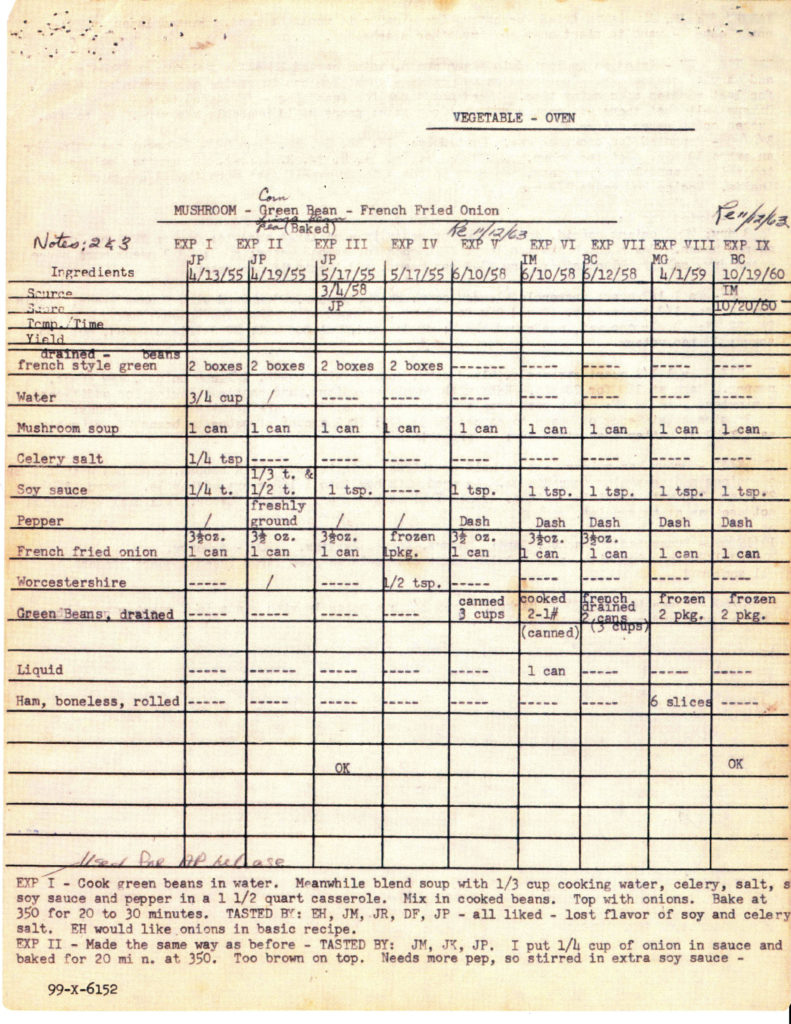
After a series of experiments, documented on a typed recipe card that is now part of the National Inventors Hall of Fame, Reilly, who was 29 at the time, hit upon the six-ingredient winner.
Now known as green bean casserole, the dish that has become a Thanksgiving icon turns 70 this year.
The original green bean casserole recipe card in the National Inventors Hall of Fame.
The “Green Bean Bake,” as it was called at the time, mainly relied on green beans and Campbell’s condensed cream of mushroom soup, along with a splash of milk, soy sauce, and black pepper. Crispy fried onions topped it off.
“It was such a rewarding feeling when your recipe was published,” Reilly told Drexel University’s alumni spotlight when she visited the campus years later. She had graduated from Drexel’s Home Economics program in 1947.
She never knew her careful experimentation (“onions too salty, beans lack freshness, too many onions,” she wrote in an early version of the recipe) would become a national star.
“How would she know of the thousands of recipes she worked on over all those years that there was one that stood out?” Reilly’s daughter, Dorcas R. Tarbell, 64, asked.
Before settling on the final ingredients, Reilly had played around with adding Worcestershire and slices of ham. Campbell’s began printing Reilly’s recipe on the back of its cream of mushroom soup can labels in 1960.
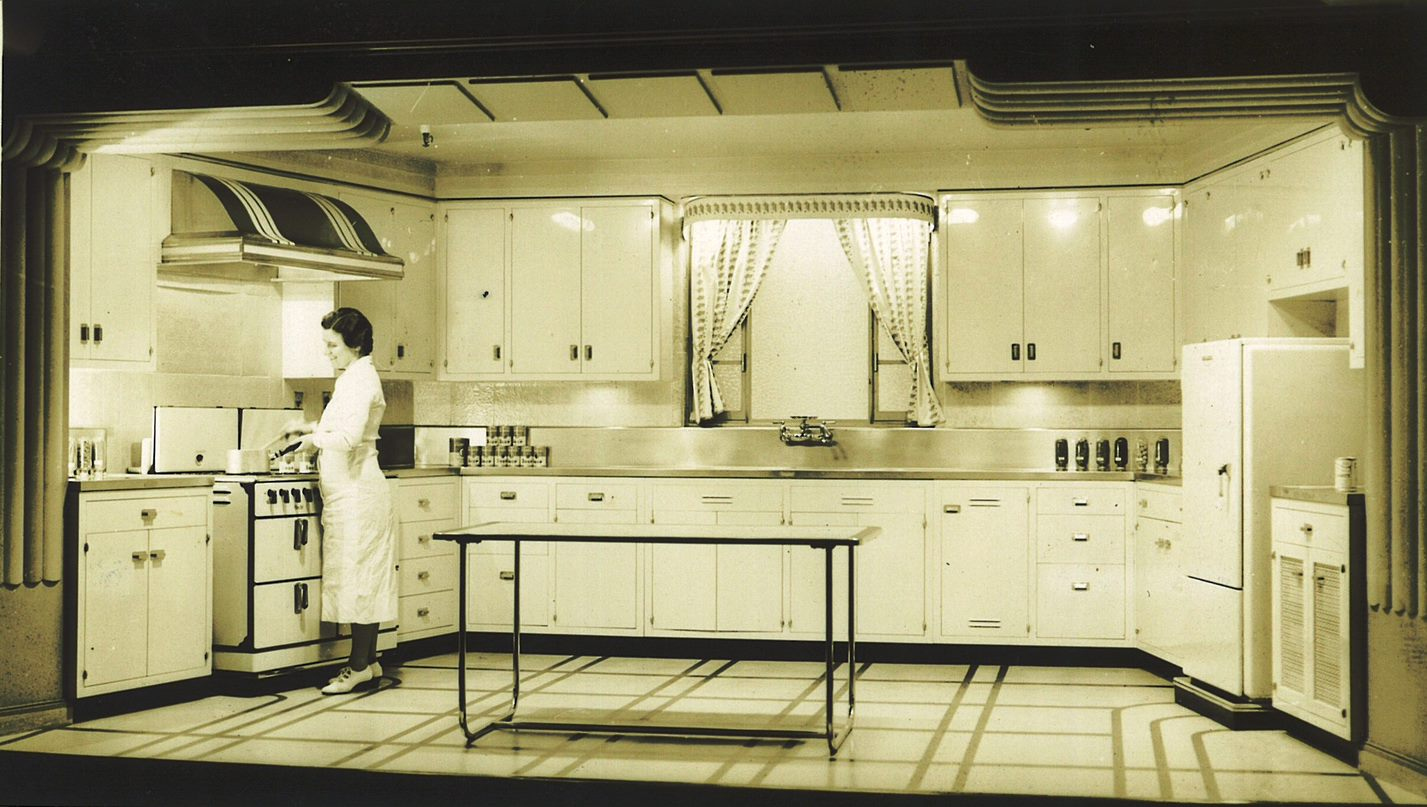
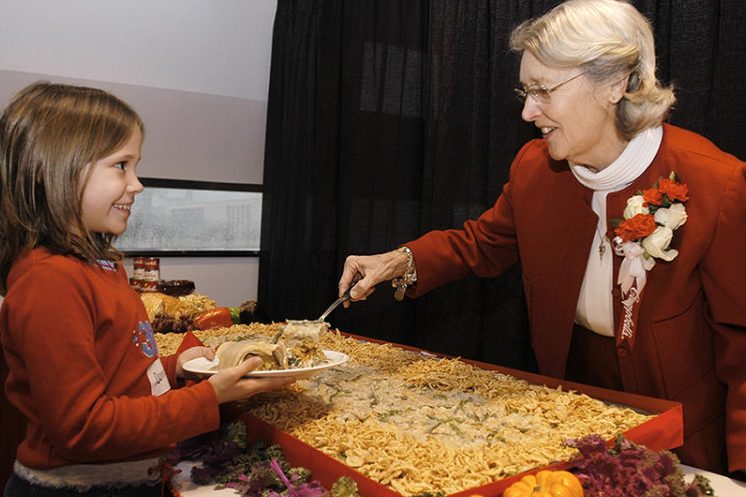
Dorcas Reilly, on the set of live TV commercials that were filmed in the late 1940s atop the original Campbell’s plant in Camden. Reilly was a Campbell’s Soup kitchen supervisor in 1955 when she combined green beans and cream of mushroom soup, topped with crunchy fried onions. It is the most popular recipe ever to come out of the corporate kitchen at Campbell’s.
Tarbell said her mother had not known how popular the dish was until 1995, 40 years after its creation.
That was when Campbell’s marketing team studied sales data and found that cream of mushroom soup sales spiked in October and November, and dropped in January. They told Reilly that her recipe was the company’s most-requested ever.
After that, Reilly became “the ambassador of the green bean casserole,” Tarbell said. Each year, she talked to radio stations and newspapers, and traveled to stockholder meetings to talk about the dish.
Reilly died in 2018 and was celebrated in obituaries across the country as the “grandmother of the green bean casserole.”
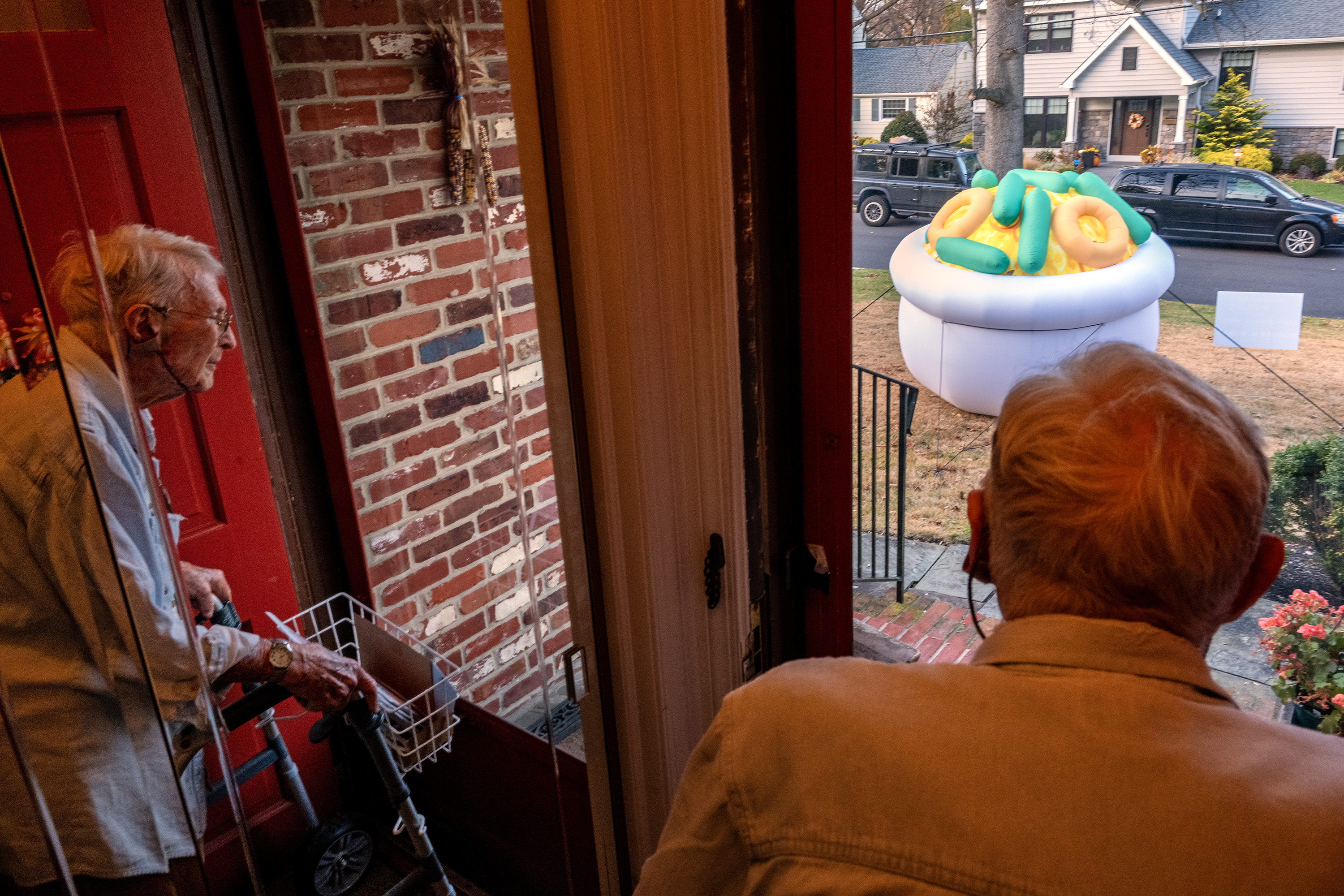
Thomas H. Reilly, 99 years old, is reflected in his foyer mirror as he looks out the front door of his home in Haddonfield at the giant inflatable green bean casserole his daughter ordered to celebrate the 70th anniversary of the famous dish.
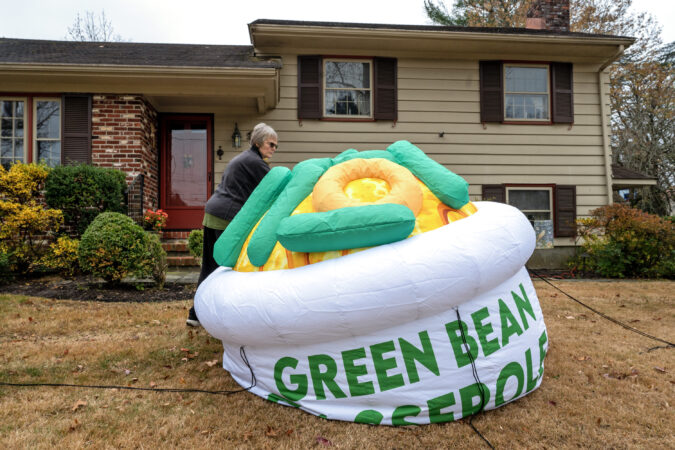
This year, to celebrate the anniversary of her mother’s famous dish, Tarbell ordered an enormous, custom-made, inflatable green bean casserole to bedeck the lawn of her 99-year-old father and Reilly’s widower, Thomas H. Reilly.
“I thought, what better gift can I give than to honor the love of his life through the green bean casserole?” Tarbell, who lives down the street, said. “At this point, you have to have humor in life.”
In a town full of yards featuring inflatable Thanksgiving turkeys and pilgrims (and a few early Santas and snowmen), the six-foot side dish stands out.
Also in honor of the 70th anniversary, Reilly’s niece, Evelynne Bates Stoklosa, who is 80, established a research grant in honor of her aunt through Phi Upsilon Omicron, a national honor society for the Family and Consumer Sciences, the modern name for home economics. The research focus for the next two years will be “areas representing culinary arts, food science, nutrition, and dietetics.”
As for her mother’s dish — which is especially popular in the Midwest — it will likely appear on more than half of Thanksgiving tables nationwide this week, Campbell said.
Growing up, Tarbell said the family never ate green bean casserole. But after they realized Reilly had created a star dish, the family embraced it.
“Of course, we have green bean casserole at Thanksgiving,” Tarbell said, adding, “We have it at Christmas. We have it at Easter.”
Dorcas Reilly and a small unnamed admirer, with the iconic green bean casserole Mrs. Reilly invented.
The 76ers have a tough time matching up with towering, athletic post players.
Even in a loss, Justin Edwards is developing into a steady player who makes the right play.
Jared McCain is starting to regain the rhythm that made him a rookie-of-the-year front-runner last season before he suffered a season-ending knee injury.
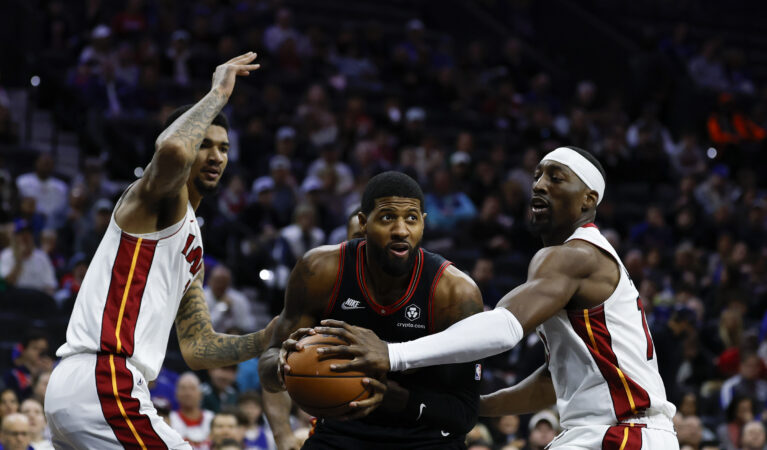
Andre Drummond was the tallest available Sixer on Sunday at 6-foot-11. Dominick Barlow, who backed him up at center, stands 6-9. Meanwhile, starting forward Paul George and reserve forward Trendon Watford are both 6-8.
Miami started 7-foot Kel’el Ware at center and 6-9 Bam Adebayo at power forward. The duo took full advantage of their height advantage. Ware finished with 20 points and 16 rebounds. He had eight points and eight rebounds (six offensive) in the first quarter. Meanwhile, Adebayo, a three-time All-Star, had 18 points and 13 rebounds.
Drummond held his own, finishing with 14 points and a season-high 23 boards for his sixth double-double in seven games. But the Sixers were outrebounded, 58-46.
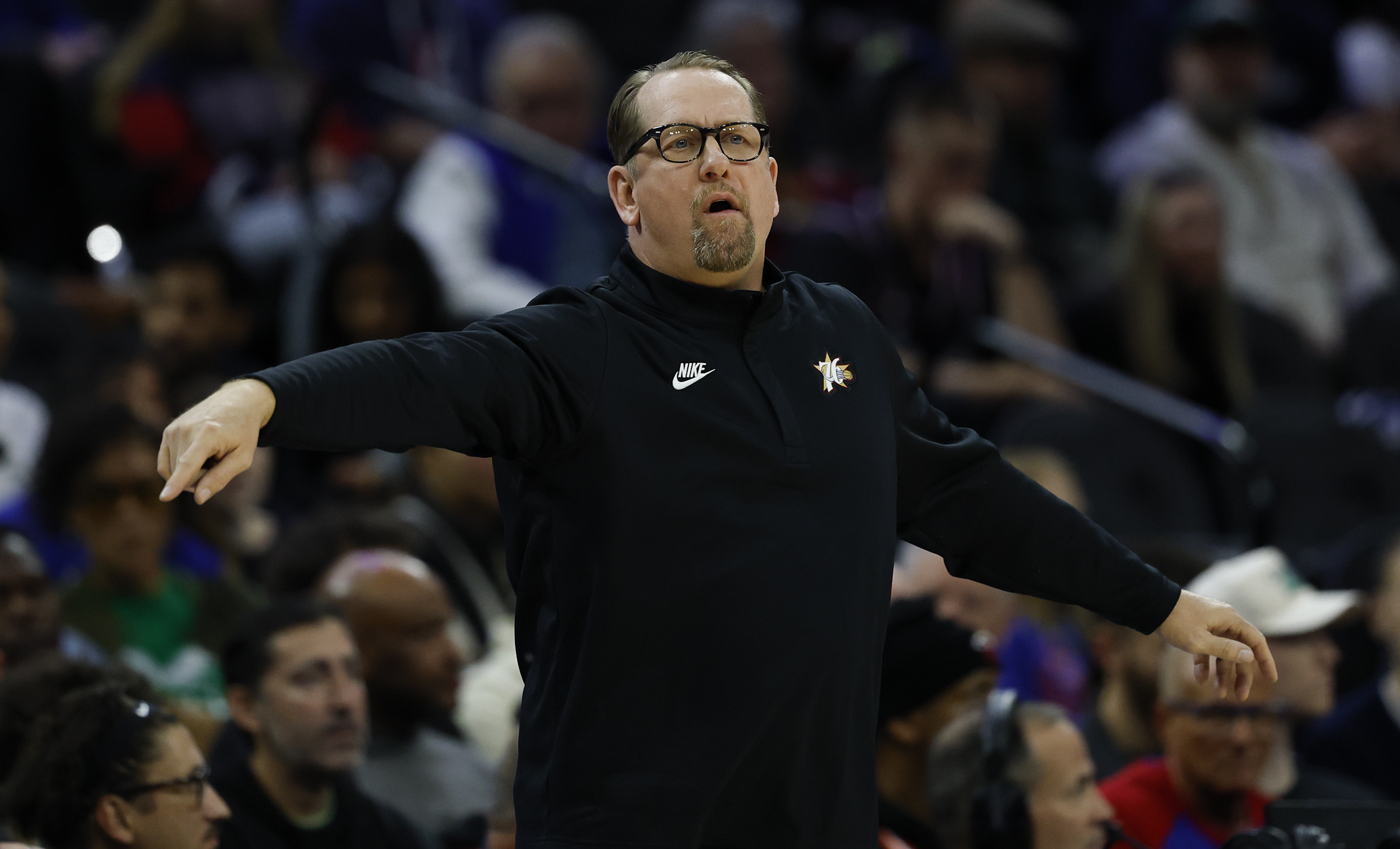
“The biggest challenge was, I think he really got going when we got into rotations for Drum being out,” coach Nick Nurse said of matching up with Ware. “His size was just a little too much for our other guys tonight with what we had out there.
“So then, we tried to do as much as we could, matching Drum with his minutes. But again, he was just a little too long and bouncy down there for us for most of the game.”
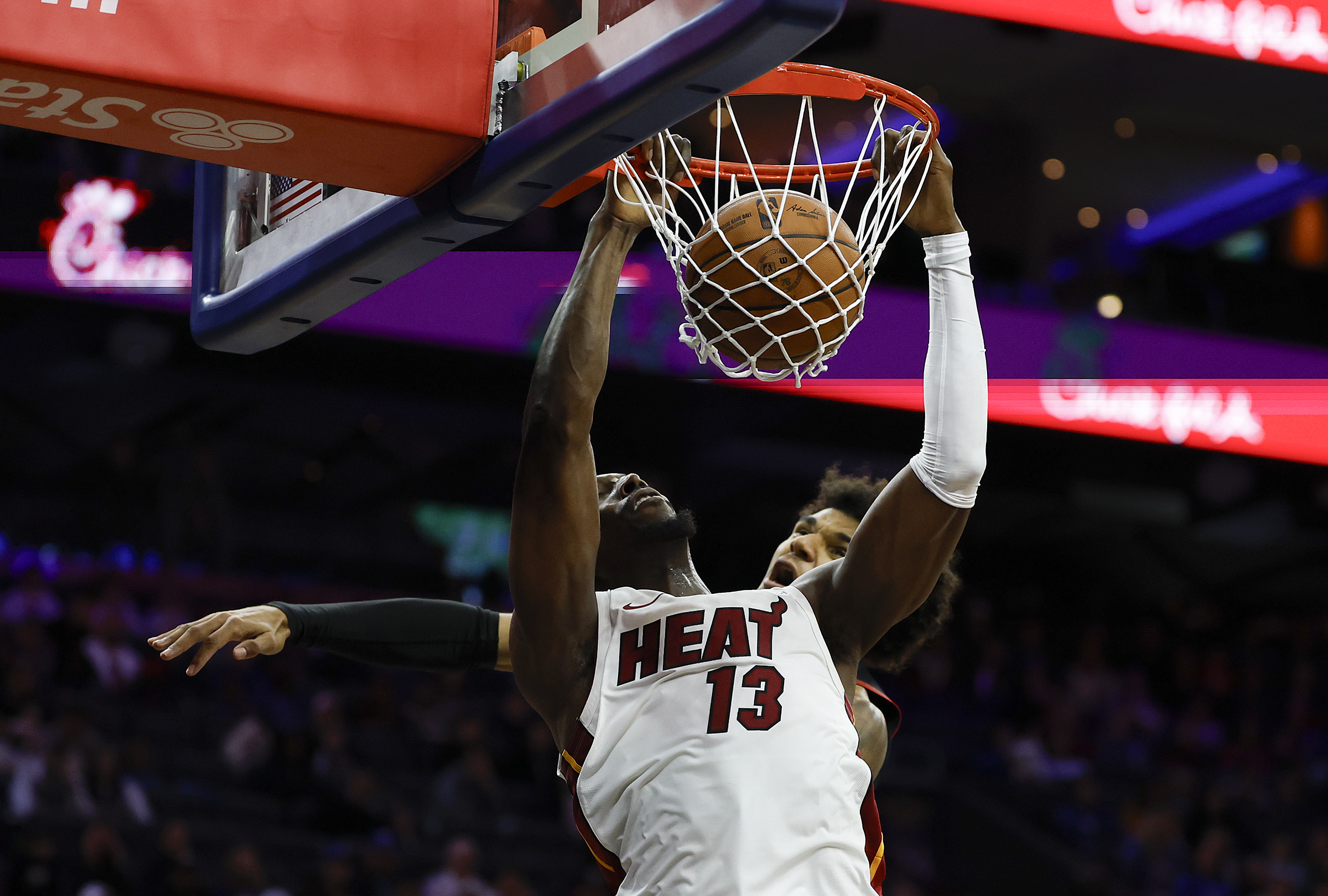
Miami Heat center Bam Adebayo dunks on Dominick Barlow in the fourth quarter.
The Heat (11-6) took advantage of the Sixers (9-7) not having starting center Joel Embiid and reserve Adem Bona.
But this isn’t the first time they have had a tough time matching up against towering post players. They struggled trying to defend Jarrett Allen and Evan Mobley in a 132-121 road loss to the Cleveland Cavaliers on Nov. 5. Embiid missed that game. Bona played, but struggled mightily against the 6-11 big men.
On that night, the Sixers held a 43-34 rebounding advantage in a game that was basically over after three quarters. Allen had 24 points, 10 rebounds, and three blocks in 29 minutes, 31 seconds. Mobley added 23 points, five rebounds, and three blocks in 34:02.
The Sixers need to find a way to erase their margin of error, regardless of who’s available to play.
“I think who is in and out of the lineup is out of our control. Let me start with that,” Drummond said. “And the guys who do play, we play to the best of our ability. We’re playing good teams. And you know it’s hard to find a rhythm when we are not knowing who we are playing with on a nightly basis. So still not an excuse. I think this game was very winnable for us.
“Just a few mistakes down the stretch of the game. It’s a good team we’re playing. It’s a great team. So we’ll get them next time.”
Drummond has a point: This was a winnable game. The Sixers battled back from a 16-point deficit, closing the gap to two points (105-103) on Trendon Watford’s layup with 8:28 remaining.
The Heat responded with a 13-2 run to put the game out of reach.
Tyrese Maxey had 27 points on 10-for-23 shooting along with six assists, two steals, and three turnovers before exiting the game with 1:29 left.
But the Sixers must do a better job of defending opposing bigs regardless of who’s on the floor. If not, they could be in trouble.
Edwards’ heady plays
Edwards made his third consecutive start at small forward in place of the injured Kelly Oubre Jr. (sprained left knee). The former Imhotep Charter standout is doing a solid job of filling in.
Edwards is starting to develop a knack for making the right play. He knows that his teammates, Maxey and George, are the go-to players. So he spaces the floor, hustles for loose balls, crashes the boards, and looks for his shot only when he is open.
Doing that, Edwards finished with seven points on 3-for-8 shooting to go with four rebounds, three assists, two steals, and two blocks against the Heat.
The second-year player out of Kentucky also did a solid job of getting Maxey the ball. One of his assists came on Maxey’s three-pointer right before the shot clock expired with1:22 remaining in the half. On the next possession, he assisted on McCain’s three-pointer.
“I’m just playing basketball, making the right play,” Edwards said. “That’s what I do. That’s my role. I’m not trying to play outside of my role. I’m just going to do whatever keeps me on the court. I’m not going to go out there, trying to play Tyrese Maxey’s role. That’s not my role.
“So I just make the right play. If I’m open, I’ll shoot it. If I drive and they [bring] help, whoever the next man is, I’ll pass it. It’s the right play, honestly.”
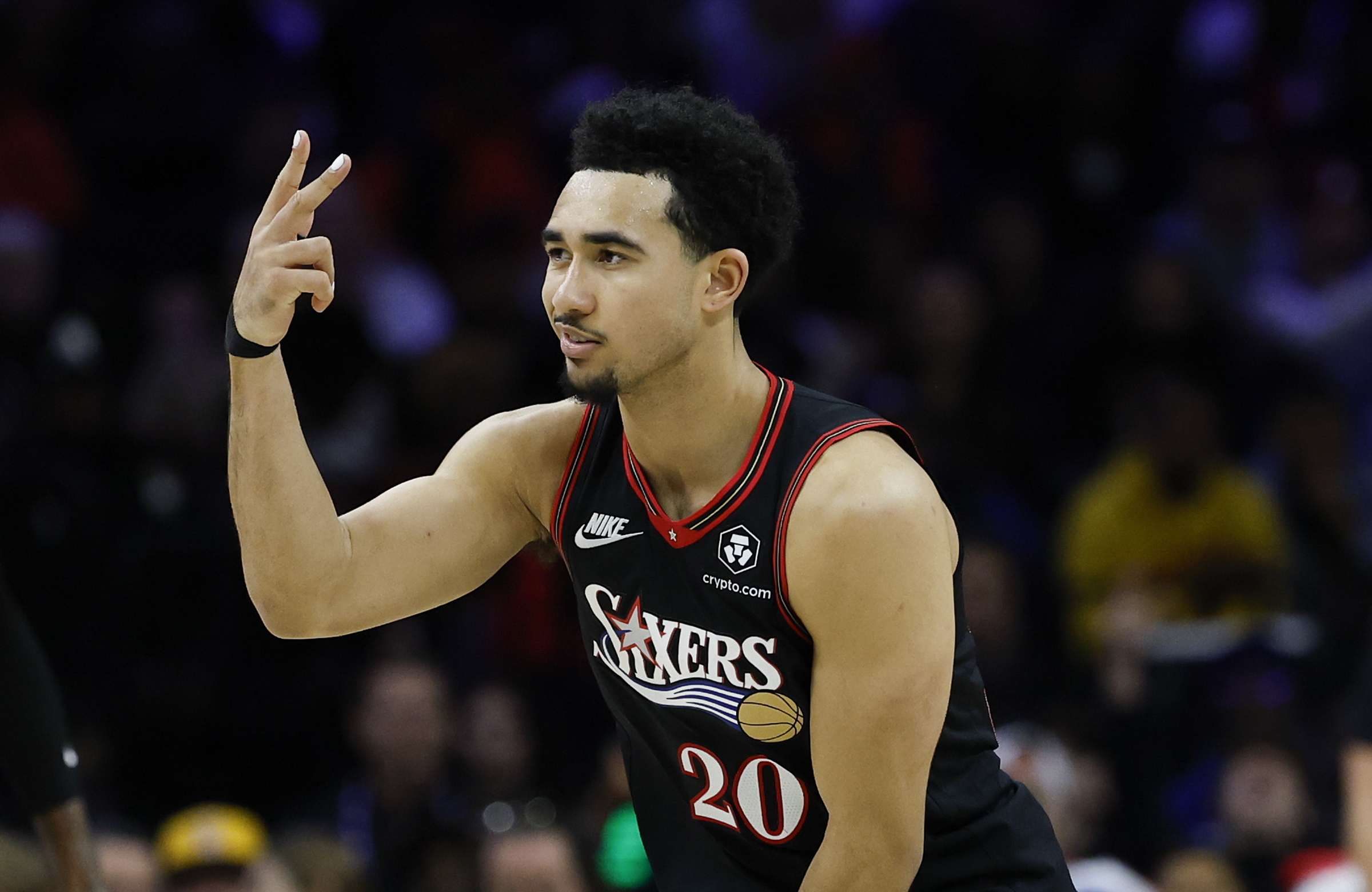
Sixers guard Jared McCain reacts after making a third quarter three-point basket.
McCain’s best game
McCain posted his best performance of the season with a season-high 15 points on 5-for-11 shooting — including making 3 of 4 three-pointers — in a season-high 25:43. The second-year guard had eight points in 13 minutes on Thursday against the Milwaukee Bucks and five points in 14 minutes the night before vs. the Toronto Raptors.
McCain failed to score on a combined 0-for-9 shooting during his first four games of the season. The 6-3, 210-pounder is starting to show his scoring prowess as he gets reacclimated to playing basketball.
He made his season debut on Nov. 4 against the Chicago Bulls at the United Center. McCain was rusty in his first game since suffering a lateral meniscus tear in his left knee on Dec. 13, 2024. He was supposed to return in time for training camp, but a torn ligament in his right thumb cost him the first six games of this season.
“It definitely felt the best,” McCain said of Sunday’s game. “I think each game is just getting more reps on the knee and more reps of movement. But I felt really good today.
“Felt like I got a little burst for my first step, and yeah, just continue to build off each game. And the more minutes I play and the more time I’m in, I feel like I can get more reps up. And yeah, it felt really good.”
Sixers coach Nick Nurse watches his team take on the Miami Heat.
Injuries have certainly hurt
Sunday was the Sixers’ 16th game of the season. By this time, teams should have a pretty good idea of their competitiveness.
But that hasn’t been the case for the Sixers because of injuries, preventing a full lineup. Embiid missed his seventh consecutive game because of knee injuries. He missed the last six games with right knee soreness. He also missed the Sixers’ Nov. 9 home loss to the Detroit Pistons for injury management on his left knee.
Meanwhile, Oubre and Bona (sprained right ankle) missed their fourth consecutive games. Sunday marked the first game that VJ Edgecombe sat out because of left calf tightness.
It also marked the third game that George (left knee injury recovery) has played in since being sidelined for the first 12. Two other Sixers — McCain and Watford (hamstring tightness) — were sidelined at the start of the season. And it was Barlow’s fifth game back after missing nine with a lacerated right elbow.
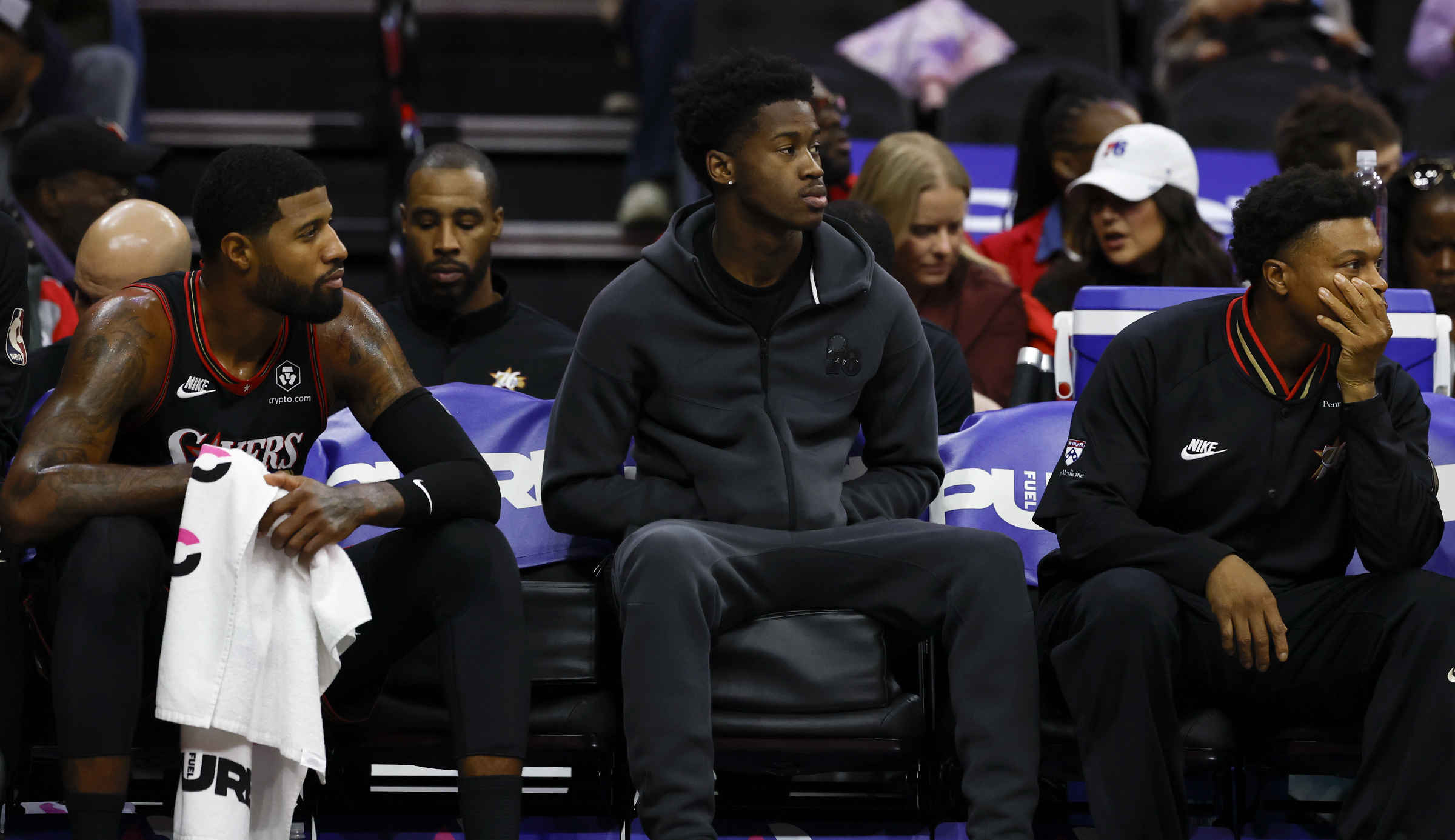
Sixers guard VJ Edgecombe (center), who missed his first game of the season, watches his teammates take on the Miami Heat with forward Paul George (left) and guard Kyle Lowry.
As a result, the Sixers started Edwards, George, Drummond, Quentin Grimes, and Maxey against the Heat.
While the situation isn’t ideal, Nurse hasn’t been concerned by how the injuries have slowed the evaluation process. He actually sees it the other way.
“I think we are getting some really good evaluations on a lot of the younger guys that we maybe wouldn’t have gotten,” Nurse said. “But, you know, obviously, we barely integrated Paul and Joel. Paul’s [played around 65 minutes]. Joel’s played six games. Most of those were minutes restricted, right? I think we’re still trying to work Jared McCain back into it. He’s still minutes restricted. I think I’m not in a big hurry to evaluate and figure out who we are right now, just trying to play as hard as we can each night and keep kind of working these guys back in.”
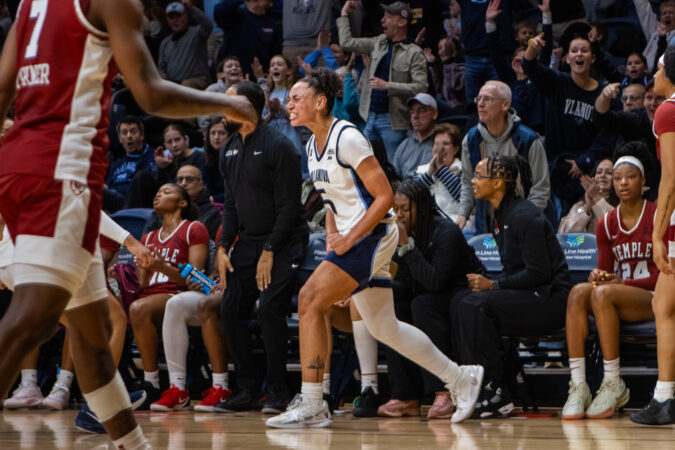
In a rematch of last year’s Big 5 Classic championship game, Villanova soundly defeated Temple, 88-58, at the Finneran Pavilion on Saturday night.
The Wildcats secured revenge over the Owls after falling in a competitive 76-62 matchup on Dec. 7, 2024.
Five Villanova players scored in double digits in its highest-scoring game of the season. Senior guard Ryanne Allen, who scored 19 points, and graduate forward Denae Carter, who recorded 17 points and five steals, each marked career highs in scoring.
“That was a tough loss last year,” Allen said. “This week in practice, we were reminding the people that weren’t here about that loss, and how we wanted to get that back. So that was a huge impetus for us, especially losing on our home floor. We didn’t want it to happen again, so it was nice to get that win back for us.”
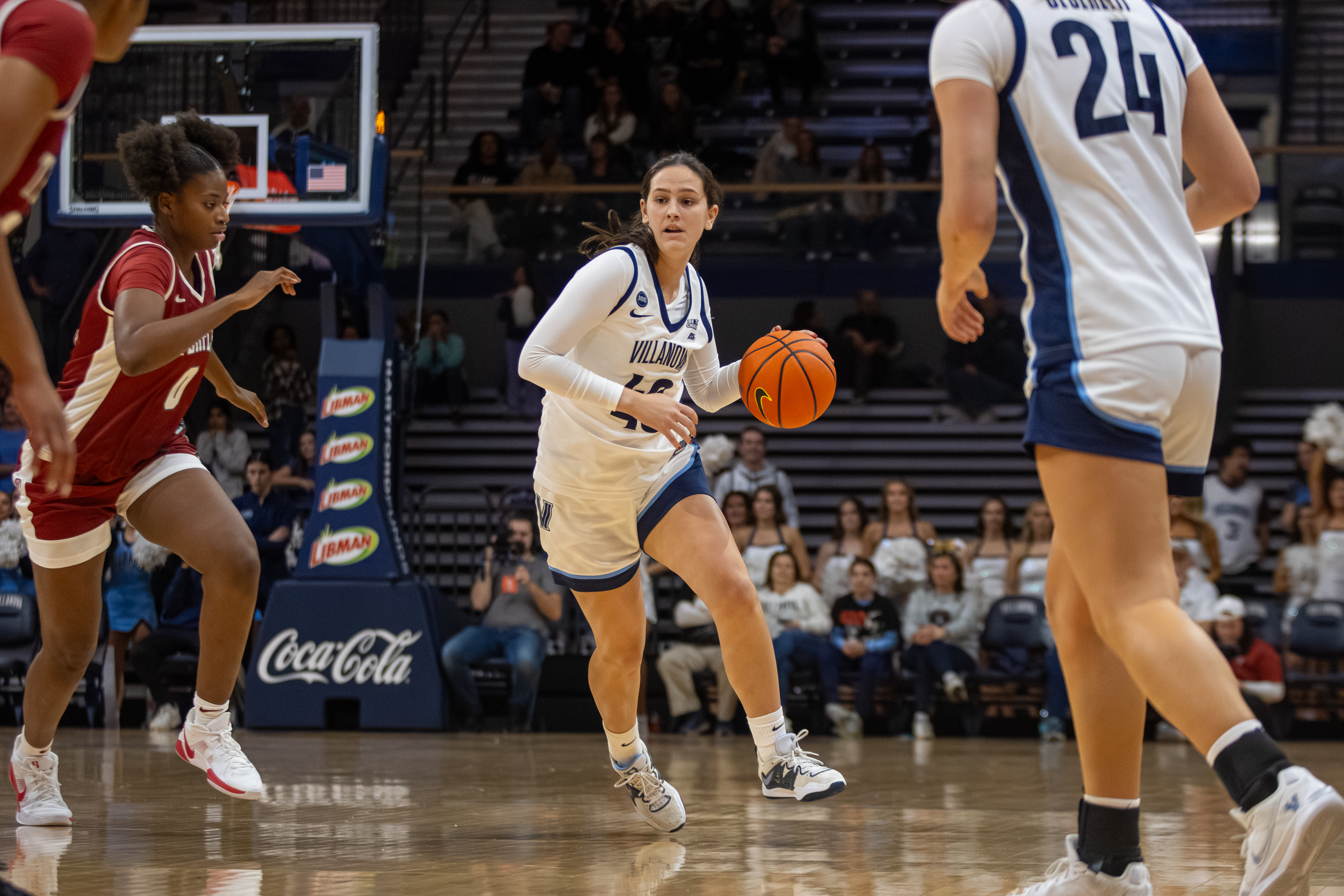
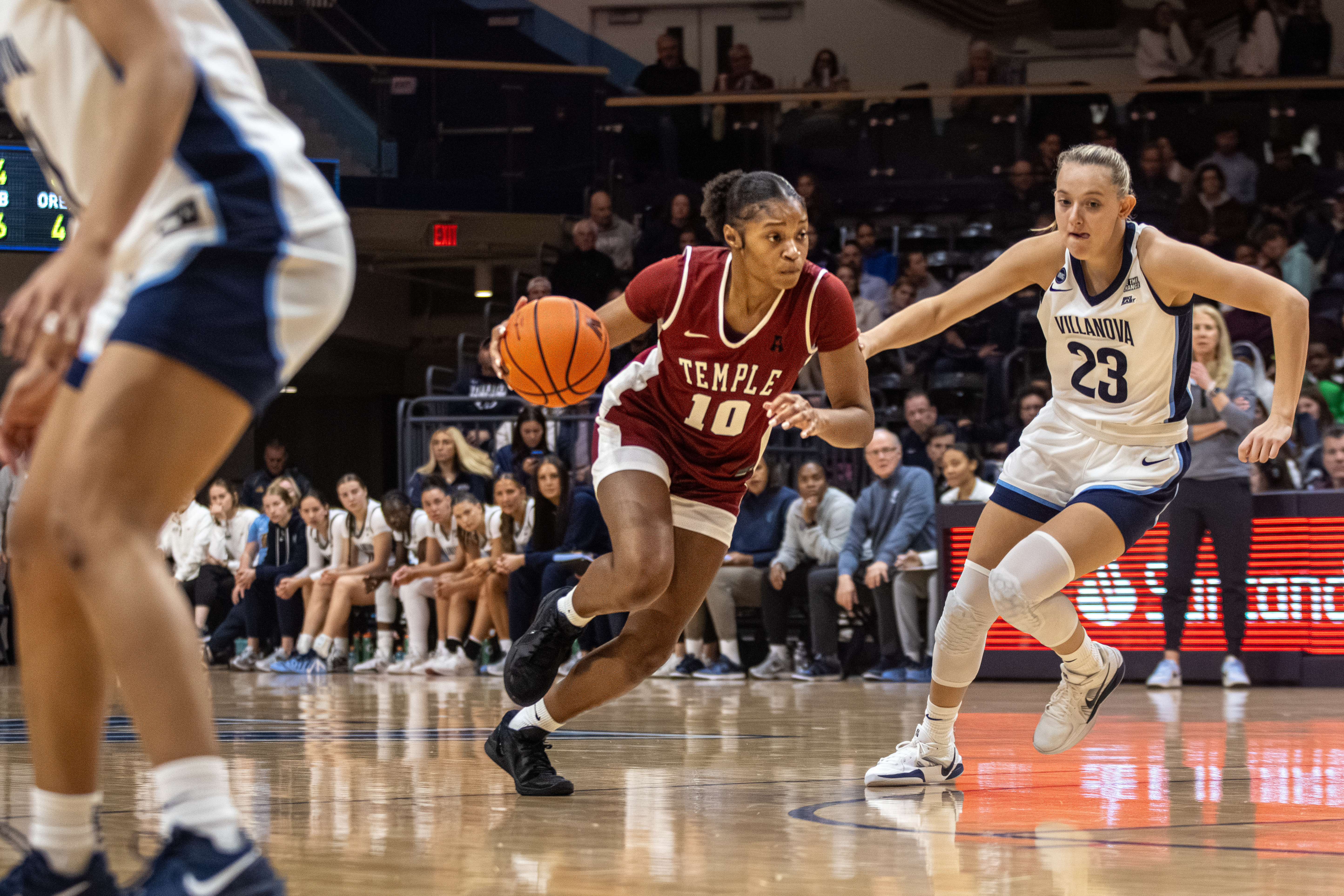
Villanova’s Annie Welde brings the ball upcourt against Temple on Saturday.
Junior guard Tristen Taylor led Temple with 15 points and four assists. Junior forward Jaleesa Molina recorded a game-high nine rebounds. Temple outrebounded Villanova, 34-29.
With the loss, Temple split its two Big 5 “pod” matchups leading up to the Big 5 Classic triple-header on Dec. 7. The Owls defeated La Salle, 75-54, on Nov. 14.
Villanova’s second-quarter surge
Freshman guard Jasmine Bascoe brought early energy for Villanova from the backcourt, scoring eight points and notching three steals in the opening 10 minutes. As the clock expired to end the first quarter, Bascoe intercepted a Temple pass and drove to the basket to tie the score at 13.
The Wildcats carried the momentum into the second quarter, going on an 8-0 run over just 57 seconds. A pair of three-pointers from senior guard Allen and freshman guard Kennedy Henry, along with a layup from junior forward Brynn McCurry, allowed Villanova to take a 21-15 lead and force Temple to call a timeout.
“The second quarter really punched us, and we didn’t respond well enough, especially because [Villanova] got a lot of points in transition,” Temple coach Diane Richardson said.
The Wildcats surged from there, going on an 18-1 run over 4 minutes, 31 seconds.
Meanwhile, Temple faltered, shooting just 5-for-14 from the field while conceding six turnovers in the second quarter.
Temple’s Savannah Curry drives against Villanova’s Kelsey Joens.
Allen’s career night
Allen drained her fourth three-pointer of the night to send the Wildcats into halftime with a 20-point lead. She finished the night shooting 7-for-8 from the field and 5-for-6 from three. She also notched a career high of six assists.
The Wildcats dominated the second half, leading by 20 points or more throughout the third and fourth quarters. Villanova was especially successful in transition, gaining 26 points on the fastbreak in contrast to Temple’s six across the game.
“What I was most pleased with was the assists,” Villanova coach Denise Dillon said. “When you have 27 assists on 35 field goals, that’s good team basketball. That’s impressive.”
Next up
Villanova will visit La Salle on Tuesday at 6:30 p.m. Temple will host Michigan State on Friday at 6:30 p.m. Villanova will host the 2025 Big 5 Classic triple-header at the Finneran Pavilion on Sunday, Dec. 7.
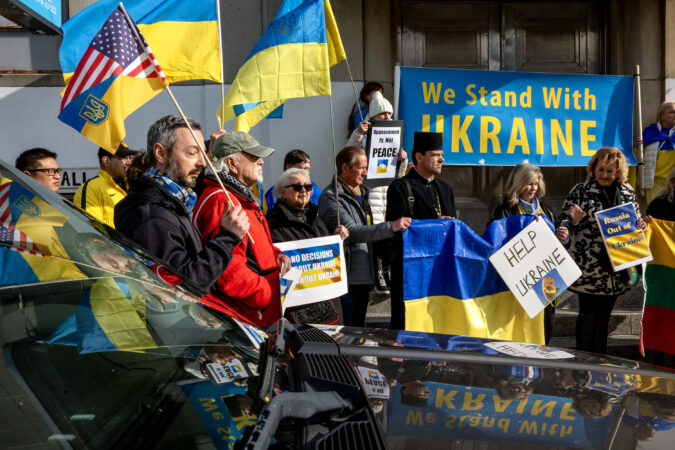
Waving Ukrainian flags and hoisting signs that read, “Appeasement Isn’t Peace,” demonstrators outside the Ukrainian American Citizens’ Association described the plan as a laughable, “copy-and-paste” of Russia’s demands, signaling America’s willingness to capitulate to the Kremlin.
The peace deal put together by Washington and Moscow calls for Ukraine to cede territory, reduce its military, and give up on NATO membership — stipulations that Ukrainian President Volodymyr Zelensky has categorically rejected in the past.
“Nobody in their right mind would ask a country to give up its territory, its military, its freedoms,” said Ulana Mazurkevich, president of the Philadelphia-based Ukrainian Human Rights Committee. “They do not know Ukrainians. … We will not give up — we fight, we fight, we fight.”
The 28-point blueprint to end the nearly four-year war may force Ukraine to choose between standing up for its sovereignty and preserving American allyship, Zelensky said last week when the proposal was leaked. Simultaneously on Sunday, world leaders convened in Geneva, Switzerland, to discuss the contentious plan. (Trump has pushed Ukrainian officials to accept the plan by Thanksgiving.)
“We will rebuild but it won’t be the same, and I just feel such pain and anger at how much they have taken from us over and over and over again,” the rally’s co-organizer Mary Kalyna said. “It’s not just dirt, there are people there.”
Kalyna added: “It’s like a reward for the aggression, which we will not stand for. We cannot stand for it.”
Olena Chymch (right), from Germantown, joins other Ukrainians and Ukrainian Americans at an emergency rally Sunday Nov. 23, 2025, to protest the 28-point “peace plan” for Ukraine.
While Russia would make almost no concessions, the plan would severely weaken an already decimated Ukraine; in return, Kyiv — which has said it was not involved in the drafting of the peace proposal — would receive international security guarantees and reconstruction assistance.
Bucks County U.S. Rep. Brian Fitzpatrick, a longtime defender of Ukraine and member of the Ukraine Caucus, called the plan “Russian-drafted propaganda” on social media.
Correction: The United States wants Russia’s answer on an unconditional withdrawal of Ukraine by Thursday.
This Russian-drafted propaganda must be rejected and disregarded for the unserious nonsense that it is. This moment requires Peace Through Strength, not appeasement.… https://t.co/BQCxtkeMFD
Between renditions of the Ukrainian national anthem and “Glory to Ukraine” salutes, protesters on Sunday also rebuked the plan’s amnesty agreement, which would likely mean Russian officials and soldiers could not be prosecuted for war crimes. “The rapists, the murderers, the genocidal maniacs … are all supposed to be forgiven — absolutely no prosecutions,” said Ukrainian American Eugene Luciw.
“That’s what America stands for? Does America stand for justice?”
This article contains information from the Associated Press.
How quickly things can change across an 82-game season.
If the Flyers had lost on Saturday, it would have been their fourth in six games. Instead, a quick spurt of goals that started a cascade led to a 6-3 win against the New Jersey Devils, and now they have won three of four.
This time last year, the Flyers were 8-10-2, and two seasons ago, when they came close to a playoff spot, the Flyers were 10-9-1 through 20 games.
At the 20-game mark this season, the Flyers are 11-6-3 and sit in a playoff spot in a supertight Eastern Conference.
Here are seven things we learned Saturday that the Flyers can carry through the next 20 games.
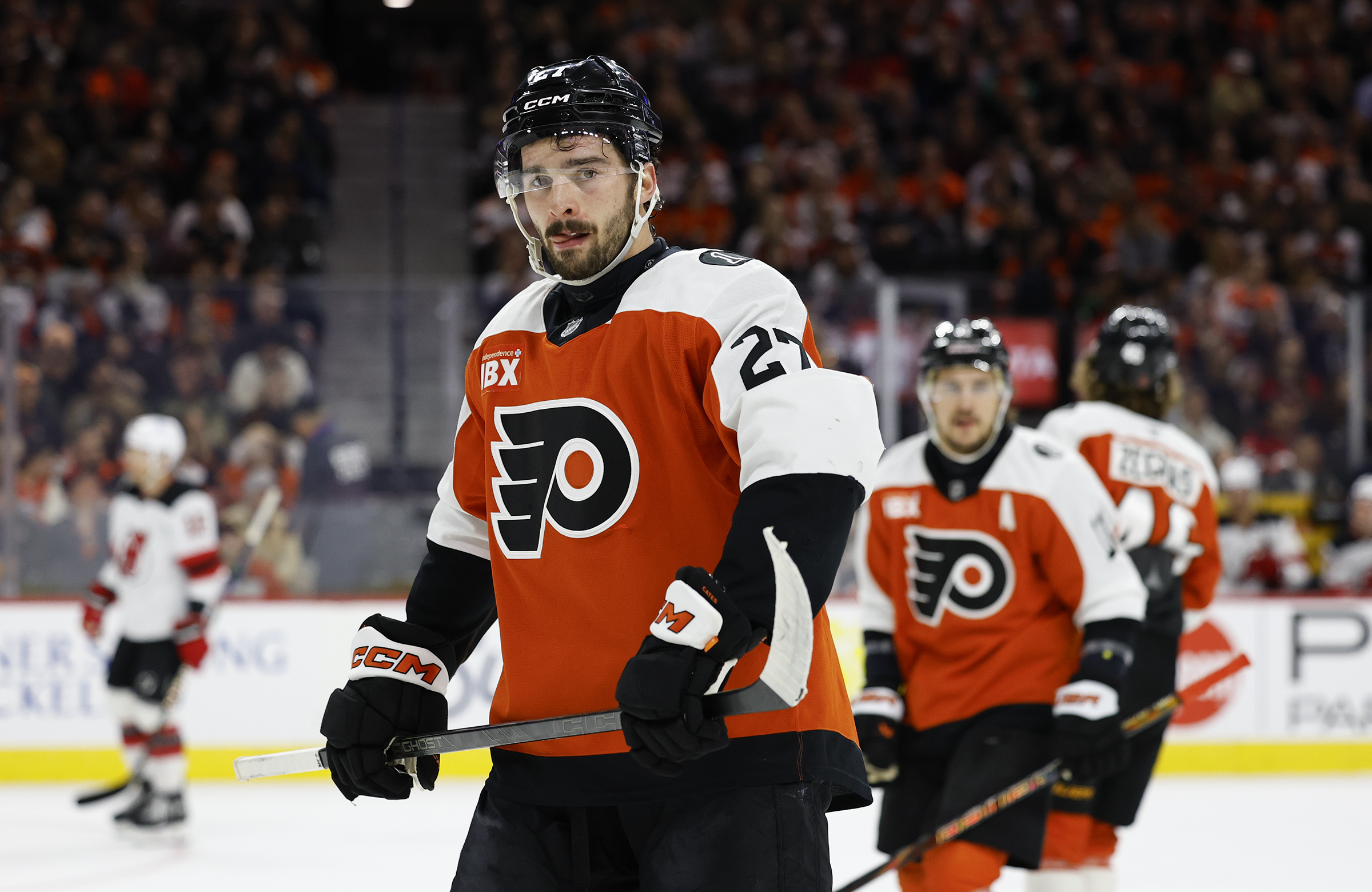
Flyers right wing Tyson Foerster (center) celebrates his second goal with Travis Konecny (left) and Noah Cates.
This team can score goals
It’s been a slow process as the team learns coach Rick Tocchet’s offensive systems, but it has been building. Entering the night, the Flyers were ranked 29th in the NHL in goals per game (2.63). However, in the last five games, including Saturday night, they rank 12th with an average of 3.20 goals. And against New Jersey, they set a franchise record with three goals in 26 seconds.
“To get one, and get the building into it, obviously a couple of quick [goals] after that was awesome,” said Noah Cates, who tied the score at 1 and scored the first of four Flyers’ goals in 3 minutes, 32 seconds. “Just keeping our foot on the gas and getting pucks out and being predictable early is kind of what we’re preaching right now, and we’ve just got to keep it up.”
Added Sean Couturier: “Obviously, if we get more shots on net, the odds should be a little more in our favor. But I think it’s more than that. Today, we forechecked pretty well. We created turnovers, and that’s hard to defend for any team. So off of that, we can create some offense, get some shots, and at the same time, when we had our chances, we capitalized.”
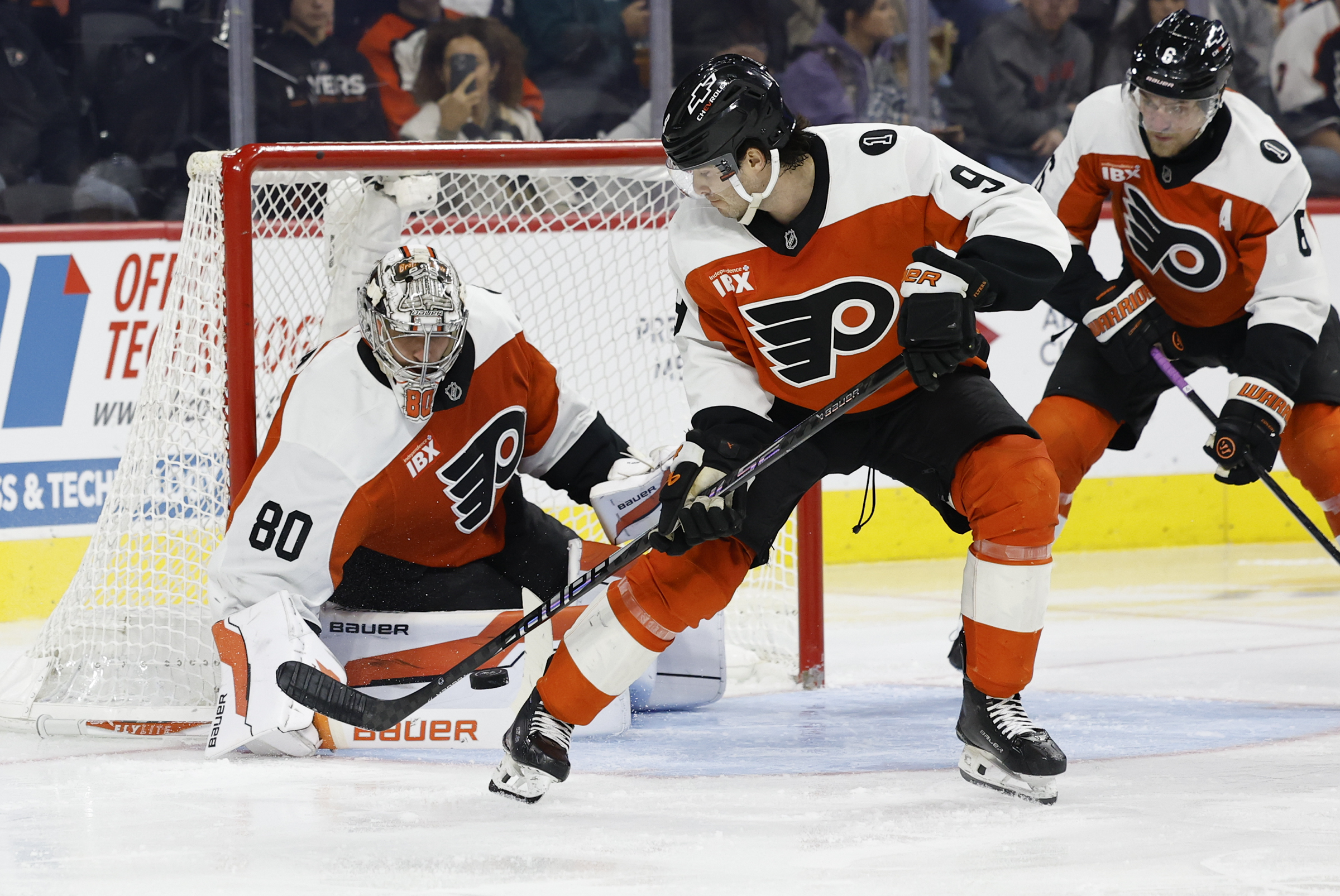
He is always known as an offensive defenseman, but Jamie Drysdale’s defensive game continues to grow and impress. The second pairing of Drysdale and Emil Andrae was not on the ice together for any goals by the Flyers, but they were also not on the ice for any against.
According to Natural Stat Trick, they skated together for 14 minutes, 6 seconds across all strengths, and allowed 12 shot attempts, including six shots, and six scoring chances. And in the third period, Drysdale combined with Cates to help keep a loose puck in the crease out of the net after a weird carom off the boards took goalie Dan Vladař out of the play.
“Thought Drysdale was our best player tonight. … For defending, he was our best defender by far,” Tocchet said. “I thought Andrae, too. Andrae is not scared of going into corners. I thought those two guys were really defending hard.”
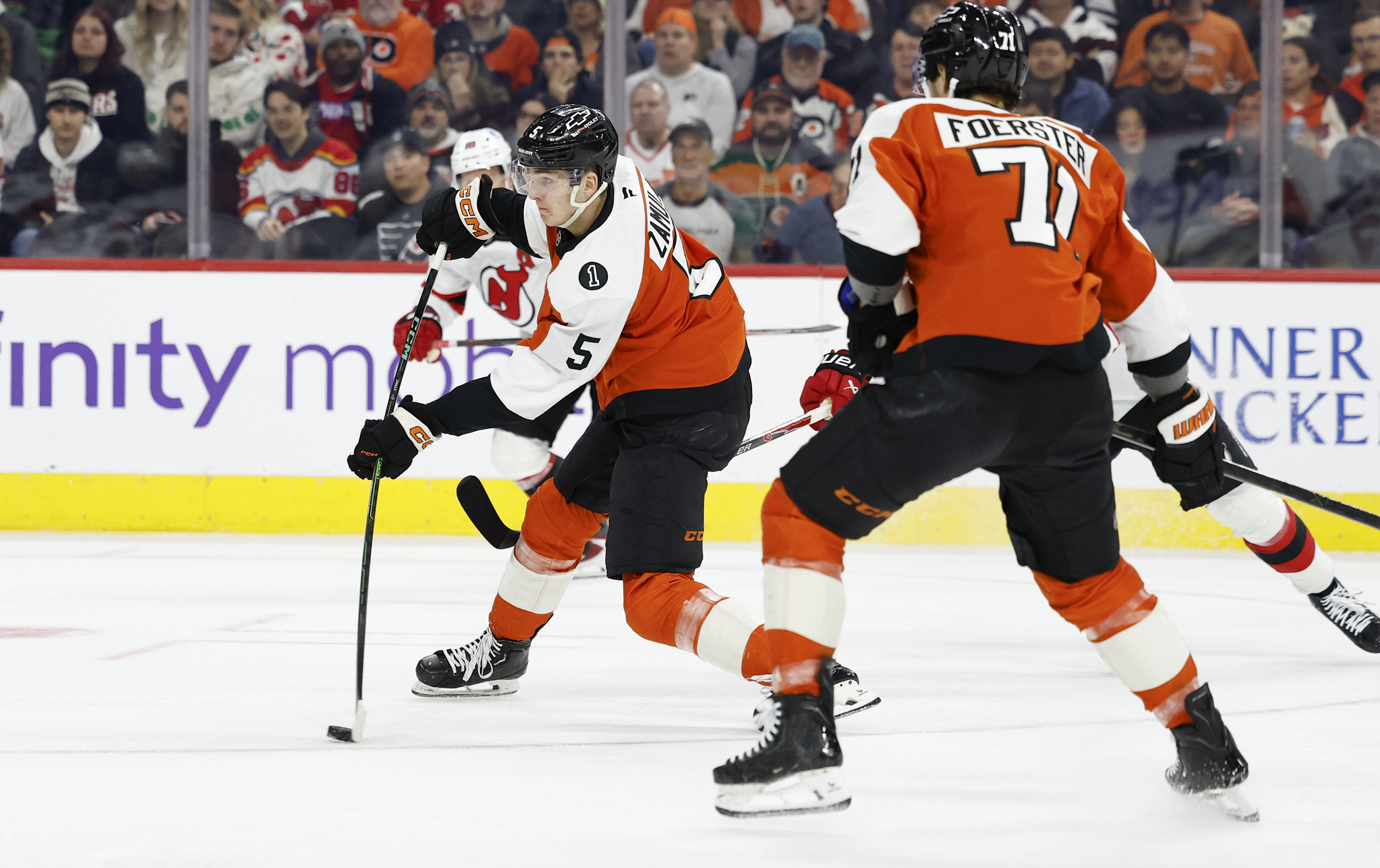
Flyers defenseman Egor Zamula shoots the puck against the New Jersey Devils on Saturday.
Flyers have depth on defense
Skating in his first game since Nov. 1, Egor Zamula admitted he was “kind of nervous” on his first shift. Makes sense considering he had played in only eight of the Flyers’ first 19 games.
But the blueliner put on an impressive show, skating alongside his old partner Nick Seeler and finishing at plus-5. Although they hadn’t played together this season, across the last three seasons, Zamula played the second-most minutes with Seeler (246:46).
Seeing the Russian slide back into the lineup seamlessly — and showing versatility — is a good sign for the depth on defense.
The top pair of Cam York and Travis Sanheim continues to drive the defense. Noah Juulsen, who sat for the first time this season, has been a steady presence on the third pair, and the Flyers also have Rasmus Ristolainen inching closer to a return from injury.
First blood
Once again, the opposition got on the board first when Timo Meier scored on a wacky sequence during a power play. But, as Tyson Foerster said, “It isn’t great, but we bounced back.”
Indeed. It’s never ideal to fall behind early in games. However, maybe for the Flyers it is. They lead the NHL with eight wins — a reminder, they have 11 total wins on the season — when trailing first.
Balanced offense
Against the St. Louis Blues a week ago, the Flyers won, 6-5, in a shootout, but got all the scoring in regulation from one line. On Saturday night, three of the four lines got on the board.
The uptick comes after the Cates, Foerster, and Bobby Brink line was broken up. Cates and Foerster are still together, but now have Travis Konecny on the right wing. They combined for three goals against New Jersey, with Foerster getting a pair.
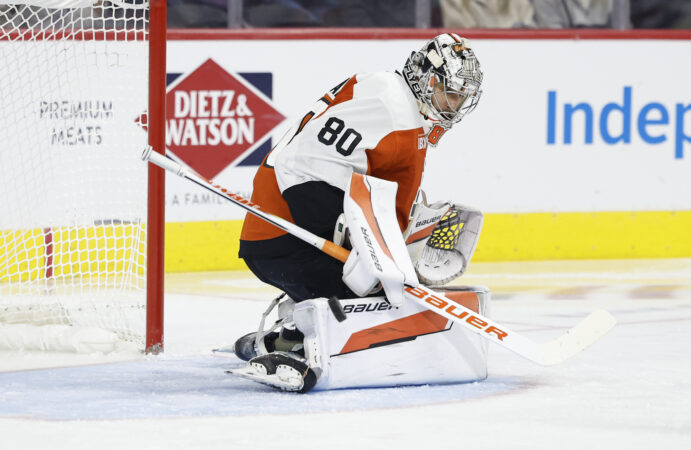
Flyers goaltender Dan Vladar watches the puck with defenseman Jamie Drysdale and defenseman Travis Sanheim against the New Jersey Devils.
Brink was moved alongside Matvei Michkov and Couturier, and the Minnesotan scored after receiving a pass from the captain — who kept the puck away from two defenders — in the second period. In the first period, it was Couturier feeding Michkov for a breakaway after the Russian winger read the play properly and sprinted ahead.
“What I like is he backchecked, he was in a good position, and once he saw we got full puck possession, he just took off, which is what we want,” Couturier said of the goal that started the 26-second, record-breaking frenzy. “When you have a guy like that, that you can send alone on a goalie, I like our odds.”
The line of Owen Tippett, Trevor Zegras, and Christian Dvorak was on the ice for one Devils goal but made up for it in the third period with Zegras getting on the board. Zegras now has 21 points in 20 games.
And while the fourth line of Rodrigo Ābols, Garnet Hathaway, and Nic Deslauriers didn’t score, they played a role in keeping the energy up.
“Every time they’re out there, they’re creating momentum,” Couturier said. “They’re three big boys that can shoot the puck in and lay the body; I’m sure it gets tiring for defenders on the other team. So, yeah, even if they don’t score, they bring a lot and help us along the way with the momentum swings.”
Added Tocchet: “I thought the [Ābols] line again, I thought Abs had a good game. … I thought he forechecked well and held onto some pucks. It’s nice when you can get some minutes to those guys. But, yeah, balanced offense was great.”
Vladař is No. 1
Tocchet did say recently that he thought his team backed in more with Sam Ersson in net, which saw him face harder shots, leading to a lower save percentage. The backing in did occur, with less frequency, with Vladař in net, but it has stopped for now — as noted by the rush chances and strong transition game the Flyers had on Saturday. Regardless, it’s clear that the net is Vladař‘s for now.
Among goalies with at least 10 games this season,Vladař ranks No. 4 in goals-against average (2.42) and save percentage (. 912). He is 8-4-1 in 13 games, with 10 of those showcasing a save percentage above .900.
Flyers left wing Noah Cates in action against the New Jersey Devils.
According to Natural Stat Trick, he stopped all 14 low-danger shots he saw from the Devils, nine of 10 mid-danger, and six of eight high-danger. He came up huge in the third period as New Jersey was pressing, stopping Meier off a cross-crease pass on a two-on-one and robbing Nico Hischier between his pair of goals when the Devils captain had two big chances while shorthanded.
One loud arena
In front of a sellout crowd at Xfinity Mobile Arena, the Flyers brought the entertainment. Was it the loudest Foerster has heard? “Yeah, and when Anaheim came to town,” he said with a big grin. That game saw former Flyers prospect Cutter Gauthier make his debut in Philly.
A former Flyers forward, Tocchet also heard the fans loud and clear.
“I’ve lived it here, this crowd. When they get something to cheer about, it’s loud. … They’re a big part of it,” Tocchet said. “So, we’ve got to continue to push the envelope to get these guys on our side, because they want to believe in our team and that starts on the ice with us.”
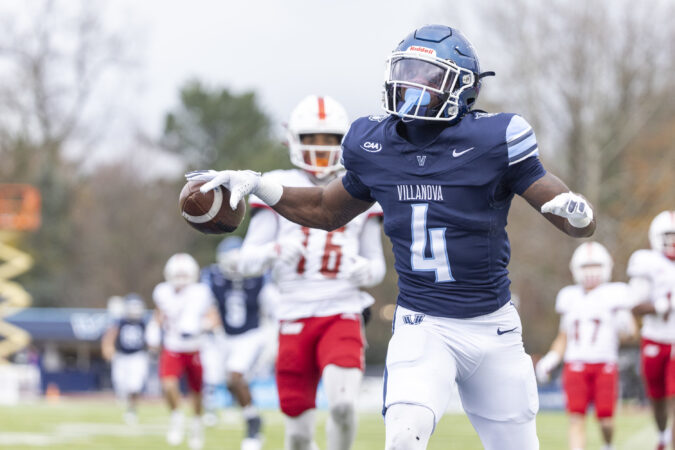
Twelfth-seeded Villanova will host Harvard on Saturday at noon in the first round of the NCAA Football Championship Subdivision playoffs.
Villanova (9-2, 7-1 Coastal Athletic Association) made the playoffs for the third straight season and the fifth time in seven years. The Wildcats are among three CAA teams that made the 24-team FCS field.
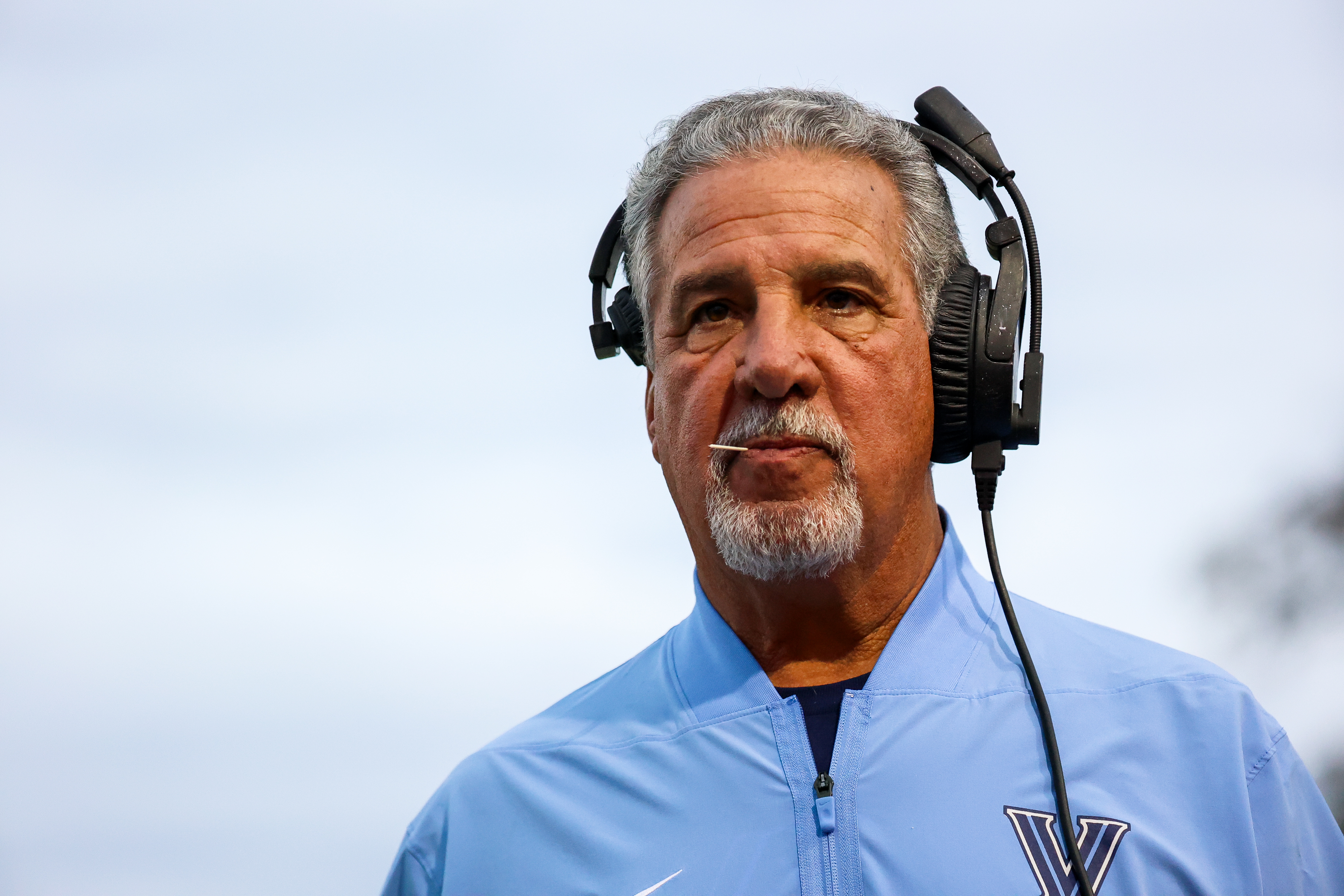
“When you see your name up there, it goes up on the board, especially to be the home team, that’s exciting,” Villanova coach Mark Ferrante said. “So we’re just grateful, thankful, and excited to be playing the first round of the playoffs at our stadium.”
The Wildcats closed out the regular season on an eight-game winning streak and were undefeated at home. Villanova’s home winning streak of 22 games is the longest active streak in Division I football.
Harvard (9-1, 6-1 Ivy) is playing in the postseason for the first time in its 152-year history after the Ivy League Council of Presidents approved a proposal last year allowing its teams to participate. Harvard played Yale on Saturday for the Ivy League’s automatic bid into the playoffs. Yale claimed the automatic bid with a 45-28 win. Harvard was awarded an at-large playoff berth and is not among the 16 seeds.
Mark Ferrante’s Villanova program enters the FCS playoffs on an eight-game winning streak.
“Our guys just seem more comfortable at home,” Ferrante said. “Whether it’s the ability to not have to travel or something like that, but our guys just seem to play at a little different level when we’re home. And to get the home-field advantage is a good thing.”
The Villanova-Harvard winner will move on to face No. 5 Lehigh (12-0) on Dec. 6 at noon.
All first- and second-round games of the FCS playoffs will be televised by ESPN+.
Anna Oeser of Brookfield, Conn., came a long way to capture the 32nd annual American Association for Cancer Research Philadelphia Marathon on Sunday in her first race at that distance.
Melikhaya Frans came much farther. The 35-year-old from Gqeberha, South Africa, won the men’s race, crossing the finish line at Eakins Oval in 2 hours, 13 minutes, 57.74 seconds.
Frans had been neck-and-neck with Kenyan runners Elisha Barno (2:15.07.97) and Milton Rotich (2:15.34.21) of the majority of the race, but pulled away during the last few miles. Barno finished second and Rotich third.
“I was so excited because I was supposed to run Cape Town last month, so to come here and win the race, it means a lot to me,” Frans said. “Our hard work [was spent] training there in South Africa. I would like to say thank you to my team, for making this possible, for me to come here. … I’m so happy to win it.
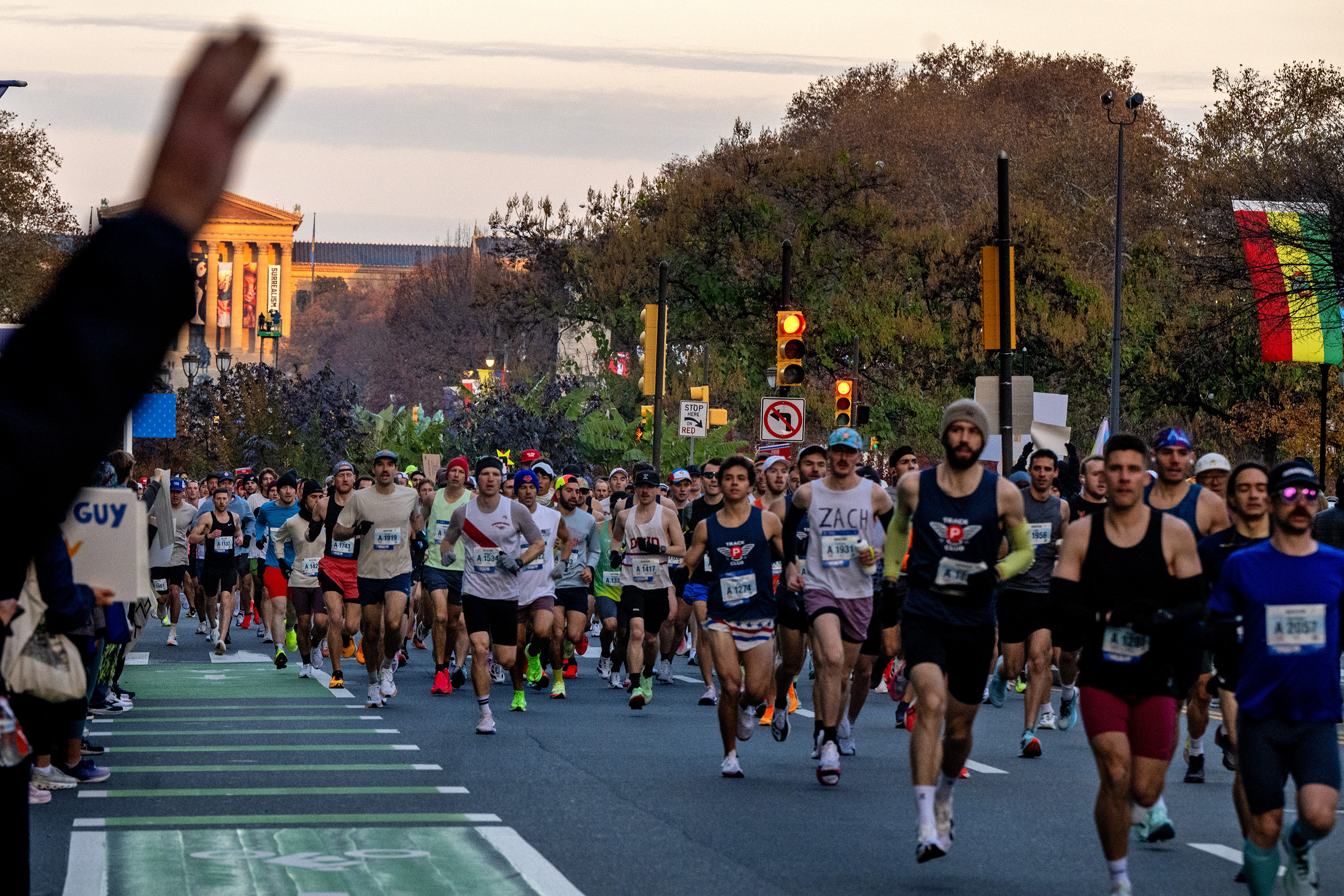
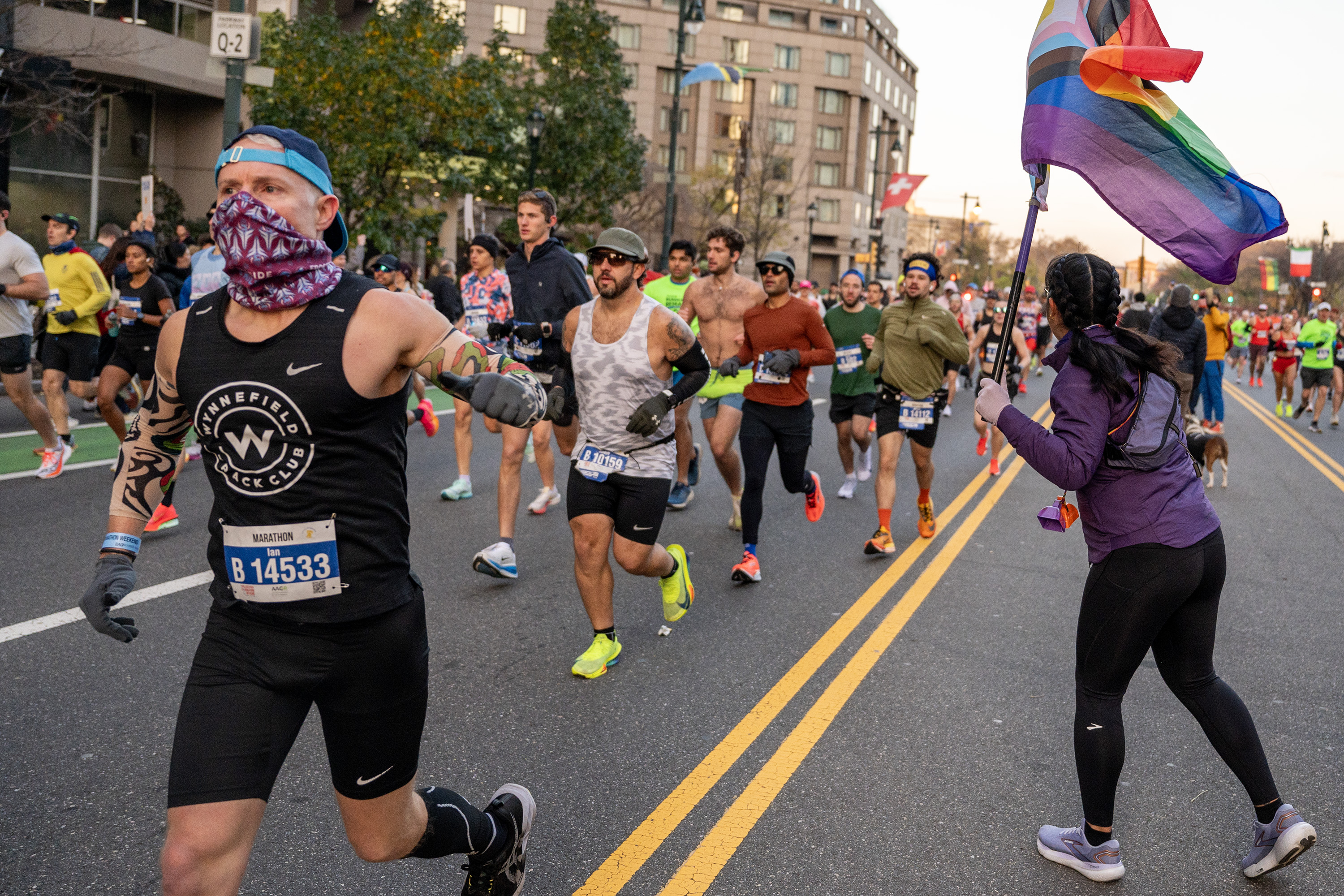
The first of.some 17,000 runners head out on the Benjamin Franklin Parkway at the start of the annual Philadelphia Marathon.
“I know at home who is watching. My coach is watching, the team is watching. I know [my coach] is crying at the moment. I know when I crossed that line, I know he’s got tears, so I did this for my team at home.”
It was a picture-perfect day for the 17,000 runners who competed, with conditions at 33 degrees at the race’s start, warming to 38 by the time people crossed the finish line.
The day began for the runners at 7 a.m. near City Hall, the first milestone they’d see on the 26.2-mile route that featured Center City, the Schuylkill, University City, and the ending alongside the Art Museum.
“I can say Philadelphia is the same as the [Rimi] Riga [Marathon in Latvia] to me because I won the Riga,” Frans said. “… The elevation is the same as Cape Town, so it’s not so difficult for me. And it’s home to me. I know Cape Town was home … but [Philadelphia] is my second home now.”
Along the way were plenty of friends and family to cheer on their loved ones. For the runners, water stations and bathrooms could be found near each mile marker.
“Every time it got a little quiet and I was like, ‘OK, where is everybody?’ the crowds erupted in the next 200 feet,” said Oeser, who finished in 2:34:55.56, holding off Michka-Mae Hyde of Jamaica, who finished in 2:35:27.19.
“A bunch of my friends are here,” Oeser said. “They kind of staggered around the bridge on [mile] 9, 12, that area, but [my boyfriend] is from Newtown, Pennsylvania, and a lot of my friends live in New York, so they took the train over and they’re here to support me.”
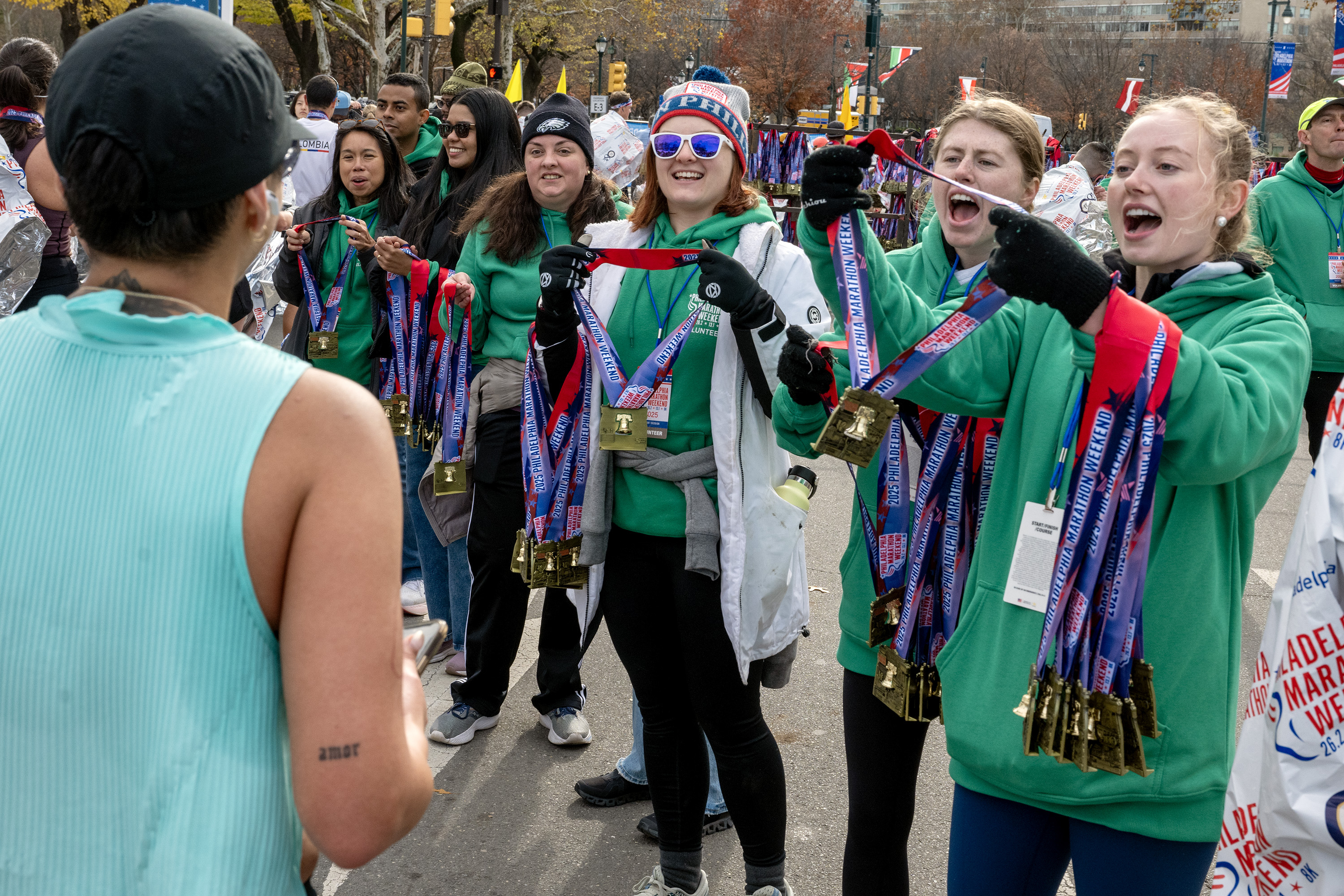
A line of race volunteers with medals greets runners finishing the Philadelphia Marathon.
For Oeser, a Boston College graduate, the support helped push her through her first marathon. Before the race, the farthest she had run was 21 miles in training. She described it as “grueling” from Mile 17 on.
“I think I just kept an open mind knowing this is uncharted territory,” she said. “I don’t know how I’m going to feel, but that doesn’t mean I can’t feel good. So, trying to stay away from all the thoughts of ‘Oh, this is when people hit the wall’ and be like, ‘Hey, maybe that won’t be my experience.’”
Miguel Vergara, 25, of Chula Vista, Calif., won the wheelchair race in 1:44:22.
Frans, Oeser, and Vergara received golden wreaths and medals for their victories. The wreaths are something new to the marathon this year.
“When you look at the start of democracy overall, it happened in the running of the marathon in Greece,” Philadelphia Marathon race director Kathleen Titus said. “… They started the beginning of democracy, but then 400 years later, Philadelphia brought that democracy to what it is today.
“We went through and really had to think mindfully of what we want the wreaths to look like. What do we want that experience to be? … We wanted to be different. We wanted to be symbolistic to Philadelphia.”
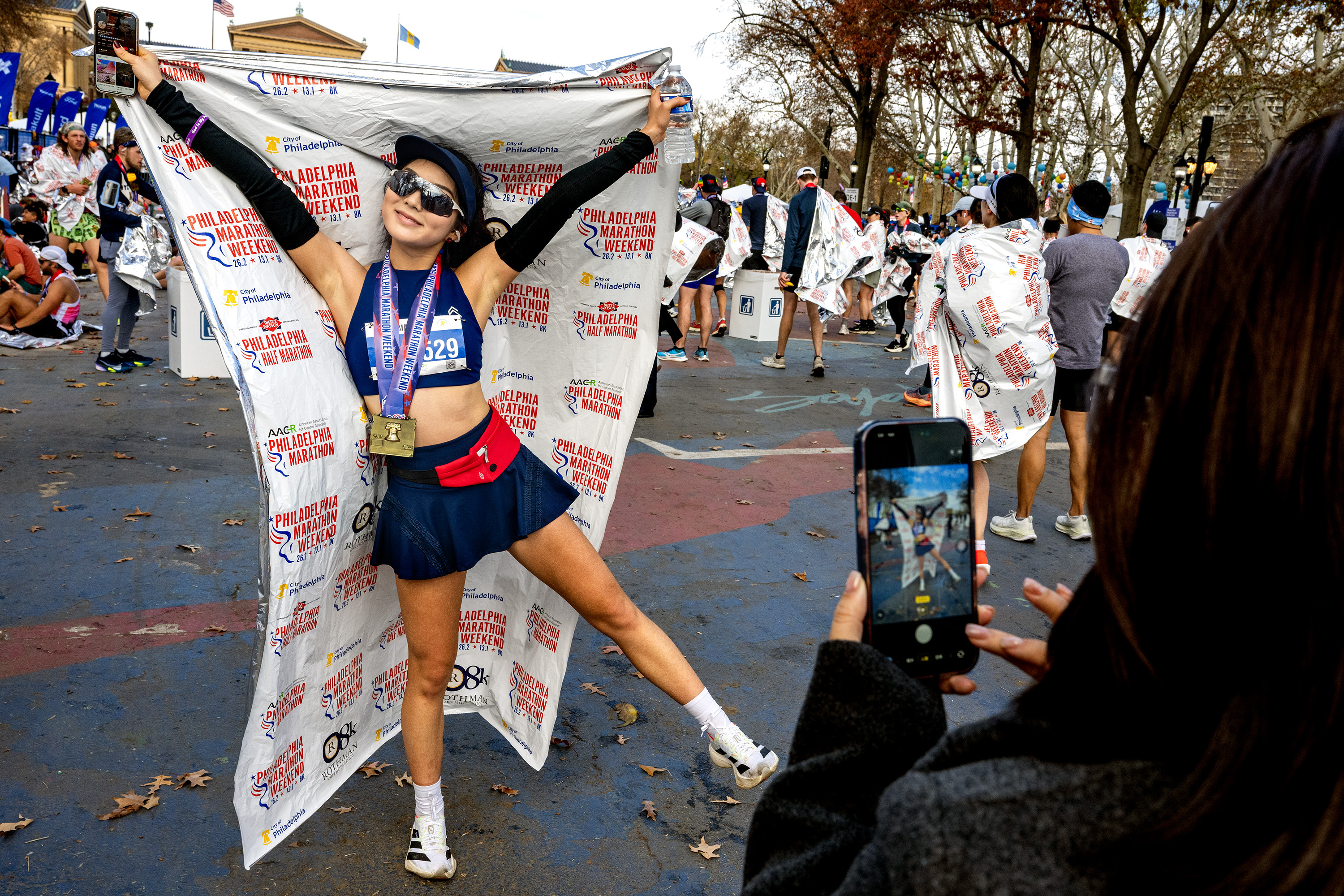
Lilian Yao, 20, poses for her mother, Leslie Liu, after completing the Philadelphia Marathon. Yau is a student at Columbia.
Others questioned it all as they attacked the hill leading to the Manayunk portion of the race.
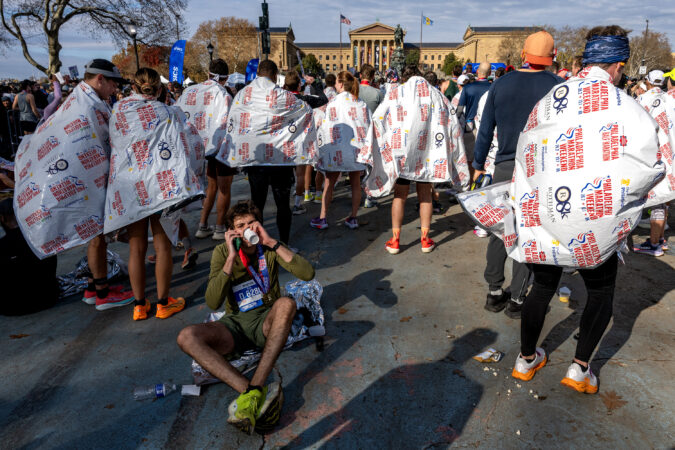
For the thousands of runners who crossed the Philadelphia Marathon finish line Sunday, the view of the Philadelphia Art Museum steps capped a blissful, sometimes brutal, 26.2-mile run.
Whether they ran for personal bests or charity, the roughly 17,000 registrants couldn’t have asked for better weather, which largely remained in what studies say is the sweet spot of 39 to 50 degrees. No brutal winds to report, either.
The fine weather was a stroke of luck for runners and spectators alike.
Philadelphia resident Latasha Clark, 47, and her daughter Brianna, 23, began waiting at Eakins Oval around 6:30 a.m., when it was much colder, with a homemade sign that read “you go girl” with carefully cut out letters.
Clark expected her daughter Trinity to finish around 11 a.m. but she wanted to secure a visible spot along the final mile. Philadelphia would mark her daughter’s first marathon and she trained for it while juggling classes at Arcadia University. Clark didn’t want to miss the photo finish and she wasn’t taking any chances.
“She would run every morning before class,” said Clark, beaming with pride. “She would call and wake me up and say, ‘I’m ready to run.’”
The crowd turnout did not go unnoticed.
First-time marathoner Charlie Marquardt, 31, said the spectators “really helped out” and he was ultimately able to run the race he wanted thanks to the weather and motivation. A new father as of March, Marquardt said he was likely going to take it easy for a bit and try to do the Broad Street run in May.
Caroline Kellner, 31, was also grateful for the crowds. The Ewing, N.J., resident couldn’t believe how many people were out cheering so early in the morning, calling it “the most spirited marathon” she’s participated in. There isn’t a huge running community in Ewing, said Kellner, making training runs somewhat lonely.
“Here I feel like the first 10 to 15 miles, you just feel so good,” she said of the spectators. “Then, you know, you hit mile 20, and it’s hanging on for dear life.”
The Philadelphia Marathon course is often billed in running circles as a relatively flat race. But there are some hills, and the one that leads to Manayunk’s boisterous Main Street is a bit of a cruel tease in timing.
Before the Manayunk crowds appear, toting shots of beer and doling out pastries and high fives, there’s a stretch of road where all you hear is the echo of sneakers bouncing off a wall — it’s tough for spectators to gather there.
It’s around the 18-mile mark that marathoners will sometimes hit “the wall,” a sign that a runner’s store of carbohydrates has slowly been depleted and calories are in need of replenishing. Still, the famous wall is as much psychological as it is physical.
Sharon Tejada (right), a co-leader of Queer Run, encourages the roughly 17,000 runners heading out on the Benjamin Franklin Parkway at the start of the annual Philadelphia Marathon on Sunday, Nov. 23, 2025.
New York City runner Mitch Kapler, 43, might be in the minority, but said he enjoyed the silence in a moment when his energy was drained and he needed to focus.
“Especially in the back part, there’s an element of not wanting to see as many people,” he said, adding that he appreciated that the course offered a taste of the city as well as a hint of scenic foliage.
In a way relatable to many long-distance runners, Kellner joked that she “blacked out” the memory of the lead-up to Manayunk, choosing to remember the effervescent crowds instead.
Burlington Township, N. J., resident Brooks Sanders, 42, said that the final section of the race is what, in his mind, makes Philly harder than the New York City Marathon.
“Philly will eat you alive,” said Sanders, who said people tend to underestimate the course difficulty. “In New York, you can rely on a crowd.”
For this race, that motivation has to come from the runner in the Kelly Drive stretches, where there aren’t a lot of people. And sometimes, runners like Kapler and Sanders fall short of personal goals. Wrapped in a Mylar blanket, Kapler was already planning his Philly Marathon “revenge tour” and Sanders, who was a few minutes shy of qualifying for the Boston Marathon, similarly planned his return.
Sanders said even the setback was part of the journey. He began running in 2021 when the love of his life and mother of his two children was diagnosed with stage 4 metastatic breast cancer. Running became therapeutic and he appreciated that the Philadelphia Marathon had close ties with the American Association of Cancer Research. By raising money for a possible cure, he felt he was doing something.
Though Sanders’ wife died last year before he ran the New York City Marathon and the Philadelphia Marathon, he remains a devout supporter of the AACR, the weekend’s title sponsor, whose runners collectively fundraised more than $800,000.
Between the amount raised for charity and the uncontrollable, such as weather, race organizers were pleased with the weekend’s turnout for the 8K, half marathon, and Sunday’s full marathon.
Kathleen Titus, Philadelphia Marathon Weekend race director, said even with last-minute dropouts, organizers expect close to 17,000 runners to have hit the road Sunday after pulling from a 3,000-person wait list.
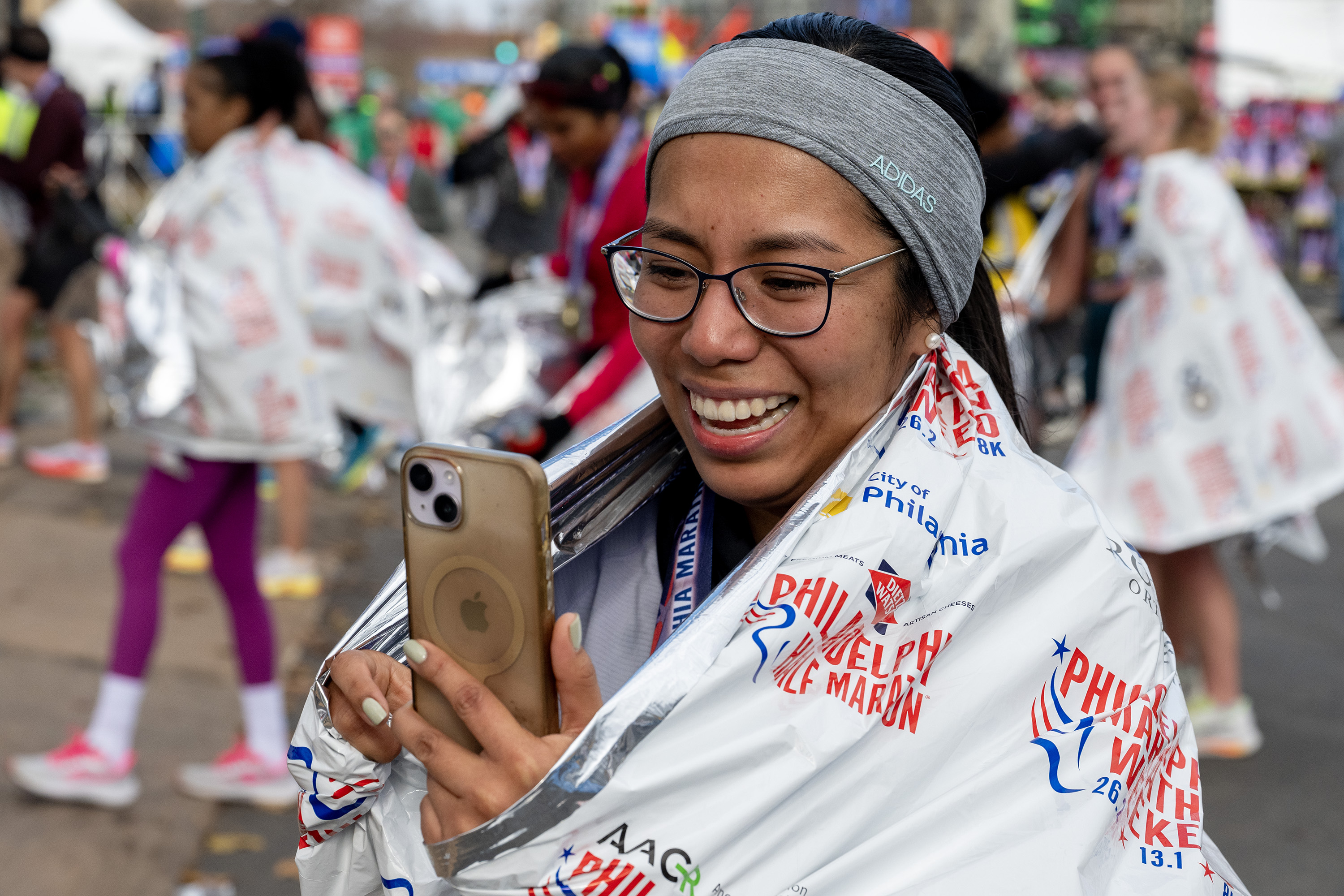
Iris Annais, from Mexico City, talks to her mother, Rosa Gonzalez, back at home after finishing the Philadelphia Marathon on Sunday, Nov. 23, 2025. It was her fifth marathon.
One striking note from Sunday, said Titus, was the rise in first-time marathoners. The top female runner, 26-year-old Anna Oeser from Connecticut, ran her first marathon at 2:34:55. People who took up running during COVID-19 lockdowns have graduated from their 5K, 10K, and half-marathon races.
“Over the past couple of years, we have seen the surge in participation in sport,” Titus said. “But people who maybe got their toes wet during the COVID period are now taking to the streets.”
It wasn’t all first-timers on the course, however, with South African professional runner Melikhaya Frans, 35, winning the male category with 2:13:57. He was a last-minute addition to the race after the Sanlam Cape Town Marathon, a major, was canceled due to weather.
The top male in the wheelchair category was Miguel Vergara of California at 1:44:22. Hannah Babalola of Illinois won the female wheelchair category at 2:15:21.
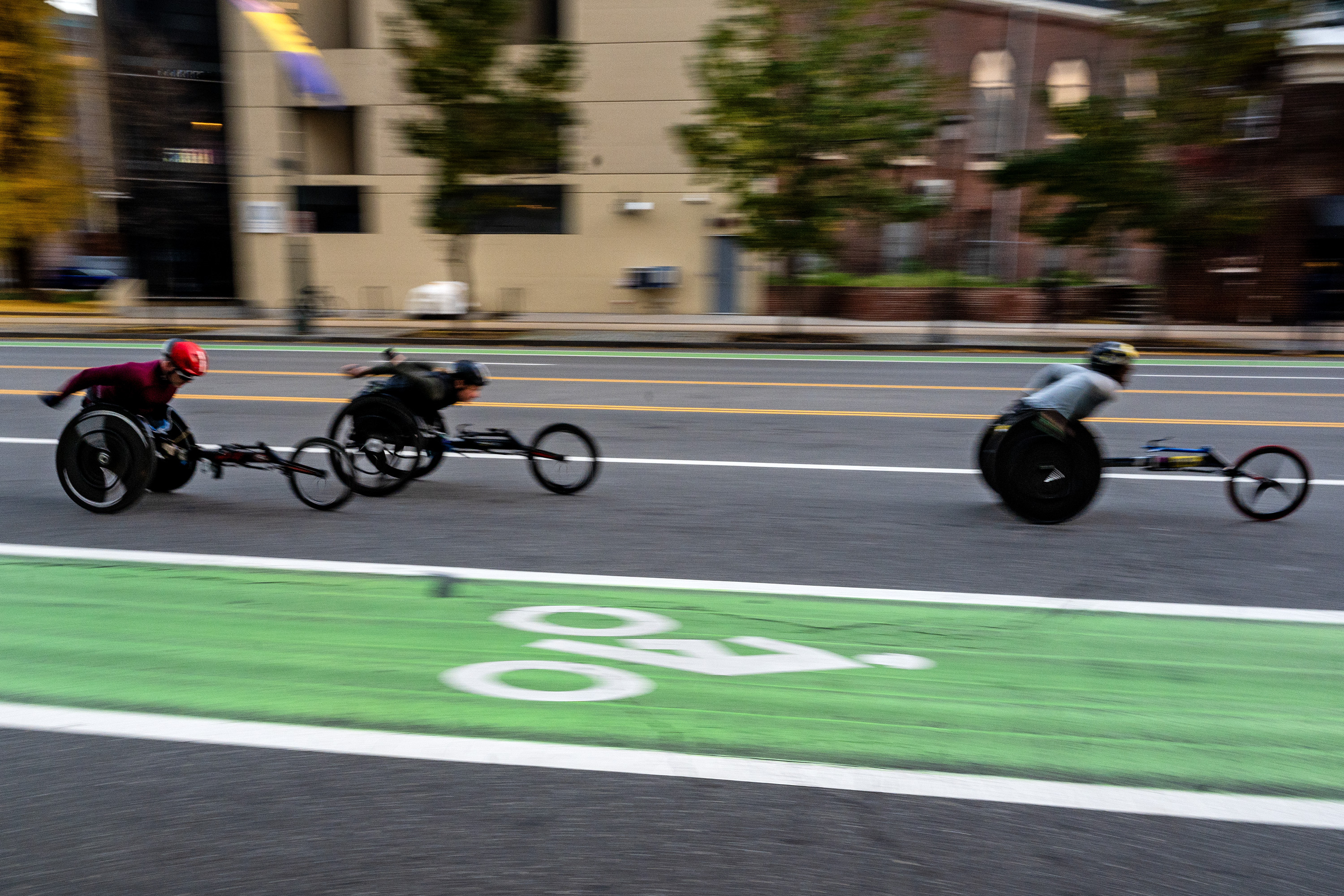
The push rim wheelchairs head out on the Benjamin Franklin Parkway at the start of the annual Philadelphia Marathon on Sunday, Nov. 23, 2025.
Close to the finish line, families waited for their loved ones with changes of clothes and slippers.
Joanna Campo, 50, a triathlete all too familiar with this particular feat of endurance, waited for her 17-year-old nephew from Rhinebeck, N. Y., to finish his first marathon, ready to provide some levity.
“I’ve been training for months to hold this sign,” read Campo’s poster board of encouragement.
The teen’s mother, Concetta Ferrari, 43, hoped to squeeze in some Philadelphia sightseeing but figured they’d probably let her son “soak in a bathtub and sleep.”
VJ Edgecombe sat out Sunday’s game against the Miami Heat at the Xfinity Mobile Arena with left calf tightness.
The 76ers said the shooting guard reported the tightness at the conclusion of Thursday’s road victory over the Milwaukee Bucks.
“It’s a little tight,” coach Nick Nurse said. “We got the imaging. It’s all clean, just precautionary.”
The third pick in June’s draft is averaging 15.6 points, 6.0 rebounds, 4.2 assists, and 1.3 steals. While in a shooting slump, Edgecombe has been a solid backcourt partner to standout Tyrese Maxey.
Nurse said the Sixers would have to “plug in the next guys” to make up for Egdecombe’s loss.
“Obviously, we’ve got Q [Quentin Grimes],” Nurse said. “Jared McCain can hopefully play a few more minutes. Might see an appearance from some other guys, you never know. But we will just plug in the next guys.”
The Sixers were also without Joel Embiid (right knee injury recovery), Adem Bona (sprained right ankle), and Kelly Oubre Jr. (sprained left knee).
Meanwhile, Tyler Herro (left ankle surgery), Nikola Jovic (right hip impingement), Andrew Wiggins (strained left hip flexor), and Terry Rozier (not with the team) missed the game for Miami.
Apparently, time really does heal all wounds — even those caused by the bone saw of a murderous prince and his personal goon squad after they hacked an intrepid Washington Post opinion journalist into pieces for speaking the truth about a corrupt and contented regime.
It’s hard to believe now, but there was actually a very brief time — in 2018, to be exact — when corporate America and even some political leaders pretended to have enough morals to resist this stone-cold killer with bags of money: Saudi Arabia’s de facto ruler, Crown Prince Mohammed bin Salman, or MBS.
It wasn’t just Oval Office-bound candidate Joe Biden who’d promised (falsely) to make MBS “a global pariah” after the CIA stated the obvious: that the crown prince was behind the barbaric murder of journalist Jamal Khashoggi. Six years ago, some of the nation’s top business leaders — like the CEOs of J.P. Morgan Chase, Ford, and Uber, and Donald Trump’s billionaire pal, Stephen Schwarzman — abruptly ditched a high-profile Saudi investment forum, and a few businesses totally cut ties with the oil dictatorship.
In 2025, any pretense of “corporate social responsibility,” let alone shame, in America’s C-suites is as outdated as dial-up internet. Schwarzman — who canceled his 2019 flight to Riyadh but not his Blackstone Group’s lucrative ties to the Saudi wealth fund — toasted MBS at a White House dinner Tuesday night, as did Ford CEO William Clay Ford Jr.
But then it would probably take less time to list which high-profile captains of American industry didn’t show up to fete MBS on his first official visit to Washington since that brief unpleasantness of — in the infamous words of Monty Python — bickering and arguing over who killed whom.
Trump fawned over Ronaldo while hosting Saudi Crown Prince MBS at the White House—a celebrity-studded dinner masking an alliance with authoritarianism and oil money. pic.twitter.com/78SFAaiUBh
The world’s sometimes richest human and Trump’s best frenemy Elon Musk, CEO of $5 trillion corporation Nvidia, Jensen Huang, GM head honcho Mary Barra, computer mogul Michael Dell, Big Oil titan Mike Wirth of Chevron, and many others all donned tuxedos or glitzy gowns to hoist a glass for the butcher of Istanbul and his host, the Unabomber of Caribbean fishing boats.
They gorged themselves on pistachio-crusted rack of lamb (a defenseless sacrificial sheep presumably also carved up with a bone saw), flecked with green nuts in some kind of communal transubstantiation with the blood-stained petrodollars they were really there to devour.
The ravenous CEOs included Tim Cook of Apple, apparently suffering from a bout of amnesia after his 2019 post-Khashoggi promise to look into Apple’s hosting of a Saudi app that allows men to track the movements of their wives and daughters (it’s still there), and apparently also unburdened, as the nation’s most prominent LGBTQ business leader, by the Saudis’ occasional executions of gay men.
The candlelight of the gilded East Room also revealed budding media mogul David Ellison, whose toasting of Khashoggi’s killer told us a lot more than any Beltway punditry about the moral fiber of the journalism that the Paramount Global boss plans for his new plaything, CBS News.
It felt more than fitting that the biggest buzz in a room larded with the billionaire men (and they were mostly men) — all so aggrieved by the short-lived #MeToo push — was for soccer superstar Cristiano Ronaldo, who during the 2017 peak of that movement fought off charges he sexually assaulted a woman in a Las Vegas hotel room. Ronaldo — who abandoned the hallowed pitches of European football to make billions on an obscure Saudi squad — was in many ways the essence of a room doing ethical backflips for the almighty petrodollar.
For one appalling night, the East Room became a capitalism megachurch where the donation plate was filled with the paper-thin pledge card of MBS’s vague promise to invest $1 trillion (we’ll see about that) on United States soil. But the Scriptures didn’t mention the record number of executions carried out by the Saudi regime, including the June death of journalist Turki al-Jasser, who tweeted criticism of his nation’s rulers and was reported to have been beheaded by a sword, MBS’s preferred method of (literally!) capital punishment.
Trump today on MBS and the killing of Khashoggi: "Things happen. But he knew nothing about it."
US intel under Trump in 2018: "The CIA has concluded that Saudi Crown Prince Mohammed bin Salman personally ordered the killing of journalist Jamal Khashoggi." https://t.co/2jDm9Fh0eJ
The MBS banquet was such a depraved and decadent ritual that it wouldn’t have been surprising if the Fortune 500 executives had broken out in satanic chants as if they were characters in a wretched Dan Brown sequel to The Da Vinci Code.
This was an orgiastic celebration of death — not just the literal state murders of Khashoggi, al-Jasser, and other journalists and dissidents hacked to death so the Saudis can keep their fossil fuels flowing, but also the death of press freedom, the death of the make-believe era of “woke corporations,” the death of democracy, and — worst of all — the death of a planet.
It didn’t seem an accident of timing that the American president and our elite ruling class was sharing their couverture mousse pear dessert with the world’s other top oil producer at the very moment the efforts of the global community — albeit without serious support from the United States, Saudi Arabia, or Trump’s other blood brother, Russia — to fight climate change were imploding at the failed COP30 summit in Brazil.
Even the amoral MBS and his Saudi regime — which is actually investing heavily in solar and other forms of clean energy — is taking the already-here crisis of global warming more seriously than Trump’s America, where his MAGA government is racing to cancel large-scale wind and solar projects and drill for oil off our endangered shores. This is what corporate America blessed when it broke bread at Trump’s White House.
In a New York Times essay, foreign policy expert Noah Shachtman wrote that “instead of trying to separate from the Persian Gulf petrostates, Mr. Trump is reshaping America to look more like them: top-down, iron-fisted, resource-rich and more than willing to flash those resources as weapons.” The leaders of Apple, Nvidia, GM, and Citibank have embraced this. This is what modern fascism looks like.
And yet, in bowing down to the petrostate mentality and all the grotesque corruption that comes with that, corporate America is also celebrating yet another kind of death: their own. The Saudi mindset, now fully embraced by the Trump regime and its billionaire obeyers, is a race to cash in — because oil, like life itself, is finite.
Rep. Vindman calls on Trump to release post-Khashoggi murder call with MBS
“The American people and the Khashoggi family deserve to know what was said on that call. If history is any guide, the receipts will be shocking,” Vindman said on the House floor. https://t.co/4Ob7WGDDQl
Tuesday’s pagan feast was ultimately a celebration of denial — denial that their guest of honor was a murderer, denial that the never-ending pasta bowl of petrodollars won’t last, denial that they’ve given up on saving the world from drought and floods and probably mass death. And denial that their 21st-century gilded age is about to crash down on them faster than the rubble of the East Wing outside their window.
Deep down in the queasy, lamb-fed pit of their stomachs, America’s CEOs know it. So does Trump. The most corrupt president in U.S. history and his family have fully embraced the grafty zeitgeist of the Saudi gold rush, from his son-in-law’s $2 billion investment windfall to a planned Trump Organization real estate development.
The art of the crooked deal was partly behind the president’s Oval Office crude dismissal of a reporter’s Khashoggi question. “Things happen,” he said, implying it was a shame what happened to the Post columnist who must have fallen off the back of a truck — an answer that reeked of organized crime boss bravado that was actually masking real fear.
Because Lordy, there are transcripts. Virginia U.S. Rep. Eugene Vindman, who was a White House aide at the time of Khashoggi’s 2018 murder, joined with the journalist’s widow to urge the release of the text from what the now-congressman called a “shocking and disturbing” phone call between the first-term Trump and MBS in the immediate aftermath.
Indeed, it seemed all too appropriate that the Oval Office questions for Trump and MBS blurred between those about the Khashoggi butchery and about the Jeffrey Epstein sex trafficking scandal, because in so many ways, they are the exact same story. It is the story of America’s rich and powerful and their narcissistic avatar at 1600 Pennsylvania Ave. pursuing their innermost desires — whether that’s oil-tainted riches or 14-year-old girls — before the wrecking ball comes for them.
This wasn’t a state dinner, but it was a state funeral for a billionaire class whose gusher is rapidly running dry.