Tag: topic-link-auto

  • Remote work is on the decline in 2025, but these Philadelphia business leaders are sticking with it

    Remote work is on the decline in 2025, but these Philadelphia business leaders are sticking with it

    Debra Andrews’ marketing firm, Marketri, gets mail and phone calls out of a Market Street address in Center City. But none of her employees work in the Philadelphia area. Neither does she.

    When she started the business in 2004, having a small office in Doylestown gave the new firm a feeling of “legitimacy,” she says. But she gave up the space in 2008 when she learned the building would be converted into homes.

    “I only really at that time had one employee based in Philly and decided, well, let’s just do this remote,” said Andrews. Now she has 15 employees working across 11 states.

    The share of employees working remotely in Philadelphia has declined, according to U.S Census data, and several large employers in the region have been pushing for more in-office time. But for employers that have remained remote, some are finding that it can provide positive returns.

    For Andrews, offering remote work has allowed her to hire the best person for a role regardless of where they live, but it doesn’t mean workers get to set their own hours — they’re expected to be on from roughly 8:30 a.m. to 4:30 p.m. in their time zones, she says.

    “We run very much like a normal business, we just happen to work from our homes,” said Andrews.

    ‘An empty building is not a problem’

    Coming out of the pandemic, some businesses in the area have downsized their leased office space. Both Philadelphia and the suburbs are experiencing high office vacancy rates.

    The National Board of Medical Examiners (NBME), which has been based in Philadelphia for over 100 years and owns a building on Market Street, redesigned its space to have more collaborative areas and fewer offices, as the organization committed to allowing more remote work. It’s also leased part of the building.

    “An empty building is not a problem — it’s a challenge to solve. It’s not a reason to bring people back,” said Janelle Endres, NBME’s vice president of human resources.

    The nonprofit creates tests for healthcare professionals, and employs about 575 people, most of whom are in Pennsylvania, Delaware, New Jersey, and Maryland. Prior to the pandemic, NBME offered a hybrid work model to most employees, and it has since “doubled down” on remote work, said Endres, adopting a “remote first” approach in 2024 — as many other employers were stiffening or increasing their requirements for in-office work.

    Staff was as productive or more so when working remotely during the pandemic, and employees appreciated the setup, Endres said. Going back to pre-pandemic work norms could have created “an employee satisfaction problem,” she said.

    Some 60% of NBME employees are eligible for remote positions and choose to work remotely. Others chose to be hybrid.

    “Nobody’s raking in big bonuses here, so we have to think about: What are the things that really set us apart and make us a unique employer?” said Endres. “Work-life balance and flexible schedules [are among] those things.”

    In exchange for flexibility, Endres said, “We expect that you will contribute in really strong ways, that you’ll perform well, that you’ll give back just as much as we’re giving.”

    “Give the people what they want, and they’re going to be like, ‘I better do a good job. I don’t want to lose this job,’” Endres said.

    But committing to a remote workplace didn’t mean “everyone’s just automatically happy,” said Endres. The organization plans some in-person days throughout the year as well as digital programming to foster culture, said Jenna Mierzejewski, manager of employee experience.

    Endres acknowledged that NBME has encountered some instances where an employee seems underproductive or distracted: “We say that’s a management challenge. That’s not a remote-work challenge.”

    Remote work ‘before it was cool’

    Casey Benedict, CEO and founder of Maverick Mindshare, says her agency has been remote since “before it was cool.”

    She has a P.O. Box in Malvern so she doesn’t have to list her home address as her business location. Beyond privacy, it’s also for professionalism, she said.

    “It’s to create a little bit of a buffer between home life and business life,” said Benedict, who leads an agency focused on influencer marketing that has been remote since it launched in 2010.

    Casey Benedict, CEO and founder of Maverick Mindshare, works from her home office.

    She wants her staff to feel like they can attend to their personal needs, whether that’s picking up a child from the bus stop or going to a doctor’s appointment, says Benedict. She has three employees who are “core to the organization.”

    “They can fully show up when they have more ownership and more control over the other parts of their lives that may pull them away from their desk,” she said.

    Allowing that kind of flexibility avoids conflict, she says. And, it pays off for the company.

    “The result is my team really does overdeliver and they enjoy what they do,” said Benedict. “They bring so much of themselves into it because they know that the structure is set up in a way to support them fully.”

    Losing the commute

    Three years before the pandemic started, three of Wendy Verna’s employees asked if they could work remotely. They told her there wasn’t enough in-person collaboration to make the commute to their South Street office worthwhile, she said.

    Verna, president and founder of marketing firm Octo Design Group, initially said no. But six months later, they started trying out remote work.

    “It wasn’t working for me,” said Verna, a self-ascribed “type A” person who likes to get out of the house and go to work. But she stuck with it because her employees were happy, and the remote setup worked for the company.

    Ultimately she figured out why she was miserable leading a remote team. “It was a control thing for sure,” she said. “I felt like, if I don’t know where you are, what are you doing?”

    She has established clear expectations for what remote work should look like at her firm. Cameras should be on for video calls, and employees should be ready to work during business hours, she says. And if employees plan to be out of town, they should let Verna know so she can determine how in-person tasks get done.

    “They’re at home, but they cannot look like they rolled out of bed, because it’s just not my brand,” said Verna.

    Verna is in the office three to four days a week, but 98% of the time, her five full-time employees, who live in the Philadelphia area, work remotely.

    Wendy Verna’s employees asked her to go remote three years before the pandemic. While she still goes to the office often, her employees spend most of their time working remotely.

    While she and her company have adjusted, Verna is still concerned about what employees lose by working remotely.

    A commute can be useful to prepare for the workday in the morning or process the day in the evening, she says. During pandemic-related office closures she would walk around the block a few times before and after work to get a similar effect.

    “When they sign off and you’re working from home, you run downstairs, well, all of a sudden, you’ve got chicken in the oven,” said Verna. “You don’t have time for that kind of debrief to yourself.”

    She’s also concerned about how the remote lifestyle will affect young people looking for jobs, saying, “You’re only as good as your network.”

    “This remote work is eliminating role models, and is eliminating mentors,” Verna said, “because I can’t mentor you behind a screen.”


  • Going green: Why frogs are appearing at ICE protests

    Going green: Why frogs are appearing at ICE protests

    The frogs are all over social media, playing and prancing in front of the ICE building in Portland, Ore. The demonstrators in big, green inflatable costumes have grown from local oddity to symbol of the resistance, undermining President Donald Trump’s claim that “war ravaged” Portland is under siege by “domestic terrorists.”

    Protests that started with a single amphibian have in recent weeks expanded into full ponds, particularly after a viral video showed officers pepper-spraying a demonstrator through the air-intake of his costume. The frog corps there has been joined by a shark, giraffe, chicken, and raccoon, and during the recent nationwide “No Kings” marches expanded its web-toed footprint to places including Philadelphia.

    Demonstrators gather for a ’No Kings’ rally in Philadelphia on Saturday, Oct. 18, 2025.

    Why has the frog become so popular?

    People following the news on the internet and TV see the paramilitary might of helmeted ICE agents arrayed against … frogs. And unicorns. And other dancing creatures.

    For demonstrators, it’s a way to make the other side look ridiculous by embracing ridiculousness ― a staple of effective political street theater, said Temple University professor Ralph Young, an expert on protest and dissent.

    “Trump saying Portland is occupied by terrorists, it’s so over the top,” Young said. “How do you respond? I guess you put on a frog outfit.”

    What has made Portland a center of immigration protest?

    Demonstrators oppose Trump’s effort to deport millions of people. And Portland has long been a target of the president, who last week again falsely claimed that the city was “burning down.”

    He wants to deploy National Guard troops in response to the protests outside the city’s Immigration and Customs Enforcement facility. An appeals court last week reversed an earlier ruling and said that deployment could proceed.

    Wearing animal costumes “dismantles their narrative a little bit,” chicken-suited protester Jack Dickinson told Willamette Week. “[Homeland Security Secretary] Kristi Noem is up on the balcony staring over the ‘Antifa Army’ and it’s, like, eight journalists and five protesters and one of them is in a chicken suit.”

    Laura Murphy, 74, wears a handmade tiara inspired by a Portland, Oregon, protester’s frog costume, on her way to the No Kings protest on Oct. 18 in Philadelphia.

    Where did the idea for the frogs come from?

    The frogs, Temple’s Young said, come out of a court jester tradition. In ancient times, jesters could speak to the king in ways that might get someone else beheaded. They offered what others might be unwilling to say ― the truth, cloaked in humor.

    Since that time there have been many other instances of truth-in-comedy protests.

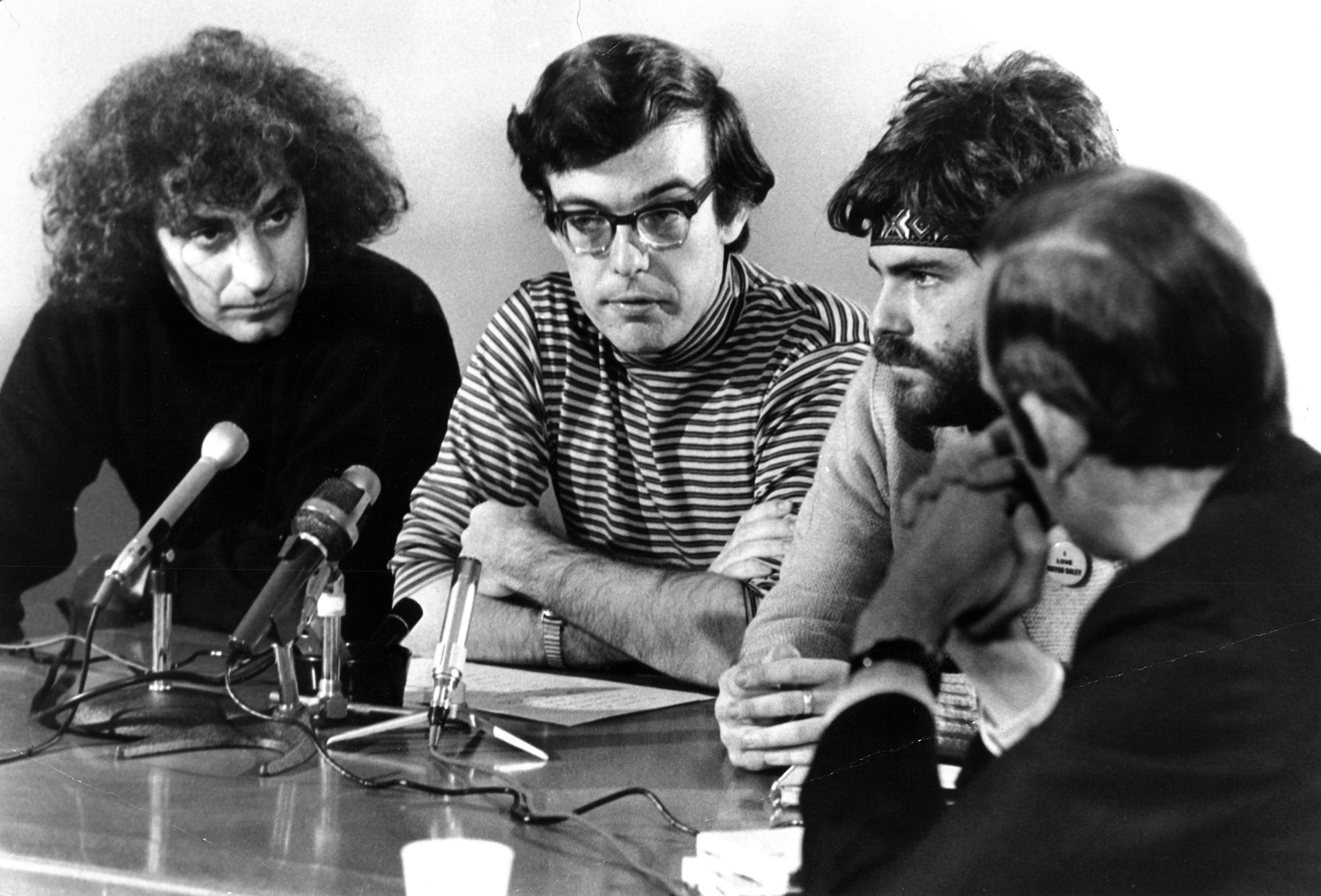
    At the 1968 Democratic National Convention, the Youth International Party, the Yippies, nominated a 145-pound pig for president. Pigasus, sarcastically named for the winged horse Pegasus, served to protest the political establishment and the sorry choice many voters felt they faced in choosing between Richard Nixon and Hubert Humphrey. The pig’s campaign slogan: “If we can’t have him in the White House, we can have him for breakfast.”

    Here on trial as part of the Chicago Seven, Abbie Hoffman (left) and Jerry Rubin (right), with beard and headband, helped nominate a pig for president. In center in striped shirt is defendant Rennie Davis. They’re picture here on Oct. 23, 1969, at the Federal Building in Chicago.

    The same year, the New York Radical Women attracted huge news coverage at the Miss America pageant when they dumped bras, makeup, and girdles into a “Freedom Trash Can” set up on the Atlantic City Boardwalk. The demonstrators were labeled “bra-burners,” though organizers insisted no bras were actually burned.

    Have frogs been spotted in Philadelphia?

    Yes, including at the recent “No Kings” protest that drew thousands onto city streets. One person carried a sign endorsing “Amphifa,” or “Amphibians Against Fascism.”

    Frogs are appearing on posters and T-shirts in a variety of poses: Raising the U.S. flag at Iwo Jima, with the help of a chicken and a unicorn. And as the subject of the famous Barack Obama campaign portrait, this one captioned not “HOPE” but “HOP.”

    So far the ICE field office in Philadelphia has not been the target of sustained protests, though the exterior of the building is now guarded by heavy concrete blocks. The group No ICE Philly plans to hold an all-day, Halloween Eve demonstration on Thursday, complete with costumes, live music, art, and free food.

    A demonstrator wearing a frog costume stands outside a U.S. Immigration and Customs Enforcement facility on Tuesday, Oct. 7, 2025, in Portland, Ore. (AP Photo/Ethan Swope)

    Is it true the frogs are meant as a biblical reference?

    Let’s not get carried away. But, yes, some people have posted social media photos of the Portland frogs captioned with a verse from Exodus 8:2-6: “If you refuse to let them go, I will bring a plague of frogs on your whole country. … The frogs will jump on you, on your people, and on all your officials.”

    Staff writer Michelle Myers contributed to this article.

  • Nominate a Philadelphia employer for the 2026 Top Workplaces program

    Nominate a Philadelphia employer for the 2026 Top Workplaces program

    The Top Workplaces program, now in its 17th year of recognizing Philadelphia-area companies that earn high marks from employees, is open for nominations for the 2026 awards at Inquirer.com/nominate.

    Any Delaware Valley organization with 50 or more employees is eligible to participate at no cost. Standout companies will be honored in a special section of The Inquirer in September 2026.

    To qualify as a Philadelphia Top Workplace, employees evaluate their workplace using a 26-question survey. Companies will be surveyed through April.

    The Top Workplaces program returns to the Philadelphia region for 2026.

    Energage, the Exton-based research partner for the project, conducts Top Workplaces surveys for media in 65 markets nationwide. For the 2025 awards, over 6,000 organizations in the Delaware Valley were invited to survey their employees. Based on employee survey feedback, 144 earned recognition as Top Workplaces.

    “Earning a Top Workplaces award is a celebration of excellence,” said Eric Rubino, CEO of Energage. “It serves as a reminder of the vital role a people-first workplace experience plays in achieving success.”

    Anyone can nominate an outstanding company. Nominees can be public, private, nonprofit, a school, or even a government agency. To nominate an employer or for more information on the awards, go to Inquirer.com/nominate or call 484-323-6270.

  • How and why Trump’s Caribbean Sea operation is being conducted has endangered trust

    How and why Trump’s Caribbean Sea operation is being conducted has endangered trust

    There’s a military saying that “piss-poor planning means piss-poor execution.”

    Unfortunately, the execution of how the Trump administration is using America’s military to conduct its counter-drug operations in the Caribbean Sea has had poor planning.

    First, 100% of fentanyl comes across the U.S.-Mexican land border — usually carried by U.S. citizens — while almost three-quarters of U.S.-bound cocaine sails via the Pacific Ocean.

    The residual cocaine begins a Caribbean transit, but only 3% is en route to our water borders. Most sail to Central America or Mexico for land transport to America. The first five small vessels our military has struck, killing 32, were in the transit zone for cocaine destined not to the United States, but for islands that forward it to Europe and West Africa.

    As a result, the administration’s current approach in the Caribbean makes any meaningful interdiction of drugs headed to America unlikely in what is an already tough hunting ground: 100,000 or more vessels — including unregistered or unbeaconed watercraft — are normally at sea in the Caribbean. I experienced this vast challenge while supporting a U.S. Coast Guard Law Enforcement Detachment (LEDET) onboard my ship, understanding why the Coast Guard’s interdiction rate hovers between 7%-15%.

    Moreover, drug cartels recruit vulnerable U.S. citizens to be the primary “mules” for fentanyl because they are less likely to be inspected at legal U.S. border crossings. That is where substantial interdiction must occur if the administration is serious about stopping drugs from coming to the United States.

    Similarly, the cartels elicit the impoverished — such as poor fishermen — to do their seaborne smuggling. Criminals? Yes. “Narco-terrorists”? According to the administration, yes, after President Donald Trump designated eight drug cartels as foreign terrorist organizations (FTOs).

    Just as it did for al-Qaeda and ISIS, an FTO designation makes drug-runners and carriers “unlawful combatants” in a “Non-International Armed Conflict (NIAC).”

    Also, like them, to be legally labeled as an FTO, the drug cartels must: 1) exhibit “politically motivated violence,” 2) execute a combination of frequent and/or severe hostilities, and 3) have an extensive command and control structure.

    However, the administration’s two principal justifications for meeting these three criteria were the number of U.S. drug overdose deaths (80,000 last year) and that the cartels’ violent activities are undermining the stabilization of the Western Hemisphere.

    The appropriateness of these justifications has consequences for military commanding officers: U.S. and international law forbid them to use deadly force against both American and international civilians. Operational officers go through rigorous training regarding this “principle of distinction.”

    Moreover, since the Navy operates on the “public commons” of the seas, it issues the Commander’s Handbook on the Law of Naval Operations that makes it clear it is “manifestly illegal” to comply with “an order directing the murder of a civilian [or] a noncombatant.”

    Adm. Alvin Holsey, commander of U.S. Southern Command overseeing the counter-drug interdictions, recently resigned, reportedly because he deemed the strikes as possibly illegal.

    It’s unquestionably disconcerting to be given a new legal interpretation of “political violence” and “severe hostilities” that suddenly changes who has always been a “civilian” into a “combatant.”

    It’s disquieting because it’s already tough “out there” in terms of ensuring wise judgment. For example, in 1988, a Navy cruiser in the Persian Gulf shot down an Iranian airliner with the loss of 290 civilians because it had mistaken it for a fighter plane in peacetime.

    A few years later, as I entered the Strait of Hormuz, an Iranian warplane took off from a nearby airfield and headed for my ship. My crew was well-trained, with missiles ready if “hostile intent” was determined. It flew low overhead — the first time the Iranian military had done so — then continued on its way, much as Chinese warplanes have done.

    If this is a hemispheric war — and not peacetime — Congress should constitutionally “declare war” rather than an abrupt renaming of civilian drug runners as “narco-terrorists.” Otherwise, the sudden denial of “civilian-ship” after years of legal and moral training places our military leaders’ judgment into its own legal and moral quandary.

    This is especially pertinent coming after Defense Secretary Pete Hegseth’s recent admonition to senior military leadership that there should be “no more politically correct and overbearing rules of engagement, just common sense, maximum lethality and authority for warfighters.”

    This followed the secretary’s removal of the head of each service’s Judge Advocate General’s Corps (the military’s legal branches), as well as his closure of the Civilian Protection Center of Excellence, established to minimize civilian casualties in military operations.

    Finally, with a tenth of all deployed U.S. Navy combatant forces now dedicated to drug interdiction — a nuclear submarine, a three-ship amphibious ready group, and five surface combatants — there is a cost to warfare training. We should be focused on our responses to threats from sophisticated subs, missiles, ships, aircraft, and space — especially as coordination is jammed and cyberattacked within a carrier battle group of ships.

    Losing this type of training has come when warfare readiness is already poor: 40% of the U.S. attack submarine fleet is out of commission for repairs — double the Navy’s target rate, overall amphibious ship readiness for war is just 41%, and while surface combatant readiness has risen, it is only 68%.

    If, as reported, the less adept — although deadly — Caribbean operation is intended as a prelude to force Venezuelan President Nicolás Maduro from office, the American people should know why their military men and women are sailing in harm’s way.

    Trust in a commander — or commander in chief — is the military’s most precious asset. And while trust might be the biggest deficit in politics, it is not in warfare.

    How and why this Caribbean Sea operation is being conducted — either as a professional drug interdiction operation or as a prelude to an intervention in another country — has endangered this trust.

    As the top operational commander’s resignation appears to confirm.

    Joe Sestak is a former Navy vice admiral, a former U.S. representative for Pennsylvania’s 7th Congressional District on the House Armed Services Committee, and director for defense policy of the National Security Council staff.

  • Letters to the Editor | Oct. 27, 2025

    Letters to the Editor | Oct. 27, 2025

    Disheartening demolition

    When my family wanted to add a 700-square-foot addition to our ordinary existing home, we had to provide architectural plans, submit them to the local zoning board, and appear at a hearing to state why our plans conformed to local laws and adhered to the character of our neighborhood. President Donald Trump lives in a historic property loaned to him by the people of the United States for use as a temporary residence during his tenure in office. Yet, without any approvals, he is demolishing part of this borrowed home and permanently changing its character.

    When Trump first floated the plan to add a 90,000-square-foot ballroom, he provided assurance that the White House footprint would not change. In August, Trump paved over the historic Rose Garden. This past Tuesday, Trump invited Republican senators to lunch at the new concrete “Rose Garden Club,” granting the senators a chance to bear witness to the bulldozers that — in the midst of a government shutdown — were plowing down Trump’s promise to preserve the East Wing. In the meantime, the National Trust for Historic Preservation haplessly was asking for time to review Trump’s architectural plans.

    As average U.S. citizens, we are bound by rules and regulations and expected to be truthful. Our president lies about his intentions, openly defies historic preservation, demolishes part of our White House, and does so while thumbing his nose at the decent folks who are just trying to get by day by day.

    In Trump World, there is no zoning board, and there are no guardrails. This is a snapshot of our new world order. What will the historians write?

    P. Bookspan, Philadelphia

    . . .

    The East Wing of the White House, built in the 1940s, undoubtedly has asbestos and lead throughout. Were tests done, and remediation actions taken? Take a look at the records for other Donald Trump projects: Profits are more important than the health of workers and the community at large.

    Victoria M. Gillen, Browns Mills

    . . .

    My heart broke seeing the clawlike machine tearing down the East Wing of the White House. Living in Hatfield Township, we had a similar issue about five years ago on a much smaller scale. The last farm in our township was sold. A demolition crew was hired by the new owner to remove the farmhouse. However, the demolition crew halted after the removal of siding exposed walls made of logs from the mid-1700s. After professional historians looked over the siding, they determined the house was one of the earliest structures in the township. After hundreds of people attended meetings concerning the house, it was decided to carefully take the farmhouse apart to be reassembled later at a different location. Unlike our little township, all I saw concerning our beloved People’s House was Donald Trump declaring that in no way would the White House be touched during the construction of his big beautiful ballroom. That could turn out to be a bigger lie than his saying he won in 2020.

    Joseph Obelcz, Hatfield

    . . .

    Instead of destroying the People’s House to build a billionaire’s ballroom, Donald Trump should turn it into a soup kitchen for all the people who will no longer be receiving SNAP benefits.

    Cheryl Rice, Erdenheim

    Canadian comparisons

    I very much appreciated Daniel Pearson’s column on Montreal and how it compares with Philadelphia. I have been to Montreal 11 times, and I have observed many of the same things: Centreville is the business center of Montreal, yet it has residential dwellings, retail, and other sorts of establishments, and therefore does not feel as hollow as some downtown areas in American cities. It is known for being very clean and orderly. Yet, everybody seems like they are relaxed and having a good time, even in this predominantly business district.

    Montreal also has ethnic enclaves such as Chinatown, and it also has strong West African, Lebanese, Moroccan, and other communities. Some of these communities are long-established. Montreal’s Old City section by the St. Lawrence River equates to our Old City section. It’s an area of history and tourism woven into one. Montreal has some of the greatest educational establishments in the world, especially McGill University, which dominates a lot of the intellectual thought of the city. Where Montreal differs from Philadelphia is in its ability to keep extreme economic disparities at bay. Some neighborhoods are doing better than others, but you don’t have a sense of dread if you accidentally get off at the wrong Metro station. The subway trains have rubber tires and are quieter than our subway trains, plus the stations are kept in a presentable manner.

    Women are very prominent in the civic life of Montreal. The misogyny and misandry that often infects our society aren’t prevalent there. Montreal does not have the tension with the provincial capital, Quebec City, that Philadelphia has with Harrisburg. Too often, I find that Philadelphia tries to learn from other American cities that are experiencing the same difficulties. With a similar layout and a similar population, Montreal might be a better example. Perhaps we need to start emulating a winning strategy. Let’s find out what they do correctly that can be replicated here.

    David W. Wannop, Philadelphia

    Filibuster, anyone?

    The truth about the current shutdown is that the Republicans can end it without Democratic help at any time. All they need to do is change the Senate rules regarding the filibuster. They did this in September to get 48 of Donald Trump’s government nominees approved. To change the rules only requires 50 votes. The reason they won’t do it is that politically, they would rather blame the Democrats than negotiate with them. Democrats should hold firm and point this out next time John Thune and Mike Johnson try to blame them on TV. The opposition party that controls no part of the government is under no obligation to help the other party.

    Warren Kruger, Abington

    Too young to remember

    From news articles, it appears many of the Donald Trump supporters are young people in their early 20s — too young to remember the terrible first Trump administration. Some perspective that may make some of us feel old: Today’s college seniors were in seventh grade when Trump was first elected nine years ago.

    These youngsters are also way too young to know what it was like to fear polio and see your friends put in an iron lung. What a relief it was to have a polio vaccine. And what do these young people of today know of World War II and the fight to save the world from the fascism that had taken control of Germany and Italy? With few World War II veterans remaining, most young people will not have a grandfather or father who faced the horrors of fighting to save democracy.

    When I was a youngster, it was required that I have several vaccinations (MMR — measles, mumps, rubella) in order to attend school. My parents did not question this policy — they accepted it as a measure to keep their children safe, and they were grateful for it. Today, I am grateful for the additional vaccines that are available for me — pneumonia, shingles, and, in particular, the flu and COVID-19 vaccines. It’s distressing to now see that many vaccines are no longer recommended, and may become unavailable or only stocked in limited supplies. It appears the scientific progress made in the last century and decades is being rejected by two men, neither of whom is a doctor or scientist.

    When will today’s young people bother to consider how the current administration is sabotaging their future as well as that of their parents and grandparents? If the luck they depend on holds, they will grow old, but will they still have vaccinations, healthcare, Social Security, food, and a safe environment? Who will they blame when these are gone? Will they look in a mirror?

    Carol Sundeen, Lower Makefield

    Do the right thing

    Republican House leader Mike Johnson says he will bring back the Republican House members when Democrats do the right thing. What Johnson means by the “right thing” is for Democrats to allow 22 million people on the Affordable Care Act to have their premiums doubled, and for 15 million people on Medicaid to lose their health insurance. I, for one, am glad that Democrats refuse to do Johnson’s “right thing.”

    Dave Posmontier, Elkins Park

    Join the conversation: Send letters to letters@inquirer.com. Limit length to 150 words and include home address and day and evening phone number. Letters run in The Inquirer six days a week on the editorial pages and online.

  • Horoscopes: Monday, Oct. 27, 2025

    ARIES (March 21-April 19). You’ll have an audience. Whether you perform for one person or a thousand, your aim is the same — to be your best. And actually, in the end, scale doesn’t matter. The effort will be identical.

    TAURUS (April 20-May 20). When people feel judged, they instinctively pull away. And when you judge yourself, it’s the same. Part of you pulls away from yourself, leaving you feeling torn and lonely. But when you stop grading and scoring, tension dissolves. Connection is possible again.

    GEMINI (May 21-June 21). Someone else might dismiss a minor opportunity, but not you. You treat the small stage like the main event. A few attendants, a casual conversation, even a walk down the street can be a chance to show the world your vitality.

    CANCER (June 22-July 22). You put more thought into things than the others do, treating little opportunities with the same focus you’d give a “big break.” You practice as if the rehearsal were the performance. Because you make the most of small moments, you’re given bigger ones.

    LEO (July 23-Aug. 22). Today you’ll be like the butterfly whose style is to travel lightly. You switch directions quickly, notice more, and enjoy movement itself. It keeps you from overinvesting or wasting energy on grudges or drama.

    VIRGO (Aug. 23-Sept. 22). Like the sugar high of candy, what’s immediately pleasurable isn’t always the healthiest. What’s good, like exercise, often requires discomfort. Knowing what you want? Not a problem. Wanting what’s good for you? That’s harder, if only because you’re human.

    LIBRA (Sept. 23-Oct. 23). It is never possible to fully know a person, but as long as you keep paying attention, that counts for a lot. Stay present and curious, avoiding assumptions based on yesterday because no one wants to be trapped in past versions of themselves.

    SCORPIO (Oct. 24-Nov. 21). Your imagination does two jobs at once today. It soothes you with comforting daydreams to buffer you from harsh realities and it sparks you with exciting ideas to propel you toward creating a better reality for you and yours.

    SAGITTARIUS (Nov. 22-Dec. 21). The day features an invigorating background noise. The chatter, the movement, the people around you working just like you are — they contribute to a sense that you and all the other spokes in the wheel are rolling into the future together.

    CAPRICORN (Dec. 22-Jan. 19). A balance is struck today. It’s not the kind of perfect equilibrium that lasts forever, but a sweet moment of harmony that reminds you that calm is possible, peace is a place that waits for you, and love lives in you.

    AQUARIUS (Jan. 20-Feb. 18). Sometimes it feels like others just don’t care about the same things you care about. Whether it’s true or not, it’s out of your control. Your passion is what matters. You’ll fight indifference with small rebellions like kindness, art and beauty.

    PISCES (Feb. 19-March 20). You’ve been steadily improving a situation and it shows. Others may not notice every little adjustment, but the cumulative effect is undeniable. Your knack for refinement will be a source of pride and not just your own.

    TODAY’S BIRTHDAY (Oct. 27). Welcome to your Year of the Brilliant Reset. What’s been nagging at you for months gets a full overhaul. Work is lighter and freer because you drop an old burden and trade up for something more lucrative. Love grows through honesty. More highlights: A trip reshapes your perspective. You’ll land unexpected allies, people who back you with resources and time. Finances flow and grow with a single disciplined change. Cancer and Aquarius adore you. Your lucky numbers are: 7, 21, 16, 50 and 14.

  • Dear Abby | Teen’s change of surname aggravates grandparents

    DEAR ABBY: Our granddaughter, “Amy,” who shows in 4-H, decided to take her stepdad’s last name when appearing at the fair. Our son, her father, is a big part of her life. This is the second year in a row she has done this, and it hurts me and my husband deeply. Her mother, stepdad and his family think it’s great. Our son has no backbone and won’t stand up to Amy’s mother or put his foot down about the situation.

    We tried talking with Amy. She said she will go by her stepdad’s last name and doesn’t care how we feel. We love her very much. Her stepfamily’s name is no more important than anyone else’s, but they think it is a big deal.

    After Amy answered the way she did, we told her we will no longer support her at the 4-H fair. She is at the impressionable age of 14. My husband and I agree that we will also discontinue Amy’s birthday and Christmas gifts if she is going to treat us like this. We were brought up to respect our family, and this is a slap in the face. What should we do?

    — PROUD OF OUR NAME

    DEAR PROUD: You wrote that your son is still a big part of Amy’s life. Has your granddaughter explained why she’s determined to do this? Could it be as simple as wanting to use a name that matches the parents who brought her to the event?

    You have allowed yourselves to become too involved in this. Retaliating by no longer subsidizing Amy’s 4-H activities and withholding birthday and Christmas gifts may have been rash and could drive a lasting wedge that won’t be easily repaired. More calm and rational discussions should take place before you go nuclear.

    ** ** **

    DEAR ABBY: I do everything for my family. I take care of everyone. I also work and earn a good living. Now that I’m older and my kids are grown, I like to go on vacation. The problem is, my husband doesn’t want to do anything.

    My best friend booked a trip for the two of us, and I’m excited to go and enjoy a few days off from “my life,” so to speak, but my husband is mad because he isn’t invited. I have taken a vacation without him to see our grandson across the country, and it has never been an issue. We have been together 38 years.

    For the last two years, my husband has been sick, but he’s doing much better now. I feel like I deserve a break and a mental reset. He says he is “hurt.” He is trying to guilt me into not going, but I told him I need this for my own sanity. Am I wrong for wanting and needing this?

    — ESCAPING IN SOUTH CAROLINA

    DEAR ESCAPING: Taking care of a sick husband in addition to everyone else is stressful. I’m glad your husband is doing better, and I understand why you might want a break. You stated that he “doesn’t want to do anything” but feels hurt that he wasn’t included. Tell him if his urge to travel has revived along with his health, you would be delighted to arrange a trip for just the two of you. You can afford it, and it may soothe his feelings.

  • Union cough up late lead to Chicago Fire but win Game 1 of playoff series in a shootout

    Union cough up late lead to Chicago Fire but win Game 1 of playoff series in a shootout

    After playing to a 2-2 draw in regulation, the Union claimed a 1-0 series lead in their first-round playoff matchup against the Chicago Fire with a 4-2 penalty-shootout win Sunday night at Subaru Park. Jesús Bueno scored the decisive attempt in the five-round shootout.

    Indiana Vassilev and Milan Iloski scored second-half goals in quick succession to open the scoring. Vassilev scored from a Mikael Uhre cross in the 70th minute, and Iloski added a second goal in the 75th minute off a feed from Tai Baribo. The Union struggled to place shots on target throughout the first half.

    Chicago answered the Union with its own pair of goals in the final 15 minutes of the match. Jonathan Bamba bested Andre Blake in the 84th minute to cut the Union’s lead to one, and former Union player Jack Elliott scored in the 93rd minute to level the score at 2.

    The Union had scoring chances during the remaining portion of stoppage time, but could not find the back of the net again in regulation.

    Union goalkeeper Andre Blake lies on the ground after the Chicago Fire’s Jack Elliott tied the game in the 93rd minute.

    In playoff matches before the MLS Cup Final, the league’s rule book opts to decide tied games through a penalty shootout, rather than extra time.

    Chicago goalie Chris Brady saved the Union’s first penalty kick, diving to his right to stop Uhre’s shot. Blake responded with a save of his own, denying Elliott.

    “Jack [Elliott] takes great penalties,” Blake said. “I happened to guess right, and I was there to make the save. I’m just grateful for that.”

    Frankie Westfield converted his attempt to get the Union on the board, but Brian Gutierrez brought the Fire even with a shootout goal of his own. Iloski made the Union’s third attempt, and Hugo Cuypers answered after scoring past Blake to level the shootout at 2. Baribo made the Union’s fourth penalty kick and Joel Waterman hit the Fire’s fourth shot off the crossbar, leaving the Union up, 3-2, after four rounds.

    Bueno stepped up and converted the decisive penalty to give the Union a 4-2 shootout win.

    “I was a little nervous for the penalty kick,” Bueno said through a translator. “But when Blake gave me the ball, I just looked at him in the eye and we laughed. We knew that everything was going to be OK.”

    The Union’s pair of goals in regulation came shortly after Bradley Carnell made substitutions in the 64th minute. Carnell sent Westfield for Nathan Harriel and Uhre for Bruno Damiani. The Union outshot Chicago, 16-13, but Vassilev’s 70th-minute goal was the first shot on target for the Union.

    “We worked in transition,” Carnell said. “We showed what we can do. We created chaos moments. We took the opportunities when they came. Just unfortunate the way we give up two moments. … We were excited about the full game.”

    The match was physical, with 20 fouls issued between the two teams. The Fire’s Sergio Oregel was issued a red card in the 94th minute, and will be unavailable for Game 2.

    “They got what they wanted — penalties,” Carnell added. “I’m glad that we came through on the other side.”

    Playoff push

    With their win over the Fire, the Union can advance to the semifinals by winning Game 2 at SeatGeek Stadium in Bridgeview, Ill., on Saturday (5:30 p.m., Apple TV+). The Union claimed a 1-0 win over the Fire in their lone regular-season trip to Chicago. If the Fire win on Saturday, the two teams will play a decisive Game 3 at Subaru Park on Nov. 8.

  • Sad-sack Giants lost this one before it started. Next time, don’t poke the bear (or Saquon)

    Sad-sack Giants lost this one before it started. Next time, don’t poke the bear (or Saquon)

    Two weeks ago, Brian Daboll stood in front of his locker room and labeled a blowout win over the Eagles as “The Standard.”

    Since then, the Giants head coach has become reacquainted with The Usual.

    The Eagles accomplished their biggest objective on Sunday afternoon. It was to leave no doubt. Jaxson Dart would not be high-fiving any referees. Kayvon Thibodeaux would not be telling anybody to “[bleep] the Eagles.” And the Giants social media team most definitely would not be sharing any victorious videos of Daboll making grandiose proclamations to his players.

    “For sure, we definitely saw how they celebrated when they beat us last time,” running back Saquon Barkley said after his 65-yard touchdown run on the second play from scrimmage catapulted the Eagles to a 38-20 win on Sunday.

    It is never wise to poke the bear, but it is especially unwise to poke the bear when you know you will be seeing the bear again in 17 days. If you are going to do it, you’d better pack some extra whistles. Or, failing that, some A.1.

    What the Giants seem to have forgotten is that they are not a good football team. In fact, they are the kind of football team that makes a sport of their not being good. Ten days after they stunned the Eagles with a 34-17 rout on Thursday Night Football, they raced out to a 19-point lead over the Broncos and then allowed 25 points in the last six minutes to lose, 33-32. It takes a special team to lose a game in that fashion. But, then, the Giants are a special team. They lose games the way Bob Ross painted pictures. With breathtaking creativity and speed.

    On Sunday, the movable object met the unstoppable force. The Eagles came out in their kelly green uniforms and they did it in vintage fashion. On their second play of the game, the offensive line opened up a weakside lane so wide that Barkley and Tank Bigsby both could have run through it. Never has a 65-yard touchdown looked so inevitable. Nor did the 189 yards that followed from Barkley and Bigsby. After the game, more than one Eagles offensive lineman noted how good the Giants’ front four was. You got the sense that they were noting it with glee.

    “We came in, we made the adjustments based off of what they gave us the last game, and we called plays to win,” guard Landon Dickerson said.

    The rest of the NFC can blame the Giants if this was the game in which the Eagles truly got their groove back. They entered Week 8 having gone five straight weeks without breaking 90 yards rushing. Not once had they reached 400 total yards of offense. On Sunday, they finished with 276 and 427. Barkley and Bigsby both cracked 100 yards and averaged 10-plus yards per carry. This, on an afternoon when Jalen Hurts threw four touchdown passes.

    “For us, it wasn’t about a weight being lifted off our shoulders,” said left tackle Jordan Mailata. “We just wanted to be the more physical team. It didn’t matter what it looked like.”

    It shouldn’t surprise anybody at this point.

    The Eagles have won a lot of games over the last four years by rag-dolling opponents, often saving their best for teams that have previously offended their sensibilities. We saw it in last year’s NFC championship game, when they road-graded the Commanders for 229 yards on the ground one month after Washington handed them one of their three regular-season losses. We saw it in last year’s Super Bowl, when they avenged their last-second loss two years earlier, to an extent that was almost uncomfortable.

    Give the Giants credit. They are a more competitive team than they have been throughout most of Daboll’s tenure at the helm. For all of Dart’s weird Gen-Z energy, he clearly has the touch and poise that can win behind a competent offensive line. Rival NFL general managers should take notice if Act I ends up going the way of Baker Mayfield in Cleveland. He has a keen sort of talent that cannot be measured or quantified, although it probably cannot make up for wholesale dysfunction around him. You saw it even on Sunday, when he kept the Giants within striking distance despite relentless pressure and a no-name receiving corps and a gruesome injury to running back Cam Skattebo.

    But the Eagles are operating on a different level. It is easy to lose sight of that fact given that they are operating on a lesser level than last season. The last couple of weeks have left little doubt, though. At 6-2 headed into the bye, they remain the most complete team in the NFC.

    More than anything, Sunday’s win was a reminder that rumors of Barkley’s demise have been greatly exaggerated. Even after his 65-yard touchdown run, the veteran running back gained 85 yards on his last 13 carries before leaving the game with what was labeled a groin injury but mostly was precaution.

    “I wasn’t worried about it,” Barkley said. “I came off, but I’ve dealt with this before. Nothing crazy. It’s a long season. I try my best to listen to the trainers, listen to the coaches.”

    Did he fight to go back in?

    “I went out swinging,” he said. “Let’s say that.”

    With these Eagles, you wouldn’t expect anything else.

  • USWNT bounces back from rare loss with 3-1 win over Portugal

    USWNT bounces back from rare loss with 3-1 win over Portugal

    EAST HARTFORD, Conn. — Olivia Moultrie scored two goals and the U.S. women’s national team bounced back against Portugal with a 3-1 victory on Sunday after honoring former goalkeeper Alyssa Naeher.

    The United States was coming off a 2-1 loss to Portugal in the first game of the international window on Thursday in Chester. It was Portugal’s first victory over the U.S. and just the third loss for the national team under coach Emma Hayes.

    Moultrie scored just 45 seconds into the game to give the USWNT the early lead. Portugal leveled in the fifth minute on Jessica Silva’s header off a cross from Beatriz Fonseca.

    Moultrie added her second in the 10th to put the Americans back in front. The 20-year-old has a pair of two-goal games in 10 international appearances.

    Sam Coffey, who came into the game as a substitute in the 77th minute, put the game away with a goal in the 82nd. Coffey and Moultrie are teammates on the Portland Thorns in the National Women’s Soccer League.

    Hayes made eight changes to the starting lineup from the group she started on Thursday.

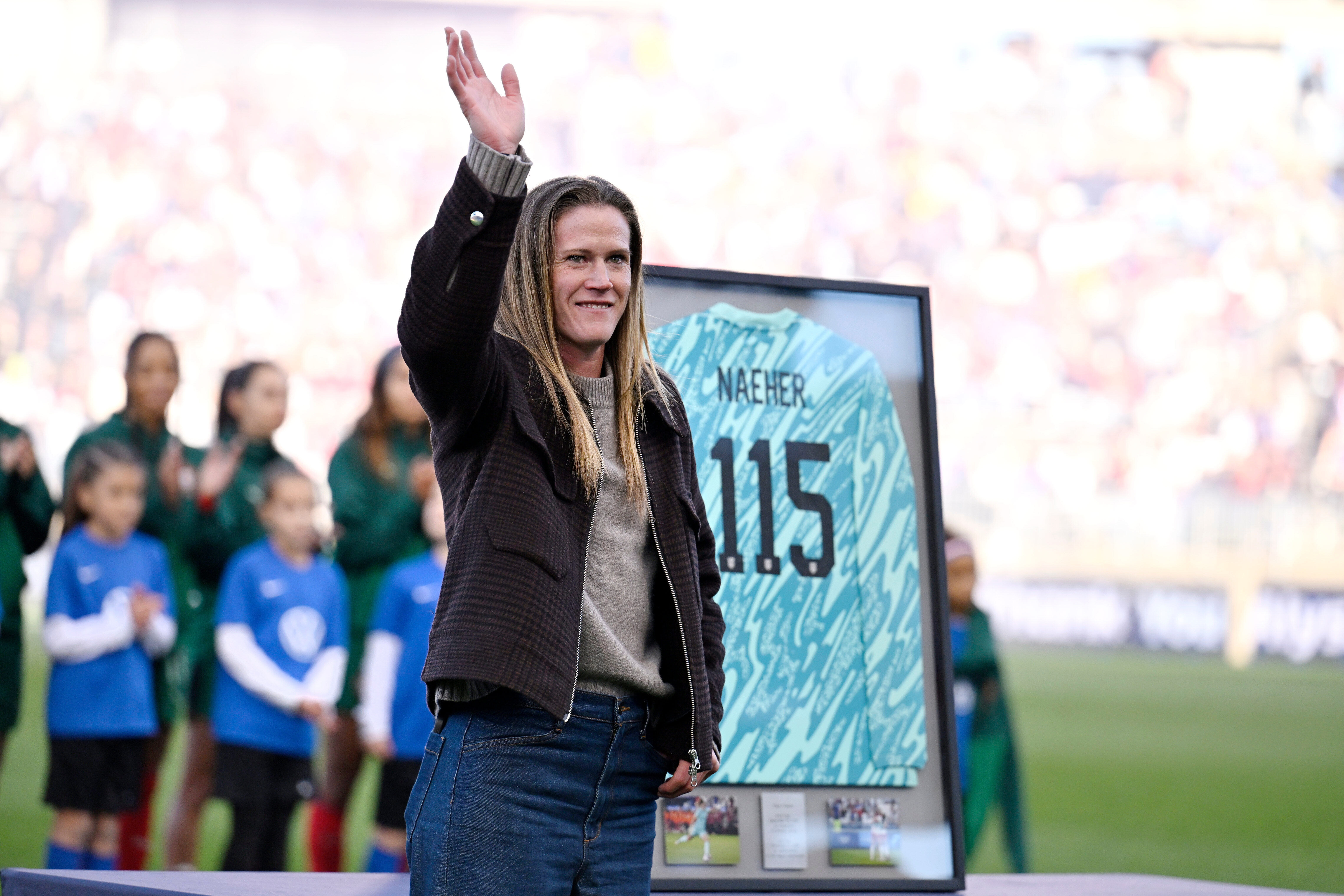
    Before the match at Pratt & Whitney Stadium, the United States honored Naeher, a Connecticut native, who retired from the national team late last year after winning a gold medal at the Paris Olympics.

    Naeher was the starting goalkeeper for the U.S. team that won the Women’s World Cup in 2019 and the 2024 Olympics. She’s the only U.S. goalkeeper to earn a shutout in both a World Cup and an Olympic final.

    Alyssa Naeher waves to the crowd in her home state during her retirement ceremony.

    The team was without some of its star players. Trinity Rodman was nursing an MCL sprain in her right knee that she sustained Oct. 15 during a CONCACAF W Champions Cup match with her club team, the Washington Spirit.

    Defender Naomi Girma remained sidelined with a calf injury that occurred before the start of Chelsea’s season in September.

    Forward Lynn Biyendolo, who was left off the U.S. roster because of a knee injury, announced on Saturday that she and her husband are expecting their first child. Other prominent national team players who have taken maternity time off this year include Sophia Wilson and Mallory Swanson.

    Hayes said that U.S. Soccer was developing more comprehensive “pre- and postpregnancy” protocols to be announced in the future.

    The United States has one more match during the current international window, against New Zealand on Wednesday at CPKC Stadium in Kansas City, Mo.