Penn’s offense sputtered and stalled in New Haven, Conn., and with it went the Quakers’ unbeaten Ivy League run.
A pair of turnovers and missed chances doomed Penn in a 35-13 loss to Yale on Saturday, the team’s first conference defeat of the season.
Penn (4-2, 2-1 Ivy) repeatedly hurt itself with penalties and failed conversions and struggled to finish drives despite controlling the ball for more than 36 minutes. The Quakers scored fewer than 24 points for the first time this season.
Yale (4-2, 2-1 Ivy) capitalized on nearly every opportunity. Quarterback Dante Reno threw for 211 yards and three touchdowns, while running back Josh Pitsenberger powered the Bulldogs’ ground game with 149 yards and a score as they cruised to their third straight win.
Penn quarterback Liam O’Brien threw for 220 yards and a touchdown.
“We had too many undisciplined problems with the penalties,” Penn coach Ray Priore said. “It’s just some missed things that our kids wouldn’t have normally done.”
Self-inflicted wounds
The Quakers entered the game second in the Ivy League in penalties committed, and their mistakes finally caught up to them, starting from their first offensive drive.
Following a recovered fumble by linebacker John Lista to give Penn possession in the red zone, an illegal formation penalty killed the momentum and forced a field goal.
“We got to convert that,” Priore said. “That’s got to be seven points. That’s one of our mottos.”
Yale responded with a 10-yard touchdown run by Nico Brown to close the first quarter, then took control after two second-quarter fumbles by O’Brien. The first was recovered and returned for a score by Yale defensive end Abu Kamara, an Interboro High School graduate.
The Quakers trailed, 28-10, at halftime and continued to struggle.
They finished with two turnovers, 110 penalty yards, and just one scoring drive, despite the defense forcing two turnovers and multiple three-and-outs.
“We put our defense in tough situations early,” Priore said. “ … When you win, you win as a team, when you lose, you lose as a team.”
Missing the ‘Juice’
Julien “Juice” Stokes, Penn’s leading rusher and the national leader in punt return yards, could be out for the season after suffering a broken fibula against Columbia, according to The Daily Pennsylvanian.
Looking to make up for Stokes’ absence, offensive coordinator Greg Chimera relied on O’Brien, who finished with 22 rushing attempts for 45 yards.
Despite mixing in star receiver Jared Richardson in the backfield alongside backup running back Donte West, Penn’s rushing attack never found traction, averaging just 2.8 yards on 33 carries, though it outrushed Yale, 202-92.
“I think we know we can play a lot better football than that,” Priore said regarding the run game. “We have to learn from this, take every game as a learning experience.”
On special teams, Stokes was equally missed.
Cornerback Jayden Drayton took over kickoff and punt returns but couldn’t match Stokes’ production and fumbled to start the third quarter.
Around the league
Harvard (6-0, 3-0) dominated Princeton (3-3, 2-1), 35-14, to take sole possession of first place in the Ivy League through three games.
The Crimson were ranked 17th in the FCS entering Saturday’s matchup and led the Ivy League in total offense, total defense, scoring offense, and scoring defense.
Penn finds is a four-way tie for second place.
Up next
Penn will host Brown (3-3, 0-3), which lost to Cornell (2-4, 1-2) in overtime, 30-24, on Friday (7 p.m., ESPN+) at Franklin Field.
On the first day of early in-person voting in New Jersey, and with U.S. Rep. Mikie Sherrill, the Democratic gubernatorial candidate, showing a slim polling edge over her Republican opponent, Democrats called in the popular governor from neighboring Pennsylvania to drum up some enthusiasm among Garden State voters.
Gov. Josh Shapiro stumped for Sherrill at a senior center auditorium and an African Methodist Episcopal church, targeting two groups seen as necessary for Sherrill to beat Republican Jack Ciattarelli.
“Thank you for getting off the sidelines,” Shapiro said to the crowd at the senior center, several of whom said they either voted by mail already or were on their way to the polls. “Thank you for doing your part. Thank you for being in this game. I am grateful.”
Outside the Monroe Township senior center, Shapiro was a big draw among the crowd that lined up early Saturday to get through security.
“He’s very well liked,” said Connie Hamlin, 71, of Monroe Township, who sipped coffee to stay warm “Number one, he’s handsome. He’s young. That’s very important.”
Equally important, she said, is that Shapiro is “for democracy” and “a decent person,” two traits she said President Donald Trump lacks.
Gov. Josh Shapiro on the campaign trail for NJ gubernatorial candidate Mikie Sherrill (left) Saturday, Oct. 25, 2025.
At the two campaign stops, Sherrill ripped into Trump, saying that while the prices of consumer goods like coffee have skyrocketed, “Trump and his family are making billions.”
Sherrill said her opponent would rubber-stamp Trump administration policies that are unpopular with many in New Jersey — such as his cancellation of $16 billion in funding to build two new rail tunnels under the Hudson River.
“It’s about opportunity and affordability,” Sherrill said. “We’re fighting for our kids, to make sure they have a better future.”
Ciattarelli hit the campaign trail as well Saturday, stopping in Passaic, Bergen, and Morris Counties with a message of “a stronger, safer, and more affordable New Jersey,” according to Facebook posts.
Friday evening, Trump held a tele-rally for Ciattarelli, in which he said Sherrill would “be a travesty as the governor of New Jersey” and urged Republicans to take part in early voting.
“You got to make sure the votes are counted, because New Jersey has a little bit of a rough reputation, I must be honest,” Trump said.
There is no evidence of mass voter fraud in New Jersey or anywhere else in recent elections, but Trump still claims the 2020 election was rigged against him and has appointed a notorious Pennsylvania election denier to a federal position monitoring elections. On Friday, the Department of Justice said it will send federal observers to monitor elections in New Jersey and California.
At a news conference Saturday, Sherrill said she is proud that New Jersey’s elections have been “open, transparent, and free.”
“And we’re going to continue to do that, and ensure we don’t have any voter intimidation,” Sherrill said.
At the senior center, Hamlin said she supports Sherrill’s plan to lower energy costs, likes that she’s a woman, and feels it’s important that the next governor is a Democrat. “She’s soft-spoken, but she has meaningful things to say,” Hamlin said.
Shapiro spoke about how he was raised and how his faith teaches him that “no one is required to complete the task, but neither are we free to refrain from it.”
The message wasn’t lost on Steve Riback, who said Trump has given antisemites and other extremists “license to come out of the woodwork.” Riback, who is Jewish, said that Shapiro would be his top choice for president in 2028, above Illinois Gov. JB Pritzker.
Shapiro urged voters frustrated with Trump to send a message to the rest of the country “that here in Jersey, we value our freedom, we cherish our democracy, and we love our country.”
And Shapiro held up Sherrill as someone who would get things done in New Jersey. Sherrill has cited Pennsylvania as an example of a state with more efficient business licensure rules and better-managed energy costs.
Shapiro, who has not officially announced his reelection campaign, has long been floated as a presidential hopeful by Democratic insiders and national pundits. Shapiro’s soon-to-be-released memoir will likely add to speculation about his 2026 intentions.
After the senior center visit, Shapiro and Sherrill hit the turnpike up to New Brunswick, where a packed Mount Zion A.M.E. Church — congregants had come in on buses from around the state — was waiting for him.
Shapiro said it was up to Democrats to keep, and build upon, what the founders created. “We are those people, and this is a moment where we have to do this work. We’ve got to stand up for our rights,” he said. “We’ve got to keep perfecting our union.”
Pheobie Thomas, an A.M.E. member who traveled from Trenton for church, said Shapiro and Sherrill offered promising signs that they support “equitable access for all people, including Black people.”
Thomas, 48, said there is a long history of Democratic politicians courting Black churches for votes, and for good reason.
“The Black church is extremely important,” Thomas said. “We do go to the polls. We do show up.”
As for Shapiro, she said he was speaking to New Jersey — but at the same time, he hinted that he was speaking to a broader audience.
“You just know that there’s that potential of, you know, ‘I may come back again to ask for your vote.’”
Staff writer Robert Moran contributed to this article.
Benita Valente, 91, a revered lyric soprano whose voice thrilled listeners with its purity and seeming effortlessness, died Friday night at home in Philadelphia, said her son, Pete Checchia. In a remarkable four-decade career, she appeared on the opera stage, in chamber music, and with orchestras.
In the intimate genre of lieder — especially songs by Schubert and Brahms — she was considered one of America’s great recitalists.
Even during an era of towering, individualistic voices, Ms. Valente stood out as something special. With pinpoint-precise technique, she deployed no vocal cheats or affectations. Her recognizable sound and honest approach were adored by aficionados.
“She is as gifted a singer as we have today, worldwide,” wrote John Rockwell in the New York Times in 1983.
Her voice had a natural quality, said pianist Richard Goode, who recalled that it was Ms. Valente who introduced him to the lieder repertoire. “There was an extraordinary distinctive sweetness of the timbre. Very clear pitch. Very focused,” said Goode, who recorded with her. ”And a kind of natural charm that came through in everything that she sang.”
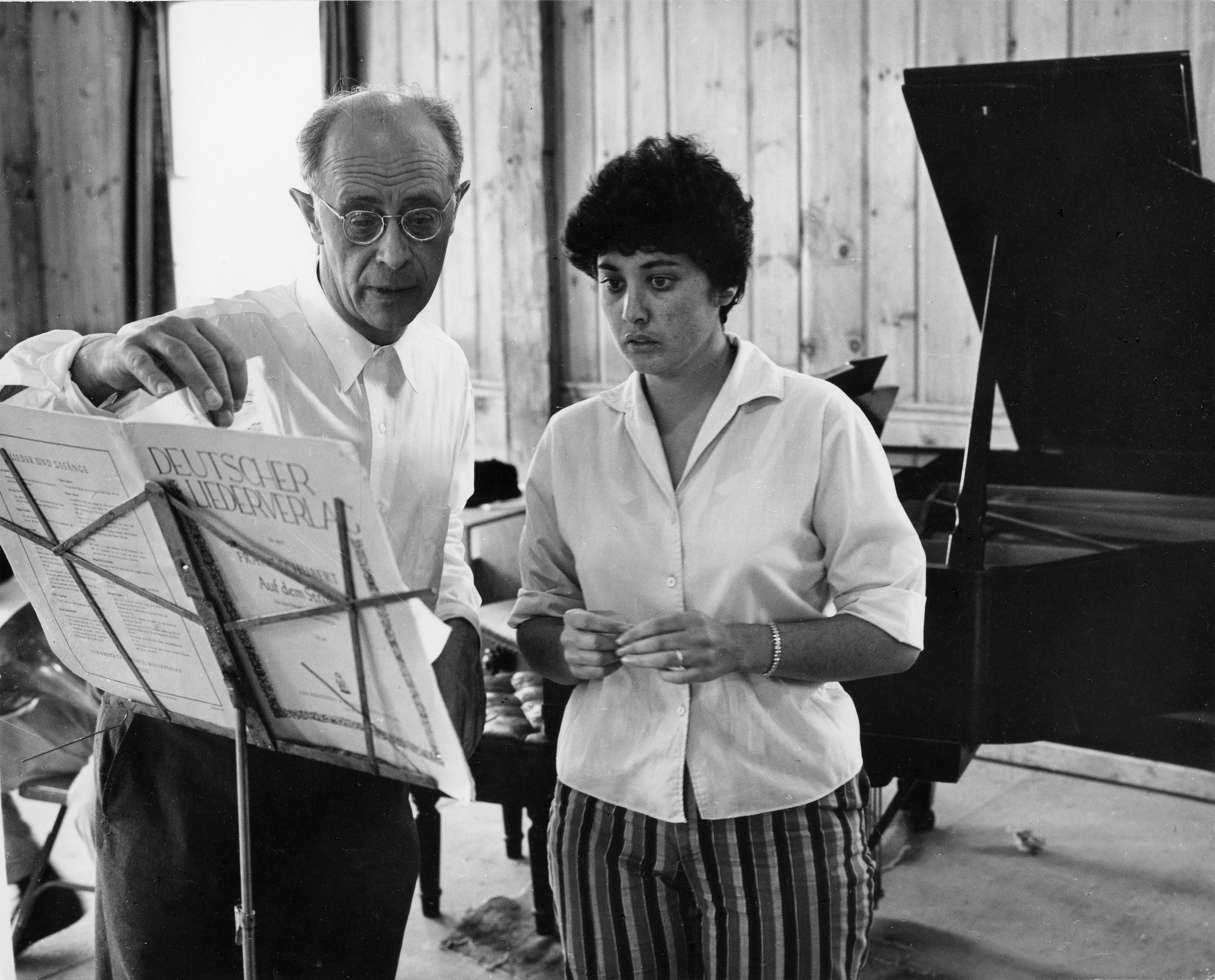
Pianist Rudolf Serkin with soprano Benita Valente at Marlboro Music, 1960s.
A longtime resident of Rittenhouse Square, Ms. Valente sang in the opera houses of San Francisco, Santa Fe, N.M., Germany, and Italy, and the Teatro Colón in Buenos Aires. She appeared with the Metropolitan Opera more than 70 times between 1960 and 1992 — as Pamina in Die Zauberflöte, Almirena in Handel’s Rinaldo, Gilda in Rigoletto, Susanna in Le Nozze di Figaro, and others.
With the Juilliard String Quartet, she gave the world premiere of Ginastera’s String Quartet No. 3 in 1974, and was the voice for the Juilliard’s recording of Schoenberg’s String Quartet No. 2 in a collection that won a 1978 Grammy Award.
In 1999, she became the first vocalist to win Chamber Music America’s Richard J. Bogomolny National Service Award.
Critics pronounced her voice “incomparable” and “almost miraculously lovely.”
She had something more: “that special projection of personality that distinguishes the great artist,” the Times wrote.
The artist had her beginnings as a self-described shy tomboy growing up on her uncle’s farm in California’s San Joaquin Valley. Ms. Valente was born Oct. 19, 1934, in Delano, Calif., the daughter of an Italian father and a Swiss mother. A high school teacher noticed her gifts and recommended her to Lotte Lehmann, and as a teenager she traveled from home to Santa Barbara to study with the celebrated soprano and Lehmann’s brother, vocal coach Fritz Lehmann.
“She didn’t know what to do with me,” Ms. Valente told The Inquirer. “I’d sing something she thought was very touching, and then there were lapses where I was as green as all get-out. She finally said, ‘I have contacts in Hollywood, I could get you to a screen test. I think you’d do very well.’ But I wanted to go into opera.”
Benita Valente with her husband, Anthony P. Checchia, at the Marlboro Music Festival.
It was Fritz Lehmann who suggested that she audition for the Curtis Institute of Music with Mozart, and she got in. Ms. Valente attended Curtis from 1955 to 1960, where her primary teacher was French baritone Martial Singher, and later studied with Wagnerian soprano/mezzo-soprano Margaret Harshaw. She was still a student when she won a Philadelphia Orchestra student competition that brought a 1958 debut with the orchestra.
The next year she married Anthony P. Checchia, a bassoonist she met at the Marlboro Music Festival who would go on to lead both Marlboro and the Philadelphia Chamber Music Society. They became one of classical music’s power couples, and had a special understanding because of their modest backgrounds — he from Tacony, she from a farm — said their son. “I remember my dad pulling over on Lombard Street once when she was on the radio. He was more nervous than she was,” Pete Checchia said. Anthony Checchia died in 2024.
Ms. Valente became a regular soloist with the Philadelphia Orchestra, appearing with the ensemble 60 times — in core repertoire of Mozart and Beethoven, but also in contemporary works. She gave the world premiere in 1981 of David del Tredici’s All in the Golden Afternoon from Child Alice, Part II, with Eugene Ormandy conducting the Philadelphians.
The work was in an ecstatic, neo-romantic musical language, thickly orchestrated with amplified soprano. Ms. Valente’s performance was “an essay in vocal purity,” wrote Inquirer music critic Daniel Webster.
For the Academy of Music 130th Anniversary Concert in 1987, she sang an evening of Puccini arias with the Philadelphia Orchestra led by legendary conductor Klaus Tennstedt. ‘’O mio babbino caro” from Gianni Schicchi seemed an ideal choice, Webster wrote, “in which her sun-filled voice illuminated the joyous text.”
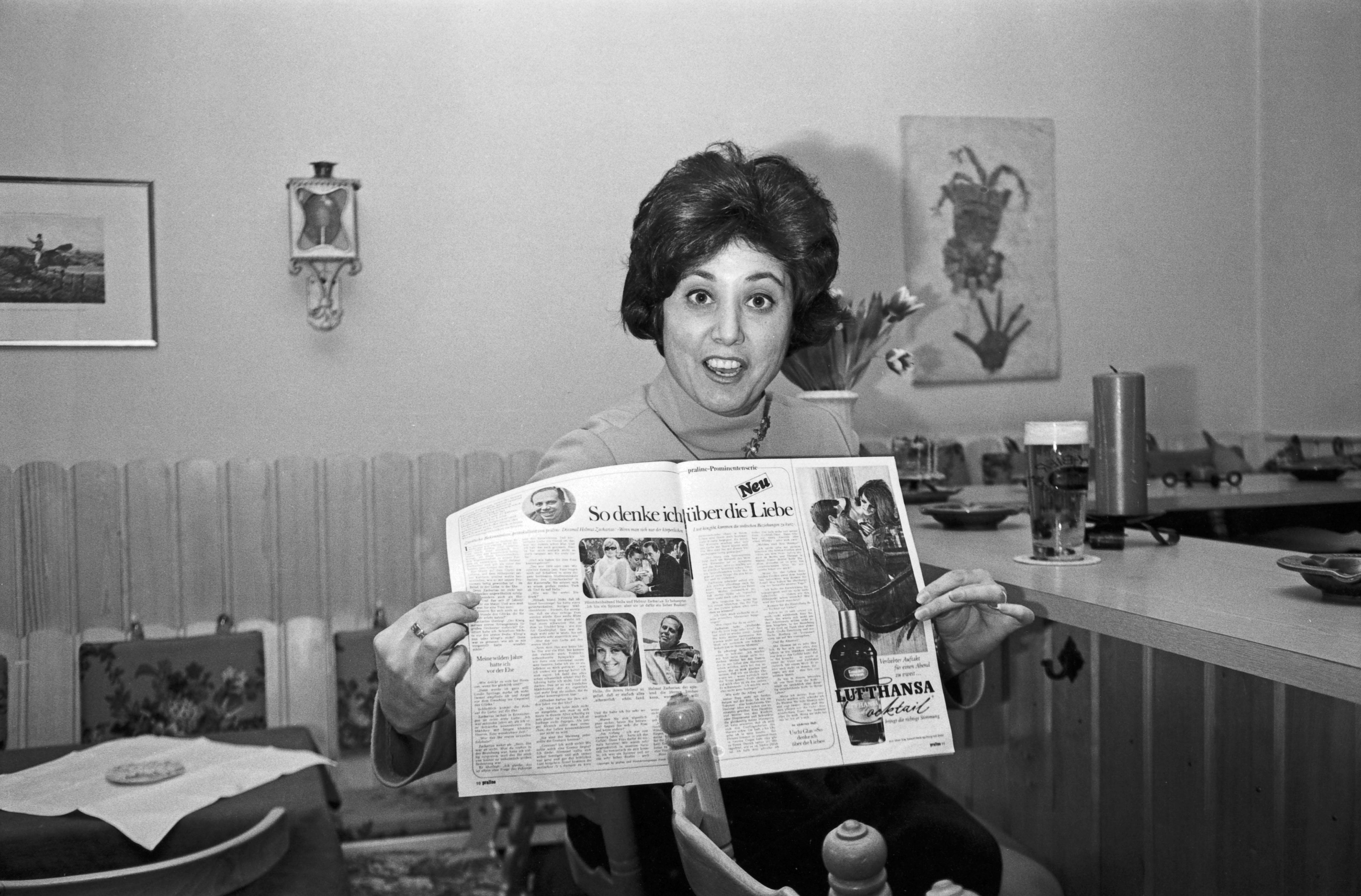
American soprano singer Benita Valente, Germany, 1970s.
Ms. Valente was soloist the previous season for one of the orchestra’s most notorious programs. She was Mélisande in a concert version of Debussy’s Pelléas et Mélisande at which an unusual number of listeners, apparently unimpressed with one of Western civilization’s great achievements, walked out. One man in the Academy of Music’s second row stretched out a newspaper and was asked to leave, she recalled.
“It has too much mystery, that Pelléas,” Ms. Valente told The Inquirer years later, pointing out that the audience seemed similarly disenchanted with the work at a Metropolitan Opera performance she attended.
Ms. Valente was never a household name, which often confounded critics. Some put it down to her lack of diva-ness. But it was perhaps more the fact that Ms. Valente was never a careerist. She was known to turn down prestigious opportunities — like a chance to sing Berg’s Altenberglieder with the Boston Symphony Orchestra — when she felt the part was not right for her voice.
She retired from singing in 2000 and was awarded an honorary degree from Curtis in 2001.
Benita Valente with soprano Lucy Fitz Gibbon in 2021.
Ms. Valente taught and mentored young singers.
“She was so meticulous about connecting the vowels and would listen in between the notes to how you got from one note to the next,” said soprano Sarah Shafer, who studied with Ms. Valente at Marlboro and in Philadelphia. “That trained my ear and my voice to pay attention to those things and brought me to a different level of detail.”
Her knowledge of the repertoire was vast, said pianist Lydia Brown, with whom Ms. Valente worked in vocal coachings at Marlboro and the Met. “Every rehearsal she came to was a piece she had sung many times, or she commissioned it or premiered it. There were so few pieces that Benita didn’t have active performing knowledge of.”
In recordings she is particularly renowned for a collection of Handel and Mozart duets with soprano Tatiana Troyanos; Haydn’s The Seven Last Words of Christ with the Juilliard String Quartet; and two discs in Bridge Records’ “Great Singers of the 20th Century” series, including a classic recording of Schubert’s “The Shepherd on the Rock” with pianist Rudolf Serkin and clarinetist Harold Wright.
“She was in the old-school style of singing, where the singer is just a vessel for the music. Not selfish, not about herself, she was just delivering the music in as clear and undistorted a way as possible,” said Shafer, who learned “The Shepherd on the Rock” from Ms. Valente and has made it a calling card of her own.
”The result is this sparkly, silver jewel of her voice that you hear in these recordings. There’s just no singing like it now.”
In addition to her son, the Philadelphia photographer Pete Checchia, Ms. Valente is survived by her “daughter by choice,” Eliza Batlle, Checchia said. A memorial concert is planned for a later date.
It was a New York State of Mind for the hometown team on Saturday.
Backed by a pair of goals from New York native Trevor Zegras, who also scored a shootout goal, the Flyers clawed back and skated away with a 4-3 win against the visiting New York Islanders.
Matvei Michkov beat countryman Ilya Sorokin in the shootout, and Sam Ersson stopped Anthony Duclair to give the Orange and Black their fourth win in the past six games.
Big Shot
Trailing 2-0, the third line of Christian Dvorak, Zegras, and Michkov single-handedly tied things for Philly.
Dvorak made it 2-1 with his second of the season with 9 minutes, 31 seconds left in the second period. Michkov and the center twice had a give-and-go, first in the neutral zone and then once again when the blue line was gained.
Michkov got the puck right up against the left boards and, as Dvorak sneaked behind the Islanders’ defense, the Russian winger fed Zegras across the ice at the right point. Zegras waited to hit Dvorak as he cut across the crease, and the center scored on the backhand.
And then came the big moment: Zegras’ first goal with the Flyers.
Dvorak carried the puck into the offensive zone, and although Islanders defenseman Marshall Warren poke checked him, it went up and off the arm of Dvorak, who corralled the puck at the goal line.
While doing so, he also drew two Islanders with him, Warren and former Flyers defenseman Tony DeAngelo, giving Zegras the time to accept the pass, pause, and beat Sorokin top corner.
Dvorak said he had seen Zegras out of the corner of his eye but also heard him yell for the puck.
“I always call for the puck,” Zegras said, jokingly. “I might not even be open, but I probably scream for it. Just happy he found me on that one though.”
The Flyers have two power-play units. But is the one with Noah Cates, Tyson Foerster, Bobby Brink, Cam York, and Zegras the second unit? Or is it the one with Michkov, Travis Konecny, Sean Couturier, Jamie Drysdale, and Owen Tippett?
“I’m not sure who is first or second right now,” coach Rick Tocchet said postgame. “You can say two, but I don’t know yet. It’s one and one right now.”
That’s a fair assessment, considering how much better the Cates unit has looked. While the other unit started the first two-man advantages, the Cates unit started the third power play of the day — and it worked.
Zegras got his second goal of the game — his first multigoal game since Jan. 7, 2024, when he was with Anaheim — as he put a rebound shot on Sorokin. Bobby Brink had turned and fired off a good shot from the right face-off circle that the Islanders’ goalie stopped before Zegras’ shot led to a mad scramble in front.
It took a few seconds, but the puck crossed the goal line with Cates giving it an extra push after it was in to confirm it tied the game at 3.
As Tocchet said, they took the information assistant coaches Jaroslav “Yogi” Svejkovský and Jay Varady provided before they went out and applied it.
“They do apply a lot of stuff that we say,” he said of the Cates line.
“Just kind of good for us to crash the net,” Cates added. “I think we want these pretty plays, but we see it day in and day out in the NHL, that you just get it to the net, get guys there, outnumber them, especially on the power play, it’s going to go in.”
On the flip side, the Couturier unit struggled again as the Islanders got better looks and a goal. Simon Holmström gave the Islanders a 1-0 lead with a short-handed tally 39 seconds into the Flyers’ first power play of the day.
Set up in the offensive zone, they had Drysdale at the point, Michkov in the right face-off circle, and Tippett in the slot as the bumper.
Tippett had some time in the bumper, and there was an open lane for a few seconds, but by the time Michkov tried, it was closed as two guys jumped on Tippett.
Matvei Michkov (stick raised in the right face-off circle) did have an open lane, but a small delay in his delivery to Owen Tippett — and thus giving away his plan — saw the lane close quickly.The lane closed as New York Islanders forwards Simon Holmström and Jean-Gabriel Pageau were able to check Tippett and create a turnover.
Holmström, who is a lefty, was easily able to knock the puck away from Tippett, a right-handed shot. It appeared the red-hot Tippett was looking to shoot instead of drawing two players in and bumping the puck back to Michkov to open even more space.
The Swedish winger got the puck and passed it to Jean-Gabriel Pageau, breaking out two-on-one. Drysdale overcommitted slightly to the puck carrier, Pageau, as Couturier tried to catch up with Holmström. Both Flyers went to Holmström after he got the puck back, but he was a stride ahead and beat his countryman, Ersson stick side.
On the Flyers’ second power play of the day — and with the Couturier unit on the ice — Adam Pelech rang one off the post after a Konecny giveaway in the Flyers’ zone.
The Flyers’ power play is now at 16% effectiveness, with four goals in 25 opportunities.
Making his third start of the season, and first appearance since Oct. 16, a 5-2 loss to the Winnipeg Jets, Ersson made 23 saves on 26 shots for his first win of the season.
“His attitude was unreal all week. Practicing hard. He’s with [goaltending coach Kim Dillabaugh] and never complained,” Tocchet said. “You’ve got to give him credit. It was a [heck] of a save on Duclair at the end [in the shootout]. So, give him a lot of credit. Great attitude.”
In the first period, he faced just four, 13 in the middle frame, and five in the third. Not an easy task for a goalie who likes shots but hasn’t seen game action in a while.
“I’ve got to try to stay ready as best as I can; obviously, it’s hard sometimes,” Ersson said. “But I’m looking to stay involved in the game, play pucks, do something to stay attached to the game mentally. So, yeah, it’s just another challenge [and] you’ve got to find a way to deal with it.”
Ersson allowed one goal in each period, but the one in the second period, the Swede had no chance.
Defenseman Noah Juulsen tried to go D-to-D with Drysdale behind the net, but the puck hit the skate of the referee. Duclair tracked it down and tried to feed Anders Lee in front; however, he was tied up by two Flyers — one being Juulsen.
The puck sprung loose to Warren, a Long Island kid making his NHL debut, who put the puck through the crease to Duclair sitting wide open at the right post for the easy goal.
Warren then helped the Islanders take a 3-2 lead less than 3 minutes after Zegras’ tying goal, when his low point shot was deflected up and over Ersson by Maxim Tsyplakov for his first NHL goal.
Then Ersson locked things down.
With the game tied, Tippett was tugged off the puck by Bo Horvat, allowing him to skate in on a two-on-one with Drysdale the only Flyer back. Horvat fed Jonathan Drouin for the quick shot, and Ersson made a diving blocker save.
But, Ersson saved his best save of the night for overtime, robbing Horvat on a sure goal. After the puck was carried back in by the bodies of Horvat and Cam York, Drouin picked it, and the Islanders’ forwards had a short two-on-one as Horvat got past York. Drouin fed the former Vancouver Canuck — he crossed paths with Tocchet for a week — and was absolutely robbed by the glove of Ersson.
“He bailed us out a handful of times,” Dvorak said. “Played great, couple of big saves there in the third, and the overtime was unbelievable. We couldn’t believe he saved that on the bench there. So it was a big goal and got us a win.”
“Just, Erss is back,” a grinning Cates said when asked what he thought about watching that save. “When he’s confident, he’s so good, and that’s a huge game for him.”
Flyers prospect Spencer Gill suffered an upper-body injury and could miss 12-15 weeks. The Flyers are still trying to determine whether the defenseman needs surgery or if he can rehab the injury. … The only change among the skaters was swapping defenseman Adam Ginning in for Egor Zamula on the third pair. … Forward Garnet Hathaway had five hits and dropped the gloves with Scott Mayfield, leaving the Islander bloodied on his forehead. In the third period, Rodrigo Ābols also fought Kyle MacLean, the son of former New Jersey Devils and New York Rangers forward John MacLean, for his first NHL fight. The line of Ābols, Hathaway, and Nikita Grebenkin ended up in the box together, with the latter two getting coincidental minor penalties.
Up next
The Flyers are off on Sunday and will practice at 11:30 a.m. on Monday. They take on the Pittsburgh Penguins on Tuesday. It kicks off ESPN’s Frozen Frenzy triple header with puck drop at 6 p.m.
Former Temple guard Jamal Mashburn Jr. was selected eighth overall by the Westchester Knicks, the G League affiliate of the New York Knicks, in the 2025 NBA G League Draft held in White Plains, N.Y., on Saturday.
Mashburn Jr., the son of former NBA All-Star forward Jamal Mashburn Sr., spent one season at Temple after playing three years at New Mexico under Richard Pitino. He also played his freshman year at Minnesota, also under Pitino.
His season at Temple started strong before being derailed by a toe injury in February.
Mashburn Jr. led the Owls with 22 points per game and started all 23 games before missing nine of Temple’s final 10, including its American Conference Tournament loss to Tulsa on March 13.
He provided a scoring punch for Temple after the departure of former guard Hysier Miller, scoring 20 or more points 16 times, including a career-high 34 in a double-overtime win over Charlotte.
Mashburn Jr. is Temple’s second player to sign an NBA contract this offseason. Former forward Steve Settle III signed an Exhibit 10 deal with the Miami Heat and is expected to play for its G League affiliate in Sioux Falls, S.D.
Spotlight PA is an independent, nonpartisan, and nonprofit newsroom producing investigative and public-service journalism that holds power to account and drives positive change in Pennsylvania. Sign up for our free newsletters.
HARRISBURG — Taxpayers are paying for roughly $1 million in security upgrades to Gov. Josh Shapiro’s private home in Montgomery County, according to information the administration disclosed to top lawmakers about its expenditures in the aftermath of the brazen arson attack on the first family earlier this year.
In a Friday letter to legislative leaders, administration officials said improvements include “erecting physical and visual barriers on the property, installing enhanced security technology, and other steps.” They then noted that due to safety concerns, they could not provide more details about the work being conducted at Shapiro’s private home.
The letter, authored by Pennsylvania State Police Commissioner Christopher Paris and Department of General Services Secretary Reggie McNeill, also disclosed safety upgrades totaling $32.3 million at the governor’s official residence in Harrisburg, including $8 million to retrofit the mansion with new windows that are bullet- and shatterproof.
The attack occurred at the 29,000-square-foot mansion this past April while the governor and his family were asleep inside.
“The horrifying attack on the Governor, his family, and Commonwealth property, coupled with the unfortunate rise in political violence across our country, has made these updates necessary to protect the Governor and his family and ensure the continued operation of the executive branch of the Commonwealth,” Paris and McNeill wrote. “No family should have to live behind bulletproof glass or behind large walls — but the nature of the threats against elected officials today require us to take these important steps.”
They added: “Unfortunately, the threat to a high-profile elected official like Gov. Shapiro does not end when he leaves the Governor’s Residence.”
In a statement, Shapiro spokesperson Rosie Lapowsky said the State Police conducted a security review of the governor’s personal residence and recommended a number of improvements. Before carrying out any of those improvements, she said the administration “consulted the Ethics Commission … to ensure there is no improper private, pecuniary gain from these security improvements.”
Last week, Harrisburg resident Cody Balmer pleaded guilty to attempted murder, aggravated arson, and other charges related to the attack in the dead of the night on April 13. That is when Balmer scaled the perimeter fence at the governor’s official residence along the banks of the Susquehanna River, broke two windows, and used crude, homemade Molotov cocktails to set fire to several rooms on the residence’s first floor.
Shapiro, his family, and friends had celebrated Passover just hours before, and were asleep on the second floor of the residence when Balmer broke in. Balmer told authorities that he would have beaten Shapiro with a hammer he had with him if he had encountered the governor.
The Democratic governor has said that he and his family are still struggling with the emotional toll of the attack, but stressed that he will not be deterred from continuing in public service.
It is not clear what prompted Paris and McNeill’s letter. Earlier this week, Spotlight PA submitted a public records request for all taxpayer-funded expenditures at the governor’s private home.
Also midweek, Republican state Sen. Jarett Coleman, who chairs the chamber’s Intergovernmental Operations Committee, fired off a letter to Paris seeking similar information about physical improvements to Shapiro’s Montgomery County home, among other items.
Coleman told Spotlight PA on Friday that his committee will “continue to investigate” spending at the governor’s private residence “to protect taxpayers as this unprecedented project is being completed.”
Spotlight PA last month reported that the state has spent more than $6 million to repair extensive damage from the fire at the governor’s official residence — but that the administration is shielding information about nearly a quarter of those expenses, including who was paid and exactly what the money was spent on.
The news organization has also reported that private donors have separately contributed to a fund managed by a Harrisburg-based nonprofit to help restore the mansion. So far, neither the organization nor the administration has disclosed the donors’ identities, the amount they contributed to the fund, or provided a general description of what that money has or will be used for.
In the letter sent to legislative leaders, the administration shed light on at least some of those questions. The officials said that to date, the state has submitted $4.5 million in expenses to one of its insurers, which in turn has so far approved $2 million in reimbursements.
Security upgrades and improvements to the official residence, however, are not covered by the state’s insurance plans. The security improvements — recommended by a third-party review commissioned by the State Police in the wake of the attack — there include:
An estimated $14 million to replace the 6-foot fence that Balmer scaled with a “single material, 10-foot barrier resistant to vehicle damage or climbing.”
An estimated $6.3 million to install updated cameras, improve lighting, and add motion detection sensors in the residence’s yard.
An estimated $8 million to retrofit the residence’s existing windows with bulletproof and shatterproof glass.
An estimated $4 million to install a comprehensive fire suppression system in the residence, one of the largest state-owned buildings without one.
“In addition to the visible and extensive building security enhancements outlined above, additional recommendations on things like staffing, internal systems, and other technology improvements have been implemented,” by the state, Paris and McNeill wrote. “To avoid risk of a successful security threat against the property or the Governor in the future, we cannot disclose all of those recommendations publicly.”
The two men noted that the fire damaged multiple decorative items inside the residence, including chandeliers, china, pianos, and artwork. Most of those items, they said, do not qualify for insurance reimbursement, and their repair or replacement will be funded by private dollars.
BEFORE YOU GO… If you learned something from this article, pay it forward and contribute to Spotlight PA at spotlightpa.org/donate. Spotlight PA is funded by foundations and readers like you who are committed to accountability journalism that gets results.
There were Irish step-dancing vampires and opera-singing vampires. Vampires who claim to hunt billionaires and vampires who moonlight as emergency medical technicians. And, in at least one instance, a vampire who doubled as a heavyweight champ.
Such was the lineup of the first-ever Miss American Vampire Philadelphia pageant, where 13 wannabe bloodsuckers donned their best vampiric drag to compete inside heavy metal bar Doom Friday night. Contestants were thirsty to show that vampires contain multitudes (and, perhaps, for a little bit of blood).
Back then, MGM hosted the regional beauty competition to promote the movie House of Dark Shadows, with finalists going on to compete in Los Angeles for title of Miss American Vampire and a guest-starring role on the long-running vampire soap opera Dark Shadows. Native American activist Sacheen Littlefeather won the crown, though she never redeemed her prize.
The stakes of Doom’s pageant were far lower than a TV appearance and eternal life, though just as competitive. Contestants were judged by a panel of full-time goths and burlesque performers on their creativity and vampiric presence as they competed in the standard pageant categories: A costume parade, an interview, and a dark art — or talent with a touch of the occult.
The crowd reacts as Ezra Markel’s vampire persona “Isolde the Saturnine” eats the human heart she concocted during the talent portion of the Miss American Vampire Pageant at heavy metal bar Doom in Philadelphia on Friday, Oct. 24, 2025.
Prizes included $100 cash, a new set of fangs, and comic books donated from Atomic City Comics. Skull and mixed metal artist Sue Moerder prepared a Bob Mackie-inspired gothic crown, with feathers and pearls sprouting from an arrangement of ornate obsidian gems.
“Vampires represent the alternative, the occult, the bat-brained, the gothic … [people] on the outskirts of civilization,” Delgado told The Inquirer. “We just wanted to show that this bar is a safe cave for vampires to commune.”
Both floors at 421 N. 7th St. were packed as contestants flitted across the makeshift stage in costumes that highlighted the full expanse of vampire-dom. There were homages to both the German and Transylvanian versions of Dracula in peasant blouses and bejeweled collars, as well as more contemporary interpretations, with floor-length evening gowns, corseted waistlines, and lots of red lips.
Lilith Lobotomy — a blue-haired vamp whose bio alleged she bakes cakes and stalks billionaires — was an immediate favorite, earning thunderous applause when she turned away from the audience to drop her floor length duster. Emblazoned in sparkling blood red font on the back of her black dress was the phrase “Eat the rich.”
Logan Laudenslager performs as “Lilith Lobotomy” during the talent portion of the Miss American Vampire pageant held at Doom. She performed a rendition of “Phantom of the Opera.”
Madame Lobotomy would go on to win the coveted title of Miss Off Putting — Delgado’s spin on Miss Congeniality — after belting out the song “The Phantom of the Opera” while twirling a lit candelabra.
She was still no match for Norah Morse, who took home the Miss American Vampire Philadelphia crown after shocking the judges with her interview. When asked how she prepared for the competition, Morse scoffed.
“I don’t know what you mean,” she said in a thick Transylvanian accent. “I’m a vampire and I showed up.”
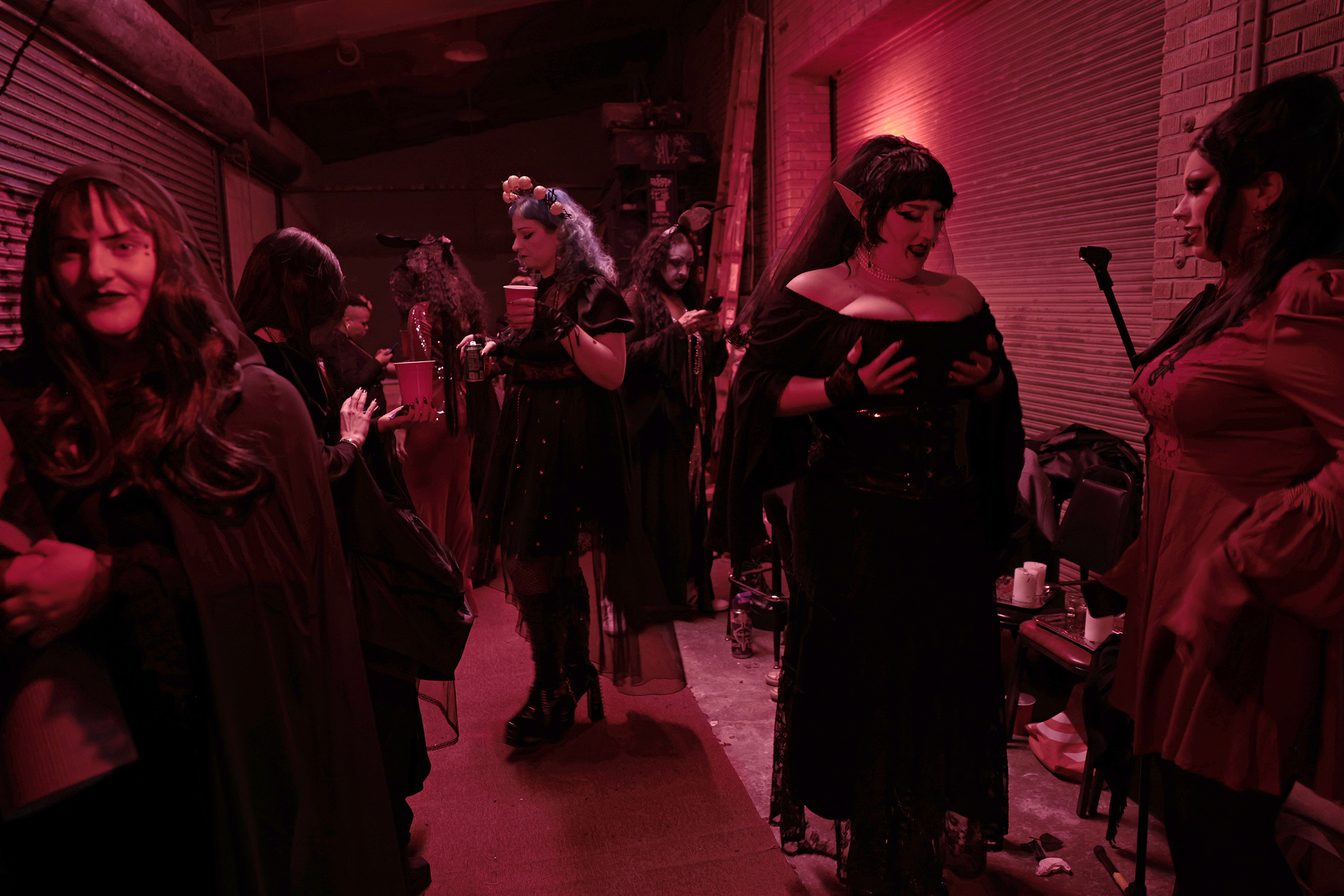
Contestants get ready backstage to performing during the Miss American Vampire Pageant at heavy metal bar Doom.
Judge and burlesque performer Caress Deville said Morse represented the commitment she was looking for. “I was gagged,” Deville said. “That’s exactly how you would answer if you were a real vampire.”
During her crowning, Morse’s human mother rushed to the front of the crowd to take photos. Even vampires, it seems, yearn for mom’s approval.
In the world of us mortals, Morse goes by Alex Decker, a 29-year-old from Bellmawr who has been drawn to vampires since she was a child. Decker lives with contamination OCD, she said, and envies the freedom of the undead.
“Life would be a lot easier if I was a vampire who could just drink blood all the time,” Decker said. “I have been weird and creepy and insane my entire life.”
Jenna Painter, of Willow Grove, performed as a naughty ‘Count Orlok” during the Miss American Vampire Pageant at heavy metal bar Doom, throwing off a trench coat to reveal a leotard and garters.
Competing to be America’s next top vampire
For some contestants, Miss American Vampire Philadelphia was an opportunity to transform their mortal selves into bolder and braver versions that were battle-tested from centuries of living.
When Doom announced the pageant on Instagram in early October, the post received more than 4,500 likes, Delgado said, and hundreds of shares. More than 50 hopefuls sent in applications via a Google form that asked for their vampiric backstory and talent, forcing Holden and Delgado to spend hours deliberating.
Delgado was unsurprised that the pageant took off. They were, however, shocked by the lack of trolling.
“I didn’t know how serious everyone who applied was at first,” Delgado said. “It’s supposed to be campy.”
On Friday, the beauty competition toed the line between a drag show and an actual Miss America preliminary. The judges pressed contestants on tough questions, such as how they choose their victims, and if it’s ethical to let them live post blood-sucking.
For Mira Castigin, of Camden, the most important quality to look for in a vampire is fun.
“What’s the point in being immortal if you let life pass you by?” she told the crowd.
Castigin’s vampiric persona is Elmira, a bewitching goth girl who shares Castigin’s day job as an EMT in hopes of atoning for her sins. The competition was an excuse for Castigin to air out some special pieces from her vintage clothing collection, including a petticoat and a pair of London Underground shoes.
Mira Castigin’s vamprie persona “Elmira” is applauded after performing during the Miss American Vampire Pageant at heavy metal bar Doom. For her talent, Castigin sang opera.
“I think it’s always fun to do your makeup and get dressed up no matter what day it is,“ Castigin, 25, of Camden, said. ”And this is like a more thought-out version of that.”
Castigin opened the talent portion by singing an operatic aria, setting up the audience for a night of bewitching tricks. One vampire played the violin, while another danced an Irish jig to a Type O Negative song. Cassius King — a silent movie star turned vampire — wowed the audience by performing feats of strength, at one point picking up his assistant and turning him upside down.
Rachel Rushmore — aka “Vampire Rachel” of Philadelphia — waits backstage during the Miss American Vampire Pageant at heavy metal bar Doom.
Rachel Rushmore, 34, of Fishtown, had a simpler talent, using sleight of hand to summon a tiny bat. Rushmore said she felt called to compete after 15 friends — including several who don’t even live in Philly — sent her Doom’s Instagram post.
Onstage, Rushmore transformed from mortal Rachel to Vampire Rachel, a temptress and philanthropist who had been around since “the age of powdered wigs and Ben Franklin.” Vampire Rachel wears maroon floor-length gowns and bedazzles her face with gems borrowed from Marie Antoinette. The real-life version works in children’s book publishing and had never performed in front of a crowd before.
“I called myself Vampire Rachel because it’s hard for me to be somebody who I’m not,” Rushmore said. “Tonight I’m Rachel, but more.”
When the Eagles and Giants squared off in Week 6, Saquon Barkley rushed for his third-highest total of the season.
He finished with a meager 58 yards, which tells you a lot about how Barkley’s second year in Philadelphia has gone.
Barkley has been held below 100 yards on the ground in each of the Eagles’ seven games. Through his first seven games in 2024, he rushed for an average of 109.4 yards, more than double his average of 52.7 in 2025.
Despite the dip in production, there is a sense of optimism in the NovaCare Complex that Barkley could be close to breaking out, as a rematch with his former squad looms Sunday at Lincoln Financial Field.
Much of the hope comes from the Eagles’ offensive performance last weekend in Minnesota, where the passing attack erupted behind an under-center, play-action flavored game plan.
The wrinkle wasn’t revolutionary, but it did give the Eagles a new look.
“It’s going to be fun or interesting to see how teams play us now,” said left tackle Jordan Mailata. “We can go under center and pass the ball, we can go under center and run the ball, so it’s going to be fun. I hope [opponents] respect one or the other. They have to now.”
Why have Barkley and the run game struggled so much?
First, defenses are playing them differently this year.
It’s been obvious live and on film that the Eagles are getting fewer lighter boxes to run into. Last year, the Eagles faced a light box 44.9% of the time, which ranked 15th in the NFL.
This year, there’s been a 20% decrease to 36.8%, which ranks 29th.
It’s a numbers game the Eagles are losing, particularly when it comes to their preferred zone blocking scheme — especially when defenses have five- and six-man fronts.
“When you go against a six-man front, now it’s one-on-one everywhere, and then there’s a guy sitting back there for the running back that’s unblocked,” said left guard Landon Dickerson.
Expecting all five offensive lineman to win their one-on-ones is a tough ask, and, in some cases, tight ends or a sixth offensive lineman are acting as a tight end.
One way to counter a heavy front is with gap scheme runs.
On a very rudimentary level, gap scheme runs, unlike zone runs, have pullers: an offensive lineman pulling as the lead blocker. These types of plays were responsible for some of Barkley’s most explosive rushes last year.
In gap schemes, the blocks are designed for a specific gap. In zone runs, the linemen block zones and work to the second level to create multiple lanes that the running back can choose to run through.
“I think zone, it’s pretty simple,” said Mailata. “If the play is an inside zone left, you’re stepping to an inside zone to your left.”
The inside zone run can come in many forms and has been a staple of offensive line coach Jeff Stoutland’s run scheme since he first arrived in Philadelphia in 2013. Every team runs it, but he may teach it better than anyone.
The Eagles, however, are having a hard time executing it this year because of the heavier boxes they’re facing and more five- and six-man fronts, and also because defensive coordinators are coming up with exotic strategies to slow the inside zone run down.
By running into bad looks on early downs, the Eagles haven’t done themselves any favors. It has burdened the line, forced Barkley to cut away from the flow of the blocking, and instead made him try to beat defenders on his own.
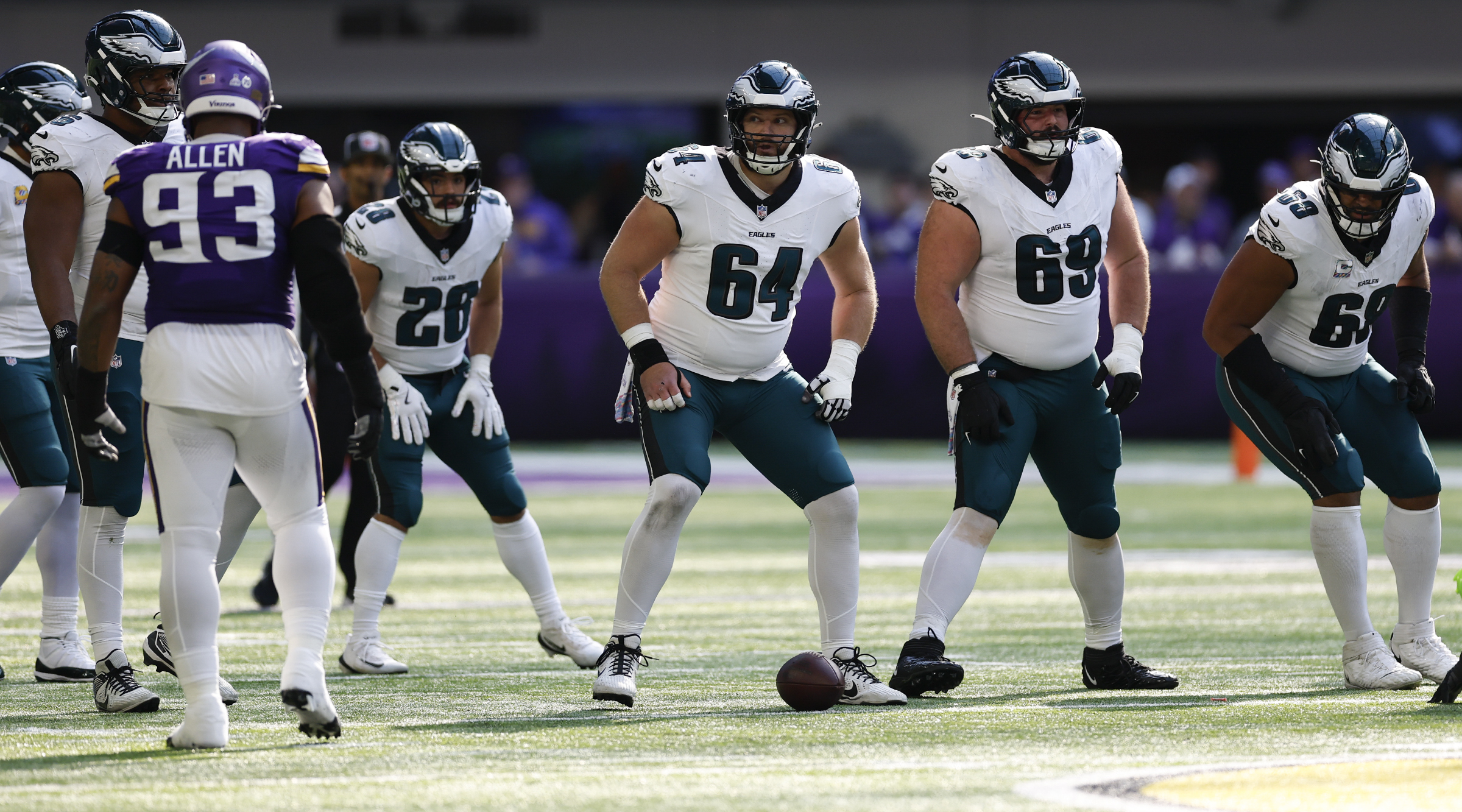
Brett Toth with teammates Landon Dickerson and Jordan Mailata at the line against the Vikings on Oct. 19.
This chain reaction is essentially what happened last Sunday when the Vikings defense, after the Eagles enjoyed modest success in the run early, adjusted on the Eagles’ third drive and started stacking the line.
The Eagles, however, had a counter of their own. Even though their initial production on the ground diminished, it still served a means to an end.
They came into their matchup with the Vikings wanting to establish under-center runs so that they could eventually use play-action passes downfield. It’s an obvious way to beat stacked boxes — to keep linebackers and safeties from cheating to stop the run.
The Eagles didn’t do much of it through the first six weeks of the season, but right tackle Lane Johnson, along with fellow linemen Dickerson and Mailata, advocated for more under-center plays during the mini-bye that followed the Eagles’ loss to the Giants on Oct. 9.
“It’s really beneficial for us,” Mailata said. “It’s just protecting our C.Y.A. — cover your [butt]. That’s the way I see it. There’s so much potential. You don’t know if it’s a pass, if it’s a run, if it’s a play-action.”
Jalen Hurts said after the Vikings game that he also recommended more under-center plays.
Through the Eagles’ first six games, he was under center only 14% of the time, throwing out of it only once.
In Minnesota, the Eagles were under center 41% and threw out of it four times. Hurts completed those passes for 121 yards, including the 79-yard touchdown pass to receiver DeVonta Smith that opened the second half.
“I think, conceptually, there’s a way to do quarterback run game from under center,” said Hurts, who usually ranks in the top five in the NFL in shotgun or pistol plays. “It’s just a matter where we are creatively, in what positions we put ourselves in.
“Not to get too much into schemes, it’s just more so how we choose to attack a team that week, and the level of execution that week.”
With receiver A.J. Brown (hamstring) already ruled out this Sunday, the Eagles will be down a key playmaker.
Barkley, who’s averaging just 3.3 yards per carry and ranks 36th out of 40 qualifying running backs with the expected points added number of -22.3, doesn’t want to hear about defenses focusing their efforts on him.
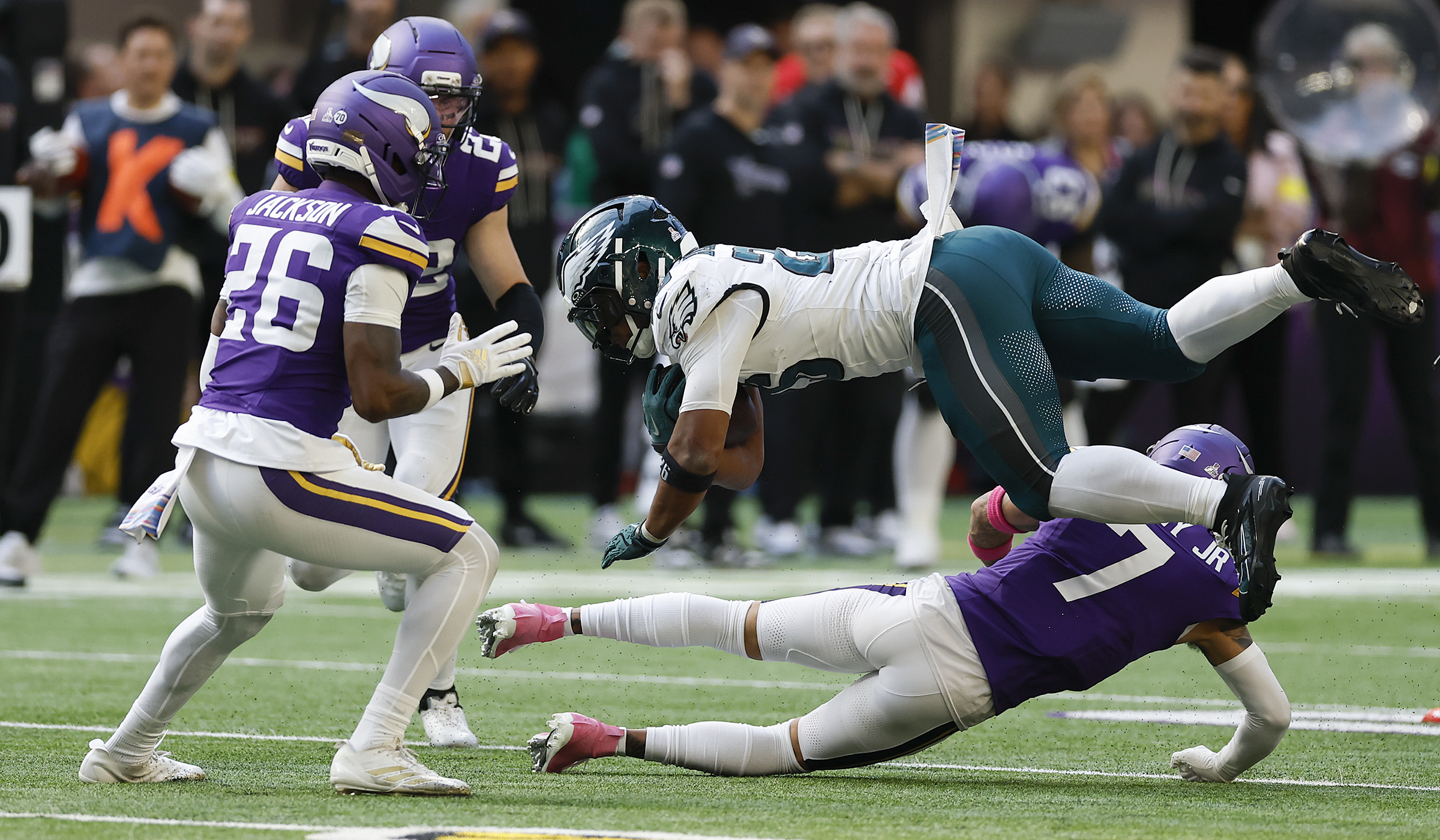
Barkley leaps past Minnesota Vikings cornerback Byron Murphy in the fourth quarter on Oct. 19.
“No, I don’t, I don’t agree with that,” said Barkley, cutting off a reporter who asked about the premise.
He said he was brought here to make plays, and right now, he’s not giving the Eagles enough of them.
“I’m taking too many negative runs, and I own that. It’s not because I rushed for 2,000 yards last year. I hate that narrative. We just had a different attitude, had a different mindset.”
Barkley already has 21 negative-yard runs this year, accounting for 18.6% of his 113 carries — nearly double his percentage from last season.
Barkley said after the Eagles’ 28-22 victory in Minnesota, the bottom line matters more to him than rushing numbers.
“Am I satisfied? No. We’ve got a lot of room to improve, but it’s good to get a win in a tough environment.”
There were a lot of questions about Barkley’s workload this season following the near-500 total touches he had in 2024.
There’s also the matter of his age. Barkley turned 28 in February. While that number is young for most, it’s around the time that running backs often start to decline.
According to the NFL’s NextGen Stats, Barkley’s rushing yards-over-expected, an advanced metric that measures how many more yards a player gains than expected, is -0.1. Last year, the mark was a superlative +1.6.
He’s also seen his average yards after contact drop from 3.4 to 2.8, and he’s averaging about three fewer touches per game in the regular season (a decline that could be related more to the run game’s ineffectiveness than the Eagles’ taking a decided approach to reducing Barkley’s carries).
Despite the decrease in his raw numbers and advanced analytics, Barkley still looks explosive and elusive enough on film.
“You guys see somebody different?,” Dickerson said. “He looks the same to me. I don’t think somebody killed him and started dressing up as him.”
Eagles coach Nick Sirianni refused to buy into Barkley’s own claim that the run game starts and ends with him.
“It’s on all of us,” Sirianni said. “We’re working like crazy to figure it out, and I think we’ve had some good thoughts. Now, we got to go put it to work.”
NEW YORK — Here’s something that Union principal owner Jay Sugarman has in common with his team’s fans.
He, too, has spent much of this year seeing Lionel Messi, Son Heung-Min, and Thomas Müller dominate the headlines, even though his team topped them all in the standings.
And he, like those fans — well, let’s keep things polite in the C-suite — would like to see the spotlight spread out a little more.
“Any press for MLS, I’m good with,” he said. “Messi’s been fantastic for this league. Son’s been fantastic, Müller’s fantastic. We don’t want to take away their press. We just want more coverage for a different kind of story.”
So Sugarman decided to put himself out there this week. The Union invited a group of media outlets, including The Inquirer, to MLS headquarters, and Sugarman held court, as he spent an hour talking about the success of his team.
Jakob Glesnes (left) and the Union could see Lionel Messi and Inter Miami again in the playoffs.
“We’ve got to show it on the field,” he said. “But so far the results, you know, I think are worthy of people paying attention. And saying, whether it’s a player or a fan: ‘Hey, I kind of like that team. They work really hard, they don’t ever give up, they’re a tough team in a tough city, and they bring it every game.’”
Sugarman praised manager Bradley Carnell’s work this year, and Ernst Tanner’s work over many years. He praised the players for their feats and the culture they’ve all built together.
He laid out a series of impressive statistics: the fewest goals conceded this year, and the most total shots taken, corner kicks won, tackles, interceptions, and counter-press regains — those moments when high-pressing forces turnovers.
“It was a bit eye-opening to see how many categories we could track to say, when does a defense become offense?” Sugarman said of conversations he had with Tanner about this very subject.
Bradley Carnell (right) helped the Union win the Supporters’ Shield in his first year as the team’s manager.
This all came as the Union recorded the league’s worst pass completion percentage, the lowest number of touches in their own half, and the second-lowest number of one-on-one take-ons. But they also had the most goals scored from crosses.
A surprising admission
Sugarman then ran all this through the eye test.
“It means we’re putting the ball in places where the defense has to put it out of play — that’s their best choice,” he said. “But where we do pass to, where we do touch the ball, is usually pretty dangerous, and it leads to dangerous things, crosses, shots, corner kicks, throw-ins deep. Anything in that deep attacking zone, I think Ernst would tell you, is a good place to be.”
Then he offered something that many outsiders have felt instinctively, but might have never expected the team to admit.
“We don’t rely so much on guys creating their own shot,” Sugarman said. “We don’t expect people to dribble through defenders. … We’re not about individual moments of brilliance breaking down a defense. But we will get into dangerous places, and our team working together will create opportunities.”
Kai Wagner (left) and Tai Baribo are some of the players who most symbolize the Union’s direct style.
The payoff for all of this has come in the statistics that matter most.
The Union have totaled the most standings points of any team in the league since 2020, and the second-highest total since Tanner’s first full year in 2019. They’ve won two Supporters’ Shields for the league’s best regular-season record, made the playoffs every year but one along the way, reached two conference finals, and came a breath from winning it all in 2022.
Sugarman believes in an organizational philosophy of continuous improvement, and there has been a lot in recent times. He also knows as well as anyone that the hardest part of improvement in sports is the last part.
Jay Sugarman was in a celebratory mood when the Union won their second Supporters’ Shield earlier this month.
A reporter from a sports business publication asked Sugarman how the team’s success on the field has translated to the team’s bank accounts.
“It’s a lot more fun to be part of a successful club,” he said to start his answer. “So we know that’s a helpful part of the conversation with sponsors and fans.”
“Our goal right now is to win a [MLS] Cup,” he said. “You can feel it in the players, you can feel it in the coaching staff, you can feel it at the ownership level. It feels like the one thing we haven’t quite gotten our hands on.”
Jakob Glesnes (center) is one of the players still left from the 2022 Union team that came so close to winning the MLS Cup final.
Now the heart of the matter was truly on the table. For as much as this year has been better than expected, there’s been real pressure on the Union to turn these many years of success into trophies.
It’s why there have been stern demands to win a U.S. Open Cup. It’s why, once that quest failed this year, the pressure skyrocketed to win the Supporters’ Shield.
It’s why the air was so thick as kickoff approached on the night they clinched it, earlier this month against New York City FC. And it’s why there was such an explosion of joy around Subaru Park when that final whistle blew.
“Everybody knows this is the best sports town, maybe the toughest sports town,” Sugarman said. “We said, maybe our MLS tagline should be ‘the toughest team in the toughest city with the toughest fans.’ They want, they demand, success — we knew that going in. So we can’t deliver anything less than that for them.”
The Union will play all but one of their playoff games this year at Subaru Park.
He was still willing to defend his long-term vision for reaching success, even as he knew those same fans want it faster. But that’s for another moment.
This moment — this month, this week, this Sunday evening playoff opener against the Chicago Fire at Subaru Park (5:55 p.m., FS1, Fox Deportes, and Apple TV) — is about right now.
“It’s great that we’re going to be at home. Our fans are going to give us that extra 10%,” Sugarman said. “I think this is the year that everybody feels like we need to do everything we can.”
He caught himself for a breath, but not much more.
“It’s hard to put the kind of pressure on to say we must do it,” he said, “but this feels like the moment where — I’ve watched the joy on this team when they win. It is infectious. When they get rolling, I think it’s going to be hard to stop this.”
A few years ago, he was driving with his then-11-year-old daughter when she asked where roads came from.
“The government,” Gibbons responded.
“What’s the government?” his daughter asked.
That led to a longer explanation and eventual father-daughter trip to a Gloucester Township meeting so she could see the government in, ah, action. Having covered many local government meetings and school boards long ago, I can attest that Gibbons went beyond any parental or civic duty.
Gibbons continued to attend the meetings when a proposal to dissolve the Municipal Utilities Authority (MUA) caught his attention. He feared the township was planning to sell the water and sewer system.
But during sworn oral testimony in a May 2023 teleconference, an attorney representing the township said there was no expectation the utilities would be sold within the next five years. Mayor David Mayer agreed.
Yet, a year later, the township council voted to sell the sewer system to the highest bidder.
“They lied to us,” Gibbons said.
The township received two bids from large for-profit water companies: Aqua offered $52 million, and New Jersey American Water bid a whopping $143 million, plus a promise to make an additional $90 million in capital improvements to a system that only needed an estimated $25 million in repairs.
Something didn’t smell right. Even for a sewer system.
Keith Gibbons (middle) joined Ira Eckstein and Denise Coyne at a rally opposing a plan to sell a South Jersey sewer and water utility in October 2024.
Coincidentally, Mayor Mayer worked for American Water. In addition to his job as director of government affairs at the water company, his mayoral salary is $52,000.
To guard against any conflict of interest, Mayer recused himself from any discussion regarding the sewer sale.
Even still, American Water’s lucrative offer raised eyebrows. But generous bids are part of the for-profit playbook. Aqua offered Bucks County $1.1 billion for its sewer system, but the commissioners backed away after fierce public opposition.
For-profit water companies have been throwing big money at small towns in New Jersey, Pennsylvania, and beyond in an effort to scale up. The utility systems may not seem sexy, but they are mini monopolies that generate steady cash flow.
In Pennsylvania, a 2016 change in the law essentially opened the door for local utilities to be sold at higher prices. Local politicians are often happy to get the utility systems off the books and use the windfall to fund other projects or avoid tax increases.
But often left out of the negotiations are the ratepayers.
After the sales go through, the for-profit companies often jack up the rates. In some towns, after a brief rate freeze, the water bills have increased by 100%.
Rates have also increased at government-owned utility companies, but not by nearly as much. For example, Philadelphia recently increased water rates by 9%.
As utility bills grow, residents have nowhere to turn. Aging infrastructure, climate change, and increased demand, including to cool computer data centers, are expected to further drive up water prices in the years to come.
From left: Denise Coyne, Nancy Kelly Gentile, Gloucester Township independent mayoral candidate Keith Gibbons, and Ira Eckstein canvass supporters in Clementon, N.J., in September.
For-profit companies say they offer professional management and resources to make long-deferred upgrades, as well as the ability to purchase materials in bulk and spread the risk across systems as they grow.
Mayer said in an interview that the sewer sale would have enabled Gloucester to reduce property taxes, eliminate its debt, and make other improvements.
But critics argue that handing control to for-profit companies seeking quick returns on investments is shortsighted and results in higher costs to consumers. After all, water and sewer utilities are supposed to be a long-term public good, not a profit center.
To its credit, Gloucester Township scheduled a referendum last November to let residents vote on whether to sell the sewer system or not. A public vote should be a requirement, but most towns avoid referendums because the last thing they want is for taxpayers to have a say in the utility system they own.
The referendum gave Gibbons time to mount a grassroots campaign against the sale. He knocked on doors, handed out yard signs, and used a podcast to raise awareness.
But Gibbons seemed overmatched. His group spent roughly $3,000 opposing the sale, while New Jersey American Water spent about $1 million.
Yet, David beat Goliath in a landslide. More than 80% voted against the sale.
Gibbons, 48, a Cinnaminson High grad, who ran a Christmas tree farm and worked for Live Nation but is now self-employed and serves on the school board, became somewhat of a local hero in a town of 66,000 residents.
Gloucester Township independent mayoral candidate Keith Gibbons holds promotional materials encouraging constituents to vote for him.
Residents soon urged him to run for mayor.
Gibbons, a former Republican, is running as an independent against Mayer, who has spent his life in South Jersey politics, working for former U.S. Rep. Rob Andrews in the 1990s before becoming chief of staff in the Camden County Clerk’s Office.
He also served as a New Jersey assemblyman before getting elected mayor in 2010. Mayer’s wife is a Camden County freeholder.
Mayer is part of the Democratic machine that has controlled South Jersey for decades, but has recently shown signs of losing its grip on power. In Gloucester Township, there are still twice as many registered Democrats as Republicans.
The election has turned nasty. There are allegations that the Democrats tried to recruit a “phantom candidate” to run as a Republican to siphon votes away from Gibbons.
Mayer said Gibbons has been on the school board for three years, and “I don’t know what he’s touting as his accomplishments.”
Other attempts to muddy Gibbons indicate that the Democratic establishment may be nervous.
Is it because Gibbons has a sophisticated field operation?
“I don’t even have a campaign manager,” he said.
Does Gibbons have deep-pocketed donors?
“I’ve spent about $5,000 on the election,” he said.
What’s his campaign message?
“I’m not a political person,” Gibbons said. “I just want to fix local problems.”
Can an outsider with no political experience win?
Gibbons believes voters are fed up with South Jersey’s entrenched political machine, in which jobs and contracts often go to cronies. He argues no one is looking out for taxpayers who are often too busy to get involved, or believe they can’t do anything to change the system.
But his efforts to block the sewer sale show that one person — and a motivated electorate — can make a difference.
Mayer counters that he is proud to be a Democrat, and that the party’s strength has benefited South Jersey. He pointed to a list of accomplishments as mayor, from creating community policing to adding open space, attracting new businesses, and opening an office for veterans, adding that no party boss tells him what to do.
For his part, Gibbons said he supports term limits and smart development. He plans to focus on fiscal responsibility and government transparency. If elected, he promised the water and sewer system would not get sold to a for-profit company whose main mission is to maximize shareholder value.
“I don’t claim to know everything, but I do know enough,” Gibbons said.
Now there’s a campaign slogan for an accidental candidate.