Tag: topic-link-auto

  • Flyers takeaways: Power play finally fires; Nikita Grebenkin announces his presence

    Flyers takeaways: Power play finally fires; Nikita Grebenkin announces his presence

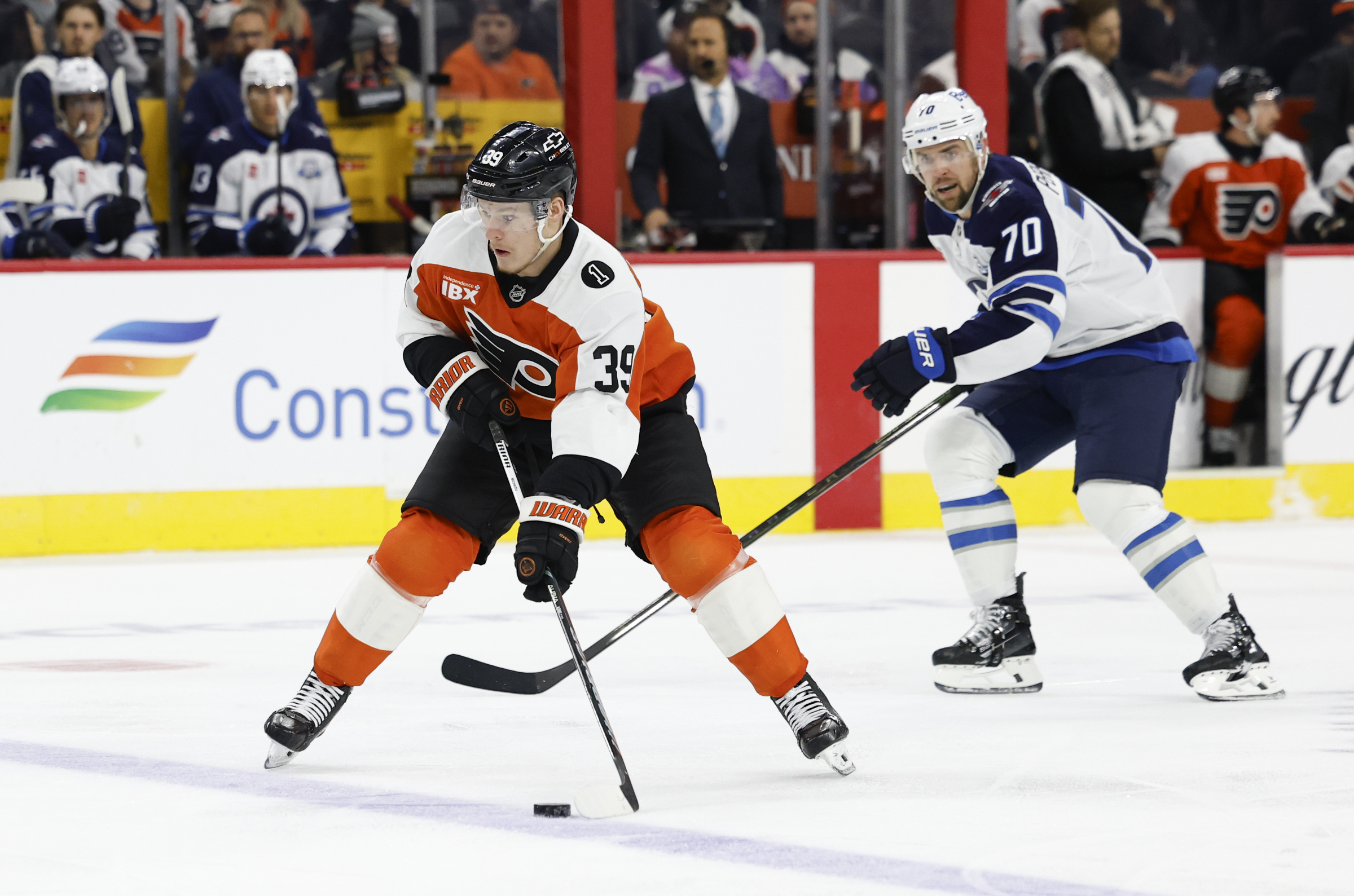
    In one of their most complete games of the young season, the Flyers closed out a four-game homestand Monday with a 5-2 win against a Seattle Kraken team that had yet to lose in regulation this season.

    It upped the Orange and Black’s record to 3-2-1. Here are three things that keyed the victory:

    Powered up

    Entering Monday night, the Flyers’ power play was in a familiar spot — last in the NHL at 6.7%. But after going 2-for-4 against the Kraken, it is now up to 15.8% and tied for 21st with the New York Islanders, who visit Xfinity Mobile Arena on Saturday (12:30 p.m., NBCSP).

    Tyson Foerster scored the first one after he and Bobby Brink got to work on the boards, transferring the connectivity that they have at five-on-five over to the power play. The play saw Foerster track down an errant pass in the corner and find a supporting Brink, who drew two Kraken defenders in before slipping it back to his linemate. The nifty give-and-go gave Foerster a ton of space in the left faceoff circle to pick the top corner.

    “Yeah, a little surprised ’cause I thought [Trevor] Zegras was open, too,” Foerster said of all the time he had to shoot. “So it was either pick Zegras or shoot, so I decided to shoot.”

    Foerster, whose goal came with 7 seconds left on the power play, also gave props to his goalie, Dan Vladař, who stopped a two-on-one and a breakaway right before the Flyers got on the board.

    “Well, we wanted to give them a couple of breakaways and a two-on-one to loosen them up and then we started to go,” coach Rick Tocchet said sarcastically when asked if there was a change in strategy for Monday or just better execution.

    “No, obviously, it was a little hairy there. We weren’t too happy with it early.”

    Tocchet liked the movement of the power play overall, but he wanted to see more. According to Cam York, who got the primary assist on the Noah Cates tip-in goal 19 seconds into a second-period power play, the credit goes to the coaches.

    “I should have done it in the first period, too, on Tyson’s first goal,” he said of putting the point shot on goal with traffic in front.

    “Didn’t [and] we watched it on video, and in the second period was able to capitalize on it. I’ve said it from the start, coaches have done a great job of making us look good out there, and I’ll give the credit to them on that one.”

    But Tocchet credited Zegras for paying attention to the pre-scout and using the information to set up York by drawing Kraken penalty killer Tye Kartye to him in the right faceoff circle.

    “That’s high-level play, is making a back pass through the top down,” said Tocchet, noting how the Kraken structure their penalty kill. “That’s a hard play and if you beat that play, you’re going to get that guy in the middle with all day for a shot. So, that’s the skill of Trevor, he can make that backhand pass to the middle guy.”

    Zegras has an assist in five straight games.

    Supporting Matvei

    There have been a lot of questions about Matvei Michkov’s reads as of late, but on Monday, not only did he read and react properly, it led to Travis Konecny’s first goal of the season.

    Owen Tippett, who remained red-hot with a pair of goals, skated a hard 34 seconds and got off the ice. It allowed Michkov to be out there with Konecny and Sean Couturier, until Couturier changed as the puck went back into the Flyers zone.

    What was not shown on the broadcast is that Michkov clearly processed that the center was changing and went back to the defensive zone to provide puck support. He swung low and turned up the right wing as two Kraken players went to play the defenseman, who flipped the puck up in the air. It dropped and died in the neutral zone, allowing Michkov, who was skating north — another thing Tocchet has stressed to him — to pick up the puck.

    From there Michkov got to work, finding a trailing Egor Zamula before the defenseman, who used his patience to outwait a Kraken defender, found Konecny at the back post.

    Flyers right wing Matvei Michkov had his best game of the young season on Monday.

    “Listen, he’s chipping away in his game, and that’s all we can ask for. We’re looking at inches for players, that’s another inch for him,” Tocchet said of Michkov. “So, yeah, he made some nice plays. He started to skate a little bit more north and stuff like that. But he makes a high-level play to Zamula. … You skate, you make everyone drive [to you], and then you make the play. It’s when you don’t move the structure that he throws it in the middle and I think there’s a difference, and I think he’s starting to learn the difference.”

    ‘We are a family’

    It’s been 23 years since Tocchet last played for the Flyers and his name is still atop the team’s all-time list for most career penalty minutes. And despite being a guy with 172 career NHL fights (regular season and playoffs), according to hockeyhights.com, Tocchet swears, “We’re not preaching fighting.”

    What he is doing is “trying to create a culture and sticking together.”

    They definitely do that because after Nic Deslauriers dropped the gloves against Minnesota; and Michkov got a minor for going at Carolina Hurricanes forward William Carrier, who nailed Konecny; and before Konecny got his own fighting major Monday after Kraken defenseman Ryan Lindgren cross-checked Couturier from behind, Nikita Grebenkin entered the chat.

    “It was awesome. Didn’t see it coming,” York said, summing it up perfectly. “But, he’s a feisty guy, I think, and any time one of our guys gets hit like that, you want to stick up for him. It’s who we are here, we’re a family, and just part of what we do.”

    Playing in just his fourth game as a Flyer, Grebenkin made his presence known. After Garnet Hathaway was hit awkwardly, he instigated a fight with Cale Fleury and body-slammed him to the ice.

    Grebenkin played just 7 minutes, 38 seconds — he earned 17 minutes’ worth of penalty time for his fight — but got his money’s worth as he endeared himself to his teammates and also made several nice plays, especially in the third period.

  • Brandon Graham says he didn’t want to retire — and this isn’t the first time the Eagles tried to bring him back

    Brandon Graham says he didn’t want to retire — and this isn’t the first time the Eagles tried to bring him back

    The Brandon Graham farewell tour of 2024 is getting a reboot.

    The 37-year-old defensive end officially announced his return to the Eagles on Tuesday morning on his podcast, Brandon Graham Unblocked, saying, “We’re coming back, baby. We’re coming back one time.”

    Additionally, the Eagles made the move official, announcing that they agreed to terms with Graham. He has a two-game exemption to ramp up that the team can lift at any time, so he doesn’t count against the active roster just yet.

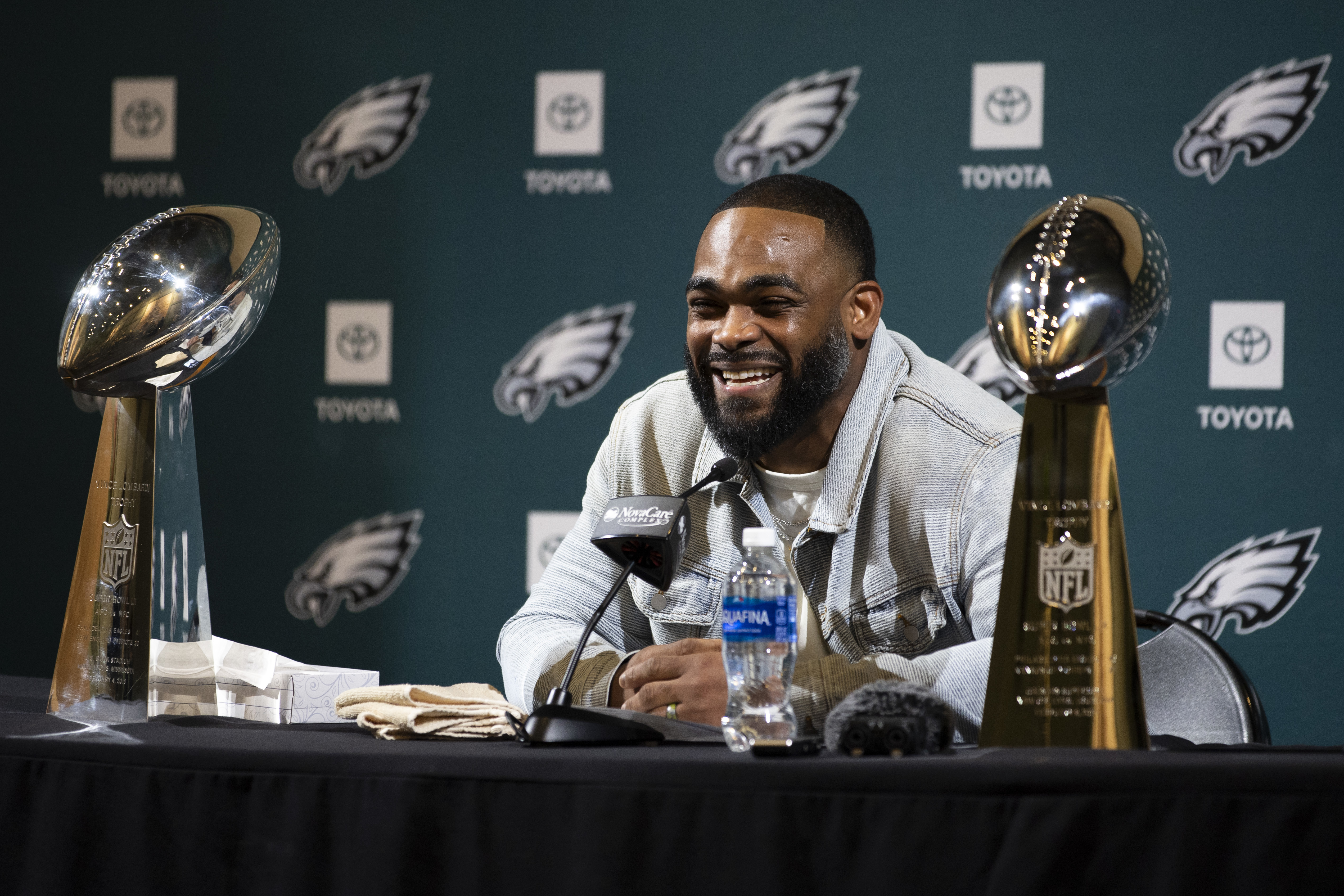
    Graham initially retired in March following the Eagles’ Super Bowl LIX win. He had been playing at a high level early in the year but suffered a torn triceps twice last season, once in Week 12 against the Los Angeles Rams and again in the Super Bowl, his first game back from the injury. Lifting the Lombardi Trophy for a second time seemed to serve as a natural ending to his Eagles tenure.

    But it wasn’t his perfect storybook ending. Graham acknowledged on the podcast that he “would’ve been back, for sure” had Howie Roseman asked him to return for a 16th season.

    “I really didn’t want to retire in the beginning,” Graham said. “It was kind of tough. But it was like, ‘Hey, Philly right now, they’ve got everything they need.’ So it’s like, ‘All right, I ain’t see myself on no other team.’ So it was kind of like, ‘I think this the best way to do it is go out on top.’”

    Graham continued to stay in shape, though, and visited the NovaCare Complex. At the start of the season, Graham said Roseman contacted his agent in need of a veteran, inquiring if he would be interested in returning to the team. Graham said he wasn’t ready then.

    Brandon Graham announced his retirement from the Eagles on March 18.

    Roseman then signed Za’Darius Smith, a 33-year-old pass rusher, following the Eagles’ Week 1 win over the Dallas Cowboys to bolster the edge rusher corps. While Smith made an immediate impact, registering 1½ sacks through five games, he retired last week after 11 seasons in the NFL.

    But in the aftermath of that call with Roseman, Graham continued to think about how he would respond if he was approached with another opportunity. Graham took Smith’s surprise retirement as a sign. This time around, Graham was ready for his opportunity to return.

    Graham said he still feels like he has some “juice left” to give on the field, acknowledging that he feels “springy and bouncy.” He said that he’s eyeing the Eagles’ Week 10 matchup against the Green Bay Packers as a potential first game back, but he didn’t rule out Sunday’s game vs. the New York Giants.

    Regardless, he’s open-minded about the role that awaits him.

    “I don’t have no expectations with it,” Graham said. “It’s just more like I’m going to just bring myself and bring the energy. Go out there, first play, ‘Oh, you thought I was done? You thought you wasn’t going to have to deal with me?’ Get to all that little fun stuff, man, because, obviously, we play a game that I enjoy playing. Of course, it was hard, because, just being honest, man, all of us, I don’t care how many years you play. It’s just something that you’re just used to all the time, and you’re trying to get used to that next-best thing.

    “Of course, I was doing a lot of stuff, but when that ball came and the Eagles was on, I was locked in. I know I’m going to get better with it as it goes, but, man, while I can still do it and the opportunity feels like it’s right, I feel like that’s exactly what I want to do. And that’s what I wanted to do in the beginning. But I know that it was Year 15, it’s just a great way to go out. But, hey, I don’t want to have no regrets, either.”

    Graham said he was “flattered and thankful” that the opportunity from the Eagles came back around. He added that he “might cry” coming out of the tunnel on Sunday.

    Not only is he looking forward to chirping at his opponents, but he’s also excited to bring his signature energy to his teammates for his first practice on Wednesday.

    “I can’t wait to go out there and be like, ‘Lane [Johnson], what’s good?’” Graham said.

  • The New York Times called Delco ‘rural America.’ But it did get a key part of ‘Task’ right.

    The New York Times called Delco ‘rural America.’ But it did get a key part of ‘Task’ right.

    On Monday morning, while scrolling on my laptop, I came across a post on X that asked a seemingly absurd question.

    “Is Delco rural America?” it asked.

    Of course not, I thought, but then I saw the attached photo and a New York Times headline: “This HBO miniseries gets rural America right.”

    In the opinion piece, television journalist Alan Sepinwall, a New Jersey native who went to Penn, says show creator Brad Ingelsby — who grew up in Chester County — “transports us to a downtrodden stretch of rural America where a guy like Robbie has to resort to stealing from drug dealers in order to make ends meet.”

    Downtrodden? Parts of it, perhaps. But I mean Villanova University, Swarthmore, and Haverford are in Delco, along with Neumann University, where the show filmed some scenes.

    Statistically, there’s really no argument to support that Delco is rural. It had 54 working farms in 2022, according to the Pennsylvania Farm Bureau. Chester County had 1,558 and Lancaster County, where in Task, the Dark Hearts dabbled in meth sales, had 4,680. Knowing the trends well, all of those numbers are surely down today. According to the Center for Rural Pennsylvania, none of Delco’s 49 municipalities are considered rural based on population density.

    Delco’s not much different from Philadelphia’s other ring counties on both sides of the Delaware: mostly suburban, with some more urban, post-industrial areas mixed in, along with a ton of strip malls, golf courses, and islands of great affluence. I grew up in a middle-class Camden County “pike town.” I know the vibes. I’ve known Robbies and Jaysons. I still see them at Wawa or read their obituaries. I’ve had beers with outlaw bikers and I’ve been threatened by them.

    I’m also uniquely qualified to talk about rural issues because that’s what I’ve covered at The Inquirer for close to a decade. I’ve written about deer urine farmers, counties with one traffic light, the difficulties of getting cell coverage, a decent workout, and even delivering pizza up mountain roads.

    I see the Times used the word “rural” to describe the show in a prior photo cutline too. It isn’t the only news outlet to call the show’s setting rural, either.

    Sam (Ben Doherty) in “Task.”

    To be fair, Ingelsby did present Delaware County as more rural than it is and the characters travel to a cabin. The quarry played a big role in the show, a sacred space for Robbie if you will, though one quarry in the show is 85 miles north, in the Lehigh Valley. Another is in French Creek State Park. In the piece, the author described the quarry as a “hot spot” and, perhaps, evidence of how little the area had. I grew up playing in an elaborate, questionable fort built atop a marshy, tidal creek behind an industrial park near my house. I get it.

    The characters in Task reminded me of the 2013 film Out of the Furnace, a crime drama set in post-industrial Western Pennsylvania. I just learned, while writing this, that Ingelsby co-wrote the script.

    I’ve covered the kind of places you’d see in Task: not quite rural or urban or even suburban, the in-between towns haunted by better days. Many of those towns lost vital industries, the ticket to a nice middle-class life, and nothing filled the void. In Delco, that dream’s still possible. A lot of those Dark Hearts could have good-paying union jobs.

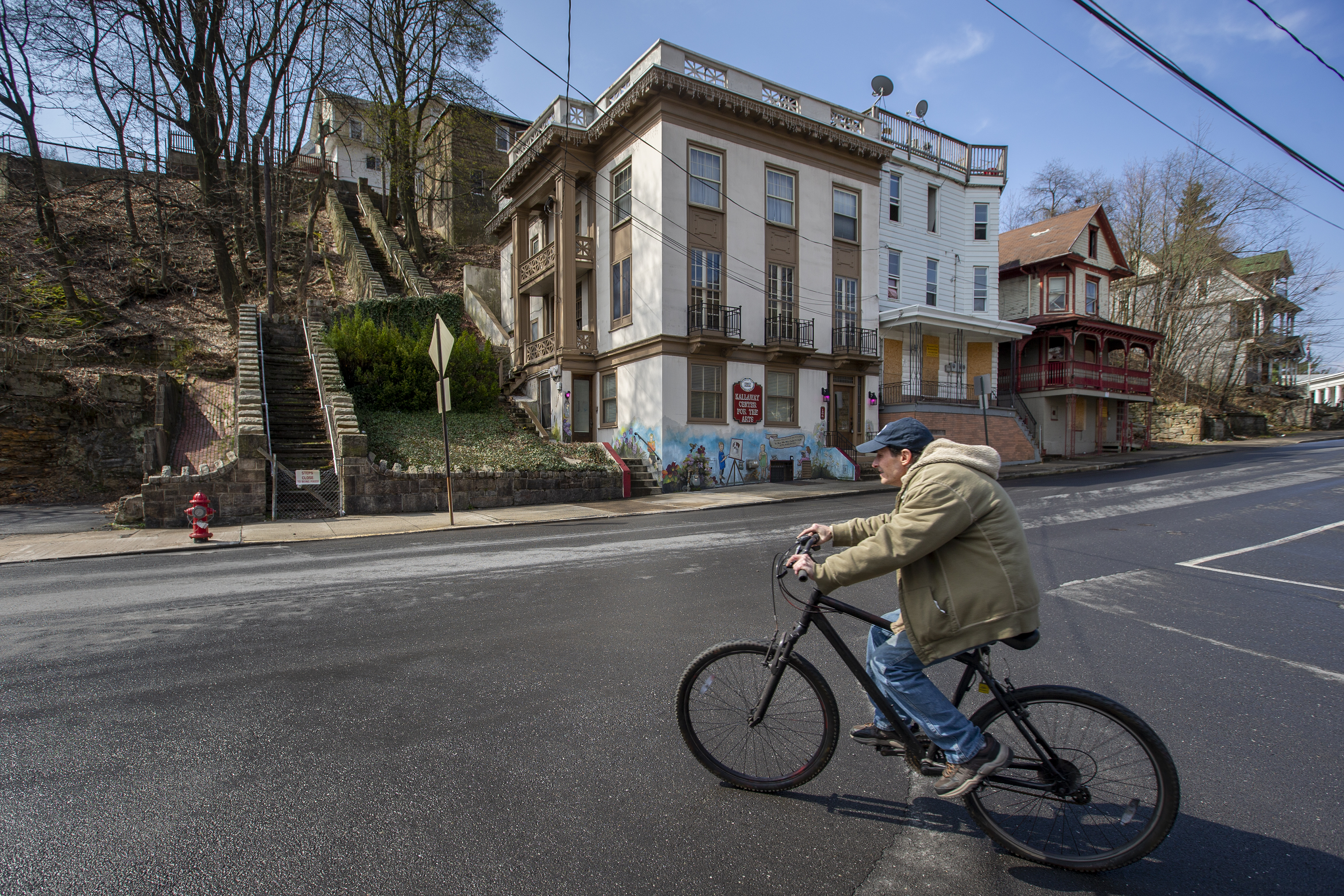
    A historic set of stairs in Shamokin, Pa.

    I just wrote about Shamokin, a hardscrabble, former coal town fit for Task. It became the butt of jokes after a news clip of locals mourning their burned-out Dunkin’ Donuts went viral.

    I go back to Shamokin time and time again for stories, but also because my great-grandparents are buried there in a mountain cemetery.

    I think Sepinwall was getting at something beyond statistics and density studies. Ingelsby, he wrote, takes viewers “somewhere other than their own reality to see the stories of people with whom they might identify.”

    Like Ingelsby, I’d like to think I’m offering readers a chance to better understand a place they’ve never been and flex their empathy.


    Jason Nark has written a handful of freelance pieces for the New York Times, like ones on crab boat races and the demise of rude carnival clowns.

  • Seven burning questions for the Sixers season, including VJ Edgecombe’s impact and Joel Embiid and Paul George’s health

    Seven burning questions for the Sixers season, including VJ Edgecombe’s impact and Joel Embiid and Paul George’s health

    Nick Nurse has not been shy about the reality facing the 76ers. That they are, in their coach’s words, “digging ourselves out of a pretty big hole.”

    That’s life coming off a shocking 24-58 season, when sky-high hopes quickly descended into a dreadful, injury-derailed slog. It initially was a version of basketball whiplash. And the aftermath has muted outside buzz entering 2025-26.

    The NBA’s general managers said in their annual preseason survey that the Sixers, by a wide margin, are the most unpredictable team entering the season. That means there were plenty of questions before Wednesday’s opener at the Boston Celtics.

    How much will Joel Embiid and Paul George play?

    Every conversation about the Sixers’ overall outlook begins here.

    This time last year, George’s free-agency addition to the All-Star tandem of Embiid and Tyrese Maxey was overwhelmingly lauded. Those three appeared to form an ideal 1-3-5 positional fit. The championship aspirations felt legitimate.

    And then Embiid’s ongoing knee issues limited him to 19 games before another surgery. George played in 41 but was hampered by several ailments and had an arthroscopic knee procedure in July. The Embiid-Maxey-George trio played only 294 minutes together across 15 games.

    So the skepticism — or, at least, uncertainty — is understandable. Yet the news surrounding Embiid and George is trending positively. Embiid played in Friday’s preseason finale — and, perhaps more important, fully participated in the Sixers’ next practice. George also returned to full-contact work but would miss the beginning of the season.

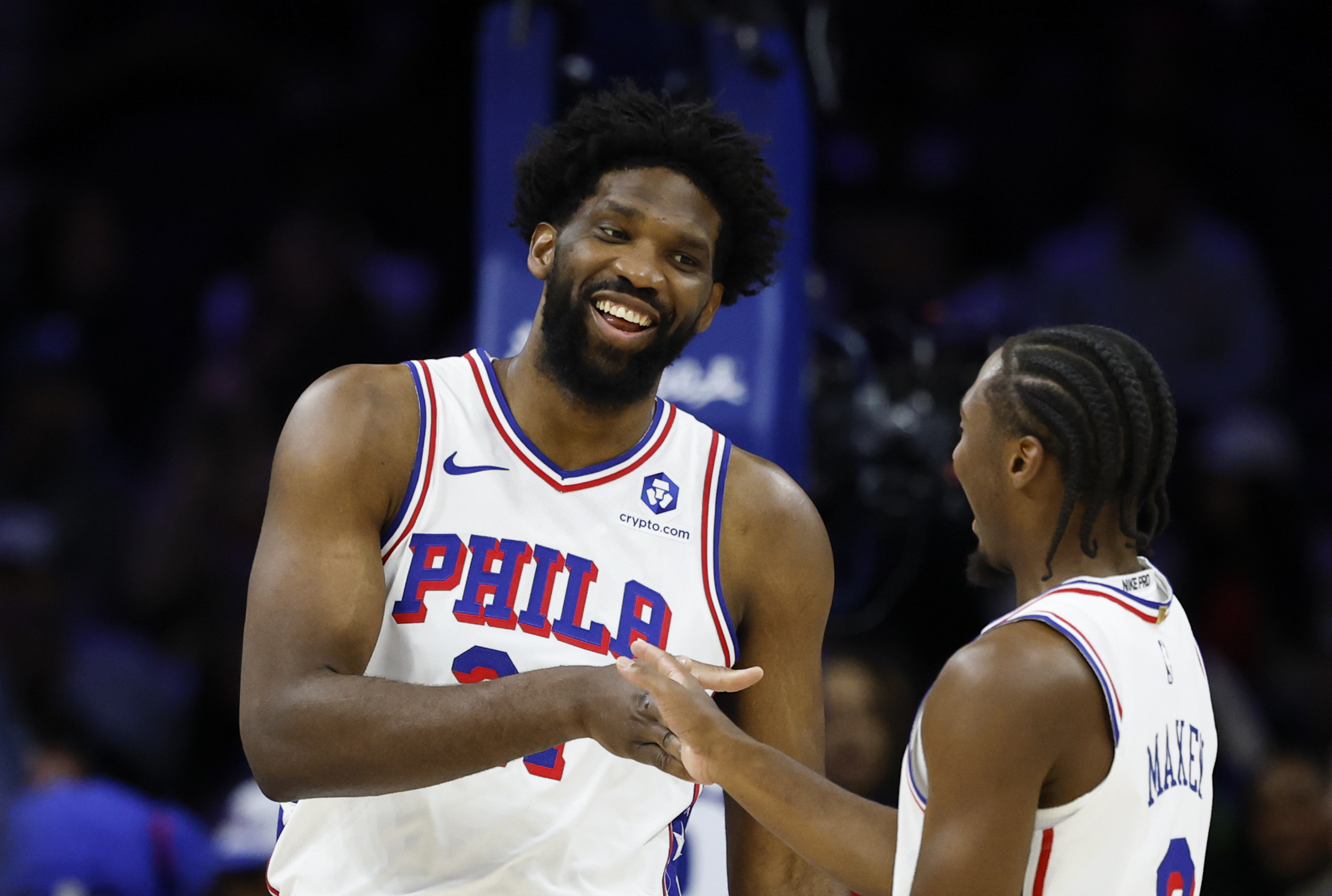
    Sixers center Joel Embiid played in Friday’s preseason finale.

    It is unrealistic to assume either player will look like a perennial All-Star immediately. Or, perhaps, ever again, given that George is 35 years old and Embiid is 31. But if the Sixers can successfully construct and execute an availability plan for both players, that would provide a massive lift to their cohesion and potential on both ends of the floor.

    How will Tyrese Maxey respond?

    Maxey had his own health trouble at the end of last season, sitting the final 22 games because of an injured little finger that dramatically impacted his outside shooting. The point guard also spoke candidly about the mental toll while shouldering mounting losses for the first time in his basketball career. He averaged a career-high 26.3 points as the Sixers’ top scoring option in his fifth NBA season, but his efficiency decreased and turnovers increased.

    The 24-year-old Maxey said he is in a good headspace entering the season, and feels more comfortable countering a variety of defensive coverages. He has taken a significant leadership role, vowing to set the Sixers’ organizational standard with daily habits and style of play. He will be the engine that ignites an offense determined to play at a faster pace, whether Embiid and/or George are on the floor or not. Maxey also will play off the ball, allowing him to leverage his speed and outside shooting stroke.

    If Maxey continues his ascent into his prime — and his team is improved — a second All-Star appearance is likely.

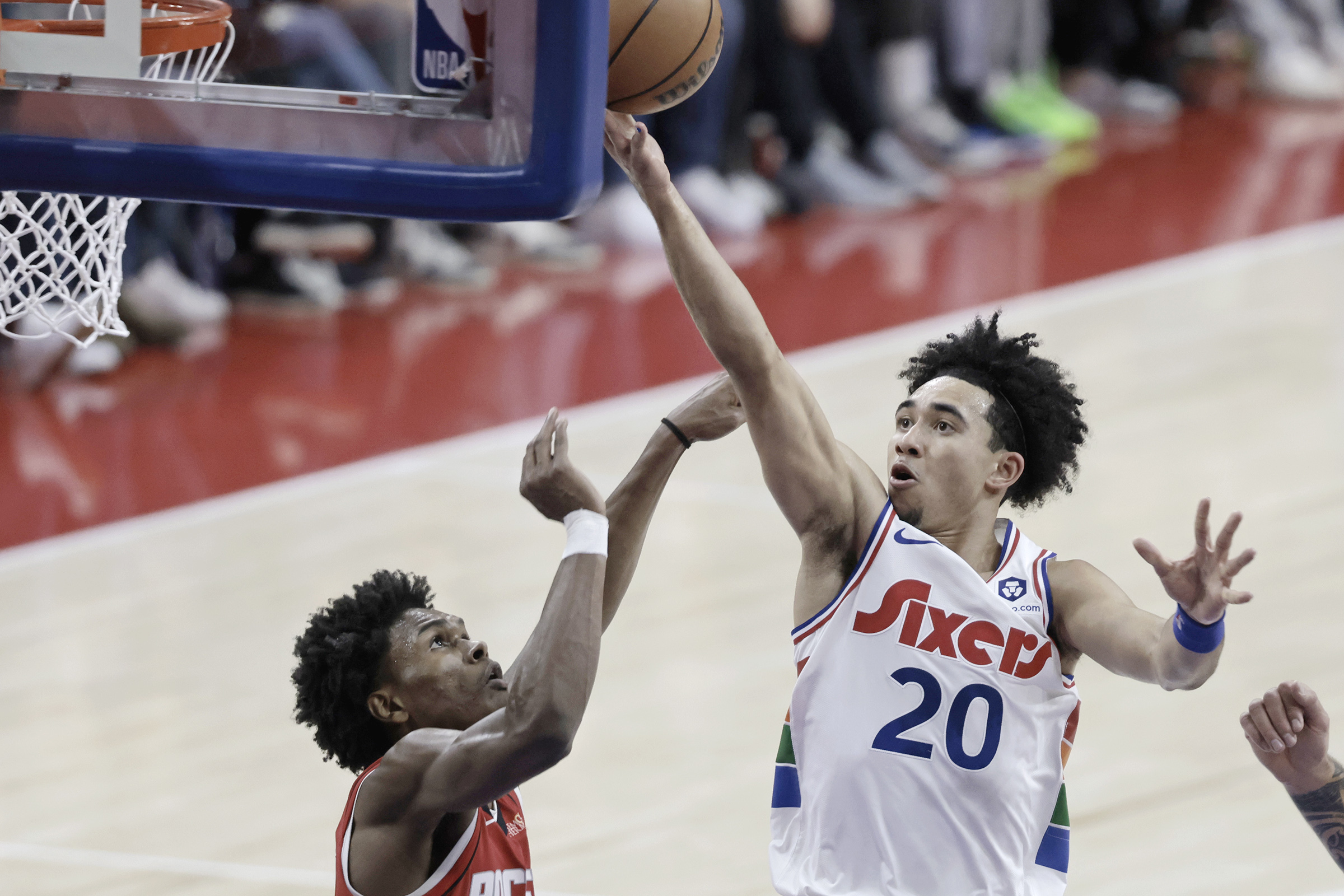
    Is VJ Edgecombe an instant-impact rookie?

    The third overall pick in this summer’s NBA draft flashed his dazzling athleticism during the preseason. Transition dunks. Come-from-behind blocks. Leaps for alley-oop passes.

    Edgecombe also has received high praise from those watching him every day behind the scenes. Nurse already trusts the rookie to handle some offense-initiating duties and to be a strong defender. The coach also is pleased with Edgecombe’s progress with his shooting mechanics, although those still need to show up consistently in games.

    As part of a loaded guard group, Edgecombe should not feel overwhelming pressure in his first NBA season. But that Nurse already feels comfortable starting the rookie is a huge compliment. He has a rare opportunity to be an instant-impact player on a team trying to win, not rebuild.

    What about the other young guards?

    At times during the preseason, Nurse has floated the idea of starting three guards, or even experimenting with four-guard lineups. Neither idea is completely outlandish because of the roster construction when healthy.

    Jared McCain was dealt another tough-luck injury blow when he suffered a torn thumb ligament in a workout just before training camp after recovering from meniscus surgery. He will be reevaluated in less than two weeks, but whenever he returns, it is reasonable to anticipate some rust after what could be an 11-month layoff.

    Sixers guard Jared McCain averaged 15.3 points in 23 games as a rookie last season.

    The hope is that McCain can eventually recapture what made him an early Rookie of the Year front-runner, when he averaged 15.3 points in 23 games and became a weapon as an outside shooter, finisher at the basket, and backup point guard.

    Quentin Grimes, meanwhile, was a late addition in the Sixers’ preseason after a contract saga ended with him taking his one-year, $8.7 million qualifying offer to become an unrestricted free agent next summer.

    Grimes has said all the right things since rejoining the team, and Nurse has been pleased with his conditioning and ability to rapidly pick up the new offensive scheme. Grimes will not regularly be the go-to scorer that he was during his breakout stretch after joining the Sixers at the trade deadline. But his scoring punch at all three levels, complementary ballhandling, and tough-minded defense are valuable.

    Is Adem Bona ready for a leap?

    One silver lining of the Sixers’ tank job last season was the opportunity it gave to their young players. Few took better advantage than Bona, who now is in line to be Embiid’s backup — and perhaps more.

    The Sixers recently have been toying with Bona playing alongside Embiid and started that double-big lineup in Friday’s preseason finale against the Minnesota Timberwolves. It’s a pairing Bona said he has eyeballed since the Sixers drafted him. It allows Bona, a hyperathletic rim protector and lob threat, to play in the “dunker” spot near the basket, and for Embiid to stretch more out to the perimeter.

    Bona’s offensive skill set — notably his shooting range — remains a work in progress. An even more urgent priority: He must stop getting into early foul trouble if he is relied on for heavier minutes.

    Is Dominick Barlow on track for a full roster spot?

    The 22-year-old forward on a two-way contract perhaps was the surprise of the preseason, earning an early rotation spot and potentially a starting nod. He is another impressive athlete with a knack for rebounding who can fit next to Embiid or Bona.

    The two-way contract structure is designed for players to split time between the Sixers and the G League’s Delaware Blue Coats and limits the number of NBA games one can play. But Nurse said he has no reservations about immediately using Barlow as much as it takes to help the Sixers. There is a full-time roster spot available, should Barlow earn a conversion to a standard contract.

    Jabari Walker also has been viewed as a contender to have his two-way contract converted to a standard deal. But right now, Barlow has the inside track.

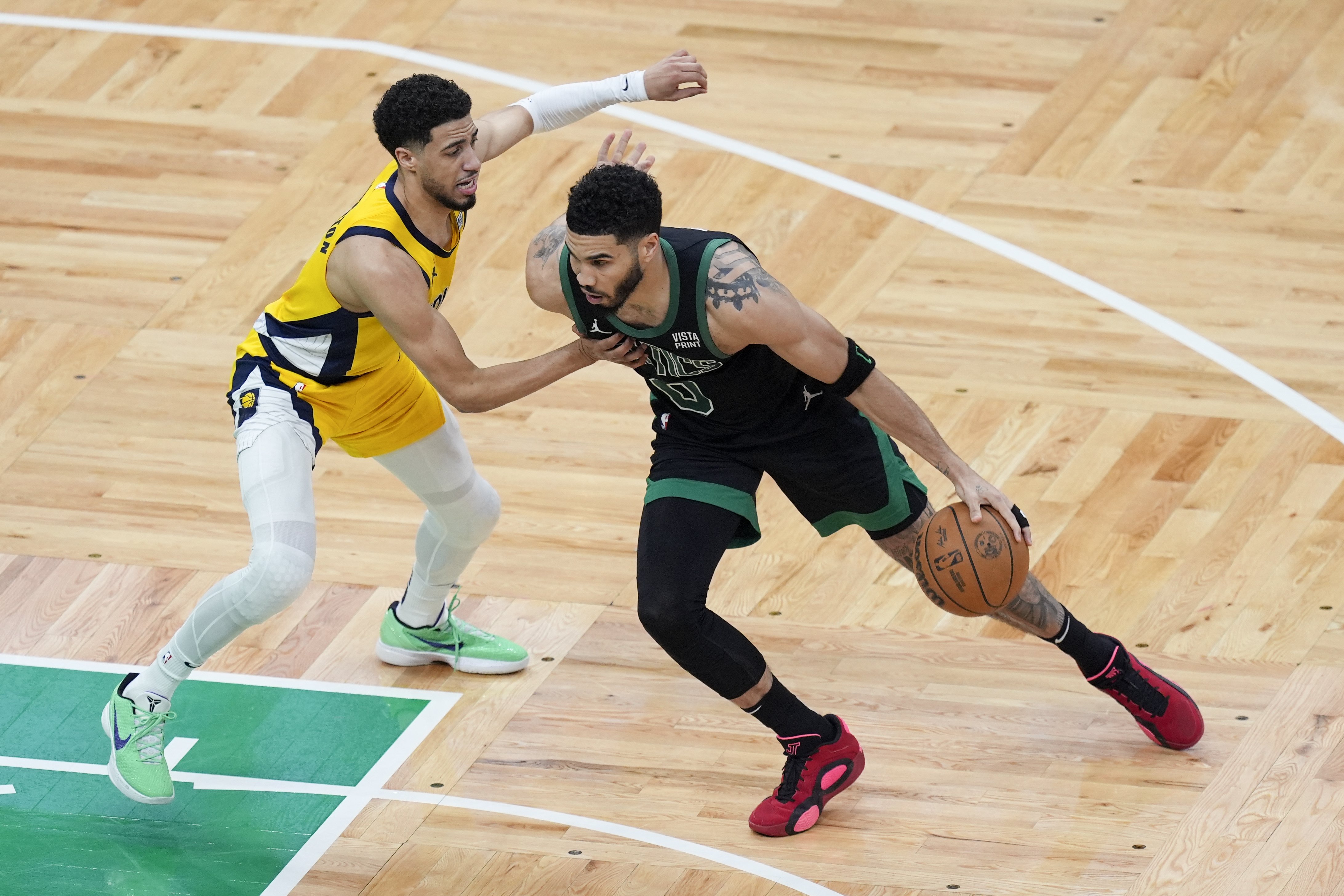
    Boston Celtics forward Jayson Tatum (right) and Pacers guard Tyrese Haliburton likely are out for the season with Achilles tendon injuries suffered in last season’s playoffs.

    How much does a down East impact the Sixers’ path?

    Perhaps you have heard the East is the NBA’s weaker conference this season.

    The Indiana Pacers and Boston Celtics are on the equivalent of “gap” years, after stars Tyrese Haliburton and Jayson Tatum suffered Achilles tendon injuries during the playoffs. The New York Knicks are coming off their first Eastern Conference finals appearance in 25 years but have a new coach in Mike Brown. The Cleveland Cavaliers, Orlando Magic, and Atlanta Hawks have stout rosters but remain unproven in the postseason.

    So there is a window for the Sixers to jump right back into the playoff mix, even as such a preseason wild card.

    In-season injuries and player movement could impact the conference’s landscape. It will be interesting to note where the Sixers are at the trade deadline, at which last season they acquired Grimes but shortly after transitioned to a tank for the best possible draft lottery odds. Keep an eye on Kelly Oubre Jr.’s $8.4 million expiring contract as a potential asset.

  • Prime Video’s ‘Allen Iv3rson’ docuseries shows the ‘raw, relentless, authentic heart’ of the Sixers legend

    Prime Video’s ‘Allen Iv3rson’ docuseries shows the ‘raw, relentless, authentic heart’ of the Sixers legend

    Prime Video’s Allen Iv3rson follows the journey of 11-time NBA All-Star Allen Iverson from Newport News, Va., to his career in the NBA, covering his life both on and off the court.

    The three-part docuseries gives a behind-the-scenes look at some of the most iconic moments from his Hall of Fame career — from the legendary “practice” press conference to his relationship with former Sixers coach Larry Brown.

    But the project goes beyond the court, covering the life of Bubba Chuck and his roots in Stuart Gardens Apartments. The series, produced and directed by One9, is a story of sacrifice, perseverance, and staying true to oneself.

    “I think the truth comes out in their memories and it’s very unfiltered,” One9 said. “No one’s ever sat with him to get the raw honest truth. And I felt that if he was able to give me what he left on the court, what he gave to the game. If he was able to give me that in this film — that same raw, relentless, authentic heart — then we’re going to have something epic.

    “You can find moments in this film that will inspire you, give you reason to reflect on how things in his life may resonate with what’s happening in anyone’s life. A lot of it deals with sacrifice. It deals with discipline, resilience, just speaking your uncompromising truth, and being true to who you are.”

    The series features appearances from his family, former players, former Sixers president Pat Croce, and Brown. Here’s what we learned from Allen Iv3rson, which premieres Tuesday night at the Philadelphia Film Festival and is set to release on Prime Video on Thursday …

    Bubba Chuck from Newport News

    Most of Iverson’s friends won’t call him by his government name. Instead, they call him by his nickname “Bubba Chuck,” which is a combination of his uncles’ names. Growing up in Newport News, his uncles Stephen and Gregory Iverson were important male role models.

    “From the time he was walking, he was always with us, and 90% of the time we’re at the basketball court,” Greg said. “He used to sit there and cry and want to get in the game. He was so small. I called him a crybaby because he would always cry all the time because he wanted to play, he wanted to come with us.”

    Iverson added: “I wanted to be like my uncles because they were my heroes. I saw excellence in both of them. They were the rocks of our family.”

    A good portion of the series covers Iverson’s relationship with his family as he grew up in the area’s low-income housing. The docuseries shows how Iverson went from hustling on the streets as a young kid to support his family to becoming a neighborhood icon with a street named after him.

    “My heart is always going to be here,” Iverson said. “This is who I am. This is what made me who I am, you know what I mean? When I look at this, I think of the people from here. My life in these streets prepared me for the rest of the world. To me, this was my only world right here. Wherever I‘m at in life, I carry y’all with me. I come from the trenches. I come from where you can’t survive being weak.”

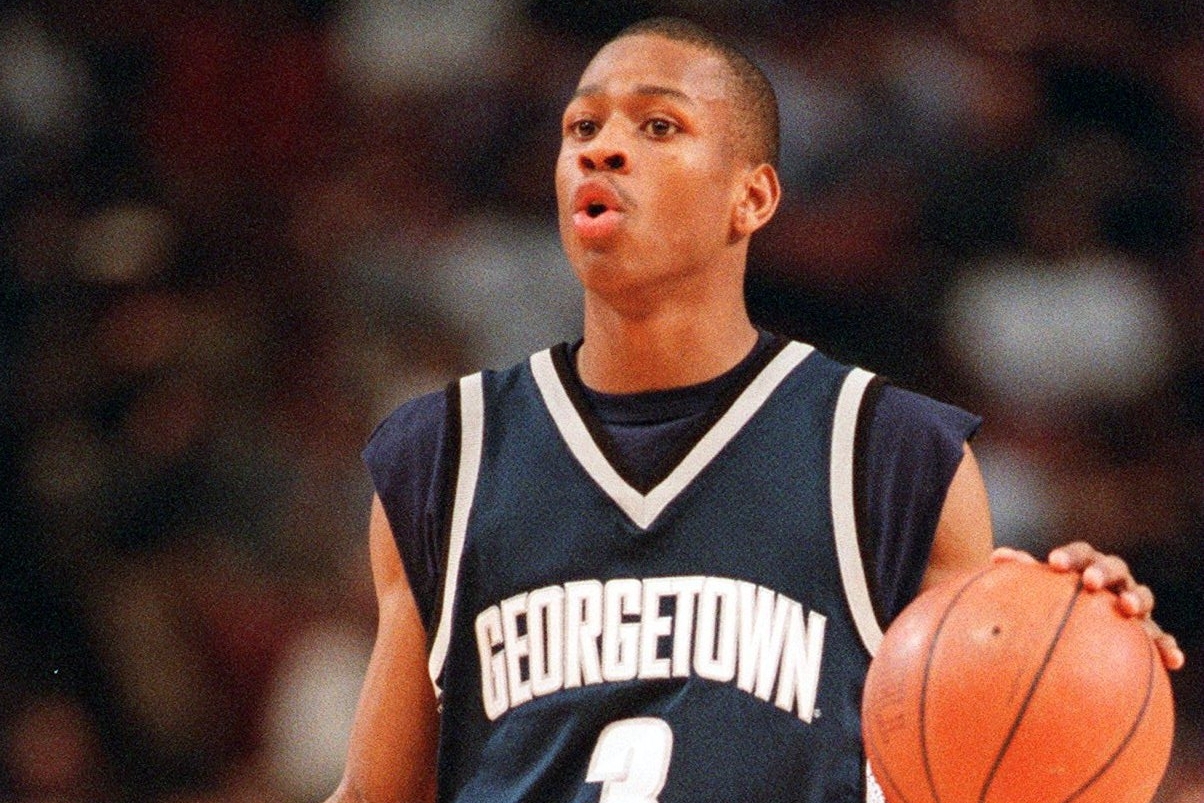
    Allen Iverson plays against Villanova at The Spectrum as a freshman in January of 1995.

    From City Farm to Georgetown

    Iverson found success in football and basketball when he was younger, leading Bethel High School to state titles in both sports within the same year. He was highly sought by different colleges until an incident at a bowling alley changed his trajectory.

    On Valentine’s Day in 1993, a 17-year-old Iverson went to a local bowling alley where things escalated quickly. A brawl eventually broke out, which allegedly stemmed from racial epithets said by white men in the alley.

    “An argument started, all hell broke loose,” Iverson said. “First, when it was going on, I was watching. And then I saw somebody get beat real bad. And that’s when it clicked in my head like, ‘Yo, it’s time to go.’”

    Iverson was arrested and sentenced to 15 years in prison for his role in the incident — which resulted in no serious injuries. The case led to heightened racial tensions in Virginia.

    “It was crazy because Virginia was divided because of me,” Iverson said. “It was tough seeing it on the news every day, the chaos of it all. I had this one [guard], man, this dude used to [expletive] with me so bad all the time. He just would not stop. Tawanna would come up to me … We would be holding hands and he would separate our hands, push us back.

    “And then they used to have the scarecrow outside the jail with my jersey on, hanging from a noose. The mail that came in for me every day was hate mail. And then I had death threats every single day.”

    Iverson’s sentencing received plenty of national attention. His mother, Ann, held a number of marches and boycotts to help get her son out of jail. Eventually, the 18-year-old was granted clemency by Gov. Douglas Wilder and was released after four months in prison.

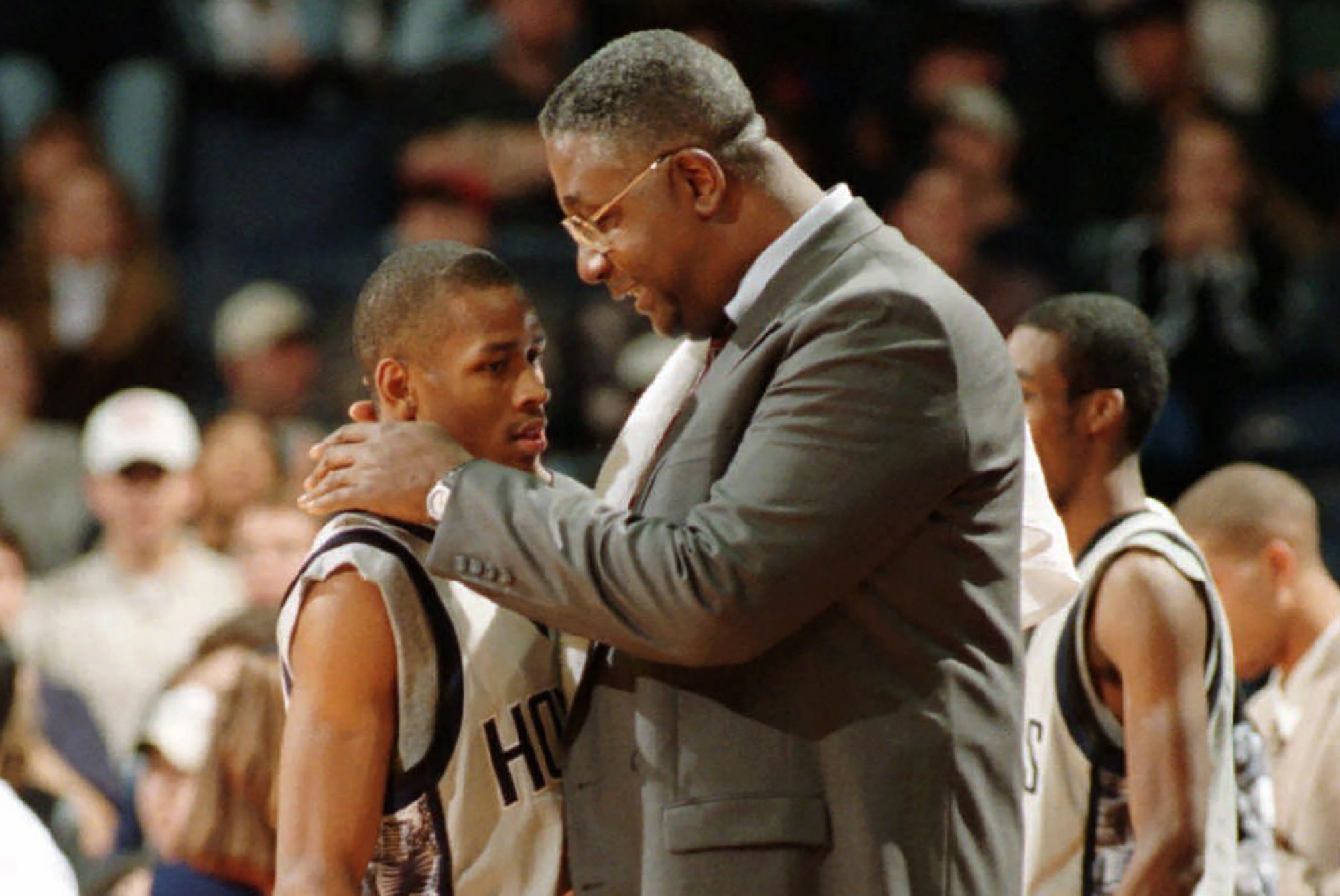
    Georgetown’s head coach John Thompson talks to Allen Iverson during a game against St. John’s on Jan. 24, 1996.

    But Ann’s job wasn’t done.

    Before Iverson was released she went to Georgetown coach John Thompson to beg him to bring her son to the Hoyas.

    ”I went to John Thompson,” Ann said. “He said, ‘Well, I’m not going to take Allen because I’m not recruiting Allen.’ And I just broke down. I broke down. I said, ‘If you don’t take him, somebody is going to hurt him because he lives in an environment that is not good. I’m scared.’ I asked him to put my son under his wing. He hugged me and he said, ‘I got you, baby girl, I got you.’ He said, ‘Because you’re the only Black momma that ever came up in here and said what they said about their son. And I got him. If he gets out of jail, I’ll take him.’”

    Relationship with John Thompson

    Iverson had it rough from fans in other arenas during his first year at Georgetown, including during a game at the Spectrum in Philadelphia.

    “Every time I went to shoot a free throw they’re screaming, ‘Jailbird! Jailbird!’” Iverson recalled. “I remember when we went to Villanova there were four guys with orange jumpsuits on and they had chains on. Coach [Thompson] took us off the floor and said we’re not going to play if they don’t get them out of there.

    “[Thompson] protected me. I didn’t talk to the media. He didn’t let people attack me like they wanted to. He taught me everything. He would call me throughout my career and we never would talk about basketball. We always talked about life.”

    In his first season at Georgetown, Iverson won Big East Rookie of the Year, and was named to the All Rookie Tournament First Team. His second year, he led the team to a Big East championship and into the Elite Eight of the NCAA Tournament. After that season, he declared for the NBA draft.

    “When I made the decision to leave Georgetown, it was a lot of hoopla because no player ever left Georgetown early,” Iverson said. “I knew after the season that I could be in the top five. When I found out that Philly was getting the first pick, I knew I had a real chance, a good chance at being the No. 1 pick. I just wanted to be an NBA basketball player. That’s the only thing that mattered to me. I was going to play every game like it was my last.”

    ‘Butting heads’ with Larry Brown

    Iverson was drafted with the first overall pick in 1996, a stacked draft that included Ray Allen, Kobe Bryant, and Steve Nash. Despite a 22-60 record, he found quick success, earning Rookie of the Year and making highlight reel plays — including crossing over Michael Jordan.

    After his rookie year, Larry Brown was hired as the Sixers coach; he didn’t completely see eye-to-eye with Iverson.

    “We butted heads,” Iverson said. “I was immature, somewhat high-strung, didn’t see the big picture. … I had him all wrong. He had the blueprint already.

    “He was able to make everyone else better by making me better. He just was a masterful coach. Billy King, and Pat [Croce], they put them guys around me that were willing to let me dominate. It was basically, you kill like you kill. And your deficiencies, the things you can’t do, we’re going to do all of those things.”

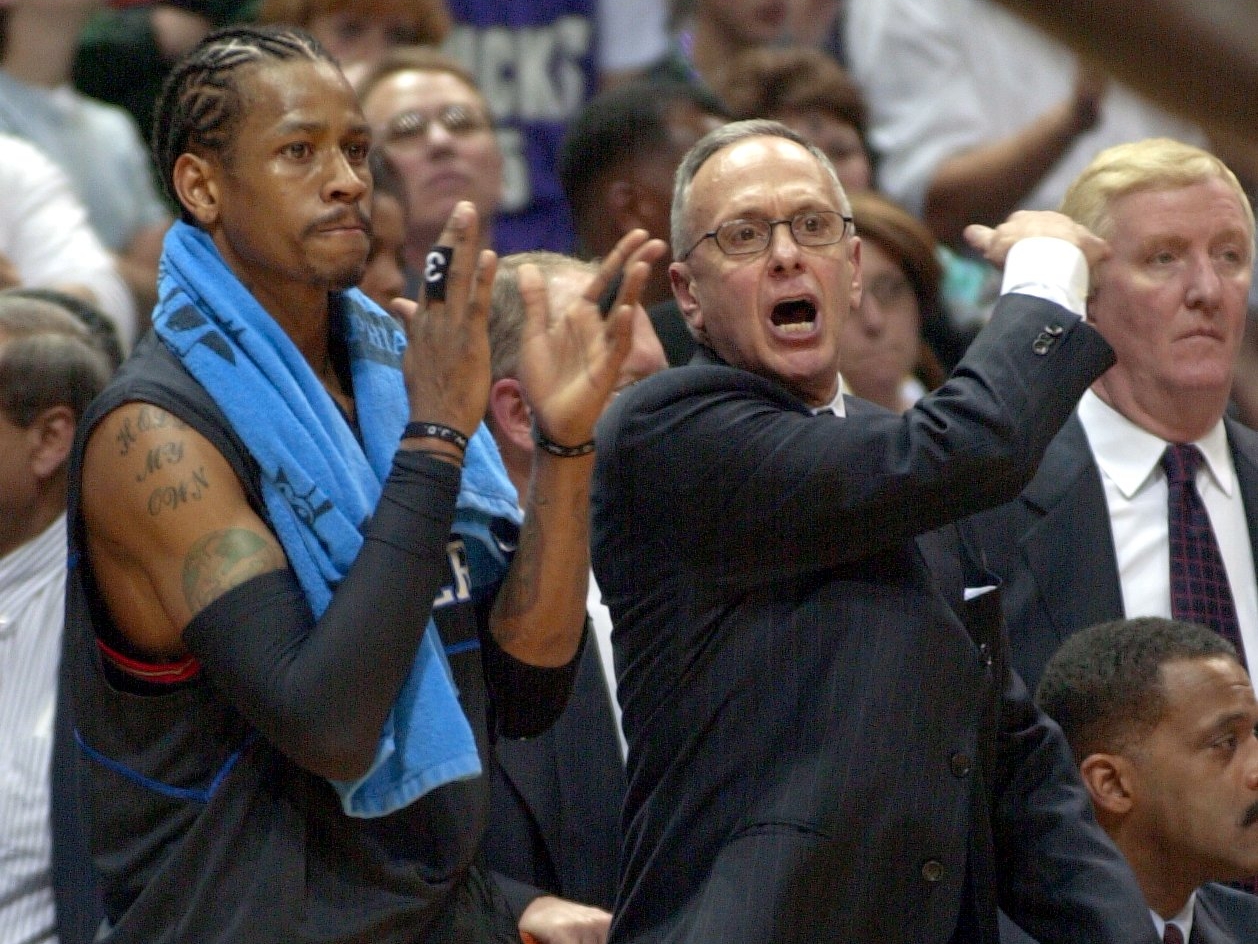
    Sixers guard Allen Iverson and head coach Larry Brown during the team’s 110-100 loss to the Milwaukee Bucks in Game 6 of the 2001 Eastern Conference Finals. The Sixers would win Game 7 to advance to the NBA Finals.

    At first, Brown and Iverson had a complicated relationship. It boiled over when Iverson didn’t show up to practice in 2002, leading to the legendary “practice” press conference.

    “[Iverson] called me that night, late at night,” said Croce. “[He said], ‘I want Larry Brown fired.’ Larry Brown calls me, ‘You trade [Iverson] tomorrow. … Get rid of him.’ I said, ‘We’ll meet tomorrow. We’ll meet at the training facility.’ We went into this board room and it was ugly.

    “Larry didn’t want to be called to the same level as his player. I didn’t care. ‘You’re not getting traded. And you’re not getting fired. I’ve never told either one of you what to do but I’m telling you right now. You’re both staying.’ … I said, ‘Both of you have the same love of basketball. Both of you have the intention and desire to win.’ I said, ‘You’re both looking in the mirror. Drop it.’ Allen got up, walked around the table, Larry stood up and he hugged and hugged for, it seemed like an eternity.”

    Iverson led the Sixers to an appearance in the 2001 NBA Finals before falling to a Los Angeles Lakers team led by Shaquille O’Neal and Kobe Bryant.

    “As a player, he’s one of the greatest players to ever play the game,” O’Neal said. “When it comes to a championship, you have to be on a great team. No disrespect to the Philadelphia 76ers team, Allen Iverson was by himself. So, when it comes to status and recognition, there’s a lot of champions that we don’t even know who they are. But I guarantee you, you know who Allen Iverson is.”

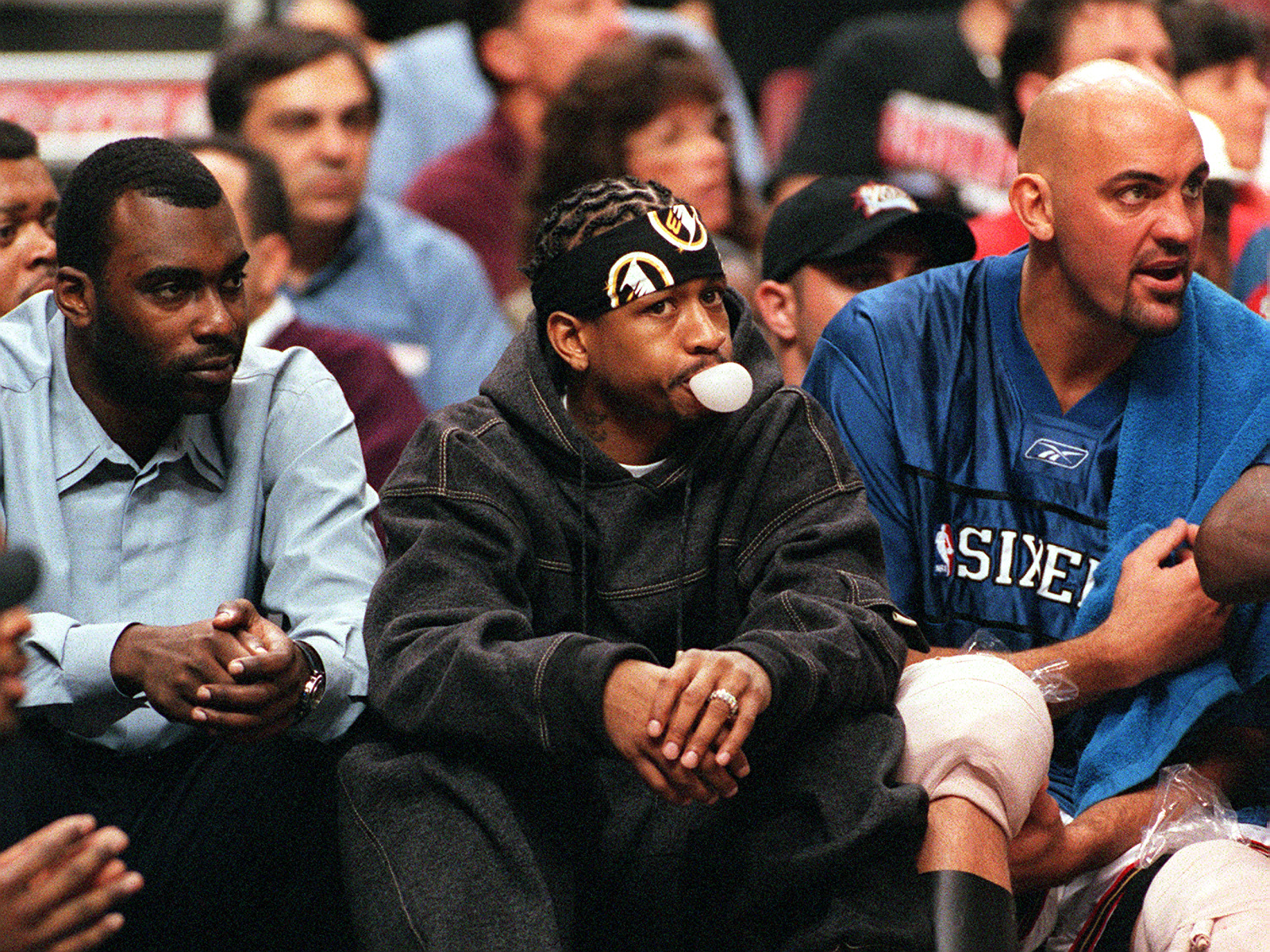
    Allen Iverson sits with Aaron McKie and Matt Geiger in the 4th period.dnphoto/Reynolds

    Culture changer

    When Iverson was a kid, he didn’t have the best clothes in the neighborhood. Instead, he would wear his sister’s pants for three days of the week, and when he went to prom with Tawanna, who became his wife and the mother of his children, he wore a pair of shoes that were two and a half sizes too small.

    “I think he had on sweat socks actually, with his too-small shoes,” Tawanna said. “He complained about it. He didn’t dance at all at prom. After prom, it was like at a sports facility, and he couldn’t wait to get out of his dress shoes and play basketball.”

    A few years later, Iverson would never have to worry about wearing shoes two sizes too small again. The young player signed a lifetime contract with Reebok in 1996. Iverson’s impact on the league was transcendent. As a small guard, he revolutionized the way players dressed and carried themselves, inspiring an entire generation to want to be like him.

    “I didn’t know I was doing it,” Iverson said. “I did it. But I didn’t know I was doing it. I didn’t know I was securing a way for these guys today to be themselves. I didn’t know I was doing it because I was stuck on, ‘I ain’t doing nothing wrong. I’m being myself.’

    “This many years later, taking an a— whooping for it is a blessing. Because now you see you can do your [stuff]. But, Chuck took that a— whooping for it. I just thought it was unfair. And the best part about my God, I just knew I was going to get through it all without folding.”

  • A milestone for NBC Sports Philadelphia’s Alaa Abdelnaby as the NBA launches new TV schedule

    A milestone for NBC Sports Philadelphia’s Alaa Abdelnaby as the NBA launches new TV schedule

    Charles Barkley on ESPN! Sixers games on Amazon! Dogs and cats living together! Mass hysteria!

    The NBA season tips off Tuesday, and with it begins new TV rights deals with NBC, ESPN, and Amazon that will reshape coverage of the league for the next decade plus.

    There’s been a lot of handwringing over the NBA’s new national schedule, with exclusive games being broadcast nationally every night on different channels and streaming platforms. It’s quite a change, considering TNT had been broadcasting national games on Thursday nights for 36 years.

    Despite the shuffling, not much will change for Sixers fans. Sixty nine of the team’s 82 games will air on NBC Sports Philadelphia (seven on NBC Sports Philadelphia+), with Kate Scott and Alaa Abdelnaby back to call all the action.

    Abdelnaby, the former Duke standout and NBA player, is entering his 10th season calling Sixers games (and his fifth alongside Scott). He was hired in the middle of “The Process,” but despite the Sixers losing 72 games during his first season, last season was his most difficult as a broadcaster.

    “Even though it wasn’t written in stone, we knew what they were doing” when the Sixers were intentionally losing games to gain assets, Abdelnaby told The Inquirer. “Last year, that wasn’t the case. They weren’t trying to do anything Process-ish … We kind of went through a whole season of not being relevant. And that stinks.”

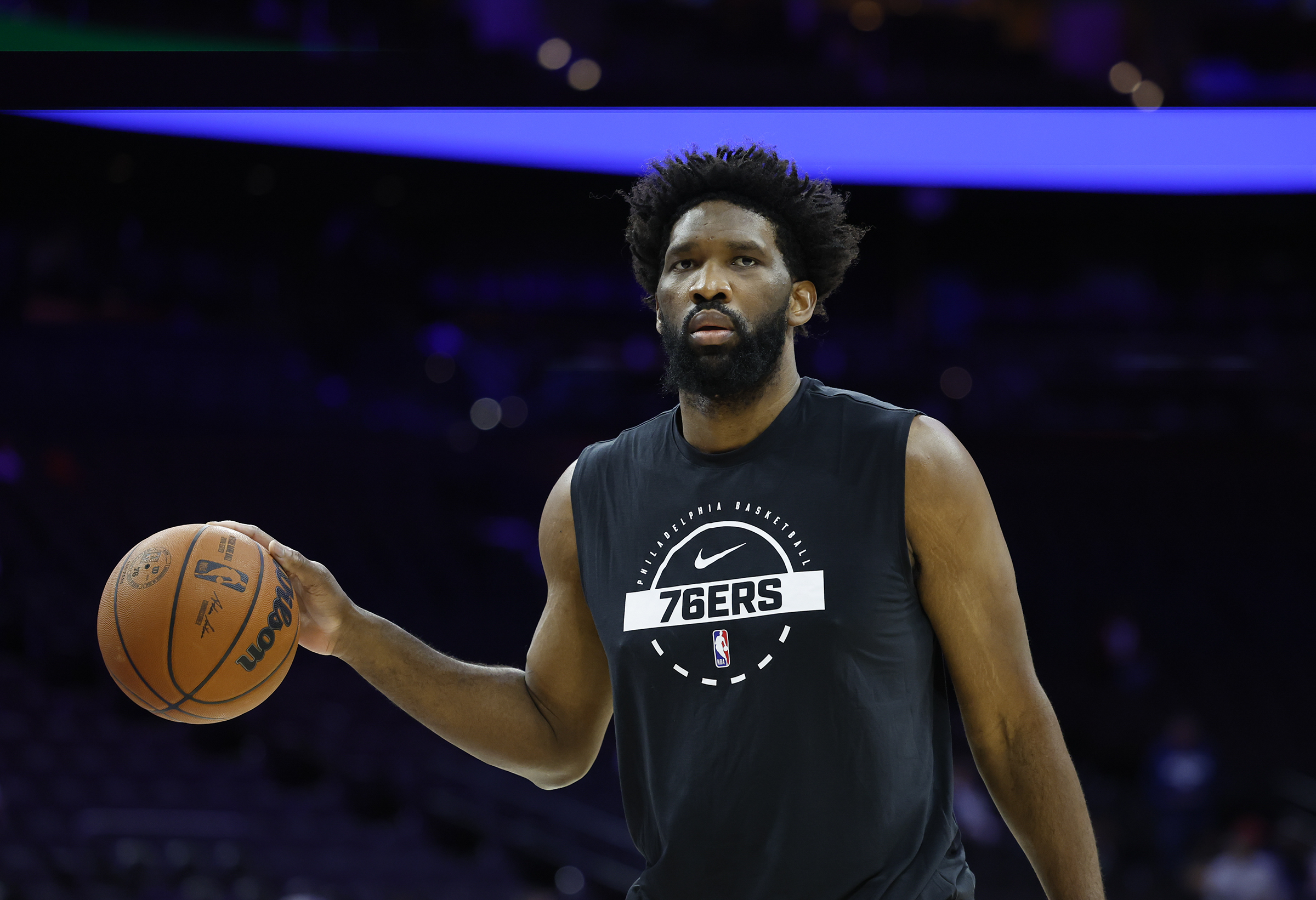
    Joel Embiid’s health will be the big question mark for the Sixers this season.

    Abdelnaby has high hopes for this season, pinned on a potentially new role for Joel Embiid following his second knee surgery in 14 months. Embiid played 19 minutes in the Sixers’ final preseason game on Friday, telling reporters he was “in a good space” mentally and physically, though his status for the season opener against the Boston Celtics Wednesday remains uncertain.

    Being around them for two games and at practice, Abdelnaby said the mood among the Sixers seemed more positive then the second half of last season. By his eye, the body language of the players and coaches point in the right direction.

    “I think health has a lot to do with that,” Abdelnaby said. “At least I’m feeling a sense of optimism from the group, and that’s a good thing.”

    The new NBA media deals have opened up broadcasting opportunities dramatically, with national games airing just about every night. While Abdelnaby used to call college basketball games for CBS Sports, he’s in no rush to return to a jet-setting lifestyle.

    “When I did college, it was a rough and tumble existence,” Abdelnaby said. ” I think I’ve gotten soft over the last 10 years, because now I fly on their plane, I don’t have to rent a car in the middle of nowhere and return it … I am so spoiled.”

    As far as NBC Sports Philadelphia’s studio goes, Amy Fadool, Marc Jackson, and former Sixers head coach Jim Lynam return for Sixers pre- and postgame coverage.

    This is the first season Sixers fans within the Philadelphia TV market can subscribe directly to NBC Sports Philadelphia without needing a cable TV plan. Fans outside the area can stream all the games using NBA League Pass.

    Sixers games can also be heard on 97.5 The Fanatic, with Tom McGinnis returning for his 31st season calling games.

    New NBA weekly national schedule

    While the bulk of the Sixers’ regular-season games will air on NBC Sports Philadelphia, 13 games will air nationally across a host of services.

    Here’s a general breakdown of the NBA’s national broadcast and streaming schedule this season:

    • Sunday: NBC/Peacock and ABC/ESPN (beginning midseason)
    • Monday: Peacock
    • Tuesday: NBC/Peacock
    • Wednesday: ESPN
    • Thursday: Prime Video (beginning midseason)
    • Friday: Prime Video and ESPN (beginning midseason)
    • Saturday: Prime Video and ABC/ESPN (beginning midseason)

    After 23 years, NBA returns to NBC

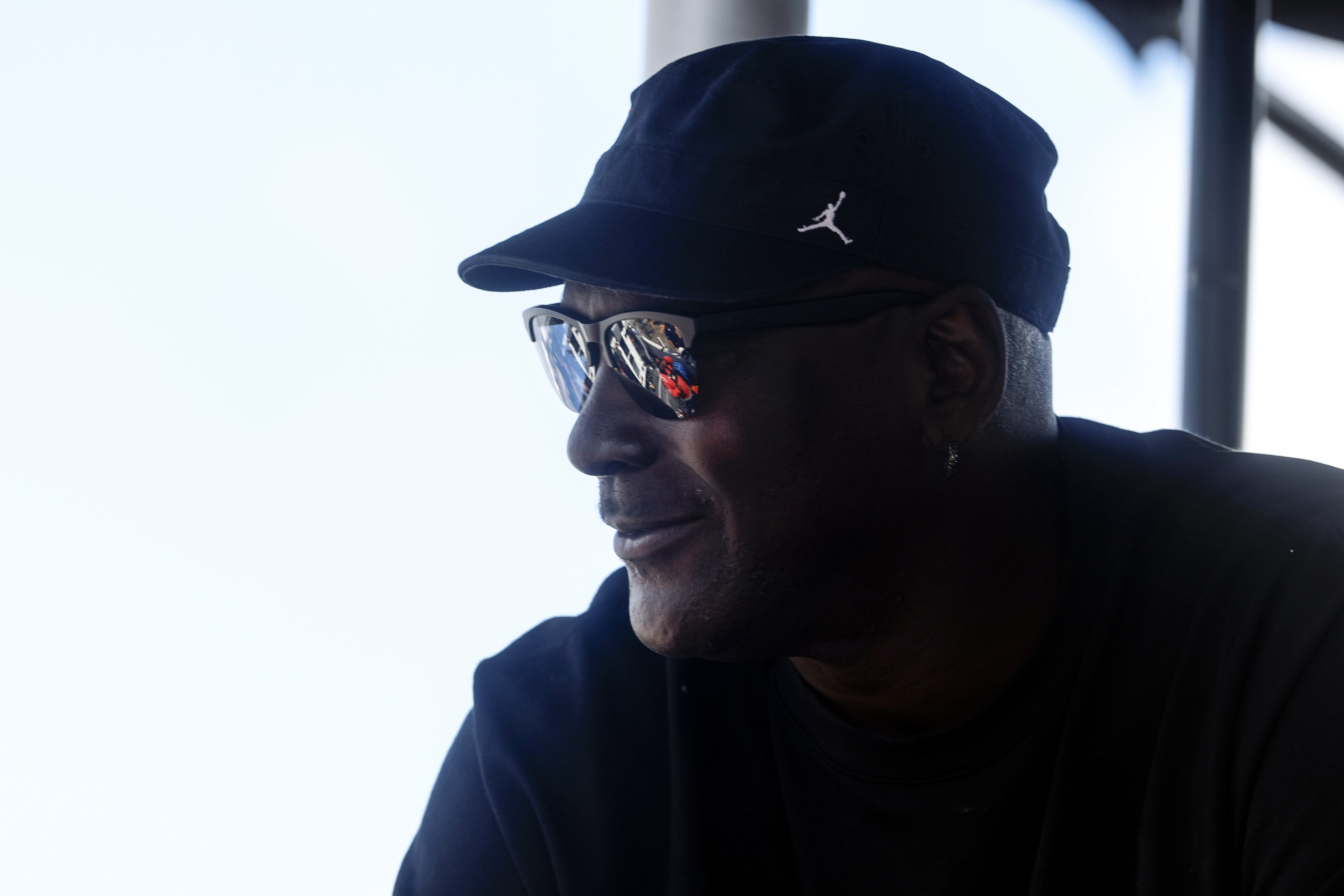
    Hall of Famer Michael Jordan will make his NBC debut Tuesday night.

    Michael Jordan is making the leap to NBA pundit (sort-of) as NBC airs games for the first time since the 2002 season.

    Jordan won’t make his debut Tuesday as a studio analyst. Instead, he’ll appear via a prerecorded interview with Mike Tirico during NBC’s debut. The network hasn’t said how frequently Jordan will contribute, but those taped segments are expected to be scattered throughout the season.

    NBC will start the season broadcasting a Tuesday doubleheader, with the East Coast and West Coast getting different prime-time games during most weeks (both will stream live on Peacock).

    NBC will also debut Sunday Night Basketball beginning Feb. 1, after the end of the NFL season. The network’s NBA coverage will pause after that for the first two weeks in February for the 2026 Olympics in Milan, Italy.

    After practicing with the Sixers and a few other teams last season, Tirico said he’ll call the first couple of Tuesday night games for NBC before focusing on his NFL duties through the playoffs. He’ll also has his duties as the host of the Olympics to contend with.

    The Sixers are scheduled to appear on NBC four times, beginning with their Nov. 11 matchup against the Boston Celtics at the newly-named Xfinity Mobile Arena.

    Play-by-play voices: Mike Tirico, Noah Eagle, Terry Gannon, Michael Grady

    Game analysts: Reggie Miller, Grant Hill, Jamal Crawford, Brad Daugherty, Derek Fisher, Austin Rivers, Brian Scalabrine, Robbie Hummel

    Studio analysts: Carmelo Anthony, Vince Carter, Tracy McGrady

    Sixers fans will also need Peacock and Amazon’s Prime Video

    NBA games will stream on Peacock Monday and Tuesday nights.

    The streaming wars have finally come for NBA fans.

    With TNT out of the picture, Sixers completists will need to sign up for two streaming services to watch all of Philly’s 82 games.

    The first is Peacock, NBC’s subscription streaming service, which is slated to stream 40 exclusive NBA games, as well as every game airing on NBC.

    As of now, Peacock is scheduled to exclusively stream just one Sixers game — a matchup against Nikola Jokic and the Denver Nuggets on Jan. 5.

    A subscription to Peacock’s premium tier runs $10.99 a month, though some Comcast Xfinity subscribers can get a discount.

    Amazon’s Prime Video will stream NBA games two nights a week after the NFL season ends.

    The second streaming service Sixers fans will need is Amazon Prime Video, which will stream 66 regular-season NBA games, including a bulk of the Emirates NBA cup and a new Black Friday game.

    The Sixers are scheduled to play in four games on Prime Video, beginning with their Halloween night matchup against the Celtics in Philly.

    If you’re an NBA League Pass subscriber, one cool feature on Prime Video is the ability to make your own multiview featuring up to four live NBA games.

    Prime Video comes with Amazon Prime, but you can also subscribe to it directly for $9 a month.

    One familiar face will be Sixers veteran Kyle Lowry, who is slated to make “select appearances” on Amazon’s NBA coverage this season. Amazon’s studio show, which will feature Blake Griffin and Dirk Nowitzki, could be a fun watch.

    Charles Barkley and the ‘Inside the NBA’ crew heading to ESPN

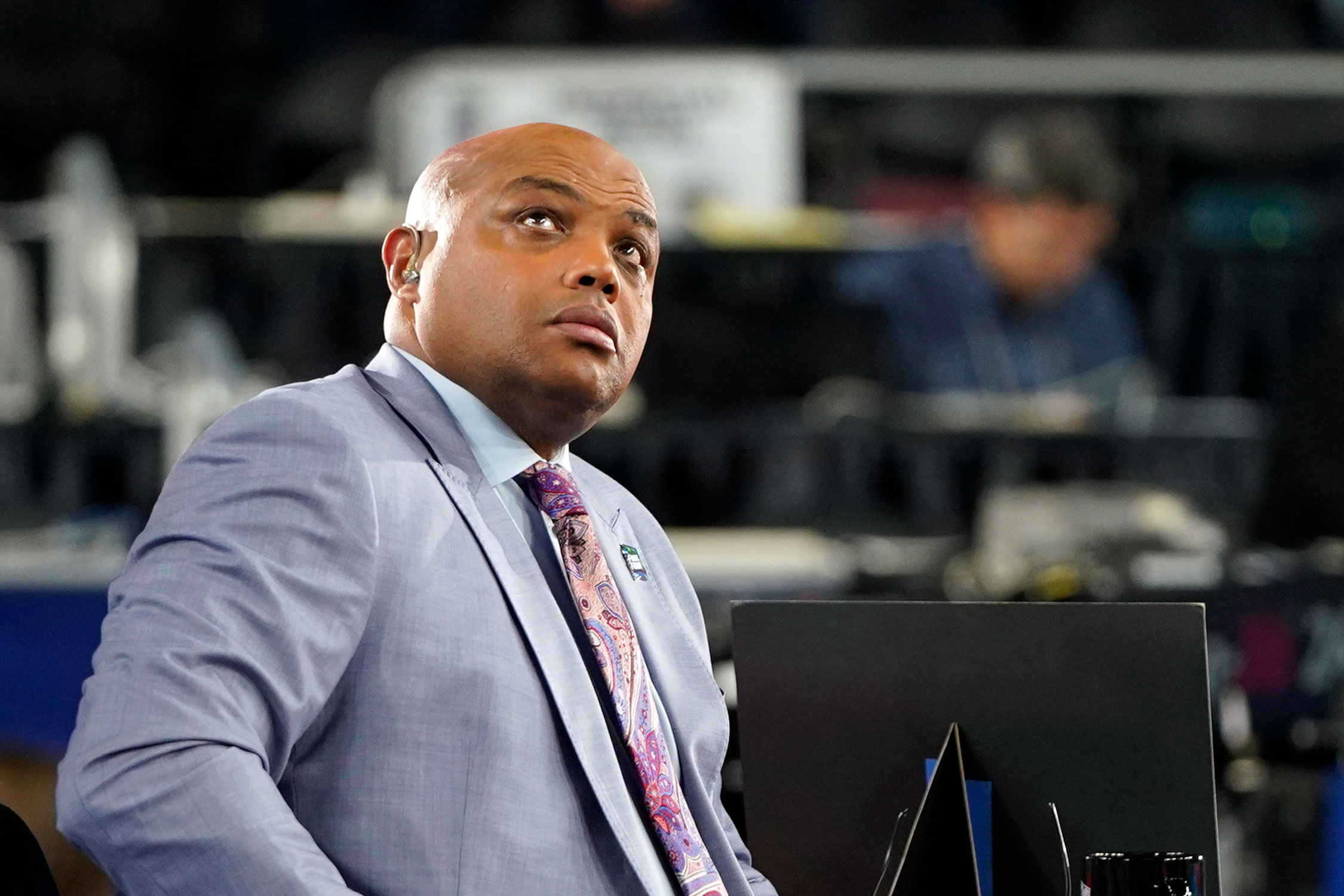
    Hall of Famer and former Sixers star Charles Barkley will be seen on ESPN this season.

    TNT lost the NBA but is keeping its studio show. It’s just going to air on another network.

    Inside the NBA, the beloved studio show featuring Charles Barkley, Shaquille O’Neal, Kenny Smith, and Ernie Johnson, is jumping to ESPN while still being produced by TNT Sports. They’ll make their debut Wednesday at 6 p.m. as part of ESPN’s season-opening doubleheader.

    ESPN has said there would be no changes to the show, beyond a lopsided schedule. Barkley and company are only scheduled appear three more times before Christmas — Thursday, Oct. 29, and Nov. 12.

    “We always go to 2 in the morning. They said they’re going to give us time,” Barkley said in a recent interview with NBA columnist Steve Bulpett. “We were concerned they’re going to be like, ‘No, you gotta go to SportsCenter or you’ve got to leave when we’re on ABC and go to the local affiliates.’ That’s the only two things we were concerned with.”

    The only remaining TV partner from last season, ESPN will mostly air NBA games on Wednesday nights, with some other nights and holidays thrown into the mix. They’ll also add Friday night games beginning Jan. 16, with most airing on ABC.

    As far as ESPN’s announcers, the only major change is on their top announcing crew, which the network hasn’t been able to get right since laying off Jeff Van Gundy and Marc Jackson in 2023.

    This time, Doris Burke is out, replaced by longtime ESPN analyst and former La Salle standout Tim Legler, who will join Mike Breen and Richard Jefferson. Burke will still call NBA games alongside Dave Pasch.

  • What we know (and don’t) about the Eagles entering Week 8 vs. the Giants

    What we know (and don’t) about the Eagles entering Week 8 vs. the Giants

    Are good vibes officially restored in Philadelphia?

    The Eagles snapped their two-game losing streak with a 28-22 win over the Carson Wentz-led Minnesota Vikings on Sunday, largely thanks to Jalen Hurts and his perfect passer rating.

    Plus, sources say that Chief Vibes Officer Brandon Graham is on his way back to the Eagles, too, to bolster an edge rusher corps that is navigating the surprise retirement of Za’Darius Smith last week.

    But to enter the bye week on a high note, the Eagles must face the New York Giants, their division rivals who handed them a blowout loss two weeks ago. The Giants will try to bounce back after a fourth-quarter collapse against the Denver Broncos on Sunday, leading to a 33-32 loss.

    Here’s what we know (and what we don’t) about the Eagles entering their Week 8 matchup against the Giants:

    Lights, camera, play-action

    The Eagles came out of the mini-bye week wanting to establish the running game. That didn’t work. Brian Flores’ defense limited Saquon Barkley to just 44 yards on 18 carries, good for a 2.4 yards per attempt (his second-lowest clip this season).

    Still, the Eagles utilized the threat of the running game successfully against the Vikings, which is a step in the right direction. The offense incorporated play-action passes from under center on Sunday more frequently than in the previous six weeks of the season.

    In Weeks 1-6, the Eagles had five under-center play-action drop backs, according to Next Gen Stats. One of them resulted in a scramble. Another went for 1 yard. The others resulted in incompletions or penalties.

    Sunday was different. Hurts had four play-action dropbacks from under center, which resulted in four completions for 121 yards and a touchdown. Why was it so effective? For one, the Eagles had established a tendency of running the ball when Hurts is lined up under center before the snap. Entering Sunday’s game, 42 of the Eagles’ 48 plays from under center were carries (87.5%).

    By establishing that tendency (and continuing to do so with 15 under-center runs on Sunday), the Vikings aligned a safety in the box in anticipation of the run, especially when the Eagles utilized Fred Johnson as an extra offensive lineman. The Eagles made them pay by occasionally breaking that tendency, especially on the 79-yard touchdown pass to DeVonta Smith, which occurred when the offense was in that jumbo package.

    “We had an answer for it,” Barkley said of Smith’s touchdown play. “We called it at the right time. That’s the beauty of this game. They can do whatever they want, but we should always have answers. I think that’s the mentality we’ve got to continue to get back to.”

    Could we see more play-action passes from under center? And could the Eagles’ success in doing so on Sunday thwart defenses from loading up the box when Hurts lines up under center? That would benefit Barkley, who is averaging just 3.3 yards per carry this season, far behind the league’s average of 4.3.

    Nick Sirianni noted Monday that the uptick in under-center plays was a byproduct of the self-scout from the mini-bye week. He emphasized the importance of meshing the running and play-action passing games seamlessly, as it challenges the defense to convert from run to pass on the fly.

    “We will see how things move forward as far as the ways we want to attack,” Sirianni said. “Every game calls for different things. This is what this game called for, and these are some of the things that came off our self-scout. We’ll continue to work and find ways to get better.”

    Feel the Burns

    Barkley hasn’t been getting a consistent boost in the running game from the Eagles’ offensive line this year. The group has been reeling from injuries. Cam Jurgens suffered the latest, exiting Sunday’s game after the second drive with a knee injury.

    With Jurgens’ status in question for the rematch against the Giants, the Eagles could turn to a backup at center, which could present all sorts of challenges against a formidable defensive front.

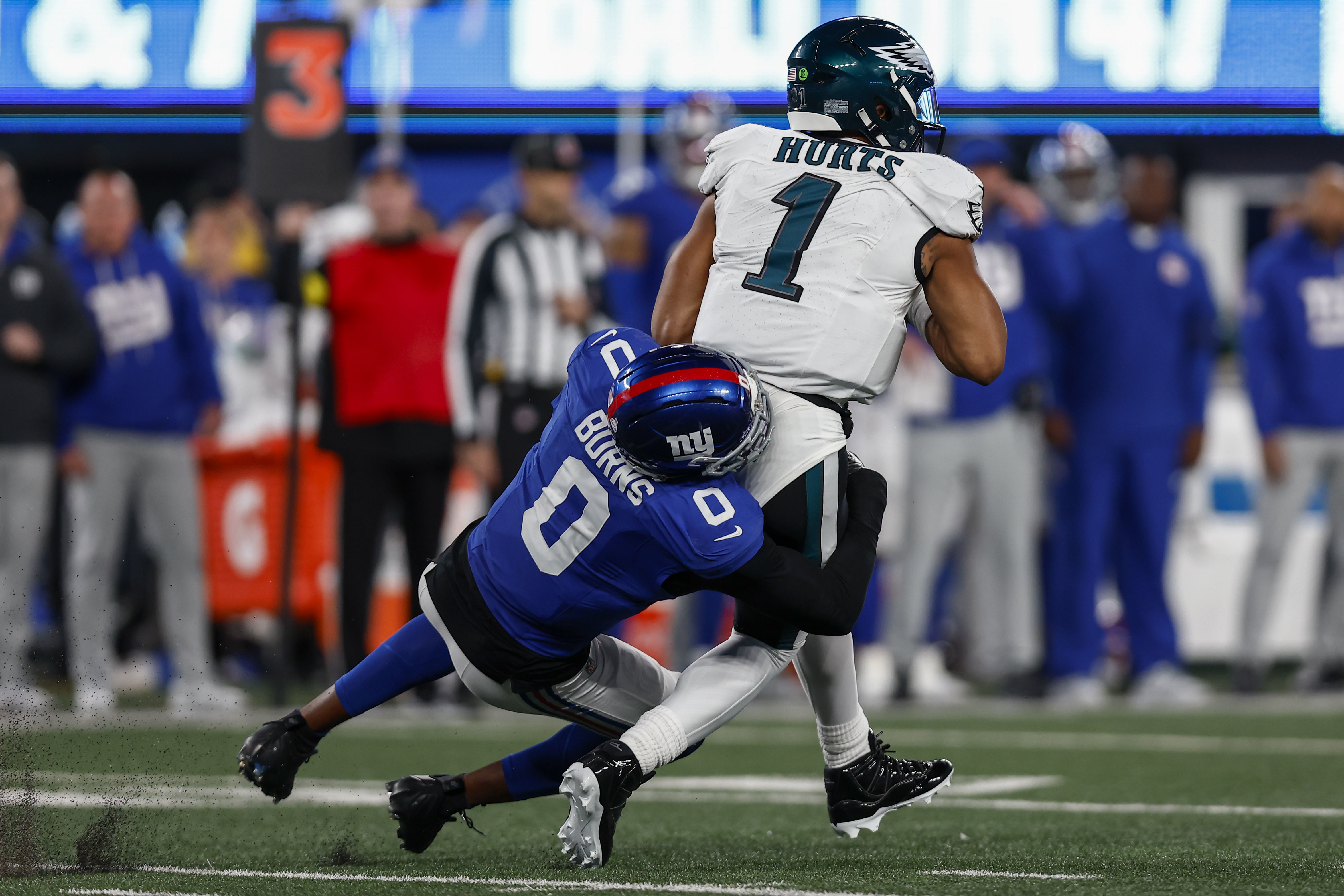
    Giants edge rusher Brian Burns had four sacks over the last two games, including dropping Jalen Hurts twice on Oct. 9.

    The Giants exploited the Eagles’ weaknesses on the offensive line in their last matchup. Brett Toth started at left guard in place of the injured Landon Dickerson (ankle). Brian Burns notched two sacks against the left side of the offensive line, once on a stunt and another from 3 yards off the line of scrimmage.

    Burns has four sacks in his last two games, after adding two more in their loss to the Broncos. The good news for the Eagles is that Dickerson started and finished Sunday’s game against the Vikings. His presence against the Giants would help stabilize the left side of the line and minimize Burns’ impact when he lines up on that side.

    But if Jurgens can’t play, the Eagles could turn to Toth at center. He would be tasked with keeping Dexter Lawrence, the three-time Pro Bowler, at bay.

    Lawrence hasn’t been as disruptive as a pass rusher as he was last season and hasn’t posted a sack this year. Still, Lawrence is an important part of the Giants’ defensive front, ranking fourth on the team with 15 “stops,” which Next Gen Stats defines as tackles that result in a successful play for the defense.

    Scramblin’ man

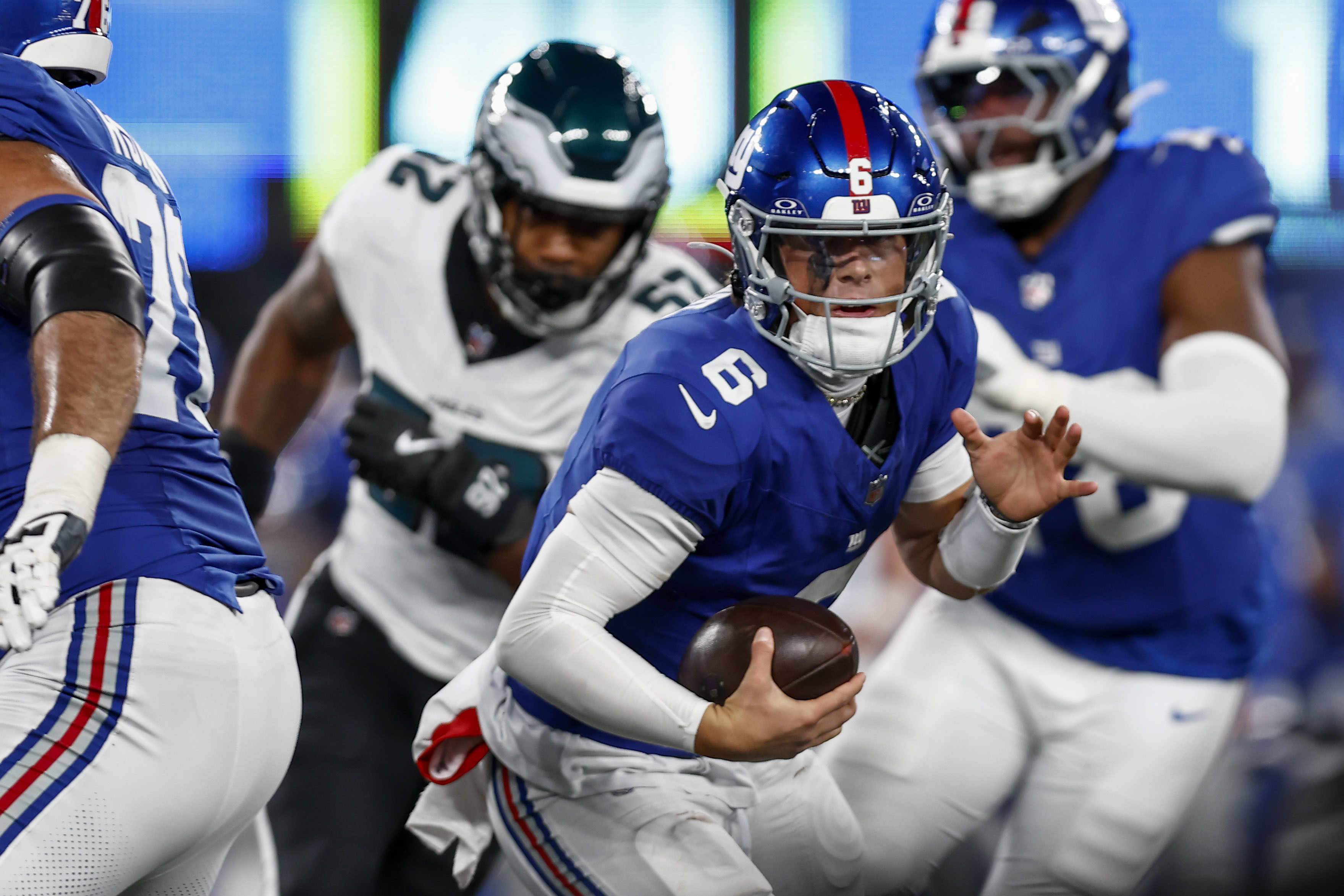
    The last time the Eagles faced the Giants, rookie quarterback Jaxson Dart got his legs going. He scrambled five times for 42 yards and a touchdown, which helped him reach career highs of 58 rushing yards and 13 attempts.

    Vic Fangio’s defense has struggled at times to prevent quarterbacks from breaking loose. Unsurprisingly, Patrick Mahomes did the most damage against the Eagles this year (seven scrambles for 66 yards), but even Wentz, 32, had a couple of long third-down scrambles totaling 28 yards late Sunday as the Vikings attempted a comeback.

    Improved tackling would be a good place for the Eagles to start. Dart forced three missed tackles against the Eagles, according to Pro Football Focus. That was a new achievement for Dart, who didn’t force a missed tackle in any of his three other starts this season.

    New York Giants quarterback Jaxson Dart finished with 42 yards on five scrambles against the Eagles on Oct. 9.

    The rookie quarterback did not scramble against the Broncos, although he made passing plays on the move. According to Next Gen Stats, Dart completed four of six passes for 101 yards and a touchdown when running over 8 mph. Keeping Dart contained will take a group effort from the Eagles, in terms of the pass rush and coverage.

    Carter’s return

    Speaking of keeping Dart contained, Jalen Carter returned to action Sunday after missing the Week 6 game against the Giants with a heel injury.

    Wentz certainly felt his presence. In the second quarter, a simulated pressure left Carter one-on-one with Blake Brandel, the third-string center. Carter breezed past Brandel and launched himself toward Wentz, forcing the quarterback to make an ill-advised throw over the middle to Jalyx Hunt, who snagged the ball and returned it for a pick-six.

    Even though Carter has been banged up this season, between heel and shoulder injuries, the Eagles could have used his talent and physicality against the Giants. In his absence, the group finished with a 26.5% pressure rate against New York two weeks ago, its lowest of the season, according to Next Gen Stats.

    Carter attempted to make up for lost time on Sunday. He led the team with six pressures against the Vikings, according to Next Gen Stats. His fourth-quarter stunt with Jordan Davis provided the initial pressure on Wentz that helped Joshua Uche register his first sack with the Eagles.

  • Penn is expanding its research in immunology — a field just honored with a Nobel Prize

    Penn is expanding its research in immunology — a field just honored with a Nobel Prize

    University of Pennsylvania professor E. John Wherry is good friends with Fred Ramsdell, who was recognized earlier this month with a Nobel Prize for his research in immunology.

    Wherry recalled sitting with Ramsdell, a scientific adviser for the California-based biotech company Sonoma Biotherapeutics, in a meeting two months ago and picking his brain about the future of autoimmunity research.

    “What are the opportunities? Where is the field going?” Wherry recalled asking.

    He said Ramsdell’s advice — to stay focused on supporting the foundational academic research — is helping to inform the scientific direction and programming at Penn’s Colton Center for Autoimmunity, which Wherry directs.

    The center opened in 2021 and is now the centerpiece of Penn’s recently launched $376 million research facility focused on immune health, autoimmunity, and infectious diseases.

    Wherry was happy to see Ramsdell awarded a 2025 Nobel Prize in Physiology or Medicine, shared among three scientists, for his research into peripheral immune tolerance, a process that prevents the immune system from attacking the body.

    “It could not have happened to a nicer guy,” he said.

    The Nobel Prize-winning discovery is especially important for understanding autoimmunity, he emphasized, and could be leveraged to treat autoimmune diseases.

    “We now have the power to push the immune system in different directions, not only to treat those diseases, but also to tell us about where the diseases are going,” Wherry said.

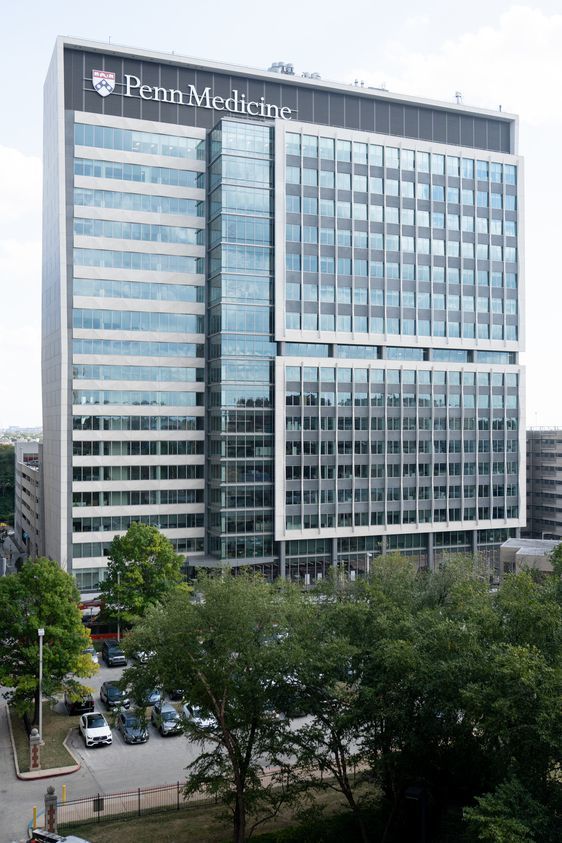
    Penn’s new research facility, which will span seven floors of an office building at 3600 Civic Center Blvd. in University City, is focused on using immunology to diagnose, treat, and prevent diseases.

    Wherry’s lab is moving into the space this month.

    “We are in the most exciting time in my lifetime for immunology,” he said.

    The Inquirer spoke with Wherry to learn more about the future of immunology research at Penn in a conversation lightly edited for length and clarity.

    How will this new center change how immunology research is carried out at Penn?

    We have the Colton Center for Autoimmunity, with really wonderful philanthropic support from Judy and Stewart Colton. They’re giving us resources to make bets on high-risk, high-reward science, and to do that at a pretty good scale. We made some big bets on CAR-T cells and autoimmunity, on mRNA therapeutics, on high-throughput screening, and on AI drug discovery.

    We have this Immune Health Platform lab. The idea is that we should be capturing samples theoretically from every patient we treat, ideally around the time they get a new treatment or there’s some change in their disease.

    Once we’ve built a model using this data and understand the rules by which the immune system functions, we can separate the model from the primary data. You can fine-tune the model and make predictions about other diseases, clinical trials that a company might want to do, and other health systems data.

    Our large database contains about 3,000 patients’ worth of data. We hope to get to 10 or 20,000 patients’ worth.

    Who will be part of this new research facility?

    There are about 25 immunology labs moving in. They include disproportionately younger labs, people who have just arrived at Penn in the last two to three years. We have enough space for probably around 35 to 37 labs, so we would like to recruit and bring new ideas in.

    The way things happen in science is because people talk. We’ve created a physical workspace that’s going to force people to interact in new and different ways and just create more opportunities for serendipity.

    The University of Pennsylvania opened a $376 million, 217,000-square-foot wet lab, office, and research facility at 3600 Civic Center Blvd. The seven-story facility was built on top of an active 250,000 square-foot office tower that opened in 2019.
    What are some of the new projects that have been funded?

    We have someone funded to work on the way the immune system recognizes our own DNA or RNA. lf the DNA in the nucleus of any cell in your body gets out of the nucleus, it’s a really bad thing, because that looks like a bacteria or a virus [to your immune system]. It triggers massive inflammation. The sensors for that can get miswired, and when they do, it can often lead to really devastating autoimmune disease, sometimes a fatal autoimmune disease within just a few years.

    We have a great researcher named Jonathan Miner who’s identified what happens when those proteins get mutated, and has also developed drugs that basically adapt the mutation to not be as pathogenic.

    We have some other really interesting studies on being able to regulate the way our bodies make antibodies, since that can be the pathogenic event in autoimmunity. If you make an antibody against proteins in your nerve ending, you can have diseases that end up causing muscle weakness. We’re starting to identify the way the immune system gets triggered to make antibodies against the wrong things.

    And then we have some really cool projects on CAR-T cells and autoimmunity, where we’re using standard CAR-T cells from cancer to get rid of B cells, which are cells that make antibodies in autoimmune diseases. We also have people inventing new kinds of CAR-T cells to help address other challenges in autoimmunity.

    What is the focus of your lab’s research?

    In the late 1990s and early 2000s, I became very interested in how the immune system deals with chronic infections. When you can’t fully eradicate an infection, what does the immune system do? Why doesn’t the immune system clear things like HIV or hepatitis B, and what are the mechanisms behind that failure?

    During our studies, we identified a process called T cell exhaustion. T cells are the part of the immune system that fights viruses and also tumors.

    Our core is always to understand this idea of immune exhaustion. It plays a role in infectious disease, it plays a role in cancer, and it definitely plays a role in autoimmunity.

    What are some of your current projects?

    We’re trying to understand the heterogeneity in different autoimmune diseases.

    To give an example, one is a really challenging kind of blistering inflammatory skin disease called Hidradenitis suppurativa, where there’s just massive inflammation of immune cells in your skin, and it causes really hard-to-treat skin lesions. We now are profiling all of the immune cells in the tissue in the skin and identifying new targets for therapeutics.

    We’re also interested in this idea that the immune system sees everything that’s happening in your tissues, meaning it acts like a biosensor. If we understand the things the immune system is seeing, we can start to predict trajectories of disease. The inspiration for our study on infant health [not yet published] came from a neonatologist who came to the lab and said, ‘These really premature infants have this kind of lung inflammation that we don’t understand.’

    We realized that somewhere around 10 or 20% of those really premature infants get infected while they’re in the ICU. And we were able to identify what those infections look like early in life.

    We think we can start to piece together ways that we might be able to use the immune system more effectively, or at least treat the damaging inflammation that might come from an early-life infection.

    What bets are you making on AI drug discovery?

    We’re very excited about an AI-based approach for drug discovery and drug repurposing that is being led by David Fajgenbaum, the physician who had Castleman disease and essentially cured himself.

    He has a big infrastructure to basically look at all FDA-approved drugs and identify ways to repurpose them for diseases they weren’t originally intended for. We can do AI predictions, take the top list of drugs from that, and then put that into a high throughput screening facility where Sara Cherry, who is brilliant and amazing, can now screen to identify which of those drugs might be able to provoke the effect we want from cells involved in autoimmunity.

  • This Philly charter has been roiled by upheaval and turnover. Now, its renewal is on hold.

    This Philly charter has been roiled by upheaval and turnover. Now, its renewal is on hold.

    For years, Northwood Academy Charter School was a stable Philadelphia charter — the kind of place where teachers and administrators stayed for decades, and children thrived.

    But in the last few years, the school, on Castor Avenue in Frankford, has cycled through dozens of administrators and teachers and test scores have dropped. Academics have suffered, according to interviews with a number of parents and staff, who say the school feels less safe, and staff morale is low.

    The school’s five-year charter expires this year, but Northwood’s renewal is on hold, The Inquirer has confirmed, because the district’s Inspector General’s Office is reviewing information about Northwood. The exact nature of the investigation is unclear.

    The Inquirer spoke to and reviewed testimony from more than a dozen parents and current and former Northwood staff. Nearly everyone interviewed requested anonymity for fear of reprisal; some who spoke out at meetings have received cease and desist letters threatening litigation from a consultant who provides human resources services to Northwood.

    “When we first got there, there was stability at the school — everyone was there since almost the beginning,” one parent said. “Now, in the last five years, we have had 20 administrators change over. The kids can’t get comfortable with the teachers, because they don’t know if they’re going to be there a long time.”

    Northwood, which opened in 2005, educates 800 students in grades K through 8. As a charter, it’s independently run but publicly funded; the Philadelphia school board authorizes its funding but does not manage its operation.

    School officials say the Northwood turnover is not excessive, but rather a function of its board of trustees’ move to steer the school to better outcomes.

    “Our goal here is to just move forward and help our students achieve,” said Kristine Spraga, a longtime board of trustees member who now serves as the board’s treasurer.

    The board’s challenge, human resources consultant Tracee Hunt said, “is getting the person who has that strategic focus, who doesn’t necessarily operate more like a principal than a CEO. What happens is we’ve hired what we thought were great hires, and then if they decide, ‘This is a little bit too much for me, the board doesn’t have any control over that.’”

    The board this month hired former Central Bucks School District Superintendent Steven Yanni to lead the school.

    A pivot point

    Northwood handled human resources in-house in its early days. When a principal left in 2018, there was some unrest among faculty after a number of teachers were shifted around.

    Shortly thereafter, one board member suggested bringing in Total HR Solutions, a New Jersey-based provider that had worked with some other Philadelphia charters, to manage those services.

    That was a pivot point for the school.

    Hunt was charged with examining the school’s practices. She found “a lack of fair and equitable hiring practices,” she said in an interview last week, “a massive amount of nepotism,” and inadequate staff diversity — the school educates mostly Black and Latino students but its staff was mostly white.

    “Through natural attrition, we have the opportunity to have fair and equitable hiring practices so that then you improve in your areas of diversity in just a natural way, versus feeling like you have to displace people,” said Hunt.

    Some current and former staff see things differently. The earlier version of Northwood wasn’t perfect, they said, but it was cohesive, and under Total HR, that changed.

    Adam Whitlach, a longtime Northwood school counselor, said Total HR “came in with the idea of ‘demolish, and re-create something from nothing.’ They were mixing it up for the sake of mixing it up. They treated it like it was a turnaround school, but it wasn’t, there was an existing community. They attempted to sell them a story that our school was failing and racist, but people didn’t believe that.”

    In 2021, the school’s longtime CEO, Amy Hollister, abruptly left Northwood with no notice to the staff and families with whom she had built a strong rapport.

    “It was out of the blue, and then everybody else started leaving,” another Northwood parent said. As with others, the parent asked not to be identified for fear of blowback. Parents began attending board meetings — at one, Hunt stood up, the parent said, “and began to tell us how the teachers want a more diverse school, and that’s the reason why all this upheaval was happening.”

    The parent, who is a person of color, said they were not bothered by the staff’s demographic balance. “Those teachers loved our children. Everybody knew you, you didn’t have to go past security, and they welcomed every parent, every child. There weren’t a lot of discipline issues, because they had relationships with our kids,” the parent said.

    More departures

    Changes accelerated after Hollister left.

    “Parents were grabbing me by the arm and saying, ‘Whitlach, tell me what’s going on here,’” the former counselor said. “The bullhorns came out, the security guards dressed all in black came out.”

    (Whitlach was ultimately fired after 15 years at the school after, he said, he complained publicly about the school pushing staff out. Students walked out in protest of his departure.)

    The departures affected academics too. A third parent said she was frustrated by “no curriculum, no books.”

    Administrations came and went. Audrey Powell came to Northwood as an assistant principal in 2023, following then-CEO Eric Langston, who has since left; Langston left this summer, and Powell resigned soon after.

    The reason for her departure?

    “I just didn’t agree with the direction or the choices of the board,” Powell said. She repeatedly brought concerns to the board that were ignored, she said. In particular, she was alarmed by the board’s relationship with Total HR and Hunt’s “overreach” at Northwood, Powell said.

    “I don’t think there were enough checks and balances,” Powell said. “I feel like [Total HR’s] contract incentivizes there to be turnover — she directly financially benefits from there being turnover.”

    Northwood paid Total HR $1.4 million between 2020 and 2023, according to public records. That included base fees for Total HR’s services, including an HR generalist who works at Northwood but is paid by Total HR, and also per-position search fees for administrative positions and board seats.

    “The constant turnover is a misuse of taxpayer dollars, and it’s a disservice to kids, to the teachers,” said Powell. “There can’t be progress when there is that much turnover. It’s two steps forward and four steps back.”

    Hunt dismissed the notion that she was simply out to make money.

    “We have these contracts that are negotiated,” said Hunt, whose firm works across industries. “Everything that I bring to Northwood, I bring below market rate.”

    The school district’s charter chief, Peng Chao, said Northwood’s spending on human resources appears to be more than is typical.

    “This level of spending is not what we usually see for this type of scope of work,” Chao said. “While we recognize the staffing challenges that schools are navigating, it is important for schools to remain mindful of fiscal constraints as we all work through an uncertain budget environment.”

    Yanni, who began as Northwood’s CEO Oct. 6, said while Total HR provides services, ultimately, hiring and firing decisions rest with the CEO.

    “HR is an adviser to us, so HR doesn’t make the hiring and firing decisions, they provide the guidance from the place of compliance and the law,” said Yanni.

    ‘Beyond frustrated’

    Staff and parent concerns about Northwood are not new. At board of trustees meetings, speakers often give impassioned testimony on the subject.

    At last week’s trustees’ meeting, kindergarten teacher Emily Parico told the board that “something nefarious is going on at Northwood, and you sit by, silent and complicit. Northwood used to be a learning sanctuary. It wasn’t perfect, but it was a place where students, staff, and families felt safe and loved.”

    Parico is the Northwood teachers union’s vice president. Most city charter teachers are not unionized; Northwood’s voted to form a union in 2023 amid turmoil at the school.

    Kim Coughlin, a fourth-grade teacher and the union president, said the school continues to be roiled.

    “Every day, teachers and staff are thinking of walking away, and two just did yesterday,” said Coughlin. “And our families are beginning to look elsewhere, because they feel the shift. The school that we once knew and loved has become unrecognizable.”

    Questions and threats of legal action

    When Langston, the CEO prior to Yanni, left suddenly in August, dozens of families and staff asked the board for answers, but none were forthcoming, said Kevin Donley, the school’s psychologist.

    “I’m beyond frustrated,” said Donley, who’s secretary of the union. “And deeply disappointed by the manner in which the board of trustees has governed our school in recent months and years.”

    At least 50 people sent letters to the board of trustees expressing concern about further turmoil after Langston’s departure, Donley said. As far as he knows, not one person heard back, either in a letter or any kind of message.

    Both Hunt and the board have sent letters threatening some who speak out with legal action; Hunt said she won a legal challenge against one parent who falsely said she had been fired by a previous client. (The client, Hunt said, moved HR services in-house and did not fire her.)

    “It’s not uncommon to have a few naysayers, but eventually when you start seeing the fruit of all this board’s labor, the reason I stick in here is because I watch them stay so focused on the kids,” Hunt said.

    School officials told The Inquirer that the staff and parents who have spoken out represent “a very small number of people who are quite passionate,” but not representative of all staff and parents.

    “I don’t see that the vast majority feel the same,” said Spraga, the board treasurer. “Otherwise, we would have those indicators in things like the engagement surveys, right?”

    Spraga, Hunt, and board president Warren Young said staff and community engagement surveys do not match the sentiments expressed at board meetings.

    New leadership under Yanni

    The Northwood CEO job is Yanni’s first foray into the charter sector; he was previously superintendent in the Lower Merion, Upper Dublin, and New Hope-Solebury school systems. Yanni was terminated as the Central Bucks superintendent last week over allegations that he mishandled child abuse allegations in a special education classroom — a contention he denies.

    Yanni said he’s thrilled to be at Northwood, where class sizes are small — 23, typically — and there’s a feeling of welcome.

    “There’s passion here,” Yanni said. “And it’s not just the staff, it’s the kids too — this is their school. Kids really feel like Northwood is their home, and we have engaged families.”

    Northwood is completely full, with a waitlist of 200 students per grade level, Yanni said, and applications are already coming in for the 2026-27 school year.

    In the 2018-19 school year, 64% of Northwood students met state standards in reading, and 30% in math; in the 2024-25 school year, the last year for which scores are publicly available, 31% of Northwood students hit the mark in reading and 11% in math. In 2018-19, Northwood beat Philadelphia School District scores (35% proficiency in reading, 20% in math) and in 2024-25, the district did better (34% proficiency in reading, 22% in math).

    Yanni said Northwood is a school on the rise and is beginning to implement positive behavioral supports to improve school climate. It’s also in the early days of an academic intervention process to identify and target individual students’ skill gaps.

    “I think we’re going to see dramatic gains this year,” said Yanni.

    Northwood “is a school that people stick with,” he said. And though the city has plenty of choices for families, “we’re going to start a strategic planning process, and really kind of blow the doors off. You hear about KIPP, and you hear about these large charter networks and then there’s little tiny Northwood. How do we make it the beacon, the flagship?”

  • A once-crumbling Point Breeze church is being preserved as a brewery and community space

    A once-crumbling Point Breeze church is being preserved as a brewery and community space

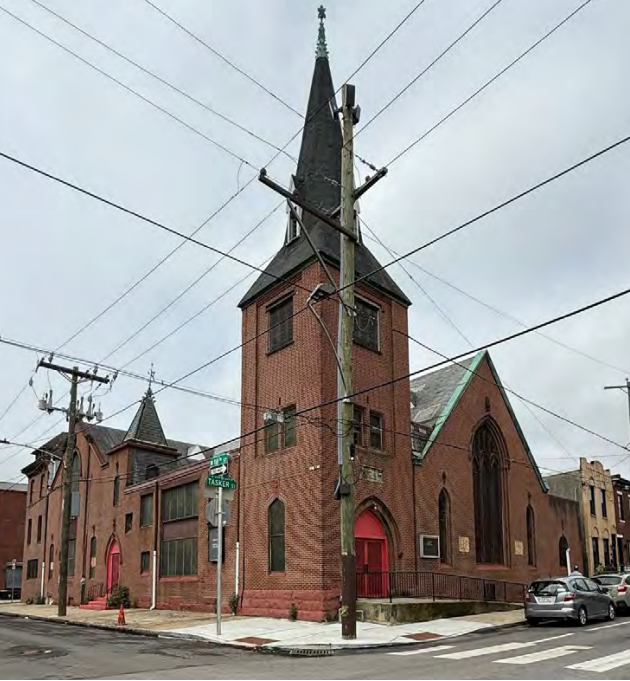
    Dane Jensen isn’t a developer by training or profession, but he loves old buildings and he’s got big plans for the church at 1800 Tasker St.

    The 138-year-old institution is a fixture in Point Breeze, but Second Nazareth Missionary Church’s shrinking congregation hadn’t been able to keep up with repairs. In 2024, as the church sought to sell, its leadership met with Jensen, who pitched them on his vision of a continuing life for the building as a communal space, if not a sacred one.

    “A lot of adaptive reuse is taking these big institutional buildings and turning them into apartments and, to me, that loses some of the intent of the space,” Jensen said. “We are trying to preserve it as something where people can still gather and feel fellowship. Even without religious intent, it can still be a place where people can connect.”

    Jensen bought the property in mid-2024 for $1.75 million, and he has begun renovations. He hopes to turn the church into a family-friendly restaurant, brewery, and event space, outfitted with an indoor playground, an idea he successfully pitched to Second Nazareth’s leadership.

    “It’s a little scary to put that word out there because some people hear brewery, and they hear bar. They hear place to get drunk,” he said. “We envision it as a community space. During the day you can go grab a cup of coffee and do some work. In the afternoon, you can meet up with friends and have lunch, and, yeah, maybe you can grab a beer.”

    Jensen isn’t imagining a traditional brewery, with giant silos and vats. He wants a place he will feel comfortable bringing his children, who are 4 and 7. That’s also why he’s been drawing up plans for play equipment inside the space.

    The church is currently zoned for single-family use, like the rowhouses that surround it. But in 2019, City Council created historic preservation incentives to make it easier to repurpose churches that are on the Philadelphia Register of Historic Places.

    That means Jensen can move forward, since the church was added to the register earlier this month. He won’t have to go to the Zoning Board of Adjustment or seek a legislative zoning change from Council President Kenyatta Johnson, who represents the area.

    However, Jensen said he still plans to meet Johnson and arrange meetings with surrounding neighborhood groups known as Registered Community Organizations (RCOs).

    “Needing to talk to your councilmember, needing to talk to your community through the RCOs, is incredibly valuable,” Jensen said. “We want to do that to make sure we’re not just coming in to extract value from the neighborhood. We really want to contribute in a real and meaningful sense. Hiring from the neighborhood feels really important.”

    Jensen is applying for a sit-down restaurant and artisan industrial use permit. Other possible uses of the building include a bakery and a coffee roastery.

    Whatever the final use, the historic church will require extensive renovation first. Currently, Jensen’s team is putting in steel reinforcements to brace the building. He plans to restore most of the stained glass, fix the leaky roof, and install fire safety and Americans with Disability Act infrastructure.

    The church dates to 1886, when it was known as the Presbyterian Church of the Evangel. That denomination was in place for almost 100 years, but as that congregation shrank, the church sought a successor.

    In 1978, the Second Nazareth Missionary Church took over the building and remained until 2024. In recent years, that congregation began facing many of the same challenges as their predecessors even as their membership was shrinking and repair costs were growing.

    Jensen said he found notes from the waning days of the Presbyterian era that showed the leaking roof was a problem back then — a challenge that decades later, Second Nazareth was facing again.

    The church as seen from the north side, in an image included in Dane Jensen’s nomination of the building to Philadelphia’s Register of Historic Places.

    When the Historical Commission accepted Jensen’s 48-page argument for the building’s importance earlier this month, that triggered the 2019 law that made it easier to find new uses for historic “special use” properties — like churches or theaters — by granting them more flexible zoning. That means no trip to the zoning board, which can add over half a year to the development process and often more if neighborhood groups or councilmembers contest the board’s ruling in court.

    The 2019 bill was drafted in response to the fate of St. Laurentius in Fishtown, which got caught up in lawsuits over a zoning board ruling. The legal battles dragged on until the church was demolished.

    “I’ve really fallen in love with the building throughout this process,” Jensen said. “I’m excited that I am in a position to try to get the building to a point that it can last another 140 years and still have people feeling togetherness in it.”