Tag: topic-link-auto

  • Eagles’ Jalen Hurts again roasts Carson Wentz; A.J. Brown says ‘Just throw me the bleeping ball’

    Eagles’ Jalen Hurts again roasts Carson Wentz; A.J. Brown says ‘Just throw me the bleeping ball’

    Carson Wentz’s passer rating against the Eagles fell to 68.0 Sunday. That is his worst passer rating against any team that he’s faced at least twice. He has faced the Eagles twice, first as a Commander, Sunday as a Viking.

    He is 0-2.

    Jalen Hurts was the opposing quarterback in both games.

    That should deliver a degree of satisfaction to any Eagles fan who still resents Ginger Jesus for whining his way out of town because, in 2020, the Eagles drafted Hurts to act as his long-term backup, then inserted Hurts for the last four games of the season.

    Instead of coming to training camp and winning his job back, thereby justifying the four-year, $128 million contract extension he’d been awarded but had not yet begun earning, Wentz first got coach Doug Pederson fired, then forced GM Howie Roseman to trade him, specifically, to Frank Reich and the Colts, where he then sabotaged Reich’s career.

    Things worked out well for the Eagles. Hurts became the better quarterback.

    But don’t think that Hurts doesn’t relish these matchups after Wentz treated him with resentment and jealousy during their shared season in Philly.

    It’s no coincidence that, in their first meeting on Sept. 25, 2022, Hurts had his best game as a passer to that point: 22-for-35, 340 yards, three touchdowns, no interceptions, and a 123.5 rating.

    Nor is it any coincidence that, on Sunday, Hurts had his best game as a passer ever: 19-for-23, 326 yards, three touchdowns, zero interceptions, and a perfect 158.3 passer rating.

    The draft capital from the Wentz trade eventually helped the Eagles, often tangentially. It was part of deals that landed DeVonta Smith, A.J. Brown, Jalen Carter, and Cooper DeJean.

    At the time, though, what mattered most was that:

    1. The Eagles appeared to have lost their long-term franchise quarterback because his feelings were hurt.
    2. The Eagles were saddled with about $34 million in dead cap money for the 2021 season, crippling the club and essentially wasting the year.

    Since Wentz’s disgraceful departure, the Eagles have gone to two Super Bowls and have won one. If that salves the wound for you, that’s healthy, I guess.

    However, if you still feel resentful, you have every right.

    ‘Just throw me the [bleeping] ball’

    On Thursday, after hearing his coaches and teammates swear for six weeks that he’d just have to wait his turn, A.J. Brown, the best receiver in Eagles history, playing at the height of his abilities, watched Ja’Marr Chase catch 16 passes on 23 targets in a Bengals win over the Steelers.

    Brown hasn’t had 16 receptions in any three consecutive games this season.

    Chase’s quarterback? Forty-year-old Joe Flacco, who’d been benched by the Browns, then traded by the Browns. It was Flacco’s second start with the Bengals.

    Imagine if Flacco had been, say, a 27-year-old reigning Super Bowl MVP?

    Hurts is a 27-year-old reigning Super Bowl MVP, and on Sunday, Brown watched Hurts hit Eagles teammate DeVonta Smith nine times for 183 yards. That yardage total not only is Smith’s career high, it also would have been Brown’s career high.

    Meanwhile, while sitting on the bench, Brown watched Vikings receiver Jordan Addison catch nine passes for 128 yards. His quarterback: five-time retread Carson Wentz.

    After the second score, the broadcast caught Brown, unhinged, voicing his ungrammatical validation:

    “This is when you throw me the [bleeping] ball. What the [bleep] is that? Just throw the [bleeping] ball.”

    Brown caught four passes for 121 yards and two touchdowns. But for about 14 months, Brown has been insisting that he needs more chances to make more catches, because he’s just that good.

    And he’s right.

    If Joe Flacco and Carson Wentz can force-feed their beasts, why can’t Hurts force-feed his?
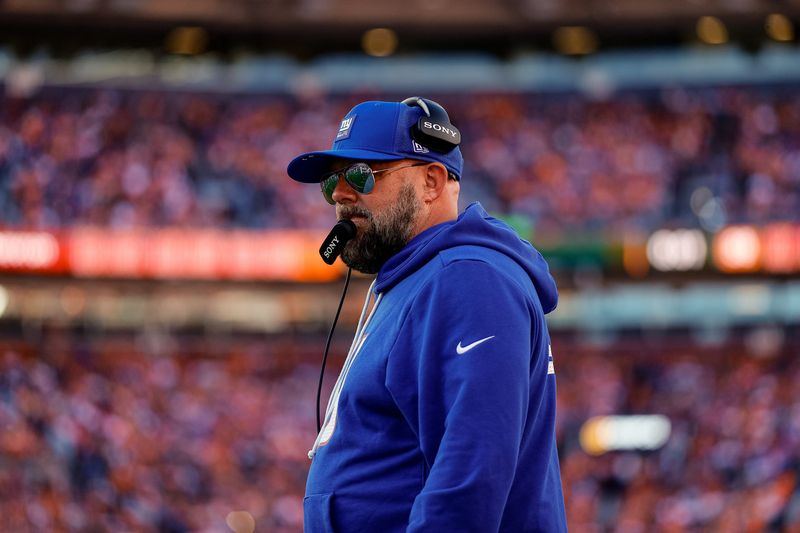
    Brian Daboll’s Giants gave up 33 fourth-quarter points to lose to the Broncos.

    Bucking Bronco

    The Giants will hit Philly on Sunday nursing a massive hangover after their historic, 19-point, fourth-quarter, mile-high collapse at Denver, a game that featured several weird plays and outcomes.

    The craziest scene among the crazy scenes was, just before the Giants’ last touchdown, the spectacle of Broncos coach Sean Payton losing his mind and running into the middle of the field at the goal line to protest a pass interference penalty on his defense. Like, all the way to the 2-yard line. Right in the middle of the action. It was like something out of an awful Oliver Stone football movie.

    Payton drew an unsportsmanlike conduct penalty, which was inconsequential, considering the ball was at the 2-yard line and could only be moved one yard. It will be less consequential when he gets that $15,000 fine from the league.

    At any rate, the TD gave the Giants a 32-30 lead, but kicker Jude McAtamney — a Northern Irishman with Gaelic football roots whose tortuous journey to Sunday included, while in college, a demotion from Rutgers’ full-time kicker to its kickoff specialist — flubbed the second of two missed PAT tries. The Broncos drove to field-goal range, and kicked the winner.

    Payton was happy then.

    Shut ’em down. Finally.

    Before Sunday, former Eagles coach Andy Reid had 304 NFL wins, including playoffs. He’d won three Super Bowls and he’d coached in three more.

    But he’d never had a shutout.

    Then on Sunday he faced Pete Carroll and the injury-depleted Raiders in Kansas City and won, 31-0.

    Kansas City Chiefs wide receiver Hollywood Brown scores as Las Vegas Raiders cornerback Darnay Holmes defends.

    This is remarkable, considering the four coaches near Reid’s win total — Don Shula, George Halas, Bill Belichick, who are ahead of him, and Tom Landry, whom he passed two years ago — all have at least a dozen shutouts.

    Granted, Shula, Halas, and Landry coached in an era in which scoring was less prolific, but Belichick is a contemporary. And anyway, when you coach teams as successful as the Eagles and Chiefs, you’d expect more than one shutout among 305 wins.

    Extra points

    Packers edge Micah Parsons, the biggest offseason name to change teams, finally went off Sunday. He delivered the last of his career-high three sacks with 27 seconds to play in Arizona. He’d had just 2½ sacks in his first five games since being traded by the Cowboys just after preseason, then signing a four-year, $186 million extension. … At this point, Shane Steichen is the runaway leader in the Coach of the Year race. The Colts are 6-1, and while all of their wins aren’t impressive — Titans, Raiders, Cardinals, Dolphins — they beat Justin Herbert’s 420-yard effort on the road Sunday against the L.A. Chargers. Steichen also has turned Giants bust Daniel Jones into an MVP candidate.

  • Cheltenham High’s football season canceled amid deepening hazing investigation; officials allege physical assault

    Cheltenham High’s football season canceled amid deepening hazing investigation; officials allege physical assault

    The remainder of Cheltenham High’s football season has been canceled as officials deepen an investigation into alleged hazing by team members, which the school district said involves “inappropriate physical contact.”

    Superintendent Brian Scriven told families late Sunday night in an email that officials made the call “with a deep sense of regret” as the district extends its investigation.

    “We do not condone or tolerate hazing or abuse of any kind in our sports programs or in our schools,” Scriven wrote. “It is our duty and obligation to protect and prioritize student safety and well being, even when we know that our decisions may come with consequences and disappointment.”

    Scriven canceled Friday’s home football game — the team was supposed to play Bristol Township’s Harry S. Truman High School at nearby Springfield High, as Cheltenham’s field was unavailable — hours before the game was to begin. At that time, he called it a temporary suspension of the season.

    The decision caused shock and anger. Senior Night was scheduled, with recognition ceremonies planned for athletes and members of the cheerleading, pep band, color guard, and drum line programs.

    “We are very sensitive to the emotions of those most directly impacted,” Scriven wrote.

    Only one game remained on the schedule — Friday at Quakertown.

    Officials learned of multiple incidents

    News of the alleged hazing came three weeks ago, Scriven said, when someone reported that a student was assaulted in the football locker room.

    Officials alerted ChildLine, the state’s abuse-reporting system, which they are legally mandated to notify when alleged abuse happens. They also notified Cheltenham police, which began its own investigation.

    At the time, they believed the incident to be isolated, Scriven said in the letter.

    But as the investigation developed, “additional information came to light indicating that hazing and/or inappropriate physical conduct may be occurring more broadly in the program. Last Friday, we received additional information, including reports indicating multiple team members engaged in hazing through physical contact.”

    That’s when officials decided to temporarily suspend the season and investigate further. The district began working with an external consultant over the weekend, Scriven said, and the investigation remains ongoing.

    The police investigation is also ongoing, said Scriven, who urged anyone with information to contact Cheltenham police. He said the district is cooperating with police and has also been in touch with the Montgomery County District Attorney’s Office.

    “Hazing is a very serious and significant issue in school athletic programs and can lead to criminal charges,” Scriven wrote. “We ask for continued patience and respect for our obligation to thoroughly investigate these allegations. We also ask that our school community not rush to judgment against any of our student-athletes or coaches.”

    Saving Senior Night

    Senior Night will be recreated in some ways, Scriven said — for those football players, cheerleaders, and members of the pep band, drum line, and color guard uninvolved in the alleged hazing.

    “We will do our very best to involve students as we develop new plans to honor our seniors,” Scriven said.

    “As a parent, educator, and former coach and student-athlete, I am troubled by this matter on numerous levels,” Scriven said. “This decision is not one that was made lightly. I will continue to communicate as openly as possible as we work through this in the coming days and weeks.

    “We must move forward as a district and school community committed to student safety and respect, and do all we can to uphold those values.”

  • Eagles still can’t run the ball, but Jalen Hurts, DeVonta Smith, and A.J. Brown made sure it didn’t matter

    Eagles still can’t run the ball, but Jalen Hurts, DeVonta Smith, and A.J. Brown made sure it didn’t matter

    MINNEAPOLIS — The Eagles wanted to run the ball. They wanted to emerge from the mini-bye — just like they had after breaks in previous seasons — with a ground-focused offensive attack.

    They just couldn’t.

    But it didn’t matter, ultimately, at least on this day. Jalen Hurts and the drop-back passing game delivered the kind of explosive performance that has mostly been lacking from the offense this season, the kind needed after a two-game losing streak had even the Eagles doubting themselves.

    “We ain’t [bleeping] losers no more,” Hurts said as he headed into Eagles’ postgame locker room after they skirted past the Minnesota Vikings, 28-22, on Sunday.

    The Eagles quarterback confirmed his quote that was videoed and posted on social media by an NBCSports reporter.

    “That’s all I could think about throughout these last two weeks,” Hurts said. “Having opportunities to finish the game, to finish the fourth quarter. I really think this is the first time we’ve finished the fourth quarter and then finished in the second half. …

    “There was some fire there, but within that fire you have to be the calm.”

    Hurts sparked a dormant offense with a career-best statistical outing in which he completed 19 of 23 throws for 326 yards and three touchdowns. And he was a steely-eyed presence against a Vikings pass defense that entered first in expected points added (EPA) per drop back.

    Hurts’ passer rating might have been a perfect 158.3, but the Eagles were far from flawless. The defense surrendered nearly 400 total yards. Special teams missed a field goal and had other miscues.

    But it was the offense that again confounded. An opening drive that set the tone for under center-heavy play calling and resulted in an A.J. Brown 37-yard touchdown catch was followed by four futile possessions before the half.

    It was the 2025 Eagles offense redux all over again. They couldn’t get Saquon Barkley going on the ground. An injury — this time to center Cam Jurgens — compounded the run-blocking issues. And the Birds kept finding themselves behind the sticks.

    And there was nothing Hurts, Brown, and receiver DeVonta Smith could do in the passing game to turn it around.

    But the Eagles still led at the half, 14-6, partly due to Jalyx Hunt’s pick-six and Vic Fangio’s red zone-stingy defense. But also because the guy who preceded Hurts in Philly, Vikings quarterback Carson Wentz, kept making bad decisions and throws.

    Going long pays off

    During the break, Smith told anyone within earshot to get to a certain deep shot play that was in the game plan.

    “He had a lot of confidence in that play,” Hurts said, “And he was chirping about it.”

    Eagles tackle Jordan Mailata said Smith found a willing listener in guard Landon Dickerson.

    “Landon went and figured out the play that he was talking about because [Smith] doesn’t know what we’re doing up front, what protection it is. He just knows his routes,” Mailata said. “And they got on the same page and Landon advocated for him.”

    Eagles wide receiver Devonta Smith celebrates his third-quarter touchdown reception.

    Offensive coordinator Kevin Patullo dialed the shot up on the Eagles’ second play from scrimmage in the second half. He had set the call up with two earlier running plays with similar personnel (Fred Johnson as the sixth offensive lineman) and a similar formation (Hurts under center).

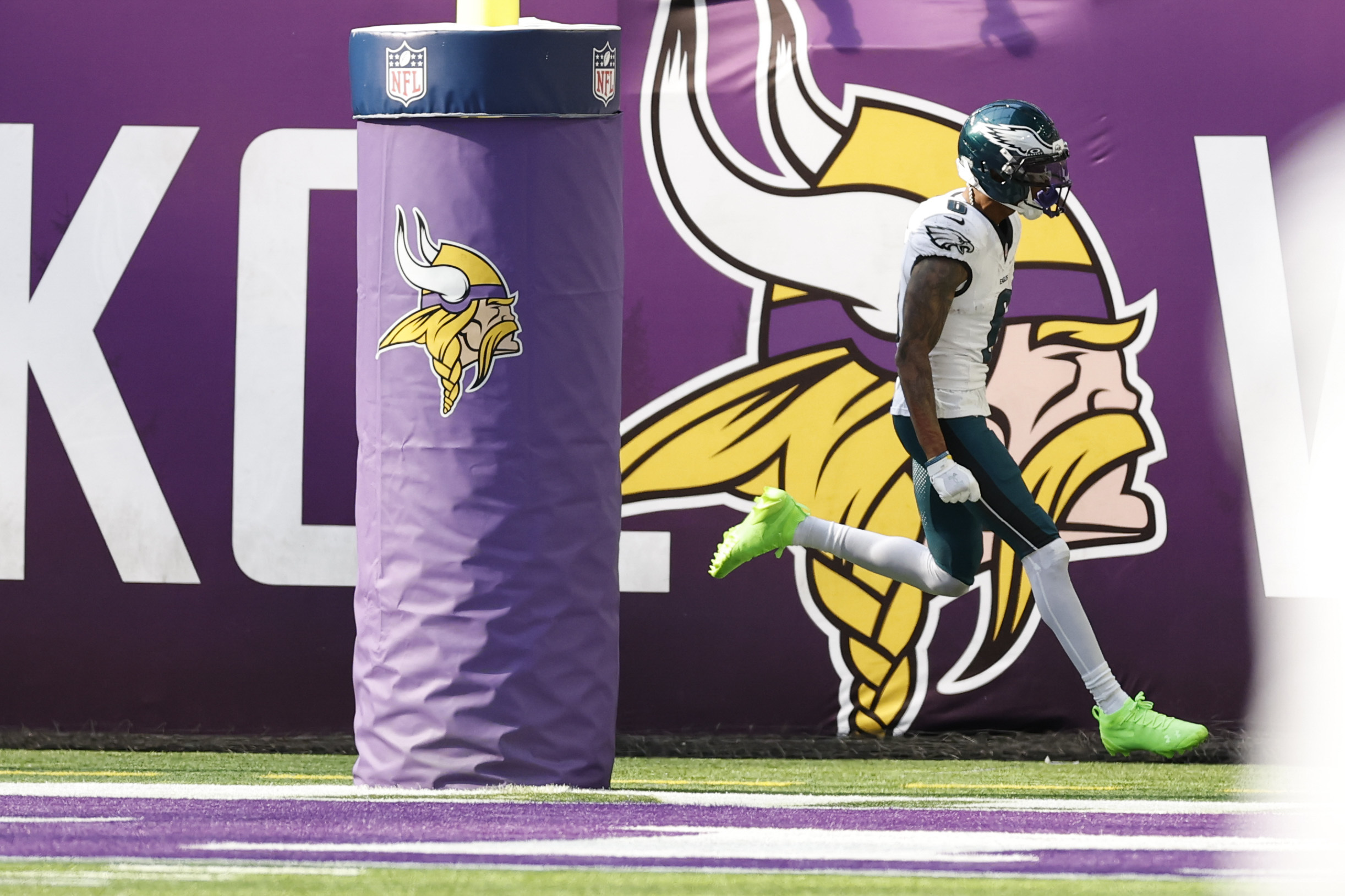
    Smith said he noticed the Vikings had a safety in the box and that there would be no help over top if he ran a deep post. He got former Eagles cornerback Isaiah Rodgers to bite on a corner route deke, and Hurts dropped the ball in his bucket for a 79-yard score.

    Hurts was under center for 20 of 49 offensive plays (40.1%). Coming into the game, the Eagles ranked 30th in the NFL in under center usage (14%). Hurts has never thrived in that world, but the offense needed more diversity if the Eagles were to set up play-action.

    Lane Johnson spoke about the running game’s predictability after the 34-17 loss to the New York Giants on Oct. 9. Ten days later, the Eagles tackle declined to talk with assembled reporters at U.S. Bank Stadium because he said he didn’t want his comments to become headline news again.

    But Johnson’s public message was heard by coach Nick Sirianni and his staff.

    “I think it frees up the passing game a lot more,” Mailata said of being under center. “You don’t know if it’s going to be a run, you don’t know if it’s going to be play-action, or you don’t know if it’s going to be a shot play. So I think it gives us versatility and definitely helps us a lot up front with our [blocking] angles.”

    Barkley under wraps

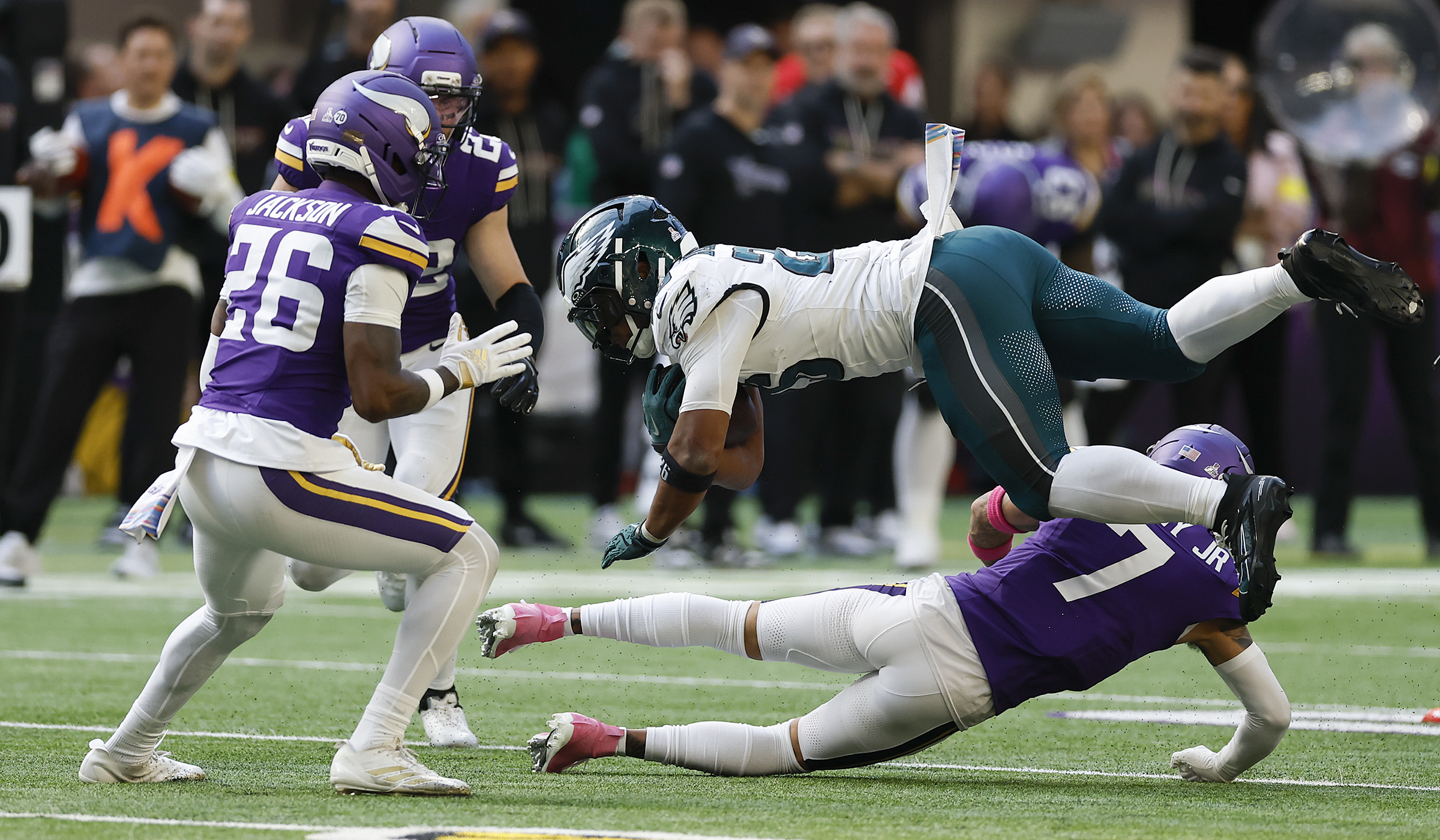
    Barkley had some early success Sunday on under-center runs. But it wasn’t sustained. It was tough going from the shotgun and pistol, as well. He was held to just 2.4 yards on 18 carries. Backup running back Tank Bigsby had one rush for 11 yards.

    The Vikings employed an inordinate number of six-man fronts to corral Barkley. Overall, he’s averaging just 3.3 yards and has seen fewer yards before contact than last year. But he said he didn’t agree with the narrative of defenses selling out to stop him.

    “We’re just not getting a job done. I’m not getting the job done,” Barkley said. “That’s just the case. I own the run game. That’s my responsibility.”

    Eagles running back Saquon Barkley has struggled to break loose all season, and Sunday at Minnesota continued that trend.

    He has missed holes, but the interior of the O-line has also struggled. Brett Toth got tossed into the barrage for Jurgens even though he has mostly played guard this season. Dickerson is clearly not 100%. And right guard Tyler Steen’s performance has been up and down.

    “Saquon is the best and I don’t want him to feel like he’s carrying that by himself,” Hurts said. “It is a group effort.”

    Hurts still hasn’t factored as much in the running game. He had an early keep that netted no gain. He used his arm instead to offset what the ground attack lacked. It wasn’t as if Patullo dropped Hurts back an exorbitant amount. The run-pass ratio was a relatively balanced 45-55.

    But the Vikings’ aggressive defense offered opportunities downfield that the Eagles took advantage of in the second half.

    “The thing was to come in and establish the run,” Hurts said. “That’s what we wanted to come in and do, and the game just flowed the way it did, and we were able to be efficient in the pass game. KP was very timely, and I think we were able to doctor up some things on the sideline and work through some things, but those guys made big-time plays.”

    Those guys — Smith and Brown — had been clamoring for more deep shots. Hurts throws the long ball as well as any quarterback, but he’s had a few uncharacteristic misses this season. But he connected on all five deep passes for a career-high 215 yards when the Vikings had allowed only three deep completions all season, according to NextGen Stats.

    Smith finished with a career-high 183 receiving yards on nine grabs, while Brown had four catches for 121 yards and two touchdowns. Both receivers caught passes on scramble drills when Hurts extended plays. But there were also completions within structure, like Brown’s 26-yard seam route score.

    Hurts was feeling it and Smith and Mailata said they could see a familiar look in their quarterback’s eyes.

    “You see it sometimes on the sideline. Sometimes in the huddle. Sometimes he’ll call the play, he’ll say a little slick remark,” Smith said. “And, OK, he sees it. He knows what’s coming.”

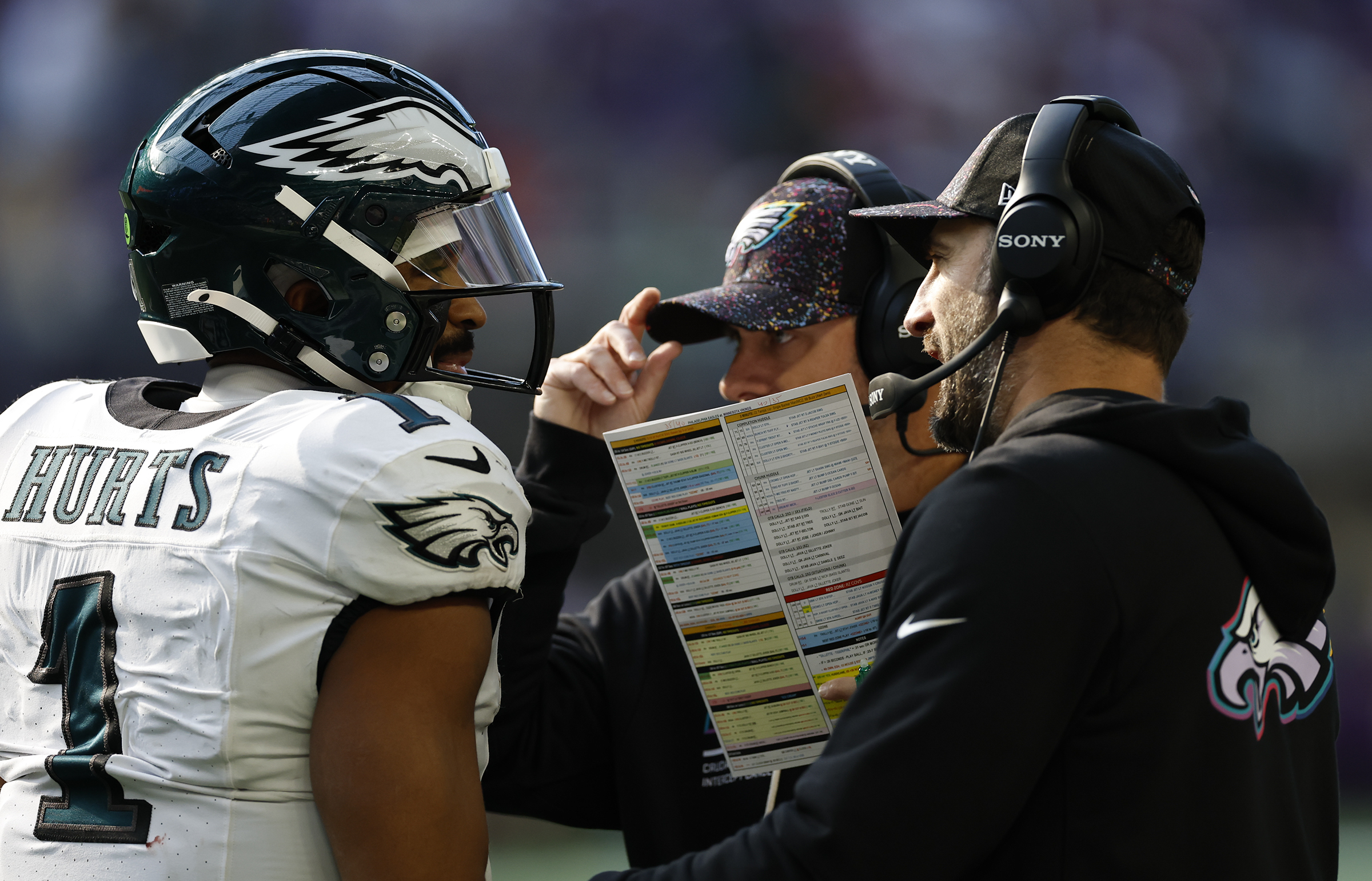
    Eagles head coach Nick Sirianni (right) talking to quarterback Jalen Hurts with offensive coordinator Kevin Patullo.

    Hurts knew what was coming on third-and-9 and the game on the line. Barkley had already been stopped on first down, and a second-down toss to Brown fell incomplete. A run would have forced Minnesota at least to take a timeout.

    But Hurts’ pre-snap read indicated Brown would be matched up in man coverage. He singled his receiver to run a “sluggo” route. Brown got Rodgers to sit on the slant and pulled in the 45-yard kill shot to cement what was one of Hurts’ best-ever games.

    Mailata said it was second to Super Bowl LIX, when Hurts similarly had to step up when Barkley was kept in check. The 27-year-old seems to play his finest when public doubt seeps in about his capabilities.

    “It was just a matter of trying to find ways to get it done,” Hurts said. “It’s not a time to hope. It’s not a time to want or wish something can happen. It’s the time to make it happen. And I think that was a collective thing by everybody.”

    Eagles offense still lopsided

    The Eagles collectively didn’t suggest they solved all their problems. The running game issues aren’t going away, although having under-center play-action on film could make opponents alter how they defend Barkley.

    And one outstanding outing does not make Hurts a drop-back maestro. Sirianni and Patullo likely don’t want an offensive identity that has him throwing as much as he did in losses to the Denver Broncos and Giants.

    He can do it, but if the 5-2 Eagles are to have any hope of making a postseason run, they have to be multiple on offense.

    “Identity is important. Don’t get me wrong,” Hurts said. “But for a long time now we find ways to win games in a ton of different ways.”

    Hurts won this one.

  • University, heal thyself

    University, heal thyself

    Whew.

    Professors and students at the University of Pennsylvania — where I teach — breathed a sigh of relief on Thursday when the university rejected a compact that would have given us preferential treatment in federal funding. All we needed to do in exchange was comply with the Trump administration’s demands around teaching, student costs, and much else.

    As our faculty senate warned, the compact asked universities to “surrender their institutional autonomy.” I’m delighted — and proud — that Penn joined four other institutions — MIT, Brown, the University of Southern California, and the University of Virginia — in rejecting the offer, which the White House sent to nine schools earlier this month.

    Now comes the hard part: to institute the goals of the compact on our own. The problem wasn’t with the demands of the Trump administration. It was with the mechanism of enforcement, which would have let it determine if we were satisfying them.

    Consider the compact’s requirement that we foster “a vibrant marketplace of ideas” and abolish “institutional units” that “belittle” conservative ideas. Of course, we should aim for a full and free dialogue of all ideas, including conservative ones.

    But do you trust Donald Trump and his disciples to determine — fairly and impartially — whether universities are belittling conservatives? I certainly don’t.

    Trump’s vice president, JD Vance, has already declared that “the universities are the enemy.” The only way to make friends with Trump is to echo his own ideas, which is what the compact would have required us to do.

    University of Pennsylvania students at graduation, at Franklin Field, in May.

    But if we’re honest, we’ll also admit that we have indeed belittled — or suppressed — conservatives, via the cultures we have created on our campuses. We talk a good game about the free exchange of ideas. If you think we’re living that ideal, however, you haven’t talked to right-leaning students.

    I have. They come out to me in my office, with the door shut, because they’re afraid of being canceled by their peers or their professors. In a 2024 survey, 12% of Penn students said they planned to vote for Trump. That’s a small fraction, but Penn is a big place; we have about 12,000 undergraduates, which means more than 1,000 students probably backed Trump.

    We almost never hear from them, which harms everyone. We won’t understand the Trump phenomenon if they are biting their tongues. I want my conservative students to speak their minds, especially in class, so they can teach the rest of us.

    But classes have become something of an afterthought at our elite universities, where reading requirements have plummeted and almost everyone gets an A. As the Trump compact correctly notes, grades should reflect “the quality, breadth, and depth of the student’s achievement.”

    They don’t. “When we act as though virtually everything that gets turned in is some kind of A — where A is supposedly meaning ‘excellent work’ — we are simply being dishonest to our students,” Yale philosopher Shelly Kagan told the New York Times in 2023.

    And earlier this month, the Times reported that Harvard students routinely skip classes, and even register for two courses that meet at the same time. When they do show up, they often spend the class period surfing on their phones or laptops.

    It’s not their fault. The problem lies with their professors, who are rewarded for their research rather than their teaching. So we let the students skate by with an easy A so we can get back to our keyboards.

    Again, though, I don’t want the federal government monitoring our “commitment to grade integrity” — to quote the Trump compact — or penalizing us if we fall short. That would give the White House another cudgel to use against a school that said or did something Trump didn’t like. We should instead address the problem on our own, by instituting grade curves and making effective teaching a requirement for tenure and promotion.

    Ditto for college costs, which the Trump compact properly identifies as a huge burden on our students. But the answer is not to freeze tuition for five years, as the compact demands, even as it instructs us to limit our enrollment of international students. Cutting the number of students from other countries — most of whom pay our full sticker price — would make it even harder for us to keep that price down.

    Rather, we need to make a stronger argument for public assistance to all our universities. Over the past four decades, as state governments slashed their aid to higher education, students and their families have had to finance college on their own. What began as a public good — to serve all Americans, and to sustain our democracy — has become a private one.

    But we’ll never make the case for more government dollars unless we can show we’re doing well with what we already have. That will require us to put good teaching — and the free exchange of ideas — front and center. I’m glad we rebuffed Trump’s effort to impose his will on us. Now we’ll find out if we can muster the will — and the courage — to do the job ourselves.

    Jonathan Zimmerman teaches education and history at the University of Pennsylvania. He is the author of “The Amateur Hour: A History of College Teaching in America” and nine other books.

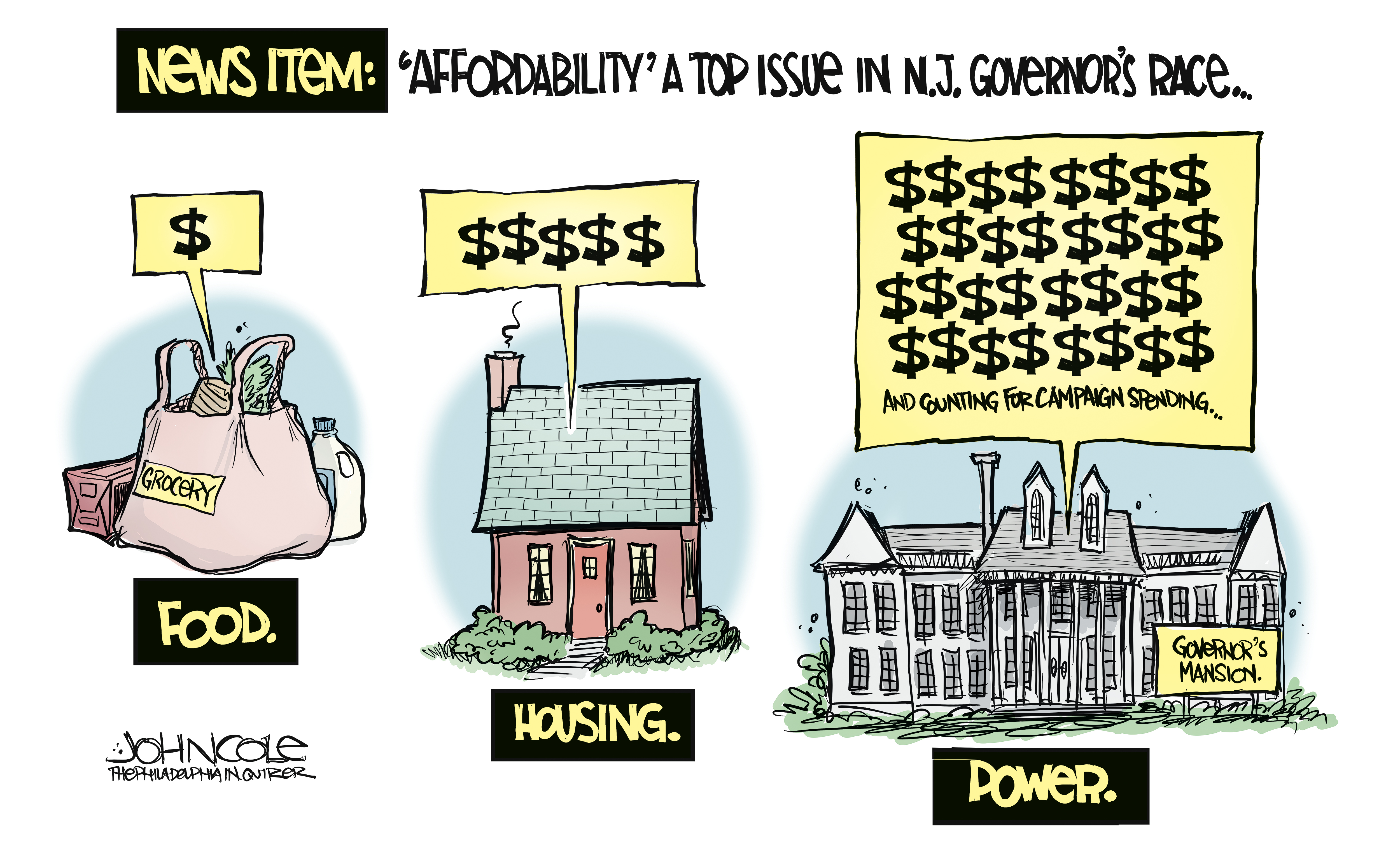
  • Through the roof | Editorial Cartoon

    John Cole spent 18 years as editorial cartoonist for The (Scranton) Times-Tribune, and now draws for various statesnewsroom.com sites.

  • ‘Conversion therapy’ is antithetical to responsible psychological counseling

    ‘Conversion therapy’ is antithetical to responsible psychological counseling

    As I listened to the recent oral arguments before the U.S. Supreme Court challenging Colorado’s ban on conversion therapy for minors — a pseudoscientific practice that attempts to change or suppress a person’s sexual or gender identity — as a mental health professional, I was confronted with a difficult truth: The Supreme Court debate itself revealed major gaps in the general understanding of what ethical therapy is, and how it differs from malpractice.

    While the decisive action taken in 2024 by the Shapiro administration and five state licensing boards to officially declare conversion therapy professional misconduct and harmful is a major victory affirming our ethical standards here in Pennsylvania, the questions raised by the justices underscore a critical and urgent need. Mental health professionals must clearly communicate to the public, especially to the youth in our commonwealth, what constitutes sound, ethical, and effective treatment.

    To an outside observer, or even a justice who sits on the highest court in the land, psychotherapy might seem like a conversation with someone who is supportive and compassionate.

    But the psychological science confirms that this impression is patently inaccurate. Evidence-based psychotherapy is built on the premise that validation, acceptance, and understanding are the keys to alleviating distress, strengthening relationships, and enabling healthier life choices.

    Becoming a competent and ethical psychotherapist takes years of specialized training, study, and supervision.

    Importance of validation

    Just looking at one of these skills, validation, we can see how complex this is. Validation is the focused act of striving to understand a person’s feelings, thoughts, and behaviors, reflecting the ways their reactions make sense in the context of their lived experience.

    Crucially, and something I stress to my own patients, validation is not agreement or approval. True validation allows for curiosity, paving the way for the self-acceptance that is essential for learning and growth. And, importantly, validation requires the therapist to put aside their own wishes, hopes, and beliefs, also not easy or natural.

    The entire premise of conversion therapy stands in direct opposition to what comprises ethical practice by therapists.

    The U.S. Supreme Court heard oral arguments this month from a lawsuit brought by Kaley Chiles, a licensed counselor, against Colorado’s law prohibiting conversion therapy for minors.

    Conversion therapy asserts that one’s inherent sexuality, a quality that lacks any evidence of malleability, is pathological and must be altered. This lie is deeply shaming and stigmatizing.

    Shame and stigma do not persevere without active promotion from those in power.

    A therapist’s position is not that of a mere “conversation partner,” but a person in an official capacity with specialized training.

    Any professional who promises a client they can alter their core sexual identity is exploiting that power and acting in the face of the overwhelming evidence that their own training is built upon.

    To illustrate, consider a licensed dermatologist consulting with a patient whose natural skin tone is subject to deep societal prejudice. The patient wishes to permanently change their skin color to escape this stigma, and the dermatologist, perhaps due to a shared personal or religious belief, sincerely wishes they could grant this escape.

    Despite this shared wish and personal conviction, if the dermatologist were to accept payment and declare, “I will prescribe a treatment that will permanently and fundamentally rewrite your DNA to give you an entirely different skin color,” that doctor would be committing profound malpractice and fraud.

    Unethical and immoral

    More than just unethical, it is immoral, because it validates and profits from the harmful, prejudiced notion that the patient’s natural, nonpathological trait is a curable defect. Their oath demands they communicate the truth: that such a fundamental alteration is impossible.

    The therapist’s scenario is the direct professional equivalent.

    They might share a client’s faith-based desire to alter their sexual orientation. But this desire does not supersede the scientific consensus of every major national psychological, psychiatric, and medical organization, all of which agree that sexual orientation is not a disease to be cured or a choice to be changed.

    A therapist can ethically help a client manage their feelings or behaviors related to their orientation; they cannot ethically promise to remove the orientation itself.

    To promise this impossible, discredited service is professionally unethical and morally corrosive, as it actively reinforces the lie that a natural variation of human existence is a defect needing a “cure.”

    The distinction is clear: Ethical therapy offers acceptance; malpractice promises an impossible cure.

    The debate before the Supreme Court is not about a professional’s freedom of speech; it is about protecting the public — especially vulnerable minors — from emotional violence perpetrated under the guise of professional care.

    Keren Sofer is a Philadelphia-based clinical psychologist.

  • VJ Edgecombe outpacing Sixers expectations — and bringing his lofty goals into view

    VJ Edgecombe outpacing Sixers expectations — and bringing his lofty goals into view

    VJ Edgecombe can do even more than the 76ers envisioned.

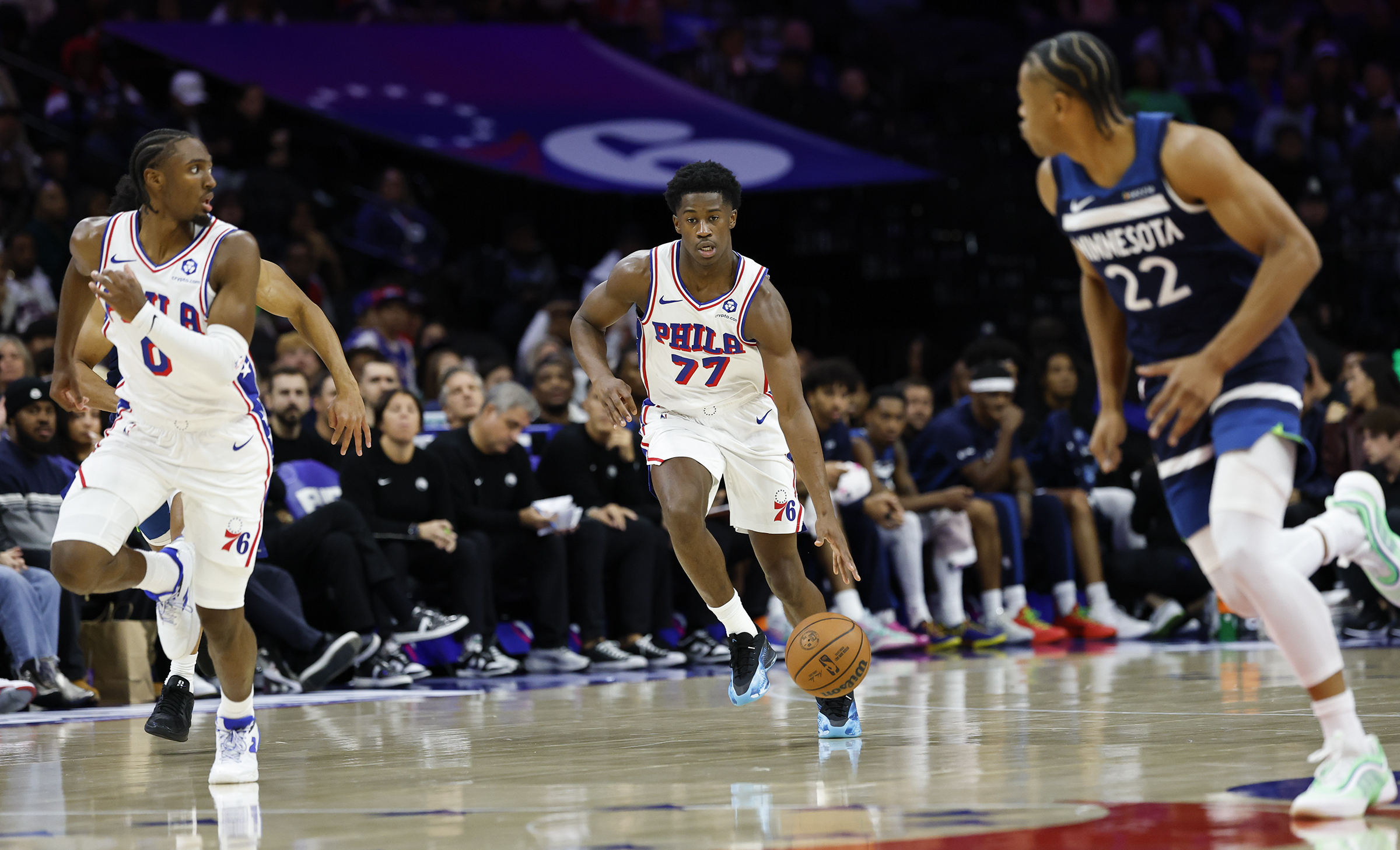
    So on Friday, they took the ball out of Tyrese Maxey’s hands and made Edgecombe the primary ballhandler in an exhibition game, even though dribbling was a supposed weakness for the rookie.

    “I think we thought, ‘OK, maybe he could play on the ball some,’ and we were talking about, ‘Let’s do it at summer league,’” coach Nick Nurse said after a 126-110 victory over the Minnesota Timberwolves in the preseason finale. “But where we’re at, I think he’s way ahead of where we thought he might be, being able to do that.”

    Edgecombe’s ability to bring the ball up the court created easy off-ball scoring opportunities for Maxey — ones he hadn’t seen since he played alongside James Harden two seasons ago. And it has people thinking that the Sixers may have found the perfect backcourt pairing for Maxey.

    Edgecombe finished the game with 26 points, one behind Maxey’s game-high total. The third pick in June’s NBA draft also had six rebounds, three assists, and a game-high five steals in 34 minutes. Eleven of his points came in the fourth quarter on 4-for-6 shooting. His final eight points came on a personal 8-0 run to put the game out of reach.

    He started the run with back-to-back rolls to the basket. Then the 20-year-old added a pair of foul shots. And after stealing the ball, Edgecombe scored on a running dunk to put the Sixers up 18 with 9 minutes, 8 seconds remaining. Having seen enough, Nurse subbed him out for good with 8:43 left.

    VJ Edgecombe’s ball-handling ability enabled the Sixers to move Tyrese Maxey (left) off the ball Friday.

    So what stood out the most to Edgecombe about his home debut?

    The five steals? Playing point guard? Scoring 11 fourth-quarter points?

    “Probably the steals,” he said. “I’d say just being in the lanes, getting as much deflections as I can, being in the right spot defensively. That’s something I pride myself on. I wouldn’t say stood out, but that’s probably the best part.”

    Edgecombe showed he was an athletic wing with elite defensive skills last season as a freshman at Baylor.

    He was a highlight waiting to happen during his lone college season. The 6-foot-4, 195-pounder was known for his scoring ability — especially in transition and at the rim. The Bahamian also possessed solid playmaking skills and defensive instincts.

    Sixers guard VJ Edgecombe went on a personal 8-0 run in the fourth quarter to put away Friday’s exhibition finale against the Minnesota Timberwolves.

    He averaged 15 points, 5.6 rebounds, and 3.2 assists last season. If there was a weakness, his struggles with shot creation stood out. The thought was that if Edgecombe developed a shot and worked on his ballhandling, he could be a solid NBA combo guard.

    But Maxey was far from surprised by Edgecombe’s ability to handle the ball on Friday. He’s been “extremely” impressed with his backcourt mate’s comfort with the ball against NBA defenders.

    “He makes good decisions,” Maxey said. “He doesn’t let people speed him up. I think he plays extremely mature for being a rookie. He’s good. He’s good at basketball.”

    Barring any setback, Edgecombe will remain in the starting lineup when the Sixers open the season Wednesday against the Boston Celtics at TD Garden.

    He’ll be a part of a young backcourt rotation this season that will include Quentin Grimes and Jared McCain, who’s sidelined after right thumb surgery. And Edgecombe has lofty goals, which include winning Rookie of the Year, making the All-Defensive and All-Rookie teams, and helping the Sixers contend for a title.

    “I know I worked hard to be in this position,” he said. “If I wasn’t ready for it, I wouldn’t have been here. I feel as though I just have a lot of confidence. My teammates instill confidence in me also. So, I won’t say it’s easy, but it’s basketball at the end of the day. I’m trying not to overthink it.

    “I love this game so much. … It just flows naturally, man. I’m just out there having fun.”

    The Sixers hope VJ Edgecombe (77) and Tyrese Maxey will lead a young guard rotation.
  • ‘Philly crime’ and the specter of Donald Trump are dominating two Bucks County law enforcement races

    ‘Philly crime’ and the specter of Donald Trump are dominating two Bucks County law enforcement races

    Bucks County Republicans are stoking fears about crime in Philadelphia even as violent crime in the city steadily drops from its high during the pandemic.

    Digital ads Republicans have circulated for the county’s sheriff and district attorney races since August tell voters to “keep Philly crime out of Bucks County,” borrowing a tactic from President Donald Trump, who regularly promotes exaggerated visions of crime-ridden liberal cities.

    Republicans in the purple collar county hope the message will boost the GOP incumbents, District Attorney Jen Schorn and Sheriff Fred Harran, as they face off this fall against their respective Democratic challengers, Joe Khan and Danny Ceisler.

    “We’re letting anarchy take over our country in certain places, and that’s not something we want in Bucks,” said Pat Poprik, the chair of the Bucks County Republican Party.

    Meanwhile, Democrats are eager to tie the GOP incumbents to Trump, portraying them as allies of a president whose nationwide approval rate is dropping.

    Khan, a former county solicitor and former federal prosecutor who unsuccessfully ran for attorney general last year, is seeking to portray himself as less politically motivated than Schorn, a veteran prosecutor who is running for a full term as district attorney after being appointed to the position last year.

    Ceisler, an Army veteran and an attorney who worked for Democratic Gov. Josh Shapiro’s administration, has taken a similar approach in his race against Harran, the outspoken Republican sheriff who has sought a controversial partnership with U.S. Immigration and Customs Enforcement.

    “Democrats are far more enthusiastic about voting precisely because they see what’s happening on the national level. They are really infuriated by what Donald Trump is doing,” State Sen. Steve Santarsiero, who chairs the Bucks County Democratic Party, said. “They’re going to make their displeasure heard by coming to the polls.”

    The local races in the key county, which Trump narrowly won last year, will be a temperature check on how swing voters are responding to Trump’s second term and will gauge their enthusiasm ahead of the 2026 midterms, when Shapiro stands for reelection.

    As the Nov. 4 election approaches, early signs indicate Democrats’ message might be working — polling conducted by a Democratic firm in September found their candidates ahead, and three weeks before Election Day, Democrats had requested more than twice as many mail ballots as Republicans.

    “I think the Republican Party has the same problem it always does. … They turn out when Trump’s on the ticket, but when he’s not, there’s less enthusiasm,” said Jim Worthington, who has run pro-Trump organizations in Bucks County. “Truth be told, the Democrats do a hell of a job just turning out their voters.”

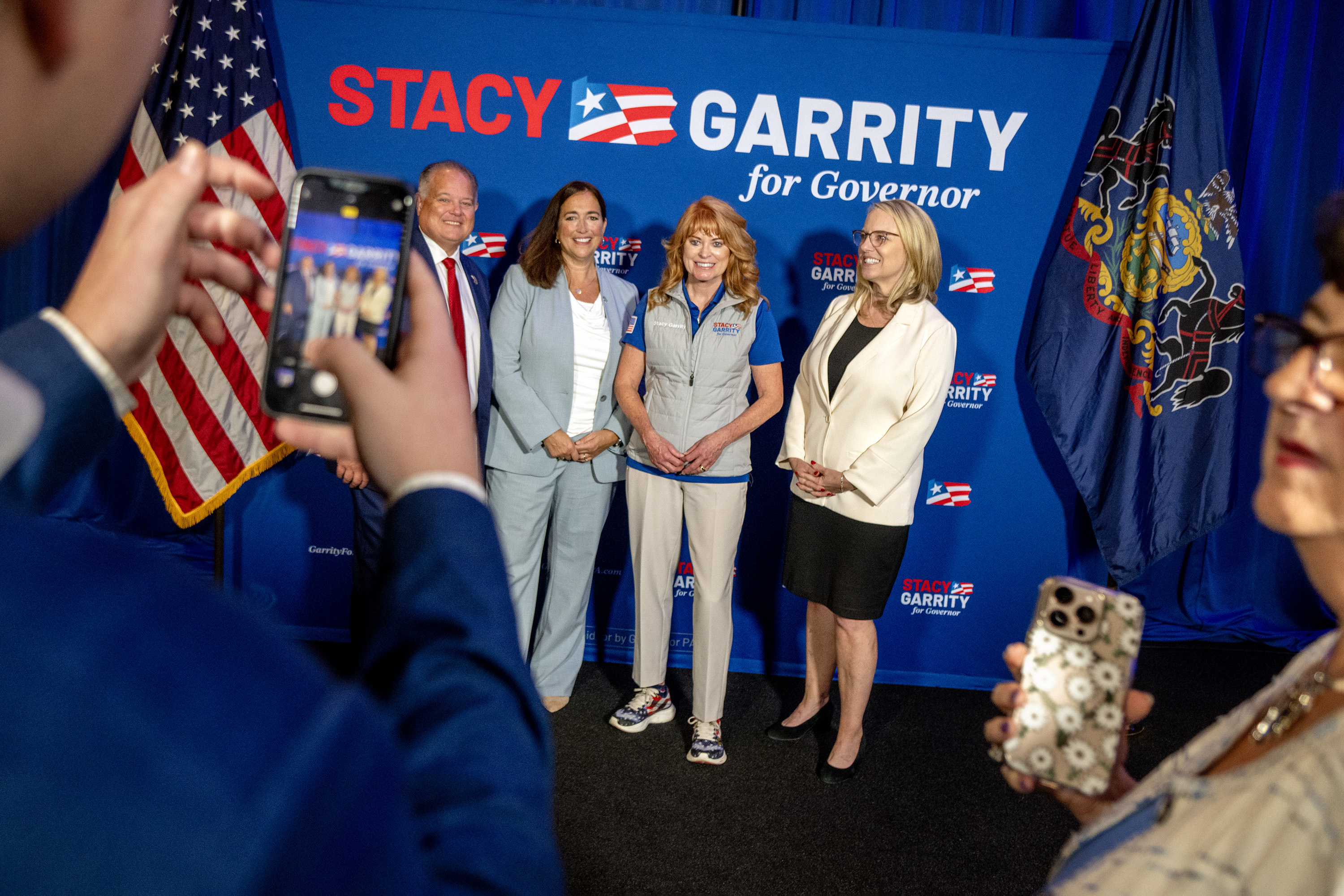
    State Treasurer Stacy Garrity, a Republican running for Pa. governor, poses with Bucks County elected officers following her campaign rally Sat the Newtown Sports & Events Center. From left: Bucks County Sheriff Fred Harran; Bucks County District Attorney Jennifer Schorn; Garrity; and Pamela Van Blunk, Bucks County Controller.

    GOP warns of ‘dangerous’ policies

    Republican messaging in the two races focuses on the idea that Bucks County is safe, but its neighbors are not.

    GOP ads, which have run over the course of four months, suggest that Khan and Ceisler would enact “dangerous” policies in Bucks County such as “releasing criminals without bail” and “giving sanctuary to violent gang members.”

    Democrats reject these ads as scare tactics. The ads make implicit comparisons to Philly’s progressive District Attorney Larry Krasner, who is poised to win a third term in the city but remains a controversial figure in the wider region even as violent crime rates have fallen in the city.

    They frame Harran and Schorn in stark contrast to their opponents as lifelong Bucks County law enforcement officers with histories of holding criminals accountable.

    “I think it resonates beyond the Republican base,” said Guy Ciarrocchi, a Republican analyst, who contended frequent news coverage of Krasner makes the message more viable.

    Khan, a former assistant Philly district attorney who unsuccessfully ran against Krasner in the 2017 primary, has noted that he campaigned “very, very vigorously” against Krasner and challenged his ideas on how to serve the city.

    “I accept the reality that I didn’t win that election,” said Khan, whose platform in 2017 included a proposal to stop prosecuting most low-level drug offenses. “Unlike my opponent, who seems to basically enjoy the sport of scoring political points by sparring with the DA of Philadelphia.”

    Schorn, however, is adamant that politics has never played a role in her prosecutorial decisions. Her mission, she said, is “simply to get justice.”

    A lifelong Bucks County resident who has been a prosecutor in the county since 1999, Schorn handled some of the county’s most high-profile cases and spearheaded the formation of a task force for internet crimes against children.

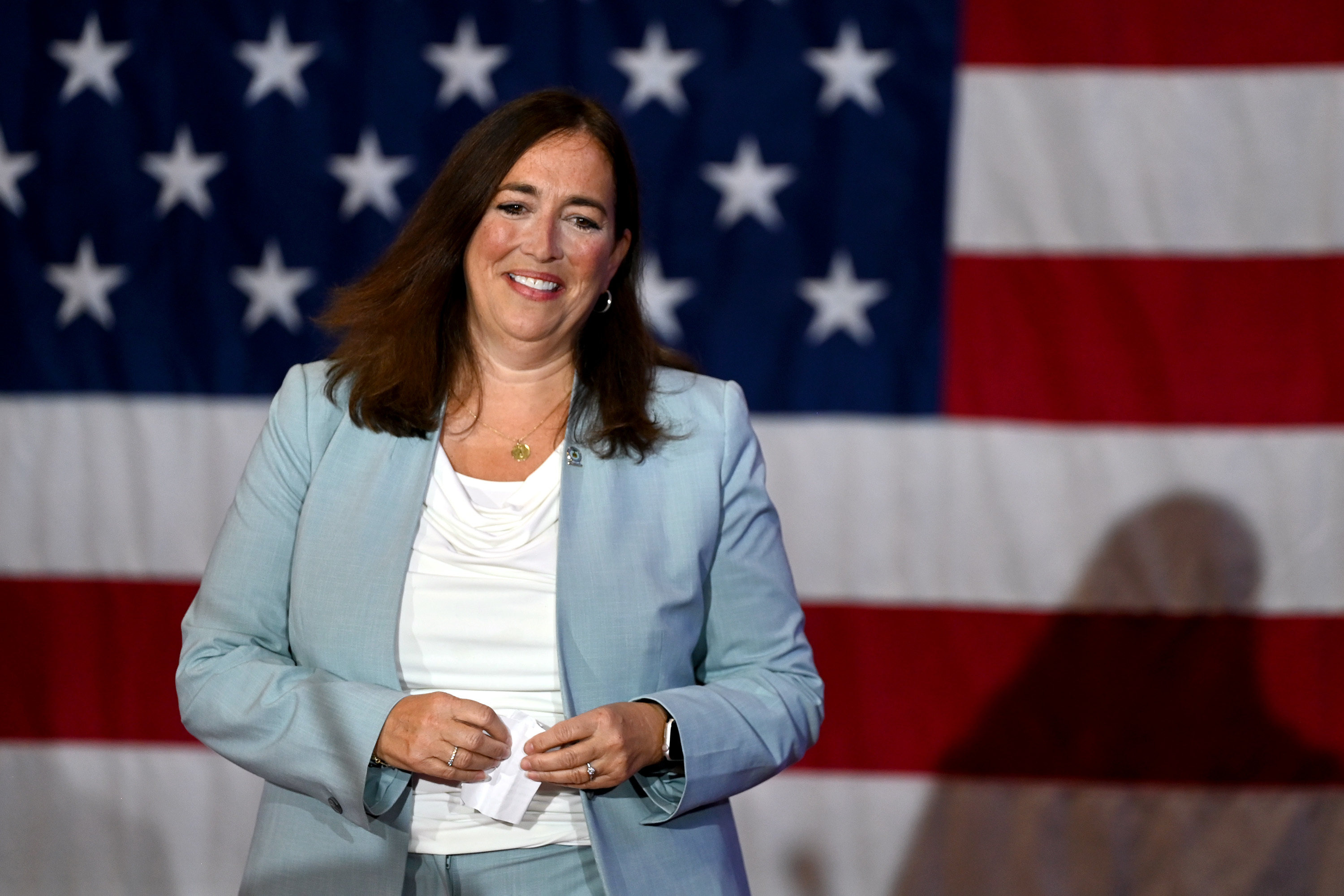
    Bucks County District Attorney Jennifer Schorn speaks at a Republican rally at the Newtown Sports & Events Center in September.

    “This has been my life’s mission, prosecuting cases here in Bucks County, the county where I was raised,” she said. “I didn’t do it for any notoriety. I didn’t do it for self-promotion. I did it because it’s what I went to law school to do.”

    Harran spent decades as Bensalem’s public safety director before first running for sheriff in 2021. He is seeking reelection amid controversy caused by his decision to partner his agency with ICE, a move that a Bucks County judge upheld last week after a legal challenge.

    “Being Bucks County Sheriff isn’t a position you can learn on the job. For 39 years, I’ve woken up every day focused on keeping our communities safe,” Harran said in an email to The Inquirer in which he criticized Ceisler as lacking experience.

    Although Ceisler has never worked directly in law enforcement, he argues the sheriff’s job is one of leadership in public safety. That’s something he says he’s well versed in as a senior public safety official in Shapiro’s administration who previously served on the Pentagon’s COVID-19 crisis management team.

    Harran, who described his opponent as a “political strategist,” criticized “politicians” for bringing “half-baked ideas like ‘no-cash bail’” into law enforcement. The concept, which is repeatedly derided in the GOP ads, sets up a system by which defendants are either released free of charge or held without the opportunity for bail based on their risk to the community and likelihood of returning to court.

    Khan and Ceisler each voiced support for the concept in prior runs for Philadelphia district attorney and Bucks County district attorney, respectively.

    Both say they still support cashless bail. Neither, however, would have the authority to implement the policy if elected, though Khan as district attorney could establish policies preventing county prosecutors from seeking cash bail in certain cases.

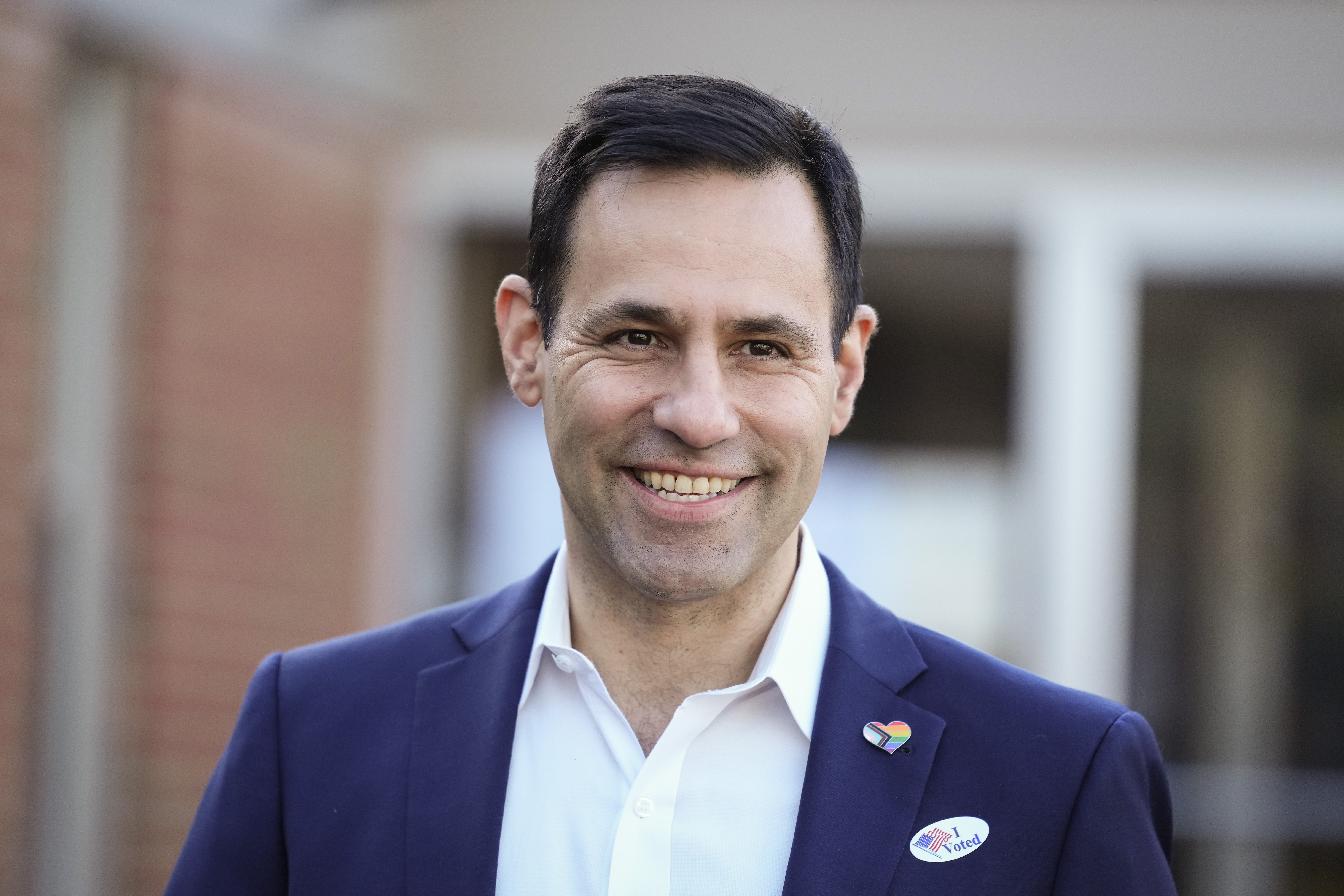
    Joe Khan, a Democratic candidate running for Bucks County DA, walks from his polling place in Doylestown, Pa. in April 2024 when he was running for attorney general.

    “When a defendant is arrested and they come into court, every prosecutor answers this question: Should this person be detained or not?” Khan said. “If the answer is yes, then your position in court is that this person shouldn’t be let out, and it doesn’t matter how much money they have. And if the answer is no, then you need to figure out what conditions you need to make sure they come to court.”

    Democrats claim to ‘keep politics out’

    Even as Democrats view voter anger at Trump as a key piece of their path to victory, they are working to present themselves as apolitical.

    Democratic ads attack Schorn for not investigating a pipeline leak in Upper Makefield and Harran as caring about nothing but himself. Positive ads highlight Ceisler’s military background and Khan’s career as a federal prosecutor.

    Khan and Ceisler, the Democratic Party’s ads argue, will “stop child predators, stand up to corruption, and they’ll keep politics out of public safety.”

    Khan has described Schorn as a political actor running her office “under Trump’s blueprint.” He has focused on her decisions not to prosecute an alleged child abuse case in the Central Bucks School District or investigate the company responsible for a jet fuel leak into Upper Makefield’s drinking water.

    The jet fuel case was turned over to the environmental crimes unit in Pennsylvania Attorney General Dave Sunday’s office. And prosecutorial rules bar Schorn from discussing the alleged abuse.

    “During the last, I don’t know, 13 years when [Khan] has been pursuing politics, I’ve been a public servant,” Schorn said. “For someone accusing me of putting politics first, he seems to be using politics to further his own agenda.”

    But Schorn appears in GOP ads alongside Harran, a figure who has frequently invited political controversy in fights with the Democratic-led Bucks County Board of Commissioners, his effort to partner with federal immigration authorities, and his early endorsement of Trump last year.

    At a September rally in Newtown for Treasurer Stacy Garrity, a Republican running for governor, Harran cracked jokes about former President Joe Biden’s age as he climbed onto the stage and falsely told voters that they will “lose [their] right to vote” if they don’t vote out three Pennsylvania Supreme Court justices standing for retention.

    Harran has long contended that his decision to partner with ICE was not political.

    “I’m a cop who ran to keep being a cop. This isn’t about politics for me — it’s about doing everything I can to keep my community safe,” Harran said.

    Harran’s opponent, Ceisler, paints a different picture as he draws a direct line between the sheriff and the president.

    Danny Ceisler, a Democrat, is running for Bucks County sheriff.

    Trump, Ceisler said, has inserted politics into public safety in his second term, and he contended that Harran has done the same.

    “[Harran] used his bully pulpit to help get the president elected, so to that extent he is linked to the president for better or worse,” Ceisler said in an interview.

    Ceisler has pledged to take politics out of the office and end the department’s partnership with ICE if elected.

    At an event in Warminster last month, voters were quick to ask Ceisler which party he was running with. Ceisler asked them to hear his pitch about how he would run the office first.

    “Don’t hold it against me,” he quipped as he ultimately admitted to one voter he’s a Democrat.

    Staff writer Fallon Roth contributed to this article.

    This suburban content is produced with support from the Leslie Miller and Richard Worley Foundation and The Lenfest Institute for Journalism. Editorial content is created independently of the project donors. Gifts to support The Inquirer’s high-impact journalism can be made at inquirer.com/donate. A list of Lenfest Institute donors can be found at lenfestinstitute.org/supporters.

  • Penn Medicine is investing more than $500 million in new cancer facilities

    Penn Medicine is investing more than $500 million in new cancer facilities

    The University of Pennsylvania Health System, the Philadelphia region’s biggest provider of cancer care and a national leader in developing new treatments, is spending more than $500 million on two new cancer facilities in Philadelphia and central New Jersey to keep growing.

    Those big projects — a fourth proton center at Presbyterian Medical Center in University City and a large cancer center at Princeton Medical Center in Plainsboro — follow years of expansion through outpatient centers in communities like Cherry Hill and Radnor. Its newest is a relocated, $18.5 million infusion center in Yardley that opened in June.

    “What we’ve seen pretty consistently is that demand is there to meet any capacity increases,” Julia Puchtler, the health system’s chief financial officer, said in an interview about fiscal 2025 financial results.

    Penn is not alone in its push to expand cancer services. Jefferson’s Sidney Kimmel Cancer Center, Temple’s Fox Chase Cancer Center, and the MD Anderson Cancer Center at Cooper are pushing into the suburbs to reach more patients.

    The same thing is happening nationally as financially pressured health systems are looking for ways to increase revenue in a growing and lucrative market for cancer care.

    Penn stands out locally for the scale of its investment in a strategy to deliver cancer care seamlessly across its seven hospitals and a growing network of outpatient clinics, with the expectation that patients will keep coming back for their ongoing health needs.

    Penn sees an opportunity to expand its market share even more, as cancer diagnoses rise. The U.S. is expected to see a nearly 40% increase in cancer diagnoses between 2025 and 2050, according to the Philadelphia-based American Association of Cancer Research.

    Experts attribute the rise to a wide variety of factors, from better early detection, to longer life spans, and to environmental exposures that are poorly understood.

    Much of Penn’s investment is in outpatient facilities, including a $270 million center being built in Montgomeryville that will have radiation oncology and an infusion center. “More and more patients want to receive care closer to home,” according to Lisa Martin, a senior vice president at Moody’s Rating. “All of that is really what’s behind all of this investment.”

    Cancer treatment overall is profitable. At Penn, cancer services account for up to 60% of the system’s operating margin by one simple measure that subtracts direct costs from direct revenue and excludes back-office expenses and other centralized costs.

    Puchtler attributed the profitability of cancer care to the prevalence of drugs, such as chemotherapy, that Penn can buy at a discount, while getting the full price from insurers, and the higher percentage of younger cancer patients with better-paying private insurance than is typical for many healthcare services.

    The expansion efforts are expensive in an industry where the consumers both benefit from advances and pay ever-rising healthcare costs. Proton therapy, in particular, costs more, but has not yet been proven to have better outcomes across a wide range of cancers.

    The intensifying competitive landscape

    Penn treats about one-third of adults with cancer in its market area, which stretches from central New Jersey to the Susquehanna, according to Robert Vonderheide, who is director of Penn’s Abramson Cancer Center and leads all of Penn’s efforts in oncology treatment and research.

    Penn counted 47,053 new cancer patients in the 12 months that ended June 30, up 40% from five years ago, according to Penn. The system has 14 locations where patients can receive chemotherapy and even more radiation oncology sites.

    Competitors are also trying to expand their reach, and Temple’s Fox Chase Cancer Center is succeeding.

    window.addEventListener(“message”,function(a){if(void 0!==a.data[“datawrapper-height”]){var e=document.querySelectorAll(“iframe”);for(var t in a.data[“datawrapper-height”])for(var r,i=0;r=e[i];i++)if(r.contentWindow===a.source){var d=a.data[“datawrapper-height”][t]+”px”;r.style.height=d}}});

    Fox Chase had 21,442 new patients in fiscal 2025, up 148% from 2020, the nonprofit said. Fox Chase has added suburban offices in Voorhees and Buckingham, Bucks County, and is expanding its infusion capacity at its main campus on Cottman Avenue. Fox Chase has a significantly smaller footprint than Penn, with six locations for infusions and four for radiation.

    The MD Anderson Cancer Center at Cooper said it had 4,326 new patients last year, up 27% over the last five years. Cooper has taken the MD Anderson Cancer Center brand to the former Cape Regional Medical Center, which it acquired last year and which used to be part of the Penn Cancer Network. Cooper also offers cancer services at its new Moorestown location.

    Jefferson Health’s Sidney Kimmel Cancer Center did not respond to requests for patient data, but has in recent years opened cancer center locations at its Torresdale and Bucks County Hospitals. Jefferson’s cancer center also attained the highest designation from the National Cancer Institute last year — the Philadelphia region’s third comprehensive cancer center, matching Penn and Fox Chase.

    Virtua Health, Penn’s partner in a proton therapy center in Voorhees, is exploring a merger with ChristianaCare, which has already been expanding from its Delaware base into Chester and Delaware Counties. Another South Jersey system, AtlantiCare, has signed a contract with the Cleveland Clinic to boost its competitiveness in cancer care.

    How Penn is trying to build a ‘cancer system’

    Lancaster County resident Susan Reese, 56, said she experienced smooth cooperation between her doctor at Penn’s Lancaster General Hospital and the team at HUP during her treatment for non-Hodgkin lymphoma.

    “I never had any question in my mind that one doctor didn’t know what the other doctor was doing,” said Reese, who received CAR-T therapy at HUP in September 2022. Penn has since started offering CAR-T at Lancaster General.

    After she relapsed in early 2023, she came back to HUP for a stem cell transplant. She could have gone to Penn State Health’s Hershey Medical Center for that. It’s significantly closer to her home in Willow Street, but she wanted to stay within the Penn system.

    Reese’s experience of integration of services at HUP and Lancaster General is what Penn is aiming for in a territory that stretches from central New Jersey to central Pennsylvania.

    Oncologist Robert Vonderheide, director of Penn Medicine’s Abramson Cancer Center, oversees all Penn’s cancer services and research.

    Electronic medical records help with the integration needed to ensure the thousands of cancer patients Penn physicians treat annually get the most advanced care possible, according to Vonderheide, whose research focuses on cellular immunotherapies.

    “We treat patients’ cancers now in a very precise way; the precise mutation, the precise type of chemotherapy, the precise dose” are the focus for doctors, Vonderheide said. “This is no longer appropriate for the telephone game. This has to be data-driven.”

    Reese’s decision to stay within Penn is part of a broader trend of patients tending to receive all their care within one health system, according to Rick Gundling, a healthcare expert at the Healthcare Financial Management Association in Washington, D.C.

    That’s particularly important in oncology, which typically involves multiple specialties, such as medical oncology, radiation oncology, and surgical oncology, he said.

    “Seamless coordination across all those disciplines really makes it a better patient experience and clinical experience because it reduces delay, improves access,” Gundling said.

    Taking advanced treatments from HUP to the network

    Part of Penn’s strategy is to begin offering advanced services at locations beyond HUP. That’s where Penn pioneered CAR-T cell therapy, which harnesses the immune system to attack cancer, and for years that was the only place Penn offered it.

    HUP still performed the bulk of the CAR-T treatments for blood cancers, 123 inpatient cases and 14 outpatient cases last year, but now CAR-T is also available at Lancaster General and at Penn’s Pennsylvania Hospital in Center City.

    Fox Chase was the next biggest center in the region for the relatively new treatment that Penn scientist Carl June and his research teams helped develop. For the fiscal year that ended June 30, 2025, Fox Chase had 21 inpatient cases and 67 outpatient cases, the center said.

    In the Penn system, certain kinds of bone marrow transplants also used to be available only at HUP. “Now we do them at HUP and Pennsylvania Hospital,” Vonderheide said.

    Even the most complicated pancreatic surgeries are going to be done at Princeton, in conjunction with experts at HUP, Vonderheide said. Penn held a ceremonial groundbreaking Monday for the hospital’s $295 million cancer center.

    Remaining only at HUP are bone marrow transplants that use another person’s cells to treat blood cancers, Vonderheide said. HUP performed 118 of those so-called allogeneic bone marrow transplants on the top floor of its $1.6 billion patient pavilion, now known as the Clifton Center.

    Pennsylvania’s next-biggest provider of the treatment was Hershey Medical Center, near Harrisburg, with 71, according to state data.

    window.addEventListener(“message”,function(a){if(void 0!==a.data[“datawrapper-height”]){var e=document.querySelectorAll(“iframe”);for(var t in a.data[“datawrapper-height”])for(var r,i=0;r=e[i];i++)if(r.contentWindow===a.source){var d=a.data[“datawrapper-height”][t]+”px”;r.style.height=d}}});

    Penn started offering proton therapy at HUP in 2010, and expanded its availability in the last three years to Lancaster General and Voorhees, through a joint venture with Virtua Health. Those two centers only have one proton machine each, compared to five at HUP.

    It’s a type of radiation that is designed to precisely target tumors and do less damage to surrounding tissues. That makes the treatment, which costs more, particularly helpful for children, and it is proving beneficial for treating certain neck and throat cancers. The use of proton therapy for the more common prostate cancer has been more controversial.

    Penn’s fourth proton center, with two machines, is under construction and is expected to open at Presbyterian in late 2027. When that $224 million center opens, Penn will have more proton treatment rooms than the entire West Coast, said Jim Metz, chair of radiation oncology at Penn.

    Currently about 10% of Penn’s roughly 10,000 annual radiation oncology patients are treated with protons, though it’s a higher percentage at locations with proton machines, Penn said.

    Penn officials have noted that some cancer patients come to Penn for proton therapy. Even when it’s not appropriate for them, they tend to stay within Penn. “We have seen, when we build protons, our market share increases, ” Metz said.

    Editor’s note: This article has been updated with more recent Fox Chase data.

  • A cold triggered an autoimmune disease in a Pa. man. Now he’s channeling his challenges into advocacy for people with rare diseases.

    A cold triggered an autoimmune disease in a Pa. man. Now he’s channeling his challenges into advocacy for people with rare diseases.

    Brian Dawson had just landed his dream job as Pennsylvania’s acting state librarian in 2015 when he came down with a cold.

    He tried to power through the sickness. But after a couple of weeks, he still couldn’t seem to kick it.

    Doctors at an outpatient clinic diagnosed Dawson with bronchitis and pneumonia, prescribed him antibiotics, and sent him home.

    A couple of days later, he developed a sharp pain in his left eye, which doctors attributed to sinus pressure.

    A few days after that, Dawson woke up in the middle of the night and told his wife he needed to go to the emergency room.

    He was admitted with severe abdominal pain, blurry vision, and trouble walking. In the span of five hours, Dawson would become blind in his left eye and paralyzed from the chest down.

    A doctor would tell him he had a rare autoimmune disease called neuromyelitis optica (NMO), and give him five to seven years to live.

    “I was in a really good trajectory in life, and then I got sick and had to pick up the pieces,” said Dawson, who lives in Harrisburg.

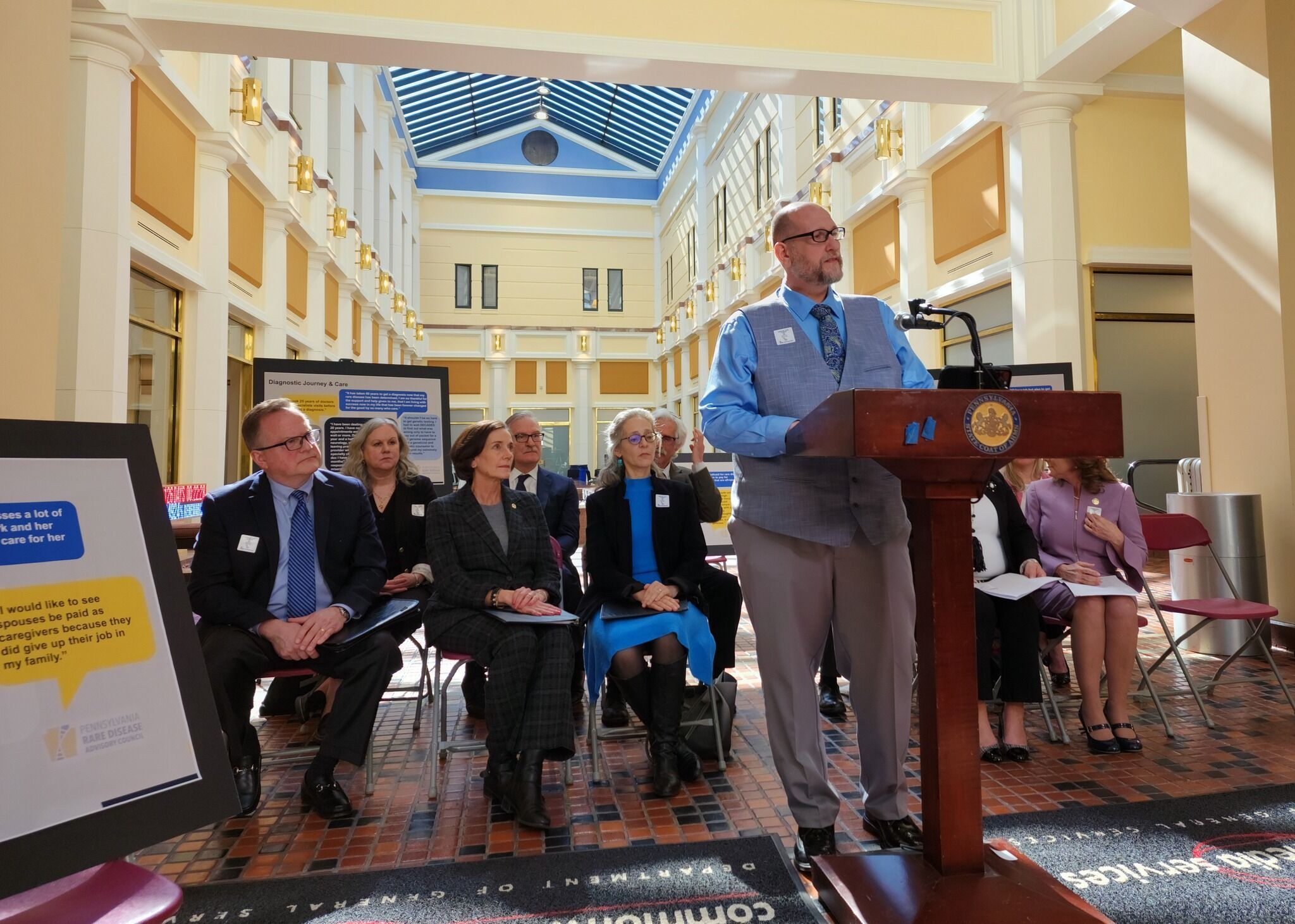
    Dawson saw his own struggles reflected in a recent survey of 1,214 rare disease patients in Pennsylvania that was spearheaded by the state’s Rare Disease Advisory Council, an advisory body to the General Assembly.

    The results, published last month in the medical journal Public Health Reports, painted a “concerning” picture of their lived experiences, said Dawson, the council’s secretary.

    For example, nearly half of the respondents waited more than two years for a diagnosis. Almost a third waited more than five years, and 37% received more than three incorrect diagnoses before their final diagnosis.

    Many respondents reported high annual spending on costs related to their disease, reduced work and school hours, and difficulty accessing medication or services after diagnosis.

    “There was a worse experience overall if there was a longer diagnosis [time],” said Jonathan Sussman, the lead author on the paper, who is working on his medical and doctoral degrees at the University of Pennsylvania’s Perelman School of Medicine.

    Misdiagnosed

    When Dawson’s symptoms progressed, doctors admitted him to the intensive care unit and started him on steroids.

    His vision returned a couple of days later, but he was still paralyzed.

    Imaging revealed that the majority of his thoracic spine — the middle section of the spine — was scarred, and his optic nerve was inflamed.

    Two weeks into his stay, a neurology fellow walked into his room, “all smiles,” Dawson recalled.

    The doctor said proudly they had figured out what he had, then leaned back on a red container on the wall, crossed his arms, and told Dawson that he had NMO.

    That meant his immune system was attacking his optic nerve and spinal cord, the doctor explained.

    He said Dawson would probably be completely blind in about five years.

    “A couple years after that, you’ll get a lesion high up on your spinal column or in your brain stem, you’ll be on a ventilator, and then pneumonia will probably kill you,” Dawson recalled him saying.

    The doctor concluded by telling him how many years he likely had left to live, and then walked out of the room.

    “The way I was told, it was horrendous,” said Dawson, who was then 42.

    Afterward, the hospital discharged him to a rehabilitation facility where he relearned how to walk for about two months.

    The next two years after that were a cycle of going on and off steroids with each relapse. He had recurring eye pain and blurriness, and pain in his legs that felt as though someone had poured searing hot coals inside them.

    “You grieve for the life that you had, grieve for the things you used to be able to do,” Dawson said.

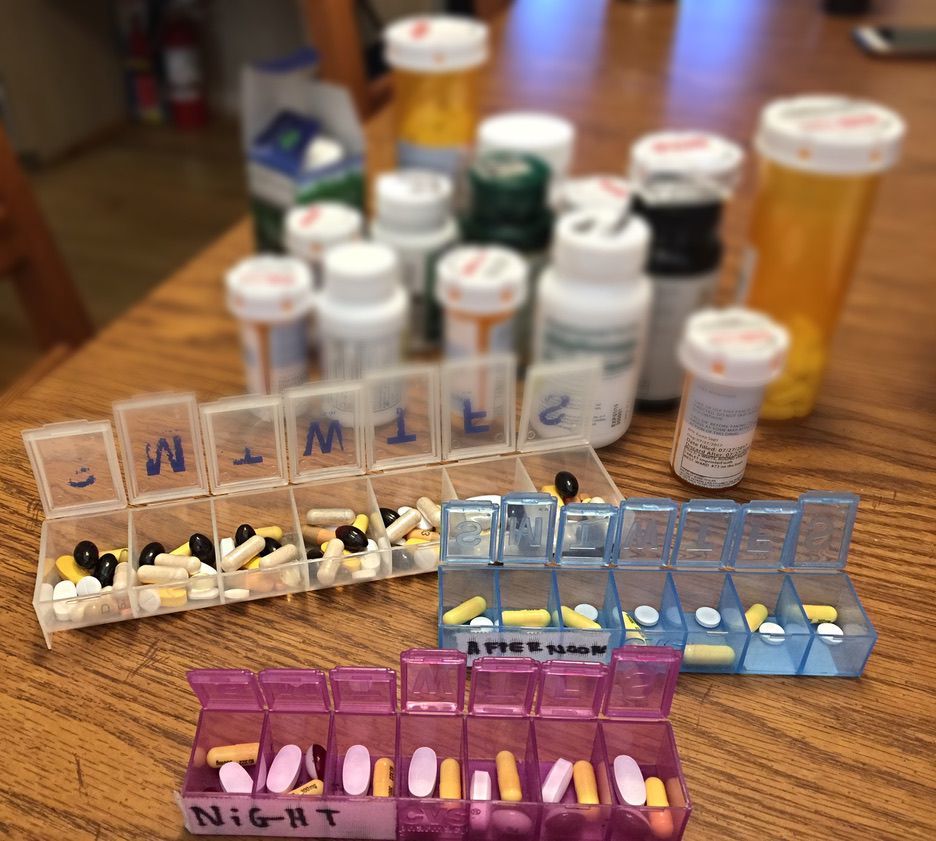
    Dawson’s doctor put him on treatments like rituximab, an infusion meant to knock down his immune system, and gabapentin for nerve pain.

    Dawson’s doctor put him on treatments like rituximab, an infusion meant to knock down his immune system, and gabapentin for nerve pain.

    But nothing seemed to work.

    In one argument with his neurologist, he told her, “we’re doing something wrong.”

    In response, she said, “I don’t know what to do with you anymore,” he recalled.

    After that, she referred him to a neurologist at Johns Hopkins, who determined from new blood work that he didn’t have NMO.

    Almost three years after Dawson was misdiagnosed, the doctor gave him his correct diagnosis: MOGAD, or myelin oligodendrocyte glycoprotein antibody-associated disease. It was a rare autoimmune disease that was likely kicked off by the cold he had back in 2015.

    MOGAD had the same constellation of symptoms as NMO, but required different treatment. It also wasn’t thought to affect a person’s life expectancy.

    “This disease is not going to kill you. You’re going to grow old,” Dawson recalled the doctor saying.

    Advocacy

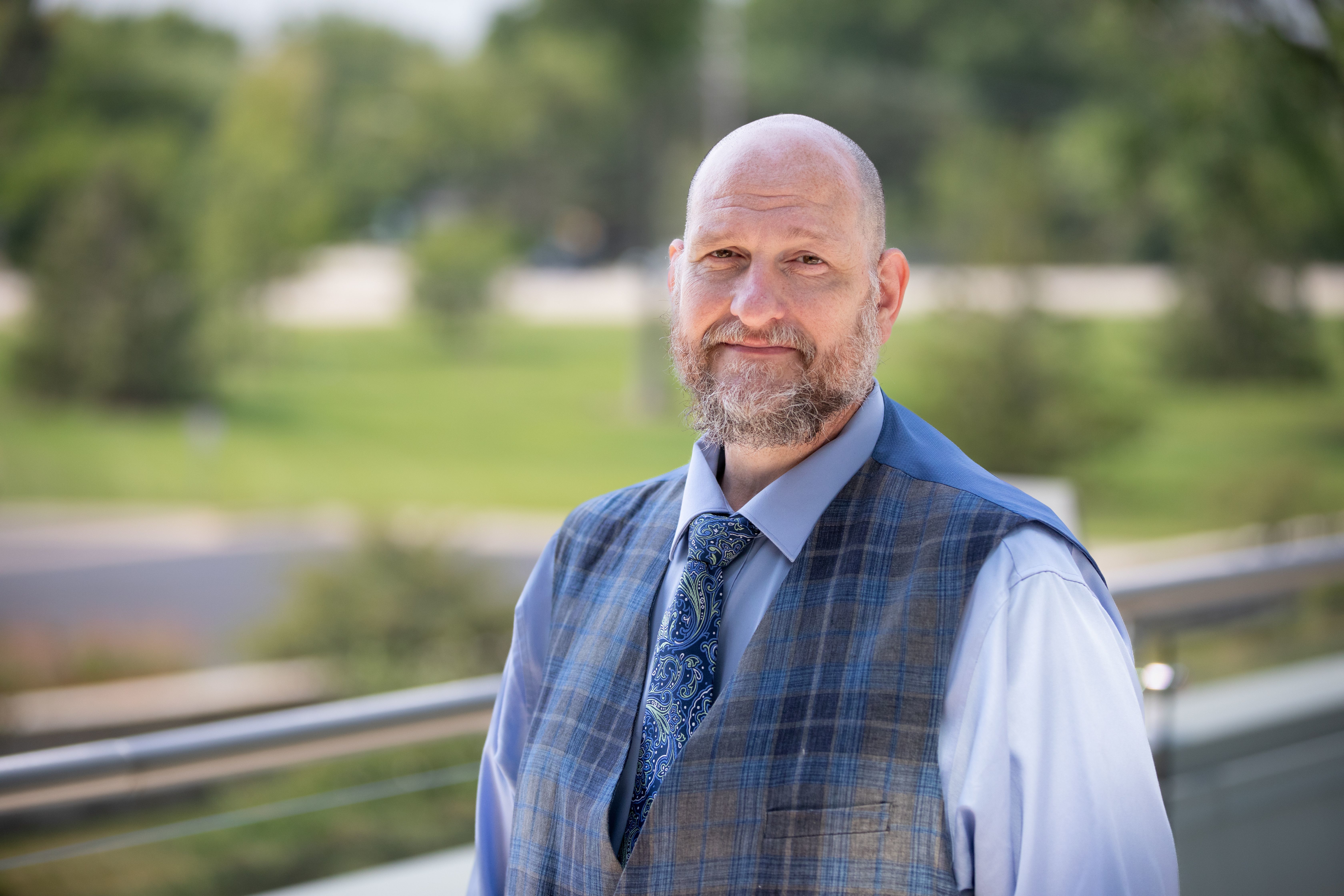
    Brian Dawson is a patient ambassador for the Sumaira Foundation and secretary of the Pennsylvania Rare Disease Advisory Council.

    The recently published survey was Dawson’s way of collecting data to substantiate trends he had heard of anecdotally.

    For example, 37% of survey respondents said they didn’t receive enough information at the time they were given a diagnosis, and 20.5% said they didn’t understand the information provided by their healthcare providers.

    As a patient ambassador for the Sumaira Foundation, a Massachusetts-based patient advocacy group for rare neuroinflammatory disorders, Dawson tries to help newly diagnosed patients navigate their own diagnoses, knowing that health literacy can be an added challenge.

    Another striking statistic to him was that half of the respondents spent more than $5,000 every year on their care, with others spending well over $10,000.

    A quarter of respondents were also unable to access medications because of co-pay costs or a lack of coverage.

    “Ninety-five percent of rare diseases don’t have an FDA-approved treatment. So a lot of times people are being treated off-label,” Dawson said.

    That means patients face barriers like prior authorizations and “flat out denials,” he added.

    Dawson himself just received a second denial from his insurance company for coverage of a medication he has been on for years, since it’s technically off-label for his condition.

    He hopes the results of the survey can inform policy to reduce barriers faced by rare disease patients.

    “There are people where it’s life or death for them dealing with some of the prior authorization stuff,” he said.

    Recovering

    When Dawson thought he only had five to seven years left to live, he “always heard the clock ticking,” he said.

    “Sometimes you could get distracted and focus on that, but if you’re focusing on that ticking clock, you’re missing everything else,” he added.

    He had hoped he could make his job as the acting state librarian into a permanent position, but with his health challenges, he had to let that dream go.

    Dawson went back to his previous role as the director of library development under the next state librarian.

    Dawson had hoped he could make his job as the acting state librarian into a permanent position.

    For the next few years, he tried to focus on making good memories for his family and minimizing the disease’s impact on them, but the effects inevitably spilled over.

    His oldest son quit a good job to move to Harrisburg to spend time with Dawson, thinking he only had a handful of years left.

    With Dawson’s new diagnosis, “our life had changed all over again,” he said.

    Now that he’s on the correct medication for his condition, Dawson is no longer experiencing the constant cycle of relapses.

    However, he still battles fatigue and brain fog from his condition, and has to be cautious about infections, since his immune system might react unpredictably.

    Brian Dawson, now 52, lives in Harrisburg.

    Even with his longer life expectancy, there’s always a chance he could relapse and become blind or paralyzed again.

    “I don’t hear the clock, but I know that reality is looming out there,” Dawson said.