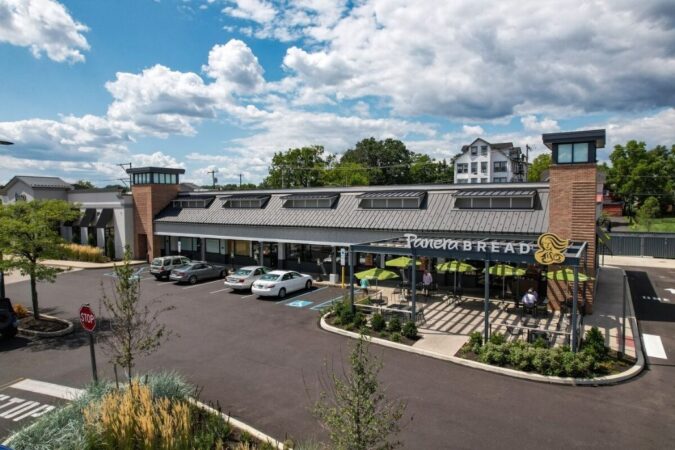
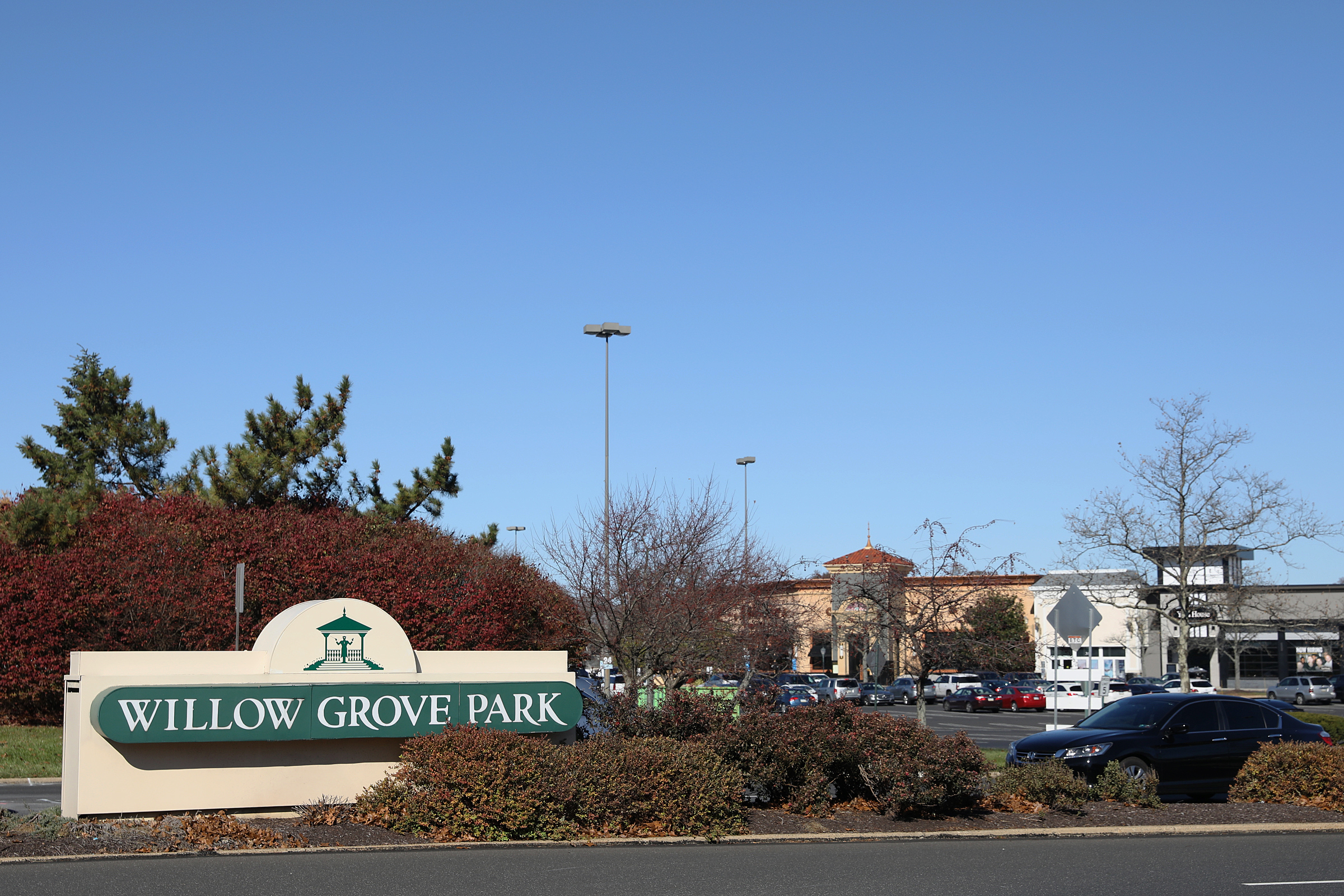
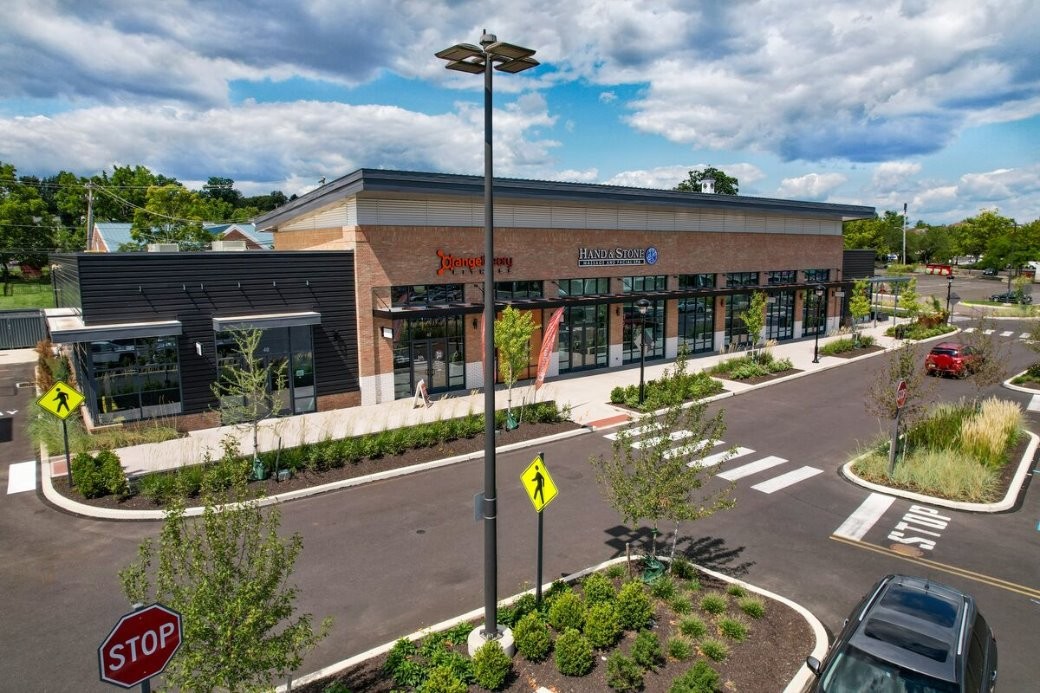
A shopping center in the shadow of Willow Grove Park Mall will soon undergo a $105-million “transformation” with new apartments and shops, says the developer behind the project.
Starting this summer, about 130,000 square feet of the Willow Grove Shopping Center will be demolished to build a mixed-used complex with 261 residential units and 35,000 square feet of new retail space, said Mark Brennan, vice president of regional development for Federal Realty Investment Trust.
It will mark the latest stage in a multiphase redevelopment of the outdoor center, which is located across the street from the mall.
A rendering of what Federal Realty Investment Trust plans to build at the Willow Grove Shopping Center.
Across the Philadelphia region, similar mixed-use complexes have increasingly been built around thriving shopping destinations, such as King of Prussia, where thousands of new apartments have risen in recent years.
A spokesperson for PREIT, which owns Willow Grove Park Mall, did not return a request for comment. In a 2022 shareholders’ report, PREIT executives called the complex “one of our leading suburban Philadelphia assets,“ with an occupancy rate of more than 96%.
The Willow Grove Park Mall is pictured in 2019.
Across Moreland Road, Brennan is confident his shopping-center redevelopment will be met with high demand.
Since the pandemic, the Montgomery County community has “really come alive,” due in part to its proximity to the city and to suburban employment centers, said Brennan, who is based in Wynnewood. And people who are moving out of the city or looking to downsize are particularly interested in moving to mixed-use developments, he said.
The center’s proximity to SEPTA’s Willow Grove train station, and major highways, including the Pennsylvania Turnpike, will make it particularly appealing, as will its mix of “highly curated” shops, Brennan said.
Across the street from the mall, the Willow Grove Shopping Center is set to undergo a $105-million transformation with apartments and new retail.
The center’s existing tenants, which include Marshalls and Five Below, will remain open during construction, Brennan said.
He expects the project to be complete sometime in 2028.
“These sort of multifaceted, multiphased development projects do take quite a bit of time and planning,” Brennan said. “We’re really excited to get to the next phase of this transformation.”
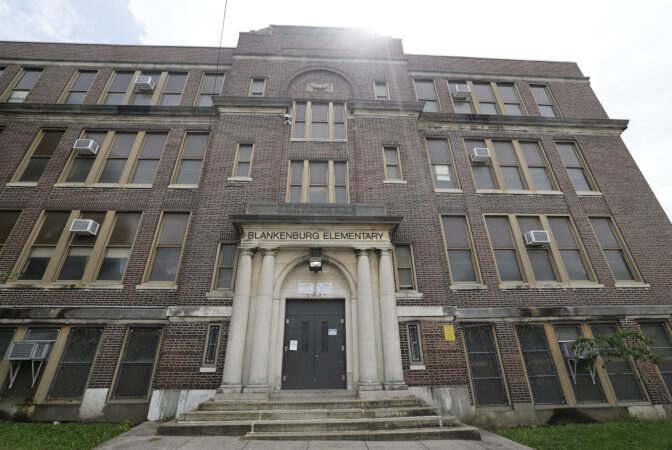
Rudolph Blankenburg Elementary School in West Philadelphia serves kids with complex needs — and test scores reflect that.
The school, where nearly 95% of students are considered economically disadvantaged, had been a Comprehensive Support and Improvement school — a federally mandated designation for schools performing in the bottom 5% statewide.
But last fall, Blankenburg shed that label. Many students are still struggling but are making gains, teachers said — progress they fear will be threatened by a district proposal to close the schoolas part of a sweeping facilities plan.
“We’ve worked really hard, with a consistent staff and all types of resources in place, for our students to pull ourselves out of that status,” said Flori Thomas, a middle school science teacher at Blankenburg.
That’s her biggest fear, she said: “You’re going to impact our scholars.”
Blankenburg is one of 20 district schools proposed for closure under the plan released last month. Six other schools would be colocated and more than 150 modernized as part of the proposal — which is facing resistance from City Council.
District officials say closures are needed in a system that has lost more than 80,000 students over the last 30 years, many to charter schools. The district has struggled to fund repairs of aging buildings — including at Blankenburg, where staff report chipping paint and roof leaks.
Marquita Jenkins, the school’s dean of climate and culture, does not disagree that the building, which opened in 1925, needs repairs — or that it is underutilized. The K-8 school, which currently enrolls 278 students, has room for almost 600. Officials said the school’s enrollment has declined by about 100 students over the last four years.
But the relatively low enrollment has also enabled smaller class sizes, helping student growth, Jenkins said. A former fourth- and sixth-grade teacher at Blankenburg, she recalled teaching a class of 33 students, 11 of whom had individualized special education plans: “It was tough.” Classes now are smaller, she said.
Like other staff, she worried about where Blankenburg students would end up. The district proposes to reassign them to Edward Heston School, James Rhoads Elementary School, and a newly colocated Martha Washington Academics Plus School and Middle Years Alternative School.
Blankenburg‘s building near 46th and Girard, meanwhile, would be conveyed to the city for “affordable workforce housing and/or job creation,” according to the district.
Jenkins and other staff questioned the safety of the routes to schoolfor reassigned students.
They also voiced concern for particularly vulnerable students: Blankenburg is surrounded by at least seven homeless shelters and “tends to have attendance fluctuations,” assistant principal Sandra Pitts said at a virtual community meeting with district officials this month. She questioned how families would be “assisted to avoid further trauma.” (Officials said they would be supporting students with housing instability in placements.)
Staffers noted that Blankenburg also has a significant population of students with special needs, who make up 25% of its enrollment.
Among them is Sherell Robinson’s kindergartener, Illiyin, who has autism and medical complexities.
Robinson, who lives in West Philadelphia, said that Illiyin had been denied enrollment at other district schools, and that she was told she had to send her daughter to Blankenburg.
Robinson initially had a negative impression of Blankenburg but was impressed with the school’s principal, Sheena Wilson, who “didn’t try to sell me, or placate me” — just presented what the school had to offer, she said.
What Robinson found was a small environment, “loving people,” and a routine for Illiyin. Now she is panicked at the prospect of the school closing.
“For them to be taking this whole community away is really devastating,” Robinson said. “It takes time to find the correct programming and environment and teachers who are neuro-affirming, especially for Black children.”
A real estate agent, Robinson said there was an irony to the district’s plan to convert Blankenburg to workforce housing — something she believes she currently would qualify for. But if she does not find a stable school environment for her daughter, she isn’t sure she will be able to keep her job.
“They might look at me as a single case, but I can assure you I am not an anomaly,” said Robinson, who also works for a disability nonprofit and is in touch with other parents of autistic children. “This is going to affect how we can take care of our families, how that perpetuates what we’re already experiencing. … I don’t want to normalize that struggle to them.”
Teachers said they are committed to Blankenburg’s students. “We bring a lot of positivity and try to keep our kids safe,” said Jenkins, who has led field trips to places including the Kimmel Center in Center City and the National Museum of African American History and Culture in Washington.
Thomas, who grew up in the neighborhood around Blankenburg and now lives in New Jersey, said that whenever students learn about her commute, she tells them they are worth the drive.
Others outside the city see headlines about crime, Thomas said, but she tells students: “I see you.”
Olwethu Makhanya is just 21 years old, and this year will be his second as a regular player for the Union. But in a centerback unit with so many newcomers, that’s enough to qualify him as a veteran.
In fact, it’s enough to qualify him as a rising leader. Though Japhet Sery Larsen and Geiner Martínez are both older, Makhanya is the only one of the expected regulars who has played in Bradley Carnell’s system, and knows the Union’s standards on and off the field.
“We had two important players from the back line leaving the team,” he told The Inquirer, referring to centerback Jakob Glesnes and left back Kai Wagner. “So that leaves people like me who were here last season to try and take on leading, try to help the new guys coming in to understand what we try to do. So yeah, I feel like it’s a new challenge for me to try and be a leader, and lead the new guys.”
No position on the field requires more chemistry than centerback. Whether in a group of two (as the Union use) or three, each player must know where the others were, are, and will be, and often without being able to talk about it in real time.
Olwethu Makhanya (right) defending Chicago striker Hugo Cuypers during last year’s playoffs.
That made it crucial to get Makhanya and Sery Larsen as many reps together as possible in the preseason, and that seemed to be achieved over the Union’s five games. Martínez arrived later, but he played in the last two games and was on the field with Makhanya in each.
“I feel like five games is enough,” Makhanya said. “Obviously it’s not going to be perfect from the start, but I feel like it’s going to be enough at least to prepare us for the start [of the season].”
He has also enjoyed getting to know Sery Larsen and Martínez off the field.
“They’re very good people,” Makhanya said. “They’re already blending in with the team. Very good human beings, they work hard, [are] willing to learn, and that’s all we need as a team.”
Japhet Sery Larsen (right) in action during one of the Union’s preseason games.
Selflessness within the group
Though Glesnes’ departure impacts Makhanya most directly, Wagner’s departure matters, too. There are no true left backs on the Union’s roster right now, and though the club is actively shopping for a new starter, they haven’t signed one yet.
For now, Frankie Westfield and Nathan Harriel are platooning at the spot, since each has past experience there. Makhanya has had to adjust to that, and will have to adjust again when the new signing arrives.
“Looking at the way that we play, the system, the style of play,” Makhanya said, “I feel like the guys that we have at the moment … everyone can be able to play those positions. As long as they’re able to take in the instructions from the coach, we should be fine.”
Longtime Union fans will know that it’s been a regular theme in these pages over the years that the Union need to have more than two starting-caliber centerbacks, so they can be rotated over the season to stay fresh. That will be very important again this season, with the club’s return to the Champions Cup now and MLS’s Leagues Cup in late summer.
Geiner Martínez is the other major new addition to the Union’s centerback group this year.
Any player wants to play, of course, but veterans know the importance of the long haul. So it’s to Makhanya’s credit that he’s willing to take a seat for a night if needed.
“I’d be OK,” he said. “As long as it’s something that’s going to help the team, I’d be fine with it.”
It’s not surprising that Makhanya has grown a bond with manager Bradley Carnell. Along with both being South Africa natives, Carnell took a leap of faith to make Makhanya a starter last year when he hadn’t played a second for the first team yet.
That faith was rewarded with a major role in the Union winning the Supporters’ Shield, and doing so with a return to the stingy defense they cherish.
Bradley Carnell on the Union sideline during a game last year.
“I feel like the relationship I have with him is really amazing,” Makhanya said. ”He’s a great human being, he’s a good teacher, his instructions are very clear, he’s a very understanding person. So because of who he is, it it’s very easy to work with him.”
Asked what his goals are for this year, Makhanya started with some humor.
“Firstly for myself, I think I’m going to score a couple of goals this season on set pieces,” he said. He scored twice last year, including a dramatic game-winner in the U.S. Open Cup round-of-16 comeback against Red Bull New York.
But Makhanya meant it when he said he wants to improve his aerial presence this year and “get a few headers” on free kicks and corners. He proved it right away, too, with a headed goal off a corner kick in the season-opening win at Defence Force FC in the Concacaf Champions Cup.
“And then for the group, we obviously have very high expectations, because we already know what we can do,” he said. “So we’re just trying to maintain that and try to find a way forward, and we take it a game at a time.”
There could be one more goal, too, beyond the Union. South Africa’s national team is in the World Cup for the first time since hosting in 2010. Fans and media back home have noticed Makhanya’s success, and have criticized the Bafana Bafana’s staff for thinking less of MLS than perhaps it should.
Carnell, who played for his country at the 2002 tournament, is well aware — and not pleased. Makhanya was diplomatic about it when asked, at least at first.
“I mean, not even being part of the national team last season was kind of disappointing for me, you know, but it’s just a motivation at the same time,” he said. “So yeah, it’s something that’s been in my mind that I’m looking forward to.”
“I think they do [look at MLS], but I feel like they don’t really have that much respect for the league,” Makhanya said. “So I guess that’s why I’m maybe not part of the squad, but I can’t really know.”
If he starts this season as well as he played last year, there might be even more people hoping for a better answer.
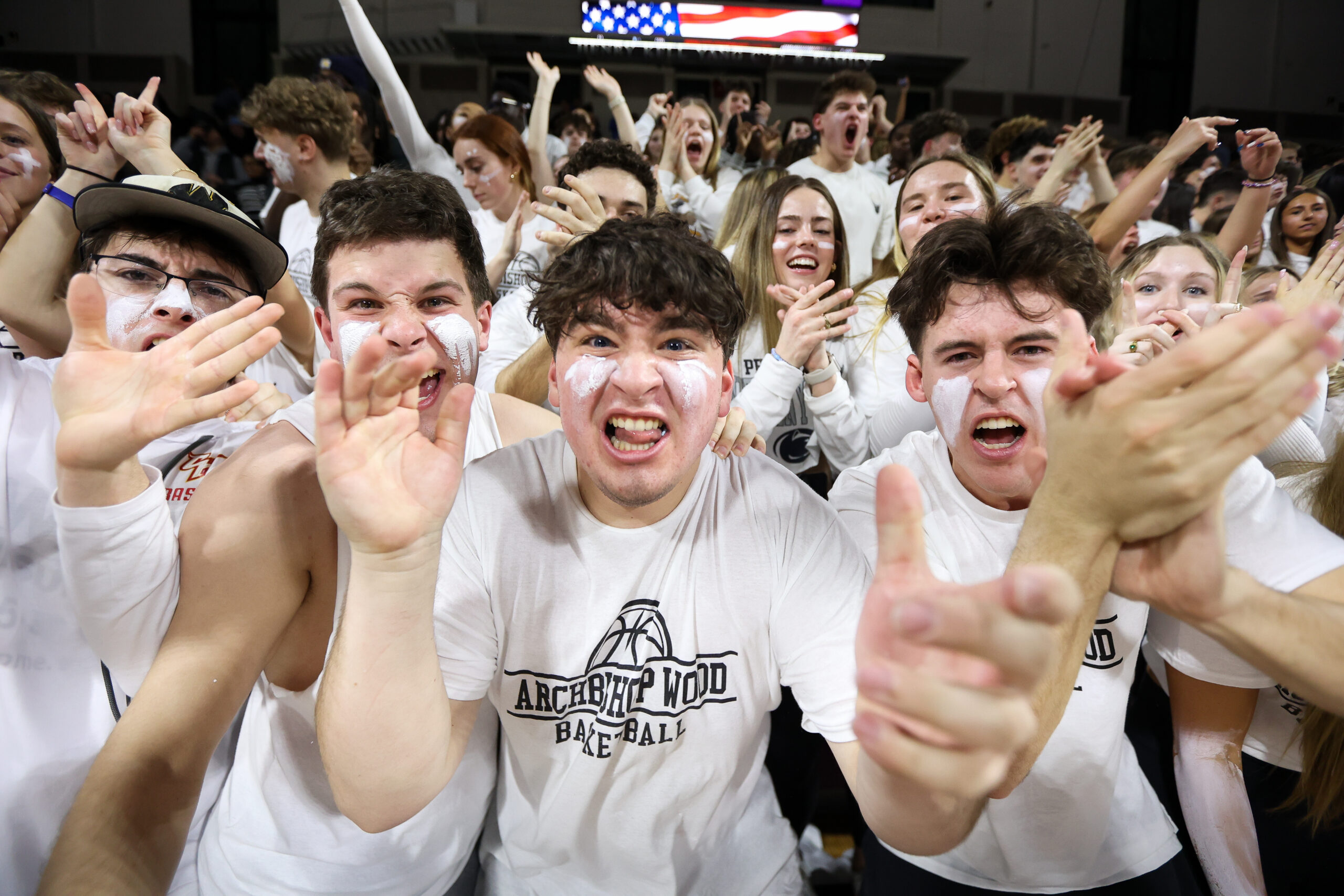
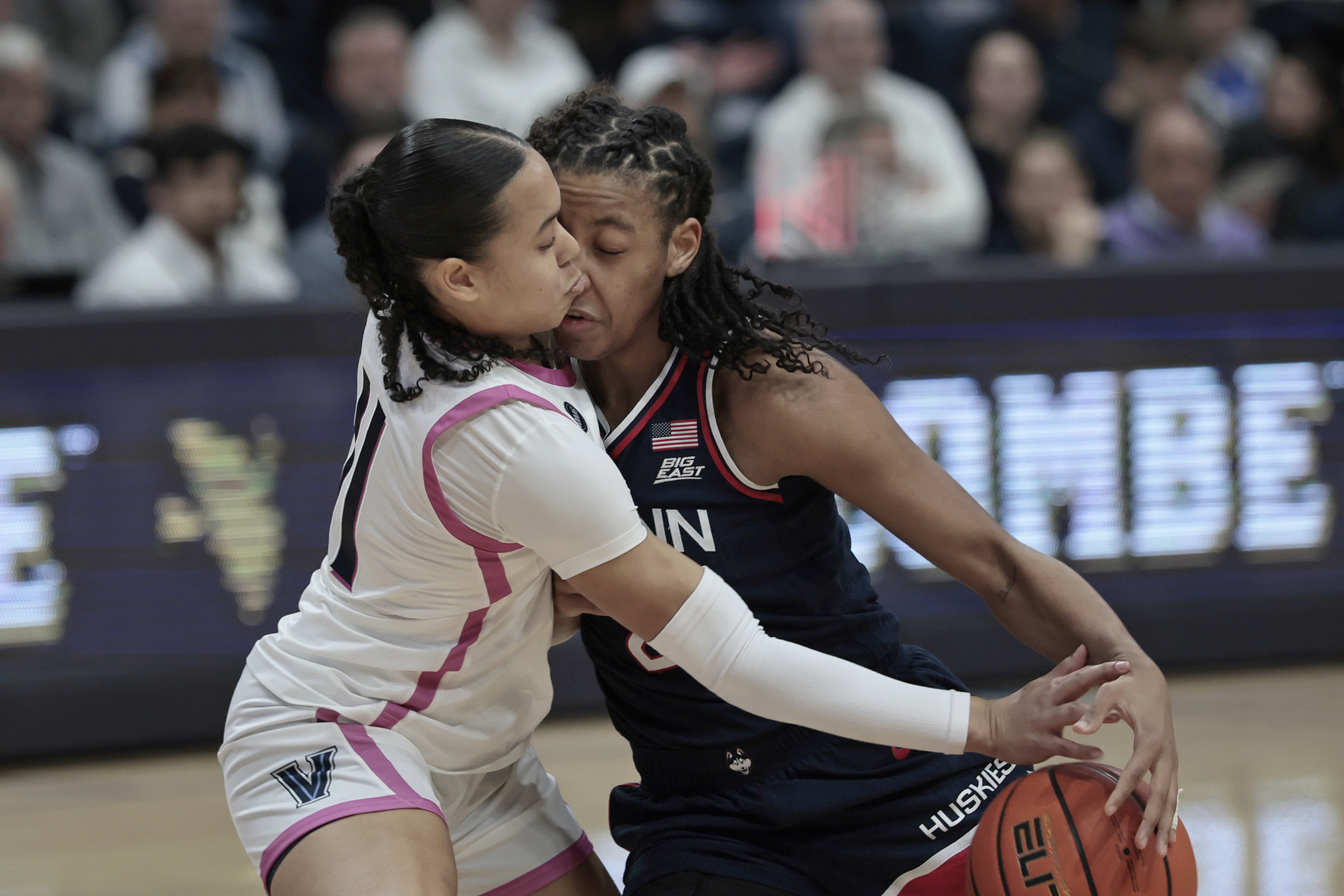
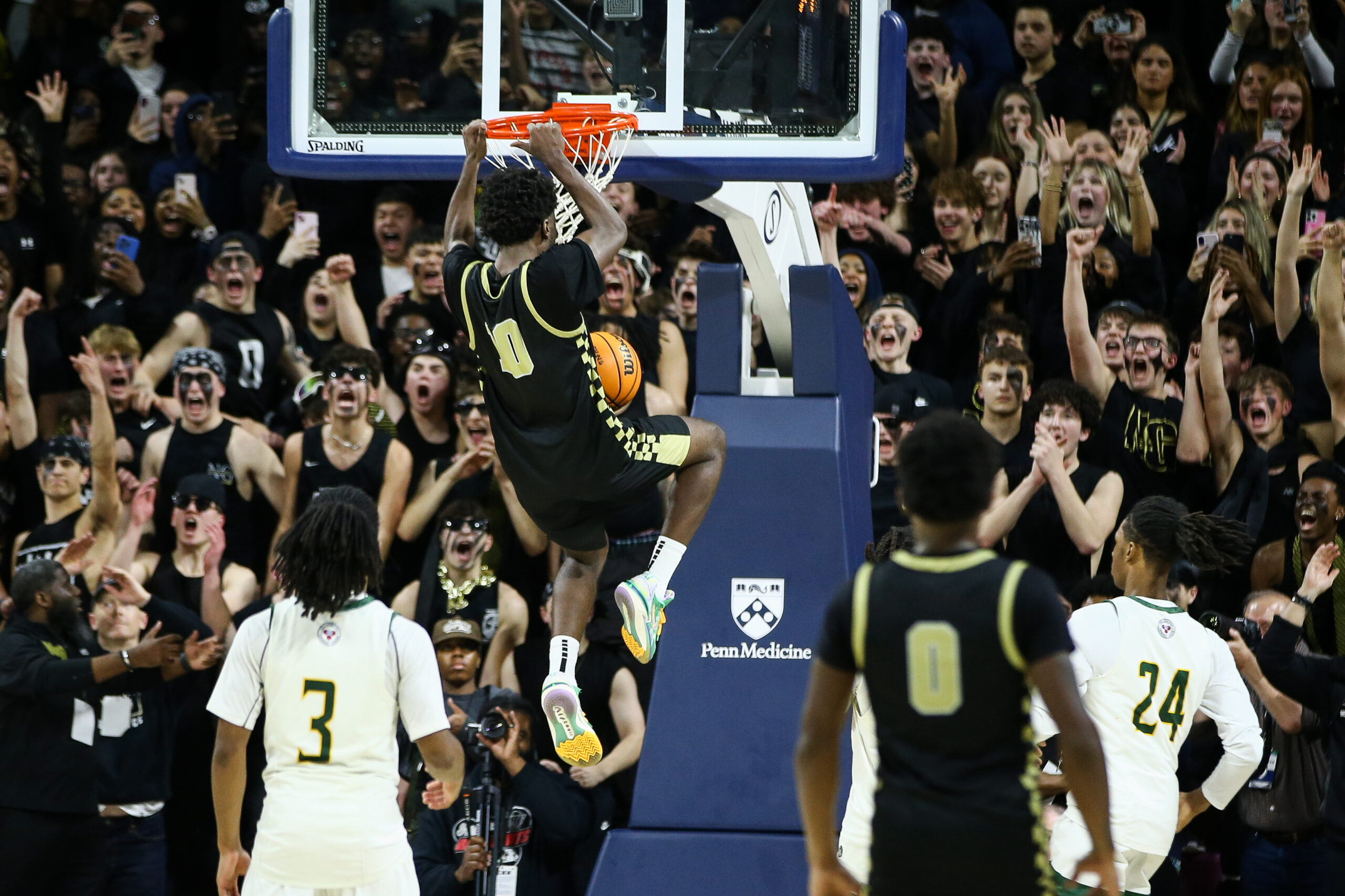
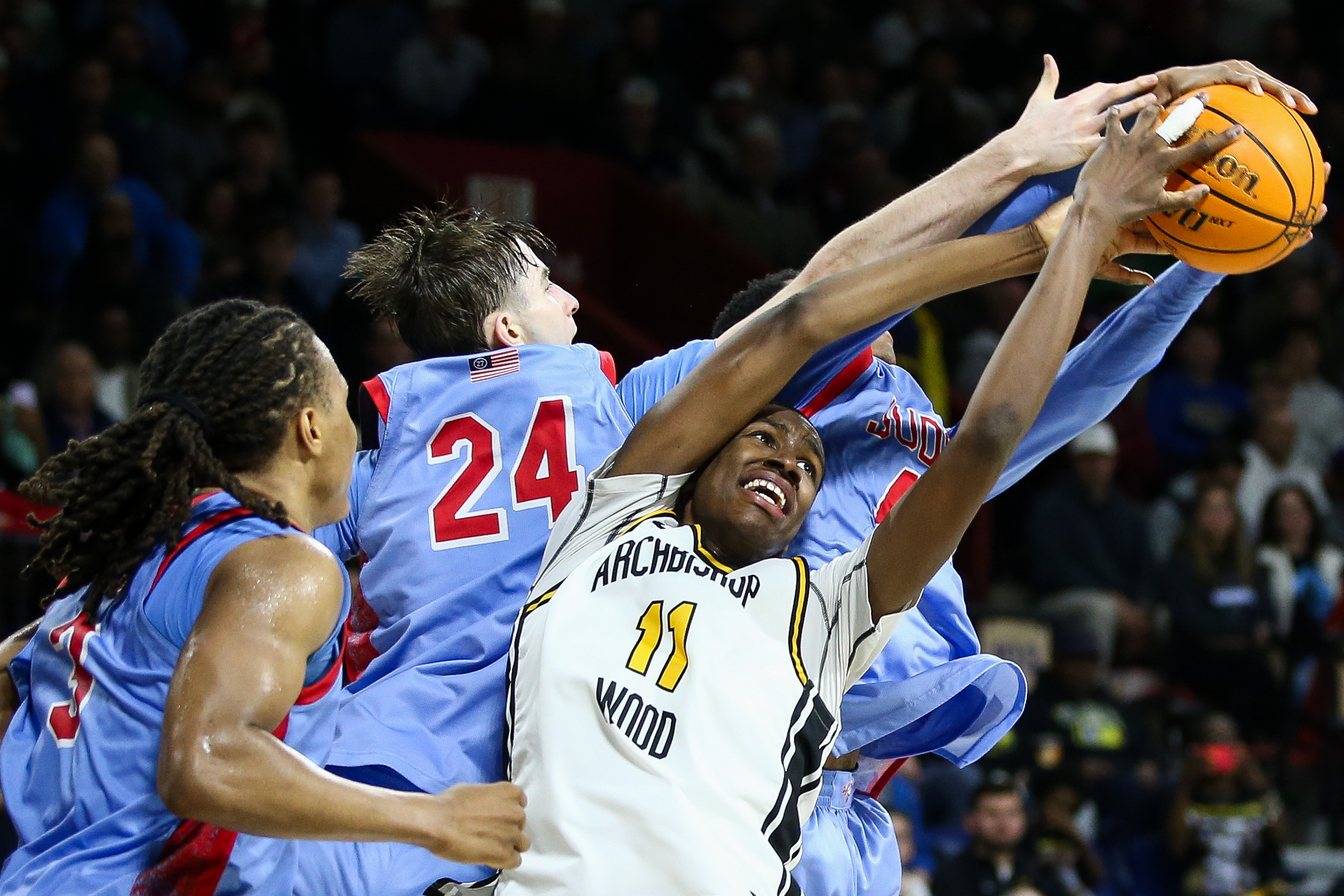
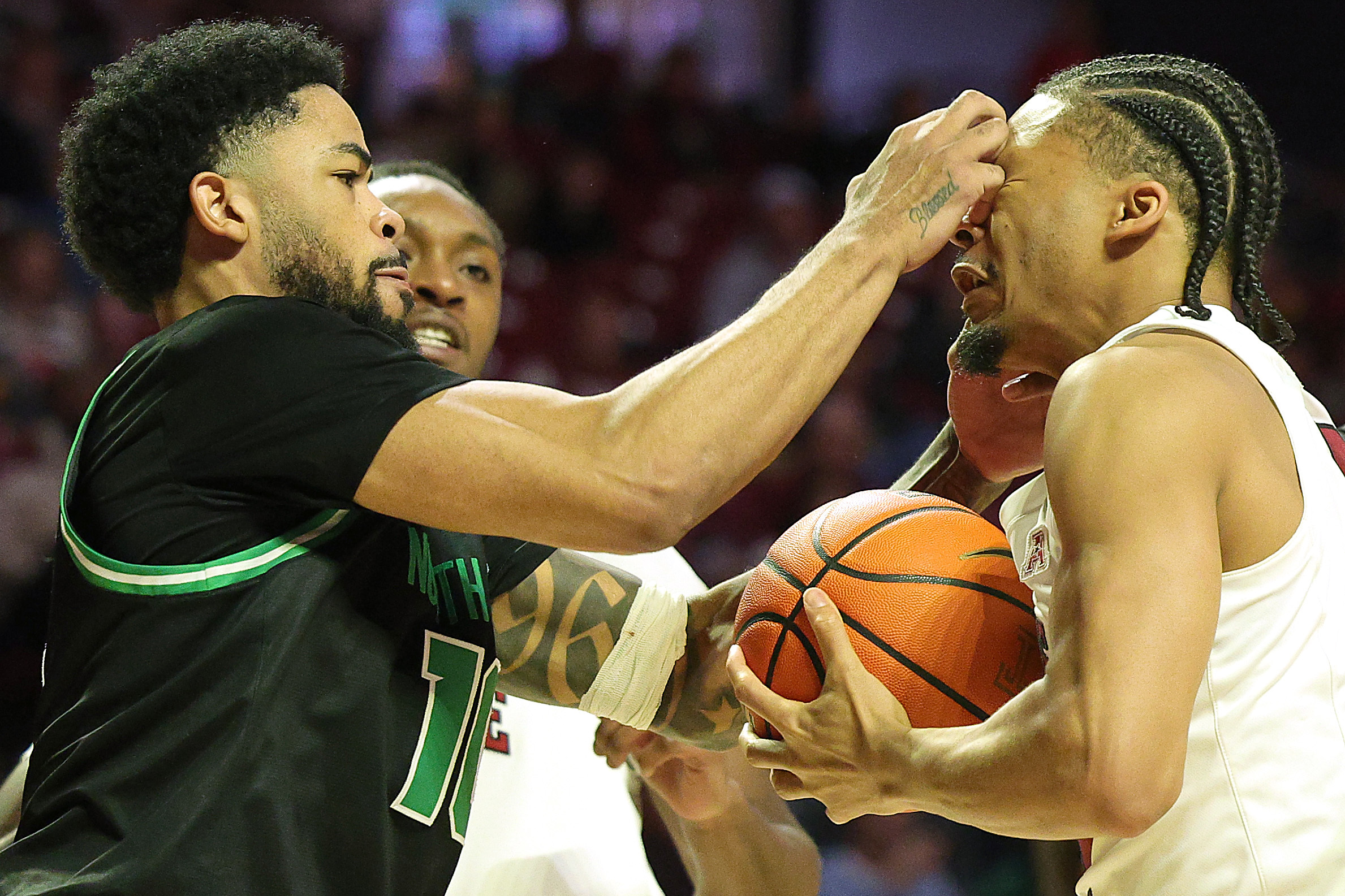
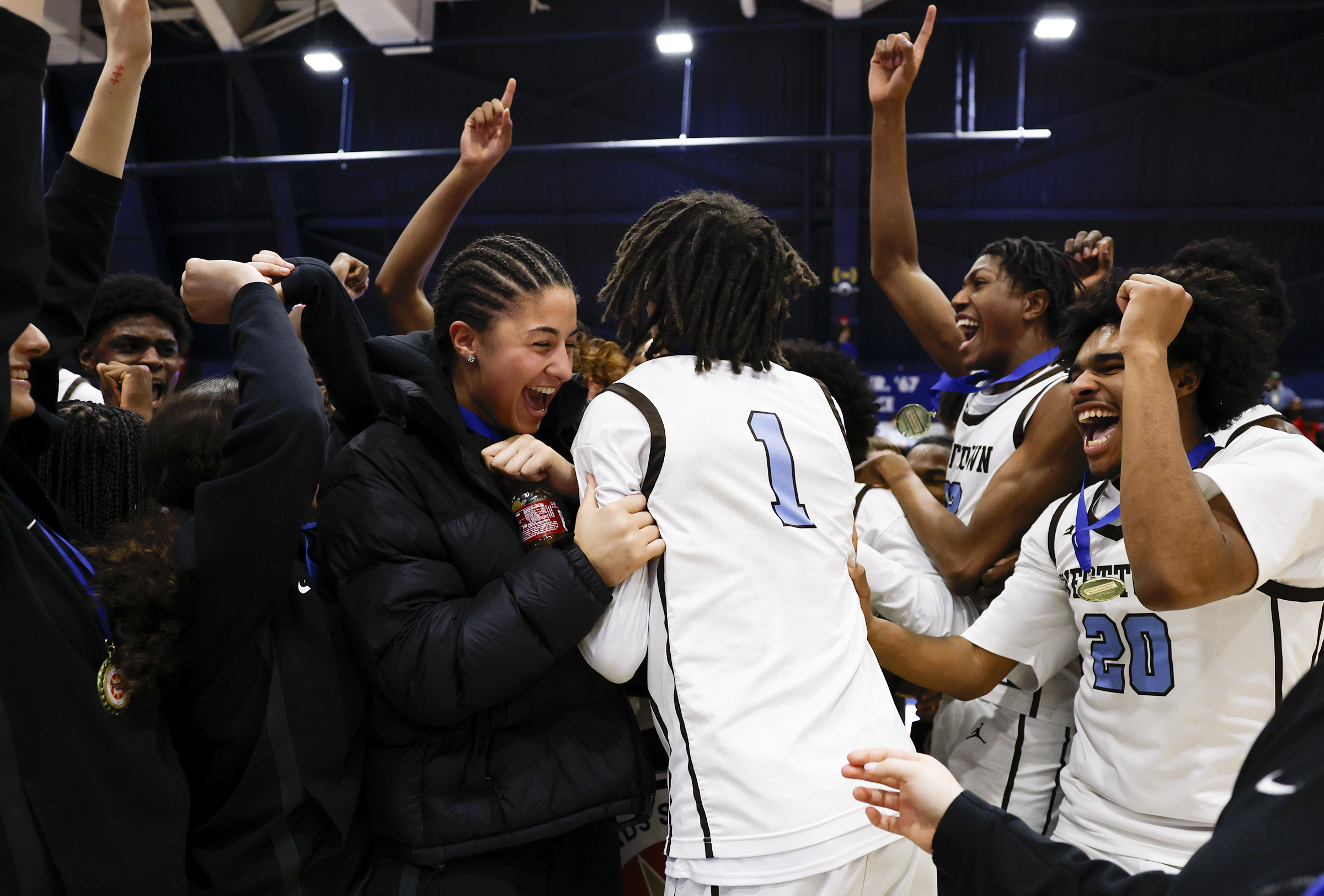
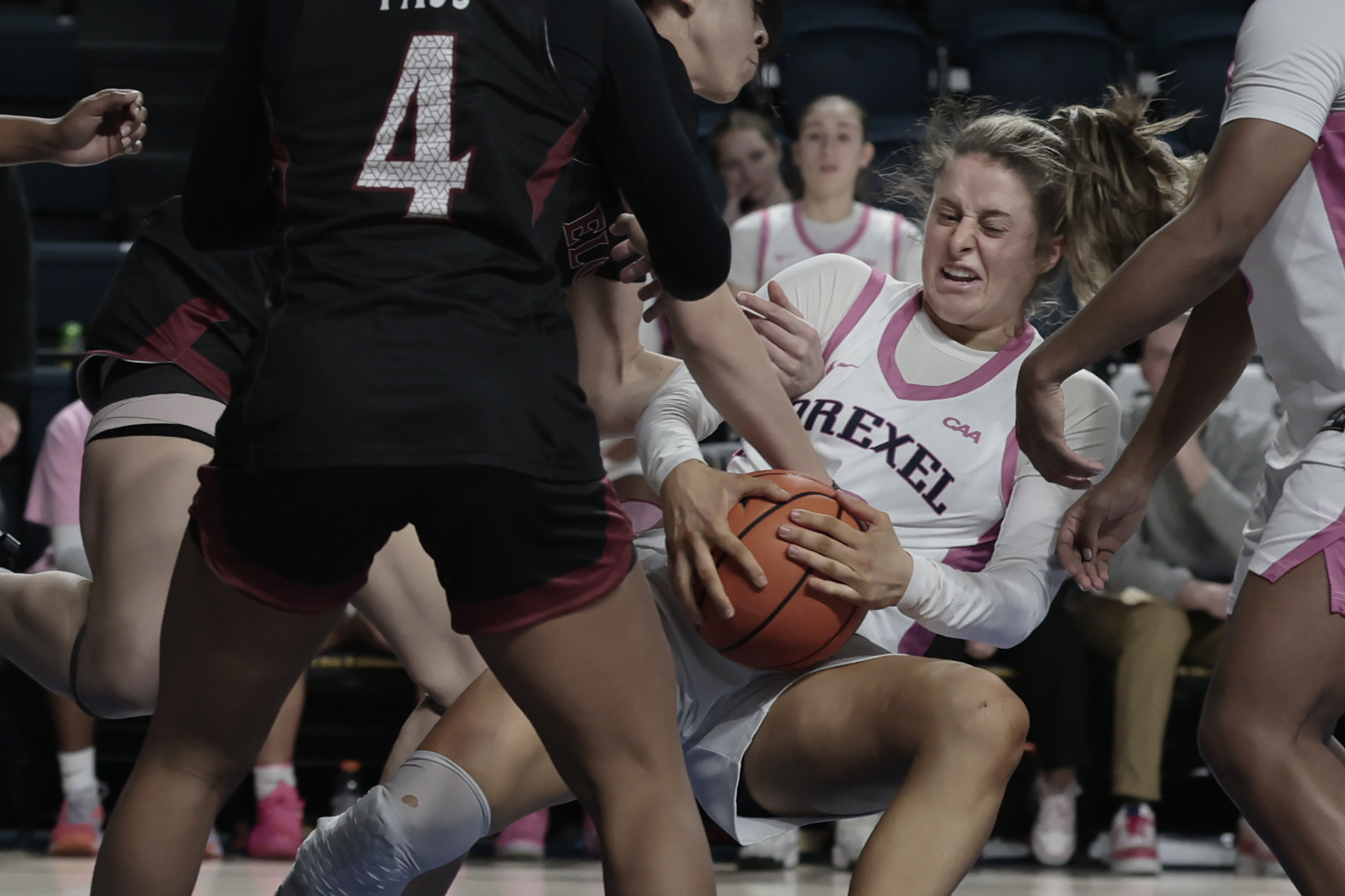
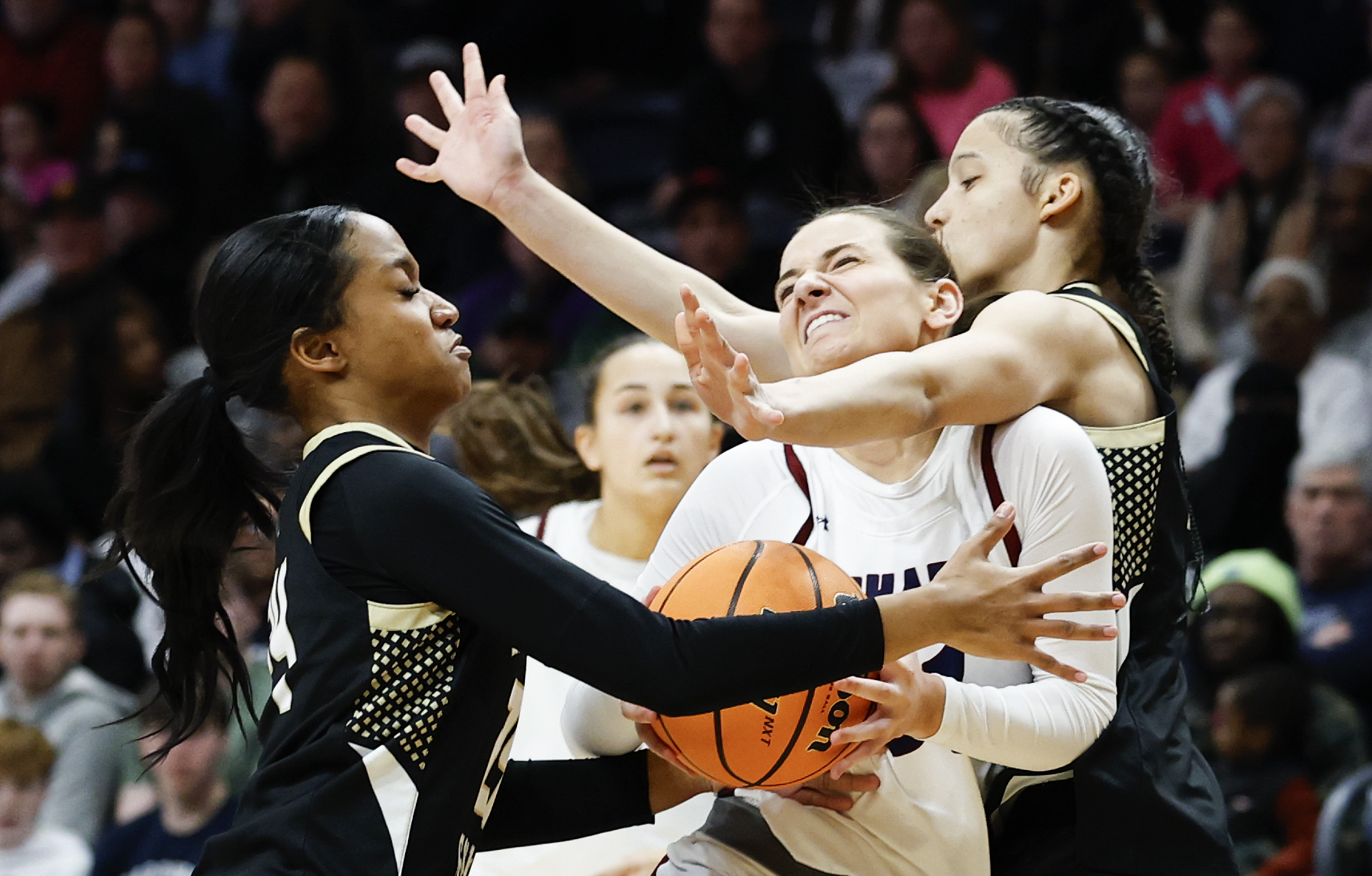
Each Friday, Inquirer photo editors pick the best Philly sports images from the last seven days. This week, there’s nowhere better to start than on the hardwood with the boys’ and girls’ high school basketball playoffs in full swing. There’s plenty from the college game and Phillies spring training as well.
The Archbishop Wood student section cheers before the start of the Vikings’ Catholic League semifinal against Father Judge at the Palestra on Wednesday. Villanova’s Jasmine Bascoe (left) knocks the ball away from UConn’s KK Arnold on Wednesday at the Finneran Pavilion. No. 1 UConn prevailed, 83-69.Neumann Goretti’s Marquis Newson dunks during the final minutes of its win against Bonner Prendergast in the Catholic League semifinals.
Archbishop Wood’s Jaydn Jenkins reaches for a rebound against several Father Judge players in their Catholic League semifinal game. Judge came out the winner.Cole Franklin of North Texas hits Temple’s Masiah Gilyard as he reaches for the ball Sunday at the Liacouras Center. The Owls fell, 65-62.Members of the boys’ and girls’ basketball teams at Westtown School rejoice after wining their Friends Schools League championships at La Salle University last Friday.
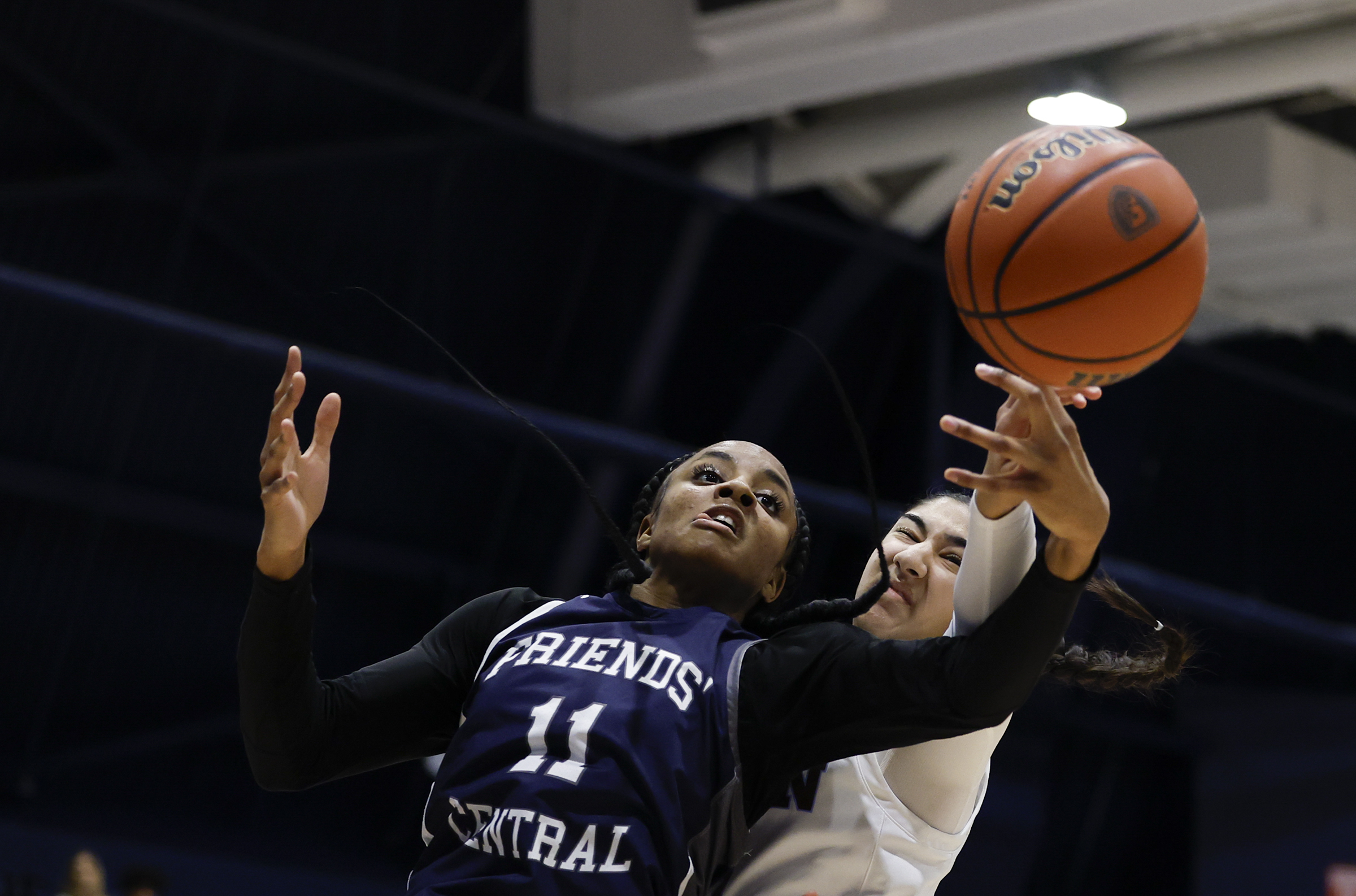
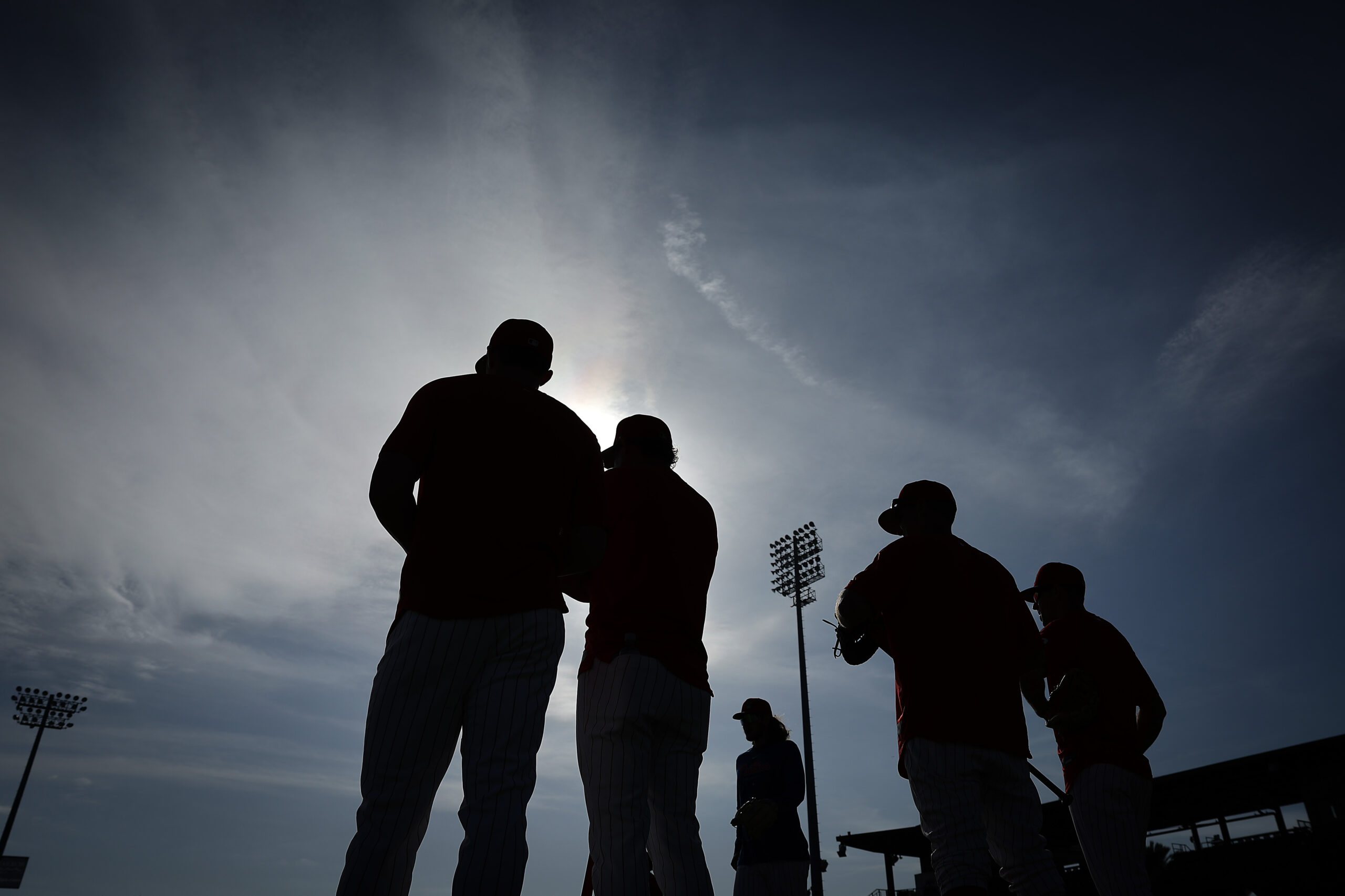
Drexel’s Laine McGurk hits the deck as she fights for a loose ball against Elon last Friday. Drexel won, 68-59. Cardinal O’ Hara’s Megan Rullo (center) is fouled driving to the basket against Neumann Goretti’s Kamora Berry (left) and Reginna Baker during their Catholic League semifinal at Villanova. Rullo scored 22 points in a 51-33 victory. Friends’ Central School’s Zya Small (11) fights for the basketball with Westtown School’s Ishana Sundararajan during the Friends Schools League title game. Phillies third baseman Alec Bohm (center) is silhouetted along with some of his teammates as they wait during a drill at spring training in Clearwater, Fla.
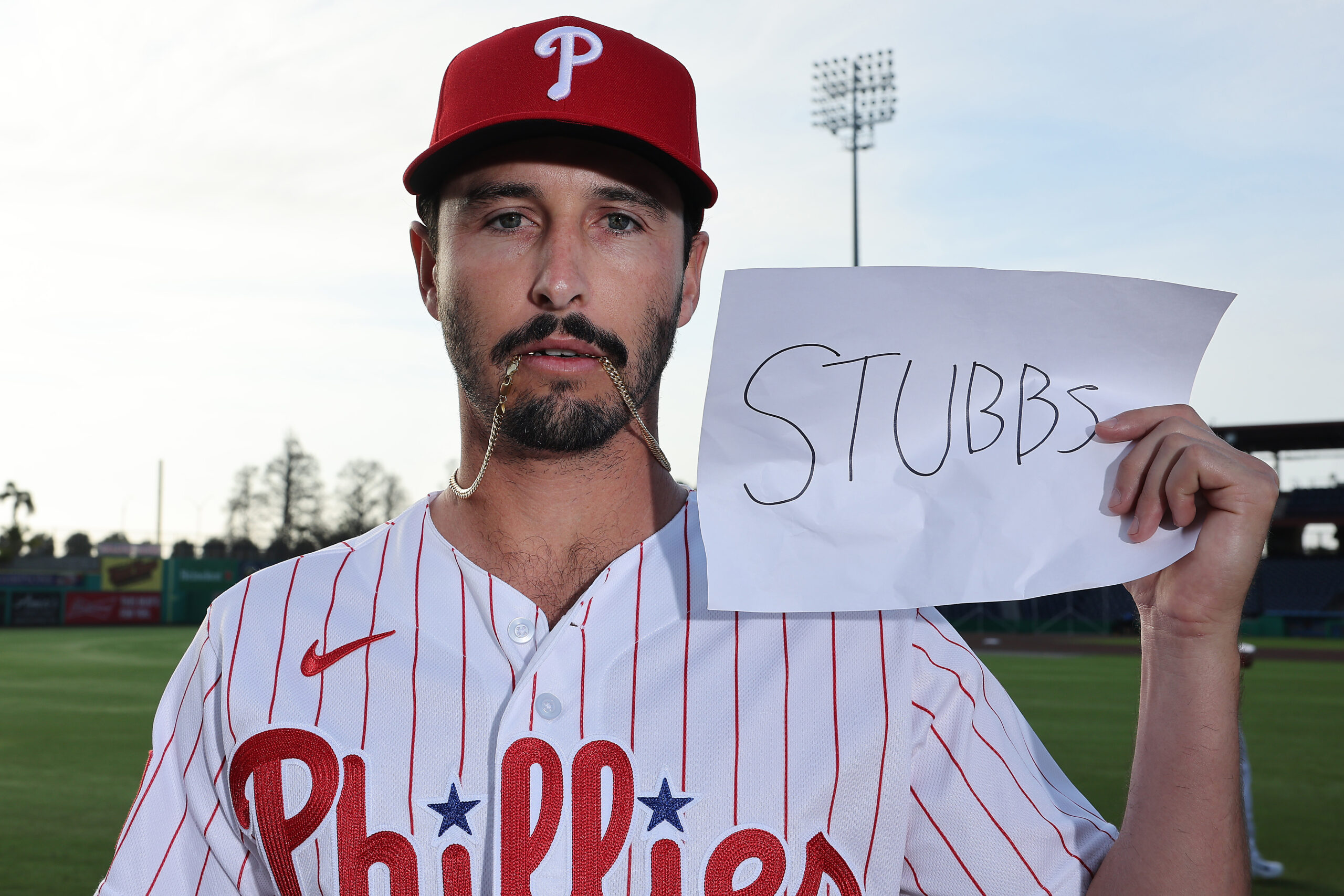
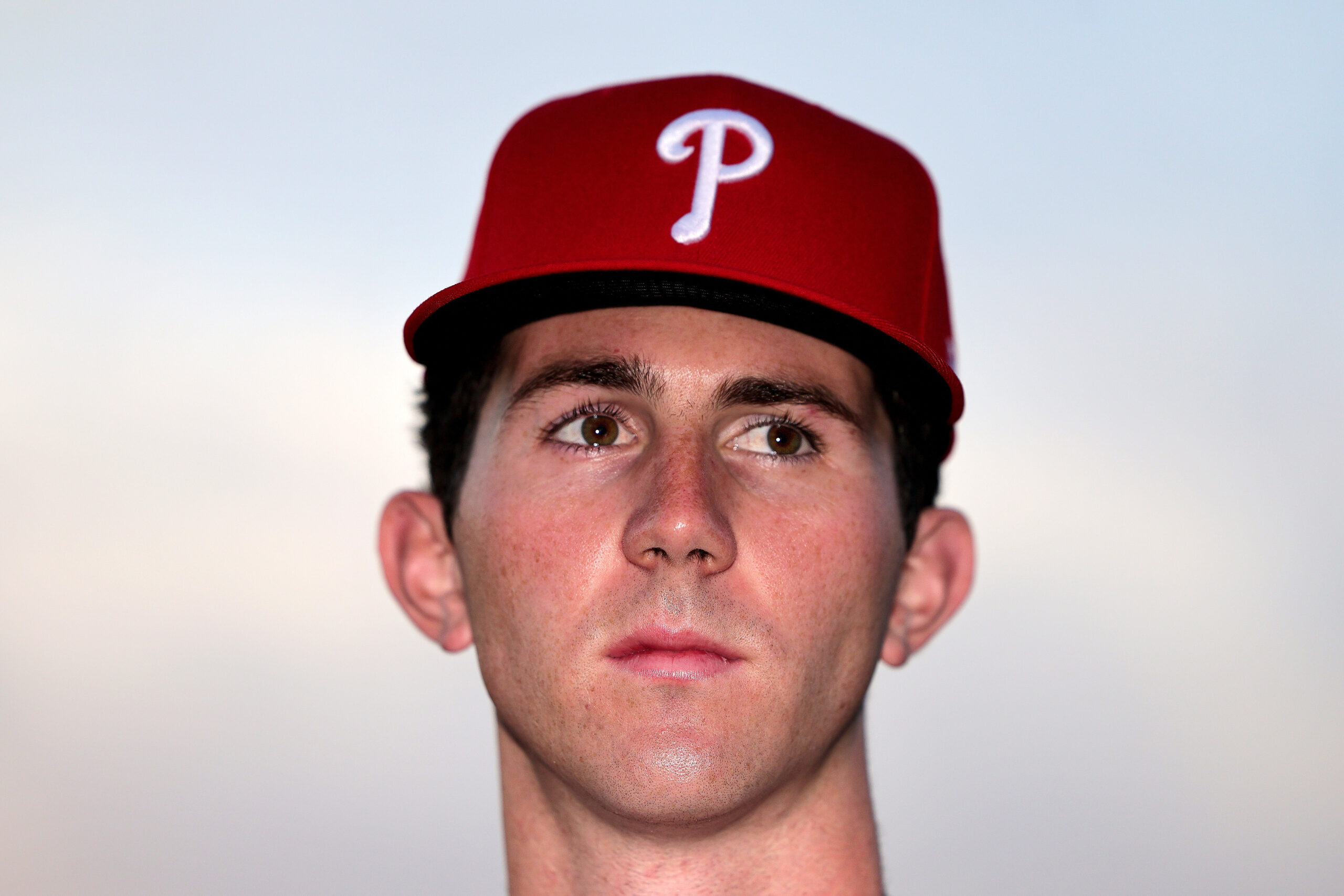
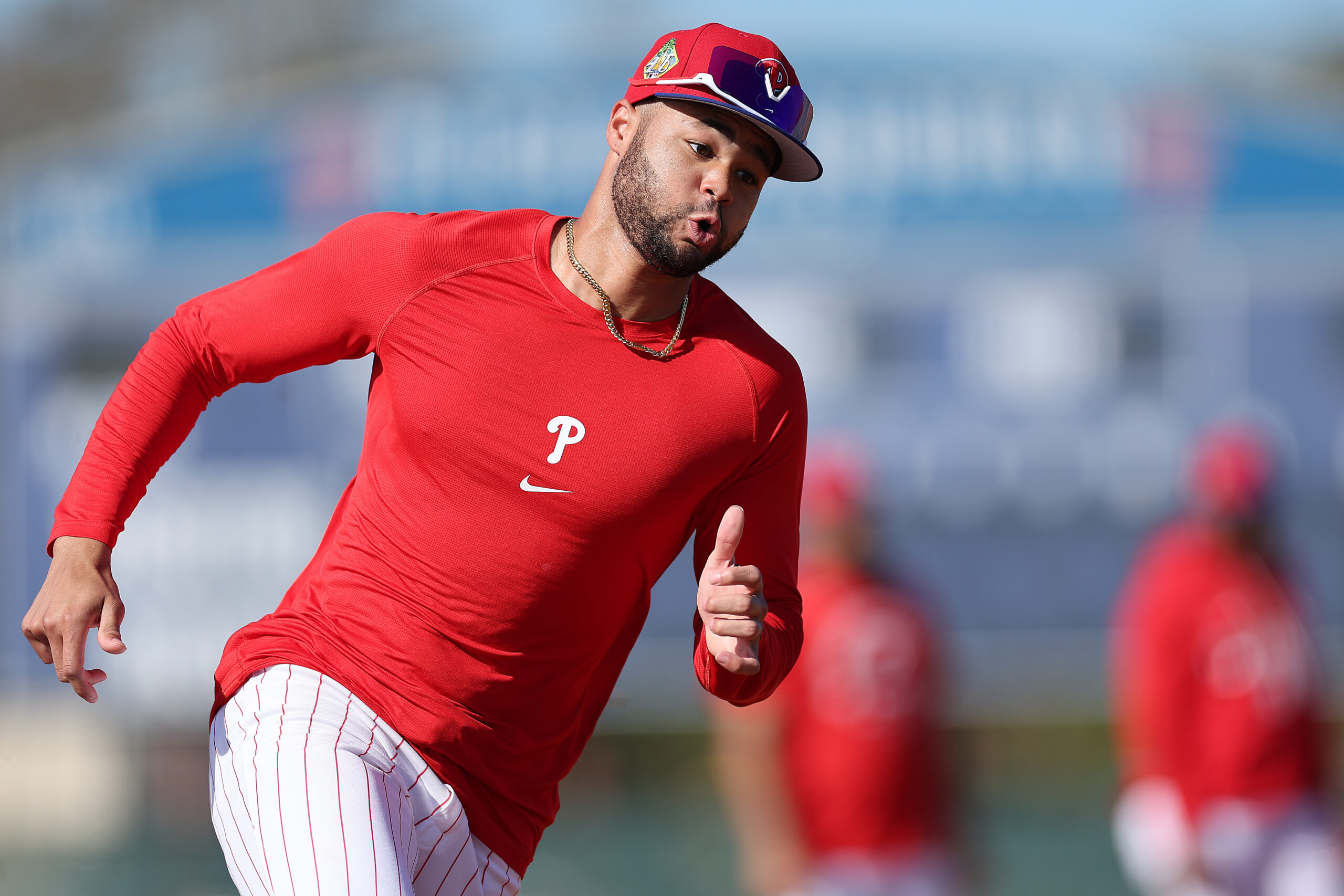
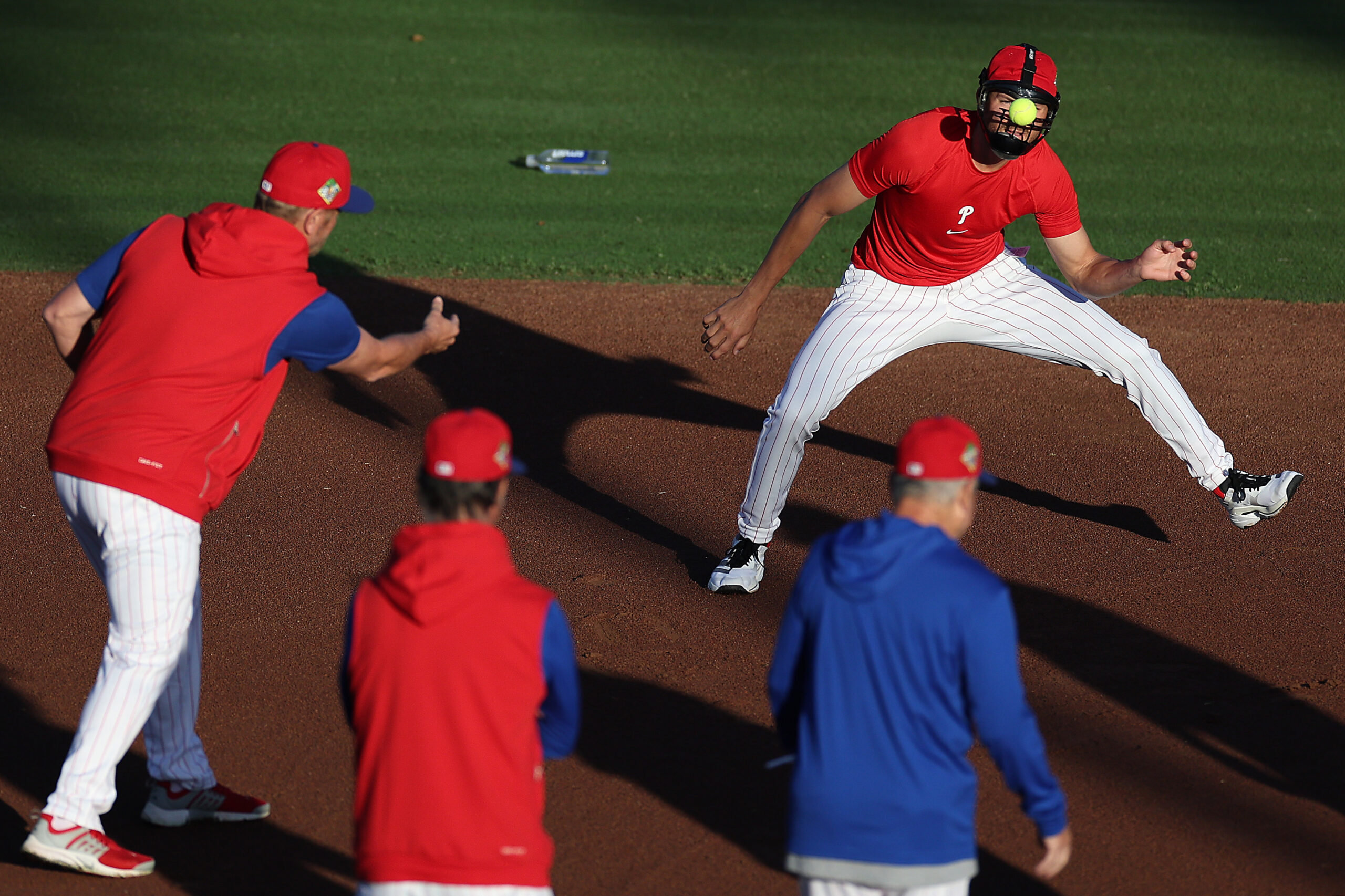
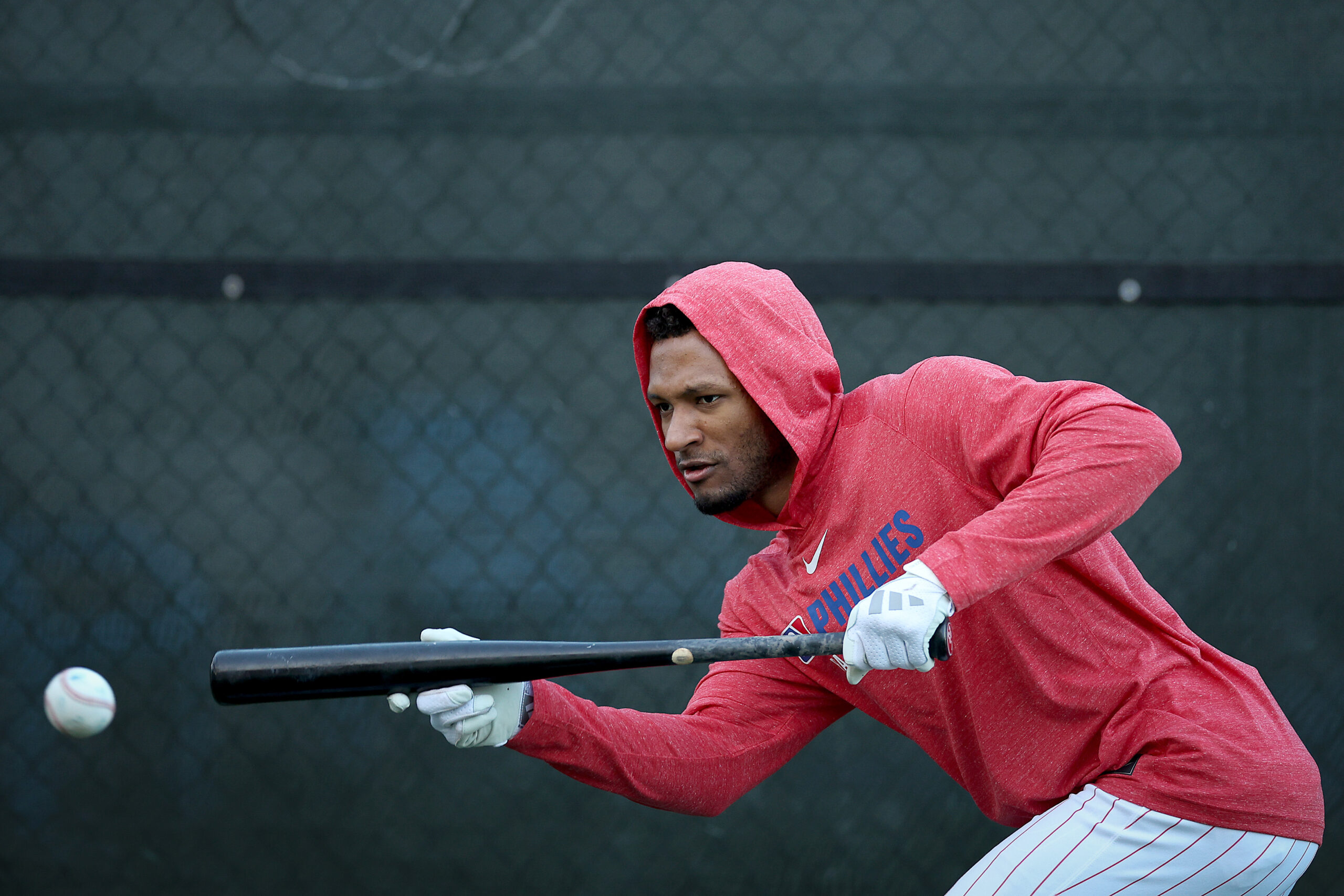
Phillies catcher Garrett Stubbs plays around for his portrait on photo day at spring training. Phillies pitcher Andrew Painter poses for a portrait during photo day in Clearwater, Fla. Veteran right-hander Aaron Nola warms up in the outfield at spring training on Wednesday. Justin Crawford, a rookie outfielder known for his speed, runs the bases during a drill at Phillies spring training on Tuesday. Hoping for a bounce-back season, pitcher Aaron Nola (center) talks with his Phillies teammates in Clearwater, Fla. Phillies shortstop Trea Turner takes part in a drill that involved bouncing a tennis ball off a mask during spring training.
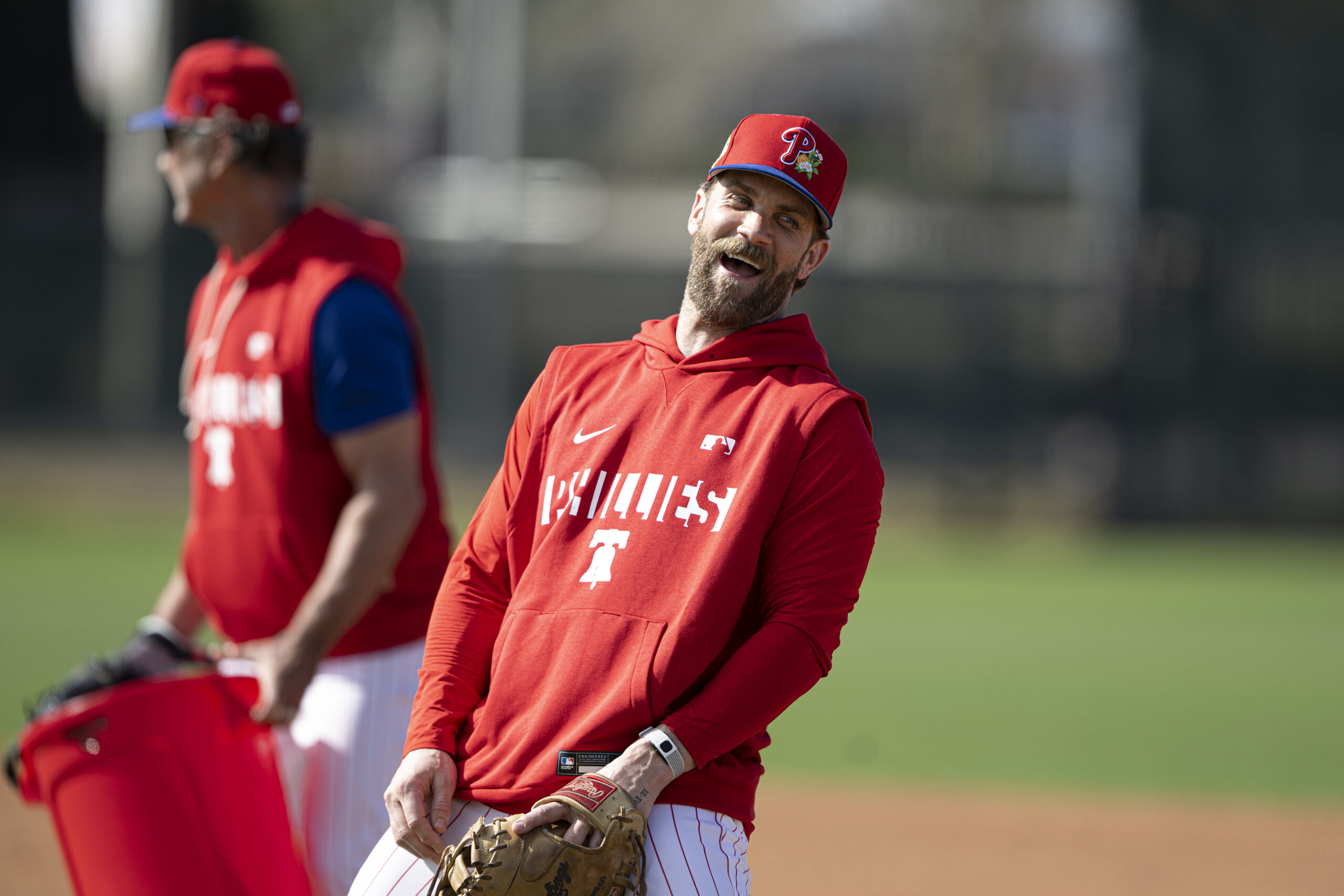
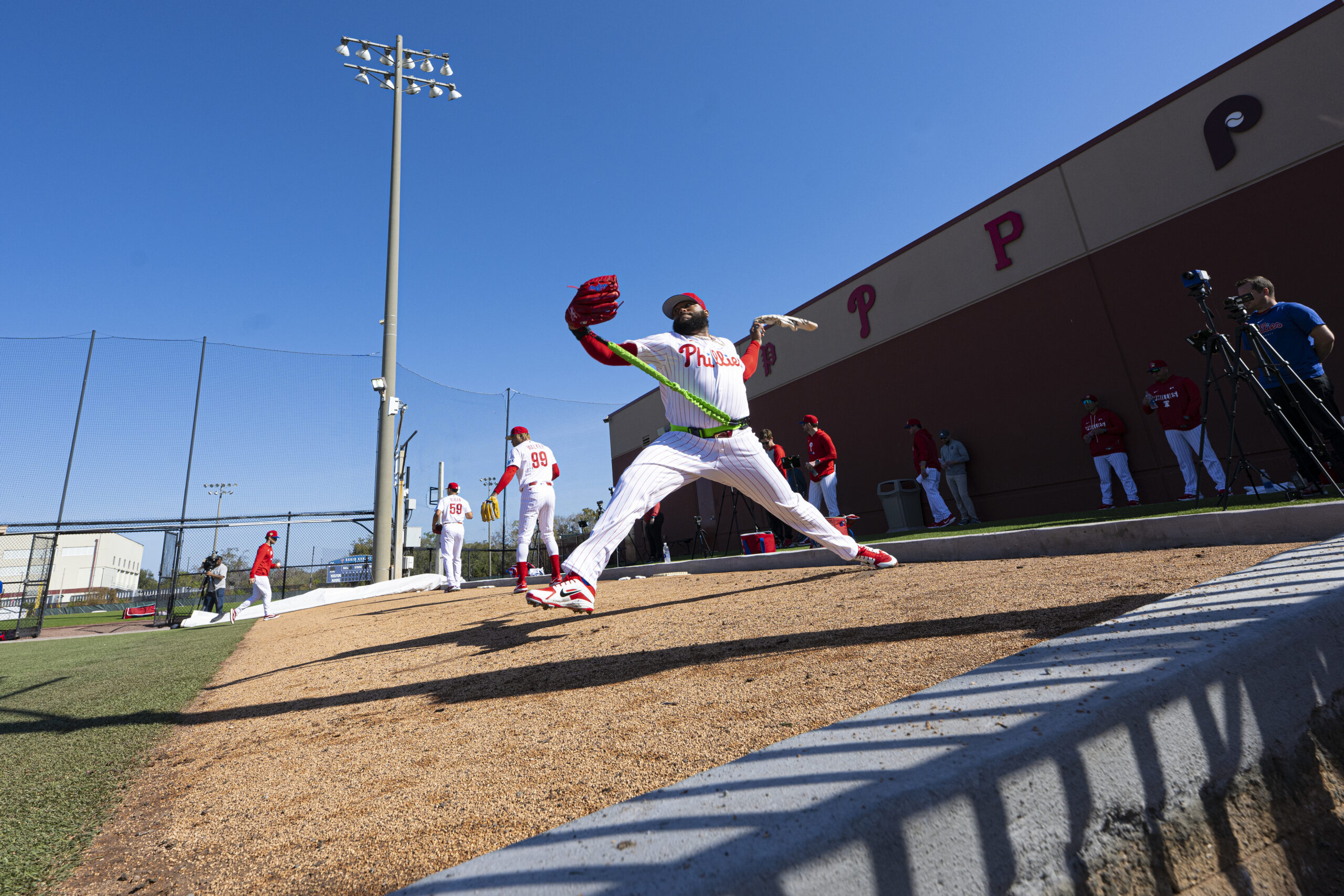
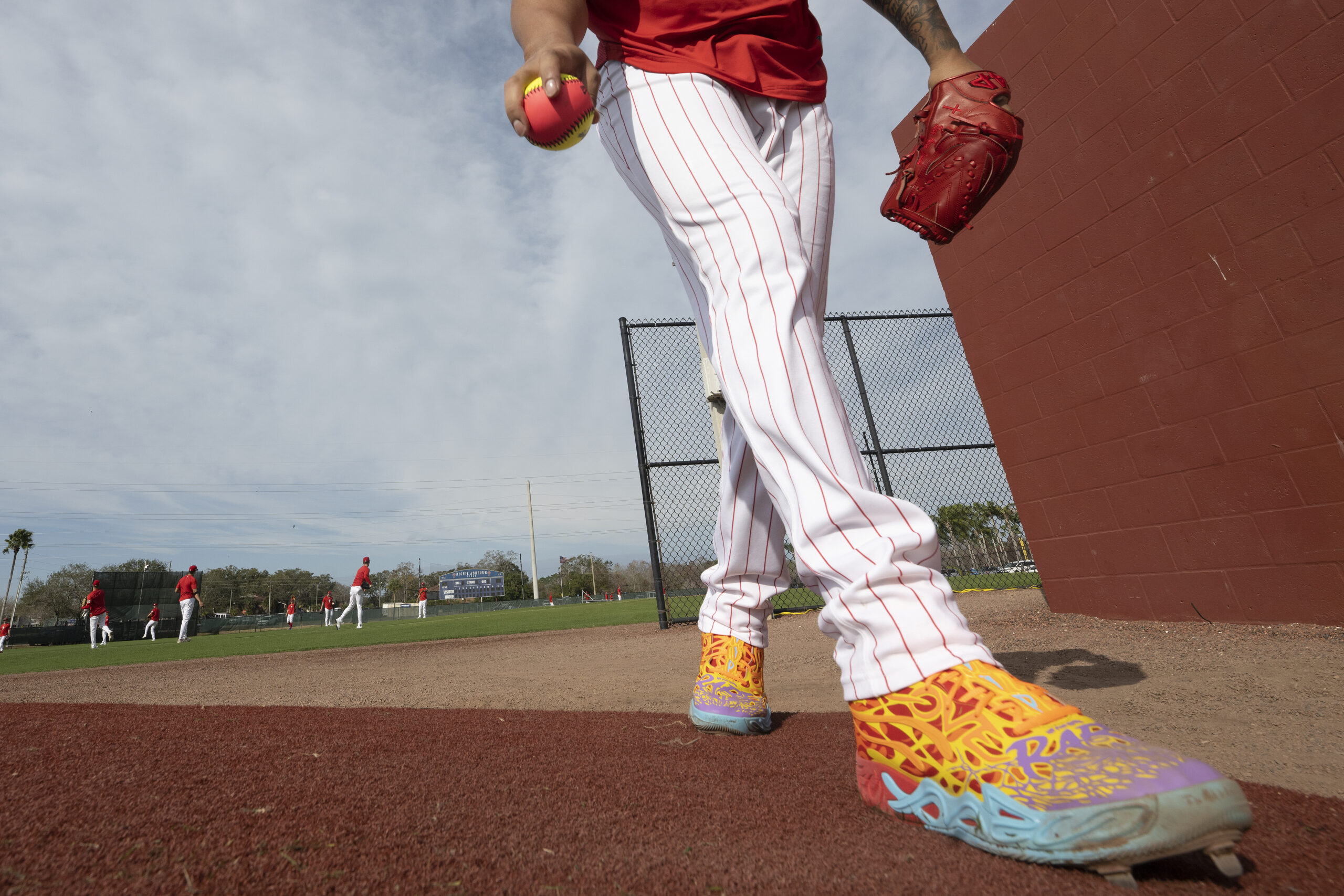
First baseman Bryce Harper (right) interacts with new Phillies bench coach Don Mattingly during the first full-squad workout on Monday. Phillies reliever Jose Alvarado goes through a workout on Saturday. Pitcher Taijuan Walker looks on during a spring training workout on Sunday. Hot feet: Closer Jhoan Duran walks off the mound after a bullpen session during spring training on Sunday.
You have to start there. It is the independent variable. You have to define it in order to solve the rest of the equation. You can’t have an opinion on how the Eagles should proceed with their All-Pro wide receiver if you don’t first have an opinion on what they should do without him.
Feel free to take as much time as you need. Just make sure that you don’t dwell too long on the internal options. Right now, there aren’t any.
Aside from DeVonta Smith, the Eagles have exactly two pass-catchers under contract who had a target for them last season. Darius Cooper and Britain Covey combined for 11 catches on 112 yards. Other than that, your options are limited to 2024 sixth-round pick Johnny Wilson, who missed last season with a knee injury. The tight end room doesn’t even have anyone to turn on the lights.
So … what’s the plan?
The draft is not a serious option. Not where the Eagles are picking, at least. Last year’s draft yielded 11 wide receivers and tight ends who played at least 50% of their team’s snaps. Four of those players were selected before pick No. 23. Five others played for the Titans, Browns or Jets. Maybe they’ll be in a position to draft this year’s Emeka Egbuka (No. 19 to the Bucs in 2024). But they could just as easily end up with this year’s Matthew Golden (No. 23 to the Packers). The best way to get yourself in trouble on draft day is to try to solve this year’s problems.
It isn’t outlandish to think Alabama wide receiver Germie Bernard might be capable of what Deebo Samuel did as a rookie when the 49ers drafted him in 2019.
That’s not to say they shouldn’t be looking. Nor that they won’t find some help. Alabama’s Germie Bernard would make a worthy target, even at No. 23. Whatever he measures at the combine, the game speed is there, as is the hybrid 6-foot-1, 204-pound frame. It isn’t outlandish to think he could do what Deebo Samuel did as a rookie after the 49ers drafted him at No. 36 overall in 2019: 57 catches, 802 yards, 14 carries, 159 yards. But to feel comfortable trading Brown, you need a lot more certainty than “isn’t outlandish.”
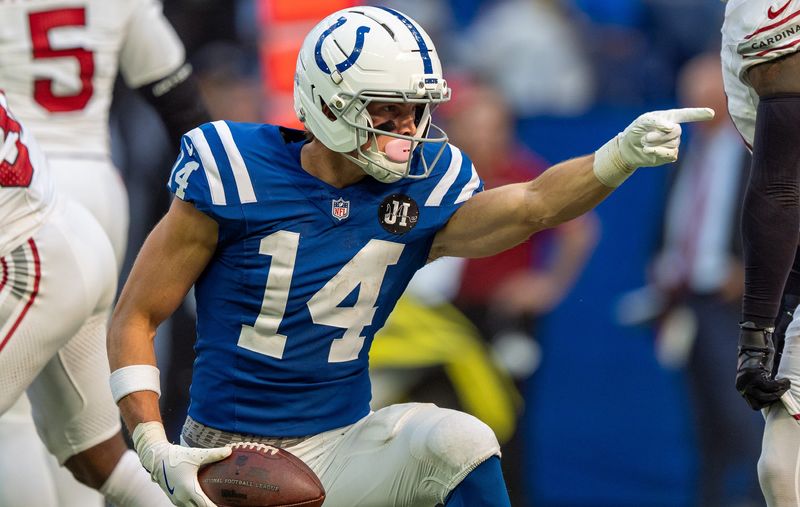
Free agents? Sure, let’s talk. Alec Pierce would be a no-brainer. At 25 years old, the Colts wideout caught 47 passes for 1,003 yards with Daniel Jones, Philip Rivers and Riley Leonard at quarterback. He isn’t anywhere close to Brown as a singular talent. Still, if you combine him with a draft pick like Bernard, he could be part of a radical and positive identity shift in both the short- and long-term.
Only one problem: The Eagles are one of 32 teams that can bid on free agents. A team like the Patriots can offer more cap room and a better quarterback and an acute need at the position. I’m skeptical the Eagles would win out.
The free agent crop is interesting even beyond Pierce and presumptive Cowboys franchisee George Pickens. Jauan Jennings and Mike Evans could replace some of Brown’s physicality in traffic and in 50/50 situations. Again, though, you have to wonder. Will players who have multiple options err on the side of a team with a run-heavy approach and Jalen Hurts at quarterback?
The conundrum is the same as it was three months ago, when the annual pre-trade-deadline nonsense reached its crescendo. The dream that the Eagles might part ways with their WR1 died in a head-first collision with reality. However disgruntled Brown was, however diminished his skills were, nobody else on the roster would have done enough in his stead to survive such a move. To suggest otherwise was to betray a fundamental misunderstanding of how this Eagles passing offense works. It would not have functioned without him.
Colts wide receiver Alec Pierce had his first 1,000-yard season with Daniel Jones, Philip Rivers, and Riley Leonard throwing to him.
True, the Eagles barely functioned with Brown. But that only matters if you think they should have given up on the season at the trade deadline. That’s what they would have been doing by trading Brown. Look at their track record without him. Brown missed four (meaningful) games in his first three seasons with the Eagles. The Eagles lost three of them, and they scored 15 points in the game that they won. In 2025, the Eagles scored 38 points against the Giants without Brown. They also threw the ball 20 times. Smith was the only wide receiver to catch more than one of them.
Plenty of NFL teams have managed to win without two WR1 types. But we’ve never seen Hurts have to do it. Right now, the Eagles don’t even have a WR2 who is better than replacement level. Keep in mind, the Eagles already have a hugely pressing need at tight end. They could need to spend big bucks to retain Jaelan Phillips, or to sign a replacement. In the draft, they will be hard-pressed to turn down an opportunity to add another offensive lineman to their feeder system.
The preponderance of the circumstances says the Eagles probably shouldn’t trade Brown. Life would be a lot easier if they didn’t need to. The onus is on the case for how they can do so and survive. If you can make one, I’m sure they’d love to hear it.
After the drama of the U.S. women’s ice hockey team’s come-from-behind win in the gold medal game Thursday, the spotlight now shifts to the men’s tournament for the rest of the Olympics.
The quality of the United States’ 2-1 overtime win over Sweden in Wednesday’s quarterfinals, and the other three games that day, showed why it’s so great to have NHL players back on the big stage.
On Friday, the tension will rise even more. The Americans will face a Slovakia squad that has just seven NHL players but topped a group with Sweden and Finland and routed Germany in the quarterfinals, 6-2.
The San Jose Sharks’ Pavol Regenda scored twice, and Flyers fans might recognize a few names from rival NHL teams: New Jersey’s Šimon Nemec, Washington’s Martin Fehérváry, and Montreal’s Juraj Slafkovský.
NBC will carry the U.S.-Slovakia game live at 3:10 p.m. Philadelphia time. USA Network will have the other semifinal, a star-studded Canada-Finland matchup, joining it in progress at 11:50 a.m. It starts at 10:40 a.m., with the entire game streamed on Peacock.
Other big events Friday include a U.S.-Switzerland women’s curling semifinal, starting at 8 a.m. on Peacock. USA will join it in progress at 8:45. It’s the first time that a U.S. women’s curling team has made an Olympic semifinal in 24 years — and this group includes a Delaware County native, Broomall’s Taylor Anderson-Heide.
There’s also women’s speedskating’s 1,500 meters. The United States’ Brittany Bowe will hope to challenge Dutch star Femke Kok, who won gold in the 500 meters and silver in the 1,000. Bowe might also hope for a little stardust from her new fiancée, U.S. women’s hockey star Hilary Knight, after Knight popped the question in Milan earlier this week.
As a general rule, our schedules include all live broadcasts on TV, but not tape-delayed broadcasts on cable channels. We’ll let you know what’s on NBC’s broadcasts, whether live or not.
NBC
Noon: Bobsled — Two-woman first run
12:15 p.m.: Freestyle skiing — Men’s aerials final (tape-delayed)
NBC’s TV coverage will have live events from noon to 5 p.m. Philadelphia time on weekdays and starting in the mornings on the weekends. There’s a six-hour time difference between Italy and here. The traditional prime-time coverage will have highlights of the day and storytelling features.
As far as the TV channels, the Olympics are airing on NBC, USA, CNBC, and NBCSN. Spanish coverage can be found on Telemundo and Universo.
NBCSN is carrying the Gold Zone whip-around show that was so popular during the Summer Olympics in 2024, with hosts including Scott Hanson of NFL RedZone. It used to be just on Peacock, NBC’s online streaming service, but now is on TV, too.
Every event is available to stream live on NBCOlympics.com and the NBC Sports app. You’ll have to log in with your pay-TV provider, whether cable, satellite, or streaming platforms including YouTube TV, FuboTV, and Sling TV.
On Peacock, the events are on the platform’s premium subscription tier, which starts at $10.99 per month or $109.99 per year.
A high-stakes fight is brewing between President Donald Trump’s administration and states such as Pennsylvania and New Jersey over the regulation of prediction markets, the online platforms that allow users to wager on everything from sports and elections to the weather.
States that have legalized sports betting in recent years say prediction markets amount to unauthorized gambling, putting consumers at risk and threatening tax revenues generated by regulated entities like casinos.
But the Trump administration this week said the federal government was the appropriate regulator, siding with the industry’s argument that the markets’ “event contracts” are financial derivatives that allow investors to hedge against risks.
The chair of the federal Commodity Futures Trading Commission on Tuesday said the CFTChad filed a brief in federal court to “defend its exclusive jurisdiction” to oversee these markets, amid litigation between state governments and platforms such as Kalshi and Polymarket.
Prediction markets “provide useful functions for society by allowing everyday Americans to hedge commercial risks like increases in temperature and energy price spikes,” CFTC Chairman Mike Selig said in a video posted on X.
New Jersey collected more than $880 million in gaming tax revenues last year, while Pennsylvania brought in almost $3 billion, according to regulators. The revenues fund property tax relief programs and the horse racing industry, as well as programs for senior citizens and disabled residents.
Pennsylvania’s gaming regulator has previously warned that prediction markets risk “creating a backdoor to legalized sports betting,” without strict oversight.
The state Gaming Control Board’s Office of Chief Counsel told The Inquirer Wednesday that it sees a distinction between certain futures markets — like those for agricultural commodities, which have long been regulated by the CFTC — and “event contracts” tied to “the outcome of a random Wednesday night NBA basketball game.”
Representatives for Gov. Josh Shapiro of Pennsylvania and Gov. Mikie Sherrill of New Jersey, both Democrats, didn’t respond to requests for comment.
But former New Jersey Gov. Chris Christie — a Republican who worked to legalize sports betting while in office and who’s now advising the American Gaming Association — said Tuesday on X that the Trump administration is trying to “grow the size of the federal government & their own power while trying to crush states rights and take advantage of our citizens.”
Beyond the courts, the GOP-led Congress could also choose to step in. Some Republican lawmakers have expressed concerns about a “Wild West” in prediction markets, notwithstanding Trump’s support for the industry.
Sen. Dave McCormick (R., Pa.) welcomed the CFTC’s announcement, writing on X that prediction markets “offer tremendous benefits to consumers and businesses.”
“A consistent, uniform framework for derivatives is essential to supporting U.S. markets,” he said.
The CFTC’s action means the federal government is backing an industry in which the Trump family has a financial stake. The agency’s brief supports Crypto.com, a platform that last year partnered with the Trump family’s social media company to launch a prediction market.
Ethics experts have said the Trump family’s ties to Crypto.com create a conflict of interest. The White House denies that and says the president’s holdings are in a trust controlled by his children.
Winding through courts
The U.S. Supreme Court in 2018 struck down a federal law that prohibited sports betting in most states, paving the way for states to legalize it. Pennsylvania and New Jersey both enacted laws authorizing sports gambling and imposing requirements on betting operators such as taxation on gaming revenues, consumer protection rules, and licensing fees.
Despite state laws, prediction markets now operate nationwide — even in states that prohibit gambling altogether, like Utah.
New York-based Kalshi launched its platform in 2021. The CFTC initially opposed Kalshi’s election-related contracts, but in the fall of 2024 the company won a case in which courts found the regulator failed to show how the platform’s “event contracts” would harm the public interest. Kalshi users proceeded to trade more than $500 million on the “Who will win the Presidential Election?” market.
Then came sports contracts. In January 2025, following the CFTC’s protocols, Kalshi “self-certified” that its contracts tied to the outcome of sports games complied with relevant laws.
The company has since offered event contracts on everything from the Super Bowl to Olympic Male Curling. Some established sportsbooks like Fanatics and DraftKings have also jumped into prediction markets.
States have tried to intervene. In March, New Jersey’s gaming regulator ordered Kalshi to cease and desist operations in the Garden State, alleging the company issued unauthorized sports wagers in violation of the law and state Constitution.
Kalshi filed a lawsuit, and a federal court issued an injunction prohibiting New Jersey from pursuing enforcement actions. Kalshi and other platforms have filed suits against other states, and courts have issued conflicting rulings.
The CFTC said it filed a brief in one such suit this week.
“To those who seek to challenge our authority in this space, let me be clear: we’ll see you in court,” Selig, the Trump-appointed CFTC chairman, said Tuesday.
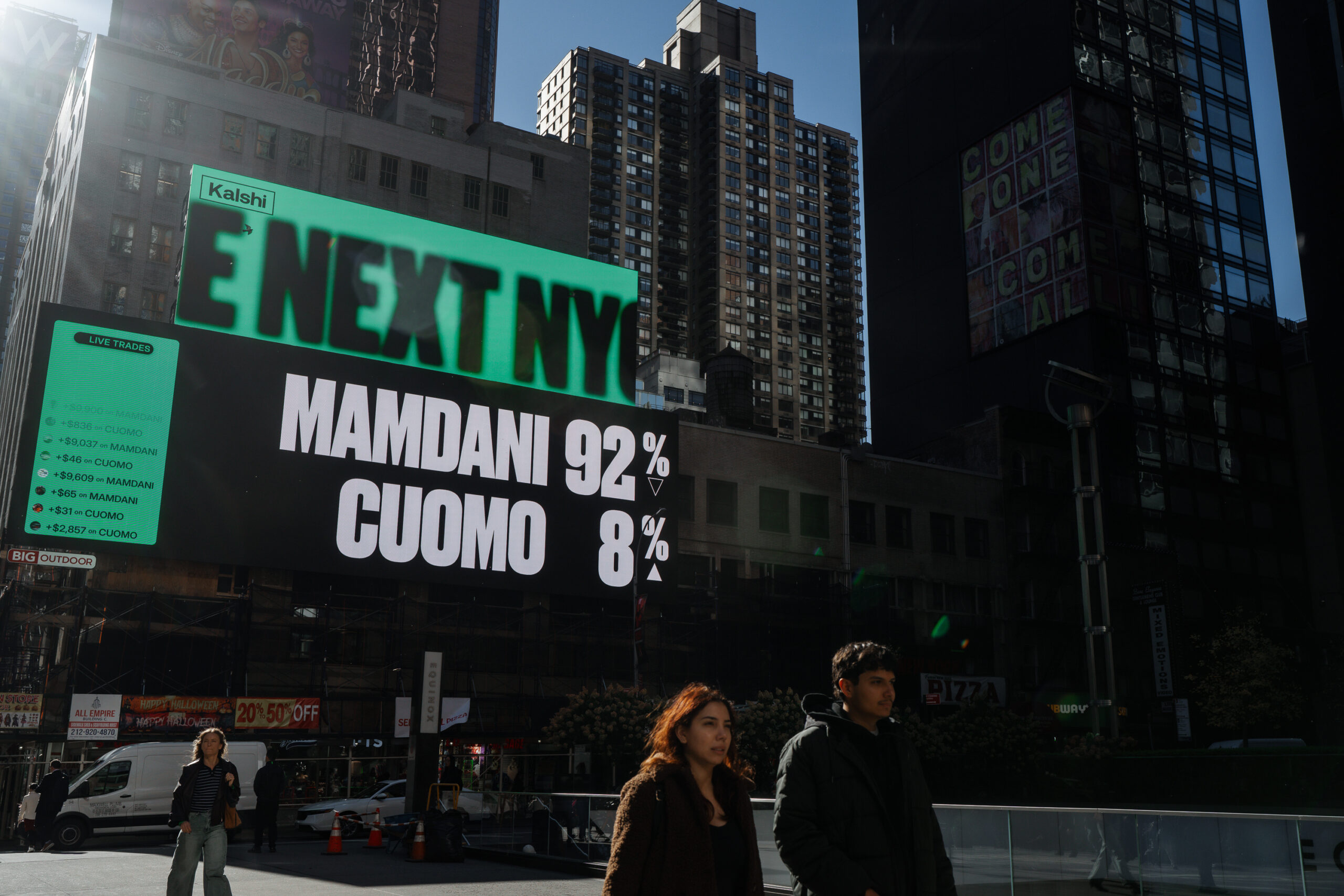
Advertisements by the company Kalshi predict a victory for Zohran Mamdani in the New York City mayoral election before the votes are counted and polls close, Tuesday, Nov. 4, 2025, in New York.
‘Event contracts’
At issue is whether the “event contracts” offered by prediction markets amount to gambling — regulated by states — or, as Selig says, financial instruments “that allow two parties to speculate on future market conditions without owning the underlying asset.”
Platforms like Kalshi say they are similar to stock exchanges, where people on both sides of a trade can meet — and therefore subject to federal regulation of commodities. Unlike a casino, the platforms say, they don’t win when customers lose.
Pennsylvania regulators see it differently.
The state Gaming Control Board told The Inquirer Wednesday that it takes issue with “‘prediction markets’ allowing any consumer, age 18 years old or older, to purchase a ‘contract’ on any potential future event occurring, even when that event does not have any broad economic impact or consequence, such as the outcome of a random Wednesday night NBA basketball game.”
(Under Pennsylvania law, gambling is limited to those who are 21 or older.)
“The Board believes that is not what the Commodities Exchange Act contemplated when it was enacted by Congress and established the CFTC and is, in fact, gambling,” the board’s Office of Chief Counsel said in a statement.
If the courts side with the Trump administration, states worry that tax revenues from regulated sportsbooks would fall and customers would be vulnerable to markets they say are easily exploited by insiders.
“If prediction markets successfully carve themselves out of the ‘gaming’ definition, they risk creating a parallel wagering ecosystem where bets on sports outcomes occur with significantly less oversight regarding potential match-fixing,” Kevin F. O’Toole, executive director of the Pennsylvania Gaming Control Board, wrote in an October letter to the state’s congressional delegation.
For example, the gaming board has the ability to penalize licensed operators if they violate state regulations, O’Toole wrote, “something that an operator who ‘self-certifies’ their contracts/wagers [under CFTC rules] would never be subjected to.”
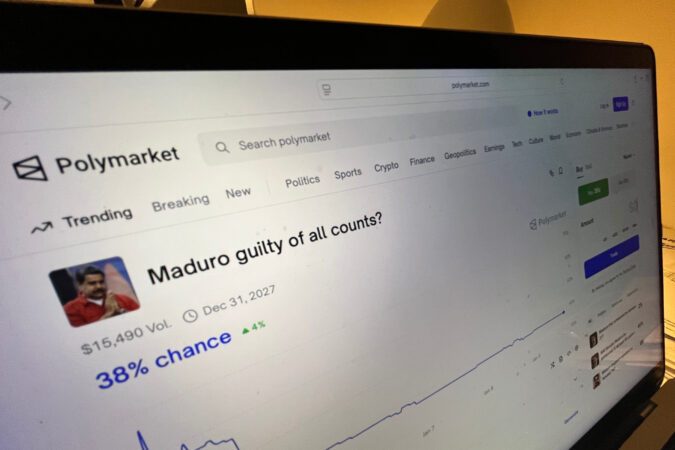
O’Toole said the board’s regulatory role in this area is limited to sports wagering, but he added that markets on non-sports related events — he cited examples from Polymarket such as whether there will be a civil war in the United States this year — are equally “if not more troubling.”
The CFTC says it is capable of overseeing the industry. “America is home to the most liquid and vibrant financial markets in the world because our regulators take seriously their obligation to police fraud and institute appropriate investor safeguards,” Selig wrote in a Wall Street Journal opinion piece this week.
As I write this column, that’s Philadelphia’s total number of homicides for the year so far. It is a 50% decrease from this time in 2025, and a stunning 79% drop from the pandemic-era spike in violence. While it is much too early to make projections, and snowy and freezing weather the last few weeks undoubtedly played a role in keeping people indoors, the decline is genuinely remarkable. Especially when it is accompanied by a similar decline in shooting victims, and double-digit declines in overall violent and property crimes.
In fact, on a per-capita basis, Philadelphia’s homicide rate is currently not that different from Bucks County’s.
Given the city just notched its safest year since the 1960s, this progress is exciting. So far, no one has an explanation for why homicide is declining. It may simply be a national trend back to normalcy. If so, it is time to extend it to more parts of life.
Killings may be down, but homelessness is rising. SEPTA’s Metro system is still overrun with smokers. And the melting snow has revealed that much of the city is covered in too much everyday grime.
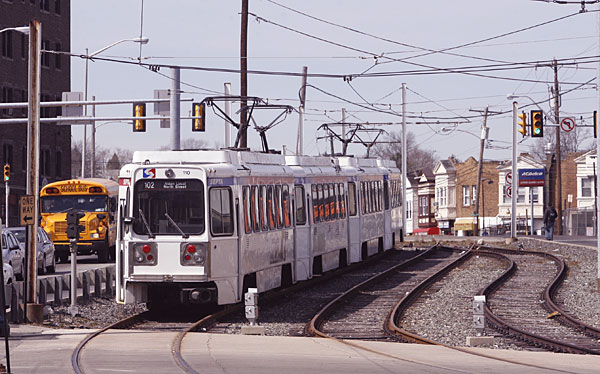
A Sharon Hill trolley — now known as the D2 — on a low-speed section of track near the 69th Street Transportation Center in Upper Darby. The route, along with its counterpart, the D1, or Media trolley, will have longer trips next week after a safety upgrade to the signal system.
15
That’s how many additional minutes trolley trips to Media could take after implementing something called “communications-based train control” at a cost of $75 million. This system takes away discretion from operators, resulting in slower acceleration, longer braking periods, and slower overall speeds. SEPTA says a similar installation on its Regional Rail system also led to initial delays, but those challenges were overcome in time.
There’s a better solution. SEPTA should restore the gate system that was removed back in 2009. This would eliminate many of the needed slowdowns.
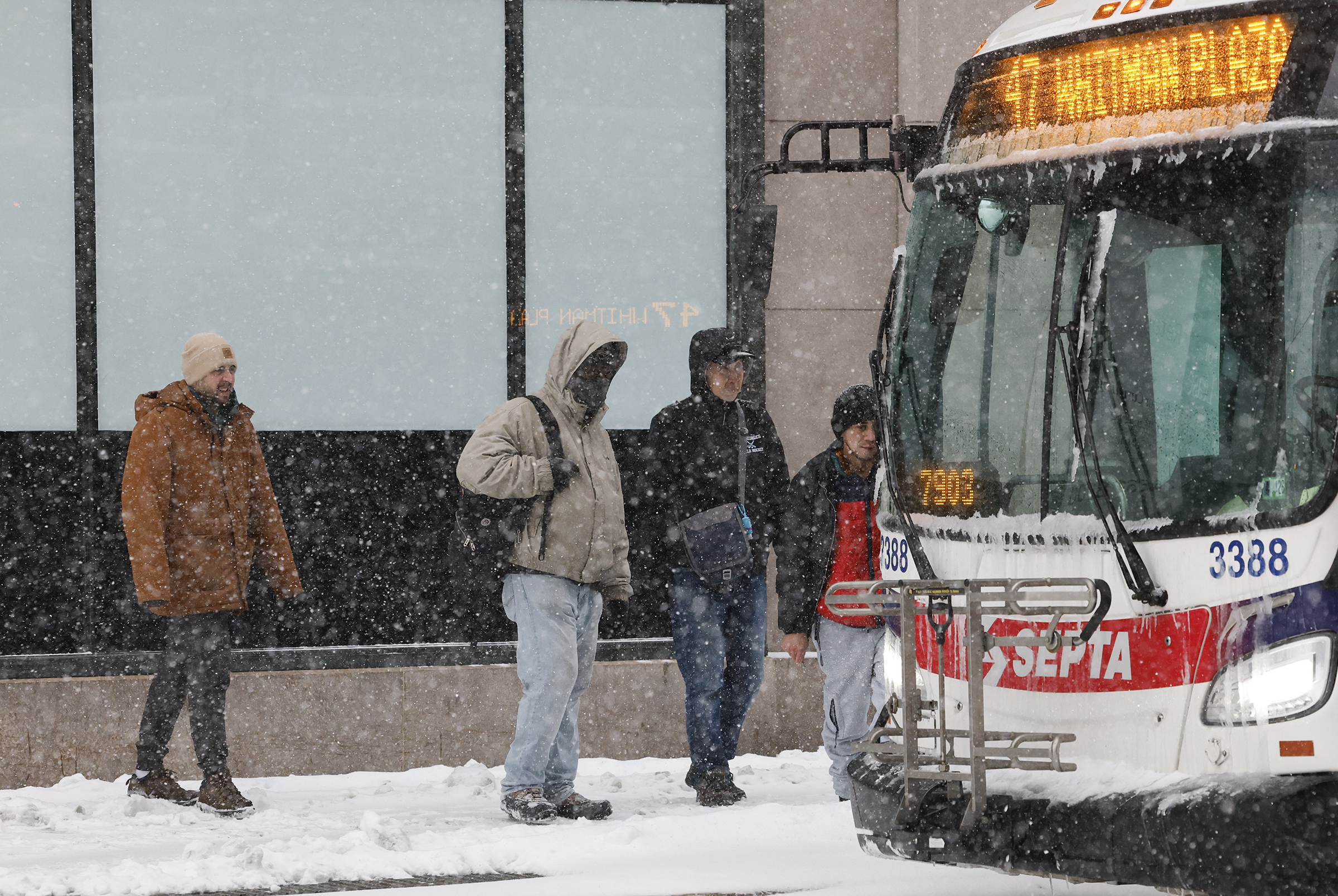
SEPTA riders board the Route 47 bus at Eighth and Market Streets in January.
714,475
That’s how many daily rides SEPTA provided on average last month, an increase of 1% over 2025. Given the struggles the agency went through last year, the fact that ridership continues to grow is remarkable.
In August, SEPTA scaled back overall service by 20%, before reversing the cuts weeks later under court order — and after a gubernatorial funds transfer. State Senate Majority Leader Joe Pittman essentially called the agency (and our entire region) a bunch of greedy moochers and blocked a plan for sustainable support.
The Regional Rail network was severely curtailed for months because of aging, exploding train cars. The Center City trolley tunnel was closed for weeks because of maintenance issues. In January, a brutal winter storm made getting to — and on — the bus a struggle. And yet, ridership grew.
In fact, since the pandemic, SEPTA has routinely been one of America’s strongest transit agencies when it comes to ridership growth. Given there have been zero additional dollars invested in operations for years, the system’s resilience may prove that Philadelphians need mass transit so badly that they’re willing to keep riding through the chaos.
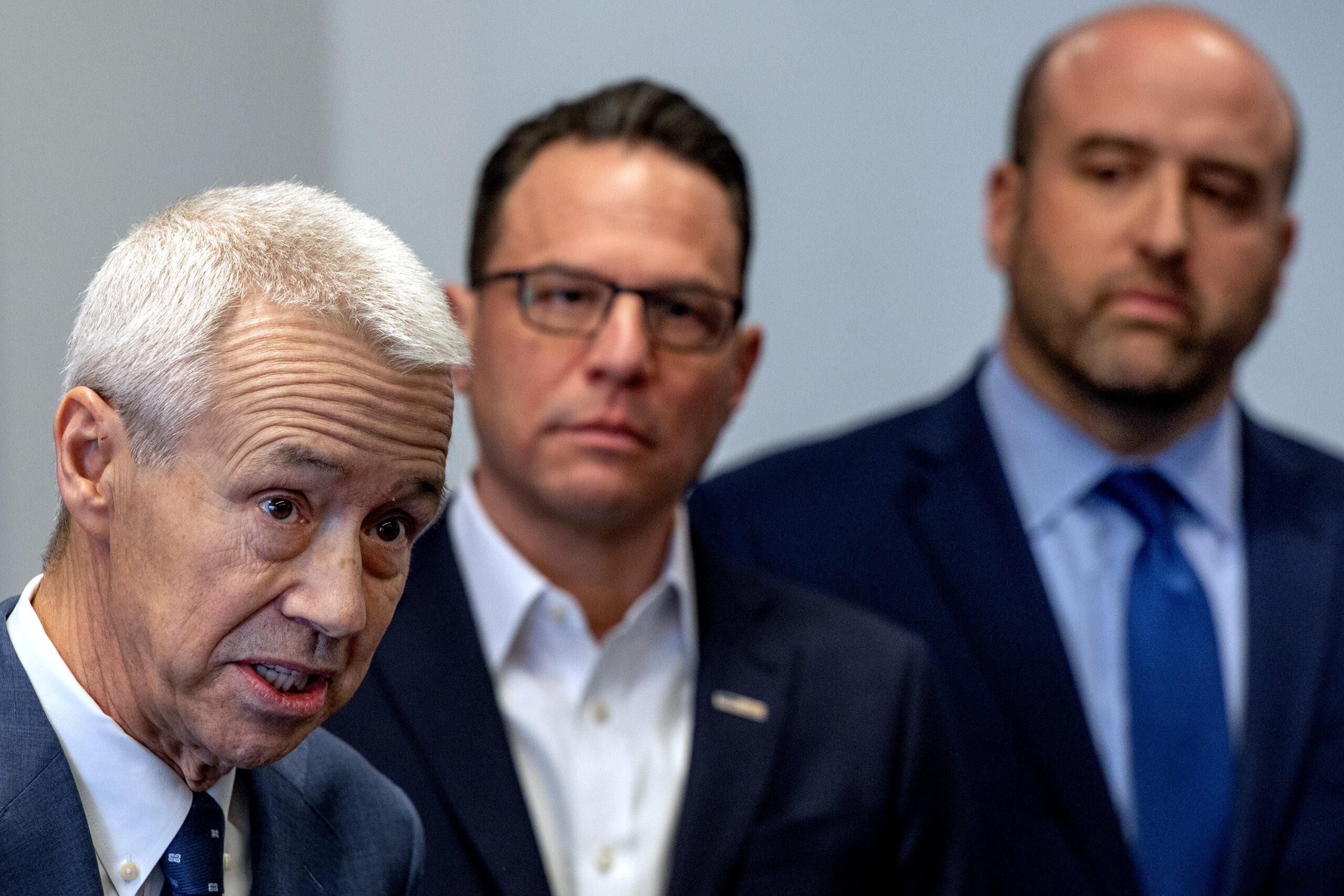
From left, Joaquin Duato, J&J chairman and CEO, is with Gov. Josh Shapiro and Pennsylvania Department of Community and Economic Development Secretary Rick Siger on Wednesday after Johnson & Johnson announced it will spend $1 billion on a cell therapy plant on its campus in Lower Gwynedd Township.
5.5
That’s how much investment, in billions of dollars from pharmaceutical companies, is coming to Eastern Pennsylvania, according to Gov. Josh Shapiro. While this is great news for the Keystone State, it’s hard to avoid noticing that none of these investments are coming to Philadelphia itself. Neither is Merck’s $1 billion new biotech center, which is being built in Delaware. Given our city’s status as a hub for eds and meds — with multiple colleges and medical schools, and a high concentration of skilled workers — this is disappointing.
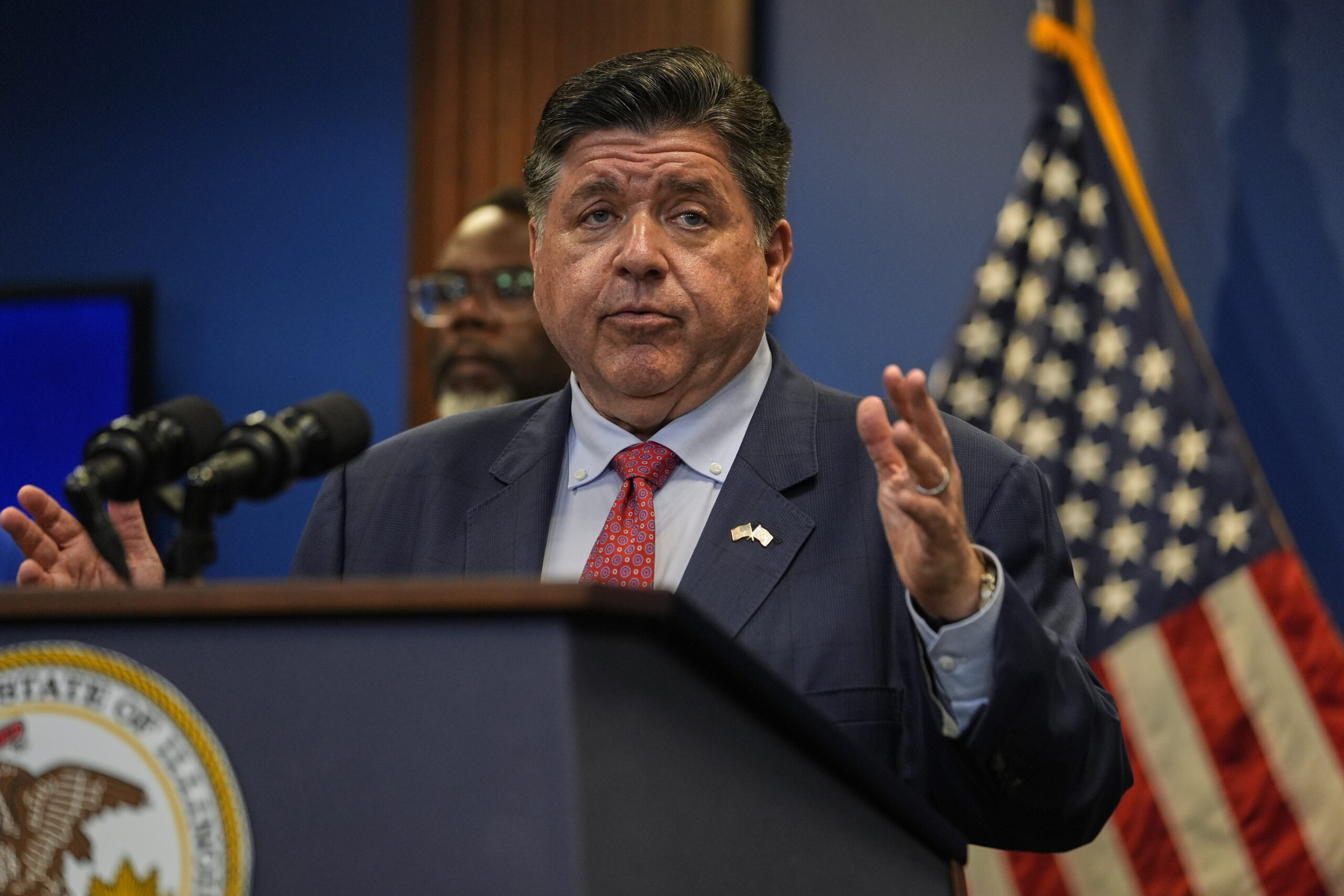
Illinois Gov. JB Pritzker speaks during a news conference in Chicago in 2025.
150
That figure, also in billions of dollars, is how much economic growth Pennsylvania needs in order to bridge the deficit without raising taxes or cutting services, according to an analysis by Athan Koutsiouroumbas, managing director of the Harrisburg-based lobbying and consulting firm Long Nyquist.
The easiest way to accomplish this is by being bolder on housing policy. As Shapiro has pointed out, Pennsylvania is currently 44th in the nation when it comes to new housing production. Unfortunately, current plans aren’t bold enough to meet the moment. They lack the significant forays into statewide zoning standards that have been embraced by figures like Illinois Gov. JB Pritzker. Shapiro likes to say he’s tired of losing to “frigging Ohio,” but without a more audacious approach to housing policy, he may have to add “frigging Illinois” to the list of states eating our lunch.
Philadelphia’s economy grew faster than Atlanta, Dallas, Denver, and Phoenix.
13.6
If we’re being optimistic, let’s call it almost 14%. That’s how much job growth Philadelphia has experienced since 2020. That’s better than the 11.7% average for the nation’s 25 most populous counties. It is better than the collar counties, and puts Philadelphia ahead of Montgomery County in office employment for the first time in decades.
Still, economist Mark Zandiurges caution. In the pages of The Inquirer, he points out that much of this has to do with the fact that the national economy is struggling. Given the city has lagged on growth for decades, even incremental steps forward may look more significant here than elsewhere.
There’s also the fact that much of this growth is in relatively low-paid work, rather than the high-wage “tradeable industries” the city needs to escape decades of economic stagnation.
Simply put, while working as a home health aide and working in a drone factory both put food on the table, only the latter helps make the regional economy healthier.
CLEARWATER, Fla. — On the eve of spring training games, an annual reminder: They don’t count.
Not really. Stats are kept, but mostly as a formality. Hits don’t carry over into the season. Strikeouts are little more than a sugar rush for a pitcher. Win some, lose some, even tie some, and everyone’s record resets on March 25.
What do you do, then, if you’re Dylan Moore? A veteran of seven major league seasons, the 33-year-old utility man must have a good camp to make the Phillies’ opening-day roster after signing a minor-league contract 17 days ago.
Try telling him Grapefruit League games aren’t really real.
“To make an impression, you’ve got to be able to take it seriously and play it like it’s a game that’s meaningful,” Moore said Thursday after facing pitchers in live batting practice. “Because it is, you know? You want to see where you’re at, which is why you never want to go less than [full effort] just because it doesn’t matter. But yeah, it’s a balancing act.”
The Phillies will play 30 spring training games, including a March 4 exhibition against Canada’s entry in the World Baseball Classic. That’s a lot of faux innings for a team that has few jobs up for grabs.
Here, then, is an attempt to answer a few roster questions entering Saturday’s opener against the Blue Jays in neighboring Dunedin, based on reporting from the first eight days of camp:
Andrew Painter is a leading candidate to occupy a spot in the Phillies’ season-opening starting rotation.
Who will take the fifth (starter spot)?
Zack Wheeler played catch from 120 feet the other day and is scheduled to do so again Friday while incorporating more spin on the ball. The Phillies haven’t said when he will progress to a mound.
But nothing has changed. Five months after having a rib removed to relieve pressure on a vein that was compressed between his collarbone and rib cage, Wheeler won’t be ready to start the season on time, which creates a vacancy in the starting rotation.
Upon returning from the World Baseball Classic, Cristopher Sánchez (Dominican Republic), Aaron Nola (Italy), and Taijuan Walker (Mexico) will join Jesús Luzardo in the starting rotation. Nobody will say it, but the last spot is Andrew Painter’s to lose.
Painter didn’t pitch in 2023 or ’24 because of a torn elbow ligament that necessitated Tommy John surgery. But after a healthy, 118-inning season in the minors, most of which came in triple A, he’s unburdened by usage restrictions this spring.
Ideally, the Phillies want Painter to not only earn his spot but also to keep it once Wheeler returns. Either way, it’s time for the 22-year-old (turning 23 in April) to step forward.
“Obviously Painter had a tough year in triple A,” Bryce Harper said, referring to a 5.40 ERA in 22 starts. “That first year coming back from Tommy John is really tough. I’m hoping he bounces back this year. We need him to.”
Lefty reliever Kyle Backhus has a chance to win a spot in the bullpen after coming over in a trade with the Diamondbacks.
How does the bullpen shape up?
Get to know this name: Kyle Backhus.
The Phillies acquired Backhus from the Diamondbacks for a minor-league outfielder on the same day in December that they sent Matt Strahm to the Royals for reliever Jonathan Bowlan. Backhus has minor league options, but Thomson mentioned him last month as a bullpen candidate.
And the hitters, including Trea Turner, who faced Backhus in live batting practice Thursday were impressed with the sidearming lefty, who had a 4.62 ERA in 32 games last season for Arizona.
“They said he was tough to pick up,” Thomson said. “He starts from the third base side. He’s a crossfire guy. It’s a really low slot, so you don’t see that. It’s tough, really tough to pick up.”
The Phillies haven’t had a lefty reliever with such a low arm slot in years. Thomson would like a third lefty in the bullpen, although he said it isn’t a necessity. Backhus would fit in behind José Alvarado and Tanner Banks.
Orion Kerkering has been slowed in camp by a hamstring injury. But health permitting, closer Jhoan Duran, Brad Keller, Alvarado, Kerkering, Banks, and Bowlan have seats in the bullpen.
That leaves two spots for a pool of candidates, including Rule 5 pick Zach McCambley and out-of-options righty Zach Pop. Veteran lefty Tim Mayza and righty Lou Trivino are also in camp as nonroster invitees.
But Backhus might have the early inside track.
“Backhus is a completely different look for people,“ Thomson said. ”You want good stuff, you want strikes, but when you have different looks like that, it makes it a lot better.”
Johan Rojas could make the Phillies’ roster as a reserve outfielder.
Who gets the last bench spot?
All the health-related caveats apply, but the opening-day lineup appears set: J.T. Realmuto (catcher), Harper (first base), Bryson Stott (second base), Turner (shortstop), Alec Bohm (third base), Brandon Marsh (left field), rookie Justin Crawford (center field), Adolis García (right field), and Kyle Schwarber (designated hitter).
Edmundo Sosa and Otto Kemp are expected to claim seats on the bench, with another going to incumbent backup catcher Rafael Marchán or veteran Garrett Stubbs.
Johan Rojas would provide speed on the bases and elite outfield defense, although the latter is less important without Nick Castellanos in right field. Marsh, Crawford, and García are all solid defenders. Also, Rojas has minor-league options and might benefit from everyday at-bats in triple A.
Veteran outfielder Bryan De La Cruz has 58 career major league homers, seven of which came against the Phillies. De La Cruz and Pedro Leon are intriguing right-handed bats, but Sosa and Kemp bat from the right side. And as outfielders, De La Cruz and Leon lack positional versatility.
And then there’s Moore, who has played everywhere except catcher and won a Gold Glove as a utility man for the Mariners in 2023. He said he signed with the Phillies to work with hitting coach Kevin Long. But he also recognized an opportunity.
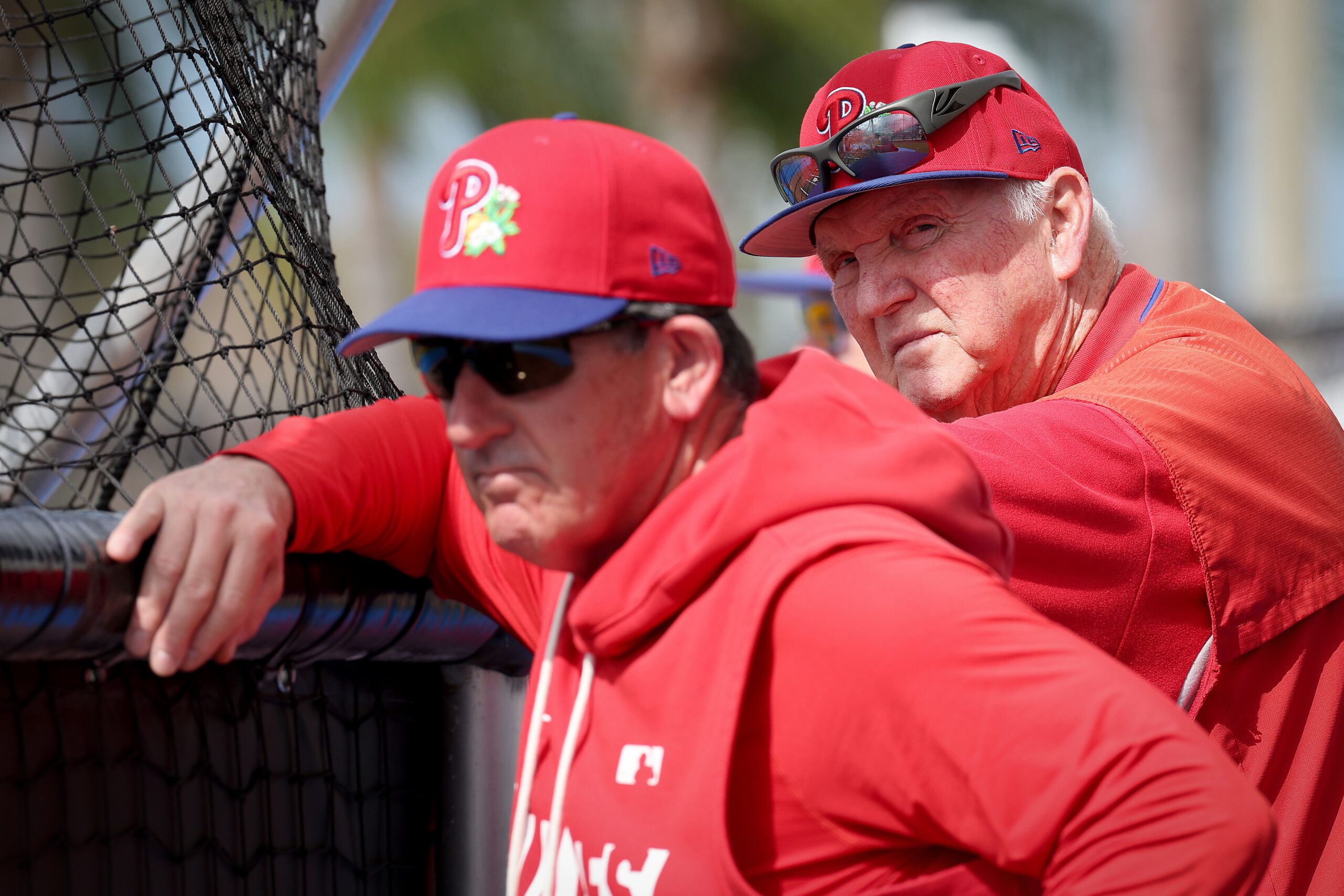
Phillies manager Rob Thomson (left), with Charlie Manuel during batting practice on Thursday, has one spot to fill for a bench player.
“In past experience, having two utility guys — one who’s more depth to infield and one who’s more depth to outfield — is huge,“ Moore said. ”A guy that can do both is great. Sosa plays an awesome infield everywhere you put him, so maybe I could be more of the outfield guy.
“This has been my career in a nutshell — play some, play not so much, and just stay ready. I feel like I’ve gotten pretty good at it, and I still have more in me.”
With Harper, Schwarber, Sosa, and Rojas away at the WBC next month, there will be ample opportunity for Moore to prove it.
The Flyers and Penn Medicine have partnered up to donate 13,750 pounds of food, which accounts for over 9,000 meals, so far this season as part of their Penn Medicine Assist program.
The initiative, which started during the 2023-24 season, donates 50 pounds of food to local hunger-relief organization Philabundance for every Flyers assist — increasing last year’s amount by 20 pounds per assist. So far, the Flyers have tallied 275 assists.
“We needed to do more, plain and simple,” said Todd Glickman, the chief revenue and business officer for Comcast Spectacor. “We felt like we needed to do more and give more because food insecurity is such a big thing in the region. It was important to Penn Medicine and it was important to us. And it was an easy thing to do.”
The program’s numbers continue to grow each year. During the 2023-24 season, the Flyers’ 396 assists donated 11,880 pounds of food. The following year, the Flyers’ 403 assists donated 12,090 pounds of food — making it over 37,000 pounds of food, and over 25,000 meals, that have been donated over the last three years.
“I think we’ll see the numbers go up significantly from last year just by increasing the amount by 20 pounds per assist,” said Lori Gustave, the chief strategy officer of Penn Medicine. “I personally hope they get a lot of assists so that we can donate a lot of food.”
The initiative will benefit Philabundance, which has been operating for 41 years, growing across two states in nine counties, with the mission to bridge the gap between a surplus of food and those in the community struggling with food insecurity.
The foundation started from the back of Pam Rainey Lawler’s Subaru in 1984. Since then, it has grown tremendously — delivering over 40 million pounds of food to the community over the past year.
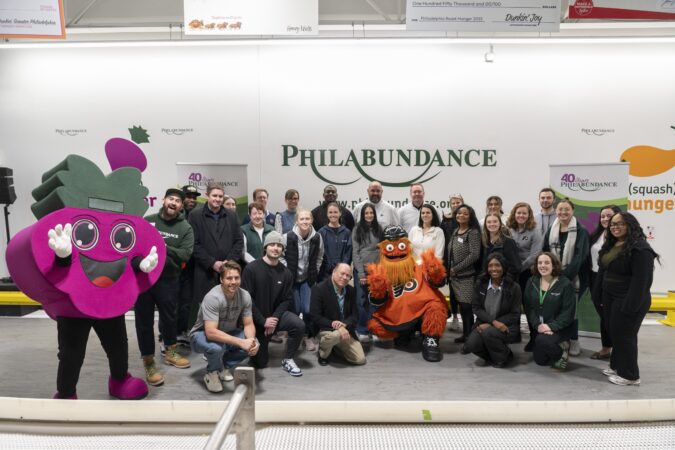
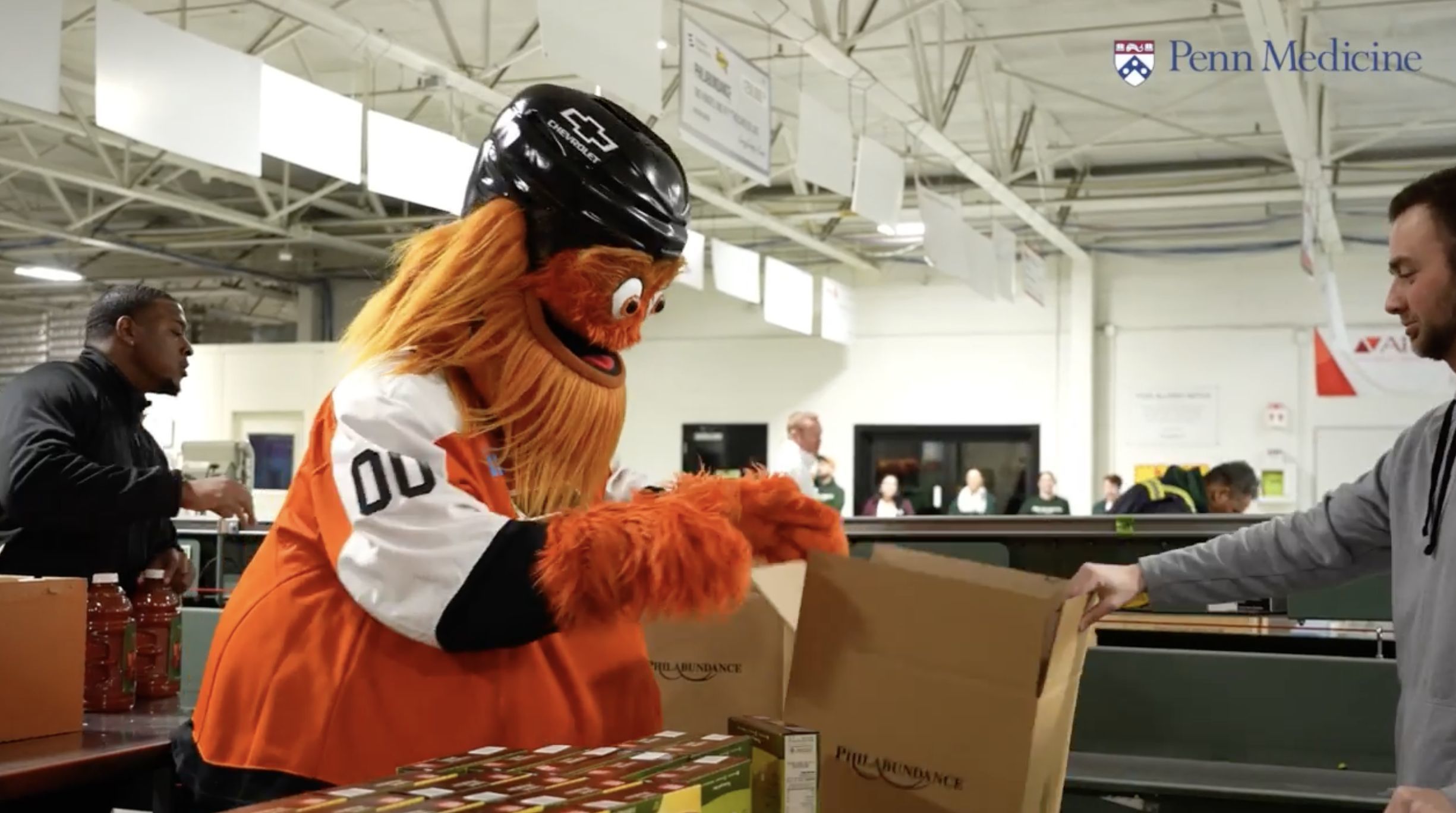
Gritty at Philabundance last year, packing some of the meals donated from the Penn Medicine Assist program.
“Of the nine counties, which includes Philadelphia, there are approximately 700,000 neighbors that are food insecure,” said Amy Galette, the director of corporate relations at Philabundance. “If you think about the amount of people we serve a week, it’s enough to fill five stadiums full during Flyers games. It’d be like selling out five Flyers games per week.”
As part of last year’s Penn Medicine Assist program, Gritty and some of the Flyers players, including Jamie Drysdale and Bobby Brink, joined the assembly line at Philabundance to help package some of the meals.
“It was fun,” Brink said. “I mean it was nice to get a little day-in-the-life kind of vibe and help out. The environment was great, a lot of great people, and it’s always nice just giving a few hours to help.”
Drysdale added: “We are very fortunate to be in this position that we’re in. And I don’t think it takes a lot for us to give a few hours wherever we can to kind of help out and just show some love back to the community that treats us so well.”