Tag: U.S. men’s soccer team

  • Philly is one step closer to knowing the World Cup nations headed to the Linc next summer

    Philly is one step closer to knowing the World Cup nations headed to the Linc next summer

    WASHINGTON — We’re one step closer in learning which teams will head to Philly ahead of next summer’s FIFA World Cup.

    A packed house inside the Kennedy Center featuring world leaders, celebrities, and the delegations of over 40 nations watched as their countries were pulled from pots and slotted into 12 groups in FIFA’s expanded 48 team tournament.

    Lincoln Financial Field is scheduled to host six matches, five in the group stage of the tournament and a Round of 16 game on July 4. Those early-round matches will be in Groups C, E, I, and L.

    window.addEventListener(“message”,function(a){if(void 0!==a.data[“datawrapper-height”]){var e=document.querySelectorAll(“iframe”);for(var t in a.data[“datawrapper-height”])for(var r,i=0;r=e[i];i++)if(r.contentWindow===a.source){var d=a.data[“datawrapper-height”][t]+”px”;r.style.height=d}}});

    The four nations in Group C were Brazil, Morocco, Haiti, and Scotland.

    Brazil, which earned its qualification following a win over Paraguay on June 10, kept its streak of qualifying for every World Cup intact. We certainly learned that Morocco, which qualified in September, brings the party, evidenced by the fanfare brought to Philly by fans of the country’s Wydad AC in this summer’s Club World Cup.

    “We’re incredibly excited about the potential for what the match schedule is going to be,” said Meg Kane, host city executive for FIFA Philly 2026, which is coordinating the events in Philadelphia next summer. “I think as we look at the four groups that have the potential of coming through Philadelphia, there are some big name teams, [like] Brazil and Morocco. We got to experience their fans last summer during Club World Cup. We would welcome them back, and I think [fans would] really lean into the excitement of that.”
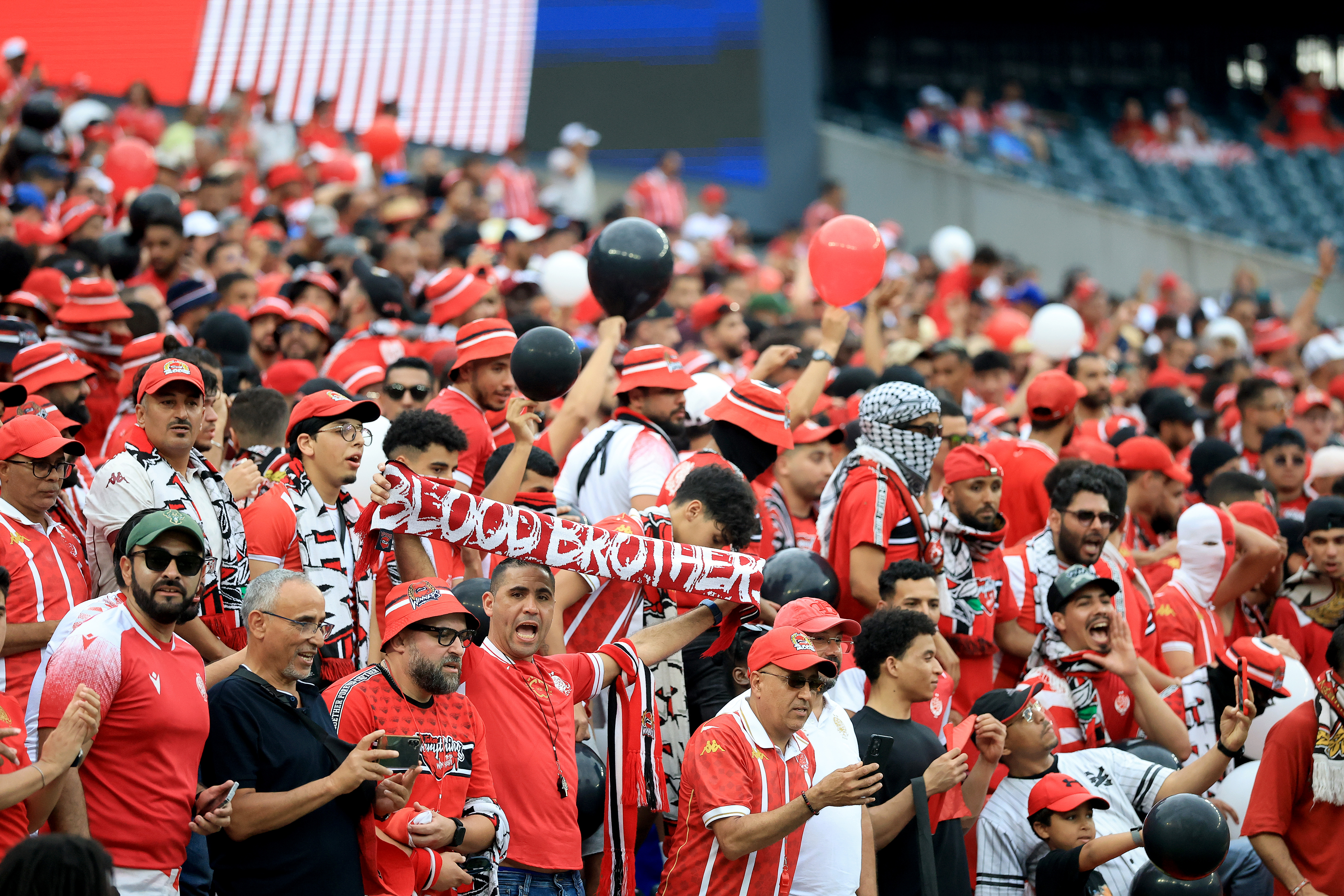
    Moroccan fans of Wydad AC brought one of the most festive displays of celebration at the FIFA Club World Cup matches at Lincoln Financial Field earlier this year.

    Possibly hosting Haiti and Senegal is exciting for Kane, too. It will be Haiti’s second World Cup appearance, and first since 1974. The Caribbean nation remains on the U.S.’s travel ban list under the Trump administration, however.

    Haiti manager Sébastien Migné said he hopes President Donald Trump, who on Friday was awarded FIFA’s inaugural peace prize, will show diplomacy.

    “[Trump] is a peace prize winner,” Migné said after the event. “Maybe he will continue, and it will open the possibility for our fans to come here.”

    Kane is eager for Haitians living in the Philadelphia area to have the opportunity to see their country at the Linc.

    “When it comes to Haiti, Ghana, and Senegal, I think that’s going to be potentially incredible when you consider the West African and Caribbean diaspora in West Philadelphia and across the region,” Kane said. “But looking at all the prospects, I think this has the potential to deliver [five incredible] group-stage matches. It’s really exciting.”

    Philly’s group C match is on Friday, June 19, coincidentally on the day the U.S. men’s national team has a match in Group D in Seattle.

    There will be two Group E matches at the Linc. That group features Germany, Curaçao, the Ivory Coast, and Ecuador. A match in Group E will kick off the series of World Cup games hosted in Philly on Sunday, June 14, with the second Group E tilt is Thursday, June 25 — another matchday on which the U.S. will have a Group D game in Los Angeles.

    Curaçao, which is making its first World Cup appearance and is the field’s smallest nation by population, will be the first match for Germany, another popular team.

    “I think we’re also excited to potentially see Germany appear in Group E,” Kane said. “That would be an incredible opportunity. France, in Group I, is huge, as well as England [in Group L]. I mean, really, when you think of major teams and the matches that we could have, the potential is there to really draw some of the top two teams.”

    Along with France, Senegal, Norway, and the winner of a March playoff between Iraq, Bolivia, and Suriname could be in the mix for Philly’s Group I match, scheduled for Monday, June 22.

    Finally, along with England in Group L, Croatia, Ghana, and Panama are together. The Linc’s Group L match, the penultimate in the series of games in Philly, will kick off on Saturday, June 27. England will open its World Cup campaign against Croatia in a rematch of the 2018 World Cup semifinal.

    Brian Swanson, FIFA’s director of media relations, told the Inquirer that a decision to extend the draw an extra day to announce the venues was to “allow for greater discussion to take place on the exact locations.”

    It already was known that no host nation will play group matches in Philly as Mexico (Group A1), Canada (B1), and the United States (D1) were predetermined.

    Now, it’s a 24-hour wait before all 16 host cities across the United States, Canada and Mexico find out the nations they’ll host. Kane said that’s when the work begins of outreach to the various federations and understanding accommodation needs while preparing to introduce “Philly to the world” in a little under seven months.

    “Once we see where those matches fall and what comes out, it’s the outreach that we’ll need to start planning in early 2026, related to which nations are coming,” Kane said. “It would have been an amazing opportunity to be in D.C. and start to be able to do that, but given that we’re not going to know until tomorrow, a lot of that outreach will be planned for in January and February.

    “Looking at this list [of potential nations], there’s not a team on here where I don’t go, ‘Wow.’ There’s a passionate fan base with ties to our area on every team, which I find fantastic and is going to really meet the moment incredibly well for Philadelphia.”

    Former NBA player Shaquille O’Neal, actor Kevin Hart, and former NFL player Tom Brady were among the big names at Friday’s draw.

    Draw tidbits

    Kevin Hart, who ended the event on stage with Heidi Klum, Tom Brady, and other celebrities gave a shoutout to Philly: “I know my guys back in Philadelphia are happy who could be coming to Philly next summer.” … Carli Lloyd, who was among the crowd at the draw noted how the men’s game coming to North America bodes well for the growth of sport — on the men’s and women’s side. The Delran native was the hero of the U.S. women’s national team’s women’s World Cup win in 2015 after her hat trick in the final cemented her legacy on the world stage. “I think it’s going to be great for both the men’s and women’s sides and we need to leverage that and harness it … to inspire girls and boys in our country,” she said. … The prize won by Trump is given to individuals who, through their unwavering commitment and their special actions, have helped to unite people all over the world, soccer’s governing body noted. Trump called the award “one of the great honors of his life,” and touted that peace accords he’s helped broker in the Middle East, Africa, and between Israel and Hamas have “saved millions and millions of lives.”
  • The best and worst World Cup opponents for the USMNT, and the teams Philly should want to host

    The best and worst World Cup opponents for the USMNT, and the teams Philly should want to host

    WASHINGTON — At some point between noon and 2 p.m. on Friday, the World Cup group draw will tell us which teams the United States will play in next year’s tournament. We’ll also get the first hints of which teams will come to Philadelphia, although the schedule won’t be set until Saturday.

    Along the way, there will be jokes from Kevin Hart, singing from Andrea Bocelli, and appearances from Tom Brady, Wayne Gretzky, Shaquille O’Neal, and Aaron Judge. President Donald Trump also will be involved, having steered FIFA to move the event from Las Vegas to the Kennedy Center in D.C.

    Not only was FIFA president Gianni Infantino happy to oblige his friend, but the global governing body added the Village People (of Trump favorite “Y.M.C.A.” fame) to the list of performers.

    But somewhere amid all that, there will be sports, too. Tournament draws weren’t always as much of a spectacle, but they’ve always been a dramatic part of soccer’s tapestry.

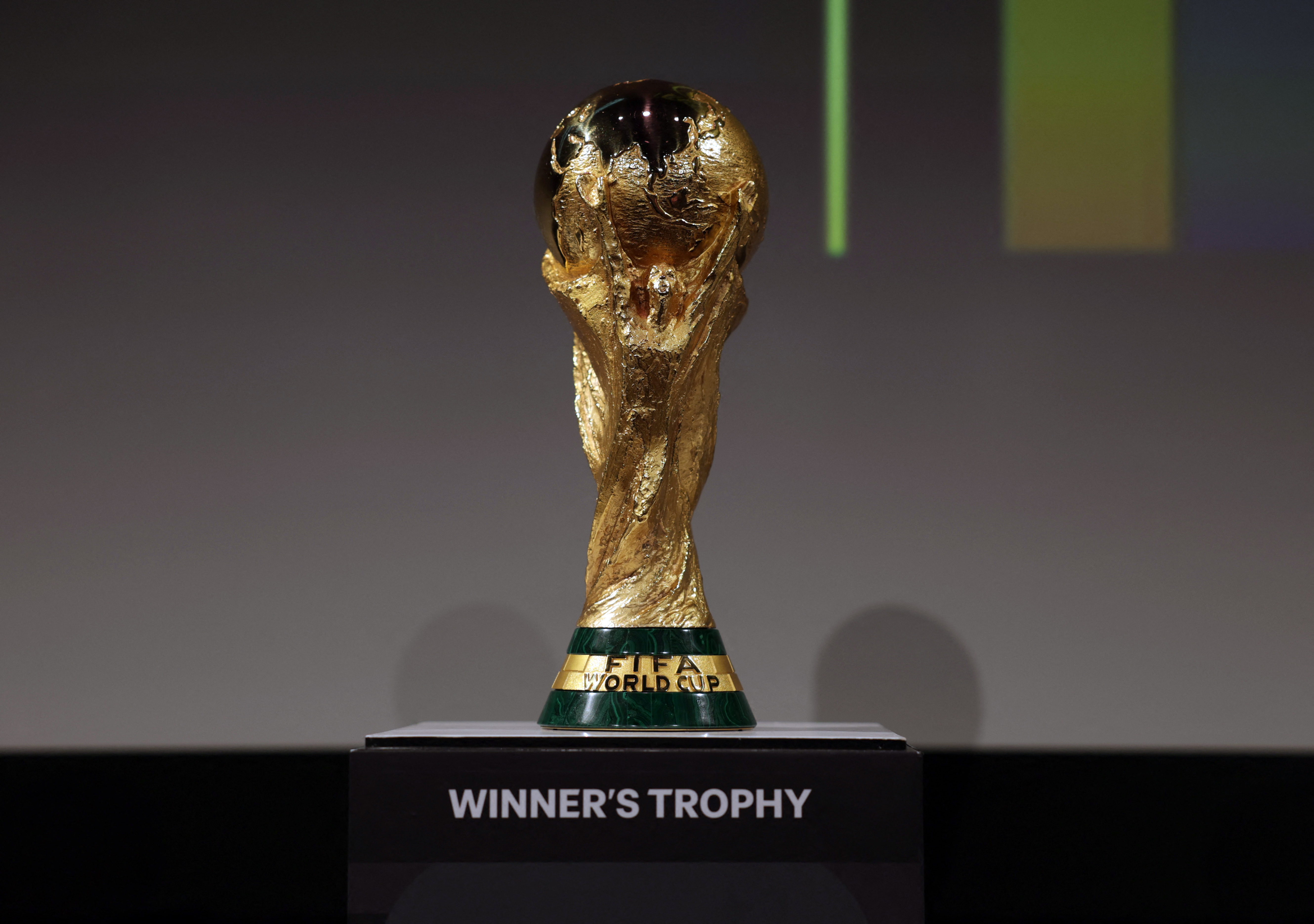
    The men’s World Cup trophy on display Wednesday at the Kennedy Center in Washington, where the draw will take place Friday.

    Once the pots of seeds were set last month — four groups of 12 each, with the cohosts and the top nine teams in FIFA’s rankings in Pot 1 — the speculation began worldwide. How about England vs. Scotland, or the Republic of Ireland, Wales, or Northern Ireland if they get through Europe’s last qualifying playoffs?

    How about a Spain-Morocco rematch of a 2022 World Cup epic? If Italy gets through the playoffs, which teams will it face in its first men’s World Cup in 12 years? And what powerhouses will underdogs like Haiti, with the Union’s Danley Jean Jacques, get to challenge?

    Then, of course, there are matchups that resonate off the field. For all the efforts to keep sports and politics separate, soccer has always been the most political sport. So will the U.S. play Iran for a second straight men’s World Cup, and a third overall? There are sparks already, as Iran has boycotted the draw, since some of its delegates were refused visas.

    As you wonder, here are three rules to consider. First, teams from the same continent can’t be drawn in the same group except for Europe, which has 16 berths in the first 48-team World Cup. There must be one European team in each group, and there can’t be more than two.

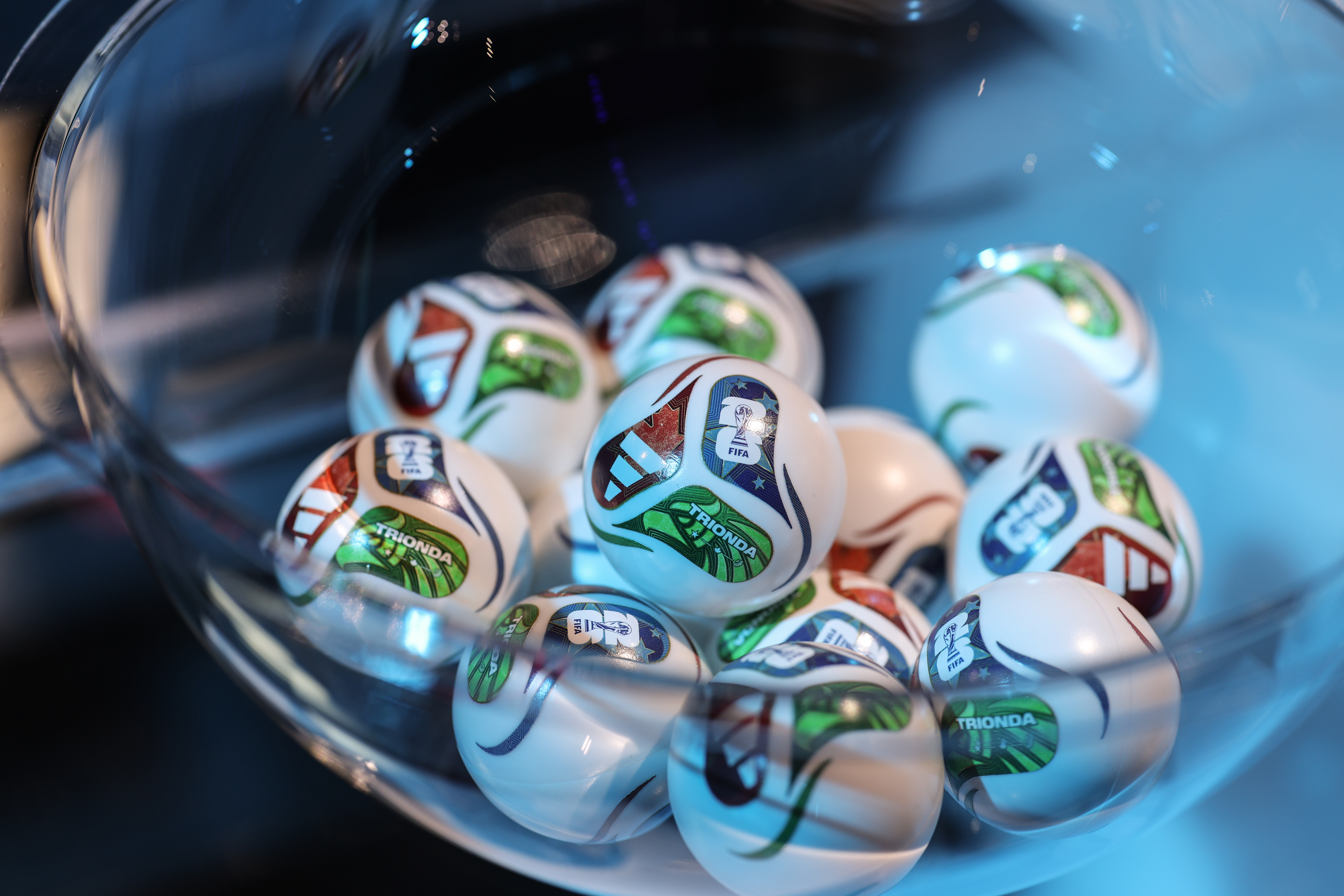
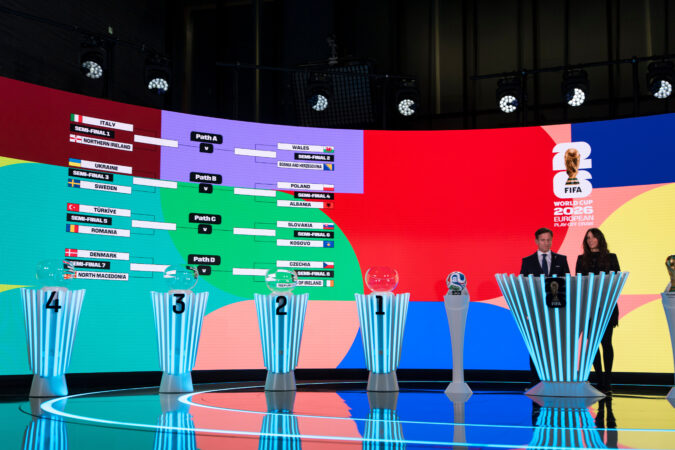
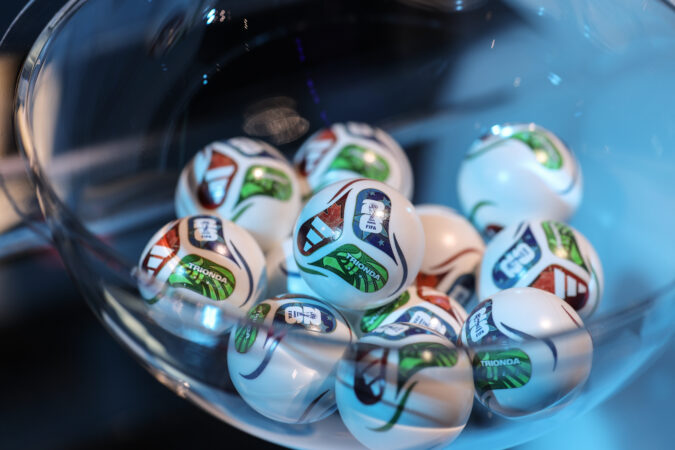
    The famous draw balls in one of the bowls on stage, waiting to be picked up.

    With that in mind, here are our picks for the easiest, hardest, most festive, and most politically controversial groups that the U.S. could end up in:

    The picks

    The easiest group: Austria, South Africa, Jordan. There are lower-ranked European teams in the playoffs than No. 24 Austria, but the case here is about the opponent you know vs. the opponent you don’t.

    Since Austria is in Pot 2, drawing that country would spare the U.S. from big hitters like Croatia, Colombia, Morocco, and Japan. From there, South Africa would give the U.S. a better tactical matchup than the rest of Pot 3, whose teams span Europe, Africa, South America, Asia, and Concacaf.

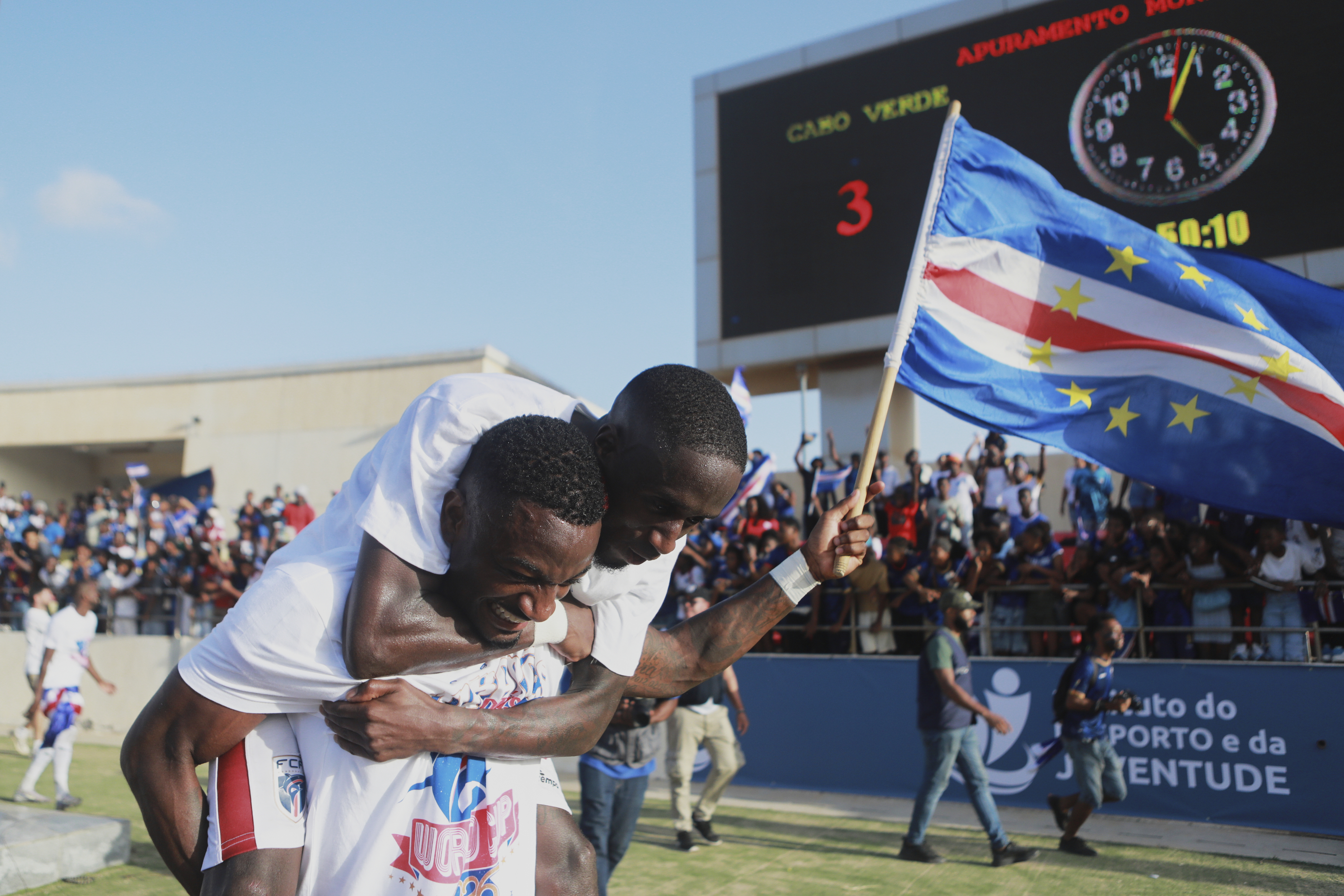
    Having picked South Africa from Pot 3, all the African teams in Pot 4 are off the table. So we’ll go to Asia for Jordan, a World Cup debutant ranked No. 66. And we’ll wish Cape Verde, with former Union midfielder Jamiro Monteiro in a starring role, all the best.

    Former Union midfielder Jamiro Monteiro (right) helped Cape Verde qualify for its first World Cup.

    The hardest group: Morocco, Norway, Italy if it qualifies. Morocco edges Croatia and Colombia from Pot 2 for talent — led by Paris Saint-Germain’s Achraf Hakimi — and a vibrant, gritty playing style.

    In Pot 3, Norway has finally delivered Manchester City superstar striker Erling Haaland to his first World Cup, along with outstanding Arsenal playmaker Martin Ødegaard.

    In Pot 4, we turn to the European playoffs. Italy never needs much introduction, though it bears repeating that the Azzuri truly blew it in failing to reach the 2018 and 2022 World Cups. The current squad features goalkeeper Gianluigi Donnarumma and midfield generals Nicolò Barella and Manuel Locatelli.

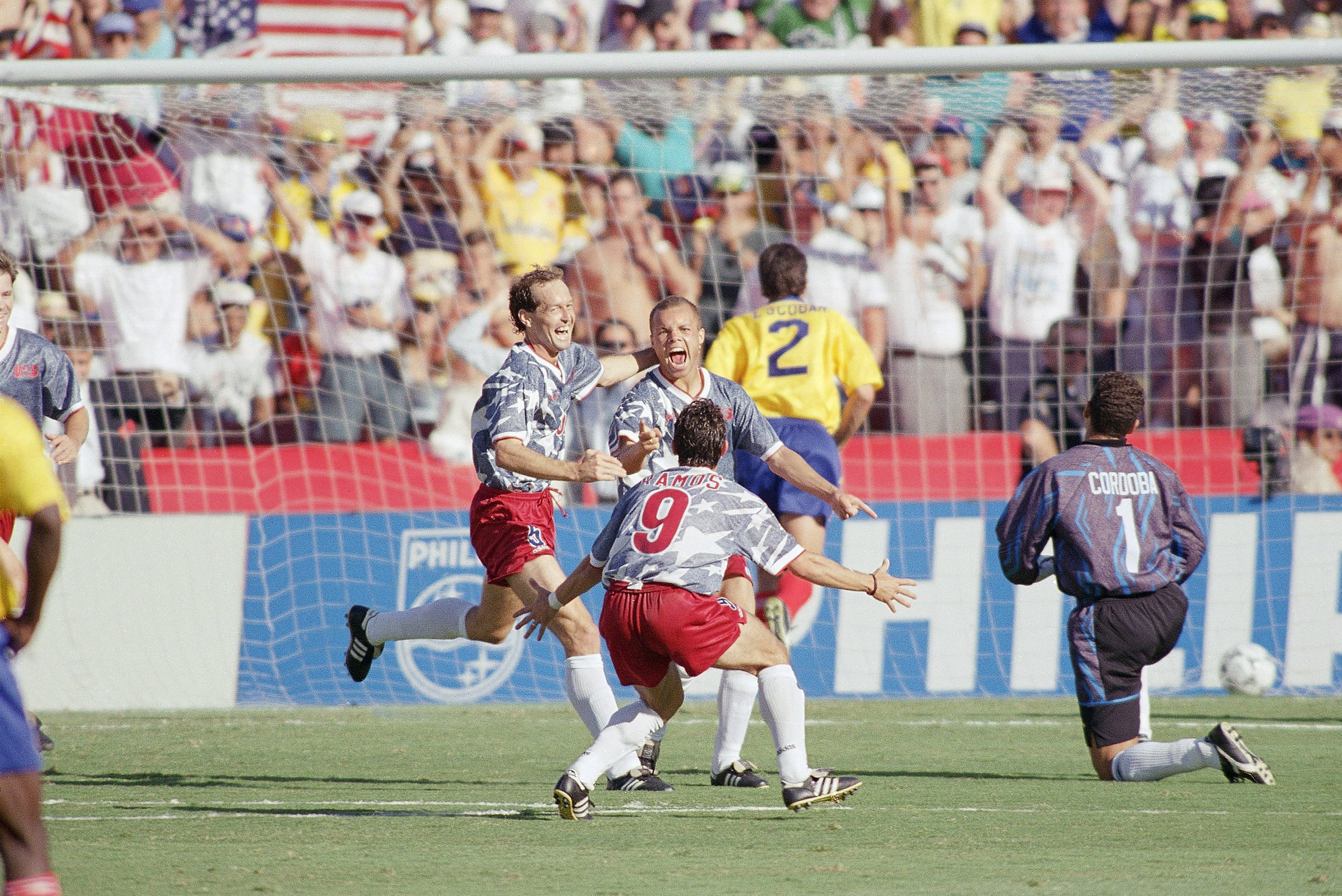
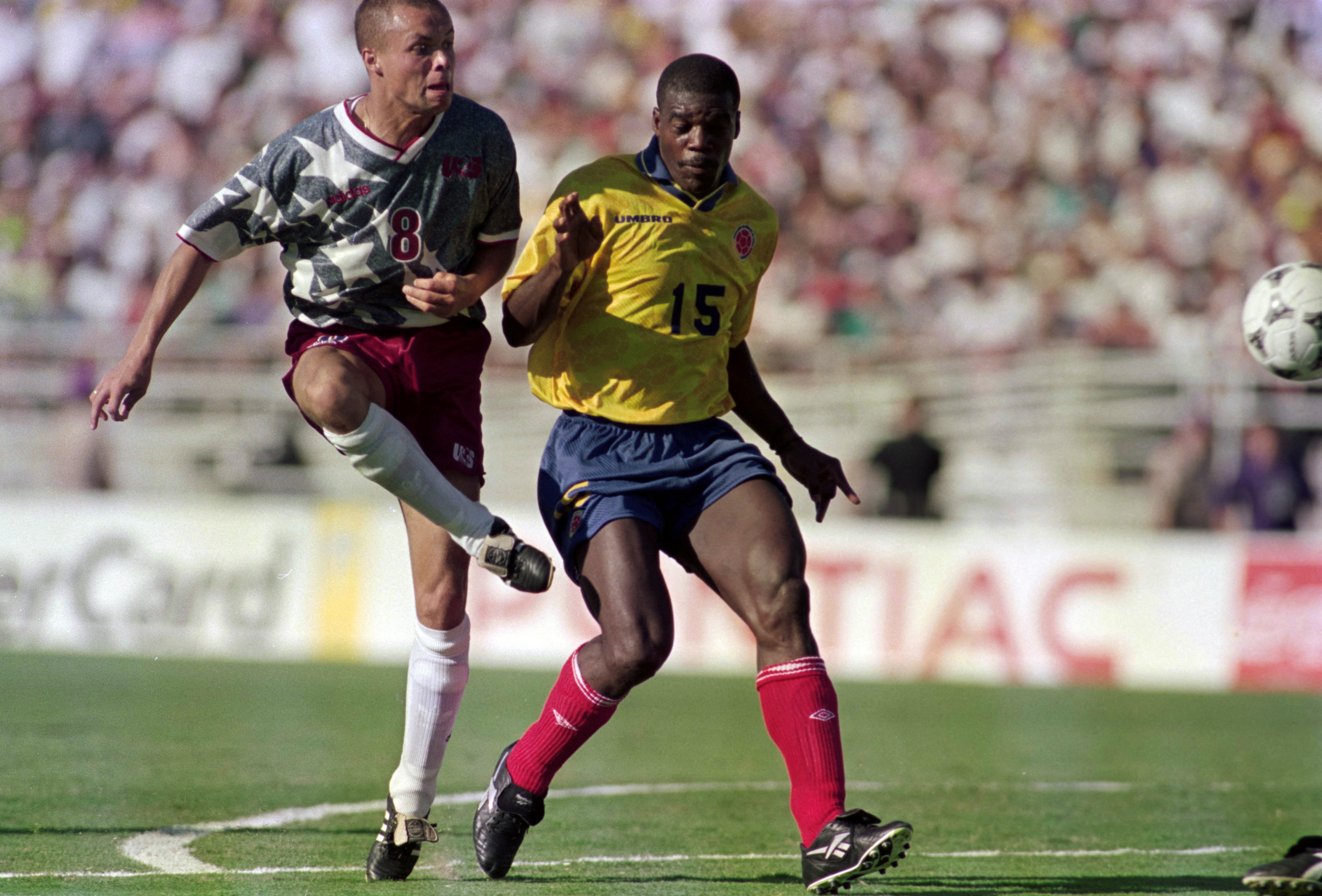
    The most festive group: Colombia, Scotland, Republic of Ireland. A U.S.-Colombia game would be a headache for the American squad but would bring back epic memories of the 1994 upset at the Rose Bowl. The Cafeteros’ fan base is also as good as it gets in South America, especially with the country’s big immigrant population in this country.

    Former Union sporting director Earnie Stewart (center) scored in the United States’ upset of Colombia at the 1994 World Cup.

    Scotland and Ireland’s fan bases are massive, loud, and fun-loving. The Scots are in a men’s World Cup for the first time since 1998, and the Tartan Army will travel in huge numbers — buoyed by expats here and anyone who wants to feel the part for a day.

    The same goes for Ireland if it gets through a tricky qualifying playoff with Czechia, North Macedonia, and favorite Denmark. But if the Irish make their first World Cup since 2002, the sea of green will flood the States. New Jersey’s Meadowlands still echo with the raucous noise of the 1994 Ireland-Italy game.

    The most political group: Iran, South Africa, Ukraine if it qualifies. A combustible mix of war, immigration, race, and religion that spans as widely as three continents.

    The teams Philadelphia fans should want

    As the city saw up close during the Club World Cup this summer, there’s no party in soccer like a South American party. Argentina, Brazil, and Colombia have the continent’s biggest fan bases in the U.S., and the first two would bring global superstars in Lionel Messi or Real Madrid’s Vinícius Júnior.

    Philly fans got to know Brazil’s new phenom, 18-year-old Estêvão, when he scored for Palmeiras against Chelsea in the Club World Cup at Lincoln Financial Field — then joined the Blues a few weeks later.

    It’s already set that the U.S. won’t play in the nation’s birthplace during the group stage, to the dismay of fans here and well beyond. But from the rest of Pot 1, France would bring the most star power from Europe, and the Netherlands‘ dancing masses would paint the town oranje.

    Germany would also be very welcome in a city with proud and deep German roots.

    In Pot 2, no player is more worth watching than Croatia’s Luka Modrić. Even at age 40, his passing skills are unparalleled as he heads into his last World Cup. Japan, South Korea, and Morocco have vibrant fan bases, and the latter two have big expat communities in this part of the U.S.

    In Pot 3, Scotland easily is the team you’d want most — and that every hotel, bar, and restaurant would dream of. Egypt would bring another superstar in Liverpool’s Mohamed Salah.

    Pot 4 is where the Union ties are. It would be special for Jean Jacques to play in his club hometown with Haiti or for Monteiro to come back to town with Cape Verde’s Blue Sharks.

    The biggest of all on that scale would be if Jamaica gets through the intercontinental qualifying playoffs to earn its first men’s World Cup trip since 1998, finally delivering Andre Blake to a stage he deserves. And the turnout from Jamaican fans would be epic, in a city they love coming to for the Penn Relays.

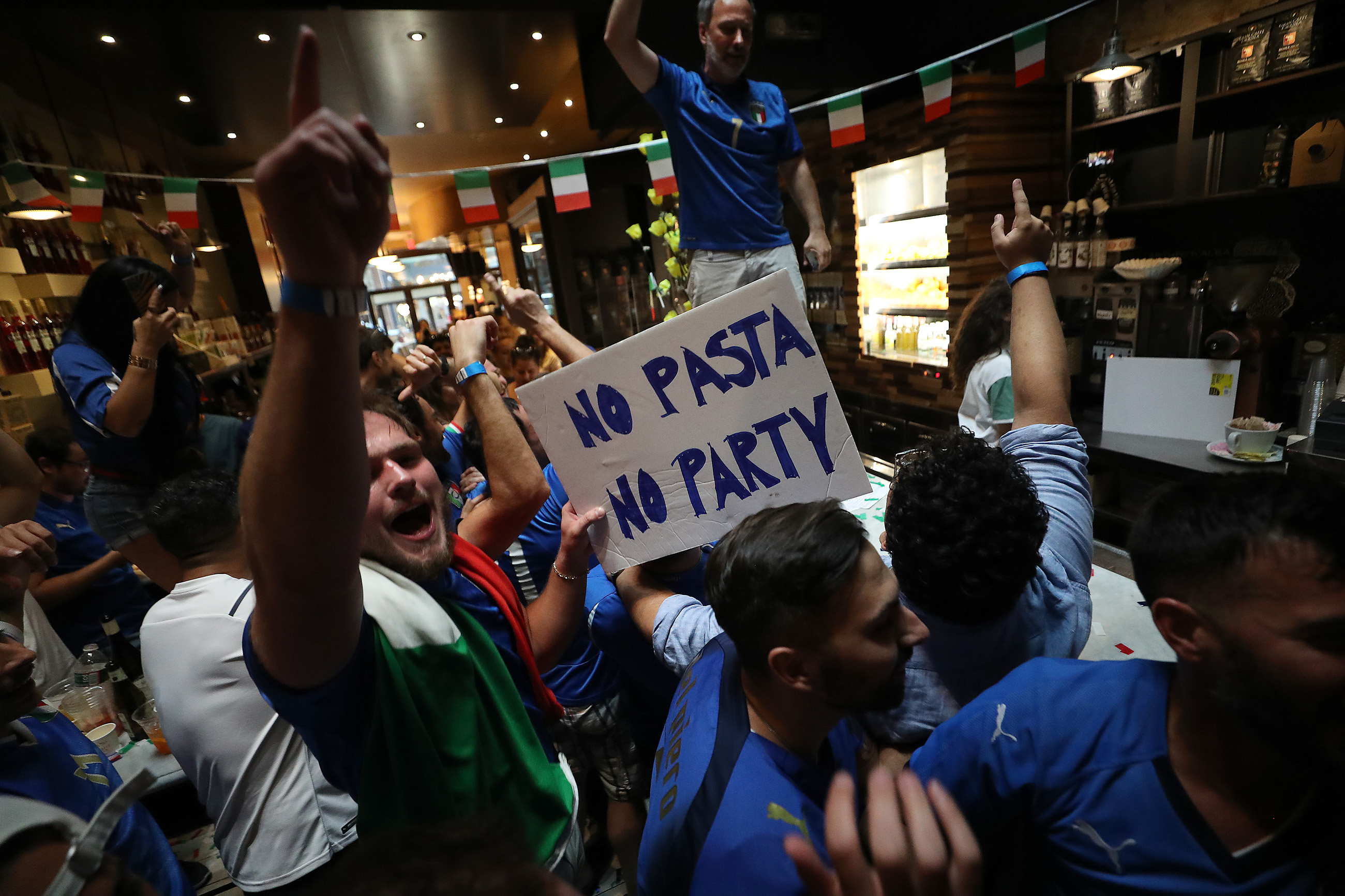
    Among the European playoff contenders, the Republic of Ireland would be a huge deal here. But ever since the day three years ago when Philly was named as a host city, the first name on everyone’s lips has been Italy. Imagine how electric it would be if the Azzuri’s World Cup drought ends at the Linc.

    The scene at Gran Caffe L’Aquila in Center City when Italy won the European Championship in 2021.

    You might have noticed one big team hasn’t been mentioned here yet: England. The Three Lions would bring a huge amount of fans, star players, and media attention to town. But to come to the city where America declared independence from them, 250 years later?

    Ask around locally, and you’d find a fair number who’d say no thanks. They’d dreamed for years of a U.S.-England game on July 4, until the preset part of the draw path took the possibility away. It would feel strange if England uses the old colonial capital as the launchpad to fulfill the hype as one of the favorites to win it all.

  • USMNT will play Cristiano Ronaldo’s Portugal, Belgium, and Germany before the World Cup

    USMNT will play Cristiano Ronaldo’s Portugal, Belgium, and Germany before the World Cup

    NEW YORK — The U.S. men’s soccer team has played some strong opponents in its preparation for the World Cup so far. But for its last four games before the tournament, the team will face some of the biggest teams of all.

    After weeks of speculation, official word came Tuesday that the U.S. will play Belgium and Portugal in March in Atlanta, then Germany in Chicago in June for its World Cup send-off game.

    There also will be a game at the end of May in Charlotte, N.C., against a team to be announced. It might be revealed after the World Cup draw on Friday, since the U.S. won’t want to play against a team it will face again a few weeks later. The U.S. can’t be drawn against Belgium, Portugal, or Germany, as they’re in the same pot in the draw.

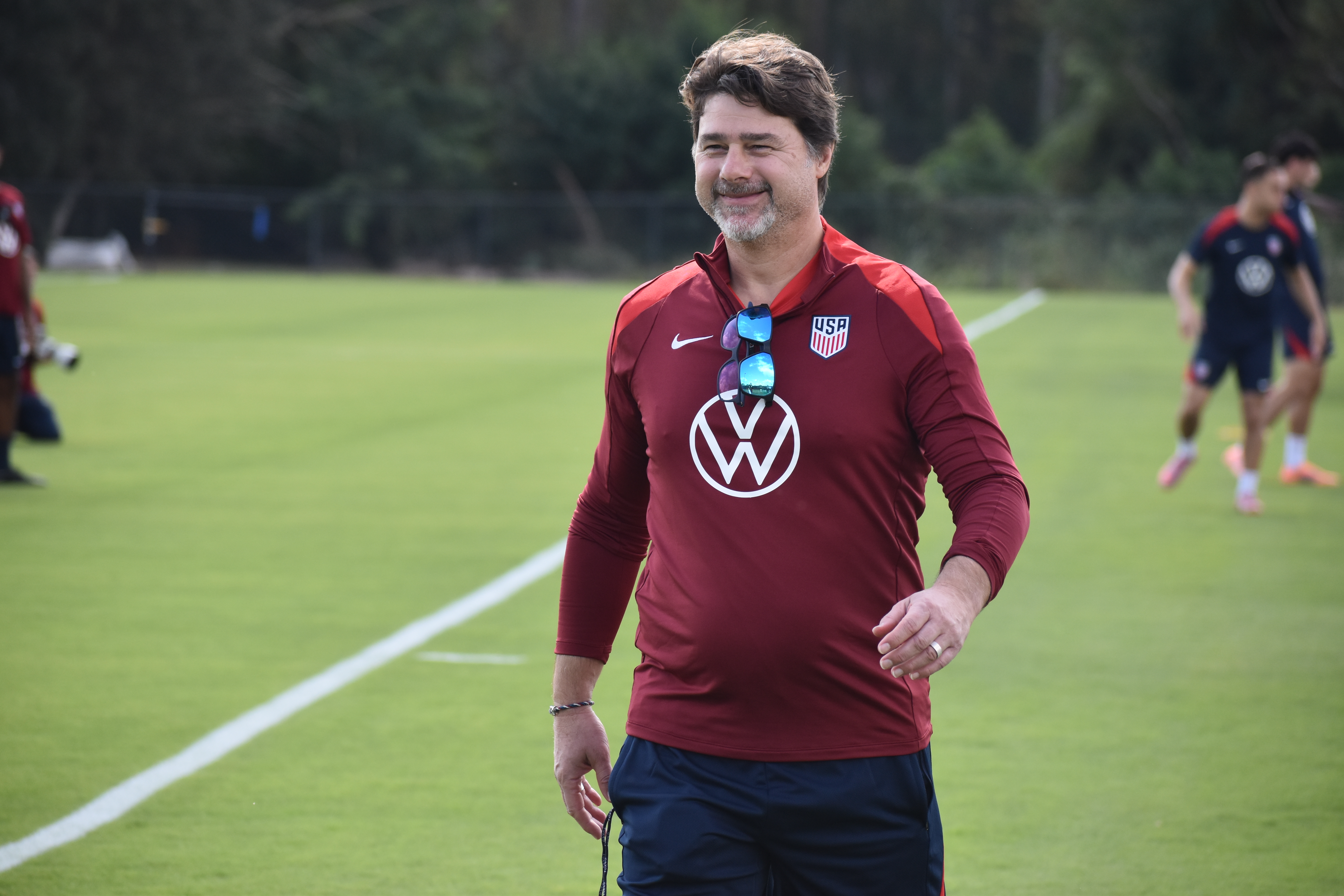
    “I think before starting the World Cup, it starts to [feel] like a World Cup, and I think it’s important for the team,” U.S. manager Mauricio Pochettino said at a gathering of the governing body’s sponsors and donors. “What we need is to challenge teams that are in the top list, and I think that is going to be an important experience for us. Great experience, and then after [that] to attack the World Cup in a very good condition.”

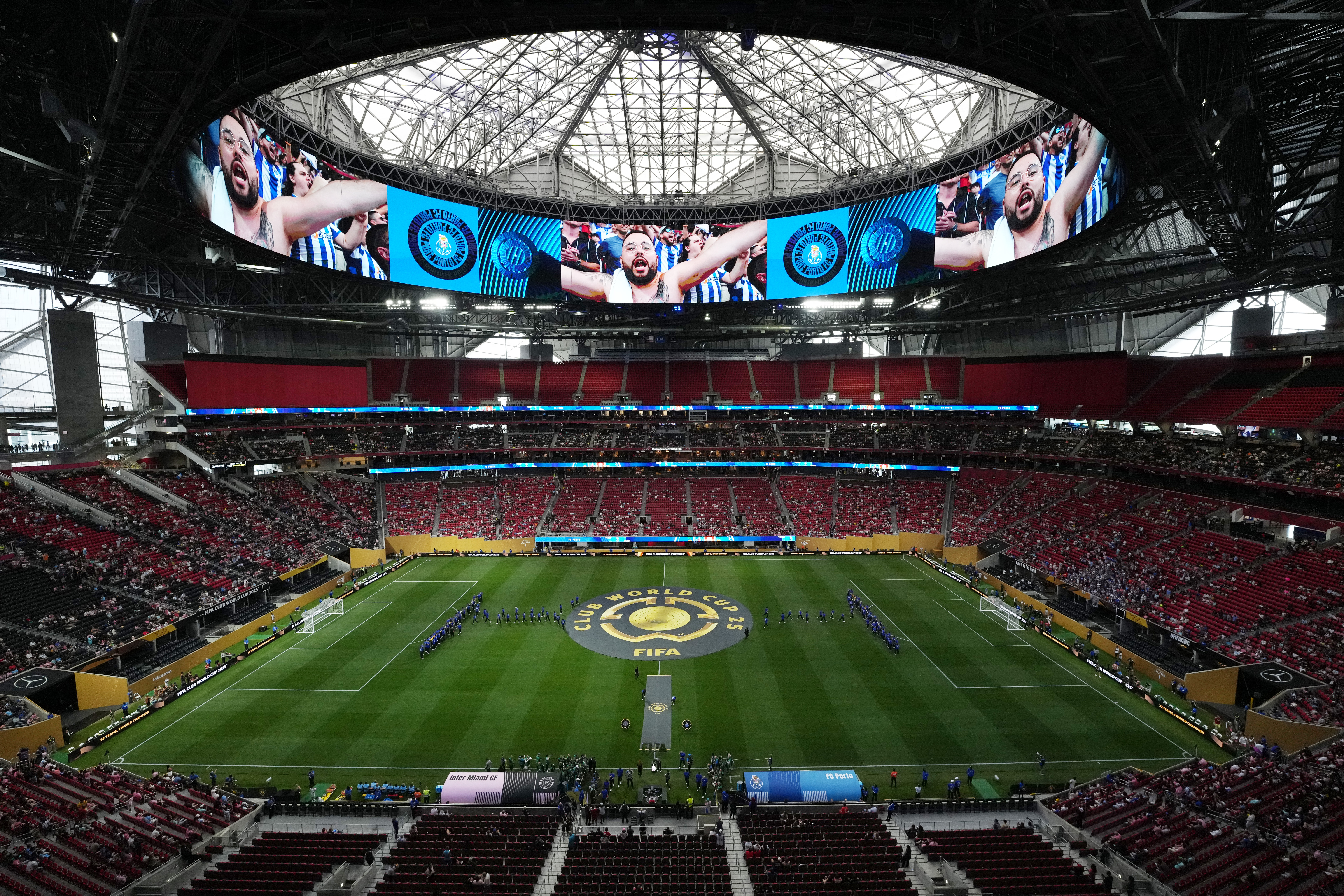
    Atlanta’s Mercedes-Benz Stadium will host eight games in next year’s World Cup, including a semifinal.

    All four games will be at the respective cities’ NFL stadiums, with Atlanta getting two since the area is the new home of U.S. Soccer’s headquarters. The governing body will open a $200-plus-million, 200-acre training center in the southern suburb of Fayetteville, Ga., this spring, in time for the men’s team to hold its pre-World Cup camp there.

    “That is a massive thing that is going to inspire, is going to give an unbelievable power to soccer here in the USA,” Pochettino said, knowing that some of the funders of the facility were in attendance Tuesday. “Maybe today, people don’t realize it because we are focused on the World Cup, [so] it’s about [how] to win the games. But that is the real impact that is going to be a massive change for soccer here in the USA.”

    Portugal’s visit won’t just bring all-time superstar Cristiano Ronaldo, who hasn’t played a game on American soil since 2014. The No. 6 team in FIFA’s global rankings has a fleet of the sport’s best players: Bruno Fernandes of England’s Manchester United, Rafael Leão of Italy’s AC Milan, and João Neves and Vitinha of reigning European champion Paris Saint-Germain.

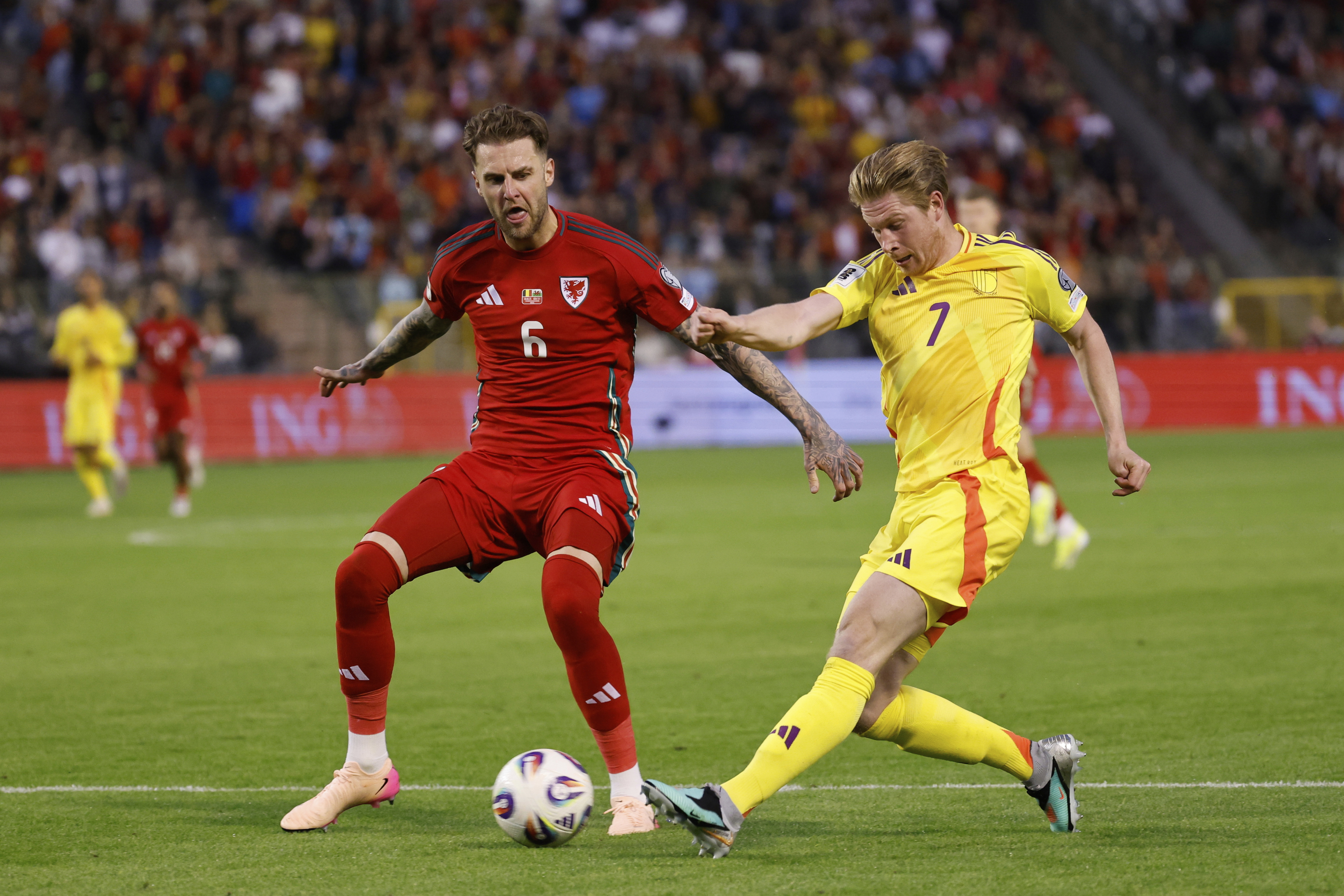
    Belgium is led by midfield playmaker Kevin De Bruyne, a longtime player for England’s Manchester City and now with Italy’s Napoli, and winger Leandro Trossard of England’s Arsenal. The Red Devils are ranked No. 8, and, like Portugal won their group in European World Cup qualifying. Had they finished second, they’d have gone into the playoffs for the last World Cup spots that also are set for March.

    Kevin De Bruyne (right) is one of Belgium’s stars.

    Some famous histories

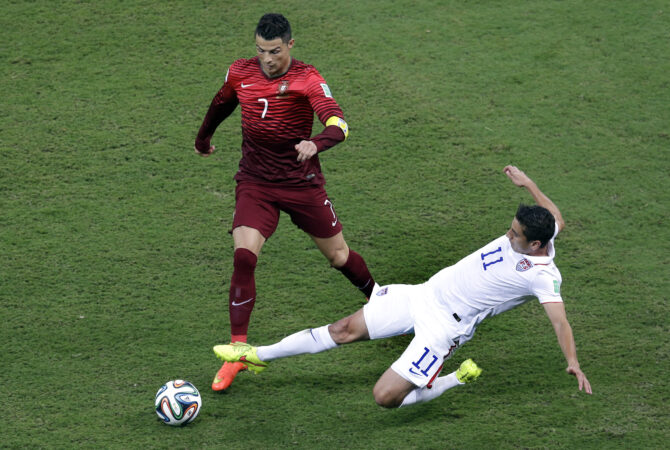
    Both nations stir memories for U.S. fans. The American men earned one of their most famous World Cup wins against Portugal in 2002, then nearly pulled off another upset win in 2014 before Ronaldo assisted a last-minute equalizer.

    When the teams last met in a friendly in 2017, the Americans earned a 1-1 tie in Portugal in the first senior national team appearance for Weston McKennie, Tyler Adams, and Cameron Carter-Vickers. (McKennie scored the goal, assisted by then-Union striker C.J. Sapong, and Ronaldo was absent.)

    Nine days later, the U.S. took Belgium to extra time with goalkeeper Tim Howard’s 16 saves, then fell, 2-1. Howard’s heroics set a World Cup record for saves in a game that still stands. The teams have not met since.

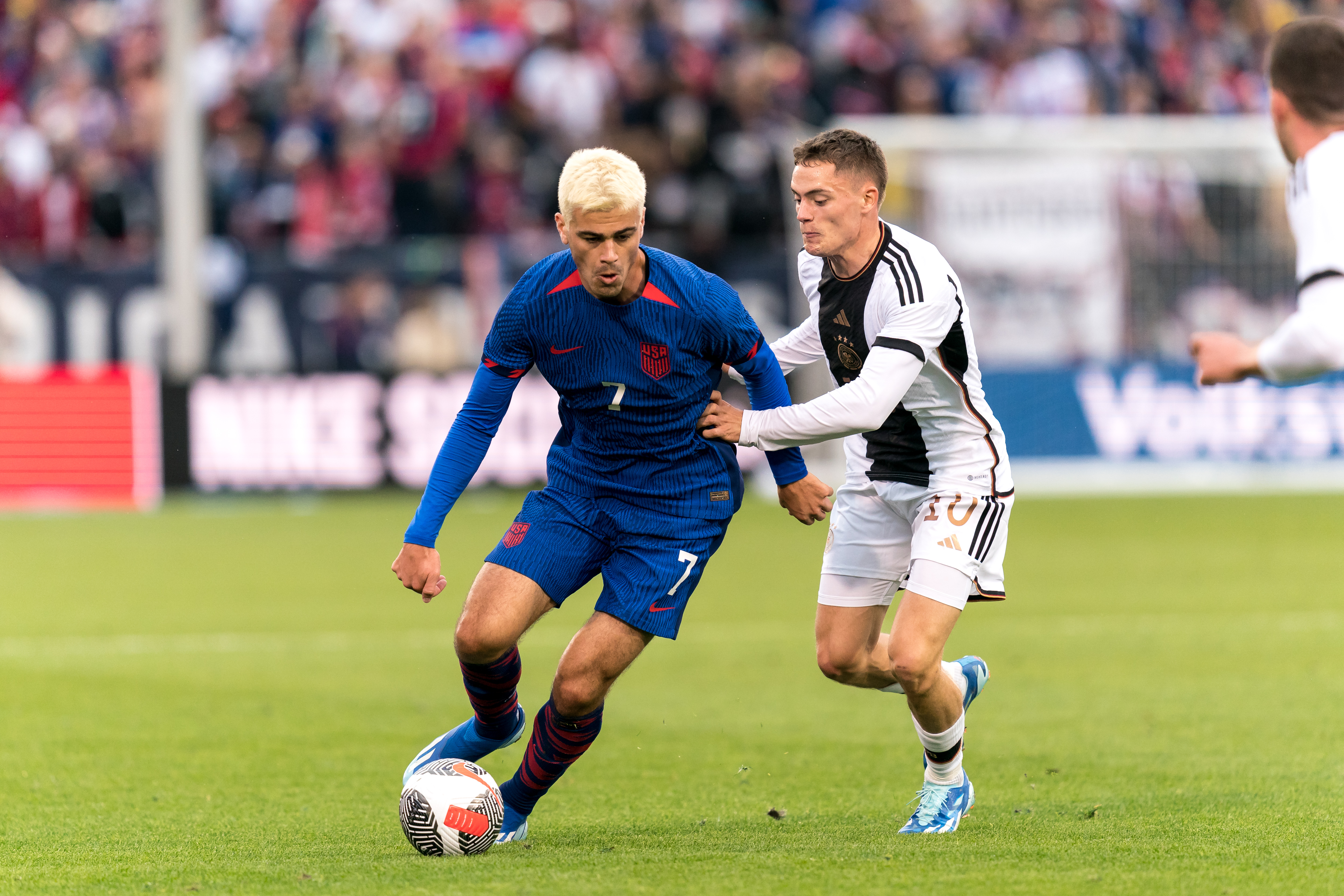
    Germany is a frequent and longtime U.S. opponent. This will be their 13th meeting, with the most recent a 3-1 Mannschaft win in Connecticut in October 2023. The first, in 1993, was a 4-3 U.S. loss that nonetheless announced the program on its way to hosting the 1994 World Cup. (Coincidentally, that game also was at Soldier Field.)

    Gio Reyna (left) on the ball in front of Florian Wirtz during the last U.S.-Germany game in 2023.

    The current German squad, ranked No. 9, is led by playmakers Florian Wirtz of England’s Liverpool and Jamal Musiala of Germany’s Bayern Munich. There also are some big-time rising stars aiming to make the World Cup squad, including striker Nick Woltemade of England’s Newcastle United and 17-year-old Lennart Karl of Bayern.

    The U.S. ends 2025 ranked No. 14, its highest standing since just before the Copa América flameout a year ago. Pochettino’s squad went 4-1-1 in its six games this autumn, with wins over Japan, Australia, Paraguay, and Uruguay.

    “It’s true that when we arrived here one year ago, it was a rushed time,” Pochettino said. “We need to go there, we need to perform, we need to get results, we need to push quickly the process, we need to go at a really fast speed. And I said, ‘No, calma [Spanish for calm down]You cannot sometimes go faster [than] what the process demands.’ I think we are in a very good moment now, right on time.”

    Pochettino’s insight on why he took the U.S. job

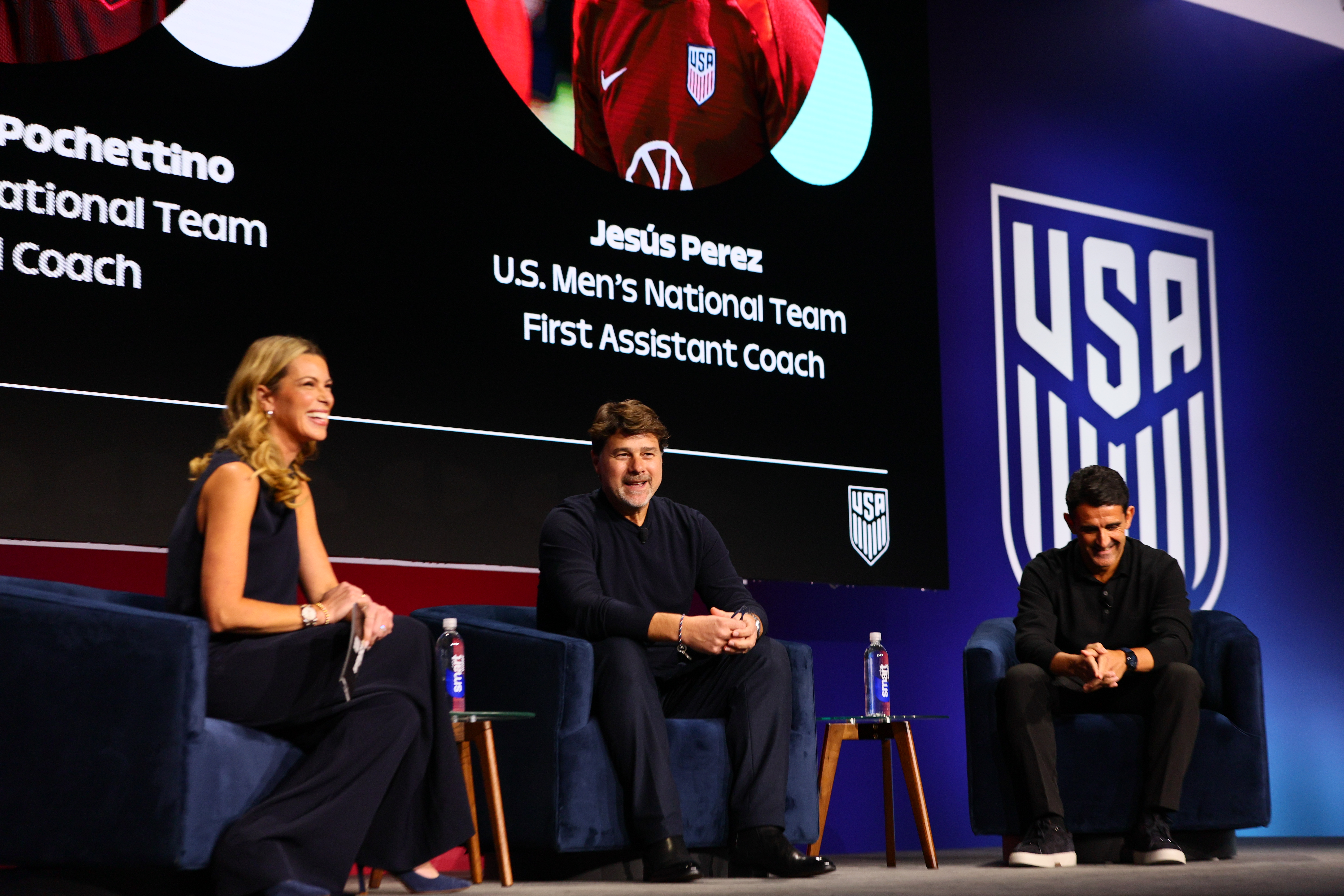
    The manager’s remarks came in a wide-ranging conversation on stage with his top assistant Jesús Pérez and Fox Sports reporter Jenny Taft. Some of the topics were ones Pochettino has covered often, but one he hasn’t so much is why he took the U.S. job in the first place.

    Mauricio Pochettino (center) with Jenny Taft (left) and Jesús Pérez (right) on stage at Tuesday’s event.

    “I think one of the motivations was to go out of our comfort zone after more than 15 years coaching clubs,” he said. “We felt very special when the first call [came] from Matt [Crocker, U.S. Soccer’s sporting director]. I called Jesús and said, ‘Why not?’”

    That didn’t mean he thought it would be easy.

    “Was it going to be a massive challenge? Of course,” Pochettino said. “We didn’t know what we were going to find there. It was a country that we only traveled to, to come here for preseason with Tottenham or Chelsea or Paris Saint-Germain.”

    Those were the three big European clubs he managed before taking the U.S. job.

    “I said, ‘Oh, that is going to be a big test for us as a coaching staff,’” he said. “It was also a moment to reveal and to challenge ourselves … I think it was the right moment for us in our lifetimes, in a personal way but also in a professional way. Both sides were perfect timing.”

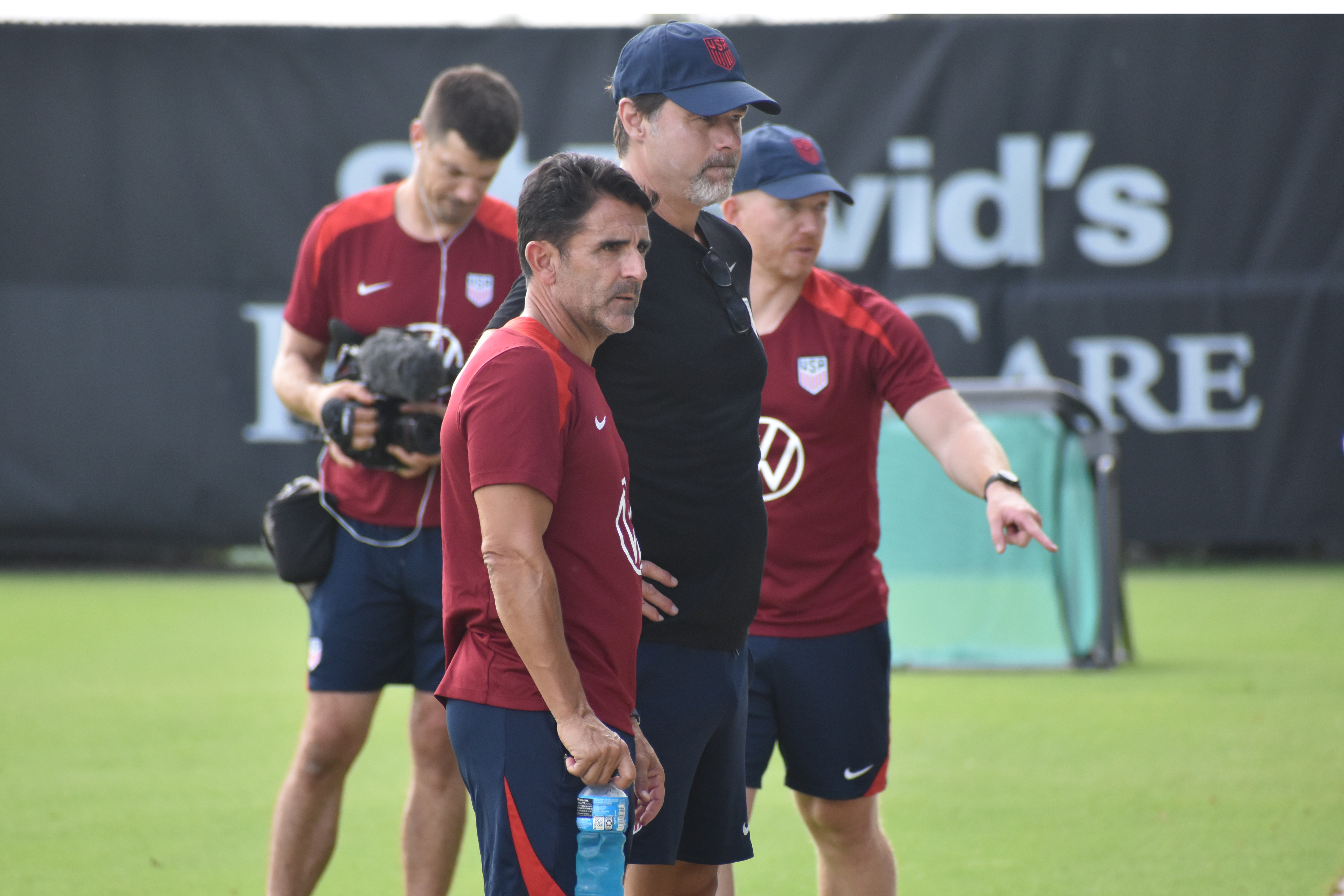
    Mauricio Pochettino (right) and Jesús Pérez (left) watching a U.S. practice in Octover.

    Pérez, who has been at Pochettino’s side throughout the manager’s career, went into more detail on that.

    “To manage the last two clubs we were working with, and the personalities there, it took a lot of energy from him [Pochettino], especially — and you pay for that,” Pérez said. “It was a challenge for us to come where people know the name, but we had to prove that we can coach here and we can perform.”

    He also spoke about the differences between club management, where coaches can spend every day with players, and national teams, where time together is limited.

    “What we miss is training sessions,” Pérez said. “It’s where you can feel the player, you can improve the player, you can challenge the player. … It took us to a point that we have to change our way of work in order to have less training sessions, more precise, more clear, sometimes more simple. But with just basics, you can make people perform.”

  • FIFA’s World Cup draw is this week. Here’s what to know before, during, and after Friday’s event

    FIFA’s World Cup draw is this week. Here’s what to know before, during, and after Friday’s event

    The FIFA World Cup is rapidly approaching, but before the world’s premier international tournament hits U.S. soil this summer, FIFA will assign qualifying nations into groups for the tournament during its highly anticipated final draw.

    Here’s everything you need to know about Friday’s event.

    When and where is the tournament draw, and how can I watch?

    The World Cup draw, which will determine the groups for the round-robin stage of the tournament, will take place on Friday at noon. The event will be hosted by the Kennedy Center in Washington and broadcast live on Fox. Its coverage of the draw will begin at 11:30 a.m. and conclude at 3 p.m. FIFA’s event, which begins at noon, is expected to last about an hour and a half, with the draw itself accounting for about 45 minutes of that time.

    Medford native Brenden Aaronson (right) and the U.S. will find out their pairings as one of three host nations on Friday.

    What teams are in the draw?

    Forty-two national teams, including cohosts Canada, Mexico, and the U.S., have already qualified for the World Cup and will be included in the draw.

    Six spots remain available for the World Cup, which will feature 48 teams for the first time in its history. Four of the remaining six qualifying spots will be awarded to the top four teams in the European Federation’s 16-team playoff, which will conclude in March. The other two spots will be awarded to the top two finishers at the FIFA Playoff Tournament, also in March.

    At Friday’s draw, the six qualifiers yet to be determined will be represented by placeholder slips, four for Europe and two for the intercontinental FIFA playoff.

    Here’s a full list of the qualified teams by confederation, plus a look at participants in the European playoff and the FIFA Playoff Tournament:

    Cohosts: Canada, Mexico, United States

    Asian Football Confederation (AFC): Australia, Iran, Japan, Jordan, South Korea, Qatar, Saudi Arabia, Uzbekistan

    Confederation of African Football (CAF): Algeria, Cape Verde, Ivory Coast, Egypt, Ghana, Morocco, Senegal, South Africa, Tunisia

    Confederation of North, Central American and Caribbean Association Football (Concacaf): Curaçao, Haiti, Panama

    South American Football Confederation (CONMEBOL): Argentina, Brazil, Colombia, Ecuador, Paraguay, Uruguay

    Oceania Football Confederation (OFC): New Zealand

    Lionel Messi will most likely play in his final FIFA World Cup with Argentina this summer.

    Union of European Football Associations (UEFA): Austria, Belgium, Croatia, England, France, Germany, Netherlands, Norway, Portugal, Scotland, Spain, Switzerland

    UEFA 16-team playoff (four qualifiers): Albania, Bosnia and Herzegovina, Czechia, Denmark, Italy, Kosovo, Northern Ireland, North Macedonia, Poland, Ireland, Romania, Slovakia, Sweden, Turkey, Ukraine, and Wales

    FIFA World Cup 26 Playoff Tournament (two qualifiers): Bolivia (CONMEBOL), Democratic Republic of the Congo (CAF), Iraq (AFC), Jamaica (Concacaf), New Caledonia (OFC), and Suriname (Concacaf)

    How does the draw work?

    Qualified nations will be divided into four pots based on their FIFA World Rankings positions. Pot 1 will contain the nine best-qualified teams in the rankings, as well as the three cohosts. The host nations have already been assigned to groups — Mexico will be in Group A, Canada will be in Group B, and the U.S. will be in Group D. The remaining teams will be assigned to the other nine groups, one team per group.

    After all the teams in Pot 1 have been drawn, the draw will move to Pot 2, selecting one team for each of the 12 groups. The process will repeat with Pot 3 and Pot 4, resulting in 12 groups of four teams. During the tournament, the top two teams in each group will advance to the knockout rounds. The top eight third-place finishers in the 12 groups will also advance, completing the Round of 32.

    Though the draw determines tournament groups, FIFA is also looking ahead to the knockout rounds. FIFA will structure the knockout bracket so that the top four teams in its rankings — Spain, Argentina, France, and England — will not meet before the tournament semifinal, provided that they each finish first in their respective groups. It is the first time the World Cup will use a tennis-style bracket for knockouts.

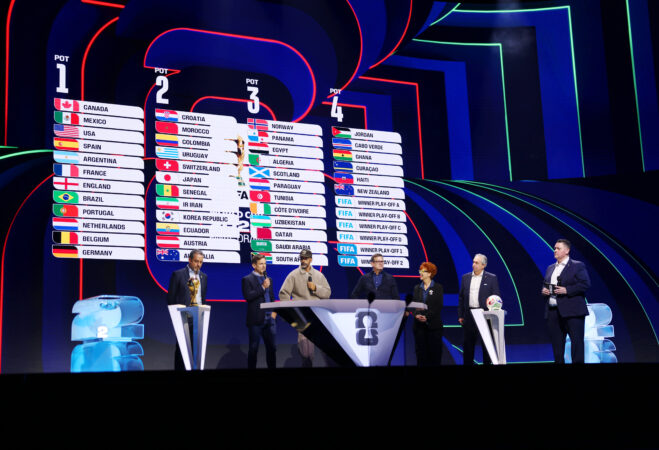
    Here’s a complete look at the pots that will be used on Friday:

    Pot 1: Canada (B1), Mexico (A1), U.S. (D1), Spain, Argentina, France, England, Brazil, Portugal, Netherlands, Belgium, Germany

    Pot 2: Croatia, Morocco, Colombia, Uruguay, Switzerland, Japan, Senegal, Iran, South Korea, Ecuador, Austria, Australia

    Pot 3: Norway, Panama, Egypt, Algeria, Scotland, Paraguay, Tunisia, Ivory Coast, Uzbekistan, Qatar, Saudi Arabia, South Africa

    Pot 4: Jordan, Cape Verde, Ghana, Curaçao, Haiti, New Zealand, European playoff winner 1, European playoff winner 2, European playoff winner 3, European playoff winner 4, Intercontinental playoff winner 1, Intercontinental playoff winner 2.

    Lincoln Financial Field is one of 11 venues in the United States that will host next summer’s World Cup.

    Which teams are coming to Philly?

    The draw should help determine which international sides will play in Philadelphia this summer. FIFA’s tournament schedule shows that Philly will host group stage games for Groups C, I, and L, and two for Group E, alongside a Round of 16 match. Fans will not be able to track which teams are coming to Philly during the draw, as the current tournament schedule does not give specific placeholders for the group stage matchups.

    The World Cup schedule will be updated on Saturday after the draw, with the paired teams assigned to venues along with kickoff times. The updated schedule will include which teams will play group stage matches in Philly from Groups C, E, I, and L, as well as the time for the Round of 16 match on July 4.

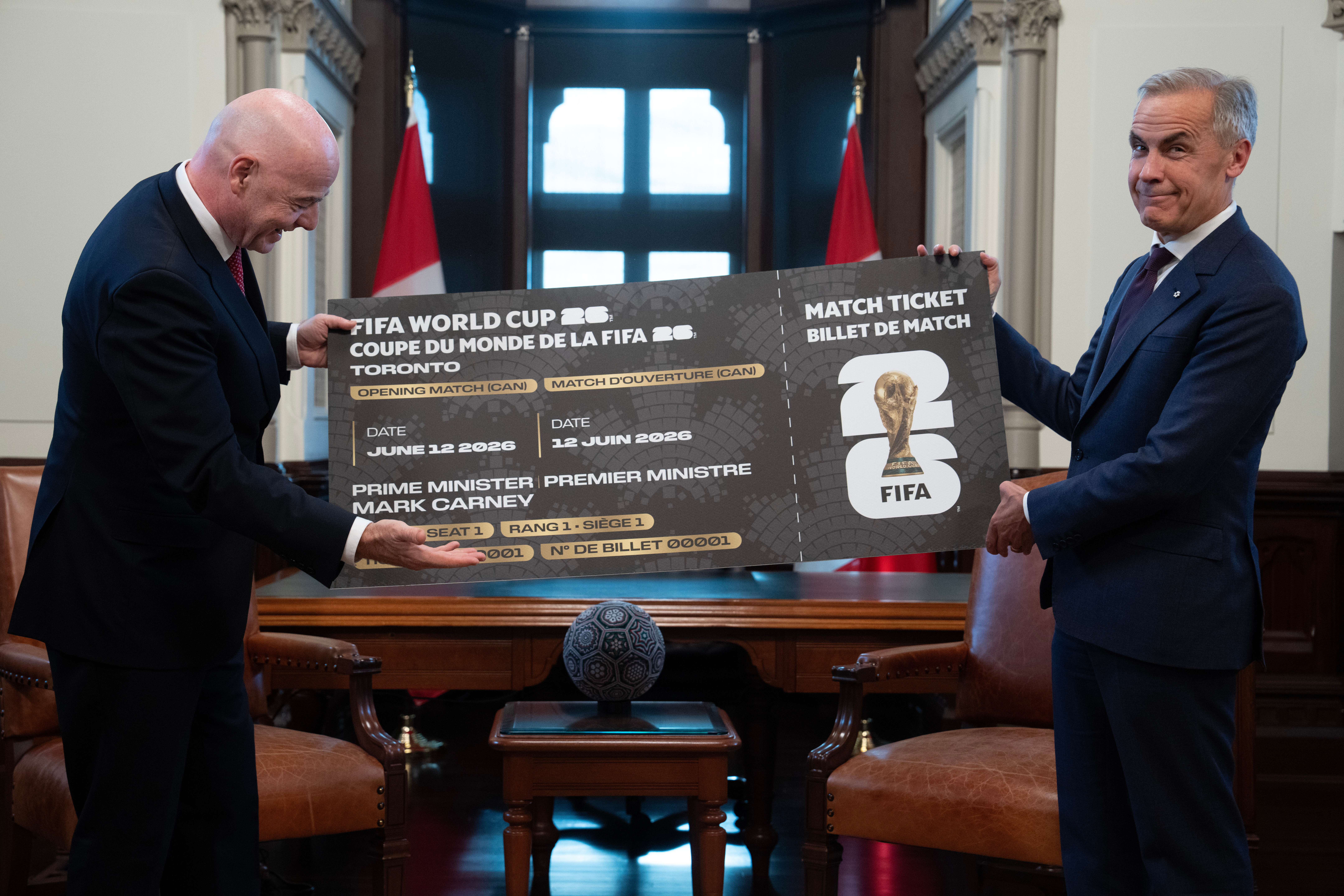
    Canadian Prime Minister Mark Carney (right) is presented with a novelty World Cup ticket by FIFA president Gianni Infantino on Oct. 10.

    Can I still buy tickets after the draw?

    Yes. Fans interested in buying tickets for World Cup matches at Lincoln Financial Field can enter ticket lotteries for individual group-stage games via FIFA’s random selection draw.

    The lotteries will begin accepting entries on Dec. 11 at 11 a.m. and close at the same time on Jan. 13.

    After the random selection draw phase of ticket sales has finished, any remaining inventory will be released on a first-come, first-served basis closer to the beginning of the tournament. Single-match and multimatch hospitality packages are also available through FIFA.

    FIFA’s first-come, first-served phase will be the last opportunity for fans to buy tickets directly through FIFA. After that, tickets will be available only through resale on the secondary market.

  • FIFA lays out the rules for the World Cup draw

    FIFA lays out the rules for the World Cup draw

    GENEVA — The 2026 World Cup draw next week will reward the four highest-ranked teams — Spain, Argentina, France and England — who will be placed in separate sections of a new tennis-style seeded tournament bracket.

    FIFA said Tuesday the top four teams in the latest men’s rankings will, if they finish top of their respective round-robin groups, avoid each other until the semifinals of the June 11-July 19 tournament being co-hosted by the United States, Canada and Mexico.

    Defending champion Argentina with Lionel Messi and top-ranked European champion Spain with Lamine Yamal therefore can ensure they do not meet until the final at MetLife Stadium near New York.

    “To ensure competitive balance, two separate pathways to the semifinals have been established,” FIFA said in a statement, aiming to reward teams whose consistent good results have raised their world ranking.

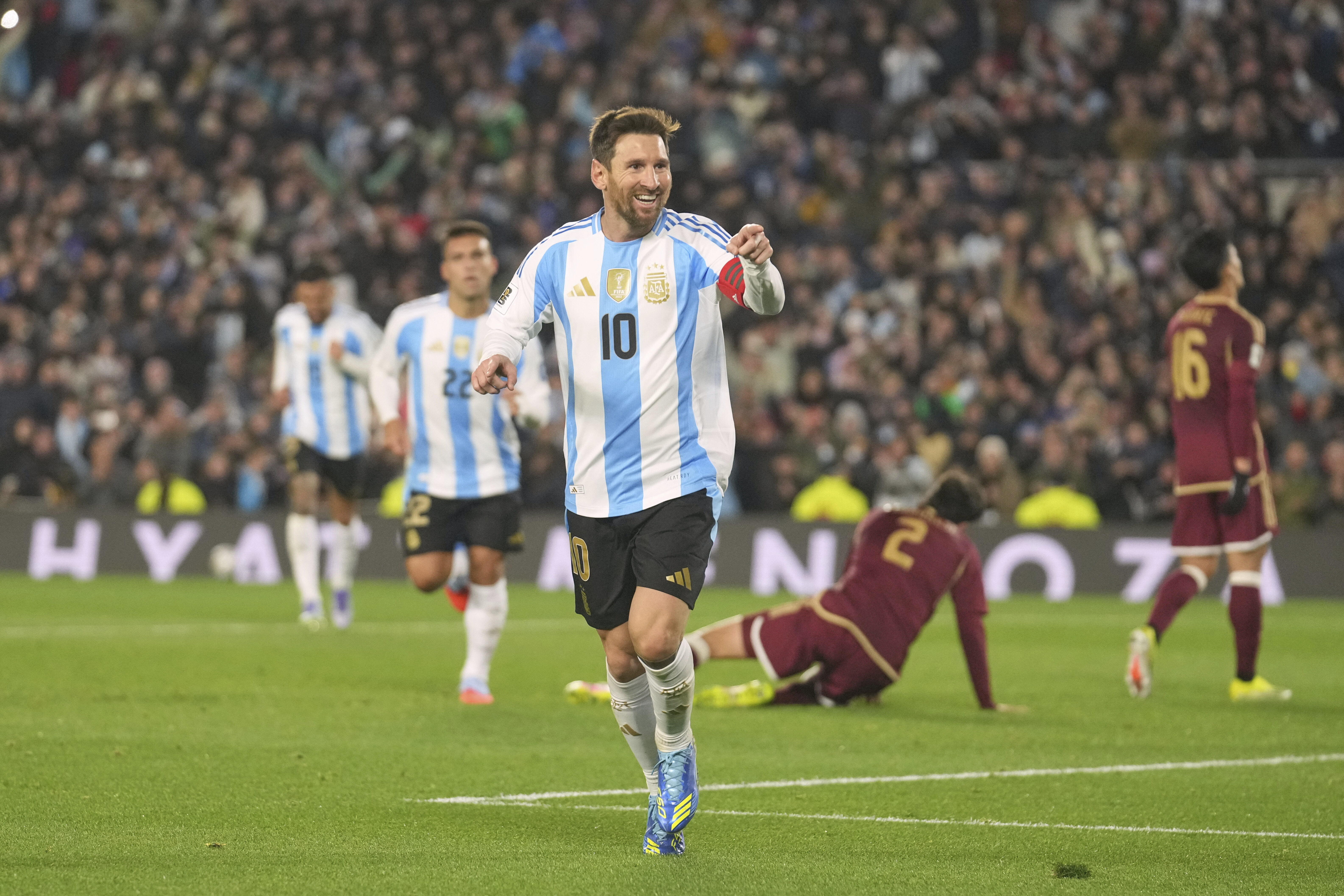
    Lionel Messi celebrates scoring a goal for Argentina in September.

    At previous World Cups, the path for teams into and through the knockout phase was decided by which group they were drawn into.

    The draw ceremony for the first 48-team World Cup will be held Dec. 5 at the Kennedy Center in Washington, D.C., in the presence of U.S. President Donald Trump.

    The 42 teams that already qualified include Iran and Haiti which FIFA expects will play exactly where they are drawn regardless of complicated politics those countries have with the U.S. The 16 host venues for the 104 games include 11 cities with NFL stadiums in the U.S., three in Mexico and two in Canada.

    The other six entries will be decided in March when European and global playoffs brackets are scheduled, and those teams all will come out of the draw pot of lowest-ranked teams.

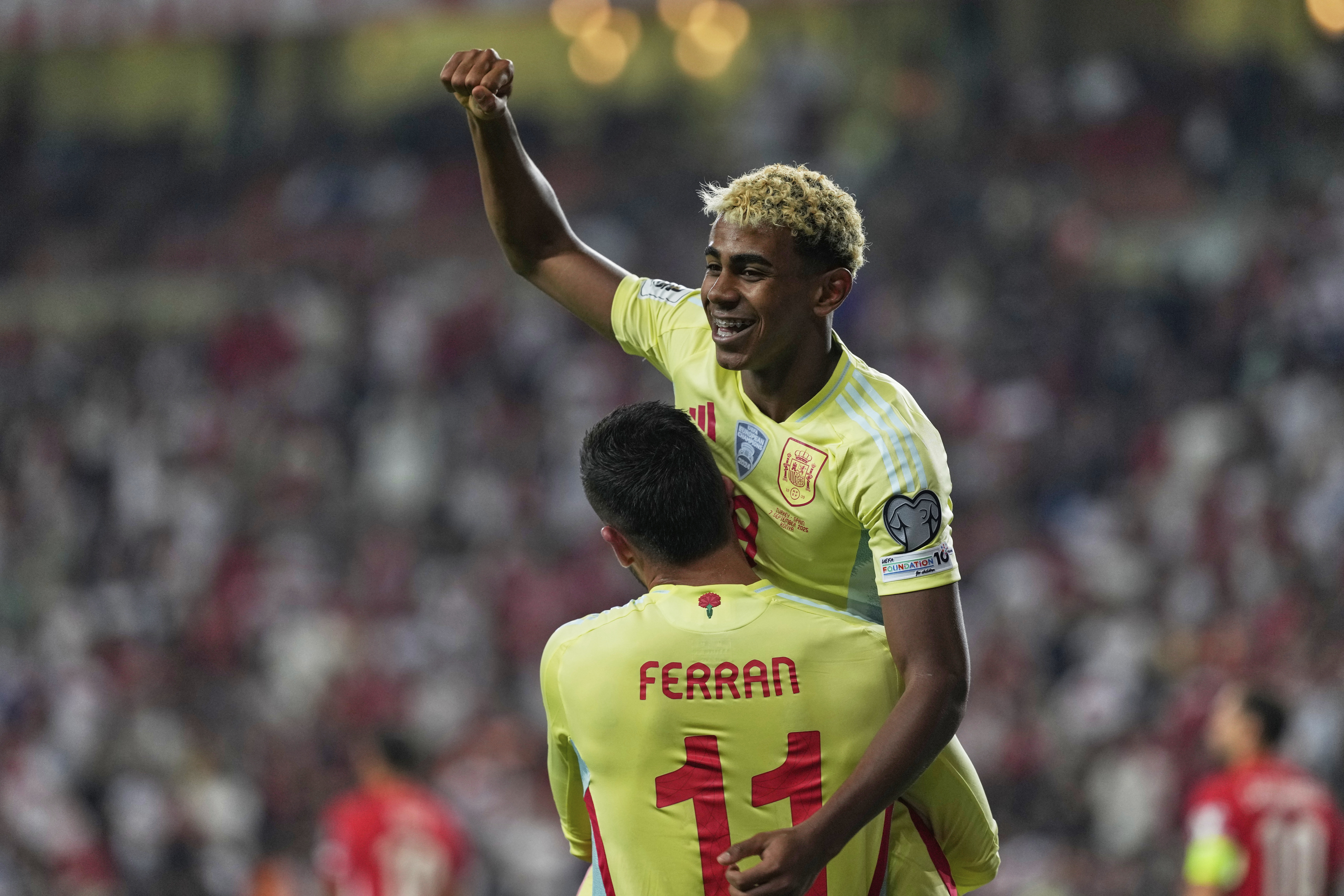
    Spain’s Lamine Yamal (right) is the soccer world’s new superstar.

    That means four-time champion Italy could be a dangerous option in the draw on Friday of next week that will set the match schedule by placing teams in 12 round-robin groups of four teams each.

    Europe has 16 teams in the lineup and a maximum of two can be drawn into any one group. The other 32 teams in the tournament cannot be drawn in a group with a team from the same continent.

    The three co-hosts are among the 12 top seeds in the draw, which is scheduled to take about 45 minutes during a show lasting about an hour and a half, FIFA said. The U.S. will open on June 12 against a team from pot 3, then face a team from pot 2 and close the group stage against a team from pot 4.

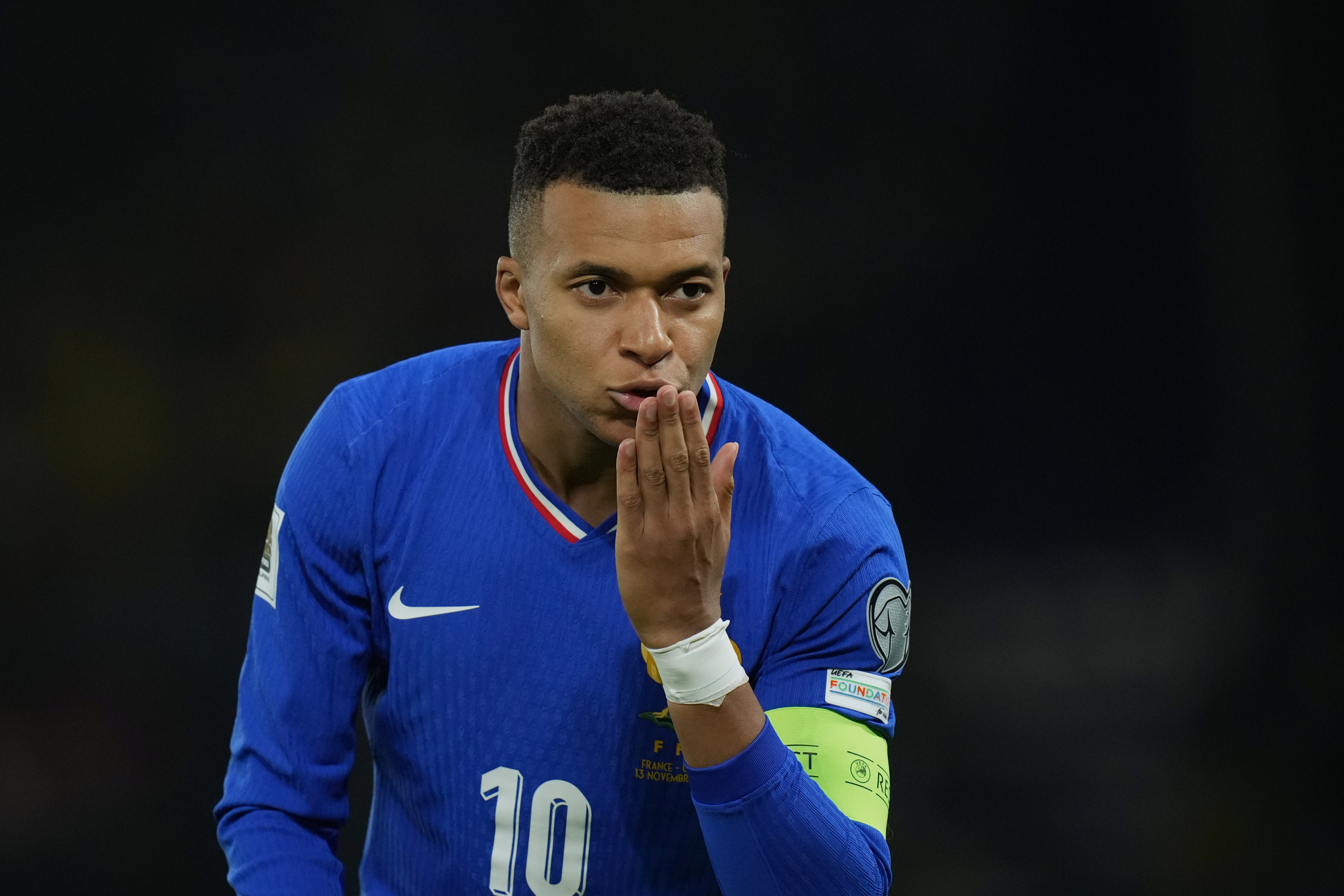
    Kylian Mbappé led France to the 2018 World Cup title and the 2022 final.

    World Cup draw seedings

    Pot 1: Spain, Argentina, France, England, Brazil, Portugal, Netherlands, Belgium, Germany, United States, Mexico, Canada.

    Pot 2: Croatia, Morocco, Colombia, Uruguay, Switzerland, Japan, Senegal, Iran, South Korea, Ecuador, Austria, Australia.

    Pot 3: Norway, Panama, Egypt, Algeria, Scotland, Paraguay, Tunisia, Ivory Coast, Uzbekistan, Qatar, Saudi Arabia, South Africa.

    Pot 4: Jordan, Cape Verde, Ghana, Curacao, Haiti, New Zealand, European playoff winner 1, European playoff winner 2, European playoff winner 3, European playoff winner 4, Intercontinental playoff winner 1, Intercontinental playoff winner 2.

  • Matt Freese is on the verge of something big with the USMNT. First, he’s got to beat the Union.

    Matt Freese is on the verge of something big with the USMNT. First, he’s got to beat the Union.

    If there was anything to learn about Matt Freese, it’s that he’s a really serious individual.

    Last week, in his return to the Philly area with the U.S. men’s national soccer team, the former Union goalkeeper and Wayne native said he spent the bulk of the week inside the team hotel instead of visiting family and friends.

    He wasn’t a complete recluse. He visited a few old friends from the Union, who were training on fields adjacent to the USMNT at the WSFS Bank Sportsplex in Chester. He even took time to speak to classes at YSC Academy, the school created specifically for soccer players aspiring to be in Freese’s shoes.

    Other than that? Freese treated the homecoming as a business trip, which was clearly conveyed in refusing all requests for interviews the day before a game and the serious gaze on his face even after the USMNT’s 2-1 win over Paraguay last Saturday.

    He returns on Sunday when the Union host New York City FC in MLS’ Eastern Conference semifinal (7:55 p.m., FS1, Apple TV, MLS Season Pass).

    “I actually didn’t see my family. I didn’t do anything,” Freese said. “[This week], I just stayed in the hotel. [Chuckles], I’m a bit of a loser, but when I’m in camp, I’m locked in. I’ll see my family in the offseason at some point.”

    Freese being locked in isn’t because he’s being standoffish. Instead, it’s his effort to prove to himself that he belongs. He has made sacrifices — particularly whenever he receives that call from the men’s national team.

    See, it was roughly around this time last year that Freese was a bit of an afterthought. Incumbent goalkeeper Matt Turner was on a tear for club and country and looked to be a shoo-in for being first up on USMNT manager Mauricio Pochettino’s roster.

    But amid a lack of playing time with Crystal Palace, Turner’s club team, he fell down the depth chart, as Pochettino told reporters in May that “it’s open for another player maybe to challenge in between [the goalkeepers] and maybe to try to give the possibility to play [to] another player,” according to an ESPN report.

    Enter Freese, who has had several call-ups since Pochettino’s remarks and has impressed, notably his performance in the U.S.’s shootout win over Costa Rica the Gold Cup quarterfinals in June. He made three saves in the penalty kick portion of the match, which helped the U.S. vault into the semifinal, and earned soccer’s version of the nickname “Matty Ice.”

    From that moment, he’s been a mainstay with the national team. Now, with the last games of the November cycle wrapping up earlier this week, it’s a waiting game to see if he’ll be called into camp for Pochettino’s World Cup squad.

    From being an unknown to being No. 1 — the opportunity arguably has never been bigger for Freese.

    “What’s driving me is this chance to represent my country,” Freese said. “Having that opportunity is one that I dreamed about but didn’t know if I was ever going to get. So every time I’m called up, I want to make the most of training, and then every time I get to play in a game, I want to make the most of that as well.”

    From favorite to foe

    One thing that stood out in a conversation with Freese was his reply that when it came to visiting family, he’d do so “in the offseason at some point.”

    Coincidentally, if the Union have their way, he might not have to commute too far. A week removed from being the hero against Paraguay, Freese returns to Subaru Park as the villain in his role as the starting goalkeeper for NYCFC.

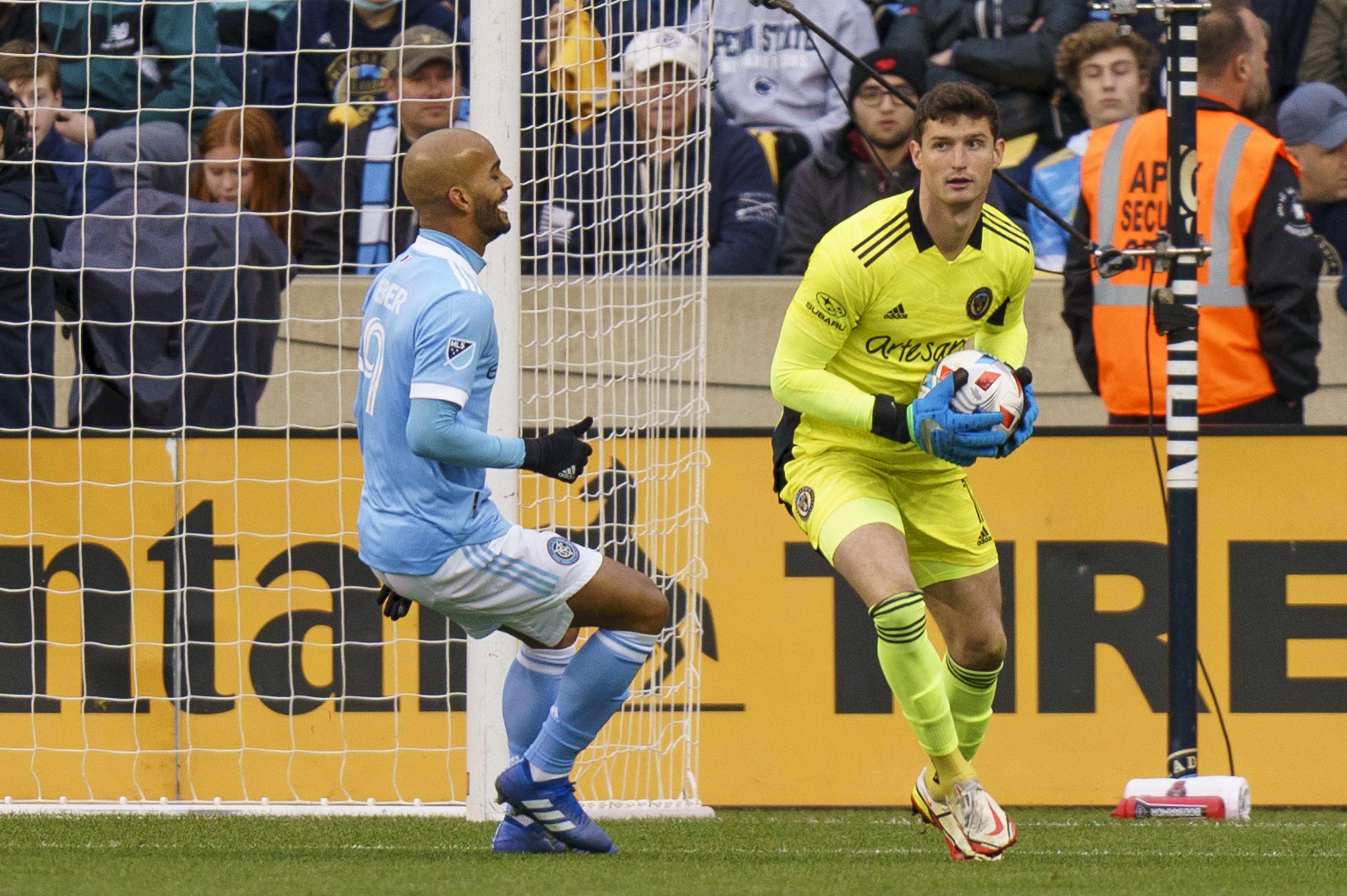
    Matt Freese (49) guided NYCFC past fourth-seed Charlotte FC to set up an Eastern Conference semifinal date against the Union.

    The meeting is the fourth time the teams will battle in the postseason and the second time for Freese, who was released from the Union in 2022 following the team’s run to the MLS Cup final.

    Instead of looking at his ouster from the Union as being on the outside looking in at a professional career, which started in the team’s youth academy, Freese locked in. Just a year after joining NYCFC was named the team’s MVP last season.

    Now, he leads NYCFC as the fifth seed in the East looking up at the No. 1 team and Supporters’ Shield winner — on its home field.

    Matt Freese (right) shown as a member of the Union against his current team, New York City FC during a game in 2021.

    “It’s a really exciting time in my career right now,” Freese said. “It’s important however to stay humble and be thankful that I’m in this situation. I have a job to do, and our goal as a team is to be the last team standing. We have to beat the best. That’s what it comes down to.”

    Fellow U.S. national team member Max Arfsten notes that mentality as the reason Freese has arrived at this moment. Arfsten, whose Columbus Crew side recently fell out of the Eastern Conference playoffs following a loss to rival club FC Cincinnati, gets a routine look at Freese firsthand over the course of the season and sees something special in the goalkeeper.

    “He’s my guy,” Arfsten, a midfielder, said following last week’s USMNT win in Chester. “His ability to control our back line and his communication is big. It allows us to do our job because we know he’s got it covered back there. He’s locked in right now, and that’s really good as we continue to push forward toward the World Cup.”

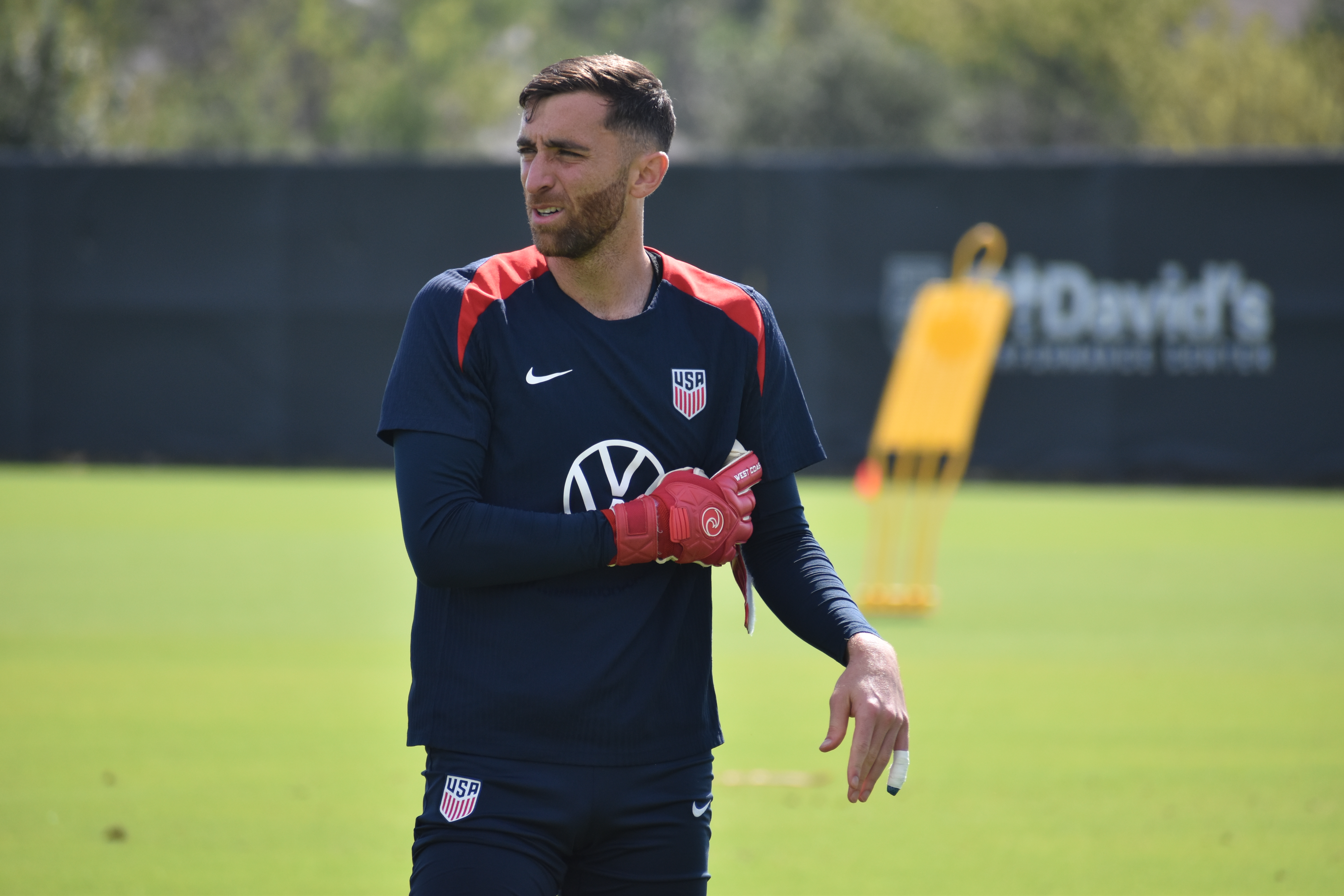
    U.S. men’s national team goalkeeper Matt Freese dives for a save during a training session earlier this month at the WSFS Sportsplex in Chester.

    On his way out of the Union’s locker room last Saturday, Freese briefly struck up a conversation with a security guard stationed just outside the main doors. What was said was muffled, but what was distinctly heard was the security guard ending the conversation in jest with “see you on Sunday.”

    Given what’s at stake, and having an obvious familiarity with Philly banter, it might have been one of the few times Freese let his armor down and cracked a smile.

  • Projecting the USMNT’s World Cup roster after its last game of the year: Several locals in; surprises on the bubble

    Projecting the USMNT’s World Cup roster after its last game of the year: Several locals in; surprises on the bubble

    TAMPA, Fla. — From the time Mauricio Pochettino took over the U.S. men’s soccer team last year, each moment has had two meanings.

    Along with trying to win games, every pass, shot, tackle, save, or failure has been about trying to make the World Cup team. That mentality is burned deep into American soccer’s psyche, as it has been for many decades, and it’s even deeper when the tournament is on home soil.

    The competition is made more difficult by how few opportunities there are to compete. Tuesday’s U.S.-Uruguay game was the 22nd match of Mauricio Pochettino’s tenure, with two more in March before the World Cup roster is named in late May.

    That is the same number of games (24) the Eagles played in their entire 2024 campaign, from the preseason through the Super Bowl — to say nothing of how many games there are in other sports’ calendars.

    U.S. manager Mauricio Pochettino.

    On top of that, in none of those 22 games has Pochettino had every member of his A squad healthy. Christian Pulisic, Tyler Adams, Weston McKennie, Folarin Balogun, Chris Richards, Sergiño Dest, and others have missed significant time along the way.

    Then combine those absences with the Nations League flop in March, which forced Pochettino to blow up his plans and bring in a bunch of less-talented challengers to try to outhustle the stars. The result is the roller-coaster path the U.S. team has been on this year, reaching a smooth track only in the last two months.

    This has made projecting a World Cup roster quite difficult. It’s a game fans love to play, and the media often enjoys it too. But the absences, the results, and the quick cadence of FIFA windows this fall made it more sensible to wait.

    Now, though, the Americans have wrapped up their work for the year. The 24 players on this month’s squad headed back to the club world on Wednesday morning, and that side of the game will reign until late March.

    Gio Reyna is one of the players who left a big and positive impression in this month’s games.

    So this moment feels right to look at the bigger picture. Here’s my view of the race to make the plane to Atlanta, where the 26-player World Cup team will gather at U.S. Soccer’s new national training center before its pretournament friendlies.

    The projection is broken down by the six main positions in Pochettino’s tactics: goalkeeper, outside back, centerback, central midfielder, attacking midfielder, and striker. Each position then has players who look like they’re in, those on the bubble (in alphabetical order), and a few words of analysis.

    Goalkeepers

    In: Matt Freese (New York City FC), Patrick Schulte (Columbus Crew)

    Bubble: Roman Celentano (FC Cincinnati), Jonathan Klinsmann (Cesena, Italy), Zack Steffen (Colorado Rapids), Matt Turner (New England Revolution)

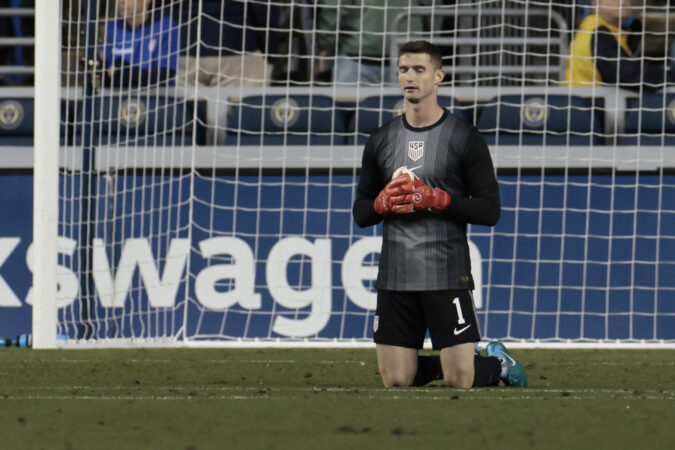
    Matt Freese making a save during one of the U.S. men’s team’s practice sessions in Chester last week.

    Analysis: Unless something goes off the rails for Freese, the Wayne native is in line to become the most surprising U.S. starting goalkeeper at a World Cup for generations. He was given a chance in June and has not let it go, playing 13 of the Americans’ 14 games since the start of the summer.

    Schulte, at age 24, is a fine starter in Columbus, a capable backup with the U.S., and a leading name for the 2030 cycle.

    Turner’s fall is as surprising as Freese’s rise. The locked-in starter from the 2021 Gold Cup through this past March is now not just out of games, but out of rosters. Even a move back to New England to get the playing time he lacked in Europe hasn’t gotten him back in Pochettino’s good graces.

    Matt Turner is on the outside looking in with the U.S. squad right now.

    Celentano and Klinsmann, son of former U.S. manager Jürgen Klinsmann, have been in a few U.S. camps. Steffen, of Downingtown, unfortunately is on the outside looking in right now, despite his talent. He’ll have to hope for a strong start next year in Colorado that vaults him over the field.

    Outside backs

    In: Max Arfsten (Columbus Crew), Sergiño Dest (PSV Eindhoven, Netherlands), Alex Freeman (Orlando City), Antonee Robinson (Fulham, England), Tim Weah (Marseille, France)

    Bubble: Kristoffer Lund (FC Köln, Germany), John Tolkin (Holstein Kiel, Germany)

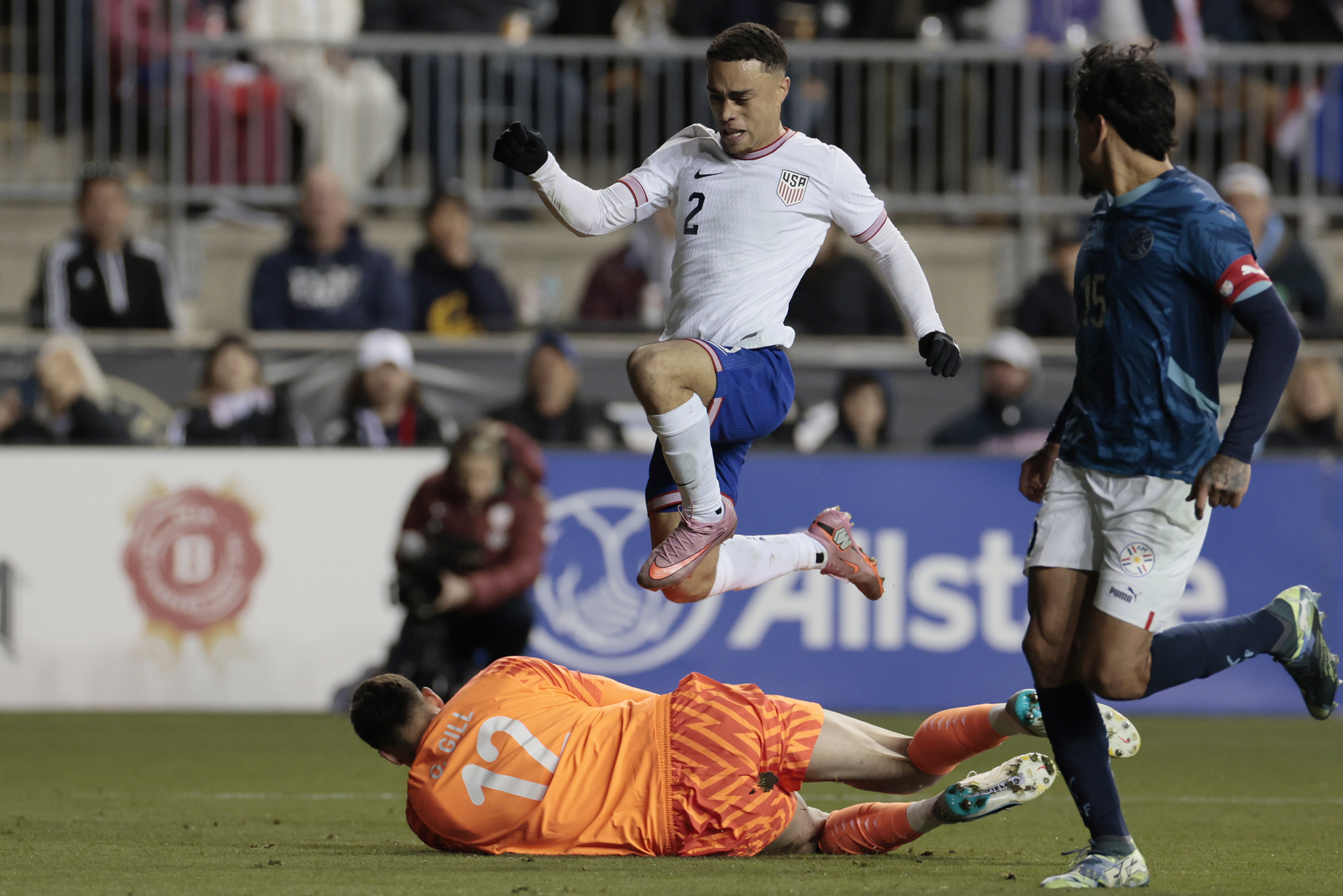
    Sergiño Dest (2) in action against Paraguay at Subaru Park on Saturday.

    Analysis: With one exception, this position is easy to line up. All five of the “in” names are locks to make the squad unless Robinson can’t recover from a long-term knee issue. From here, the view is if he’s healthy on June 1, that’s all that matters.

    Dest and Weah are the other big names, each capable of thriving in the right wingback role and playing the left side if necessary.

    Earlier this year, a reader complained to me on social media that the underwhelming Gold Cup squad might only produce the last players picked for a World Cup squad. I responded that if that was to happen, that squad would be a smashing success, no matter its results.

    Arfsten and Freeman are the proof of that, having shot to well-earned prominence this year. Though they wouldn’t start if the three others are healthy, they are more than capable backups.

    Lund and Tolkin are on the bubble in case Robinson ends up out. Tolkin played well against Uruguay on Wednesday in his first U.S. cap since the Gold Cup; Lund hasn’t been called in since October of last year.

    Centerbacks

    In: Mark McKenzie (Toulouse, France), Tim Ream (Charlotte FC), Chris Richards (Crystal Palace, England)

    Bubble: Noahkai Banks (Augsburg, Germany), Tristan Blackmon (Vancouver Whitecaps), Cameron Carter-Vickers (Celtic, Scotland), Miles Robinson (FC Cincinnati), Joe Scally (Borussia Mönchengladbach, Germany), Auston Trusty (Celtic, Scotland), Walker Zimmerman (free agent, last with Nashville SC)

    Chris Richards working out during a practice in September.

    Analysis: Ream and Richards aren’t just locks, they’re expected starters. The third starting spot is up for grabs, and there’s a lot of competition.

    McKenzie isn’t just projected as in here out of hometown loyalty to the Union alumnus from Bear, Del. His play for the national team and Toulouse puts him above a field in which no one else has truly stepped up.

    From here, the bet is Pochettino will take two more, and the race is wide-open.

    Blackmon has played some for Pochettino but isn’t at the needed level. Carter-Vickers didn’t play for the U.S. in October, a big warning sign, then suffered an Achilles injury at Celtic. Robinson is a U.S. regular but hasn’t quite done well enough to ensure a plane ticket.

    Scally can play multiple positions and is listed here because right centerback is where he projects under Pochettino. After being out of the picture for a while, he played there against Paraguay, got torched on a goal, then didn’t play vs. Uruguay.

    Mark McKenzie (left) and Auston Trusty (right) grew up with the Union together, and could go to the World Cup together.

    Trusty played the full game vs. Uruguay and did well at both ends of the field. Zimmerman is last in line, but if he lands at a big club in MLS free agency and starts the year strong, he could be an emergency option.

    Banks is a big wild card. The 18-year-old Hawaii native stands 6-foot-4, is starting to earn regular playing time at Augsburg, and has held his own in the Bundesliga’s cauldron. Pochettino called him up in September, but hasn’t since. If Banks keeps playing, he might just make it.

    Central midfielders

    In: Tyler Adams (Bournemouth, England)

    Bubble: Sebastian Berhalter (Vancouver Whitecaps), Johnny Cardoso (Atlético Madrid), Aidan Morris (Middlesbrough, England), Cristian Roldan (Seattle Sounders), James Sands (St. Pauli, Germany), Tanner Tessmann (Lyon, France)

    Tyler Adams (left) is one of the U.S. team’s biggest stars.

    Analysis: Adams is a lock — a star, a veteran, and the team’s most vocal leader. From there, the question will be how deep Pochettino goes at the position.

    Tessmann, Roldan, and Morris lead the way, with Tessmann the closest to a lock. That takes the total to four, and the guess here is one more will make it.

    Berhalter made quite a statement in Tuesday’s win over Uruguay, with a goal and an assist off a corner kick. That puts him ahead for now of Cardoso, who has tons of talent and is at a huge club but has a history of playing poorly for the U.S. He’s also coming off an injury. If he’s healthy by March, he could get one shot at a ticket in that month’s friendlies.

    Sands helps his case with versatility, as he also can play centerback. He got a look in October and wasn’t bad, but he wasn’t called back this month even though there was room for him.

    Attacking midfielders

    In: Brenden Aaronson (Leeds United, England), Weston McKennie (Juventus, Italy), Christian Pulisic (AC Milan, Italy), Malik Tillman (Bayer Leverkusen, Germany), Alejandro Zendejas (Club América, Mexico)

    Bubble: Diego Luna (Real Salt Lake), Jack McGlynn (Houston Dynamo), Gio Reyna (Borussia Dortmund, Germany)

    Union alum and Medford native Brenden Aaronson in action for the U.S. on his former home field at Subaru Park.

    Analysis: The “in” players are locks as long as they’re healthy, with Zendejas the only one close to a question. Pulisic obviously is a starter, with Tillman or McKennie in line to run next to him.

    From there, Pochettino can make subs based on situations. Medford’s Aaronson is an ideal defensive closer, and Zendejas provides width and creativity.

    The last pick could come down to Luna, whom Pochettino rightly adores for his toughness; or Reyna, whose talent is forever followed by injury fears. It would be great to see both make it, but there might not be room unless another position is sacrificed. Reyna has the advantage now and will keep it if he plays regularly for his club.

    McGlynn is a long shot, but a hot streak with Houston next year could bring his magic left foot back to the picture.

    Strikers

    In: Folarin Balogun (AS Monaco, France), Ricardo Pepi (PSV Eindhoven, Netherlands), Haji Wright (Coventry City, England)

    Bubble: Patrick Agyemang (Derby County, England)

    Folarin Balogun (center) might finally be the U.S. team’s long-awaited top striker.

    Analysis: It’s truly remarkable that the highest-profile position is one at which the U.S. has the fewest questions. Never before in the program’s 36-year modern era has there been a striker depth chart with this much quality.

    If Balogun, Pepi, and Wright are healthy, they’ll be on the plane, and that will be it. If any of them are injured — which Pochettino and every U.S. fan will pray doesn’t happen — Agyemang is first in line to come in.

    The field drops so far from there that right now no other strikers truly are in consideration.

  • USMNT stuns Uruguay with a 5-1 rout in its last game of the year

    USMNT stuns Uruguay with a 5-1 rout in its last game of the year

    TAMPA, Fla. — The U.S. men’s soccer team closed its year with one of its toughest tests under Mauricio Pochettino, against star-studded Uruguay on Tuesday. And if the opponent’s quality wasn’t enough, Pochettino upped the ante by starting many of his backups to test them.

    What resulted was one of the most surprising games not just of Pochettino’s tenure, but for some years with the U.S. program: a 5-1 shellacking by the Americans, with goals from four different scorers.

    Sebastian Berhalter, Alex Freeman (twice), and Diego Luna tallied in the first half, and Tanner Tessmann added another in the second before a crowd at Raymond James Stadium that was as stunned as it was thrilled.

    As much as the result of any friendly game counts, Pochettino’s lineup changes immediately became the night’s first headline. Just two of the 11 players who started Saturday’s win over Paraguay, right back Sergiño Dest and former Union goalkeeper Matt Freese, remained starters three days later. (The short time between contests was perhaps another factor in Pochettino’s rotation.)

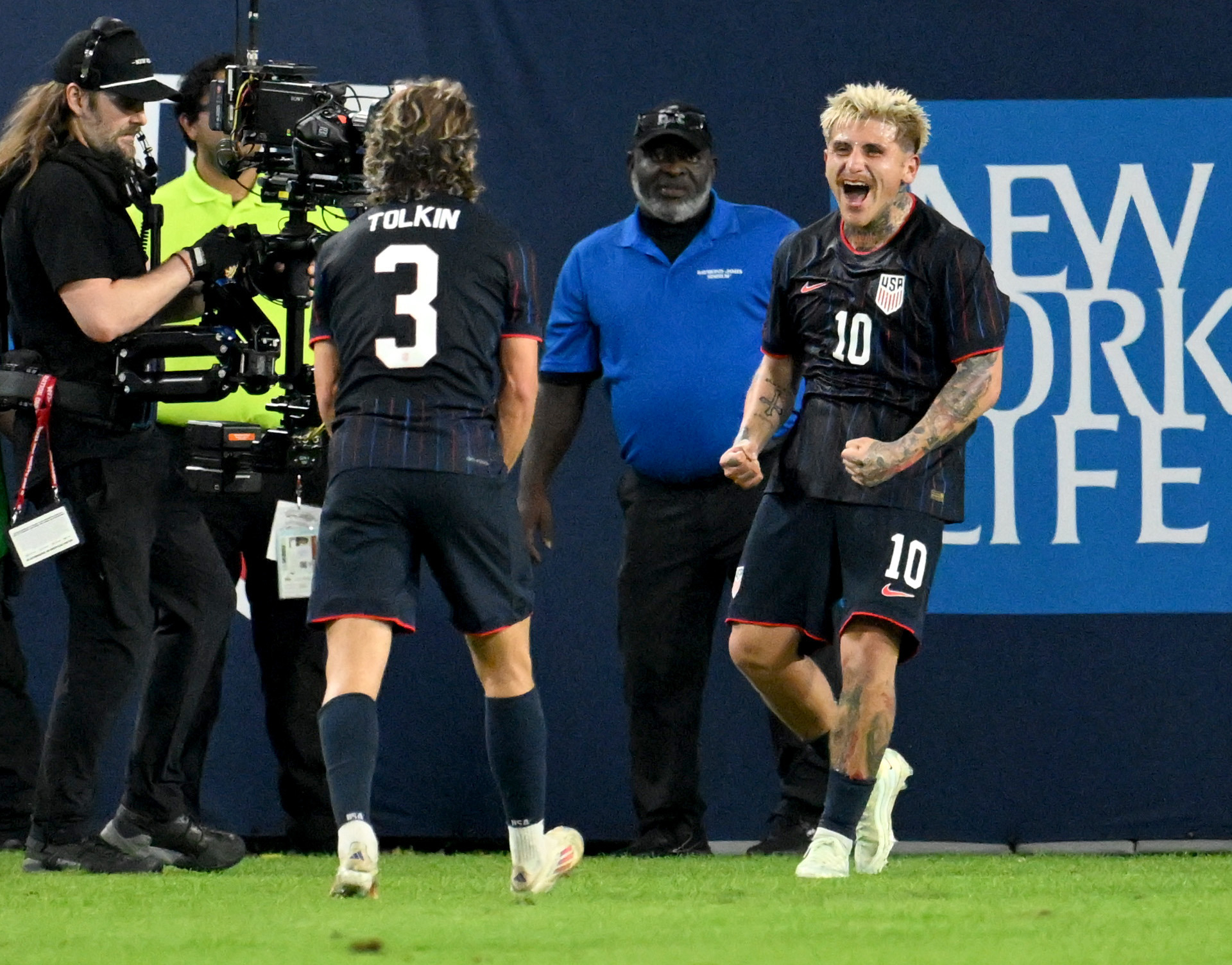
    John Tolkin (left) and goal scorer Diego Luna (right) were among the new U.S. starters.

    Pochettino took the U.S. back to a 4-3-3 setup, with Union alumni Mark McKenzie and Auston Trusty together at centerback, John Tolkin at left back, and Freeman at right back. Aidan Morris was the midfield stopper behind Timothy Tillman and Berhalter; and Luna, Haji Wright, and Dest were the front three from left to right.

    They faced an Uruguay lineup stacked with marquee names. Barcelona’s Ronald Araújo anchored the back line; Tottenham Hotspur’s Rodrigo Bentancur and Manchester United’s Manuel Ugarte led the midfield; and Flamengo dynamo Giorgian de Arrascaeta created behind striker Federico Viñas of Spain’s Real Oviedo.

    Along with their talents, they were expected to bring Uruguay’s famed garra charúa fighting spirit. Instead, the near total opposite happened.

    Berhalter opened the scoring in the 17th off a free kick trick play, a give-and-go with Dest for a curler from the left side of the 18-yard box. The son of former U.S. manager Gregg Berhalter grabbed his jersey by the badge as he exulted, pointed to it, and aimed an ear to the crowd — perhaps to make a point to his critics.

    Freeman doubled the lead four minutes later when he leapt to meet Berhalter’s corner kick and headed it past a stranded Uruguay goalkeeper Cristopher Fiermarin — one of la Celeste’s only inexperienced players, in just his second national team game.

    In the 31st minute, Freeman made it 3-0 at the tail end of another corner kick play. After an initial clearance, Freeman ended up on the left side of the field, Trusty sprung him forward, and Freeman — who plays his club soccer 90 minutes west of here in Orlando — split Araújo and Ugarte before shooting.

    Luna struck the fourth in the 42nd, set up by Tillman. This really was shocking now, as Uruguay’s stars looked tired and uninterested. It was miles from the standard set by famed manager Marcelo Bielsa, who launched Pochettino’s professional career decades ago at Argentine club Newell’s Old Boys.

    This all said, in the moments Uruguay advanced forward, the U.S. defense didn’t exactly look great. It came to a head in first-half stoppage time, when Freese came off his line, nearly crashed into Freeman, recovered, then was stuck at his right post as de Arrascsaeta uncorked a bicycle kick in front of McKenzie. Seven U.S. field players stood in front of Freese at the point when de Arrascaeta launched himself.

    Uruguay’s fight showed up in the second half, but not always for the better: Bentancur was ejected with a straight red card in the 65th for upending Berhalter.

    Just before then, Pochettino made his first substitutions of the night. Luna, Wright, and Dest went out, and Gio Reyna, Folarin Balogun, and Tessmann went in. That didn’t all add up as like-for-like swaps, but the end result was a 4-2-3-1 with Berhalter, Reyna, and Tillman in front of Morris and Tessmann.

    The fifth goal came in the 68th, off another corner kick play. Reyna had the eventual assist with a ball floated from the left wing that Tessmann headed in, with Fiermarin barely contesting the service.

    Max Arfsten and Brenden Aaronson entered next, replacing Tolkin — who had been kicked around enough to be injured — and Tillman in the 75th. Cristian Roldan was the last U.S. substitute, replacing Morris in the 86th.

    When the clock struck 90 minutes, Guatemalan referee Julio Lune blew the final whistle right away instead of adding stoppage time.

    He, like everyone else, had seen quite a sight.

  • The USMNT’s players appreciate the team’s tough schedule leading up to the World Cup

    The USMNT’s players appreciate the team’s tough schedule leading up to the World Cup

    TAMPA, Fla. — Once the U.S. men’s soccer team knew it wouldn’t have to qualify for next year’s World Cup as a cohost, it faced a different challenge.

    Having no qualifiers to play meant the program would have to fill its calendar with exhibition games, which the world’s game calls “friendlies” even when they aren’t polite. (Look no further than the brawl that ended Saturday’s U.S.-Paraguay match in Chester.)

    Since it started to matter in June, U.S. Soccer could have picked several lesser opponents to try to rack up wins for public perception. But it knew those would have been empty calories, and many fans would have agreed.

    So manager Mauricio Pochettino and his staff chose the harder path: aim high, suffer along the way, and come out the other side sharpened.

    U.S. manager Mauricio Pochettino at Monday’s practice in Tampa.

    There was certainly suffering for a while: a 2-1 loss to Turkey and a 4-0 blowout to Switzerland in June, and a 2-0 loss to South Korea in September.

    Pochettino’s words after the Switzerland game were as true then as they are now, with the U.S. on a four-game unbeaten run against Japan, Ecuador, Australia, and Paraguay.

    “We knew that we wanted to play with two important teams in Europe like Turkey and Switzerland,” he said. “When we decided to play them, it’s because we wanted the players to feel the high level. And when you take the risk, this accident can happen.”

    Had the Americans not turned results in their favor, as they have over the last four games, the ride would still be bumpy. Perhaps some critics would claim to prefer the easier path.

    But the good results have further justified a correct decision.

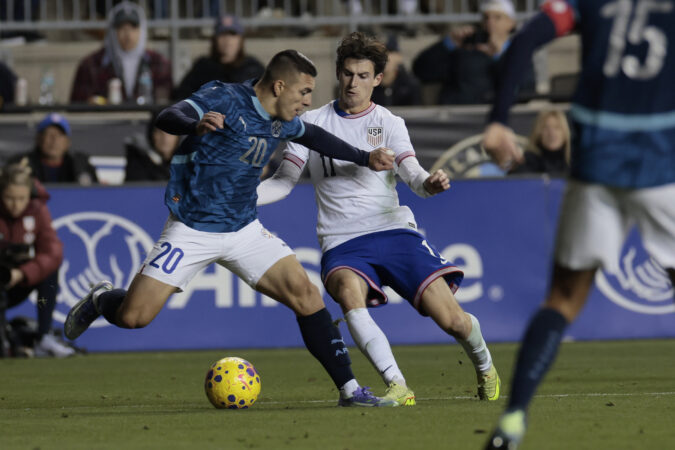
    Gio Reyna (left) celebrating after scoring the opening goal for the U.S. against Paraguay at Subaru Park on Saturday.

    Now the hill grows steeper. After facing Turkey and Switzerland in June, South Korea and Japan in September, Ecuador and Australia last month, and Paraguay last week, the U.S. closes its year by facing South American superpower Uruguay at the Tampa Bay Buccaneers’ Raymond James Stadium on Tuesday (7 p.m., TNT, Universo).

    Next March’s games, the last before the World Cup is set, are expected to be against Portugal and Belgium at Atlanta’s Mercedes-Benz Stadium — a fittingly glamorous stage in U.S. Soccer’s new hometown.

    ‘A real, raw passion’

    All 10 of those teams were or will be in the top 40 of FIFA’s global rankings at the time of the matchup, with nine in the top 25 and five in the top 20. (The U.S. sits 16th, and has for all but one ranking period over the last year.)

    And since the opponents had their own World Cup qualifiers to play, U.S. Soccer earns more credit for getting them over here in the rare times they were available.

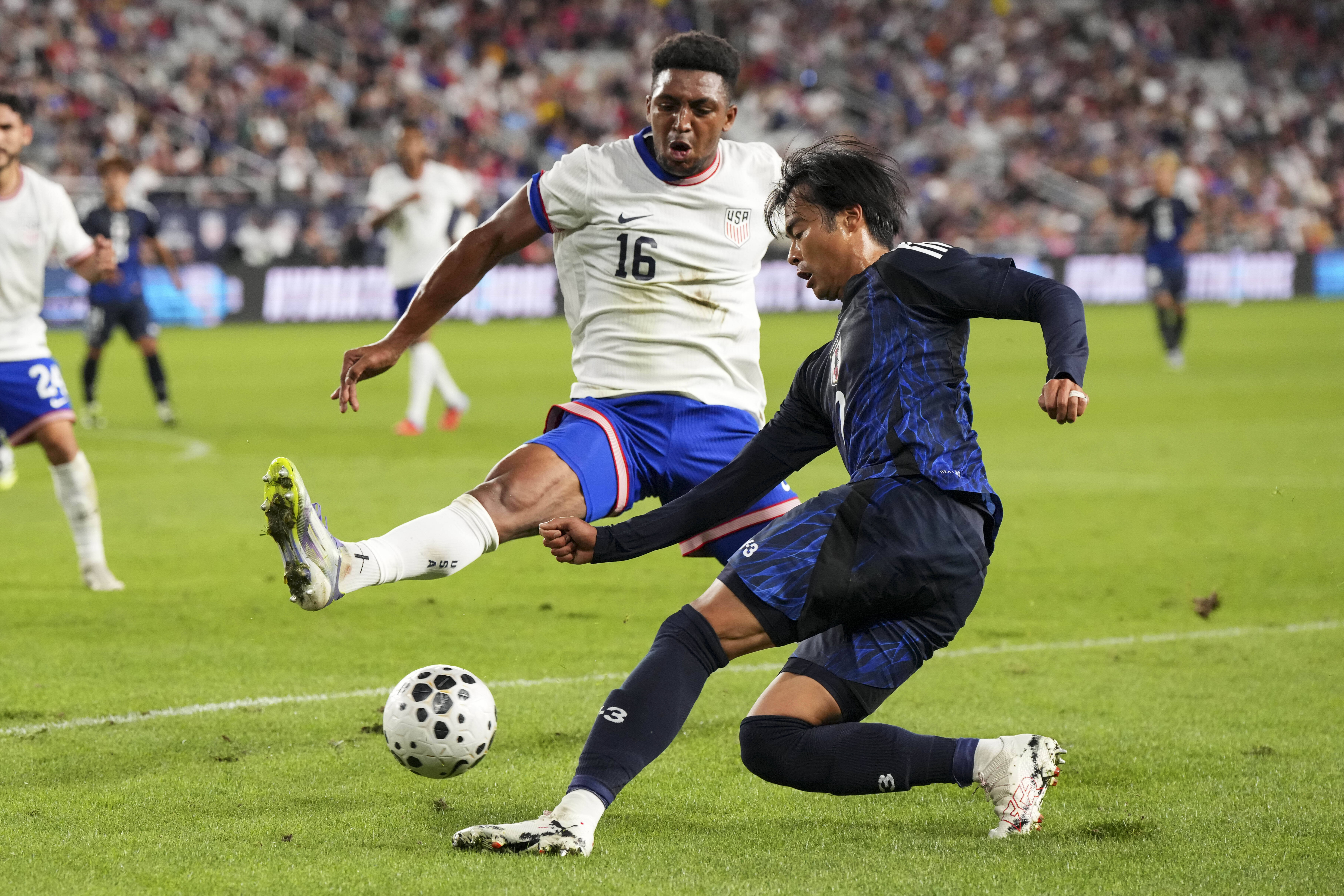
    Alex Freeman (left) defending Japan’s Kaoru Mitoma during their matchup in September.

    “That’s ultimately what you want,” former Union centerback Mark McKenzie said. “I think any competitor wants to play against the best of the best, and as you go into a World Cup where we don’t have the luxury of a qualification period, you want to play against opponents who ultimately you have the potential to see in the World Cup. So I think when you play against those teams that are especially high-ranked, it puts you up to bat, and to figure out where you stand against those kinds of teams.”
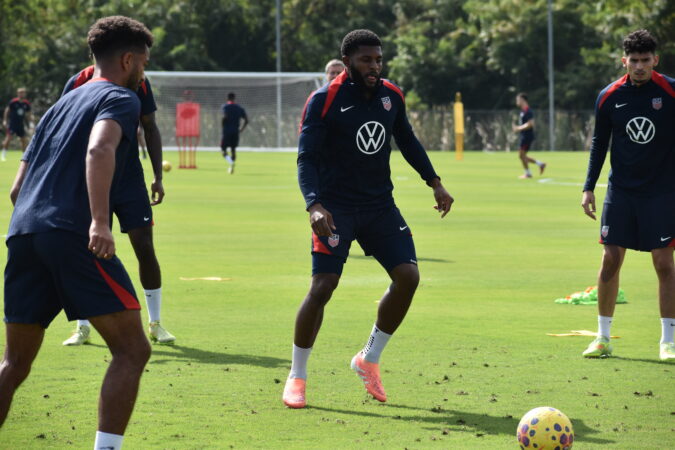
    The competitive juices especially come out when the U.S. plays South American opponents. Though big-name European nations draw more fan interest, South American teams deliver an unmatched mix of talent and passion.

    “There’s a real, raw passion that comes along with that,” McKenzie said. “There’s a sense of real pride that South American teams play with. You hear it with the national anthems — the stadium is rocking because their supporters are all singing and screaming their anthem.”
    McKenzie tries to bring the same mentality to playing for his country, and to his teammates.

    “We have that mentality of, it’s not every day you get the chance to represent your crest, [or] every day you get to be one of 20-some-odd players to step on that pitch,” he said. “So, yeah, we’re going for the same mentality. We approach each game [as] it’s not a friendly match, but this is a preparation for what’s to come.”
    Gio Reyna (second from left) and Tim Ream (right) are among the U.S. players shown stretching at Monday’s practice.

    The U.S. has a long history of big games against South American foes. Its first guest appearance in a Copa América, South America’s continental championship, was in 1993 — a year before facing Colombia and Brazil in the first men’s World Cup hosted here.

    Kasey Keller’s 10-save masterclass against Brazil in 1998 still lives in the history books, as does a 1999 upset of an Argentina squad that Pochettino played for. More recently, the U.S. hosted two Copa Américas, in 2016 and last year, and in them faced six of the continent’s 10 teams.

    That Uruguay landed the knockout blow in last year’s group stage makes this meeting even more of a benchmark.

    Among the players who have gotten the message is outside back Alex Freeman, one of the younger members of this group but with a fast-rising profile.

    “I feel like it’s a good test for us,” he said. “I feel like, especially in our home country, we need these tests. We need to show what we’re capable of and what we can do, and I feel like just knowing that we’re able to compete against these teams, it’s just a good step for us, and for the U.S. in general for soccer.

    Long before he was the Union’s sporting director from 2015-18, Earnie Stewart (left) scored a historic goal to help the U.S. men upset Colombia at the 1994 World Cup.

    The USMNT’s pre-World Cup friendly opponents

    Here’s a look at the teams the U.S. has played in friendlies since the start of June, and will play leading up to the World Cup.

    After the World Cup roster is announced in late May or early June, the tournament squad will play two friendlies against teams and in cities that are still to be announced.

    The FIFA rankings below are as of the date of the matchup, or as of this week for games that haven’t happened yet.

  • Gio Reyna seizes his moment with the USMNT, and is now in the World Cup race

    Gio Reyna seizes his moment with the USMNT, and is now in the World Cup race

    From the moment the U.S. men’s soccer team’s starting lineup was announced Saturday, all eyes were fixed on Gio Reyna.

    Not only was he about to play for his country for the first time since late March, but he was starting for the first time since last year’s Copa América group stage finale — a loss to Uruguay that sent the U.S. out in the group stage on home soil, and sent manager Gregg Berhalter out of his job.

    Reyna, 23, didn’t make any of Mauricio Pochettino’s squads until the Nations League final four in March because of a groin injury. Then he didn’t play in the semifinal loss to Panama, and was an ineffective second-half substitute in the third-place game loss to Canada.

    For all Reyna’s talents — and he has perhaps the most natural talent of any U.S. player besides Christian Pulisic — Pochettino declared him not “ready to play in the way that we expect from him” on the eve of the third-place game.

    Gio Reyna hadn’t been with the U.S. men’s soccer team since March.

    That was how far he had fallen, in terms of fitness, form, and playing time at his club, Germany’s Borussia Dortmund.

    Nor was he done falling. Reyna went to the Club World Cup with Dortmund instead of the Gold Cup and the friendlies before it, because Dortmund wanted him at their games and Pochettino didn’t want players at the friendlies whom he wouldn’t have afterward.

    Would that be salvation? No, it was almost the opposite. Reyna got off the bench only once in Dortmund’s five tournament games, a mostly useless 12-minute cameo in the group stage finale.

    Only after that did he finally leave for newer pastures, a move many outsiders had hoped to see for years. Borussia Mönchengladbach bought him for about $4.5 million up front and $3 million in incentives. It was miles below what Dortmund expected when a 17-year-old Reyna made his first-team debut in early 2020.

    Gio Reyna watched almost all of Borussia Dortmund’s Club World Cup run this summer from the bench, finally leaving the club afterward.

    It was to be a fresh start, but it barely started before Reyna suffered the latest of seemingly countless muscle injuries in September. He returned to action in mid-October, but only as a substitute.

    So it was a pretty big surprise when Pochettino called him up to the national team this month. But over the course of the week in Chester, it felt increasingly inevitable that he would start Saturday against Paraguay at Subaru Park.

    Meeting the moment

    Right on cue, there he was, and the message was clear. This was Reyna’s shot. Would he take it?

    The answer came within four minutes.

    It was a broken play out of a corner kick, the ball pinging around off all manner of limbs on both teams. Eventually, it fell to Max Arfsten, and he chipped a cross into the crowd. Reyna rose highest and met it with a header that caromed in off the crossbar.

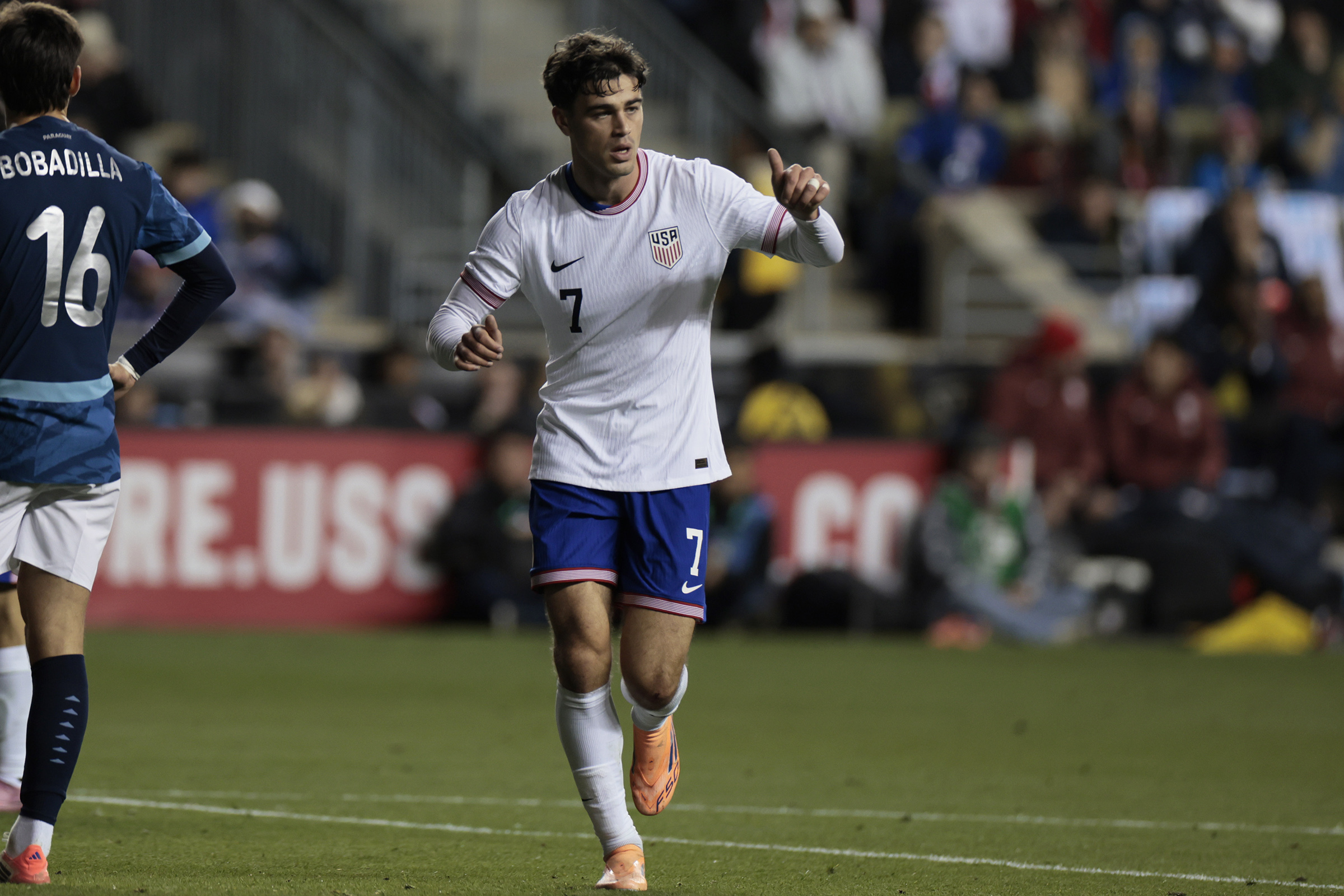
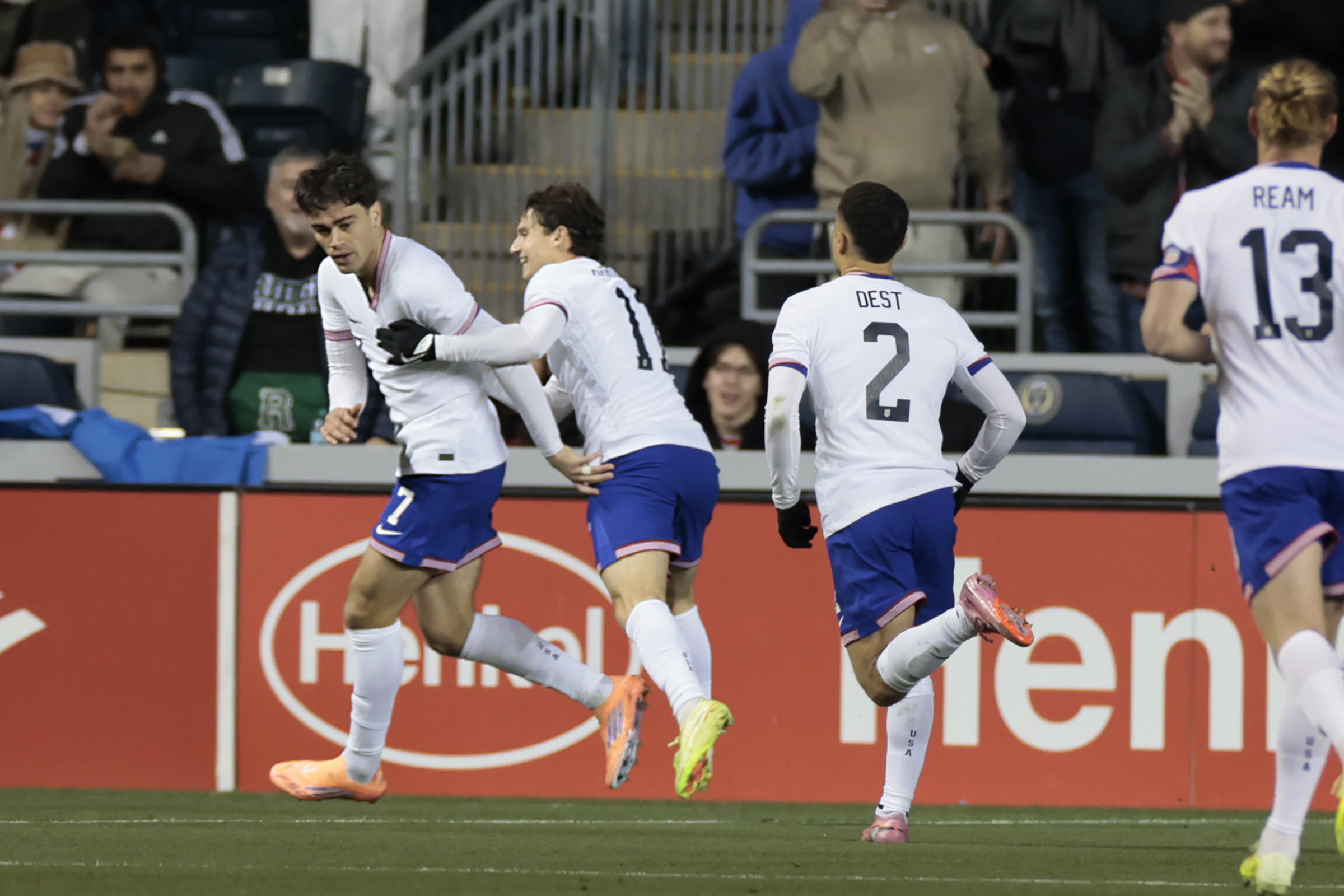
    As the crowd roared, Reyna ran toward the corner flag, pointing to the U.S. badge on his jersey. Within seconds, his teammates had swarmed him to celebrate.

    “I know the kind of player he is, and I’m just really happy for him — he deserves it,” said Medford’s Brenden Aaronson, who started with Reyna in the attacking midfield spots. “He’s been through a lot with injuries, with all this stuff. But whenever he plays for the national team, he’s always there, and it’s awesome to see. … He’s confident in his ability, he knows what he can do, and that’s the beauty of him.”

    There wasn’t time in the moment to point out that Reyna has not in fact always been “there” when with the national team. That was the whole point of the 2022 World Cup scandal that nearly torpedoed him.

    When that goal went in, though, it was a moment for his immense burden of history to be a privilege, not a weight. The tally was his ninth for the U.S., passing his legendary father Claudio’s eight.

    Gio Reyna (left) celebrates with Brenden Aaronson (center) and other teammates after scoring the game’s opening goal.

    And for once, Claudio wasn’t invoked because of that scandal, or all the times Claudio interfered with U.S. Soccer officials before then, or yelled at referees from the sidelines in Gio’s youth days, or by genetics passed his ego on to his son.

    By the time Gio emerged from the locker room to meet one of the biggest media packs at a U.S. game in quite a while, he had already texted with his father.

    “It was just fun, love,” Gio said. “He was obviously happy for me that I passed him, but I had no idea. So he was more making fun of me for the fact that it was my first header I’ve ever scored.”

    The pressure on him is earned

    The negative side of the burden struck twice after that. On Paraguay’s 10th-minute equalizer, Reyna was late and slow to challenge Junior Alonso before he launched the long ball that sprung Miguel Almirón for a dazzling assist on Alex Arce’s goal.

    In the 50th, Reyna had a look to shoot in the 18-yard box and didn’t take it, choosing instead to dribble into what became a crowd of defenders.

    Those were small moments, but they mattered. Just as pressure is a privilege, Reyna knows his talents bring extra scrutiny.

    The scale tilted back his way in the 71st. Reyna combined superbly with Folarin Balogun to create the winning goal. The man of the hour had delivered again, and the U.S. went on to close out a 2-1 win.

    “I think in the end, performances like this that can help everybody here,” Reyna said. “But I want to have, more importantly, seven or eight good months in the rest of the season with Gladbach. And then I believe if I keep performing like I did tonight, then I’ll have a good chance to make the team and have an impact there, too.”

    There’s still a ways to go, and as Pochettino said, plenty for Reyna to do to earn a seat on the plane next summer. But in a moment when he was asked to step up, he did, and in national team soccer there are never many moments. So when you get one, you have to take it.

    “He showed why he started, and yes, confirmed that he’s a player that needs to improve because he needs to play more in his club,” Pochettino said. “But we can see today that he was great: scored and assisted. And the way that [he has] always the capacity to read the game, and find the free space in between the lines, I think that was a nightmare for Paraguay, and I think he did a very good job.”

    Reyna thanked Pochettino in turn, with some notable humility.

    “I knew it was an opportunity for me to to show that I belong here,” he said. “He’s been great with me all week, working with him, and just trying to give me the freedom and the confidence to sort of be myself. So I can’t thank him enough, obviously, for the start and just for the relationship that we’ve really built this camp.”

    Gio Reyna (center) working in practice during the week.

    The stakes only get higher from here, and so does the quality of opponent the U.S. will face. After meeting Uruguay on Tuesday in Tampa, Fla. (7 p.m., TNT, Universo), to close out this month, it’s expected that March’s games will see big-time opponents from Europe. Portugal, France, and Belgium are reportedly on the radar, with Atlanta’s Mercedes-Benz Stadium set as a fittingly big-time venue.

    Time will tell if Reyna earns the right to be there. For now, he’s only in the race. But that alone is the best place he’s been in for a long time.