Temple University Health System and Jefferson Health are the latest area health systems to sue pharmaceutical companies and pharmacy benefit managers over high insulin pricing.
Temple filed its suit last week, and Jefferson sued just before the new year.
Eli Lilly, CVS Caremark, and Sanofi are among the major companies named in the suits, which accuse drugmakers and pharmacy benefit managers, or PBMs, of conspiring to drive up profits on diabetes drugs.
PBMs work with drug manufacturers, insurers, and pharmacies, negotiating prices and developing formularies — lists of prescription drugs that are available on a given insurance plan.
The health systems and other plaintiffs say drugmakers inflate prices for their insulin products in order to secure lucrative placements on formularies. Then, they pay a portion of the resulting profits back to PBMs, according to the lawsuits.
Jefferson and Temple officials said they are paying more for employees’ insulin as a result, impacting the health systems’ budgets and hurting their ability to “provide necessary services […] to the larger Philadelphia community.”
Representatives from both health systems declined to comment.
Eli Lilly has worked for years to reduce out-of-pocket costs for insulin, the company said in a statement, noting that some plaintiffs filing the lawsuits are choosing higher-priced medications over more affordable options.
Lilly capped insulin prices at $35 per month, the statement said, and in 2024 the average monthly out-of-pocket cost for its insulin was less than $15.
CVS Caremark said pharmaceutical companies “alone are responsible” for pricing their drugs in its latest statement, released after Philadelphia officials joined the litigation last month. The company said it would welcome lower prices on insulin.
“Allegations that we play any role in determining the prices charged by manufacturers for their products are false, and we intend to vigorously defend against this baseless suit,” they wrote in an email.
A statement from Sanofi said that the company has always complied with the law when it comes to drug prices and works to lower prices. PBMs and insurers sometimes negotiate savings on drugs, but those are “not consistently passed through to patients in the form of lower co-pays or coinsurance,” the statement read.
“As a result, patients’ out-of-pocket costs continue to rise while the average net price of our insulins declines.”
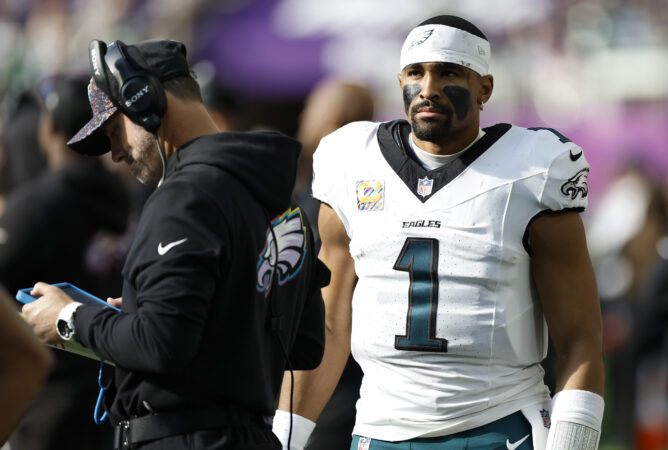
Jalen Hurts knew the score. He knew Kevin Patullo was done. It made zero sense for the Eagles quarterback to say he wanted the offensive coordinator to return, knowing it was a fait accompli.
“It’s too soon to think about that,” Hurts said Monday when asked about wanting Patullo back. “I put my trust in Howie, Nick, and Mr. Lurie.”
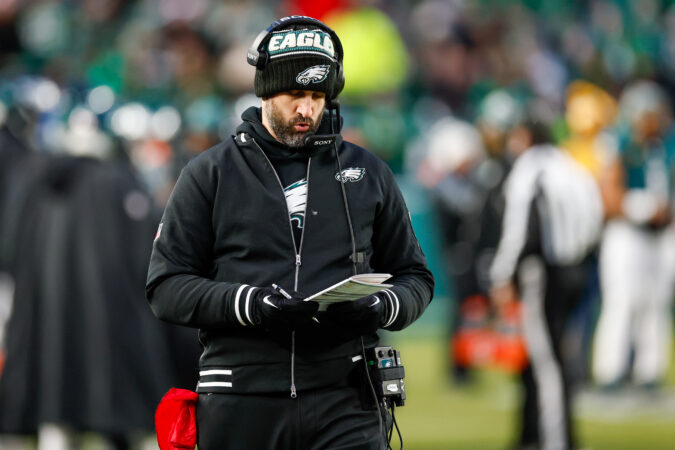
The Eagles haven’t officially fired or demoted Patullo as of this writing, but it’s only a matter of time before Howie Roseman, Nick Sirianni, and Jeffrey Lurie come to that conclusion after a once-banging offense ended a calamitous season with a whimper on Sunday. (Editor’s note: Patullo was removed from his position Tuesday).
It was hard to find any source within the NovaCare Complex who expected otherwise. And if you listened closely to Hurts’ comments at his locker stall the day after the Eagles lost to the San Francisco 49ers, you could hear in his tone an elegy for Patullo.
“I hate that, you know … [pause] … I hate that,” Hurts said before another pause. “I hate that it ended this way, but I know we’ll be better from it.”
Hurts was talking about how the season ended, but he just as easily could have been talking about Patullo’s fate.
He could have also, of course, stood up on his stool and defended the coach. He could have taken accountability for his role in the first-time play-caller’s struggles. He could have pointed to specific plays he failed to make and specific ways he limited the offense.
But it really made no sense. Patullo will be the latest coordinator to exit the annual roller coaster that is having Hurts as your quarterback. From the highs of getting head coaching promotions (see: Shane Steichen and Kellen Moore) to the lows of getting canned (see: Brian Johnson and eventually Patullo).
Hurts, meanwhile, will remain and have a fifth different coordinator and sixth play-caller since Sirianni became head coach in 2021. And if you want to go all the way back to college — as Hurts has noted before — he’ll have his 14th different play-caller in the last 11 years.
That’s a lot of change and most of it out of his control, especially in Philadelphia after Sirianni gave up play-calling during his first year. But Hurts isn’t a pup anymore. And even he seemed to acknowledge that play-caller turnover isn’t a credible excuse after he won a Super Bowl in his first season with Moore.
“I accept the change,” Hurts said when asked about areas he wanted to work on this offseason. “I accept that those things come, whether expectations are met or whether we’re making Super Bowl runs. I’ve experienced both ends of it, and so I have a unique perspective on that.
“So I’m not going to allow that to be an excuse for us not to make championship runs and for us to not have the success that we desire and that I desire.”
Hurts is just one piece of the puzzle, just as Patullo was. They’re major parts of the machinery, so they rightfully get the most attention. But too much outside blame was placed on the coordinator because he was new, while not enough was directed toward the quarterback because of his previous success.
It’s understandable. Doesn’t make it accurate.
Inside the Eagles, most understood that there were myriad reasons for the offense’s decline. The personnel wasn’t as good. The offensive line wasn’t as healthy. The coaching staff wasn’t as sharp. And it’s damn hard to repeat as champions. The margin for error is slim in the NFL.
The Eagles’ best leaders looked internally at themselves and what they could improve and refused to point fingers. But there was definitely some redirecting of criticism, with the split about evenly distributed between Hurts and Patullo.
The Hurts critics just seemed louder. Some of the gripes were performance-based. Like the offense isn’t exotic and moves slowly because Hurts can’t read complex defenses or doesn’t want pre-snap motion. Or his inability to process post-snap limits middle-field throws. Or he doesn’t want to run as much anymore.
All claims can have some semblance of truth, but the first two didn’t seem to hinder the offense when the going was good. The scheme, as wide receiver DeVonta Smith said Sunday, was essentially the same since 2021.
There was more nuance than that. The system evolved to become more run-based. Moore brought in some new passing concepts in 2024, but some were never used. The Eagles could rest on their talent more than most.
But they rolled it back again in 2025 as running back Saquon Barkley said on Monday — similar to how they did in 2023 — and defenses caught up. And Patullo, as it increasingly became clear, wasn’t able to consistently dial up sustainable drives. He showed his acumen in the red zone, but getting there was often a battle.
If there was a conflict between Hurts and Patullo that went public, it was over designed quarterback runs. Hurts didn’t originally deny reports that he didn’t want to run as much, but when asked last week about how that factored into his good health this season, he suggested that it wasn’t his doing.
“The approach this year, and the way the games have been called with this coordinator — with Coach KP — it’s just kind of gone that way,” Hurts said. “I’ve taken it in stride and [am] giving my best with the position they’ve put me in.”
It’s hard to believe that Hurts doesn’t have a say in those conversations. He has said his influence has steadily increased. Some team sources have said it’s much greater than has been conveyed. But if he has been overpowering coaches, isn’t that as much of an indictment of Sirianni and Patullo as it is the quarterback?
Hurts was asked Monday how comfortable he had been with being uncomfortable in the offense.
“I think that’s the essence of what my career has been,” Hurts said. “Can’t say that every situation I’ve been in has been the most comfortable, but I’ve been able to find my way out of it and find ways to win and find ways to success. And so that’s a part of growth, and I’ve never run away from growth.”
Hurts has progressed. He’s better as a drop-back passer. He’s better at reading coverages. He’s better vs. the blitz. But in his growth as an NFL quarterback, he may have lost sight of how his mobility made him dynamic.
“He is not who he thinks he is,” an Eagles source said.
Teammates openly call him “Lil Jordan” in reference to his relationship with Michael Jordan, being one of the faces of the Air Jordan brand, and wanting to emulate and be the NFL version of the iconic basketball player. It’s a slight tease and Hurts rolls with it, several players said.
He is an easy target. No one faces as much scrutiny. And some of the internal forces against him seem to be holding his famously stoic demeanor against him. He isn’t the most cuddly creature.
But he has taken steps in that regard, as well. When A.J. Brown made it apparent he was frustrated with Hurts earlier in the season, he went to the receiver first to clear the air, two sources close to the situation said.
“That was mostly about not being on the same page,” one source said.
It took a while, but Hurts and Brown, whose friendship dates back almost a decade, have smoothed things over off the field. It’s unclear if they’ll be on the field together next season, although the quarterback intimated that he wants the receiver back.
“A.J. and I have talked. We’re in a good, great place,” Hurts said. “I know you all can talk to him and ask.”
The last sentence was a sly reference to Brown not talking to reporters in over a month. He again wasn’t available during locker clean-out day.
Hurts, meanwhile, didn’t miss a media requirement all season. He’s heard the criticisms and he’s hardly ever thrown shade toward a teammate, coach, or otherwise. Maybe he could have taken some of the arrows for Patullo.
But that stagecoach has departed. There will be a new coordinator in town soon enough. Hurts wouldn’t say how much influence he’ll have over the decision. He still may not be especially approachable, but Roseman, Sirianni, and Lurie have his number.
“Overall, my line is always open,” Hurts said. “And so however involved or whatever level of inquiry I [have], I’ll definitely be available. Ultimately, I put my focus on controlling the things I can.”
He hired an overmatched offensive coordinator, watched his franchise quarterback regress, and did nothing to curtail the serial insubordination of A.J. Brown, then oversaw an offense that delivered the Eagles’ worst playoff loss in 22 years.
“At the end of the day, we didn’t do a good enough job,” Sirianni said, “and that starts with me.”
For the last two seasons, Brown frequently has criticized the passing game both in person and on social media. This came to a head when Brown called the offensive issues a “[expletive]-show” on Nov. 11.
Later that week, owner Jeffrey Lurie had to step in and muzzle the wide receiver. At practice. In public.
Some folks consider Sirianni to be a brilliant coach. Really? Do you think Andy Reid or Bill Belichick would have needed Clark Hunt or Robert Kraft to come to practice to muzzle Tyreek Hill or Randy Moss?
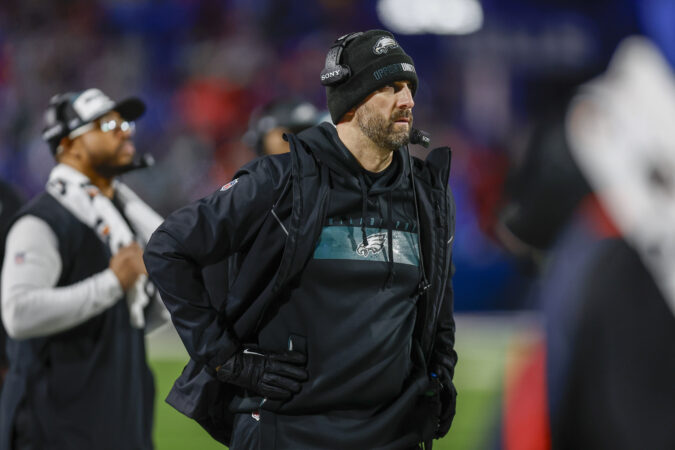
The enduring image of the offseason surely will be Sirianni, Patullo, and Hurts on the sideline during a timeout discussing the final play of the final drive on Sunday. As Patullo spoke to what appeared to be a befuddled and reluctant Hurts, Sirianni stood there, mostly silent, looking like a cross between a deer in headlights and a dog hearing a high-pitched whistle.
More and more, Sirianni seems less a coaching savant and more a dude who happens to be in the right place at the right time to take advantage of the best rosters in Eagles history.
Culture creatures
Since Lurie’s admonishment to Brown, and in violation of league rules, Brown has boycotted the media. That included Sunday’s game and Monday’s locker clean-out. As he did so often this season, he left his teammates to clean up his mess.
It was unprofessional — but then, unprofessionalism always has been an issue during Sirianni’s five-year tenure. He sets that tone and creates that culture.
When the Eagles won in Kansas City in 2023, he taunted Chiefs fans as he walked up the tunnel.
I like the Eagles and their coach but this might not turn out for them like they think it will in the end. pic.twitter.com/uRPwK5yMsp
When the Eagles beat the Browns at home in the middle of the 2024 season, Sirianni taunted Eagles fans as he left the field, then, incredibly, brought his three young children to what was certain to be a fractious postgame news conference.
Eagles HC Nick Sirianni appears to have some words towards the crowd as the clocked ticked down in the Philly victory. pic.twitter.com/XILkMvVamD
Sirianni issued an apology after that incident, but, two weeks ago, after the Eagles won in Buffalo, Sirianni taunted Bills fans as he walked up the tunnel — a taunt that drew a side-eye eye roll from Brown, who was walking beside him.
On Sunday, he charged down the sideline to hurry Brown off the field, then had a few choice words for Brown, who barked back at him, then, a few moments later, tried to get after Sirianni again.
Another look at the exchange between AJ Brown and HC Nick Sirianni on the sideline. pic.twitter.com/Syn0hr0MFK
This ended the lost season nicely, considering it began when defensive tackle Jalen Carter, having walked toward the Cowboys huddle to taunt a young lineman, then spat on Dak Prescott and was ejected.
It’s hard to blame the players. After all, why should they be expected to control themselves if their coach can’t control himself?
Focus
Left tackle Jordan Mailata, the team’s de facto spokesman and often the adult in the room, was asked both at midseason and after Sunday’s loss about the Eagles’ biggest issue. Each time, his answer was the same:
“Focus.”
Another clear measurable of a lack of discipline: penalties.
In 2024, the Eagles committed 103 penalties for 793 yards, 37 of them pre-snap penalties. In 2025, they committed 117 penalties for 1,073 yards, 42 of them pre-snap calls. Those are increases of 14%, 35%, and 14%, respectively.
This is a team that was expected to defend a Super Bowl title.
This was a disaster.
Sirianni’s disaster.
That’s why it’s amazing how little culpability has fallen at Sirianni’s feet.
Granted, Patullo didn’t take advantage of his first OC opportunity … but, after losing at home to the Bears in Game 13, Sirianni inserted himself into the game-planning process. After Sirianni’s insertion, the Eagles played three playoff teams. They averaged just 17 points.
Hurts, mired in self-preservation mode, ran the ball 33% less often this season than his previous three seasons and scored only eight rushing touchdowns after averaging 14 the three previous seasons. Patullo makes the calls, but the buck stops with Nick.
Brown dropped two passes in Sunday’s wild-card loss to the visiting 49ers and, during the regular season, too often seemed … indifferent? Disengaged?
“I have a special relationship with him,” Sirianni said after Sunday’s dustup.
Eagles wide receiver A.J. Brown had a critical drop in the fourth quarter of Sunday’s NFC wild-card game.
If that’s true, then Sirianni needed to mobilize that connection, because Brown just had the worst of his four seasons as an Eagle.
There were other issues.
Saquon Barkley’s rushing total dropped from 2,005 yards and 13 touchdowns to 1,140 yards (865 fewer yards), and seven touchdowns (six fewer scores). For context, only 21 backs gained at least 865 yards this season and/or scored more than six touchdowns.
The offensive line regressed, and while injuries to Lane Johnson, Landon Dickerson, and Cam Jurgens limited their performance and availability, the performance of their backups left much to be desired.
At any rate, now that it’s over and the distractions have faded, we can better assess Sirianni’s role in the lost season of 2025. The football world will zoom out to the “30,000-foot view,” as Sirianni likes to call his CEO style of coaching.
What they see will not be pretty.
None of this is irredeemable. Sirianni is still a newish head coach, only five years in, and, at 44, he’s a relatively young man.
It’s the first time he’s been in a situation dealing with overpaid divas who won him a Super Bowl.
Maybe, if he’s in this situation again, he’ll act the way a head coach should act.
On the same day President Donald Trump’s administration targeted ultra-processed foods in its new federal nutrition guidelines, Penn researcher Alyssa Moran published an academic journal article explaining why they’re hard to regulate.
For starters, there’s no consensus on how policymakers should define the term, she and two coauthors said in a Nature Medicine commentary piece. (The publication timing was a coincidence, but she welcomed the attention to an underestimated challenge.)
Ultra-processed foods are generally understood to be those with industrially produced ingredients not found in home cooking, but experts have long debated how best to classify the foods for regulation. The wording would need to encompassall the possible variations, without beingso rigid that the industry finds loopholes.
The U.S. Food and Drug Administration and the Agriculture Department have said they are working on developing a federal definition to provide“increased transparency to consumers about the foods they eat.” It’s a key goal of the nation’s top health official, Robert F. Kennedy Jr., who blamesultra-processed foods for the United States’“chronic disease epidemic.”
This is the first time U.S. dietary guidelines have explicitly called out ultra-processed foods, also called highly processed foods, and told Americans to limit consumption, Moran said. The guidancewas part of a broader update by the Trump administration the first week of January that flipped the longstanding food pyramid on its head to promote consumption of whole foods, proteins, and some fats.
Though health experts questioned changes, such as the vague guidance on drinking alcohol, the crackdown on ultra-processed foods mirrorswhat many health organizations and consumer advocacy groups have been saying for years.
“I thought it was a bold move, and I was glad to see it,” she said.
Moran talked with The Inquirer about what people should know about ultra-processed foods and the challenges that remain in regulating the products.
This conversation has been lightly edited for length and clarity.
Health & Human Services Secretary Robert F. Kennedy Jr. speaks during a press briefing with leading health officials and nutrition advisors at the White House in early January.
What are ultra-processed foods?
It’s a term that’s been used for decades and has been used, I think, interchangeably with ‘the Western diet’ or ‘junk foods’ or ‘highly processed foods.’
Most foods are processed in some form, whether it’s physical processing, like slicing fruit before you eat it, or adding some chemical preservatives to foods that increase food safety. What changes with ultra-processing is the intent of the processing.
With ultra-processing, the intent isn’t just to make the food safer or to extend shelf-life. It is to make it more cosmetically appealing and more likely to be overconsumed by individuals. They’re formulated in a way that makes them addictive, and they’re also aggressively marketed.
What does it mean to make a food ‘cosmetically appealing’?
It’s the overall sensation of eating the product.
Companies are manipulating levels of highly palatable ingredients like sugar, salt, and fat to be at levels that are not naturally occurring and that are extremely palatable to consumers.
They also add additives that enhance the naturally rewarding properties of things like sugar, salt, and fat. Some additives are added to food, for example, to mask a bitter flavor or prevent an aftertaste. They also add emulsifiers to change the mouth feel of a product. They pay attention to how the product sounds — even the crunch of a product when you’re chewing it — and add dyes to make them more visually appealing, especially to kids.
There are all kinds of strategies that can take advantage of all of the senses to make the product almost irresistible.
Why is there so much debate over how to define the products?
The current administration has talked more than any prior administration about potentially limiting the production, marketing and sale, and availability of ultra-processed products. So, to be able to formulate policy to limit intake of these products, we have to be able to identify them.
Many people have proposed going down the route of defining ultra-processed foods according to a list of additives. And there are many reasons why I don’t think that’s a good approach.
What are the reasons?
We need to really be thinking about how companies are going to respond to whatever definition we create.
If we use a list of specific additives that makes something ultra-processed, companies are going to look at that list and they’re going to say, ‘How can we get around this. How can we skirt regulation?’ They’re either going to increase their use of additives that exist already but aren’t on that list, or they’re going to create new additives with very similar structures and functions as the existing additives.
We see this happen all the time with commercially regulated products. When policies tax sugar, we see that companies increase their use of non-nutritive sweeteners, so the food supply is just as sweet, if not more. When Red Dye No. 2 was banned (in 1976), companies created Red Dye No. 3, which is almost identical and was also banned (in 2025), but 50 years later.
Plus, we have hundreds of thousands of products on the marketplace and there are constantly new ones being added. And currently under FDA policy, companies don’t even need to notify the FDA when they add new ingredients to the food supply. So we don’t even have a complete list of every single additive in the food supply right now.
What approach did you propose in your Nature article on this topic?
Right now, it has been proposed to use a list of ingredients that would make a food ultra-processed. Everything else is non-ultra-processed.
Our recommendation is really to flip that.
We would say, ‘Here are all of the ingredients that make a food non-ultra-processed. Everything else is ultra-processed.’
There are very few additives that make a food non-ultra-processed. The purpose (of the additive) would have to be for food safety or preservation, and that’s one reason why this is also a much simpler approach. Our approach is saying, for example, your yogurt is considered non-ultra-processed if it contains things like milk, live cultures, fruit, nuts, seeds, and honey, as well as some preservatives, vitamins, and minerals.
If it has anything else, it’s an ultra-processed food and is in scope for regulation. Then, if companies introduce new additives, they’ll still be considered ultra-processed because they still fall into the ‘everything else’ bucket.
Are there any other challenges that you see in terms of regulating the industry?
The biggest one is the pushback from the food industry. They spend a lot of money fighting against policies to regulate production, marketing, and sale. We see it with sweet and beverage taxes that have been enacted in Philadelphia and other places. We see it with front-of-package labeling, which the FDA had been trying to pass.
The lack of resources at our federal agencies is another barrier. This administration, early on, really dismantled the FDA, which I think would be the main regulatory body involved in creating this definition and potentially developing policy to regulate these products.
If we don’t have people at those agencies, and they don’t have the resources they need to do their work, you could have a law on the books, but it’s not going to go anywhere.
What are your tips for consumers?
Shop on the grocery store perimeter and avoid the center aisles. Avoid ingredients that aren’t familiar to you.
Classic examples of ultra-processed foods are box macaroni and cheese, many frozen pizzas or frozen prepared meals, and many boxed cookies, candies, cakes, and packaged foods.
I would never tell consumers in this environment that you have to avoid every single ultra-processed food to be healthy. These products are everywhere. They’re cheap. They’re super convenient. Many people don’t have access to minimally processed whole foods.
That’s why I think policy is so important — policies that both put limits on ultra-processed foods, but also promote and incentivize the production and sale and marketing of non-ultra-processed products.
Kevin Patullo is as good as done. A.J. Brown’s future is murkier.
But whatever happens to the offensive coordinator and the team’s top receiver, some form of significant change is coming to the Eagles offense after a season of frustration ended fittingly with another bipolar performance on Sunday.
Patullo will be the easiest to cut off, not because he was solely responsible for the regression or even for the substandard play calling that doomed the Eagles in their 23-19 loss to the 49ers in the playoffs, just as it had throughout most of the 2025 regular season.
Most players, including tackle Jordan Mailata, publicly supported the first-year coordinator on Sunday. They pointed the finger at themselves and their execution, or lack thereof. But the powers that be, as Mailata noted, can’t just wipe out the bulk of the highest-paid offense in the NFL.
“It’s easier to blame somebody who gets paid less than your starting people, right?” Mailata said. “And everybody knows that. Everyone in this [expletive] locker room — even you [reporters] know that. But the story makes better sense if we’re pointing to somebody else than not the players.”
Brown might seem the logical piece to move considering how his drops against San Francisco seemed indicative of an apathetic season by his standards. General manager Howie Roseman isn’t normally fond of trading Hall of Fame talent, and Brown’s contract may make it difficult to move the 28-year old.
But the Eagles will need to find ways to clear salary-cap space with salaries for quarterback Jalen Hurts and others on offense increasing and young homegrown players on defense, including defensive tackles Jalen Carter and Jordan Davis, slated for extensions.
Getting rid of Brown may send a message. But for as great as fellow receiver DeVonta Smith can be, most defenses still spent each week in 2025 devising coverages to cloud Brown. He didn’t have his best season by any stretch, and sometimes ran poor routes and couldn’t pull in grabs he normally makes.
He let two of Hurts’ downfield throws slip off his hands on Sunday.
“He’s got the best hands I’ve ever seen,” Eagles coach Nick Sirianni said. “The way he catches the ball, the amount of different types of catches that he’s made. When you get as many targets as he does, you’re going to have some drops. Not ever using an excuse, but the ball moves differently in the wind.”
Brown declined interview requests after the game, much like he has for the last month. He got into a brief altercation with Sirianni on the sideline in the second quarter when the coach yelled for him to get off the field after a three-and-out.
“I love A.J. I think he knows how I feel about him,” Sirianni said. “I have a special relationship with him. We’ve probably [gone] through every emotion you can possibly have together. We’ve laughed together, we’ve cried together, we’ve yelled at each other. We’re both emotional.”
Brown’s emotions have sometimes gotten the best of him. He’s admitted to mistakes he’s made when using social media to voice frustrations with the offense. He’s among the most-liked players in the locker room. But a change of scenery may be best as he enters the latter stage of his career.
A.J. Brown logged another 1,000-yard season, but it was a tumultuous year for the star wide receiver.
Sirianni and Hurts aren’t going anywhere, nor should they. But they face another crossroads just two years after the Eagles offense underwent its first facelift. Sirianni fired coordinator Brian Johnson, certainly with input from owner Jeffrey Lurie and Roseman, and Kellen Moore was brought in to spiff up the system.
Johnson was more of a Hurts guy, not that Sirianni took pleasure in ending his tenure in Philly. But Patullo has been with the coach since their days with the Colts. They’re kindred spirits in football and friends away from it. But even Sirianni can’t deny that Patullo was in over his head.
“There will be time to evaluate everybody’s performance,” Sirianni said when asked about his coordinator’s future.
If the Eagles weren’t coming off a Super Bowl, maybe Patullo could have been given more time to learn on the job. Maybe Sirianni has built up enough clout to hold off Lurie/Roseman. But precedent suggests that the Eagles will move fast, and that they already have possible replacements lined up.
Who could be next? Mike McDaniel? Kliff Kingsbury? Brian Daboll? Nate Scheelhaase? Todd Monken? Frank Reich? Whoever it is, it should be someone with a pedigree of improving quarterbacks, and preferably one who actually played the position.
Hurts didn’t evolve this season. He ran less and it not only made him less dynamic, but it gave defenses one less option to worry about in the running game. And it made his deficiencies in the drop-back passing game more glaring.
“I think I’m always growing,” Hurts said when asked about working with Patullo. “I’m always taking in my experiences and learning from everything that we go through. I think it’s tough to single out one individual, especially in a moment like this.
“We’ve all got to improve and that’s how I look at everything that we go through.”
Hurts didn’t play poorly in windy conditions at Lincoln Financial Field. In fact, it was a very Hurtsian performance. He made some good throws. He didn’t turn the ball over while his counterpart, Brock Purdy, tossed two interceptions.
But Hurts’ arm lacked the velocity to cut through the breeze at times. He left clean pockets far too early. And he failed again to deliver a game-winning drive. He may play by far the most important position on the field, but the Eagles’ struggles Sunday and all season weren’t all on his shoulders.
And the same applies to Patullo. How much was he handcuffed by Sirianni’s emphasis on not giving the ball away? The Eagles led, 13-7, midway through the second quarter. But the offense failed to generate a first down on four of its next five possessions against a 49ers defense that was down to its fourth and fifth linebackers.
There were dropped passes, penalties, missed blocking assignments, and Hurts throwaways over that span. There were also conservative calls like running on second-and-18, or Hurts keeping on third-and-13. Sirianni was aggressive on two fourth downs in the first half. He seemed to settle for field goals after the break.
“If it goes the way you want it to go in the first half and then not the second half, I think that’s the go-to of people [thinking] you take your foot off the gas,” Sirianni said. “But we were playing more balanced, got the run game going a little bit, trying to mix our play-actions in, trying to get our passes in to create explosives.
“At the end of the day, we didn’t create enough explosives.”
49ers coach Kyle Shanahan, meanwhile, dialed up four pass plays that gained 27 yards or more, including a double-reverse trick play that had receiver Jauan Jennings hitting running back Christian McCaffrey for a 29-yard touchdown on the first play of the fourth quarter.
Gadget plays aren’t going to solve core offensive problems. But the Eagles offense, overall, wasn’t diverse enough. There weren’t enough passing concepts that utilized the middle of the field. There weren’t enough layups for Hurts schemed off under center play-action plays.
The offense moved too slowly in its pre-snap operation and it crippled an already battered offensive line in the running game. Left guard Landon Dickerson admitted after the game what was obvious: He was playing through multiple injuries. Center Cam Jurgens never looked fully recovered from offseason back surgery.
Right tackle Lane Johnson missed the final eight games with a Lisfranc foot injury. He practiced last week, but his replacement, Fred Johnson, said he found out Saturday that he would be starting instead.
“That’s not normal,” Fred Johnson said. “Lane came out this week and prepared like he was a starter. He tested it this week with his reps. Saturday he just felt like he wasn’t ready.”
But the Eagles, for the most part, were healthy. They returned 10 of 11 starters from a Super Bowl-winning offense. The only new cog was Patullo, so he bore the brunt of blame. But Mailata said that was “very unfair.” Dickerson said he did a “tremendous job.”
The offensive linemen also acknowledged Patullo’s inexperience.
“I think he improved over the year,” Fred Johnson said when asked about Patullo. “That’s about it.”
There was some individual grumbling about the play calling from various corners of the locker room over the course of the year. But it never rose to the level it did when Sirianni demoted former defensive coordinator Sean Desai midseason in 2023.
Despite Sirianni’s claim last week that the Eagles had found an identity, it never really materialized. They wanted to ride Saquon Barkley and the running game much as they did en route to the Super Bowl a year ago. But it just ended up being a rinse-and-repeat offense for most of the season and again on Sunday: some glimmers of hope in the first half, darkness thereafter.
“It’s been a common theme for us this year,” Barkley said. “We haven’t done a good enough job of playing complete football, putting two halves together. Sometimes you get into this moment and [believe] we’ll just figure this out. And it just caught up to it.
There’s a word for doing the same thing over and over and expecting the same results. It could be used to describe the furor in Philly whenever an offensive coordinator fails to succeed. Patullo will likely suffer a fate because Eagles leaders won’t want to be labeled as such for sticking with him.
There’s a strong argument for making a move. But there’s change every season.
“There’s a lot of great guys in this locker room on this team, lot of great coaches, a lot of great people upstairs,” Dickerson said. “Every team’s got a one-year expiration on it, so this team will never be put together again.”
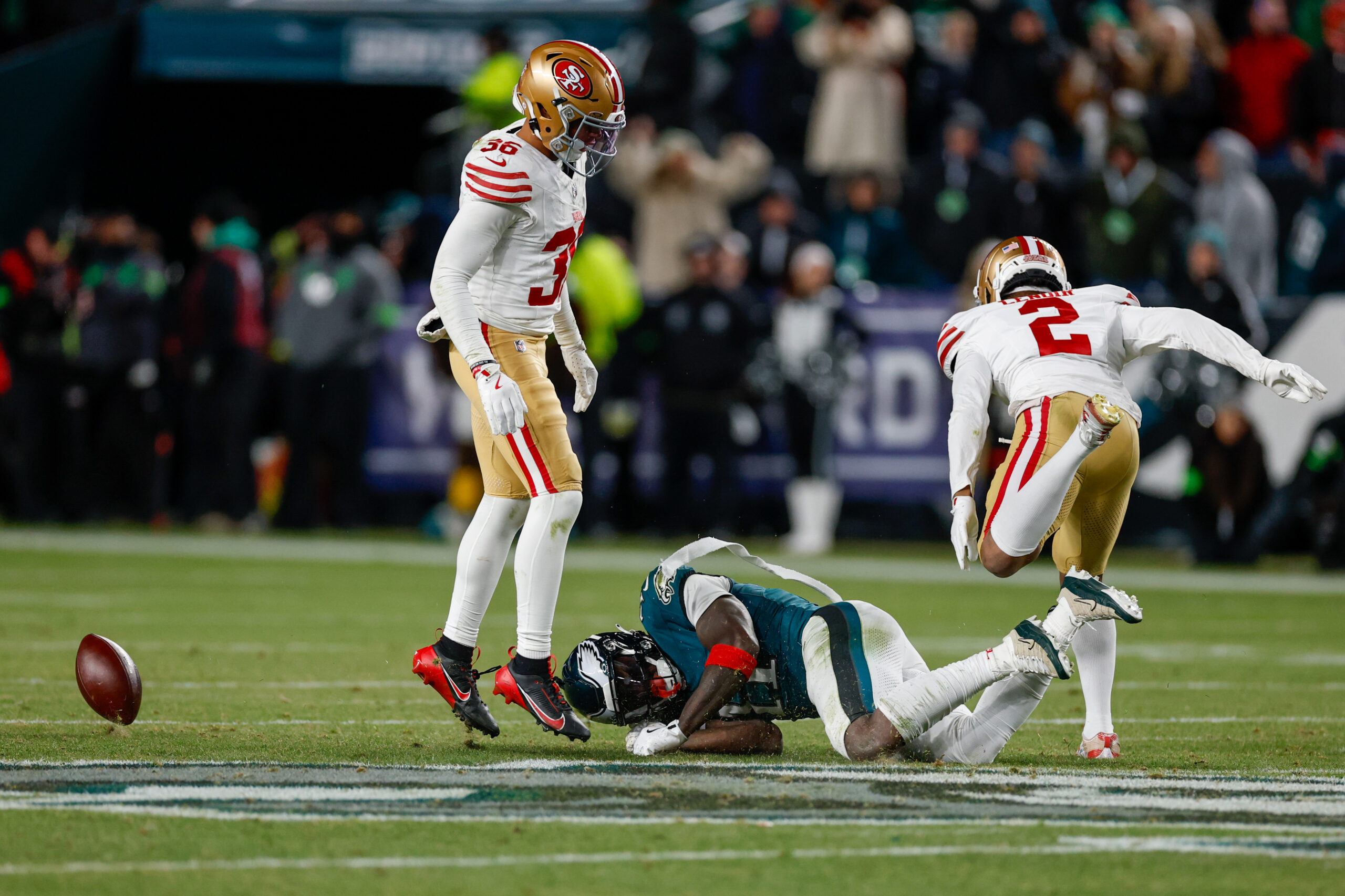
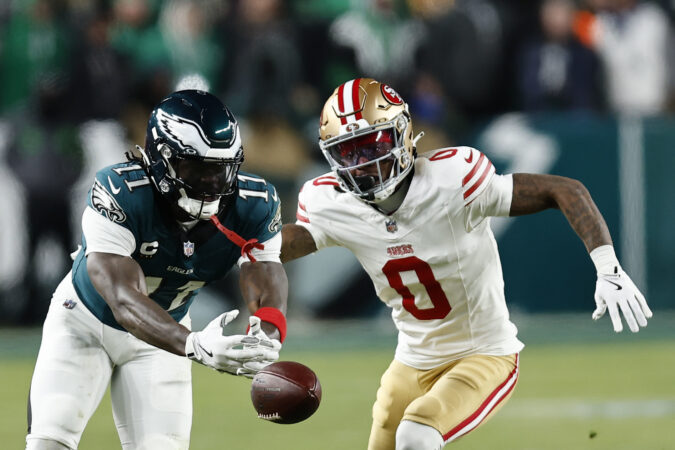
The play that encapsulated everything the Eagles offense wasn’t this season was a play that they themselves didn’t even run. First snap of the fourth quarter Sunday night for the San Francisco 49ers, first-and-10 from the Eagles’ 29-yard line, and there was Kyle Shanahan, calling a double-wing reverse pass that made one of the NFL’s best defenses look like a bunch of suckers. Brock Purdy handed the football to Skyy Moore, who pitched it to Jauan Jennings, who rainbowed a pass toward the end zone to Christian McCaffrey, who didn’t have an Eagles player within 5 yards of him.
A six-point Eagles lead suddenly was a one-point deficit. And though that touchdown technically wasn’t the winning score in the 49ers’ 23-19 wild-card victory, it was the perfect symbol for the difference between a team that played like it had nothing to lose and a team that played like it was fearful of taking the slightest of chances.
From Nick Sirianni to Kevin Patullo to Jalen Hurts, the Eagles spent too much of this season acting as if being daring was taboo for them. Sirianni preached the importance of minimizing turnovers, citing the Eagles’ marvelous record during his tenure as head coach when they protected the football better than their opponents. But it turned out that a Super Bowl champion cannot defend its title on caution alone. The 49ers committed two turnovers. The Eagles didn’t commit any. And the final score was the final score.
In the locker room afterward, player after player used the same word as the cause of the Eagles’ struggles during the regular season and their quick exit from the postseason: execution. “If there are multiple players saying that,” tackle Jordan Mailata asked, “why don’t you believe us?” Good question. Here’s why: It’s a familiar, sometimes default way of thinking among elite athletes: It doesn’t matter what the coach calls. It doesn’t matter if my opponent knows what’s coming. If I do exactly what I’m supposed to do exactly when I’m supposed to do it, nothing can stop me, and nothing can stop us.
“I don’t think we were playing conservatively,” running back Saquon Barkley said. “I think it comes down to execution. A lot of the same calls we have — I know it was a new offensive coordinator and new guys, but we kind of stuck with the same script, to be honest, of what we did last year. It’s easy to say that when you’re not making the plays. … If we’re making the plays, no one is going to say we’re being conservative.”
The Eagles could get away with following that mantra last season. Their offensive line was the best in the league, and they shifted midseason from having Jalen Hurts throw 30-plus passes a game to giving the ball to Barkley and counting on him for consistent yardage and big plays. But, as Barkley acknowledged, they returned this season with pretty much the same offense — after the other 31 teams had an offseason to study what the Eagles had done and come up with ways to neutralize it.
“If they call inside zone and we call inside zone and they run it better than us, they just ran it better than us,” Barkley said. “They executed better than us. That’s just my mindset. Maybe I’m wrong.”
He is. There rarely was any surprise to the Eagles’ attack this season, rarely any moments when A.J. Brown or DeVonta Smith was running free and alone down the field, when Barkley wasn’t dodging defenders in the backfield, when anything looked easy for them. When everyone in the stadium knows you’re likely to call a particular play in a particular situation, yes, you had better be perfect in every aspect of that sequence. But when you catch a defense off guard — as Shanahan did on Jennings’ pass — your execution can be less than ideal, and the play will still work.
Look at Sunday: Barkley had 15 carries in the first half and 11 in the second. He had 71 yards in the first half and 35 in the second; after halftime, the 49ers started sending more players toward the line of scrimmage just before Hurts took the snap. The proper countermove would have been to throw the ball downfield more often, but the Eagles were reluctant to court such risk. It doesn’t much matter whether Patullo couldn’t scheme up such plays or whether, even if Patullo had opened up the offense, Hurts would have held the ball anyway. The result was the same. They settled for what was safe.
“I think that’s always the go-to. … People think you take your foot off the gas,” Sirianni said. “We didn’t create enough explosives. They did.”
To the end, the head coach struggled to see the connection between his conservatism and the problems that plagued his offense. No Super Bowl appearance, no title defense, not even a spot in the playoffs’ second round. Over 18 games, this team wrote its own epitaph.
The 2025 Eagles: They played not to lose. Which is why they did.
This time last year, few fans outside of the most rabid of the NFL knew who Kevin Patullo was. For the record, he was the Eagles’ passing game coordinator and coach Nick Sirianni’s favorite lieutenant.
Now, everybody knows his name. After 18 games of ineptitude as the Eagles’ offensive coordinator, Patullo will bear the blame for the lost season of 2025, no matter how much he looks like his buddy, Nick.
Patullo cannot survive the week. The blame will fall to him.
It might not be true. The defense needed two months to round into shape.
It might not be fair. Sixty percent of the offensive line was injured to some degree all season, and neither wide receiver A.J. Brown nor running back Saquon Barkley played to his usual standards.
Still, it’s hard to believe that owner Jeffrey Lurie, who spent $128 million on an offense that cost him more than twice what the defense cost, will give another chance to the least popular assistant coach since Juan Castillo moved from offensive line to defensive coordinator in 2011. Castillo was fired in October 2012, two months ahead of Andy Reid’s departure.
An offense that featured Barkley, Brown, Jalen Hurts, DeVonta Smith, Dallas Goedert, and a well-paid, pedigreed offensive line scored two early touchdowns against the visiting 49ers on Sunday night. And then just six more points.
It had been 22 years since the Eagles suffered such a gutting home playoff loss, a 14-3 collapse in the NFC championship game. Move over, Carolina.
The Eagles gave away a 23-19 wild-card playoff loss to a 49ers team that had crossed three time zones with a depleted roster, that, after the second quarter, also had lost one of its better players, tight end George Kittle. Hurts and Patullo’s offense had a chance to score the winning touchdown in the closing minutes, but the drive broke down and failed at the 21-yard line on the quarterback’s fourth-down incompletion intended for Goedert with 40 seconds left.
Asked his evaluation of Patullo’s first season, Hurts replied: “We’ve all got to get better.”
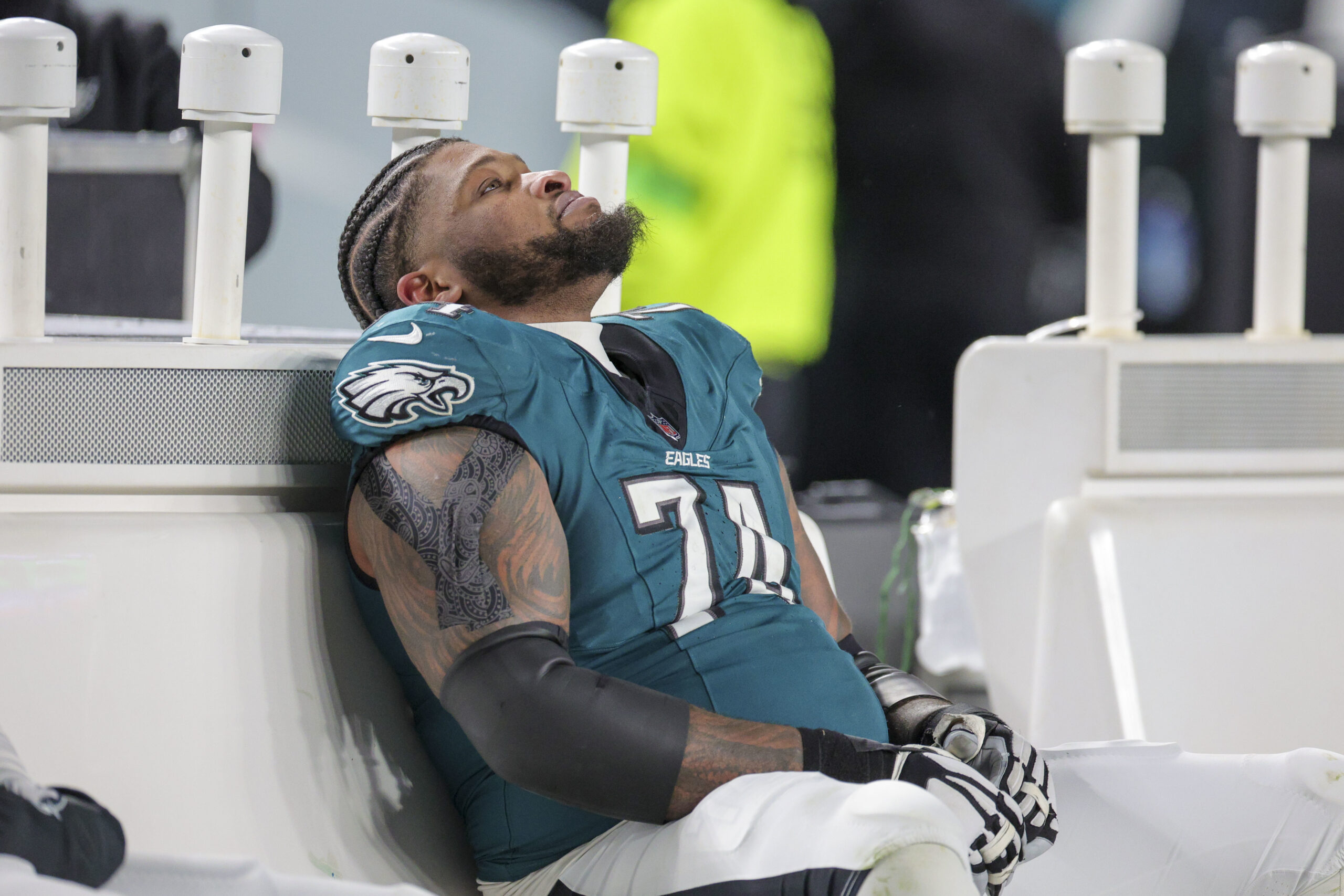
Eagles tackle Fred Johnson sits on the bench after the loss to the San Francisco 49ers at Lincoln Financial Field.
Left tackle Jordan Mailata said, effectively, let he who is without sin cast the first stone:
“Nobody wants to blame the guy we paid $22 million, so let’s blame the offensive coordinator,” said Mailata, who averages $22 million per season.
Niners coach Kyle Shanahan acts as his team’s play-caller, and, despite absences and injury, he gave Patullo a master class in scheme and preparation.
The 49ers’ first possession, comprised mainly of passes for 61 and 11 yards, lent credence to the people who wanted the Eagles to play their starters instead of resting them in Game 17 the week before. The defense looked more than just rusty. It looked inept.
The Eagles’ maligned offense somehow stayed sharper than their celebrated defense. On its first possession, six runs from Barkley helped move the Eagles to the 1, where tight end Goedert ran the ball for just the fourth time in his career and scored his first rushing touchdown.
The Eagles’ next score happened because Barkley waited for Landon Dickerson to block a defender on a 20-yard screen pass. Later, Hurts waited for a defender to clear the path between himself and Goedert, whom Hurts found for a 9-yard touchdown pass.
The game was punctuated by a sideline incident with 2 minutes, 2 seconds to play in the first half as the Eagles prepared to punt. Head coach Nick Sirianni ran 30 yards down the sideline toward the touchy wide receiver Brown, who, in Sirianni’s view, was taking too much time exiting the field. Brown stopped and appeared to heatedly argue the point. Security chief Dom DiSandro separated them.
A few seconds later Brown left the bench and shouted in Sirianni’s direction, and was ushered away by sideline personnel and teammates.
Some of the stars starred.
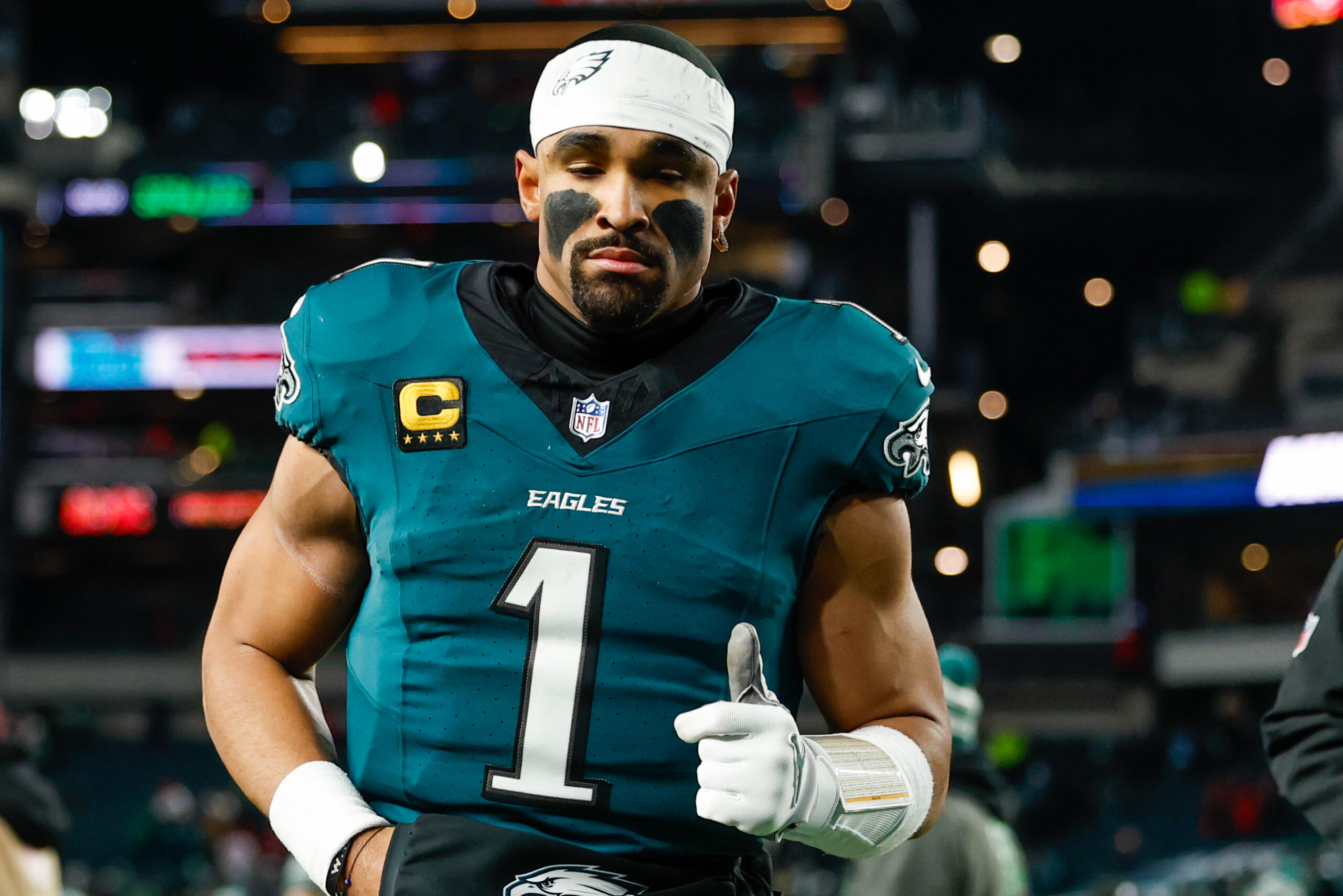
Eagles quarterback Jalen Hurts runs off the field after the loss to the 49ers.
Goedert, who this season set an Eagles record with 11 touchdown catches, tied for the league lead, ran for one touchdown — the first tight end to do so in NFL playoff history — and caught another.
Quinyon Mitchell, the team’s best defensive back since Brian Dawkins, collected his third and fourth interceptions in his five career playoff games.
Barkley ran 26 times for 106 yards and caught a 20-yard pass.
Brown? He managed just three catches for 25 yards. He failed on two consecutive deep shots to connect with Hurts, disconnects that immediately preceded his latest sideline incident.
Brown often has expressed frustration with the Eagles offense the past two seasons. Sunday, as he has done for more than a month, he left the locker room without fulfilling his league-mandated obligation to speak with reporters.
Not only did the Phillies cannonball last week into the pool of teams interested in signing Bichette, but his market is about to kick into overdrive after fellow free-agent infielder Alex Bregman reached a five-year, $175 million agreement with the Cubs late Saturday night.
Bichette has a Zoom call with the Phillies scheduled for this week, a league source confirmed. Now, after Bregman bolted Boston for the North Side of Chicago, the Red Sox figure to pivot to Bichette, multiple major league sources expect. The Yankees may be in the mix, too, as their talks with free agent Cody Bellinger are at an “impasse,” ESPN.com reported over the weekend.
The Cubs doled out a club-record $35 million per year for Bregman, albeit with deferrals that reduce the present-day value, according to The Athletic. Bichette, who turns 28 in March, is four years younger than Bregman, which could put him in line for a seven- or eight-year contract at a similar, if not higher, annual salary and boost the overall value of the deal to $250 million or more.
Meanwhile, another musical chair in the infield market disappeared over the weekend, as the Diamondbacks pulled back Ketel Marte in trade talks. That leaves Bichette and 34-year-old free agent Eugenio Suárez as the best and most straightforward infield options.
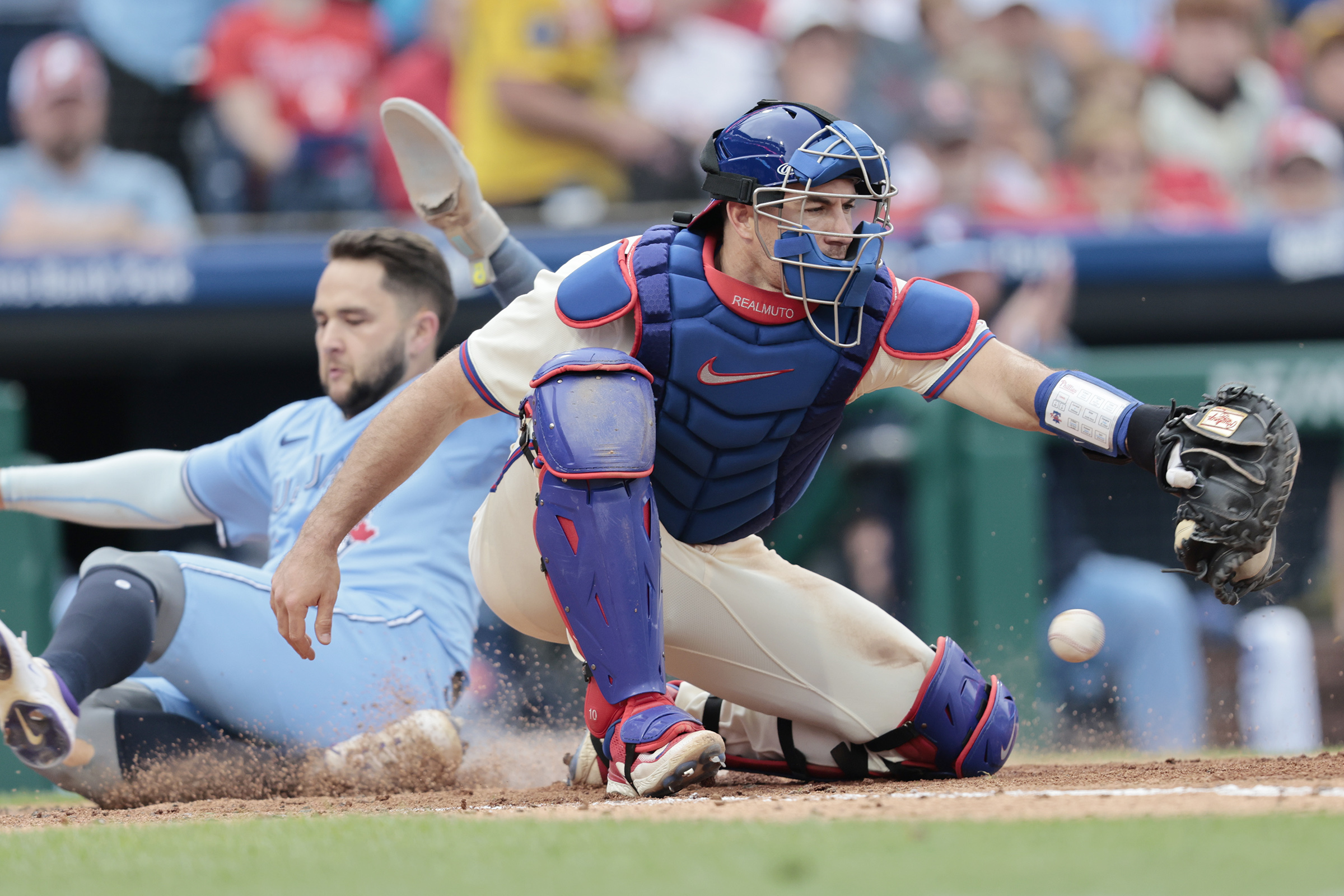
Bo Bichette (left) will meet this week with the Phillies, who are awaiting a decision from free-agent catcher J.T. Realmuto.
Until the last few weeks, the Phillies didn’t expect to join the bidding for Bichette. Not after re-signing Kyle Schwarber to a five-year, $150 million contract and making an offer to bring back cornerstone catcher J.T. Realmuto, whose influence among the pitching staff and leadership from behind the plate outweigh his declining offense.
But as Realmuto holds out for a better offer, the Phillies have explored other avenues to potentially improve the roster, a league source said last week, and see a possible fit with Bichette, who is open to moving to second base or third base after playing shortstop for seven seasons with the Blue Jays.
At the plate, Bichette is a .294 career hitter with a 121 OPS-plus and the unusual combination of a low strikeout rate (14.5% last season) and high rate of swings at pitches out of the strike zone (35.2%). His knack for putting balls in play, regardless of where they’re pitched, would add a dimension to the Phillies offense.
It’s also likely the Phillies got a strong endorsement from newly hired bench coach Don Mattingly, with whom Bichette grew close over the last two seasons in Toronto.
But the competition for Bichette is fierce, even more with Bregman off the board. Let’s look at the teams that could threaten the Phillies’ pursuit of Bichette:
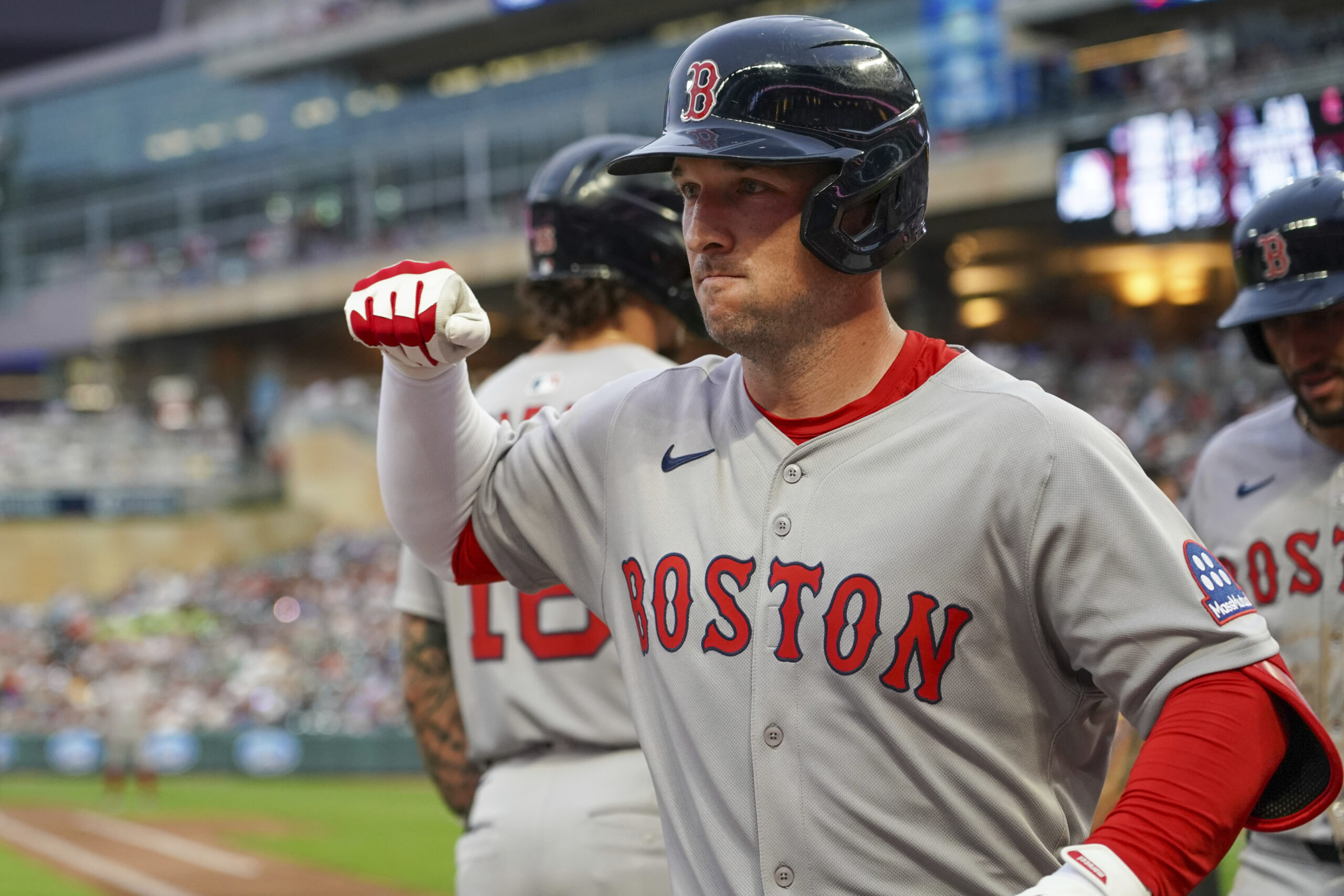
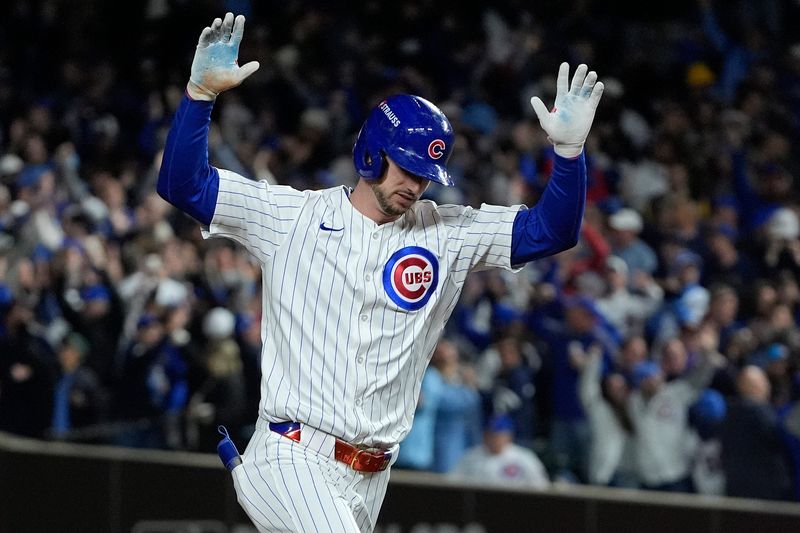
After only one season with the Red Sox, Alex Bregman agreed to a five-year, $175 million contract with the Cubs.
Red Sox
When the Red Sox signed Bregman last spring, they irritated incumbent third baseman Rafael Devers so much that they traded him in June even though Bregman could opt out of his contract after one season.
Sure enough, third base at Fenway Park will be occupied by neither Bregman nor Devers in 2026.
Although the Sox have mostly resisted long-term deals with free agents since they fired Dave Dombrowski in 2019, they reportedly put a five-year offer on the table for Bregman before getting outbid by the Cubs. It’s fair to assume they would go at least that long for Bichette. But would they stretch to seven years? Eight?
The Sox entered the offseason looking for two middle-of-the-order hitters. Rather than chasing Schwarber or Pete Alonso in free agency, they traded for first baseman Willson Contreras. Their other big offseason move was also a trade, also with the Cardinals, for pitcher Sonny Gray. They could aim for the hat trick by trading for St. Louis’ Brendan Donovan to fill a vacancy at second base or third.
Donovan, 29, will make only $5.8 million this year and is under club control through 2027. Trading for him feels like a move for a free agent-averse team. But few free agents are as young as Bichette, which might enable the Red Sox to view him as less risky.
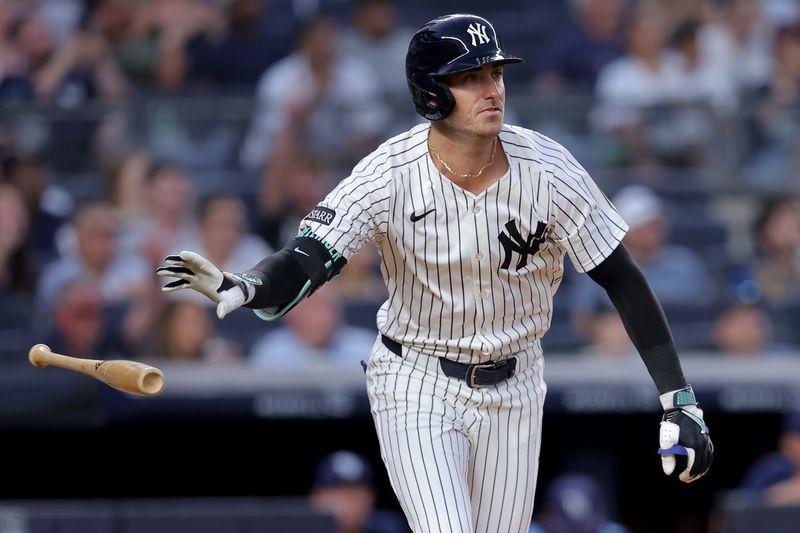
Despite reportedly receiving multiple offers from the Yankees, Cody Bellinger is still a free agent.
Yankees
Like the Phillies with Realmuto, the Yankees prioritized re-signing Cody Bellinger and taking aim at another World Series.
A deal hasn’t materialized.
Bellinger, 30, is reportedly seeking a seven-year contract; the Yankees, according to reports, are hesitant to go longer than five. And the longer the staring contest between the sides persists, the more the Yankees figure to pursue other options.
Signing Bichette would require the Yankees to do almost as much lineup juggling as the Phillies. While the Phillies would have to trade third baseman Alec Bohm to make room in the payroll and the infield, the Yankees likely must do the same with second baseman Jazz Chisholm Jr. (Coincidentally, Bohm and Chisholm will both make $10.2 million this year and can be free agents after the season.)
But if the Yankees lose Bellinger, they will need to replace his middle-of-the-order production. Bichette is one solution, albeit from the right side of the plate instead of the left.
Free-agent outfielder Kyle Tucker spent the 2025 season with the Cubs.
Blue Jays
After spending $337 million in free agency on starter Dylan Cease, relievers Tyler Rogers and Cody Ponce, and Japanese third baseman Kazumo Okamoto, the World Series runner-up is hoping to put a cherry on top of its offseason bonanza by signing outfielder Kyle Tucker.
Why not just bring back Bichette?
The Blue Jays haven’t ruled it out. Although the infield appears set with Vladimir Guerrero Jr. at first base, Ernie Clement at second, Andrés Giménez at shortstop, and Okamoto at third, the Jays believe Okamoto is capable of adding left field to his portfolio. In his introductory news conference in Toronto, Okamoto said he likes playing different positions.
But Tucker represents a better positional fit for the Blue Jays. If he signs elsewhere, it’s worth wondering if they would pivot to fellow lefty-hitting outfielder Bellinger or turn back to Bichette.
The field
Never count out the Dodgers, especially if Bichette is willing to sign for a shorter term and higher annual salary with an opt-out after a year or two. The two-time defending World Series champs would presumably play him at second base and use Tommy Edman in center field and Hyeseong Kim and Miguel Rojas in utility roles.
Bichette would also fit with the Mariners, who won a division title and advanced to Game 7 of the ALCS last year despite ranking 17th in wins above replacement at second base (1.5) and 13th at third base (1.9). They could choose to re-sign Suárez but already lost infielder Jorge Polanco in free agency to the Mets.
Reading was tough, and staying focused on even simple things proved difficult.
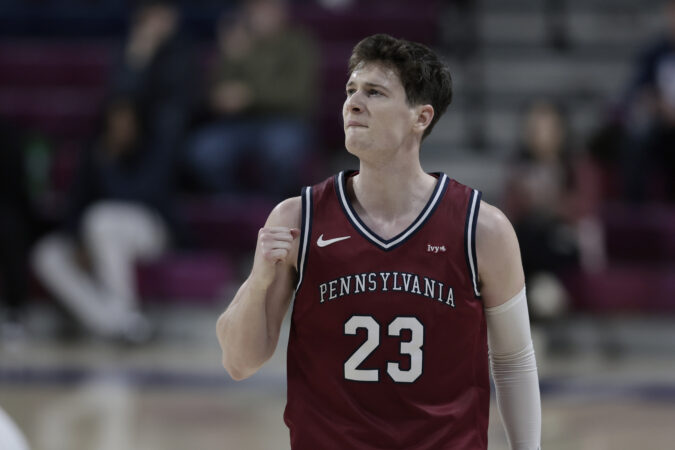
But on Saturday, in only his second game back from what was described weeks earlier as a “severe” concussion, Penn’s captain scored 28 points to help the Quakers secure their first Ivy League win of the season over Brown, 81-73.
Penn now enjoys a week before its next Ivy League test at Dartmouth on Saturday (3 p.m., ESPN+).
The Drake transfer started the season on top of the world, reaching as high as third in the nation in scoring while leading Penn to its first Big 5 Classic championship game against Villanova.
But in that matchup, disaster struck.
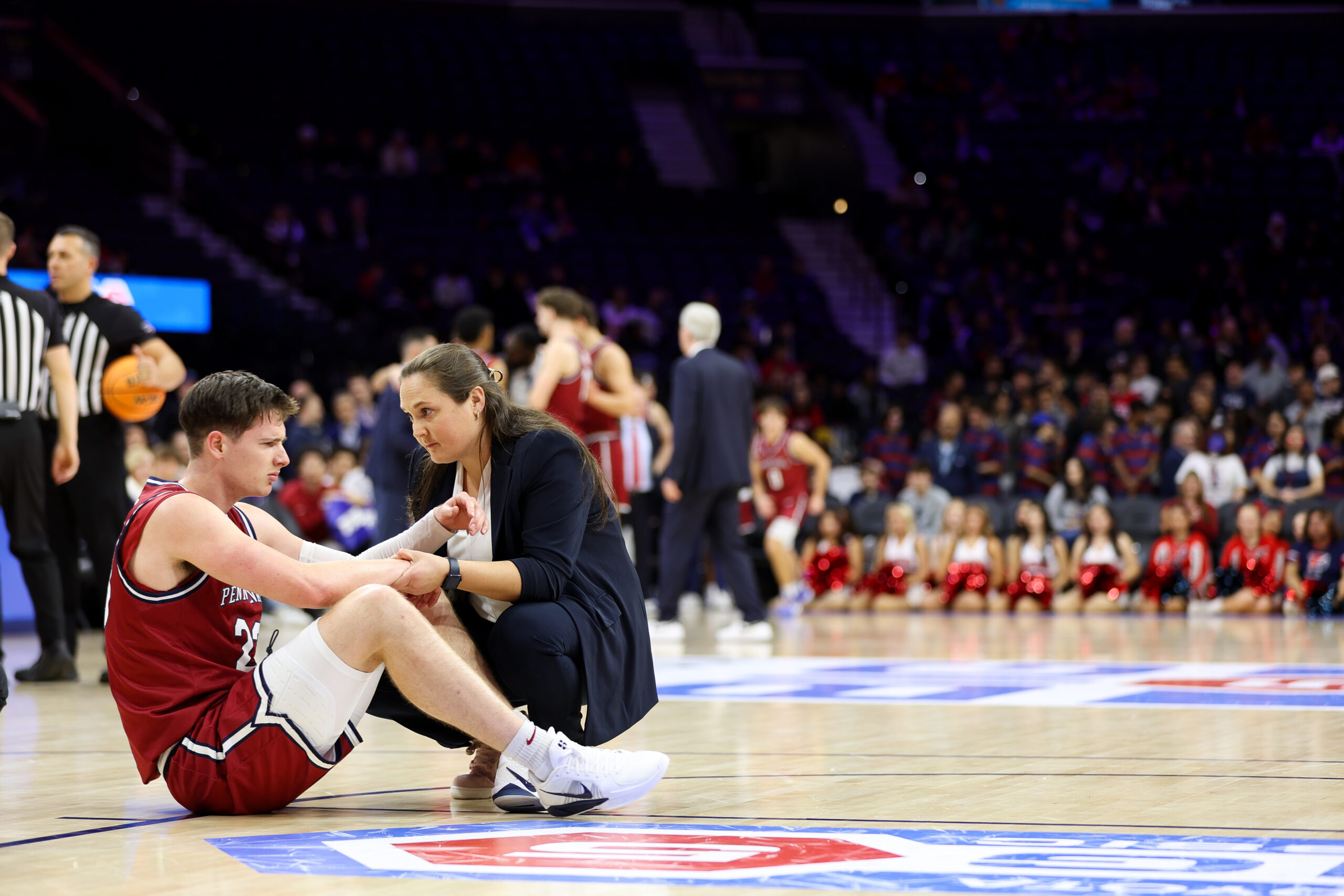
Ethan Roberts suffered a concussion during the Big 5 Classic championship game against Villanova on Dec. 6.
A hard foul resulted in Roberts leaving Xfinity Mobile Area before the final buzzer, being taken to the hospital in an ambulance.
“I know it happened, obviously, but I don’t remember getting hit,” Roberts said. “I lost memory from that day. I got hit and gained consciousness in the emergency room before my CAT scans.”
Penn was eventually blown out by Villanova, and Roberts was released from the hospital early the next morning after doctors confirmed there was no bleeding in his brain. The team went 2-2 in the subsequent four games he missed.
As the Quakers attempted to stay afloat without their captain, Roberts was busy working back from his injury.
“I’ve never had a concussion before,” Roberts said. “The doctor told me that it was a severe one, and that it would take a while. For two weeks, I had every symptom at its worst. I was extremely sensitive to light, extremely sensitive to noise, I had really bad headaches and eye pain, and more so than anything, I couldn’t read and lost memory. I was helpless, I had to have someone around me, so for two weeks I was in a cocoon.”
Over Christmas break, Roberts attended vestibular therapy at Penn Medicine in which he relearned to read while battling coordination issues, including practicing walking in a straight line.
QUAKERS ON TOP.@PennMBB improves to 1-1 in Ivy League play with an 81-73 victory over Brown. Michael Zanoni and Ethan Roberts combined for 48 points in the win. 🌿🏀pic.twitter.com/yQm5stqWwA
After more than four weeks of recovery, Roberts was given only three days to prepare for his team’s Ivy League opener vs. Princeton, when much of his time was spent working through non-contact and contact practices while still impacted by symptoms. Roberts reported an inability to remember plays and problems with his hand-eye coordination.
“Even just my hand control,” Roberts said before facing off against Princeton. “I’ve had to revamp everything, not to be dramatic. Sometimes, I’m out there playing, and it just doesn’t calibrate in my head.
“I was out for a month. Missing games I really wanted to play in, too, but it makes me want to savor the moment a little bit more and enjoy it a little bit more, truthfully, because when I’m not wearing Penn across my chest, it’s going to hurt.”
Against the Tigers, Roberts led the team in scoring with 19 points, but with the Quakers down two during the waning moments of the game, he passed away the final shot in the 78-76 loss.
“He just has to get back in rhythm,” coach Fran McCaffery said. “He missed five weeks, so he’s trying to remember the plays. He’s trying to remember where he goes … but when I’m making calls, you can tell he’s a little slow registering sometimes.”
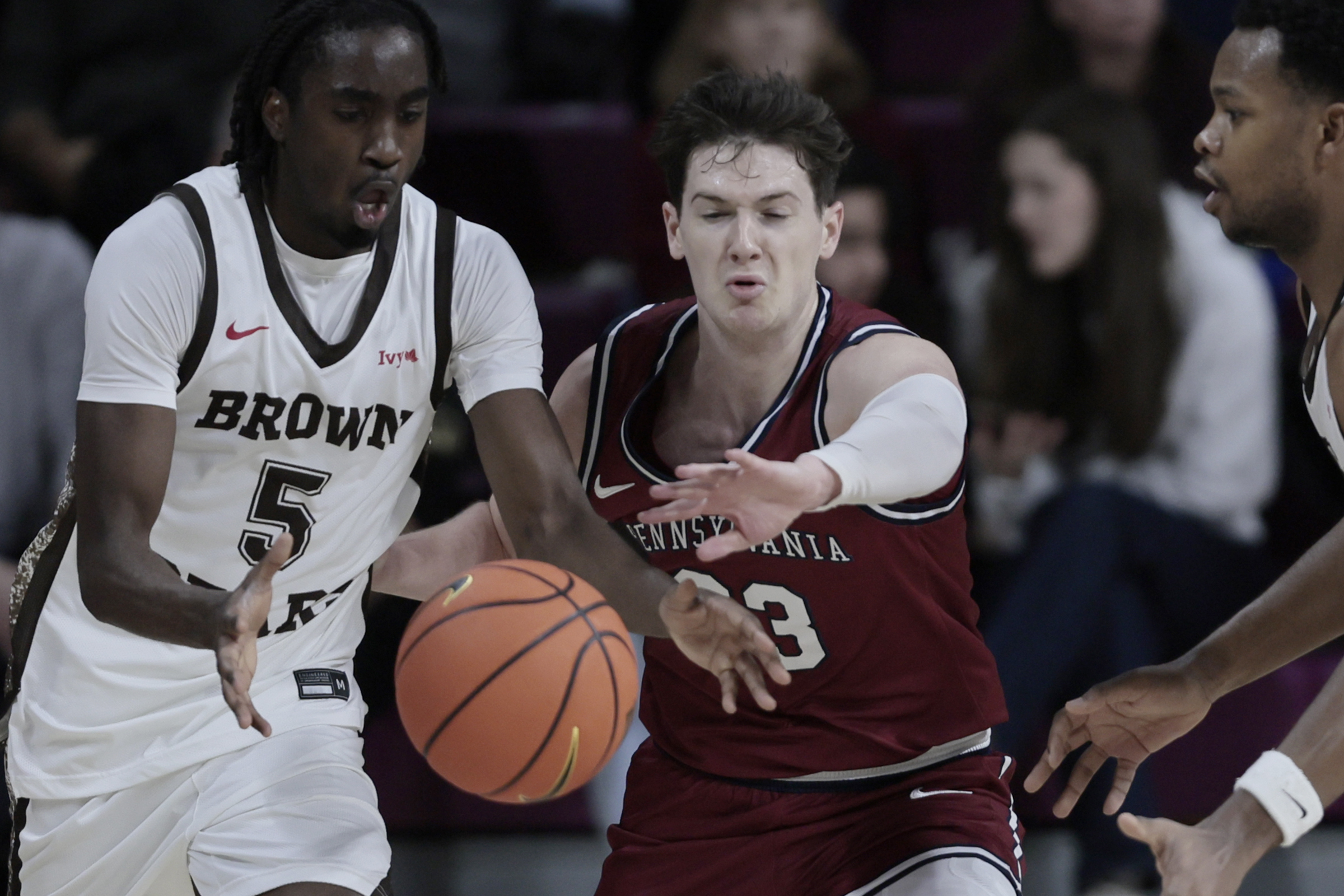
In Saturday’s win against Brown, Roberts (right) poured in a team-high 28 points.
Against Brown, Roberts once again found that rhythm, ending the first half by scoring eight of his team’s last nine points to pull the game to a 42-42 tie. At the end of the second half, Roberts scored 10 of the team’s last 14 points to secure a narrow win.
Roberts’ physical play led to 14 free-throw attempts despite only sitting for five minutes in the contest, a huge step forward in his recovery. When McCaffery was asked about Roberts still dealing with mental blocks after the game, he was happy to poke fun at his star player.
“He’s one of the best scorers, if not the best scorer, in the league, probably in the country,” McCaffery said. “It takes the pressure off everyone else. [His brain] can’t be that fuzzy. He had 28 points; tell him [BS].”
NATION'S BEST.@PennMBB's Ethan Roberts is the Lou Henson Award National Player of the Week! 🌿🏀
Despite still not feeling back to his normal self, Roberts is grateful to be able to keep playing in his final year at Penn. This isn’t the first time Roberts has dealt with serious injuries, having suffered from an undisclosed illness that forced him to medically redshirt at Drake — but with every roadblock, Penn’s captain has only felt more grateful to be a Quaker.
“It means everything,” Roberts said. “Just to wear Penn across your chest and to represent these people, it’s serious. It’s the best honor I’ve ever had in my life, and to win in front of them, it doesn’t get old. I’m just super grateful to be here wearing Penn, like I said, getting this win at the most historic venue in college basketball — the cathedral, baby.”
Ray Didinger is gone. Gone on vacation, gone to the other side of the world, gone to places he has never been before and will never visit again.
He and his wife, Maria, left last Sunday on a five-month Magellan-like cruise, a journey to Bora Bora, to the Hawaiian Islands, to New Zealand and Tasmania, to the Far East, to Canada and Alaska and back home again to their 15th-floor apartment in Center City.
He will not be in Philadelphia to watch Super Bowl LX — a prospect, given the very real possibility that the Eagles will return to the big game and win it again, that once would have been unthinkable. Didinger, after all, is regarded as the foremost authority on the franchise and its history, having covered, commented on, and written comprehensive books about the Eagles over his half-century-plus in journalism and media.
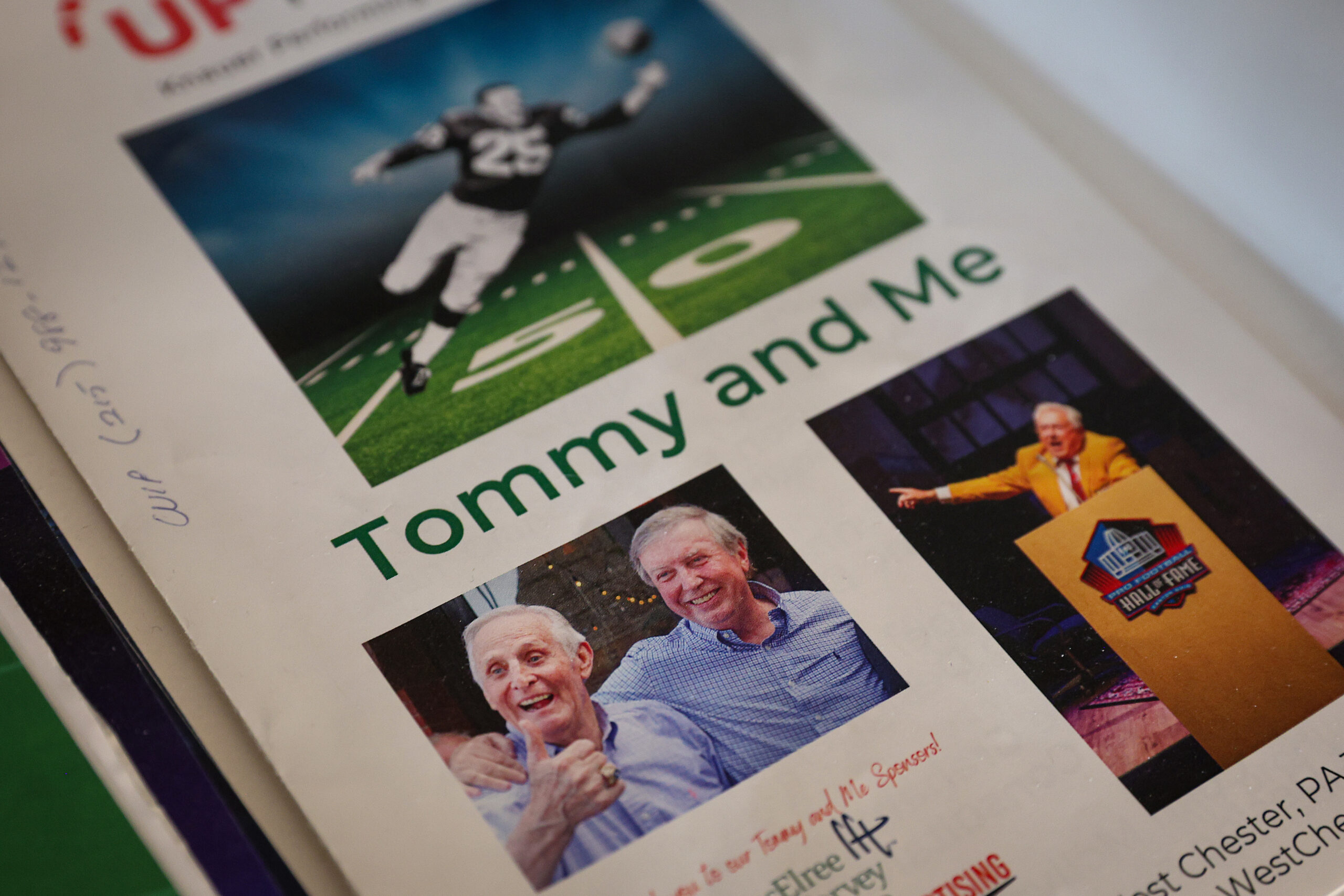
He also wrote a play tied to the Eagles, Tommy and Me, about his relationship with Hall of Fame wide receiver Tommy McDonald, and the play is the thing that makes the timing of his once-in-a-lifetime trip so ironic. Ten years after Tommy and Me’s debut, Boys to Fame — a documentary/feature film, produced by Sam Katz, about Didinger, his play, and McDonald — became available for purchase and viewing on Sunday morning.
Tommy and Me, the play created by Ray Didinger, chronicles his childhood and its close relationship to former Eagles great Tommy McDonald.
Didinger, a week into his journey, isn’t around for the release. And there was no chance he would be.
“I would rather be here to help Sam promote it as best I could,” he said before embarking on the cruise. “But this trip has been two years in the making, so there was no way to be here and tell Maria, ‘Honey, we’ve got trip insurance. Let’s just bag this thing.’ It’s a long fall from the 15th floor to Locust Street.”
Katz, 76, has seen his career evolve into multiple iterations that he still maintains simultaneously: a player in Philadelphia and Pennsylvania politics — he ran for mayor three times — a venture capitalist, and a filmmaker. Through his company, History Making Productions, he has produced documentaries about Philadelphia’s filmmaking history, the rise of classical music in China, and one about Detroit’s bankruptcy, Gradually, Then Suddenly, which in 2021 won the Library of Congress’ Lavine/Ken Burns Prize for Film.
When he saw Tommy and Me in 2016, its first run, he thought the play was worthy of film treatment — a film about the play and Didinger, that is. “The play itself was powerful, emotional, and a really incredible story of a relationship between two men,” he said. “I felt that a feel-good story like this would be timely, and I still feel that way.”
He worried, though, that funding such a project would be a challenge.
His other documentaries, all historical and to one degree or another educational in nature, lent themselves to philanthropic contributions. A film delving into the life of a sportswriter, even one as well-known and locally admired as Didinger, required Katz to find private investors — and contribute money himself.
He found a group willing to back the film, former City Council member Allan Domb and Bullpen Capital founder Paul Martino among them, and decided, instead of pursuing a deal with a streaming service or television station, to release the film independently. It will be available on a website, boystofame.com, on a pay-per-view basis — “I’m selling it direct to the Philadelphia sports fan,” Katz said — and he hopes to generate attention and interest through grass-roots media coverage and screenings at film festivals and private clubs.
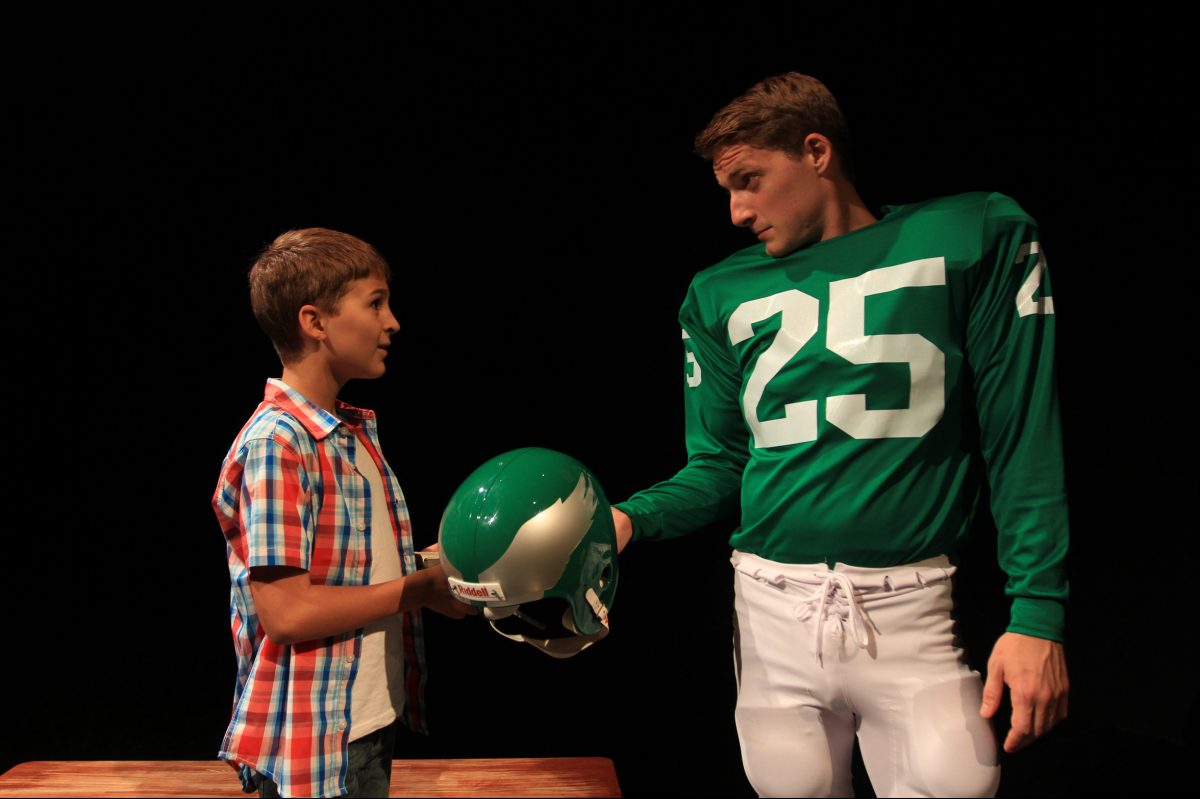
In the play Tommy and Me, Ray Didinger (left, Simon Canuso Kiley) meets boyhood hero, and Eagles player Tommy McDonald (right, Ned Pryce) in the late 1950s in Theatre Exile’s world premiere of the play in 2018.
The 82-minute film covers topics, features voices, and reveals details and emotions that Tommy and Me, by its singular focus on the big brother/little brother dynamic between McDonald and Didinger, and on Didinger’s efforts to get McDonald into the Hall of Fame, didn’t and couldn’t.
Katz interviewed Didinger for more than five hours, talked to all four of McDonald’s children and several members of his Hall of Fame class, and even tracked down Billie Jo Boyajian, who was McDonald’s Queen’s Court escort at the 1998 induction weekend — and whom McDonald scooped up in his arms and carried to the stage during the Hall of Fame dinner.
(In a fascinating side note, Boyajian pleaded guilty last January to charges of theft, forgery, and misuse of credit cards while she was the treasurer of a Canton high school basketball booster club. Katz had interviewed her for Boys to Fame years earlier.)
The documentary bookends both McDonald’s life and Didinger’s. It directly confronts the fact that in 2021, three years after his death at 84, McDonald was diagnosed with the brain disease chronic traumatic encephalopathy, commonly known as CTE.
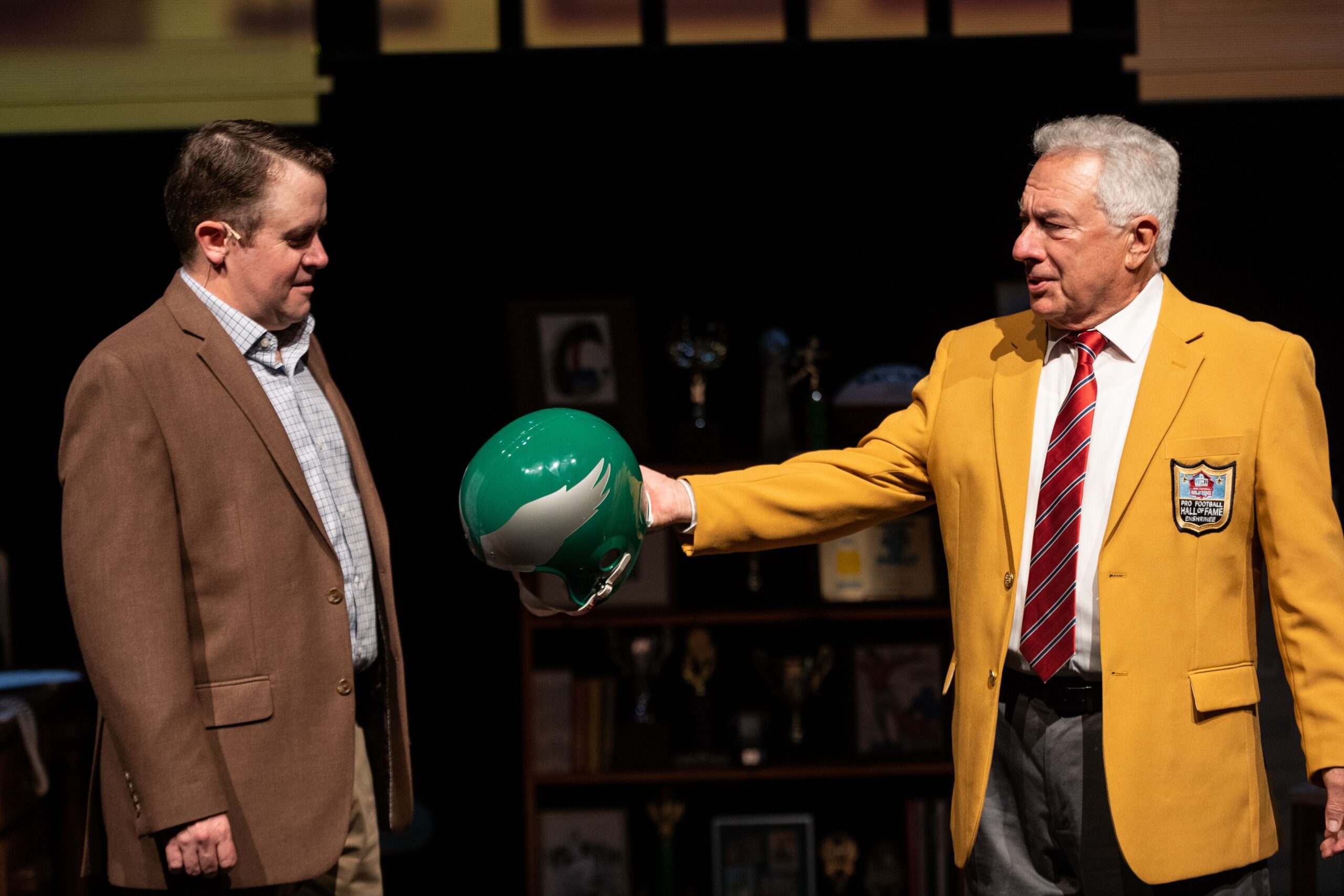
Tommy and Me at Bucks County Playhouse in New Hope, with (left to right) Matt Pfeiffer and Tom Teti.
The McDonalds gave Katz access to scrapbooks that Tommy’s parents had begun keeping of his exploits when he was a high school phenom in Roy, N.M., in the early 1950s. They also provided him with a video of McDonald’s reaction — joyful tears, dozens of thank-yous and thank-Gods — when he received the phone call to tell him that he finally would be inducted into the Hall of Fame.
“I’ve seen it a hundred times, and I still get a lump in my throat,” Didinger said, “because it’s so raw and real and so true to the guy I know.”
To Katz, though, it was important to give Didinger’s background and story — his childhood in southwest Philadelphia, his careers at The Bulletin and The Daily News, NFL Films and WIP and NBC Sports Philadelphia — as much weight as McDonald’s. To recreate Didinger’s youth, Katz took over The Barn, a pub near his vacation home in Eagles Mere, Pa., for two days and transformed it into Didinger’s grandfather’s bar, the place where Didinger, as a kid, spent hours wowing patrons with his encyclopedic Eagles knowledge. Katz hired several of The Barn’s regulars and a 10-year-old boy, none of whom had ever acted before, to star in the film.
To depict the vacations that Didinger’s family would take to Hershey each summer to watch the Eagles at training camp, Katz coaxed a collector of antique cars to bring three 1955 vehicles to the Eagles Mere community center. “I insisted on everything being better,” he said.
The most poignant moments of the film come when Didinger describes in depth his last visit with McDonald, on the day before McDonald died.
A play about ex-Eagle Tommy McDonald‘s road to the Pro Football Hall of Fame, and his connection with legendary sports writer Ray Didinger, at People’s Light Theatre last year. The play is being turned into a film by Sam Katz.
“Sam kept telling me, ‘For this thing to work, I need you to open your kimono,’” Didinger said. “That was the hardest and least comfortable aspect for me, but that day Tommy and I spent together had to be talked about.”
In the film’s final scene, Didinger and his son, David, sit together on the couch in Ray’s home, watching an Eagles game. On Feb. 8, the day of this year’s Super Bowl, the Didingers’ cruise ship is scheduled to be off the coast of New Caledonia.
If the Eagles do make it to Santa Clara for the big game, it would hardly be surprising if Ray stood atop the bow, hurled himself into the South Pacific, washed up on the beach in Sea Isle City, and was in front of his TV, pen and yellow legal pad in hand, by kickoff. Sorry, but that would be a better ending to the doc. Prepare accordingly for a reshoot, Mr. Katz.
Columnist’s note: In the interest of full disclosure, I succeeded Didinger as a WIP co-host in July 2022, and I appear briefly in the documentary.