For most of professional football’s history, few people among the millions who tuned in every Sunday and every Monday night actually understood what was happening on the field. There was a quarterback, of course, dashing and rugged, the clear leader. There were collisions of giant bodies. There were smaller, faster men with a ballet dancer’s flexibility and a sprinter’s speed who made breathtaking plays. But no one really knew how those men freed themselves, or were freed, to make those plays. How did anyone get open? Who was supposed to block that blitzing linebacker?
This is a newer, more informed era. This is the era of All-22 film, available to everyone, showing everything. This is the era of the next-level analyst, the football-aholic who grinds tape, the mind who can demystify an entire sport for you. Which means that, when it comes to NFL coaches, this is the era of the great play-caller, the great play-designer, the great scheme-creator, the brilliant and beautiful brain. The players are more than just athletes with distinct strengths and roles and personalities. They are clusters of pixels on a screen, moving as if drawn by a magnet on a particular route to a particular spot on the field.
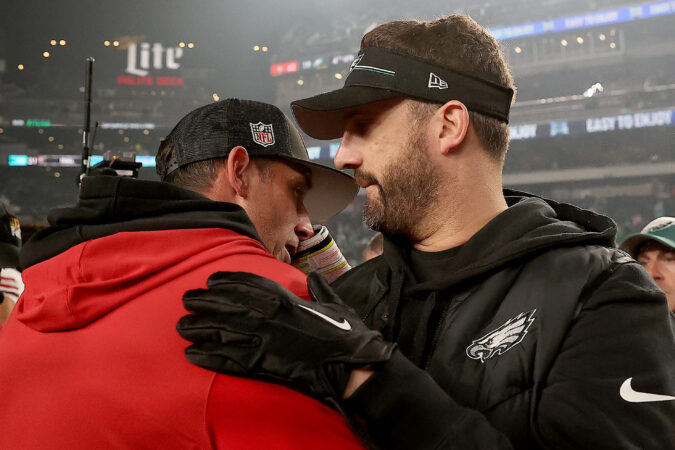
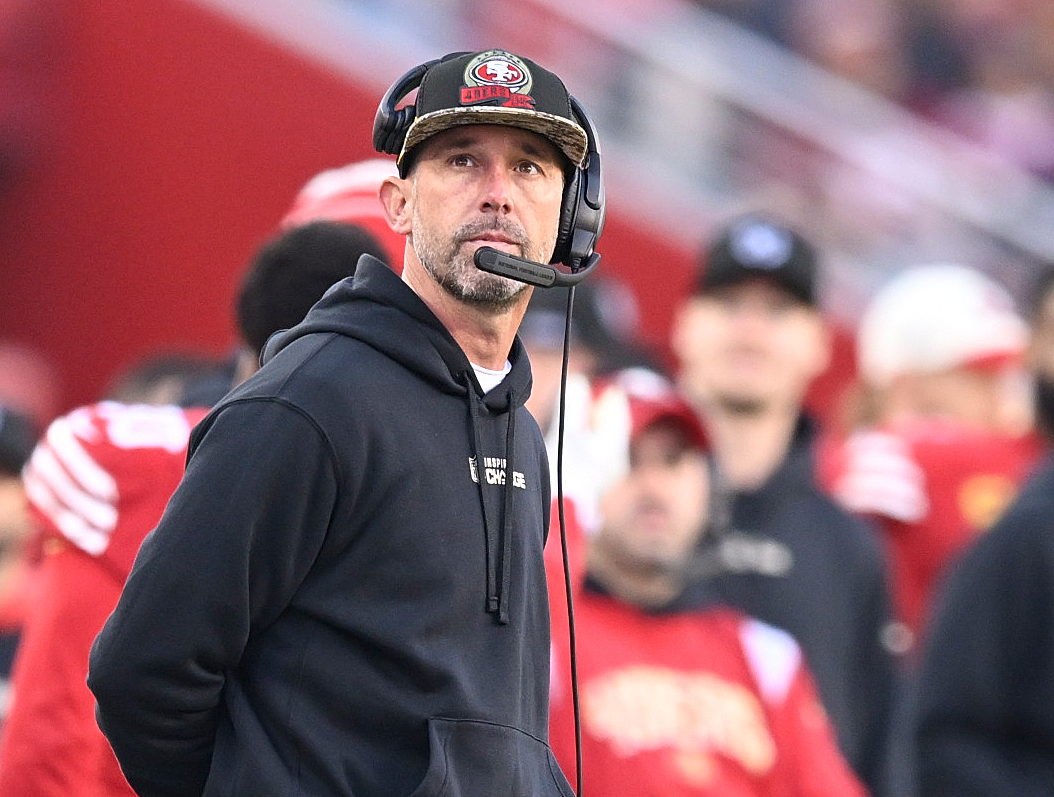
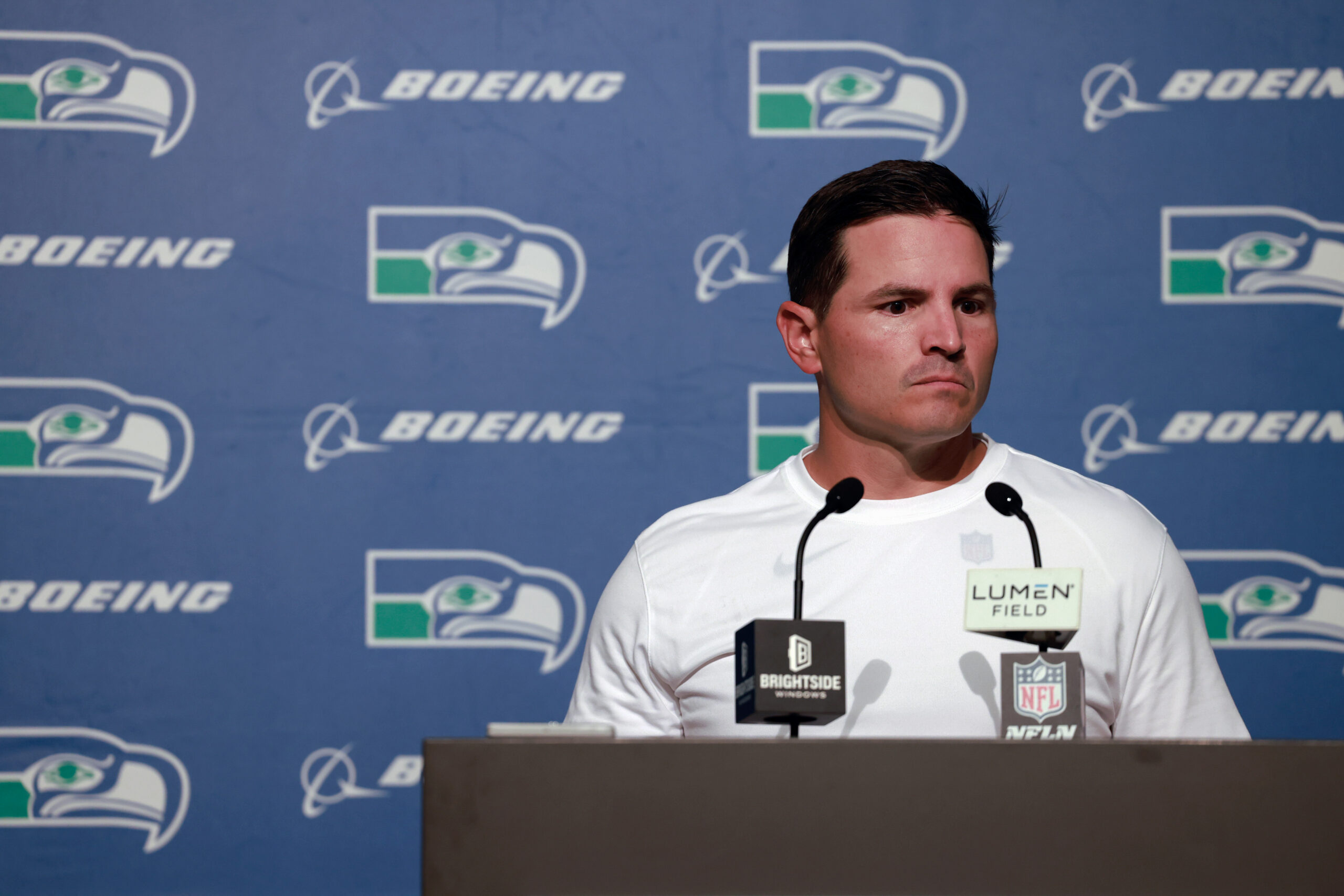
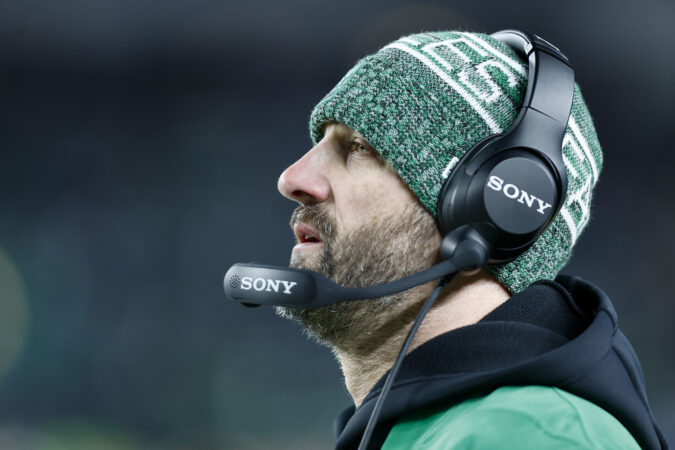
Kyle Shanahan, the head coach of the San Francisco 49ers, whom the Eagles face Sunday in the NFC wild-card round, is considered one of these savants. He is a terrific coach in just about every regard, having guided the 49ers to two Super Bowls and two other appearances in the NFC championship game. But it is in his creativity and orchestration of the team’s offense where he is truly elite.
San Francisco 49ers coach Kyle Shanahan has had his share of success, but a Super Bowl title has eluded him.
Shanahan calls all the 49ers’ plays, and his offense is so quarterback-friendly that the team has reached those two Super Bowls and four NFC title games with Jimmy Garoppolo, who backed up Tom Brady in New England, and Brock Purdy, who was the last player picked in the 2022 draft, as its starters at the position. Loaded with motion and deception, based on a zone-running attack that features Christian McCaffrey, Shanahan runs as close to a plug-and-play system for a quarterback as it gets in the NFL, and it works. San Francisco has finished among the top 10 teams in scoring in four of the last seven years.
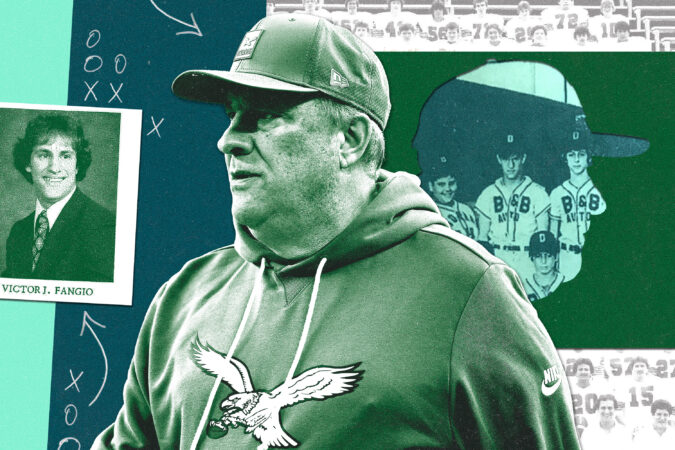
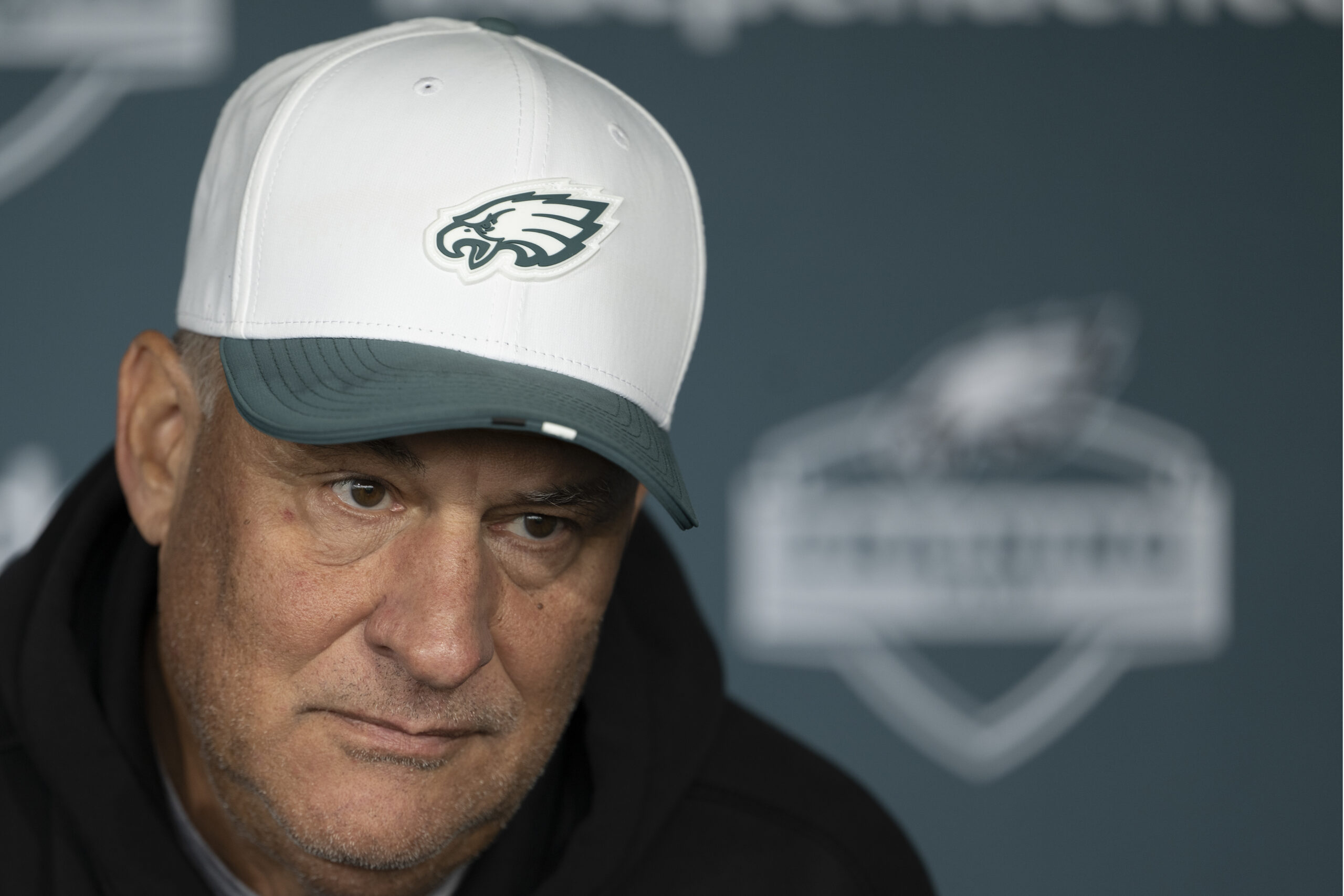
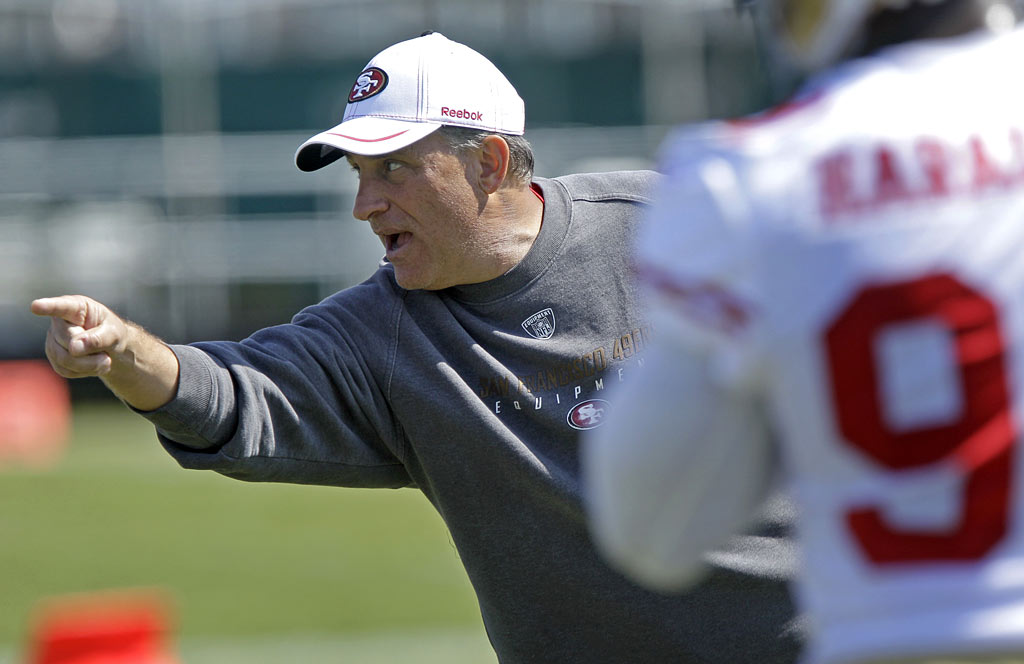
“They have a really good scheme,” Eagles defensive coordinator Vic Fangio said Tuesday. “It’s all packaged together very nicely. They give you a lot of good motions. Everything they do is with a purpose and they do a really good job of it.”
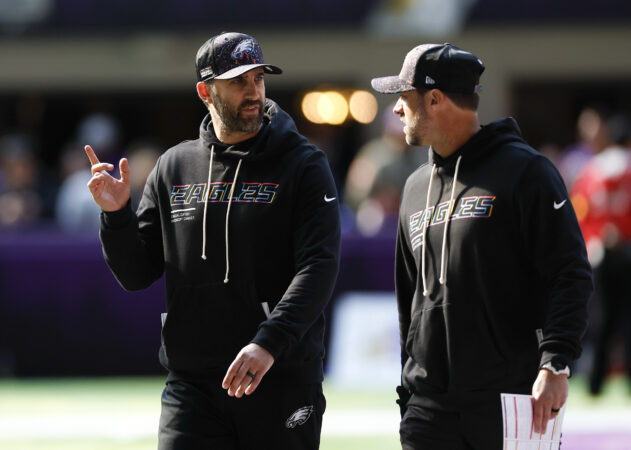
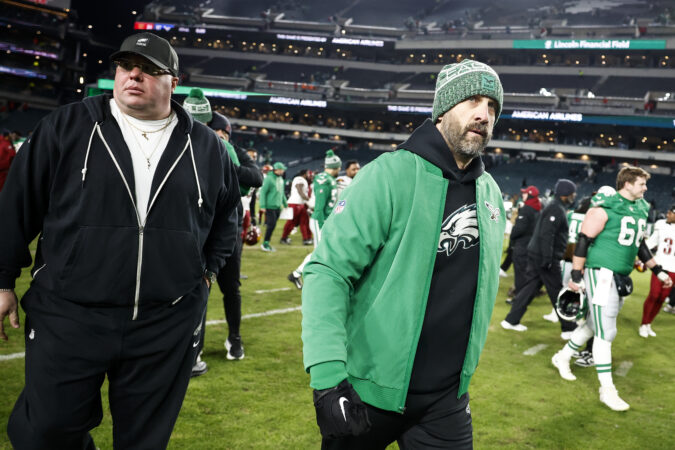
Nick Sirianni, the Eagles’ head coach, and Kevin Patullo, their offensive coordinator, are not considered the same kinds of coaches that Shanahan is. Say what you want about them — and a lot of what is said about them around here, especially about Patullo, can’t be repeated in decent company — but generally they are not among the first names mentioned when anyone starts listing the top offensive minds in the NFL. Sirianni stopped calling plays, for instance, in 2021, his first season as a head coach. Patullo had never been an NFL coordinator or play-caller before this season, and the Eagles’ up-and-down (to put it kindly) performance has made him a convenient and oft-deserved target of criticism.
Nick Sirianni has yet to have a losing season or miss the playoffs in his five years with the Eagles.
NFL coaching, though, is about more than being an offensive wizard. Shanahan hasn’t won a Super Bowl in his career yet, and one of the reasons is that, when he and his teams have had opportunities to bury their opponents, they’ve failed to do it. He was the offensive coordinator of the 2016 Atlanta Falcons, who infamously blew a 28-3 lead in Super Bowl LI to the Patriots in part because Shanahan got too aggressive in his late-game play selection. Under him, the 49ers had double-digit fourth-quarter leads in Super Bowl LIV and in the 2021 season’s NFC title game … and lost both. And in Super Bowl LVIII against the Kansas City Chiefs, Shanahan took the ball first in overtime, opted to kick a field goal on fourth-and-4 from the Chiefs’ 9-yard line, and handed the ball back to Patrick Mahomes with a chance to win the game. Patrick Mahomes, to no one’s surprise, won the game.
Sirianni, meanwhile, has won a Super Bowl, has reached another, and has yet to have a losing season or miss the playoffs in his five years with the Eagles. Does he need a Shanahan-like or Shane Steichen-style play-caller to make his offense go? The presence of such an assistant certainly helps. But by all indications, he makes up for whatever shortcomings his coordinators — or, in fairness, his quarterback, Jalen Hurts — might have with his abilities as a culture-builder.
“Week-to-week, day-to-day, his energy, his passion, everything you want in a leader who stands in front of this team in team meetings and at practice, he gives you,” Patullo said. “His attention to detail — we talk about core values all the time: toughness, together, detailed, all that stuff. And when we look at those things, that’s what he embodies and brings that to the team. Every day, he’s consistent in who he is. You’re not going to get somebody who goes back and forth on what they say, and I think when he speaks, everybody receives it and they’re ready to go.”
There’s more than one way to be an excellent head coach, even if one of those ways gets a little more attention, a little more scrutiny, a little more credit these days. The film can tell you how good a coach Kyle Shanahan is. What Nick Sirianni does well sometimes isn’t so easy to see. Come Sunday, may the best savant win.
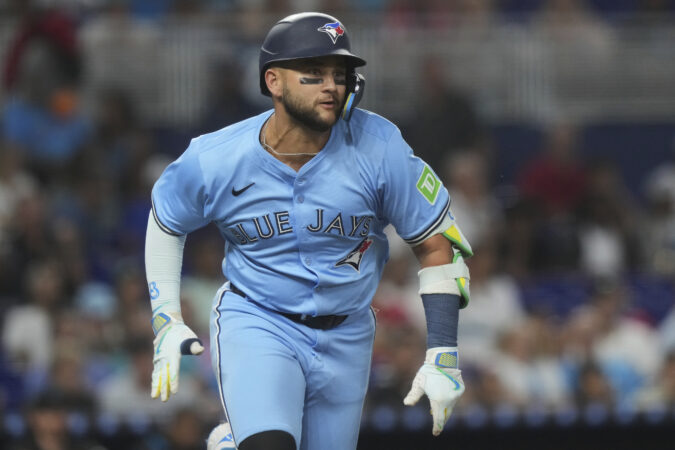
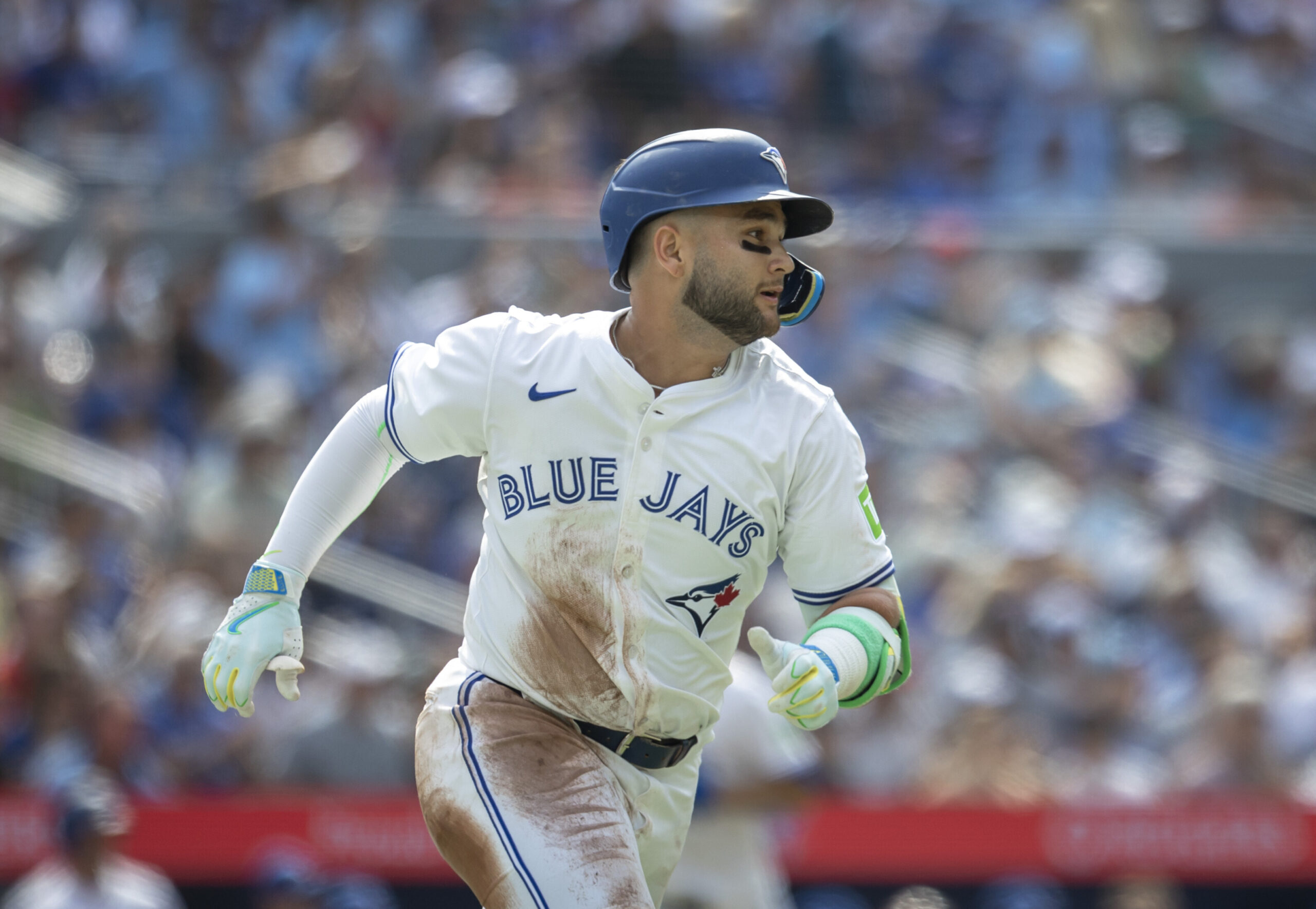
There is a long list of reasons that you shouldn’t waste your daydreams on visions of Bo Bichette wearing red pinstripes and hitting behind Bryce Harper. The Phillies’ reported interest in the Blue Jays star only barely distinguishes them from the 29 other major league teams that likewise are interested in signing very good baseball players at the right price. Interest is not a differentiator. You can’t buy a Bentley with affection.
Circumstance, context, and logic suggest that Bichette will end up signing elsewhere. And that’s great if you’re into those things. The rest of us will be over here indulging ourselves. On the 12th day of Christmas, the New York Post’s Jon Heyman gave to us a vaguely worded, thinly sourced report connecting the Phillies to a big-ticket free agent. What are we supposed to do? Underreact?
The least we can do is try to proceed with some level of dignity and decorum. This often is easiest to do under the guise of asking questions. There are no dumb questions, only dumb questioners, right? So let’s fire away.
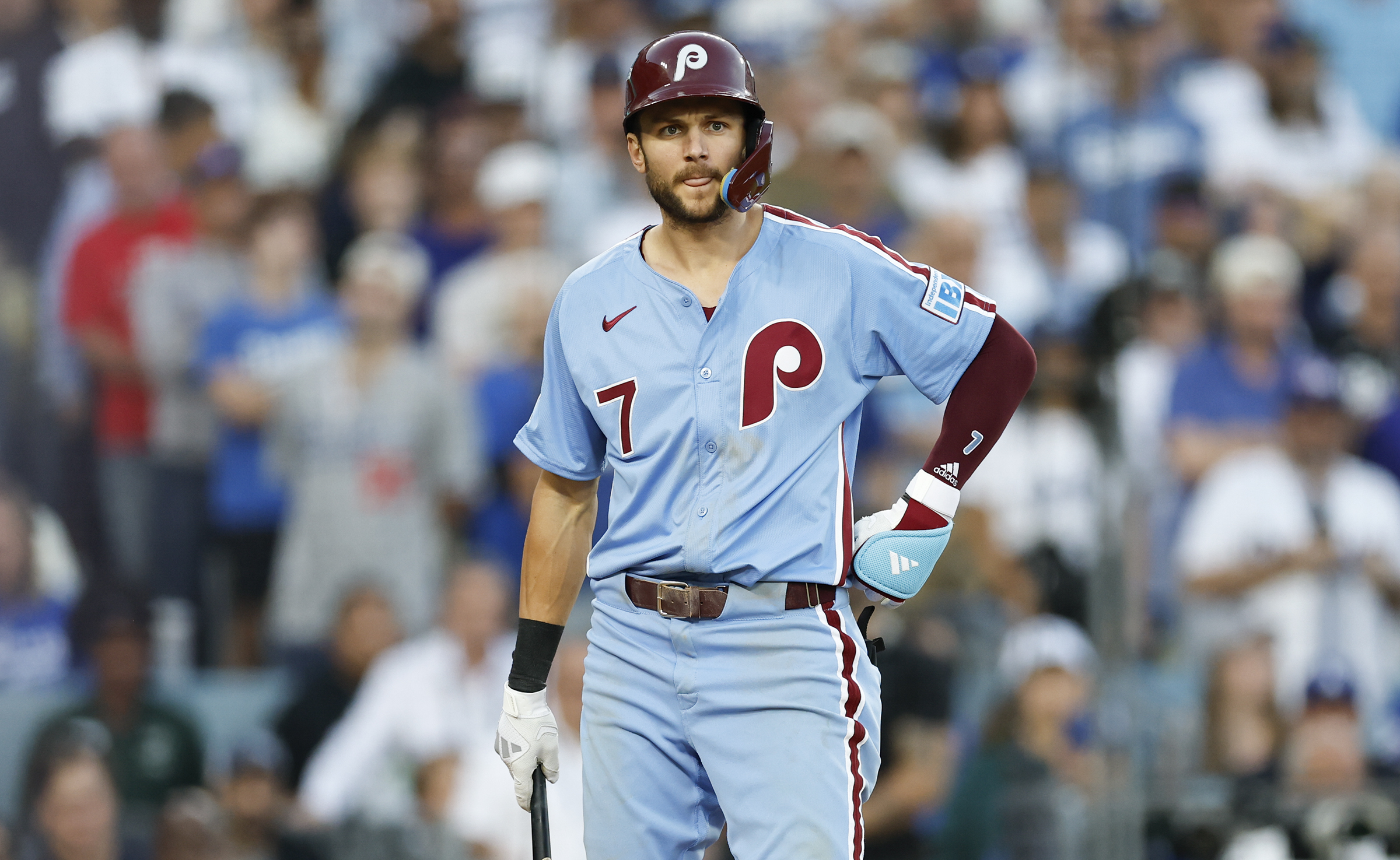
The Phillies already have a shortstop in Trea Turner. Presumably, Bo Bichette would move to second base in any scenario that brought him to Philadelphia.
Only a few weeks ago, Dave Dombrowski sounded like a man who didn’t expect any more major additions to his roster. What would have caused that to change? Is Bitcoin about to spike again?
This is the however-many-million-dollar question. Five weeks out from pitchers and catchers reporting, the roster looks pretty close to set. Ken Rosenthal of The Athletic reported Monday that the Phillies still were in the market for another right-handed-hitting outfielder, which is encouraging, because they really could use a viable Plan B in case Justin Crawford turns out to be late-stage Juan Pierre or Ben Revere. They don’t need anything major. Veteran Randal Grichuk, whom the report mentioned specifically, would make a lot of sense. Otherwise, there isn’t an obvious opening that would compel the Phillies to make an offer with the sort of necessity premium that often distinguishes a winning bid from the rest.
One thing that may have changed is Dombrowski’s evaluation of the market. Not much has happened since the last time he spoke. Not only do most of the major free agents remain unsigned, we aren’t even seeing smoke. Bichette, Cubs outfielder Kyle Tucker, Red Sox third baseman Alex Bregman, Yankees outfielder Cody Bellinger, Mariners third baseman Eugenio Suárez, not to mention Ranger Suárez and the rest of the starting pitchers … the complete lack of movement at the top of the market is abnormal.
We’ve seen slow-moving markets before. But there is some reason to believe that this one is reaching a point of collapse. The money may not be out there this year. Virtually all of the big-market teams already are at or above the luxury tax threshold with the money on their books. Last year, the Phillies were at a disadvantage because teams like the Mets, Red Sox, and Cubs were in payroll expansion mode. Other teams simply had more money to spend than they did. That may not be the case this year.
The Cubs still are a potential market maker, with roughly $80 million in space before the first luxury tax threshold. It shouldn’t surprise anybody if they make a flurry of moves that alters the current narrative about the NL landscape. Same goes for the Mets, who presumably have whatever money they would have paid to Pete Alonso and Edwin Díaz before both signed elsewhere. The Orioles are always lingering. The Blue Jays are pushing $300 million but seem to be operating with the taste of blood in their mouths. So there still is plenty of reason to doubt that the Phillies can win via aggression.
But there are a lot of players out there. And there don’t seem to be the usual dark-horse lurkers among the midmarket clubs. It’s worth noting the situation in Minnesota, where the Twins are shedding payroll as if they need to make rent. The middle class might be content to sit this one out, especially with next year’s labor talks looming.
Bo Bichette was an MVP-level hitter after he broke out of an extended slump last season.
So Bichette might be more affordable than the Phillies thought?
Yes and no. It’s awfully hard to project a contract for a player who is an anomaly in terms of his age (only 28 this season), career production (24 home runs per 162 games and 121 OPS+) and pedigree (Dante Bichette’s kid), but who also is less than a year removed from a brutal 18-month stretch in which he posted a .651 OPS in 651 plate appearances. Trea Turner’s career numbers were nearly identical (minus the steals) when the Phillies signed him to an 11-year, $300 million contract heading into his 30-year-old season. FanGraphs had Bichette projected at seven years and $189 million entering the offseason. ESPN recently updated its projection to five years and $150 million. If that second number is close to reality, the Phillies may well readjust their expectations.
What’s this about Bichette posting a .651 OPS in 651 plate appearances? Isn’t that a concern?
It is. But it also might be an opportunity, if other teams are worried. Once he snapped out of his funk early last season, Bichette was an MVP-level hitter. In his last 102 games, he hit .325/.372/.528 with 17 home runs. From the right side of the plate. While playing middle infield. He has always had the kind of skill set scouts drool over. Bichette’s contact rate ranked in the top 20% of qualified hitters last season. At 83.2%, it would have ranked third among Phillies regulars, behind Alec Bohm (87%) and Bryson Stott (86.1%). His chase rate also ranked at the high end of the spectrum — in a bad way. Only 18 qualified hitters chased more often: Bichette’s 37.9% ranked just behind Bryce Harper (38.1%).
That said, Bichette did make some steady progress last season. It’s fair to wonder if he emerged from his slump as a different hitter. Only 10 hitters in baseball had a lower strikeout rate after the All-Star Break — his 11.1% was a dramatic improvement over an already-solid roughly 15%. He coupled that with a huge boost in his walk rate, from an anemic 5.5% to a slightly-better-than-average 8.8%. If the Phillies think they can get a $250 million player for $175 million, that might change things.
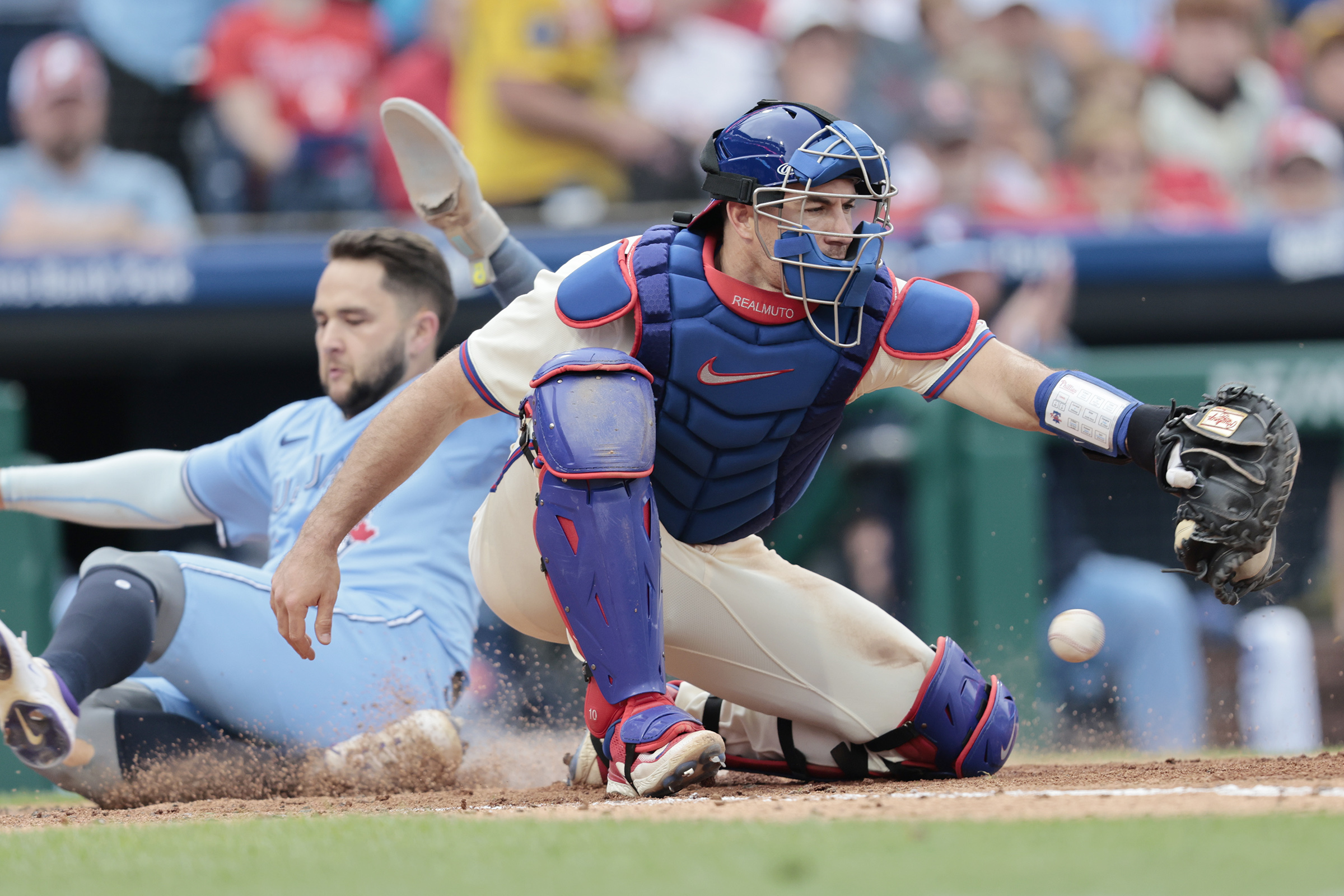
Bo Bichette scoring a run for the Blue Jays in June as Phillies catcher J.T. Realmuto tries to catch the throw.
Why wouldn’t the Blue Jays just match any offer?
I guess Christmas is over, isn’t it? Assuming Bichette likes Toronto, which seems to be the case, and the Blue Jays are willing to spend, which seems to be the case, the Phillies presumably would need to land Bichette the old-fashioned way: by guaranteeing him more than anybody else is willing to guarantee him. They have close to $60 million coming off the books next season and theoretically would be able to accommodate another big deal, biting the bullet on the luxury tax this season while freeing up $15 million to $20 million by trading Bohm and Edmundo Sosa and finding someone to pay a little bit of Nick Castellanos’ salary.
But, then, we’d be back where we started. Realizing that Bichette probably won’t be here.
David Robertson, 40 and unemployed until July, put out a fire in the sixth inning of the Phillies’ first playoff game of 2025, but he hadn’t pitched an “up-down” all season — ending one inning and beginning another. With a one-run lead, Rob Thomson sent him back out for the seventh. Robertson hit one batter and another singled. Thomson then brought in Matt Strahm, who hadn’t inherited a runner in six weeks. Strahm got two outs, then gave up a three-run homer. The Phillies lost Game 1 of the NLDS to the Dodgers.
Two nights later, with a slow runner on second base and nobody out in the ninth inning of a one-run game, Thomson directed Bryson Stott to bunt. Twice. The Dodgers ran a “wheel” play and nailed the runner at third. The Phillies lost Game 2 of the NLDS.
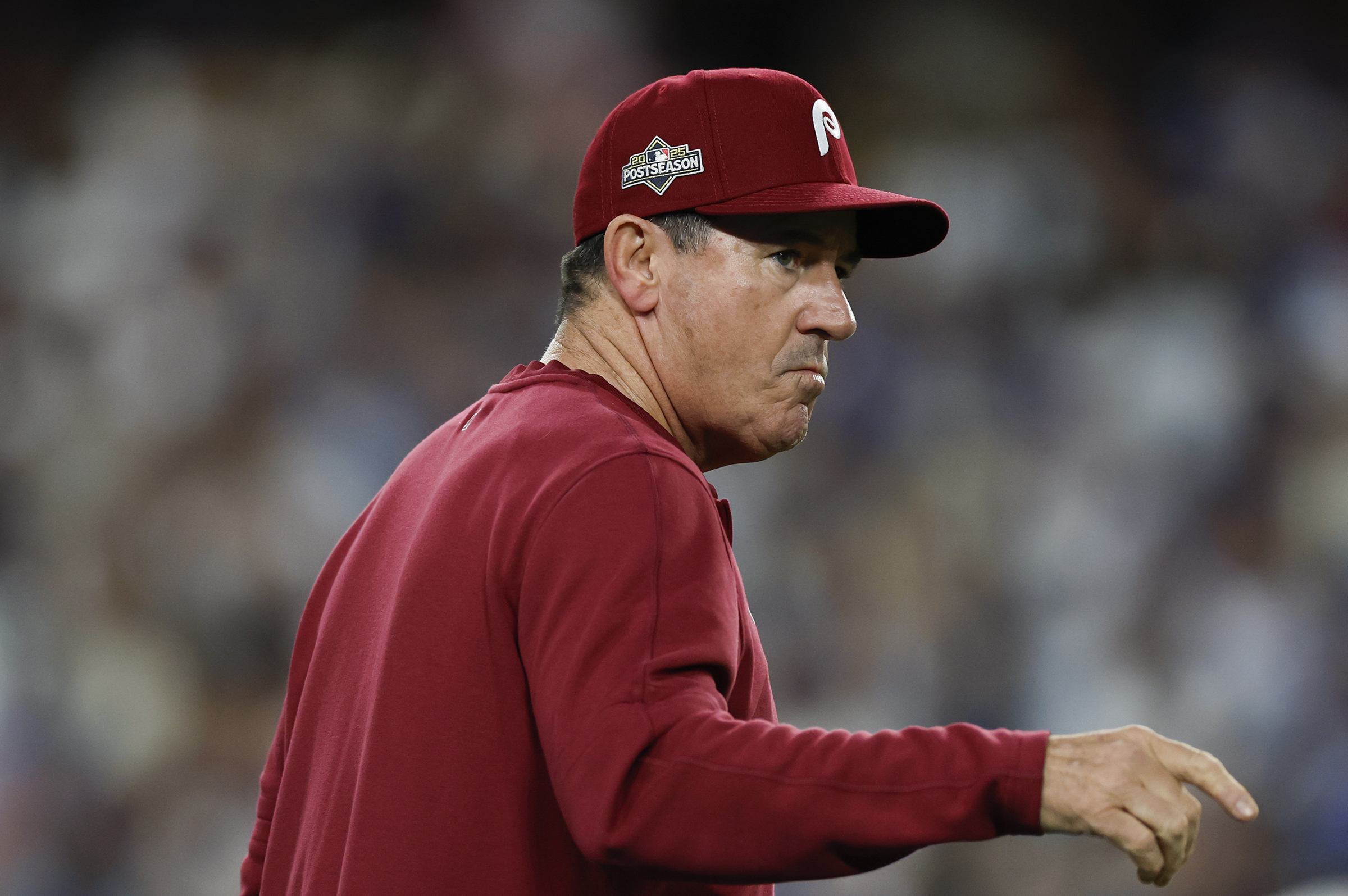
These are the latest blemishes on Thomson’s thin resumé. He was elevated from longtime major league bench coach to first-time manager in June 2022, and the Phillies have at least played to the level of their payroll ever since, but they’ve faltered in the fall. Fairly or not, from pulling Zack Wheeler early in Game 6 of the 2022 World Series to not pinch-hitting early for Johan Rojas in Game 7 of the 2023 NLCS, the popularity of the affable, accountable skipper has steadily waned.
Enter Donnie Baseball.
After an intense, two-month recruiting effort, the Phillies on Monday hired Yankees legend Don Mattingly, 64, to replace Mike Calitri as bench coach. Immediately after the four-game NLDS loss to the Dodgers, the Phillies reassigned Calitri to the post of major league field coordinator, which means he’ll retain his myriad administrative duties as they pertain to scheduling and number-crunching. But he no longer will be Thomson’s chief lieutenant; no longer the voice of reason in tight situations.
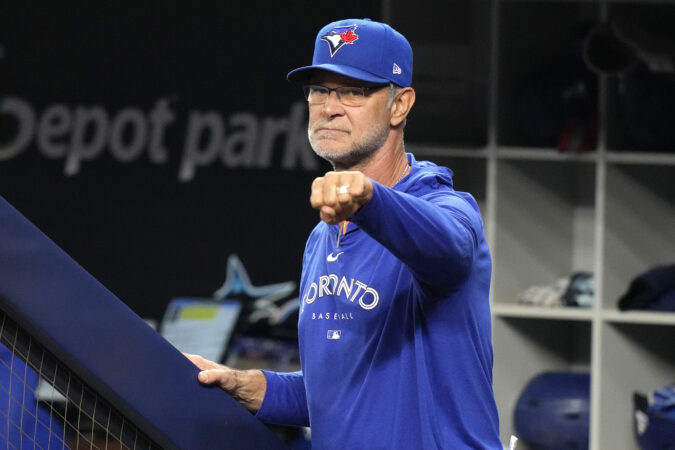
Phillies manager Rob Thomson will have an experienced bench coach in the dugout with him in 2026 with the addition of Don Mattingly.
That louder, deeper voice will belong to Mattingly.
Thomson was asked Monday if some of his playoff missteps might have been averted had Mattingly been on the bench, protesting.
“Possibly,” Thomson replied. “Possibly. You never know.”
“Missteps” might be unfair, but Thomson has addressed each one with honest reevaluation. His authenticity and his absence of ego are part of his charisma.
Charisma doesn’t win World Series.
Anyway, the dugout’s charisma just grew by a factor of 10.
For a decade, Mattingly was the face of the Yankees, then the biggest sports franchise in America. His .307 career average, .830 OPS, and nine Gold Glove awards make him a logical Hall of Fame candidate who has been cursed by a largely illogical voting bloc. With a husky build, full mustache, and thick, full head of dark hair, he was an archetype of a baseball player for a generation. Even today, as the cleft in his chin grows deeper with age, he looks like a movie-star version of a once-great athlete.
He managed the Dodgers to the playoffs three times and the Marlins once, in 2020, when he was National League Manager of the Year. He has coached for the Yankees, Dodgers, and, for the last three seasons, for the Blue Jays, who lost the World Series to the Dodgers in seven games. Mattingly expected Game 7 to be the last of his career.
But Phillies president Dave Dombrowski was on the phone the next day, and the day after that, and so forth. Finally, Mattingly agreed.
From now on, every decision — who pitches the eighth inning, who sits for a defensive replacement, who steals and who sacrifices — will go through a man with credentials Thomson simply doesn’t have.
Don Mattingly managed the Marlins for seven seasons after leading the Dodgers for five.
“We can now blame Don for it,” Thomson joked.
Mattingly might have agreed to support Thomson for the next two seasons, but he agreed to much more than just making sure that Topper doesn’t bunt again in the ninth with nobody out.
Superstar Don
Mattingly immediately validates a coaching room full of excellent, but anonymous, teachers of the game. With a roster that includes Bryce Harper, Kyle Schwarber, Trea Turner, and Wheeler, in a game in which nothing carries more weight than having withstood the brightest lights yourself, this cannot be overstated.
“He’s a great sounding board for our stars because he’s been there and done all these things,” Thomson said. “The rest of us really can’t [say] that.”
Sheriff Don
One of the most important services a bench coach provides is as a buffer between a manager and the players or as an enforcer who snuffs sparks before they become fires. It’s doubtful that Nick Castellanos’ insubordination or Strahm’s frequent criticisms would have proliferated if Mattingly had been around the clubhouse.
Manager Don
Asked if he ever wanted to wear the skipper hat again, Mattingly was steadfast and insistent in his reply.
“I feel like those days have passed me by; I don’t have any aspirations to manage,” Mattingly said. “I don’t think I have the energy for that anymore.”
If the Phillies stumble early in 2026, or if, heaven forbid, something incapacitates Thomson, Mattingly will be the obvious choice to replace him. You simply don’t take a job as bench coach without the understanding that you will manage the team in case of dismissal or emergency. Also …
Preston Mattingly (right) with Dave Dombrowski, is going into his second season as Phillies general manager.
Daddy Don? Spy Don?
The Phillies and Mattingly want us to believe that the presence of Preston Mattingly as the Phillies’ general manager is almost entirely coincidental to their pursuit of him and of him delaying retirement. Mattingly swore that, even though Press is his son, he never would betray the sanctity of the dugout and clubhouse to the front office.
“I’m not a voice running upstairs to talk about anything and everything,” Don said, clearly aware that some organizations are run in exactly that manner. “I came from a different era where that is not something that happens.”
That said, after more than four decades of playing and working in the majors, Mattingly admitted that he has envisioned the sweetness of winning the first World Series with his son as his boss.
“To be able to do that with him would be incredible,” Don said.
Incredibly difficult.
In fact, even chiming in on Thomson’s occasional cockeyed decisions, and even riding herd over a roster full of coddled princelings, maintaining a normal father-son relationship while balancing a strictly professional GM-bench coach relationship will be the hardest part of old Don Mattingly’s new job.
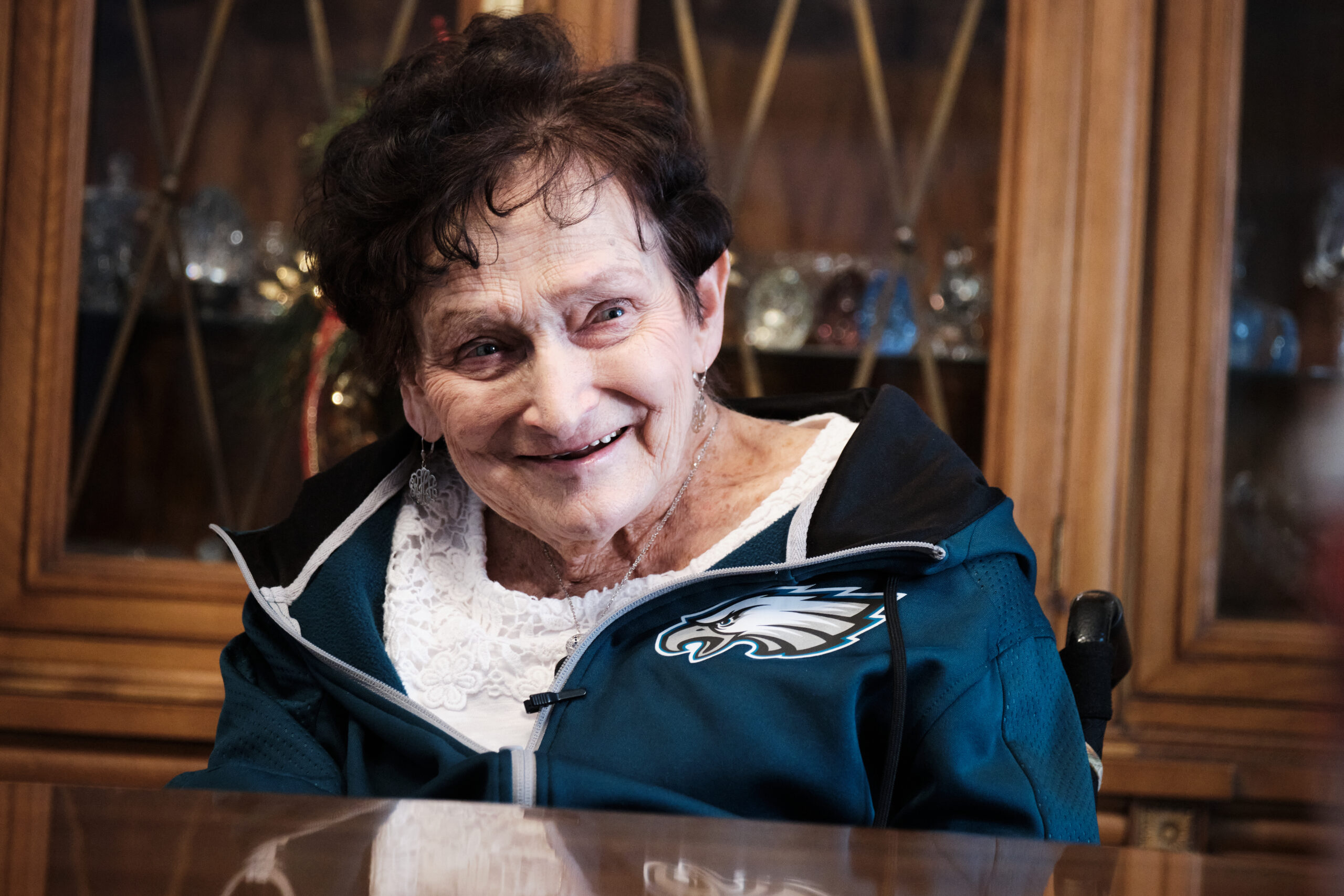
DUNMORE, Pa. — Roseann Henzes is 89years old and watching the Eagles is the highlight of her week. This is not because of the players, the head coach, the general manager, or the famous security officer.
It is because of Vic Fangio, whom she has known since he was 14, when he played high school football for her late husband, Jack Henzes.
A day before the game, the octogenarianwill text the defensive coordinator “good luck.” From her wheelchair in Dunmore, she’ll take in every snap, paying close attention to moments when the camera pans to the coaching booth.
Fangio wears the same expression he did in the 1970s: stern, focused, and endearingly gruff. Win or lose, Henzes sends him a message afterward. He usually replies, with his typical brevity.
“I get one-word answers,” she said with a laugh. “‘Thanks,’ or ‘appreciate it,’ maybe. No time to chitchat.”
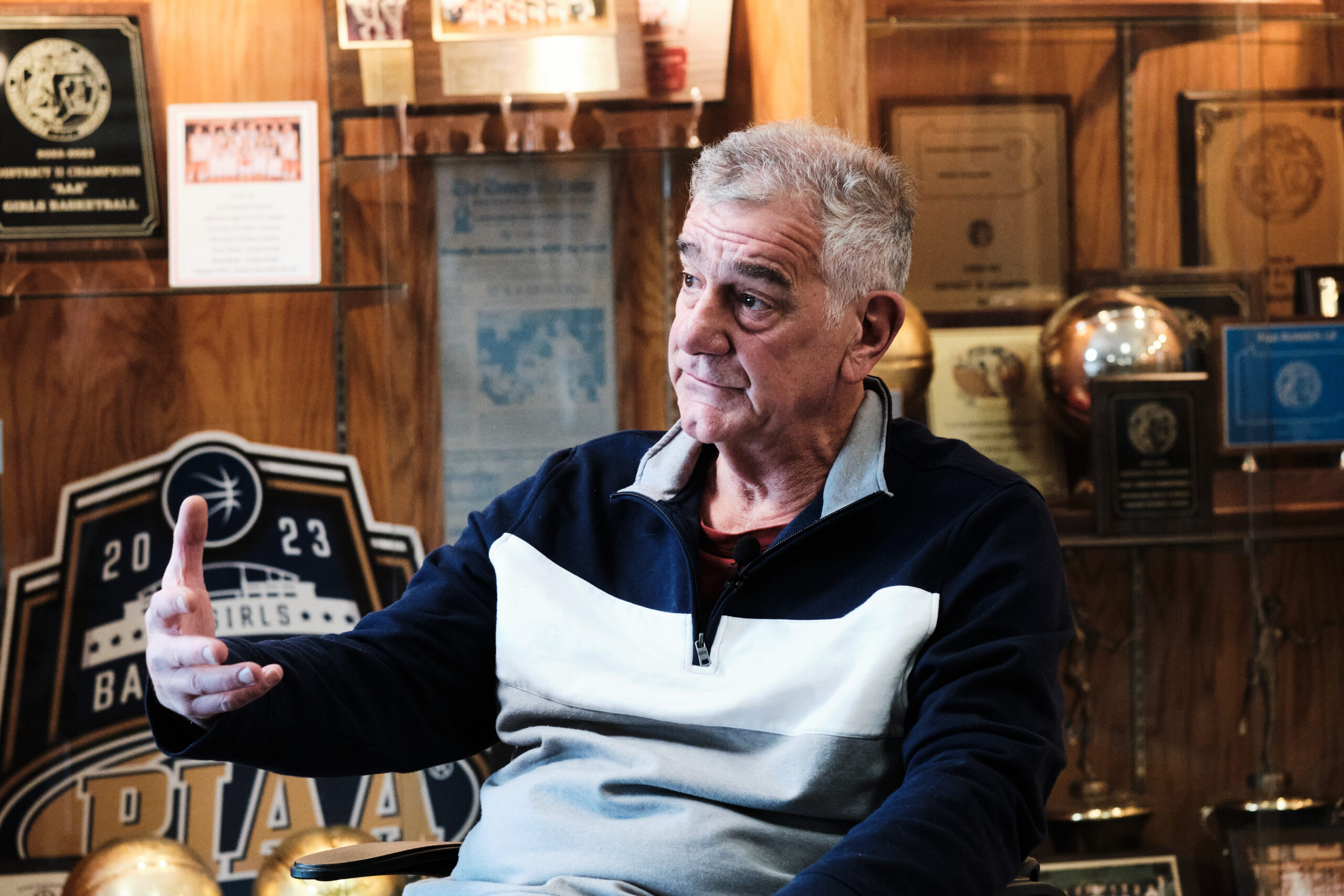
Roseann Henzes still communicates with Vic Fangio more than 40 years since he last coached under her husband, Jack.
Some coordinators are toughened by long hours and stressful seasons, but the people of Dunmore say this is how Fangio has always been. Even as a young safety, he was hard-nosed and meticulous, a player who devoured film and grasped concepts on the first try.
Fangio showed an ability to be in the right spot at the right time, or, better yet, anticipate what the opposing offense would do next. These instincts only sharpened in 1979, when he was hired by Jack Henzes as linebackers coach at Dunmore High School, his alma mater, about 120 miles north of Philadelphia.
It was an opportunity that laid the foundation for the rest of his career. Henzes became a mentor to Fangio, whom he saw as a kindred spirit. He taught his pupil how to work, how to coach, and how to get the most out of his team.
They took pride in the minutiae, drilling players on everything from proper footwork to hand placement. This translated into success: After losing seasons in 1976 and 1977, and a bounce-back 10-win season in 1978, Fangio and Henzes went 21-13 over their three years coaching together.
The Eagles defensive coordinator has accomplished a lot since then — including a Super Bowl championship in which he had a crucial role — but locals still see the same understated guy.
To Roseann Henzes and the Dunmore community, he will always be the kid who umpired Little League games for fun. Or the high school coach who tended bar at Ragnacci’s for extra money — despite his reticent nature.
“I just laugh when they show him in the [coaches’] box,” said Tony Donato, Fangio’s former neighbor. “The same expression on his face. Doesn’t crack a smile. I think he’s saying, ‘I don’t want this camera on me at all.’”
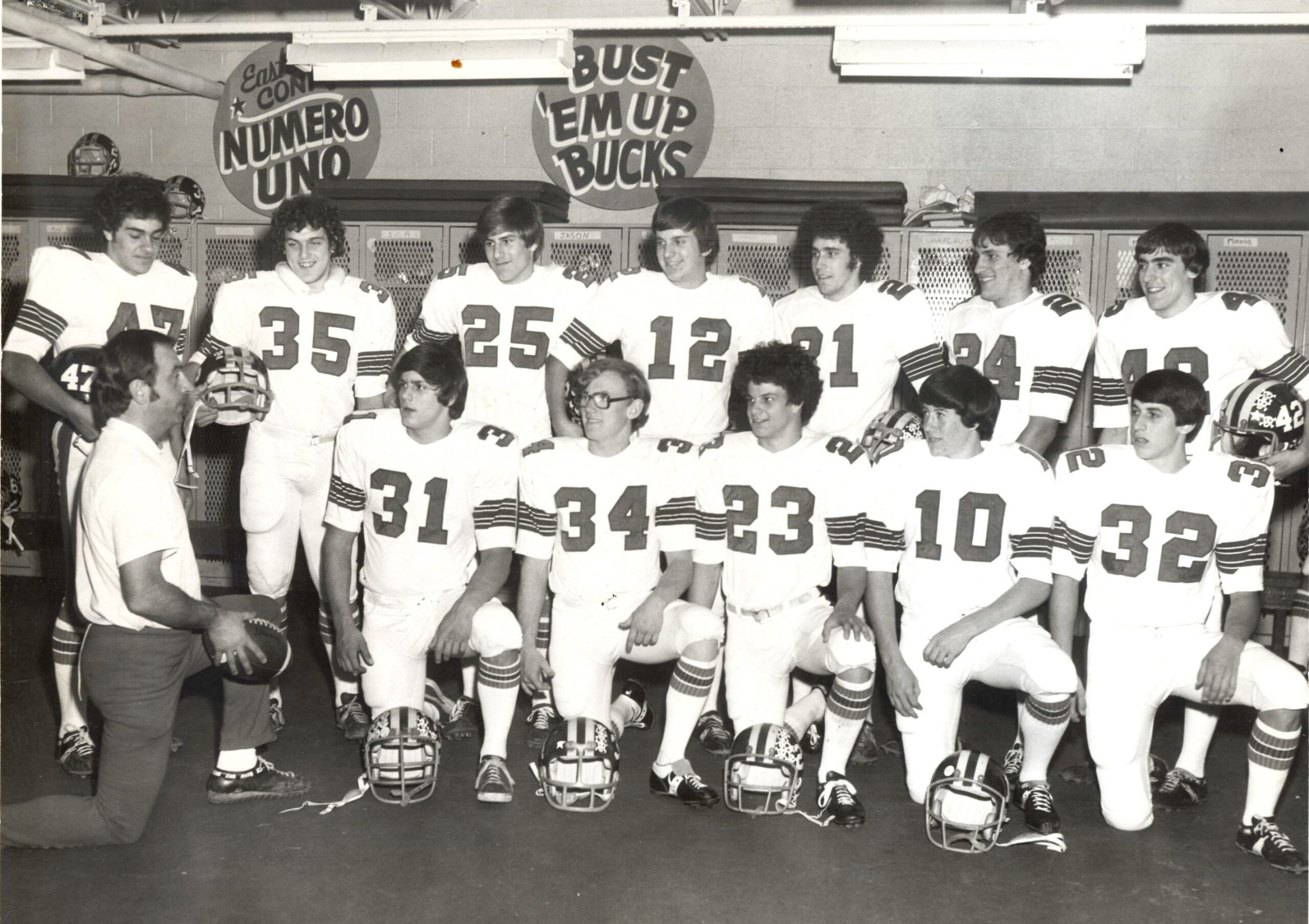
Dunmore coach Jack Henzes with his 1975 team. Vic Fangio is standing second from right.
A player known as ‘Hector’
Fangio spent his formative years in Dunmore, a borough of about 14,000 people just outside of Scranton. His mother, Alice, was a housewife and, later, a secretary at the local high school. His father, Vic Sr., owned a tailor shop.
From a young age, Fangio was immersed in sports. He played baseball in the spring, football in the fall, and basketball in the winter. As if that wasn’t enough, Fangio began umpiring in Dunmore’s Little League, where Vic Sr. served as a coach, in the early 1970s.
He was only a teenager, but he displayed a breadth of knowledge that commanded respect.
Bob Holmes, who played for Fangio from 1979 to 1981, experienced this firsthand. He met his future football coach in the batter’s box. The umpire showed no mercy.
“He called balls and strikes,” Holmes said. “And if you were just this kid sitting up there, and you’d watch one go by, he’d punch you out like it was a major league game. Off to the side, fist out, you’re done. Out you go.”
Locals assumed Fangio would work in sports. Some wondered if he’d become an umpire, following in the footsteps of Dunmore resident and Baseball Hall of Famer Nestor Chylak.
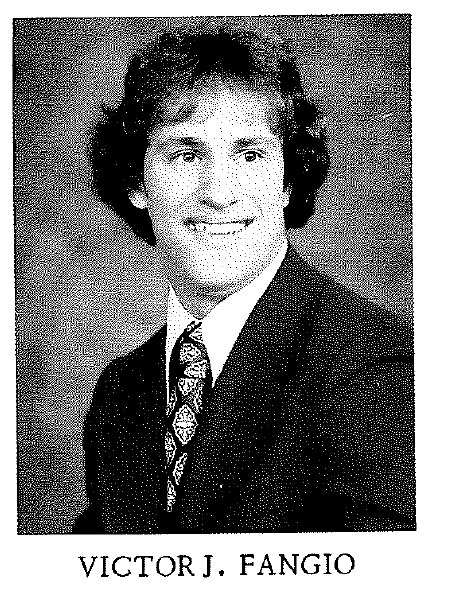
Vic Fangio’s senior yearbook photo at Dunmore High School in 1976.
But after Fangio was introduced to Henzes, his love for football became clear. He played for the freshman team in eighth grade, with a voracious appetite to learn. Bill Stracka, Fangio’s coach in 1971, said the middle schooler would bring him NFL concepts to implement.
“Every once in a while he’d say, ‘Could I talk to you before we leave?’ And I’d say, ‘Sure,’” Stracka said. “He’d say, ‘Well, last night, I was watching part of the game, and I saw something that I’d really like to explore here. I think I could do it.’
“Whenever we talked about things, it was like that. He was very, very aware.”
Fangio joined the varsity team in 1973, and was taken by Henzes’ understanding of the sport. Henzes was taken by Fangio, too. Roseann said her husband would talk about the safety “all the time,” and eventually introduced her to Fangio when he was a sophomore.
She was struck by how similar they were, down to their demeanor. Both Fangio and Henzes were quiet. Both had a borderline obsession with the game, spending long days and late nights studying film.
Because of all this work, they could predict an opposing offense’s next move. Joe Carra, a former linebacker at Dunmore, remembered one game in 1973 against Valley View, which Dunmore hadn’t beaten in years.
With Fangio on the field, they achieved the improbable. He intercepted a pass late in the fourth quarter and returned it 40 yards for a backbreaking touchdown en route to a 33-27 win.
“He would play right behind me, and he was always in the right position,” Carra said. “That’s why he had a bunch of interceptions.”
Together, Henzes and Fangio elevated the program to new heights. After a lackluster freshman season in which it went 5-4-2, Dunmore posted a 28-6-1 record over its next three years with three Big 11 Conference championships.
Senior players on the 1975 Dunmore High School football team that won the Big 11 championship, including Vic Fangio (24), back row left.
At some point during this span, Fangio was given an unusual nickname among a select group in his hometown: “Hector.” Carra recalled that it was assistant coach Paul Marranca who first coined it (although Marranca’s memory of this is hazy).
In Carra’s telling, one day in practice, Marranca was trying to get his players in position and mistakenly yelled “Hector” instead of “Victor.” The moniker stuck.
“We all laughed under our breath,” Carra said. “Coach Henzes would have made us run if he thought we were laughing at him.”
Fangio graduated in 1976 and attended nearby East Stroudsburg, where he attended coaching clinics. By 1979, he’d gotten his first coaching job, overseeing linebackers under Henzes at Dunmore, while finishing his senior year of college.
He stayed for three seasons, working as defensive coordinator in 1980 and 1981. The first stop of his career shaped his philosophy for decades.
“Everything he got came from Coach Henzes,” Carra said. “He went further with the detail. He learned toughness. He learned hard work.”
Though not known for his ebullient manner with people, Vic Fangio once worked as a bartender in Dunmore.
Coach by day, bartender by night
It didn’t take long for players to realize their new coach was advanced for his age. Dunmore had previously been running base defenses. After Fangio was hired, it started incorporating stunts and blitzes.
“We had no idea what we were doing,” former safety Paul Sheehan said via email.
The coach would challenge them schematically, but also would harp on fundamentals. Fangio had rules for every position group. The players first had to line up correctly. Then, they needed to know their coverages. They’d have to use their hands, stay square, and tackle properly.
Any mistakes would be pointed out in film review on Monday — even with players outside of his purview.
“He would stop the film and run it back 18 times to make a point,” Holmes said. “If [he] were critiquing our offensive line, he would critique their stance. ‘Your foot’s too far.’ ‘You just got beat off the corner because your foot wasn’t far enough.’ Or balance. The littlest of things.
“You’re sitting there, and you’re like, ‘Oh my gosh.’ You can’t wait to get out of there. But everything was important.”
It was here that Fangio’s attention to detail really shone. FormerlinebackerJack Miles remembered one day in 1980 when they were reviewing footage of an upcoming opponent. The coach paused the film, then rewound it.
He pointed to the hash marks.
“He [noticed] that if both receivers were outside the hashes, they’d run the ball,” Miles said. “If one receiver was inside the hash mark and the other one was outside, that was their throwing formation. Sure enough, he was correct.”
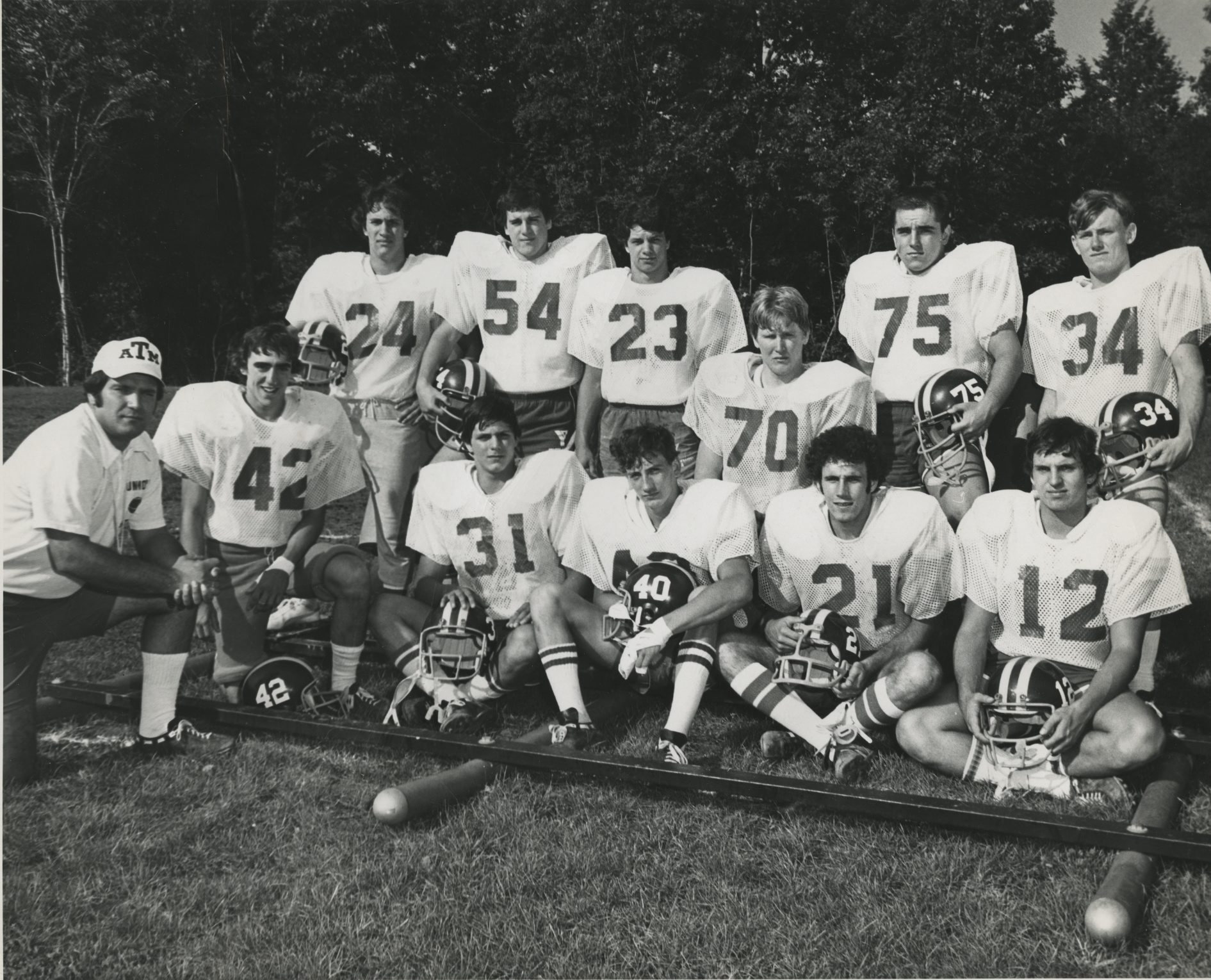
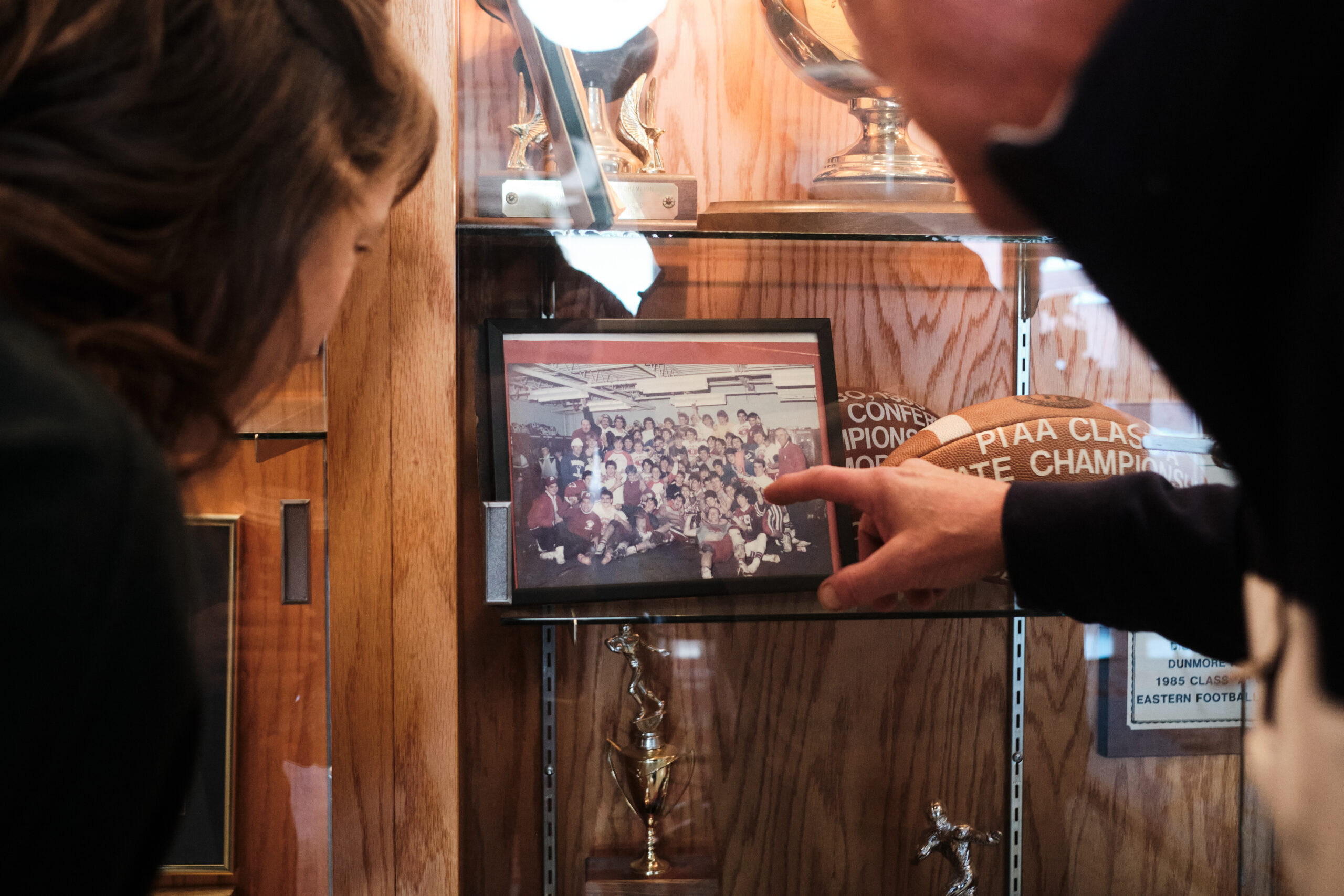
A photo of Vic Fangio’s high school team hangs in the trophy case at Dunmore High School.
Fangio was just as thorough on the field, equipping his players for every situation. Defensive backs would practice “high-pointing” the football, catching tipped passes, and taking efficient angles while pursuing ballcarriers.
Before long, Dunmore was running sound, but unpredictable, defense — one that proved difficult to dissect. Fangio’s unit would use four-man, five-man, and six-man fronts, all with four or five different plays apiece.
He occasionally reminded the players of his impact. On a Monday after a big win against Valley View, Fangio ran back a clip of Miles making a tackle untouched. Then, he ran it again. And again.
Fangio looked at the linebacker.
“He says, ‘Did anybody touch you?’” he said. “And I said, ‘No, Coach.’ And he says, ‘Aren’t you going to say thank you?’”
For Miles, getting a laugh out of Fangio was a point of pride. He was famously reserved, and not only at practice. Bobby Ragnacci, who coached Dunmore’s offensive line, hired Fangio to work at his family’s restaurant in the early 1980s.
Jack Miles shares fond memories of Vic Fangio’s work as an assistant coach under Jack Henzes at Dunmore.
He needed a bartender, and Fangio needed some extra money. So one night a week, the future Eagles defensive coordinator served 25-cent drafts and two signature cocktails: the Blue Moon and the Blue Hawaiian.
Pouring beer into a glass wasn’t an issue. Making small talk was.
“Well, he was no Tom Cruise, flipping bottles and stuff,” Ragnacci said. “But he was very efficient. And very honest. Certainly didn’t give away any free drinks.
“He was a good listener. Not much feedback.”
Added Holmes: “Not particularly good. He was probably drawing plays or something.”
Despite his taciturn demeanor, Fangio showed how much he cared. Holmes struggled in high school. He didn’t play a full season in his sophomore year because he became academically ineligible.
He was in a car accident in his junior year, which prolonged his time off the field, and finally returned to the team in 1981, his senior year.
Holmes remembered Fangio giving a speech to set the tonefor offseason workouts. He made a reference to “the players who weren’t here” in years past.
The tailbacktook notice.
“I think what he was saying to me, without saying it, was that we value you,” Holmes said. “‘We missed you last year. But I don’t want you to just sit there on the bench and hear me talk. I want to draw [your] attention. Because we feel you’re going to be an important part of our team.’”
To those around them, the parallels between Fangio and Henzes were obvious. They were defense-minded coaches who led with high expectations and tough love.
They possessed a savant-like ability to draw up plays, not because of clairvoyance, but hard work.
“Coach [Henzes] never felt like he was too smart for the game,” Holmes said. “He was always trying to learn new things. And I think he probably instilled that in Victor.”
Vic Fangio has never forgotten Dunmore amid his nationwide travelogue within the NFL.
Faxing defense to Dunmore
In the early 1980s, Fangio told Henzes he wanted to coach at the next level. Henzes urged his pupil to leave as soon as possible. He did, taking a job as defensive coordinator at Milford Academy in Connecticut in 1982.
After working as a graduate assistant at the University of North Carolina in 1983, Fangio was hired by Jim Mora as a defensive assistant for the USFL’s Philadelphia/Baltimore Stars from 1984-85.
He entered the NFL in 1986, joining Mora’s New Orleans Saints as a linebackers coach. He stayed there for the next eight years, leading one of the greatest linebacker units in history, the “Dome Patrol.”
Despite his busy schedule, Fangio always made time for his hometown. He often would provide tickets to family and friends from Dunmore. If they came to visit, he’d make sure to see them.
In the 1990s, Stracka and his wife traveled to New Orleans for a conference. They decided to let Fangio know, and he invited them to tour the Saints facility.
The couple walked the grounds, and afterward, Fangio offered to show them his office.
Stracka and his wife were aghast by what they saw.
“What’s the matter?” Fangio asked.
“Well, you must have 1,000 sheets of paper in here,” Stracka replied.
The linebackers coach was unfazed. He looked at the papers, stacked up around his desk, and went through each pile one-by-one.
“Well, that’s for linebackers,” he explained matter-of-factly, “and this one’s for this, and …”
Bill Stracka is among the Dunmore associates who kept a connection with Vic Fangio throughout his coaching rise.
Despite the fact that Henzes and Fangio were about 1,200 miles apart, they still talked on a regular basis. This continued at all of Fangio’s NFL stops: Carolina, Indianapolis, Houston, Baltimore, San Francisco, Chicago, Denver — where he was the Broncos’ head coach — and Miami.
Henzes would ask his pupil for advice on schemes and how to attack upcoming opponents.
Fangio would draw up plays and fax them to the guidance office at Dunmore High School. Sometimes, he’d call Henzes back at the field house, where the coach’s office was located, to talk to him directly.
“You’d hear the phone ring, and somebody would pop out, and they’d say, ‘It’s Coach Fangio,’” said former fullback Kevin McHale, who played for Henzes in the 1990s. “And he would say, ‘Excuse me for a second, I’ve got to talk to Victor.’ It was like the president was calling him.”
McHale said Fangio often would respond to his former coach that day. If he wasn’t able to reach him at his office, he’d try calling Henzes at home.
Roseann usually would pick up the phone. A self-described “talker,” she would try to engage the coach in conversation.
“All I do is ask questions,” she said. “How are you? What did you do? Where are you going? Where have you been? How’s the kids?
“And I would get one-word answers, right? And I always joke that I could talk to a wrong number — and I could — but that was tough. It was really tough.”
She’d pass the phone to her husband, who would jot down Fangio’s X’s and O’s with a paper and pen in hand. Every once in a while, she’d hear his end of the conversation.
“He’d say, ‘Well, I can’t do that, because I don’t have the personnel that you have,’” Roseann said. “But he’d get the ideas from him anyway.”
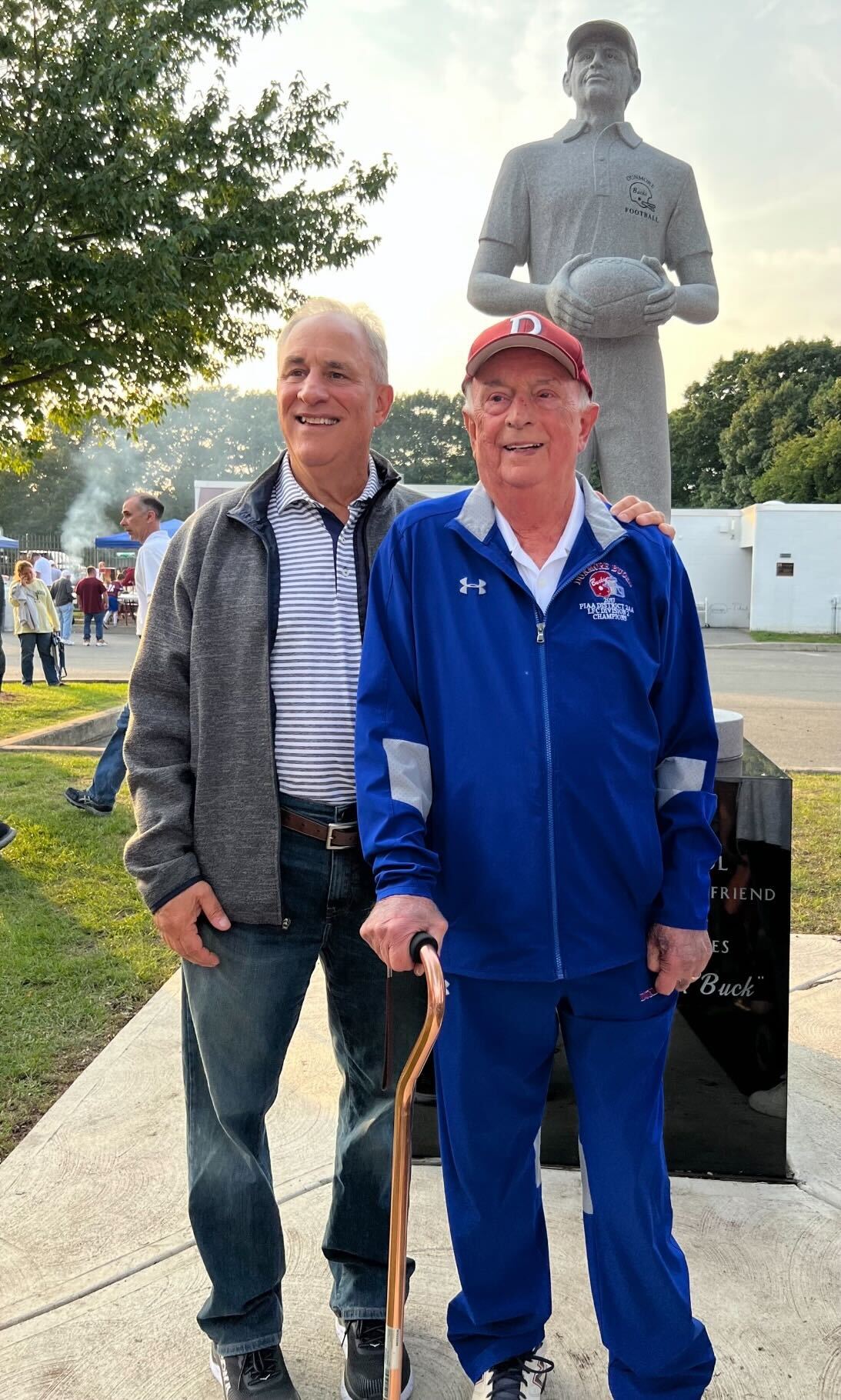
Vic Fangio honored his high school coach, Jack Henzes, by accompanying him to his statue unveiling.
Fangio continued to help his former coach until he retired from Dunmore in 2019. Aside from his role as Henzes’ unofficial defensive consultant, he also visited him in person, taking the coach to lunch at Ragnacci’s or talking to his high schoolers over the summer.
In turn, Henzes would use Fangio as a model for his players. If he saw someone acting out of line, he’d muse that they wouldn’t see “Victor’s guys” doing the same thing. The coach bought NFL Sunday Ticket so he could watch all of Fangio’s games. Any lessons he learned, he relayed back to his team.
In 2022, Dunmore High School built a statue dedicated to Henzes, the third-winningest high school football coach in state history. Fangio, who was working as a consultant for the Eagles at the time, showed up to surprise his mentor.
About a year later, in the summer of 2023, he made an impromptu stop at the Henzes household.
It was the last time Fangio would see his former coach. The mentor and the mentee sat together in the back room, talking about football and family. Henzes died two weeks later, at 87.
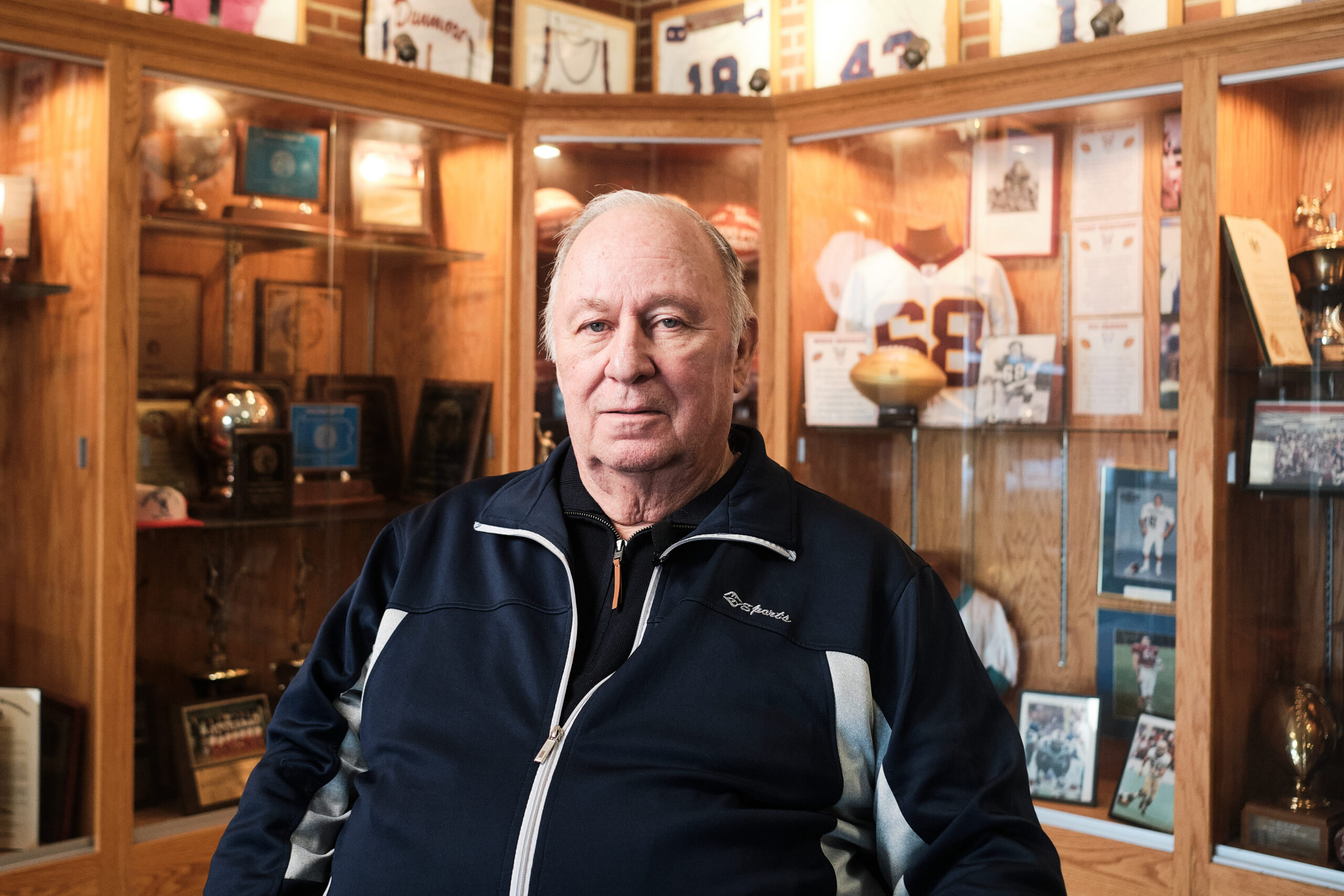
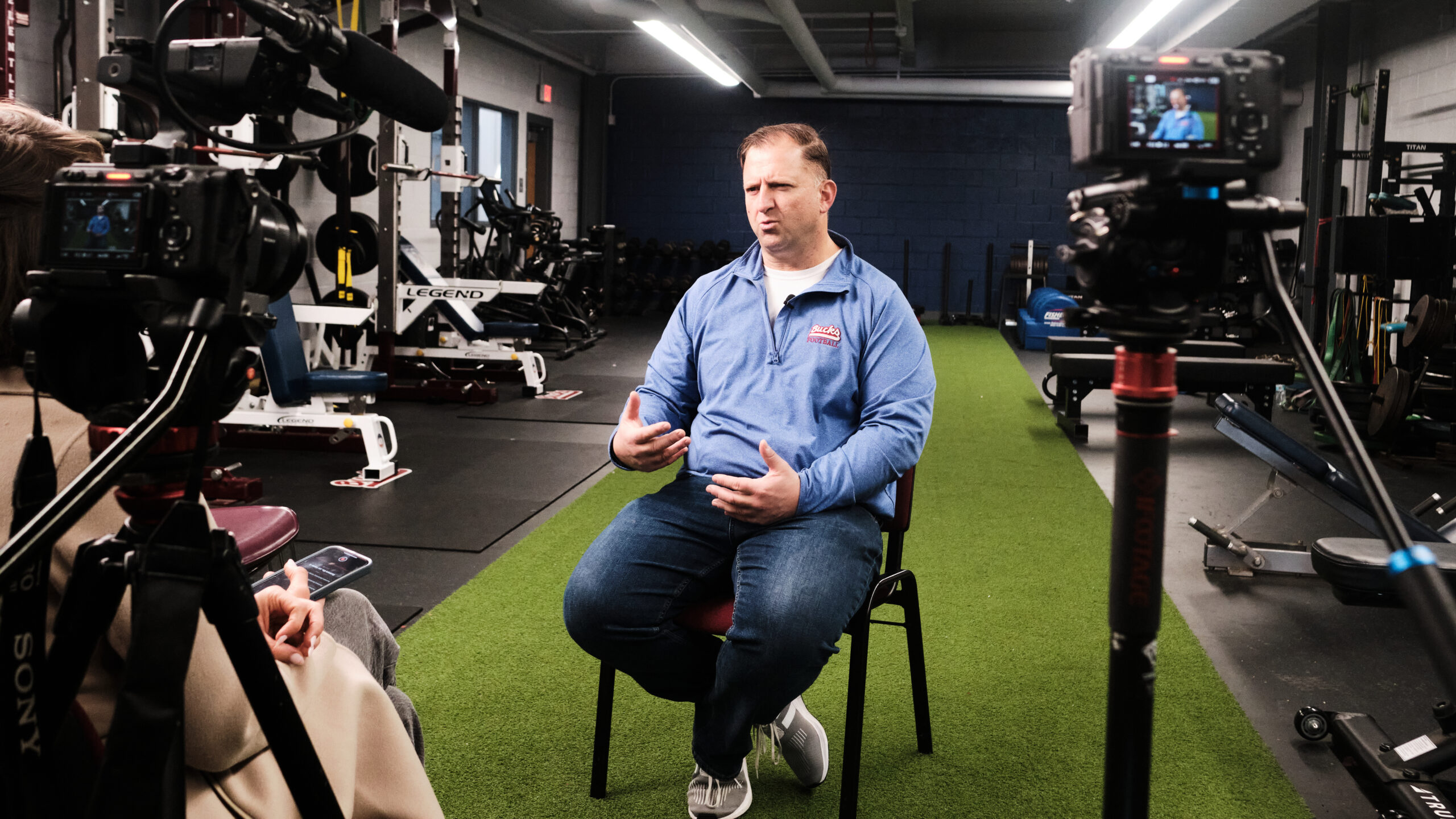
Dunmore High School’s current football coach, Kevin McHale, says Vic Fangio maintains firm ties to the high school where it all started for the esteemed NFL coordinator.
“V-I-C”
In the lead-up to Super Bowl LIX, Dunmore’s football team watched every Eagles playoff game and Fangio news conference from its weight room.
McHale, who was named the Bucks’ head coach in 2019, would break down Fangio’s defense after each matchup, pointing out how his players performed on the biggest stage.
The teenagers looked on in awe as a man who’d once walked the same halls they did put on a defensive master class. The Eagles’ Super Bowl victory filled Dunmore with pride. In a way, it felt like his hometown had won, too.
Fangio’s former players could see traces of their high school coach in Philadelphia’s defense. The personnel was more advanced, of course, but the foundation was the same: sound fundamentals, attention to detail, and unpredictable pressures.
Holmes observed how Zack Baun tackled and thought back to Fangio’s rules: head across the body, driving through the ballcarrier, proper angle of pursuit. It all seemed familiar.
“When we watch the Eagles now, we’re like, ‘Hey, we recognize that,’” he said.
A few weeks after the Super Bowl, Fangio returned to Dunmore. McHale had heard he’d be around, and reached out to the defensive coordinator to see if he would talk to his team.
Fangio agreed. On Feb. 28, he met the players in their locker room and stayed for an hour and a half, answering every question they had. Some were technical — asking Fangio how he developed the defense’s approach to Patrick Mahomes — and some were more trivial in nature.
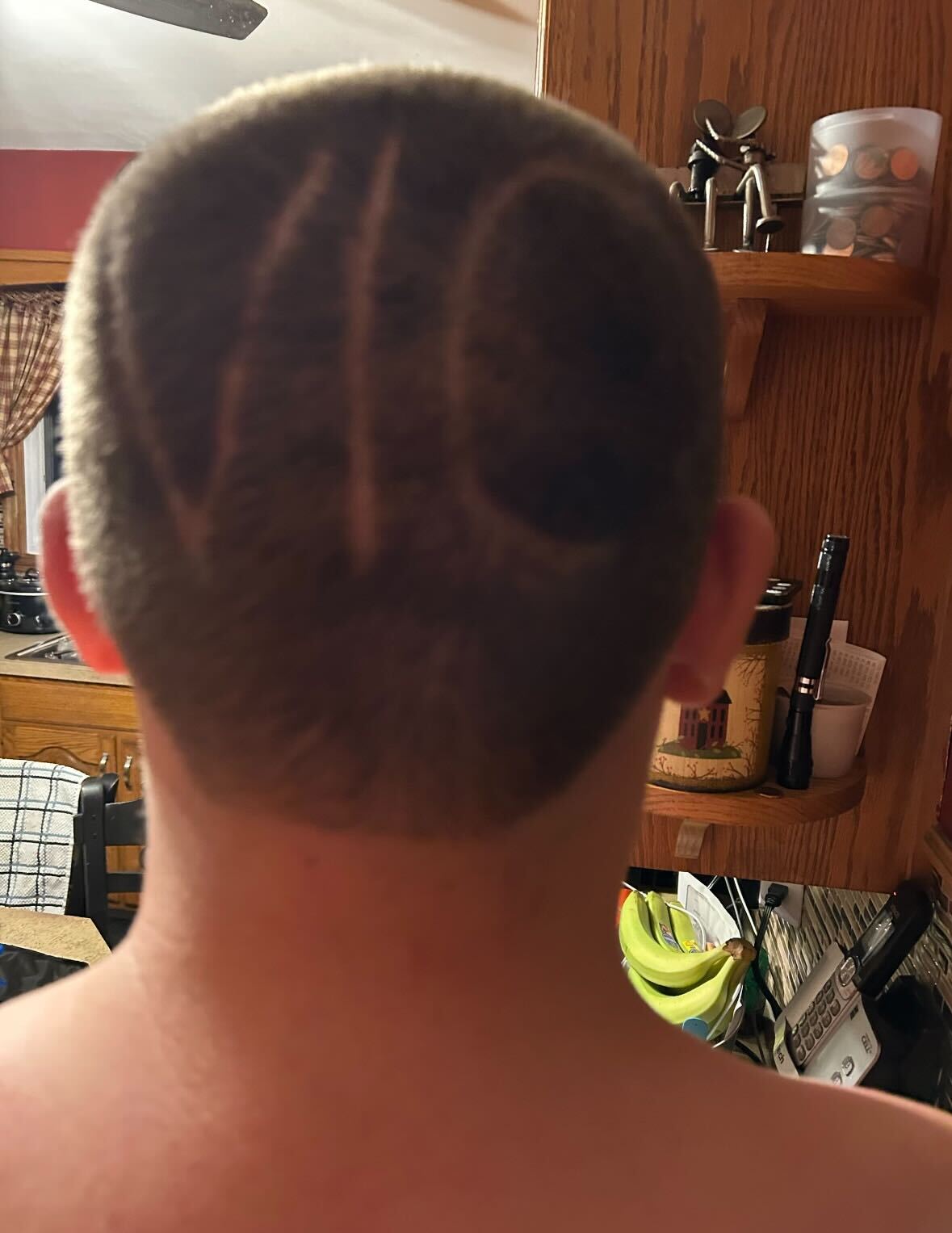
At one point, McHale paused the Q&A. He asked Fangio if he’d ever met anyone who had shaved his name into the back of his head.
Fangio said no.
“Well,” McHale said, “we’ve got a kid right here.”
He motioned to right tackle Drew Haun, who turned around to reveal a big “V-I-C” etched into his buzz cut.
This got a smile out of Fangio.
Dunmore right tackle Drew Haun honored his school’s most famous football alumnus before a Vic Fangio visit to campus.
“I think he liked it,” the freshman said.
McHale is not in contact with Fangio as much as Henzes was, but he consults him from time to time. And if the defensive coordinator doesn’t reply right away, his concepts arenever far.
All McHale has to do is go to his home office in Dunmore. There, on a bookshelf, is a manila folder full of faxes; a trove of wisdom from a coach who will always be known as “Victor” or “Hector.”
I don’t vote on the Associated Press version of NFL postseason awards, which are the NFL’s official awards. That voting is done by an eclectic panel of 50 semi-rotating media members — and I use the term “media members” extremely loosely, partly because last year the panel included Fox analyst Tom Brady, who also is an NFL owner.
Maybe this year, too. Voters can out themselves, as Mike Florio at ProFootball Talk.com did to himself and his colleague Chris Simms, but we won’t know who all of this year’s voters are until the AP publishes the list during Super Bowl week.
While I’m not an AP voter, I have written a weekly NFL column for years, and I have covered the NFL extensively for 35 years. Therefore, it’s not entirely inappropriate to offer my insight, if only to inform the judgment of any actual voters, who have to vote by 3 p.m. Monday.
Read fast, Tom.
MVP
Brady said Sunday that his choice was Rams quarterback Matthew Stafford over Patriots QB Drake Maye. This, after Stafford rebounded from a three-interception game against the gritty Falcons with a four-touchdown home game against the pathetic Cardinals. Part of Brady’s rationale: Stafford, 37 and MVP-less, won’t have as many chances as Maye, who is 23 and in his second season.
This is the dumbest reason ever. Football is violent, tomorrow is promised to no one, and the only criteria should be the 2025 season. Unfortunately, I don’t think Brady will be the only voter who considers this year’s competition a lifetime achievement award.
Maye secured the No. 2 seed in the AFC with the highest passer rating among regulars, at 113.5, and did so with a new coaching staff in just his second season. Still, Stafford led the league with 4,707 passing yards and 46 touchdowns passes, and secured the No. 5 seed against the NFL’s toughest schedule.
I actually agree with TB12.
Stafford it is.
But not because he’s old.
Mike Macdonald is 24-10 in two seasons as Seahawks coach.
Coach of the Year
This, by far, is the toughest call, because there are so many worthy Coach of the Year candidates, and some fresh faces.
Sean Payton and the Broncos have the No. 1 seed, but he’s done it for 24 years and he’s had three years to build in Denver, two of them with his current quarterback, Bo Nix. Should having experience and tenure count against him?
Mike Vrabel is in his seventh season but his first in New England, where the pressure as a Patriots legend was immense and where the Patriots were the last-place team in the AFC East. They won the division and got the No. 2 seed, but Vrabel inherited Maye, who already was a Pro Bowl quarterback. Should that count against him?
In his second season as a head coach, Mike Macdonald added Pro Bowl QB Sam Darnold to a solid, 10-win Seattle roster, won 14 games, and took the NFC West from the Rams and the 49ers. Irrelevant fact: He’s only ever really worked for Harbaughs — John with the Ravens and Jim at Michigan. Anyway, the Seahawks led the NFL in point differential, at plus-191, three touchdowns better than the No. 2 team.
Liam Coen, the first of the rookies, was an NFL offensive coordinator for only two years — one of them a stormy season as OC with the Rams — before a bizarre courtship tore him away from being OC at Tampa Bay. He succeeded Doug Pederson in Jacksonville, won 13 games against some really good teams, and finished on an eight-game heater … but he inherited a franchise QB in Trevor Lawrence.
Ben Johnson, the second of the rookies, flipped the Bears from worst-to-first in the NFC North and refined second-year QB Caleb Williams. He was my slam-dunk pick two weeks ago, but the Bears have faded. Seventh seed Green Bay certainly isn’t scared to travel to the No. 2 seed now; the Bears lost to the Packers earlier this season and they needed overtime to beat them three weeks ago.
Who’s my choice now?
It’s Macdonald, but only by a meticulously groomed hair.
Falcons running back Bijan Robinson led the NFL in yards from scrimmage with 2,298.
Offensive Player of the Year
Player of the Year usually is the category reserved for the best running back or receiver, since only quarterbacks have been allowed to win MVP since Adrian Peterson in 2012.
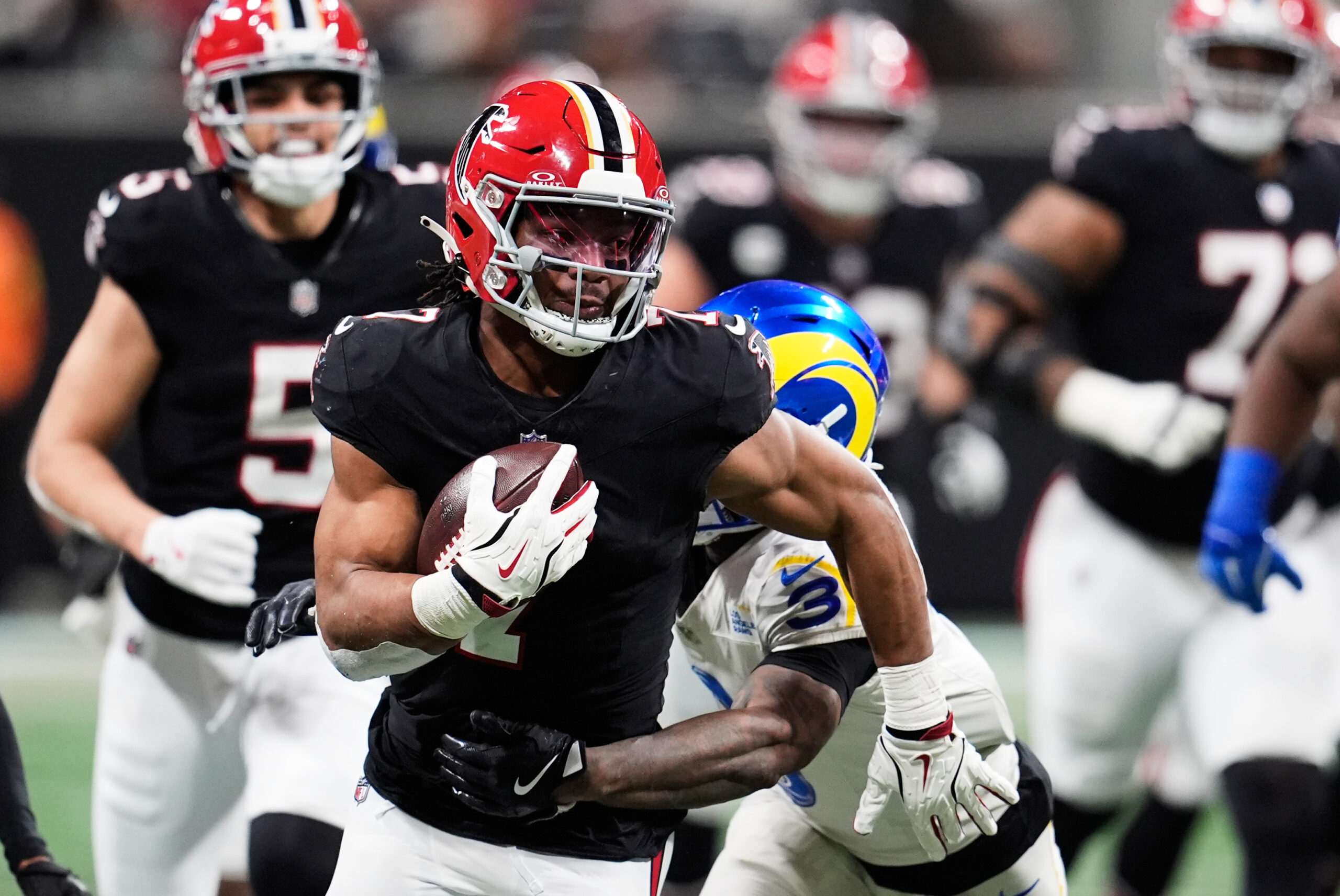
My favorite offensive player this year: Falcons back Bijan Robinson, who led the NFL in yards from scrimmage with 2,298, the best by 172 yards, on a team so bad it fired its head coach and GM on Sunday night.
Unlike Robinson, both Jaxon Smith-Njigba of Seattle and Puka Nacua of the Rams will be catching passes in the playoffs. But what Robinson did, and with such little support, reminds you of Christian McCaffrey with the 5-11 Panthers in 2019.
McCaffrey was second in yards from scrimmage this year.
Browns defensive end Myles Garrett celebrates on Sunday after breaking the NFL record for sacks in a season with 23.
Defensive Player of the Year
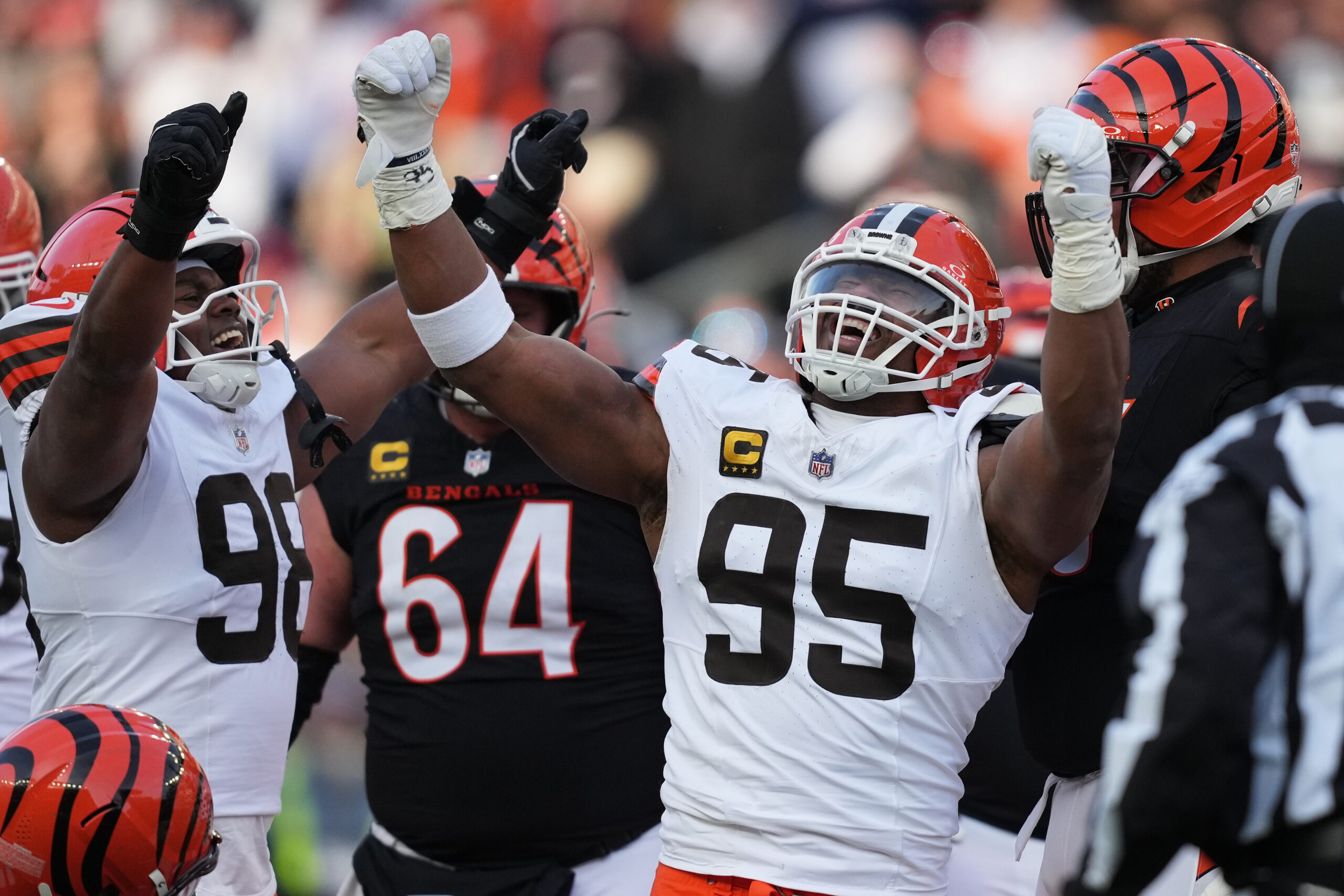
Browns lineman Myles Garrett sacked Bengals quarterback Joe Burrow in the fourth quarter Sunday to break the sack record of 22½ shared by Michael Strahan and T.J. Watt.
However, Garrett’s 23rd sack came in the 17th of his 17 games. Watt played in just 15 of 17 games in 2021, which is remarkable. Strahan played in just 16 games of the 2001 season, which is all they played back then, but Packers quarterback Brett Favre essentially surrendered to the last “sack,” in the last game.
I know there’s a few people out there that say Myles Garrett had an extra game which he did, but let’s not forget Brett Favre literally dropped like a corpse to give Michael Strahan the record! S/O Myles Garrett on setting the new sack record! pic.twitter.com/lEcqX1pMHl
Saints quarterback Tyler Shough had a worse passer-rating season than Jacoby Brissett.
Panthers receiver Tetairoa McMillan caught 70 passes for 1,014 yards, better than either A.J. Brown or DeVonta Smith, and seven touchdowns. No contest.
Linebacker Carson Schwesinger had 156 tackles in 16 games as a rookie for the Browns this season.
Defensive Rookie of the Year
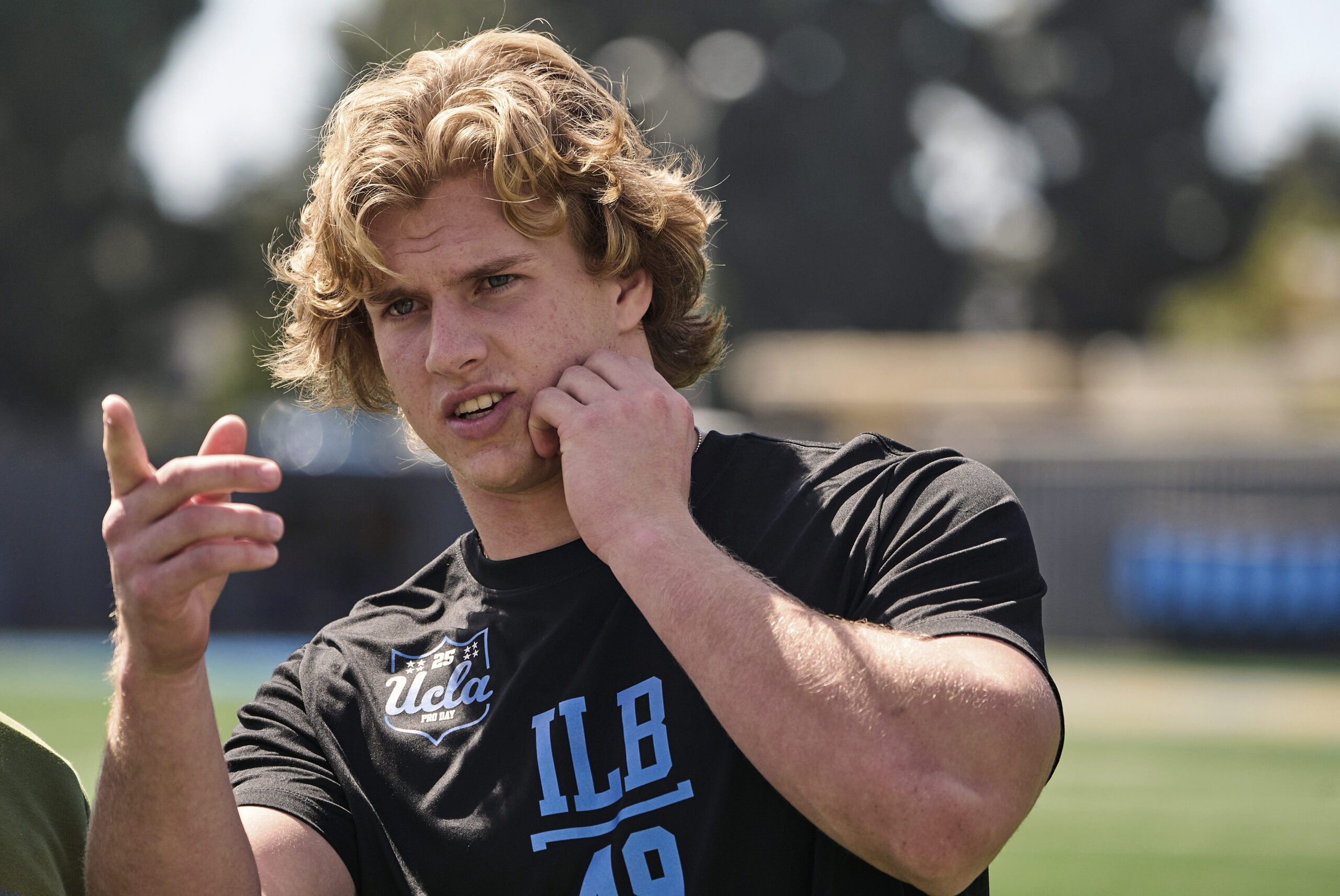
Carson Schwesinger, the Browns’ tackling machine, is really the only choice this season. He’s a second-round pick who looks exactly like what you’d think a linebacker from UCLA would look like.
Assistant Coach of the Year
In his first season of his second return to New England, offensive coordinator Josh McDaniels turned Maye into an MVP favorite in his second NFL season, running the top yardage and scoring offense in the AFC. McDaniels had as much to do with the Patriots’ turnaround as Vrabel.
Comeback Player of the Year
McCaffrey missed most of 2024 with a knee injury and might win OPOY this year. Sorry, Dak.
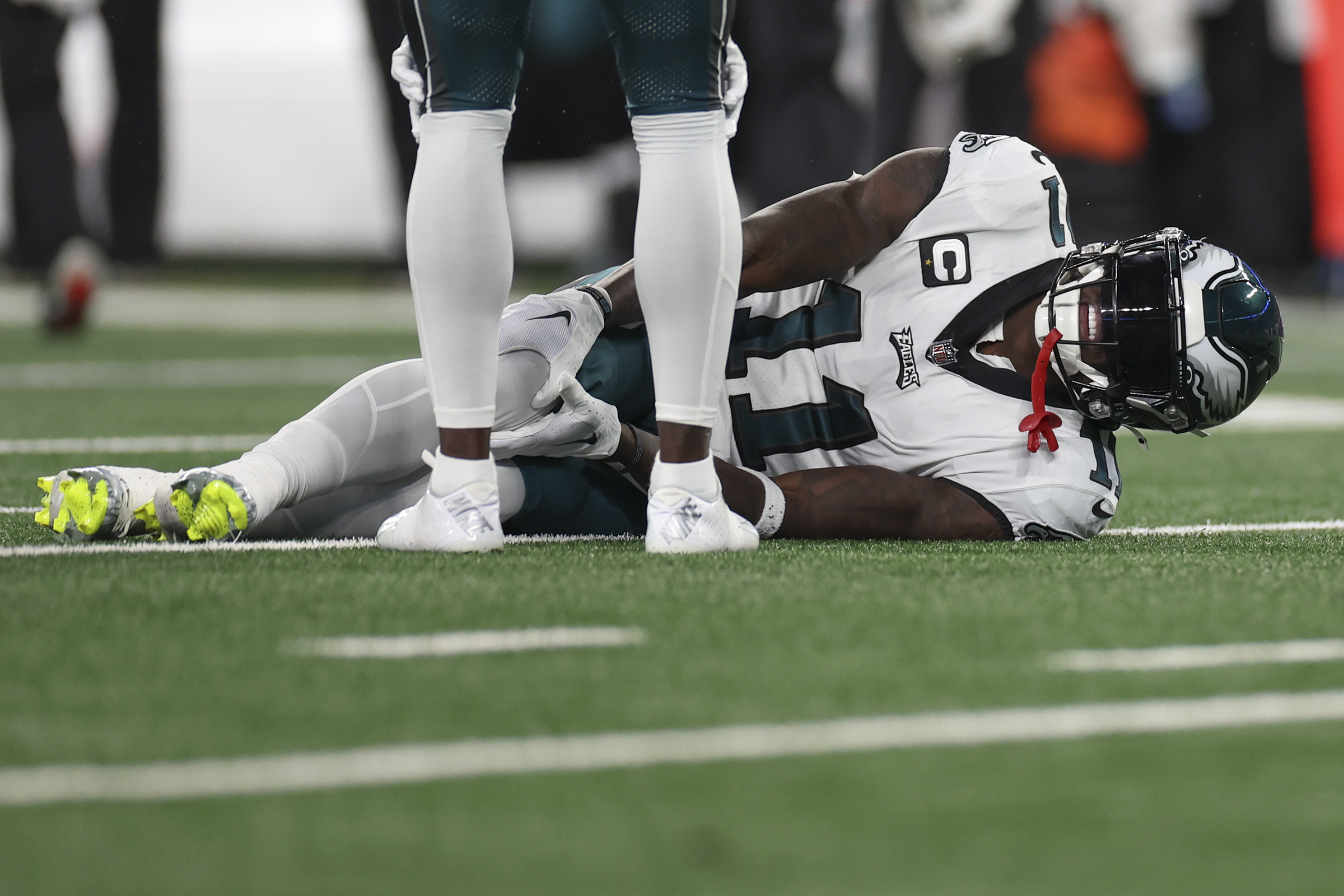
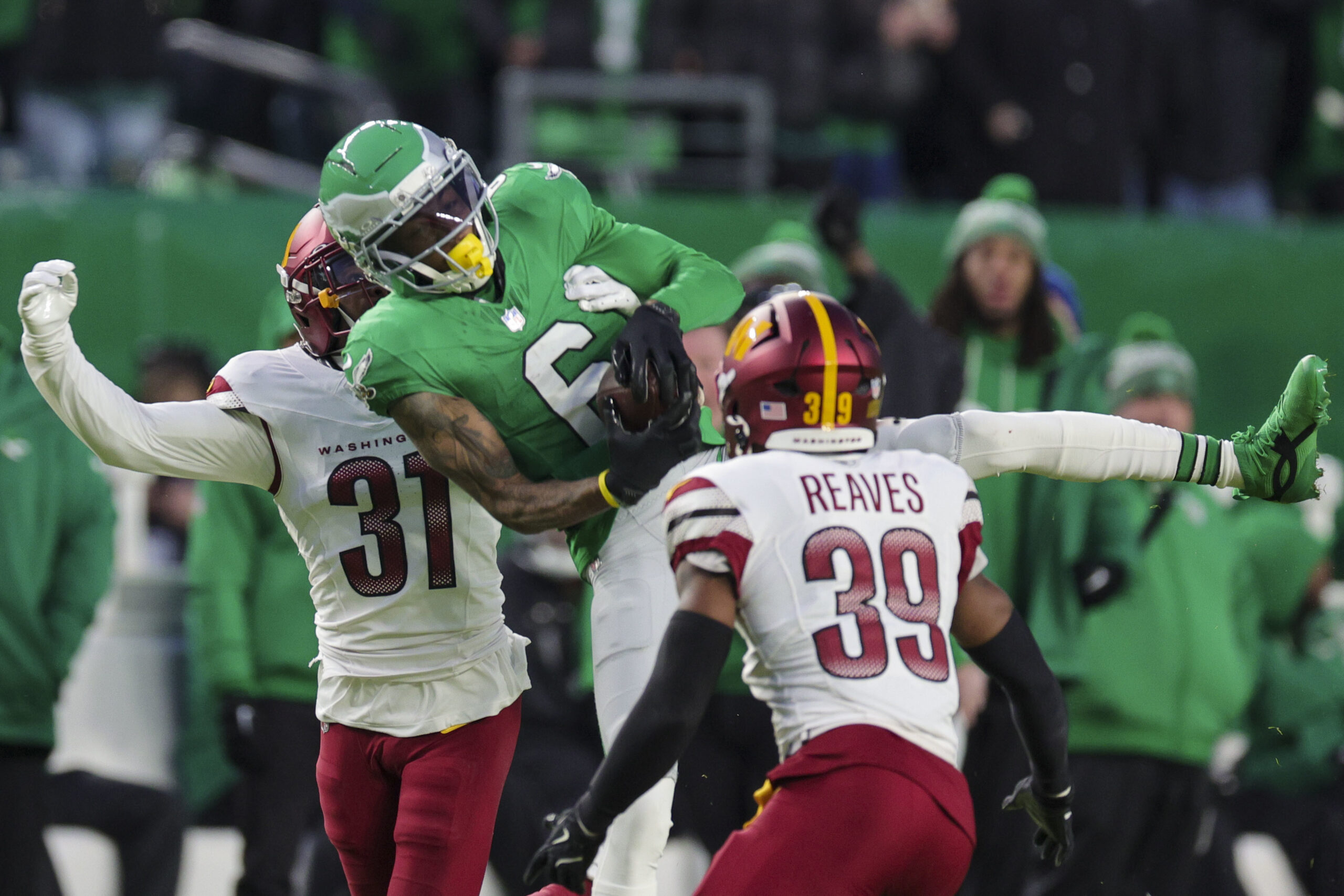
OK, let’s play this out. Let’s go back to the third quarter of the Eagles’ 24-17 loss Sunday to the Washington Commanders, to a first-down completion for 6 yards from backup quarterback Tanner McKee to Grant Calcaterra, the team’s second tight end — an innocent enough play. Let’s go back to Washington safety Jeremy Reaves grabbing Calcaterra from behind and dragging him down in an illegal (and yet unpenalized) hip-drop tackle. Let’s go back to Calcaterra limping off the field then into the locker room, his right knee and ankle injured so badly that he couldn’t return to the game.
Now, let’s pretend that coach Nick Sirianni had made a different decision ahead of Sunday’s results: the Eagles’ loss, the Chicago Bears’ loss to the Detroit Lions, the Eagles’ ending up with the No. 3 seed in the NFC playoffs when they could have had the No. 2 seed. Let’s pretend Sirianni had played all the team’s starters instead. Hell, let’s pretend that, because all their starters played, the Eagles beat the Commanders.
And let’s pretend that it wasn’t Calcaterra who suffered those injuries. Let’s pretend it was Dallas Goedert.
Would the victory have been worth it? Would it?
Let’s pretend some more. Let’s pretend that it wasn’t Brett Toth who started at left guard Sunday … and who suffered a concussion in the second half and, like Calcaterra, left the game. Let’s pretend it was the Eagles’ usual starting left guard. Let’s pretend it was Landon Dickerson.
Perhaps no Goedert. Perhaps no Dickerson. Perhaps another vital player who might have ended up unavailable, or at least damaged, for next Sunday’s wild-card game against the 49ers.
Would the victory and the No. 2 seed have been worth it then? Would it?
On the crucial question ahead of Sunday for the Eagles, the easiest position to take was, Play the starters. It required no calibration of whether a theoretically weaker opponent in the first round (the Green Bay Packers) and a potential extra home game in the divisional round was better for the Eagles than a week of rest for their top guys. It required none of the responsibility that Sirianni bore: to take the pulse of the locker room, to understand where his players stood on the matter, and act accordingly. It required nothing other than the simplest of calculations, one that could be drawn without any context. You play to get the higher seed. End of story.
But that context matters, and it includes some relevant recent history. It’s no coincidence that each of the two teams that have repeated as Super Bowl winners in the last quarter-century — Tom Brady and the 2003-04 New England Patriots, Patrick Mahomes and the 2022-23 Kansas City Chiefs — had an all-time great at quarterback. That measure of greatness at the most important position in sports is the closest thing that an NFL team can have to a shortcut to a Super Bowl. Remember: The Eagles played four playoff games last season in reaching and winning Super Bowl LIX, and a team attempting to win back-to-back championships needs every hour of rest and recovery it can get. It’s the price of success, sure, but an NFL season that’s 24% longer than a regular 17-game campaign — and an offseason that’s 24% shorter — does exact a toll.
“I don’t know whether people think about it, but it does, a hundred percent,” defensive tackle Moro Ojomo said. “You think about the Niners when they went to the Bowl in ’23 — they just completely dropped [the following season]. The Eagles went to the Bowl [in 2022]; after that year, they had a slump at the end of the season. It’s insanely hard, what the Chiefs have done and what we’re trying to get done. You play a lot of football, and you want to keep on going.
“You get this late in a season, and you get bruised up and banged up, and you don’t know how much it helps a guy who’s been dealing with a shoulder [injury] to have a week off. That goes a long way. Now that guy’s coming into the playoffs a little fresher. So if you’re a running back, maybe instead of going for 85 yards you go for 115. That’s the goal, to give yourself any advantage you can get.”
The Eagles cost themselves that advantage as recently as 2023, when Sirianni suited up his starters for the season finale in East Rutherford, N.J., just for the sake of trying to snap the team out of a terrible slump. What happened was the true worst-case scenario in such situations: A.J. Brown injured his knee and missed the following week’s wild-card game against Tampa Bay. Jalen Hurts dislocated his finger. And the Eagles lost to the Giants.
The Eagles decided not to rest starters in the 2023 season finale and lost A.J. Brown for the playoffs that year.
So Sirianni went the other way Sunday, effectively manufacturing a bye week for his best players. They had one in 2022-23, when they were the conference’s No. 1 seed, and they had one last year, when Sirianni played his backups against the Giants in Week 18.
“Every year is different,” Sirianni said. “Every year that you go through it, you’re judging this team. Of course you think back to that. My mindset was more all the good things that have happened as we’ve rested guys. I didn’t really think too much about the negatives of it.”
The positives outweighed them anyway. Do the Eagles have a harder road back to the Super Bowl now? Maybe, but not necessarily. They got some rest and eliminated any risk that they’d be shorthanded to a significant degree next Sunday. The defending champs let everything play out, and now they really get to take their chances, to show that being healthy and healed up is a bigger advantage than anything they might have gained from treating Sunday’s game like their season depended on it.
If there was an argument for Nick Sirianni playing his starters against the Commanders on Sunday, it was using the season finale as an opportunity to give the Eagles offense some momentum heading into the postseason.
The reasoning wasn’t exactly strong. But it had more validity than trying to jump up to the No. 2 seed (although starting Jalen Hurts & Co. could have satisfied both objectives).
Sirianni, of course, opted to sit his quarterback and most starters on both sides of the ball. The rest may benefit the Eagles against the 49ers in the wild-card round of the playoffs. As the coach said before and after a 24-17 loss to Washington, the one thing he could control was how he utilized his personnel.
It was a sound rationalization. Some will question the decision after a Bears loss to the Lions could have pitted the Eagles against the Packers and given them a potential home game at Lincoln Financial Field in the divisional round.
Either way, three games will stand between the team returning to the Super Bowl. And repeating as champion is unlikely if the offense continues to function as it has for most of the season. An inadequate Washington defense could have offered the chance to, at least, reverse a pitiful second half at the Bills last week.
“We treat every practice like we’re using that as momentum, and had a good week of practice with the guys and good individual work to sharpen our skills,” Sirianni said. “Again, this is what I felt was best for us, was to be rested and healthy going into the playoffs. Everything else was considered, obviously.”
It would be extreme to use the offense’s outing vs. the Commanders as a harbinger of how it will perform against San Francisco at the Linc. Two starters played briefly — wide receiver DeVonta Smith and right guard Tyler Steen — and several rotational skill position backups logged regulars’ snaps.
There was some positive from quarterback Tanner McKee, running back Tank Bigsby and various reserves who were given more playing time. There was ultimately more bad than good, but it was hard to come to conclusions about individual players considering the circumstances.
And the same could be said about coordinator Kevin Patullo. He had a decent opening half, and dialed up concepts that beat various schemes on occasion. The offense looked a little different with McKee and some new faces. The operation seemed to move at a quicker pace.
But Patullo was the one main cog in the offense who didn’t get the week off, and his game plan and play-calling felt like essentially more of the same. A better evaluation can’t be made until after a film review, but in the macro it felt like there wasn’t enough of Bigsby and the running game, and in the micro there were questionable decisions.
The Eagles have been among the best offenses in the red zone all season. It’s where Patullo has shined the most. McKee’s 15-yard touchdown pass to tight end Grant Calcaterra in the second quarter on a seam route was the perfect call against a quarters zone.
But when the Eagles advanced to the Washington 6-yard-line on their ensuing possession with balanced play-calling, Patullo had McKee throw out of the shotgun on third- and fourth-and-2. Maybe Sirianni didn’t inform his assistant that he was planning on gambling on fourth down, but a run on third down would have made more sense.
And having McKee with an empty backfield made it easier on the Commanders. Unlike with Hurts, a quarterback draw or scramble in that situation was improbable.
A series later, a Jalyx Hunt interception gave the Eagles the ball at Washington’s 22-yard-line. McKee hooked up with receiver Darius Cooper for a 17-yard toss over the middle, but the rookie spun the ball after his catch and was flagged for taunting.
The Eagles still had the ball at the 20-yard line, but after an incomplete pass and a Bigsby carry for no gain, McKee threw a bad interception.
“Like any game, he’s going to want some plays back, but I thought he did a lot of good things and we were able to move the ball,” Sirianni said of McKee. “Obviously, we didn’t finish a couple times in the red zone for different reasons.”
That didn’t count as a red zone possession. It’s hard to fault Patullo for Cooper and McKee’s mistakes on that drive.
The Eagles turned another fortuitous turnover into points in the third quarter. Patullo used a heavy dose of under-center runs to punch Bigsby into the end zone for a 14-10 lead. There was more shotgun on the next series that ended with a Jake Elliott 39-yard field goal.
But after Washington knotted the score at 17 in the fourth quarter, Patullo had McKee drop back to pass on all three downs before punting. It was the Eagles’ lone three-and-out of the game — an improvement upon their NFL-worst rate.
The inability to capitalize on Bigsby’s tough running and playmaking — his 31-yard catch was the Eagles’ longest of the game — was dubious, though. He didn’t get a single touch in the fourth quarter, partly because backup running back Will Shipley was on the field with the offense in pass mode.
But having McKee drop back on 15 straight plays on the final three possessions, behind a second-unit offensive line, wasn’t ideal. He completed just 5 of 14 passes for 40 yards and was sacked once on those drops. His lack of mobility was glaring whenever he was pressured.
Tanner McKee had some nice moments but his mobility was an issue, as was his supporting cast.
There were other differences between McKee and Hurts, with some of them suggestive of areas in which the latter struggles. The Eagles didn’t often snap the ball as late into the play clock as they do with Hurts at quarterback.
On the first seven possessions, McKee completed 16 of 25 passes for 201 yards. The ball often went where it should go based on the progression read vs. a certain coverage.
“I kind of have a philosophy that the defense is going to tell you where to throw the ball,” McKee said.
He wasn’t as good out of structure. McKee also missed some open receivers, the most egregious coming when he overshot Kylen Granson on fourth down late in the game. But he often had little time with rookie tackle Cameron Williams, for instance, having never previously played in an NFL game.
“When you don’t have your starting offensive line and you’ve got to have lots of different thumps on the D-ends and chip blocks, rather than get everybody out in the route scheme,” Eagles receiver Britain Covey said, “things like that make a huge difference.”
The Eagles ran more from under center (53%) than the shotgun (47%). But McKee didn’t throw off play action as much as expected. He dropped back from under center only five times and completed 2 of 3 passes for 37 yards. He was also sacked and scrambled for 2 yards on those plays.
DeVonta Smith’s brief cameo was helpful for the Eagles, but their reserves ultimately could not bridge the talent gap.
McKee lost his best option when Smith was pulled after eclipsing 1,000 yards receiving for the season. He hit the receiver on 3 of 4 targets for 52 yards. Sirianni said he limited Smith’s routes to protect him, but the Eagles clearly drew up passes in which he was a primary read.
“You have things drawn up for certain guys and certain things,” Smith said, “but, ultimately, it’s based on what the coverage is.”
It stands to reason why Patullo, Hurts and the offense can’t have more planned success with their designs. The sample was small and the Commanders, of course, didn’t offer the best resistance. But that might have been enough justification for playing the starters.
Sirianni tried something similar two years ago at the Giants and it blew up in his face. The Eagles had more at stake with the NFC East still on the line, but the offense was stagnant against another subpar defense and Hurts and receiver A.J. Brown also got hurt.
The Eagles have a much better defense than they did in 2024. Parity is the best way to describe the NFC playoff picture. Each team is flawed. The Eagles’ Achilles’ heel is their offense. Resting the starters — and probably playing them, as well — was unlikely to cure that condition.
“We’ll be all right,” Smith said. “We know what we’ve got to do. We know what’s at stake. It’s win or go home. It’s no time for the mistakes, ‘We’ll get it next time.’ You’ve got to get it this time.”
But will the Eagles offense finally get it together when it counts?
You can rationalize it all you want. No, really, you can. There are lots of reasons to believe the Eagles won’t live to regret the decisions they made in Week 18.
To shrug their shoulders at the No. 2 seed.
To go against everything that Nick Sirianni and his coaches have preached throughout their tenure with the Eagles: that the most important Sunday is the current one.
To do what no other team chose to do this weekend and rest their starters when a potential home playoff game was on the line.
Sure, there are reasons. If the Eagles can’t beat an injury-depleted 49ers team at home like the Seahawks did on Saturday and then beat an inexperienced Bears team on the road like the Lions did on Sunday, then they don’t deserve to be in the Super Bowl. Even with the No. 2 seed, they would have lost somewhere along the line … probably not to the Packers or Bears at Lincoln Financial Field, but certainly to the Seahawks in Seattle or the Rams at home.
Right?
The more you talk it out, the sillier it sounds, which is why all the rationalizations in the world can’t change the cold, hard truth. If the Eagles would have beaten the Commanders on Sunday, their odds of repeating as Super Bowl champions would have been better than they are now. Now, after an ugly 24-17 loss to Washington that should quell all that talk of Tanner McKee being traded for premium draft capital, the Eagles will enter the postseason as the third-seeded team in the NFC. They will play the depleted but pedigreed 49ers instead of the depleted and not pedigreed Packers. Then, they will likely either travel to Chicago or host the dangerous Rams, instead of hosting the Bears.
Could everything break in their favor? Sure. If the Packers upset the Bears next weekend, and if the Panthers upset the Rams next weekend, the Eagles would essentially be where they would have been as the No. 2 seed. In that case, the top-seeded Seahawks would host the seventh-seeded Packers and the Eagles would host the Panthers for the right to advance to the NFC championship. But, then, if the Packers upset the Bears and the Rams beat the Panthers, the Eagles would be hosting the Rams in a rematch of their Week 3 game, which saw the Rams jump out to a 26-7 lead and eventually lose on a blocked field goal.
Essentially, the result of the Eagles’ loss to the Commanders on Sunday was to bring into play the possibility of a second-round matchup with the Rams, in addition to the possibility of traveling to frigid Soldier Field rather than hosting the Bears.
If chalk prevails elsewhere — the Rams opened as 10.5-point favorites against the Panthers, the Bears as 1.5-point favorites against the Packers — the Eagles have a manageable road to the NFC championship. There’s a decent chance they’ll be the betting favorite in any situation other than a road game in Seattle or a home game against the Rams. And they might also be favored against the Rams. The difference now is that, barring upsets, there is no easy road. They are a better team than the Bears on a neutral field, their Black Friday loss notwithstanding. But their offensive struggles have been exacerbated in suboptimal conditions — at Buffalo, at Green Bay, home against the Lions. The conditions at Soldier Field in January are rarely optimal. The Eagles will be better than they were, assuming they have a healthy Jalen Carter and a healthier Lane Johnson. But playing on the road creates far more uncertainty.
The expected return of tackle Lane Johnson gives the Eagles plenty of optimism for a repeat.
As for the 49ers, well, they figure to be a tougher test than the Packers. Kyle Shanahan is one of the brightest offensive minds in recent NFL history. He, Brock Purdy and the rest of the 49ers will derive plenty of motivation from the memory of their quarterbackless playoff loss to the Eagles three years ago. That being said, this 49ers team is far different from the one that destroyed the Eagles — and catapulted Dom DiSandro to celebrity status — at Lincoln Financial Field late in 2023 en route to its own Super Bowl. The defense is in shambles, absent longtime stalwarts Fred Warner at linebacker and Nick Bosa on the edge. The Niners have little pass-catching talent outside of tight end George Kittle and running back Christian McCaffrey. As long as the Eagles can stop the run, they should be fine.
At the end of the day, the Eagles are still a team that everybody must take seriously. Even as the No. 2 seed, they would have likely needed to beat Seattle on the road or the Rams at home in order to advance to the Super Bowl. They still have the third-best odds at winning the NFC, according to the online sportsbooks.
You just have to wonder. If Sirianni knew that the Lions would beat the Bears on Sunday, and that his Eagles only needed to beat the Commanders to secure the No. 2 seed, would he have done anything differently?
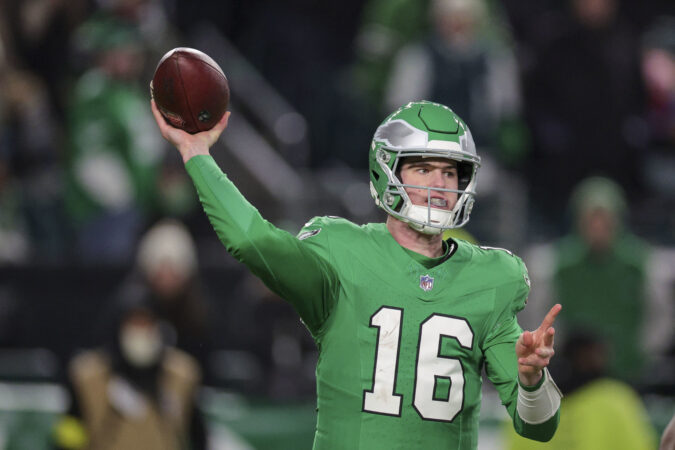
There is a faction among Eagles fans and NFL cognoscenti that hoped Tanner McKee would on Sunday provide a quarterback controversy on which they could feed during the cold winter months. They hoped McKee, a sixth-round pick in 2023, might sufficiently shine in a meaningless game against a moribund team so that he might be considered a viable threat to Jalen Hurts, a two-time Pro Bowl player and the reigning Super Bowl MVP.
That didn’t happen.
That was never going to happen.
McKee could have thrown for 350 yards with five touchdown passes and he still wouldn’t sniff the starting job in Philadelphia until Hurts gives it away.
Hurts might throw three interceptions and he might fumble twice next weekend in the playoff opener against the 49ers and the starting job will still be his, both in September and in January.
McKee started his second NFL game Sunday. It was an insignificant game against an insignificant team playing its least significant players.
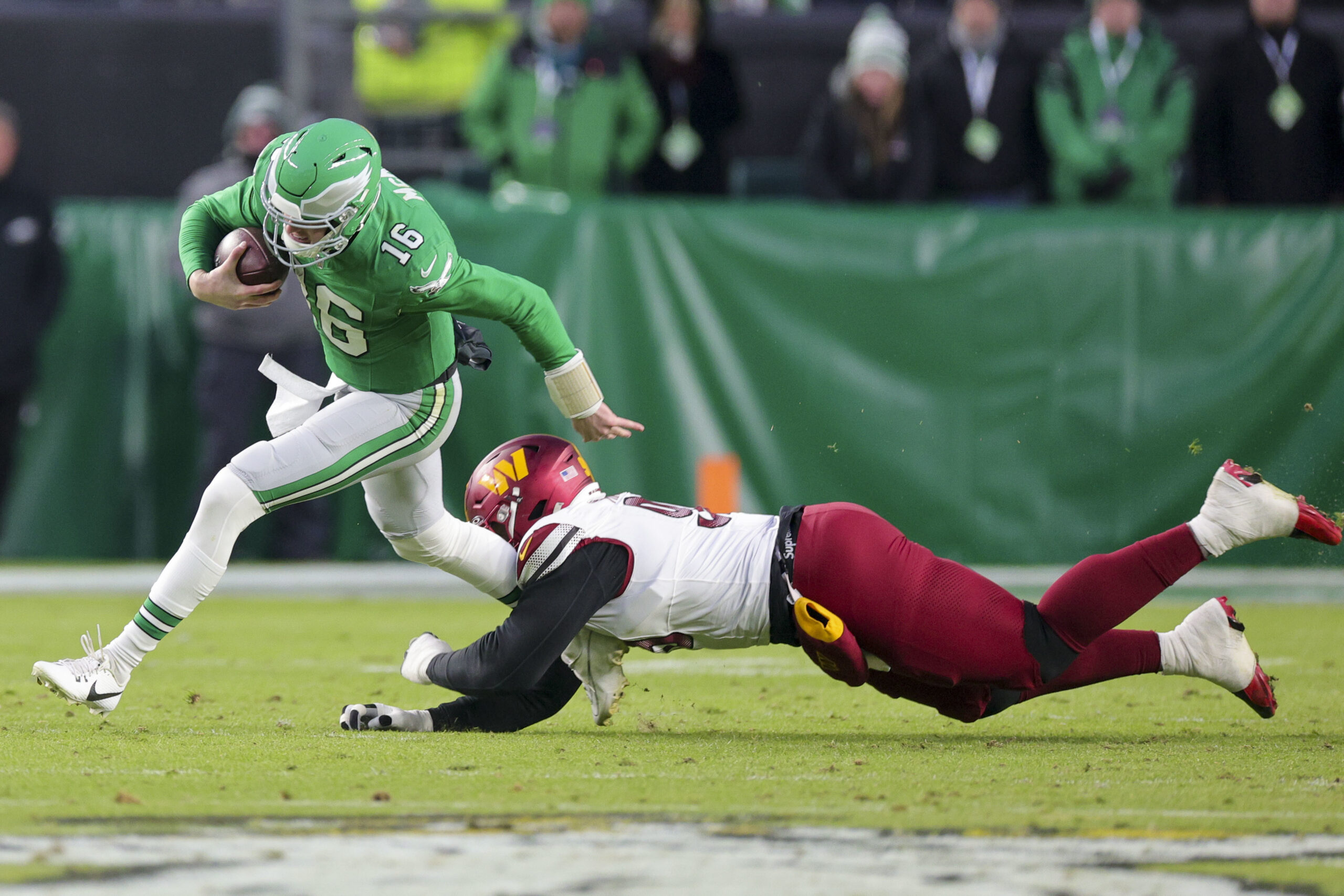
Tanner McKee is tackled by the Commanders’ Daron Payne and Jordan Magee.
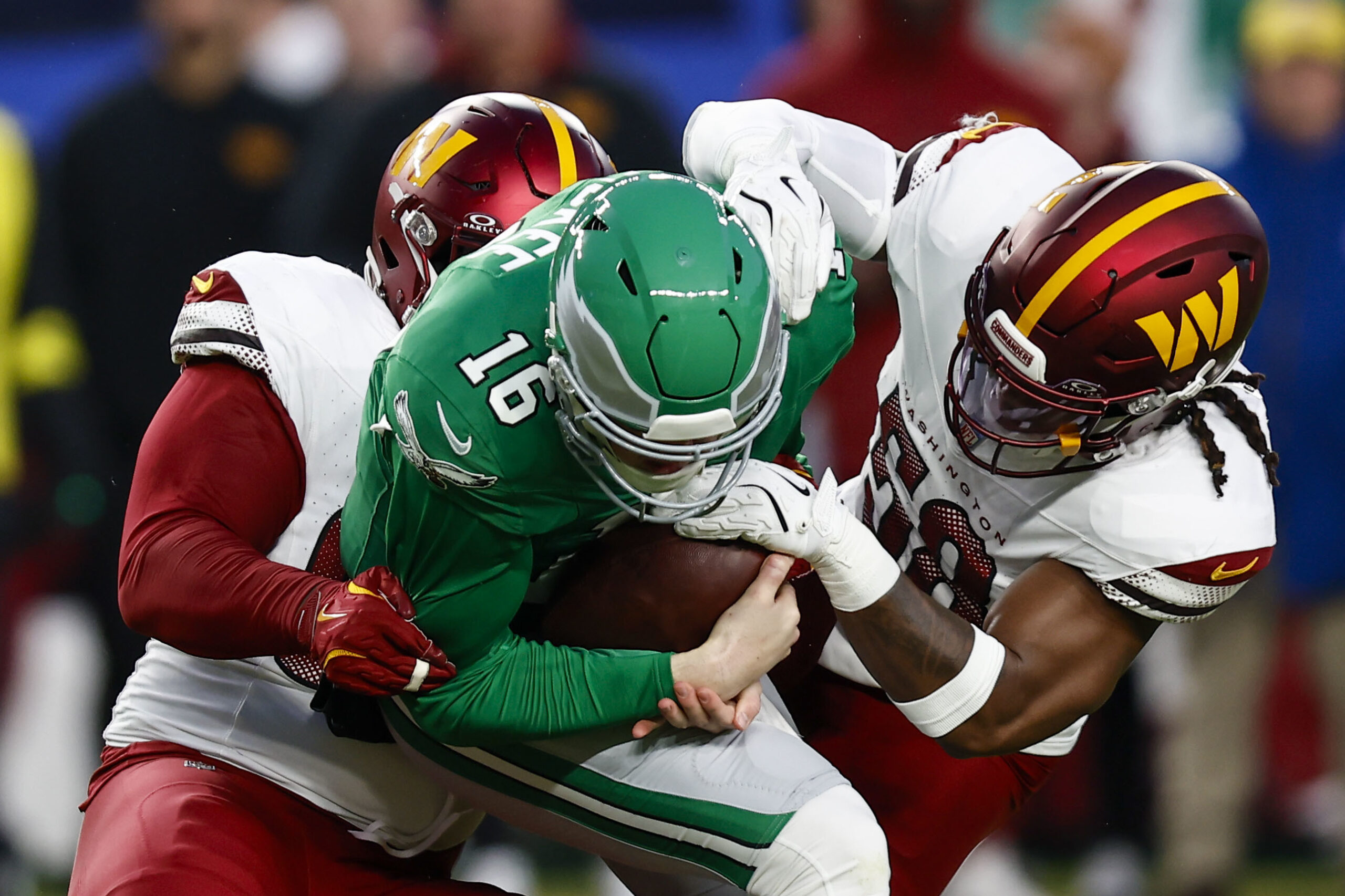
In this context, McKee looked fine: 21-for-40, one touchdown, one interception, against the five-win Commanders, who won, 24-17. He threw crisp passes, usually on time. He recognized defenses. He moved well in the pocket. He ran a couple of times.
“I thought he did a lot of good things,” coach Nick Sirianni said.
He also threw two uncatchable passes late in the fourth quarter that ended the Eagles’ chances to win, in the very moments when the Bears were in the process of losing to the Lions. An Eagles win and a Bears loss would have given the Eagles the No. 2 seed instead of No. 3, which would have guaranteed at least two home games in the playoffs.
Notably, McKee did this without the services of the team’s top running back, four of its top offensive linemen, its top tight end, one of its top two receivers, and, after two series, both of its top receivers: DeVonta Smith played until he hit the 1,000-yard mark, then left.
McKee looked a lot like he looked in a similar context: Game 17 of the 2024 season, when he beat the three-win Giants: 269 yards, two touchdowns, no turnovers.
He didn’t face the best of the Commanders. They didn’t blitz much. They didn’t play particularly hard. And, of course, they stink.
Still, McKee looked good enough to win a game or two, maybe even in the playoffs. This, for the Eagles, is excellent news: They have a competent backup quarterback on whom they have expended almost no draft or salary-cap capital.
McKee makes just over $1 million, and he seems capable. Benched Giants has-been Russell Wilson will take home $10.5 million this season. The Jets’ Tyrod Taylor and the Broncos’ Jarrett Stidham each have two-year, $12 million contracts. Marcus Mariota, the Commanders’ understudy, made $8 million. The Panthers’ Andy Dalton and Jameis Winston, one of the QBs who replaced Wilson, each made $4 million.
The Eagles’ biggest question entering the 2025 season didn’t involve the third cornerback, or defensive line depth, or the departure of mediocre right guard Mekhi Becton. The biggest question was:
If Hurts got injured, as he has done each of the first five seasons of his career, and with no veteran backup on the roster, would McKee be good enough to replace him? After all, Eagles owner Jeffrey Lurie subscribes to the notion that, if the most important player is the quarterback, then the second-most important player is the backup. That’s why he and Howie Roseman signed Nick Foles in 2017, and it’s why they drafted Hurts in 2020.
Tanner McKee is tripped up by Washington Commanders defensive tackle Javon Kinlaw in the first quarter at Lincoln Financial Field.
Sunday’s performance delivered another indication that, yes, if Hurts gets hurt, McKee can do the job.
Until then, it’s Hurts’ job. He’s been too good, or at least good enough, too often for too long.
Further, cutting or moving Hurts before the end of the 2027 season would incur more than $20 million in dead money. McKee is under contract through 2026 for just over $1 million.
Hurts has had his haters since he hit Philly. Every time he slumps, and every time he misses a receiver over the middle, the haters surface, louder than ever. It doesn’t matter if it’s Gardner Minshew, Kenny Pickett, or McKee: Their preferred choice is Anybody But Jalen.
When Hurts struggled from Games 10-13, beginning in mid-November, multiple reports asserted that several people in the Eagles organization were wondering if benching Hurts in favor of McKee might be necessary to mount a viable Super Bowl defense. Hurts’ passer rating in that span was just 68.7. The Eagles averaged 17.8 points in those games and went 1-3. He turned the ball over seven times in those four games, including five times in a road loss to the Chargers, the worst game of his career and the last of that span.
Nevertheless, Sirianni declared that any consideration of benching Hurts was “ridiculous” — a declaration that was, itself, ridiculous, considering how badly Hurts was playing.
In the end, it didn’t matter. As his job security was being debated, Hurts responded with the best game of his career, a 31-0 win over the visiting, hapless Raiders. He further secured his place with solid wins in Washington and Buffalo.
The Chargers game was an aberration. Hurts has nearly mastered the art of not losing games. He’ll even win you one every now and then.
For a team that possesses an elite defense, powerful weapons, and a sturdy offensive line, that’s all that matters.
No matter what happens in the next few weeks, there will be no legitimate calls for McKee to start any meaningful games.
These aren’t the Niners of old. They aren’t even the Niners of two years ago.
That’s good news for the Eagles, who moved one step closer to facing San Francisco in the opening round of the playoffs after the 49ers fell to the Seahawks, 13-3, on Saturday night. Seattle’s victory in the first batch of Week 18 games brought the NFC playoff picture into clearer focus. The Seahawks have clinched the No. 1 overall seed, thus earning themselves an opening round bye and a home game in the divisional round against the lowest-seeded team to survive. That team will not be the Eagles, who cannot face Seattle until the NFC championship game.
This was the outcome Birds fans should have been rooting for on Saturday night. Had the 49ers won, the Eagles would be standing on the precipice of an opening-round matchup against the Seahawks or the Rams, the two most impressive teams in the NFC during the regular season. The only other scenario would have required them to beat the Commanders and the Bears to lose to the Lions, thereby giving the Eagles the No. 2 seed and an opening round matchup against the seventh-seeded Packers. (That scenario remains on the table entering play on Sunday.)
The Eagles could still face the Rams, who outplayed them in the regular season before the Eagles pulled out a 33-26 win on Jordan Davis’ blocked field-goal return for a touchdown at the buzzer. In order to avoid them, they need the Rams to beat the Cardinals today, thereby clinching the No. 5 seed and knocking San Francisco down to No. 6. A Rams loss to the Cardinals would mean an Eagles-Rams rematch at Lincoln Financial Field next weekend. Keep in mind, the Cardinals have lost eight straight games and 13 of 14 since a 2-0 start.
To recap the three scenarios in play:
Scenario 1: If the Eagles win and Bears lose, the Eagles get the No. 2 seed and an opening-round game against the Packers.
If the Eagles lose OR the Bears win, then the Eagles get the No. 3 seed and …
Scenario 2: If the Rams beat the Cardinals, the Eagles face the 49ers.
Scenario 3: If the Cardinals beat the Rams, the Eagles face the Rams.
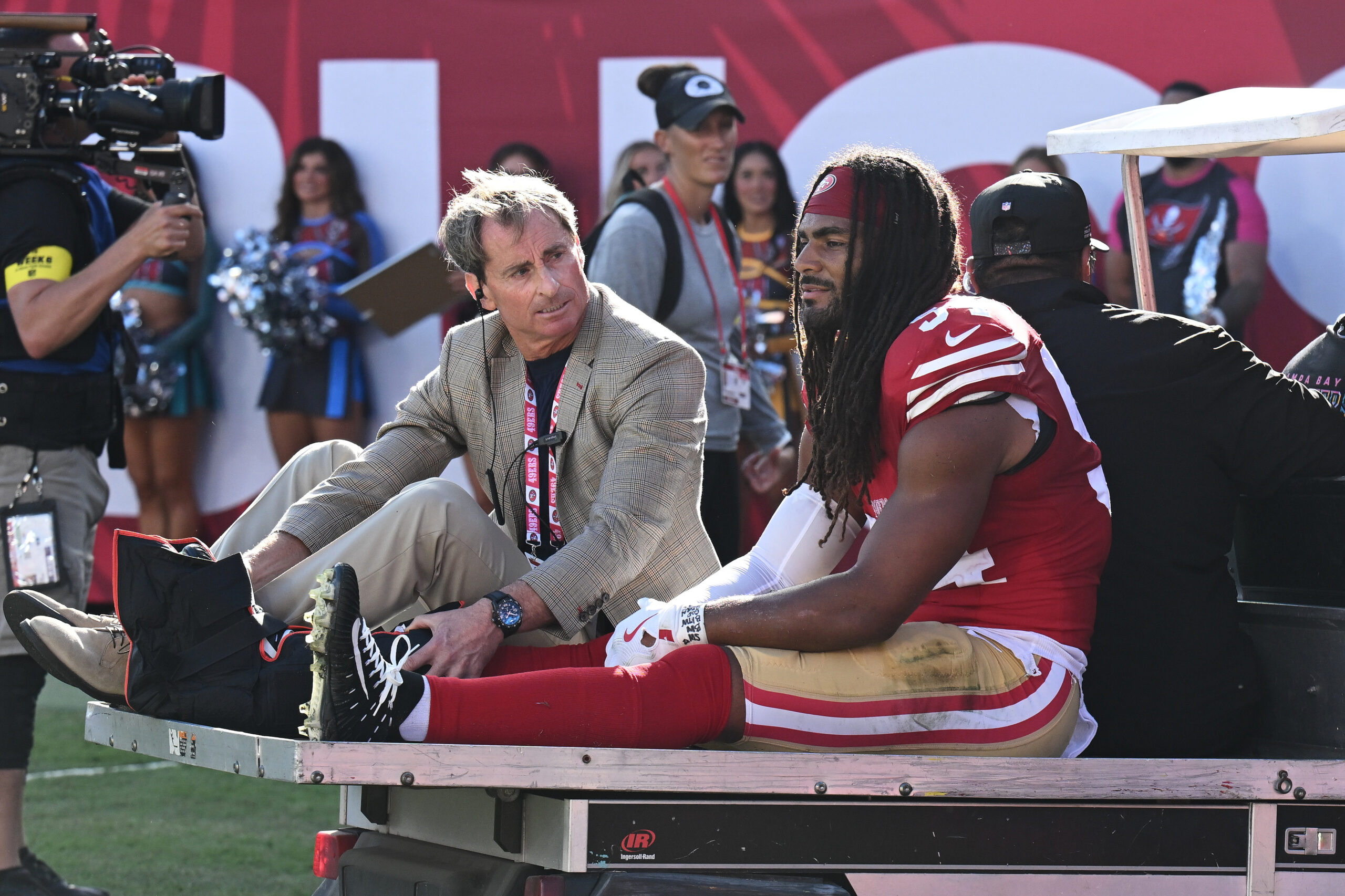
The 49ers are the clear preference over the Rams. San Francisco has been ravaged by injuries on the defensive side of the ball, with all-world linebacker Fred Warner and defensive end Nick Bosa both lost for the season. The Niners suffered two more injuries Saturday night, in fact, with linebackers Dee Winters and Tatum Bethune both leaving and not returning.
Middle linebacker Fred Warner is among the key 49ers who are injured with the playoffs set to begin.
The 49ers are still dangerous. They showed that with their 42-38 shootout win over the Bears in Week 17. But they also showed Saturday night that they can struggle against a top-tier defense. San Francisco gained just 173 yards and posted nine first downs against the Seahawks. A big variable is All-Pro tackle Trent Williams, who missed Saturday’s game with a hamstring injury after being questionable to play.
The 49ers were no match for the Seahawks’ power running game, allowing 180 yards on the ground. It was the sixth time this season they allowed an opponent to gain at least 360 yards of total offense.
The Eagles certainly wouldn’t be looking past a playoff game against the 49ers. But it was and is the best of the likeliest options.