As Philadelphia’s largest visual arts institution heads into the new year, it does so shaken by disorder and strife — reeling under a drama as extraordinary in substance as the public nature with which it is playing out.
In a recent court filing from Suda’s legal team, the ousted director was described as a “visionary leader” recruited to “save a struggling museum.” Her efforts, the filing reads, “collided with a small, corrupt Board faction determined to preserve the status quo.”
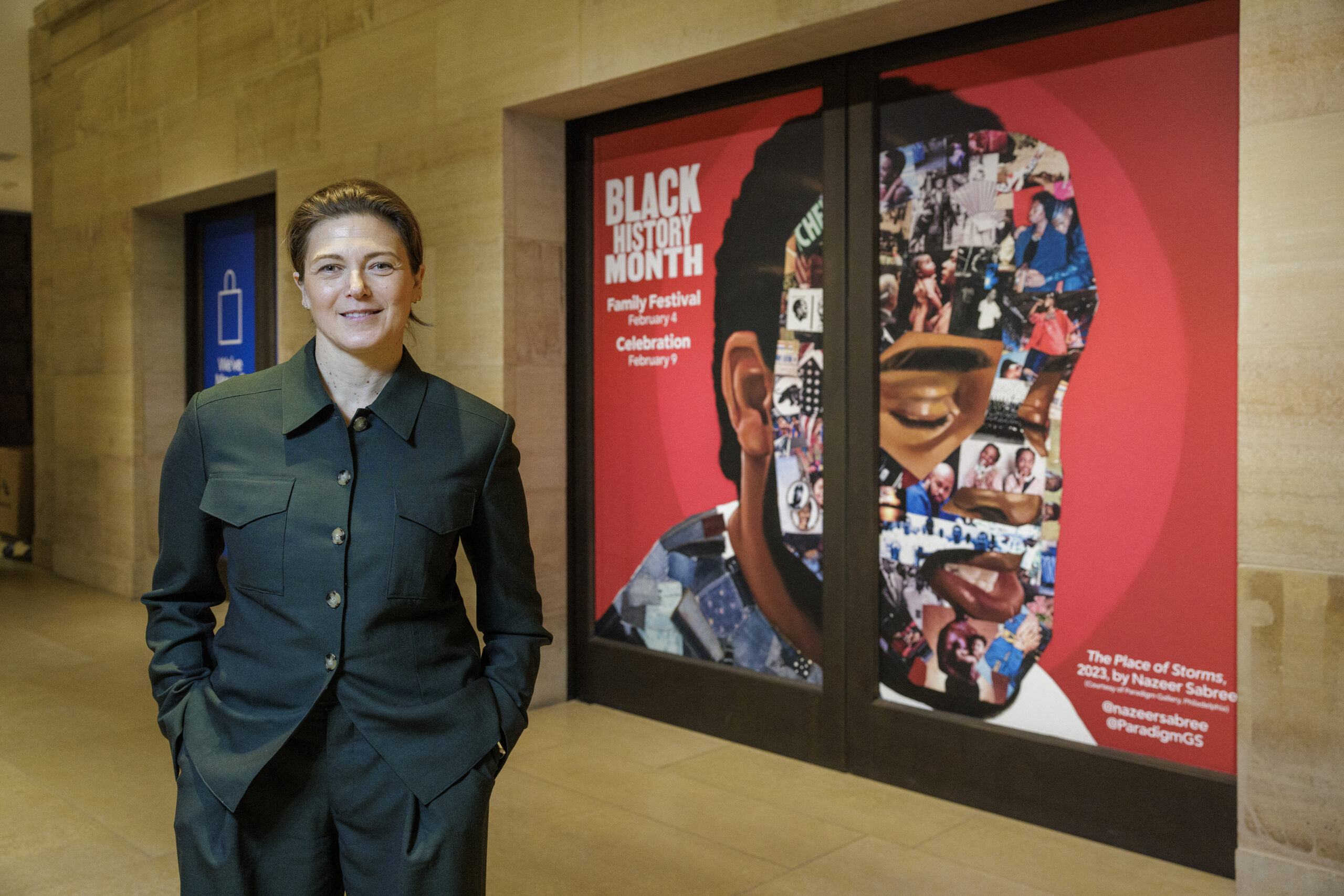
Daniel H. Weiss, director and CEO of the Philadelphia Art Museum
All this comes after three years of organizational turbulence that has left staff angry and bewildered.
“There’s a lot of nervousness about what’s to come now,” said one longtime staffer. “It’s been so chaotic for so long. Nobody feels steady. We’re supposed to be just chugging along like business as usual, but nothing feels stable.”
Though Weiss started at the museum this month, he will also maintain his position as an art history professor at Johns Hopkins University though May 2026.
Among the challenges facing Weiss: depressed attendance, an operating deficit, low staff morale, deferred maintenance on existing buildings, and questions about how to prioritize stalled expansion plans.
This account is based on interviews with former and current staffers, both union and nonunion, ranging from curatorial affairs to finance and operations. All of them spoke on condition they not be named.
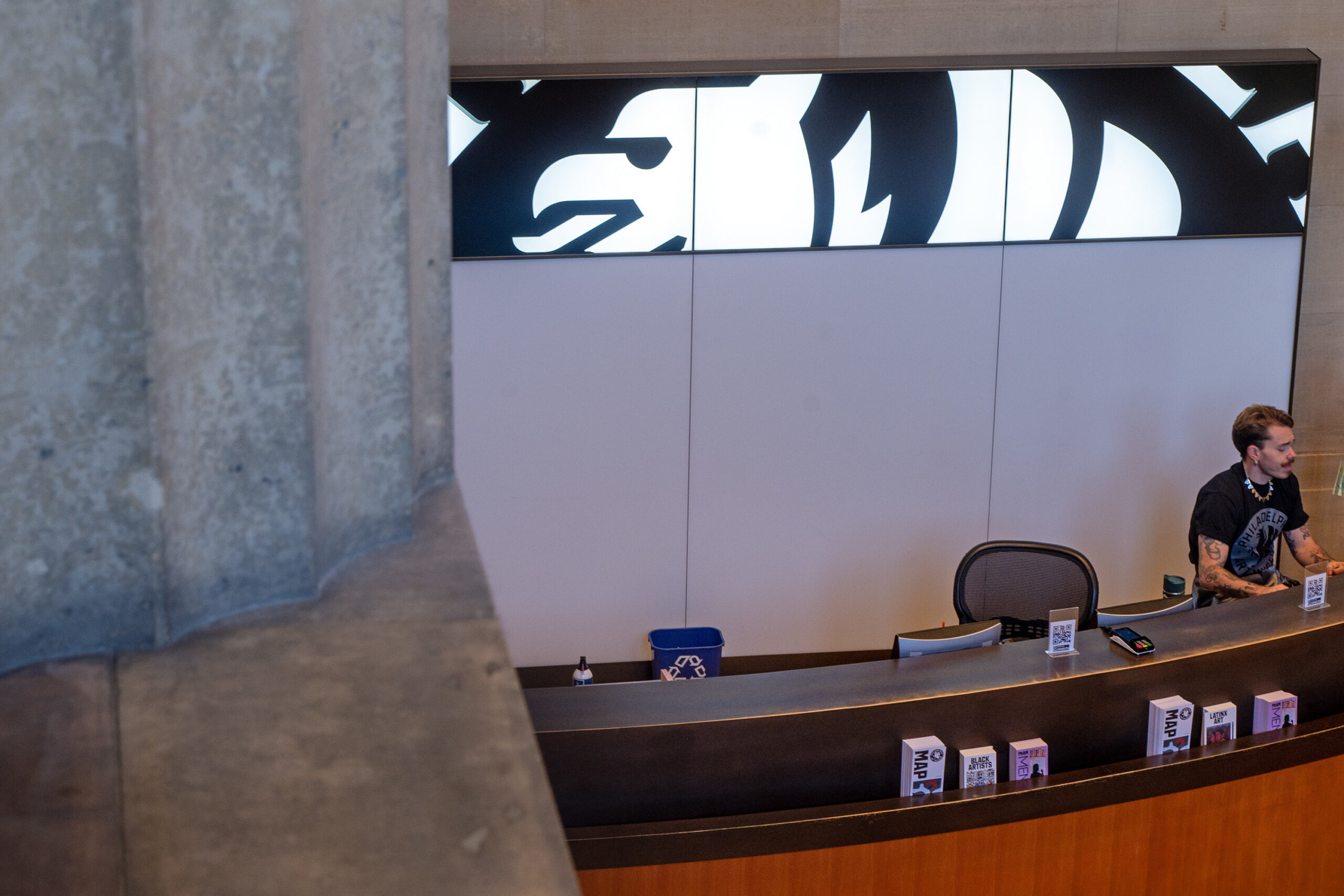
Visitors services staff member Tiago Segundo works the admissions counter at the west entrance of the Philadelphia Art Museum, Oct. 6, 2025.
Staff shortage
Weiss will have to contend with a shortage of staff — which has dropped from 500 in 2019 to 375 today — following years of significant employee turnover.
During Suda’s tenure, at least 60 employees — many from the senior executive team — were fired, laid off, or pressured to leave across departments. These include human resources, curatorial, digital content, communications, facilities, conservation, the library, visitor services, and more, according to museum insiders.
Suddenly gone in the fall of 2024 without explanation to the staff was Carlos Basualdo, earlier promoted by Suda to deputy director and the museum’s first-ever chief curator; he was highly respected and held several important relationships with collectors and top international artists like Jasper Johns and Bruce Nauman.
Basualdo was named director of the Nasher Sculpture Center in Dallas in April.
Curator Kathryn B. Hiesinger, who had been with the museum for 53 years, had talked to Suda in the summer of 2023 about her desire to retire at some point, and discussed ideas about winding down her tenure.
“She said it all sounded very reasonable,” said Hiesinger, 82, in a recent interview.
Several months later, Hiesinger said her computer stopped working and she was called into Suda’s office. A woman Hiesinger didn’t know — who turned out to be from human resources — and Suda handed her a sheath of papers, which she was asked to sign.
“I didn’t realize I was being fired,” Hiesinger said. “I was actually quite shocked by the whole way it was handled. It was so unnecessary. All she needed to do was say, ‘I think it’s time for you to retire; let’s see how we can make it work.’ But it was just like that — shut down the computer, call me into the office, and sign the papers, and that was it.”
A few weeks later, Suda called Hiesinger to apologize after museum leaders intervened. She was given the title of senior curator emeritus of European decorative arts and was told she would be allowed to complete her pending projects for the museum.
Hiesinger has had no official contact with the museum since.
Among others whostopped working at the museum during Suda’s tenure, several were made to sign nondisclosure agreements and could not speak to the media.
At the museum’s “Head to Toe: African and Asian Wearables” display, Oct. 6, 2025
A declining reputation
For staffers who have remained, there is a sense of internal disorganization.
“We’ve had three reorganizations within three years, and we were only given an org chart [and] an understanding of it in the last couple months,” said a longtime staffer.
Ultimately, the staffers The Inquirer interviewed believe the reputation of the museum has diminished over the years. Colleagues in the larger museum world, another staffer said, “look at me sideways, because this place has gotten such a bad rap … we’ve become a joke.”
Low morale has been a longstanding issue.
In her lawsuit, Suda detailed two instances of board members allegedly “yelling and berating staff.”
At one event, an unnamed board member “verbally assaulted a Museum employee,” the suit said, leading to a formal complaint. The board member later apologized to the staffer.
The second incident reportedly happened in the winter of 2024 when the museum hosted two simultaneous events for major donor Bank of America and a group invited by Philadelphia City Council President Kenyatta Johnson.
According to the lawsuit, board member Melissa Heller was allegedly “berating staff, cursing, and shouting that the team was unprepared.” Suda alleged that a Bank of America representative “witnessed this awful altercation” and called her to discuss it. Board chair Ellen T. Caplan spoke to Heller about it and “declared the matter closed.”
Suda’s lawsuit also recounted an incident when former board chair Leslie Anne Miller allegedly screamed and cursed at Suda.
Miller declined to comment and Heller did not respond to The Inquirer’s request for comment.
Several employees said Suda regularly engaged in similar behavior herself.
Sasha Suda, former director of the Philadelphia Art Museum, at the museum on Jan. 30, 2024.
“Sasha has done the same thing, [being] verbally abusive to staff, yelling at them, telling them that nobody likes them and people don’t want to work with them,” said the longtime staffer who spoke to the museum’s recent reorganizations.
The staffer worried about the museum’s diminishing reputation also claimed that the programming team became less autonomous and more risk-averse under Suda.
Managers, the staffer said, use threats of dismissal and public humiliation, leading curators and others to feel that their jobs depend solely on the success or failure of an exhibit. Staff members are wary of Suda’s executives continuing this culture of insecurity.
“People are afraid to do their work. Curators are afraid to put on exhibitions. They’re afraid to spend money,” the staffer said. “I feel like my work has ground to a near halt. I do a fraction of what I used to do, just in a very dysfunctional way now.”
The museum now puts on fewer of its own shows,a departure from previous administrations. Some of the biggest exhibits in recent years, like “The Time Is Always Now” and “Dreamworld: Surrealism at 100,” have been touring shows organized elsewhere and adapted for the museum.
A forthcoming programmatic highlight is the show “A Nation of Artists.” Featuring art from the family collection of Phillies managing partner John Middleton, the show is scheduled to run at the museum April 12, 2026, to July 5, 2027. It was conceived before Suda’s time at the museum.
Tourists pose with “Rocky” statue on the steps of the Philadelphia Art Museum, Thursday, September 11, 2025.
Ongoing financial struggles
Over the last several years, the nearly 150-year-old museum has operated with a persistent deficit.
In 2025, that number was forecast as around $2 million on a budget of $62 million. The fiscal year ending June 30, 2023, was the museum’s last period with no deficit. Suda began her tenure as director and CEO in September 2022.
Attendance has not rebounded to pre-pandemic levels. As of Nov. 30, the museum was still falling short of its goal for the fiscal year, clocking 266,282 visitors against a to-date goal of 306,750. Its total goal for the fiscal year — which goes through June 30 — is 731,000. (All of these numbers include not just visitors, but also school groups and people attending special events.)
And even that goal is a considerable downgrade from previous ambitions. A decade ago, the museum in its strategic plan stated the goal of increasing attendance to a million visitors per year within five years.
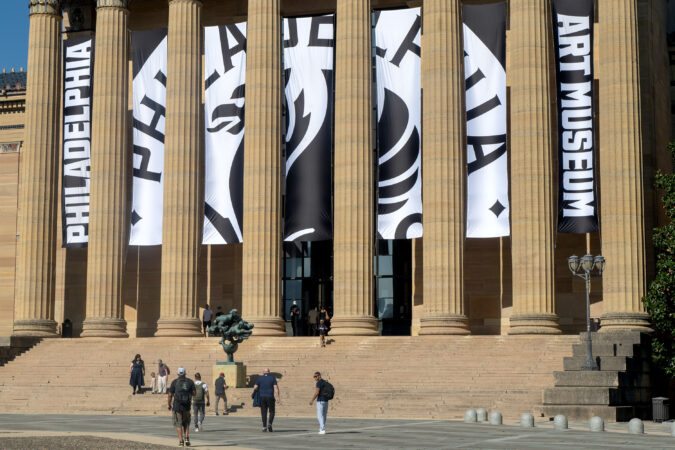
The museum’s widely panned rebrand and name change in October has proven divisive externally and internally. The campaign unveiled a new logo and changed the name of the institution from Philadelphia Museum of Art to Philadelphia Art Museum. Its cost totaled more than $1 million, according to two sources familiar with the details who spoke on the condition of not being named. Leaders hoped the rebrand would drive up attendance and cut down current operating deficits; the impact remains to be seen.
Suda’s lawsuit, staff worry, could worsen the financial outlook.
“We’re already broke as an institution. We could have a messy lawsuit that really takes a lot of funding away,” said the longtime staffer.
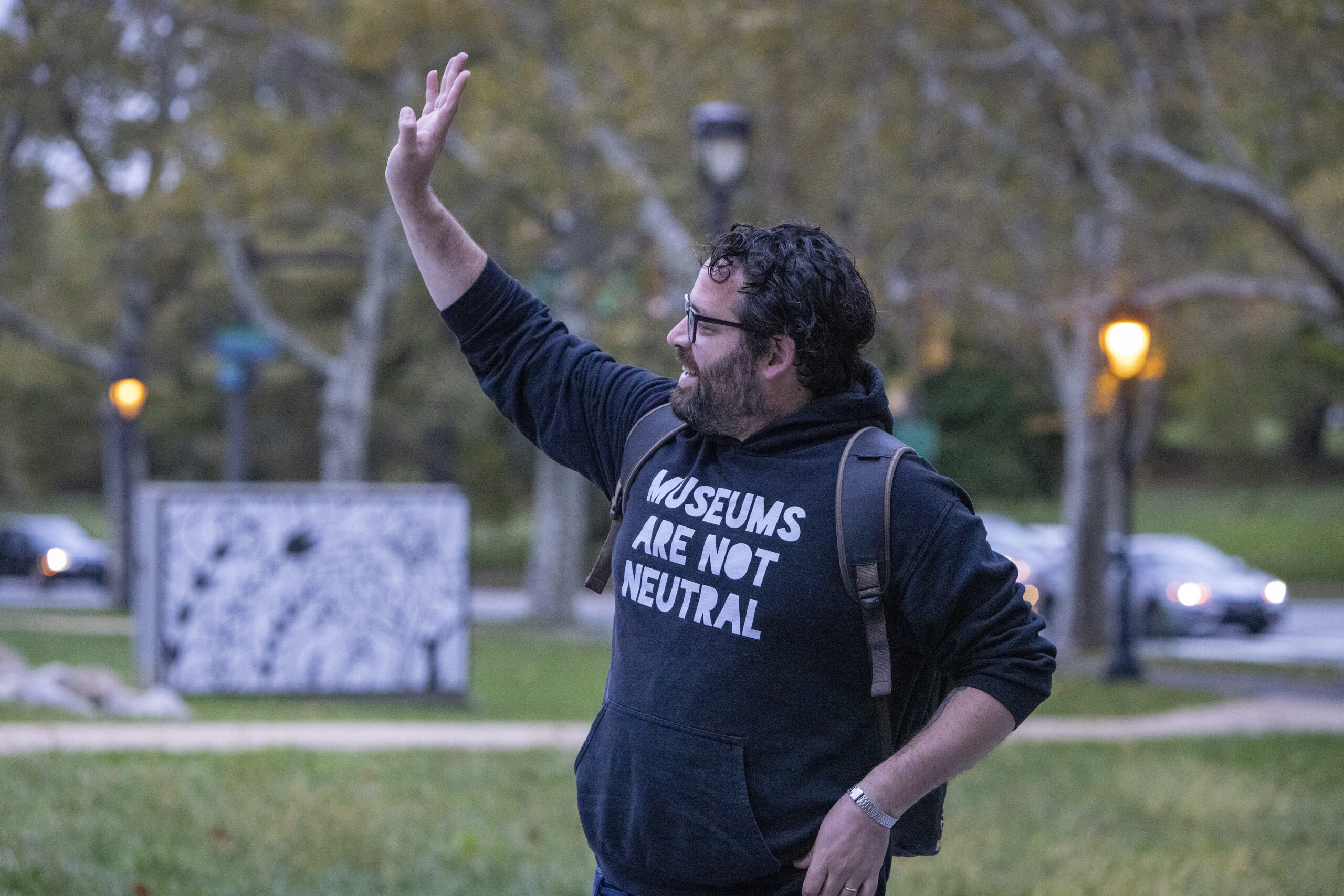
Adam Rizzo, former president of the Art Museum union, an affiliate of AFSCME DC47, waving to a honking supporter on the morning museum employees returned to work after a strike in 2022.
A new contract ratified in July 2025 ensured 3% annual pay raises and increased parental leave from four weeks to eight. But a number of grievances remain unresolved. The PMA Union, part of AFSCME Local 397, which represents Philadelphia culture workers, did not comment for this story.
After their boss was fired earlier this year, a staffer said, they were expected to take on extra responsibilities, with the promise of an hourly wage increase. Eight months later, the employee has not received that compensation and has been working with the union to address the problem.
“What they would rather do is have me go to the union, grieve it, and get the lawyers involved, and that way they can drag it out for another like six to eight months and not have to pay me,” the staffer said. “But they would still have to pay me all the back pay. It’s just them dragging their feet and penalizing people. To be honest, if they get me the higher end of [the raise], it’s only 90 cents extra.”
A museum spokesperson could not respond to this claim, deeming it “a personnel matter.”
Several other staffers have had similar experiences. Under the new leadership, they hope to have these disputes resolved amicably without the need of a grievance process.
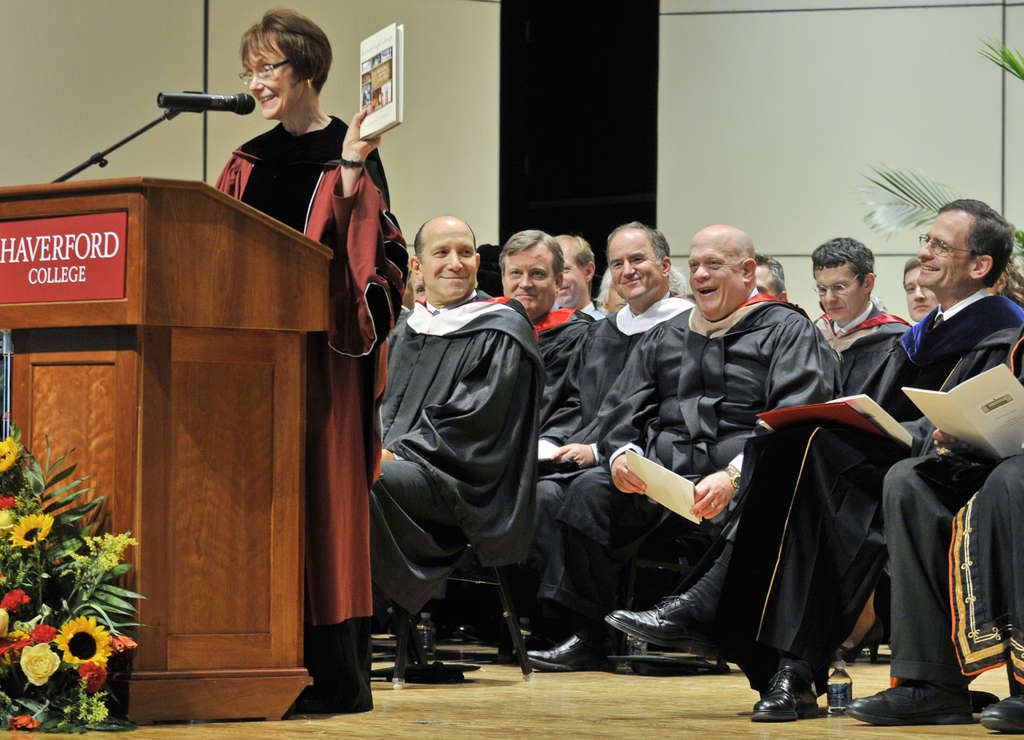
A 2013 photo of then-Swarthmore College president Rebecca Chopp showing off a copy of “Remaking College” at the inauguration of president Daniel H. Weiss at Haverford College, who is now director and CEO of the Philadelphia Art Museum.
What comes next
Weiss declined to be interviewed about specifics of his tasks and priorities, but the museum released a general statement:
“Daniel Weiss was appointed for his extensive leadership experience at major educational and cultural institutions. He began his tenure only weeks ago, and he is focused on learning the nuances of the museum’s ongoing operations regarding its programming, education initiatives, fundraising, and strategic planning. Mr. Weiss is currently working with senior staff to review key priorities and will address updates in the new year.”
Amid the leadership crisis and transition, staff has been kept mostly in the dark with little communication. The staffer seeking a raise shared that during the interim they received invitations for hot chocolate and parfait socials from human resources.
“It’s what the senior management do. That’s their usual MO, like, ‘Oh, well, have a cupcake,’” they said. “They treat us all like children, or like we’re all dumb. It’s pretty insulting.”
Weiss officially began his tenure on Dec. 1 but held an all-staff meeting before Thanksgiving. One staffer who attended said Weiss “said all the right things” so they are feeling “cautiously optimistic.”
“Everything he’s doing, he’s doing with such integrity. It’s heartwarming,” said a member of the curatorial affairs division.
But, they cautioned, “he’s going to lose people’s optimism if he doesn’t make any moves soon.”
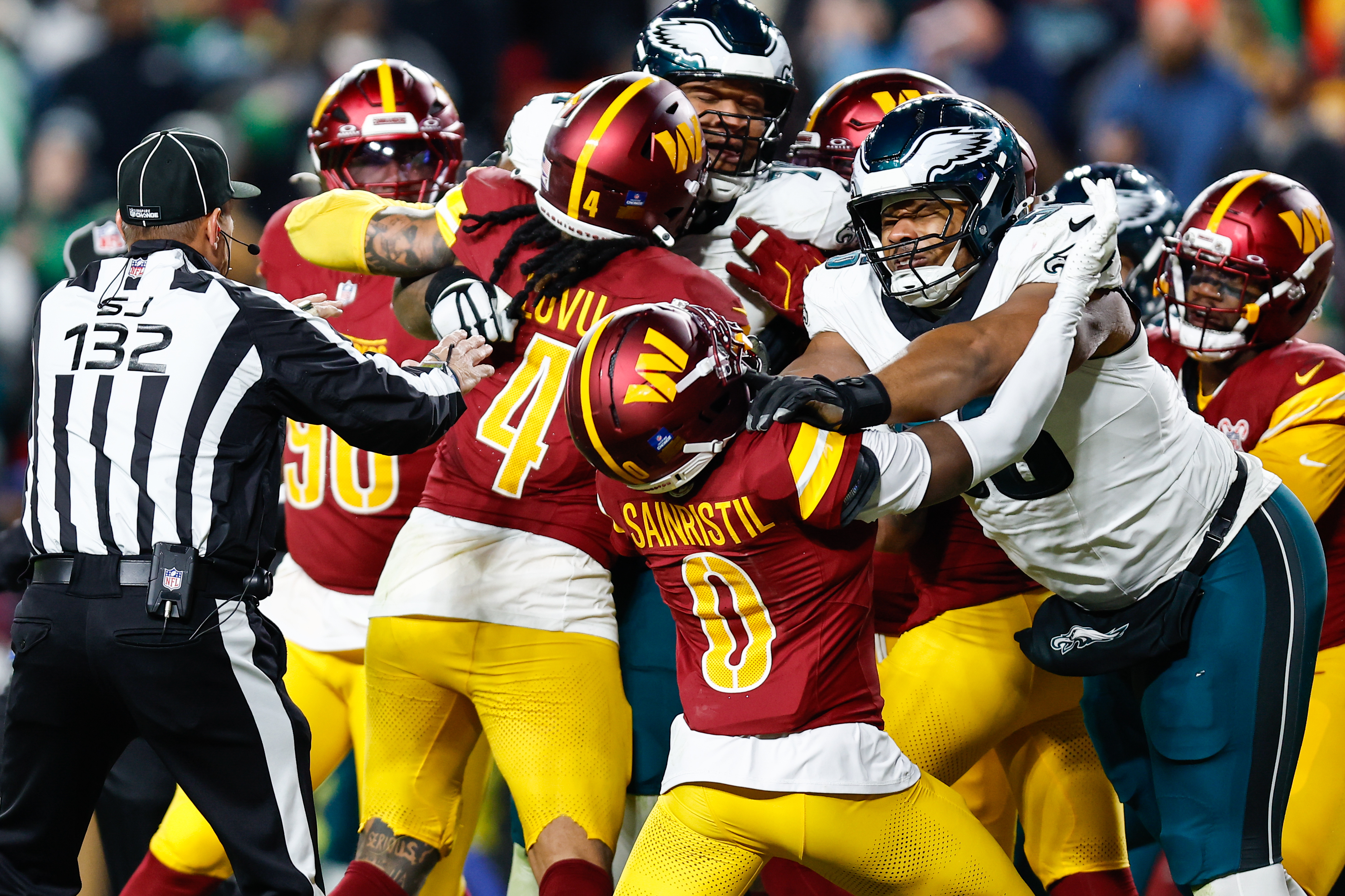
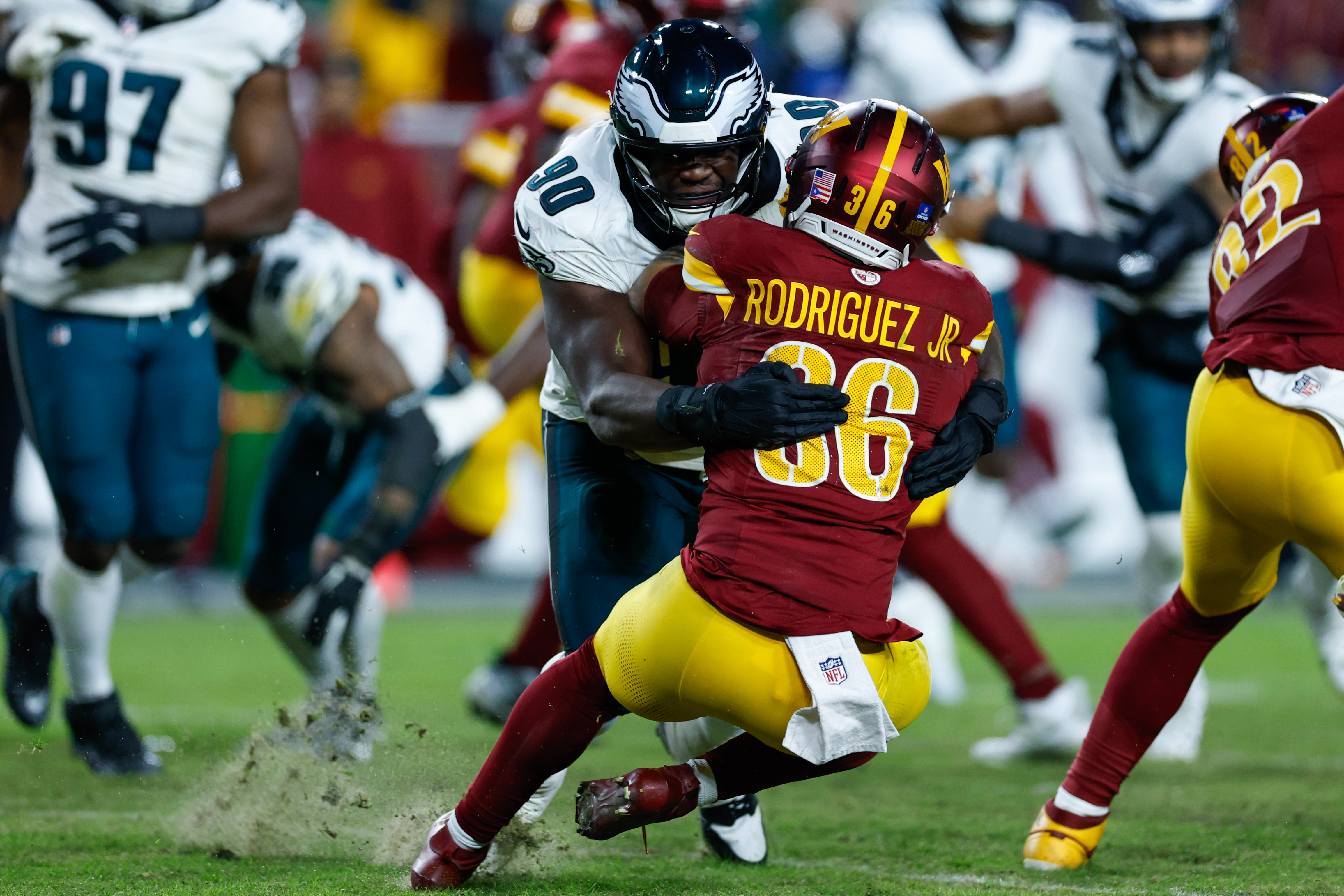
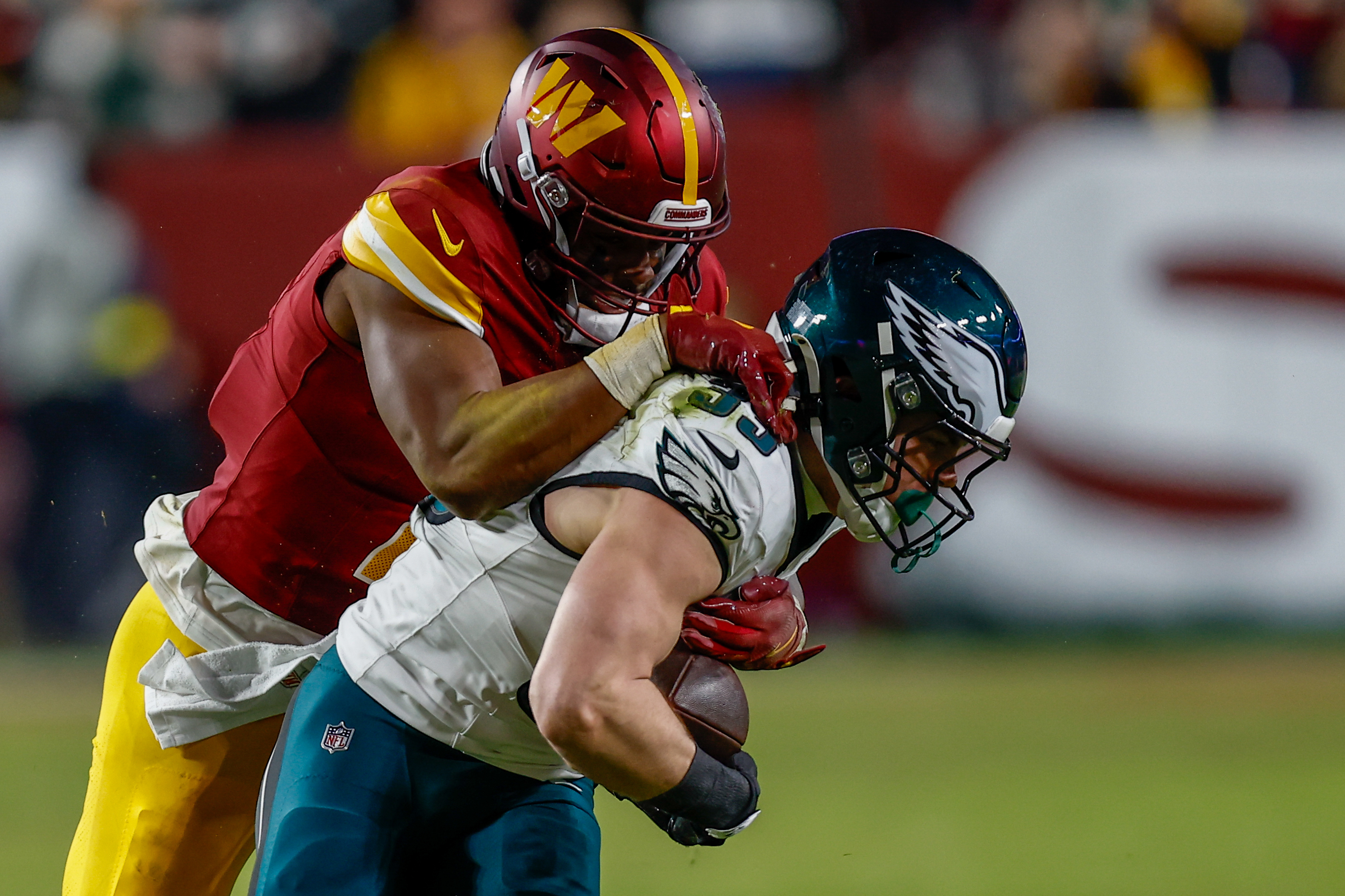
Eagles GM Howie Roseman and owner Jeffrey Lurie make the big decisions, and most of their decisions in the past five years turned out to be sound. But they didn’t take a single snap, run a meeting, or call a play during the Eagles’ five consecutive playoff runs, culminating Saturday in the first back-to-back NFC East championships since Andy Reid’s Eagles did it four times from 2001-04.
Five straight postseason runs ties those Reid-era Eagles for most consecutive playoff appearances. It also is the longest active streak, technically, but Buffalo (six straight from 2019-24) and Tampa Bay (five straight) both have a chance to extend theirs. Kansas City’s 10-year run, which is second only to the Patriots’ 11-year run, just ended; the Eagles’ win in KC on Sept. 14 helped to exclude Reid and his Chiefs.
In all cases, consistent excellence and dedication have pushed a wealth of talent to accomplish what is every NFL team’s goal at the start of every season. These are the front line people who were a part of it in Philly for all of the last five years:
Nick Sirianni, whose coaching ability far outstripped anyone’s expectations. On Saturday, he tied George Seifert as the coach with the most regular-season and playoff wins in his first five seasons as a head coach in the Super Bowl era, but Sirianni’s 64 wins are much more impressive than Seifert’s. Seifert inherited a Super Bowl team with legends all over the 49ers roster. Sirianni inherited Jalen Reagor.
Jalen Hurts, whose quarterbacking ability far outstripped anyone’s expectations. His 61 wins, including playoffs, rank third behind the Chiefs’ Patrick Mahomes and the Bills’ Josh Allen.
Lane Johnson, right tackle, who might be the best Eagle ever.
DeVonta Smith, wide receiver, who already is the Eagles’ all-time leader in playoff receiving yards with 595.
Landon Dickerson, left guard, part of the best left side in Eagles offensive line history.
Jordan Mailata, left tackle, the other part of the best left side in Eagles offensive line history.
Brandon Graham, defensive lineman, who was drafted in 2010, retired after 2024, unretired in mid-2025, changed positions from end to tackle two weeks ago, and has three sacks since.
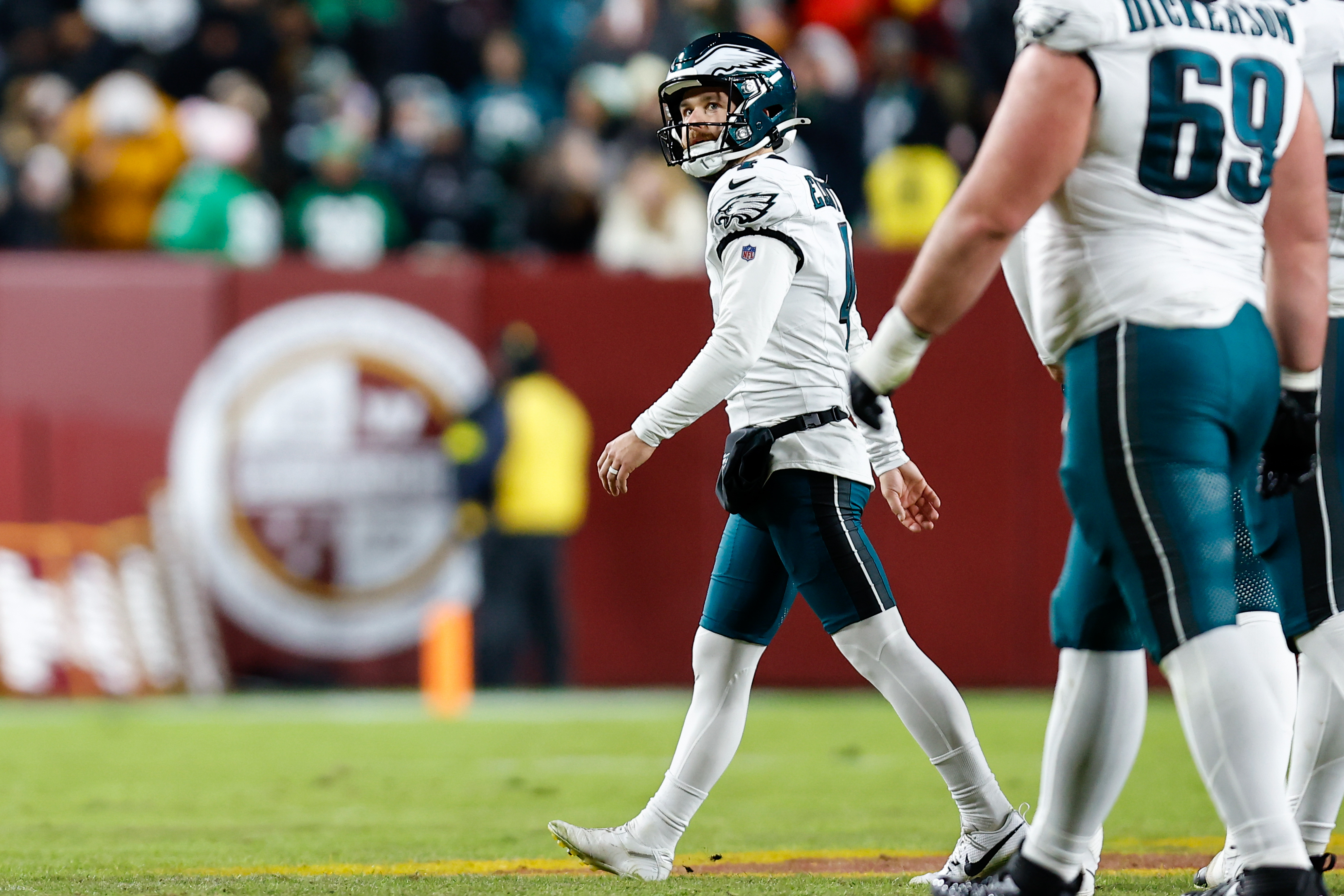
Jake Elliott, who has missed five of his last 11 kicks, but who set a Super Bowl record in February with 16 points when he made four field goals in New Orleans.
Dallas Goedert, tight end, whose 52 postseason catches are a franchise record.
Jeff Stoutland, the offensive line coach and the best assistant in the history of Philadelphia.
Michael Clay, special teams coordinator, who entered the NFL coaching ranks in 2014 thanks to former Eagles coach Chip Kelly, who should be credited for a lot of changes in Eagles culture.
Kevin Patullo, first-year offensive coordinator, former passing game coordinator, and Sirianni’s longtime majordomo. Currently, he is unpopular.
Jemal Singleton, running backs coach and current assistant head coach who has overseen the best seasons of Saquon Barkley, D’Andre Swift, and Miles Sanders.
Jason Michael, the tight ends coach who made Goedert a top-five tight end and helped sixth-rounder Grant Calcaterra last for four years in the NFL.
Aaron Moorehead, the receivers coach tasked with keeping A.J. Brown in line.
Jeremiah Washburn, who has coached edge rushers including Nolan Smith, Jalyx Hunt, Jaelan Phillips, and Josh Sweat. Also Bryce Huff and Joshua Uche.
“Big” Dom DiSandro, security chief, Howie’s adviser, game-day and sideline sheriff, whose basic job it is to keep everybody safe and out of trouble.
Honorable mention: Lurie and Roseman delegate liberally, and their scouts and support staff are remarkably loyal and proficient.
DK Metcalf’s swing at fan costs Steelers
Late in the second quarter of their game in Detroit, Steelers wide receiver DK Metcalf approached a blue-wigged Lions fan in the stands and exchanged words. He then grabbed the fan’s shirt, pulled the fan down closer to him, then appeared to try and strike the fan as he released the fan’s shirt and walked away. Metcalf, through reported sources, claimed the fan, with whom he interacted during last year’s game, used a racial slur and also insulted Metcalf’s mother.
Metcalf remained in the game — officials afterward said they didn’t see it happen. The league apparently did not believe Metcalf’s explanation of provocation or didn’t believe it warranted his action.
He was suspended (as always, without pay, in this case $555,556) for the Steelers’ last two games, which could be devastating. The Steelers, 9-6 and atop the AFC North, face the Browns, then the 7-8 Ravens to finish the year. Metcalf plans to appeal the decision.
Social media, Rams fans, and Lions fans nearly shared a group embolism after several unusual plays with intricate rules applications affected the outcomes of games with significant playoff implications — plays on which officials ultimately landed on the correct calls, with no room for argument.
On Thursday night, the Seahawks were granted a two-point conversion that tied their game with the Rams, 30-30, on a bizarre sequence:
Sam Darnold threw a backward pass to Zach Charbonnet, which deflected off Rams linebacker Jared Verse’s hand, then his helmet. The second deflection sent the ball forward, just over the goal line. As Charbonnet dejectedly retrieved the ball, a whistle blew.
Officials gathered to discuss the play and they ruled that, even though the whistle blew, the ball remained live. Further, since there is a distinction between a backward pass and a fumble — the offense cannot advance a fumble on a two-point conversion — Charbonnet’s recovery was valid.
Not only did the refs get this right, TV rules analyst Terry McAulay immediately explained why officials were discussing the play and he accurately predicted a reversal. Minutes later, the Football Zebras account took to Twitter/X and explained the intricacies of the determination.
On all 2PCs, the 2-minute fumble rule is in effect (regardless of the time on the clock). This may be a statistical fumble, but the ruling in replay is a backward pass muffed forward. Therefore it is a legal recovery. If it is a rulebook-defined fumble, the offense cannot score 2
If you’re interested, early Friday morning McAulay used his own entertaining Twitter/X account to further explain and defend his comments and opinion, including a quote-tweet of one of his posts from 2023, which explains the rules and emphasizes the confusion regarding the whistle. This includes a reply to an esteemed, retired Inquirer writer who covered the Eagles.
NFL players and coaches should know this rule and most do, which is why we see players attempting to recover loose balls on the ground all the time after the play has been ruled dead, regardless of a whistle being blown or not.
You might not agree with the rules enforced here, but they have existed for a long time, and they were appropriately applied. That said, I understand the outrage. I’ve been covering the NFL for 35 years and I’ll admit that I wasn’t sure what I was watching. I am sure, however, that, between the nuances of the backward pass and the whistle, I would have gotten at least part of it wrong.
The refs, in the end, did not.
Notably, this all happened with more than six minutes to play in regulation. Each team had three more possessions before overtime, so the conversion didn’t directly determine the winner. Each team scored a touchdown in overtime, and after the Seahawks scored the answering TD they were successful with a bold, if benign, two-point conversion. The win put them at 12-3, gave them the current top seed in the NFC, and the lead in the NFC West over the 11-4 Rams.
On Sunday evening, another bizarre play did determine the winner of the Steelers-Lions game, with possibly even greater playoff consequences that included a third team.
The Lions drove to the Steelers’ 1-yard line with 25 seconds to play, trailing by five points. They scored a touchdown on the next play, but it was nullified by offensive pass interference on Jameson Williams, called for an illegal pick on a Steelers defender. Good call.
Two plays later, the final play of the game, Jared Goff hit Amon-Ra St. Brown near the goal line. St. Brown was stopped but not declared down; instead, he lateraled to Goff, who vaulted into the end zone for a touchdown after time expired.
A lengthy discussion determined that St. Brown had indeed committed offensive pass interference before the catch. The penalty nullified the touchdown. Since time had expired, the game was over.
The fallout: The Steelers clinched a playoff spot for the 49ers and essentially ended the Lions’ season, since, due to tiebreaker rules, the 8-7 Lions now cannot catch the 10-4 49ers in the wild-card race. The Steelers, now 9-6, also greatly improved their own postseason hopes with a crazy 29-24 win in Detroit, where they were seven-point underdogs.
Anyway, kudos, refs.
Then, on Sunday Night Football, as if to spite their few supporters, officials failed to call a blatant pass interference penalty against the Ravens late in the Patriots’ comeback win at Baltimore, probably the worst missed call of the year. The Pats still scored on that drive and won the game, but come on, fellas.
Mike Tirico, Cris Collinsworth, and Terry McAulay voice their shock about pass interference not being called against the Ravens on a Patriots deep ball. 🏈🦓🎙️ #NFL#SNFpic.twitter.com/CEGfOgTVA5
The Bears’ comeback win over the Packers on Saturday night virtually locked the Eagles into the No. 3 seed behind the Seahawks (12-3) and the Bears (11-4). … The Chiefs could be moving from Missouri to Kansas to secure a new stadium, with an announcement coming as soon as Monday afternoon. … The Patriots’ win not only locked in their first playoff berth since 2021, it gave them a 12-3 record, same as the Broncos, who lost in Jacksonville (11-4), though the Patriots lose the top-seed tiebreaker against the Broncos (common opponents). … The Jags have won six in a row.
#Eagles playoff scenarios! (updated after SEA win over LAR)
In Week 16, Eagles would clinch…
NFC East with: [PHI win] *or* [DAL loss] *or* [PHI tie + DAL tie]
at least NFC # 3 seed with: [PHI win + CAR loss/tie]
When you’re building a list of great restaurants to represent a major metropolitan dining scene, the number you pick defines your roster’s ambitions and has implications. In The 76, The Inquirer’s annual dining guide that’s built around a very Philly number, we can paint a broad picture of what moves a city’s appetites. That landscape spans from the coveted seasonal tasting menus of Her Place Supper Club to the Poblano cemitas of El Chingón and the Tibetan momos of White Yak, three personal favorites I got to scout for this year’s guide alongside a hungry cohort of 17 Inquirer eaters.
My annual Top 10 list asks a different question: Which places are producing meals that capture the most special energy in Philly restaurants right now? This list reflects singular dining experiences that can only happen here, the kinds of magical flavors and hospitality that resonate in my mind after I leave the table and linger in my imagination for days to come. The sparks came when I least expected them: a seemingly simple dish of grilled mushrooms painted in porcini miso over sweet corn at Pietramala that was, in fact, a profound rumination on the shifting seasons; the snap of a tawny crepe perched over Mawn’s banh chow salad, hiding the electric funk and joyful zing of herbal Khmer greens; the mind-expanding creativity of the pasta omakase at Vetri Cucina, where a one-bite Wagyu cheesesteak wrapped inside a grilled pasta coin showed one of the city’s kitchen godfathers still pushing limits, setting standards, and having fun. (For the first time in six years, Vetri is back on my end-of-year list of favorites.)
This year may go down as Philadelphia’s best ever for ambitious new restaurants — including a couple, Little Water and Tequilas/La Jefa, that are first-timers on this list. But I was heartened to see over the course of several hundred meals that excellence is still being served at several long-standing stars, from the ever-dazzling tasting menu and bar program at Friday Saturday Sunday to the Southern Thai fireworks at Kalaya and to Royal Sushi & Izakaya, where the omakase may be next-to-impossible to book, but every morsel sends a sushi shiver down my spine.
Each restaurant on this list represents a unique snapshot of what makes Philly a world-class restaurant city. And since I love a succulent lamb kebab as much as a whipped sturgeon doughnut piled high with caviar, here’s another important fact about the number on this list: My Top 10 remains unranked.
Friday Saturday Sunday
I rarely use the word “perfection” to describe any meal, let alone a pricey tasting menu with a dozen intricate creations. But the moment I bit into the warm beignet stuffed with tender oxtail and smoked yam purée, I hungrily began scanning our table at Friday Saturday Sunday for the next treasure to devour. A thimble-sized nori pastry stuffed with a tartare of tuna, veal, and caviar? Gone like a Scooby snack. Sweet Hokkaido scallops and long hot pepper jam hiding in a fluted shell beneath a creamy mist of smoked coconut sabayon? Sluurrrp!
Chad and Hanna Williams haven’t rested on their accolades — a Michelin star, a No. 16 ranking in North America by World’s 50 Best, and a run of James Beard kudos. Their townhouse tasting-menu oasis off Rittenhouse Square has gotten better every year since the couple bought this now 52-year-old landmark a decade ago. That’s true whether you are seated in the plush upstairs dining room or the leopard-print ground-floor Lovers Bar, where walk-in regulars dine a la carte on irresistible FSS classics (smoked herring spaghetti, octopus and beans) and sip brilliantly original cocktails while Aretha Franklin and Herbie Hancock play in the background.
I marvel at how Williams and his team, including chef de cuisine India Rodriguez, continuously reinvent the tasting menu with globe-hopping inspirations that never feel contrived. Somehow fusilli noodles darkened with allium ash and glossed in luxurious lobster stock seem like the ideal prelude to the next dish, a pairing of sweetbreads and plantains in a buttery vin blanc froth. A deeply savory grilled short rib is slow-poached sous vide for days in lemongrass and shrimp paste before it’s grilled and served with the spark of a chili crunch. I’m still dreaming of the unexpected rice course — a soulful cup of koshikari grains cooked in duck stock with Filipino adobo, studded with smoky bacon, and draped with a rosy, honey-glazed slice of duck breast.
Pastry chef Amanda Rafalski enters the picture with a palate-cleansing cashew custard topped with pretzel crumbles and a rose-scented granita, and then delivers the tart to end all tarts: an almond pastry shell filled with duck egg semifreddo, strawberry jam, fresh berries, and tangy strawberry top tea. Perfection? This tart — and this whole meal — was it.
Kalaya
Philadelphians know Chutatip “Nok” Suntaranon as an underdog success story: the former Thai flight attendant who launched her cooking career in a Bella Vista BYOB, then soared to fame on the wings of hand-pinched, bird-shaped dumplings and the uncompromising fire of her towering tom yum.
Now the rest of the world knows Suntaranon, too. She was recently crowned “best female chef in North America” by North America’s 50 Best Restaurants, which also named Kalaya the seventh best restaurant on the continent. It’s the latest in a string of awards since her 2022 move to the airy, palm-fringed space of a former Fishtown warehouse for a much grander Kalaya 2.0. The James Beard Foundation, Netflix’s Chef’s Table, and Time100 innovators list have all chimed in.
Kalaya still delivers spectacularly because Suntaranon is America’s most passionate ambassador for the bold flavors of her native Southern Thailand. Earthy goat and lamb curries. Majestic wok-fried river prawns in shrimp paste and brown butter. Crispy squid with a turmeric-fried crust that unleashes waves of curry, lime, and long hot pepper spice. Those are just a few dishes that make Kalaya so singular.
Now three years into its current location and Suntaranon’s partnership with the team behind Suraya and Pizzeria Beddia, Kalaya as an operation is in fine-polishing mode, assuring the family recipes are consistent every time, and refining its format so servers can more easily convey a menu of regional specialties unfamiliar to many Americans. The tasting menu option, a three-course feast for $75 that’s the default on weekends, is designed to help guide diners toward a meal of balanced flavors. (Too spicy? There are tropical cocktails and fun shaved-ice desserts to quench the heat.)
I would start with the crispy chive dumplings and blue flower-shaped shaw muang dumplings. Try the sour fish curry tart with pineapples for a taste of Suntaranon’s mother’s favorite dish (the restaurant, after all, is named for her). There are other favorites I don’t want to miss: the grilled chicken glazed in tamarind, coconut milk, and soy; the whole branzino in fish sauce and lime; the tangy-sweet Mangalitsa pork chop. But Suntaranon is always working new dishes into the mix, like the fisherman’s pot of squid ink-blackened rice jeweled with colossal crab, shrimp, and calamari that tastes like the Andaman Sea. One day, Nok may even get Philadelphians to go for the rustic punch of the fish-innard curry she craves whenever she visits home. If history is any indicator of Nok’s magic touch, we’re going to love that, too.
Little Water
At Little Water, where the shrimp cocktail comes beneath stripes of smoked catsup piled high with fresh-shaved horseradish, the swordfish Milanese cutlets are encrusted in potato chips, and the “Caesar-like” salad is dusted with nori, Philadelphia’s once-grand fish house tradition has gotten the modern update it deserves.
This restaurant, launched a year ago from chef Randy and Amanda Rucker, the married couple behind River Twice, has re-energized a corner bar near Rittenhouse Square. Wrapped in glass cafe walls and pressed tin ceilings, Little Water rides the fine line between neighborhood haunt and destination splurge. You can pop by the bar (always reserved for walk-ins) for the “Low Tide” happy hour of $2 Sweet Amalia oysters splashed in Alabama white sauce and a kombu-infused martini for $10. Or you can dive deep into one of the most innovative raw bars in town — scarlet crab claws dabbed with black walnut mustard, little toasts with tuna ’nduja, a tin of caviar with hush puppies and ricotta — and then embark on a considerable feast.
If River Twice has remained Randy’s intimate atelier for modernist experimentation, the 78-seat Little Water is geared to be a bit more accessible, with a menu that taps the couple’s residence in coastal regions from Texas to New England. Two recent hits: a bowl of creamy pencil cob grits topped with luscious chunks of lobster and caramelized cippolini onions, and a steak tartare riff on oysters Rockefeller dressed with a Pernod reduction and topped with cornmeal-fried oysters. A massive fried bass over Sea Island peas remains one of my favorite whole fish of the year. And hash browns topped with Jonah crab salad and Maine uni are a must when it’s urchin season, ideal with a glass of sparkling Crémant de Bourgogne or a Müller dry riesling from the concise but smart Euro wine list.
I go for the turmeric sparkle of the nonalcoholic Golden Hour during Little Water’s mellowlunch service. The midday menu is as ambitious as ever, whether one of Rucker’s peerless gumbos, a meaty Texas redfish roasted “on the half shell” with its char-roasted scales still on, or a juicy chicken-fried chicken on toast. Its tawny crust is drizzled in a buttermilk dressing beaded with smoked trout roe then spiked with a toothpick stack of bread-and-butter pickles. All you need to complete the coastal-picnic vibe is the snappy tang of Little Water’s key lime tart for dessert.
Mawn
The Cambodian-inspired flavors are so electric at Mawn, where the funky spice of wild boar prahok dip sometimes comes atop Khmer chili dogs and the fried head-on shrimp are glazed in fish sauce caramel, it can be hard to know where to start.
That’s when it’s time to go “puck & see,” the Cambodian expression for “eat and drink.” That’s also your cue to skip Mawn’s a la carte menu and let the kitchen produce a family-style feast of multiple dishes that, for $65 a person, is an incredible value.
“It’s a way for us to create a mixtape for you, so you can understand our music,” says chef Phila Lorn, who co-owns this 28-seat BYOB sensation with wife, Rachel Lorn.
Just as the restaurant’s own soundtrack bounces from classic Khmer crooners like Sinn Sisamouth to Cambodian rapper VannDa, Mawn’s cuisine is dynamic, ranging from traditional flavors that echo the Southeast Asian Market in FDR Park (amazing lemongrass-marinated beef skewers) to multicultural influences gleaned from Phila’s time in Japanese restaurants and beyond, from Zama and CoZara to Stock.
Mawn calls itself a “noodle house with no rules,” and there are noodle-based highlights, including the signature schmaltz-enriched chicken soup spiked with chili jam. But I think about Mawn’s salads even more, especially the sour and spicy papaya salad made famous on a Food & Wine cover in September, when Phila was named one of America’s “Best New Chefs” following a similar nod from the James Beard Foundation. Other irresistible salads include a Burmese melon salad dusted with lime leaf powder and crispy shallots, and the banh chow, a crispy half-moon crepe that recalls a Southeast Asian tuile inlaid with ground chicken and shrimp, placed atop a tangle of lettuce and minty backyard herbs lashed in Phila’s mom’s galangal vinaigrette.
And then the free-flowing tasting menu brings pristine raw scallops in chili jam dusted with peanuts, a glimpse of what’s popping at their new oyster bar, Sao. More scallops — seared this time — arrive over a red curry infused with shrimp paste and Japanese chocolate, inspired by a mole lunch at nearby Casa Mexico in the Italian Market. We happily clear space for the “all-star fried rice,” topped with a treasure chest of seafood that’s been wok-fried with crab fat butter. And then my dream steak: a 20-ounce rib-eye piled high with a salad of Thai eggplants and turmeric-roasted tomatoes splashed in lime juice punchy with fermented prahok fish paste.
Mawn is so bold, boisterous, and tinged with nostalgia for Phila’s South Philly childhood that it’s no wonder Philadelphians cannot get enough of it. Neither can I.
My Loup
My Loup burst onto the scene in 2023 with its epic côte de boeuf and jars of pickled shrimp, already primed as the hotly anticipated sequel to Her Place Supper Club from star chef Amanda Shulman and her husband, chef Alex Kemp. The emergence of the Montréal-born Kemp as the kitchen’s driving force, however, has shaped My Loup into the rollicking French-Canadian bistroof my dreams, where the garlic knots explode with escargot, the summer cherry and peach tarts harbor a savory custard of foie gras, and Philly’s farm market seasonality informs every move, down to the cocktails.
The bar, presided over by gregarious beverage manager Jillian Moore, is one of my preferred places to dine at My Loup. I’ll order her lemon-honeyed Bees Knees, anise-scented fall sangria, or mezcal bijou while devouring the slender razor clam stuffed with the salami-and-olive muffuletta fixings, or Maine sea urchins tucked into their bristly shell cups beneath an orange cloud of sweet potato mousse tart with apple cider vinegar.
Kemp, who worked at Montréal’s Mon Lapin as well as Manhattan’s Eleven Madison Park, pairs elite culinary chops with a sense of whimsy that brings a welcome touch of levity to French cuisine. “Caviar and donuts” is a revelation of unexpected indulgence that offers a tin of ossetra alongside incredibly airy fritters made with smoked sturgeon, accompanied by a sour cream dip with seaweed and chive that builds layers of oceanic savor into every bite. Kemp’s team debones whole rabbits then reassembles them into bacon-wrapped saddles with garlic sausage and peaches. Juicy roasted chickens appear over mustardy spaetzle beneath truffles and fistfuls of chanterelles.
In a town once dominated by French chefs, Kemp is one of the few remaining standout sauciers in that genre, with a knack for lightweight-yet-flavorful updates of classics like a silky white blanquette sauce for an osso bucco with sweet baby turnips, or an orchard-bright Calvados brandy reduction that illuminates the novel surf-and-turf pairing of seared scallops with blood sausage.
My Loup’s menu can lean rich, but the servers are as adept at helping guests order with balance as they are at guiding them through the deep French cellar. Desserts are so straightforward the right answers are self-evident: a stunning bittersweet chocolate layer cake with a polished ganache mirror glaze, and a soft-serve sundae whose flavor combos swirl with the season’s spirit. There was corn and cherry in summer, a fall pairing of caramel apple and graham, and now? I’ve got My Loup on frequent repeat, because I want to try them all.
Pietramala
Ian Graye has figured out one of the secrets of becoming a great chef: focusing his energy on polishing one essential combination rather than cluttering plates with too many flourishes. And it has allowed him to unlock greater depths of flavor from vegetables at Pietramala than most chefs can tap from a wide-open world of meats and animal products. But don’t let the minimalist look fool you. The creations at this cutting-edge vegan kitchen in Northern Liberties are almost always the result of days, if not months, of labor — fermenting, dehydrating, smoking over the coals.
This is the case with his game-changing veggie burger, a special made from smoked mushrooms, heirloom beans, house-made tamari, and miso that has triggered monthly lines down Second Street. Another stunning dish this year essentially paired two ingredients: sweet corn and oyster mushrooms. But Graye teased out a rare complexity by cooking each ingredient within different versions of themselves, simmering whole kernels of Lancaster corn inside their creamy corn puree, then topping the result with a grilled mushroom painted in mushroom miso that’s fermented for months. This duo captured the poetry of shifting seasons: the fleeting sweetness of summer and autumnal umami united onto one haunting plate.
That sense of wonder here is common. A smoked eggplant in au poivre sauce (with Dad’s Hat rye and creamy onion soubise) will make you forget it’s inspired by the classic steak dish, though it is every bit as satisfying. A corno di toro pepper glazed in orange Jimmy Nardello pepper romesco sauce and stuffed with smoked walnuts, local rice, and foraged lobster mushrooms elevated a potentially frumpy stuffed pepper to a special event.
Graye’s growth in the three years since Pietramala opened has been impressive. He’s refined his craft and cultivated a vast larder of condiments for maximum flavor control. The intimate restaurant has also evolved, with a steady team in the open kitchen as well as a gracious front-of-house staff. The addition of a winery license for this former BYOB through Northeast Philly’s Camuna Cellars has also allowed Pietramala to add natural wines made from local grapes (the “Let’s Go Swimming” orange wine and blaufrankisch were my favorites) and cocktails with Pennsylvania spirits, lively nonalcoholic shrubs, and ingredients like fresh wormwood, summer plum, and birch bark. The license has also given a 20% revenue boost to this intimate 36-seat gem, which, of course, addresses one of the other key secrets of becoming a great chef: a sustainable business model.
Royal Sushi & Izakaya
There’s a practical case to be made for the Royal Sushi part of Royal Sushi & Izakaya to be left off this list. It is as close to a private club as a public restaurant can be. While a handful of newcomers do, in fact, make it off of Resy’s daunting waiting list each week — snagging one of the 16 seats at Jesse Ito’s coveted omakase counter — you otherwise need to persuade a regular to loan you their standing reservation.
But there’s a reason to keep singing its praises. This is one of the most magical dining experiences Philadelphia has to offer. Ito’s toro-carving artistry is one of the reasons he sets Philadelphia’s omakase gold standard.
On a recent visit, I took a bite of glistening pink mackerel belly (a gloriously extra-extra-fatty toro sawara) and its fruity tang and buttery richness flooded my body with a pleasure wave of omega-3s. (“Oh yeah…right?!” said a friendly stranger at the counter beside me, as we shared a mackerel moment.) There was the alabaster-smooth scallop dusted with yuzu zest cradling a nub of perfect nigiri rice, each warm grain distinct and full of flavor. A scarlet carabinero prawn melted away like sweet ocean butter.
Royal Izakaya, the low-lit tavern that occupies the front of this Queen Village building, is a destination on its own, with seating for walk-ins only, serving “tuna-guac,” fish collars, chirashi buns, and Japanese-themed cocktails. Ito’s latest, dancerobot, a playful Rittenhouse Square collaboration with chef-partner Justin Bacharach, is pure Japanese comfort-food fun. But Royal Sushi’s $355-per-head sushi counter (gratuity included), where Ito handcrafts every morsel in tandem with exceptional sake pairings, resides on its own level. Ito’s style is ever-evolving, having graduated beyond the “bro-makase” cliché of pile-it-high luxuries to a more personal, nuanced style.
His latest creative riff on bibimbap, a nod to his Korean mother, is a treasure hunt through buttered seaweed rice, uni, and cured Jidori egg yolk down to a hidden bottom layer of bluefin, sea bream, and king salmon. The tangy dashi dressing for lusciously thick slices of buri (adult hamachi) exuded a savory whiff of fish sauce, an ode to Ito’s Thai best friend. And then came the A5 Wagyu rib-eye, marinated galbi-style before it’s torched — an extraordinarily beefy add-on that prompted my new counter friend and I to share another knowing glance. “Don’t tell my mother,” he told me, noting his own Korean heritage, “but it’s better than hers.”
Tequilas/La Jefa
The Tequilas legacy could have disappeared altogether after a 2023 kitchen fire closed the restaurant for two years. Instead, the Suro family has blazed back to glory this spring with a remarkable vision for an all-day modern Mexican oasis fueled by agave spirits and the aroma of heirloom corn. The realization of this plan honors the traditions of a Philly pioneer, but also celebrates the present and future of one of the city’s most vibrant dining categories with contemporary creativity.
From fresh-baked hibiscus conchas and morning lattes dusted with tortilla salt to artful ceviches, tequila-splashed langostinos, and cutting-edge cocktails at night, the range of delights here is vast. ¡Bienvenidos a Guadaladelphia! But first, understand how much the institution launched by David Suro Sr. 40 years ago has evolved. As noted in my colleague Kiki Aranita’s review, the revitalized Tequilas is now three places in one: A dining room, an all-day cafe, and a hidden mezcal bar inside that cafe. This Locust Street mansion’s gorgeous dining room, with its 19th-century Baccarat chandelier shimmering over a teal floor of handmade Mexican tile, has been largely preserved. This is where longtime patrons will find some of the restaurant’s classics (the cochinita and a lava rock molcajete bubbling with beef tenderloin and cheese in a chile-fired stew) deftly updated by consulting chef Fabián Delgado Padilla of Guadalajara’s palReal, and executed beautifully here by chefs and cousins Eduardo Moreno Sanchez and Jessica Sandoval.
Tequilas’ former rear dining room, meanwhile, has been transformed by Suro’s children — David Jr., Elisa, and Dan — into La Jefa, an airy all-day cafe accessed from Latimer Street, offering single-origin Mexican coffees and inventive brunches. Tucked in the back of La Jefa is a moody cocktail lounge called Milpa, which has a modern Mexican menu all its own, aside from its tightly curated (and world-class) mezcal collection, avocado soda, and fascinating drinks (try the shaved ice Raspado or the $27 “Agave Cocktail,” a not-margarita made from premium Cascahuín tequila, Colima salt, lime, and house-made roasted agave syrup).
Delgado has brought elegant updates to much of Tequilas’ original menu, including a crackling-edged pork belly shingled over sweet mole dulce, an airy guacamole cloud hiding raw tuna at the bottom of a bowl, and an incredibly delicious Tapatía barbacoa made with brisket and dried chilies.
But La Jefa and Milpa are where the contemporary Mexican flavors really shine. The guacamole comes with house-dried cecina beef jerky instead of chips. A stunning quesadilla made from inky black masa harbors tender squid inside molten quesillo cheese. A soft tetela, or triangular masa pastry, showcases the mind-blowing subtlety of a sweet plantain stuffing against the nutty spice of a pipián verde sauce. La Jefa’s spiced lengua pastrami sandwich is my Mexi-Jewish deli fantasy come true, and the soft huevos verdes are what I crave for brunch.
Tequilas is part of a wave of thrilling Mexican projects that landed in Philly this year, but its exceptional veteran service team — many with three decades of service — sets it apart. They all returned after two years away because the Tequilas experience is really about them, too, especially as this institution strides into an even more exciting future.
Vetri Cucina
“Hug the noodle” has become Marc Vetri’s new favorite slogan. It’s a cooking directive, of sorts, to describe the magic moment when sauce suddenly thickens around pasta just enough to cling to each morsel, forming a creamy halo of cacio e pepe or zesty duck-and-olive ragù.
But the saying also describes a life’s calling for Vetri, whose nationally acclaimed career has revolved around his passionate embrace of noodlecraft. Vetri radiated pure joy behind the chef’s counter recently as he dazzled a handful of lucky diners with his coveted monthly “pasta omakase,” a 15-course parade of exquisite pasta creations inspired by the sushi tasting format of Japan, where Vetri owns a restaurant in Kyoto. Snappy tagliolini strands arrive in sake butter beneath creamy sea urchin and caviar. Gnocchi clouds come stuffed with lobster mousse. A culurgione of carob dough wrapped around an X.O.-spiked stuffing of duck confit in a citrusy meat reduction sauce was essentially duck à l’orange as a dumpling. Finally, a pasta coin arrived cinched around grilled wagyu beef and Cooper Sharp for a whimsical one-bite wonder that redefined the fancy cheesesteak.
Even if the limited omakase isn’t accessible to a wide audience, it’s become an essential creative outlet for the chef and his crew at Vetri Cucina to keep evolving after 27 years in this elegant Spruce Street townhouse. It has also helped refresh and inspire Vetri’s regular menu, which is still very much worth your time — and perhaps even more so of late.
It’s been six years since this Philly fine-dining classic made my end-of-year favorites list. But a pair of recent visits, including for the standard $165 four-course menu, convinced me Vetri is once again having a buzzy moment — hugging the noodle, if you will — as the team’s best new ideas (sweet potato cavatelli with crab and apple) rise seamlessly alongside time-tested standards (melt-away spinach gnocchi).
With one of Philadelphia’s most gracious service staff drawing from an exceptional collection of Italian wines, the complete experience here goes well beyond pasta. There’s housemade salumi to start the meal, along with a savory pear tarte Tatin with radicchio and Gorgonzola. The kitchen can produce alta cucina at its most precise, with lobster mousse dumplings wrapped in mustard greens or a rosy-hued venison glossed in raisiny Amarone sauce. It can also deliver rustic satisfaction with perhaps my all-time Vetri favorite: smoked baby goat over house-milled polenta. Revived recently after years off the menu, the goat’s crispy-skinned tenderness and earthy simplicity has been a revelation for the latest generation of line cooks. Yes, the cutting-edge pastas are still a major draw. But at Vetri, what’s old is new and beautiful again, too.
Zahav
There’s always something new to savor at Zahav, the shimmering glass box in Society Hill Towers whose live-fire interpretations of modern Israeli flavors have transfixed Philadelphians for 17 years and earned national destination status.
Its standards are still so superb its 100 seats remain among Philly’s toughest to book. But the more co-owners Steven Cook and Michael Solomonov grow their company — now with 14 restaurants in three states (plus 10 Federal Donuts) — the more committed they remain to maintaining their crown jewel as a living, breathing project. Some of that involves constantly improving ingredients, like the newly acquired “oyster cut” of lamb that has taken Zahav’s iconic pomegranate-braised and smoked lamb shoulder to another level of earthy tenderness. Or the vividly fresh Turkish sumac, unavailable when Zahav first opened, that lends a tangy lift Solomonov likens to “sour cherry pink lemonade” for the juicy chicken shishlik with stone fruit amba and crispy chicken skin.
The prime energy boost, though, flows from a steady infusion of kitchen talent, including cochefs Natasha Sabanina and newly arrived Aiden McGuiggin, formerly of D.C.’s Tail Up Goat. McGuiggin’s talent for preservation contributed to recent memorable bites, including a poppy-encrusted cobia crudo, whose firm white flesh crunched against snappy tiles of locally grown Asian pears compressed with turmeric and fruity yellow jalapeños. Some lusciously rare lamb carpaccio, meanwhile, was elevated by dried, cured, and smoked summer tomatoes dusted in the green chili-cilantro zing of Shabazi spice. And just when I thought the kebabs here couldn’t be more delicious, I forked into a juicy new ground lamb skewer tinted green with crushed pistachios, almost fluffy from the leavening sparkle of ginger beer, alongside a black garlic toum.
Zahav’s dining room has also gotten a gentle makeover, with a second bar to speed the arrival of za’atar-dusted gin and tonics and sesame-infused bourbon drinks into thirsty diners’ hands, but also to add a few extra seats where lucky walk-ins can order a la carte (even if the four-course mesibah tasting menu remains a great value for $90). A new wooden structure in the central dining room has also added linen-draped cubbies for a touch more intimacy in this boisterous space lined with Jerusalem limestone. There’s even the promise of new acoustic treatments to finally allow easier conversation over the high-energy classic-rock soundtrack. What might people be saying? At my table it was this: Zahav is somehow still exciting and aging gracefully at the same time.
Tyler Perkins has a different point of view than the rest of his Villanova teammates.
The junior guard is one of three returning players on the Wildcats roster, and the lone returnee who played last season. Perkins has been a steady presence as the program went through a coaching transition and a total reboot entering the 2025-26 campaign.
But adapting to a new system isn’t the biggest challenge for Perkins — he’s done it every season of his college career. He played for Penn as a freshman, then transferred to Villanova ahead of the 2024-25 season. While most of his former teammates moved on after Kyle Neptune’s firing in March, Perkins elected to stay on the Main Line as Kevin Willard took the helm.
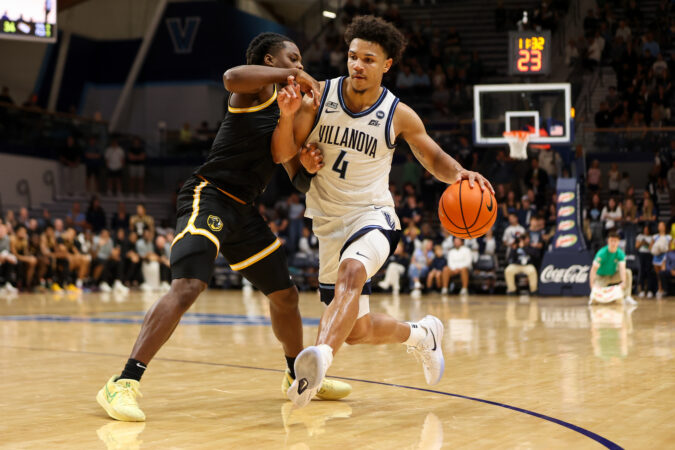
Perkins is focused on being a leader for Villanova (9-2), in addition to fulfilling Willard’s high expectations of his backcourt. Promoted to the starting five this season, Perkins is averaging 10.6 points and 4.3 rebounds through 11 games.
“When you’re a college basketball player, you don’t really want to have three new coaches in three years,” Perkins said. “But it’s something you can’t control and have to learn from. Willard has definitely helped me understand that even on your good days and bad days, if you’re one of the leaders, you always have to keep a positive attitude. Even my teammates are holding me accountable.”
The only returner
The process of building camaraderie among the new Villanova squad inevitably was difficult when summer training began. The Main Line was unfamiliar to most of the team, apart from Perkins, redshirt freshman forward Matt Hodge, and walk-on senior guard Wade Chiddick. But over the summer, Perkins made a jump in his own game as he got to know his new teammates and coaching staff.
“When you have 13 new guys, it’s hard and it takes a while, but ever since the summer, we’ve clicked, and it’s been fun,” he said.
Perkins was a consistent contributor early in the season, scoring eight points in each of the first four games. Against Old Dominion on Nov. 25, he scored 21 points — his most in a Villanova uniform — with seven rebounds at the Finneran Pavilion.
Tyler Perkins scored a career-high 21 points against Old Dominion on Nov. 25.
It was Perkins’ third year playing in the Big 5 Classic. But it was the first time that most of his Villanova teammates — and coaches — had competed in the annual tripleheader among the six Philadelphia teams.
Perkins took it upon himself to emphasize the significance of the Big 5 rivalry to his teammates ahead of the event. Against Penn, he recorded six points and three rebounds as the Wildcats demolished the Quakers, 90-63, for their first Big 5 title in the revamped format.
“[The Big 5] is all about pride, to be honest,” Perkins said. “When I was at Penn and we had Villanova on our schedule, it was like our Super Bowl. It was a game where we could show everybody who we are. Being on the other side of that now, I was just trying to tell the guys that these games mean a lot to the Big 5 schools. So being able to finally win it and bring it back to the Main Line is definitely special.”
‘It’s bigger than you’
Upon arriving at Villanova, Willard noticed Perkins’ potential to fill his starting lineup as a versatile guard. In their first conversations, Perkins was eager to buy into Willard’s vision for the program.
“I thought my playing style and [Willard’s] coaching style meshed, both offensively and defensively,” Perkins said. “He likes his guards to get deflections and get steals. And I feel like that’s something that I’m naturally good at, and just my ability to rebound and play hard. So after talking with him and seeing how those things aligned, I was happy with the decision [to stay at Villanova].”
In Villanova’s win over Wisconsin on Friday night, Perkins was confident with the ball in his hands. He shot 6-for-17 from the field, including 4-for-10 from three, and scored a team-high 19 points in the 76-66 overtime victory.
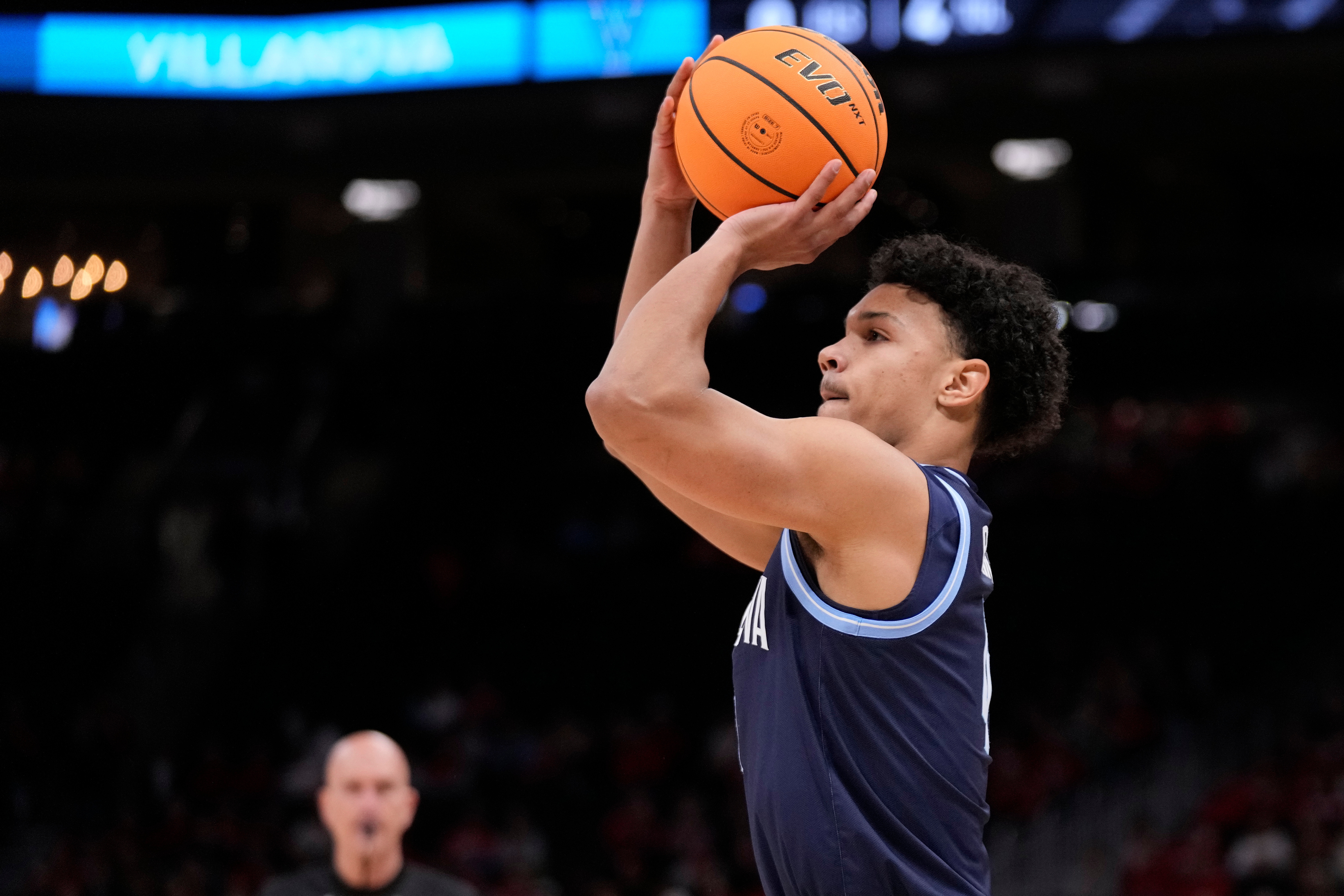
Villanova guard Tyler Perkins shoots a three-pointer against Wisconsin on Friday.
“I like the fact that Perk’s looking to shoot the basketball. … He does all the little things that most people don’t see,” Willard said postgame in Wisconsin. “But when he’s aggressive out there, it gives us another scorer.”
When grappling with uncertainty after last season, Perkins turned to some of the former teammates he looked up to as role models, including 2025 graduates Eric Dixon and Jordan Longino. Both played their full careers at Villanova and helped shape Perkins’ understanding of the school’s basketball tradition and how to represent it.
Now, Perkins sees himself as a leader by example as the Wildcats get ready to open Big East play at Seton Hall on Tuesday (7 p.m., NBCSP, Peacock). Villanova enters the most crucial part of the season, and Perkins hopes to put the program back in the national spotlight.
“When you walk into the Finn and see [murals of] Jalen Brunson, Collin Gillespie, and all those other greats, they built this place,” Perkins said. “Villanova is Villanova because of them. Now, it’s just our turn to keep it going and play for those guys. That’s the main thing I’ve learned, is that it’s bigger than you.”
Cencora Inc., a drug-distribution giant based in Conshohocken, is expanding its presence in oncology and retina care, two medical specialties that rely heavily on pharmaceuticals.
The company announced on Dec. 15 that it had agreed to buy out its private-equity partner in a national cancer practice management company, OneOncology, for $5 billion in cash and debt.
Cencora already owned 35% of OneOncology, which has a small presence in the Philadelphia area.
In January, Cencora spent $5 billion, including contingency payments, for Retina Consultants of America, a network of specialized practices withlocations in 23 states, including two in Pennsylvania outside the Philadelphia area.
The deals are part of Cencora’s effort to extend its reach into medical specialties that rely heavily on pharmaceuticals to treat patients. By positioning itself closer to patients, Cencora can capture more of the profit margin that goes along with selling drugs.
“We like those two spaces because they’re pharmaceutical centric,” Cencora’s CEO Robert Mauch said at the 2025 J.P. Morgan Healthcare Conference. He said the company doesn’t see other specialties with the same makeup as oncology and retina.
“That’s where we will continue to focus,” he said. “Now as we look forward, there could be other specialties. There could be other innovations in the pharma industry that create something in another area.”
Cencora had $321 billion in revenue in its fiscal year that ended Sept. 30. It had $1.5 billion in net income. That’s a great deal of money, but amounted to less than half a percent of its revenue.
McKesson and Cardinal Health, Cencora’s two biggest U.S. competitors in the drug-distribution business, face similarly narrow margins from drug distribution. Both also own companies that manage cancer practices. Among the benefits of owning the management companies is securing the customer base.
Cencora’s follow-up to 2023 deal
Cencora, then known as AmerisourceBergen, paid $718.4 million for a 35% stake in OneOncology in June 2023. That deal, in partnership with TPG, valued OneOncology at $2.1 billion. The seller was General Atlantic, a private equity firm that had invested $200 million in the Nashville management services company in 2018, according to the Wall Street Journal.
The deal announced last week valued OneOncology at $7.4 billion, including debt. The big increase in value came thanks to a doubling in the company’s size. OneOncology now has 31 practices with 1,800 providers who treat 1 million patients across 565 sites, according to the company.
Rittenhouse Hematology Oncology, which has offices in Bala Cynwyd, Brinton Lake, King of Prussia, and Philadelphia, became part of OneOncology last year.
BRANDYWINE, Md. — No one knows exactly when Terrence Butler began keeping a journal, but there is a best guess. The first and only time someone noticed that he was writing something that he clearly wanted to keep private was the evening of Saturday, July 29, 2023, four days before he died.
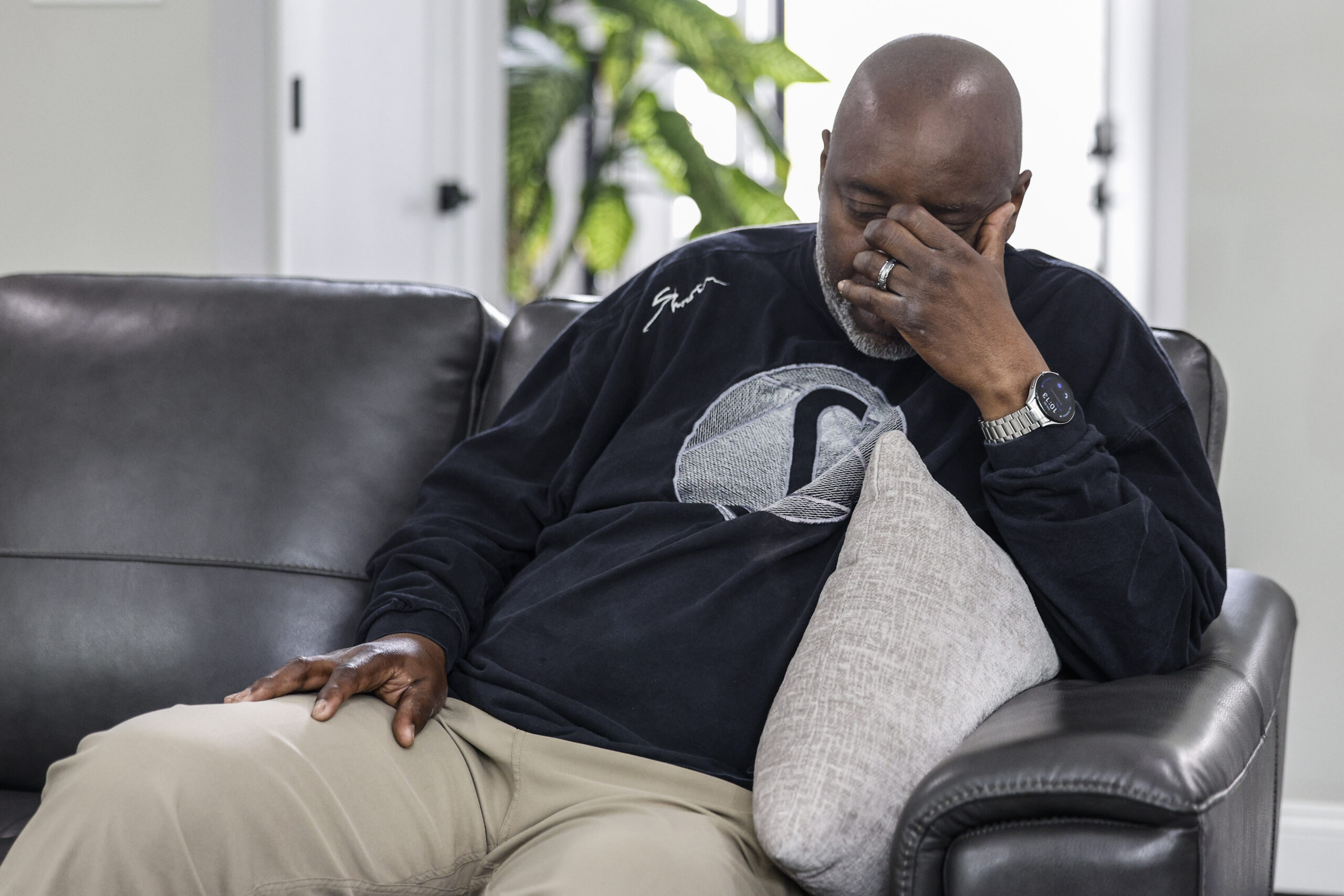
He had spent that morning and afternoon at his mother’s townhouse here, curling and bending his 6-foot-7 body to lounge on the couch, cozy in a hoodie, gym shorts, and white socks, quiet, sometimes reading his Bible. His behavior was nothing out of the ordinary for whenever he was in town, though there was something about her son’s visit, this particular visit, that Dena Butler thought strange. Throughout Terrence’s two years at Drexel University, before and after he had stopped playing for the men’s basketball team, he merely had to call Dena whenever he had wanted to come home, and she would drive the 150 miles north to West Philadelphia to pick him up. This time, though, he had taken an Amtrak train from 30th Street Station, arriving in New Carrollton, Md., at close to 11 o’clock Friday night. He had never done that before.
His older sister Tiara was with him all day at Dena’s, happy to dote on her little brother, helping Dena prepare his favorite meals — bacon and eggs for breakfast; chicken fingers with his favorite condiment, Sweet Baby Ray’s barbecue sauce, for lunch — the two of them good-naturedly complaining that the Jamie Foxx movie they were watching was too slow and not all that funny.
It started to rain in the afternoon, and Terrence walked over to the wide window at the front of the house. He stood there for a while, leaning back a bit, his eyes turned to the charcoal clouds outside. Tiara remembers that moment still. “He loved the rain,” she said. “It wasn’t odd for him to do, but now, looking back on it, he was very somber, looking into the sky.”
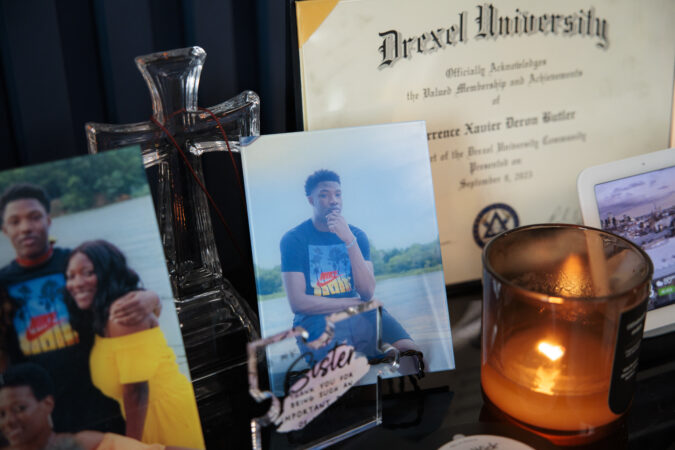
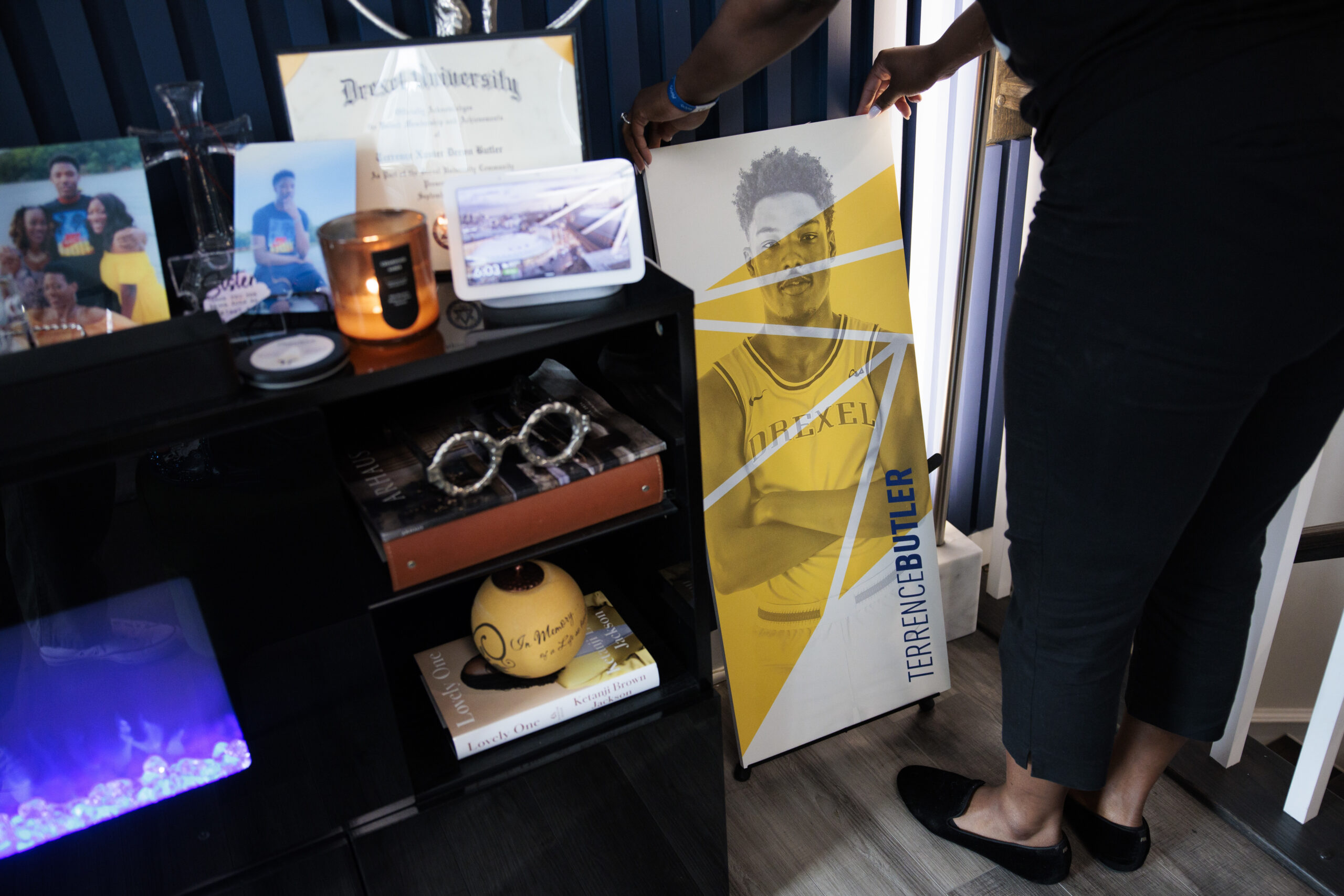
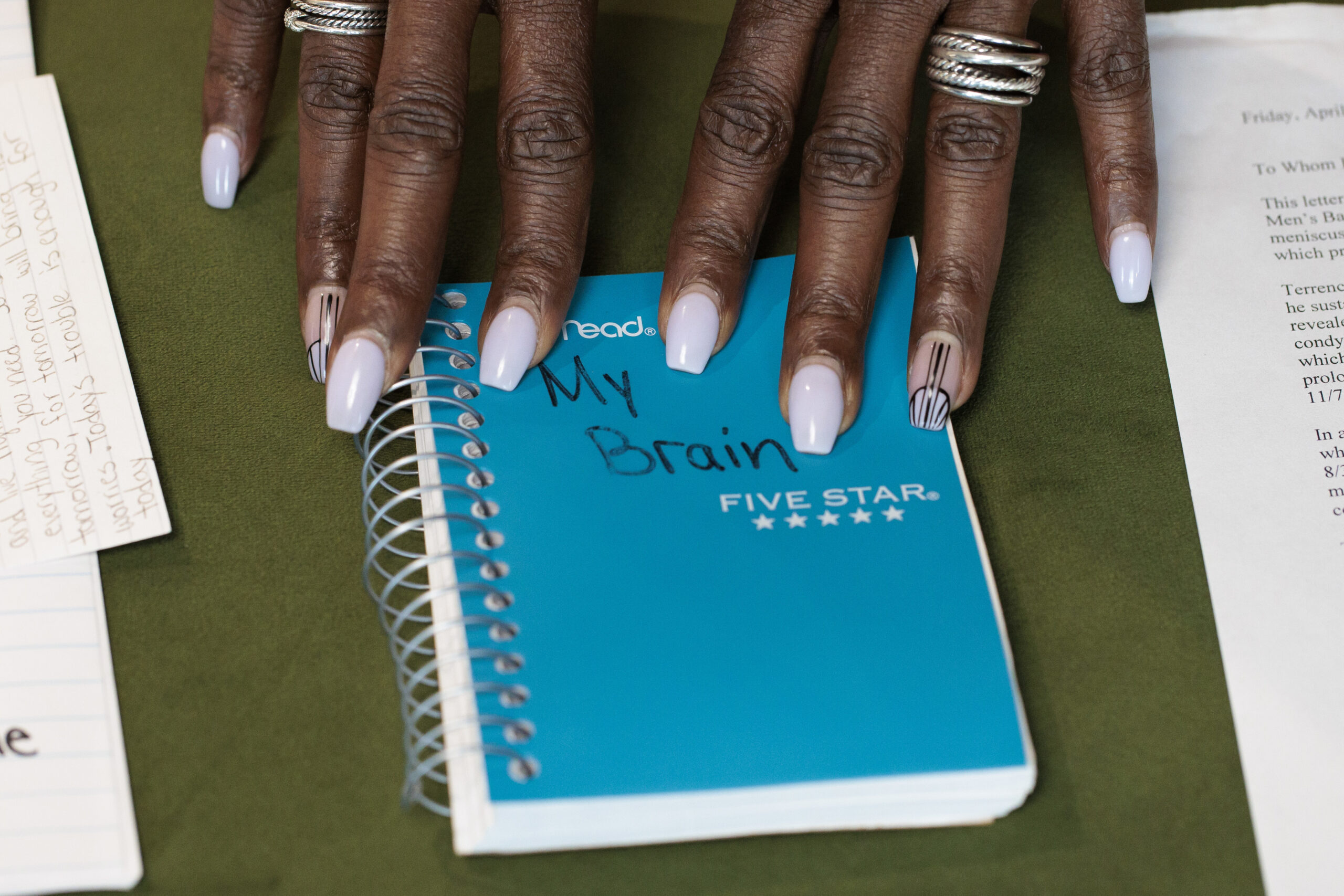
A journal that belonged to Terrence Butler at his mother’s home reads, “I’m sorry. I really tried.”Some of Terrence Butler’s notes displayed at Dena Butler’s home in Brandywine, Md.
She drove Terrence back to their house; he would stay there that night, with Tiara and her husband, Arthur Goforth, to wake up for a 6:32 train back to Philadelphia the next morning. Before he went to bed, he sat on a barstool at Tiara and Arthur’s island, the farthest seat in their kitchen from their living room. In his hands were a black-ink pen and a notebook with a sky-blue cover.
Tiara assumed that he was finishing up some schoolwork. “After I got a little closer, he slowed down with the writing,” she said. “When I was further away, he was hunched over, writing.” She didn’t think anything of it until Wednesday, Aug. 2, when she and her family were combing through Apartment 208 of The Summit at University City, Terrence’s apartment, desperate for any clue that might tell them why he had shot himself.
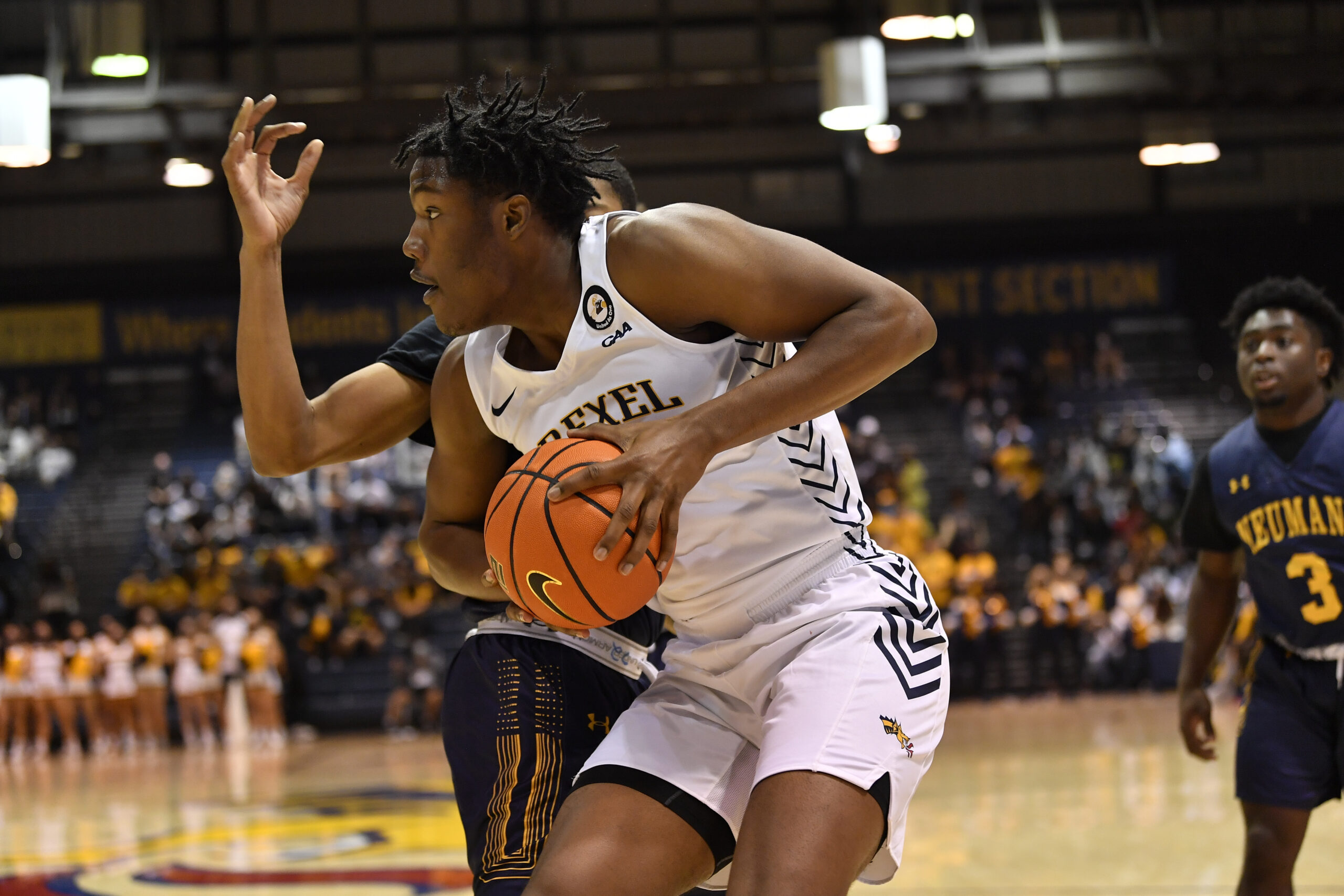
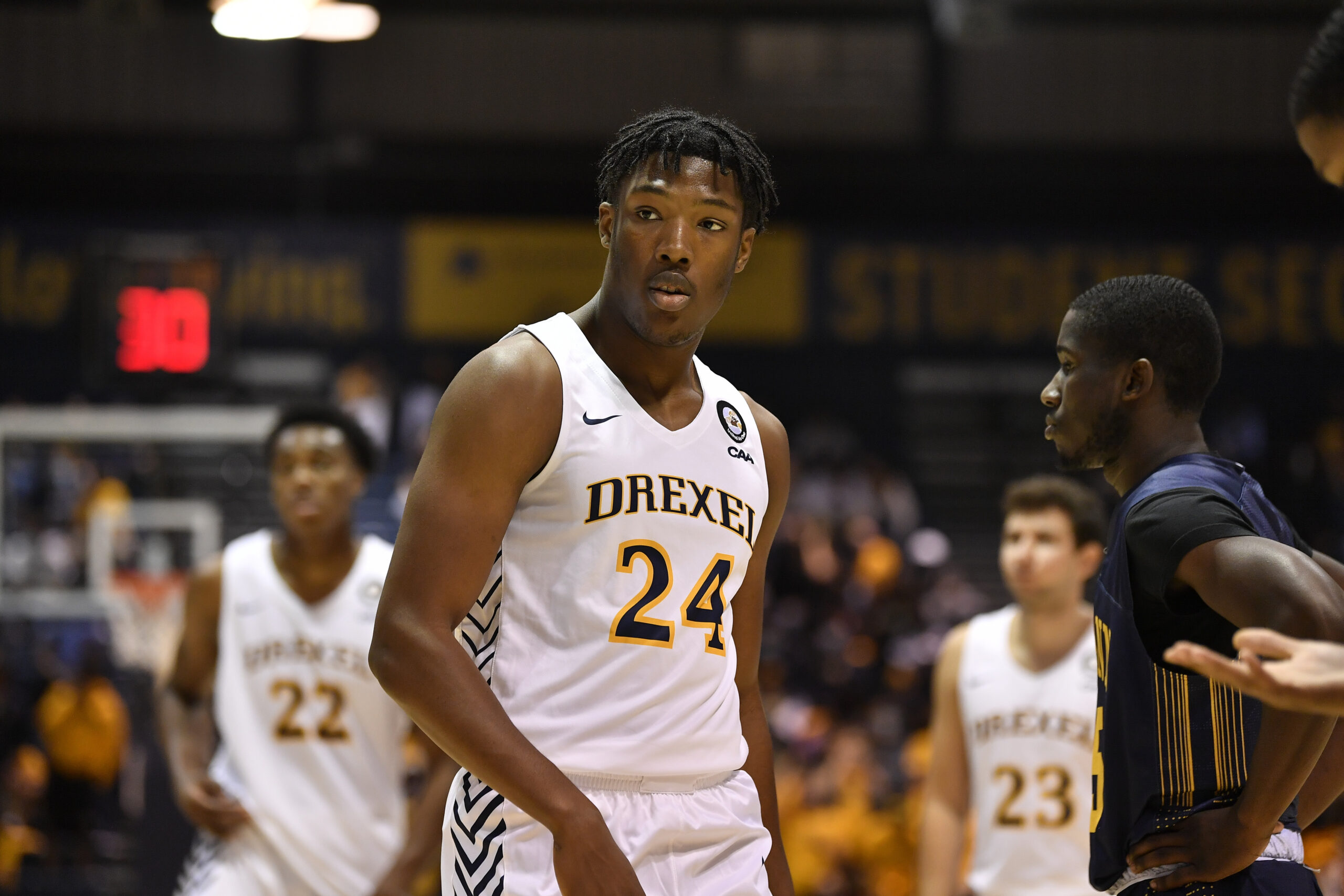
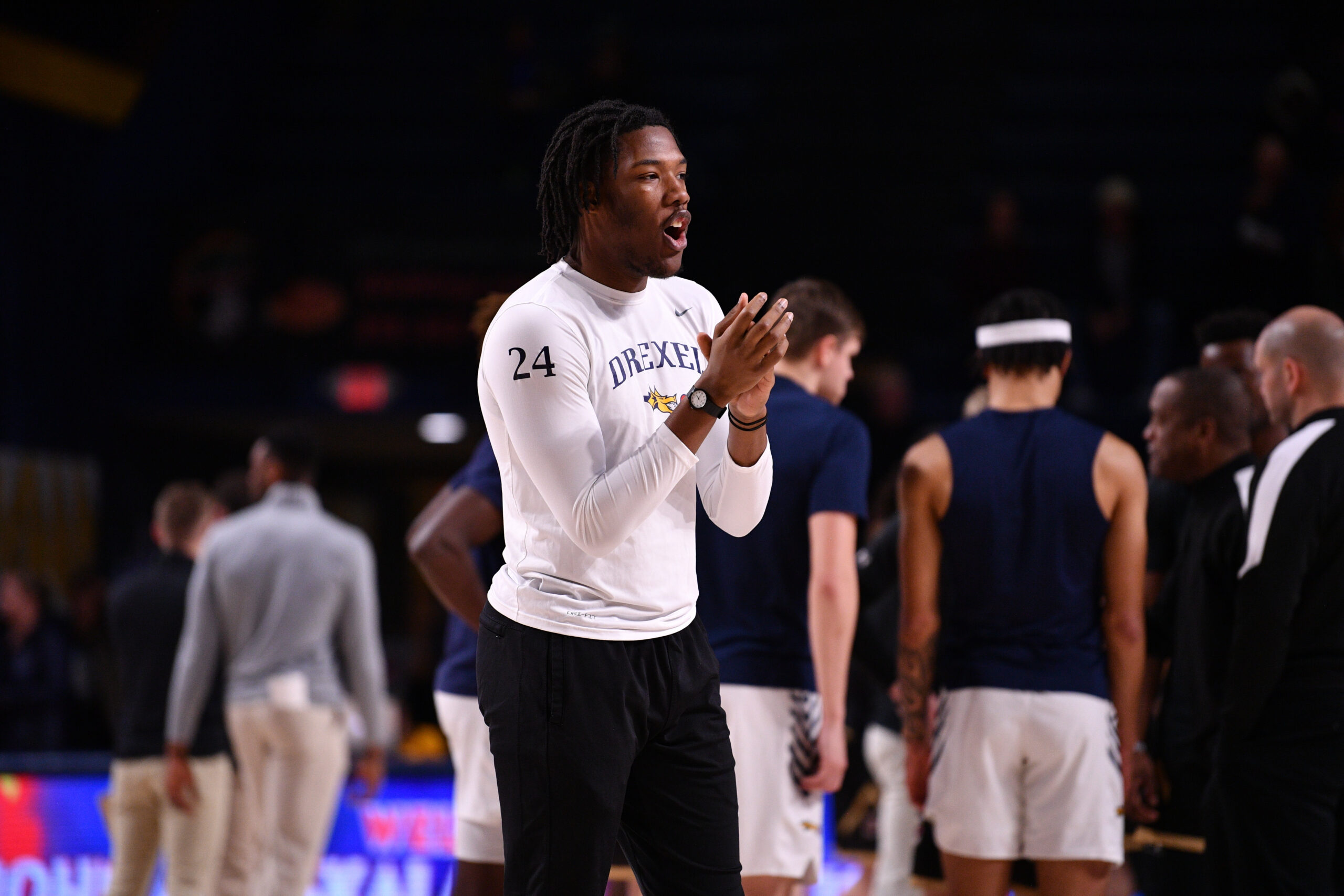
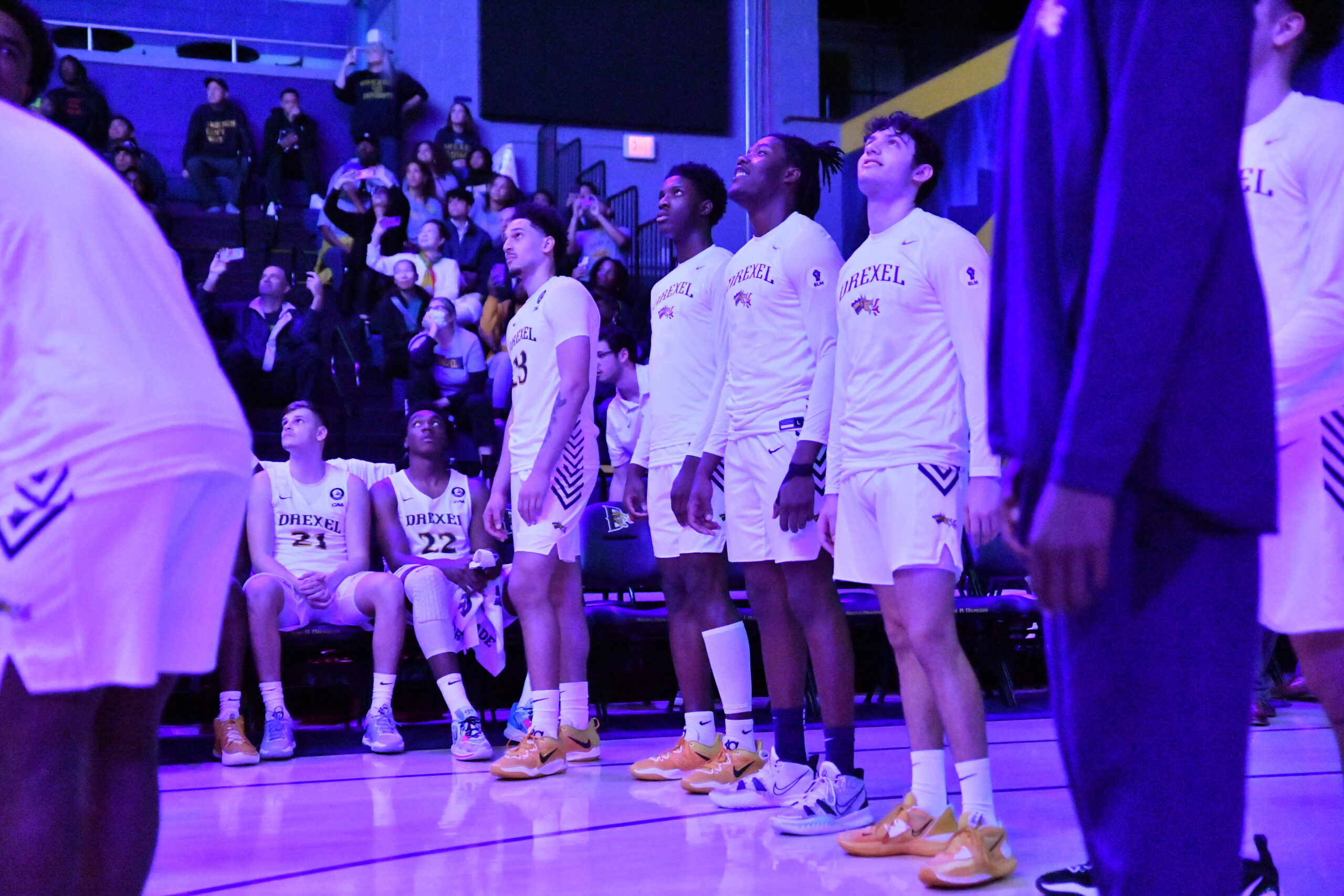
Terrence Butler appeared in just eight games for the Drexel men’s basketball team over his two years at the university.
The story of a young life
Twelve photographs on a wall in Zach Spiker’s office at Drexel tell the story of his decade as the university’s men’s basketball coach. There was Matey Juric, the 5-11 backup guard who was an “empty-chair kid” when Spiker recruited him: “I went to watch him play, and there were four chairs for college coaches, and they were all empty.” He’s in medical school now. There were team photos from the Dragons’ recent trips to Australia and Italy, from their celebration of their 2021 Colonial Athletic Conference Tournament championship. And there — in the picture from Italy, blending in among his friends and teammates — was Terrence Butler. It’s the only photo on the wall that Spiker took himself.
“It’s there for a reason,” he said, “and it will be as long as I’m here.”
Terrence Butler’s college basketball career comprised just eight games over two seasons at Drexel. His death at age 21, on Aug. 2, 2023, was at once core-shaking to those who knew and cared for him and, after a few days, just another speck of troubling news during troubling times to those who did not. It marked one of the rare occasions in which someone, especially someone so young, had died by suicide and the manner of death was immediately acknowledged and publicly revealed.
Terrence Butler spent two seasons with the Drexel Dragons from 2021 to 2023.
Within 48 hours of the discovery of Terrence’s body, the Philadelphia Department of Public Health confirmed to media outlets that he had killed himself, for there was no way to euphemize it and no point in trying. The cold and clinical language of the medical report — that a “normally developed, well nourished … black man whose appearance is consistent with the reported age of 21 years” had died — left no space for doubt.
The reasons that Terrence had died … they were a different matter. They would remain shrouded in grief and incomprehension, in blindness born of love and admiration and disbelief that he was capable of such an act — in an innocent unwillingness or inability to see.
Like all those who die at their own hands, he was locked in battle with himself. It was a struggle whose scope and depth he alone knew, and only by tugging a thread of the tapestry of circumstances and events and achievements that were sewn together to form his too-brief life can anyone even attempt to make sense of its ending.
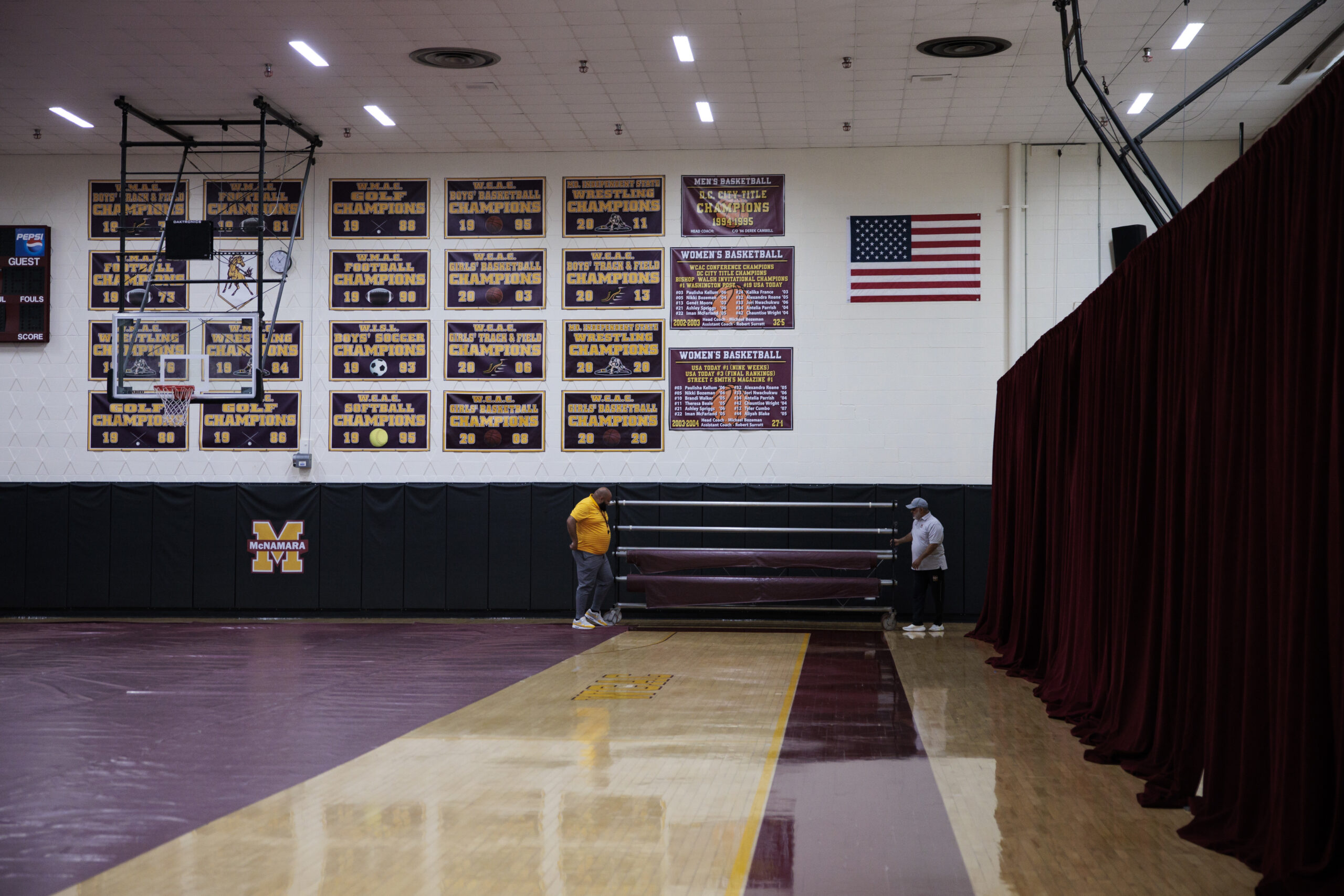
The gym at Bishop McNamara High School in Forestville, Md.
Why would anyone want to see the signs, after all? And who would have been capable of seeing them? Spiker couldn’t spot them on the day he met Terrence. No coach could. It was a camp at Drexel, just one stop on a tour of colleges and universities and programs for Terrence, and there he was, in the summer after his sophomore year at Bishop McNamara High School in Forestville, Md., grabbing a rebound in one pickup game inside the Daskalakis Athletic Center, scanning the court to throw an outlet pass, seeing no one open, pulling the ball down and dribbling the length of the floor to throw down a dunk himself. Spiker offered him a scholarship then and there. Take your tour. See those schools. Go through your process. Just remember: You have a home here at Drexel.
“We loved the skill set,” Spiker said. “We loved his motor, his size, typical basketball things. He was big. He was strong. He was respectful, a super-engaging, super-likable, smiling guy. Man, TB, he was a very impressive young man.”
Terrence’s parents, Tink and Dena, had charted a particular course for him and his sisters to try to prepare them for the demands and rewards of the pursuit. Tink saw sports as the children’s primary path. Growing up near Washington, D.C., he had boxed in the AAU and Golden Gloves programs before entering the Army, which promptly sent him to Colorado Springs to train to make the 1988 U.S. Olympic team as a light heavyweight.
“Was doing well,” he said. “Winning all my fights.”
Except he dislocated his left shoulder. No one knew; he popped it back in and hid the injury from the coaches, for a while. He started fighting southpaw, throwing all his real punches with his right hand, faking haymakers with his left … except the shoulder popped out again, and he couldn’t hide it any longer, and he had to have surgery, and his Olympic dream vanished. “I don’t know how far I could have gone,” he said one day in his living room. “I probably would have won a gold medal.”
Dysfunction framed Dena’s early life. She was 2 when her parents split up, both of them alcoholics, her mother moving from Memphis to the D.C. region to escape Dena’s father. Tall for her age, Dena began driving when she was 10 and working when she was 14, putting the money she earned from fast food restaurant and retail jobs toward rent.
“I didn’t sleep as a child,” she said. “I never slept. I just couldn’t. There was always something happening, and I just decided not to live like that when I had kids. I didn’t want that for them. These can be cycles if you’re not intentional and deliberate about your choices. Your choices affect your kids. Every choice my parents made affected me.”
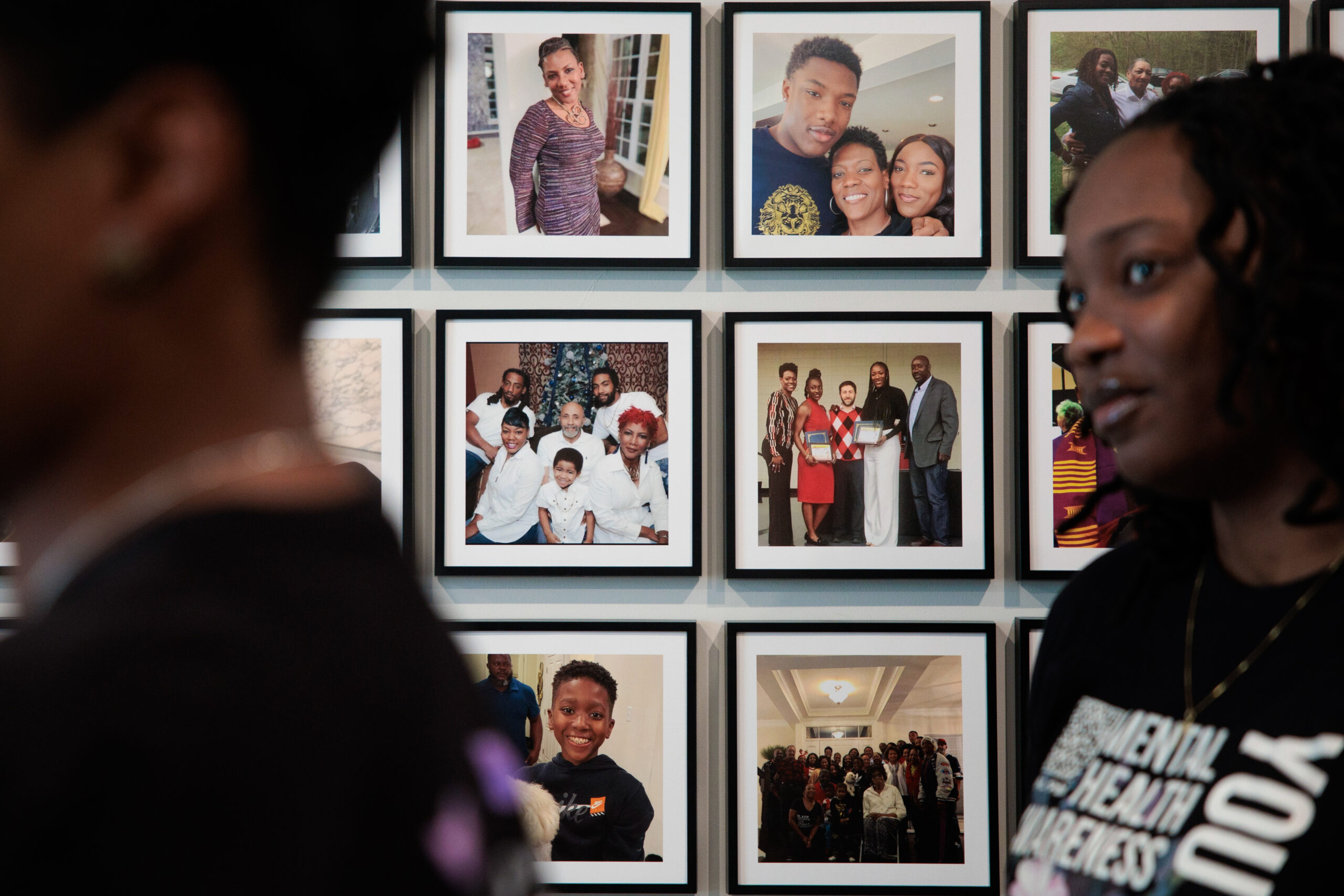
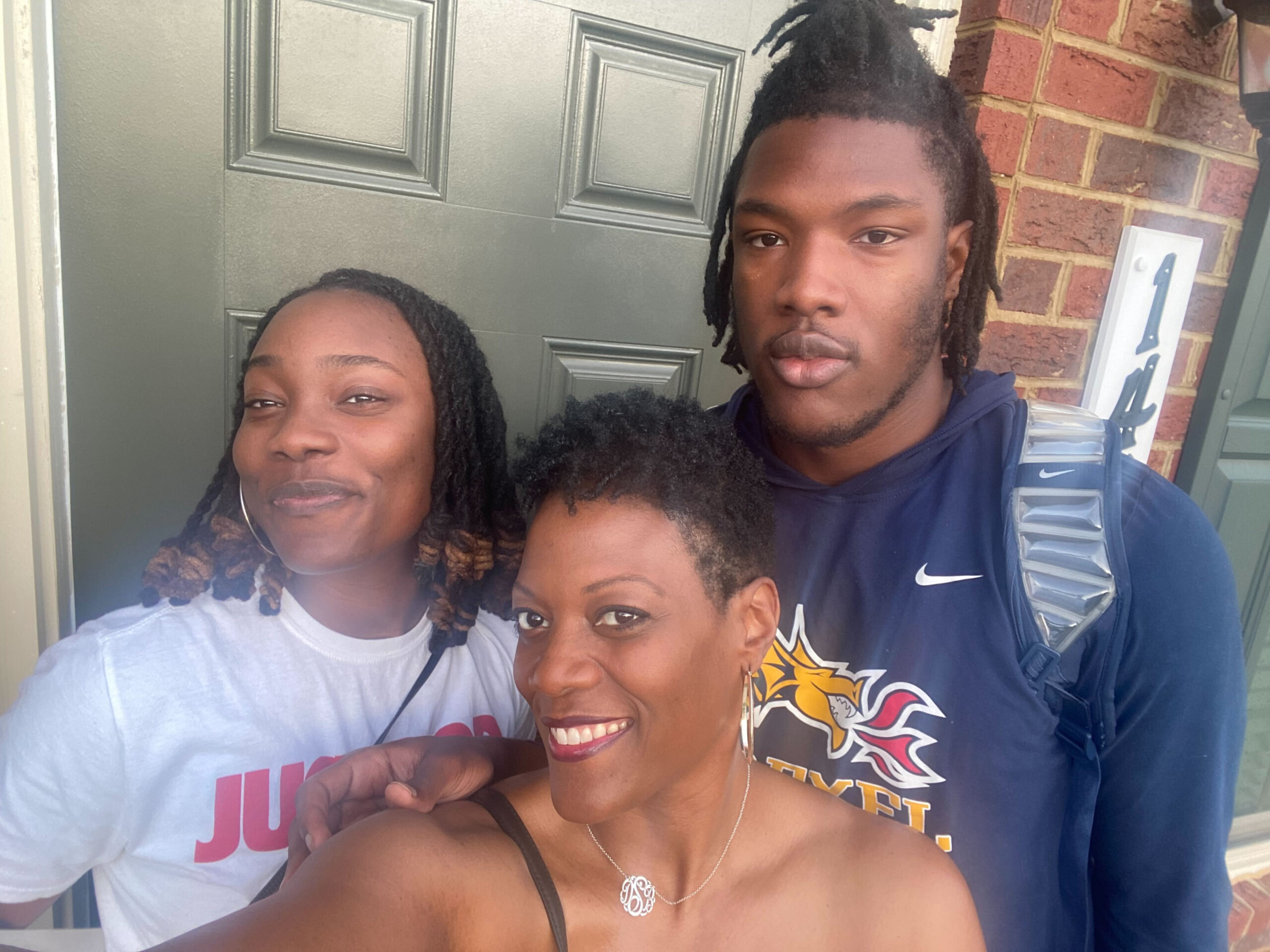
Tasia (left), Dena, and Tiara Butler pose for a portrait in front of their family wall at Dena’s home in Brandywine, Md.
Once Dena and Tink met and got married and started their family, as he moved from one solid job to another — from a power-company technician to a crane operator to a D.C. government supervisor — and she settled in as a resources analyst for NASA, they established a certain culture, with certain norms and standards, for their children. There would be a consuming emphasis on academics and athletics and, more importantly to Dena, a balance of those two foci.
Tiara was born in 1992, and a second daughter, Tasia, arrived three years later, and the sisters grew up hearing the same daily phrases from Dena: TV will kill your brain. … Go look it up in the dictionary. … Smart people ask questions. … “But the biggest philosophy we learned,” Tasia said, “was ‘Work first so you can play later.’”
Dena Butler with her daughters, Tasia (left) and Tiara (right).
The playing came naturally to all of them. The only driving Tiara did when she was 10 was when she had a basketball in her hands and an open road to the hoop. She got her first Division I scholarship offer when she was 14, then picked Syracuse. Tasia preferred dancing — hip-hop, ballet, tap, jazz — to dribbling, but she followed Tiara to Syracuse on a full ride for basketball before transferring to James Madison.
The understanding that sports could be a vessel shepherding the two of them to college, to a terrific education, to stability and success in their lives was doctrinal among mother, father, and daughters. Family time morphed into basketball time, and basketball time morphed into vacation time, and there was less vacation time as life went on.
Tink, in fact, spent so many mornings and afternoons and nights in gymnasiums and arenas with Tiara and Tasia, became so familiar a presence at AAU tournaments and all-star camps, chatted with so many coaches and recruiters and shared so many tidbits and observations about players that he parlayed his daughters’ careers into a new profession. Into a scouting service. Into a subscription-based website: prepgirlshoops.com. Into more than $100,000 in annual revenue. After Terrence was born in 2002, he was a fixture in those gyms and near those courts just like his parents and sisters were.
“When he first started playing,” Tiara said, “he would run up and down the court, saying, ‘Look at me,’ smiling and leaping. Always passed the ball. So kind to teammates and opponents. He really just wanted the snacks afterward.”
He wanted to be “T.J.,” but it never stuck. His sisters shortened the nickname they had given him when he was a baby, “Man-Man,” to just “Man.” It was all they called him. By age 10, he was playing high-level AAU ball, growing on a vegetable-free diet of chicken nuggets and french fries. Heredity was on his side. Tink was 6-3. Dena was 5-10. “I’m thinking he’s going to be 6-6 or 6-7,” Tink said, “and Michael Jordan was 6-6.”
Tink took him to one football practice when Terrence was 11, to try to toughen him up. All it took was a helmet to the stomach in his first tackling drill to get him coughing and wheezing and whining, to have him decide he hated football. Good, Tink thought, now we can concentrate fully on basketball. So Tiara and Tasia — don’t let those soft features and sad eyes, just like their brother’s, fool you — would roughhouse Terrence in their one-on-one games.
“May have gotten carried away,” Tasia said.
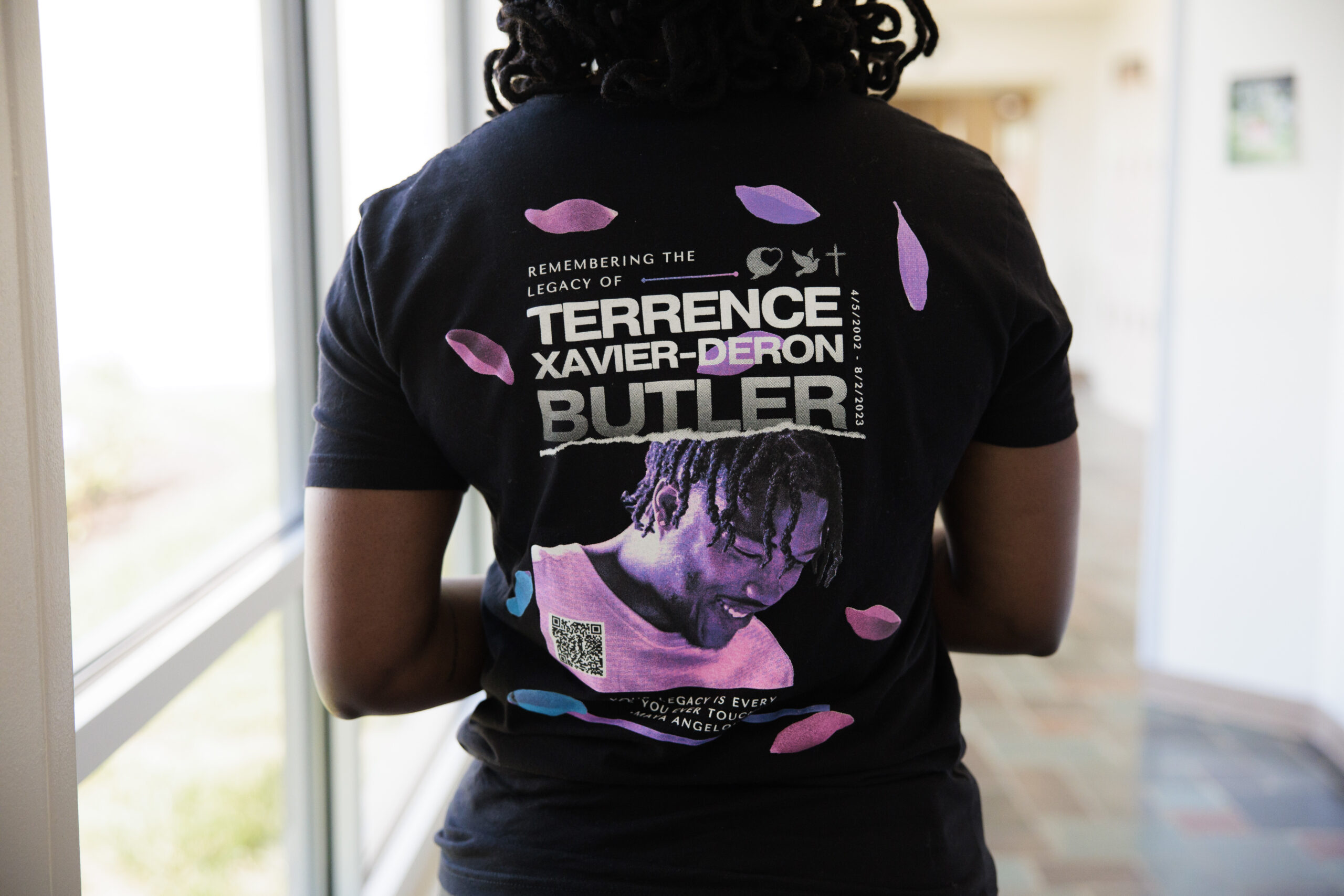
Tiara Butler, a visual arts teacher at Bishop McNamara High School, wears a T-shirt in remembrance of her brother, Terrence, at the school in Forestville, Md.
‘We were a unit’
His sisters’ recruiting visits were groundwork-layers for him, at least in his father’s eyes. When he was 9, he got pulled out of the crowd at a Towson University game for a free-throw contest. He sank 12 straight, right in front of the cheerleaders. When he was in sixth grade, the family joined Tasia for a visit to the University of Miami, and men’s coach Jim Larrañaga took one look at Terrence, at a pair of prepubescent arms already showing muscle and definition, and said, I’m giving you an offer!
He did the AAU circuit: DC Thunder, DC Premier, Team Takeover, Team Durant. Tink would bounce from Tiara’s game to Tasia’s to Terrence’s; Dena was always at Terrence’s. So he’d call her for updates.
How’s he doing?
OK … Oh, wait. He just scored.
A necklace features charms with photographs of Terrence Butler and his grandmother, Connie S. Hill, at Dena Butler’s home.
As the kids’ basketball schedules, especially Terrence’s, took up more days on the calendar, there were more dinners in restaurants, fewer at home around the table. But Tink and Dena still made time to serve in ministry at The Soul Factory, an evangelical church in Largo, Md., even serving as premarital counselors to engaged couples. “We were always on the road,” she said, “but we lived selflessly. We were a unit.”
Then, a potential setback: July 2016. The summer between his seventh- and eighth-grade years. An AAU tournament in Atlanta. He jumped, landed on someone’s foot, wrenched his right knee. A torn meniscus. Surgery. Nine months of rehabilitation.
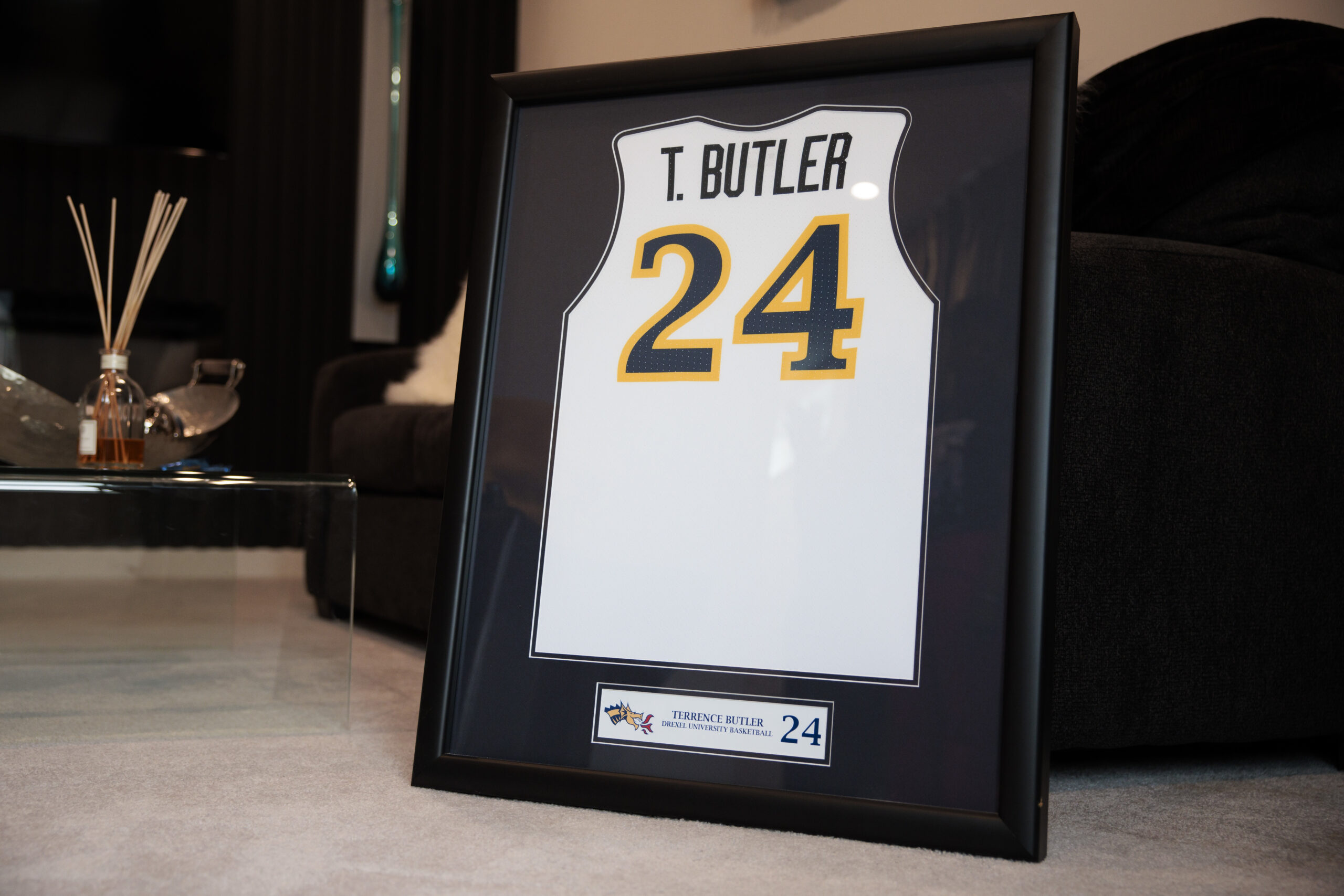
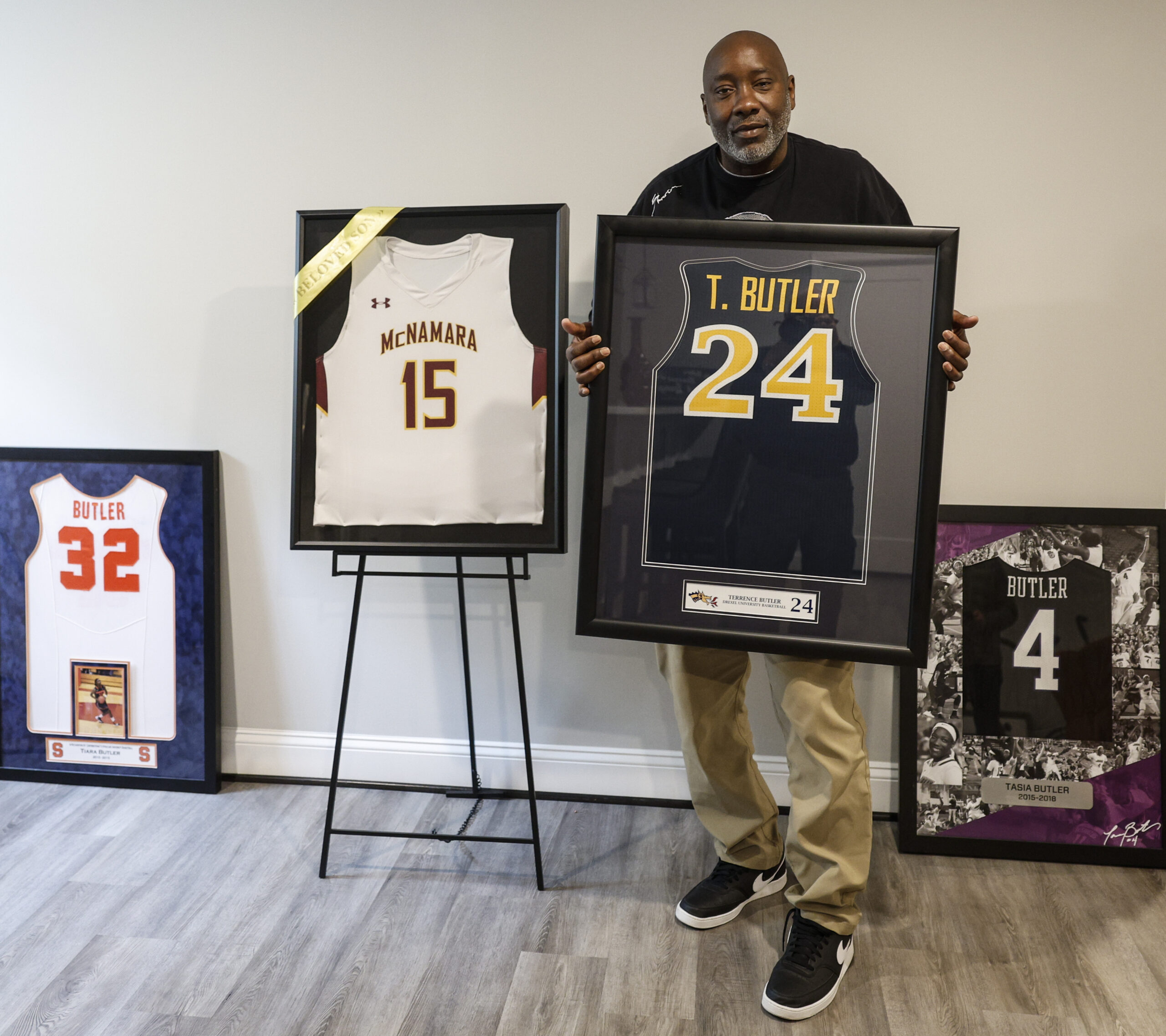
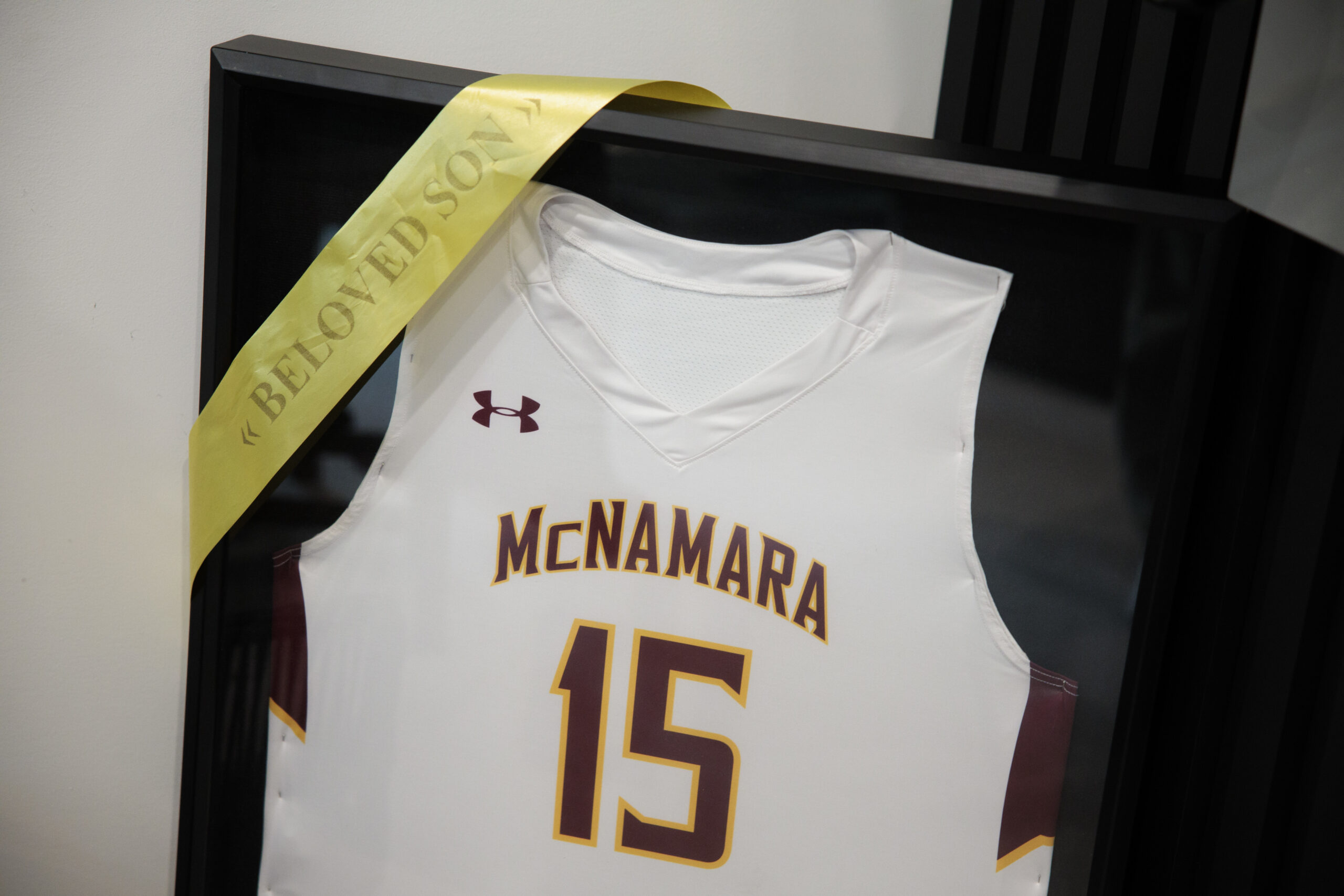
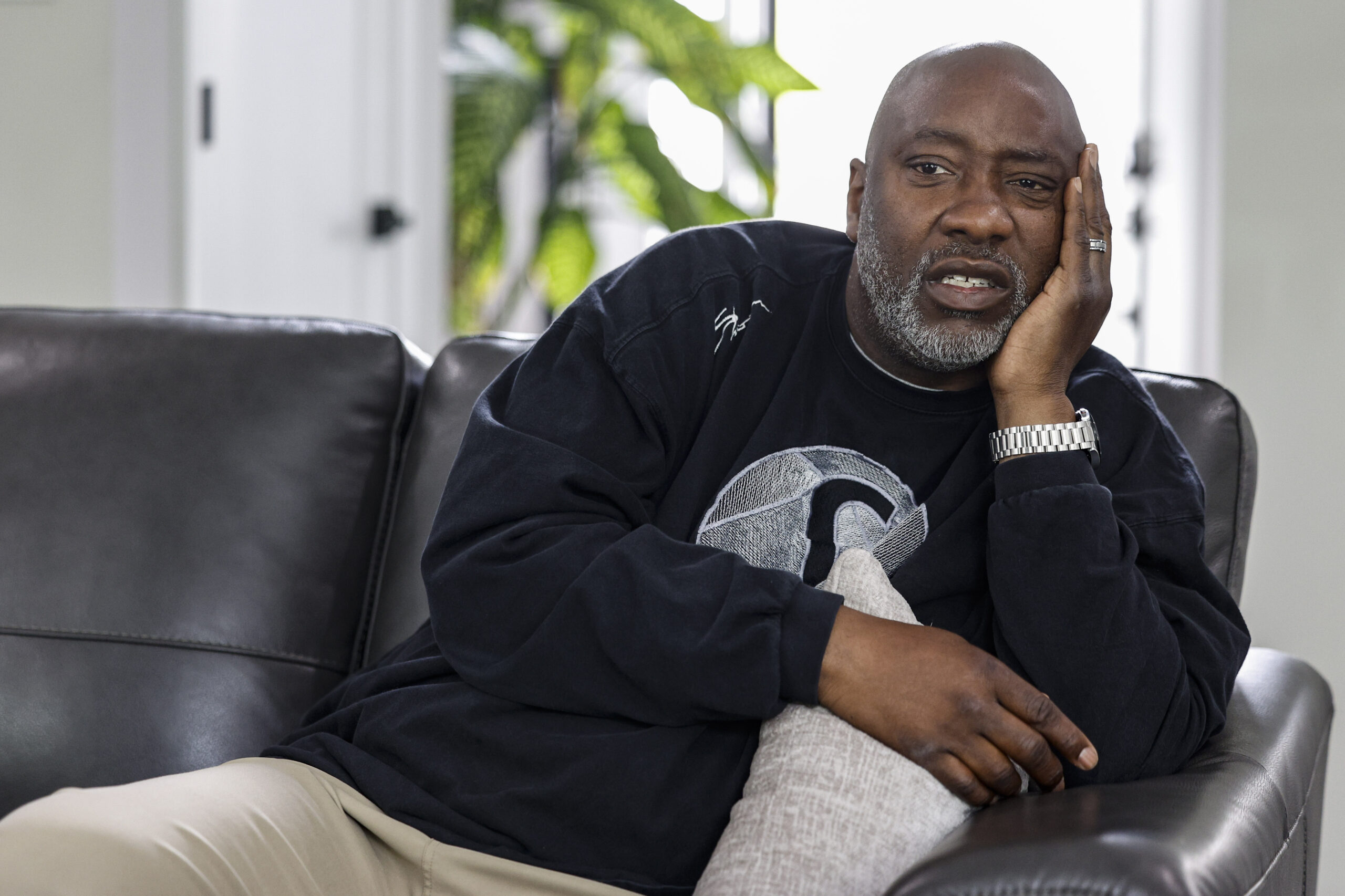
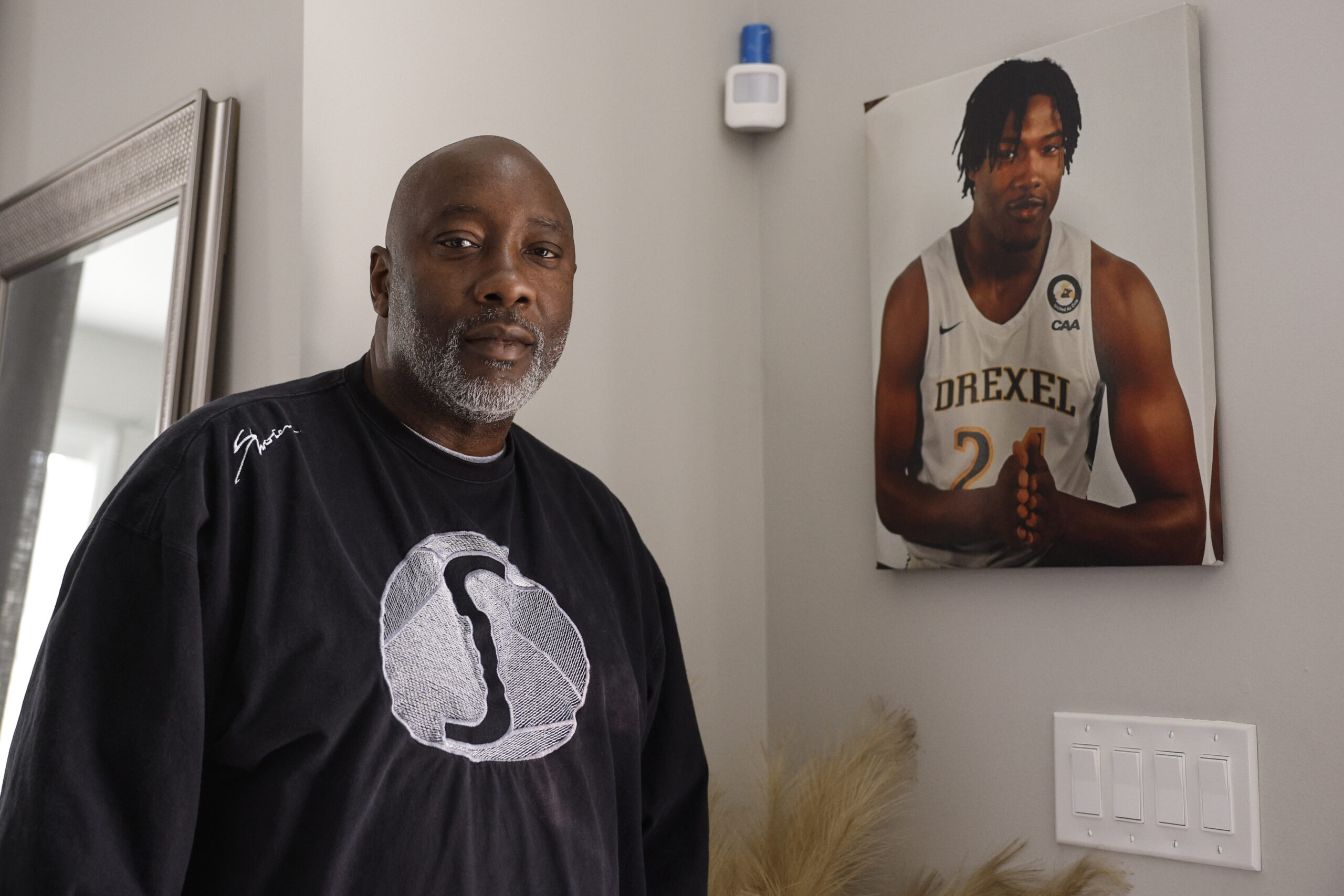
Tink Butler with framed jerseys honoring his son, Terrence, in Clinton, Md.
The big private high schools in and around D.C. had been scouting him; the injury might scare them away. No. Bishop McNamara, just a five-minute drive from the Butlers’ house, followed through with a basketball scholarship. Affiliated with the Congregation of the Holy Cross, its campus a strip of gleaming modern architecture and emerald land in Prince George’s County, with an enrollment that its admissions officers limit to roughly 900 students in grades nine through 12, McNamara is one of the most respected high schools in Maryland. Its alumni include several professional athletes, an astronaut, and Jeff Kinney — the author of Diary of a Wimpy Kid. The school fit perfectly with Dena’s plan for her children, with the idea of segueing from sports to a career or vocation beyond sports.
In his first year at McNamara, Terrence was the only freshman to play varsity basketball. The following year, the school hired a new head coach, Keith Veney, who immediately made Terrence the centerpiece of the team. He called Terrence “T-Butts” and would push him to shoot more frequently, questioning him every time he passed the ball and ending up half-impressed and half-exasperated at the answer Terrence always gave: Because the guy was open, Coach.
Still, Terrence had the ball in his hands often enough to be named the Mustangs’ most valuable player as a sophomore. “He would pass up those shots on purpose,” Tink said, “so that it wouldn’t be about him. He liked the accolades, but he didn’t want the attention.”
What did he want? It was hard to know sometimes. From the time Terrence began playing, Tink would give him a dollar for every rebound he grabbed in a game. One day, he opened up Terrence’s bank and found $1,200. Other than the occasional game of Fortnite, the kid didn’t buy anything for himself, didn’t crave the trendy clothes or the coolest sneakers. “He was the banker,” Tasia said. “We’d ask him, ‘You have change for a $50?’”
He embraced McNamara’s dress code: shirt, tie, hair cropped close. At home, he’d sit down and read the Bible, watch CNN, make an offhand joke whenever Dena would wonder how he had done on a school assignment. Got an A. Could’ve gotten an A+ if I tried. He had one girlfriend in high school, but Tink was pretty sure that Terrence hadn’t done much more with her than carry her books to class and sit with her on a stoop. “Waiting for marriage,” Tink said.
Terrence towered over the student body yet managed to keep himself on his peers’ level. “He was just a cool guy,” said Herman Gloster, McNamara’s dean of students. “You would see him before he’d see you. He was a kid who you could feel coming down the hallway — tall, always smiling. It was like a light force was behind him. Very respectful. Never had a detention. Just a great spirit. If you didn’t like Terrence Butler, something was wrong with you.”
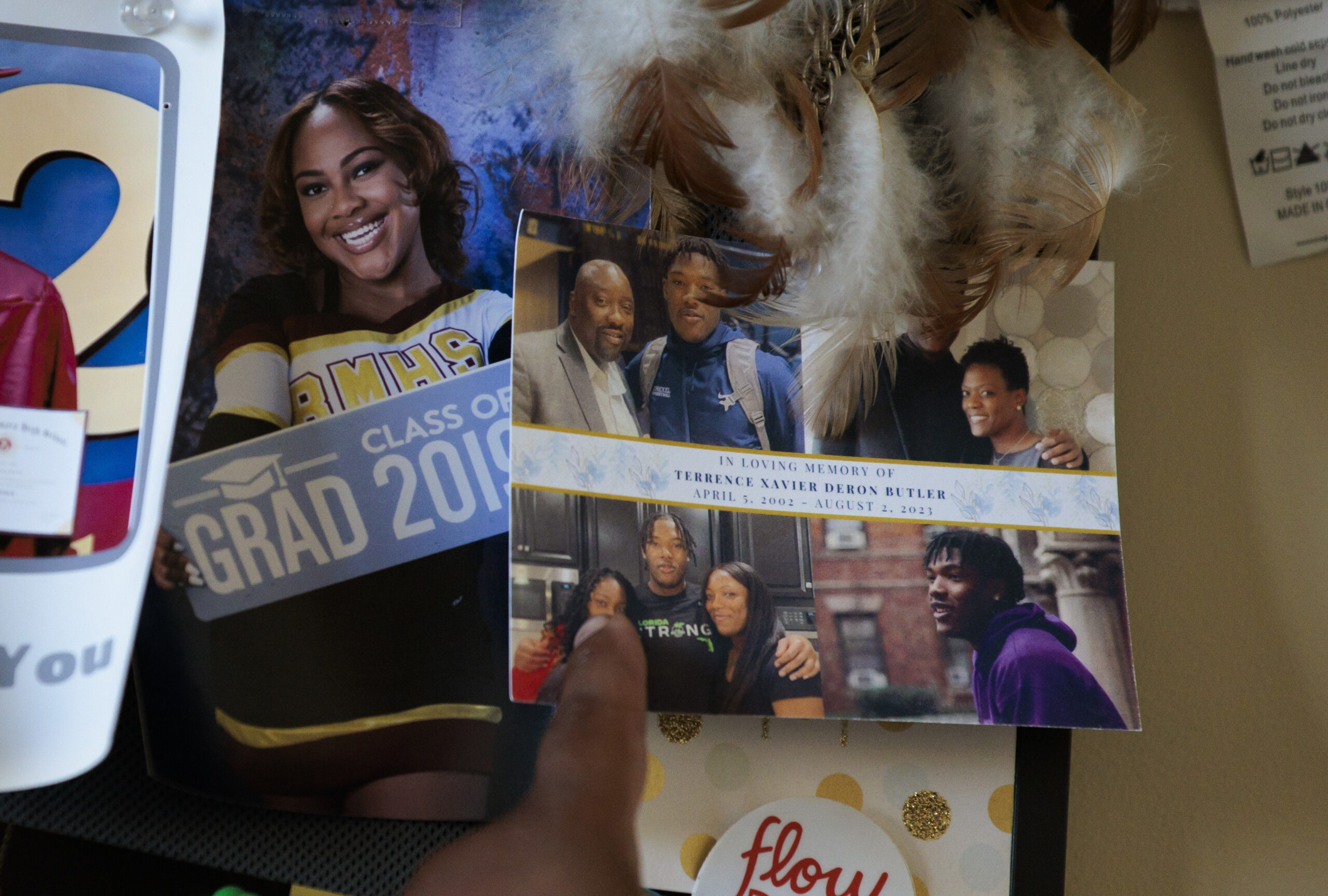
A memorial card for Terrence Butler hangs on the wall in dean of students Herman Gloster’s office at Bishop McNamara High School in Forestville, Md.
When McNamara shut down its building for the COVID-19 pandemic in March 2020, it kept its doors closed and its students learning virtually for 12 months, from the middle of Terrence’s junior year to the middle of his senior year. The administration created “The Mustang Mix,” clusters of faculty and students who would gather on Zoom calls to stay connected with one another.
“A lot of people were complaining that seniors weren’t coming to the mixes,” said Dian Carter, McNamara’s principal. “Terrence came every day faithfully. He was always on camera, making breakfast, frying eggs.”
Once the school reopened, it did so partially. Students returned on a staggered schedule based on where their last names fell alphabetically. Plexiglas dividers separated them at each cafeteria lunch table. The entire building was cleaned every Wednesday. “It was the craziest thing,” Carter said, and she could sense Terrence’s hunger to be around and engage face-to-face with his friends and classmates again. Ms. Carter, he’d ask her, can’t we come here every day?
Terrence Butler was troubled by knee injuries throughout his time at Drexel.
Injury problems
The court was hardly a refuge for him. Throughout the first month of the lockdown, he and Tink searched for places where he could play and train. They found one guy who had a small private gym and was willing to open it. On a Sunday, Terrence was going full-court against some eighth and ninth graders, players younger and less skilled than he was, and one of them bumped into Terrence, and that brief contact was all it took. No, my knee! An MRI test confirmed it: He had retorn his right meniscus.
Another surgery, this one in April 2020. Another nine months without basketball. OK, Terrence could still be a McDonald’s All American nominee his senior year at McNamara … and was. Terrence could still be ready for the start of his freshman season at Drexel, and Spiker had remained loyal to him, had been the first coach to offer him a scholarship and had never rescinded it, had shown that he was authentic and real and that his word meant something. Terrence could still stand there inside the DAC in June 2021, alongside Drexel’s other incoming recruits, for a private ceremony honoring the Dragons’ conference-tournament title three months earlier, and he could hear Spiker say, I know you guys didn’t play in these games, but you’re part of this program. I’m super-excited you’re here to see this, and this is the standard we’re shooting for. Terrence could …
… no, maybe he couldn’t. During a workout just weeks after the ceremony, he tore his left meniscus — not as severe as his previous injuries, just a two-to-four-month rehab this time, but … Lord, three knee operations, and he hadn’t suited up for a single official practice for Spiker yet.
Terrence Butler cheering on his Drexel teammates during his time on the sideline.
Rough as that misfortune was, Dena trusted that her son could handle it. “It was almost like he was always doing a self-examination to see if something resonated with him,” she said. “He had a mentality of ‘I could take it or leave it. I’m good wherever I am. If I choose to go to school, I can do that. If I choose to play ball, I can do that. If I choose to write novels, I can do that.’ He was never a person you could put in some type of box. He was completely different. You could not read him in that manner. He was like, ‘Wherever God leads me.’ He would just be in that moment. If he’s playing ball, he’s going to give you ball. If he’s in school, he’s going to give you school.”
These were more than a proud mother’s words. Terrence wrote biblical verses in pencil on index cards and carried the cards with him. Galatians 5:16: So I say, let the Holy Spirit guide your lives. Then you won’t be doing what your sinful nature craves. There was no preaching or proselytizing, just the self-assurance of a person who appeared fully comfortable with himself. Is there a more appealing quality in a human being? It didn’t take him long to become one of the most popular figures on campus. He majored in engineering, joined Drexel’s chapter of the Fellowship of Christian Athletes, and had the time and the opportunities to move within the university’s varied worlds.
Spiker would stop in at a coffee shop to grab a drink, and a student would recognize him and say, Coach, I know Terrence Butler. He’s one of the nicest guys I’ve ever met. So Spiker would take a selfie with the student and text it to Terrence, and Terrence would respond, One fan at a time, Coach. One day, the two of them strolled across campus, and Spiker felt like he was with a celebrity.
“It was two girls from the lacrosse team: ‘Hey, TB,’” he said. “It was two girls from the dance team. It was two guys from FCA. A lot of people identified with him. He knew as many people as the rest of our team combined. This dude was very outgoing and had a big reach.”
Imagine if he had been playing any meaningful minutes for the Dragons. Imagine what his reach would have been then. He’d set the coaches’ grease board in his lap, pick up a marker, and design plays for his teammates. He’d call his brother-in-law, Arthur, who was a personal trainer, and press him for insights and advice: What can I do to be the best athlete I can be, to strengthen my body so I won’t get injured again? Push-ups, sit-ups, stretching — he devised his own exercise routines.
Luke House, one of Terrence’s teammates and roommates, would join him for long weightlifting sessions that they’d pause only when Terrence set his face in “The Look,” House once wrote, which meant “it was time to tuck our shirts in because the weights were getting heavy.”
After one victory over Towson, after Terrence had spent two days of practice dragging his damaged leg up and down the floor, refusing to sit out, insisting on suiting up for the Dragons’ scout team, Spiker turned to one of his assistant coaches and said, I don’t think we win that game if TB doesn’t give us all he had. He was doing his best to contribute, to get back on the court. Everyone could see that.
Then in January 2022 he was running during a pickup game and felt his right knee pop and found out that he had torn that damned right meniscus for a third time.
Terrence Butler’s Bishop McNamara High School basketball jersey is framed at his mother’s home.
The doctors and trainers recommended that he not play anymore. Tink called him. Did he want to transfer? Tink had been working the phones, talking to coaches in other programs. No, Terrence wanted to stay. Spiker and Drexel put him on a medical hardship scholarship. He could get his engineering degree, be part of the team in another role or capacity. I’m good, Dad, he said. I’m good.
Dena … well, it never crossed her mind that Terrence might transfer. She had attended all of his games at McNamara, and she attended every Drexel home game whether he played in any of them or not. And he would play just those eight times, never seeing the floor for more than 12 minutes in any of them, never pulling down more than five rebounds, never scoring more than two points. She attended every game even though she and Tink had been drifting from each other for a while, even though he was spending more time at work and at games — among Tiara and Tasia and Terrence and his scouting service and his tournaments and his website, where did business end and family begin? — even though they divorced in 2021.
It was raw. It was painful. It was the breakup of The Butlers — that’s how everyone knew them, spoke of them. The Butlers. They had been a unit, as Dena said, and now they weren’t.
Terrence was managing to handle it, as she trusted he would. At least he seemed to be managing. Spiker noticed nothing out of the ordinary. Still the same old TB. Still in good spirits. Still the same terrific student — he made the Colonial Athletic Association’s honor roll in 2022, the same year basketball stopped for him. In June 2023, he was taking a summer class, Introduction to Africana Studies, and earned an A on a five-page paper about the corrosive effects of American slavery. He wrote in part:
Dena Butler and Tiara Butler stand in front of the family wall.
The solution begins with education and must start at a young age. … Until we start to seek knowledge and dig up the roots of America rather than trimming branches, black people will always be disproportionately affected, with no understanding why.
A month and a half later, Terrence took that train ride down to Maryland to visit his family. Tink was hosting a party at his house on the night of Saturday, July 29, for a world welterweight championship bout between Errol Spence Jr. and Terence Crawford — 70 people, food, drinks, a television on the outside deck. Terrence declined to attend, which didn’t strike anyone as unusual. People would have asked him about Drexel and basketball, would have made a fuss over him, and he wouldn’t have wanted to be an object of attention at such a large gathering. He preferred a quiet night at his sister’s house. Arthur offered to cut his hair.
Just before Terrence and Tiara left Dena’s house, the three of them gathered on the front stoop to snap a photo of themselves in the summertime’s evening light. But as he stepped outside, Terrence paused. Hold on, he said. I forgot something. He went back inside, reemerging after a few moments. The picture, in hindsight, is telling. Dena is in the middle. She smiles wide, her teeth sparkling white. Tiara, on the left, has a knowing, closed-mouth grin. Terrence towers above them. His face is stone.
Tiara (left) with mom Dena and Terrence Butler.
He texted Dena at 9:19 a.m. Sunday to let her know that he had arrived safely. But on Wednesday, Aug. 2 — a cerulean, temperate, just perfect Aug. 2 in Philadelphia — Terrence missed a team breakfast. He was tracing a different academic arc from most of the other players, taking a full schedule of summer classes, on track to graduate in a year, while his teammates were taking a course or two. So Spiker chalked up his absence to his study habits, and it wasn’t until the guys started to murmur that they hadn’t seen him in a few days that Spiker began to wonder and worry.
He called and texted Terrence immediately. No response. He called Dena, who told him that she hadn’t heard from Terrence since he got back to Drexel. He called campus security and requested a wellness check and stayed on the phone while the officers unlocked and opened the door to Terrence’s bedroom and discovered that something horrible had happened.
When her phone buzzed and a police detective told her that her son was dead, Dena managed to ask, How? She listened to the answer, then ran upstairs. After she and Tink had divorced, she knew that she would be living alone, in a new house, in an unfamiliar neighborhood. So she had purchased a black .357 revolver for self-defense. All three of her children knew exactly where she kept the gun: out of sight, on the floor, under the headboard of her bed. She looked there. It was gone.
Photos of Terrence Butler on display at Dena Butler’s home in Brandywine, Md.
A terrible conundrum
At Terrence’s funeral, inside Zion Church in Greenbelt, Md., Tink and Dena stood side by side behind a lectern, holding hands, eulogizing their son. “I thank God for loaning him to us for 21 years,” Tink said during his short speech. Dian Carter, McNamara’s principal, had been on vacation, sunning herself on a beach near Houston, when she heard the news of Terrence’s death. No, she thought, that can’t be right. Terrence must have been attacked. Suicide? Terrence? What were the signs?
Now here she was, sitting and weeping among the congregation at Zion, and she had never seen anything like Tink and Dena’s gesture, their grip, that coming together of a couple who were now separate. She found it comforting, but it did not answer the question that Carter was still asking herself, the question that everyone in the church had to have been asking themselves: The worst thing that can happen to a family, to a young person in the prime of life, had happened to this family, to this young man. Why?
That is the conundrum that cuts to the core not just of Terrence’s death, but of suicide in the United States. There are so many contextual factors and contradictory trends that anticipating when someone might end his or her life or reaching a definitive conclusion about why someone did is akin to grasping at vapor.
Kelly Green, a psychologist and senior researcher at the University of Pennsylvania’s Perelman School of Medicine, said in an interview that the most recent available data on suicides are from the same year that Terrence died: 2023. Medical examiners must report suicide deaths to states, and states must report them to the Centers for Disease Control, and the slow grind of that bureaucratic machinery causes an information lag.
“One of the frustrations is that we’re always a couple of years behind what’s happening now,” Green said. “We’re always playing catch-up.”
Though Green noted that suicide “is still a very low base rate event — it happens rarely” — its current has been flowing in a concerning direction. The overall national rate jumped 37% from 2000 to 2018, according to the CDC, dipped by 5% between 2018 and 2020, then peaked in 2022. It held relatively steady in 2023, when 14.2 out of every 100,000 deaths were suicides.
Terrence fell within the age range, 15-24, with the second-lowest suicide rate, which would cast his death as an awful anomaly. But the CDC has reported that, although men make up 50% of the population, they account for nearly 80% of all suicides, and among Black men, according to the American Foundation of Suicide Prevention, the rate climbed from 9.41 per 100,000 deaths in 2014 to 14.59 in 2023, which would cast Terrence’s death as one stirring of the sea in a destructive tide.
“I would go even a step further,” Derrick Gordon, an associate professor of psychiatry at the Yale School of Medicine, said in an interview. “In the Black community, the data show that, traditionally, suicide was not seen as a Black thing. The norm has been, ‘That’s a white thing.’ It’s sometimes seen as the antithesis of the Black faith tradition. ‘My faith isn’t strong enough to help me get past this thing, and it should, and it’s not working.’ Faith doesn’t reduce the burden. It adds to the burden.
“For a long time, there was this myth: ‘We don’t have to worry about Black people and suicide. They’re at low risk. They have more community or are more connected to their faith — a lot of buffers to protect them.’ Well, we’re seeing that’s not true.”
Tink Butler at his home in Clinton, Md. He remains involved in basketball.
Parents, siblings, loved ones: These would presumably be the strongest guardrails. But as Gordon noted, the factors that compel a person to attempt suicide are always unique to that person, and since even those closest to him or her often don’t pick up on any indications of deep distress, predicting or preventing a suicide is challenging at best and impossible at worst.
“Families never think of suicide as a possibility,” Gabriela Khazanov, a clinical psychologist and assistant professor at Yeshiva University in New York, said in an interview, and they can inadvertently create conditions that heighten the risk.
Terrence was one of the more than 49,000 people who died by suicide in 2023, according to the CDC … and one of the more than 55% of those who used a firearm to do it. The combination of suicidal thoughts and easy access to a gun can be lethal, in part because “it’s not that people who are suicidal want to die,” Green said. “It’s that they want to stop an intolerable situation or problem. They seek an escape,” and they are often willing to act without hesitation to relieve their pain.
A January 2009 study published by the Journal of Clinical Psychology showed that half of all suicide attempts result from less than 10 minutes of planning.
“The impulse might be quick, but the issue is, do you have means?” Gordon said. “I can think about it all I want to, but if I don’t have access to means, that’s an issue.”
Terrence Butler did have means, but it would be wrong to call his decision to use his mother’s gun impulsive. He had carried the revolver with him in his navy blue Drexel backpack on the ride from Dena’s house to Tiara and Arthur’s. He had kept it in that backpack for several hours at their home — kept it there overnight, in fact. He kept it there during the short car ride to New Carrollton Station and throughout the 1-hour, 45-minute train ride back to Philadelphia. He kept it there as he walked the three-fifths of a mile from 30th Street Station to The Summit, to a vibrant college setting in a vibrant city, and he kept it there as he opened the door to Apartment 208, to his living space with his personal effects and the memories they inspired.
It is one of the most excruciating aspects of his death: Terrence Butler had time to consider what he was going to do. He also had time to consider all the reasons, in his mind, that he had no choice but to do it.
“I thank God for loaning him to us for 21 years,” Tink Butler said during his son’s memorial service.
Signs no one could see
Inside the dimly lit auditorium of Archbishop Carroll High School in Washington, some 150 parents, coaches, teachers, and administrators gathered on a night in October 2024 and learned about Terrence Butler from the women who knew him best. The school was holding a symposium about athletes’ mental and emotional health, and Dena, Tiara, and Tasia were the first speakers. They wore black T-shirts with his picture on them. Behind a table atop a stage, Dena sat between her daughters, one arm draped over Tiara’s shoulders, one arm draped over Tasia’s. There was an empty chair next to them, for Terrence.
Three siblings. Three honor students. Three Division I basketball players. A veneer of perfection, or as close to it as a family can get. And now …
“You can have all that,” Dena said to the audience, “and your child may not want to be there.”
Tiara and Tasia did not want to be there. Over the two years since Terrence’s death, the Butlers and others have plumbed their memories and searched within themselves for hints and connections that might help them explain the inexplicable. The sisters keep returning to their own childhoods and adolescence — to Tiara’s desire to draw and paint and write and Tasia’s to dance, to Tink training them to be competitive and never treat their opponents as friends, to Dena reminding them that athletics was their conduit to college, to the pressure they felt to perform.
Before every basketball game he played, Terrence would dash to the bathroom, as if he were seasick, and his hands would sweat so much that he could barely grip the ball. He’d douse them in powder to dry them only to have it turn into paste in his palms.
At Syracuse, Tiara often couldn’t eat before games because she was so nauseous from nervousness, then would shake as she sat on the bench. And it was only after her brother had died that Tiara confessed to her family that in her instances of greatest stress she would hear noises in her head — loud, indescribable noises — that she could not quell.
“I don’t really know where it came from,” she said, “but it showed itself in my body. It showed itself in my handshake. It showed itself with me being out of breath, with my voice shaking.
“I know what that feels like, what he was feeling. You can’t really control it. If you’re not playing, there’s that daunting feeling on top of that. Am I good enough to get on the court? Part of you is like, ‘OK, I didn’t play today, so I didn’t mess up today.’ But the other part, especially when you’re away from home and you didn’t play, is that you have to explain yourself to someone who’s not there and asks, ‘Hey, what’s going on?’ You’re thinking, ‘I’m working hard, doing all that I can do. It’s someone else’s decision.’ Now you’ve got to listen to that voice, too: ‘Hey, what’s really going on?’ It’s just a tough balance, especially as a kid. Then you’re going off to be by yourself, high level, lights always on …”
Tink Butler says he remains troubled daily by his son’s death.
Guilt creeped into Tink’s thoughts. Was his children’s performance anxiety purely genetic, or had he pushed them too hard? Once, when Tiara wasn’t yet a teenager, she had moseyed after a rebound during a workout, and he chucked the ball to the opposite end of the gym and bellowed at her, “RUN!” When she came back, there were tears in her eyes and a whimper in her words. You yelled at me. He backed off some with Tasia, then backed off even more with Terrence — in his tone, but not in the time, the effort, the aspirations.
“My whole life was basically getting rebounds for him,” Tink said. “That was the plan from the time I saw I was having a son: I’m going to mold this guy into a basketball player.”
Dena second-guessed herself about how she and Tink handled their divorce. She had filtered all her parenting decisions through the lens of her own childhood, through the experience of growing up in a broken home, and she wanted to spare Tiara, Tasia, and Terrence any trauma. She and Tink had taken care never to argue in front of them, hiding the hard reality of their disintegrating marriage, opening up fully about the divorce only after Tink had remarried.
“I was playing God,” she said, “in trying to control everything so they wouldn’t see certain things.”
But the upshot was that, when the three kids finally found out their parents were splitting up, they were shocked. They never saw it coming, and Terrence was the youngest, the most impressionable, the baby of the family. In trying to protect them, had Dena failed to prepare them? Had she failed to prepare him?
“It could have handicapped them,” she said. “I’m supposed to be their training ground.”
She carried similar concerns once he went off to Drexel, and she wasn’t the only one. The pandemic had already isolated Terrence, pulling him away from his friends and his social life while he was still at McNamara, from an environment and experience that, even if the lockdowns hadn’t disrupted it, would have been its own kind of cocoon.
Dena Butler’s “Proud Momma” cups featuring the school colors and logos for her three basketball-playing children.
“Prince George’s County can give you a false sense when you leave here,” said Gloster, the McNamara dean — and a former police officer. “It’s a county of wealthy African Americans, and you don’t find many Catholic schools with so many Black students where parents are paying a tuition of $22,000. Then they get out in the real world, and it’s, ‘Maybe I’m too Black. Maybe I’m not Black enough. Maybe I didn’t realize there was a lot of racism in the world. Maybe I didn’t realize I had demons inside that hadn’t surfaced.’”
Now Terrence was living in an unfamiliar campus in an unfamiliar, more economically distressed neighborhood in an unfamiliar city, and whenever Dena or Tiara or Tasia saw a news story about violence in Philadelphia, one of them would call him. Hey, don’t go outside today. Dena would warn Terrence — 6-foot-7, 235-pound, Division I athlete Terrence — not to get into a stranger’s car, and Tasia would remind him that, as a Black male college student, he “fit the description of someone who could be in trouble.”
He could be a target for a criminal or a cop, could be taken for an easy victim or presumed to be a thug, so he should get to know as many people at Drexel as possible, make sure that everyone knew his face … starting with the campus police. His popularity was based on his personality, yes, but also on self-preservation.
Near the end of his freshman year, he confessed to Arthur that he was contemplating giving up basketball after college, even during college. He had realized that the sport at these levels was a business, and he wanted to enjoy the game, not have it be his job.
He had considered transferring from Drexel when Tink pitched him the idea, but no, he told his family — and himself — that being around the team, contributing to it whenever and however he could, and graduating with his engineering degree would satisfy him.
Drexel basketball player Terrence Butler (left) and his father, Tink, on artwork at his home in Clinton, Md.
Besides, what guarantee would there be that he wouldn’t be trapped in limbo in another program just like he was at Drexel? Would transferring allow him to say goodbye to all the rehab and the ice packs and those platelet-rich-plasma injections, all those needles to his knees to stem the swelling and stoke some healing, and become the player he might have been? Would anything be different anywhere else?
But maybe he needed basketball more than he let on, more than even he understood or acknowledged. His faith calmed him only so much. Those biblical excerpts weren’t the only index cards he kept on his person at all times. He had others that were daily reaffirmations, prompts to remember that he mattered: I AM Valuable. I AM A Masterpiece. Even the white throw pillow on his bed, with a single word stitched across it, seemed to carry a double meaning. Whether asleep or awake, Terrence should RELAX.
He couldn’t. He asked Tiara to put him in touch with a therapist. She did, paying for his sessions. How much progress he was making, only he knew. He sought the counsel of Jordan Lozzi, the director of the Fellowship of Christian Athletes at Drexel and at Penn. On Nov. 28, 2022, Terrence sent a text message to Dena.
I do think I have a lot of unchecked thoughts. There are times where I know the truth but I try to solve everything on my own without guidance. I’ve been taking some baby steps here and there but I feel like I’m moving in slow [motion].
On March 10, 2023, he texted Dena again, confirming what he had earlier said to Arthur about his future, or lack of one, in basketball.
To be honest, it does not necessarily bother me that I’m not playing because I don’t have a passion to continue playing basketball after college. I’m still in the process of learning that my identity and worth [do] not come from basketball.
Later, another message to his mother:
I’ve always had this idea in my head that I needed to be perfect, and whenever I miss the mark or mess up in any way it messes with my head. It kind of reminds me of how I would feel after most games I played growing up. It’s difficult for me to focus on the good that comes out of situations. I may recognize it but the overwhelming negativity clouds the positive.
Dena responded at length.
I appreciate your honesty and transparency. You are not in denial about where you are which gives the Holy Spirit something to work with. Here is something that should support you in dealing with the spirit of perfectionism.
Possible things you’ll need to accept: that you’ll never be perfect and neither will your projects, but since life is about God — not perfect projects — this isn’t really a big deal.
Possible things you’ll need to confess: that you’re making something more important than God wants you to make it, that you’re seeing yourself through the culture’s eyes rather than God’s eyes, that you’re hurting others in your quest for perfection, and that you don’t have time to do the things God wants you to do because you’re too busy trying to be perfect.
She suggested that he consult the Gospel of Matthew, to remind himself that God would comfort him. Then she concluded her text:
Your goal is to please God. He is your source and once you understand that and align with His trust and what He says about you, He will cause the people to follow His plan for your life.
Dena Butler at her home in Brandywine, Md.
She keeps screenshots of these messages on her phone. They provide her no solace, no consolation, and no explanation. In November 2024, she contacted Lozzi, texting him four questions about what Terrence might have shared with him during their conversations and what actions Lozzi did take or could have taken to help him. The answers were revealing.
Terrence, Lozzi told Dena, “disclosed that he had harmed himself” sometime in April 2023, not long after he turned 21; Lozzi provided no details about how. Terrence had said it was the first time he had done anything like that.
Dena asked Lozzi if he was mandated to report any such occurrences of self-harm to a licensed therapist.
“In the college space,” Lozzi wrote, “we are mandated reporters, but I believe there is no mandated reporting for self-harm with adults. The mandated reporting in the college space is around sexual violence or relational abuse. To connect someone to suicide watch from my understanding they must be a present danger to themselves. In any of my interactions with Terrence I don’t believe there was anything that would have qualified to admit him to suicide watch.”
Lozzi was asserting that he wasn’t allowed to tell anyone that Terrence had committed harm to himself — that because Terrence was an adult, either Lozzi or a mental-health professional would have needed Terrence’s consent to disclose the incident to Dena, to another therapist, to anyone else, and Terrence had not given that consent. In his final text to Dena, Lozzi wrote that he “did propose for [Terrence] to see Drexel’s school counselors.”
When asked via email earlier this year if he would speak on the record about Terrence’s death, Lozzi responded that he had “sent your request to the appropriate person to get in touch with you right away.” He had forwarded the message to Hamilton Strategies, a public relations firm that represents the Fellowship of Christian Athletes. “Unfortunately,” an executive with the firm said in an email, “Jordan is unable to interview for your story. Thank you!” A second request for comment, sent in November to Lozzi and the executive, went unanswered.
Terrence Butler at a game with his Drexel teammates.
The struggle of hope
The why of Terrence Butler’s suicide eludes everyone who loved him. Tiara teaches art at Bishop McNamara, her brother’s alma mater, and most of her students don’t know about Terrence’s death unless she mentions him, and once she does, sometimes one of them will approach her in her classroom and say, I just wanted to give you a hug. Tink will break down over his son once or twice a day, then just continue with his office work. He still asks himself haunting questions: How much did the divorce affect Terrence? How much did the knee injuries affect him? Did he consider himself a burden to his parents, as if he owed them a debt for all the time they had spent with him and money they had spent on him — a debt that he could never repay?
After Philadelphia police had ruled Terrence’s death a suicide, Dena said, she pleaded with them to unlock his cell phone. Perhaps he had written something in his notes app. Perhaps he kept a meaningful or revelatory photo stored in it. But the police, she said, told her that they would do that only in an open investigation — a homicide, for instance, in which they were trying to find and extract evidence. Here, they already knew what had happened, even if no one else really does. The department’s public affairs office did not respond to an inquiry about how, in general, police handle such situations.
Having the service provider unlock the phone wouldn’t accomplish anything either, Dena said, because only Terrence knew the passcode; resetting the phone without the code would erase all its data. She recently had the phone disconnected. It was a bitter symbol of the absence of closure.
“What I struggle with the most to understand in all this,” she said, “is that my son was devoid of hope, that he was in such despair, and he didn’t want anybody to help him. As a mom, to know your child didn’t have hope anymore … and hope is what gets us. Hope is what propels us. Hope is the motivator for why we keep going. And to know he didn’t have that, that’s hard.”
Zach Spiker finds himself slower to anger whenever one of his players happens to be late for a team meeting, for a practice, for anything. “I just want to make sure they’re safe,” he said. “Then we talk about it.” He saw a counselor himself, just a few sessions. “I had to,” he said. “I need to figure out things. I still have questions. There are still breadcrumbs, and you want to solve the mystery.”
They hoped that they had on the day that Terrence died. That night, 11 people crowded into his apartment: Dena, Tiara, Tasia, Tink and his wife, cousins and close family friends. Everything in the place was clean. There was nothing on his bed but a bare mattress. “You would have never known,” Tiara said later.
Tasia peered into the bedroom trash can. It was empty. She noticed Terrence’s Drexel backpack next to his bed. She picked it up, brought it into the living room, plopped it on the floor, and began rifling through it. She found random items, things that one would expect to find in a college student’s backpack: Terrence’s schoolwork, his headphones. Then she found something else.
Dena Butler touches a journal that belonged to her son, Terrence.
The spiral 5×7 notebook, more than a half-inch thick from its 160 pages, was buried at the bottom of the bag. Tasia stopped. Tiara recognized the book, that sky-blue cover that she had glimpsed just four days before: It’s the same one he was writing in when he was at my house. Across the cover, Terrence had printed two words in black marker: My Brain.
This was it. This had to be it. This was Terrence’s journal, so this had to be the missing piece, the unknown explanation. Everyone in the apartment froze, went silent, then sat down. Tasia opened the book.
On the first page, on the top line, Terrence had written, I’m sorry. I really tried.
On the second page, on the top line, he had written, The noise is too loud.
On the third page, on the top line, in the top left-hand corner, he had written just one letter, just one word: I.
Tasia turned the page. And the next page. And the next. The family waited for a revelation that would never come. There were 157 pages remaining in the notebook. Terrence Butler had left all of them blank.
LANDOVER, Md. — Saquon Barkley had rushed for just 52 yards on 14 carries when he came to the sideline late in the third quarter. The Eagles had taken a 14-10 lead after a 17-play, touchdown-scoring drive, but they did so in spite of the struggles in the running game.
It’s been a season-long slog on the ground, but there have been glimpses of hope in recent weeks. And Barkley, who’s had to run into more stacked boxes than ever in his eighth year, felt that he wasn’t taking advantage of opportunities against a weakened Commanders defense.
“We got a little fired up on the sideline, but it was good,” Barkley said. “It’s all out of love, let’s say that. We want to do what’s best for the team when we’re winning games and hold each other accountable. But thank God it happened for me, to be honest, because it put me in my bag, as people would say.”
It was a 12-yard touchdown run off left tackle. The stat sheet account of the play doesn’t do Barkley’s seventh rushing score of the season justice. Jordan Mailata gave perhaps the best description.
“That was an angry run by Say,” the Eagles left tackle said. “Kind of expected that from him by the way he was acting on the sideline. He was just very adamant, being very positive, like, ‘Hey, we’re gonna get it.’”
Barkley’s touchdown wasn’t exactly the final nail. But he drove the last spike with a dazzling 48-yard run two drives later. And backup Tank Bigsby buried the Commanders with a 22-yard bolt into the end zone of the Eagles’ eventual 29-18 win at Northwest Stadium on Saturday.
Most important, the victory clinched the NFC East for a second straight year — the first time that’s happened in the division in 21 years. But in terms of the bigger picture, stacking strong performances on the ground in consecutive weeks suggests the Eagles might have a chance in the postseason.
The last two opponents — the Raiders and Commanders — might not have provided playoff-caliber competition. But the offense needed glimmers after a three-game losing streak, and really, a whole season of never looking quite right.
But diversifying the calls, and involving quarterback Jalen Hurts more in the running game, has opened the playbook some for offensive coordinator Kevin Patullo.
“O-line blocking well. Saquon running well. Jalen faking well and being a threat to carry it as well,” Eagles coach Nick Sirianni said. “Tank coming in, giving good carries. The receivers block, tight ends … Kevin’s doing a good job calling it and putting the guys in position.
“So, yeah, I think there’s a lot to be encouraged on. We’ve got to build on it.”
It may be no coincidence that the offensive improvement came after Sirianni asserted more of his authority on that side of the ball three games ago. There were bright moments in the overtime loss to the Chargers, but Hurts had five turnovers.
Actually, there were improvements in run design the week before against the Bears. But the Eagles defense didn’t meet its usual standard and the offense couldn’t compensate. The numbers in the last four games, though, suggest that Barkley and Co. are doing something better.
The Eagles have averaged 4.96 yards per carry over that span. In their first 11 games, they averaged only 3.91 yards.
They’ve done it various ways. Last week, they ran from under center more than normal. This week, it was mostly from the shotgun. In the former, Barkley and Bigsby combined to rush 77 yards on just five totes. In the latter, it was 20 carries for 93 yards.
It was from under center, with six offensive linemen, that the pair broke off their two long runs late in the game. Barkley’s 48-yarder put him at 132 yards on 21 carries for the day. He went over 1,000 yards on the season earlier in the game and has 1,072 yards total through 15 games.
Saquon Barkley picks up yards during the fourth quarter vs. the Commanders.
It’s not quite the 2,000 yards he gained last season in 16 games. But considering all the angst over the running game this season, breaking the thousand mark for a fifth time in his career is still an accomplishment.
“I mean, 1,000 is great every time, but I can’t even say it’s a slog,” Barkley said. “Most importantly, I’m all about winning. And even when I was rushing for 2,000 yards, the message and the mindset was the same.”
But maybe for the first time this season, Barkley looked his 2024 self for a brief period. He spun out of would-be tackles, shed defenders, and picked up yards after contact. He’s been trying to find the balance between when to be flash and when to be power.
“There’s so many ways you can do it,” Barkley said. “A mindset this game was run like I’m 230, 235. That’s what my coach said. There’s times I don’t. I have games where I rush for 200 yards because I’m able to be more like a scat back.”
He squirted out of two tackle attempts on the 12-yard touchdown run and carried a Commander across the goal line. On the 48-yard scamper, he twirled away from a defensive lineman who shot into the backfield untouched, stiff-armed the safety, and picked up an extra 30-plus yards thanks to a downfield block by receiver DeVonta Smith.
“Apparently, Smitty said I’ve got to [expletive] score, so I’ve got to go back and watch it,” Barkley said.
The house-call touchdowns haven’t been as prominent this season. And maybe that skewered Barkley’s numbers from 2024, or more likely, expectations for this season. But there isn’t another player on the roster whom the Eagles feed off more than the 28-year-old running back.
Even Hurts conceded as much.
“It was good to see him out there earning those yards like he did,” Hurts said. “He was very physical. He ran very hard today. Very hard. He had a hell of a game. I think it always has a component to energize a team. I think it energizes him.”
Bigsby might have had the exclamation point after the 48-yarder, but Barkley came out and converted the two-point attempt with another tough carry. A melee that got right guard Tyler Steen and two Commanders ejected from the game followed the conversion.
A late brawl involving Eagles guard Tyler Steen could have implications when the teams meet again in two weeks.
Washington coach Dan Quinn’s response to a question about the fight suggested that his players didn’t like the Eagles going for two.
“I can only answer from my side and what I would do,” Quinn said. “But hey, man, like that’s how they want to get down then. Like, all good. We play them again in two weeks.”
Sirianni said the Eagles’ analytics suggested the risk to have a 19-point lead vs. 18 with a little over four minutes left was worth the try.
“To go up one more point is, in my mind, not running up the score,” Sirianni said.
It’s quite possible the season finale will be meaningless for the Eagles, who are now locked into at least the No. 3 seed. They face a stiff test next week at Buffalo. A step back there might negate some of the positive from the last two games.
Hurts had some impressive throws in the passing game, but he also had his share of shaky moments. He brought a dynamic that’s been missing for most of the season with five scrambles for 40 yards. His lone non-Tush Push designed run went for zero yards.
But Hurts’ legs, Barkley’s characteristic strong December, better blocking schemes, and Bigsby as the second punch could be the recipe for the Eagles in the postseason. They need their running game to be successful — 2,000-yard season or not.
“I know personally, would love to have gotten [Barkley] back to 2,000, but I think it’s cool,” Mailata said of eclipsing 1,000 yards. “I think we just have high standards, and don’t want to rain on the parade, but we wish we got the running game going earlier.
“I wish we were executing at a higher rate early in the year, just to help him get closer to the goal that we set in the year.”
We are football followers, Eagles followers, so … no lies between us.
The Tush Push had its moments. Yes, it did. You remember the first touchdown of Super Bowl LIX, the ease with which Jalen Hurts slipped through the Kansas City Chiefs’ defensive line and into the end zone? The Tush Push was the first sign of the rout to come. And the fourth-and-1 from the Eagles’ 26-yard line against the Miami Dolphins two years ago? In a one-score game? That was the Tush Push at its best. And the NFC championship game in January. The two Hurts TDs from the Washington 1-yard line. The Frankie Luvu leaps. The high comedy.
The Tush Push took a lot of close games and put them away. Yes, indeed. It won more games for the Eagles than it lost, as much as any strategy or ploy. Did it tick off an NFL coach or three? No doubt. I think the league actually kind of got used to it, thank God. Did it cause controversy and enrage owners and get people in the media saying silly things about “nonfootball plays?” Hell, yes. Was it as much a fad, a passing fancy, as the run-and-shoot and the Wildcat and an RPO-based offense? Abso-freaking-lutely. But the Tush Push stood against that dark tide, and it helped make the Eagles of Philadelphia a great team. A championship team.
♦ ♦ ♦
LANDOVER, Md. — Here at Northwest Stadium, just 35 miles from the city that was the setting for David Simon’s magisterial series The Wire, it is only fitting that, as if attending a barstool wake among Baltimore po-leece, we eulogize the Tush Push. The play that once gave the Eagles a physical, psychological, and strategic edge over every opponent they encountered is, by all available indications, dead.
Three times during their 29-18 victory Saturday over the Commanders, the Eagles tried to run their unique and once-unstoppable version of the quarterback sneak. Three times, it failed. Once, tackle Fred Johnson committed a false-start penalty. Once, Hurts gained no yardage. Once, guard Landon Dickerson committed another false-start infraction. And with his offense facing a (relatively long) fourth-and-1 on its first possession, coach Nick Sirianni had the Eagles punt from their own 41 instead of attempting the play.
This was the flat line across the electrocardiogram screen. In 2023, the Eagles led the NFL in fourth-down conversion percentage, at 67.9%. Last season, they were third, but their efficiency rate (71%) was higher. This season, they entered Saturday at 61.1%, seventh-best in the league — good, but not dominant, not close.
“Teams adjust; we’ve got to continue to adjust,” Sirianni said. “Credit to them. They did a really good job of stopping us there. … We have to get this play working the way it’s been in the past, which we’ll work our butts off to do. But we were really able to overcome.”
They were. They got Hurts’ 15-yard touchdown pass to Dallas Goedert late in the third quarter — a nifty bit of improvisation after Dickerson’s penalty and a holding call against Johnson had pushed them back from the Commanders’ 1. They got Saquon Barkley gaining 132 yards and running like all the members of Washington’s defense had insulted his mother. And they got the benefit of playing a bad team that started its backup quarterback (Marcus Mariota) and had to turn to its third-stringer (Josh Johnson).
But the demise of the Tush Push is real, and it has to be a worry as the Eagles look ahead to the postseason. Hurts has made it clear that he had grown tired of running it anyway, and the league officials had raised their level of scrutiny of it, calling more penalties against the Eagles this season. It has gone from an automatic first down to an unreliable chore. They will have to find a new way to remain aggressive, and to succeed, in fourth-and-short situations.
“The play might not even be around next year, to be honest, the way they’re officiating it,” tackle Jordan Mailata said. “Last week, it was that our shoulders have to be parallel to the line of scrimmage. They can’t be angled in. Great. They’re officiating us a little harder. If this is the last year that we can run it, we’ll just run it till we can’t run it anymore.
“The history that we have with that, we’re pretty successful, so when we lean on that play, you expect us to convert. One-yard line — we just didn’t do it. I was pretty happy that Dallas and Jalen could bail us out on that one, but sometimes, that’s just how it goes. Teams this year have done a great job of stopping that play, so we’ve got to do a better job of executing it and go from there.”
Understand: The Eagles brought these challenges upon themselves, in the best way possible. They pioneered the Tush Push, then perfected it, then used it so frequently in the course of winning a Super Bowl that they inspired a campaign against it. Teams are better prepared for it now, and the officials are eyeballing the Eagles every time they line up to run it. And yet, like mourners over a casket, they spoke Saturday as if they haven’t reconciled themselves to the hard, heartbreaking truth. “It’s in a good place,” Hurts said, and center Cam Jurgens insisted, “It’s still our bread and butter. It might get a little dry at times, but bread and butter is bread and butter.” But these words seemed the bittersweet valediction for a play that will send an opposing defense to its knees no more.
The Tush Push worked, and now its prime has passed. Raise your glass. It was called. It served. It is counted.
LANDOVER, Md. — Instant grades on the Eagles’ performance in their 29-18 win over the Commanders:
Quarterback: B
Jalen Hurts got it done with his arm, legs and mind and has looked more like the “triple threat” quarterback he once described himself as. In the passing game, Hurts completed 22 of 30 throws for 185 yards and two touchdowns. As a runner, he gained 40 yards on seven carries. And with his mind, he operated the offense efficiently and avoided turnovers.
There were some misses, and moments when he held the ball too long. Hurts overthrew a wide-open A.J. Brown on a 15-yard out in the second quarter. And before halftime, he fumbled in the pocket and took a sack. But he more than got the job done against one of the lesser defenses in the NFL.
Hurts had a beautiful touchdown pass to Dallas Goedert in the third quarter. After the Eagles shot themselves in the foot with multiple penalties after starting at the 1-yard line, the quarterback stepped up on third down and hit his tight end on the move for a 15-yard score. Hurts didn’t have much success on his one designed non-Tush Push run, but he scrambled five times for 40 yards.
Running back: B+
Saquon Barkley went over 1,000 yards rushing for the fifth time in his career. It’s been a slog, but he deserves credit for perseverance. Barkley finished with 132 yards on 21 carries. He broke three tackles and carried a defender into the end zone on his 12-yard touchdown run in the fourth quarter.
Barkley had maybe his best run of the season on a 48-yarder that cemented the outcome. But there were again too many rushes that netted little to no yards for various reasons. His blitz pickup was inconsistent, but he got enough of Commanders linebacker Bobby Wagner on a third down that Hurts converted with a scramble.
Tank Bigsby scored from 22 yards out in the fourth quarter.
A.J. Brown continued his strong second half of the season against the Commanders.
Receiver / tight end: B
Brown was again Hurts’ favorite target and caught 9 of 12 attempts for 95 yards. In the first half, he matched a career high with eight grabs for 86 yards. Brown picked up yards after the catch on his first two receptions on the Eagles’ opening scoring drive. He also made a fingertip grab over the middle in the second quarter that resulted in a 24-yard pickup.
DeVonta Smith caught 6 of 8 targets for 42 yards and a touchdown. He couldn’t pull in a pass on a fade route in the end zone, but he rebounded later on the same first-quarter drive and scored a 5-yard touchdown on an out route. Smith also dove for a 9-yard grab in the third quarter and drew a pass interference penalty in the end zone in the third quarter.
Goedert didn’t see a pass come his way until the first drive of the second half. Later, he drew an illegal contact penalty on fourth down that negated a Commanders interception. And Goedert capped the drive with his team-high 10th touchdown catch.
Offensive line: B
The Eagles didn’t lean as much into the run game with the Commanders just as susceptible through the air. It was an up-and-down 60 minutes in terms of O-line run blocking. Right guard Tyler Steen had a good block to the second level on a Barkley 9-yard run to the right in the second quarter. He later tossed Washington defensive tackle Javon Kinlaw to the side when Barkley gained 8 yards up the middle.
Fred Johnson and Tyler Steen were involved in a brawl against the Commanders late in the game but were solid for the bulk of the contest.
Left guard Landon Dickerson led the way on a Barkley 8-yard rush in the fourth quarter. On Barkley’s first carry, which resulted in no gain, it looked like left tackle Jordan Mailata and Goedert messed up their blocking assignments.
Right tackle Fred Johnson continued to fill in for the injured Lane Johnson (foot). He failed to sustain a block when Barkley was dropped for no gain in the third quarter and held on third down in the red zone later in the series. Center Cam Jurgens had a nice win at the point of attack on a Barkley 10-yard bolt up the middle.
The pass protection, as usual, was mostly sound. Dickerson and Barkley were late to pick up the blitzing Wagner, who sacked Hurts in the third quarter. Dickerson and Johnson each had false starts on Tush Push tries near the goal line. It may be RIP time for the play.
Defensive line: A-
Commanders running backs averaged just 2.8 yards on their first 20 carries — some late meaningless runs improved their numbers — and the Eagles’ front had a lot to do with that. Jordan Davis was a monster in the middle and led the Eagles with six run stops. He had several run tackles near the line and almost kept running back Jacory Croskey-Merritt from crossing the goal line from the 1-yard line, until reinforcements helped push him across. Defensive tackle Moro Ojomo had a relatively quiet game but got good push up the middle.
Jordan Davis and the Eagles front seven left very little room for the Commanders running backs.
Nolan Smith appeared to step on Commanders quarterback Marcus Mariota’s right hand, which knocked him out of the game. The Eagles probably would have won anyway, but backup Josh Johnson had no chance vs. the Eagles defense. Jalyx Hunt had a strong second series. He dropped into coverage, defended a swing pass for a minimal gain, and drew a holding penalty while rushing the passer on third down.
Brandon Graham continued to play inside with Jalen Carter still nursing shoulder injuries. He picked up his third sack in two games — thanks to tight coverage on the back end — on a third-down rush late in the first quarter. Defensive tackle Byron Young picked up a late sack.
Nakobe Dean left during the second possession with a hamstring injury and was replaced by Jihaad Campbell. Campbell played solidly in his first extended action in some time. He was targeted on a Deebo Samuel choice route that resulted in a 14-yard catch and run. But he later drew a holding penalty when he blitzed on third down in the third quarter.
Zack Baun led the Eagles with nine tackles. He gets a share of credit for the run defense.
Cooper DeJean had one of the big plays for the Eagles defense on Saturday.
Cornerback: B
Adoree’ Jackson had a few leaky moments. He got toasted by Commanders receiver Terry McLaurin on the outside for a 40-yard catch. And early in the second half, Treylon Burks caught a 24-yard pass over the middle and in front of Jackson. But once Mariota left, the Commanders had no chance through the air.
Quinyon Mitchell stayed on the boundary side of the field and didn’t trail McLaurin. Mitchell broke up a pass to Samuel in the third quarter.
Cooper DeJean was in coverage when Samuel caught a third-down toss over the middle for 20 yards in the third quarter. But DeJean bounced back as he often does with a stellar play, this time an interception of Johnson. It was his second pick of the season.
While he might have gotten away with pass interference on Mariota’s third-down throw into the end zone on the Commanders’ first drive, DeJean had a breakup on the next series.
Safety: B
Reed Blankenship and Marcus Epps weren’t tested much on deep routes in the middle, but they kept everything in front. They both assisted in stopping the run and finished with a combined five stops. Blankenship missed an open-field tackle on a 13-yard run up the middle in the first quarter.
Concerns about kicker Jake Elliott only intensified on Saturday.
Special teams: D
Kicker Jake Elliott had a brutal first half. The stat sheet will say he missed only two field goal attempts, but Elliott hooked three wide left: from 43, 57, and 52 yards when a Commanders offsides penalty gave him a second chance. He did make all three of his extra points, though.
Elliott has made just 17 of 24 field goal tries this season for a career-low 70.8%.
Punter Braden Mann averaged a solid 43.5 net yards on two punts. Britain Covey had an 11-yard punt return and fair caught three others. Will Shipley fumbled the opening kickoff when Mike Sainristil stripped the ball. The Eagles defense had his back and forced a field goal, thanks in part to 4-10 Dan Quinn’s inexplicable decision to not go for it from the 4-yard line. Shipley had another goof when he hesitated coming out of the end zone, which resulted in a short return.
Coaching: B
Coach Nick Sirianni‘s team won back-to-back NFC East titles — the first time that’s been accomplished in 21 years. Despite a topsy-turvy 3½ months, Sirianni’s Eagles prevailed. They’ve made the playoffs in all five of his seasons at the helm.
Nick Sirianni guided the Eagles to another playoff appearance.
The Eagles aren’t close to perfect, as a sloppy first half against an inferior opponent indicated. Sirianni again had some questionable game management moments. On the first possession, he tried to get the Commanders to jump on fourth-and-1 at his own 41. The Eagles took a delay and punted instead. Before the half, Sirianni letting the clock drain down and taking another unnecessary timeout after another fake attempt to draw the defense offside was aggressively passive.
Offensive coordinator Kevin Patullo had a solid day. He shifted quickly from run-heavy play-calling and used empty backfields to make the Commanders’ pass coverages more predictable. He never got too far away from the ground attack, and in the end, was rewarded when Barkley broke off big gains.
Defensive coordinator Vic Fangio‘s unit was stellar once again. It held Washington to a field goal after Shipley’s fumble and the first unit allowed only one touchdown. Mariota’s exit made his job that much easier, but the Eagles mostly dominated.
LANDOVER, Md. — It seems ungrateful to complain about any win, particularly a win that ensures a fifth consecutive trip to the playoffs, and the team in question won the latest Super Bowl.
It seems doubly thankless to whine about the coach and staff that largely have been responsible for this windfall of January football, delivered with an NFC East title earned Saturday with a 29-18 win over the Commanders.
So yes, it seems ungrateful, and even thankless, to wish for better.
But we are Philadelphia, aren’t we?
“We’ve raised the expectations of what to expect,” Nick Sirianni said.
He gets it.
Sirianni shepherded his Eagles into Northwest Stadium to face a 4-10 Commanders team that played without its starting quarterback for the first two-thirds of the game, then played without its backup the rest of the way.
Sirianni’s offensive line was overwhelmed for the first three quarters. His quarterback, Jalen Hurts, was confused most of the evening, typical of Hurts’ meetings with Commanders coach Dan Quinn, the former defensive coordinator for Dallas.
Eagles running back Saquon Barkley runs past Commanders linebacker Bobby Wagner for a fourth-quarter touchdown.
Sirianni’s curious decision to try a two-point conversion instead of kicking a PAT with a 27-10 lead with 4 minutes, 46 seconds to play was the cherry on top. Sirianni said it was simple math, but his postgame handshake with Quinn was very brief. So they got the 19-point lead, but at what cost? A scrum broke out as the scoreboard turned to 29-10. The scrum immediately followed the successful conversion, and it led to the ejection of two Commanders and one Eagle, right guard Tyler Steen. All could face suspensions.
The scrum was precipitated, at least in part, by what some Commanders perceived as Sirianni running up the score against a hapless team using its third-string quarterback. Commanders linebacker Bobby Wagner certainly seemed to be expressing those sentiments to Hurts as the fighting subsided.
Asked afterward what he thought of the two-point try, Wagner replied tersely, “I didn’t understand it.”
Was it a diss?
“Was it disrespectful? Maybe,” Wagner said. “We’ve got to stop them. We’ll see them in a couple of weeks.”
Quinn was less gracious.
“Hey, man, that’s how they want to get down? All good,” he said. “We play them again in two weeks.”
So yes, the hosts were not happy with Sirianni, and that animosity will linger when the Commanders visit Philadelphia for the season finale in two weeks.
The fight (loosely defined; there was no damage done) was the oddest incident of the Saturday, 5 p.m. start, which was itself an oddity. Maybe the unconventionality of the game produced the overarching atmosphere of weirdness.
There was more strangeness in a first half that ended with the Eagles in a 10-7 hole.
Jake Elliott missed field goal tries of 43, 57, and 52 yards, all wide left, the last two almost consecutively. (The 57-yarder was wiped by an offsides penalty and didn’t officially count as a miss, but still mattered.)
Hurts missed A.J. Brown with an easy third-down pass.
Will Shipley fumbled the opening kickoff, which gifted the Commanders three points. He then brought another out of the end zone; kneeling would have given them the ball at the 35, but it wound up costing the Eagles 16 yards.
Near the end of the half the Eagles had to call a timeout … coming out of a timeout.
This is not the stuff of champions.
Well, maybe NFC East champions, but the NFC East stinks this season, and besides, the NFC East championship is not the goal, is it? Super Bowl LX is the goal, and it seemed unrealistic after Saturday.
There were just too many glaring mistakes and omissions.
Cornerback Cooper DeJean celebrates his interception in the third quarter against the Commanders.
Chief among them: Tight end Dallas Goedert, who had 14 catches for 148 yards two touchdowns the previous two weeks, was not even targeted until the second half.
When the Eagles finally deigned to include the best postseason pass-catcher in their history, it worked out. He caught passes of 8 yards, then 9 yards, drew a penalty on third-and-8 (unaccepted due to a more penal, simultaneous penalty), and then, on third-and-goal from the 15 thanks to offensive line penalties, caught a 15-yard TD pass that gave the Eagles a 14-10 lead.
The TD pass gave Goedert 10 this season after catching a total of eight the previous three seasons combined.
This is the guy who hadn’t been targeted.
Commanders quarterback Marcus Mariota left the game with a hand injury after the first series of the second half, which left the Commanders with Josh Johnson and no backup. They might better have gone with the no backup.
Johnson threw an interception on his first series, a floater across the field to Cooper DeJean at the Commanders’ 37-yard line. The Birds turned it into a touchdown, but it took them seven plays, the last two of which were Saquon Barkley runs of 8 and 12 yards — tough, punishing, bell-cow runs behind a line that finally asserted itself properly.
Barkley finished with 132 yards on 21 runs, his second-best game of the season, and left him at 1,072 for the year, the fifth 1,000-yard season of his eight-year career.
Tank Bigsby added a late TD, which led to the two-point scrum, which minimized the late Commanders’ TD, with 1:10 to play.
Glass half full: A good win — on the road, against a division opponent, with no offensive turnovers, but with a defensive turnover. Also, a win having lost linebacker Nakobe Dean, who left early with a hamstring injury. Also, a win with right tackle Lane Johnson and defensive tackle Jalen Carter likely to return for next Sunday’s game at Buffalo.
Glass half empty: Another ugly win — against a poor team, a win despite a skittish $5 million kicker who has missed five of his last 11 kicks; a win in which Hurts continued an inconsistent season; a win in which the coaching staff seemed unprepared with a game plan that seemed uninspired.
A win is a win is a win, but, really, is it too much to expect a greater degree of consistency and professionalism from the reigning Super Bowl champions?
Is it ungrateful to believe a 10-5 team should look more like a 10-win team than five-loss team?