Tag: UniversalPremium

  • Rivals Northeast and Central believe their Thanksgiving football game, like the game’s trophy, is worth saving

    Rivals Northeast and Central believe their Thanksgiving football game, like the game’s trophy, is worth saving

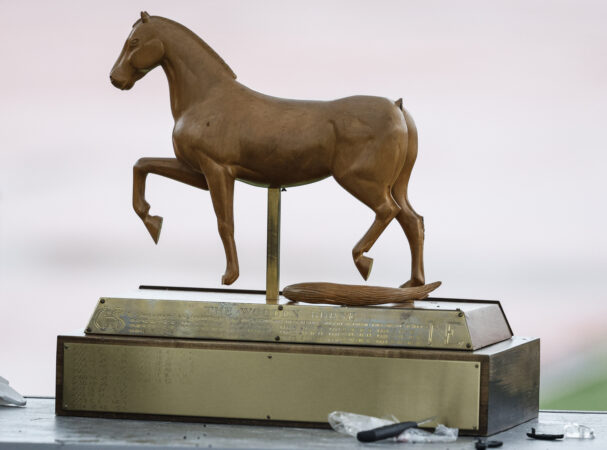
    It was Nick Lincoln’s first season at Northeast High School, so the football coach asked his athletic director last November if the Wooden Horse — the mahogany trophy carved nearly 80 years ago by a student — could be brought to the field on Thanksgiving morning for the annual game against Central.

    The trophy, heavy and old, usually stays inside. But what good is the Wooden Horse if the players can’t hoist it after a win?

    “Well, we had a little too much excitement,” Lincoln said.

    The celebration ended, and the horse no longer had a tail.

    “I said, ‘Dude, you’re going to get me fired,’” athletic director Phil Gormley said. “‘You’re going to be back coaching in Delaware, and I’m going to be bagging groceries at the Acme.’”

    Northeast vs. Central is one of the longest-running rivalries in the country, but the Thanksgiving game is no longer the spectacle it once was. The halls of the schools don’t buzz in the weeks leading up to it, the parade down Cottman Avenue was canceled years ago, the bleachers aren’t filled, and the trophy is falling apart.

    High school football in Philadelphia once meant as much to Thanksgiving as Santa Claus climbing into Gimbels. But traditions fade. Just 10 games are planned Thursday in Southeastern Pennsylvania, down from 28 in 2005. Thanksgiving games have faded for a variety of reasons: state playoffs, lack of competition, tepid attendance, and school closures.

    But Northeast vs. Central — the schools say it’s the nation’s oldest rivalry among public schools — refuses to go away, even if the trophy is showing its age. The teams will meet again at 10:30 a.m. Thursday at Northeast.

    “I don’t think the game will fade,” Gormley said. “It’s not attended like it used to be, but I know it’s still important to our alumni. When I talk to anyone who comes back for any reason, it’s always a question that eventually comes up. I think the game, for the foreseeable future, is OK. It’s certainly something that could happen, but thankfully it’s not something that will happen anytime too soon.”

    A historic game

    The schools first played in 1892 and started playing annually in 1896. The rivalry has paused only twice: in 1918 during World War I and 2020 during the pandemic. They’ve played through snow, rain, and muddy fields.

    The rivalry was real, as the schools were just three miles apart: Central was at Broad and Green, and Northeast was at 8th and Lehigh. The trophy came along in 1947, when Northeast’s Spurgeon Smith, using only a kitchen paring knife, carved into a block of mahogany donated by Smythe Mahogany Company.

    The games often were epic and packed. More than 15,000 fans saw Central beat Northeast in 1929 at the Baker Bowl, they played a muddy scoreless tie in 1971, and they’ve braved a few snowstorms.

    Philadelphia had a full slate of high school football on Thanksgiving morning, and Northeast-Central was the game for years.

    “Everyone is brought on board at Central knowing that Thanksgiving is against Northeast,” said Jeff Thomas, Central’s associate archivist. “No matter how good or bad the team is that year, that is the most important game. Very similar to Army-Navy. Both teams could be 1-6, but when they play each other, it’s the most important game.”
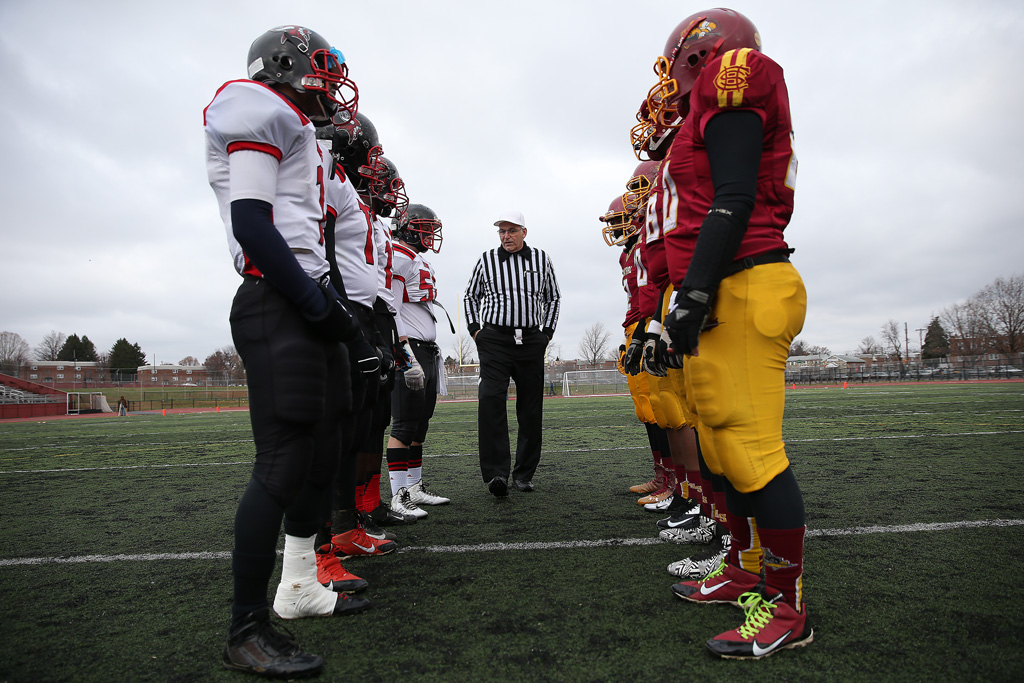
    Northeast High School football players (left) meet at the center of the field with their Thanksgiving Day rival, Central High School, before the 2014 game.

    In 1986, current Central coach Rich Drayton scored five touchdowns as the Lancers ran up the score in a 60-3 win in front of 7,000 fans. Afterward, Northeast coach Harvey Schumer refused to shake hands with Central coach Bob Cullman, and the two had to be separated at midfield. Three years earlier, Northeast didn’t let up in a 42-point Thanksgiving win. So Central was returning the favor.

    The rivalry was deep.

    “Wherever you go wearing your Lancers stuff, people ask for your class number,” Drayton said. “The next thing they say is, ‘Are we going to win on Thanksgiving?’ It’s a really big deal. Hopefully, the student body can notice before it’s too late how important it is.”

    Hanging on

    The parade of antique cars and convertibles started near the Roosevelt Mall, traveled west on Cottman Avenue, turned right on Glendale Avenue, then finished with a lap around the track that circled Northeast’s football field.

    The stands were filled as more than 6,000 fans came each Thanksgiving to see which school’s trophy case would hold the Wooden Horse.

    But the parade ended about 15 years ago when the school district replaced the cinder track with rubber. Students no longer decorate the stadium like they once did, and the game now attracts between 600 and 800 fans instead of thousands.

    Both schools have strong alumni groups, and former students still come out. It’s a chance to wear a letterman’s jacket, see old classmates, and tell the same stories.

    “We have breakfast in the gym for alumni who come back,” Gormley said. “These old guys would be in there razzing each other. ‘Well, you lost to Central. I never lost to them.’ You know how guys talk. It’s funny to hear.”
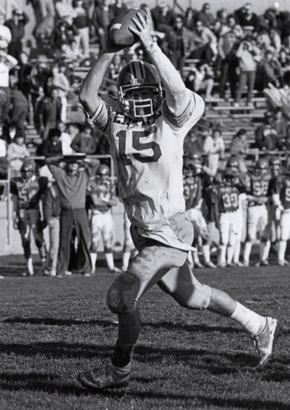
    Central’s Mike Roche threw for 409 yards and five touchdowns in a 60-3 rout of Northeast on Thanksgiving Day 1986.

    But interest among current students is tepid. Both schools draw students from across the city, and getting to Northeast Philly on a holiday morning can be a challenge.

    The game has become one-sided — Northeast last lost in 2013 — and a football game doesn’t mean what it once did. The high school experience at Northeast and Central is not defined by the football teams the way it was in the 1960s or 1970s.

    “We have career day, and me and the other old guys come in,” Thomas said. “At the end of each class, we’ll ask them who’s going to the game. One hand raised. I’m like, ‘OK. Well, let’s beat Northeast.’ They’re like, ‘Huh?’ It’s gone full cycle to almost no care at all.”

    St. Joseph’s Prep and La Salle High School stopped their Thanksgiving game in 2006. North Catholic and Frankford played their final game in 2009 before North closed seven months later. Father Judge and Lincoln canceled their annual game last year, and Neumann Goretti and Southern won’t play this year.

    Thanksgiving games drop off the schedule every year. As interest drops, could Northeast-Central be next?

    “No,” Thomas said. “Well, maybe. After, say, everyone who graduated before 1985 is gone.”

    High school football’s regular season in Pennsylvania started a week before Labor Day and ended a week before Halloween. Central did not make the playoffs, and Northeast lost in the first round, so neither team has played a game in nearly four weeks.

    The PIAA playoff schedule has ended other rivalries as schools are either playing this weekend in the state tournament — like La Salle — or have been dormant for too long to play on Thanksgiving.

    Northeast and Central found a way to keep their teams together as they wait for Thanksgiving. The coaches could have walked away weeks ago when the season ended — they instead practice a few times a week and schedule time in the weight room. They want to give their kids another game.

    “I would love to be playing a PIAA playoff game and have to forfeit,” Lincoln said. “But it’s another chance for our guys to play football.”
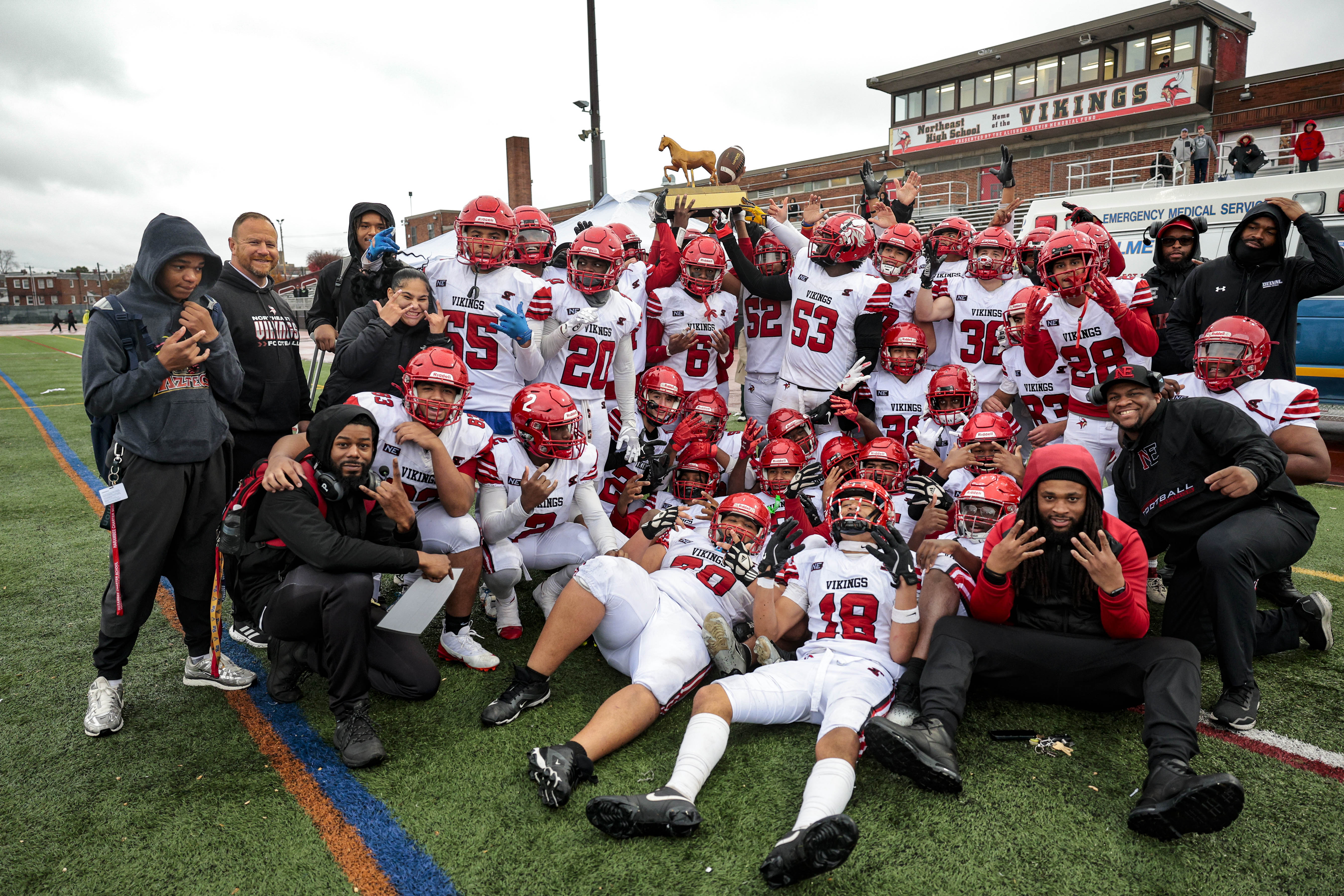
    Northeast celebrates its 37-21 win over Central with the Thanksgiving game Wooden Horse trophy last year.

    Lincoln held his breath last Thanksgiving before he found the Wooden Horse’s tail on the field. His first win against Central wasn’t spoiled by a horse’s rear.

    Gormley took the Wooden Horse to a nearby trophy shop, which repaired the tail and added last year’s final score — Northeast 37, Central 21 — to the base before it was tucked safely into the trophy case. The Wooden Horse, just like the game it represented, refused to go away.

    “I’m going to try to bring it out again,” Lincoln said. “Let’s see if the AD allows me to.”
  • Bucko Kilroy was once called the NFL’s dirtiest player. He became much more than that in a six-decade career.

    Bucko Kilroy was once called the NFL’s dirtiest player. He became much more than that in a six-decade career.

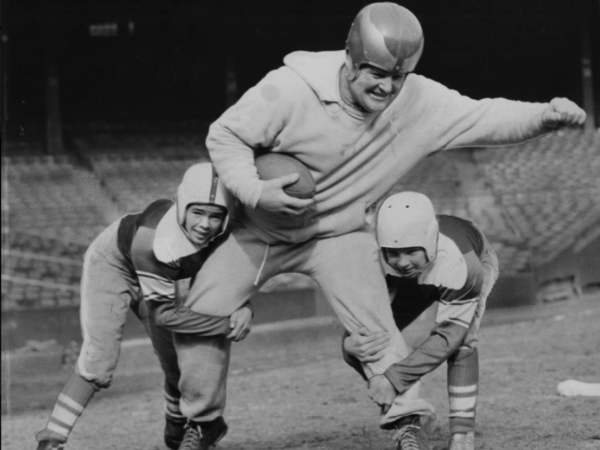
    Bucko Kilroy spent a week in a Philadelphia courtroom three years after a Life magazine story described him as football’s dirtiest player. He sued the magazine for libel, claiming the accusation that he purposely injured opponents had ruined his reputation.

    He was a two-way lineman for the Eagles who once played in 101 straight games. Dirty? Never, Kilroy said. A lawyer representing the magazine during the 1958 case asked Kilroy if he remembered kicking the Chicago Bears’ Ray Bray in the groin. “It is all according to what you mean by kicking,” Kilroy said.

    Upton Bell’s secretary interrupted him in his office to tell the newly hired New England Patriots general manager that someone was on the phone for him. It was a collect call from a pay phone.

    “I said to myself, ‘Who the heck is this?’” said Bell, whose father founded the Eagles in 1933.

    It was Kilroy, who was working for the Dallas Cowboys and had scouted with Bell years earlier. He wanted to work for the Patriots.

    “He was calling from a phone booth because he didn’t want Dallas to know that he was applying for the job,” Bell said. “He said, ‘There’s no way they can trace this to me.’ Typical Bucko.”

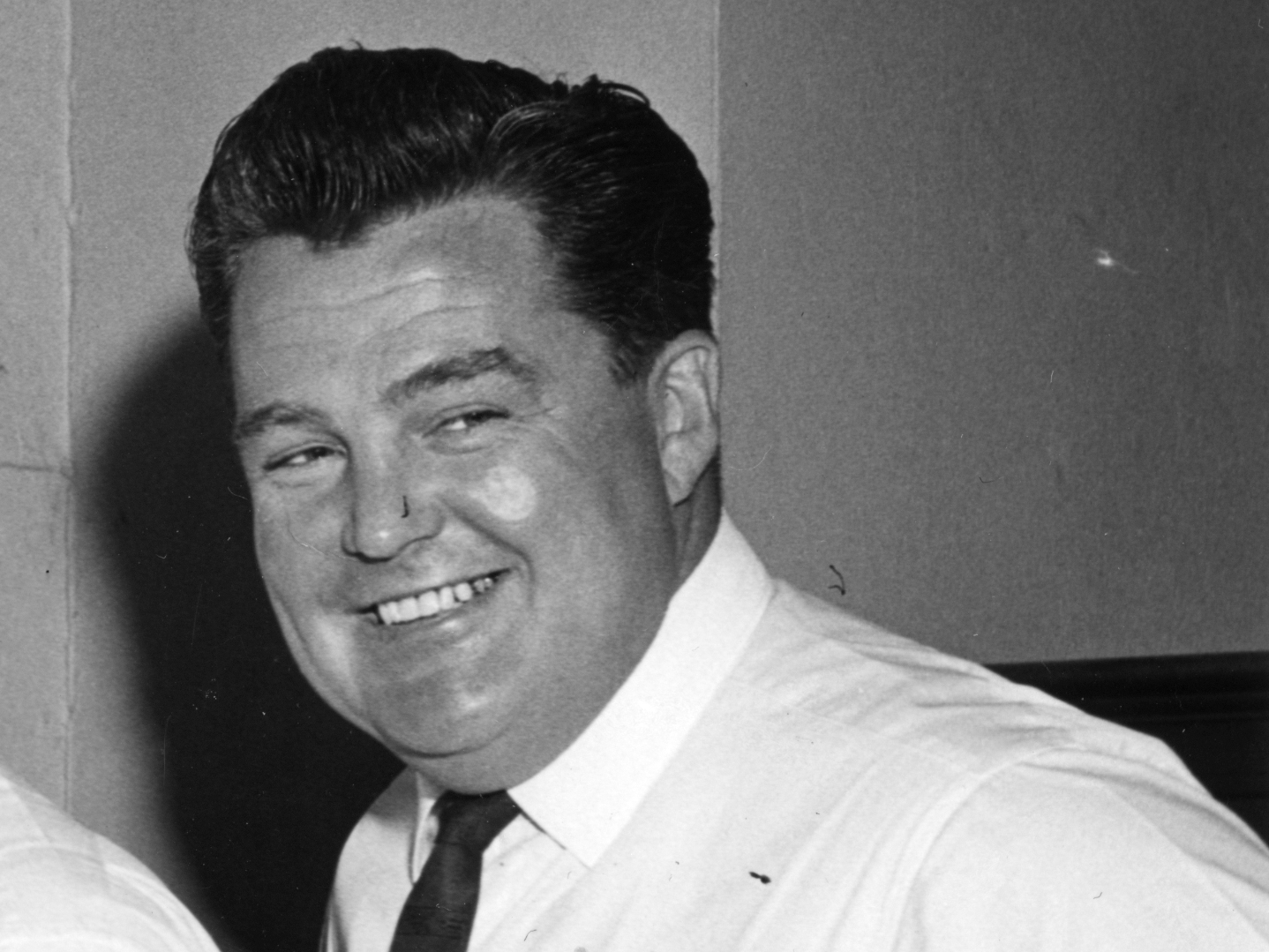
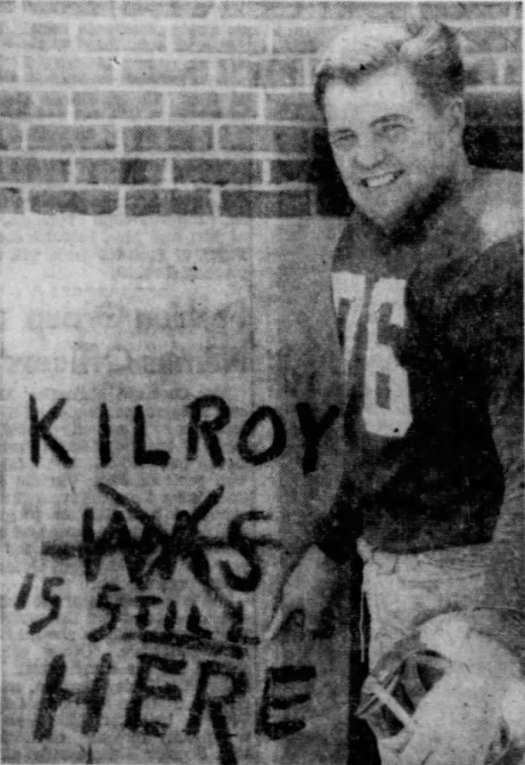
    Francis Joseph “Bucko” Kilroy, who will be inducted Friday into the Eagles Hall of Fame during the game against the Bears, spent 64 consecutive years in the NFL as a player, coach, scout, and front-office executive. He grew up in Port Richmond, starred at North Catholic and Temple, and won NFL championships with the Eagles in the 1940s before helping Bill Belichick win Super Bowls as a scouting consultant in the 2000s. Kilroy was there.

    Bucko Kilroy during his time as the Eagles’ player personnel director in 1960, when they won the NFL championship.

    Kilroy was one of the league’s first scouts and a front-office innovator who helped teach a lineage of future decision makers from Hall of Famer Bill Parcells to current Tampa Bay general manager Jason Licht. He was much more than the dirtiest player in football. And everything — from the players he was targeting in the draft to the phone calls he made — was a secret.

    “I would ask him, ‘Is that for public record or not?’” said Tom Hoffman, the Patriots’ director of public relations during Kilroy’s tenure as GM. “He would tell me, well, he can always disseminate confidential misinformation.”

    Battle scars

    The incident happened, Kilroy told the lawyer, about 10 years earlier during a preseason game. He fell down on a kickoff and Bray jumped on top of him. Kilroy said he put his foot up and flipped Bray over. Kilroy was ejected and fined $250.

    The lawyer asked Kilroy if that was a fair description of a “vicious kick in a very vulnerable spot.” No, Kilroy said. “I wasn’t trying to kick him, I was trying to ward him off. The man was trying to jump on me. How else could I get rid of him? Am I going to let him jump on me?”

    Kilroy spent most of his adult life with the indention of a cleat on his cheek, a scar from his time in the NFL when face masks were rare and gentlemen were even rarer. A kick to the face may not have been a penalty, but it did leave a battle scar. Kilroy’s NFL was wild — penalties like roughing the passer were years away — and the guy from Port Richmond fit right in.

    “Nothing came easy for him,” said Dan Fahy, Kilroy’s great-nephew. “He had to work hard. He had that grit and that desire and that ferociousness to succeed. He saw football as a game of toughness and that meant playing the game tough.”

    An Eagles player from 1943-55, Kilroy crushed opponents’ faces with his huge hands, tripped ballcarriers, and drove quarterbacks into the turf.

    When he injured a Pittsburgh Steelers player in 1951, the Steelers said they would get revenge on Kilroy when the teams played again. Bring the brass knuckles, he replied. He was a 6-foot-2, 243-pound menace who never backed down.

    “I can remember my father getting a call from Bucko’s wife [Dorothy] complaining because my dad [who became NFL commissioner] had fined him,” Bell said. “I think he kicked someone in the head. I can hear the whole conversation and he’s telling her, ‘Mrs. Kilroy, if Bucko goes the rest of the season without getting in trouble, I’ll give you the money.’ Bucko had promised to buy her a mink coat with his bonus. So she was calling because she thought she was losing her coat. My dad said, ‘I won’t give him the money back, but I’ll give it to you.’ And that’s what he did. Bucko didn’t get in trouble the rest of the year and my father had the check issued to her, not him. She got her coat.

    “He did have a reputation for being a dirty player. But there were a lot of guys around like that. The game was totally different. He was also a pretty damn good player. Guys were fearful of him.”

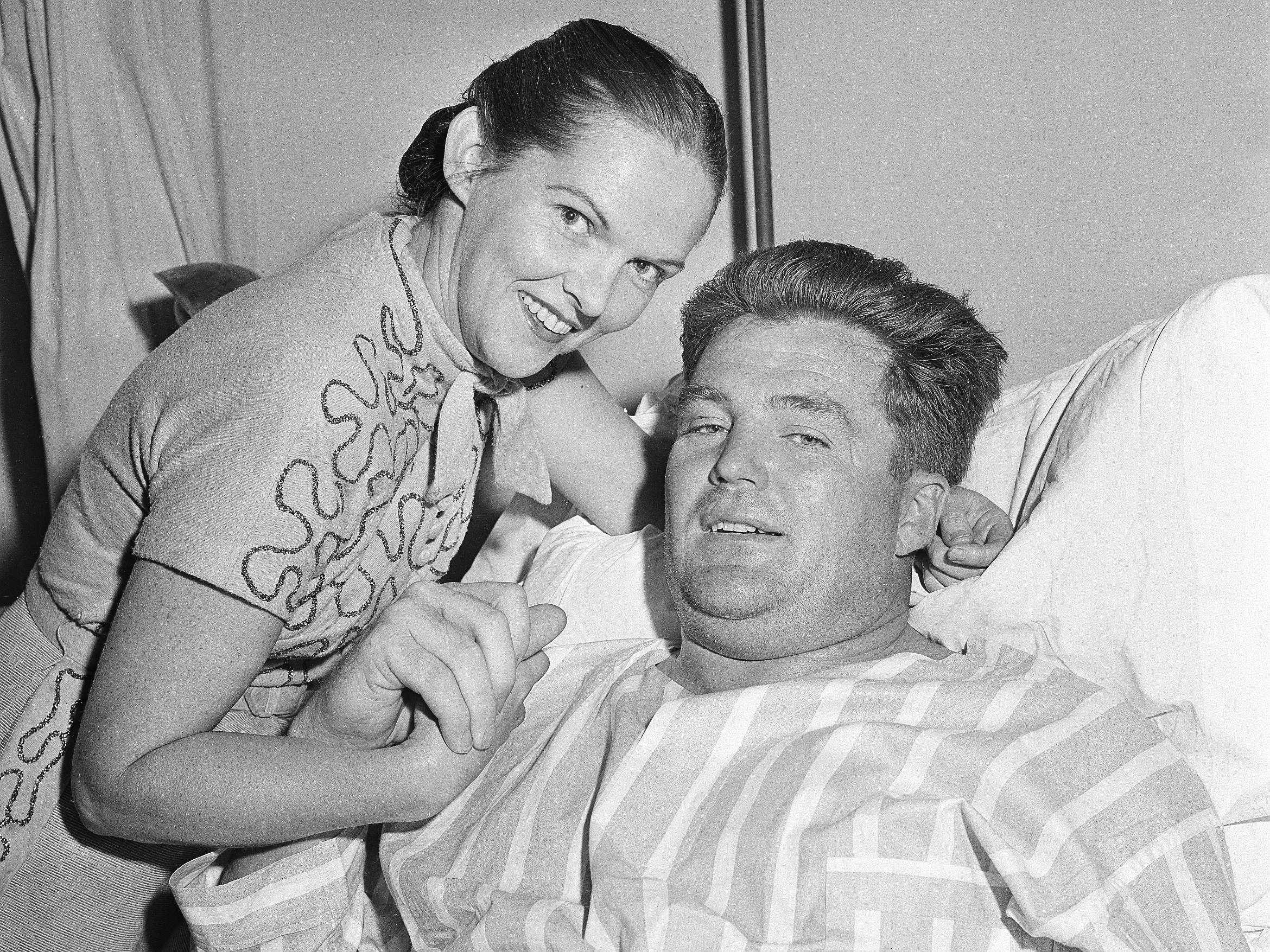
    Eagles lineman Bucko Kilroy with his wife, Dorothy, in the hospital after he suffered a career-ending knee injury against the New York Giants in 1955.

    Kilroy’s uncle, Matt “Matches” Kilroy, pitched in the majors (his 513 strikeouts in 1886 are still a record) and his father owned a bar on Richmond Street. He grew up in St. Anne’s parish during the Great Depression and played in the NFL with the same vigor he did as a kid against the boys from Nativity.

    Kilroy started his professional career in 1943 with the Steagles, the team Bert Bell formed during World War II by combining the Eagles and Steelers.

    He played on the weekends, commuting from New York while serving in the Merchant Marines. It was the start of an NFL career that spanned more than six decades without missing a season.

    “Football hasn’t just been a part of my life,” Kilroy said in 1993 after joining North Catholic’s Hall of Fame. “It is my life.”

    Kilroy was roommates on the Eagles with Walt “Piggy” Barnes, who later found work in Hollywood as an actor in Clint Eastwood movies. Kilroy worked during each offseason — he sold cars at night one year after working mornings in a stone quarry — and lived in a twin house on Wakeling Street in Frankford.

    When the Eagles won the 1948 title by beating the Chicago Cardinals, it was Kilroy’s fumble recovery that positioned the Birds for their only score during a snowstorm at Shibe Park. A year later, the Eagles repeated as champions and were gifted $500 and cigarette lighters. If they wanted championship rings, the players had to pay $65.

    Kilroy, who was later named to the NFL’s all-decade team for the 1940s, was the oldest player in the NFL at age 34 when he entered his 13th and final season. His career ended in the 1955 opener against the Giants. They were still angry at Kilroy for injuring quarterback Arnie Galiffa two years earlier. The Giants mangled Kilroy’s knee during a pile-up and he never played again.

    Bucko Kilroy was the oldest player in the NFL when he retired with the Eagles in 1955 at age 34.

    “These guys had it for him,” Fahy said. “But his own teammates would have told you that he had it coming. He had a reputation.”

    ‘Ornery critters’

    Kilroy and teammate Wayne Robinson — who also sued Life magazine — were described in the article as “ornery critters.” Cloyce Box of the Detroit Lions explained in court that an ornery critter was a “domesticated animal which at periods of times acts without the scope of that domestication.”

    Otto Graham, the Hall of Fame quarterback from Cleveland, said in court that the Eagles were the “roughest football team in the National Football League.” And Kilroy? “Well, he was the bad boy, one of the bad boys, of the league,” Graham said.

    Kilroy left that pay phone in 1971 to work with Bell in New England as the personnel director. He was the Eagles’ player personnel director when they won the 1960 NFL championship, making him one of the league’s first scouts. He later built scouting systems for the Dallas Cowboys that led to five straight division titles. He was instrumental in launching the scouting combine for the draft.

    Kilroy’s Patriots hit on three first-round picks in 1973 by selecting future Hall of Fame lineman John Hannah, running back Sam Cunningham, and wide receiver Darryl Stingley. Three years later, the Pats again had three first-rounders and Kilroy drafted another future Hall of Famer in defensive back Mike Haynes.

    “He was a brilliant mind,” Hoffman said.

    Kilroy was promoted to GM in 1979 and later became the Patriots’ vice president before becoming a scouting consultant, a position he held until he died in 2007 at age 86. Belichick honored him the next spring when the Patriots drafted for the first time without Kilroy. He was a pillar of the league, Belichick said. Kilroy spent one year longer in the NFL than George Halas. He was more than a dirty player. And that was his best-kept secret.

    “You would think, ‘This is just some big, dumb football player,’” Bell said. “But if you got to know him, you learned how smart he was. He was one of the greatest characters I’ve ever known and I’ve known most of the great characters. I once told him, ‘Bucko, you’re so secretive. Are you sure you didn’t work in the CIA?’

    “Bucko Kilroy belongs in the Pro Football Hall of Fame. That’s how good he was. And if I don’t get a phone call from Bucko Kilroy in a phone booth, I don’t hire him.”

    Kilroy won his lawsuit against the magazine and was awarded $11,600. It was more than he ever made in the NFL as his first season with the Steagles earned him just $1,300.

    But the lawsuit wasn’t really about Kilroy as much as it was about the NFL, which was trying to protect its image as it grew in popularity. The league needed to respond to an article titled “Savagery on Sundays” and Kilroy’s libel case was the response. Kilroy played football with an edge, so calling him dirty was hardly an offense. “I don’t think Bucko was ever offended by anything,” Bell said.

  • Fear factors: Ranking the Eagles’ road to the Super Bowl, from the real Rams to the fraud Bears

    Fear factors: Ranking the Eagles’ road to the Super Bowl, from the real Rams to the fraud Bears

    It’s a weird year in the NFL. Each of the traditional powers is missing something. Everything we fret about with the Eagles are worries in Kansas City and Buffalo.

    The Chargers have failed to take the next step. The Lions and Ravens might miss the playoffs. Brock Purdy just threw three interceptions against the Panthers. Drake Maye is a great quarterback. Do the Patriots really have a great roster?

    Something to be thankful for: Nobody else is great, either.

    We’ll see that on Friday, when the Eagles host the Bears. Chicago is among the more fraudulent 8-3 teams we’ve seen.

    Here is a look at all of the NFC teams that matter more than the Bears.

    1. Rams (9-2)

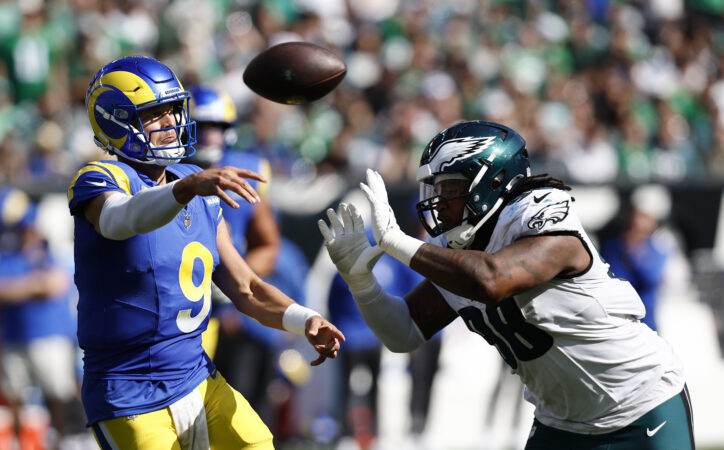
    It sure feels like 2025 is setting up for a Rams-Eagles NFC championship game that could launch an era-defining rivalry. The only thing missing right now is a big Rams win. The Eagles have beaten them four times over the last three seasons after initially replacing them as NFC champs in the 2022 season. But the Rams have walked away from the last two outings feeling like the Eagles’ equals if not betters.

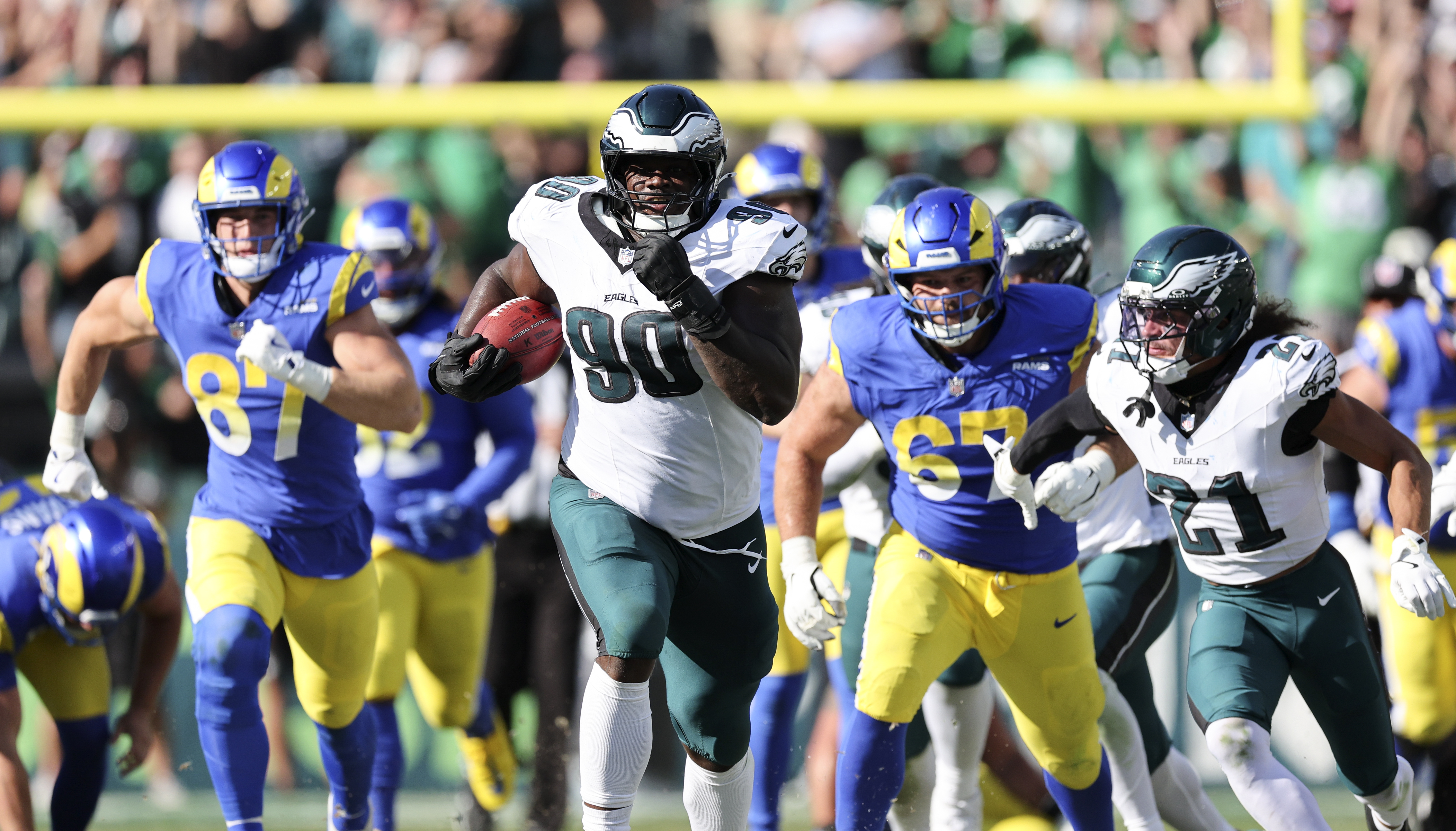
    First came that snowy 28-22 playoff loss when the Rams gave away six points on fumbles and still had a first down on the Eagles’ 21-yard line with 1 minute, 25 seconds remaining and a chance for a go-ahead touchdown. Then came Week 3, when L.A. blew a 26-7 lead and still had a shot at a game-winning 44-yard field goal with three seconds left only to have Jordan Davis block it and score a touchdown to boot.

    The Rams are due. Sean McVay is too good of a coach, Matthew Stafford too good of a quarterback, and Les Snead too good of an executive to not eventually announce it to the rest of the world. What they’ve done in the four years since they won the Super Bowl is every bit as impressive as the mini-dynasty that Nick Sirianni, Jalen Hurts, and Howie Roseman have put together.

    Eagles defensive tackle Jordan Davis brought the last meeting with the Rams to a thrilling end with his touchdown.

    Snead and McVay have orchestrated an incredible turnaround on par with the Eagles post-2017. Stafford is one of only four players remaining on either side of the football who played at least 20% of the offensive snaps in 2021, when the Rams won the Super Bowl (The others: OT Rob Havenstein, TE Tyler Higbee, CB Darious Williams). They exited their Super Bowl with a bloated cap sheet and just one first-round pick between 2017 and ’25. Now, suddenly, they are the most impressive team in the NFL. The only impressive team, arguably, along with maybe the Colts. Since losing to the Eagles, their only loss was in overtime to the division rival 49ers (more on them later). They’ve beaten the Colts, the Ravens, the Jaguars, the 49ers, the Seahawks, and the Bucs. Of their six straight wins, five have been by at least two touchdowns. Of their nine overall wins, seven have come against teams whose Super Bowl odds rank in the top half of the NFL.

    2. Detroit Lions (7-4)

    The eye test says Detroit is a team nobody should want to face, particularly at home. But they wouldn’t even make the playoffs if they started today. And they would need to overcome some considerable odds if they hadn’t pulled out an overtime win over the Giants on Sunday. The Lions’ last six games are all losable: on the road against the Rams, Vikings, and Bears; at home against Green Bay, Dallas, and Pittsburgh.

    Don’t get it twisted. They are a serious threat, one of two teams in the NFC who would have a strong argument to make to be favored over the Eagles in a playoff game at home. That’s a long shot to happen, given the tiebreaker the Eagles hold. But the Lions’ 16-9 loss at Lincoln Financial Field in Week 11 didn’t exactly establish them as the definitive favorites even at home.

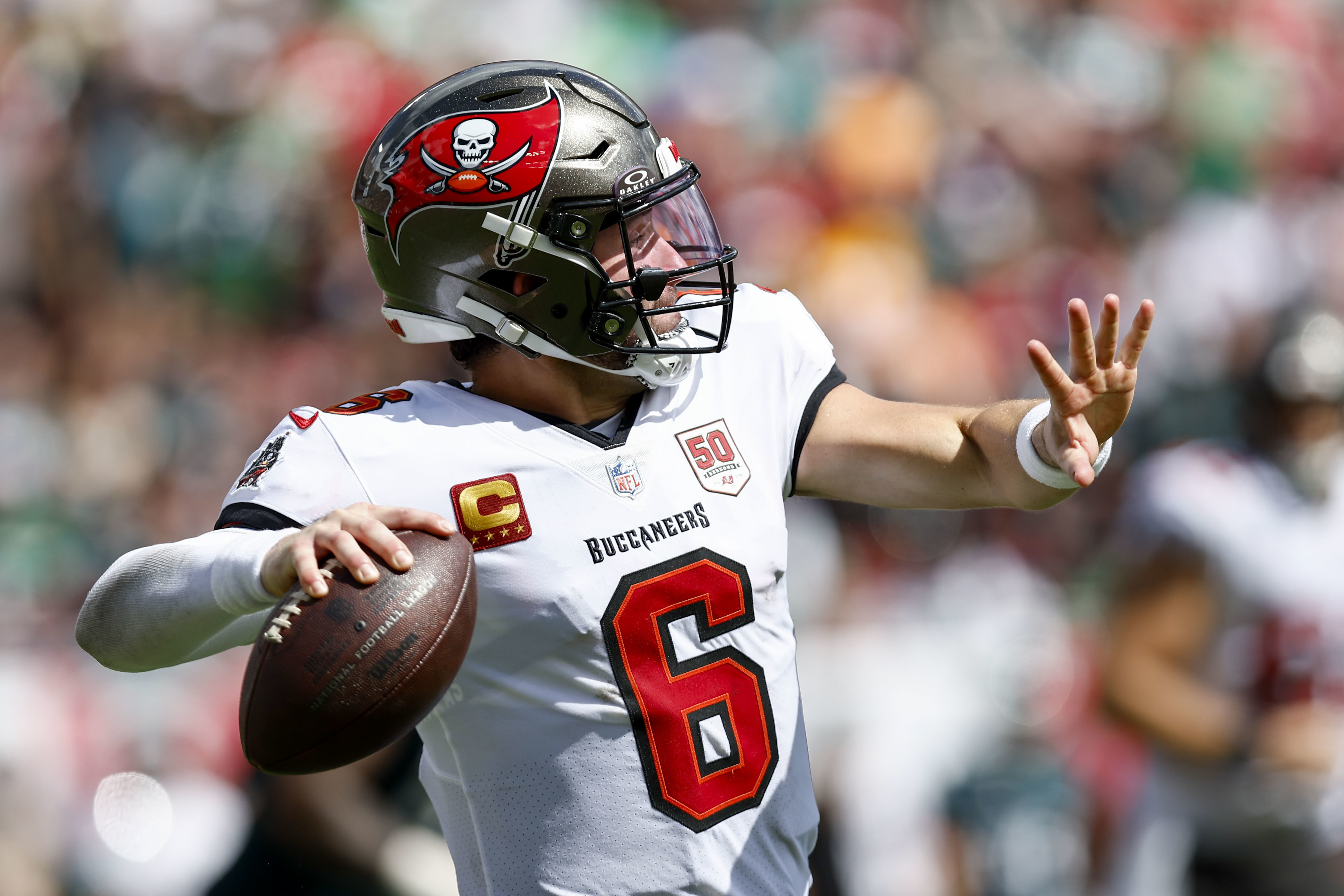
    Baker Mayfield and the Bucs have a soft schedule ahead.

    3. Buccaneers (6-5)

    Tampa Bay has one of the easiest remaining schedules in the NFL. Arizona, New Orleans, Atlanta, Miami, and Carolina twice. Find me two losses among those, assuming Baker Mayfield starts at quarterback. Even if Mayfield misses a week or two with his sprained nonthrowing shoulder, the Bucs should be able to finish atop the putrid NFC South. That means they have six weeks to get Mayfield and Chris Godwin healthy. Which means they could easily be a threat once the playoffs arrive.

    4. 49ers (8-4)

    Surprised? You shouldn’t be. Like I said, the field is weird this year. Who else would you put ahead of San Francisco? The Eagles are the only legitimate contender of the NFC’s three-loss teams. They already beat Green Bay on the road. Seattle is quarterbacked by Sam Darnold and will be playing as a wild card with the Rams winning the division. The Bears are the fakest of them all. You’ll see that on Friday.

    The 49ers? They are faker than they usually are. The Fred Warner injury — out for the season — was the final deal-breaker. They sorely miss Deebo Samuel and Brandon Aiyuk on the offensive side. San Francisco is only a threat to the Eagles if the Eagles turn out to be the team they’ve looked to be over the last several weeks. That team is capable of losing to anybody with a competent quarterback and a great head coach.

    5. Cowboys (5-5-1)

    This is not recency bias. The Cowboys would be second on this list if you could guarantee me that they would make the postseason. As it stands now, they will probably need to win two out of three against the Chiefs (home), Lions (road), and Chargers (home) just to have a reasonable chance of qualifying for the postseason. And that’s assuming they beat the Vikings, Commanders, and Giants.

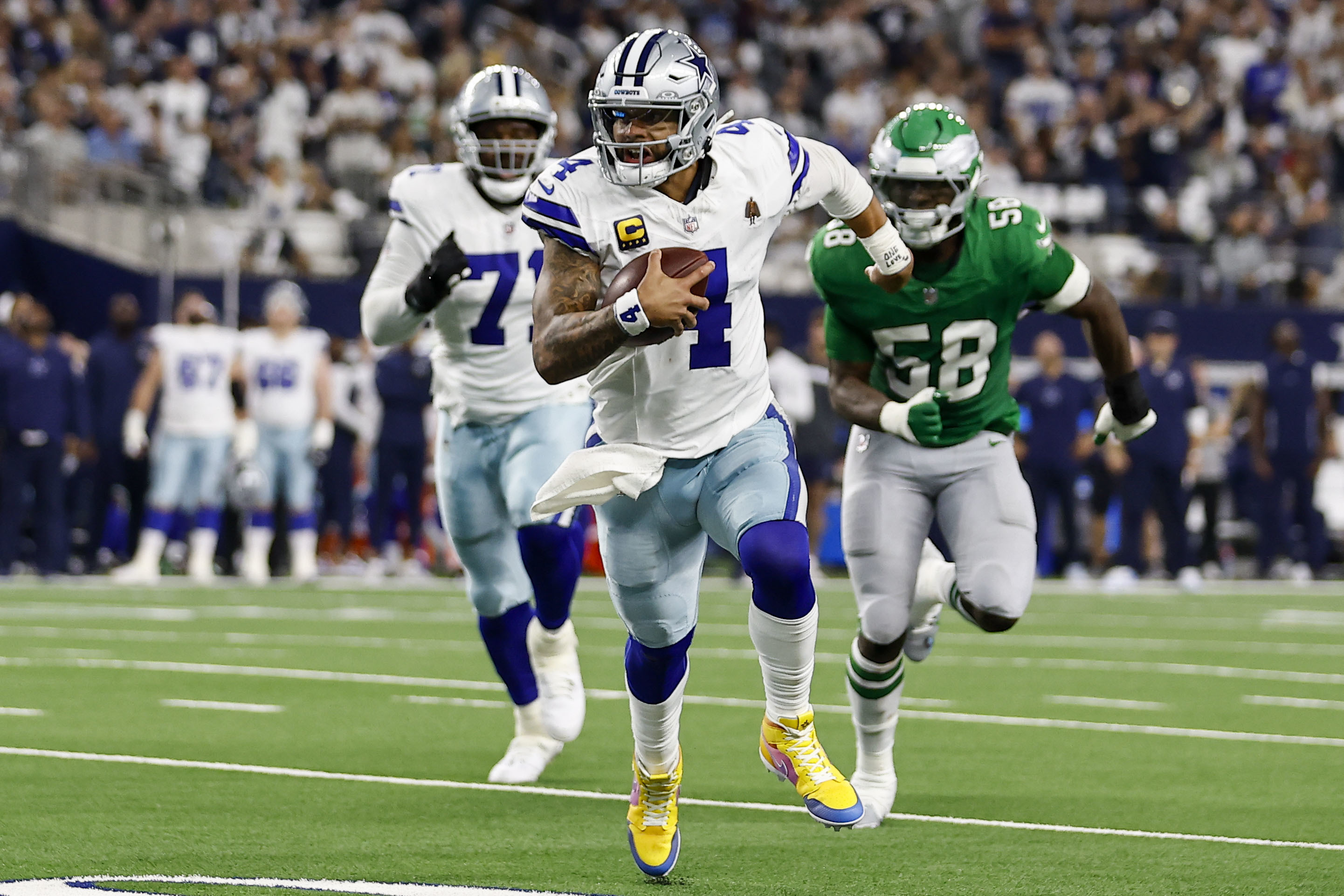
    Cowboys quarterback Dak Prescott running for a touchdown in the fourth quarter against the Eagles.

    That being said …

    If all of that happens, then we’d be foolish to consider the Eagles as anything better than a coin flip in a playoff game against the Cowboys, whether at home or on the road. Dallas has outplayed them even this season, once in a game the Eagles should have lost and, more recently, in a game the Eagles should have won. In both games this season, the Eagles have struggled to find an answer for CeeDee Lamb and George Pickens. Dak Prescott is playing at a near-MVP level and gives the Cowboys the advantage at quarterback. Mostly, this is a referendum on the rest of the NFC.

    6. Seahawks (8-3)

    Look, Darnold has been better than anybody could have envisioned after the Jets drafted him at No. 3 overall. But he is still the biggest reason to doubt that Seattle has been anything more than the beneficiary of a light schedule. The Seahawks’ best wins have come on the road in Pittsburgh in Week 2 and on the road in Jacksonville in Week 6. It’s definitely worth something that they put up 414 yards of total offense and nearly beat the Rams despite Darnold throwing four interceptions. But, then, Darnold threw four interceptions.

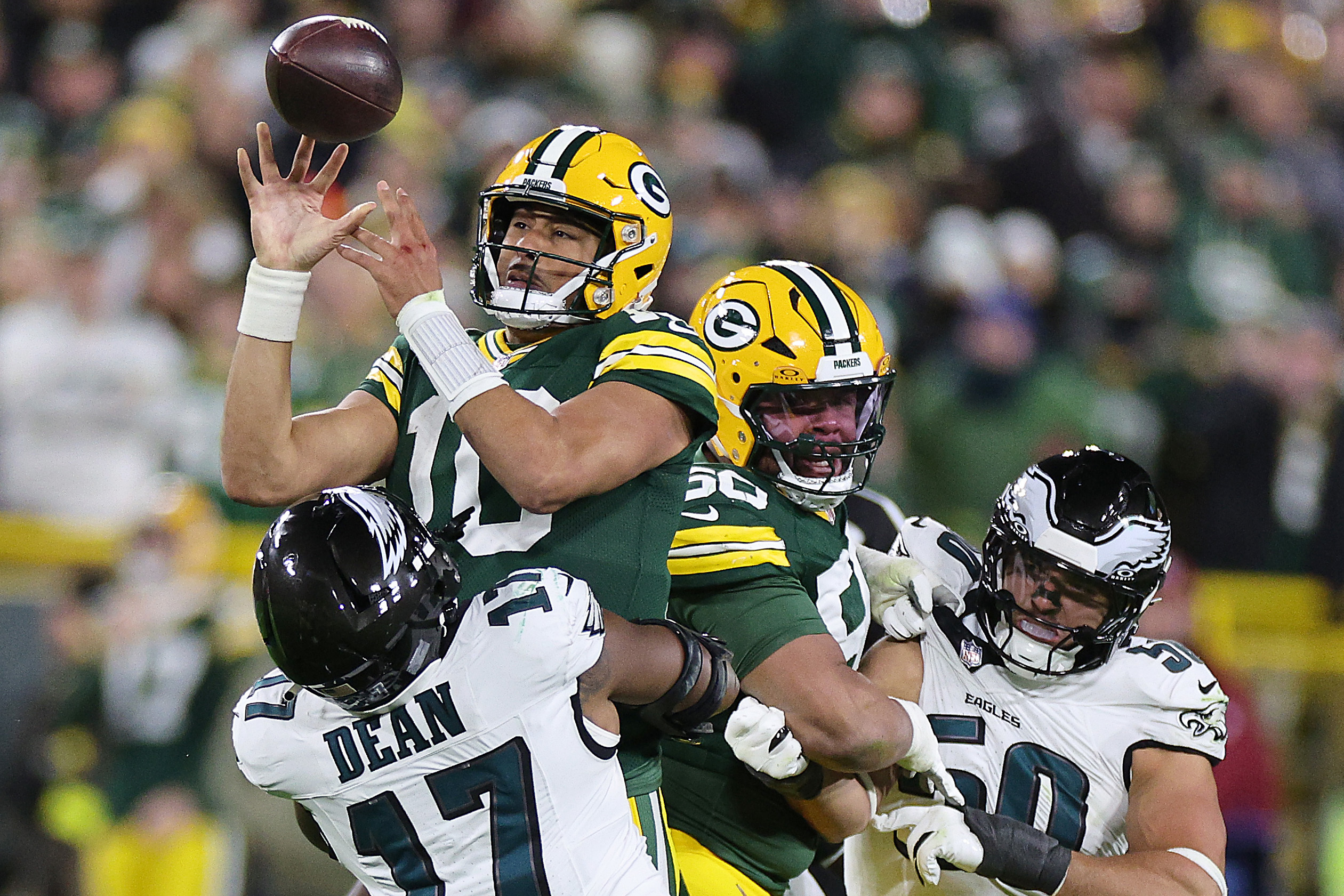
    Eagles linebacker Nakobe Dean forcing a fumble by Packers quarterback Jordan Love on Nov. 10.

    7. Packers (7-3-1)

    Jordan Love is the most overrated quarterback in the NFL, and Matt LaFleur might be the most overrated play-caller. Not a good combination. The Eagles already beat Green Bay at Lambeau Field on a night when a better team would have beaten them. No worries here.

    8. Bears (8-3)

    For whatever reason, I’ve watched more of the Bears this season than virtually any other team. At no point have they looked capable of beating even a semicompetent team. That holds true for some of the games that they’ve actually won. Caleb Williams is missing something. I think we will see that on Friday.

  • Jefferson Health hit with federal WARN Act lawsuit

    Jefferson Health hit with federal WARN Act lawsuit

    A lawsuit filed Tuesday in Philadelphia accused Jefferson Health of violating federal labor rules when it laid off 1% of its 65,000 employees in October and this month without providing a 60-day notice.

    The purported class-action lawsuit says the proposed lead plaintiff, Ciara Brice, lost her job as a medical assistant on Nov. 12 with no notice and has not received the severance pay she was promised.

    Brice was not available for comment, said her lawyer, Jeremy E. Abay, with Philadelphia law firm Pond Lehocky Giordano Inc.

    The Worker Adjustment and Retraining Notification Act has a complicated rubric for determining when a mass layoff requires advance notification, which is filed with state labor departments. One of the triggers is an employer cutting at least 500 jobs, according to Abay.

    Even though the layoffs happened throughout Jefferson’s entire footprint from South Jersey to near Scranton, Abay said notice is required because Jefferson operates as a single entity.

    “We believe the facts will show that there was no violation of the federal WARN Act,” Jefferson said in a statement.

    The nonprofit filed a notice of 108 layoffs at Jefferson Cherry Hill Hospital, Jefferson Stratford Hospital, and Jefferson Washington Township Hospital because New Jersey has its own rules, Abay said.

    In August, Jefferson reported a $195 million operating loss on $15.8 billion in revenue for the year that ended June 30.

    The nonprofit, which grew through acquisitions from three hospitals in Philadelphia in 2015 to more than 30 now, provided no details when it announced the layoffs in mid-October.

    That layoff was part of a series of large job cuts starting in the summer of 2023, but may have been the first time patient-facing workers like Brice were hit.

    The lawsuit seeks back pay, benefits, and damages for each laid-off employee who did not receive a 60-day notice.

    Editor’s note: The headline on this article has been updated to clarify that a lawsuit claims violations.

  • You asked, Craig LaBan and co. answered: The Inquirer’s food team fields readers’ questions

    You asked, Craig LaBan and co. answered: The Inquirer’s food team fields readers’ questions

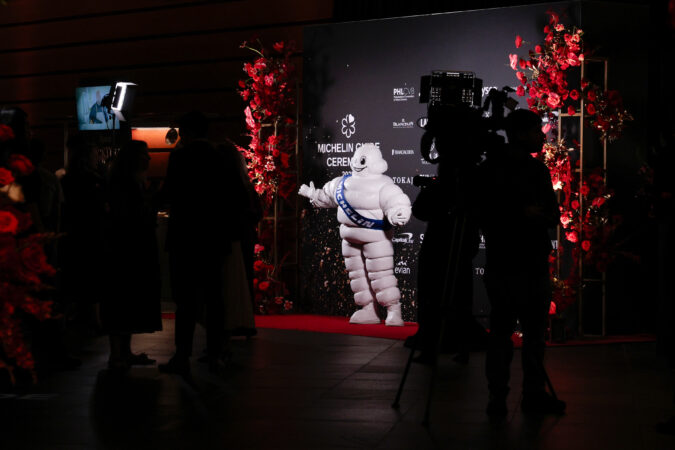
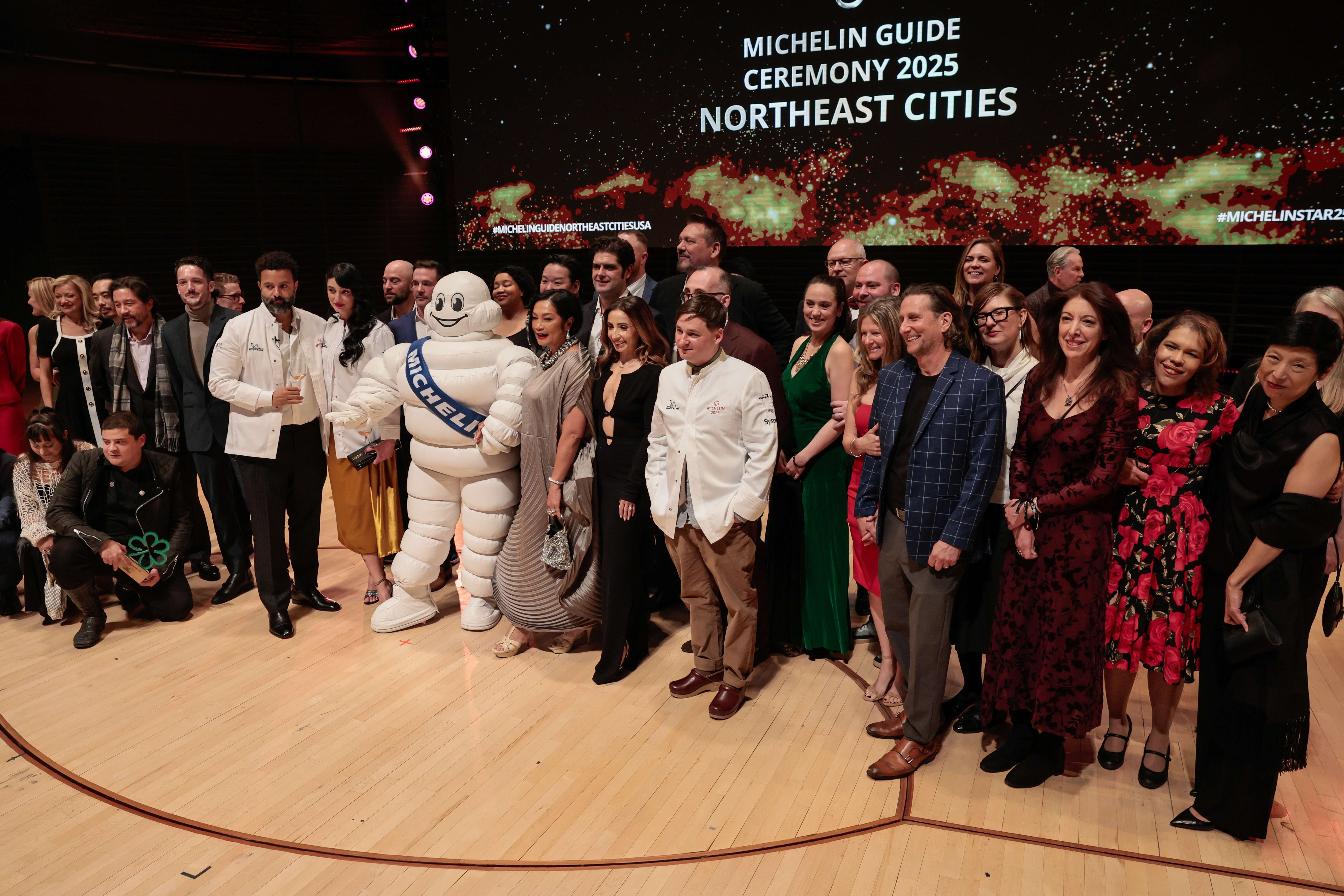
    Last week was a busy one for our food desk: Michelin announced its first-ever stars and honorees in Philadelphia’s food scene, a much-anticipated reveal sandwiched between The Inquirer’s inaugural food festival and Thanksgiving week. To cap it all off, we solicited subscribers’ questions on our site. No surprise, there were lots of Michelin questions, along with a slew of requests for restaurant recommendations.

    Our team had answers. Read on for our musings on Michelin, where Philly’s restaurant scene is going, and staff picks for red gravy joints, BYOBs, and Philly’s best roasted duck.

    The Philadelphia chefs acknowledged at the Michelin Guide announcements at the Kimmel Center Tuesday, Nov. 18, 2025, in Philadelphia.

    Michelin machinations

    Can you give us an idea how much the [Philadelphia Convention and] Visitors Bureau had to pay Michelin to come to Philadelphia? It was shocking to find out these awards are “pay to play,” but now I understand why decades of world-class dining in Philadelphia have never garnered a Michelin star until now. Is it possible James Beard awards are more highly regarded, which I doubt, since they are not pay to play.

    Michael Klein, food & dining reporter: We don’t have any idea how much Michelin was paid. As a private nonprofit, the Philadelphia Convention & Visitors Bureau does not have to release that. It’s rolled into its budget, and it likely will be rolled into unspecified marketing fees. Its most recent tax return, which covered July 1, 2023, to June 30, 2024, was filed in February 2025. The deal for this year’s other new Michelin city, Boston, also was not made public; one report pegged it as over $1 million for the three-year partnership. Typically, small markets and individual cities pay $70,000 to $300,000 per year, typically in three-year deals. For the 2025 American South regional guide that came out Nov. 3, cities and states across the South collectively are contributing $1.65 million per year for three years (about $4.95 million total).

    Why wasn’t Mawn recognized by the Michelin Guide? Are you surprised by fact there was no recognition for Mawn?

    Jenn Ladd, deputy food editor: Michelin’s decision-making is famously secretive, but we are operating with an informed assumption that an inspector could not get a table/reservation there (or perhaps couldn’t get more than one, since they are supposed to make repeated visits) and so did not include it. You can find more thoughts in our writers’ reactions to the Michelin picks.

    As a team, we definitely were surprised by that choice. While it’s understandable (to at least some on the food desk) that Royal Sushi’s omakase wasn’t considered due to how difficult it is to get a reservation there, Mawn’s lunch is walk-ins only. Will you have to arrive early and wait in line? Yes, but it’s not impossible to dine there without connections. Hopefully next year, Michelin’s inspectors have a longer timeline during which to consider our city’s food scene.

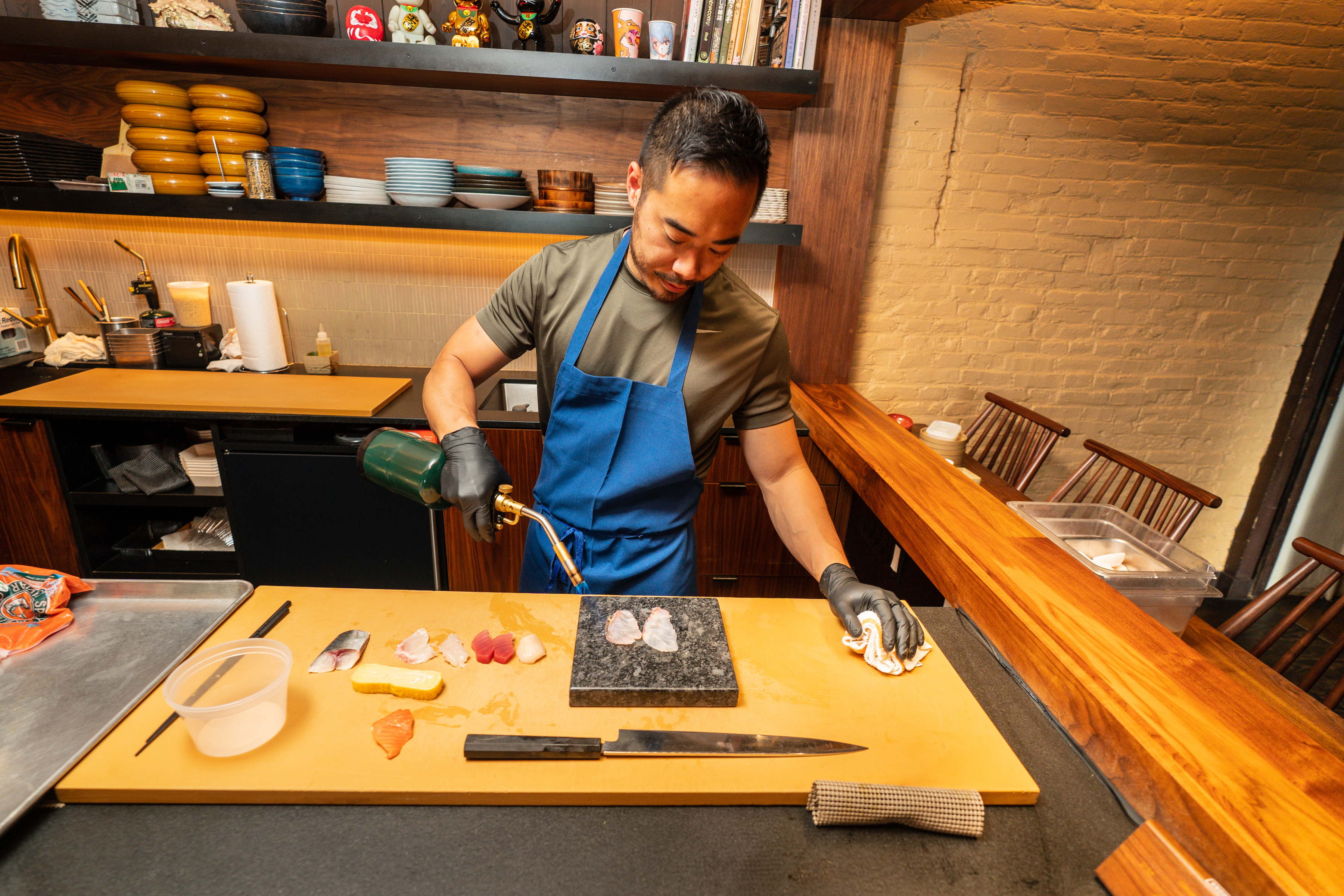
    Chef-owner Jesse Ito makes “Industry Chirashi” (a late night bargain chirashi they make in a plastic tub with scraps from the nigth’s omakase, at Royal sushi and Izakaya, in Philadelphia, Friday, August 11, 2023.

    Is there a general concern that higher-end restaurants will get even more expensive and perhaps “one-dimensional” in a way in striving to impress Michelin with more tasting menus and the like? What do we not want to see in prospective changes?

    JL: This is a concern we share. As Craig wrote earlier, “My only hope is that restaurateurs keep cooking from the heart, and that they don’t alter what they do simply in pursuit of a star.”

    We were heartened by the fact that Michelin gave such a spotlight to Her Place Supper Club, which had a characteristically Philly start (from Penn dorm room to BYOB pop-up residency to full-fledged restaurant). I also think there are plenty of restaurant chefs and owners in Philadelphia who aren’t aspiring to Michelin-star status, who just want to cook good food for people. I’m an admitted Michelin skeptic, but even I would have to say, I don’t think Philly will lose its restaurant-scene identity anytime soon, even if we do see more awards-bait menus.

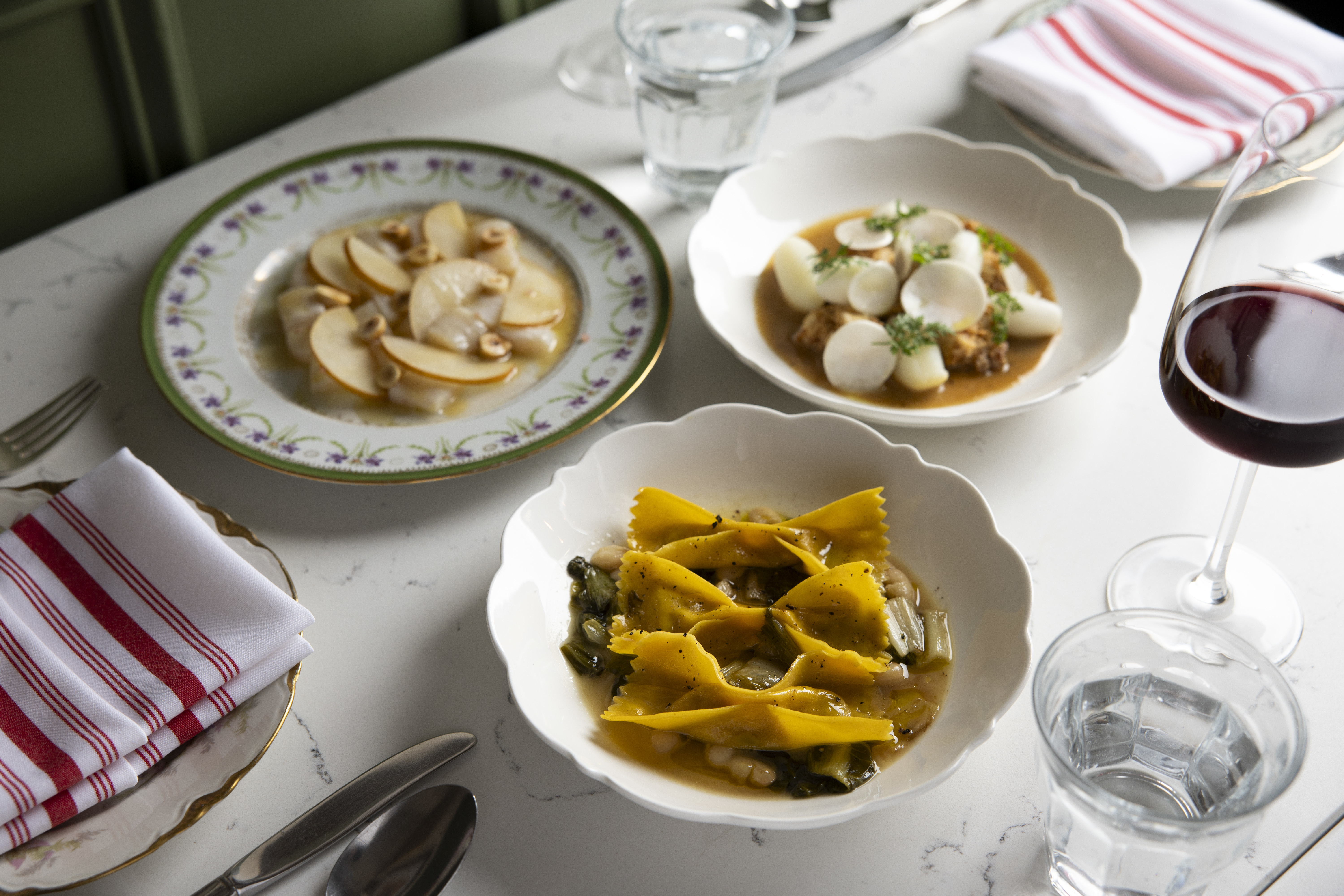
    The bean and prosciutto-stuffed farfalle, center, at Her Place Supper Club on Tuesday, Nov. 26, 2024 in Philadelphia. Her Place is located at 1740 Sansom Street in Center City.

    If each of you could pick your top 5 restaurants that didn’t make any of the Michelin Philly selections, what would they be?

    Bea Forman, food & dining reporter: First off: There’s a lot more than five restaurants I wish Michelin would’ve selected. All the honorees are so deserving, but I couldn’t help but feel like the Bib Gourmand selection especially painted a white-washed version of Philly’s dining scene. They hit up at least three cheesesteak places but couldn’t find it in their hearts (or stomachs) to find a gem in Chinatown? Or a Vietnamese restaurant? Or more restaurants that speak to Philly’s rich tradition of excellent Mexican, Latino, and African food? Lame. Tomato. Tomato. My five picks for Bibs or recommendations would be:

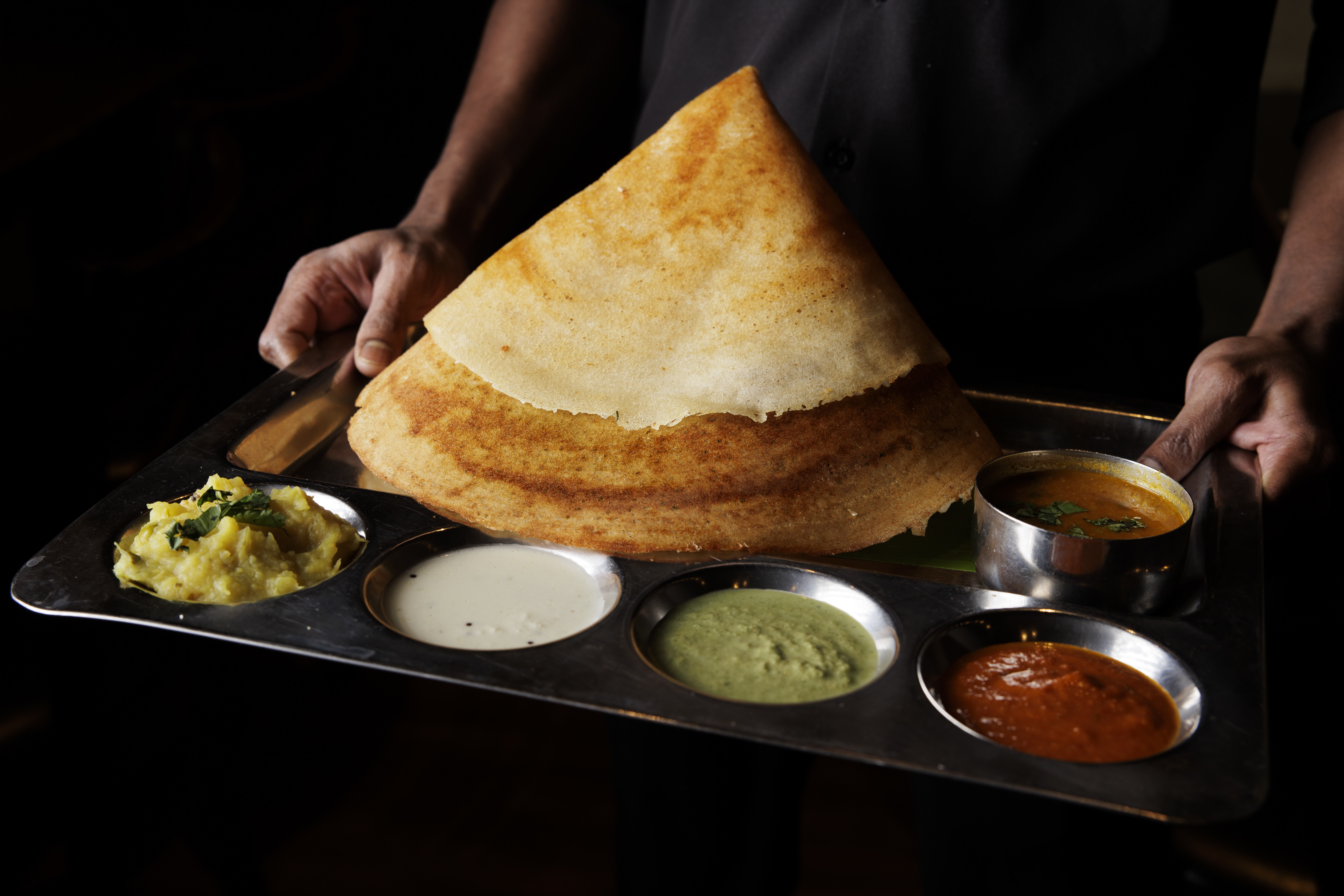
    The Ghee Roast Dosa at Amma’s on Chestnut Street in Philadelphia on Wednesday, Aug. 21, 2024.

    Hira Qureshi, food & dining reporter: I’d love to have seen these five/six restaurants get a Bib or Recommended: Amsale Cafe for their beautiful injera-lined platters with kitfo and gomen wat; Samson Kabob House for their insane chapli kababs alone; and Kabobeesh for their mutton karahi that’s just as good as my mom’s. Apricot Stone or Al-Baik Shawarma & Grill have the best hummus and falafels in Philly. And Black Dragon Takeout really does nail personality like no one else in the city.

    A saturated restaurant scene?

    There are so many good and great restaurants in the city — many moving into neighborhoods that are still deep into renovation/gentrification (i.e. near the York/Dauphin station for example), and there are quite a few empty seats especially on non-prime evenings. Is the Philly restaurant scene reaching a point of saturation?

    JL: Hard to speak for our entire team on this one, but my best guess — from years on the food beat here and from reading my colleagues’ work very closely over the past 7 years — is not a chance. Year after year, there have been more restaurant openings than the last, even post-pandemic. There IS more out-of-town interest in opening in Philadelphia (a theme that’s been building all year and is sure to play out more in 2026), which could affect our restaurant scene in all sorts of ways.

    We are seeing fewer BYOBs open and more capacious, expensive restaurants, but there are plenty of neighborhoods left in Philadelphia — I live in one! — that could use more restaurants. I for one hope that as the rents go up in the saturated neighborhoods, the scrappy entrepreneurs and chefs that have defined our culinary scene start to consider properties in those pockets of town.

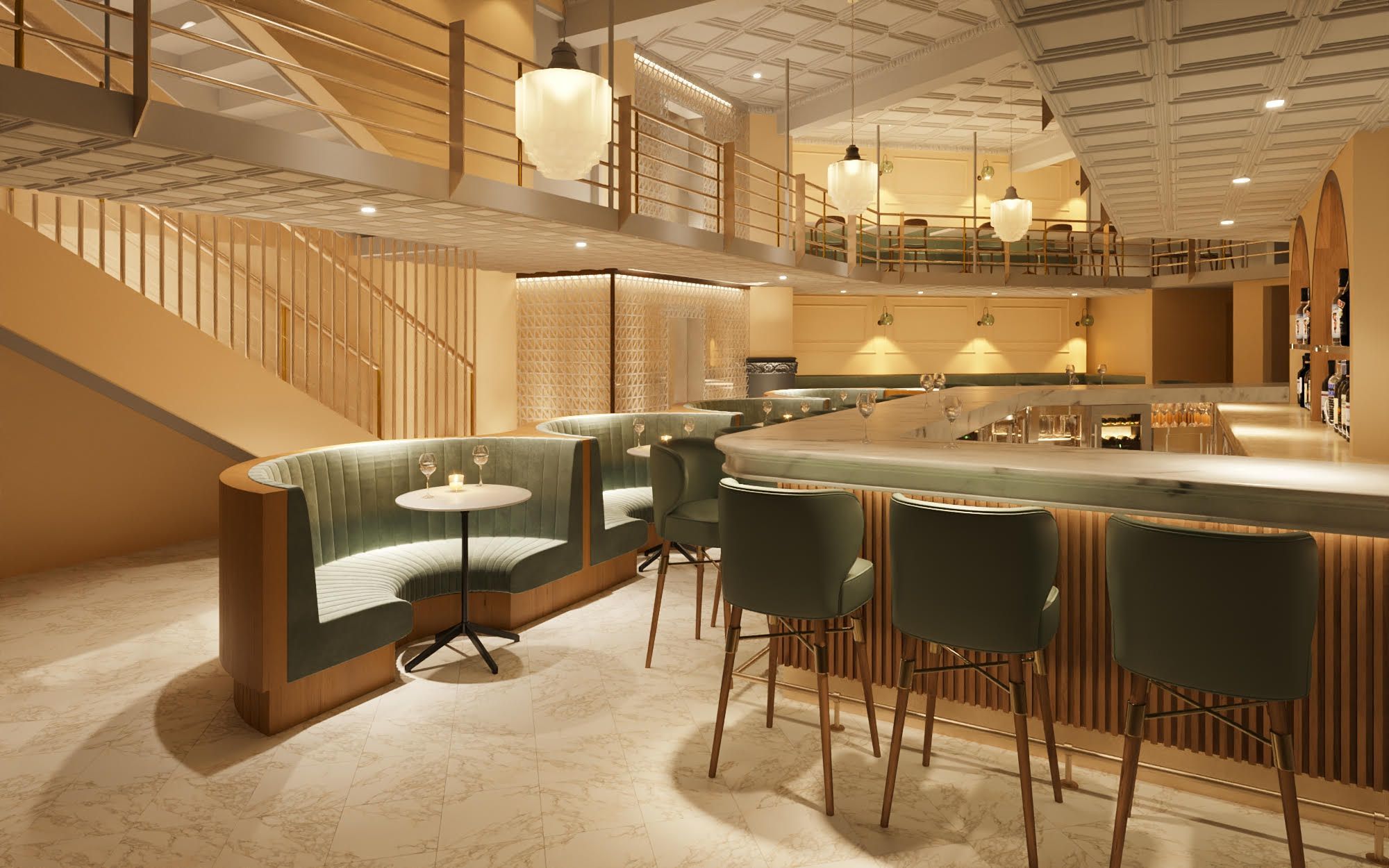
    A rendering of the bar at Flueur’s, 2205 N. Front St.

    Craig LaBan, restaurant critic: I think only time will tell on this question. There is a lot of new construction going up in these very neighborhoods, and some extremely ambitious restaurants to match. I’m thinking of Fleur’s, for example, which is farther north than many of the earlier Fishtown hits. It was quite the midweek night I visited, but that is totally normal for a new restaurant. Once it starts to get press and social media buzz, if it is positive, that will change. They have to be well-capitalized to weather the storm of early months as they build their audience. If they do a good job, Philly diners will come. Restaurant-goers’ enthusiasm for excellent new places, in fact, almost always helps boost gentrification.

    Helm, for example, was one of the few destinations on its block, save for a good neighboring taqueria, when it opened there… Now it is completely surrounded by new development. Same for Que Chula es Puebla at Second and Master. The new Honeysuckle is dealing with the same dynamic on North Broad Street. It is very much a residential neighborhood in progress of being built. It’s all about timing, capitalization, and performance. So far the quality the food is there for Honeysuckle. Hopefully the business will follow.

    Restaurant recommendations

    As an old-timer, I go back to the days of the great Django with BYOs. Are there some underrated BYOBs that didn’t make your 76 list?

    JL: There are quite a few — 76 spots gets awful tight when you’re considering the full range of the Philly region’s restaurants! Illata in Grad Hospital, Little Fish in Queen Village, Helm in Kensington, and Elwood in Fishtown, not to mention a slew of suburban gems like Spring Mill Cafe in Conshy, Maize in Perkasie, Charcoal in Yardley, for starters.

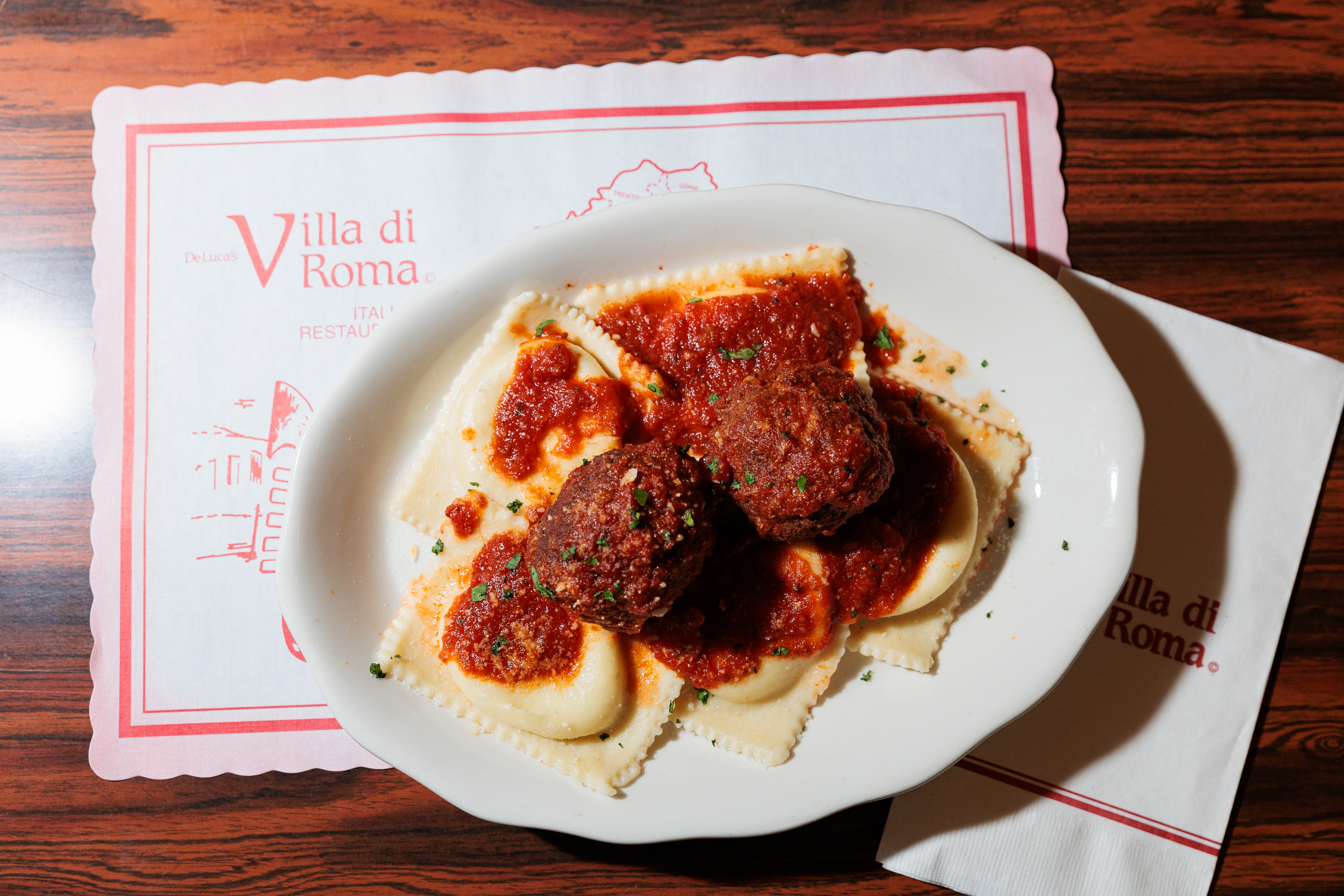
    Ravioli with meatballs from Villa Di Roma on Wednesday, Sept. 11, 2024, in Philadelphia .

    In addition to Dante and Luigi’s, what other old school “red gravy” joints have best survived the passage of time?

    MK: Ralph’s, Victor Cafe, Villa di Roma. You might also count Ristorante Pesto, whose owner Giovanni Varallo had the long-ago Io E Tu on Passyunk. (Craig LaBan adds: “Scannicchio’s! But technically a ‘post-red gravy’ generation restaurant, not unlike Pesto.”)

    Where are the best places in Philly for college students to eat at? (Besides food trucks)

    BF: Penn class of ’22 grad here, so I would be silly to not shout out our campus bar Smokey Joe’s for having sneakily excellent and oversized pizza and burgers. If you go for lunch or dinner early in the evening, it’s kind of the platonic ideal of a dive bar.

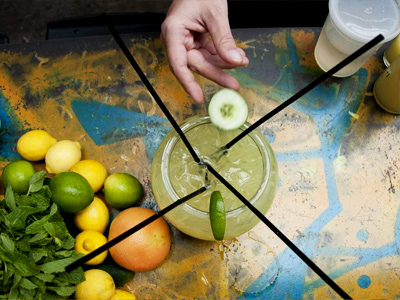
    Michael Wirzenberger, managing partner at Sampan Philly, mixes a scorpion bowl of cucumber margarita at the restaurant’s Graffiti Bar. Wirzenberger came up with the recipe. ( Abi Reimold / Staff Photographer )

    Otherwise, you and your friends should be taking advantage of happy hour deals throughout Philly and far, far away from your campuses. Food is cheaper that way. My faves:

    • Rosy’s Taco Bar: Happy hour is 3 – 5 p.m so it’s always been mostly other college students. Everything is $5, and deeply reliable.
    • Sampan: Very yum pan-Asian small bites all under $10. Split a scorpion bowl with your friends if everyone is of drinking age.
    • La Chinesca: This is for when you want to feel classy and cool and adult, eating tacos from a retrofitted mechanic’s shop.
    • Harp & Crown, Giuseppe & Sons, and Bud & Marilyn’s all felt the right amount of fancy for a college student for happy hour. Very solid small bites, lots of young people.

    If you are actually looking for places to to eat and not experiences with good enough food like I wanted in college, I would recommend just exploring Reading Terminal Market and a lot of the mom-and-pop or hole-in-the wall restaurants in Chinatown and the Italian Market. You’ll feel like you actually live here.

    Is it fair to say that the very best roasted duck in Philly is sold at Ting Wong on 11th Street in Chinatown??

    CL: Ting Wong reopened earlier this year after a short closing and everyone rejoiced because it’s such a neighborhood standby for Hong Kong-style noodles, soups, and BBQ meats — including a stellar roast duck. It’s still very good, but I’ve long been a bigger fan of two others in Chinatown: Siu Kee, the takeout-only duck shop just across 10th Street from Ting Wong, which supplies many of the best restaurants in Chinatown with their ducks (including Tai Lake, which I revisited this year), but also Lau Kee, a cozy little storefront on the 900 block of Race Street owned by the longtime former duck chef of Sang Kee. It’s great!

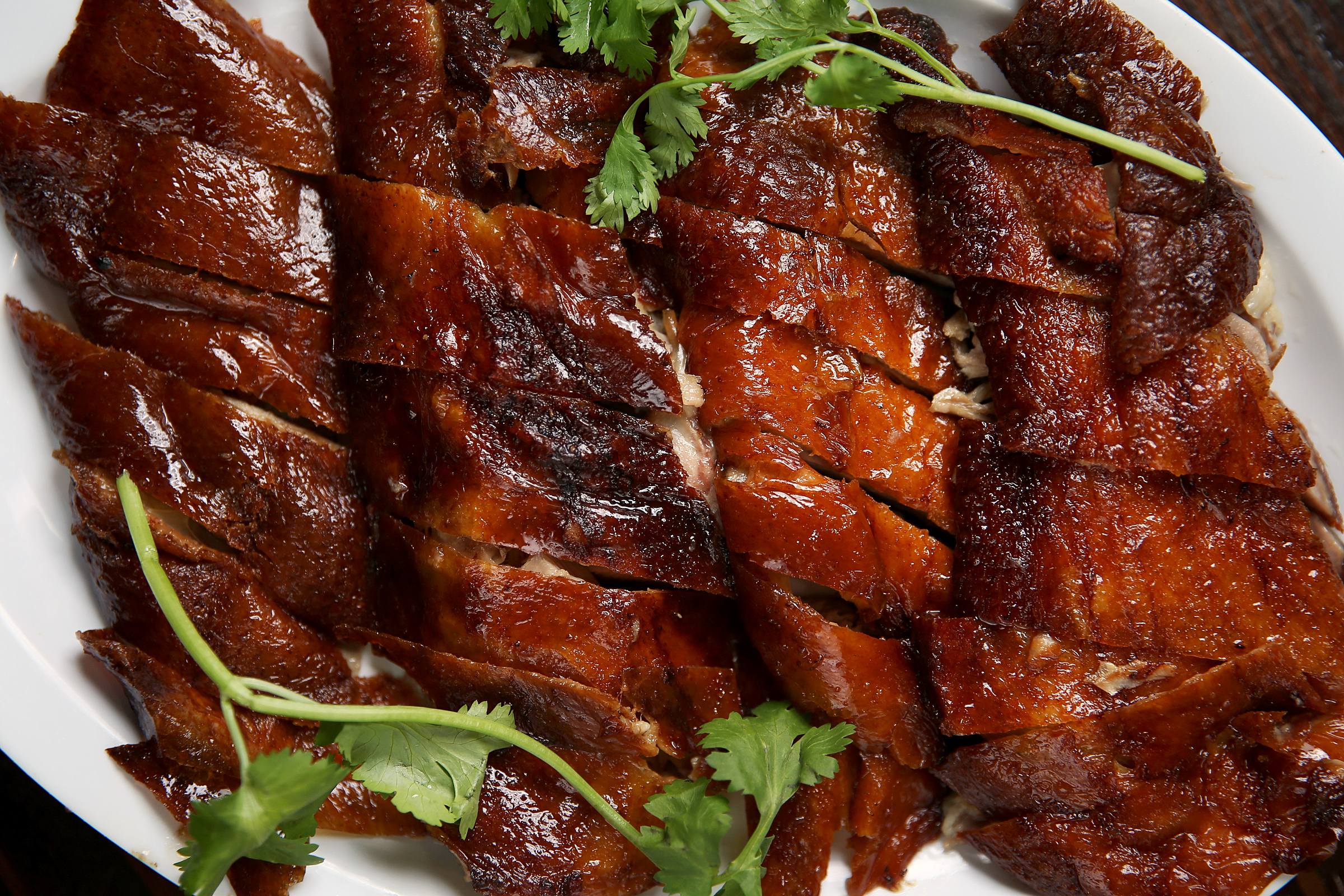
    The Peking duck is pictured at Lau Kee in Philadelphia’s Chinatown on Thursday, April 1, 2021.

    One more: While these previously mentioned shops are examples of the savory, marinated Hong Kong duck style, a newer entry called Beijing Peking Duck and Seafood Restaurant on Arch Street makes one of the best Peking-style ducks I’ve had — with a cracker-crispy golden skin that gets carved dramatically tableside. You have to order a whole duck, but it is an event worth the splurge.

    I miss Gigi Pizza and Nomad Pizza so much. Are there any casual pie spots with great sides and salads like them in Center City or in the works? Vetri Pizza is missing something lately and Pietro’s is good but Rittenhouse gets SO crowded anymore…

    MK: Gigi and Nomad had a good thing going. A little fancier is Sally at 23rd and Spruce Streets, which just was awarded a Bib Gourmand by the Michelins. Charcuterie boards, fab meatballs, really nice salads (the green salad with miso and pickled shallot), and crispy pies, like the Loud Red, whose arrabbiata sauce is perfect for the spice fans… Wilder at 20th and Sansom has a raw bar, a few salads, and seasonal wood-fired pies, like the lamb bacon…. Clarkville at 43rd and Baltimore has a warm cauliflower salad that supplements the pizza list… I’m also really fond of the new-ish Corio at 37th and Market, not only for the pizza, pasta, and salads, but the inviting vibe.

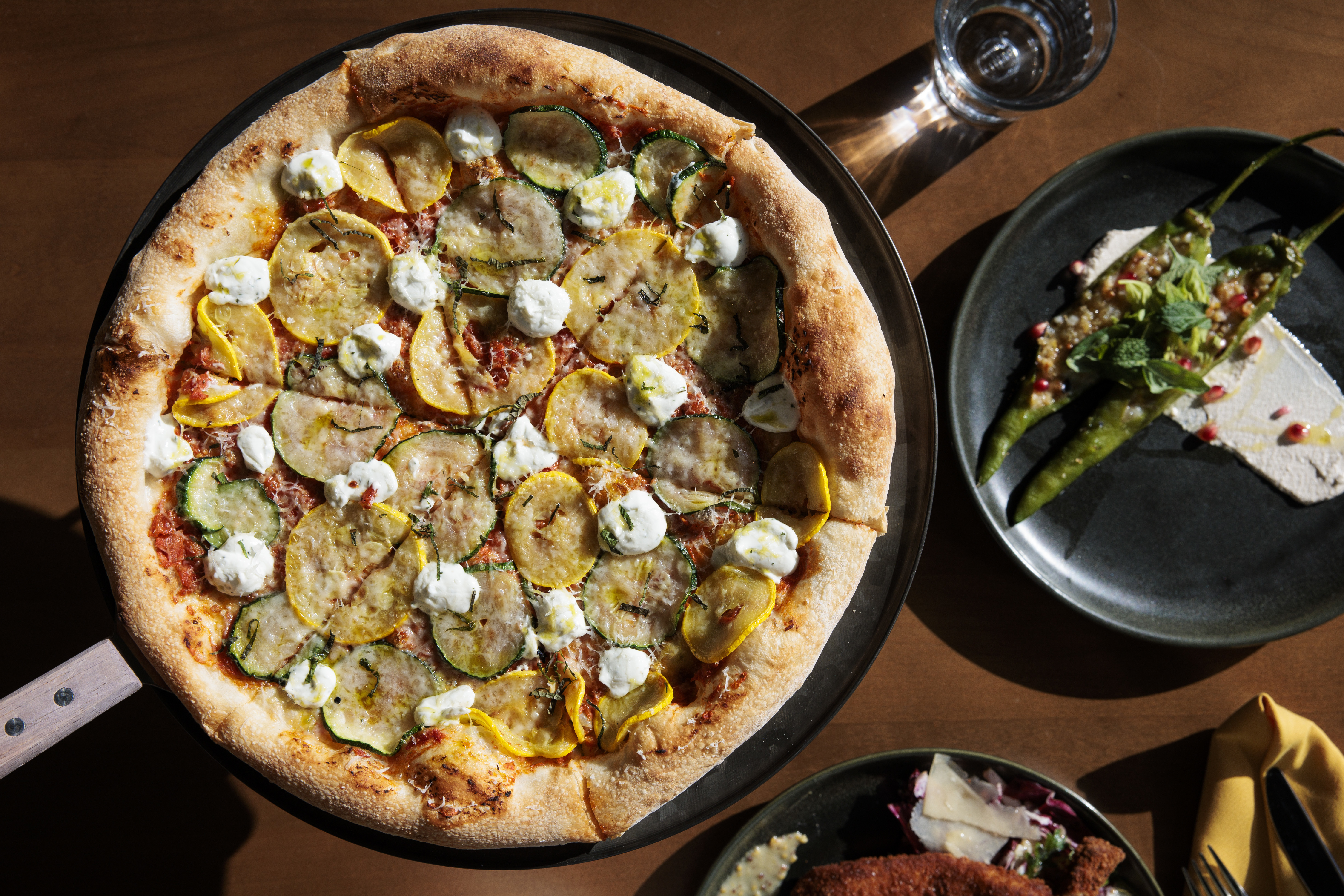
    The Zucchini Pizza and Stuffed Long Hots at Corio on Thursday, Sept. 18, 2025 in Philadelphia.

    When I lived and worked in Philly in the ’90s, Caribou was near the top of my dining list. The menu still looks fine. What is your take on this restaurant?

    CL: Caribou is still kicking! This Center City standby — going on 33 years in its current Walnut Street location — had a change of ownership over a year ago, with chef Townsend Wentz’s group taking it over. I’ve not been since a solid lunch in the early weeks of Wentz’s takeover, but here’s a few basic observations: They’ve largely kept the classic brasserie vibe intact, including that fantastic long bar with its art deco statuettes, and they’ve simply made an effort to update and improve some of the classic French bistro fare. Wentz is good at that, and I loved the initial French onion soup I tasted there. But I’d like to return for a check-in. As the weather gets cold, a good stewy plate of boeuf bourguignon or a hearty choucroute garnie sounds good to me. But you never know until you go. With the unfortunate closing of Bistrot La Minette last year, Center City needs all the great French bistros it can hold onto.

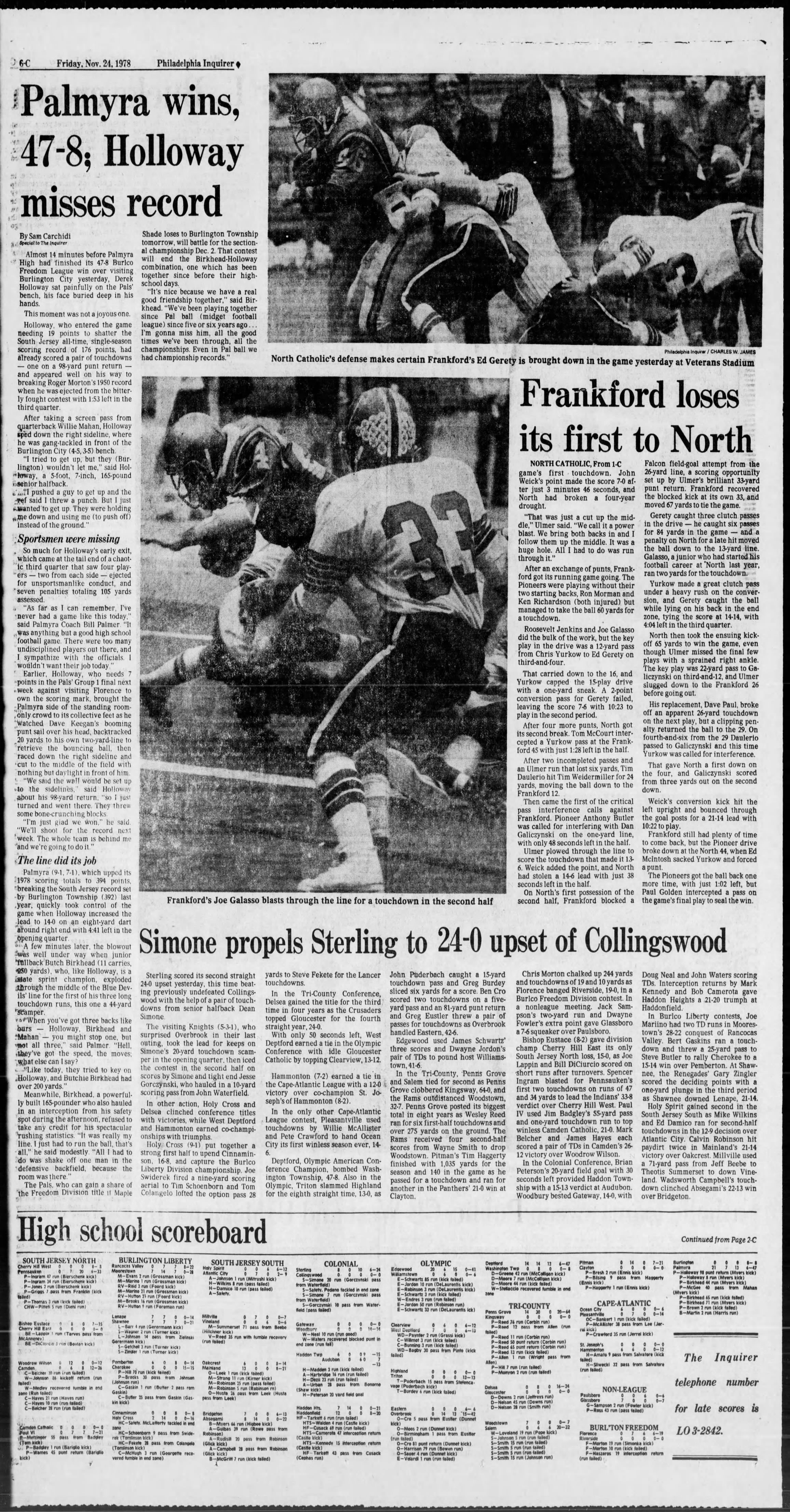
  • North Catholic beat Frankford on Thanksgiving in 1978. It’s a victory the Norphans haven’t forgotten.

    North Catholic beat Frankford on Thanksgiving in 1978. It’s a victory the Norphans haven’t forgotten.

    Not long after North Catholic’s building and campus were sold in 2011, an alumnus found pieces of sports equipment in a nearby dumpster. Ruby-red helmets, game-used footballs, and faded trophies were discarded carelessly, bound for a landfill, until this anonymous Samaritan fished them out.

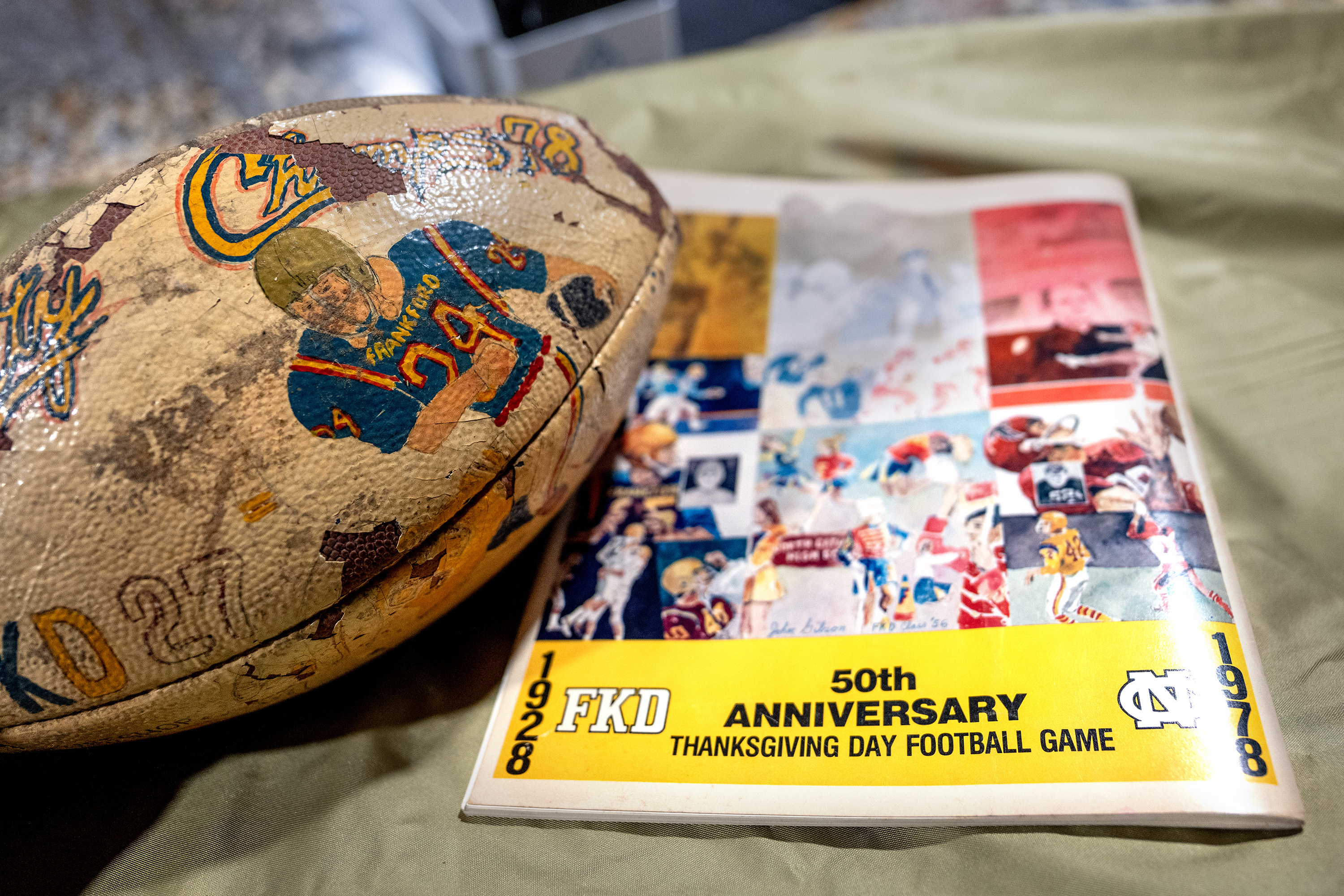
    To the seniors who were part of the school’s 1978 football team, these items were anything but garbage. They represented cherished memories, including the greatest of all: the 50th anniversary Thanksgiving Day game between the North Catholic Falcons and the Frankford Pioneers.

    The “Norphans” — derived from “North Catholic” and “orphans” — are determined to keep the legacy of that game alive. For decades, it was a Northeast Philadelphia tradition. The neighboring high schools, one public and one Catholic, played from 1928 to 2009, not for a state championship or a league title, but for bragging rights.

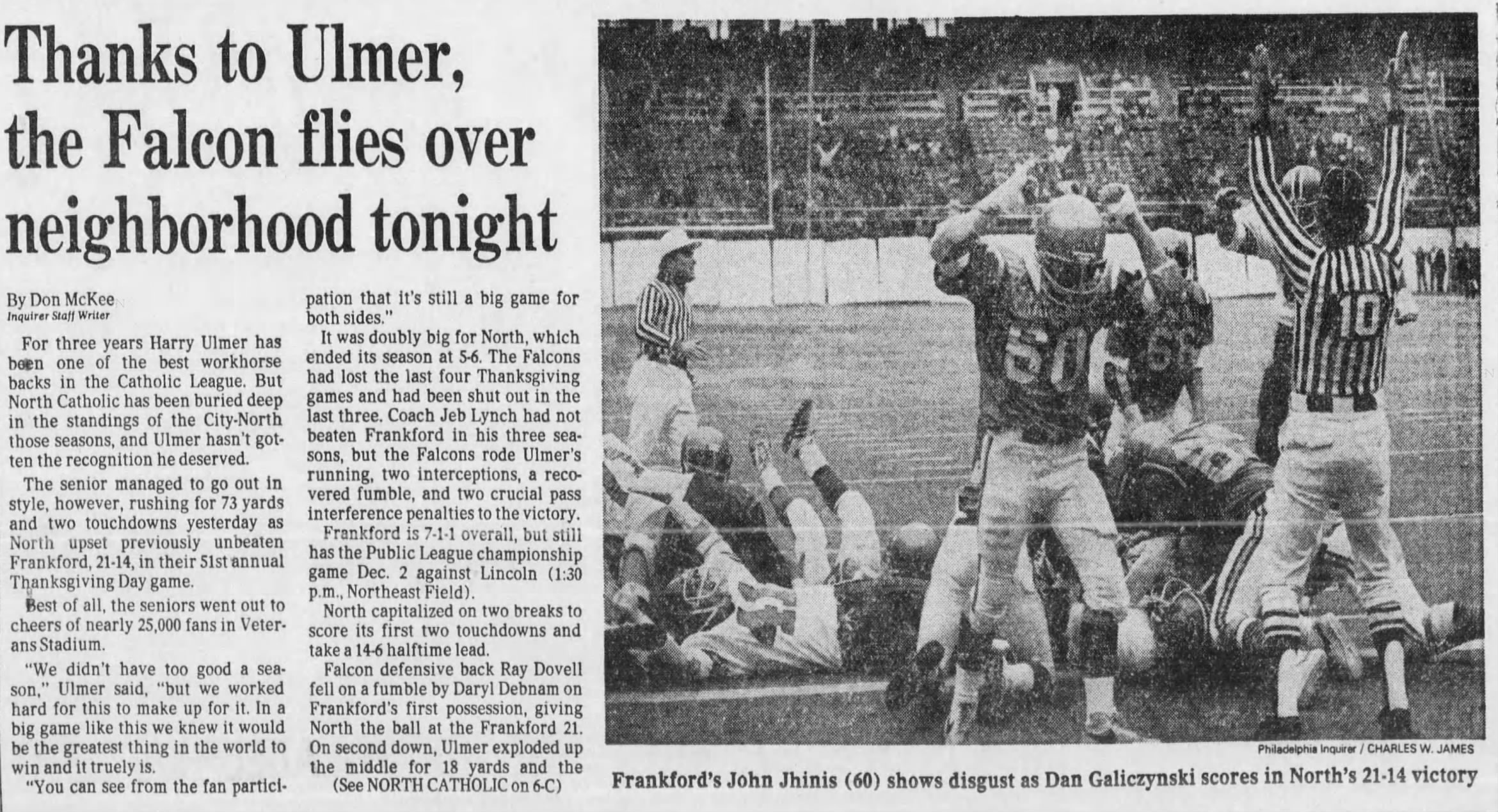
    The 50th anniversary pushed an already-intense rivalry to new heights. Eagles coach Dick Vermeil relocated his team’s practice to Franklin Field so the high schoolers could play at Veterans Stadium. Twenty-five thousand people showed up, including politicians and scores of local reporters.

    A souvenir from the Frankford-North Catholic 1978 football game. For decades, North Catholic and Frankford had a heated rivalry that played out in a Thanksgiving Day game.

    The Falcons were heavy underdogs. They’d gone 5-6 that year and had lost their previous four Thanksgiving games to Frankford. The Pioneers were a bigger team, with a renowned coach in Al Angelo, who led them to a 7-1-1 record en route to a city title in 1978.

    But North Catholic was gritty. And on Nov. 23, it pulled off an improbable win, beating its rival, 21-14, in the seniors’ final game together.

    As the Falcons walked off the field, nose tackle John Kane imagined returning for the 100th anniversary in 2028. That became impossible in 2010, when North Catholic closed because of dwindling enrollment, rendering the Thanksgiving tradition a thing of past.

    But the 1978 North Catholic seniors still have remnants of that game, recovered from the dumpster. They still have the film. They still have the memories, and they still have one another. And for that, they are grateful.

    “It was the last game we’d ever play together, and we went out as a winner,” said offensive lineman Chuck Cianci. “It was our championship.”

    ‘Our Super Bowl’

    North Catholic and Frankford occupied the same swath of Northeast Philly, about a mile and a half apart. The high schools’ proximity made the Thanksgiving game a hotly contested neighborhood event.

    Kane compared it to the “Catholics and the Protestants in Northern Ireland.” Cianci said it was like “hell week.” Stories of past Thanksgiving games were passed down from generation to generation. Local children dreamed of playing in it — and quickly learned to embrace the rivalry.

    Fullback Tim Keller, then a freshman, recalled taking the bus home after the Falcons lost to the Pioneers, 12-7, in 1974. As the North Catholic bus turned off Adams Avenue and onto Roosevelt Boulevard, the Frankford bus pulled up alongside it.

    “The next thing you know, the windows came out, and the [North Catholic fans] were throwing the [bus] seats at them,” Keller said. “We lost the game and tore the bus apart.”

    North Catholic and Frankford played their Thanksgiving game at Veterans Stadium on Nov. 23, 1978.

    A police officer pulled the vehicle over. He allowed women and children to exit, but raucous students and adults spent their Thanksgiving at the 15th Police District on Levick Street.

    “The cop gets on [the bus] and says, ‘Sit down!’” Keller said. “And we’re like, ‘We can’t. There are no seats anymore.’”

    The officer took the North Catholic fans’ IDs but did not search their pockets. They smuggled a bottle of wine in and passed it from cell to cell.

    Even when the games weren’t competitive, the rivalry remained intense. North Catholic was shut out every Thanksgiving from 1975 to 1977. Frankford put up a combined 65 points over that span.

    But the Falcons entered the 1978 season with a singular focus. North Catholic coach Jeb Lynch started harping on the Thanksgiving game during the team’s summer workouts at Allentown College of St. Francis de Sales (now DeSales University).

    They practiced from morning until night, turning their car headlights onto the field when it became too dark to see.

    It ended up being a lackluster season. By Thanksgiving week, North Catholic had lost four consecutive games, including a 49-11 drubbing by Archbishop Ryan.

    Nevertheless, the excitement around the 50th anniversary was palpable. It was all anyone in the neighborhood talked about. Teachers and students expressed their support — some in unorthodox ways.

    North Catholic slotback Dan Galiczynski took an electronics class his senior year. He was struggling. A few days before the game, his teacher, a religious brother, offered him a lifeline.

    “The brother said, ‘Dan, all you’ve got to do is beat Frankford,’” Galiczynski said. “‘And I’ll give you a 72.’”

    (He chose 72 because it would allow Galiczynski to “barely pass” without exaggerating his electronics savvy.)

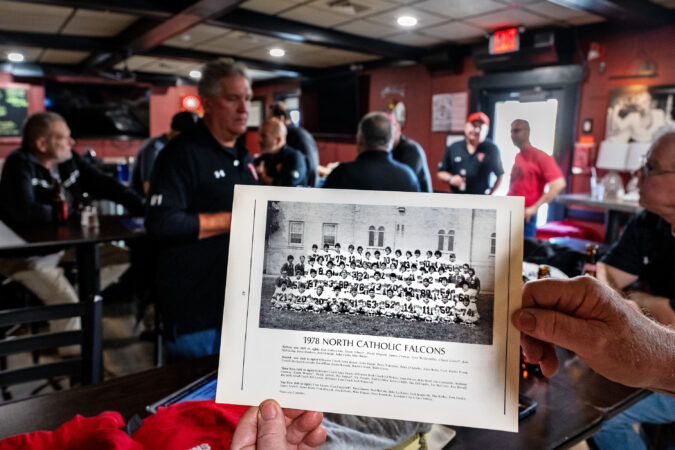
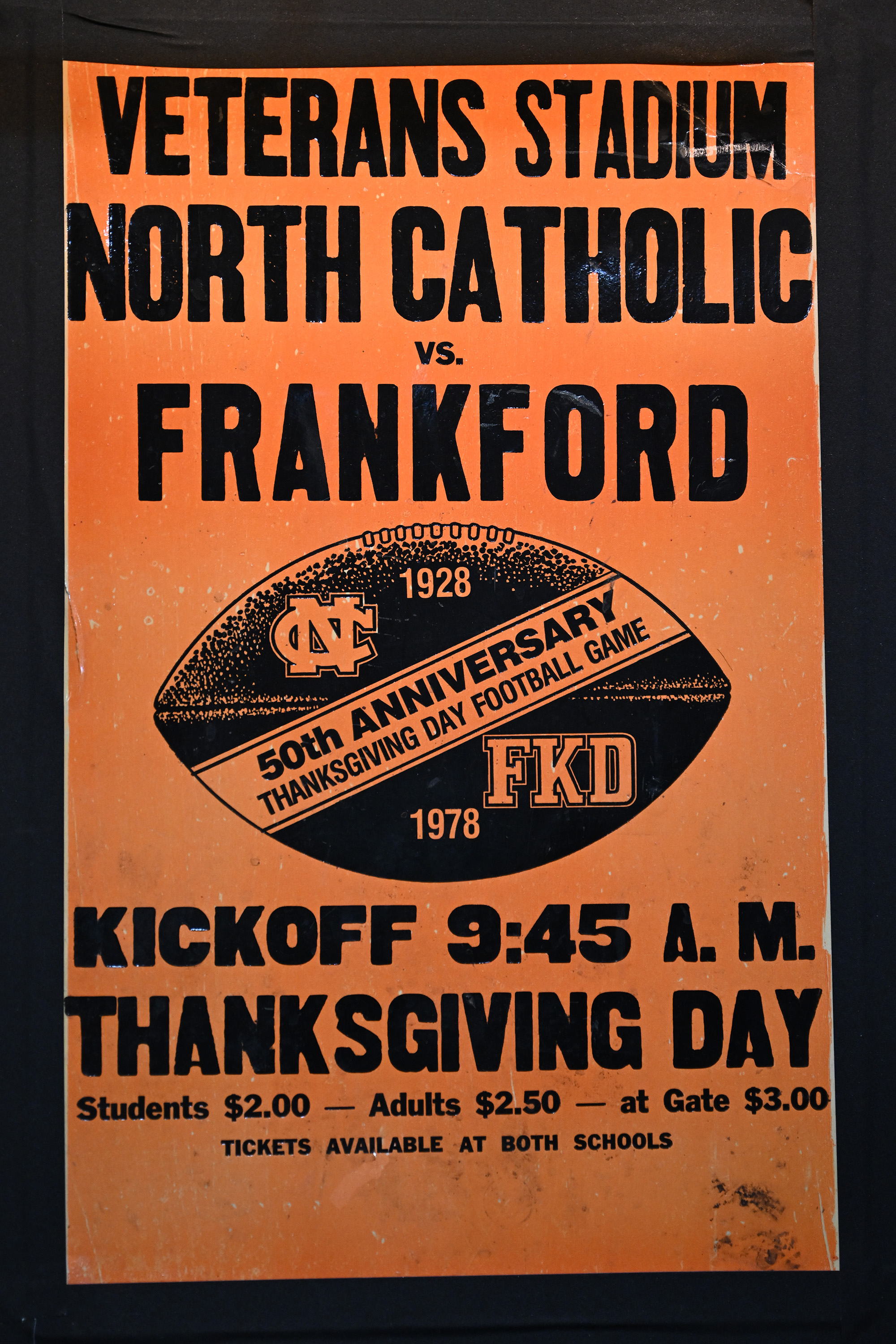
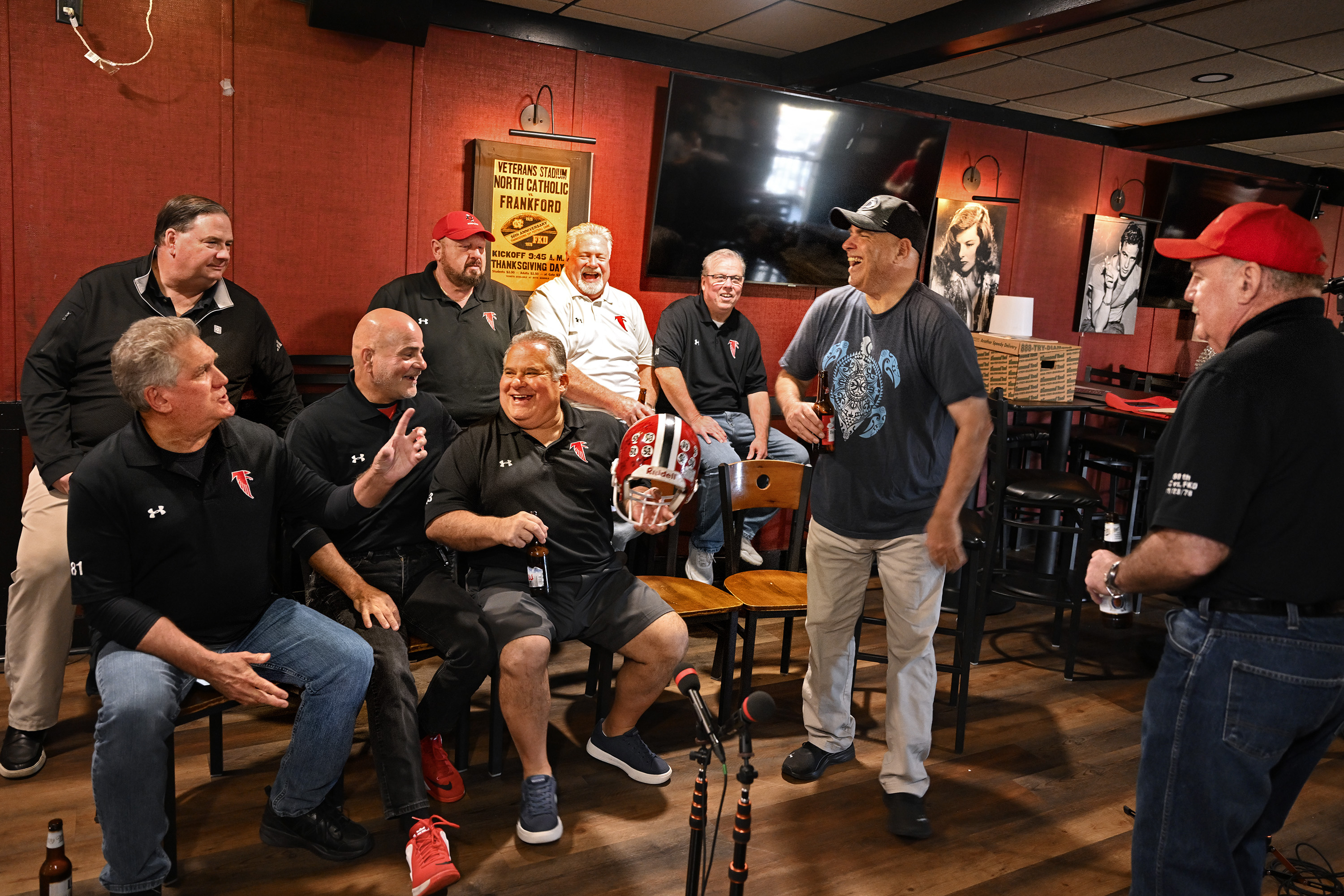
    A poster from the 1978 game brought by former North Catholic football players gathering at Dagwood’s Pub in Torresdale on Nov. 16.

    Before 1978, the Thanksgiving game had been played at Temple Stadium (which was demolished in 1997) or Franklin Field, but to commemorate the 50th, Angelo proposed that it be moved to Veterans Stadium. The city signed off on the idea and arranged for Frankford to use the Eagles’ locker room. North Catholic was to use the visitors’.

    Just before 9:45 a.m. that Thursday, the Falcons walked out of the tunnel to thousands of screaming fans. They looked up and saw friends and family in the crowd.

    Frank Correll, who played on special teams, got goose bumps.

    “We all came from small neighborhoods,” he said. “So it was overwhelming. Now you understand why these guys all come out for big football games running around and jumping. There’s a lot of energy. And this was, for our school, our Super Bowl.”

    High school heroics

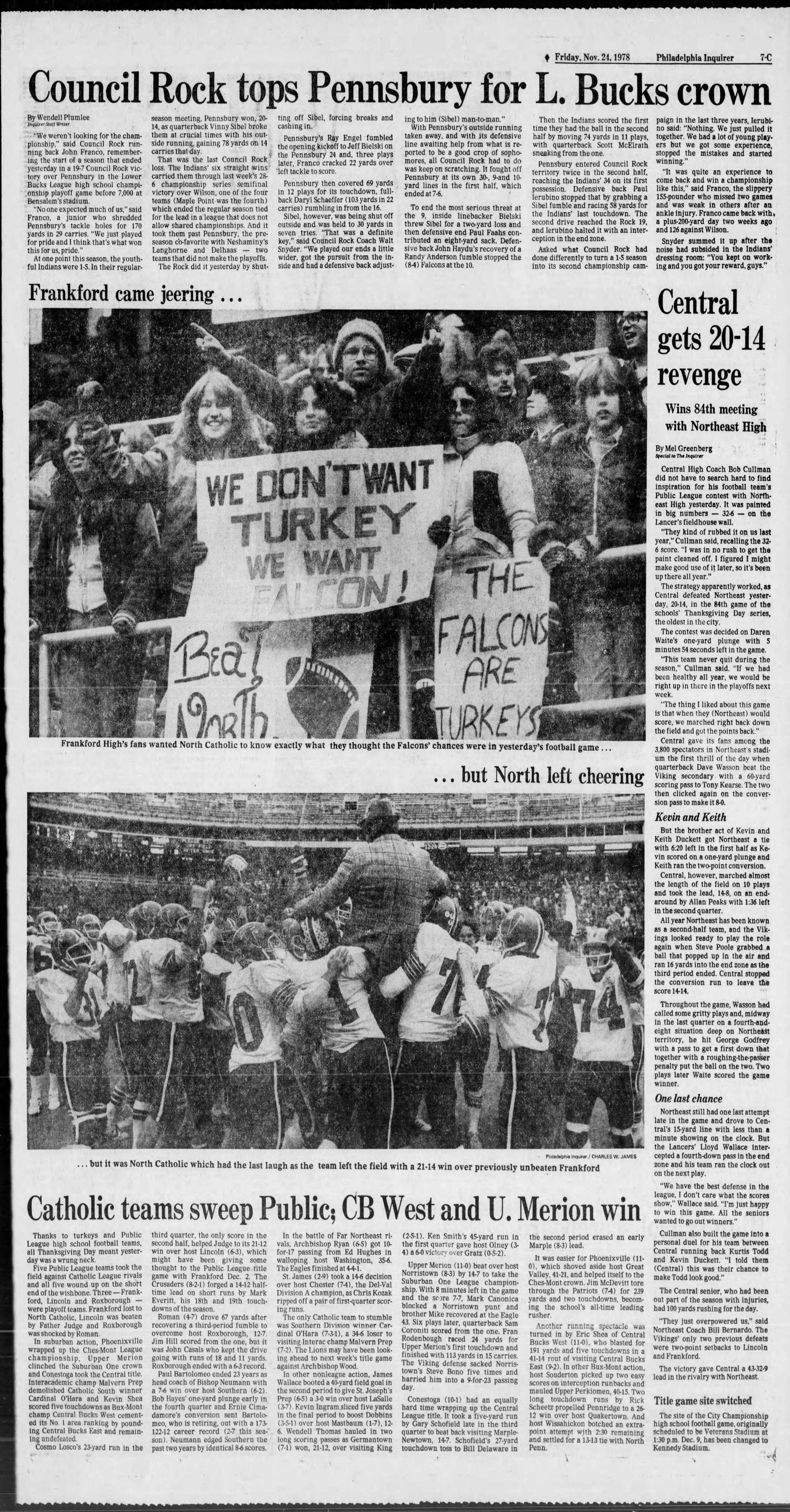
    It didn’t take long for things to get contentious. Frankford fans began chanting “We don’t want turkey, we want Falcon!” Some threw whiskey bottles at North’s captains during the coin toss.

    As handles of hard liquor careened through the autumn air, tailback Harry Ulmer turned to Cianci.

    “He was like, ‘What’s going on?’” Cianci said. “That wasn’t good. That wasn’t good.”

    Despite the hostility, North Catholic got off to a promising start. Defensive back Ray Dovell recovered a fumble on Frankford’s first possession, setting the Falcons up at the Pioneers’ 21-yard line. Moments later, Ulmer rushed for a touchdown to give North Catholic an early lead.

    Frankford responded with a 60-yard touchdown drive. But a two-point conversion attempt failed, leaving North Catholic with a 7-6 lead with 10 minutes, 23 seconds left in the second quarter.

    North Catholic vs. Frankford in a Thanksgiving game at Veterans Stadium on Nov. 23, 1978.

    Then North Catholic got another break. Defensive back Joe McCourt intercepted a pass from Frankford quarterback Chris Yurkow, and ran 18 yards to reach the Pioneers’ 30-yard line.

    With less than two minutes to go in the half, North Catholic was desperate to add to its lead. But on the next three plays, the team didn’t get any closer to the end zone; it went backward, losing 6 yards.

    Now, there was only a minute remaining. North Catholic sat on the 35-yard line, too close to punt and too far for a field goal. Lynch settled on a conservative play. He wanted to run the ball.

    But Cianci had other ideas. The offensive lineman jogged into the huddle.

    “Coach just wants you to run the ball,” he said. “We’re not doing that. What do you want to do?”

    Wide receiver Tim Weidenmiller looked at quarterback Tony Daulerio. The team had practiced a tight end out-and-up play but hadn’t used it in the game yet.

    “I can beat this corner right now,” Weidenmiller told him.

    “All right,” Daulerio responded. “Let’s do that.”

    On fourth-and-16, Daulerio hit Weidenmiller for a 23-yard pass that put them at Frankford’s 12-yard line. Ulmer then ran it in for his second touchdown of the day, giving North a 14-6 lead at the half.

    In the third quarter, Frankford blocked a North Catholic field goal and recovered the ball at its own 33-yard line. The Pioneers drove 67 yards to tie the game, 14-14, with 4:04 left in the quarter.

    North Catholic vs. Frankford was a Thanksgiving game tradition. The Falcons beat the Pioneers on Nov. 23, 1978.

    Ulmer exited with a sprained ankle. Running back Dave Paul replaced him and ran 26 yards for a touchdown, but the play was called back for a clipping penalty. The ball was returned to the 29-yard line.

    Galiczynski walked over to his coach.

    “Listen,” he told Lynch. “I’m a senior. Dave Paul is a sophomore. I ran tailback my whole junior year. Put me in.”

    “Go ahead,” Lynch responded.

    Galiczynski scored two plays later. The Falcons made the extra point, giving them a 21-14 lead with 10:22 left.

    The Pioneers had ample time to score, but North held the line. Defensive back Paul Golden finished the game by intercepting Yurkow’s Hail Mary pass with just over a minute remaining. The clock ran out. The Falcons crowd roared.

    A few players lifted Lynch on their shoulders as they triumphantly marched off the field.

    “We got to this game, in this special place, and we won it,” Cianci said. “And to look around and see the fans, and how much joy they had … it was unbelievable. We were like folk heroes.”

    A new tradition

    After graduating, the seniors from the 1978 North Catholic team went their separate ways. Some moved out of the city, some moved out of the state. But the group stayed in touch while supporting each other from afar.

    In the early 1980s, Cianci was accepted into the police academy. A few months later, he was told classes for that semester had been canceled. He had to find a new job until the academy opened up, and happened to run into Galiczynski at a local softball game in Philadelphia.

    Cianci explained his predicament.

    “Danny said, ‘You can work with me in construction,’” Cianci said. “And he put me to work until the academy called me back. That’s the kind of friendship we have.”

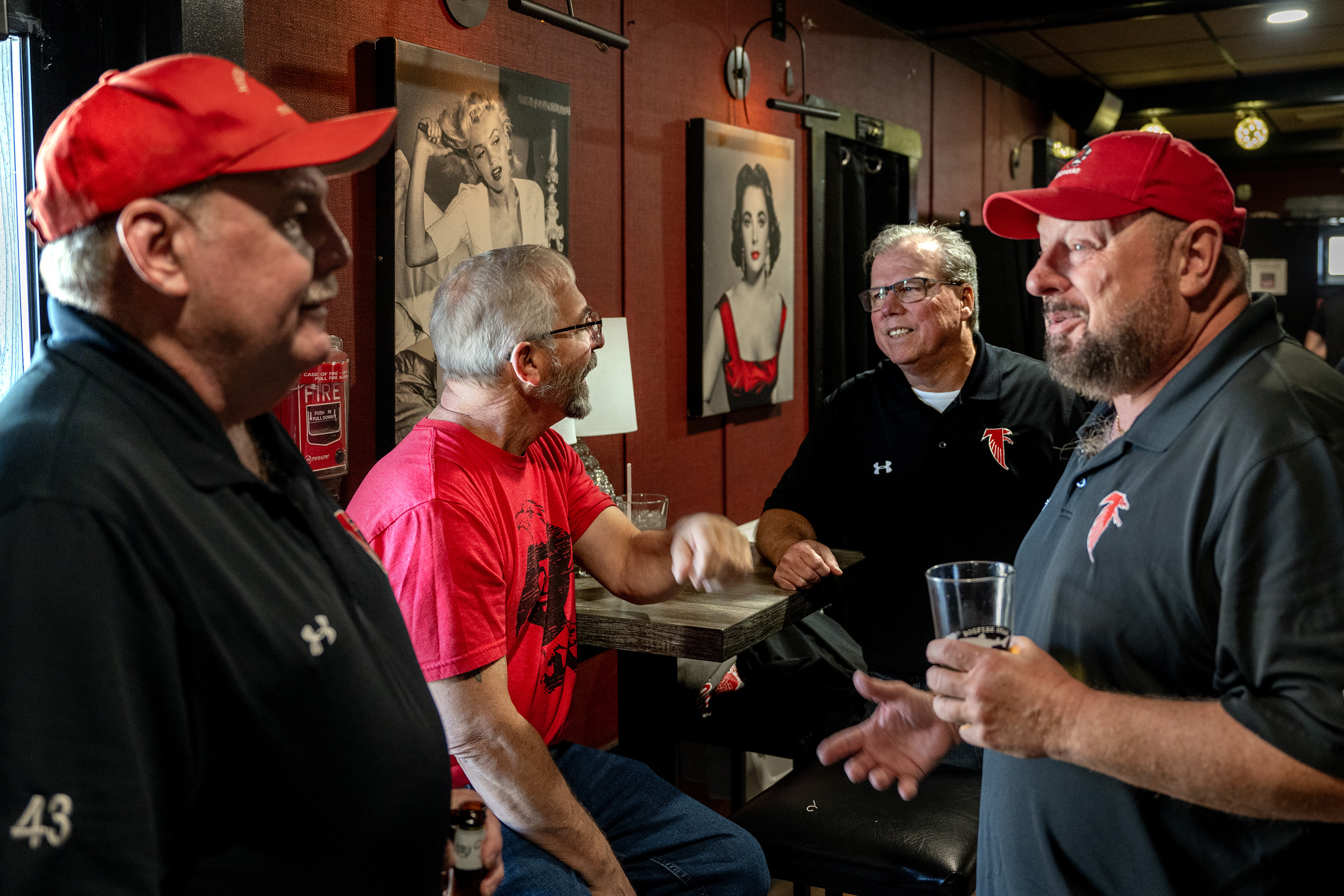
    Former North Catholic football players Paul Golden (from left), Tim Keller, Joe McCourt, and Mike Butler catch up on Nov. 16 at Dagwood’s Pub in Torresdale.

    In 2018, Tommy Campbell, a senior defensive tackle on the 1978 team, fell ill. He was diagnosed with amyloidosis and a rare blood disease. His heart and liver were failing him. The North Catholic graduate spent six months on life support in the intensive care unit.

    Campbell worked as a mechanic for an airline at Dulles International Airport in suburban Washington. The airline’s insurance company told him it wasn’t going to cover a heart and liver transplant because of the blood disease.

    His wife, Karen, began a letter-writing campaign to persuade the insurance company to pay for the operations. Multiple members of the 1978 North Catholic team joined in.

    Linebacker Pat Jordan, a 1978 senior captain, took it a step further. He was a longtime plumber with Local 690. The union used the same insurance as Campbell, so Jordan decided to apply some pressure.

    “He went to the international, and said, ‘Listen, we need to do something. This is one of my best friends,’” Cianci said. “‘We’re going to call the insurance company. We’re going to threaten to pull our insurance for all union members if they don’t get this approved.’”

    The company reversed its decision and covered Campbell’s surgery. To this day, he believes his teammates saved his life.

    “These were guys I hadn’t seen in 30-35 years, coming to the plate,” Campbell said. “Everybody should be lucky enough to feel that.”

    Jordan died unexpectedly on Feb. 3. He was 63. The 1978 seniors toasted to him during a reunion last summer in North Wildwood.

    Former North Catholic football players gather together on Nov. 16.

    This is their annual tradition now. There are no more North Catholic-Frankford games to go to. The local Thanksgiving games that remain just don’t feel the same.

    So every July, the Norphans will meet at the beach before they head to Keenan’s Irish Pub. They’ll celebrate Jordan, linebacker Frank Wodjak, guard Ken McGuckin, and other fallen teammates.

    They’ll wear black-and-red polo shirts with uniform numbers stitched into their sleeves and relive a day that still feels like dream.

    “And we’ll toast,” Galiczynski said, “until the last of us is standing.”

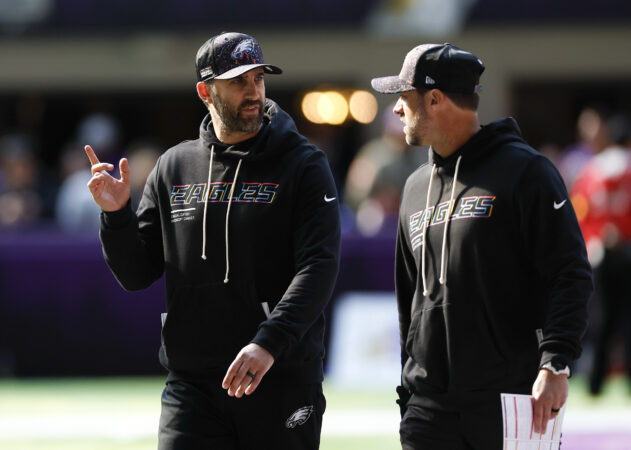
  • Nick Sirianni just gave Kevin Patullo a vote of confidence. He didn’t have a choice.

    Nick Sirianni just gave Kevin Patullo a vote of confidence. He didn’t have a choice.

    The worst thing the Eagles can do right now is the thing that everybody wants them to do. Nick Sirianni isn’t going to do it. He has said it all season and he said it again on Monday, even though he did not need to. You don’t make a change in play-calling duties after a late afternoon road game in the week of Thanksgiving when you are scheduled to play on Friday. Even if Sirianni was entertaining the idea of demoting offensive coordinator Kevin Patullo, doing it this week is almost a non-starter.

    But let’s be clear. He shouldn’t be entertaining such a move, short week or not. It doesn’t make sense on a practical level. It doesn’t make sense on a logistical level. And it certainly doesn’t make sense on an existential level, as the Eagles have seen before.

    “I feel like we’ve got the right people, as players, as coaches, that have had success, and we’re all searching for answers to make it more consistent,” Sirianni said Monday. “There’s some good things, there’s obviously some not so good things. We have to find the things that we can really hang our hat on and the complements that come off that.”

    It matters not whether you believe him, or whether he believes himself. Whatever he or you or the players think of the job Patullo has done in his first 11 games calling plays, the important thing is that he is the one who has been doing it. It has been his voice over the headset. It has been his messaging in the meetings. From a command and control perspective alone, changing coordinators this late into a season would introduce a whole new list of things that could go wrong. But what really matters is the message such a move would send.

    Offensive coordinator Kevin Patullo “did a good job” of calling plays against the Cowboys, Eagles coach Nick Sirianni said.

    Sirianni and the Eagles say they learned a lot of lessons a couple of years ago when their 10-1 start to the 2023 season ended with six losses in their last seven games. The biggest of those lessons is the one that so many of us can’t seem to wrap our heads around. Firing a coordinator this late into a season can do more harm than good, however much he deserves the blame.

    We all remember how the movie ended in 2023, right? When the Eagles stripped defensive coordinator Sean Desai of his play-calling duties on Dec. 17, the circumstances were remarkably similar to now. They were coming off two of their ugliest outings of the season, the second of them a 33-13 loss to the Cowboys at Dallas. But they were 10-3, still very much in the running for the top seed in the NFC playoffs, and only a few weeks removed from back-to-back statement wins over the Kansas City Chiefs and the Buffalo Bills. The ship was hardly sinking. Then Capt. Matt Patricia took charge.

    There’s a strong argument to be made that the 2023 season ended the day they demoted Desai. Up until then, the Eagles still had the confidence and swagger of a defending conference champion. They were a good team going through a rough patch. There was no reason to think otherwise.

    By demoting Desai and replacing him with Patricia, the Eagles made an unprompted announcement that things at One NovaCare Way were more dire than they seemed. From that point on, every week brought more dysfunction.

    Sirianni barely survived the fallout. It took him until last February to finally shake off the last of the weakness.

    The Eagles demoted defensive coordinator Sean Desai during the disastrous finish to their 2023 season.

    The kicker, of course, is that the defense didn’t get better. In Patricia’s first week on the job, the Eagles allowed a touchdown pass with 28 seconds left to lose a game to the Seattle Seahawks that they’d led throughout. The next week, they allowed 25 points to Tommy DeVito, Tyrod Taylor, and the Giants, with New York’s potential game-tying touchdown drive ending at the Eagles’ 26-yard line. After that, they lost a 35-31 shootout to an Arizona Cardinals team that hadn’t cracked 30 points all season.

    Demoting Patullo has even less potential upside. Anybody who would replace him is already in the building. That person would almost certainly try to do things the same way the Eagles have been doing them throughout Sirianni’s tenure as coach. Kellen Moore didn’t take the secret recipe box with him to New Orleans. He just happened to be calling plays with an offensive line that was averaging 6 yards per carry.

    Sirianni will get some ridicule for his messaging during Monday’s news conference. The worst thing you can tell an emotionally unstable Eagles fan is that everything is well.

    The head coach didn’t even go that far. He was asked if he’d considered making a change in play-calling duties. He answered definitively.

    “No, I haven’t,” Sirianni said. “Again, I think that we’re always looking for answers, as coaches we’re always looking for answers and we’re never into assigning blame, it’s just looking for answers. … It’s every piece of the puzzle: coaching, playing, execution, scheme, everything … have to be better in all of those aspects. Yesterday, I thought Kevin did a good job of calling. Obviously, he’s going to want plays back just like every player and myself, we all want plays back. … It’s never in football one thing. So, no, I haven’t considered that.”

    Anybody who calls plays for this offense is going to face the same challenges as Patullo. The Eagles have an offensive line that is missing its best player in Lane Johnson and looks incapable of the same dominance it showed on the road to a Super Bowl last season. They have a quarterback who isn’t confident enough in his arm to make the sorts of throws that Dak Prescott was making into traffic on Sunday, when the Cowboys overcame a 21-point deficit and the Eagles offense stalled for three quarters of a 24-21 Dallas win. They have a superstar wide receiver who looked like a distant third behind George Pickens and CeeDee Lamb as the best receivers on the field. They have a superstar running back who doesn’t have the same burst he did last season.

    In order for Sirianni to make a change, he would need to be reasonably confident that things would get better. If not, things would get appreciably worse. Sirianni and the Eagles would be operating from a position of weakness for the duration of the season. The worst thing they can do right now is panic. We’ve seen how that sort of thing ends.

  • Book it: The Eagles’ loss to Dallas will put their coaches under Jeffrey Lurie’s microscope

    Book it: The Eagles’ loss to Dallas will put their coaches under Jeffrey Lurie’s microscope

    There are games in the NFL that have repercussions. The Eagles’ 24-21 loss Sunday to the Cowboys — a game in which they blew a 21-point lead, throttled back their offense after taking that lead, and committed one egregious mistake after another — is likely to be one.

    Those repercussions might yet be good for the Eagles. The NFL is so parity-ridden, each team separated from the other by such small differences, that it’s possible that Sunday’s meltdown will inspire the Eagles to clean up their sloppy play, beat the Chicago Bears on Black Friday, and embark on another deep playoff run. They’re still going to win the NFC East, at a minimum. It will be difficult to call such a season, no matter its final endpoint, a complete failure.

    But Eagles chairman Jeffrey Lurie stopped judging his franchise by that standard a long time ago. Sunday’s loss went from See, the team is rounding into form to HOLY HELL EVERYONE’S WORST FEARS HAVE BEEN CONFIRMED in a matter of minutes. That sudden reversal of fortune, though, really had been the culmination of a steady accumulation of inconsistent performances, injuries to important players, and consternation both inside and outside the locker room.

    Those conditions are the kind that, in the past, have compelled Lurie to act. It is, of course, true that the offensive line’s decline is a huge factor in the Eagles’ overall regression, maybe the biggest factor, and that reality, one could argue, should absolve Nick Sirianni, Kevin Patullo, Jalen Hurts, and anyone else for an 8-3 team that feels like it’s 3-8. But it’s naive to think, given the nature of Sunday’s loss and the arc of this season, that Lurie isn’t taking a long, hard look at the coaching staff, Sirianni included.

    Raising such questions might seem premature or unnecessary. It’s not. There are reasons for Sirianni to be worried here — not necessarily that he’s going to be fired after the season, but that he’s more vulnerable than he once was. Nine months after winning the Super Bowl, six months after getting a contract extension, he ought to understand that, if recent history is any indication, there’s a lot at stake for him over the next 6-12 weeks. Consider:

    1) The Eagles aren’t playing offense the way Lurie has generally wanted his teams to play offense.

    This assertion is obvious, and it’s based on the Eagles’ production, or lack thereof. But it’s also based on the Eagles’ style of play.

    For years, dating to the Andy Reid era, the Eagles made their bones by remaining aggressive in their play-calling even after taking a big lead, by using analytics to set themselves apart from the rest of the league. Sometimes, it cost them games. In February 2018, it won them their first Super Bowl. Lurie loves that approach.

    The last two years, however, the Eagles have turned themselves into a full-fledged running team. Lurie is not necessarily anti-running the ball — not when it leads to the big plays and the Super Bowl victory that Saquon Barkley and that dominant offensive line delivered last season. But those plays haven’t materialized and the line hasn’t dominated this season, and Sirianni’s response has been to lean into being uber-conservative. He doesn’t call plays, no, but the offense is his, and he hasn’t prioritized piling up points. He has prioritized protecting the football, eliminating turnovers, and walking a thinner line to victory. He has tempted fate by trying to win games in a manner Lurie is inclined to reject once it fails.

    2) Lurie has never hesitated to insist upon coaching changes when he has thought them necessary.

    After the 2019 season, for instance, the Eagles parted ways with then-offensive coordinator Mike Groh and then-wide receivers coach Carson Walch. A year later, after the team’s disastrous 4-11-1 season in 2020, then-head coach Doug Pederson was fired.

    For the moment, Patullo is a great shield for Sirianni. Everyone knows that Patullo is the Eagles’ offensive play-caller. Everyone knows that he’s a neophyte when it comes to this role and its responsibilities. And everyone can see that the Eagles offense has not been good this season, even though it has plenty of superstar-level players to whom Lurie is paying superstar-level dollars. So if the Eagles offense remains dysfunctional — and it really hasn’t been functional at all, not to the degree it was expected to be — Patullo will be and has been the coach who bears the blame, and a layer of protection will have been removed from Sirianni.

    Eagles quarterback Jalen Hurts on the sideline with head coach Nick Sirianni (right) during Sunday’s loss in Dallas.

    3) Lurie expects his franchise quarterback to grow into greatness, then remain there.

    One of the problems that the Eagles’ play-not-to-lose strategy creates for Sirianni is the implication that Hurts can’t be trusted or isn’t at his best when asked to operate a more dynamic, more daring offense. Lurie doesn’t care and doesn’t want to hear that the Eagles’ coaches feel like they have to run a Frankenstein’s monster style of offense, patching together parts from several systems just to maximize Hurts’ skill set. He wants his franchise quarterback to be worth the franchise-quarterback money he’s paying him, and if that player isn’t meeting those expectations, Lurie will greenlight a search for a replacement only as a last resort.

    Remember: Even after Carson Wentz’s horrible 2020 season, the Eagles fired Pederson first. They were willing to make it work with Wentz until they finally understood they couldn’t. Only then did they trade him.

    4) Sirianni’s personality is different from Pederson’s, and that difference doesn’t help Sirianni.

    Pederson was a go-along-to-get-along kind of guy, at least as much of one as an NFL head coach ever is. But after he won the Super Bowl, he started to assert himself. He wrote his autobiography. He sought more power within the organization, at least with respect to his assistants. Lurie eventually disabused him of those notions.

    Sirianni is naturally more emotional and combative than Pederson. He, too, has won a Super Bowl, and his winning percentage is among the best of any head coach in league history. It’ll be interesting to see whether he’ll have to quell his assertiveness with Lurie and Howie Roseman — and if he’s able.

  • A Philadelphia jury reached $35 million verdict against Main Line Health and Penn Medicine for cancer misdiagnosis

    A Philadelphia jury reached $35 million verdict against Main Line Health and Penn Medicine for cancer misdiagnosis

    A Philadelphia jury reached $35 million verdict last week against Main Line Health and the University of Pennsylvania Health System for a cancer misdiagnosis that led a then-45-year old Philadelphia resident to undergo a total hysterectomy in 2021.

    Main Line discovered later that the biopsy slides used to make the diagnosis in February 2021 were contaminated. The cancer diagnosis was due an error that involved a second person’s DNA, not that of the plaintiff, Iris Spencer, who did not have cancer.

    Main Line settled with Spencer in 2022 for an undisclosed amount, so it won’t have to pay its share of the verdict.

    The jury found Penn and its physician, Janos Tanyi, a gynecological oncologist, liable for $12.25 million, or 35%, of the total awarded in damages for her unnecessary hysterectomy. The lawsuit said Spencer suffers from “surgically-induced menopause.”

    The lawsuit against Penn and Tanyi said the physician did not do enough to resolve a conflict between biopsy results at Main Line and those at Penn, where Spencer sought a second opinion.

    A Penn biopsy did not find cancer. Other tests were also negative, but Spencer did not know about those results.

    “The verdict affirms the central importance of the patient and the doctor’s obligation to inform the patient of all of the test results, of all of her options, and that she shouldn’t be dismissed because she’s a patient and not a doctor,” Spencer’s lawyer, Glenn A. Ellis, said Monday.

    The $35 million verdict is Philadelphia’s largest this year for medical malpractice, according to data from the Philadelphia Court of Common Pleas.

    Medical malpractice costs have been rising throughout healthcare. A factor in Pennsylvania is a 2023 rule change that allowed more flexibility in where cases can be filed.

    In 2023, a Philadelphia jury issued a state record $183 million verdict against the Hospital of the University of Pennsylvania in a birth injury case.

    A laboratory mistake

    Spencer’s troubles started in February 2021 at Main Line’s Lankenau Medical Center where her biopsy found that she had cancer in the lining of her uterus despite the lack of symptoms.

    For a second opinion, Spencer saw Tanyi at Penn a few days later. A repeat biopsy came back negative, according to Spencer’s complaint that was filed in early 2023. Tanyi also performed other tests, all of which came back negative, but he did not share that information with Spencer, the complaint says.

    After Tanyi performed the complete hysterectomy on March 8, 2021, Penn’s pathology laboratory found no cancer in the tissues that had been removed from Spencer’s body.

    That’s when Spencer, who has since moved to Georgia, went back to Lankenau seeking an explanation. Seven months later, Main Line informed her that she never had cancer.

    Main Line and Spencer subsequently “reached an amicable full and final settlement to resolve and discharge all potential claims for care involving the health system,” Main Line said in a statement. Main Line did not participate in the trial.

    Penn said in a statement: “We are disappointed by the jury’s verdict in this case that was unmoored to the evidence presented at trial on negligence and damages. Our physician reasonably relied on the pathology performed at a hospital outside our system that revealed a very aggressive cancer.”

    Penn said it plans to appeal the verdict, which could increase by more than $2 million if the court approves a motion for delay damages that Ellis filed Saturday.

  • Jerry Jones reveals who saved the Cowboys’ season; Tom Brady’s Chip Kelly problem; more Week 12 thoughts

    Jerry Jones reveals who saved the Cowboys’ season; Tom Brady’s Chip Kelly problem; more Week 12 thoughts

    It took 19 minutes for the Cowboys defense to remember it doesn’t stink anymore. Once that happened, they shut down the Eagles and saved their season.

    “If anything could go wrong, we had it happen to us, against one of the best teams there is,” said Cowboys owner Jerry Jones.

    He stood outside a jubilant home locker room in a royal blue suit, relieved that the last six weeks of the season had not been rendered meaningless. The Cowboys roared back from a 21-0 deficit Sunday and won, 24-21, on a last-second field goal.

    “We came back from it and won the game when our backs were against the wall,” Jones said.

    Their backs aren’t exactly clear of the wall, and they’ll be spotlighted for the next three weeks. They host a desperate Chiefs team Thanksgiving afternoon, visit Detroit on Thursday Night Football, then host Minnesota on Sunday Night Football.

    Frankly, after their first two-game winning streak of the season, they seem up to it.

    Dak Prescott threw for 354 yards and the receiving tandem of CeeDee Lamb and George Pickens made unreal catches. But the 41-minute shutout the defense pitched gave the man who runs this 5-5-1 team real reason for hope.

    “A balanced effort with a defense carrying things,” Jones said, and paused. “I wouldn’t have dreamed that could have come out of my mouth six weeks ago.”

    Six weeks ago, Jones’ defense was the worst in the league. Not only had it been ravaged by short-and long-term injuries, it hadn’t recovered from the trade of edge rusher Micah Parsons to Green Bay just before the season began. That was a trade made necessary by Jones’ latest botched offseason contract talks, which also resulted in the crippling contracts of Prescott and Lamb.

    Further fallout: Jones had to spend first- and second-round picks in a deadline trade for Jets defensive tackle Quinnen Williams, who went to the last three Pro Bowls. Williams, 27, is under contract through 2027, but the impact he’s made the last two weeks has been, to use Jones’ malaprop, “Incremental.”

    We’ve covered Jerrah for 35 years. He meant “instrumental.” He continued:

    “We had to have something at this level of excellence on run-stopping that he brought to the table.”

    The Cowboys allowed 143.0 rushing yards per game before Williams arrived. They’ve allowed 100 yards, total, in the two games since.

    Williams was relieved that, not only did the Cowboys win, but the most significant owner in the league credited him with the recent turnaround.

    “This organization took a chance on me by trading for me,” Williams said. “The best I can do is give my all.”

    The Brady Bunch

    The NFL last October allowed Tom Brady to purchase 5% of the Raiders. Brady was not required to leave his post as the top Fox Sports NFL broadcast analyst, despite the clear conflict of interest.

    Brady has been instrumental in the hiring of staff, including retread head coach Pete Carroll and failed Eagles head coach Chip Kelly, the offensive coordinator who was fired Sunday after 11 games. The Raiders reportedly are on the hook for the remainder of Kelly’s three-year, $18 million contract, the amount it took to pry Kelly away from the coordinator job at Ohio State.

    More evidence that Kelly — who also failed in San Francisco — might be able to manage lesser beings in the NCAA, but he clearly lacks the depth to coach the elite, independent athletes in the NFL. Also more evidence that Brady, who reportedly met with Kelly at least twice a week to discuss strategies, is unable to manage the roles he now fills.

    The Raiders are 2-9 and also fired special teams coordinator Tom McMahon on Nov. 7.

    Colts cooled, Chiefs saved

    It was the sort of win that would have made Shane Steichen the Coach of the Year favorite and would have earned Jonathan Taylor the sort of MVP buzz that fellow running back Saquon Barkley enjoyed last season.

    Alas. The coaching award now looks destined for Mike Vrabel, who has resuscitated the Patriots (10-2).

    Instead of winning at Kansas City and further diminishing that dynasty‘s postseason odds, the Colts blew a 20-9 lead and went three-and-out in their last four possessions, including one overtime drive, as the Chiefs avoided a losing record with a 23-20 win.

    The Chiefs are 6-5 and still outside of the playoff picture due to tiebreakers. But in two weeks they play Houston, one of the teams ahead of them in the wild-card race.

    Lionhearted

    Jahmyr Gibbs’ career-high 264 yards from scrimmage, including a 69-yard touchdown run on the first play of overtime, pushed the Lions past the Giants. Like the Chiefs, the Lions are on the outside of the playoff roster looking in, but they too play one of the teams in front of them when the Packers visit Thursday to begin the Thanksgiving slate of games.

    Extra points

    Consider it stolen valor: Rookie quarterback Shedeur Sanders, Prime Time’s nepo-famous son, won his first game with a modest performance and stole the headlines from Cleveland’s defense, which recorded 10 sacks against the Raiders. … MVP favorite Drake Maye, whom Stephen A. Smith bizarrely called a “liar” for saying he doesn’t watch Smith’s ESPN morning show, First Take, led New England to its 10th win. He beat Joe Flacco and the Bengals, who plan to have franchise QB Joe Burrow back Thanksgiving night in Baltimore. Burrow has missed nine games with a toe injury, and the Bengals have now lost eight of them. Ja’Marr Chase was suspended for the game for spitting on Steelers corner Jalen Ramsey last week. … The Giants, who fired head coach Brian Daboll on Nov. 10, on Monday fired defensive coordinator Shane Bowen after they blew a double-digit lead in the fourth quarter for the fifth time. They lost to the Lions in overtime and fell to 2-10. … The Ravens are back atop the AFC North after a fifth straight win, the last four under the helm of Lamar Jackson, who’d missed three games with a hamstring injury.