Temple University Health System‘s medical malpractice expenses have surged in the two years that ended June 30 as part of a campaign to reduce financial risk by settling old cases.
The hope is that “aggressively” settling cases will pay off over the next few years by reducing medical malpractice expenses, Michael DiFranco, the health system’s chief accounting officer, told investors during a conference call last week on the health system’s fiscal 2025 financial results.
Temple’s annual medical malpractice expenses increased nearly fourfold, to $117.8 million in fiscal 2025 from $31.6 million two years ago. Over the same period, it cut its reserves for future expenses by $88 million, or 22%. Temple’s reserves peaked at $402.9 million in 2023.
Rising medical malpractice costs are reverberating throughout healthcare. Tower Health recently boosted its reserves after its auditor decided they should be higher to deal with anticipated claims. Lifecycle Wellness, a birth center in Bryn Mawr, blamed its decision to stop delivering babies in February in part on rising medical malpractice costs.
The average number of medical malpractice lawsuits filed in Philadelphia every month has risen from 34 and 35 in the two years before the pandemic to 51 last year and 52 so far this year, according to the Philadelphia Court of Common Pleas.In additional to lawsuits against hospitals, the tally includes litigation against physicians, nursing homes, and other healthcare providers.
Contributing to the increase was a rule change at the beginning of 2023 that allowed more cases to be filed in Philadelphia rather than the county where an injury occurred. Malpractice lawyers say they like to file in Philadelphia because the system for trying cases is efficient. Health systems often note that Philadelphia juries sometimes award large verdicts.
A ‘wake-up call’ at Temple
Temple Health started rethinking its medical malpractice strategy after John Ryan started as general counsel in January 2022. A month before he started, The Inquirer published an article about three suicides at Temple Episcopal Hospital in 2020. At least two of the families sued Temple.
“That was a wake-up call,” Ryan said in a recent interview on his approach to handling malpractice cases.
Then in May 2023, a Philadelphia jury hit Temple with a $25.9 million verdict in a case involving a delayed diagnosis of a leg injury leading to an amputation.
After that loss, Temple changed the kinds ofoutside lawyers it hiresto defend it in malpractice cases, Ryan said, swapping medical malpractice specialists for commercial litigators from firms like Blank Rome, Cozen O’Connor, and Duane Morris. Such lawyers cost more, but it’s paying off, he said.
“The settlements we’re getting from the plaintiff lawyers, because they can see that we’re serious, are much better,” Ryan said. The two Episcopal cases were settled this year for undisclosed amounts, according to court records. A birth-injury lawsuit against Temple University Hospital in federal court settled for $8 million this month.
In 2024, a jury awarded $45 million to a teen who was shot in the neck and suffered brain damage from aspirating food soon after his release from Temple. Temple appealed and the judge who oversaw the original trial ordered a new one. That case then settled at the end of October for an undisclosed amount.
The new approach has helped Temple reduce the number of outstanding cases at any one time to 65 or so now compared to 110 three years ago, according to Ryan.
Temple is using the money it is saving on malpractice costs to invest in better and safer care, Ryan said. “That’s not a byproduct of all we’re trying to do as the lawyers. It’s the goal,” he said.
Inquirer staff reporter Abraham Gutman contributed to this article.
Growing up in Radford, Va., basketball games between Darris and Shane Nichols almost always ended in a fight.
Shane is two years older than Darris and was stronger and faster when they were kids. The brothers were ultracompetitive, but the tone shifted when they began to play organized basketball. The fights stopped, and they focused on pushing each other on the court.
Darris and Shane went on to play college basketball at West Virginia and Wofford, respectively, before shifting to the sidelines. They made multiple stops at different schools as assistant coaches but never overlapped in their first decade as coaches.
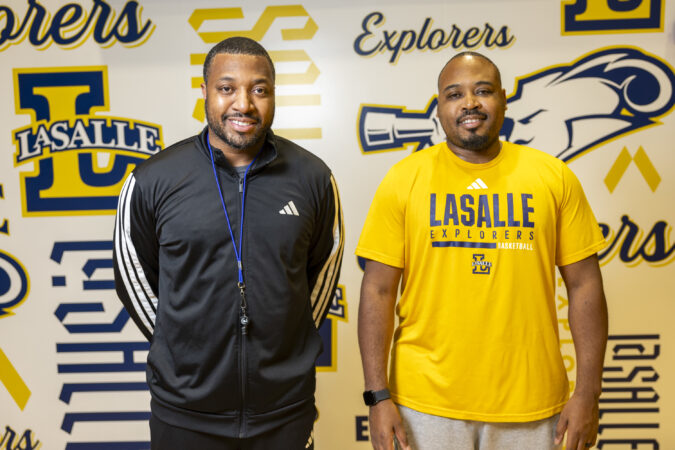
That was until Darris was named Radford’s head coach in 2021 and he brought Shane with him. The pair led the Highlanders to multiple 20-win seasons, before Darris earned a new opportunity at La Salle and was named its head coach in March. Shane followed again as the associate head coach. The brothers, now in the City of Brotherly Love, are ready to lead the Explorers back to success behind a culture built on toughness.
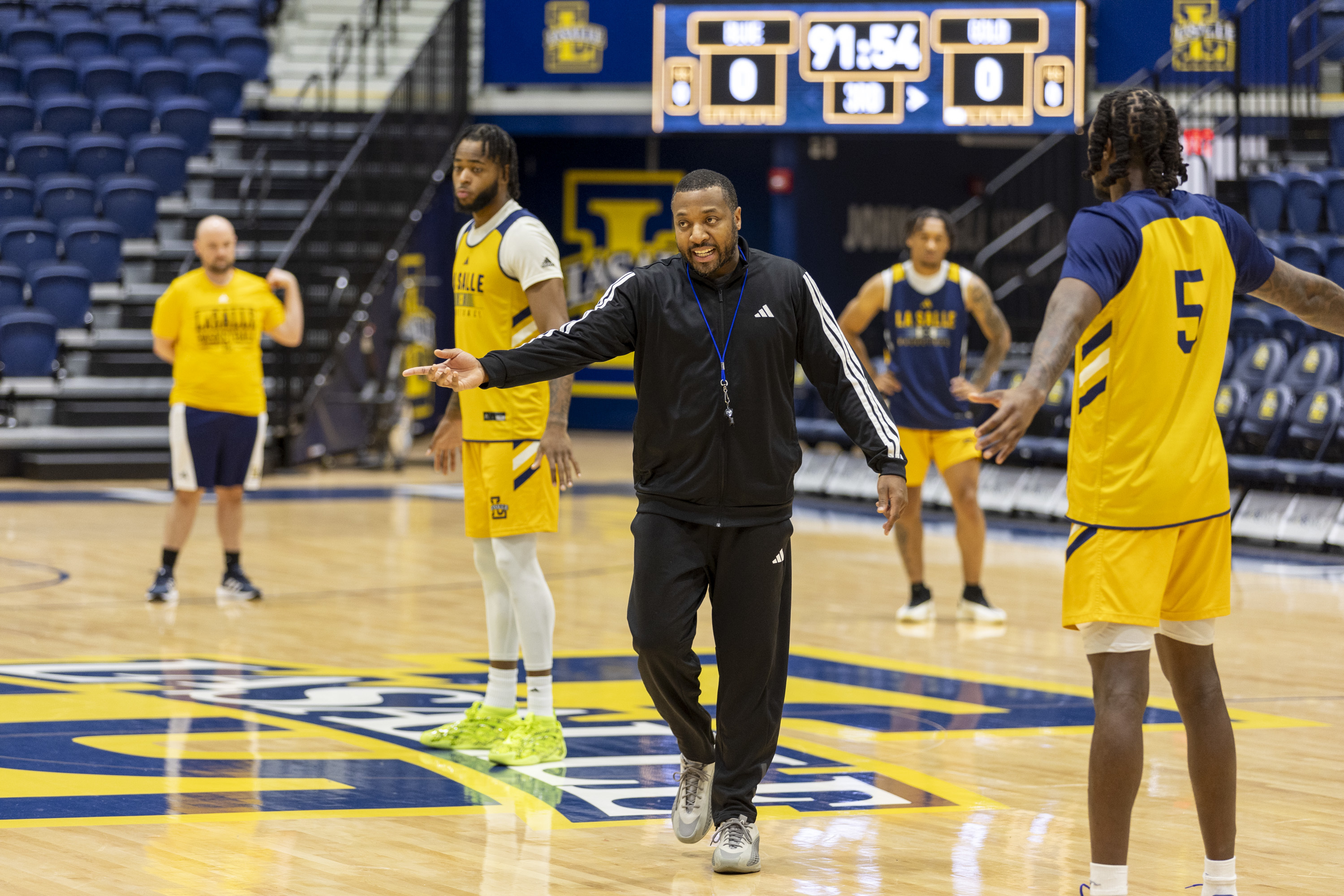
La Salle coach Darris Nichols conducts practice at John E. Glaser Arena on Nov. 14.
“We value toughness before anything,” Darris said. “I think that when you have a common [theme] in college basketball where guys just leave after every year or two years, it’s hard to build toughness. So you got to recruit to it. And I think we’ve done a pretty good job of that in Year 1. So that’s kind of in our philosophy of getting in the right direction.”
The brothers had similar coaching paths. Darris and Shane went overseas to play professionally following their college careers, but that time was short-lived.
Darris injured both knees and Shane also got banged up. Their post-playing days were unceremonious at first, with Darris working as a valet and Shane at a sales job.
Shane missed basketball and spent time coaching at Radford High School, his alma mater, before returning to Radford University in 2010 as an assistant coach. Darris turned to his West Virginia coach Bob Huggins and joined his staff as a graduate assistant in 2010.
The brothers spent the next 10 years building their profiles as assistant coaches at multiple schools. They made sure to consistently stay in touch during the season and would bounce ideas off each other and learn more about players the other may have faced.
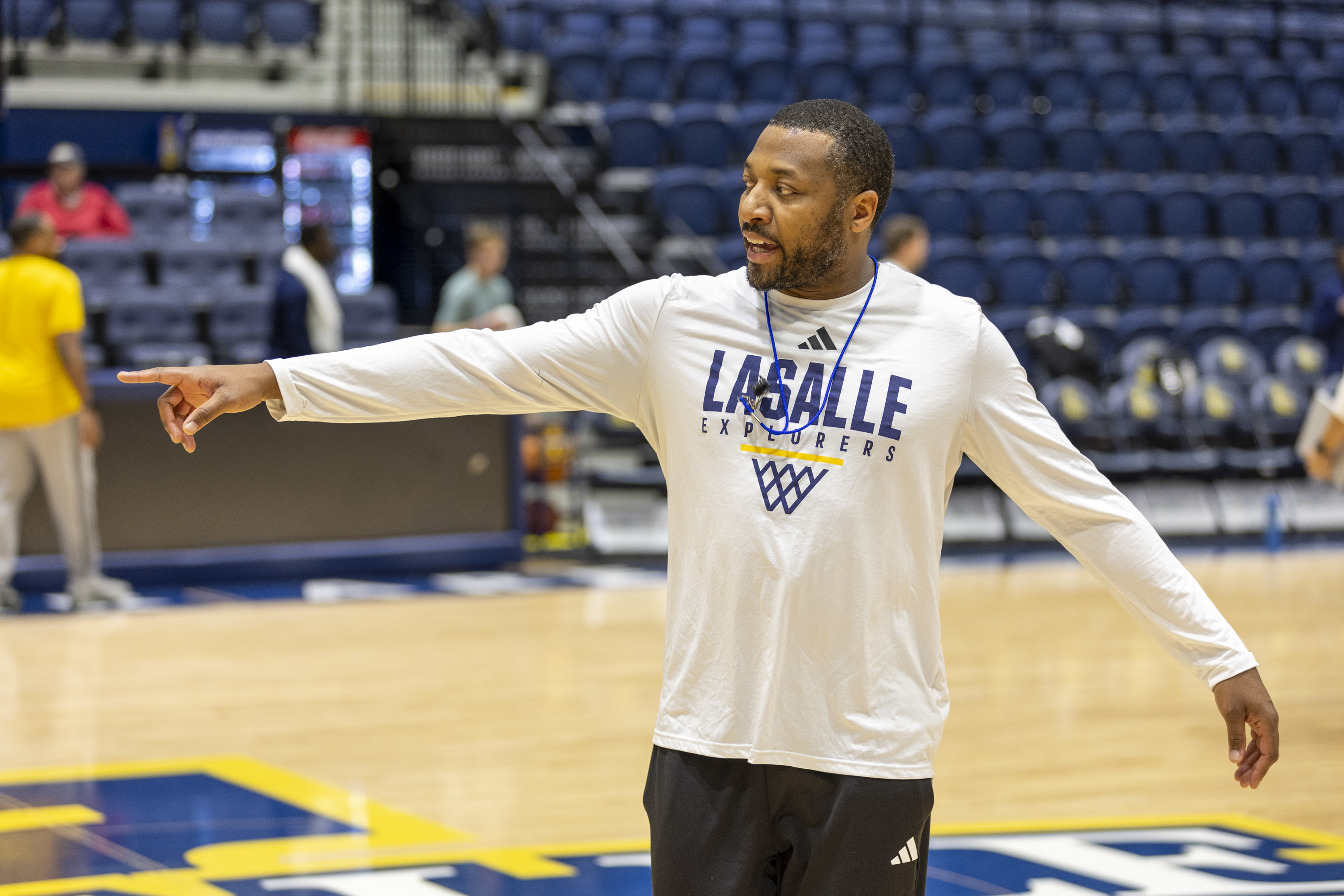
La Salle head coach Darris Nichols had multiple 20-win seasons in his four years at Radford University.
“We talked every day,” Darris said. “Most of the time it was about, ‘Have you seen this player? What do you know about this? Can you send me this guy’s contact info?’ It was a lot of that going on.”
Darris also jokingly tried his luck with poaching future NBA All-Star Ja Morant from Shane when his older brother was at Murray State, and he was at Florida.
“When he was at Murray State, they had Ja Morant, and I called him and I said, ‘Hey, man, I’m trying to get Ja Morant to transfer.’ He said he wasn’t going to do a transfer.”
Darris earned the head coaching job at Radford after six seasons as an assistant at Florida. Shane was coaching at Murray State at the time, and the Racers had won three straight regular-season conference championships with him on staff. Still, the decision to join forces with his brother back home was a no-brainer.
“I wanted to come help my brother be successful, and I felt like there was nobody else in the profession that could help him do that more than me,” Shane said. “That’s just because I got his back. He can trust me, and I’m going to work hard to make sure he is successful.”
The brothers spent the next four seasons building the Radford program together.
Radford won 21 games in 2022-23 and 20 games in 2024-25. Darris and Shane won 68 games in their four years with the Highlanders, but a new opportunity presented itself this past offseason.
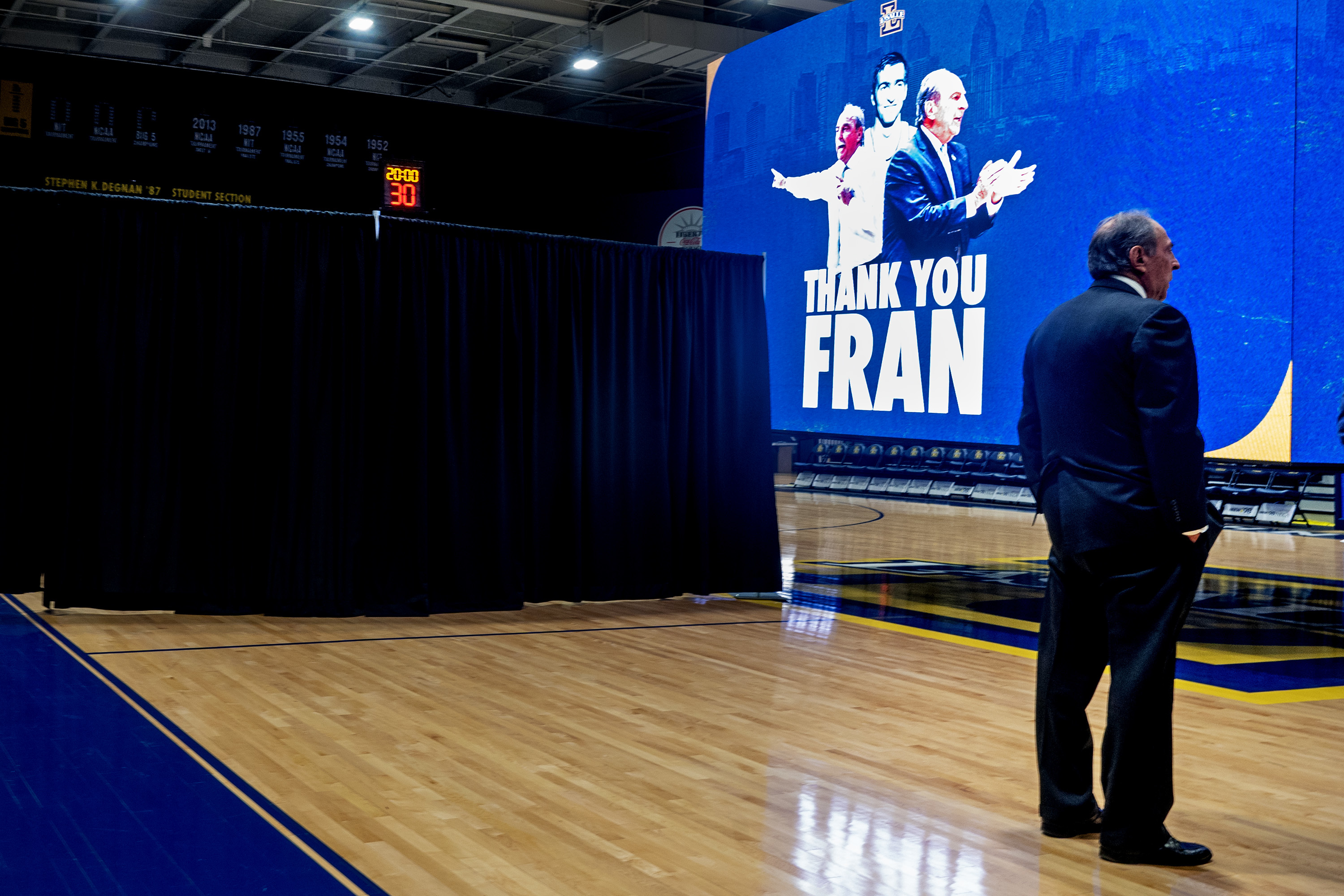
The Nichols brothers replaced La Salle and Big 5 legendary coach Fran Dunphy, who retired after returning to coach his alma mater in 2022.
La Salle’s head coaching job was open following the retirement of Fran Dunphy, and Darris got the offer to fill the role. The move offered a change and new challenge in his eyes, so he made the move up to 20th and Olney. Shane followed suit.
“It was cool opportunity because most of the college jobs that I’ve been at have been in college towns or small towns,” Darris said. “So I wanted something different. Let’s coach in the college city.”
The brothers are taking over an Explorers program that has not won more than 20 games or the Big 5 title since the 2012-13 season. Darris and Shane crafted a natural family feel at Radford and are looking to do the same at La Salle.
“Throughout the years with the teams we’ve had is just being able to mold and really build them, and they take on our mentality to the game,” Shane said. “You see it toward the middle and end of the year where they buy into the toughness piece. They buy into the togetherness piece. Right now, our guys are doing that. We just got to keep molding that, building that, and making it stronger.”
ARLINGTON, Texas — For the first 30 minutes, the Eagles did everything necessary to win a key game in a hostile stadium. They looked like a team worthy of a title defense.
For the next 30 minutes, they did everything necessary to give it away. They looked like a team unworthy of even a division title.
Two lost fumbles.
Two huge passing plays.
Fourteen — 14! — penalties, their most this season by five, and tied for the most by the Birds since Sirianni took over in 2021.
It was, to borrow A.J. Brown’s descriptor from two weeks ago, a (bleep)-show after the first 18 minutes. Cam Jurgens’ false start crippled one drive. An illegal formation stymied another. Brandon Graham couldn’t get off the field fast enough, and that negated an interception. On consecutive snaps to start the fourth quarter, DeVonta Smith committed offensive pass interference and A.J. Brown false-started, so a promising drive ended in a long field goal miss. In the middle of the fourth quarter, at the Cowboys’ 28, Fred Johnson turned second-and-7 into second-and-17; Saquon Barkley fumbled on the next play.
By the time Dak Prescott found George Pickens for 24 yards with 35 seconds to play, all the good that had been done — the offensive breakout of the Eagles’ passing game, the stinginess of the defense early — all of it had been undone.
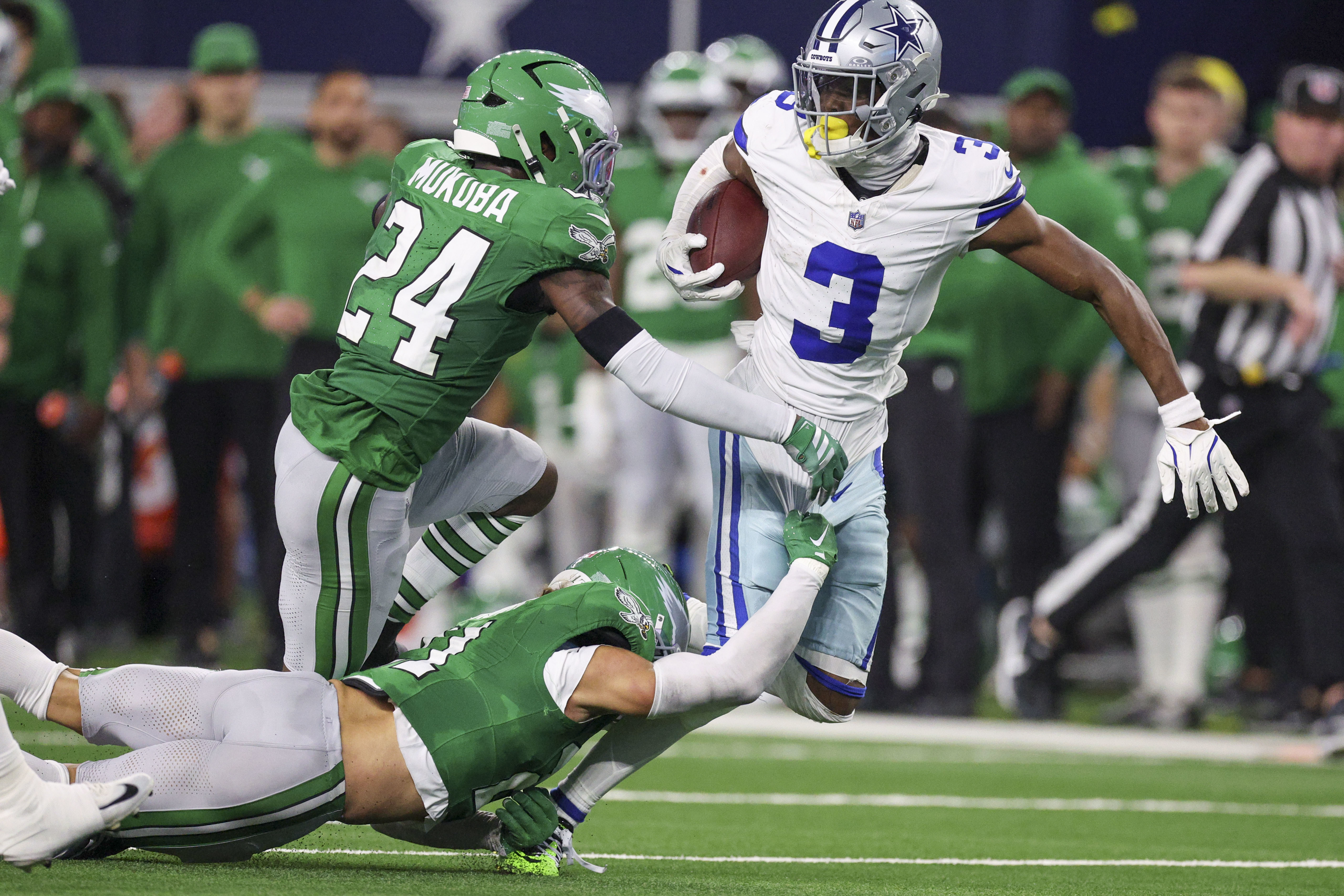
Safeties Andrew Mukuba and Sydney Brown pull down Cowboys receiver George Pickens after he made a big catch over the middle.
Brandon Aubrey kicked a 42-yard field goal as time expired Sunday, leaving the Birds 24-21 losers. They now face a short week and a Black Friday afternoon game against a hot Chicago Bears team whose 8-3 record mirrors their own.
It looked like the Eagles had their Thanksgiving turkey at halftime, perhaps drowsy with tryptophan as they sleepwalked through the Texas evening.
“All it is is a lack of focus,” said left tackle Jordan Mailata. “First, look internally, because that’s the only way we can move forward.”
Focus? Focus? From a veteran team that won a Super Bowl nine months ago? Focus, in a game against a losing team that you beat in September — a game that would virtually wrap up the NFC East title with six weeks to go?
“We’ve got to make sure we’re mastering the things that require no talent,” coach Nick Sirianni said, trotting out one of his most careworn aphorisms.
Mailata and quarterback Jalen Hurts said the same thing. Give him credit: Even if Sirianni can’t manage to scheme a running game, he can manufacture a maxim and embed it.
Mottoes won’t win another Super Bowl.
The win saved the Cowboys’ season, for the moment. Now 5-5-1, the ’Pokes have won two in a row; have made their abysmal defense respectable; and have a legitimate shot at the playoffs.
Seriously? Sure.
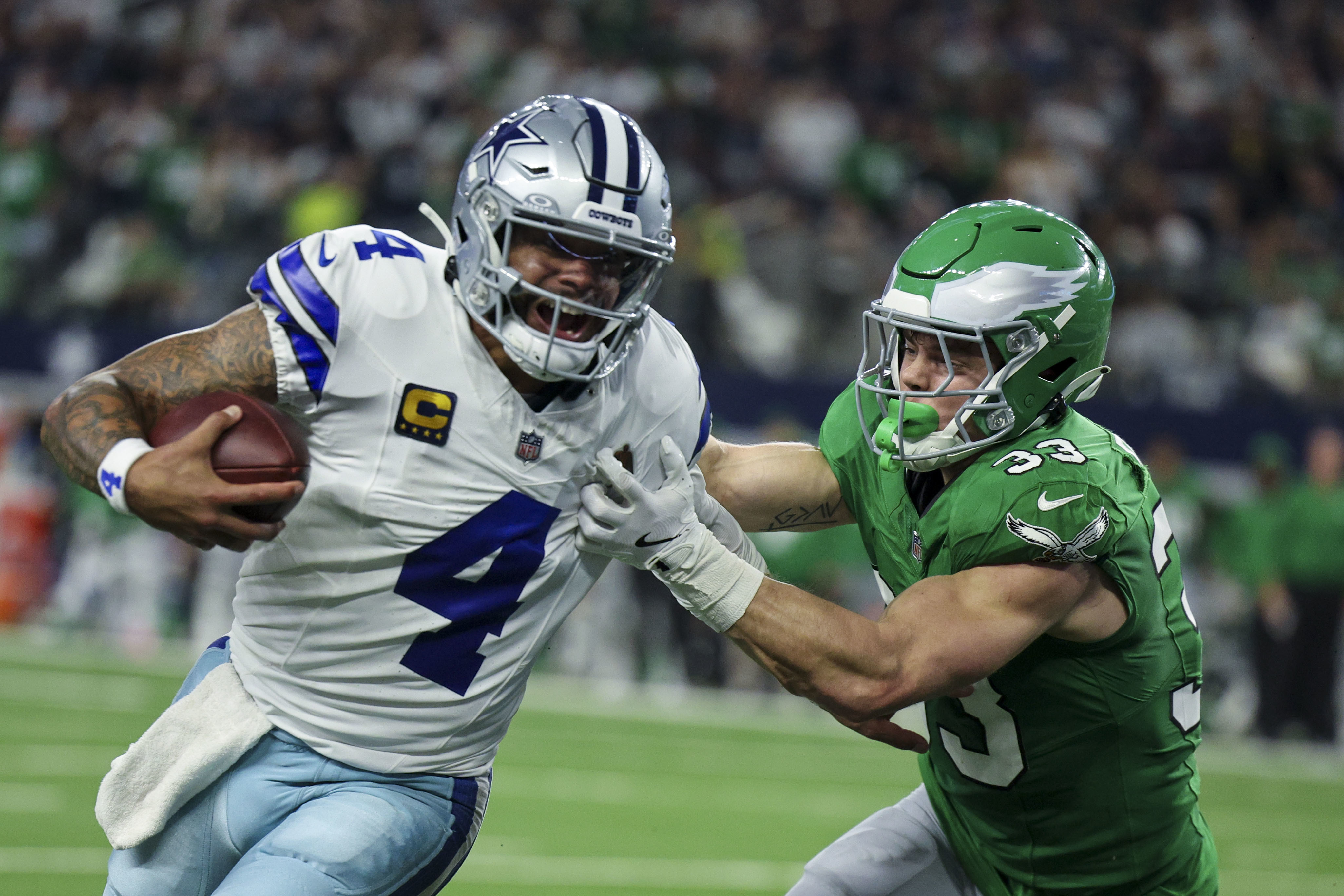
For all of the Eagles’ mistakes, the Cowboys made the plays winning teams make. They didn’t wilt down by three touchdowns. Prescott is now 10-5 against an Eagles franchise that is in the middle of the best decade in its history. He entered with gaudy numbers against the Birds, and burnished them with 354 passing yards, two passing touchdowns, a rushing touchdown, and, yes, another win.
Hurts fell to 5-4 against his archrival, and, despite a fine statistical performance — the Eagles’ inconsistent passing game showed its head for 45 minutes or so — he chose to wallow in the defeat.
The loss will lead to more questions about an Eagles offense that has been under siege all season.
Hurts passed for 289 yards, threw for a touchdown and ran for two more, but he sputtered after the first half. Malcontent receiver A.J. Brown caught a season-high eight passes for 110 yards, but virtually disappeared after the first half.
It was a magnificent first 18 minutes.
It was a pathetic final 42.
Eagles cornerback Cooper Dejean keeps Dallas quarterback Dak Prescott out of the end zone in the fourth quarter.
Both Barkley and punt returner Xavier Gipson fumbled in the fourth quarter.
Cornerback Cooper DeJean gave up a 48-yard bomb to CeeDee Lamb, which led to Prescott finding tight end Brevyn Spann-Ford for a touchdown from 4 yards with about two minutes to play in the third to make it 21-14. DeJean then gave up a 41-yard bomb to Pickens, which led to Prescott running 8 yards to tie it at 21 early in the fourth.
But the Cowboys went nowhere after Barkley’s fumble and punted, which led to Gipson’s gaffe, which eventually led to fourth-and-goal from the Eagles’ 2-yard line, which led to Dallas’s inexplicable decision to go for it with less than four minutes to play against an offense that had been enfeebled for the second half.
Prescott threw incomplete from the Eagles’ 2. He threw short of the goal line to tight end Jake Ferguson.
With two minutes left, the Eagles faced third-and-2 from their 37. Two Tush Pushes, right?
Nope. Straight drop back. Hurts couldn’t pull the trigger, took a 13-yard sack, gave the ball back to Dallas, and watched as the Cowboys saved their season.
The scene Friday at Drexel was one that wasn’t supposed to happen, at least for some people.
When the Big 5’s organizers rearranged the pods for this season, they knew they were taking a risk. Splitting St. Joseph’s and Villanova took away a guaranteed contest of the city’s most famous rivalry for the first time since the 1997-98 season, but opened the door for an even bigger matchup in the title game.
At the time the decision was made — and that time was before last season’s Big 5 Classic, when the word first got out — there were enough reasons to believe the title game clash would happen.
Sure, Villanova was down, but not far enough down to not be favored against Temple and La Salle. Steve Donahue wasn’t gone from Penn yet, Billy Lange was far from gone from St. Joe’s, TJ Power was still at Virginia, and Xzayvier Brown was still on Hawk Hill.
Shuffling the pods really felt like two things at the time. A St. Joe’s-Penn-Drexel pod made the Hawks clear favorites on paper, while a Villanova-Temple-La Salle pod guaranteed the schools with the two biggest fan bases would face off. As long as the Hawks made the final, a matchup with Villanova or Temple would be intriguing — and good for the box office, too.
By the time the season tipped off, the scene looked totally different. And when the Hawks walked out of the Palestra on Monday on the losing end, the dream final was halfway to going up in smoke.
St. Joe’s needed a Drexel win, which would have left all three teams at 1-1. The tiebreaker is the NCAA’s NET rating, the first edition of which lands on Dec. 1 — the day Villanova hosts Temple in the last pod game of the season — and the Hawks would presumably have taken it. At Friday’s tipoff, they were No. 151 in Ken Pomeroy’s rankings to Drexel’s 249 and Penn’s 265.
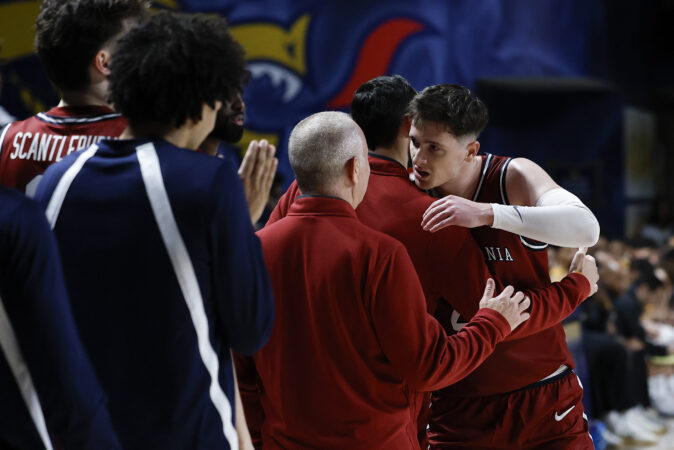
Now the die is officially cast. Led by Power and Ethan Roberts, Penn never trailed against Drexel and ended up rolling to an 84-68 win at the Daskalakis Athletic Center. Roberts scored 30 points for his third 20-plus game of the year, and his second straight with 30; and Power continued to show his talents with 18.
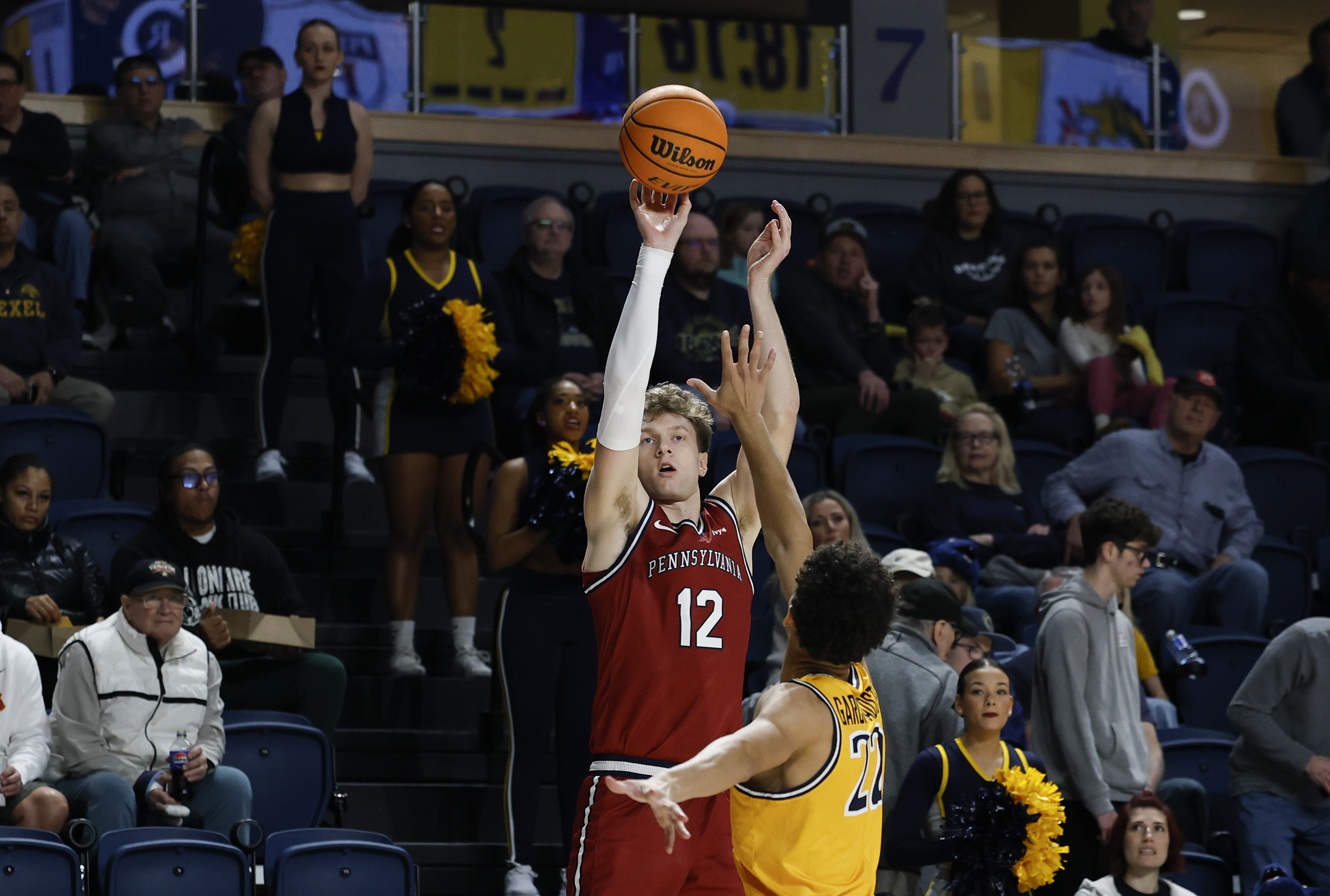
Penn’s TJ Power shoots over Drexel’s Villiam Garcia Adsten during the first half.
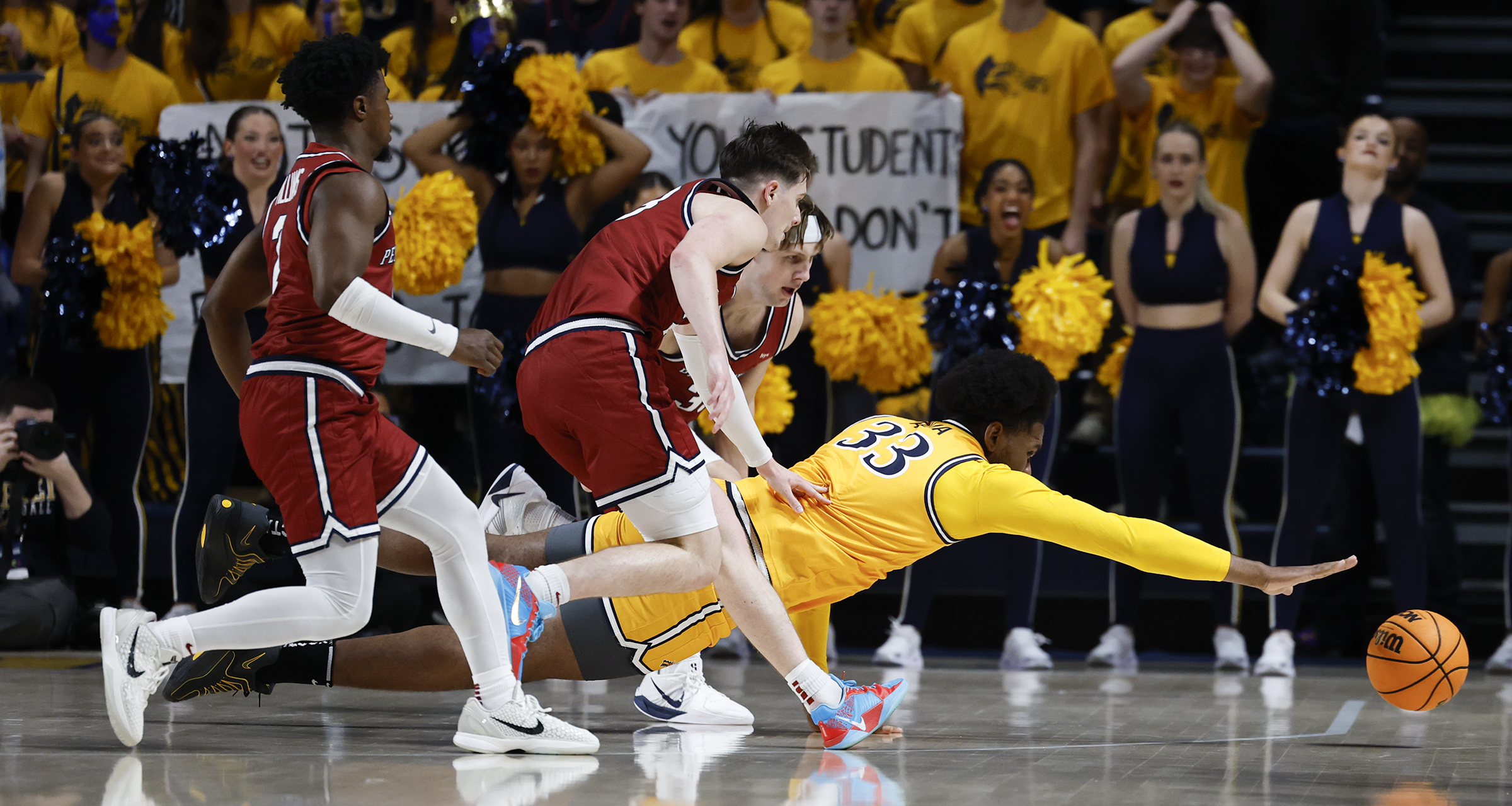
The crowd on Market Street was lively and bipartisan, announced as 1,984 — a few hundred short of a full house, and not far from the lowly 2,384 crowd at St. Joe’s-Penn on Monday. Drexel’s student section turned out well, and at one point unfurled an old-fashioned rollout mocking Penn’s students for not showing up at the Palestra.
They had a point, and would have in many past years, too. But for this night, the atmosphere felt real.
“I think coming in as a transfer, you don’t completely understand the Big 5 hype until you play in those games,” said Power, whose former Duke teammate Jared McCain was in the stands with the Sixers off. “These past two games have been some of the most intense games I’ve played in, and for us to get to that championship [final] in coach’s first year, it’s a real feeling, I think. I’m looking forward to playing in that championship game.”
The action was not just intense, but good quality for two teams still getting to know themselves. Penn shot 50% from the floor and Drexel shot 42.2%. That doesn’t always happen in the City Series, a fact some long-timers might not want to admit while reminiscing about the old days.
(This writer, for example, has been scarred for 21 years by the 2004 Temple-Villanova game at the Palestra: a 53-52 Owls win where the teams missed a combined 80 of 120 shots.)
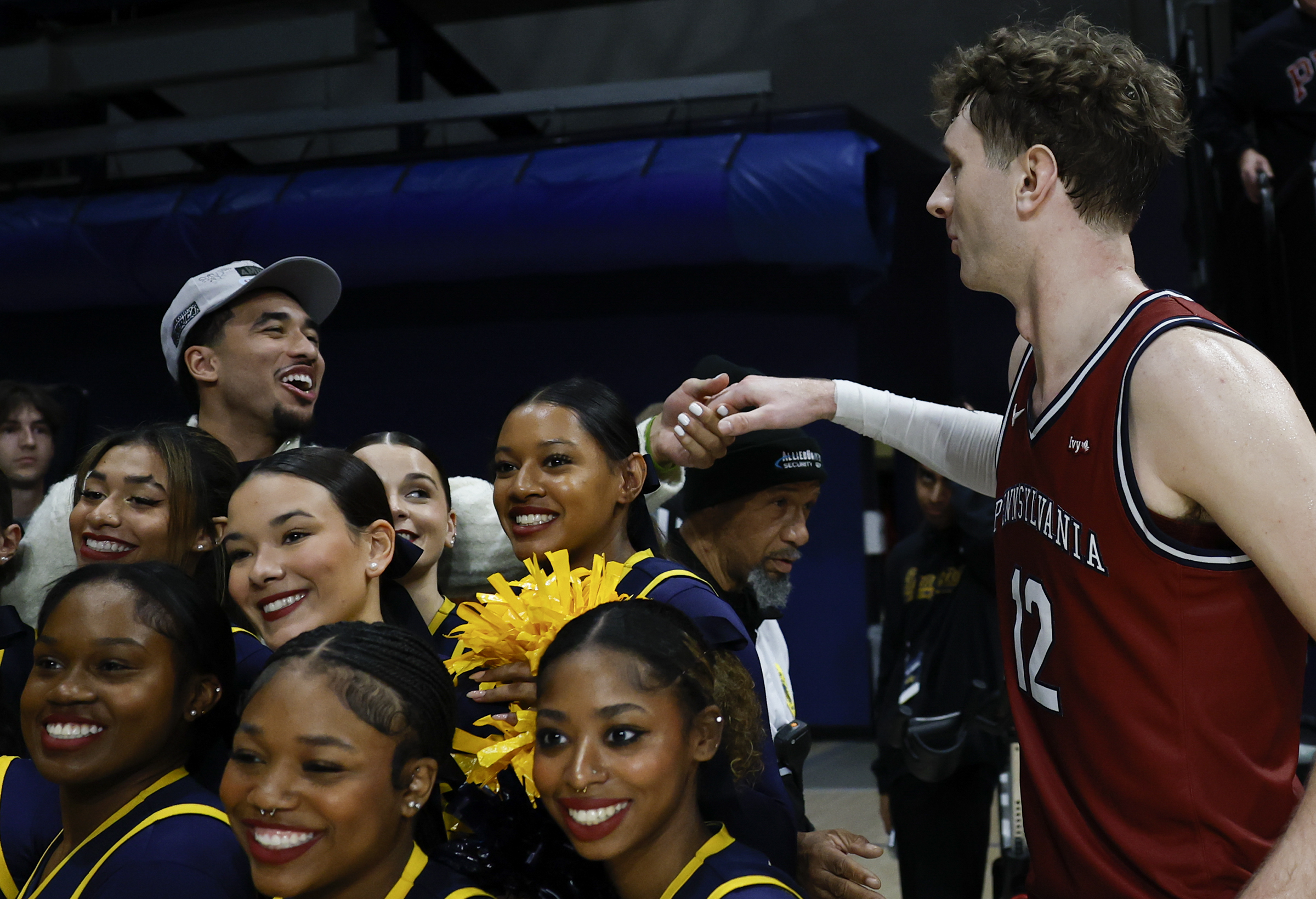
“Jared’s my best friend since my freshman year at Duke, and to have him in the city has been really cool,” Penn’s TJ Power (right) said of the Sixers’ Jared McCain (left).
The big picture
Does missing out on a St. Joe’s-Villanova final mean the risk wasn’t worth taking? The ticket sales for the Big 5 Classic on Dec. 6 will offer one verdict, and fans can decide if they want to offer another.
If there isn’t going to be a full round-robin, there shouldn’t be anything wrong with the principle of changing up the pods from time to time. This season was the first time that happened, and it’s expected that the new groups will run for two years as the first set did.
Was there a way to keep St. Joe’s and Villanova together in the first change? There weren’t many moves to make, since St. Joe’s and La Salle have to stay separate being in the same conference.
A St. Joe’s-Temple-Villanova pod obviously would not make sense. So the only other option besides the move they settled on — swapping Villanova and Drexel — would have put Villanova, St. Joe’s, and Drexel together. That would have sent the Wildcats to the city’s smallest gym in one of the two years, which felt unlikely this early in the pod system.
Drexel’s Ralph Akuta (right) dove for a loose ball in front of the Dragons’ student section as they held up a banner mocking Penn students for not showing up to their team’s games.
So it was understandable that the people in charge tried. A little uncertainty is no bad thing anyway, as it livens up the early-season slate. And though the Big 5 still feels stratified, the pod format also heightens the stakes of each game. One loss can tip the whole thing, as just happened to the Hawks.
It could happen again if Temple upsets Villanova on the Main Line. That would give us a ‘Nova-St. Joe’s game after all, just in the third-place game.
What the final will look like is a different question, but that’s not Penn’s problem for now. Coach Fran McCaffery, Power, and the rest can celebrate just getting there — and laying down a strong marker to start McCaffery’s tenure at his alma mater.
“When you come into a season, there are certain things that you hope to be able to accomplish collectively, and that clearly is one,” he said. “I think everybody knows the respect I have for the Big 5 and its history, and also for the level of talent and coaching in all the teams. We just beat two really good teams, two really well-coached teams, and then we’ll get to play another one.”
This time, it will be on the city’s biggest stage.
What Big 5 pods work? Reality limits the answer.
St. Joe's and La Salle can't be in the same pod since they're in the same conference.
It doesn't make sense to have Villanova, St. Joe's and Temple all on the same side.
They practice at The Star and they play games at Jerry World, but the Eagles can turn the Arlington, Texas, stadium into Boot Hill if they beat the Cowboys on Sunday evening.
The Cowboys are in second place in the NFC East, but they’re 4-5-1, and they face the Chiefs, Lions, and Vikings in the coming weeks. The Eagles, at 8-2, also have a couple of testers left, but they face the Raiders once and the Commanders twice, all games in which they should be big favorites.
If they leave Dallas with nine wins, the NFC East race will be all but finished, and a four-win Cowboys team after Week 11 won’t have a realistic shot at a wild-card berth.
A Big W in Big D, in one fell swoop, essentially hands the Eagles the division title and renders their closest competitor impotent.
To get that W, they’ll need to handle Dak Prescott and the No. 1 offense in the NFC.
Dallas Cowboys quarterback Dak Prescott is 14-9 against the Eagles with a passer rating of 98.9.
The Cowboys’ quarterback is best known for regular-season brilliance and big-game disasters, but, like him or not, he’s on his way to his fourth Pro Bowl. Those trips have been fueled, partially, by his proficiency against the Eagles — a proficiency attained during the Birds’ current golden era.
Prescott is 14-9 against an Eagles franchise in its heyday. His passer rating of 98.9 is slightly better than his career rating of 98.5, but then, the Eagles are the best team he has regularly faced in his 10 seasons.
He’s thrown 24 touchdown passes in those 23 games, a modest number, but he has just eight interceptions, which is a remarkable number, considering the quality of the Eagles’ defenses in the last decade and the fact that those defenses are more familiar with him than with any other quarterback.
He hasn’t produced gaudy numbers the past three meetings. He managed only 188 yards and no scores in the Thursday Night Football season opener in Philadelphia, and he was injured for both games last season. However, in the five previous matchups, Prescott averaged 305 yards, completed 72% of his passes, threw for 16 touchdowns, and had just one interception. His passer rating was 129.7.
Granted, since 2021, he has faced four different defensive coordinators and has seen a complete turnover of defensive personnel, save for Brandon Graham, who recently unretired and missed the opener.
But there’s just something about Philly that brings out the best in Dak. And, after missing half of 2024 with a hamstring injury, Dak is back to being Dak.
He leads the league with 253 completions, a 74.9 quarterback rating (which includes non-passing data), ranks third with 258.7 yards per game, ranks fourth with a 69.9% completion rate, and ranks eighth with a 102.5 passer rating.
That final stat can be misleading, considering that Jalen Hurts ranks fifth at 107.0, but no sane person would argue that Hurts is playing as well as Prescott — not even Eagles defensive coordinator Vic Fangio.
“He’s having a hell of a year,” Fangio said of Prescott on Tuesday.
Fangio might be playing possum here.
Prescott struggles against Fangio’s defenses. He lost to Fangio’s defense when Fangio coordinated for Miami in 2023. Fangio flummoxed Dak in 2021, when he was the head coach in Denver. They didn’t meet in 2024, but Dak wasn’t great in the opener in September.
The opener in Philly was Prescott’s best chance against Fangio, and he was aided by the idiocy of Fangio’s best weapon.
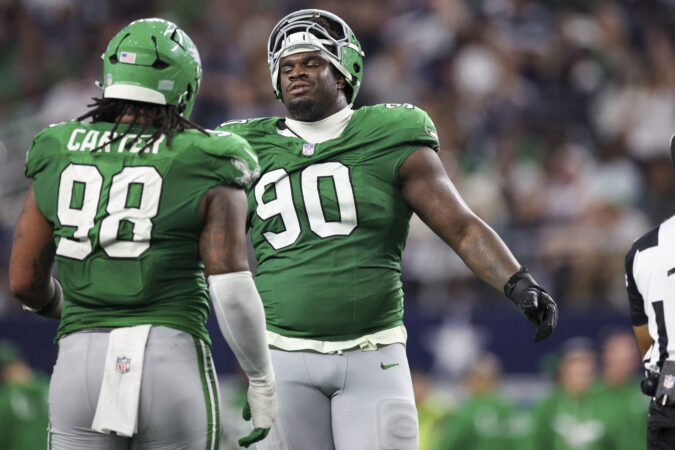
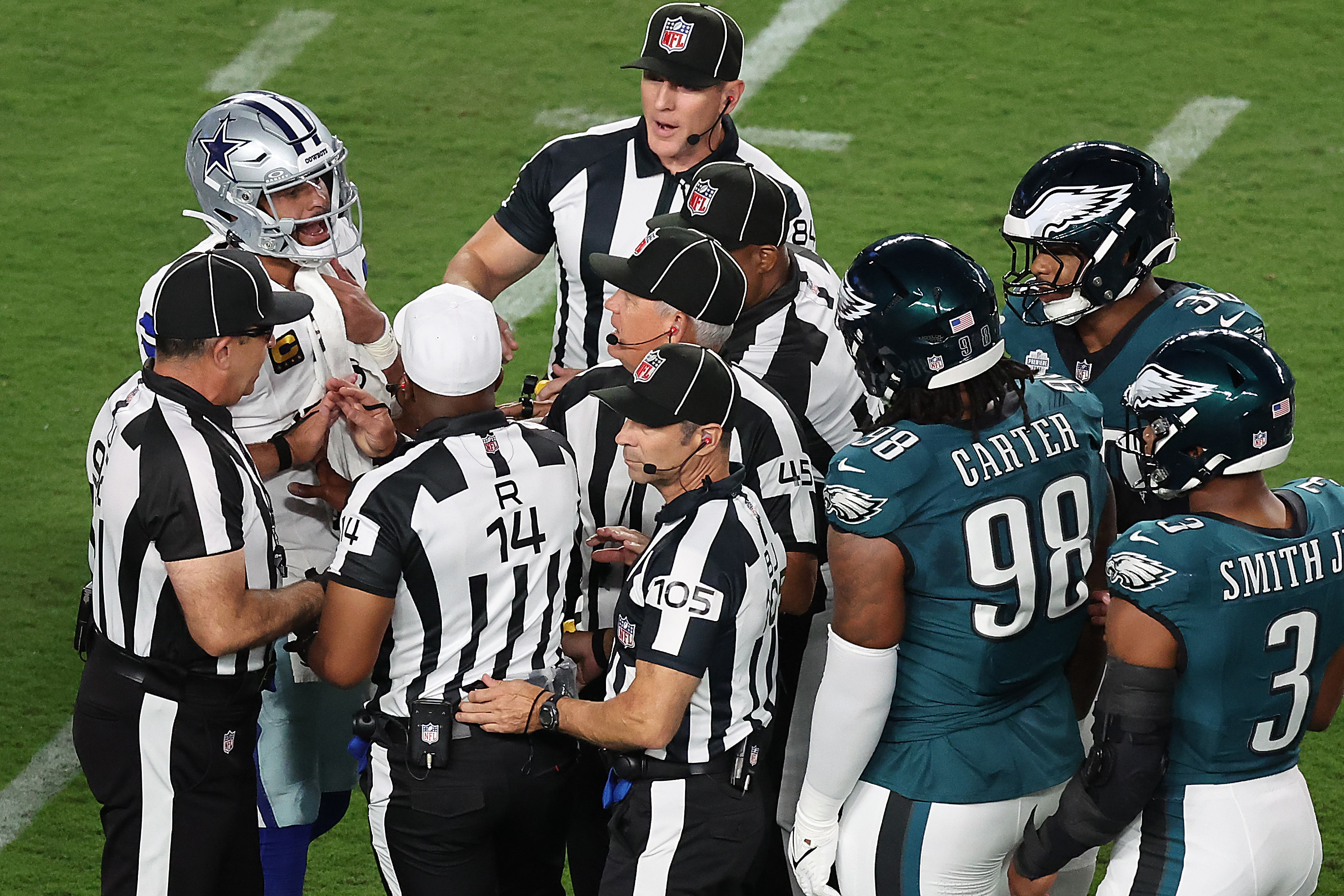
NFL officials stand between Cowboys quarterback Dak Prescott (left) and Eagles defensive tackle Jalen Carter (right) after a spitting incident in their game on Sept 4.
Pro Bowl defensive tackle Jalen Carter spat on Prescott before the first play from scrimmage and was ejected from the game. Prescott still didn’t throw for a TD pass.
For Sunday, not only is Carter is back and playing his best, he has reinforcements.
The Eagles added edge rusher Jaelen Phillips at the trade deadline. Nakobe Dean, lost in the playoffs to a knee injury, finally returned to play as a linebacker four games ago, which amplified the play of All Pro linebacker Zack Baun, and the Eagles have allowed just one meaningful touchdown in each of those four games, all wins. Graham hit the field two games ago, and the Eagles surrendered 16 total points in those two games.
George Pickens caught just three passes for 30 yards in the opener, and, though he had seven catches for 110 yards, CeeDee Lamb had just one catch for 13 yards against second-year shutdown corner Quinyon Mitchell, who is playing even better now. Mitchell’s independent competence helps nickel corner Cooper DeJean, who is solid in coverage, serve as a third, punishing safety.
“This is a hell of a defense,” Cowboys coach Brian Schottenheimer told reporters this week. “I think they’re best in the league.”
Schott’s offense, behind Dak, is the best in the conference: tops in total yards, at 378.8; Dak’s passing yards, at 258.7; and, most significantly, points, at 29.6. That final number should be the most troubling for the Birds, because they’ve scored just 26 points in their last two games, combined.
Eagles quarterback Jalen Hurts (1) and wide receiver A.J. Brown seen here in action earlier this season against the Vikings will need to be on the same page Sunday against the Cowboys.
Which brings up the bizarre nature of the Eagles’ 2025 campaign.
Amid all the winning, most of the recent discussion surrounding the Super Bowl champion Philadelphia Eagles (who are the NFC’s No. 1 seed at the moment) has been the toothlessness of the Eagles’ passing offense. It’s currently ranked 28th, leading to acontroversy surrounding Hurts and malcontent receiver A.J. Brown, fueled entirely by Brown.
That’s why, this week, so much attention is being paid to the Cowboys’ atrocious passing defense, which is the worst in the conference. Maybe the Eagles’ air attack will resurface Sunday.
Irrelevant.
The real story lies in the opposite matchup.
If, as Schottenheimer contends, the Eagles have the best defense; and if that defense can dominate Dallas’ incendiary attack; not only will the pursuit of the NFC East title be a fait accompli, but a second straight Lombardi trophy also should be in the Eagles’ future, too.
Twenty-four hours after throwing 96 pitches to shove the World Series to a seventh game, the Dodgers’ Yoshinobu Yamamoto ran in from the bullpen to this: ninth inning, one out, winning run at second base.
It was a legend-making moment.
Halfway around the world, Tora Otsuka chuckled.
In 2023, his first season as a Japan-based scout for the Phillies, Otsuka hosted three team officials, including assistant general manager Jorge Velandia, on a scouting visit. Among their stops: Chiba, a short drive from Tokyo, to watch Yamamoto pitch for the Orix Buffaloes.
“He threw a no-hitter in that game,” Otsuka said this week, laughing into the phone from Japan. “We had all our people watching this one game, and he threw a no-hitter. Only special players do that, you know? I feel like some players have ‘it.’ He’s one of those guys that has ‘it.’”
Otsuka laughed some more.
“When I saw that,” he continued, “I was like, ‘Yeah, I know he will do good in the States.’”
Just not for the Phillies.
Oh, they tried. The Phillies took a Bryce Harper-size swing at signing Yamamoto two years ago. They flew a seven-person delegation to Southern California to meet him and make a $300 million guarantee, plus add-ons that boosted the offer to more than $325 million, multiple sources said at the time.
The Phillies tried hard to sign Yoshinobu Yamamoto as a free agent out of Japan two years ago.
But the Phillies have never signed a player out of Japan to a major league contract.
And Yamamoto wasn’t interested in being the first.
It’s a common sentiment. When Shohei Ohtani was courted by teams in 2017, he famously told MLB.com that he wanted to snap a selfie with the Rocky statue but didn’t want to play here. Last year, right-handed phenom Roki Sasaki wouldn’t even meet with the Phillies, a snub that owner John Middleton described as “hugely disappointing.”
And with a trio of Japanese stars available this offseason — right-hander Tatsuya Imai entered the posting system this week, joining slugging infielders Munetaka Murakami and Kazuma Okamoto — the Phillies are at a disadvantage relative to teams that have been active in Japan over the years, notably the Dodgers but also the Mets, Yankees, Cubs, Mariners, and Red Sox.
“Well, you still compete,” Phillies president of baseball operations Dave Dombrowski said. “Sometimes there’s a little bit more of an obstacle we’re facing. Maybe [Philly] is not the No. 1 place, first and foremost. But you don’t give in to that. You try to create an atmosphere that people want to join, and you’re hopeful that at some time it works out for you.“
Dombrowski maintains that the Phillies have made inroads, even though it’s difficult to see. They employ two full-time scouts in Japan now after years with one or none. Otsuka, the son of former major league pitcher Akinori Otsuka, is based near Tokyo; Koji Takahashi, hired away from the Twins, lives 300 miles to the southwest in Osaka.
With Otsuka and Takahashi building connections on the ground, at the amateur level and especially within Nippon Professional Baseball, the Phillies believe they’re better positioned to attract players.
But when?
“I feel like it’s going to happen sooner or later for the Phillies,” Otsuka said. “Timing-wise, it just hasn’t happened yet. We’re very close, I would say.”
Assistant general manager Jorge Velandia heads up the Phillies’ international scouting efforts, including in Japan.
Playing catch up
It all started with “Nomomania.”
Hideo Nomo signed with the Dodgers in 1995, bringing a distinctive pitching style that translated into major league success. Since then, 72 players have gone from NPB to MLB, with seven teams (Mets, Dodgers, Mariners, Red Sox, Cubs, Yankees, and Rangers) accounting for more than half those deals.
Conversely, the Phillies, Rockies, Astros, and Marlins have been shut out. (Second baseman Tadahito Iguchi and outfielder So Taguchi played for the Phillies. But Iguchi was traded over from the White Sox in 2007, and Taguchi signed as a free agent a few months later after six seasons with the Cardinals.)
The Phillies fell behind other teams in scouting Japan. After getting hired in December 2020, Dombrowski felt that he lacked adequate information about available Japanese players. He appointed Velandia to lead international scouting, with a directive to “build a better infrastructure in how we approach the Far East.”
Velandia tasked scouting director Derrick Chung with interviewing talent evaluators. Chung, who joined the Phillies in 2017 as an interpreter for South Korean outfielder Hyun Soo Kim before moving into scouting, recommended Takahashi.
Otsuka was clinging to hopes of playing professionally in Japan when Chung met him at a tryout for an independent league team. A former outfielder for the University of San Diego, Otsuka impressed Chung with his knowledge of the game and fluency in both Japanese and English.
After a formal interview process, the Phillies hired Otsuka, now 27, as a full-time scout.
Tadahito Iguchi became the Phillies’ first player from Japan after being acquired from the White Sox in a 2007 trade.
Velandia and Chung each make two or three trips per year to Japan. The Phillies send their special assignment scouts, too. Otsuka said this was a “very busy year, with scouts coming in and out” to watch Imai, Murakami, and others in “a very, very solid class of guys.”
“The stuff we were doing three years ago and now, I’d say we have gotten better just understanding more about the market,” Otsuka said. “We’re more dialed in now compared to maybe before. We send scouts all the time to come to Japan. Just the process of everything has gotten smoother and smoother as the years have gone by.”
Otsuka claims that the Phillies’ brand recognition has improved in Japan, too. Amid four consecutive playoff appearances, and with popular stars such as Harper and Kyle Schwarber, the Phillies are often featured on television in Japan.
They aren’t the Dodgers, of course. For 30 years, from Nomo through pitchers Kazuhisa Ishii, Takashi Saito, Hiroki Kuroda, Yu Darvish, and Kenta Maeda, Japanese baseball culture has extended to Los Angeles. And after signing Ohtani, Yamamoto, and Sasaki in the last two years, the Dodgers might as well be Japan’s national team.
The connection extends to the players. Yamamoto cited a desire to play with Ohtani as a reason for choosing the Dodgers’ $325 million over similar offers from the Mets, Yankees, and Phillies. Sasaki made no secret that he wanted to be alongside Ohtani and Yamamoto.
And social media was buzzing this week over a photo of Murakami, who holds Japan’s single-season record with 56 home runs, dining with Yamamoto.
“There is the difficulty of we have not had a player straight from Japan,” Otsuka said. “Players do talk with each other, saying what is a good organization, what is not a good organization. It would be nice to have one player be signed from Japan who plays in the big leagues to have more viewership from the Japan side for the Phillies.”
For a brief time last winter, Otsuka thought he might have found that player.
The Phillies signed Japanese reliever Koyo Aoyagi to a minor league contract last winter but released him in July after he struggled in triple A.
Chicken-or-egg situation
Koyo Aoyagi was a three-time all-star in nine NPB seasons. He won a gold medal in the 2020 Olympics. Three years later, he started Game 7 of the Japan Series and spun 4⅔ scoreless innings for the champion Hanshin Tigers.
But his dream was to play in the majors.
At 31, coming off a 2024 season that he said didn’t meet his standards, Aoyagi signed a minor-league contract with the Phillies. The side-arming reliever attended major league camp but agreed to go to triple A.
Upon arriving in spring training — his first visit to the United States — Aoyagi said through an interpreter that he “wasn’t too aware” of the Phillies’ inability to break through in Japan. But he also acknowledged that “me pitching on the big-league mound will definitely bring some attention to the Phillies that would be able to recruit Japanese players more.”
It was a low-risk, high-reward union of player and team.
And it didn’t work out.
Aoyagi struggled to throw strikes all spring, and it carried into the season. He had a 7.45 ERA with 23 walks in 19⅓ innings in triple A. After getting demoted to double A, he posted a 6.91 ERA and 15 walks in 14⅓ innings. The Phillies released him in July.
But Otsuka, who recommended that the Phillies take a flier on Aoyagi, stands by the team’s process. He also believes in what Aoyagi represented.
“Even though he didn’t make it to the big leagues, just him being on the team [in spring training], that still brought some attention in Japan,” Otsuka said. “I see a lot more Phillies hats walking around town. That’s all I can say. And I hear a lot of people talking about the Phillies just being a really good, strong team.”
Japanese reliever Koyo Aoyagi pitched in the minors for the Phillies last season before getting released.
Maybe. But the Aoyagi experience re-raised a chicken-or-egg conundrum: Do the Phillies have to gain more traction in Japan in order to attract an impact player? Or must they sign a Japanese player to a major league contract in order to really penetrate the Far East market?
The answer might not be found in this year’s class.
Murakami, 26, has prodigious left-handed power but also strikes out a lot and is a poor defender at third base. Okamoto, 30, is a right-handed hitter with less upside than Murakami who also profiles best at first base.
Imai, 28, draws intriguing comparisons to Yamamoto. The Phillies aren’t prioritizing the rotation. But that was the case in each of the last two offseasons, and they made a mega offer to Yamamoto and discussed trading for Garrett Crochet before acquiring Jesús Luzardo.
“When most teams talk to me about Imai, they say, ‘Oh my,’” agent Scott Boras said at the recent GM meetings. “He’s that kind of guy. … He loves big markets. We go through a list of places he may want to play, and, believe me, he is someone who wants to be on a winning team and compete at the highest level.”
But whether it’s now or in the future, the Phillies’ biggest challenge in mining talent from Japan is selling players on Philadelphia.
Velandia said the pitch highlights the city’s restaurants, doctors, and other resources that would make a Japanese player feel comfortable. Otsuka likes to emphasize the area’s golf courses, such as Pine Valley and Merion East.
The fact is, though, Philadelphia has a smaller Japanese population than many other major league cities. As one team official said, it makes sense that a Japanese player coming to the U.S. would be drawn to L.A. or New York, just as an American soccer player going to Spain would focus on Barcelona or Madrid.
“We just spit out all the good things about Philly,” Otsuka said. “We give the most information about Philadelphia, where it is as a city, what it’s like to play for the Phillies. It’s not like the worst sell ever. It has its difficulties, but it’s good. We can make it work.”
It might take a trail blazer, a player who wants to forge his own path. Otsuka intends to find him.
“That’s actually one of those selling points, that you could be ‘The Guy,’” Otsuka said. “You can be the first. When they think about Phillie Japanese players, you could be that player. Definitely the right player’s out there, the player that we want to go after.
“When the time’s right, it’s going to happen. It’s just a matter of time. We have the right processes. We’re doing everything possible now. I think we have all the necessary resources now to actually make it happen. I’m not frustrated about it. I’m just patiently waiting.”
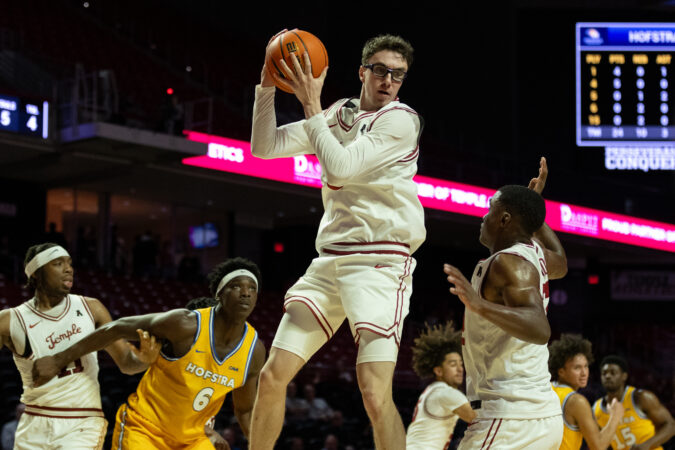
During Temple’s season opener against Delaware State on Nov. 5, a new face got the action going instantly — Gavin Griffiths.
The 6-foot-7 former Nebraska guard soared to the hoop from a lob by forward Babatunde Durodola, slamming it home for Temple’s first points. He ended his Owls debut with 16 points and had another dunk, earning him the nickname “LeBron Frames” on social media.
“We ran through that play a lot of times in practice,” Griffiths said. “So yeah, it was something we worked on at shootaround today. I knew it was coming.”
Griffiths, a junior, is having a career resurgence after injuries spoiled his single season with the Huskers. This is his third program — he spent the 2023-24 season at Rutgers — and he has become one of Temple’s best players, averaging 13.2 points per contest.
“He’s rebounded at a high rate right now and we can throw some lobs, which is fun,” said coach Adam Fisher. “His personality is great. I just told him, ‘Don’t get caught up in all the memes.’ He’s been a great addition. He’s so coachable. He’s come from amazing coaches.”
Griffiths joined Temple after spending one season at Nebraska, but his college career began at fellow Big 10 school Rutgers. He played one season under coach Steve Pikiell and scored a career-high 25 points in his second collegiate game against Boston University.
The additions of future NBA lottery picks Dylan Harper and Ace Bailey prompted the four-star recruit — and top 50 high school prospect out of Kingswood Oxford School in Connecticut — to enter his name into the transfer portal. He played in 16 games for the Cornhuskers before entering the transfer portal again.
Fisher, who was an assistant coach at Penn State when Griffiths was coming out of high school, tried recruiting him to the Nittany Lions. Penn State assistant coach Mike Farrelly was Griffiths’ lead recruiter, but Fisher remembers meeting the guard’s family, and the two formed a relationship from there.
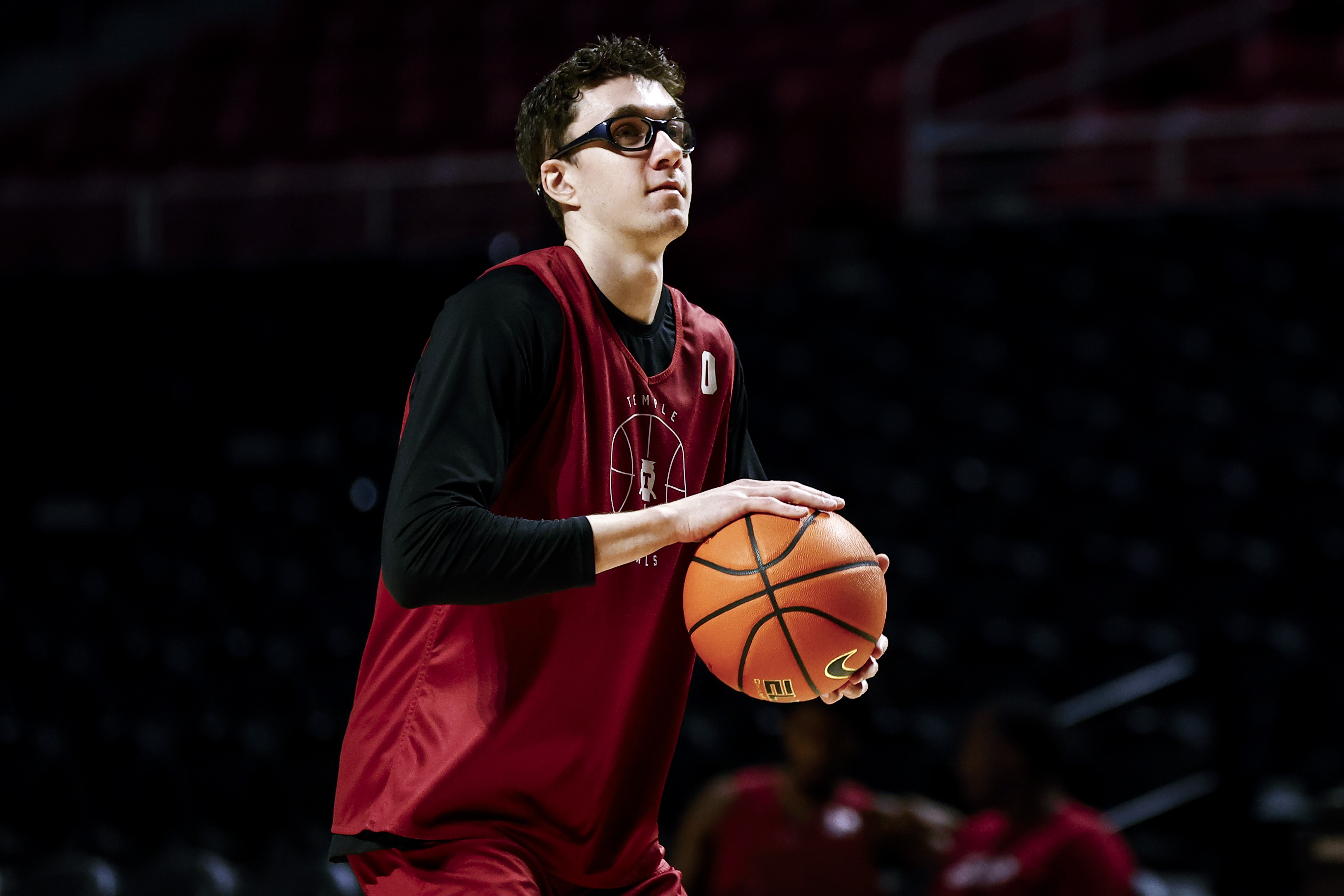
Gavin Griffiths works out during practice at the Liacouras Center on Oct. 27.
“Gavin’s a young man that I’ve known for a long time,” Fisher said. “Mike Farrelly was the point person on the recruitment there and then coach Shrewsbury and I went and saw him and visited with his family. So we had a relationship and had seen him for three years prior. Great athlete, can make shots, comes from an amazing family. His mom and dad are just great people.”
Griffiths had a better sense of what he was looking for since it was his second time in the transfer portal. He already had a relationship with Fisher, so most of his time was spent watching the Owls’ film. He then visited Temple’s campus, which led to his commitment on April 25.
While he has given Temple a boost from three-point range, he worked to improve his game during the offseason. He developed to become a complete player and earned a spot in the Owls’ rotation. He’s started all four Temple games.
“I’ve just been trying to work on my game in the offseason to make sure my shot feels good,” Griffiths said. “Play my role in terms of, if that’s knocking down a three, being able to do that and step in and shoot it confidently.”
He’s reached double digits in each of the Owls’ four games, and when his shots are falling, it has put Temple in an offensive groove. He also knocked down three consecutive three-pointers in the last three minutes against Boston College on Nov. 15, which gave Temple a fighting chance — despite falling 76-71.
He did the same thing against Hofstra on Wednesday. Griffiths finished with 11 points, including nine second-half points, all of which came in three-pointers to help the Owls escape the Pride.
“I like that we scored,” Griffiths said. “And I like that [I] helped us get a little bit of energy, and I think that let us get some stops. So yeah, I think it was a good play.”
For Fisher, Griffiths’ impact has reminded the coach of the player he recruited in high school.
“I think it’s something that you just got to build with your players,” Fisher said. “We’re going to give you the freedom and you’re going to make mistakes. We all do. … Every team in the country is going to have practice. What are you doing besides that to separate yourself? And he does all that extra work.”
STATE COLLEGE, Pa. — It has been a struggle-filled season for Nicholas Singleton, Penn State’s speedy senior running back.
But it was not always like this.
In eight starts as a freshman, the Shillington, Pa., native rushed for 1,061 yards on 156 carries and added 13 total touchdowns. His breakaway speed flashed with an 87-yard rushing touchdown in the 2023 Rose Bowl, which placed an exclamation point on an impressive rookie campaign.
Over the next two seasons, Singleton added 2,534 all-purpose yards and 27 touchdowns. Some draft experts projected that he would go as high as the second round if he declared for the 2025 NFL Draft.
But Singleton stayed in Happy Valley. He wanted another chance at a national title, another opportunity to prove his worth on the national stage. But in a 2025 season filled with shocking revelations for Penn State, Singleton’s struggles have ranked near the top.
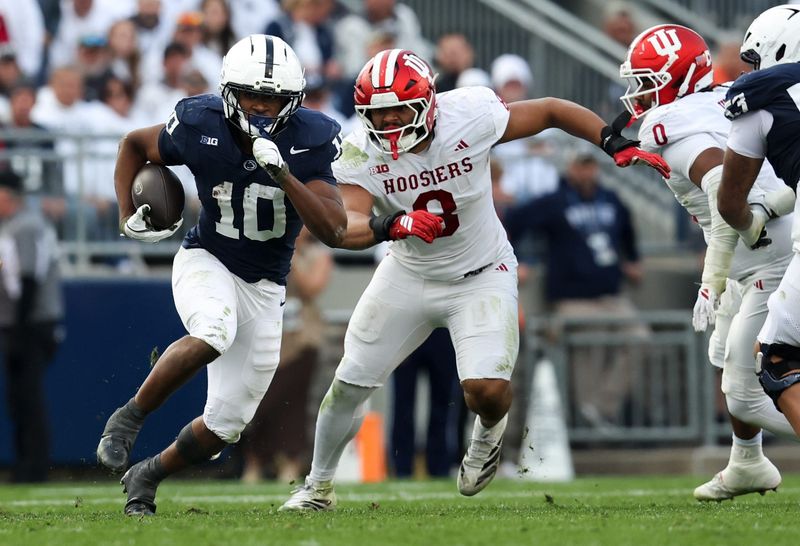
Nicholas Singleton (10) runs during the fourth quarter against the No. 2 Indiana Hoosiers at Beaver Stadium.
Through the Nittany Lions’ first eight games, the senior running back rushed 82 times for 292 yards. It marked a career-worst 3.5 yards per carry, a stark dropoff from last season’s 6.4. Singleton peaked at 39 rushing yards across Penn State’s first five Big Ten contests and scored just twice during that span.
Andy Kotelnicki, the Nittany Lions’ offensive coordinator, blamed himself for not giving Singleton enough opportunities to showcase his speed. Kotelnicki said Singleton’s “superpower” is quickly bursting through holes when they open, rushing lanes that had not often presented themselves to that point in the season.
“It’s about continued opportunities and making sure that those opportunities are ones where [Singleton] is going to have a chance to do what he does well, and that’s utilize his speed,” Kotelnicki said during a recent press conference.
"I hope they break every single one of [my records]."
Singleton’s struggles in those eight games were exacerbated because Kaytron Allen, his roommate and counterpart in Penn State’s backfield, was enjoying a career season. Allen routinely found open rushing lanes when Singleton could not, halting the potential “poor offensive line play” excuse.
Bottom line: Singleton didn’t look like himself. His typical explosive runs were nonexistent, and his impact on Penn State’s offense seemingly lessened with each carry.
But team officials inside the Lasch Building, the site of the team’s training facility, never wavered. They believed Singleton’s spark would return. And they have made sure he knew that
“The people who kept me going are the coaches, my teammates,” Singleton said. “They have always been there every step of the way throughout the whole season. I know it’s been long and a rough start, but they’ve been sticking together, coming out here and [helping me] get better every day.”
Singleton kept his head down and his legs churning. He knew his breakthrough moment was near. And against No. 2 Indiana, his preparation met opportunity.
Inside a packed Beaver Stadium on Nov. 8, Singleton capped a 10-play, 67-yard drive with a 2-yard rushing touchdown to even the score. His rushes, mainly outside the numbers, were generating more yards than they had in recent weeks. On several occasions, he was one broken tackle away from a big gain.
Then came his breakthrough moment.
With Penn State trailing 20-10 at the start of the fourth quarter, Singleton burst through a hole and outraced the Hoosiers’ trailing secondary until a shoestring tackle brought him down at the 1-yard line.
“I told [Singleton] after that long run, ‘This is who you are,’” said Ethan Grunkemeyer, Penn State’s starting quarterback. “When he broke that long run, you could just feel the energy.”
The Beaver Stadium fans rose to their feet as the 21-year-old capped the drive with a 1-yard score. It was his second rushing TD of the game and 41st of his career, which placed him second on the program’s all-time rushing touchdowns list behind only Saquon Barkley (43).
Khalil Dinkins, Penn State’s starting tight end, said Singleton simply “flipped a switch.” Singleton’s teammates knew he had his usual burst buried somewhere. He just had to find it.
Against Indiana, he did.
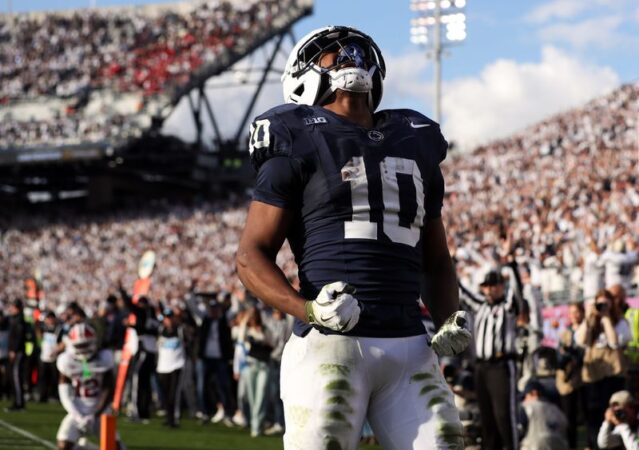
Penn State’s Nicholas Singleton (10) celebrates his fourth-quarter touchdown against Indiana on Nov. 8, one of three on the afternoon.
“Nick is an amazing football player and an amazing person,” wide receiver Devonte Ross said. “He’s always had [skill], so I think the last couple of weeks he’s been just showing what he can do.”
The 224-pound rusher was not done yet. On the ensuing drive, he took a screen pass 19 yards for the go-ahead score. It marked the third three-touchdown game of his career.
Singleton finished with a season-best 93 all-purpose yards and three touchdowns. The next week against Michigan State, he rushed 15 times for 56 yards, the first time he had broken 50 rushing yards in consecutive games since Weeks 2 and 3.
“Just getting back to the drawing board. Taking it one day at a time,” Singleton said. “Just [trying to] get better every day.”
Peter Fineberg sat in his Spectrum seats for more than 20 years, certain his perch was safe from the pucks that often flew into the stands. It would be years until protective netting was installed at every NHL arena, but Fineberg’s season tickets were behind the glass. He was good.
“The puck came in lots of times,” Fineberg said. “But always above me.”
But here it came — an errant slap shot in 1989 from a Flyers defenseman that redirected after tipping the top of the glass — falling straight onto Row 11 of Section L.
“We all see it coming,” Fineberg said. “I bail out of the way.”
He escaped, got back to his feet, and saw his mother grabbing her chin.
“I said, ‘Mom, what happened?’ She said, ‘The puck hit me,’” Fineberg said. “I go ‘What?’ She takes her hand off her chin and she just spurts blood.”
An usher walked Nancy Fineberg to a first-aid station where they helped slow the bleeding and offered the 64-year-old an ambulance ride to the hospital. But this was a playoff game and Nancy Fineberg, a mother of three who graduated from Penn in the 1940s, loved the Flyers. The stitches could wait.
“She said ‘I’ll go to the hospital after the game,” her son said. “She toughed it out.”
Another fan gave Nancy Fineberg a handkerchief to hold against her chin for the rest of the third period as the Flyers beat the Pittsburgh Penguins.
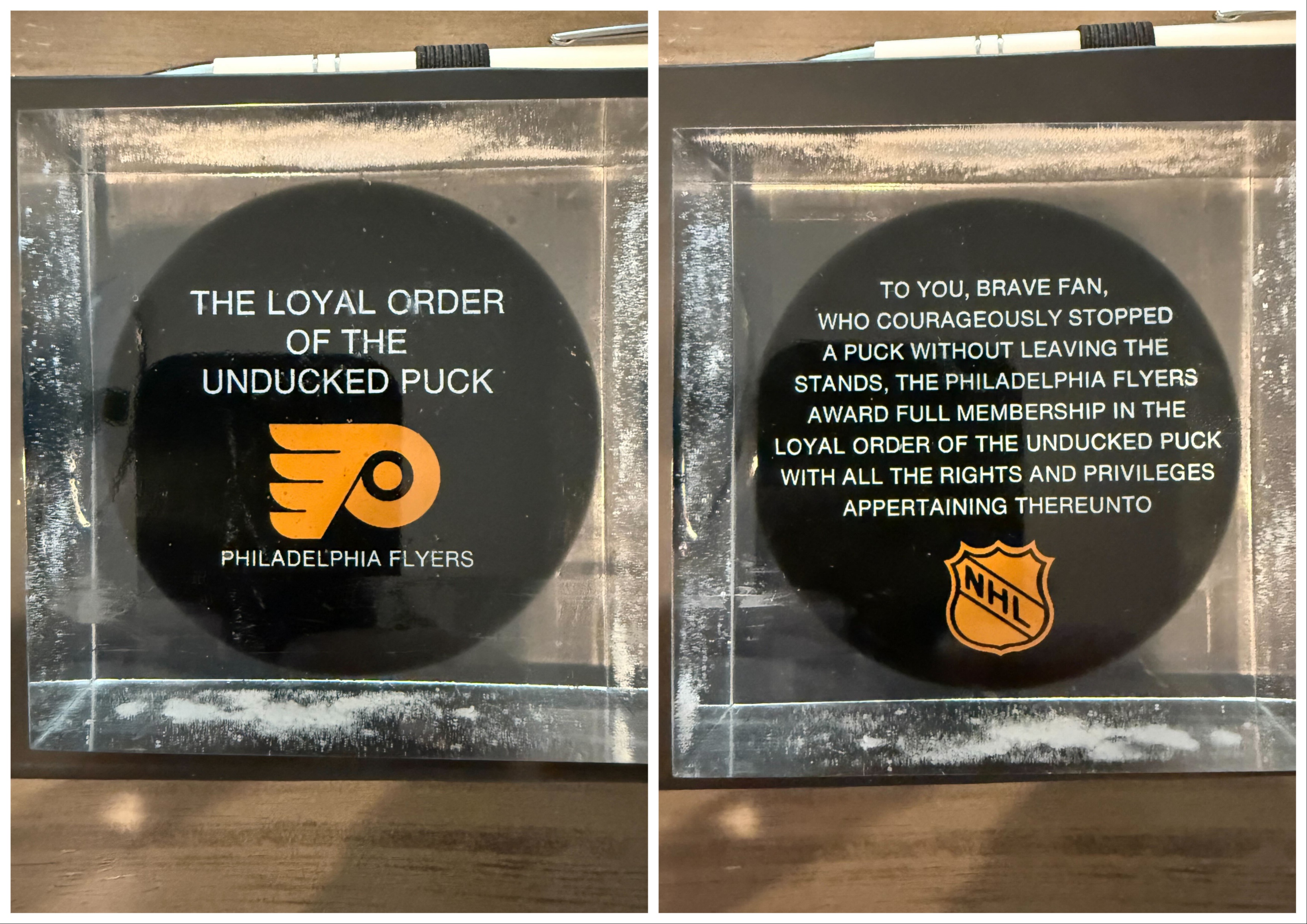
A package was shortly after delivered to her home in Bala Cynwyd. Fineberg was officially a member of the “Loyal Order of the Unducked Puck,” an exclusive club created by the Flyers in the 1970s partly as a way to dissuade fans from suing them if they were hit by a puck. You could not purchase a membership. You had to earn it.
“It was screaming,” her son said of the puck. “I’m amazed it didn’t break her jaw.”
A Loyal Order of the Unducked Puck plaque. The club was created by the Flyers in the 1970s partly as a way to dissuade fans from suing them if they were hit by a puck. You could not purchase a membership. You had to earn it.
A negative to a positive
A fan wrote to the Flyers in the early 1970s, letting them know that she was hit by a puck at the Spectrum and her outfit was ruined. Lou Scheinfeld, then the team’s vice president, told the fan the team would replace the bloodied clothes and get her tickets to a game. But he wanted to do more.
Ronnie Rutenberg, the team’s lawyer, envisioned more fans complaining about being hit by pucks and feared that lawsuits would be filed. The Flyers, he said, needed to turn being hit by a puck into a positive.
“He figured that if we made people feel special, they wouldn’t sue us,” said Andy Abramson, who started working at the Spectrum in the 1970s and became a Flyers executive in the 1980s. “Ronnie was brilliant.”
So the Flyers created the Loyal Order of the Unducked Puck and made fans feel brave for having been hit by an errant shot. Scheinfeld advised security members to immediately attend to any fan who was struck, bring them to a first-aid station, and gather their information.
The team then sent them a letter signed by a player and a puck with an inscription written by Scheinfeld printed on the back.
“To you brave fan who courageously stopped a puck without leaving the stands,” the inscription read. “The Philadelphia Flyers award full membership in the Loyal Order of the Unducked Puck with all the rights and privileges appertaining thereunto.”
The pucks were sent to fans for years, easing the pain of being hit by a frozen piece of rubber and making a bruise feel like an initiation. In 2002, the NHL mandated teams to install protective netting behind each goal after a 13-year-old girl was killed by a puck that was deflected into the stands. The netting has stopped most pucks from entering the stands, all but eliminating the need for a Loyal Order.
“You couldn’t buy your way in,” Abramson said. “You had to live through the experience in order to qualify. And you had to be willing to give up your personal information to a representative of the Spectrum in order to be enrolled.
“Let’s say you got hit and shook it off. We never knew, and you didn’t get in. It’s one of these unique things that made the Flyers who we were. It wasn’t just a hockey team.”
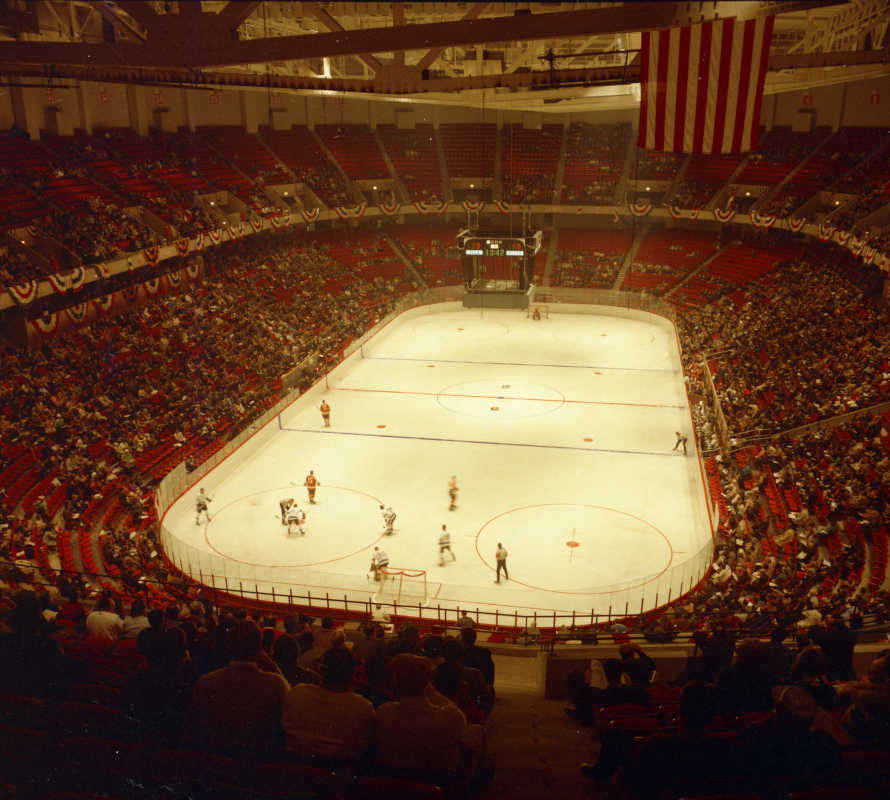
The first Flyers game played at the Spectrum against the Penguins on Oct. 19, 1967.
The perfect arena
The rows of seats inside the Spectrum were steep, because the arena was built on just 4½ acres, forcing developers to build up instead of out. It was perfect for hockey.
“Every seat was close to the ice, and you were on top of the action no matter where you were,” Scheinfeld said. “The sound was deafening. You could hear the click of the stick when the puck hit it. When a guy pulled up in front of the goalie and his skate sent an ice spray, you could hear that.
“It was like a Super Bowl every game. You couldn’t get a ticket. People didn’t give away their tickets to a friend or company. They came.”
And the pucks came in hot.
“We were right in the shooting gallery,” said Toni-Jean Friedman, whose parents had season tickets behind the net. “Thinking about that now, that was really crazy.”
Friedman’s mother was introduced to hockey in the 1970s, falling for the foreign sport at the same time nearly everyone else did in the region. Fran Lisa and husband Frank met a couple of friends at Rexy’s, the haunt on the Black Horse Pike where the Broad Street Bullies were regulars.
The Lisas met the players, got Bobby Clarke’s autograph on the back of a Rexy’s coaster, and bought season tickets at the Spectrum. A few years later, a puck was headed their way.
“She was trying to catch it, but then survival instincts took over,” Friedman said. “We saw people taken out in stretchers.”
The puck hit Lisa’s wrist and ushers rushed to her seat. She shrugged it off and watched the game. They jotted down her address in Marlton Lakes, and a puck was soon on its way. She was a member of the Loyal Order.
“She was proud of it. She showed it to everyone,” her daughter said. “So it worked because she would’ve never thought twice about suing, not that that’s who she was anyway.”
Fran Lisa was hit on the wrist by an errant puck. “She was trying to catch it, but then survival instincts took over,” her daughter said. “We saw people taken out in stretchers.”
The Flyers had Clarkie, Bernie, The Hound, and The Hammer, but the Spectrum was more than just the Bullies. Sign Man was prepared for anything, Kate Smith brought good luck, and a loyal order of fans sold out every game. Hockey in South Philly — a foreign concept years earlier — became an event.
“There was always action. There was always something going on,” Fineberg said. “And you never thought the Flyers were going to lose. I remember going into the third period and they’re down, and Bobby Clarke … it gives me chills … Bobby Clarke just took over and would score and bring them back. It gives me chills thinking about it. It was unbelievable.”
Fineberg bought season tickets in the late 1960s for $4.50 a seat as a teenager attending the Haverford School. His mom started going with him a few years later, knitting in the stands and wearing sandals no matter how cold it was outside.
“I can still see her crossing Pattison Avenue in the snow with sandals and no socks,” said her daughter, Betsy Hershberg.
The faces in the crowd became almost like family as they invited each other to weddings and kept up with more than just hockey. A couple from Delaware sat next to the Finebergs, a UPS driver was in front, a teenager from Northeast Philly was down the row, the Flyers’ wives were nearby, and Charlie was in Seat 1.
“Charlie had one of those comb overs. He was an older guy,” Fineberg said. “I remember one time, the Flyers scored and everybody jumped up. A guy in the back spilled his beer on Charlie’s head and his hair was hanging down to his back.
“You go to all these games with these people and share all these experiences. You can’t help but have a bond with them.”
Unducked Puck member Nancy Fineberg (left). “She said ‘I’ll go to the hospital after the game,” said her son. “She toughed it out.”
A lasting legacy
Nancy Fineberg is 99 years old and watches sports on TV. Her 100th birthday is in March. She went to Methodist Hospital after the Flyers won that game and left with 25 stitches. A faint scar is still visible on her chin. Her grandson Dan Hershberg has the puck the Flyers sent to her house, clinging to the symbol of his grandmother’s induction into the Loyal Order like it’s a family heirloom.
“My grandmom is kind of like an old-school badass,” Hershberg said. “Yeah, I was at the hockey game and things happen and you move on.”
The original Loyal Order puck was a cube of Lucite with a Styrofoam puck inside — “Seriously?,” Friedman said — because a real puck would be too heavy. The Flyers later created plaques for members. They also sent a letter signed by a player. Friedman’s mother heard from Bernie Parent.
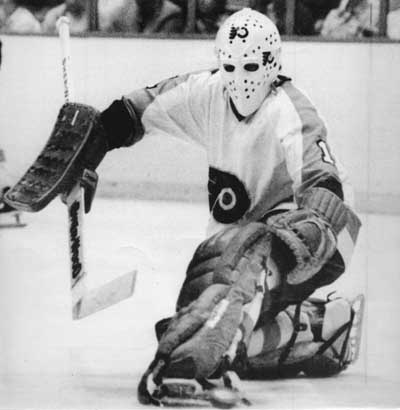
Bernie Parent, the former Flyers goalie, would sign letters sent to Loyal Order of the Unducked Puck inductees.
Dear Fran,
Unfortunately, you are now a full-fledged member of the Loyal Order of the Unducked Puck. I know your initiation was tough, but now that you have passed it with flying colors, Pete Peeters, Rick St. Croix, and myself (all honorary members) would like to take this opportunity to welcome you to the club. Everyone in the Flyers organization hopes you are now feeling fine and we hope you’ll accept this little memento of your unpleasant experience with a smile.
Best regards,
Bernie Parent
Fran Lisa died in March. There was always a game on TV, her daughter said, and Lisa knew all the stats. When the family wrote her obituary, they mentioned how she “showered people with love and food” and invited everyone to her Shore house. Lisa, they said, was the axis of her family.
And they also made sure the obituary included that she was a member of the Loyal Order of the Unducked Puck. Lisa was 85 years old and being hit with a puck at the Spectrum was worth a mention. The family wanted all to know that their mother earned her place in the Loyal Order.
“It was her,” Friedman said. “To her, she felt like she was a Flyer because of this whole thing. She was in the club. I can’t describe it any other way but she was proud. It was a great idea.”
If there was anything to learn about Matt Freese, it’s that he’s a really serious individual.
Last week, in his return to the Philly area with the U.S. men’s national soccer team, the former Union goalkeeper and Wayne native said he spent the bulk of the week inside the team hotel instead of visiting family and friends.
He wasn’t a complete recluse. He visited a few old friends from the Union, who were training on fields adjacent to the USMNT at the WSFS Bank Sportsplex in Chester. He even took time to speak to classes at YSC Academy, the school created specifically for soccer players aspiring to be in Freese’s shoes.
Other than that? Freese treated the homecoming as a business trip, which was clearly conveyed in refusing all requests for interviews the day before a game and the serious gaze on his face even after the USMNT’s 2-1 win over Paraguay last Saturday.
He returns on Sunday when the Union host New York City FC in MLS’ Eastern Conference semifinal (7:55 p.m., FS1, Apple TV, MLS Season Pass).
“I actually didn’t see my family. I didn’t do anything,” Freese said. “[This week], I just stayed in the hotel. [Chuckles], I’m a bit of a loser, but when I’m in camp, I’m locked in. I’ll see my family in the offseason at some point.”
Freese being locked in isn’t because he’s being standoffish. Instead, it’s his effort to prove to himself that he belongs. He has made sacrifices — particularly whenever he receives that call from the men’s national team.
See, it was roughly around this time last year that Freese was a bit of an afterthought. Incumbent goalkeeper Matt Turner was on a tear for club and country and looked to be a shoo-in for being first up on USMNT manager Mauricio Pochettino’s roster.
But amid a lack of playing time with Crystal Palace, Turner’s club team, he fell down the depth chart, as Pochettino told reporters in May that “it’s open for another player maybe to challenge in between [the goalkeepers] and maybe to try to give the possibility to play [to] another player,” according to an ESPN report.
Enter Freese, who has had several call-ups since Pochettino’s remarks and has impressed, notably his performance in the U.S.’s shootout win over Costa Rica the Gold Cup quarterfinals in June. He made three saves in the penalty kick portion of the match, which helped the U.S. vault into the semifinal, and earned soccer’s version of the nickname “Matty Ice.”
From that moment, he’s been a mainstay with the national team. Now, with the last games of the November cycle wrapping up earlier this week, it’s a waiting game to see if he’ll be called into camp for Pochettino’s World Cup squad.
From being an unknown to being No. 1 — the opportunity arguably has never been bigger for Freese.
“What’s driving me is this chance to represent my country,” Freese said. “Having that opportunity is one that I dreamed about but didn’t know if I was ever going to get. So every time I’m called up, I want to make the most of training, and then every time I get to play in a game, I want to make the most of that as well.”
One thing that stood out in a conversation with Freese was his reply that when it came to visiting family, he’d do so “in the offseason at some point.”
Coincidentally, if the Union have their way, he might not have to commute too far. A week removed from being the hero against Paraguay, Freese returns to Subaru Park as the villain in his role as the starting goalkeeper for NYCFC.
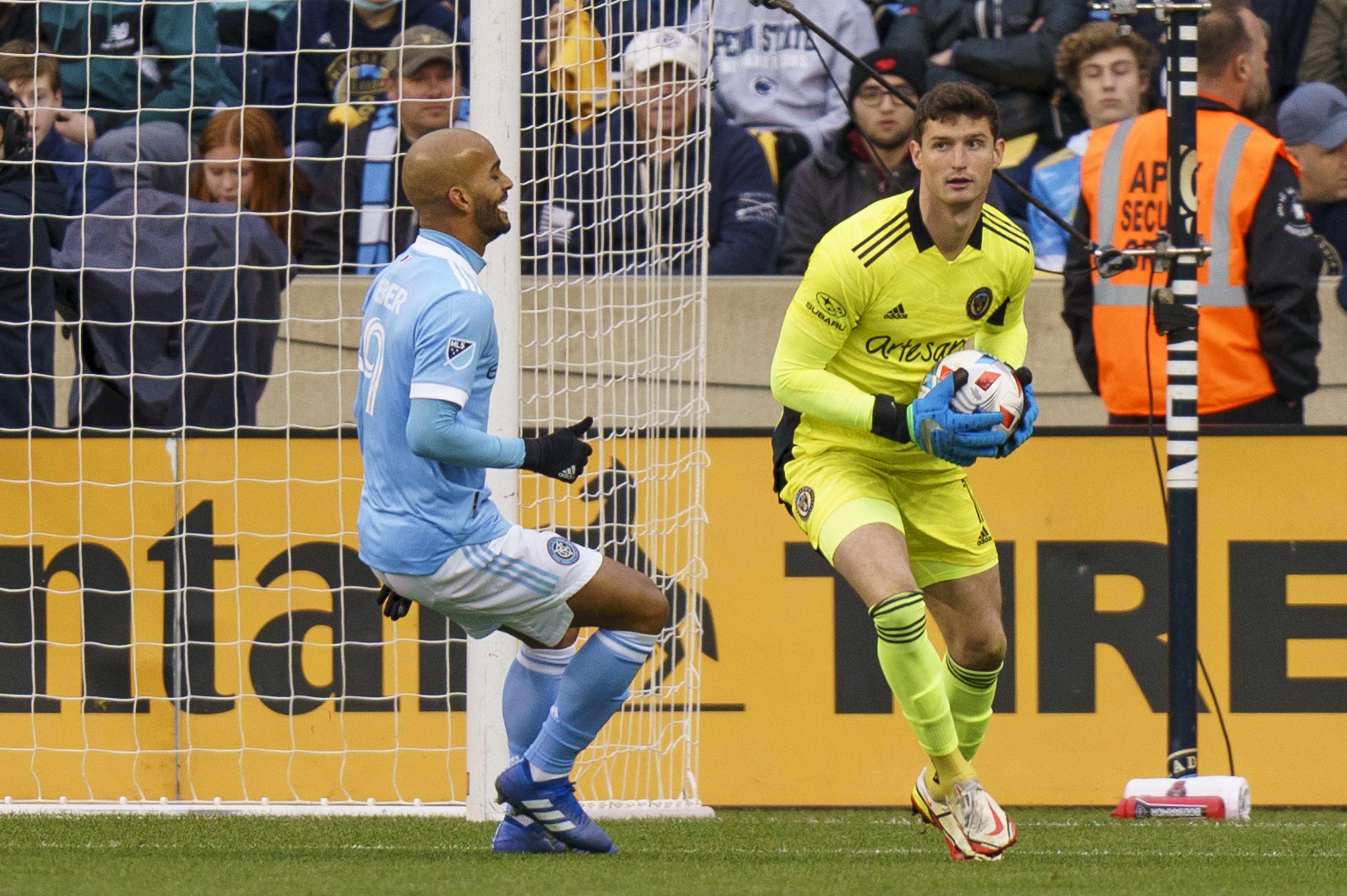
Matt Freese (49) guided NYCFC past fourth-seed Charlotte FC to set up an Eastern Conference semifinal date against the Union.
The meeting is the fourth time the teams will battle in the postseason and the second time for Freese, who was released from the Union in 2022 following the team’s run to the MLS Cup final.
Instead of looking at his ouster from the Union as being on the outside looking in at a professional career, which started in the team’s youth academy, Freese locked in. Just a year after joining NYCFC was named the team’s MVP last season.
Now, he leads NYCFC as the fifth seed in the East looking up at the No. 1 team and Supporters’ Shield winner — on its home field.
Matt Freese (right) shown as a member of the Union against his current team, New York City FC during a game in 2021.
“It’s a really exciting time in my career right now,” Freese said. “It’s important however to stay humble and be thankful that I’m in this situation. I have a job to do, and our goal as a team is to be the last team standing. We have to beat the best. That’s what it comes down to.”
Fellow U.S. national team member Max Arfsten notes that mentality as the reason Freese has arrived at this moment. Arfsten, whose Columbus Crew side recently fell out of the Eastern Conference playoffs following a loss to rival club FC Cincinnati, gets a routine look at Freese firsthand over the course of the season and sees something special in the goalkeeper.
“He’s my guy,” Arfsten, a midfielder, said following last week’s USMNT win in Chester. “His ability to control our back line and his communication is big. It allows us to do our job because we know he’s got it covered back there. He’s locked in right now, and that’s really good as we continue to push forward toward the World Cup.”
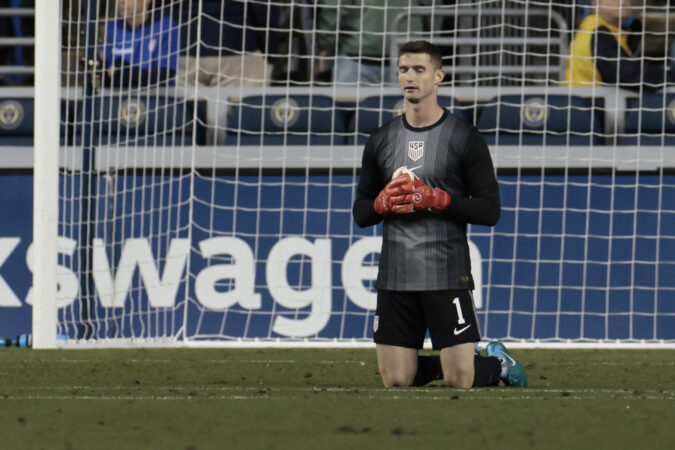
U.S. men’s national team goalkeeper Matt Freese dives for a save during a training session earlier this month at the WSFS Sportsplex in Chester.
On his way out of the Union’s locker room last Saturday, Freese briefly struck up a conversation with a security guard stationed just outside the main doors. What was said was muffled, but what was distinctly heard was the security guard ending the conversation in jest with “see you on Sunday.”
Given what’s at stake, and having an obvious familiarity with Philly banter, it might have been one of the few times Freese let his armor down and cracked a smile.