Tag: UniversalPremium

  • Vic Fangio and Howie Roseman have rebuilt the Eagles defense that won a Super Bowl

    Vic Fangio and Howie Roseman have rebuilt the Eagles defense that won a Super Bowl

    It’s the goal-line stand that will have everyone talking, and rightly so, since it was the sort of set of plays from which hard-nosed, November NFC football is made.

    The Lions had the ball, second-and-goal from the 6, trailing by seven points, late third quarter. Safety Reed Blankenship hit Jahmyr Gibbs on first down for just 2 yards. Defensive tackle Jalen Carter limited Gibbs to 1 yard on the next play. Deadline addition Jaelan Phillips pressured Jared Goff and forced an incompletion on fourth down.

    The Lions never got inside the 29-yard line again.

    The Eagles won, 16-9, Sunday night at Lincoln Financial Field despite an offense aptly described by wideout A.J. Brown as a “bleep-show.”

    Why?

    Because that Eagles defense, which led them to a Super Bowl win nine months ago, suddenly, again, is elite.

    “The defense is [bleeping] balling right now,” said grateful offensive tackle Jordan Mailata.

    But, elite?

    Nakobe Dean, who shined all night, paused and considered.

    “We gotta continue to get better,” he said.

    They’d just held the Packers to seven at Lambeau Field, then allowed the NFC’s highest-scoring offense its fewest points in 16 games, counting playoffs. The Eagles travel to Dallas on Sunday, where the Cowboys are shaking in their boots.

    Really, how much better can the Eagles’ defense get?

    After a virtuoso performance in Game 9 last Monday night at Green Bay, the defense — constructed by general manager Howie Roseman and coordinated by Vic Fangio — delivered a tour de force six nights later. Zones and man, blitzes and stunts, batted passes and sacks and so much more.

    Most important: Sixteen points surrendered against two very good quarterbacks who play for playoff-likely teams that are above .500.
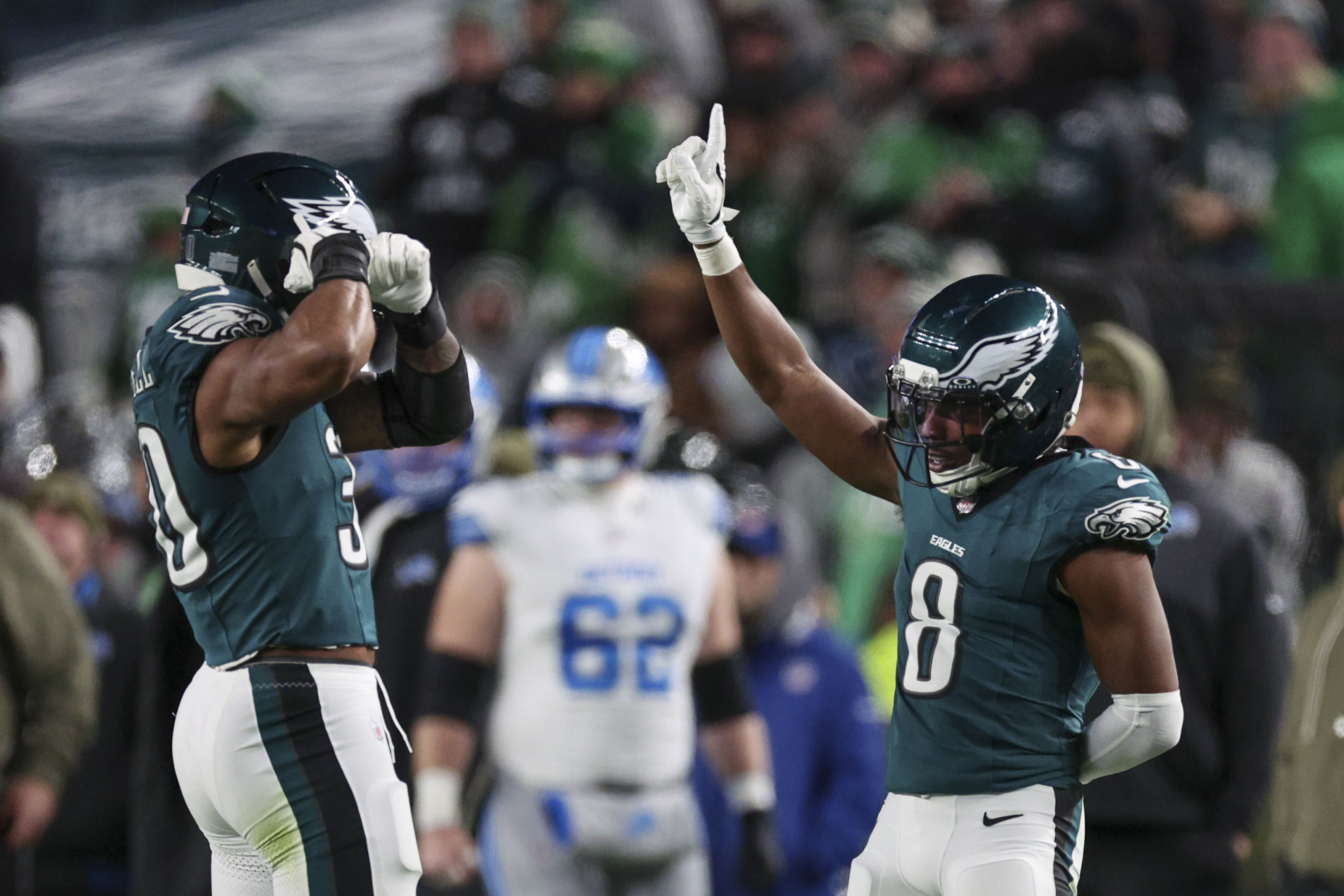
    Linebacker Jihaad Campbell (left) celebrates with Adoree’ Jackson after the cornerback broke up a pass in the fourth quarter.

    Two touchdowns in eight quarters.

    Good job, Vic.

    But …

    Bravo, Howie.

    Bravissimo!

    “You saw those guys, all those guys, out there making plays,” said quarterback Jalen Hurts, appreciatively.

    Phillips, Carter, and Dean featured all night. Among them, only Carter had featured before Game 5, since Dean was hurt and Phillips was in Miami, and frankly, Carter didn’t feature much, since he wasn’t in shape until Game 6.

    Sunday marked the first game that the Eagles defense played as it originally was comprised. Thanks to Roseman, it also featured reinforcements.

    For the first time this season both Dean, the middle linebacker, and defensive end Nolan Smith started without snap-count limitations; Smith had been hurt, too.

    “Holy [bleep],” Mailata said. “Them coming back — game-changer. Really a game-changer.

    They were joined by Philips, a pricey trade-deadline pass rusher who’d debuted brilliantly Monday night in Green Bay, and by old friend Brandon Graham, who’d unretired four weeks earlier and also had played his first game as a 2025 Eagle in Green Bay.

    Not coincidentally, the Eagles surrendered just seven points to the Packers, their stingiest performance of the season … by 10 points. The seven-point allowance was 17 fewer than the Packers’ average, which ranked 14th.

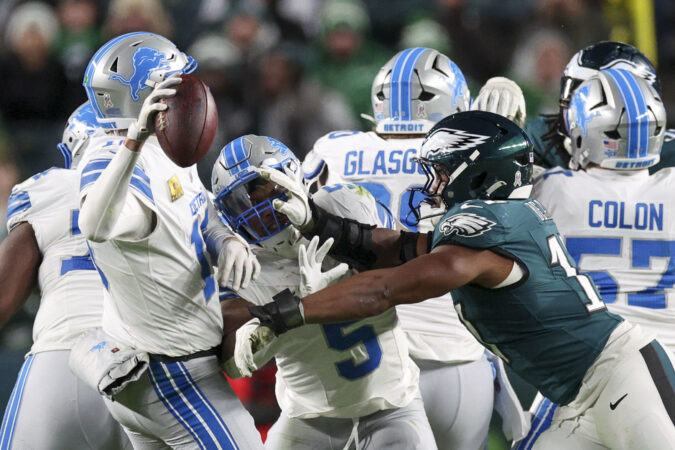
    Eagles linebacker Jalyx Hunt goes after Detroit Lions quarterback Jared Goff in the fourth quarter at Lincoln Financial Field.

    The Lions averaged 31.4 points entering Sunday night, second-best in the league. They scored 22 fewer than they averaged.

    The Lions entered with a pedestrian 37.5% third-down conversion rate, but ranked fourth in fourth-down conversions at 72.2%.

    They converted 3 of 13 third downs, or 23%.

    They converted zero of 5 fourth downs, or, yep, 0%.

    “Those are turnovers in our mind,” coach Nick Sirianni said. “Five-for-five, the way we look at it.”

    How?

    Playmakers all over Lincoln Financial Field, wearing the midnight green.

    First series: Dean covered the running back out of the backfield, Jordan Davis pushed the pocket and deflected the pass, and Cooper DeJean intercepted it. That led to a field goal.

    Second series: Phillips sacked Goff, which led to a punt.

    Third series: Carter dropped David Montgomery for a 2-yard gain on third down, which led to a punt.
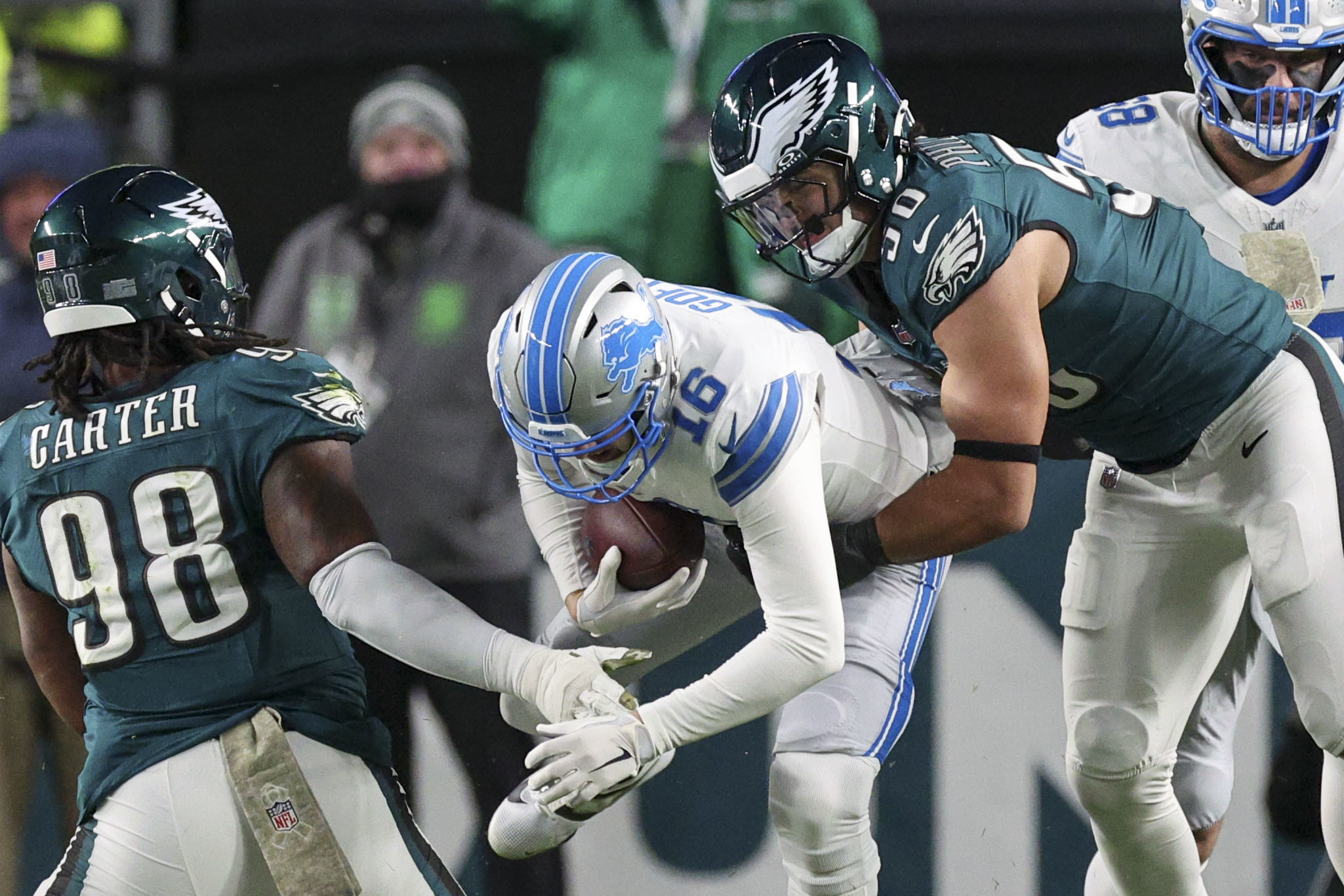
    Eagles edge rusher Jaelan Phillips sacks Lions quarterback Jared Goff as Jalen Carter moves in.

    Fourth series: On fourth-and-1, Moro Ojomo grabbed Gibbs low, Carter hit him high, and they stoned him at the line of scrimmage.

    Fifth series: Dean hit Goff on third down, which forced an incompletion that forced fourth down, and the Lions tried a fake punt and failed.

    Then, a Detroit touchdown on two long passes. Nobody’s perfect.

    The Eagles came close.

    Dean, a linebacker, covered star wideout Amon-Ra St. Brown and helped force a turnover on downs.

    Then, the goal-line stand.

    Later in the second half, Dean would blanket Jameson Williams. On the next play, he’d sack Goff.

    Phillips had another pressure.

    Jalyx Hunt pressured Goff twice in three plays with just under six minutes to go.

    If there was a standout, well, it was Dean’s day, but name them all. Carter, Phillips. Ojomo for a minute. Cornerback Quinyon Mitchell — superb.

    They all were good. So, so good.

    Just like Vic called it. Just like Howie built it.
  • Redemption, tradition, and history: Area football teams compete for much more in PIAA playoffs

    Redemption, tradition, and history: Area football teams compete for much more in PIAA playoffs

    Roman Catholic coach Rick Prete said it best: Every team in the state playoffs is good, and this is what each program has prepared all year for. What they’re playing for is different.

    For the Cahillites, it’s getting back to the state final after making their first appearance in school history last season, when Roman Catholic fell in overtime to Harrisburg’s Bishop McDevitt for the PIAA Class 5A crown at Cumberland Valley High School.

    The heartbreaker has been Roman Catholic’s fuel all season, and this time Prete believes his team is “in a good place” to reach the final.

    The Cahillites (8-3) handed La Salle College High its first loss of the season, nearly beat St. Joseph’s Prep (in a 40-39 double overtime loss), and are riding a four-game winning streak entering a matchup against Whitehall of District 11 in the first round of the PIAA playoffs on Friday night.

    “We’re the only team that can get in our own way,” said Prete, who has been at the helm since 2019. “We have to stay focused and get better every day. … From the beginning of the year to now, it’s been about staying out of our way and understanding that if we play our best, we’re the best team in Pennsylvania.”

    Roman Catholic is led by Akron-bound quarterback Semaj Beals, who has passed for 2,456 yards this season. His main targets have been Ashdan Roberts (12 touchdowns) and Eyan Stead Jr. (eight), who both recently committed to Temple.

    Prete also credited center/guard Dom Ramos and defensive end Julian Enoch as the team’s vocal leaders. The two seniors “lead by example and try to hold guys accountable,” Prete said.

    “We tell them to be where their feet are,” he said. “We’re not focused on coming off of four wins. We’re coming off of a loss in the state title game. We’re coming off a loss in essentially the PCL championship game. … Roman has been coming back from a loss. That’s been our mindset.”

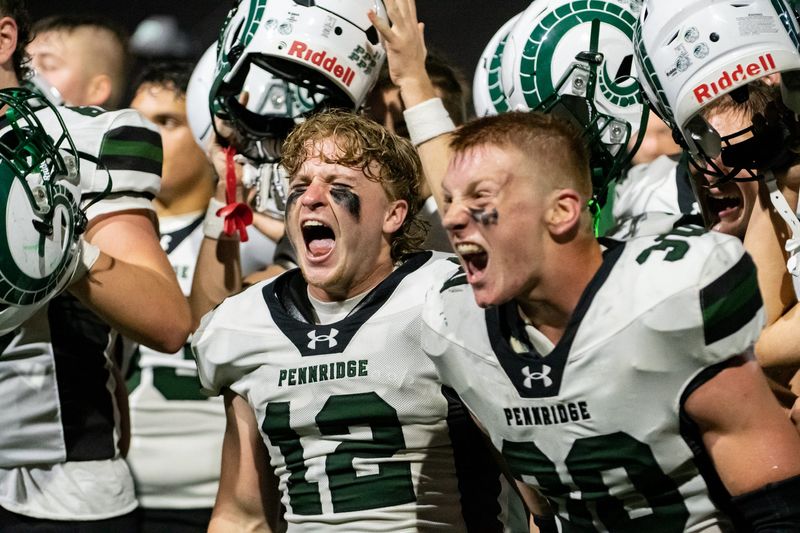
    Pennridge eyes history

    Pennridge High has never won a district or state championship. The Rams (11-1) are having their best season under third-year coach Kyle Beller after going 3-7 in 2023 and 4-7 in 2024. They opened the season on a seven-game winning streak, with victories against conference foes North Penn and Neshaminy.

    District 1 Class 6A includes top competition. Pennridge, which earned a Suburban One League title outright and was seeded No. 1 in districts, barely got past No. 16 Plymouth-Whitemarsh to open the district playoffs, 22-21.

    Pennridge celebrates its victory over Neshaminy on Oct. 3.

    “Plymouth-Whitemarsh is a very good program,” Beller said. “We’re talking about the 16th seed and their record is 7-3 — that’s a pretty darn good football team. When you’re looking at that top to bottom there, we knew we had our work cut out for us.

    “We have three of the four teams left in District 1 right now, playing for the district championship. That’s how good the conference is [Suburban One National]. It’s the best conference in this side of the state and one of the best in the state.”

    Pennridge has found ways to win — against schools it hasn’t beaten in some time. Beller has been building the program for this moment. Pennridge is one win away from a district final appearance, but first must take down Coatesville in the District 1 semifinal on Friday night.

    “It’s about consistency,” Beller said. “We’ve had that for three years.”

    Following in his footsteps

    Cardinal O’Hara coach Michael Ewing reminded his team to stay level-headed entering its matchup with Bonner Prendergast in the Class 4A Catholic League final last Saturday.

    “They’re our school’s biggest rival,” said Ewing, in his fourth season at the helm. “Any time we play them in any sport, both schools’ student sections, the alumni, everybody shows out. It’s a great atmosphere.”

    The Lions (8-4) silenced the defending 4A state champions, 24-3, marking the first time that O’Hara has beaten Bonner in nine years. O’Hara will face West Philadelphia at the Northeast Supersite on Saturday in the District 12 championship with the chance — at least to Ewing’s knowledge — to win the program’s first district title.

    There’s also a unique opportunity for Ewing, who is the grandson of Bob Ewing, the winningest coach at O’Hara and a hall of famer. Michael recalled when his late grandfather won a city title at Veterans Stadium in 1979.

    Saturday is his chance to earn the team a city title, following in his grandfather’s footsteps, and he hopes “to do something that he was never able to do” in the state playoffs — win the school’s first PIAA crown.

    “My dad coached on his staff as well,” Michael Ewing said. “I grew up at O’Hara — for the first nine years of my life I was on the sidelines, in the locker room, and the coaches’ rooms. They didn’t do the daycare thing back then. …

    “The school has a special place in my heart. That’s why I came back to it. That’s why I wanted to try and bring them back to where they once were.”

    Here’s a look at the full schedule of the local teams competing in the first round of the PIAA playoffs:

    PIAA Class 1A

    • Belmont Charter at York Catholic, York County, on Saturday (1 p.m.).

    PIAA Class 2A

    • Lansdale Catholic vs. Lakeland, Lackawanna County, at Germantown Supersite on Saturday (1 p.m.).

    PIAA Class 3A

    • Neumann Goretti will play in the quarterfinals next weekend against the winner of Berks Catholic and Trinity High School. Time and location to be determined.

    PIAA Class 4A

    • North Pocono, Lackawanna County, at Bishop Shanahan on Friday (7 p.m.).
    • Cardinal O’Hara vs. West Philadelphia at the Northeast Supersite on Saturday (11 a.m.) for the District 12 title.

    PIAA Class 5A

    • Roman Catholic at Whitehall on Friday (7 p.m.).
    • Strath Haven at Springfield (Delco) on Friday (7 p.m.).
    • West Chester Rustin at Chester on Saturday (1 p.m.).

    PIAA Class 6A

    • La Salle vs. Imhotep at Northeast High on Saturday (3 p.m.) in the District 12 championship.
    • Coatesville at Pennridge on Friday (7 p.m.).
    • Neshaminy at North Penn on Friday (7 p.m.).
  • Temple tight end Peter Clarke’s size is creating an advantage in the passing game: ‘He’s hard to bring down’

    Temple tight end Peter Clarke’s size is creating an advantage in the passing game: ‘He’s hard to bring down’

    On the first offensive possession of the season, Temple faced second and 9 from Massachusetts’ 21-yard line, and offensive coordinator Tyler Walker buzzed down a play call to quarterback Evan Simon.

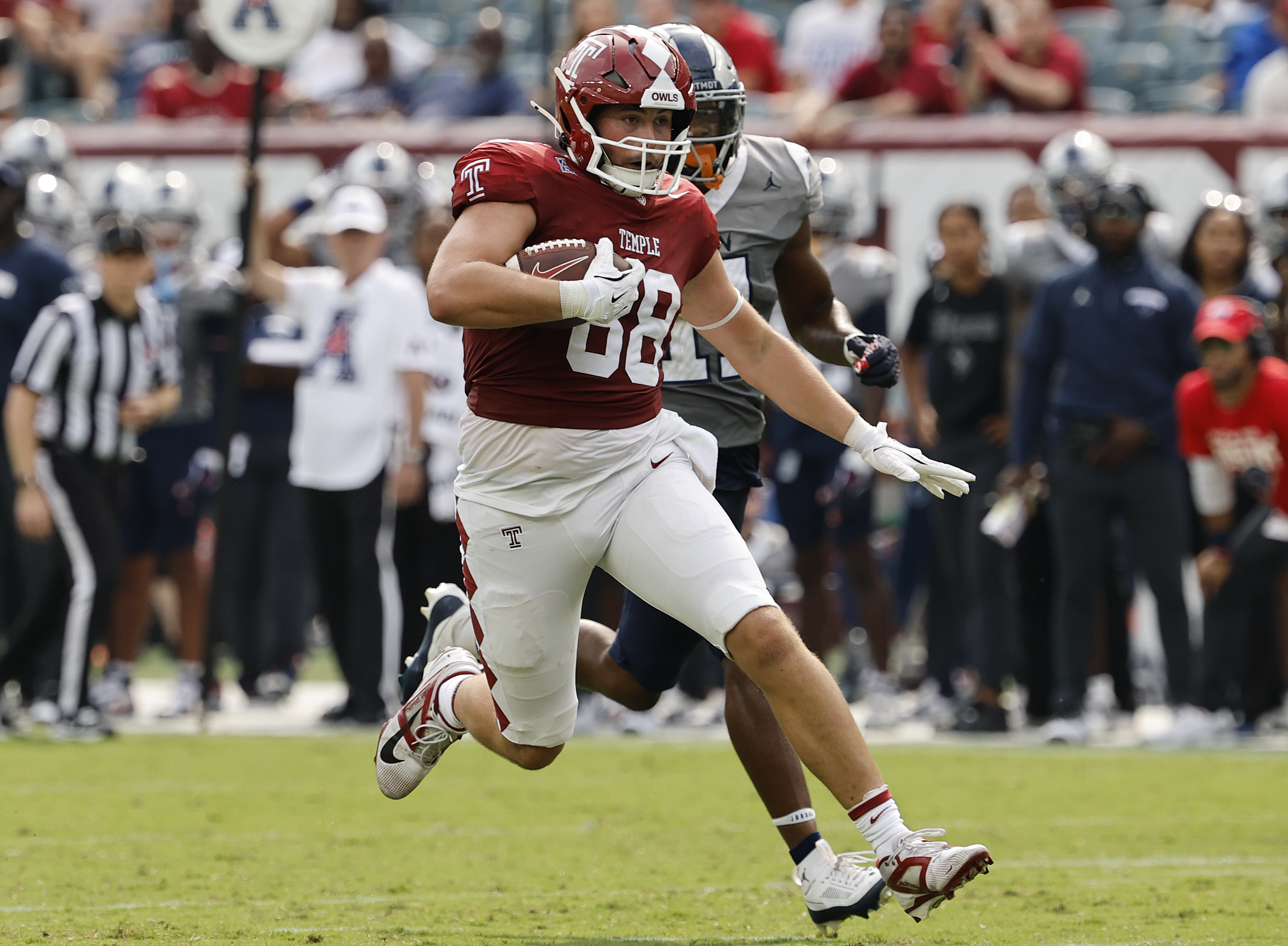
    The play, called “Buckeye,” sent tight end Peter Clarke down the seam on a double move matched up with a UMass safety. The ball from Simon, which he says was “really overthrown,” somehow found the outstretched right hand of Clarke, the 6-foot-6, 265-pound tight end.

    “You look at his height and weight, and [he’s] just a big target who really makes my job easier,” Simon said by telephone recently. “The missed throws, or whatever you want [to call them], inaccurate throws, they have a little more leeway with [his size].”

    Walker heavily featured his tight ends as Montana State’s offensive coordinator, and he brought the same mindset to the Owls. He recalls meeting Clarke, describing him as “big, athletic, can run and catch the ball well.”

    Clarke, a native of South London, went through the NFL Academy, a platform that helps international athletes learn football. He told Walker that he watched YouTube videos to learn the basics of football, drills, and highlights.

    “He’s got great ball skills, he’s super intelligent,” Walker said. “When he told me that he learned [football] through YouTube, I was surprised, because he’s got football feel that you see from kids who’ve been playing the game their whole life.”

    Philly emulates his home

    Clarke has put up career numbers through eight games in his junior season with 23 catches, 378 yards, and four touchdowns. He entered the season with just five catches and three touchdowns.

    Football began as a hobby for him in England, where he played five-on-five games in middle school before enrolling in the NFL Academy at 16. He equates the NFL Academy to IMG Academy in Bradenton, Fla., with the way it “emulates a college football sort of atmosphere in terms of the intensity and the weight room, the attention to detail in the meetings, the time schedule of early mornings, late afternoons, and really playing on a bigger stage than just an average high school.”

    Temple tight end Peter Clarke runs with the football against Howard on Sept. 6.

    “The NFL Academy did a great job of preparing me just for the transition of how much time, effort and intensity you put into this thing,” Clarke said. “And then once I got here, I had great leaders in my room, people like [former Temple tight end David Martin-Robinson], who’s on the Titans now, to really show me what college football was about and how to live this life.”

    When it came to choosing his future college home, Clarke said the decision was simple.

    “I wanted to go to a school that emulated something of my home environment, London, in a big city, 10 million people. I come from a very, like, inner-city part of London,” Clarke said. “So I wanted to go to a school that was in a city and Temple being in the heart of North Philly, when I came on my visit, it felt like home.”

    Top-rated tight end

    Among the tight ends across 136 teams in the Football Bowl Subdivision, Clarke is rated No. 1, according to Pro Football Focus, with a 91.8 grade, more than four points higher than the next player.

    His value on the field has been apparent this season. Clarke averages the most yards per catch (16.4) on the team among players with five or more receptions. But his preparation is what separates him, tight ends coach Chris Zarkoskie said.

    “Since I got here, he’s been a kid who has a good skill set and can do a lot of different things, and a young man who works really hard and is ready when his opportunity comes, which is the thing I’m most proud of for him,” Zarkoskie said. “He takes pride in the whole body of work that it takes to be a tight end. And I think that he’s continuing to grow and evolve as a blocker, in-line and out in space.”

    Temple’s tight end corps has representation from three international players: Clarke, Ryder Kusch (Canada), and Daniel Evert (Germany). David Wise is from South Philly and Jake Woods is from California. Zarkoskie said getting to coach this diverse group “is the coolest part of the game that we coach.”

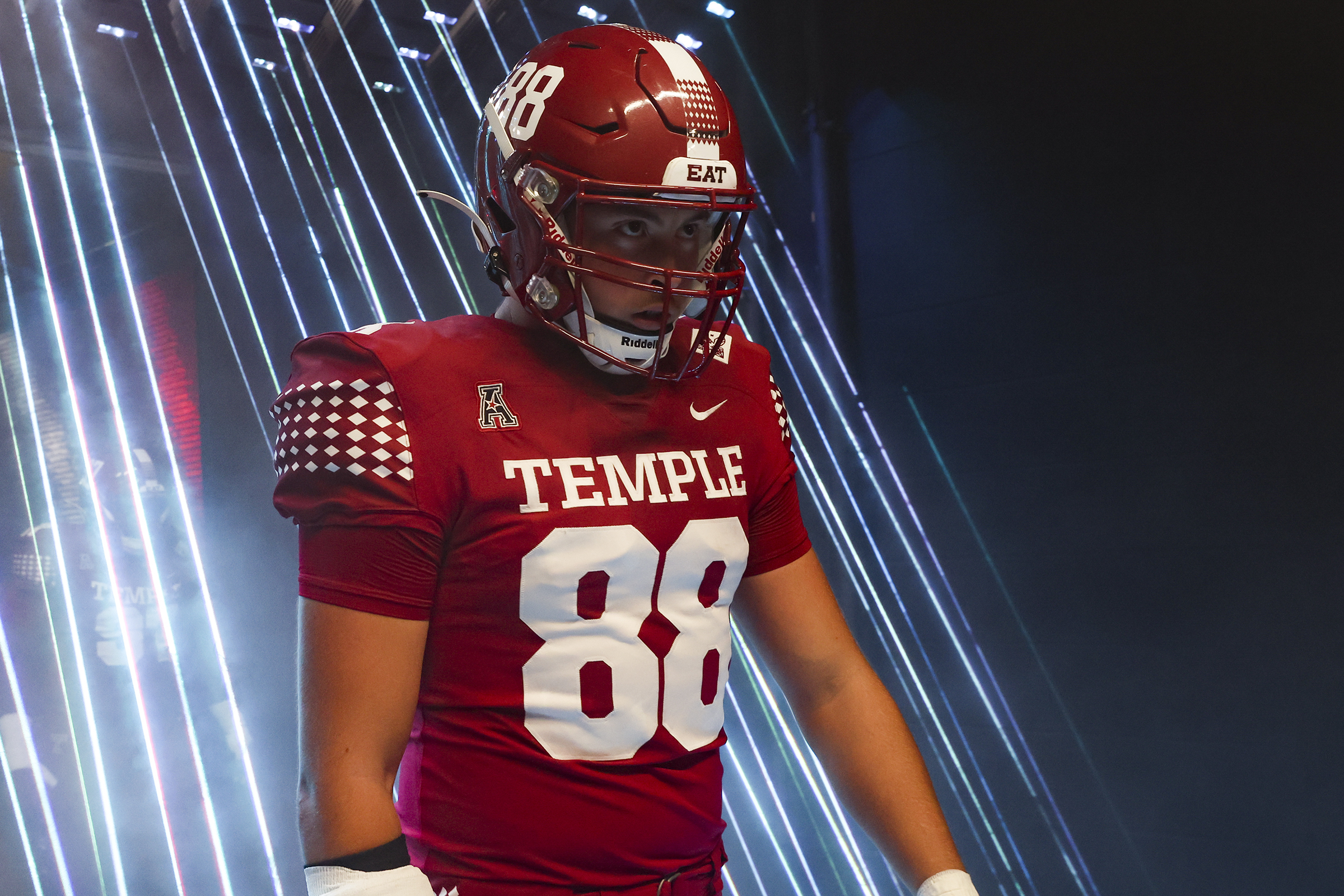
    Temple tight end Peter Clarke enters before a game against Miami at Lincoln Financial Field on Sept. 23, 2023.

    Clarke arrived at North Broad weighing 225 pounds and has filled out his frame. He said he relishes most in proving that he is more than a run blocker by doing “freakish stuff” in the passing game. Walker and Simon agree, and both detailed Clarke’s best play this season as a pass catcher.

    “If I had to pick one from this year so far, I think it would be against UTSA in the second half,” Simon said. “Our first drive in the third quarter, we refer to it as ‘the spark,’ and we went down, scored, and his catch over the middle with a linebacker right on him and safety over top that could have really taken his head off. He stuck in there, caught the ball.”

    Added Walker: “Evan put the ball in a window the size of a computer screen, and you saw Peter’s big mittens just coming out of the air and catching the ball above his head. And then on top of that, being able to get the yards after the catch and add on another 15 yards, his pure size, his pure mass. He’s hard to bring down. He’s a little more fluid than people would think, just based off his size.”

    Clarke added to his highlight reel with a career-long 50-yard reception during a 38-37 overtime win over Tulsa on Saturday. With one more win, Temple (5-3) will be bowl eligible for the first time since 2019. And you can bet Clarke will be in the middle of it all.

  • Are the refs now favoring the Eagles? Plus, the Birds’ red-zone success and a new Tush Push controversy

    Are the refs now favoring the Eagles? Plus, the Birds’ red-zone success and a new Tush Push controversy

    Here’s a novel thought:

    The refs are actually favoring the Eagles.

    After decades of paranoia and conspiracy theories that cast the Birds as victims of perceived favoritism shown to such rivals as the Cowboys, Patriots, and Chiefs, consider what happened for the Eagles on Sunday against the Giants. Honestly, no fan base feels persecuted more than the Eagles’, whose owner, Jeffrey Lurie, is still bitter about the obvious defensive holding call by James Bradberry that cost them a Super Bowl win three years ago.

    These days, things are skewing Philly.

    The NFL continues to allow the Eagles to run the Tush Push, but that play earned another strike against it when the owners meet next spring.

    Assuming a team introduces another proposal to ban the controversial short-yardage play — which has been assailed as an injury risk, which is ridiculous, and has been assailed as a penalty magnet, which is legitimate — Sunday’s debacle will add fuel to whatever fire remains from last spring’s 22-10 vote, which was two ballots shy of a ban.

    Facing fourth-and-1 at the Giants’ 11 early in the second quarter, Jalen Hurts and his line surged forward and Hurts peeled off slightly to the left. Floating on a sea of humanity, Hurts clearly never stopped moving toward the line to gain, and as he reached the ball forward, Giants linebacker Kayvon Thibodeaux stripped him of the ball and recovered it.

    The play was not reviewable because forward progress is not a reviewable issue.

    The larger issue here is that officials don’t seem to be able to consistently rule correctly on a number of areas, among them: whether the defense moves too early; whether the defense lines up in the neutral zone; whether the offensive line moves early; or whether the offense lines up in the neutral zone.

    Sunday, they didn’t properly gauge forward progress, even with the runner in plain view.

    The final was 38-20, but the call was enormous in the context of the game. Instead of losing the ball to a Giants team that had just completed a 52-yard touchdown drive, the Eagles retained possession and scored a touchdown two plays later to make it 14-7.

    It was just the first seven-point swing the officials delivered to the home team.

    Early in the fourth quarter, with New York facing fourth-and-11 and trailing by 18, Giants receiver Darius Slayton and Eagles cornerback Quinyon Mitchell engaged in routine hand-fighting during Slayton’s route. Slayton disengaged in a normal fashion, caught the pass, and romped for a 68-yard touchdown.

    But no.

    Slayton was called for offensive pass interference. Brutal call. In fact, a penalty probably should have been called on Mitchell.

    Instead of cutting the lead to 11, the Giants had to punt.

    The Eagles are tied for 11th in total penalties called, and they’re seventh in total penalty yards, but most of the calls are inarguable, and, objectively, they seem to be getting away with lots of shenanigans. This was true Sunday.

    Yes, the Eagles won by 18, and they dominated all day, but they were gifted that 14-point swing. These two were the kinds of crucial calls that the Eagles and other Chiefs opponents lately have claimed gave unfair advantage to Kansas City; the kinds of calls the Patriots under Bill Belichick seemed to get all the time; and the kinds of calls America’s Team has gotten for 50 years in Dallas.

    The Eagles are getting those calls now … right?

    The Giants agreed, at least for Sunday. Said Thibodeaux:

    “They said they called the forward progress before he reached the ball out. Sounds like some [B.S.] to me.”

    Me too.

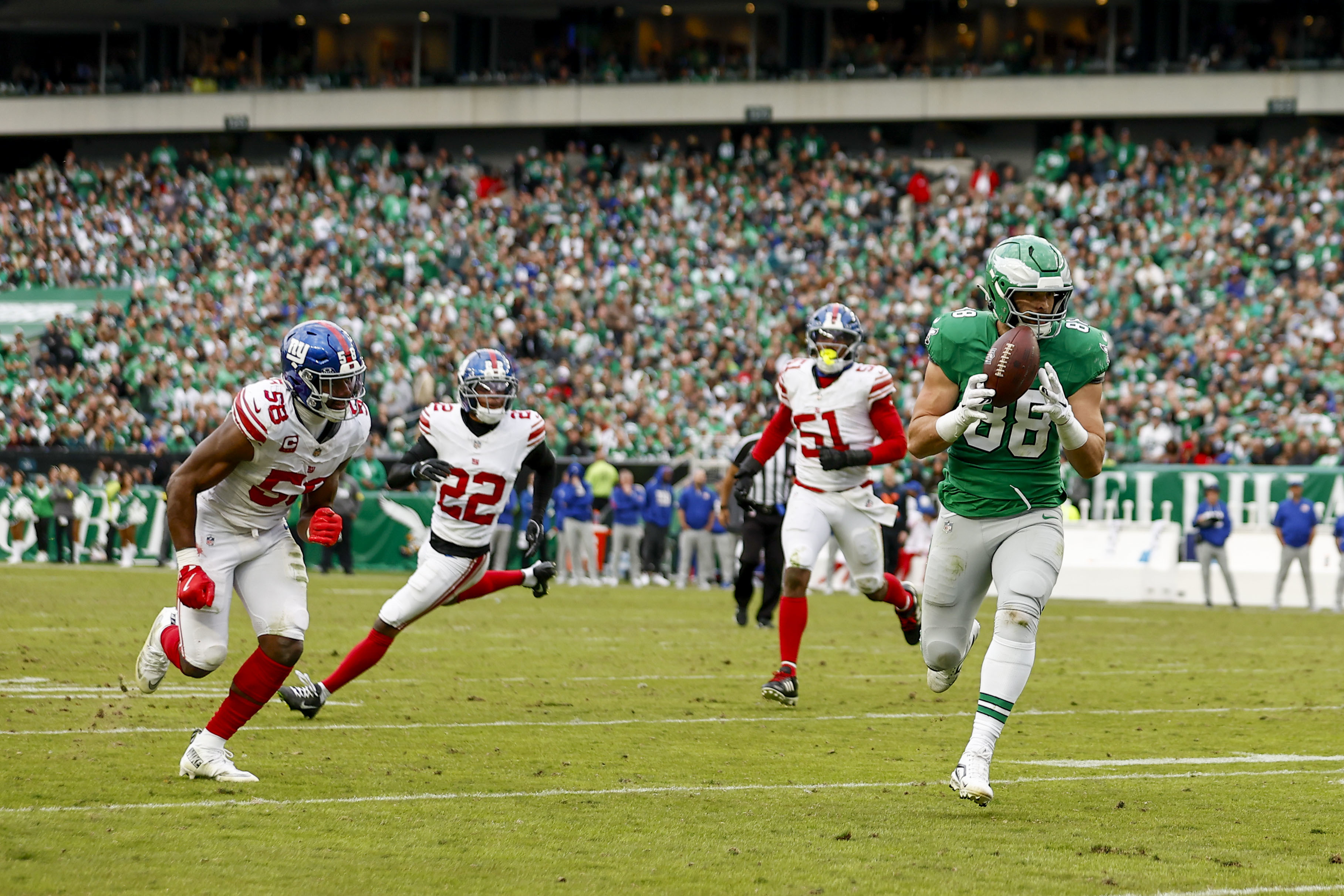
    Eagles tight end Dallas Goedert scoring a fourth-quarter touchdown against the Giants.

    Seeing red with Goedert

    Under Nick Sirianni, the Eagles have never finished outside the top 10 in red-zone efficiency. But with the combination of Sirianni and offensive coordinator Kevin Patullo, who had served as Sirianni’s passing-game coordinator the last four years, the Birds have never been better.

    The Eagles are 6-2 in large part because they’ve converted 17 of their 20 trips inside the opponents’ 20-yard line into touchdowns. That’s 85%, which is about 11 percentage points better than the Ravens’ rate last season, which is the best conversion rate by any team over an entire season since Sirianni arrived.

    Why are they so efficient?

    Because the Eagles have a spectacular offensive line; a strong, fast quarterback; a lethal play in the Tush Push; a superstar running back; two star receivers; and, for my money, the most important red-zone weapon: an elite tight end.

    Also: superb play-calling. Example:

    On second-and-8 from the Giants’ 17-yard line, Patullo called a run-pass option. Hurts kept it. At the same time, tight end Dallas Goedert swung from the left side of the line to the right, broke upfield, and was wide-open for a touchdown.

    So many moving parts worked in perfect synchronization. It was the Eagles’ prettiest play of the season.

    “Ultimately, Kevin has to call the plays that he feels give us the best chance to win there,” Sirianni said after the Eagles went 3-for-3 in the red zone on Sunday. “I think we’ve done a good job of being efficient down there, though. … We’ve kept the ball moving forward. Jalen’s played really good football down there, and Dallas has obviously been really good down there.”

    Goedert had two touchdown catches in Sunday’s win over the Giants. His seven TD catches are first among tight ends and already are a career high.

    “They’ve been letting me get the ball and use my big body,” Goedert said. “We can score in a lot of different ways.”

    He certainly can. His 35 touchdowncatches (including playoffs) in about 7½ seasons as an Eagle rank second among franchise tight ends behind Zach Ertz, who caught 40 (including playoffs) in about 8½ seasons.

    “He’s a hell of a player,“ Hurts said. ”He’s a big-time target and in a sense, he’s due. He’s due. He does a lot of dirty work in this offense.”

    It might be tough to call Goedert’s number with Hurts, running back Saquon Barkley, and receivers A.J. Brown and DeVonta Smith, but the Eagles are winning because Goedert is finding the end zone more than anyone else under Patullo.

    “KP has a really good feel in the red zone,” said Hurts.

    So does DG.

    Mixed emotionals

    After being embarrassed by owner Woody Johnson, who said, “If we can just complete a pass, it would look good” after seven weeks of bad quarterback play, Jets quarterback Justin Fields played well Sunday in a comeback win over the Bengals.

    Fields had been benched at halftime the week before in favor of Tyrod Taylor, but Taylor’s bruised knee sidelined him Sunday and gave Fields another chance. Fields played well enough to win: 21-for-32, 244 yards, one touchdown. Afterward, during an emotional press availability, he admitted that the pressures of his turbulent career, culminating in Johnson’s criticisms, broke him down.

    “This week, I found myself in my closet, crying on the ground, laying down,” Fields said.

    As you might assume, Johnson, formerly Donald Trump’s ambassador to the United Kingdom, is not a pleasant bloke. In an annual survey conducted by the players’ association, his 2024 team gave his club the league’s only overall “F,” and his franchise has been a punch line for years.

    However, if Johnson’s cruel, candid, but ultimately accurate assessment of the quarterback play worked, well …

    Coach Shane Steichen’s Colts are 7-1.

    Extra points

    Shane Steichen, in his third year in Indianapolis, continued his romp to Coach of the Year honors when his Colts beat the Titans and moved to 7-1. Since becoming the Eagles’ OC in 2021, Steichen’s teams have been in the top 10 in rushing, with the Eagles finishing No. 1 in 2021. This year, behind league-leading running back Jonathan Taylor, the Colts rank sixth. … Right behind Steichen in the running for COY: Mike Vrabel, whose Patriots reached 6-2 with a win over the Browns. Second-year quarterback Drake Maye leads the NFL with a 118.7 passer rating. … In that game, Browns defensive lineman Myles Garrett recorded five sacks, bringing him to 10 for the season, tied for the league lead. … Aaron Rodgers failed to join Peyton Manning, Tom Brady, Brett Favre, and Drew Brees as quarterbacks who have beaten all 32 teams when his Steelers lost to the Packers, the team that drafted him. … The Cowboys, with their No. 2-ranked offense and second-to-last defense, lost in Denver and fell to 3-4-1. That means the Eagles are the only team in the NFC East with a winning record — remarkable, since the division was considered one of the best before the season began.

  • At 20, BalletX is nowhere near done bringing the most exciting new ballet and choreography to Philly

    At 20, BalletX is nowhere near done bringing the most exciting new ballet and choreography to Philly

    In 2005, Christine Cox just wanted to hire exciting choreographers to make new work on dancers who, at the time, were mostly her friends and colleagues picking up extra work in their off time from Pennsylvania Ballet.

    She had little idea that she was creating a Philadelphia institution.

    “I was a really short-term planner,” said Cox, 56, whose contemporary ballet company, BalletX, is celebrating 20 years. “I just wanted to do the next right thing.”

    She tried selling the company to everybody, she said: “people sitting in a picnic at Rittenhouse Square, someone at a library, someone I met in an elevator. I literally had postcards in my back pocket.”

    Once at a fair on Walnut Street, she had her team blow up hundreds of BalletX balloons and hand them out. “And I’d see all these balloons, and it was so much work” said Cox. “But you know, we were as a team, doing anything we could to spread the word, and we still continue.”

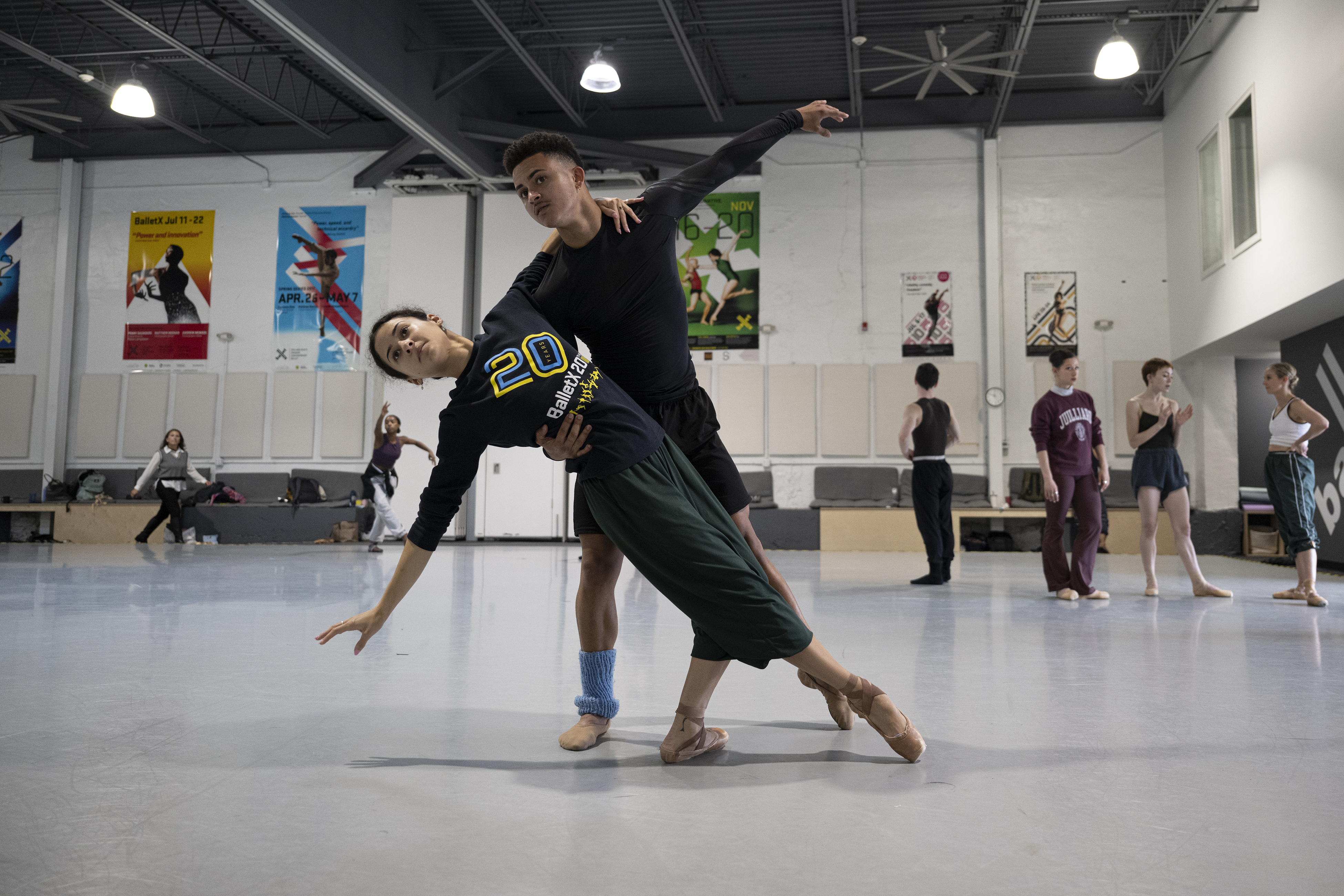
    BalletX dancers, João Pedro Silva and Itzkan Barbosa rehearse.

    There was no way of knowing that the troupe she started with Matthew Neenan (who later left to devote his full attention to his choreography but continues to work frequently with BalletX) would one day employe 16 dancers for an almost unheard of 52-week contract with six weeks of paid vacation time and a matching 401(k). Or that they would tour, perform frequently at the Vail Dance Festival, and have regular home seasons in Philly.

    Cox would go on to commission 150 world premieres by 80 choreographers, launching some careers and bringing well-known dance makers to Philly.

    BalletX will be celebrating its two decades with a pair of retrospective performances over the next two weeks at the Suzanne Roberts Theater. The first week will include excerpts of works Cox commissioned in the company’s first decade. The second will include excerpts from more recent works and then finish with a short world premiere by rehearsal director Keelan Whitmore.

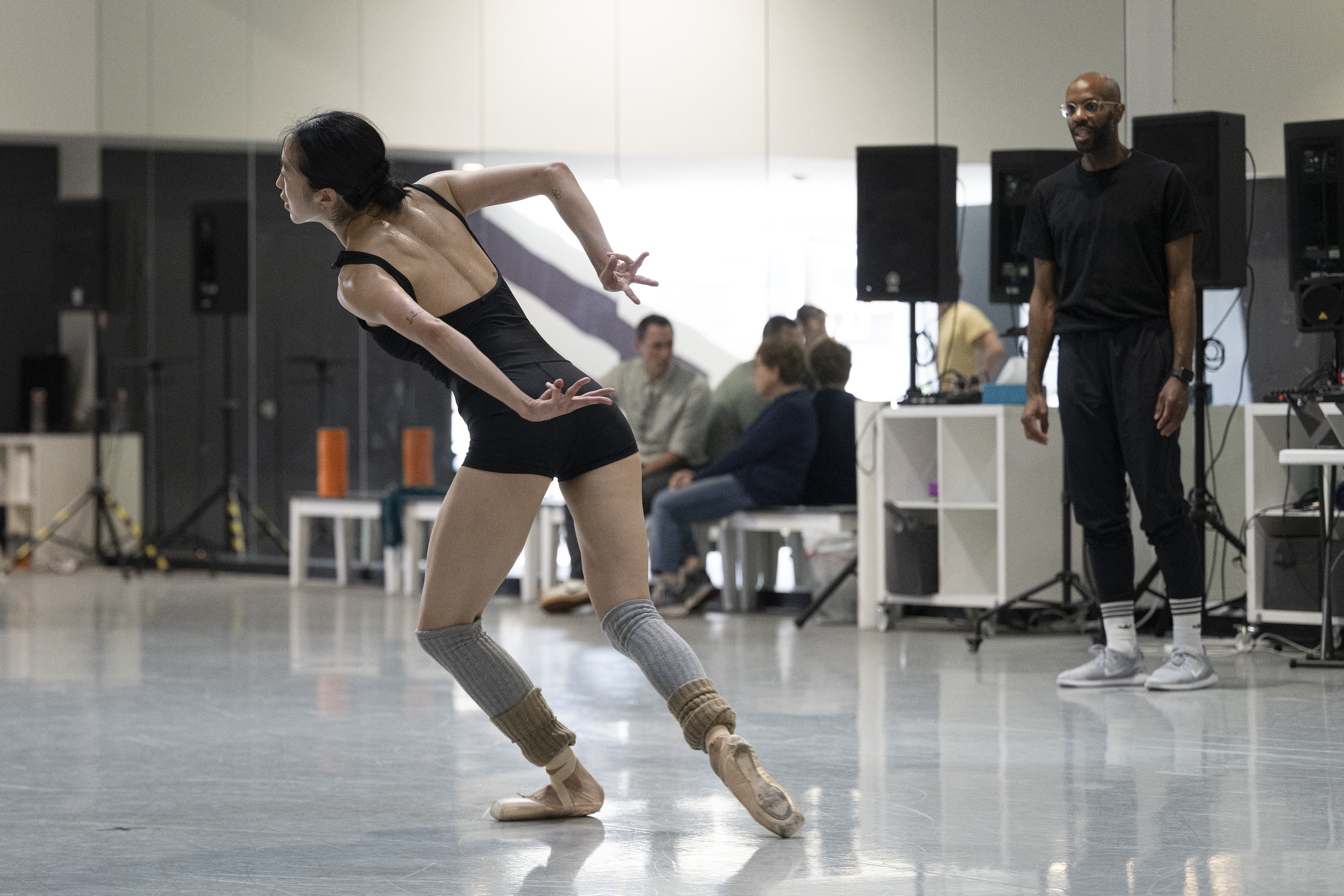
    BalletX dancer Eileen Kim rehearses.

    In all, the performances will mark 18 new works BalletX commissioned, each in snippets of six minutes or less.

    Until relatively recently, Cox didn’t realize the success she had built.

    It took BalletX opening its own studio on Washington Street in 2018 for her to see it.

    “When I saw the looks on people’s faces around the country, like, ‘Oh, we just opened up our own studio.’ Especially when we were in New York City. Suddenly everyone took us a little bit more seriously.

    A home of one’s own is a rare success in the dance world.

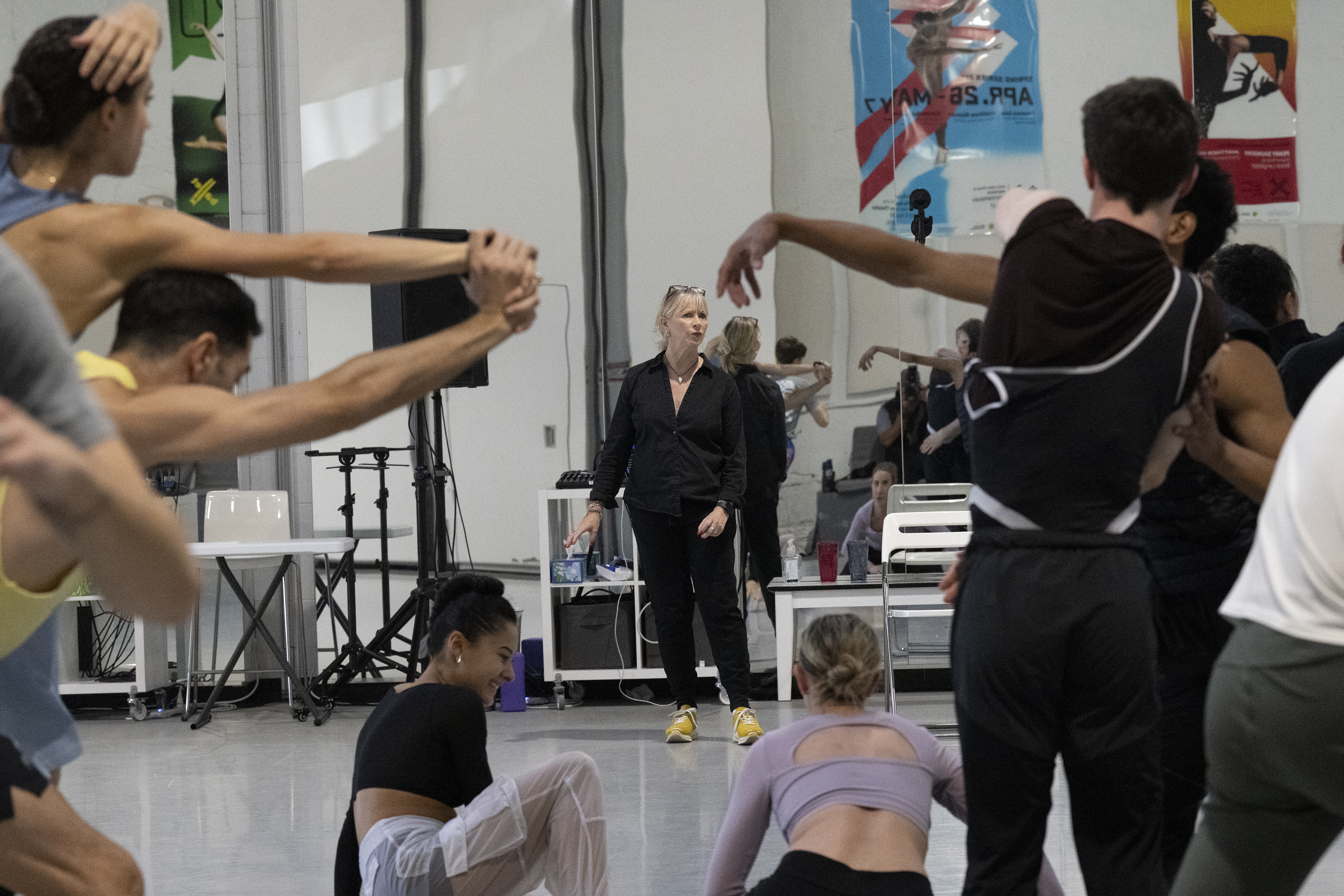
    Choreographer, Marguerite Donlon, center, rehearses dancers for the company’s 20th anniversary retrospective.

    She is finally starting to have a longer vision and dream.

    “I am able to now say, ‘OK, I think this, this is possible.’ I always say it with hesitation, because that’s my nature, the balance between humility and confidence. It’s a fine balance. I’m also a little superstitious. I don’t want to be like, ‘We’ve got it all figured out,’ and then the next thing you know, you’re navigating out of a pandemic.”

    And yet, the COVID-19 pandemic also helped shape BalletX, which was one of the first and more successful companies to do work on camera. The company continues to feature short films in every performance and will do so for the retrospective, too.

    The first week’s performances will open the way BalletX launched: with the angel trio from Neenan’s Frequencies. The initial three dancers were Cox, Neenan, and Tara Keating, who is now the company’s associate artistic director.

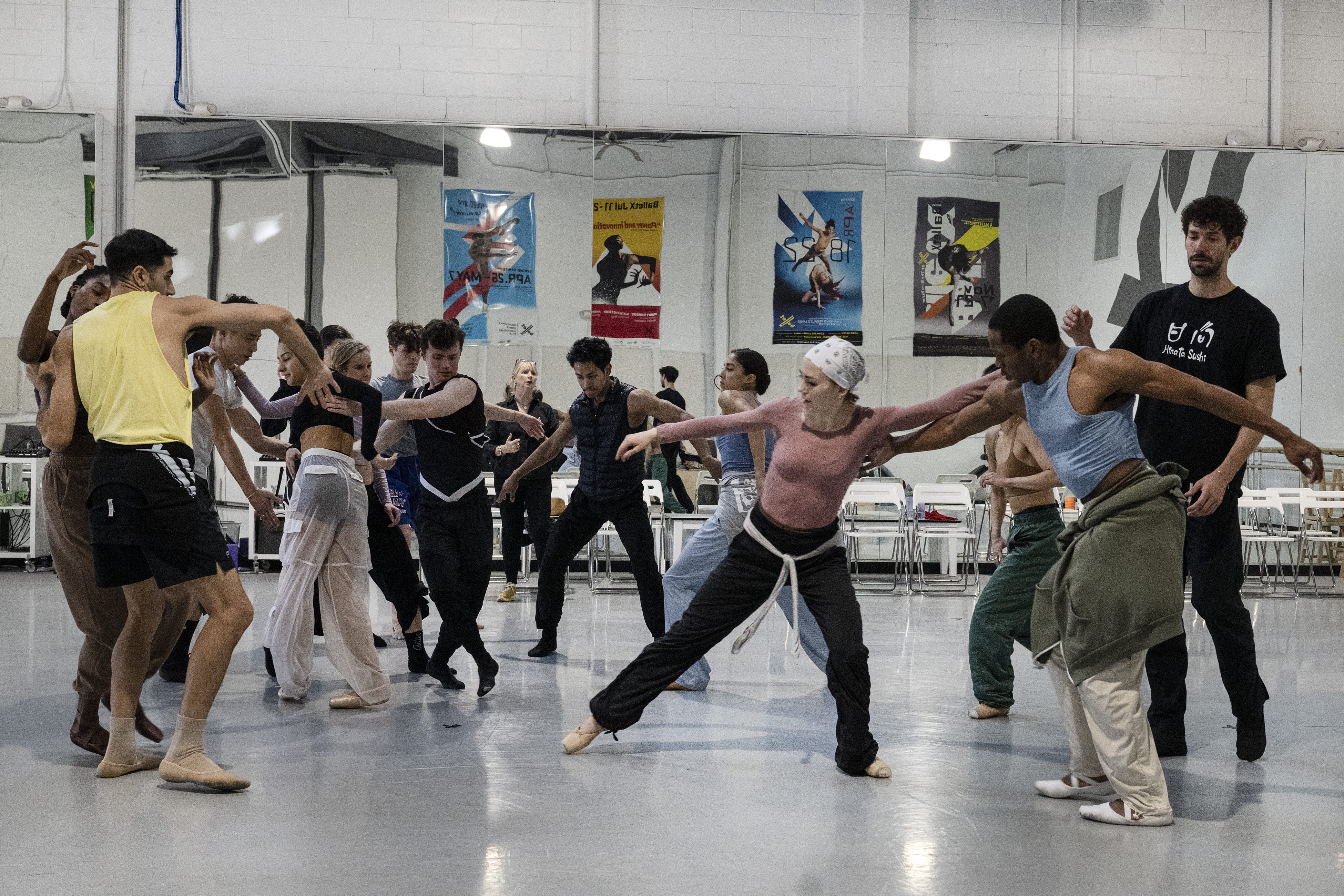
    Ballet dancers rehearse for the company’s 20th anniversary retrospective.

    “It was a couple years after 9/11. The lyrics in the music, the whole piece was just unexpected to me. We ended with this beautiful trio of this really lightning, fast, energetic piece. Matt just was so bold and daring … he would take really into make really incredible choices that were not traditional. And I think that was really important in helping us define who we were.”

    The program will also include Still at Life, which introduced the now widely known choreographer Annabelle Lopez Ochoa to American audiences. It will also include a piece by Edward Liang, the artistic director of Washington Ballet, along with work by Jodie Gates, Nicolo Fonte, and Jorma Elo.

    The second week will feature excerpts from Trey McIntyre’s Big Ones, which got BalletX featured on the cover of Dance Magazine. It also includes work by Jo Stromgren, Darrell Grand Moultrie, Dwight Rhoden, and Jennifer Archibald. It will also feature the work of former BalletX dancer Caili Quan who, after launching her career in Philly, went on to choreograph for some of the top American companies.

    At the end of the retrospective, Cox wants to launch BalletX into the future, with the world premiere of Whitmore’s work.

    “I thought it’s really important to really end the night on the second program with what we do, which is the future. You know, we’re creating work.”

    BalletX 20th anniversary retrospective. “Program A: The first decade,” Oct. 29-Nov. 2. “Program B: The second decade,” Nov. 5-9. Suzanne Roberts Theater. $65-$90, 215-225-5389 x250 or boxoffice@balletx.org

  • Jefferson Health says it will terminate Lehigh Valley Health Network’s contracts with UnitedHealthcare

    Jefferson Health says it will terminate Lehigh Valley Health Network’s contracts with UnitedHealthcare

    Jefferson Health says it will terminate Lehigh Valley Health Network’s contracts with UnitedHealthcare next year, stating United, the nation’s largest health insurer, is paying less than their negotiated rates, Jefferson said Monday.

    The contracts will remain in effect until Jan. 26 for Medicare Advantage patients and until April 25 for patients with commercial insurance through their employer. In the last 18 months, Lehigh Valley Health facilities treated 70,000 people with United insurance, Jefferson said.

    “Like all health systems, we are facing significant headwinds as costs rise faster than reimbursement,” Mark Whalen, Jefferson’s chief strategy and transformation officer, said in an email.

    “When reimbursement falls substantially below negotiated levels, it threatens our ability to fulfill our mission of providing exceptional care to all patients.”

    Whalen said Jefferson will continue working to secure a better deal with United, as it has for more than two years.

    United said in a statement that its most recent proposal went to Lehigh Valley in April. “We have yet to receive a counter proposal from the health system, whose last proposal was provided in December 2024 and included a near 30% price hike in the first year of our contract,” the statement said.

    Jefferson countered with a statement saying that its dealings with United are not part of a normal contract renegotiation. “This ongoing dispute is caused by United Healthcare’s implementation of a multiyear 30% price decrease that was not agreed to, not accepted and is not sustainable, Whalen said.

    The timing of the United announcement is noteworthy. Medicare Advantage open enrollment is underway until Dec. 7 for plans that take effect Jan. 1.

    The potential termination of United’s Medicare plans on Jan. 26 puts United’s customers who depend on Lehigh Valley for health services in a quandary. Should they stick with United or switch to another plan, such as those offered by Jefferson’s insurance arm?

    United said Jefferson’s decision to make its announcement during open enrollment looked like “a negotiating tactic.”

    The Minnesota company has about 27,500 Medicare Advantage enrollees in the main counties served by Lehigh Valley Health doctors, according to federal data from September.

    The impasse does not affect Philadelphia-area Jefferson patients with insurance from UnitedHealthcare.

    Insurance regulations require notice to patients before contracts end.

    In March, Jefferson went out-of-network with Cigna Health for a few weeks during a similar impasse in negotiations. Jefferson and Cigna quickly reached a deal after the termination.

  • Tracking the sharp drop in Philadelphia health systems’ operating margins after COVID-19

    Tracking the sharp drop in Philadelphia health systems’ operating margins after COVID-19

    The worst of the coronavirus pandemic that started nearly six years ago is well in the past, but Philadelphia’s biggest nonprofit health systems are still contending with the financial disruption unleashed by the virus that led to thousands of deaths in the area.

    Operating conditions for hospitals started improving in 2023, but “the slope of the recovery is a bit more shallow than a lot of health systems had planned for,” said Mark Pascaris, a senior director at Fitch Ratings, one of three major credit ratings agencies.

    Patients have returned, but the pandemic led to a resetting of expenses for labor and supplies at a higher level, Pascaris said. “That’s been the challenge over the last two or three or four years now, trying to manage through a very challenging expense situation,” he said.

    To show how the financial landscape has changed, The Inquirer compiled financial data for the region’s six biggest health systems that have fiscal years ending June 30 each year. The analysis compared average operating profits in three years before the pandemic (fiscal years 2017-19) to the results in most recent three years (fiscal years 2023-25).

    All six systems showed a substantial drop in a measure of earnings that excludes certain accounting expenses and interest costs. This slice of financial results is known as earnings before interest, depreciation, and amortization. Abbreviated as EBIDA, it’s a primary indicator watched by influential credit ratings agencies.

    window.addEventListener(“message”,function(a){if(void 0!==a.data[“datawrapper-height”]){var e=document.querySelectorAll(“iframe”);for(var t in a.data[“datawrapper-height”])for(var r,i=0;r=e[i];i++)if(r.contentWindow===a.source){var d=a.data[“datawrapper-height”][t]+”px”;r.style.height=d}}});

    The experience of Children’s Hospital of Philadelphia clearly illustrates what has happened: The organization’s aggregate revenue in the most recent three fiscal years was 58% higher than it was in the three years that ended June 30, 2019, but its EBIDA climbed only by half a percentage point.

    “Hospitals and healthcare systems across the country continue to face significant headwinds, driven by reimbursement challenges, increased supply and labor costs, uncertain governmental pressures, and the continued ripple effect of the pandemic,” CHOP said in a statement.

    Officials at ChristianaCare, Main Line Health, and Temple University Health System echoed CHOP’s remark.

    “Margins were far better prior to the pandemic, largely due to lower supply and labor costs,” Main Line’s chief financial officer Leigh Ehrlich said. “Those costs rose sharply during the pandemic and continue to rise.”

    ChristianaCare’s CFO Rob McMurray noted: Not only have Medicare and Medicaid rates not kept up with inflation, but more people have those government forms of insurance for people 65 and older and for low-income people.

    The nonprofit is expanding from its base in northern Delaware to Southeastern Pennsylvania and is expanding alternative formats, such as hospital-care-at-home and micro hospitals, to reduce costs, McMurray said.

    A significant worry for Temple University Health System is the impact of the 2025 budget reconciliation bill, sometimes called the One Big Beautiful Bill Act. The North Philadelphia nonprofit estimates that Medicaid cuts in that law will cost it $519 million over the next 10 years, said Jerry Oetzel, the system’s CFO.

  • The Eagles had two games to get themselves right before their bye. They did that and then some.

    The Eagles had two games to get themselves right before their bye. They did that and then some.

    It was just 17 days ago that the Eagles lost for the second straight time, lost to the New York Giants by 17 points at MetLife Stadium, lost in so humiliating a fashion that their All-Pro right tackle called out the play-calling as predictable and their star wide receiver admitted that with more than 11 minutes left in the game he had already resigned himself to defeat. It was bad.

    Two seasons before, it had been worse. Two seasons before, the Eagles had lost back-to-back games to the San Francisco 49ers and the Dallas Cowboys, and those pathetic performances triggered the kind of midseason change that reveals a franchise’s leadership has started to panic. The defensive coordinator was demoted. A Bill Belichick acolyte was promoted. And what began as a pebble rolling down a hill turned into an avalanche: six losses in seven games, a head coach whose job was in jeopardy, a collapse whose psychological residue remained on this team for a long time.

    Maybe, after their 38-20 victory Sunday in their rematch against the Giants, the Eagles can assure everyone that they’ve scraped away the last of that sticky stuff from 2023. Their Super Bowl win in February took care of most of it, but burping up that late lead against the Denver Broncos on Oct. 5 and getting manhandled by Jaxson Dart and Cam Skattebo four days later brought up all those bad memories again. The Eagles were 4-2 but reeling, still formidable but vulnerable, and it was fair to wonder whether they could straighten themselves out over their two games before their bye week.

    They did. They won a challenging road game against the Minnesota Vikings, then handled an inferior opponent Sunday. Now they enter their 15-day break with a 6-2 record, with a stranglehold on the NFC East, and — despite several injuries to key players, despite the ever-present mist of controversy around A.J. Brown — without the worry that their season was spiraling out of control.

    “I don’t think from an inside perspective there was ever any like, ‘Oh man, this is like ’23,’” coach Nick Sirianni said. “You know what I mean? But were there lessons learned in ’23? Absolutely. We continue to try to learn lessons from ’24 and ’25.

    “I always like our process off of a bye week and during a bye week. That’s my job as a coach. We’ve still got a lot of things to fix and clean up, but that’s what this week will be about: the players resting, looking at stuff themselves, and then us really grinding it out this week to put ourselves in a position to move on through the rest of the season.”

    It would be easy to argue that the Eagles are mentally tougher now than they were then; that they have a more talented, more cohesive collection of players; that Sirianni is a better head coach with a better coaching staff; that Jalen Hurts is a better quarterback. All those assertions are true, but they can feel intangible and opaque. The explanations for why a team regresses (as the Eagles did late in the 2023 season), improves (as they did in 2024), or stabilizes itself (as they’ve done over their last two games) often come down to the schematic and tactical adjustments that the team tries to make. They come down to concrete changes in the way the team does things.

    Take one example that went awry. When the Eagles decided in December ‘23 that they needed a new defensive coordinator, when they replaced Sean Desai with Matt Patricia, they failed to take a vital factor into consideration. Patricia’s defensive scheme was a lot of things, but simple wasn’t one of them, and there was little chance that the players would learn it well enough in time to thrive within it.

    “I still remember we used to come in here before games, and he’d have an entire greaseboard — it looked like a 15-foot-long greaseboard — and the entire thing was written up with all the calls,” Eagles center Brett Toth said after Sunday’s game. “And to see that, it’s like, ‘Wow.’ That’s tough on anyone to try to switch to midseason.

    “It’s a very hybrid defense. Anything with the Patriots is going to be very complex, high-IQ stuff. To have to learn and install that in the middle of the season, it’s a huge ask. This is chess. Football is 11-man chess.”

    Now take another, more recent, more successful example: the Eagles’ use, at long last, of under-center snaps and play-action passes. There’s no getting around the fact that their offense has been more dynamic overall — and their running game back to its old dominant self against the Giants — partially because putting Hurts under center allows Kevin Patullo to call a wider variety of plays. They didn’t have to rewrite the playbook. A new wrinkle was all they needed.

    “It’s not necessarily that you stick a guy under the center or you’re playing from the shotgun or you’re in a pistol,” said Hurts, who over his last two games has completed 34 of his 43 passes for 505 yards and seven touchdowns. “It’s about what you’re doing when you’re under center, how we’re leveraging what we do, how we’re leveraging the guys, what spots are we putting guys in when we’re in these different positions. We just want to continue to build off it.”

    Seventeen days ago, the idea that the Eagles would be building off anything heading into their bye seemed tenuous at best. The defending champs had staggered. The Giants had embarrassed them. And the memory of that awful ending to 2023 was fresh again. Now? It seems deeper in the distance, and they have a chance to make sure it stays there.

  • No, the Eagles aren’t better without A.J. Brown, but for one game they were

    No, the Eagles aren’t better without A.J. Brown, but for one game they were

    A.J. Brown stood on the sideline with a kelly green hoodie pulled over his head, which was also wrapped in a towel. The Eagles led the New York Giants, 31-13, late in the fourth quarter, despite the absence of their No. 1 wide receiver.

    But it wasn’t the passing game, nor Brown’s replacements, that had the offense looking its most efficient this season. It was the resurrection of running back Saquon Barkley and the ground attack that carried the torch.

    Eagles receivers other than DeVonta Smith had just one catch for 3 yards by the time quarterback Jalen Hurts dropped back on third-and-6 with just over six minutes remaining. But Hurts went to Jahan Dotson even though he had no separation against man coverage, on the type of jump ball that Brown has mastered the art of catching.

    And he’d probably like to see Hurts throw to him more often.

    But Dotson was the target on this 50-50 opportunity, and he made the best of it, hauling in the 40-yard heave for a touchdown. Brown, out with a hamstring injury, raised his right arm and pumped his fist. He hung back near the bench reserved for receivers and greeted Dotson with a smile and a handshake after his score.

    “It’s tough when you’re missing not only the best receiver on your team, but one of the best receivers in the league,” Dotson said of Brown, who missed his first game of the season. “We have this motto in our room: There’s no drop-off, no matter who goes out there.”

    Make no mistake, the Eagles need Brown if they are to make a deep postseason run and repeat as Super Bowl champions. Sunday’s lopsided 38-20 win might suggest otherwise, because a balanced offense scored its most points and gained its most yards.

    But the Giants offered the perfect remedy. They had embarrassed the Eagles just 17 days earlier, but a perfect storm of a short turnaround following a choke job to the Denver Broncos, untimely injuries, and an offense still wandering in the identity wasteland contributed to an uncharacteristic loss.

    The Eagles should have taken advantage of the Giants’ run defense deficiencies in the first meeting. They got behind, and Hurts and the drop-back passing game couldn’t compensate. But Eagles coaches wanted to establish the run two weeks later, and Barkley’s 65-yard touchdown dash on the second play from scrimmage meant they could stick with it and open the playbook.

    A diversity of run calls and directions — and even personnel — helped spring Barkley for 150 rushing yards on 14 carries and reserve Tank Bigsby for 104 yards on just nine carries.

    “That’s my all-time favorite way to win,” Eagles coach Nick Sirianni said during his postgame speech in the home locker room at Lincoln Financial Field.

    It was a vintage performance in a Sirianni era full of rushing records. The Eagles’ 276 yards on the ground ranked second in the last five years (behind 363 yards vs. the Green Bay Packers in 2022) and their 8.4 yards per carry were first over that span (ahead of an 8.2 average against the Giants, also in 2022).

    Sirianni’s Eagles with Hurts at quarterback are normally at their best when the run offense is humming. He was never going to abandon the cause with Barkley as his bell cow and the offensive line, despite injuries, superior to most.

    But Brown’s absence, at least for one week, allowed the Eagles to focus more on getting Barkley back on track. It meant having one less potent mouth to feed in the pass offense, but also one that can be vocal about his hunger.

    “Obviously, any time you lose a player like A.J. for a game, it changes some things as far as how you go about putting guys in different positions,” Sirianni said. “But if you have faith in the guys that you have that are backing him up, whether that’s receiver or O-line, you’ve still [got to] go about doing what they can do the best, but also putting them in a position to make plays.”

    Eagles quarterback Jalen Hurts completed 15 of 20 passes for 179 yards and four touchdowns on Sunday against the Giants.

    Hurts still dropped back to throw. But Smith was far and away his primary target, catching six of nine passes for 84 yards. Barkley was next with four grabs, with one coming on the oft-neglected screen pass. Tight end Dallas Goedert had three receptions with two resulting in red zone touchdowns.

    Overall, Hurts completed 15 of 20 passes for 179 yards and four touchdowns. There were still struggles against pressure and four sacks that appeared to fall on him more than anyone else. But it was a methodical day after an explosive aerial showing against the Minnesota Vikings last week.

    “It’s definitely a different rhythm, because you get a flow of playing with A.J. and Smitty and Dallas and you have your crew,” Hurts said, before adding: “But when we are able to run the ball like we did, it creates more of a balance and free will of how we attack people.”

    Aside from three victory-formation kneels, and one Tush Push, the run-pass ratio was an equal 50-50. Offensive coordinator Kevin Patullo had maybe his best play-calling day, and mixed in variety with Hurts under center, run-pass options, and outside runs on gap schemes.

    Offensive linemen Landon Dickerson and Jordan Mailata said the game plan called for more diversity in the running game. Sirianni countered that claim. “That doesn’t mean we haven’t had them in,” he said.

    Whatever the case, not getting to them before required patience from Barkley and the O-line after weeks of frustration.

    “I think it’s just being professional,” Barkley said of finally breaking loose. “Knowing that every week’s not going to be how you learn to be sometimes, but you can’t lose faith.”

    It could be a lesson for Brown, who has expressed his disappointment with the passing offense, both publicly in interviews and cryptically on social media. Few have objected when he has stood in front of microphones and, in so many words, said he wants the ball. He should. He’s one of the best receivers in the NFL.

    Even his post on X after the Tampa Bay Bucs game last month — when he quoted Scripture about not being listened to — was understood by many because he and Hurts had mainly failed to hook up in Tampa.

    But Brown’s most recent post — “using me but not using me” — after he caught four passes for 121 yards and two touchdowns in Minnesota probably took whatever discontent he may have to uncharted territory within the Eagles organization.

    Eagles general manager Howie Roseman, shown before his team’s win on Sunday, is unlikely to move A.J. Brown ahead of next week’s trade deadline.

    He is well-liked in the locker room, by the coaching staff, and the front office. But every player is expendable. The Eagles are unlikely to trade Brown ahead of next Tuesday’s deadline. There’s an astronomical dead-money hit, and Howie Roseman would need blockbuster compensation to even consider it.

    The Eagles general manager also isn’t known for trading players in their prime who are crucial to winning titles. Brown may not be pleased with whomever — most likely, Hurts — but it makes little sense for him to want to be moved. At least now.

    Hurts, to his credit, went out of his way to praise the receiver several times during his Wednesday news conference last week. But it would behoove the quarterback to make Brown happy on the field and off. His success raises all ships.

    “I think the best is yet to come,” Hurts said when asked about Sunday’s run offense explosion.

    He sounds like he knows something. Getting Brown more involved would help.

  • Sad-sack Giants lost this one before it started. Next time, don’t poke the bear (or Saquon)

    Sad-sack Giants lost this one before it started. Next time, don’t poke the bear (or Saquon)

    Two weeks ago, Brian Daboll stood in front of his locker room and labeled a blowout win over the Eagles as “The Standard.”

    Since then, the Giants head coach has become reacquainted with The Usual.

    The Eagles accomplished their biggest objective on Sunday afternoon. It was to leave no doubt. Jaxson Dart would not be high-fiving any referees. Kayvon Thibodeaux would not be telling anybody to “[bleep] the Eagles.” And the Giants social media team most definitely would not be sharing any victorious videos of Daboll making grandiose proclamations to his players.

    “For sure, we definitely saw how they celebrated when they beat us last time,” running back Saquon Barkley said after his 65-yard touchdown run on the second play from scrimmage catapulted the Eagles to a 38-20 win on Sunday.

    It is never wise to poke the bear, but it is especially unwise to poke the bear when you know you will be seeing the bear again in 17 days. If you are going to do it, you’d better pack some extra whistles. Or, failing that, some A.1.

    What the Giants seem to have forgotten is that they are not a good football team. In fact, they are the kind of football team that makes a sport of their not being good. Ten days after they stunned the Eagles with a 34-17 rout on Thursday Night Football, they raced out to a 19-point lead over the Broncos and then allowed 25 points in the last six minutes to lose, 33-32. It takes a special team to lose a game in that fashion. But, then, the Giants are a special team. They lose games the way Bob Ross painted pictures. With breathtaking creativity and speed.

    On Sunday, the movable object met the unstoppable force. The Eagles came out in their kelly green uniforms and they did it in vintage fashion. On their second play of the game, the offensive line opened up a weakside lane so wide that Barkley and Tank Bigsby both could have run through it. Never has a 65-yard touchdown looked so inevitable. Nor did the 189 yards that followed from Barkley and Bigsby. After the game, more than one Eagles offensive lineman noted how good the Giants’ front four was. You got the sense that they were noting it with glee.

    “We came in, we made the adjustments based off of what they gave us the last game, and we called plays to win,” guard Landon Dickerson said.

    The rest of the NFC can blame the Giants if this was the game in which the Eagles truly got their groove back. They entered Week 8 having gone five straight weeks without breaking 90 yards rushing. Not once had they reached 400 total yards of offense. On Sunday, they finished with 276 and 427. Barkley and Bigsby both cracked 100 yards and averaged 10-plus yards per carry. This, on an afternoon when Jalen Hurts threw four touchdown passes.

    “For us, it wasn’t about a weight being lifted off our shoulders,” said left tackle Jordan Mailata. “We just wanted to be the more physical team. It didn’t matter what it looked like.”

    It shouldn’t surprise anybody at this point.

    The Eagles have won a lot of games over the last four years by rag-dolling opponents, often saving their best for teams that have previously offended their sensibilities. We saw it in last year’s NFC championship game, when they road-graded the Commanders for 229 yards on the ground one month after Washington handed them one of their three regular-season losses. We saw it in last year’s Super Bowl, when they avenged their last-second loss two years earlier, to an extent that was almost uncomfortable.

    Give the Giants credit. They are a more competitive team than they have been throughout most of Daboll’s tenure at the helm. For all of Dart’s weird Gen-Z energy, he clearly has the touch and poise that can win behind a competent offensive line. Rival NFL general managers should take notice if Act I ends up going the way of Baker Mayfield in Cleveland. He has a keen sort of talent that cannot be measured or quantified, although it probably cannot make up for wholesale dysfunction around him. You saw it even on Sunday, when he kept the Giants within striking distance despite relentless pressure and a no-name receiving corps and a gruesome injury to running back Cam Skattebo.

    But the Eagles are operating on a different level. It is easy to lose sight of that fact given that they are operating on a lesser level than last season. The last couple of weeks have left little doubt, though. At 6-2 headed into the bye, they remain the most complete team in the NFC.

    More than anything, Sunday’s win was a reminder that rumors of Barkley’s demise have been greatly exaggerated. Even after his 65-yard touchdown run, the veteran running back gained 85 yards on his last 13 carries before leaving the game with what was labeled a groin injury but mostly was precaution.

    “I wasn’t worried about it,” Barkley said. “I came off, but I’ve dealt with this before. Nothing crazy. It’s a long season. I try my best to listen to the trainers, listen to the coaches.”

    Did he fight to go back in?

    “I went out swinging,” he said. “Let’s say that.”

    With these Eagles, you wouldn’t expect anything else.