Tag: UniversalPremium

  • How can Bryce Harper have an ‘elite’ season in 2026? It starts with examining his atypical 2025.

    How can Bryce Harper have an ‘elite’ season in 2026? It starts with examining his atypical 2025.

    Alec Bohm returned from the injured list last month and got eight hits in three games, giving rise to a theory: If Bohm stayed hot, maybe the star hitter who precedes him in the Phillies’ batting order would see more strikes.

    “I doubt it,” Bryce Harper said.

    Harper knew how that sounded, so he made clear that he meant no disrespect to Bohm. But his point remained. Harper faced a lower rate of pitches in the zone (43%) than any hitter in baseball this season (minimum 150 pitches), so the notion that any Phillies lineup protection short of peak Mike Schmidt would affect how he was pitched ranked somewhere between wishful thinking and delusion.

    It has been this way for most of Harper’s life. He recalls being 11 years old and competing in travel tournaments in which the opposing coach would point to him and direct pitchers not to give him anything to hit. In 2016, the Cubs walked him 13 times, four intentionally, in 19 plate appearances over four games at Wrigley Field.

    Quite simply, teams game-plan against Harper specifically.

    “When we go into a series, we circle guys’ names, too,” Harper said earlier in the season. “It happens that way.”

    Even so, there was something different about this season. When Harper did get pitches in the zone, he didn’t do as much damage. As such, he didn’t produce his typical numbers.
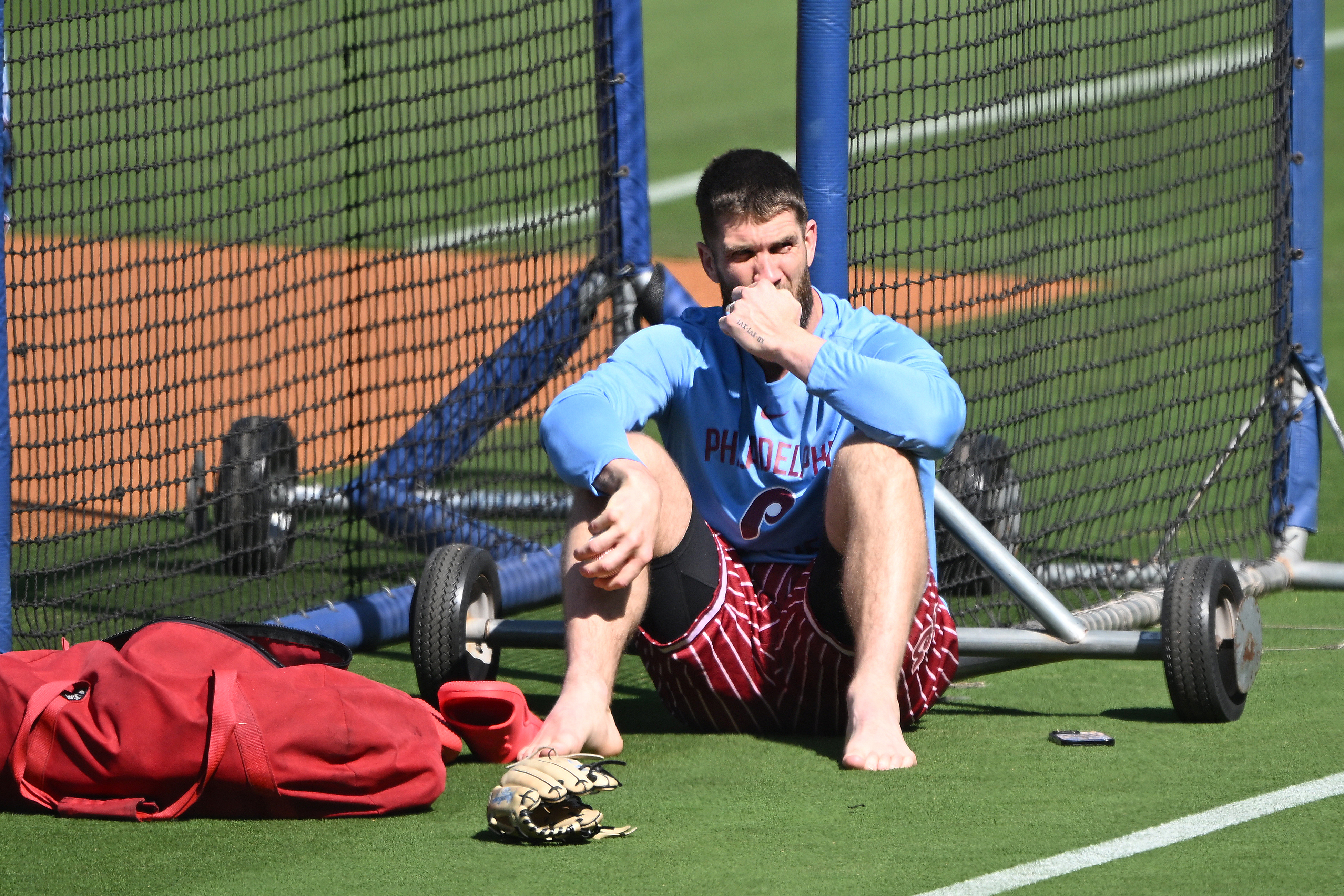
    Phillies first baseman Bryce Harper saw a lower rate of pitches in the strike zone (43%) than any hitter in baseball this season.

    Harper reached base at a .357 clip, his lowest mark since 2014. He slugged .487 with an .844 OPS, his worst totals since 2016. He mashed 27 home runs, despite missing a month with an inflamed right wrist. Although he outproduced the league average by 29%, based on OPS+, he has been 42% better than average over his career.

    So, upon being asked at his end-of-the-season news conference on Oct. 16 — coincidentally, Harper’s 33rd birthday — if the Phillies believe this was a down year and not the start of a downturn for the face of the franchise, president of baseball operations Dave Dombrowski offered an eyebrow-raising answer.

    “He’s still an All-Star-caliber player,” he said. “He didn’t have an elite season like he has had in the past. And I guess we only find out if he becomes elite [again] or he continues to be good. If you look around the league, Freddie Freeman, he’s a really good player, right? Is he elite like he was before? Probably not to the same extent. Freddie is a tremendous player, and that, to me, is Bryce.

    “Can he rise to the next level again? I don’t really know that answer. He’s the one that will dictate that more than anything else.

    “I don’t think he’s content with the year that he had. And, again, it wasn’t a bad year. But when you think of Bryce Harper, you think of elite, right? You think of one of the top-10 players in baseball, and I don’t think [this season] fit into that category. But again, a very good player. I’ve seen guys at his age — again, he’s not old — that level off. Or I’ve seen guys rise again.”

    Maybe we just aren’t accustomed to that level of candor from a high-ranking executive, especially at a news conference. Or maybe Dombrowski calculated that challenging a future Hall of Famer to be better would have the effect of poking a grizzly.

    Regardless, it sparked conversation — even idle speculation about Harper’s future with six years and $153.25 million left on his contract and no-trade rights based on more than 10 years of major-league service, more than five with the Phillies.

    “I’ve been reading that, ‘Oh, the Phillies may trade Bryce Harper.’ That couldn’t be further from the truth,” Dombrowski said the other day on Foul Territory TV. “We love him, think he’s a great player. He’s a very important part of our team.

    “When I think of Bryce Harper, it’s a compliment. Because the reality is, there are eight to 10 players in the game of baseball every year when they’re not, let’s say, in the MVP consideration for whatever reason — sometimes it can be an injury factor; sometimes they just have a bad year — it’s not an elite year for them.

    “I’ve seen him have better years. I look for him to have better years.”

    Especially if the Phillies give him more help.
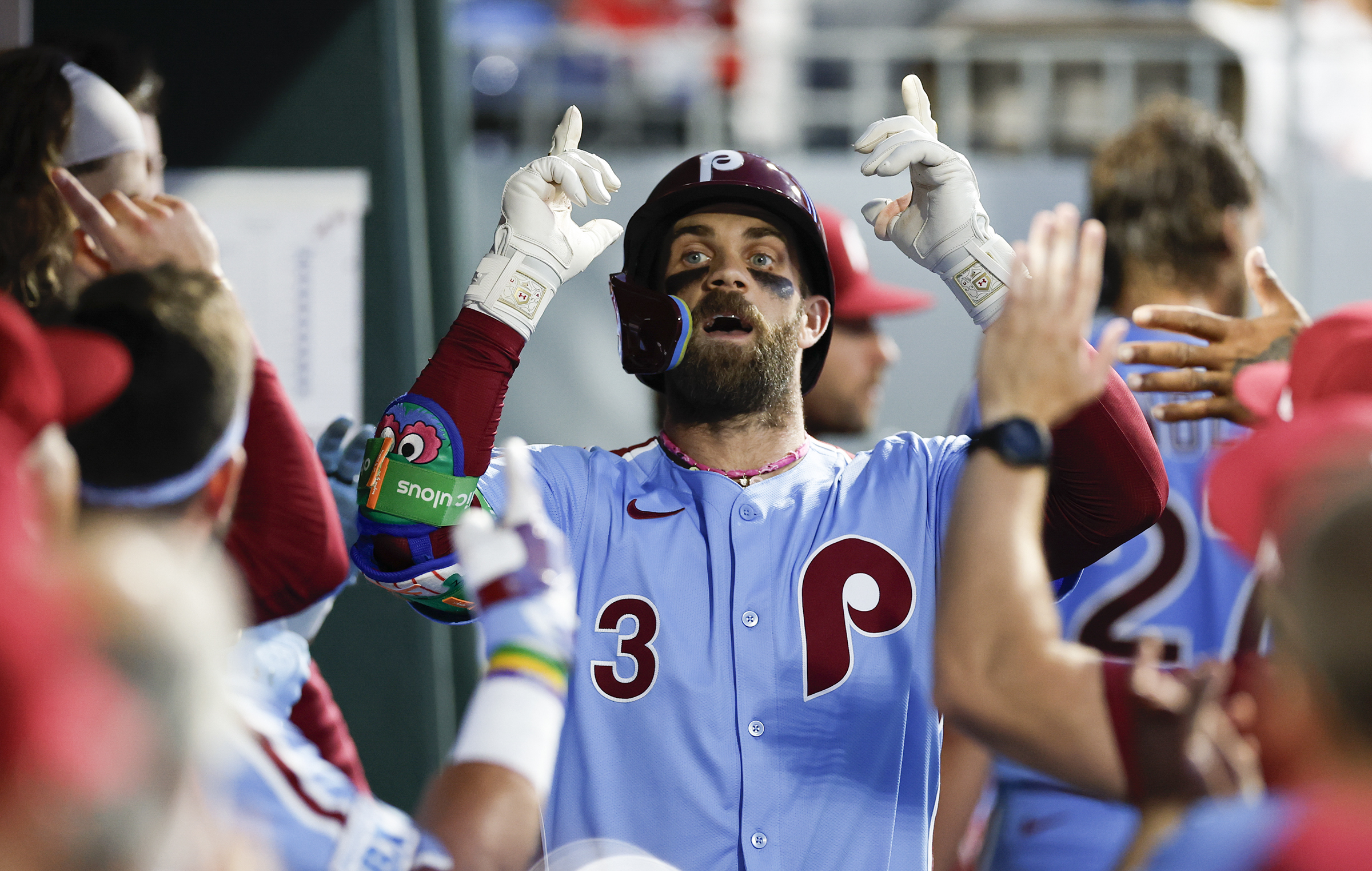
    Bryce Harper hit 27 homers this season, despite missing one month with an inflamed right wrist.

    Missing the mistakes

    Let there be no doubt about Harper’s state of mind in the aftermath of the Phillies’ second consecutive divisional-round knockout.

    “I want [a championship] more than probably a lot of people,” he said. “I want to hold that trophy. On a personal level, I’m going to work my butt off this offseason again and get ready for next year and hopefully take another swing at it and see what we can do.”

    But who will follow Harper in the batting order?

    It was a topic of conversation early this season. Harper got walked intentionally twice with runners in scoring position on April 11 in Atlanta, prompting Rob Thomson to tweak the lineup the next day. Rather than keeping a struggling Bohm — or fellow right-handed hitters J.T. Realmuto or Nick Castellanos — behind Harper, the manager moved Kyle Schwarber into that spot.

    “Just trying to protect Harper the best we can,” Thomson said.

    Schwarber should have represented Secret Service-level lineup protection. He batted behind Harper for 42 consecutive games and hit 12 homers in that span.

    And yet Harper didn’t see many more pitches in the zone.

    “It’s actually gotten worse, which is crazy,” Harper told The Inquirer in May during a series in Cleveland. “Just got to try to hone in as much as possible and hit the mistakes. That’s one thing where [Barry] Bonds was so good at. You get the mistakes and let the other ones go.”

    Usually, it’s a trademark of Harper’s, too.

    Through six seasons with the Phillies (2019 to 2024), he saw only 42.6% of pitches in the zone, tied for second-lowest rate among 293 players who faced at least 500 pitches, according to Statcast. But he punished those strikes, slugging .680, fifth-best behind Aaron Judge (.763), Shohei Ohtani (.710), Yordan Alvarez (.695), and Mike Trout (.695).
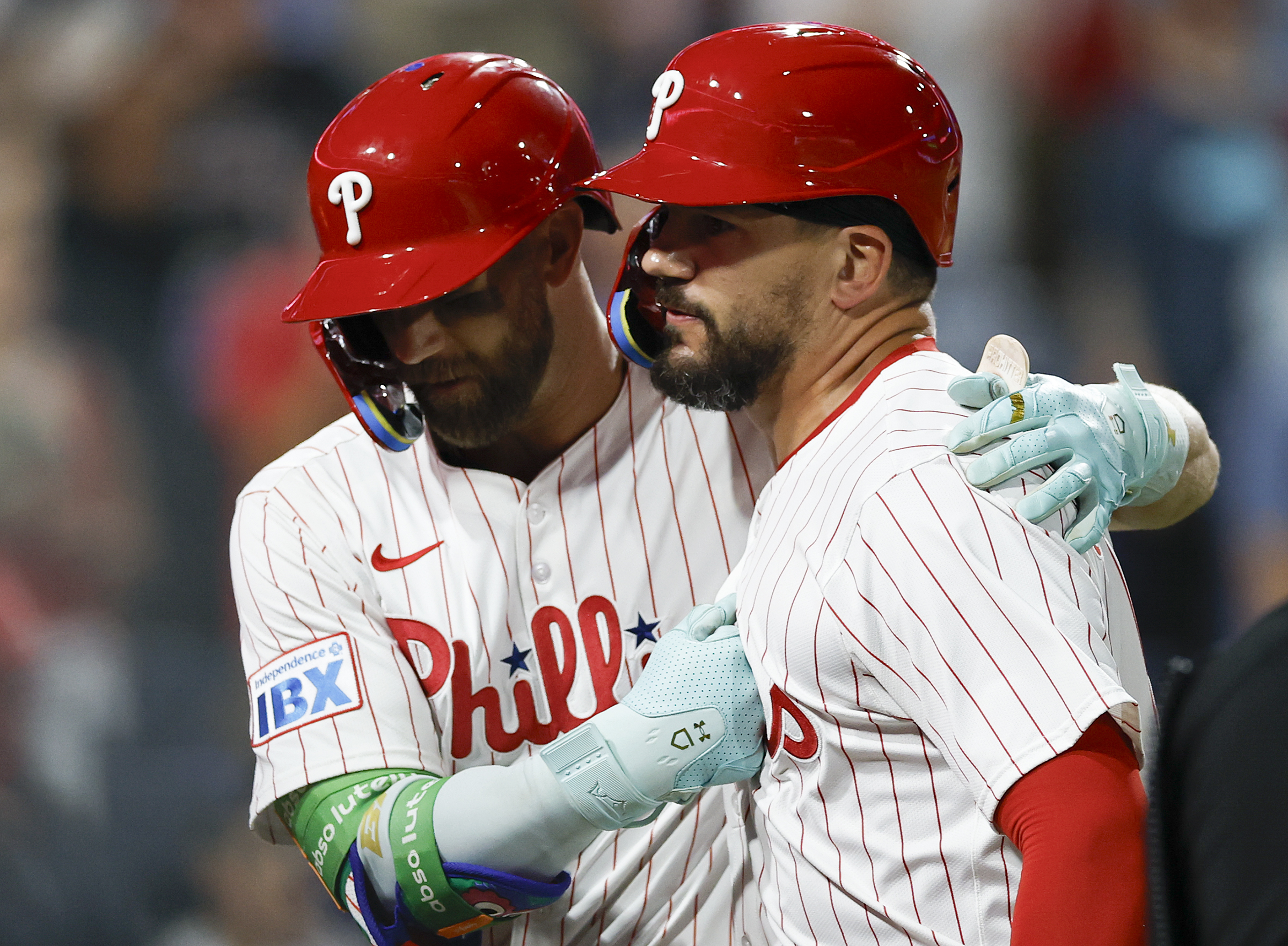
    Kyle Schwarber (right) batted behind Bryce Harper early in the season before the Phillies got away from that alignment.

    This year, with opponents still coming after him in the zone only 43% of the time, Harper’s slugging percentage on those pitches fell to .591. His weighted on-base average slipped, too, from .424 to .378.

    Reasons for the drop-off weren’t clear. Harper’s average bat speed wasn’t diminished (74.2 mph vs. 74.0 mph in 2024). His average exit velocity (91.3 mph) and hard-hit rate (47.5%) were consistent with the last two seasons (91.5 mph, 47.5%).

    There was a notable difference in how teams attacked Harper. He faced fewer fastballs (46.7%) and more breaking pitches — curveballs and sliders (41.3%) — than ever before. By comparison, the breakdown last season was 52.9% fastballs and 32.3% breaking stuff.

    Why the change?

    “Because I’m not hitting them,” Harper said. “Like, don’t try to fix what’s not broken, right?”

    Indeed, Harper slugged .438 against curveballs and sliders, down from .458 in 2024, .466 in 2023, and .495 in 2022.

    At least Harper didn’t overreact by swinging at many more pitches out of the zone. His chase rate ticked up to 35.6%, according to Statcast, but wasn’t far off his 33.4% mark from each of the previous two seasons. He walked in 12.1% of his plate appearances, nearly identical to his 12% mark from 2024.

    But as the Phillies seek explanations for Harper’s subpar season, they can start by tracing why he didn’t crush as many pitches — of any variety — in the zone as usual.
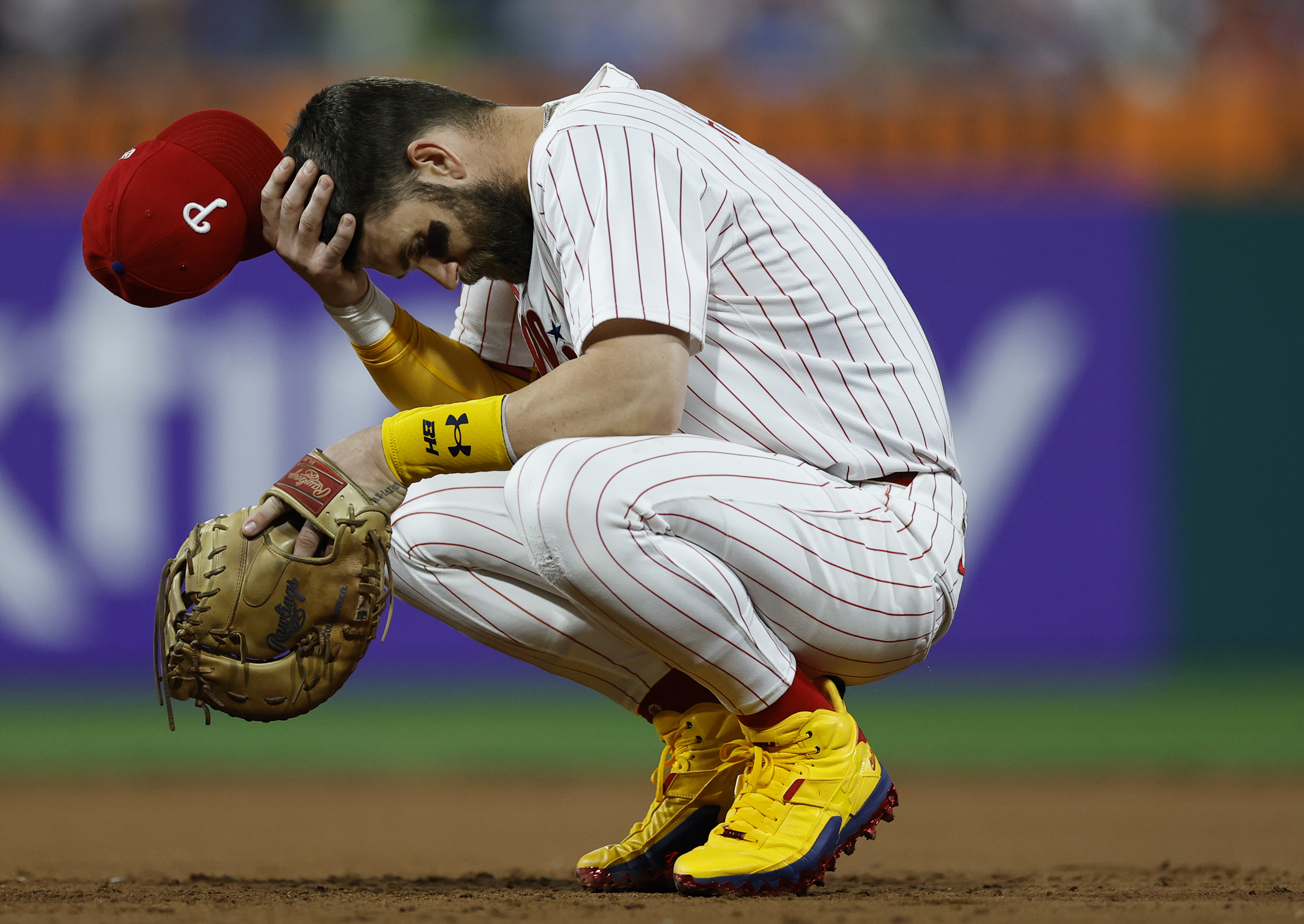
    Bryce Harper is a two-time Gold Glove finalist at first base. The Phillies haven’t discussed moving him back to the outfield.

    Better protection

    Maybe it would’ve helped if Thomson stuck with Schwarber behind Harper.

    Instead, Schwarber moved into the No. 2 hole while Harper was sidelined in June and stayed there en route to joining Ryan Howard in the pantheon of Phillies’ 50-homer hitters. Once Harper came back, he most often was followed in the order by Realmuto (41 games), Bohm (18), and Castellanos (13).

    Harper was the Phillies’ primary No. 3 hitter (117 games); Phillies cleanup hitters combined to rank 20th in slugging (.408) and OPS (.720).

    Scott Boras, Harper’s agent, didn’t respond to messages in recent days. But he told MLB.com that the best way for the Phillies to restore Harper’s elite performance is to “give Bryce Harper more pitches to hit.”

    Translation: Upgrade the lineup protection.

    Maybe it’s as simple as re-signing Schwarber and sticking him in the cleanup spot. Maybe the Phillies can add even more slug by putting the $24.5 million that will come off the books with the departures of Max Kepler, Jordan Romano, and David Robertson into an offer for, say, Alex Bregman, then swapping Bohm for Angels outfielder Taylor Ward.

    But unless 2006 Ryan Howard comes out of retirement, history suggests that Harper will continue to see fewer pitches in the zone than almost any hitter in baseball.

    He needs to get back to crushing them.

    “I think he’s highly motivated to have the best season of his career next year,” Thomson said. “He hasn’t told me this, but that type of person — and I’ve seen it before — they’ve had bad years, they’ll go like gangbusters during the offseason to get better because they want to get back to where they normally are at. I think that’s just Harp’s mindset. I think that’s what he’s going to do.”

  • One year of inspections at Phoenixville Hospital: August 2024 – July 2025

    One year of inspections at Phoenixville Hospital: August 2024 – July 2025

    Phoenixville Hospital was not cited by the Pennsylvania Department of Health for any safety violations between August 2024 and July of this year.

    The hospital, located in Phoenixville, is owned by Tower Health.

    Here’s a look at the publicly available details:

    • Sept. 12, 2024: Inspectors followed up on two citations from May and June, and found the hospital was in compliance. In May, the hospital had been cited for discharging a patient to another facility without proper transfer orders. In June, the hospital was cited for using physical restraints on two patients without documenting that staff had first tried less restrictive ways to subdue them.
    • Feb. 18, 2025: Inspectors came to investigate two complaints but found the hospital was in compliance. Complaint details are not made public when inspectors determine it was unfounded.
    • April 17: The Joint Commission, a nonprofit hospital accreditation agency, renewed the hospital’s accreditation, effective February 2025, for 36 months.
  • The arrests in the NBA gambling scandal are proof that the new world is better than the old

    The arrests in the NBA gambling scandal are proof that the new world is better than the old

    One thing nobody will dispute is that Thursday was a victory for the scolds. All at once, they logged on, and logged in, and limbered up their Twitter fingers and sent them dancing across the keyboard like Herbie Hancock on the ivories.

    A good old-fashioned gambling scandal was erupting, and they weren’t going to let it pass without imparting some grave moral lessons.

    Look here, they said. The most important indictment announced by the U.S. Attorney’s Eastern District of New York office on Thursday wasn’t the one that laid out the charges against NBA guard Terry Rozier for his alleged role in a prop-bet-fixing scheme, or the one that detailed NBA head coach Chauncey Billups’ alleged involvement in rigging illegal poker games.

    No, the important indictment was the metaphorical one handed down against the NBA itself. For embracing legalized sports gambling. For partnering with online sportsbooks like DraftKings. For prioritizing profit over the integrity of the game.

    This wasn’t just criminals allegedly doing as criminals allegedly do. It was the inevitable end result of the NBA’s embrace of an industry that should not exist.

    Again, according to the scolds.

    But the scolds are wrong. In fact, their interpretation of Thursday’s events, and of last year’s Jontay Porter guilty plea in a separate investigation, is the exact opposite of the real lesson to draw. A world where people can gamble openly with reputable companies that operate within the jurisdiction of federal law enforcement and in cooperation with sports leagues is a world where any bad actors are likely to be caught. That is not the world as it used to be.

    We all remember the old world, right? Pete Rose, Paul Hornung and Alex Karras, the Black Sox, Boston College and CCNY. These were some of the biggest individual or institutional names of their eras, all of them involving serious wagers on the outcomes of games over an extended period of time, most of them in concert with the criminal underworld.

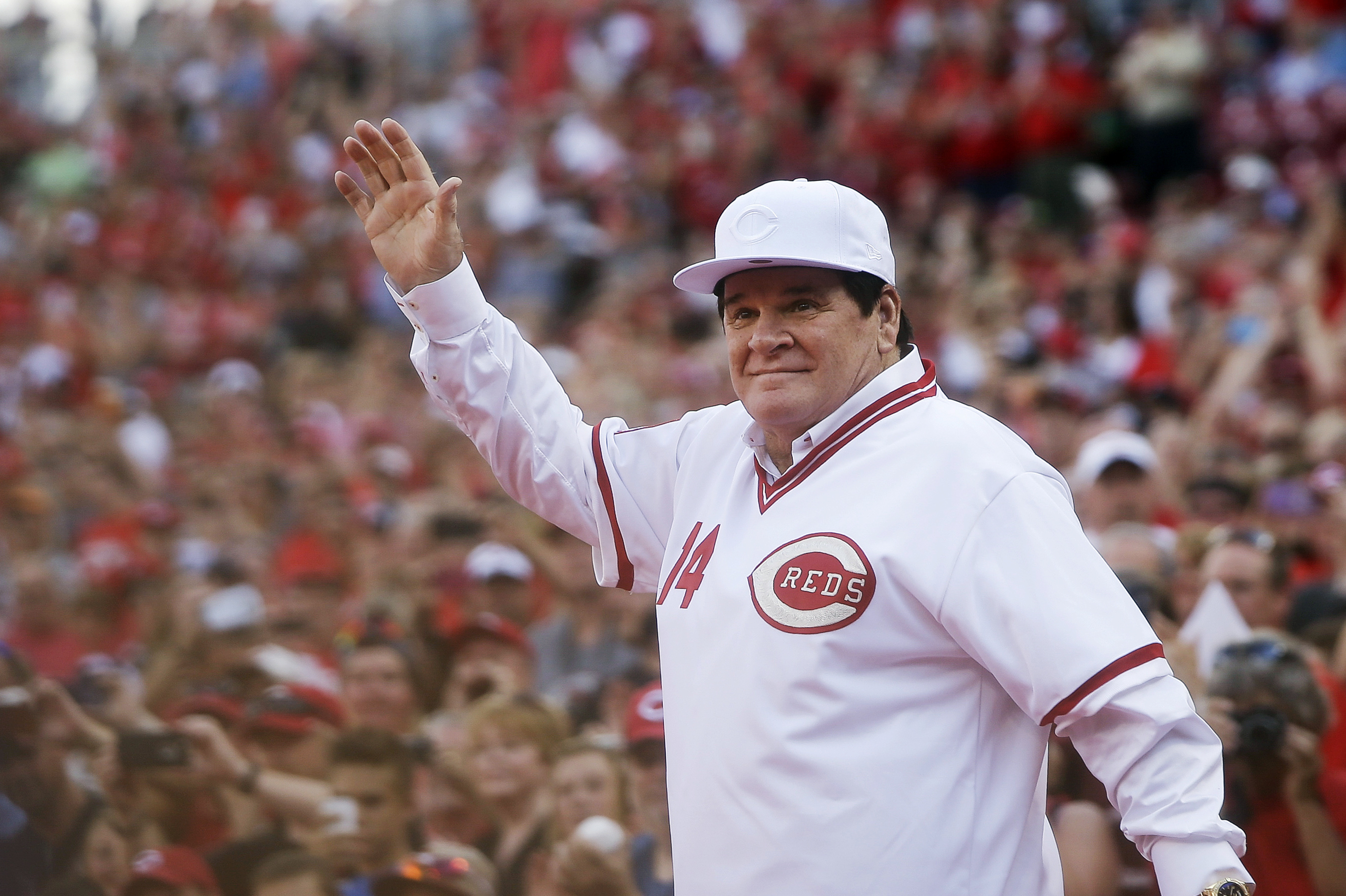
    Pete Rose, who was banned from baseball for 35 years for betting on the sport, was reinstated last May.

    The responsibility of protecting the integrity of games fell primarily on sports executives. Karras and Hornung, two of the NFL’s biggest stars in the 1960s, were suspended for a season as a result of commissioner Pete Rozelle’s investigation into players’ ties with bettors.

    Nobody knows the old world as well as the NBA. Two decades ago, the league found itself mired in the biggest scandal of them all when it learned that referee Tim Donaghy had spent four years wagering on games that he officiated. Donaghy, a Delco native who attended Cardinal O’Hara, later claimed that 80% of his bets ended up cashing.

    His gambling was eventually uncovered by an FBI investigation that resulted in prison time, but only after he’d inflicted four years’ worth of reputational damage on the league.

    Compare the Donaghy scandal to what the feds laid out in their indictments on Thursday. Rozier is alleged to have provided nonpublic information to gamblers who bet on at least seven games between March 2023 and March 2024.

    The indictment involving Rozier also includes mention of a “Co-Conspirator 8″ who provided gamblers with information about Portland Trailblazers personnel decisions, although Billups was not explicitly named. (Billups’ charges stem from a separate case involving the rigging of illegal poker games.)

    The Rozier case stems from an earlier investigation into Porter, a then-Toronto Raptors player who later admitted in court that he manipulated his performance in two games. (Porter was banned from the NBA in the spring of 2024 and is currently awaiting sentencing in his case).

    I don’t mean to minimize the seriousness of the cases involving Rozier, Billups, and Porter. Rozier and Billups deserve to join Porter with lifetime bans, and Billups should be removed from the Hall of Fame.

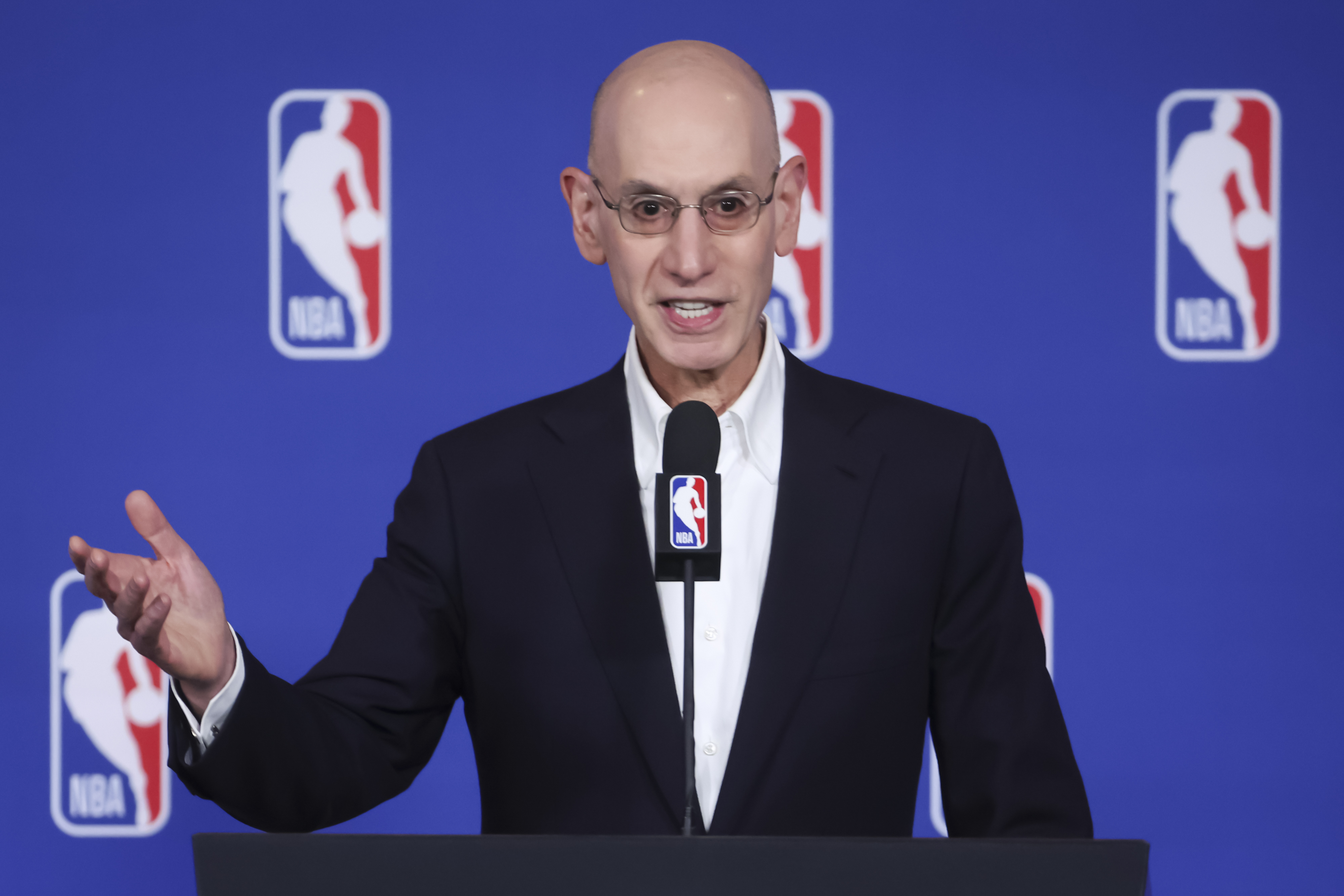
    NBA commissioner Adam Silver and the league need to do some serious self-scouting to figure out if there is anything they can do beyond wielding heavy-handed punishment as a deterrent.

    The scolds are correct in at least one regard. The NBA and its fellow sports leagues should seriously reconsider the extent to which they have encouraged the integration of betting with their telecasts and live events. The rise in popularity of betting on individual player props and so-called same-game parlay promotions has created a huge new front of incentives and avenues for malfeasance, packaged and promoted in a way that can feel more like fantasy sports than gambling.

    It is more than fair to suggest that commissioners should create more distance between themselves and the sportsbooks, particularly when it comes to marketing.

    The NBA’s increasingly close relationship with sportsbooks has brought in significant revenue but also led to additional problems.

    Let’s not lose sight of the real issue. The leagues had no choice but to accept the reality of legal sports gambling. In the years before its adoption in the United States, overseas sportsbooks were exploding in popularity. Daily Fantasy cash games were already legal. Sports gambling was going to achieve critical mass at some point in the United States.

    The decision that the leagues had to make was whether they wanted to help create a world where it could be regulated and policed most effectively.

    We saw that world play out in Porter’s case. The gambling syndicate that attempted to profit from his prop bets was flagged due to the irregular nature of the wagers. The ability to detect abnormal betting patterns is the single biggest weapon in the fight against sports-fixing, and it should be the single biggest deterrent to anybody who attempts to engage in it.

    The legalization of sports gambling is shifting all of the money that used to be wagered in the underworld onto audited books overseen by billion-dollar companies with sophisticated detection methods in place. It would be silly for a league like the NBA not to encourage that sort of framework in favor of one where forensic accounting is nearly impossible.

    The cases of Rozier, Billups, and Porter are an indication that the world still isn’t perfect. But it is silly to suggest that stuff like this was less prevalent in the old world. We were just less likely to find out about it.

  • Temple’s 1-0 approach, more drama at Penn State, and have you heard about Eastern U?

    Temple’s 1-0 approach, more drama at Penn State, and have you heard about Eastern U?

    It’s starting to get really fun keeping track of Temple football again.

    While it might be a bit too soon to suggest that head coach K.C. Keeler has revitalized the program, it’d be unfair to suggest that he hasn’t brought in a fresh perspective bolstered by a new coaching staff and a belief that his roster can deliver results.

    It’s worth noting that Keeler, who could pick up his 276th win as a head coach this weekend with a road matchup against Tulsa on Saturday (3:30 p.m., ESPN+), has been honest with his team — and the media — on his expectations.

    But it also seems like he’s put the right people in place — on the field and off — to deliver.

    “I feel like they are just starting to figure out that they are a good football team,” Keeler said this week. “That’s what showed when we played Charlotte. When we played them, I think it finally came out that we’re a good football team.”

    The Owls (4-3, 2-1 American) have a winning record at this juncture of the season for the first time since 2019. Now, they are eyeing a real possibility of being bowl eligible in Keeler’s first season.

    After Tulsa, the road doesn’t get any easier as teams like East Carolina (Nov. 1) and Tulane (Nov. 22) await. But both of those matchups are at home, where the Owls are 2-2 and could be 3-1 if not for a late flop against Navy two weeks ago on homecoming weekend.

    It appears that Temple is applying the same mentality to its season that Penn State has vowed to employ. Each week, the Owls say they are going into games trying to be “1-0.” Defensive end Allan Haye says that approach is motivating them ahead of this weekend’s game.

    “Just 1-0,” Haye said during Monday’s press conference. “Last week, we went 1-0, so now it’s 0-0 coming into this week. We’re coming into this game like it’s a clean slate; and every game from now on is our Super Bowl. Every game is very important because it’s the next game. That’s just how we move and how we think.”

    Who would have believed that mindset would be working better for the Owls than the Nittany Lions?

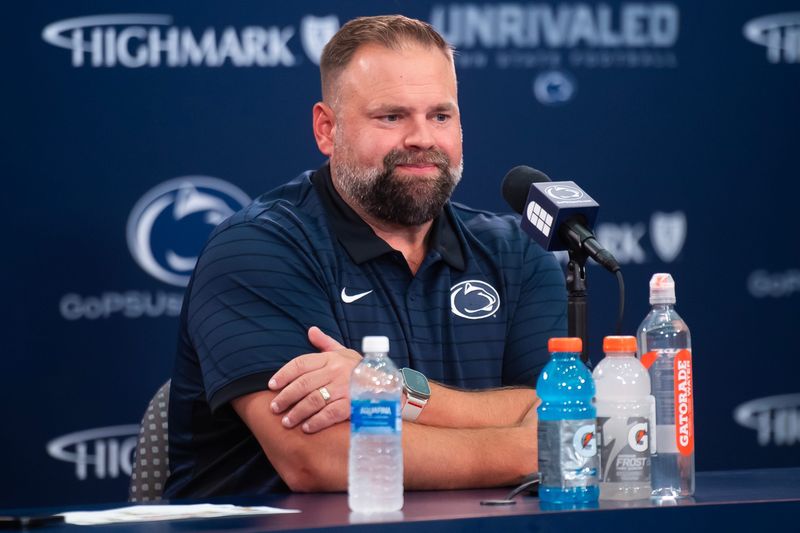
    Penn State offensive coordinator Andy Kotelnicki can’t put a finger on what’s plaguing the Nittany Lions’ offense.

    Choice of words

    Speaking of Penn State, Andy Kotelnicki might’ve wanted to use more time to think about his response when asked about what’s plaguing the Nittany Lions’ offense.

    “I don’t really have a good explanation,” he said when asked Wednesday.

    Now, more was said in context, which is available on the team’s website, but that’s not what fans want to hear about a team that currently ranks 97th in the FBS in total offense with around 355 yards per game.

    Temple, meanwhile, is 72rd with 381.4 yards per game. And while playing UMass and Howard isn’t the same as playing Oregon and Iowa, we’re talking about a team that went from No. 2 in the nation to an afterthought in two months.

    Needless to say, Kotelnicki’s response is getting the business on social media forums from irate Penn State fans who are looking for a little more insight into the collapse of a team that reached the semifinals of the College Football Playoff just a season ago.

    Fortunately, Kotelnicki and the Nittany Lions have some time to figure it out as a bye week provides a few more days before a showdown with No. 1 Ohio State on Nov. 1 (noon, Fox29).

    In one week …

    Lincoln Financial Field becomes the home to one of the most anticipated HBCU college football games of the season when former Eagles Michael Vick and DeSean Jackson go head-to-head as coaches on Oct. 30 (7 p.m., ESPNU, tickets).

    Vick’s Norfolk State will take on Jackson’s Delaware State on the same field where the two made memories for themselves and Eagles fans alike.

    But arguably the most memorable moment didn’t happen at the Linc; it happened in 2010 against Washington at FedEx Field in Landover, Md., when Vick threw an 88-yard pass to Jackson on the first play of the game, part of a six-touchdown outburst by Vick.

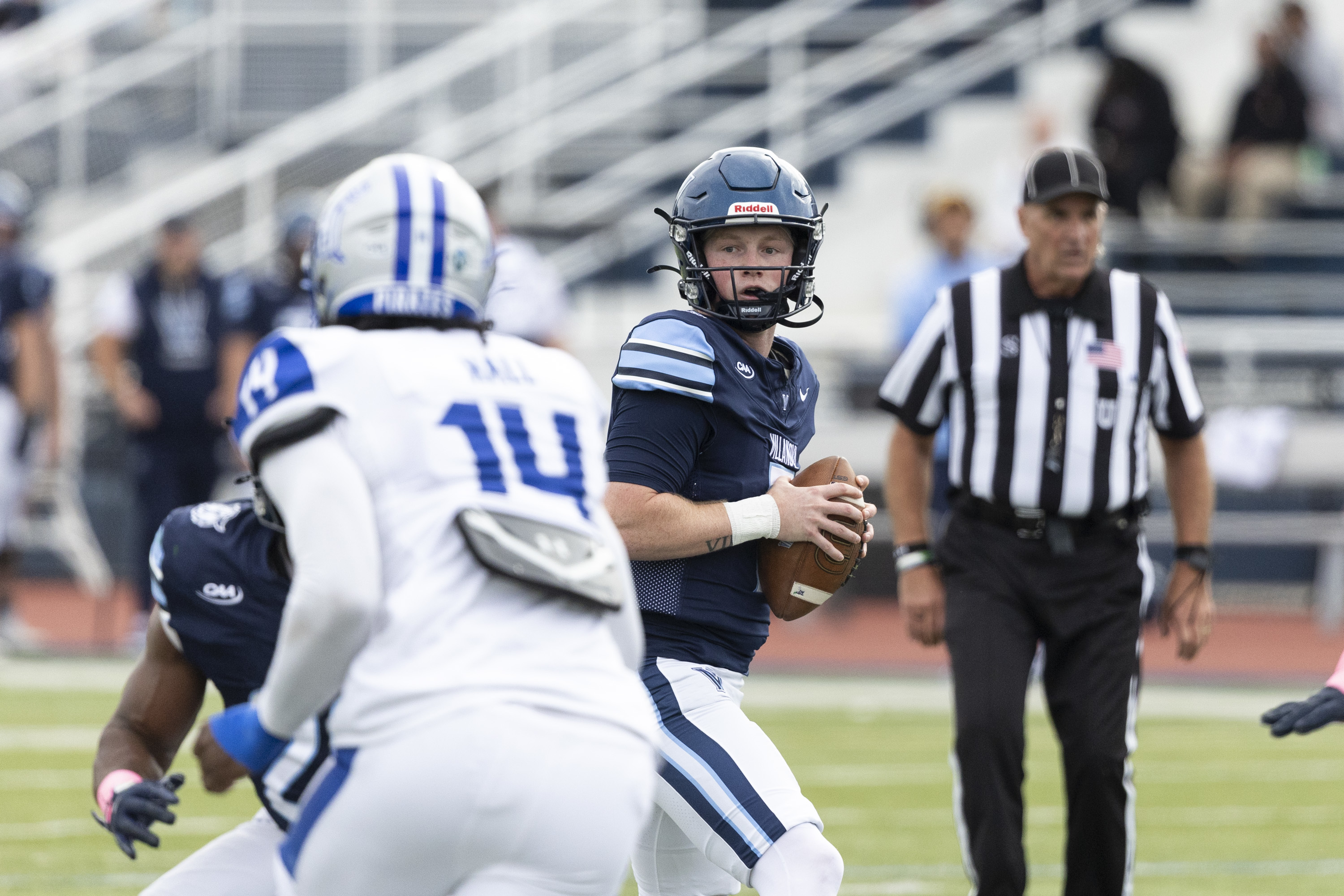
    Villanova quarterback Pat McQuaide threw five touchdowns on just 13 passing attempts against Hampton last Saturday.

    Three questions

    🏈 How the heck did Villanova quarterback Pat McQuaide throw five touchdowns on just 13 pass attempts in a rout of Hampton last week, and can he do it again against Albany at home on Saturday (3:30 p.m., FloSports)?

    🏈 Will Penn pick up its first 3-0 start in conference play after knocking off last season’s co-champs in Dartmouth and Columbia in the last three weeks? This week, a road trip to Yale (noon, ESPN+) will answer that question.

    🏈 How come no one told us about how good the football is over at Eastern University? The Division III Eagles, who play on the campus of Valley Forge Military Academy, are off to a 5-1 start to their season and are on a three-game winning streak. They’ll look to make it four in a row when they travel to take on Misericordia University on Saturday (1 p.m., watch live).

    The BIG number

    20: That’s the number of consecutive home victories Villanova would have with a win over Albany this week. The Wildcats already own the second-longest active home winning streak in college football and are coming off a 56-14 win over Hampton last weekend at Villanova Stadium.

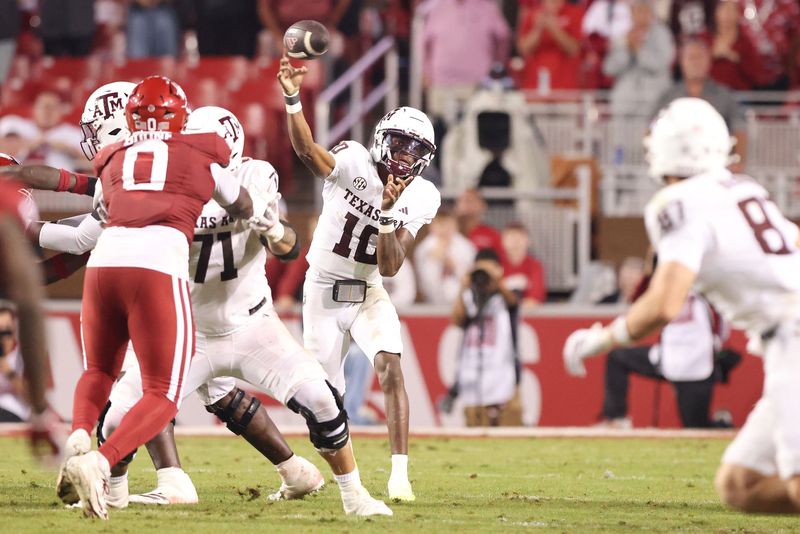
    Texas A&M quarterback Marcel Reed will lead the Aggies into Tiger Stadium in Baton Rouge, La., to take on No. 20 LSU on Saturday.

    Game of the week

    No. 3 Texas A&M at No. 20 LSU (Saturday, 7:30 p.m., 6ABC)

    LSU’s fall to No. 20 is considered surprising, but there’s a real chance to prove naysayers wrong against SEC opponent Texas A&M, the No. 3 team in the nation. Vegas only has the Tigers as a 2.5-point underdog, and that’s because LSU boasts a 4-0 record at Tiger Stadium this season.

    Looking for a channel flipper? Consider No. 25 Michigan at cross-state rival Michigan State happening at the same time (7:30 p.m., NBC10).

  • Elijah Robinson and Fran Brown wanted to ‘build a program together.’ The two are fulfilling that dream at Syracuse.

    Elijah Robinson and Fran Brown wanted to ‘build a program together.’ The two are fulfilling that dream at Syracuse.

    Syracuse coach Fran Brown and defensive coordinator Elijah Robinson played football together at Camden High School. The two also overlapped at Temple and Baylor as assistant coaches from 2014 to 2017.

    From a young age, they shared a dream to eventually work on the same sideline.

    “We’ve talked about it for a long time, early in our careers, about one of us having the opportunity to become a head coach at some point, and that we would love to build a program together,” Robinson said. “I’m grateful for him wanting me to come and join him on his path.”

    One of Robinson’s greatest coaching success story came while serving as Temple’s defensive line coach from 2014-16. Former Eagles defensive end Haason Reddick, now with the Buccaneers, joined the Owls as a walk-on in 2012. Robinson coached Reddick during his three of five years as an Owl, helping the future two-time Pro Bowler go from an unrecruited prospect to an early first-round draft pick.

    “[Hasson’s] somebody that everyone can look up to,” Robinson said. “He went about his day as a pro — the way he prepared, the way he practiced, and he just continued to develop. He’s a guy that had to fight, pay his own way, and he didn’t get a scholarship until his senior year in college.”

    After three seasons at Temple and one at Baylor, Robinson was hired as Texas A&M’s defensive line coach, where he helped starters DeMarvin Leal (Steelers), Micheal Clemons (Jets), McKinnley Jackson (Bengals), and Jayden Peevy (Saints) earn NFL contracts.

    Before the 2022 season, Robinson added assistant head coach and run game coordinator to his job titles. The following year, after Texas A&M fired head coach Jimbo Fisher with just two games remaining, Robinson got the job on an interim basis.

    “I was just honored to be chosen to lead that group of young men for the remainder of that time,” Robinson said. “They needed some leadership; they needed someone that cared about them, that was going to stick with them through it all.”

    On Nov. 28, 2023, Fran Brown was hired as Syracuse’s head coach, and Robinson was announced as his defensive coordinator just days later.

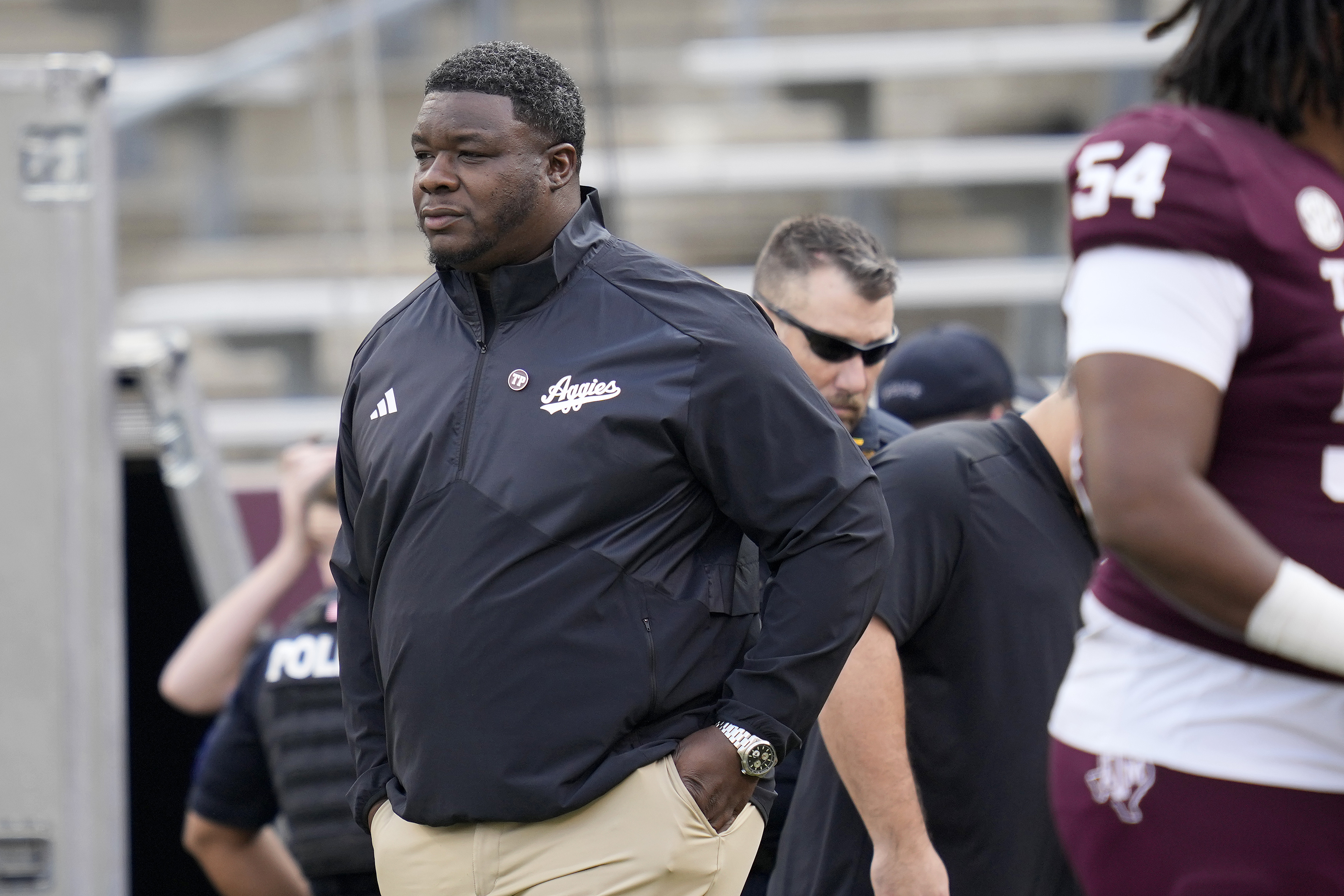
    Elijah Robinson was interim head coach at Texas A&M in 2023.

    At that point, Texas A&M had about a month left of practices and a bowl game remaining.

    “When Coach Fran got the job [at Syracuse], there only would’ve been one way that kept me from coming to join him,” said Robinson. “That was [being] the head coach at Texas.”

    The reason that Robinson accepted the defensive coordinator job at Syracuse was because the Aggies had already found his replacement. On Nov. 27, 2023, Texas A&M hired Mike Elko to be its next head coach, though he wouldn’t take over his new role until after the 2023 season.

    “I appreciate [Syracuse] for allowing me to finish it out with those guys [at A&M] until their head coach came and took over,” Robinson said.

    While Robinson was a big addition for Syracuse in terms of player development, he may have been even more valuable for his recruiting. In 2022, the Penn State alum won 247 Sports’ recruiter of the year award, an honor Brown received two years later.

    But when Robinson arrived at Syracuse, he took a firm stance against recruiting players from his old job.

    “[Texas A&M] treated my family and I really well, and I built a lot of great relationships there,” said Robinson. “So, I wanted nothing but that program to have success, and for me to tell players or encourage players to leave, I wasn’t going to do that.”

    Now in his second season at Syracuse, Robinson isn’t closing the door on becoming a head coach. Last November, Brown was asked about the possibility of both Robinson and offensive coordinator Jeff Nixon, who also has Temple ties, potentially taking what was a vacant head coaching job with the Owls.

    “When we continue to win the way that we’ll continue to win, I think there’ll be opportunities that open up that’ll put them in the same Power Four level, instead of trying to have to go down a level to coach,” Brown said.

    But as of now, Robinson has his focus elsewhere.

    “At the end of the day, you got to be where your feet are, something I learned as a player,” Robinson said. “I think if I start looking at opportunities too far ahead, they’ll never show up.”

  • Lincoln thought its football season was over, until an overturned suspension presented another chance

    Lincoln thought its football season was over, until an overturned suspension presented another chance

    The entrance to Lincoln High School’s football field was locked last Saturday morning for the Railsplitters’ regular-season finale against defending Philadelphia Public League champion Imhotep Charter.

    Spectators had to be preapproved for entrance into the gates, then checked by a Philadelphia police officer on a list. There were three camera crews there, too, taking sporadic shots of the field and video of the 50 or so parents scattered in the concrete stands.

    Lincoln hasn’t played a game since Oct. 4, after the team received a three-game suspension — which would have ended its season — following a brawl that broke out after its game against Northeast High School. However, last week, the School District of Philadelphia overturned Lincoln’s suspension after video evidence revealed players, parents, and coaches from both schools were involved in an altercation as Lincoln’s team attempted to leave the Northeast Supersite.

    The Railsplitters forfeited two games, including their 39-8 victory over Northeast, before the suspension was amended. But none of that mattered against Imhotep. Lincoln just wanted another chance to play.

    In a 26-25 thriller, the Railsplitters snapped the powerhouse Panthers’ 35-game league winning streak and became the first Public League team to beat Imhotep in six years.

    If the Railsplitters (5-4) had lost, their season was over. Lincoln persevered, despite having 12 players suspended due to the altercation, and will advance to the Public League quarterfinal round of the playoffs. They will play Central at 11 a.m. on Saturday at the Germantown Supersite.

    Another chance

    As the game was winding down on Oct. 4, Lincoln coach Hakeem Cooper and Northeast coach Nick Lincoln agreed to skip the traditional postgame handshake down the middle of the field, Cooper said, due to the in-game chatter that was stirring between the teams.

    Instead, Northeast went back to its locker rooms, located up a ramp and behind the stadium field house. Cooper gathered his team in the far end zone to address the group for 15 minutes after the game. Cooper said he sent assistant coach Joe DiGrazio to get the Lincoln team buses over to the visitor’s side of the field.

    DiGrazio then went up the steps on the Northeast home side, where a verbal altercation ensued, Cooper said.

    DiGrazio, who is shown on a video from the incident, had his back to the steps and extended his arms trying to hold back Lincoln’s players from going up the steps. The video also showed shoving and jostling before the altercation was settled.

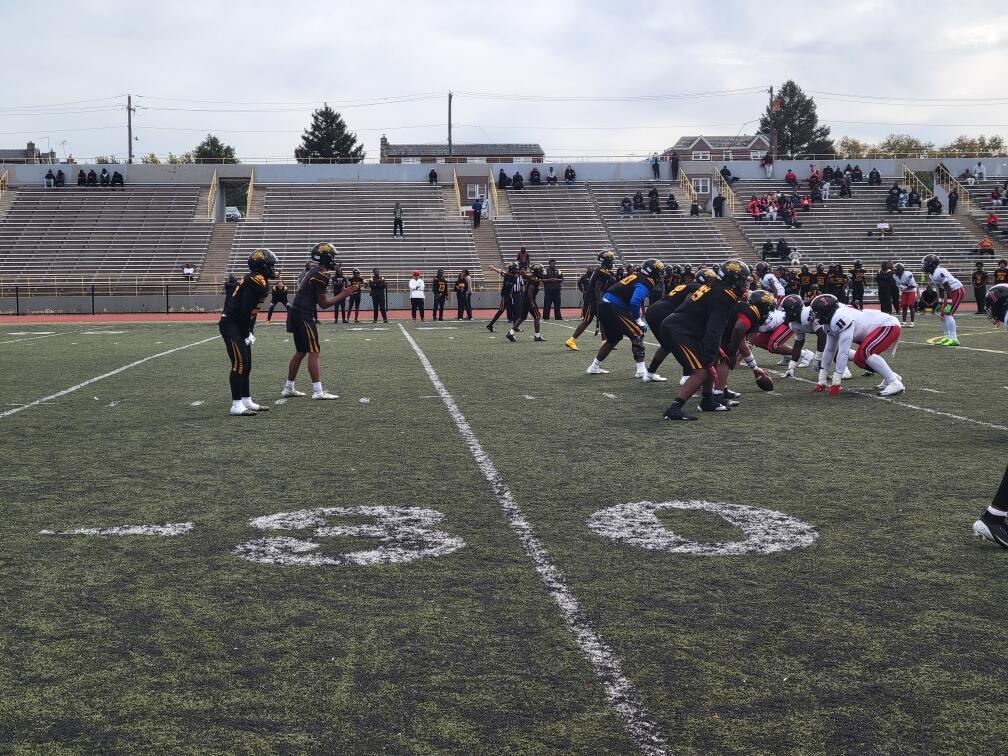
    Lincoln High School plays against Imhotep Charter on Oct. 18.

    Northeast interim principal Peggy DeNaples, Northeast athletic director Phil Gormley, and Vikings coach Nick Lincoln could not comment about the matter.

    The school district wrote in a statement: “After an additional review of video footage, statements from coaches, parents and OSS (Office of School Safety) officers on-site and reports from PPD (Philadelphia Police Department), the PPL (Philadelphia Public League)’s investigation concluded that student-athletes and coaches from the Abraham Lincoln high school football team engaged in unsportsmanlike conduct after the conclusion of the game … . Individuals who were not directly involved in the altercation from Lincoln were eligible to return to play for their final regular season game on Oct. 18.”

    On Oct. 8, Lincoln principal Jack Nelson was informed by the district that the Railsplitters’ season would be canceled. Cooper gathered his team in a study hall to tell them the news, which was greeted with a swell of emotion.

    It also happened to be on Cooper’s 34th birthday.

    “Yep, it was not a good birthday present, because it was highly emotional,” said Cooper, who is in his fifth season as the Railsplitters’ head coach and guided Lincoln to a 2023 PPL Class 6A championship, its first league title since 1979. “It’s probably one of the hardest things I ever had to do as a coach. I got emotional, seeing all my boys breaking down after we lost a championship that we should have won [last November to Imhotep on a blocked punt in the Public League championship].

    “It’s been a roller coaster these last two weeks. I was holding out hope that we would be able to salvage the season. I just wanted the kids to have one more chance. We appealed the suspension when more video came out, and the school district gave us our season back.”

    ‘Never gave up hope’

    A week later, in the same room that Lincoln thought its season was over, Cooper told his 47 players to grab their helmets and shoulder pads and get ready for practice. They had a 90- minute session last Wednesday and a two-hour practice on Thursday, before finishing the week with a Friday walk-through.

    It was not an ideal way to prepare for a team like Imhotep, which beat Lincoln 35-6 last year during the regular season. The Panthers also squeezed by the Railsplitters, 28-26, for the Public League Class 6A title on a blocked punt with less than a minute left in regulation and a touchdown by Jabree Wallace-Coleman (who’s now at Penn State) on the final play of the game.

    Last Saturday, Lincoln’s 6-foot-1, 193-pound senior quarterback KJ Moore was brilliant. He extended plays. He found sophomore Nazir Holley in the corner of the end zone for a 20-19 lead with 1:48 to play.

    It looked like the Railsplitters would seal the win when defensive end Koi Muse took an interception 35 yards and added a 26-19 lead. But Imhotep kept coming.

    On the ensuing kickoff, Imhotep scored a touchdown on a fumbled return and had Cooper feeling cursed by the football gods that another odd special team’s breakdown would end Lincoln’s season. But the Railsplitters held, as Imhotep’s two-point conversion was stopped.

    Cooper’s lower lip quivered after the game. The whole experience seems to have galvanized the Railsplitters. The suspension made a tight team a tighter team.

    “I never gave up hope that we would play again, and I never felt so happy going to practice last Wednesday,” Moore said. “I was angry. We had to play behind a locked gate. Me, Jamir Duncan, and Nymir Marable, the team captains, called a players-only meeting the day after we were told our season was over. We were determined to get our season back. … On the outside, we had a lot of ignorance coming at us.

    “We’re going to be tough to beat. We are getting our guys back, and Alvin Yates is eligible to play. I saw the cameras there. I also saw that they left. They didn’t stick around. They covered their story. They missed the story: us beating a team no one thought we could beat. This adversity has made us closer. … I learned how this coaching staff cares about us. They are always there for us. It’s why we push, because our coaches push.”

    Marable, a senior receiver who is getting attention from West Chester, Delaware State, Gettysburg, and West Virginia State, added: “We had to prove everyone wrong. We were supposed to lose 50-0. I think we all got a gift in this — we had something taken away and then given back. We learned not to take anything for granted. Everyone was ready to play. No one was going to stop us.”

    When Cooper showed up at Lincoln at 8 a.m. Saturday, he was greeted by 20 of his players waiting in front of the locker room door.

    Yates, a 6-5, 260-pound defensive lineman and cousin of former St. Joe’s Prep star Samaj Jones and Imhotep’s Zahir Mathis, had to wait 21 days before his eligibility kicked in after transferring into Lincoln from Imhotep.

    “I can’t wait to play after being on the sideline,” said Yates, who is getting attention from Syracuse, Temple, Monmouth, and Penn State. “We have some dogs on this team. The mindset of this team is to win everything, especially with everything we have been through.”

    If Lincoln and Northeast win this weekend, the two teams will advance to the Public League semifinals, which will be played at the South Philadelphia Supersite on Nov. 1 at 11 a.m. According to sources from Lincoln and Northeast, there will likely be no fans permitted to attend.

    “I won’t forget my son coming home [on Oct. 8] crying like he lost an aunt and I knew something was not right,” said Kareem Moore Sr., KJ Moore’s father. “I was there when the fight broke out. The animosity was high between the two teams. These were adults acting poorly. It’s too bad this was taken out on these kids. It will feel real good when Lincoln wins the Public League title. These kids are filled with a lot of energy. They can do it.”

  • The clash between the federal government and states over vaccine policy is ‘unprecedented,’ Villanova health law professor says

    The clash between the federal government and states over vaccine policy is ‘unprecedented,’ Villanova health law professor says

    Villanova professor Ana Santos Rutschman would describe the current state of vaccine policy as a game of chess.

    When the federal government does something, some states — primarily Democratic-led states including Pennsylvania respond immediately to counter.

    A prime example followed the federal government’s move, through the Food and Drug Administration, in August to limit eligibility for the updated COVID-19 vaccine. Previously, the annual shot was recommended for all Americans 6 months and older. The new guidance was for people 65 or older and those at high risk of complications from COVID-19.

    Pennsylvania’s regulatory body for pharmacists opened up access by allowing pharmacists to follow the broader recommendations of professional medical societies.

    “It’s kind of [like] ‘Harry Potter’ chess. Remember when they climb on the gigantic pieces and then try to kill one another?” Rutschman said, referring to the fictional scene where chess pieces violently smash the opposing side’s pieces.

    “There’s a certain violence to this from a political perspective,” she added.

    States are allowed to diverge from the federal government on vaccine policy because our system of government, known as federalism, divides power between the federal government and the states.

    With vaccines, states historically have chosen to align in large part with the federal government’s recommendations.

    Rutschman says recent actions by Health and Human Services Secretary Robert F. Kennedy Jr. have ushered in a new era of what’s being called “vaccine federalism.” Kennedy is a longtime anti-vaccine activist now serving as President Donald Trump’s top health official.

    Many states, especially those with Democratic governors, including Pennsylvania and New Jersey, saw recent changes under his leadership as a sign that they “need to do something in direct opposition to the federal government,” Rutschman said.

    Now it’s a “head-on collision,” she added.

    The Inquirer spoke with Rutschman, who researches vaccine federalism as a health law professor and director of the Health Innovation Lab at Villanova University, to learn more about this new era and its possible consequences in a conversation lightly edited for length and clarity.

    What is vaccine federalism?

    For vaccination and everything else, our system is split in two. You have the states and then you have the federal government.

    There is room for tension between the federal level and the state level. Historically, that tension has been, I would argue, limited. It has existed, but it’s not been the defining feature. Now, particularly in the context of vaccines, it has become probably the most salient feature.

    How are states allowed to differ from the federal government as far as vaccine policy?

    States don’t have the power to authorize a new vaccine to come to market.

    But then you have a lot of things that the Centers for Disease Control have done that are more informational. The federal government recommends which shots children or adults should get, and the time frame for most children to get these shots.

    The federal government offers this kind of informational support, and then states set their own policy.

    How has vaccine federalism played out in the past?

    Examples from the past are not as salient or blatant as the ones you’re seeing right now.

    There was a lot of variability around the country, but the overall message was harmonious. Everybody was trying to get, by and large, most of the population vaccinated past herd immunity.

    What is happening now?

    Now it’s a head-on collision.

    States are saying, ‘We’re not going to implement requirements to restrict access to these vaccines.’ The Board of Pharmacy in Pennsylvania decided not to be bound by the CDC’s recommendations. This is a direct clash. We hadn’t had this before between the federal government and the states in the field of vaccines.

    What are examples of this new era of vaccine federalism?

    One example would be the formation of state clusters. These are a lot of neighboring states in agreement. They’re trying to share data and think of best practices, which is almost that informational function that traditionally fell to the [federal health agencies].

    The states are saying, ‘Well, you’re not doing that, so we will.’

    ‘We will pull resources and information to come up with our own advisory role.’ That’s unprecedented.

    You have sort of two speeds in the country. Some states are collaborating and very active in setting regional vaccine policy. And then you have a bunch of states that go completely the other way. You have the, for now, isolated case of Florida saying, ‘We’re going to just basically do away with all vaccination mandates,’ which is going further than the federal government.

    Now it’s a much messier situation, legally, philosophically, politically, etc.

    How effective are these regional coalitions?

    They are accomplishing something. You see fewer restrictions in access to vaccines in a place like Pennsylvania than other states.

    Whereas states who are not part of these kinds of coalitions — typically excluding the likes of Florida — a lot of them are waiting to see what happens, because this has never happened in the history of vaccination in the United States.

    In the meantime, there are a lot of people falling through the cracks who would have been indicated for a vaccine last year. Now they’re wondering what to do, and their providers are not entirely sure.

    There’s a lot of confusion about what happens now that federal policy has taken a completely different direction.

    What impacts do you see coming from this new era of vaccine federalism?

    People hearing one thing out of the CDC and another one out of the state of Pennsylvania may think, ‘Who’s correct? Who should I listen to?’ You start aggregating all the people who might forgo vaccination just because they don’t understand what’s going on.

    I think it continues to accelerate the overall phenomenon of vaccine mistrust, and we’re already seeing levels of herd immunity come down for many vaccine-preventable diseases.

    If I were a provider, I would be similarly confused and concerned, because nobody takes lightly the idea that from now on, ‘I’ll be doing something that’s in direct opposition to what the federal regulators are suggesting I should be doing.’ So I think there’s a fear factor and confusion.

    Lastly, I think there’s an overall chilling effect with regard to vaccines. Yes, some vaccines make money, but they don’t make a whole lot of money to begin with. They’ve never been one of the preferred products for manufacturers. These are not the most profitable things they can be doing.

    I think that we will see much less focus on vaccine development in years to come, because that’s the logical position for pharmaceutical companies, and for some funders even to take, which is unfortunate.

    What do you think of Pennsylvania’s response?

    I think it’s to Pennsylvania’s credit, and I think it’s to some degree reassuring for Pennsylvanians. Although it obviously makes me sad that we have sort of this two-speed mode in the country. Some part of this national fabric has ruptured.

    For now, Pennsylvania has protected itself as it can, but states alone don’t control everything. You have Pennsylvanians going to other states where you may have an outbreak of a vaccine-preventable disease. We don’t have real borders. We cross them all the time.

  • Eagles Week 8 film preview: Key to a big day for Jalen Hurts, stopping Giants’ rookie duo, and more

    Eagles Week 8 film preview: Key to a big day for Jalen Hurts, stopping Giants’ rookie duo, and more

    Breaking tendencies on offense for the Eagles played a big role in their Week 7 win over the Minnesota Vikings. With a rematch looming with the New York Giants on Sunday, that formula will likely be put to good use again.

    Jalen Hurts finished the Vikings game with a perfect passer rating (158.3) and continued his trend of exploiting zone coverage for a second straight game. But the influx of under-center play-action and connecting on his deep shots with A.J. Brown and DeVonta Smith made all the difference.

    Can the offense carry that momentum against the Giants, while figuring out its running-game issues? Here’s what we learned from the film ahead of Sunday’s rematch between the division foes:

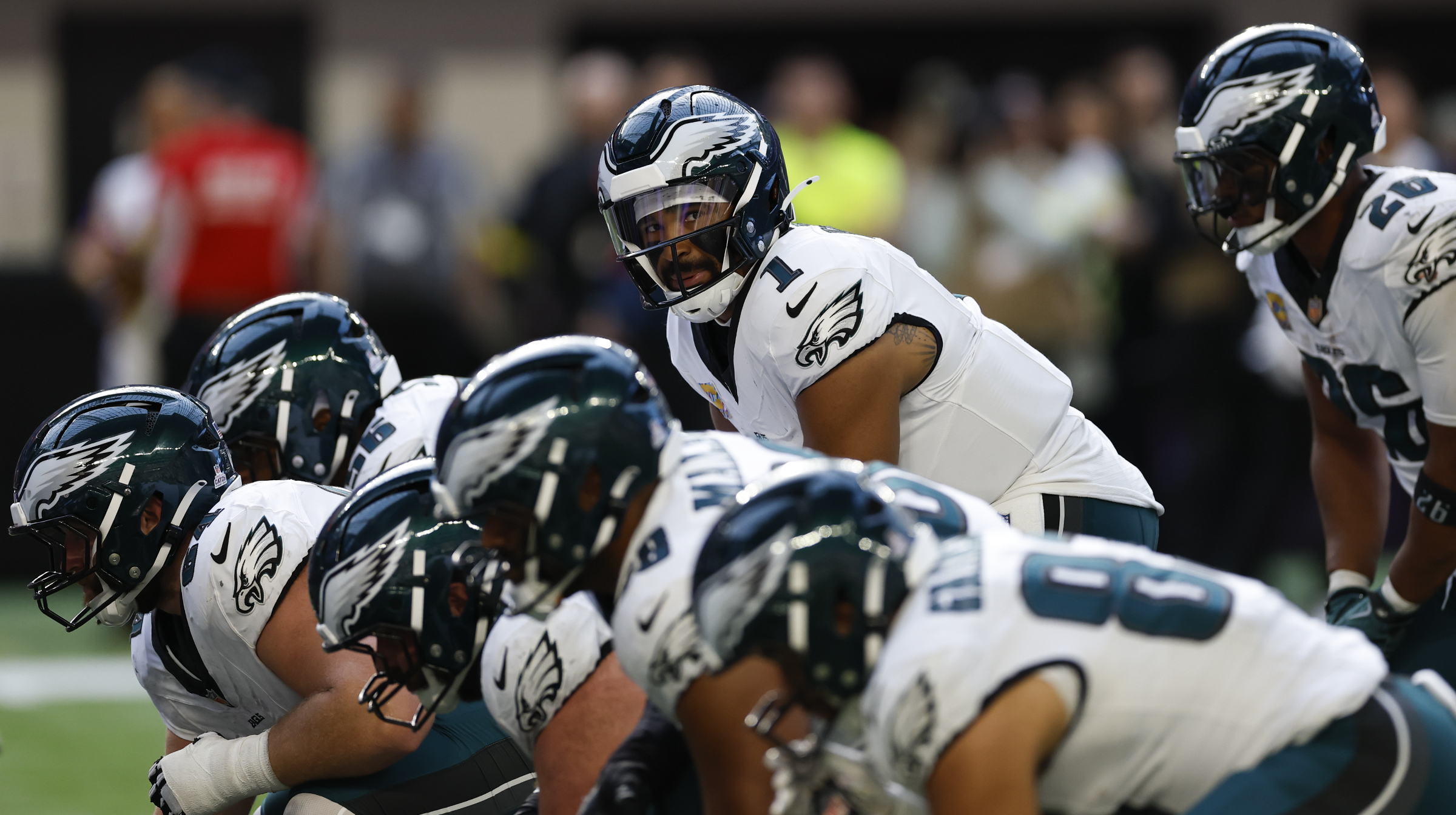
    Eagles quarterback Jalen Hurts thrived passing from under center against the Vikings in Week 7.

    More under-center play-action

    Of Hurts’ 326 passing yards against Minnesota, 121 of them came on play-action, under-center throws downfield. Entering that game, the Eagles averaged just 0.8 yards from under center, which ranked 30th in the NFL, according to Fantasy Points Data.

    Hurts completed all four of those pass attempts, including the 79-yard touchdown strike to Smith. The play-action also opened up the middle, allowing the Eagles offense to attack an area of the field it has often neglected.

    The Giants, according to Next Gen Stats, are giving up the eighth-highest total of passing yards on throws traveling 10 to 19 air yards, yielding 71.9 yards per game. Hurts has completed four of six passes in that range of the field in each of his last two games.

    There are also examples of the Giants defense giving up explosive plays off play-action passes from under center. New York yielded a 33-yard gain to CeeDee Lamb during a matchup with Dallas in Week 2, and surrendered an 87-yard touchdown connection from Spencer Rattler to Rashid Shaheed in Week 5 against New Orleans.

    In their Week 6 matchup, Hurts, who has typically thrived against man coverage in his career, completed just six of 12 passes against New York’s man looks on defense, according to Next Gen Stats. And he threw his lone interception of the season, which all but ended the game.

    Hurts’ early touchdown pass to Brown against Minnesota was proof of his improvement as a passer, making plays with his arm rather than taking off and scrambling. According to Next Gen Stats, Hurts had his first game with a positive expected points added (which measures team performance on a play-by-play basis) per drop back on scrambles without actually taking off and running.

    If Hurts can continue that trend, the Eagles should be in for another big passing day — the Giants are giving up the seventh-highest total of passing yards per game in the NFL (245.3) and the second-most passing yards on throws that travel 20 or more air yards (62.9), according to Next Gen Stats.

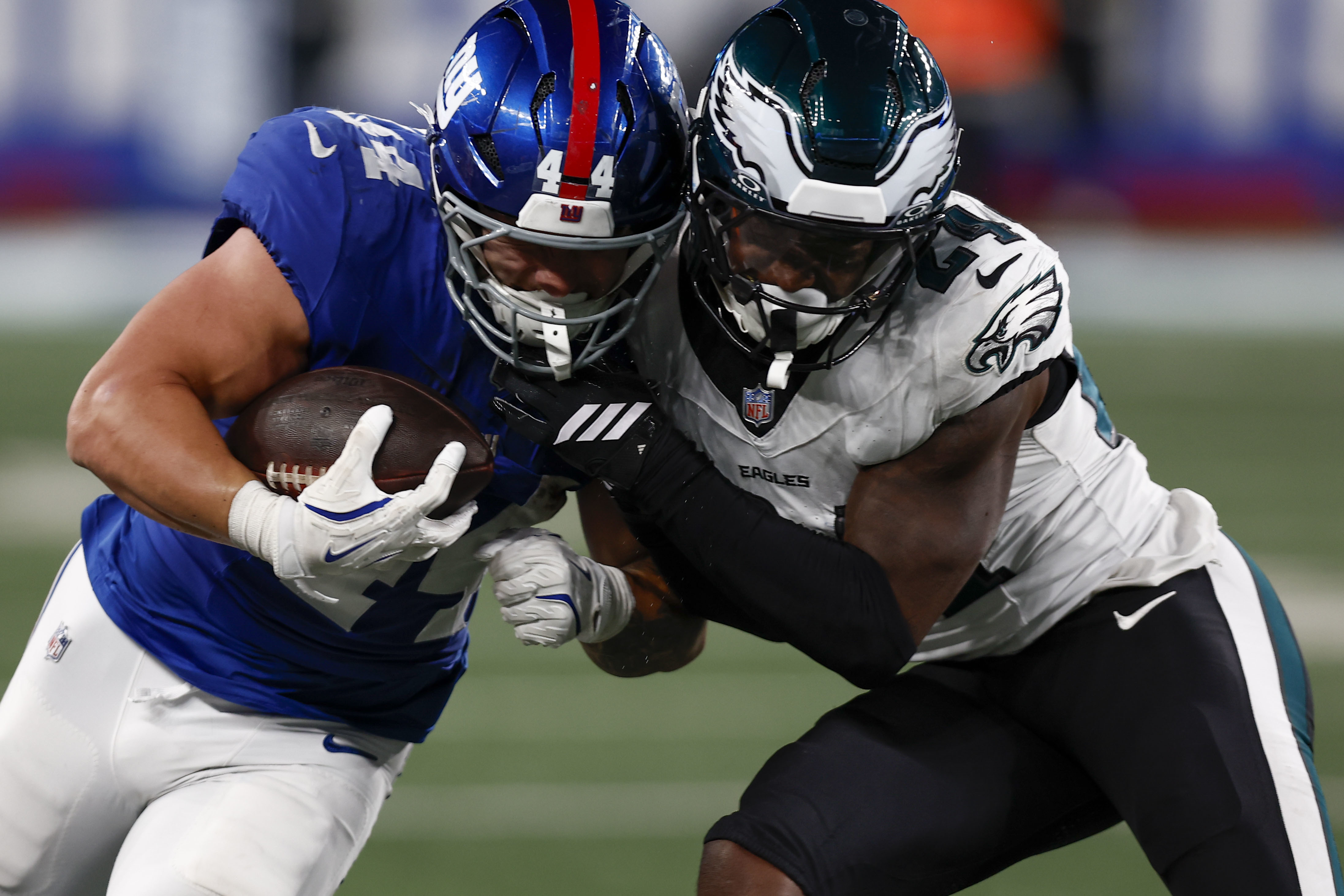
    Giants rookie running back Cam Skattebo rushed for 98 yards and three touchdowns against the Eagles in Week 6.

    Keeping Dart and Skattebo in check

    In Week 6, rookies Jaxson Dart and Cam Skattebo ran wild over the Eagles defense, which was without defensive tackle Jalen Carter and cornerback Quinyon Mitchell, who left the game with a hamstring strain. And the pairing hasn’t slowed down after accounting for 156 of the Giants’ 172 rushing yards in that game.

    Skattebo was a little more subdued against Denver, rushing for 60 yards on 3.1 yards per carry. But Dart continued to make plays downfield and on the move, hurting the Broncos defense with his arm. Dart is coming off his best passing day, throwing for 283 yards and three scores.

    His connection with wide receiver Wan’Dale Robinson continues to grow. When he escapes the pocket and extends plays, Dart has consistently found Robinson outside the numbers or over the middle of the field for big gains — first against the Eagles in Week 6, then Denver last week.

    Tight ends continue to be among Dart’s favorite targets. He threw two more to that position group Sunday in Denver, finding Daniel Bellinger (44 yards) and Theo Johnson (41 yards) for touchdowns.

    Of Dart’s seven touchdown passes, five have gone to tight ends, and Johnson has four of them. Because of the high tight end usage, the Giants could look to attack downfield and utilize double moves against the Eagles’ secondary to spring Johnson or Bellinger.

    Against Minnesota, a double move from Jordan Addison created a 32-yard completion between Mitchell and Drew Mukuba in zone coverage. The Giants completed a pass on similar action to Bellinger, albeit against man coverage.

    But the most important thing the Eagles need to do to prevent New York from taking shots downfield is to stop the run. The Birds defense has allowed 26 runs of 10 or more yards, tied for the seventh-most in the NFL, and it particularly struggles on outside runs.

    The Giants made the Eagles pay in their previous matchup, with three of the five rushes that went 10 yards or more coming from runs outside the tackles, according to Next Gen Stats. The running-back toss play to Skattebo has been effective over their last two games.

    Although his status for Sunday’s game is in question, defensive end Brandon Graham, now back with the Eagles, could provide a huge boost in the run defending department. Graham’s reps before his first triceps injury last season showed a promising trend of setting a firm edge and knifing through offensive lines.

    He would be a major boost to a run defense that ranks 22nd in the NFL in rushing yards allowed per game (127.9).

    Encouraging signs for Barkley

    For the last two games, Eagles opponents entered the game struggling to defend the run but were still able to hold Saquon Barkley to 58 and 44 total rushing yards. Looking beyond the numbers, though, tells a different story.

    The Eagles are trying to get Barkley out in space and last week’s game that featured under-center play-action passing showcased an evolved plan for the running game. After finding some success earlier in the season on Barkley pitch plays to the left side of the offensive line, the Eagles called four outside toss plays against the Vikings that yielded 14 yards. It also provided some new run scheme looks from under center that can be paired with play-action passes.

    Denver ran a similar play that popped a big gain against the Giants’ defense in Week 7, with J.K. Dobbins rumbling for a 32-yard gain. Expect the Eagles to keep the toss play as a run scheme option for Barkley on Sunday.

    In addition to the toss play, the Eagles have found success in getting Barkley some daylight on split-zone runs against the Giants and Vikings that created 18-, 8-, and 9-yard gains. The action allows a backside tight end (Dallas Goedert) or motioning receiver across the formation to keep a defensive end or edge rusher from crashing down the play for a loss.

    Barkley’s rushing numbers could be even worse if not for his elusiveness in the backfield. Twice last week he had to force someone to miss right after he got the handoff to turn a potential negative play into a positive one.

    With center Cam Jurgens’ status for Sunday in question, the Eagles must continue to find ways to give Barkley room to run. Mixing in variations of run schemes should help aid a potential breakout performance.

  • Grieving Roman Catholic coach and his family find solace in their football community

    Grieving Roman Catholic coach and his family find solace in their football community

    When Rick Prete returned from Iraq in 2009, he had just one focus: his family. Throughout his yearlong deployment as an infantryman in the Army, he could speak to his wife and daughter only sparingly over Skype.

    Once he was home in Audubon, Montgomery County, he tried to spend as much time with them as possible. He took on day-to-day tasks with glee, like doctor’s appointments and school drop-offs. Prete didn’t see these as mundane. To him, they were opportunities.

    “How can I be around my kid more?” he said. “That’s all I really cared about.”

    It was this mentality that brought Prete to youth cheerleading practice in Conshohocken in the summer of 2010. For four nights a week, he would sit and watch 6-year-old Arianna’s routines as the 15-and-under football team did drills nearby.

    Prete, a former wide receiver at Norristown High School and East Stroudsburg University, barely noticed that the players were there. But the Conshohocken Bears’ coaches noticed him, and quickly asked if he’d consider joining their staff.

    Prete declined at first. The veteran was battling depression, he said, and worked late nights as an emergency room technician. Any free time he had, he wanted to spend with Arianna and his wife, Gabriela.

    But after a few weeks, Prete warmed up to the idea. He would observe the team’s practices and suggest different defenses and coverages. Conshohocken added him as an assistant coach in August 2010, and he dove right in.

    Rick Prete has been the head football coach at Roman Catholic since 2019.

    Gabriela noticed that Rick was happier and more talkative at home. She’d catch him poring over film and scribbling plays on napkins and notepads. Instead of thinking about what he’d seen in Iraq, he was thinking about how to help his players.

    “I definitely saw a shift in him,” she said. “This was something that he loved, but he was also good at it. It was like an outlet.”

    Prete’s coaching career took off from there. He was hired as a wide receivers/defensive backs coach at Plymouth Whitemarsh High School in 2012, and joined Malvern Prep’s staff as the freshman head coach in 2015. He was named the school’s varsity wide receivers coach in 2016, and Imhotep Charter hired Prete to serve as offensive coordinator in 2017.

    In 2019, he became head coach of Roman Catholic High School’s football program, where he remains.

    Prete has always said that he wouldn’t have found his calling without Arianna. Now the sport is healing him in her absence.

    In the early morning of July 11, 2024, Arianna and a friend were riding in another friend’s Honda Odyssey when their vehicle collided with a tow truck at K Street and East Hunting Park Avenue in North Philadelphia.

    According to the Philadelphia Police Department, the truck driver was speeding and blew through a red light. The minivan entered the intersection just as the traffic signal was turning from yellow to red.

    Arianna was ejected forward from the backseat. She suffered severe injuries and was taken to Temple University Hospital, where she was pronounced dead less than an hour later.

    She was 19, and the only fatality from the crash.

    Court records show that the driver of the tow truck, Omar Morales, was charged with homicide by vehicle, involuntary manslaughter, and four related offenses.

    Charlie Payano, the friend driving the Odyssey, was charged with homicide by vehicle, involuntary manslaughter, and three related offenses.

    The trial is scheduled to start soon.

    Prete’s initial instinct was to quit football altogether. He barely had enough energy to get out of bed, let alone handle a group of teenagers.

    But Gabriela urged him to return to Roman Catholic. More than a year since the crash, he’s glad he did.

    “I don’t know if I’d be able to sit here right now, and go forward throughout a day,” Prete said, “if I didn’t have those kids.”

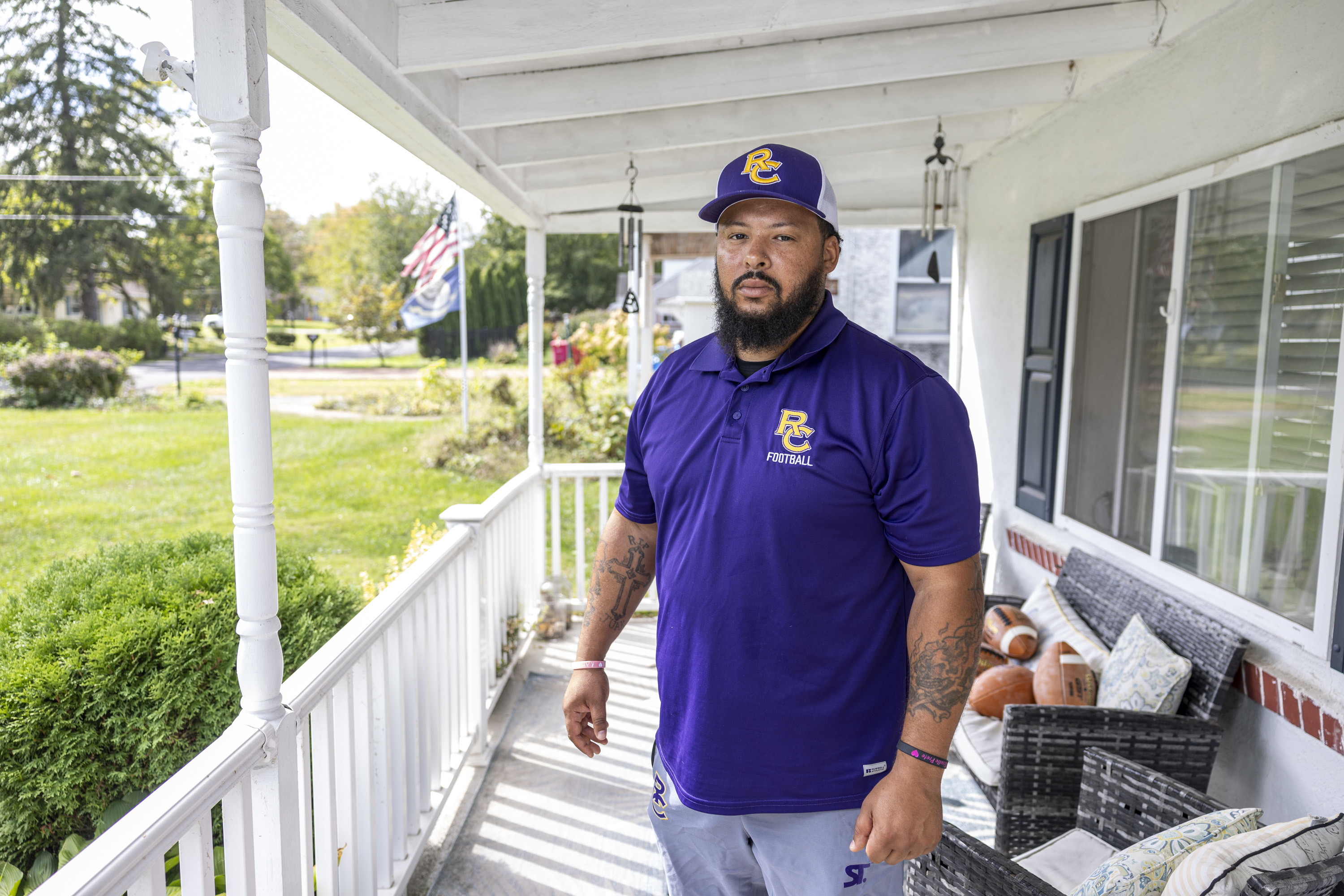
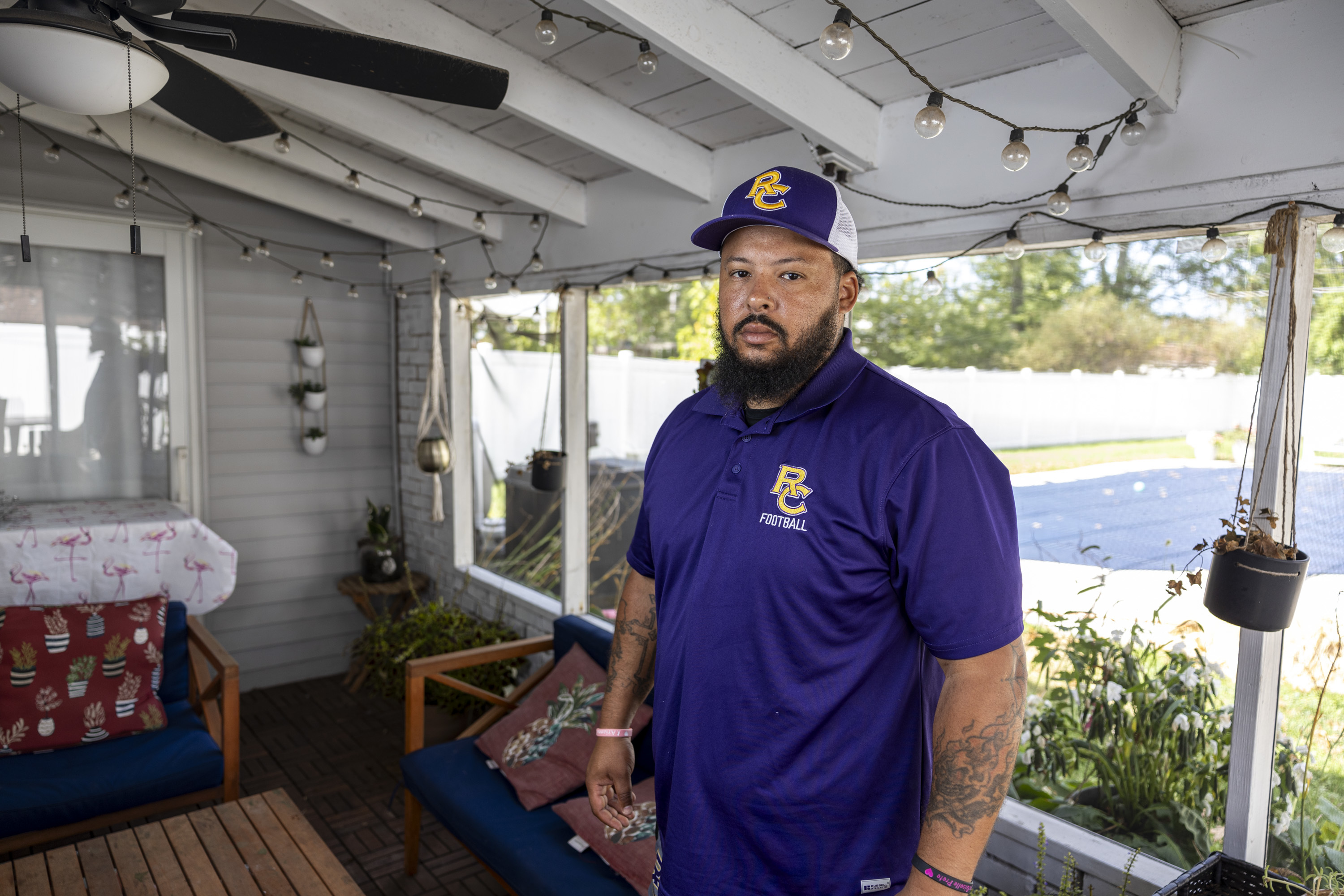
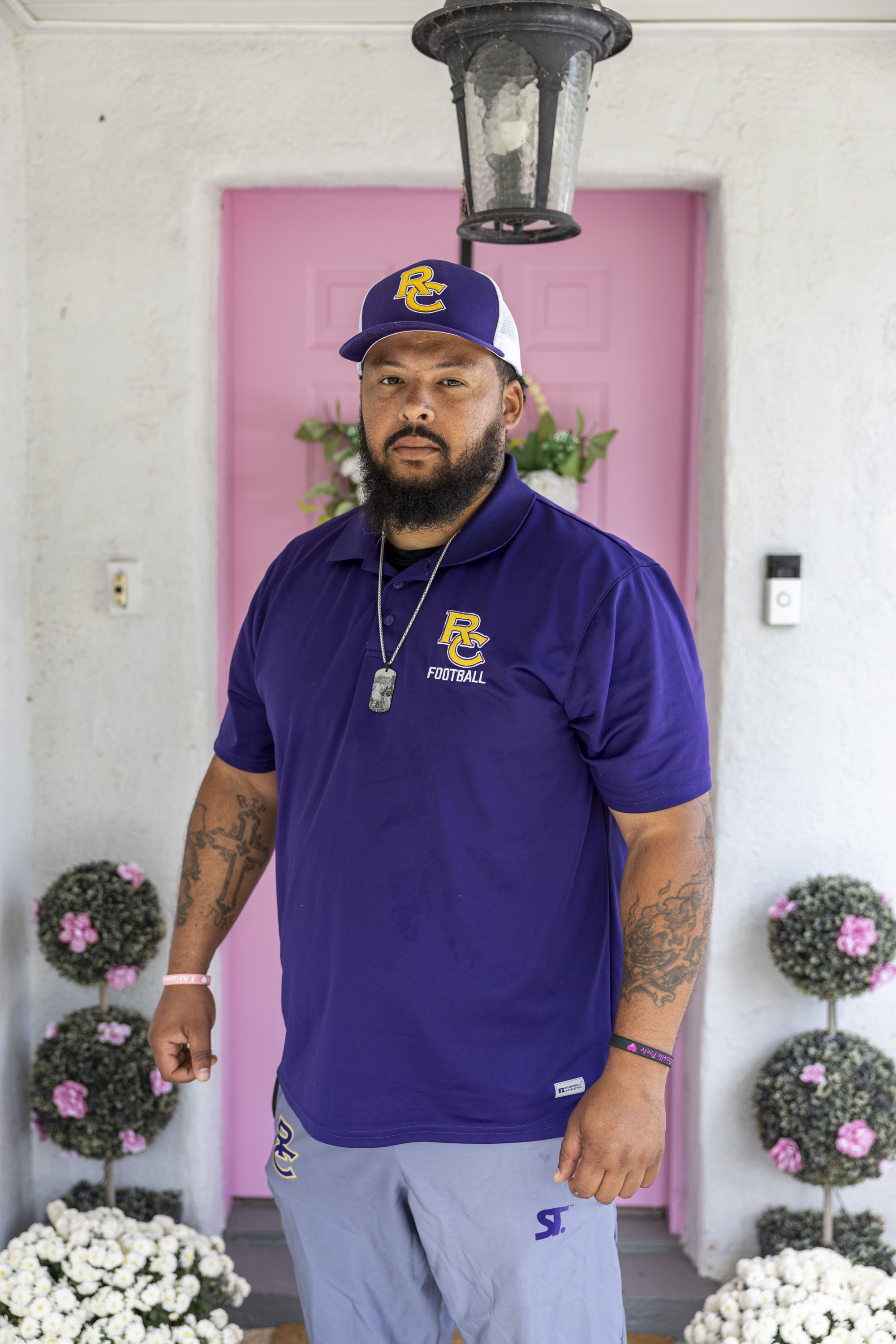
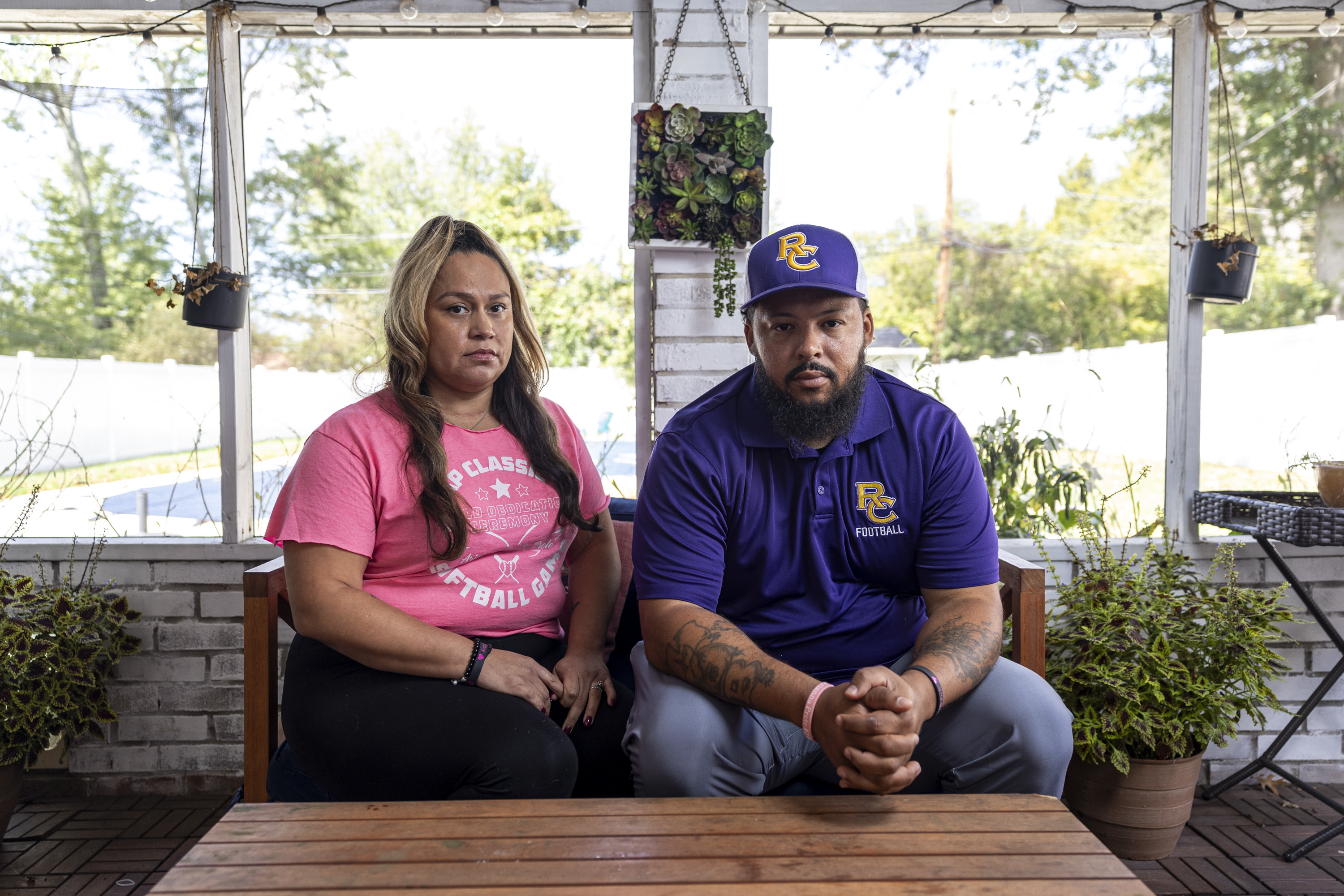
    Rick Prete at his home in Audubon, Montgomery County, on Oct. 2.

    A football and softball bond

    Arianna and Rick always connected over sports. She was a self-described “girly girl” who loved the color pink, romantic comedies, and Bruno Mars, but also a natural athlete like her father.

    She signed up for T-ball when she was 6 and switched over to travel softball not long after. Norristown Recreation didn’t have an under- 10 team at the time, so Arianna played with 10-, 11-, and 12-year-olds.

    Despite facing pitchers far older, she made contact regularly and quickly emerged as a hitter to watch. Rick, who played baseball in high school and college, began to train with her.

    Arianna would take 100 swings off the tee every day. Sometimes, her father would throw soft toss in the backyard. When she switched from third base to catcher at age 10, Rick started challenging her behind the plate.

    He’d spike softballs in the dirt, or pitch them high above, forcing his daughter to shift and block. By age 12, they were flipping tires and swinging sledgehammers in the driveway.

    “[Softball] was a huge part of our relationship,” he said. “That was my avenue to learn how to be her dad.”

    Arianna felt equally invested in Prete’s coaching career. When she was a student at Methacton High School, from 2019 to 2023, she would spend Friday nights with the football team at Roman Catholic.

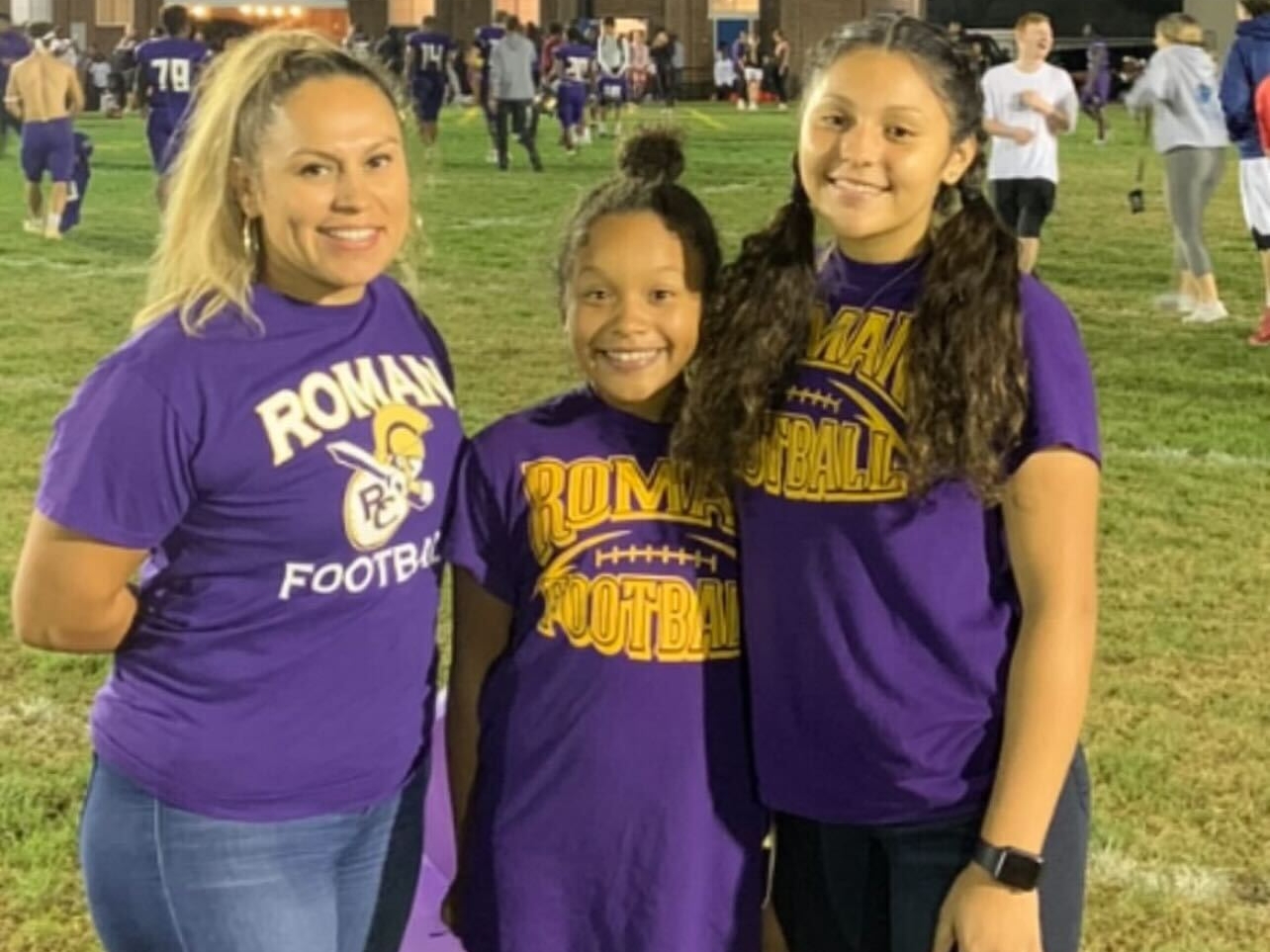
    Rick Prete’s wife, Gabriela, with daughters Nylah and Arianna at a Roman Catholic game.

    In the school’s 2019 season opener, on Aug. 24, the Cahillites found themselves down 26-0 in the first quarter to Pope John Paul II. By halftime, they’d narrowed their deficit to 11 points.

    The team kept chipping away, and with 1 minute, 30 seconds to go, quarterback Jayden Pope threw a 50-yard touchdown pass to earn Roman a 47-46 comeback win.

    Prete still has the film from that night. In the background, Arianna is on the sideline, sprinting toward wide receiver Malachi Harris, who made the game-winning catch.

    “You couldn’t tell that girl that she wasn’t an assistant coach,” Gabriela said. “She liked the energy. Running up and down the field with the other coaches. You would always find her there.”

    Prete’s teams went 10-28 over his first four seasons, but over time, he built a strong program. The Cahillites posted a 9-3 record in both 2022 and 2023.

    In 2023, in the District 12 Class 5A championship game, Roman Catholic lost to Imhotep Charter, the eventual state champion, by only 4 points.

    With more success came more commitment, so Prete would always check to make sure that Arianna and her younger sister, Nylah, were comfortable with him coaching. After a while, the question became redundant. The answer was always yes.

    “They’d both say, ‘No, you go coach,’” Prete said. “‘We want you to.’”

    Arianna graduated from Methacton in 2023. She enrolled at Montgomery County Community College in the fall of that year, and took a real estate course in the spring, but was unable to pass the state exam. She planned to return to Montco in September.

    The former softball player had always loved working with kids, so she thought about becoming a teacher. Or maybe going back to real estate school, to retake her test. But these possibilities, once filled with promise, came to an abrupt halt on July 11, 2024.

    Rick and Gabriela heard a knock at about 3:30 a.m. Two Lower Providence Township police officers were standing outside their door.

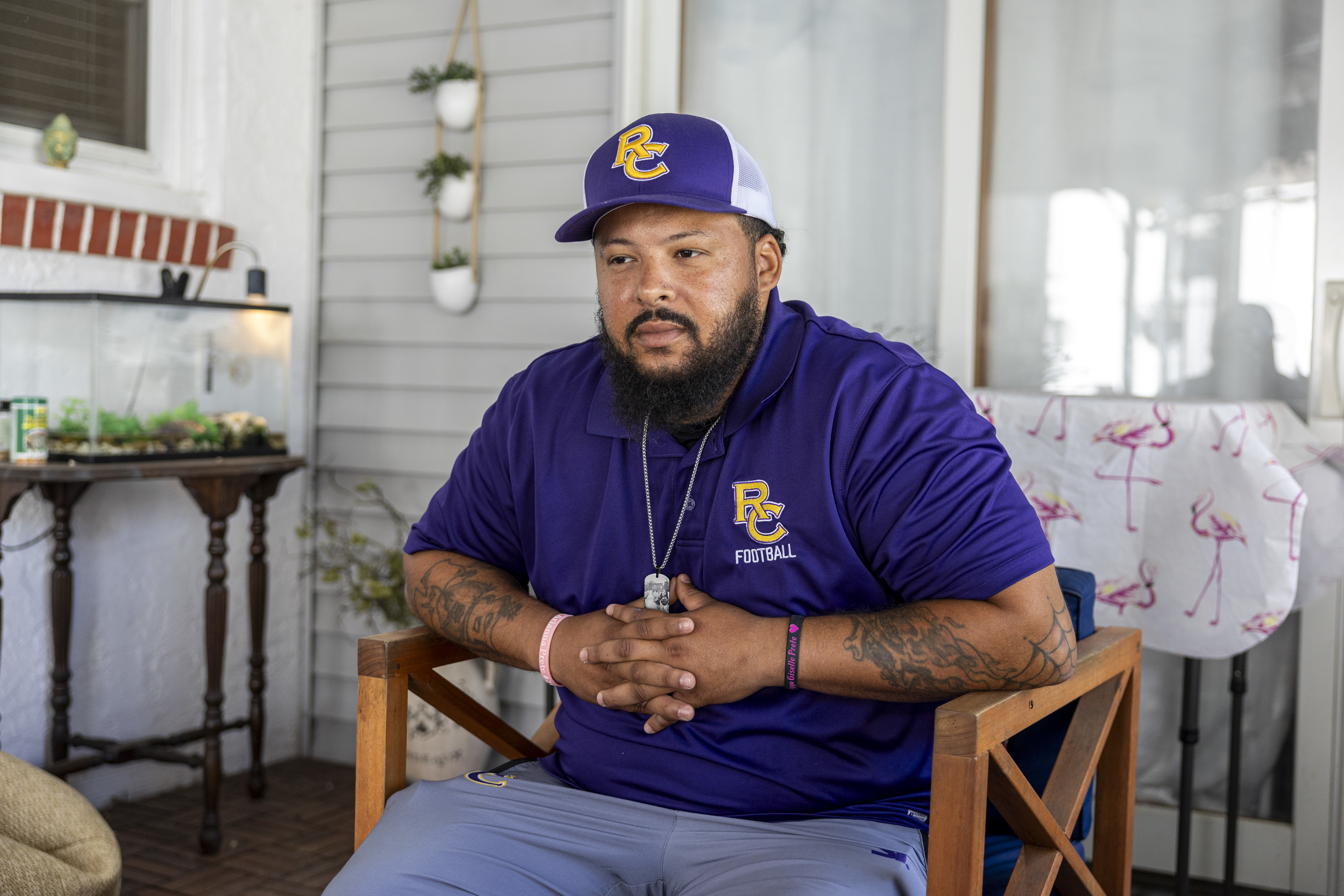
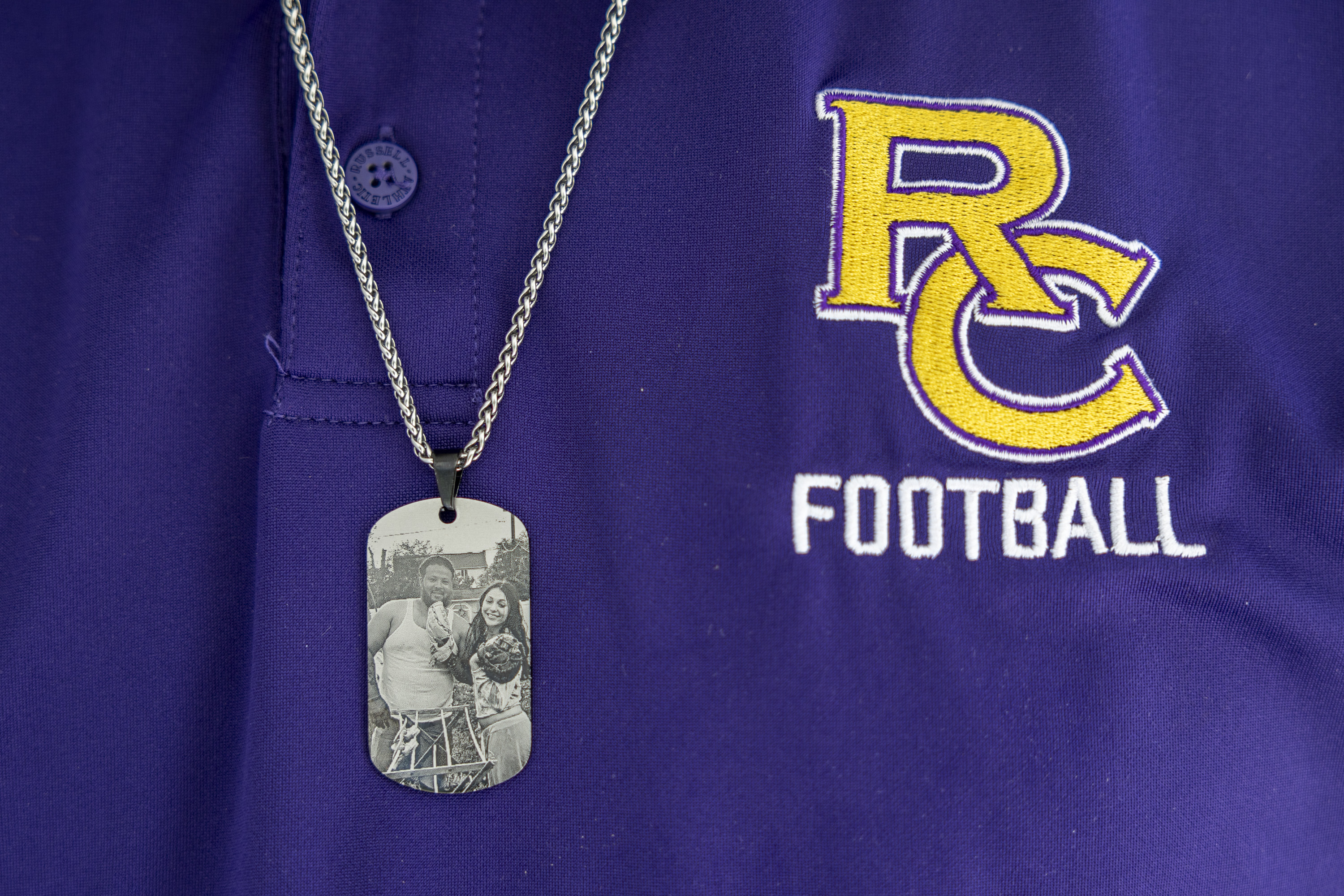
    Rick Prete wears a necklace with a photo of him and his daughter Arianna, who died in a 2024 car crash.

    They told the Pretes about the collision and instructed them to go to Temple University Hospital Jeanes Campus, in Fox Chase, to identify Arianna’s body.

    But once they arrived, their daughter wasn’t there.

    “It gives you a glimmer of hope,” Gabriela said. “Maybe they got this wrong.”

    In an email, Lower Providence Police Chief Michael Jackson said that the officers received their information from a victims’ advocate at Temple University Hospital.

    The parents finally reached Temple’s main hospital, on North Broad Street, at about 7 a.m., and realized that the victim was indeed their daughter.

    “Your body shuts down,” Rick said. “Your mind goes numb. It’s your worst nightmare being realized.”

    Rick Prete poses for a portrait at his home in Audubon, Montgomery County, on Oct. 2.

    ‘I feel your pain, Coach’

    The next few days were a blur. The Pretes called as many family members as they could. A steady stream of visitors came through the house to share condolences, with flowers and food in hand.

    Roman Catholic was scheduled to go to a three-day team camp at East Stroudsburg on the day of Arianna’s passing. But Prete was not in any shape to attend and arranged for offensive coordinator Marcus Hammond to take the team instead.

    Two days later, the Cahillites finished their visit and piled into two yellow school buses. The drivers were supposed to head back to campus, but the students had a different idea.

    The team went to the coach’s house in Audubon. More than 50 players gathered on his lawn, took a knee, and began to sing Roman Catholic’s fight song.

    Prete stood on his porch, buried his head in his hands, and cried.

    “Thank you,” he said. “Now, give me a … hug.”

    Gabriela ordered some pizzas. A few players pulled Rick aside to say a prayer. One student, 17-year-old quarterback Semaj Beals, shared that he’d lost his sister Dymond in 2014. She was 8, and died by suicide.

    “I feel your pain, Coach,” Beals said. “And if you need anything, if you need to talk to me, I’m here.”

    Prete hugged him tight.

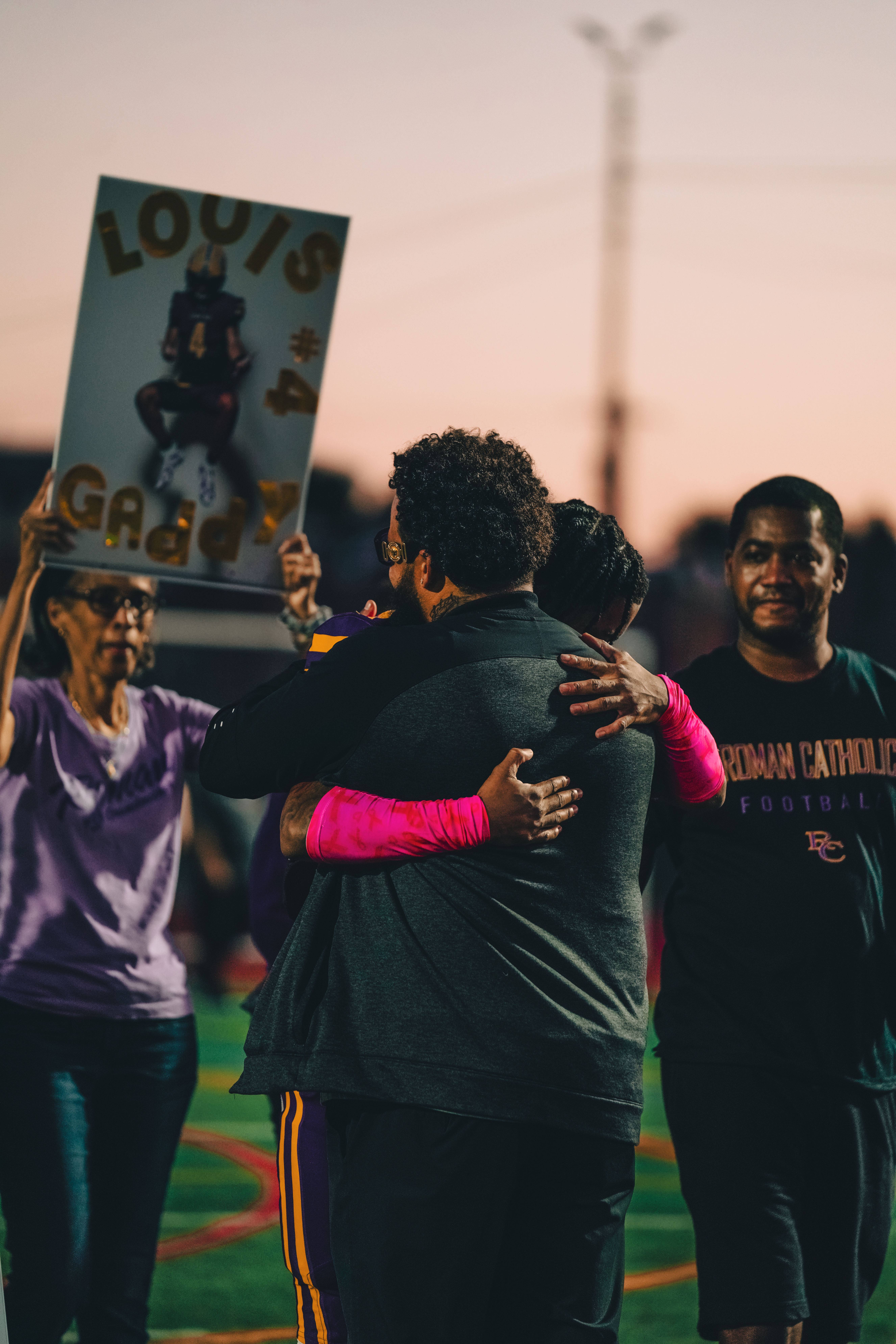
    Lou Gaddy hugs his coach, Rick Prete, at Roman Catholic’s senior day in 2024.

    “I know you do,” he replied.

    For many of the Cahillites, Prete has been like a second father. He’d lend them food and gas money. If they lived far away from the school, at Broad and Vine, he’d arrange for alternate transportation.

    The coach would regularly check on his players’ mental health and always made sure their grades weren’t slipping. There were conversations about schemes and formations, but also about how to treat a young woman, how to plan for their future, and how to handle a difficult situation at home.

    Lou Gaddy, a Roman Catholic graduate who is now a freshman safety at Stony Brook University, is the first person in his family to go to college. He received a full scholarship.

    Gaddy grew up in Burlington County in South Jersey and is unsure if he would have made it if he hadn’t played for Roman Catholic.

    “Who knows if I’d develop the way I did,” he said. “The [Philadelphia Catholic League] is a much stronger conference than where I live. It’s way more work. It requires more out of you. Long days, late nights.

    “But Coach Prete definitely knew what he was doing. He’s sent countless amounts of kids to college. Countless.”

    Because of this connection, the players felt Arianna’s death on a deeper level. Some saw Prete, overwhelmed by grief, and felt as if they were watching their own parent cry for the first time.

    Their coach was the one who fixed problems for them. Now, he was distraught. He struggled to focus. His attention to detail wasn’t the same.

    Prete was reluctant to return to Roman Catholic. He struggled to just get through a day. But Gabriela insisted he go back. The couple had already been robbed of their daughter. She didn’t want him to lose his career, too.

    He rejoined his team in August 2024. It was a challenging adjustment. There were days when players asked if Prete was OK, only to hear him say, “No.” The coach began wearing sunglasses during games and practices, day and night, because he couldn’t hold back his tears.

    Rick Prete was reluctant to return to Roman Catholic after his daughter died in a car crash last summer. Now, it’s helping him heal.

    Prete was in charge of the defense, but at times, he struggled to call plays. So, his players would call them for him.

    “They’d bail me out,” Prete said. “Lou [Gaddy] would literally line the defense up. And he would just make sure the defense had the plays that they needed. And he’d do it right.

    “All of the kids did that, because they knew that I’d be gone sometimes.”

    Gaddy would also make sure that his teammates understood the playbook and handled any adjustments that needed to be made on defense. Beals compared him to a “coach on the field.”

    “It was just to take the stress off,” Gaddy said. “Semaj made sure the offense was in check. And that’s kind of how I was with the defense. Making sure people were attacking the field the right way.”

    Players who previously sat out practices became regular participants. They were more efficient in their workouts and pushed themselves harder than before.

    The team discovered a greater purpose beyond competing for district titles or a state championship. The season was no longer about them. It was about their coach.

    “Sometimes, when things happen like that, a head coach will step away,” Beals said. “But Coach Prete was there the whole way. So, we just felt like that was special. We needed to do something for him.”

    Roman began to win — a lot. The Cahillites didn’t lose until Week 5 when the team played DeMatha, a high school powerhouse out of Hyattsville, Md.

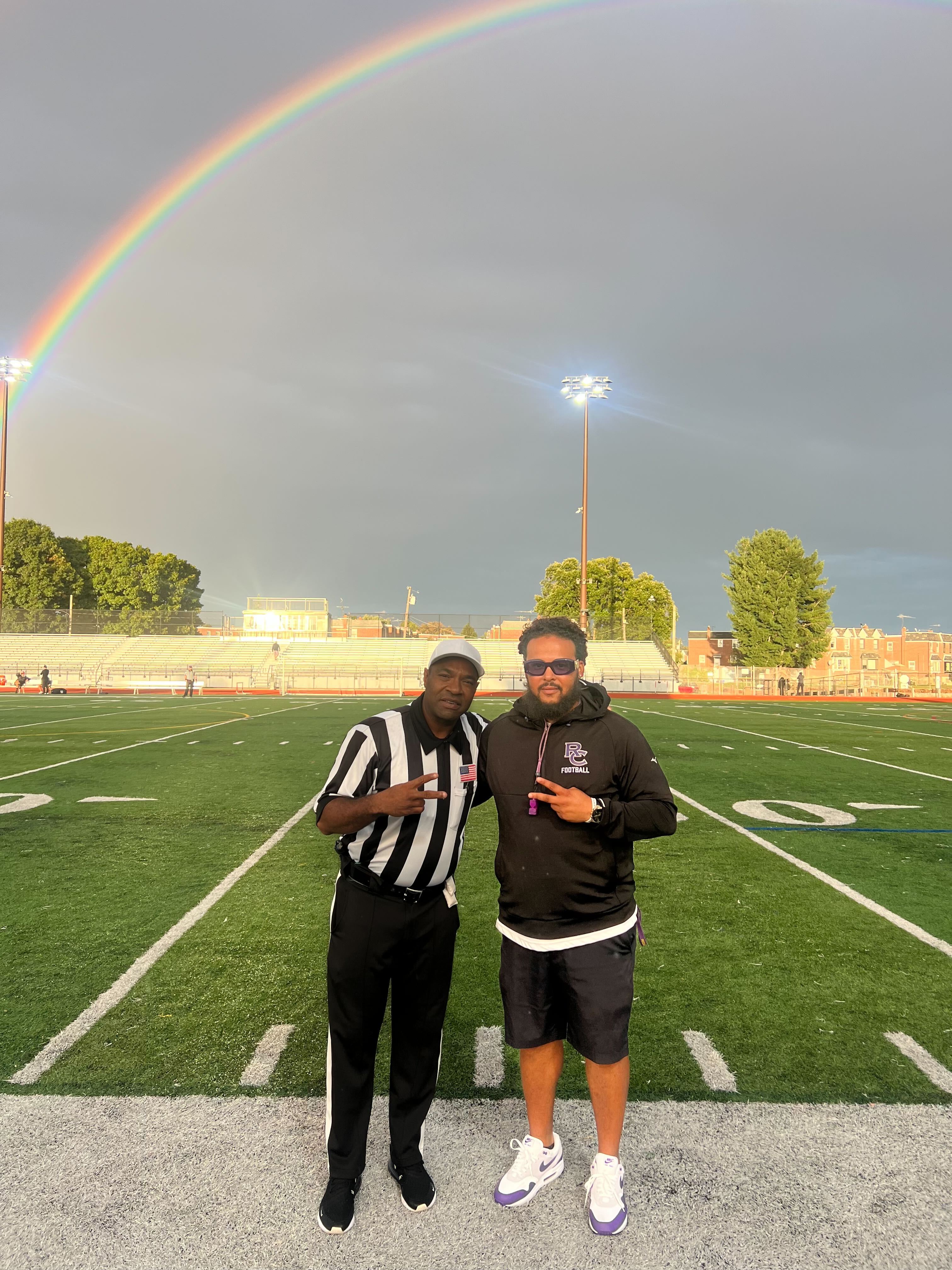
    Rick Prete (right) with a referee who approached him before a game in 2024. The referee had also lost a child, and expressed his condolences, when a rainbow appeared over both of them.

    The games were competitive, but with soulful moments of humanity throughout. Opposing coaches would give Prete prayer cards when they shook hands. In September 2024, before Roman Catholic played A.P. Randolph Campus High School in New York, a referee walked up to him.

    He told Prete that he’d also lost a child. As they talked, a rainbow appeared over the field. To Rick and Gabriela, the 2024 campaign was full of moments like these. Moments that felt as if their daughter was with them.

    It could be as subtle as a seeing a butterfly on the field. Or hearing a song on the way to a game. Or noticing that the players had written “LLA” — Long Live Arianna — on their helmets, compression sleeves, and wristbands.

    An already special season reached a new height in December, when Roman Catholic advanced to the state championship for the first time in school history. With an 11-4 record, the Cahillites had plowed through the district playoffs to face Bishop McDevitt of Harrisburg in the final.

    On a brisk night in central Pennsylvania, Roman Catholic rallied from a 21-3 deficit to tie the score at 31 and push the game into overtime. The Cahillites fell just short of a championship, losing to McDevitt on a field goal, but Prete was filled with pride.

    “I don’t want to say it was magical,” he said, “but that team became so close. And it really felt like my kid was right there. Like my kid was literally right next to me.”

    Rick and Gabriela Prete at their home in Audubon, Montgomery County, on Oct. 2.

    Coaching with purpose

    The Prete house is quiet now. Arianna’s laugh is no longer ringing through the halls. Her parents don’t hear her feet stomping along the floor upstairs, or her shrill voice singing to Bruno Mars.

    Gabriela thinks about her daughter constantly. Sometimes, when Rick is sitting in his living room chair, late at night, he looks toward the door, expecting Arianna to open it.

    There are little signs of normalcy. Last year, Gabriela started seeing Rick’s trail of football plays again. He would leave them all over the house, on napkins and notepads, just like he did before his daughter’s passing.

    Football won’t bring her back. It won’t diminish the family’s grief. But Roman Catholic gives them a community. It gives Gabriela and Nylah a place to be on Friday nights.

    It gives Rick a task; three or four hours that aren’t spent asking questions he can’t answer. A task that fills him with purpose.

    “I didn’t know how much energy I have left to give anybody,” Prete said. “But [the players] help get me out of bed. They put things in perspective. That we still have a family, that our family still does have a future.

    “That we need to pour into what’s here, and to be present, for Arianna. We can’t live in a standstill. And seeing people accomplish their goals. … It’s always been something we’ve wanted, but now that is what it’s all about. You know?”

  • Jalen Carter, Landon Dickerson, Nakobe Dean among five reasons Eagles will win the rematch vs. Giants

    Jalen Carter, Landon Dickerson, Nakobe Dean among five reasons Eagles will win the rematch vs. Giants

    Nobody saw it coming. Not even the Giants.

    “Quite honestly, nobody really expected us to put up a performance like this,” Giants quarterback Jaxson Dart said afterward.

    Maybe we should have.

    One of the more shocking upsets in recent Eagles history happened at MetLife Stadium on Oct. 9, when the 1-4 Giants got their second win over the 4-1 Eagles, who were defending Super Bowl champions and the winners of the last seven truly meaningful games against their closest NFC East rivals.

    Should it have been so shocking?

    After all, the Giants’ losses came at the Commanders, who had the services of since-injured quarterback Jayden Daniels; at the Cowboys, who have the No. 1 offense; at home against the Chiefs, a current dynasty; and at the Saints, where Dart, in his second start, committed three of the Giants’ five turnovers.

    Further, the Eagles played without two Pro Bowl players, defensive tackle Jalen Carter and guard Landon Dickerson, and they lost top cornerback Quinyon Mitchell in the second quarter.

    So, maybe the Giants weren’t so bad, and, clearly, the Eagles weren’t as deep as they needed to be.

    A lot has changed in two weeks. That should make all the difference come Sunday afternoon.

    1. Dickerson is healthy

    Dickerson was the seventh-best guard in the league last season, according to Pro Football Focus, when he was named to his third straight Pro Bowl and played in his second Super Bowl in three seasons. He has dealt with knee surgery that cost him most of training camp, a back injury that limited him in September, and an ankle injury that cost him the Giants game. He’s still ranked in the middle of the pack.

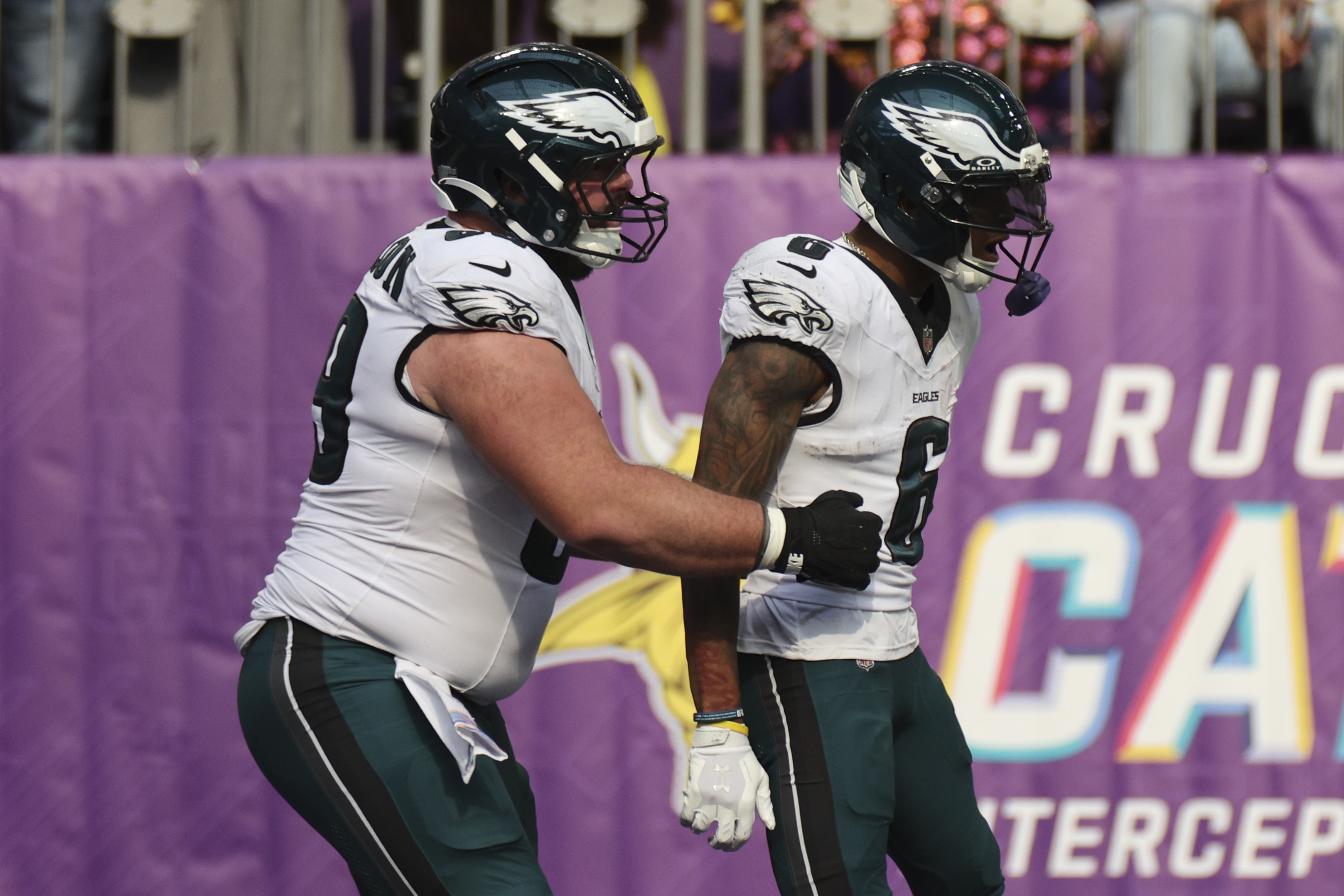
    Eagles guard Landon Dickerson celebrates with wide receiver Devonta Smith after Smith’s touchdown in Minnesota on Sunday.

    Dickerson was his healthiest this season last Sunday in Minneapolis, and the resulting grade showed it. Even with fifth-year backup Brett Toth playing at center for the first time next to him, Dickerson dominated.

    Toth was Dickerson’s replacement in the loss to the Giants. Things did not go well.

    2. Carter is healthy

    The Eagles built their defense around Carter, who has succeeded Fletcher Cox as the franchise’s core defensive player. Carter’s injured heel cost him the game against the Giants, but the 10 days between the Giants game and the trip to Minnesota not only gave the heel time to heal (heh heh), it also allowed his sprained right shoulder to strengthen.

    The shoulder cost him time in training camp and, intermittently, during the regular season. It also made him a horrific tackler: the worst, in fact, among all NFL defenders, according to PFF.

    Also, he’s finally in good enough shape to be effective for more than half an NFL game. Of course, there’s no viable reason he should not have been in better shape to start the season.

    You don’t run on your shoulder.

    3. Jalen Hurts found his rhythm

    In Minnesota, Hurts and his top three receivers, A.J. Brown, DeVonta Smith, and Dallas Goedert, finally appeared to be in sync. Hurts threw for 326 yards and had a perfect 158.3 passer rating for the first time in his career.

    Much had been made about the ineffectiveness of the passing game through the first six games, but, as we warned when the season began, injuries to Brown and Smith kept the passing attack from practicing as a complete unit the entire preseason, which is why the preseason (and preseason games) exist. Hurts is always gun-shy. He’s much more gun-shy when he’s not comfortable. Last Sunday, for the first time, he looked comfortable.

    Also, the team changed offensive coordinators for the third consecutive season.

    Also, the offensive line has played just one of seven games from start to finish with its starters intact, and that’s why the Eagles won at Kansas City.

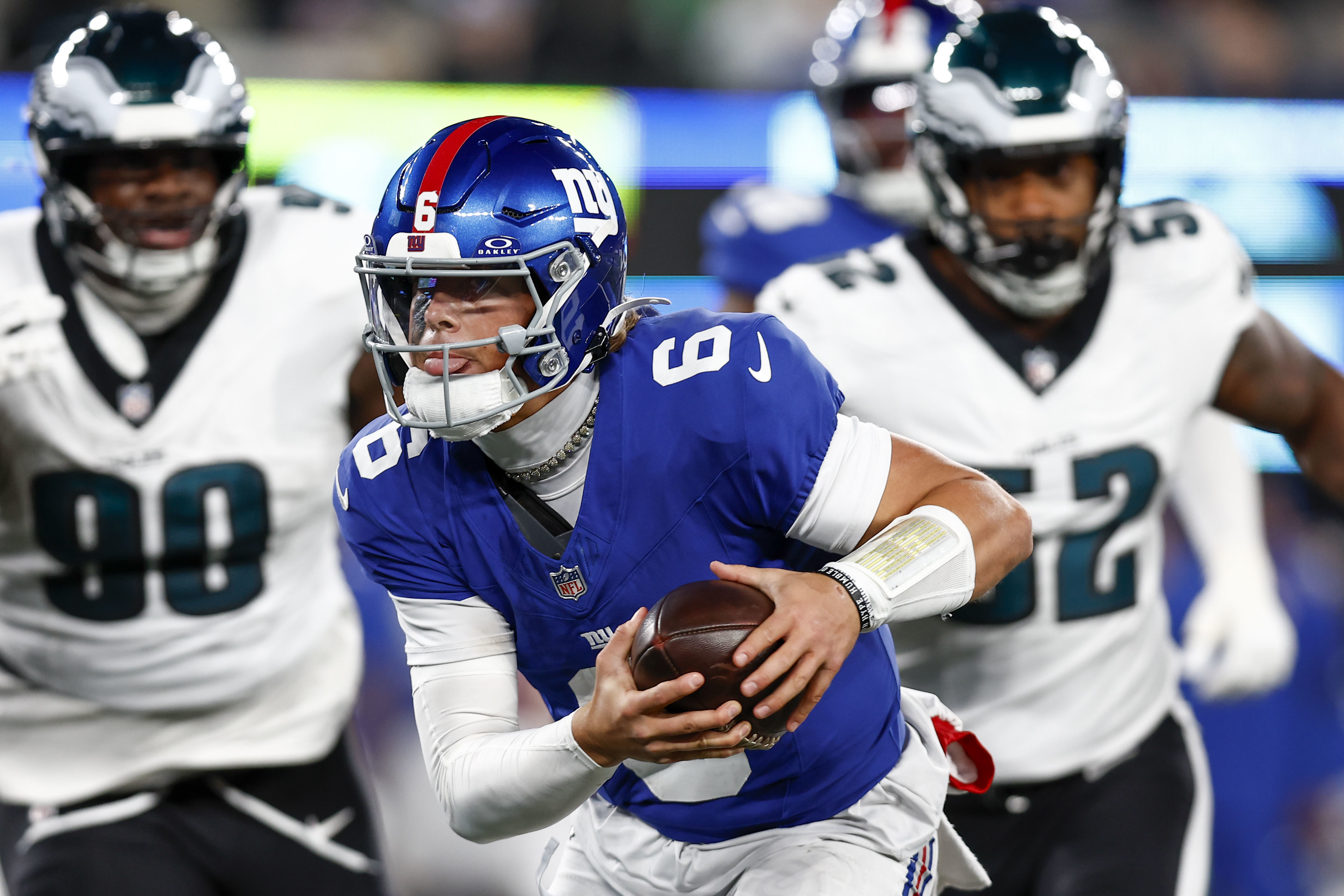
    New York Giants quarterback Jaxson Dart scrambles during an Oct. 9 matchup with the Eagles.

    4. Familiarity

    There’s a little more tape on Dart, whose elusiveness and fearlessness are a formidable combination. Combine that with unpredictability, and you get a kid who will make a lot of plays but will also make a lot of mistakes.

    A lot of the tape on Dart shows Eagles defenders getting roasted.

    Don’t expect much more of that sort of tape from Sunday’s game.

    5. Return of the Macks

    Nobody commanded more respect in the Eagles locker room last season than 15-year veteran defensive end Brandon Graham. His return from retirement Tuesday will resound whether or not he takes a snap on Sunday.

    A close second: third-year linebacker Nakobe Dean. Before he injured his pectoral muscle in the playoffs last season, he ranked 10th among all linebackers in overall defense, seventh as a pass rusher, according to PFF, and his impact as a tackler in his return Sunday was dynamic: He had six tackles, three solos, and a tackle for loss … on just 23% of the defensive snaps.