Tag: UniversalPremium

  • Penn Medicine is investing more than $500 million in new cancer facilities

    Penn Medicine is investing more than $500 million in new cancer facilities

    The University of Pennsylvania Health System, the Philadelphia region’s biggest provider of cancer care and a national leader in developing new treatments, is spending more than $500 million on two new cancer facilities in Philadelphia and central New Jersey to keep growing.

    Those big projects — a fourth proton center at Presbyterian Medical Center in University City and a large cancer center at Princeton Medical Center in Plainsboro — follow years of expansion through outpatient centers in communities like Cherry Hill and Radnor. Its newest is a relocated, $18.5 million infusion center in Yardley that opened in June.

    “What we’ve seen pretty consistently is that demand is there to meet any capacity increases,” Julia Puchtler, the health system’s chief financial officer, said in an interview about fiscal 2025 financial results.

    Penn is not alone in its push to expand cancer services. Jefferson’s Sidney Kimmel Cancer Center, Temple’s Fox Chase Cancer Center, and the MD Anderson Cancer Center at Cooper are pushing into the suburbs to reach more patients.

    The same thing is happening nationally as financially pressured health systems are looking for ways to increase revenue in a growing and lucrative market for cancer care.

    Penn stands out locally for the scale of its investment in a strategy to deliver cancer care seamlessly across its seven hospitals and a growing network of outpatient clinics, with the expectation that patients will keep coming back for their ongoing health needs.

    Penn sees an opportunity to expand its market share even more, as cancer diagnoses rise. The U.S. is expected to see a nearly 40% increase in cancer diagnoses between 2025 and 2050, according to the Philadelphia-based American Association of Cancer Research.

    Experts attribute the rise to a wide variety of factors, from better early detection, to longer life spans, and to environmental exposures that are poorly understood.

    Much of Penn’s investment is in outpatient facilities, including a $270 million center being built in Montgomeryville that will have radiation oncology and an infusion center. “More and more patients want to receive care closer to home,” according to Lisa Martin, a senior vice president at Moody’s Rating. “All of that is really what’s behind all of this investment.”

    Cancer treatment overall is profitable. At Penn, cancer services account for up to 60% of the system’s operating margin by one simple measure that subtracts direct costs from direct revenue and excludes back-office expenses and other centralized costs.

    Puchtler attributed the profitability of cancer care to the prevalence of drugs, such as chemotherapy, that Penn can buy at a discount, while getting the full price from insurers, and the higher percentage of younger cancer patients with better-paying private insurance than is typical for many healthcare services.

    The expansion efforts are expensive in an industry where the consumers both benefit from advances and pay ever-rising healthcare costs. Proton therapy, in particular, costs more, but has not yet been proven to have better outcomes across a wide range of cancers.

    The intensifying competitive landscape

    Penn treats about one-third of adults with cancer in its market area, which stretches from central New Jersey to the Susquehanna, according to Robert Vonderheide, who is director of Penn’s Abramson Cancer Center and leads all of Penn’s efforts in oncology treatment and research.

    Penn counted 47,053 new cancer patients in the 12 months that ended June 30, up 40% from five years ago, according to Penn. The system has 14 locations where patients can receive chemotherapy and even more radiation oncology sites.

    Competitors are also trying to expand their reach, and Temple’s Fox Chase Cancer Center is succeeding.

    window.addEventListener(“message”,function(a){if(void 0!==a.data[“datawrapper-height”]){var e=document.querySelectorAll(“iframe”);for(var t in a.data[“datawrapper-height”])for(var r,i=0;r=e[i];i++)if(r.contentWindow===a.source){var d=a.data[“datawrapper-height”][t]+”px”;r.style.height=d}}});

    Fox Chase had 21,442 new patients in fiscal 2025, up 148% from 2020, the nonprofit said. Fox Chase has added suburban offices in Voorhees and Buckingham, Bucks County, and is expanding its infusion capacity at its main campus on Cottman Avenue. Fox Chase has a significantly smaller footprint than Penn, with six locations for infusions and four for radiation.

    The MD Anderson Cancer Center at Cooper said it had 4,326 new patients last year, up 27% over the last five years. Cooper has taken the MD Anderson Cancer Center brand to the former Cape Regional Medical Center, which it acquired last year and which used to be part of the Penn Cancer Network. Cooper also offers cancer services at its new Moorestown location.

    Jefferson Health’s Sidney Kimmel Cancer Center did not respond to requests for patient data, but has in recent years opened cancer center locations at its Torresdale and Bucks County Hospitals. Jefferson’s cancer center also attained the highest designation from the National Cancer Institute last year — the Philadelphia region’s third comprehensive cancer center, matching Penn and Fox Chase.

    Virtua Health, Penn’s partner in a proton therapy center in Voorhees, is exploring a merger with ChristianaCare, which has already been expanding from its Delaware base into Chester and Delaware Counties. Another South Jersey system, AtlantiCare, has signed a contract with the Cleveland Clinic to boost its competitiveness in cancer care.

    How Penn is trying to build a ‘cancer system’

    Lancaster County resident Susan Reese, 56, said she experienced smooth cooperation between her doctor at Penn’s Lancaster General Hospital and the team at HUP during her treatment for non-Hodgkin lymphoma.

    “I never had any question in my mind that one doctor didn’t know what the other doctor was doing,” said Reese, who received CAR-T therapy at HUP in September 2022. Penn has since started offering CAR-T at Lancaster General.

    After she relapsed in early 2023, she came back to HUP for a stem cell transplant. She could have gone to Penn State Health’s Hershey Medical Center for that. It’s significantly closer to her home in Willow Street, but she wanted to stay within the Penn system.

    Reese’s experience of integration of services at HUP and Lancaster General is what Penn is aiming for in a territory that stretches from central New Jersey to central Pennsylvania.

    Oncologist Robert Vonderheide, director of Penn Medicine’s Abramson Cancer Center, oversees all Penn’s cancer services and research.

    Electronic medical records help with the integration needed to ensure the thousands of cancer patients Penn physicians treat annually get the most advanced care possible, according to Vonderheide, whose research focuses on cellular immunotherapies.

    “We treat patients’ cancers now in a very precise way; the precise mutation, the precise type of chemotherapy, the precise dose” are the focus for doctors, Vonderheide said. “This is no longer appropriate for the telephone game. This has to be data-driven.”

    Reese’s decision to stay within Penn is part of a broader trend of patients tending to receive all their care within one health system, according to Rick Gundling, a healthcare expert at the Healthcare Financial Management Association in Washington, D.C.

    That’s particularly important in oncology, which typically involves multiple specialties, such as medical oncology, radiation oncology, and surgical oncology, he said.

    “Seamless coordination across all those disciplines really makes it a better patient experience and clinical experience because it reduces delay, improves access,” Gundling said.

    Taking advanced treatments from HUP to the network

    Part of Penn’s strategy is to begin offering advanced services at locations beyond HUP. That’s where Penn pioneered CAR-T cell therapy, which harnesses the immune system to attack cancer, and for years that was the only place Penn offered it.

    HUP still performed the bulk of the CAR-T treatments for blood cancers, 123 inpatient cases and 14 outpatient cases last year, but now CAR-T is also available at Lancaster General and at Penn’s Pennsylvania Hospital in Center City.

    Fox Chase was the next biggest center in the region for the relatively new treatment that Penn scientist Carl June and his research teams helped develop. For the fiscal year that ended June 30, 2025, Fox Chase had 21 inpatient cases and 67 outpatient cases, the center said.

    In the Penn system, certain kinds of bone marrow transplants also used to be available only at HUP. “Now we do them at HUP and Pennsylvania Hospital,” Vonderheide said.

    Even the most complicated pancreatic surgeries are going to be done at Princeton, in conjunction with experts at HUP, Vonderheide said. Penn held a ceremonial groundbreaking Monday for the hospital’s $295 million cancer center.

    Remaining only at HUP are bone marrow transplants that use another person’s cells to treat blood cancers, Vonderheide said. HUP performed 118 of those so-called allogeneic bone marrow transplants on the top floor of its $1.6 billion patient pavilion, now known as the Clifton Center.

    Pennsylvania’s next-biggest provider of the treatment was Hershey Medical Center, near Harrisburg, with 71, according to state data.

    window.addEventListener(“message”,function(a){if(void 0!==a.data[“datawrapper-height”]){var e=document.querySelectorAll(“iframe”);for(var t in a.data[“datawrapper-height”])for(var r,i=0;r=e[i];i++)if(r.contentWindow===a.source){var d=a.data[“datawrapper-height”][t]+”px”;r.style.height=d}}});

    Penn started offering proton therapy at HUP in 2010, and expanded its availability in the last three years to Lancaster General and Voorhees, through a joint venture with Virtua Health. Those two centers only have one proton machine each, compared to five at HUP.

    It’s a type of radiation that is designed to precisely target tumors and do less damage to surrounding tissues. That makes the treatment, which costs more, particularly helpful for children, and it is proving beneficial for treating certain neck and throat cancers. The use of proton therapy for the more common prostate cancer has been more controversial.

    Penn’s fourth proton center, with two machines, is under construction and is expected to open at Presbyterian in late 2027. When that $224 million center opens, Penn will have more proton treatment rooms than the entire West Coast, said Jim Metz, chair of radiation oncology at Penn.

    Currently about 10% of Penn’s roughly 10,000 annual radiation oncology patients are treated with protons, though it’s a higher percentage at locations with proton machines, Penn said.

    Penn officials have noted that some cancer patients come to Penn for proton therapy. Even when it’s not appropriate for them, they tend to stay within Penn. “We have seen, when we build protons, our market share increases, ” Metz said.

    Editor’s note: This article has been updated with more recent Fox Chase data.

  • Eagles grades: Jalen Hurts a perfect passer, DeVonta Smith and A.J. Brown soar in victory against Vikings

    Eagles grades: Jalen Hurts a perfect passer, DeVonta Smith and A.J. Brown soar in victory against Vikings

    MINNEAPOLIS, Minn. — Instant grades on the Eagles’ performance in their 28-22 win over the Vikings:

    Quarterback: A

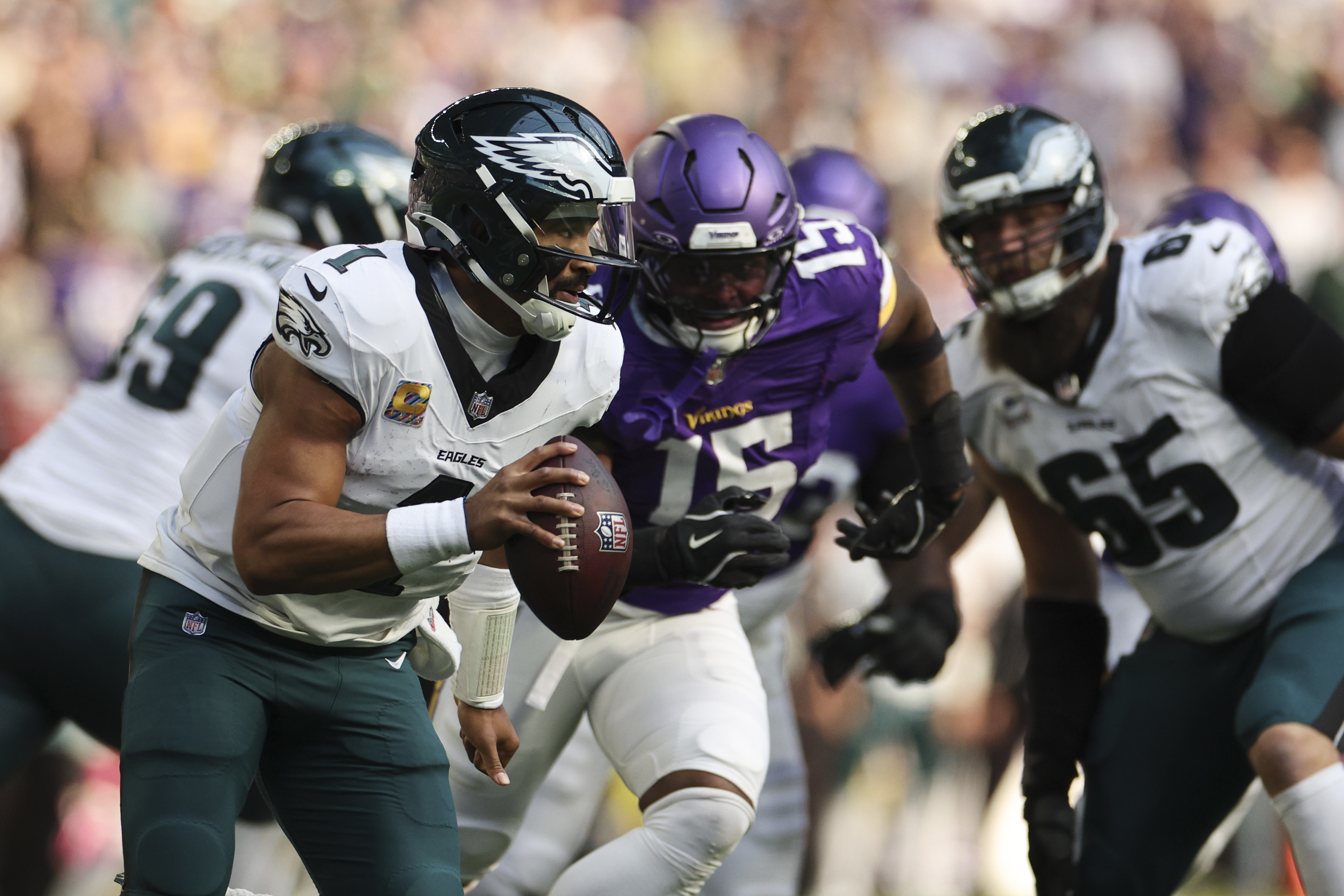
    Jalen Hurts was fantastic. He seems to always play his best when doubt seeps in about his abilities. He completed 19 of 23 passes for 326 yards and three touchdowns and iced the game when he lofted a 45-yard strike to A.J. Brown. Hurts finished with a perfect 158.3 passer rating.

    He may not always be great within structure, but he killed the Vikings when forced to extend plays in the second half. Hurts found receiver DeVonta Smith once for 28 yards, later for 21 yards, and Brown for 13 in between. The first two completions came on long third downs.

    window.addEventListener(“message”,function(a){if(void 0!==a.data[“datawrapper-height”]){var e=document.querySelectorAll(“iframe”);for(var t in a.data[“datawrapper-height”])for(var r,i=0;r=e[i];i++)if(r.contentWindow===a.source){var d=a.data[“datawrapper-height”][t]+”px”;r.style.height=d}}});

    Hurts followed the last scramble drill completion with a dart to Brown for a 26-yard touchdown. He hooked up with him to open the game on another scramble drill that resulted in a 37-yard score. There was a lull after that, but Hurts did what he does best with a 79-yard touchdown bomb to Smith to open the second half.

    Eagles quarterback Jalen Hurts completed 19 of 23 passes for 326 yards and three touchdowns against Minnesota.

    Running back: B

    It was another tough day on the ground for Saquon Barkley, but he ran hard. He finished with 44 yards on 18 carries. Barkley had a couple of shifty moves on a 7-yard rush in the second quarter. He also had his longest rush of 13 yards brought back by a holding penalty.

    Barkley’s blitz pickup remained a problem. He got run over by Vikings linebacker Eric Wilson — and still held him — before Hurts got sacked in the second quarter. Will Shipley did better a series later, and Hurts was able to throw for a first down. Tank Bigsby had a carry on the Eagles’ first series that went 11 yards off tackle. AJ Dillon, a game after he fumbled, was inactive for the first time this season.

    Cameron Latu was the lead blocker on a Barkley 5-yard run in the third quarter.

    Receiver / tight end: A-

    DeVonta Smith produced his second 100-yard receiving game of the season. He caught nine passes for a career-high 183 yards and a touchdown. He toasted former Eagles cornerback Isaiah Rodgers with a double move on the 79-yard touchdown.

    Earlier, Smith failed to pull in a third-down jump ball over Rodgers in the first quarter, but it was high on the scale of difficulty.

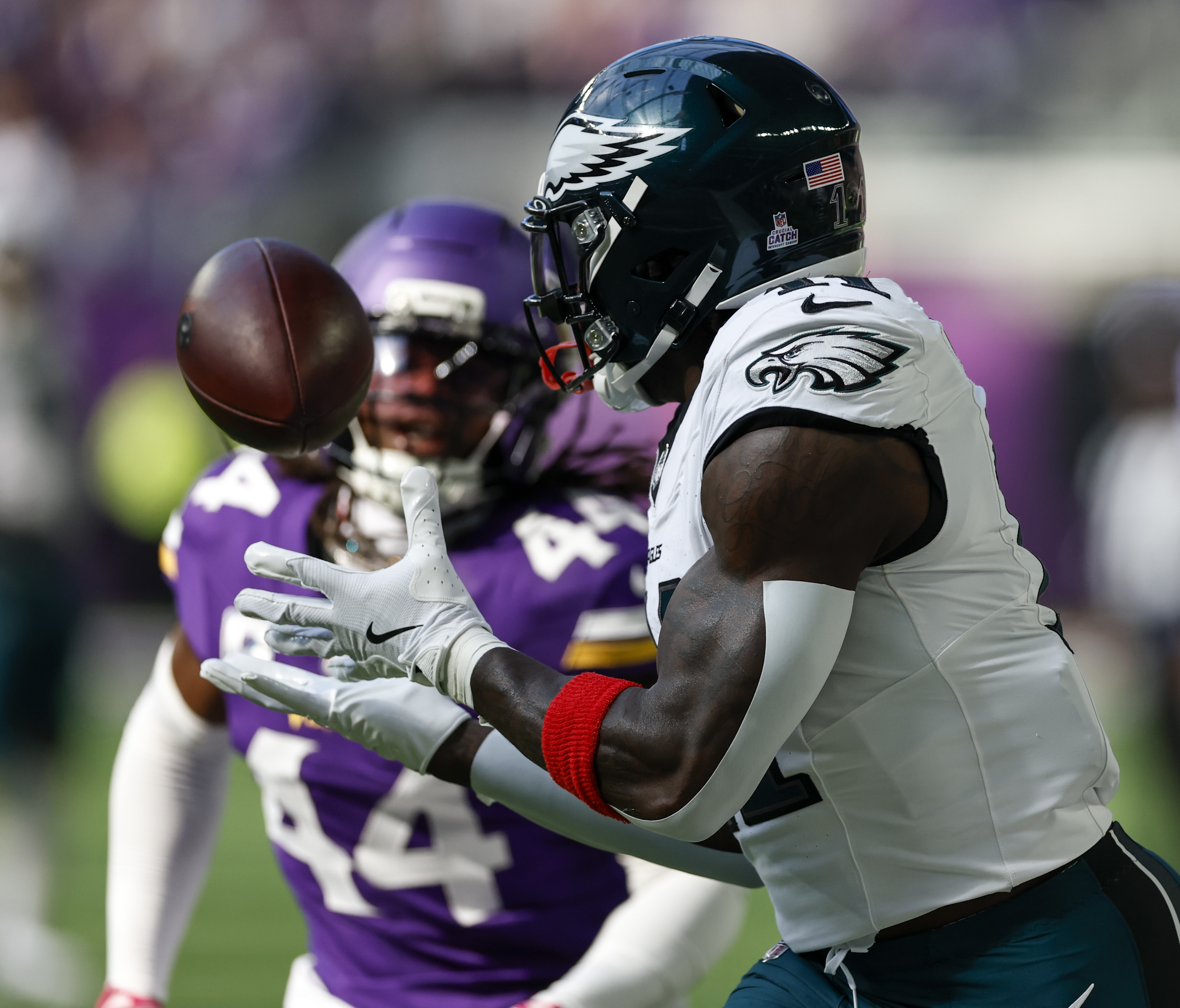
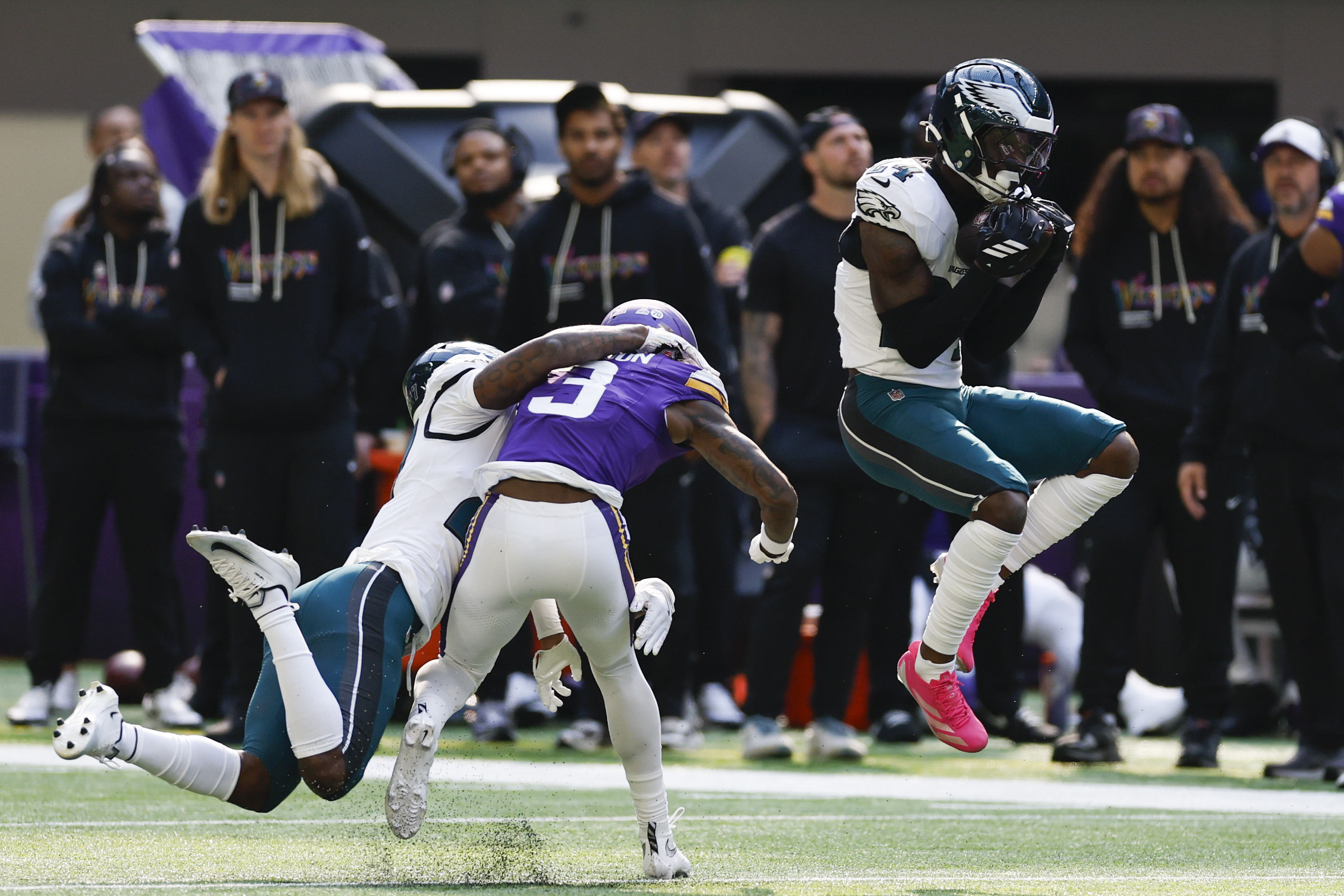
    A.J. Brown’s early touchdown was his lone target until the third quarter. He took advantage of great pass protection and released up field beyond man coverage for a 37-yard touchdown on the game’s first possession. Brown caught a 26-yard touchdown on an in-breaking route in the fourth quarter. His 45-yard grab at the end put him over 100 yards for the second time this season.

    Tight end Dallas Goedert had a relatively quiet day as a receiver, catching three passes for 18 yards. With Grant Calcaterra (oblique) out, Kylen Granson, EJ Jenkins, and Latu handled second and third tight end blocking.

    Eagles wide receiver A.J. Brown catches the ball on his first-quarter touchdown reception.

    Offensive line: B

    Center Cam Jurgens was sidelined in the second quarter with a knee injury and was replaced by Brett Toth. Rookie center Drew Kendall was inactive as he has been for most of the season. Toth got bowled over on one of his first snaps and Barkley was dropped in the backfield. He couldn’t hold his block on a Barkley third-down run in the fourth quarter.

    Landon Dickerson was back at left guard after missing the New York Giants game with an ankle injury. He had a clear-out lead block on an early Barkley carry and held up despite multiple nagging injuries. Right guard Tyler Steen’s holding penalty in the third quarter brought back a Barkley 13-yard run.

    Tackles Jordan Mailata and Lane Johnson didn’t allow much edge pressure in pass protection. Mailata did appear to get beaten on the blind side once in the fourth quarter. He also committed an early first-half holding penalty.

    The O-line led the way on a successful fourth-down Tush Push on the opening drive, despite the Vikings laying a defender on the ground behind the ball. Brown’s false start denied a second try a drive later.

    Fred Johnson was the sixth O-lineman on a couple of early runs, later setting up the bomb to Smith.

    Defensive line: B+

    The Eagles held Vikings running backs to just 3.2 yards a carry. The defense allowed running back Jordan Mason to rush five times for 34 yards to open the second half, but the group tightened the hatches down the stretch. The pass rush was effective early, then not-so-much for a period, until Moro Ojomo‘s third-down sack early in the fourth quarter forced the Vikings to settle for a field goal.

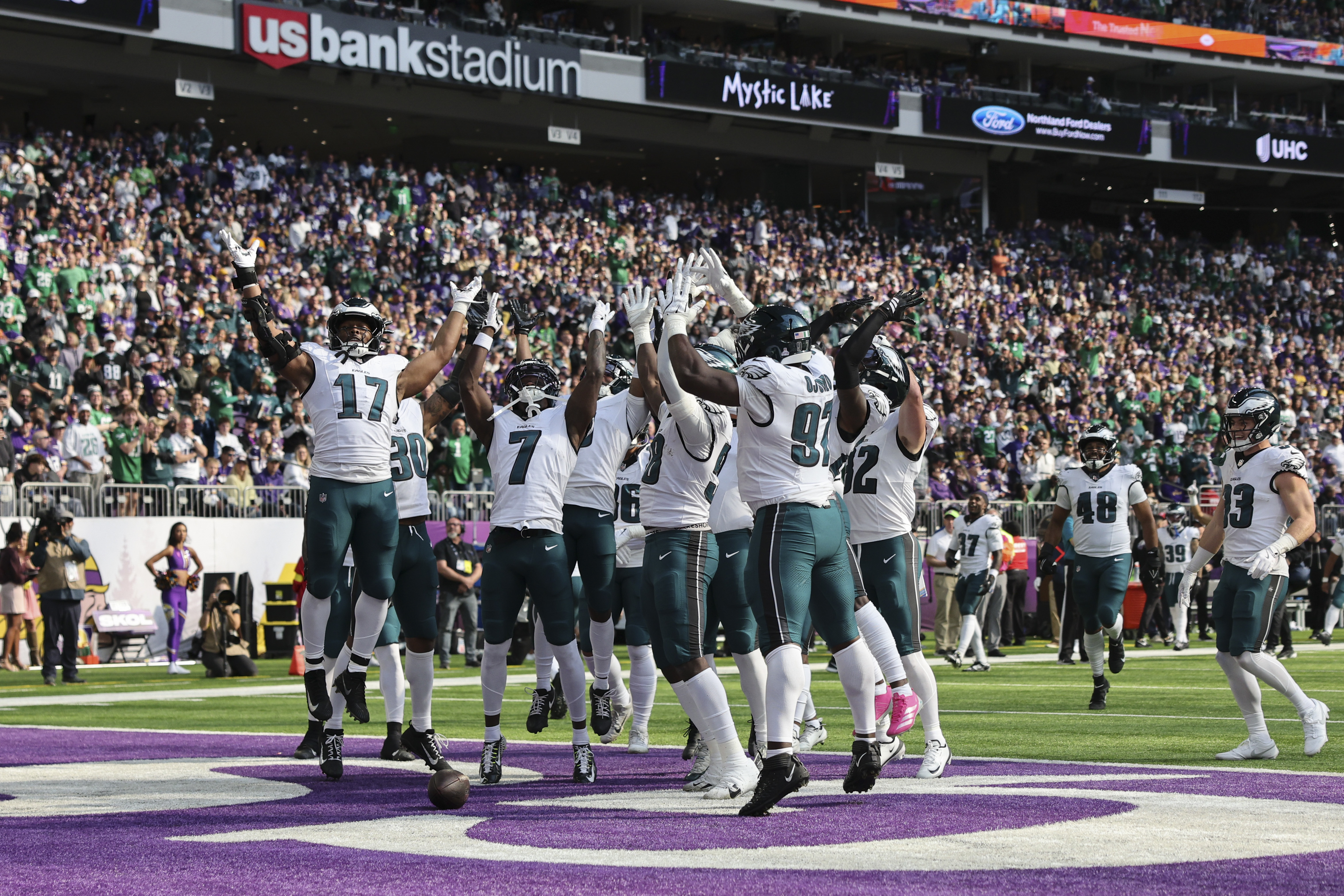
    Jalyx Hunt had the early defensive play of the game with a second-quarter pick-six. The outside linebacker dropped into coverage and Vikings quarterback Carson Wentz threw it right to him. Hunt didn’t do as well the next time he was targeted in coverage, when some Minnesota trickery resulted in him committing pass interference.

    The Eagles celebrates Jalyx Hunt’s interception return for a touchdown in the second quarter.

    Jalen Carter, who returned to the lineup after a one-game absence, hurried Wentz on the interception with an inside rush. He was credited with another hit just before the half. He broke through and forced Wentz out of the pocket before he threw his second pick in as many drives. Jordan Davis held up Vikings blockers before making two run stops near the line in the second quarter.

    Azeez Ojulari went inside early with a hamstring injury, which forced an already-depleted edge rush corps to lean on Hunt, Joshua Uche, and Patrick Johnson. Uche delivered with a late sack.

    Linebacker: A-

    Rookie Jihaad Campbell played some outside linebacker for the first time this season. It allowed Nakobe Dean to take his first defensive snaps of the season at off-ball linebacker. Campbell had some edge-rush chances but didn’t get home. He finished with three tackles.

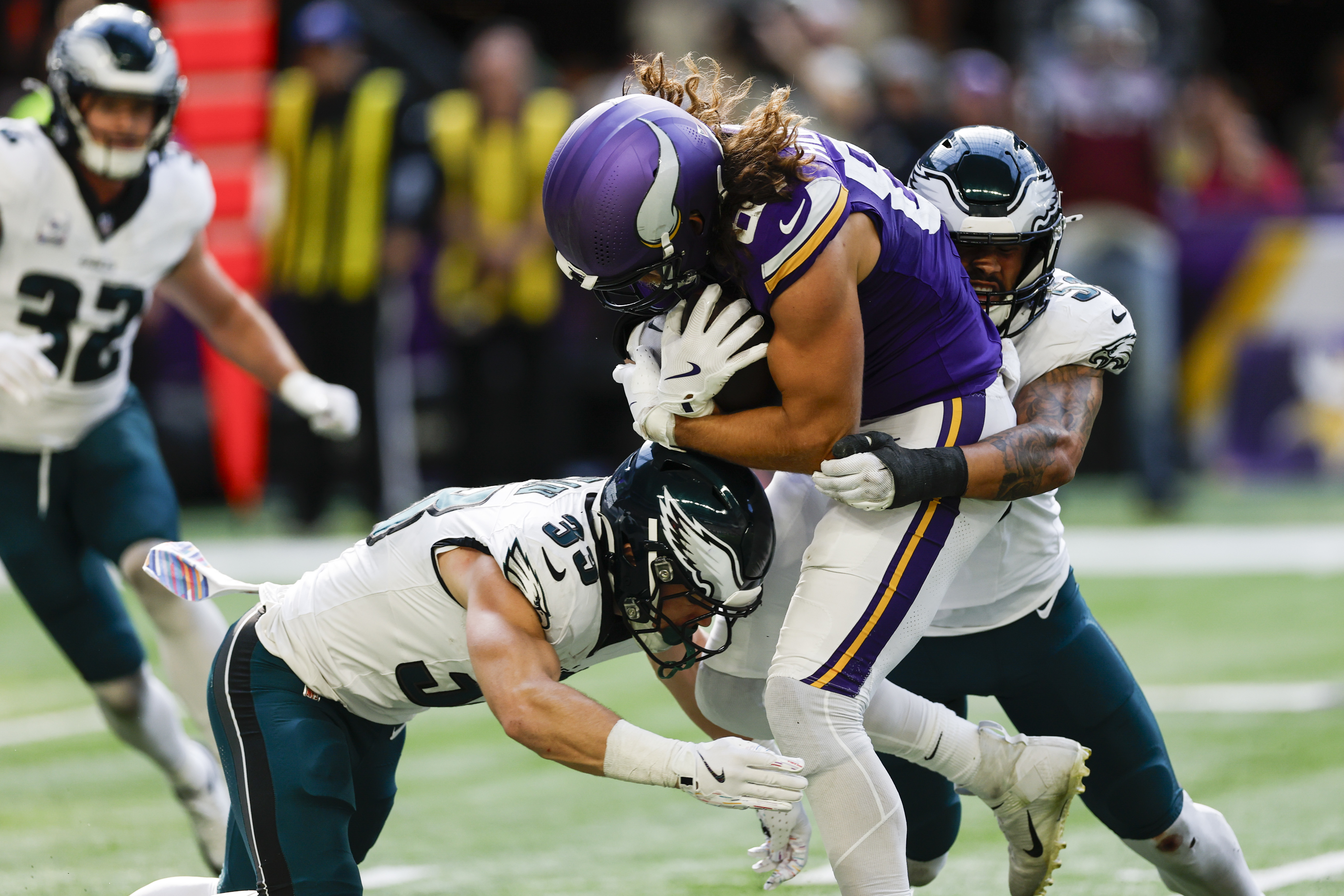
    Dean finished with six tackles, including a run tackle for loss in the third quarter. He was behind only Zack Baun (10) in tackles. Baun was all over the field. He made a tough open-field tackle on a pass to the flat in the second quarter.

    Jeremiah Trotter Jr. injured an ankle on punt duty and never returned.

    Eagles cornerback Cooper DeJean (left) and linebacker Zack Baun stop Minnesota tight end T.J. Hockenson during the third quarter.

    Cornerback: B

    Adoree’ Jackson got the nod ahead of the benched Kelee Ringo. He didn’t allow much until Vikings receiver Jalen Nailor converted a third down in the third quarter. Jackson got up slowly and a play later suffered a game-ending concussion. That forced the embattled Ringo into action. A drive later, Vikings receiver Jordan Addison toasted Ringo on a 25-yard crossing route.

    Quinyon Mitchell didn’t follow elite receiver Justin Jefferson. He wasn’t targeted much by Wentz, but his soft coverage in the fourth quarter allowed Addison a relatively easy 20-yard reception.

    Cooper DeJean was up and down. He had tight coverage on Addison in the end zone on a Wentz my-guy-or-no-one overthrow in the first quarter. Playing on the outside, DeJean gave Jefferson too much space on an 18-yard slant route. He let Nailor get behind him for a 26-yard gain in the second quarter. He rebounded later in the possession, though, and broke up an end-zone corner fade to Jefferson.

    Jefferson was held to five catches for 79 yards.

    Safety: B

    Drew Mukuba notched his second career interception — another Wentz gift — when he played center field on an ill-advised, up-for-grabs toss. He later whiffed on a sideline tackle attempt and Jefferson turned what should have been a short catch into a 40-yard pickup.

    Reed Blankenship played well. He got beaten by Addison on a third-down conversion in the red zone in the third quarter, but he kept the deep middle secure and chipped in with four run stops. The Eagles had a busted coverage when Addison got behind Mitchell in zone coverage for a 37-yard completion in the first quarter.

    Eagles safety Andrew Mukuba picks off a pass by Minnesota’s Carson Wentz in the second quarter.

    Special teams: B-

    Xavier Gipson was active for the first time since he was acquired last month. He had five kick returns for a 25.6-yard average, while Shipley averaged 29 yards on two returns.

    Kicker Jake Elliott was wide right on a 42-yard field-goal attempt for his first miss of the season. He made all of his extra points. Punter Braden Mann averaged 40 net yards on three boots. The Eagles didn’t have a single punt return.

    Latu was flagged for an illegal combo block on a third-quarter Eagles kick return. The Eagles’ kick coverage unit allowed a 38-yard return to open the second half. Elliott’s next kickoff landed short of the landing zone and the Vikings had good field position at the 40.

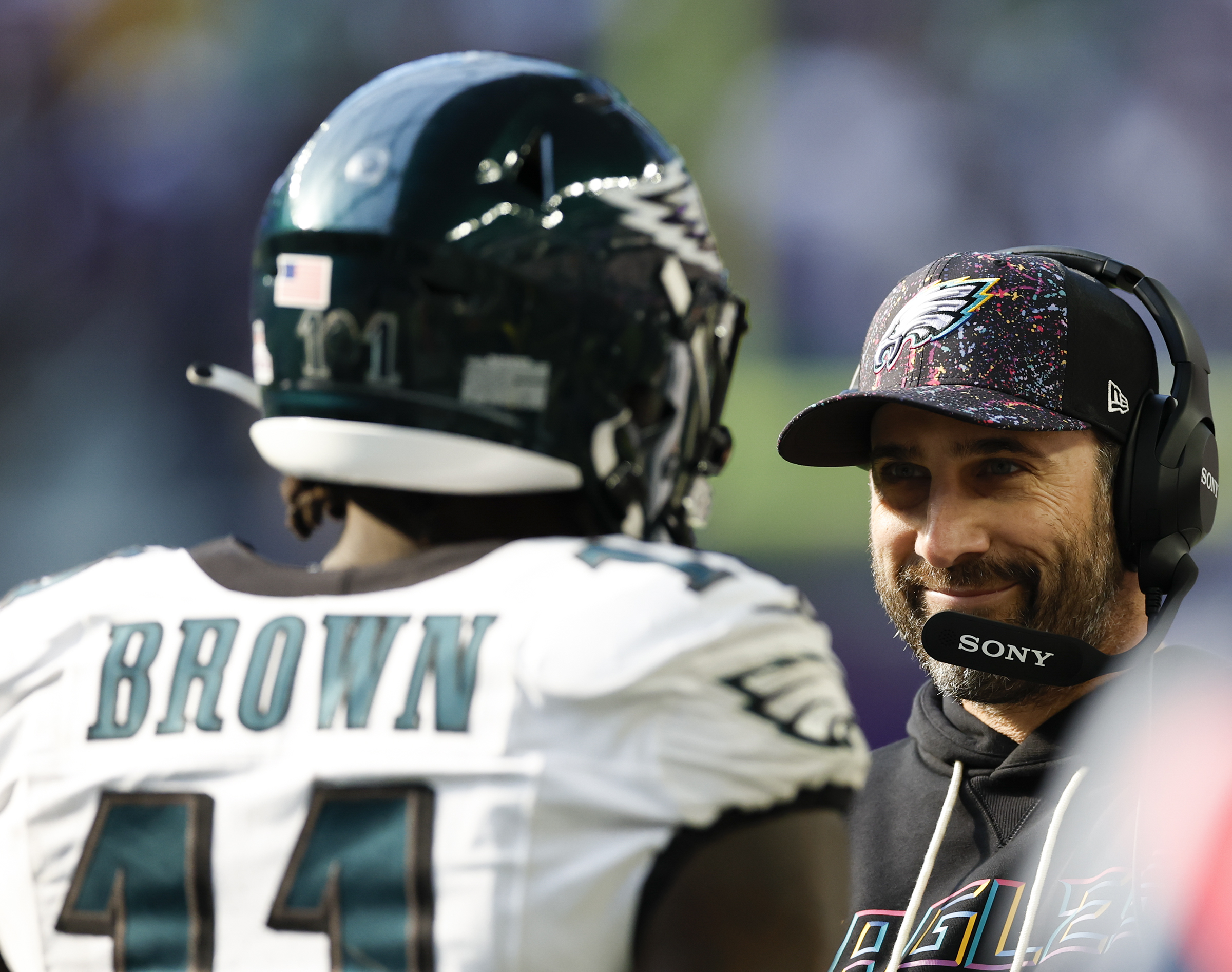
    Eagles wide receiver A.J. Brown with coach Nick Sirianni late in the fourth quarter against the Vikings.

    Coaching: B+

    Coach Nick Sirianni has his team back in the winner’s circle after a two-game losing streak. It wasn’t pretty, but Eagles football during the Sirianni era rarely is. And that’s OK for now as the 5-2 Eagles continue their search for an offensive identity. It may just be relying on Hurts and the passing game.

    Offensive coordinator Kevin Patullo dialed up a strong opening script, with plays under center and a fourth-down dagger vs. single high man coverage that resulted in Brown’s 37-yard touchdown. But after that 12-play, 75-yard drive, the offense did very little before the half. The Eagles went three-and-out on their next three possessions, and Hurts was sacked twice before the break came.

    Patullo had one of his better moments when he set up the Vikings with six O-linemen and used under-center play action to free up Smith on his 79-yard connection with Hurts. And he just let Hurts roll with it down the stretch and it worked, especially in crunch time.

    Vic Fangio’s defense did a lot of bending and benefited from Wentz’s miscues. But the Eagles were great in the red zone and forced the Vikings to kick five field goals on six possessions inside the 20.

  • Jalen Hurts has never been better in saving the Eagles against the Vikings

    Jalen Hurts has never been better in saving the Eagles against the Vikings

    MINNEAPOLIS — Jalen Hurts was rolling to his right, and he continued that way until the slice of available space for him to keep rolling got precariously thin. It was third-and-13 midway through the fourth quarter Sunday, the Eagles leading by two and one failed play away from handing the ball — and maybe the game — back to the Vikings. Two Minnesota defenders, tackle Javon Hargrave and linebacker Dallas Turner, were chasing Hurts, right at his heels, when he zipped a pass to A.J. Brown right at the marker. Thirteen yards. A first down. Just what the Eagles needed, just when they needed it.

    That was Hurts all day, all throughout the Eagles’ 28-22 victory. Whatever they needed, he gave them. And they needed a lot.

    They had lost their previous two games. One team leader, Lane Johnson, had called the offense predictable. Another, Brown, was pleading publicly for change, for improvement. Their offensive line is as leaky and damaged as the Titanic post-iceberg. Center Cam Jurgens, who already was playing through pain while still recovering from offseason back surgery, left Sunday’s game with a knee injury. Brett Toth replaced him, and the line, which was rarely opening holes for Saquon Barkley as it was, pretty much stopped generating push on any run plays. Those struggles have done more than just render Barkley mortal. They have made him practically a nonfactor. That ought to be impossible, and it certainly ought to be impossible for the Eagles to win when it happens.

    But it did, and they won anyway. They won because Vic Fangio’s defense kept holding the Vikings to field goals in the red zone, and because Carson Wentz — as anyone who remembers his Eagles career knows — remains a maddeningly inconsistent quarterback: glorious individual plays one moment, inexplicable mistakes the next. He threw two interceptions, one of which edge rusher Jalyx Hunt (who played safety in college) returned for a touchdown.

    Mostly, though, the Eagles won because their quarterback was as good as he’s ever been for them. Hurts was 19-of-23 for 326 yards, three touchdowns, and a perfect passer rating of 158.3. When has he been better? Perhaps in Super Bowl LIX. This one was a close second, though, at least. A championship wasn’t at stake Sunday, of course, but given the current state of this team, this was as meaningful as a regular-season game gets, and Hurts met the moment.

    “Definitely, there was some fire there,” he said. “But within that fire, you have to be the calm.”

    window.addEventListener(“message”,function(a){if(void 0!==a.data[“datawrapper-height”]){var e=document.querySelectorAll(“iframe”);for(var t in a.data[“datawrapper-height”])for(var r,i=0;r=e[i];i++)if(r.contentWindow===a.source){var d=a.data[“datawrapper-height”][t]+”px”;r.style.height=d}}});

    He did it by feeding his two playmakers on the outside often. Brown and DeVonta Smith combined for 304 receiving yards and all three of those scores, the first of which came when Hurts and Brown improvised on a fourth-and-4 play on the Eagles’ first possession. Brown was supposed to go short. But when Hurts pointed downfield for Brown to go long, their old teammate Isaiah Rodgers, charged with covering Brown, never had a chance.

    “He’s got so much swag, a swagginess to him,” tackle Jordan Mailata said. “When he’s in control, you can see the look in his eye … that sharpness to his eye.”

    Offensive coordinator Kevin Patullo even broke from what had been par for his play-calling course over the season’s first six weeks by putting Hurts under center and having him throw, and throw deep, from that formation, including on Smith’s 79-yard TD catch in the third quarter. The play marked, according to the research firm Tru Media, the first passing yards that the Eagles had gained all season on a play-action pass in which Hurts had been under center.

    “It frees up the passing game a lot more,” Mailata said. “You don’t know if it’s going to be a run. You don’t know if it’s going to be play-action. And you don’t know if it’s going to be a shot play. It gives us versatility.”

    Hurts’ final completion again was to Brown — and just as vital as his previous one. Third-and-9 with 1 minute, 45 seconds to go, the sound rising inside U.S. Bank Stadium, the Eagles needing a first down to force the Vikings to burn their timeouts, and Hurts lofted a rainbow to Brown for 45 yards, for that all-important first down, for a chance to finish the Vikings off, finally.

    “He’s always clutch in those moments,” coach Nick Sirianni said. “It’s why I have the confidence to go for it on the first drive, on a fourth-and-4, because you know the guys will make plays. Sometimes you watch a game, and it’s like, ‘Analytics say you should go for it here.’ Do you trust your players in those moments? That’s what you lean on.”

    It’s maybe the most reliable aspect of Hurts’ game and career. He can be inconsistent. His passing numbers can be sickly. Yet he seems to save his best games for the biggest games. Stability restored, back-to-back losses now buried, he sauntered through the stadium back to the visiting locker room and said, loud enough to be heard but to no one in particular, “We ain’t [obscenity] losers no more.” The Eagles can thank him for that.

  • Despite a surprising slide, Penn State doesn’t intend to play scared under interim coach Terry Smith

    Despite a surprising slide, Penn State doesn’t intend to play scared under interim coach Terry Smith

    STATE COLLEGE, Pa. — Penn State didn’t play scared in its 25-24 loss to Iowa on Saturday.

    Interim head coach Terry Smith, who took over after James Franklin’s dismissal last Sunday, trusted his first-time starting quarterback in a hostile environment. He allowed Kaytron Allen to be a workhorse running back. He went for it on several fourth downs, including one at his team’s 40-yard line.

    Most importantly, he showed belief in a group searching for some confidence amid an emotional coaching change and a three-game slide.

    His team repaid that trust against the Hawkeyes (5-2, 3-1 Big Ten), enough to earn a chance to win late. But Ethan Grunkemeyer’s fourth-down heave fell incomplete, and so did the Nittany Lions’ comeback bid.

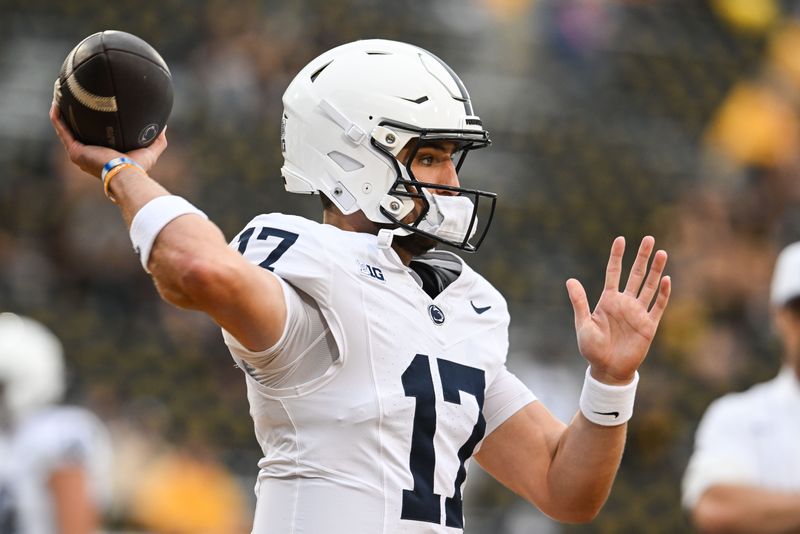
    Penn State quarterback Ethan Grunkemeyer performed well in his first start in place of the injured Drew Allar.

    Smith asked his players to leave it all on the field. His message was well received.

    “I think our guys played hard. I think our guys left it out there,” Smith said. “They gave everything they had. There was no one who didn’t give great effort. We just have to execute.”

    Penn State (3-4, 0-4) fell under .500 for the first time since 2021, the same year it last lost four straight games.

    Emptying the clip

    Under Franklin, Penn State stuck to a script. It played the same players, no matter their production, and rarely gambled on fourth down or in end-of-half situations.

    Saturday showcased Smith’s differing approach, one that asked his team to “empty the clip.”

    Penn State converted two fourth downs on its first scoring drive and later attempted two more. Its offense aggressively pushed to score at the end of the first half rather than worrying about handing its opponent an extra possession, which Franklin did against UCLA earlier this season.

    “We knew coming into the game we wanted to be aggressive,” Smith said. “You’re on the road at night in a place like this. You have to come to win. You can’t try to just lose your way into victory.”

    Smith played several players who rarely, if ever, saw action through the first six games. Notably, Koby Howard and Jaxon Smolik, who both had not played since Sept. 13.

    Howard, a freshman wide receiver, caught a 14-yard pass in the opening quarter for his first collegiate reception. Smolik, Penn State’s speedy backup quarterback, ran several option plays, an added element to Andy Kotelnicki’s offense. He finished with four carries before exiting with an injury and returning with an air cast on his left arm.

    Smith also relied heavily on Allen, who entered Saturday tied in total carries with Nick Singleton despite averaging nearly 3 more yards per carry. Against Iowa, Allen rushed a career-high 28 times for 145 yards and two touchdowns. Singleton rushed six times for 15 yards, both season lows.

    When Smith assumed the interim title, he said no one would question his team’s effort. That included Allen, who refused to quit amid Penn State’s four-game slide.

    “I’m all about playing football for my team,” Allen said. “I would never quit on my team, never quit on anybody. That’s just who I am. Whatever I start, I’ve got to finish.”

    Getting used to QB1

    Grunkemeyer’s inexperience showed in his first collegiate start.

    In a hostile environment, he seemed to rush his decisions. And against the nation’s No. 8 scoring defense, his two interceptions proved costly.

    The redshirt sophomore completed 15 of his 28 pass attempts for 93 yards. He pushed Penn State to midfield on its final drive but couldn’t march farther.

    “Not good enough,” Grunkemeyer said. “We lost the game, so [we’ve] got to get better and learn from it.”

    His biggest blunder came late in the first half when he tossed a third-down pass off Luke Reynolds’ face mask and into an awaiting Iowa defender’s grasp. The Hawkeyes followed with a touchdown to take the lead. Smith said Grunkemeyer forced his throw to Reynolds but praised his overall performance.

    “I thought [Grunkemeyer’s] game was solid,” Smith said. “I thought he managed the line of scrimmage, the calls at the line of scrimmage, and handled the crowd.”

    It wasn’t all bad for Grunkemeyer, who led two 10-play scoring drives and completed five straight passes in the second quarter.

    Up next

    Penn State gets to regroup on a bye week before its road clash with No. 1 Ohio State (7-0, 4-0) on Nov. 1.

  • Jeff McLane’s keys to Eagles vs. Vikings in Week 7: What you need to know and a prediction

    Jeff McLane’s keys to Eagles vs. Vikings in Week 7: What you need to know and a prediction

    The Eagles travel to face the Minnesota Vikings in a Week 7 matchup at U.S. Bank Stadium at 1 p.m. on Sunday. Here’s what you need to know about the game:

    Vikings defensive coordinator Brian Flores is known for blitzing a lot.

    When the Eagles have the ball

    We’ve seen Nick Sirianni switch it up offensively coming out of mini-byes or byes before, with the emphasis often placed on the run game. The guess here is that he will take the same approach this season. The Eagles desperately need to get Saquon Barkley going on the ground. There have been glimpses in the last few games, but play caller Kevin Patullo hasn’t stuck with it enough for various reasons.

    The Vikings’ run defense offers an opportunity to get on track (of course, so apparently did the New York Giants last week). They rank 24th in the NFL in expected points added (EPA) per rush and have allowed 132.2 yards a game. The Eagles haven’t won as much at the point of attack, but Minnesota is light on its defensive line. Landon Dickerson (ankle) could return at left guard, but playing at far less than 100% hasn’t helped.

    The Eagles don’t major in under-center plays. They ranked 30th in snaps there. But I think we may see more of Jalen Hurts in that formation. It would conceivably help get Barkley downhill, and if successful, open up play action. They just can’t tip off defenses with their tendencies and may need to throw from under center a few times early on.

    Vikings defensive coordinator Brian Flores is likely willing to give up yards on the ground because his No. 1 EPA-ranked pass defense has been stingy. Flores is a master of creating chaos. Yes, he blitzes a lot — a second-most 35.8% rate — but it’s his simulated pressures and disguised coverages that have given quarterbacks the most fits. The Eagles have struggled mightily against the latter two, partly because they’re often late to the line.

    Flores leans heavily on zone coverages (77%) and employs a lot of two-high safety shells, often in Cover 2 or 6. The Eagles have seen zone more than ever and have had trouble working the intermediate part of the field.

    Only 9.9% of Hurts’ attempts have traveled 10 to 19 yards, less than half the NFL average of 20.1%. Sirianni, Patullo, and Hurts have to do a better job of getting the ball to receivers A.J. Brown and DeVonta Smith in space. Eagles receivers are averaging only 4 yards after the catch, which ranks 32d — last — in the league.

    Carson Wentz will make his second career start against his former team, this time with the Vikings.

    When the Vikings have the ball

    The Eagles will face former franchise quarterback Carson Wentz for the second time since he was traded in 2021. It didn’t go well for Wentz in the first round. Then, with Washington, he got overrun by the Birds’ pass rush and was sacked nine times and fumbled twice. He still holds the ball too long and wants to play the hero.

    But the Eagles’ front isn’t as ferocious and he has a solid offensive line, assuming that most of the starters are playing. Christian Darrisaw and Brian O’Neill (sprained MCL) are plus tackles. Rookie left guard Donovan Jackson is back from a wrist injury, but backup center Michael Jurgens (hamstring) and O’Neill are questionable.

    Wentz, despite his flaws, can still make throws many quarterbacks can’t. And he has arguably the best receiver in the NFL. Justin Jefferson will draw additional attention from Vic Fangio’s defense. Cornerback Quinyon Mitchell has followed top receivers this season, but his recent hamstring injury could hamstring Fangio’s coverage plans.

    If opposite-side corner Adoree’ Jackson, who steps back into the starting role after Kelee Ringo’s benching, is matched up against Jefferson, Fangio will likely cloud his side. Jefferson alone, for context, has matched Hurts’ 10 intermediate-length completions this season for 205 yards. Jordan Addison is a potent No. 2 receiver.

    The Eagles’ run defense has been leaky. They rank 20th in EPA per rush and 26th in success rate. With defensive tackle Jalen Carter (heel/shoulder) out last week, the Giants ran it down their throats. Minnesota running back Jordan Mason (4.7 yards per rush) has been effective in Aaron Jones’ absence.

    It’s been an 11-man problem in stopping the run, but the Eagles have been susceptible on the edges. That isn’t just an outside linebacker issue, but a suspect pass rush that can be traced to the ineffectiveness of the Eagles’ edges. The current group, after Za’Darius Smith’s retirement, has just one collective sack.

    Jalyx Hunt, Joshua Uche, Azeez Ojulari, and Patrick Johnson (owner of said sack) have gotten pressure at times, but if Wentz has an extra click in the pocket, you can be sure he’ll often find an open Jefferson downfield.

    Eagles beat writers Olivia Reiner and Jeff McLane will provide a preview of the game before the Eagles face the Minnesota Vikings on Sunday.You can tune in here.


    Extra point

    I don’t know what to make of this Eagles team through six games. I thought there would be early-season struggles, and predicted a 4-2 start. I just didn’t think it would look like this. Fangio’s unit has not played well over the last five quarters, but the offense’s second-half malaise against the Denver Broncos led to a fourth-quarter meltdown. And losing Carter and Mitchell clearly affected the Eagles at the Meadowlands. It shouldn’t have looked that pathetic.

    There are still concerns at corner, edge, and safety. And where has defensive tackle Jordan Davis been the last three games? But it’s the pains on the other side of the ball that are more disconcerting. I keep expecting talent to win out, but the Sirianni-Patullo-Hurts trinity has had more holes than holiness. I foresee a tough, grind-it-out outcome, so the game could go either way. But I have a hard time riding with Wentz.

    Prediction: Eagles 19, Vikings 17

  • The Phillies are eyeing an infusion of youth for 2026. Here’s how three top prospects can fit.

    The Phillies are eyeing an infusion of youth for 2026. Here’s how three top prospects can fit.

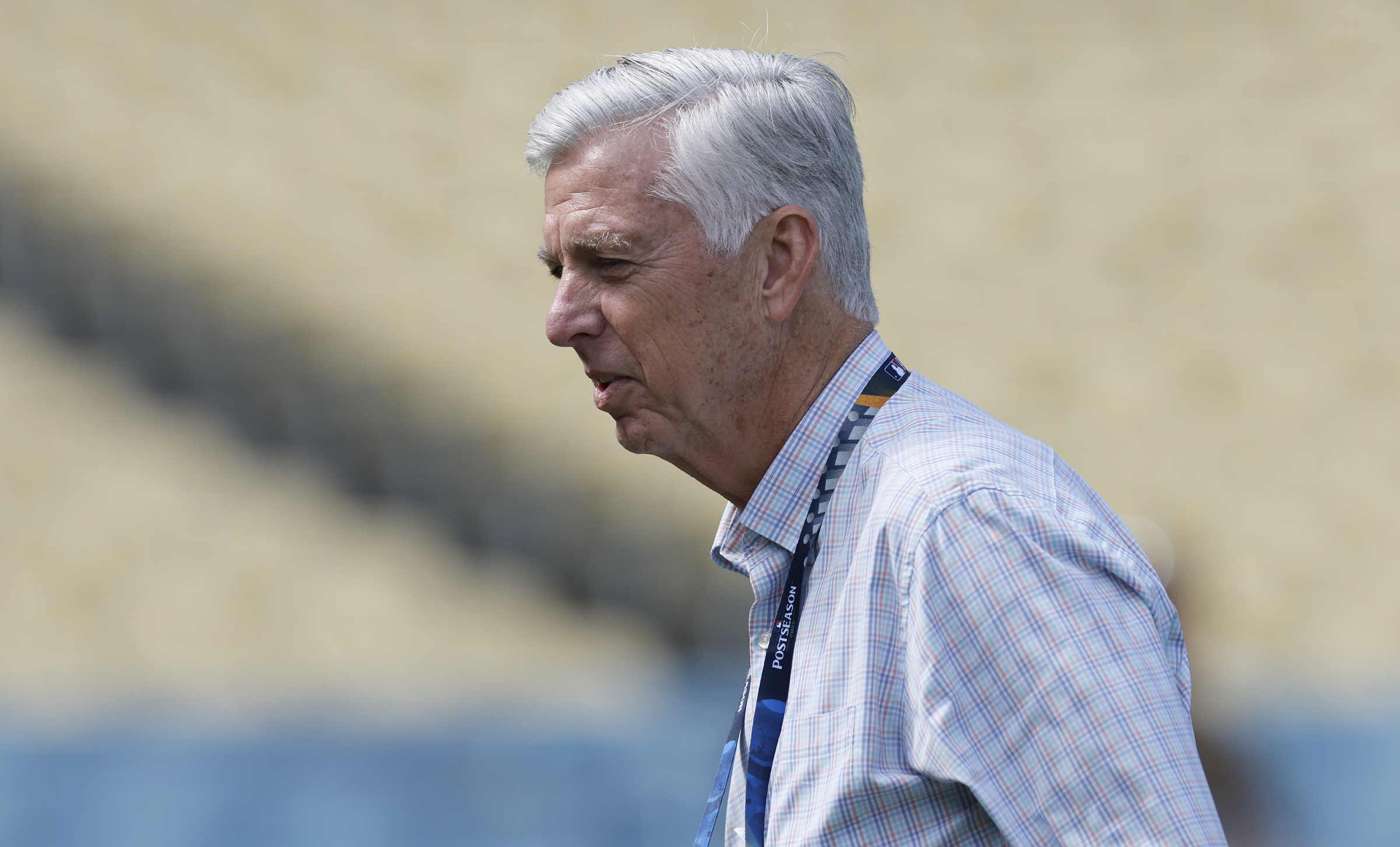
    When he looks up from assembling the Phillies’ roster, Dave Dombrowski watches sports. One thing recently caught his eye. The Golden State Warriors are poised to open the NBA season with four starters who are 35 or older.

    “It’s never happened before,” he said.

    Dombrowski, the team’s president of baseball operations, brought this up Thursday, midway through his 54-minute news conference in Citizens Bank Park, to make a point: Aging teams can contend for titles.

    It’s relevant because if the Phillies achieve their offseason priority of re-signing free agents Kyle Schwarber and J.T. Realmuto, who will be 33 and 35 next season, at least four of the top hitters in the projected opening-day lineup will be 32 or older and locked up to multiyear contracts. It would be so uncommon that Schwarber joked about it several months ago.

    “We would love to all finish our careers together,” he said. “But who would want to come out and want to watch a bunch of 40-year-old dudes play baseball? Right?”

    Warriors fans might not mind the basketball version, but there’s a notable difference. Whereas Stephen Curry and Draymond Green won four championships together before teaming with Jimmy Butler and Al Horford, the Phillies’ core — Bryce Harper (33), Trea Turner (32), Schwarber, Realmuto, and pitchers Zack Wheeler (35) and Aaron Nola (32) — is still title-less.

    The Phillies are coming off 96 wins, 95 last season, and 90 the year before. It would be irrational to blow it all up based on one bad week in each of the last three Octobers and impractical given all the long contractual commitments made by Dombrowski and owner John Middleton.

    Phillies president of baseball operations Dave Dombrowski must balance blending an aging core with young players from the farm system.

    But in addition to an eyebrow-raising challenge to Harper — “I guess we only find out if he becomes elite or if he continues to be good. … I’ve seen guys at his age that level off, or I’ve seen guys rise again. We’ll see what happens” — the takeaway from Dombrowski’s end-of-season gab session was that he realizes the need for an infusion of youth, even as the Phillies prepare a nine-figure offer to Schwarber and discuss how far to go to retain Realmuto.

    To extend the NBA comparison, the Phillies must incorporate their Moses Moody and Jonathan Kuminga, the 23-year-olds among the Warriors’ graybeards.

    “We have some young players that we’re going to mesh into our club,” Dombrowski said. “I’m not going to declare that anybody has a job. But there will be some people that we’re really open-minded to being with our big league club next year, coming out of spring training.”

    Unsurprisingly, Dombrowski mentioned outfielder Justin Crawford and right-hander Andrew Painter. He also name-checked Otto Kemp, who made his major-league debut in June and could fit next season as a right-handed bench bat.

    But Dombrowski said he “wouldn’t even preclude [infielder] Aidan Miller from being that type of guy” to contribute in 2026, an indication that the Phillies are ready to push down harder on the prospect pedal.

    They were conservative this season, consistent with their recent philosophy. A recent Fangraphs study showed that only 24 players have made their major- league debut with the Phillies since 2022, the third-fewest in baseball after the Yankees and Braves.

    The trend must change.

    “It’ll be very interesting next spring training because those guys, they’re on the doorstep, and a couple of them are ready to go,” manager Rob Thomson said of Crawford, Painter, and Miller. “So we’ll see. I love young players because they always bring energy. But they have to perform, too.”

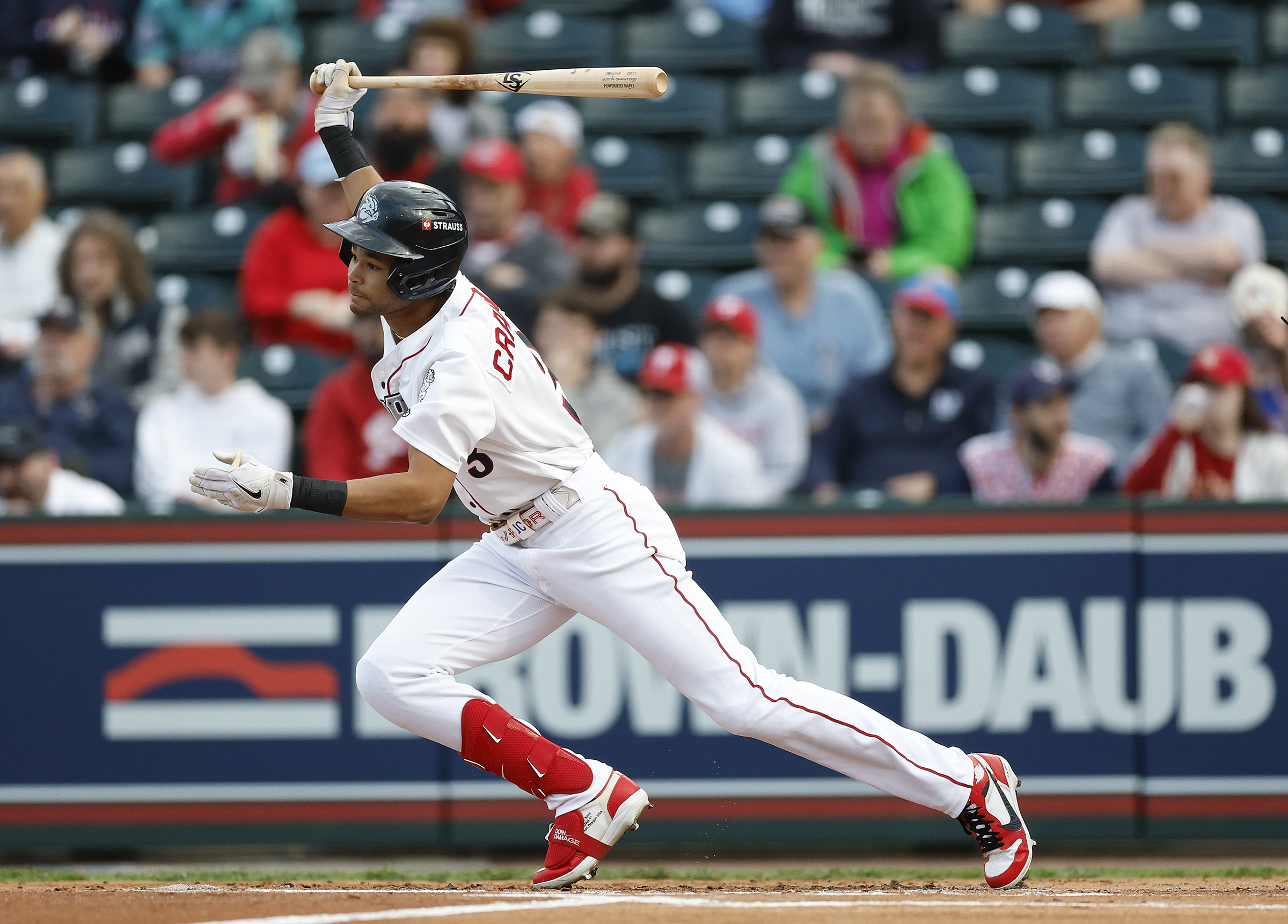
    Phillies outfield prospect Justin Crawford won the triple-A International League batting crown with a .334 average.

    Front and center, or stage left?

    At times this summer, the Phillies got “very close,” a team source said, to calling up Crawford.

    Instead, they left the 21-year-old in triple A.

    Never mind that left fielder Max Kepler was drowning, with a .201 average and .661 OPS through July 25. Rather than releasing the $10 million veteran and replacing him with Crawford, the Phillies gave Kepler a longer rope. And after trading for Harrison Bader at the deadline, there wasn’t an opportunity for Crawford to play every day in the majors.

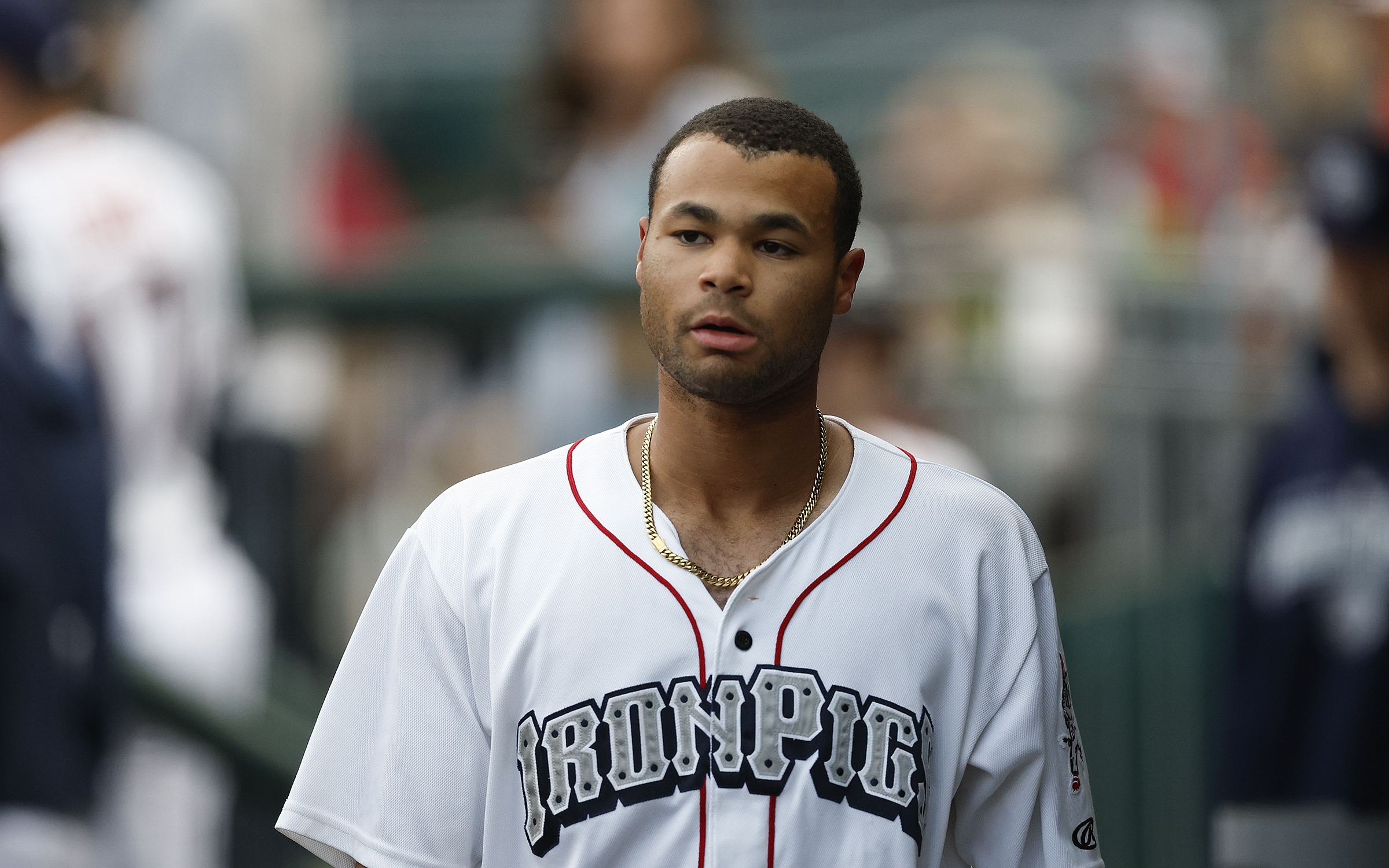
    But Crawford reached base at a .411 clip for Lehigh Valley and won the International League batting crown with a .334 average. He stole 46 bases and led the farm system with 147 hits.

    “I don’t know what else he really does at the minor-league level at this point,” Dombrowski said. “He’s led leagues in hitting. He steals bases. He’s a good energy guy. He’s a solid outfielder.”

    Go ahead, then, and pencil in Crawford for a spot in the season-opening outfield.

    But where?

    Differences of opinion about Crawford once focused on his offense, notably his extreme tendency to hit the ball on the ground. Now, it’s more whether he’s best suited for center field or left.

    Crawford got drafted as a center fielder and played there exclusively for three years. He shifted to left field more often late this season, especially once Johan Rojas got sent back to triple A. Crawford’s dad, Carl, played left field for 15 years in the majors.

    Dombrowski might have hinted at the Phillies’ thinking by saying Kepler is “not going to most likely be back because he’s a free agent and we have Justin Crawford coming.” And Thomson said Crawford is “maybe a little better in left than he is in center,” based on internal reports.

    Other team officials don’t fully concur.

    Some Phillies officials believe Justin Crawford is best suited to play left field. Others think he can handle center.

    “I see Justin as a center fielder,” minor-league director Luke Murton said. “We’re very confident in his ability to play center field. It’s just a matter of, he’s played less left field over the course of his career, so give him exposure to that so when the opportunity comes, if he has to go to the big leagues and play left field, then he’s prepared to do that.

    “But I think, as an organization, we see him as a center fielder.”

    It would simplify the outfield picture if Crawford is able to handle center field.

    Bader, who stabilized center field after the trade, is expected to decline his $10 million mutual option. The Phillies would feel less urgency to bring him back in free agency off his career-best season at the plate.

    And they could commit to Brandon Marsh, also a better defender in left field than center, as at least the lefty-hitting side of a corner outfield platoon, which would enable them to focus on finding a replacement for malcontented right fielder Nick Castellanos, all but certain to be traded or released.

    Regardless, it will be Crawford’s time. At last.

    “I don’t expect him to carry our club in the very beginning of the season, but you also don’t want to put him in where you think it would be a bit too much for him,” Dombrowski said.

    “I don’t think that’s going to happen. He has never been overwhelmed when he’s been with us at any level, and we keep moving him up. You want to just see that he just continues to handle himself the same way that he has,” Dombrowski said.

    Phillies top pitching prospect Andrew Painter struggled in triple A in his first season back from Tommy John elbow surgery.

    ‘He’s going to be fine’

    Don’t look now, but there will probably be a spot for Painter in the season-opening starting rotation.

    Really. It’s true this time.

    In 2023, a few team officials predicted that Painter would make the team out of camp even though he was 19 and hadn’t pitched above double A. He injured his elbow and wound up needing Tommy John surgery.

    Last winter, in outlining the plan to build Painter’s workload in his return to the mound, Dombrowski infamously said he could be ready for the majors by “July-ish.” Instead, the top prospect had a 5.40 ERA in triple A.

    It’s doubtful, then, that Dombrowski will pin yet another timetable on Painter. But with Ranger Suárez headed to free agency and Wheeler recovering from thoracic outlet decompression surgery, Painter’s long-awaited debut could come early next season.

    “I think he’s going to be better the second year out after the Tommy John [surgery],” Thomson said. “The command’s going to get better. The quality of stuff’s going to get a little bit better. He’s going to be fine.”

    Rival talent evaluators generally agree. One NL scout said last month that he has “appropriate concern” about the decline in Painter’s command but is inclined to “cut him some slack” after not pitching for two years.

    There were encouraging signs last month. In his second-to-last start, Painter tossed five scoreless innings. He shut out Syracuse for three innings before allowing three runs in the fourth in his final start.

    Even if Suárez bolts, Cristopher Sánchez, Jesús Luzardo, Nola, and Taijuan Walker are rotation holdovers. The Phillies are optimistic that Wheeler will return. They can’t say for sure that he will still be elite.

    Painter’s time is coming. Maybe even in April.

    “He still throws his fastball in the upper-90s, touches 100, still has quality breaking stuff,” Dombrowski said. “Most importantly, he remained healthy. So, those things are the encouragement. He used to have great command. It wasn’t quite as good this year. And normally, when you trace back to a lot of people that have had Tommy John, that’s the last thing that comes back. We’re optimistic that he’ll be able to regain that.”

    Phillies infield prospect Aidan Miller went 9-for-27 with two doubles and a homer in an eight-game triple-A cameo to end the season.

    Miller time?

    Murton was skeptical in spring training when minor-league baserunning coordinator Gary Cathcart recommended that Miller be among the players who got a green light to run.

    “I was like, ‘Hey man, I don’t think Aidan Miller’s going to steal a ton of bases in the big leagues. That’s just me,’” Murton said. “He’s like, ‘Well, I think he’s going to.’ I’m like, ‘Yeah, I don’t.’”

    Murton relented. A few months later, he marveled that Miller already swiped more than 20 bases. Miller finished with 59, including seven steals in eight games at triple A to end the season.

    In hindsight, even Miller didn’t see it coming.

    “Honestly, no,” he said last month. “I don’t really know if I’m faster this year. Maybe a little bit. But I think I’m just being more aggressive on the bases.”

    Miller’s path to the majors might be accelerated, too.

    After a slow start, he batted .356 with a 1.099 OPS in his last 36 games. If the Phillies trade Alec Bohm this winter, after dangling him in talks last offseason, Miller could be in the wings at third base, even though he has played shortstop so far throughout the minors.

    “He’s played some second, he’s played some third, but he’s primarily been a shortstop, so we’d have to make sure that we properly prepared him to do that,” Dombrowski said. “That’s still a discussion that we’ll have to have. But he’s a really good player and a good athlete. And he can hit.

    “If Miller’s coming up here, he’s going to be an everyday player at the beginning of his career. We’re not going to bring him up and not play the majority of time.”

    Miller was scheduled to play in the Arizona Fall League, but the Phillies decided that it was better if he rested after a long season. Besides, he could be in for a big spring training.

    If it seems fast, consider this: When Dombrowski ran the Red Sox, he called up Andrew Benintendi from double A in 2016 and Rafael Devers a year later after only six triple-A games, two fewer than Miller played this season.

  • Penn believes that behind its young women’s basketball roster, ‘anything can happen’

    Penn believes that behind its young women’s basketball roster, ‘anything can happen’

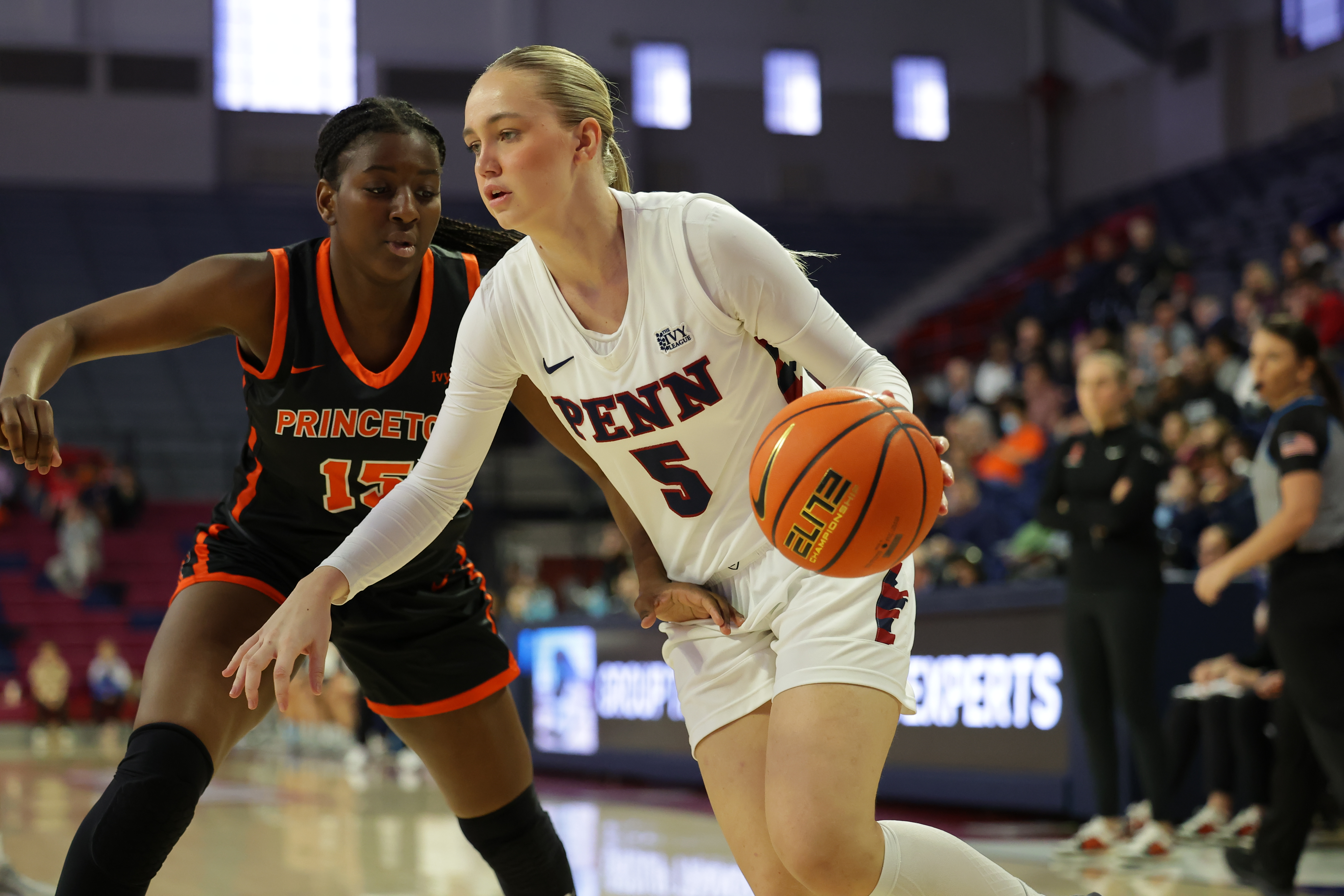
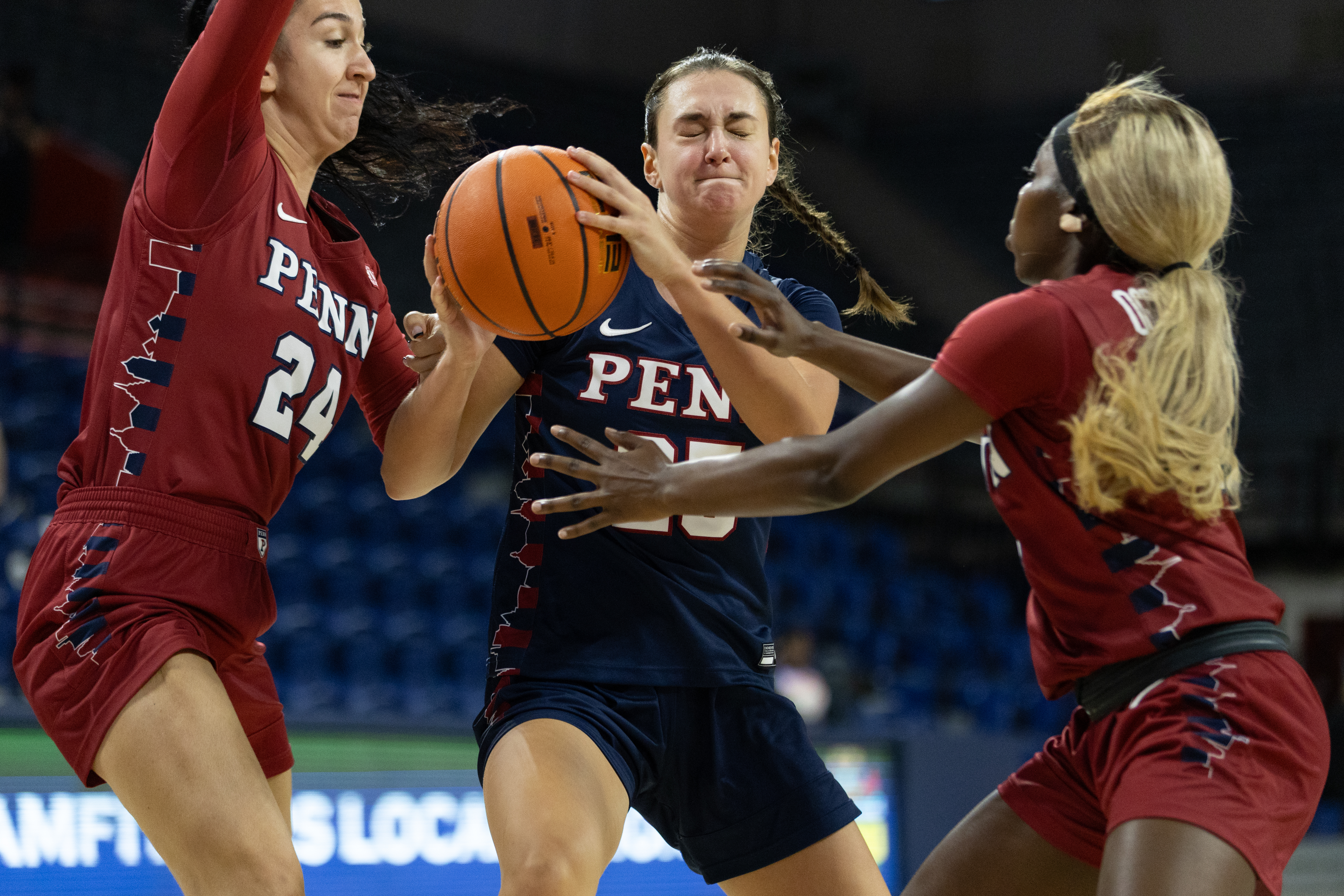
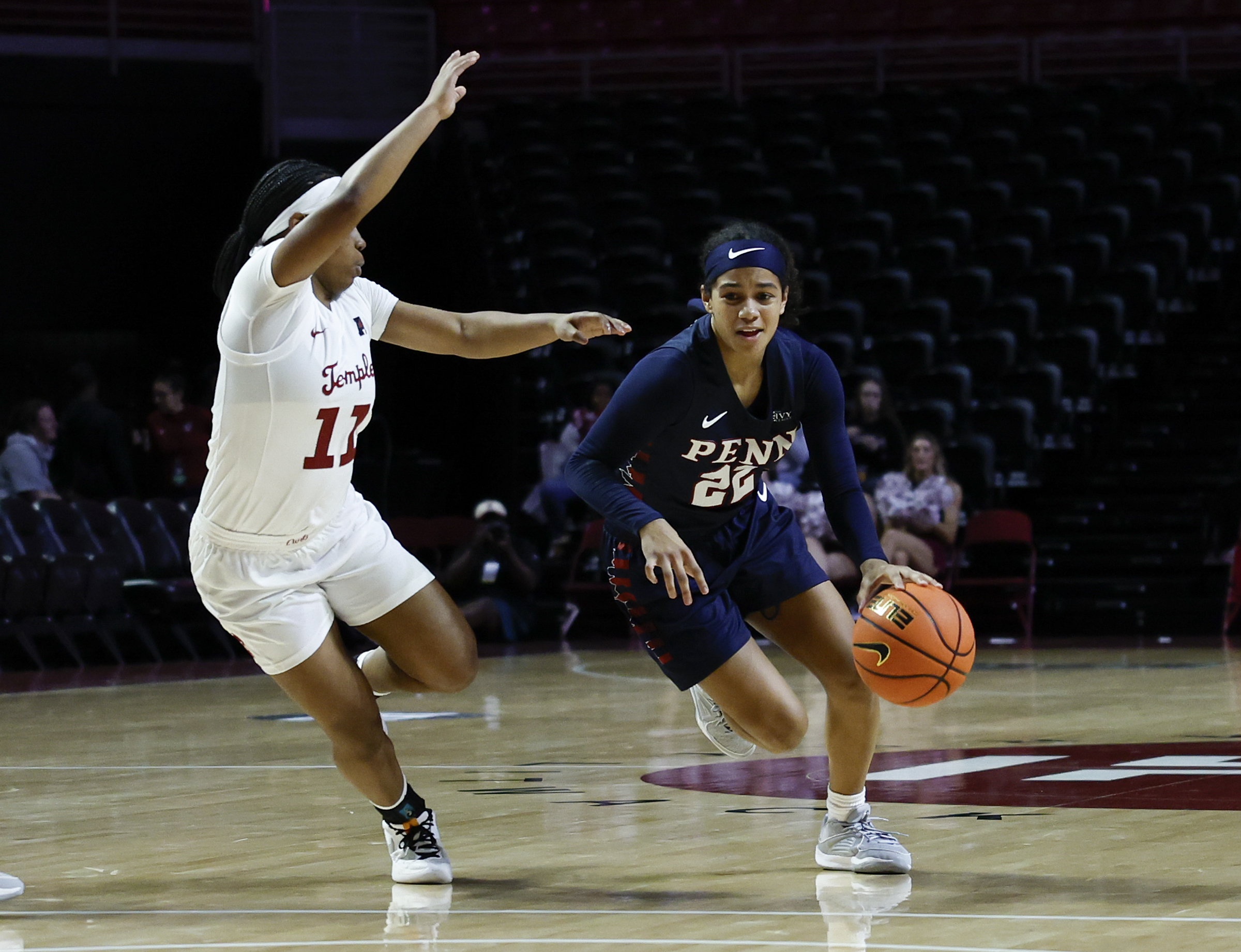
    Penn believes it has all the right pieces to be a competitive women’s basketball program in the Ivy League.

    Now the Quakers just have to put it all together.

    After a season in which Penn lost in the first round of the conference tournament for the third straight year, the Quakers find themselves only a month away from opening tip at the Palestra with plenty of questions still left to answer.

    Having to reinvent the offense to make up for the loss of first-team All-Ivy forward Stina Almqvist — who led the team in total minutes, points, and rebounds — coach Mike McLaughlin recognizes that the starting rotation needs a lot of ironing out .

    Penn will miss the production of Stina Almqvist, who led the team in total minutes, points, and rebounds.

    “I think we need a little more in the post. … We need to see who’s going to be three, four, and five in that rotation,” McLaughlin said. “ … That is the area that I need to see more of because that’s been inconsistent so far.”

    Big shoes to fill

    Katie Collins, last year’s Ivy League Rookie of the Year, is the only other front court player to log significant minutes for Penn — and is preparing to adapt to playing next to a more traditional center in Tina Njike.

    “Little different from last year with Katie and Stina,” McLaughlin said. “They could both play inside and out. Katie is going to need to adapt a bit because Tina’s ball skills away from the basket are not where Stina’s were.”

    With McLaughlin believing Njike to be capable of playing only 20 minutes a game because of her physical style of play, the team will have to find valuable minutes from players eager to make an impact.

    Katie Collins (center), last season’s Ivy League Rookie of the Year, will be relied on even more in her sophomore season.

    Kate Lipatova, a 6-foot-3 stretch forward from Moscow, rounds out the frontcourt group alongside fellow international freshman Ari Paraskevopoulou (Greece).

    “[Lipatova] hasn’t played, unfortunately, she got hurt 10 minutes into practice, and will be out at least a couple more weeks, which is going to impede her growth,” McLaughlin said. “She had a nice preseason. … This is definitely a setback.”

    Figuring out the rotation

    Point guard Mataya Gayle is set to take center stage for the first time with the Quakers. After being a strong No. 2 to Almqvist in 2024 and former first-team All-Ivy forward Jordan Obi in 2023, Gayle will be Penn’s go-to player when it comes to scoring.

    “This kid is ready,” McLaughlin said. “She’s going to have a huge year. She’s going to score it, she’s going to assist it, you’re going to see her rebound the ball better, you’re going to see her in big spots being significantly further along.

    “I think for someone with her stature after the first two years, she’s taken massive growth, [and] I just love where the kid is mentally — I just think she’s doing it the right way.”

    Which players get to fill out the rotation, besides Gayle and Collins, is still up in the air. Stalwart guards Saniah Caldwell and Abby Sharpe, who played significant minutes last year, are battling injuries already — leaving the door open to establish a larger rotation of guards.

    “If we can add 10 players that can actually get out there and play at our level every day, I think this team has a chance” of competing for a championship, McLaughlin said.

    Confidence through it all

    Roster overturn and injuries will always lead to uncertainty. Gayle, though, is confident that this is the roster that will bring Ivy glory back to the Palestra.

    “This is the most excited I’ve been about a season — I see us taking this to the next level,” Gayle said. “We’ve had a lot of team conversations, internal work, and I think we are all on the same page this year, which is obviously winning an Ivy League championship.”

    Penn guard Mataya Gayle (right) enters as one of the team’s leaders on offense.

    With the season growing closer by the day, McLaughlin feels as though this squad has the ability to rise to the occasion by the end of the season.

    “If a couple of these kids take a bigger step before we get to league play, anything can happen from there,” McLaughlin said. “ … We have a ways to go to get to where we were last year, but our ceiling couldn’t be higher.”

  • Kennett’s Shay Barker is following in his older brother’s footsteps, one kick at a time

    Kennett’s Shay Barker is following in his older brother’s footsteps, one kick at a time

    Shay Barker wouldn’t describe his relationship with his older brother Ryan as instant best friends. They fought as children and were competitive with each other, but Shay secretly wanted to do whatever his big brother was doing.

    “I was kind of like a crybaby as a kid, and he was the one who just found that super annoying,” said Shay, three years younger than Ryan. “We would get in a lot of fights and stuff. But I’m a lot more mature now. I don’t really get upset about things. I think that’s probably the biggest reason why we’re so close now: We connect on a different level than we used to.”

    Part of their connection also stems from the bond that the two Chester County natives share in the same sport.

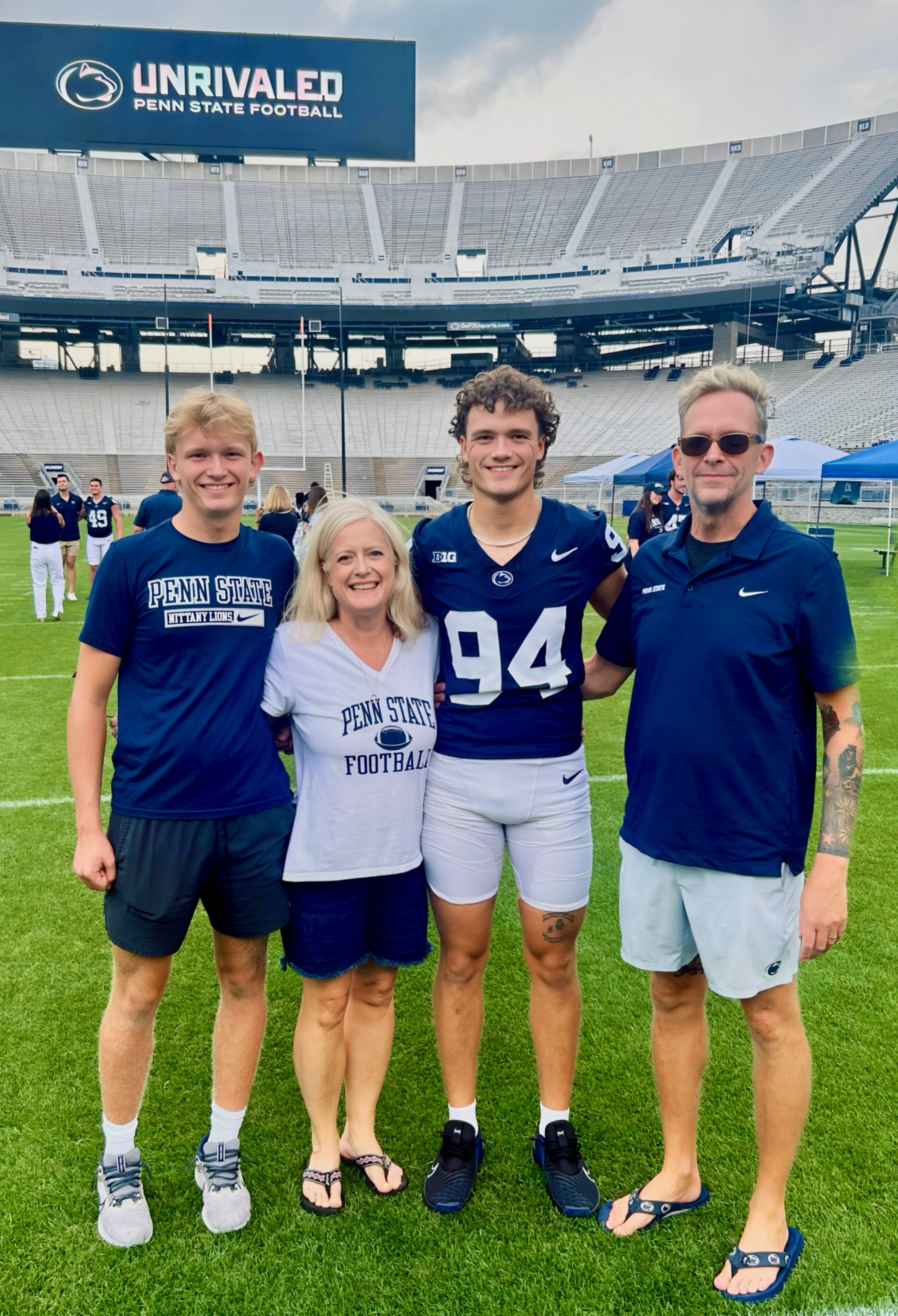
    Ryan is the starting kicker at Penn State. The redshirt sophomore, once a preferred walk-on, is now on scholarship. Shay, a senior at Kennett High School, will also head to a high-major program to kick and punt next fall. He earned a scholarship offer to Syracuse and made his pledge in June.

    Ryan is considered one of the best to come through Kennett’s program. He holds the school record for longest field goal (45 yards) and was the first in program history to play Division I football. With the Nittany Lions this season, Ryan’s longest field goal is 49 yards, and he ranks eighth on Penn State’s all-time list in extra-point percentage (98.6%), while carrying the top percentage (86.7%) in field goals made in program history.

    Shay felt he had high expectations to live up to. He has been compared to Ryan before. But Shay brushed those comments to the side because the only way to silence those remarks is on the gridiron.

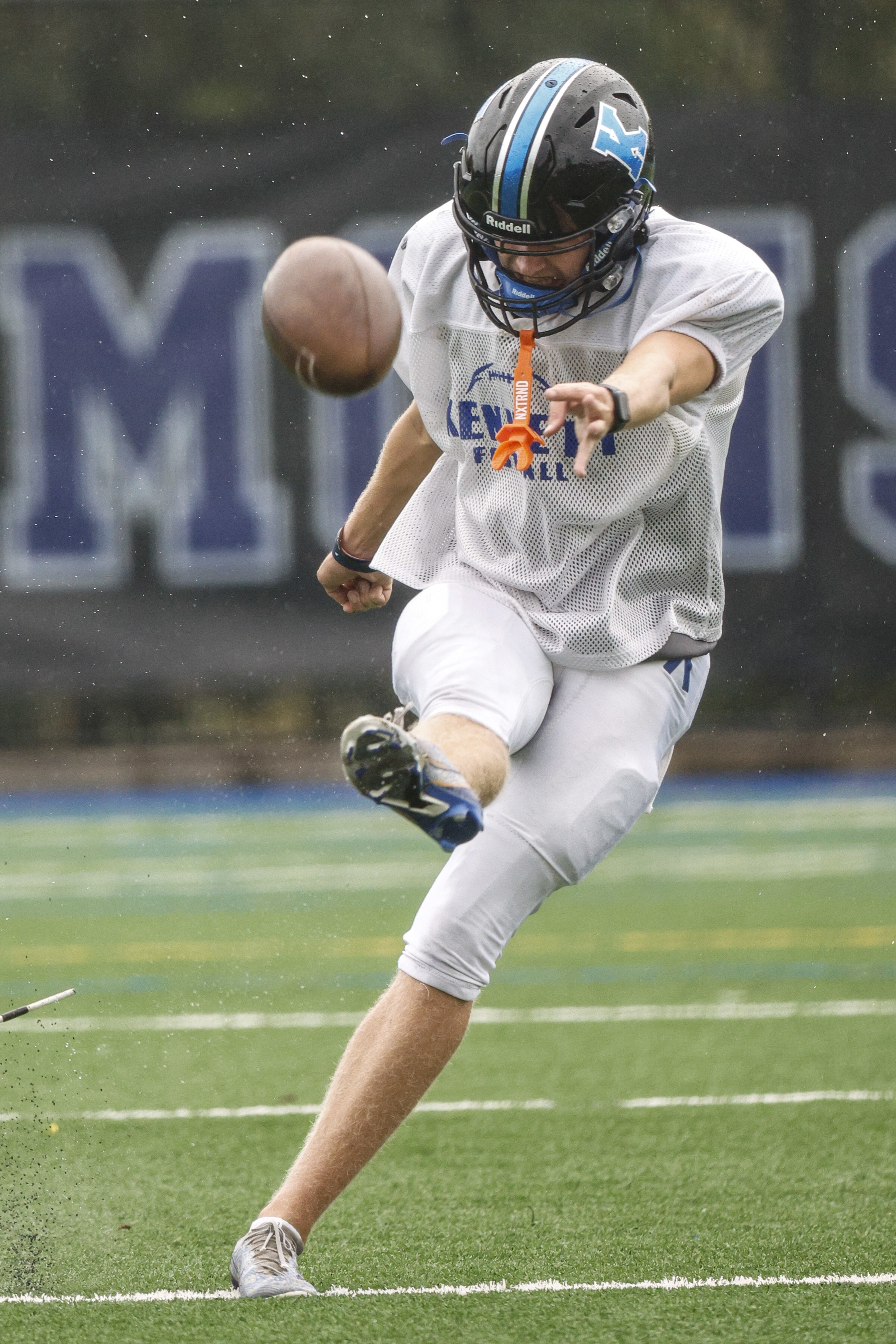
    The 6-foot-2, 190-pounder is ranked among the top 10 high school kickers in the country, according to 247Sports. He has kicked field goals as far as 63 yards in practice, and his in-game career-long is 44 yards. So far, Shay has made 8 of 10 field goal attempts for a 7-2 Kennett team.

    “Kicking has brought us closer than I ever thought we would be,” Ryan Barker said. “It’s such an individualized thing that we’re both trying to work just as hard as each other to get better at whatever we need to improve on, and to be able to have each other there for the mental and physical aspect, it’s just awesome. I love helping him. I love coaching him, and I can see that he’s listening.”

    Soccer turned football

    The Barkers grew up in a soccer family.

    Their mother, Sally, used to visit her parents’ native England during the holidays. In the early days of their relationship, her future husband came along. The two decided to go to a championship match a tier below the Premier League, and “my jaw hit the floor,” Chris Barker said.

    From the atmosphere to the game itself, Barker was hooked and became a supporter of Manchester United. The Barkers even named Ryan after Ryan Giggs, one of the most decorated footballers of all time, who spent the majority of his career with United.

    And it didn’t take long for Ryan Barker to pick up the sport.

    Shay, Sally, Ryan, and Chris Barker together on the field at Penn State.

    “We have video of Ryan barely walking but kicking a soccer ball,” his father said. “Ryan went on to achieve a lot of success in soccer. We thought that was going to be the pathway. We thought that soccer would be their ticket to maybe a scholarship in college. But little did we know that there’s an influx of Europeans now in the American collegiate soccer system, and it became pretty clear early on that it was going to be a lot more competitive for our boys to earn a scholarship, let alone play at a high level.”

    Both brothers started soccer around age 3. They played for the Delaware Rush Football Club in Hockessin and the Southern Chester County Soccer Association in Kennett Square. However, before Ryan entered high school, he sat on the idea of kicking in football.

    One day in the summer, he asked his father to drop him off at Kennett’s football field. He brought a football and tried to kick a field goal. After each attempt, he would jog over to the ball to do it again. A custodian at the school saw Ryan and went to find coach Lance Frazier to tell him, “‘There’s a freshman on the field kicking 50-yard field goals,’” Frazier recalled.

    “I’m like, ‘Get out of here, that’s not possible,’” said Frazier, in his eighth season as Kennett’s head coach. “I go up there and I see this tall, slender kid. I can hear him before I can see him, because he’s kicking the [stuff] out of the ball. … I knew he was going to have to make a really big decision here in the future: Is he a soccer player or is he a football player?”

    Through three years, Ryan played on Kennett’s soccer team and kicked for the football team. In his senior year, he decided to put his full commitment into kicking. He had some interest from smaller soccer programs to play collegiately, but he wanted to go Division I.

    Football could give him that opportunity.

    “That was probably one of the most difficult decisions that I ever had to make for myself,” Ryan said. “Just in terms of soccer being my first love and playing it for 17 years. … When I realized I could potentially play Division I football, that was kind of the main factor in my decision.”

    Kennett’s Shay Barker kicked his longest field goal of 41 yards last season.

    Shay’s journey was a bit different. He started to fall out of love with soccer in the eighth grade. Due in part to a growth spurt, Shay had patellar tendinitis in his knees, which made it painful to run. He decided to try kicking as a freshman while learning alongside his brother, then a senior.

    “He had seen how fun it was for his brother to play on Friday nights and to be part of the football team at school,” their mother said. “I think he was really excited to join [Ryan] and kind of be his understudy.”

    Kicking came naturally to Shay, but he was uncertain what he wanted from the sport. Then, something changed.

    Carving his own path

    During his junior year, Shay competed in a few camps and showcases through Kohl’s Kicking, a program for athletes who play specialized positions of kicker, punter, and long snapper to gain exposure to college coaches. He had a rough showing during the January showcase, which led him to question whether this was what he wanted to do.

    “Growing up, Shay always wanted to go to hang out with his friends,” his mother said. “He wanted to play this sport, this club. Last winter, he said, ‘I think I’m going to try to play basketball my senior year.’ [Chris and I] would look at each other like, ‘What is he talking about?’ He just could not say no. … The biggest question mark was maybe not whether he could do it, but whether he would choose to do it because of the sacrifice.”

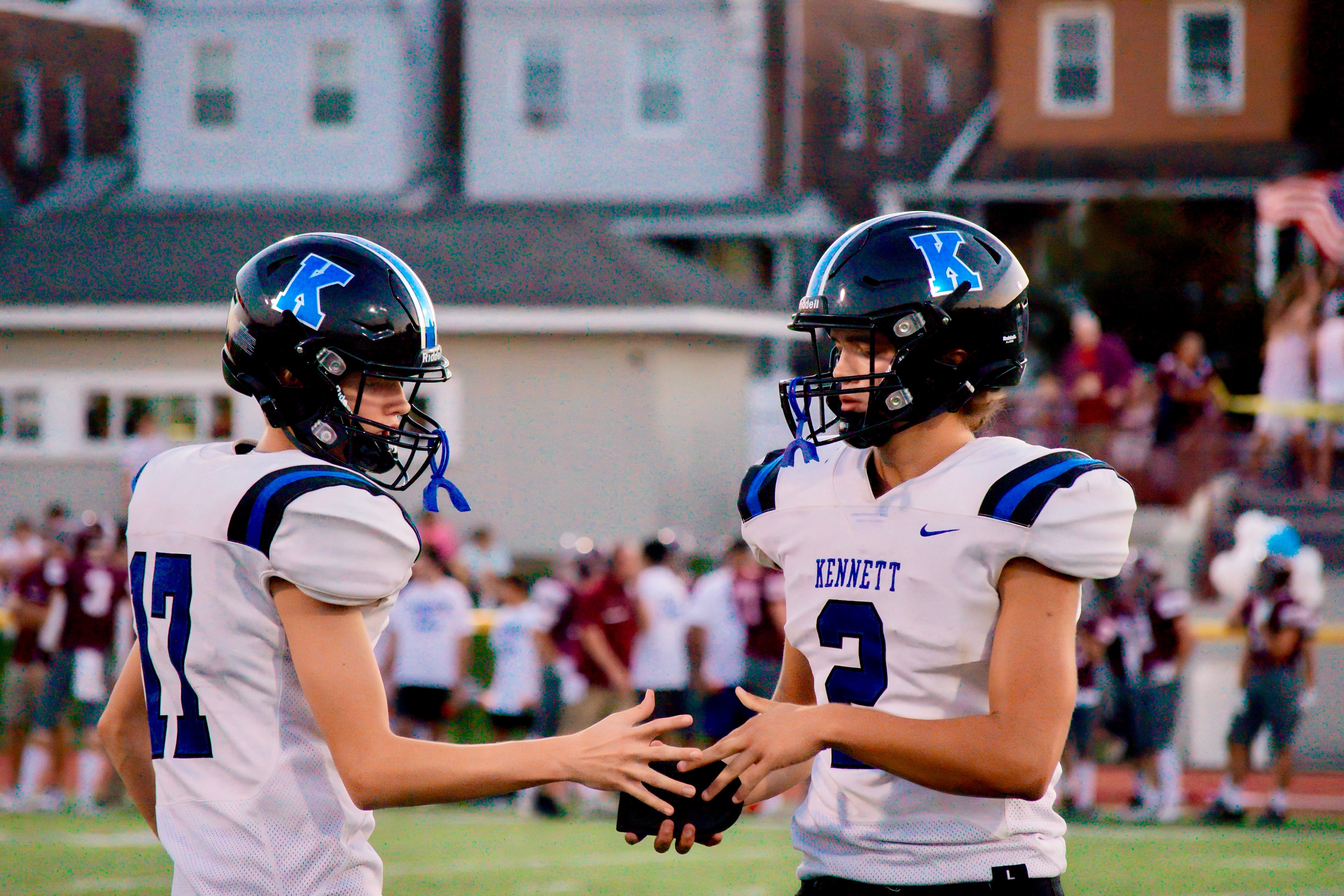
    Shay and Ryan Barker shown together while they played at Kennett High School.

    That performance fueled his desire to get better.

    Shay began seeing a personal trainer to get stronger and sought out advice from Ryan, who reminds his younger brother that “the only kick that matters is the next one.”

    In June, Shay attended a camp at Syracuse, where he won the field goal competition and backed up to about 58 yards. He also was a finalist in the kickoff competition.

    A few days later, Syracuse came calling to offer Shay a full ride.

    “They saw something in me that I didn’t even see in myself,” Shay said. “I was kind of an underdog a lot of my career. I just got in the right mental space and did what I needed to do. … I’m honored to have this opportunity, especially coming from a small school like Kennett, where not many kids get these kinds of opportunities. I just want to make the most of it.”

    And even when Ryan and Shay aren’t together, they are still competing.

    Last year, when Penn State faced Southern California on Oct. 12, Ryan hit the game-winning field goal in overtime to secure a 33-30 win for the Nittany Lions. Later that evening, Shay hit a career-long 41-yard field goal against Unionville.

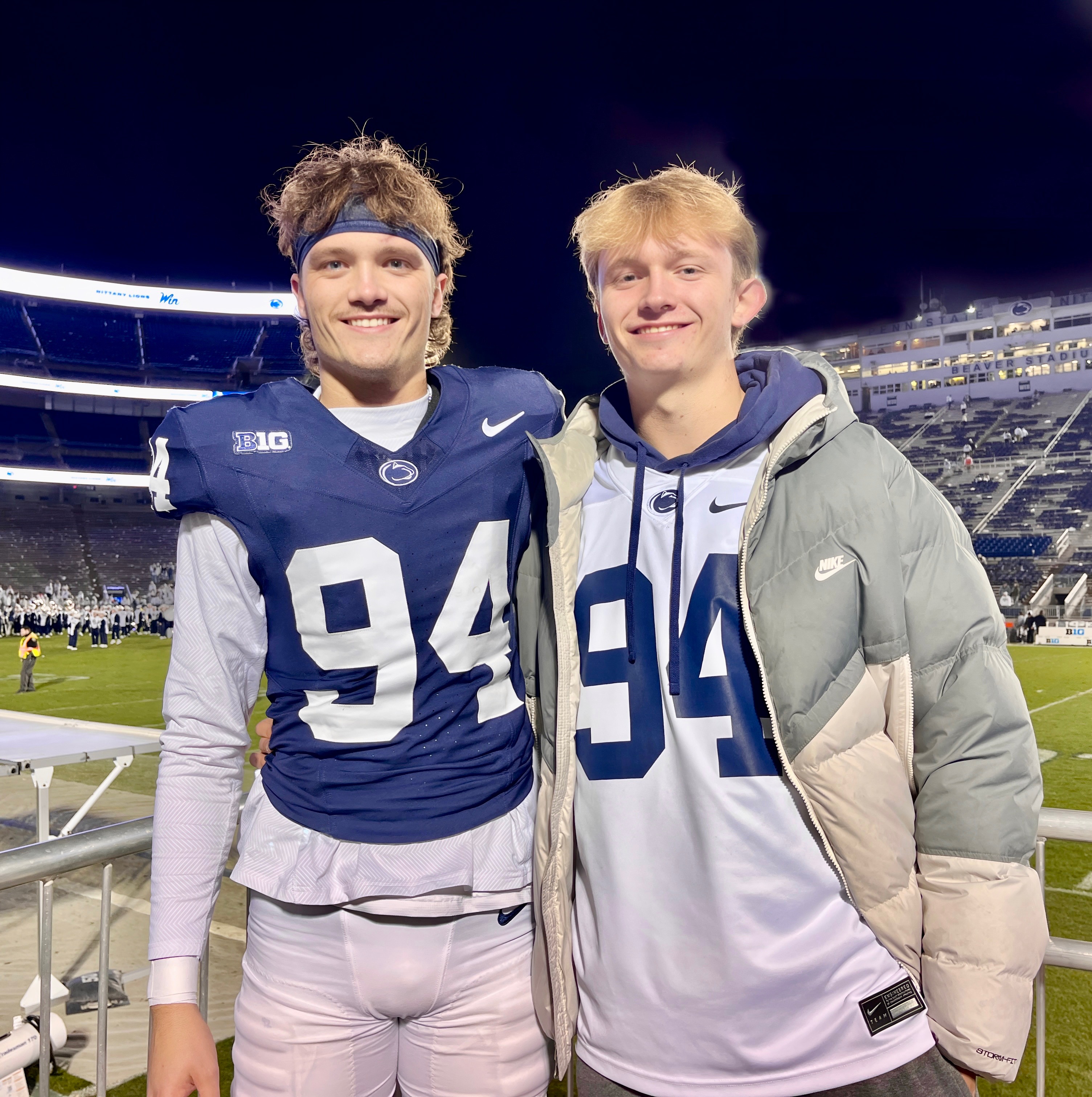
    Ryan and his younger brother Shay during a Penn State football game.

    “That was probably one of the proudest and special moments for us as parents,” their father said. “Both our boys, at their various levels, did something quite remarkable on the same day.”

    Shay has hopes of surpassing Ryan’s program record. Last weekend, he broke his career-long with a 44-yard field goal against Avon Grove. He told his big brother about those aspirations and has his support.

    “Ever since I went to college, Shay is finally able to find his identity and what he brings to the table in terms of football,” Ryan said. “It’s great seeing him succeed. He, without a doubt, has the capability to beat that record, so I hope that he gets that opportunity.”

    Frazier believes Ryan and Shay could be the next brother duo to kick in the NFL.

    The two already have Sept. 4, 2027, circled on their calendars, when the Nittany Lions host the Orange at Beaver Stadium. This journey isn’t what Shay would have expected, he said, but kicking has given him the chance to play college sports, while forming a lifelong bond with his brother.

    “It’s definitely something I don’t take for granted,” he added. “I wouldn’t be here without Ryan.”

  • Flyers prospect Alex Bump became a star at Western Michigan. The former fifth-rounder might prove to be ‘an absolute steal.’

    Flyers prospect Alex Bump became a star at Western Michigan. The former fifth-rounder might prove to be ‘an absolute steal.’

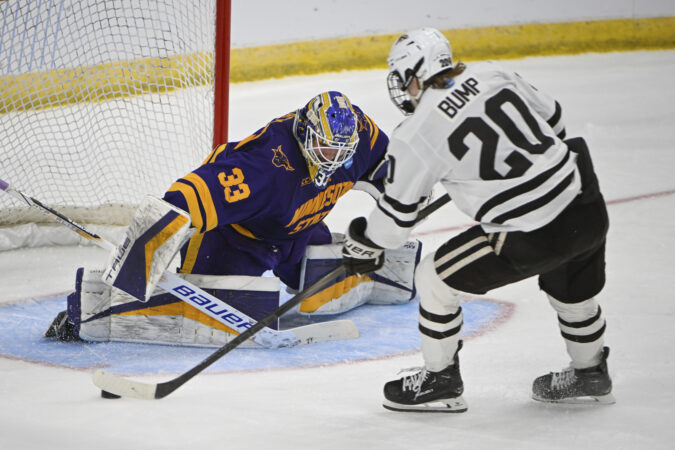
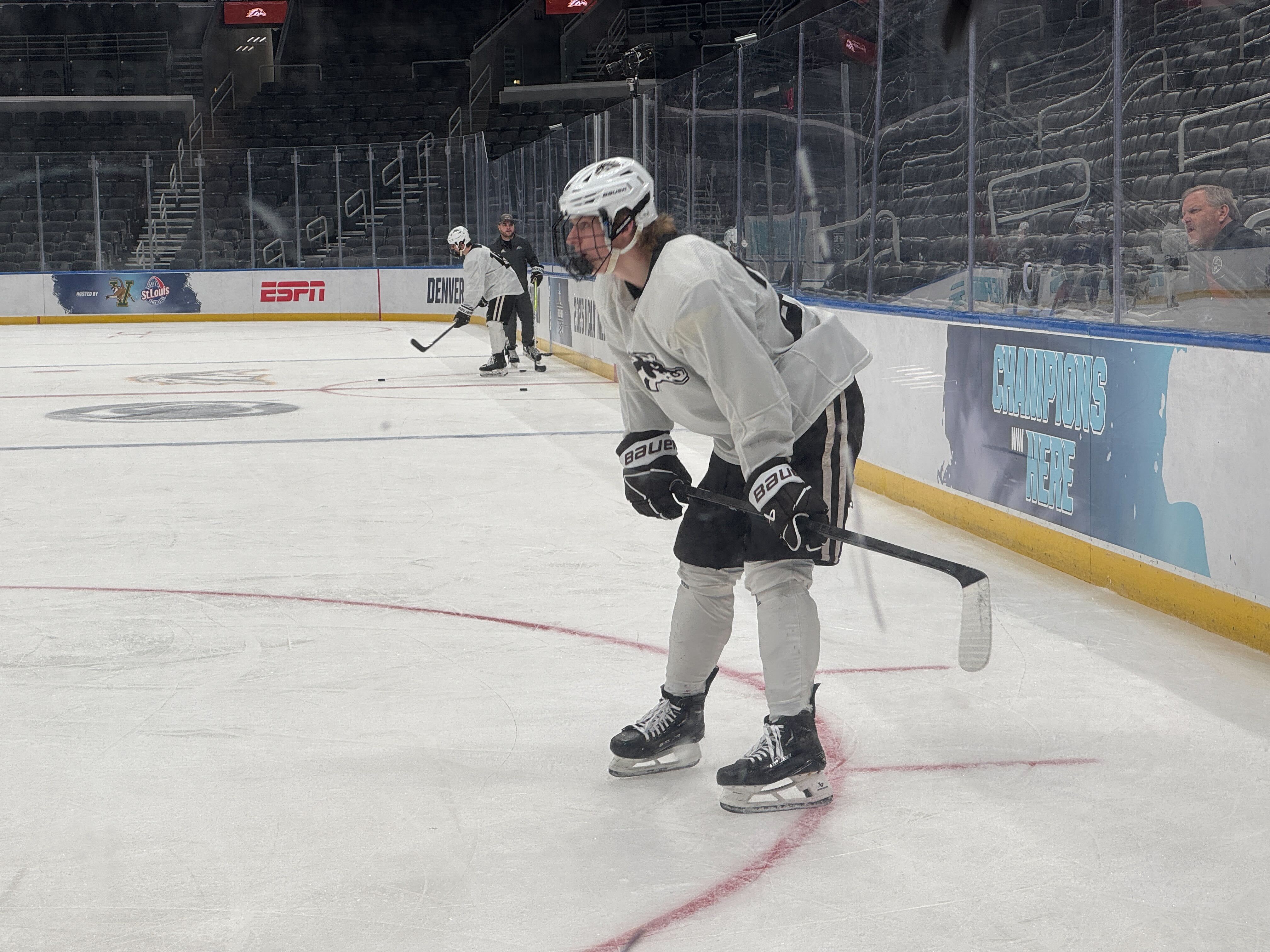
    ST. LOUIS — Skating around the Enterprise Center with his blond hair flowing out of his helmet, Flyers prospect Alex Bump potted a quick wrister from the slot as his linemate Matteo Costantini let out a big yelp.

    Were they celebrating a goal like the double-overtime winner that sent Western Michigan to the NCAA regional finals? No. Was it one of his team-leading 23 tallies this season? Nope. It was instead at Western Michigan’s final practice before the university’s first-ever appearance in the Frozen Four.

    While the goal came as he skated around in a white practice jersey with a black Bronco on it, it encompassed what Bump, 21, does best now, and what he will look to replicate when he suits up for the Flyers in the no-longer-distant future.

    Bump is a goal scorer.

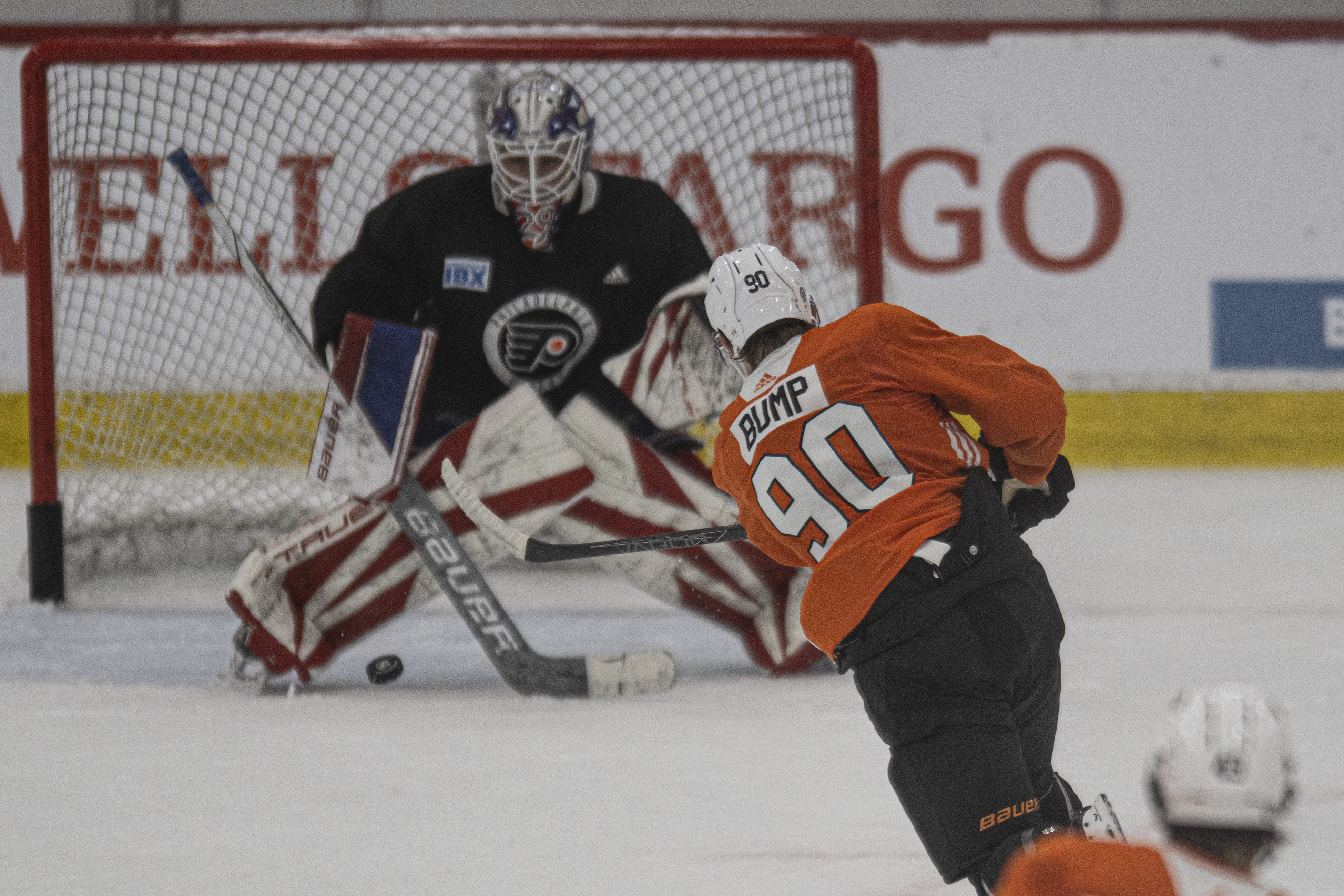
    “A lot of guys are not confident in their shooting,” Flyers director of player development Riley Armstrong said. “A lot of guys don’t think they can beat a goalie, or they have to get to a certain area on the ice to be able to beat the goalie. I think Alex is a very confident shooter, he knows where to shoot the puck. He’s always known how to find the net.”

    Flyers prospect Alex Bump is tied for eighth in the nation with 23 goals this season.

    Hometown hero

    Joe Pankratz remembers Bump being at the rink, even before he starred for him at Prior Lake High School. Bump’s two older brothers played hockey for the school’s longtime coach, and a young Bump — who at the age of 8 and 9, “was a good squirt”— developed a reputation as a rink rat.

    “The biggest thing is, he absolutely loves hockey,” Pankratz told The Inquirer. “You can’t get him off the ice.”

    It was in his hometown of Prior Lake, Minn., where Bump developed that lethal shot of his. He scored 48 goals during his senior season as the Lakers’ captain, including 12 in the section and state tournament playoffs; five came in one playoff game.

    “It’s a lot of snapshots, and he protects it and hides it really well. He changes the angle on his shot. … A lot of that is he’s got amazing hands, but he has a lot of poise with the puck, so he isn’t in a rush,” Pankratz said. “He doesn’t panic with it.”

    And he is a volume shooter. This season, the left-shot winger has fired 236 shots on goal with 23 goals, a 9.7% shooting percentage.

    But it’s not just his shot that’s impressed the Flyers.

    “He’s very elusive of checks. He’s slippery, as you would call it in hockey,” Armstrong said. “He always finds a way to get around guys, get through guys, and then when he doesn’t have the puck, he always finds a way to get open. He has a really good stick. He’s physical. He engages with and without the puck into contact, which is something that you need to play at the NHL level.”

    Alex Bump’s skill has popped at multiple Flyers development camps. Next year, he hopes to crack the NHL out of main training camp.

    The NHL could come as soon as the Broncos’ season ends, either Thursday against the University of Denver (5 p.m., ESPN2) or after Saturday’s national championship game (7:30 p.m., ESPN2). And it sounds like Bump will be coming with an ax to grind.

    “Our guys, Brent [Flahr, assistant general manager] and [amateur scout] Shane Fukushima in Minnesota, had seen him play a lot [in high school], and they were very comfortable with him. They couldn’t believe that he had fallen this far,” Flyers general manager Danny Brière said this week.

    At the time, Brière was an adviser to then-GM Chuck Fletcher. He jokes that his nephew Zaac, the team’s runner at the Montreal draft, “still claims he made the pick for us” after seeing Bump’s name high on the team’s draft board and saying they should take the Minnesotan.

    Bump was eventually selected by the Flyers in the fifth round with pick No. 133 — and it lit a fire.

    “He came up to the suite after. He had his brothers there, his family, and he came in and he was [ticked] off that he went so late. He felt he should have went earlier in the draft,” added Armstrong, then an assistant coach with Lehigh Valley.

    “I think he’s proven a lot of people wrong, or for our sake, right.”

    ‘An absolute steal’

    Why Bump, the 2022 USA Today High School Hockey Player of the Year, fell is irrelevant now. Just like the round he was drafted. As Flahr always says, it’s all about what you do after that matters. And what Bump, 21, has done has been impressive.

    But first, Bump had to face some adversity. He played USHL hockey wrapped around his senior year but didn’t put up the biggest numbers the year after he graduated. A University of Vermont commit, he had to make a last-minute pivot when the Catamounts’ coach was fired, and found a home at Western Michigan in Kalamazoo, Mich.

    Alex Bump, pictured at Western Michigan’s Frozen Four practice on Wednesday, was the NCHC’s top forward this year.

    “I think that we’ve seen over the last two years is that his development has seemingly gone into hyperdrive. I think he’s ahead of schedule where we thought he would be this time two years ago,” FloHockey’s prospect analyst Chris Peters told The Inquirer. “So that’s a pretty positive development, because he was good in the USHL, but he wasn’t dominant. And now this year, you could say he was one of the best players in college hockey.”

    Broncos coach Pat Ferschweiler, who was a linemate at Western Michigan with Flyers president Keith Jones, and the Flyers organization work in lockstep. Armstrong speaks with the coaching staff and Bump consistently, and goes over videos with the player to make sure they are all on the same page as far as his development and making sure he is NHL-ready.

    How it will translate at the NHL level is to be determined. Ferschweiler says the Flyers got “an absolute steal.” He notes Bump’s “incredible hockey sense and incredible vision,” but feels what will really separate him and “what the Flyers fans are going to love, is, he’s got incredible compete.”

    “Alex does not lack for confidence,” he said. “He’s got inner belief, because he works really hard, and that’s how belief is earned. He does that every day. So he’s not a cocky kid, but he does have self-belief, which I think there’s a fine line there and he walks on the right side of it.”

    A pure goal scorer, Bump does need to continue to work on his skating. But those who know him best have seen improvement. This past winter break, Bump skated with his old high school team and Pankratz noted “how much stronger, more powerful of a skater he is.”

    And they all know he will put in the work because he wants to succeed.

    “I don’t think he’s ever really been a passenger.” Peters said. “He’s a driver, and especially at his age, and that program, and based on what they have surrounding him, like they needed him to be that, and he’s delivered. So he’s risen to the occasion.”

    The Flyers and their fans will love to hear that because maybe, just maybe, he becomes another game-changer for a team that needs more of them to take that next step.

    “I really do,” Armstrong said, when asked if Bump could be that type of guy. “I think, with Matvei [Michkov] as well. … You just have to have a little bit of patience to kind of see the rebuild through and wait for these kids to get there.

    “Once they do, you’re going to have a couple of game-changers sitting right in front of you.”

    Alex Bump’s shot is his No. 1 attribute but the Flyers see more than just that in the 21-year-old.