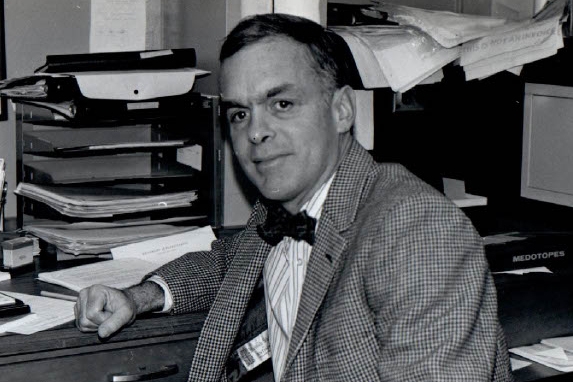
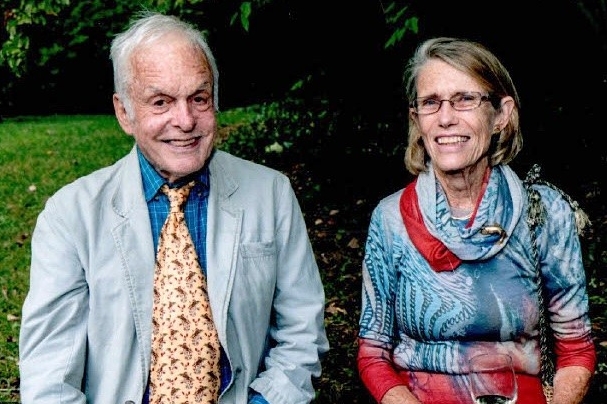
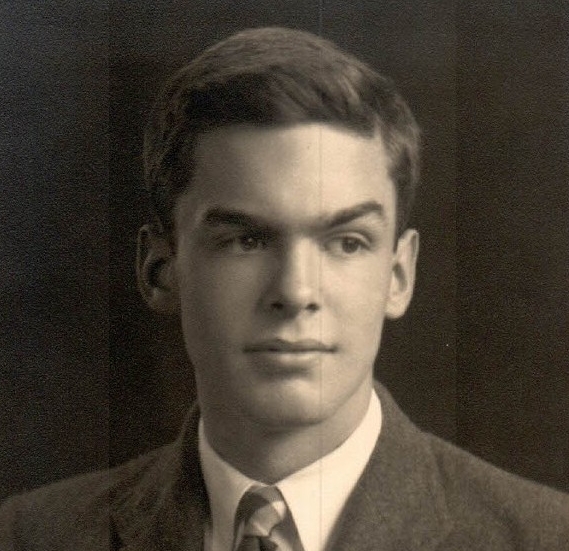
William L. Elkins, 93, of Coatesville, pioneering research immunologist at what is now the University of Pennsylvania’s Perelman School of Medicine, associate professor emeritus of pathology and laboratory medicine, innovative longtime Angus cattle rancher in Chester County, avid sailor, and veteran, died Tuesday, Nov. 11, of complications from pneumonia at Chester County Hospital.
The great-great-grandson of Philadelphia business tycoon William Lukens Elkins, Dr. Elkins fashioned his own distinguished career as a scientist, medical researcher, and professor at Penn from 1965 to 1985, and owner of the Buck Run Farm cattle ranch in Coatesville for the last 39 years.
At Penn, Dr. Elkins conducted pioneering research on how the human immune system fights infection and disease. He collaborated with colleagues in Philadelphia and elsewhere around the country to provide critical new research regarding bone marrow transplants and pediatric oncology.
His work contributed to new and more effective medical procedures at Penn, Children’s Hospital of Philadelphia, and elsewhere, and he instructed students and residents at Penn. But his lifelong love of the fields and rolling hills he roamed as a boy in Chester County never faded, he told Greet Brandywine Valley magazine in 2023.
Dr. Elkins was a lifelong outdoorsman.
“Farming is in my blood,” he said. “So even when I went to medical school and all that, the enthusiasm never left, and I wanted to go back to it.”
So he retired from medicine at 53, and he and his wife, Helen, bought nearly 300 acres of the old King Ranch on Doe Run Church Road in Coatesville. She kept the books and looked after the business. He became an expert on breeding cattle and growing the high-energy grass they eat.
Wearing floppy hats and riding a colorful ATV from field to field, Dr. Elkins worked his land for decades. He mended fences and tended daily to his 120 cows, heifers, and prize bulls.
He championed holistic regenerative farming and used new scientific systems to feed his cattle. He rejected commercial fertilizer and knew all about soil composition, grass growing, and body fat in cattle.
Dr. Elkins and his wife, Helen, married in 1966.
In a 1995 Inquirer story, he said: “Cattle are just like anyone else. If you just turn a few cattle out in a great big field, they will wander around, eat the grass they like best, and leave what they don’t want. That means the less desirable grasses tend to predominate.”
He traveled the country to confer with other cattlemen and helped found the Southeast Regional Cattlemen’s Association in 1994. He sold his beefsteaks, patties, jerky sticks, and kielbasa grillers to private customers online and to butchers and restaurants.
At least one local chef featured an item on the menu called Dr. Elkins’ Angusburger. Lots of folks called him Doc.
He earned his medical degree at Harvard University in 1958 and served two years in the Navy at the hospital in Bethesda, Md. He was a surgical intern in New York and discovered that he preferred the research lab. Before Penn, he worked at the Wistar Institute of biomedical research.
Dr. Elkins graduated from St. Mark’s School in Massachusetts in 1950.
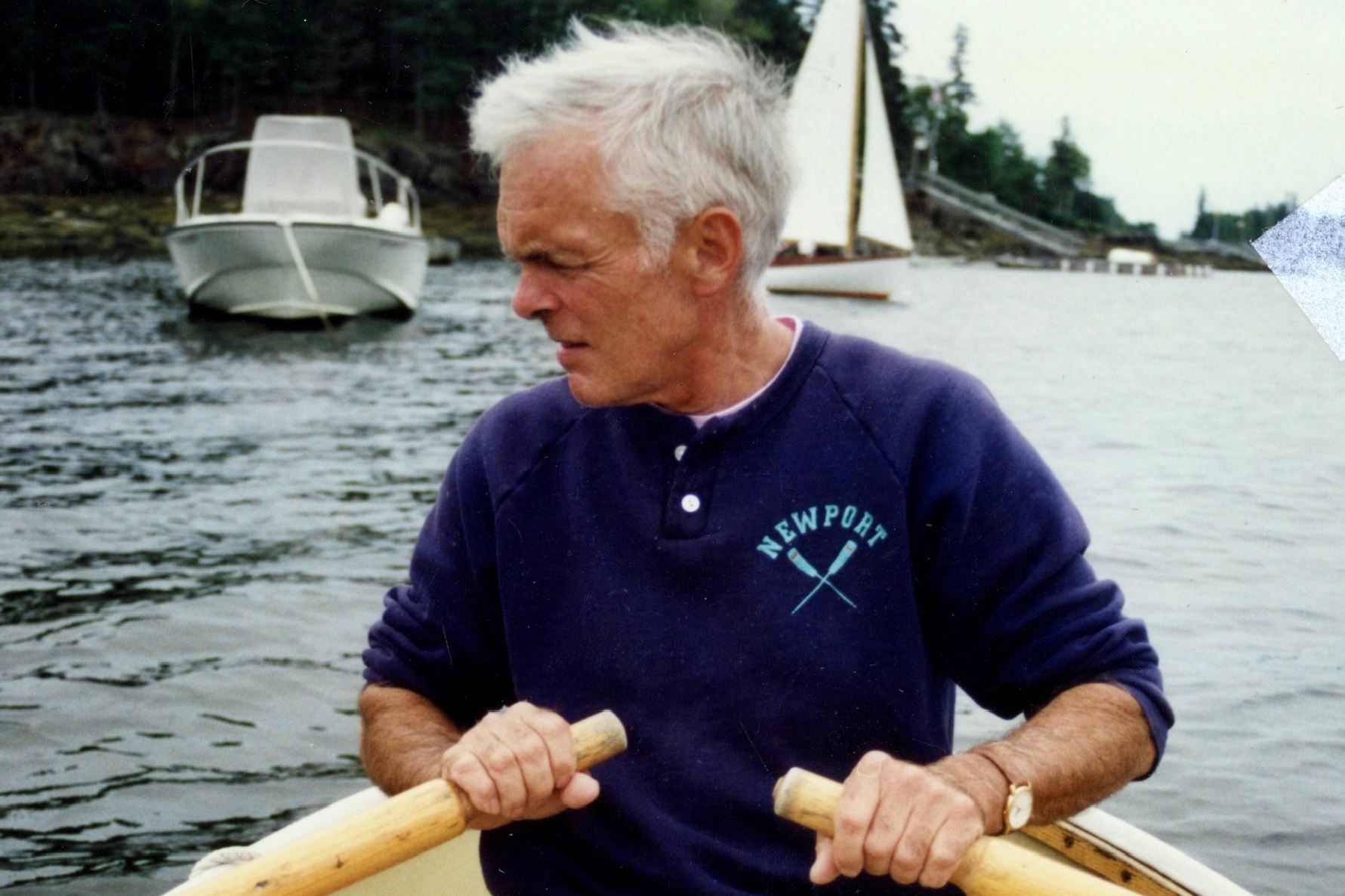
Away from the lab, Dr. Elkins was an ocean sailor, expert navigator, and former boat club commodore. He was active with the Brandywine Conservancy, Natural Lands, and other groups, and was lauded by national organizations for his wide-ranging conservation and wildlife efforts.
He made his farm a haven again for the bobolink grassland songbird and other migratory birds and butterflies that had dwindled. “Buck Run Farm is more about growing grass and trees than beef,” he told Greet Brandywine Valley. “We’re blessed by the land.”
William Lukens Elkins was born Aug. 2, 1932, in Boston. He lived on the family dairy farm in Pocopson, Chester County, when he was young, went to boarding school in Massachusetts for four years, and earned a bachelor’s degree in biology at Princeton University.
He met Helen MacLeod at a party in Washington, and they married in 1966 and had a daughter, Sheila, and a son, Jake. They lived in Center City, Society Hill, and Villanova before moving to the farm. “He was easy to be with,” his wife said.
Dr. Elkins enjoyed sailing and fishing.
Dr. Elkins loved nature, fishing, and baseball, and he followed the Phillies, the Flyers, and other sports teams. “He had a wonderful bedside manner,” his daughter said. “He was a great listener. He really knew how to support people.”
His son said: “He was unassuming and direct. He spoke his mind. He connected with so many different people. He was curious about the world around him.”
His wife said: “He was thoughtful and always concerned about people. He had good humor. He was fun.”
In addition to his wife and children, Dr. Elkins is survived by five grandchildren and other relatives. A sister died earlier.
This article about Dr. Elkins and his ranch appeared in The Inquirer in 1995.
Sherri Horsey Darden has no family history of brain cancer, nor has she been having persistent headaches, seizures, or any other symptoms that could suggest a tumor.
But when she heard the Brain Tumor Foundation, a New York-based charity, was offering free magnetic resonance imaging (MRI) brain scans in Philadelphia, she made sure to get an appointment.
“A lot of times people have things and don’t know,” she said.
She received her scan at Triumph Baptist Church of Philadelphia in North Philadelphia, where the foundation was offering scans last week to the general public. She’ll receive her results within a couple weeks.
The foundation has hosted these screening events for more than a decade, with the goal of promoting early detection of brain tumors.
Using MRI scans for preventive health screening hasgrown increasingly popular in recent years, with celebrities like Kim Kardashian touting expensive whole-bodyscans on social media.
But many doctors worry that the risks outweigh the benefits. They say that screening MRIs of the brain could lead to unnecessary surgeries and anxiety, and that catching a brain tumor early wouldn’t always change a person’s outcomes. These scans are not typically covered by insurance if not ordered by a doctor, and can cost anywhere from $1,000 to $10,000.
“There, to date, is no data available at all that would suggest that this is a useful approach,” said Stephen Bagley, a neuro-oncologist at Penn Medicine’s Abramson Cancer Center.
In the best scenarios, preventive medical screening can help catch diseases early when they are most treatable, and give people peace of mind. But they can also lead to overdiagnosis, false positives, unnecessary stress, and costlyfollow-up procedures.
This is why expert panels carefully evaluate which screening tools should berecommended to the general public. Decisions by the U.S. Preventive Services Task Force, considered the gold standard for evidence-based preventive care, weigh the potential harms involved against the likelihood of improving outcomes.
Even the most common screenings for cancer, like mammograms for breast cancer and PSA tests for prostate cancer, have faced controversy and shifting guidelines regarding who should get them and how frequently they should be administered.
There is no medical evidence showingthat mass MRI screening is helpful. Still, all spots for the foundation’s multiday screening event at Triumph Baptist Church were claimed. Zeesy Schnur, executive director of the foundation, said they aim to scan 100 to 150 people in each city.
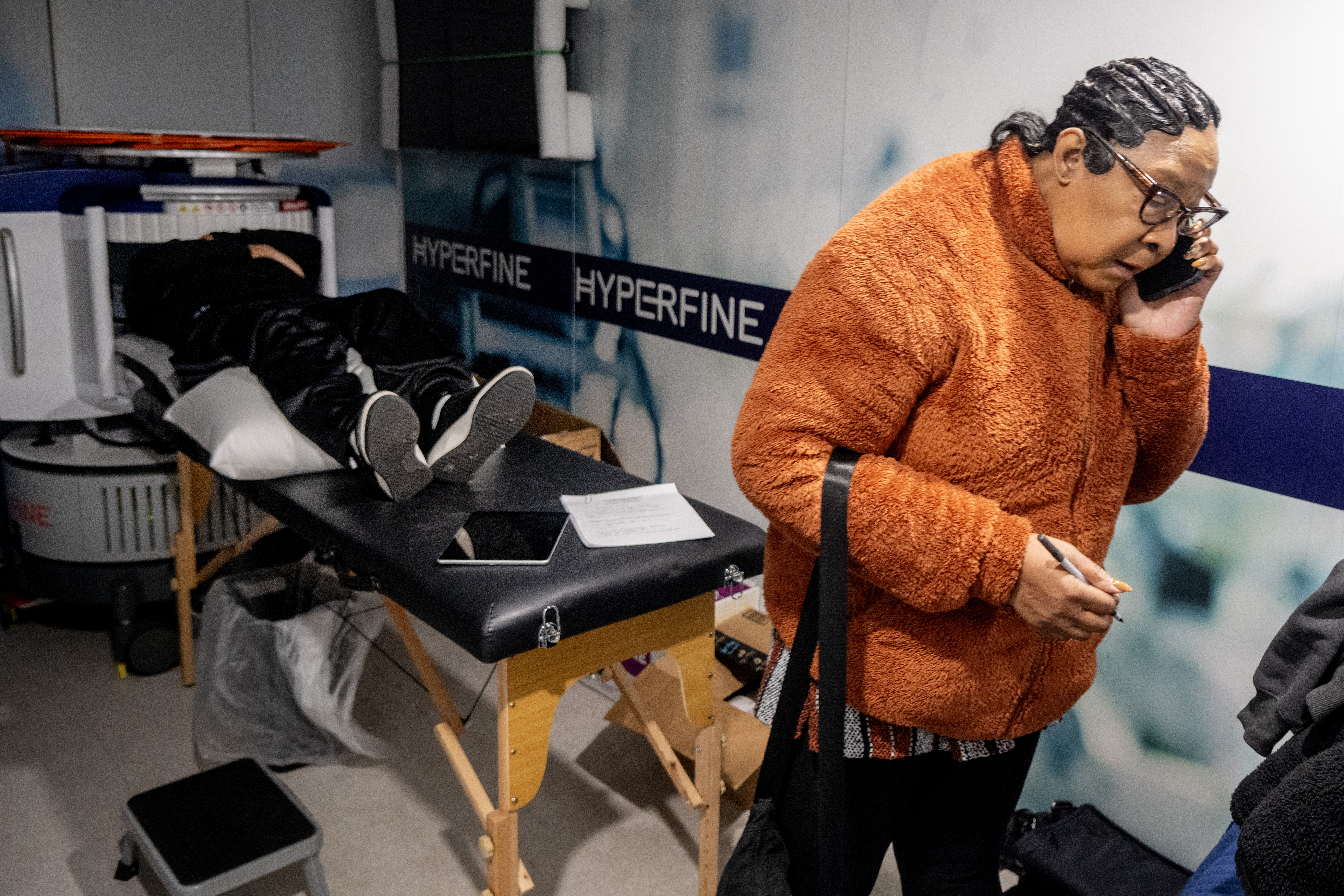
Juanita Young, her husband, and her friend all booked consecutive appointments last week. Though she hasn’t had any symptoms that would make her think she had brain cancer, she signed up “just wanting to know,” she said.
Juanita Young, her husband, and her friend all booked consecutive appointments to get screened.
Philadelphia visit
The idea for the early detection campaign came from Patrick Kelly, a now retired neurosurgeon who started the foundation in 1998.
He was frustrated to see the majority of his brain cancer patients die from the disease, and felt that treatment would be more effective if the tumors were found earlier, explainedSchnur, who has been at the foundation since 2000.
Kelly envisioned a future where, similar to going through the scanners at an airport security checkpoint, people could get a full scan of their body, “and then this piece of paper would pop out and say, ‘Hey, you have a problem here,’” Schnur recalled.
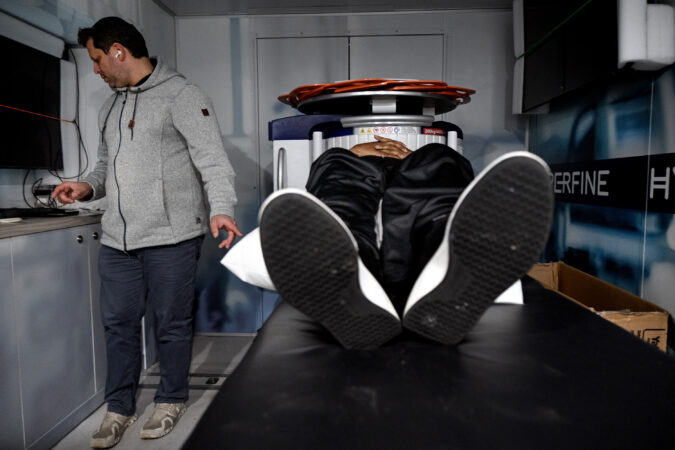
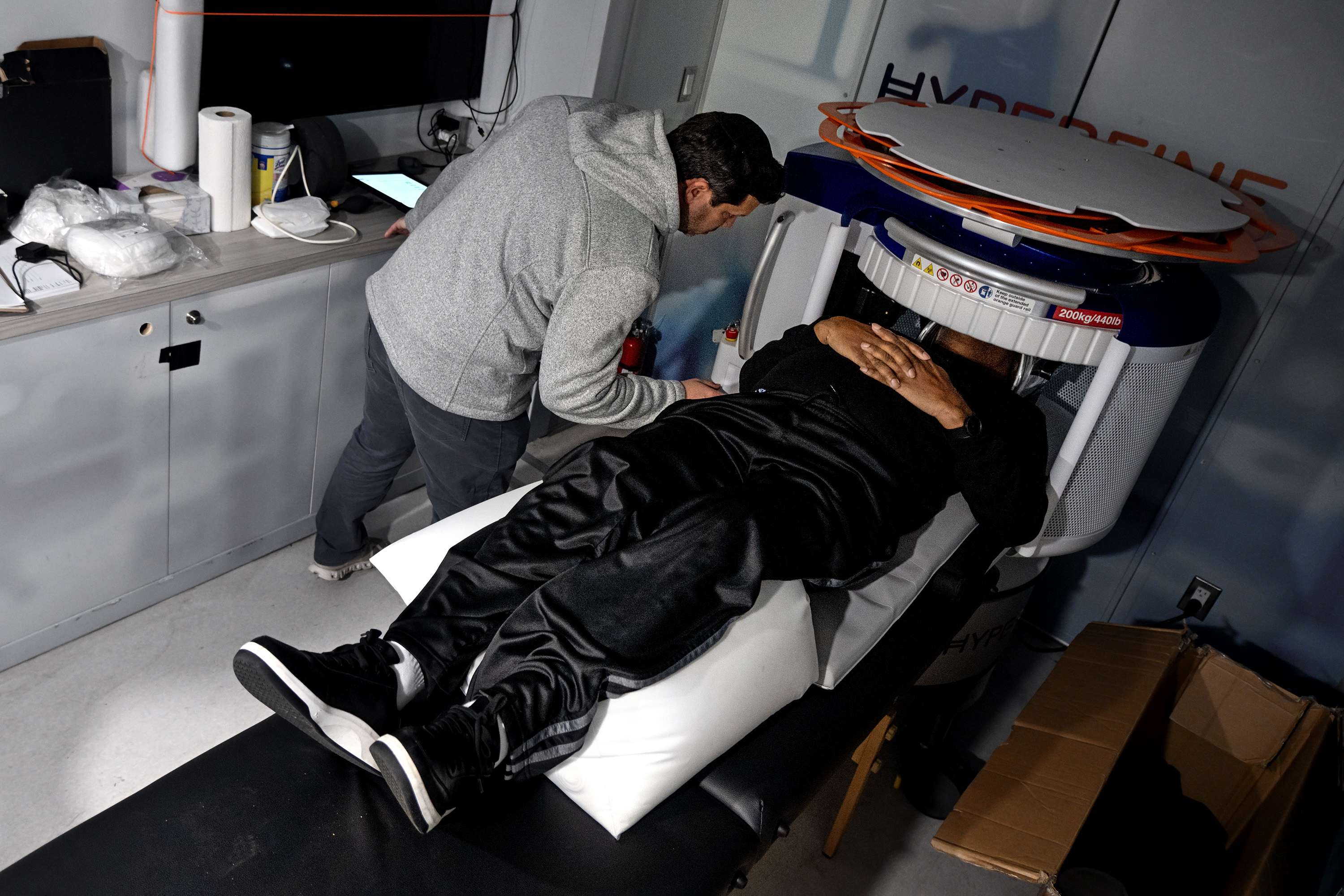
The foundation offers brain MRIs for free at their events, covering the cost of administering the scan and having a radiologist read it. They use a portable MRI machine that only scans the brain and takes approximately 15 minutes.
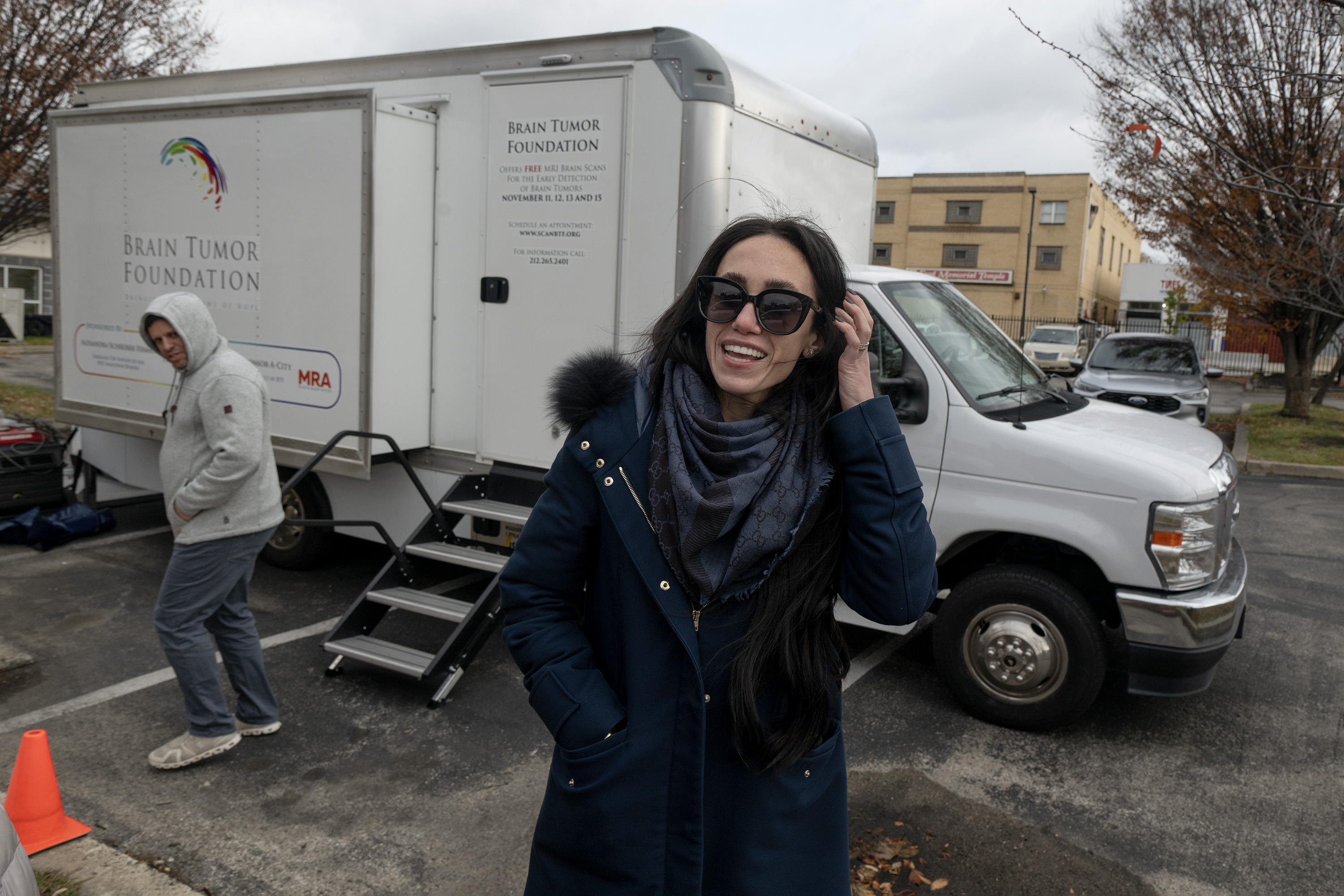
The foundation has chauffeured its machine all over the country through its “Sponsor-A-City” program, which allows people to donate the funds needed to bring the unit to a city of their choice. They usually pick cities that are demographically diverse.
The event in Philadelphia was sponsored by Alexandra Schreiber Ferman, who lives in the area, through the more than $50,000 she raised from running the New York City Marathon.
Schreiber Ferman’s paternal grandfather died from glioblastoma and was a patient of Kelly’s. Her family has been involved with the foundation since its inception.
Schreiber Ferman got her first scan five or six years ago, after she had been having headaches. She pressured her parents to get her in for an MRI when the foundation’s unit was in Brooklyn.
“Thankfully, everything was OK. I just was stressed out,” she said.
Having a family history of the cancer makes her and her family more alert when it comes to headaches and other symptoms. Schreiber Ferman received her second scan Tuesday morning at the screening event.
Alexandra Schreiber Ferman sponsored the Brain Tumor Foundation’s event in Philadelphia.
She said her family and people at the foundation feel that these scans should be “something that’s routine,” like mammograms and skin checks.
“My goal would be that getting a brain scan becomes just a routine part of aging,” she said.
Her father, who serves as chairman of the foundation, wants other people to have the chance to get screened and has helped sponsor past city visits.
However, he himself has only gotten one screening since the program first started, and no longer wants any more.
“My dad is adamant that he does not want to get a scan. I think for him, ‘ignorance is bliss,’” she said.
What doctors say
Screening tests have to meet certain criteria in order to become standard practice, explained Richard Wender, chair of family medicine and community health at Penn and former chief cancer control officer for the American Cancer Society.
A national leader in cancer screening, he would not recommend that people undergo MRIs to screen for brain cancer.
The first criteria for a screening tool to be recommended for the general population is that the disease is common, he said. The disease must also come with a high risk of harm or death and must have stages, so that it can be found before it causes symptoms.
Lastly, available treatments for the disease have to be able to reduce the risk of serious outcomes.
Brain cancer is unlikely to ever meet that criteria, Wender said, mainly because it isn’t common enough. There also isn’t sufficient evidence that finding a brain cancer earlier reduces the risk of a person dying from it.
For example, the most common malignant brain tumor, glioblastoma, is so aggressive and invasive from the start, it is always considered a grade four tumor, noted Bagley, who serves as section chief of neuro-oncology at Penn.
These cancers grow so quickly that the time between the tumor developing and someone showing up to the emergency room with symptoms is typically on the order of months, he said.
“You cannot cure it, no matter when you find it,” Bagley said.
A subset of brain tumors called grade two gliomas are slow-growing enough that catching them earlier could give a patient a better outcome. However, “it’s so rare, you’d have to do so many of these MRIs to find those tumors,” he said.
Another issue with screening the general population is that there will inevitably be false positives.
Some abnormalities in the brain might look like possible tumors on MRIs but turn out to be harmless.
Yet, the person would have to undergo a medical procedure, such as a brain biopsy, to prove that it isn’t cancer.
“You end up putting the patient through invasive brain procedures, lots of anxiety, and existential distress for what ends up to be nothing,” Bagley said.
The same goes for benign brain tumors like meningioma, the most common type of brain tumor in adults. Roughly 39,000 cases are reported each year in the United States. A “very tiny percentage” of these ever become malignant, and it’s unknown if catching them early would help the patient in the long run, Bagley said.
It might just mean the patient has to get MRIs every year for the rest of their life, or get surgery to remove a tumor that probably never would have been become a problem.
Some of these patients have ended up seeking follow-up care fromRicardo Komotar, a neurosurgeon who directs the University of Miami Brain Tumor Initiative in Florida, after finding out they had benign tumors from screening MRIs. He tells these “super nervous” patients that it’s nothing to worry about, but now that they’ve found it, he has to follow it.
As of right now, there is no good screening mechanism when it comes to the brain, Komotar said. He recommends only imaging a person’s brain if there’s a reason, such as a seizure, weakness, or migraines, or an injury, such as in a car accident.
“Brain MRIs as screening have not been proven to help and, in my experience, they only hurt,” Komotar said.
More research needed
Ethan Schnur checks on James Brown as he has his early detection brain tumor screening at the Brain Tumor Foundation event in Philadelphia.
When the foundation first started offering scans, they were finding potential abnormalities in one out of every 100 people they screened. Those included anything from a brain tumor, to silent stroke, to an aneurysm.
One example was a man from Staten Island who had no symptoms, but through the scan, found out he had a nonmalignant brain tumor. He got surgery to remove it.
“He called us afterward to thank us,” Schnur said.
Their stance is that these MRIs should be part of standard of care, so that anyone who wants one has the option.
The foundation has partnered with Weill Cornell Medicine and NewYork-Presbyterian in New York City for a formal research study using data from their screening events.
John Park, the lead researcher and chief of neurosurgery at NewYork-Presbyterian Queens Hospital, said the study will help assess whether screening MRIs for a general populationcould be useful. They aim to screen up to thousands of patients.
“We don’t know if it will be effective or not,” Park said.
If the study were to suggest the scans are effective, there would still need to be a large randomized trial to validate those conclusions, Wender said.
Park’s team will also look at demographic information in an effort to identify risk factors for brain tumors and other abnormalities.
Research into risk factors could help justify whether certain populations should get routine screeningMRIs, Bagley said. He noted that patients with Li-Fraumeni syndrome, a rare genetic disease that predisposes people to developing cancer, are already recommended to get whole-body MRI scans yearly because they’re known to be at such high risk.
Other than those patients, “we don’t really have any way to say this large group of patients is at high risk for this type of brain tumor,” Bagley said.
A handful of patients have ended up seeking care at Penn from Bagleyafter paying for a whole-body MRI from a private company. These are people who were “completely fine” before happening to find a brain tumor on their scans, he said.
One of them was diagnosed with glioblastoma.
He isn’t sure yet whether being diagnosed earlier will actually extend the patient’s survival time. It might just mean the patient gets a few months’ head start on treating the tumor.
“It’s totally unclear if he did himself any justice by finding this terrible brain cancer any earlier. It’s incurable either way,” Bagley said.
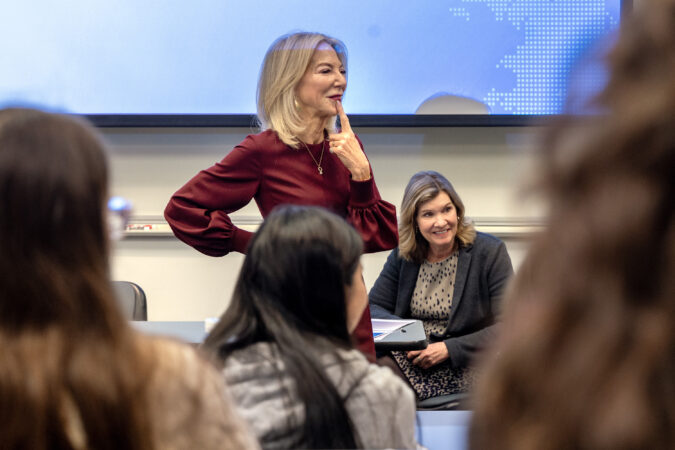
The undergraduateclass at the University of Pennsylvania vigorously discussed the use of affirmative action in college admissions, half the room charged with arguing one side and half the other.
Their task, informed by the 2023 U.S. Supreme Court decision that ended the use of race-conscious college admissions, was to brief and advise a popular governor of a swing state who had not yet taken a position on the issue.
“Guess who is the governor?” said their professor, Amy Gutmann. “I am the governor.”
And for 90 minutes, the entirety of the class period, Gutmann guided a lively discussion in which students talked as much as she did.
While never a governor, Gutmann has quite the leadership portfolio. She was president of Penn for a record 18 years, leaving in 2022 to become U.S. ambassador to Germany under former President Joe Biden, a post she held until 2024. She is also a Harvard-educated political scientist who cowrote the book The Spirit of Compromise and in 2018 was called one of the world’s 50 greatest leaders by Fortune magazine.
Now, for the first time in about 25 years — since she was a politics professor at Princeton — Gutmann is back in the classroom teaching a full course this semester in the Annenberg School for Communication. Sarah Banet-Weiser, dean of Annenberg, who initially came up with the idea for the course, is her co-teacher.
For students, the professorial star power was hard to pass up. There was a waiting list for the class.
“It’s kind of a power duo,” said Evan Humphrey, 21, a senior communications major from Seattle. “Got to take that class.”
Senior Evan Humphrey said she was drawn to enroll in the class because of the two professors and their distinguished careers.
Focusing on teaching — the heart of a university — has been especially meaningful to Gutmann, and to Banet-Weiser, too, at a time when higher education has had its federal funding threatened and its approaches attacked.
“It literally gives me life every week,” Banet-Weiser said.
Gutmann, 75,who said she aspired to be a teacher since she was 5, said it has made her feel productive “in a way that goes to the heart of what a university is about.”
“We should never lose sight of that heart of the university and how valuable it is,” she said.
The goal of the class, called “The Art and Ethics of Communication in Times of Crisis,” is “to learn how and why to communicate with greater insight and understanding across differences,” while creating space “for free and open dialogue about controversial issues.”
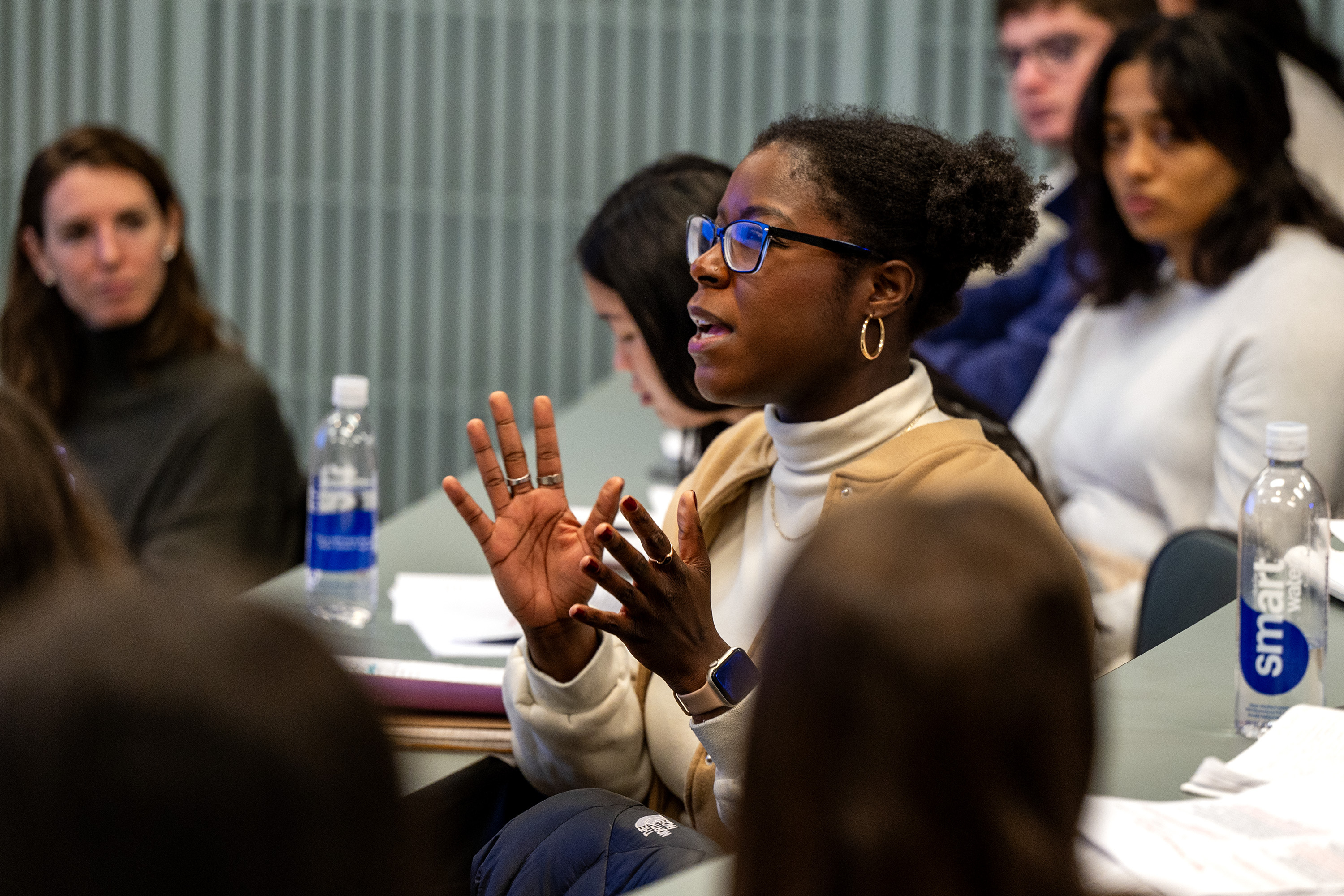
Seniors Luiza Louback (left) and Sarah Usandivaras (right) participate in the class discussion.
It could be a primer for the politically divided nation.
“My pitch is that you can’t really know what you believe if you don’t know what people who disagree with you believe and what their reasons are,” Gutmann said in an interview. “I always say I don’t care what your position is. I care that you can give reasons for it and understand the strongest arguments on the other side.
“That’s the method to search for truth, and it’s the way we serve a democracy.”
Bringing experience to the classroom
During class, Gutmann frequently drew on her experiences as a first-generation college student, a young professor at Princeton, a college president, and an ambassador.
When she got her first teaching job, a male colleague congratulated her, but later she learned he told someone she got the job because she was a woman.
“Did I take that as a compliment? Mm-mm,” Gutmann told the class.
Humphrey said she especially likes hearing about Gutmann’s vast experiences.
“She’s like, ‘Well, when I was the president here, this is something I dealt with,’” Humphrey said. “It’s really interesting knowing the experience she has and her background and the perspective she brings.”
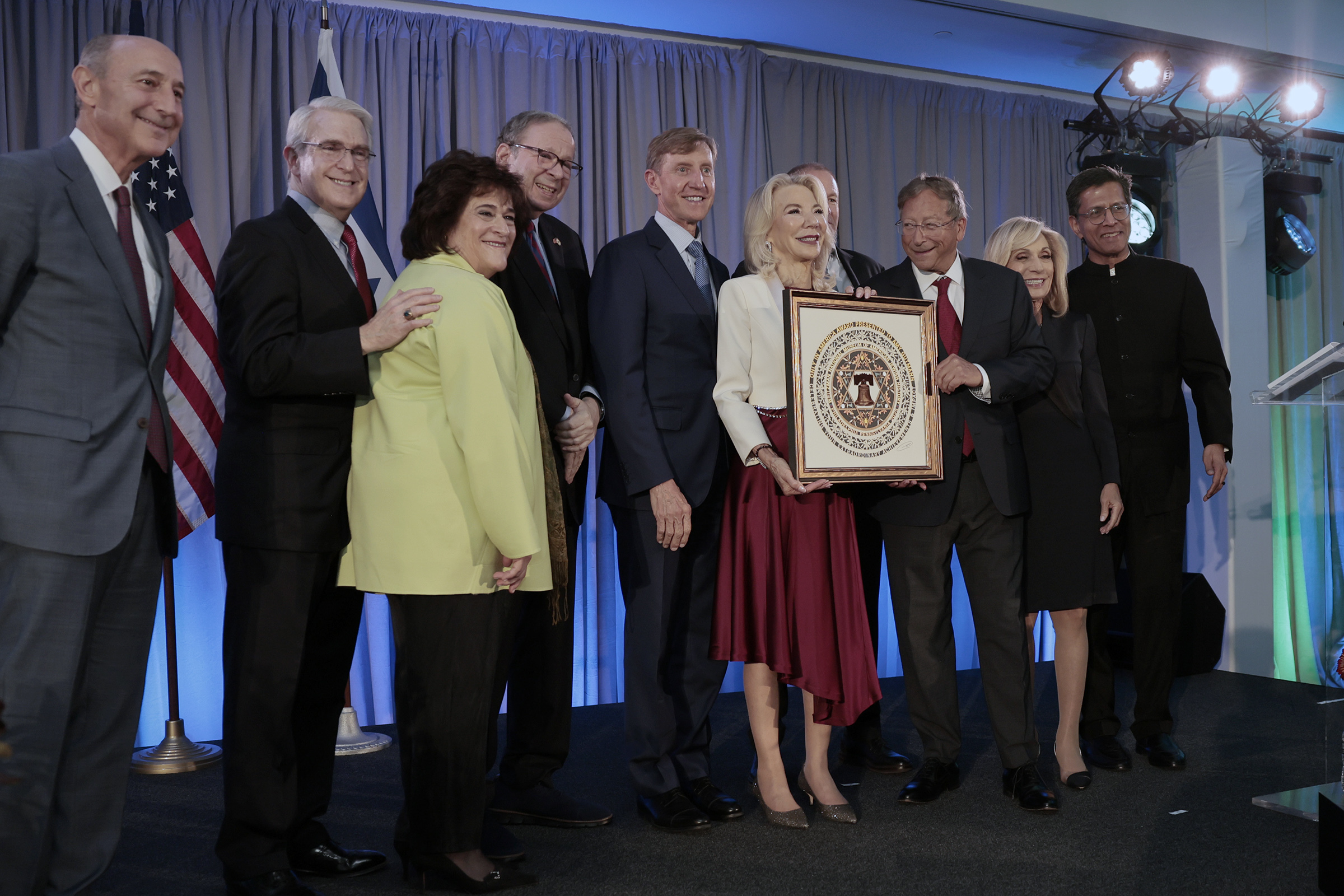
Amy Gutmann (center), president emerita of the University of Pennsylvania and former U.S. ambassador to Germany, is presented with the Weitzman National Museum of American Jewish History’s Only in America® Award during a gala at the museum this month. The award recognizes “Jewish Americans who have made enormous contributions to our world … often despite facing antisemitism and prejudice.” Among those posing with her are Ramanan Raghavendran (far right), chair of Penn’s board of trustees, veteran journalist Andrea Mitchell (next to Raghavendran), Penn President J. Larry Jameson, (to the immediate left of Gutmann), and David Cohen, former Penn board chair, (next to Jameson.)
Gutmann’s life outside class continues to be full, too. After class Wednesday, Gutmann, whose father fled Nazi Germany, flew to Berlin to receive the Prize for Understanding and Tolerance from the Jewish Museum Berlin.
Having returned to Philadelphia to live after leaving Germany, Gutmann said it wasn’t hard to find her stride again in the classroom. She had given one-off lectures as Penn’s president.
“I have a lot of muscle memory on teaching,” she said.
Her style has changed from her early days at Princeton, where she worked from 1976 to 2004. She said readinga student’s notebook left behind and open after one of her ethics and public policy lectures was a major turning point.
“‘That’s not what I said,’” Gutmann thought. “And I realized it’s not what you teach them, it’s what they learn. At that point, I realized I needed feedback.
“So I changed from doing the 45-minute [lecture] thing to doing five or 10 minutes, max, and then asking them questions. Then I got them to argue with one another, and once I found that, I found what I really discovered worked for learning.”
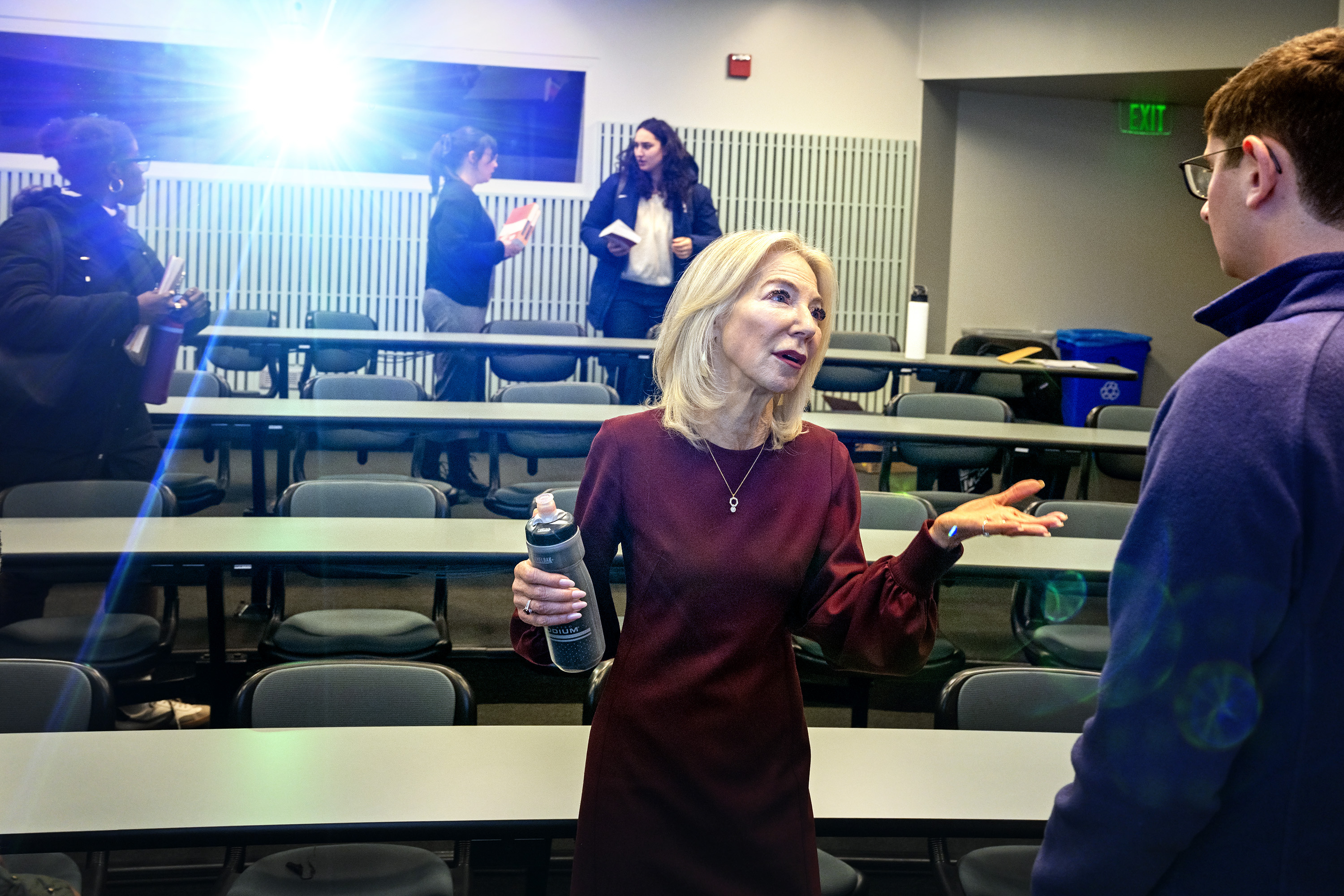
Amy Gutmann talks with sophomore Brian Barth (right) at the end of class she co-teaches at Penn’s Annenberg School for Communication.
Gutmann said she spends Fridays and weekends preparing for the class, which meets twice a week.
“It’s a ton of work,” she said. “I’m really delighted to be doing it.”
The class comes against the backdrop of fraught times for colleges. Penn earlier this year scrubbed its website of diversity initiatives after President Donald Trump’s administration threatened funding to schools employing diversity, equity, and inclusion efforts. In the summer, the school struck an agreement with the administration over the past participation of former transgender swimmer Lia Thomas, and Penn was one of nine schools originally asked to sign a compact that would have given the school preferential consideration for federal funding in exchange for complying with certain mandates affecting admissions, hiring, and other university operations. Penn declined.
‘One-of-a-kind’ discussions
Gutmann and Banet-Weiser do not allow laptops, phones, or any electronic devices in class so that students completely focus on the conversation. To prepare for the affirmative action discussion, students were assigned related readings and review of the court cases.
The two professors interacted with each other and prompted discussion among students with deep questions: Is treating people equal the same as treating them equally? Is it right to use affirmative action for only one racial group? What about other forms of affirmative action or preference, including for athletes, low-income students, and legacies whose parents attended the university?
The approach resonated with students.
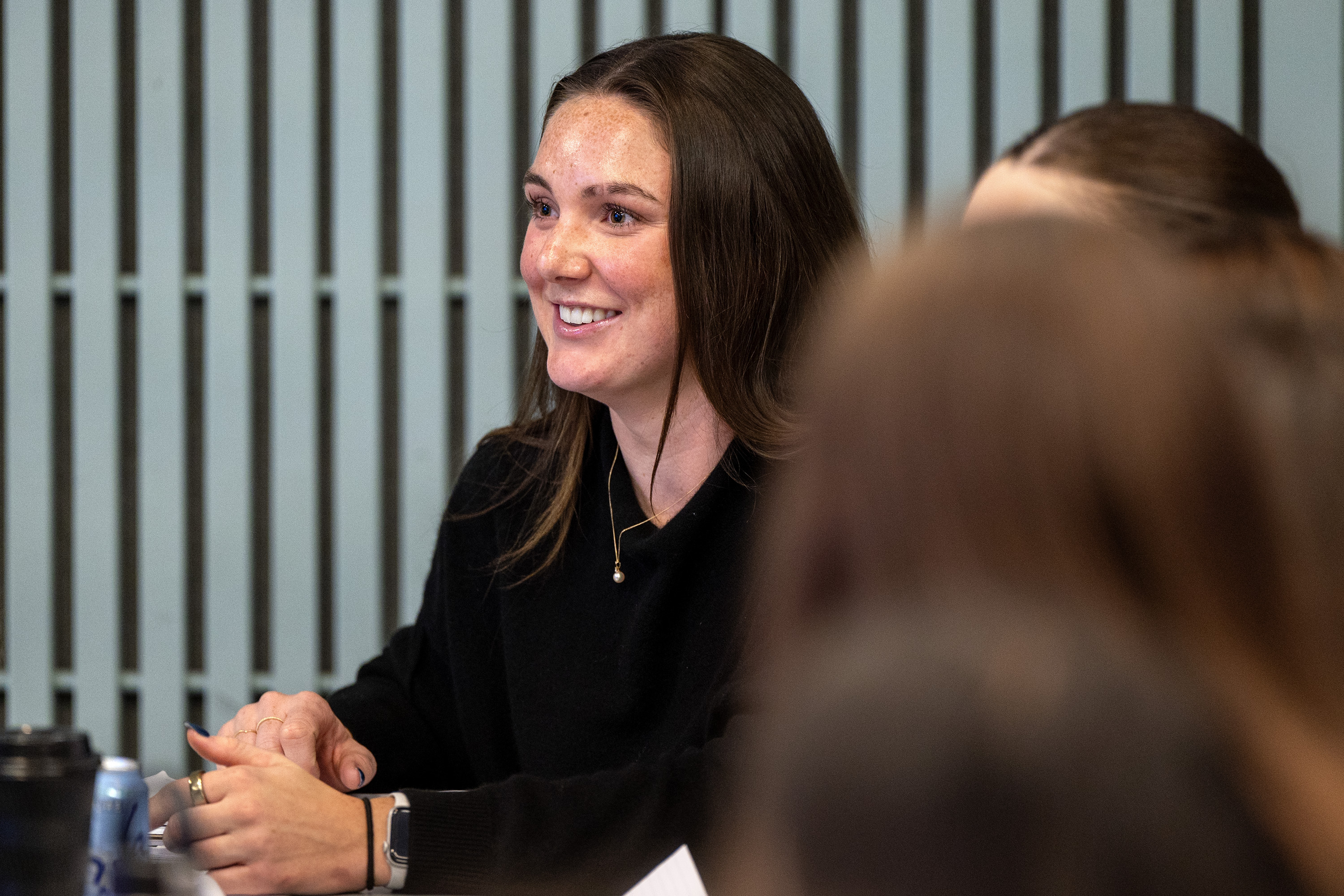
“I wanted to take a class where I would really be encouraged to step out of my comfort zone and be able to learn not only how to understand my own beliefs and values but understand the beliefs and values of others,” said Sarah Usandivaras, 21, a senior communications and political science major who was born in New York and grew up in Paraguay.
She found it in Gutmann and Banet-Weiser’s classroom.
“It’s a one-of-a-kind,” she said.
Ariana Zetlin, a doctoral student in Penn’s Graduate School of Education, is auditing the class to observe its approach.
“The discussion and the debates are so much deeper and stronger than what I’m seeing in classrooms that don’t necessarily have these structures,” said Zetlin, 30, who is from New York.
During class, those on both sides found common ground.
Senior Angele Diamacoune said she was learning from the day’s lesson.
“So I’m hearing agreement that diversity is a good thing but disagreement on how you get it,” Gutmann said.
She asked students how many believed that having low-income and racially diverse students in class contributed to their learning. Every hand went up.
“That to me is really striking,” Gutmann said. “There aren’t that many things that we can get unanimity on.”
She asked students how they would advise colleges to teach the issue.
“It would be good to teach with activities like this,” said Angele Diamacoune, 21, a senior communications major from Allentown.
Thirty years ago next February, the world’s first high-profile competition between human and machine intelligence took place in Philadelphia.
IBM’s Deep Blue supercomputer faced world chess champion Garry Kasparov at the still-new Pennsylvania Convention Center. It was timed with the 50th anniversary of the unveiling at the University of Pennsylvania of ENIAC, the world’s first supercomputer, and a reminder that Philadelphia once led the world into the computer age.
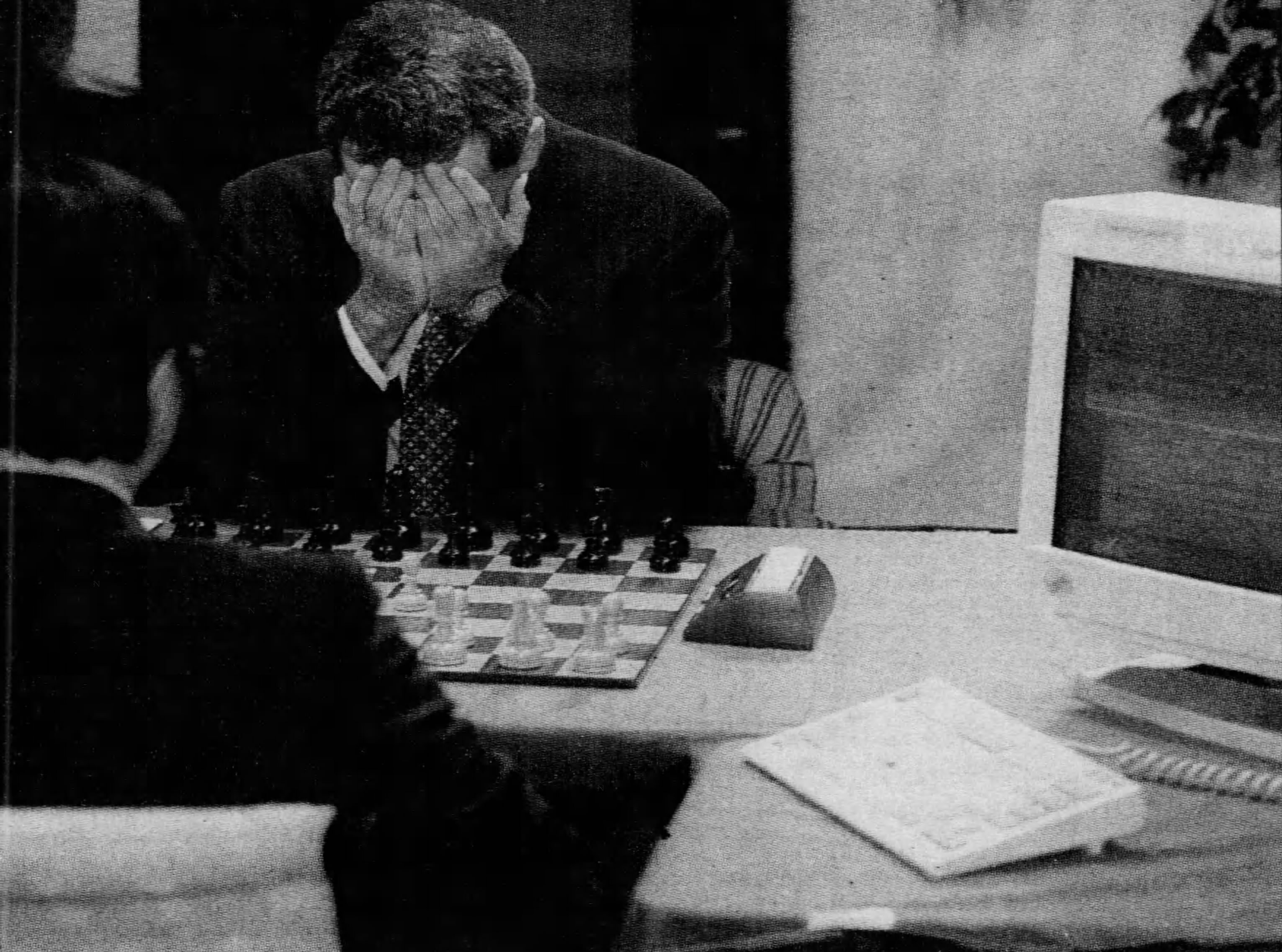
Russian chess grandmaster Garry Kasparov, hunched over a chessboard and holding his furrowed brow in his hands, competes against the supercomputer Deep Blue in February 1996.
Back then, artificial intelligence felt distant. Today, it feels existential.
As we prepare to host the nation’s 250th anniversary in 2026, I’ve been asking: In a city so rich in history, are we still interested in the future?
How it started
This spark began in 2023, during a reporting project on economic mobility called Thriving that Technical.ly — the news organization I founded and lead — published with support from the William Penn Foundation, the Pew Charitable Trusts, and the Knight Foundation. Our newsroom followed 10 Philadelphians for a year to produce an award-winning audio-documentary and hosted a dozen focus groups across the city.
One Brewerytown resident said something that inspired a previous op-ed I wrote for this paper: “Leaders here talk a lot about hundreds of years in the past, but nobody is looking very far in the future.”
Across this region — in boardrooms, nonprofits, universities, and regional corporate offices — too many leaders manage the wealth and institutions created by past entrepreneurs, but too rarely invent anything new. We fight over what exists instead of building what’s next.
The Semiquincentennial is our chance to prove we can balance our past, present, and future.
Why this matters now
My career has been spent listening to and challenging the inventors, entrepreneurs, and civic leaders shaping tomorrow’s economy. They act while others analyze.
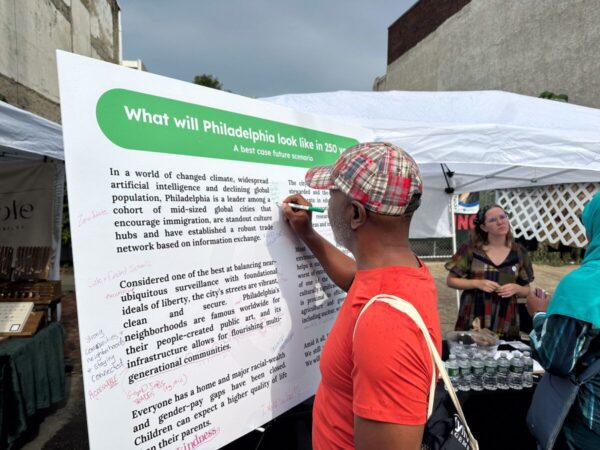
In that spirit, we spent two years developing a vision for Philadelphia 250 years in the future. Nearly 1,000 Philadelphians have shared ideas at festivals, community events, and small-group gatherings. The current draft, open for one final round of feedback at Ph.ly, isn’t a plan but an invitation — a shared view of what we wish for our descendants in 2276.
The coming decades could bring population decline, climate strain, and sweeping technological change. Yet, many local leaders still struggle to plan even years ahead.
During a recent private discussion I moderated inside one of our city’s impressively preserved old buildings, a longtime civic leader cited Philadelphia’s poor economic mobility ranking. I reminded him that the same research, with the same warning, was released a decade ago. Why didn’t we plan to make changes then?
He assured me this time would be different.
Philadelphia’s past points forward
Philadelphia’s breakthroughs have nearly always come from outsiders who pushed past local gatekeepers.
Stephen Girard, a French immigrant dismissed by elites, built a shipping and banking fortune, stabilized the nation’s finances, and endowed Girard College.
The Drexel family’s daring banking experiments helped fuel the Industrial Revolution before founding the school for engineers.
Albert Barnes saw beauty where Philadelphia’s art establishment did not.
ENIAC’s inventors, John Mauchly and Presper Eckert, were a little-known physics professor and a 24-year-old grad student whose entrepreneurial efforts were blocked locally, presaging Silicon Valley.
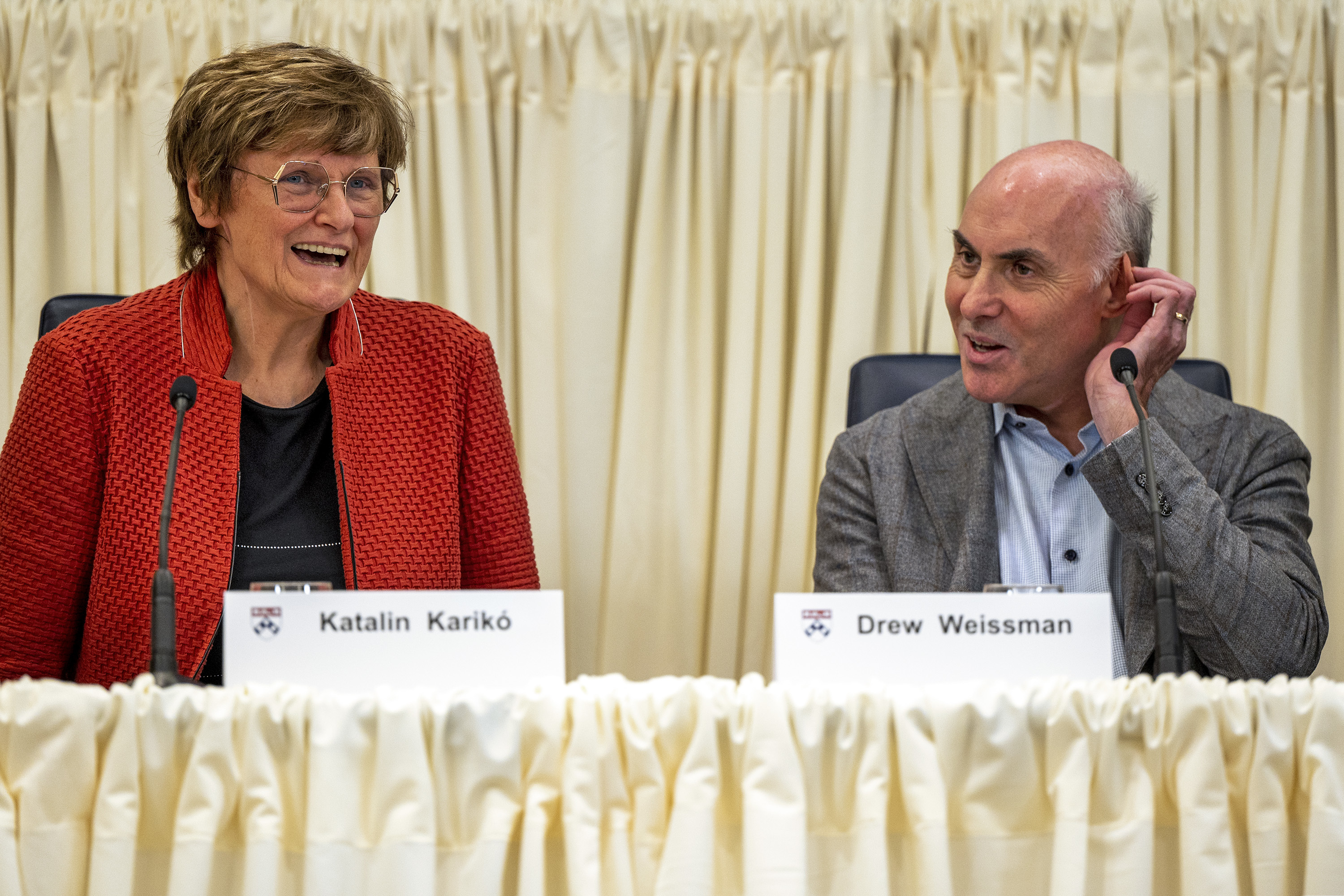
Katalin Karikó and Drew Weissman attend a news conference at the University of Pennsylvania in October 2023, after they were named winners of the 2023 Nobel Prize in physiology or medicine for their work on messenger RNA, a key component of COVID-19 vaccines.
Most recently and famously, Nobel laureate Katalin Karikó’s mRNA research that led to the rapid-fast, lifesaving COVID-19 vaccine response was commercialized in Boston, not here.
The pattern is clear: Visionaries choose to live in Philadelphia, yet often get ignored, if not outright blocked, by local institutions. That’s no way to secure the next 250 years.
There are signals of change.
I take inspiration from bold efforts to build, including the Delaware waterfront and the cap of I-95. In the 2010s, Philadelphia’s technology sector earned initial, if timid, attention from successive mayoral administrations and civic leadership — and a half dozen tech unicorns were born.
That tech community helped inform this multiyear vision statement project, which received $75,000 from a funders collaborative activating Semiquincentennial efforts, including the William Penn and Connelly Foundations. The city’s 2026 planning director, Michael Newmius, has been supportive, urging us to listen to residents and avoid undue filtering.
Over two years, we’ve tabled at community events, hosted discussions, and led working sessions. The result isn’t mealymouthed or filtered by incumbency; it has grit and humanity — like Philadelphia itself.
You can read the draft vision at Ph.ly and in the article box in this op-ed. We’re collecting one final round of feedback this fall, and we’ll incorporate what we can. We’re accepting feedback until Dec. 1.
From conversation to commitment
Our goal is to enshrine the final version of this statement on a physical plaque at a prominent location in the city. We’ll also host a digital version online, paired with voices from residents across the region.
This vision doesn’t prescribe policy, nor make fallible predictions; instead, it offers a shared aspiration, a framework that future leaders can measure their plans against.
In its early drafts, the statement imagined a green-energy Philadelphia with climate-adaptive agriculture, abundant public art, thriving multigenerational neighborhoods, and a culture that “exports ideas and imports opportunity.”
Over subsequent versions, the specifics were removed to reflect the long time horizon, but the spirit remains: Philadelphia must keep people — not technology, not incumbency — at the center of our future.
The Semiquincentennial should celebrate our history — I personally cherish it. I was a historic Old City tour guide for a year, and my daily bicycle commute to the Technical.ly newsroom past Independence Hall reminds me what endurance looks like.
But if we only admire our past, we’ve missed its key lesson. Philadelphia is strongest when we pair cobblestones with invention’s spark.
Read the vision at Ph.ly. Critique it, add to it, make it better. May it inspire Philadelphians for generations to keep building, not just preserving.
The Kasparov-Deep Blue rivalry is remembered as the moment a machine beat a human genius. But that was the rematch. The first contest — the one held here in Philadelphia — ended with the human winning. Let’s make sure that’s still true for our city.
Christopher Wink is the publisher and cofounder of the news organization Technical.ly.
City Councilmember Jimmy Harrity wants to revisit the contentious debate that led to the 2017 creation of Philadelphia’s sweetened beverage tax, arguing that the levy has cost the city jobs and will eventually prove insufficient to pay for the programs it was enacted to support, such as subsidized prekindergarten.
“We‘re going to keep on pulling more money out of the general fund each year, taking away from other programs,” Harrity, a Democrat, said Monday at a hearing of Council’s Labor and Civil Service Committee, which he chairs. “If we were in business and these numbers were the numbers of the business, we wouldn’t be in business long.”
The tax, which is paid by distributors of sweetened beverages sold in Philadelphia, is 1.5 cents per ounce. Council approved it in 2016 despite vociferous opposition from the beverage industry and Teamsters Local 830, which testified Monday the tax has led to 1,000 of its members who drove trucks for distributors losing work.
Harrity,an ally of the Teamsters, noted that revenue from the tax has declined as Philadelphians either drink fewer sweetened beverages or find ways to purchase them outside the city. The tax produced about $73.4 million in the 2023 fiscal year, but only $64.4 million last year, he said.
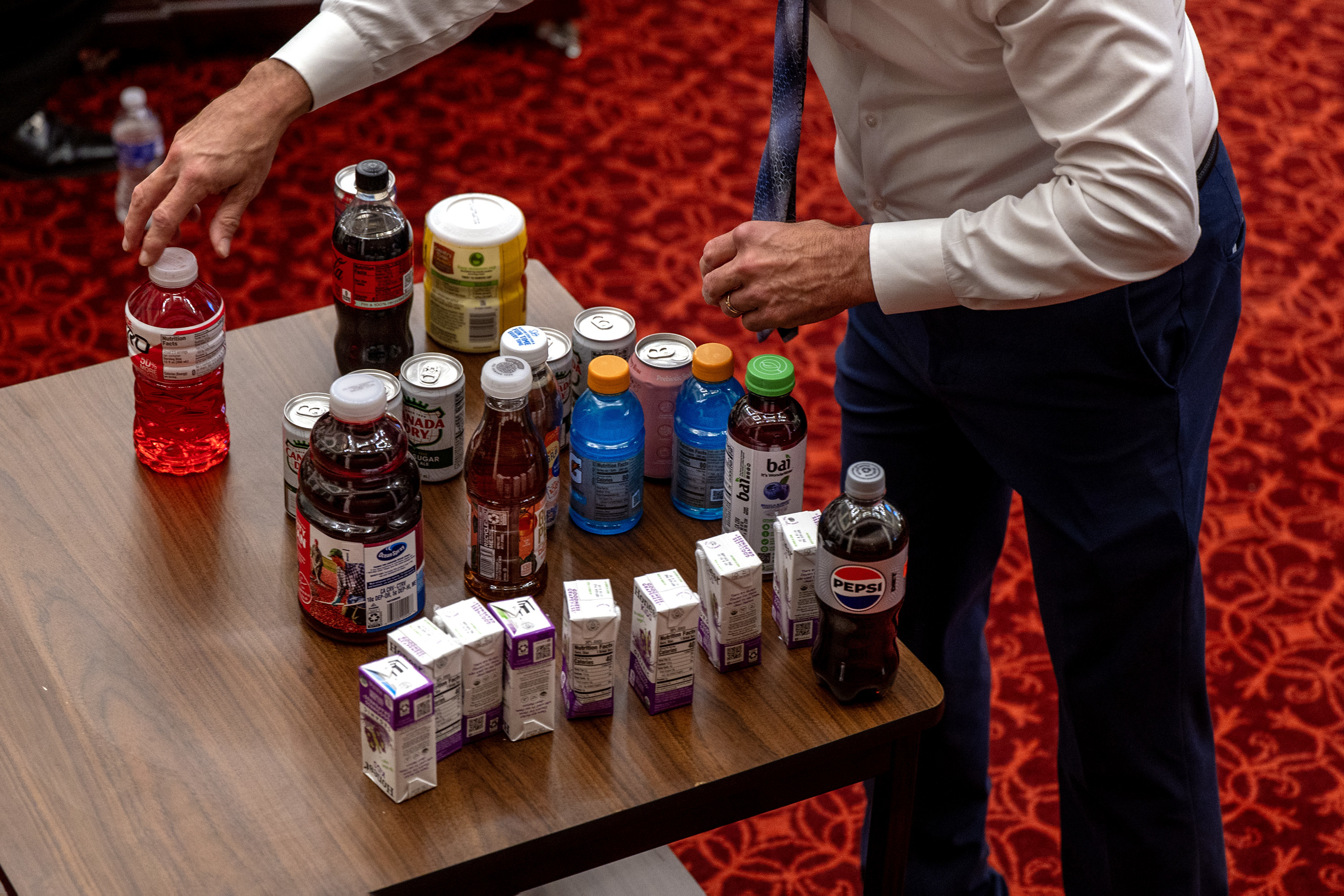
A Council staffer arranges a table of sugary drinks before Councilmember Jimmy Harrity (not shown) holds a hearing in City Council Monday, Oct. 27, 2025 on former Mayor Jim Kenney’s tax on sweetened beverages.
For Harrity, that means that the city should consider eliminating the “soda tax,” as it is widely known, in favor of a more “sustainable” funding stream. He did not offer any alternatives.
But based on his colleagues’ reactions, it is unlikely the tax will be reconsidered in a serious way any time soon.
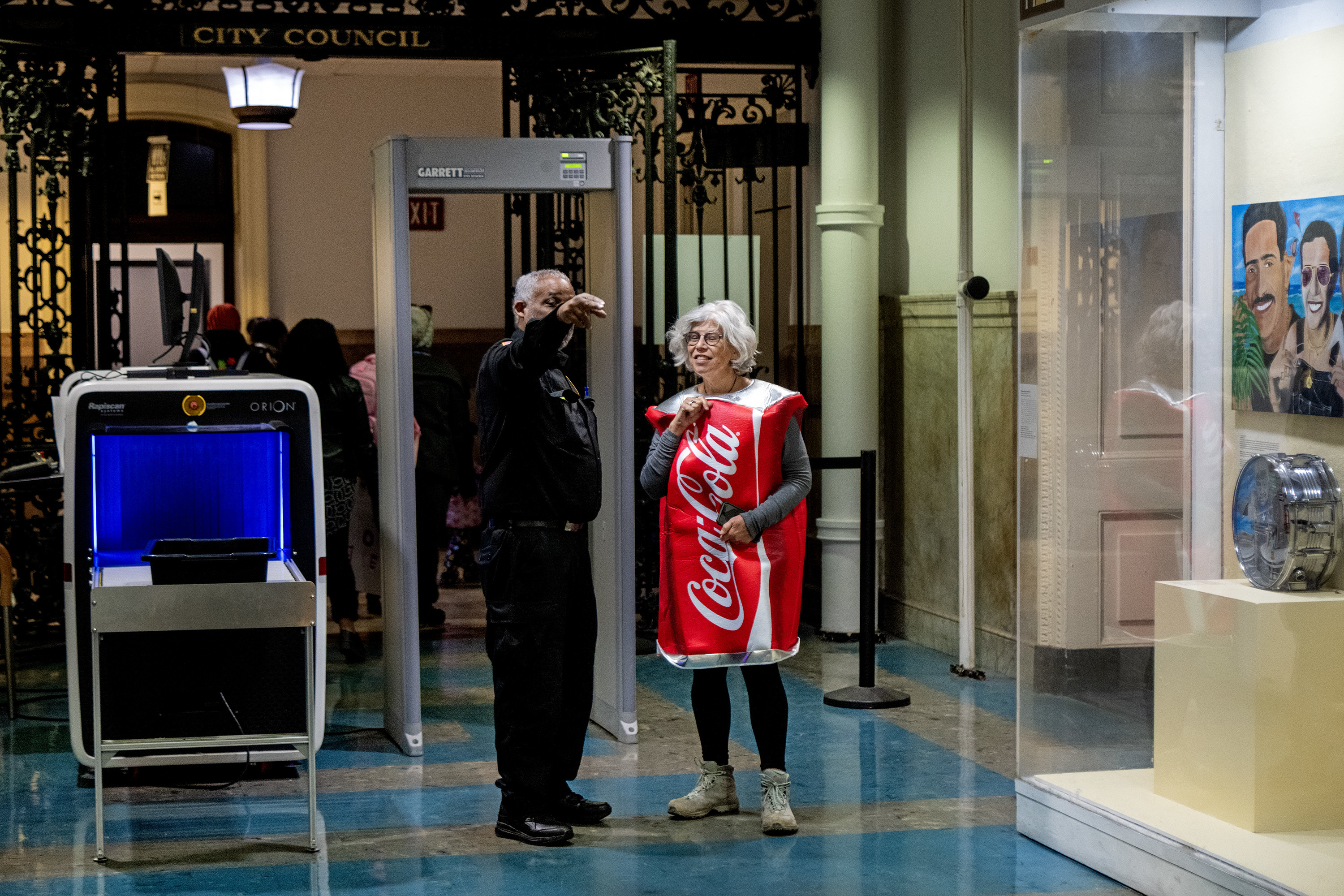
Marcy Boroff with Children First dresses as a coke can for a City Council hearing Monday, Oct. 27, 2025 on former Mayor Jim Kenney’s tax on sweetened beverages. She was there to support the tax. Children First advocates for policy changes to improve child health, education, and welfare, especially for low-income children. .
And they stressed its critical role in paying for the three initiatives that Kenney launched alongside the tax: PHL Pre-K, which provides free childcare to 5,250 kids; community schools, which offer a multitude of services to families in 20 Philly schools; and the Rebuild program, which renovates and improves recreation centers and playgrounds.
“We have to make tough decisions that will actually benefit the greater good, and that’s what we did here,” Democratic Councilmember Rue Landau said during the hearing, adding that “the majority of us up here on this panel think this is a great investment.”
“We would not have been able to fund these programs without that beverage tax money,” said city Finance Director Rob Dubow, who has held his role under Parker, Kenney, and former Mayor Michael A. Nutter. Nutter twice tried unsuccessfully to implement a “soda tax” before Kenney succeeded.
Dubow told lawmakers that the decline in the tax’s revenue over time was always part of the plan and that city leaders intended for the regular city budget to make up the difference for funding Rebuild, pre-K, and community schools when they created the tax. The moment when the soda tax began taking in less money than the city pays out for the three programs it helped launch was the 2024 fiscal year, he said.
“We pay for it out of the general fund, which is what we always intended we would do,” Dubow said.
This year, Rebuild, pre-K, and community schools are projected to cost $110 million, Dubow said. Of that, $73 million pays for the 5,250 slots in the city’s pre-K program.
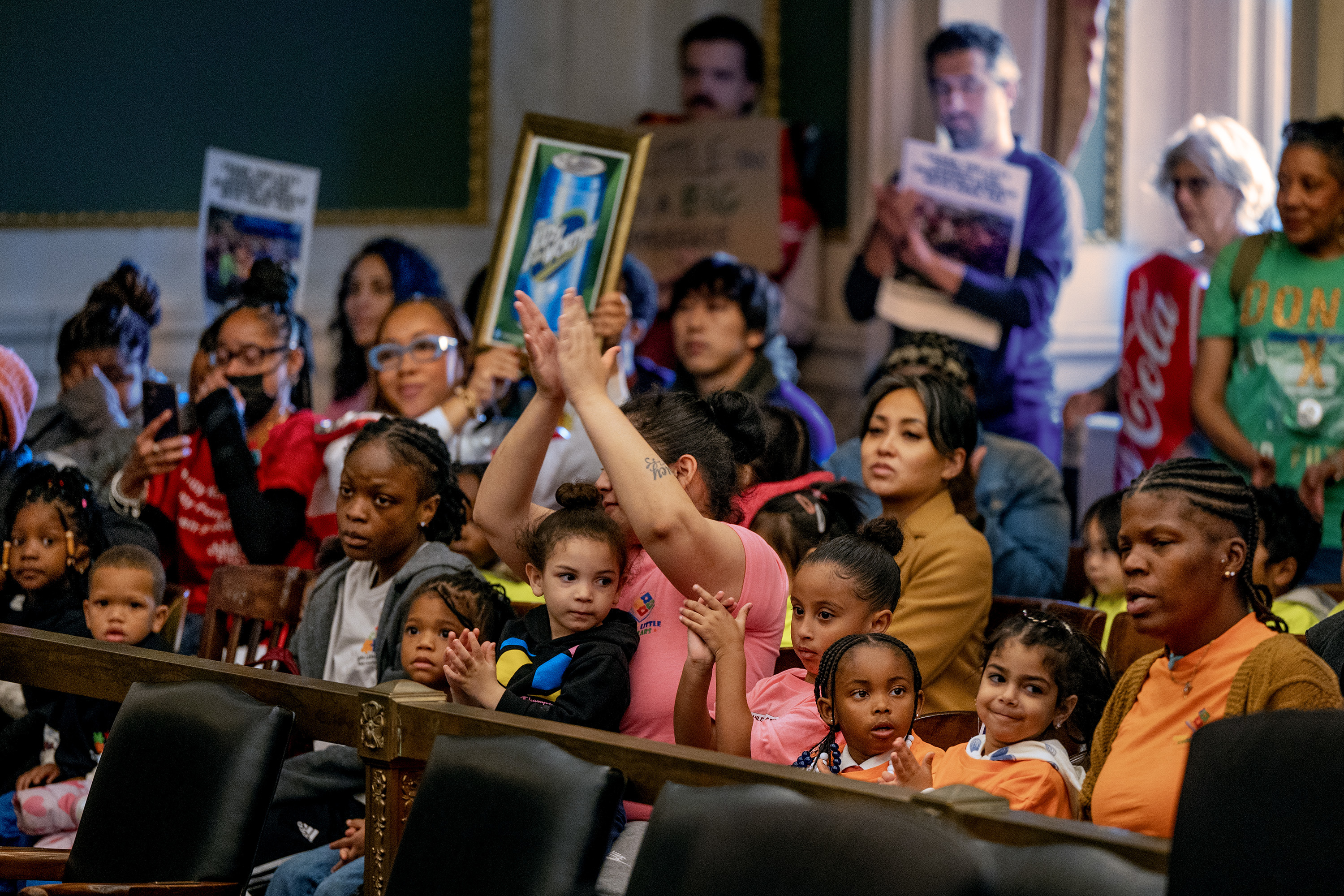
Preschoolers and their caregivers attend a City Council hearing held by Councilmember Jimmy Harrity Monday, Oct. 27, 2025 on former Mayor Jim Kenney’s tax on sweetened beverages. The tax funds the city’s universal pre-kindergarten program
‘Why not Taj Mahals?’
Councilmember Brian O’Neill was the only other Council member besides Harrity to vocally criticize the tax at Monday’s hearing.
O’Neill, Council’s lone Republican, noted that Council members have traditionally had control over capital funding for Philadelphia Parks and Recreation projects in their districts. That money, he noted, is split evenly among the 10 district Council members.
“This program — Rebuild, they call it — they didn’t decide to bring playgrounds up to some minimum level where people over the years may not have spent their money well,” O’Neill said. “They decided to build Taj Mahals in many cases. … You know what happens when you build a playground and spend tons of money on it? … All the playgrounds around it look terrible.“
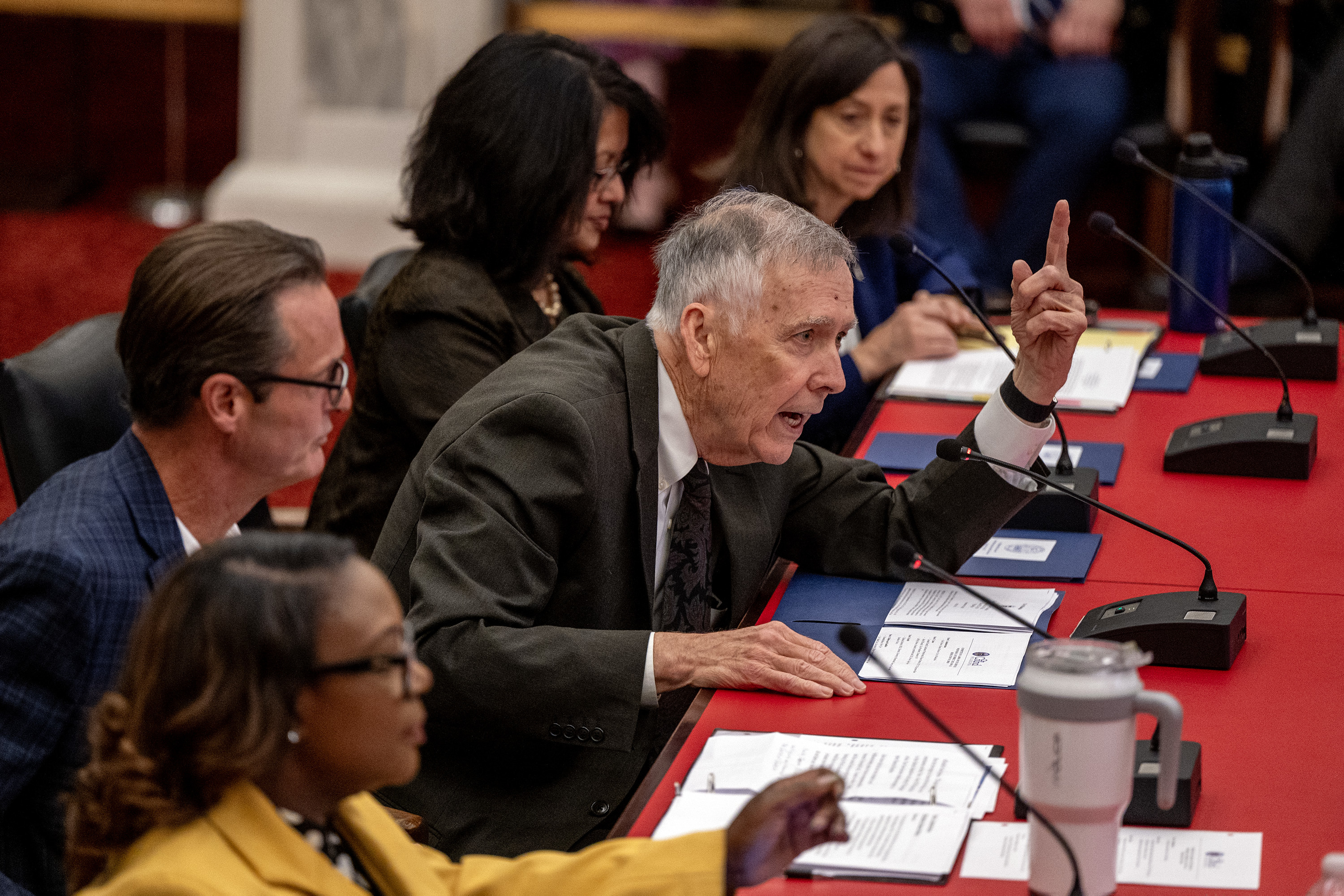
Councilmember Brian J. O’Neill (center) speaks during a hearing in City Council Monday, Oct. 27, 2025 on former Mayor Jim Kenney’s tax on sweetened beverages. Behind him, front to rear, are: Councilmembers Kendra Brooks, Jimmy Harrity, Nina Ahmad, and Rue Landau.
That comment did not go over well with some of his colleagues.
“My community benefited from a rec center that was through the Rebuild program,” said Councilmember Kendra Brooks, a member of the progressive Working Families Party who lives in Nicetown. “It’s not a Taj Mahal. It’s a quality rec center in the middle of North Philadelphia. It does not have everything, because I personally went and bought a refrigerator.”
And Councilmember Nina Ahmad, a Democrat, questioned why building grandiose rec centers would be a problem in the first place.
“Why not Taj Mahals for all our folks? Why not have the best-quality rec centers so our children want to go there, our children want to spend time there?” Ahmad said. “We live in a first-world country and yet we are begging for scraps for our youngest citizens.”
The University of Pennsylvania on Friday afternoon released the letter that President J. Larry Jameson sent to the U.S. Department of Education last week, explaining why the school rejected the compact proposed by President Donald Trump’s administration.
“Our university policies and practices are already aligned with many of the core principles of the Compact…” Jameson wrote. But “we find that significant portions of the Compact and its overarching framing would undermine Penn’s ability to advance our mission and the nation’s interests.”
The “Compact for Academic Excellence in Higher Education” was the latest attempt by the Trump administration to force changes in the way universities operate as the president tries to reshape higher education to match his vision. It offered colleges that sign preferential consideration for federal funding. It’s still not clear what penalty, if any, Penn — which receives about $1 billion annually in federal funding — will face for not signing.
“Institutions of higher education are free to develop models and values other than [those in the compact], if the institution elects to forego federal benefits,” the compact states.
Penn last week declined to release its letter, but Jameson in a message to the campus community Friday afternoon said “in the spirit of transparency” he would share it. He said he’d received many requests for its release.
The university has not had further discussions with the government since rejecting the compact, Jameson said, noting “we believe there remains opportunity to advance the long-standing relationship between American higher education and the federal government which has greatly benefited our community, nation and world.”
But he also was clear that Penn’s greatest partnership is with the public.
“America’s great universities already have a compact with the American people,” he said. “It is built on the open exchange of ideas, merit-based selection and achievement, and freedom of inquiry to yield knowledge. It affirms that knowledge should serve the public good, that education should remain a ladder of opportunity, and that discovery should make life better, richer, and freer.”
Jameson highlighted seven areas where he said Penn and the compact appear to be in alignment and five areas that pose concerns.
Areas of agreement include hiring and promotion standards and “merit based admissions” that comply with the law, including the 2023 U.S. Supreme Court decision that banned the use of race-based admission, Jameson said. The university also has reinstituted a standardized test score requirement for admission; Penn like many others had paused the requirement during the pandemic. And, its undergraduate student body is 13% international, Jameson said. That’s under the 15% mark that the compact would require.
Penn also is in compliance with federal foreign gift regulations and has “viewpoint-neutral rules” governing protests and expression, he said.
The university last year adopted an “institutional neutrality” policy, which states that the school will no longer make statements about world events unless they have a direct effect on Penn’s operations; the compact calls for schools to adhere to institutional neutrality.
While the university hasn’t agreed to freezing tuition for five years as the compact asks, the school has taken steps to make education more affordable, Jameson said, noting that its aid is all grants and no loans and is need based. Nearly half its students receive aid, he said.
And, Jameson said, Penn officials “share concerns about grade inflation and believe there may be an opportunity to engage the higher education community to seek a broader solution.”
But Penn objects to federal funding being meted out based on signing a compact, Jameson said.
“Research and our nation are better served by competition that rewards promise and performance,” he said. “Penn seeks no special consideration beyond fair and merit-based funding.”
The compact fails to promise or even mention academic freedom, which is “the bedrock of our national system of higher education,” Jameson said. It seeks to protect conservative thought alone, he said.
“One-sided conditions conflict with the viewpoint diversity and freedom of expression that are central to how universities contribute to democracy and to society,” Jameson wrote.
He also objected to the compact mandating free tuition to students in the “hard sciences.”
“We celebrate the sciences,” Jameson wrote. “However, we focus our financial aid efforts on those who cannot afford to pay, ensuring that a Penn education is accessible to those who are offered admission.”
Jameson also called out the compact’s financial penalties for failing to comply “based on subjective standards and undefined processes.” That could endanger teaching and research, he said.
“Universities must be accountable for their actions,” he wrote. “We believe that existing laws and policies suffice to achieve compliance and accountability.”
Many groups on campus had spoken out against the compact and were watching closely, given that the university had struck an agreement with the Education Department in July over the participation of a transgender athlete on the women’s swim team.
Penn’s announcement that it would reject the compact brought praise from local and state officials, including Democratic Gov. Josh Shapiro.
One University of Pennsylvania faculty member was called into a university office to answer for assigning “a pedagogically-relevant reading about conflict in Palestine,” others for political posts on personal social media accounts.
One faced questions for wearing a stole with the Palestinian flag at an off-campus event.
These are among “unfounded accusations of antisemitism” that Penn’s chapter of the American Association of University Professors said faculty and students have endured in the last year. Chapter representatives accompanied faculty to meetings at Penn’s Office of Religious and Ethnic Interests, which called the faculty in for questioning, according to a statement the group released Wednesday.
The religious and ethnic interests office oversees the implementation of Title VI of the Civil Rights Act, which prohibits discrimination based on race, color, national origin, or shared ancestry. It was formed following accusations of antisemitism on campus in the aftermath of Hamas’ Oct. 7, 2023, attack on Israel, when Penn was roiled by dueling complaints of unfairly treating Jewish and pro-Palestinian members of its community.
Then-Penn president Liz Magill resigned in December 2023 following a bipartisan backlash over her congressional committee testimony regarding antisemitism complaints, and the following spring, pro-Palestinian protesters erected an encampment on the College Green that ultimately was dismantled by police.
Since January, President Donald Trump’s administration has targeted universities that it asserts have failed to respond adequately to antisemitism complaints, and the group of Penn professors said they are worried that the university is following the president’s lead.
“We are concerned that Penn’s own Title VI office may be responding to these external pressures in a manner that risks chilling faculty speech and potentially discriminating against faculty in violation of the law,” the group asserted in a statement published on its website Wednesday. “… Faculty members, who in some cases had already been subject to targeted harassment, felt that they were expected to take unsubstantiated accusations of antisemitism at face value and to express contrition or offer some concession to their unidentified accuser, or face the possibility of disciplinary action.”
Penn did not respond to a request for comment. Neither did the religious and ethnic interests office.
Penn announced the creation of the office in September 2024, noting it was the first of its kind nationally and saying it would ensure a consistent response across all of its schools.
“Over the past year, our campus and our country witnessed a disquieting surge in antisemitism, Islamophobia, and other forms of religious and ethnic intolerance,” J. Larry Jameson, who was then interim president and was named president six months later, said at the time. “The Office of Religious and Ethnic Inclusion (Title VI) is being formed to confront this deeply troubling trend, and to serve as a stand-alone center for education and complaint resolution.”
The office formally opened in December with the foundational goals of educating, investigating, mediating, and evaluating. Its codirectors are Steve Ginsburg, who had served over a decade as an executive of the Anti-Defamation League, and Majid Alsayegh, founder of Alta Management Services LLC, which helped clients with criminal justice reform. The office’s chief investigator is Deborah Frey, who previously served as an assistant U.S. attorney in the Eastern District of Pennsylvania, working on discrimination complaints.
“Because of our own lived experiences as targets of bigotry, we know this work is not going to be easy,” Ginsburg had told Penn Today. “These issues are complex and require deep thought and sensitivity for those who are impacted.”
Faculty and students were not named in Wednesday’s statement and declined to comment through an AAUP executive committee member out of fear of retribution or harassment. The AAUP did not disclose the number of faculty and students involved.
But the reports “come almost exclusively from faculty who are Palestinian, Arab, Muslim, and/or Black,” the group said, giving rise to concerns about potential discrimination.
The faculty and students referred to in the letter were not sanctioned or punished for their activities, but the mere act of being called in and questioned has “a chilling effect” on research, teaching, and speech, said the AAUP executive committee member, who asked not to be identified because the chapter wanted to speak with one voice.
“For instance, in one meeting, a faculty member whose peer-reviewed research was subject to a complaint was pressured to make a modification to the presentation of that research, although their work had the support of their colleagues and dean,” the AAUP chapter said.
In that case, the faculty member had been called in because the research “referenced a third-party resource that a complainant claimed, without evidence, promoted hatred of Israel and of Jews in the United States,” the letter stated.
The chapter called on the office to “clarify and modify its procedures to ensure the transparency, consistency, and fairness essential to carrying out the office’s mission.”
And it asked the office to respond to a series of questions, including about the criteria it uses to decide whether to pursue a complaint.
Three large stand-alone parking garages have been proposed in Philadelphia this year, unusual projectsin a city where parking operators have long complained that high taxation makes it difficult to run a business.
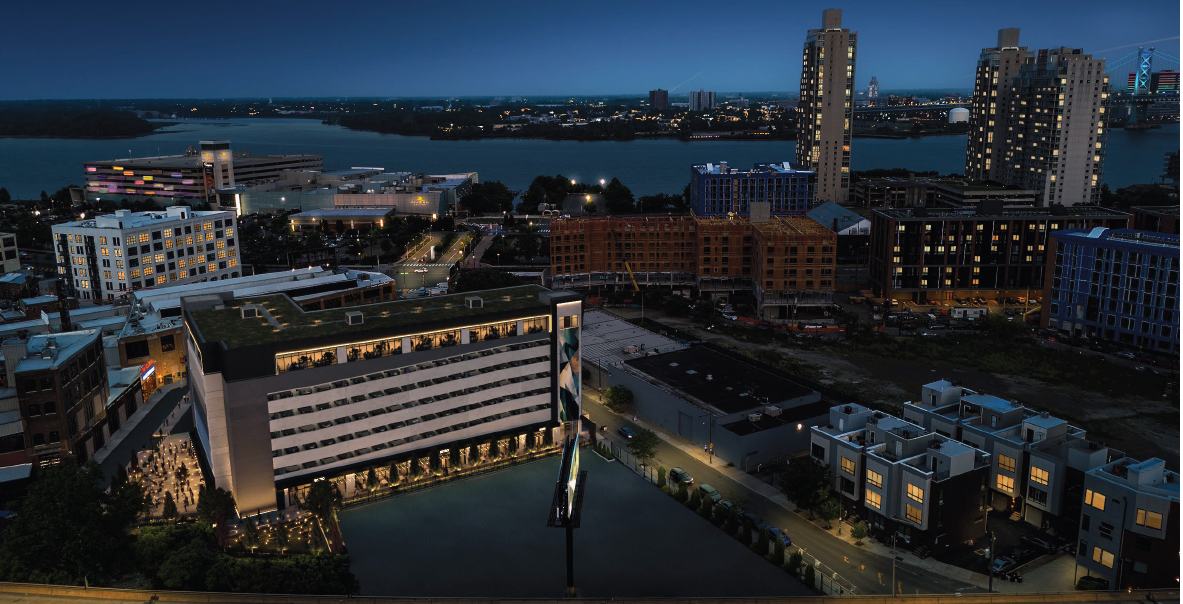
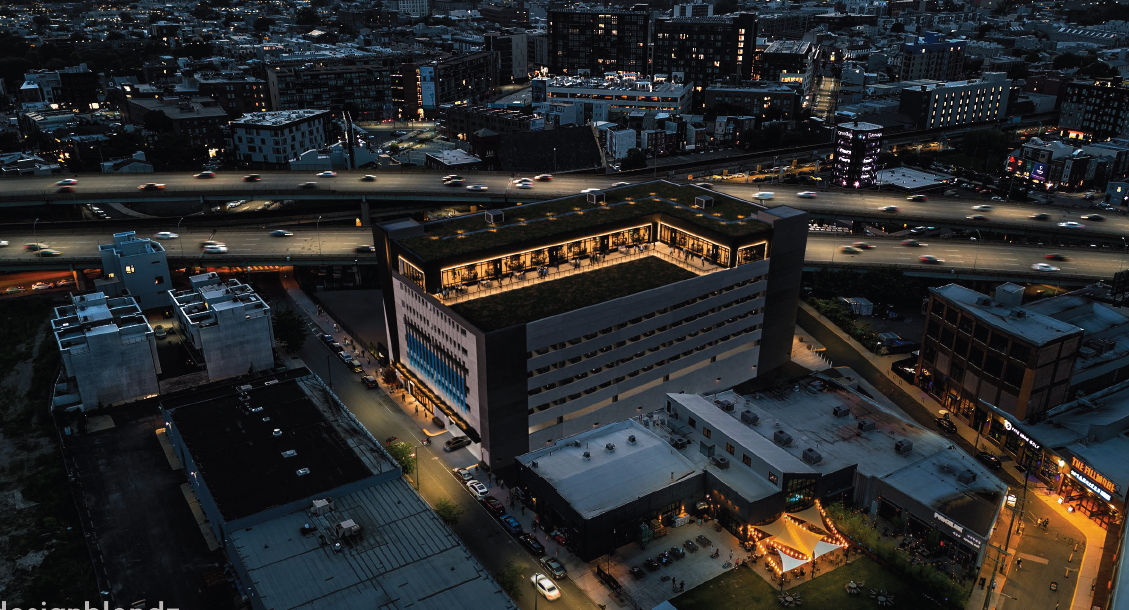
The latest is a 372-unit garage near Fishtown and Northern Liberties at 53-67 E. Laurel St. near the Fillmore concert hall and the Rivers Casino.
“There’s been about 2,500 units that have come online within a 5- to 10-minute walk” of the planned garage, said Aris Kufasimes, director of operations with developer Bridge One Management. “When you’re building those on 7-1 [apartments to parking spaces] ratios, that leaves a massive hole. Where is everybody going to put their vehicles?”
Despite central Philadelphia’s walkability and high levels of transit access, two other developers have made similar calculations this year.
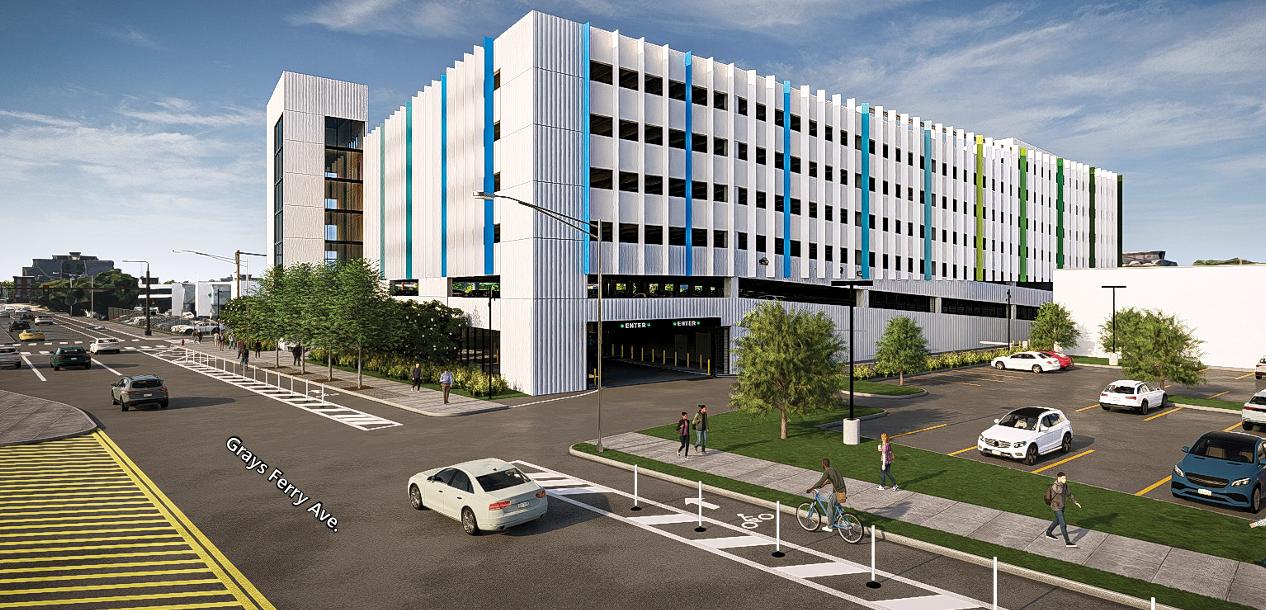
In the spring, Children’s Hospital of Philadelphia (CHOP) revealed plans for a 1,005-space parking garage in Grays Ferry along with a shuttle service to spirit employees to the main campus a mile away.
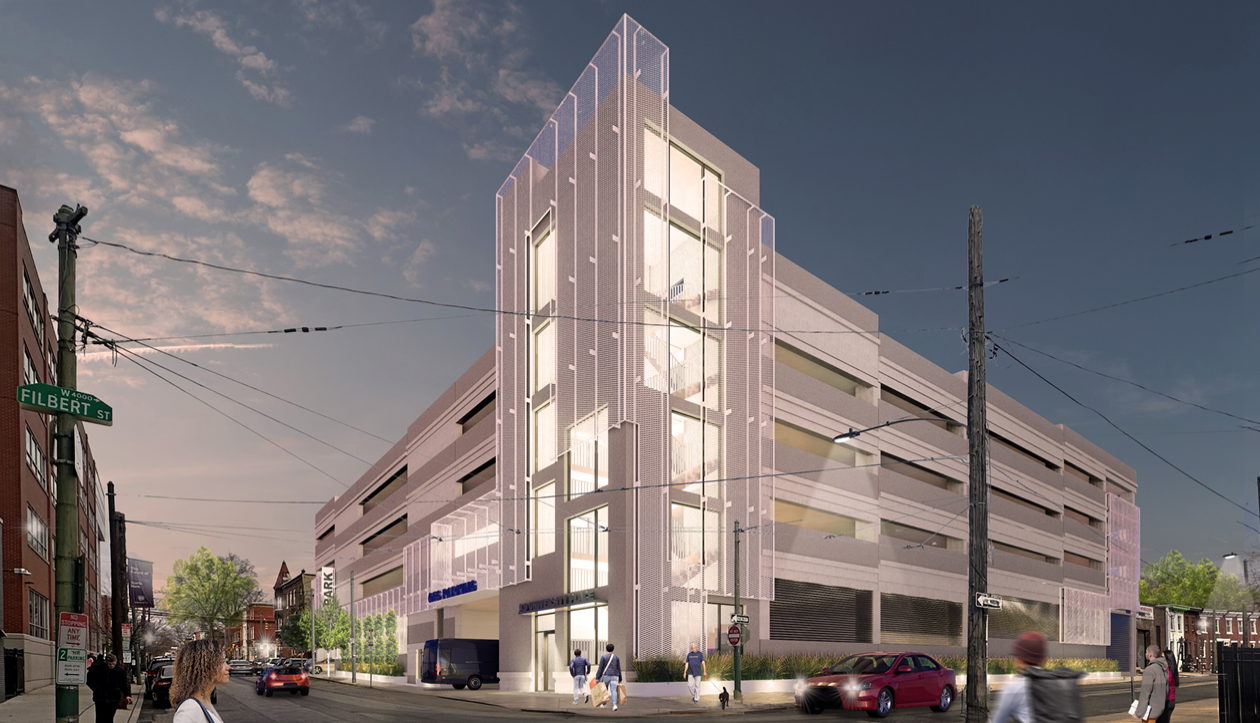
In August, University Place Associates unveiled plans for a 495-unit garage. About a fourth of it will be reserved for the use of the city’s new forensic lab, but the rest will be open to the public.
All three projects have baffled environmentalists and urbanists, who thought Philadelphia was moving away from car-centric patterns of late 20th-century development.
It’s also surprised parking operators in the city, who say national construction cost trends and high local taxation make it difficult to turn a profit.
Legacy parking companies in Philadelphia like E-Z Park and Parkway Corp. have been selling garages and surface lots for redevelopment as anything other than parking. They say the city has lost 10,000 publicly available spaces in the last 15 years, bringing the total to about 40,000 in Center City.
“I don’t think I’ll ever build another stand-alone parking facility,” said Robert Zuritsky, president of Parkway Corp. and board chair of the National Parking Association. “It doesn’t make any sense.”
Zuritsky and other parking companies have long noted that operators in Philadelphia, who often have unionized workforces, get hit with parking, wage, property, and the Use and Occupancy Tax.
When combined with the soaring cost of building new spaces across the nation, it’s difficult to turn a profit in Philadelphia.
A rendering of the Fishtown garage, looking towards the Delaware River.
Zuritsky says it costs $60,000-$70,000 a space to build an aboveground lot in today’s environment and $100,000 to $150,000 below ground.
“It’s like building a house for a car,” he said.
Depending on hyperlocal peculiarities, Zuritsky says that taxation in Center City can eat up to 60% of the money they bring in and that to profit from new construction, an operator would have to charge $3,000 per space a month.
“I wish people luck, the ones that are moving in,” said Harvey Spear, president of E-Z Park. “Between taxes, insurance, and labor, it comes to, like, 70-some percent of what we take in. We have more equipment now that does away with a lot of labor; we’re trying to compensate with that.”
Urbanist and environmental advocates, meanwhile, have condemned the new garage projects, arguing that they will add to carbon emissions, air pollution, and traffic congestion.
“A massive parking garage less than half a mile from the El [in Fishtown] is the wrong direction for any city that claims to take climate action seriously,” said Ashlei Tracy, deputy executive director with the Pennsylvania Bipartisan Climate Initiative. “SEPTA is already working to get more people out of cars and onto transit, but projects like this one and the one from CHOP only make that harder.”
Here are the parking projects in the pipeline.
Fishtown: 372 spaces
The garage, with architecture by Philadelphia-based Designblendz, doesn’t just contain parking. It includes close to 14,000 square feet of commercial space on the first floor, which the developer hopes to rent to a restaurant — or two — on the edges of one of Philadelphia’s hottest culinary scenes.
Another over 16,000-square-foot restaurant space is planned for the top floor, with views of the skyline and river. Both the top and bottom floors also could be used as event spaces.
Kufasimes says that this aspect of the project could partly offset the kinds of costs that parking veterans warn of.
“Our due diligence team went through those numbers and vetted them pretty thoroughly: The returns are what they needed to be,” Kufasimes said. “It’s got a multifunction of income streams, so we think that that really will help play a larger role.”
Kufasimes also said a parking garage made sense in an area that’s seen more development than almost any other corner of Philadelphia. When investors purchased the land at 53-67 E. Laurel St. and approached his company for ideas, they met with other stakeholders in the neighborhood and determined parking would be appreciated.
“It wasn’t necessarily all about the profit,” Kufasimes said. “A lot of people this day and age, that is their number-one goal. If this is a slightly lower return in the long run but can be better accepted by the community as a whole, we think that actually raises the value of the asset.”
An overhead-perspective rendering of the Fishtown garage.
At an October meeting of the Fishtown Neighbors Association, that argumentappeared to pay off. Unlike most community meetings where a large new development is proposed, there were no adamant opponents of the project. The project also includes a 20,000-square-foot outdoor space, a green roof, and a to-be-decided public art component. All of that helped, too.
“It’s nice seeing a parking garage, of all things, be as pedestrian-friendly and thoughtful as this,” one speaker said during the Zoom meeting.
Dubbed University Place 5.0, it largely exists because of a major expansion of the municipal bureaucracy west of the Schuylkill.
For years the city has sought a new location for its criminal forensics laboratory. The debate became heated in City Hall, with numerous Council members making the case for locations within their districts.
Councilmember Jamie Gauthier pushed for its location in University City Place 3.0, a newly built, state-of-the-art life sciences building that was coming online just as its intended industry was slowing down in the face of higher interest rates.
To get the crime lab, Mayor Cherelle L. Parker’s administration said the police department would need ample parking. That’s where the new garage comes in.
In June, Gauthier passed a zoning overlay that cleared away the regulatory hurdles to the project. Six weeks later, the developers revealed University City Place 5.0, which has 29 parking spaces on the ground floor reserved for official use by forensics vehicles and 100 spaces reserved for city employees.
A rendering of the proposed University City parking garage as seen from 42nd and Filbert Streets.
Designed by Philadelphia-based ISA Architects, the garage is also meant to serve University Place Associate’s other large developments in the area. Akin to the Fishtown garage, they have also sought to make the development pedestrian friendly, with a dog park, green space, and public art.
The local community group, West Powelton Saunders Park RCO, also embraced the proposal.
“The community met regarding this project back in August, and … they were all in support of this project,” Pamela Andrews, president of the West Powelton Saunders Park RCO, said at the city’s September Civic Design Review meeting. “We have a tremendous problem with parking, and the community members felt this was a much needed and welcome addition.”
Grays Ferry: 1,005 parking spaces
CHOP’s thousand-car parking garage by far has been the most controversial of the proposals. But it also makes the most economic sense for the owner. Unlike the other garages — or those owned by Parkway and E-Z Park — it will be owned by a nonprofit and exempted from many of the taxes that make it so expensive to own parking in Philadelphia.
A rendering of the new parking garage CHOP plans for Grays Ferry.
The hospital purchased the property at 3000 Grays Ferry Ave., next to the Donald Finnegan Playground, for almost $25 million last year.
The seven-story development, which, plans show, would have far fewer amenities than its University City and Fishtown counterparts, is meant to serve CHOP’s new research facilities in Fitler Square and the new patient tower set to open in 2028.
“We recently secured permits and have begun construction on the new parking garage at 3000 Grays Ferry Ave.,” a CHOP spokesperson said. “The full construction is expected to go through the fall of 2026. CHOP continues to engage with the community by providing support, timely updates and addressing feedback during construction.”
At the time of its unveiling, CHOP argued that the massive garage was needed as SEPTA threatened to become unreliable due to a political funding crisis in Harrisburg. But detractors appeared almost immediately to denounce the hospital for worsening air quality in a lower-income neighborhood that is already a hot spot for asthma.
There are no regulatory hurdles to the development, but changes in the political or economic landscape could make it difficult to embark on a large capital project. Notably, the University of Pennsylvania proposed an 858-space garage in 2023 for the nearby Pennovation Center and has never broken ground.
Former President Joe Biden completed a round of radiation therapy at a Penn Medicine cancer center in Philadelphia Monday as part of his treatment for prostate cancer, according to a family representative.
Biden, 82, announced in May that he had been diagnosed with an aggressive form of the disease that had spread to his bones.
A spokesperson for the Bidens, Kelly Scully, said that following his treatment over the course of several weeks, Biden “rang the bell” at Penn, alongside his wife, Jill Biden, his daughter Ashley Biden and grandchildren, Hunter and Finnegan.
Ringing the bell at Penn typically signifies that a patient has completed cancer treatment, according to the health system.
But Biden has not yet made a statement on his treatment, and it wasn’t immediately clear if the former president would need additional treatment.
Ashley Biden posted a story on her Instagram of the bell-ringing moment alongside a woman who Scully confirmed was Biden’s doctor at Penn. Another photo showed the doctor with a bouquet of flowers standing with Biden.
“Dad has been so damn brave throughout his treatment,” Ashley Biden wrote in her post. “Grateful.”
A Penn spokesperson directed questions to the Biden family.
Steve Hirst relies on virtual visits with his urologist, whose office is an hour away from his Broomall home, to stay on top of his treatment plan and renew medications.
But earlier this month Hirst, 70, got a notice from his doctor’s office informing him that it could no longer schedule telemedicine visits for patients like him who have Medicare because of new federal policy changes.
Medicare began covering telemedicine services during the COVID-19 pandemic and has maintained the popular offering through temporary waivers approved by Congress since. But the most recent of those waivers expired at the end of September when Congress failed to reach a budget deal and the government shut down.
The change specifically affects traditional Medicare, which is administered by the government for people 65 and older and some with disabilities. People with Medicare Advantage plans, which are administered by private insurers, should check with their plan.
Some of the Philadelphia area’s leading health systems, including Temple Health and Penn Medicine, have said they are continuing to provide telehealth services to people with Medicare and temporarily suspending billing for those services, with hope that coverage will be reinstated when a budget deal is eventually reached.
But smaller provider practices may not have the luxury of delaying payment for thousands of dollars in services for an indefinite period of time.
With the government shutdown in its third week, Republicans and Democrats seem no closer to reaching a deal. The next vote is scheduled for Monday evening, though no deal is expected.
Another health policy issue — tax credits for people who buy insurance through Affordable Care Act marketplaces, including Pennie in Pennsylvania — has been a major sticking point in the ongoing federal budget debate. Democrats want the enhanced subsidies extended permanently as part of the budget deal, and Republicans have refused, arguing that lawmakers could address the issue separately, before the subsidies expire at the end of the year.
Meanwhile, the waiver’s expiration has left Hirst and others who are covered by Medicare unsure how they will access needed health services.
Telehealth rose in popularity during the COVID-19 pandemic, when people were urged to avoid hospitals unless they were having an emergency and when most routine procedures were canceled.
The approach was especially helpful to older adults and people with disabilities, who needed to stay in contact with doctors for ongoing treatment and who were considered particularly vulnerable to severe illness from COVID-19.
After the pandemic ended, many private insurers, Medicaid, and Medicare permanently adopted telehealth coverage for certain services, such as mental health, because of its popularity during the pandemic.
Medicare has used temporary waivers to continue telehealth coverage for other types of doctors’ visits.
Beyond patient popularity, research has found that telehealth visits can be as effective as in-person visits for certain types of care, such as palliative care for cancer patients, while improving access to patients with transportation challenges.
Philadelphia health systems respond
Philadelphia’s largest health systems said they are optimistic that coverage will be reinstated — either by a new temporary waiver or a permanent change — when Congress reaches a new budget agreement and the shutdown ends.
Temple Health will continue to provide telehealth services to Medicare patients for the next three weeks, in anticipation of Congress reaching a deal.
Penn Medicine has not billed Medicare patients for telehealth visits since the shutdown began and has paused its process for filing claims until the government reopens, a spokesperson said.
“Congress has been vocal in its support of telehealth and its value, and we are hopeful that legislation will be passed to ensure permanent Medicare telehealth coverage and flexibilities once the government reopens,” Penn said in a statement.
Main Line Health has been reaching out to affected patients to help them change previously scheduled virtual visits into in-person appointments or reschedule virtual visits that can be put off.
Jefferson Health did not respond to a request for comment in time for publication.
Patients in limbo
Hirst drives into Philadelphia to see his urologist in person once a year. Every three months, he has a virtual visit to check in and renew prescriptions.
Driving to Philadelphia for every appointment would be inconvenient, but Hirst will probably do it “for now,” he said.
But he worries about older adults and people with disabilities who can’t safely drive to the doctor’s office, and for whom virtual care is a lifeline. They could end up putting themselves or others at risk being on the road when they shouldn’t be. Or they may end up skipping needed care because they don’t have a ride.