Tag: Upper Merion

  • Johnson & Johnson will spend $1 billion on a cell therapy plant in Montgomery County

    Johnson & Johnson will spend $1 billion on a cell therapy plant in Montgomery County

    Johnson & Johnson plans to spend more than $1 billion to build a cell therapy manufacturing facility in Montgomery County near Spring House, the New Jersey pharmaceutical and medical supplies giant said Wednesday.

    The Lower Gwynedd Township plant, part of an effort by the company to invest $55 million in the U.S. by early 2029, is expected to employ 500 people when fully operational in 2031, J&J said.

    The facility at 1201 Sumneytown Pike will add to J&J’s capacity to make cell therapy treatments for cancer, with a focus on multiple myeloma. That’s a type of cancer that attacks white blood cells in the bone marrow. Cell therapy is the use of engineered immune cells to treat disease.

    “Pennsylvania’s proud manufacturing legacy, from steel to today’s medicines and medical technologies and Johnson & Johnson’s roots here for seven decades, are part of why we are investing here.” Joaquin Duato, J&J’s chairman and CEO, said.

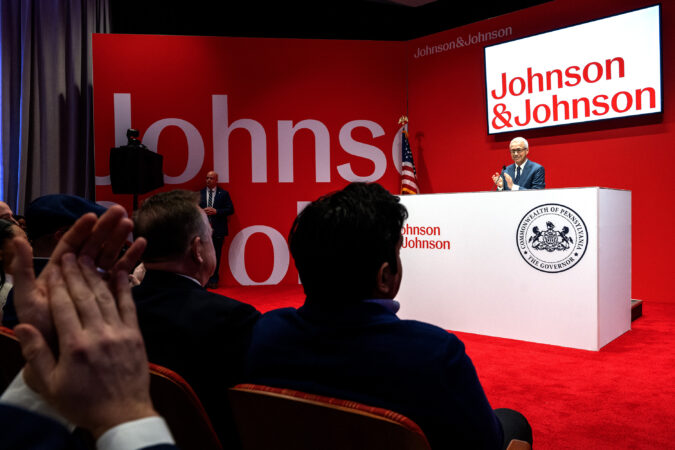
    Duato spoke during an event at the company’s Spring House research and development campus, where 2,500 scientists work in 70 laboratories. The Montgomery County site is J&J’s largest R&D center and it’s “where most of our discovery efforts start,” Duato said.

    The company based in New Brunswick, N.J., employs 5,885 people at 10 Pennsylvania facilities, according to the office of Gov. Josh Shapiro. The Shapiro administration has offered $41.5 million in state support for the J&J project.

    “With this investment, we are further cementing our place as a leader in life sciences,” Shapiro said. He said his administration’s efforts to cut red tape are among the reasons companies like J&J “are choosing to double down on their investments” in Pennsylvania.

    Eli Lilly & Co. last month announced plans to build a $3.5 billion pharmaceutical plant in the Lehigh Valley to expand manufacturing capacity for next-generation injectable weight-loss medicines.

    GSK said in September that it will build a biologics factory in Upper Merion Township, but did not specify how much it would spend there. That project is part of GSK’s plan to spend $1.2 billion on advanced manufacturing facilities.
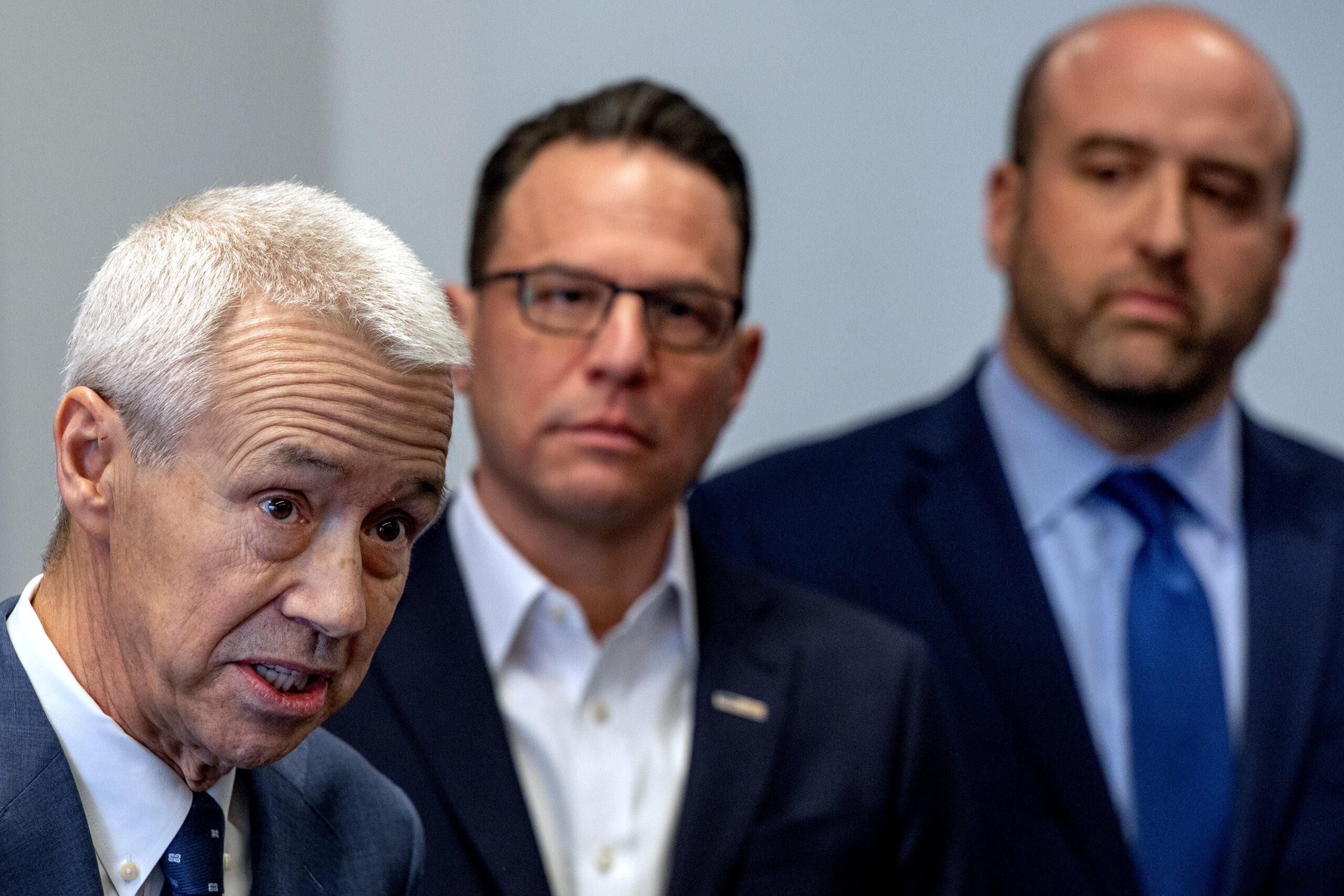
    Johnson & Johnson chairman and CEO Joaquin Duato (left), was joined by Gov. Josh Shapiro and Pa. Dept. of Community and Economic Development Secretary Rick Siger (right) on Wednesday when J&J announced it will spend $1 billion on a cell therapy plant on its campus in Lower Gwynedd Township.

    Merck, another New Jersey-based drug giant, last year announced plans for a $1 billion factory and lab near Wilmington. Merck also has major operations in Montgomery County, which is among the top-ranked counties nationally for pharmaceutical manufacturing jobs.

    J&J has a long legacy in the Philadelphia region. Among its major acquisitions here was the 1959 purchase of McNeil Laboratories, which later developed Tylenol. The pain reliever is still made at a plant in Fort Washington.

    Other major Philadelphia-area J&J deals include the 1999 purchase of Centocor, one of the country’s first biotech companies, and the 2012 deal for Synthes Inc., a Swiss medical device maker with its North American headquarters and major operations here.

    Separately from the new cell therapy manufacturing facility, J&J has two expansion projects planned for the Spring House R&D site.

    One is a new cell engineering and analytical sciences facility. The other is focused on CAR-T testing and manufacturing during research and development, with the goal of creating personalized therapies more quickly and efficiently. The company did not disclose the cost of those projects.
  • Eli Lilly plans a $3.5 billion Lehigh Valley pharma campus for new weight-loss drugs

    Eli Lilly plans a $3.5 billion Lehigh Valley pharma campus for new weight-loss drugs

    Eli Lilly & Co. plans to build a $3.5 billion pharmaceutical plant in the Lehigh Valley to expand manufacturing capacity for next-generation weight-loss medicines, the Indiana company announced Friday in Allentown.

    The decision by Lilly to build one of its four new U.S. factories in Lehigh County marks a significant win for Pennsylvania as states compete for the billions Big Pharma, under pressure from Washington, is spending to boost domestic manufacturing.

    “The Mid-Atlantic, Northeast in recent years hasn’t seen this type of mega-plant investment. Most of that has gone to the South and the Southwest,” Don Cunningham, CEO of Lehigh Valley Economic Development Corp., said in an interview.

    The Lehigh Valley sits in the middle of a pharmaceutical manufacturing belt that stretches from Montgomery County into central New Jersey, but historically has been known for steel, cement, and Mack Trucks. The Lilly plant will put it on the map for life sciences, said Cunningham, whose agency helped recruit Lilly.

    Montgomery County, a major drug and vaccine manufacturing hub, secured another significant project during the ongoing pharmaceutical investment push. The British company GSK said in September that it will build a biologics factory in Upper Merion Township, but did not specify how much it would spend there.

    Merck, the New Jersey-based drug giant, announced plans for a $1 billion factory and lab near Wilmington, beyond its existing major operations in Montgomery County.

    Until now, Lilly has been busy in the South. Last year, Lilly announced plans to spend a total of $17.5 billion on three factories in Alabama, Texas, and Virginia. The Lehigh Valley was in the competition for the Virginia project, which will be built west of Richmond, Cunningham said.

    The 150-acre Lehigh Valley site, in Upper Macungie Township, was selected from more than 300 applications for one of the four new Lilly plants. Ohio was among the other finalists, Cunningham said. The property Lilly is acquiring is adjacent to Interstate 78 on the north side just west of the Route 100 interchange.

    Pennsylvania boosted its chances of landing the Lilly project by offering up to $50 million in tax credits and $50 million in grants. An additional $5 million will go to a local community college for a job-training program.

    Gov. Josh Shapiro played an important part in securing the Lilly commitment, Cunningham said, with “his team bringing to bear every resource the state could.”

    When fully operational in 2031, the Lilly complex is expected to employ 850. The average annual pay in a Lilly facility is $100,000, Lilly’s chair and CEO David A. Ricks told a crowd gathered at the Da Vinci Science Center in downtown Allentown.

    “Those are high-value jobs that I can say with a lot of confidence change the trajectory of families,” Ricks said.

    Among the products Lilly anticipates manufacturing at the plant are Zepbound, which Ricks called the world’s best-selling medicine, and retatrutide, a type of weight-loss medication dubbed “triple G” that acts on three aspects of appetite regulation.

    Early results suggest such next-generation medications may lead to more weight loss than seen with the current drugs on the market, such as Novo Nordisk’s Ozempic and Lilly’s Mounjaro, which target one or two metabolic drivers.

  • Trail project planned near King of Prussia Mall gets new funding

    Trail project planned near King of Prussia Mall gets new funding

    A trail planned in Montgomery County is getting new funding to take the project to the next step.

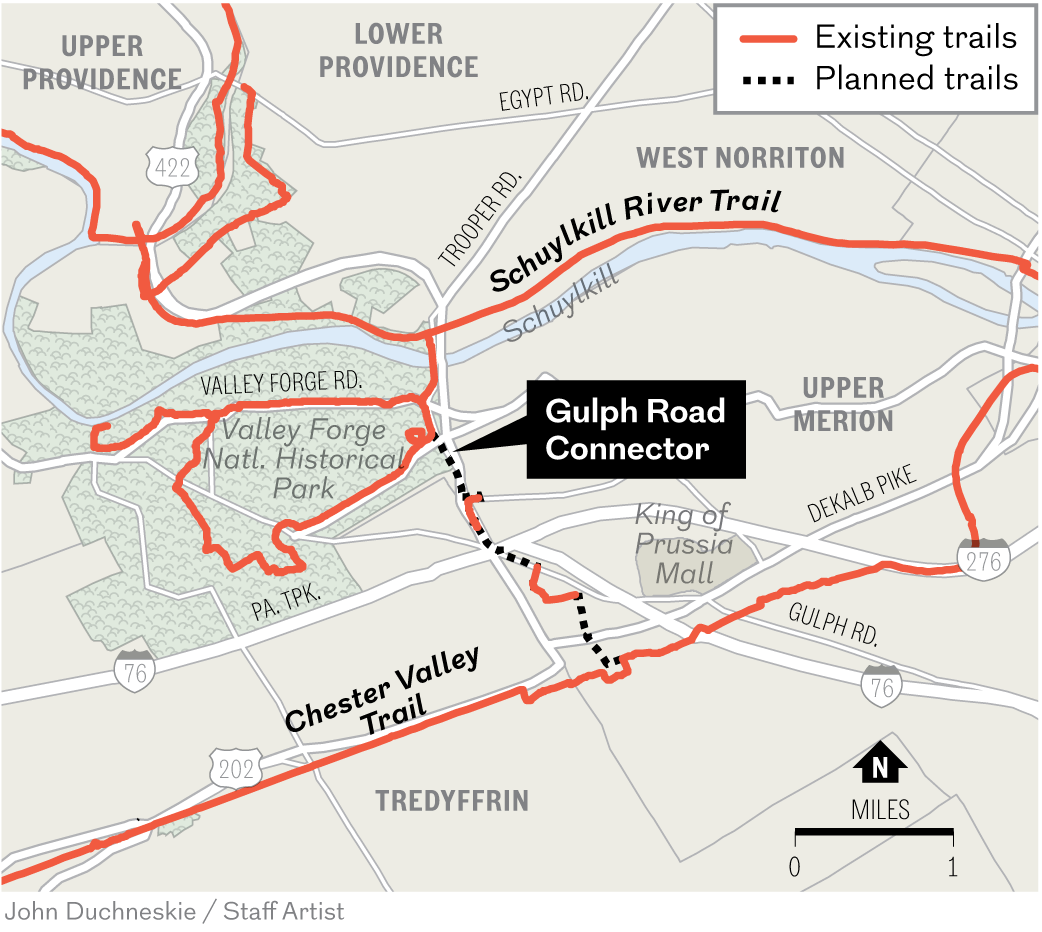
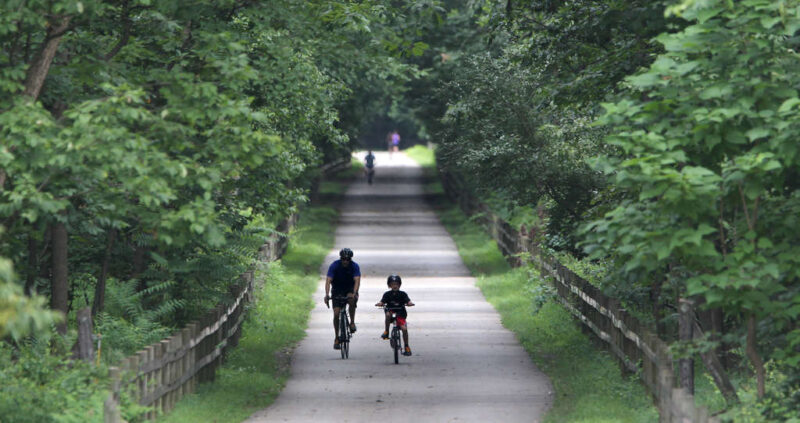
    The “Gulph Road Connector,” as it is currently called, is slated to connect to the Chester Valley Trail near the King of Prussia Mall, cross through Valley Forge National Historical Park, and link with the Schuylkill River Trail when completed.

    The project was recently awarded a three-year $326,900 grant from the William Penn Foundation, which will begin in January, said Eric Goldstein, president and CEO of the King of Prussia District, which is leading the project. The official name of the trail has not been determined.

    The influx of funds is slated for education, advocacy, and marketing, said Goldstein, who noted that the foundation is supporting “efforts to build a coalition of advocates” for the trail. The money will not be used for design or construction.

    Segments of the planned 2.8-mile trail connector are in stages of design and construction, with some already built, Goldstein said.

    “What we’re trying to do is ultimately fill in the blanks to make the 2.8-mile section complete,” he said.

    Goldstein said the new funds will allow the King of Prussia District to work with different partners along the trail. The aim is to build a coalition and raise awareness of the proposed trail, which ideally would lead to more grant money down the line for design and construction, he said.

    Map of the planned Gulph Road Connector trial near King of Prussia.

    The new funding is “the impetus for this trail to start moving toward completion,” said Molly Duffy, executive director of the Valley Forge Park Alliance, a partner organization in the trail’s development.

    There is no estimate yet for the total cost of the project, Goldstein said.

    The project is part of the Circuit Trails, a regional network that aims to have more than 850 miles of trails through nine counties. Once the trail is built out, Goldstein said, he expects it will be managed by multiple entities, depending on the section.

    He hopes to be able to complete the trail in the next 10 years.

    Some parts of the trail are “enormously complex,” he noted, adding that pedestrian bridges over sections of highway would require complex engineering and be costly — which requires raising funds.

    While the trail is expected to be used for recreation, it could also be an option for commuting to work.

    “The second audience of this proposed trail network is employees that work in Upper Merion Township that are seeking alternative modes of transportation to get to and from work,” he said.

    The trail also could make Valley Forge National Historical Park more accessible by ways other than driving, Duffy said.

    “We want people to be able to get here,” Duffy said. “Knowing where this is — in this super densely populated suburban area — we know that there’s this missing link, really, between these two major trails that, once built, will literally connect thousands and thousands of people who live in the area, work in the area, are visiting the area.”