Tag: West Oak Lane

  • ‘Don’t uproot our education,’ Pennypacker fourth graders plead as their school faces closure

    ‘Don’t uproot our education,’ Pennypacker fourth graders plead as their school faces closure

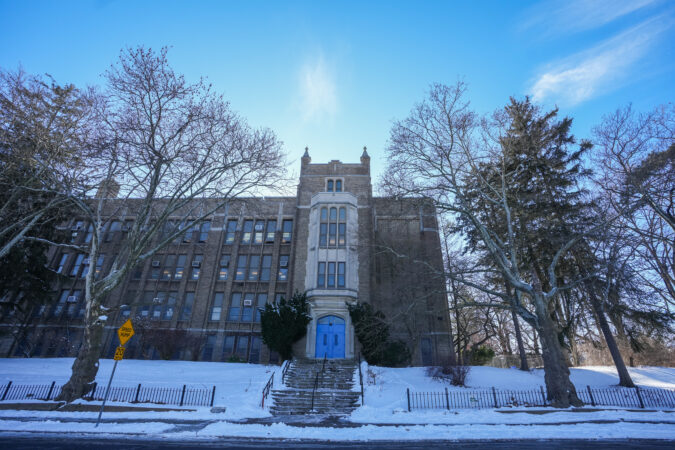
    For nearly a century, the Samuel Pennypacker School has survived — a three-story brick anchor of the West Oak Lane neighborhood in Northwest Philadelphia.

    Now it faces the threat of extinction.

    The Philadelphia School District says the school’s building score is “unsatisfactory” and modernizing it would cost more than $30 million. District officials are calling for shuttering Pennypacker following the 2026-27 school year, funneling its students to nearby Franklin S. Edmonds or Anna B. Day schools — part of a citywide proposal to close 20 district schools.

    The recommendation, district officials say, is no reflection of the “incredible teachers, community, [and] students” at Pennypacker. Rather, it is an attempt by the district to optimize resources and equity for students.

    Like many district schools, Pennypacker, which serves students in kindergarten through eighth grade, is aging and outdated, having opened in 1930. At just over 300 students, it is among the city’s smaller schools — and operating at about 64% of building capacity.

    Yet, it is those same qualities — its size and longevity — that represent some of its greatest strengths, say those in the school community who are not happy about the proposed closure.

    It’s a school, they say, that is more than the sum of its aging parts.

    On the school’s walls are pocks of chipped paint, yes, but also the colorful detritus of a small but vibrant student population: a poster composed of tiny handprints in honor of Black History Month; a “Blizzard of Positivity” — handwritten messages reading “Smile” and “Hugs” and “Help your friends when they fall.”

    It’s where Wonika Archer’s children enrolled soon after the family emigrated from Guyana — the first school they had ever known.

    “A lot of firsts,” Archer said. “Their first friends, their first teachers outside of their parents.”

    It’s where, since 1992, Andreas Roberts’ youth drill team has been allowed to practice. The team, which includes some Pennypacker students, recently participated in its first competition and won first place.

    “Pennypacker has been very, very useful to us,” he said. “We have nowhere else to practice for the kids.”

    It’s where Christine Thorne put her kids through school, her son and her daughter, and where her grandchildren now go. Around the school, they call her “Grandmama.”

    “I feel as if my household is being destroyed,” she said recently.

    For students, news of the imminent closure has been no less jarring.

    When Janelle Pearson’s fourth-grade students learned recently that their school was poised to be shuttered under the district’s plan, they took it as a grim reflection on themselves.

    “It makes them feel like, ‘What did we do wrong that they want to close our school?’” said Pearson, who has taught at Pennypacker for about a decade. “That’s the part that tugs at your heart.”

    Unwilling to go down without a fight, the fourth graders resolved to do what they could. Soon, a poster took shape, in marker and crayon, a series of pleas addressed to Philadelphia Superintendent Tony B. Watlington Sr.

    “Pennypacker is our home.”

    “Don’t uproot our education.”

    “Our neighborhood depends on this school!”

    The poster was presented to district officials earlier this month at a community meeting held in the school’s wood-seated auditorium.

    At that meeting, representatives from the district did their best to explain the reasoning for the proposed closures. They presented a tidy PowerPoint and talked of student retention and program alignment, of building capacity and neighborhood vulnerability scores.

    It stood in stark contrast to the parents and teachers and staffers who, one by one, held a microphone and spoke of love and family and community, of teachers and staffers who routinely went above and beyond to make their children feel safe. To make them feel special.

    “It’s not just about a building,” said Richard Levy, a onetime Pennypacker teacher who now works at St. Joseph’s University. “The challenges here aren’t reasons to close the school — they’re reasons to strengthen it.”

    Whether their appeals might affect the district’s decision remains to be seen. Other schools in the district slated for closure have mounted efforts of their own, and, despite a recent grilling by City Council members, it seems all but certain that several schools will ultimately shutter.

    A school board vote on the district’s proposal is expected later this winter.

    Until then, those at Pennypacker are holding tight to the possibility of an eleventh-hour reprieve for the longtime neighborhood institution.

    “I’m hoping there’s a chance,” Archer said. “I’m so hopeful.”
  • These Philly schools are slated for big upgrades as the district works to modernize buildings

    These Philly schools are slated for big upgrades as the district works to modernize buildings

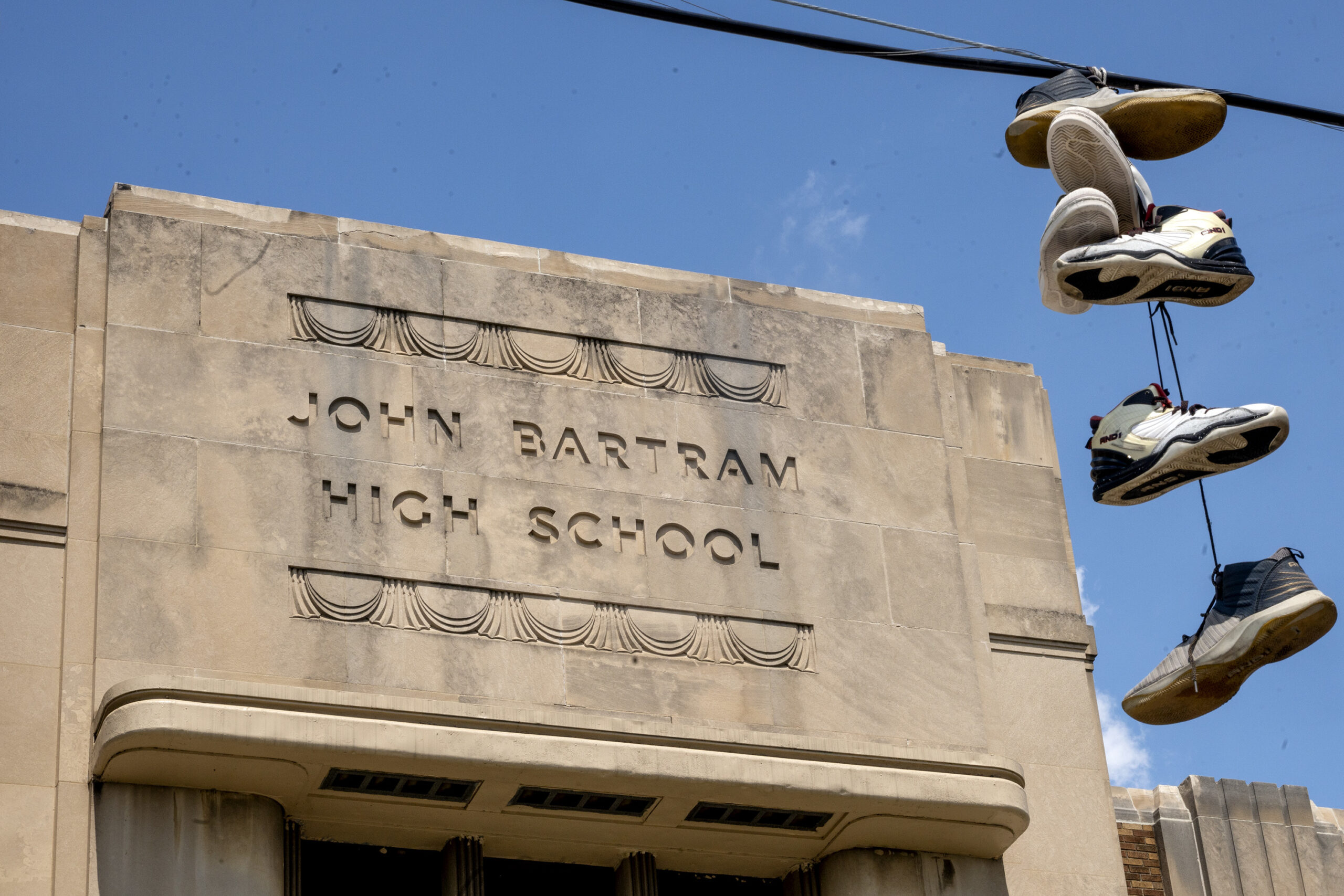
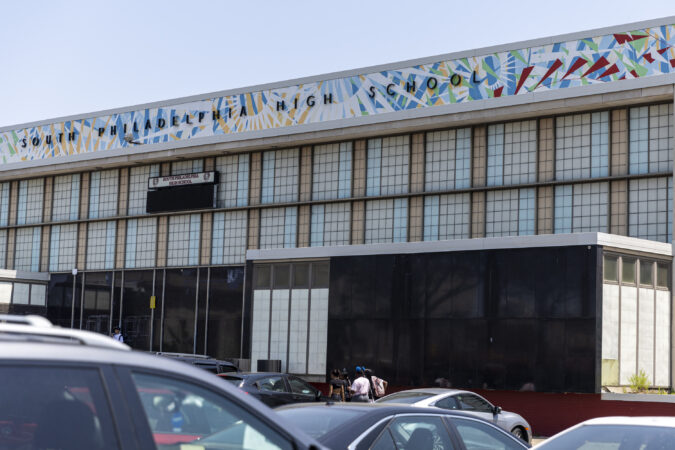
    Nearly $58 million for South Philadelphia High School. Over $27 million for Forrest Elementary in the Northeast. Almost $55 million for Bartram High in Southwest Philadelphia.

    Ahead of a Tuesday City Council hearing on the Philadelphia School District’s proposed facilities master plan, district officials have dangled the carrot that would accompany the stick of 20 school closings.

    The district released Monday morning how much it would spend on modernization projects at schools in each City Council District if Superintendent Tony B. Watlington Sr.’s plan is approved by the school board this winter.

    The totals range from $443 million in the 9th District — which includes parts of Olney, East and West Oak Lane, Mount Airy, and Oxford Circle — to nearly $56 million for the 6th District in lower Northeast Philadelphia, including Mayfair, Bridesburg, and Wissinoming.

    The district’s announcement comes as the plan has already raised hackles among some Council members, and City Council President Kenyatta Johnson has said he’ll hold up the district’s funding “if need be” if concerns are not answered to Council’s satisfaction.

    Tailoring the release to Council districts — including highlighting one major project per district — appears to be an effort to calm opposition ahead of Tuesday’s hearing.

    Details on every school that would get upgraded under Watlington’s plan — 159 in total — have not yet been released.

    John Bartram High School at 2401 S. 67th St in Southwest Philadelphia.

    Watlington has stressed that the point of the long-range facilities plan is not closing schools, but solving for issues of equity, improving academic programming, and acknowledging that many buildings are in poor shape, while some are underenrolled and some are overenrolled.

    “This plan is about ensuring that more students in every neighborhood have access to the high-quality academics, programs, and facilities they deserve,” Watlington said in a statement. “While some of these decisions are difficult, they are grounded in deep community engagement and a shared commitment to improving outcomes for all public school children in every ZIP code of Philadelphia.”

    But at community meetings unfolding at schools across the city that are slated for closure, Council members have expressed displeasure about parts of the plan — a preview, perhaps, of Tuesday’s meeting.

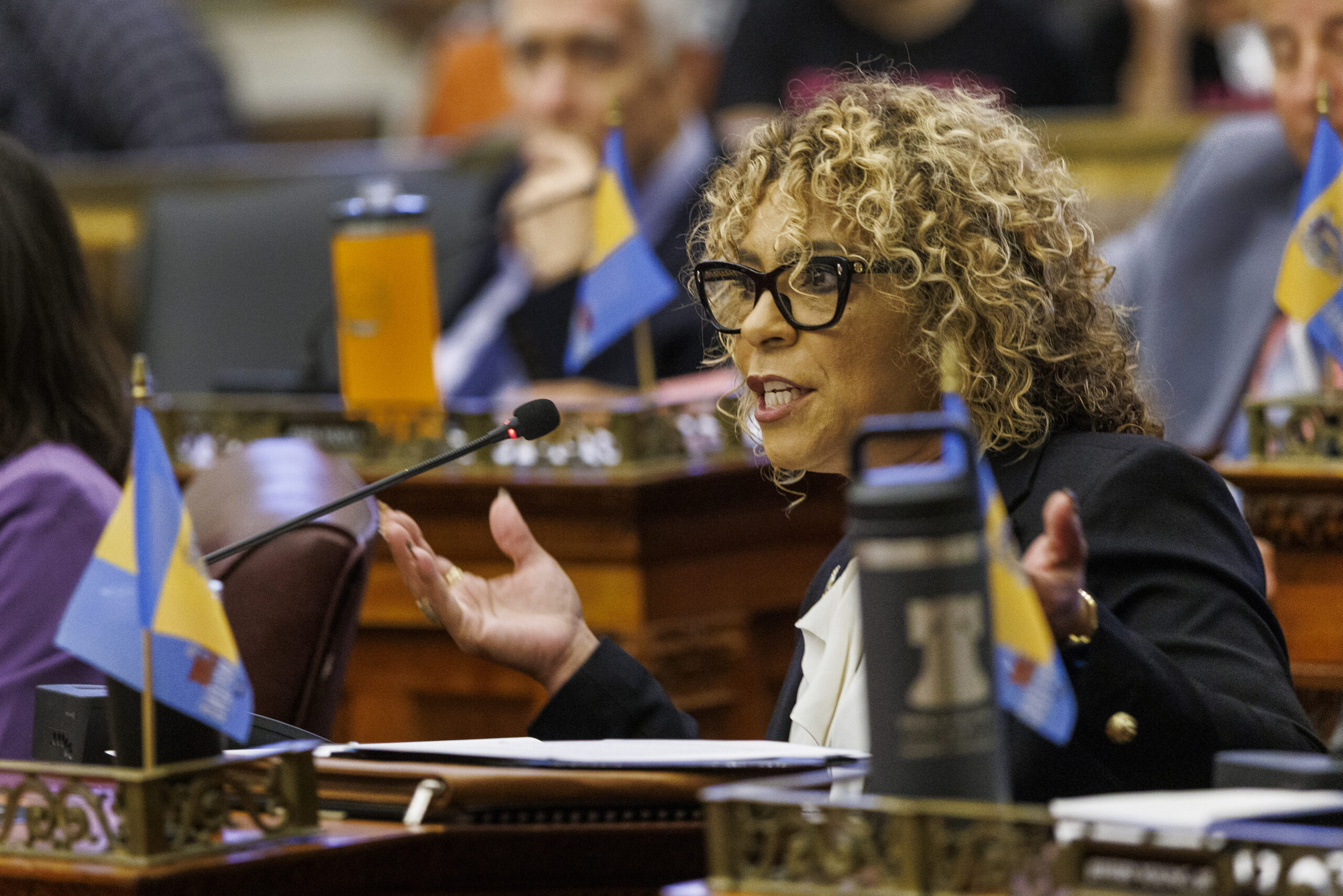
    Councilmember Quetcy Lozada, represents the 7th District, including Kensington, Feltonville, Juniata Park, and Frankford. Four schools in her district — Stetson, Conwell, Harding, and Welsh — are on the chopping block.

    “The fact that they are being considered for closure is very concerning to me,” Lozada said at a meeting at Stetson Middle School on Thursday.

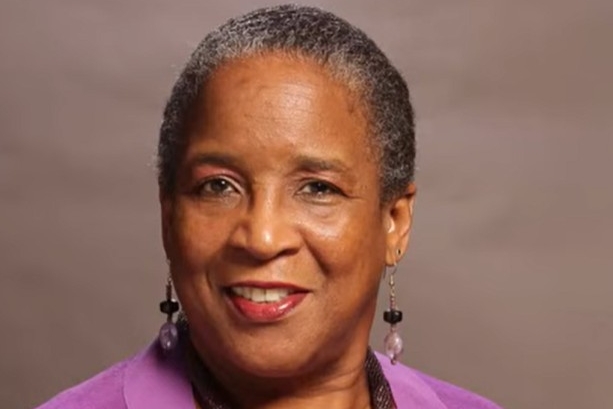
    Councilmember Quetcy Lozada is shown in a 2025 file photo.

    Councilmember Cindy Bass, speaking at a Lankenau High meeting, objected to closing schools that are working well. (Three schools in Bass’ 8th District, Fitler Elementary, Wagner middle school, and Parkway Northwest High School, are proposed for closure. Lankenau is in Curtis Jones Jr.’s district but has citywide enrollment.)

    “I do not understand what the logic and the rationale is that we are making these kinds of decisions,” said Bass.

    While Council members will not have a direct say on the proposed school closures or the facilities plan, Council wields significant control over the district’s budget. Funding for the district is included in the annual city budget that Council must approve by the end of June.

    Local revenue and city funding made up about 40% of the district’s budget this year, or nearly $2 billion. Most of that is the district’s share of city property taxes which, unlike other school systems in Pennsylvania, are levied by the city and then distributed to the district.

    (function() {
    var l2 = function() {
    new pym.Parent(‘schools_districts2’,
    ‘https://media.inquirer.com/storage/inquirer/projects/innovation/arcgis_iframe/schools_districts2.html’);
    };
    if (typeof(pym) === ‘undefined’) {
    var h = document.getElementsByTagName(‘head’)[0],
    s = document.createElement(‘script’);
    s.type = ‘text/javascript’;
    s.src = ‘https://pym.nprapps.org/pym.v1.min.js’;
    s.onload = l2;
    h.appendChild(s);
    } else {
    l2();
    }
    })();

    Where will the money go?

    Despite city and schools officials saying in the past that the district has more than $7 billion in unmet facilities needs, Watlington has said the district could complete its plan — including modernizing 159 schools — for $2.8 billion.

    Officials said further details about modernization projects and the facilities plan will be released before the Feb. 26 school board meeting, where Watlington is expected to formally present his proposal to the school board.

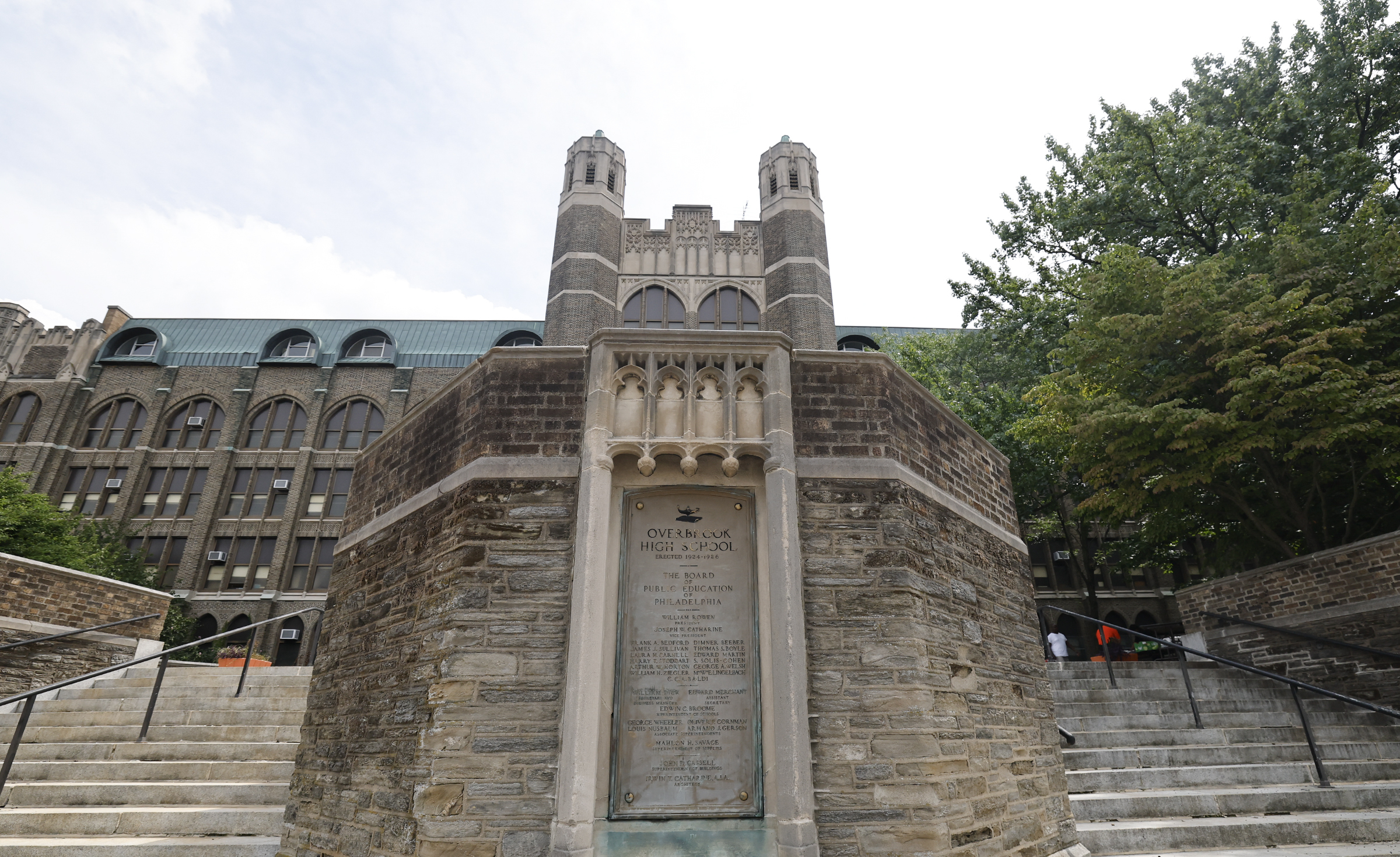
    Overbrook High School, in West Philadelphia, will get major renovations in preparation for The Workshop School, a small, project-based district school, colocating inside the building.

    Here are the total proposed dollar amounts per Council district and the 10 big projects announced Monday:

    • 1st District: $308,049,008. Key project: $57.2 million for South Philadelphia High, turning the school into a career and technical education hub and modernizing electrical, lighting, and security systems.
    • 2nd District: $302,284,081. Key project: $54.6 million for Bartram High, to renovate the school and grounds, career and technical education spaces, restroom and accessibility renovations, new painting, and new athletic fields and facilities (on the site of nearby Tilden Middle School, which is slated to close). Motivation High School would close and become an honors program inside Bartram.
    • 3rd District: $204,947,677. Key project: $19.6 million for the Sulzberger site, which currently houses Middle Years Alternative and is proposed to house Martha Washington Elementary. (It currently houses MYA and Parkway West, which would close.) Improvements would include heating and cooling and electrical systems, classroom modernizations, and the addition of an elevator and a playground.
    • 4th District: $216,819,480. Key project: $50.2 million for Overbrook High School, with updates including new restrooms, accessibility improvements, and refurbished automotive bays. (The Workshop School, another district high school, is colocating inside the building.)
    • 5th District: $290,748,937. Key project: $8.4 million for Franklin Learning Center, with updates including for exterior, auditorium, and restroom renovations, security cameras, accessibility improvements, and new paint.
    • 6th District: $55,769,008. Key project: $27.2 million for Forrest Elementary, including modernizations that will allow the school to grow to a K-8, and eliminate overcrowding at Northeast Community Propel Academy.
    • 7th District: $388,795,327. Key project: $32.3 million at John Marshall Elementary in Frankford to add capacity at the school, plus a gym, elevator, and schoolwide renovations.
    • 8th District: $318,986,215. Key project: $42.9 million at Martin Luther King High in East Germantown for electrical and general building upgrades and accommodations for Building 21, a school that will colocate inside the King building.
    • 9th District: $442,934,244. Key project: $42.2 million at Carnell Elementary for projects including an addition to expand the school’s capacity, restroom renovations, exterior improvements, and stormwater management projects.
    • 10th District: $275,829,539. Key project: at Watson Comly Elementary in the Northeast, an addition to accommodate middle grade students from Loesche and Comly, and building modernizations. District officials did not give the estimated cost of the Comly project.

    What’s next?

    The facilities Council hearing is scheduled for 10 a.m. Tuesday at City Hall. It will also be livestreamed.

    Members of the public also have the opportunity to weigh in on the facilities plan writ large at three community town halls scheduled for this week: Tuesday at Benjamin Franklin High from 4:30 to 6:30 p.m., Friday at Kensington CAPA from 4:30 to 6:30 p.m., and a virtual meeting scheduled for 2 p.m. on Sunday.

    Meetings at each of the schools proposed for closure continue this week, also; the full schedule can be found on the district’s website.

  • Philadelphians deserve safe and healthy homes

    Philadelphians deserve safe and healthy homes

    The Department of Licenses and Inspections didn’t mince words when it declared the 144-unit Upsal Gardens complex an “unsafe structure.”

    Foundation separation. Cracked masonry. Failing floor joists. A building so compromised that city officials said it posed “immediate danger” to human life.

    That violation is just the tip of the iceberg. I know this because I have lived it. On Aug. 23, my wife noticed a large crack forming in our living room ceiling. We alerted management through their portal, and I went to their on-site office to report it. Less than 24 hours later, at 12:06 a.m., the entire ceiling collapsed.

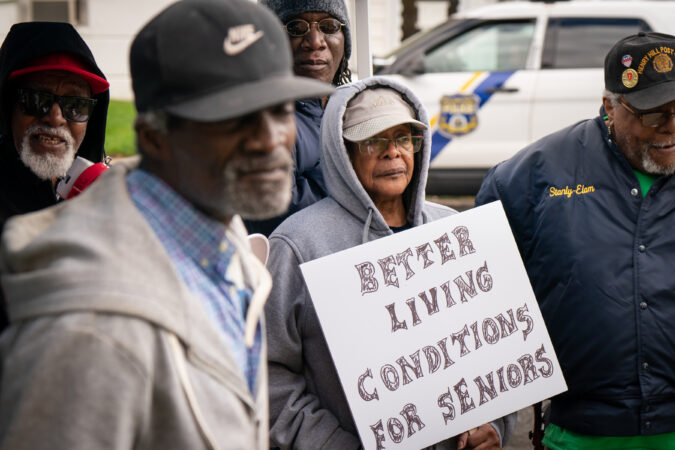
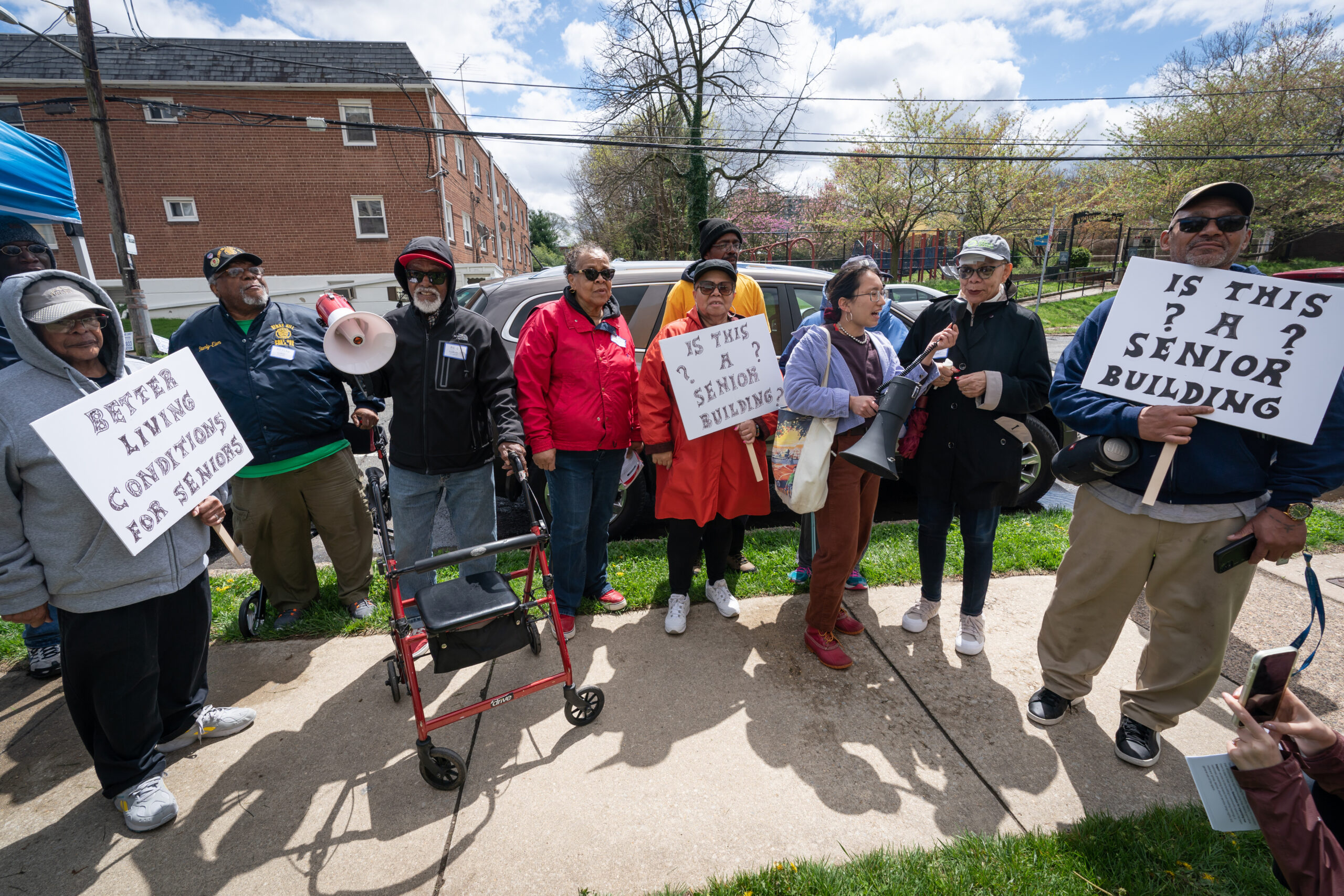
    Residents speak during a demonstration organized to protest against the living conditions at Brith Sholom House apartments in Philadelphia in April 2024.

    Fortunately, we had renters’ insurance. While management took their time deciding what to do, we stayed in the apartment under the exposed ceiling until our insurance finally booked us a hotel. After two days of waiting, we were moved temporarily so repairs could be made. But that displacement came with costs: For eight days, we paid out of pocket for meals and essentials while living in the hotel.

    Nevertheless, when we returned home, a notice was taped to our door: “Overdue rent.”

    Management knew we were displaced because of conditions they failed to address. And still, they badgered us for late rent — as though the collapse was an inconvenience to them, rather than a danger to us.

    A citywide crisis

    Unfortunately, my story isn’t unusual. My neighbors have filed a class-action lawsuit against the owners and managers of the property due to the complex-wide dangerous conditions described in an “unsafe structure” L&I violation. This lawsuit reflects a mounting rental safety crisis across Philadelphia.

    In West Oak Lane, tenants at Bentley Manor filed a similar lawsuit after their building was deemed unsafe while rent was still being collected. Upsal Gardens, Bentley Manor, Brith Sholom, Phillip Pulley and SBG Management, 8500 Lindbergh Blvd., ABC Capital. These are different buildings with different owners, managers, and business models, but nonetheless an all too similar story: Tenants forced to live in deplorable conditions while predatory landlords keep turning a profit.

    Philadelphians deserve safe and healthy homes, tenants deserve roofs and ceilings that are secure, floors that don’t buckle, and air that doesn’t make their children sick. We have laws on the books intended to address these issues.

    But a combination of loopholes, insufficient funding, and lack of enforcement leaves renters without a clear means to enforce those laws, placing many renters between a rock and a hard place: pay for unsafe housing, risk retaliation for withholding rent, or absorb the costs of displacement.

    Renters aren’t completely powerless, though. This year, we’ve seen that when renters come together, they win. This spring, City Council took the first steps toward addressing the city’s rental safety crisis by creating a fund for tenants displaced because of unsafe conditions. But that fund sat empty for months, until a coalition of housing justice advocates successfully lobbied for Mayor Cherelle L. Parker’s H.O.M.E. Plan to fund it.

    Dangerous, uninhabitable

    Still, there is much more work to be done. The vast majority of renters continue to live in units that have never been inspected. Landlords continue to demand rent for rental units with dangerous, uninhabitable conditions. Renters continue to acquiesce to those conditions out of fear of retaliation.

    The Safe Healthy Homes (SHH) campaign, led by OnePA, Renters United Philadelphia, Philly Thrive, and the office of Councilmember Nicolas O’Rourke, provides commonsense answers to these issues: protecting renters who speak up about unsafe conditions from landlord retaliation, authorizing proactive L&I inspections, and requiring proof of code compliance to evict or collect rent. These are all things we would assume are happening already, but this package adds the critical enforcement provisions that have been missing.

    Safe housing is not a perk — it is the bare minimum, and City Council’s Housing Committee had a long-overdue hearing for the SHH package tentatively scheduled for Tuesday.

    I encourage you to let the members of the committee know how you feel about having safe and healthy homes for tenants across our city.

    B. Cincere Wilson is the chief operations officer of Myra’s Kids Inc., a nonprofit serving justice-impacted and high-risk youth. He lives in Philadelphia and works in New York City.

  • Philly’s building plan would close this high-performing magnet. Lankenau is fighting back.

    Philly’s building plan would close this high-performing magnet. Lankenau is fighting back.

    There’s no place in Philadelphia like Lankenau High School.

    It is the city’s environmental sciences magnet school and the state’s only three-year agriculture, food, and natural resources career and technical education program. It’s set amid 400 acres of woods, with neighbors including a vast environmental center and farm that are active partners with the school. Lankenau’s students have access to dual enrollment and an impressive array of internships.

    But Lankenau just landed on the Philadelphia School District’s closing list, one of 20 schools proposed to shutter for the 2027-28 school year as the district grapples with 70,000 extra seats citywide, billions in unmet capital needs, and a desire to modernize and bring equity to student experiences in the school system.

    The Lankenau community is already gearing up for a fight ahead of a school board vote on the proposal, expected this winter. Community members say the school must be saved because it is one of a kind, offering immersive education in agriculture and sciences and boasting a 100% graduation rate that’s rare in Philadelphia.

    Shutting “the Lank” would be a disastrous move, said Jamir Lowe-Smith, a junior at the school. The district’s proposal would merge Lankenau into Roxborough High as an honors program, but you cannot replicate what his school has built anywhere else, Lowe-Smith said.

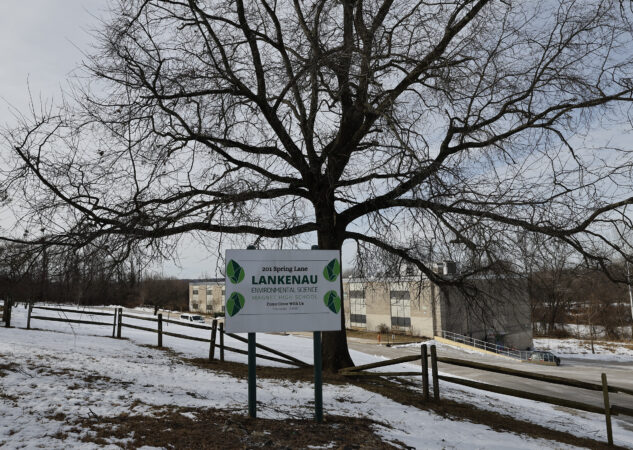
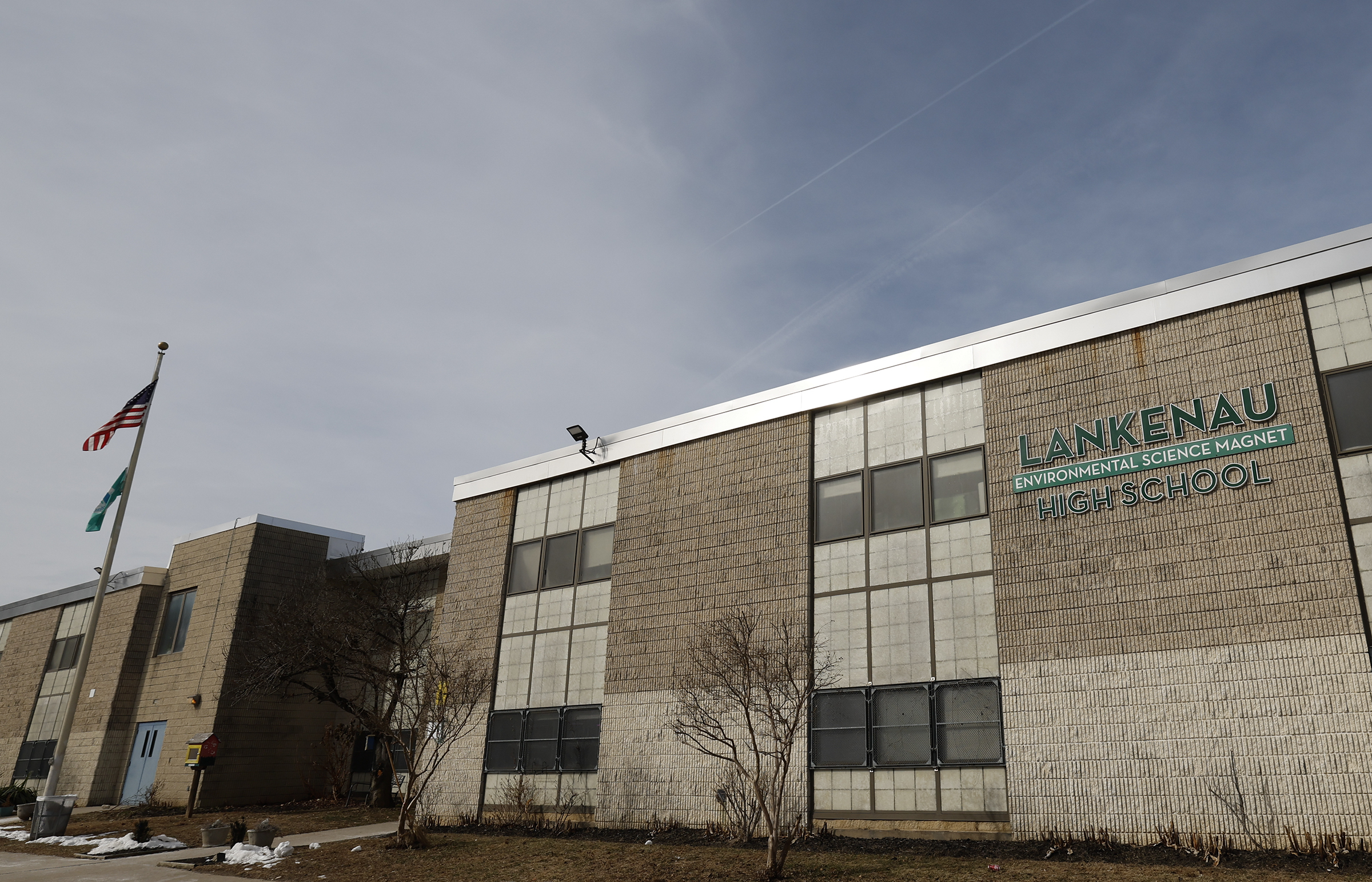
    The Lankenau Environmental Science Magnet High School in Roxborough. The district’s proposal would merge Lankenau into Roxborough High as an honors program.

    “Lankenau takes education to the next level,” said Lowe-Smith, president of the school’s chapter of Junior MANNRS — Minorities in Agriculture, Natural Resources, and Related Sciences — which preps students for jobs in the growing green sciences industry.

    “The environment is beautiful, the woods are — that’s another classroom,“ Lowe-Smith said. ”Nature is like therapy for a lot of people — it changed my life.”

    Being tucked into the woods allows for a Friday advisory bird-watching club at Lankenau and research in a stream that leads directly to the Schuylkill. It lends itself to tick drags — studies of tick species — pesticide classes that will allow students to graduate as certified pesticide applicators, and work with school beehives. Its students engage in innovative project-based learning every day.

    Lankenau students all receive yellow school bus transportation because the campus is not close to any SEPTA routes — adding to the district’s expense to keep it open.

    The school is small — its building, on Spring Lane in Upper Roxborough, is about half full, enrolling about 250 in a building that can accommodate 461. But the recommendations for closing need to be about more than numbers, said State Rep. Tarik Khan, a Democrat whose district includes that area.

    “Respectfully, the recommendation to close Lankenau is one of those things that doesn’t make sense when you look at the full picture,” Khan said. “Right now, it’s a recommendation. Early on, it’s important just to say: This is the wrong decision. I will elevate my voice throughout this process, and I’m not alone.”

    Monique Braxton, a district spokesperson, said the Lankenau recommendation “reflects the district’s commitment to reinvesting in neighborhood high schools as community anchors — a guiding theme of the Facilities Master Plan that received overwhelming support in the recent community survey. This approach expands access to high-quality academic programming and resources across neighborhoods, creating greater opportunity for more students and supporting stronger academic outcomes and postsecondary readiness.”

    Firing on all cylinders

    Lankenau, Khan said, is “firing on all cylinders. The school has so many opportunities for students, so many connections. To take this school out of its environment will break a lot of those connections, will break the cohesiveness.”

    The school lacks a gym. But its students play flag football, hike in the woods, and practice archery. It has a 100% graduation rate, officials say, educating a student body that is primarily Black and brown, with 25% of students requiring special education services.

    Jessica McAtamney, Lankenau’s principal for the last five years, stressed that the school is “doing urban agriculture in a very unique campus setting that is anchored in the space. Agriculture is Pennsylvania’s No. 1 industry. Lankenau is preparing kids to do that. This campus is what allows us to do that.”

    Roxborough High School, by contrast, is in a dense, residential area. Its building, which can hold almost 2,000 students, is about three-quarters empty.

    Like many in the Lankenau community, Erica Stefanovich — who teaches the only Intro to Geographic Information Systems high school course in the city, she believes — was blindsided by word that the school was earmarked for closure.

    “They can say that our building condition is an issue, but how is our building a problem when we have air-conditioning, zero asbestos, and they put a brand-new roof on our school two years ago?” Stefanovich said.

    In 2006, the district actually made plans to expand the Lankenau building, going so far as to contract with an architectural firm to make a model. But those plans went by the wayside as the school system hit rocky financial waters in the early 2010s.

    No slight against Roxborough, Stefanovich said. It does have a park close by, but “we can’t do mussel experiments in that park. We can’t do our internships that our students love. How do we have beehives when there isn’t enough pollinator space around Roxborough High School to have beehives? Our seniors are out of the building 40% of the time; they are off doing things. If we move, we don’t have that.”

    District changes yielded fewer incoming students

    Lankenau used to educate more students.

    Before the district changed its school selection process, in 2021, instituting a centralized lottery in the name of equity, the school had bigger incoming classes. It’s a magnet, meaning students have to have certain grades and test scores to qualify, but in the past, administrators had some leeway to let in students who were close to qualifying if they were a good fit.

    And though district officials said changes to the admissions procedure were necessary to ensure that schools’ demographics mirrored the city’s, Lankenau did not have a diversity problem prior to the changes.

    Lankenau had 106 ninth graders in 2020-21, before the lottery. It dipped to just 28 freshmen in 2023-24, but after a number of parents and administrators raised concerns about the process, some course corrections were made.

    Its numbers are now rising again. Seventy-eight ninth graders entered this school year, and 107 students listed Lankenau as their top choice for the 2026-27 freshman class.

    Even if the proposed school-closing changes go through, Wyntir Alford, a Lankenau 11th grader from West Oak Lane, will be able to graduate from the school as-is — the change is not planned to take effect until the 2027-28 school year.

    But her family was clear: If the closing were happening next year, Alford would have had to transfer.

    “My mom told me her first thought was, ‘There’s no way she’s going to Roxborough.’ She said, ‘The reason we put you in Lankenau is because of all the opportunities and all the nature around.’ I’m not surrounded by any nature at home. So to be able to go to a school like this is a big deal.”

    A student tests a water sample in a Lankenau High school science class in this 2023 file photo.

    Juniper Sok Sarom, a current Lankenau ninth grader, is not sure whether she will transfer to Roxborough if the school board approves the closure recommendation. But she knows she’s happy at a school that gives her plenty of hands-on experience.

    “Our campus — it’s a special learning environment, which you wouldn’t get at any other school, not even Central or Palumbo or SLA,” Sarom said, referring to Science Leadership Academy.

    She and others are gearing up to fight the changes, they said.

    Charde Earley, a Lankenau paraprofessional, dealt with her own sadness the day students found out about the proposed closure, working through tears. And then she marveled at how students pivoted to problem-solving, resolving to write letters and speak at meetings.

    “My motto is, respectfully, ‘Hell, no, we won’t go,’” Earley said. “We’re secluded and we’re safe. You never know what hardship our kids are going through. Imagine what this is doing to our kids.”

  • Carla Washington Hines, longtime dancer, choreographer, and teacher, has died at 72

    Carla Washington Hines, longtime dancer, choreographer, and teacher, has died at 72

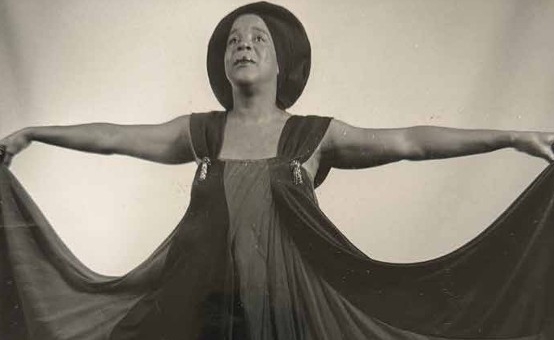
    Carla Washington Hines, 72, of Philadelphia, longtime dancer, pioneering choreographer, celebrated teacher, former artistic director, collaborator extraordinaire, and mentor, died Sunday, Nov. 2, of sepsis at Temple University Hospital-Jeanes Campus.

    Mrs. Hines came to Philadelphia from Virginia in 1974 after college and spent the next four decades dancing, teaching, lecturing, traveling, and generally advocating for arts in education from kindergarten through college. She danced with the Sun Ra Arkestra, the John Hines Dance Co., and other troupes at all sorts of venues in Philadelphia, New York, Chicago, elsewhere in the United States, and throughout Europe.

    She choreographed original performances such as “Montage in Black,” “Reflections,” and “Life Cycle,” and collaborated with notable jazz musicians Herbie Hancock and Alice Coltrane, and other musical stars. She was a guest on TV and radio shows, read poetry at public events, and earned awards from the Pennsylvania Council on the Arts and the Philadelphia-based Bartol Foundation for education.

    She was an expert in jazz dance, modern dance, ballet, and posture, and she lectured, organized workshops, and taught the elements of dance and choreographic principles at schools, colleges, art centers, drama guilds, libraries, and elsewhere around the country. Her mother, Thelma, was a dancer and teacher, too, and Mrs. Hines championed the connection between an interest in the arts and academic success.

    “In dance, I can be anything I want to be,” she said in an online interview. “That’s the magic of the arts.”

    She created an afterschool residency at a Universal charter school and taught dance at E.M. Stanton Elementary School, Strawberry Mansion High School, and other schools. She said in the online interview that her curriculum “is based on the appreciation of dance and movement,” and that it helps students “make sense of their lives using dance as a tool for learning.”

    She said: “I want them to be able to understand through movement exploration how dance can change one’s life.”

    She was artistic director for the Philadelphia chapter of the Institute for the Arts in Education and at the Point Breeze Performing Arts Center. “Her creative guidance helped students tell powerful cultural stories through movement,” her family said.

    Mrs. Hines performed with the Jones-Haywood Dance School in Washington before moving to Philadelphia.

    As longtime community engagement manager for the Philadelphia Clef Club of Jazz and Performing Arts, Mrs. Hines wrote grants and choreographed performances. She was executive director of the John Coltrane Cultural Society and active at the old University of the Arts.

    Her family said: “She devoted her life to creativity and to nurturing talent in others.”

    Carla Yvette Washington was born Nov. 3, 1952, in Charleston, W.Va. Her family moved to Grambling, La., when she was young, and she graduated from high school in 1970.

    She was named Miss Freshman at what is now Grambling State University, joined the Alpha Kappa Alpha Inc. sorority, and earned a bachelor’s degree in recreation in 1973. In 1981, she earned a master’s degree in fine arts and dance at the old Philadelphia College of the Performing Arts.

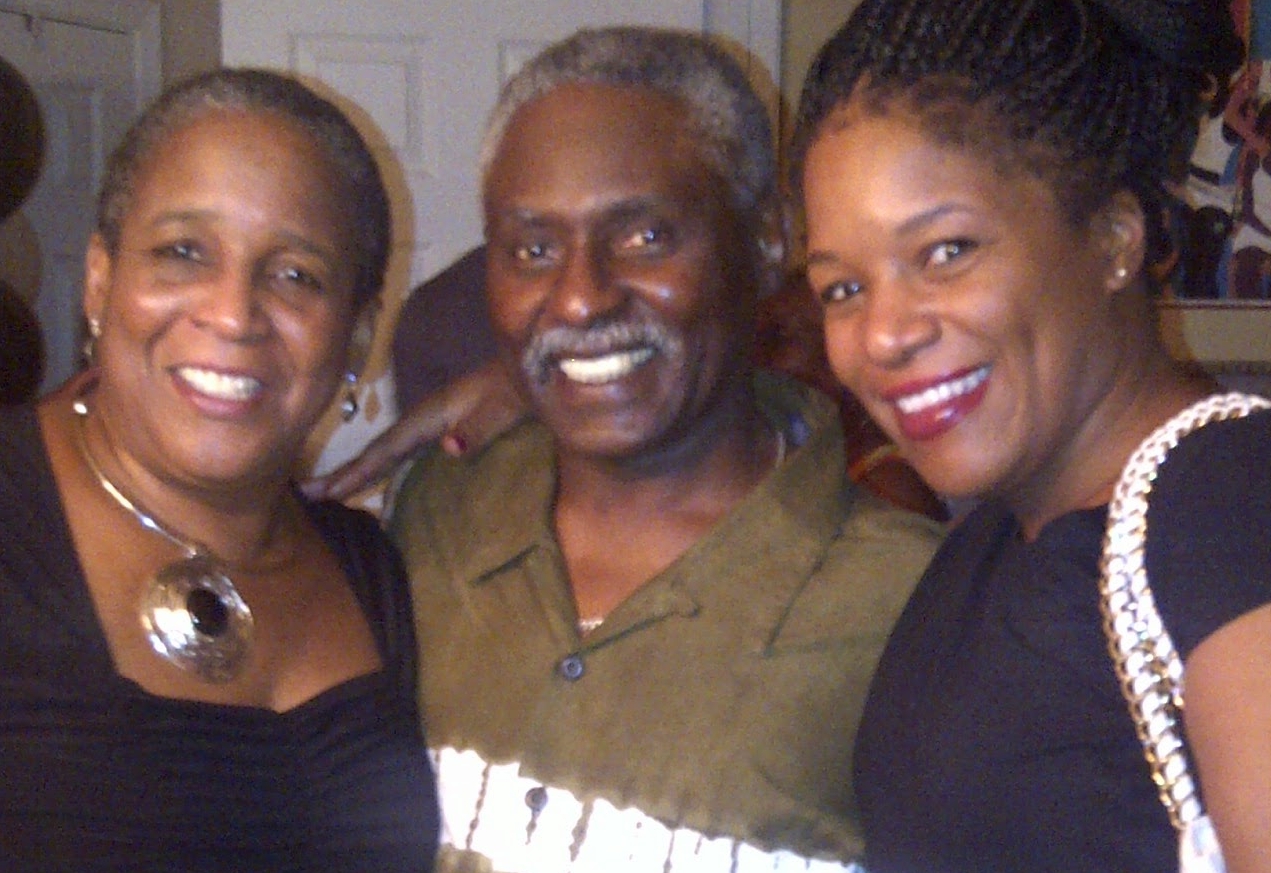
    Mrs. Hines (left) smiles with her husband, Lovett, and their daughter, Zara.

    She worked as a dance teacher for the Fairfax County Department of Recreation in Virginia after college and performed with the Jones-Haywood Dance School in Washington before moving to Philadelphia.

    She met jazz musician Lovett Hines Jr. when they were students at Grambling and they married in 1984 and lived in West Oak Lane. They had a daughter, Zara, and Mrs. Hines welcomed her husband’s son, Lovett III, and his family into her family.

    “She introduced many creatives to dance and culture, and sparked their creative careers,” her stepson said. “That is the essence of her legacy.”

    Mrs. Hines and her husband, their daughter said, were “a partnership of two geniuses.” He played the saxophone and was artistic director at the Clef Club. She loved the drums, and they collaborated seamlessly on many notable projects.

    Friends called her “a sweetheart” and “a beautiful soul” in online tributes. One said she “made an impact on Philadelphia and beyond in countless ways.” Her sister, Alicia Williams, said: “Everyone had a special relationship with her.”

    Mrs. Hines graduated from Grambling High School in Louisiana in 1970.

    Mrs. Hines was diagnosed with a lung disease in 2024 and Stage 4 cancer in 2025. “She was stern but soft,” her daughter said, “loving but able to tell you like it is.”

    Her husband said: “She had special relationships with so many musicians, so many people. It was through insight, understanding, and patience. In them, we see her everyplace, feel her everyplace.”

    In addition to her husband, daughter, mother, and stepson, Mrs. Hines is survived by three sisters, two step-grandsons, and other relatives. A brother died earlier.

    Services were held Wednesday, Dec. 17.

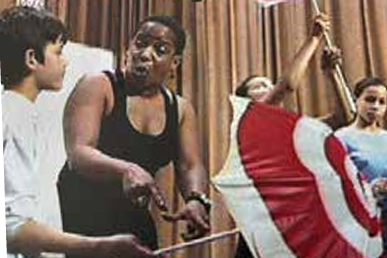
    Mrs. Hines (center) said she adapted her teaching techniques to suit the needs and ages of the students.
  • Martin Luther King Jr. spoke to Philly students in 1967. These men say it influenced the rest of their lives.

    Martin Luther King Jr. spoke to Philly students in 1967. These men say it influenced the rest of their lives.

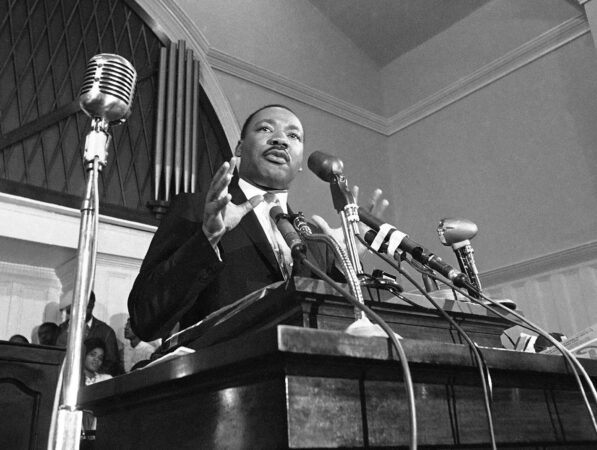
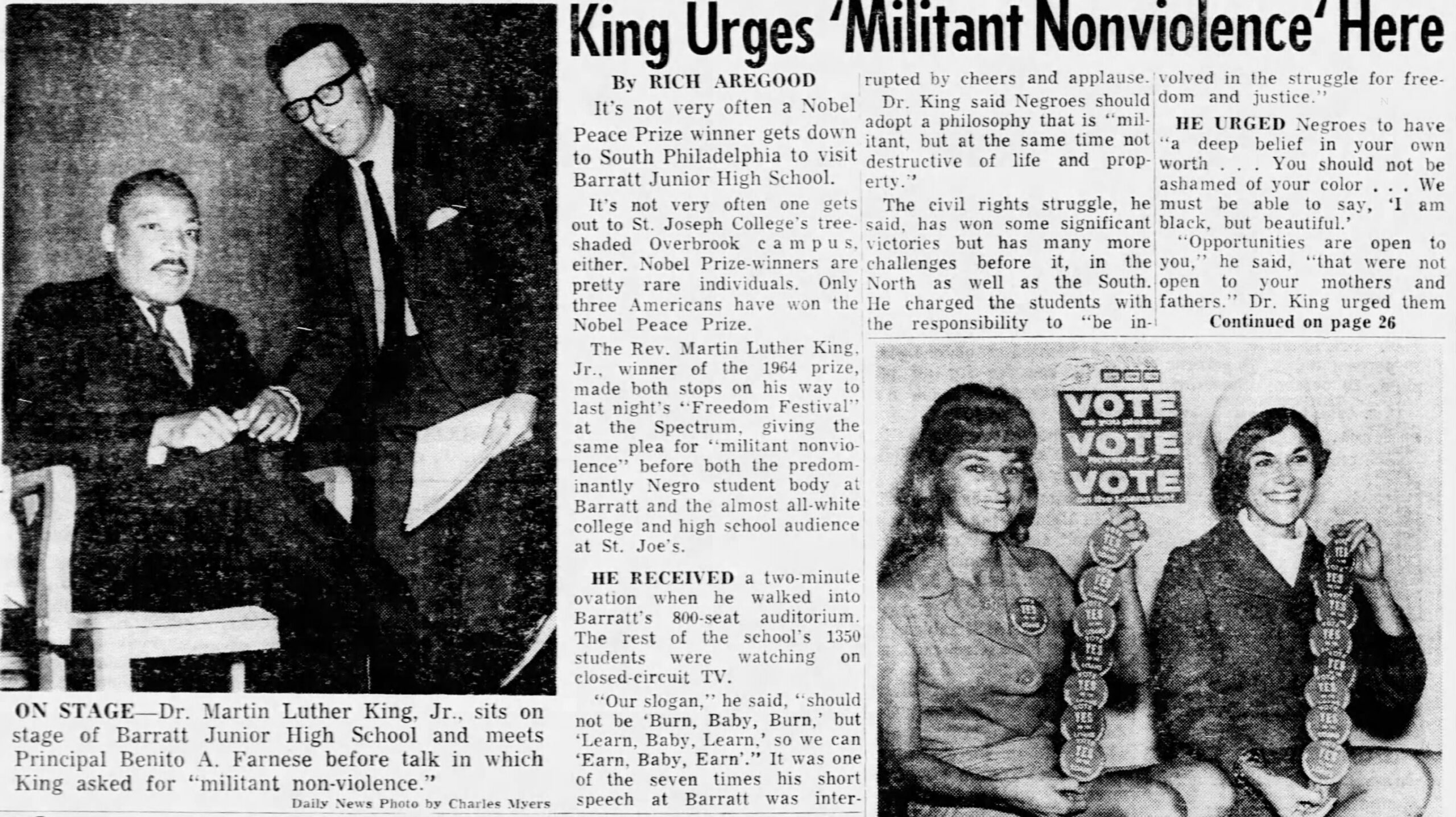
    The limousine door burst open, and the Rev. Dr. Martin Luther King Jr. stepped out onto the sidewalk in front of Dennis Kemp’s South Philadelphia school.

    Kemp was 13 that day in October 1967, a member of the stage crew and the basketball team asked by the principal of Barratt Junior High to greet the school’s surprise special guest.

    “In just about every Black household that I went into those days, there were three pictures hanging: Jesus, John Kennedy, and Dr. King,” said Kemp, now 72. “To actually meet this guy, it just blew me away.”

    King’s historic speech, made six months before he was assassinated, had a profound effect on Kemp and many of the 800 students crowded into the school auditorium.

    “What is your life’s blueprint?” King asked the students. “This is a most important and crucial period of your lives, for what you do now and what you decide now at this age may well determine which way your life shall go.”

    The community will mark the historic moment Monday, on Martin Luther King Jr. Day, with a showing of the speech in the auditorium of the school now known as Childs Elementary, then a day of service projects inside the building. One group hopes to apply to have a historical marker commemorating the visit placed outside the school.

    Kemp is glad that people still view and discuss King’s speech. Although he was a child, he sensed that he was part of something significant.

    Though nearly 1,000 students had packed into the Barratt auditorium, crowding into aisles and leaning over balconies, the room was silent save for King’s voice, Ben Farnese, then the school’s principal, told The Inquirer in 2006. In a nearby overflow room, 450 more students watched King on closed-circuit TV.

    “I took it in,” said Kemp, who was in the auditorium. “I said, ‘I’m going to keep this with me as long as I live.’”

    Charles Carter, a ninth grader who was in the auditorium, remembers the quiet.

    “Just figure — kids can be a little rowdy,” Carter said. “But we were transfixed, we were glued. We weren’t rowdy that day.”

    Jeffrey Miles, another Barratt student, had a good seat that day. He had heard a speaker was coming to school, and he was excited — he thought it might be Georgie Woods, the prominent DJ.

    After he heard King speak, he couldn’t help himself.

    “I had the end seat, and I jumped up out of my seat,” said Miles, who had turned 14 a few weeks before King spoke. “The speech was so exhilarating and so electrifying, I couldn’t control myself. He was walking down the aisle with [DJ] Georgie Woods, and I said, ‘Dr. King, can I shake your hand?’”

    King said yes. Miles grabbed his hand, which was sweaty — a detail that sticks in his mind, along with the sound of the Barratt students clapping thunderously for King.

    A belief in ‘somebodiness’

    King was in town for a “Stars for Freedom” show at the new Spectrum, opened the prior month in South Philadelphia.

    The Philadelphia Daily News recounted Martin Luther King Jr.’s visit to Barratt Junior High in October, 1967.

    “I know you’ve heard of that new impressive structure called the Spectrum, and I know you’ve heard of Harry Belafonte and Aretha Franklin and Nipsey Russell and Sidney Poitier and all of these other great and outstanding artists,” King said. He told the students to urge their parents to attend. “And I hope you will come also, for it will be a great experience and, by coming, you will be supporting the work of the Civil Rights Movement.”

    King did not use notes, Farnese said. He spoke for 20 minutes, an address that would eventually be known as his “What is Your Life’s Blueprint?” speech.

    The Barratt students, seventh, eighth, and ninth graders, were poised to move into a time that would determine the course of the rest of their lives.

    The great civil rights figure, who had by that time already won the Nobel Peace Prize, told the young people to have “a deep belief in your own dignity, your own worth, and your own somebodiness. Don’t allow anybody to make you feel that you are nobody.”

    Take pride in your color, your natural hair, King told the students, most of whom were Black.

    “You need not be lured into purchasing cosmetics advertised to make you lighter, neither do you need to process your hair to make it appear straight,” King said. “I have good hair and it is as good as anybody else’s in the world. And we’ve got to believe that.”

    ‘Learn, baby, learn’

    King urged the crowd to set upon a path to excellence, whatever that looks like.

    “I say to you, my young friends, that doors are opening to each of you — doors of opportunity are opening to each of you that were not open to your mothers and your fathers,” King said. “And the great challenge facing you is to be ready to enter these doors as they open.”

    Kemp remembers being surprised that King came to South Philadelphia.

    “Our neighborhood was pretty poor,” said Kemp, who grew up as one of nine children in a family that struggled. “There really wasn’t too much to look forward to in our neighborhood.”

    King acknowledged the “intolerable conditions” faced by many of the children he addressed. But, he said, it was incumbent on them to stay in school, to build a good life.

    “Set out to do a good job and do that job so well that the living, the dead, and the unborn couldn’t do it any better,” King said. “If it falls to your lot to be a street sweeper, sweep streets like Michelangelo painted pictures.”

    The civil rights hero told students to commit to “the eternal principles of beauty, love, and justice. Don’t allow anybody to pull you so low as to make you hate them.”

    King, who encouraged peaceful resistance, urged “a method that can be militant, but at the same time does not destroy life or property.”

    “And so our slogan must not be ‘Burn, baby, burn,’” King said, referring to a chant that had become associated with the 1965 Watts riots in Los Angeles. “It must be ‘Build, baby, build. Organize, baby, organize.’ Yes, our slogan must be ‘Learn, baby, learn’ so that we can earn, baby, earn.

    “And with a powerful commitment, I believe that we can transform dark yesterdays of injustice into bright tomorrows of justice and humanity.”

    ‘I’ll never forget it’

    Some of the members of the Barratt class in the room that day soared: Kevin Washington, who was on the basketball team with Kemp, went on to become the first Black president of the national YMCA.

    Kemp was bright, but his family’s economic struggles weighed on him, he said. He dreamed of college, but it wasn’t in reach. He ended up leaving South Philadelphia High without a diploma, eventually earning a GED.

    He raised children, built a life working — often in maintenance. He spent time as a school basketball coach.

    After suffering medical and marital issues, Kemp fell on hard times. He spent four months without a home, sleeping in parks and at 30th Street Station.

    “Dr. King’s speech really helped,” he said. “That used to come to mind when I was on the street. I’ll never forget it.”

    Kemp rallied; he now lives in an apartment in South Philadelphia.

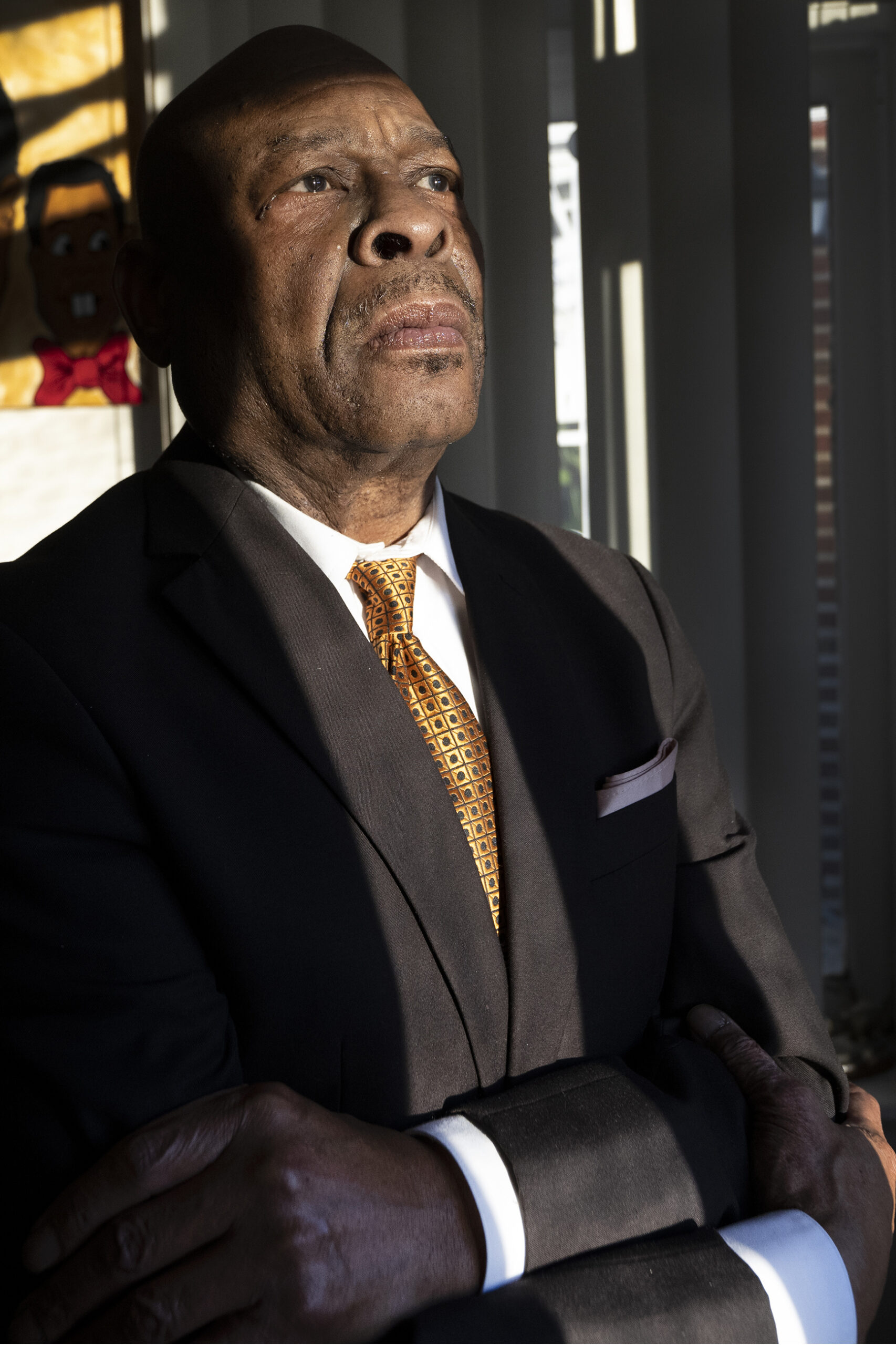
    Jeffrey Miles is photographed at his home in Philadelphia on Friday, Jan. 16, 2026. Miles was 13 in October 1967 when he shook the hand of the Rev. Dr. Martin Luther King Jr. and witnessed a speech that altered the course of his life.

    The speech also altered the course of Miles’ life.

    “I was a member of a gang in South Philly,” said Miles, now 72. “I never paid attention to adults and teachers. But that day I paid attention to Dr. King.”

    King’s words — reach for more, do your best, no matter your struggles — resonated. He buckled down at school, graduated from high school, from college. He became an optician and even taught students at Salus University.

    “When Dr. King said, ‘instead of burn, baby, burn, learn, baby learn,’ that gave me a window,” said Miles, who lives in West Oak Lane. “It gave me hope.”

  • Two Philly men accused of ‘fraud tourism’ in a Minnesota scandal that has drawn criticism from President Donald Trump

    Two Philly men accused of ‘fraud tourism’ in a Minnesota scandal that has drawn criticism from President Donald Trump

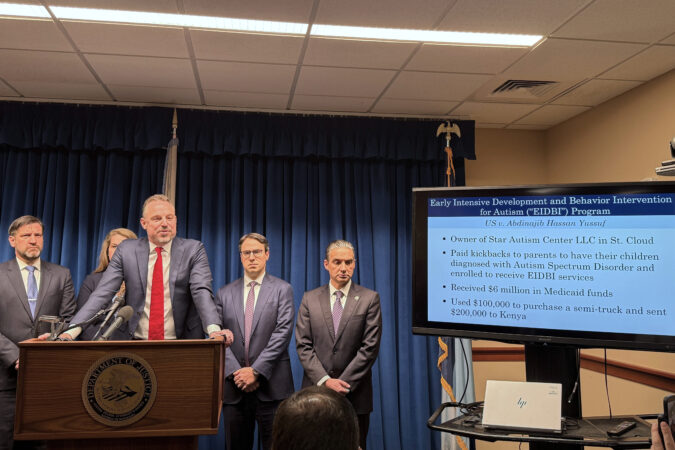
    Two Philadelphia men are facing federal charges in Minnesota after authorities said the men had learned of the state’s lax controls around a government-funded housing program, then traveled there to learn how to exploit it — the latest development in a long-running fraud scandal that has enveloped Minnesota and drawn the ire of President Donald Trump.

    Anthony Waddell Jefferson, 37, and Lester Brown, 53, were accused of fraudulently obtaining more than $3.5 million in government proceeds — funds that should have gone to Minnesota’s Housing Stabilization Services Program, prosecutors said, but were instead diverted to two companies the men oversaw in Philadelphia.

    Jefferson and Brown “came [to Minnesota] not to enjoy our lakes, our beautiful summers, or our warm people,” Joseph H. Thompson, Minnesota’s first assistant U.S. attorney, said Thursday. “They came here because they knew and understood that Minnesota was a place where taxpayer money could be taken with little risk and few consequences.”

    Jefferson and Brown each face one count of wire fraud and were charged by information, prosecutors said, which typically means a defendant intends to plead guilty.

    Court records for their cases were not immediately available, and it was not clear if either man had retained an attorney.

    Thompson cast their case as a novel twist in a scandal that he said was “swamping Minnesota” and had likely bilked taxpayers out of hundreds of millions of dollars intended for daycares, hunger programs, autism support, and other endeavors.

    The state had become such a magnet for fraudsters, Thompson said, that Jefferson and Brown had effectively performed “fraud tourism,” visiting the state purely to learn how to take advantage of its reputation for having programs that were ripe for abuse.

    The broader issues over the state’s lax disbursements have burst into national view in recent months as Trump and other Republicans have taken interest in the situation. Trump on social media called Minnesota a “hub of fraudulent money laundering activity” and, because many of those charged have ties to Minneapolis’ Somali community, said “Somali gangs are terrorizing the people of that great state.”

    Republicans have also blamed Minnesota Gov. Tim Walz — the 2024 Democratic vice presidential nominee — for allowing the situation to unfold on his watch. And right-wing groups have questioned whether some funds were being disbursed to terrorist groups in Somalia or elsewhere in Africa.

    Thompson said Thursday that he did not believe that was being done at a large scale, but that the exploitation of the programs was troubling and a phenomenon that had become uniquely common in Minnesota.

    Fraud scandals targeting government programs date back at least a decade in that state. But they received renewed attention in 2022, when the FBI raided the offices of Feeding Our Future, a food relief nonprofit that had rapidly expanded through pandemic relief efforts.

    Investigators later pointed to about $250 million in federal funding the group had received as part of the Department of Human Services’ Child Nutrition Program, some of which had allegedly been funneled into fraudulent claims for the Medicaid-backed meals program.

    Prosecutors did not have evidence to show exactly how much they said had been misspent, but said last month 78 people had been charged in connection with the scheme, which they called one of the largest pandemic-related frauds in the country.

    The Feeding Our Future investigation is just one of several schemes that have been fueling discourse over Minnesota’s government disbursements. The discussion has taken a dark turn in recent weeks, as Trump used the situation to insult Walz with a slur for people with intellectual disabilities, and to lash out at Somali immigrants, saying, “I don’t want them in our country.” During a speech in Pennsylvania this month, he called Somalia “about the worst country in the world.”

    As for the Philadelphia defendants, prosecutors said the men created two companies — Chozen Runner LLC and Retsel Real Estate LLC — in order to submit “fake and inflated bills” for housing services that were never provided. The program they ripped off was intended to create housing for people with disabilities or substance abuse issues, prosecutors said.

    Jefferson and Brown “repeatedly flew together from Philadelphia to Minneapolis,” purportedly to recruit beneficiaries for their LLCs from Section 8 housing or shelters, prosecutors said. But Jefferson and his employees created fake paperwork, sometimes listing bogus employees, to dupe insurance companies into reimbursing them.

    In all, prosecutors said, they submitted $3.5 million worth of claims for services they said they provided to 230 people.

    Thompson said the men and their companies had virtually no connections to Minnesota other than viewing the state housing funds as “easy money.”

    Jefferson, a Brewerytown resident according to voter registration data, describes himself in social media profiles and an online biography as a serial entrepreneur — selling a line of perfumes, working as a gospel musician, while also serving as the CEO of “The Housing Guys,” a group that says it provides housing stabilization services. In a photo posted to social media last summer, Jefferson was pictured being presented with an honorary citation from City Council President Kenyatta Johnson.

    Contacted Thursday by an Inquirer reporter, Jefferson hung up.

    He was pursued earlier this year in Philadelphia courts over a $103,000 federal tax lien.

    Brown formed Retsel — “Lester” spelled backward — in 2021, according to Pennsylvania corporate documents, using a mailing address in the West Oak Lane neighborhood.

    Attempts to reach Brown for comment Thursday were unsuccessful.