Philadelphia is getting $13 million to support six traffic-safety projects in Philadelphia, courtesy of speeders caught and fined by automated enforcement cameras.
The Pennsylvania Department of Transportation announced the grants Wednesday for an array of city projects, including $2 million for traffic-calming measures on Lincoln Drive between Kelly Drive and Wayne Avenue.
Some of that money will help pay for speed humps at 100 additional public, parochial, and private schools in the city, PennDot said.
Since taking office in 2023, the Shapiro administration has invested $49.7million in city traffic-safety projects, all from revenues raised by speed cameras.
Calming speeders
Under the automated speed-enforcement program, grants are plowed back into the communities that generated the revenue. Philadelphia is so far the only municipality in the state where speed cameras are authorized.
Pennsylvania also has automated speed enforcement in highway work zones, but that revenue goes to the Pennsylvania State Police for extra patrols and more troopers, the turnpike for safety projects and speeding counter-measures, and the general treasury.
The new grant is meant to continue traffic-safety work on Lincoln Drive that began a couple of years ago.
That includes speed humps, speed slots, new phosphorescent paint, flexible lane delineators, a smoother merge point where the road narrows, and marked left-turn lanes.
“It’s made a huge difference,” said Josephine Winter, executive director of the West Mount Airy Neighbors civic group, which organized residents.
“People that live along Lincoln Drive are feeling positive,” she said — though there is a split between people who are angry at what speed bumps have done to their cars’ undercarriages and those who support what they say are life-saving improvements.
“The city was wonderful, very responsive,” Winter said. “We’re been fortunate to get something done here.” Next up: working with other Northwest residents to get improvements on side streets, Wissahickon Avenue, and others.
Other grants
$1.5 million for planning work to upgrade traffic signals, better lane and crosswalk markings, and intersection modifications.
$5 million for design and construction of safety improvements along commercial and transit corridors. Those include curb extensions, concrete medians, bus boarding bump-outs, and new crosswalks. Locations include: Frankford Avenue (Tyson Avenue to Sheffield Avenue); 52nd Street (Arch Street to Pine Street); Hunting Park Avenue (Old York Road to 15th Street); and Germantown Avenue (Indiana Avenue to Venango Street).
The house: A 1,590-square-foot rowhouse in West Philly with three bedrooms and two bathrooms, built in 1925.
The price: listed for $425,000; purchased for $410,000
The agent: Benjamin Camp, Elfant Wissahickon
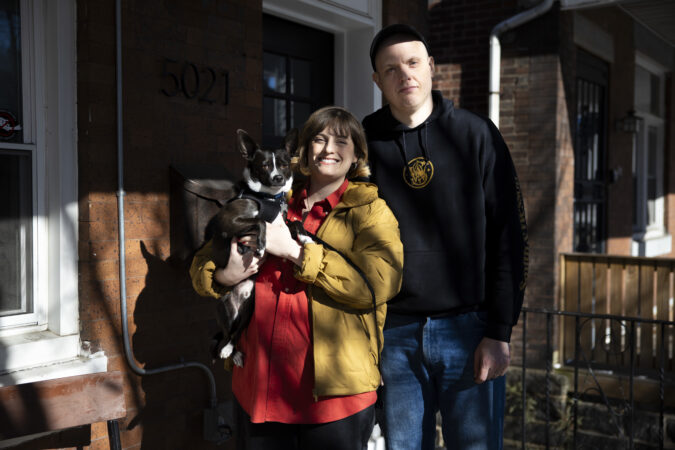
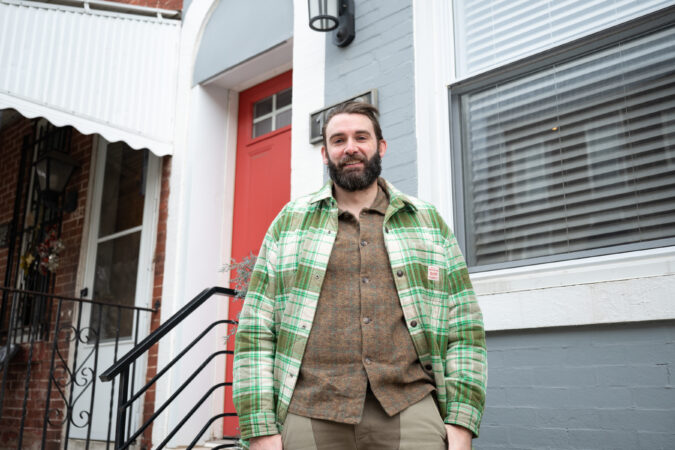
Rhiannon and Malcolm Critcher bought their West Philly home after a very short search. They saw only two other homes.
The ask: After a few years in Tucson, Ariz., Malcolm and Rhiannon Critcher knew they wanted to return to the East Coast. They tested a few cities first. Washington felt “a little too nerdy,” Malcolm Critcher said. New York swung too far in the other direction: “a little too main character.” Philadelphia felt just right. “It was a Goldilocks situation,” Critcher said. “We both came here and instantly fell in love.”
They moved in 2023 and rented in Center City for a year to get their bearings and explore neighborhoods. They fell in love with South and West Philly, but the latter’s parks and tree-lined streets ultimately won them over. They wanted to start a family soon, and West Philly‘s “green, verdant life,” Critcher said, “just felt like a really cool place to be a kid.”
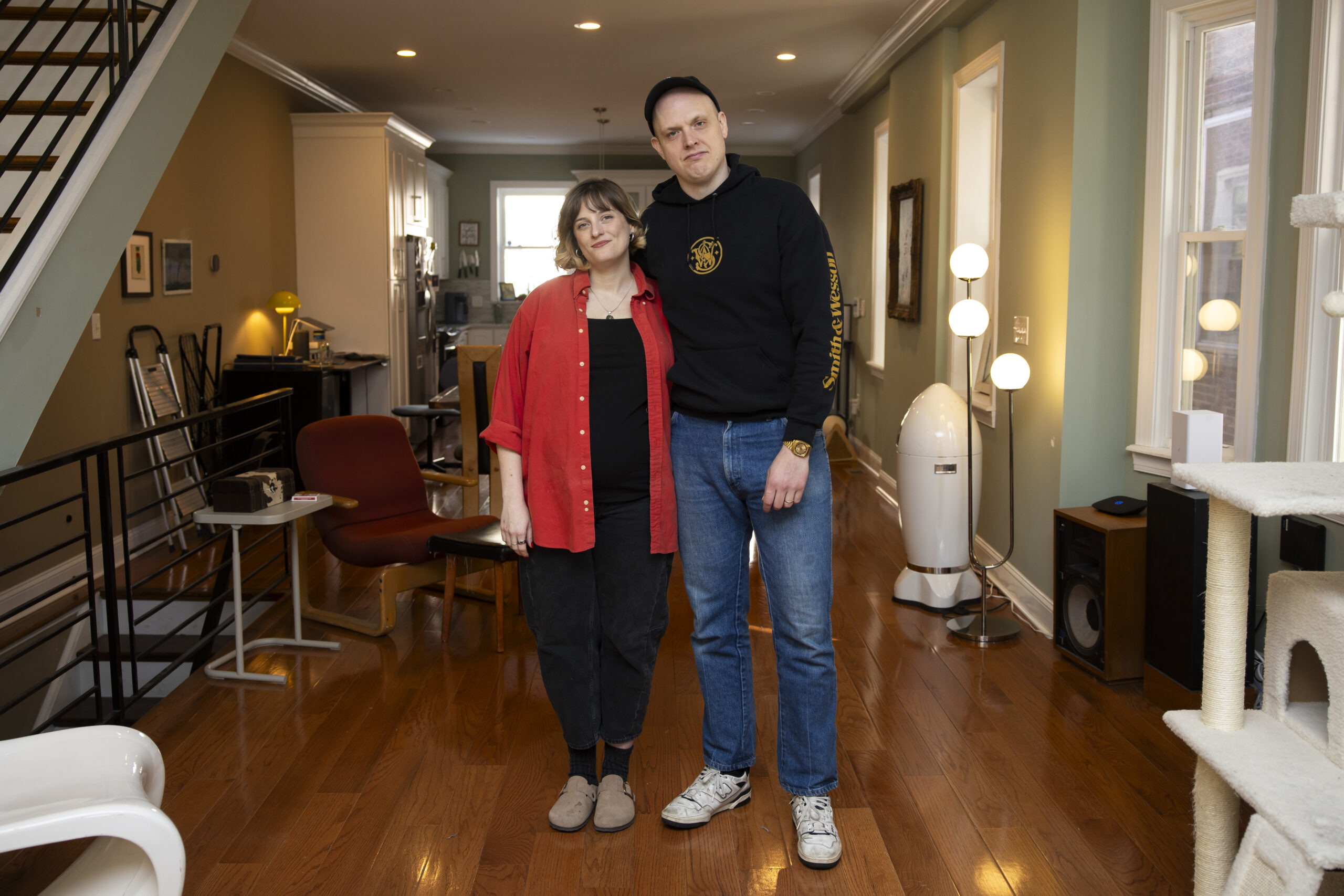
Their must-have list was short but specific: a kitchen meant for hosting, an open-concept floor plan, and a basement big enough for Critcher, who is 6-foot-4, to stand in.
The search: One morning in November 2024, after getting breakfast in West Philly, they decided to walk to nearby open houses. They saw three houses. The third was a recently renovated semi-detached twin with light pouring in from multiple sides.
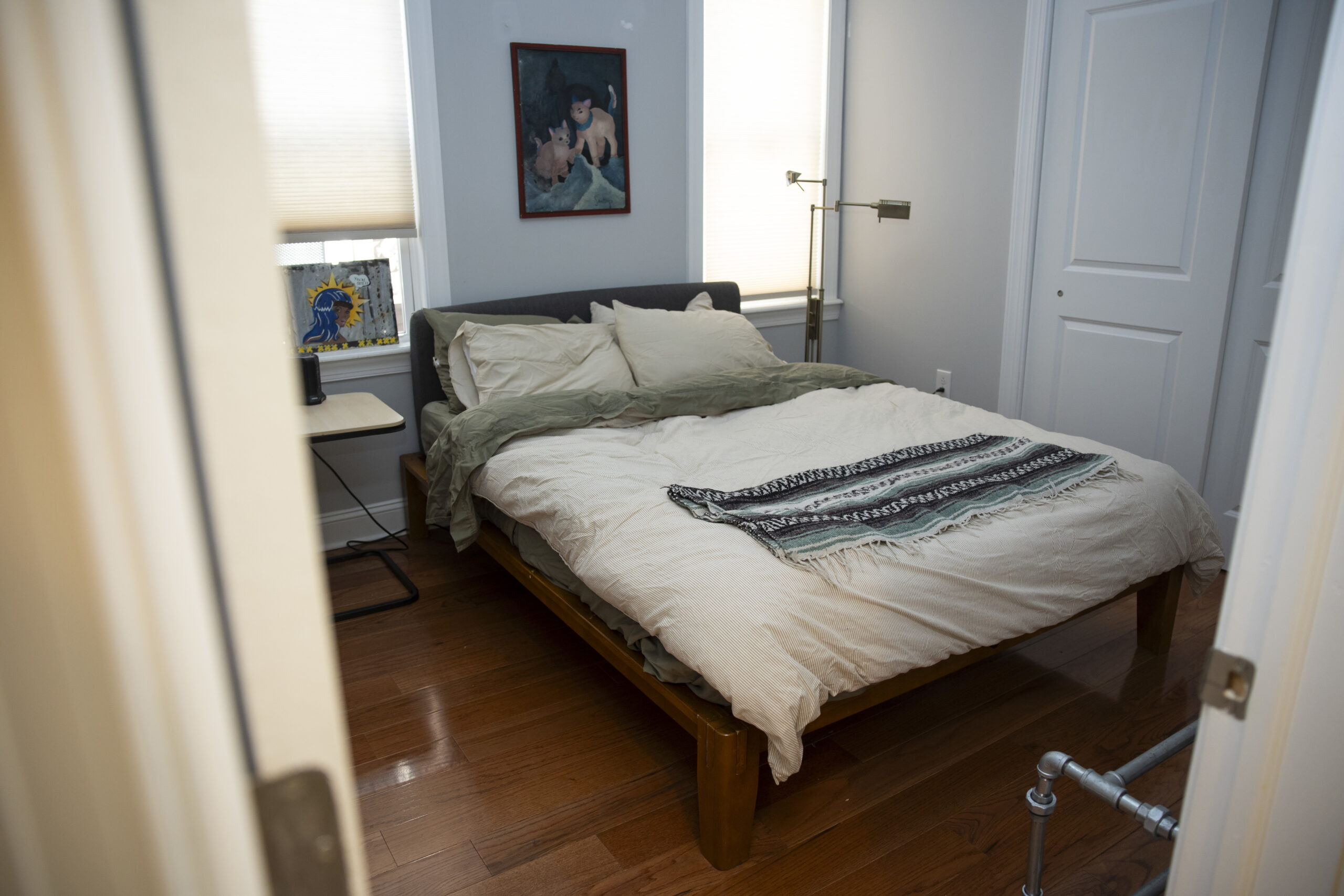
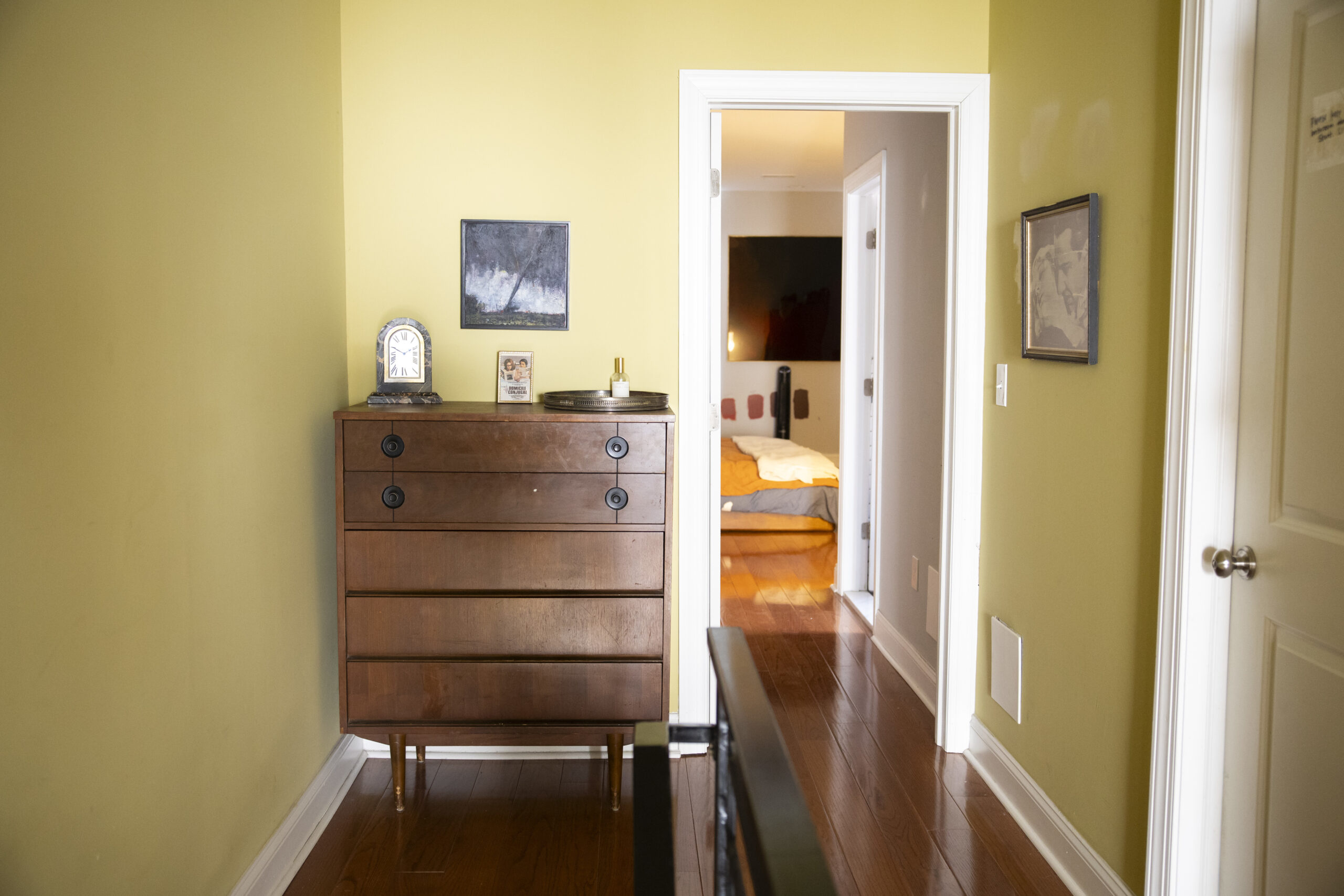
One of three bedrooms in Malcolm and Rhiannon Critcher’s home.
They both wanted to buy it right away, but worried they were being impulsive, so they decided to test the walk to the train. The couple doesn’t have a car and relies heavily on public transportation. It took less than five minutes. On the ride home, they realized they weren’t interested in delaying for the sake of process. “If you find the perfect thing early on, it’s still the perfect thing,” Critcher said.
Having previouslybought and sold three houses, Critcher had the confidence to move quickly. “I know what I’m looking for and what I want,” he said. They called their agent and made an offer that afternoon.
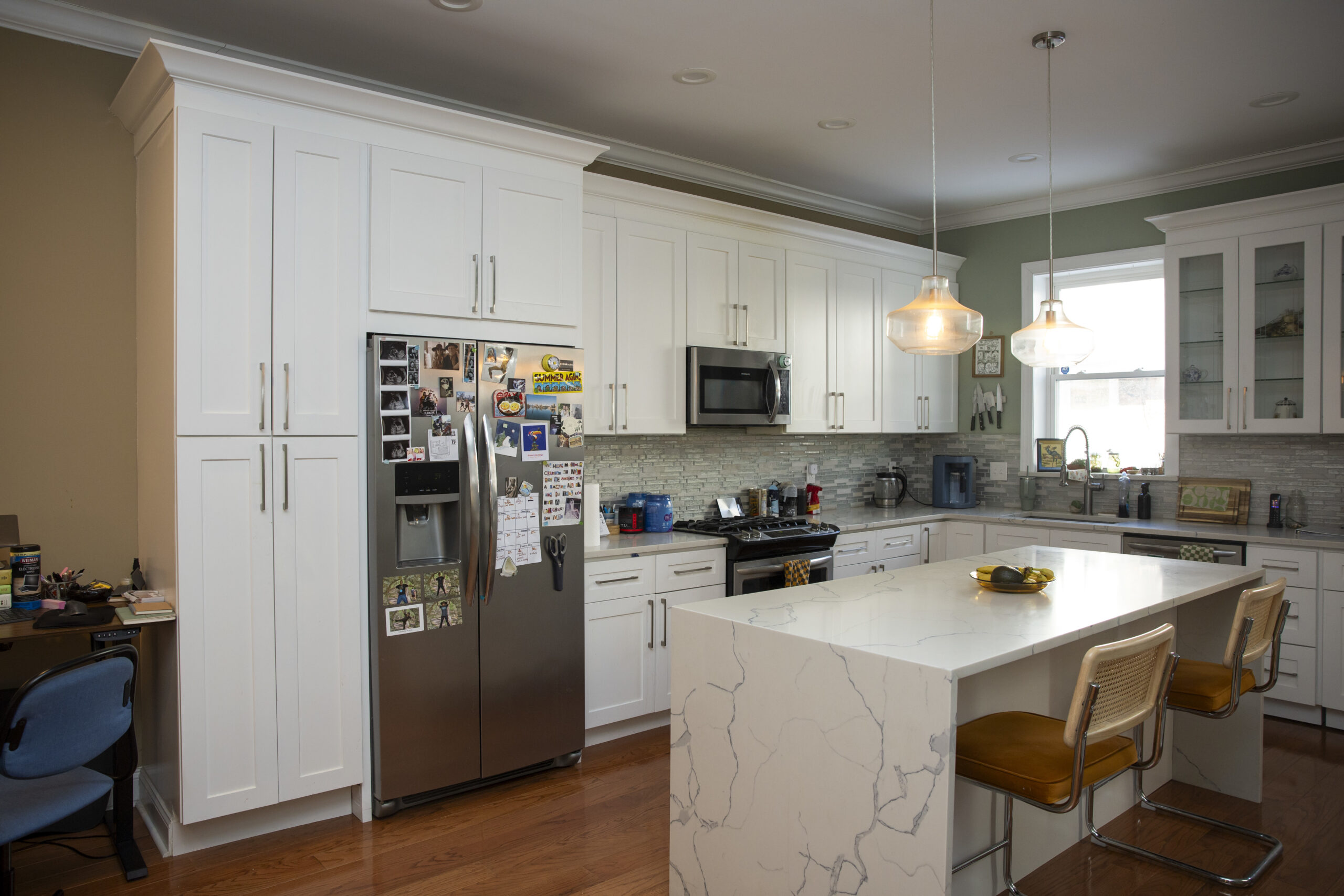
The appeal: The layout was the first draw. The open first floor flowed naturally from the living room to the kitchen, making it feel larger than its footprint. Then there was the renovation. Unlike the gray-floored, hastily flipped houses they had seen elsewhere, this one felt considered, as if the sellers had remodeled it for themselves, not for resale. They liked the finishes, the flow, and little design choices like the kitchen backsplash. “My wife walked into the kitchen and was just like, ‘Wow, this is my favorite kitchen I’ve ever been in,’” Critcher said.
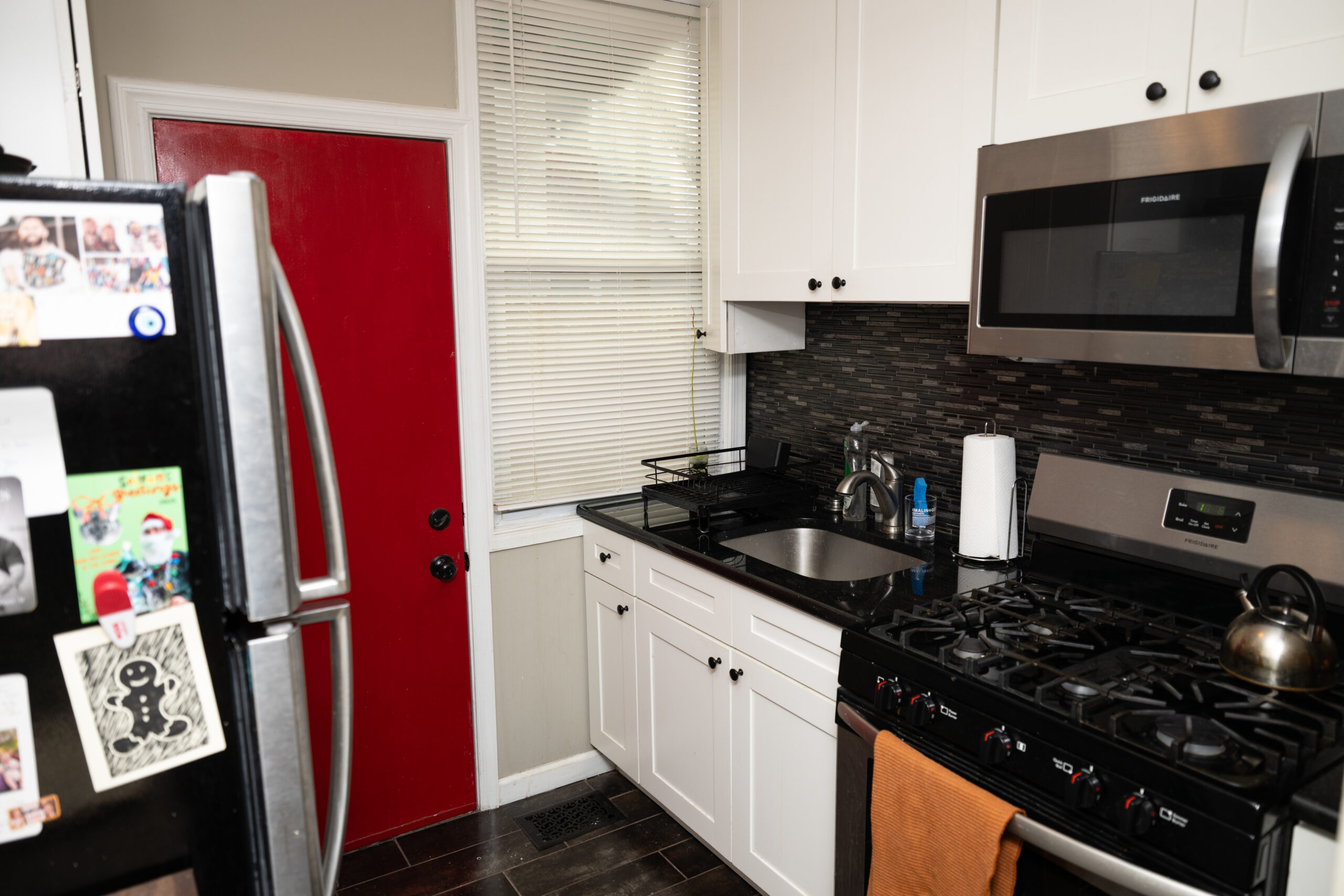
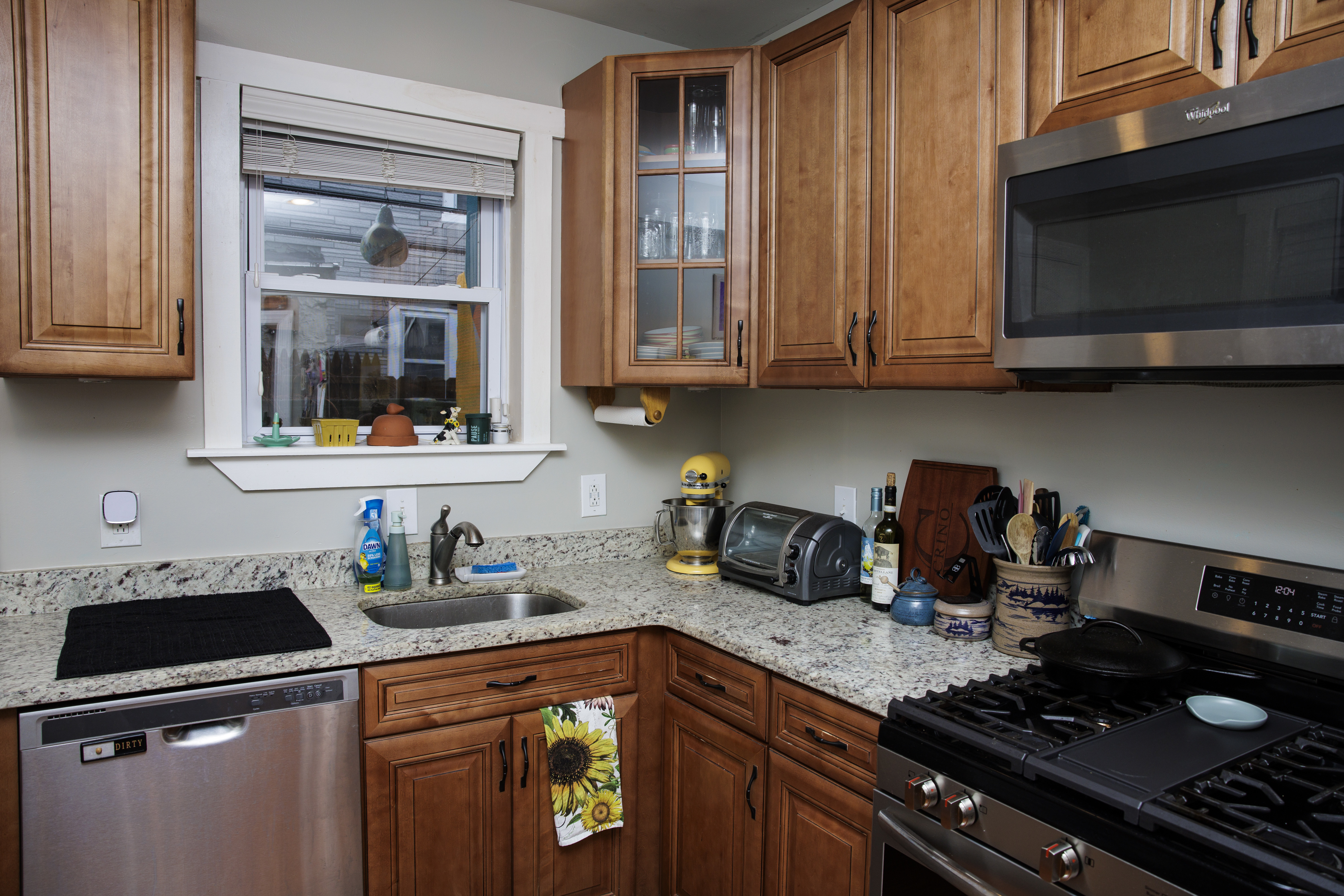
The couple wanted a kitchen that would be great for hosting.
For him, the basement stole the show. It was finished, spacious, and didn’t require him to duck.
The deal: The house was listed at $425,000 — the very top of the couple’s budget. It had been on the market for justone day when they saw it. They decided to offer $25,000 below the asking price, but they promised to take it as-is, as long as the inspection didn’t reveal anything concerning. The sellers agreed to the terms but requested $410,000, which the couple agreed to.
Light pours in from multiple sides of the Cratchers’ semi-detached twin.
The inspection came back spotless. The appliances had all been replaced in 2018. The sewer line had recently been redone. There were no structural issues. “Literally the most perfect housing inspection possible,” Critcher said.
The money: All told, Critcher and his wife brought a little over $100,000 to closing. Most came from the sale of their previous home in Tucson. They bought that house in early 2020 for $179,000 and sold it in 2024 for $300,000. The proceeds went straight into a high-yield savings account and remained untouched until the couple was ready to buy again.
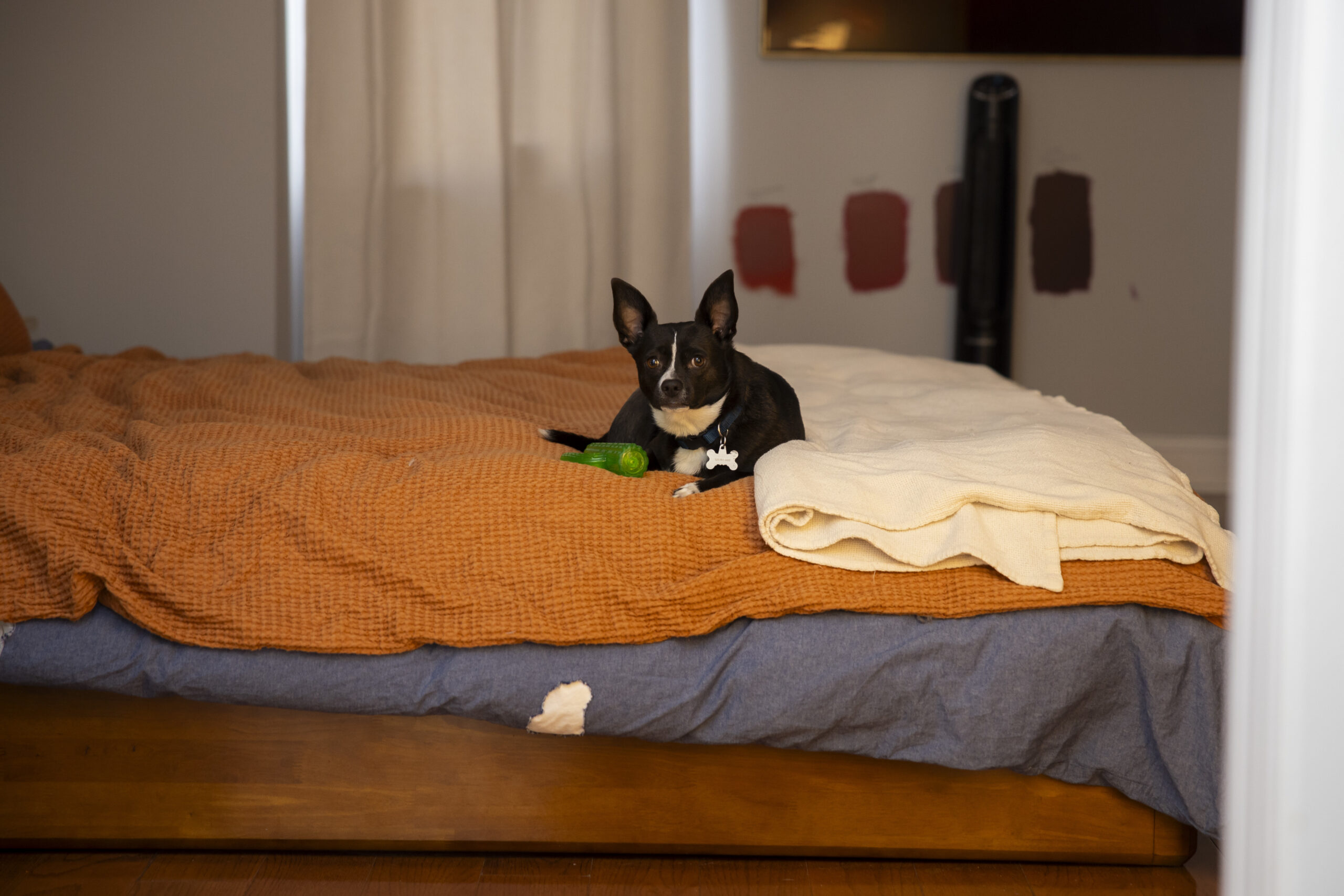
The couple’s dog, Pablo, likes to hang out in the second bedroom.
The down payment on their new house came in just under 20% — about $82,000 — and closing costs were $26,000.
For Critcher, the exact breakdown mattered less than the total. He approached the purchase with a fixed pot of money and trusted their lender and agent to structure the details responsibly.
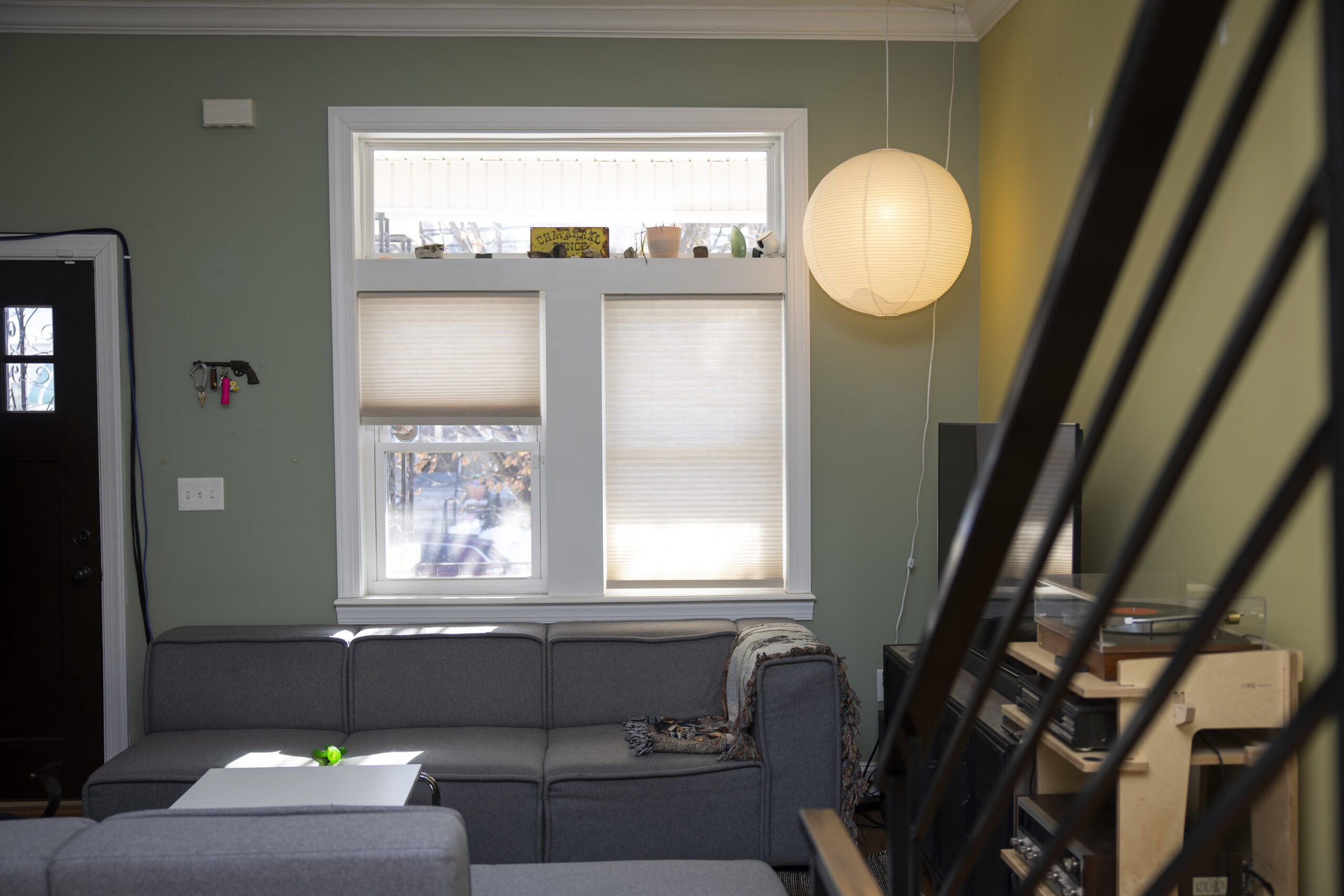
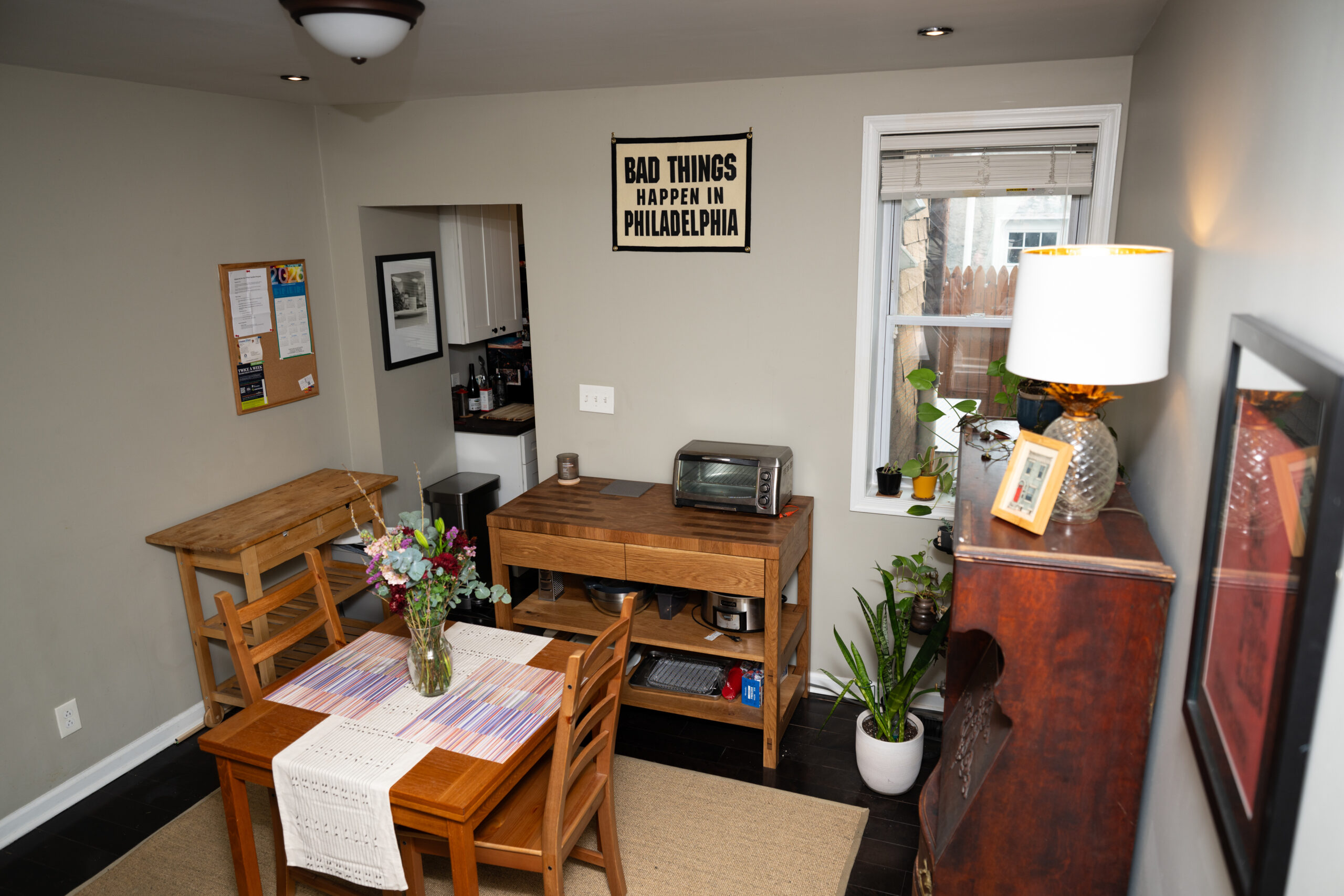
The couple loved the open floor plan on the first floor.
The move: The couple closed in mid-December 2024 while they were out of town. A notary in Arizona helped them file the necessary paperwork. The move itself happened in mid-January. Compared to moving across the country a year earlier, moving from Center City to West Philly wasn’t too bad. They hired movers to load a U-Haul from their sixth-floor apartment, then unloaded it themselves at the new house. Packing took about a week. The move took two days. Unpacking stretched on for a month.
Any reservations? Critcher wouldn’t recommend their approach to first-time homebuyers. “It was very impulsive,” he said. “But we both just fell deeply in love with it.”
Life after close: They’ve kept things simple since moving in. They haven’t undertaken any major renovations or upgrades. “We’re just kind of floating,” Critcher said.
What’s changed for chef Nicholas Bazik in the weeks since his Society Hill restaurant, Provenance, earned a coveted star from the Michelin Guide?
Everything.
And nothing.
“There’s this strange duality to it,” says Bazik. “It’s like a complete life-changing event. … But at the same time, the day-to-day is exactly the same. It’s just a little more amplified and there’s more things to do.”
Bazik’s Provenance was one of three local restaurants to be awarded a Michelin star in November, and already, the accolade has brought lots of things: National acclaim, a rush on reservations, and a plaque (yet to be delivered) that will be displayed inside the restaurant, which opened in 2024.
Then there’s the pressure that comes with earning the culinary world’s highest honor.
“The restaurant industry in and of itself is unique, because at every step, every milestone that you get, it just means that there’s more work to do — and more pressure,” Bazik says. “Having a Michelin star means that everyone coming through the door is seeing you as that thing, so there’s no time to let [up].”
The one exception might be Sundays, when the restaurant is closed and Bazik can finally take a breath. It’s a day that, for him, revolves almost entirely around family — though food, not surprisingly, also plays a supporting role.
This interview has been lightly edited for clarity.
7:30 a.m.
I normally wake up around 7:30, which is around the time my 4-year-old son wakes up.
In my previous job, prior to me going on paternity leave, the owner gave me a gift certificate to a coffee company, saying, “You should get yourself an espresso machine because you’re going to need it.” That was one of the best, most thoughtful gifts I’ve received from an employer. It’s a Jura espresso/coffee machine, and I use that everyday.
Then we’re going to Sulimay’s. It’s as close to a perfect diner as it gets. The food is great, the service is great, the space is unique to Philadelphia. Any breakfast spot, I always get the same thing which is two eggs over easy, bacon, hash browns, and rye toast.
10 a.m.
I’ll spend some time at the farmers market at Headhouse Square, which is largely how I like to shape my menus and figure out exactly what’s seasonal, what’s on offer, what’s relevant, what’s good. My family’s with me, and I’ll do shopping there for the restaurant and I’ll also do some shopping for home.
My son and my wife will go to Three Bears Park, which is around the corner from us, and I’ll go meet up with them there, and we’ll play and then go back home for a light lunch with some of the things that we got at the market.
1 p.m.
After lunch, we’ll go to Adventure Aquarium in Camden. My son is just obsessed with everything aquatic. He has an encyclopedic knowledge of sharks and fish and whales. We love going there — it doesn’t matter if we’re looking at the same fish every single time, he loves it. So we’ll go there for an hour, and make our next move, which is somewhere outdoors.
2-4 p.m.
Ideally, we’d make two stops. We’d go to Lemon Hill, which is where my wife and I got married, and then go to Wissahickon Park — so essentially try to spend the whole afternoon in a green space.
To be able to travel from Center City and 15 minutes later be in a green, open space with trees and wildlife, it’s incredible.
5 p.m.
Because our son is 4 now, he has the full capability of selecting what he wants to eat for dinner, so we leave it up to him. And we essentially go to one of two places: Kim’s Restaurant in North Philly, which is the oldest charcoal grilled Korean barbecue spot. The other one is Mr. Joe’s restaurant, which is my son’s name for Picnic in Fishtown.
For our purposes, Picnic is the perfect restaurant. It has chicken, french fries (my son’s favorite food group), oysters, and green salad. We get the same thing every single time, and we go enough that we should have a designated table.
6 p.m.
It’s time to go home and start the bedtime routine. We do shampoo time, and it’s the only time that my son watches any sort of TV. We’ll watch 20 or 30 minutes of something — normally a deep-sea documentary or a solar system documentary.
Then from 9-10 p.m., my wife and I get to talk about what’s happening that week — what’s happening with him at school, what events are coming up that week, giving her a proper heads up on what’s happening at work, because everything happens so fast that it’s sometimes hard to keep up.
And ideally, it’s in bed by 10 p.m., and then it’s start the week the next day.
The house: A 960-square-foot townhouse in Norris Square with two bedrooms and one bath, built in 1920.
The price: Listed for $255,000; purchased for $255,000
The agent: Kate McCann, Elfant Wissahickon
Todtz saw potential in the house’s flexible floor plan.
The ask: Evan Todtz was tired of commuting from Baltimore to Washington, D.C. He didn’t want to live in the latter, and he couldn’t find work in the former, so he considered the next-closest big city: Philadelphia.
“I’ve always really loved Philly and wanted to spend more time in it,” Todtz said. When his company approved a transfer to its Philadelphia office, Todtz moved north and rented an apartment in Norris Square. A year later, he was ready to make it official. “I felt like I was getting into a groove in Philly,” he said, “and I wanted to invest in a place and make this my home.”
Transit access was Todtz’s top priority. He frequently travels along the east corridor for work, so being close to the Market-Frankford line, which could take him directly to 30th Street Station in the “wee hours of the morning,” was a nonnegotiable. He wanted two bedrooms, enough space to host visitors, and an outdoor space. Everything else was flexible. “I’m particular, but I’m not picky,” he said.
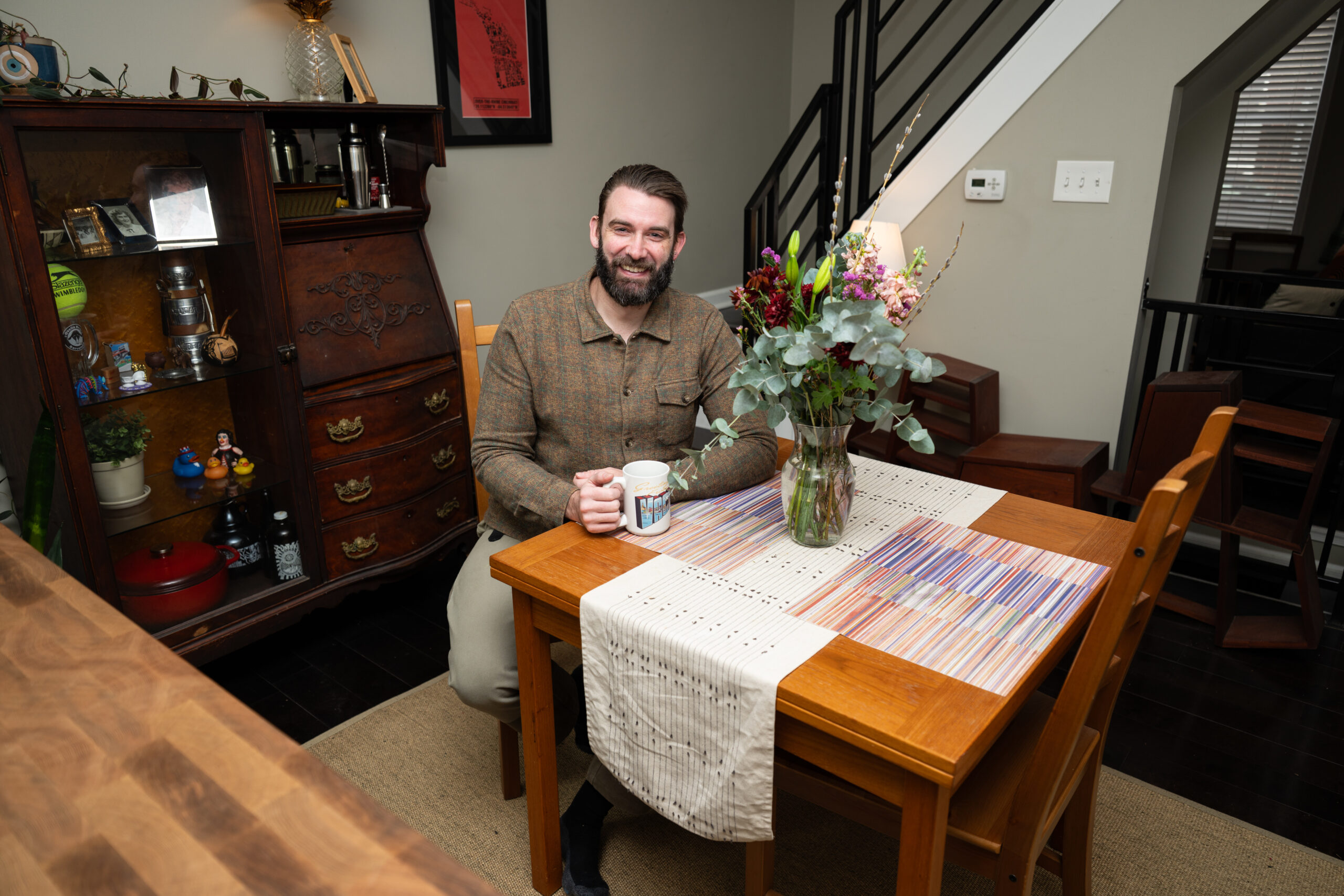
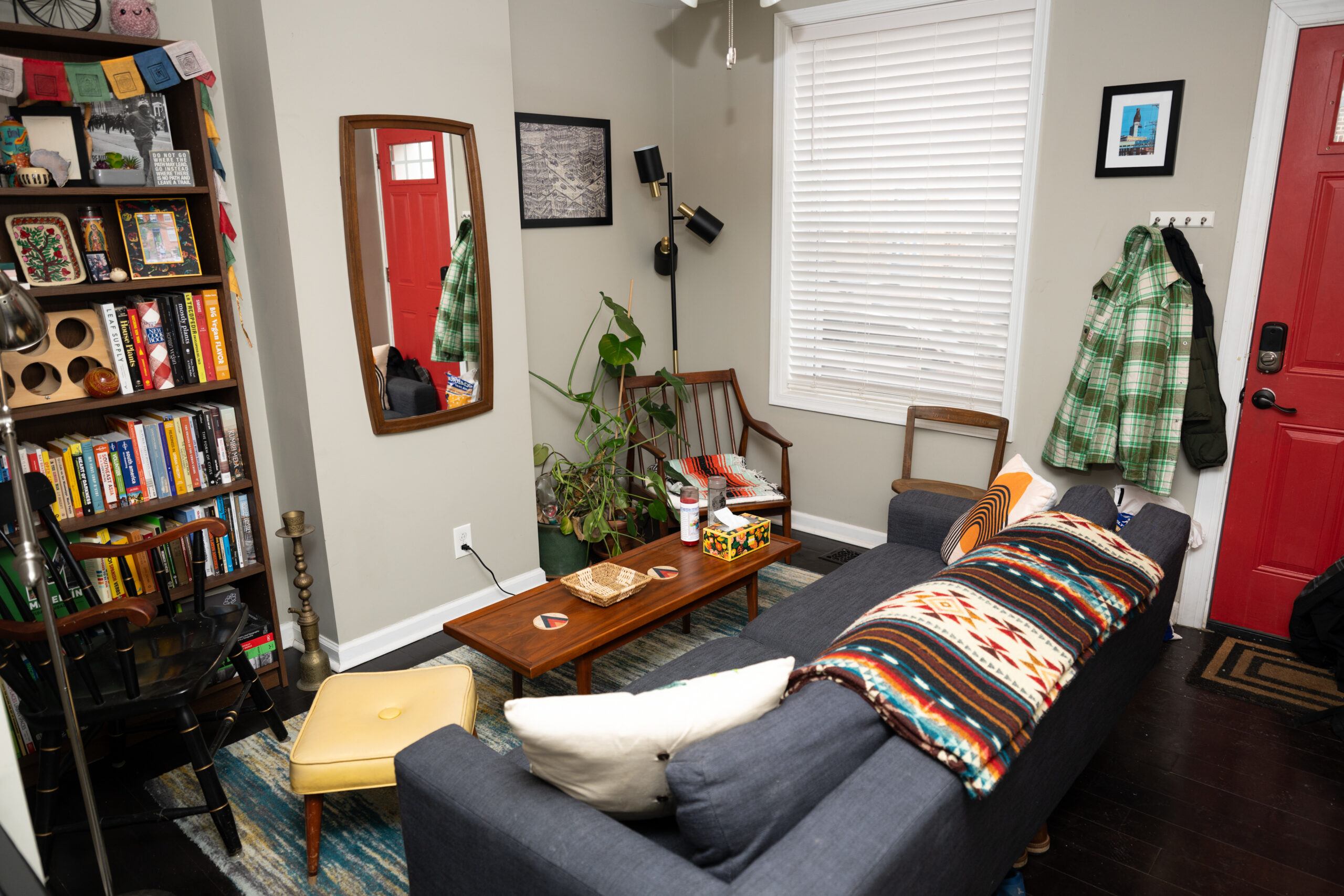
Todtz liked the living room’s tan walls and dark floors. They made the room feel cozy.
The search: Todtz began looking seriously at the end of 2023, after attending a first-time homebuyers workshop hosted by Philly Home Girls. Over a month, hesaw several homes on weekends and evenings. He saw the house he would eventually buy early in his search, but it felt out of reach. Originally listed at $280,000, it hovered just above what he felt comfortable paying. He put it on a mental “maybe” list and kept looking. One month later, the price dropped to $255,000. “That’s when it felt within striking distance,” Todtz said. “It was closer to comps in the market.”
The appeal: Todtz immediately noticed the quality of the renovation. The house looked polished but not flashy, neat but not boring. “There weren’t super high-end finishes I wasn’t going to appreciate,” Todtz said, “and there wasn’t the gray-washed millennial nothingness design that so many new houses have.”
Instead, the house felt solid and lived-in, with dark wood floors and warm-colored walls. “It was very cozy and pretty,” Todtz said. He also liked the flexible floor plan and could see “potential in the footprint,” he said. Mostly, he liked that there wasn’t anything glaringly wrong with it. “It just felt very manageable,” he said. “It didn’t feel like I was taking on a massive project that I didn’t know how to start.”
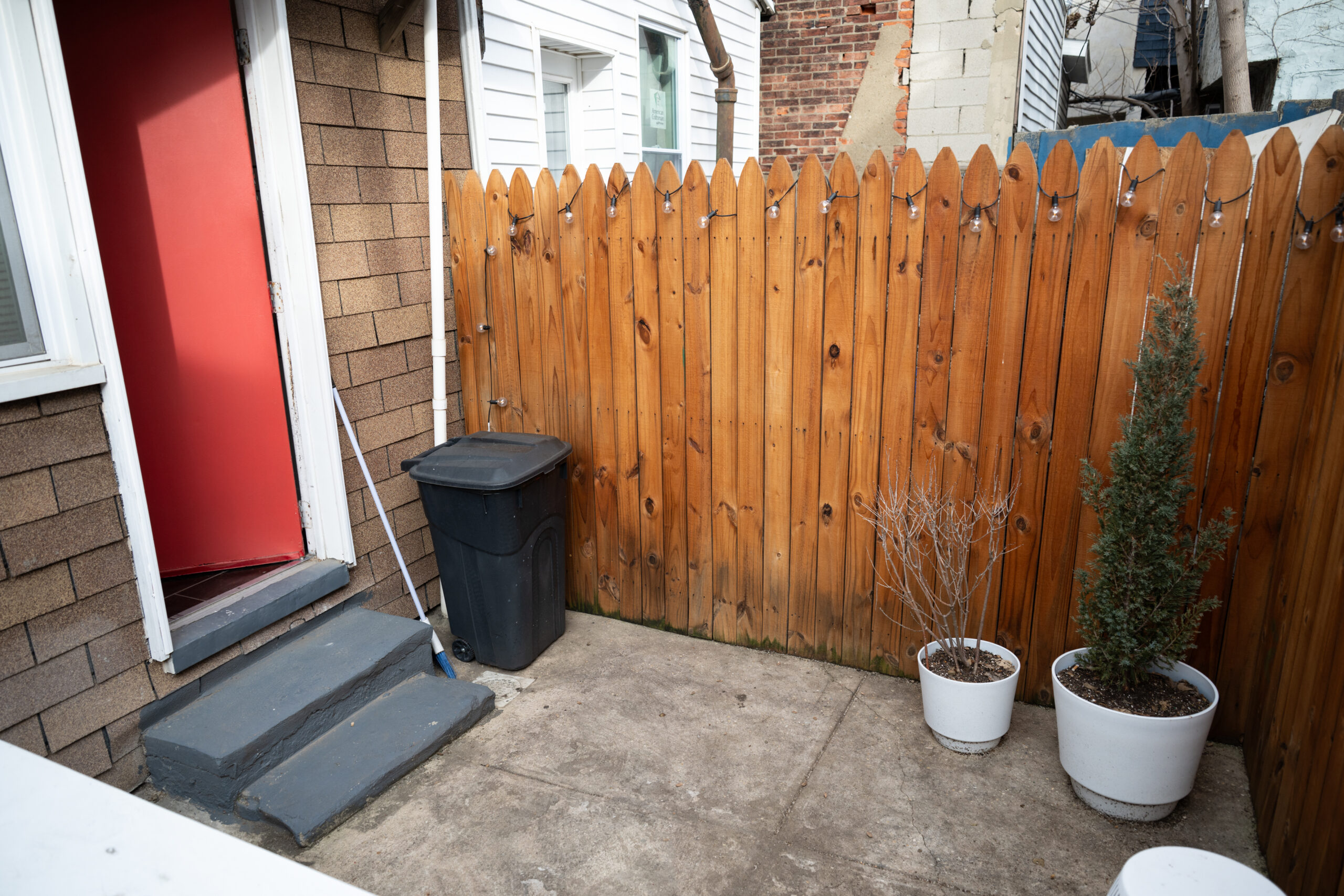
Todtz said he would be happy with any kind of outdoor space.
The deal: By the time the price dropped to $255,000, the house had been sitting on the market for months. Todtz and his agent sensed the seller was “eager to get it off his books,” so they offered the asking price and requested a 3% seller’s assist. The seller agreed. “That was a huge win,” Todtz said. It effectively lowered the price to $247,000.
The inspection turned up only minor issues. The silver coating on the roof was wearing, and the seller, a small-time developer from Queens, N.Y., offered to address it without hesitation. “He was very chill,” Todtz said. “It was great to work with him.”
The money: All in, Todtz spent about $21,000 on closing costs and upfront expenses. Todtz’s mortgage is through the Keystone Home Loan Program, which required only a 3.5% down payment, provided he paid mortgage insurance. The money came primarily from his long-term savings.
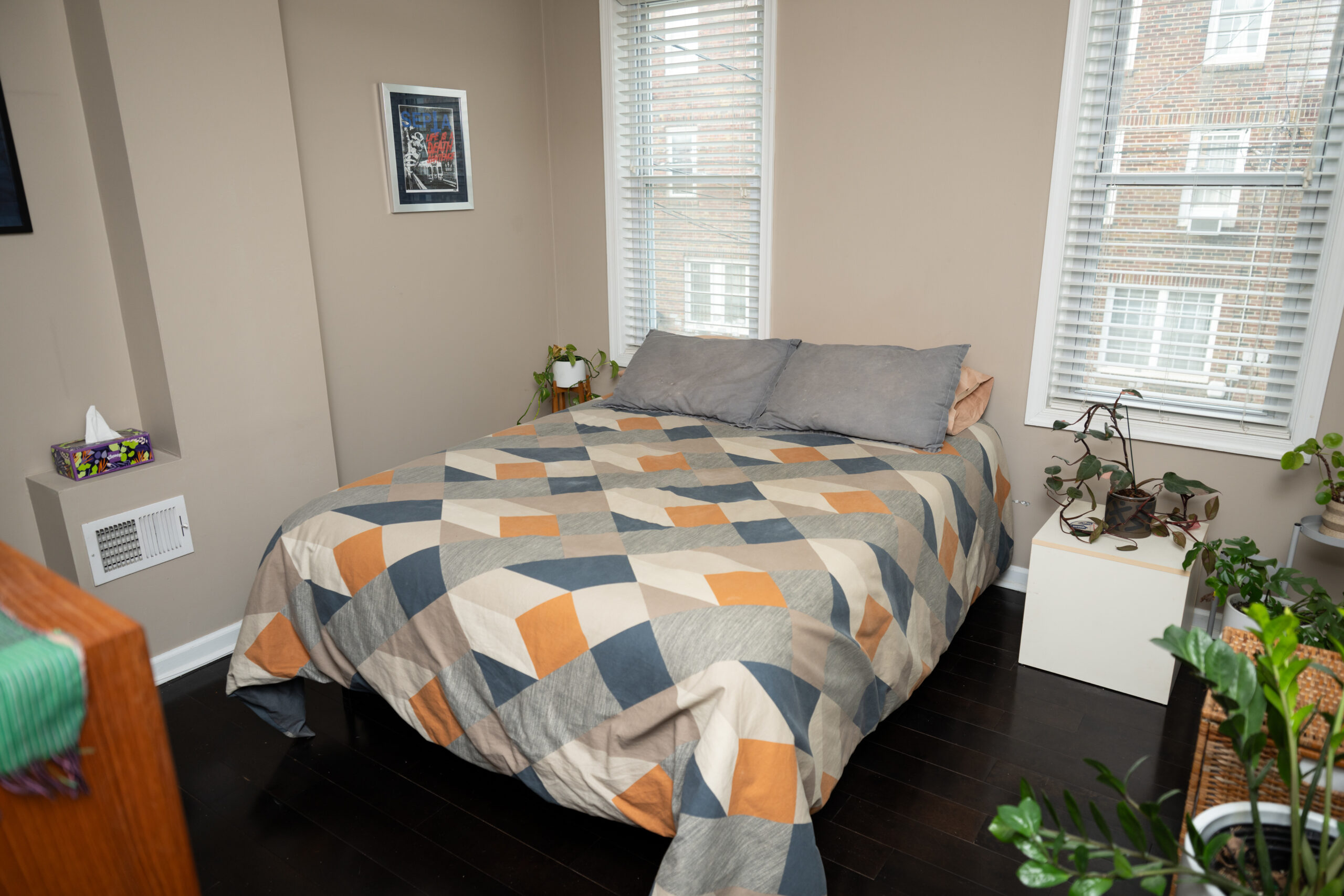
One of two bedrooms in Evan Todtz’s house.
“Every paycheck since graduating from undergrad, I’ve been putting money away,” Todtz said. “However modestly, whether it was 50 bucks or 100 bucks.” Eventually, he transferred some of those savings into a mutual fund that he let grow for a decade. He put the rest in a high-yield savings account. He also received a few thousand dollars from his grandmother’s estate.
The move: Todtz closed on April Fools’ Day, which he feared was a bad omen. His agent reassured him it wasn’t. He spent the next month moving small items in his car, then hired movers to handle the bulk of the work over a weekend in May. He didn’t ask his friends to help him move. “I want to keep my friends,” Todtz said. ”I don’t want to make them stop talking to me.”
Todtz loves his kitchen even though it’s “a little small,” he says.
The move was mostly smooth, except for one casualty: a box spring that couldn’t fit up the new house’s narrow staircase.
Any reservations? Todtz doesn’t regret buying, though he acknowledges that homeownership comes with new anxieties. Given the current state of the economy, “renting and being able to flee is kind of attractive,” he said.
Still, he’s glad he made the leap. “I’m happy to own,” he said, “and I feel comfortable learning as I go.”
The custom wood butcher block Todtz built with the help of the Philadelphia Table Co.
Life after close: Most of the changes Todtz has made have been cosmetic. “I didn’t want to bite off more than I could chew,” he said. He tackled the patio first, pressure-washing the concrete, re-staining the fencing, and adding cafe lights. After that, he partnered with Philadelphia Table Co. to build a custom wood butcher block that has doubled the counter space in his kitchen.
He has a couple of larger projects he plans to tackle next year, such as a full HVAC upgrade, but for now, he’s focused on rebuilding his savings. “I’m happy with the investment,” he said, “but I’m very much in a house-poor moment right now.”
Even as a child, Dan McQuade let his imagination run wild. “What are you doing?” his mother, Denise, would ask if she hadn’t heard any noise from his bedroom for a while. “I’m making stories,” he would reply.
Later, as a young man about town, his compassion for fellow Philadelphians inspired his father, Drew. Dan volunteered to give blood often, donated brand-new sneakers to other guys in need, and continually reached out to people he saw struggling with drug abuse and homelessness. “His kindness was what I loved about him the most,” his father said.
Dan McQuade was already an award-winning writer, blogger, and journalist when he met his future wife, Jan Cohen, online in 2014. To her, his jovial humor, wide-ranging intelligence, and shoulder-length hair made him unique in her circle. “I thought he was too cool for me,” she said.
His empathy, likely inspired by his parents, his wife said, led him to toil tirelessly for charitable nonprofits such as the Everywhere Project, Back on My Feet, and Prevention Point. “Service was always part of his life,” his wife said.
His coolness, as unconventional as it sometimes was, made those he encountered feel cool, too. Molly Eichel, an Inquirer editor and longtime friend, said: “He was annoyingly smart and incredibly kind.”
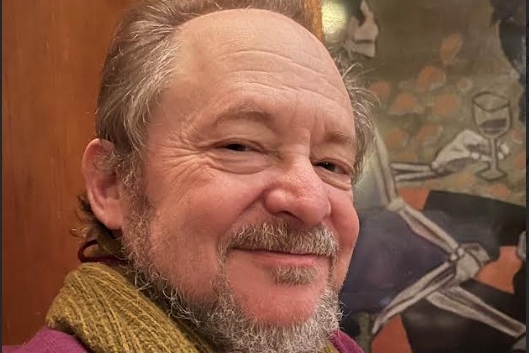
Dan McQuade died Wednesday, Jan. 28, of neuroendocrine cancer at his parents’ home in Bensalem. He was 43. His birthday was Jan. 27.
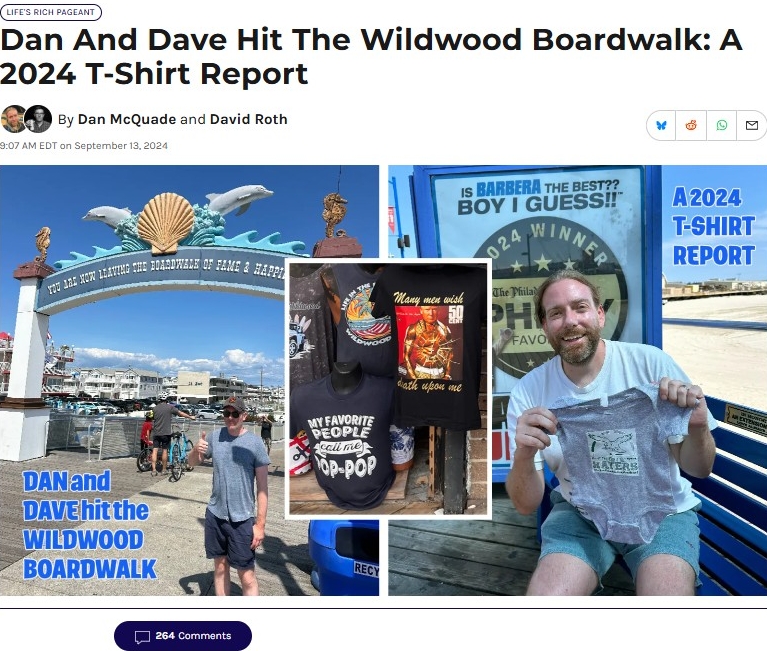
Mr. McQuade’s annual Wildwood T-shirt report was a favorite of his many readers and fans.
“It’s incredibly hard for me to imagine living in a Philadelphia without Dan McQuade,” said Erica Palan, an Inquirer editor and another of Mr. McQuade’s many longtime friends. “He understood Philadelphians better than anyone because he was one: quirky and funny, competitive and humble, loyal and kind.”
A journalism star at the University of Pennsylvania in the early 2000s, Mr. McQuade was a writer, sports editor, and columnist for the school’s Daily Pennsylvanian, and managing editor of its 34th Street Magazine. He earned two Keystone Press awards at Penn, was the Daily Pennsylvanian’s editor of the year in 2002, and won the 2003 college sports writing award from the Philadelphia Sportswriters Association.
He went on to create Philadelphia Weekly’s first blog, “Philadelphia Will Do,” and was a finalist for the Association of Alternative Newsmedia’s best blogger award. He served an internship at the Bucks County Courier Times in Levittown and worked for a while at the Northeast News Gleaner.
Often irreverent, always inventive, he filed thousands of notable stories about, among other things, the Wildwood T-shirt scene, the origin of “Go Birds,” sneaker sales, Donald Trump, Wawa hoagies, the Philly accent, parkway rest stops, the Gallery mall, soap box derbies, and Super Bowls. His stories sparkled with research and humor.
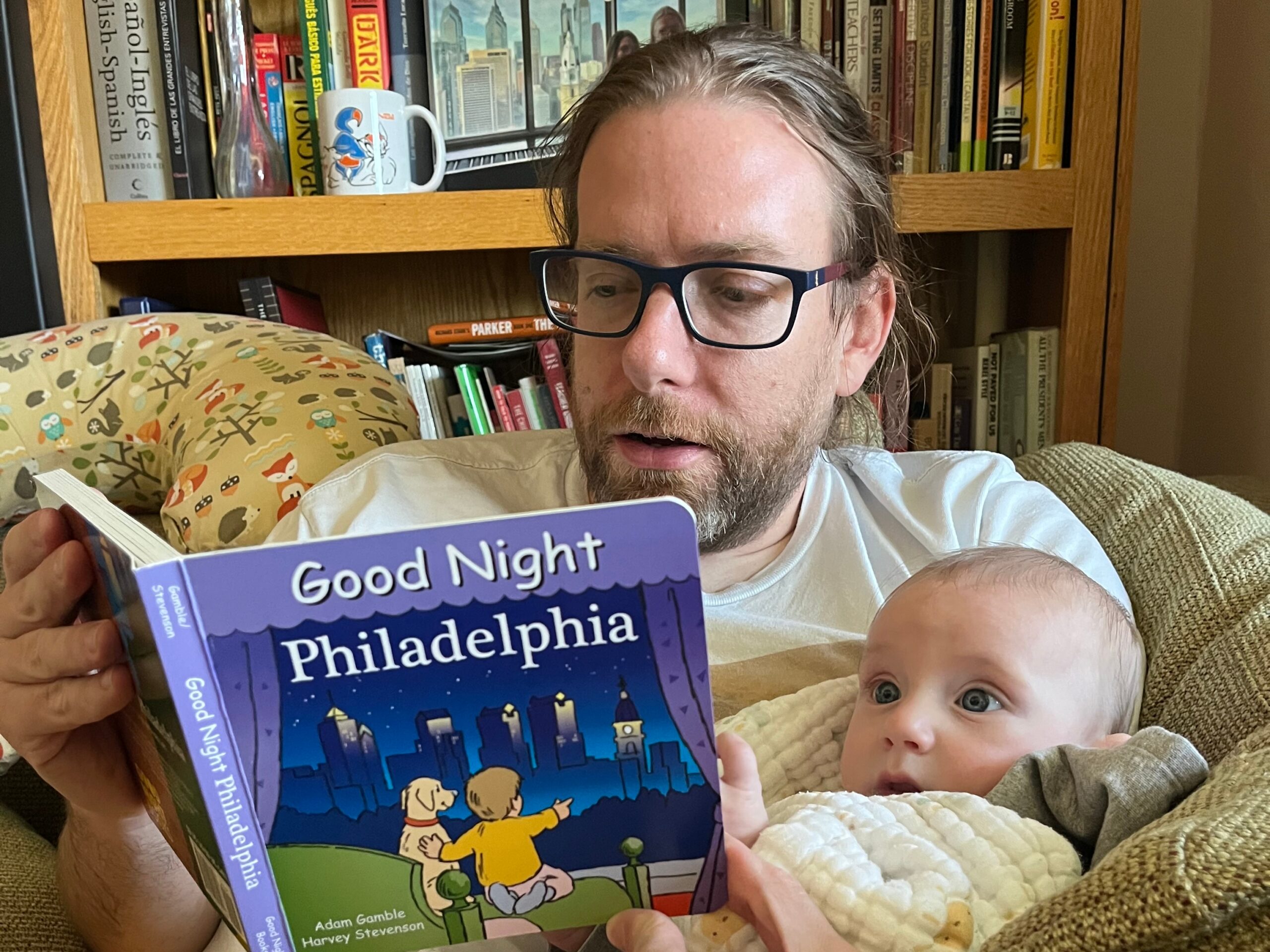
An avid reader himself, Mr. McQuade enjoyed reading local tales to his son, Simon.
“Dan was a truly authentic and engaging person,” Tom Ley, editor-in-chief at Defector, said in an online tribute. “His curiosity was relentless, and his interests were varied and idiosyncratic.”
For example, Mr. McQuade wrote in Philadelphia Magazine in 2013 that Sylvester Stallone’s famous training-run montage in Rocky II — it started in South Philly and ended two minutes of screen time later atop the Art Museum steps — actually showed city scenes that would have had the actor/boxer run more than 30 miles around town. “Rocky almost did a 50K,” Mr. McQuade wrote. “No wonder he won the rematch against Apollo!”
In 2014, he wrote in Philadelphia Magazine about comedian Hannibal Buress calling Bill Cosby a rapist onstage at the old Trocadero. The story went viral, and the ensuing publicity spurred more accusations and court cases that eventually sent Cosby to jail for a time.
When he was 13, Mr. McQuade wrote a letter to the editor of the Daily News that suggested combining the Mummers Parade with Spain’s running of the bulls. Crossing Broad’s Kevin Kinkead said he had “an innate gift for turning the most random things into engaging reads.”
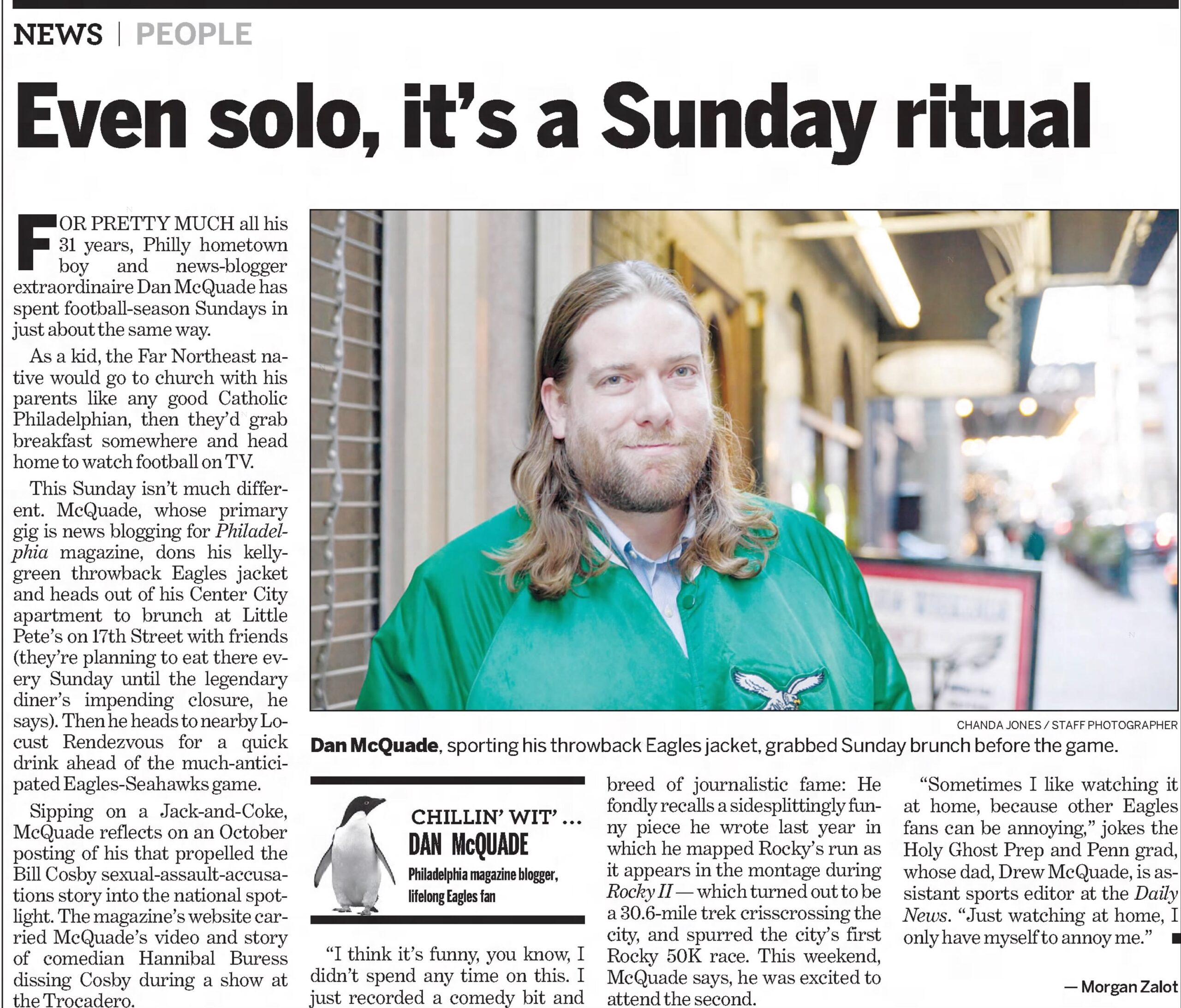
This story about Mr. McQuade appeared in the Daily News in 2014.
“Without Dan’s voice, Philly Mag wouldn’t be Philly Mag,” editor and writer Brian Howard said in a tribute on phillymag.com. “And, I’d argue, Philadelphia wouldn’t quite be Philadelphia.”
Other colleagues called him “a legend,” “a Philadelphia institution,” and “the de facto mayor of Philadelphia” in online tributes. Homages to him were held before recent Flyers and 76ers games.
“Sometimes,” his wife said, “he inserted himself into stories, so readers had a real sense of who he was because he was so authentic.”
Daniel Hall McQuade was born Jan. 27, 1983, in Philadelphia. His father worked nights at the Daily News for years, and the two spent many days together when he was young hanging around playgrounds and skipping stones across the creek in Pennypack Park.
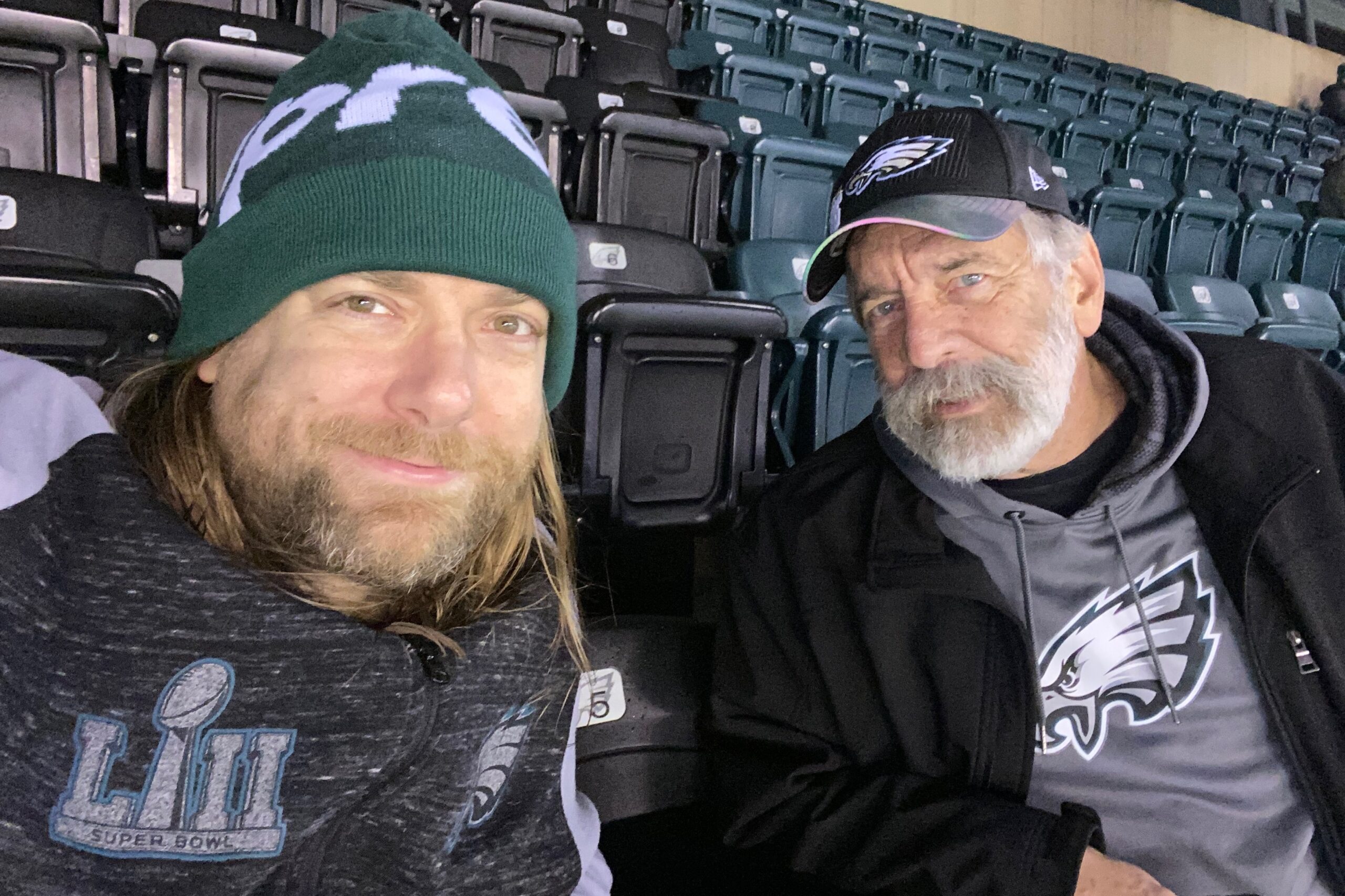
Mr. McQuade (left) and his father, Drew, shared a love of Philly sports and creative writing.
Later, they texted daily about whatever came to mind and bonded at concerts, Eagles games, and the Penn Relays. He grew up in the Northeast, graduated with honors from Holy Ghost Preparatory School in Bensalem, and earned a bachelor’s degree in English at Penn in 2004.
He overcame a serious stutter as a teen and played soccer and basketball, and ran cross-country and track at Holy Ghost. He married Jan Cohen in 2019 and they had a son, Simon, in 2023. They live in Wissahickon.
Mr. McQuade was a voracious reader and an attentive listener. “He never wanted to stop learning,” his wife said. He enjoyed going to 76ers games with his mother and shopping for things, his father said, “they didn’t need.”
He was mesmerized by malls, the movie Mannequin, the TV series Baywatch, and his wife’s cat, Detective John Munch. During the pandemic, he and his wife binged all 11 seasons of Baywatch.
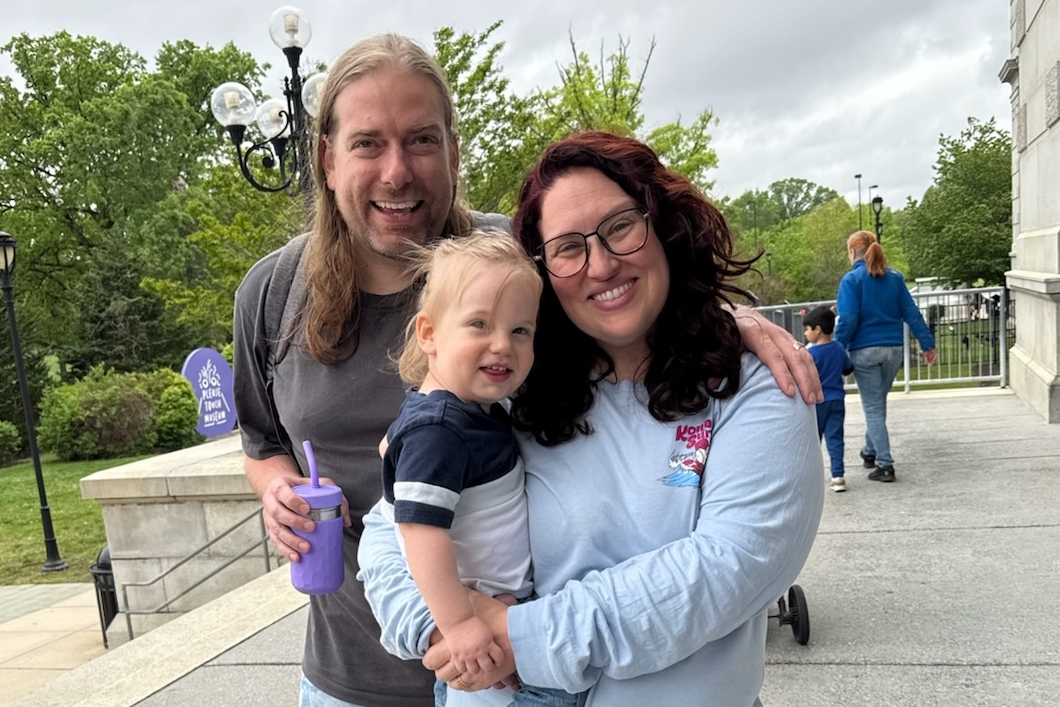
Mr. McQuade doted on his wife, Jan, and their son, Simon.
He could be loud, his mother said, and Molly Eichel described his laugh as “kind of a honk.” His friend and colleague Alli Katz said: “In 50 years I’ll forget my own name. But I’ll remember his laugh.”
He was a vintage bootleg T-shirt fashionista, and his personal collection numbered around 150. He named Oscar’s Tavern on Sansom Street as his favorite bar in a recent podcast interview and said he would reluctantly pick a pretzel over a cheesesteak if that was the choice.
In September, Mr. McQuade wrote about his illness on Defector.com under the headline “My Life With An Uncommon Cancer.” In that story, he said: “Jan has been everything. My son has been a constant inspiration. My parents are two of my best friends, and I talk to them every day. Jan’s parents have been incredible.”
He also said: “I believe there are no other people on earth with my condition who are in as fortunate a situation. … For the past thousand words you have been reading about a bad break I got, but if only everyone in my position had it this good.”
Mr. McQuade and his wife, Jan Cohen, married in 2019.
His wife said: “He was truly the best guy.”
In addition to his wife, son, and parents, Mr. McQuade is survived by his mother-in-law, Cheryl Cohen, and other relatives.
Visitation with the family is to be from 9 to 10 a.m. Thursday, Feb. 5, at St. Martha Parish, 11301 Academy Rd., Philadelphia, Pa. 19154. Mass is to follow from 10 to 11 a.m.
Donations in his name may be made to the Everywhere Project, 1733 McKean St., Philadelphia, Pa. 19145.
The buyers: David Snelbaker, 59, finishing technician
The house: a 1,440-square-foot townhouse in Port Richmond with three bedrooms and two baths built in 1925.
The price: listed for $275,000; purchased for $269,500
The agent: Allison Fegel, Elfant Wissahickon Realtors
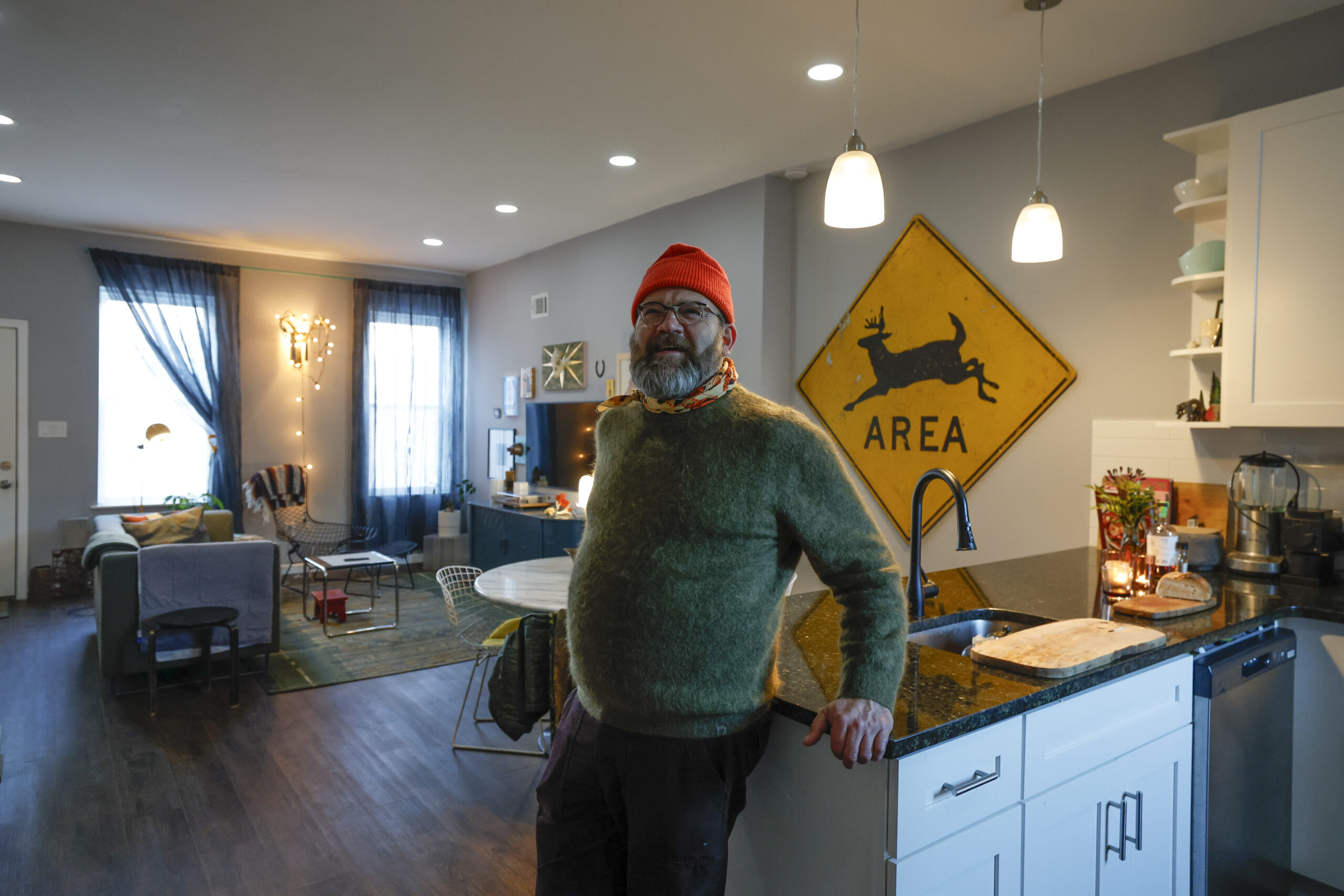
Snelbaker in the kitchen of his Port Richmond home.
The ask: Snelbaker didn’t want to give up his house in Graduate Hospital. He’d spent years rehabbing and repairing it. But in 2023, on the heels of a breakup, he determined he couldn’t afford to keep it on his own. He needed to downsize, but he wanted to stay in his neighborhood. Other than that, his list was short but firm: a backyard for gardening and a rowhouse that wasn’t too narrow.
His budget was $300,000 — a number driven less by lender approval than by self-preservation. “I didn’t want to be house poor,” he said. “I have friends who are. They don’t go on vacations. They’re just kind of financially stuck.”
The search: Snelbaker needed to sell his old house before he could make an offer on a new one, which made it difficult to compete in South Philly’s hot market. “A lot of the places I wanted to jump on would just go so fast,” he said.
He expanded his search and discovered better stock in Fishtown and Port Richmond. “For the same price for something in South Philly, it was a fixer-upper,” he said. “And here, it was in good shape.” Snelbaker had already lived through years of construction in his old house and wasn’t eager to do it again. “I just didn’t want to get into another fixer-upper situation,” he said.
He checked out a few places in Fishtown but settled on Port Richmond because it was closer to his work. The prices were better, too. “It was a win-win,” Snelbaker said. The only other place he considered was a recently renovated rowhouse close to the river. “It was laid out well,” he said. “That was my second choice.”
Snelbaker liked that the house was recently renovated and move-in ready.
The appeal: Snelbaker knew he’d found the one when he stepped out back. “The backyard was unbelievably, unbelievably big,” he said. “It’s like 27 feet long and 18 feet wide.” Plenty of space for the major landscaping projects he wanted to do, like planting several trees and building raised beds. Even better, one side of the yard abutted a warehouse, not another rowhouse, which gave him “a level of privacy,” he said.
Inside, the house was open, newly renovated, and neutral. “It didn’t have a lot of personality,” Snelbaker said, “but it wasn’t a lot of work either.”
The deal: Snelbaker saw the house at the end of the summer, but because he needed the proceeds from his Graduate Hospital home for a down payment, he couldn’t make an offer right away. Thankfully, the Port Richmond house lingered on the market until he sold his place in October. “I was surprised it didn’t move,” Snelbaker said.
Once his old house sold, Snelbaker moved quickly. He offered $269,500 — $5,500 under the asking price — and the seller accepted without pushback. The inspection brought little drama. The sellers, who were contractors, handled minor repairs. “They did some patching on the roof and some stuff on the brick in the front,” Snelbaker said. “There was something with the dishwasher … they repaired that. That was pretty much it.”
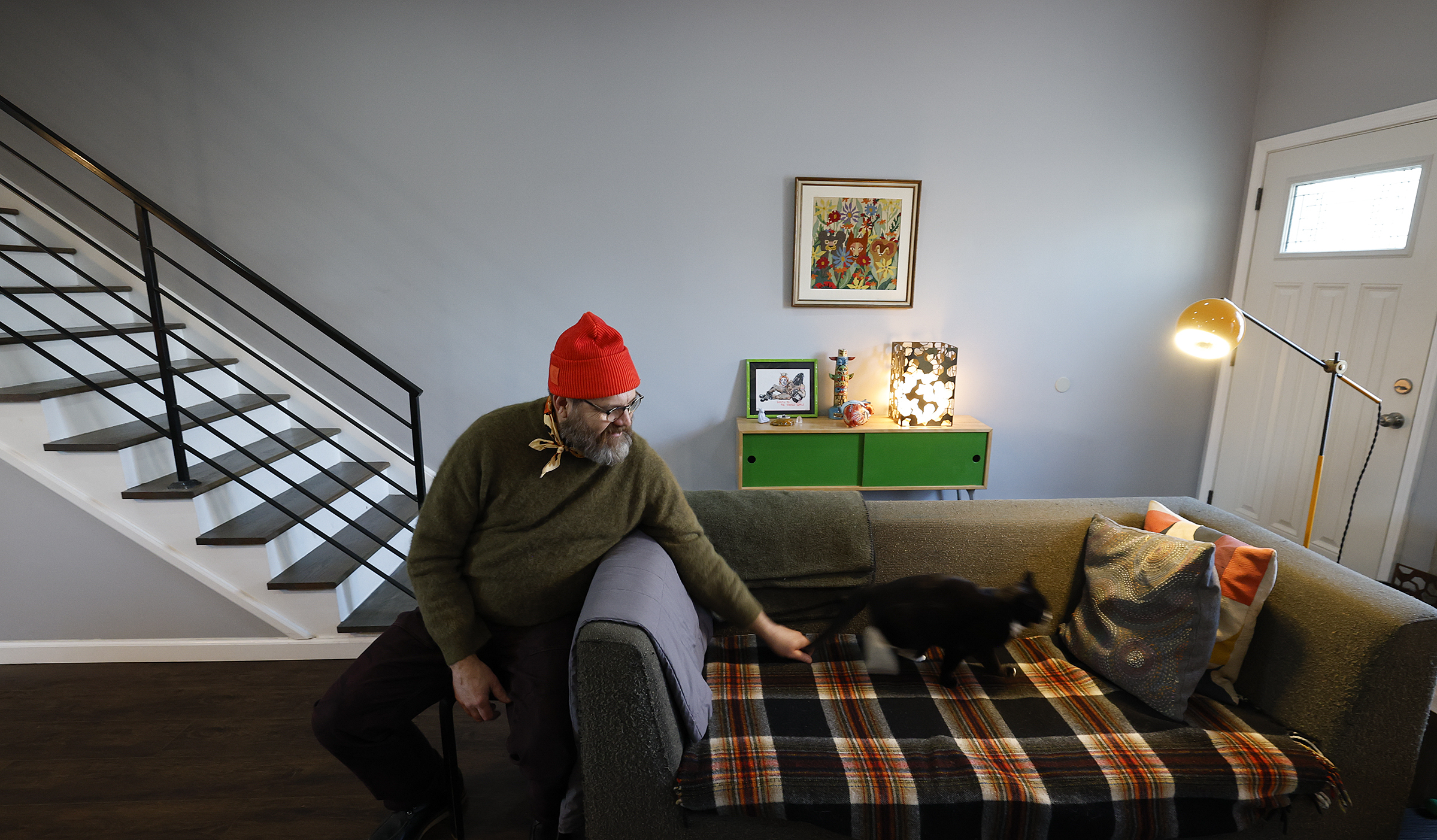
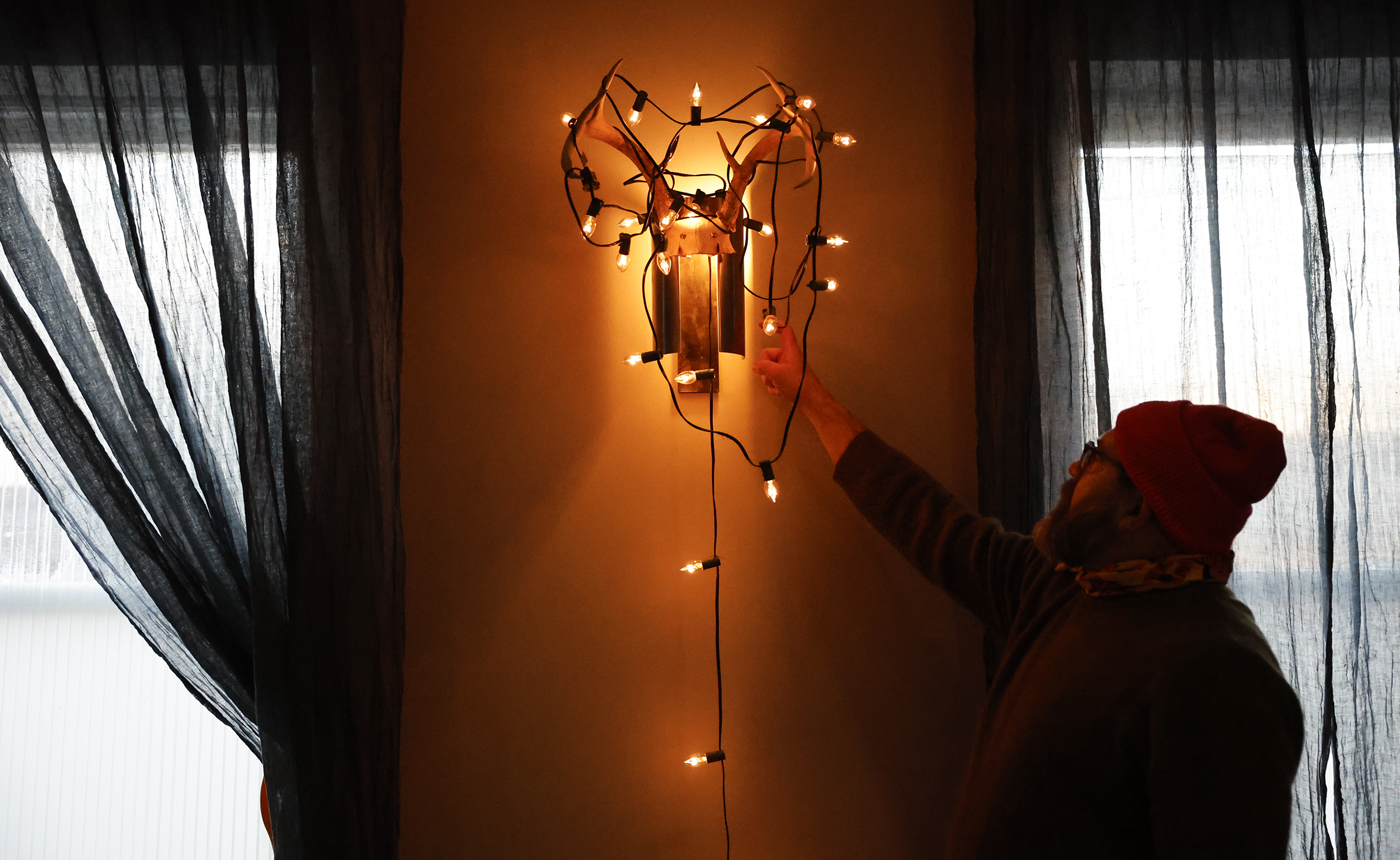
Since moving in, Snelbaker has added personal touches like this antler lamp to give his house more personality.
The money: Snelbaker walked away with $240,000 from the sale of his previous home. He put a chunk of it into a certificate of deposit and used the remaining $180,000 for the down payment. “I put more than 20% down because I wanted to keep my monthly payment low,” he said.
Even so, timing worked against him. Interest rates climbed to 7% as he was shopping, and insurance costs jumped a few months after he moved in. His monthly payment was originally $1,300. Now it’s $1,900. He plans to refinance once interest rates drop a few percentage points, and he’s actively looking for a better rate on his home insurance.
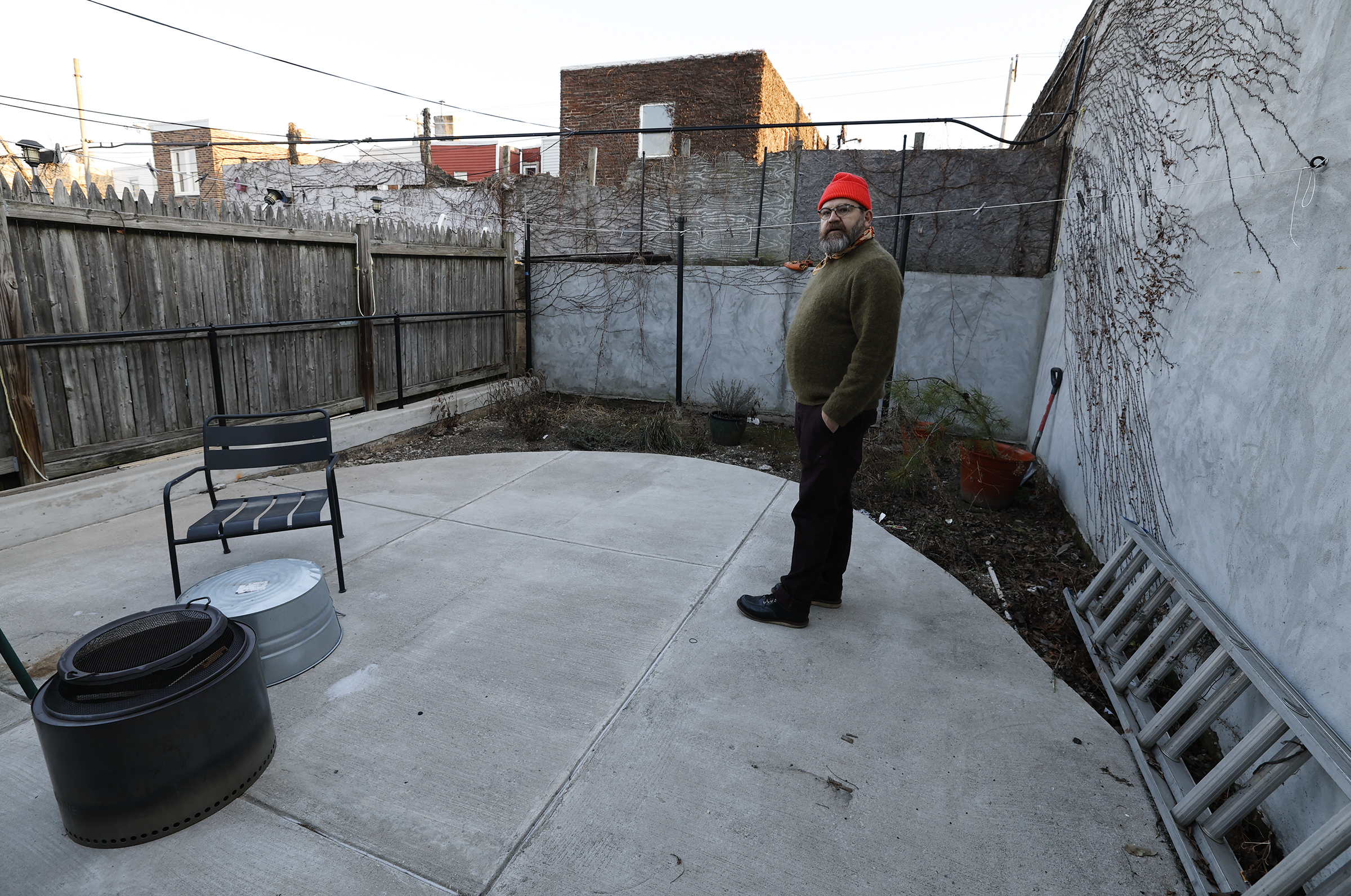
Snelbaker removed some of the concrete in the backyard to plant trees.
The move: Snelbaker sold his old house in mid-October and officially closed on his new one on Halloween, but he wasn’t ready to move in right away. His agent did some “fancy footwork” and worked out a deal for Snelbaker to rent his old house from its new owners for a few weeks. “She negotiated a really good timeline that gave me space to pack and wrap up everything at the old house,” Snelbaker said.
Even better, he celebrated Halloween with his old neighbors. “We handed out candy, and they made me dinner. It was very sweet,” Snelbaker said. He moved into his new home the week before Thanksgiving.
Any reservations? Without an attached neighbor on one side, the house runs colder than Snelbaker expected. He contacted an energy auditor who advised him not to do anything until he insulated the roof. It’s pricey, but worth it, Snelbaker said. “It’ll definitely increase the comfort and lower my heating bills.”
Life after close: Since moving in, Snelbaker has focused on the backyard. He removed slabs of concrete to make room for trees and raised beds. “That was important for me,” he said. “I really wanted to get a garden going again like I had in my old spot.”
The buyers: Casie Girvin, 30, performer and voice teacher; Steve Crino, 32, musician
The house: A 984-square-foot rowhouse in Point Breeze with three bedrooms and one bath, built in 1923.
The price: Listed and purchased for $305,000
The agent: Benjamin Camp, Elfant Wissahickon
The ask: For Casey Girvin and Steve Crino, the home-buying journey began long before they opened Zillow. “We always knew that we wanted to be homeowners,” said Girvin. “It’s something we were saving for a long time.”
Both musicians, they spent years learning what did and did not work for their lifestyles. They started in a one-bedroom, which didn’t work because their practice sessions often overlapped, creating a cacophony of noise. Eventually, they moved into a bi-level apartment where they had room to work.
That experience shaped their home-buying wish list. That meant they needed at least three bedrooms — one for sleeping and two for music studios — and a layout that let two musicians practice without driving each other mad. “We needed it to be either like a bi-level space, or we needed a buffer room between the two of us,” Girvin said.
They also wanted a backyard. “We learned during COVID that having an outdoor space was really important to us,” she added. So was being close to the Broad Street SEPTA line. Fixer-uppers were a nonstarter.
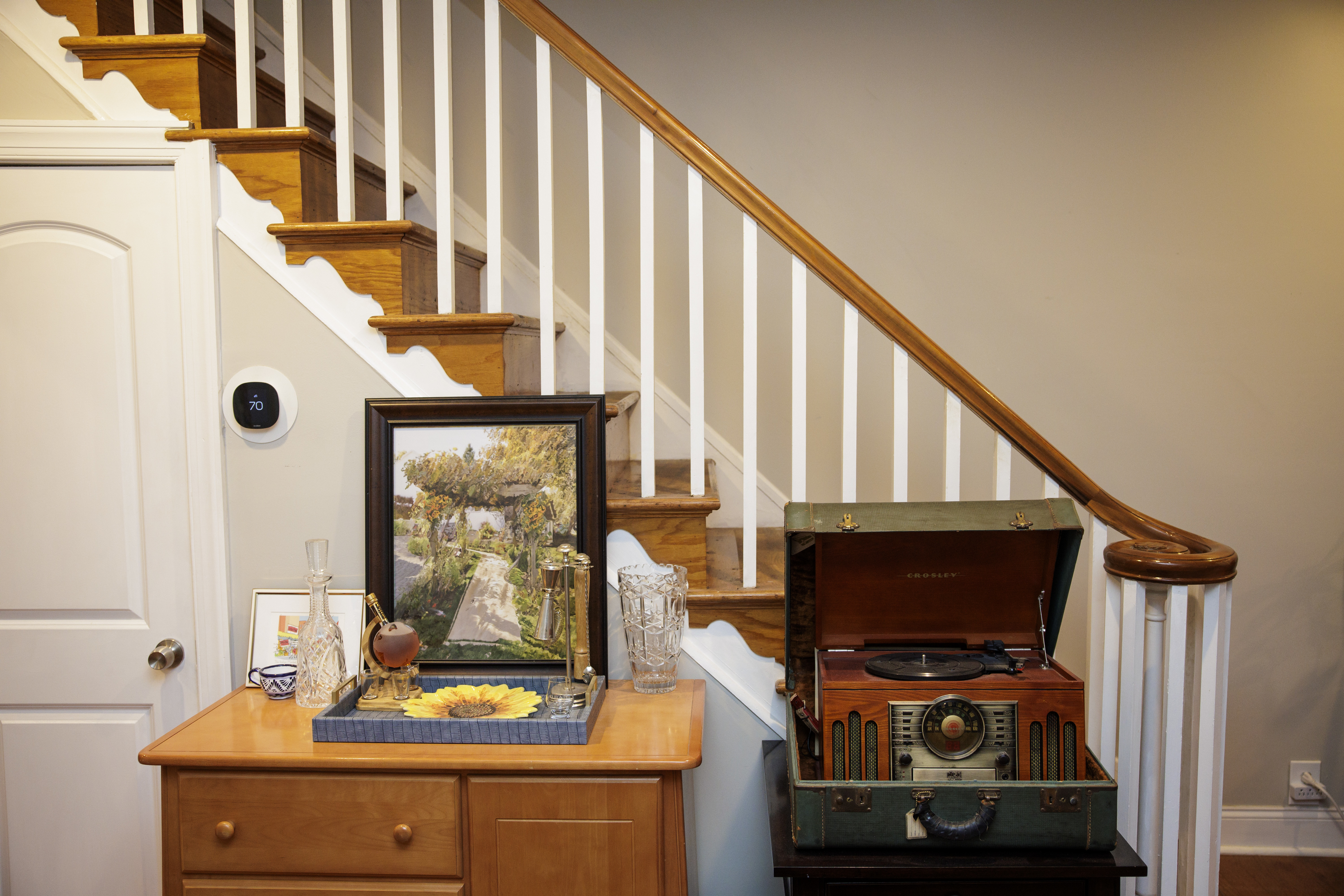
Upon entering the house, the couple immediately fell in love with the staircase, especially its architectural detailing.
The search: The couple intentionally waited until winter to search, hoping for lower prices. They saw 21 houses in Point Breeze and liked a lot of what they saw, but tried to be ruthless when it came to making an offer. “That was a very informative part of the process, Crino said, “because when you’re contemplating actually putting an offer down, your preferences emerge.”
They ended up making only one other offer on a house they nicknamed “the Grandma house” because of its funky carpeting and wallpaper. The seller verbally accepted it but eventually pulled it from the market.
“Ultimately, we’re happy with what happened,” said Girvin.
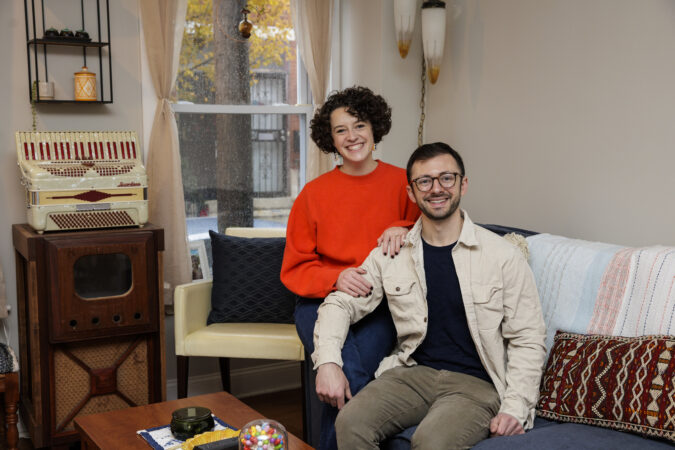
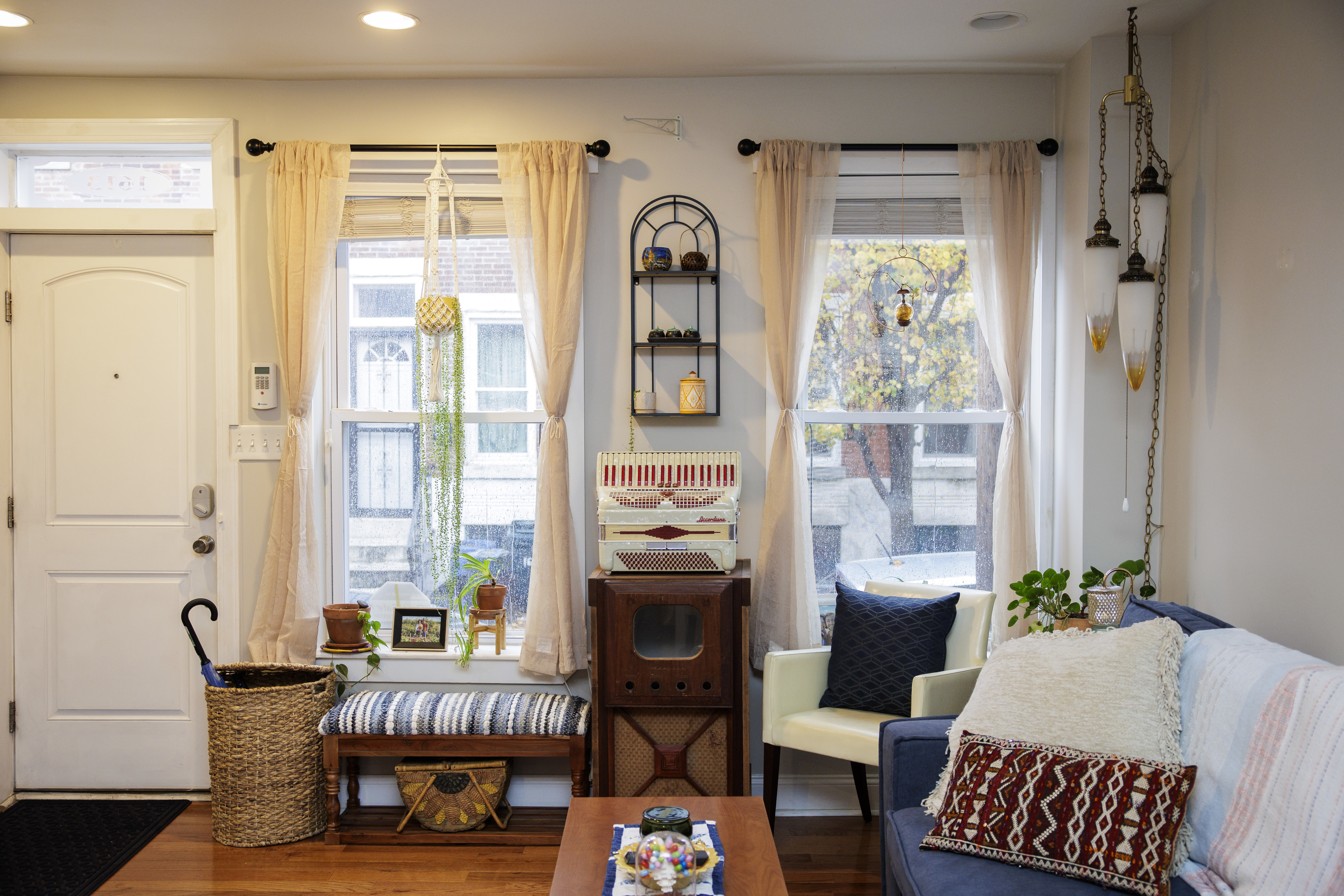
Girvin and Crino love all the natural light pouring through the living room windows.
The appeal: Girvin had a good feeling about the house when she saw it online. “I was like, ‘Wow, that looks exactly like where we want to be, at a price point that was quite exciting,’” she said. Even better, it had central air, beautiful hardwood floors, and matched the couple’s aesthetic. But the couple panicked when they saw an open house the next day. They called their agent and secured a same-day viewing.
Inside, the house aligned almost perfectly with what they had been searching for. What they weren’t expecting, though, were interesting artistic details, like the sunflower etched into the banister and the mural in the backyard. They loved the staircase, the amount of natural light pouring through the living room windows, and the view from their bedroom window of a church they admired. “The house is on a nice, little, cute side street,” Cirsi said. And crucially: “It’s so close to the subway.”
The second floorsealed the deal. The layout was perfect: a bathroom between the two smaller bedrooms. A built-in sound buffer for their future studios. “Most Philly rowhomes, you go up the stairs, it’s like a bathroom right at the top, and then the three bedrooms in a row,” Girvin explained. “But this one has bedroom, bathroom, bedroom, bedroom. That was ultimately one of the main reasons we bought the house.”
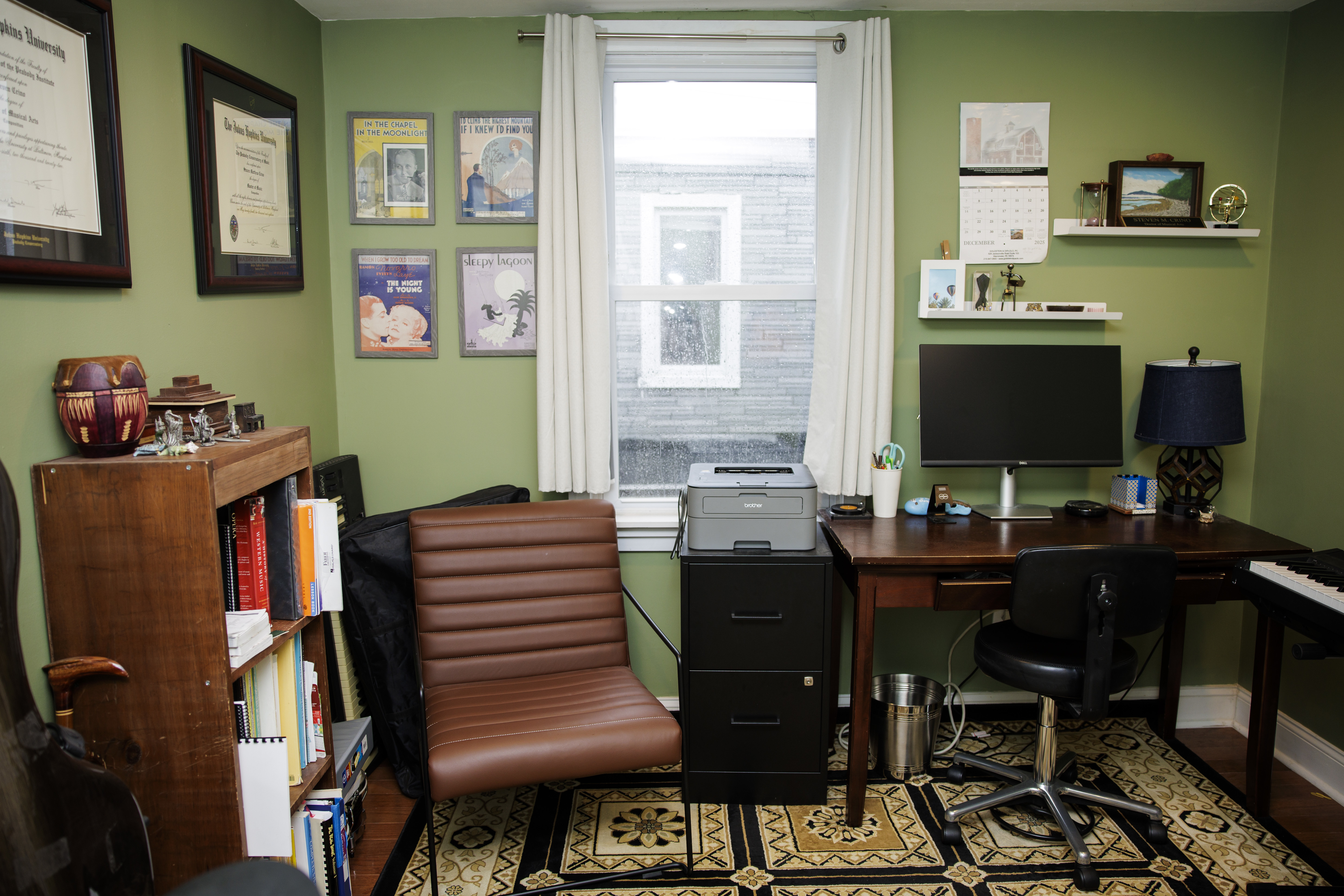
Crino’s studio is separated from Girvin’s by a bathroom, allowing the couple to practice music at the same time without disrupting each other.
The deal: The couple made an offer that evening. They offered the listing price — $305,000. “We felt that the house was worth what it was asking,” Girvin said. The sellers accepted right away.
The inspection revealed two issues. First, the oven needed to be replaced. The sellers issued the couple a credit to buy a new one.
The bigger issue was the HVAC system. The breaker tripped during the inspection. “We watched it go boop,” Crino said. The fix required electrical work, and they insisted it be completed and certified before closing. “That was the right decision because it definitely was pricier than they thought it was going to be,” Crino said.
The money: Girvin and Crino had been saving for almost a decade. Every month, they set aside a portion of their earnings in a separate account. They also had money saved for a wedding that they decided to put toward their house instead. “At one point we thought about having a really big wedding,” Girvin said, “but we decided to do the whole micro wedding, DIY backyard thing.”
The small side street the couple lives on was no sweat for their movers, Old City Moving Co.
Between their life savings and the wedding savings, plus generous gifts from wedding guests, Girvin and Crino had “$80,000-ish” to spend. They put 20% down, which was $61,000, and spent the rest on closing costs, which were $27,000. “That was the $80K right there,” Girvin said. Their mortgage is a little less than $1,800, which is exactly what they had been paying in rent.
The move: The couple moved in mid-March, one month after they closed. “Moving was relatively painless,” Girvin said. “We hired Old City Moving Co., and they were really great.” They navigated getting a giant moving truck down a tiny side street like pros, backing in so that they could get out more easily.
Any reservations? None worth mentioning. The only thing they’d add is a second bathroom — another half bath someday, maybe in the basement. But that feels like a future luxury, not a present problem. “Most days we’re like, I love this house,” Girvin said.
Girvin and Crino purchased a new oven with help from a seller’s credit.
Life after close: Their first major purchase was a new oven. “When people come to the house, I’m like, ‘You know, we bought that oven,’” Crino said, laughing. Decorating has been slow and thoughtful. The most sentimental change is the three-teardrop lamp from Steve’s grandmother, now hanging from their ceiling — something they never would have installed in a rental. The backyard is next.
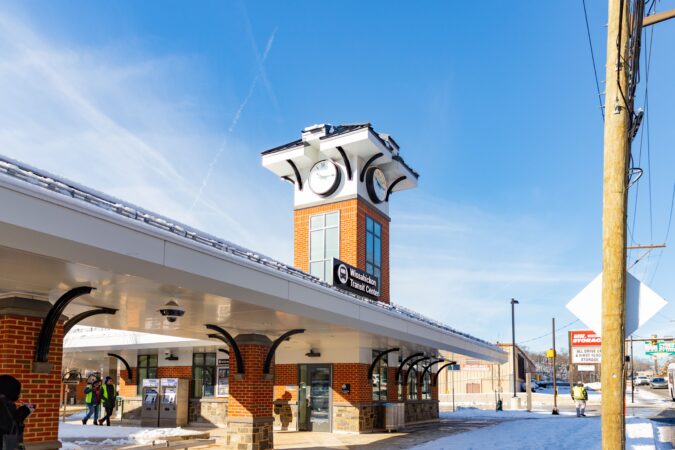
SEPTA officially unveiled its long-awaited Wissahickon Transportation Center in Manayunk, which is about six times the size of the previous small bus depot.
The new center on Ridge Avenue, near Main Street, is expected to serve 5,000 bus riders a day, officials said Monday at the ribbon cutting.
Construction of the $50 million project began in 2023 at what was already one of SEPTA’s busiest transportation hubs. It is located within walking distance of the Wissahickon Regional Rail Station.
Officials say the center improves connections, provides a better waiting experience for riders, and serves as a key transportation link to busy Main Street. They also say it makes navigating the immediate area easier for buses, pedestrians, and bicyclists.
“We are making bus service safer and more reliable at one of our busiest transportation facilities,” SEPTA board chair Kenneth Lawrence said in a statement. “This new hub provides better access to work, school, and other opportunities, including reverse commute connections for Philadelphia residents to Montgomery and Delaware Counties.”
window.addEventListener(“message”,function(a){if(void 0!==a.data[“datawrapper-height”]){var e=document.querySelectorAll(“iframe”);for(var t in a.data[“datawrapper-height”])for(var r,i=0;r=e[i];i++)if(r.contentWindow===a.source){var d=a.data[“datawrapper-height”][t]+”px”;r.style.height=d}}});
Among the improvements:
Weather-protected waiting areas, benches, and bicycle racks
Better lighting, signs, and security cameras
A supervisor’s booth
A new left turn lane dedicated to buses on a wider road
Improved crosswalks for pedestrians crossing Ridge Avenue
Bicycle racks
Improved crosswalks
Americans with Disabilities Act-compliant boarding areas
The previous center that fronted Ridge Avenue was basically a large bus shelter where commuters who live in neighborhoods in the city’s northwest and pass through on their way to jobs in King of Prussia and Plymouth Meeting change buses.
Nearly three-quarters of the passengers who board at Wissahickon are transferring to or from other SEPTA services.
“This is our largest customer-centric bus project to date,” said SEPTA general manager Scott Sauer.
Officials say the center lays the groundwork for SEPTA’s new bus network. For about five years, the transit agency had been taking steps toward launching its first comprehensive overhaul of the bus system since SEPTA opened in 1964, but last year SEPTA put the project on indefinite pause due to funding issues.
The new center, which is immediately behind the old facility, is part of the city’s larger Wissahickon Gateway Plan to grow and improve the area where the Schuylkill and Wissahickon Creek meet at Ridge Avenue and Main Street.
The gateway plan’s goal is to address stifling traffic, dangerous conditions for pedestrians and cyclists, and provide easier access to the river.
As part of the gateway, a new trail segment is also planned that would include a paved path allowing walkers, runners, and cyclists to circumvent the busy nexus of roads, giving easier access to the Schuylkill River Trail.
Aaron Goldblatt, 70, of Philadelphia, award-winning museum services partner emeritus at Metcalfe Architecture & Design, former vice president for exhibits at the Please Touch Museum, exhibit designer, sculptor, adventurer, and mentor, died Sunday, Dec. 7, of lung cancer at his home.
He joined business partner Alan Metcalfe in 2002 and specialized in constructing canopy walks, glass floors, elevated walkways, net bridges, abstract playgrounds, multimedia exhibits, and other unique designs in prominent locations. Visitors encounter their creations at the Museum of the American Revolution, the Independence Seaport Museum, Children’s Hospital of Philadelphia, the National Museum of Industrial History in Bethlehem, Pa., and the Whiting Forest at Dow Gardens in Michigan.
He and colleagues built the Lorax Loft on the Trail of the Lorax at the Philadelphia Zoo, the innovative garden and playground at Abington Friends School, and the lobby at Wissahickon Charter School. At Morris Arboretum, they built the celebrated Out on a Limb and Squirrel Scramble “treetop experiences” that Inquirer architecture critic Inga Saffron called “an irresistible allure, to young and old alike.”
He earned bachelor’s and master’s degrees in sculpture, hitchhiked from adventure to adventure around the country and South America after high school, and said in 2019 that “learning, laughter, and creating genuine connections between people, nature, and history … really inspire my design.”
Play, he said, is one of those genuine connections. “Wherever people are, as long as they are there long enough, play will happen,” he said in 2019. “It happens in schools, museums, and even prisons. Play is fundamental to being human.”
Together, Mr. Goldblatt, Metcalfe, and their colleagues earned design awards from the local chapter of the American Institute of Architects, the American Association of Museums, and other groups. In 2022, they earned the Wyck-Strickland Award from the historic Wyck house, garden, and farm for outstanding contributions to the cultural life of Philadelphia.
In a tribute, colleagues at Metcalfe said Mr. Goldblatt “transformed our studio into the place we are today.” They said: “His generosity, wisdom, and passion for play emanated throughout every conversation, punctuated only by his wit and sense of humor.”
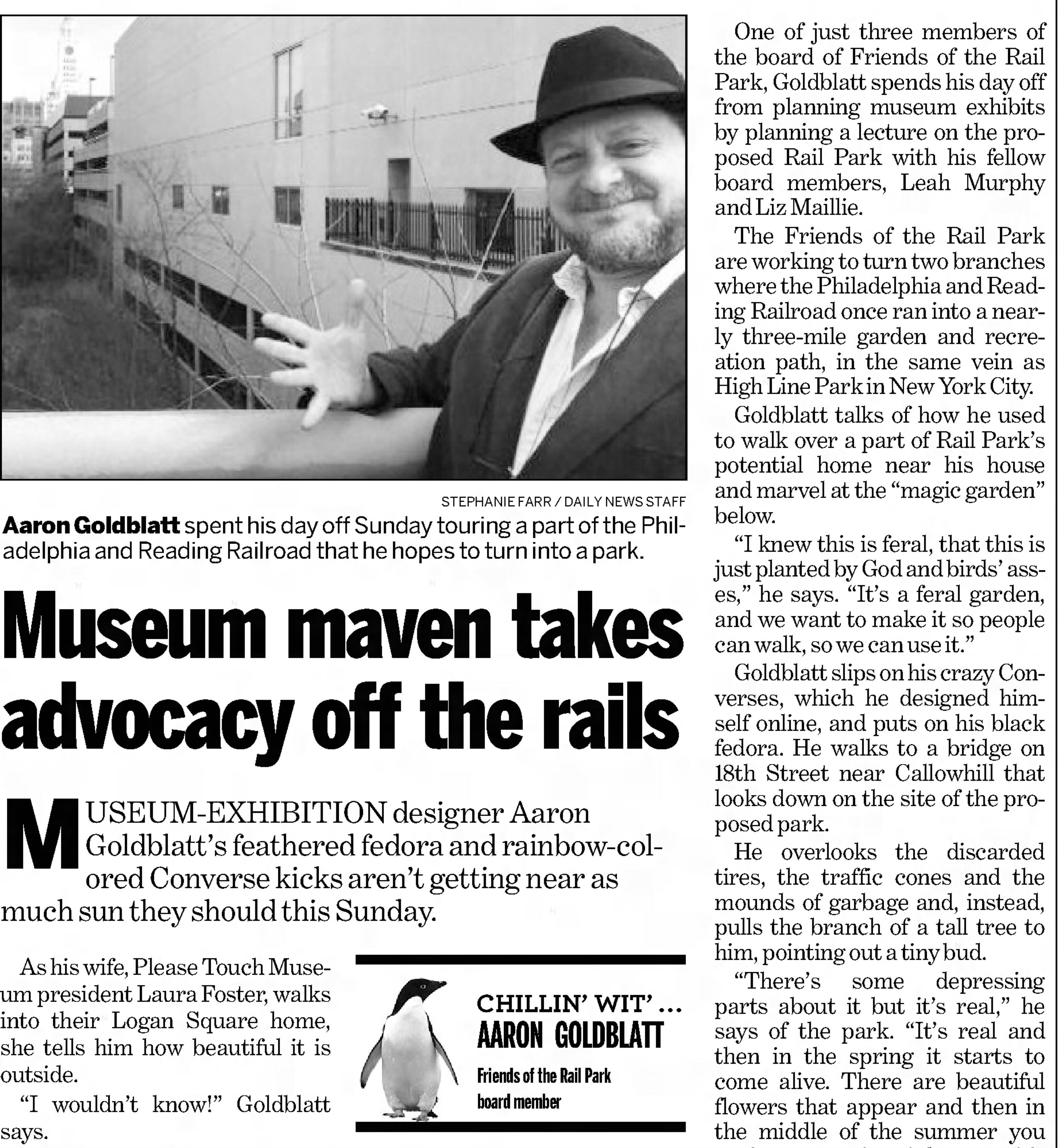
This photo and story about Mr. Goldblatt appeared in the Daily News in 2013.
From 1990 to 2002, he designed and developed exhibits at the Please Touch Museum. Earlier, he was director of exhibits for the Academy of Natural Sciences, assistant director at the Wagner Free Institute of Science, and studio assistant to sculptor Alice Aycock and other artists.
He helped design the Rail Park and was a cofounder and longtime board member of Friends of the Rail Park. He served on boards at the Print Center, the Wagner Free Institute of Science, and other groups, and taught postgraduate museum studies at the University of the Arts for 20 years.
“He developed a love of the process and philosophy of building,” said his daughter, Lillian. His wife, Susan Hagen, said: “He was always engaged, always asking questions. He was curious, funny, and extremely smart.”
Friends called him “lovely, smart, and witty” and “warm, wise, and creative” in Facebook tributes. One friend said: “He always had a spark.”
Aaron Shlomo Goldblatt was born March 22, 1955, in Cleveland. His father was in the Army, and Mr. Goldblatt grew up on military bases across the country and in Germany.
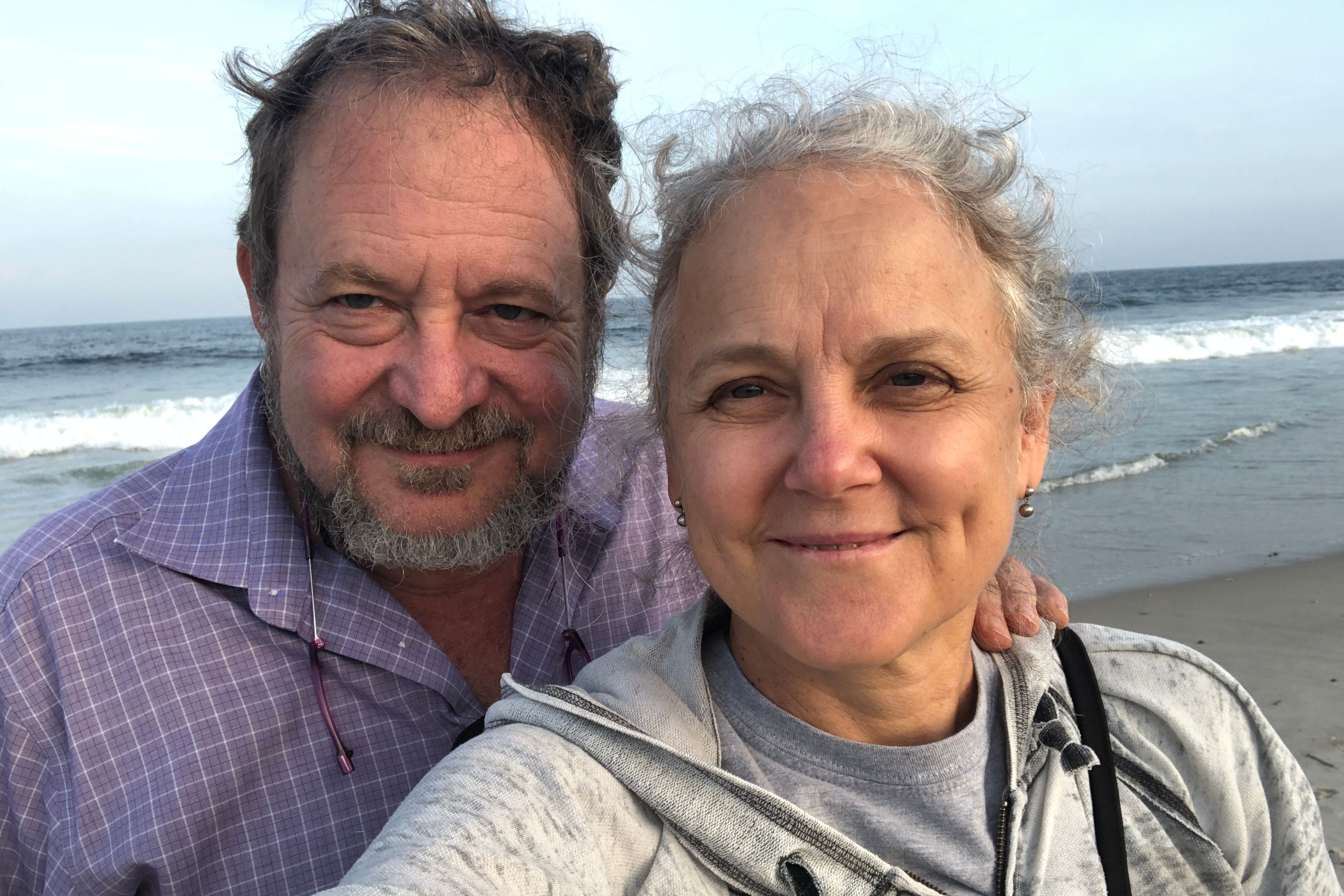
Mr. Goldblatt and his wife, Susan Hagen, married in 2023.
He graduated from high school in Maryland and earned his bachelor’s degree at Philadelphia College of Art in 1982 and master’s degree at Rutgers University in 1990. Before settling in Philadelphia, he worked on farms, painted houses, and spent time as a carpenter, a welder, and a potter.
He married Diane Pontius, and they had a daughter, Lilly. After a divorce, he married Laura Foster. She died in 2019. He married fellow artist Susan Hagen in 2023, and they lived in Spring Garden.
An engaging storyteller and talented cook, Mr. Goldblatt enjoyed all kinds of art, music, and books. He watched foreign films, wrote letters to politicians and the editor of The Inquirer, and visited the Reading Terminal Market as often as possible. He and his wife started birding during the pandemic.
“Aaron led with his heart, engaging deeply with the people and ideas around him,” his daughter said. “He could burst into song at any moment.”
Mr. Goldblatt smiles with his daughter, Lilly.
His wife said: “He was a family person, and everyone talks about his love and kindness.”
In addition to his wife and daughter, Mr. Goldblatt is survived by a grandson, a sister, a brother, his former wife, and other relatives.
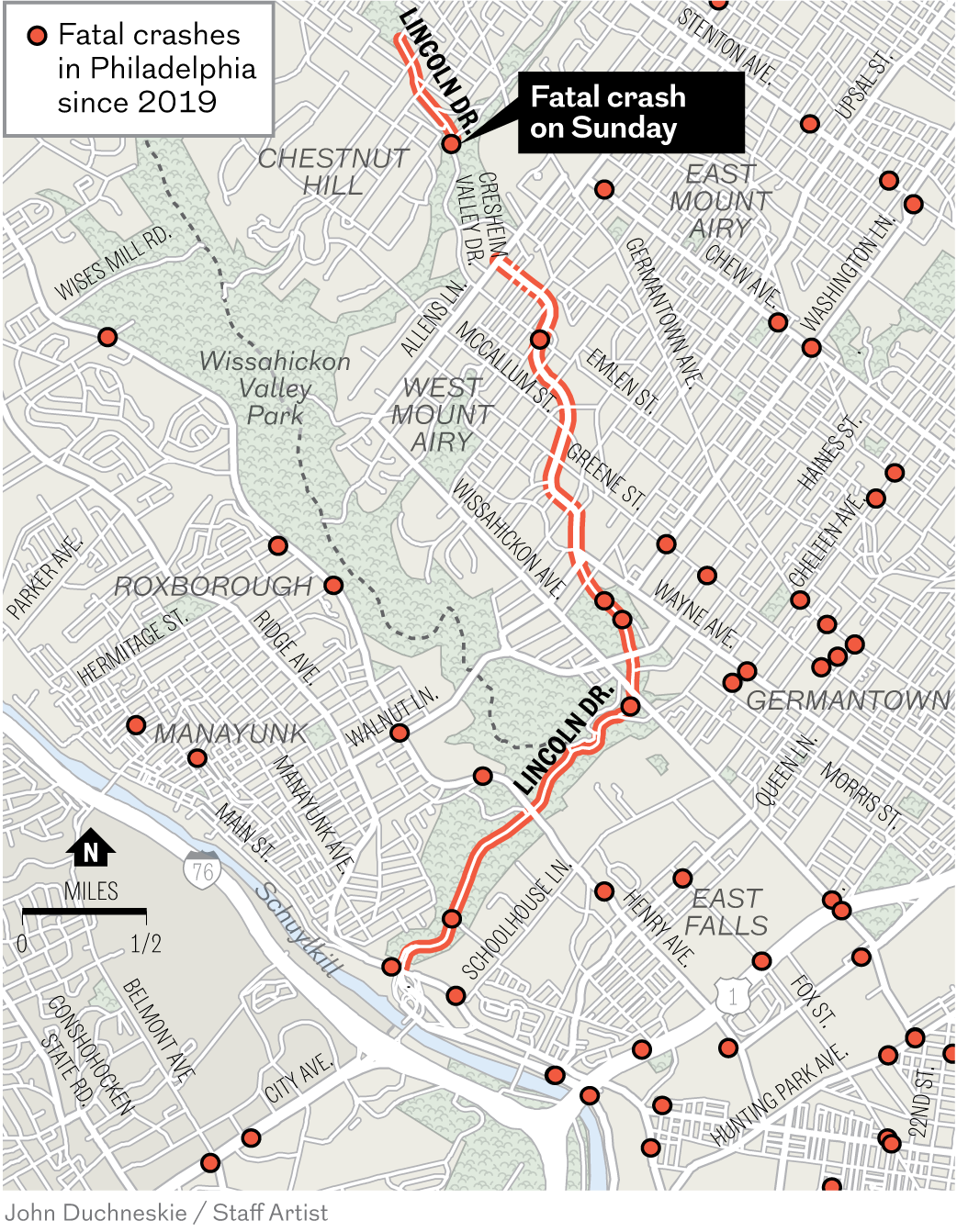
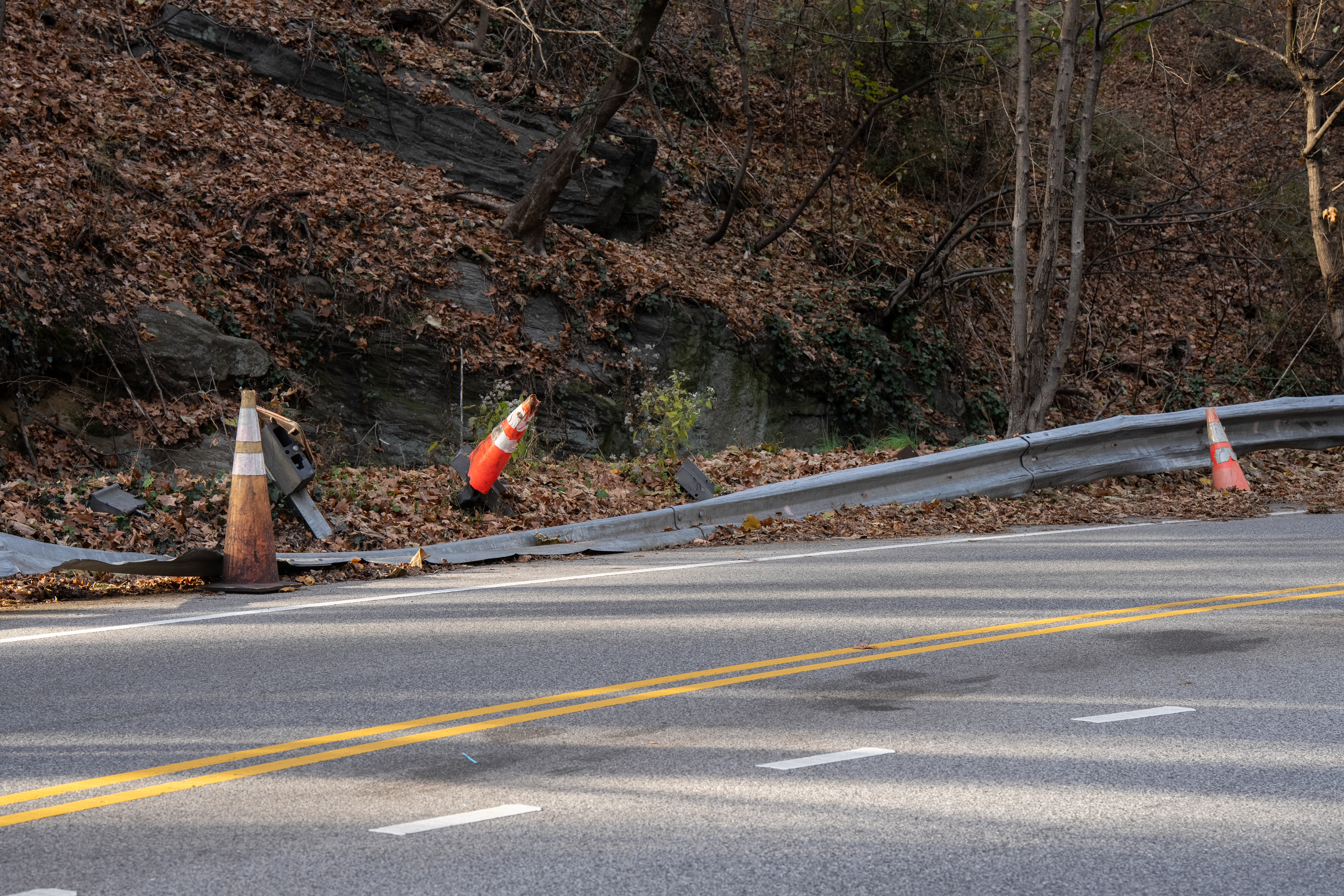
A 65-year-old man died Sunday after he lost control of his vehicle on Cresheim Valley Drive in Chestnut Hill, striking a downed guardrail and flipping the car upside down into a creek. Just weeks before, another driver veered off the same road but survived.
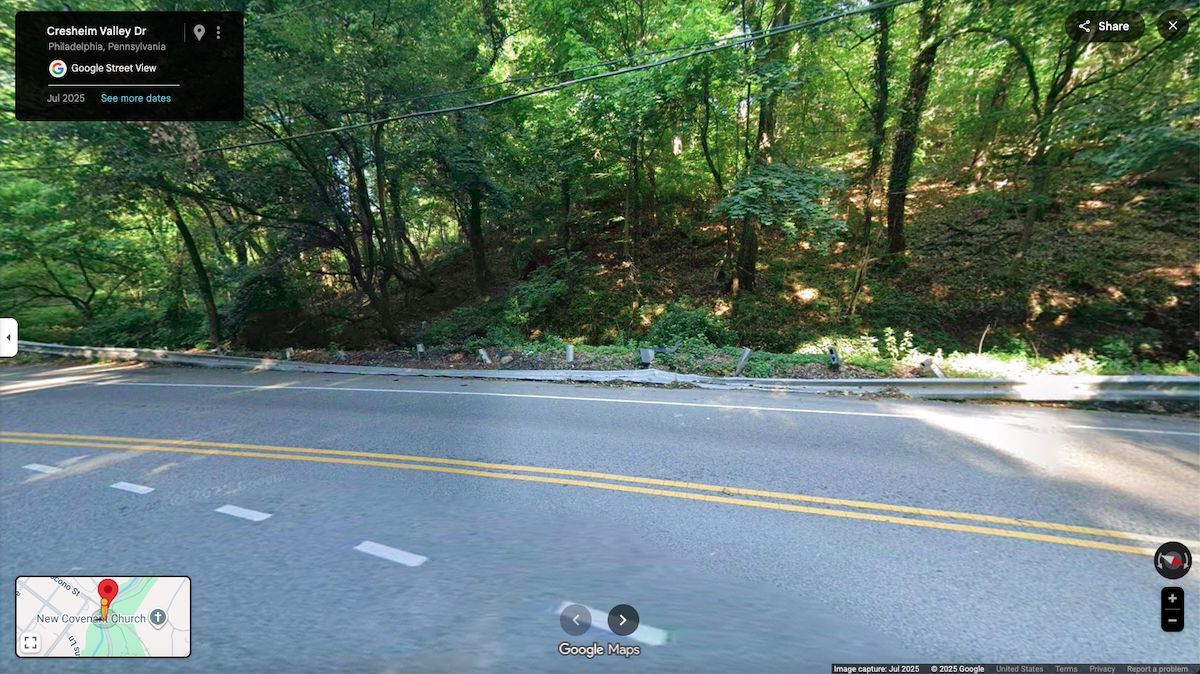
Compounding this latest traffic death is the fact that the guardrail meant to prevent cars from swerving off the road was broken and nearly flattened from previous crashes, leaving a gap in the guardrails for months, said Josephine Winter, a Mount Airy resident and executive director of West Mount Airy Neighbors (WMAN). “The guardrail was down, and it was previously crumbled so it’s a frequent site of crashes,” she said. Images from Google Maps show the guardrail down as far back as July.
The Philadelphia Streets Department is aware of the recent crash and is conducting an assessment of the guardrail on Cresheim Valley Road. “The streets department’s top priority is public safety,” a spokesperson said.
A screenshot of a Google Map’s street view captured in July 2025 shows the downed guardrail on Cresheim Valley Drive in the Chestnut Hill neighborhood of Philadelphia. On Nov. 30, 2025, a 65-year-old man crashed and went over the guardrail, later succumbing to his injuries.
Neighbors say accidents, sometimes fatal, have plagued the winding roadways in Chestnut Hill and Mount Airy for decades. These traffic safety concerns came to a head with Sunday’s deadly crash.
“It’s a curvy, tricky road, especially when it’s wet, and people tend to speed on that road,” Winter said of roadways like Lincoln and Cresheim Valley Drives, which are lined with trees, have swooping dips and hills, and are prone to flooding.
Map of fatal crashes in Northwest Philadelphia since 2019.
Winter, who leads WMAN’s traffic-calming committee, and other neighborhood organizations have petitioned for city support, urging the streets department to slow the speed of traffic on Cresheim Valley Drive, Lincoln Drive, and Wissahickon Avenue. The group’s efforts are so ingrained in the fabric of the neighborhood that, when digging through Temple University’s Urban Archives, Winter found an advertisement from 1968 stressing the need for cars in Mount Airy to “slow down to keep kids safe.”
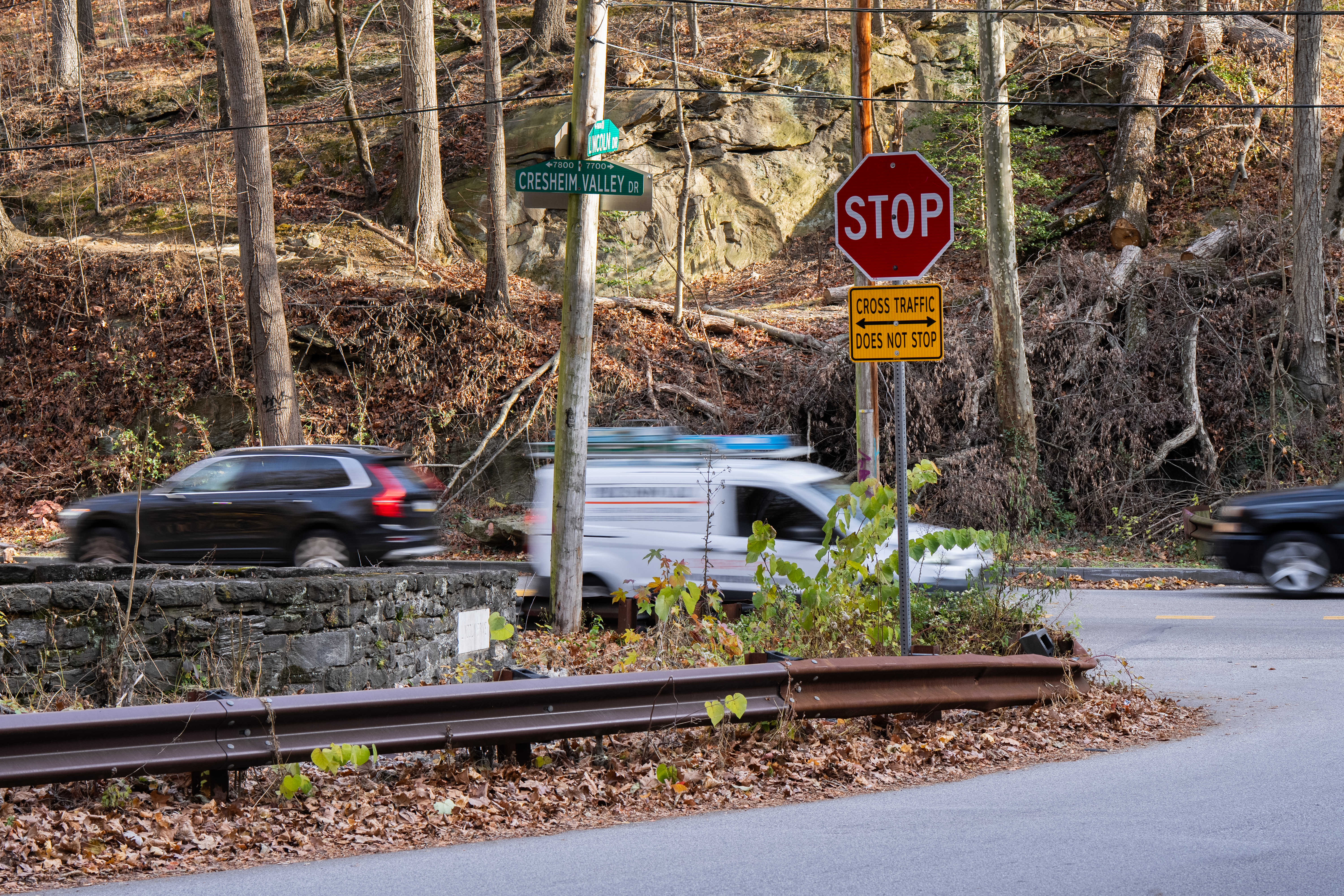
The intersection of Cresheim Valley Drive and Lincoln Drive, in Philadelphia, PA, Dec. 1, 2025.
The streets department installed “speed slots,” traffic-calming structures similar to speed bumps, earlier this year along Lincoln Drive between Allens Lane and Wayne Avenue. Along the same stretch of road, the Pennsylvania Department of Transportation installed rumble strips and speed tables to slow drivers down in 2023, in addition to traffic lane separators to keep drivers from using center lanes to pass other vehicles.
In addition to the recently completed speed slots and traffic-calming measures on sections of Emlen Street, which becomes Cresheim Valley Road, signal upgrades are planned for Lincoln Drive as well.
However, the work to improve these streets is not over, Winter said. Additionally, the streets department plans do not include changes to Cresheim Valley Drive, where Sunday’s crash happened.
“We’ll need a collaborative approach as soon as possible to temporarily address the downed guardrail, and then see what the options are moving forward,” Winter said.
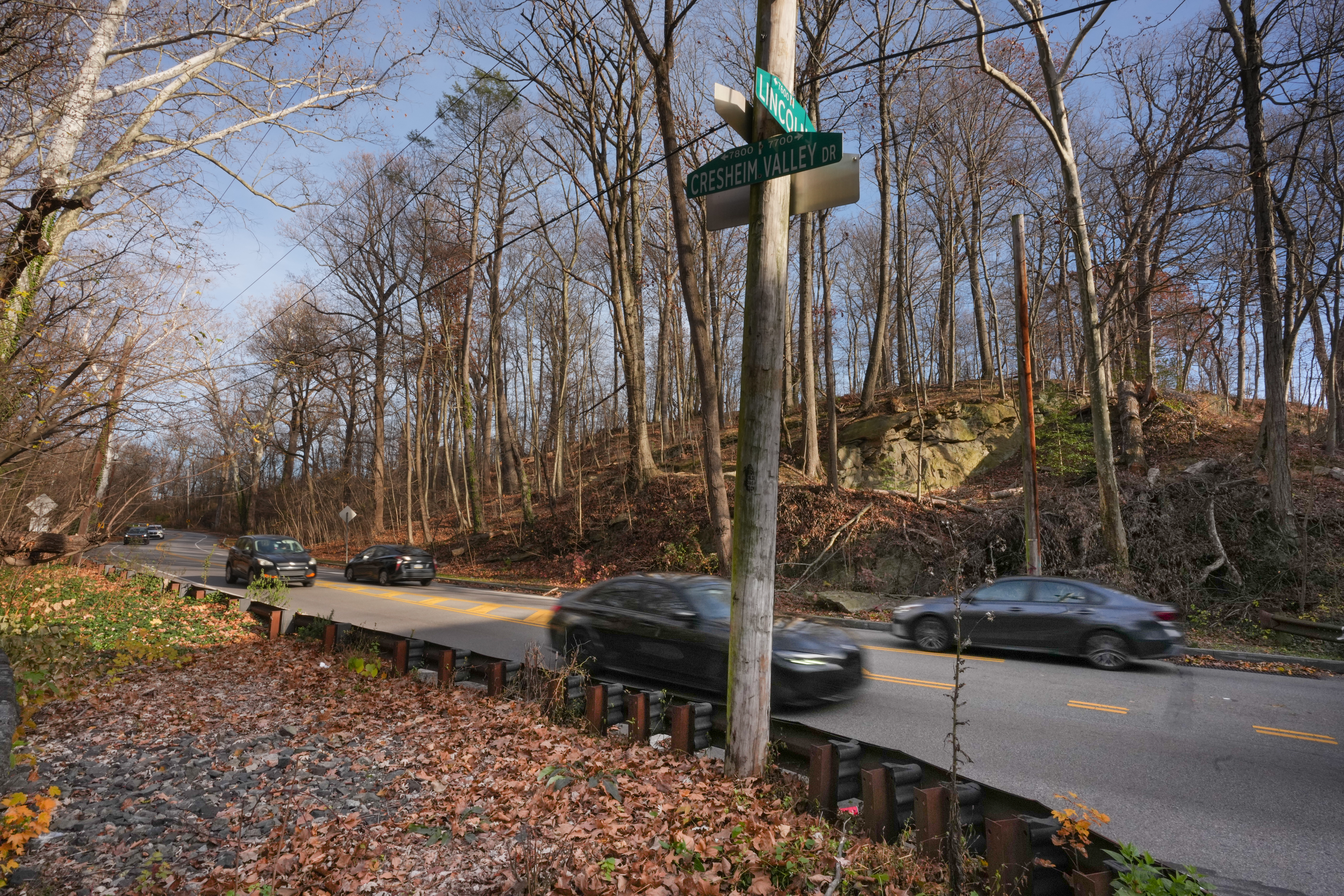
The intersection of Cresheim Valley Drive and Lincoln Drive, in Philadelphia, PA, Dec. 1, 2025.
Throughout the last decade, locals have suggested better-timed signals, more speed tables, and reducing the number of driving lanes from two in either direction down to one. They also want to see more roundabouts and curb bump-outs in the neighborhood to keep traffic flowing, but at a reasonable speed.
A mere 50 to 100 feet from Cresheim Valley Drive is a parallel bike trail, where trail organizers like Brad Maule are accustomed to the crashes on the road nearby. Before Sunday’s fatal crash, he remembers two other cars that drove off the side of the road in recent months, not counting the crashes on the roadway itself. The city recently installed pedestrian crossing signs and repainted the crosswalk on nearby Cresheim Road, but Maule hopes speed bumps will follow.
Cresheim Valley Drive near where it intersects with Lincoln Drive, in Philadelphia, PA, Dec. 1, 2025.
While Winter said that engineers from the Philadelphia Streets Department were among the first calls she received Monday morning responding to the crash, and that the community appreciates the response, she, Maule, and other neighbors hope that more safety improvements will be considered to save more lives.
“I’m just looking forward to the new measures of safety that come here,” Maule said. “Hopefully, people will abide by them.”
Staff writers Max Marin and Dylan Purcell contributed to this article.