Tag: Working Families Party

  • Philly congressional candidate Ala Stanford dropped out of a live debate, leaving her rivals to face off without her

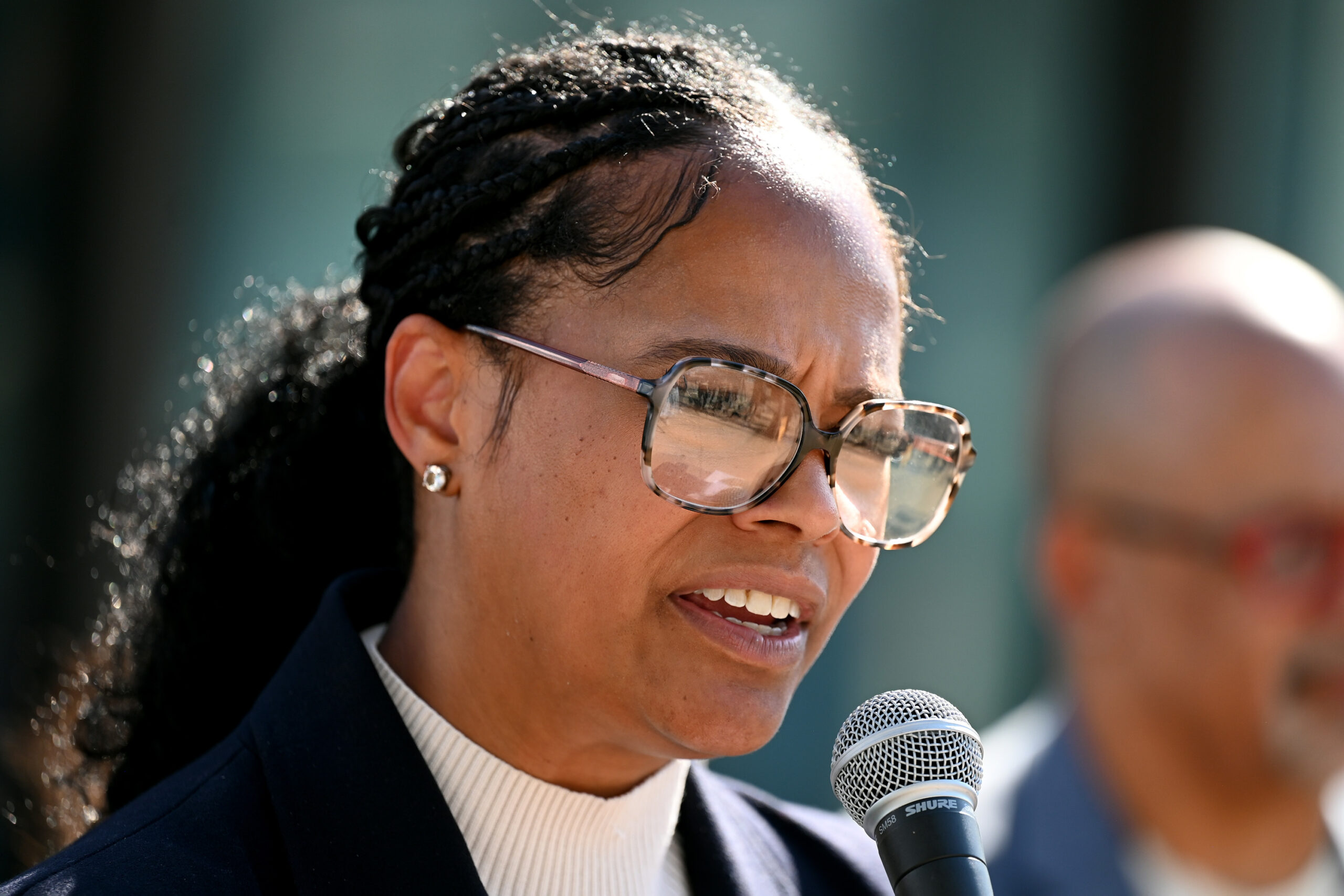
    Congressional hopeful Ala Stanford on Wednesday morning announced she was dropping out of a WHYY candidates debate two hours before it was scheduled to begin, saying her campaign could not agree with the public radio station on a format for the debate and criticizing her opponents in the race for “misogynistic attacks.”

    “I have never been afraid of a hard room,” Stanford said in a statement. “After engaging in good faith with WHYY, we could not reach terms on a format that would deliver the serious accountability voters in PA-03 deserve.”

    Stanford’s campaign manager emailed the announcement to reporters around 10 a.m., two hours before the debate on WHYY’s Studio 2 was supposed to take place.

    In her statement, Stanford did not clarify what problems she had with the debate format. She also did not provide details on any attacks from her opponents in the Democratic primary for Pennsylvania’s 3rd Congressional District.

    A Stanford spokesperson declined to comment beyond her written statement.

    Stanford’s surprise announcement came less than three weeks before the May 19 primary, and followed a series of missteps for her campaign, including the revelation that a staffer used artificial intelligence to help answer a candidates’ questionnaire and her stumbling through a question about immigration enforcement in an interview with NBC10.

    A recent Inquirer report on her stewardship of the Black Doctors Consortium also found that the organization omitted details about her income that were required to be included on nonprofit tax forms filed with the Internal Revenue Service.
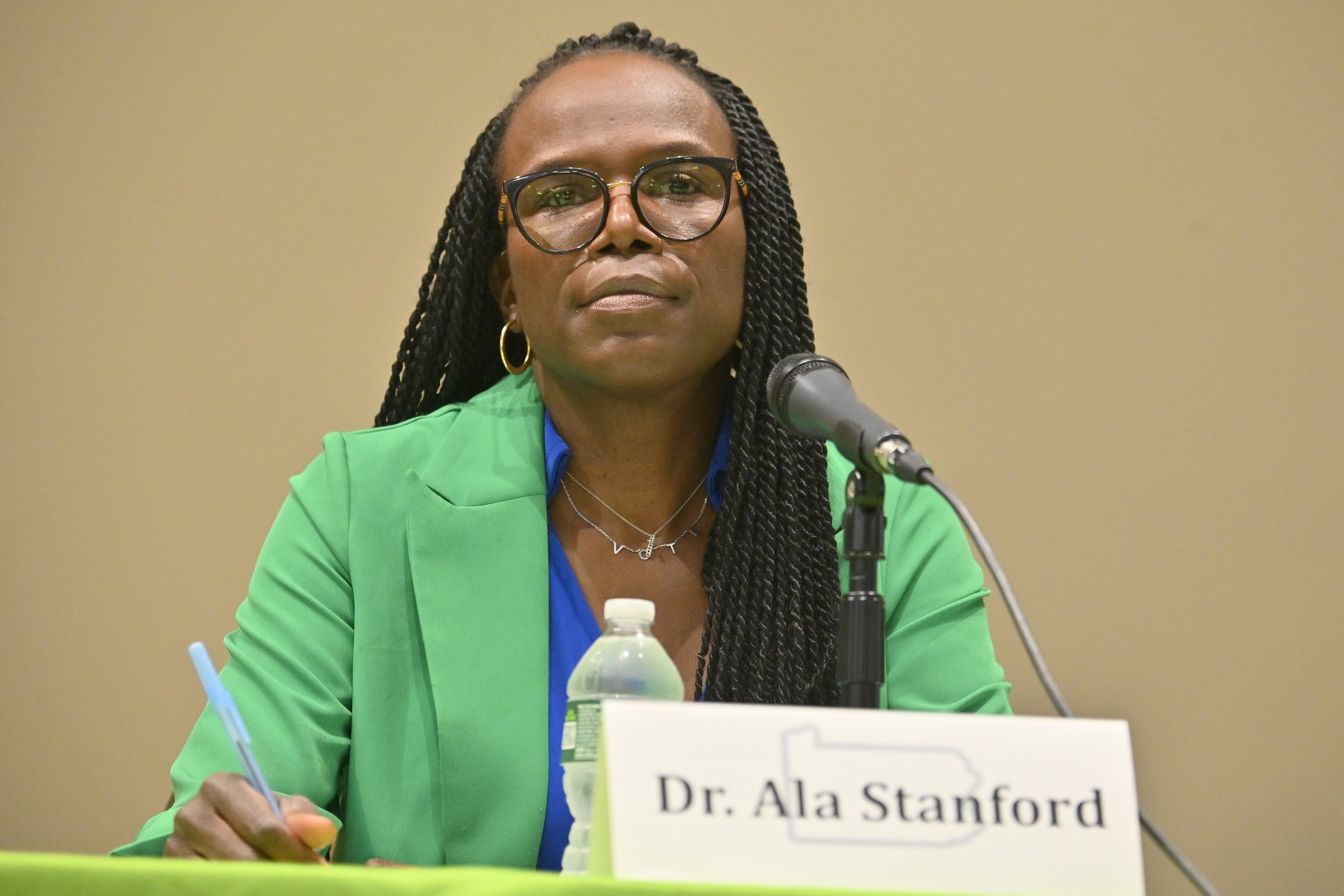
    Ala Stanford, pediatric surgeon and founder of the Black Doctors Consortium, participates in the debate for Pennsylvania’s 3rd Congressional District at Center in the Park in Germantown on Tuesday, April 14, 2026.

    Stanford’s exit from the Wednesday event meant the other two top contenders in the race, State Rep. Chris Rabb and State Sen. Sharif Street, were the only candidates to participate in the debate featured on WHYY’s Studio 2, the highest-profile live and on-air debate thus far.

    It was a relatively subdued affair compared to some of the other more gloves-off style campaign events in the open race. Street and Rabb took questions from moderators and largely agreed on policy, with both saying they support expanding universal healthcare, abolishing U.S. Immigration and Customs Enforcement, and impeaching President Donald Trump.

    The two state lawmakers sought to contrast their styles, with Street portraying himself as a more competent legislator.

    “I get things done,” said Street, the former head of the state Democratic Party. “Rep. Rabb and I share a lot of value propositions. But the difference is I deliver on ideas.”

    Rabb, a progressive who has been endorsed by the Working Families Party, said Street is too closely aligned with the Democratic establishment, and that his ideas are not bold enough.

    “There’s so many people who think we can’t do things big and bold,” he said. “They play around the edges, because that’s what establishment politics does.”
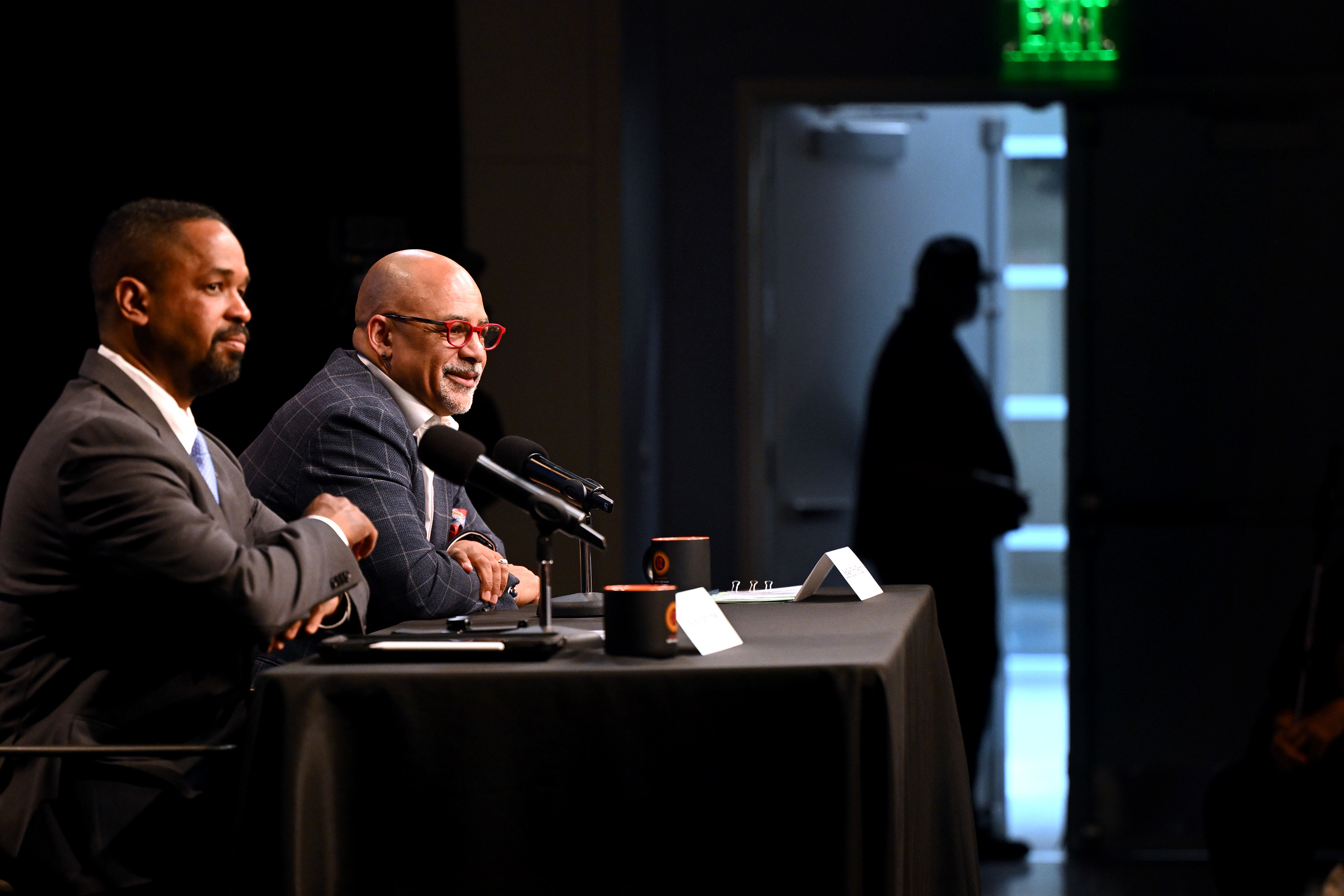
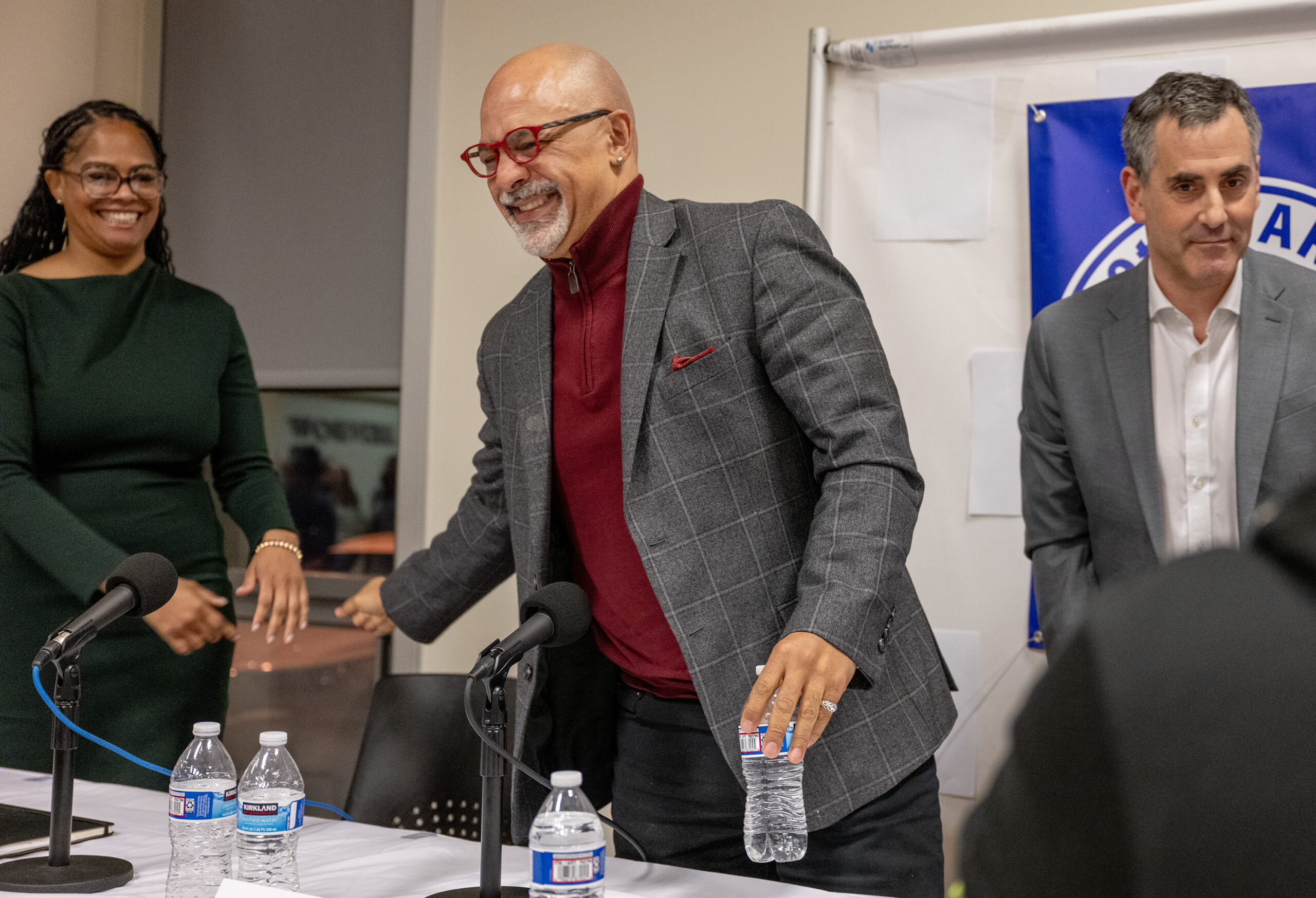
    State Sen. Sharif Street (left) and State Rep. Christopher Rabb (right) wait for the WHYY studio door to close Wednesday, April 29, 2026 before start of their debate in the Democratic primary for the 3rd Congressional District. The third leading candidate, Ala Stanford declined to attend at the last moment.

    Both candidates were also asked about Stanford’s absence and her charge Wednesday that the race has been “marred by misogynistic attacks and lies from both of my opponents.”

    Stanford, a first-time political candidate, is the only woman on the ballot.

    Rabb said he wasn’t sure what she was referring to, but pointed out that when Stanford was recently heckled by some of his own supporters during a candidates forum, he repeatedly told them to let her speak.

    And Street said he has not attacked her directly, but acknowledged that she’s faced criticisms.

    “She has been attacked. I’ve been attacked. Everybody on this campaign, I’m sure, has been attacked at some point,” he said.

    Rabb and Street said their campaigns did not negotiate with WHYY on the format of the event.

    Kevin McCorry, an executive producer and host at the station, said WHYY engaged with Stanford’s campaign “in good faith” and acquiesced to her staff members’ requests, including allowing her to have notes on the table and bring extra staffers to sit in the audience.

    He said WHYY learned that she was pulling out when Stanford’s campaign manager released a statement to reporters from multiple news outlets.

    “We were flexible with her requests,” McCorry said. “At no time did they say, ‘If X doesn’t change, we’re backing out.’”
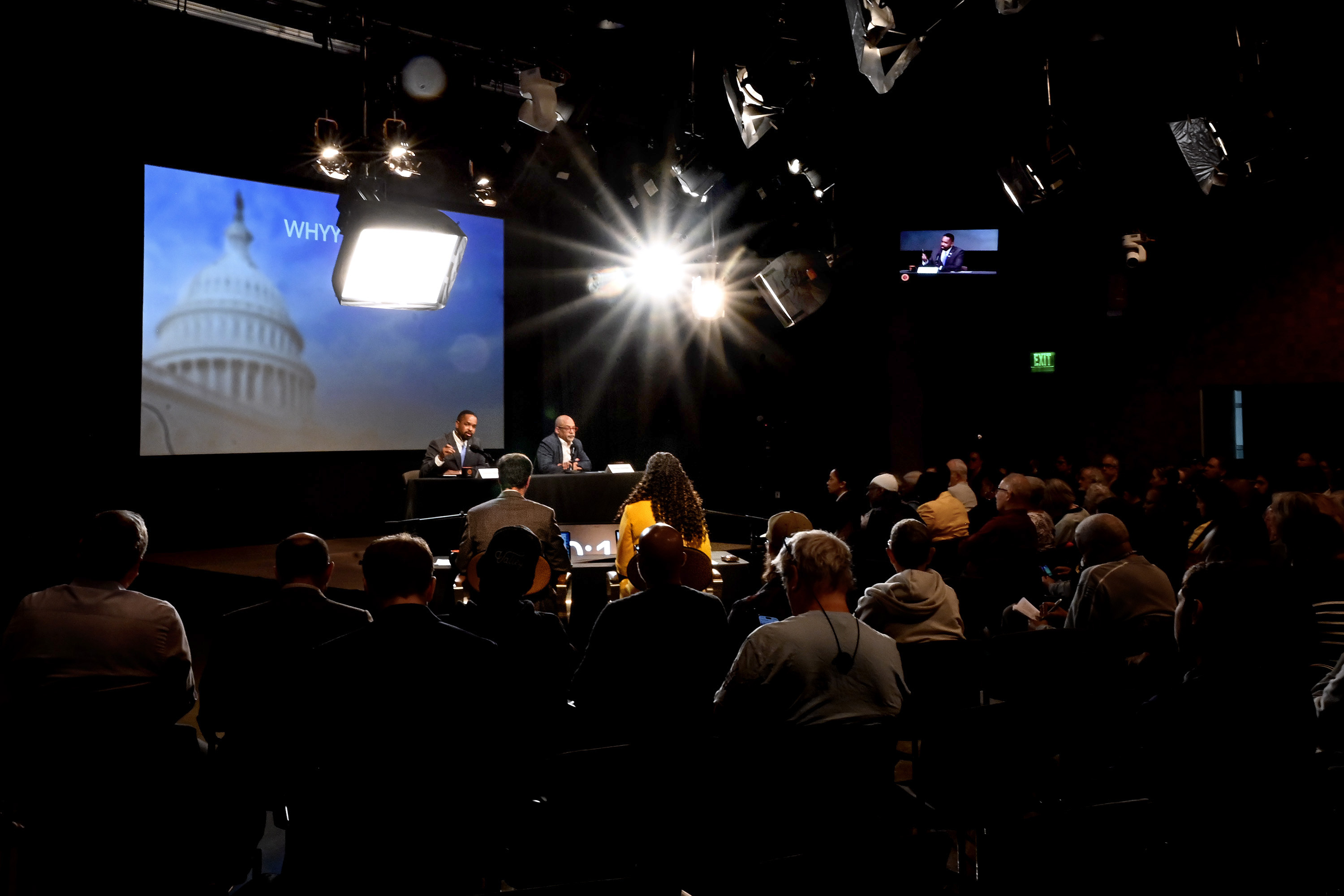
    State Sen. Sharif Street (left) and State Rep. Christopher Rabb (right) appear in a debate at WHYY studios Wednesday, April 29, 2026 for the Democratic primary in the 3rd Congressional District. The third leading candidate, Ala Stanford declined to attend at the last moment.

    Street spokesperson Anthony Campisi accused Stanford of dropping out to avoid tough questions, adding that “her campaign is in free fall.”

    “Rather than answer these questions in a debate that’s aired on radio and television, she appears to be taking her ball and going home, which is not what Philadelphians expect from their member of Congress,” Campisi said Wednesday. “Philadelphians deserve a member of Congress who is ready to fight for them and against Donald Trump, not someone who runs from a fight.”

    Rabb said that when it comes to campaign events, he and his team “don’t negotiate, we just show up.”

    “Even if I didn’t like the format, which is not uncommon, I still show up,” he said, “because I’m a public servant and I’m a public candidate, and I got to reach people wherever they are.”

    In her statement, Stanford, a physician, noted she has taken the Hippocratic Oath “to first do no harm.”

    “I challenge everyone in this race to join me in promoting the kind of spirited, but serious and meaningful dialogue Philadelphians should expect from those asking to serve,” she said. “In the meantime, I will be where I have always been — on doorsteps, in church basements, and on the corners of the wards that built me.”

    Shaun Griffith, a tax adviser and the fourth candidate in the race, did not participate in the debate because he did not meet WHYY’s criteria, which included a fundraising threshold.

    He attended the event and sat in the audience, and said afterwards that it was “frustrating to be watching other people get to answer questions and not have the opportunity to do so myself.”

  • Philly City Council will consider limiting ICE next month as new Pa. detention centers loom

    Philly City Council will consider limiting ICE next month as new Pa. detention centers loom

    Philadelphia City Council next month will consider legislation to place some limits on immigration enforcement in the city and is planning a daylong hearing to parse the proposals.

    Council President Kenyatta Johnson, a Democrat who controls the flow of legislation in the chamber, said he has scheduled a hearing to take place at 10 a.m. on April 6 before the Committee of the Whole, which comprises all 17 Council members.

    That means every lawmaker will have the opportunity to question members of Mayor Cherelle L. Parker’s administration, as well as immigration advocates, about the package.

    The timeline means mid-April is the earliest that Council could pass the package. Fifteen of the body’s 17 members have expressed support, and that constitutes a veto-proof majority.

    City Councilmembers Rue Landau, a Democrat, and Kendra Brooks, of the progressive Working Families Party, sponsored the legislation introduced in January, which prohibits ICE agents from wearing masks, bans them from staging raids on city property, and makes it illegal to discriminate against someone based on immigration status.

    The legislation also clarifies how and when Philadelphia officials can coordinate with federal immigration enforcement.

    Parker has said an executive order signed by her predecessor remains in place, limiting some cooperation between law enforcement and ICE. But the legislation that Council is considering goes further, codifying a prohibition on city officials assisting ICE and prohibiting data-sharing agreements.

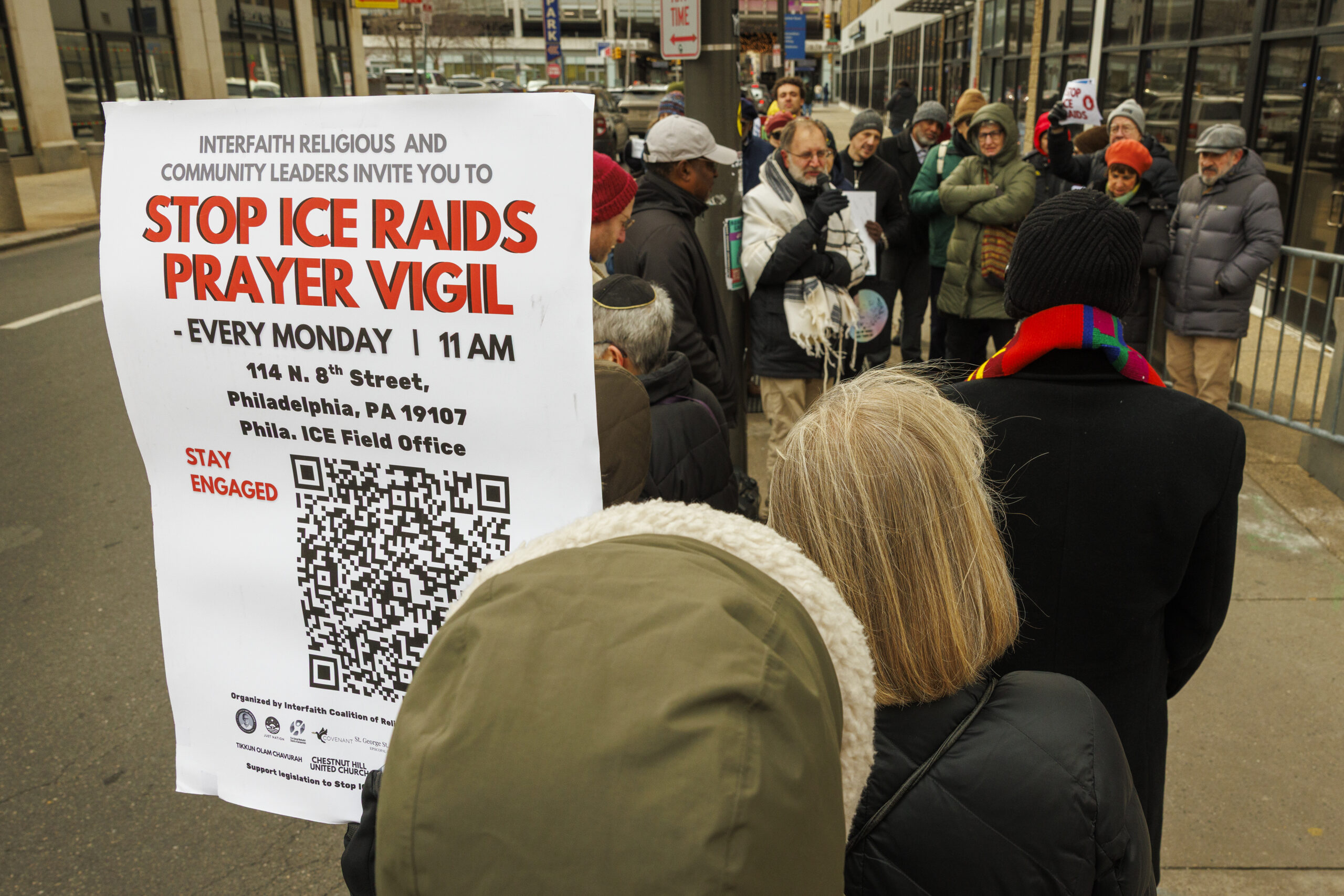
    Interfaith religious and community leaders prayer vigil outside the Philadelphia U.S. Immigration and Customs Enforcement office at 114 N. 8th Street in Center City on March 2.

    It comes as the U.S. Immigration and Customs Enforcement agency is undergoing a revamping to its leadership structure. President Donald Trump on Thursday ousted Department of Homeland Security Secretary Kristi Noem, and said he intends to nominate U.S. Sen. Markwayne Mullin (R, Okla.) to replace her.

    At the same time, Democrats across Pennsylvania, including Gov. Josh Shapiro, continue to denounce ICE, including the agency’s plans to develop two immigration detention centers outside the city.

    Several local officials said this week that they’re worried the federal government will surge enforcement efforts in Philadelphia in order to fill the centers, and that the city must move quickly to pass its legislation.

    “I’m extremely concerned,” said City Councilmember Quetcy Lozada, a Democrat whose North Philadelphia-based district has a large immigrant population. “We need to really figure out what our position is as it relates to working with ICE very closely. We have community residents that we should be protecting.”

    The Trump administration this year quietly spent millions of dollars buying warehouses in two dozen communities across the country.

    Two are in Pennsylvania and could reportedly hold about 9,000 beds in total.

    Spotlight PA reported Tuesday that ICE is referring to a facility in Tremont, located in Schuylkill County, as the “New ICE Philadelphia Mega Center” and one in Upper Bern Township in Berks County as the “New ICE Philadelphia Processing Center.”

    Landau said Council is “paying close attention to these developments and the questions they raise about the expansion of detention facilities in our area.”

    “The majority of Philadelphians are deeply disturbed by ICE’s tactics,” she said.

    Johnson said in an interview last month that the detention centers are a reason to move swiftly on the ICE-related legislation.

    The proposed laws, he said, are a means to “be out in front” of a potential surge of immigration enforcement in the city.

    “Some people say, ‘Well, they’re not even here yet.’ But they just built a warehouse in [Berks County],’” Johnson said. “I believe that was strategic. It took some planning to say ‘We want to set up shop right in your backyard.’”

  • Candidates line up to replace Rep. Dwight Evans | Shackamaxon

    This week’s column analyzes the city’s camera surge, the need for political challengers, and calls for some basic sense about security.

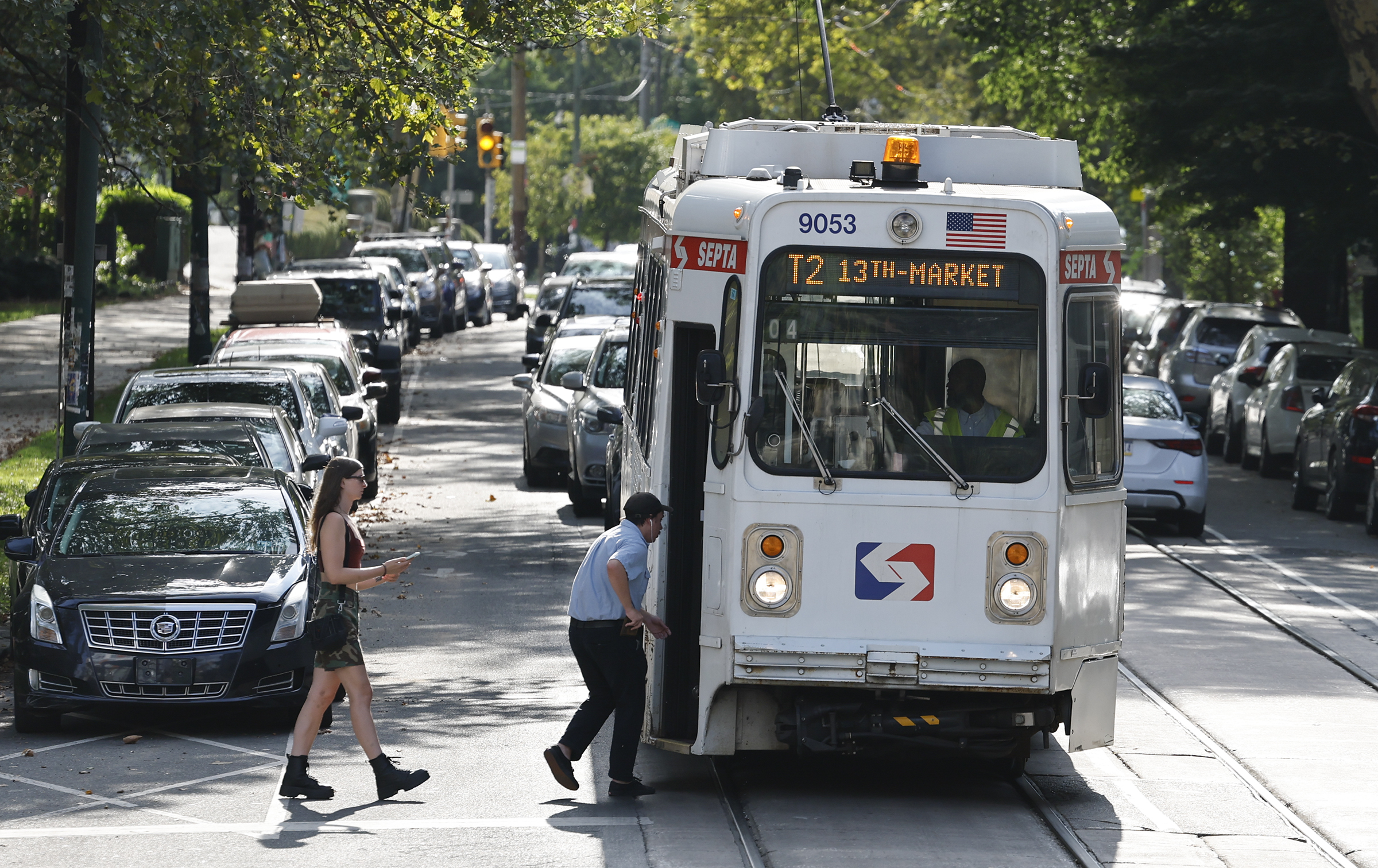
    Passengers board a SEPTA trolley along Baltimore Avenue in West Philadelphia.

    Trolley cams

    Over the last few years, Philadelphians have increasingly come under surveillance. Cameras enforce bus lane violations, issue speeding tickets, and help prevent and solve violent crime. Just this week, the Philadelphia Parking Authority announced it is now adding cameras to the city’s trolleys.

    This surge in surveillance has led to some residents bemoaning what they view as a cash grab. These worries were echoed last year by City Councilmember Jeffery “Jay” Young during a committee meeting in which he held up authorization for school zone cameras. Fortunately, these concerns are unwarranted.

    Our speed and red-light cameras are not designed to raise revenue. While camera systems in states like Illinois are used to pay for regular local government expenses, Pennsylvania’s are earmarked for traffic safety projects. Philadelphia is getting $13 million from the most recent distribution. This leaves politicians with little incentive other than to focus on safety and efficiency when choosing where and why to place the cameras. The system isn’t designed to take advantage of sudden speed traps, a problem that occurs with both automated and traditional traffic enforcement systems.

    Per a PPA spokesperson, 63% of vehicle owners who get a bus camera ticket don’t get a second one.

    In the case of the trolley cameras, it is also a question of basic fairness. If you ride the trolleys enough, you’ll eventually end up stuck. Almost always, it is because someone decided to inconvenience 20 to 40 people to avoid parallel parking or walking a short distance. While no one likes getting a ticket, motorists who opt to block trolleys should be happy with the fact that they aren’t being immediately towed.

    Candidates in the Democratic primary for Philadelphia’s 3rd Congressional District include, clockwise from upper left: State Sen. Sharif Street, State Rep. Chris Rabb, Ala Stanford, and State Rep. Morgan Cephas.

    Marquee matchup

    The race to replace U.S. Rep. Dwight Evans was always going to be close-fought. With the youthful Brendan Boyle occupying the city’s other congressional seat, this could be the best chance to represent Philadelphia in Washington, D.C., for decades. State Sen. Sharif Street (the son of former Mayor John F. Street) and State Rep. Morgan Cephas (who chairs the Philadelphia delegation in the state House) are both long-expected candidates for the job. They’ve been joined by progressive firebrand Chris Rabb, surgeon Ala Stanford, and a handful of other candidates with less funding and political support. For Southeast Pennsylvania politicos, it’ll have to do. There simply aren’t a lot of competitive races this year.

    In state Senate District 34, Towamencin Township Supervisor Kofi Osei is running against party-endorsed candidate Chris Thomas. There are also a couple of contested primaries for state House seats. That’s all, folks.

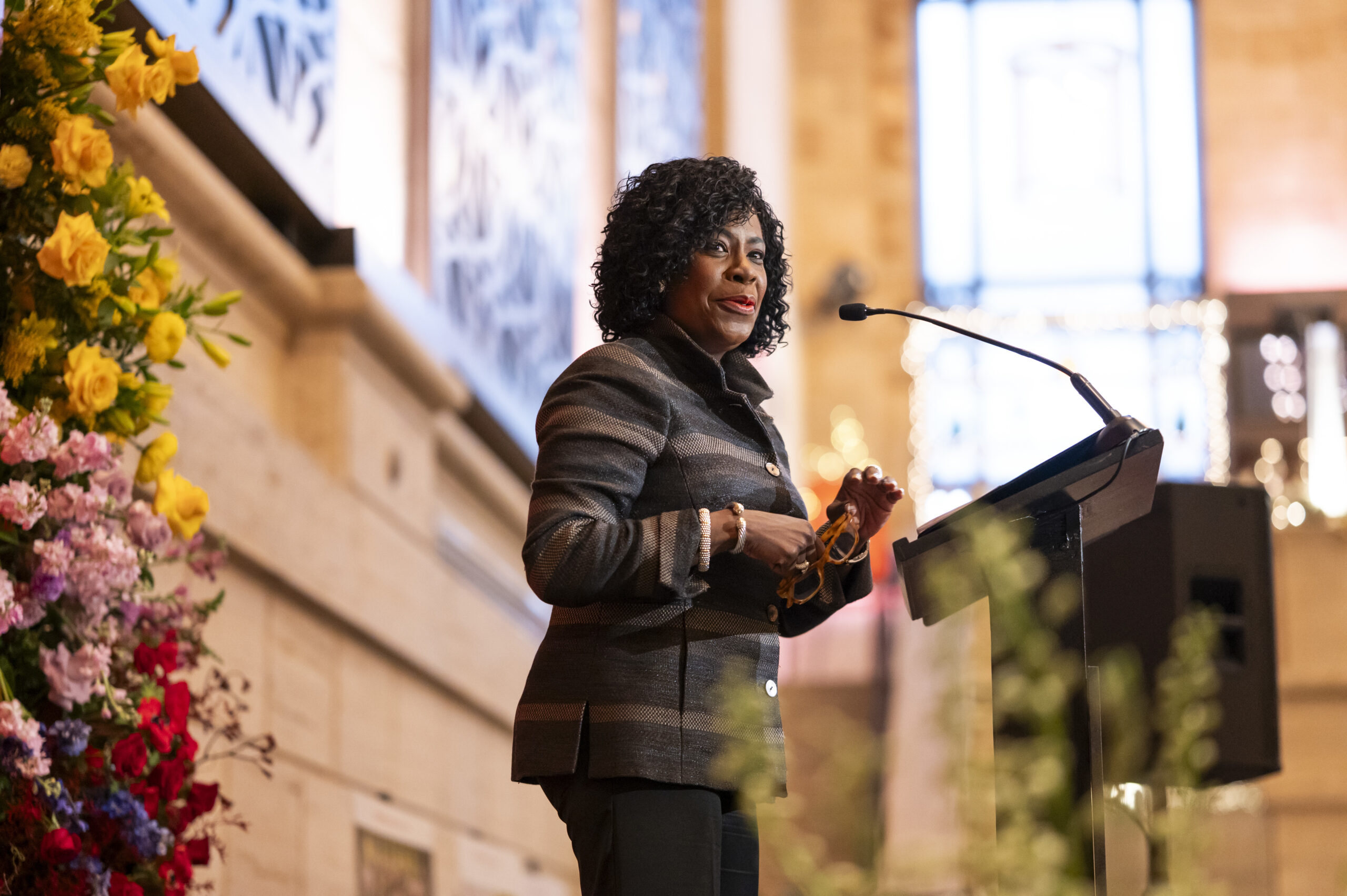
    Mayor Cherelle L. Parker delivers her keynote address at the Chamber of Commerce for Greater Philadelphia’s Annual Mayoral Luncheon, in February.

    Challengers needed

    Next year also looks fairly empty. While some progressive groups have polled residents to gauge the viability of defeating Mayor Cherelle L. Parker, few potential candidates appear eager to take her on. That’s perhaps not surprising. Only one Philadelphia mayor has failed to be reelected in the last 70 years. That includes W. Wilson Goode Sr., who bombed a city block during his first term, and Frank Rizzo, who failed a lie-detector test he himself had suggested.

    What the city really could use are more challengers for City Council seats. So far, I am aware of just one candidate, Jalon Alexander, who has put his hat in the ring. Alexander plans to challenge Young in the 5th District, citing capricious decision-making. But Young, while he may be the most egregious example, is not the only Council member who could use some competition.

    I expect the city’s progressive groups, like Reclaim Philadelphia and the Working Families Party, will eventually find candidates to challenge some of the weaker members, including Young, Cindy Bass, Nina Ahmad, and Jim Harrity. Last cycle, these groups organized around ideas, like rent control, that simply aren’t viable in Philadelphia.

    Despite being mostly frozen out by Council President Kenyatta Johnson and their colleagues, the current progressive delegation has been somewhat unwilling to challenge that body’s status quo. While Councilmember Kendra Brooks voted against a ban on safe injection sites, and Rue Landau voted against one of Young’s ill-considered moves, the city could use at least one councilmember who is willing to consistently challenge their colleagues’ bad decisions.

    Pennsylvania Gov. Josh Shapiro is seen after a B’nai B’rith Youth Organization International Convention on Feb. 12 in Philadelphia.

    Security snafu

    We call Gov. Josh Shapiro the Ambitious Abingtonian here for a reason. The governor is a hard-charging, elbows-up politician who has turned many friends into enemies over the years. Republicans seem to believe they have finally found a weakness in Shapiro’s political armor: the decision to spend taxpayer money to secure his home in Abington, and the seizure of a small strip of adjoining land that accompanied it. State Sen. Tracy Pennycuick, who represents western Montgomery County and eastern Berks County, even opined that Shapiro “put his family at a higher level of risk” by moving them home instead of to a bunker after the April arson attack at the governor’s mansion.

    Of course, the Shapiros just survived an attempted assassination. Let’s be human beings for one second. Shapiro’s shell-shocked children deserved to sleep in familiar settings.

    If Republicans want spending decisions to critique, they should start with Shapiro’s reliance on an opaque group called Team PA to pay for everything from travel to sporting events instead.

  • Self-funding physicians, candidates trying to keep up, and a frontrunner: Inside the money race for a Philly congressional seat

    Self-funding physicians, candidates trying to keep up, and a frontrunner: Inside the money race for a Philly congressional seat

    State Sen. Sharif Street maintained his financial advantage. Physicians Ala Stanford and David Oxman have turned to self-funding their campaigns. And State Reps. Chris Rabb and Morgan Cephas are low on cash — but one might be getting help soon.

    The crowded Democratic primary for Pennsylvania’s 3rd Congressional District is beginning to come into focus after the candidates this weekend filed new campaign finance reports. The filings cover the last three months of 2025, providing insights into the candidates’ resources as the campaign heats up.

    window.addEventListener(“message”,function(a){if(void 0!==a.data[“datawrapper-height”]){var e=document.querySelectorAll(“iframe”);for(var t in a.data[“datawrapper-height”])for(var r,i=0;r=e[i];i++)if(r.contentWindow===a.source){var d=a.data[“datawrapper-height”][t]+”px”;r.style.height=d}}});

    Fundraising will not be the only factor that determines the outcome of the May primary election, which will ultimately be decided by voters. But the 3rd District candidates need money to pay staff and buy advertisements to spread their message, and the beginning of an election year is often a pivotal time for campaigns to prove their viability.

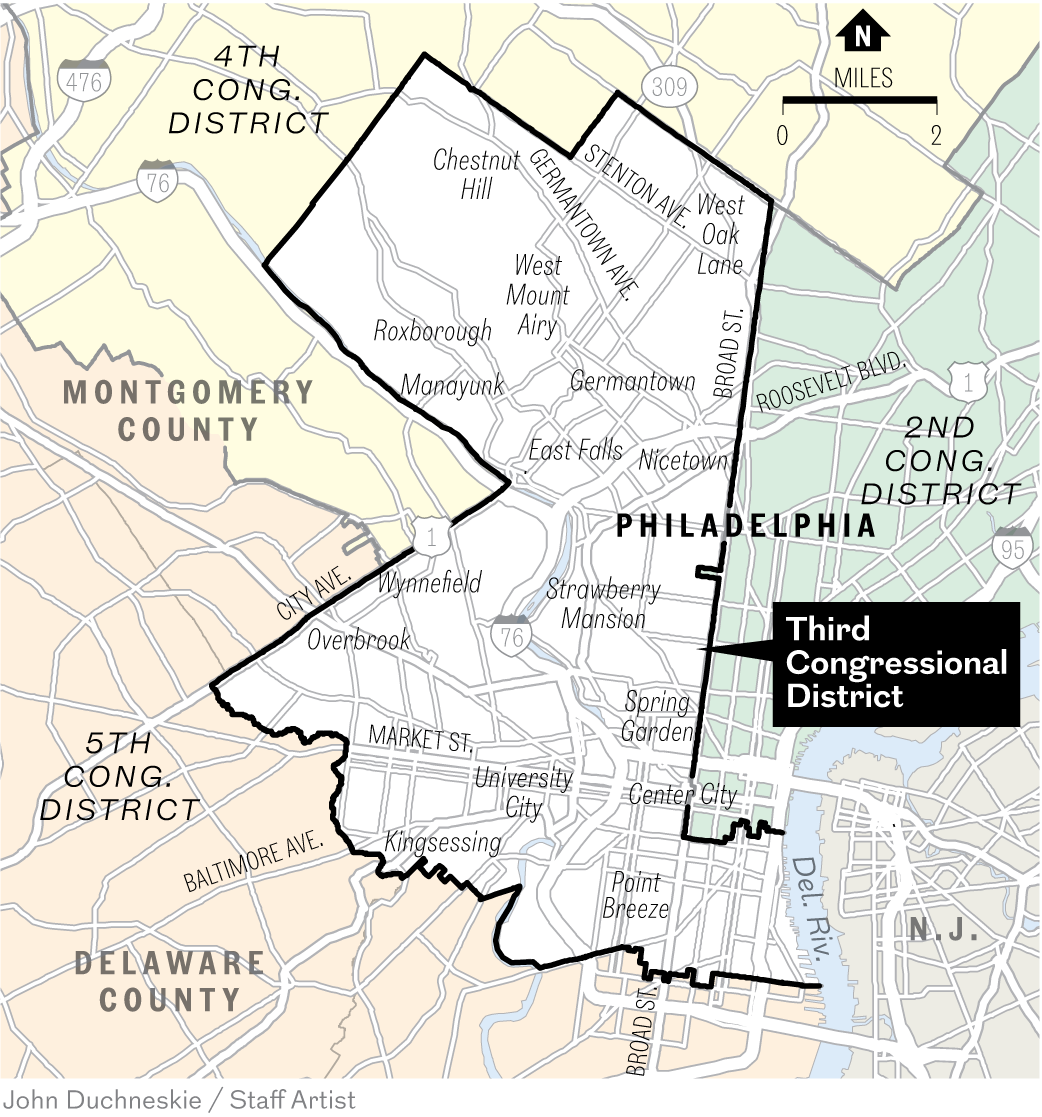
    Map of Pennsylvania’s 3rd Congressional District.

    After U.S. Rep. Dwight Evans (D., Philadelphia) last year announced he would not seek reelection to the nation’s bluest district, more than a dozen candidates tossed their hats in the ring. It’s likely some will not stay in the race long enough to appear on the May 19 primary ballot.

    The 3rd District includes all of Northwest and West Philadelphia, as well as parts of Center City and North, South, and Southwest Philadelphia.

    Sharif Street continues to rake in cash

    Street, a former chair of the Pennsylvania Democratic Party and the son of former Mayor John F. Street, continues to use his connections to his advantage when it comes to fundraising.

    Street led the field by raising about $347,000 from Oct. 1 to Dec. 31 of last year, according to his report. His campaign spent $193,000 during that period, and he had $527,000 in cash on hand at the start of 2026.

    window.addEventListener(“message”,function(a){if(void 0!==a.data[“datawrapper-height”]){var e=document.querySelectorAll(“iframe”);for(var t in a.data[“datawrapper-height”])for(var r,i=0;r=e[i];i++)if(r.contentWindow===a.source){var d=a.data[“datawrapper-height”][t]+”px”;r.style.height=d}}});

    Campaign manager Josh Uretsky said Street’s fundraising totals “demonstrate that our strong track record of progressive leadership — from lowering health care costs to leading the fight to legalize recreational cannabis and reform our justice system — is resonating in every corner of the district.”

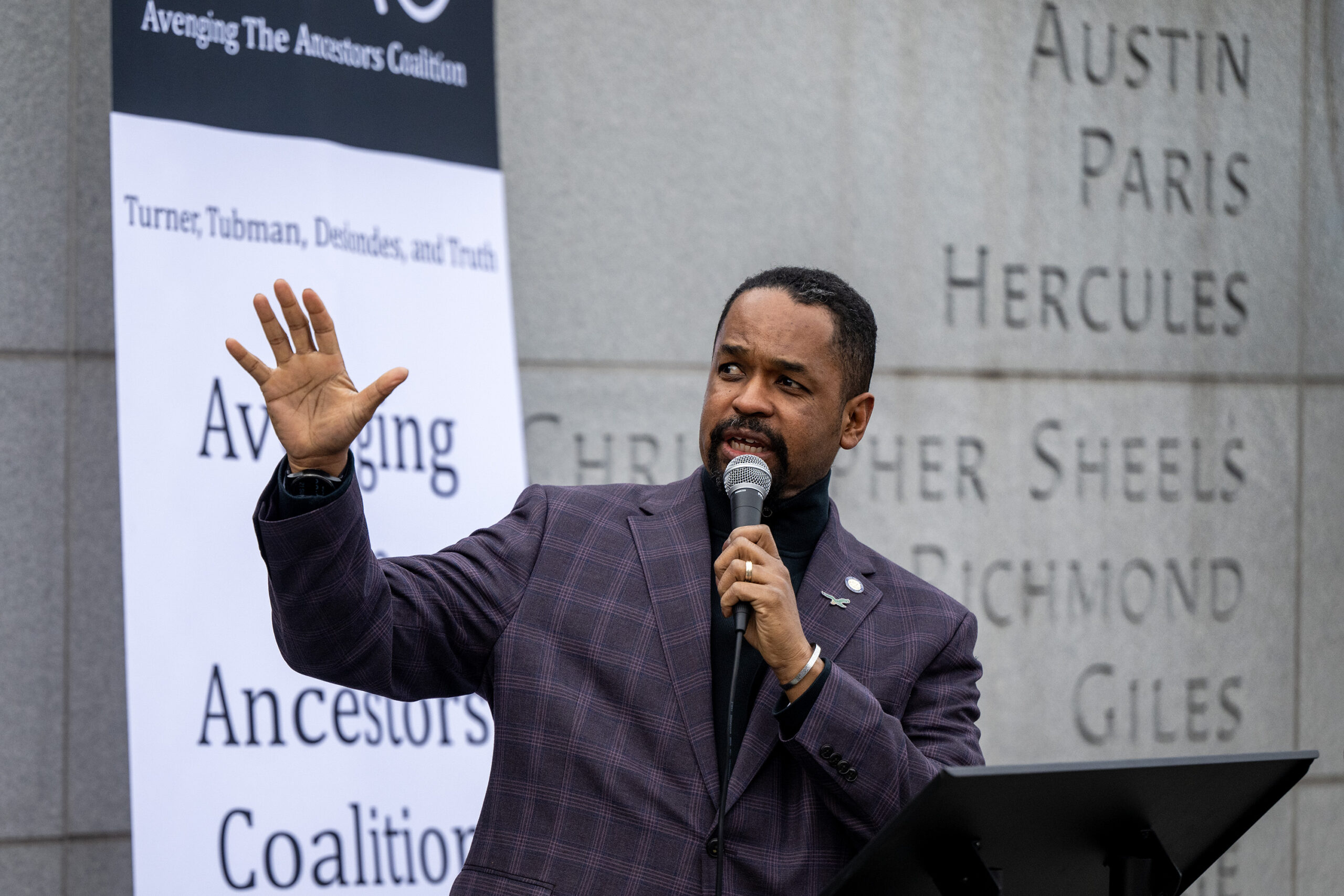
    State Sen. Sharif Street speaks in front ofthe engraved names of nine enslaved people who lived and worked at President George Washington’s home, as the 15th anniversary of the President’s House exhibit in Independence National Historical Park is celebrated Sunday, Dec. 21, 2025.

    Street has benefited from contributions from the deep-pocketed building trades unions, which endorsed him last fall. In the past, those unions have also funded outside spending committees, or super PACs, to support their preferred candidates, and it’s likely they’ll do the same for Street this spring.

    Street collected more than $40,000 from labor groups in the most recent reporting period.

    First-time candidates Ala Stanford and David Oxman turn to self-funding

    Last month, it appeared that Stanford, a pediatric surgeon, was raking in cash when her campaign released a statement saying she had raised more than $467,000, a significant haul for a first-time candidate. The campaign said at the time that her fundraising prowess “solidifies [her] leading role” in the race.

    But it turns out that more than half of the money the campaign brought in came from Stanford herself. The new report showed that Stanford lent her campaign $250,000 on Dec. 31, the last day of the reporting period, bringing her total cash on hand to about $392,000 at the end of the year.

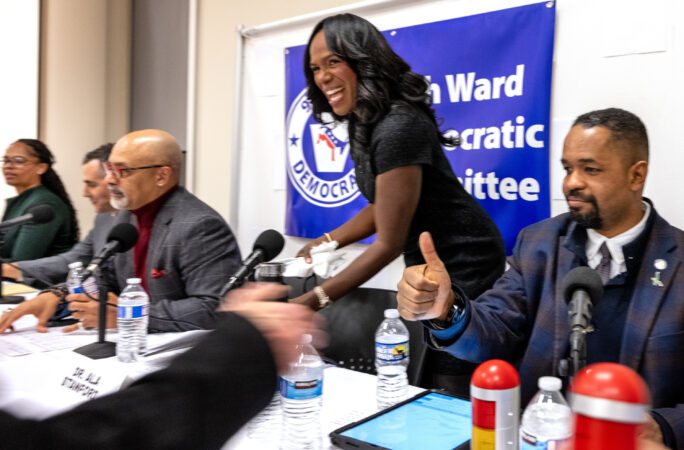
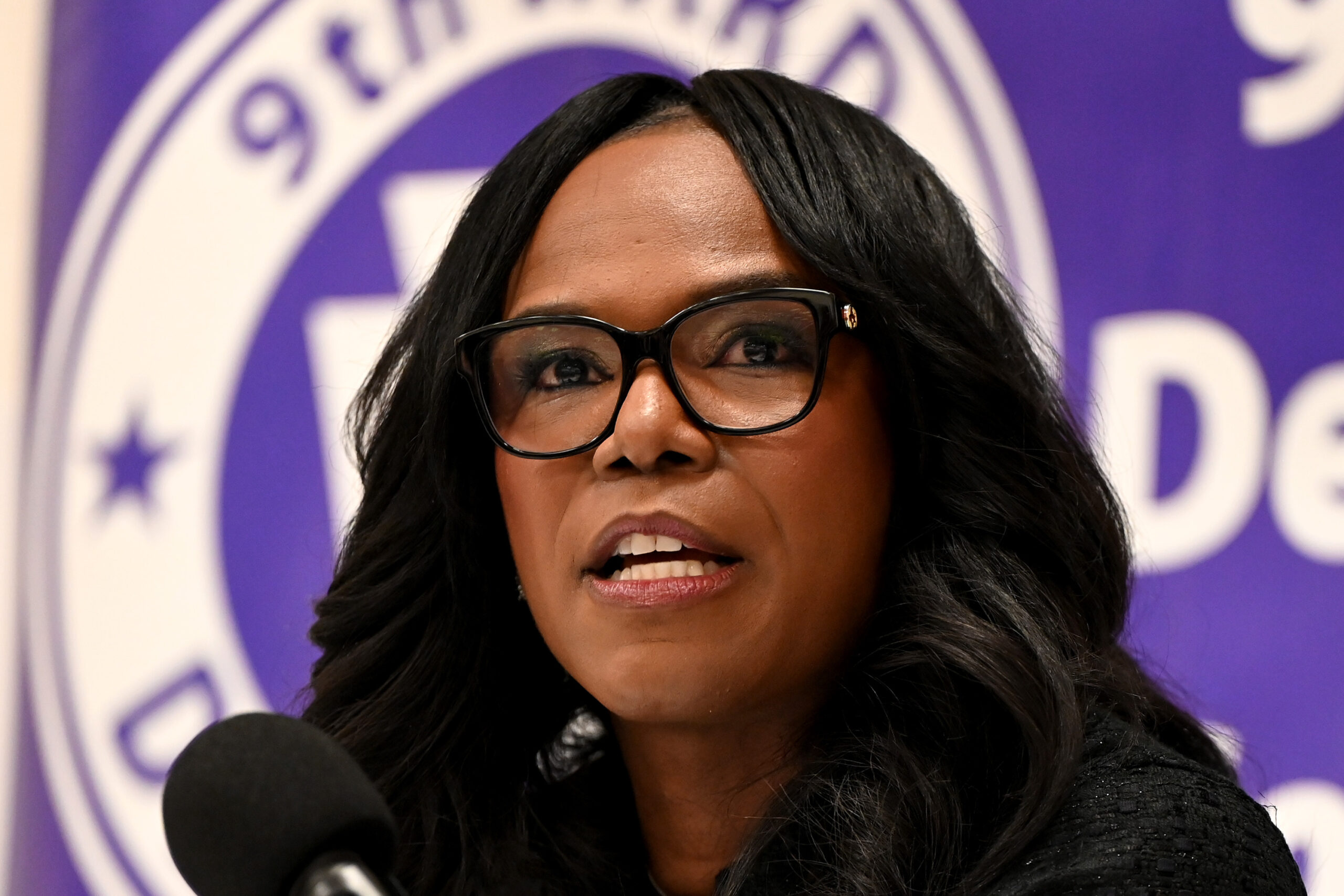
    Physician Ala Stanford at a forum hosted by the 9th Ward Democratic Committee Dec. 4, 2025.

    In a statement Monday, Stanford emphasized her humble upbringing in North Philadelphia public housing, saying she “never imagined being in this position, but this city has given me so much.”

    Her campaign noted that she also invested her own money in her nonprofit organization, the Black Doctors Consortium, to bolster the city’s COVID-19 testing and vaccination programs during the height of the pandemic.

    “I’ve stood up and led during a crisis before — and spent my own money to do it — so I’m going do whatever it takes to fight for our city,” Stanford said. “I’m incredibly grateful that in just the first few months of our campaign, that commitment has been matched with amazing grassroots financial support, too, and we’re just getting started.”

    Stanford is not the only doctor self-funding their congressional campaign. Oxman, another political outsider and physician, brought in just over $107,000 between October and December — including $75,000 that he lent to his own campaign.

    Oxman, an intensive-care physician and professor at Thomas Jefferson University, has lent his campaign $175,000. At the end of the year, he had $357,000 in the bank.

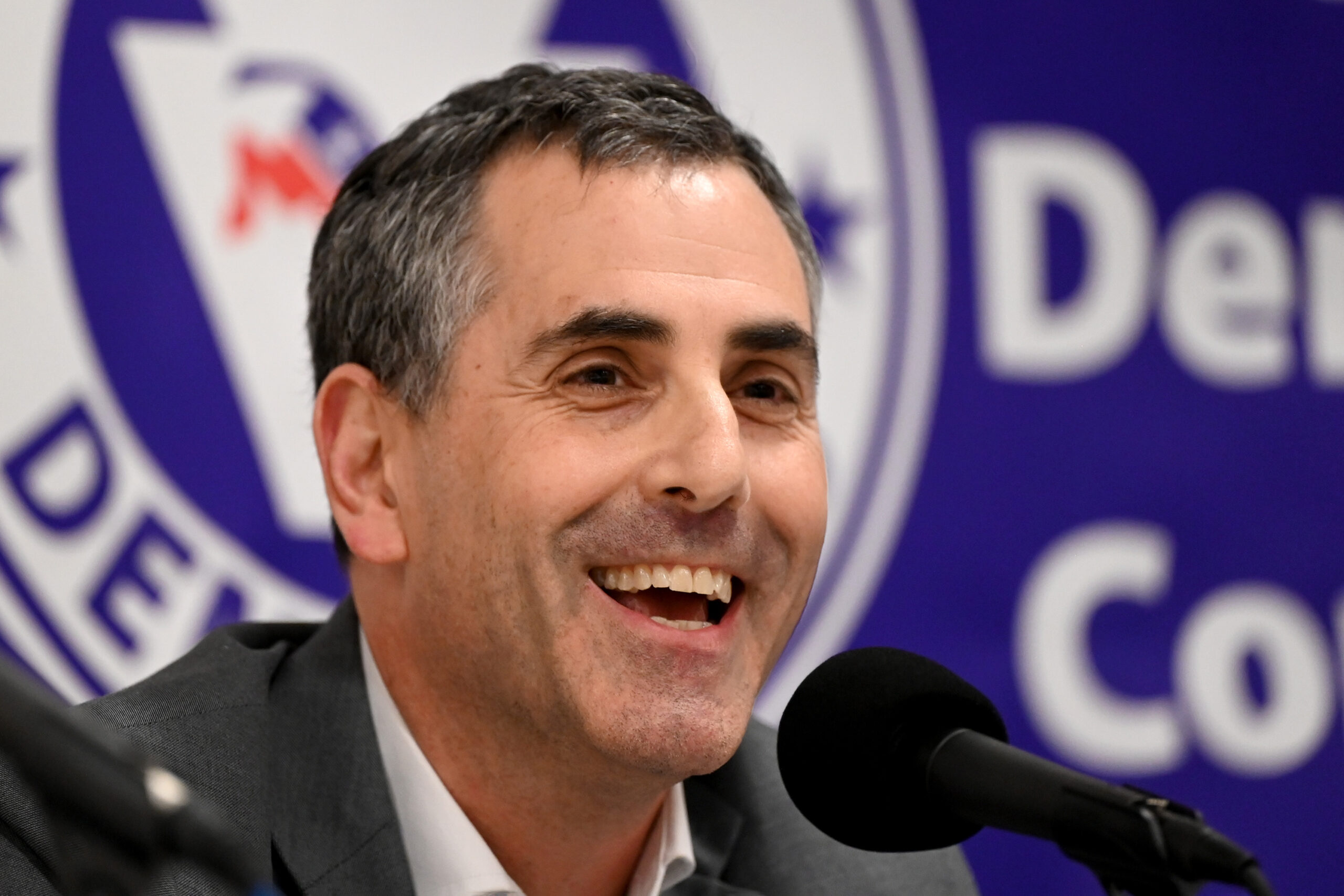
    Physician David Oxman at a forum hosted by the 9th Ward Democratic Committee Dec. 4, 2025.

    In a press release Sunday, Oxman emphasized that he was not accepting corporate PAC donations.

    “You cannot fight for the health of the people of the 3rd district while you are taking money from nursing home companies and health insurance PACs,” Oxman said. “The corporatization of medicine is just a piece of a larger corporatization of American life that is hollowing out our economy as well as our democracy.”

    Chris Rabb and Morgan Cephas enter 2026 low on cash

    Both Cephas and Rabb raised less money in the fourth quarter of 2025 than in the opening months of their campaigns, and they both closed the year with roughly $100,000 in cash on hand.

    Cephas raised about $85,000 in the last three months of 2025. She collected $156,000 in the previous quarter, despite joining the race in September shortly before the filing deadline.

    Cephas, who represents a West Philadelphia district and chairs the city’s delegation to the Pennsylvania House, entered the year with about $109,000 in cash on hand.

    State Rep. Morgan Cephas at a news conference Sept. 3, 2025.

    “The residents of the 3rd Congressional District are more concerned with the skyrocketing cost of living, fewer health care options, and making sure their communities are safe than who raised the most money,” Cephas campaign manager Salvatore Colleluori said. “Rep. Cephas has only one priority in this race, the residents of Philadelphia’s 3rd Congressional District.”

    Similarly, Rabb, a progressive who represents part of Northwest Philly, took in $127,000 in the latest reporting period despite previously raising $257,000. He had $99,000 in the bank on Jan. 1.

    “I’m incredibly proud of the thousands of people in Philly and across the country fueled by a movement so much bigger than electoral politics,” Rabb said. “Our momentum is undeniable. We always knew we wouldn’t outraise the corporate-backed and self-funded campaigns — and we don’t need to.”

    Pablo McConnie-Saad, a 39-year-old South Philly resident who worked in Biden’s administration, entered the race to represent Pennsylvania’s 3rd Congressional District.

    Meanwhile, Pablo Iván McConnie-Saad — a Bella Vista resident who worked in Delaware politics before serving in the Treasury Department under former President Joe Biden — brought in a fundraising haul similar to the sitting state representatives last quarter despite his campaign largely flying under the radar.

    McConnie-Saad collected $119,000 in contributions last quarter, and he had $69,000 on hand at the start of the year.

    In a statement, campaign field director Matt Cárdenas said McConnie-Saad offered voters a “different choice.”

    “This campaign is entirely people-powered,” he said. “No corporate PAC money, no AIPAC, just everyday people investing in a different kind of politics. We’re proud of what we’ve built so far. Politicians have failed us, and Washington won’t change unless we challenge it.”

    Rabb may get outside help from progressive groups

    Despite his weak fundraising totals, there may be good news around the corner for Rabb, a progressive who is starting to see left-leaning political groups coalesce around his candidacy.

    The Democratic Socialists of America’s Philadelphia chapter recently endorsed him, as did two liberal wards in South Philadelphia. And Reclaim Philadelphia leaders are recommending that its members back Rabb in the progressive group’s internal endorsement process.

    The Working Families Party of Pennsylvania, which often funds super PACs to back left-leaning candidates, has not yet weighed in.

    Candidates (from left) State Reps. Morgan Cephas, and Chris Rabb; and physician David Oxman appear at a forum hosted by the 9th Ward Democratic Committee in Mt. Airy Thursday, Dec. 4, 2025.

    “We’re still going through an active endorsement process, but we’re confident that we will land on a progressive who will fight for working people, not billionaire donors, big corporations, or special interests,” said Nick Gavio, a spokesperson for the party.

    Additionally, the Justice Democrats, a national group founded by operatives from Bernie Sanders’ presidential campaign, may also get involved. In the past, the PAC has backed candidates with similar platforms to Rabb’s.

    Justice Democrats “will likely come to a decision with news to share in the very near future in support of a candidate we can be confident will represent the values of the everyday people in this district,” spokesperson Usamah Andrabi said.

    Data reporter Joe Yerardi contributed to this article.

  • ICE tactics in Minneapolis set off political firestorm from Philadelphia City Hall to Washington

    ICE tactics in Minneapolis set off political firestorm from Philadelphia City Hall to Washington

    In Philadelphia, lawmakers on Tuesday unveiled legislation that would institute some of the nation’s toughest limits on federal immigration-enforcement operations.

    In Harrisburg, a top Democrat floated making Pennsylvania a so-called sanctuary state to protect undocumented immigrants.

    And in Washington, senators faced mounting pressure to hold up funding for the Department of Homeland Security, an effort that could result in a government shutdown by the end of the week.

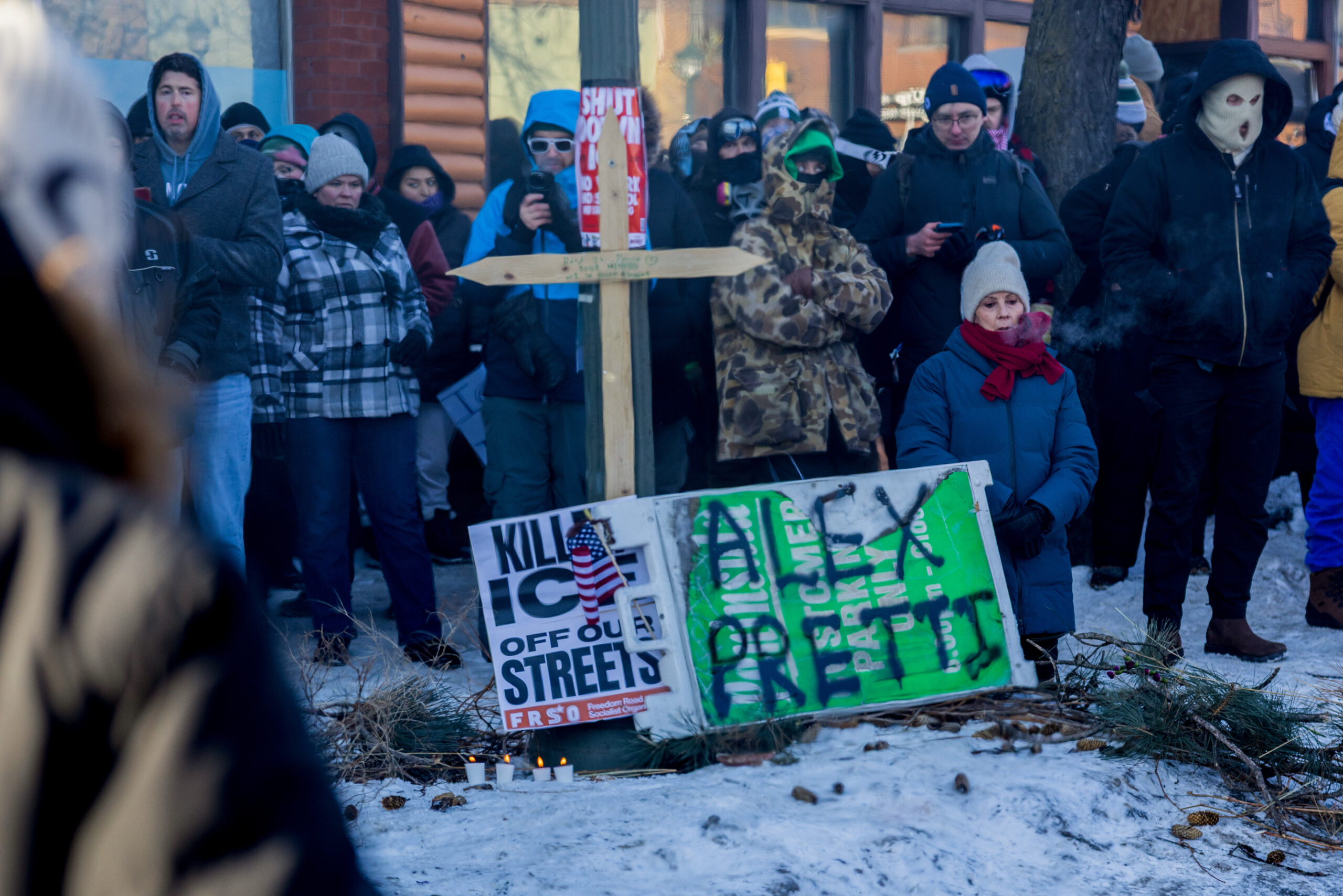
    Across the nation, lawmakers are fielding calls to rein in U.S. Immigration and Customs Enforcement after President Donald Trump’s administration surged forces into Minneapolis as part of his aggressive nationwide deportation campaign. Frustration with the agency reached new heights Saturday after agents fatally shot protester Alex Pretti, the second killing of a U.S. citizen there this month.

    Democrats nationwide slammed ICE and called on Trump to pull the forces out of Minnesota. Sen. John Fetterman, the Pennsylvania Democrat who has at times sided with Trump on immigration matters, said DHS Secretary Kristi Noem should be fired.

    Anti-ICE activists demonstrate outside U.S. Sen. John Fetterman’s Philadelphia office on Monday, calling for an end to federal immigration enforcement policies.

    But Fetterman has also said he will not vote to shut down the government. That angered protesters, who rallied on Tuesday outside his Philadelphia office. Some of the senator’s fellow Democrats, including members of Pennsylvania’s U.S. House delegation, urged him to vote against a bill to fund DHS.

    A growing number of Republicans have also signaled their discomfort with the Minneapolis operation, including Trump allies who called on members of the administration to testify before Congress. Sen. Dave McCormick, a Pennsylvania Republican, has called for an independent investigation into Pretti’s killing.

    Trump, for his part, showed some willingness to change course, sending border czar Tom Homan to Minneapolis to meet with Democratic leaders there. The president on Tuesday called Pretti’s death a “very sad situation.”

    Rue Landau shown here during a press conference at City Hall to announce a package of bills aimed at pushing back against ICE enforcement in Philadelphia on Tuesday.

    However, a chorus of Democrats and activists said Tuesday that the agency needs to change its tactics and be held accountable for missteps. And local leaders said they are laying out plans in case a surge of immigration enforcement comes to Philadelphia, home to an estimated 76,000 undocumented immigrants.

    “We have spent hours and hours and hours doing tabletop exercises to prepare for it,” Gov. Josh Shapiro, a Democrat, said during a Monday night interview on The Late Show with Stephen Colbert.

    Shapiro, who is running for reelection and is a rumored presidential contender, added: “I want the good people of Pennsylvania to know — I want the American people to know — that we will do everything in our power to protect them from the federal overreach.”

    Codifying sanctuary policies

    Philadelphia officials said the best way they can prepare is by limiting the city’s cooperation with federal immigration enforcement.

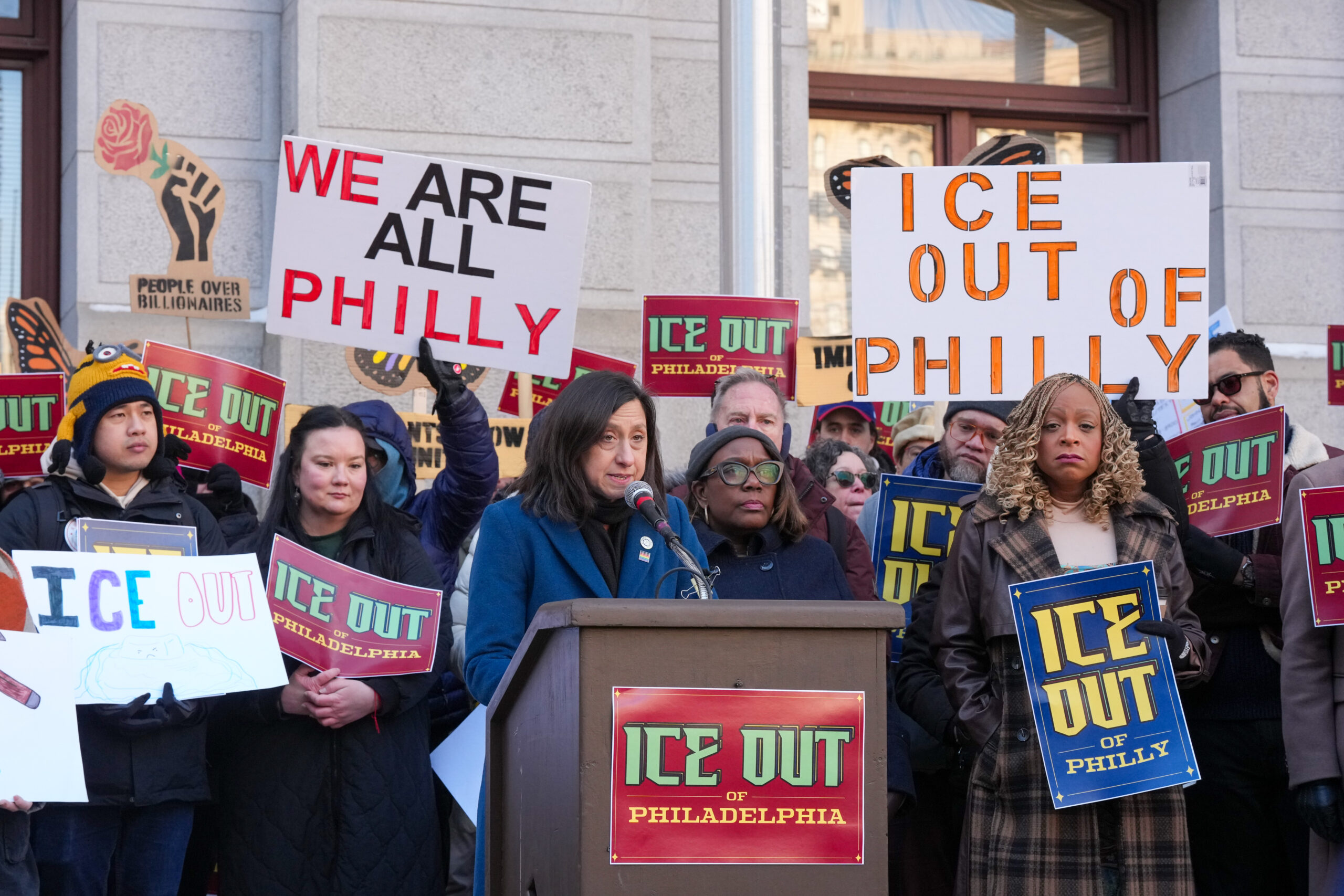
    City Councilmember Kendra Brooks, of the progressive Working Families Party, and Councilmember Rue Landau, a Democrat, were joined by dozens of activists and other elected officials during a news conference Tuesday to unveil a package of legislation aimed at codifying into law the city’s existing “sanctuary city” practices.

    Those policies, which are currently executive orders, bar city officials from holding undocumented immigrants in custody at ICE’s request without a judicial warrant.

    Landau and Brooks’ legislative package, expected to be introduced in Council on Thursday, goes further, preventing ICE agents from wearing masks, using city-owned property for staging raids, or accessing city databases.

    Erika Guadalupe Núñez, executive director of immigrant advocacy organization Juntos, said the legislation “goes beyond just ‘We don’t collaborate.’”

    Juntos gets regular calls about ICE staging operations at public locations in and around Philadelphia, and people have been worried, despite official assurances, whether personal information held by the city will be secure from government prying.

    “We deserve a city that has elected leadership that’s willing to step forward with clear and stronger protections,” Núñez said.

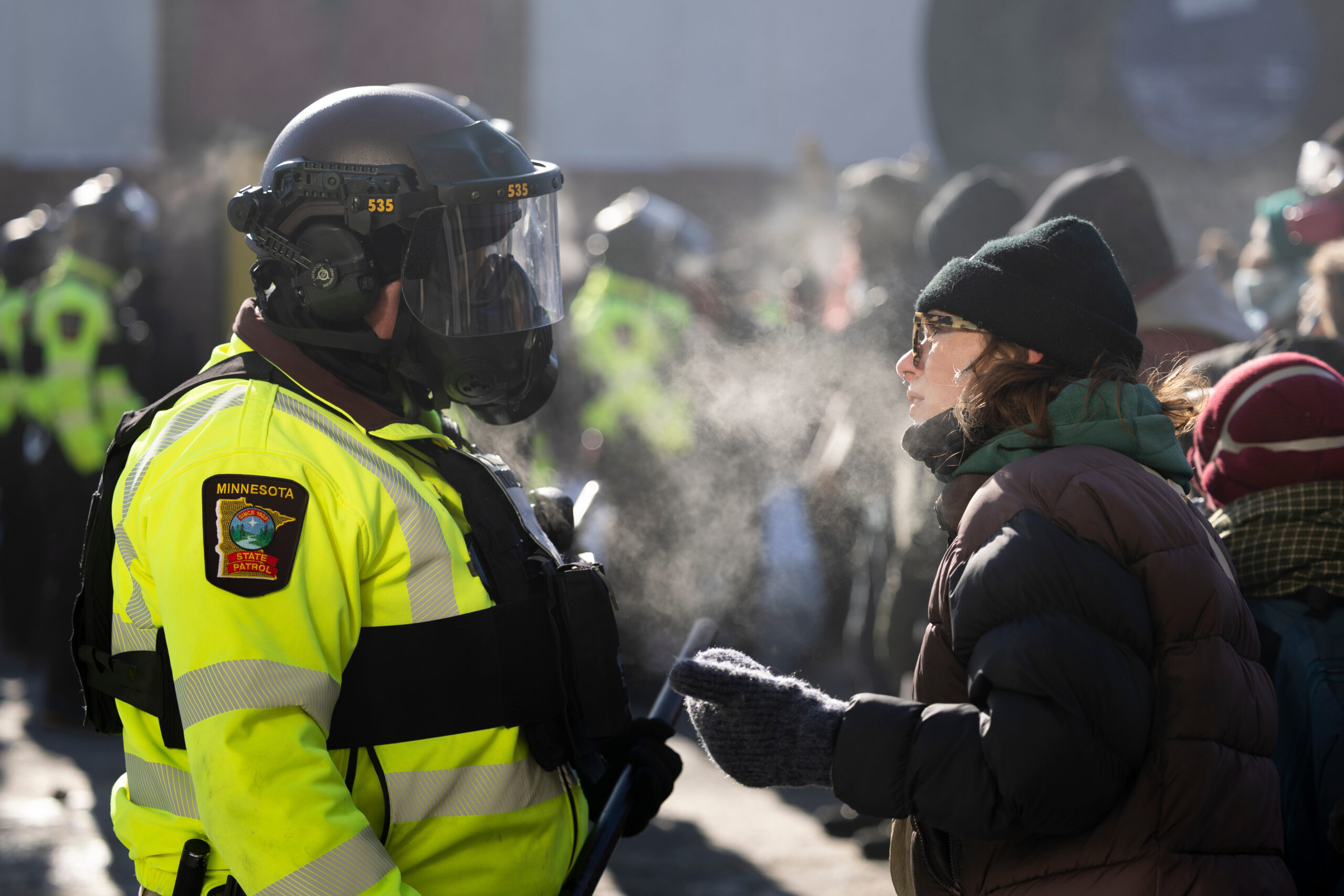
    A protester speaks to a Minnesota State Patrol officer near the site of the fatal shooting of 37-year-old Alex Pretti by federal agents in Minneapolis on Saturday.

    If the legislation is approved, Philadelphia would have some of the most stringent protections for immigrants in the country.

    Oregon has especially strong restrictions against cooperation with federal immigration authorities, including barring local law enforcement from detaining people or collecting information on a person’s immigration status without a judicial warrant.

    In Illinois, local officers “may not participate, support, or assist in any capacity with an immigration agent’s enforcement operations.” They are also barred from granting immigration agents access to electronic databases or to anyone in custody.

    California, New York, Colorado, Vermont — and individual jurisdictions in those states — also provide strong protections for immigrants.

    In New Jersey, Gov. Mikie Sherrill, a Democrat who was sworn in last week, has kept the state’s sanctuary directive in place as lawmakers seek to expand and codify the policy into law. Legislators came close in the final days of former Gov. Phil Murphy’s administration, but he killed a related bill that had won approval in Trenton, saying he worried that enacting a law that included changes to the state’s current policy would invite new lawsuits.

    Meanwhile, some conservatives say bolstering sanctuary policies risks community safety.

    “If an illegal immigrant breaks the law, they should be dealt with and handed over to federal law enforcement, not be released back into our neighborhoods to terrorize more victims and commit more crime,” said James Markley, a spokesperson for the Pennsylvania Republican Party.

    He added: “Sanctuary policies don’t protect communities, they endanger all of us by shielding criminals from accountability for their crimes.”

    Democrats are taking varying approaches

    The widespread outrage over ICE’s tactics in Minneapolis has exposed sharp divisions in elected Democrats’ responses.

    On one end of the party’s ideological spectrum is Fetterman, who has said often that he will not bow to activist demands and strongly opposes shutting down the federal government, even if it means funding DHS.

    On the other end is District Attorney Larry Krasner, Philadelphia’s most prominent progressive, who has on several occasions threatened to file criminal charges against ICE agents who commit crimes in the city.

    “There will be accountability now. There will be accountability in the future. There will be accountability after [Trump] is out of office,” Krasner said Tuesday. “If we have to hunt you down the way they hunted down Nazis for decades, we will find your identities.”

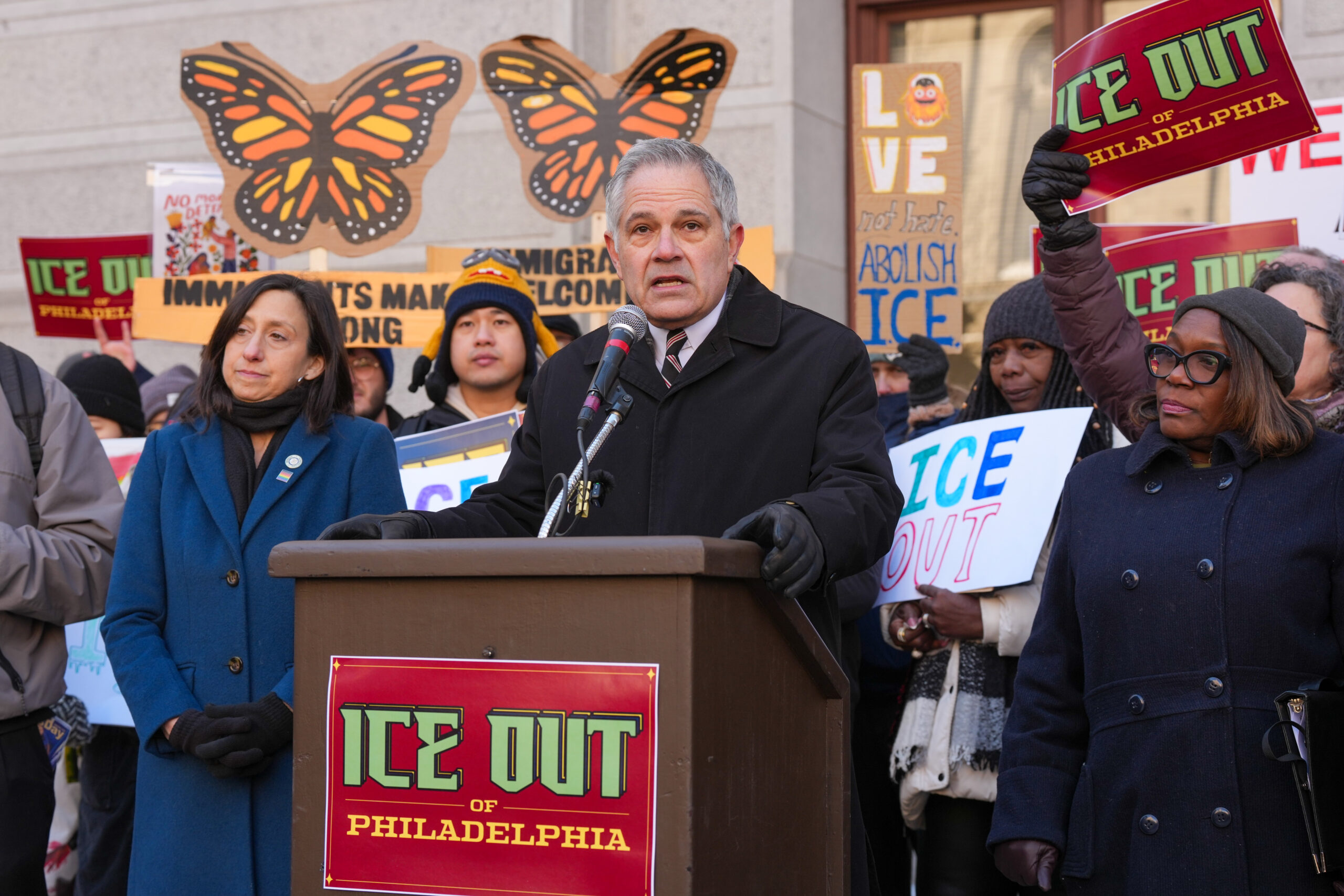
    District Attorney Larry Krasner speaks during a news conference at City Hall on Tuesday to announce a package of bills aimed at pushing back against ICE enforcement in Philadelphia.

    Somewhere in the middle is State Sen. Sharif Street, a Philadelphia Democrat and former head of the state party who is running for Congress.

    Street does not have Krasner’s bombast, but this week he announced plans to introduce legislation to prevent state dollars from funding federal immigration enforcement. The bill has less of a chance of becoming law in Pennsylvania’s divided state legislature than similar measures would in Philadelphia, where City Council is controlled by a supermajority of Democrats.

    “Who knows the amount of money that the state could incur because of Trump’s reckless immigration policies?” Street said in an interview Tuesday. “I don’t think state taxpayers should be paying for Donald Trump’s racist, reckless policies.”

    The city’s most prominent Democrat — Mayor Cherelle L. Parker — has perhaps said the least.

    The centrist Democrat has largely avoided outwardly criticizing Trump or his administration, saying often that she is focused on carrying out her own agenda.

    The mayor’s critics have said her approach is not responsive to the city’s overwhelmingly Democratic residents.

    “To the people of Philadelphia, I want to say: I hear you. You want ICE out of our city, and you want your local government to take action,” Brooks, the Council member, said Tuesday. “Some people believe that silence is the best policy when dealing with a bully, but that’s never been an option for me.”

    Kendra Brooks shown here during a news conference at City Hall on Tuesday to announce a package of bills aimed at pushing back against ICE enforcement in Philadelphia.

    Others say Parker’s conflict-averse strategy is appropriate.

    “All of us have different roles to play,” Street said. “The mayor has to manage the city. She’s got to command law enforcement forces. … As a state legislator, we make policy.”

    Rafael Mangual, a fellow who studies urban crime and justice at the right-leaning Manhattan Institute in New York City, said legislative efforts to erect barriers between federal and local law enforcement could backfire.

    “If you don’t engage at all, and you do something that seems to actively frustrate the federal government,” Mangual said, “that would seem to be an invitation for the federal government to prioritize a city like Philadelphia.”

    Staff writers Alfred Lubrano, Aliya Schneider, and Gillian McGoldrick contributed to this article.

  • Philly lawmakers want to restrict cooperation with ICE and ban agents from wearing masks

    Philly lawmakers want to restrict cooperation with ICE and ban agents from wearing masks

    Philadelphia lawmakers are set to consider legislation that would make it harder for ICE to operate in the city, including limiting information sharing, restricting activity on city-owned property, and prohibiting agents from concealing their identities.

    Among the package of bills set to be introduced Thursday is an ordinance that effectively makes permanent Philadelphia’s status as a so-called “sanctuary city” by barring city officials from holding undocumented immigrants at ICE’s request without a court order. Another bans discrimination based on immigration status.

    Two City Council members are expected to introduce the legislation as U.S. Immigration and Customs Enforcement is facing mounting national scrutiny over its tactics in Minneapolis, where federal agents fatally shot two U.S. citizens this month.

    Councilmembers Rue Landau, a Democrat, and Kendra Brooks, of the progressive Working Families Party, said in an interview that the violence in Minneapolis hardened their resolve to introduce legislation to protect a population that includes an estimated 76,000 undocumented immigrants in Philadelphia.

    “It’s been very disheartening and frightening to watch ICE act with such lawlessness,” Landau said. “When they rise to the level of killing innocent civilians, unprecedented murders … this is absolutely the time to stand up and act.”

    The package of a half-dozen bills is the most significant legislative effort that Council has undertaken to strengthen protections for immigrants since President Donald Trump took office last year on a promise to carry out a mass deportation campaign nationwide.

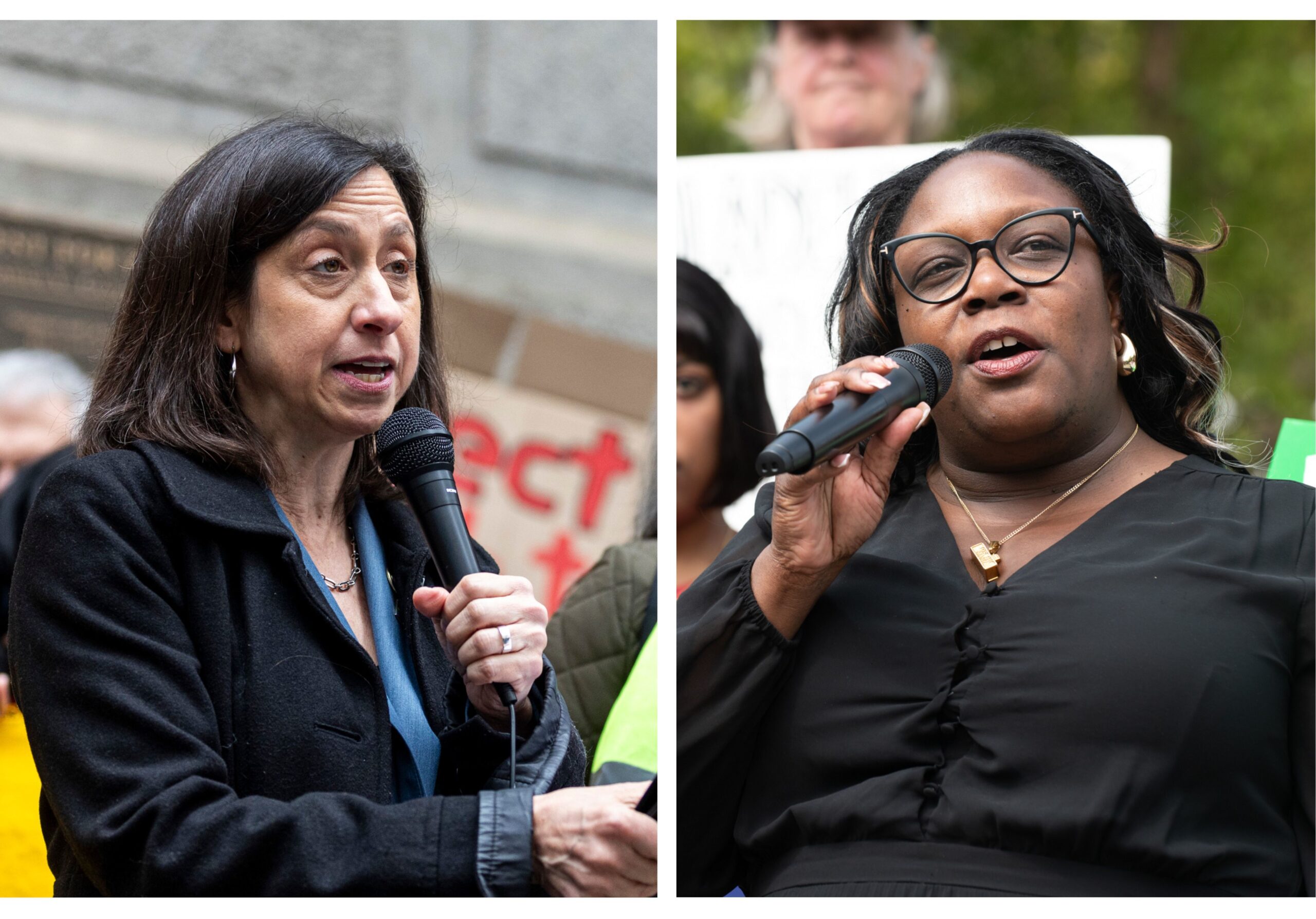
    Left: City Councilmember Rue Landau. Right: City Councilmember Kendra Brooks. Landau and Brooks are introducing legislation this week to make it harder for ICE to operate in Philadelphia, including by limiting city cooperation with the agency.

    ICE spokespeople did not immediately reply to a request for comment.

    Jasmine Rivera, executive director of the Pennsylvania Immigration Coalition, said it’s not the job nor the jurisdiction of the city to enforce federal law.

    The goal of the legislation, Rivera said, is ensuring that “not a single dime and single second of our local resources is being spent collaborating with agencies that are executing people.”

    Activists have for months urged Mayor Cherelle L. Parker to formally affirm her commitment to the city’s sanctuary status. Top city officials say an executive order signed by the former mayor to limit the city’s cooperation with ICE remains in place.

    But Parker, a centrist Democrat, has taken a quieter approach than her colleagues in Council, largely avoiding criticizing the Trump administration outwardly and saying often that she is focused on her own agenda.

    Now, the mayor could be forced to take a side. If City Council passes Landau and Brooks’ legislation this spring, Parker could either sign the bills into law, veto them, or take no action and allow them to lapse into law without her signature. She has never vetoed a bill.

    Joe Grace, a spokesperson for Parker, declined to comment on the legislation.

    Mayor Cherelle L. Parker speaks at a news conference earlier this month. It is unclear how she will act on upcoming legislation related to ICE operations in Philadelphia.

    It’s unclear what fate the ICE legislation could meet in Council. The 17-member body has just one Republican, but Parker holds influence with many of the Democrats in the chamber.

    City Council President Kenyatta Johnson, a Democrat who controls the flow of legislation, has not taken a position on the package proposed by Landau and Brooks.

    But he said in a statement that “Philadelphia has long positioned itself as a welcoming city that values the contributions of immigrants and strives to protect their rights and safety.”

    “I have deep concerns about federal ICE actions directed by President Donald Trump’s administration that sow fear and anxiety in immigrant communities,” Johnson said, “underscoring the belief that enforcement practices should be lawful, humane, and not undermine trust in public safety.”

    Making sanctuary status the law

    Border Patrol and ICE are both federal immigration agencies, which are legally allowed to operate in public places and subject to federal rules and regulations. Some cities and states — not including Pennsylvania and New Jersey — actively cooperate with ICE through written agreements.

    Since 2016, Philadelphia has operated under an executive order signed by former Mayor Jim Kenney, which prohibits city jails from honoring ICE “detainer requests,” in which federal agents ask the city to hold undocumented immigrants in jail for longer than they would have otherwise been in custody to facilitate their arrest by federal authorities.

    Undocumented immigrants are not shielded from federal immigration enforcement, nor from being arrested and charged by local police for local offenses.

    Some refer to the noncooperation arrangement as “sanctuary.” As the term “sanctuary cities” has become politically toxic, some local officials — including in Philadelphia — have backed away from it, instead declaring their jurisdictions to be “welcoming cities.”

    Parker administration officials have said several times over the last year that Philadelphia remains a “welcoming city.”

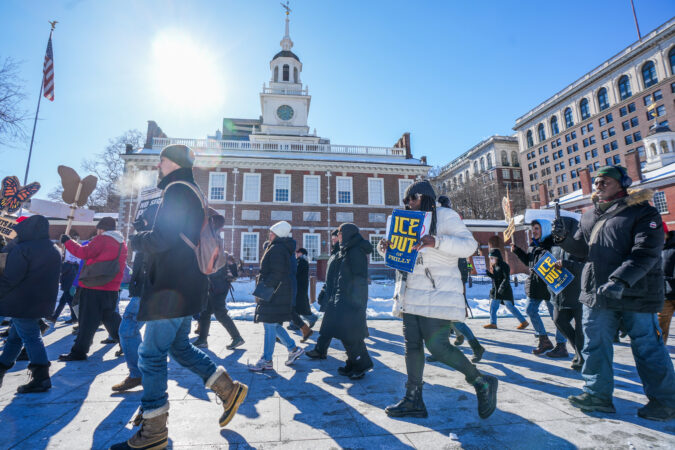
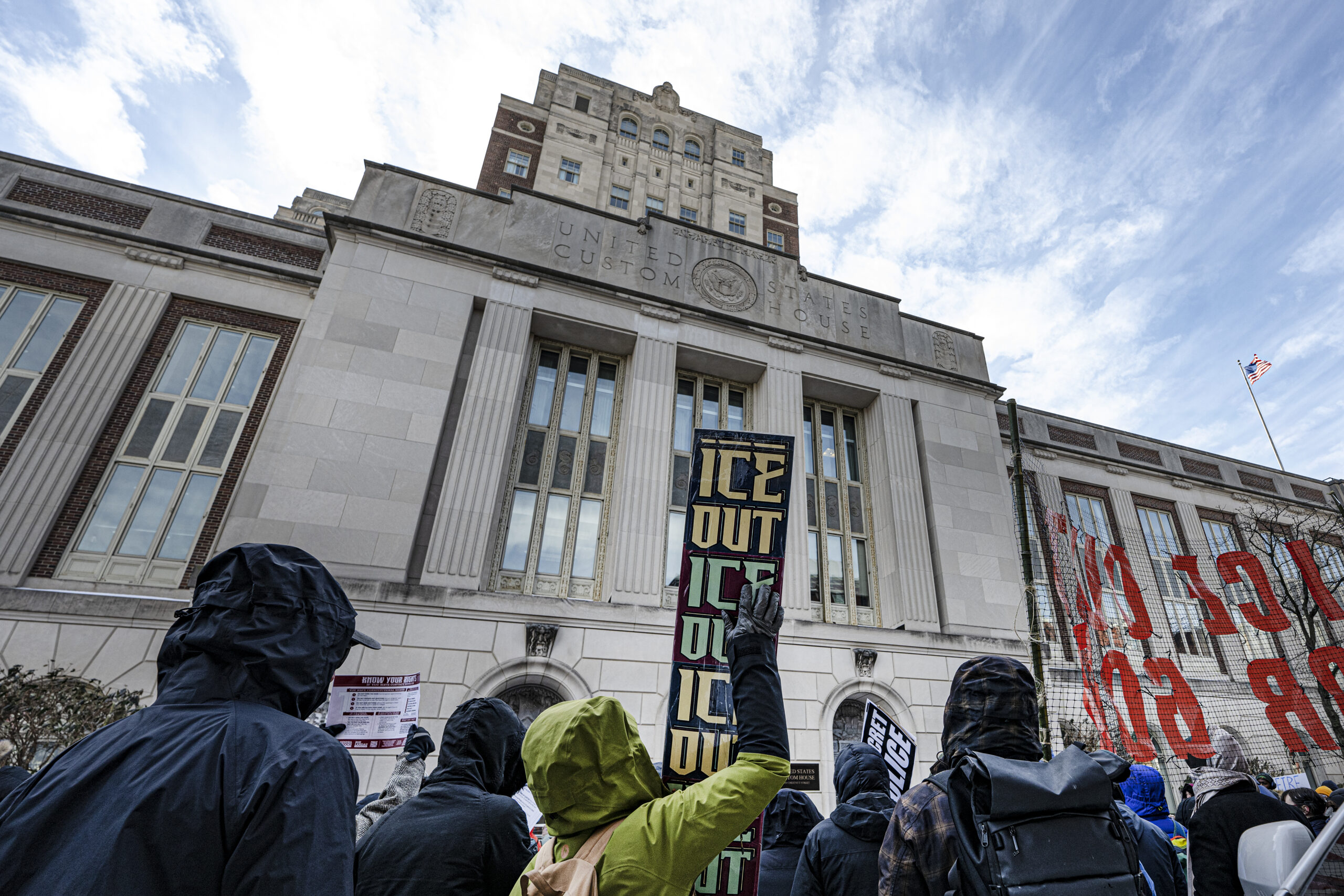
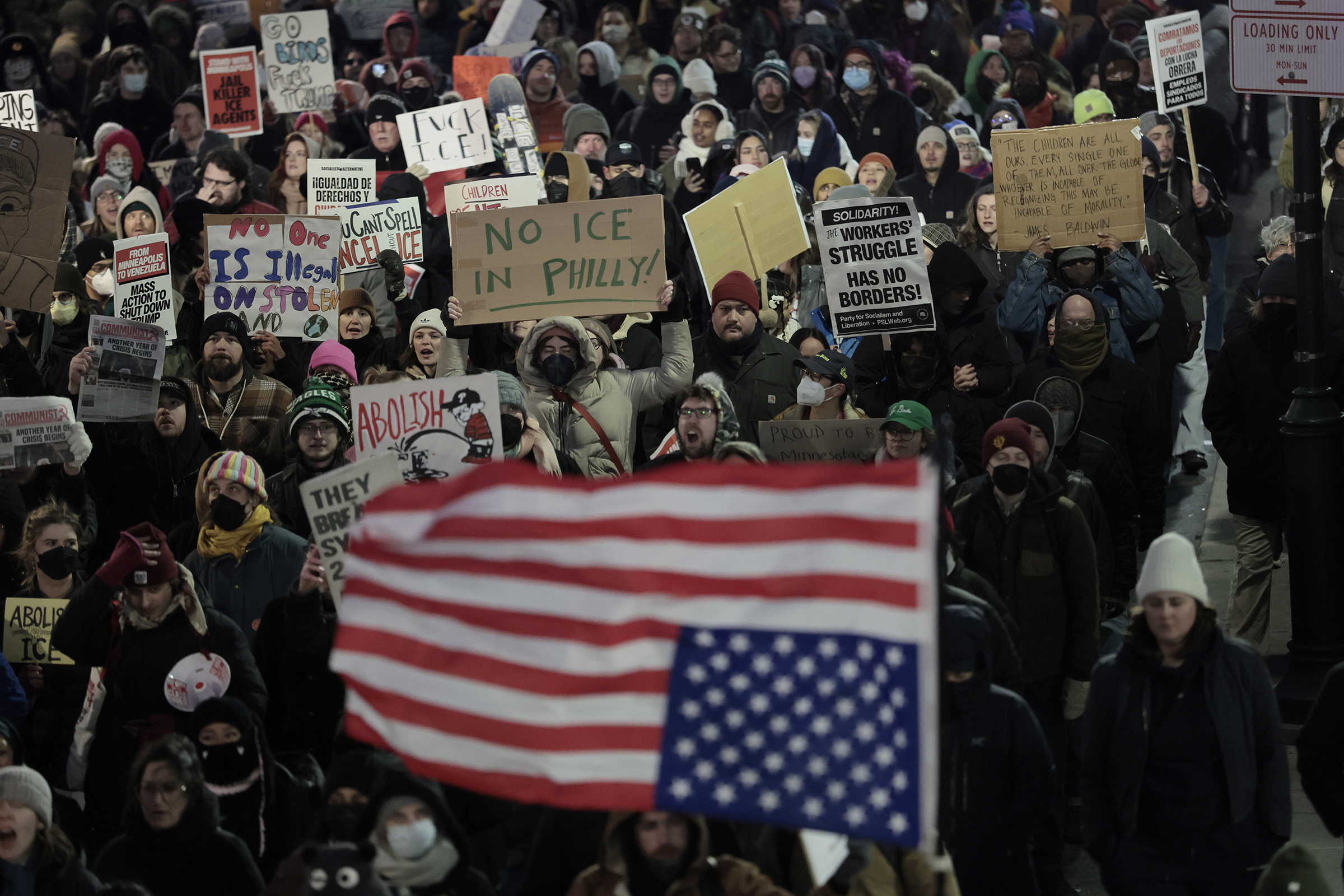
    Protesters march up Eighth Street, toward the immigration offices, during the Philly stands with Minneapolis Ice Out For Good protest at Philadelphia’s City Hall on Jan. 23.

    But advocates for immigrants have said they want an ironclad city policy that can’t be rescinded by a mayor.

    Landau and Brooks’ legislation would be that, codifying the executive order into law and adding new prohibitions on information sharing. The package includes legislation to:

    • Strengthen restrictions on city workers, including banning local police from carrying out federal immigration enforcement and prohibiting city workers from assisting in enforcement operations.
    • Prohibiting law enforcement officers from concealing their identities, including by wearing masks or covering up badges with identifying information.
    • Banning ICE from staging raids on city-owned property and designated community spaces such as schools, parks, libraries, and homeless shelters. (It would not apply to the Criminal Justice Center, where ICE has had a presence. The courthouse is overseen by both city and state agencies.)
    • Prohibiting city agencies and contractors from providing ICE access to data sets to assist in immigration enforcement.
    • Restricting city employees from inquiring about individuals’ immigration status unless required by a court order, or state or federal law.

    Peter Pedemonti, co-director of New Sanctuary Movement of Philadelphia, an advocacy organization that partnered with the Council members to craft the package of bills, compared ICE to an octopus that has multiple arms reaching into different facets of American life.

    The proposed legislation, he said, is a means to bind a few of those arms.

    “The whole world can see the violence and brutality,” Pedemonti said. “This is a moment where all of us need to stand up, and Philadelphia can stand up and speak out loud and clear that we don’t want ICE here to pull our families apart, the families that make Philadelphia Philadelphia.”

    An impending showdown that Parker hoped to avoid

    Homeland Security officials claim that sanctuary jurisdictions protect criminal, undocumented immigrants from facing consequences while putting U.S. citizens and law enforcement officers in peril.

    Last year, the Trump administration named Philadelphia as among the jurisdictions impeding federal immigration enforcement. The White House has said the federal government will cut off funding to sanctuary cities by Feb. 1.

    However, the president has made no explicit threat to ramp up ICE activities in Philadelphia.

    Some of Parker’s supporters say the mayor’s conflict-averse strategy has spared Philadelphia as other cities such as Washington, New York, Los Angeles, Chicago, and Minneapolis have seen National Guard troops or waves of ICE agents arrive in force.

    Residents near the scene of a shooting by a federal law enforcement agent in Minneapolis on Saturday.

    Critics, including the backers of the new legislation, have for months pressed Parker to take a stronger stand.

    Brooks said she “would love to have the support of the administration.”

    “This should be something that we should be working collaboratively on,” she said. “Philadelphia residents are demanding us do something as elected officials, and this is our time to lead.”

    But Parker has not been eager to speak about Philadelphia’s immigration policies.

    For example, the city is refusing to release a September letter it sent to the U.S. Department of Justice regarding its immigration-related policies, even after the Pennsylvania Office of Open Records ruled its reasoning for keeping the document secret was invalid. The Inquirer has requested a copy of the letter under the state Right-to-Know Law.

    The new Council legislation and the increasing tension over Trump’s deportation push may force Parker to take a clearer position.

    Notably, the city sued the federal government last week over its removal of exhibits related to slavery from the President’s House at Independence National Historical Park, potentially signaling a new willingness by Parker to push back against the White House.

    But even then, Parker declined to take a jab at Trump.

    “In moments like this,” she said last week, “it requires that I be the leader that I need to be for our city, and I can’t allow my pride, ego, or emotions to dictate what my actions will be.”

  • A Philly lawmaker refused to advance her colleague’s reproductive healthcare legislation. Now she’s promoting her own.

    A Philly lawmaker refused to advance her colleague’s reproductive healthcare legislation. Now she’s promoting her own.

    They say imitation is the sincerest form of flattery, but Kendra Brooks isn’t taking kindly to a recent gesture of duplication by one of her colleagues.

    The progressive City Council member is incensed at Councilmember Nina Ahmad, a Democrat who has been in something of cold war with Brooks for months over stalled legislation related to reproductive healthcare access.

    It all came to a head Thursday when Ahmad introduced a resolution to hold a hearing examining access to such care in Philadelphia — legislation that would, under most circumstances, be uncontroversial in a body where Democrats hold a supermajority.

    But Brooks and Councilmember Nicolas O’Rourke, both of the progressive Working Families Party, voted against it — a highly unusual move in a body that almost always unanimously approves legislation to authorize hearings.

    The backstory: Brooks had already authored legislation to hold a hearing on threats to reproductive healthcare, and City Council approved it five months ago.

    But the hearings have not happened. Ahmad, who chairs the Public Health and Human Services Committee, has refused to schedule Brooks’ hearing, citing scheduling difficulties. That was despite pleas from advocates to move swiftly amid new federal restrictions on reproductive care and clinics closing due to funding loss.

    Now, Ahmad is poised to call up her own legislation on the matter, leaving Brooks and her allies feeling squeezed out.

    Ahmad said her legislation is far more broad than Brooks’ and would allow Council to examine the entire reproductive healthcare landscape, not just access to abortion care.

    The Council member who authors a resolution to hold a hearing typically has sway over how the hearing is conducted, including steering the tenor of it by lining up witnesses to testify. In turn, that can drive the creation of more concrete legislation.

    “You have to be comprehensive,” Ahmad said in an interview. “I’m evidence-based. I’m a scientist. I want to look at the whole breadth of things.”

    City Councilmember Kendra Brooks stands in Council during the first day of the fall session in September.

    But Brooks said she is focused on all forms of reproductive healthcare and criticized Ahmad’s legislation for failing to acknowledge the role of the city’s Reproductive Freedom Task Force, which Brooks leads. Members of that group called for Council hearings after local Planned Parenthood leaders said they were disappointed that the most recent city budget did not include a $500,000 line item for sexual and reproductive healthcare, as it did the previous year.

    Brooks said Ahmad was engaging in “foolishness.”

    “This is a level of petty that turns people off from politics,” she said. “It’s really unfortunate that she would play politics on an issue that’s this important.”

    And Brooks intimated that the saga could cause her and her progressive allies to target Ahmad next year, when every City Council member is up for reelection.

    “I’m not going to forget this,” Brooks said. “We’re very close to reelection to be playing this game.”

    The veiled threat from Brooks, the face of the city’s Working Families Party, is notable and could put the WFP on a collision course with the local Democratic Party — which tends to endorse incumbents such as Ahmad. The WFP has previously said its efforts to win minority-party seats on Council are no threat to Democrats.

    However, in 2023 when both Brooks and Ahmad were running for seats on Council to represent the city at-large, Ahmad said that the WFP was trying to “poach” Democratic voters and that its political strategy was “lazy.”

    But Ahmad said Thursday she is not playing politics.

    “She’s the one,” Ahmad said of Brooks. “I’m the chair of the Public Health Committee, and I need to be aware of what work is going on in these respects. And if people don’t want to share, that’s up to them.”

    Brooks said she plans to hold her own hearing in March — what she is calling a “people’s hearing” that will take place outside the walls of City Hall.

    Some advocates say they will participate in both that event and Ahmad’s traditional hearing.

    Signe Espinoza, the vice president of public policy and advocacy at Planned Parenthood of Southeastern Pennsylvania, said she is supportive of any legislation that elevates the issue — no matter the author.

    “We are committed to keeping the doors open, and we also recognize that this is the most hostile environment we’ve ever been in,” Espinoza said, noting that clinics have closed across the country. “The clock is ticking.”

  • In one of Phil Murphy’s final acts as governor, he signed a bill that could help Camden tower get $400 million in tax credits

    In one of Phil Murphy’s final acts as governor, he signed a bill that could help Camden tower get $400 million in tax credits

    Hours before leaving office, New Jersey Gov. Phil Murphy on Tuesday signed legislation that could make it easier for commercial real estate projects in Camden to qualify for hundreds of millions of dollars in state tax incentives.

    One planned development that could benefit is the Beacon Building, a proposed 25-story office tower downtown on the northwest corner of Broadway and Martin Luther King Boulevard, The Inquirer previously reported.

    Murphy approved the bill and dozens of others on the final day of his second term, shortly before fellow Democrat Mikie Sherrill was sworn in as governor. Another newly signed law authorizes up to $300 million in tax breaks to renovate the Prudential Center in Newark, home of the New Jersey Devils. The hockey team is owned by Harris Blitzer Sports & Entertainment, which also owns the Philadelphia 76ers.

    The Camden-focused law makes changes to the state’s gap-financing program, known as Aspire, which authorizes up to $400 million in corporate tax credits over 10 years for “transformative” redevelopment projects that have a total cost of $150 million and meet other requirements.

    To qualify for the incentives, most commercial projects must generate a net positive benefit to the state, based on the Economic Development Authority’s economic modeling. The new law exempts certain projects from that “net benefit test.”

    The law applies to redevelopment projects located in a “government-restricted municipality” — as described in the Aspire program’s statute — “which municipality is also designated as the county seat of a county of the second class.” In addition, the project must be located in “close proximity” to a “multimodal transportation hub,” an institution of higher education, and a licensed healthcare facility that “serves underrepresented populations.”

    A rendering of the 25-story Beacon Building proposed for the northwest corner of Broadway and Martin Luther King Boulevard in Camden. It would be the tallest building ever constructed in the city.

    The site of the proposed Beacon Building is across the street from the Walter Rand Transportation Center and Cooper University Hospital. Rutgers’ Camden campus is also nearby. Lawmakers said projects in New Brunswick and Trenton could also qualify for exemptions under the law.

    Development firm Gilbane is leading the project with the Camden County Improvement Authority. Gilbane has yet to announce any commitments from tenants.

    Assembly Majority Leader Louis Greenwald (D., Camden), who sponsored the legislation, has said it wasn’t written with a specific project in mind but rather to remove a barrier to investment in South Jersey.

    Critics said that the law removes a key safeguard meant to protect taxpayers and that it represented an about-face for Murphy, who earlier in his tenure sought to reform corporate incentive programs.

    “Just in terms of the governor signing the bill, this is a massive disappointment,” said Antoinette Miles, state director of the New Jersey Working Families Party.

    “Broadly, if there’s a so-called transformative project that can’t pass the net benefit test, maybe it isn’t so transformative,” she said.

    Murphy’s office announced the bill signing without commenting on it, though he has previously cheered state investment in Camden. Any Aspire tax incentives must be approved by the state’s Economic Development Authority.

  • Chris Rabb is trying to be the left’s standard-bearer as he runs for Congress. Will progressives rally around him?

    Chris Rabb is trying to be the left’s standard-bearer as he runs for Congress. Will progressives rally around him?

    In the most-watched race for Congress in Philadelphia in more than a decade, State Rep. Chris Rabb has cast himself as the unabashed anti-establishment leftist. He’s refusing donations from corporations, calls the war in Gaza a genocide, and wants to abolish U.S. Immigration and Customs Enforcement.

    But despite announcing his campaign more than six months ago, he had yet to amass support from much of the city’s progressive flank, leading observers to wonder if he would be able to tap into the movement’s network of donors and volunteers.

    It appears they’re coming around.

    Rabb this week has won an endorsement from One PA, a progressive political group that’s aligned with labor and most of the city’s left-leaning elected officials. That comes after the environmental justice group Sunrise Movement said it, too, would back Rabb.

    “This is a moment when democracy is at stake,” said Steve Paul, One PA’s executive director. “If there was any moment for the style of leadership that Chris [Rabb] brings to the table, it’s this moment.”

    Rabb said he’s “energized” by the endorsement and what it means for the campaign.

    “Our movement is growing every single day,” he said.

    The questions now are whether some of the city’s most prominent progressive elected officials will lend their endorsements to Rabb, and if deep-pocketed national organizations will spend money to back him.

    For example, Justice Democrats, a progressive political action committee, said it’s “very closely looking at this district.” And the Working Families Party, the labor-aligned third party that supports progressives across the nation, has endorsed candidates in four other congressional races with competitive primaries — but not yet in Philadelphia’s. The group previously spent millions to boost candidates in the region.

    Rabb, who hails from the voter-rich Northwest Philadelphia, is one of several likely front-runners seeking the Democratic nomination to represent the 3rd Congressional District, which encompasses about half of Philadelphia. U.S. Rep. Dwight Evans is retiring after holding the seat since 2016.

    Progressives and democratic socialists — energized by Mayor Zohran Mamdani’s win last year in New York City — see a major opportunity to install one of their own in the district, which is the most Democratic in the nation.

    Map of Pennsylvania’s 3rd Congressional District.

    The primary election — the marquee race in deep-blue Philadelphia — isn’t until May. But some on the left say the movement should have already coalesced around Rabb.

    “We will probably regret it in the end, because this is a seat we should win,” said one leader of a progressive organization in the city who requested anonymity to speak freely about the political dynamic.

    Rabb is seen as something of a lone operator with his own political apparatus. He didn’t come up through the newer progressive organizations that have run their own candidates for office in the city. Rather, he won a seat in the state House for the first time a decade ago when he toppled an establishment-backed Democrat.

    State Rep. Chris Rabb at a forum hosted by the 9th Ward Democratic Committee on Dec. 4, 2025. He is a Democratic candidate running to represent Philadelphia’s Third Congressional District.

    Some of the city’s progressive leaders say they expect to back Rabb but that they were waiting to see how the field shaped up.

    Last year, there were efforts to recruit other left-leaning candidates to run, including City Councilmember Kendra Brooks of the Working Families Party, and State Rep. Rick Krajewski, according to three sources with knowledge of the efforts who spoke on condition of anonymity to preserve relationships. Both decided against running.

    Brooks — who emerged as a face of the Working Families Party six years ago after she became the first third-party candidate to win a seat on Council in 100 years — is likely to back whomever the organization endorses. The group is still in the midst of its endorsement process.

    “We’re confident that we will land on a progressive who will fight for working people, not billionaire donors, big corporations, or special interests,” WFP spokesperson Nick Gavio said.

    Krajewski, who represents parts of West Philadelphia, has also not endorsed a candidate but he said he will. Rabb, according to Krajewski, has the qualities necessary to be a member of Congress during “a pivotal moment for our country.”

    “The question is: Do we allow the fascists and the ruling class to double down on this insanity that they’re pushing? Or do we use this opportunity to agitate and say a different world is possible?” Krajewski said. “That’s what I want from my member of Congress. Chris [Rabb] has demonstrated that he’s clear about that.”

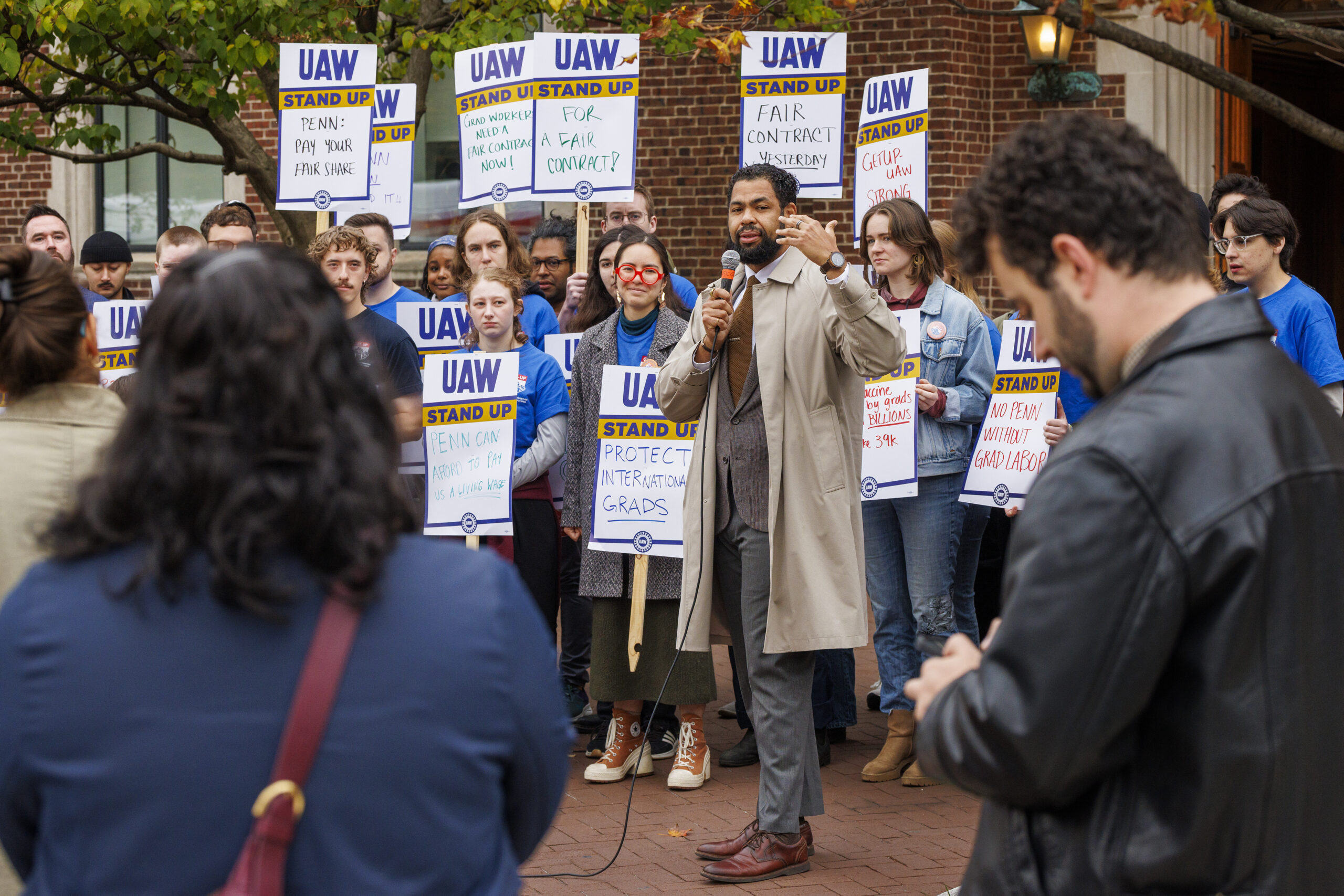
    Pennsylvania State Rep. Rick Krajewski making statements at a news conference and rally by University of Pennsylvania graduate students. Grad students held the event to call for a strike vote against the university at corner of South 34th and Walnut Streets on Nov. 3, 2025.

    Meanwhile, other candidates in the wide-open Democratic primary have tried to pick off progressive support.

    State Sen. Sharif Street, the former chair of the state Democratic Party, is seen as the establishment’s pick for the seat. But he also has alliances with some of the city’s most progressive leaders.

    That includes a decades-long relationship with Councilmember Rue Landau, who often votes with Council’s progressive bloc and is the first openly LGBTQ person ever elected to Council. Two sources familiar with Landau’s thinking said she is strongly considering endorsing Street.

    Street has also worked closely on criminal justice reform matters with District Attorney Larry Krasner, perhaps the city’s most prominent elected progressive. He inherited some of Krasner’s political staff to manage his campaign.

    However, several other candidates in the congressional race could be in the running for backing from Krasner, who recently won his third term in office in landslide fashion. Rabb, Street, and State Rep. Morgan Cephas previously endorsed Krasner for reelection.

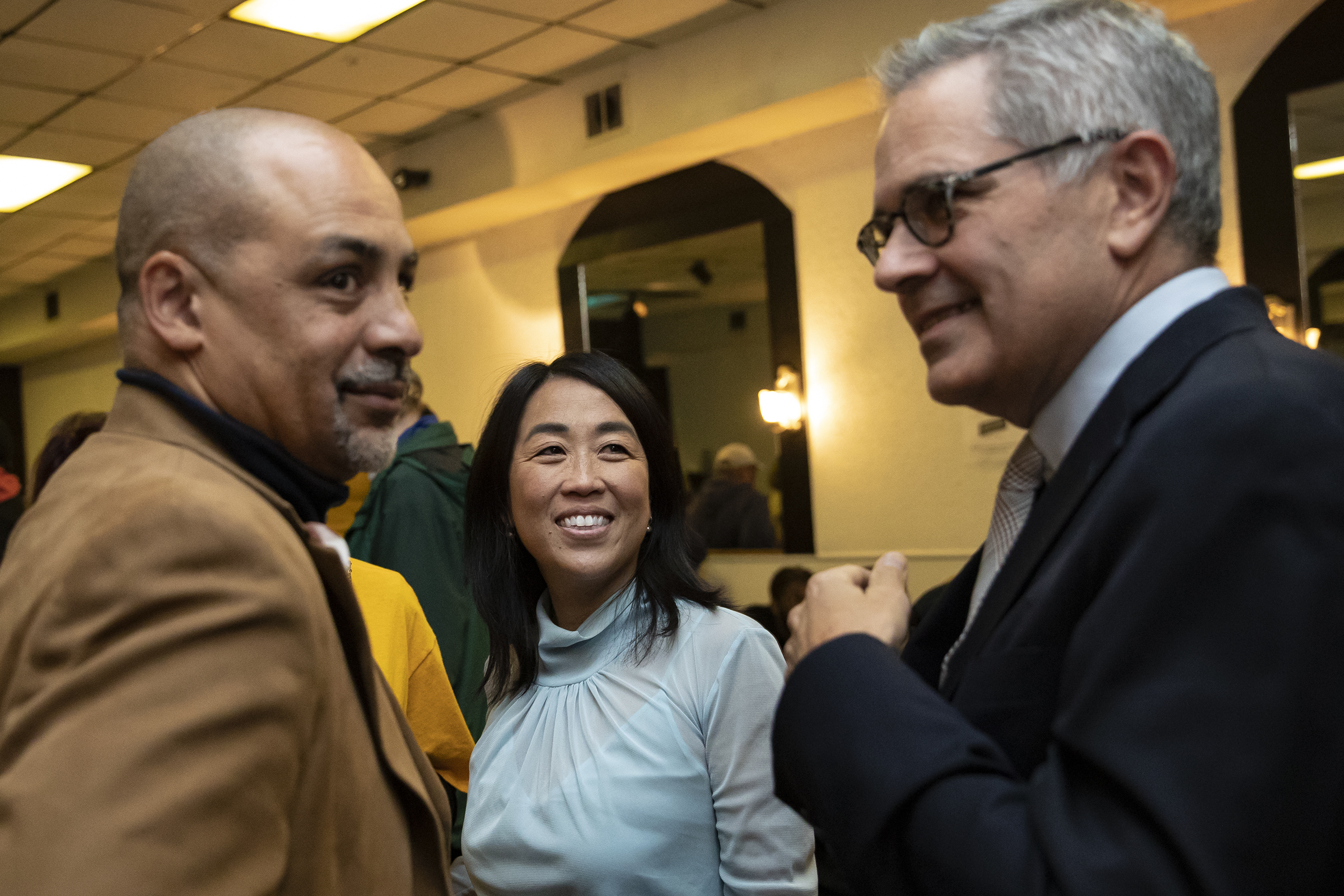
    State Rep. Chris Rabb (left), Helen Gym (center), and District Attorney Larry Krasner attend the election results watch party for Working Families Party candidates Kendra Brooks and Nicolas O’Rourke in North Philadelphia on Nov. 5, 2019.

    The crowded field may also mean that some elected officials choose not to get involved.

    State Rep. Tarik Khan, a Democrat and nurse practitioner who has been backed by progressive organizations, said he has relationships with several leading candidates. That includes his colleagues in Harrisburg, as well as Ala Stanford, a surgeon. She and Khan were both prominent vaccine advocates during the COVID-19 pandemic.

    “There’s a lot of good choices in this race,” Khan said. “I’m probably just going to let the process play out.”

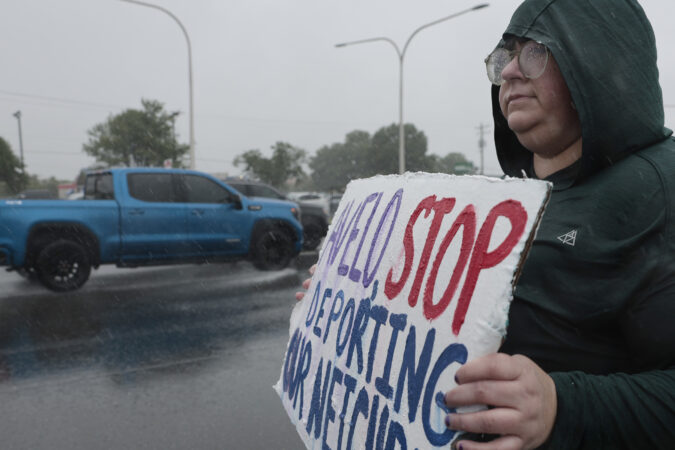
  • Avelo stops deportation flights in Arizona; protesters in Delaware applaud

    Avelo stops deportation flights in Arizona; protesters in Delaware applaud

    Avelo, the only commercial airline serving Wilmington’s airport, has ended its contract flights to carry foreign nationals detained by U.S. immigration agents. The change takes place amid a larger consolidation of Avelo’s routes.

    The Delaware Stop Avelo Coalition of groups critical of President Donald Trump’s deportation policies hailed the airline’s move. They had been leading pickets at the Wilmington airport in New Castle, Del., since last spring, when Avelo joined several charter airlines transporting deportees for the Department of Homeland Security.

    For Avelo, the latest move was part of a cost-cutting reorganization “streamlining its network” to four of its regional bases: Wilmington; New Haven, Conn.; Charlotte/Concord, N.C.; and Lakeland, Fla. Among the regional bases it is closing is Mesa, Ariz., which handled deportation flights.

    “Avelo will close the base” in Arizona, where it had managed what the airline called “removal flights” for the government, “and will conclude participation in the DHS charter program” by Jan. 27, Avelo spokesperson Courtney Goff said in a statement. The airline said earlier that it had not moved deportees through Delaware.

    Avelo also said it has gotten rid of six Boeing jets. Airline industry information sites are reporting DHS has picked up at least some of those former Avelo airliners, as if moving deportation capacity in-house.

    Avelo plans a new base at the McKinney National Airport, near Dallas, later this year.

    Avelo CEO Andrew Levy last year said the DHS contract was part of the airline’s plans for growing and maintaining operations. Levy started the airline in 2020 and has rapidly increased its route network, but also has acted quickly to cut and shift unprofitable service.

    The coalition, a group including local Democratic Party activists in chapters of the Indivisible organization, Working Families Party affiliates, the Delaware Democratic Socialists of America, and Unitarian-Universalists, said in a statement that it welcomed Avelo’s decision to end deportation flights, “especially those without due process.”

    “We don’t know, to be honest, but we have indications from behind the scenes that we had some effect. Sometimes these things build and build,” said Gayle Gibson, an engineer who serves as coalition spokesperson.

    The coalition also coordinated some of the sign-waving picketing with actions at other airports Avelo serves around the country.

    Gibson noted that Wilmington City Council passed a resolution calling on Avelo to stop flying deportees rushed into custody without due process. State legislators drafted similar bills, which had not yet advanced to a vote, and “hundreds” of protesters had turned out to airport picket lines, local-government meetings, and University of Delaware rallies to pressure Avelo. Leaders also met with Gov. Matt Meyer and other top state officials.

    Safety concerns raised by Avelo employees also had an impact, Gibson said. “This shows Delaware stands behind businesses that operate according to laws and value people and due process.”

    The organizers in their statement took credit for making Avelo’s deportation flights “politically and reputationally radioactive,” leading to the company’s decision to stop.

    Avelo cited poor financial returns. The program did not pay Avelo enough “to overcome its operational complexity and costs,” according to Goff’s statement.

    State and local officials in Connecticut, New York, and other states had called on Avelo to stop the deportation-related flights.

    Meyer, who welcomed Avelo to the airport when he was New Castle County executive in the early 2020s, had said he personally boycotted Avelo after the protests began.

    Activists said they couldn’t measure the effect of any customer boycott.

    “We did not see an impact regarding customers choosing to fly,” said Goff, the airline spokesperson. Customer flights rose to 2.6 million last year, up 11% from 2024, as planes were fuller. She credited low fares and on-time reliability.

    The protests put Meyer and other Democratic officials in a quandary. They had encouraged Avelo to begin service from the airport, which formerly managed only charter, corporate, and general-aviation flights, as a way of boosting Delaware’s corporate employment sector as the state economy turns from heavy and chemical manufacturing toward biotech and other developing industries.

    Meyer did not act on protesters’ demands that the state cancel tax incentives and other Avelo financial benefits to pressure the airline to end the flights.

    The airport is operated by the Delaware River and Bay Authority, which also controls the Delaware Memorial Bridge and Cape May-Lewes ferry. The authority’s board represents the Democratic-led states of Delaware and New Jersey.

    Like the governor, the authority declined activist requests to pressure Avelo, saying the airline had the right to conduct its business the way it sees fit.

    “We’re aware of the community concerns regarding Avelo’s past operations at other airports,“ James Salmon, the authority’s spokesperson, said in a statement after Avelo announced an end of the flights. “We’ve consistently maintained a neutral position” and focused on keeping the airport accessible to customers for Avelo’s flights to Florida and other destinations. The airline’s flights from other airports were “outside the scope” of the agency’s authority.

    “This decision proves that public pressure really works,” the coalition said in its statement. It said it would keep pushing proposed laws to prevent airlines receiving state benefits from “quietly” resuming flights or other deportation contractors from winning government support.