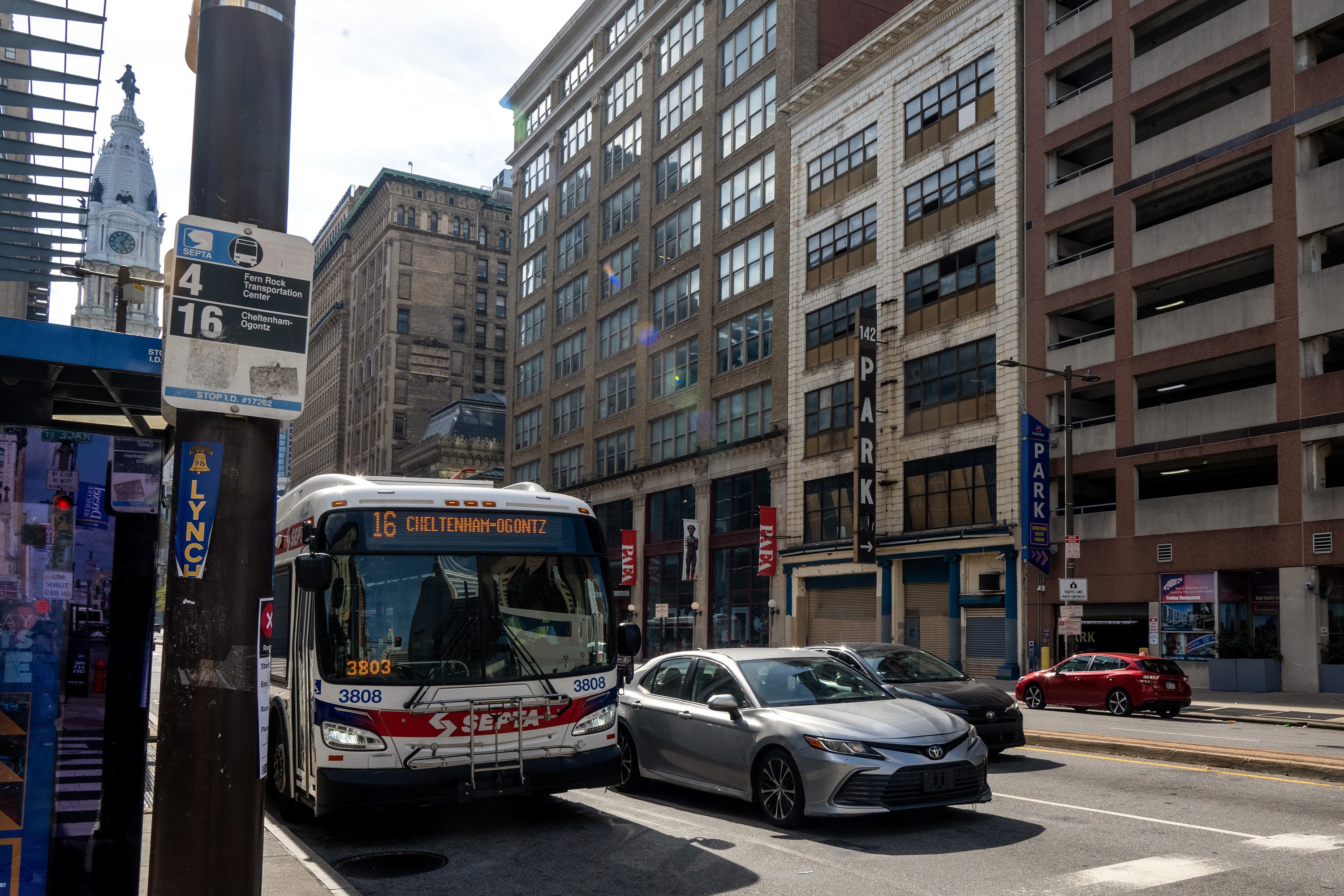
An antiquated industrial building at 142-144 N. Broad St. is being converted to 99 apartments and over 4,000 square feet in restaurant space.
The seven-story building previously served as a car showroom with vehicle elevators and a factory. It has been empty for years.
“It’s gone through a couple of owners,” said Carolina Pena, principal at Parallel Architecture Studio, which is working on the project. “We’re doing an interior renovation. There are no additions proposed. We’re trying to retrofit the existing garage into apartments.”
The building’s previous owner, John Wei, has been selling off property across the Callowhill area in recent years in the face of mounting financial difficulties. He purchased 142-144 N. Broad in 2022 for $7 million.
The property sold in August for $6.2 million to a company called Penn Hall Investment LLC.
In zoning applications filed with the city earlier this month, the owners are listed as Qiaozhen Huang and Yizhou Li with their business address as 300 E. Allegheny Ave. in Kensington.
Philadelphia-based Parallel Architecture Studio, which is designing the project for the latest developers, also served as the architect for an earlier iteration of the property, when Wei sought to use it to house a 115-room hotel.
Pre-pandemic permits show a proposal for an even larger hotel from another developer and architect.
“It’s more stable financially this way,” said Pena, of Parallel Architecture. “It’s harder to get financing for hotels than to get financing for apartments.”
Pena projects a construction timeline of 18 to 24 months. The apartments will be designed for single-person households.
“We have some studios, some one-bedrooms,” Pena said. “They’ll be around 600 square feet.”
A view of 142-44 N. Broad St. (black PARK sign). Zoning permits have been pulled for a conversion of the long-vacant tower to residential and restaurant use.
The current Penn Hall project does not require any action from the zoning board because 142 N. Broad St. is in the most flexible zoning district in the city.
Bicycle parking and four automobile spaces will be available in the tower’s existing small underground parking facility.
In 2017, the city issued an “unsafe structure” violation for the building, but the owners at the time shored it up. No violation of that magnitude has been issued since.
The development along North Broad Street has been advancing at a slow but steady pace since the Great Recession.
Philadelphia developer Eric Blumenfeld’s string of popular projects along the thoroughfare, including The Met and the Divine Lorraine, started the redevelopment trend.
Other developers such as Alterra Property Group have added hundreds of new apartments to the area, and the Philadelphia Ballet’s new building is opening soon. Closer to City Hall at the shuttered Hahnemann University Hospital, Dwight City Group plans 288 apartments.
Dane Jensen isn’t a developer by training or profession, but he loves old buildings and he’s got big plans for the church at 1800 Tasker St.
The 138-year-old institution is a fixture in Point Breeze, but Second Nazareth Missionary Church’s shrinking congregation hadn’t been able to keep up with repairs. In 2024, as the church sought to sell, its leadership met with Jensen, who pitched them on his vision of a continuing life for the building as a communal space, if not a sacred one.
“A lot of adaptive reuse is taking these big institutional buildings and turning them into apartments and, to me, that loses some of the intent of the space,” Jensen said. “We are trying to preserve it as something where people can still gather and feel fellowship. Even without religious intent, it can still be a place where people can connect.”
Jensen bought the property in mid-2024 for $1.75 million, and he has begun renovations. He hopes to turn the church into a family-friendly restaurant, brewery, and event space, outfitted with an indoor playground, an idea he successfully pitched to Second Nazareth’s leadership.
“It’s a little scary to put that word out there because some people hear brewery, and they hear bar. They hear place to get drunk,” he said. “We envision it as a community space. During the day you can go grab a cup of coffee and do some work. In the afternoon, you can meet up with friends and have lunch, and, yeah, maybe you can grab a beer.”
Jensen isn’t imagining a traditional brewery, with giant silos and vats. He wants a place he will feel comfortable bringing his children, who are 4 and 7. That’s also why he’s been drawing up plans for play equipment inside the space.
The church is currently zoned for single-family use, like the rowhouses that surround it. But in 2019, City Council created historic preservation incentives to make it easier to repurpose churches that are on the Philadelphia Register of Historic Places.
That means Jensen can move forward, since the church was added to the register earlier this month. He won’t have to go to the Zoning Board of Adjustment or seek a legislative zoning change from Council President Kenyatta Johnson, who represents the area.
However, Jensen said he still plans to meet Johnson and arrange meetings with surrounding neighborhood groups known as Registered Community Organizations (RCOs).
“Needing to talk to your councilmember, needing to talk to your community through the RCOs, is incredibly valuable,” Jensen said. “We want to do that to make sure we’re not just coming in to extract value from the neighborhood. We really want to contribute in a real and meaningful sense. Hiring from the neighborhood feels really important.”
Jensen is applying for a sit-down restaurant and artisan industrial use permit. Other possible uses of the building include a bakery and a coffee roastery.
Whatever the final use, the historic church will require extensive renovation first. Currently, Jensen’s team is putting in steel reinforcements to brace the building. He plans to restore most of the stained glass, fix the leaky roof, and install fire safety and Americans with Disability Act infrastructure.
The church dates to 1886, when it was known as the Presbyterian Church of the Evangel. That denomination was in place for almost 100 years, but as that congregation shrank, the church sought a successor.
In 1978, the Second Nazareth Missionary Church took over the building and remained until 2024. In recent years, that congregation began facing many of the same challenges as their predecessors even as their membership was shrinking and repair costs were growing.
Jensen said he found notes from the waning days of the Presbyterian era that showed the leaking roof was a problem back then — a challenge that decades later, Second Nazareth was facing again.
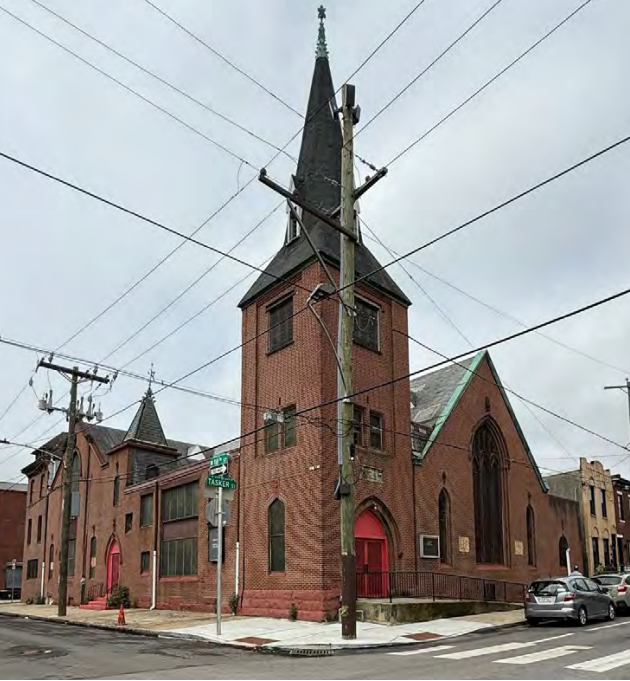
The church as seen from the north side, in an image included in Dane Jensen’s nomination of the building to Philadelphia’s Register of Historic Places.
When the Historical Commission accepted Jensen’s 48-page argument for the building’s importance earlier this month, that triggered the 2019 law that made it easier to find new uses for historic “special use” properties — like churches or theaters — by granting them more flexible zoning. That means no trip to the zoning board, which can add over half a year to the development process and often more if neighborhood groups or councilmembers contest the board’s ruling in court.
“I’ve really fallen in love with the building throughout this process,” Jensen said. “I’m excited that I am in a position to try to get the building to a point that it can last another 140 years and still have people feeling togetherness in it.”
To hear Michael Blichasz tell it, none of this would have happened if he hadn’t gone asking for a copy of the deed.
City officials never would have come knocking on the door of his nonprofit museum, the Polish American Cultural Center, curious how he came to be the supposed owner of a multimillion-dollar property in the heart of Philadelphia’s historic district.
They never would have begun scrutinizing the decades-long paper trail, the political handshakes, and the forgotten promises made to the once-powerful community leader.
And the quaint Polish history museum that has operated in Society Hill since 1987 would still have its home.
Because for nearly 30 years, City Hall never questioned whether Blichasz’s nonprofit actually owned the building at 308 Walnut St.
“No one mentioned a word about it,” Blichasz, 79, said. “It was totally silent.”
That silence started unraveling seven years ago when, Blichasz said, he requested a copy of the deed in order to get a state grant to make repairs on the five-story property. He had somehow avoided an inquiry for decades, despite securing other grants and contracts to keep alive his nonprofit’s mission: providing Polish immigrants with a one-stop cultural hub that could connect them to city services.
Officials at the Philadelphia Redevelopment Authority (PRA) scratched their heads at the request, according to Blichasz. Records showed the authority owned the museum building, not the Polish group.
PRA eventually took Blichasz to court, accusing him of squatting in the property and failing to pay back millions in loan installments. Blichasz said former Mayor W. Wilson Goode and other elected officials in the late 1980s purchased the property for his group and promised to pay off the debt as a gift to the Polish community.
But apparently those promises were never written down.
“The city has no records [or] evidence anyone in the city ever agreed to pay the balance on behalf of [the Polish museum] to obtain ownership of the property,” Jamila Davis, a PRA spokesperson, said in a statement.
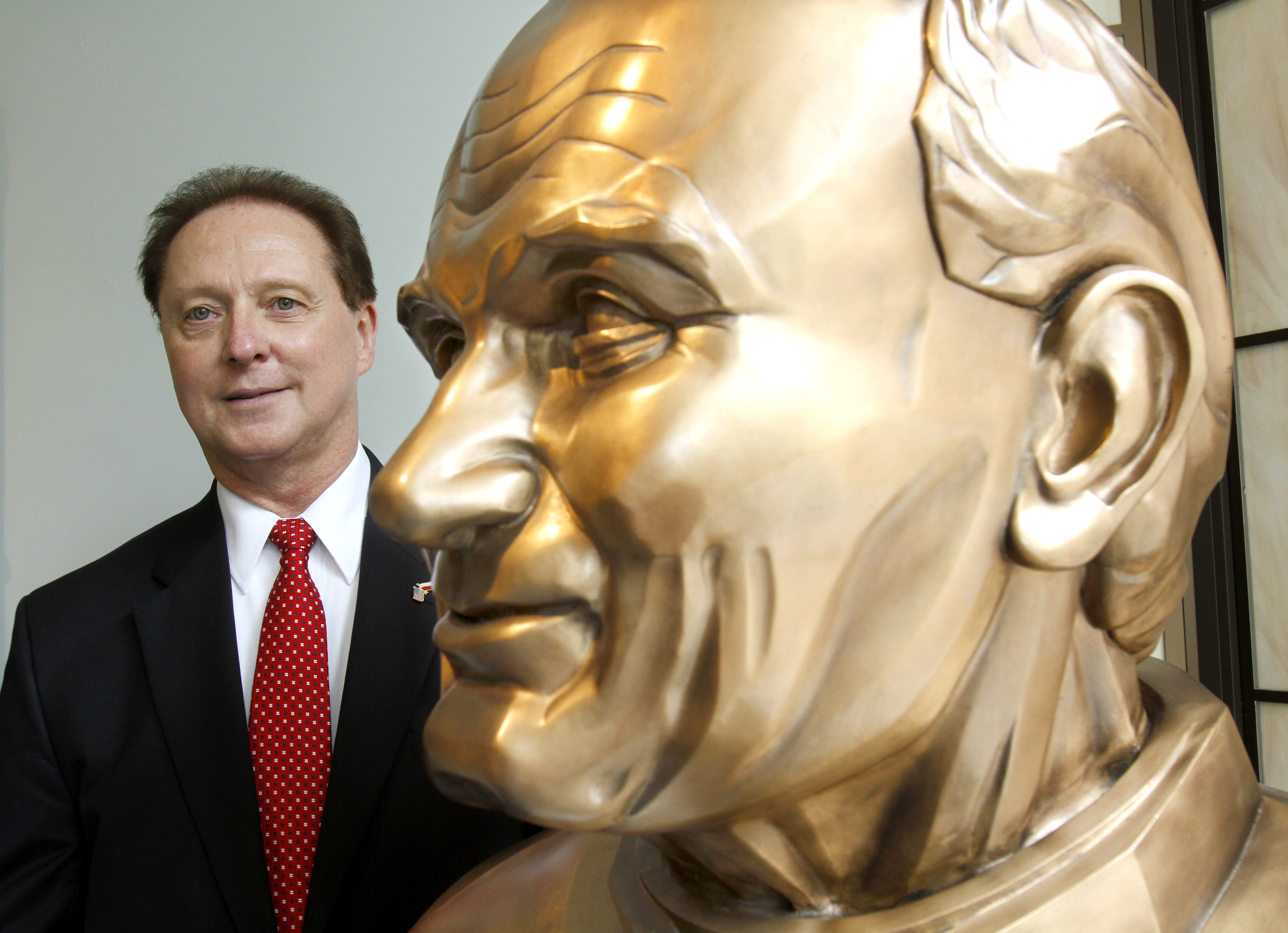
Michael Blichasz, president of the Polish American Cultural Center, stands beside a bust of the former Pope John Paul II.
This much both sides agree on: The Polish American Cultural Center came to occupy the historic building thanks to a rare and generous arrangement in 1987.
Goode approved a $2.1 million bond to buy a permanent home for United Polish American Social Services, a nonprofit run by Blichasz that had been aiding the city’s Polish immigrants since the early 20th century.
The grant led to the birth of the city’s first and only Polish museum, where Blichasz amassed an exhibit hall full of national folk art, portraits of famous Poles such as Pope John Paul II, and historical artifacts dating from the first immigrant settlers to these shores in 1608 to the diaspora that followed the 1939 invasion of the Nazis.
But Goode’s act of benevolence came with a caveat: According to the bond agreement, if the Polish group failed to keep up with payments, the city could kill the deal and take back the building. Blichasz claims Goode and other elected officials at the time, many of whom are now dead, promised he would never have to pay a dime.
“They said, ‘You will pay zero,’” he said.
A copy of a $81,875 check Blichasz provided to The Inquirer represents one of the only payments made by the nonprofit to the city — in August 1988. PRA said Blichasz’snonprofit, all told, paid about $155,000 toward the bond taken out by the city, which grew to $4.6 million with interest.
The Goode administration later applied for a federal grant through the U.S. Department of Housing and Urban Development (HUD) to pay off the property, according to records provided to The Inquirer.
Blichasz said he was under the impression the deal was done. But those federal funds never materialized — and the city didn’t seek to settle the debt for decades.
Bicentennial cash and ethnic tensions
The museum’s origins lie in the summer of 1987, when City Hall faced accusations of racial and ethnic favoritism.
The city had just unlocked $2 million left from the 1976 Bicentennial, and Council members had sent half that money to nine Black community groups. Anger simmered among white ethnic leaders like Blichasz.
“Reverse discrimination,” Councilmember Joan Krajewski said at the time.
Critics asserted also that regardless of race, the fund was supporting activities with few ties to America’s birthday celebration — from a Trinidadian steelpan orchestra to a Polish-American festival at Penn’s Landing led by Blichasz.
At the time, however, Blichasz’s nonprofit was also trying to move its headquarters from Fairmountto Philadelphia’s historic district.
And the city had already agreed to pay for the new building.
After the city inked the bond purchase on behalf of the Polish group, Blichasz vowed to increase the nonprofit’s annual budget by 50% to keep up with repayment. Goode promised the group leniency, but newspaper articles from the time show no offer to fully wipe the debt.
Blichasz was confident. Donors in the Polish community, he said, would “respond with joy” to bring this first-of-its-kind museum to life in Philadelphia.
But the joy proved less than hoped.
Months later, Blichasz was back at City Hall asking for a bailout. His group had raised only a fraction of its $1 million goal and needed an additional $350,000 to pay the mortgage and museum build-out costs.
He pointed out that the city had financed capital projects for other ethnic groups, including the Mummers Museum, the African American history museum, and the Jewish museum.
“This is going to tell us just how appreciated the good, taxpaying Poles are by this country,” Blichasz said at the time.
The museum, he promised, would be “an attraction” that would more than repay its debt.
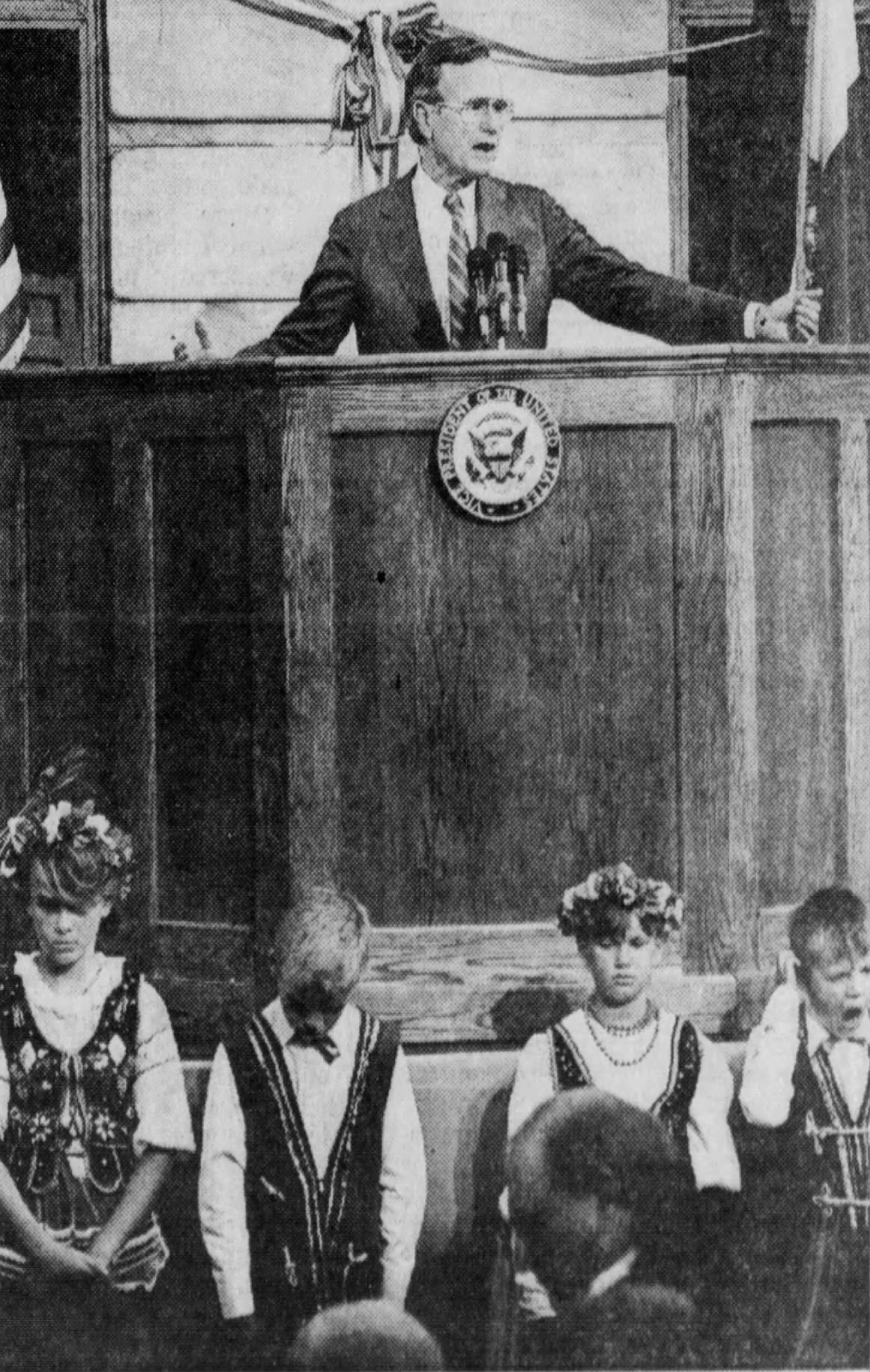
Then Vice President George H.W. Bush visits the Polish American Cultural Center for the opening published on Aug. 10, 1988, in The Inquirer.
Teaching self-sufficiency
The Polish American Cultural Center opened its doors in August 1988 to a flag-waving crowd of 300 people. Then-Vice President George H.W. Bush attended the ribbon-cutting ceremony, where visitors admired hand-cut Polish crystal and other curios from the homeland.
Alongside the museum, the nonprofit continued to provide the community with services that ranged from English language courses to help with rent and fuel rebates — work Blichasz said was “teaching Polish immigrants to be self-sufficient.”
Much of that work was also financed by the city.
Auditors later raised concern over a six-figure contract the Goode administration dealt to the nonprofit. At the time, the arrangement led former city finance director David Brenner to speculate about Blichasz’s political clout: “Where his influence comes from beats the hell out of me, but no question he’s got it.”
At some point, however, concerns over the debt for 308 Walnut St. disappeared.
As far as Blichasz was concerned, it was absolved after Goode applied for the HUD grant.
Blichasz said officials like Krajewski and Goode insisted his group not cut any more checks to the city, saying “we will take care of it.”
Why PRA did not inquire about the outstanding mortgage agreement remains uncertain. A spokesperson did not immediately respond to a question about the matter, and city records show only one inspection of the property, in 2011.
By the time PRA took a renewed interest, Blichasz had a problem: Many of the people who helped facilitate the initial deal were no longer around to help explain.
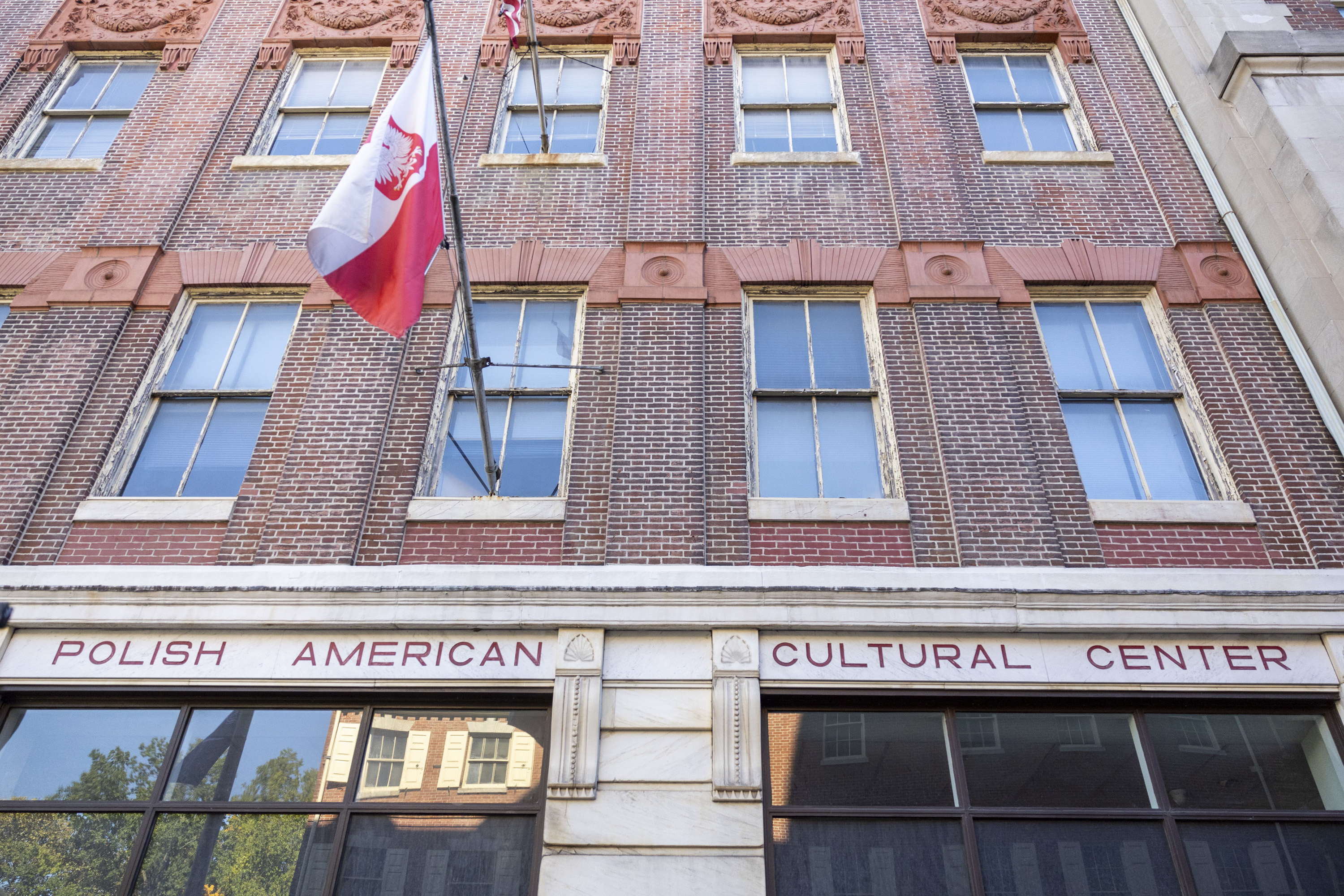
The outside of the Polish American Cultural Center.
A historic takeback
The museum fell under the radar until Mayor Jim Kenney’s first term. Soon after Kenney took office in 2016, Blichasz recalled, there was a heated meeting after the nascent administration ended his nonprofit’s six-figure social services contract.
He described the city as more interested in “giving out condoms” than providing help to an increasingly elderly Polish population.
Years later, during an insurance audit of large buildings owned by the Philadelphia Redevelopment Authority, Kenney administration officials were baffled by 308 Walnut St. It’s not clear if the PRA even knew who owned it.
PRA officials toured the building in 2019 and found the museum on the first floor much as it had ever been. But the floors above were in shambles, according to a city employee who toured the property.
The second through fourth floors looked as if their occupants had been raptured, with calendars from the 1980s frozen on the walls and moldy cups of coffee that appeared to date to the same decade.
On the fifth floor, officials said, they found evidence that someone had been sleeping in the building along with boxes of old documents and recording equipment where Blichasz broadcast his Polish American radio hour.
PRA quickly moved to intervene.
“Based on concerning conditions observed during the tour,” PRA said in a statement this week, it hired an engineering firm to document the state of the building. The contractors reported it needed at least $1.8 million to be brought back to code. The lack of maintenance resulted “in potentially dangerous structural issues,” PRA said in a statement.
Blichasz acknowledged water damage from leaks, which he had hoped to repair with state grants. But he called the PRA’s overall assessment of the property a fiction. He said his nonprofit spent “millions” in repairs over the years out of its operating budget.
“It’s very fishy,” Blichasz said of PRA’s inspection.
The agency said in a statement that officials “attempted to negotiate” but that Blichasz “refused to cooperate and repeatedly requested outright ownership” of the property, despite not having complied with the terms of the original deal.
With no legal title, the PRA took the nonprofit to court in 2023. The agency ultimately won, wresting back control of the building. A judge ordered the nonprofit to pay $3.5 million dollars in debt and damages.
This April, the Polish American Cultural Center was evicted.
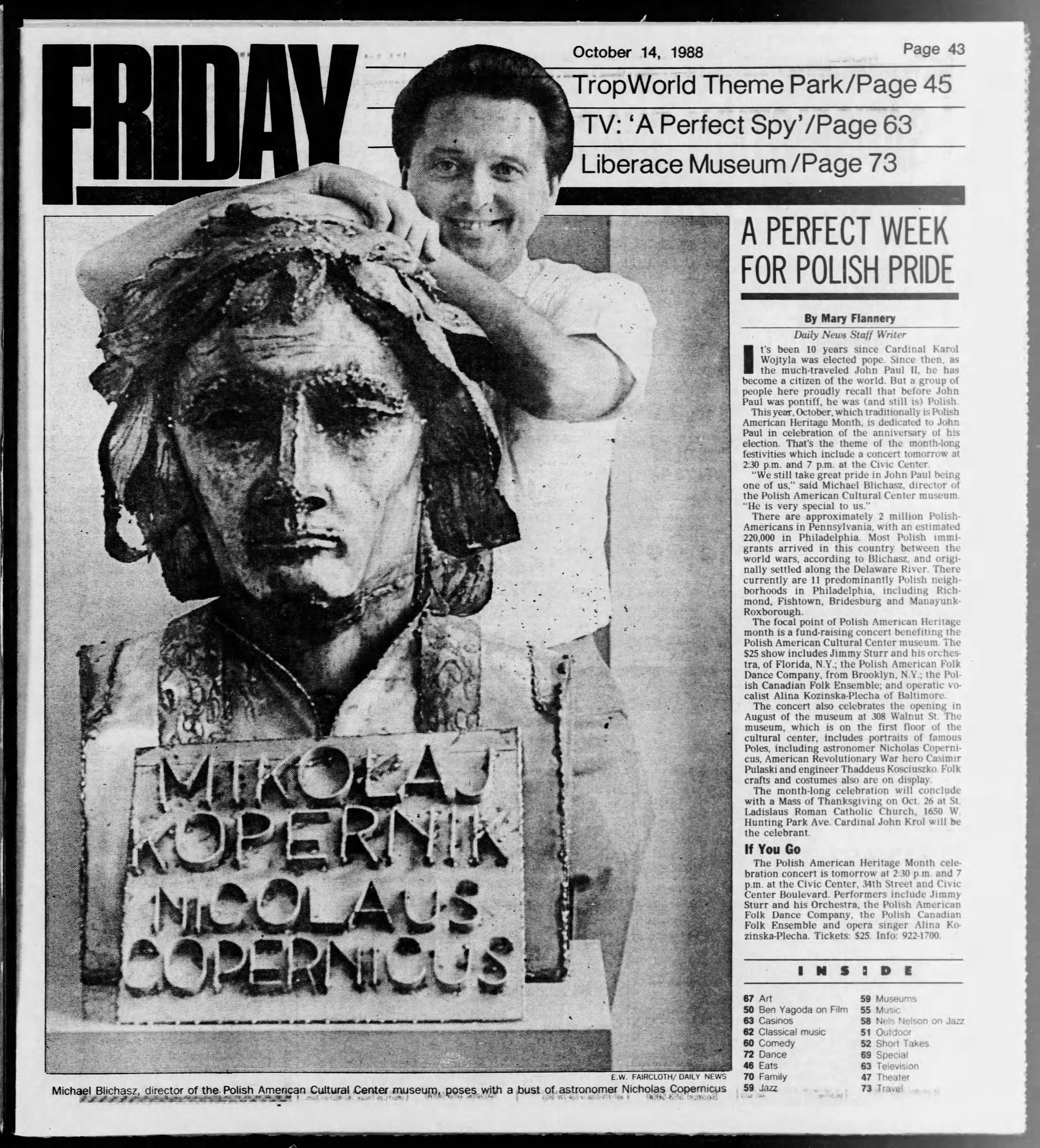
Michael Blichasz, director of the Polish American Cultural Center museum poses with a bust of astronomer Nicholas Copernicus. Published in the Philadelphia Daily News on Oct. 14, 1988.
Last chance to cut a deal
As the city clawed back the property, Blichasz accused officials of negotiating in bad faith. He also suggested it was a racially motivated attack against his organization to divert funding to nonwhite community groups.
Those who could attest to the original deal are dead or not talking. Krajewski, the former Council member, died in 2013. Blichasz said he hadn’t reached out to Goode in years. Phone calls to the former mayor were not returned.
“When those people were alive, we could have had a nice get-together, a hearing,” Blichasz said. “Now they want to take me to court. I said, ‘Why? You never sat down with us to discuss this.’ All I want to do is keep the original mission and goals alive.”
The ordeal has interested at least one current elected official.
Councilmember Mark Squilla, who represents the area, has acted as a liaison between Mayor Cherelle L. Parker and Blichasz this year. Emails shared with The Inquirer showed that Blichasz turned down three compromise options from Parker that would have either allowed the Polish group to remain in the building under a new lease or helped pay for the group’s relocation.
Squilla acknowledged that the paperwork didn’t support Blichasz’s case. But he argued that his decades of contributions to the city should be considered, too.
“After we did some background research, I figured there’s no way we could find out what really happened,” Squilla said. “So I figured, ‘Why don’t we just work out a deal?’ And unfortunately, the deals that the PRA made were not accepted by the Polish museum folks.”
Squilla introduced a resolution in City Council on Oct. 9 to hold hearings on the PRA’s treatment of Blichasz.
“After 30 years, I believe that they had the right to stay in and use the building,” the Council member said.
On Wednesday, a woman approached the doorway of the museum, asking if it was open.
Inside, standing in the wood-paneled hallway that harkened back to another era, a maintenance worker shooed her away.
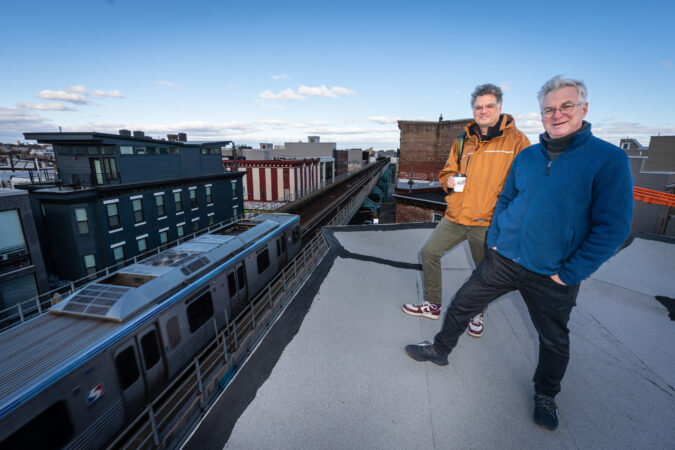
A building boom is unfolding on Front Street in Fishtown along the Market-Frankford elevated train line.
Walking north beneath this towering transit edifice, pedestrians are forced to zig-zag across the street to avoid construction sites spilling onto the sidewalks. The total number of apartments on Front Street between Girard and the York-Dauphin stations is set to almost double in the next year.
“It’s pretty surreal to see it all happening at the same time,” said Henry Siebert, cofounder of Archive Development, which plans to build at 1440 N. Front St. “The amount of construction that’s ongoing, I don’t see that anywhere else in Fishtown.”
According to the CoStar Group, a commercial real estate analytics firm, there are 441 apartment units actively under construction along this 1.1-mile stretch of the Market-Frankford Line, another 174 are proposed, and 231 have been completed since 2019. (There were 215 apartment units along the stretch prior to that year.) And that’s probably a slight undercount because it only includes projects with five units or more.
There are new apartments popping up in the storefronts of renovated older buildings along the train line, such as the building that housed Mighty Mick’s boxing gym in the Rocky movies. When construction there is complete, it will include a commercial space of 2,600 square feet along with four apartments in the revitalized historic brick building.
All this is happening as SEPTA ridership is dramatically lower than it was before the pandemic. In November, ridership on the Market-Frankford Line was only at 58% of February 2020 levels. Ridership at the stops in this part of Fishtown is even lower, according to data provided by SEPTA, with the York-Dauphin station only seeing 46% of 2019 ridership levels in 2023, the Berks station 52%, and the Girard station 48%.
(function() {
var l2 = function() {
new pym.Parent(‘fishtown_el’,
‘https://media.inquirer.com/storage/inquirer/projects/innovation/arcgis_iframe/fishtown_el.html’);
};
if (typeof(pym) === ‘undefined’) {
var h = document.getElementsByTagName(‘head’)[0],
s = document.createElement(‘script’);
s.type = ‘text/javascript’;
s.src = ‘https://pym.nprapps.org/pym.v1.min.js’;
s.onload = l2;
h.appendChild(s);
} else {
l2();
}
})();
And yet, the transit infrastructure is attracting a level of investment unprecedented in modern memory.
“SEPTA is experiencing a rough patch,” said Yonah Freemark, a senior researcher at the Washington-based Urban Institute, a policy think tank. “But for all the problems with drug abuse and lack of investment from the public sector, the fact that private investors want to spend huge amounts of money bringing hundreds of apartments to the neighborhood seems incredibly bullish for the future.”
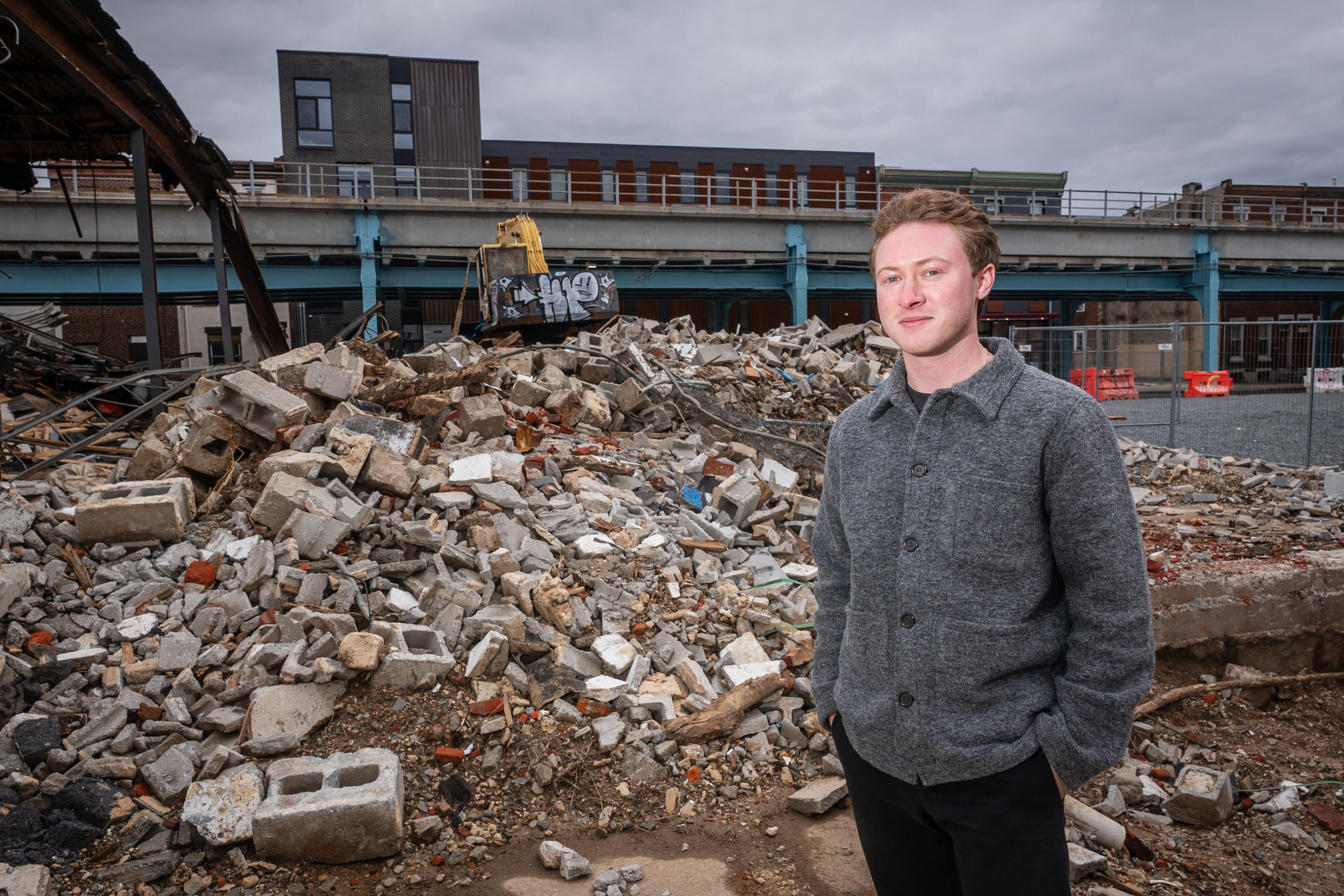
Henry Siebert, cofounder of Archive Development, at the company’s apartment project on 1440 N. Front St.
A ‘critical mass’ of demand
Few neighborhoods in Philadelphia have been as transformed as Fishtown since the Great Recession.
In 2012, political scientist Charles Murray used the neighborhood as the embodiment of all that had gone wrong for a downwardly mobile, white, working-class America. The commercial corridors on Frankford Avenue and Front Street were run-down, with many shuttered storefronts. The headquarters of the Warlocks Motorcycle Club could be found, but not a wine bar.
Now, Fishtown is the neighborhood in Philadelphia outsiders are most likely to be able to name, partly due to a spate of national media attention. The Warlocks vacated in 2011, and Frankford Avenue is now a thriving commercial corridor home to many of the city’s finest restaurants (including a James Beard Award winner), cocktail bars, and a La Colombe that looks largeenough to house a harrier jet. According to Census data, the Northern Liberties and Fishtown area now has the highest median income in the city.
“As Northern Liberties got all the hype [in the 2000s] prices went up and people started moving into Fishtown because it was more affordable,” said Brenda Nguyen, associate director at CoStar’s Philadelphia office. Now “the Fishtown area has enough dense housing, retail, restaurants, and neighborhood amenities that there’s a critical mass of demand.”
Throughout Fishtown’s redevelopment, many of the large vacant lots on Frankford Avenue, and elsewhere east of the Market-Frankford Line, filled in. Within a 10-minute walk of the heavy rail line there are 4,585 existing apartment rentals and 1,646 under construction. (A further 922 are proposed, although their status is unclear given the development industry’s current deep freeze.)
“When we originally started developing in the city in 2018, I told [my partner]that we would likely never develop a property along the El,” said Siebert. But “as large-scale development opportunities became more and more scarce, developers eventually turned their attention to Front [Street].”
Many developers had avoided the thoroughfare, partly because the looming edifice creates challenges with noise from passing trains and limits natural light. But the area became more appealing as other developable land vanished.
It helps that the land along this stretch of the Market-Frankford Line is zoned to allow taller and denser buildings than much of the rest of Fishtown. Archive Development addressed the challenges of building next to the train line by designing a first floor with 17-foot ceilings, ensuring the residential units on the second floor were elevated above transit. They plan to install windows with special glazing to reduce noise from passing trains.
Developers who have seen how Frankford Avenue has thrived to the east hope that they can build enough housing to create the demand for a second strong retail corridor. But they also hope to help establish attractive retail businesses that will, in turn attract more tenants. It’s the virtuous cycle that helped early developers in Fishtown such as Roland Kassis — who is also building next to the El — successfully launch businesses such as Frankford Hall and the La Colombe flagship.
“I was talking to a broker the other day and he said that what people want is an activated street front,” said Rafi Licht, a developer with Norris Square Development, the company behind the renovated Mighty Mick’s gym building.
“That’s what we’re aiming for here,” said Licht. “Putting in coffee shops, bars, restaurants, whatever is going to activate the street that makes it easier for people to imagine living upstairs.”
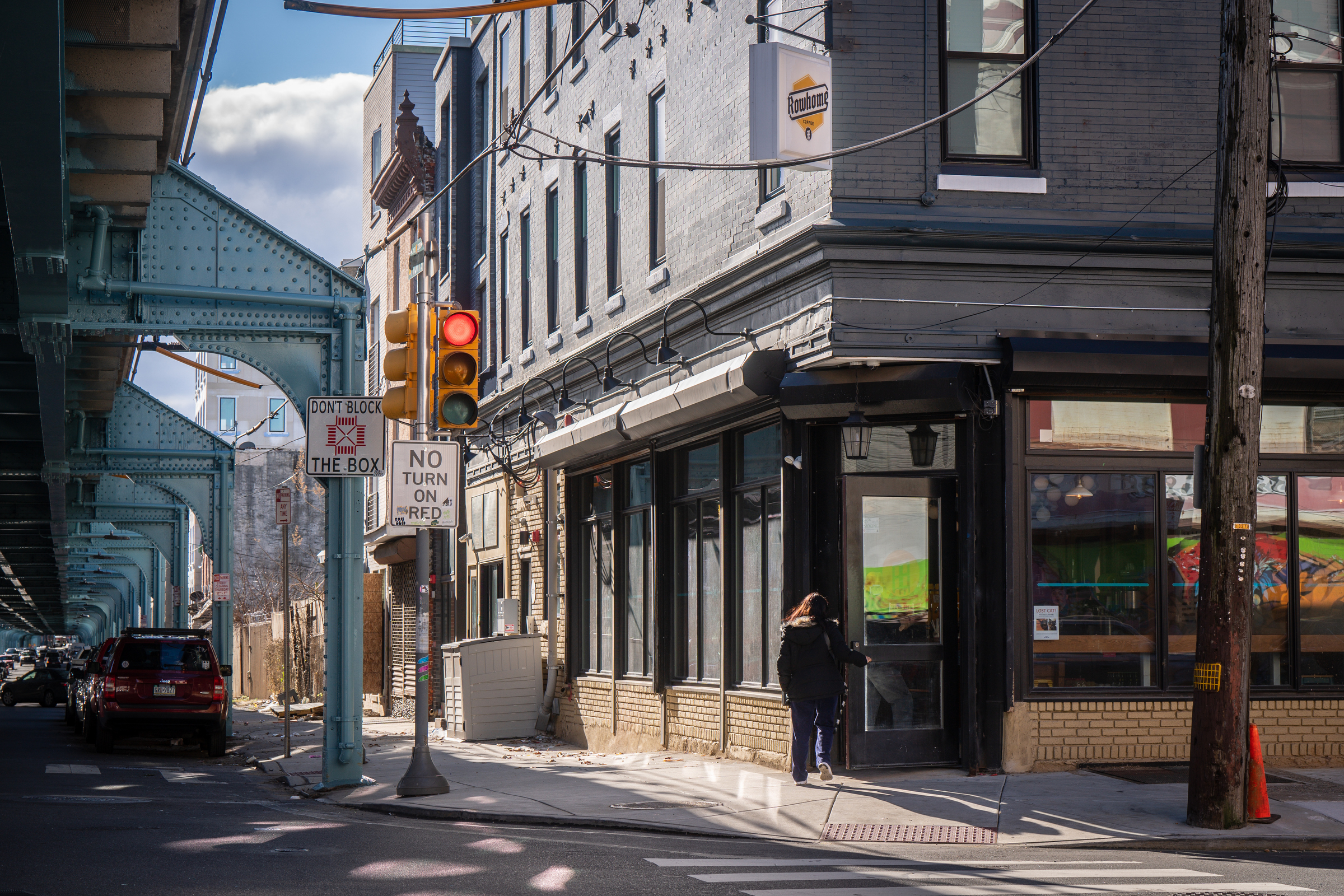
Rowhome Coffee at 2152 N. Front St., in a recently renovated historic building.
Norris Square Development is also working on other properties around the York-Dauphin stop. In 2022, Rowhome Coffee opened in its building at 2152 N. Front St. It drew a crowd then, and it still does.
“When Rowhome Coffee opened during the pandemic, people were queued up for the takeout window,” said Jonathan Auerbach, a partner in Norris Square Development. “I saw young women with prams lined up and realized, wow, people have been waiting for this.”
Will the redevelopment of Front Street aid mass transit?
Few of the developments along the El are subsidized, meaning rents will be relatively high in comparison with housing costs in nearby working-class and lower-income neighborhoods. (The rents in the Mighty Mick’s building will be close to $2,000 for a two-bedroom or $1,600 for a one-bedroom.) Many workers who have jobs that require in-person attendance — such as retail, hospitality, or restaurant work — are less likely to be able to afford newly constructed, transit-oriented apartments.
Even before the pandemic, most studies showed that lower-income and working-class people are far more likely to use transit, partly due to the high cost of car ownership and partly because they were more likely to live in cities with extensive transit systems.
A 2016 Pew study and a Census study of 2019 commuter behavior also revealed that higher-income Americans were more likely to use transit than their middle-income peers, perhaps because wealthier people had started moving back to the transit-rich big cities of the Northeast.
But post-pandemic, transit may be less of an important amenity than it once was.
“[These] renters might not see public transit as a primary factor when they’re choosing where they want to live,” said Nguyen of CoStar. “It’s more of an added bonus.”
Still, developers in Fishtown argue that even if white-collar workers are less likely to be going into the office five days a week, the Market-Frankford Line still offers unparalleled access to Center City and University City.
“If you’re going to the office [at all], you still need a way to get to Center City,” said Ryan Kalili, cofounder of Archive Development. “Two days or three days a week is still enough that you’re not going to Uber. “I think [ridership] hopefully will change as the northern part of Front Street [attracts more residents].”