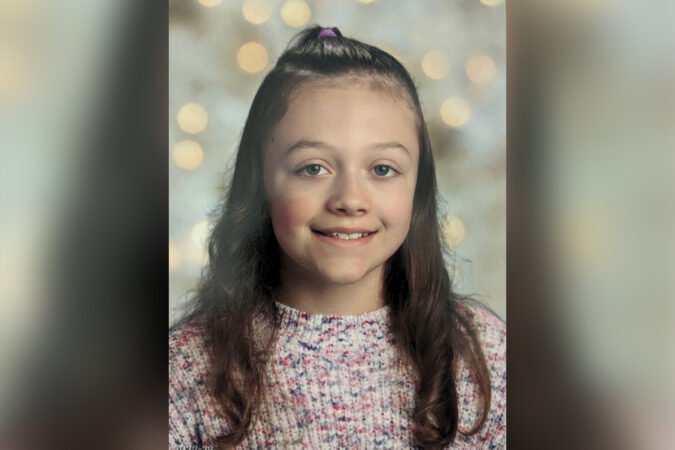
By all accounts, Malinda Hoagland was the kind of 12-year-old girl who would make any parent proud.
She received A’s in school, loved unicorns and going to Wawa with her older sisters, and wrote her lunch ladies notes thanking them for stocking the cafeteria with applesauce and milk.
But her father, Rendell, clearly didn’t see that little girl, prosecutors said Friday in Chester County Court.
Instead, Rendell Hoagland and his fiancee, Cindy Marie Warren, tortured Hoagland’s daughter for months in their West Caln home, depriving her of food and medical care.
They chained her to furniture and forced her into stress positions for hours, beating her if she moved or displeased them.
Once, when the girl forgot her jacket at school, they forced her to do push-ups in the kitchen late at night, striking her with a belt. Other times, the beatings came with a metal spatula.
The lack of care ultimately killed Malinda in May 2024.
Medical examiners found the girl died from severe malnutrition, her organs atrophied from starvation. More than 70 bruises, ulcers, and sores riddled her body, which by then weighed just 50 pounds.
It was the rare type of crime that brought tears even to a judge’s eyes.
On Friday, that judge, Anne Marie Wheatcraft, accepted a guilty plea from Hoagland on one count of first-degree murder and related crimes. The 54-year-old will be confined in prison for life without the possibility of parole.
“This was calculated, sustained cruelty inflicted on an innocent child,” said Malinda Hoagland’s maternal aunt, Christine Mayrhauser, as the girl’s family read tearful victim impact statements.
Rendell Hoagland, a bald man whose size tested the limits of a red prison jumpsuit, gazed on.
“A quick execution is too good for him,” Mayrhauser said.
Warren is also charged with first-degree murder and related crimes. Her trial, scheduled for early January, has been delayed and she will receive a pretrial hearing in May.
Lead prosecutor Erin O’Brien described Malinda Hoagland’s final years as a period of abuse no child should ever endure.
After Rendell Hoagland separated from his wife, he received custody of Malinda in 2020 and moved with the girl from Monroe County to West Caln.
He enrolled the girl at school, but she soon began missing day after day of classes. By 2023, Hoagland had pulled Malinda out of school entirely, and she was completing school online under his and Warren’s near-constant supervision.
After the girl’s death in 2024, investigators recovered photos, videos, and text messages from both Hoagland and Warren that detailed the girl’s horrific life at home.
She was often chained to an air hockey table or other pieces of furniture, even sleeping there, O’Brien said, or made to run in place or do jump squats at Hoagland and Warren’s command.
They punished her with scalding showers and ice baths, forced her to hold books over her head for hours, and poured hot sauce down her throat. The couple monitored the girl through security cameras they had installed throughout the home.
They also kept locks on the refrigerator and snack cabinet, and the girl lost more than a third of her body weight in the last two years of her life. She was often sleep-deprived or suffering open wounds; by the end of her life, she struggled to do her homework because of her eye injuries, O’Brien said
The abuse ended only with death, prosecutors said.
On May 3, 2024, Hoagland called 911 claiming that Malinda had fallen off her bike and had lost consciousness at a campground in Quarryville.
But prosecutors say that the girl had been unconscious for hours, and that Hoagland had driven to CVS the night before, looking for smelling salts in an attempt to wake her up. He propped up the girl’s body so that she did not raise the suspicions of passersby.
It was a common pattern in attempted cover-ups, O’Brien said, and Hoagland and Warren were also known to use makeup to cover up the girl’s bruises for the few people they allowed to see her.
One of the last people to see Malinda Hoagland alive was William Delmedico, an emergency medical responder who wrapped the barely conscious girl in his sweatshirt as he rushed her to a hospital, where she died after surgery.
“I kept telling her she’s not alone, she’s loved, and that we’re doing everything possible to help her,” Delmedico told the court, his voice breaking.
Hoagland and Warren managed to keep the abuse hidden from Malinda’s extended family, prosecutors said, including her three older sisters, his biological children. The women were not living in Southeastern Pennsylvania during the time of the abuse, they said.
In addition to murder, “You should also be facing several counts of robbery,” said Emily Lee, Malinda Hoagland’s older sister, addressing her father. “You robbed my baby sister’s future. You took a life she deserved.”
Jamie Hoagland, another sister, said she begged her father for access to Malinda, sending her sister cards and gifts and playing Minecraft with her online when possible.
“I fought for every inch of communication,” Jamie Hoagland said. She later lamented: “Instead of taking her to the movies, I visit her grave.”
When given the chance to speak, Rendell Hoagland told Wheatcraft he had “nothing to say at this time.”
Wheatcraft said she was not surprised that Hoagland did not express remorse.
Philadelphia police are investigating whether theseparate slayings of three men, all of whom worked in the city’s towing industry, are connected, authorities said this week.
Two of the men, who were shot and killed in December and January respectively, worked as truck operators for the Jenkintown-based company 448 Towing and Recovery, according to police.
The other man, who was shot and killed in November, is connected to a different towing company and worked as a wreck spotter.
Investigators began looking at a possible connection between the killings after the shooting death of 25-year-old Aaron Whitfield Jr. on Sunday, according to Lt. Thomas Walsh of the department’s homicide unit.
“On the surface, there’s obviously some sort of connection,” Walsh said.
Whitfield was in a tow truck with his girlfriend outside of a Northeast Philadelphia smoke shop near Bustleton Avenue and Knorr Street that evening when two men pulled up in another vehicle. They fired at least a dozen shots at the truck before speeding off.
Whitfield died at the scene, while the woman was hospitalized with gunshot wounds to the leg.
The shooting came after another 448 Towing and Recovery driver, David Garcia-Morales, was shot on Dec. 22 while in a tow truck on the 4200 block of Torresdale Avenue, according to police.
Police arrived to find Morales, 20, had been struck multiple times. They rushed him to a nearby hospital, where he died from his injuries on Dec. 26.
While Walsh could not conclusively say whether investigators believe the killings were carried out by the same person or by multiple individuals, he noted that two different vehicles had been used in the crimes.
One of those vehicles, a silver Honda Accord used in the shooting of Whitfield, was recovered earlier this week after police found it abandoned in West Philadelphia, Walsh said.
Meanwhile, police are investigating whether the shooting death of 26-year-old Aaron Smith-Sims in November may also be connected to the killings of Whitfield and Garcia-Morales.
Smith-Sims, who Walsh said was connected to a different towing company, died after he was shot multiple times on the 2700 block of North Hicks Street in North Philadelphia the morning of Nov. 23.
Investigators are now looking to question the owners of both towing companies involved, according to Walsh.
So far, they have failed to make contact with the owner of 448 Towing and Recovery.
“Obviously the victims’ families are cooperating,” Walsh said. “They’re supplying all the information that they have.”
An industry that draws suspicion
Philadelphia’s towing industry can appear like something out of the Wild West, with operators fiercely competing to arrive first at car wrecks and secure the business involved with towing or impounding vehicles.
Police began imposing some order on the process in 2007, introducing a rotational system in which responding officers cycle through a list of licensed towing operators to dispatch to accident scenes.
But tow operators often skirt that system, employing wreck spotters — those like Smith-Sims — to roam the city and listen to police scanners for accidents, convincing those involved to use their service before officers arrive.
The predatory nature of the industry and, in some cases, its historic ties to organized crime make it rife with exploitative business practices and even criminal activity.
But Walsh cautioned the public against jumping to conspiracy theories about the killings, which have proliferated on social media in the days after Whitfield’s death and the news of a possible connection between the murders.
Those suspicions aren’t entirely unwarranted.
In 2017, several employees who worked for the Philadelphia towing company A. Bob’s Towing were shot within 24 hours of one another — two of them fatally.
Pressley admitted to accepting payment in exchange for killing one of the towing employees, 28-year-old Khayyan Fruster, who had been preparing to testify as a witness in an assault trial.
Pressley shot Fruster in his tow truck on the 6600 block of Hegerman Street, killing him and injuring one of his coworkers.
And in an effort to mask the killing — and to make it appear as if it had been the result of a feud between towing operators — Pressley earlier shot and killed one of Fruster’s coworkers at A. Bob’s Towing at random, according to prosecutors.
Haverford Township officials voted this week to bar the township’s police department from cooperating with U.S. Immigration and Customs Enforcement in the agency’s civil deportation efforts.
Township commissioners overwhelmingly approved the resolution, which says Haverford police officers and resources will not be made available for ICE’s 287(g) program. The nationwide initiative allows local police departments to perform certain federal immigration duties, should they choose to enter an agreement with the agency.
The Monday evening vote came after a weekend of anti-ICE protests in cities across the country spurred by the fatal shooting of 37-year-old Renee Good by an immigration agent during an enforcement operation in Minneapolis.
“The last thing I want to see happen is that our relationship with our police department be hurt by the reckless and criminal activity of ICE,” Haverford Commissioner Larry Holmes said before the vote. “We have the power to prevent that.”
Local law enforcement agencies that enter a 287(g) agreement with ICE are offered a variety of responsibilities and trainings, such as access to federal immigration databases, the ability to question detainees about their immigration status, and authority to issue detainers and initiate removal proceedings.
The program is voluntary and partnerships are initiated by local departments themselves, though some Republican-led states are urging agencies to enter them. The Department of Homeland Security recently touted that it has more than 1,000 such partnerships nationwide, as the Trump administration continues to make a sweeping deportation effort the focus of its domestic policy.
Critics such as the American Civil Liberties Union say the program turns local departments into an “ICE force multiplier” and that the agreements, which require officers to shift from local to federal duties, are a drain on time and resources.
Haverford Township’s police department has not made any request to initiate such an agreement with ICE, according to commissioners, who called the resolution a preemptive measure. While ICE has ramped up enforcement in Philadelphia and in surrounding communities like Norristown, there have not been sizable operations in Delaware County.
Judy Trombetta, the president of the township’s board of commissioners, said the resolution was about protecting the civil liberties of those living in Haverford, as well as the township’s public safety.
In Trombetta’s view, a 287(g) agreement could mean those without legal immigration status could be deterred from reporting crimes to Haverford police or showing up to court hearings, while leaving officers confused about their own responsibilities.
And as a township, she said, it is “not our role” to act as federal immigration agents.
“It’s our job as a township to keep people safe, [to] uphold the Constitution,” Trombetta said.
Commissioners voted 7-2 to approve the resolution.
The motion still requires Haverford police to cooperate with federal immigration agencies in criminal investigations. But because many cases involving those living in the country illegally are civil offenses, much of ICE’s activities are exempt.
Commissioner Kevin McCloskey, voicing his support for the resolution, said the week after Good’s killing had been “incredibly taxing on the American people,” and in his view, it was important to adopt the resolution even if ICE wasn’t active in the community.
But for Commissioner Brian Godek, one of the lone holdout votes, that reality made the resolution nothing more than “political theater.”
Tensions over Good’s killing were on full display during the meeting, as both the resolution’s supporters and detractors filled the seats of Haverford’s municipal services building.
“I do not want my tax dollars or Haverford’s resources to be used to support a poorly trained, unprofessional, and cruel secret police force that is our current federal U.S. Immigration and Customs Enforcement agency,” said resident Deborah Derrickson Kossmann.
Brian Vance, a resident and a lawyer who opposed the resolution, said he was approaching the matter like an attorney. He questioned whether noncompliance with a federal department would open up the possibility of lawsuits, or the federal government withholding funds for the township.
“It’s legal, it’s proper, whether we agree with it or not,” Vance said of ICE’s authority.
After the vote, McCloskey, the commissioner, made a plea for unity to those divided over the issue.
That included residents who said the resolution’s supporters had gotten caught up in the “emotion” of the Minneapolis shooting.
“I just ask that you take a step back,” McCloskey said. “On some level, we should all be able to appreciate that none of us wanted to see a 37-year-old mother in a car get shot.”
Prosecutors say Trevor Christopher Weigel, of Churchville, broke into the Yardley home of 19-year-old Jaden Battista in February 2024 with the goal of stabbing the young woman to death.
The couple had broken up months before, prosecutors said, and Weigel became enraged after learning that Battista had blocked his phone number.
In all, prosecutors say Weigel stabbed Battista 13 times throughout her upper body, leaving her bleeding outside the home just as police arrived.
“If he couldn’t have her, nobody was going to have her — and he made sure of it,” Assistant District Attorney A.J. Garabedian told jurors Tuesday in a Bucks County courtroom.
Garabedian said prosecutors have a variety of evidence showing Weigel broke into the house, where Battista was on a FaceTime call with her friend at the time. The friend called 911, spurring Lower Makefield police to respond while Weigel led Battista to his car, prosecutors said. With the passenger door open, prosecutors said, Weigel began chasing Battista and stabbed her repeatedly.
A police officer captured Battista’s final breaths on a body-worn camera, they said.
Meanwhile, Weigel ran away, and another officer chased him on foot to the nearby Interstate 295 freeway as the young man repeatedly stabbed himself in the neck. Police used a Taser to subdue and apprehend him.
Prosecutors later charged Weigel with first-degree murder, burglary, attempted kidnapping, and related crimes.
Weigel’s defense lawyers, meanwhile, disputed the prosecution contention that the couple had split. Lead defense attorney Brian McBeth told jurors Weigel had not left his house that morning planning to kill Battista. Rather, he said,Weigel had acted in response to the “soul-crushing” realization that the young woman had cheated on him.
McBeth said that did not excuse Weigel’s actions. But he urged jurors to question prosecutors’ suggestion that the crime was premeditated and consider whether Weigel had committed involuntary manslaughter, a lesser crime that does not carry the same penalties as first-degree murder.
In prosecutors’ telling, Weigel had left his job at a Warminster manufacturing plant that afternoon with a clear intent to kill.
They said Battista, still on a video call with her friend when Weigel arrived, became distressed as he banged on the door and demanded to be let inside. The friend told Battista to run and hide, prosecutors said.
Weigel lied to Battista, prosecutors continued, telling her he wanted to come inside to collect belongings he had left there after their two-month relationship ended late in 2023.
Once inside, Weigel forcefully led Battista outside to his red Ford Mustang, prosecutors said. Garabedian told jurors they would hear from a neighbor who described Battista as barefoot and not wearing clothing suited for winter.
“She’s not going willingly,” Garabedian said.
Defense attorneys strongly disputed that account.
McBeth said Weigel and Battista had gotten back together in early February, even going out to dinner together on Valentine’s Day.
Over the following days, however, Battista stopped responding to Weigel’s calls and texts in which he asked whether she was OK, McBeth said.
McBeth said Weigel left work early because he was worried about Battista, who he said had previously struggled with depression and self-harm. The young woman let Weigel inside the home willingly, he said, and an argument began when Weigel noticed hickeys on the girl’s neck.
“She told him she cheated, and he snapped,” McBeth said.
Proceedings are set to continue in the courtroom of Bucks County Judge Charissa J. Liller over the next week.
A Philadelphia man who goes by the alias “YP SlumBoy” was arrested Thursday by U.S. Marshals and charged with killing the mother of his child, tampering with evidence and other crimes.
Quamir Jones, 25, is accused of fatally shooting 23-year-old Siani Smith early in the morning of Oct. 12, according to an affidavit of probable cause for his arrest.
Investigators say Smith was in the passenger seat of a vehicle with another man on the 7400 block of Dicks Avenue in the city’s Eastwick neighborhood when Jones pulled up in a car shortly after 5 a.m.
Jones approached the front driver side of the vehicle,the affidavit says. The other man, surprised at Jones’ presence, asked whether he was blocking the driveway.
After a short exchange between the two men, Jones drew a gun, stuck it inside the vehicle and fired once. As the vehicle sped off, Jones fired the weapon again, according to the affidavit.
Finding Smith had been struck, the man drove her to a nearby hospital, where she was pronounced dead around 5:30 a.m.
Meanwhile, Jones called Smith’s mother, police said. He told the woman that a group of men had been outside her home, and that she needed to go outside and pick up shell casings they left behind.
Jones told Smith’s mother that the casings would lead back to a gun registered in his name, but she did not find any casings outside, according to the affidavit.
Smith’s mother later told investigators she was asleep during the shooting but was awoken when she heard “five to six gunshots outside.”
The last time Smith’s mother had seen her daughter was earlier that evening, when Smith arrived home after a night out.
Smith’s mother said she had heard her daughter talking to the child she shared with Jones, according to the affidavit. Siani Smith and the child had moved back into the home two weeks prior.
The woman told police Jones was known to carry guns, and investigators later learned Jones had a valid permit to carry a concealed firearm, a Glock 9mm pistol that was registered in his name in Delaware County.
Jones had two prior arrests for gun crimes in 2022, according to the affidavit. One of those cases was dropped for reasons that were not immediately clear, and the other was dismissed for lack of evidence.
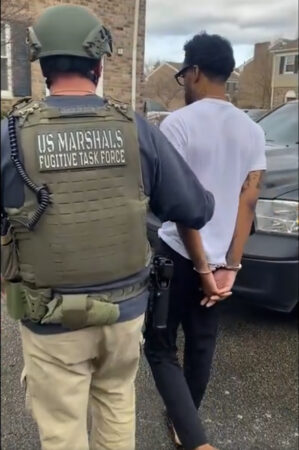
On Thursday, Marshals arrested Jones on the 200 block of E. Mermaid Lane in Chestnut Hill, nearly three months after Smith’s death. It was not immediately clear where Jones resided during that time.
In a post on X, the U.S. Marshals of Eastern Pennsylvania alleged Jones is a member of the city’s “Blumberg” gang.
@USMS_Philly@PhillyPolice@PAAttorneyGen agents, arrested Quamir Jones, 25, in the 200 block of E. Mermaid Lane. On Oct 12 Jones aka "YP Slumboy" allegedly shot and killed his child's mother in the 7300 block of Dicks Ave. Jones is a member of the "Blumberg" gang in North Phila. pic.twitter.com/fkcU9305A4
— U.S. Marshals Service Philadelphia (@USMS_Philly) January 7, 2026
In addition to murder, prosecutors charged Jones with possessing an instrument of crime, criminal solicitation, recklessly endangering another person, and tampering with evidence.
He is being held at the Curran-Fromhold Correctional Facility and was denied bail, court records show. He is represented by a court-appointed defense attorney.
Philadelphia police confirmed Friday that Jones went by the alias “YP SlumBoy,” a rap name that has garnered a modest following on social media.
President Donald Trump and top White House officials offered a starkly different view, saying Good tried to run over the officer with her car.
Department of Homeland Security Secretary Kristi Noem said the officer,identified Thursday as Jonathan Ross, was justified in shooting the woman because he feared for his life. She said Good, a mother of three, had committed an act of domestic terrorism.
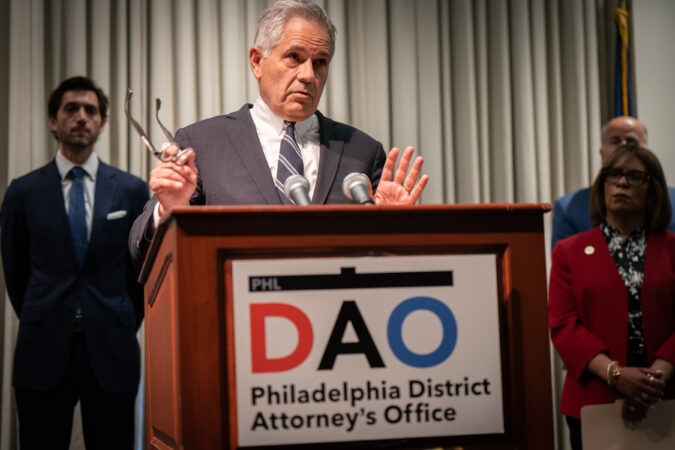
But Krasner, flanked by a group of Philadelphia City Council members and the sheriff, called the actions criminal.
The top prosecutor said that he has family ties to Minneapolis, and that he had reviewed the videos of the shooting, about a mile from where George Floyd was killed by police in 2020. He held a moment of silence for Good and displayed her photo before leading the group in a chant of her name.
“We have to use our voices to call out people who commit terrible crimes,” Krasner said. “Or who justify them.”
That last part was aimed at Trump, whom Krasner has sharply and repeatedly criticized.
The progressive prosecutor often uses his platform to openly decry the president and his policies, most recently when he urged Philadelphians to film ICE agents who have ramped up immigration enforcement since Trump’s return to office.
He said that tactic had been a success in Minneapolis because the video brought widespread attention to the incident.
After Good’s killing, Krasner said, “The first thing out of Trump’s mouth was a lasagna of lies.”
“She behaved horribly,” Trump told reporters. “And then she ran him over.”
Krasner said he could not even be certain that Good was blocking officers from the roadway, as some officials have suggested. Had Good done so, Krasner said, she would have been engaging in an act that “protesters have done forever.”
And that behavior, he said, does not justify a fatal shooting.
Any law enforcement agent inclined to behave similarly in Philadelphia should “get the eff out of here,” Krasner said. And should such an incident happen in the city, the DA said, he would charge the offending officer in state court, where presidential pardons have no effect.
“There are honest decent moral law enforcement officers by the bushel — this is not for you,” Krasner said of his warning. “This is for any one of your colleagues who thinks they are above the law.”
In Kensington, a program to mitigate street violence was hitting its stride.
After joining the New Kensington Community Development Corporation in 2023, outreach coordinators with Cure Violence began responding to shootings in the neighborhood, connecting folks with mental health services and other wellness resources.
They hosted men’s therapy groups, safe spaces to open up about the experience of poverty and trauma, and organized a recreational basketball league at residents’ request. Their team of violence interrupters even intervened in an argument that they said could have led to a shooting.
Cure Violence Kensington was funded by a $1.5 million federal grant from the Department of Justice, part of a Biden-era initiative to combat the nation’s gun violence epidemic by awarding funds to community-based anti-violence programs rather than law enforcement agencies.
One year after a political shift in Washington, however, federal grants that Philadelphia’s anti-violence nonprofits say allowed them to flourish are disappearing.
In the spring, New Kensington CDC received a letter from the Justice Department, saying that under the leadership of Attorney General Pam Bondi it had terminated the grant that would have funded Cure Violence for the next three years.
The work, the letter said, “no longer effectuates the program goals or agency priorities.” In the future, it said, the department would offer such grants exclusively to local law enforcement efforts.
“It was a heavy hit,” said Bill McKinney, the nonprofit’s executive director.
The cuts come amid a Trump administration crackdown on nonprofits and other organizations it views as either wasteful or focused on diversity and DEI.
It spent 2025 slashing funds for programs that supplied aid abroad, conducted scientific research, and monitored climate change. At the Justice Department, cuts came for groups like McKinney’s, which aim to target the root causes of violence by offeringmental health services, job programs, conflict mediation, and other alternatives to traditional policing.
In Philadelphia, organizations like the Antiviolence Partnership of Philadelphia and the E.M.I.R. Healing Center say they, too, lost federal funding last yearand expect to see further reductions in 2026 as they scramble to cover shortfalls.
A Justice Department spokesperson said changes to the grant program reflect the office’s commitment to law enforcement and victims of crime, and that they would ensure an “efficient use of taxpayer dollars.”
“The Department has full faith that local law enforcement can effectively utilize these resources to restore public safety in cities across America,” the spokesperson said in an email.
Nonprofits may appeal the decisions, the spokesperson said, and New Kensington CDC has done so.
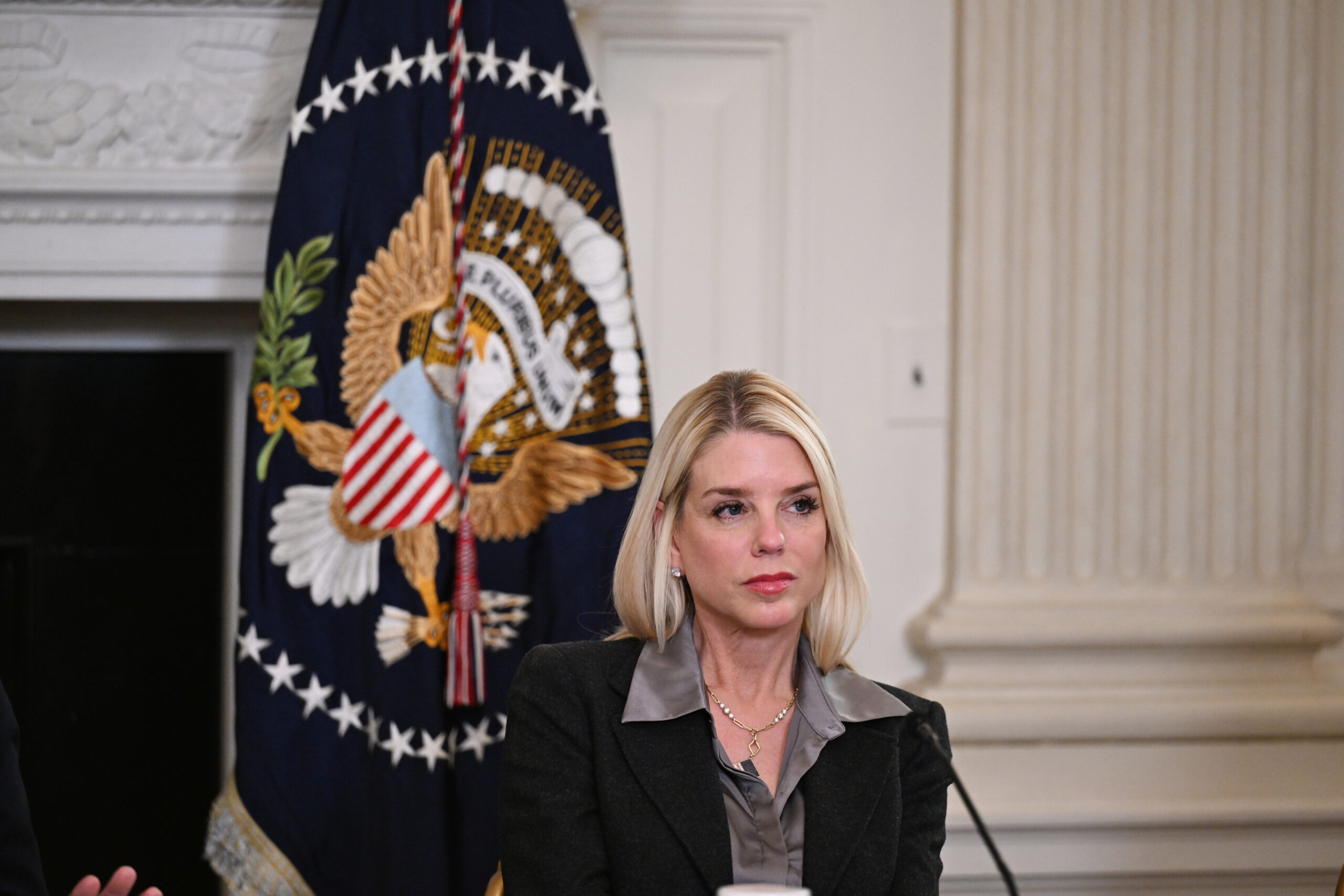
Attorney General Pam Bondi takes part in an event at the White House on Oct. 23.
Philadelphia city officials, for their part, say they remain committed to anti-violence programs, in which they have invested tens of millions of dollars in recent years.
“There are always going to be things that happen externally that we have no control over as a city,” said Adam Geer, director of the Office of Public Safety.
The reversal in federal support comes at a time when officials like Geer say the efforts of anti-violence programs are beginning to show results.
Violent crime in Philadelphia fell to historic lows in 2025, a welcome relief after the sharp upturn in shootings and homicides that befell the city at the height of the pandemic.
In 2021, the city announced a large-scale campaign to combat gun violence that,in the past year, included nearly $24 million for anti-violence programs.
That was on top of the Biden administration’s Community Based Violence Intervention and Prevention Initiative. Since launching in 2022, the DOJ program awarded more than $300 million to more than 120 anti-violence organizations nationwide.
In April, many of those groups, including New Kensington CDC, lost funds. And in September, a larger swath learned they were now barred from applying for other Justice Department grants that would have arrived this spring.
“We’ve seen enormous dividends” from the work of such groups, said Adam Garber, executive director of CeaseFirePA, a leading gun violence prevention group in the state. “Pulling back now puts that progress at risk — and puts lives on the line.”
Philadelphia feels the squeeze
Federal grants helped Natasha McGlynn’s nonprofit thrive.
McGlynn, executive director of the Antiviolence Partnership of Philadelphia, said a DOJ grant called STOP School Violence allowed her organization to launch a counseling program for young people who had been victims of violence or otherwise exposed to it in some of the city’s most violent neighborhoods.
The nonprofit used the grant to hire therapists to help students develop healthier attitudes around conflict and trauma, she said.
The $997,000 grant was cut in April, and when McGlynn went to apply for another round of funding in the fall, she learned that nonprofits were no longer eligible. The lost funding means some services, like counseling, could now be eliminated, she said.
“I would say several positions are in question,” McGlynn said. “I would say the program is in question.”
Chantay Love, the director of Every Murder is Real, said her Germantown-based victim services nonprofit also lost Justice Department funding in 2025.
Federal grants are not the nonprofit’s only source of income, Love said, but she along with other nonprofit leaders in the city are considering whether they’ll need to cut back on programs this year.
Record-setting investment
The decade before the pandemic saw gun-related deaths in the state climb steadily, spiking during the lockdown as social isolation, school closures, shuttered community services, and higher levels of stress contributed to a spate of gun homicides and shootings that began to ease only in 2024.
Two years earlier, the state began dispersing more than $100 million to community-based anti-violence programs, much of the money coming from the American Rescue Plan, a sweeping Biden administration pandemic recovery package that also sought to reduce rising gun violence. And when those funds expired, state lawmakers continued to invest millions each year, as did Philadelphia city officials.
Garber, of CeaseFirePA, said those efforts “get a lot of heavy-lifting credit” for Philadelphia’s historic decrease in violence.
A report compiled by CeaseFirePA cites studies that found outreach programs like Cure Violence helped reduce shootings around Temple University, as well as in cities like New York and Baltimore, where homicides and shootings in some parts of the city fell by more than 20%.
While it’s too early for data to provide a full picture on how such funding has contributed to overall violence reduction, officials like Geer, the Philadelphia public safety director, agreed that programs like Cure Violence have helped crime reach record lows.
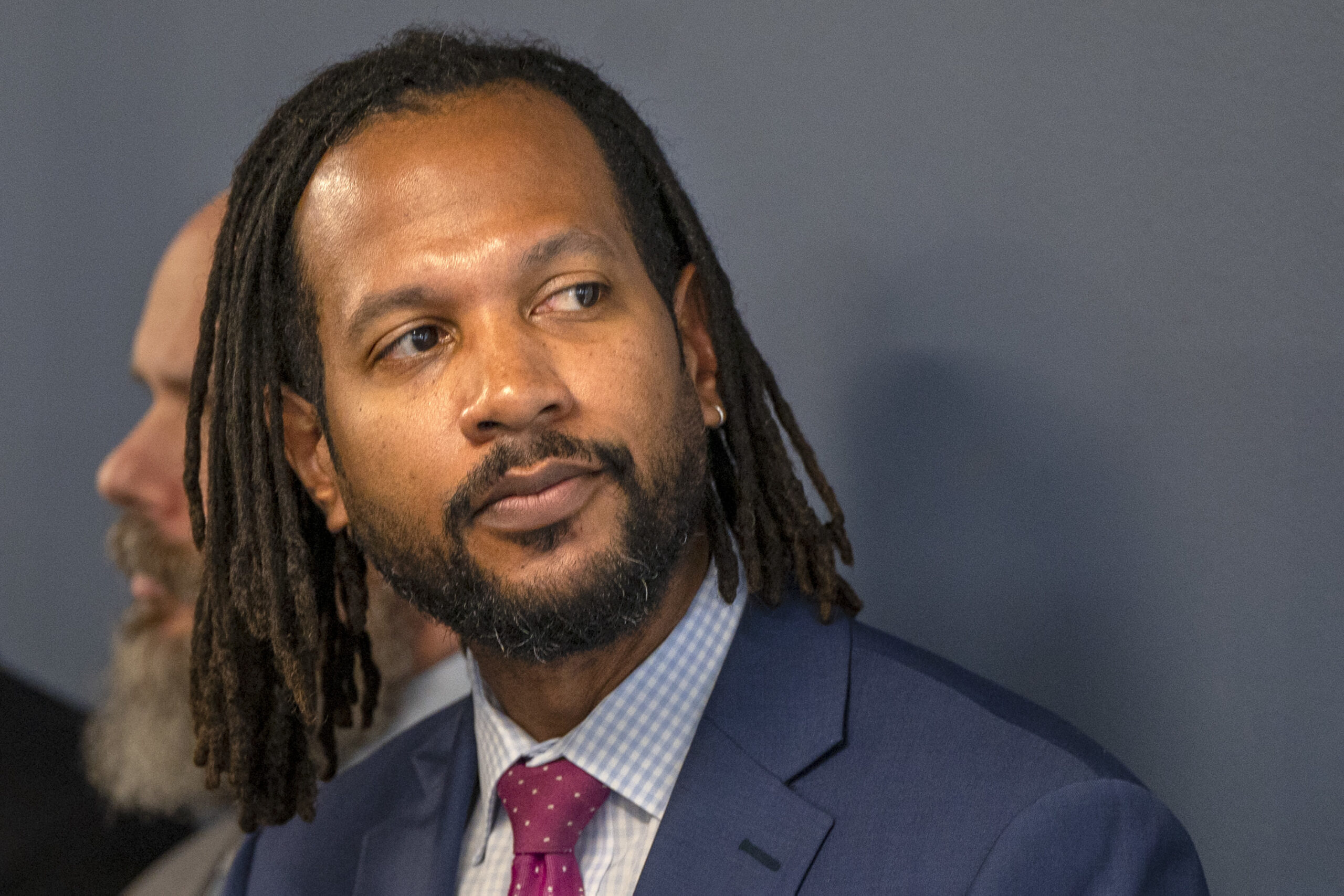
Philadelphia acting chief public safety director Adam Geer attends a news conference on Jan. 30, 2024, about a shooting that left an officer wounded and a suspect dead.
Outreach workers with the city-supported Group Violence Intervention program made more than 300 contacts with at-risk residents in 2025, according to data provided by Geer’s office, either offering support or intervening in conflicts.
And they offered support to members of more than 140 street groups — small, neighborhood-oriented collectives of young people that lack the larger organization of criminal gangs — while more than doubling the amount of service referrals made the previous year.
In practice, a program’s success looks like an incident in Kensington in which Cure Violence workers intervened in a likely shooting, according to members of New Kensington CDC.
In April, a business owner called on the nonprofit after seeing a group of men fighting outside his Frankford Avenue store and leaving to return with guns. Members of the outreach team spoke with both parties, de-escalating the conflict before it potentially turned deadly.
“Each dollar cut is ultimately a potential missed opportunity to stop a shooting,” Garber said.
Cutting off the ‘spigot’
Even as community-based anti-violence programs have risen in popularity, they are not without their critics.
While some officials champion them as innovative solutions to lowering crime, others say the programs can lack oversight and that success is difficult to measure.
In 2023, an Inquirer investigation found that nonprofits with ambitious plans to mitigate gun violence received millions in city funds, but in some cases had no paid staff, no boards of directors, and no offices.
A subsequent review by the Office of the Controller found some programs had not targeted violent areas or had little financial oversight. But by the next round of funding, the city had made improvements to the grant program, the controller’s office found, adding funding benchmarks and enhanced reporting requirements.
Meanwhile, as Philadelphia continued its support these programs, President Donald Trump’s Justice Department began a review of more than 5,800 grants awarded through its Office of Justice Programs. It ultimately made cuts of more than $800 million that spring.
Among programs that lost funding, 93% were “non-governmental agencies,” including nonprofits, according to a letter DOJ officials sent to the Senate explaining the decision.
The balance of remaining funds in the violence prevention grant program — an estimated $34 million — will be available for law enforcement efforts, according to a DOJ grant report. In addition to fighting crime, the money will help agencies improve “police-community relations,” hire officers, and purchase equipment, the document says.
Agencies conducting immigration enforcement are also eligible for grants, the report says, while groups that violate immigration law, provide legal services to people who entered the country illegally, or “unlawfully favor” people based on race are barred.
One group lauding the cuts is the National Rifle Association, which commended the Trump administration in November for cutting off the “spigot” to anti-violence nonprofits.
‘[T]he changes hopefully mean that nonprofits and community groups associated with advocating gun control will be less likely to do it at the expense of the American taxpayer and that real progress can occur on policing violent criminals,” the NRA’s legislative arm wrote in a blog post that month.
Nate Riley disagrees.
Riley, an outreach worker with Cure Violence Kensington, said the cuts threaten to reverse the progress New Kensington CDC has made since he joined the program early last year.
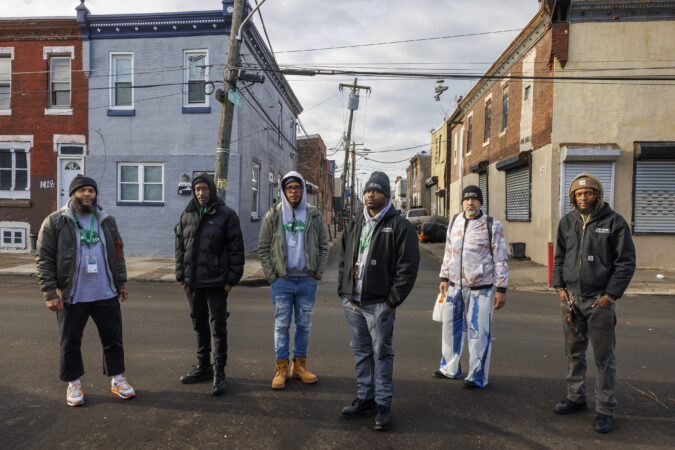
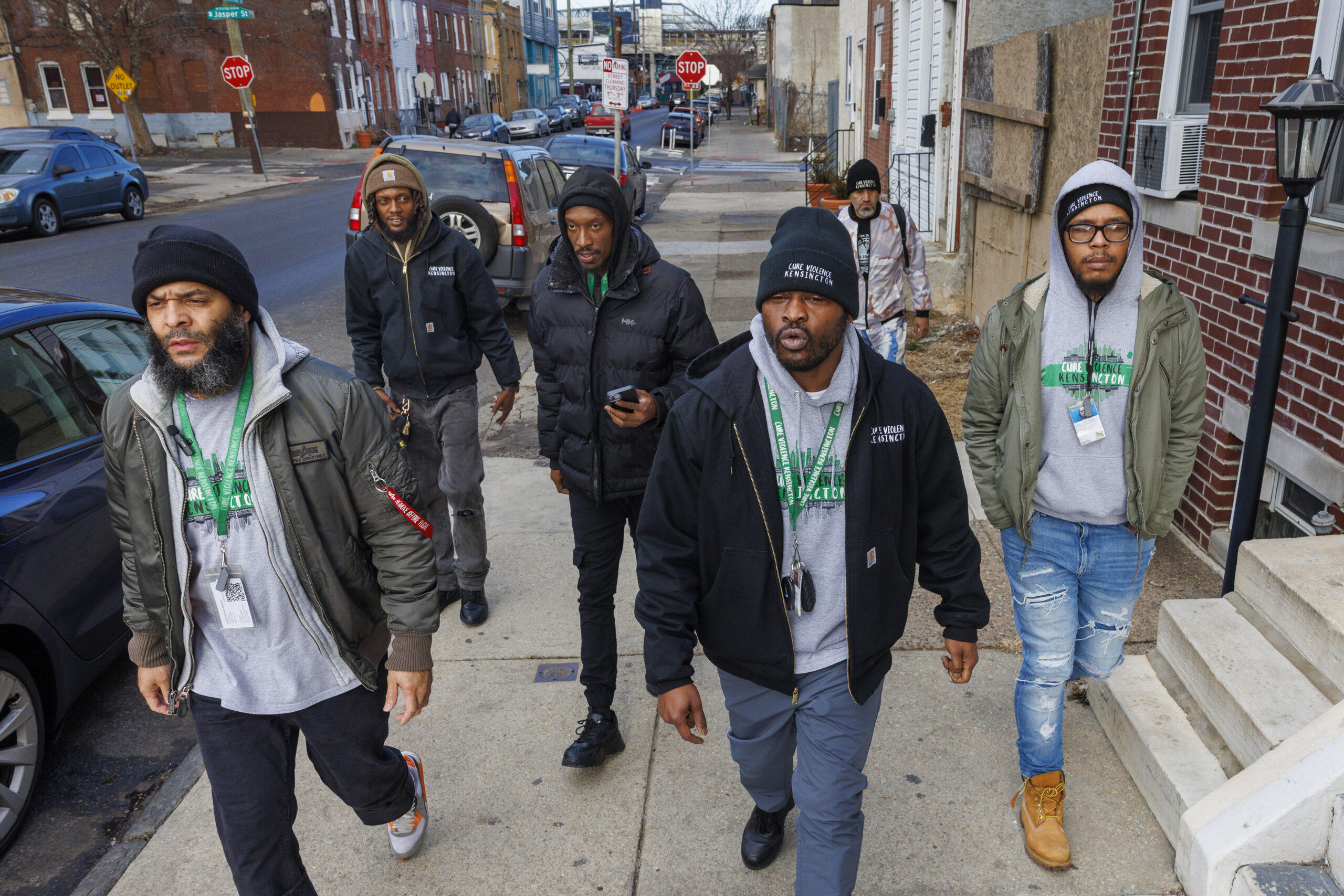
Nate Riley (from left), Tyree Batties, Dante Singleton, Tyreek Counts, Ivan Rodriguez, and Jamall Green-Holmes, outreach workers with New Kensington Community Development Corporation, making their rounds on Wednesday.
Cure Violence’s six-person outreach team is made up of people like Riley, who grew up in North Philadelphia and says he is well-versed in the relationship between poverty, trauma, and violence and brings that experience to Kensington.
“This is a community that’s been neglected for decades,” Riley said. “For lack of a better term, you’ve got to help them come in outside of the rain.”
In a recent month, Cure Violence outreach workers responded to 75% of shootings in the Kensington area within three days, a feat Riley is particularly proud of.
He said the program is not meant to supplant the role of police.
Instead, Riley sees street outreach as another outlet for those whose negative experiences with authorities have led them to distrust law enforcement.
Those people may alter their behavior if they know police are present, he added, giving outreach workers embedded in the community a better chance at picking up on cues that someone is struggling.
From Kensington to Washington
McKinney, with New Kensington CDC, said the group was still expecting about $600,000 from the Justice Department when the grant was cut short.
The nonprofit has since secured a patchwork of private donations and state grants that will keep Cure Violence running through much of 2026, he said.
After that, the program’s future is uncertain.
In the wake of the cuts, national organizations like the Community Justice Action Fund are advocating for federal officials to preserve funding for community-based anti-violence programs in future budgets. Adzi Vokhiwa, a federal policy advocate with the fund, said the group has formed a network of anti-violence nonprofits dubbed the “Invest in Us Coalition” to do so.
The group petitioned congressional leadership in December to appropriate $55 million for anti-violence organizations in the next budget — a figure that both Democrats and Republicans in the Senate have previously agreed on and that Vokhiwa views as a sign of bipartisan support for such programs.
McKinney, with New Kensington CDC, said it was impossible to ignore that the nonprofit and others like it provide services to neighborhoods where residents are overwhelmingly Black and brown. In his view, the cuts also reflect the administration’s “war on cities.”
He was bothered that the Justice Department did not seem to evaluate whether New Kensington CDC’s program had made an impact on the neighborhood before making cuts.
“We’re in a situation where the violence isn’t going away,” he said. “Even if there’s been decreases, the reality is that Kensington still leads the way. As those cuts get deeper, we are going to see increases in violence.”
Two men died in a shootout that began over a domestic issue in the city’s Castor neighborhood on New Year’s Day, authorities say, and police have charged a man and a woman with murder for their involvement.
The victims, 52-year-old Luis Colon and 21-year-old Quadir Tull, both died from their injuries at local hospitals, according to police.
Tyriq Williams, 21, and Cara Williams-Reeves, 44, were charged with murder and related crimes on Friday.
The incident began Thursday when a group of family members related to the ex-boyfriend of Colon’s stepdaughter showed up to Colon’s residence on the 7100 block of Oakland Street shortly after 11 a.m.
The group, which included Tull, Williams, and Williams-Reeves, had come to “initiate a confrontation” with Colon’s stepdaughter, police said. The ex-boyfriend was not present.
A struggle broke out when two women in the group — including Cara Williams-Reeves — began assaulting Colon’s stepdaughter and wife on the front lawn.
When Colon intervened, Tull and Williams pulled out firearms and pushed Colon.
Colon then pulled a firearm, and a shootout between the three men began, police said. They did not specify which man fired the fist shot.
Colon was struck multiple times in the chest and was transported by police to a nearby hospital, where he was pronounced dead just before noon.
Tull and Williams fled the scene in a dark-colored Chrysler 300 along with Williams-Reeves.
Tull had been shot multiple times and was driven in the Chrysler to a different hospital, where he was pronounced dead around 11:50 a.m.
Williams was shot in the hand and is in stable condition, police said.
When Nicole Lauria met Daniele Grovola more than a decade ago, it was clear that the little girl from Upper Darby would one day become a star employee at her karaoke company.
“She was amazing,” said Lauria, the owner of Lucky Music Productions. “A lot of people use the phrase, ‘She lit up a room.’ But she really did.”
Tragedy struck the Grovola family days before Christmas.
Police arrested the young woman’s mother, Diane Grovola, 57, whom they have accused of stabbing her daughter to death in the home. Her husband, John, Daniele Grovola’s father, discovered the horrific scene as he arrived home from an overnight shift at the airport, authorities said.
Friends of Daniele Grovola are shocked by a crime they are struggling to understand.
Photo of Daniele Grovola.
In the week since Grovola’s death, they have launched a fundraiser to support her father and cover the young woman’s funeral costs. The money will also go toward veterinary bills for the family’s dog, Ezra, which police suspect Grovola’s mother also stabbed that morning.
And loved ones are sharing memories of Daniele Grovola, who brought joy and warmth to those she encountered.
Lauria met John Grovola around 15 years ago, when he made the leap from singing karaoke to joining Lucky Music as an equipment manager and DJ. The company hosts events at venues throughout Delaware County and Philadelphia.
Grovola soon began to bring around his daughter, who took a fast interest in her father’s work.
The father and daughter were “immensely close,” Lauria said. Following in her father’s footsteps, Daniele Grovola eventually joined Lucky Music herself, managing the company’s DJ equipment.
She was training to become a bar trivia host before she died.
Her radiant personality shone on the job, according to Lauria, including at a karaoke party the company hosted in 2024 for children who had disabilities and were on the autism spectrum.
“[Daniele] was just amazing at encouraging them to sing, helping them to feel positive about themselves,” Lauria said. “She was just a warm person.”
Hailey Geller, 23, said she and Grovola had been best friends since the third grade. The girls went on to attend Upper Darby High School together.
“She was never a bother,” Geller said. “She was really good to me, and I was good to her.”
Hailey Geller with Daniele Grovola and her father, John.
Grovola had her quirks, Geller said, amusing friends with her obsession with Sharpies. The girls would spend afternoons at the mall, where Grovola would hunt for multicolored markers to use in her artwork.
She was an avid fan of anime shows, Geller added, and, as a music lover, adored her headphones.
Geller said Grovola was always there to confide in. In recent months, however, some of Grovola’s comments about her home life had concerned her.
Grovola told Geller that her mother had been “in and out” of local crisis centers. And Grovola described her mother as having “mental issues,” Geller said, once disclosing she had locked herself in the basement to avoid her.
Still, Geller believes Grovola did not share the complete story of possible tensions with her mother. Police have yet to identify a motive in the killing and continue to investigate.
Friends like Lauria said those who knew the Grovola family did not suspect such a crime was possible.
“It makes no sense,” Lauria said. “[Daniele] was a great daughter to her mother … loved her mother very much. This just came out of nowhere.”
A Delaware County woman was charged with first-degree murder for allegedly stabbing her 23-year-old daughter to death in their Upper Darby Township home two days before Christmas, authorities say.
Police found Diane Grovola, 57, naked, covered in blood, and suffering self-inflicted stab wounds when they responded to a 911 call at the family residence that morning, according to the affidavit of probable cause in her arrest.
Grovola’s daughter was in an upstairs bedroom with knife wounds to her face, chest, legs, and back. Her eyes were open but she was unresponsive, the affidavit says. She was pronounced dead shortly after.
“Sorry, I should have stabbed myself first,” Grovola told officers as they placed her in wrist restraints, according to the affidavit.
Grovola’s husband, the young woman’s father, was first to discover the distressing scene.
The man arrived at the home on South Bishop Avenue in the Secane section around 6:30 a.m. after returning from a shift at Philadelphia International Airport, the affidavit says. He had stopped at McDonald’s to get breakfast for his family.
Once inside, the man was greeted by the family dog, which had suffered knife wounds to its abdomen and “got blood on his clothing,” according to the affidavit.
He found his wife seated on the living room sofa with a knife in her hand.
“I stabbed our daughter,” she told him, according to the affidavit.
As her husband dialed 911, Diane Grovola told him she did not want to live anymore and began to stab herself in the chest, according to the affidavit.
The operator told the man to flee the residence.
During that time, Grovola stripped naked and began breaking items in the kitchen until police arrived. They eventually recovered a large stainless-steel knife that appeared to have blood on it, the affidavit says.
In addition to first-degree murder, prosecutors charged Grovola with third-degree murder, possessing an instrument of a crime, and aggravated cruelty to an animal.
She is being held in the George W. Hill Correctional Facility and was denied bail, court records show.