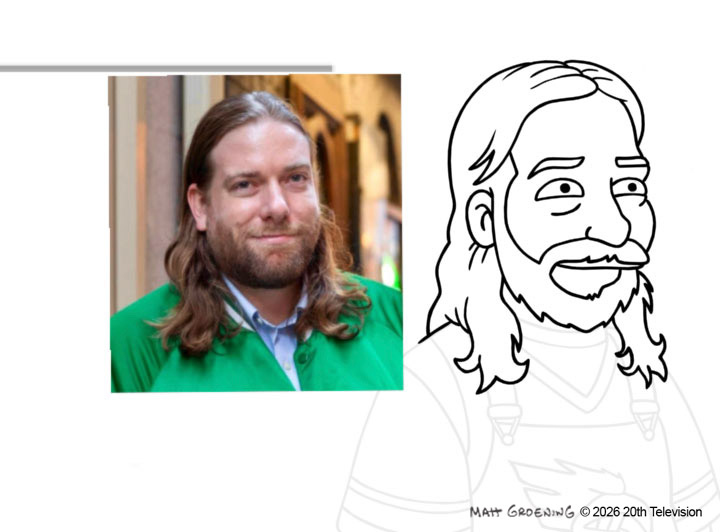
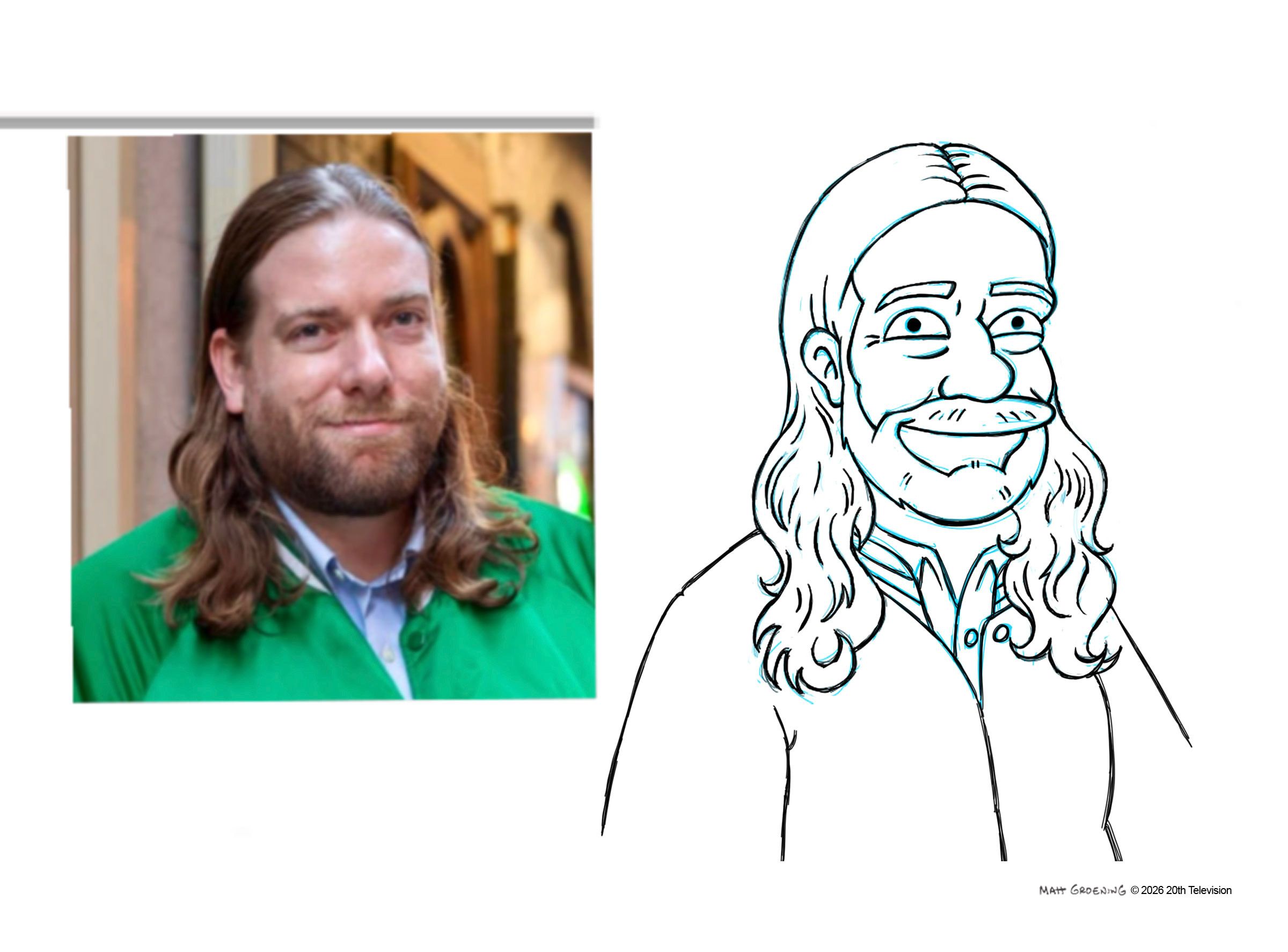
On the night of Feb. 4, at about 9:30, Christine Nangle received a text. It was from her boss Matt Selman, executive producer of the Fox program The Simpsons.
He had an idea. A mutual friend of theirs, Defector writer Dan McQuade, had recently died of neuroendocrine cancer at the age of 43. McQuade was a Simpsons superfan who embraced all of Philadelphia’s quirks, from tacky boardwalk T-shirts to the comically small La Salle smoke machine.
The Simpsons was about to air its 800th episode, set in Philadelphia. It included a litany of local references, many of them obscure to anyone outside the Delaware Valley.
McQuade had been planning to write about it. He hoped to get together to discuss the episode with Nangle and Selman while simultaneously watching and riffing on another Philadelphia-based show — Do No Harm, a medical drama McQuade described as “weird and bad.”
But that never happened. McQuade’s condition worsened. He died Jan. 28 at his parents’ home in Bensalem.
The Simpsons episode seemed tailor-made for McQuade. The producers hadn’t sent the final video to Fox studios yet. So, Selman made a proposal: Why not add a Dan McQuade Easter egg?
Nangle, a writer and producer on the show, couldn’t believe it. A few days earlier, she’d had the same thought, and almost texted it to her boss. But she assumed that it would be too late, because the episode was set to air on Feb. 15.
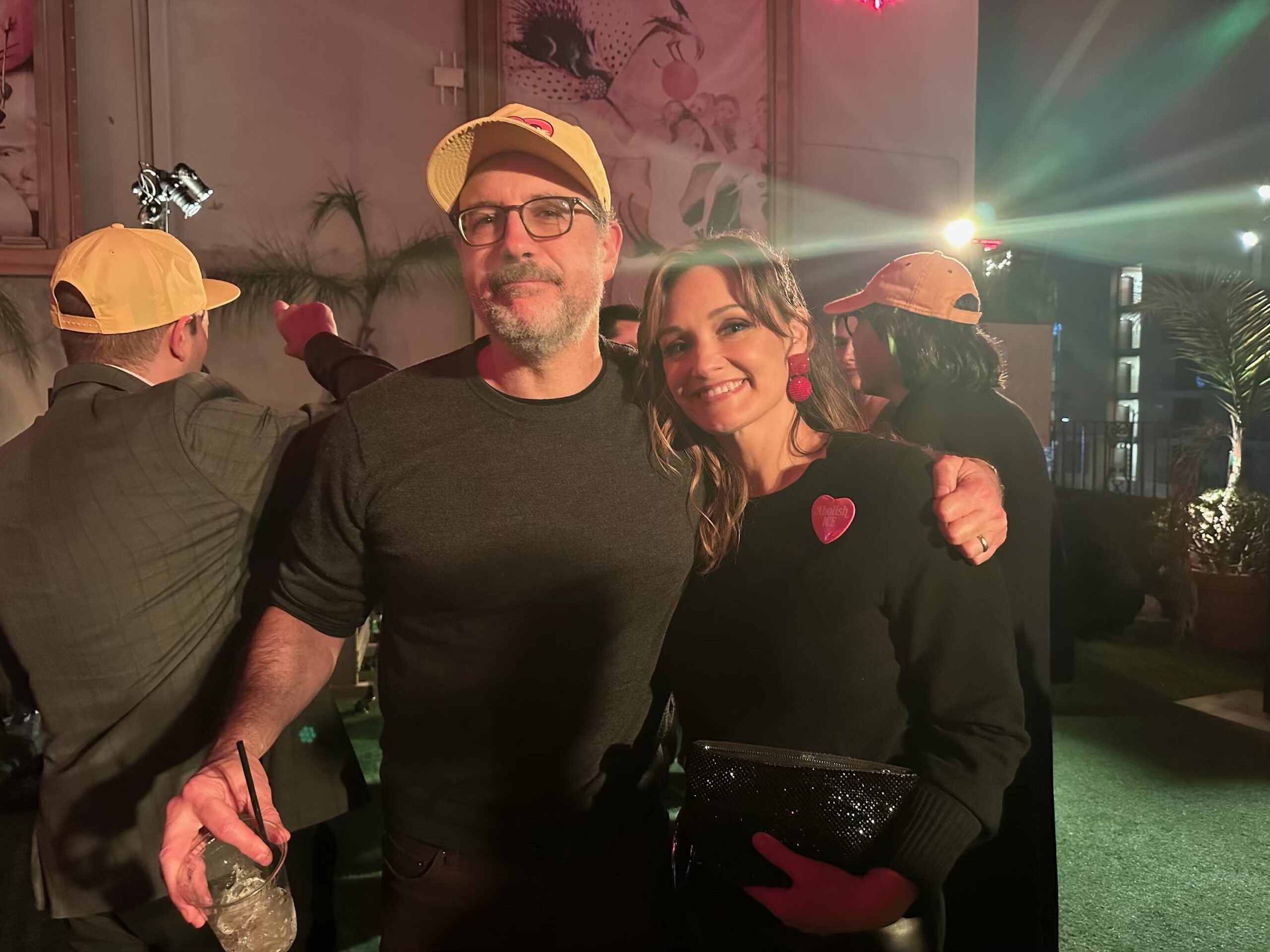
Matt Selman and Christine Nangle pictured at “The Simpsons” 800th episode party on Feb. 6.
The coworkers began to scour footage for any spot they could fit a Simpson-size, shaggy-bearded Philadelphian. Nangle considered putting him in the Mütter Museum, when Homer visited with a National Treasure-themed contingent.
But that was ruled out. So was the “Philadelphia Super Bowl Riot of 2018.” Selman worried viewers wouldn’t be able to recognize McQuade among the crowd of rabid fans.
“That was the Super Bowl when the Eagles beat my beloved Patriots, because of Bill Belichick’s inflexibility,” the executive producer said. “I thought about jamming him into that, but you wouldn’t have been able to see his cute little face. His little hairstyle.”
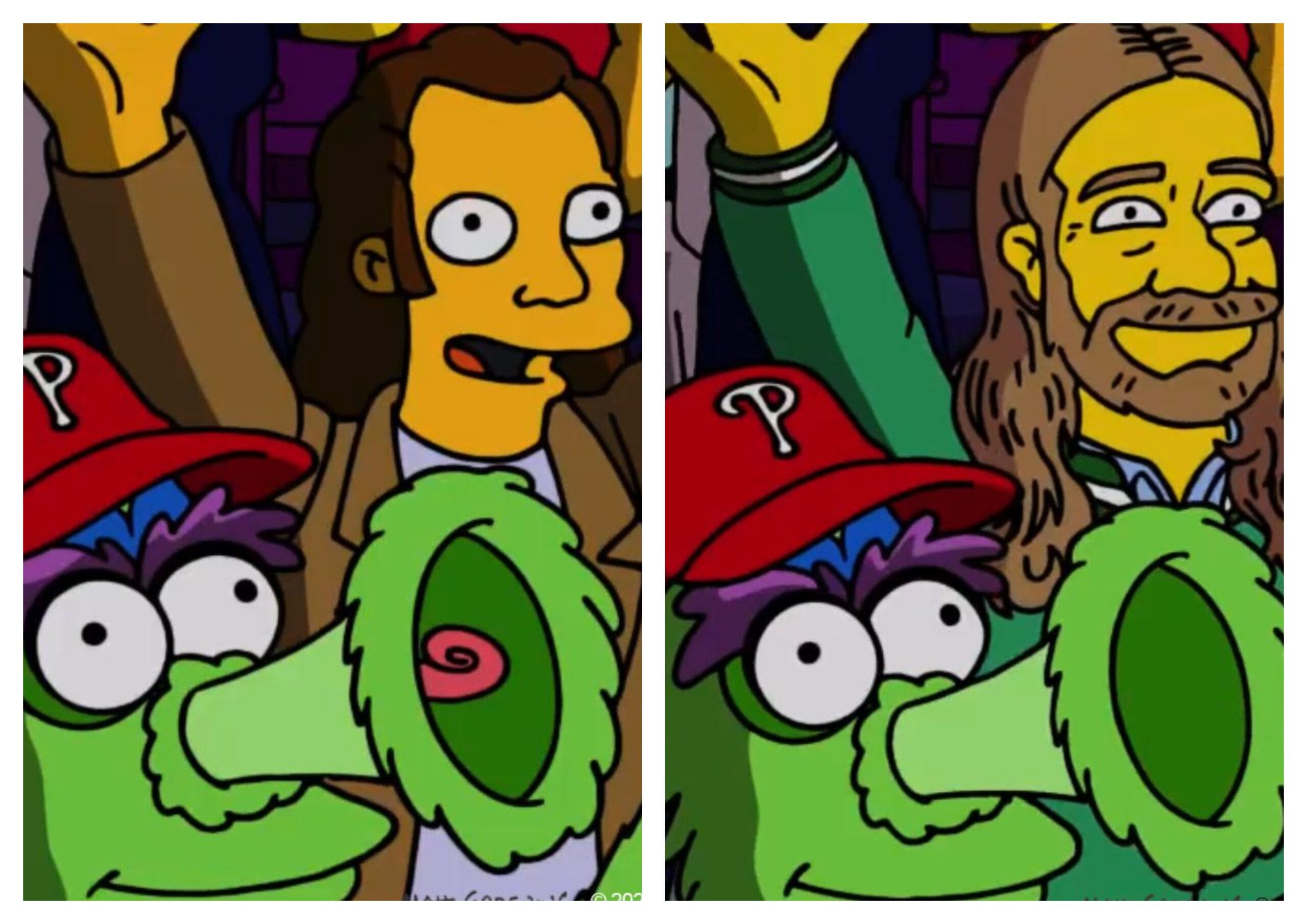
Instead, Selman found the perfect scene. About halfway through the episode, at the 10:49 mark, Homer goes to a Roots concert. The camera pans to the front row.
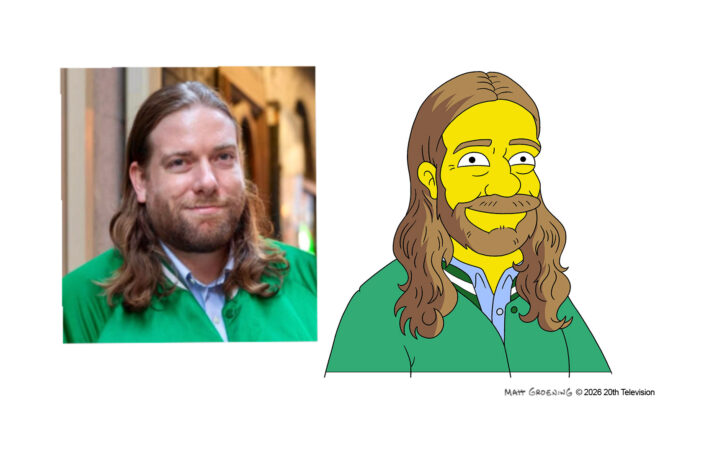
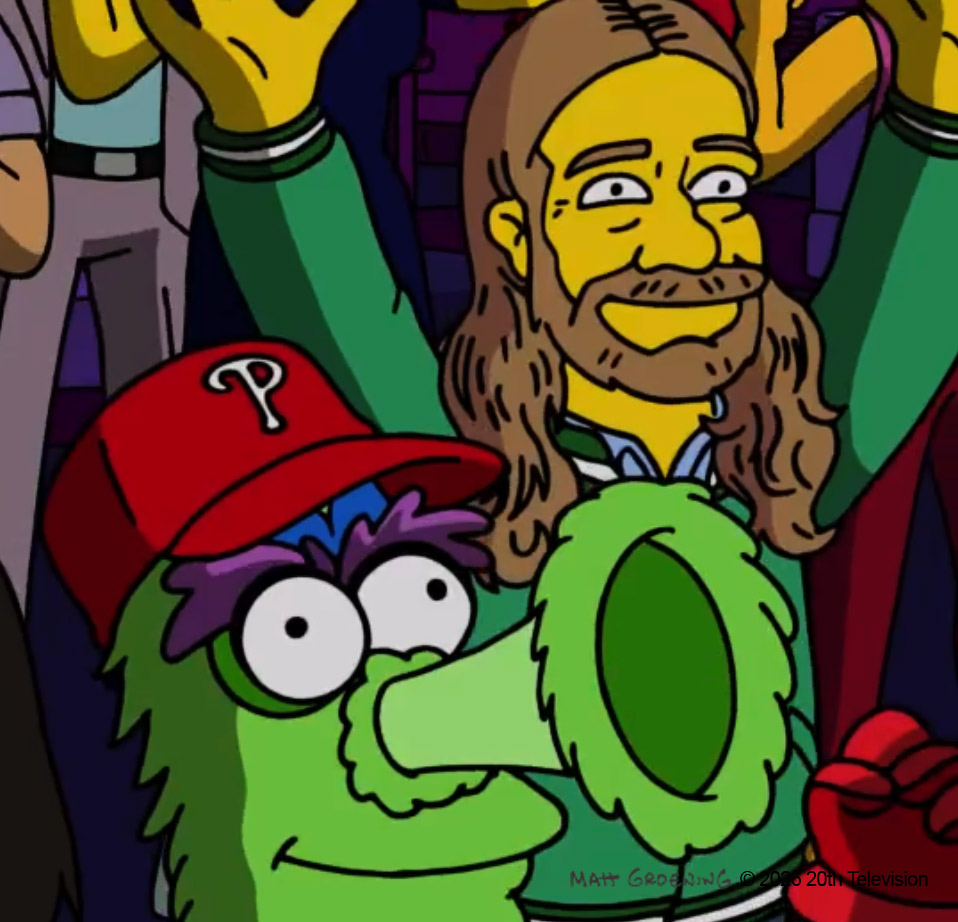
In the upper right-hand corner, wearing a kelly green satin jacket, with his long hair parted down the middle, is Dan McQuade.
“If it brought his family an ounce of relief, for one millisecond, then it was worth it,” Selman said.
Dan McQuade’s likeness was utilized in a scene depicting a concert by The Roots.
‘This is a good idea’
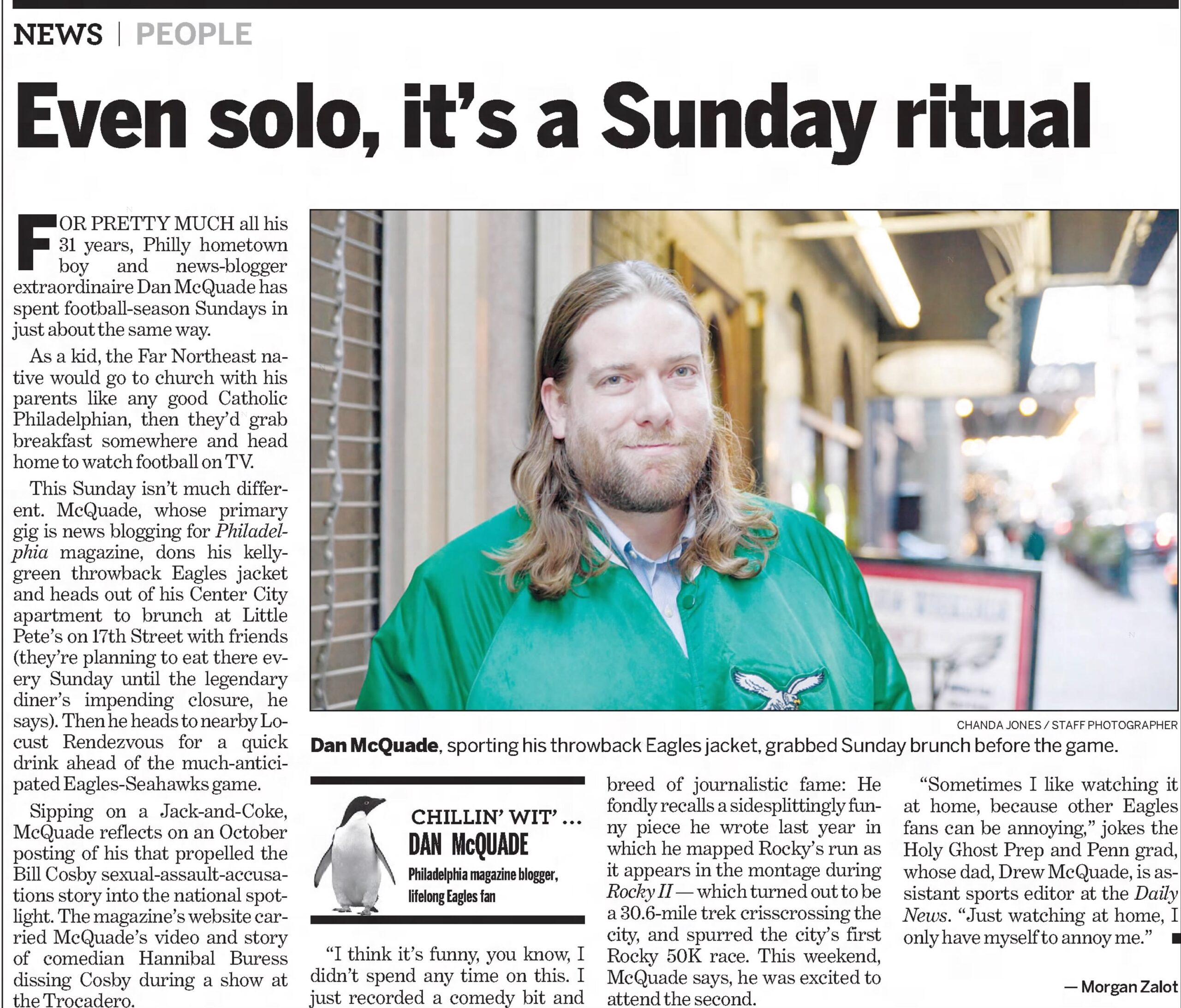
Selman had known McQuade for about five or six years. They were both alumni of the University of Pennsylvania, where they worked as editors at the Daily Pennsylvanian and 34th Street Magazine.
McQuade was 11 years younger, so they never met on campus. But Selman developed an appreciation for his work, and an online friendship blossomed.
Nangle, who grew up in Oxford Circle and attended Little Flower High School, met McQuade only once, when they were teenagers. But like Selman, she got to know him through his writing.
“He did this whole piece about the Franklin Mills Mall,” she said. “Just having somebody give voice to something that you thought was a mundane, dumb part of your life, and elevate it and make it seem like it matters, is really cool. You feel really seen.”
She added: “I barely remember meeting him in high school, but just reading his work, I was like, ‘It’s crazy that I’m not friends with this guy.’ And I was like, ‘Next time I’m in the city, we have to hang out.’”
Long after the producers moved to Los Angeles to work on the show, McQuade remained their portal to Philadelphia’s idiosyncrasies. In a way, Nangle looked to him as a kindred spirit.
They were both trying to bring a bit of the city’s character to a national audience. For Nangle, that meant slipping Delco accents and eccentric characters into her shows.
Selman would often go back and forth with McQuade about general Philadelphia weirdness. But they’d also talk about The Simpsons, of which McQuade was a lifelong fan.
A few times, the writer managed to combine his two passions.
“He’d text me photos of bootleg Bart Simpson T-shirts that he found,” Selman said. “And mail them to me. He would always send them to me.”
McQuade and Selman had been planning a story around The Simpsons’ 800th episode for months. In October, the writer flew out to Los Angeles, to discuss it more in person.
(Selman characterized this as more of a “fun-hang session.”)
They toured the Fox studio and went to the gift shop, where McQuade purchased Itchy and Scratchy toys for his son, Simon. They finished the day with lunch at Moe’s Cafe.
“There was a Philly cheesesteak on the menu,” Selman said. “And he was like, ‘I know this is going to be terrible, but I’m going to get it anyway.’
“He didn’t think it was that good. He was a champ about it, though.”
At the time, McQuade seemed to be in good health and good spirits. He’d told Selman about his cancer diagnosis but said that he “was doing OK.”
When the executive producer heard that his friend had died, he was shocked. Selman read McQuade’s obituary, and looked back on a video of Simon playing with the Itchy and Scratchy toys.
Then, the concept came to him.
Selman reached out to line producer Richard Chung. Chung’s job was to streamline episode production — and it was rare for The Simpsons to add a character, even a minor one, so last-minute. Selman wasn’t sure how Chung would react.
It would cost the company money and time. Not every line producer would have approved. But Chung did.
“This is a good idea,” he said.
The likeness of late writer Dan McQuade used in a recent episode of “The Simpsons” went through several iterations.
Going ‘full Santa Claus’
The next day, Chung started working on adding McQuade to the episode. He reached out to a character designer, who drew out a sketch.
After it was done, Selman brought the concept to Drew Magary and David Roth at Defector. He asked what they recommended McQuade wear.
“They said, ‘Put him in the kelly green Eagles satin jacket,’” Selman recalled. “So, we were able to put that implied jacket on him.
“And then we just kind of looked for good pictures of his funny hair.”
Dan McQuade’s Defector colleagues Drew Magary and David Roth recommended that the illustrators capture McQuade in his kelly green Eagles jacket.
Selman and Nangle decided to replace a generic member of the crowd at The Roots concert with McQuade.
It was unclear to Selman, or Magary, or Roth, if McQuade liked or disliked The Roots. But it was the best spot to include him. McQuade would be positioned right behind the Phillie Phanatic (tweaked to avoid copyright infringement).
“I don’t know if [Dan] was or was not a Roots fan,” Selman said. “They didn’t seem to know. I think they would have known if he was a huge fan, but I hope he wasn’t an enemy.
“Plus, legal-version of Gritty and legal-version of Phanatic are both there. So, I assumed he liked them. They all went together.”
‘The Simpsons’ illustrators replaced a random fan at The Roots concert with a likeness of Dan McQuade.
Less than 48 hours after Selman and Nangle exchanged texts, McQuade was added to the show. He was included in the first-aired broadcast on Feb. 15, as well as the legacy version (on Disney+).
The late writer’s appearance lasted only nine seconds, but fans caught on.
Later that night, Nangle confirmed on Bluesky that it was indeed an homage to McQuade. Her post quickly went viral. She received all sorts of messages and mentions.
“I guess they didn’t want to put his Mass card from the funeral [there],” Nangle said. “So, they put that image instead, which took my breath away.”
It was a hectic process, but Selman and Nangle are grateful they could honor McQuade in their unique way. They hope this episode can provide some joy to his loved ones, when they’re missing their Simpsons-loving friend.
“Having this job gives you magic Santa Claus powers to bring joy to people,” Selman said. “And you can’t use your Santa Claus powers all the time, to bring joy to everybody.
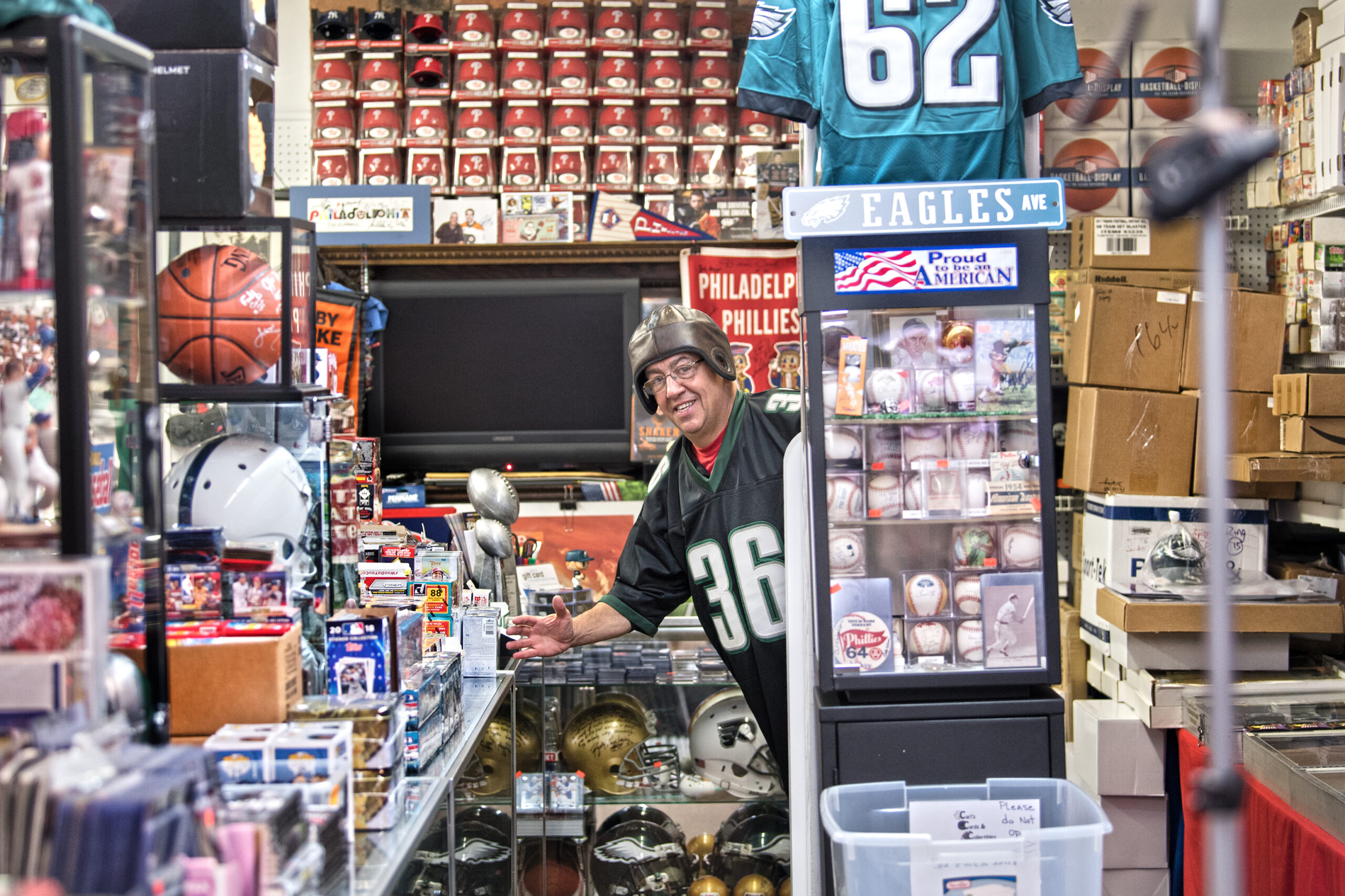
On the morning of Jan. 31, a few hours after Carl Henderson died unexpectedly in his sleep, his daughter, Lauren Henderson-Pignetti, drove to her late father’s sports cards and collectibles shop.
She opened it up like she would any other Saturday. Sometimes, kids stopped in with their parents on the back end of trips to the grocery store. Or while they were driving home from basketball practice or piano lessons.
Being there — just like her father had for 31 years — seemed like the right thing to do. So, the younger Henderson stayed at Carl’s Cards in Havertown from 11 a.m. to 7 p.m., until the last customer left.
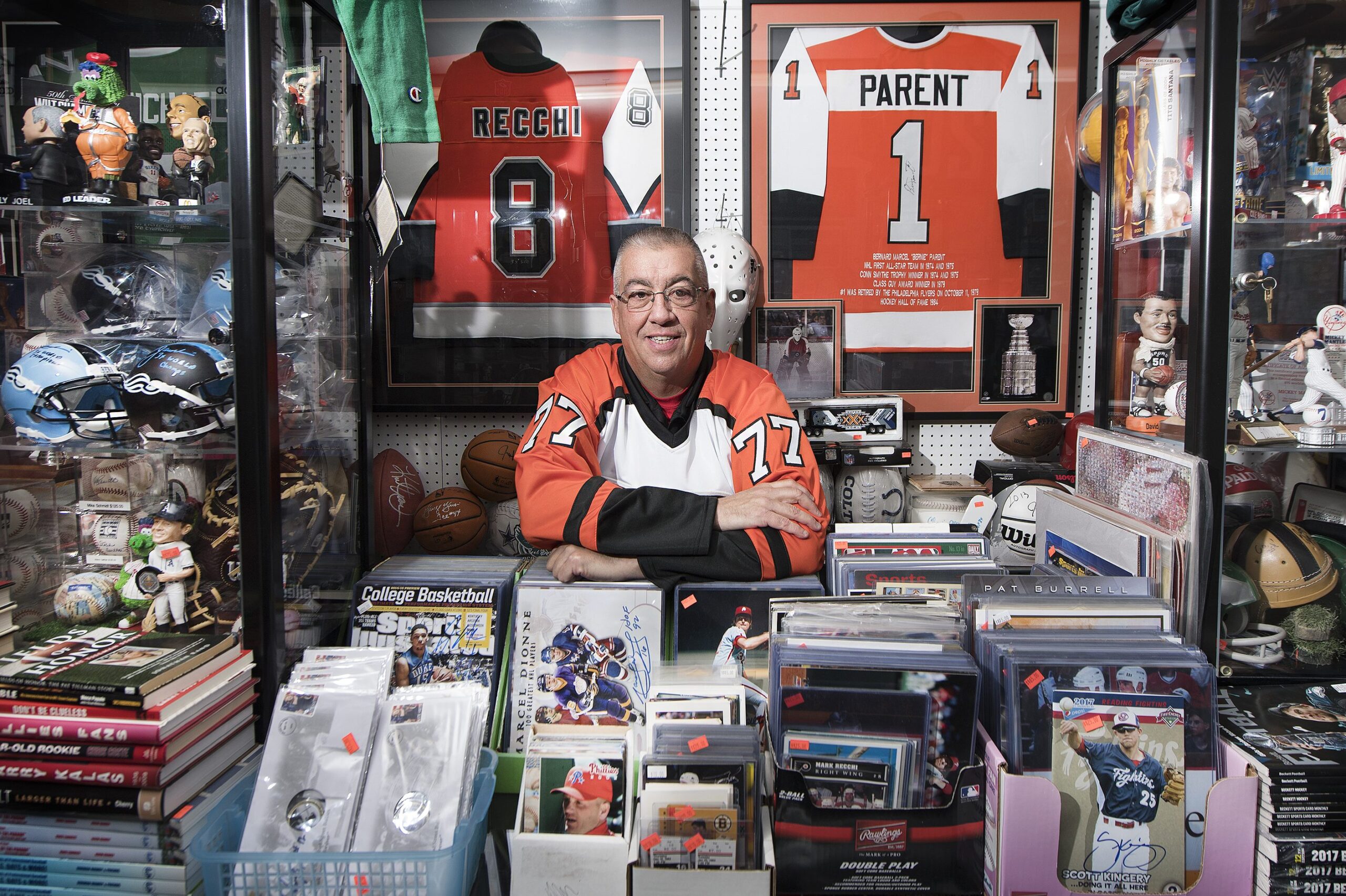
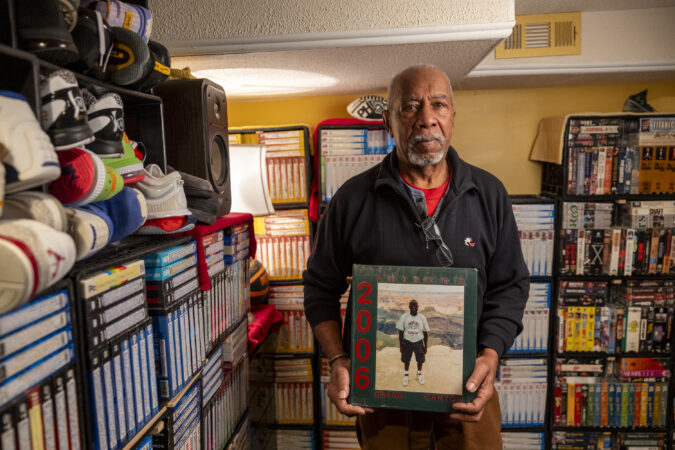
Carl Henderson at his Havertown store in 2018.
The shop owner was 69 when he passed. His family announced the news on Sunday, and received an overwhelming response; thousands of messages from children and adults and even a few local pro athletes.
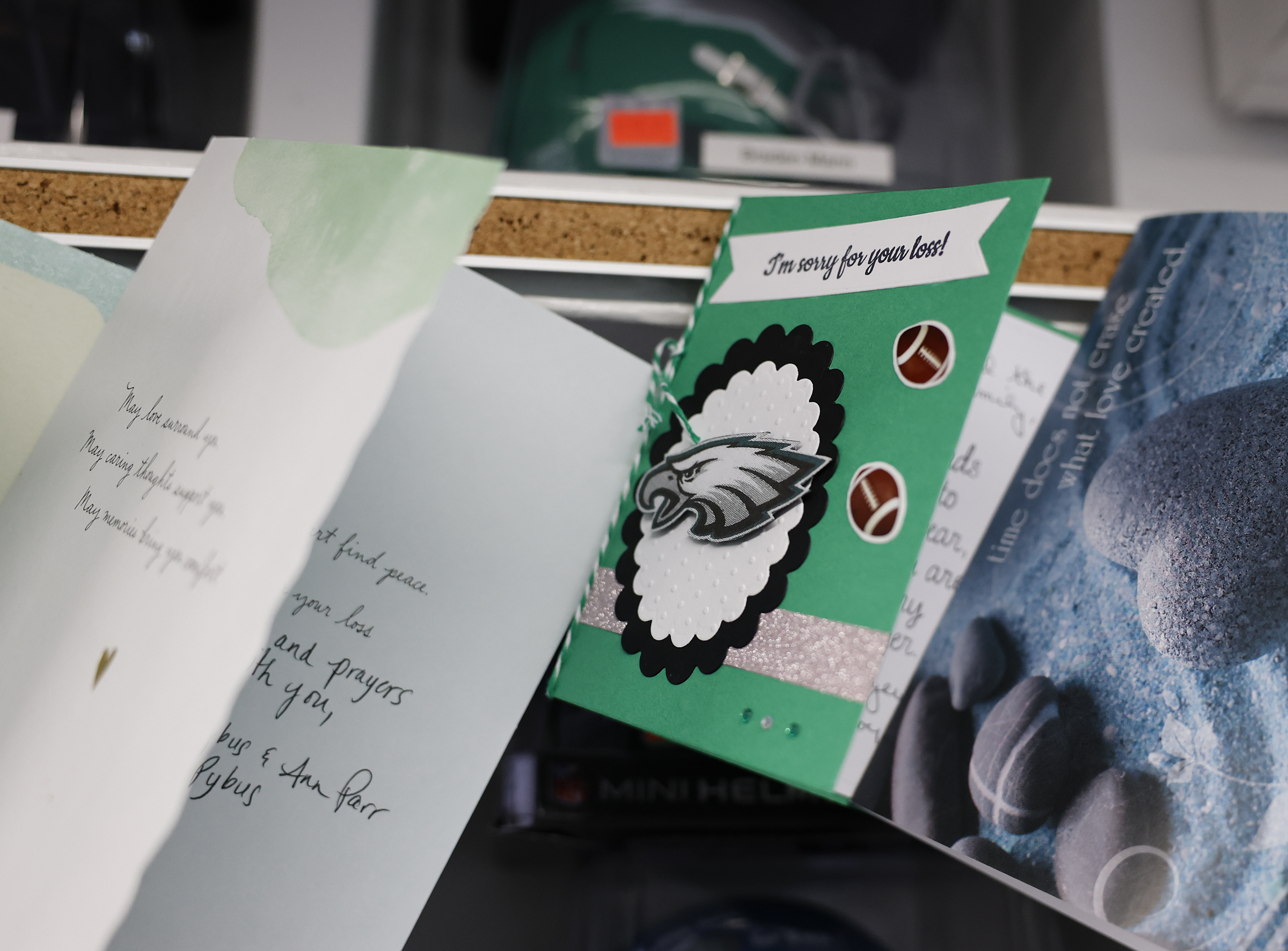
By Monday morning, bouquets of flowers were wedged between the doors. Customers started sending sympathy cards. Some showed up in person to express their support.
A memorial service held last week, in Bryn Mawr, drew about 400 people. Former Phillies pitcher Dickie Noles read a passage from the Old Testament. Members of the Broad Street Bullies sat among the crowd.
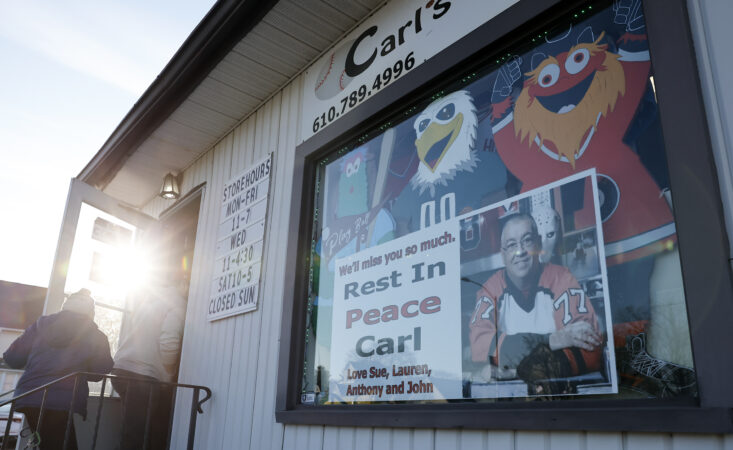
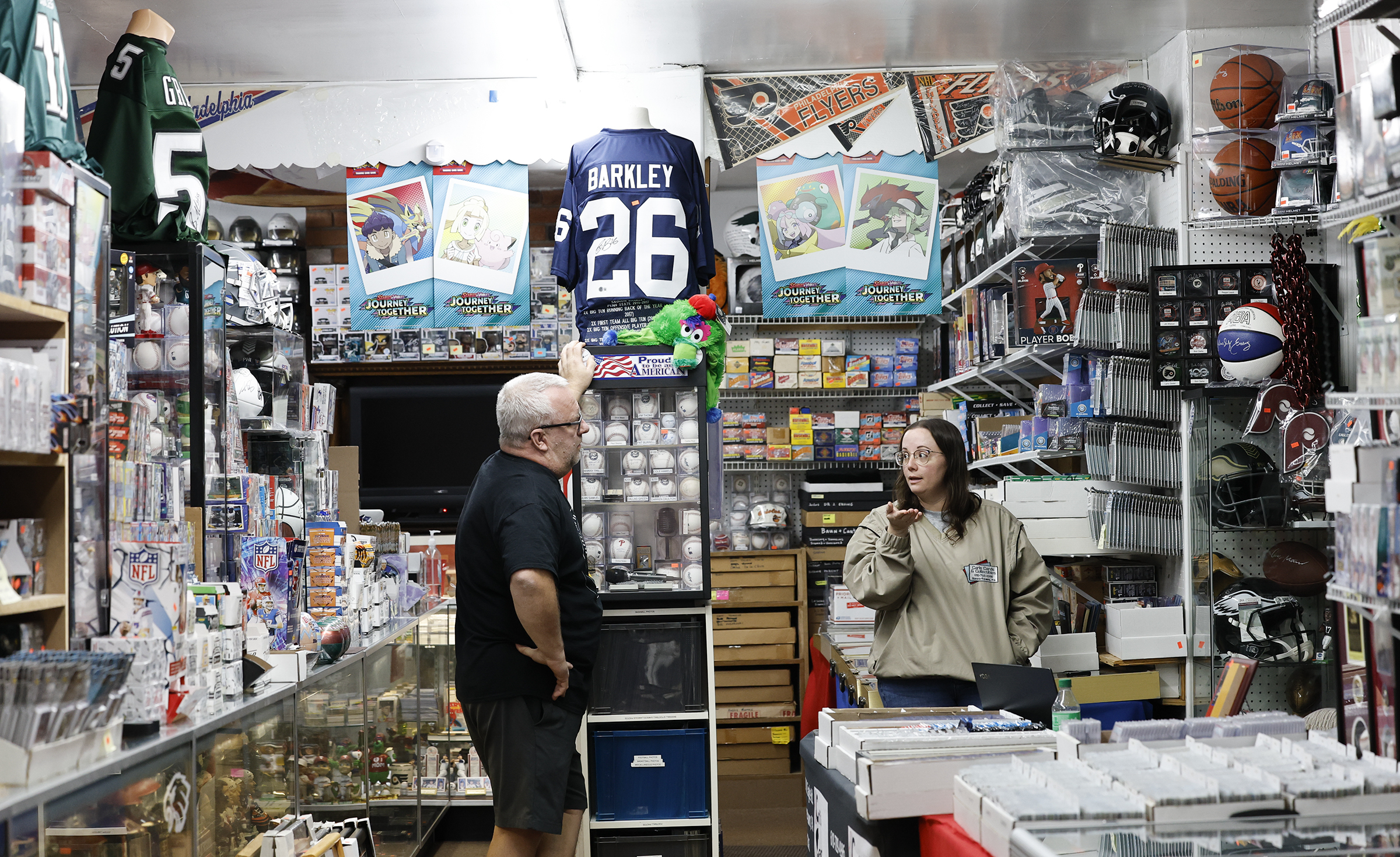
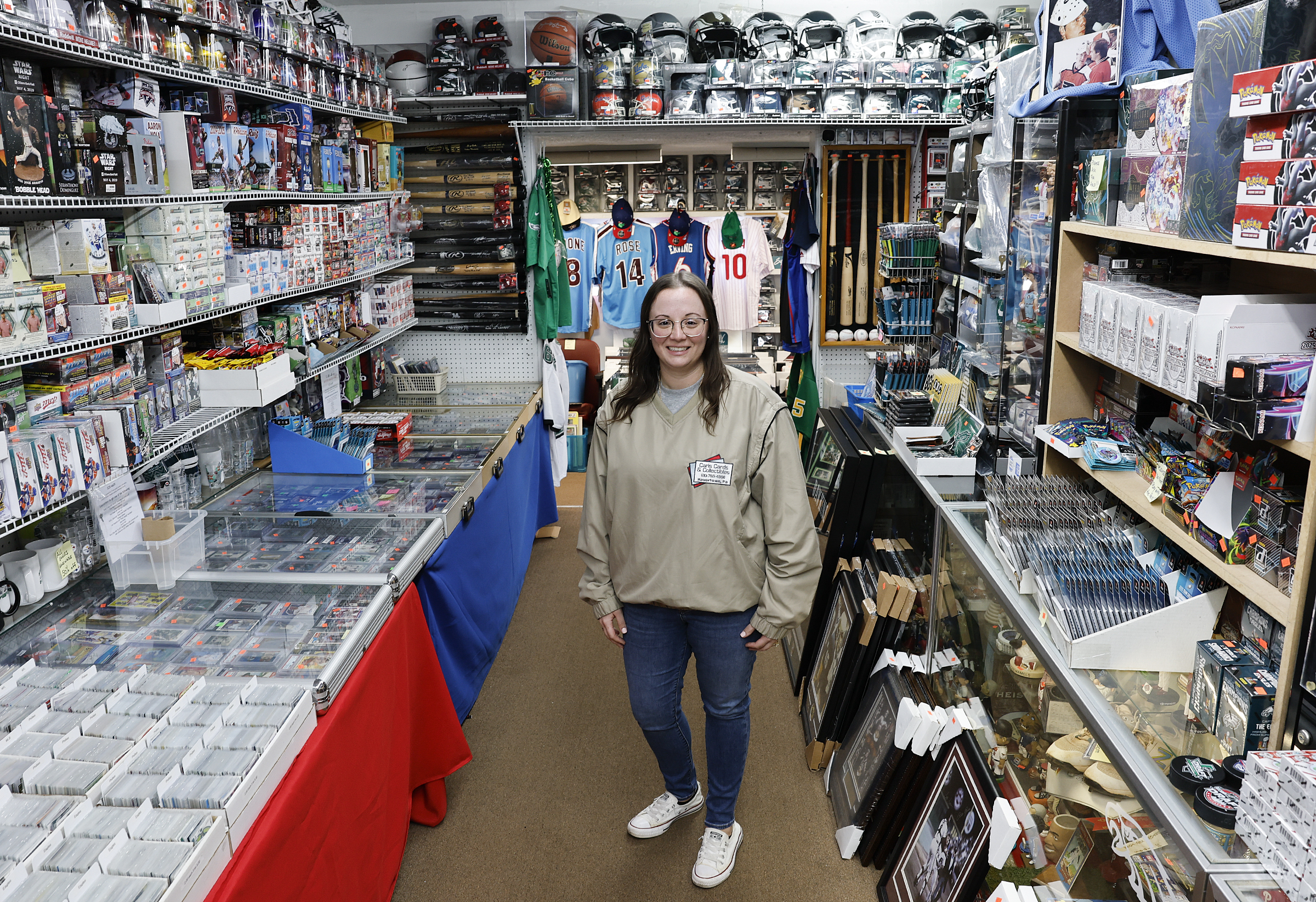
His shop looks a little different now. Those sympathy cards are pinned along the walls. A sign commemorating the longtime owner sits in its front window.
Condolences and tributes have poured into Carl’s Cards, including some from area sports figures.
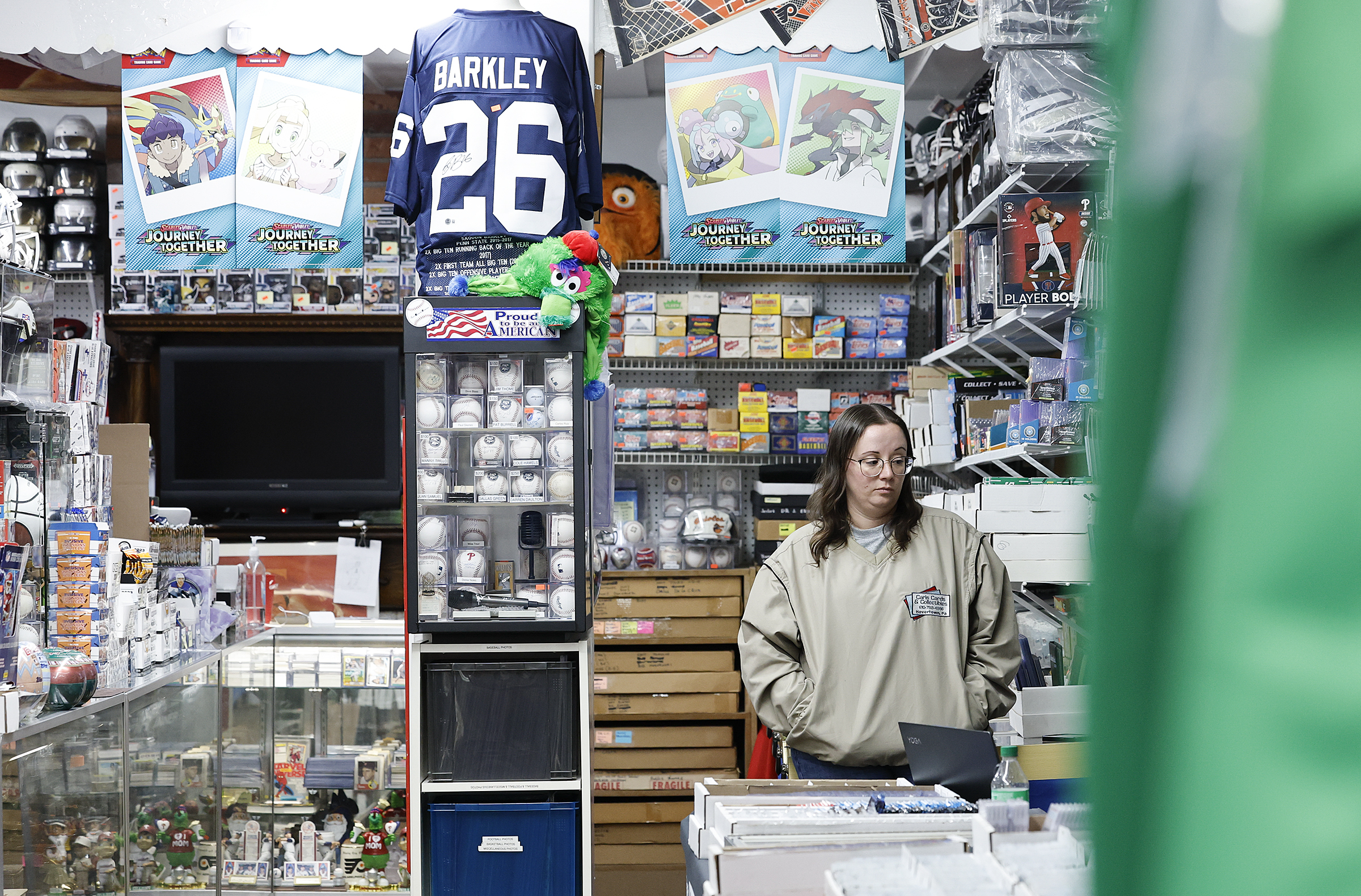
But the character remains the same — and Henderson-Pignetti is determined to keep it that way. Carl’s Cards has something for everyone. Kids can fish through the dollar bin for unexpected treasures. Right above it, collectors can purchase a limited edition Bryce Harper-signed bat more than 1,000 times that price.
There are more run-of-the-mill items, like signed helmets and jerseys, but also packs of Pope Leo XIV trading cards, and a rectangular piece of wood cut from the old Spectrum court.
The sports memorabilia world can be transactional, if not cold, but Henderson navigated it with warmth and integrity. He frequently donated money and autographed items to charity.
He liked to say he knew his clientele — and they weren’t always big spenders.
The shop owner cared just as much about the 10- or 11-year-old student with only a few dollars in their pocket. Or those who had no money to spend at all, but just wanted to vent about Philadelphia sports.
“He didn’t care if you were buying something,” said Henderson-Pignetti. “It was almost like a version of a bar where you stop in and talk to a bartender.
“You can buy something, [but] you don’t have to. You can just stop in and talk. It wasn’t always about the dollar.”
Lauren Henderson-Pignetti has taken on the responsibility of maintaining her father’s life’s work.
The store has been open since Henderson passed. For now, it’ll stay on its previous schedule.
Henderson-Pignetti sees this as a way of honoring her late father, who would’ve wanted Carl’s Cards to stay alive, no matter what.
“We made the decision to keep everything rolling the way he would have,” she said. “He spent 31 years building this place. He would have wanted everything to stay the way it was.”
A family atmosphere
When Henderson opened Carl’s Cards in 1995, his family thought he was out of his mind. He’d left a stable, corporate job working for Ryerson Steel, and had a wife and young daughter to support.
But Henderson loved collecting, and was ready for a change. So, he signed a three-year lease for a small property on Darby Road.
By 1998, he’d outgrown it, moving to a bigger location across the street from The Haverford Skatium. In 2010, he outgrew his budding collection yet again, moving Carl’s Cards to its current home on West Eagle Road.
These shops were where Henderson-Pignetti spent her childhood. She watched as her father welcomed world-class athletes for autograph signings, and put them at ease in a way bigger card shops couldn’t.
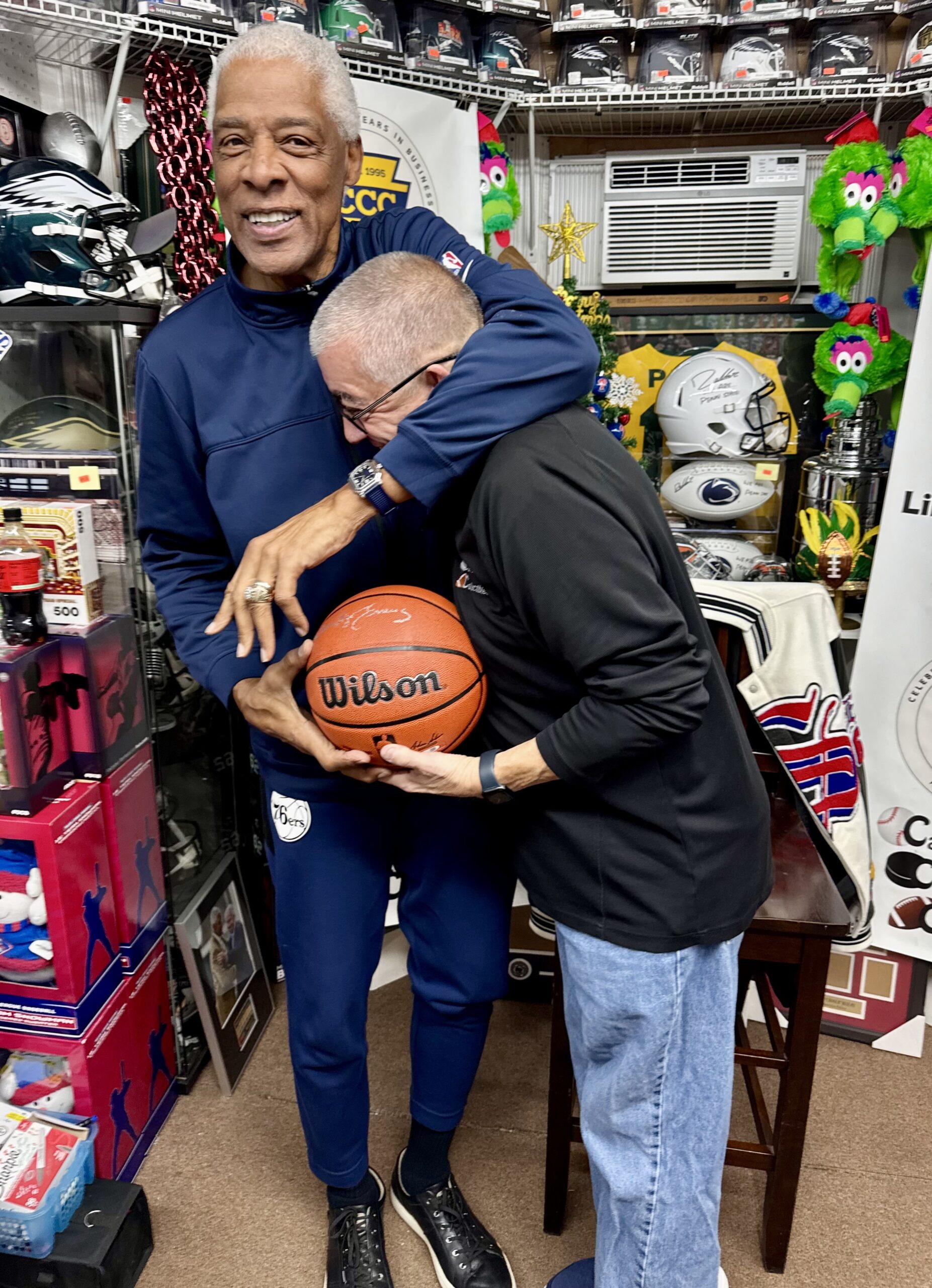
Julius Erving was among the local sports dignitaries who were made to felt comfortable by Carl Henderson (right).
There were no strangers at Carl’s Cards. He was always running the show, with his wife, Sue, selling tickets. As Lauren got older, she began to help out too, mainly with social media and website management.
“It’s not like one of those big card shows where you’re sort of forced in and forced back out again,” Henderson-Pignetti said. “It’s very much a family atmosphere. So, I think a lot of players really enjoyed that.”
Henderson’s theory was that when athletes were more relaxed, they were able to show their authentic selves. This proved true time and time again. Carl’s Cards hosted everyone from Allen Iverson to Jimmy Rollins to A.J. Brown.
Many of these athletes returned for more signings. Some, like Eagles offensive tackle Fred Johnson, even reached out after Henderson’s passing. Others, like Julius Erving, treated the store owner like an age-old friend.
An appearance by Erving had long been on Carl’s bucket list. Like many kids growing up in Philadelphia in the 1970s, Henderson idolized Dr. J. He owned Converse sneakers — just like the Sixers forward — and played varsity basketball at John Bartram High School.
Not much enthralled Henderson, but the idea of sharing a room with one of the best athletes of his generation did. They booked the signing for Dec. 21. After it was done, Erving hung around and talked to the store owner.
At one point, he heard some employees poking fun. He joined in.
“Dr. J was like, ‘Man, they even talk to the boss like that!’” Henderson-Pignetti recalled. “And my dad was like, ‘Do you hear that, guys? I’m the boss here.’
“It was just a really fun, sort of banter conversation. It was just nice.”
While autograph signings were part of the job, they were not the whole job. Henderson wanted his shop to be just as accessible for young kids.
Carl Henderson was a lifelong fan of the area’s sports teams, and that passion showed in his work.
In addition to the dollar bin, he made sure to stock the shelves with affordable card packs. He brought in a gumball machine and added $25 mystery memorabilia boxes.
But above all, he was an uplifting presence in their lives, in a way that Henderson-Pignetti wasn’t even aware. After her father died, she heard from all sorts of kids.
One of them, 12-year-old Owen Papson, crafted a handmade letter.
“I just heard the news,” he wrote. “I am so sorry. We will miss Carl so much. Your store will always be my favorite.”
Inside, he taped a signed Harold Carmichael Topps card with an inscription above: “Hopefully this will help.”
More stories came pouring in on Facebook. One, in particular, stuck with her. It was from a longtime customer who used to frequent Carl’s Cards in the early 2000s.
Lauren Henderson-Pignetti (right, with John O’ Brien) has been touched by the outpouring over her father’s death.
He explained that at the time, his parents were going through a divorce. Henderson was a stable presence when he needed one. He’d ride his bike to the store and was greeted with a smile every time.
“I had no idea,” said Henderson-Pignetti. “To think that something so simple as my dad just being in his place of business … for this kid [it] meant more to him than I think he probably even realized.”
‘A gift from God’
Last September, Henderson-Pignetti quit her role as director of development at the Humane Society in Reading. She loved working there, but was ready for something different, similar to her father when he left Ryerson Steel.
In the moment, her decision was based on a gut feeling, but now she can see the bigger picture. Last fall, Henderson-Pignetti started working full-time at Carl’s Cards.
On Thursdays, her father would give her run of the shop; how to properly open and close, how to track sales, how website orders are mailed out, and other intricacies of the job.
“It was a gift from God, basically, because it allowed me to just absorb even more information from him,” she said. “I kind of look back on that as a weird sort of intuition type of thing. If I hadn’t left my job, that wouldn’t have happened.”
Lauren Henderson Pignetti says her goal is to keep Carl’s Cards & Collectibles up and running after her father’s passing.
The goal, for now, is to keep the shop open. Some days are easier than others. Sue is sick and unable to work. Coworkers, and even customers, have helped pick up shifts when Henderson-Pignetti needs some space.
It can be emotionally exhausting at times. But she’s going to see it through.
“The plan is to not have anything change,” she said. “He would want me to step right into this role. I have no doubt about that. So that’s what I’m going to do, for as long as I possibly can.”
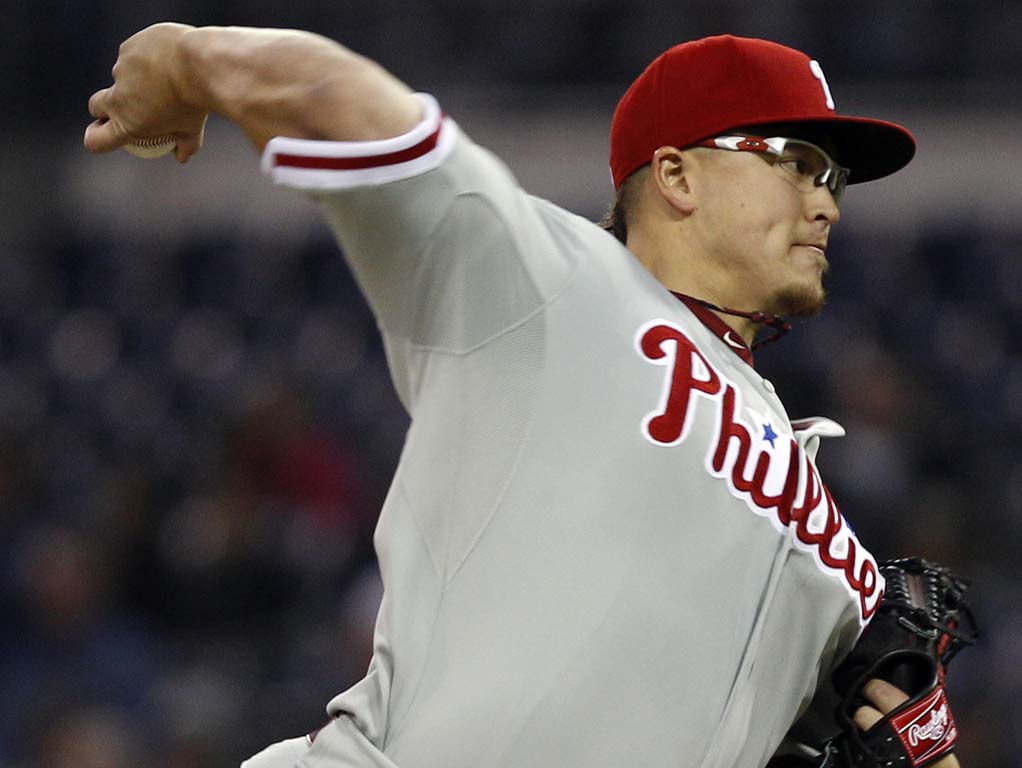
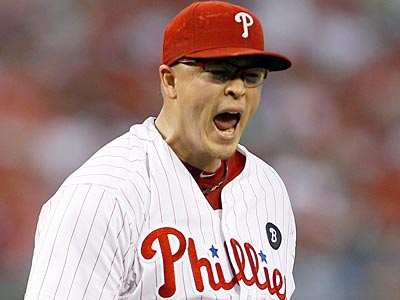
In December of 2021, Vance Worley received an unexpected email. He’d recently played parts of the minor league season with the Mets’ triple-A affiliate in Syracuse and heard from one of the organization’s scouts, Conor Brooks.
Brooks had ties to Britain’s national baseball team. The organization was interested in adding Worley to its roster ahead of the World Baseball Classic qualifier in Germany in September and told him that he was eligible to pitch.
As the former Phillie read the message, he started to laugh.
“I’m like, ‘How?’” he said. “‘Where is my lineage to Great Britain?’”
Worley had never been to England, Scotland, or Wales. Neither had anyone in his immediate family. But the team was able to find an unconventional loophole.
Worley’s mother, Shirley, was born in Hong Kong while it was under British rule. All Brooks needed was a birth certificate.
The right-handed pitcher called his parents. A few minutes later, he texted a screenshot of Shirley’s birth certificate to the scout.
By September, he was on a flight to Germany for a game against Spain. Great Britain won in a 10-9 walk-off, punching a ticket to the 2023 World Baseball Classic.
Vance Worley’s 3.3 WAR in 2011 was better than both Craig Kimbrel (2.5) and Freddie Freeman (1.5), two probable Hall of Famers who finished ahead of him in Rookie of the Year voting that season.
For Worley, the timing was perfect. The swingman made his big league debut with the Phillies in 2010. He earned a spot on the team’s roster in 2011, when he pitched to a 3.01 ERA across 131⅔ innings and finished third in National League Rookie of the Year voting behind Craig Kimbrel and Freddie Freeman.
But he bounced around after that. The Phillies traded him to the Twins in 2012. Minnesota placed him on waivers in March 2014, and outrighted him to triple A once he cleared.
At this point, Worley says he was in a dark place. He texted former Phillies teammate John Mayberry Jr. and said he was ready to quit. Mayberry quickly convinced him otherwise.
“You play until they rip that damn jersey off your back,” the outfielder told his friend.
Worley has been pitching ever since. He’s now 38, teaching baseball lessons out of a gym in South Jersey. He hasn’t thrown an MLB inning in nine years, but that doesn’t faze him.
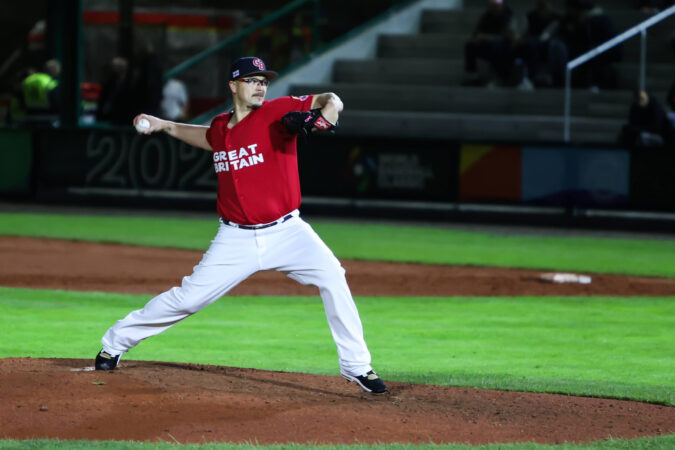
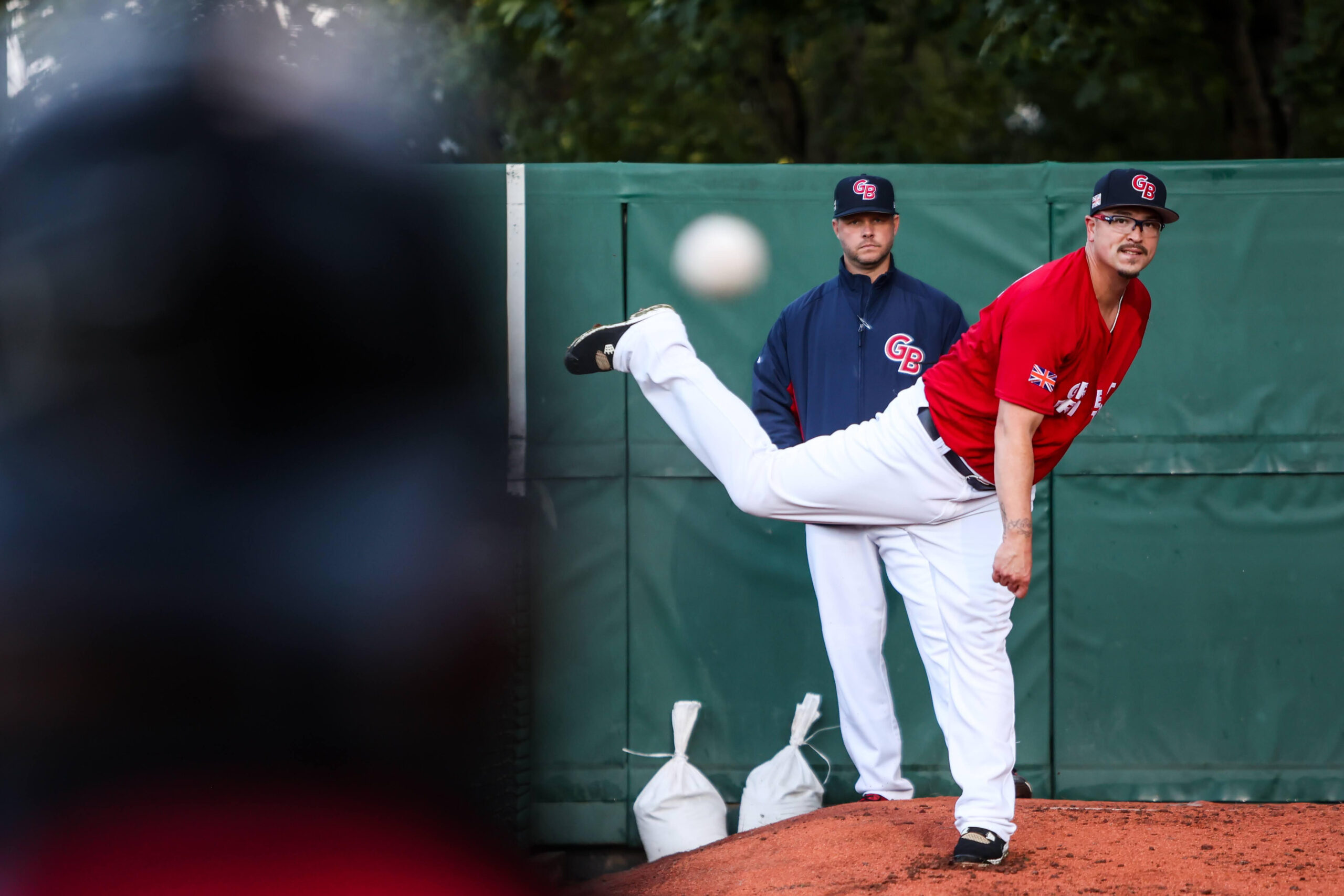
The right-handed pitcher loves the game and has found a home with Britain’s baseball federation. Since 2024, he’s worked on the side as a pitching coach for the under-23 national team. In March, he’ll suit up for the WBC in what his could be his last appearance on the mound.
“This program has given to me,” Worley said. “So I said, ‘I’m going to stick around. I’m going to help you guys out, and I’m going to coach with you guys. And as long as you let me play, I’m going to keep playing.’”
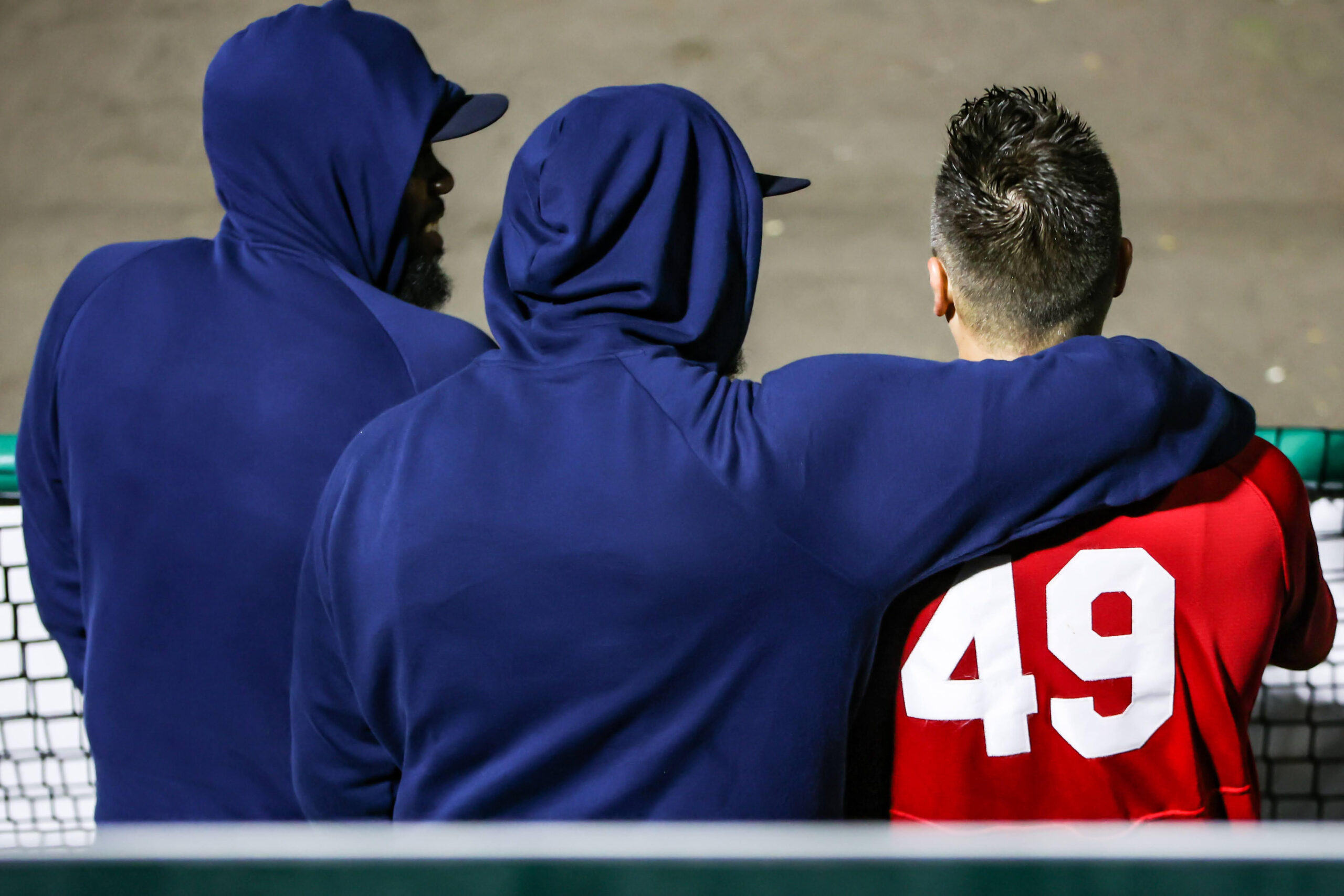
Vance Worley (49) has been embraced by Great Britain teammates young and old.
‘I’ve been called Grandpa’
Worley still remembers stepping into the visitors’ clubhouse at Busch Stadium in St. Louis on a hot July day. It was 2010, and he’d recently been called up by the Phillies.
The right-handed pitcher arrived early and watched as his new teammates filtered on and off the field. He was starstruck, especially when he saw Joe Blanton, a player Worley rooted for as an A’s fan growing up in Sacramento, Calif.
He decided to introduce himself.
“I was like, ‘Hey Joe, it’s nice to meet you,’” Worley recalled. “‘I remember watching you when I was in high school.’
“[Blanton] just goes, ‘God, I’m getting old.’”
Worley had a similar experience when he joined Great Britain in 2022. One of his new teammates was Nick Ward, a longtime minor league infielder who was born and raised in Kennett Square.
Ward was brought up on the Phillies teams of Jimmy Rollins, Chase Utley, and Ryan Howard. But he’d had a special affinity for “The Vanimal,” a pitcher who’d never thrown the hardest but was a fierce competitor.
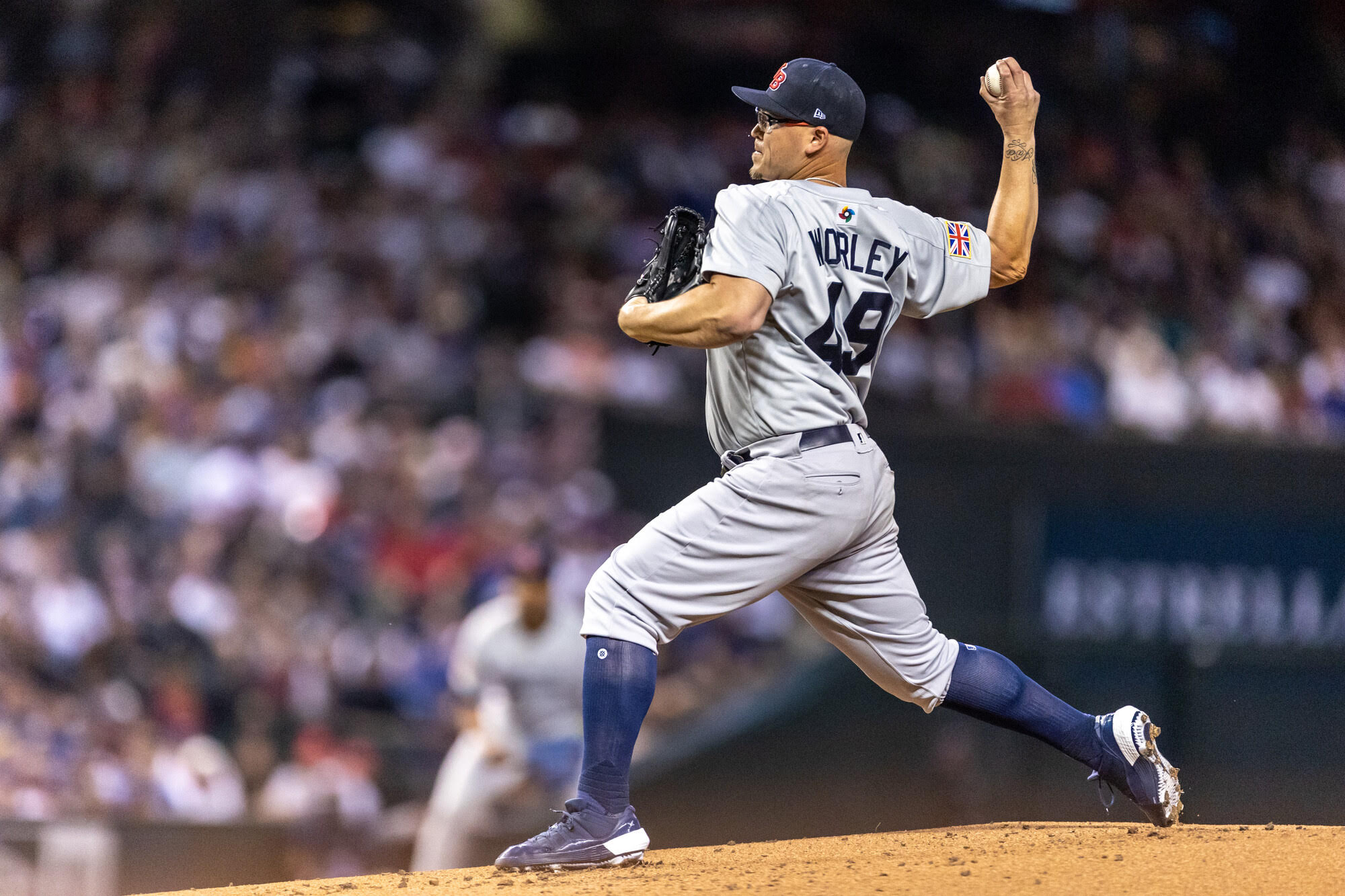
Vance Worley’s performance for Great Britain in the 2026 World Baseball Classic could be his last hurrah on the mound.
Similar to how Worley was with Blanton, Ward was in awe. The righty looked the same as he did on TV, back when he was donning black-rimmed glasses and a Phiten necklace.
“It was like, ‘Holy crap. That’s Vance Worley,’” Ward said. “I had to pinch myself. It was just really cool that one of the guys that I loved to watch play was actually a super good dude.”
Just as it did with Blanton, this reaction made Worley feel a bit old. But he has embraced his role as the team’s elder statesman.
“I’ve been called Uncle,” Worley said. “I’ve been called Grandpa. And I’m just like, ‘Whatever man, your uncle and grandpa, think about them barbecues, out there playing Wiffle ball. I’d be punching you out right now. I see things you don’t know yet.’”
After he returned from Germany, Worley continued to throw. He used his day job, teaching baseball at Powerhouse Sports Arena in Sewell, Gloucester County, to help him stay in shape.
Once he arrived in Arizona for the WBC in 2023, he mentored the younger players around him. One was Harry Ford, Britain’s catcher, who was drafted by the Mariners in 2021 but has since been traded to the Nationals.
Worley asked his coaches if he could work with Ford one-on-one, and he started teaching the young backstop the minutiae: how to set up early, how to set up late, how to work quick.
Vance Worley
He showed him different pitch shapes, how they moved, and the strategy behind calling a game. The veteran pitcher served as a pseudo player-coach for the entire team, giving them words of encouragement on the field and off.
For Ward, this instruction made a big impact. Like Worley, he’d bounced around a lot in the lead-up to the 2023 WBC. But unlike Worley, he’d never played a big league inning.
Great Britain’s first game was scheduled on March 11 against Team USA, a roster stacked with prominent major leaguers. Worley was scheduled to start, which, years removed from MLB, was a daunting feat.
He threw 2⅔ innings, allowing three hits and no runs with three walks and a strikeout. While Worley was on the mound, Ward made a few big defensive plays at first base. The right-handed pitcher made his appreciation known, giving Ward a fist-bump or a point or a smile.
“It was just like, ‘Wow, if this guy that I used to really look up to is doing that … I’m good enough,’” Ward said. “And it wasn’t just me that he was doing this to. He was making all of us feel like we belong here.”
Worley exited the game early due to pain in his elbow. Great Britain lost, 6-2, and when he picked up his bag to get onto the bus, he felt the pain again. He would need bone chip surgery (the third of his career).
Worley thought this would be the last time he’d step on a mound. He was despondent that his time in baseball would come to such an unceremonious end.
Vance Worley’s passion for the game has not changed since his days with the Phillies, and has rubbed off on his young Great Britain teammates.
Before Great Britain’s game against Colombia on March 13, Ward noticed Worley standing alone on the top step of the dugout.
It was just before first pitch. The minor leaguer gave the big league veteran a hug.
“Thank you,” Ward told him. “I got to be your fan, first. Getting to share the field with you was one of the coolest moments that I could have ever dreamed about.”
A new chapter
Great Britain ended up defeating Colombia, 7-5, before falling to Mexico, 2-1, on March 14. Before they left Arizona, the players reminisced over what they’d done.
Worley reminded them that the British team wasn’t expected to be in the tournament in the first place. The players had come from all walks of life and had shown they deserved to be there.
“A lot of them were never in pro ball, or didn’t get an opportunity, or had an injury that shut them out,” Worley said. “And for them to be able to play in a big league stadium, playing big leaguers … I was like, ‘Hey, man, no matter what anybody says to you, you’re a big leaguer today.’”
The win over Colombia secured Great Britain’s berth for the 2026 tournament, which Ward and Worley will both be participating in.
Worley has gotten creative in his preparation. He’s integrated it into his day-to-day life, throwing in neighborhood sandlot games with his kids and also at the gym where he gives lessons.
He’ll report to camp in Arizona on Feb. 26. He has not officially retired and is unsure if this will be his last outing in a baseball game.
But the former Phillie is going to treat it that way, just in case.
“I’ve been through pretty much every situation as a player,” Worley said. “Trade, waive, claim, release, DFA. And I’m relentless. I’m not going to let something that should sidetrack me, or take me off the track, [prevent me from] being a baseball player, and what I enjoy.”
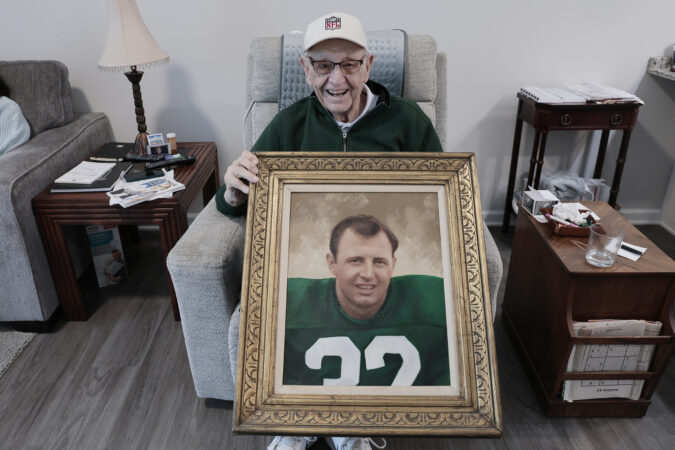
When Joe Pagliei moved to the Azalea senior living facility in September of 2023, word spread quickly. This was not just because he spent a season playing for the Eagles.
It was also because of his unabashed personality.
Pagliei would walk the halls of the Cinnaminson retirement home practicing his golf swing. If he lost a game of bingo, he’d throw the cards into the air and accuse his neighbors of “cheating.”
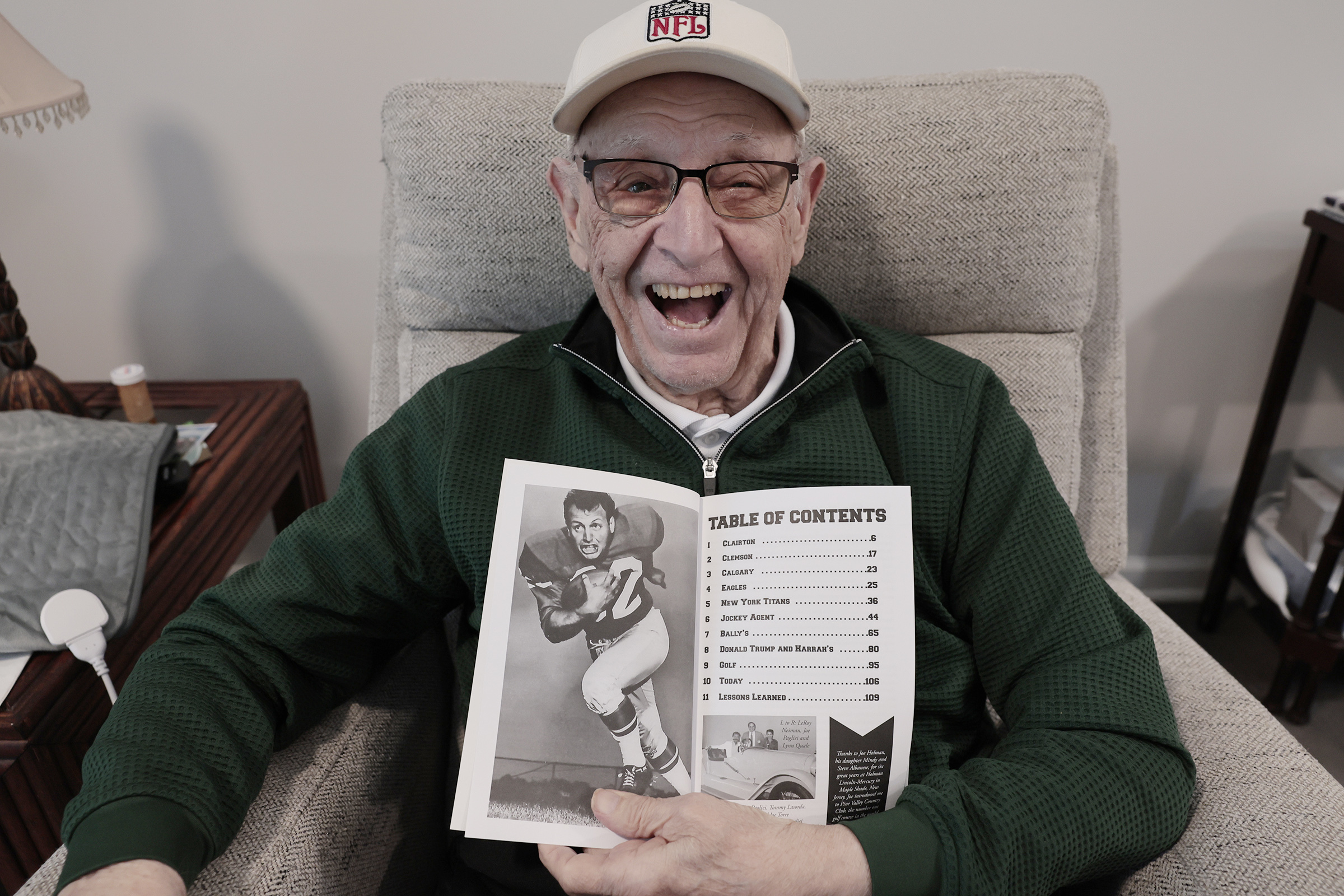
Every day, at 3 p.m., he’d sit at the bar, nursing a ginger ale, with copies of a book about his life stacked beside him. Before long, residents began to ask for some.
This wasn’t your average nonagenarian, after all. Pagliei spent parts of the 1950s and 1960s as a pro football player, first in Canada in the CFL, then in the NFL, and eventually, the AFL.
He played the 1959 season as a fullback and punter with the Eagles. Pagliei was the last cut in training camp before the 1960 season. The Eagles called him back, asking if he’d want to rejoin the team, but it was too late.
The fullback had already signed with the New York Titans, later to become the New York Jets. Pagliei ended up missing out on a championship.
“Big mistake,” joked his daughter Vicki.
It didn’t hamper Joe’s confidence. The former football player worked in auto sales and real estate for a few years, and became a jockey agent in 1970 out of Garden State Park Racetrack.
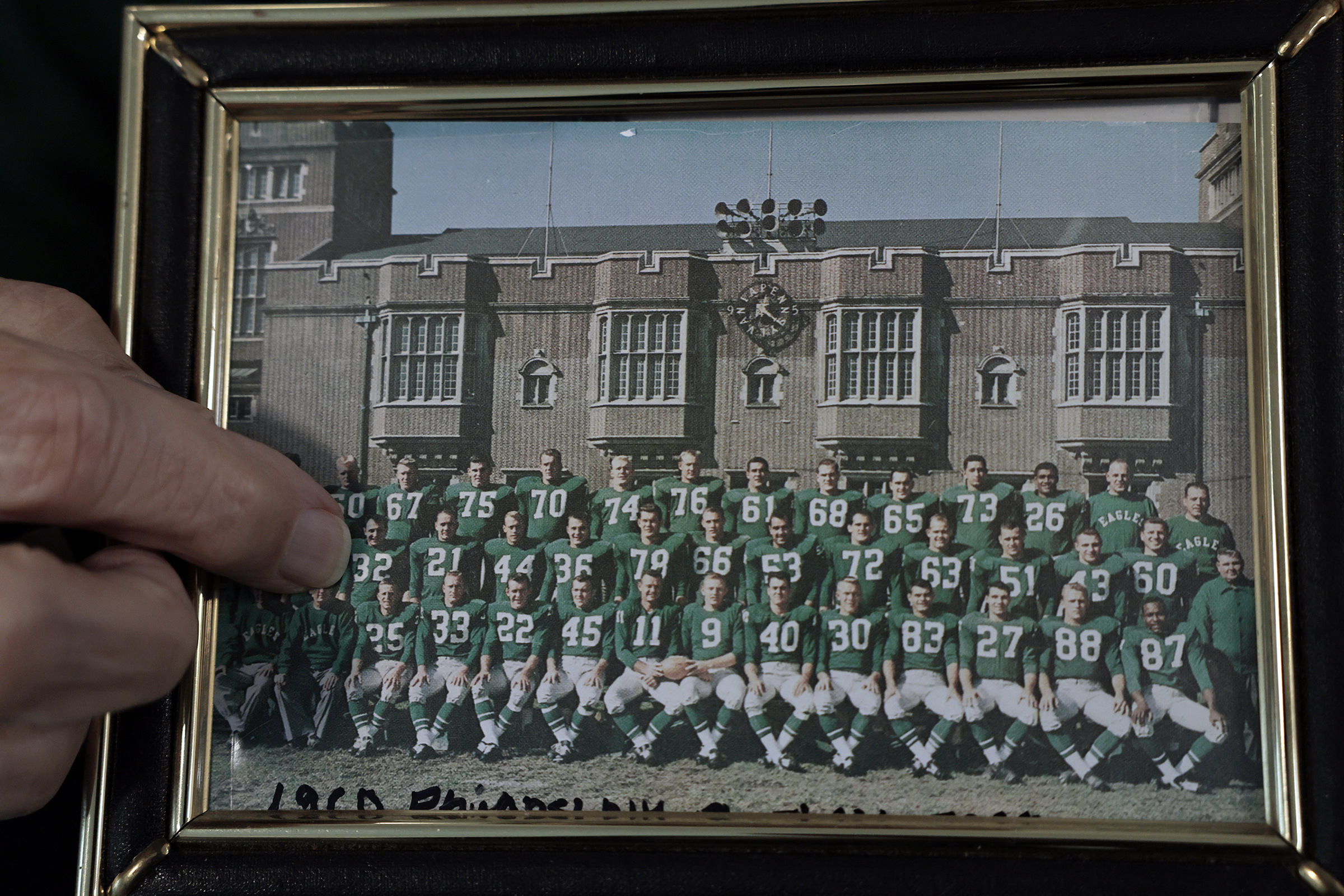
Joe Pagliei points to himself, wearing No. 32, in the 1960 Eagles team photo taken at Franklin Field.
When the track burned down in 1977, Pagliei headed to Atlantic City, where he became a casino host, crossing paths with everyone from Mickey Mantle to Joe Frazier to Sammy Davis Jr.
He moved to Mount Laurel with his wife of 62 years, Rita, and four children in 1991. He sold cars for a few years, retired in 2000, and moved to Azalea after Rita died in 2023.
At 91, Pagliei is believed to be the oldest living former Eagle. It is not a title he takes lightly. Last year, before the Super Bowl, his senior facility arranged for a visit from an Eagles-themed bus.
Dressed in his kelly green jersey, Pagliei signed one of the bus panels: “Joe Pagliei, #32.”
When he’s not lifting weights, or playing poker, he is watching Eagles games in his apartment, often with critiques of his own. Philadelphia will always be his favorite team, but he does have some misgivings about how he was used back in the day.
“I was awfully good to be sitting down,” the 91-year-old said. “Not enough [playing time].”
‘I’m going to make you famous, buddy’
Pagliei grew up in Clairton, Pa., a small town southeast of Pittsburgh, full of hard-nosed steel mill workers. His father, Alberto, emigrated from Italy and spent 48 years working as a janitor at the local plant.
The elder Pagliei, a pragmatic man who saved every dollar, didn’t see the benefit in his son joining the football team. He refused to let him play until the 11th grade.
Despite missing a few seasons, the younger Pagliei was not short on confidence. On the first day of practice, he walked straight up to his new coach.
“I said, ‘I’m going to make you famous, buddy,’” Pagliei recalled. “He said, ‘You’re full of [expletive].’ And I said, ‘Oh really?’
“I didn’t know the plays. I went out on a Wednesday. I ran two touchdowns. He said, ‘Wow.’ I said, ‘You just put my [butt] in there. Don’t worry about it.’”
Famous might have been an exaggeration, but Pagliei did catch the attention of some big-name schools. According to his 2017 self-published book, The Roast Master, he received more than 100 recruitment letters.
The fullback chose Clemson University in South Carolina. His arrival on campus in 1952 marked the first time he’d ever traveled outside of Western Pennsylvania. He played both football and baseball, and separated himself on the gridiron.
Joe Pagliei came to football later than most, but he made up for lost time as a dual-position standout.
In 1954, he led the Atlantic Coast Conference in punting, averaging 37.8 yards on 26 kicks. In 1955, his senior year, he topped the conference again, averaging 39.1 yards on his punts. He also made a dual-threat impact for the Tigers on offense, rushing for 476 yards and catching 10 passes for 233 yards.
Clemson’s 1955 team program referred to the fullback as a “flashy performer,” a characterization that seemed apt, though perhaps insufficient in retrospect.
“I did a number on ’em when I went to Clemson,” Pagliei said. “I just ran everybody the hell out. They had me as number five. I said, ‘I’m number uno.’ They said, ‘You’re five.’ I became the best one.”
After going undrafted in 1956, Pagliei received free-agent invitations from the Green Bay Packers and Washington, but said neither came “with any form of guarantee.”
He ended up getting a better contract outside the NFL, with the Calgary Stampeders of the CFL, where he played the 1956 season. Pagliei was drafted into the U.S. Army in 1957.
He joined the football team on the base while serving at Fort Knox in Kentucky, and the Eagles offered him a contract for the 1958 season. Because of his military commitment, he was unable to suit up until May 1959, when he was discharged from the Army.
The Eagles had a deep backfield, and as Pagliei noted, he didn’t get much playing time (only two carries for minus-5 yards and two catches for 9 yards). He didn’t get much time as a punter, either, because he was the backup for Hall of Fame quarterback Norm Van Brocklin.
But Pagliei did emerge with one stat to be proud of. According to The Roast Master, on Dec. 6, 1959, in the middle of a rainy game against Washington, Van Brocklin suggested that Pagliei take the kick.
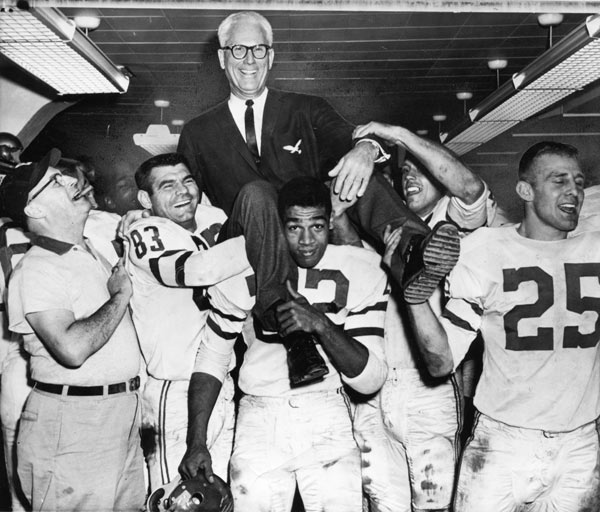
Joe Pagliei was not officially a part of Buck Shaw’s 1960 title team, but he was considered an honorary part of it by his former Eagles teammates.
He did, for 45 yards. It was the NFL rookie’s only punt of the 1959 season, giving him a yearly average of 45 yards (for his one attempt) while Van Brocklin had only 40.8 (for his 53).
“I always rubbed that in with Van Brocklin,” Pagliei wrote. “And he’d say to me, ‘You son of a [expletive]. One punt and you lead the team.’”
Pagliei again faced stiff competition in training camp the following year. He was cut on the day the Eagles took their team photo, Sept. 19, 1960, thereby capturing his final moment on the future championship-winning squad.
After he signed with the Titans of the AFL, the Eagles contacted Pagliei again. Fullback Theron Sapp had broken his leg in a preseason game and would be out longer than the team had expected.
They asked Pagliei if he’d like to return to Philadelphia, but he’d already signed his Titans contract. While missing out on history was bittersweet, the 91-year-old always felt like he was a part of the 1960 Eagles group.
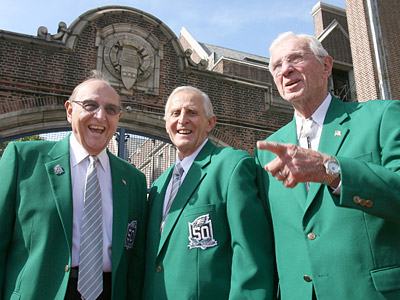
Joe Pagliei (left) with Tommy McDonald (center) and Chuck Bednarik at an event honoring the 1960 team.
It included some of his closest friends. Defensive tackle Jesse Richardson was the best man at Pagliei’s wedding. Wide receiver Tommy McDonald was like a family member. McDonald’s wife, Patty, was the godmother to Pagliei’s daughter Lizanne and the confirmation sponsor for Vicki.
Pagliei left professional football in 1961 but continued to stay a part of that fraternity. His kids would play with McDonald’s kids, and linebacker Bob Pellegrini’s kids. The team always invited Pagliei to reunions and celebrations of the 1960 championship.
In 2018, after the Eagles won their first Super Bowl, former players and their families were invited to the NovaCare Complex to see the Lombardi Trophy up close.
McDonald had been diagnosed with dementia. He attended the event in a wheelchair, donning his gold Hall of Fame jacket. The former receiver’s recall was shaky, but when he saw Pagliei, his face lit up.
“He knew who my dad was,” Vicki said. “He didn’t know too many people, but he knew who my dad was. He used to call him his brother.”
The mayor of Azalea, senior living
The staffers at Azalea of Cinnaminson say that Pagliei is something akin to a mayor. He knows everyone in the building. He also knows everythinggoing on in the building, for better or for worse.
The 91-year-old goes to the gym once a day, where he rides a bike, and does “40 reps of each weight.” On Tuesday and Thursday nights, he plays poker, a game that he might take more seriously than any other.
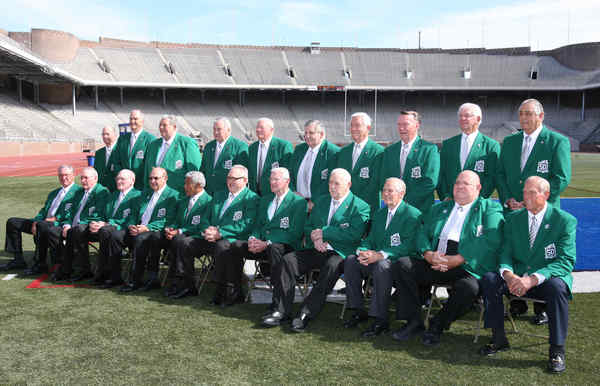
Members of the 1960 Eagles NFL championship team pose for a team photo at Franklin Field, the site of their 17-13 win over Green Bay in the title game.
“I make a lot of money,” Pagliei said, pointing to a stack of bills totaling $21 on a nearby counter. “Big time. Big time.”
The former Eagle is 66 years removed from his last NFL season, but he has not lost his competitive spark. The Azalea staff learned this the hard way.
Gracie Pouliot, a guest services manager, has had to intervene in a few contentious games of bingo.
“He’s not a very good loser,” she said. “Everyone is cheating if he loses. He’s like, ‘This is [expletive]! They cheated!’
“And we’re like, ‘No!’ He’ll throw the cards. He just cracks us up. He’s so funny.”
Linda Bryant, a life enrichment assistant, said that Pagliei used to make fun of how she’d play pool.
“He was joking around,” she said. “‘You guys don’t know how to do it.’”
Bryant and Pouliot wouldn’t have it any other way. Pagliei might not be able to punt the ball, or run the length of a field, but he still has the spirit of a teenager.
Long before Sam Howell became best friends with Drake Maye, he was aware of him. Maye’s parents were standout high school athletes, and his father, Mark, played quarterback at the University of North Carolina. His brothers, Luke and Beau, played basketball there (Luke hit a last-second shot that sent the Tar Heels to the Final Four in 2017, en route to an NCAA championship).
A third brother, Cole, also won a national title in 2017, but at a different school (Florida) and in a different sport (baseball). Former UNC offensive coordinator Phil Longo called the family “the Mannings of North Carolina.”
Drake was the youngest, and went down the football path. He and Howell, both quarterbacks, became acquainted through seven-on-seven leagues in the Charlotte area.
In 2019, when Howell was a freshman quarterback at UNC, he attended one of his future protégé’s high school playoff games. Howell was impressed. But it wasn’t until 2021, Maye’s first season with the Tar Heels, that Howell realized how much they had in common.
Howell was the entrenched starter, and Maye was the backup — a situation that doesn’t always lend itself to friendship. But these two were the exception. They became “attached at the hip,” in the words of former coach Mack Brown, and not just on the field.
The quarterbacks were fiercely competitive, and would battle each other on the golf course, at the ping-pong table, and more.
“Drake was so competitive, if I said, ‘Hey, I’m going to get to the doorknob before you do, he would jump over a table to get there,’” Longo said. “That’s just kind of how he was. [Sam was] that way, too.”
The two quarterbacks have stayed close, FaceTiming on a near-daily basis since Howell was drafted by Washington in 2022 and Maye was drafted by New England in 2024.
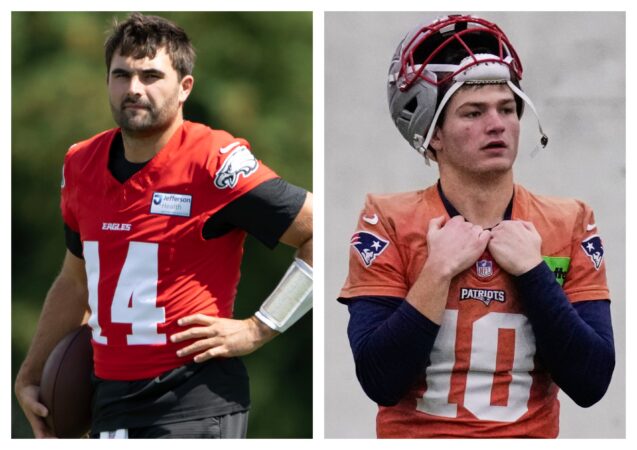
Their careers have taken different trajectories. Howell, 25, has bounced around the league, from the Commanders to the Seattle Seahawks to the Minnesota Vikings to the Eagles, where he served as a third-string quarterback this past season.
Maye, 23, will start in Super Bowl LX for the New England Patriots on Sunday, in just his second season in the NFL.
Howell feels no ill will. He has attended every New England playoff game since the Eagles were eliminated, and will be in the Bay Area this weekend to support his friend.
“[I’m] extremely proud of him,” Howell said. “He’s worked his whole life to be where he is and he’s getting what he deserves. He was made for the big moments and I have no doubt he’ll be ready to go.”
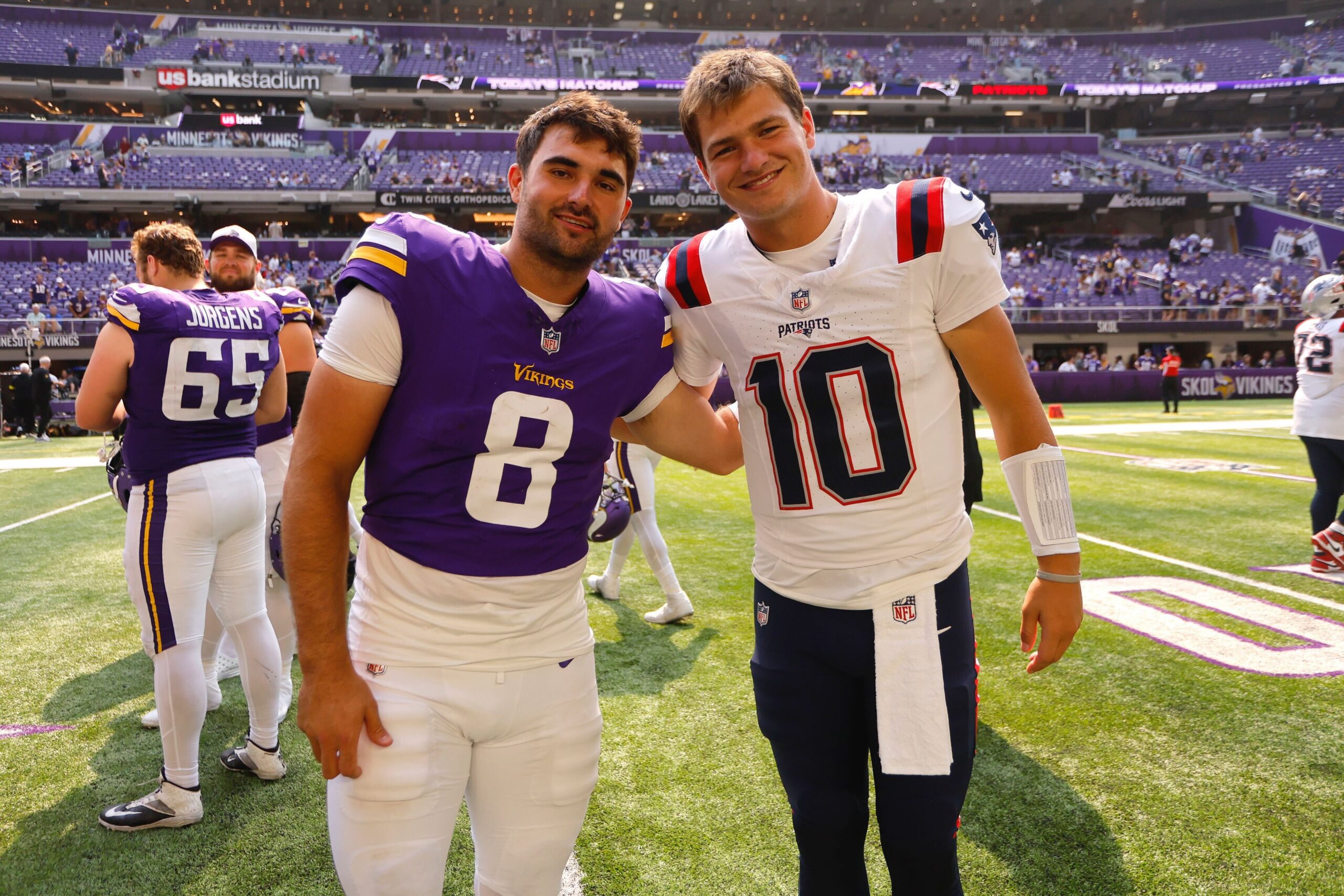
Sam Howell (as a member of the Vikings in 2024) and Drake Maye have remained tight even as their football journeys have diverged.
Football junkies
Longo described Howell as a “football junkie.” He’d pore over film and challenge his coaches with tough questions. Before he’d even signed with North Carolina, in late 2018, the quarterback started asking Longo for offensive information.
The coordinator didn’t hand it over until everything was official. But once he did, Howell began studying. Longo would send him formations, and Howell would teach them back to his coach a few hours later.
This went on throughout Christmas break, until the start of classes.
“By the time he showed up in mid-January, from a mental standpoint, he actually already knew the entire offense,” Longo said. “Which is rare and pretty impressive.”
Howell would constantly bring up new routes and concepts to the coaching staff. Instead of waiting to be told what they’d run on Monday, he’d be a part of designing plays on Sunday night.
To Longo, quizzing Howell in the quarterbacks room became an exercise in futility. The quarterback always seemed to have the right answer, not because he was winging it, but because he’d reviewed virtually everything.
It set an example for the future Patriots QB.
“Drake may not admit this, or remember it, but it got to a point where any time I asked an open question and didn’t direct it at one individual quarterback, Sam would always answer first,” Longo recalled. “And obviously he was correct. But Drake was competitive, and [he would] try to answer the question first, and beat Sam out.
“My analyst and I both noticed that, and we loved it. Because it was Drake just wanting to get better.”
Howell had been the starting quarterback since his freshman year, and Maye knew that wasn’t going to change. But neither player was threatened by the other. They started throwing after practice, bringing along wide receivers to work on routes, drop backs, and trigger times.
They’d often give each other feedback, both good and bad. Brown said that Maye would be waiting for Howell to come off the field after every game.
“To talk to him about what he saw,” Brown said. “So, you had two great minds that were talking about every play. And one of them, out of the action, standing over there watching, could say, ‘Here’s what I saw. Look for this.’”
He added: “It’s very unusual to have two people competing for the same [role] that care about each other so much, respect each other so much. And that’s the reason it worked. For me, as a head coach, it was like a marriage made in heaven.”
They had their stylistic differences. Maye’s biggest strength was his ability to make accurate throws while off-platform and off-balance, a feat Longo credited to his footwork, honed by years of youth and high school basketball.
Howell’s was physical strength that allowed him to break tackles by running downhill.
Their communication styles were different, too. Maye was more of a vocal leader, and Howell tended to pull guys off to the side. But the two quarterbacks complemented each other.
“When he was backing me up at Carolina, he was really good at making me feel very confident going into games,” Howell said. “And just trying to give me that last sense of peace.
“Before every game in college he’d tell me I was the best player on the field. Little things like that. He’s a great leader, great motivator.”
It didn’t take long for the quarterbacks — and their coaches — to realize they shared a relentless competitive spark. Longo remembered a recruiting event when Howell and Maye played ping-pong until the lights shut off.
In training camp, they’d have ping-pong “battles,” tacking on rounds until each side was ready to acquiesce. In 2021, Maye introduced Howell to golf, shifting their off-field rivalry to a new sport.
It was not a relaxing endeavor.
“I would see them afterward,” Brown said. “They’d say, ‘Oh man, he got me by four strokes.’ It was like the U.S. Open or something. It wasn’t like two quarterbacks going out to play.
“And the other one would say, ‘Yeah, but I just missed a putt or I would have beaten him.’ It was like two little kids going at each other’s throats.”
Added Howell: “Sometimes people invite us out to play, and they’re surprised with how the round is going. There’ll be times in the round where we’re not talking to each other and stuff like that. It’s a lot of fun.”
After Howell graduated, he stayed in touch with his mentee. In September 2022, months after the Commanders drafted him in the fifth round, Howell attended a UNC road game against Appalachian State.
It ended up being the highest-scoring game (including combined points) in school history. Maye had five touchdowns (four passing, one rushing) and 428 total yards in a 63-61 UNC win.
In the third quarter, Maye scored on a 12-yard run for his fourth touchdown of the day. Howell, by coincidence, was standing just past the end zone, as if he was waiting for his best friend.
He gave the quarterback a high five and a hug.
“I told him, after I ran it in, I should have gotten on a knee and held the ball up to him,” Maye told local reporters. “Because what he did here [at UNC] is pretty incredible.”
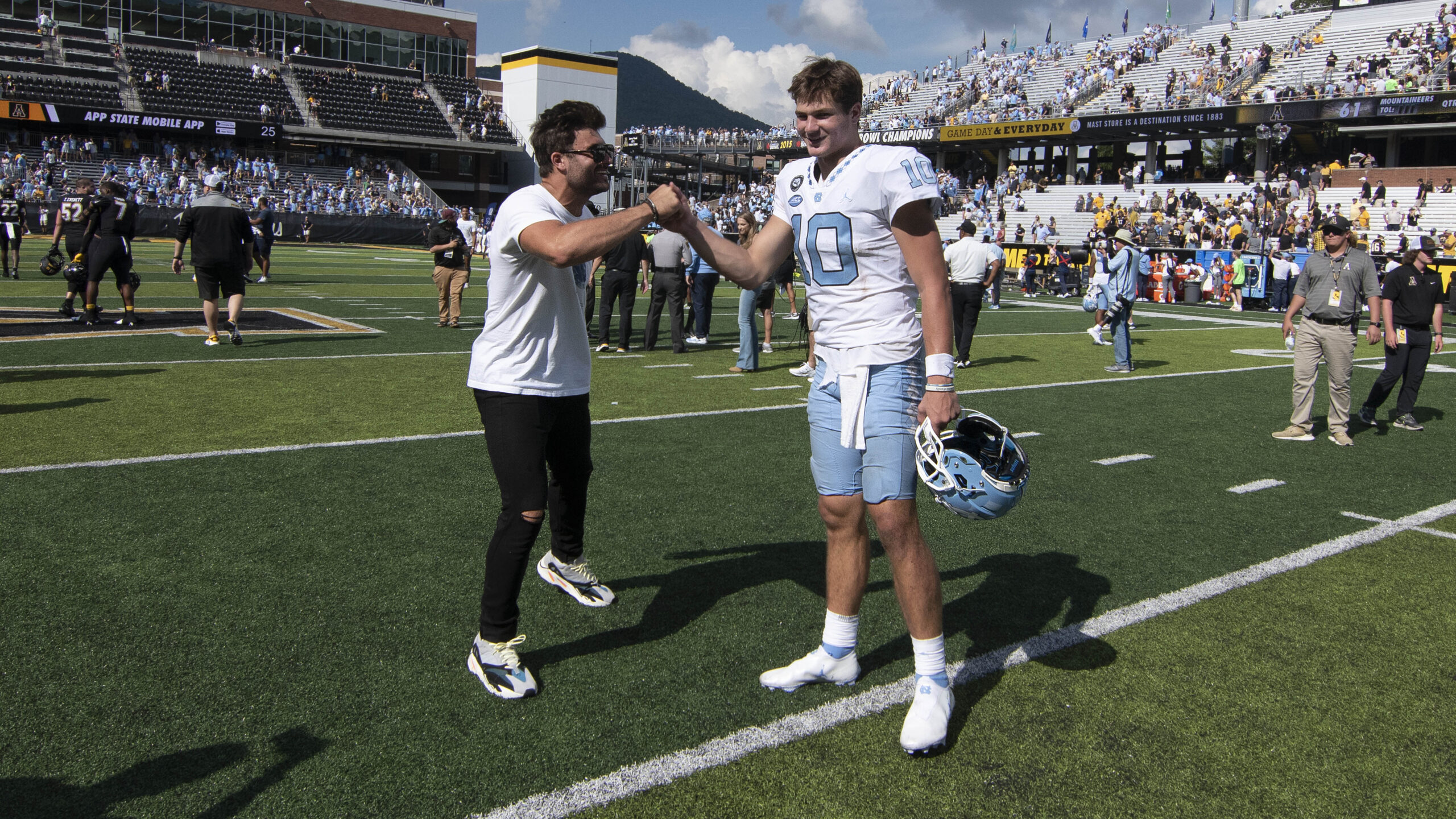
Then a member of the Commanders, Sam Howell returned to UNC to watch a vintage Drake Maye performance against Appalachian State on Sept. 3, 2022.
An NFL friendship
Just before Maye’s final season at UNC, he and Howell became roommates for a few months. It was Howell’s NFL offseason — January to April in 2023 — and they lived together in an apartment in Chapel Hill.
When they weren’t working out, or at the golf course, they were playing the board game Catan and EA Sports’ PGA Tour at home.
Maye was drafted with the third overall pick a year later. Howell, a 17-game starter with the Commanders in 2023, was traded to Seattle a month before the 2024 draft, and was subsequently dealt to the Vikings and then the Eagles in 2025.
As Maye and Howell navigated the ups and downs of the NFL, they continued to talk every day. Howell said they’d go over defenses they were seeing that week.
Sometimes, Maye would hype his friend up, the same way he did before Carolina games.
“Even when I was playing in the NFL and we weren’t winning a lot, he would always still call me to instill confidence in me,” Howell said. “He’s great about that.”
Since the Eagles lost to the San Francisco 49ers in the wild-card round on Jan. 11, Howell has attended every one of Maye’s games. He’ll be at the Super Bowl on Sunday, brimming with pride for his golf buddy.
But before it starts, there’s one thing he’ll make sure to do.
“I’ll definitely talk to him before the game,” Howell said. “Let him know that he was born for these moments, and he’s going to light it up.”
Frank Seravalli was standing behind the players’ bench at Bucks County Ice Sports Center when his phone buzzed. He didn’t reach for it — which is not his usual instinct.
Seravalli, a former Daily News reporter, is one of only a handful of NHL insiders. His job is to talk to athletes and decision makers around the league. Missing a call or a text can mean missing a story, and in a competitive media environment, in which quick, accurate information comes at a premium, being “late” isn’t ideal.
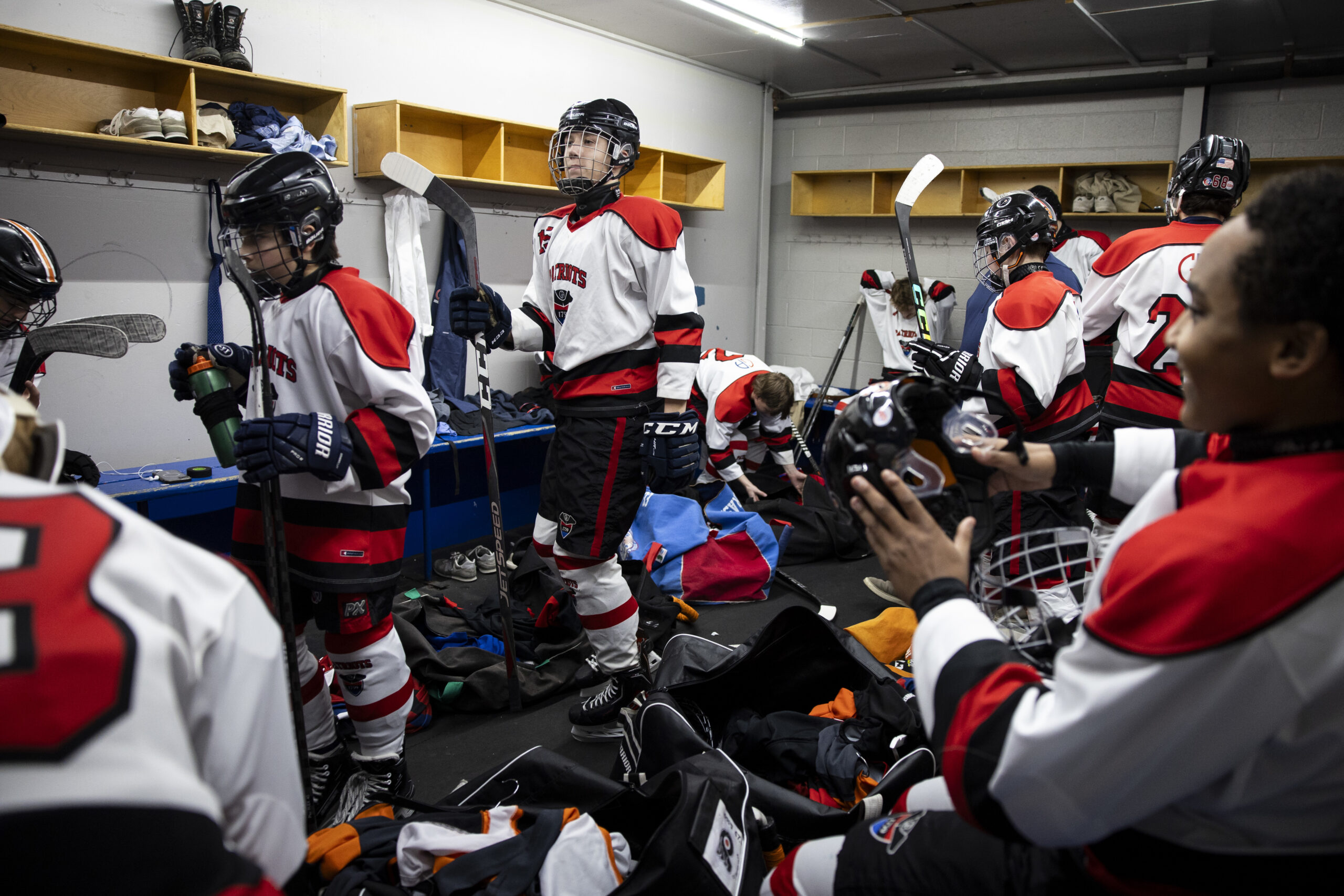
But on Jan. 12, in the midafternoon, Seravalli was busy. He was coaching Germantown Academy’s varsity hockey team. It was the third period and the Patriots were up, 6-2, in a rematch against Episcopal (5-2 on the aging scoreboard, which was missing a number).
Despite their lead, Seravalli’s players didn’t relent. With 35.6 seconds remaining, sophomore Mick Tronoski fired another shot into the net. A smattering of fans cheered.
After the two groups shook hands, Seravalli walked off the ice. He pulled his phone from his pocket, and read that the Columbus Blue Jackets had fired their head coach, Dean Evason.
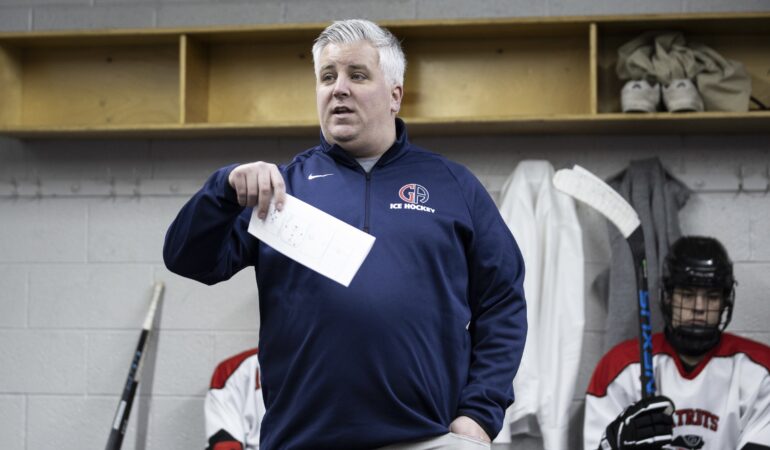
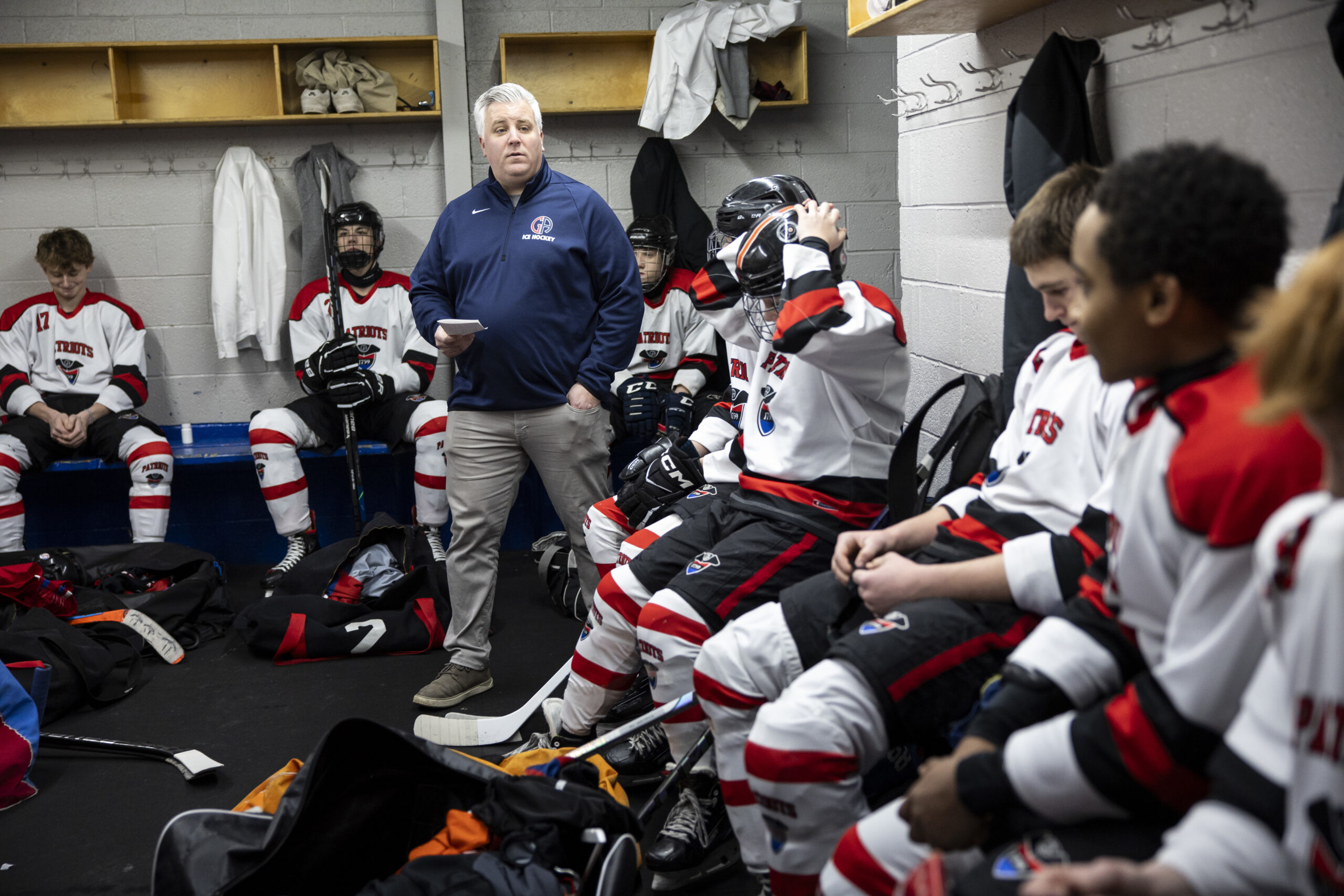
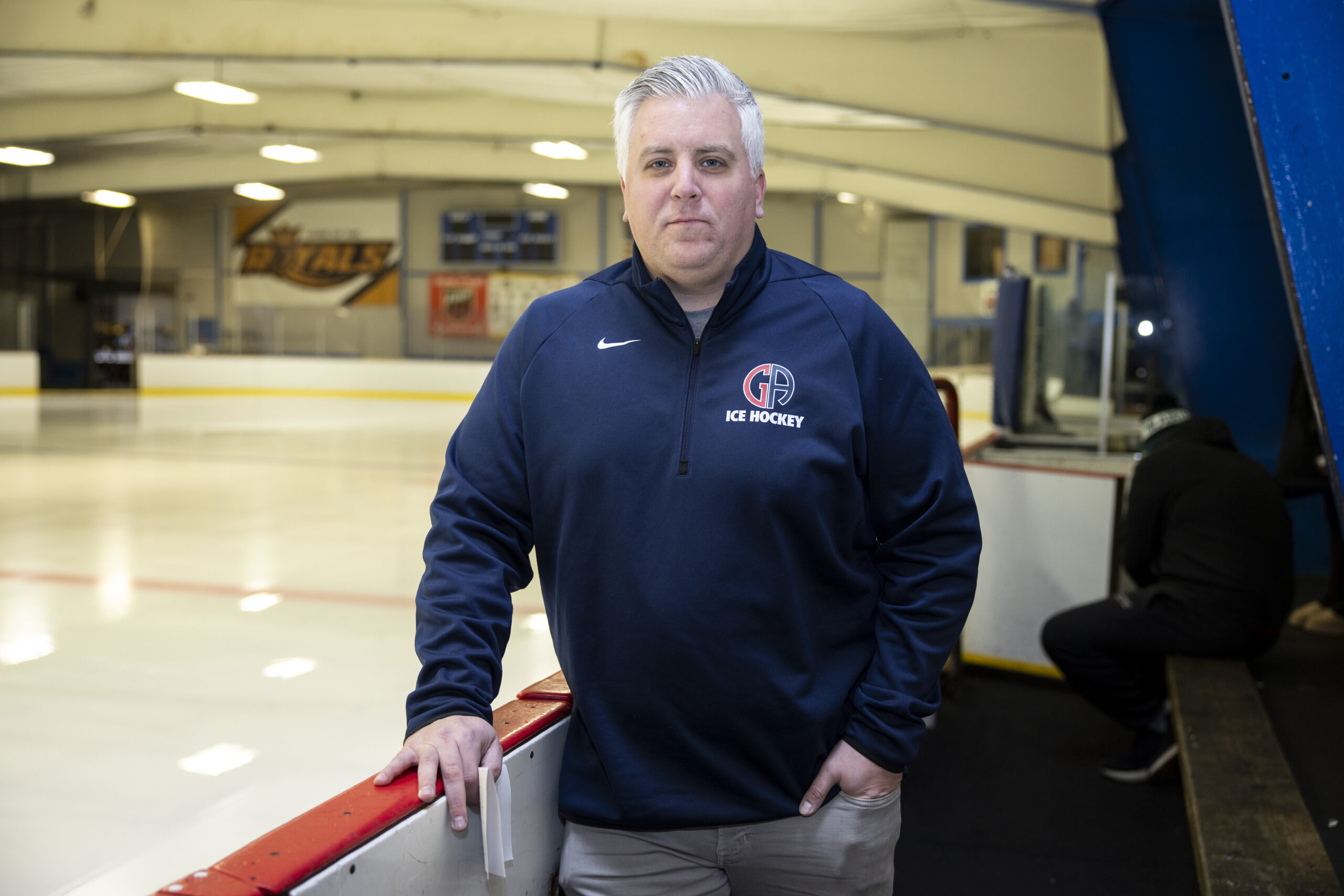
Coach Frank Seravalli talks with his Germantown Academy team in the locker room at the Bucks County Ice Sports Center on Jan. 12.
He retweeted a team statement, 27 minutes late. The NHL insider shrugged.
“I mean, it’s just life, right?” he said. “What are you going to do?”
Since July, Seravalli, 37, has served as GA’s head hockey coach. It is a daily commitment, one that he takes as seriously as his podcast and TV hits for various outlets. Five times a week, Seravalli oversees hourlong practices, and coaches hour-and-a-half games, with some 7 a.m. morning lifts mixed in.
He is not above doing the grunt work, either, like ordering gear, setting the schedule, and keeping the team’s stats. He reviews film, plans workouts, and runs the middle school program, all while keeping an eye on promising players in the area.
NHL insiders do not have an abundance of free time, so when Seravalli first told his family that he’d be coaching high school hockey, they thought the idea was absurd. And maybe it is a little absurd. Seravalli is not an alumnus of Germantown Academy. He is not doing this for the small stipend he gets halfway through the year.
But he is doing it for a reason. Just over two years ago, Seravalli’s cousin, Anthony Seravalli, died unexpectedly. He was 41 and left behind a wife and three sons.
Frank always looked up to him. Anthony was mature for his age, even as a teenager. He was a team captain and a star defenseman at Germantown Academy in the late-1990s, back when the school was winning Flyers Cups and producing NHL-caliber talent.
GA hockey’s stature has diminished since then. New York Rangers goalie great Mike Richter once played for the Patriots, but for years, the program was essentially dormant. Local recruiting wasn’t a priority. It was unclear whether there would be enough players to field a team in 2025-26.
Until Seravalli arrived. He has told the school he’s willing to make a five-to-10-year commitment to restore the program to what it was. In his mind, this is the best way to honor his late cousin.
“I thought of him, and how big high school hockey was 25 to 30 years ago, and how I could help make that big again,” Seravalli said. “And I was like, ‘Maybe, this was supposed to happen.’”
A ‘fixture’ of GA hockey
Germantown Academy was an unlikely hockey powerhouse in the 1980s, ’90s, and 2000s. The coed school had an enrollment of only 1,200 students, from kindergarten through 12th grade. These numbers allowed the Patriots to fill only one varsity team most years.
It paled in comparison to some of the bigger programs in the area, like La Salle College High School, which was able to fill four teams (one varsity and three junior varsity).
Nevertheless, GA found success. Players took pride in its underdog identity, especially while playing local behemoths like Council Rock and Malvern Prep. Germantown Academy won two Flyers Cups — the hockey championship for eastern Pennsylvania high schools — in 1982 and again in 1983, and a state championship later that year.
The team won three more Flyers Cups in 1991, 1994, and 1995, and went 100-0-6 in regular-season league play for over five seasons in the mid- to late-1990s.
Anthony Seravalli was a key part of GA’s team. He joined thevarsityas a freshman in 1996, and quickly established himself as a leader. Dan McDonald, a defenseman who was two years older, would drive him to school every morning.
Anthony Seravalli (right) was a critical part of GA’s program in the late 1990s.
The underclassman would rarely — if ever — call out sick with an injury or illness. His teammates estimated that he’d be on the ice for about 70% of Germantown Academy’s games (a hefty workload for a young player). Seravalli was a physical presence, standing at 6-foot-2, with a big windup slap shot that was hard to miss.
He carried no ego, despite his abilities. Anthony was inclusive with all of his teammates, including those who spent more time on the bench. In 1999, a few players got injured, and Seth Gershenson, a self-described “bench guy,” was asked to play some shifts.
Before Gershenson took the ice, Seravalli pulled him aside to give a few words of encouragement.
“He respected my effort and willingness to go out there and get beat up a little bit,” Gershenson said.
Many local players also participated in club hockey. They saw it as a way to get noticed in eastern Pennsylvania, which was not exactly a hotbed for the sport. As a result, club teams often took precedence over high school teams.
But this was not the case for Seravalli. GA always came first. Gershenson referred to him as a “fixture.”
“He took being a captain really, really seriously,” Gershenson said, “and he took the success of GA really seriously. He took pride in our success much more than whatever his club team was doing.”
Frank Seravalli grew up in Richboro, Bucks County, just a few minutes from the Face Off Circle, where Germantown Academy played at the time. By age 6, he was attending games and practices to watch Anthony and another cousin, Jason Jobba.
The elementary school student would stand in the same spot, behind the net, with a fizzy Coke in hand, and his face pressed up close to the glass.
“Watching your cousins who are a bit older, those are your heroes,” Seravalli said. “And for me, that’s part of where my love for the game came from.”
The Seravallis were a big, tight-knit group. Almost everyone played hockey, and almost everyone went to work at the family construction business. This was the path Anthony took, but he also found time to give back to his alma mater.
Frank Seravalli fondly remembers watching his older cousins play hockey when he was a child.
In 2004, while Frank was playing at Holy Ghost Prep, Anthony returned to GA as an assistant coach. He had a knack for connecting with the players, most of whom were familiar with his high school career.
One example was Brian O’Neill, a GA alum and former U.S. Olympian who is now playing pro hockey in Sweden.
O’Neill was a talented skater, but he lacked defensive fundamentals. This was one of Anthony’s strengths, and when O’Neill was moved to defense in his sophomore year, he began to work with the assistant coach.
Seravalli constantly reminded him to keep “stick on puck.” It was a message that O’Neill had heard for years but never fully understood. That changed when the coach stepped in.
“It was easy for him to sell me on what he was trying to teach, because I had a lot of respect for him as a player and a person,” O’Neill said. “He didn’t really have to earn my trust. That was already there.”
The goal was to put pressure on his opponent, in a way that didn’t involve hitting or cross-checking. The coach ran drills in which O’Neill would hold a puck in his right hand, and the stick in his left, to focus on keeping the stick down.
“It’s amazing,” O’Neill said. “You would think, ‘OK, I can’t grip the stick with my other hand, so I pretty much am playing with one hand,’ and all you can do with that is pretty much stick on puck.
“You would think you would be way worse at defending, but it’s actually the opposite, because all you’re focused on is stick on puck. And you’re not focused on hitting.”
The concept finally clicked. O’Neill, who went on to play in the NHL, still uses it to this day.
“[Anthony] was the guy that gave me the most advice on defense,” he said, “and that definitely made a huge impact on my career.”
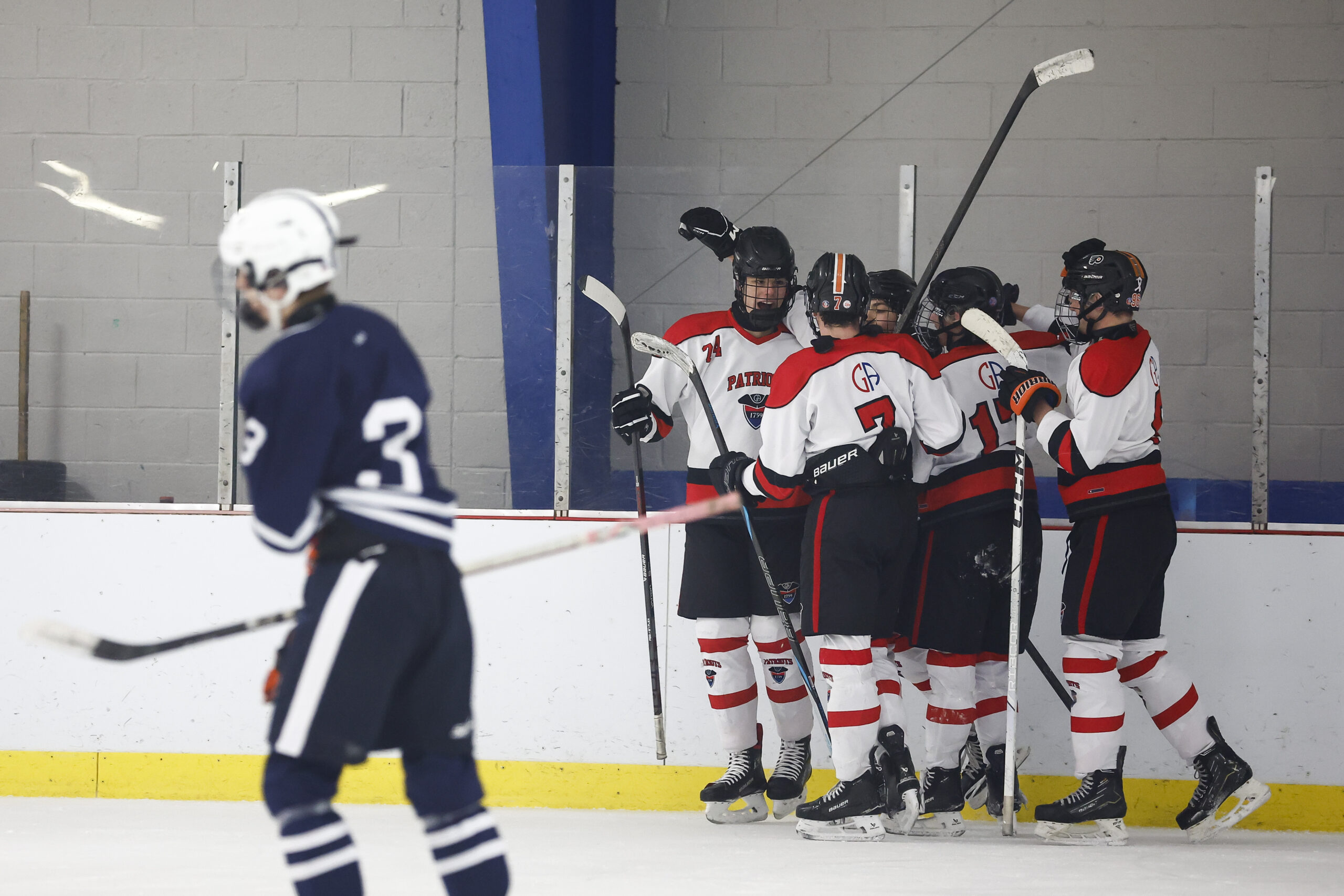
Germantown Academy players celebrate after a goal against Episcopal Academy at Bucks County Ice Sports Center.
‘Please help save our program’
When he was young, Frank Seravalli would visit his family’s construction business in Northeast Philadelphia. He’d often notice workers perusing thick copies of the Daily News over lunch, and dreamed about having a byline someday.
In 2009, that dream became a reality, when the paper hired Seravalli out of Columbia University’s journalism school to cover the Flyers. He stayed for six years, before leaving for the Canadian television network TSN, where he worked as a senior writer and NHL insider.
In 2021, Seravalli started his own business, the Daily Faceoff, which was sold to a media group in Denmark in 2024. He’s now building a hockey network at the streaming service Victory+.
A typical day includes a radio interview in the morning, a podcast taping at noon, and more radio and television hits at night. Interspersed are hours spent texting and calling sources throughout the league.
It is a frenetic lifestyle, one that requires Seravalli to be glued to his phone. Finding time to coach a high school hockey program seemed impractical, if not impossible. But Seravalli was drawn to the idea. So, when he saw the job opening last year, he decided to apply.
The school’s athletic director, Tim Ginter, could only laugh when he read the insider’s resumé. Among his references were two NHL general managers, an executive with the league, and a former NHL head coach.
“He’s like, ‘Call [former Anaheim Ducks head coach] Dallas Eakins,’” said Ginter. “And I’m like, ‘You’ve got to be kidding me.’”
Seravalli interviewed for the position in the spring. He talked to two of the team’s captains, J.P. McGill and Joey Lonergan, who explained that their program was in jeopardy.
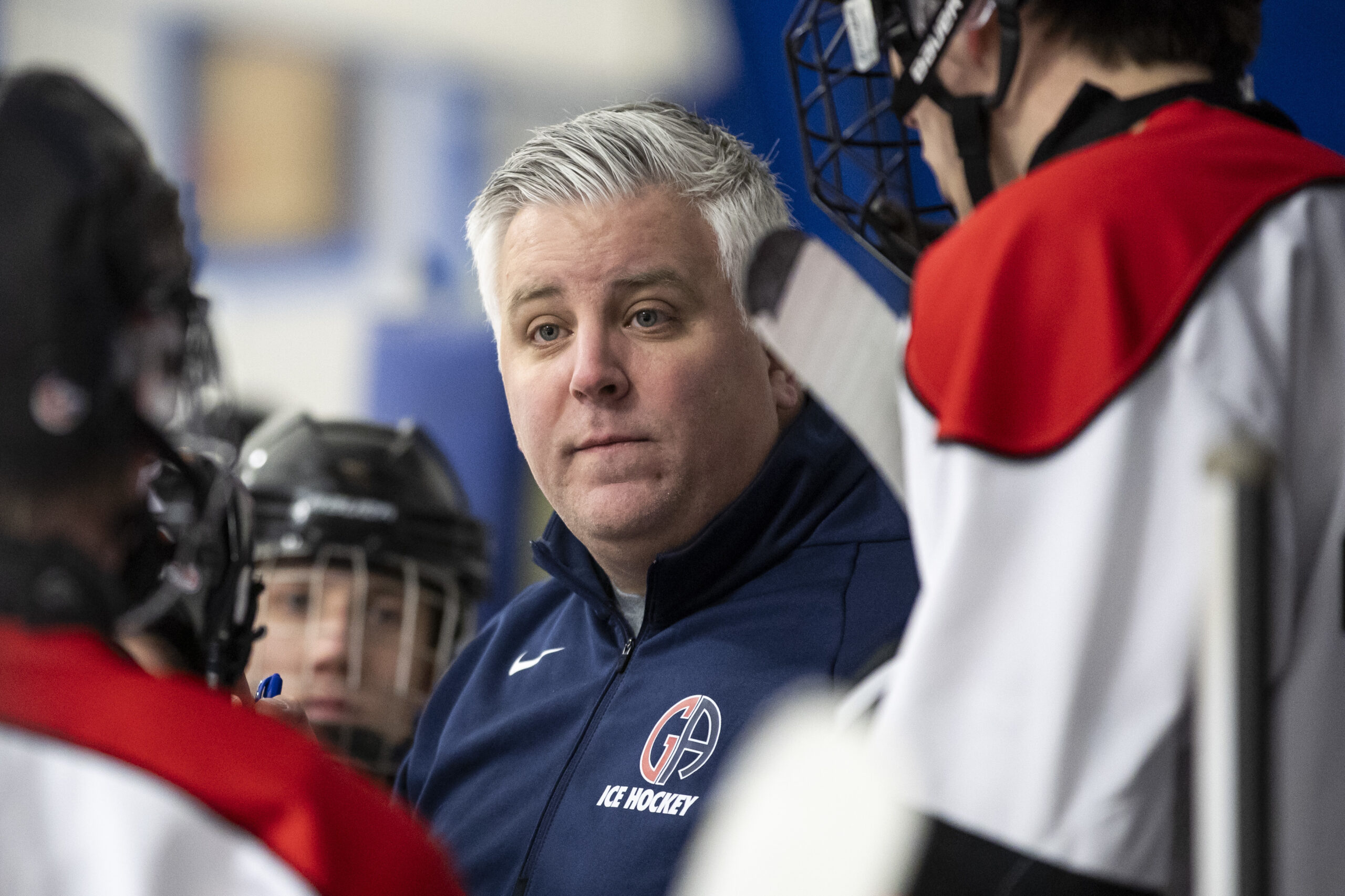
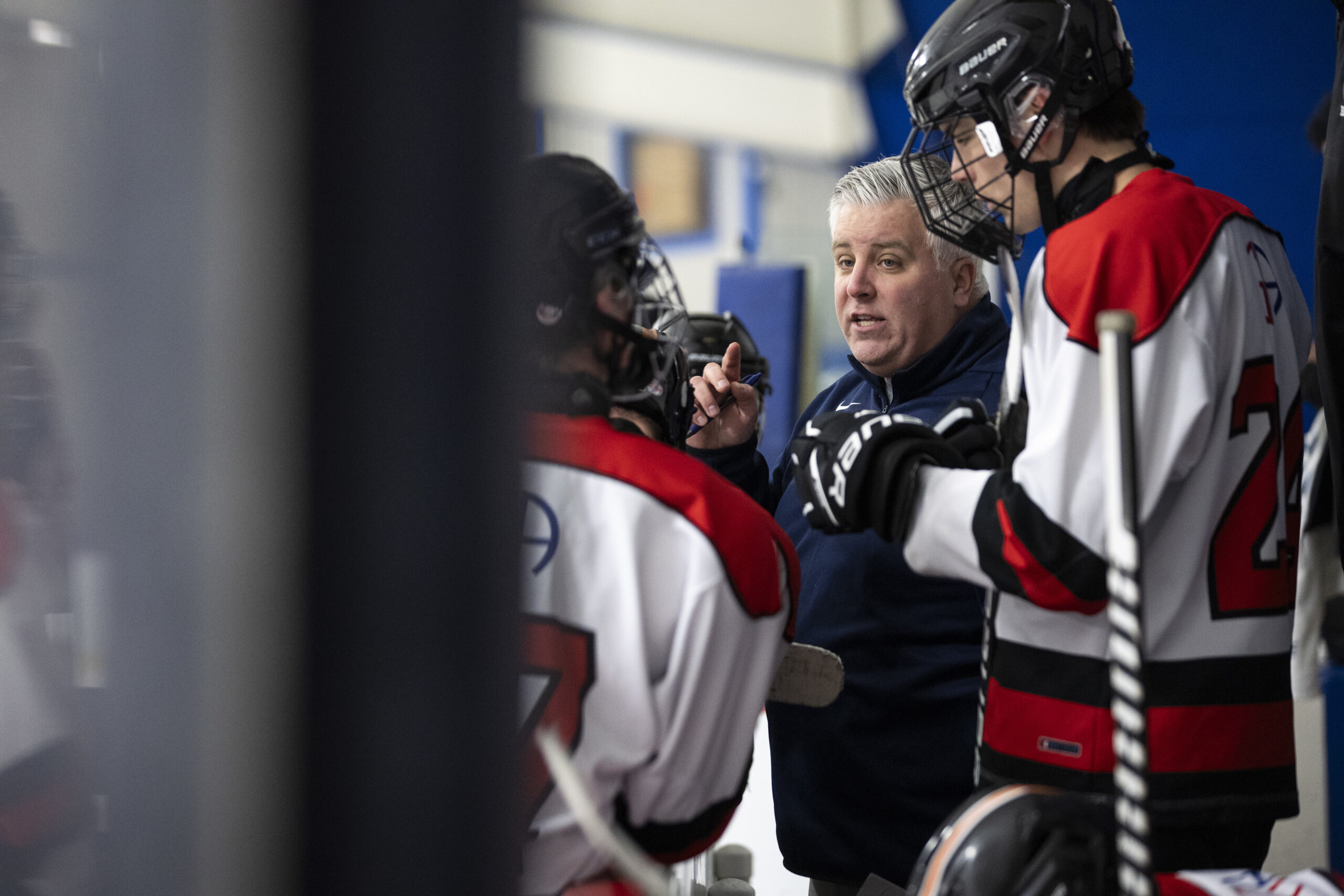
Coach Frank Seravalli talks with his team during the game against Episcopal Academy.
GA had lost five playersin 2025. School officials didn’t know how they were going to fill those spots. McGill and Lonergan had heard stories about the 1990s and 2000s teams, but returning to that level seemed like a long shot.
The Patriots hadn’t played in a Flyers Cup since 2009. After years of shrinking rosters and coaching changes, the team was moved for 2009-10 from the Suburban High School Hockey League to the lesser Independence Hockey League, which isn’t eligible for Flyers Cup entry.
“Essentially their plea was, ‘Please, help save our program,’” Seravalli said. “‘We’re not even sure we’re going to have a team next year.’
“I couldn’t say no at that point. I knew I was hooked.”
Seravalli met with Ginter shortly after. He made a succinct but powerful pitch.
“If you don’t have interest in changing your program, and really tearing it down and rebuilding it, I’m not your guy,” the insider told him. “But if you are interested, I’m willing to make a five-to-10-year commitment to build this the right way.”
He was hired in July. Seravalli rarely mentioned his full-time job, but it didn’t take long for the teenagers to figure it out. One day, while McGill was “doomscrolling” on the internet, he spotted his high school coach on Bleacher Report Open Ice.
His reaction: “Oh [expletive].”
“I texted some of my teammates,” McGill said. “I’m like, ‘He’s the Adam Schefter of the NHL!’”
Germantown Academy’s players were not aware at first that their new coach was an NHL insider.
Added junior defenseman Jack Stone: “He’s a reporter, so obviously he knows what he’s talking about.”
The insider started to use his connections behind the scenes. He’d ask current and former NHL head coaches for advice, among them Eakins, who now works for Adler Mannheim in Germany.
Eakins encouraged Seravalli to model the behavior he wanted to see in his team. He emphasized how important it was to show not only that he cared about the program, but about the players as people.
He also shared some mistakes he’d made in his own coaching career, with the hope that Seravalli could learn from them.
“Sometimes people [will] say, ‘OK, I’m a coach, now I have to take on a different persona,’” Eakins said. “And I told him, don’t do that. Don’t go in there and pretend to be [Florida Panthers head coach] Paul Maurice.
“You’ve got to go in there and be Frank Seravalli. Because as soon as you step outside of that, you’re cooked. You can only pretend to take on this other persona for so long.”
The tenor of the program changed almost immediately. Before Seravalli’s arrival, on-ice practices and team lifts were optional. Sometimes, as few as two or three players would show up. Now, they were mandatory, and everyone was expected to arrive on time.
The teenagers learned this the hard way. In October, during preseason workouts, Seravalli organized morning weightlifting. Two players — who will remain anonymous — slowly waltzed into the gym, 15 minutes late.
Coach Frank Seravalli brought a disciplined approach to the Germantown Academy hockey team.
Seravalli didn’t say anything in the moment. But after the workout, he brought the team down to the field house to run sprints. The two late arrivals were put on the sideline, so they could watch their peers suffer on their behalf.
“And I just said, ‘Look, we have a standard here,’” said Seravalli. “‘You have to make the commitment that everyone else is to show up on time and be ready.’
“And I’ll tell you what: Since then, no one’s been late.”
The players have embraced the newfound discipline. Stone said it’s something that they didn’t realize they needed, but they’re grateful to have. McGill agreed.
“He’s way more intense than what we’ve had in the past,” McGill said. “Which, to some people, can be intimidating. But if you want to play at a high level, that can’t be intimidating.
“There’s no getting away with anything around here anymore. Frank has done a great job of holding us accountable to what the new standard needs to be.”
A different type of connection
Not long after he was hired, Seravalli moved the team from the Hatfield Ice Arena to the Bucks County Ice Sports Center (formerly known as the Face Off Circle). The building looks just like it did when Anthony was in high school.
The white-and-blue paint is faded, but intact, and so is the thermostat, set to the coldest possible temperature. Five days a week, Seravalli walks past the spot where he stood as a child, watching his cousins with wide eyes, as they swept across the ice.
Anthony’s death was a shock to the entire family. He no longer roams the halls of the construction firm. He is no longer behind the bench at the Face Off Circle.
John Linehan and Kobe Bryant used to talk. A lot. This would not have been unusual for other AAU teammates, but these two were fierce high school rivals.
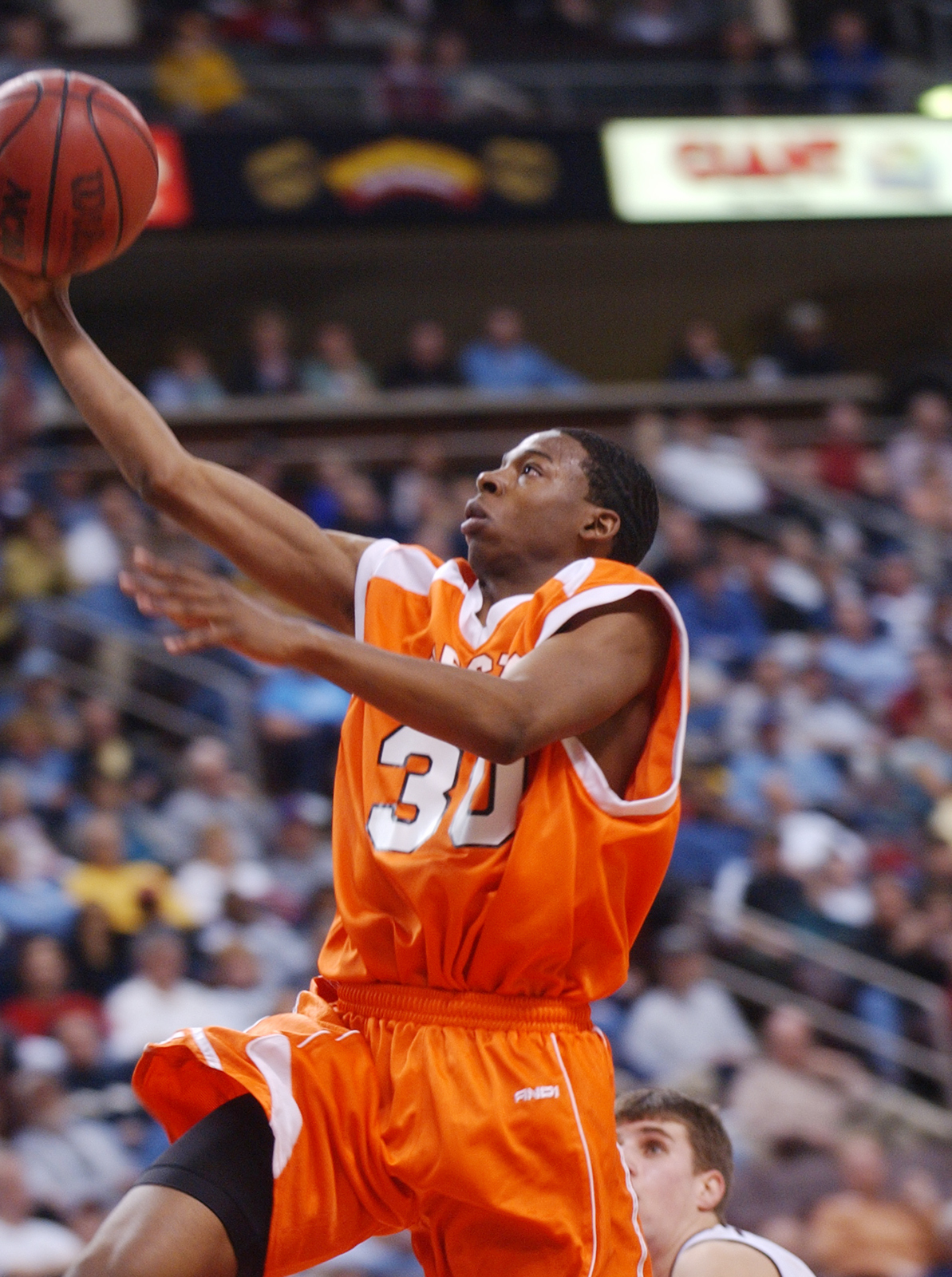
Linehan was a scrappy point guard for Chester. Bryant was a relentless shooting guard for Lower Merion. Both were competitive, almost to a fault, and in the days leading up to big games, they’d get chippy.
The week before the 1996 PIAA Class AAAA District 1 title game, for example, the players talked every day on bulky landline phones, with Bryant often calling Linehan at his home in Chester.
“I just said, ‘You know, John, I haven’t won a championship yet, and you have,’” Bryant told The Inquirer in 1996.
Linehan knew what his friend was doing. The future NBA star did the same thing a few weeks later, on March 19, a day before the teams met again in the state semifinal.
“He was trying to get me to trash talk,” Linehan said. “I think he needed a little edge. I didn’t want to give him too much. I was like, ‘Man, you crazy.’”
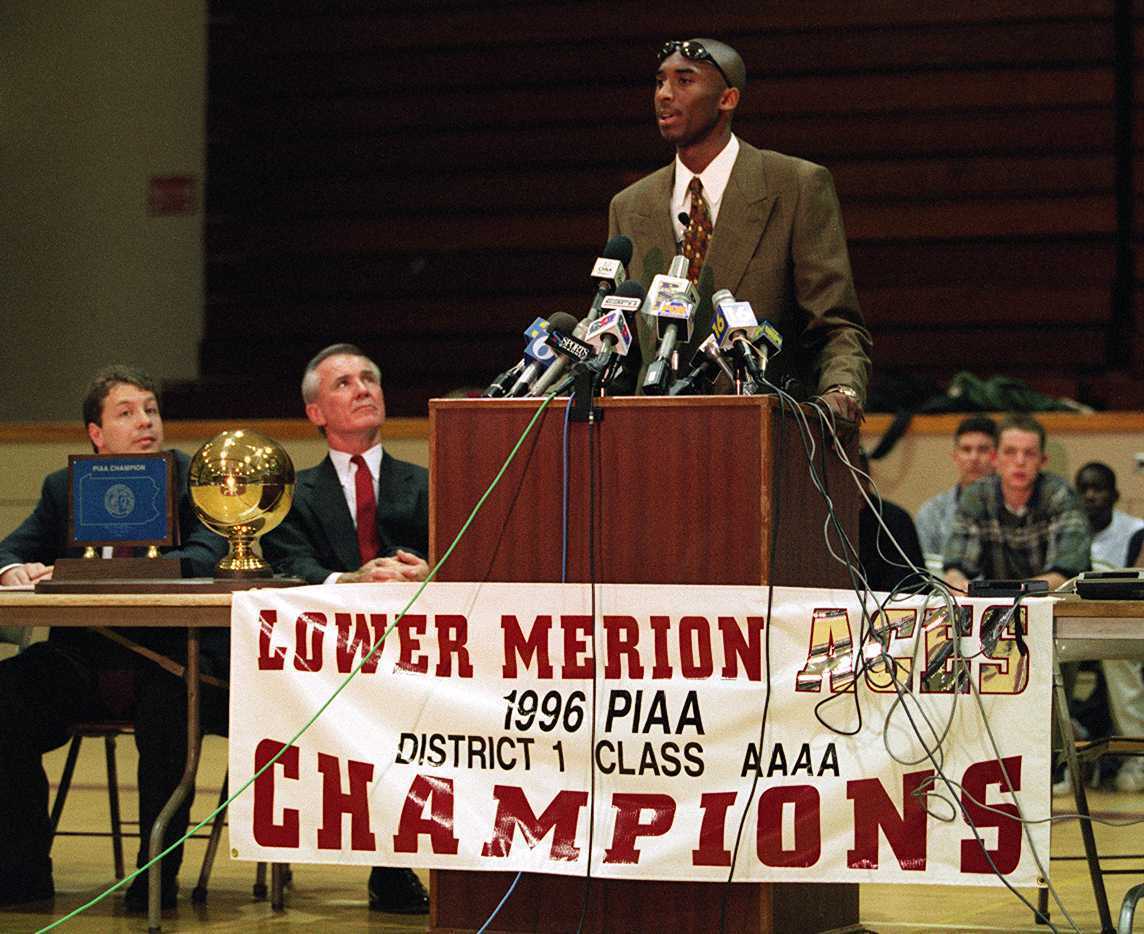
The late Kobe Bryant, a former Lower Merion basketball star, announcing he will go directly into the NBA draft out of high school.
Lower Merion wasn’t a basketball school when Bryant arrived in the fallof 1992. It paled in comparison to the local powerhouses like Simon Gratz, Coatesville, and Chester.
But Bryant changed that. Even in his freshman year, a season in which the Aces went 4-20, he brought a new standard, working out before class and introducing a level of toughness that was foreign to his teammates.
Bythe mid-1990s, Lower Merion was among the best high school teams in the Philadelphia area. Its players were more confident, celebrating after big shots, and talking loud on the court.
The Aces didn’t play as many games against Coatesville, a rising power led by Rip Hamilton. They couldn’t consistently measure themselves against Gratz, which didn’t participate in the PIAA playoffs untilthe 2004-05 season.
But they could against Chester. And so, a decades-long rivalry was born.
From 1996 through the mid-2010s, Chester and Lower Merion put on some of the greatest high school basketball games in the area. They’d often sell out venues like the Palestra and Villanova’s Pavilion. Some fans would even scalp tickets.
Their communities were almost diametrically opposed. Chester was predominantly Black; Lower Merion was predominantly white. Chester was plaguedby poverty; Lower Merion was considered affluent.
Chester, with its Biddy League, had a legacy of basketball greatness, and a steady pipeline of talent. Lower Merion had nothing comparable. But these differences melted away on the court.
And while the rivalry is not what it once was, it lives on today.
“The pride and the intensity and the history will never fade,” said Lower Merion coach Gregg Downer. “I mean, if we played them tomorrow night, that would be an intense game.”
The Bryant-Linehan era
When Downer was named head coach in 1990, he already was well-aware of Chester’s tradition. He’d played youth basketball growing up in Media and had heard about the stars who’d come out of the Biddy League.
It was obvious that his team would have to go through the Clippers to win any sort of accolade. But it wasn’t until Bryant’s arrival that Downer’s aspirations became a real possibility.
The shooting guard, who was the son of former 76er Joe “Jelly Bean” Bryant, was mature for his age. He’d demand more, mentally and physically, of older teammates. Doug Young, a former Lower Merion forward, remembered seeing Bryant leaving the locker room at 7 o’clock one September morning in 1993.
He’d been at the high school gym since 5 a.m., working out by himself. To the Lower Merion basketball team, this was a “crazy” concept, so Young and his cohorts decided to join him.
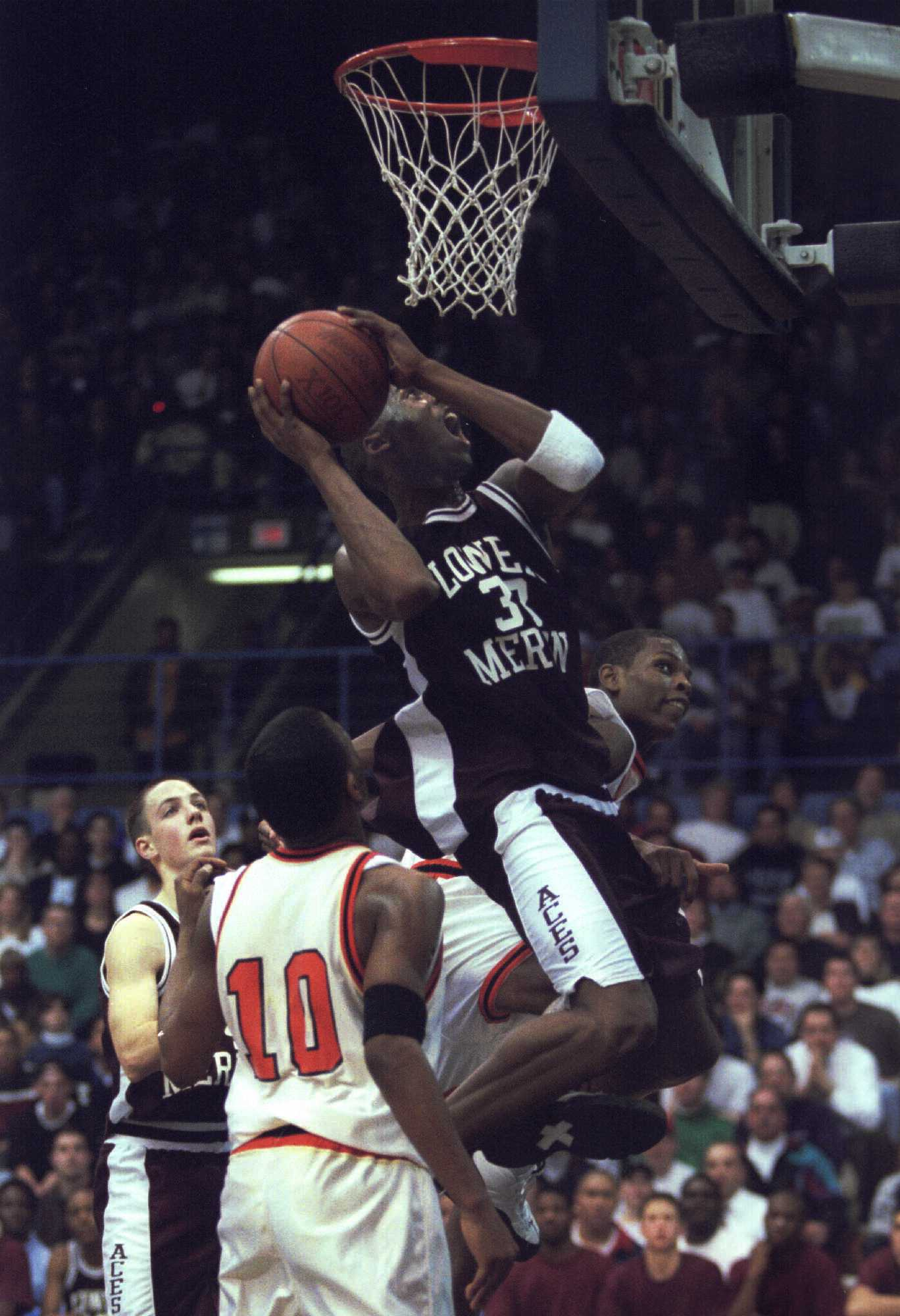
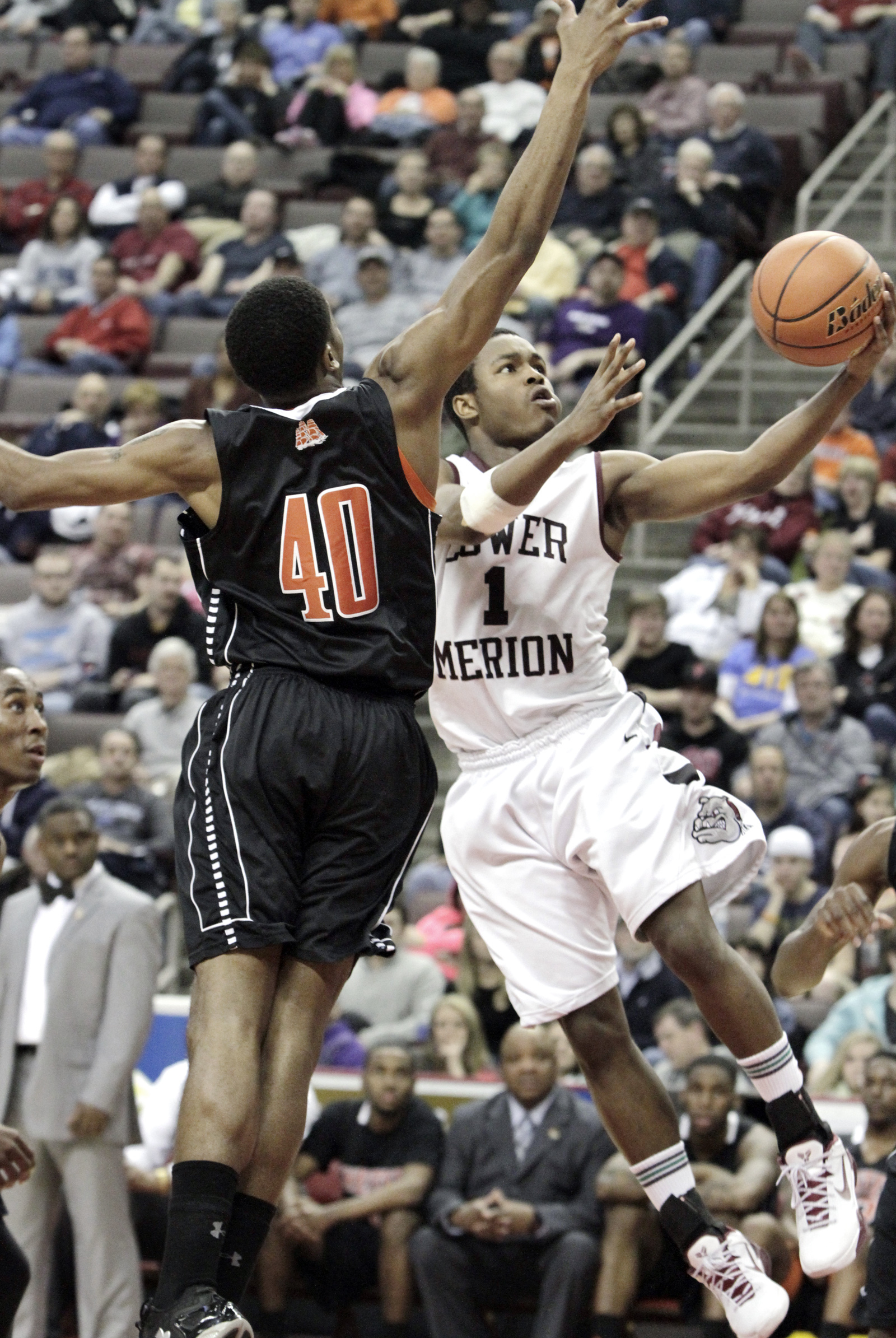
In the District 1 championship game against Chester, Kobe Bryant goes to the hoop over the Clippers’ John Linehan.
They arrived the next day at 5:06 a.m. The players knocked on the door. Bryant didn’t answer.
“He wouldn’t open it,” said Young, who graduated in 1995. “You’re either there or you’re not. We were six minutes late.”
His teammates waited outside until 6:30 a.m., when the school opened. They made sure to show up before 5 a.m. from that day on.
Downer was wired the same way. The coach — and his NBA-bound pupil — would push the team in practice. Losses were particularly tough. The players would go through endless sprints and rebounding drills that sent them running to the trash can.
It wasn’t fun. But over time, the method created a newfound tenacity.
“No one walked into high school saying, ‘Oh, yeah, I want to win a state championship,’” Young said. “But [Kobe] knew what that was. He was like, ‘I don’t know any other way. If we’re not going to win a championship, what the heck are we playing for?’”
Chester was always going to be an obstacle, so Downer tried to play into the battle. He’d use analogies for the tough, hard-nosed team, comparing it to an animal stalking its prey.
The coach began to screen movies to underscore this point. Together, in a Lower Merion classroom, Downer’s players watched Jaws and other tales of survival, like The Edge, a 1997 thriller about a plane that crashes in the Alaskan wilderness.
“This bear is stalking them, and the couple is saying, ’What are we going to do about this bear?’” Downer said. “And one of them says, ‘The only thing we can do is kill the bear.’
“And I remember being like, ‘We can do this.’ But the only solution is to — not to be overly graphic — but to kill them.”
(The bear in this analogy was Chester.)
He added: “We tried everything humanly possible to get through to this team.”
The first few games were ugly. In 1995, Lower Merion met the Clippers in the District 1 championship, only to lose by 27 points. But they came back with a renewed focus the following year, in 1995-96, going 25-3 in the regular season to earn a district final rematch against Chester.
The Aces showed up at the arena with “27″ printed on their warmup shirts. Bryant, armed with fresh bulletin board material from Linehan, dropped 34 points against the Clippers en route to a 60-53 Aces win.
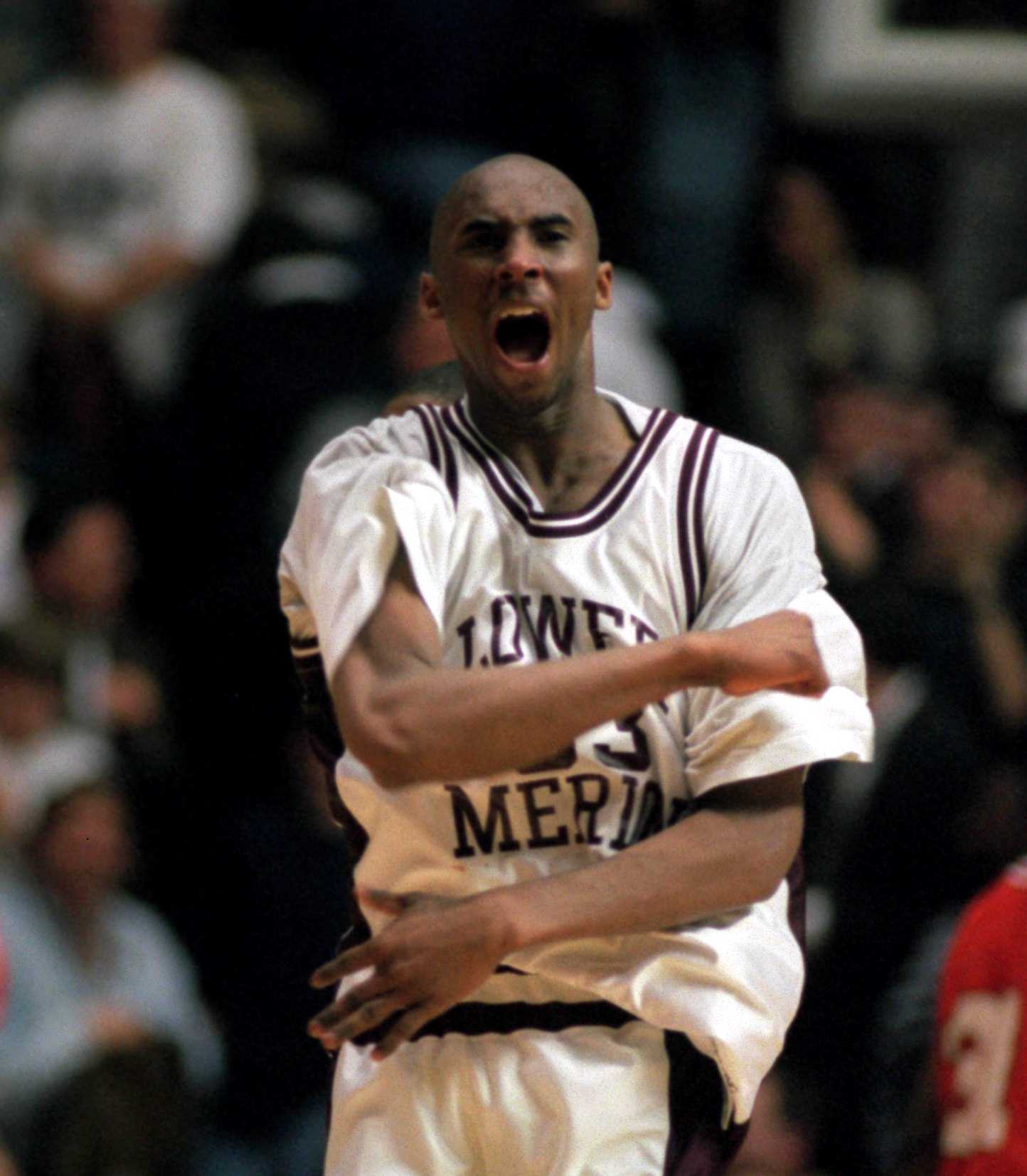
The shooting guard scored 39 points later that month — with a broken nose — in a 77-69 state semifinal win over Chester. Lower Merion went on to beat Erie Cathedral Prep, 48-43, to win its first state championship since 1943.
Kobe Bryant celebrates after defeating Chester at the Palestra in 1996 to advance to the state final.
To Linehan, the difference Bryant made was obvious. He joked that he’d “never heard of Lower Merion” before his friend arrived. But once he did, Chester realized it would have to go to great lengths to prepare for the phenom.
Ahead of a big game against Lower Merion in the mid-1990s, the coaching staff reached out to Clippers alumnus Zain Shaw. He played at West Virginia and in Europe and possessed some of the same characteristics as Bryant — a tall frame and an athletic build with strong ballhandling skills.
The Clippers invited Shaw to practice, where he played the role of Bryant (to the best of his ability).
“Kobe was so special, we had to bring in a pro to help us prepare,” said Linehan, who later starred at Providence.
But there was another impact the future Lakers star had, one that had nothing to do with his own prowess. Linehan noticed that Bryant’s Lower Merion teammates started to take on some of his qualities. Suddenly, they were playing brash, confident basketball.
“We didn’t have reason to believe, until Kobe got there, that we belonged on the court with Chester,” Young said. “The fear was real. Teams were afraid of Chester because they’d run you out of the building.
“The idea of Lower Merion being on the court in a meaningful game against [them] was such a crazy thought. But then, you started to believe.”
The buzzer-beater heard ’round Chester
Bryant never got over the rivalry, even after he embarked on his Hall of Fame NBA career in 1996. Sometimes, he’d call the coaching staff before big games against Chester, leaving expletive-laden voicemails to use as motivation.
The Lakers shooting guard also created an incentive structure for his former team.
“You couldn’t get a pair of Nike sneakers unless you qualified for the playoffs,” Young said. “If you don’t earn it, you don’t get it.”
He became especially involved in 2005-06. After a lull in the early 2000s, Chester and Lower Merion found themselves neck-and-neck again. The Aces were led by the duo of Ryan Brooks and Garrett Williamson, and the Clippers boasted a deep roster, headlined by Darrin Govens. All of them eventually played in the Big 5.
(Chester was so stacked that it brought a 1,000-point scorer off the bench in Noel Wilmore.)
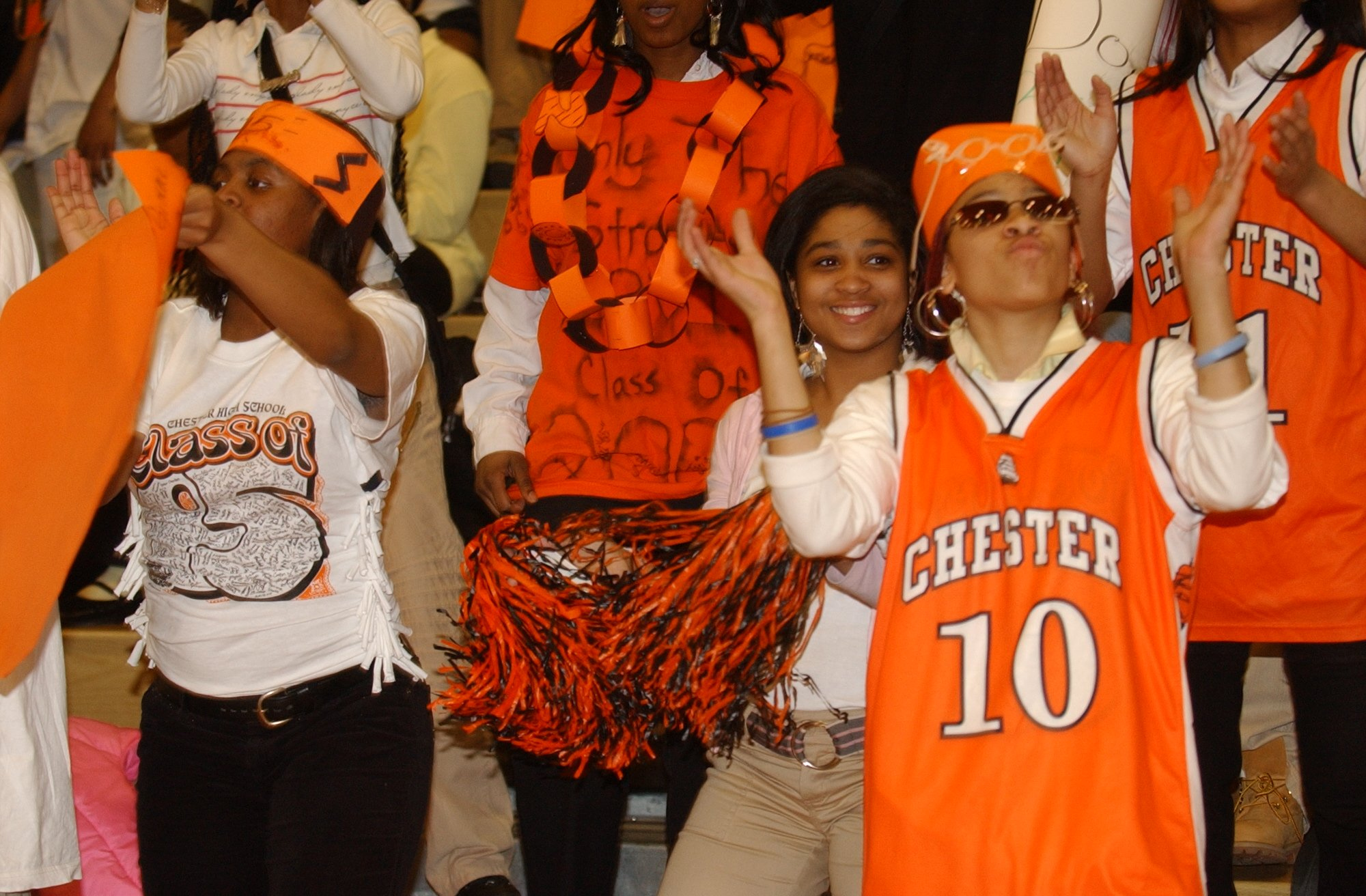
Students from the class of 2005 show their support as Chester and Lower Merion play in the state final.
The rivals met in the state championship on March 19, 2005. Despite strong performances from Williamson and Brooks, the Clippers pulled away in the second half thanks to a dominant third quarter from Govens. Chester won, 74-61.
The teams reconvened the following season with their competitive spark fully reignited. They faced each other three times that year. Chester took Round 1, a one-point regular-season victory on Dec. 27.
Round 2 was in the district final on March 3. Before the game, in front of a packed crowd at the Pavilion, Chester sophomore Karon Burton walked up to the layup line.
Lower Merion’s student section caught his ear with a chant about coach Fred Pickett’s stout stature.
The dig didn’t intimidate Burton. If anything, it fueled him. He grew up playing street ball in Chester and always loved trash talk.
Instead of cowering, like the crowd hoped, the sophomore delivered an unforgettable outing. The game went into overtime, and was tied at 80 with only a few seconds remaining.During a timeout, assistant coach Keith Taylor pulled Burton aside.
“He was like, ‘Hey, listen,’” Burton said. “They’re going to double Darrin. If you get that ball, do your thing.’”
Taylor’s words proved prescient. As Lower Merion’s defenders swarmed Govens, the Clippers inbounded the ball to Burton.
He took a pull-up jumper from beyond the arc and drilled it for an 83-80 win. The Chester fans stormed the court. Burton, who later joined Wilmore in the 1,000-point club, said he felt like a celebrity in his hometown.
“It was like watching a buzzer-beater in the NBA,” he said. “I just ran to my teammates, they picked me up. It was a crazy feeling.
“I’m a big Kobe fan, too. Kobe’s my favorite player ever. So when I came and I hit the game-winner on that team …”
Round 3 took place a few weeks later, in a state semifinal rematch at the Palestra on March 22. Bryant called Lower Merion’s coaches before the game.
“I don’t remember specifically what he said, but I’m sure there were a lot of [expletives] dropped,” said Young. “Like, ‘Don’t call me back if you don’t beat those [expletives].’ That was a line we heard from him a couple times.”
This one didn’t go Chester’s way. After trailing the Clippers, 47-37, at the end of the third quarter, the Aces came roaring back in the fourth and put up 33 points to eke out a 70-65 win.
The celebration in the locker room was cathartic. Water sprayed into the air. Players sat atop each other’s shoulders and turned the showers into a slip ‘n slide. Bryant called in, again, as other members of the 1996 team filtered through.
Darrin Govens scored his 1,000th point for Chester against Lower Merion in the state championship in 2005.
This was not how Govens wanted to end his high school career. And a few months later, when he arrived at St. Joseph’s on a basketball scholarship, he saw a familiar foe.
It was Williamson, his new Hawks teammate.
“We were sitting on the opposite side of the bench,” Govens said. “I didn’t want to sit next to him; he didn’t want to sit next to me. We’d kind of avoid each other and just head nod.
“Even in running drills, it was a competition. He looked to the left. I looked to the right. We tried to beat each other in sprints. But then we realized, ‘All right bro, we’re teammates now.’”
‘Hero status’
Chester had always rallied around its high school basketball team. Linehan said it was akin to playing for the Sixers. The teenagers were treated like professional athletes — especially those who had been a part of big wins.
The Clippers’ public address announcer, James Howard, called this “hero status.”
“All of a sudden, your money’s no good,” he said. “Barbers take care of you, make sure your hair looks nice before games. Free food. Little kids look up to you and ask for your autograph. That’s how it is.”
In Chester, there were plenty of heroes to draw from. There was Linehan, but also Jameer Nelson, who met a young Burton in the late 1990s. Nelson, a friend of Burton’s cousin, gave the aspiring basketball player a gift before he left for St. Joe’s: his MVP medal from the Chester summer league.
“He was one of the biggest guys in our city,” Burton said, “so it’s definitely something that I’ll always remember.”
By the early 2010s, when the rivalry was reignited for a third time, Lower Merion had built more of a basketball tradition. Aces guard Justin McFadden said he’d get stopped in Wawa before big games against the Clippers.
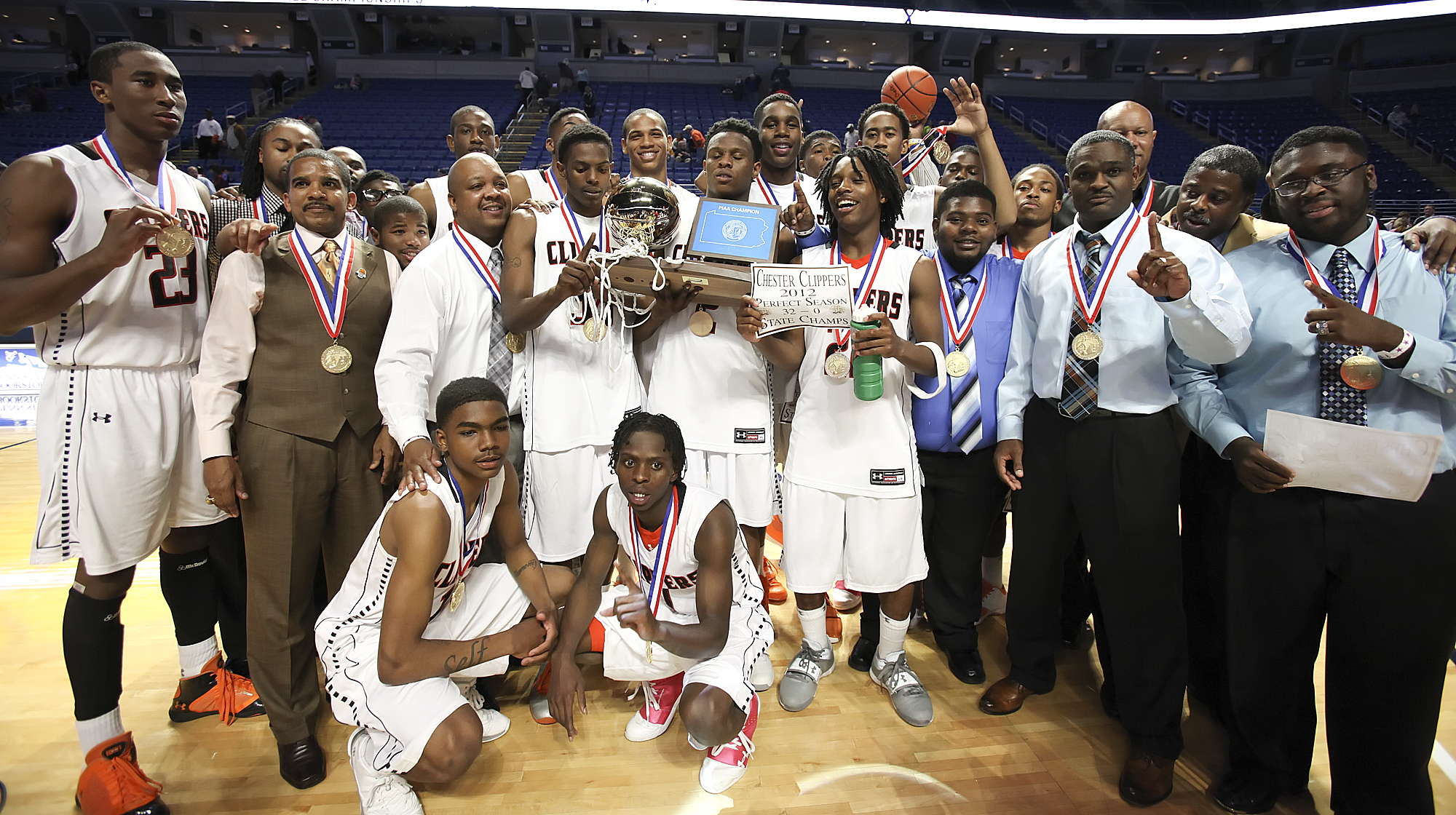
Chester celebrates its win over Lower Merion for the state championship in 2012.
“It became a community thing,” he said. “People would be asking, ‘What do you guys think about Chester? Do you think we can get it done?’”
In 2012, the schools met in the state championship for the first time since 2005. Junior forward and future NBA starter Rondae Hollis-Jefferson put up a double-double to lead the Clippers to a resounding 59-33 win over the Aces. It was their second straight title and their 58th straight victory.
A year later, after going 17-0 in the Central League, the Aces met the Clippers in the state final again. Chester had won 78 straight games against in-state opponents. Snapping that streak would be daunting, but Downer had a plethora of motivational tactics at his disposal.
Just as they had in the 1990s, The Aces again spent pockets of the season watching Jaws, The Edge, as well as an addition: Al Pacino’s “Inch by Inch” speech in Any Given Sunday.
“He would have that fired up on YouTube, ready to go,” McFadden said. “Looking back, [your reaction] is a chuckle, but in the moment, it worked. We knew that this was the hill that needed to be climbed.
“And every time they played that speech, we got goose bumps. We were ready to fire.”
Chester got out to an early lead, but Lower Merion rallied behind a 22-point, 11-rebound performance from B.J. Johnson, who later starred at La Salle. The Aces snapped the streak and won their seventh state title with a 63-47 victory.
Lower Merion’s Jaquan Johnson goes to the net as Diamonte Reason guards him in the Chester-Lower Merion state championship game in 2013.
The Clippers then were coached by Larry Yarbray. Pickett, who was diagnosed with cancer in2010, was in declining health. Just before he died in 2014, Downer decided to say goodbye.
He and his former assistant coach Jeremy Treatman drove out to Pickett’s home in Chester. They went to his bedside.
“And we talked,” Downer said. “And we held hands. It was a really touching moment for me. This is a man that carried Chester on his back. That tried to carry Lower Merion on his back. And I knew it was the last time I was going to see Fred.
“We walked out the door, and we told each other that we loved each other. And I never thought he would say that to me, or vice versa. But it was just kind of like, ‘You know what? We’ve had some amazing battles, and there’s a lot of respect there.’”
Keeping the tradition alive
In recent years, the Chester-Lower Merion rivalry has diminished.
There was a brief period when the teams were in different classifications. Both programs have lost players to private schools that can recruit, and the addition of the Philadelphia Catholic League to the PIAA has made the state playoffs more competitive.
One place the Aces and Clippers could meet is in the district tournament, where they reunited in 2024. But they haven’t played each other since. And Howard says the contests don’t have the same feel.
“Both teams have lost D-I talent,” he said. “It’s not as high-flying, above the rim, as it was in the past. But still a great game. Sold out at Lower Merion, and at Chester, same thing.”
The history will always be there, though, and Burton is doing his best to keep it alive. His 8-year-old son, Karon Burton Jr., is playing in the Biddy League. His father is his coach.
Sometimes, they go on YouTube and watch old Clippers games. Junior’s favorite, of course, is the 2006 district final.
Burton believes that his son has a promising future, but isn’t sure of where he’ll go to high school yet. He doesn’t want Karon Jr. to feel obligated to follow his father’s path.
But if it worked out that way, what a story that would be.
“I’d love to be the first father and son to have 1,000 points,” Burton said. “With the same name? That would be crazy.”
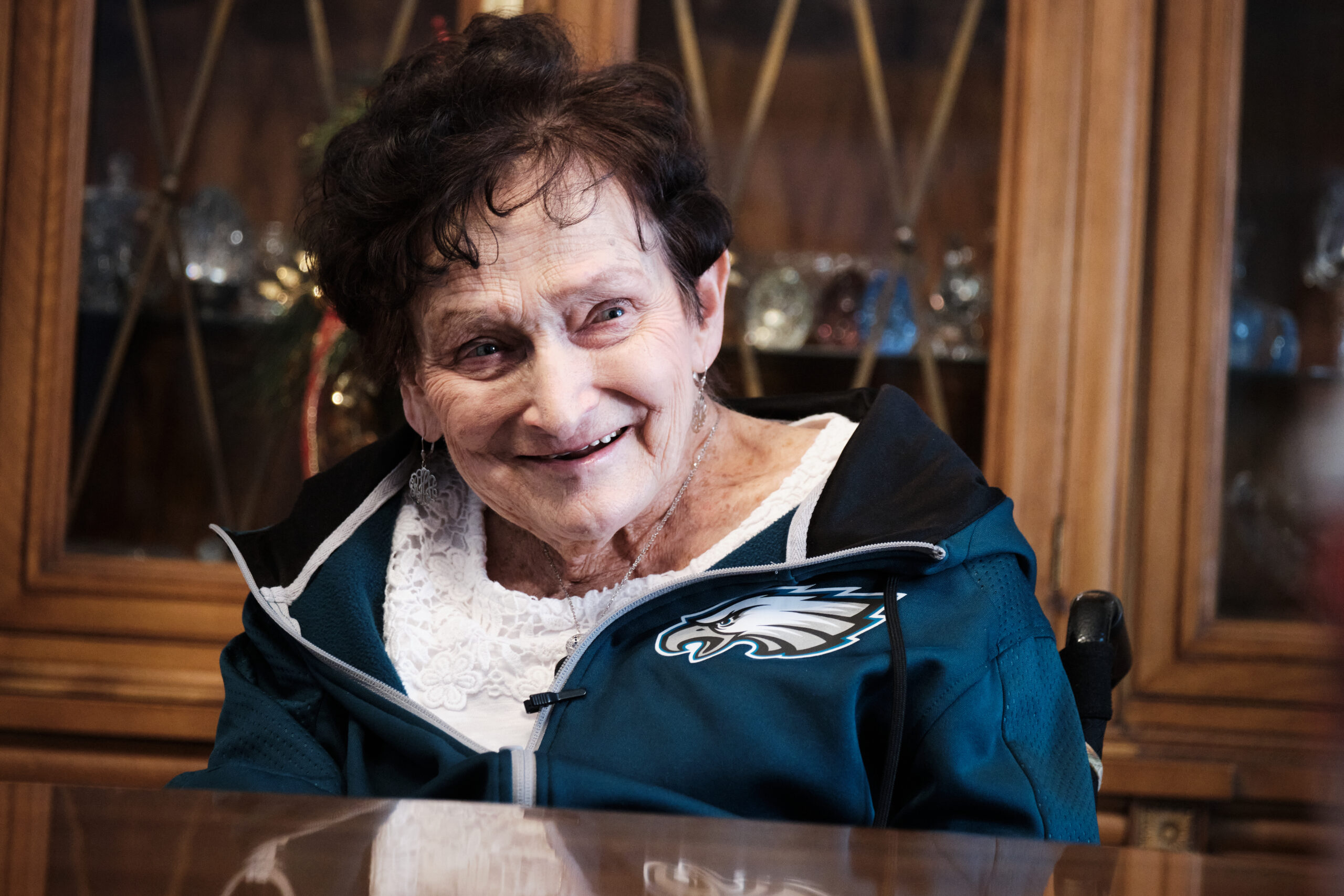
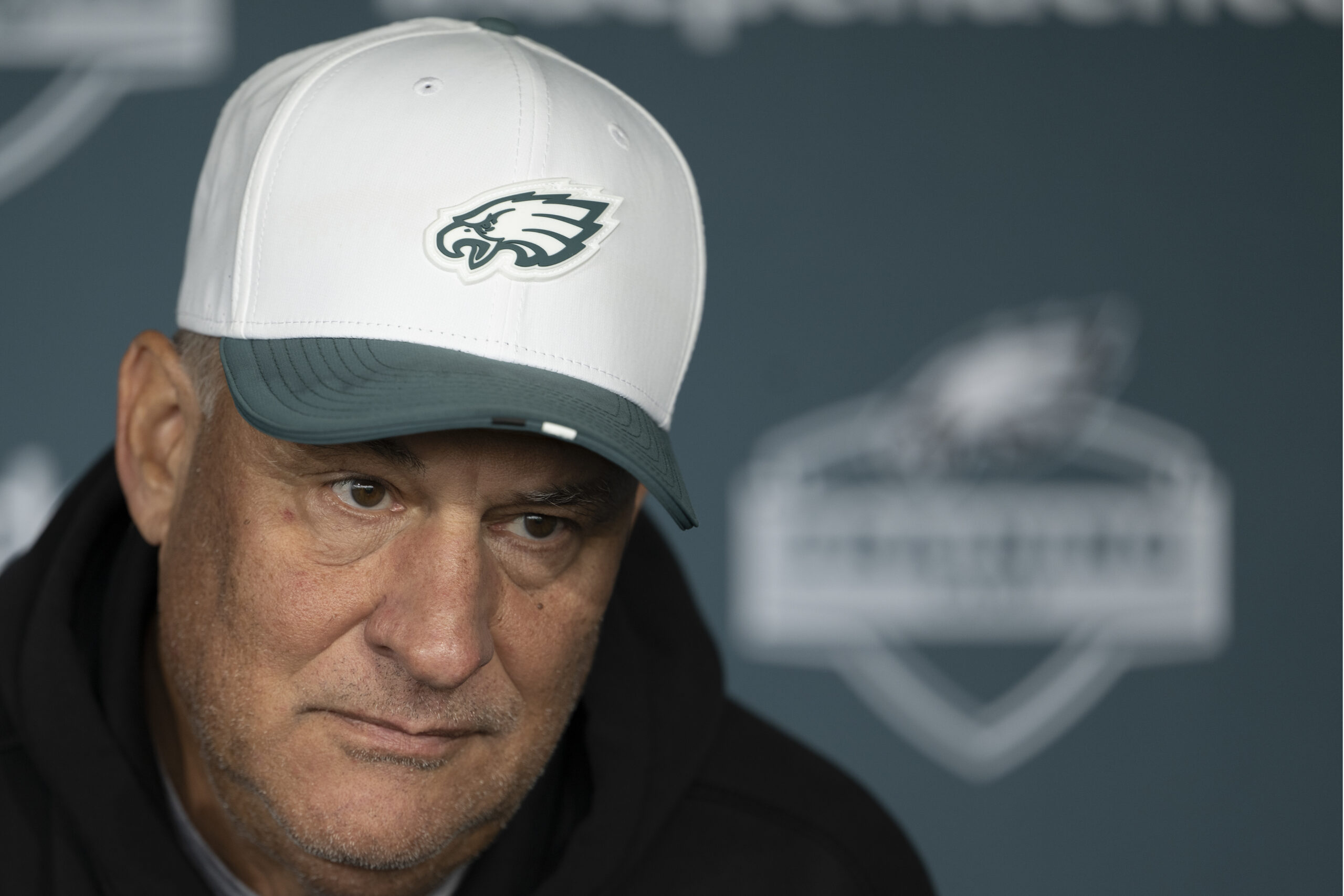
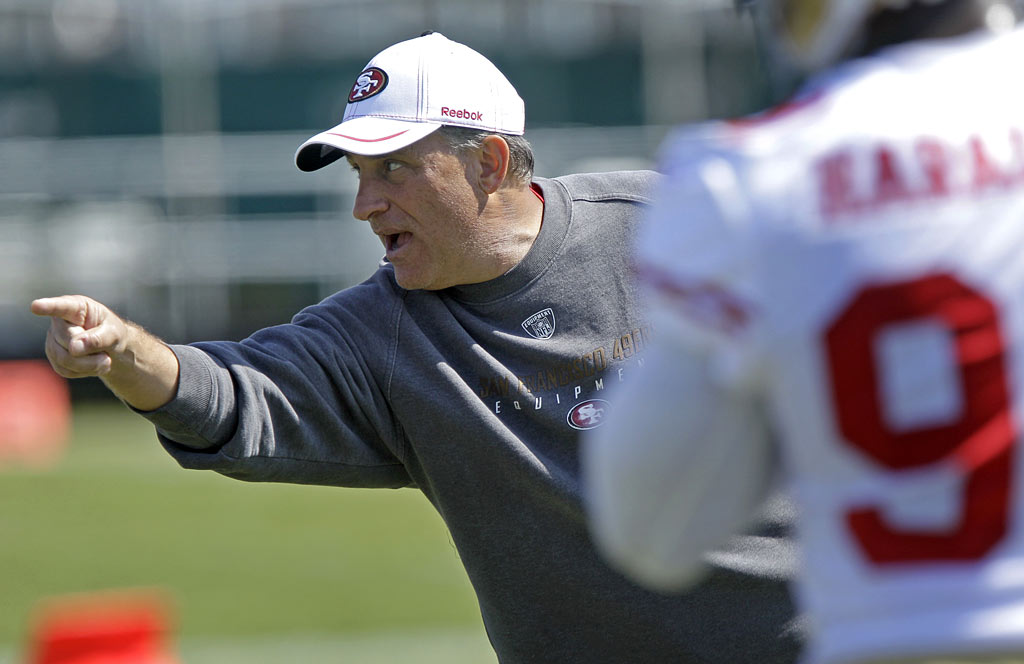
DUNMORE, Pa. — Roseann Henzes is 89years old and watching the Eagles is the highlight of her week. This is not because of the players, the head coach, the general manager, or the famous security officer.
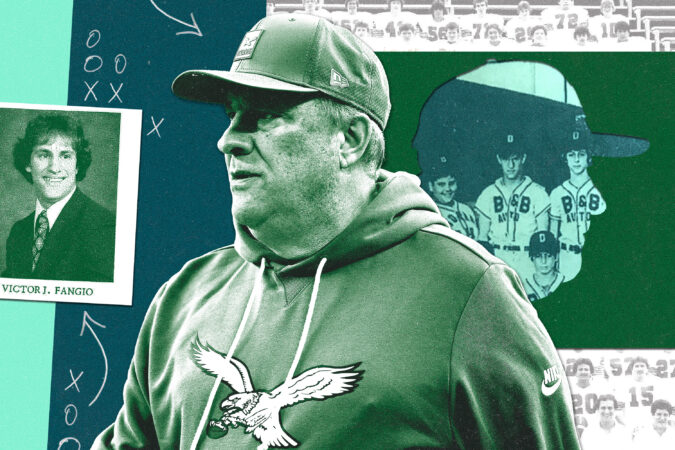
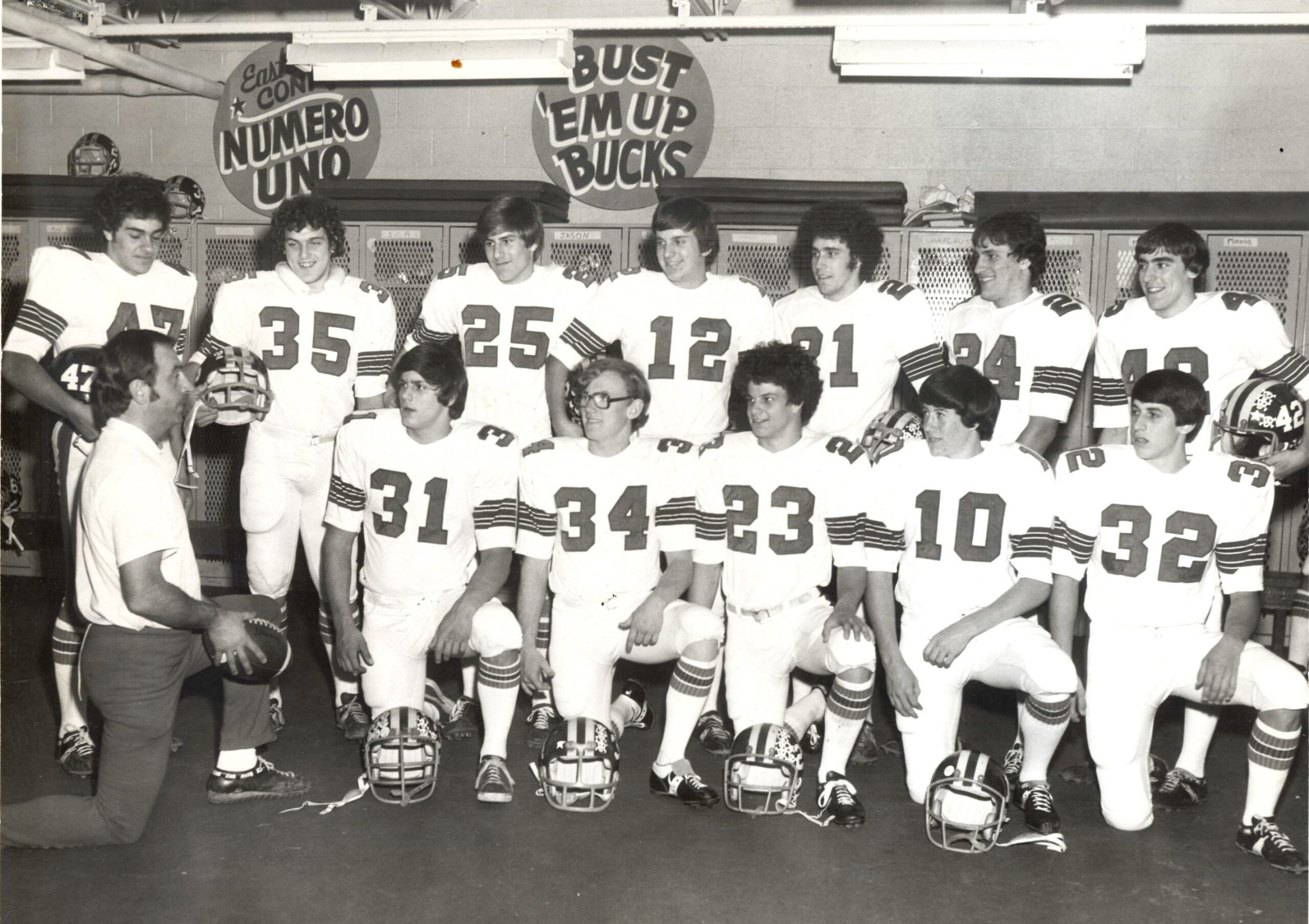
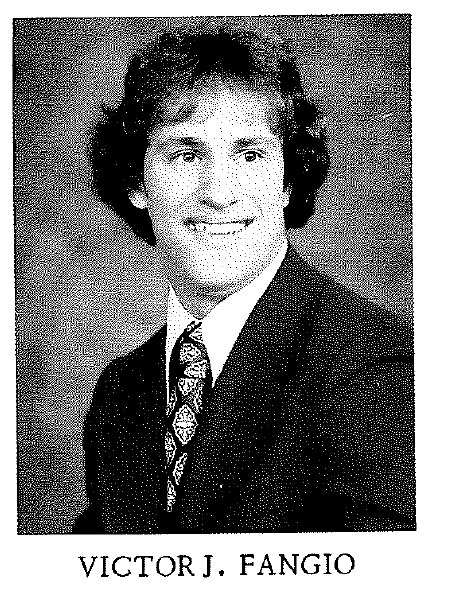
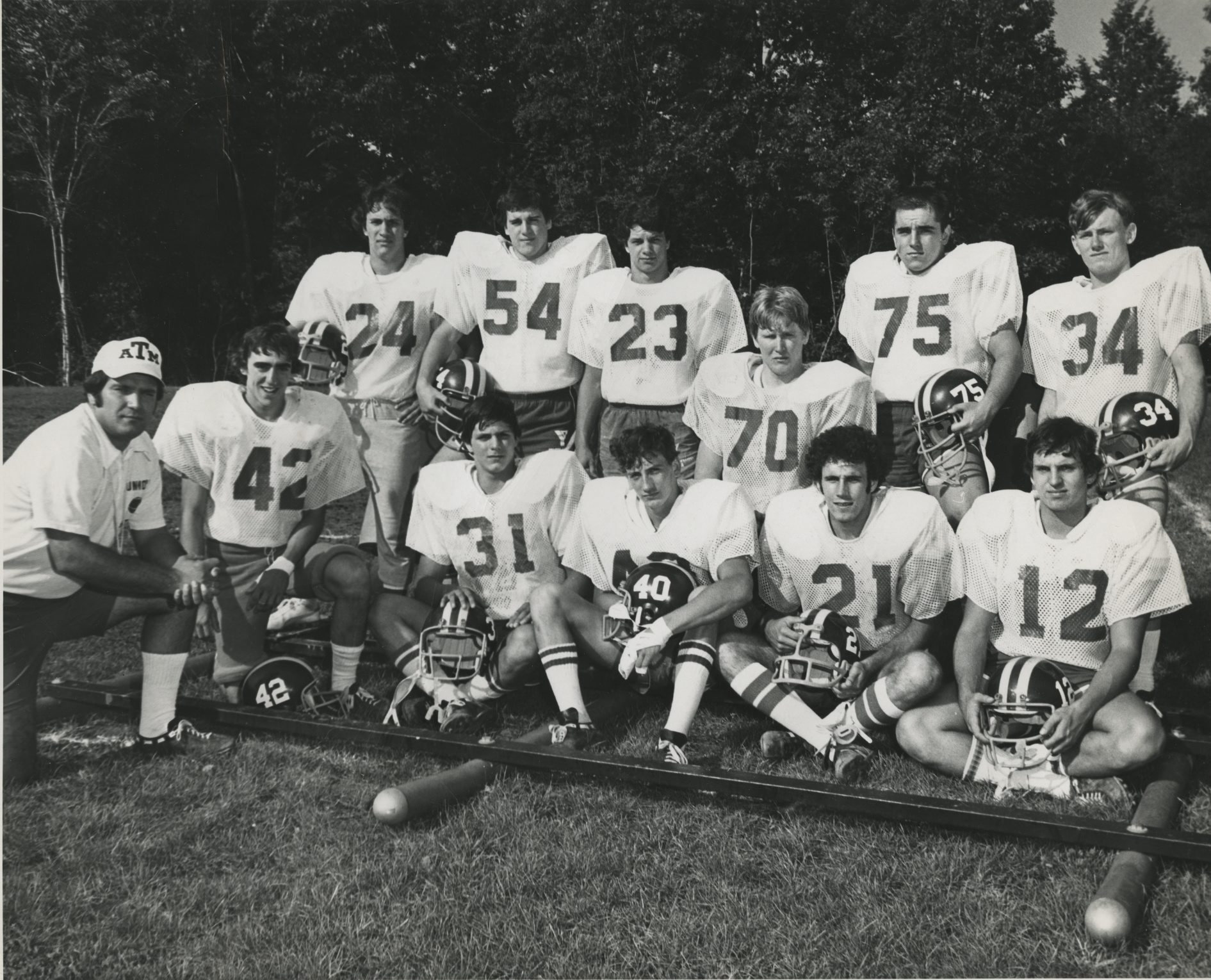
It is because of Vic Fangio, whom she has known since he was 14, when he played high school football for her late husband, Jack Henzes.
A day before the game, the octogenarianwill text the defensive coordinator “good luck.” From her wheelchair in Dunmore, she’ll take in every snap, paying close attention to moments when the camera pans to the coaching booth.
Fangio wears the same expression he did in the 1970s: stern, focused, and endearingly gruff. Win or lose, Henzes sends him a message afterward. He usually replies, with his typical brevity.
“I get one-word answers,” she said with a laugh. “‘Thanks,’ or ‘appreciate it,’ maybe. No time to chitchat.”
Roseann Henzes still communicates with Vic Fangio more than 40 years since he last coached under her husband, Jack.
Some coordinators are toughened by long hours and stressful seasons, but the people of Dunmore say this is how Fangio has always been. Even as a young safety, he was hard-nosed and meticulous, a player who devoured film and grasped concepts on the first try.
Fangio showed an ability to be in the right spot at the right time, or, better yet, anticipate what the opposing offense would do next. These instincts only sharpened in 1979, when he was hired by Jack Henzes as linebackers coach at Dunmore High School, his alma mater, about 120 miles north of Philadelphia.
It was an opportunity that laid the foundation for the rest of his career. Henzes became a mentor to Fangio, whom he saw as a kindred spirit. He taught his pupil how to work, how to coach, and how to get the most out of his team.
They took pride in the minutiae, drilling players on everything from proper footwork to hand placement. This translated into success: After losing seasons in 1976 and 1977, and a bounce-back 10-win season in 1978, Fangio and Henzes went 21-13 over their three years coaching together.
The Eagles defensive coordinator has accomplished a lot since then — including a Super Bowl championship in which he had a crucial role — but locals still see the same understated guy.
To Roseann Henzes and the Dunmore community, he will always be the kid who umpired Little League games for fun. Or the high school coach who tended bar at Ragnacci’s for extra money — despite his reticent nature.
“I just laugh when they show him in the [coaches’] box,” said Tony Donato, Fangio’s former neighbor. “The same expression on his face. Doesn’t crack a smile. I think he’s saying, ‘I don’t want this camera on me at all.’”
Dunmore coach Jack Henzes with his 1975 team. Vic Fangio is standing second from right.
A player known as ‘Hector’
Fangio spent his formative years in Dunmore, a borough of about 14,000 people just outside of Scranton. His mother, Alice, was a housewife and, later, a secretary at the local high school. His father, Vic Sr., owned a tailor shop.
From a young age, Fangio was immersed in sports. He played baseball in the spring, football in the fall, and basketball in the winter. As if that wasn’t enough, Fangio began umpiring in Dunmore’s Little League, where Vic Sr. served as a coach, in the early 1970s.
He was only a teenager, but he displayed a breadth of knowledge that commanded respect.
Bob Holmes, who played for Fangio from 1979 to 1981, experienced this firsthand. He met his future football coach in the batter’s box. The umpire showed no mercy.
“He called balls and strikes,” Holmes said. “And if you were just this kid sitting up there, and you’d watch one go by, he’d punch you out like it was a major league game. Off to the side, fist out, you’re done. Out you go.”
Locals assumed Fangio would work in sports. Some wondered if he’d become an umpire, following in the footsteps of Dunmore resident and Baseball Hall of Famer Nestor Chylak.
Vic Fangio’s senior yearbook photo at Dunmore High School in 1976.
But after Fangio was introduced to Henzes, his love for football became clear. He played for the freshman team in eighth grade, with a voracious appetite to learn. Bill Stracka, Fangio’s coach in 1971, said the middle schooler would bring him NFL concepts to implement.
“Every once in a while he’d say, ‘Could I talk to you before we leave?’ And I’d say, ‘Sure,’” Stracka said. “He’d say, ‘Well, last night, I was watching part of the game, and I saw something that I’d really like to explore here. I think I could do it.’
“Whenever we talked about things, it was like that. He was very, very aware.”
Fangio joined the varsity team in 1973, and was taken by Henzes’ understanding of the sport. Henzes was taken by Fangio, too. Roseann said her husband would talk about the safety “all the time,” and eventually introduced her to Fangio when he was a sophomore.
She was struck by how similar they were, down to their demeanor. Both Fangio and Henzes were quiet. Both had a borderline obsession with the game, spending long days and late nights studying film.
Because of all this work, they could predict an opposing offense’s next move. Joe Carra, a former linebacker at Dunmore, remembered one game in 1973 against Valley View, which Dunmore hadn’t beaten in years.
With Fangio on the field, they achieved the improbable. He intercepted a pass late in the fourth quarter and returned it 40 yards for a backbreaking touchdown en route to a 33-27 win.
“He would play right behind me, and he was always in the right position,” Carra said. “That’s why he had a bunch of interceptions.”
Together, Henzes and Fangio elevated the program to new heights. After a lackluster freshman season in which it went 5-4-2, Dunmore posted a 28-6-1 record over its next three years with three Big 11 Conference championships.
Senior players on the 1975 Dunmore High School football team that won the Big 11 championship, including Vic Fangio (24), back row left.
At some point during this span, Fangio was given an unusual nickname among a select group in his hometown: “Hector.” Carra recalled that it was assistant coach Paul Marranca who first coined it (although Marranca’s memory of this is hazy).
In Carra’s telling, one day in practice, Marranca was trying to get his players in position and mistakenly yelled “Hector” instead of “Victor.” The moniker stuck.
“We all laughed under our breath,” Carra said. “Coach Henzes would have made us run if he thought we were laughing at him.”
Fangio graduated in 1976 and attended nearby East Stroudsburg, where he attended coaching clinics. By 1979, he’d gotten his first coaching job, overseeing linebackers under Henzes at Dunmore, while finishing his senior year of college.
He stayed for three seasons, working as defensive coordinator in 1980 and 1981. The first stop of his career shaped his philosophy for decades.
“Everything he got came from Coach Henzes,” Carra said. “He went further with the detail. He learned toughness. He learned hard work.”
Though not known for his ebullient manner with people, Vic Fangio once worked as a bartender in Dunmore.
Coach by day, bartender by night
It didn’t take long for players to realize their new coach was advanced for his age. Dunmore had previously been running base defenses. After Fangio was hired, it started incorporating stunts and blitzes.
“We had no idea what we were doing,” former safety Paul Sheehan said via email.
The coach would challenge them schematically, but also would harp on fundamentals. Fangio had rules for every position group. The players first had to line up correctly. Then, they needed to know their coverages. They’d have to use their hands, stay square, and tackle properly.
Any mistakes would be pointed out in film review on Monday — even with players outside of his purview.
“He would stop the film and run it back 18 times to make a point,” Holmes said. “If [he] were critiquing our offensive line, he would critique their stance. ‘Your foot’s too far.’ ‘You just got beat off the corner because your foot wasn’t far enough.’ Or balance. The littlest of things.
“You’re sitting there, and you’re like, ‘Oh my gosh.’ You can’t wait to get out of there. But everything was important.”
It was here that Fangio’s attention to detail really shone. FormerlinebackerJack Miles remembered one day in 1980 when they were reviewing footage of an upcoming opponent. The coach paused the film, then rewound it.
He pointed to the hash marks.
“He [noticed] that if both receivers were outside the hashes, they’d run the ball,” Miles said. “If one receiver was inside the hash mark and the other one was outside, that was their throwing formation. Sure enough, he was correct.”
A photo of Vic Fangio’s high school team hangs in the trophy case at Dunmore High School.
Fangio was just as thorough on the field, equipping his players for every situation. Defensive backs would practice “high-pointing” the football, catching tipped passes, and taking efficient angles while pursuing ballcarriers.
Before long, Dunmore was running sound, but unpredictable, defense — one that proved difficult to dissect. Fangio’s unit would use four-man, five-man, and six-man fronts, all with four or five different plays apiece.
He occasionally reminded the players of his impact. On a Monday after a big win against Valley View, Fangio ran back a clip of Miles making a tackle untouched. Then, he ran it again. And again.
Fangio looked at the linebacker.
“He says, ‘Did anybody touch you?’” he said. “And I said, ‘No, Coach.’ And he says, ‘Aren’t you going to say thank you?’”
For Miles, getting a laugh out of Fangio was a point of pride. He was famously reserved, and not only at practice. Bobby Ragnacci, who coached Dunmore’s offensive line, hired Fangio to work at his family’s restaurant in the early 1980s.
Jack Miles shares fond memories of Vic Fangio’s work as an assistant coach under Jack Henzes at Dunmore.
He needed a bartender, and Fangio needed some extra money. So one night a week, the future Eagles defensive coordinator served 25-cent drafts and two signature cocktails: the Blue Moon and the Blue Hawaiian.
Pouring beer into a glass wasn’t an issue. Making small talk was.
“Well, he was no Tom Cruise, flipping bottles and stuff,” Ragnacci said. “But he was very efficient. And very honest. Certainly didn’t give away any free drinks.
“He was a good listener. Not much feedback.”
Added Holmes: “Not particularly good. He was probably drawing plays or something.”
Despite his taciturn demeanor, Fangio showed how much he cared. Holmes struggled in high school. He didn’t play a full season in his sophomore year because he became academically ineligible.
He was in a car accident in his junior year, which prolonged his time off the field, and finally returned to the team in 1981, his senior year.
Holmes remembered Fangio giving a speech to set the tonefor offseason workouts. He made a reference to “the players who weren’t here” in years past.
The tailbacktook notice.
“I think what he was saying to me, without saying it, was that we value you,” Holmes said. “‘We missed you last year. But I don’t want you to just sit there on the bench and hear me talk. I want to draw [your] attention. Because we feel you’re going to be an important part of our team.’”
To those around them, the parallels between Fangio and Henzes were obvious. They were defense-minded coaches who led with high expectations and tough love.
They possessed a savant-like ability to draw up plays, not because of clairvoyance, but hard work.
“Coach [Henzes] never felt like he was too smart for the game,” Holmes said. “He was always trying to learn new things. And I think he probably instilled that in Victor.”
Vic Fangio has never forgotten Dunmore amid his nationwide travelogue within the NFL.
Faxing defense to Dunmore
In the early 1980s, Fangio told Henzes he wanted to coach at the next level. Henzes urged his pupil to leave as soon as possible. He did, taking a job as defensive coordinator at Milford Academy in Connecticut in 1982.
After working as a graduate assistant at the University of North Carolina in 1983, Fangio was hired by Jim Mora as a defensive assistant for the USFL’s Philadelphia/Baltimore Stars from 1984-85.
He entered the NFL in 1986, joining Mora’s New Orleans Saints as a linebackers coach. He stayed there for the next eight years, leading one of the greatest linebacker units in history, the “Dome Patrol.”
Despite his busy schedule, Fangio always made time for his hometown. He often would provide tickets to family and friends from Dunmore. If they came to visit, he’d make sure to see them.
In the 1990s, Stracka and his wife traveled to New Orleans for a conference. They decided to let Fangio know, and he invited them to tour the Saints facility.
The couple walked the grounds, and afterward, Fangio offered to show them his office.
Stracka and his wife were aghast by what they saw.
“What’s the matter?” Fangio asked.
“Well, you must have 1,000 sheets of paper in here,” Stracka replied.
The linebackers coach was unfazed. He looked at the papers, stacked up around his desk, and went through each pile one-by-one.
“Well, that’s for linebackers,” he explained matter-of-factly, “and this one’s for this, and …”
Bill Stracka is among the Dunmore associates who kept a connection with Vic Fangio throughout his coaching rise.
Despite the fact that Henzes and Fangio were about 1,200 miles apart, they still talked on a regular basis. This continued at all of Fangio’s NFL stops: Carolina, Indianapolis, Houston, Baltimore, San Francisco, Chicago, Denver — where he was the Broncos’ head coach — and Miami.
Henzes would ask his pupil for advice on schemes and how to attack upcoming opponents.
Fangio would draw up plays and fax them to the guidance office at Dunmore High School. Sometimes, he’d call Henzes back at the field house, where the coach’s office was located, to talk to him directly.
“You’d hear the phone ring, and somebody would pop out, and they’d say, ‘It’s Coach Fangio,’” said former fullback Kevin McHale, who played for Henzes in the 1990s. “And he would say, ‘Excuse me for a second, I’ve got to talk to Victor.’ It was like the president was calling him.”
McHale said Fangio often would respond to his former coach that day. If he wasn’t able to reach him at his office, he’d try calling Henzes at home.
Roseann usually would pick up the phone. A self-described “talker,” she would try to engage the coach in conversation.
“All I do is ask questions,” she said. “How are you? What did you do? Where are you going? Where have you been? How’s the kids?
“And I would get one-word answers, right? And I always joke that I could talk to a wrong number — and I could — but that was tough. It was really tough.”
She’d pass the phone to her husband, who would jot down Fangio’s X’s and O’s with a paper and pen in hand. Every once in a while, she’d hear his end of the conversation.
“He’d say, ‘Well, I can’t do that, because I don’t have the personnel that you have,’” Roseann said. “But he’d get the ideas from him anyway.”
Vic Fangio honored his high school coach, Jack Henzes, by accompanying him to his statue unveiling.
Fangio continued to help his former coach until he retired from Dunmore in 2019. Aside from his role as Henzes’ unofficial defensive consultant, he also visited him in person, taking the coach to lunch at Ragnacci’s or talking to his high schoolers over the summer.
In turn, Henzes would use Fangio as a model for his players. If he saw someone acting out of line, he’d muse that they wouldn’t see “Victor’s guys” doing the same thing. The coach bought NFL Sunday Ticket so he could watch all of Fangio’s games. Any lessons he learned, he relayed back to his team.
In 2022, Dunmore High School built a statue dedicated to Henzes, the third-winningest high school football coach in state history. Fangio, who was working as a consultant for the Eagles at the time, showed up to surprise his mentor.
About a year later, in the summer of 2023, he made an impromptu stop at the Henzes household.
It was the last time Fangio would see his former coach. The mentor and the mentee sat together in the back room, talking about football and family. Henzes died two weeks later, at 87.
Dunmore High School’s current football coach, Kevin McHale, says Vic Fangio maintains firm ties to the high school where it all started for the esteemed NFL coordinator.
“V-I-C”
In the lead-up to Super Bowl LIX, Dunmore’s football team watched every Eagles playoff game and Fangio news conference from its weight room.
McHale, who was named the Bucks’ head coach in 2019, would break down Fangio’s defense after each matchup, pointing out how his players performed on the biggest stage.
The teenagers looked on in awe as a man who’d once walked the same halls they did put on a defensive master class. The Eagles’ Super Bowl victory filled Dunmore with pride. In a way, it felt like his hometown had won, too.
Fangio’s former players could see traces of their high school coach in Philadelphia’s defense. The personnel was more advanced, of course, but the foundation was the same: sound fundamentals, attention to detail, and unpredictable pressures.
Holmes observed how Zack Baun tackled and thought back to Fangio’s rules: head across the body, driving through the ballcarrier, proper angle of pursuit. It all seemed familiar.
“When we watch the Eagles now, we’re like, ‘Hey, we recognize that,’” he said.
A few weeks after the Super Bowl, Fangio returned to Dunmore. McHale had heard he’d be around, and reached out to the defensive coordinator to see if he would talk to his team.
Fangio agreed. On Feb. 28, he met the players in their locker room and stayed for an hour and a half, answering every question they had. Some were technical — asking Fangio how he developed the defense’s approach to Patrick Mahomes — and some were more trivial in nature.
At one point, McHale paused the Q&A. He asked Fangio if he’d ever met anyone who had shaved his name into the back of his head.
Fangio said no.
“Well,” McHale said, “we’ve got a kid right here.”
He motioned to right tackle Drew Haun, who turned around to reveal a big “V-I-C” etched into his buzz cut.
This got a smile out of Fangio.
Dunmore right tackle Drew Haun honored his school’s most famous football alumnus before a Vic Fangio visit to campus.
“I think he liked it,” the freshman said.
McHale is not in contact with Fangio as much as Henzes was, but he consults him from time to time. And if the defensive coordinator doesn’t reply right away, his concepts arenever far.
All McHale has to do is go to his home office in Dunmore. There, on a bookshelf, is a manila folder full of faxes; a trove of wisdom from a coach who will always be known as “Victor” or “Hector.”
Harry Kalas loved Christmas. The holiday combined two of his favorite things: singing and making people happy. So when Andy Wheeler, a producer at CBS3, approached the broadcaster about reading ’Twas the Night Before Christmas in 2002, Kalas didn’t have to give it much thought.
“I’ll come right in,” he replied.
The station was recording a segment of five local broadcasters reciting the poem. Kalas would be featured alongside Marc Zumoff and Tom McGinnis of the 76ers, Merrill Reese of the Eagles, and Jim Jackson of the Flyers.
It aired Dec. 24, and a few years later, while cleaning out his desk, Wheeler found the unedited Kalas video. He watched it through, and suddenly, an idea popped into his mind.
They had the footage. Why not use the Kalas version in its entirety?
Wheeler (no relation to longtime Phillies announcer Chris Wheeler)presented it to producer Paul Pozniak and sports director Beasley Reece, who signed off. Christmas Eve was always a slow news day. This would give them something seasonal that undoubtedly would resonate with their audience.
A decades-long tradition was born. Barring breaking news (and Eagles games), the station has aired Kalas’ reading of the poem every Dec. 24 since 2005.
Management hasno plans to change that.
“Obviously, people love Christmas and people love Harry Kalas,” Wheeler said. “And having him read that story, with his voice that everybody is so used to … I think people miss him and miss hearing him.
“It’s almost like watching a home movie of Christmases past.”
A broadcaster for all seasons
To Phillies employees, Kalas’ voice was as synonymous with Christmas as it was with summer. He loved carols and often sang them at the team’s holiday party.
The broadcaster would do this in a way only he could. Toward the end of the evening’s festivities, Kalas would ask those gathered to join hands to “sing the greatest Christmas song ever.” As they swayed back and forth, he’d belt out “Silent Night” in his baritone voice.
Dan Stephenson, the Phillies’ longtime video productions manager, compared it to a star gracing a stage.
“We knew at some point in the evening that Harry was going to be the entertainment,” he said. “And that was good enough for all of us.”
Harry Kalas in the booth at the Vet in July 2000.
This wasn’t Kalas’ only December tradition. In the early 2000s, he visited retirement homes in the Philadelphia area to provide seasonal cheer.
Like the Phillies’ holiday party, these visits inevitably ended with Christmas carols. John Brazer, who worked in the team’s marketing department for 33 years, remembered driving Kalas to a retirement community in Media in 2005.
On the ride there, Brazer asked the broadcaster if he enjoyed singing to the retirees.
“John, I tell you what,” Brazer recalled Kalas saying. “I love it. I love Christmastime. But the songs I really love doing are the religious songs — ‘Hark the Herald Angels Sing’ and ‘Silent Night.’”
He got emotional for a moment, then abruptly changed his tune.
“But I really don’t like when they do a secular song. I’m not a big fan of ‘Jingle Bells’ and ‘Santa Claus is Coming to Town’ and stuff like that.”
Brazer and Kalas arrived at the retirement home a few minutes later. Kalas began taking requests, as an employee played along on the piano.
The first four songs were religious in nature. The fifth was not.
“Someone said, ‘Hey, Harry, can you sing ‘Jingle Bells?’” Brazer said. “And he [turned to] me with this disgusted look.”
Despite his personal opinions, Kalas launched into an upbeat rendition of the song with a big smile on his face, as if it were his favorite carol of all.
Harry Kalas was legendary within the community of Phillies fans.
Brazer relayed the story to Stephenson, who wasn’t surprised. Kalas would sign every autograph with glee. He’d get all sorts of requests — fans asking him to record voicemail greetings, or to read the names of their bridal parties — and would always oblige.
It was about making people feel like they mattered.
“There was no way he wasn’t going to sing it,” Stephenson said with a laugh. “That was classic Harry.”
Harry Kalas couldn’t resist tossing a reference to longtime broadcast partner Richie Ashburn (right) into his Christmas recitation.
‘Like he was reading to his grandkids’
Wheeler had a December tradition, too. When he was a kid, growing up in Aston, his parents would read ’Twas the Night Before Christmas every Dec. 24.
The idea of having play-by-play announcers recite the poem on air was exciting, but when it came to Kalas, the young producer was nervous.
He grew up listening to the voice of the Phillies, and was worried about coming off as inexperienced (or worse, clueless). But when Kalas arrived to KYW’s studios at 5th and Market, he brought calm to a chaotic scene.
The only Christmas tree the producers could find was in the lobby, so they had Kalas do his taping there. Station employees filtered in and out, causing quite a bit of background noise. A gaggle of children with limited attention spans sat in front of him.
But none of that seemed to faze Kalas. Wheeler handed him the book (bought from a nearby Borders), and the broadcaster began to read.
His audience was entranced.
“It was almost like he played the role of Santa Claus,” Pozniak said. “With his voice, and the way he relates to people. He wasn’t too big to be talking to kids he didn’t know. It was like he was reading to his grandkids or something.”
Kalas sat in front of the tree for about 40 minutes, asking producers for feedback and reciting lines until he was satisfied. He even added his own creative flair.
Near the end of the poem, the broadcaster realized there was a reference to a pipe. He decided to give a nod to his partner, Richie Ashburn, who famously smoked in the booth.
“And the beard on his chin was as white as the snow,” Kalas read. “The stump of a pipe — like Whitey’s — he held tight in his teeth …”
Kalas grinned at Wheeler.
“Had to get that in there,” he said.
Harry Kalas and CBS3 producer Andy Wheeler at the 2008 World Series.
It wasn’t until a few years later, when Wheeler found the old recording, that he realized just how special Kalas’ version was. So KYW, and subsequently CBS3, began running it every Christmas Eve.
After Kalas died of heart disease in April 2009, the station considered ending the tradition. Wheeler and Pozniak were concerned that it would be in poor taste.
But Reece insisted they continue.
“This is a way of keeping him close,” he told the producers.
Years later, the recitation still has that effect. From start to finish, it captures Kalas perfectly. You can see his humanity, and his humor. You can hear the richness in his voice.
And if you listen closely enough, you can even catch his favorite carol, softly humming in the background: “Silent Night.”
Billy Gordon was surrounded by the tapes. They were the first thing he saw in the morning, and the last thing he saw at night. His bedroom, in the basement of his grandmother’s Cobbs Creek home, was not big; maybe 190 square feet, if that.
But he found enough space for the thousands of basketball games he’d recorded from 1986 to 2024, all on VHS. Each tape came with a neatly written label, noting the name of the event, the teams who played, each team’s record, and the final score.
They were carefully placed into black crates, organized by year, and stacked on top of one another, creating a technicolor tapestry around his bed. It was an unconventional hobby, but Gordon loved it.
His family wasn’t surprised. Gordon, who worked as a baggage handler at Philadelphia International Airport, was a diehard sports fan with an encyclopedic mind. He could remember statistics about any athlete, no matter how obscure.
Billy Gordon made meticulous notations on the tapes he stored neatly for five decades inside his Cobbs Creek home.
So, it only made sense that he’d spend his free time collecting archival footage of everything from Super Bowl XXXIII to his alma mater, Cheyney, to Pepperdine vs. Loyola Marymount in 1987.
“He didn’t miss very much,” said Gordon’s uncle, Ron Hall.
Hall and Gordon lived together in Cobbs Creek for about 15 years. Neither had a traditional work schedule. Hall was a union carpenter who traveled for jobs; Gordon picked up night shifts at the airport.
But in the moments they did overlap, they’d watch games, often with pizza and chicken wings. This tradition continued through the winter of 2024, when Gordon was diagnosed with an autoimmune disease. The illness quickly worsened, and he was moved to a nursing home in King of Prussia.
As he lay in his hospital bed, hooked to a respirator, Hall sat beside him. They cheered on whatever local team was playing that day: the Eagles, Phillies, or 76ers.
“Just to let him know that people love him,” his uncle said.
Gordon died earlier this year, in May, at age 66. He was buried in his blue-and-white Cheyney track suit.To Hall, it was like a losing a brother. It took him months to even step into that basement bedroom.
Once he did, he was stunned. He always knew that his nephew had a VHS collection, but didn’t realize the full extent of it until then.
“The magnitude of what was here really hit me,” he said. “I was in disbelief that he had accumulated so much. That he had taken the time to collect so many things.”
‘A love for the game’
Gordon was born and raised in a sports-loving household. His grandmother, Vernese,was an avid Phillies fan. Hall was too, and would bring his nephew to different ballparks.
After graduating from John Bartram High School in the 1970s, Gordon went on to Cheyney, where he studied industrial arts. It was there that his love for sports information really blossomed.
The young college student had the fortune of overlapping with John Chaney, who was coaching Cheyney’s men’s basketball team.
Billy Gordon followed John Chaney’s career closely after their personal interactions during Chaney’s time at Gordon’s alma mater.
The Wolves were nothing short of dominant. Chaney led them to a 225-59 record from 1972 to 1982, with eight tournament appearances and one NCAA Division II championship.
Gordon was not athletically inclined, certainly not enough to play on Chaney’s team. But he liked to hang out around the gym and developed a rapport with the players and coaches.
He also showed an attention to detail to which Chaney gravitated.
“He had such a love for the game, and knew the game so well, that he could point something out to this player, that player,” Hall said. “[He] really was just being an asset to the coaching staff.”
Chaney invited Gordon to work at his summer camp, which he ran with Sonny Hill throughout the Philadelphia area.The zealous sports fan couldn’t believe his luck. He’d help with drills, but he also took pride in the little things: packing lunches, inflating basketballs, and setting up exercise equipment.
The coaches of the Chaney-Hill summer camp. Gordon is pictured second from the right, with the basketball between his ankles
On rainy days, when the kids couldn’t play outside, Gordon would pop one of his tapes into the VCR.
“Old Temple games,” said his friend, Mia Harris. “Just so the kids could learn.”
She said that Gordon worked with Chaney and Hill from the mid-1980s to the early 2000s. The camp was the highlight of his summer; an opportunity to get to know the legends of the Philadelphia basketball scene.
“They made him feel like a part of the team, even though he wasn’t a player,” Harris said. “He even wore a whistle. That tickled me.”
It was around this time that Gordon started building his VHS collection. He began taping bigger events — the 1987 Stanley Cup Finals, Super Bowl XXII — but basketball was always the bedrock.
He captured the dominance of Michael Jordan, the fearlessness of Kobe Bryant, and every March Madness Cinderella story since the mid-1980s. He chronicled the NBA Finals, the WNBA Finals, and a slew of conference college basketball games.
The sheer number of tapes and labels was dizzying (Hall estimated that his nephew had 40 crates). But upon closer inspection, a trend emerged.
Chaney was hired as head coach of Temple in 1982, a job he kept until 2006. Among the stacks were pockets of his time there: Mark Macon’s first game for the Owls in 1987; the team’s first loss of that historic season, to UNLV, on Jan. 24, 1988.
Gordon recorded years of Temple vs. Illinois, Temple vs. Duquesne, Temple vs. Penn State. There even was a sit-down interview with Chaney, from the late 1980s.
These tapes stuck out. Gordon didn’t personally know any of the NBA greats he filmed. He didn’t know the WNBA stars, either. But he did know John Chaney, long before he became a national figure. And he never forgot him.
Finding a new home
A few months after Gordon died, Hall began to sort through his nephew’s things. It was an emotionally taxing process.
The retired carpenter donated Gordon’s winter coats and appliances to a local men’s shelter in Southwest Philadelphia. He gave his summer gear to a nonprofit that sends gently used clothing to Liberia.
Billy Gordon’s crates, filled with various tapes of NCAA, NBA, and WNBA games from 1986 to 2024, are awaiting what his family believes is the right price and the right home.
Gordon’s sneaker collection went to Hall’s son, Gamal Jones, and his food was delivered to charity.
The only thing left was the thousand-tape-elephant-in-the-room. Jones looked at his father.
“What do you want to do?” he asked.
“I have no idea,” Hall responded.
Jones listed Gordon’s tape collection on Facebook Marketplace, for the modest sum of $123. The response exceeded the family’s expectations.
They received almost a dozen messages, from NBA superfans, collectors, and archivists. Some offered to travel to Cobbs Creek to assess the collection in person.
Hall recognizes that his nephew’s trove is worth more than $123. But he says this isn’t about the money.
He wants to find a buyer who will share the same passion that Billy Gordon had for 38 years. Someone who will honor his hobby and preserve it.
“He probably would want it to go to somebody that was as enthusiastic about it as he was,” Hall said. “That could really appreciate the time, the energy, that he put in to collect all these.”