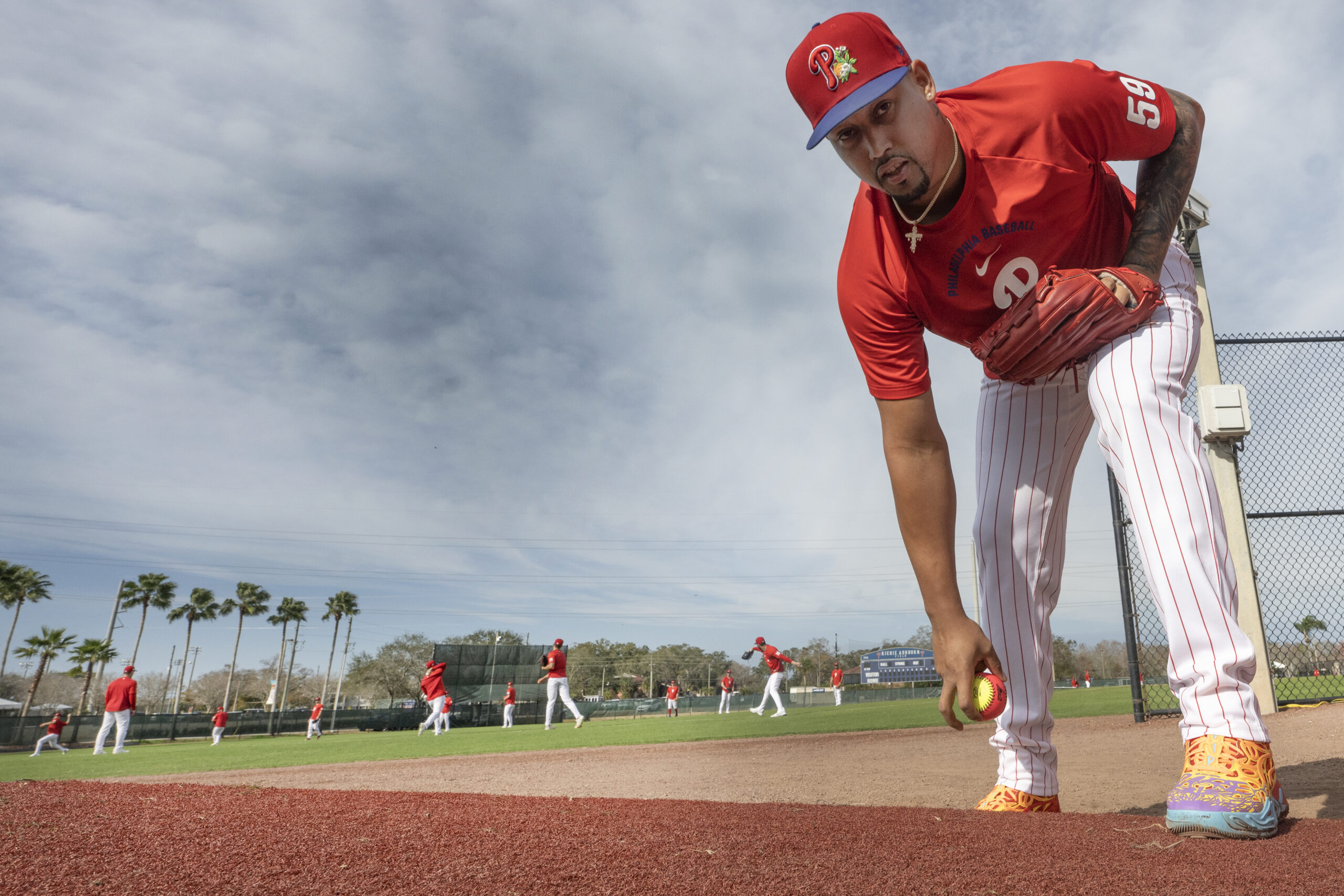
CLEARWATER, Fla. — It was only fitting that Wednesday’s exhibition game started with a ball hit to Phillies center fielder Johan Rojas. Team Canada’s designated hitter, Edouard Julien, drove one to right-center field. Rojas made a diving catch on the warning track dirt.
The ball continued to find him. Two at-bats later, Josh Naylor flied out to center field. At the top of the second inning, Tyler O’Neill did the same.
Rojas hit a double that bounced over the wall in the bottom of the fourth inning to score Bryson Stott.
On Tuesday, news broke that Rojas reportedly had tested positive for a performance-enhancing drug. He chose to appeal his 80-game suspension, which was why he was back playing on Wednesday afternoon.
Until a decision is made on Rojas’s appeal, he will continue to train at the Phillies’ complex and appear in Grapefruit League games.
Team Canada went on to a 5-3 victory over the Phillies.
Who stood out
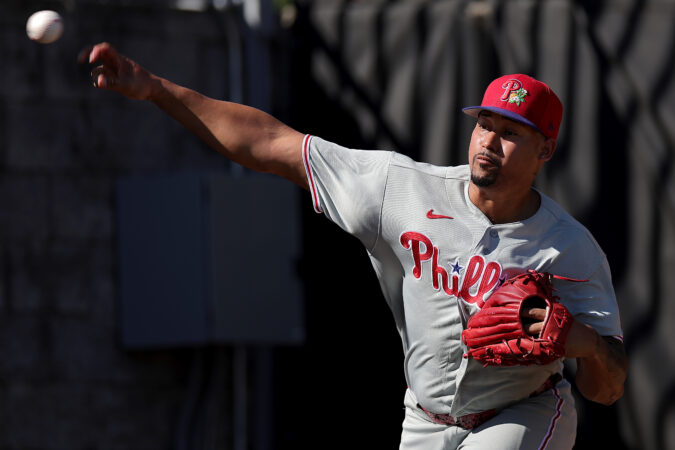
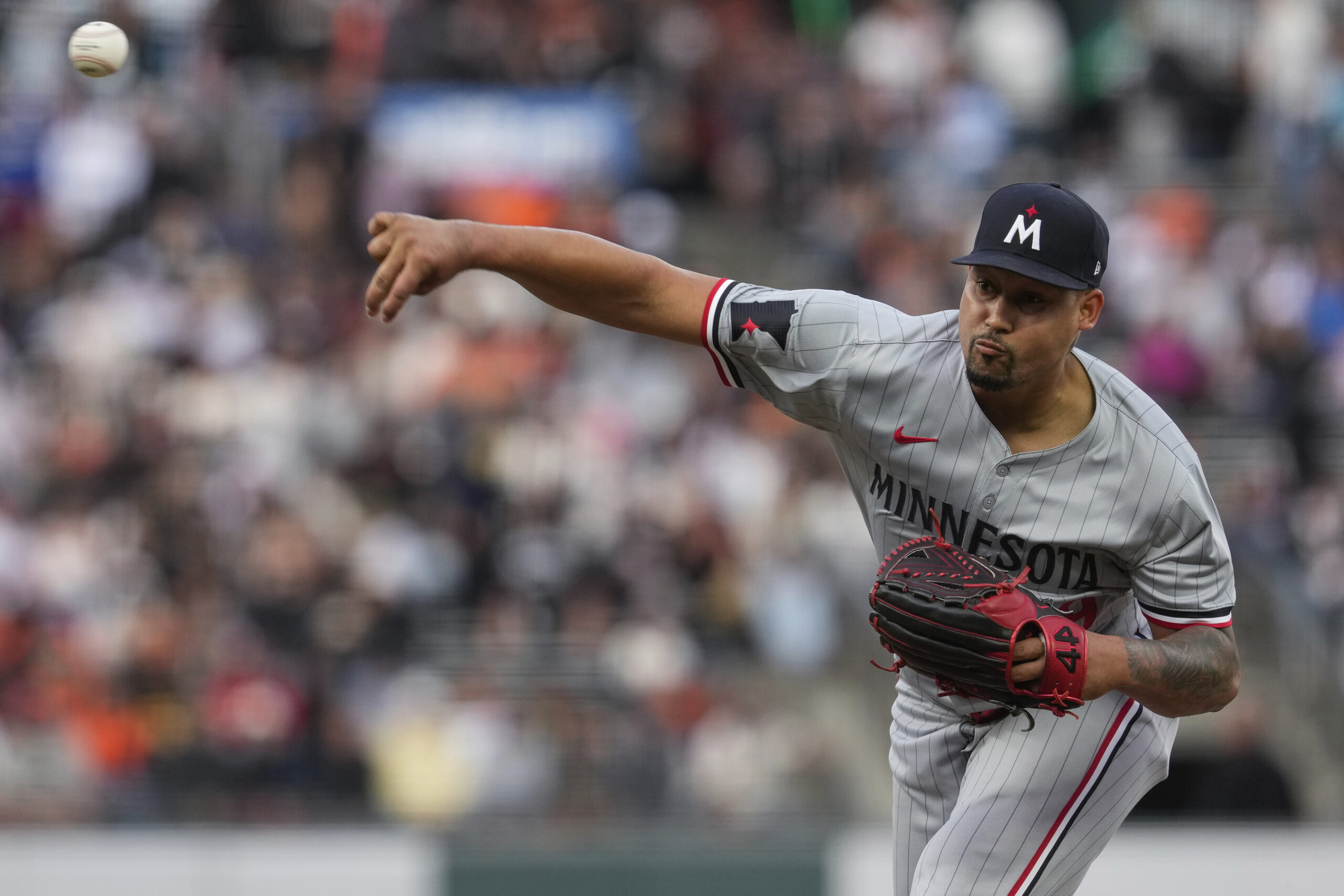
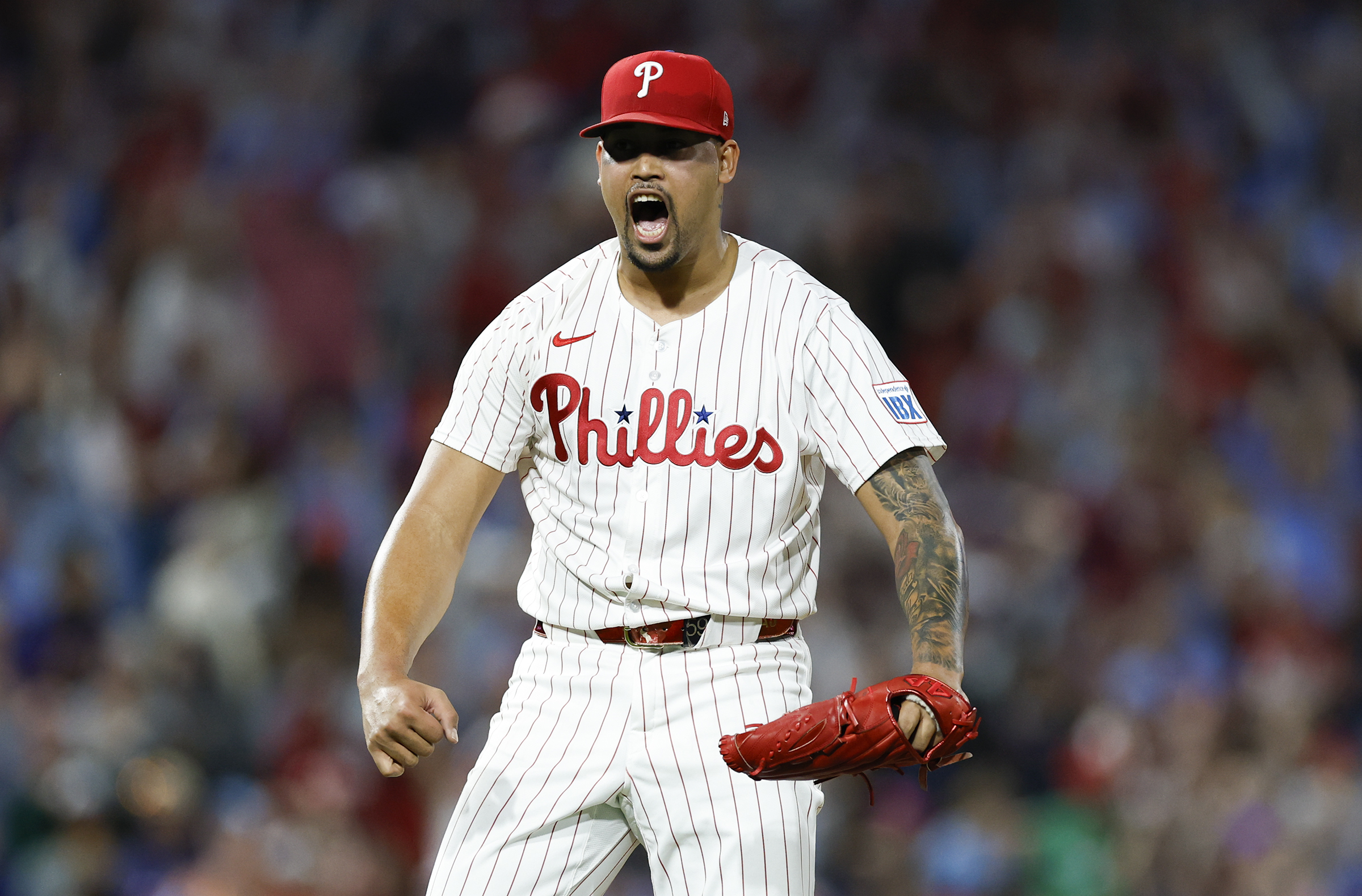
Jhoan Duran made his first appearance of the spring in the fourth inning. He pitched one inning, allowing no hits, runs or walks, with one strikeout.
His velocity was down (his splitter averaged 95 mph and his four-seam fastball 97.7 mph) but the closer wasn’t concerned.
“Everything is great right now,” he said when asked if he felt healthy. “Today is my first outing and I feel fantastic. So it’s good.”
Duran said he lost some weight during the offseason, likely because he was sick. He started throwing two weeks into the offseason, stopped for a few weeks because he was sick, and then picked up again.
Duran’s first outing of the spring last year came on Feb. 22. Manager Rob Thomson said this one came a bit later because of the illness, and because he “had a little touch of something earlier in camp.”
But Thomson, like Duran, said the closer is healthy.
Duran threw a few split-changeups on Wednesday — a pitch he said he hasn’t thrown since the minor leagues — and said he might bring it back during the regular season.
He said the grip of his split-changeup is a little different from his regular splitter.
“It’s just a different look,” Thomson said of the split-change. “Just something for the other hitters to think about.”
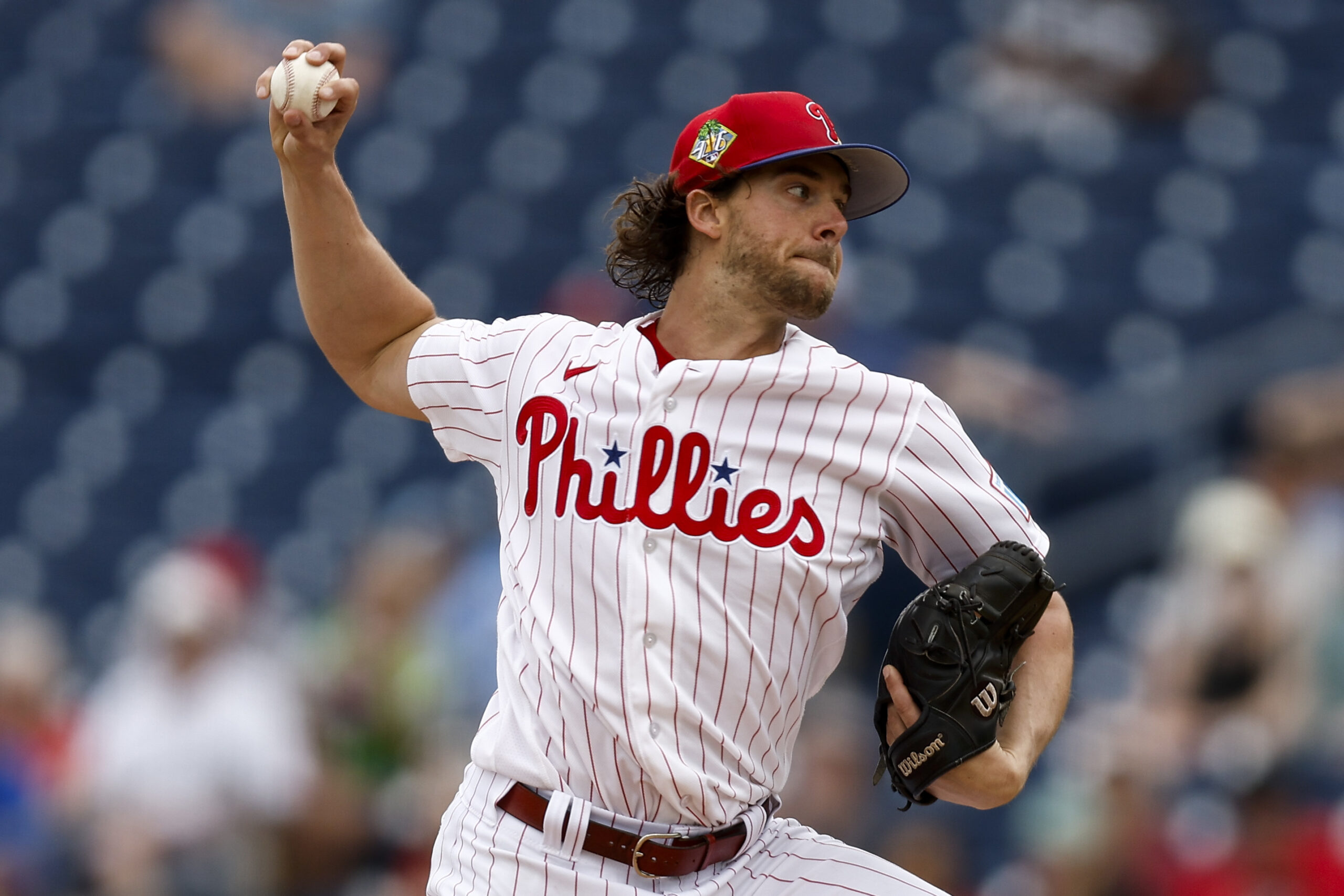
Aaron Nola, shown during a game on Friday, pitched three shutout innings and had four strikeouts against Team Canada on Wednesday.
On the mound
Aaron Nola made his last start before departing for the World Baseball Classic, where he will compete for Team Italy. He is expected to make his first start for Italy on March 11.
Nola pitched three innings, allowing one hit with four strikeouts. His velocity ticked up a bit, which he attributed to a slight tweak in his offseason routine.
“Probably starting earlier in the offseason,” he said. “Gave my arm and body time to ease into it, ease into throwing and long toss. I’m able to kind of rear back and throw a little bit harder right now, rather than previous spring trainings. My body feels really good, my arm feels really good.”
Duran followed Nola in the fourth. Reliever Tanner Banks pitched a clean inning in the fifth with two strikeouts, and Jonathan Bowlan followed in the sixth.
The reliever, who was acquired from the Royals in the Matt Strahm trade, struggled immediately, loading the bases by allowing two singles and a walk.
Abraham Toro hit a three-run double to tie the game at 3.
Right-hander Aaron Combs came in after Bowlan, and allowed an RBI single to score Toro and give Canada a 4-3 lead. He pitched one inning, with one hit and one hit batsman.
Quotable
“That was great,” Nola said of Rojas’ catch. “I thought the ball was gone. I saw the wind blowing a little bit. That was a good catch.”
On deck
The Phillies will play the Boston Red Sox at BayCare Ballpark on Thursday (1:05 p.m., NBCSP+).
CLEARWATER, Fla. — Johan Rojas walked to his locker in the Phillies clubhouse just before 11:30 a.m., with his duffel bag slumped over his shoulder.
On a normal day, this would not be notable, but Wednesday was hardly a normal day. Less than 24 hours earlier, news broke that Rojas had reportedly tested positive for a performance-enhancing drug.
A source told The Inquirer that the center fielder would appeal the 80-game suspension, which would explain why he was back with his team the following morning. No ruling has been made on Rojas’s suspension.
Until there is one, he will continue to work out at the Phillies’ spring training complex and play in Grapefruit League games. The team didn’t waste any time in getting him back in the lineup.
Rojas batted seventh in Wednesday’s exhibition game against Team Canada. When asked pregame if he had a comment on his reported appeal or potential suspension, Rojas said he had to get ready for the game.
When asked if he’d comment after the game, he declined.
The ball found him on the first pitch. In the top of the first inning, Canada DH Edouard Julien drove an Aaron Nola fastball to deep right center field.
Rojas got a good jump, sprinting toward the wall and diving on the dirt to make the first out of the game. He finished his day going 1-for-2 with an RBI after knocking a hard-hit double to center field in the fourth.
After the game, manager Rob Thomson reiterated that the only information he has about Rojas’ status is what he’s read through reports.
“I don’t know anything about the appeal,” he said. “We know nothing about … I said yesterday, we read the reports, but nobody from Major League Baseball has told us anything.”
It’s unclear how long the appeal process will take. The ruling will be decided by a neutral arbitrator, per the Major League Basic Agreement.
PORT CHARLOTTE, Fla. — The Phillies’ 3-1 Grapefruit League loss to the Rays on Tuesday afternoon was very much a spring training affair. Their defense was sloppy. Rafael Marchán failed to block a wild pitch in the first inning. He and shortstop Erick Brito made throwing errors, and Brandon Marsh misplayed a ball in right field.
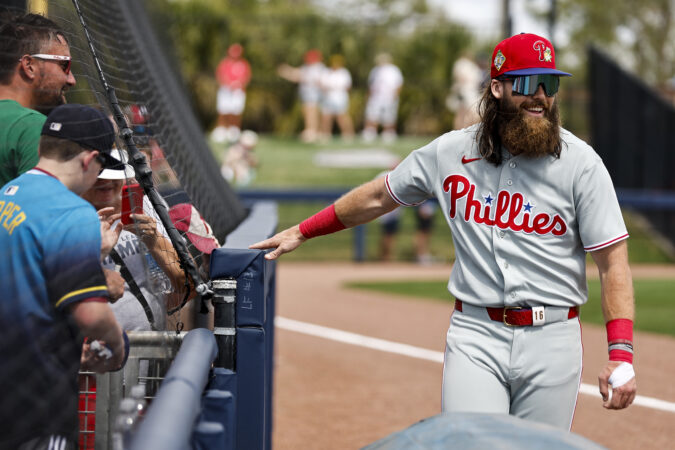
But there were some positives — Marsh’s health among them. After suffering a minor hand injury while sliding during practice in late February, he returned to Grapefruit League play on Tuesday.
Marsh went 1-for-3 with a strikeout, but most importantly, did not feel pain in his hand when he was swinging.
“It felt good,” Marsh said of his hand. “Today was great. Health-wise, felt good. Performance-wise, some a little bit better [than others], but the whole goal was to get through today without feeling it, and we did. So that’s perfect.”
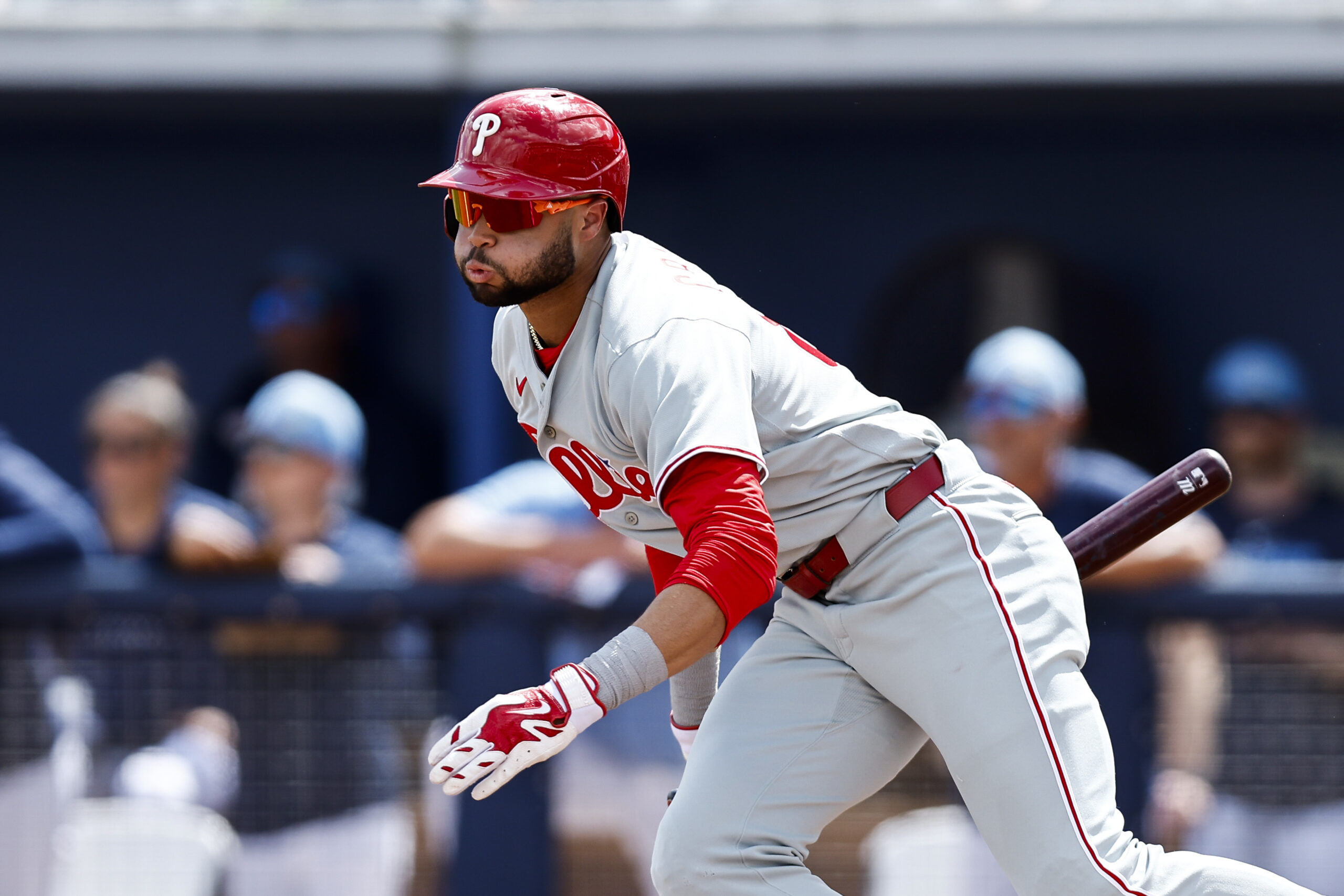
Justin Crawford, who was playing in his sixth game of the spring, roped a hard-hit single to left field in the first inning that came off his bat at 100.2 mph. He’s slashing .316/.350/.474 in 19 at-bats.
Designated hitter José Rodríguez put the Phillies on the board with an RBI single to center field in the fifth. The Phillies combined for eight hits, two walks, and eight strikeouts.
Phillies center fielder Justin Crawford singles during the first inning on Tuesday.
Who stood out
Infielder Aroon Escobar showed some pop in the fifth, hitting a ground-rule double that traveled 328 feet and left his bat at 110 mph. It was Escobar’s second hit of the spring (and the hardest hit of the day).
On the mound
Right-handed pitcher Alan Rangel made the start. He threw 43 pitches in 1⅔ innings, 23 of which were strikes. He allowed two runs (one earned) on one hit with two walks.
Righty Jack Dallas entered in relief of Rangel and allowed one hit. Reliever Lou Trivino entered in the third, pitching one frame, allowing one unearned run on one hit with one walk.
Rule 5 pick Zach McCambley, who would need to be added to the opening day roster or be placed on waivers, made his fourth appearance of the spring. He threw a 1-2-3 inning with one strikeout, lowering his spring ERA to 2.25. Seth Johnson followed that with a 1-2-3 innings of his own in the fifth.
He returned for the sixth and retired his next two batters on a flyout and a strikeout before being replaced by Nolan Hoffman. Hoffman pitched 1⅓ innings and allowed two hits with one strikeout.
Andrew Walling pitched the eighth, recording three strikeouts with one hit.
Manager Rob Thomson was particularly impressed with the last four.
“Johnson has pitched extremely well his last two or three times out,” Thomson said. “Hoffman has been good throughout. It was good to see McCambley using the cutter and the slider and throwing strikes.
“And Walling had a rough outing his last time out and bounced back and really threw the ball well.”
On deck
The Phillies will play an exhibition game against Team Canada at BayCare Ballpark on Wednesday (1:05 p.m., NBCSP+).
Luis Ramírez grew up in El Taque, a small village in northwestern Venezuela. It was known for its arid climate, full of cacti and barren landscapes.
It was also known for its critters. Ramírez, the assistant pitching coach for the Minnesota Twins, saw his fair share of snakes and centipedes, lizards, and, of course, tarantulas.
They’d hide under bushes and tree roots and had a distinctive pattern — a dark blue body, with a mix of black and yellow stripes along the legs. The image always stuck with the coach throughout his decades-long career in professional baseball.
Ramírez, 52, was hired by the Twins in 2006 to work at their Venezuelan academy. He gradually moved up the ranks, from the Gulf Coast League, to the Appalachian League, to the Arizona Fall League. In 2019, he was promoted to pitching coach at the team’s high-A affiliate in Fort Myers, Fla.
It was there that he met Jhoan Duran. The future Phillies closer was a 21-year-old starter at the time. He was skinny, and tall, with blonde and black dreadlocks sprouting from his head.
One day, when Ramírez was talking to strength and conditioning coach Chuck Bradaway about Duran’s pregame routine, he blurted out a nickname.
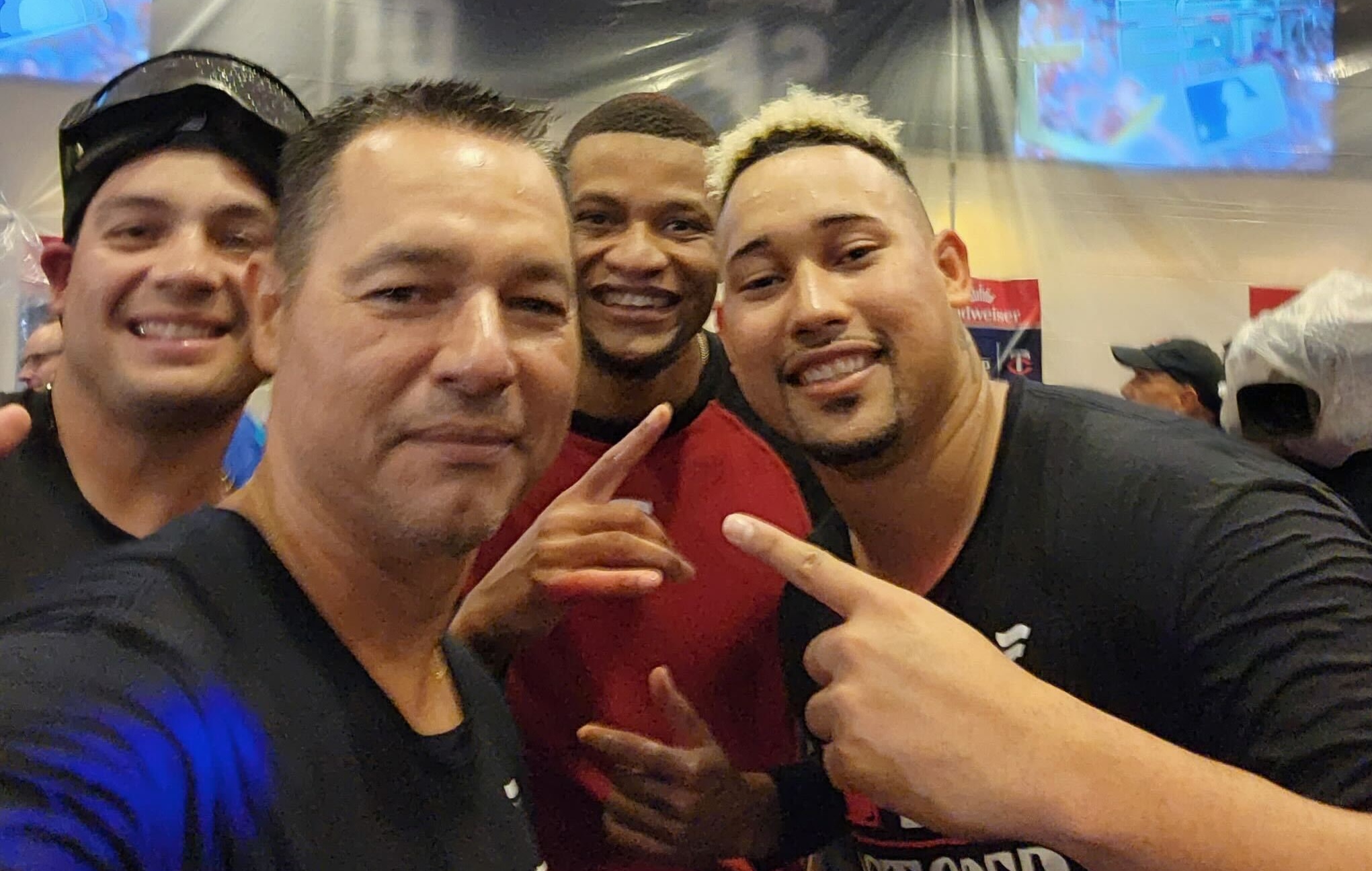
Luis Ramírez (second from left) with Jhoan Durán (far right) in 2023.
“Somehow, ‘Durantula’ came to my mind,” Ramírez said, “and I said it. And it’s been there ever since.”
There were a few reasons the pitching coach came up with this specific moniker. One was his pupil’s last name. Another was that “duro” translates to “hard” in Spanish, and Duran was already hitting triple-digits on the radar gun.
But the biggest reason was Duran’s hair.
“He used to have dreadlocks,” Ramírez recalled. “And the color of his hair was brown, and kind of yellow. And the dreads were kind of long, and it kind of looked like a tarantula.
“It kind of looked like one of those spiders. A little spider leg, hanging [off].”
He added: “I saw a lot of tarantulas when I was a kid, and his hair looked just like it.”
Duran, who watched the Spider-Man movie trilogy growing up, embraced the nickname. When he reached the major leagues in 2022, he began to put tarantulas on his sneakers. He eventually got a tarantula tattoo, and in 2023, an entrance fit for a WWE wrestler.
When the closer was dealt to the Phillies at the 2025 trade deadline, the entrance came with him. Before Duran jogs from the bullpen, all of the lights in Citizen Bank Park go out.
Fans hold up their phones, as a remix of “El Incomprendido” by Farruko and “Hot” by Pitbull and Daddy Yankee begins to play. Duran’s name appears in flames on LED screens, while a tarantula crawls from one side of the ballpark to the other.
The display still makes Ramírez smile.
“The nickname is the same thing with [pitches],” he said. “Sometimes you’re in the bullpen, and you move a grip, or you make a slight adjustment, and now a pitch that was maybe average becomes a weapon. ‘Durantula’ just stuck.”
Duran and Ramírez say their relationship is akin to that of a father and son. In 2019, the pitcher moved from his hometown of Esperanza, Dominican Republic, to Fort Myers full-time.
He and Ramírez would train together during the offseason. They’d fine-tune his pitches, tweak his routines, and work on conditioning, but also spent time together off the field.
Their families became close. Duran’s son began calling Ramírez “Tío Lupita” — Uncle Lupita in English — because the pitching coach would play the song “Hay Lupita” by Lomiiel while he was cooking dinner.
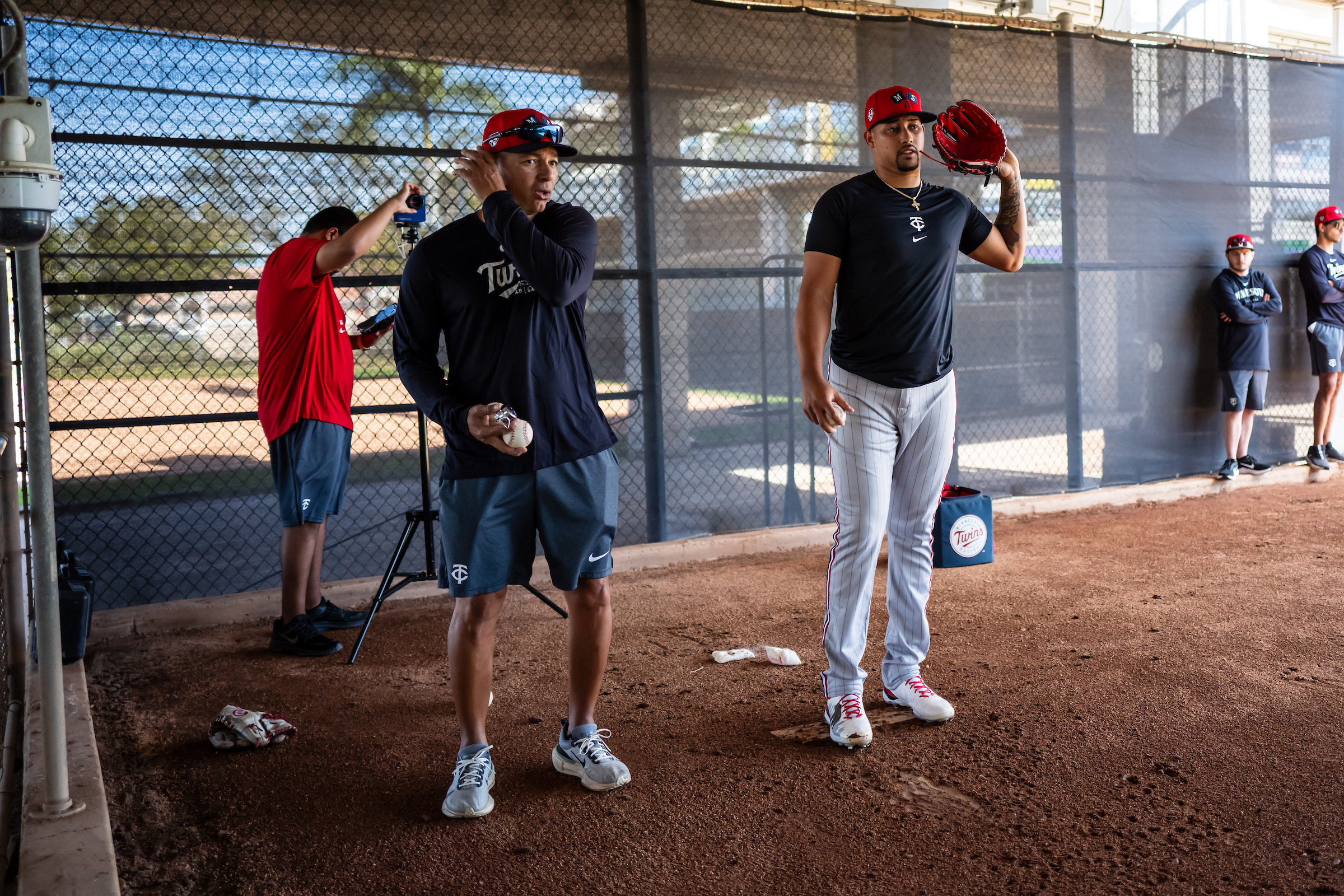
Jhoan Durán (right) pictured with Luis Ramirez in Fort Myers during spring training in 2024.
“I used to dance with him,” Ramírez said. “The song would go, ‘Hay Lupita, Hay Lupita.’ And then, from there, he just called me Tío Lupita all the time.”
Even as early as 2019, the pitching coach saw promise in Duran. He had big-time stuff without a pretentious attitude. Duran was hungry to learn, and put in the work to do so.
Ramírez could envision him playing a big role for the organization down the road, so when they were in Fort Myers, he started talking to Duran about one day pitching in the World Series.
He didn’t specify what role it would be, but Ramírez had a hunch his pupil would eventually become the team’s closer.
He and Duran split up in 2021, when Ramírez accepted a position coaching at double-A Wichita, and Duran was promoted to triple-A St. Paul.
They reunited at the big league level in 2022, when Duran was converted to a Twins reliever, and picked up their conversations from there.
Ramírez told him to prepare mentally and physically to pitch the last few outs of the biggest game of his life.
Jhoan Duran was a star with the Twins but postseason success was elusive.
“You are going to help us to win a World Series,” Ramírez would tell Duran. “You have to be ready for that. Because you’re going to be the guy closing the game in the World Series.”
“I remember that like yesterday,” Duran added. “He always told me, when he saw me, he’d say, ‘Hey, remember. You’re going to be one of the guys to help the Twins win a World Series.’”
The young pitcher kept the message in the back of his mind, but in 2023, when he closed out the game that would clinch the Twins’ first playoff spot since 2020, he struggled.
Duran threw 34 pitches against the Angels, of which only 17 were strikes. He allowed two walks and one earned run on two hits. Duran got the save, but Ramírez could tell something was off.
“Hey, last night, I thought the game was a little fast for you,” Ramírez said.
“Yes,” Duran conceded. “I was a little sped up.”
“That’s my fault,” the coach replied. “Because I should have prepared you for this moment. We should have talked more before it happened.”
Ramírez connected Duran with the team psychologist, who began working with the closer on visualization exercises. It had an immediate impact.
Jhoan Duran recorded 16 saves after being acquired by the Phillies on July 30, 2025.
Duran didn’t allow a run in his four postseason appearances that year. He had six strikeouts and yielded only one walk through five innings pitched.
The closer returned to October baseball in the National League Division Series last season. He pitched in Games 1 and 2 against the Dodgers, allowing one hit and two walks, with four strikeouts.
His final outing came in Game 4. Duran entered in relief of Cristopher Sánchez in the bottom of the seventh, with runners on first and second and one out. He induced a groundout from Andy Pages, and intentionally walked Shohei Ohtani.
In the next at-bat, he walked Mookie Betts, allowing the tying run to score. He retired his next four batters.
Duran was charged with the blown save in the Phillies’ season-ending 2-1 loss, but only after the home plate umpire blew a call earlier in the inning.
Jhoan Duran enters his first full season with the Phillies.
This was not the way the closer wanted his season to end. But Ramírez isn’t worried about how he will bounce back.
He says Duran has a short memory, and an unwavering trust in himself — good qualities for a high-pressure job.
The coach is hopeful that the closer will have more October moments. He believes he’s built for it.
“He feeds off of the crowd,” Ramírez said, “off of the energy, the pressure. He’s never been afraid of [a situation where] the game is on the line. He’s never been afraid of that.
“I think that’s why he got traded there. Because, I know that in Philadelphia, the park is always full.”
About once a month, Brian Wanamaker drives toa cancer treatment center near his home in Crowley, Texas. He sits on a hospital bed as nurses inject needles into his arm and stomach; one for chemotherapy, the other to boost his immune system.
He can be there anywhere from one to four hours.Wanamaker is asleep throughout, but he doesn’t wake up rested. His stomach burns. His body feels fatigued.
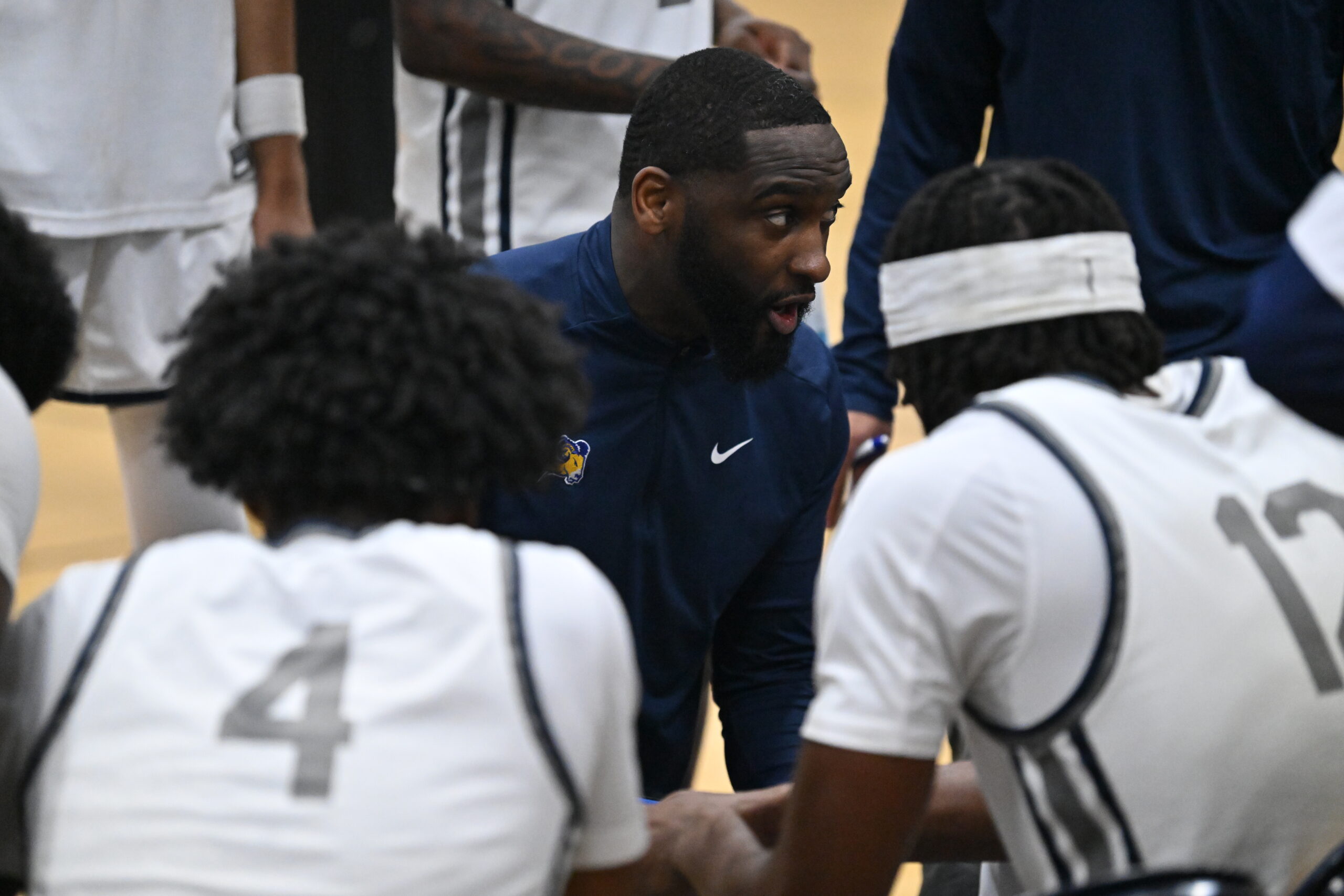
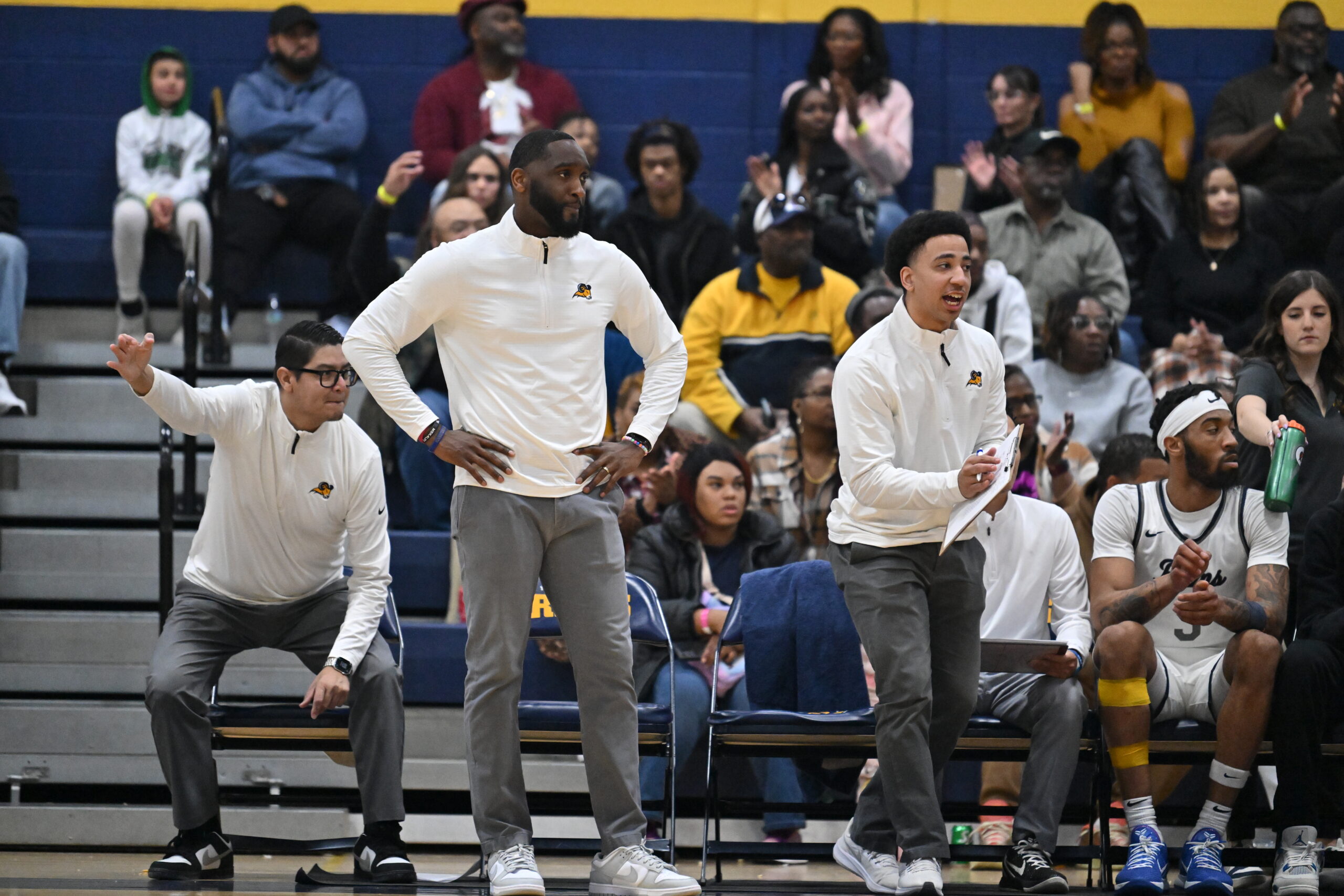
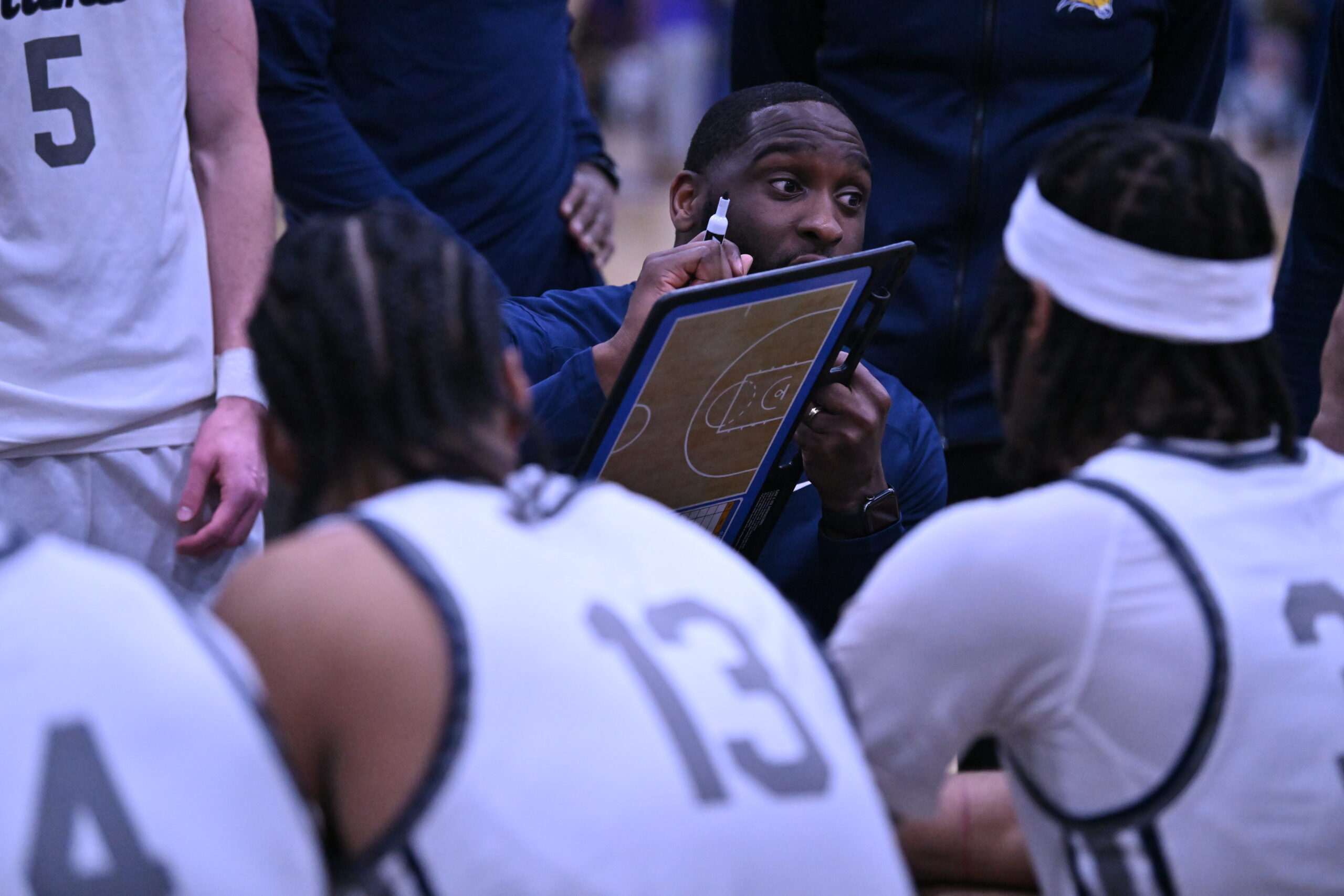
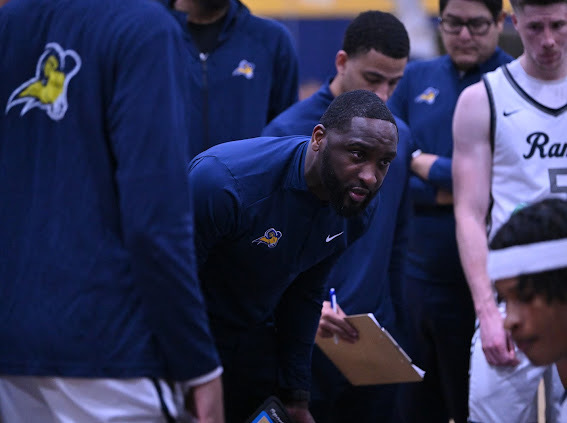
After it’s over, he often goes straight to the gym at Texas WesleyanUniversity, where the North Philadelphia native coaches the NAIA men’s basketball program. Sometimes, he even beats his players to practice.
Since 2022, when Wanamaker was diagnosed with multiple myeloma, he has been balancing his job with the limitations of an incurable cancer. It is not easy. The head coach takes six pills a day to keep the disease in remission for as long as possible.
His doctors advise him not to engage in stressful activities (even if running a college basketball team is antithetical to this). Then, there is the matter of his schedule. Texas Wesleyan plays games mostly on Thursdays and Saturdays.
It doesn’t allow much time to undergo chemotherapy and fully recover. But the coach has an answer for that, too. He receives treatment early on Mondays, so he doesn’t feel sick later in the week.
If the Rams are on the road, he’ll reschedule.
“It’ll come back,” Wanamaker said of multiple myeloma. “But right now, I do maintenance.”
The 36-year-old doesn’t talk like someone who is worried about the future. If anything, his job has helped him stay grounded in the present. Coaching was a lifelong goal of Wanamaker’s, ever since he was a boy playing in the Sonny Hill League.
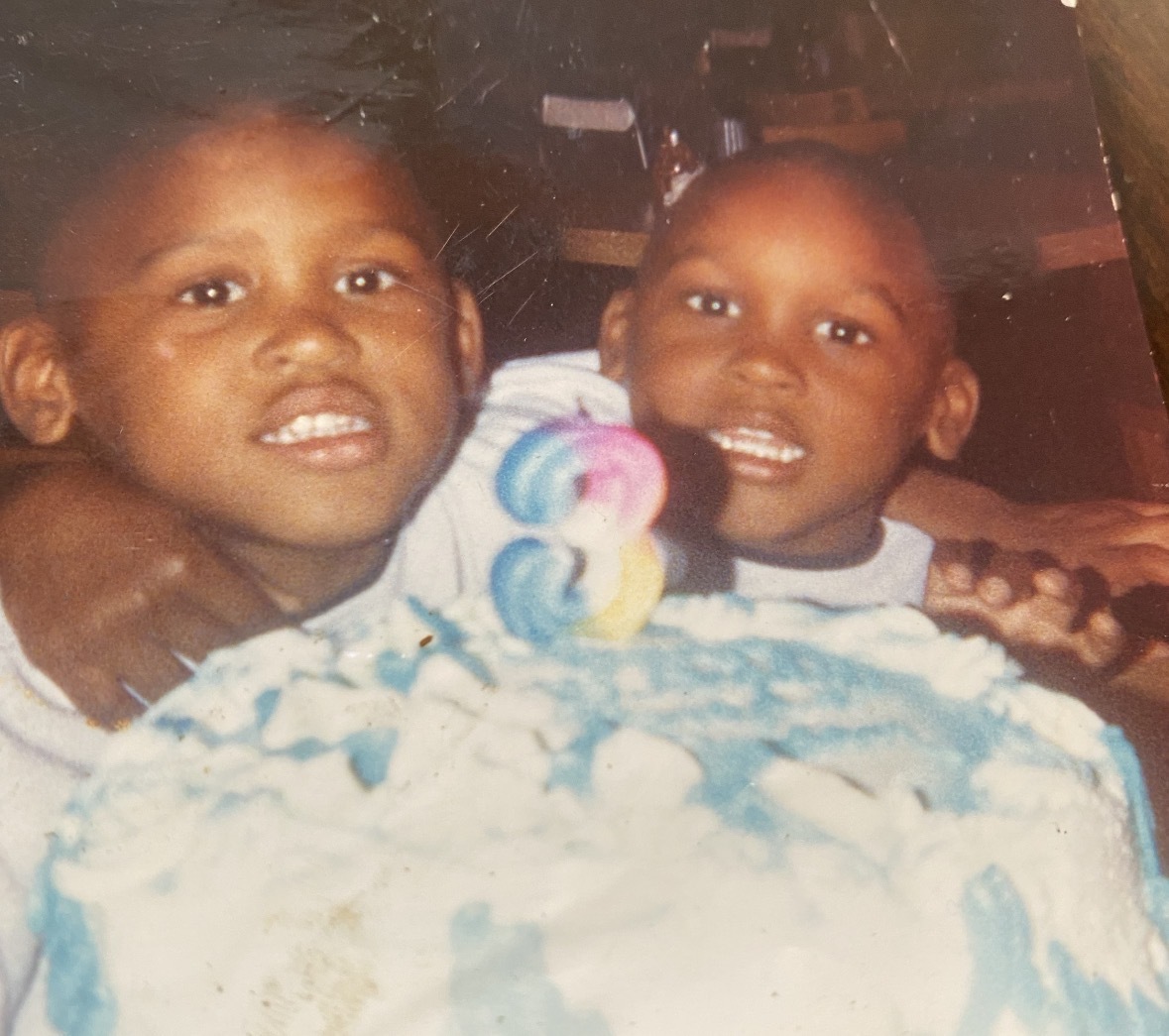
This is where he and his twin brother, Brad, first saw how basketball could change a life. Their coach, Rasool Hajj, was an alumnus of and former volunteer assistant coach at Roman Catholic High School. He helped the twins connect with the program, and they enrolled in 2003.
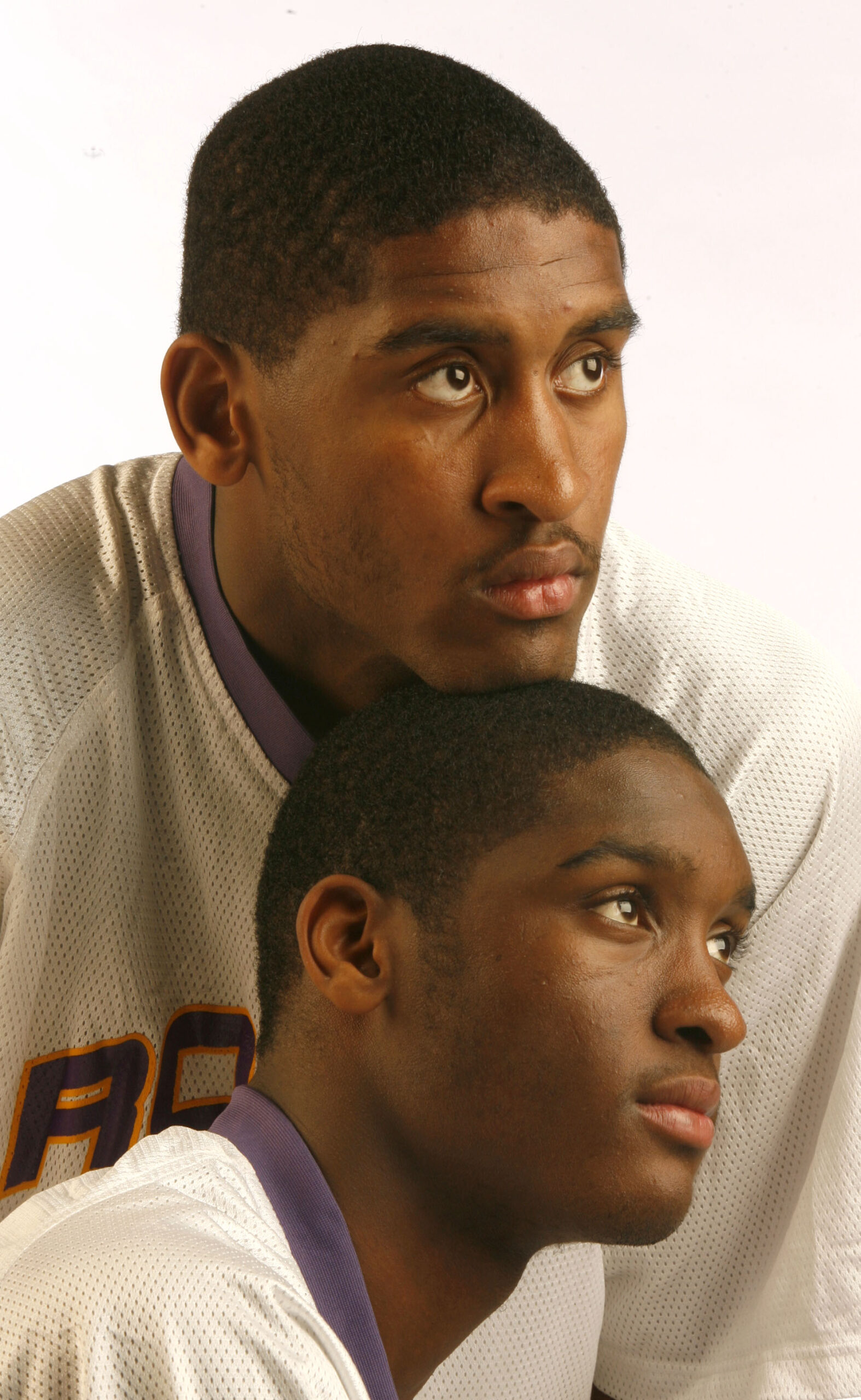
Brad and Brian Wanamaker (bottom) were stars at Roman Catholic High School and went on to play professional basketball.
The Wanamaker brothers quickly became standout players. In 2007, they led Roman to a Catholic League championship under coach Dennis Seddon. After that, their careers took divergent paths.
Brad starred in college at Pittsburgh en route to a seven-year stint in Europe, followed by a four-year stretch in the NBA. Brian struggled with injuries in college and bounced around, eventually finding a permanent home as a player at Texas Wesleyan.
He spent a few years playing overseas but returned to the school as an assistant coach in 2019. The Philadelphia native was named head coach in 2024 and has made an immediate impact, leading the Rams to a 38-20 record since taking over.
He models his approach after Hajj’s. He checks on players’ mental health before berating them for a mistake. He routinely asks how things are going at home and at school.
The team is encouraged to be vulnerable and learn from one another, rather than to react in real time. Wanamaker tells the players to focus on “the person,” because everyone is going through something.
“But I also talk to them about reality,” Wanamaker said. “Yes, everybody wakes up with an excuse they can use, and it’s real. But you can either use it or you can fight through it. You know?”
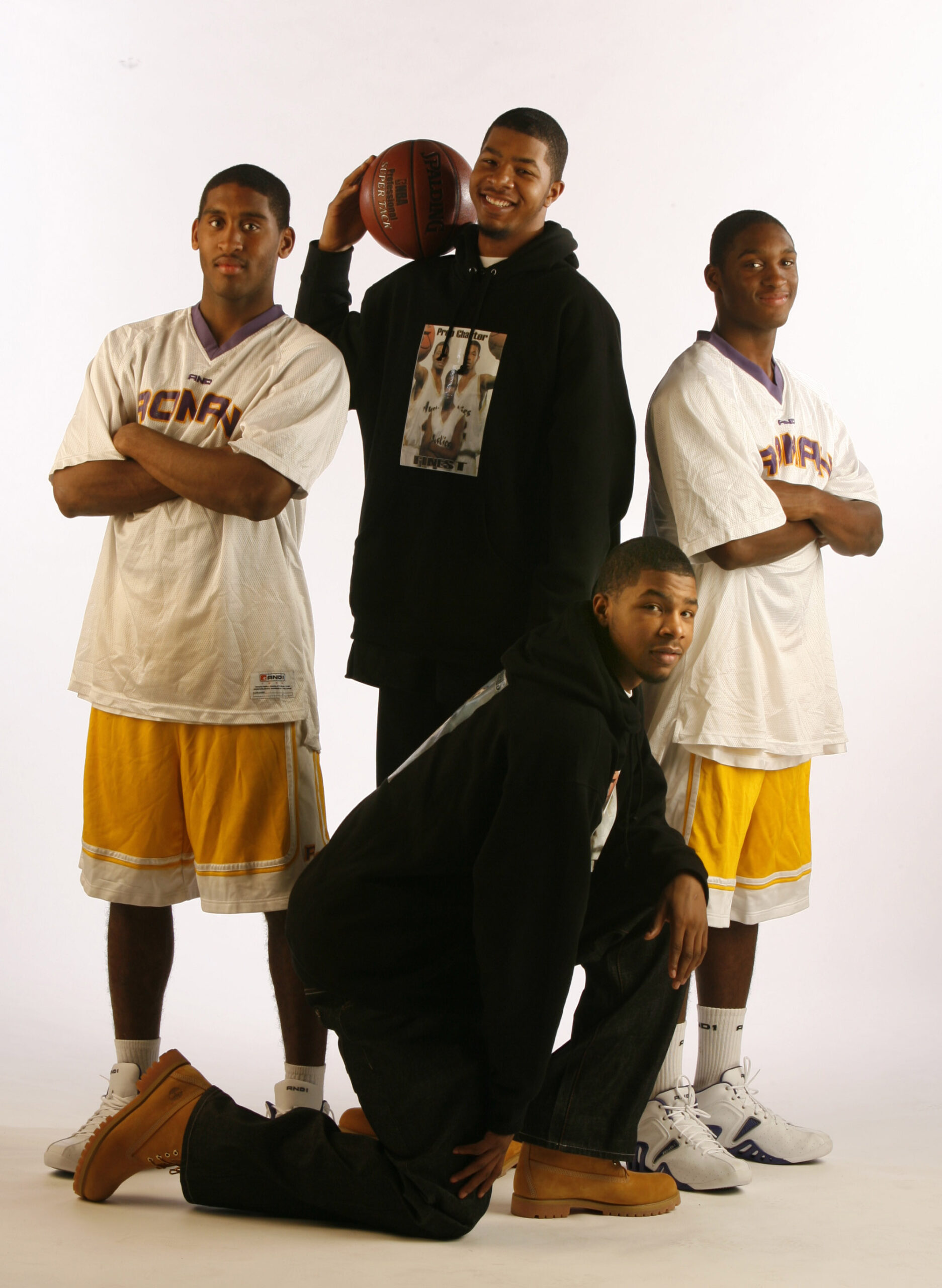
Brad (left) and Brian (right) Wanamaker with fellow basketball-playing twins, Markieff (top center) and Marcus Morris (kneeling) of Prep Charter in 2006.
A North Philly upbringing
Brian and Brad grew up in a three-story house on 19th Street between Norris and Diamond. They were the second and third of five siblings — Brad is 1 hour, 11 minutes older than Brian — and shared a bedroom on the top level.
This had its shortcomings. The roof had holes, so when it rained, the boys put pots on the floor. Their neighborhood was perilous at times, and from an early age, they became aware of the poverty, gun violence, and drug use around them.
But their childhood was still full of joy. Nineteenth Street was home to a lot of young kids, many of them Brian and Brad’s age. They rode bikes, played tag, and staged impromptu football games outside.
Basketball was their favorite sport. The twins ventured to courts all over the city in search of the fiercest pickup battle: 16th and Berks, 16th and Susquehanna, 25th and Diamond, 22nd and Norris.
They’d shoot hoops before and after school. Local elders would organize basketball tournaments between blocks with trophies for the winners. In seventh grade, a friend, Saleem Elam, asked if they played AAU basketball.
Neither brother knew what that was. But they soon attended a tryout, held their own against more experienced players, and made the team. Before long, they were playing in leagues throughout the area — Gustine Lake, Sonny Hill, Belfield.
The Sonny Hill League was where they met Hajj, who seemed to be part basketball coach, part social worker. He allowed the twins to reimagine the bounds of what a coach could do, a template they’d lean on later in their careers.
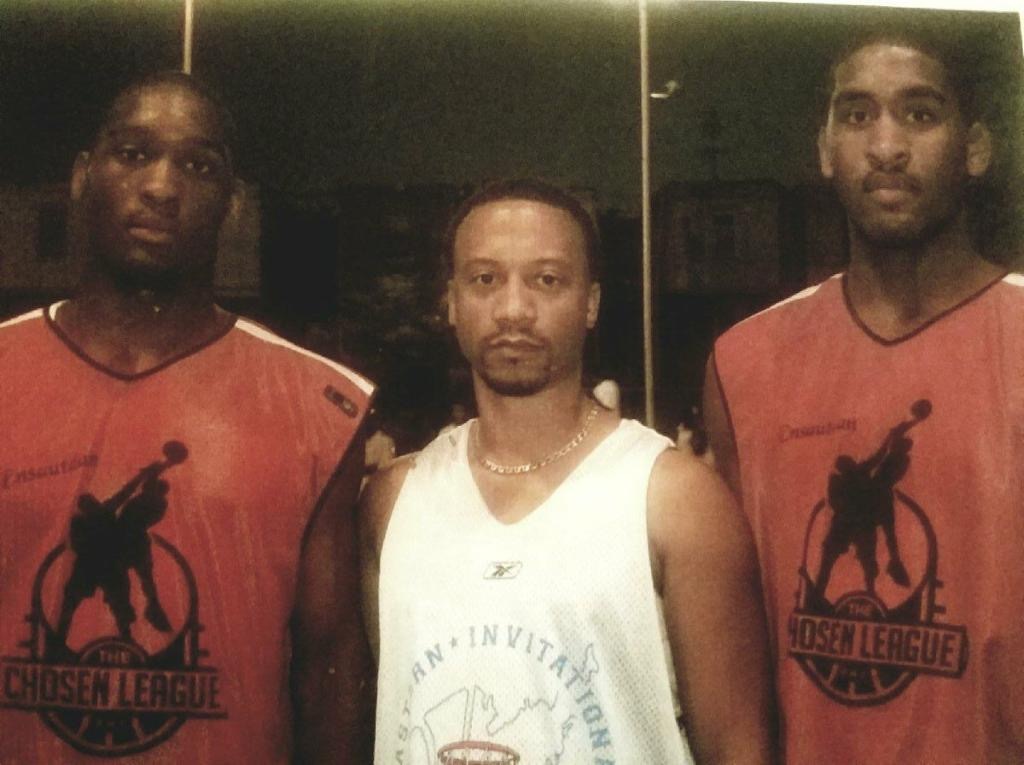
The Wanamaker Brothers looked to Rasool Hajj (center) as a coach and mentor.
“He helped a lot of kids, but also a lot of families,” Brian said. “He helped parents get jobs. He would give people money if they needed it for something. He was always there. He was almost like a big brother to us.”
Hajj became a mentor to the twins. At the time, they were attending Gillespie Junior High School, which closed in 2011. Brian and Brad seemed to learn all the wrong lessons, like how to cut class and replace it with extra gym time.
Teachers wouldn’t enforce the rules, so to the twins, there was no reason to follow them.
“There wasn’t a lot of learning,” Brad said. “Not a lot of structure. I’d go to one class — Ms. Brown, because she knew my dad. So, I’m like, ‘I got to make sure I go to her class.’
“I’d go to homeroom and get marked absent for the day. Then I’m in my brother’s class, I’m at his lunch, I’m playing cards [with him].”
Hajj, who recognized the twins’ untapped potential, introduced them to Seddon and the other Roman Catholic coaches. That break altered their lives.
The high school brought a level of discipline that the Wanamakers weren’t used to. And when they arrived as freshmen, it was a tough adjustment.
Brian walked through the doors in September 2003 and looked at the students around him.
“We wanted to leave because we didn’t know it was an all-boys school,” Brian said. “We was like, ‘What? There’s no girls in the school?’ We were so confused.”
Brian Wanamaker and his brother were standout AAU players who had to adjust to Roman Catholic on and off the court.
They racked up demerits for every conceivable offense, from untucked shirts to facial stubble. Both brothers failed a class in their first semester and were ruled ineligible for the first half of the basketball season.
Because they were on academic probation, they had to go to summer school, wearing slacks, long-sleeved collared shirts, and ties in the sweltering heat. The lesson stuck.
“It just was like, ‘We got to be doing the right thing,’” Brad said.
In sophomore year, Brad started on varsity, and Brian on JV (with some varsity appearances mixed in). They fed off each other in practice and in games.
The players had different strengths. Brian, a 6-foot-2 combo guard, was a better defender and three-point shooter. Brad, a 6-4 shooting guard, was a “laid-back killer” who could score from midrange.
Brian showed all of his emotion. He wasn’t above “mugging a player,” in Brad’s telling, and wasn’t afraid of getting a technical foul. He’d scream and yell. Brad, by contrast, was quiet.
But occasionally, he would give his brother some in-game feedback.
“He’d be like, ‘Hey, play your role!’” Brian said. “He’d be like, ‘Pass it to me. Pass me the ball, and you play defense!’”
Added Brad: “He’d go, ‘Shoot the ball!’ And I’d tell him, ‘Calm down! I need you out here!’ Because sometimes he gets too emotional. And I’m like, ‘Before you get a technical foul, I need you to calm down.’”
Brian Wanamaker helped Roman win the Catholic League title.
The brothers racked up accolades, especially in 2006-07, their senior season. Brian was named second-team All-Catholic and All-City, as well as Defensive Player of the Year. Brad was named the Daily News’ Player of the Year, and was first-team All-State, All-City and All-Catholic as well.
The Cahillites parlayed this success into a historic campaign. The twins led Roman Catholic to a 28-3 record and its first Catholic League championship since 2000.
Rival Neumann Goretti, the No. 1 seed from the Catholic League South, came into the final favored. And the game, played at the Palestra, was close until the very end.
Brad had to sit for a stretch midway through the third quarter after picking up his fourth foul. Without its best player, Roman was at a disadvantage. Brian made sure everyone knew their defensive assignments, so the undermanned Cahillites could stay within striking distance.
His brother returned early in the fourth quarter, and spurred his team to a 17-4 run. With just over a minute remaining in the game, Brian hit a layup to widen Roman’s lead to 58-54. It finished with a 59-56 comeback win.
“I think [Brian] pointed to our student section,” said Brad, now the head coach at Roman Catholic. “We still have the picture at my mom and dad’s house. It was in the newspaper. It was a moment.”
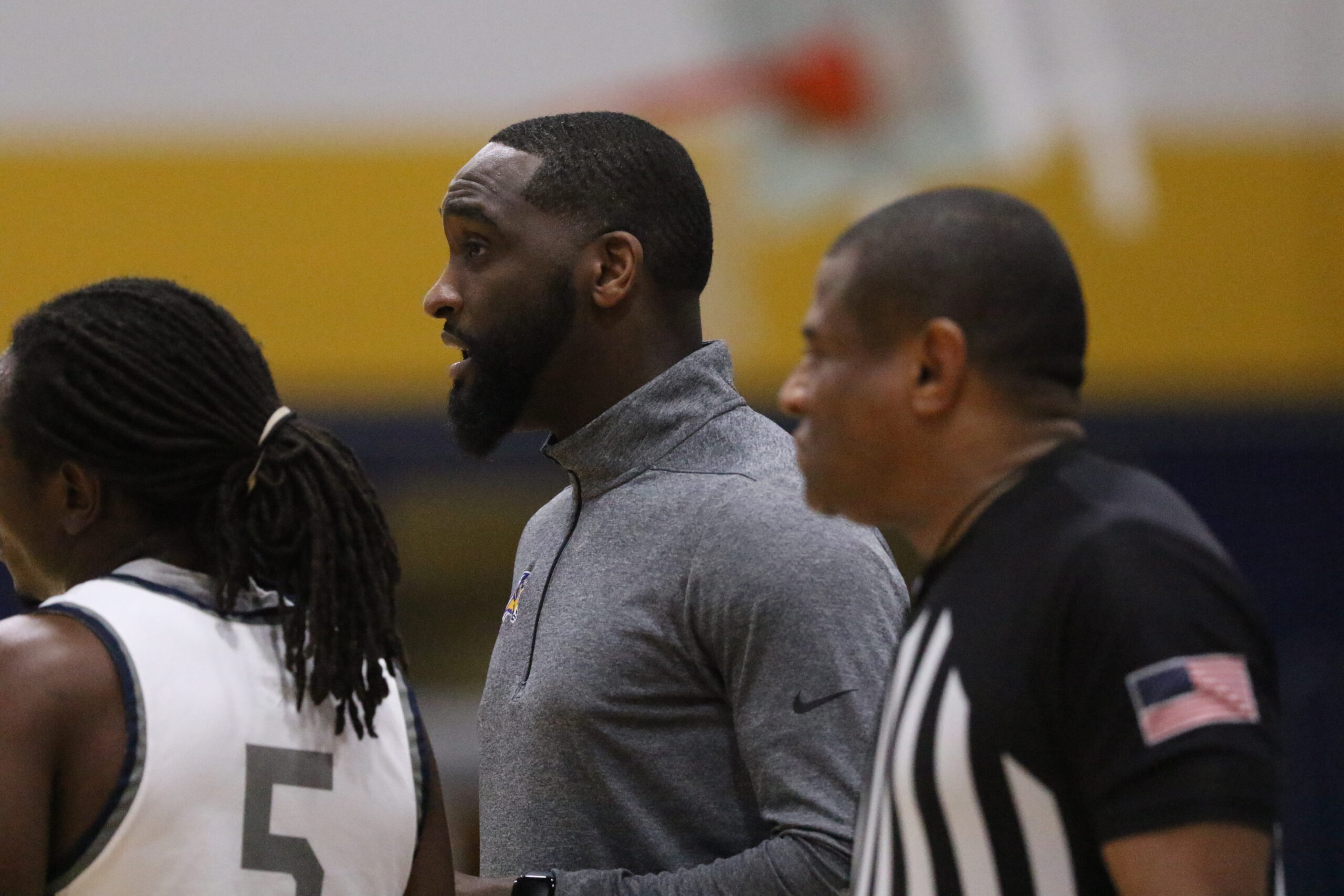
Brian Wanamaker coaching at Texas Wesleyan University.
Coaching through chemo
After graduating, Brad played for Pitt when it was one of the top men’s basketball programs in the country. Brian bounced around; first to Central Connecticut State, then to Lon Morris Junior College in Jacksonville, Texas, and, finally, to Texas Wesleyan in 2009.
He struggled with foot injuries almost every year of his college career. This made it difficult to get steady playing time. But at Wesleyan, he found a fit.
A former coach had recommended the school to him, and Wanamaker initially was skeptical. He’d never heard of it. The campus was in Fort Worth, Texas, about 1,500 miles away from home.
“I didn’t know what Texas Wesleyan was,” he said. “My first semester, I played basketball, stayed in my room, and didn’t talk to teammates, coaches, anyone. I was just like, ‘Why am I here?’”
By his second semester, he realized this would be his last opportunity to play in college. So he decided to embrace the program and was happy he did. Wanamaker felt he could be himself in a way he couldn’t at his previous two stops.
During the summer of 2010, Brian visited Brad at Pitt and trained with him and his teammates. He returned to campus in the fall more confident than ever.
That season, he was named a first-team NAIA All-American and Red River Athletic Conference Player of the Year, averaging 19.1 points, 5.7 rebounds, and 5.0 assists.
The combo guard was drafted into what then was the NBA D-League and ended up playing six seasons in Germany and Lithuania.He returned to Texas Wesleyan in 2019 to finish his degree and work as an assistant coach.
Brian Wanamaker returned to Texas Wesleyan as a coach and has endured a trying off-court experience while leading the Rams program.
In late 2021, during his second season coaching, Wanamaker started to feel back pain. At first, he thought it was workout-related. Maybe he’d pulled or strained a muscle.
But the pain worsened, to the point where he had to stop exercising. He couldn’t sleep in a bed anymore because it would hurt his back, so he would lie flat on the floor.
Wanamaker underwent all sorts of testing, but the doctors didn’t find anything. They hypothesized that his pain was stress-related.
“And I would tell them,” he said, “‘I’m not stressed.’”
In September, after a litany of visits, his primary care doctor received MRI results that showed tumors all over Wanamaker’s back. He went to the hospital for further testing, and was told he had multiple myeloma, a cancer formed in plasma cells that is treatable but has no known cure.
He was a statistical anomaly. The disease is predominantly diagnosed in people 65 years or older. According to the American Cancer Society, only 1% of cases are found in those younger than 35.
Wanamaker was 33.
“That was really hard,” he said. “Because, obviously, when you hear cancer, you think death. And then you hear, ‘No cure.’ It was hard for me to process.”
Brian Wanamaker will lead Texas Wesleyan in the Sooner Athletic Conference Tournament starting Wednesday.
The next day, the coach started seven months of chemotherapy. Many on the team assumed he would be out for the rest of the year.
But Wanamaker was back in the gym that week, helping at practice and eventually sitting on the bench during games.
He had little energy and often felt sick. His immune system was at a higher risk than usual. But Wanamaker felt he needed to do it. So every day, he’d drive to Texas Oncology for his treatment, and would head to Texas Wesleyan afterward.
“I was probably more than half-asleep,” he said. “I was going through what I was going through, but I knew as a coach, players are going through stuff, too. It was just being there for them.”
Guard Akili Vining had recently lost his father to cancer. Point guard Matthias Nero had gotten into a severe car accident, which led to the death of his close friend.
Wanamaker was acutely aware of their struggles and those of other players. He decided to pour himself into his team.
“Coach B would probably text me every day,” Nero said. “He would make sure I was in the right headspace, to see if I needed help. He’d pull me aside and just tell me, ‘If you need anything — this isn’t about basketball. This is about the future and your mental health.’”
Wanamaker received a blood transfusion in May 2023. His father and brother visited him in the hospital shortly after. Seeing him hooked up to a cluster of machines was difficult.
“It was like, ‘I can’t lose my brother,’” Brad said. “‘Not the person I came into this world with.’”
Brad Wanamaker (left) has had to monitor his twin brother’s condition from afar.
Eventually, Brian’s chemotherapy schedule was reduced from daily to monthly treatments. Through it all, he rarely missed a practice or a game, which became a source of inspiration for his team.
The players could see their coach had changed. He’d lost hair and weight, and his skin looked dull. Sometimes, he’d arrive with a bandage on his arm to cover a needle mark.
But he was showing up, just like they were.
“If he can fight though chemo,” Vining told a local TV affiliate, “I can fight through practice.”
Brian Wanamaker has won the respect of his players by caring about them as players and people.
‘People are going to say I cared’
In April 2024, Wesleyan’s head coach, Brennen Shingleton, resigned to work for a business in Fort Worth. Wanamaker was named interim coach but also applied for the full-time job.
He wasn’t alone. Athletic director Ricky Dotson said he received “a ton” of applications, from former NBA assistants to former Division I head coaches. He narrowed it down to four finalists, interviewing them throughout the spring.
Despite the high caliber of candidates, Wanamaker still set himself apart. It wasn’t just that he was familiar with the team. It was that the players respected him, and looked to the Philadelphia native as a role model.
Dotson knew the coach’s character. He could see that this would not be a surface-level job for him. By the end of the interviews, he was convinced that Wanamaker was the best choice, even with the uncertainty about his health.
“I just never really doubted that he would be able to do it,” Dotson said. “And he’s moved right on through.”
That June, Wanamaker was officially named head coach. He immediately got to work, targeting bigger, more athletic players in hopes of building a hard-nosed, physical team.
One such player was Khalil Turner, a 6-8 guard from Northeast Philly who had shuffled through four colleges before taking a two-year hiatus. Like Wanamaker, Turner was a Hajj disciple in need of a new home.
The former Sonny Hill coach was confident that Wesleyan would be the right fit.
“Listen, man, I got a place for you,” Hajj told him. “It’s a Philly coach. He’s going to treat you like family. All you’ve got to do is just go out there and put the work in, and everything is going to fall into place.”
The two initially butted heads, usually over inconsequential things. Turner said that one day, in practice, they almost got into a physical fight. But Wanamaker never gave up on him. He didn’t suspend Turner or revoke his scholarship.
Brian Wanamaker connected with another former Philly star, Khalil Turner, who arrived in Fort Worth.
Eventually, the guard began to open up about his personal struggles. He had a family member who was sick at home. He told the coach that he needed a job to make some extra money. Wanamaker found him one at a local laundromat.
Now, Turner says they are “best buds.” Last year, when the incoming freshmen arrived on campus, the senior guard was the first to explain Wanamaker’s predicament.
“We told them, ‘Hey, Coach is dealing with this,’” Turner said. “‘So from time to time, he might be a little moody. But this is why he’s moody. He’s worried about his chemo. So don’t stress him out too much.’
“The vets feel like if Coach is giving his all, with his chemo, we should give it our all every day in practice,” Turner added, “and every day on the court. He’s going above and beyond for us, so we should do the same.”
After consecutive losing seasons, the Rams now look like a different team. They have adopted some of Wanamaker’s characteristics, playing a faster, tougher brand of basketball.
They set hard screens and make hard cuts. They dive on the floor for loose balls and swarm opposing offenses. And they are seeing results.
In 2024-25, Texas Wesleyan went 19-11, earning an NAIA National Tournament berth. This year, it is 19-9.
But Wanamaker isn’t just focused on the numbers.
He knows his players have changed as people, too. They are more emotionally available. They are better able to communicate their feelings. They are less reactionary than when they first arrived.
And to the Philadelphia native, that is more valuable than anything.
“It gives me my purpose,” he said. “And no matter what happens, I know that, when it’s all said and done, people are going to say I cared.”
In May 2024, Johnny Gaudreau reached out to his father, Guy. He’d recently wrapped up his 10th full NHL season, with the Columbus Blue Jackets, but he had a bigger goal in mind.
For the first time since 2014, NHL players would be allowed to compete in the 2026 Winter Olympics.
Gaudreau had already started conditioning, and wanted to do more. So, he went to his first coach.
“He said, ‘Dad when I come home, we really have to push it,’” Gaudreau’s sister, Katie, recalled Sunday. “‘I really want to make the Olympics.’”
From May through August, Johnny and Guy drove from their Shore house in Avalon — where their family spent the summer — to any rink in the area that would give them an hour of ice time.
These weren’t always quick trips. Hollydell Ice Arena was about 60 miles away. Pennsauken Skate Zone was a little farther than that.
But Gaudreau knew this was his chance to achieve a lifelong dream. So he put in the extra work, sometimes getting additional conditioning in before his father arrived to the rink.
He was, by his own admission, “not impressed” with what shape he was in at the start. But by the end of the summer, he’d improved.
Guy saw it himself. In August, he turned to his wife, Jane.
“I think he might make the team,” he told her. “He’s in the best shape of his life.”
The Gaudreaus started thinking about a future trip to Milan, where the Olympics would take place.
Katie, who was set to get married in late August 2024, was already planning a honeymoon there, and joked that it wouldn’t make sense to go twice in a short span.
She began sketching out the conversation with her supervisors at Oldmans Township School, where she works as a first-grade teacher.
But all of this excitement and hope came to an unceremonious halt on Aug. 29, 2024.
Johnny and his brother, Matty, were at home in Oldmans Township for Katie’s wedding the following day.
They were hit by an alleged drunk driver while riding bicycles on County Route 551. The brothers were severely wounded and both died at the scene. Johnny was 31 years old, and Matty was 29.
Ever since they died, their family has been trying to honor their legacy. Jane and Guy have attended multiple ceremonies to honor their late sons.
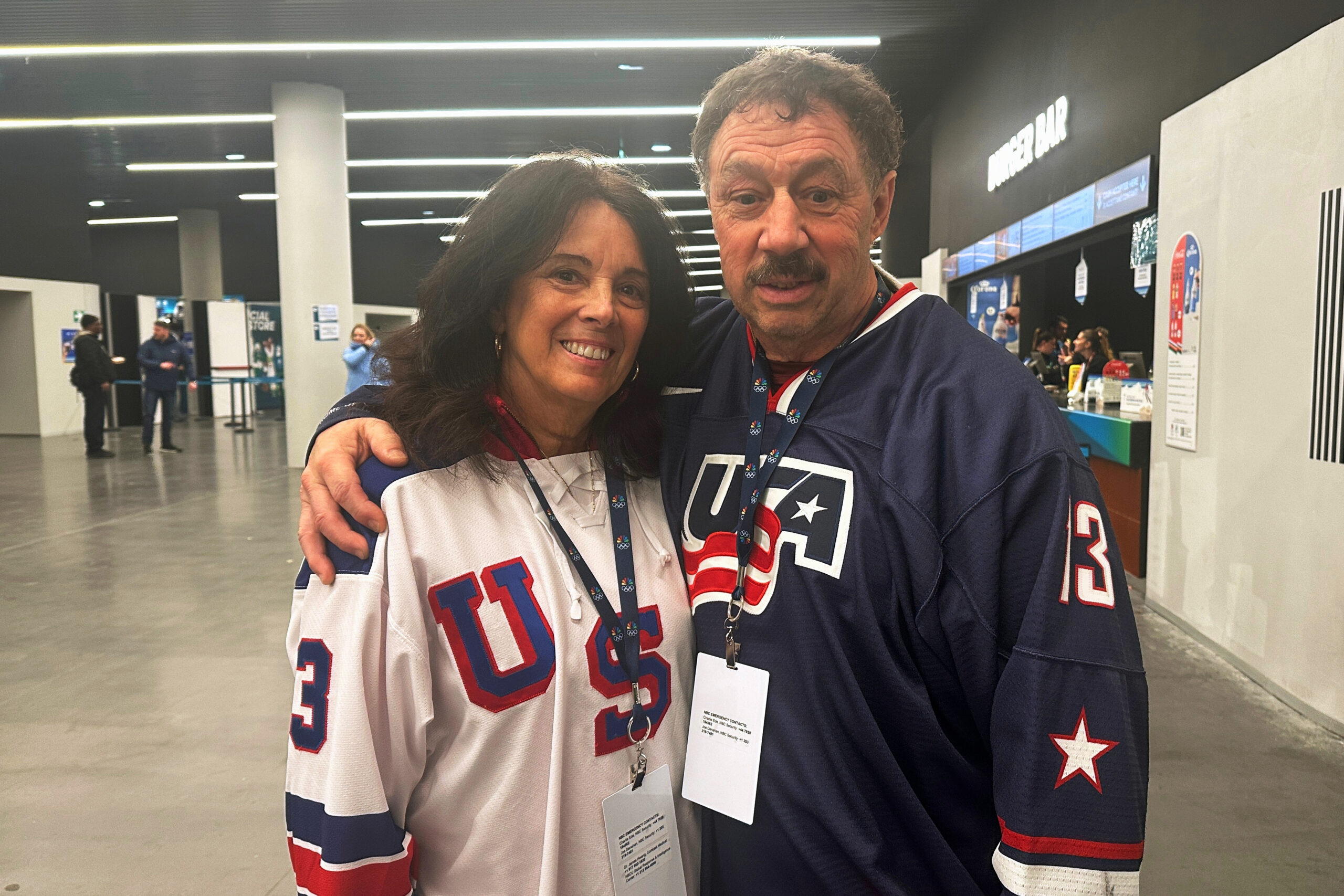
After some initial hesitation, Jane and Guy Gaudreau made the trip to Italy to honor their son and root on his former Team USA teammates.
In 2025, they started the annual Gaudreau Family 5K, an in-person and virtual road race to raise money for the Gaudreau Family Foundation.
But last week, they received a special opportunity to celebrate Johnny’s ultimate goal.
On Tuesday, a representative for USA Hockey asked the Gaudreau family if they’d want to attend the semifinal game against Slovakia on Friday. They were also invited to Sunday’s gold-medal game, if the Americans qualified.
Initially, Guy and Jane said no. Katie and her sister Kristen weren’t able to make it, and they didn’t want to travel without them.
It also seemed bittersweet to attend an Olympic semifinal or final without their late son.
But on Wednesday morning, Jane had a change of heart.
“My mom was like, ‘I really didn’t sleep,’” Katie said. “‘I think John would want us to go. I think we should go.’”
A staple of Team USA
Throughout his career, Gaudreau was a staple of USA Hockey. He’d been involved in development camps since he was a teenager.
He’d competed in international tournaments since 2010, when he was a member of the Under-18 select team.
In the 2013 World Junior Championship, Gaudreau led the tournament with seven goals en route to a gold medal.
The forward continued to establish himself as a key player on the senior team, setting a number of offensive records despite never competing at an Olympics.
He still holds the mark for the most points (43) and assists (30) by any American in IIHF men’s World Championship history.
“He does his best, I swear, in a Team USA jersey,” Katie said.
His Olympic enthusiasm went beyond tournament play. The Gaudreau family watched the movie Miracle, about the 1980 U.S. Olympic hockey team, so many times, they could recite it by heart.
It was always playing in their minivan, as they traveled up and down the East Coast for Johnny and Matty’s hockey tournaments.
As the years passed, and Gaudreau continued to solidify himself as an NHL star, the idea of him making an Olympic team seemed less of a dream and more a reality.
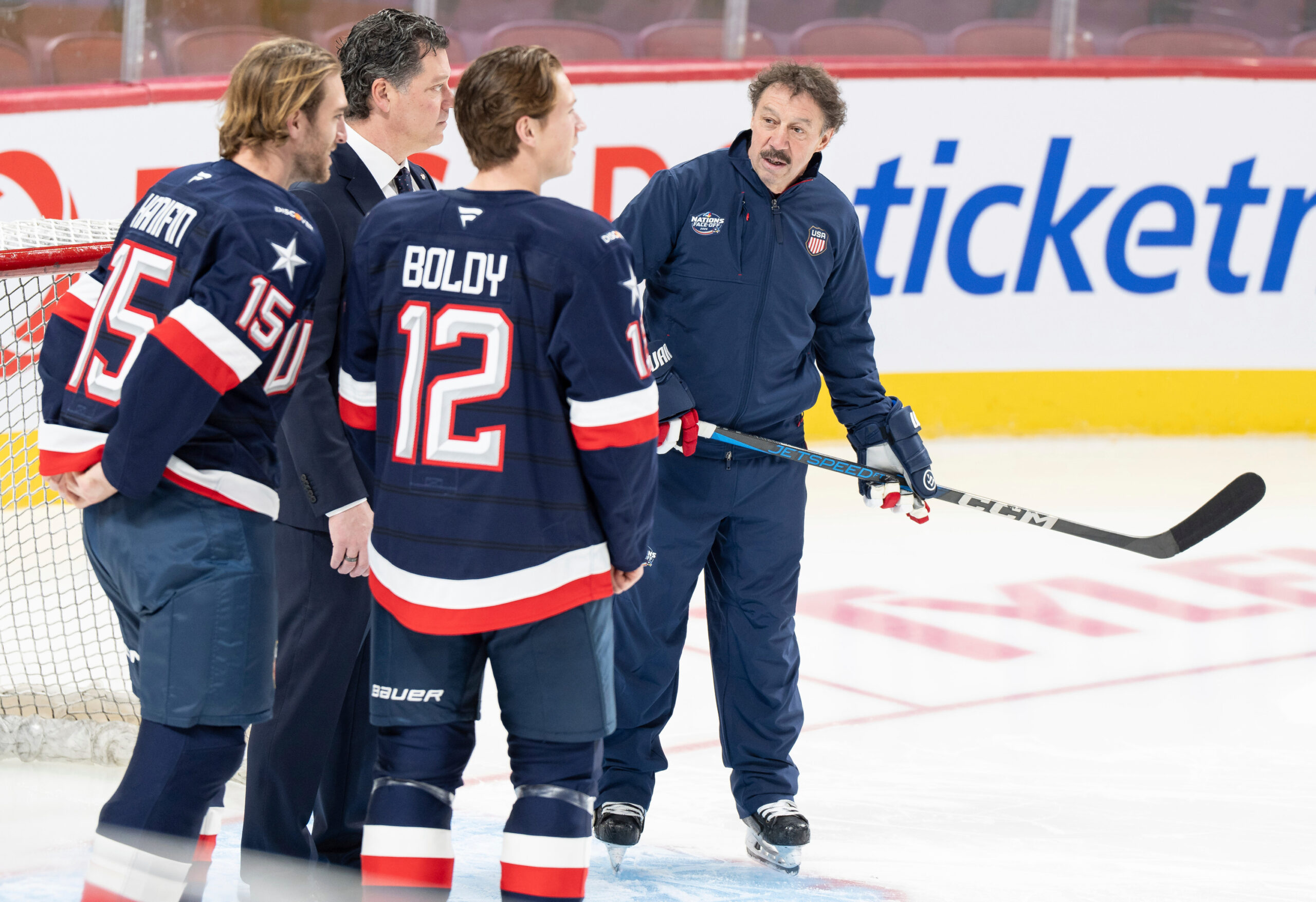
Team USA confirmed as much after Johnny passed. Last year, at the Four Nations Face-Off, an official told Guy that “John would have had a spot on the team.”
“Any hockey player growing up, of course they want to make it to the NHL, but the Olympics is really the big thing,” said Katie. “And it’s always been a dream of John and Matthew’s. And we knew it was a tangible dream.”
So, when Team USA made the initial offer to fly the family out to Milan, Jane and Guy were hesitant.
They knew going to a game or two would be an emotional experience. Katie knew this, too. But she encouraged her parents to at least try.
Guy Gaudreau, a longtime coach in South Jersey, has spent time on the ice as a guest of Team USA over the past two years.
“I said, ‘If you get there, and you go to the first game, and it’s entirely too hard, you don’t have to go back,’” Katie said. “‘You don’t have to go. You can leave. But if you’re watching the game at home, you can’t be there.’
“‘So this is a once-in-a-lifetime opportunity to honor the boys. And keep their legacy alive. And that’s what we do, every day. We wake up and we just want to honor the boys’ legacy.’”
Jane and Guy decided to go. They met Johnny’s widow, Meredith, in Atlanta, with her two oldest children, Noa and Johnny Jr.
Together, they flew to Milan, where they attended Friday’s game against Slovakia and Sunday’s gold-medal game against Canada.
Katie and Kristen watched from their parents’ house in South Jersey with family and close friends. They knew that the players had hung up Johnny’s USA jersey in their locker room, and hoped that he would be celebrated if they won.
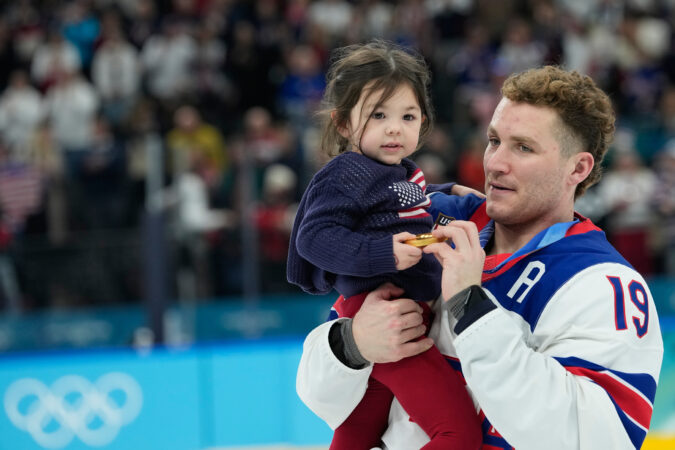
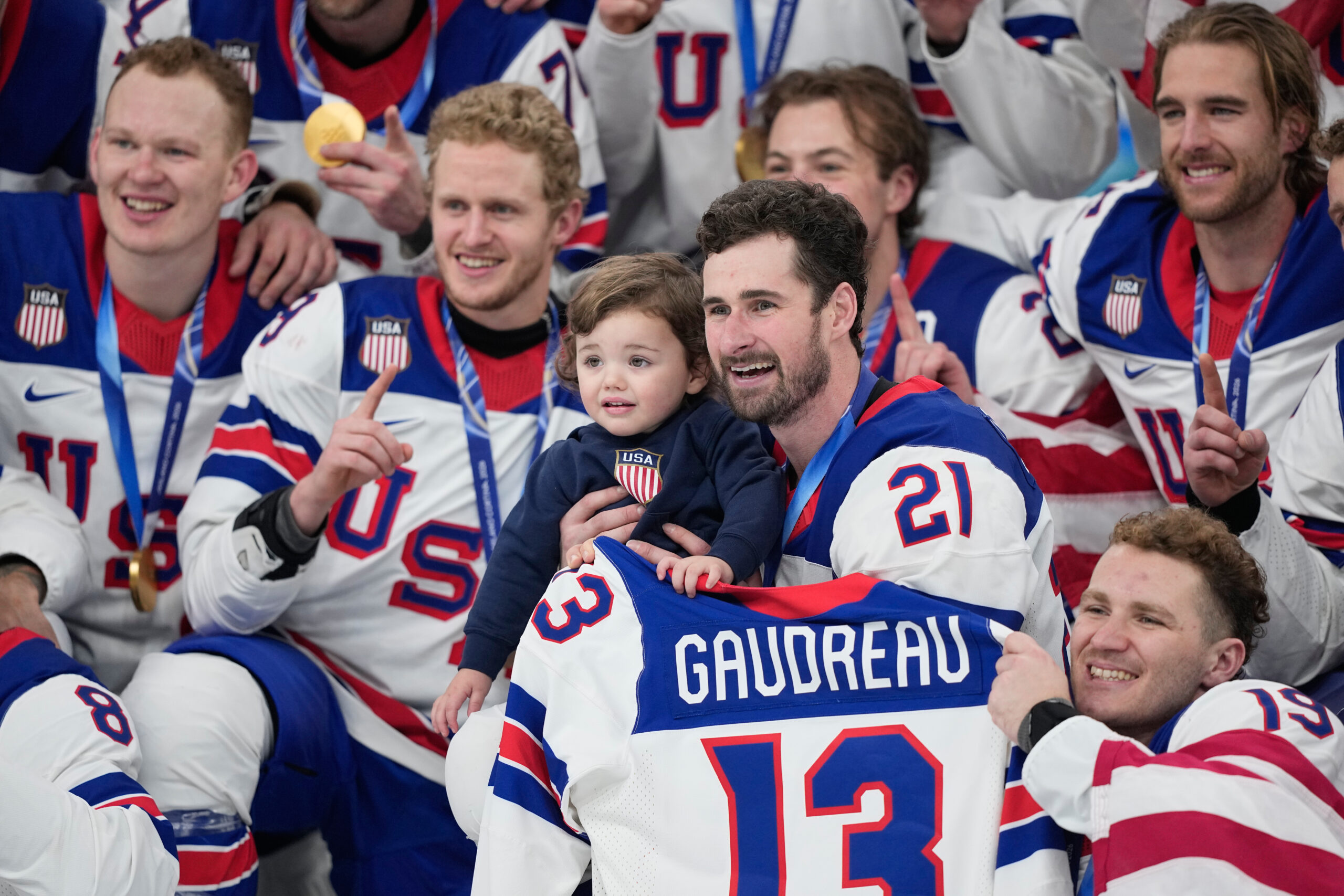
But they weren’t sure what would happen when the United States beat Canada, 2-1, in overtime. Katie and her sister were “in tears” when Auston Matthews, Matthew Tkachuk, and Zach Werenski carried Gaudreau’s No. 13 jersey as they glided across the ice.
The next few moments exceeded the family’s expectations. Meredith, who was watching in the stands with her two oldest kids and in-laws, received a call from a Team USA official.
He put her in touch with Tkachuk, who asked if she could bring Noa and Johnny Jr. down to the ice.
Two players, Dylan Larkin and Werenski, skated off the rink, with gold medals hanging around their necks.
They met Meredith at the bottom of the stands, scooped up Noa and Johnny Jr., and carried them back out for a team photo.
Noa sat on Werenski’s lap. Johnny Jr. — who was celebrating his second birthday — sat on Larkin’s.
“I was like, ‘There’s no way they’re going to do that. There’s no way,’” Katie said. “When they did that, I lost it. I’m so proud. I’m so happy that the kids got to experience that, because this is what John wanted. The team did an amazing job.”
United States forward Dylan Larkin (21) holds Johnny Jr., the son of the late player Johnny Gaudreau, in the team photo after the gold-medal game.
It’s a memory the Gaudreaus will hold close. They know that tomorrow, people will go to work, and get on about their days, and a fresh news cycle will take hold.
But a year and a half later, Team USA still hasn’t forgotten about Johnny and Matty Gaudreau. And for that, their family is grateful.
“Every time I think, ‘All right, now it’s time to move on, we’re not going to have all this support’ — they don’t [move] on,” said Katie. “This is a history book [moment] that there will be a movie about.
“And in that movie, Noa and Johnny will be on the ice.”
On the night of Feb. 4, at about 9:30, Christine Nangle received a text. It was from her boss Matt Selman, executive producer of the Fox program The Simpsons.
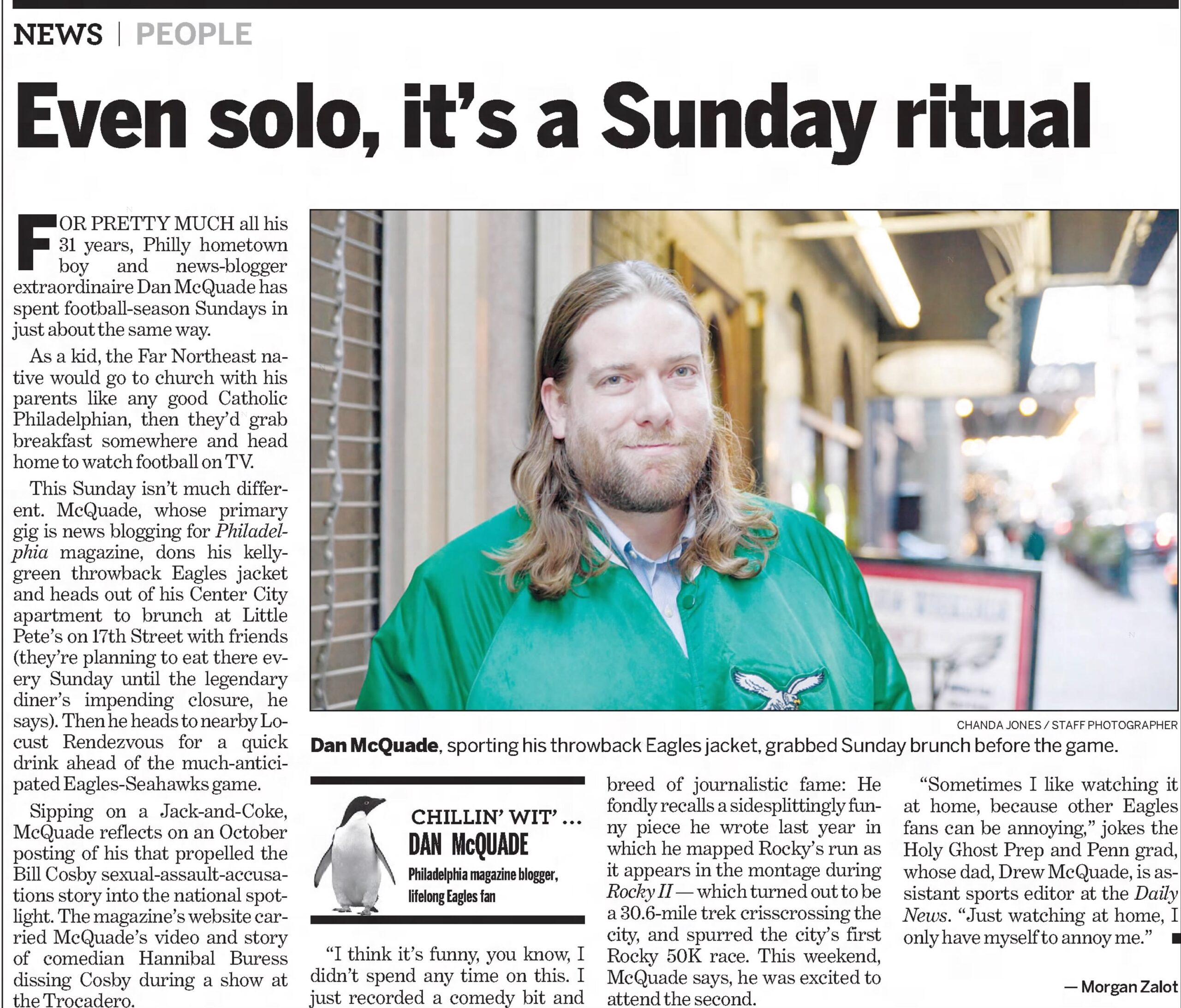
He had an idea. A mutual friend of theirs, Defector writer Dan McQuade, had recently died of neuroendocrine cancer at the age of 43. McQuade was a Simpsons superfan who embraced all of Philadelphia’s quirks, from tacky boardwalk T-shirts to the comically small La Salle smoke machine.
The Simpsons was about to air its 800th episode, set in Philadelphia. It included a litany of local references, many of them obscure to anyone outside the Delaware Valley.
McQuade had been planning to write about it. He hoped to get together to discuss the episode with Nangle and Selman while simultaneously watching and riffing on another Philadelphia-based show — Do No Harm, a medical drama McQuade described as “weird and bad.”
But that never happened. McQuade’s condition worsened. He died Jan. 28 at his parents’ home in Bensalem.
The Simpsons episode seemed tailor-made for McQuade. The producers hadn’t sent the final video to Fox studios yet. So, Selman made a proposal: Why not add a Dan McQuade Easter egg?
Nangle, a writer and producer on the show, couldn’t believe it. A few days earlier, she’d had the same thought, and almost texted it to her boss. But she assumed that it would be too late, because the episode was set to air on Feb. 15.
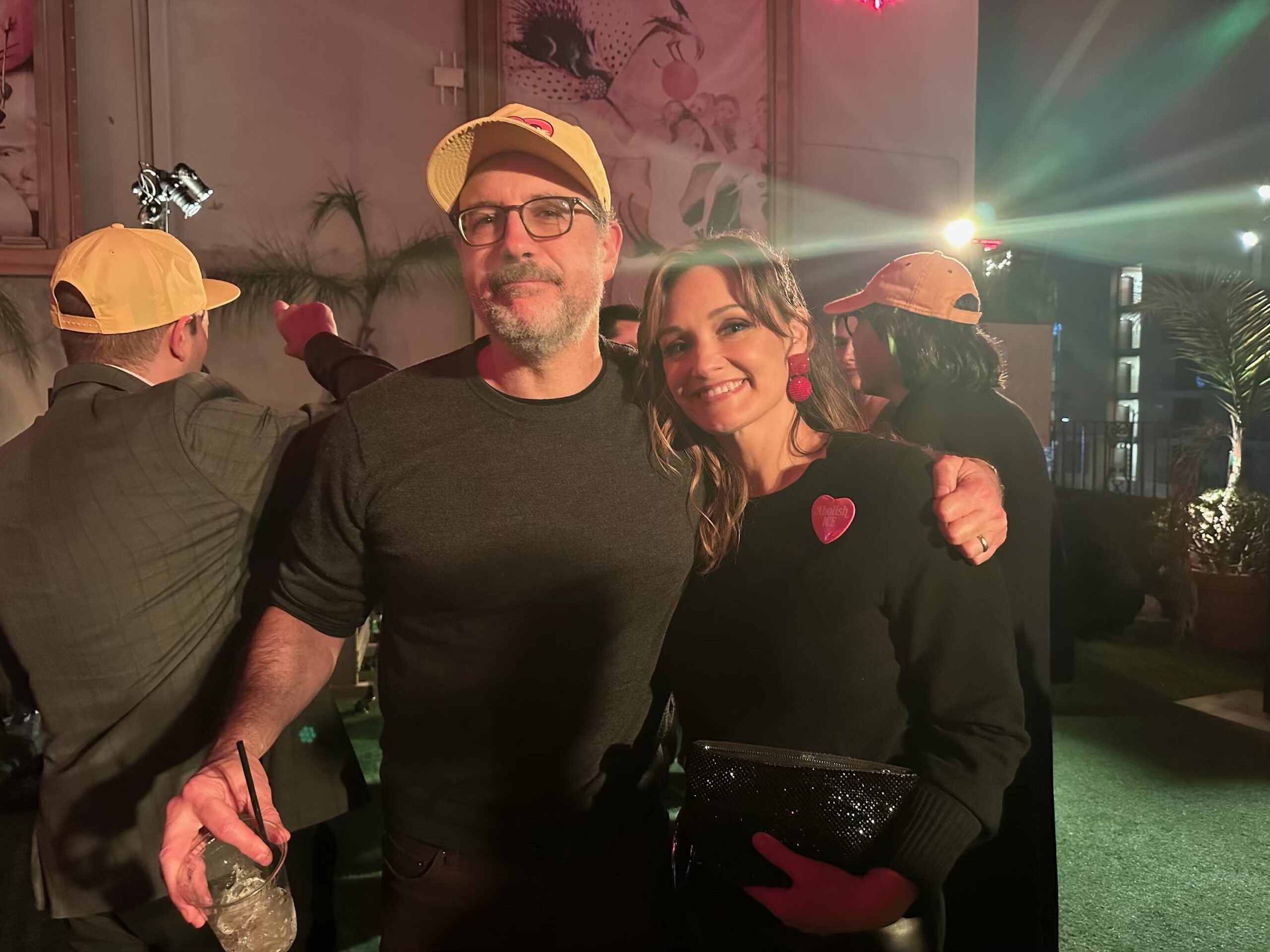
Matt Selman and Christine Nangle pictured at “The Simpsons” 800th episode party on Feb. 6.
The coworkers began to scour footage for any spot they could fit a Simpson-size, shaggy-bearded Philadelphian. Nangle considered putting him in the Mütter Museum, when Homer visited with a National Treasure-themed contingent.
But that was ruled out. So was the “Philadelphia Super Bowl Riot of 2018.” Selman worried viewers wouldn’t be able to recognize McQuade among the crowd of rabid fans.
“That was the Super Bowl when the Eagles beat my beloved Patriots, because of Bill Belichick’s inflexibility,” the executive producer said. “I thought about jamming him into that, but you wouldn’t have been able to see his cute little face. His little hairstyle.”
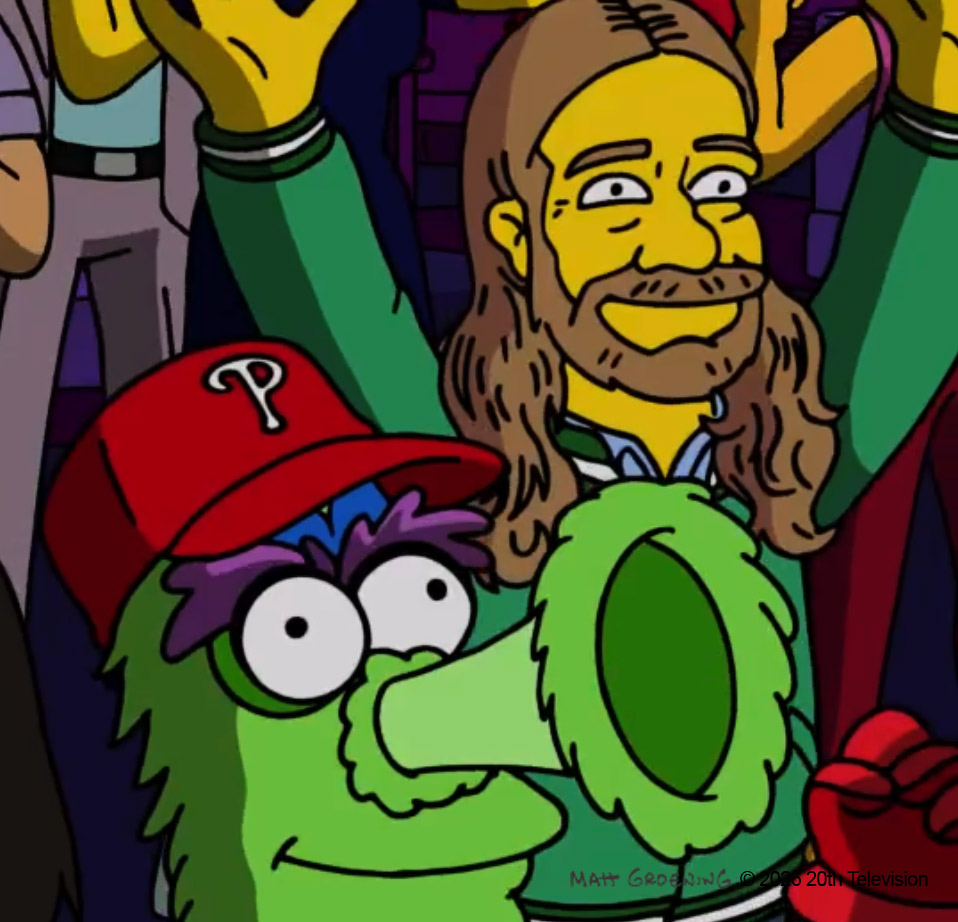
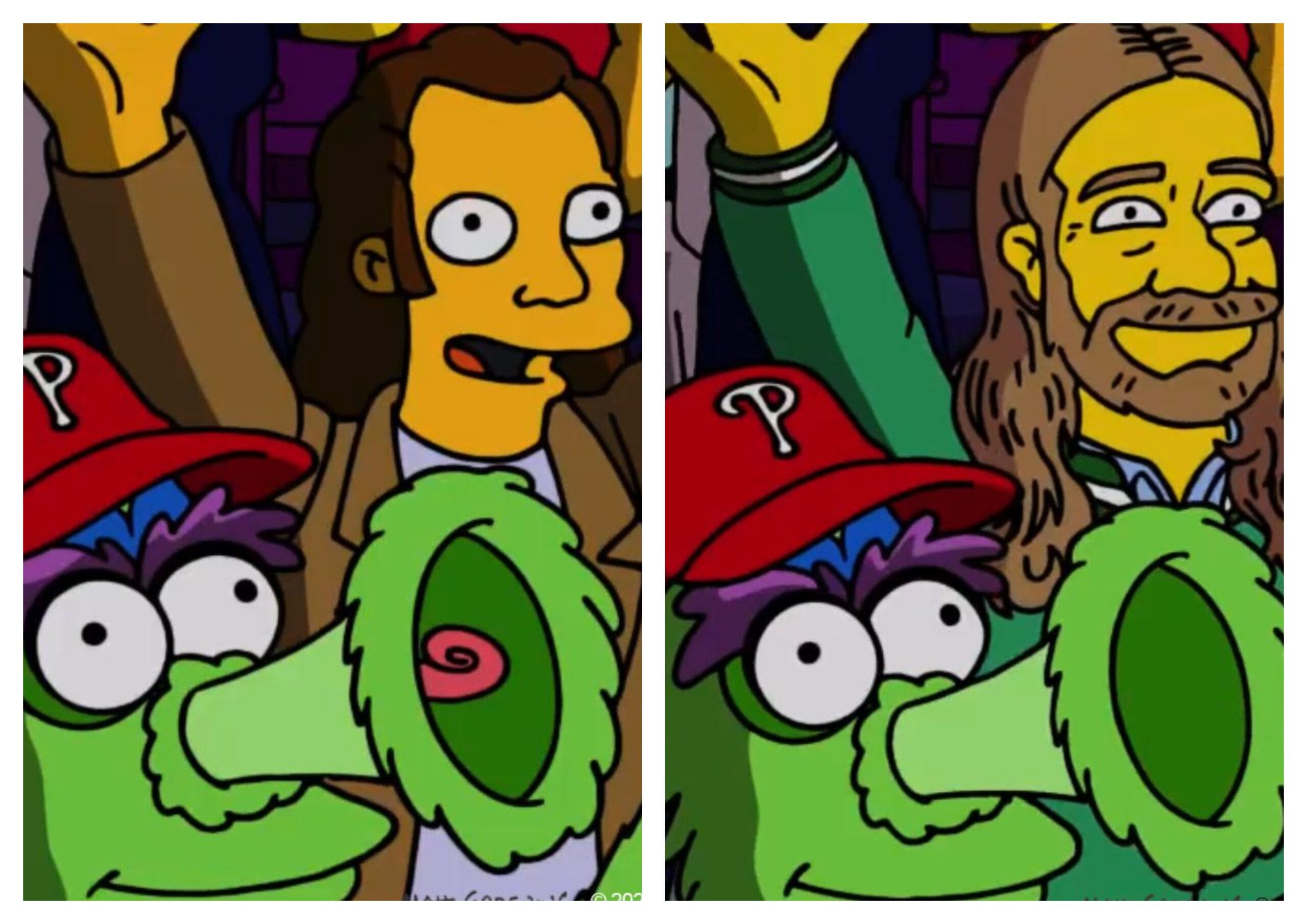
Instead, Selman found the perfect scene. About halfway through the episode, at the 10:49 mark, Homer goes to a Roots concert. The camera pans to the front row.
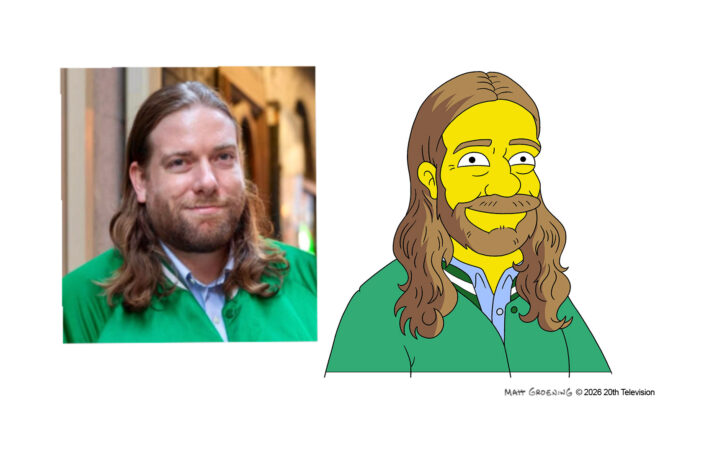
In the upper right-hand corner, wearing a kelly green satin jacket, with his long hair parted down the middle, is Dan McQuade.
“If it brought his family an ounce of relief, for one millisecond, then it was worth it,” Selman said.
Dan McQuade’s likeness was utilized in a scene depicting a concert by The Roots.
‘This is a good idea’
Selman had known McQuade for about five or six years. They were both alumni of the University of Pennsylvania, where they worked as editors at the Daily Pennsylvanian and 34th Street Magazine.
McQuade was 11 years younger, so they never met on campus. But Selman developed an appreciation for his work, and an online friendship blossomed.
Nangle, who grew up in Oxford Circle and attended Little Flower High School, met McQuade only once, when they were teenagers. But like Selman, she got to know him through his writing.
“He did this whole piece about the Franklin Mills Mall,” she said. “Just having somebody give voice to something that you thought was a mundane, dumb part of your life, and elevate it and make it seem like it matters, is really cool. You feel really seen.”
She added: “I barely remember meeting him in high school, but just reading his work, I was like, ‘It’s crazy that I’m not friends with this guy.’ And I was like, ‘Next time I’m in the city, we have to hang out.’”
Long after the producers moved to Los Angeles to work on the show, McQuade remained their portal to Philadelphia’s idiosyncrasies. In a way, Nangle looked to him as a kindred spirit.
They were both trying to bring a bit of the city’s character to a national audience. For Nangle, that meant slipping Delco accents and eccentric characters into her shows.
Selman would often go back and forth with McQuade about general Philadelphia weirdness. But they’d also talk about The Simpsons, of which McQuade was a lifelong fan.
A few times, the writer managed to combine his two passions.
“He’d text me photos of bootleg Bart Simpson T-shirts that he found,” Selman said. “And mail them to me. He would always send them to me.”
McQuade and Selman had been planning a story around The Simpsons’ 800th episode for months. In October, the writer flew out to Los Angeles, to discuss it more in person.
(Selman characterized this as more of a “fun-hang session.”)
They toured the Fox studio and went to the gift shop, where McQuade purchased Itchy and Scratchy toys for his son, Simon. They finished the day with lunch at Moe’s Cafe.
“There was a Philly cheesesteak on the menu,” Selman said. “And he was like, ‘I know this is going to be terrible, but I’m going to get it anyway.’
“He didn’t think it was that good. He was a champ about it, though.”
At the time, McQuade seemed to be in good health and good spirits. He’d told Selman about his cancer diagnosis but said that he “was doing OK.”
When the executive producer heard that his friend had died, he was shocked. Selman read McQuade’s obituary, and looked back on a video of Simon playing with the Itchy and Scratchy toys.
Then, the concept came to him.
Selman reached out to line producer Richard Chung. Chung’s job was to streamline episode production — and it was rare for The Simpsons to add a character, even a minor one, so last-minute. Selman wasn’t sure how Chung would react.
It would cost the company money and time. Not every line producer would have approved. But Chung did.
“This is a good idea,” he said.
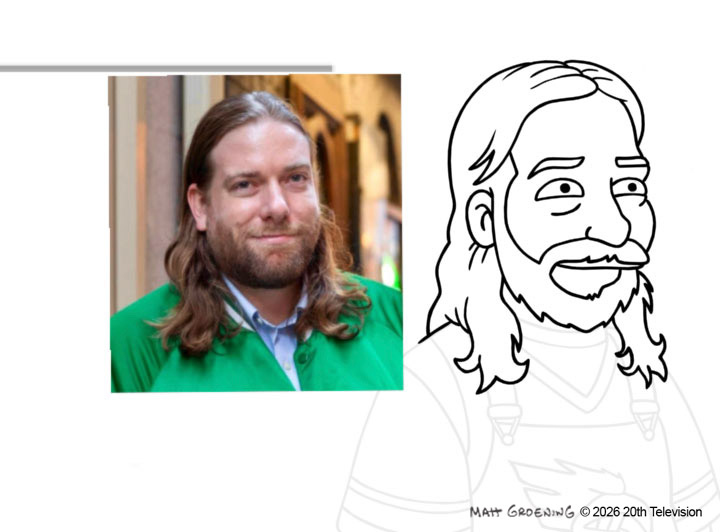
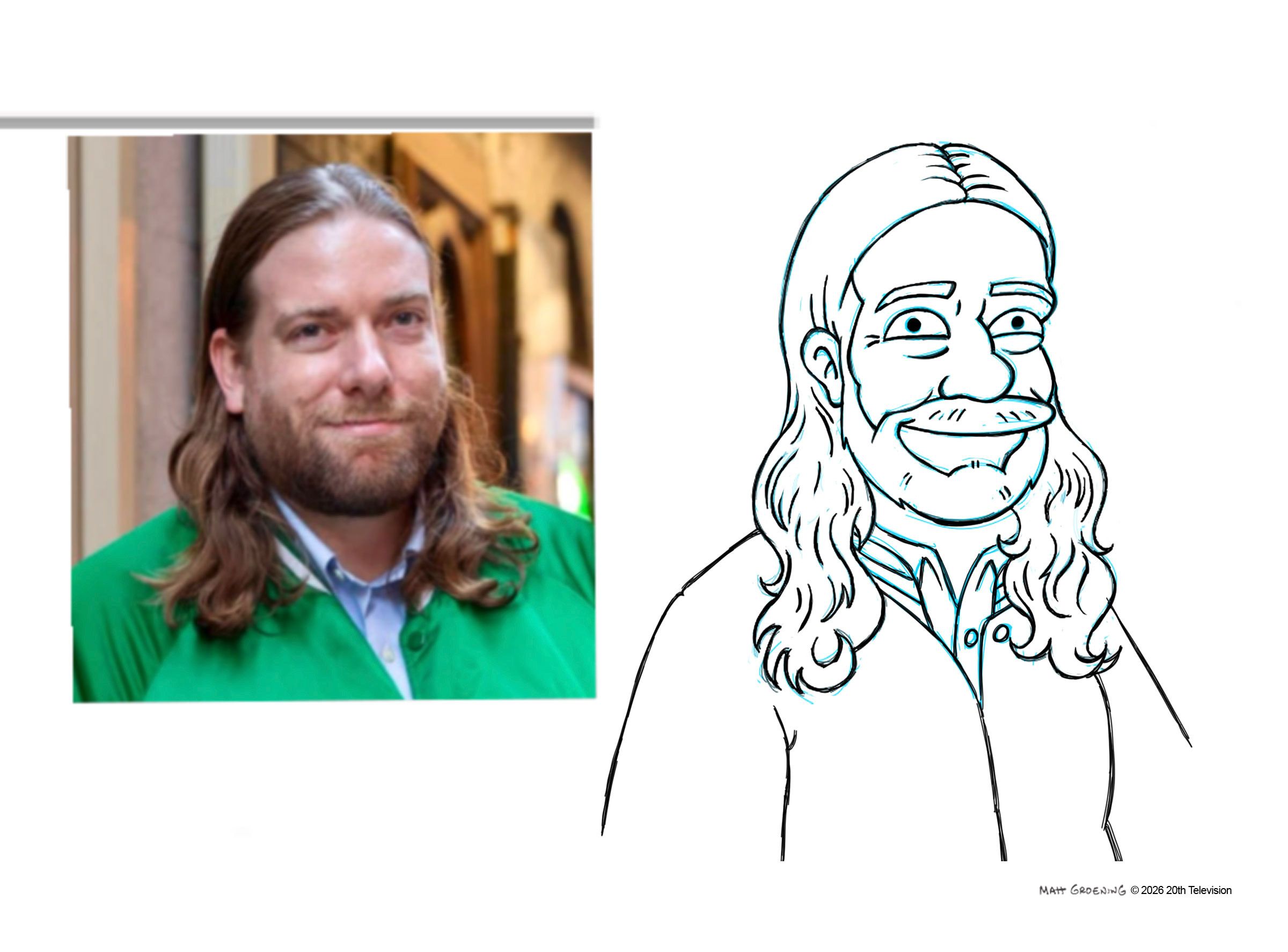
The likeness of late writer Dan McQuade used in a recent episode of “The Simpsons” went through several iterations.
Going ‘full Santa Claus’
The next day, Chung started working on adding McQuade to the episode. He reached out to a character designer, who drew out a sketch.
After it was done, Selman brought the concept to Drew Magary and David Roth at Defector. He asked what they recommended McQuade wear.
“They said, ‘Put him in the kelly green Eagles satin jacket,’” Selman recalled. “So, we were able to put that implied jacket on him.
“And then we just kind of looked for good pictures of his funny hair.”
Dan McQuade’s Defector colleagues Drew Magary and David Roth recommended that the illustrators capture McQuade in his kelly green Eagles jacket.
Selman and Nangle decided to replace a generic member of the crowd at The Roots concert with McQuade.
It was unclear to Selman, or Magary, or Roth, if McQuade liked or disliked The Roots. But it was the best spot to include him. McQuade would be positioned right behind the Phillie Phanatic (tweaked to avoid copyright infringement).
“I don’t know if [Dan] was or was not a Roots fan,” Selman said. “They didn’t seem to know. I think they would have known if he was a huge fan, but I hope he wasn’t an enemy.
“Plus, legal-version of Gritty and legal-version of Phanatic are both there. So, I assumed he liked them. They all went together.”
‘The Simpsons’ illustrators replaced a random fan at The Roots concert with a likeness of Dan McQuade.
Less than 48 hours after Selman and Nangle exchanged texts, McQuade was added to the show. He was included in the first-aired broadcast on Feb. 15, as well as the legacy version (on Disney+).
The late writer’s appearance lasted only nine seconds, but fans caught on.
Later that night, Nangle confirmed on Bluesky that it was indeed an homage to McQuade. Her post quickly went viral. She received all sorts of messages and mentions.
“I guess they didn’t want to put his Mass card from the funeral [there],” Nangle said. “So, they put that image instead, which took my breath away.”
It was a hectic process, but Selman and Nangle are grateful they could honor McQuade in their unique way. They hope this episode can provide some joy to his loved ones, when they’re missing their Simpsons-loving friend.
“Having this job gives you magic Santa Claus powers to bring joy to people,” Selman said. “And you can’t use your Santa Claus powers all the time, to bring joy to everybody.
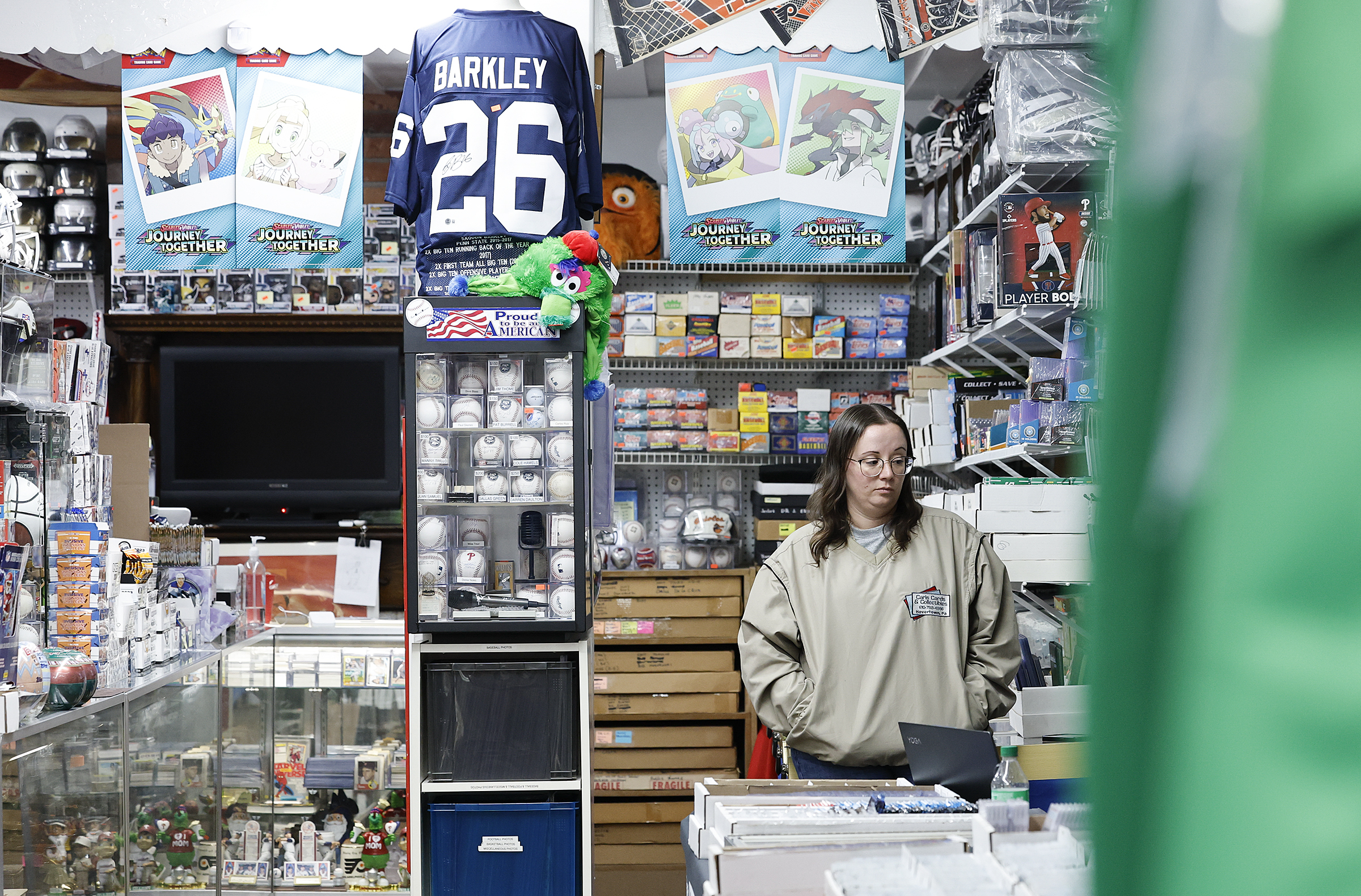
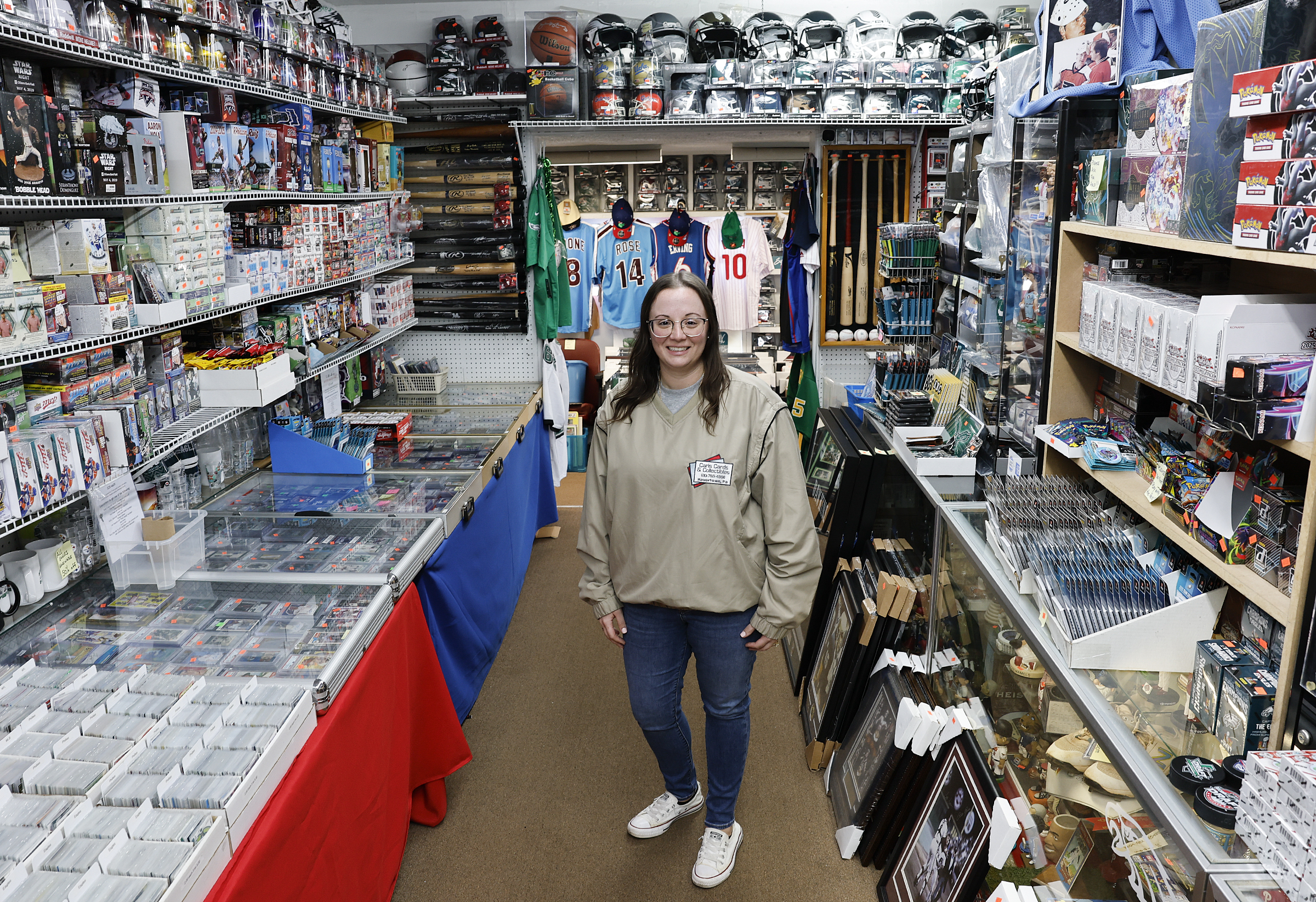
On the morning of Jan. 31, a few hours after Carl Henderson died unexpectedly in his sleep, his daughter, Lauren Henderson-Pignetti, drove to her late father’s sports cards and collectibles shop.
She opened it up like she would any other Saturday. Sometimes, kids stopped in with their parents on the back end of trips to the grocery store. Or while they were driving home from basketball practice or piano lessons.
Being there — just like her father had for 31 years — seemed like the right thing to do. So, the younger Henderson stayed at Carl’s Cards in Havertown from 11 a.m. to 7 p.m., until the last customer left.
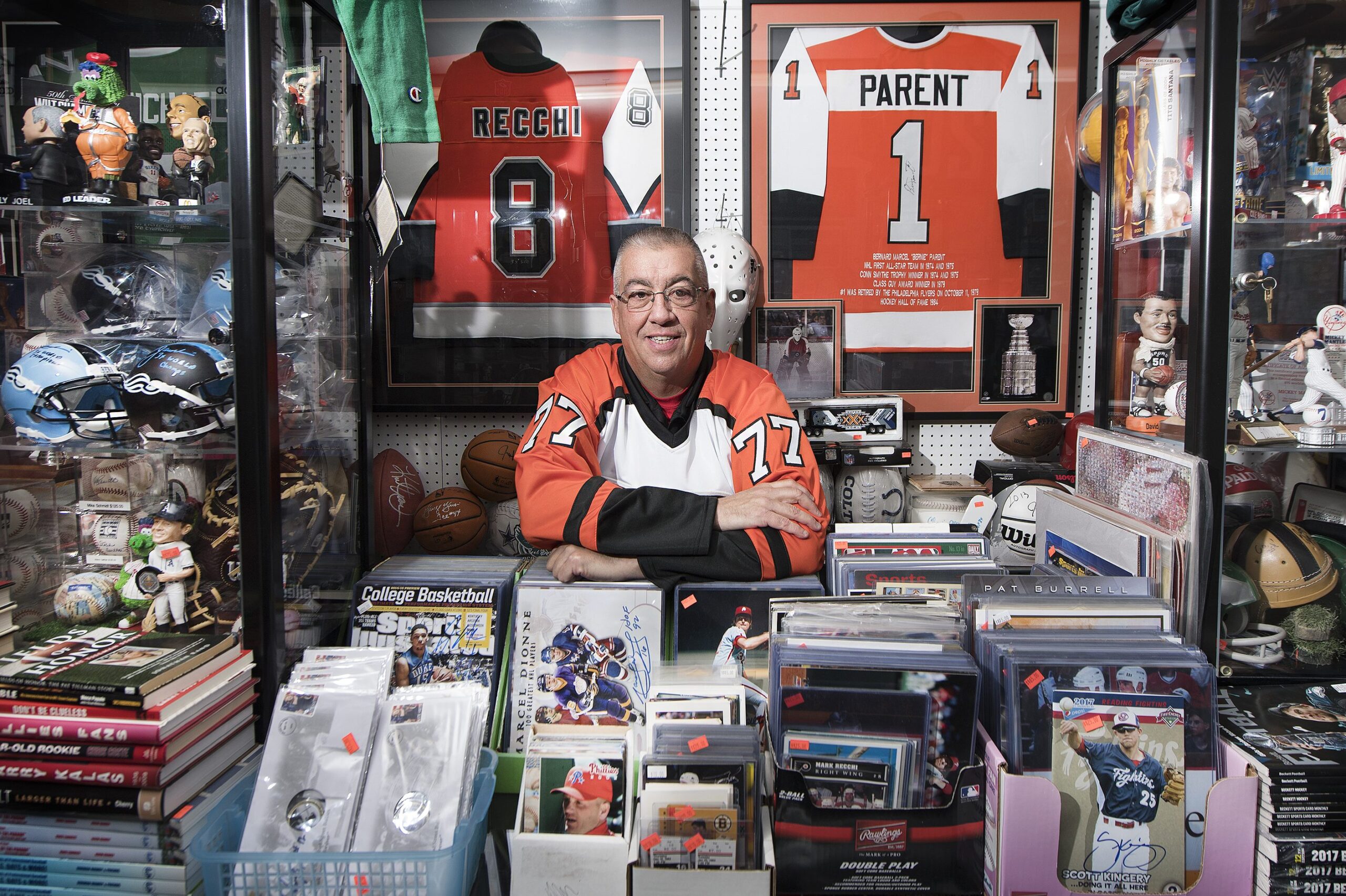
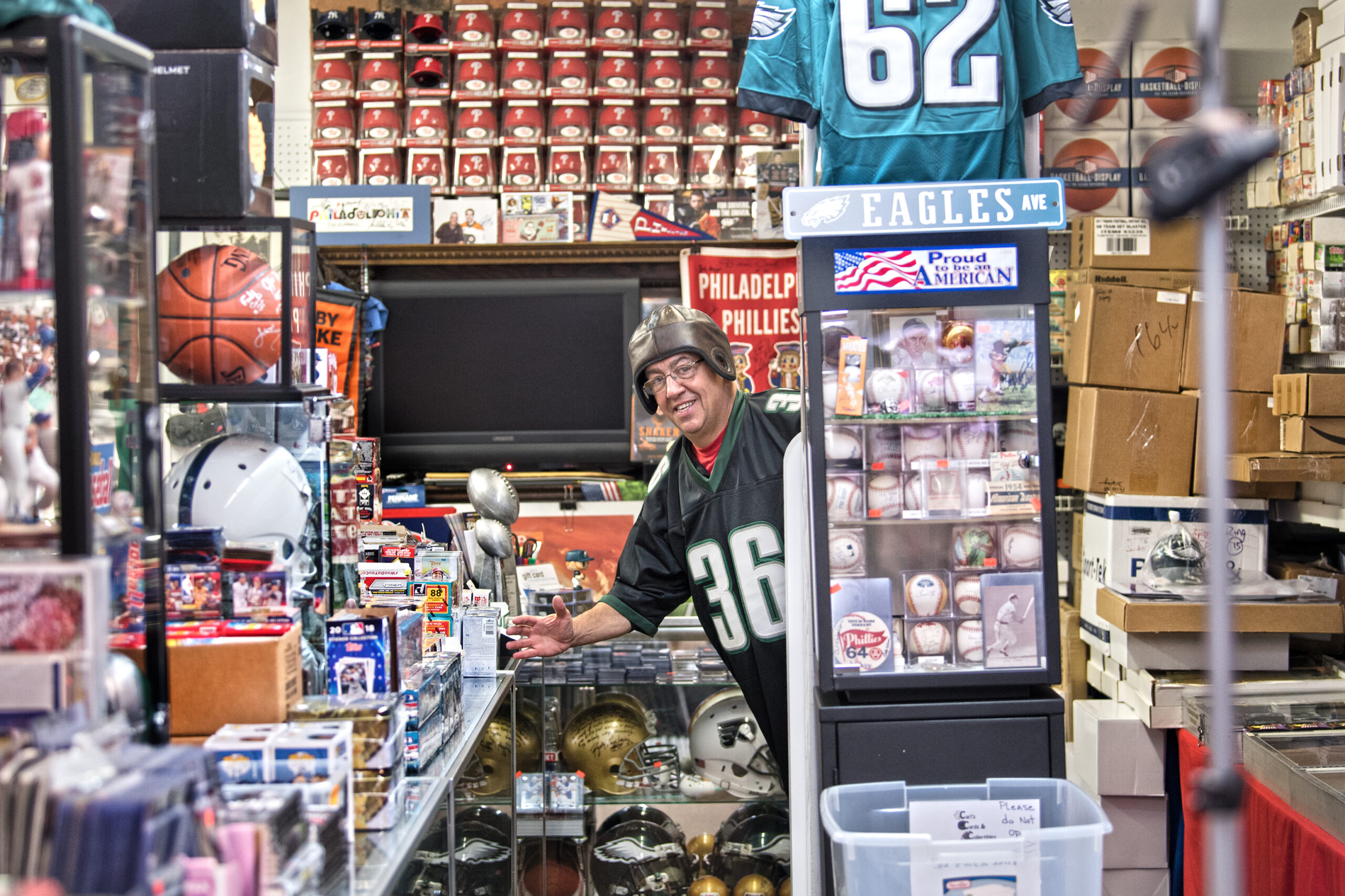
Carl Henderson at his Havertown store in 2018.
The shop owner was 69 when he passed. His family announced the news on Sunday, and received an overwhelming response; thousands of messages from children and adults and even a few local pro athletes.
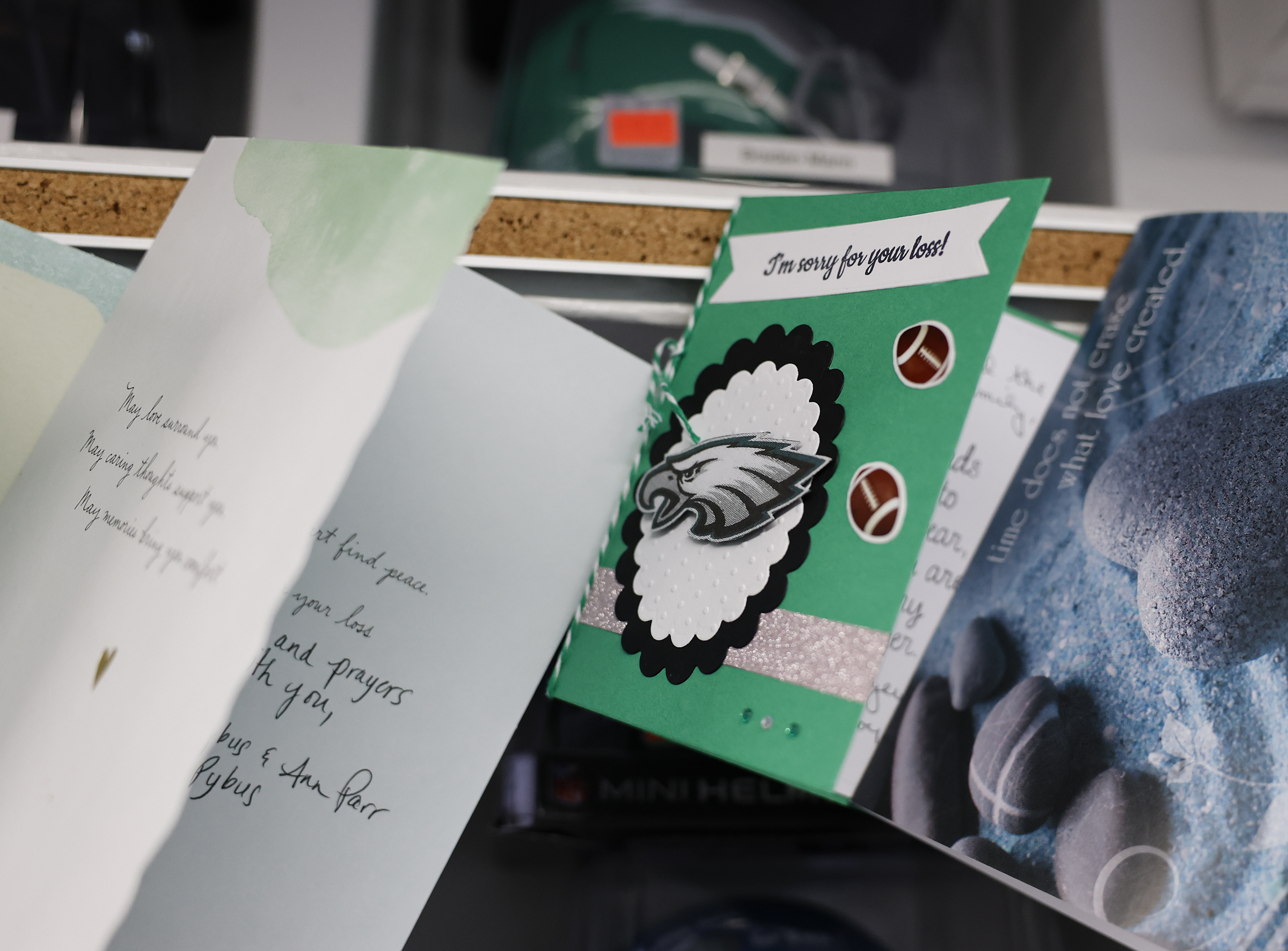
By Monday morning, bouquets of flowers were wedged between the doors. Customers started sending sympathy cards. Some showed up in person to express their support.
A memorial service held last week, in Bryn Mawr, drew about 400 people. Former Phillies pitcher Dickie Noles read a passage from the Old Testament. Members of the Broad Street Bullies sat among the crowd.
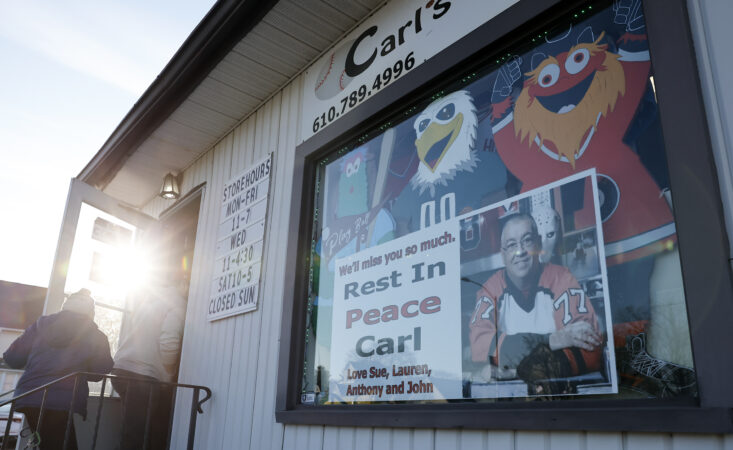
His shop looks a little different now. Those sympathy cards are pinned along the walls. A sign commemorating the longtime owner sits in its front window.
Condolences and tributes have poured into Carl’s Cards, including some from area sports figures.
But the character remains the same — and Henderson-Pignetti is determined to keep it that way. Carl’s Cards has something for everyone. Kids can fish through the dollar bin for unexpected treasures. Right above it, collectors can purchase a limited edition Bryce Harper-signed bat more than 1,000 times that price.
There are more run-of-the-mill items, like signed helmets and jerseys, but also packs of Pope Leo XIV trading cards, and a rectangular piece of wood cut from the old Spectrum court.
The sports memorabilia world can be transactional, if not cold, but Henderson navigated it with warmth and integrity. He frequently donated money and autographed items to charity.
He liked to say he knew his clientele — and they weren’t always big spenders.
The shop owner cared just as much about the 10- or 11-year-old student with only a few dollars in their pocket. Or those who had no money to spend at all, but just wanted to vent about Philadelphia sports.
“He didn’t care if you were buying something,” said Henderson-Pignetti. “It was almost like a version of a bar where you stop in and talk to a bartender.
“You can buy something, [but] you don’t have to. You can just stop in and talk. It wasn’t always about the dollar.”
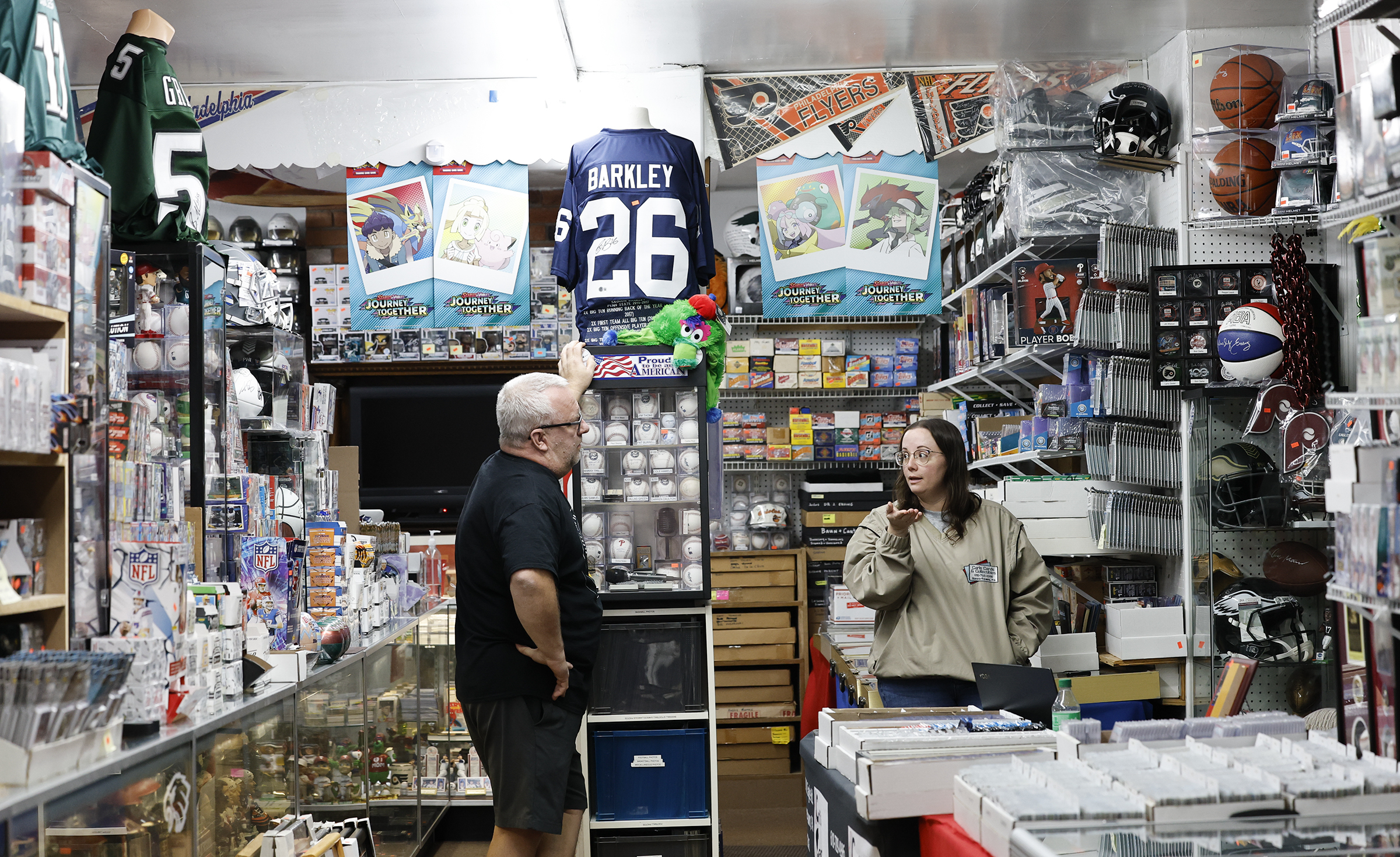
Lauren Henderson-Pignetti has taken on the responsibility of maintaining her father’s life’s work.
The store has been open since Henderson passed. For now, it’ll stay on its previous schedule.
Henderson-Pignetti sees this as a way of honoring her late father, who would’ve wanted Carl’s Cards to stay alive, no matter what.
“We made the decision to keep everything rolling the way he would have,” she said. “He spent 31 years building this place. He would have wanted everything to stay the way it was.”
A family atmosphere
When Henderson opened Carl’s Cards in 1995, his family thought he was out of his mind. He’d left a stable, corporate job working for Ryerson Steel, and had a wife and young daughter to support.
But Henderson loved collecting, and was ready for a change. So, he signed a three-year lease for a small property on Darby Road.
By 1998, he’d outgrown it, moving to a bigger location across the street from The Haverford Skatium. In 2010, he outgrew his budding collection yet again, moving Carl’s Cards to its current home on West Eagle Road.
These shops were where Henderson-Pignetti spent her childhood. She watched as her father welcomed world-class athletes for autograph signings, and put them at ease in a way bigger card shops couldn’t.
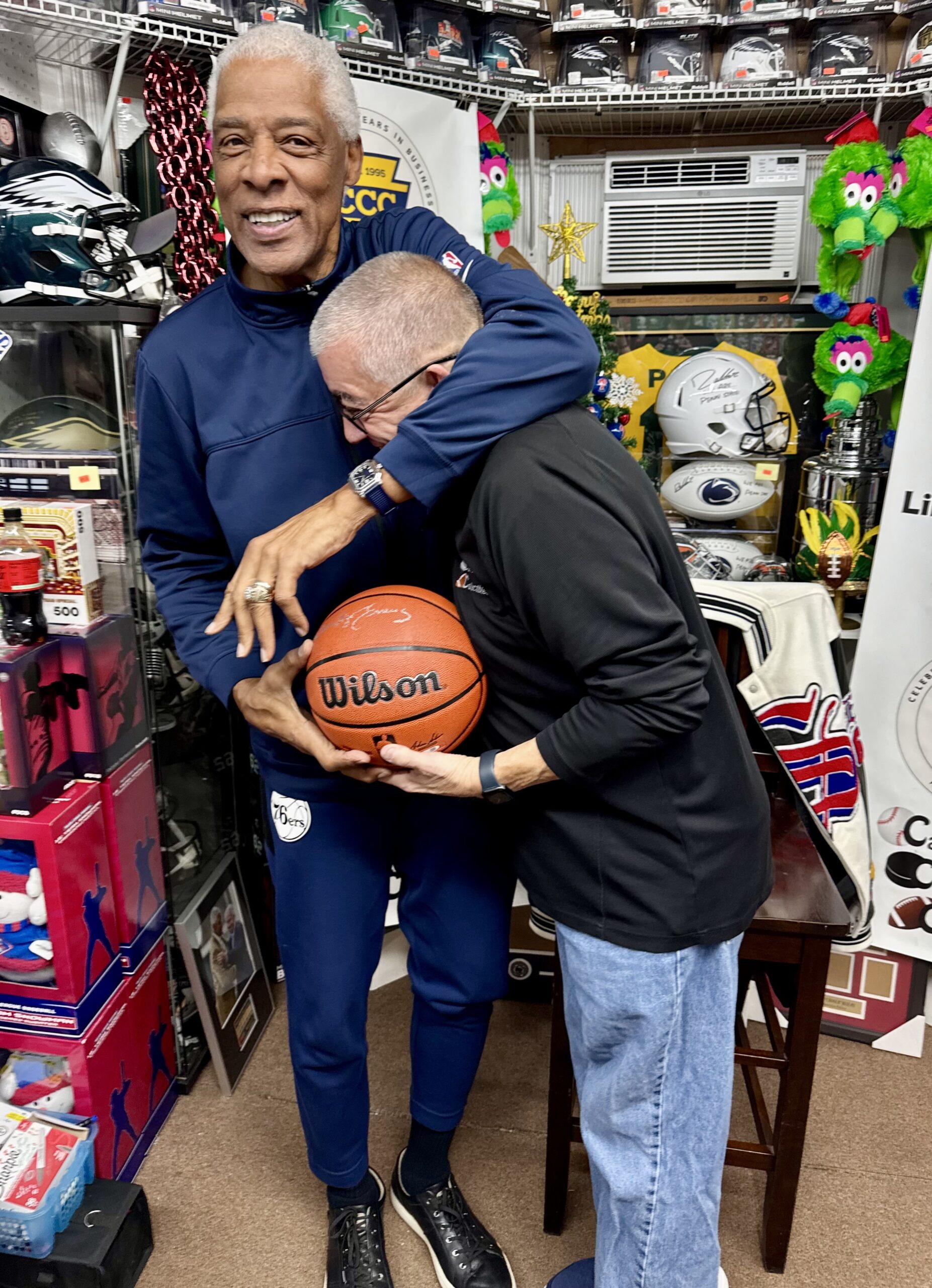
Julius Erving was among the local sports dignitaries who were made to felt comfortable by Carl Henderson (right).
There were no strangers at Carl’s Cards. He was always running the show, with his wife, Sue, selling tickets. As Lauren got older, she began to help out too, mainly with social media and website management.
“It’s not like one of those big card shows where you’re sort of forced in and forced back out again,” Henderson-Pignetti said. “It’s very much a family atmosphere. So, I think a lot of players really enjoyed that.”
Henderson’s theory was that when athletes were more relaxed, they were able to show their authentic selves. This proved true time and time again. Carl’s Cards hosted everyone from Allen Iverson to Jimmy Rollins to A.J. Brown.
Many of these athletes returned for more signings. Some, like Eagles offensive tackle Fred Johnson, even reached out after Henderson’s passing. Others, like Julius Erving, treated the store owner like an age-old friend.
An appearance by Erving had long been on Carl’s bucket list. Like many kids growing up in Philadelphia in the 1970s, Henderson idolized Dr. J. He owned Converse sneakers — just like the Sixers forward — and played varsity basketball at John Bartram High School.
Not much enthralled Henderson, but the idea of sharing a room with one of the best athletes of his generation did. They booked the signing for Dec. 21. After it was done, Erving hung around and talked to the store owner.
At one point, he heard some employees poking fun. He joined in.
“Dr. J was like, ‘Man, they even talk to the boss like that!’” Henderson-Pignetti recalled. “And my dad was like, ‘Do you hear that, guys? I’m the boss here.’
“It was just a really fun, sort of banter conversation. It was just nice.”
While autograph signings were part of the job, they were not the whole job. Henderson wanted his shop to be just as accessible for young kids.
Carl Henderson was a lifelong fan of the area’s sports teams, and that passion showed in his work.
In addition to the dollar bin, he made sure to stock the shelves with affordable card packs. He brought in a gumball machine and added $25 mystery memorabilia boxes.
But above all, he was an uplifting presence in their lives, in a way that Henderson-Pignetti wasn’t even aware. After her father died, she heard from all sorts of kids.
One of them, 12-year-old Owen Papson, crafted a handmade letter.
“I just heard the news,” he wrote. “I am so sorry. We will miss Carl so much. Your store will always be my favorite.”
Inside, he taped a signed Harold Carmichael Topps card with an inscription above: “Hopefully this will help.”
More stories came pouring in on Facebook. One, in particular, stuck with her. It was from a longtime customer who used to frequent Carl’s Cards in the early 2000s.
Lauren Henderson-Pignetti (right, with John O’ Brien) has been touched by the outpouring over her father’s death.
He explained that at the time, his parents were going through a divorce. Henderson was a stable presence when he needed one. He’d ride his bike to the store and was greeted with a smile every time.
“I had no idea,” said Henderson-Pignetti. “To think that something so simple as my dad just being in his place of business … for this kid [it] meant more to him than I think he probably even realized.”
‘A gift from God’
Last September, Henderson-Pignetti quit her role as director of development at the Humane Society in Reading. She loved working there, but was ready for something different, similar to her father when he left Ryerson Steel.
In the moment, her decision was based on a gut feeling, but now she can see the bigger picture. Last fall, Henderson-Pignetti started working full-time at Carl’s Cards.
On Thursdays, her father would give her run of the shop; how to properly open and close, how to track sales, how website orders are mailed out, and other intricacies of the job.
“It was a gift from God, basically, because it allowed me to just absorb even more information from him,” she said. “I kind of look back on that as a weird sort of intuition type of thing. If I hadn’t left my job, that wouldn’t have happened.”
Lauren Henderson Pignetti says her goal is to keep Carl’s Cards & Collectibles up and running after her father’s passing.
The goal, for now, is to keep the shop open. Some days are easier than others. Sue is sick and unable to work. Coworkers, and even customers, have helped pick up shifts when Henderson-Pignetti needs some space.
It can be emotionally exhausting at times. But she’s going to see it through.
“The plan is to not have anything change,” she said. “He would want me to step right into this role. I have no doubt about that. So that’s what I’m going to do, for as long as I possibly can.”
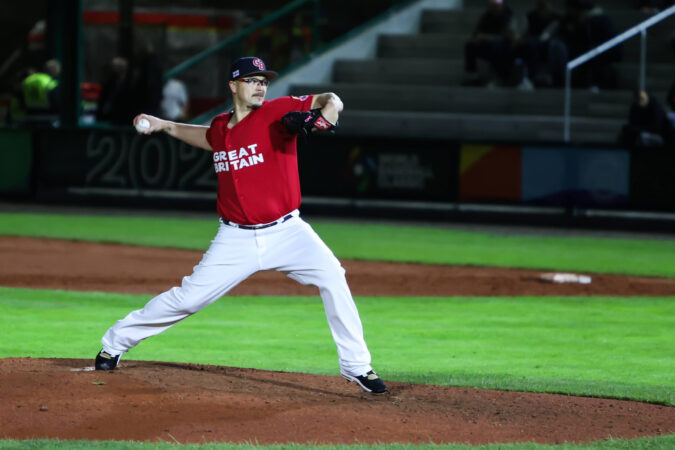
In December of 2021, Vance Worley received an unexpected email. He’d recently played parts of the minor league season with the Mets’ triple-A affiliate in Syracuse and heard from one of the organization’s scouts, Conor Brooks.
Brooks had ties to Britain’s national baseball team. The organization was interested in adding Worley to its roster ahead of the World Baseball Classic qualifier in Germany in September and told him that he was eligible to pitch.
As the former Phillie read the message, he started to laugh.
“I’m like, ‘How?’” he said. “‘Where is my lineage to Great Britain?’”
Worley had never been to England, Scotland, or Wales. Neither had anyone in his immediate family. But the team was able to find an unconventional loophole.
Worley’s mother, Shirley, was born in Hong Kong while it was under British rule. All Brooks needed was a birth certificate.
The right-handed pitcher called his parents. A few minutes later, he texted a screenshot of Shirley’s birth certificate to the scout.
By September, he was on a flight to Germany for a game against Spain. Great Britain won in a 10-9 walk-off, punching a ticket to the 2023 World Baseball Classic.
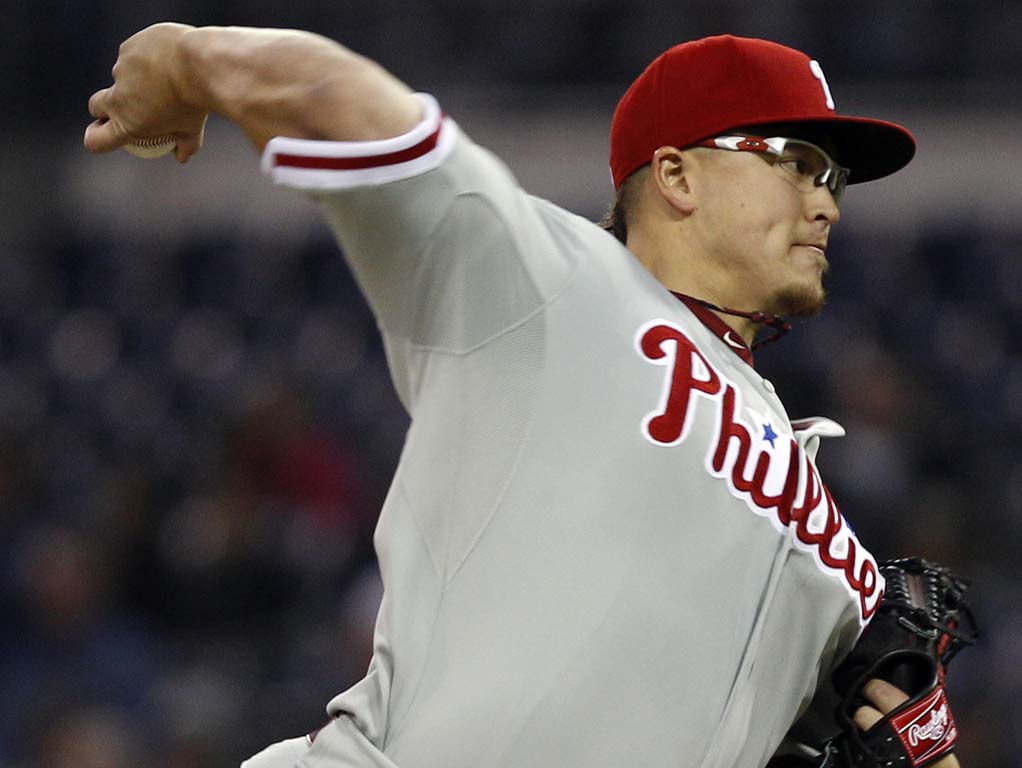
Vance Worley’s 3.3 WAR in 2011 was better than both Craig Kimbrel (2.5) and Freddie Freeman (1.5), two probable Hall of Famers who finished ahead of him in Rookie of the Year voting that season.
For Worley, the timing was perfect. The swingman made his big league debut with the Phillies in 2010. He earned a spot on the team’s roster in 2011, when he pitched to a 3.01 ERA across 131⅔ innings and finished third in National League Rookie of the Year voting behind Craig Kimbrel and Freddie Freeman.
But he bounced around after that. The Phillies traded him to the Twins in 2012. Minnesota placed him on waivers in March 2014, and outrighted him to triple A once he cleared.
At this point, Worley says he was in a dark place. He texted former Phillies teammate John Mayberry Jr. and said he was ready to quit. Mayberry quickly convinced him otherwise.
“You play until they rip that damn jersey off your back,” the outfielder told his friend.
Worley has been pitching ever since. He’s now 38, teaching baseball lessons out of a gym in South Jersey. He hasn’t thrown an MLB inning in nine years, but that doesn’t faze him.
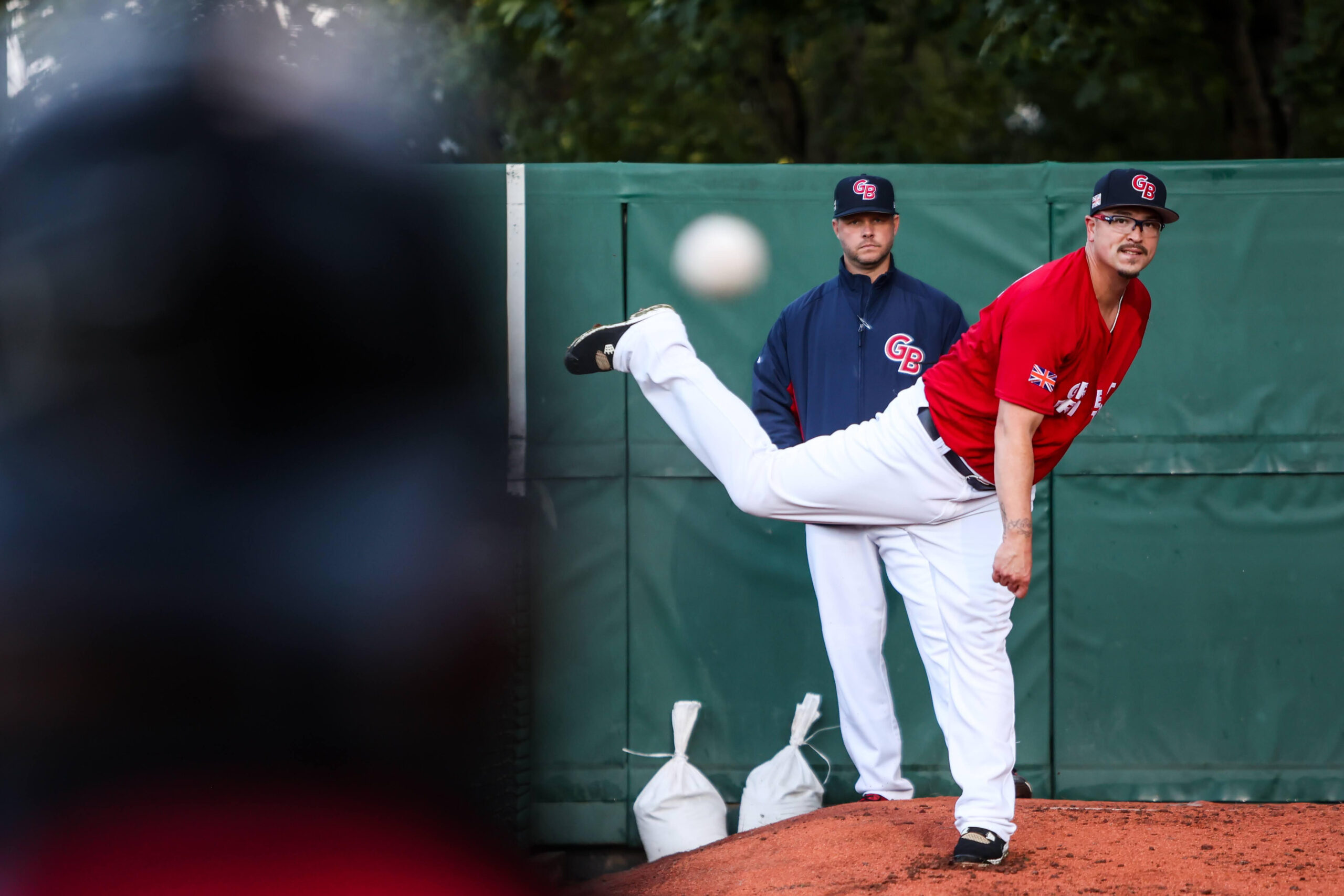
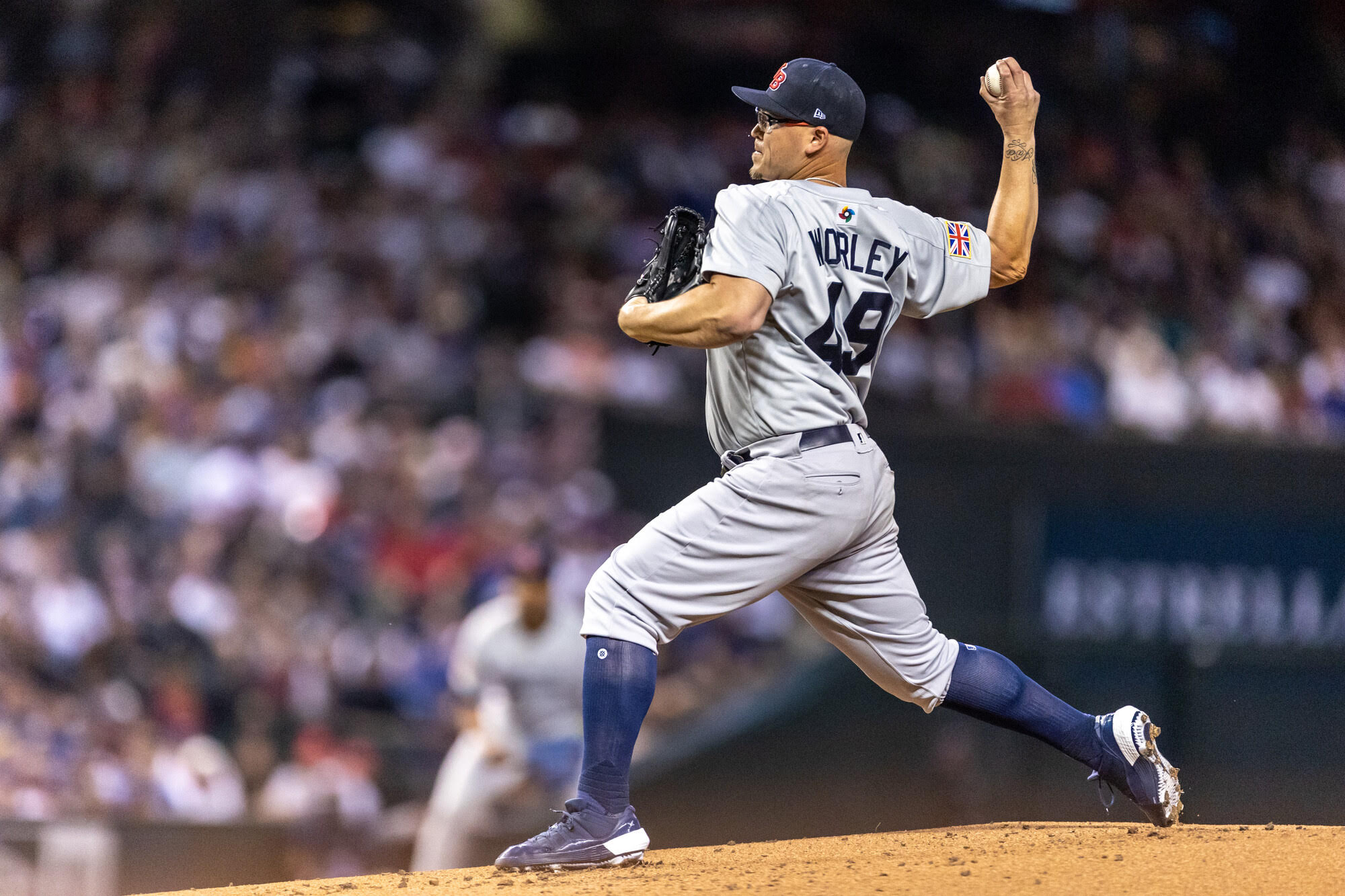
The right-handed pitcher loves the game and has found a home with Britain’s baseball federation. Since 2024, he’s worked on the side as a pitching coach for the under-23 national team. In March, he’ll suit up for the WBC in what his could be his last appearance on the mound.
“This program has given to me,” Worley said. “So I said, ‘I’m going to stick around. I’m going to help you guys out, and I’m going to coach with you guys. And as long as you let me play, I’m going to keep playing.’”
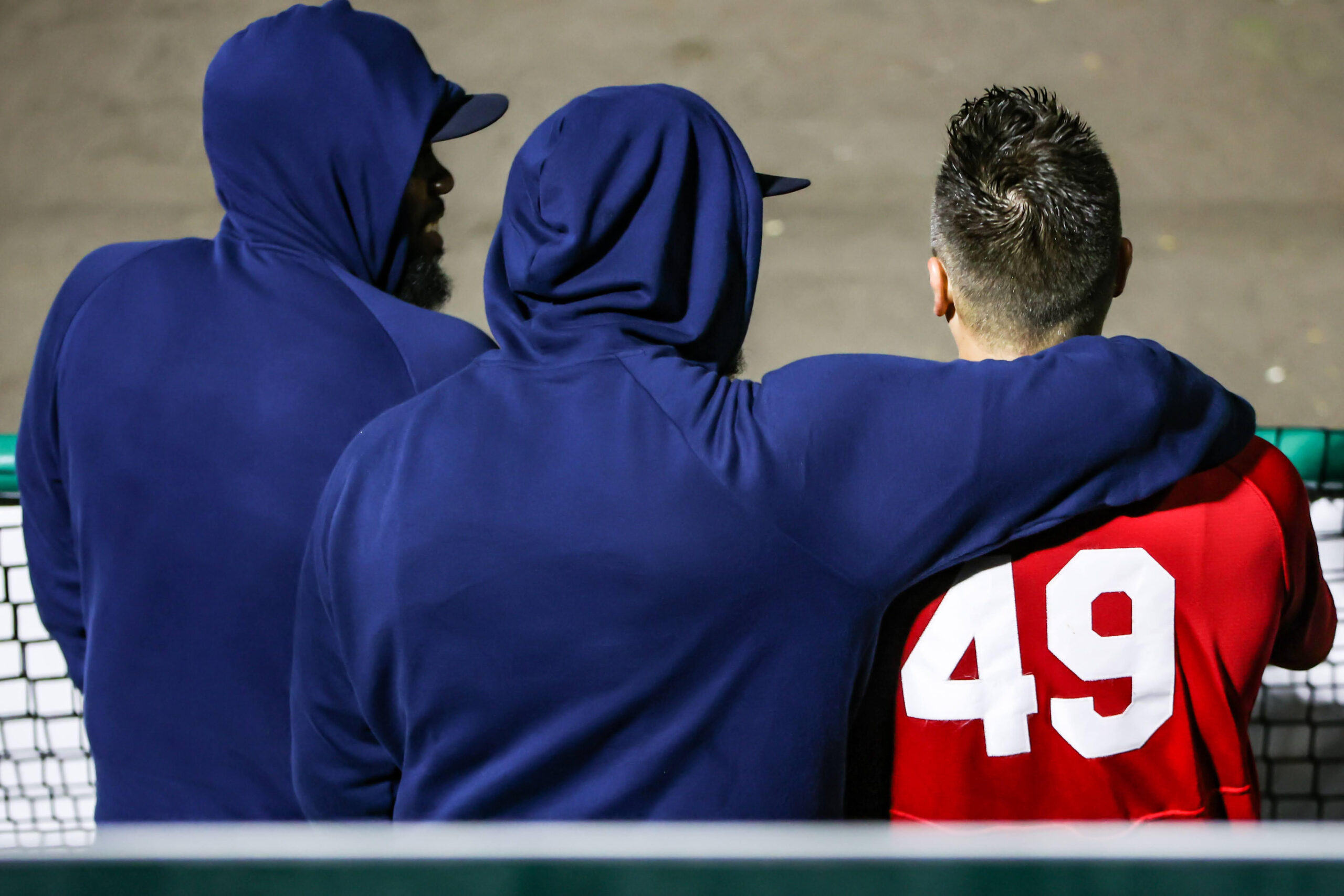
Vance Worley (49) has been embraced by Great Britain teammates young and old.
‘I’ve been called Grandpa’
Worley still remembers stepping into the visitors’ clubhouse at Busch Stadium in St. Louis on a hot July day. It was 2010, and he’d recently been called up by the Phillies.
The right-handed pitcher arrived early and watched as his new teammates filtered on and off the field. He was starstruck, especially when he saw Joe Blanton, a player Worley rooted for as an A’s fan growing up in Sacramento, Calif.
He decided to introduce himself.
“I was like, ‘Hey Joe, it’s nice to meet you,’” Worley recalled. “‘I remember watching you when I was in high school.’
“[Blanton] just goes, ‘God, I’m getting old.’”
Worley had a similar experience when he joined Great Britain in 2022. One of his new teammates was Nick Ward, a longtime minor league infielder who was born and raised in Kennett Square.
Ward was brought up on the Phillies teams of Jimmy Rollins, Chase Utley, and Ryan Howard. But he’d had a special affinity for “The Vanimal,” a pitcher who’d never thrown the hardest but was a fierce competitor.
Vance Worley’s performance for Great Britain in the 2026 World Baseball Classic could be his last hurrah on the mound.
Similar to how Worley was with Blanton, Ward was in awe. The righty looked the same as he did on TV, back when he was donning black-rimmed glasses and a Phiten necklace.
“It was like, ‘Holy crap. That’s Vance Worley,’” Ward said. “I had to pinch myself. It was just really cool that one of the guys that I loved to watch play was actually a super good dude.”
Just as it did with Blanton, this reaction made Worley feel a bit old. But he has embraced his role as the team’s elder statesman.
“I’ve been called Uncle,” Worley said. “I’ve been called Grandpa. And I’m just like, ‘Whatever man, your uncle and grandpa, think about them barbecues, out there playing Wiffle ball. I’d be punching you out right now. I see things you don’t know yet.’”
After he returned from Germany, Worley continued to throw. He used his day job, teaching baseball at Powerhouse Sports Arena in Sewell, Gloucester County, to help him stay in shape.
Once he arrived in Arizona for the WBC in 2023, he mentored the younger players around him. One was Harry Ford, Britain’s catcher, who was drafted by the Mariners in 2021 but has since been traded to the Nationals.
Worley asked his coaches if he could work with Ford one-on-one, and he started teaching the young backstop the minutiae: how to set up early, how to set up late, how to work quick.
Vance Worley
He showed him different pitch shapes, how they moved, and the strategy behind calling a game. The veteran pitcher served as a pseudo player-coach for the entire team, giving them words of encouragement on the field and off.
For Ward, this instruction made a big impact. Like Worley, he’d bounced around a lot in the lead-up to the 2023 WBC. But unlike Worley, he’d never played a big league inning.
Great Britain’s first game was scheduled on March 11 against Team USA, a roster stacked with prominent major leaguers. Worley was scheduled to start, which, years removed from MLB, was a daunting feat.
He threw 2⅔ innings, allowing three hits and no runs with three walks and a strikeout. While Worley was on the mound, Ward made a few big defensive plays at first base. The right-handed pitcher made his appreciation known, giving Ward a fist-bump or a point or a smile.
“It was just like, ‘Wow, if this guy that I used to really look up to is doing that … I’m good enough,’” Ward said. “And it wasn’t just me that he was doing this to. He was making all of us feel like we belong here.”
Worley exited the game early due to pain in his elbow. Great Britain lost, 6-2, and when he picked up his bag to get onto the bus, he felt the pain again. He would need bone chip surgery (the third of his career).
Worley thought this would be the last time he’d step on a mound. He was despondent that his time in baseball would come to such an unceremonious end.
Vance Worley’s passion for the game has not changed since his days with the Phillies, and has rubbed off on his young Great Britain teammates.
Before Great Britain’s game against Colombia on March 13, Ward noticed Worley standing alone on the top step of the dugout.
It was just before first pitch. The minor leaguer gave the big league veteran a hug.
“Thank you,” Ward told him. “I got to be your fan, first. Getting to share the field with you was one of the coolest moments that I could have ever dreamed about.”
A new chapter
Great Britain ended up defeating Colombia, 7-5, before falling to Mexico, 2-1, on March 14. Before they left Arizona, the players reminisced over what they’d done.
Worley reminded them that the British team wasn’t expected to be in the tournament in the first place. The players had come from all walks of life and had shown they deserved to be there.
“A lot of them were never in pro ball, or didn’t get an opportunity, or had an injury that shut them out,” Worley said. “And for them to be able to play in a big league stadium, playing big leaguers … I was like, ‘Hey, man, no matter what anybody says to you, you’re a big leaguer today.’”
The win over Colombia secured Great Britain’s berth for the 2026 tournament, which Ward and Worley will both be participating in.
Worley has gotten creative in his preparation. He’s integrated it into his day-to-day life, throwing in neighborhood sandlot games with his kids and also at the gym where he gives lessons.
He’ll report to camp in Arizona on Feb. 26. He has not officially retired and is unsure if this will be his last outing in a baseball game.
But the former Phillie is going to treat it that way, just in case.
“I’ve been through pretty much every situation as a player,” Worley said. “Trade, waive, claim, release, DFA. And I’m relentless. I’m not going to let something that should sidetrack me, or take me off the track, [prevent me from] being a baseball player, and what I enjoy.”
When Joe Pagliei moved to the Azalea senior living facility in September of 2023, word spread quickly. This was not just because he spent a season playing for the Eagles.
It was also because of his unabashed personality.
Pagliei would walk the halls of the Cinnaminson retirement home practicing his golf swing. If he lost a game of bingo, he’d throw the cards into the air and accuse his neighbors of “cheating.”
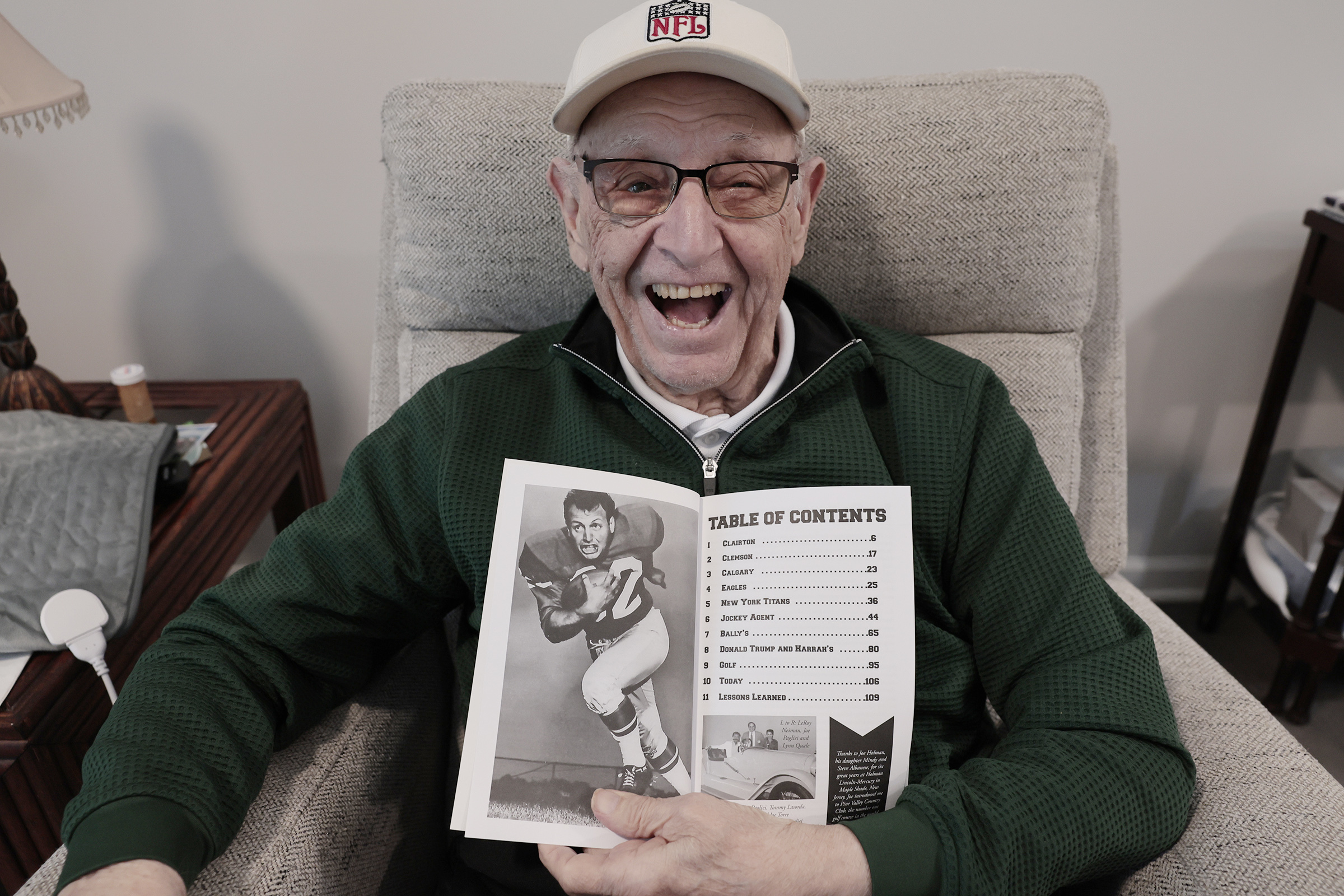
Every day, at 3 p.m., he’d sit at the bar, nursing a ginger ale, with copies of a book about his life stacked beside him. Before long, residents began to ask for some.
This wasn’t your average nonagenarian, after all. Pagliei spent parts of the 1950s and 1960s as a pro football player, first in Canada in the CFL, then in the NFL, and eventually, the AFL.
He played the 1959 season as a fullback and punter with the Eagles. Pagliei was the last cut in training camp before the 1960 season. The Eagles called him back, asking if he’d want to rejoin the team, but it was too late.
The fullback had already signed with the New York Titans, later to become the New York Jets. Pagliei ended up missing out on a championship.
“Big mistake,” joked his daughter Vicki.
It didn’t hamper Joe’s confidence. The former football player worked in auto sales and real estate for a few years, and became a jockey agent in 1970 out of Garden State Park Racetrack.
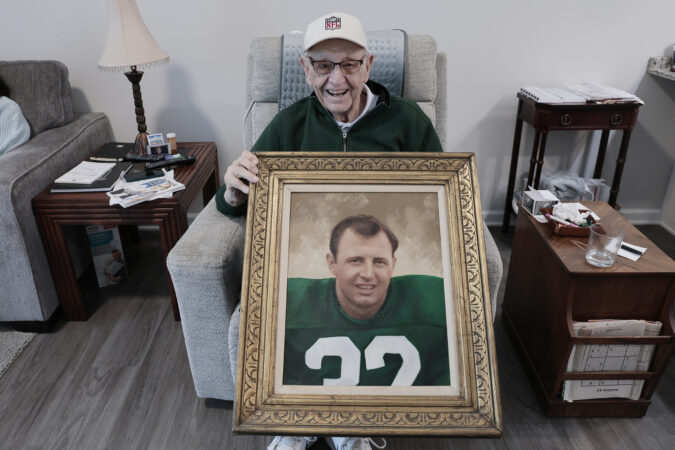
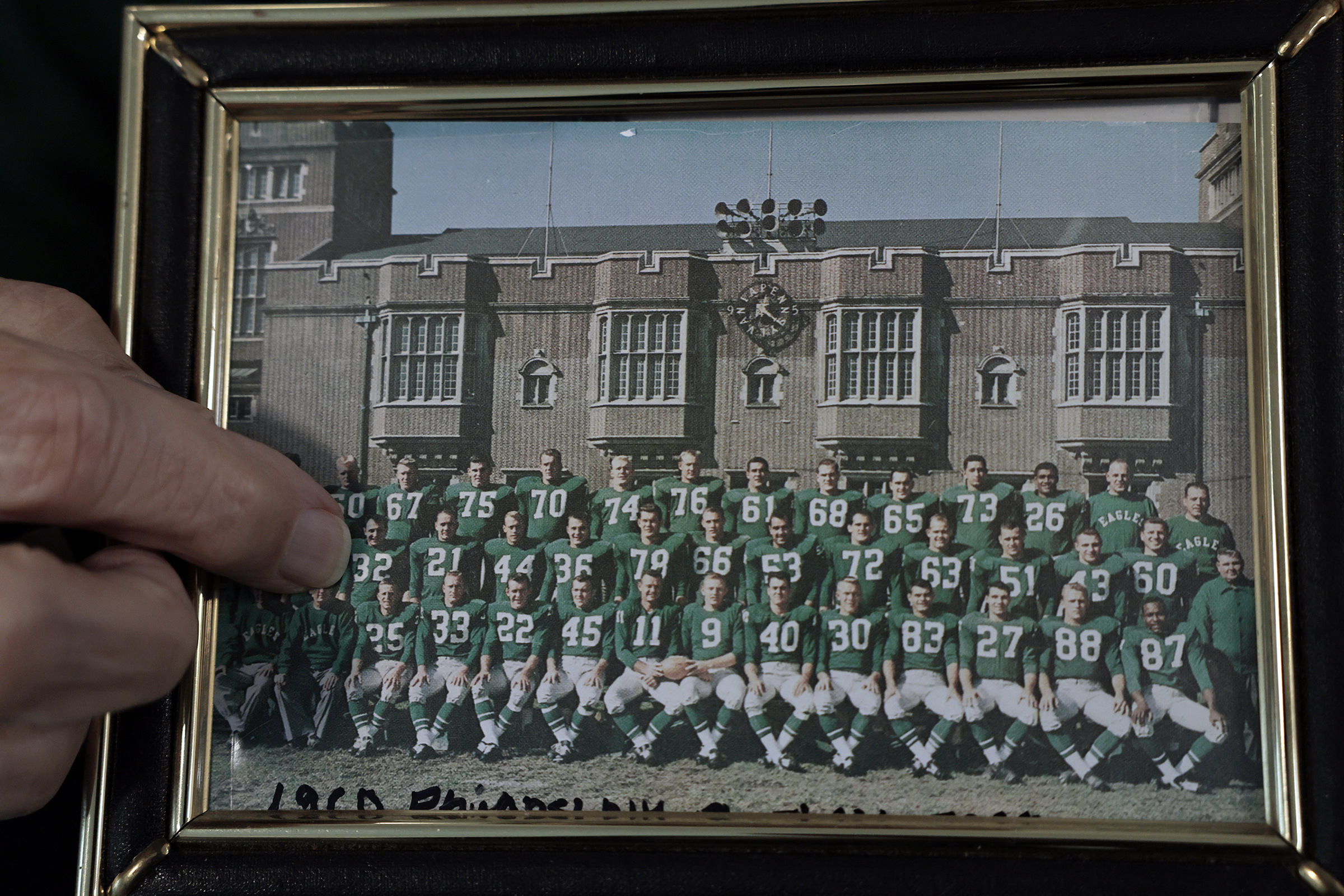
Joe Pagliei points to himself, wearing No. 32, in the 1960 Eagles team photo taken at Franklin Field.
When the track burned down in 1977, Pagliei headed to Atlantic City, where he became a casino host, crossing paths with everyone from Mickey Mantle to Joe Frazier to Sammy Davis Jr.
He moved to Mount Laurel with his wife of 62 years, Rita, and four children in 1991. He sold cars for a few years, retired in 2000, and moved to Azalea after Rita died in 2023.
At 91, Pagliei is believed to be the oldest living former Eagle. It is not a title he takes lightly. Last year, before the Super Bowl, his senior facility arranged for a visit from an Eagles-themed bus.
Dressed in his kelly green jersey, Pagliei signed one of the bus panels: “Joe Pagliei, #32.”
When he’s not lifting weights, or playing poker, he is watching Eagles games in his apartment, often with critiques of his own. Philadelphia will always be his favorite team, but he does have some misgivings about how he was used back in the day.
“I was awfully good to be sitting down,” the 91-year-old said. “Not enough [playing time].”
‘I’m going to make you famous, buddy’
Pagliei grew up in Clairton, Pa., a small town southeast of Pittsburgh, full of hard-nosed steel mill workers. His father, Alberto, emigrated from Italy and spent 48 years working as a janitor at the local plant.
The elder Pagliei, a pragmatic man who saved every dollar, didn’t see the benefit in his son joining the football team. He refused to let him play until the 11th grade.
Despite missing a few seasons, the younger Pagliei was not short on confidence. On the first day of practice, he walked straight up to his new coach.
“I said, ‘I’m going to make you famous, buddy,’” Pagliei recalled. “He said, ‘You’re full of [expletive].’ And I said, ‘Oh really?’
“I didn’t know the plays. I went out on a Wednesday. I ran two touchdowns. He said, ‘Wow.’ I said, ‘You just put my [butt] in there. Don’t worry about it.’”
Famous might have been an exaggeration, but Pagliei did catch the attention of some big-name schools. According to his 2017 self-published book, The Roast Master, he received more than 100 recruitment letters.
The fullback chose Clemson University in South Carolina. His arrival on campus in 1952 marked the first time he’d ever traveled outside of Western Pennsylvania. He played both football and baseball, and separated himself on the gridiron.
Joe Pagliei came to football later than most, but he made up for lost time as a dual-position standout.
In 1954, he led the Atlantic Coast Conference in punting, averaging 37.8 yards on 26 kicks. In 1955, his senior year, he topped the conference again, averaging 39.1 yards on his punts. He also made a dual-threat impact for the Tigers on offense, rushing for 476 yards and catching 10 passes for 233 yards.
Clemson’s 1955 team program referred to the fullback as a “flashy performer,” a characterization that seemed apt, though perhaps insufficient in retrospect.
“I did a number on ’em when I went to Clemson,” Pagliei said. “I just ran everybody the hell out. They had me as number five. I said, ‘I’m number uno.’ They said, ‘You’re five.’ I became the best one.”
After going undrafted in 1956, Pagliei received free-agent invitations from the Green Bay Packers and Washington, but said neither came “with any form of guarantee.”
He ended up getting a better contract outside the NFL, with the Calgary Stampeders of the CFL, where he played the 1956 season. Pagliei was drafted into the U.S. Army in 1957.
He joined the football team on the base while serving at Fort Knox in Kentucky, and the Eagles offered him a contract for the 1958 season. Because of his military commitment, he was unable to suit up until May 1959, when he was discharged from the Army.
The Eagles had a deep backfield, and as Pagliei noted, he didn’t get much playing time (only two carries for minus-5 yards and two catches for 9 yards). He didn’t get much time as a punter, either, because he was the backup for Hall of Fame quarterback Norm Van Brocklin.
But Pagliei did emerge with one stat to be proud of. According to The Roast Master, on Dec. 6, 1959, in the middle of a rainy game against Washington, Van Brocklin suggested that Pagliei take the kick.
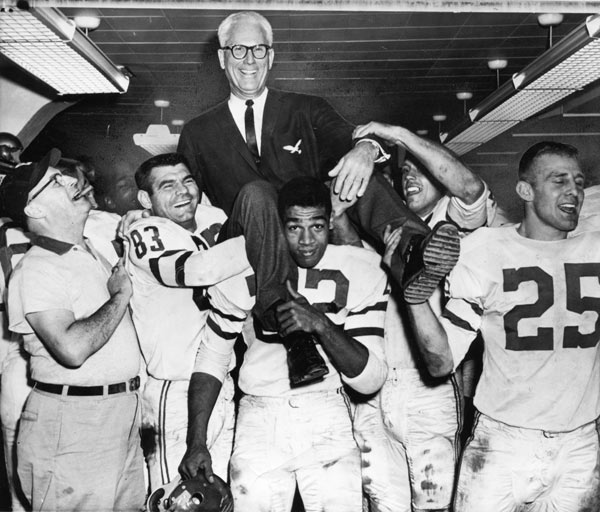
Joe Pagliei was not officially a part of Buck Shaw’s 1960 title team, but he was considered an honorary part of it by his former Eagles teammates.
He did, for 45 yards. It was the NFL rookie’s only punt of the 1959 season, giving him a yearly average of 45 yards (for his one attempt) while Van Brocklin had only 40.8 (for his 53).
“I always rubbed that in with Van Brocklin,” Pagliei wrote. “And he’d say to me, ‘You son of a [expletive]. One punt and you lead the team.’”
Pagliei again faced stiff competition in training camp the following year. He was cut on the day the Eagles took their team photo, Sept. 19, 1960, thereby capturing his final moment on the future championship-winning squad.
After he signed with the Titans of the AFL, the Eagles contacted Pagliei again. Fullback Theron Sapp had broken his leg in a preseason game and would be out longer than the team had expected.
They asked Pagliei if he’d like to return to Philadelphia, but he’d already signed his Titans contract. While missing out on history was bittersweet, the 91-year-old always felt like he was a part of the 1960 Eagles group.
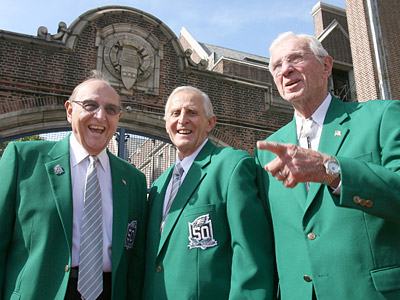
Joe Pagliei (left) with Tommy McDonald (center) and Chuck Bednarik at an event honoring the 1960 team.
It included some of his closest friends. Defensive tackle Jesse Richardson was the best man at Pagliei’s wedding. Wide receiver Tommy McDonald was like a family member. McDonald’s wife, Patty, was the godmother to Pagliei’s daughter Lizanne and the confirmation sponsor for Vicki.
Pagliei left professional football in 1961 but continued to stay a part of that fraternity. His kids would play with McDonald’s kids, and linebacker Bob Pellegrini’s kids. The team always invited Pagliei to reunions and celebrations of the 1960 championship.
In 2018, after the Eagles won their first Super Bowl, former players and their families were invited to the NovaCare Complex to see the Lombardi Trophy up close.
McDonald had been diagnosed with dementia. He attended the event in a wheelchair, donning his gold Hall of Fame jacket. The former receiver’s recall was shaky, but when he saw Pagliei, his face lit up.
“He knew who my dad was,” Vicki said. “He didn’t know too many people, but he knew who my dad was. He used to call him his brother.”
The mayor of Azalea, senior living
The staffers at Azalea of Cinnaminson say that Pagliei is something akin to a mayor. He knows everyone in the building. He also knows everythinggoing on in the building, for better or for worse.
The 91-year-old goes to the gym once a day, where he rides a bike, and does “40 reps of each weight.” On Tuesday and Thursday nights, he plays poker, a game that he might take more seriously than any other.
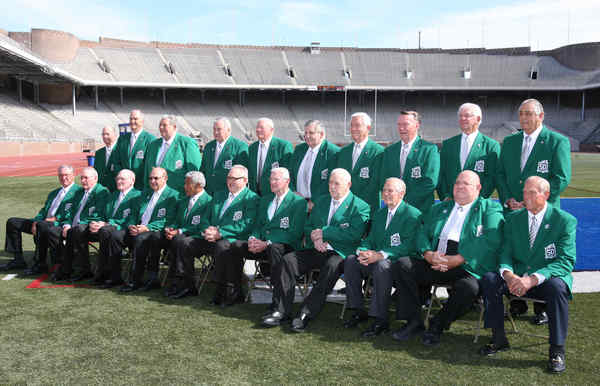
Members of the 1960 Eagles NFL championship team pose for a team photo at Franklin Field, the site of their 17-13 win over Green Bay in the title game.
“I make a lot of money,” Pagliei said, pointing to a stack of bills totaling $21 on a nearby counter. “Big time. Big time.”
The former Eagle is 66 years removed from his last NFL season, but he has not lost his competitive spark. The Azalea staff learned this the hard way.
Gracie Pouliot, a guest services manager, has had to intervene in a few contentious games of bingo.
“He’s not a very good loser,” she said. “Everyone is cheating if he loses. He’s like, ‘This is [expletive]! They cheated!’
“And we’re like, ‘No!’ He’ll throw the cards. He just cracks us up. He’s so funny.”
Linda Bryant, a life enrichment assistant, said that Pagliei used to make fun of how she’d play pool.
“He was joking around,” she said. “‘You guys don’t know how to do it.’”
Bryant and Pouliot wouldn’t have it any other way. Pagliei might not be able to punt the ball, or run the length of a field, but he still has the spirit of a teenager.