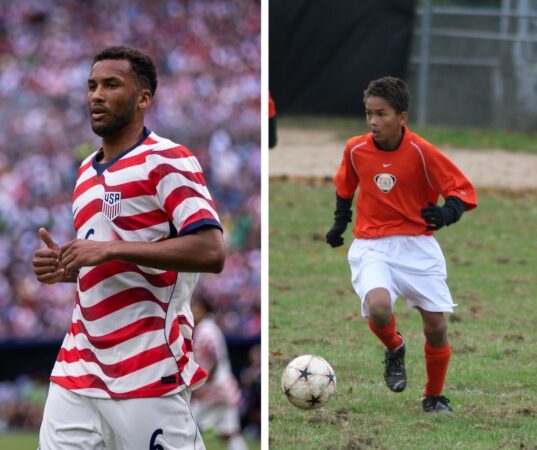
Auston Trusty plays centerback for the U.S. men’s national team, a position that doesn’t lend itself to scoring. But when he fired a goal against Turkey in the group stage finale of the World Cup, William Hall wasn’t surprised.
The University of Richmond junior was well-acquainted with Trusty’s shot. He’d seen it dozens, if not hundreds, of times, standing in the net at Chester Park in Wallingford, Pa.
It was the spring of2020. Hall was 14 years old, an incoming freshman at Strath Haven High School, and Trusty was 21, a starting defender on the Colorado Rapids. COVID-19 had, pushed back the MLS season, and Trusty was at home in his native Media, Pa.
He still needed to train, but there were few options available. So, the professional athlete decided to return to where it all began: Chester Park, home of youth soccer club Nether United, now 1776 United FC.
Trusty had played under coach John Waraksa for six seasons, two years above his age group, before going to the Philadelphia Union Academy in 2013. Hall was on Nether United’s U-15 team when the pandemic hit.
The teenager would often train with his teammates at Chester Park, and one day in late April or early May, Trusty showed up. They ran through warm-ups, then L-shape passing drills, then finishing drills, then shooting drills.
Hall was the only goaltender present, which put him in the unenviable spot of having to defend against a world-class athlete. It didn’t go well for the teenager.
Unlike players Hall’s his age, Trusty moved with a quicker pace and a harder strike. The ball would curl into the corner rather than launching straight ahead.
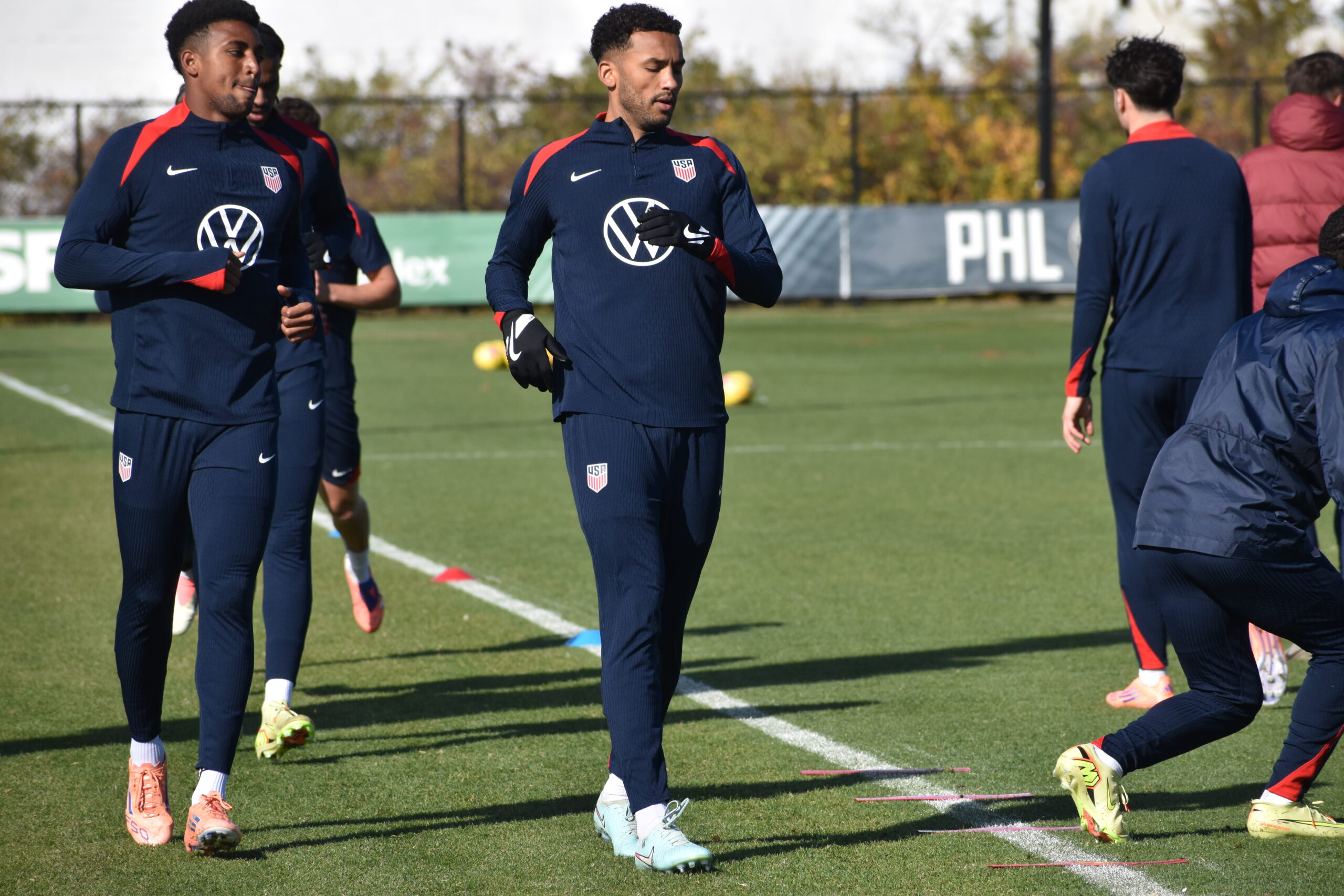
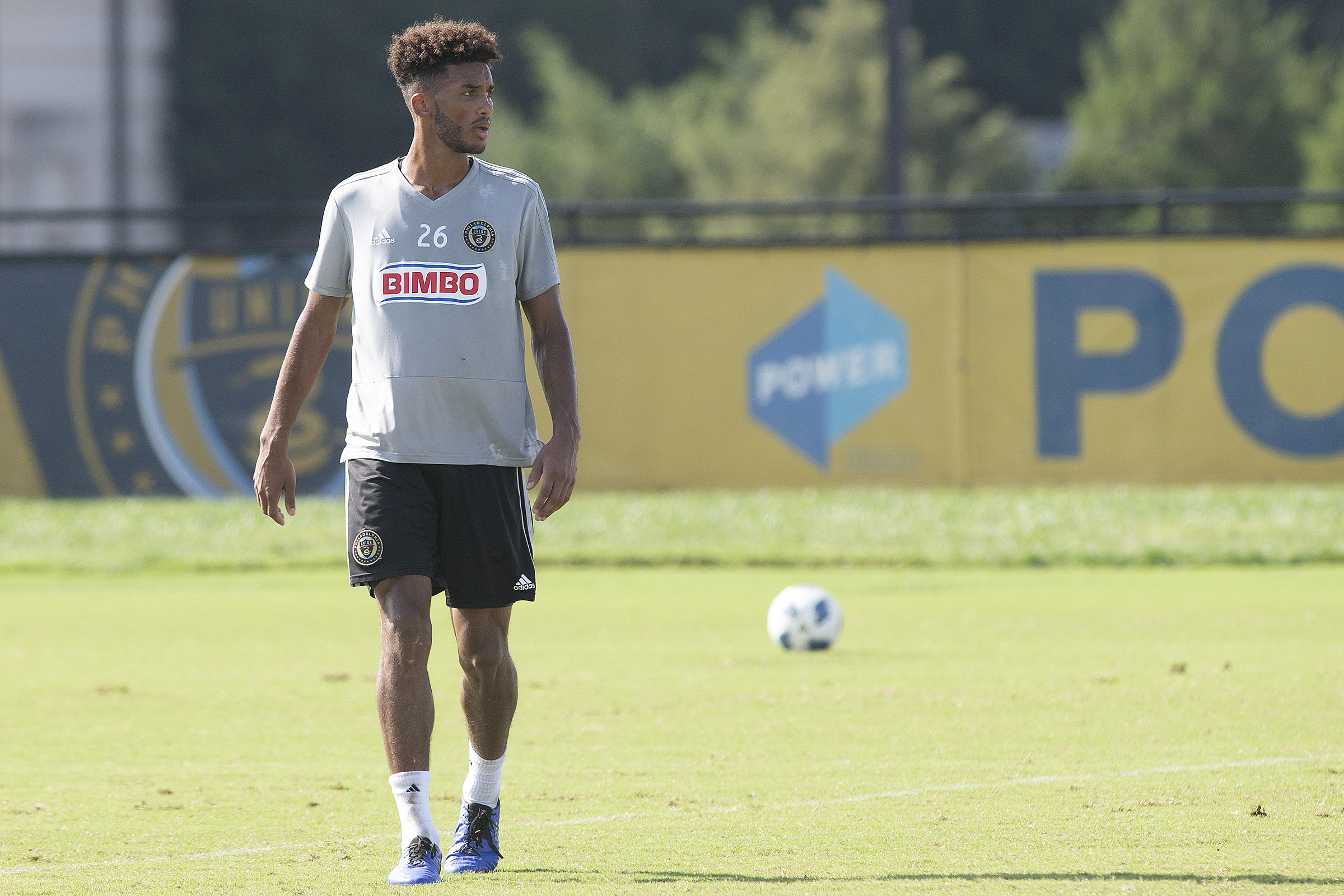
Auston Trusty (center) made his return to the Philly area in November as part of the U.S. men’s national team group that faced Paraguay at Subaru Park.
“He would just pound them into the net, over and over,” Hall said. “I would say if he shot 20 shots, he’d probably make 18. Maybe hit the post on one of them. And I could scrape a hand on the last one.”
Trusty continued coming back to Chester Park, training with Hall and a group of local players five or six times that spring. It was a thrill for the teenager then, but now, those moments mean even more.
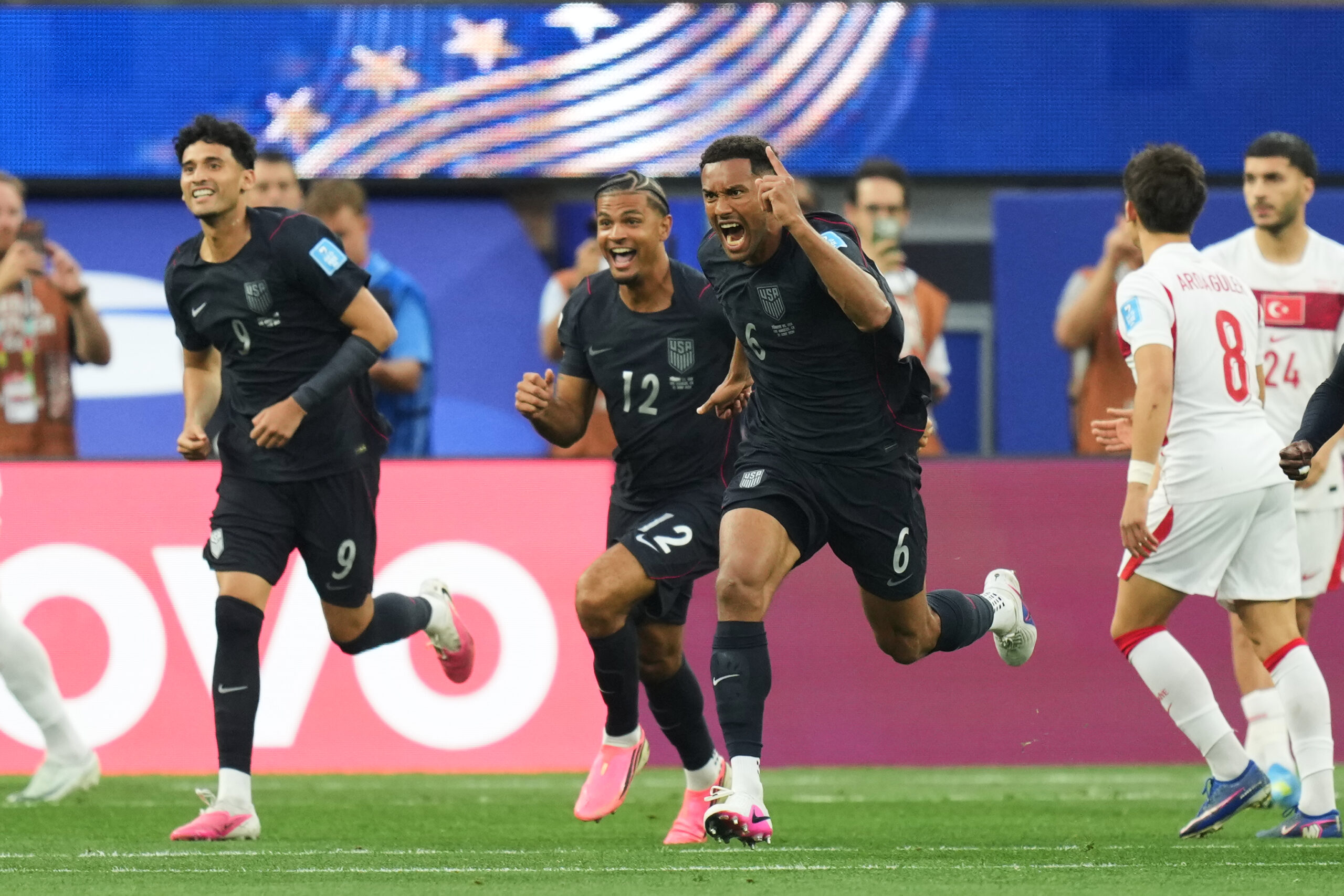
The “Delco-head,” as national team goalie and Wayne, Pa. native Matt Freese calls him, has made an imprint on the sport’s biggest stage. His goal against Turkey on June 25, which came in the third minute, was the second fastest in U.S. World Cup history.
It was not only Trusty’s first international goal, but the first men’s World Cup goal scored by a player born in the Philadelphia region.
“The group chats were going crazy,” said Hall. “But I think my first thought was, ‘I played with a player who just scored in the World Cup. That is insane. I saved his shot as a young kid.’”
Others throughout the Delaware Valley soccer community felt similarly. Paul Norris, who coached Trusty as a freshman at Penncrest High School, said he became emotional just hearing his name and hometown during the roster reveal.
As was the case with Nether United, Trusty was playing far above his weight at Penncrest. Even as a 14-year-old, he was starting alongside players who were much older and bigger than he was.
Auston Trusty (center) celebrates scoring his first-ever U.S. goal in the final match of Group D for the Americans against Turkey.
“What people laugh at now is he plays professionally as a defender,” Norris said. “But at the time, he had obviously a lot of skill, and we had him as a striker. And he was our second leading goal scorer that year.”
For the last 25 years, Norris has worked both at Penncrest and at Springton Lake Middle School, where he taught Trusty physical education. He still sees that lanky kid when he’s roaming the defensive line for Team USA (even though that kid now stands at 6-foot-3, 172 pounds).
So does Waraksa. The 1776 United coach has known Trusty since he was 8 and was at his World Cup debut in Seattle against Australia on June 19. He was down the shore, in Ocean City, N.J., watching with friends and family when the Media native scored his first goal.
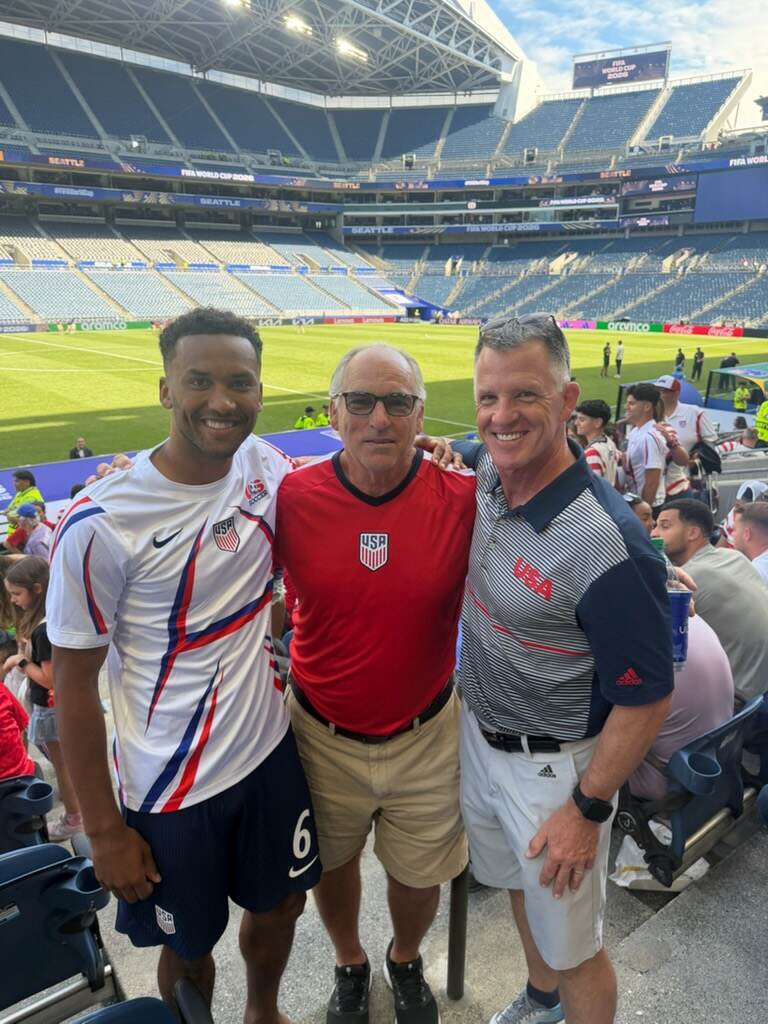
U.S. men’s soccer defender and Media native Auston Trusty (left), poses for an image with his former youth soccer coaches and his former club head coach John Waraksa (center).
It brought Waraksa back to 2013, when Trusty scored in Nether United’s state cup final against Lehigh Valley.
“Lehigh had won the last five state championships at our age group,” the coach said, “so he stepped up, even two years young, in a state cup final. I mean, who does that?”
Trusty found himself in some challenging situations with Nether United. Waraksa put him on a high back line, but even from an early age, he took to it. Once the centerback realized he could compete amid a more advanced style of play, his confidence only grew.
And as he continues to represent his country, that confidence is as high as ever. Norris is still coaching varsity soccer at Penncrest, and for the past few years, he’s shown his players clips of Trusty back when he was playing for the Philadelphia Union.
In addition to his time with Nether United, Trusty was also groomed in the Philadelphia Union’s academy and played for its first team.
A lot has happened since then. In 2022, Trusty signed with Arsenal. He returned to Europe in 2023, signing with Sheffield United, and in 2024, he penned a five-year-deal with Celtic.
But Norris now has the best Auston Trusty highlight reel of all, one that is “slightly updated” from his Union days. And with Penncrest’s preseason rapidly approaching, the coach can’t wait to show it off.
“We try to remind the kids that this was somebody who was local,” Norris said. “This was not that many years ago. These are things that somebody who was in this school, and in the seat that you may be sitting in, has done.
“You’re all capable of it. It’s just a matter of, do you want to put the work in for it?”
Lastweekend, K.C. Peterson was sitting at a bar with his friends in western Nebraska, talking about Fourth of July celebrations, when he shared an unexpected tale.
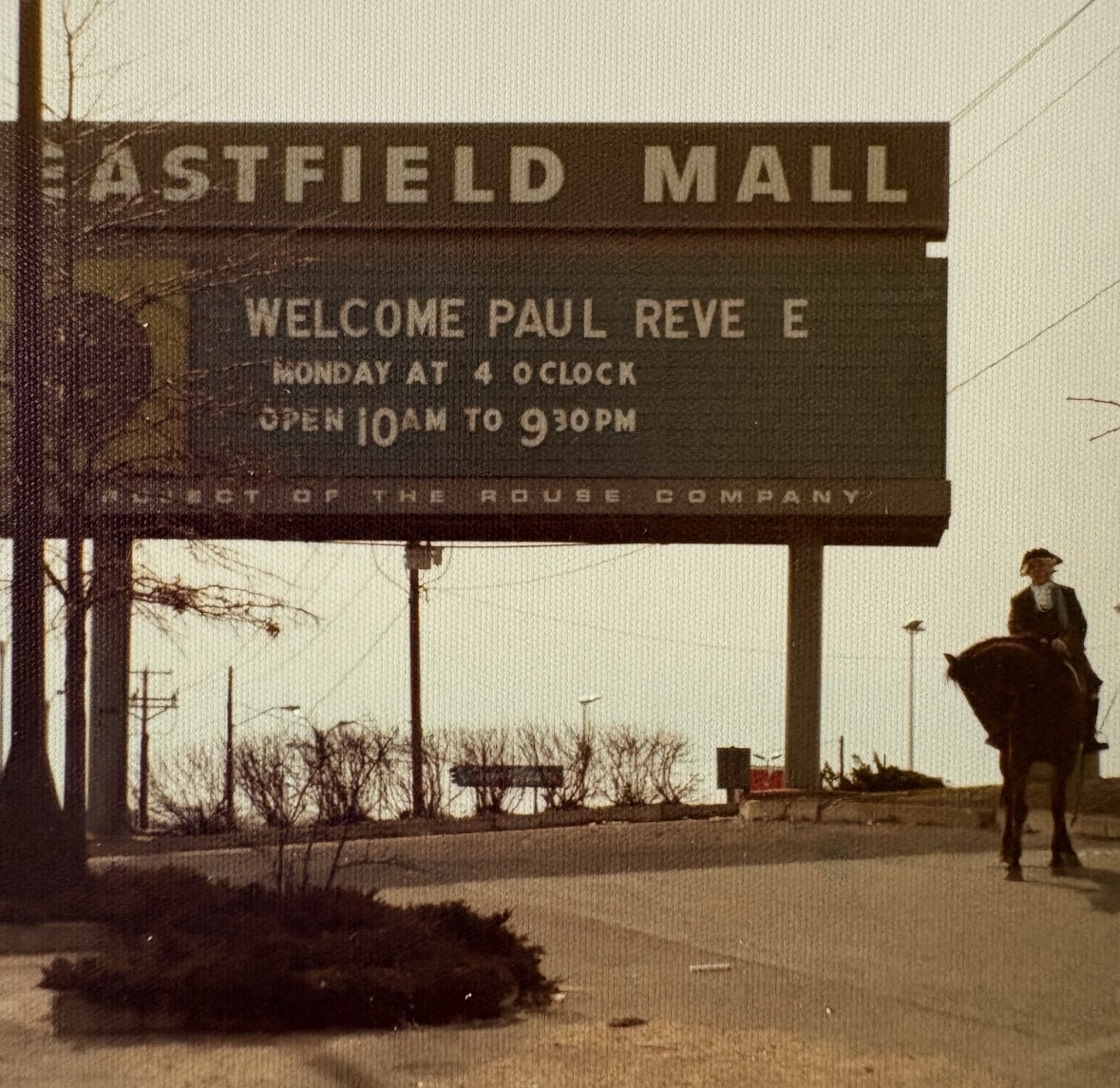
It all started with a marketing gimmick, one so unique only Phillies executive Bill Giles could’ve conceived it. The year was 1976, and Philadelphia was buzzing with excitement around the Bicentennial.
Giles, who described himself as a “pseudo historian” according to newspaper accounts, had been reading up on Paul Revere. Everyone was familiar with the blacksmith’s midnight ride, but the executive was far more interested in a lesser-known journey.
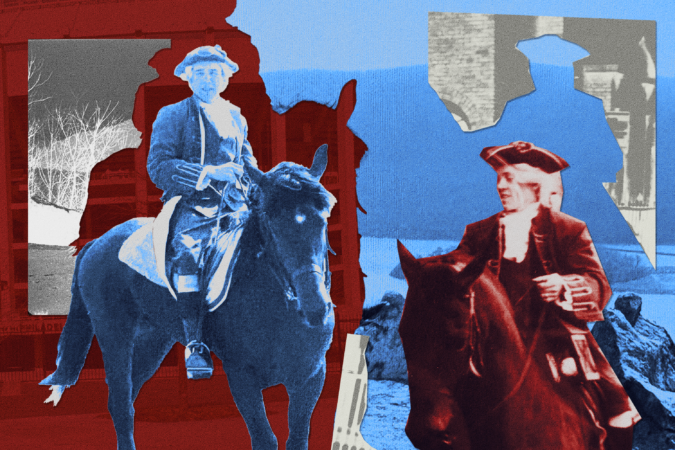
In 1774, Revere traveled by horseback from Boston to Philadelphia to deliver the Suffolk Resolves — a document that would serve as a harbinger of the revolution to come — to the First Continental Congress.
Citizens in Suffolk County, Mass., would refuse to pay British taxes. They’d organize militias to defend themselves. They’d boycott British goods.
Giles began to brainstorm. What if the Phillies could recreate such a ride for opening day? With a Paul Revere re-enactor, dressed in colonial garb? Carrying a game ball in a lantern, instead of a blueprint for civil resistance?
K.C. Peterson and his brother were hired by Phillies executive Bill Giles for an ambitious two-week stunt.
The plan was set into motion. In March of 1976, Giles hired K.C. and his brother, Russ, to trek 318 miles over two weeks from Old North Church to Veterans Stadium on horseback.
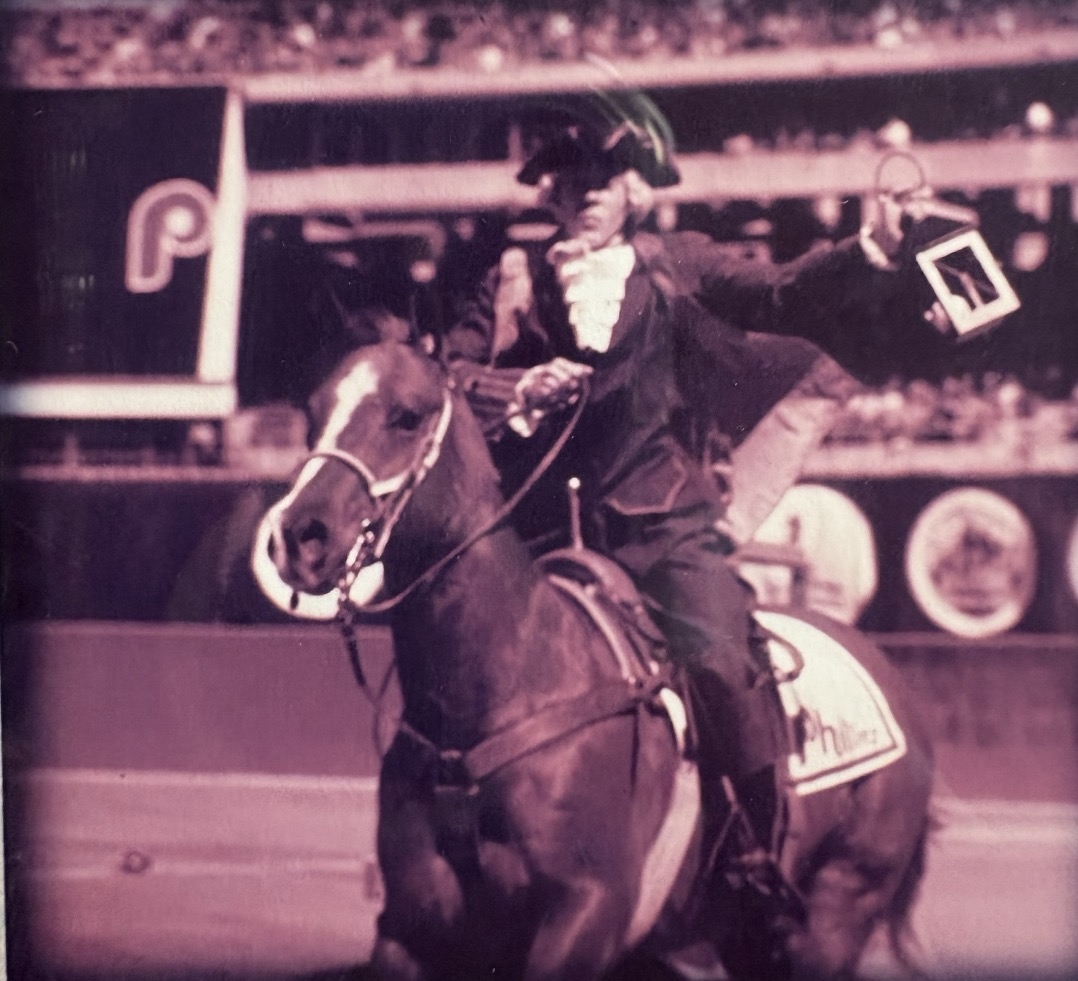
They arrived on April 10, a few hours before first pitch. Russ handed the ball to a man with a jet pack — “Rocket Man” — who soared 150 feet into the air, landing on the mound to deliver it to former Phillies pitcher and newly elected Hall of Famer Robin Roberts.
Peterson’s friends were skeptical. He and his brother had lived a wild life, as rodeo trick riders in Nebraska, but even by their standards, this seemed outlandish.
But the tale was all true — from the wigs to the tricornered hats to the tall black boots.
“They said, ‘Oh, bulls—,’” K.C. recalled. “I said, ‘I’m not bulls— you, we did!’
“One rode in the morning, one rode in the afternoon. And it rained almost every day. For two weeks.”
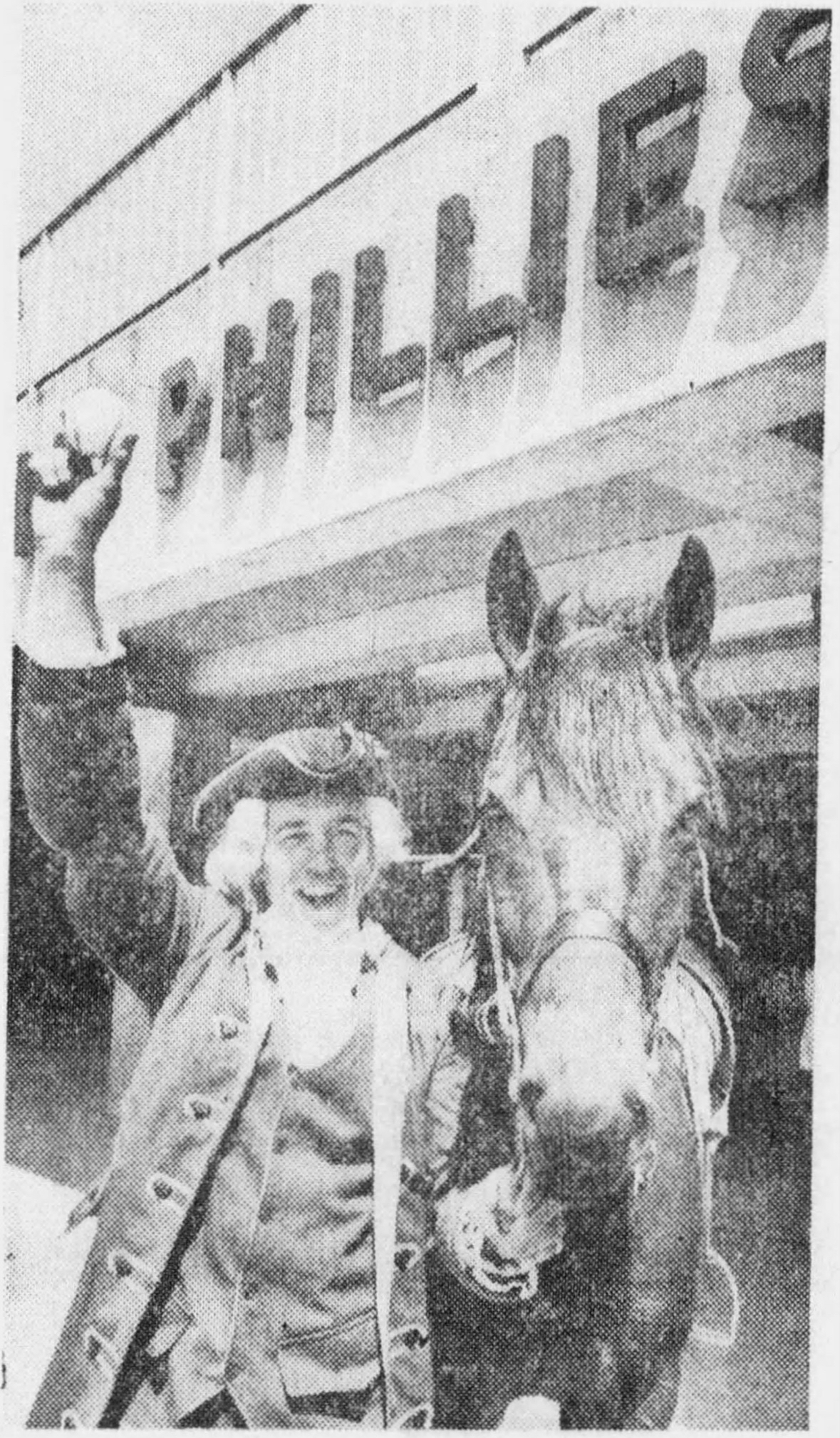
Russ Peterson (pictured) and his brother K.C. were mistaken for George Washington in some of the stops on their 318-mile ride.
$5,000 for 318 miles
K.C. and Russ Peterson knew close to nothing about Revere when they accepted Giles’ job. They had never been to a baseball game either, and didn’t consider themselves fans of any team.
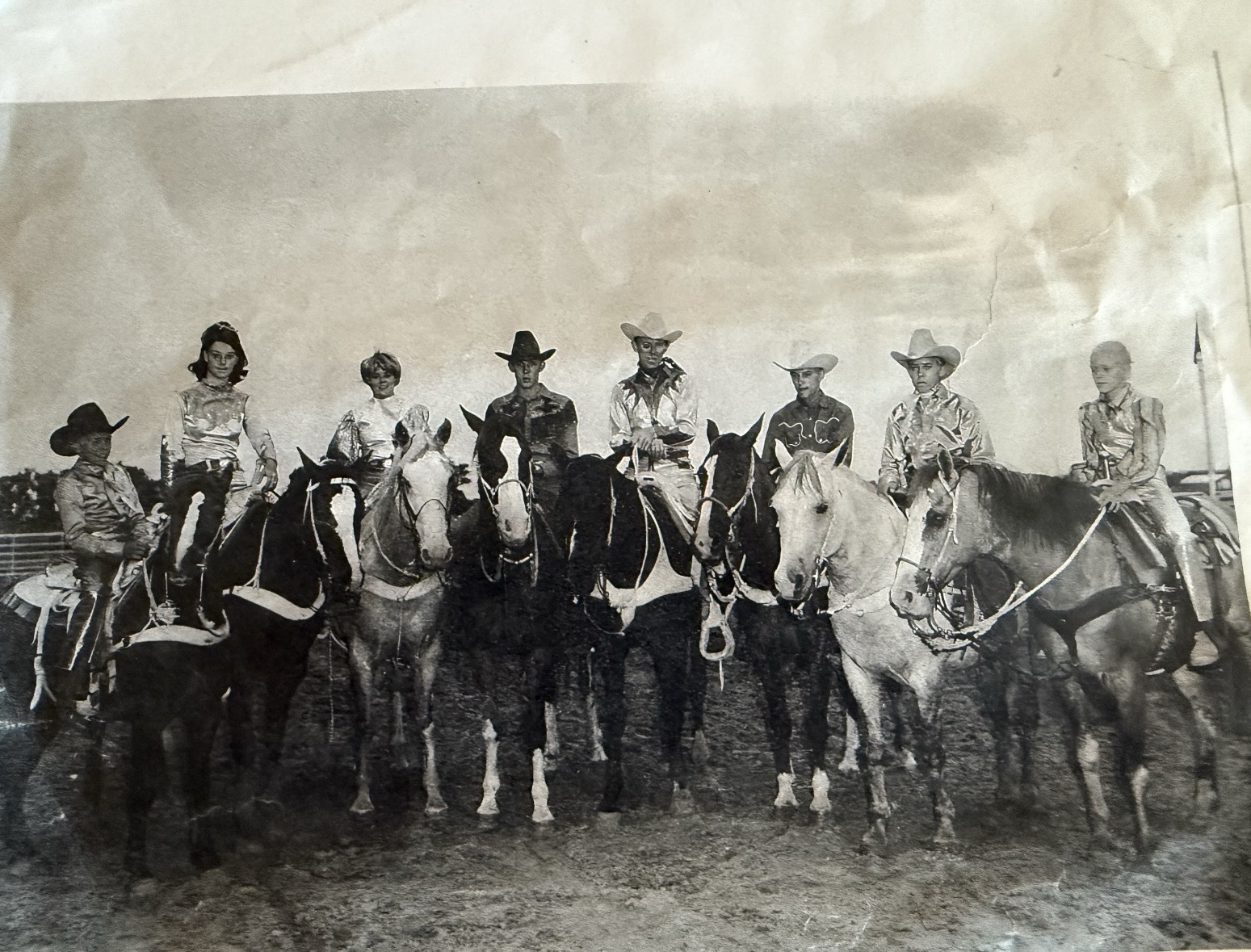
But they were expert horsemen, and that was enough. The eight Peterson siblings grew up on a ranch in Ogallala, nicknamed the “Cowboy Capital” of Nebraska. Their brother, Denny, taught them trick riding at an early age; before long, they could do shoulder stands and vaults on the back of a galloping steed.
It was a unique skillset that led to some interesting experiences. During the summer, K.C. and Russ would perform halftime shows at Ogallala’s local rodeo. In 1973, the family traveled to Japan on tour with celebrity cowboy Casey Tibbs.
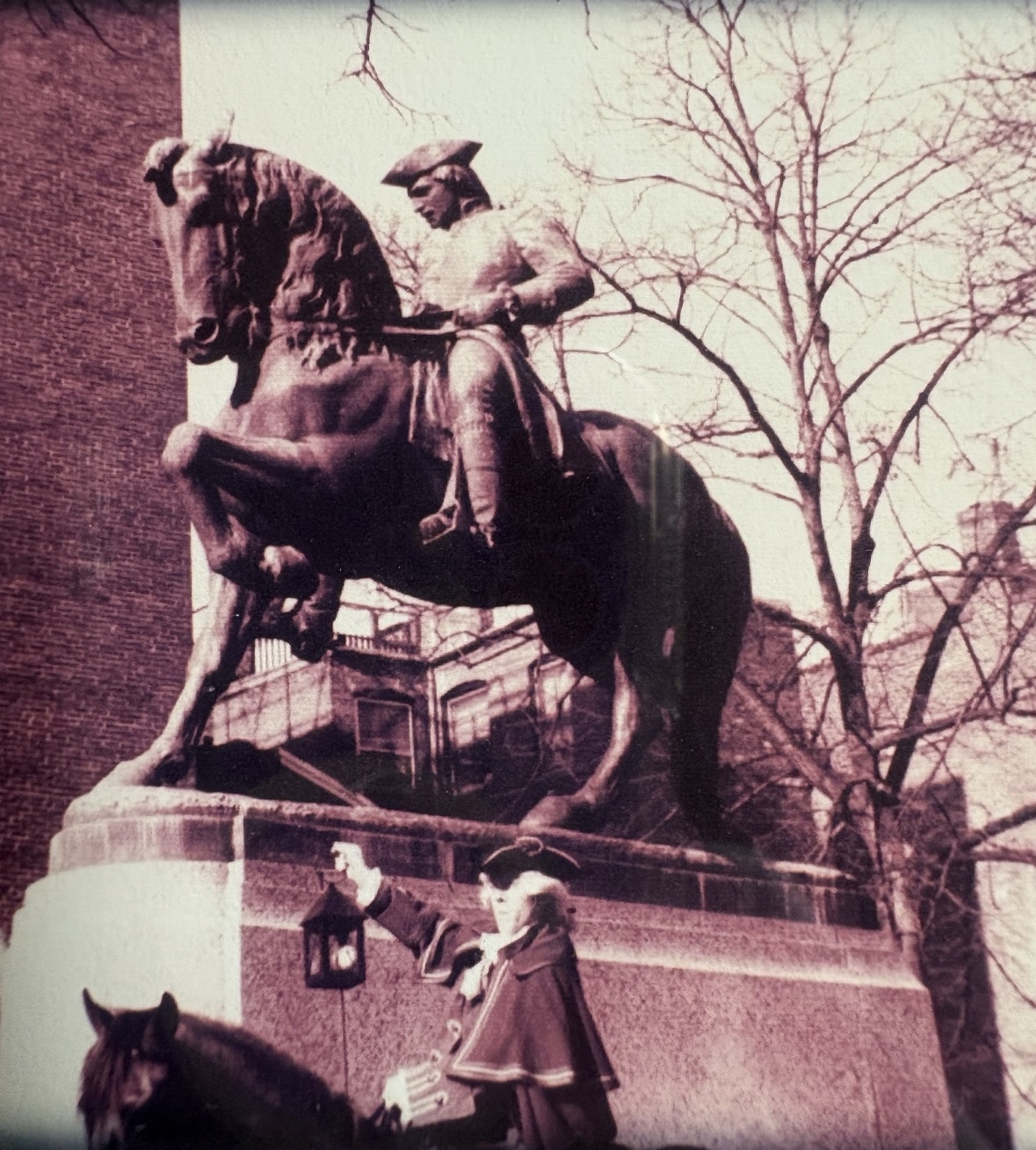
K.C. (far left) and Russ Peterson (second from right at a 1971 Buffalo Bill Wild West show) had honed their horseman skills in the years leading up to their Phillies stunt.
What Giles proposed in 1976 was an entirely different commitment. For the past few years, the brothers had been working four shows a day, seven days a week, over the summer at Great Adventure Theme Park in Jackson Township, N.J.
Now, their boss was saying that the Phillies wanted them to embark on a 318-mile trek.
“I was like, ‘What the hell are you talking about?’” K.C. recalled. “And they said, ‘Well, it’s gonna take two of you, because it’s a long ways, and you’ve got to do it at a trot in an English saddle.’
“And hell, I’ve never rode an English saddle in my life. We’re just trick riders. Grew up on a ranch. Rode Western saddle, and trick riding saddle, but never an English saddle. It’s an itty bitty saddle. There ain’t much to sit on.”
“I was 17 years old, and Russ was 21, and we got paid $2,500 apiece,” he said. “For a broke kid, it’s a hell of a lot of money.”
The brothers accepted the team’s offer on the spot. Russ’ girlfriend at the time, ReNee Dancer, was not happy. She and Peterson had planned to get married before they left Nebraska for New Jersey in May.
That idea was no longer feasible. The Phillies needed K.C. and Russ to be in Boston by late March to start their trip. They’d have to postpone the wedding until after it was done.
“He was so excited that they asked him to do that,” ReNee said. “And all I was worried about was getting married.”
K.C. and Russ departed from the Old North Church on March 27 at 9 a.m. The Phillies gave them a route with different stops along the East Coast. Unlike Revere’s, this journey was not entirely on dirt, grass and cobblestone.
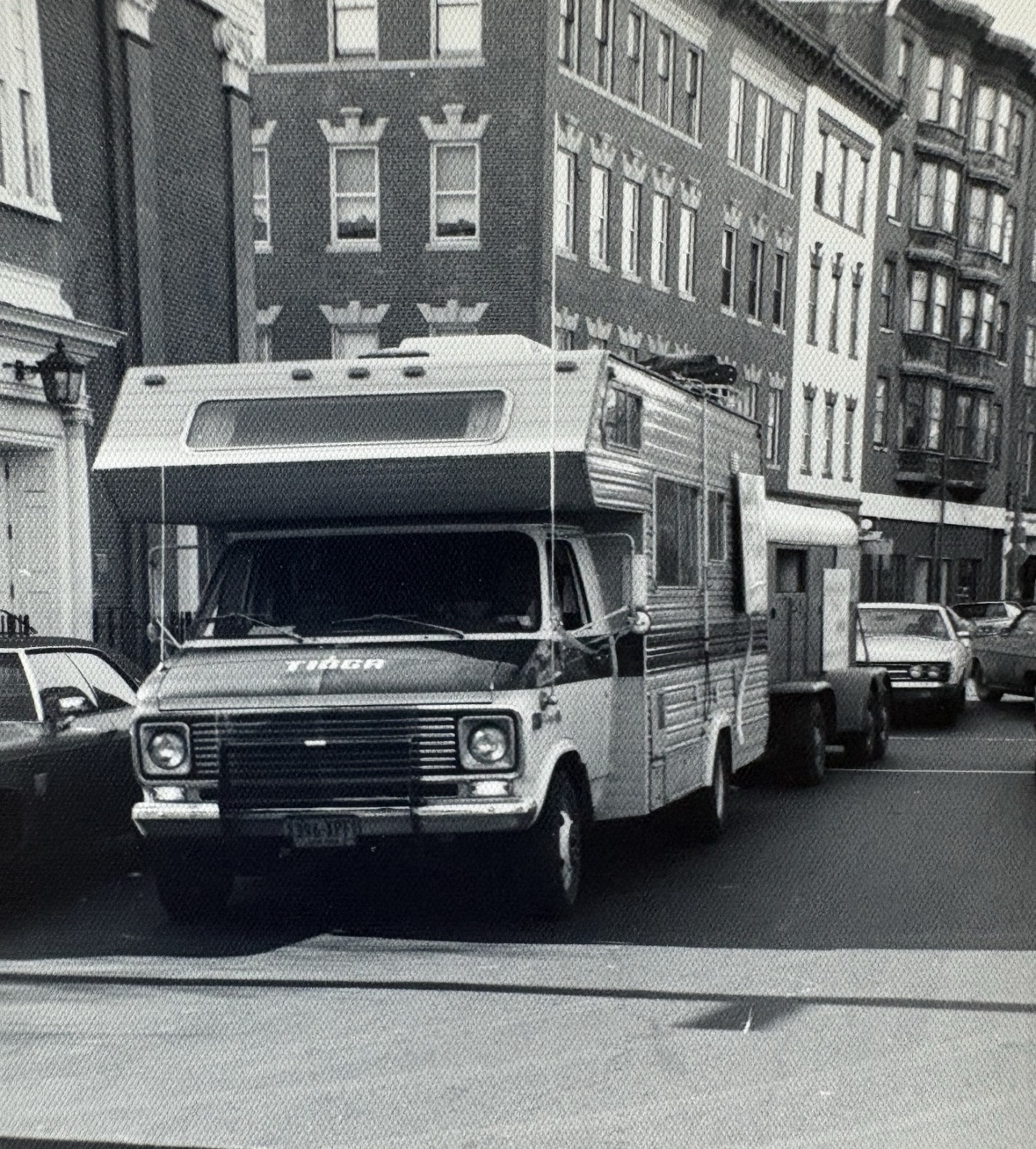
The Peterson brothers were trailed by a motor home that had its own issues in surviving the two-week trek.
The younger Peterson said there were times when one brother would be riding on the side of a small highway, with a motor home behind him — flashers on — and a horse trailer hitched to the back.
Local drivers were not enthused; honking loudly, while telling the colonial horsemen to “get the hell out of the road.”
The weather, which K.C. described as a “downpour,” only made things worse. Their wigs were soaked and their tricornered hats were slipping. A dry, wool coat would’ve been helpful amid the 40 to 50 degree temperatures, but drenched, it was essentially useless.
On their hardest days, K.C. and Russ contemplated tossing their lanterns and costumes aside. The routine was quickly getting old. But in the spirit of Revere, they continued on.
“Here we were, 200 years later, doing [his ride] on a paved road,” K.C. said.
The brothers would often depart by 7 a.m. to reach the day’s destination by early afternoon. There, they would take part in a ceremony welcoming them to town, usually held by a local chamber of commerce.
“Kids would start coming out of school, yelling, ‘George Washington!’” K.C. recalled. “With our little hat on, with our little wig on, with the curls in it. But it wasn’t no raincoats, I’ll tell you that. We had to stay in costume.”
The Peterson brothers had daily, non-Phillies-related stops on their Paul Revere-style tour.
They’d have a quick meal, put the horses in a barn, spend the night in a motel, and do it all over again the next morning. Together, the brothers averaged about 20-30 miles a day, visiting 14 cities along their route.
By April 9, everyone had had enough. The “up-down” motion of riding 318 miles on a trot was uncomfortable; K.C. compared it to “calisthenics.”
Horseshoes were falling offhooves, clothes were dirty, the motor home was damaged (because its driver, another Great Adventure employee, accidentally crashed it) and the brothers were physically exhausted.
But they were only one stop away from Philadelphia. Their concrete promised land was near.
A baseball delivered, a promise kept
Unsurprisingly, Giles planned a 45-minute pregame affair around America’s founding.
The Mummers put on a Revolutionary War-themed show. Plymouth Whitemarsh High School’s marching band performed a song, and the Philadelphia Boys Choir sang the national anthem.
Russ Peterson (pictured) and brother K.C. finally reached their destination at The Vet after an arduous 318-mile journey.
Then came Revere. Just before first pitch, Russ brought his horse up to the right field corner. A stadium worker opened the gate, as the re-enactor trotted onto the AstroTurf, doing a lap — with some trick riding — around the entire field.
He handed the ball to “Rocket Man,” who took off for the mound, where Roberts was waiting. The Phillies offered the brothers tickets to that day’s game against the Pirates, but after the ceremony was done, they packed their horses, changed out of their costumes, and left.
Russ arrived to his trailer in Jackson Township not long after, with bags of memorabilia in hand. He was a quiet man by nature, but on this night, he couldn’t stop talking.
“You could hear the excitement in his voice, about that rocket man flying through there,” ReNee said. “That was probably the thing that he enjoyed the most. He thought it was pretty amazing.”
Peterson continued to live an eventful life. He and ReNee moved back to Nebraska later that year and started a construction business in 1993. They raised cattle of their own, and shoed horses, and did some projects for Habitat for Humanity.
But the trick rider always took pride in his two-week, 318-mile trip. So much so, that when Russ died in a work-related accident in 2015, it got a mention in his obituary.
His family noted how honored he was to be a part of the Bicentennial, in the very city where the Declaration of Independence was signed. Yet nothing compared to the events of the following day.
“Perhaps the most important of his activities while in the area,” the notice read, “involved marrying the love of his life, ReNee A. Dancer, in Howell Township, New Jersey, on April 11th.”
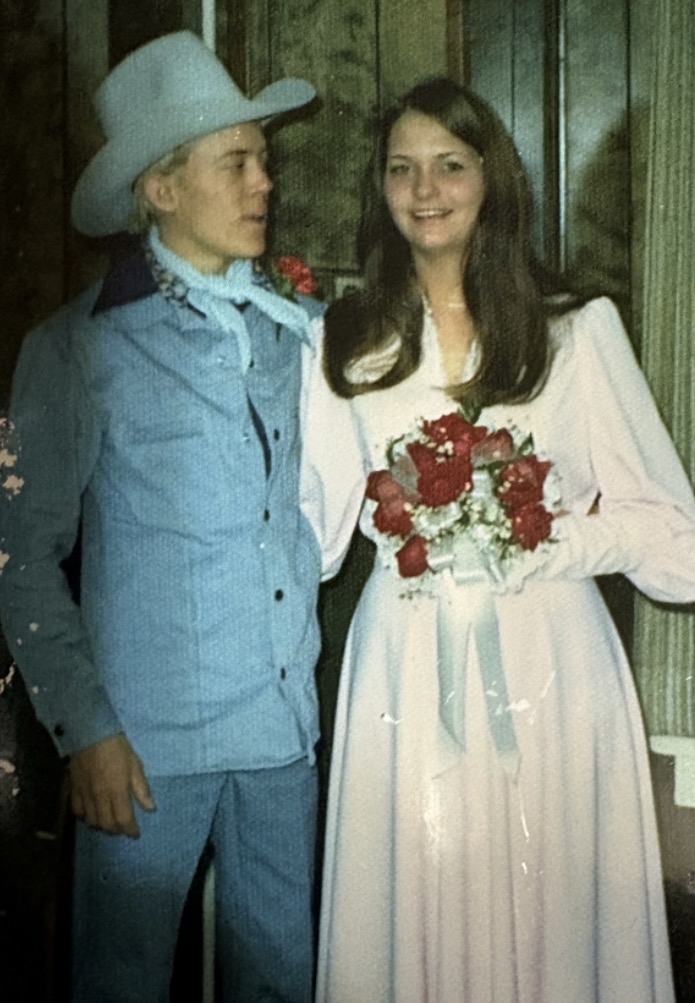
Russ Peterson and his wife, ReNee, on their wedding day in 1976.
The night before Roy Halladay died, he was with his team. It was Nov. 6, 2017, and Calvary Christian High School was playing an exhibition game in Clearwater, Fla.
Halladay, a pitching coach, showed up in baseball pants and a batting practice jacket, with a clipboard beneath his arm. This would not have been unusual for March or April, but fall ball was much more relaxed.
The rest of the staff, which was dressed in shorts and T-shirts, erupted in laughter. Halladay didn’t hesitate to fire back. “Thanks for the heads up,” he said with a grin.
As the Warriors jogged onto the field, just past 7 p.m., the future Hall of Famer sat on the bench. After a few innings, infielder Christian Cairo joined him.
He liked watching games with Halladay. The former Phillie and Blue Jay brought the same intensity to coaching that he did to his 16-year MLB playing career, but with a newfound lightness.
He’d routinely crack jokes from the dugout. Months earlier, a hitter from a local high school walked up to the plate. He had straight, long hair, all the way down to his back. Halladay turned to the mound.
“Hey!” he yelled. “Look out for the bunt! This chick can run!”
The high schoolers loved it.
“Ridiculous stuff like that,” said Halladay’s 25-year-old son, Braden. “It was funny because he’s saying this to, like, 14-year-old kids.”
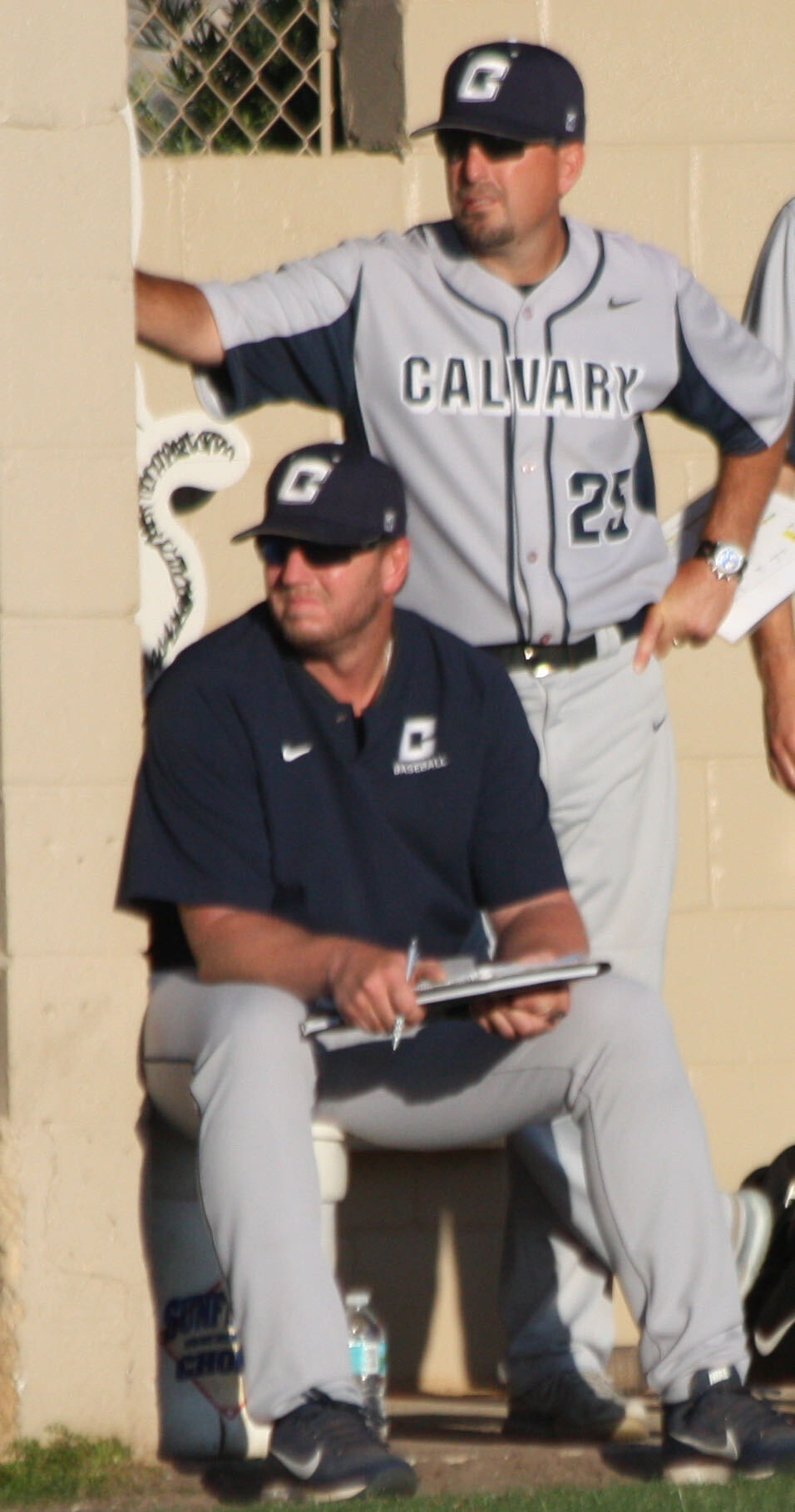
Coach Greg Olsen (seated) and pitching coach Roy Halladay during a Calvary Christian game in spring of 2017.
Halladay was in prime form on Nov. 6. The game wouldn’t count toward Calvary Christian’s record, but he was still taking notes and videos on his iPad.
He was also razzing everyone in sight: his players, their players, umpires.
“We were talking crap with each other,” Cairo said. “It was a lot of fun.”
At 9:30 p.m., the two teams left the field. By the next afternoon, ominous rumors had started to spread. Braden, then 17, got a call from his mother. She told him to pick up his 13-year-old brother, Ryan, and drive them to their house.
Pitcher Nolan Hudi texted Braden while he was in the car. He sent a link to a Twitter post: a selfie of him and Roy in the cockpit of his plane, taken three days prior.
The photo had gone viral. People were commenting “RIP.”
Hudi asked if people on social media had ever tweeted such morbid things about his father.
“No,” Braden said.
That morning, at 11:47 a.m., Halladay had flown his Icon A5 out of Brooksville-Tampa Bay Regional Airport. A few minutes after taking off, he crashed into the Gulf of Mexico.
The boys he coached are now men. Braden works in data analytics for the Texas Rangers. Cairo, 25, is a minor leaguer in the Phillies system. Some have played for other affiliates; Hudi spent a couple of years pitching at the University of South Florida.
They all cherish that 2017 season. Not just for what they learned (which was plenty) but for what they saw. As a big leaguer, Halladay was fierce and, at times, intimidating.
But as a coach, he was more laid back. He’d play pranks. He’d chirp. He’d try goofy things to help his team win, like flying a drone over a rival’s batting practice.
It was all refreshingly fun. What the players didn’t realize, though, was that they were giving Halladay something too.
“A way for him to enjoy baseball,” Braden said, “in a very pure form again.”
Roy Halladay won two Cy Young awards in his 16-year career, including in 2010 with the Phillies.
Roy being Roy
Halladay never liked the spectacle his success could bring. And it was difficult for him to escape.
His sons started playing travel ball in the early 2010s, at the height of his career. The Phillie would frequently be stopped for autographs at games and tournaments.
This attention got so bad that he started keeping a Groucho Marx-style disguise — black-rimmed glasses and a fake nose and mustache — in the back of his car.
“He thought it was hilarious,” Braden said, “because it’s the stupidest disguise you can come up with.”
But while Halladay didn’t enjoy the chaos, he did enjoy teaching. In 2011, Hudi played alongside Braden on a Florida team called the West Coast Warriors. Halladay, fresh off his second Cy Young Award, would stop by to help out.
One day, he approached Hudi during a bullpen session in Tarpon Springs. Halladay asked what pitches he threw. The 11-year-old’s answer was essentially “nothing.” He asked if he’d ever tried a cutter. Hudi shook his head.
Halladay grabbed a baseball and showed him a grip. Then he reached for a pen, and traced around Hudi’s hand, so the middle schooler could practice at home.
“He outlined where my fingers were,” Hudi said. “I thought that was so cool.”
Parents would ask Halladay if he’d be willing to coach, but he always demurred. The big leaguer wanted his son to carve out his own identity in the sport. Having a world-class athlete around would make that challenging.
But in 2014, he had a change of heart. Halladay had recently retired. Braden was only a year and a half removed from high school, and had experienced a few seasons on his own.
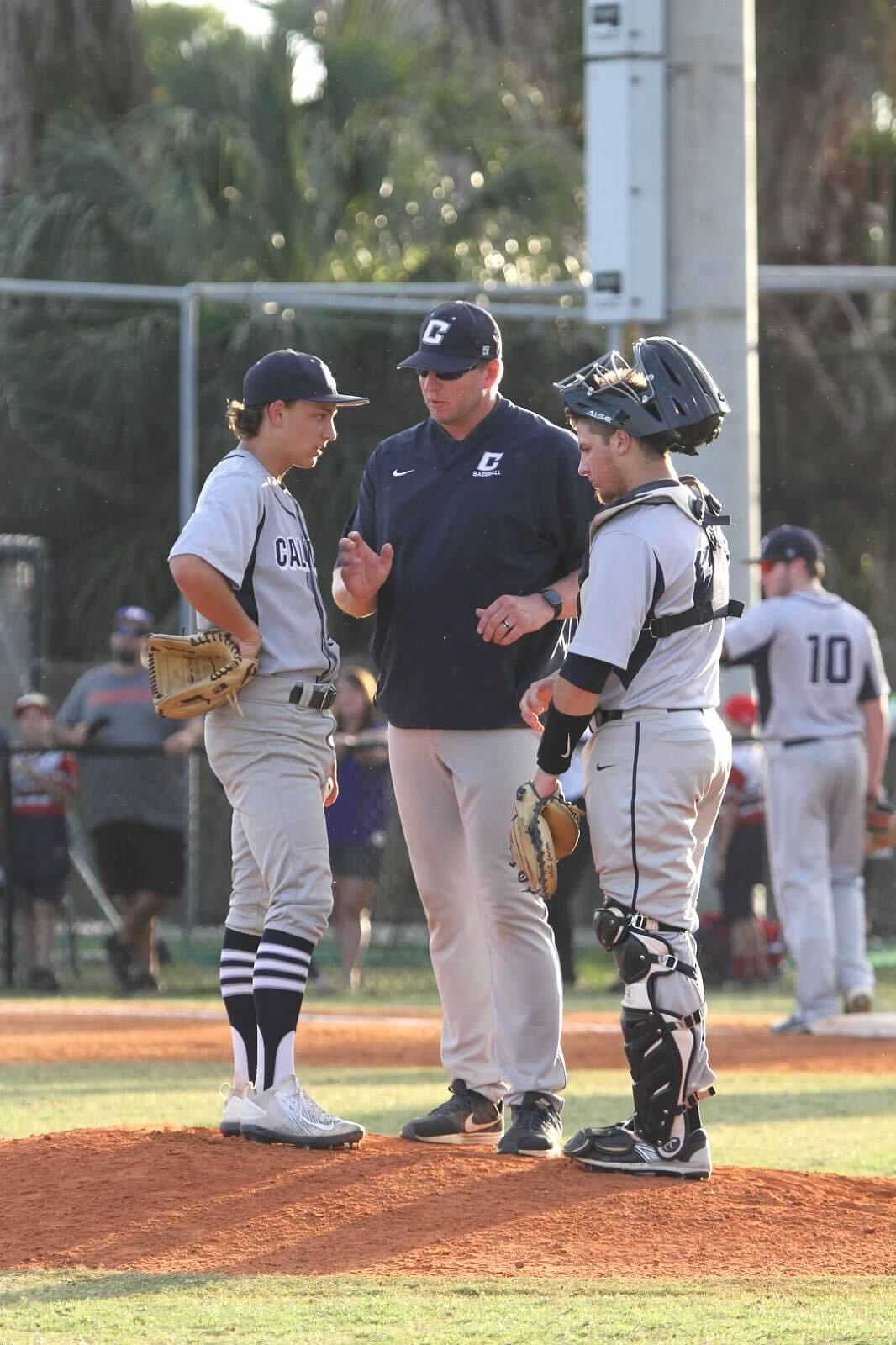
Roy Halladay talking to pitcher Nolan Hudi during a game in 2017.
The son encouraged his father to join the coaching staff of his travel ball team, the Dunedin Panthers. Halladay stayed through 2015, serving as pitching coach and later head coach.
He did not take this role lightly. Once, a baserunner bowled over Dunedin’s catcher at home plate. The league’s rules stated this should be an automatic out, but the umpires didn’t call it.
Halladay was furious. He explained to the crew that they’d made a mistake. One umpire, who didn’t recognize the eight-time All-Star, told him that he didn’t “know the rules of baseball.”
This set off Halladay even more. He was ejected. Braden, who wasn’t standing far away, overheard a conversation between the officials not long after.
“He goes, ‘Hey, dude, you know you just ejected Roy Halladay, right?’” Braden recalled. “And the umpire goes, ‘Oh my God.’”
Halladay decided to have himself a day. He went to the concession stand and bought three cheeseburgers. He filled his big Yeti tumbler with Diet Coke, got in his truck, and pulled it behind the left field fence.
He sat there for the rest of the game, scrutinizing the umpire’s every call. If he missed one, Halladay would let him know it, loudly proclaiming that the official didn’t “know the rules of baseball.”
Braden enrolled at Calvary Christian in 2016. He spent his freshman year playing junior varsity, without his father, and was promoted to varsity as a sophomore.
Halladay joined head coach Greg Olsen’s staff that year. Hudi transferred in from East Lake High School in Clearwater not long after. He and Braden were close friends; Hudi would sleep over at the Halladays’ house fairly often.
To Hudi, the 6-foot-6 Halladay was not a star pitcher. He was an eccentric parent. One time, when the boys were older, Hudi made the mistake of drinking Halladay’s last Dr Pepper.
Halladay barged into the game room, where Hudi and Braden were watching TV.
“Who drank the last [expletive] Dr Pepper?” he asked.
Hudi, holding the can with trepidation, said he didn’t know.
The pitcher stormed out. He returned 30 minutes later with two six-packs.
“He’s like, ‘This six-pack is yours,’” Hudi recalled. “And then he holds up another case, and he’s like, ‘Don’t [expletive] touch this. This is mine.’”
Roy Halladay had a 3.25 ERA in four seasons with the Phillies and tossed a perfect game in 2010.
Halladay brought the same attitude to the Warriors in 2017. Braden wasn’t used to seeing his father act this way on a baseball field.
“Whenever he was home, he was kind of a funny, not-take-things-too-serious kind of person,” he said. “It was more so that you’d notice at the field that he wasn’t doing that. And he actually was kind of a little bit scary.”
But at Calvary Christian, there was no pressure to uphold a persona.
“I think he just got to be himself,” Braden said.
A method to his madness
Olsen had been around a lot of coaches at this point, some of them former big leaguers. But he quickly learned that reaching the pinnacle of the sport didn’t necessarily translate to on-field instruction.
This was especially true when it came to resonating with kids. They could easily discern coaches who were sincere from those who were not. And if they deemed a coach insincere, it was over.
Halladay didn’t have this problem. He could explain grips and mechanical adjustments with ease (and without condescension).
Roy Halladay with his son Braden in 2017.
He would go beyond telling a player what to do. He’d help them find their feel. That way, when the high schoolers were alone on the mound, they could throw a curveball or a splitter, or any other pitch, and make corrections in the moment.
The coach showed no favoritism, not even to his son. He studied like he was still in the big leagues, sitting on a bucket with his enormous iPad, scribbling notes during games and practices.
“It was like a 55-inch flat-screen TV,” Hudi said. “And he’s a big guy, so him holding that giant thing made it look even crazier. Nobody knew what he was writing down.”
He didn’t need to show them. Halladay routinely proved he’d done his homework. In 2017, he helped Hudi redesign his entire windup, from stepping sideways to stepping behind the rubber, with his hands overhead.
Halladay wanted the pitcher’s momentum going toward the plate; otherwise, his stride would be inconsistent.
“The wealth of knowledge was crazy,” Hudi said. “And it went so much further than pitch grips.”
Halladay helped his team with mental skills, too. Olsen would often see him talking to players between innings, to strategize for upcoming at-bats or guide them through a tough moment.
He’d tailor his mound visits to whatever was needed, no matter how unorthodox it looked.
Braden remembered one game when he was losing his command. Halladay walked out to the mound but didn’t say a word. He just stared.
After the inning was over, the pitcher approached his father.
“Hey man, what was that?” Braden said.
“Were you thinking about throwing strikes?” Halladay asked.
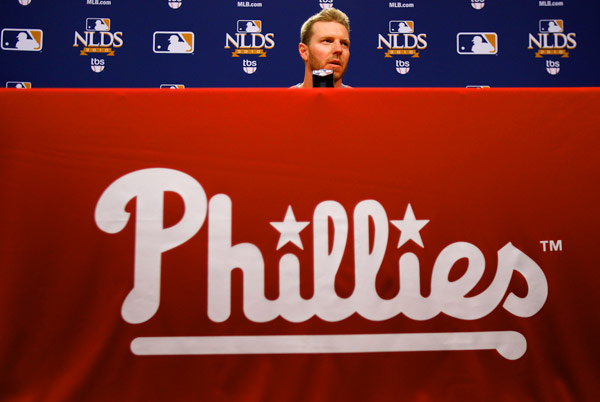
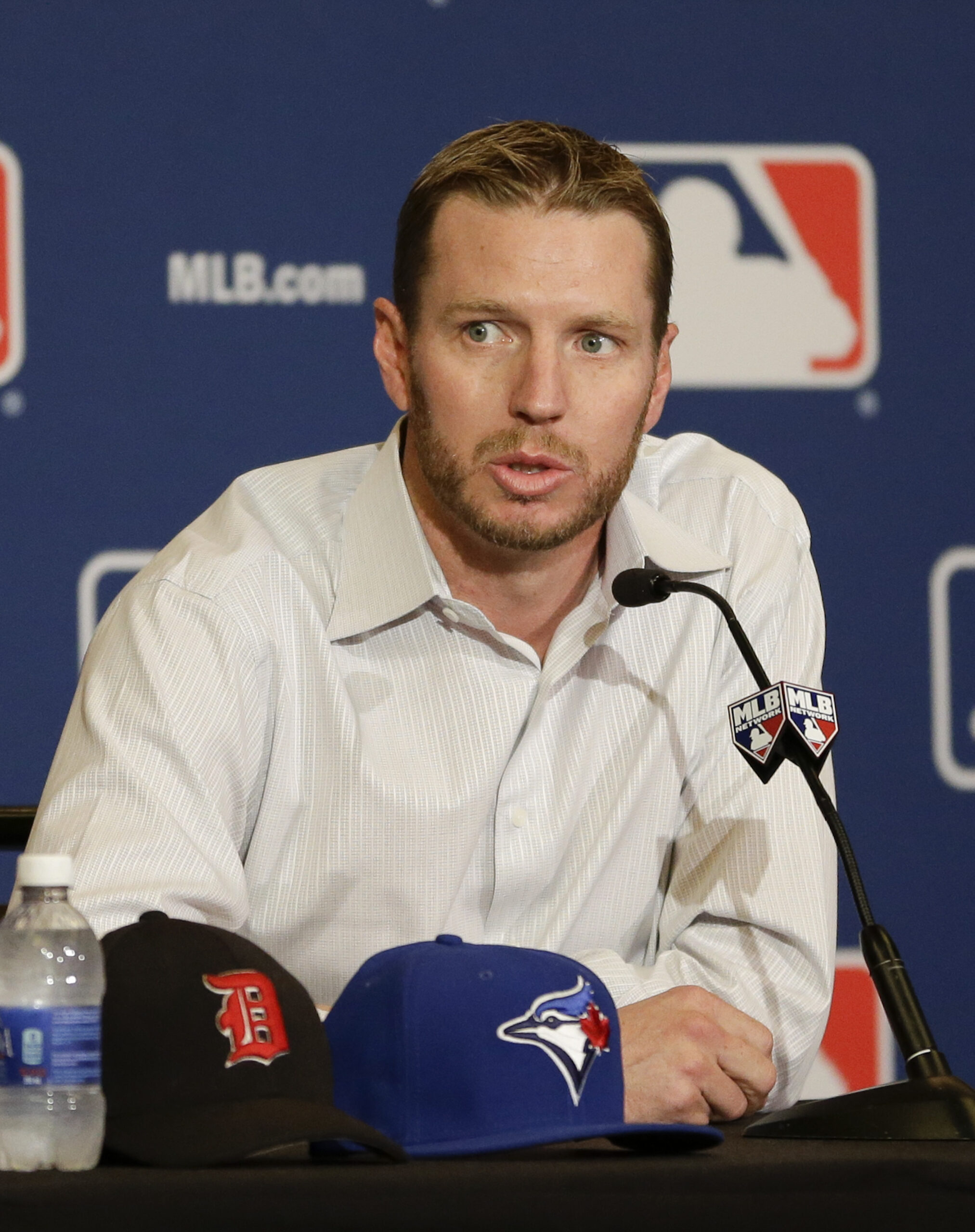
At his retirement news conference in 2013, Roy Halladay had a Dunedin Panthers hat among the caps for the teams he played for.
“No,” Braden said. “I was thinking about how weird that was.”
His father smiled.
“Exactly!” he said.
This was just one of many instances when Halladay was validated for his quirky ideas. He and Olsen would stand next to each other in the dugout, signaling pitches to Calvary’s catcher.
They usually agreed. But every once in a while, Halladay would propose something unusual. In the district semifinal, a formidable Tampa Catholic hitter took his final at-bat. He’d struck out twice earlier in the game on sliders.
Halladay wanted a fastball down the middle.
“He was like, ‘Look, we gotta go off script at some point,’” Olsen recalled. “And he was right. We threw a ball right down the middle, and the hitter froze. That was his genius of pitch calling.”
Two weeks later, in the regional final, Halladay called for a splitter in the ninth inning with a runner on first and a one-run lead.
There was one problem: The pitcher had never thrown a splitter in a game before.
“In that moment, I felt like this is either going to work, or our season could be over,” Olsen said. “Because the kid’s gonna hit it out. But he made the right call. We jammed him, he grounded out, and we won the game.”
Cairo, who was sidelined with a hand injury, had a front-row seat to all of this. Sometimes, the infielder would sit next to Halladay on the bench and go through pitch sequencing.
Other times, they’d just talk crap.
“I remember this one pitcher was talking a lot after we scored like six runs on him,” Cairo said. “Roy told him to go sit in his truck or something like that. That was fun.”
Calvary Christian didn’t lose a game that year. The Warriors were perfect in the regular season — despite enduring injuries to multiple players — and made it to the state championship in Fort Myers in late May.
By now, everyone knew of Halladay’s idiosyncrasies. So no one was surprised when he was caught flying a drone over Pensacola Catholic’s practice.
The opposing coaches saw a metal device whizzing through the air. They told a security guard, who spotted Halladay in the dugout with a remote control and a grin.
The security guard was not as amused. Had anyone else pulled this stunt, they would’ve been kicked out of the game. But Halladay knew the tournament officials wouldn’t do that.
He got a slap on the wrist.
“The official was like, ‘Hey, dude, like, you can’t spy on the other team with aerial equipment,’” Braden said. “And he was like, ‘Ahhhh … sorry, sorry.’”
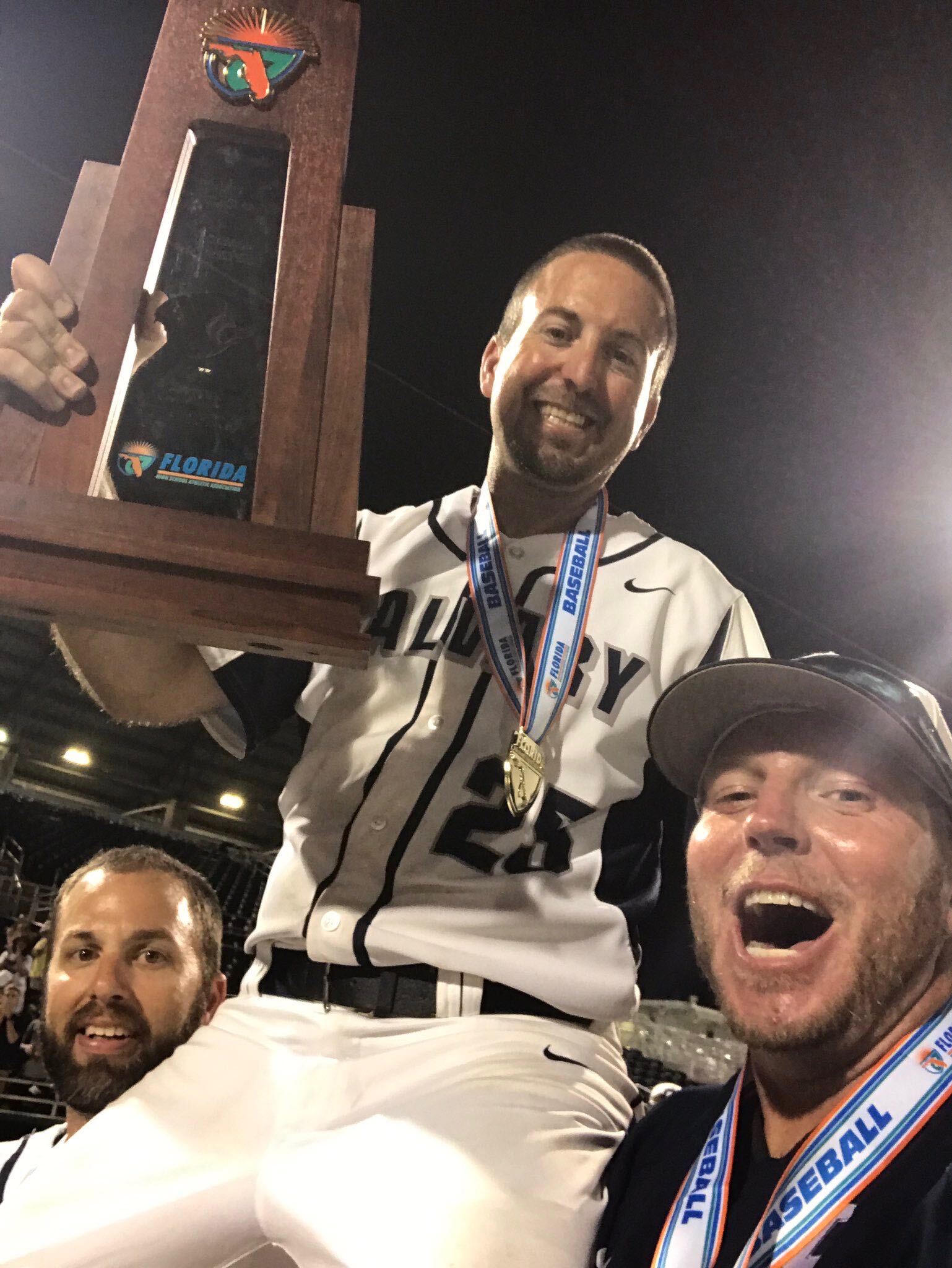
Roy Halladay and coach Greg Olsen after winning the state championship in 2017.
‘I really felt him there’
The drone surveillance didn’t end up being necessary. Calvary Christian won the Class 4A state baseball title handily. By the sixth inning, they’d amassed an 11-1 lead over Pensacola Catholic. The game ended by mercy rule.
The high schoolers sprinted from the dugout, jumping into a dogpile. Halladay flitted around the group, giving bear hugs big enough to lift players off the ground.
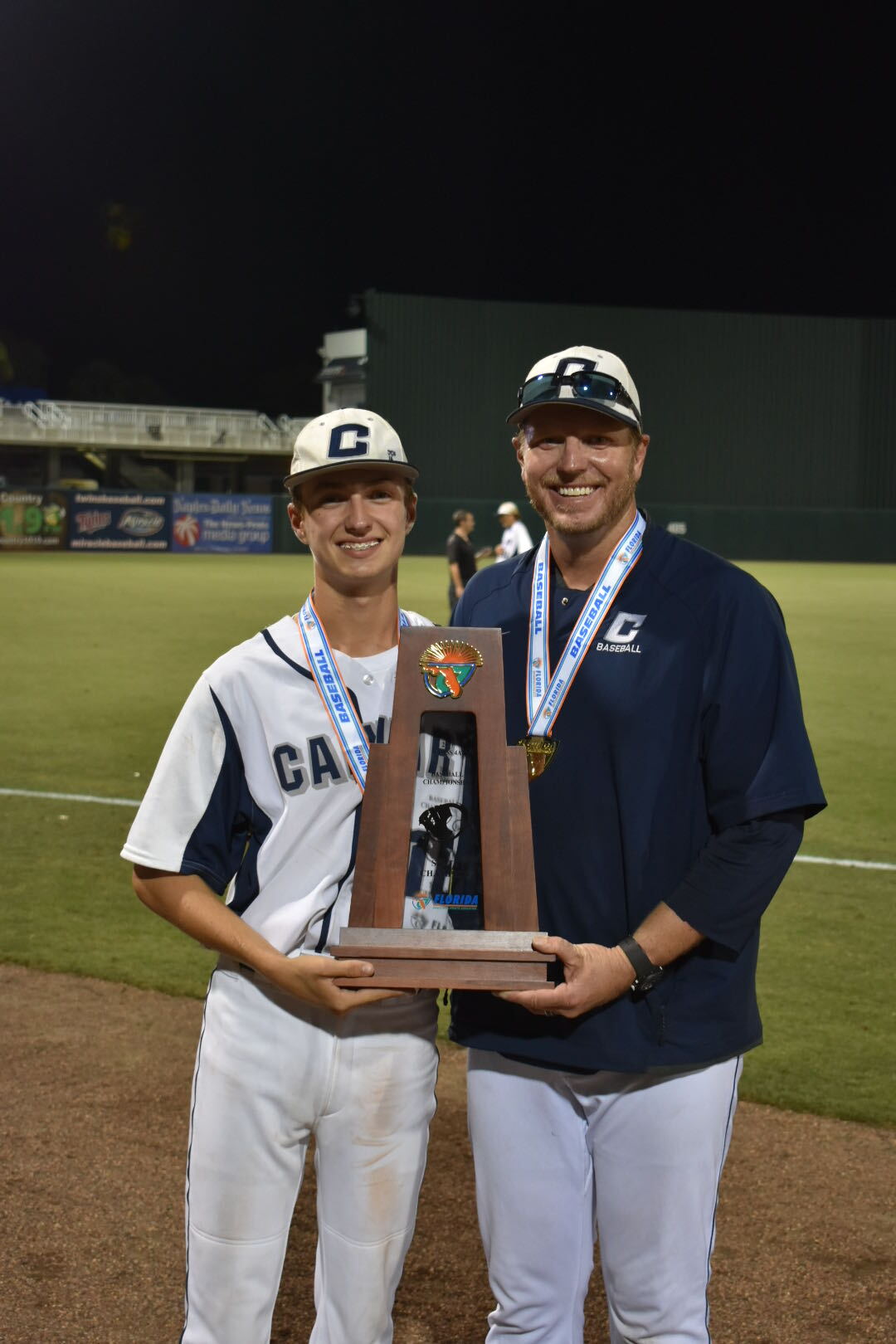
He and assistant coach Mike White hoisted Olsen on their shoulders, as he carried a wooden trophy. The former Phillie beamed from ear to ear. This wasn’t a World Series. But it was sweet all the same.
Halladay couldn’t wait to do it again next season, which is why he arrived to an exhibition game in full baseball garb in early November. But that would be the last time he’d see his team.
Yes here are the HS kids and me with my son! Proud dad, Proud coach, Proud member of a coaching staff! #familypic.twitter.com/3WgoW0kwC6
Braden described the days after his father’s death as a blur. Teammates and coaches came by the house to express condolences. Cairo and Hudi barely left his side.
On Nov. 8, Olsen gave the younger Halladay a call. Calvary Christian had another exhibition game scheduled for Nov. 9, against East Lake.
Braden was supposed to start, but Olsen said they could cancel it altogether if he wanted. He told his coach he would think about it.
Less than 24 hours later, Braden was in his car, driving to the ballpark. As he warmed up in the bullpen, he heard a loud noise.
The high schooler looked toward the sky to find a small airplane flying overhead.
“It looked exactly like my dad’s,” he said. “That brought me closer to him in that moment.”
At 7 p.m., Braden stepped onto the mound, with his father’s Calvary jersey hanging in the dugout. A typical November game would draw about 30 to 40 people; on this night, there were four to five hundred.
Braden insisted that he’d take it one inning at a time, but once he started, he couldn’t stop. Four frames later — a long outing by fall ball standards — he’d allowed one hit and no runs.
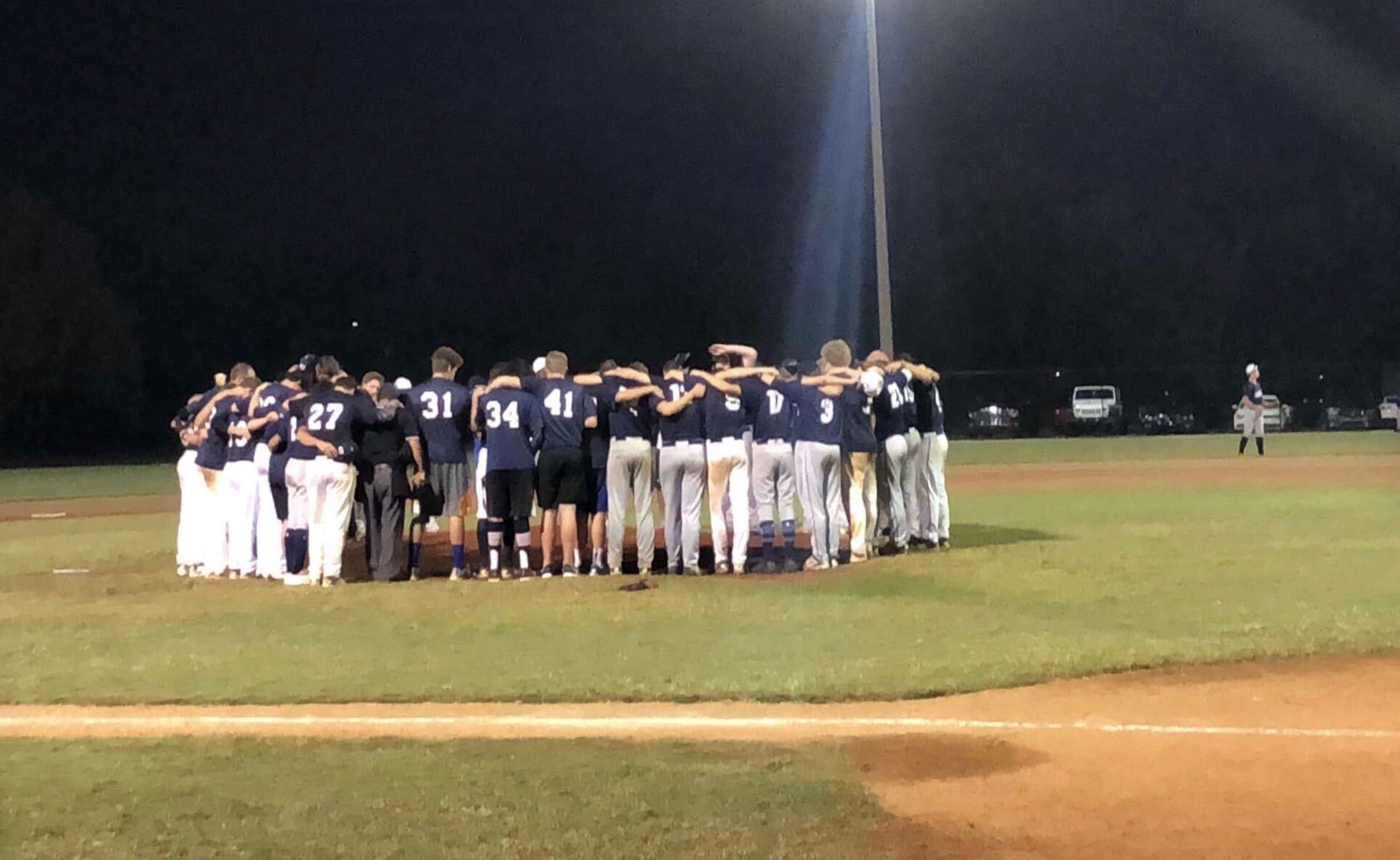
The Calvary team gathers on the mound to say a prayer following Braden’s first start after his father’s passing in 2017.
Braden told Olsen he was done. He walked off the mound, grabbed his father’s jersey, and began to cry.
“Obviously when he passed away, my thought was, ‘I lost my father,’” he said. “But that was my first moment of … he’s still with me. I still have him. I really felt him there.”
The players circled around the mound and said a prayer. Someone took a photo and sent it to Braden. Through the darkness, a ray of light shined down on his head.
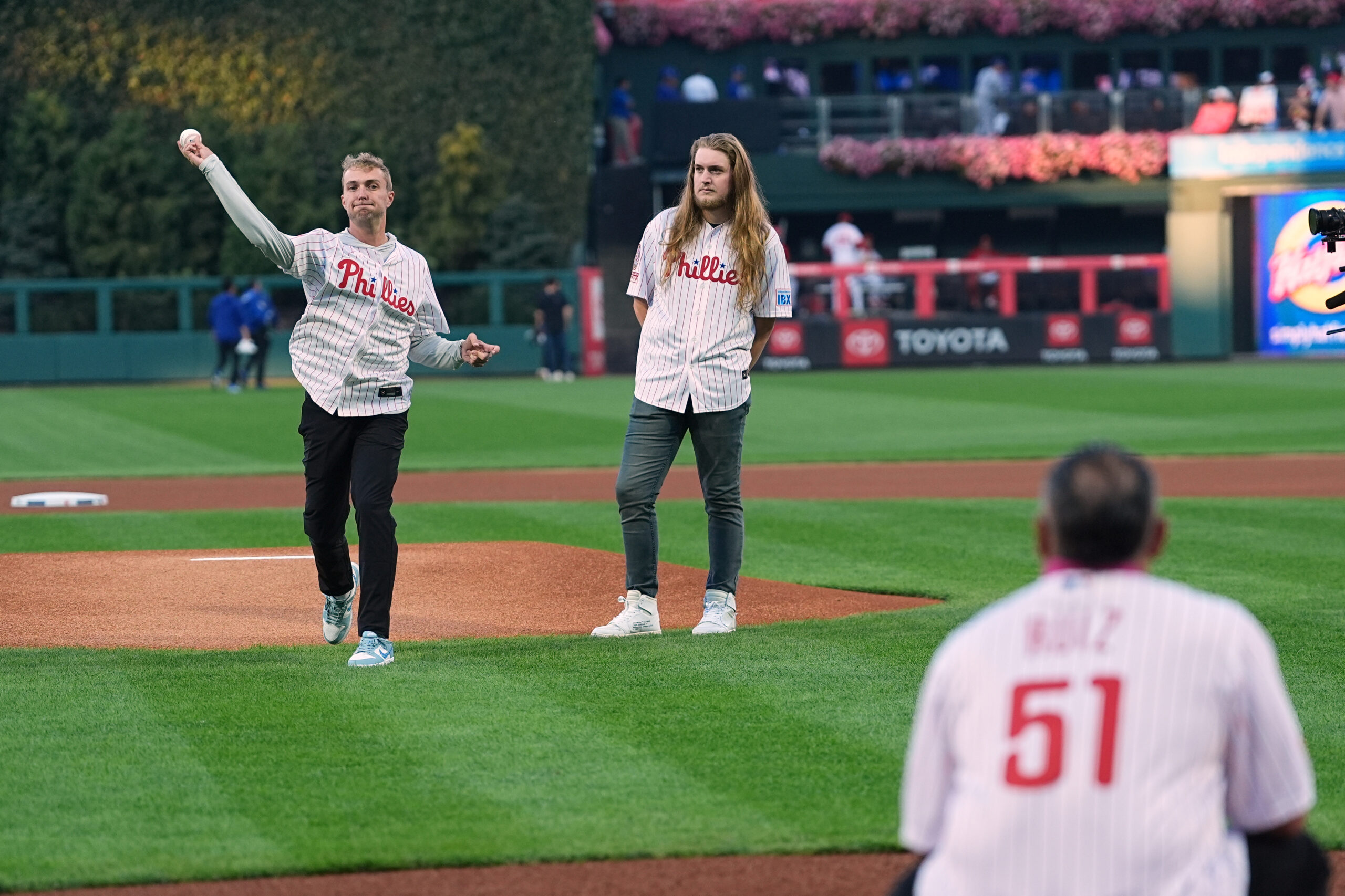
Braden Halladay (left) accompanied by his brother Ryan, throws the first pitch to former Phillies catcher Carlos Ruiz, marking the 15th anniversary of their father Roy Halladay’s postseason no-hitter, ahead of an NLDS game against the Dodgers in 2025.
A different side of Halladay
On Nov. 14, 2017, the Phillies held a celebration of life at their spring training complex. It was open to the public; thousands of people attended.
After the ceremony, Halladay’s friends and family moved to the batting cages beneath the stadium. Standing on bright green turf, with the nets pulled back, they grieved.
This was the first time many of his players had met his Phillies and Blue Jays teammates. And as the high schoolers traded stories with Chase Utley and Ryan Howard and Cliff Lee, it dawned on them that they’d seen a completely different person.
The former big leaguers painted a picture of a cutthroat competitor; a titan of the sport whose intensity seeped out. To the boys of Calvary Christian, he just was a goofy dad.
This is how they will remember him. They’ll never forget the perfect game, or the postseason no-hitter, or the countless shutouts. But for those 17 high schoolers, who are now 17 men, the coach they knew meant so much more.
Eight years ago, when FIFA announced that the World Cup would be coming to the United States in 2026, a student in France felt a rush of excitement. He and his friends had been watching the international soccer tournament on television since they were kids.
They’d never seen it in person. The last time their native country hosted the competition was in 1998, before all four Frenchmen were born. In the years since, they’d tried to make it to a game, but to no avail.
Russia hosted in 2018, but the four friends were unable to get visas. Qatar hosted in 2022, but this time, they were attending different colleges, which made traveling logistically complicated. So, they looked ahead to 2026 and started saving money.
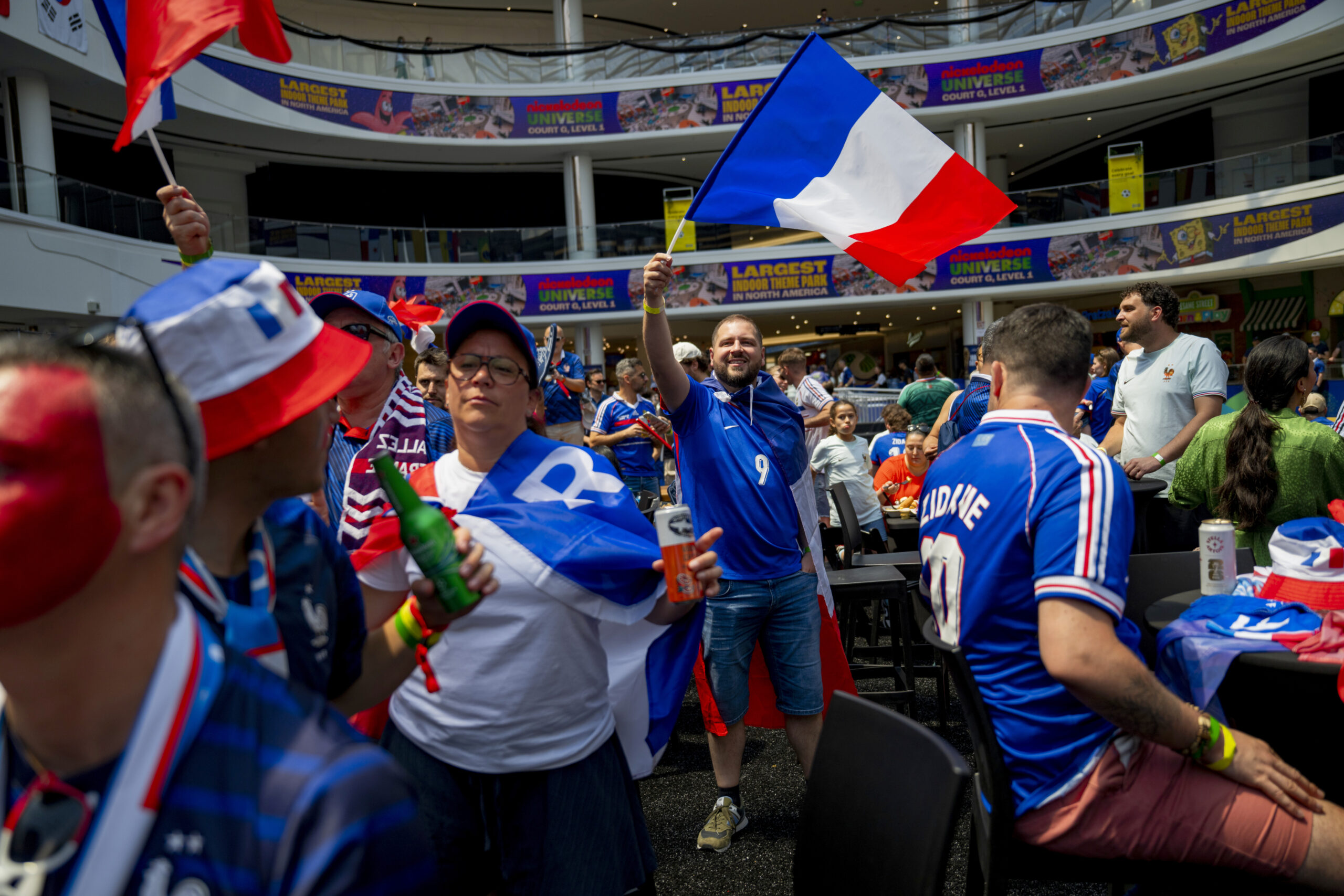
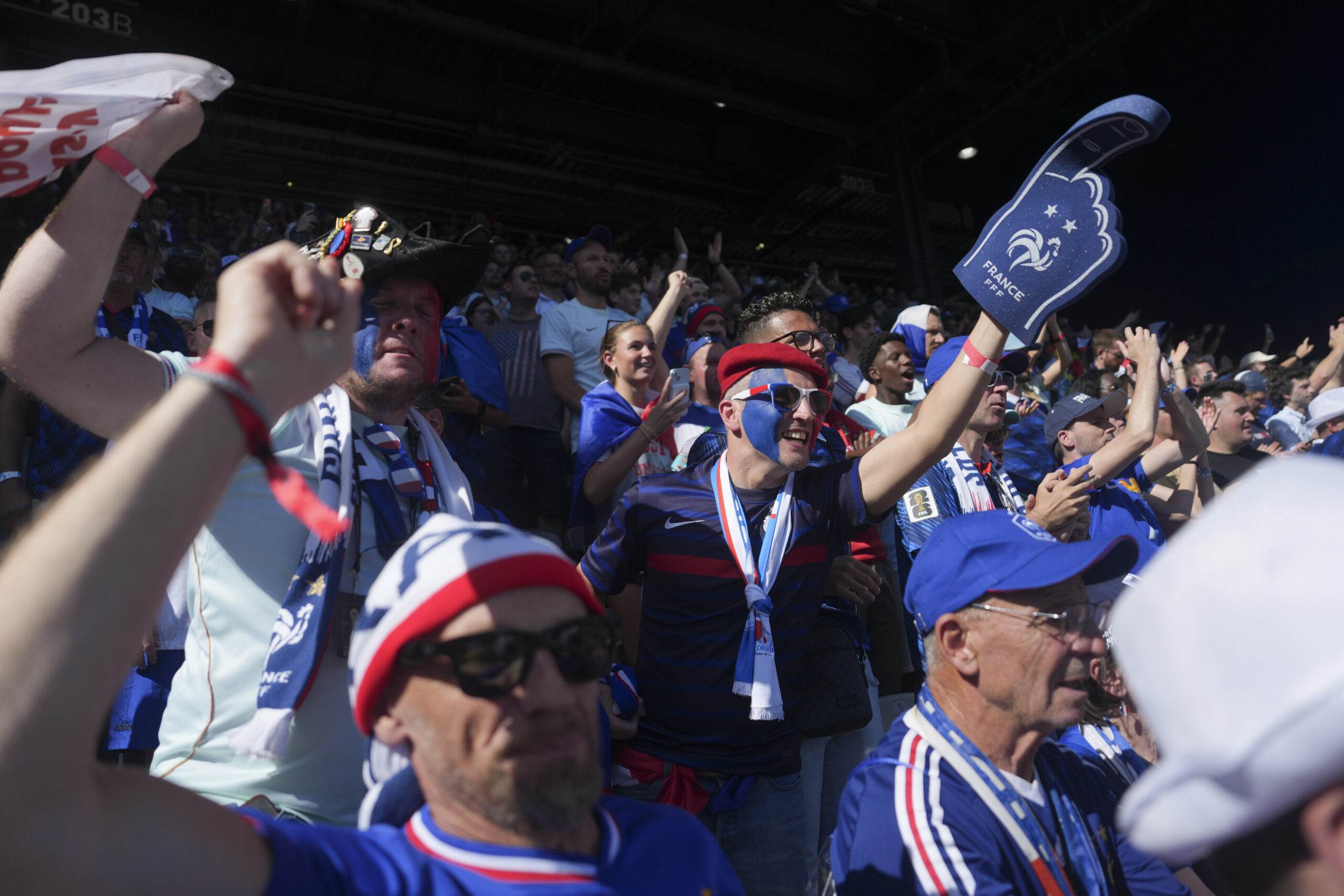
A heavy France contingent was part of an announced attendance of 68,274 at New York/New Jersey Stadium for their first game of the World Cup.
One man picked up extra work shifts at his Parisian brasserie. Another taught English lessons on the side. All four made a conscious effort to cut back on drinking and eating out.
There was one problem. The men worked in upscale restaurants, and summers were extremely busy. The Parisians knew that they wouldn’t be able to get a few days off, let alone a few weeks.
In the spirit of Ferris Bueller, the 20-something-year-olds decided to tell a white lie. And now, three years and $12,000 in savings later, they are in Philadelphia, enjoying everything it has to offer (unbeknownst to their employers).
“Momo,” the Parisian waiter who organized this trip, participated on the condition that he and his friends’ last names would be omitted (out of fear of losing their jobs).
It was a risk traveling here but one he says has been “absolutely” worth it. For more than a week, the Frenchmen have been exploring the city, rating each experience on a 1-to-3 scale.
Eating through Philadelphia
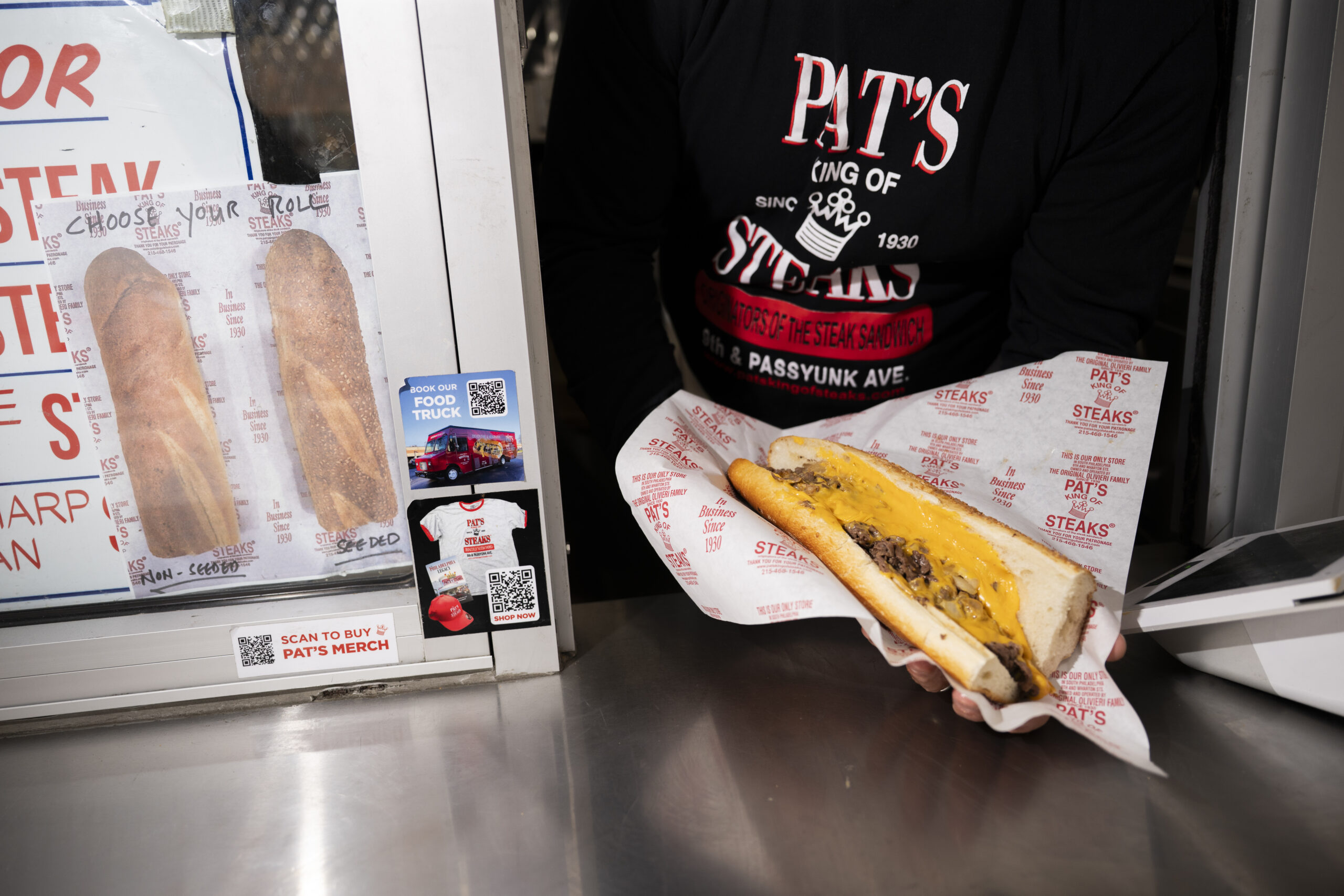
Their first stop was Pat’s. Momo and his friends — Micha, Anto, and Titi — accidentally ended up at Geno’s. They asked customers where they could find Pat’s, to which he said they responded, “What the [expletive].”
“We turned around and there’s the building,” Momo said. “And we’re like ‘Ohhhh.’”
They each bought two cheesesteaks, with a soda and fries, to compare the difference. It was negligible. Pat’s edged out Geno’s in their rating system, just because they thought the “crown on the cup was cooler.”
What did stand out were the condiments.
For these four Frenchmen, a trip to Pat’s Steaks was on the menu which they gave the edge to over Geno’s.
“We had what you call Cheez Whiz,” Momo said. “I’ve never had something like this. It was good. Interesting flavor. It’s not cheese, but it was good anyway.”
He added: “Micha wanted me to mention that we enjoy ranch sauce. It is very good. We had this brand, Hidden Valley.”
They’ve since gone to Ricci’s for hoagies. Grandma’s Pizza, Del Rossi’s, and Parc are also on the agenda (that is, if they can get a table at Parc).
“Somebody told me what the hoagie was yesterday,” Momo said. “I had never heard hoagie. So, I got the hoagie today. It was good hoagie, I think it was Italian hoagie.
“We gave Ricci’s a 3 [rating]. It was unique. There’s nothing Italian about it. But it was so good. The sandwich itself, you’d never find it in Italy, but it was so unique that we just enjoyed it. So we gave it three stars.”
This is a substantial amount of food — and the portions are much bigger than they are in France — but the Frenchmen are quickly burning off the calories. They say they are walking approximately “five miles a day” to see the sights (and save some money).
Exploring the city by foot
The four friends are partially doing this out of necessity. They are staying at an Airbnb in South Philadelphia. SEPTA isn’t as comprehensive as the train system in Paris. But exploring the city by foot has led to some enlightening experiences.
One of the first things they saw were “Philadelphia 250″ signs on buildings and billboards. After conversing among themselves, and coming up with no answers, Momo decided to ask a passerby.
“We said, ‘What is 250?’ ” he said. “‘What are these numbers?’ I asked the man on the street, ‘Sir, what is 250?’ He was like, ‘Our anniversary this year, 250.’
“And I was like, ‘Oh, OK, yes, yes, yes. I understand.’ Because then I remember the whole Revolutionary War stuff. They were telling me fireworks and baseball and all of this other American stuff that we’ve never seen before. So, we said we’ll stick around and we’ll go to it.”
Fans of France were in full force during the team’s World Cup match against Senegal. They head to Philly to face Iraq at 5 p.m. Monday.
Other areas of confusion have included Uber delivery robots (“in Paris, we just have guys on mopeds”) and knowing where you can and cannot smoke a cigarette.
The smoking alone has led to some interesting encounters. Last Sunday night, while at dinner in Fishtown, the Frenchmen tried to take a smoke break outside a restaurant.
They were promptly told to relocate, and met another local who had been told the same. They started talking about the Eagles — Momo and Micha want to buy a jersey — and he gave them some recommendations.
A few minutes later, they said goodbye, and the man signed off with a “Go Birds.”
“And I was like, ‘Go Birds?’” Momo said. “And he’s like, ‘Go Birds.’ I thought he meant pigeons or seagulls. I didn’t know he meant Eagles.
“He’s like, ‘People say Go Birds all the time here.’ I was like, ‘Even when the Eagles are not playing?’ He said, ‘Yeah.’ That’s interesting. That would be like saying, ‘Allez Paris Saint-Germain’ when Paris Saint-Germain are not playing. Why would you say it now? Just say it later, when they are playing.”
A ‘devastating’ encounter with Rocky
While on another five-mile walk on Wednesday, the Frenchmen decided to see Rocky. They were very excited; Micha and Momo had both watched the film for the first time on their flight over. They weren’t expecting a statue, though.
The four friends said that they thought Rocky was a real person, and assumed they were en route to meet a world-class boxer.
Finding out he was fictional was “devastating,” in Momo’s words. But the visit still earned high marks.
“Me and Micha gave Rocky statue a 10, even though 3 is the highest rating,” he said. “Because we just watched the movie, so we think, ‘Oh this is a 10 rating.’”
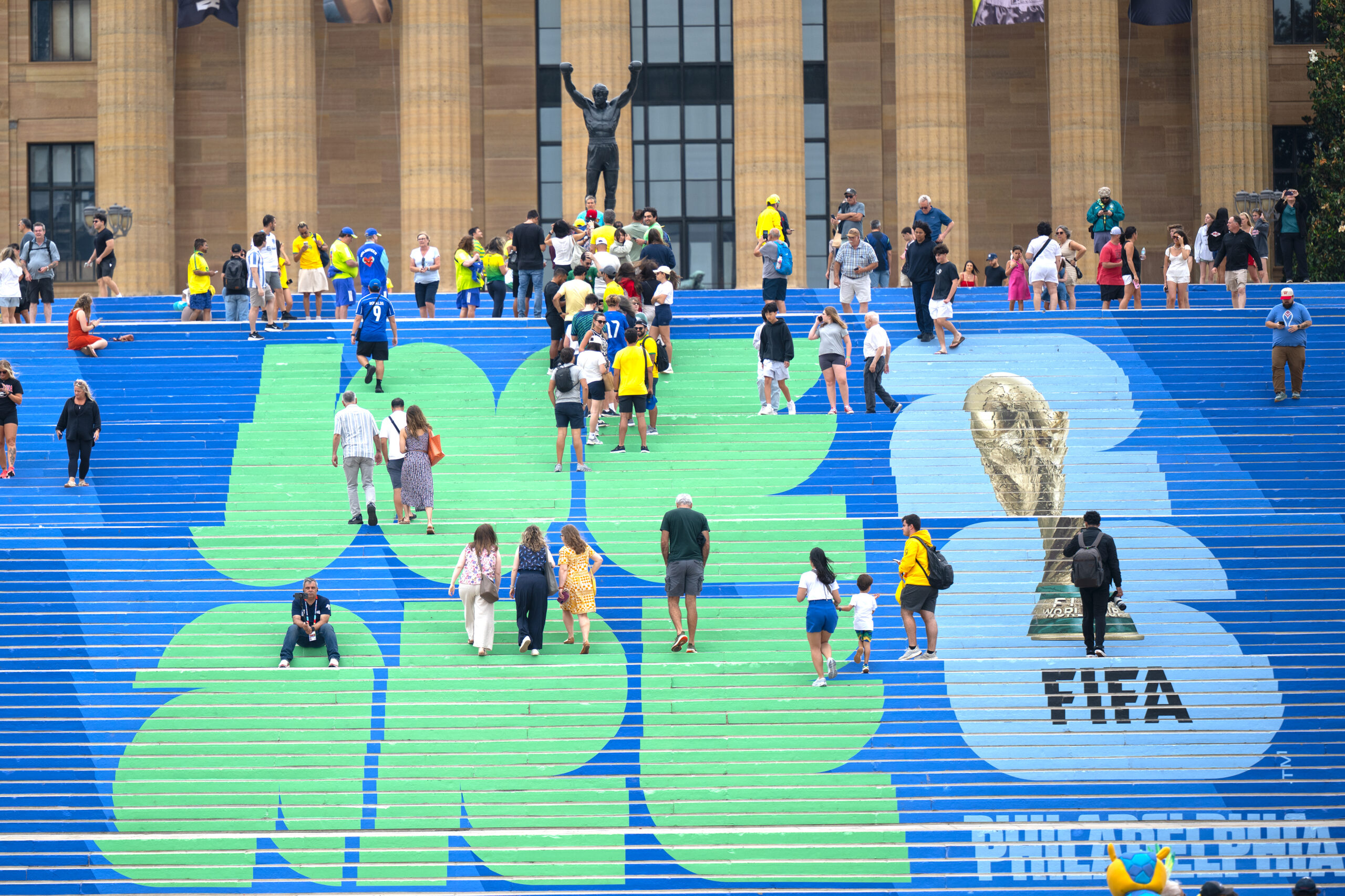
Brazilian and soccer fans climb the steps of the Rocky statue, marked with a FIFA World Cup logo, on Thursday, June 18, 2026, in Philadelphia, ahead of Friday’s FIFA World Cup Group C match between Brazil and Haiti.
While they were there, the Parisians heard about the Rocky curse. Unlike Ecuador’s fans, they will not be falling victim to it.
“I said, ‘Sir, we’ve paid too many American dollars to come this far now to watch France lose to Iraq in Philadelphia, so that will not be happening,’” Momo said. “If people come here and I see it happen, I’ll take [the jersey] off myself. I’m not watching France lose here.”
The four friends, who are staying through the Fourth of July when Philly will host its final World Cup game, have a lot of sights to see until then. On Saturday, they headed to Citizens Bank Park. This week, they’ll try to visit the Philadelphia Museum of Art.
But the main attraction, of course, is Les Bleus, who will play Iraq at Lincoln Financial Field at 5 p.m. Monday (Fox 29). Anto found himself getting emotional about this earlier in the week.
His friend asked what was wrong; Anto said he was in disbelief that the Frenchmen were finally on the precipice of their first World Cup.
“Then I thought about it,” Momo said. “We’ve sacrificed going out with our friends to save up for this. We said on the plane ride, even if something goes wrong we’re going to try to enjoy, because we’ve been saving forever.
“Even seeing France play one game at the World Cup … I’ll be telling my kids about that for the rest of my life. It’s something that I’ll never forget.”
The four friends could’ve gone to other American cities. France has also played in New Jersey, and will play in Boston next Friday. But they chose Philadelphia, and are glad they did.
“It’s funny,” Momo said. “If New York were a little cheaper, we would have gone to New York, and never gotten any of the experiences here. But I’m happy that we picked a city that I feel like most Europeans don’t think about.
— Equipe de France ⭐⭐ (@equipedefrance) June 19, 2026
“They think about New York and Miami and LA. But now I can go home and tell people, ‘Yo, go to Philadelphia. It’s interesting.’”
He added: “They say that people in Philadelphia are mean and rude. They say the same thing about Paris. It’s not true; the people are very helpful. I feel like people here would help you if you need help, just in the way that people in Paris would do the same. If you need help, people would help you.
“I have not met one mean person. Super helpful and accommodating and hospitable to me and my friends.”
The Frenchmen have enjoyed it so much that they are already planning their next trip, to the Linc in the fall.
It’ll be tricky because the Eagles’ season overlaps with Paris Saint-Germain’s (and the four friends are season-ticket holders). But they’re determined to find a way to make it work.
“We’ve heard of Eagles before,” Momo said. “I’ve heard of Jalen Hurts and Saquon Barkley, when he jumped over that football player. We will definitely come back. And if not for Eagles, just to explore the city.”
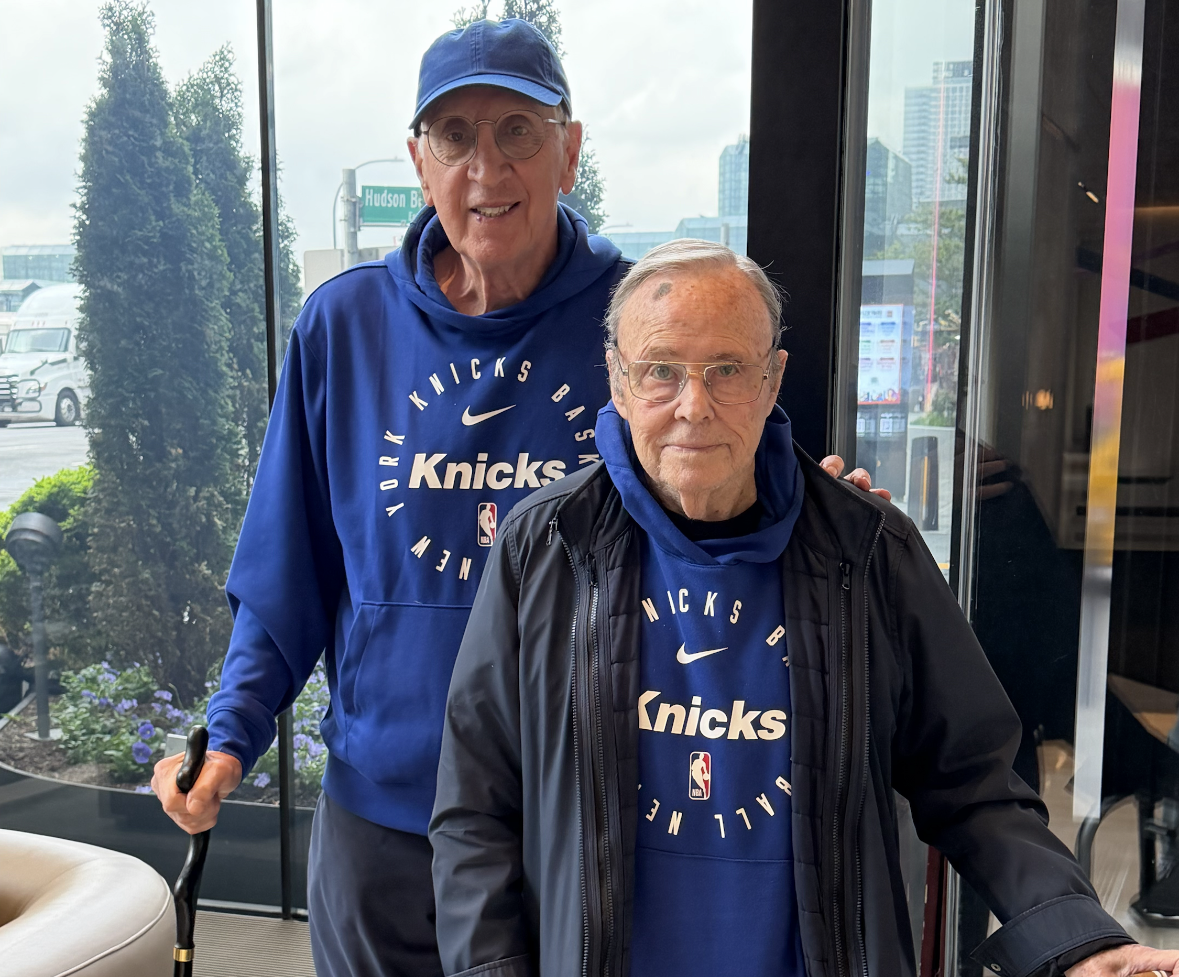
Seth Friedman was watching the NBA Finals on Saturday night in Graduate Hospital when he heard a familiar refrain.
It came from Leon Rose, the mild-mannered architect of the New York Knicks. His team had just won its first title since 1973.
Rose, 65, was asked how he felt knowing he’d built a roster that had ended a 53-year-drought. The Knicks president shook his head, shrugged his shoulders, and pivoted to his players.
He praised their brotherhood, their grit, their empathy. He talked about their care for one another, and their selflessness, and how it allowed them to reach new heights.
Friedman, sitting on his couch next to his wife, began to tear up.
“It sounded like he was talking to us,” he said, “back when we were 13 or 14 years old.”
The setting was vastly different. Instead of holding two-a-days for high schoolers, Rose was standing on a platform in San Antonio, Texas, with a sparkling trophy beside him.
But the message was nearly identical. Friedman listened to it himself when he played for Rose in the mid-2000s at his local Jewish community center.
“He literally preached that same mentality,” Friedman said. “That family mentality.”
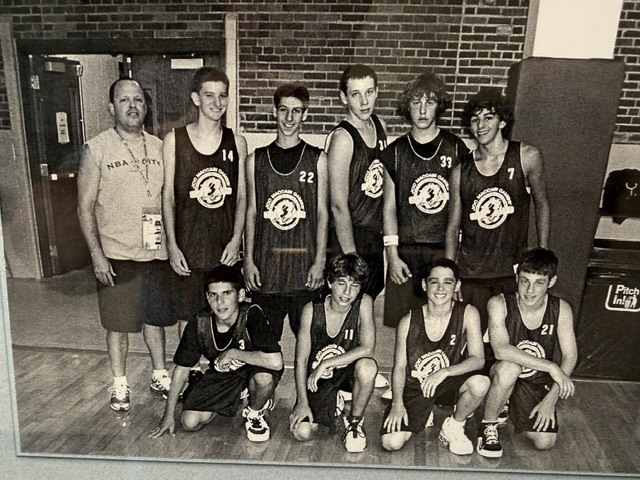
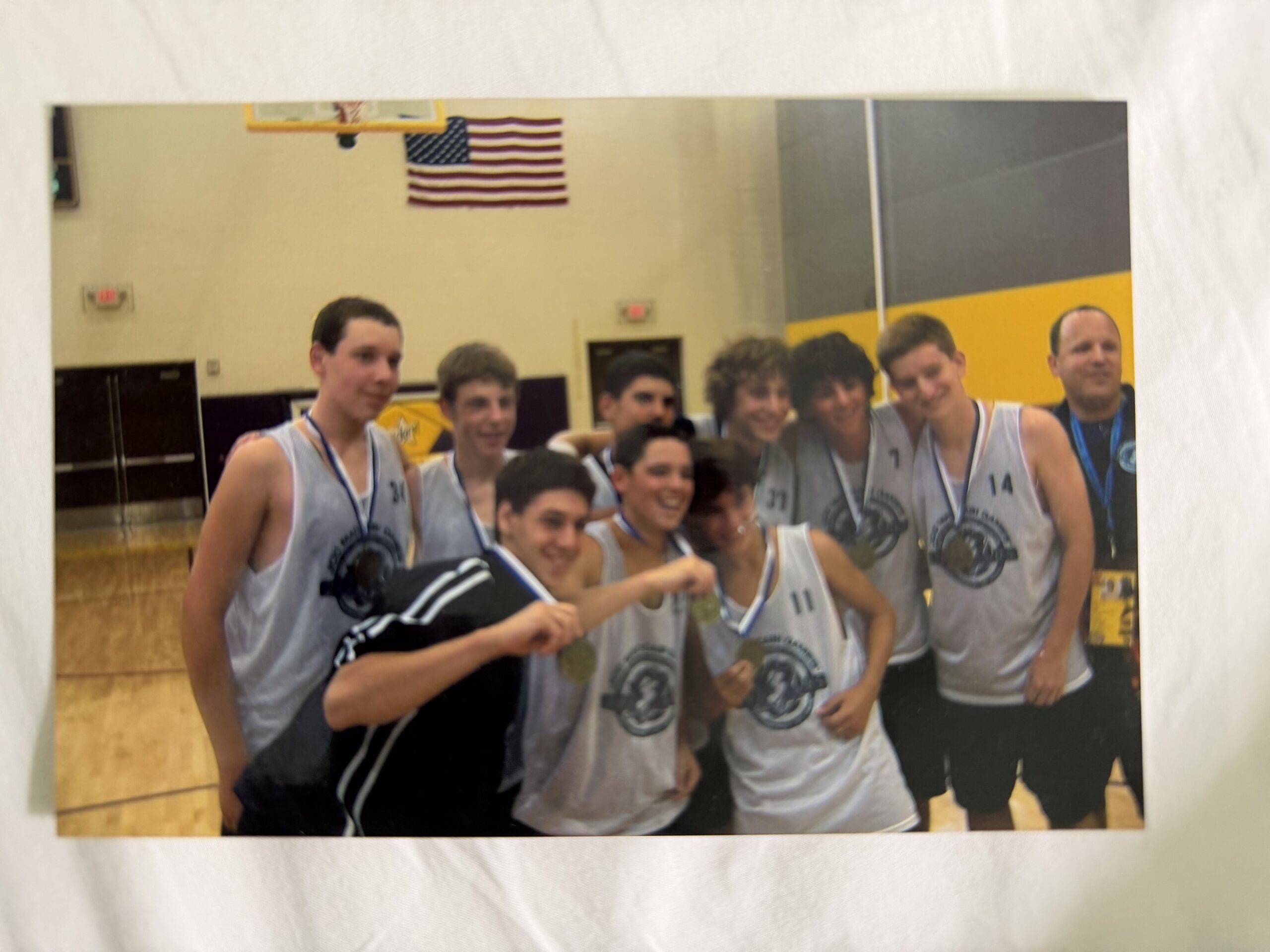
Leon Rose coaching at the Katz JCC in 2005. Seth Friedman is pictured in the bottom row, second from the right.
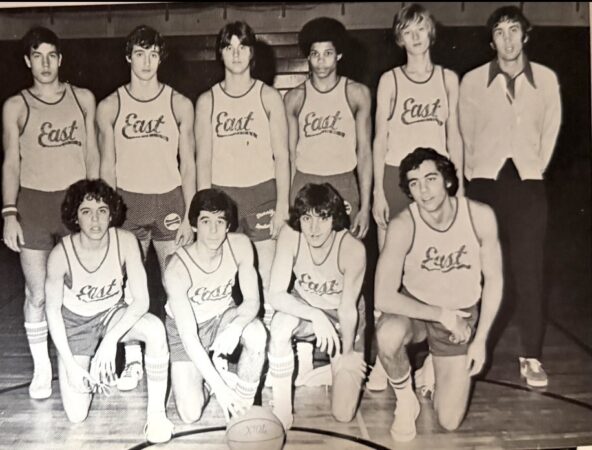
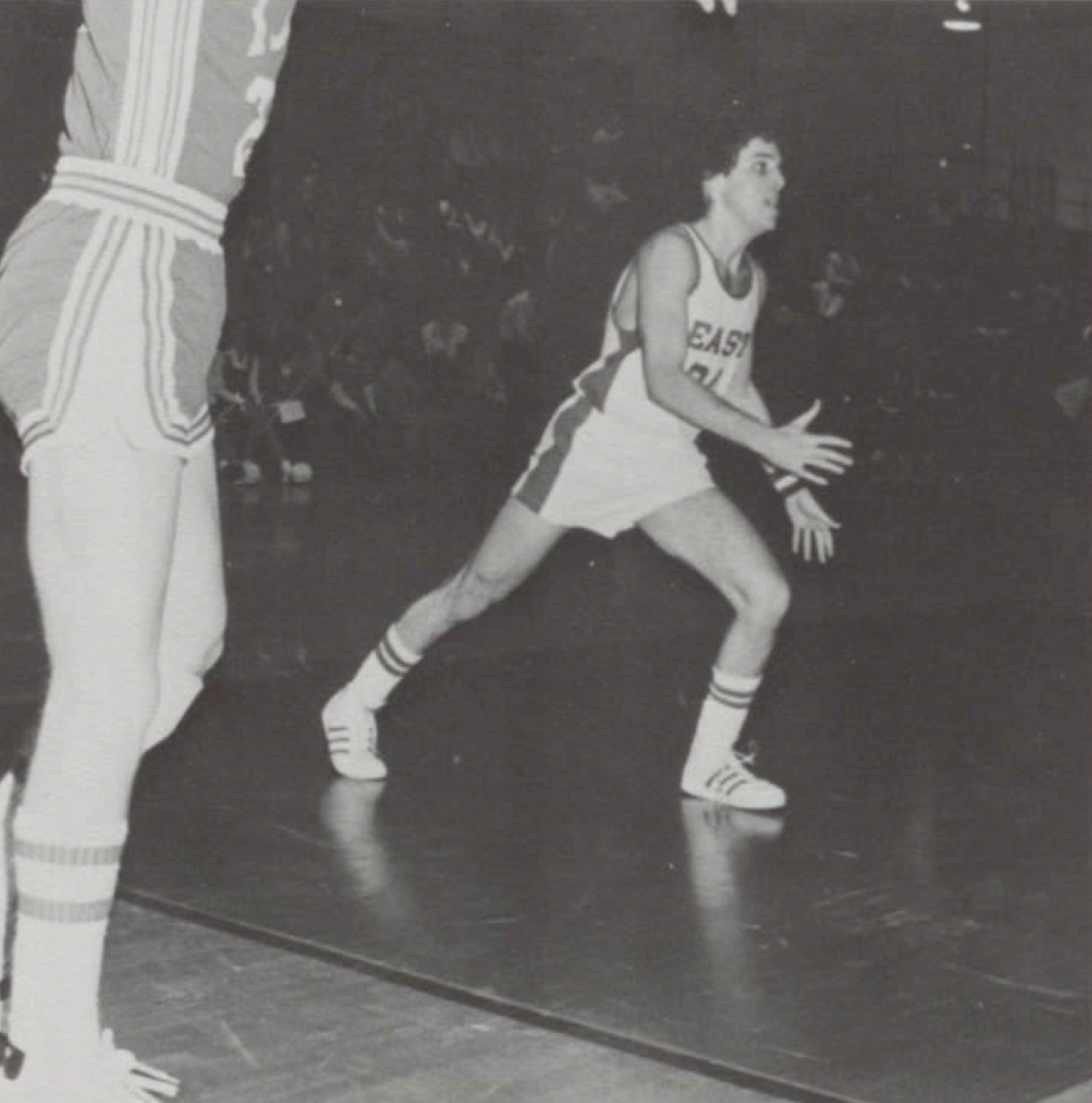
For decades, the future Knicks president was a mainstay in his Cherry Hill basketball community. He played under head coach John Valore at Cherry Hill East from 1975 to 1979 and joined Valore’s staff in the early 1980s while studying atTemple’s law school.
He moved on to work as an assistant coach through the late 1980s at Rutgers-Camden, a short commute from his day job at the Camden County prosecutor’s office.
He’d leave collegiate coaching in 1988, but Rose would always find time for the sport, even as he ascended the ranks of the NBA. In the 1990s, while he transitioned to sports management, Rose often could be found playing pickup hoops at the Katz JCC in Cherry Hill.
By the mid 2000s, he’d assembled a Rolodex of star-studded clients, including Allen Iverson and LeBron James. But that didn’t keep him away from the gym. For the better part of a decade, Rose served as a volunteer coach at the Katz JCC, preparing teams to compete in the Maccabi Games.
The Knicks executive has achieved a lot since then. But those who know him best say he is the same understated guy who’d wear baggy sweatshirts and run his team through tap drills and sprints.
“He was Coach Leon,” Friedman said. “He was one of us. Even now, you see him down the Shore, and you’d never know that he’s the person that he is.”
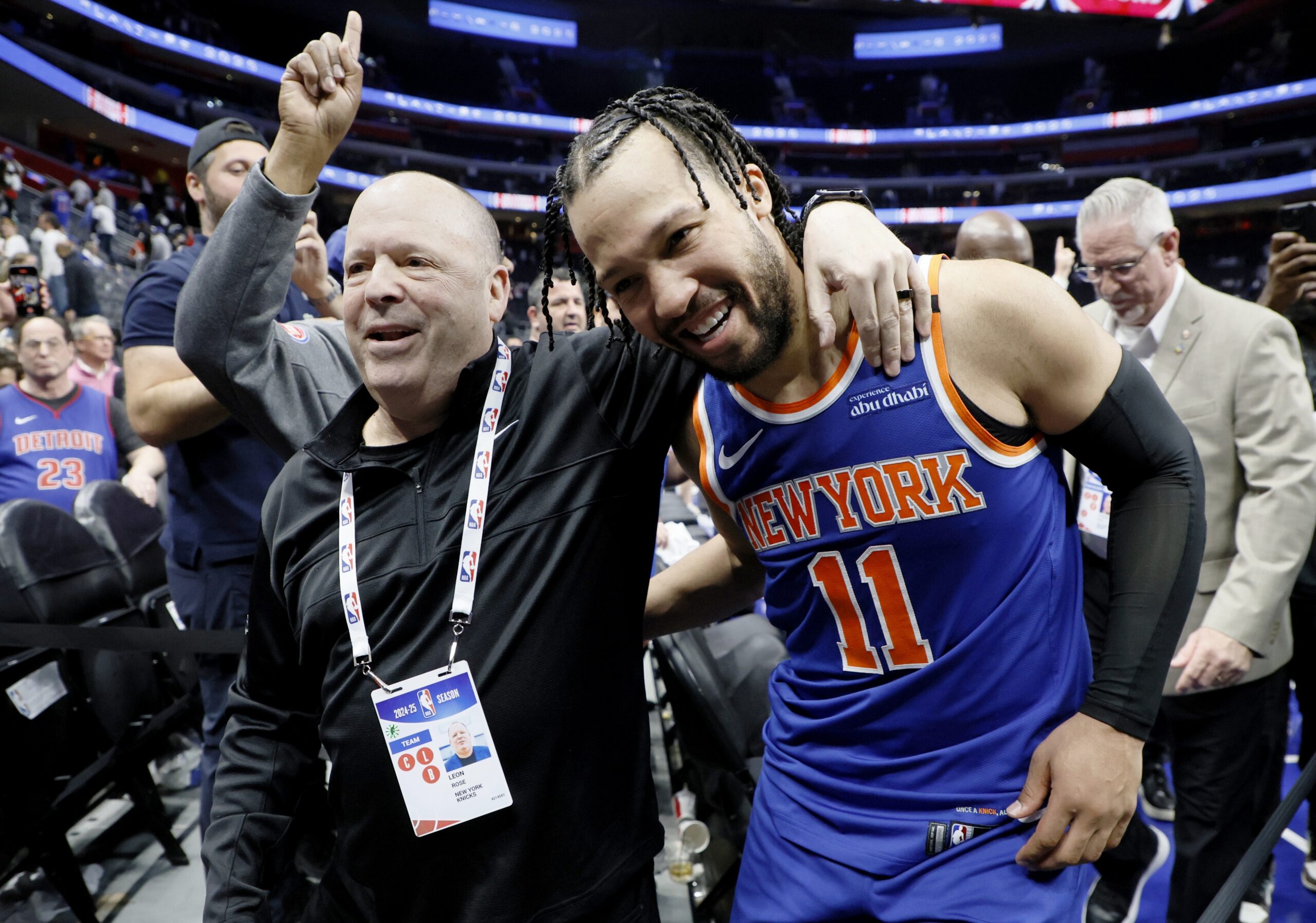
New York Knicks Leon Rose (left) hugs guard Jalen Brunson (11) as they leave the court following a Game 6 win against the Pistons in the 2025 playoffs.
‘A gym rat’
Valore met Rose in 1975 when he was coaching junior varsity at Cherry Hill East. The freshman was undersized compared to his teammates, but he played above his stature.
If there was a loose ball, the point guard would dive for it. If there was a charge, he would take it. Valore admired his toughness. So when he got the varsity job in 1976-77, he decided to bring Rose with him.
The sophomore made the most of his opportunity. Cherry Hill East was a relatively new program at the time and largely was viewed as a “doormat,” in Valore’s words. Rose helped change that, building an unselfish culture from the ground up.
He wasn’t a vocal leader, but he showed interpersonal skills that would serve him later on. The future NBA executive was direct and honest. He could have difficult conversations with teammates if he needed to about roles and behavior on and off the court.
Rose also set a standard through his style of play. Cherry Hill East was up against stiff competition in South Jersey from teams like Camden and Haddon Heights, which boasted players who were 6-foot-2, 6-3.
The point guard was unafraid to battle them.
“He was a player that had to compete harder and tougher than the person he competed against,” Valore said, “because he was 5-7, 5-8, 5-9. That shows you the toughness he had within him.”
Leon Rose at Cherry Hill East.
Cherry Hill East’s culture quickly translated into wins. When Rose arrived, the varsity team finished just above .500. By the time he graduated, it was one of the best teams in its conference.
But above all, Valore was most impressed by his pupil’s character. During a practice in 1979, the coach called his co-captain over. Valore’s wife, Joyce, had just given birth to their first child, J.C.
The coach wanted Rose to be the boy’s godfather.
“[Leon] was 17 years old,” he said, “and I saw everything I wanted to see. He was an exceptional person with relating to other people. He was something special.
“He went back to his dad and explained the situation, and his dad gave the thumbs-up. And the rest is history.”
After a few years studying and playing basketball at Dickinson College, Rose rejoined his high school team as an assistant coach in 1983. The 22-year-old was just as impactful on the bench as he’d been as a point guard.
Over Rose’s three seasons with Cherry Hill East, the program produced four Division I players. One of those four, Nick Katsikis, ended up contributing to Seton Hall’s run to the 1989 NCAA championship game.
Valore can see similarities in what Rose accomplished with the Knicks. When the agent was hired by James Dolan in 2020, the team was en route to its seventh straight losing season; “a doormat,” just like Cherry Hill East.
Then Rose came along, and everything changed.
“He was a gym rat,” Valore said. “He just loved the game.”
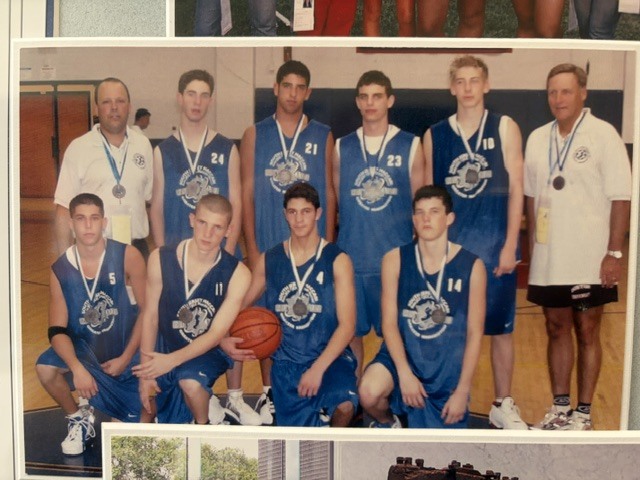
Leon Rose coaching for the Katz JCC in 2004. Ed Vernick is pictured on the far right.
From Maccabi gold to an NBA title
Ed Vernick moved from Philadelphia to South Jersey in the early 1980s, the same time Rose was coaching with Valore.
Unsurprisingly, the men became friends at the gym. Vernick was about to go on a trip to Ocean City and wanted a good place to work out. Rose overheard him talking, ripped off a piece of paper, and scribbled down an address.
Vernick had no idea who the young lawyer was, but he took him up on his suggestion. A few days later, while he was running on a treadmill in that Ocean City gym, he saw Rose walking by.
“He goes, ‘I just wanted to make sure you got here,’” Vernick said. “What a nice guy. I’m thinking, ‘Who does that?’ It was just one of those things that caught me.”
About two decades later, when Rose was starting to coach basketball at the Katz JCC, he asked Vernick to be his assistant. Together, they spent the summer of 2004 preparing Cherry Hill-area kids for the Maccabi Games, a youth athletic competition for Jewish athletes from all over the world.
Parents and players said Rose took this as seriously as the NBA Finals. He’d carefully craft his rosters, thinking hard about how each piece would fit.
Once the team was constructed, he’d spend July running them into the ground with many of the methods Valore used at Cherry Hill East: switch drills, sprints, tap drills.
Leon Rose coaching at the Katz JCC in 2005.
The week before the Games was by far the toughest. Players would be required to train twice a day and would arrive at the gym at 6:30 a.m. and return at 2 p.m.
“He got into us,” Friedman said. “But it got us ready. It got us prepared. It got us in shape. I hated it during it, but, looking back, those were memories I’ll never forget.”
This was a major time investment for one of the most high-powered agents in the NBA, but Rose was deeply involved. He continued to coach before and after his son, Sam, and daughter, Brooke, were eligible to play.
And he went far beyond what was expected of a volunteer. One year, Friedman said Rose took the team up to the Poconos for an exhibition game at Pine Forest Camp, which was known for its basketball program.
“He’s driving us up to play an exhibition game like it’s an NBA team,” Friedman said. “He didn’t have to do that as a coach. But he did whatever he could to get us prepped and ready to win a gold medal.”
About “80% of the team” came from Cherry Hill East, in Vernick’s estimation, and Rose often would be on the phone with Valore, asking about certain players.
Like his former coach, Rose gravitated toward toughness, and that style emanated from the teams he built. In 2004, South Jersey’s 16-and-under Maccabi team faced Washington, D.C., for the gold medal.
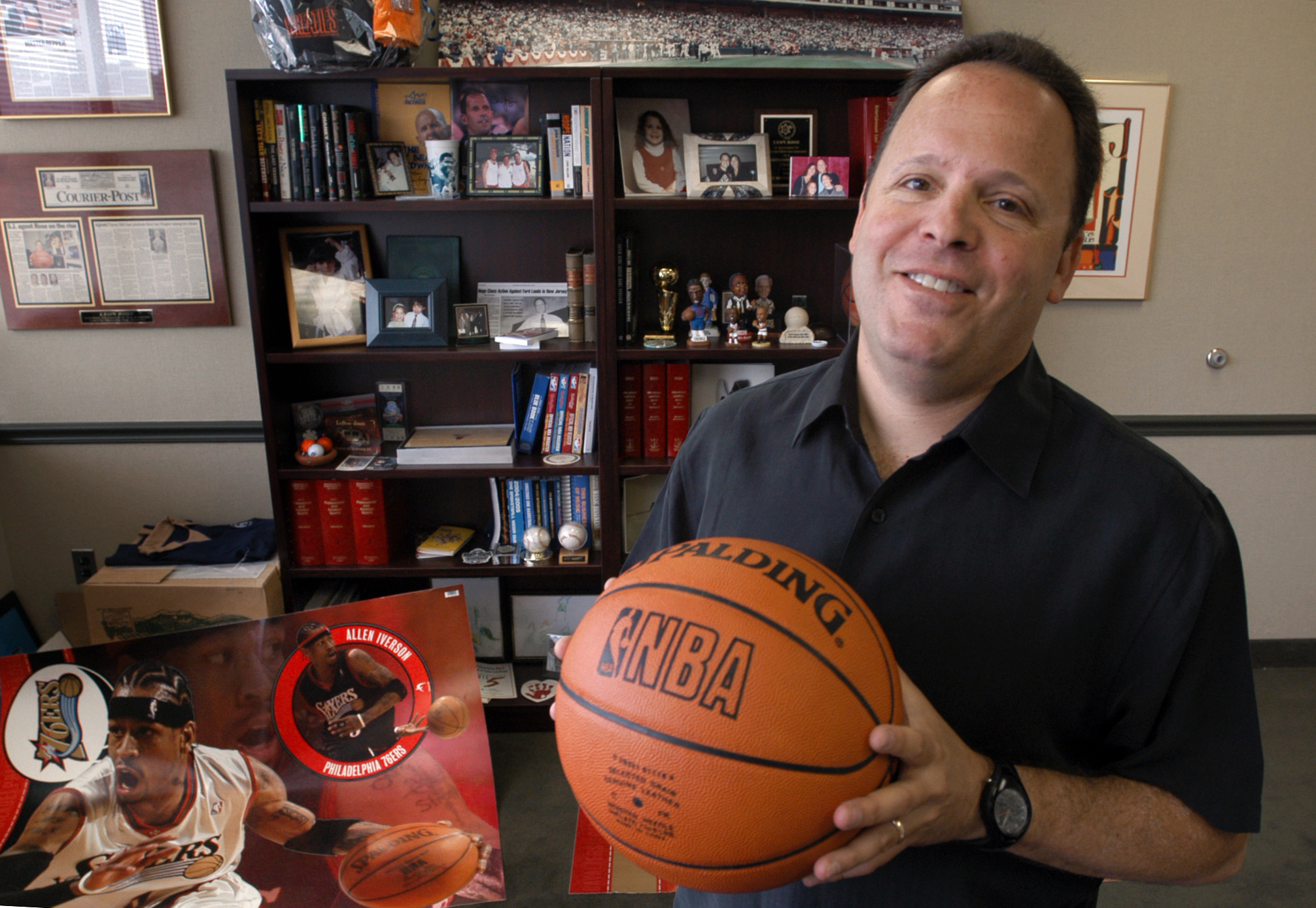
Leon Rose (in 2006) made his name as a superagent to the likes of Allen Iverson and LeBron James, but he did not flaunt that status to his young players.
It was a low-scoring game, one that came down to the buzzer. Washington was bigger and more talented, but Rose’s group challenged every bucket.
“I remember I could hear sneakers squeaking the whole game,” Vernick said, “and I just smiled. And I thought, ‘This is the way you play defense.’”
South Jersey fell, 42-40, but it won gold the following year in Minneapolis.
Rose spent six summers coaching at the JCC throughout the 2000s, winning two gold and two silver medals. He looked and acted like any other coach, donning Cherry Hill East basketball gear and sweatpants.
He rarely — if ever — talked about who he represented, or what he did for work, but the players occasionally got a glimpse.
When Friedman was a senior at Cherry Hill East, Rose arranged a surprise for his alma mater.
It was March 2010. The Cleveland Cavaliers were in town. After practice, their coach swung by to talk to the high school basketball team and answer any questions they might have.
It ended up being the coach who would lead the Knicks to a championship 16 years later.
“He had Mike Brown come over,” Valore said. “He was fantastic. Off the cuff, not scripted. He gave a wonderful speech to the kids.”
John Valore (left) and Zev Rose before a Knicks game in the early part of their 2026 playoff run.
Cherry Hill at the Garden
Rose and his family now live in New York, but they’re never too far from Cherry Hill. His 88-year-old father, Zev, still resides in the area, and is a regular at the Katz JCC.
Every once in a while, his son will send a limo to drive him and the 81-year-old Valore to Madison Square Garden. They were in the building for Game 4, sitting near the team president.
At first, it looked bleak for New York. The Knicks fell behind early and trailed by 29 points in the third quarter. But they came storming back in the fourth and completed the comeback on an OG Anunoby tip-in.
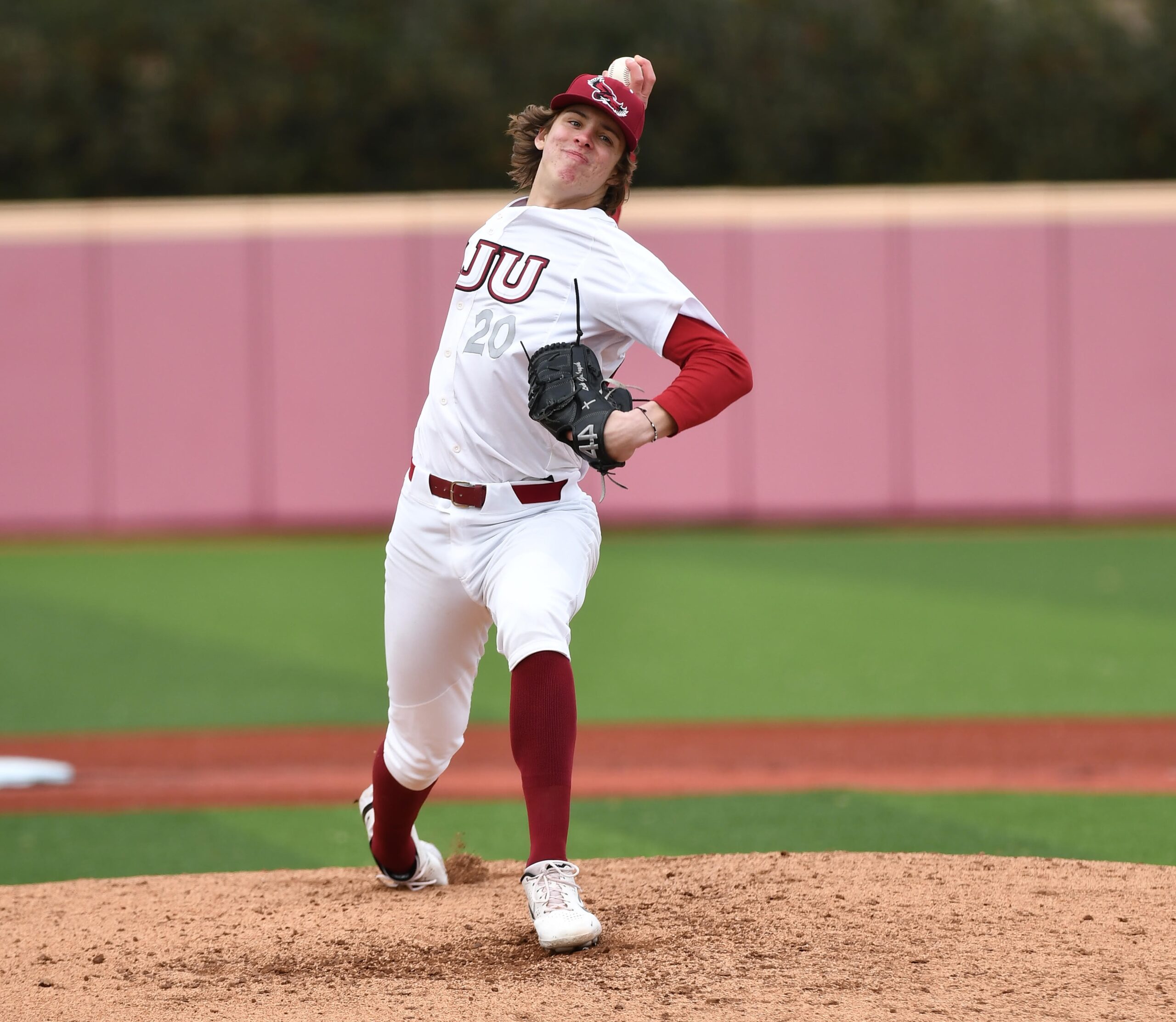
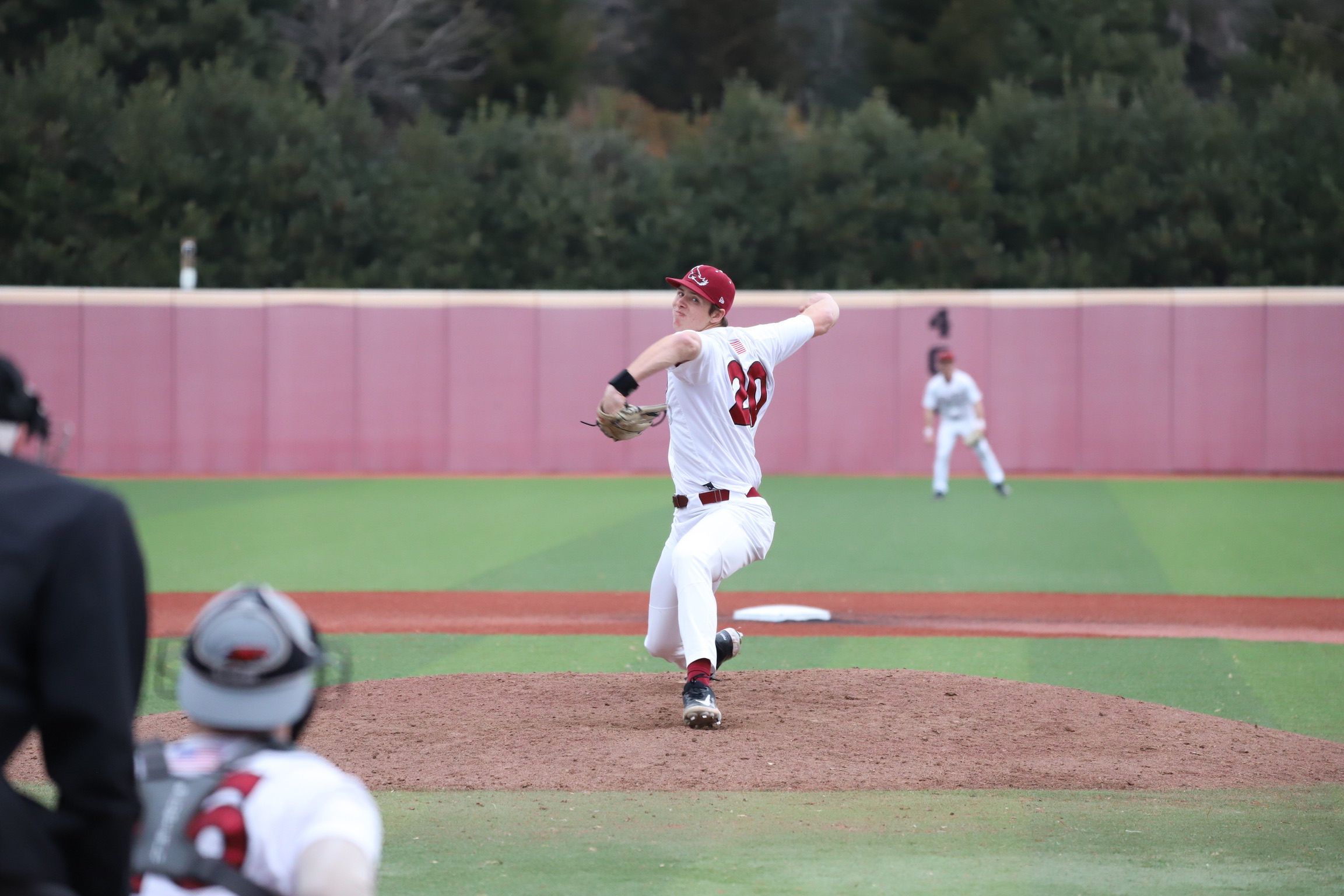
CLEARWATER, Fla. — Luke Gabrysh has been to Citizens Bank Park dozens, maybe hundreds, of times. Growing up in Wilmington, Del., his father Gary was a Phillies season ticket holder.
He was raised on the teams of Chase Utley and Ryan Howard, but living 30 minutes away, games were more of an occasional treat. That changed in 2022, when Gabrysh enrolled at St. Joseph’s University to play baseball.
All of a sudden, the right-handed pitcher was a train and subway ride from his favorite squad. He and his Hawks teammates took advantage of it.
After practice, they’d head to Overbrook Station, transfer to Suburban Station, and catch the Broad Street Line until the very last stop. They’d buy the cheapest ticket they could find — usually $30 — and roam around the upper deck, searching for the best vantage point.
“You can watch from anywhere,” Gabrysh said. “You don’t even need to sit down.”
The pitcher and his St. Joe’s cohorts were constantly at the ballpark. They didn’t need a reason. They’d go when they had nothing better to do, because in their minds, there was no better place to be.
But July 23, 2024, was a different kind of trip. Instead of walking through the first or third base gate, Gabrysh and his family were escorted into an employee entrance.
A Phillies scout, Jeff Zona, and other executives were waiting in a conference room.
“That was when it hit,” Gabrysh said. “I went there not to watch a baseball game. I went there to be part of the organization.”
Luke Gabrysh, shown pitching for St. Joe’s in 2024, was drafted by the Phillies in the 15th round of the 2024 MLB draft.
The 6-foot-3 right-handed reliever was selected by the Phillies in the 15th round of the 2024 MLB draft. He’s not a top prospect, but has piqued some interest internally.
Most pitchers who transition roles switch from the rotation to the bullpen. But with Gabrysh, the Phillies proposed the opposite. They liked his stuff, and his arsenal, and his ability to throw strikes.
And while the peripheral numbers in his first minor league season were average — a 3.33 ERA across low A and high A — he is trending in a promising direction.
Gabrysh’s fastball averaged 94 mph last year. It’s already jumped up to 96 this spring, occasionally touching 98. He throws five pitches: a four-seam fastball with carry, a sinker, a hard slider, a sweeper, and a changeup.
“Tons of strikes,” said director of pitching development Travis Hergert. “He can really spin the ball. And he can hold his [velocity] over the course of multiple innings, as well.”
Of course, there’s a chance Gabrysh ends up being a nice local story. But he could also be something more. And what a story that would be.
‘Just had a conversation with Nola’
The last time Gabrysh started regularly was on the Concord High School baseball team.
When he got to St. Joe’s, they needed bullpen help, so he began pitching in long relief. His surface-level numbers, again, were unremarkable: an 8.13 ERA across 68⅔ innings over three seasons.
But in 2024, he played summer ball with the Trenton Thunder, and quickly got on a few scouts’ radars. Gabrysh, who was being used as a closer, threw to a 1.42 ERA across 12⅔ innings with 23 strikeouts and only five walks.
His transition to a starting role in pro ball was difficult. Gabrysh liked showing up to the ballpark not knowing if he would pitch or not. He now needed a pregame routine, and a mindset better suited for long stints.
And the initial outings were ugly, to put it mildly. He allowed five earned runs through 1⅔ innings in his first start last April, and three earned runs through two innings in his second.
Luke Gabrysh had a 3.33 ERA across low A and high A in the Phillies’ minor league system last year.
But eventually, things got easier. The Clearwater Threshers coaching staff helped him plan a routine, down to the minute, and added a hard slider to his arsenal.
The pitch gave him a weapon againstleft-handed hitting, allowing him to induce moreweak contact and more swing and miss
“This year, it’s one of my bigger pitches,” he said. “It’s helped a lot.”
Despite the positive impression he’s already made within the organization, none of this feels even remotely normal to Gabrysh.
Four years ago, he was at Game 5 of the National League championship series, mere feet from catching Bryce Harper’s iconic home run. This spring, he’s seen the two-time MVP walking around the Carpenter Complex.
“It’s crazy,” he said.
In late January, Gabrysh was throwing a bullpen at BayCare Ballpark.
The minor leaguer looked to the outfield and saw someone playing catch. A couple of minutes later, Aaron Nola walked over to introduce himself.
(For a lifelong Phillies fan, this wasn’t necessary).
“Of course, I knew who he was,” Gabrysh said.
The two pitchers talked about where they went to school, and where they grew up. After Gabrysh got back to his locker, he texted his friends from home.
“I was like, ‘Just had a full blown conversation with Nola,’” he recalled. “And they were all jealous.”
Because Gabrysh is still on the minor league side, interactions with big leaguers are few and far between. But he has tried to savor these moments, and enjoy this experience, wherever it takes him.
Not so long ago, the right-handed pitcher was tailgating Eagles games, and buying cheesesteaks at Dalessandro’s. He was spending his summers not at the shore, but at the beach (an important distinction for a Delaware kid).
Now, he’s a few feet away from his baseball heroes. He hopes that one day, he can join them.
BRADENTON, Fla. — Friday’s game was more about depth within the Phillies’ system than anything else. It mostly was minor leaguers who made the trip for a 14-10 win over the Pittsburgh Pirates.
Prospect Jean Cabrera made the start and pitched 2⅓ innings. He allowed one run on two hits with one walk and three strikeouts.
He said afterward that he’d benefited from being around veterans in big league camp like José Alvarado, Cristopher Sánchez and Jesús Luzardo.
When asked what he’s learned from them, Cabrera said they gave him some advice.
“First and foremost, they tell me to add some weight,” the 6-foot, 145-pound Cabrera said with a laugh. “They think that I would benefit from that, to be ready and be healthy for 30 starts in the big leagues. Two hundred-plus innings, who doesn’t want that?”
A few relievers who are competing for bullpen spots, like Seth Johnson, Nolan Hoffman, and Lou Trivino, also made appearances on Friday.
Otto Kemp had another strong day offensively, going 1-for-3 with a double and a bases-loaded walk. Catcher Rafael Marchán also had a good day at the plate, going 2-for-3 with four RBIs and a walk.
Phillies catcher Rafael Marchán watches his three-run double against the Pirates on Friday in Bradenton, Fla.
Catcher competition
Marchán, who started behind the plate against the Pirates on Friday, is competing with Garrett Stubbs for a backup catcher spot.
Manager Rob Thomson said he was looking for who performs the best at the position.
“Marchán is a little bit younger,” he said. “He’s a switch-hitter. They both understand the role and play the role extremely well. And they both can catch and throw.
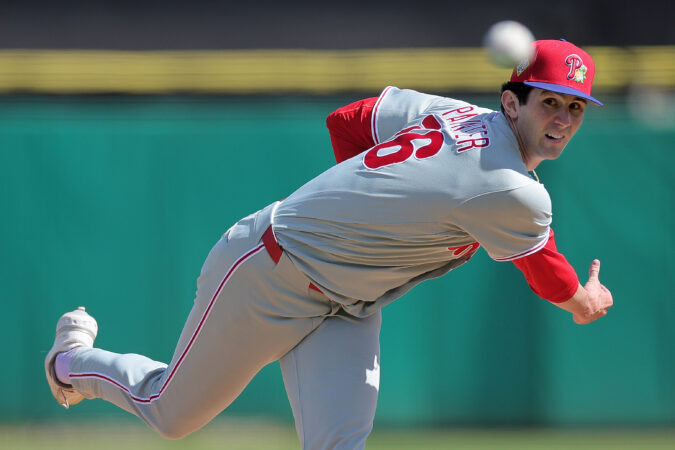
CLEARWATER, Fla. — Andrew Painter likes to eat. It has never been much of an issue. The Phillies’ top prospect has a fast metabolism and stands 6 feet, 7 inches.
If anything, it is hard for him to add weight. So, the occasional — or frequent — ice cream cone doesn’t hurt. But this offseason, while training at Cressey Sports Performance in Florida, the lanky pitcher noticed something.
It was early November, and Painter was reviewing video of his 2025 triple-A season with coach Spencer Stockton. He hadn’t felt a difference on the mound, but could see one on the screen.
The prospect had put on some extra pounds — topping out at 240 at one point — and was moving slower. He’d get fatigued by the fourth or fifth inning.
His delivery was impacted, too. Instead of driving off the mound, Painter was “falling” off it.
Stockton and Painter looked back at his delivery in 2022, before he got Tommy John elbow surgery. It was quicker and more up-tempo.
They decided they’d try to get back to that. The coach and the pitcher made some slight changes to Painter’s offseason program, adding more “movement days” of sprints and agility work.
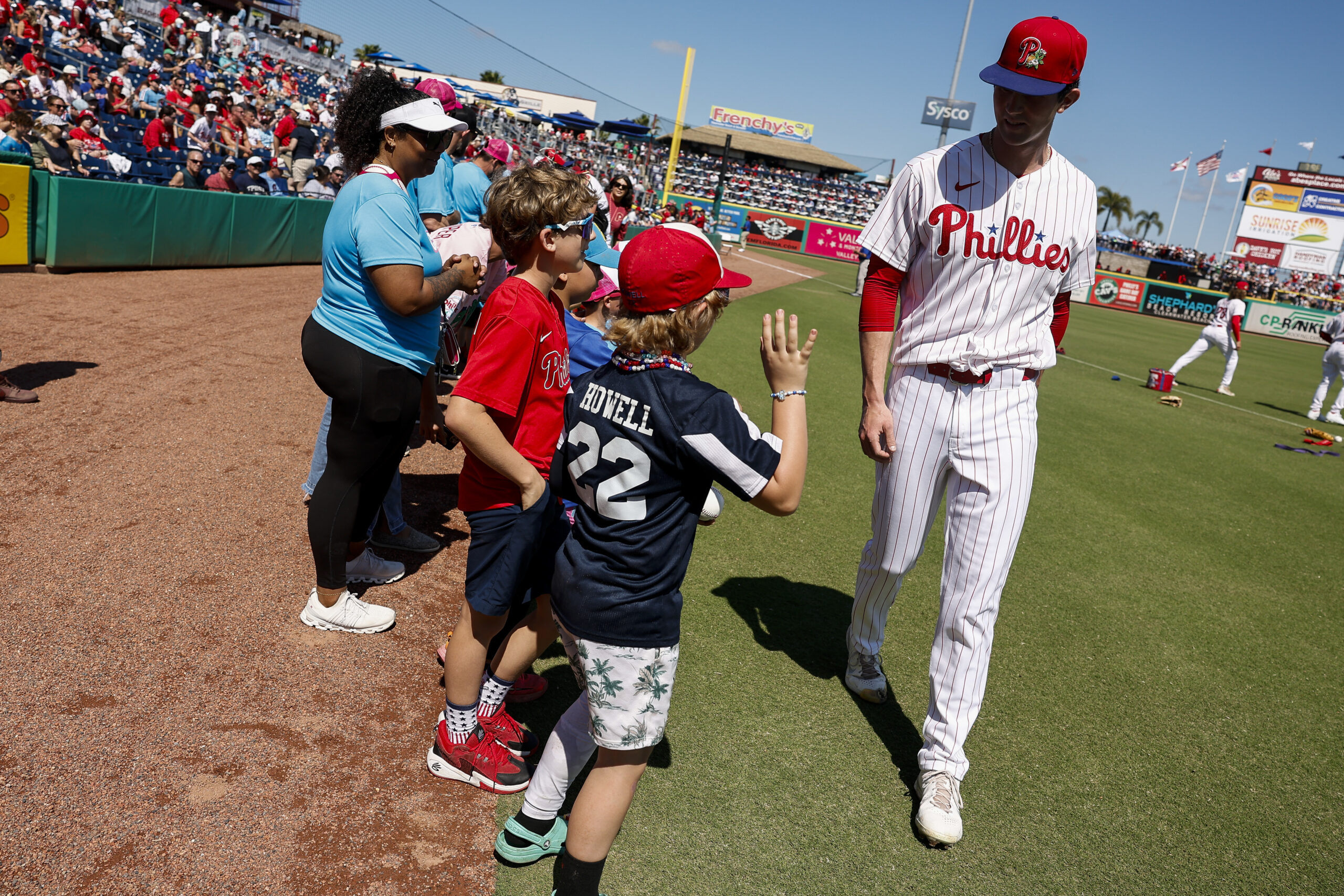
Phillies pitcher Andrew Painter greets Little Leaguers before a game against the Yankees on Sunday at BayCare Ballpark in Clearwater, Fla.
They also made some tweaks to his diet. Painter’s weight in 2022 was 225 pounds.
To get back to that number, he’d have to make some sacrifices.
“Fewer trips to the Dairy Queen,” he said with a laugh.
This would be a challenge. Painter’s house in Pompano Beach, Fla., was a block away from the fast-food restaurant. It was easy — perhaps too easy — to order an Oreo Blizzard or milkshake.
His teammate and longtime friend, Phillies lefthander Jesús Luzardo, described Painter’s eating habits as “notorious.” Former Phillies minor league pitching coordinator Vic Díaz recalled that he had a “big sweet tooth.”
“I’m almost positive he would go to Publix and just pick up a pie,” Díaz said.
But nevertheless, Painter got it done. He’s at 225 pounds, his “ideal weight.” His leaner physique is part of the reason he showed dominance in his one game so far this spring — no hits, no walks, no runs in two innings — as he prepares for a starting job on the big league club. He is scheduled to pitch on Saturday.
“All offseason he’s looked great,” Luzardo said. “He looks strong, he looks athletic, the way he’s pitching, moving down the mound. His body is moving cleaner, is the way I would describe it.”
‘Sorry, I ate a whole pumpkin pie’
Painter has never been shy about his proclivity for dessert. In September 2021, months after he was drafted in the first round, he was sitting alongside Díaz at the Bobby Mattick Complex in Dunedin, Fla.
The highly-touted prospect was minutes away from his final start of the year, against the FCL Blue Jays. But there was one problem.
“He just looked at me and said, ‘Sorry, I ate a whole pumpkin pie last night,’” Díaz said.
Painter ended up having his best FCL outing to date. He pitched two innings, struck out five, and allowed just one hit.
But Díaz wasn’t about to let him off the hook.
“He called me out at the end of the [pitchers] meeting,” Painter said. “We were wrapping up and he says my name. And I’m like, ‘What did I do?’
“And he’s like, ‘Just wanted to let you all know, Painter ate a whole pumpkin pie.’”
Andrew Painter pitched two scoreless innings in his spring debut on Sunday.
The minor league coordinator started regularly asking the prospect what he’d eaten the night before. And Painter was happy to divulge.
Even as a teenager, he was unapologetically himself. Painter would shag fly balls left-handed in the outfield during batting practice. He relished Beach Dog Fridays at single-A Clearwater, picking out his favorite mutts in the crowd.
So, it was no surprise to Díaz that Painter also had a light-hearted approach to his diet.
“In Clearwater, he and Alex Garbrick had a thing where they would go to BJ’s Restaurant once a week,” Díaz recalled. “When it was two-for-one Pizookies.”
(For those unfamiliar, a Pizookie is a cookie skillet with ice cream on top).
Luzardo, who also has a sweet tooth, was not familiar with the pumpkin-pie fiasco or the weekly Pizookies. But he was aware that his friend liked to eat.
“I didn’t know about that,” Luzardo said. “But I saw him do a — he did do a hot dog eating contest here last year.”
Of course, there is a balance to all of this. Painter doesn’t want to reach 240 pounds again, but he also doesn’t want to dip below 220, which was where he was in 2023, before he got Tommy John.
“It’s trying to find that middle spot of where I’m light, but I’m not injured, too,” he said. “Because you get to a certain point where you’re too skinny and there’s not enough fat in your body to stay healthy.
“And everyone always says, ‘You can’t tear fat.’ So, it’s trying to find that middle point.”
Around 225 seems to be it. Painter feels great. He isn’t as sluggish as he was last year. He’s fluid and agile.
Coupled with a higher arm slot, and a lengthier long toss routine, it’s just another reason why he’s looked — and felt — so good this spring.
And as long as he isn’t anywhere near a pumpkin patch come October, it should stay that way.
CLEARWATER, Fla. — Jesús Luzardo made his first start of the spring on Thursday. He did not disappoint. The Phillies left-hander recorded five strikeouts with two hits in three scoreless innings in a 6-2 win over the Boston Red Sox.
Luzardo needed only 38 pitches for his Grapefruit League debut. His velocity ticked up a bit — he hit 98 and 97 mph a few times on his four-seam fastball and his sinker — while his sweeper averaged 87.2 mph.
“Maybe a little bit of adrenaline, getting back out there for my first spring start,” Luzardo said. “But just health. I feel good. Worked hard this offseason to really prepare for this year. Body is in a good spot.
“So I’m glad to see the velocity coming, nice and easy, without having to overthrow.”
Luzardo said he took it easy earlier in the offseason, which was different from previous winters. He thinks giving his body a little break might have helped him.
“Normally I would start getting after it pretty early,” he said. “The season went a little long last year, so kind of started slow and progressively built up to the work that I wanted to.”
Who stood out
Otto Kemp went 2-for-3 with two hard-hit doubles. Leading into Thursday’s game, he only had two hits over his previous 16 at-bats.
“He’s swung the bat pretty good the last few times out,” manager Rob Thomson said. “It’s good to see. One of the games in Fort Myers [on Sunday and Monday], he’s going to play third base, and then he’s going to play left field.
“So, we’re going to move him around a little bit, but concentrate most on left field. But yeah, he’s been really having good at-bats.”
Chase Shugart, who pitched the fifth inning and recorded the first out of the sixth, made a strong impression. The 29-year-old righty, who was traded from the Pirates to the Phillies in January, pitched 1⅓ innings, allowing no hits or runs, with two strikeouts.
“Really good,” Thomson said. “He throws strikes. He attacks. Fastball is mid-90s at times. Cutter is really good, the curveball is good. And he competes. He’s not afraid. He trusts his stuff.”
Quotable
“Tremendous,” Thomson said of Luzardo’s outing. “Velocity was up. Think he touched 98. Got ahead, pounded the zone. First-pitch strikes were great. All of his pitches were working.
“Changeup is really improving, there’s some swing and miss to it, there’s some bottom to it. Everything about him was good.”
On deck
The Phillies will play the Pirates in Bradenton, Fla., on Friday at 1:05 p.m. The audio of the game will be livestreamed on MLB.com.
CLEARWATER, Fla. — A few days ago, a custom clothing vendor, Lindsey Tamblyn, came to BayCare Ballpark. Brandon Marsh was familiar with her work. When he was in the midst of his first spring training with the Phillies in 2024, J.T. Realmuto bought him one of Tamblyn’s suits.
It made Marsh feel like part of the group. So much so that he “jumped on” Realmuto and hugged him afterward.
When he heard Tamblyn was returning last week, Marsh decided to pay it forward. He walked up to 22-year-old prospect Justin Crawford.
Marsh told him to pay a visit to Tamblyn, give her his measurements, and pick out any suit he wanted.
“I said, ‘Go, get you a suit, bro,’” Marsh recalled, “‘because God willing we’re going to be in the playoffs again this year. And you’ve gotta look nice.’”
Crawford, who describes his fashion sense as “basic,” picked out a sleek black jacket.
“I told him he didn’t have to,” Crawford said, “but he insisted.”
Crawford appreciated it. This is a big season for him. He is expected to be the Phillies’ opening day center fielder, a position that has been a persistent black hole for the last few years.
Phillies center fielder Justin Crawford is slashing .316/.350/.474 through 19 at-bats this spring.
If all goes according to plan, he would be the first 22-year-old everyday position player for the Phillies since Jimmy Rollins. It is a lot of pressure for someone who just a year ago got the right to legally drink.
As a player, Crawford is polarizing. Much has been made of his ground-ball rate, which has steadily lowered as he’s climbed up the minor league ranks, but is still relatively high. In 2023, it reached 69.7% across single A and high A.
Crawford dropped it to a career-low 59.4% at triple-A Lehigh Valley in 2025. He brings elite speed, and above-average contact skills. He hits the ball hard. But fans and pundits alike have questioned whether that matters if he can’t consistently lift it in the air.
The prospect tries to avoid this chatter. He’s off social media, and has a good support system, full of former major league players: his father, Carl Crawford, his godfather, Junior Spivey, and his hitting coach, Mike Easler.
“When you’re around people who know what they’re talking about, and have done it for a long time, [they] can keep you on that track,” Crawford said. “To be like, ‘No, forget what those people are saying. Just play your game. Be you.’ That’s probably the best advice I’ve received from anybody.”
The Phillies have provided some support, too. Crawford said manager Rob Thomson called him this past winter. His message was for the prospect to “be himself” and get ready to compete for a starting role in camp.
Thomson followed up after the Phillies signed Adolis García to play right field.
“I called him again,” he recalled, “and said, ‘Look, this signing doesn’t mean anything for you. You’re still grinding for that center-field job.’”
All of these gestures have made Crawford feel more confident this spring, in which he’s hitting .316/.350/.474 through 19 at-bats.
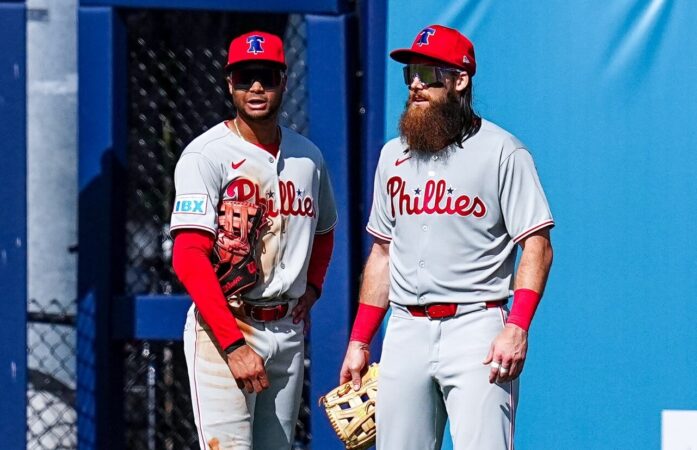
But he’s developed a special kinship with the 28-year-old bearded outfielder.
“Marshy’s a great guy,” Crawford said. “He really took me under his wing, honestly, since Day 1. So that’s someone I’m really fortunate to be around, and play next to, hopefully this year. He’s the best.”
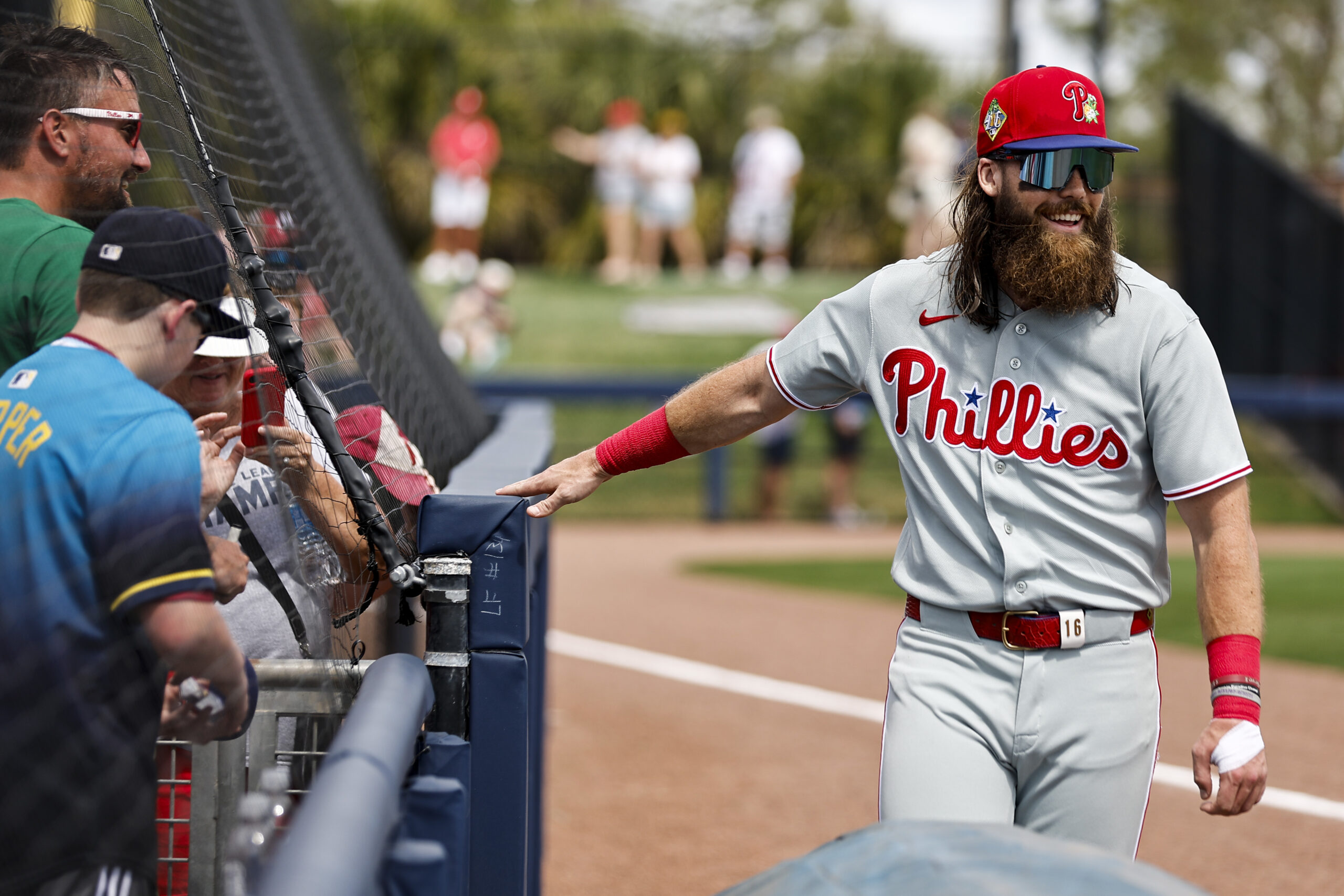
Brandon Marsh “is the best,” says Justin Crawford, who has appreciated how his left fielder has looked out for him this spring.
‘I’ve got the aux’
When Marsh was a 23-year-old rookie with the Angels in 2021, he had an abundance of veteran mentors to lean on. There was three-time MVP Mike Trout, Justin Upton, Dexter Fowler, and Jon Jay.
All of these players helped him, in myriad ways, but with the same overarching message.
“I was trying to be Super Man,” Marsh said. “They helped ease the game for me. And I’m just trying to do the same thing for J Craw.”
With that in mind, Marsh made a point of introducing himself to Crawford early last spring. He went out of his way to make things easier for Crawford, like offering to drive him when the team traveled to different ballparks across the state of Florida.
Thomson doesn’t allow players with less than three years of service time to drive themselves to road games. Crawford didn’t have any service time, so he assumed he’d have to take the bus.
But Marsh presented another option. They’ve continued to stay carpool buddies this spring, and it’s allowed them more time to get to know each other.
Of course, there were rules attached. Marsh would be in charge of the music, which in previous years might have meant a lot of Lil Uzi Vert. Now, not so much.
“I still love Lil Uzi,” Marsh said. “But I’ve been on a huge Larry June and Freddie Gibbs kick. So, more of a smooth rap instead of … like, you know, bang your head off the front windshield.
“But yeah, learning to find moments that are calm and stuff like that. I’ve got the aux.”
Like the Angels veterans did with Marsh, he has encouraged Crawford to not put pressure on himself. To stay true to his game — regardless of what others think.
He’s provided another support system for the young outfielder, within the clubhouse.
To some, buying a suit jacket, or giving a pep talk, or making the two-hour drive to Port Charlotte, Fla., may not mean much. But to Crawford, it does. And he doesn’t take it for granted.
“He’s just super genuine and super welcoming,” Crawford said of Marsh. “Those are the type of guys you want to be around.”