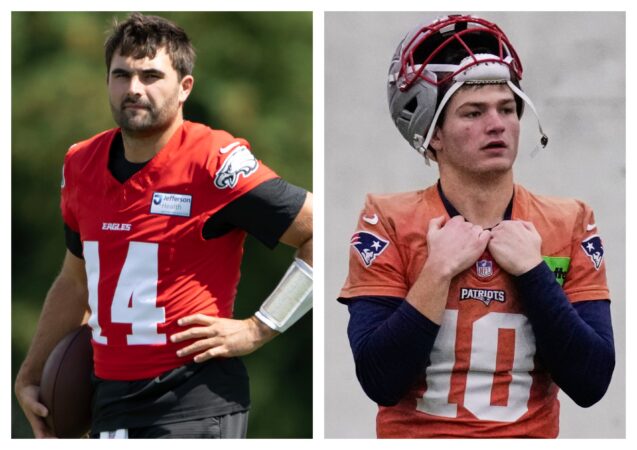
Long before Sam Howell became best friends with Drake Maye, he was aware of him. Maye’s parents were standout high school athletes, and his father, Mark, played quarterback at the University of North Carolina. His brothers, Luke and Beau, played basketball there (Luke hit a last-second shot that sent the Tar Heels to the Final Four in 2017, en route to an NCAA championship).
A third brother, Cole, also won a national title in 2017, but at a different school (Florida) and in a different sport (baseball). Former UNC offensive coordinator Phil Longo called the family “the Mannings of North Carolina.”
Drake was the youngest, and went down the football path. He and Howell, both quarterbacks, became acquainted through seven-on-seven leagues in the Charlotte area.
In 2019, when Howell was a freshman quarterback at UNC, he attended one of his future protégé’s high school playoff games. Howell was impressed. But it wasn’t until 2021, Maye’s first season with the Tar Heels, that Howell realized how much they had in common.
Howell was the entrenched starter, and Maye was the backup — a situation that doesn’t always lend itself to friendship. But these two were the exception. They became “attached at the hip,” in the words of former coach Mack Brown, and not just on the field.
The quarterbacks were fiercely competitive, and would battle each other on the golf course, at the ping-pong table, and more.
“Drake was so competitive, if I said, ‘Hey, I’m going to get to the doorknob before you do, he would jump over a table to get there,’” Longo said. “That’s just kind of how he was. [Sam was] that way, too.”
The two quarterbacks have stayed close, FaceTiming on a near-daily basis since Howell was drafted by Washington in 2022 and Maye was drafted by New England in 2024.
Their careers have taken different trajectories. Howell, 25, has bounced around the league, from the Commanders to the Seattle Seahawks to the Minnesota Vikings to the Eagles, where he served as a third-string quarterback this past season.
Maye, 23, will start in Super Bowl LX for the New England Patriots on Sunday, in just his second season in the NFL.
Howell feels no ill will. He has attended every New England playoff game since the Eagles were eliminated, and will be in the Bay Area this weekend to support his friend.
“[I’m] extremely proud of him,” Howell said. “He’s worked his whole life to be where he is and he’s getting what he deserves. He was made for the big moments and I have no doubt he’ll be ready to go.”
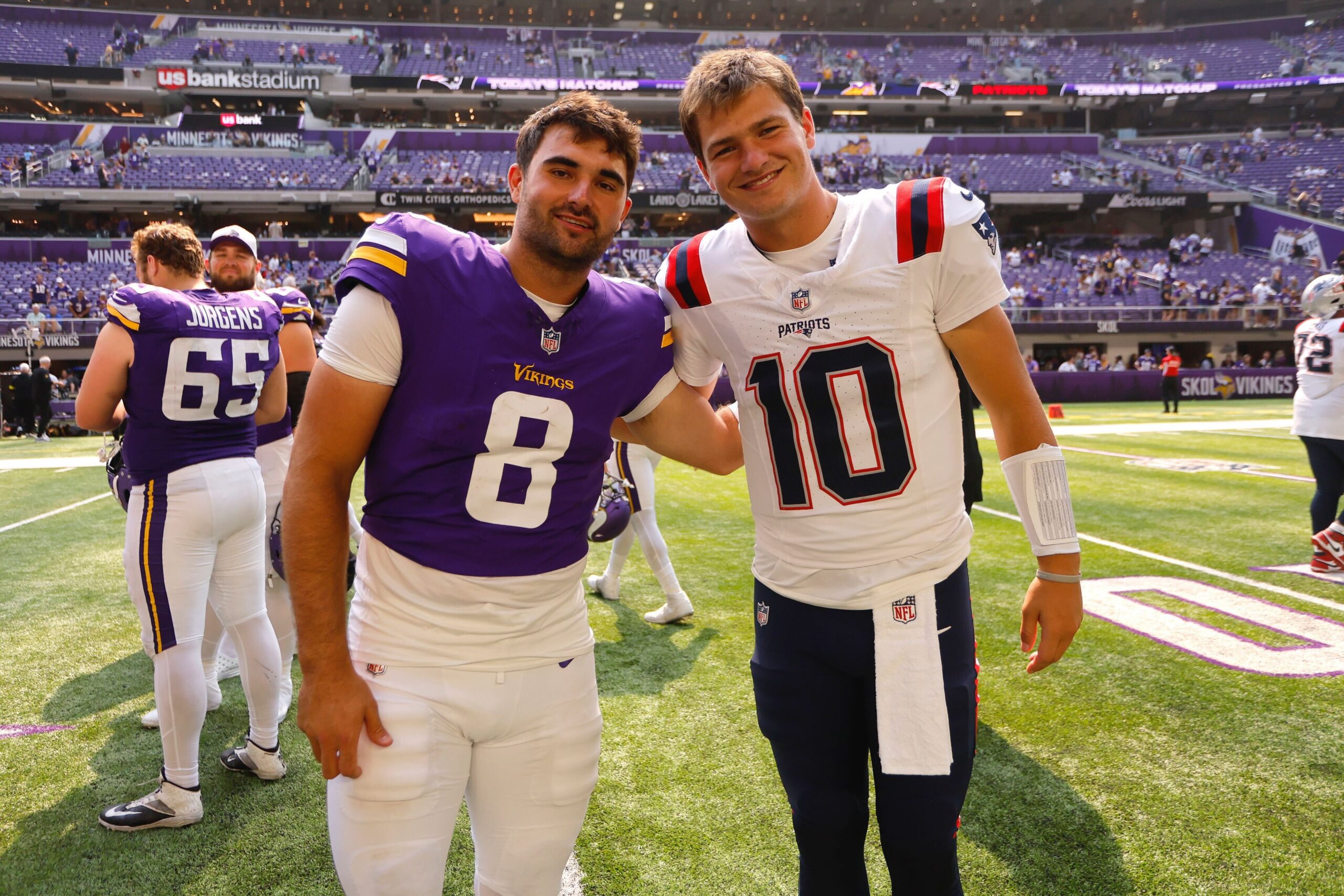
Sam Howell (as a member of the Vikings in 2024) and Drake Maye have remained tight even as their football journeys have diverged.
Football junkies
Longo described Howell as a “football junkie.” He’d pore over film and challenge his coaches with tough questions. Before he’d even signed with North Carolina, in late 2018, the quarterback started asking Longo for offensive information.
The coordinator didn’t hand it over until everything was official. But once he did, Howell began studying. Longo would send him formations, and Howell would teach them back to his coach a few hours later.
This went on throughout Christmas break, until the start of classes.
“By the time he showed up in mid-January, from a mental standpoint, he actually already knew the entire offense,” Longo said. “Which is rare and pretty impressive.”
Howell would constantly bring up new routes and concepts to the coaching staff. Instead of waiting to be told what they’d run on Monday, he’d be a part of designing plays on Sunday night.
To Longo, quizzing Howell in the quarterbacks room became an exercise in futility. The quarterback always seemed to have the right answer, not because he was winging it, but because he’d reviewed virtually everything.
It set an example for the future Patriots QB.
“Drake may not admit this, or remember it, but it got to a point where any time I asked an open question and didn’t direct it at one individual quarterback, Sam would always answer first,” Longo recalled. “And obviously he was correct. But Drake was competitive, and [he would] try to answer the question first, and beat Sam out.
“My analyst and I both noticed that, and we loved it. Because it was Drake just wanting to get better.”
Howell had been the starting quarterback since his freshman year, and Maye knew that wasn’t going to change. But neither player was threatened by the other. They started throwing after practice, bringing along wide receivers to work on routes, drop backs, and trigger times.
They’d often give each other feedback, both good and bad. Brown said that Maye would be waiting for Howell to come off the field after every game.
“To talk to him about what he saw,” Brown said. “So, you had two great minds that were talking about every play. And one of them, out of the action, standing over there watching, could say, ‘Here’s what I saw. Look for this.’”
He added: “It’s very unusual to have two people competing for the same [role] that care about each other so much, respect each other so much. And that’s the reason it worked. For me, as a head coach, it was like a marriage made in heaven.”
They had their stylistic differences. Maye’s biggest strength was his ability to make accurate throws while off-platform and off-balance, a feat Longo credited to his footwork, honed by years of youth and high school basketball.
Howell’s was physical strength that allowed him to break tackles by running downhill.
Their communication styles were different, too. Maye was more of a vocal leader, and Howell tended to pull guys off to the side. But the two quarterbacks complemented each other.
“When he was backing me up at Carolina, he was really good at making me feel very confident going into games,” Howell said. “And just trying to give me that last sense of peace.
“Before every game in college he’d tell me I was the best player on the field. Little things like that. He’s a great leader, great motivator.”
It didn’t take long for the quarterbacks — and their coaches — to realize they shared a relentless competitive spark. Longo remembered a recruiting event when Howell and Maye played ping-pong until the lights shut off.
In training camp, they’d have ping-pong “battles,” tacking on rounds until each side was ready to acquiesce. In 2021, Maye introduced Howell to golf, shifting their off-field rivalry to a new sport.
It was not a relaxing endeavor.
“I would see them afterward,” Brown said. “They’d say, ‘Oh man, he got me by four strokes.’ It was like the U.S. Open or something. It wasn’t like two quarterbacks going out to play.
“And the other one would say, ‘Yeah, but I just missed a putt or I would have beaten him.’ It was like two little kids going at each other’s throats.”
Added Howell: “Sometimes people invite us out to play, and they’re surprised with how the round is going. There’ll be times in the round where we’re not talking to each other and stuff like that. It’s a lot of fun.”
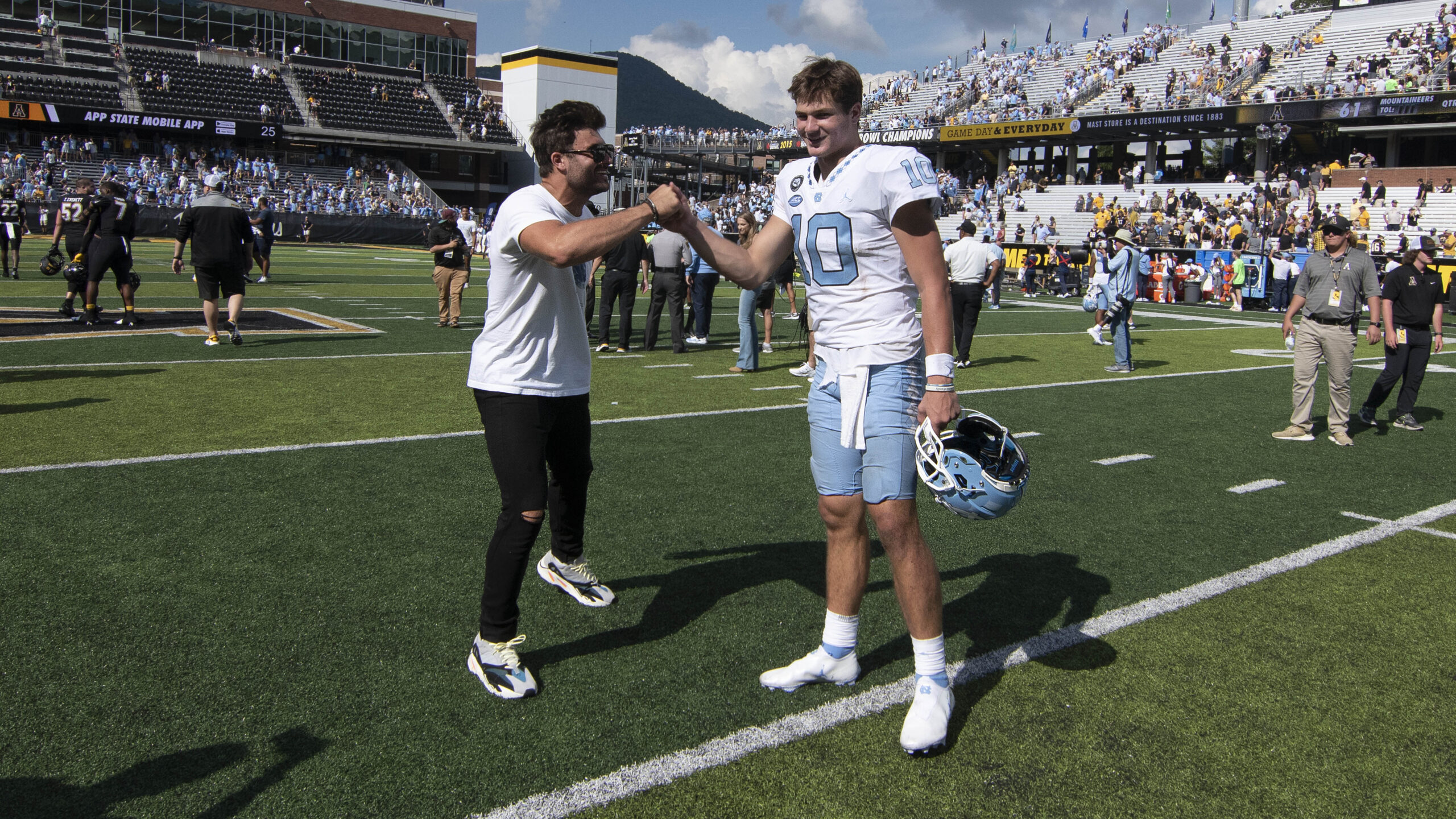
After Howell graduated, he stayed in touch with his mentee. In September 2022, months after the Commanders drafted him in the fifth round, Howell attended a UNC road game against Appalachian State.
It ended up being the highest-scoring game (including combined points) in school history. Maye had five touchdowns (four passing, one rushing) and 428 total yards in a 63-61 UNC win.
In the third quarter, Maye scored on a 12-yard run for his fourth touchdown of the day. Howell, by coincidence, was standing just past the end zone, as if he was waiting for his best friend.
He gave the quarterback a high five and a hug.
“I told him, after I ran it in, I should have gotten on a knee and held the ball up to him,” Maye told local reporters. “Because what he did here [at UNC] is pretty incredible.”
Then a member of the Commanders, Sam Howell returned to UNC to watch a vintage Drake Maye performance against Appalachian State on Sept. 3, 2022.
An NFL friendship
Just before Maye’s final season at UNC, he and Howell became roommates for a few months. It was Howell’s NFL offseason — January to April in 2023 — and they lived together in an apartment in Chapel Hill.
When they weren’t working out, or at the golf course, they were playing the board game Catan and EA Sports’ PGA Tour at home.
Maye was drafted with the third overall pick a year later. Howell, a 17-game starter with the Commanders in 2023, was traded to Seattle a month before the 2024 draft, and was subsequently dealt to the Vikings and then the Eagles in 2025.
As Maye and Howell navigated the ups and downs of the NFL, they continued to talk every day. Howell said they’d go over defenses they were seeing that week.
Sometimes, Maye would hype his friend up, the same way he did before Carolina games.
“Even when I was playing in the NFL and we weren’t winning a lot, he would always still call me to instill confidence in me,” Howell said. “He’s great about that.”
Since the Eagles lost to the San Francisco 49ers in the wild-card round on Jan. 11, Howell has attended every one of Maye’s games. He’ll be at the Super Bowl on Sunday, brimming with pride for his golf buddy.
But before it starts, there’s one thing he’ll make sure to do.
“I’ll definitely talk to him before the game,” Howell said. “Let him know that he was born for these moments, and he’s going to light it up.”
Frank Seravalli was standing behind the players’ bench at Bucks County Ice Sports Center when his phone buzzed. He didn’t reach for it — which is not his usual instinct.
Seravalli, a former Daily News reporter, is one of only a handful of NHL insiders. His job is to talk to athletes and decision makers around the league. Missing a call or a text can mean missing a story, and in a competitive media environment, in which quick, accurate information comes at a premium, being “late” isn’t ideal.
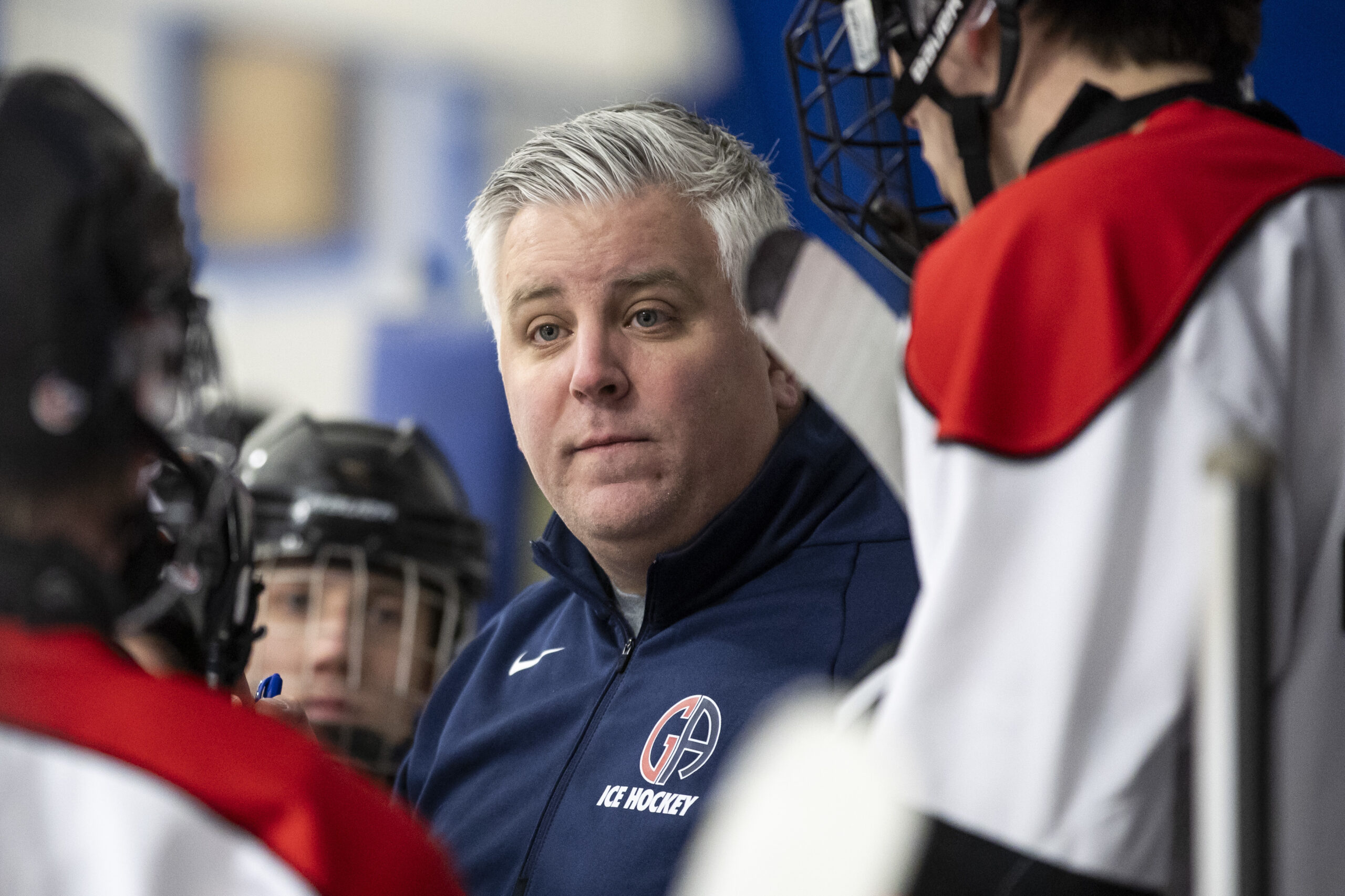
But on Jan. 12, in the midafternoon, Seravalli was busy. He was coaching Germantown Academy’s varsity hockey team. It was the third period and the Patriots were up, 6-2, in a rematch against Episcopal (5-2 on the aging scoreboard, which was missing a number).
Despite their lead, Seravalli’s players didn’t relent. With 35.6 seconds remaining, sophomore Mick Tronoski fired another shot into the net. A smattering of fans cheered.
After the two groups shook hands, Seravalli walked off the ice. He pulled his phone from his pocket, and read that the Columbus Blue Jackets had fired their head coach, Dean Evason.
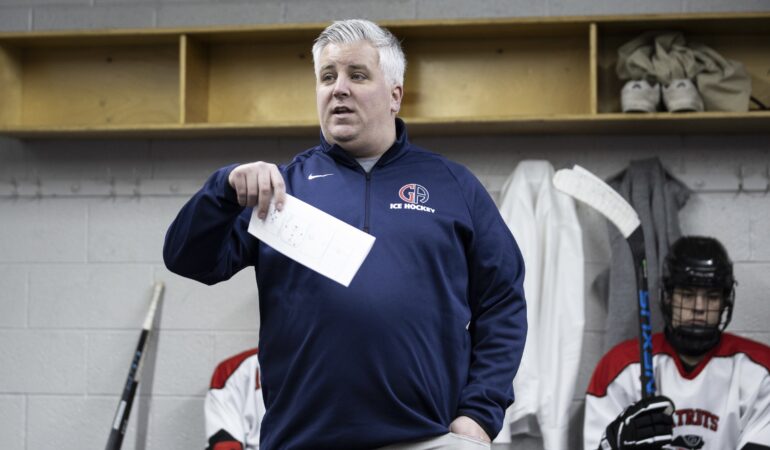
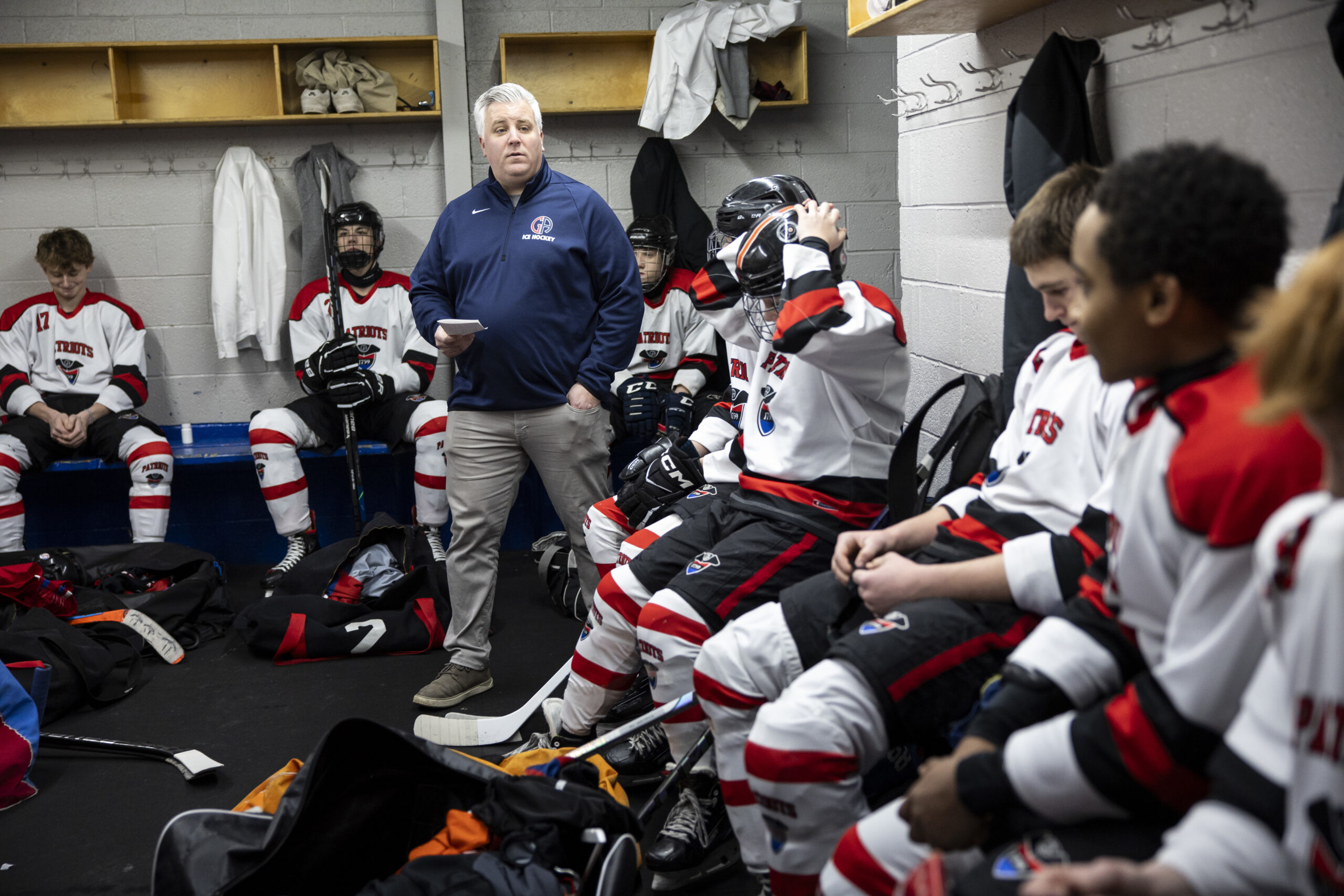
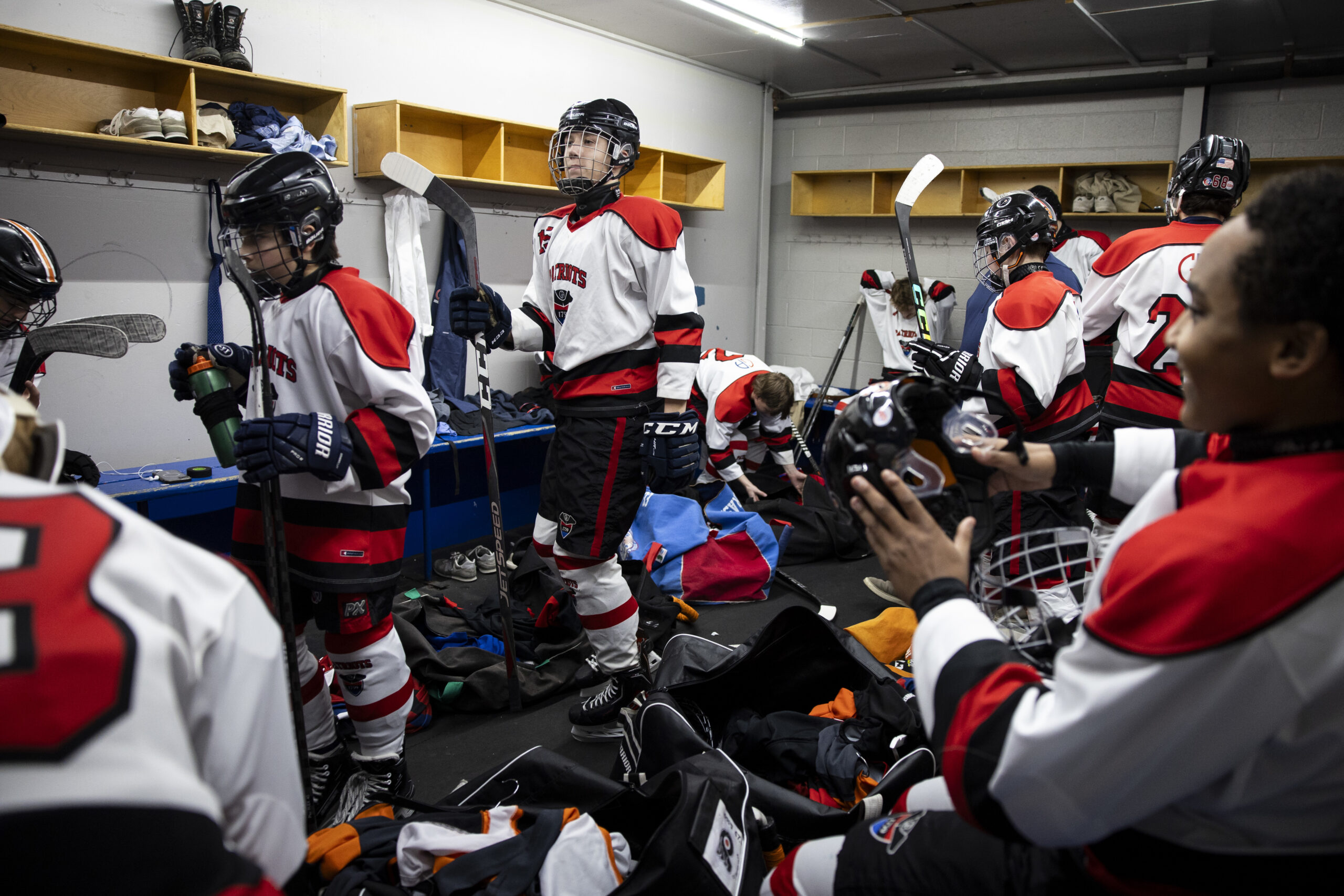
Coach Frank Seravalli talks with his Germantown Academy team in the locker room at the Bucks County Ice Sports Center on Jan. 12.
He retweeted a team statement, 27 minutes late. The NHL insider shrugged.
“I mean, it’s just life, right?” he said. “What are you going to do?”
Since July, Seravalli, 37, has served as GA’s head hockey coach. It is a daily commitment, one that he takes as seriously as his podcast and TV hits for various outlets. Five times a week, Seravalli oversees hourlong practices, and coaches hour-and-a-half games, with some 7 a.m. morning lifts mixed in.
He is not above doing the grunt work, either, like ordering gear, setting the schedule, and keeping the team’s stats. He reviews film, plans workouts, and runs the middle school program, all while keeping an eye on promising players in the area.
NHL insiders do not have an abundance of free time, so when Seravalli first told his family that he’d be coaching high school hockey, they thought the idea was absurd. And maybe it is a little absurd. Seravalli is not an alumnus of Germantown Academy. He is not doing this for the small stipend he gets halfway through the year.
But he is doing it for a reason. Just over two years ago, Seravalli’s cousin, Anthony Seravalli, died unexpectedly. He was 41 and left behind a wife and three sons.
Frank always looked up to him. Anthony was mature for his age, even as a teenager. He was a team captain and a star defenseman at Germantown Academy in the late-1990s, back when the school was winning Flyers Cups and producing NHL-caliber talent.
GA hockey’s stature has diminished since then. New York Rangers goalie great Mike Richter once played for the Patriots, but for years, the program was essentially dormant. Local recruiting wasn’t a priority. It was unclear whether there would be enough players to field a team in 2025-26.
Until Seravalli arrived. He has told the school he’s willing to make a five-to-10-year commitment to restore the program to what it was. In his mind, this is the best way to honor his late cousin.
“I thought of him, and how big high school hockey was 25 to 30 years ago, and how I could help make that big again,” Seravalli said. “And I was like, ‘Maybe, this was supposed to happen.’”
A ‘fixture’ of GA hockey
Germantown Academy was an unlikely hockey powerhouse in the 1980s, ’90s, and 2000s. The coed school had an enrollment of only 1,200 students, from kindergarten through 12th grade. These numbers allowed the Patriots to fill only one varsity team most years.
It paled in comparison to some of the bigger programs in the area, like La Salle College High School, which was able to fill four teams (one varsity and three junior varsity).
Nevertheless, GA found success. Players took pride in its underdog identity, especially while playing local behemoths like Council Rock and Malvern Prep. Germantown Academy won two Flyers Cups — the hockey championship for eastern Pennsylvania high schools — in 1982 and again in 1983, and a state championship later that year.
The team won three more Flyers Cups in 1991, 1994, and 1995, and went 100-0-6 in regular-season league play for over five seasons in the mid- to late-1990s.
Anthony Seravalli was a key part of GA’s team. He joined thevarsityas a freshman in 1996, and quickly established himself as a leader. Dan McDonald, a defenseman who was two years older, would drive him to school every morning.
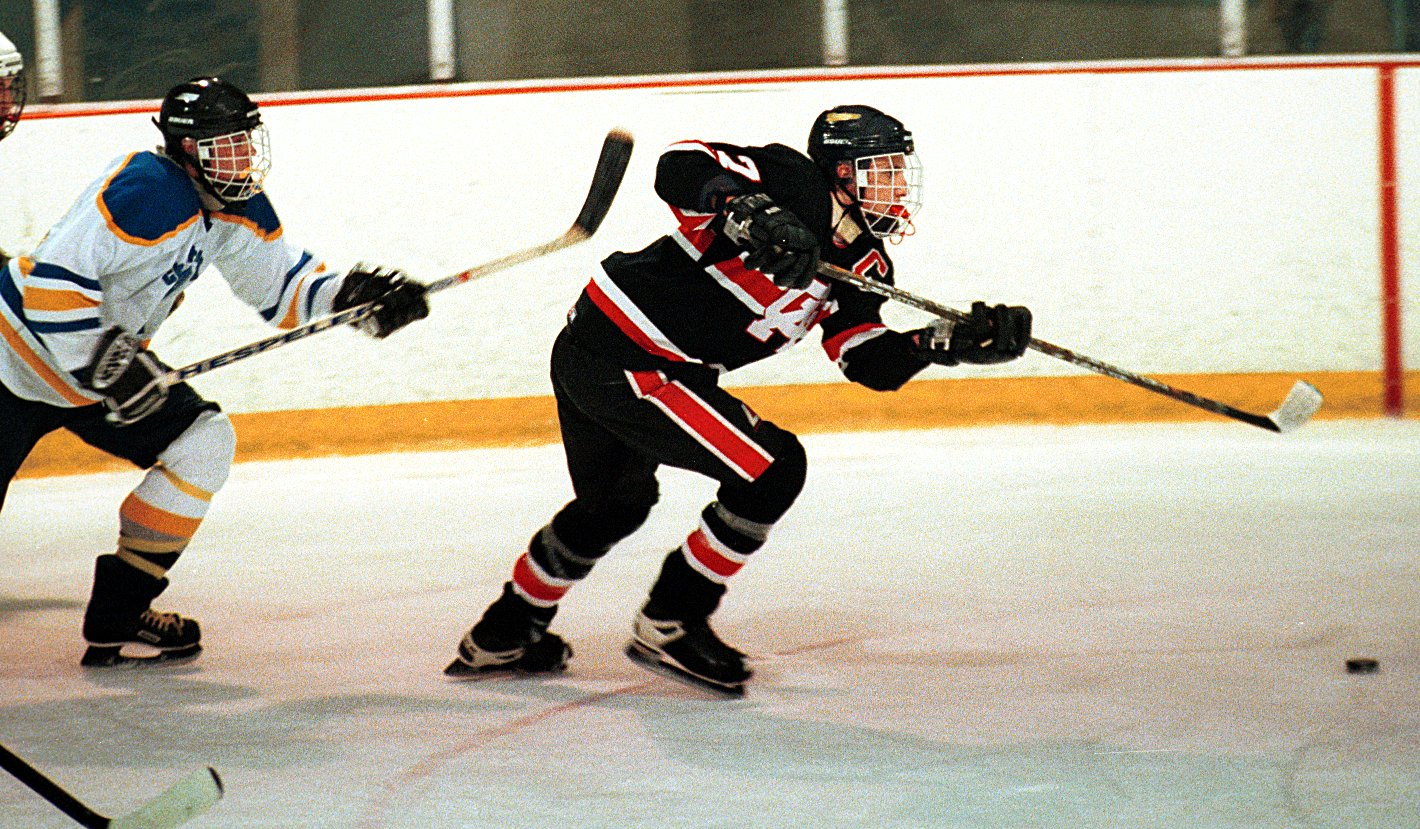
Anthony Seravalli (right) was a critical part of GA’s program in the late 1990s.
The underclassman would rarely — if ever — call out sick with an injury or illness. His teammates estimated that he’d be on the ice for about 70% of Germantown Academy’s games (a hefty workload for a young player). Seravalli was a physical presence, standing at 6-foot-2, with a big windup slap shot that was hard to miss.
He carried no ego, despite his abilities. Anthony was inclusive with all of his teammates, including those who spent more time on the bench. In 1999, a few players got injured, and Seth Gershenson, a self-described “bench guy,” was asked to play some shifts.
Before Gershenson took the ice, Seravalli pulled him aside to give a few words of encouragement.
“He respected my effort and willingness to go out there and get beat up a little bit,” Gershenson said.
Many local players also participated in club hockey. They saw it as a way to get noticed in eastern Pennsylvania, which was not exactly a hotbed for the sport. As a result, club teams often took precedence over high school teams.
But this was not the case for Seravalli. GA always came first. Gershenson referred to him as a “fixture.”
“He took being a captain really, really seriously,” Gershenson said, “and he took the success of GA really seriously. He took pride in our success much more than whatever his club team was doing.”
Frank Seravalli grew up in Richboro, Bucks County, just a few minutes from the Face Off Circle, where Germantown Academy played at the time. By age 6, he was attending games and practices to watch Anthony and another cousin, Jason Jobba.
The elementary school student would stand in the same spot, behind the net, with a fizzy Coke in hand, and his face pressed up close to the glass.
“Watching your cousins who are a bit older, those are your heroes,” Seravalli said. “And for me, that’s part of where my love for the game came from.”
The Seravallis were a big, tight-knit group. Almost everyone played hockey, and almost everyone went to work at the family construction business. This was the path Anthony took, but he also found time to give back to his alma mater.
Frank Seravalli fondly remembers watching his older cousins play hockey when he was a child.
In 2004, while Frank was playing at Holy Ghost Prep, Anthony returned to GA as an assistant coach. He had a knack for connecting with the players, most of whom were familiar with his high school career.
One example was Brian O’Neill, a GA alum and former U.S. Olympian who is now playing pro hockey in Sweden.
O’Neill was a talented skater, but he lacked defensive fundamentals. This was one of Anthony’s strengths, and when O’Neill was moved to defense in his sophomore year, he began to work with the assistant coach.
Seravalli constantly reminded him to keep “stick on puck.” It was a message that O’Neill had heard for years but never fully understood. That changed when the coach stepped in.
“It was easy for him to sell me on what he was trying to teach, because I had a lot of respect for him as a player and a person,” O’Neill said. “He didn’t really have to earn my trust. That was already there.”
The goal was to put pressure on his opponent, in a way that didn’t involve hitting or cross-checking. The coach ran drills in which O’Neill would hold a puck in his right hand, and the stick in his left, to focus on keeping the stick down.
“It’s amazing,” O’Neill said. “You would think, ‘OK, I can’t grip the stick with my other hand, so I pretty much am playing with one hand,’ and all you can do with that is pretty much stick on puck.
“You would think you would be way worse at defending, but it’s actually the opposite, because all you’re focused on is stick on puck. And you’re not focused on hitting.”
The concept finally clicked. O’Neill, who went on to play in the NHL, still uses it to this day.
“[Anthony] was the guy that gave me the most advice on defense,” he said, “and that definitely made a huge impact on my career.”
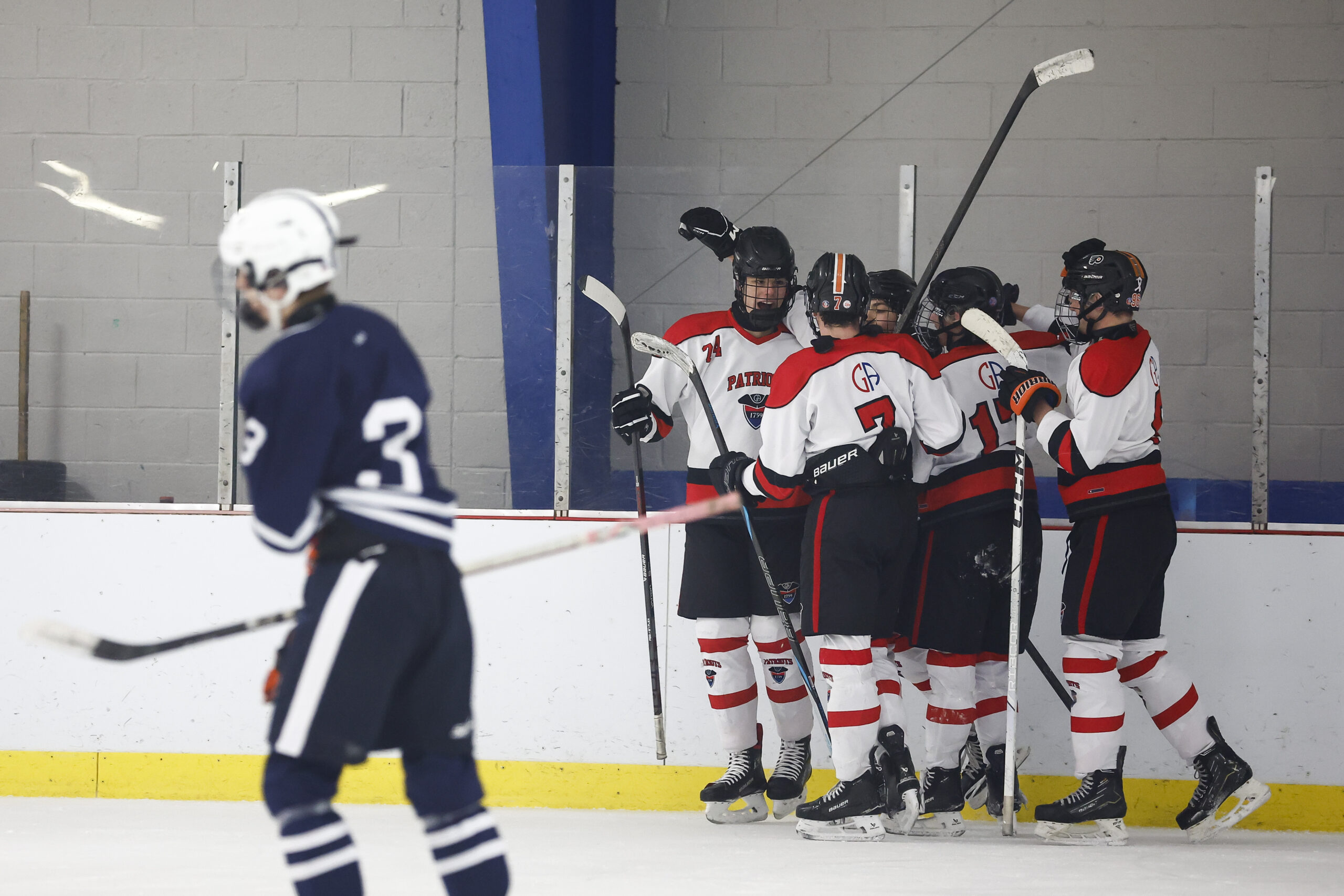
Germantown Academy players celebrate after a goal against Episcopal Academy at Bucks County Ice Sports Center.
‘Please help save our program’
When he was young, Frank Seravalli would visit his family’s construction business in Northeast Philadelphia. He’d often notice workers perusing thick copies of the Daily News over lunch, and dreamed about having a byline someday.
In 2009, that dream became a reality, when the paper hired Seravalli out of Columbia University’s journalism school to cover the Flyers. He stayed for six years, before leaving for the Canadian television network TSN, where he worked as a senior writer and NHL insider.
In 2021, Seravalli started his own business, the Daily Faceoff, which was sold to a media group in Denmark in 2024. He’s now building a hockey network at the streaming service Victory+.
A typical day includes a radio interview in the morning, a podcast taping at noon, and more radio and television hits at night. Interspersed are hours spent texting and calling sources throughout the league.
It is a frenetic lifestyle, one that requires Seravalli to be glued to his phone. Finding time to coach a high school hockey program seemed impractical, if not impossible. But Seravalli was drawn to the idea. So, when he saw the job opening last year, he decided to apply.
The school’s athletic director, Tim Ginter, could only laugh when he read the insider’s resumé. Among his references were two NHL general managers, an executive with the league, and a former NHL head coach.
“He’s like, ‘Call [former Anaheim Ducks head coach] Dallas Eakins,’” said Ginter. “And I’m like, ‘You’ve got to be kidding me.’”
Seravalli interviewed for the position in the spring. He talked to two of the team’s captains, J.P. McGill and Joey Lonergan, who explained that their program was in jeopardy.
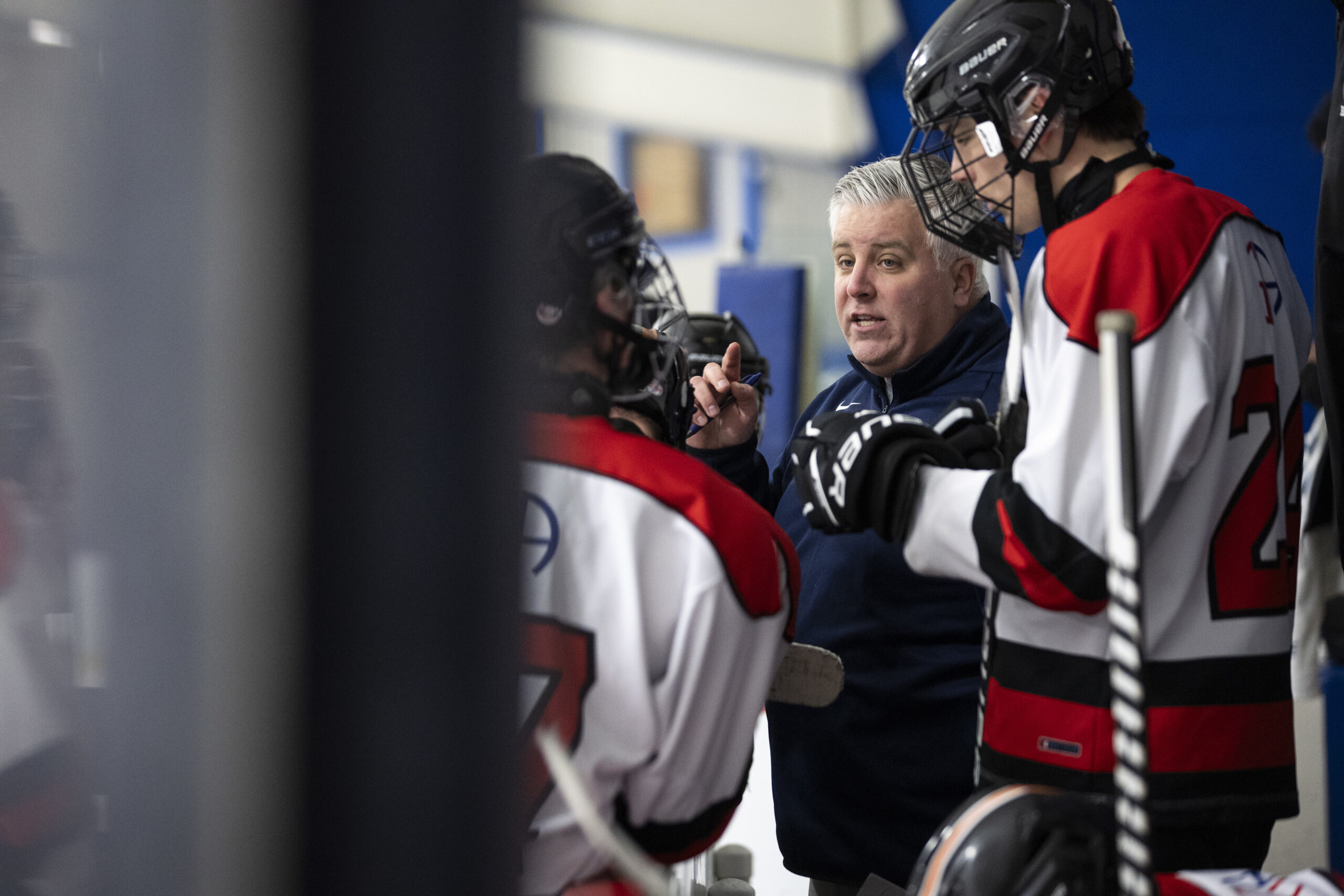
Coach Frank Seravalli talks with his team during the game against Episcopal Academy.
GA had lost five playersin 2025. School officials didn’t know how they were going to fill those spots. McGill and Lonergan had heard stories about the 1990s and 2000s teams, but returning to that level seemed like a long shot.
The Patriots hadn’t played in a Flyers Cup since 2009. After years of shrinking rosters and coaching changes, the team was moved for 2009-10 from the Suburban High School Hockey League to the lesser Independence Hockey League, which isn’t eligible for Flyers Cup entry.
“Essentially their plea was, ‘Please, help save our program,’” Seravalli said. “‘We’re not even sure we’re going to have a team next year.’
“I couldn’t say no at that point. I knew I was hooked.”
Seravalli met with Ginter shortly after. He made a succinct but powerful pitch.
“If you don’t have interest in changing your program, and really tearing it down and rebuilding it, I’m not your guy,” the insider told him. “But if you are interested, I’m willing to make a five-to-10-year commitment to build this the right way.”
He was hired in July. Seravalli rarely mentioned his full-time job, but it didn’t take long for the teenagers to figure it out. One day, while McGill was “doomscrolling” on the internet, he spotted his high school coach on Bleacher Report Open Ice.
His reaction: “Oh [expletive].”
“I texted some of my teammates,” McGill said. “I’m like, ‘He’s the Adam Schefter of the NHL!’”
Germantown Academy’s players were not aware at first that their new coach was an NHL insider.
Added junior defenseman Jack Stone: “He’s a reporter, so obviously he knows what he’s talking about.”
The insider started to use his connections behind the scenes. He’d ask current and former NHL head coaches for advice, among them Eakins, who now works for Adler Mannheim in Germany.
Eakins encouraged Seravalli to model the behavior he wanted to see in his team. He emphasized how important it was to show not only that he cared about the program, but about the players as people.
He also shared some mistakes he’d made in his own coaching career, with the hope that Seravalli could learn from them.
“Sometimes people [will] say, ‘OK, I’m a coach, now I have to take on a different persona,’” Eakins said. “And I told him, don’t do that. Don’t go in there and pretend to be [Florida Panthers head coach] Paul Maurice.
“You’ve got to go in there and be Frank Seravalli. Because as soon as you step outside of that, you’re cooked. You can only pretend to take on this other persona for so long.”
The tenor of the program changed almost immediately. Before Seravalli’s arrival, on-ice practices and team lifts were optional. Sometimes, as few as two or three players would show up. Now, they were mandatory, and everyone was expected to arrive on time.
The teenagers learned this the hard way. In October, during preseason workouts, Seravalli organized morning weightlifting. Two players — who will remain anonymous — slowly waltzed into the gym, 15 minutes late.
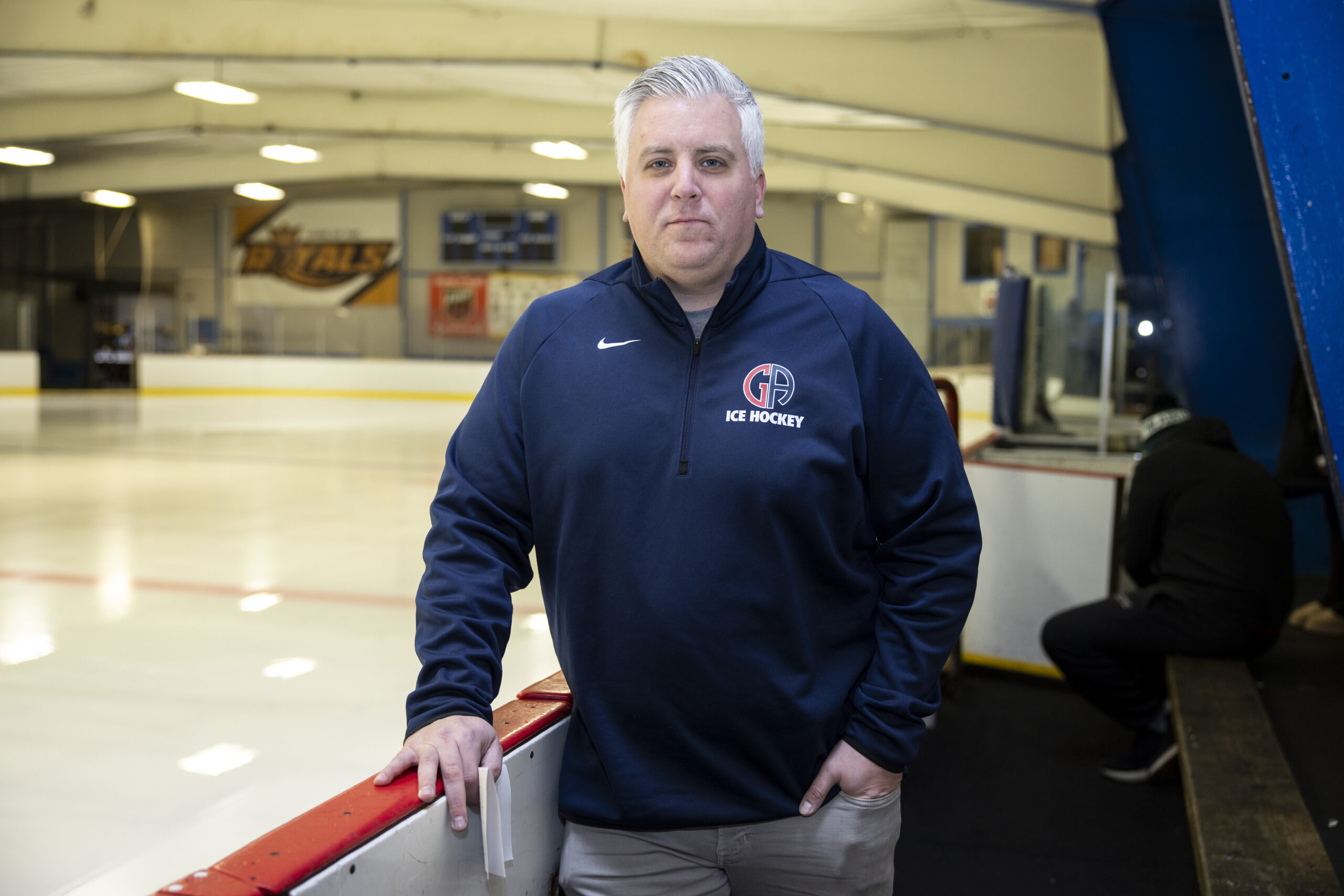
Coach Frank Seravalli brought a disciplined approach to the Germantown Academy hockey team.
Seravalli didn’t say anything in the moment. But after the workout, he brought the team down to the field house to run sprints. The two late arrivals were put on the sideline, so they could watch their peers suffer on their behalf.
“And I just said, ‘Look, we have a standard here,’” said Seravalli. “‘You have to make the commitment that everyone else is to show up on time and be ready.’
“And I’ll tell you what: Since then, no one’s been late.”
The players have embraced the newfound discipline. Stone said it’s something that they didn’t realize they needed, but they’re grateful to have. McGill agreed.
“He’s way more intense than what we’ve had in the past,” McGill said. “Which, to some people, can be intimidating. But if you want to play at a high level, that can’t be intimidating.
“There’s no getting away with anything around here anymore. Frank has done a great job of holding us accountable to what the new standard needs to be.”
A different type of connection
Not long after he was hired, Seravalli moved the team from the Hatfield Ice Arena to the Bucks County Ice Sports Center (formerly known as the Face Off Circle). The building looks just like it did when Anthony was in high school.
The white-and-blue paint is faded, but intact, and so is the thermostat, set to the coldest possible temperature. Five days a week, Seravalli walks past the spot where he stood as a child, watching his cousins with wide eyes, as they swept across the ice.
Anthony’s death was a shock to the entire family. He no longer roams the halls of the construction firm. He is no longer behind the bench at the Face Off Circle.
John Linehan and Kobe Bryant used to talk. A lot. This would not have been unusual for other AAU teammates, but these two were fierce high school rivals.
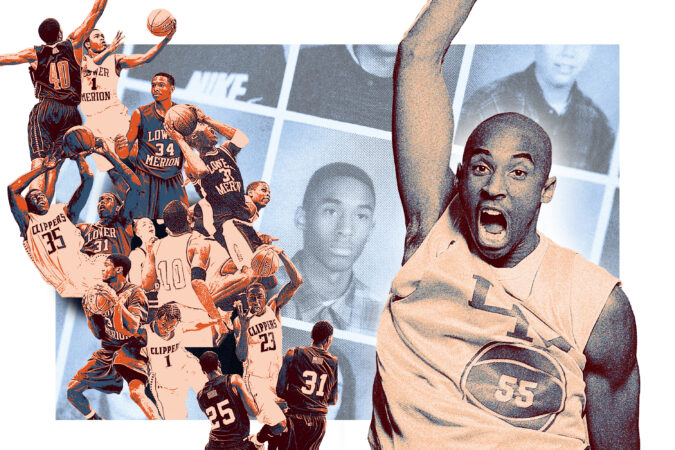
Linehan was a scrappy point guard for Chester. Bryant was a relentless shooting guard for Lower Merion. Both were competitive, almost to a fault, and in the days leading up to big games, they’d get chippy.
The week before the 1996 PIAA Class AAAA District 1 title game, for example, the players talked every day on bulky landline phones, with Bryant often calling Linehan at his home in Chester.
“I just said, ‘You know, John, I haven’t won a championship yet, and you have,’” Bryant told The Inquirer in 1996.
Linehan knew what his friend was doing. The future NBA star did the same thing a few weeks later, on March 19, a day before the teams met again in the state semifinal.
“He was trying to get me to trash talk,” Linehan said. “I think he needed a little edge. I didn’t want to give him too much. I was like, ‘Man, you crazy.’”
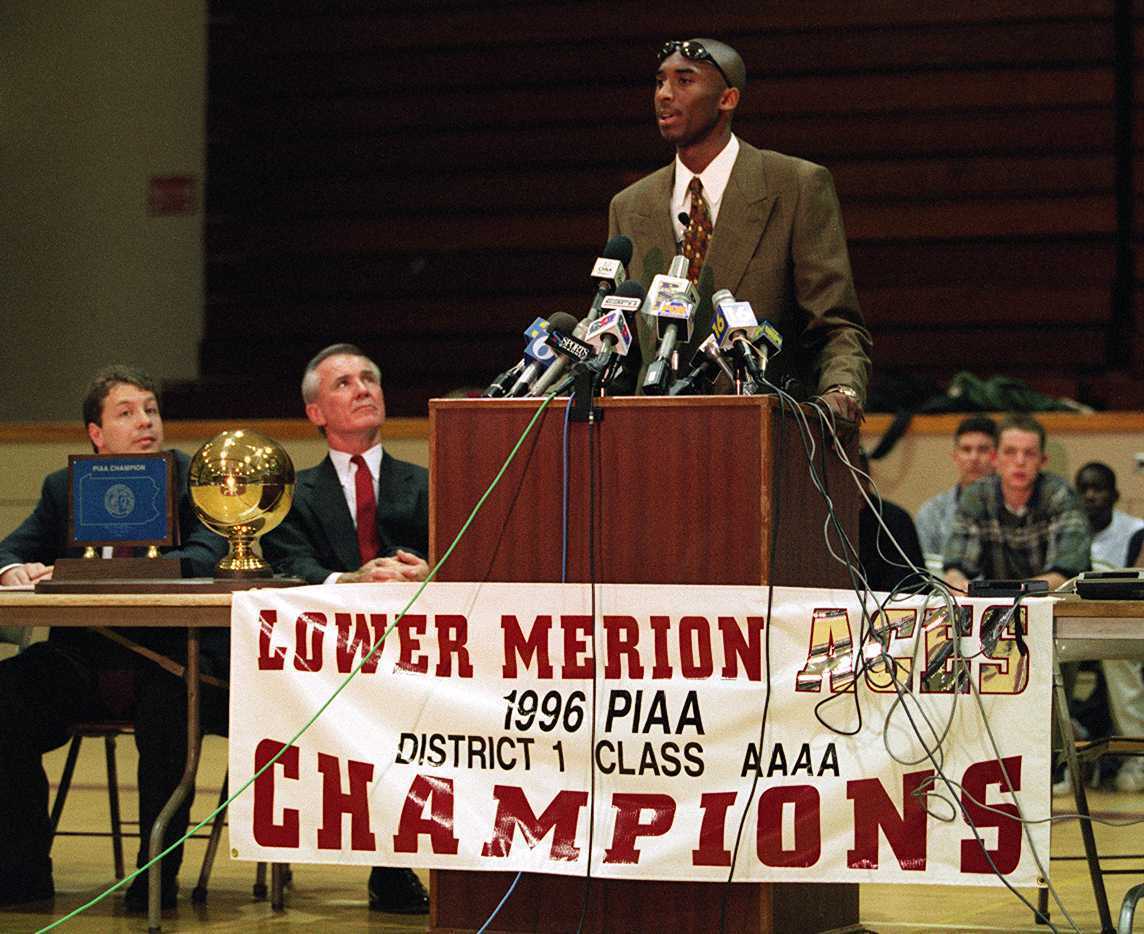
The late Kobe Bryant, a former Lower Merion basketball star, announcing he will go directly into the NBA draft out of high school.
Lower Merion wasn’t a basketball school when Bryant arrived in the fallof 1992. It paled in comparison to the local powerhouses like Simon Gratz, Coatesville, and Chester.
But Bryant changed that. Even in his freshman year, a season in which the Aces went 4-20, he brought a new standard, working out before class and introducing a level of toughness that was foreign to his teammates.
Bythe mid-1990s, Lower Merion was among the best high school teams in the Philadelphia area. Its players were more confident, celebrating after big shots, and talking loud on the court.
The Aces didn’t play as many games against Coatesville, a rising power led by Rip Hamilton. They couldn’t consistently measure themselves against Gratz, which didn’t participate in the PIAA playoffs untilthe 2004-05 season.
But they could against Chester. And so, a decades-long rivalry was born.
From 1996 through the mid-2010s, Chester and Lower Merion put on some of the greatest high school basketball games in the area. They’d often sell out venues like the Palestra and Villanova’s Pavilion. Some fans would even scalp tickets.
Their communities were almost diametrically opposed. Chester was predominantly Black; Lower Merion was predominantly white. Chester was plaguedby poverty; Lower Merion was considered affluent.
Chester, with its Biddy League, had a legacy of basketball greatness, and a steady pipeline of talent. Lower Merion had nothing comparable. But these differences melted away on the court.
And while the rivalry is not what it once was, it lives on today.
“The pride and the intensity and the history will never fade,” said Lower Merion coach Gregg Downer. “I mean, if we played them tomorrow night, that would be an intense game.”
The Bryant-Linehan era
When Downer was named head coach in 1990, he already was well-aware of Chester’s tradition. He’d played youth basketball growing up in Media and had heard about the stars who’d come out of the Biddy League.
It was obvious that his team would have to go through the Clippers to win any sort of accolade. But it wasn’t until Bryant’s arrival that Downer’s aspirations became a real possibility.
The shooting guard, who was the son of former 76er Joe “Jelly Bean” Bryant, was mature for his age. He’d demand more, mentally and physically, of older teammates. Doug Young, a former Lower Merion forward, remembered seeing Bryant leaving the locker room at 7 o’clock one September morning in 1993.
He’d been at the high school gym since 5 a.m., working out by himself. To the Lower Merion basketball team, this was a “crazy” concept, so Young and his cohorts decided to join him.
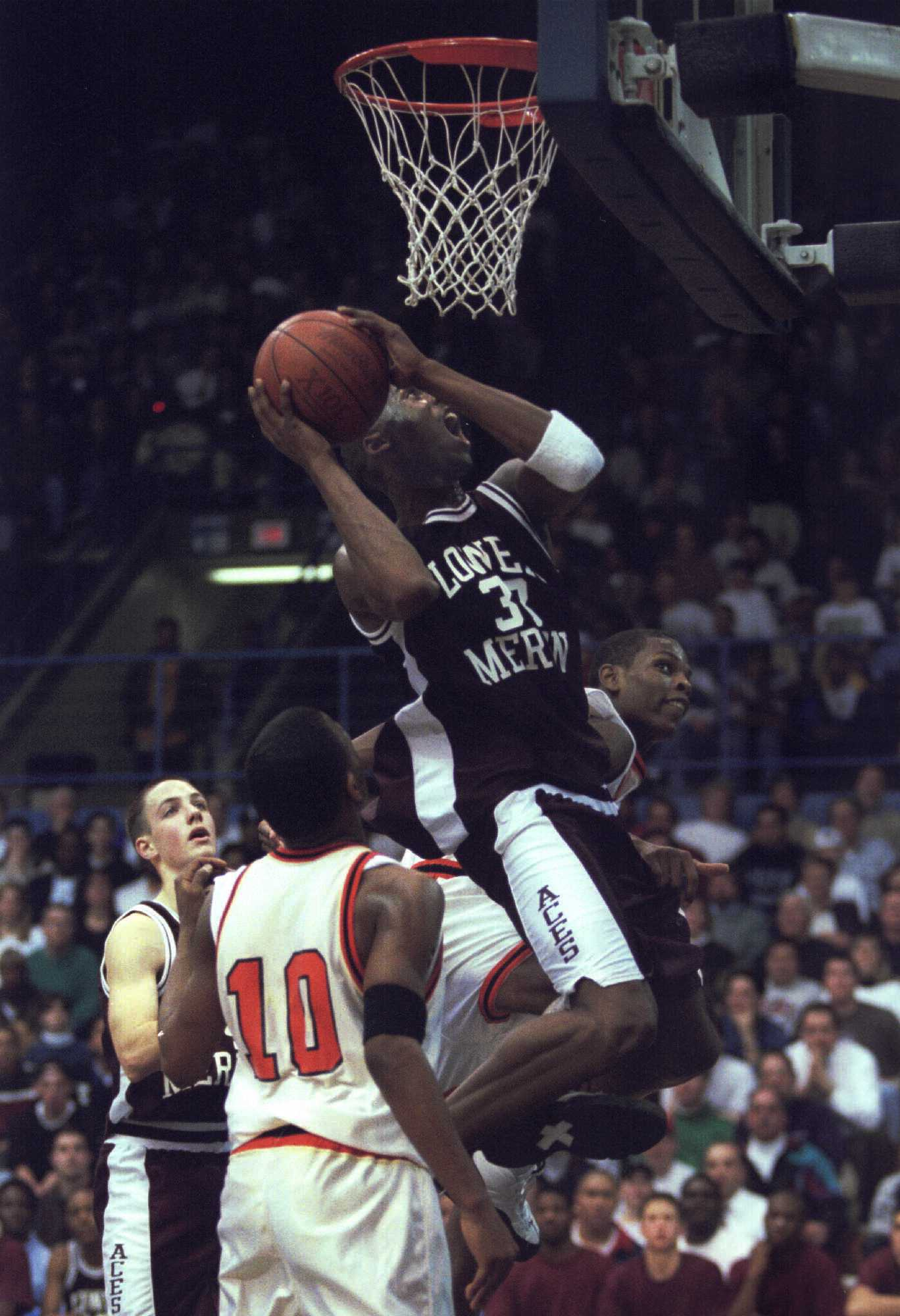
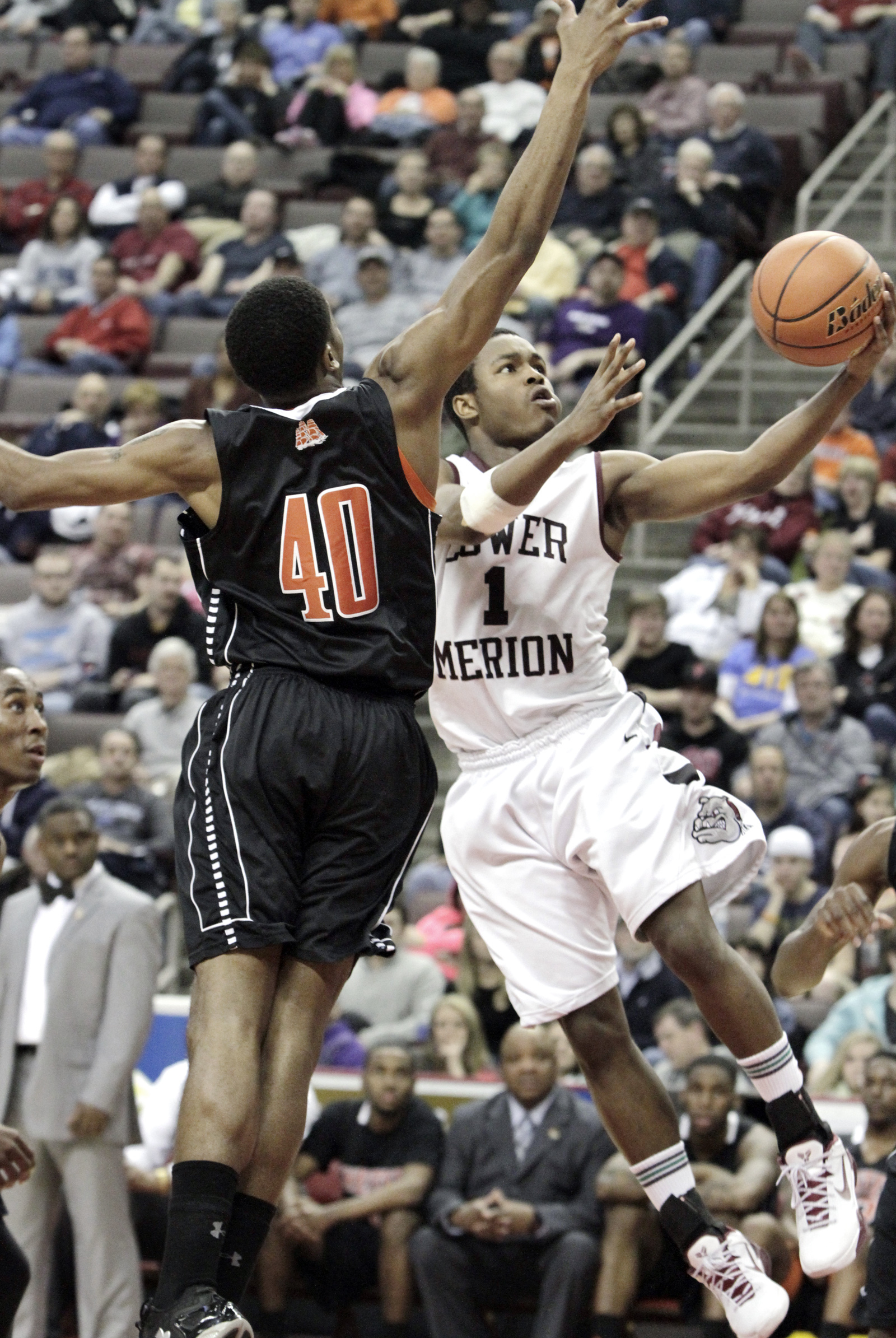
In the District 1 championship game against Chester, Kobe Bryant goes to the hoop over the Clippers’ John Linehan.
They arrived the next day at 5:06 a.m. The players knocked on the door. Bryant didn’t answer.
“He wouldn’t open it,” said Young, who graduated in 1995. “You’re either there or you’re not. We were six minutes late.”
His teammates waited outside until 6:30 a.m., when the school opened. They made sure to show up before 5 a.m. from that day on.
Downer was wired the same way. The coach — and his NBA-bound pupil — would push the team in practice. Losses were particularly tough. The players would go through endless sprints and rebounding drills that sent them running to the trash can.
It wasn’t fun. But over time, the method created a newfound tenacity.
“No one walked into high school saying, ‘Oh, yeah, I want to win a state championship,’” Young said. “But [Kobe] knew what that was. He was like, ‘I don’t know any other way. If we’re not going to win a championship, what the heck are we playing for?’”
Chester was always going to be an obstacle, so Downer tried to play into the battle. He’d use analogies for the tough, hard-nosed team, comparing it to an animal stalking its prey.
The coach began to screen movies to underscore this point. Together, in a Lower Merion classroom, Downer’s players watched Jaws and other tales of survival, like The Edge, a 1997 thriller about a plane that crashes in the Alaskan wilderness.
“This bear is stalking them, and the couple is saying, ’What are we going to do about this bear?’” Downer said. “And one of them says, ‘The only thing we can do is kill the bear.’
“And I remember being like, ‘We can do this.’ But the only solution is to — not to be overly graphic — but to kill them.”
(The bear in this analogy was Chester.)
He added: “We tried everything humanly possible to get through to this team.”
The first few games were ugly. In 1995, Lower Merion met the Clippers in the District 1 championship, only to lose by 27 points. But they came back with a renewed focus the following year, in 1995-96, going 25-3 in the regular season to earn a district final rematch against Chester.
The Aces showed up at the arena with “27″ printed on their warmup shirts. Bryant, armed with fresh bulletin board material from Linehan, dropped 34 points against the Clippers en route to a 60-53 Aces win.
The shooting guard scored 39 points later that month — with a broken nose — in a 77-69 state semifinal win over Chester. Lower Merion went on to beat Erie Cathedral Prep, 48-43, to win its first state championship since 1943.
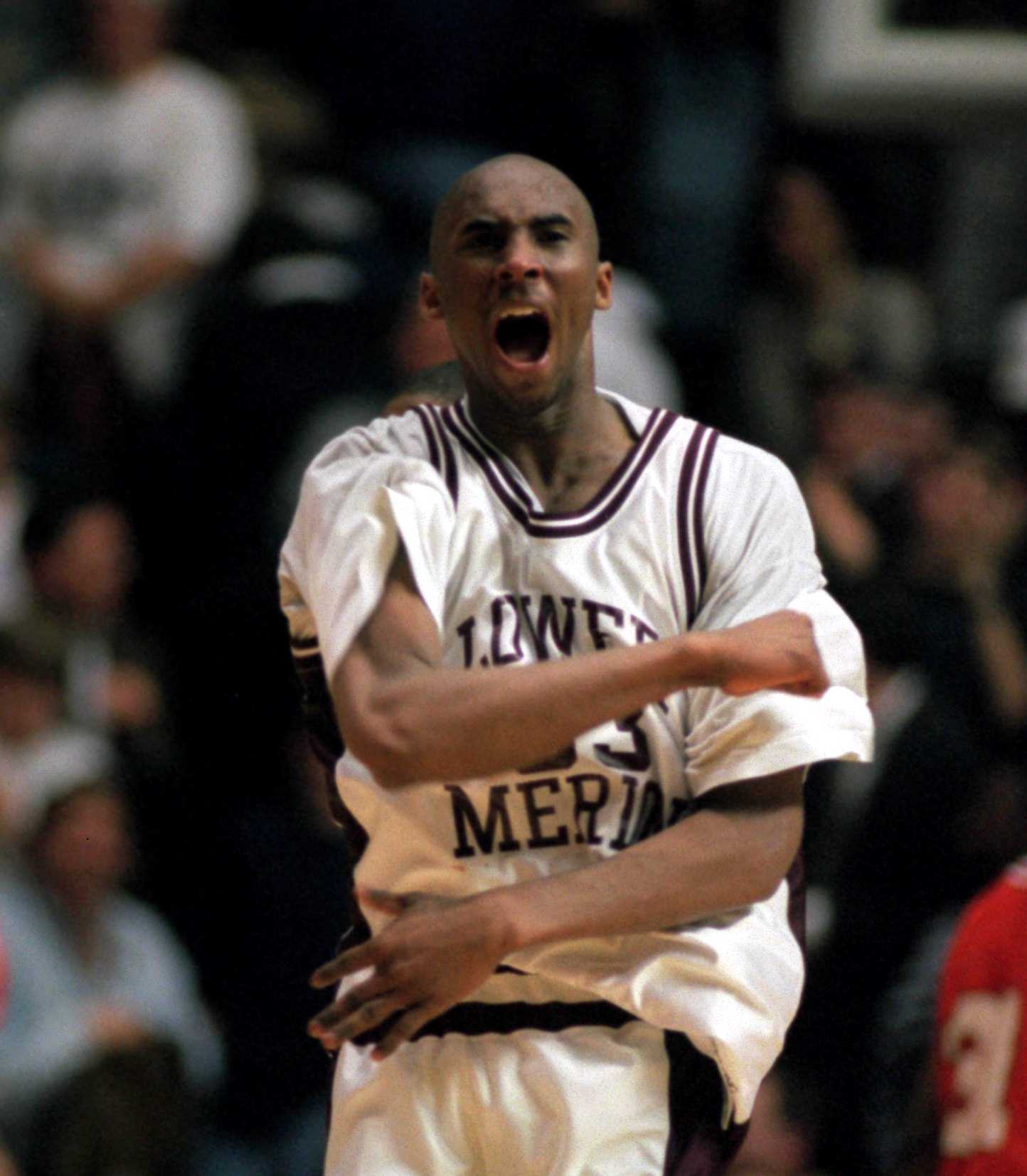
Kobe Bryant celebrates after defeating Chester at the Palestra in 1996 to advance to the state final.
To Linehan, the difference Bryant made was obvious. He joked that he’d “never heard of Lower Merion” before his friend arrived. But once he did, Chester realized it would have to go to great lengths to prepare for the phenom.
Ahead of a big game against Lower Merion in the mid-1990s, the coaching staff reached out to Clippers alumnus Zain Shaw. He played at West Virginia and in Europe and possessed some of the same characteristics as Bryant — a tall frame and an athletic build with strong ballhandling skills.
The Clippers invited Shaw to practice, where he played the role of Bryant (to the best of his ability).
“Kobe was so special, we had to bring in a pro to help us prepare,” said Linehan, who later starred at Providence.
But there was another impact the future Lakers star had, one that had nothing to do with his own prowess. Linehan noticed that Bryant’s Lower Merion teammates started to take on some of his qualities. Suddenly, they were playing brash, confident basketball.
“We didn’t have reason to believe, until Kobe got there, that we belonged on the court with Chester,” Young said. “The fear was real. Teams were afraid of Chester because they’d run you out of the building.
“The idea of Lower Merion being on the court in a meaningful game against [them] was such a crazy thought. But then, you started to believe.”
The buzzer-beater heard ’round Chester
Bryant never got over the rivalry, even after he embarked on his Hall of Fame NBA career in 1996. Sometimes, he’d call the coaching staff before big games against Chester, leaving expletive-laden voicemails to use as motivation.
The Lakers shooting guard also created an incentive structure for his former team.
“You couldn’t get a pair of Nike sneakers unless you qualified for the playoffs,” Young said. “If you don’t earn it, you don’t get it.”
He became especially involved in 2005-06. After a lull in the early 2000s, Chester and Lower Merion found themselves neck-and-neck again. The Aces were led by the duo of Ryan Brooks and Garrett Williamson, and the Clippers boasted a deep roster, headlined by Darrin Govens. All of them eventually played in the Big 5.
(Chester was so stacked that it brought a 1,000-point scorer off the bench in Noel Wilmore.)
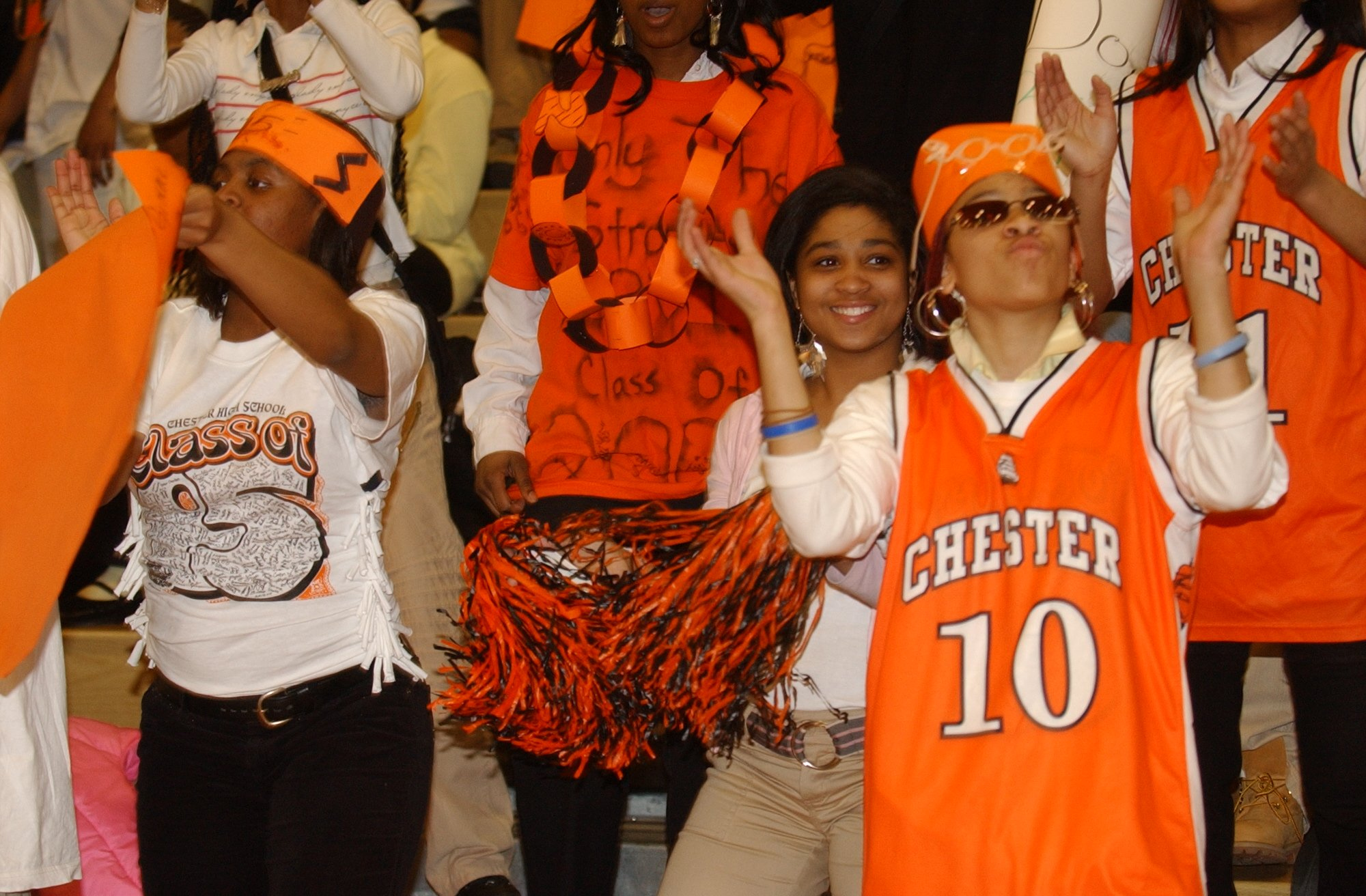
Students from the class of 2005 show their support as Chester and Lower Merion play in the state final.
The rivals met in the state championship on March 19, 2005. Despite strong performances from Williamson and Brooks, the Clippers pulled away in the second half thanks to a dominant third quarter from Govens. Chester won, 74-61.
The teams reconvened the following season with their competitive spark fully reignited. They faced each other three times that year. Chester took Round 1, a one-point regular-season victory on Dec. 27.
Round 2 was in the district final on March 3. Before the game, in front of a packed crowd at the Pavilion, Chester sophomore Karon Burton walked up to the layup line.
Lower Merion’s student section caught his ear with a chant about coach Fred Pickett’s stout stature.
The dig didn’t intimidate Burton. If anything, it fueled him. He grew up playing street ball in Chester and always loved trash talk.
Instead of cowering, like the crowd hoped, the sophomore delivered an unforgettable outing. The game went into overtime, and was tied at 80 with only a few seconds remaining.During a timeout, assistant coach Keith Taylor pulled Burton aside.
“He was like, ‘Hey, listen,’” Burton said. “They’re going to double Darrin. If you get that ball, do your thing.’”
Taylor’s words proved prescient. As Lower Merion’s defenders swarmed Govens, the Clippers inbounded the ball to Burton.
He took a pull-up jumper from beyond the arc and drilled it for an 83-80 win. The Chester fans stormed the court. Burton, who later joined Wilmore in the 1,000-point club, said he felt like a celebrity in his hometown.
“It was like watching a buzzer-beater in the NBA,” he said. “I just ran to my teammates, they picked me up. It was a crazy feeling.
“I’m a big Kobe fan, too. Kobe’s my favorite player ever. So when I came and I hit the game-winner on that team …”
Round 3 took place a few weeks later, in a state semifinal rematch at the Palestra on March 22. Bryant called Lower Merion’s coaches before the game.
“I don’t remember specifically what he said, but I’m sure there were a lot of [expletives] dropped,” said Young. “Like, ‘Don’t call me back if you don’t beat those [expletives].’ That was a line we heard from him a couple times.”
This one didn’t go Chester’s way. After trailing the Clippers, 47-37, at the end of the third quarter, the Aces came roaring back in the fourth and put up 33 points to eke out a 70-65 win.
The celebration in the locker room was cathartic. Water sprayed into the air. Players sat atop each other’s shoulders and turned the showers into a slip ‘n slide. Bryant called in, again, as other members of the 1996 team filtered through.
Darrin Govens scored his 1,000th point for Chester against Lower Merion in the state championship in 2005.
This was not how Govens wanted to end his high school career. And a few months later, when he arrived at St. Joseph’s on a basketball scholarship, he saw a familiar foe.
It was Williamson, his new Hawks teammate.
“We were sitting on the opposite side of the bench,” Govens said. “I didn’t want to sit next to him; he didn’t want to sit next to me. We’d kind of avoid each other and just head nod.
“Even in running drills, it was a competition. He looked to the left. I looked to the right. We tried to beat each other in sprints. But then we realized, ‘All right bro, we’re teammates now.’”
‘Hero status’
Chester had always rallied around its high school basketball team. Linehan said it was akin to playing for the Sixers. The teenagers were treated like professional athletes — especially those who had been a part of big wins.
The Clippers’ public address announcer, James Howard, called this “hero status.”
“All of a sudden, your money’s no good,” he said. “Barbers take care of you, make sure your hair looks nice before games. Free food. Little kids look up to you and ask for your autograph. That’s how it is.”
In Chester, there were plenty of heroes to draw from. There was Linehan, but also Jameer Nelson, who met a young Burton in the late 1990s. Nelson, a friend of Burton’s cousin, gave the aspiring basketball player a gift before he left for St. Joe’s: his MVP medal from the Chester summer league.
“He was one of the biggest guys in our city,” Burton said, “so it’s definitely something that I’ll always remember.”
By the early 2010s, when the rivalry was reignited for a third time, Lower Merion had built more of a basketball tradition. Aces guard Justin McFadden said he’d get stopped in Wawa before big games against the Clippers.
Chester celebrates its win over Lower Merion for the state championship in 2012.
“It became a community thing,” he said. “People would be asking, ‘What do you guys think about Chester? Do you think we can get it done?’”
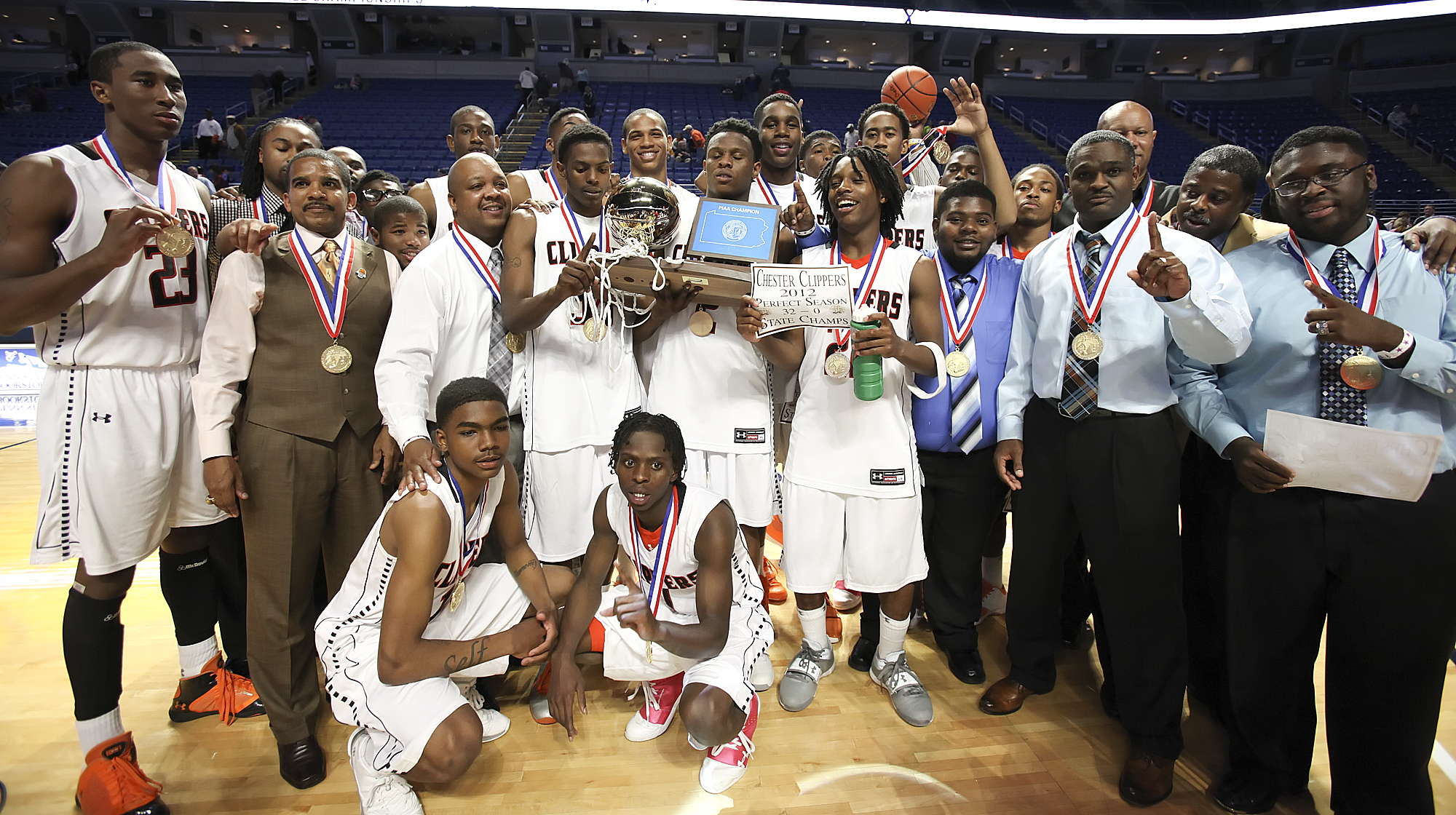
In 2012, the schools met in the state championship for the first time since 2005. Junior forward and future NBA starter Rondae Hollis-Jefferson put up a double-double to lead the Clippers to a resounding 59-33 win over the Aces. It was their second straight title and their 58th straight victory.
A year later, after going 17-0 in the Central League, the Aces met the Clippers in the state final again. Chester had won 78 straight games against in-state opponents. Snapping that streak would be daunting, but Downer had a plethora of motivational tactics at his disposal.
Just as they had in the 1990s, The Aces again spent pockets of the season watching Jaws, The Edge, as well as an addition: Al Pacino’s “Inch by Inch” speech in Any Given Sunday.
“He would have that fired up on YouTube, ready to go,” McFadden said. “Looking back, [your reaction] is a chuckle, but in the moment, it worked. We knew that this was the hill that needed to be climbed.
“And every time they played that speech, we got goose bumps. We were ready to fire.”
Chester got out to an early lead, but Lower Merion rallied behind a 22-point, 11-rebound performance from B.J. Johnson, who later starred at La Salle. The Aces snapped the streak and won their seventh state title with a 63-47 victory.
Lower Merion’s Jaquan Johnson goes to the net as Diamonte Reason guards him in the Chester-Lower Merion state championship game in 2013.
The Clippers then were coached by Larry Yarbray. Pickett, who was diagnosed with cancer in2010, was in declining health. Just before he died in 2014, Downer decided to say goodbye.
He and his former assistant coach Jeremy Treatman drove out to Pickett’s home in Chester. They went to his bedside.
“And we talked,” Downer said. “And we held hands. It was a really touching moment for me. This is a man that carried Chester on his back. That tried to carry Lower Merion on his back. And I knew it was the last time I was going to see Fred.
“We walked out the door, and we told each other that we loved each other. And I never thought he would say that to me, or vice versa. But it was just kind of like, ‘You know what? We’ve had some amazing battles, and there’s a lot of respect there.’”
Keeping the tradition alive
In recent years, the Chester-Lower Merion rivalry has diminished.
There was a brief period when the teams were in different classifications. Both programs have lost players to private schools that can recruit, and the addition of the Philadelphia Catholic League to the PIAA has made the state playoffs more competitive.
One place the Aces and Clippers could meet is in the district tournament, where they reunited in 2024. But they haven’t played each other since. And Howard says the contests don’t have the same feel.
“Both teams have lost D-I talent,” he said. “It’s not as high-flying, above the rim, as it was in the past. But still a great game. Sold out at Lower Merion, and at Chester, same thing.”
The history will always be there, though, and Burton is doing his best to keep it alive. His 8-year-old son, Karon Burton Jr., is playing in the Biddy League. His father is his coach.
Sometimes, they go on YouTube and watch old Clippers games. Junior’s favorite, of course, is the 2006 district final.
Burton believes that his son has a promising future, but isn’t sure of where he’ll go to high school yet. He doesn’t want Karon Jr. to feel obligated to follow his father’s path.
But if it worked out that way, what a story that would be.
“I’d love to be the first father and son to have 1,000 points,” Burton said. “With the same name? That would be crazy.”
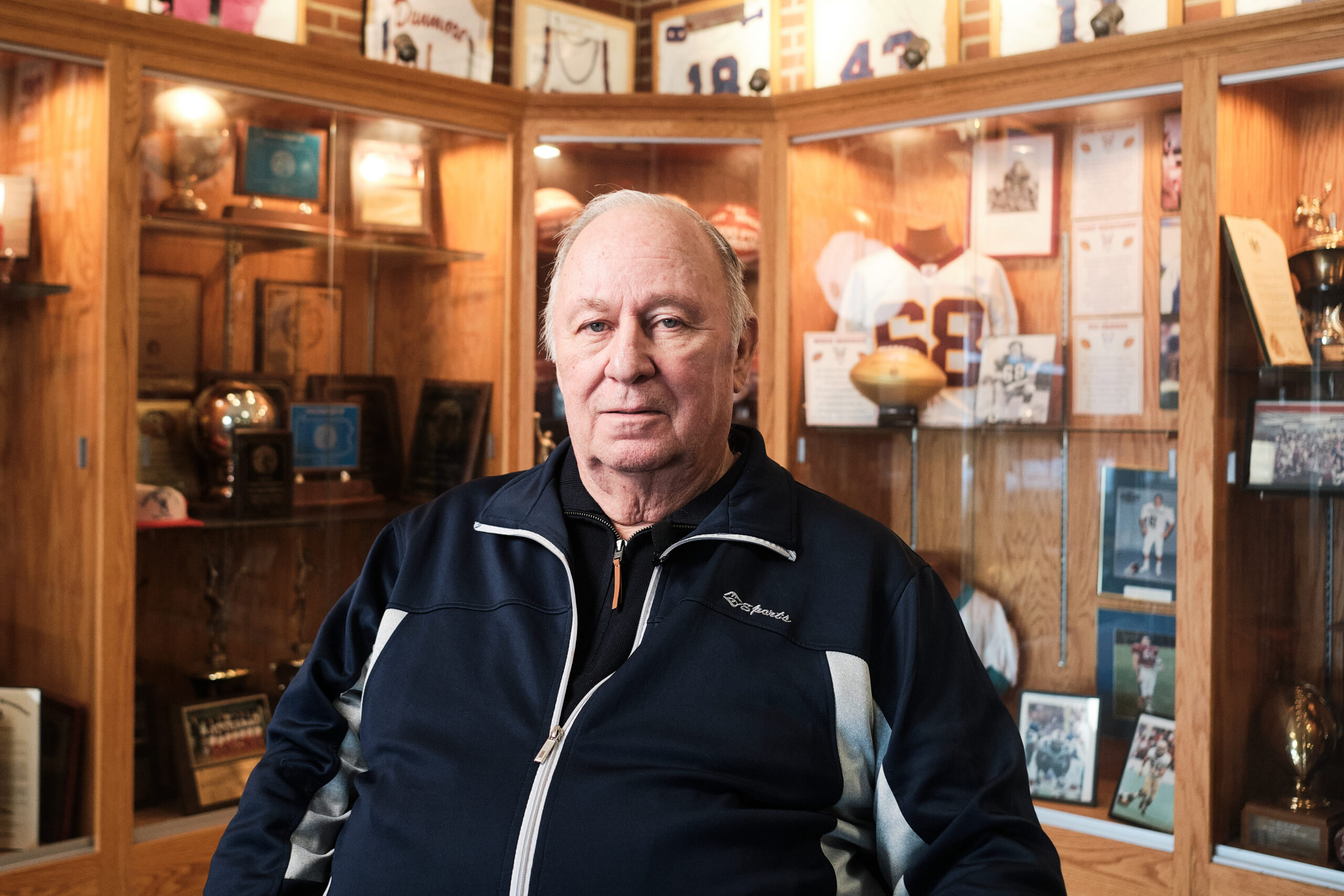
DUNMORE, Pa. — Roseann Henzes is 89years old and watching the Eagles is the highlight of her week. This is not because of the players, the head coach, the general manager, or the famous security officer.
It is because of Vic Fangio, whom she has known since he was 14, when he played high school football for her late husband, Jack Henzes.
A day before the game, the octogenarianwill text the defensive coordinator “good luck.” From her wheelchair in Dunmore, she’ll take in every snap, paying close attention to moments when the camera pans to the coaching booth.
Fangio wears the same expression he did in the 1970s: stern, focused, and endearingly gruff. Win or lose, Henzes sends him a message afterward. He usually replies, with his typical brevity.
“I get one-word answers,” she said with a laugh. “‘Thanks,’ or ‘appreciate it,’ maybe. No time to chitchat.”
Roseann Henzes still communicates with Vic Fangio more than 40 years since he last coached under her husband, Jack.
Some coordinators are toughened by long hours and stressful seasons, but the people of Dunmore say this is how Fangio has always been. Even as a young safety, he was hard-nosed and meticulous, a player who devoured film and grasped concepts on the first try.
Fangio showed an ability to be in the right spot at the right time, or, better yet, anticipate what the opposing offense would do next. These instincts only sharpened in 1979, when he was hired by Jack Henzes as linebackers coach at Dunmore High School, his alma mater, about 120 miles north of Philadelphia.
It was an opportunity that laid the foundation for the rest of his career. Henzes became a mentor to Fangio, whom he saw as a kindred spirit. He taught his pupil how to work, how to coach, and how to get the most out of his team.
They took pride in the minutiae, drilling players on everything from proper footwork to hand placement. This translated into success: After losing seasons in 1976 and 1977, and a bounce-back 10-win season in 1978, Fangio and Henzes went 21-13 over their three years coaching together.
The Eagles defensive coordinator has accomplished a lot since then — including a Super Bowl championship in which he had a crucial role — but locals still see the same understated guy.
To Roseann Henzes and the Dunmore community, he will always be the kid who umpired Little League games for fun. Or the high school coach who tended bar at Ragnacci’s for extra money — despite his reticent nature.
“I just laugh when they show him in the [coaches’] box,” said Tony Donato, Fangio’s former neighbor. “The same expression on his face. Doesn’t crack a smile. I think he’s saying, ‘I don’t want this camera on me at all.’”
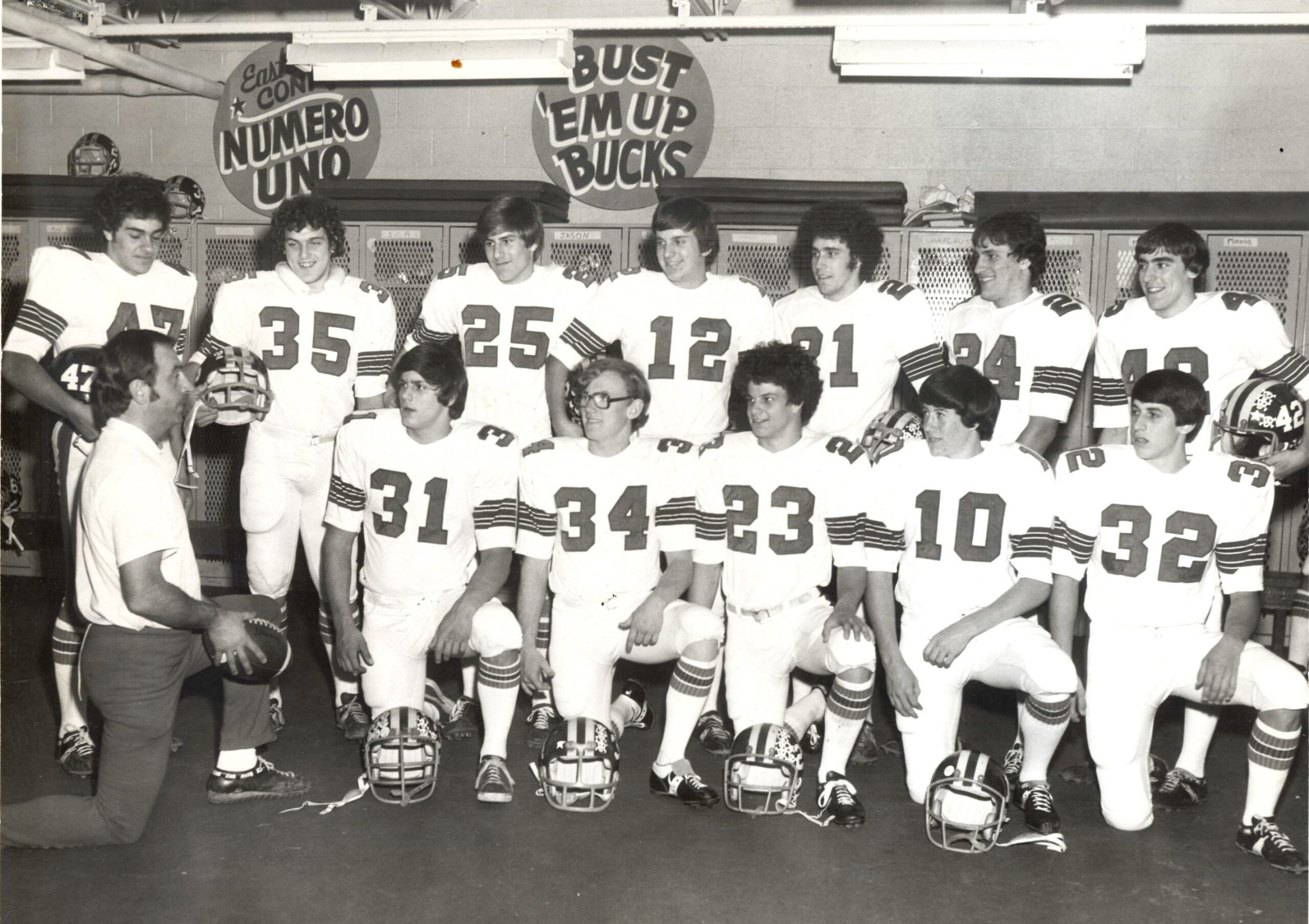
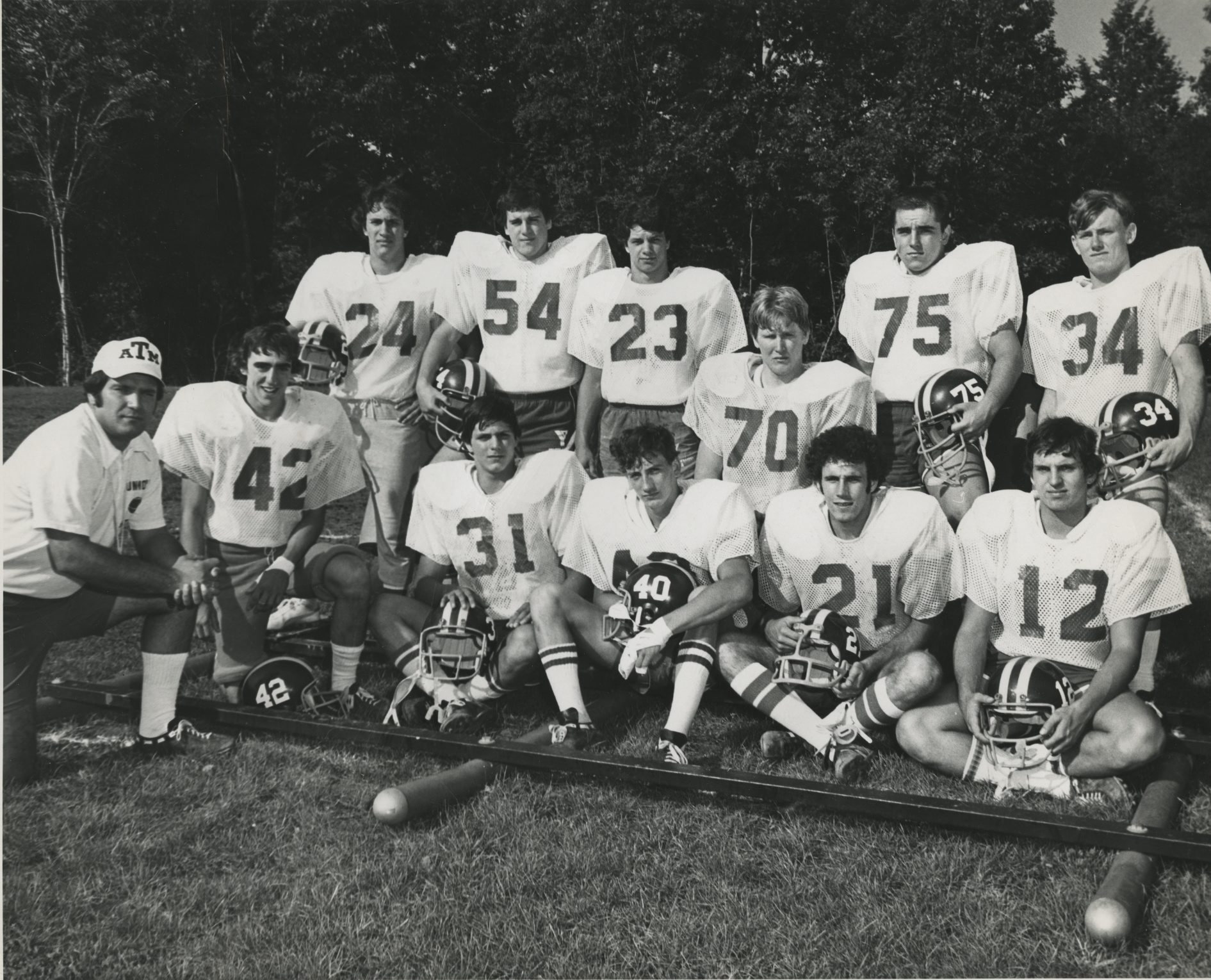
Dunmore coach Jack Henzes with his 1975 team. Vic Fangio is standing second from right.
A player known as ‘Hector’
Fangio spent his formative years in Dunmore, a borough of about 14,000 people just outside of Scranton. His mother, Alice, was a housewife and, later, a secretary at the local high school. His father, Vic Sr., owned a tailor shop.
From a young age, Fangio was immersed in sports. He played baseball in the spring, football in the fall, and basketball in the winter. As if that wasn’t enough, Fangio began umpiring in Dunmore’s Little League, where Vic Sr. served as a coach, in the early 1970s.
He was only a teenager, but he displayed a breadth of knowledge that commanded respect.
Bob Holmes, who played for Fangio from 1979 to 1981, experienced this firsthand. He met his future football coach in the batter’s box. The umpire showed no mercy.
“He called balls and strikes,” Holmes said. “And if you were just this kid sitting up there, and you’d watch one go by, he’d punch you out like it was a major league game. Off to the side, fist out, you’re done. Out you go.”
Locals assumed Fangio would work in sports. Some wondered if he’d become an umpire, following in the footsteps of Dunmore resident and Baseball Hall of Famer Nestor Chylak.
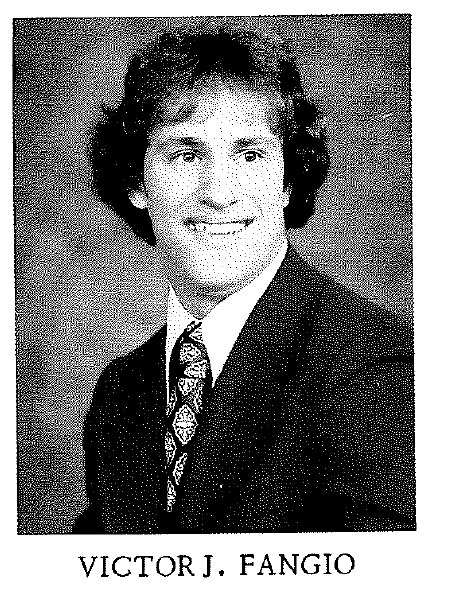
Vic Fangio’s senior yearbook photo at Dunmore High School in 1976.
But after Fangio was introduced to Henzes, his love for football became clear. He played for the freshman team in eighth grade, with a voracious appetite to learn. Bill Stracka, Fangio’s coach in 1971, said the middle schooler would bring him NFL concepts to implement.
“Every once in a while he’d say, ‘Could I talk to you before we leave?’ And I’d say, ‘Sure,’” Stracka said. “He’d say, ‘Well, last night, I was watching part of the game, and I saw something that I’d really like to explore here. I think I could do it.’
“Whenever we talked about things, it was like that. He was very, very aware.”
Fangio joined the varsity team in 1973, and was taken by Henzes’ understanding of the sport. Henzes was taken by Fangio, too. Roseann said her husband would talk about the safety “all the time,” and eventually introduced her to Fangio when he was a sophomore.
She was struck by how similar they were, down to their demeanor. Both Fangio and Henzes were quiet. Both had a borderline obsession with the game, spending long days and late nights studying film.
Because of all this work, they could predict an opposing offense’s next move. Joe Carra, a former linebacker at Dunmore, remembered one game in 1973 against Valley View, which Dunmore hadn’t beaten in years.
With Fangio on the field, they achieved the improbable. He intercepted a pass late in the fourth quarter and returned it 40 yards for a backbreaking touchdown en route to a 33-27 win.
“He would play right behind me, and he was always in the right position,” Carra said. “That’s why he had a bunch of interceptions.”
Together, Henzes and Fangio elevated the program to new heights. After a lackluster freshman season in which it went 5-4-2, Dunmore posted a 28-6-1 record over its next three years with three Big 11 Conference championships.
Senior players on the 1975 Dunmore High School football team that won the Big 11 championship, including Vic Fangio (24), back row left.
At some point during this span, Fangio was given an unusual nickname among a select group in his hometown: “Hector.” Carra recalled that it was assistant coach Paul Marranca who first coined it (although Marranca’s memory of this is hazy).
In Carra’s telling, one day in practice, Marranca was trying to get his players in position and mistakenly yelled “Hector” instead of “Victor.” The moniker stuck.
“We all laughed under our breath,” Carra said. “Coach Henzes would have made us run if he thought we were laughing at him.”
Fangio graduated in 1976 and attended nearby East Stroudsburg, where he attended coaching clinics. By 1979, he’d gotten his first coaching job, overseeing linebackers under Henzes at Dunmore, while finishing his senior year of college.
He stayed for three seasons, working as defensive coordinator in 1980 and 1981. The first stop of his career shaped his philosophy for decades.
“Everything he got came from Coach Henzes,” Carra said. “He went further with the detail. He learned toughness. He learned hard work.”
Though not known for his ebullient manner with people, Vic Fangio once worked as a bartender in Dunmore.
Coach by day, bartender by night
It didn’t take long for players to realize their new coach was advanced for his age. Dunmore had previously been running base defenses. After Fangio was hired, it started incorporating stunts and blitzes.
“We had no idea what we were doing,” former safety Paul Sheehan said via email.
The coach would challenge them schematically, but also would harp on fundamentals. Fangio had rules for every position group. The players first had to line up correctly. Then, they needed to know their coverages. They’d have to use their hands, stay square, and tackle properly.
Any mistakes would be pointed out in film review on Monday — even with players outside of his purview.
“He would stop the film and run it back 18 times to make a point,” Holmes said. “If [he] were critiquing our offensive line, he would critique their stance. ‘Your foot’s too far.’ ‘You just got beat off the corner because your foot wasn’t far enough.’ Or balance. The littlest of things.
“You’re sitting there, and you’re like, ‘Oh my gosh.’ You can’t wait to get out of there. But everything was important.”
It was here that Fangio’s attention to detail really shone. FormerlinebackerJack Miles remembered one day in 1980 when they were reviewing footage of an upcoming opponent. The coach paused the film, then rewound it.
He pointed to the hash marks.
“He [noticed] that if both receivers were outside the hashes, they’d run the ball,” Miles said. “If one receiver was inside the hash mark and the other one was outside, that was their throwing formation. Sure enough, he was correct.”
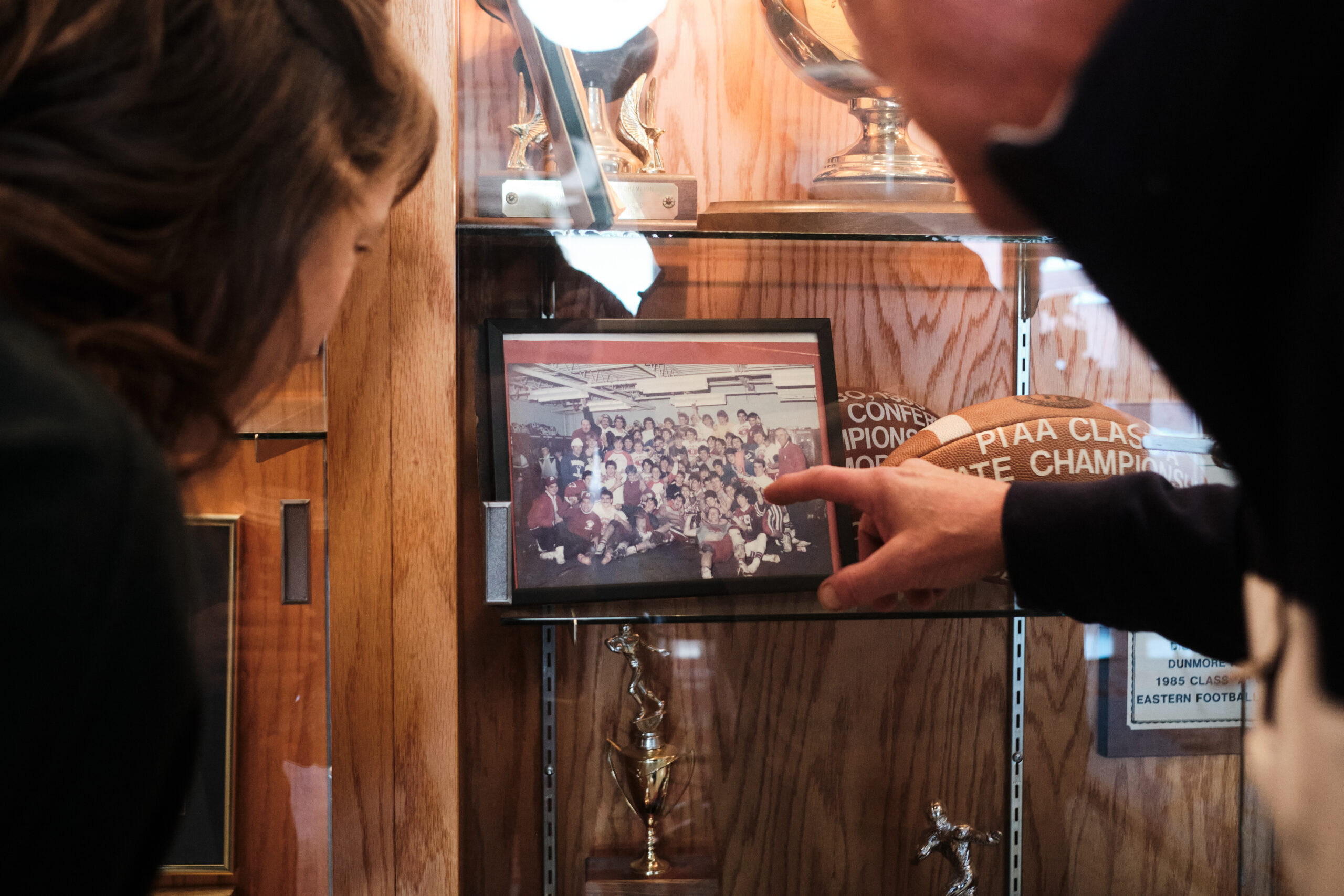
A photo of Vic Fangio’s high school team hangs in the trophy case at Dunmore High School.
Fangio was just as thorough on the field, equipping his players for every situation. Defensive backs would practice “high-pointing” the football, catching tipped passes, and taking efficient angles while pursuing ballcarriers.
Before long, Dunmore was running sound, but unpredictable, defense — one that proved difficult to dissect. Fangio’s unit would use four-man, five-man, and six-man fronts, all with four or five different plays apiece.
He occasionally reminded the players of his impact. On a Monday after a big win against Valley View, Fangio ran back a clip of Miles making a tackle untouched. Then, he ran it again. And again.
Fangio looked at the linebacker.
“He says, ‘Did anybody touch you?’” he said. “And I said, ‘No, Coach.’ And he says, ‘Aren’t you going to say thank you?’”
For Miles, getting a laugh out of Fangio was a point of pride. He was famously reserved, and not only at practice. Bobby Ragnacci, who coached Dunmore’s offensive line, hired Fangio to work at his family’s restaurant in the early 1980s.
Jack Miles shares fond memories of Vic Fangio’s work as an assistant coach under Jack Henzes at Dunmore.
He needed a bartender, and Fangio needed some extra money. So one night a week, the future Eagles defensive coordinator served 25-cent drafts and two signature cocktails: the Blue Moon and the Blue Hawaiian.
Pouring beer into a glass wasn’t an issue. Making small talk was.
“Well, he was no Tom Cruise, flipping bottles and stuff,” Ragnacci said. “But he was very efficient. And very honest. Certainly didn’t give away any free drinks.
“He was a good listener. Not much feedback.”
Added Holmes: “Not particularly good. He was probably drawing plays or something.”
Despite his taciturn demeanor, Fangio showed how much he cared. Holmes struggled in high school. He didn’t play a full season in his sophomore year because he became academically ineligible.
He was in a car accident in his junior year, which prolonged his time off the field, and finally returned to the team in 1981, his senior year.
Holmes remembered Fangio giving a speech to set the tonefor offseason workouts. He made a reference to “the players who weren’t here” in years past.
The tailbacktook notice.
“I think what he was saying to me, without saying it, was that we value you,” Holmes said. “‘We missed you last year. But I don’t want you to just sit there on the bench and hear me talk. I want to draw [your] attention. Because we feel you’re going to be an important part of our team.’”
To those around them, the parallels between Fangio and Henzes were obvious. They were defense-minded coaches who led with high expectations and tough love.
They possessed a savant-like ability to draw up plays, not because of clairvoyance, but hard work.
“Coach [Henzes] never felt like he was too smart for the game,” Holmes said. “He was always trying to learn new things. And I think he probably instilled that in Victor.”
Vic Fangio has never forgotten Dunmore amid his nationwide travelogue within the NFL.
Faxing defense to Dunmore
In the early 1980s, Fangio told Henzes he wanted to coach at the next level. Henzes urged his pupil to leave as soon as possible. He did, taking a job as defensive coordinator at Milford Academy in Connecticut in 1982.
After working as a graduate assistant at the University of North Carolina in 1983, Fangio was hired by Jim Mora as a defensive assistant for the USFL’s Philadelphia/Baltimore Stars from 1984-85.
He entered the NFL in 1986, joining Mora’s New Orleans Saints as a linebackers coach. He stayed there for the next eight years, leading one of the greatest linebacker units in history, the “Dome Patrol.”
Despite his busy schedule, Fangio always made time for his hometown. He often would provide tickets to family and friends from Dunmore. If they came to visit, he’d make sure to see them.
In the 1990s, Stracka and his wife traveled to New Orleans for a conference. They decided to let Fangio know, and he invited them to tour the Saints facility.
The couple walked the grounds, and afterward, Fangio offered to show them his office.
Stracka and his wife were aghast by what they saw.
“What’s the matter?” Fangio asked.
“Well, you must have 1,000 sheets of paper in here,” Stracka replied.
The linebackers coach was unfazed. He looked at the papers, stacked up around his desk, and went through each pile one-by-one.
“Well, that’s for linebackers,” he explained matter-of-factly, “and this one’s for this, and …”
Bill Stracka is among the Dunmore associates who kept a connection with Vic Fangio throughout his coaching rise.
Despite the fact that Henzes and Fangio were about 1,200 miles apart, they still talked on a regular basis. This continued at all of Fangio’s NFL stops: Carolina, Indianapolis, Houston, Baltimore, San Francisco, Chicago, Denver — where he was the Broncos’ head coach — and Miami.
Henzes would ask his pupil for advice on schemes and how to attack upcoming opponents.
Fangio would draw up plays and fax them to the guidance office at Dunmore High School. Sometimes, he’d call Henzes back at the field house, where the coach’s office was located, to talk to him directly.
“You’d hear the phone ring, and somebody would pop out, and they’d say, ‘It’s Coach Fangio,’” said former fullback Kevin McHale, who played for Henzes in the 1990s. “And he would say, ‘Excuse me for a second, I’ve got to talk to Victor.’ It was like the president was calling him.”
McHale said Fangio often would respond to his former coach that day. If he wasn’t able to reach him at his office, he’d try calling Henzes at home.
Roseann usually would pick up the phone. A self-described “talker,” she would try to engage the coach in conversation.
“All I do is ask questions,” she said. “How are you? What did you do? Where are you going? Where have you been? How’s the kids?
“And I would get one-word answers, right? And I always joke that I could talk to a wrong number — and I could — but that was tough. It was really tough.”
She’d pass the phone to her husband, who would jot down Fangio’s X’s and O’s with a paper and pen in hand. Every once in a while, she’d hear his end of the conversation.
“He’d say, ‘Well, I can’t do that, because I don’t have the personnel that you have,’” Roseann said. “But he’d get the ideas from him anyway.”
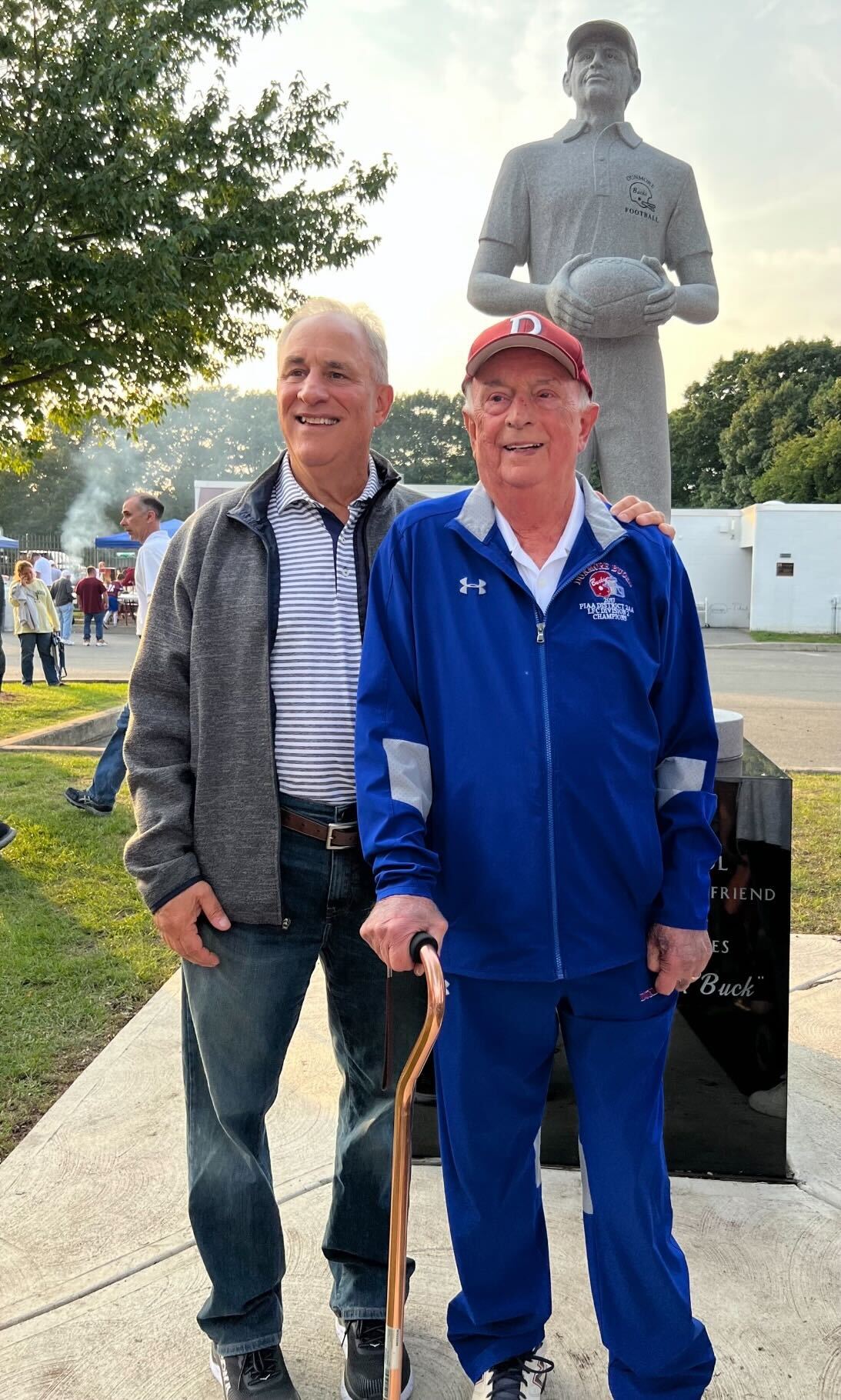
Vic Fangio honored his high school coach, Jack Henzes, by accompanying him to his statue unveiling.
Fangio continued to help his former coach until he retired from Dunmore in 2019. Aside from his role as Henzes’ unofficial defensive consultant, he also visited him in person, taking the coach to lunch at Ragnacci’s or talking to his high schoolers over the summer.
In turn, Henzes would use Fangio as a model for his players. If he saw someone acting out of line, he’d muse that they wouldn’t see “Victor’s guys” doing the same thing. The coach bought NFL Sunday Ticket so he could watch all of Fangio’s games. Any lessons he learned, he relayed back to his team.
In 2022, Dunmore High School built a statue dedicated to Henzes, the third-winningest high school football coach in state history. Fangio, who was working as a consultant for the Eagles at the time, showed up to surprise his mentor.
About a year later, in the summer of 2023, he made an impromptu stop at the Henzes household.
It was the last time Fangio would see his former coach. The mentor and the mentee sat together in the back room, talking about football and family. Henzes died two weeks later, at 87.
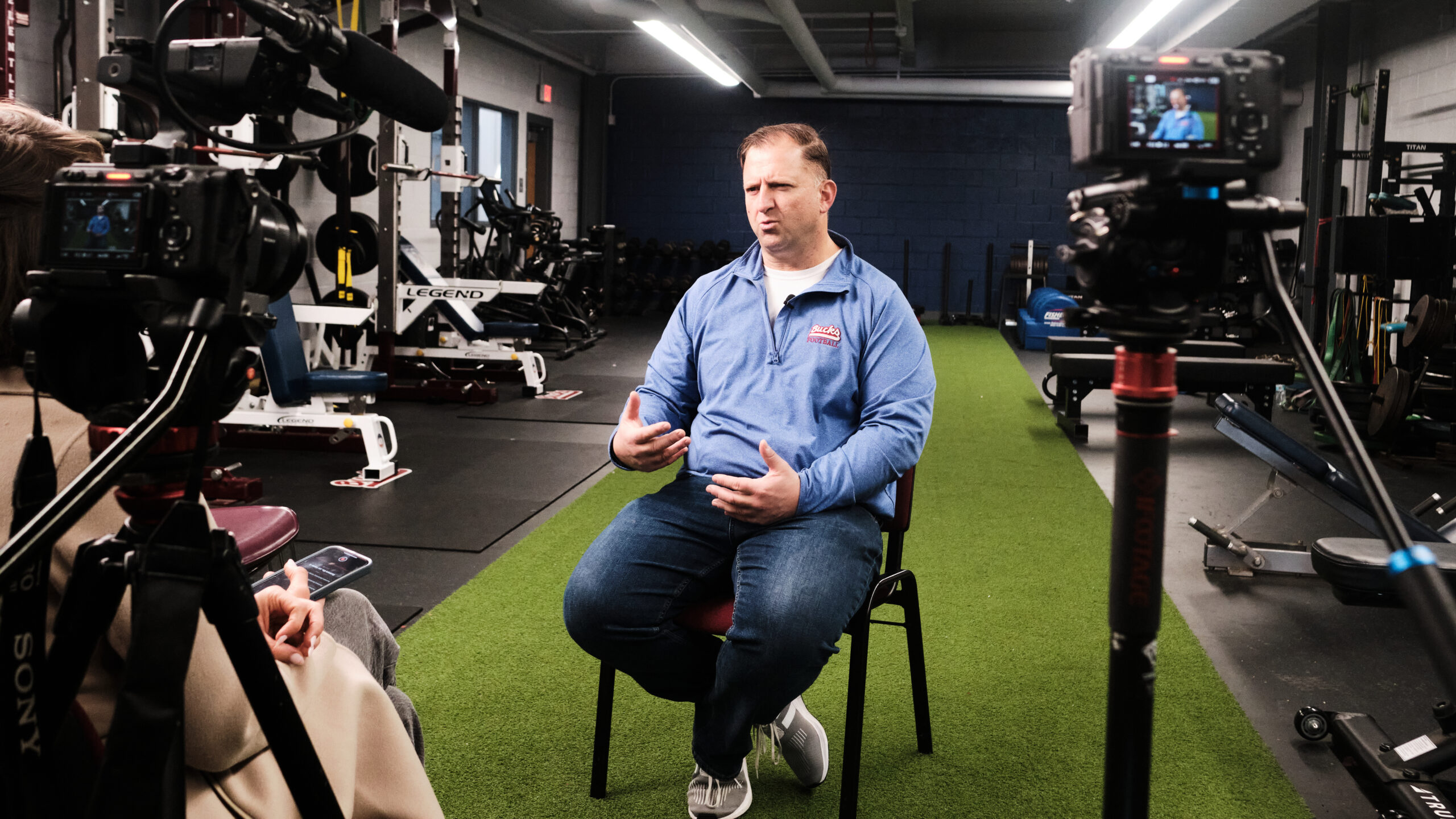
Dunmore High School’s current football coach, Kevin McHale, says Vic Fangio maintains firm ties to the high school where it all started for the esteemed NFL coordinator.
“V-I-C”
In the lead-up to Super Bowl LIX, Dunmore’s football team watched every Eagles playoff game and Fangio news conference from its weight room.
McHale, who was named the Bucks’ head coach in 2019, would break down Fangio’s defense after each matchup, pointing out how his players performed on the biggest stage.
The teenagers looked on in awe as a man who’d once walked the same halls they did put on a defensive master class. The Eagles’ Super Bowl victory filled Dunmore with pride. In a way, it felt like his hometown had won, too.
Fangio’s former players could see traces of their high school coach in Philadelphia’s defense. The personnel was more advanced, of course, but the foundation was the same: sound fundamentals, attention to detail, and unpredictable pressures.
Holmes observed how Zack Baun tackled and thought back to Fangio’s rules: head across the body, driving through the ballcarrier, proper angle of pursuit. It all seemed familiar.
“When we watch the Eagles now, we’re like, ‘Hey, we recognize that,’” he said.
A few weeks after the Super Bowl, Fangio returned to Dunmore. McHale had heard he’d be around, and reached out to the defensive coordinator to see if he would talk to his team.
Fangio agreed. On Feb. 28, he met the players in their locker room and stayed for an hour and a half, answering every question they had. Some were technical — asking Fangio how he developed the defense’s approach to Patrick Mahomes — and some were more trivial in nature.
At one point, McHale paused the Q&A. He asked Fangio if he’d ever met anyone who had shaved his name into the back of his head.
Fangio said no.
“Well,” McHale said, “we’ve got a kid right here.”
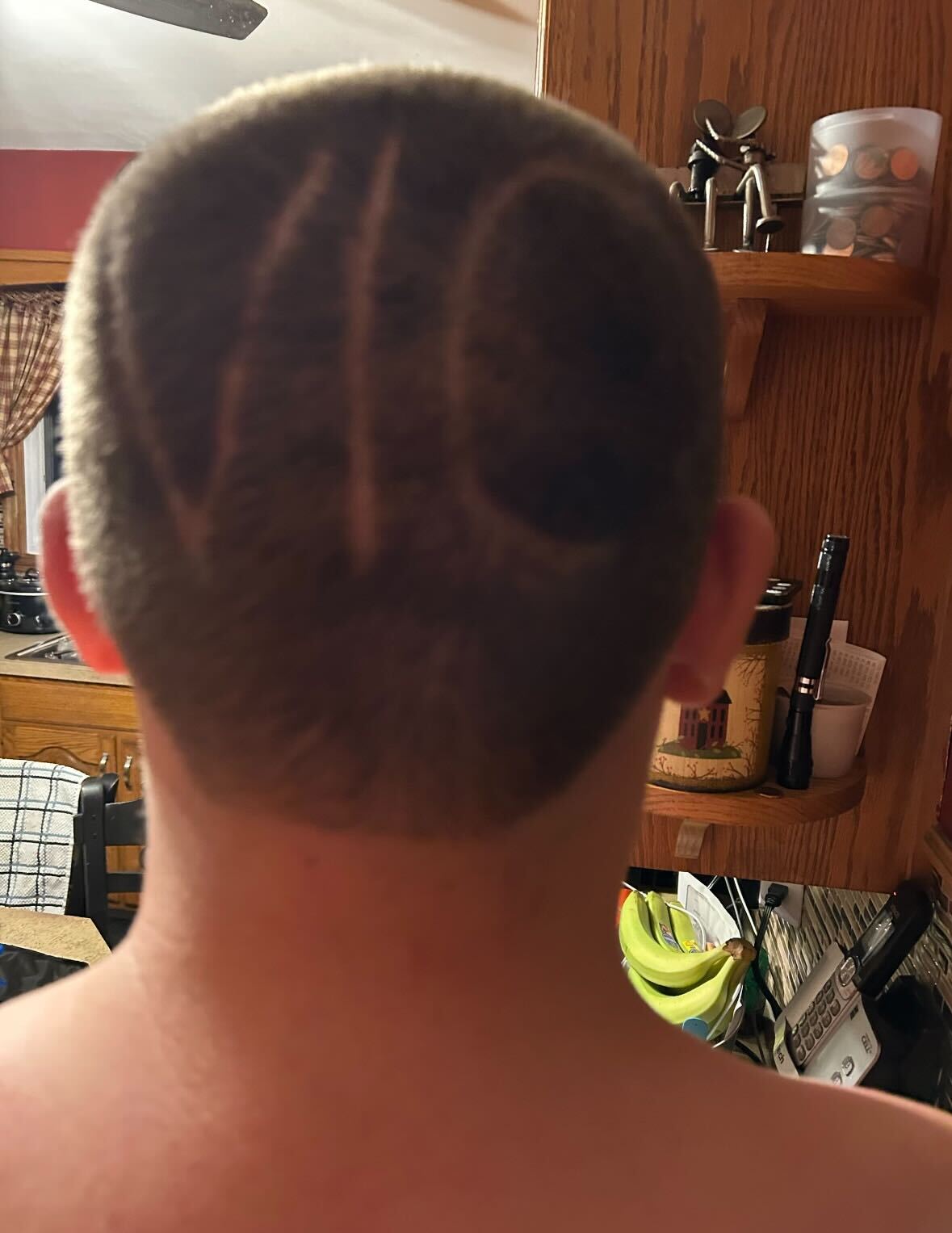
He motioned to right tackle Drew Haun, who turned around to reveal a big “V-I-C” etched into his buzz cut.
This got a smile out of Fangio.
Dunmore right tackle Drew Haun honored his school’s most famous football alumnus before a Vic Fangio visit to campus.
“I think he liked it,” the freshman said.
McHale is not in contact with Fangio as much as Henzes was, but he consults him from time to time. And if the defensive coordinator doesn’t reply right away, his concepts arenever far.
All McHale has to do is go to his home office in Dunmore. There, on a bookshelf, is a manila folder full of faxes; a trove of wisdom from a coach who will always be known as “Victor” or “Hector.”
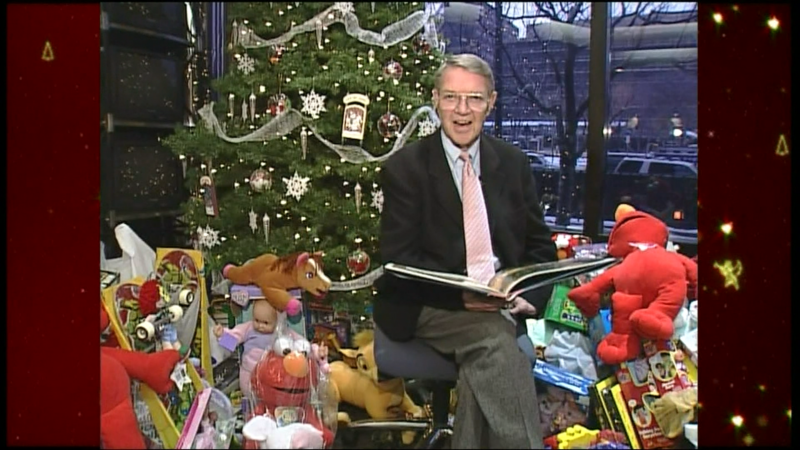
Harry Kalas loved Christmas. The holiday combined two of his favorite things: singing and making people happy. So when Andy Wheeler, a producer at CBS3, approached the broadcaster about reading ’Twas the Night Before Christmas in 2002, Kalas didn’t have to give it much thought.
“I’ll come right in,” he replied.
The station was recording a segment of five local broadcasters reciting the poem. Kalas would be featured alongside Marc Zumoff and Tom McGinnis of the 76ers, Merrill Reese of the Eagles, and Jim Jackson of the Flyers.
It aired Dec. 24, and a few years later, while cleaning out his desk, Wheeler found the unedited Kalas video. He watched it through, and suddenly, an idea popped into his mind.
They had the footage. Why not use the Kalas version in its entirety?
Wheeler (no relation to longtime Phillies announcer Chris Wheeler)presented it to producer Paul Pozniak and sports director Beasley Reece, who signed off. Christmas Eve was always a slow news day. This would give them something seasonal that undoubtedly would resonate with their audience.
A decades-long tradition was born. Barring breaking news (and Eagles games), the station has aired Kalas’ reading of the poem every Dec. 24 since 2005.
Management hasno plans to change that.
“Obviously, people love Christmas and people love Harry Kalas,” Wheeler said. “And having him read that story, with his voice that everybody is so used to … I think people miss him and miss hearing him.
“It’s almost like watching a home movie of Christmases past.”
A broadcaster for all seasons
To Phillies employees, Kalas’ voice was as synonymous with Christmas as it was with summer. He loved carols and often sang them at the team’s holiday party.
The broadcaster would do this in a way only he could. Toward the end of the evening’s festivities, Kalas would ask those gathered to join hands to “sing the greatest Christmas song ever.” As they swayed back and forth, he’d belt out “Silent Night” in his baritone voice.
Dan Stephenson, the Phillies’ longtime video productions manager, compared it to a star gracing a stage.
“We knew at some point in the evening that Harry was going to be the entertainment,” he said. “And that was good enough for all of us.”
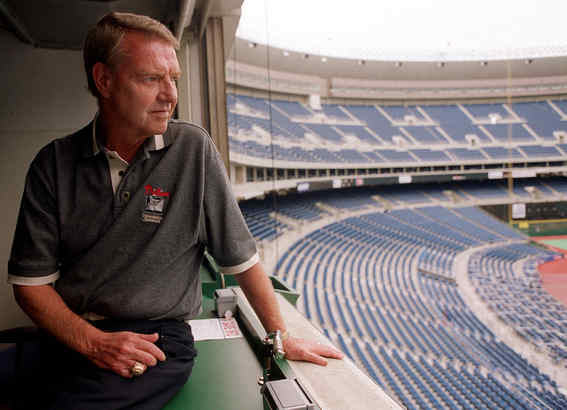
Harry Kalas in the booth at the Vet in July 2000.
This wasn’t Kalas’ only December tradition. In the early 2000s, he visited retirement homes in the Philadelphia area to provide seasonal cheer.
Like the Phillies’ holiday party, these visits inevitably ended with Christmas carols. John Brazer, who worked in the team’s marketing department for 33 years, remembered driving Kalas to a retirement community in Media in 2005.
On the ride there, Brazer asked the broadcaster if he enjoyed singing to the retirees.
“John, I tell you what,” Brazer recalled Kalas saying. “I love it. I love Christmastime. But the songs I really love doing are the religious songs — ‘Hark the Herald Angels Sing’ and ‘Silent Night.’”
He got emotional for a moment, then abruptly changed his tune.
“But I really don’t like when they do a secular song. I’m not a big fan of ‘Jingle Bells’ and ‘Santa Claus is Coming to Town’ and stuff like that.”
Brazer and Kalas arrived at the retirement home a few minutes later. Kalas began taking requests, as an employee played along on the piano.
The first four songs were religious in nature. The fifth was not.
“Someone said, ‘Hey, Harry, can you sing ‘Jingle Bells?’” Brazer said. “And he [turned to] me with this disgusted look.”
Despite his personal opinions, Kalas launched into an upbeat rendition of the song with a big smile on his face, as if it were his favorite carol of all.
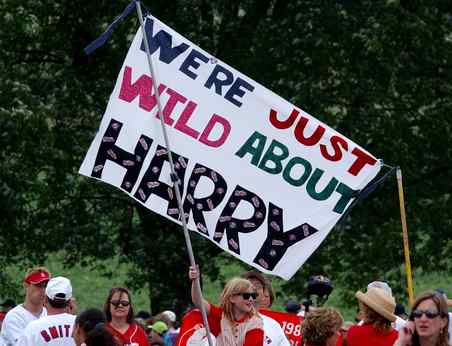
Harry Kalas was legendary within the community of Phillies fans.
Brazer relayed the story to Stephenson, who wasn’t surprised. Kalas would sign every autograph with glee. He’d get all sorts of requests — fans asking him to record voicemail greetings, or to read the names of their bridal parties — and would always oblige.
It was about making people feel like they mattered.
“There was no way he wasn’t going to sing it,” Stephenson said with a laugh. “That was classic Harry.”
Harry Kalas couldn’t resist tossing a reference to longtime broadcast partner Richie Ashburn (right) into his Christmas recitation.
‘Like he was reading to his grandkids’
Wheeler had a December tradition, too. When he was a kid, growing up in Aston, his parents would read ’Twas the Night Before Christmas every Dec. 24.
The idea of having play-by-play announcers recite the poem on air was exciting, but when it came to Kalas, the young producer was nervous.
He grew up listening to the voice of the Phillies, and was worried about coming off as inexperienced (or worse, clueless). But when Kalas arrived to KYW’s studios at 5th and Market, he brought calm to a chaotic scene.
The only Christmas tree the producers could find was in the lobby, so they had Kalas do his taping there. Station employees filtered in and out, causing quite a bit of background noise. A gaggle of children with limited attention spans sat in front of him.
But none of that seemed to faze Kalas. Wheeler handed him the book (bought from a nearby Borders), and the broadcaster began to read.
His audience was entranced.
“It was almost like he played the role of Santa Claus,” Pozniak said. “With his voice, and the way he relates to people. He wasn’t too big to be talking to kids he didn’t know. It was like he was reading to his grandkids or something.”
Kalas sat in front of the tree for about 40 minutes, asking producers for feedback and reciting lines until he was satisfied. He even added his own creative flair.
Near the end of the poem, the broadcaster realized there was a reference to a pipe. He decided to give a nod to his partner, Richie Ashburn, who famously smoked in the booth.
“And the beard on his chin was as white as the snow,” Kalas read. “The stump of a pipe — like Whitey’s — he held tight in his teeth …”
Kalas grinned at Wheeler.
“Had to get that in there,” he said.
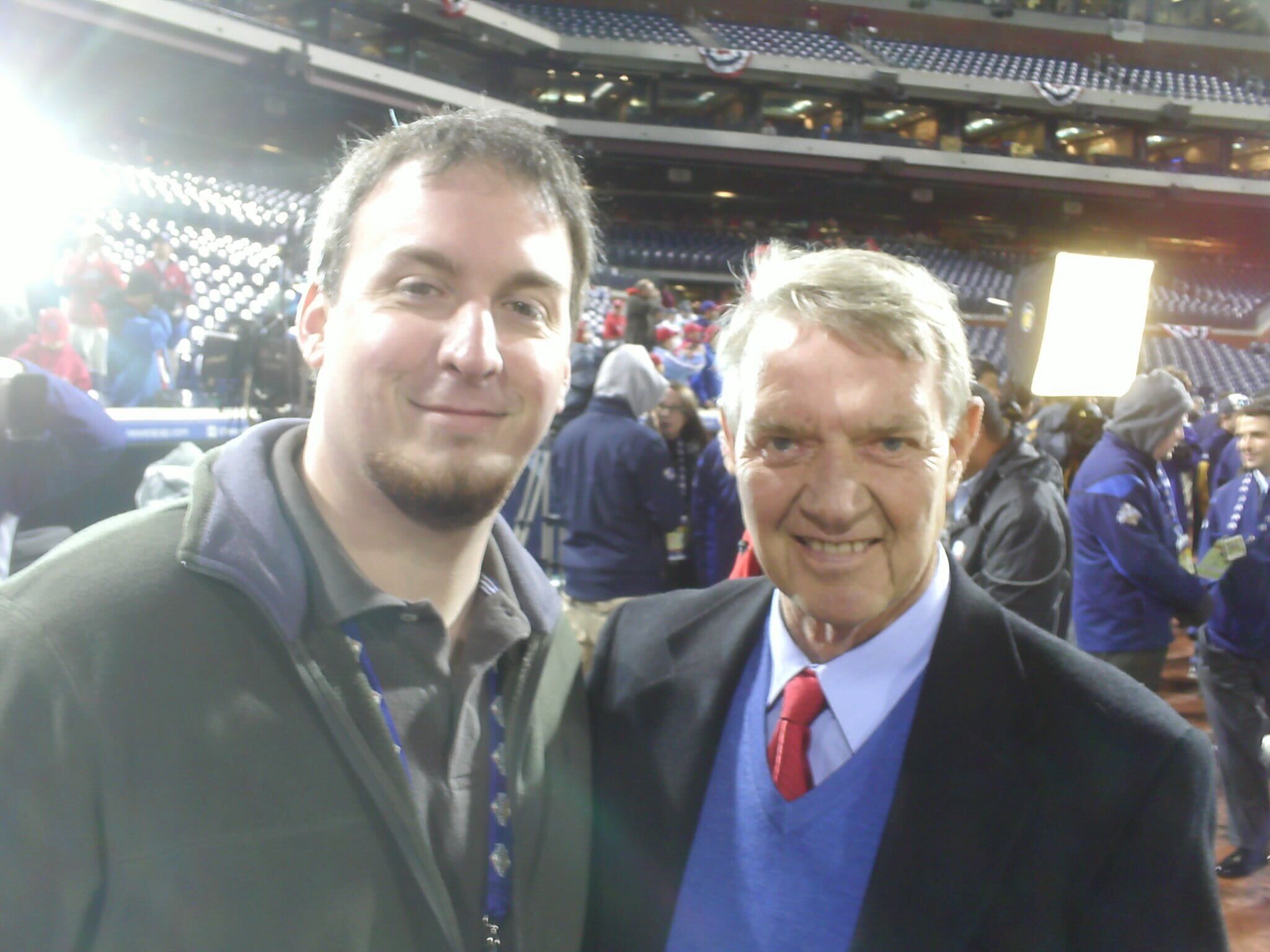
Harry Kalas and CBS3 producer Andy Wheeler at the 2008 World Series.
It wasn’t until a few years later, when Wheeler found the old recording, that he realized just how special Kalas’ version was. So KYW, and subsequently CBS3, began running it every Christmas Eve.
After Kalas died of heart disease in April 2009, the station considered ending the tradition. Wheeler and Pozniak were concerned that it would be in poor taste.
But Reece insisted they continue.
“This is a way of keeping him close,” he told the producers.
Years later, the recitation still has that effect. From start to finish, it captures Kalas perfectly. You can see his humanity, and his humor. You can hear the richness in his voice.
And if you listen closely enough, you can even catch his favorite carol, softly humming in the background: “Silent Night.”
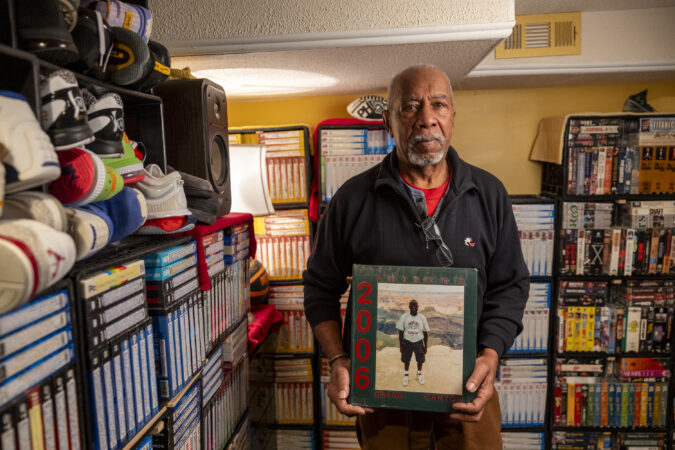
Billy Gordon was surrounded by the tapes. They were the first thing he saw in the morning, and the last thing he saw at night. His bedroom, in the basement of his grandmother’s Cobbs Creek home, was not big; maybe 190 square feet, if that.
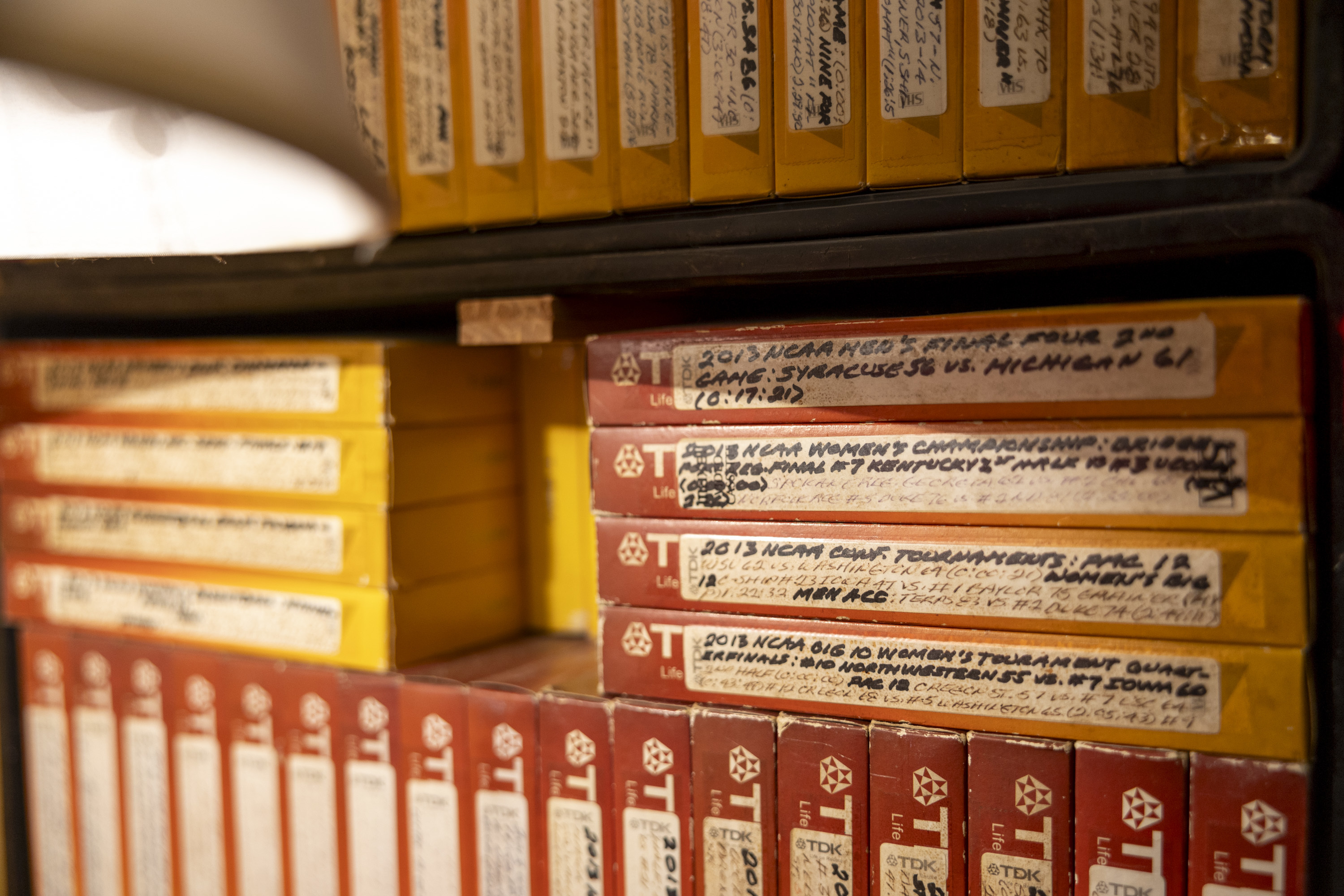
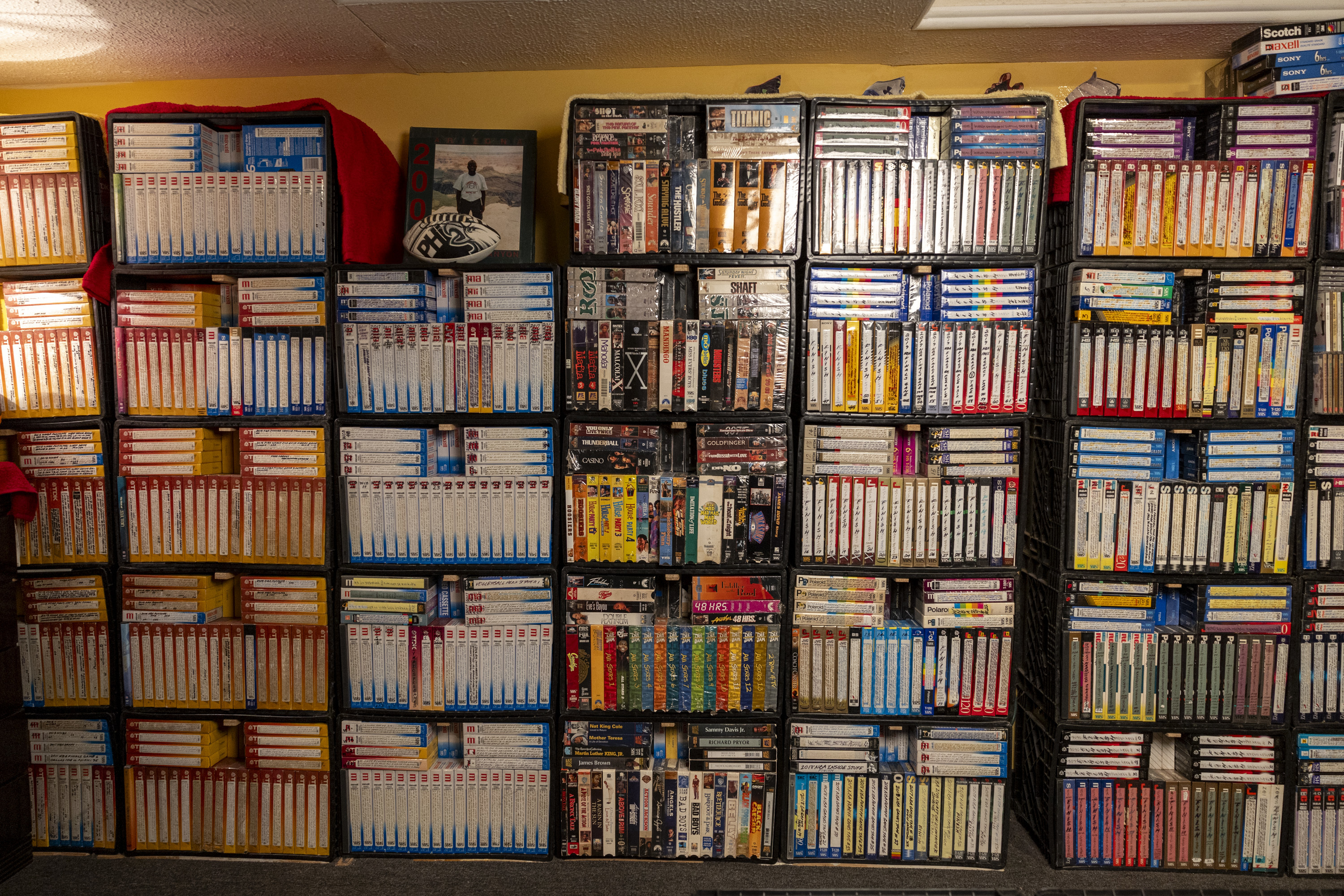
But he found enough space for the thousands of basketball games he’d recorded from 1986 to 2024, all on VHS. Each tape came with a neatly written label, noting the name of the event, the teams who played, each team’s record, and the final score.
They were carefully placed into black crates, organized by year, and stacked on top of one another, creating a technicolor tapestry around his bed. It was an unconventional hobby, but Gordon loved it.
His family wasn’t surprised. Gordon, who worked as a baggage handler at Philadelphia International Airport, was a diehard sports fan with an encyclopedic mind. He could remember statistics about any athlete, no matter how obscure.
Billy Gordon made meticulous notations on the tapes he stored neatly for five decades inside his Cobbs Creek home.
So, it only made sense that he’d spend his free time collecting archival footage of everything from Super Bowl XXXIII to his alma mater, Cheyney, to Pepperdine vs. Loyola Marymount in 1987.
“He didn’t miss very much,” said Gordon’s uncle, Ron Hall.
Hall and Gordon lived together in Cobbs Creek for about 15 years. Neither had a traditional work schedule. Hall was a union carpenter who traveled for jobs; Gordon picked up night shifts at the airport.
But in the moments they did overlap, they’d watch games, often with pizza and chicken wings. This tradition continued through the winter of 2024, when Gordon was diagnosed with an autoimmune disease. The illness quickly worsened, and he was moved to a nursing home in King of Prussia.
As he lay in his hospital bed, hooked to a respirator, Hall sat beside him. They cheered on whatever local team was playing that day: the Eagles, Phillies, or 76ers.
“Just to let him know that people love him,” his uncle said.
Gordon died earlier this year, in May, at age 66. He was buried in his blue-and-white Cheyney track suit.To Hall, it was like a losing a brother. It took him months to even step into that basement bedroom.
Once he did, he was stunned. He always knew that his nephew had a VHS collection, but didn’t realize the full extent of it until then.
“The magnitude of what was here really hit me,” he said. “I was in disbelief that he had accumulated so much. That he had taken the time to collect so many things.”
‘A love for the game’
Gordon was born and raised in a sports-loving household. His grandmother, Vernese,was an avid Phillies fan. Hall was too, and would bring his nephew to different ballparks.
After graduating from John Bartram High School in the 1970s, Gordon went on to Cheyney, where he studied industrial arts. It was there that his love for sports information really blossomed.
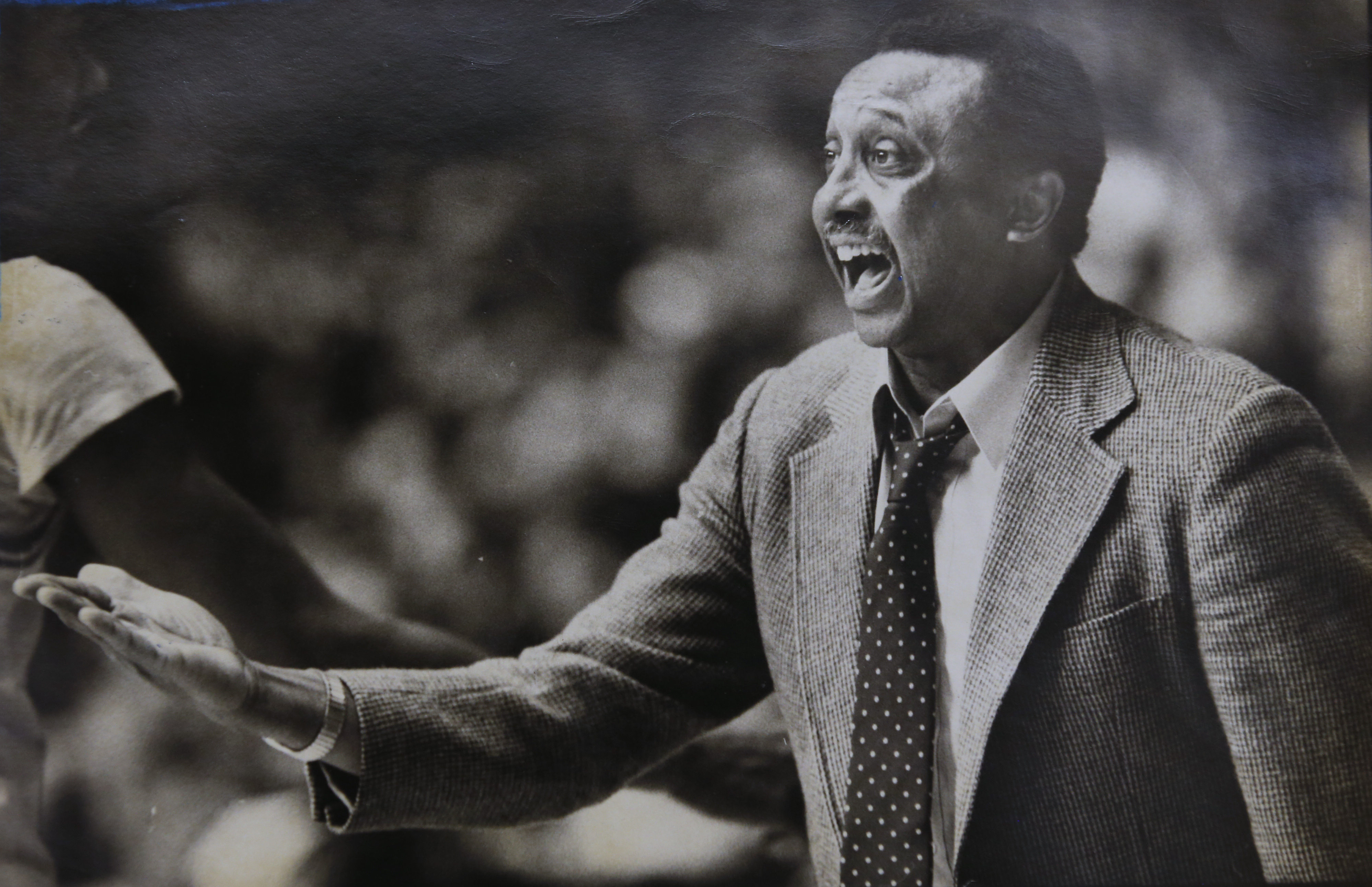
The young college student had the fortune of overlapping with John Chaney, who was coaching Cheyney’s men’s basketball team.
Billy Gordon followed John Chaney’s career closely after their personal interactions during Chaney’s time at Gordon’s alma mater.
The Wolves were nothing short of dominant. Chaney led them to a 225-59 record from 1972 to 1982, with eight tournament appearances and one NCAA Division II championship.
Gordon was not athletically inclined, certainly not enough to play on Chaney’s team. But he liked to hang out around the gym and developed a rapport with the players and coaches.
He also showed an attention to detail to which Chaney gravitated.
“He had such a love for the game, and knew the game so well, that he could point something out to this player, that player,” Hall said. “[He] really was just being an asset to the coaching staff.”
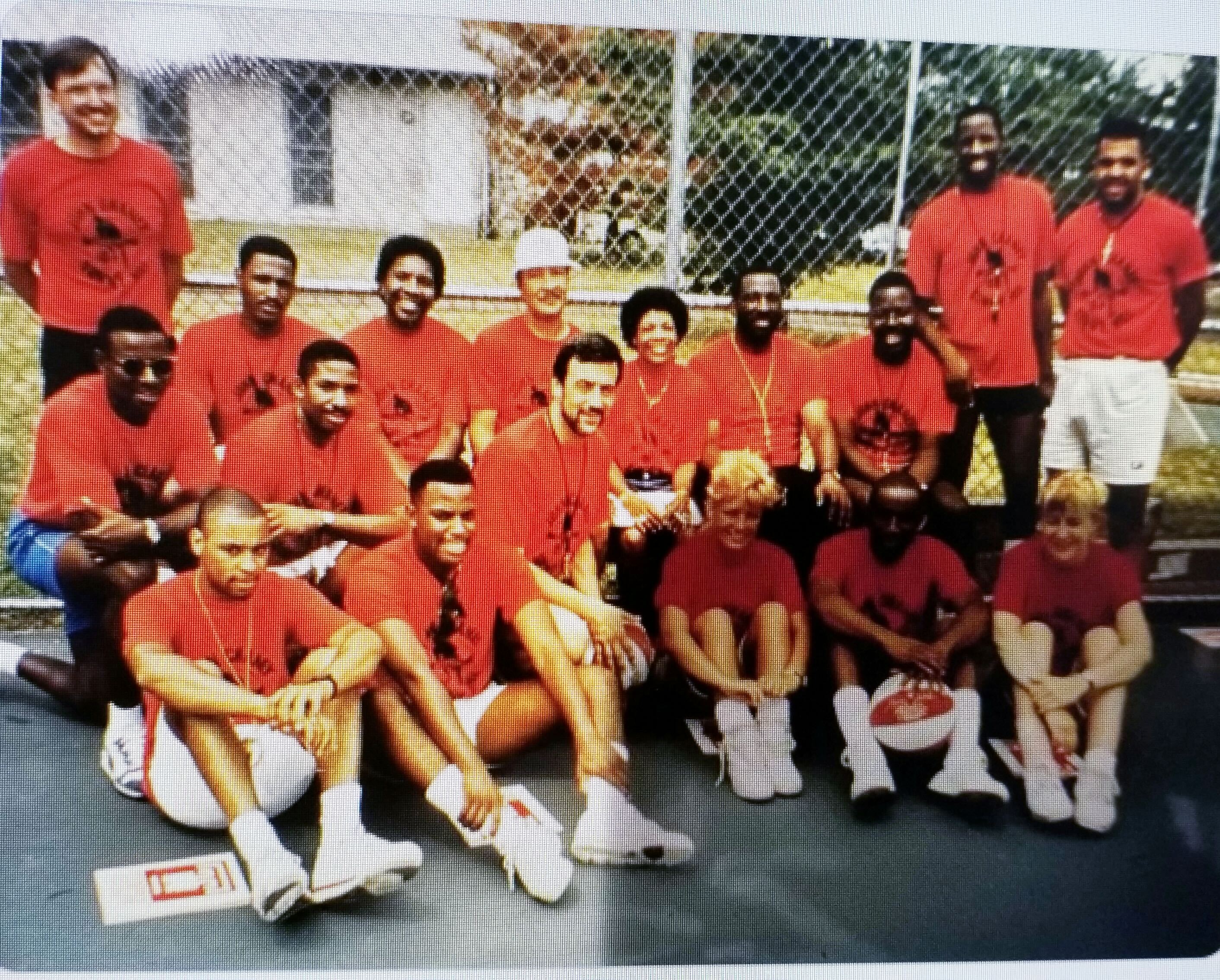
Chaney invited Gordon to work at his summer camp, which he ran with Sonny Hill throughout the Philadelphia area.The zealous sports fan couldn’t believe his luck. He’d help with drills, but he also took pride in the little things: packing lunches, inflating basketballs, and setting up exercise equipment.
The coaches of the Chaney-Hill summer camp. Gordon is pictured second from the right, with the basketball between his ankles
On rainy days, when the kids couldn’t play outside, Gordon would pop one of his tapes into the VCR.
“Old Temple games,” said his friend, Mia Harris. “Just so the kids could learn.”
She said that Gordon worked with Chaney and Hill from the mid-1980s to the early 2000s. The camp was the highlight of his summer; an opportunity to get to know the legends of the Philadelphia basketball scene.
“They made him feel like a part of the team, even though he wasn’t a player,” Harris said. “He even wore a whistle. That tickled me.”
It was around this time that Gordon started building his VHS collection. He began taping bigger events — the 1987 Stanley Cup Finals, Super Bowl XXII — but basketball was always the bedrock.
He captured the dominance of Michael Jordan, the fearlessness of Kobe Bryant, and every March Madness Cinderella story since the mid-1980s. He chronicled the NBA Finals, the WNBA Finals, and a slew of conference college basketball games.
The sheer number of tapes and labels was dizzying (Hall estimated that his nephew had 40 crates). But upon closer inspection, a trend emerged.
Chaney was hired as head coach of Temple in 1982, a job he kept until 2006. Among the stacks were pockets of his time there: Mark Macon’s first game for the Owls in 1987; the team’s first loss of that historic season, to UNLV, on Jan. 24, 1988.
Gordon recorded years of Temple vs. Illinois, Temple vs. Duquesne, Temple vs. Penn State. There even was a sit-down interview with Chaney, from the late 1980s.
These tapes stuck out. Gordon didn’t personally know any of the NBA greats he filmed. He didn’t know the WNBA stars, either. But he did know John Chaney, long before he became a national figure. And he never forgot him.
Finding a new home
A few months after Gordon died, Hall began to sort through his nephew’s things. It was an emotionally taxing process.
The retired carpenter donated Gordon’s winter coats and appliances to a local men’s shelter in Southwest Philadelphia. He gave his summer gear to a nonprofit that sends gently used clothing to Liberia.
Billy Gordon’s crates, filled with various tapes of NCAA, NBA, and WNBA games from 1986 to 2024, are awaiting what his family believes is the right price and the right home.
Gordon’s sneaker collection went to Hall’s son, Gamal Jones, and his food was delivered to charity.
The only thing left was the thousand-tape-elephant-in-the-room. Jones looked at his father.
“What do you want to do?” he asked.
“I have no idea,” Hall responded.
Jones listed Gordon’s tape collection on Facebook Marketplace, for the modest sum of $123. The response exceeded the family’s expectations.
They received almost a dozen messages, from NBA superfans, collectors, and archivists. Some offered to travel to Cobbs Creek to assess the collection in person.
Hall recognizes that his nephew’s trove is worth more than $123. But he says this isn’t about the money.
He wants to find a buyer who will share the same passion that Billy Gordon had for 38 years. Someone who will honor his hobby and preserve it.
“He probably would want it to go to somebody that was as enthusiastic about it as he was,” Hall said. “That could really appreciate the time, the energy, that he put in to collect all these.”
Mike Golic still remembers standing on the sideline when quarterback Randall Cunningham fell to the grass at Lambeau Field. It was Game 1 of the 1991 Eagles season. In the second quarter, Packers linebacker Bryce Paup lunged at Cunningham’s knees.
The trainers rushed to his side. Golic and his defensive teammates were stunned. This was supposed to be their year. Now, as Cunningham rolled on his back in agony, that seemed less likely.
With Cunningham out for the season, the Eagles cycled through a litany of quarterbacks in 1991. It gave the defense virtually no room for error — but instead of faltering, it rose to the occasion.
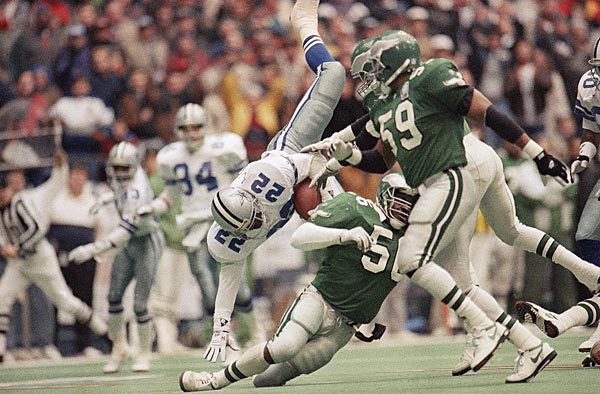
The Eagles could not rely on quarterback Randall Cunningham in 1991, after Cunningham suffered a season-ending injury in Week 1.
Over the next 16 games, the group put together one of the best defensive seasons in NFL history — if not the best — surrendering the fewest passing yards and rushing yards along with the lowest completion percentage in the NFL that season.
“I know that group all too well,” analyst Troy Aikman said on Monday Night Football on Dec. 8. “Because I played against them. Number one against the run. Number one against the pass. I could name the roster for you, on the defensive side of the ball.”
The 1991 Eagles recorded the most sacks in the league (55) and ranked third in interceptions (26). They allowed an average of 15.3 points per game.
“We knew that we were going to go as far as the defense could carry us,” linebacker Seth Joyner recalled in late November. “And that just turned the intensity up.”
The current Eagles defense is not in quite the same predicament. Their quarterback is healthy. Nevertheless, through 14 games, Jalen Hurts’ offense has not performed relative to its talent level.
And while the 2025 defense has not been as consistent as the 1991 group, it has shown flashes of the same caliber of dominance, particularly since the bye week.
If the Eagles have any hopes of returning to the Super Bowl, such a run would likely have to involve an elite defense.With that being said, here is what three members of Gang Green — Joyner, Golic, and Clyde Simmons — are seeing from Vic Fangio’s group.
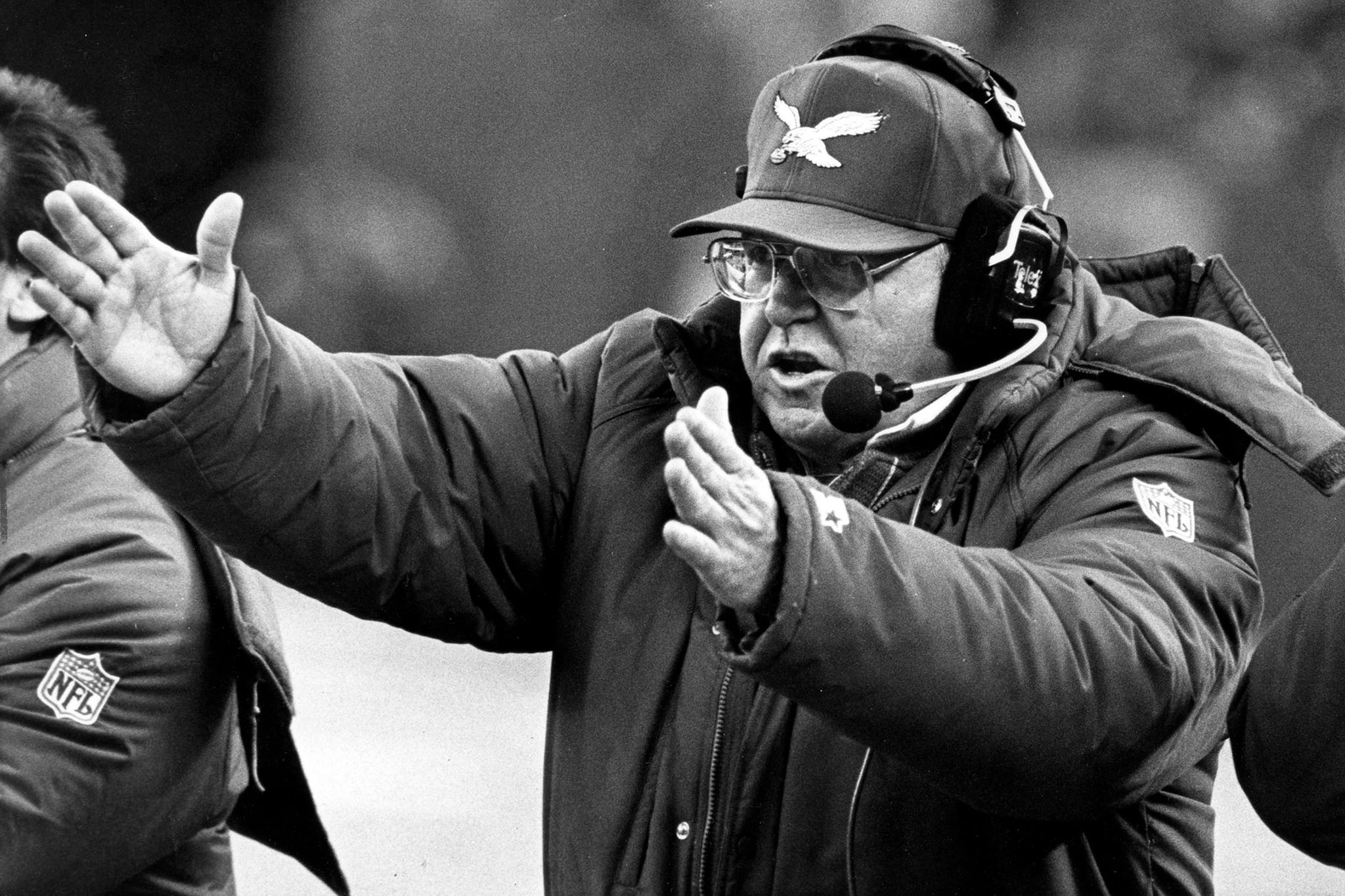
Buddy Ryan was gone by 1991, but his stamp was still all over the Eagles defense.
Aggressiveness
Buddy Ryan, the defensive guru who coached the Eagles from 1986-90, had a mantra: “Score on defense.”
This meant pitching the ball from player to player if you got an interception. Or, if you got a fumble, trying to scoop and score instead of falling on the ball. Or, if you didn’t score, giving the offense a shorter field.
Ryan’s philosophy wasn’t just about preventing a team from scoring; it was about putting that team’s offense on the defensive.
That carried over to the 1991 team, even after Ryan was fired following the 1990 season. The 1991 defense, coached by coordinator Bud Carson, brought this concept to a new level.
With Cunningham out, it was unlikely the Eagles would be scoring 20-30 points a game. So, the defensive players took it upon themselves to score — or, at a minimum, make things easier for the offense.
Golic, a former defensive tackle who now hosts a show on FanDuel Sports Network, said this message was largely player-driven. It was always reiterated, either on the sidelines or in defensive meetings.
“We played aggressively anyway, but we kind of even upped that,” Golic saidin November. “And it wasn’t disparaging to the offense. It was just, like, ‘Listen, we don’t have our starting quarterback anymore. We know we do a lot on this team, but we know we now have to do more.’ So it was more of an up-tempo, upbeat, ‘Let’s do more. Let’s help out more.’”
Added Simmons, a dominant defensive end: ”We’d always prided ourselves with being a really good defense, but we knew we had to be even better to win ballgames. It started really getting tightened down. Just try to be sure to give ourselves all the opportunities in the world to win ballgames, keep people off the scoreboard, and keep the yardage down.”
Golic and Joyner see a similar aggression in the Eagles’ current group — both in the play-calling and in the players. This has been especially true with the addition of Jaelan Phillips, the return of Brandon Graham, and Nakobe Dean playing above expectations after returning from a serious knee injury.
Bud Carson (with star cornerback Eric Allen) coordinated a unit that finished No. 1 against the run and the pass in 1991.
It has freed up the pass rush, allowing Fangio to be more unpredictable — a Ryan/Carson staple. Fangio isn’t blitzing as much as those teams, but he is mixing in different looks. One example is that he favors a simulated pressure in which at least one linebacker rushes and one lineman drops into coverage.
“Bud Carson as the D coordinator, he was a very aggressive coordinator, and certainly Vic’s a very aggressive coordinator,” Golic said. “And players love playing aggressively. You’d rather be attacking than reacting. So that’s probably the biggest comparison.
“I mean, obviously I’m biased toward my 1991 team. The stats were ridiculous. But I would say overall, yeah, the aggressiveness of the two units would be comparable.”
He added: “A lot of it is just trusting the person next to you, behind you, in the secondary, and them trusting us up front that we’re going to get there. Players know when they’re going to be on an island and understand that and accept the responsibilities of it. And coaches like Fangio and Bud Carson certainly weren’t afraid to be aggressive and put people on islands.”
Those who witnessed both play see similarities between current Eagle Jalen Carter and the legendary Jerome Brown (99).
Players who would fit on Gang Green
There was only one player whose name came up repeatedly as example of someone who evoked the 1991 team — and it shouldn’t come as a surprise.
The family of Jerome Brown said in March that they see some of the late Eagles defensive tackle in current Eagles DT Jalen Carter,who has been sidelined the past two weeks with shoulder injuries. To the 1991 Eagles, the comparisons are obvious.
Simmons, the defensive line coach at Bowling Green, doesn’t have much time to keep tabs on the Eagles. But even in the limited games he has watched, Carter has stood out.
“I know they’ve got a couple good players in there, like a Jalen Carter, who is such a big man, and so explosive, and a game-controlling guy,” Simmons said last month. “He’s special. You don’t see a lot of people that big, who are that explosive.”
“He plays on the other side of the line [of scrimmage],” Golic added. “I mean, he just plays with leverage, with strength. You know, and the ends were bigger at that point. Reggie [White] was 315 pounds, Clyde was 290 pounds, Jerome was 300, I was in the 280s, 290, so was Mike Pitts.
“Jalen [Carter] is a 300-pounder who is quick off the ball and plays on the other side of the line. That’s what we always did. We always played on the other side of the line. And he would have, jeez … I mean, put him on that line, with Jerome [Brown] in the middle, would have been ridiculous.
“If there’s one player on that defense that would have fit in our defense, it definitely would have been Jalen [Carter].”
Clyde Simmons (96) draws comparisons to current Eagle Jaelan Phillips.
Joyner, a former linebacker who hosts pregame and postgame Eagles shows on YouTube, made a different comparison. In Phillips, he saw a bit of Simmons — a multifaceted player who could run different formations and be put in different spots.
“I probably would have to compare him to Clyde,” Joyner said of Phillips. “I definitely wouldn’t compare him to Reggie [White, a Hall of Famer] because there’s just no comparison to that guy. But I think when you when you think about Clyde, especially under Buddy … because under Buddy, we ran a little bit of everything. We ran 30 front and 40 front, unders, overs, swim package, with all three linebackers off the ball in an even front. We ran a little bit of everything.
“And in the 30 front, Clyde was pretty much the weakside outside linebacker. Like, we could line up in a four-man front, quarterback getting his cadence. We could shift to a 30 front, Clyde would kick his hand off the ground, and stand up as an outside linebacker. And sometimes even drop into coverage, believe it or not.
“Those are some of the intangibles that Jaelan Phillips brings to the table. Because like I said, I was shocked to see Vic actually drop him off in coverage out of that five-man front [against the Lions]. And in some of the zone blitzes where you brought a linebacker from the other side and you dropped him off into the flat. He brings a versatility.”
“It’s definitely possible” for the Eagles to win back-to-back, titles, ex-Eagles defensive tackle Mike Golic says.
A Super Bowl-caliber defense
All three former players looked at the 1991 season as a lost opportunity. They believe that if Cunningham had stayed healthy, they could have won a Super Bowl.
Instead, the 1991 Eagles went 10-6 and didn’t make the playoffs. But these Eagles are in a different spot, which leads Simmons, Joyner, and Golic to believe the outcome could be better for them.
Joyner sees the same confidence in the 2025 group that the 1991 group had. Golic sees it, too.
Now, it’s a matter of play-calling and playing with the same confidence on the offensive side of the ball.
“It’s definitely possible [for them to go back-to-back],” Golic said. “Listen, the offense, it’s tough to duplicate. The [offensive] line has not been what it was last year. They still run more than they pass. They still try and live off the run. But you can never negate a great defense. What a great defense will do will always keep you in the game, always.
“So you look at some of the top defenses, like Denver, like Houston, Philly, certainly is one of them, you’re always going to be in the game. And then you just need the offense to produce some. And certainly the Eagles offense has the ability to [do that].
“Statistically, they’re not what they were last year, but they have the ability to show it. But when you have a really good defense, you’re going to be in every game.”
In July 2024, Tim Hampton was working his shift at TGI Fridays when he spotted a familiar face.
It was longtime Sixers player and coach Billy Cunningham. He was eating lunch with La Salle coach Fran Dunphy and two other Sixers alumni: former forward and coach Doug Collins, and former executive John Nash.
Hampton smiled. Seeing the group brought back memories. There was a time, not long ago, when the chain restaurant on City Avenue hosted everyone from Charles Barkley to Maurice Cheeks to Moses Malone.
This particular Fridays, which opened in 1981, was down the street from where the Sixers practiced, first at St. Joseph’s, and eventually, at Philadelphia College of Osteopathic Medicine. It became the team’s unofficial hangout spot, a place where they could grab meals in the afternoon or dinner and drinks at night.
By the late 1990s, when Hampton was hired as a host, it had a long list of NBA clientele. Then, a rambunctious rookie named Allen Iverson came to town, and everything changed.
TGI Fridays was incorporated into Philadelphia’s nightlife scene. People called it “Club Fridays.” Women would wear their shortest dresses and their highest heels. Men would don collared shirts and expensive jeans.
Allen Iverson’s famous booth became part of the City Avenue TGI Fridays lore.
At the center of it all was Iverson, who had a designated booth — “Table 70” — a special back entrance, and his own security detail.
“It was exactly like a club,” said former Sixers forward Jumaine Jones. “They would come there with their best outfit on, like they was going to a party.
“We gave Allen the nickname Mick Jagger. Because he was like a rock star. People wanted to be around him.”
There were nights when wait times lasted for hours. Fans would line up around the block, all the way to the bus stop on City Avenue and Presidential Boulevard, just to catch a glimpse of the superstar. Those who were lucky enough to enter would hand napkins to their servers in the hopes that Iverson would sign them.
And most of the time, he did. Despite the chaos, Hampton said that Iverson treated the employees and patrons of TGI Fridays with respect. He became friendly with the general manager, Jeff Tretina, the kitchen manager, Jerry Shott, and the rest of the staff.
When the point guard was traded to the Nuggets in 2006, the longstanding relationship between the Sixers and the chain restaurant faded. But Iverson never forgot it. And neither did his Fridays “family.”
“He could’ve chosen anywhere else to go,” Hampton said, “but he chose us.”
TGI Fridays manager Tim Hampton remembers a time when “Club Fridays” would produce lines around the block.
‘Club Fridays’
Hampton grew up at 33rd and Diamond in North Philadelphia, raised on Dr. J and George McGinnis. He studied business administration atBurlington County College in New Jersey and started working at the restaurant in 1999.
The lifelong Sixers fan climbed his way from a host to a waiter to a cook, and eventually, to a general manager. He quickly realized that this was no ordinary Fridays.
Employees would share stories of Barkley, Darryl Dawkins, Bobby Jones, and more. Players who’d patronized the restaurant during their careers, like Cheeks, would return after they’d joined the Sixers’ coaching staff.
A big part of this was convenience. Fridays was an easy place to stop after practice, and had plenty of parking for big groups.
There also wasn’t as much of a social barrier between players and fans as there is now. This was true even among some of the team’s celebrities.
While Allen Iverson gets much of the credit for launching the Sixers-Fridays legend, Charles Barkley was a loyal patron of the establishment first.
Barkley and center Mike Gminski would go to the movies together in Philadelphia. They’d attend Phillies games and would sit out in the open, rather than a suite.
Eating at a chain restaurant was not uncommon. And in the 1980s and 1990s, it looked a lot different from it did when Iverson was in town.
There was no security at Fridays, no separate entrance, and no reserved table; just a group of extraordinarily tall men, squeezed into a four-person booth.
“Pretty much everybody on the team used to go there or go somewhere,” Gminski said. “If anybody, it was probably Charlie [who went the most].
“And after a while, it wasn’t really a thing seeing us. There were no cell phones. There were no pictures, no selfies.
“We never really thought about shying away. We ate where everybody else ate.”
Most of the players and staff would go to Fridays for lunch, and Bridget Foy’s in Society Hill for postgame drinks.
It wasn’t until Iverson arrived in 1996 that Fridays turned into a nightly haunt. At first, people barely noticed he was there. Iverson would sit in his booth, eat his favorite dish — Cajun shrimp and chicken pasta — and lay low.
Jumaine Jones, who was drafted by the Hawks in 1999 and traded to the Sixers shortly after, usually accompanied him. Iverson quickly gravitated to the small forward, loudly proclaiming that Jones was his “rookie.”
Jumaine Jones (with fellow draft pick Todd MacCulloch and coach Larry Brown) was a familiar face at the City Line Fridays.
They started hanging out off the court. Jones estimated that the two players went to Fridays “every day for two years.” Sometimes, he would go home to take a nap, and wake up a few hours later, only to realize that Iverson was still at the restaurant.
“We probably spent more time at Fridays than we did at the gym,” Jones said.
The rookie wasn’t complaining. If anything, it made Iverson seem more relatable.
“I’d just come from being this broke college student,” he said. “So, to go to Fridays, it was like, ‘Oh, OK, that’s cool. He likes Fridays too!’
“But it was funny that somebody who was making so much money liked Fridays. The fact that he didn’t change what he ate, and the things that he enjoyed doing, really made him human to me.”
After the 2001 NBA Finals, when Iverson famously stepped over Lakers point guard Tyronn Lue, his celebrity grew to new heights. People started flocking to Fridays not to eat, but to see Iverson.
The restaurant had to hire its own security for crowd management (in addition to Iverson’s detail). It changed its hours and staffing arrangements to accommodate the influx of people.
“If it was a game day on a weekend, you pretty much figured he was coming,” said former manager Elan Walker. “We were closing at like 1 a.m. on weekends. So we were open late.
“At most businesses your dinner is from 5 p.m. to 7 p.m., and you’re down to a skeleton crew by 10 o’clock. That wasn’t the case for us. We still had a full staff on at midnight. Because we were expecting a crowd.”
Even though it was a foregone conclusion that Iverson would be at Fridays after a home game, he still liked to give the staff a heads up.
So, he’d call the restaurant, or Tretina and Shott directly, to let them know he was coming.
The point guard would roll up in his Rolls-Royce or his blue Bentley and step out with anyone from Jadakiss to Fat Joe.
Allen Iverson’s magnetic presence helped make the City Line Fridays a destination.
“You never knew who was going to be with A.I.,” said Jamilah Lawry, a friend of Iverson’s. “So that was really a huge element of surprise. Who does he have with him? Who’s going to get out of that car?
“You didn’t know who was going to be in there. And you had to look good, because the man of your dreams could walk in. You know?”
Lawry’s uncle, Jeff Lawry, owned Luxe Lounge and Club Roar at the time. Jamilah was familiar with Philadelphia nightlife.
But to her, Fridays was the best of both worlds; a place where they could be themselves, in an exciting environment, without too many rules and regulations.
“We’d watch the game, we’d talk loud,” she said. “We’d play too much. Those type of things. You know, you can’t go to Ocean Prime and do that. They’ll be like, ‘Hey, get out.’”
“It was more of what we would call a Greek picnic type thing,” Lawry added. “There was nothing like Club Fridays. Except for Club McDonald’s on Broad Street. And that’s a whole other story.
“If you didn’t want to go to the club, you’d go to Fridays, and that’s what would be going on.”
TGI Fridays manager Tim Hampton is presiding over an establishment that might be undergoing a renaissance in the days ahead.
‘City Line Love’
After Iverson retired in 2013, he rolled out a special-edition sneaker, in collaboration with Reebok and the Philadelphia-based retailer Ruvilla. It was called A Day in Philly.
The tongue had a maroon and gray stripe along the top, as a nod to his favorite restaurant. He held the release party in November 2014 at TGI Fridays on City Avenue.
The staff rolled a red carpet onto the sidewalk. Fifteen security guards roamed the grounds as police officers stood nearby.
At one point, employees had to close the doors, because the restaurant had reached its occupancy level (475 people).
Jadakiss and Styles P gave a surprise performance and a DJ held court after that. To Hampton, it felt like old times.
“It was like a Renaissance moment,” he said. “I felt like I was part of history.”
Now, over a decade later, he’s trying to recapture the magic. In November, Fridays’ corporate branch introduced a membership program called “Club Fridays,” that offers discounts and other perks.
Hampton has asked Iverson if he’ll help the restaurant promote it. He has also reached out to a few current Sixers players to forge some new relationships.
“We’re working on trying to get VJ Edgecombe and Tyrese Maxey to come here,” Hampton said. “Because we want to extend that City Line Love.
“That’s our goal. To get the new Sixers in. We want them to know about the legendary 4000 City Line Avenue, because it is a legendary location.”
In March of 2013, La Salle pulled off the improbable. The Explorers hadn’t been to the NCAA Tournament since 1992. They hadn’t advanced past the Round of 64 since 1990.
But here they were, on a chilly night in Kansas City, edging out Kansas State, 63-61, to earn a spot in the Round of 32.
As players danced in the middle of the locker room, with the music blaring, an unlikely figure emerged.
Donning a black suit with a blue dress shirt, the visitor walked through the chaos, straight to La Salle’s head coach, John Giannini.
It was Jay Wright.
His team had a game in a few hours, against North Carolina, but the Villanova head coach wanted to congratulate his dear friend.
Former La Salle head coach John Giannini during a game against Butler on Jan. 23, 2013.
“Once we got to the tournament, we were always rooting for each other,” Wright said of the Big 5 programs. “It was always about Philadelphia basketball.”
This was the way he and his Big 5 counterparts had been taught. When Wright was an assistant at Villanova in the late 1980s and early 1990s, he watched as head coach Rollie Massimino battled with Temple’s John Chaney.
The games were intense, and often heated, but they always showed each other respect. Sometimes, Big 5 coaches would go to dinner afterwards. It wasn’t uncommon for them to get together during the offseason.
The coaches would celebrate each other’s wins, even though they were technically competitors. Every time Wright advanced in the NCAA Tournament, he’d get a call from Chaney.
When Martelli reached the Elite Eight in 2004, he heard from Wright and longtime La Salle coach Speedy Morris.
The men who preceded them practiced the same habits, from Temple’s Harry Litwack, to Villanova’s Al Severance, to St. Joseph’s Dr. Jack Ramsay.
“The initial [Big 5] group was so together, and so tight, that when the rest of us joined, it was just the way it was done,” said Fran Dunphy, who spent a combined 33 seasons at the helm of Penn, Temple, and La Salle. “The culture was already set.”
Former Big 5 coaches Phil Martelli, Steve Lappas, John Griffin, Speedy Morris, and Fran Dunphy.
For former Big 5 coaches in the area, that culture is still intact. Martelli, Dunphy, and Wright remain good friends. They visit with Morris, and are in regular contact with other former colleagues, like Giannini, Steve Lappas, and John Griffin.
The coaches believe this brotherhood is unique to Philadelphia, a city rich with basketball lore.
“On the court, you wanted to kill each other,” Wright said, “and off the court you were like brothers.”
A ‘different’ kind of bond
Dunphy was born and raised in Drexel Hill, only a few years before the founding of the Big 5 in 1955.
Back then, it was an association of five Division I schools: Villanova, Penn, St. Joe’s, Temple, and La Salle (Drexel was added in 2023).
The future coach rooted for them all, without prejudice. He’d often spend his Wednesdays, Fridays, and Saturdays at the Palestra, watching Big 5 teams square off.
“There were three nights of doubleheaders,” Dunphy said. “It was an amazing experience.”
When he was hired as the head coach of Penn in 1989, Dunphy felt a deep sense of pride. He also felt respect for his peers, many of whom had toiled through the same high school and assistant coaching ranks.
Their connections went far back. In 1976, when Wright was in the ninth grade, he attended a basketball camp in the Poconos. His camp counselor was a young Martelli.
A few years later, Martelli coached his first high school game for Bishop Kenrick in Norristown, which closed in 2010. His opponent was Dunphy, who was leading Malvern Prep at the time.
Morris and Chaney were introduced during their tenures at Roman Catholic and Simon Gratz in the late 1960s and 1970s. Lappas was an assistant at Villanova when Martelli assisted at St. Joe’s in the 1980s.
All of this only fortified the “brotherhood.”
Fran Dunphy spent a combined 33 seasons at the helm of Penn, Temple, and La Salle.
“It was different than going to an ACC school or a Big Ten school or whatever the major conferences are,” Dunphy said. “Let’s say we went to Orlando for an AAU tournament. There might be three or four of us sitting together as Philly coaches, because that’s what we did. And we might be recruiting the same guy.
“And there would be coaches from other leagues, and they’d say, ‘What are you guys doing?’ Well, that was just the way it was.”
Added Martelli: “You never said, ‘I’m going to talk bad about this guy or that guy, just so we can get a recruit.’ Because you knew [the other coaches] weren’t doing it. So we were not going to do it.
“People from the outside marveled at it. They’d say, ‘Seriously, this is what you guys do?’ And I’m like, ‘Yeah.’”
Despite this unspoken pact, the coaches were not thrilled when a Big 5 rival would scoop up a promising player. Martelli, for example, was very frustrated when Dunphy earned local star Lavoy Allen’s commitment in late 2006.
“I would say that in a complimentary way,” Martelli said. “I was like, ‘I can’t believe we didn’t get him. And to make matters worse, Temple got him. We’ve got to deal with him for four years?’”
Even at the height of their competitive prowess, the coaches would band together for the betterment of the sport and the world around them. In 1996, Martelli and Dunphy started the Philadelphia chapter of Coaches Vs. Cancer, a nonprofit that raises awareness and funds for cancer research.
They looped in their fellow Big 5 coaches: Lappas, Morris, Chaney and Bill Herrion (who was at Drexel). Not long after Wright was hired as head coach of Villanova in 2001, he accompanied Martelli and Dunphy to meet the CEO of Blue Cross/Blue Shield, Fred DiBona, for lunch in Center City.
Former Big 5 coaches Phil Martelli and Fran Dunphy with their wives at a Coaches Vs. Cancer event.
The insurance company offered them $50,000, and became the group’s first corporate sponsor. That donation helped lift the chapter off the ground.
“The three of us were really competing against each other, right then,” Wright said. “And we all went together during basketball season, up to his office, and got that thing spearheaded.”
Wright, Martelli, and Dunphy are still very involved with Coaches vs. Cancer. The Philly chapter has since become the most successful in the country, raising over $22 million.
It is not the only legacy they’ve left behind. Over recurring breakfasts at Overbrook Golf Club, the coaches would talk about everything from scheduling to the format of the Big 5 round-robin.
Some of those ideas will be implemented on Saturday, in the third-annual Big 5 classic. Wright said that the triple-header format was discussed as far back as “15-20 years ago.”
He and peers wanted to put on a big event, one that didn’t cause scheduling conflicts.
“It was healthy, because we were from different leagues,” Martelli said. “Fran was in the Ivy League, I was in the Atlantic 10, and Jay was in the Big East.
“It was always for the greater good. It wasn’t about, ‘What’s best for St Joe’s? It was, ‘What’s best for college basketball?’”
‘The elder statesmen’
Wright, Dunphy, and Martelli have a reverence for Morris and the late Chaney, “the elder statesmen” of the group.
Chaney took special interest in Dunphy, who replaced him at Temple in 2006. The former head coach liked to share his thoughts after games. This was especially true if Temple had too many turnovers.
The next day, Dunphy’s phone would ring. He always knew who was calling.
“The conversation would go, ‘Franny, what the hell is going on out there?’” he recalled. “‘Why are we turning the ball over?’
“‘I know, Coach. We’re working on it. We’ve gotta get better.’”
Speedy Morris and John Chaney developed a friendship while serving as Big 5 coaches.
Like their younger counterparts, Morris and Chaney were contemporaries. They both grew up in the city; Morris in Roxborough and Chaney in North Philly.
The coaches also shared a flair for the dramatic. Neither man was above throwing his coat, or screaming at a referee, or stomping up and down the court.
They found kindred spirits in each other.
“He was tough,” Morris said of Chaney. “But I enjoyed him, very much.”
One day, in the late 1990s, the La Salle coach came up with an idea. The Temple coach was known for his expensive clothes, especially his ties. He’d often give them away as gifts.
So, Morris decided to pay it forward. He grabbed a few dozen of the ugliest 70s-era ties he could find, and asked his wife, Mimi, to wrap them up in a box. She sent it to Temple, with a note.
“It read, ‘You’ve been so kind to share some of your beautiful ties with me,’” Morris’s son, Keith, recalled. “‘I’d like to share a few of mine with you.’
“Chaney opened it up, and he was like, ‘What is this [expletive]?’”
After Chaney retired from coaching in March of 2006, he became an occasional attendee at Morris’ practices and games at St. Joe’s Prep. There was one, in particular, that stuck out in Morris’s mind.
It was 2006, and the two coaches had just paid a visit to Tom Gola, who was dealing with a health scare. They headed back to the Prep, where they’d parked their cars. As Morris said goodbye, Chaney made an impromptu announcement.
He would be coming to practice, too.
John Chaney, Speedy Morris, and Fran Dunphy.
Morris was thrilled. The high school coach asked his friend if he wanted to take the lead. Chaney insisted he didn’t. But once Morris started running a defensive drill, that quickly changed.
It was a 2-3 matchup zone, and a Prep player missed a weak-side box-out. Chaney jumped out of his chair, as if he was still at Temple.
He ran from midcourt to the paint.
“He said, ‘No!’” Morris recalled. “‘That’s not how we do it!’”
Chaney proceeded to give the student a 10-minute, expletive-laden lesson on rebounding and positioning. Keith Morris, an assistant coach at the time, nervously looked around to make sure there weren’t any Jesuit priests in the gym.
The two coaches stayed close until Chaney died in 2021. They’d talk on the phone at least once a week. They’d get lunch together in Manayunk, discussing basketball and life.
“They called each other brothers,” Keith said.
‘The caretakers’
This level of camaraderie is more challenging in today’s game. When Wright, Dunphy, and Martelli were coaching, the idea of having a player transfer from one Big 5 school to another was unfathomable.
Now, it is commonplace, with much more relaxed rules. The advent of NIL has pushed programs to generate more revenue, so they can remain competitive and pay their players. It has led to a corporate, less familial environment.
But despite these challenges, the coaches still believe that upholding the Big 5 brotherhood is worth the effort.
“Because the guys who are coaching now, they didn’t create the Big 5,” Martelli said. “They don’t own the Big 5. But they are the caretakers. And the same goes for all of us.”
Not long after North Catholic’s building and campus were sold in 2011, an alumnus found pieces of sports equipment in a nearby dumpster. Ruby-red helmets, game-used footballs, and faded trophies were discarded carelessly, bound for a landfill, until this anonymous Samaritan fished them out.
To the seniors who were part of the school’s 1978 football team, these items were anything but garbage. They represented cherished memories, including the greatest of all: the 50th anniversary Thanksgiving Day game between the North Catholic Falcons and the Frankford Pioneers.
The “Norphans” — derived from “North Catholic” and “orphans” — are determined to keep the legacy of that game alive. For decades, it was a Northeast Philadelphia tradition. The neighboring high schools, one public and one Catholic, played from 1928 to 2009, not for a state championship or a league title, but for bragging rights.
The 50th anniversary pushed an already-intense rivalry to new heights. Eagles coach Dick Vermeil relocated his team’s practice to Franklin Field so the high schoolers could play at Veterans Stadium. Twenty-five thousand people showed up, including politicians and scores of local reporters.
A souvenir from the Frankford-North Catholic 1978 football game. For decades, North Catholic and Frankford had a heated rivalry that played out in a Thanksgiving Day game.
The Falcons were heavy underdogs. They’d gone 5-6 that year and had lost their previous four Thanksgiving games to Frankford. The Pioneers were a bigger team, with a renowned coach in Al Angelo, who led them to a 7-1-1 record en route to a city title in 1978.
But North Catholic was gritty. And on Nov. 23, it pulled off an improbable win, beating its rival, 21-14, in the seniors’ final game together.
As the Falcons walked off the field, nose tackle John Kane imagined returning for the 100th anniversary in 2028. That became impossible in 2010, when North Catholic closed because of dwindling enrollment, rendering the Thanksgiving tradition a thing of past.
But the 1978 North Catholic seniors still have remnants of that game, recovered from the dumpster. They still have the film. They still have the memories, and they still have one another. And for that, they are grateful.
“It was the last game we’d ever play together, and we went out as a winner,” said offensive lineman Chuck Cianci. “It was our championship.”
‘Our Super Bowl’
North Catholic and Frankford occupied the same swath of Northeast Philly, about a mile and a half apart. The high schools’ proximity made the Thanksgiving game a hotly contested neighborhood event.
Kane compared it to the “Catholics and the Protestants in Northern Ireland.” Cianci said it was like “hell week.” Stories of past Thanksgiving games were passed down from generation to generation. Local children dreamed of playing in it — and quickly learned to embrace the rivalry.
Fullback Tim Keller, then a freshman, recalled taking the bus home after the Falcons lost to the Pioneers, 12-7, in 1974. As the North Catholic bus turned off Adams Avenue and onto Roosevelt Boulevard, the Frankford bus pulled up alongside it.
“The next thing you know, the windows came out, and the [North Catholic fans] were throwing the [bus] seats at them,” Keller said. “We lost the game and tore the bus apart.”
North Catholic and Frankford played their Thanksgiving game at Veterans Stadium on Nov. 23, 1978.
A police officer pulled the vehicle over. He allowed women and children to exit, but raucous students and adults spent their Thanksgiving at the 15th Police District on Levick Street.
“The cop gets on [the bus] and says, ‘Sit down!’” Keller said. “And we’re like, ‘We can’t. There are no seats anymore.’”
The officer took the North Catholic fans’ IDs but did not search their pockets. They smuggled a bottle of wine in and passed it from cell to cell.
Even when the games weren’t competitive, the rivalry remained intense. North Catholic was shut out every Thanksgiving from 1975 to 1977. Frankford put up a combined 65 points over that span.
But the Falcons entered the 1978 season with a singular focus. North Catholic coach Jeb Lynch started harping on the Thanksgiving game during the team’s summer workouts at Allentown College of St. Francis de Sales (now DeSales University).
They practiced from morning until night, turning their car headlights onto the field when it became too dark to see.
It ended up being a lackluster season. By Thanksgiving week, North Catholic had lost four consecutive games, including a 49-11 drubbing by Archbishop Ryan.
Nevertheless, the excitement around the 50th anniversary was palpable. It was all anyone in the neighborhood talked about. Teachers and students expressed their support — some in unorthodox ways.
North Catholic slotback Dan Galiczynski took an electronics class his senior year. He was struggling. A few days before the game, his teacher, a religious brother, offered him a lifeline.
“The brother said, ‘Dan, all you’ve got to do is beat Frankford,’” Galiczynski said. “‘And I’ll give you a 72.’”
(He chose 72 because it would allow Galiczynski to “barely pass” without exaggerating his electronics savvy.)
A poster from the 1978 game brought by former North Catholic football players gathering at Dagwood’s Pub in Torresdale on Nov. 16.
Before 1978, the Thanksgiving game had been played at Temple Stadium (which was demolished in 1997) or Franklin Field, but to commemorate the 50th, Angelo proposed that it be moved to Veterans Stadium. The city signed off on the idea and arranged for Frankford to use the Eagles’ locker room. North Catholic was to use the visitors’.
Just before 9:45 a.m. that Thursday, the Falcons walked out of the tunnel to thousands of screaming fans. They looked up and saw friends and family in the crowd.
Frank Correll, who played on special teams, got goose bumps.
“We all came from small neighborhoods,” he said. “So it was overwhelming. Now you understand why these guys all come out for big football games running around and jumping. There’s a lot of energy. And this was, for our school, our Super Bowl.”
High school heroics
It didn’t take long for things to get contentious. Frankford fans began chanting “We don’t want turkey, we want Falcon!” Some threw whiskey bottles at North’s captains during the coin toss.
As handles of hard liquor careened through the autumn air, tailback Harry Ulmer turned to Cianci.
“He was like, ‘What’s going on?’” Cianci said. “That wasn’t good. That wasn’t good.”
Despite the hostility, North Catholic got off to a promising start. Defensive back Ray Dovell recovered a fumble on Frankford’s first possession, setting the Falcons up at the Pioneers’ 21-yard line. Moments later, Ulmer rushed for a touchdown to give North Catholic an early lead.
Frankford responded with a 60-yard touchdown drive. But a two-point conversion attempt failed, leaving North Catholic with a 7-6 lead with 10 minutes, 23 seconds left in the second quarter.
North Catholic vs. Frankford in a Thanksgiving game at Veterans Stadium on Nov. 23, 1978.
Then North Catholic got another break. Defensive back Joe McCourt intercepted a pass from Frankford quarterback Chris Yurkow, and ran 18 yards to reach the Pioneers’ 30-yard line.
With less than two minutes to go in the half, North Catholic was desperate to add to its lead. But on the next three plays, the team didn’t get any closer to the end zone; it went backward, losing 6 yards.
Now, there was only a minute remaining. North Catholic sat on the 35-yard line, too close to punt and too far for a field goal. Lynch settled on a conservative play. He wanted to run the ball.
But Cianci had other ideas. The offensive lineman jogged into the huddle.
“Coach just wants you to run the ball,” he said. “We’re not doing that. What do you want to do?”
Wide receiver Tim Weidenmiller looked at quarterback Tony Daulerio. The team had practiced a tight end out-and-up play but hadn’t used it in the game yet.
“I can beat this corner right now,” Weidenmiller told him.
“All right,” Daulerio responded. “Let’s do that.”
On fourth-and-16, Daulerio hit Weidenmiller for a 23-yard pass that put them at Frankford’s 12-yard line. Ulmer then ran it in for his second touchdown of the day, giving North a 14-6 lead at the half.
In the third quarter, Frankford blocked a North Catholic field goal and recovered the ball at its own 33-yard line. The Pioneers drove 67 yards to tie the game, 14-14, with 4:04 left in the quarter.
North Catholic vs. Frankford was a Thanksgiving game tradition. The Falcons beat the Pioneers on Nov. 23, 1978.
Ulmer exited with a sprained ankle. Running back Dave Paul replaced him and ran 26 yards for a touchdown, but the play was called back for a clipping penalty. The ball was returned to the 29-yard line.
Galiczynski walked over to his coach.
“Listen,” he told Lynch. “I’m a senior. Dave Paul is a sophomore. I ran tailback my whole junior year. Put me in.”
“Go ahead,” Lynch responded.
Galiczynski scored two plays later. The Falcons made the extra point, giving them a 21-14 lead with 10:22 left.
The Pioneers had ample time to score, but North held the line. Defensive back Paul Golden finished the game by intercepting Yurkow’s Hail Mary pass with just over a minute remaining. The clock ran out. The Falcons crowd roared.
A few players lifted Lynch on their shoulders as they triumphantly marched off the field.
“We got to this game, in this special place, and we won it,” Cianci said. “And to look around and see the fans, and how much joy they had … it was unbelievable. We were like folk heroes.”
A new tradition
After graduating, the seniors from the 1978 North Catholic team went their separate ways. Some moved out of the city, some moved out of the state. But the group stayed in touch while supporting each other from afar.
In the early 1980s, Cianci was accepted into the police academy. A few months later, he was told classes for that semester had been canceled. He had to find a new job until the academy opened up, and happened to run into Galiczynski at a local softball game in Philadelphia.
Cianci explained his predicament.
“Danny said, ‘You can work with me in construction,’” Cianci said. “And he put me to work until the academy called me back. That’s the kind of friendship we have.”
Former North Catholic football players Paul Golden (from left), Tim Keller, Joe McCourt, and Mike Butler catch up on Nov. 16 at Dagwood’s Pub in Torresdale.
In 2018, Tommy Campbell, a senior defensive tackle on the 1978 team, fell ill. He was diagnosed with amyloidosis and a rare blood disease. His heart and liver were failing him. The North Catholic graduate spent six months on life support in the intensive care unit.
Campbell worked as a mechanic for an airline at Dulles International Airport in suburban Washington. The airline’s insurance company told him it wasn’t going to cover a heart and liver transplant because of the blood disease.
His wife, Karen, began a letter-writing campaign to persuade the insurance company to pay for the operations. Multiple members of the 1978 North Catholic team joined in.
Linebacker Pat Jordan, a 1978 senior captain, took it a step further. He was a longtime plumber with Local 690. The union used the same insurance as Campbell, so Jordan decided to apply some pressure.
“He went to the international, and said, ‘Listen, we need to do something. This is one of my best friends,’” Cianci said. “‘We’re going to call the insurance company. We’re going to threaten to pull our insurance for all union members if they don’t get this approved.’”
The company reversed its decision and covered Campbell’s surgery. To this day, he believes his teammates saved his life.
“These were guys I hadn’t seen in 30-35 years, coming to the plate,” Campbell said. “Everybody should be lucky enough to feel that.”
Jordan died unexpectedly on Feb. 3. He was 63. The 1978 seniors toasted to him during a reunion last summer in North Wildwood.
Former North Catholic football players gather together on Nov. 16.
This is their annual tradition now. There are no more North Catholic-Frankford games to go to. The local Thanksgiving games that remain just don’t feel the same.
So every July, the Norphans will meet at the beach before they head to Keenan’s Irish Pub. They’ll celebrate Jordan, linebacker Frank Wodjak, guard Ken McGuckin, and other fallen teammates.
They’ll wear black-and-red polo shirts with uniform numbers stitched into their sleeves and relive a day that still feels like dream.
“And we’ll toast,” Galiczynski said, “until the last of us is standing.”