Author: Ximena Conde

  • Philadelphia has spent $59 million on its snow response so far. Here’s how it breaks down.

    Philadelphia has spent $59 million on its snow response so far. Here’s how it breaks down.

    With the arrival of above-freezing temperatures, Philadelphia is declaring an end to an emergency response that lasted 26 days, closing the chapter on an all-hands-on-deck mobilization of various city departments that navigated the biggest snowfall in a decade and the persistent cold snap that followed.

    The city’s “enhanced code blue” response began the Friday before a winter storm that blanketed Philadelphia with 9.3 inches of snow and sleet on Jan. 25. The designation allowed the city to deploy support services across departments for some of the city’s most vulnerable, living on the streets.

    A preliminary estimate by the city puts the cost of the storm response at about $59 million, which officials said reflects the intensity of the storm and conditions that followed.

    “A tremendous City workforce, outreach teams, first responders, nonprofit partners, and community stakeholders came together without hesitation,” Mayor Cherelle L. Parker said in a statement Tuesday. “Because of their coordination, compassion, and commitment, lives were protected during some of the harshest conditions we have faced this winter.”

    Amid a bitter cold that hampered snow-removal efforts, the city embarked on a cleanup operation that lasted more than two weeks and combined heavy machinery and old-fashioned manual digging.

    Here are some key numbers highlighting how various city departments mobilized and the costs they accrued.
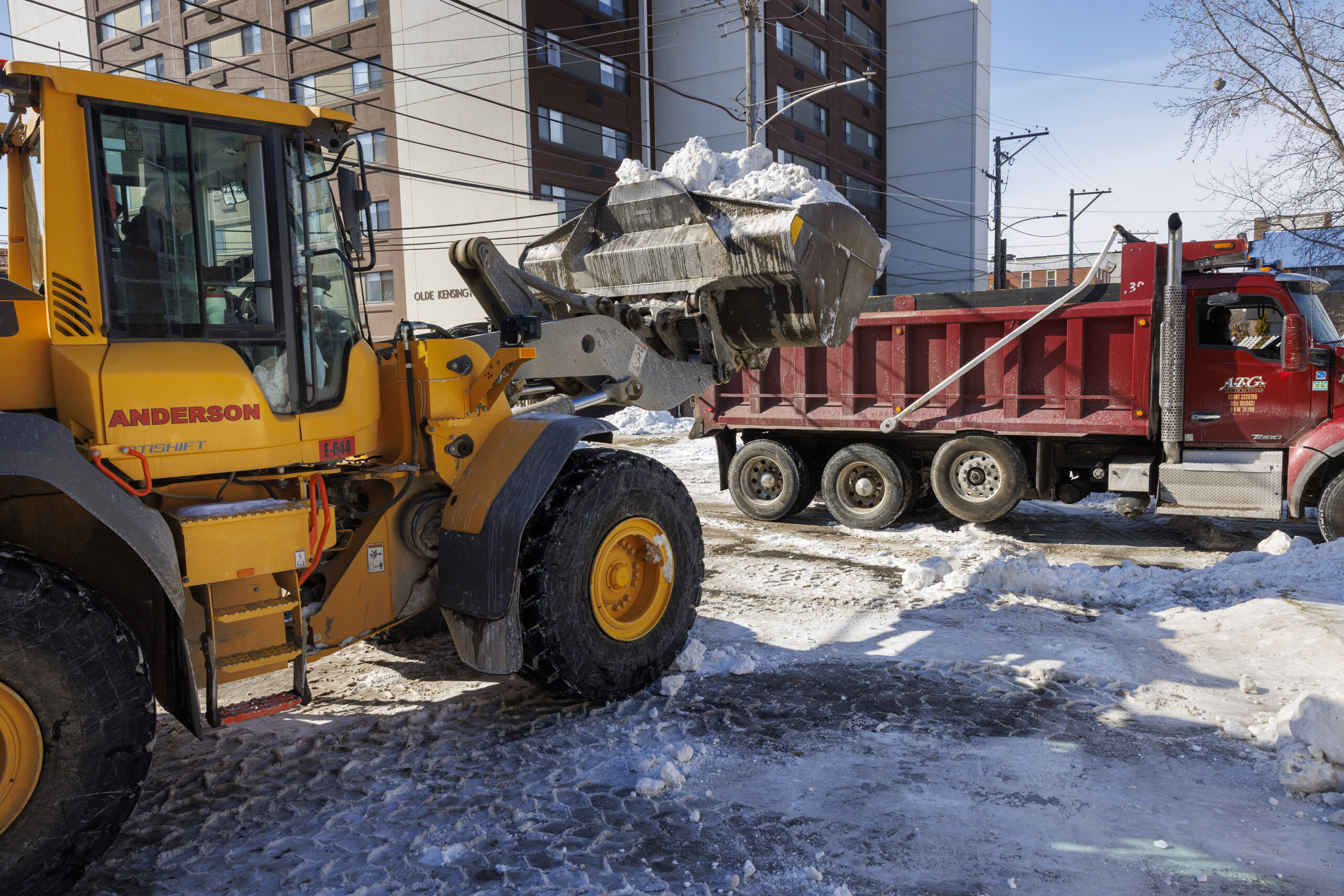
    Heavy machinery and dump trucks collecting piles of snow from Germantown and Thompson Street, Philadelphia, Wednesday, Jan. 28, 2026.

    $46,021,516 in snow removal

    The city crafted its $4.1 million snow operations budget for fiscal year 2026 using a rolling-year average of prior costs.

    But the storm brought about a slew of unanticipated expenses and challenges, including snow removal, ice control, and other emergency operations.

    The city looked to contractors to bolster its workforce as it launched a massive effort to treat and plow streets.

    Contractor plowing and salting operations during the storm cost $13.9 million, while the post-storm contractor cleaning and lifting operations cost $31.8 million. The remainder of the expenses came from snow-related operations across departments, such as the activation of warming centers.

    Part of what made the storm so costly was the uncooperative temperatures.

    Amid complaints from residents over what was perceived as a slow cleanup, the city noted that the below-freezing temperatures created increasingly tightly packed ice that had nowhere to go.

    The city even brought in a snow melter from Chicago, which eliminated 4.7 million pounds of snow in the first two days after the snowfall. The costs of melting, which is considered a specialized service, ran more than $139,000.

    After the initial snow removal, the city moved to what it called its lifting operations.

    Snowplows, compactors, front-end loaders, and backhoes took part in an intricate operation where snow was placed in dumpsters before being shipped off to more than 30 dumping sites.

    The Philadelphia Streets Department mobilized up to 300 pieces of equipment on any given day in an effort to leave no street untreated.

    The city went through 15,000 tons of salt through the three-week cleanup amid other challenges, such as an icy Delaware River that temporarily blocked additional salt orders, and the rising cost of salt post-storm.

    The cost of salt was more than $1.2 million.
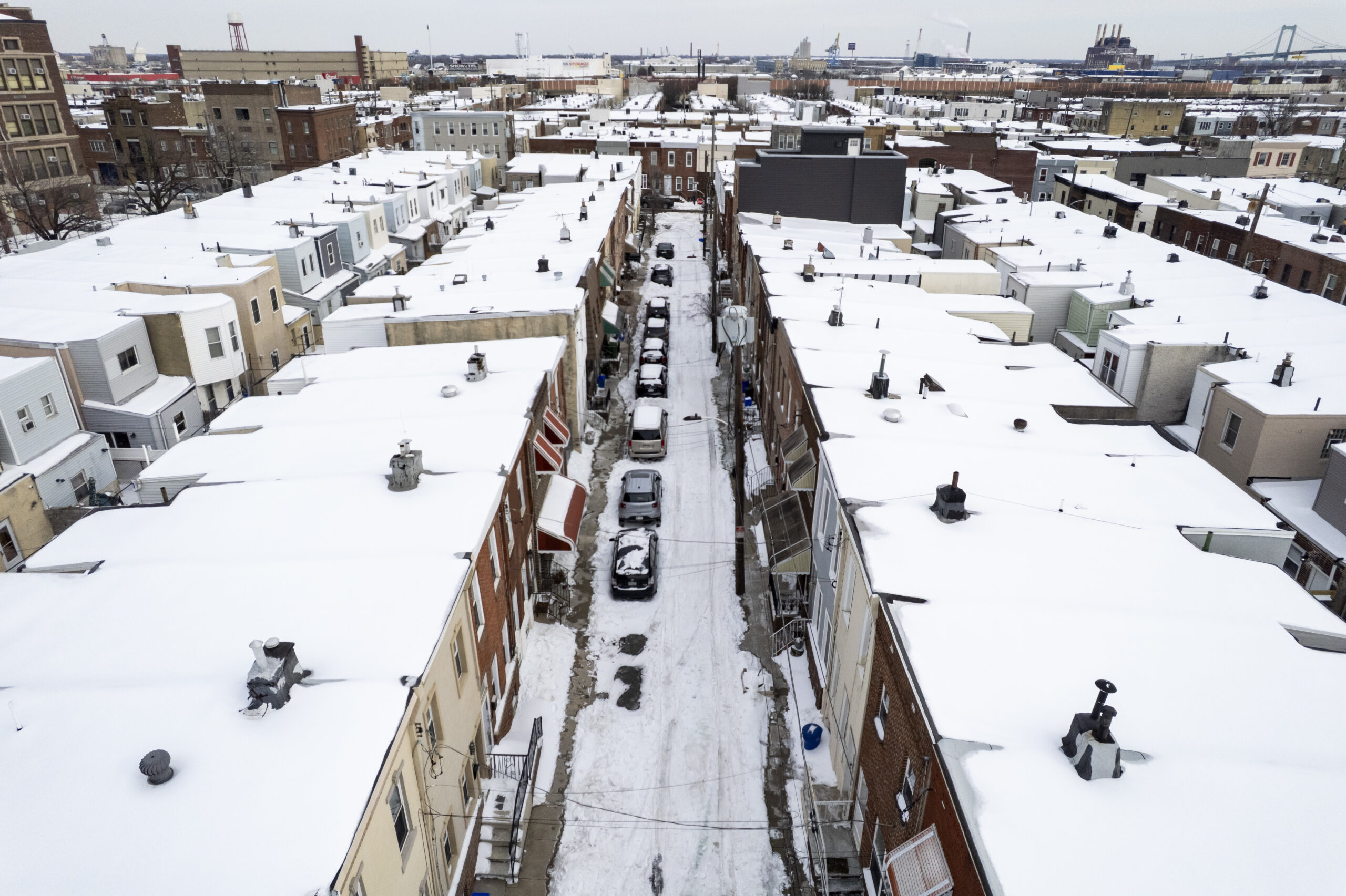
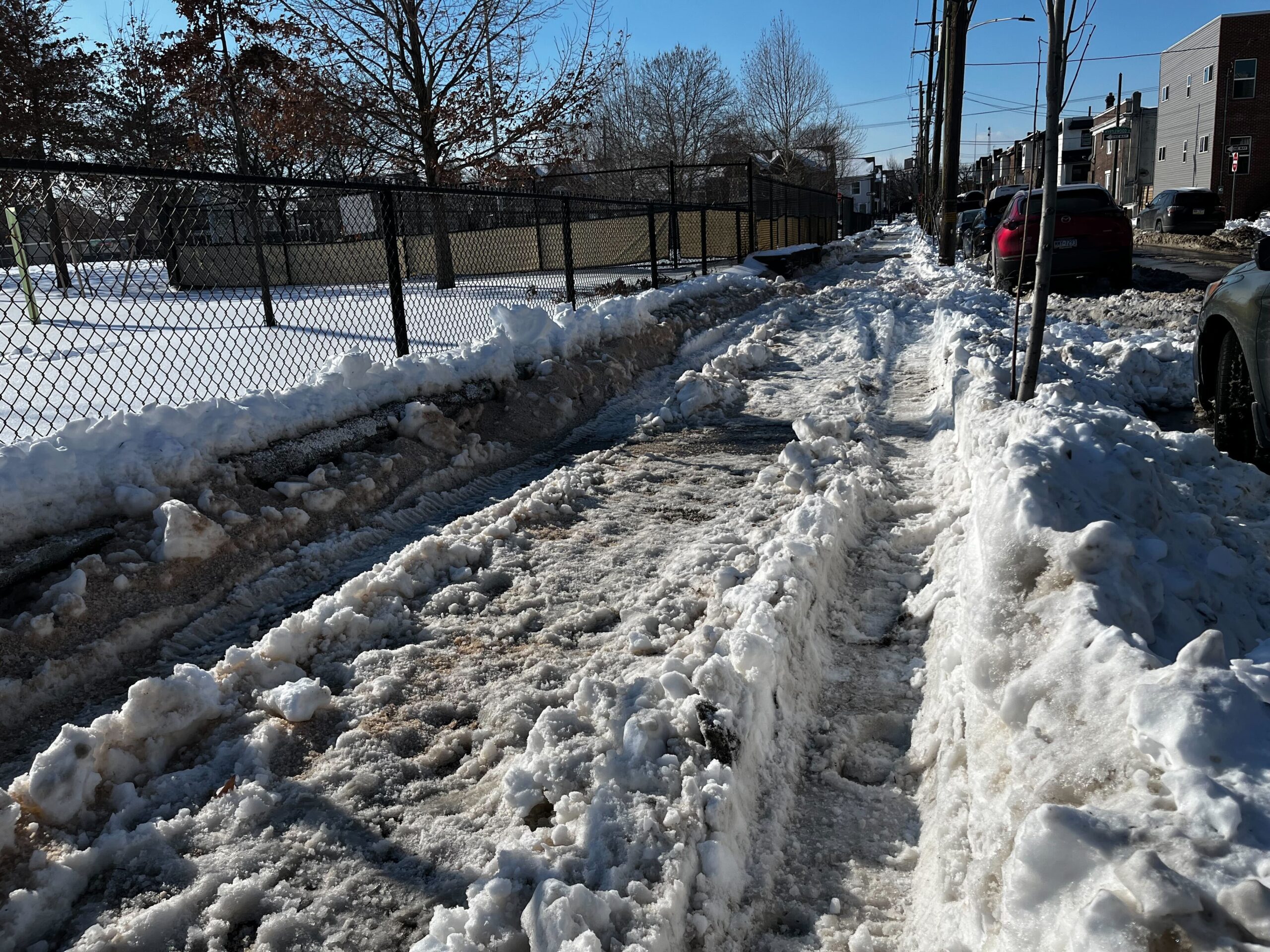
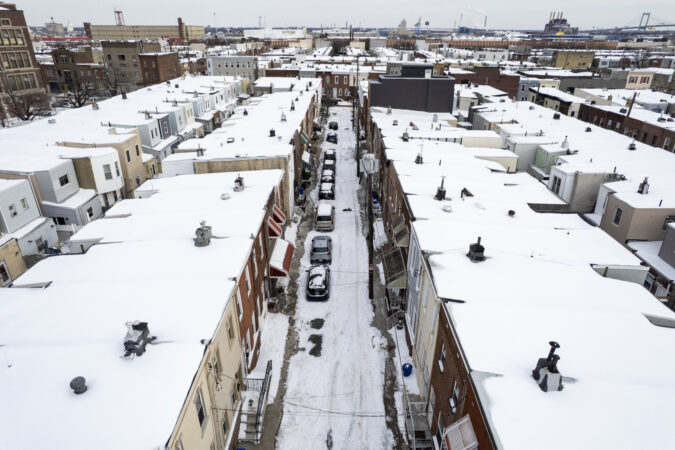
    Emily Street is still covered in snow near Furness High School (top left) on Wednesday, Jan. 28, 2026 in South Philadelphia.

    18,340 ramps cleared

    The massive cleanup had the city looking at creative ways to boost the number of workers clearing streets.

    The streets department tapped participants in its Future Track Program for snow-removal efforts early on. These are trainees, typically at-risk young adults, who are not enrolled in higher education and are unemployed. They get job experience, as well as other services, and they help in beautification projects.

    The trainees cleared hundreds of ADA ramps across Philadelphia.

    But more than a week after the storm, the city was still being flooded with complaints about inaccessible crosswalks and SEPTA stops piled with ice.

    That’s when officials tapped into a city program that pays people the same day for their work, deploying 300 people to help chip and sweep away the hardened ice with shovels and brooms.

    The city assembled a more than 1,000-person workforce for cleanup efforts this way, deploying a mix of city employees, contractors, and participants from the same-day pay program.

    In all, the city said, the crews worked nearly 2,300 intersections, clearing 18,340 ADA ramps and about 2,800 SEPTA stops.

    The use of contractors, however, was met with pushback from American Federation of State, County and Municipal Employees District Council 33, the city’s largest municipal workers union, which said the decision was made without consulting the union.

    “Our members are the trained, dedicated workforce responsible for this work, and it is disheartening to see the administration move forward without even a discussion on how best to manage these challenges,” DC 33 president Greg Boulware said in a statement in early February.

    (function() { var l = function() { new pym.Parent( ‘phillysnowcosts__graphic’, ‘https://media.inquirer.com/storage/inquirer/ai2html/phillysnowcosts/index.html’); }; if(typeof(pym) === ‘undefined’) { var h = document.getElementsByTagName(‘head’)[0], s = document.createElement(‘script’); s.type = ‘text/javascript’; s.src = ‘https://pym.nprapps.org/pym.v1.min.js’; s.onload = l; h.appendChild(s); } else { l(); } })();

    22 warming centers

    The cold snap presented another life-or-death challenge for the city: how to get people living on the streets indoors.

    Between Jan. 20 and Feb. 14, homeless outreach teams worked nonstop distributing more than 2,800 warming kits, 4,000 fleece blankets, 700 cases of water, and 35,000 food items while trying to get people to take a shelter bed or go to one of the city’s 22 so-called warming centers.

    The code blue designation allowed the city to activate some libraries and recreation centers as hubs for people looking to escape the cold.

    The warming center operation was seen as lifesaving, largely supported by library staff. Between Jan. 19 and Feb. 11, New York City recorded at least 18 cold-related deaths; Philadelphia had three over a similar time frame.

    Still, after 20 days of 12-hour operations, staff at the daytime centers described a lack of support from the city when it came to dealing with people who had medically complex issues requiring behavioral health support and wound care. (One library staffer said more city-assigned support staff showed up at the daytime centers after The Inquirer published a report about workers’ concerns.)

    Philadelphia officials said more than 100 people from more than 20 city and partner organizations helped support the warming centers.

    Nighttime warming centers had about 4,400 overnight guests, according to the city.
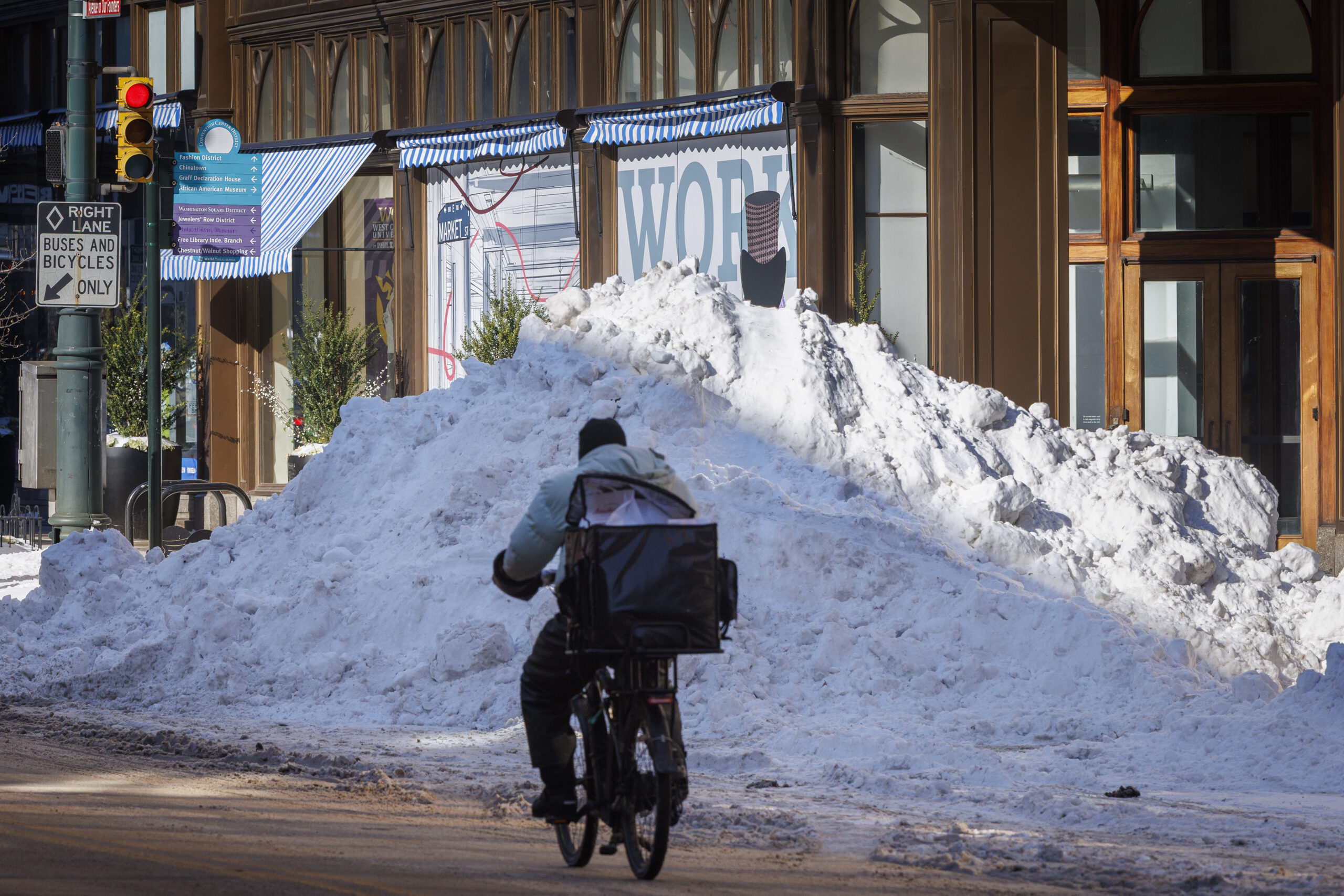
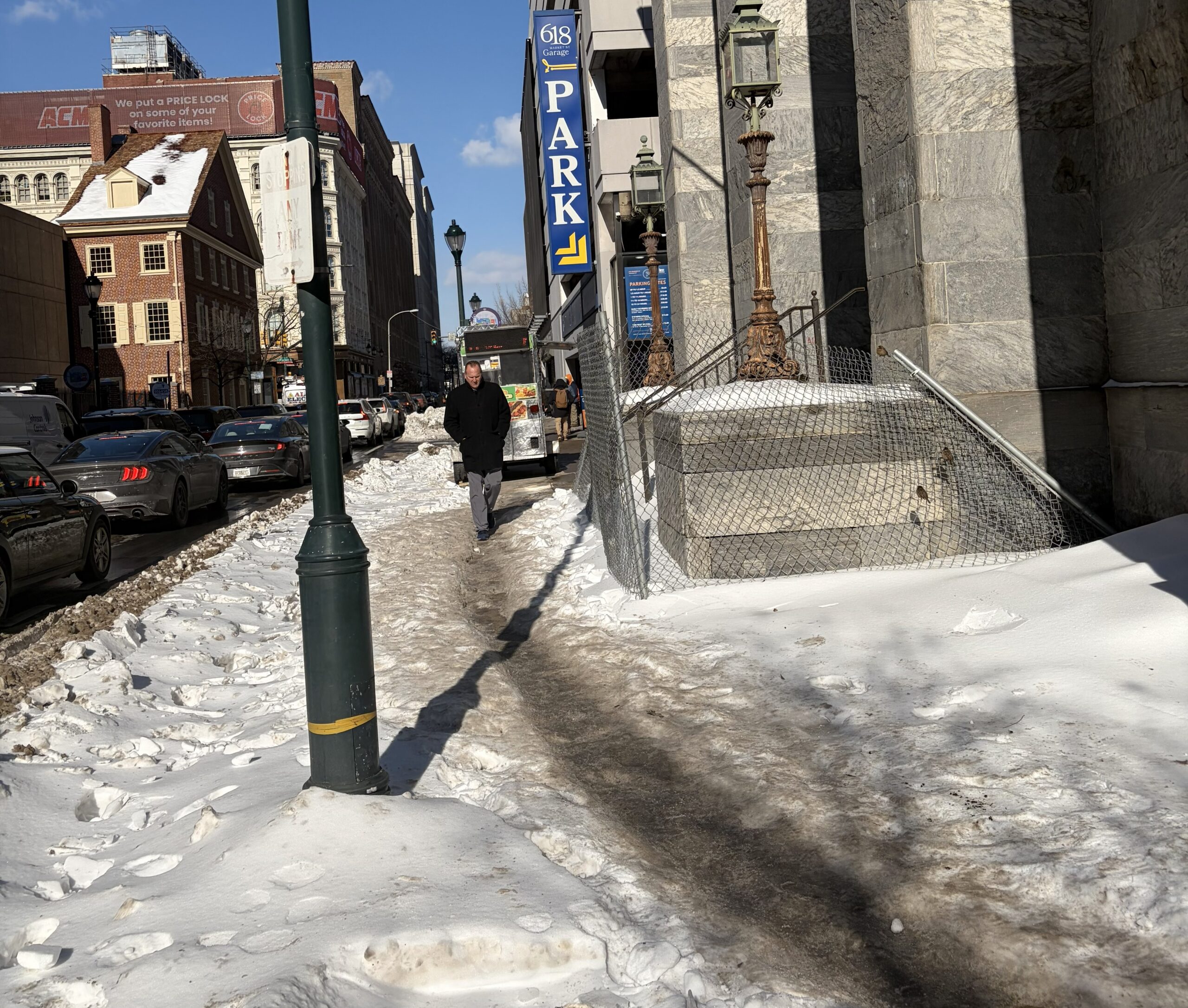
    Mount Market Street at 7th Street, Center City Philadelphia, Tuesday, Jan. 27, 2026. Large pile of snow on northeast corner of Market and 7th.

    $50 million from general fund

    Because snow operations exceeded the initial amount allotted in the budget, the city plans to transfer $50 million from its general fund to its transportation fund.

    Even so, the city said its general fund remains higher than projected in its five-year plan because of a larger-than-anticipated general fund balance in the previous fiscal year.
  • Library warming centers strained workers and left people without help for complex issues, staff say

    Library warming centers strained workers and left people without help for complex issues, staff say

    The bitter and persistent cold of recent weeks was so dangerous that various Philadelphia agencies coalesced around one mission: Get the city’s most vulnerable off the streets.

    Philadelphia libraries became a key piece in these efforts, with some branches doubling as so-called warming centers for more than 20 days straight in an effort to provide a respite to people who would otherwise be living outside.

    The mobilization of what can exceed 10 branches during life-threatening cold snaps is largely, though not universally, welcomed by library staff, the community groups that support the workers, and the people who use the spaces.

    As outdoor deaths mount in places like New York City, where at least 18 people have died on the streets since Jan. 19, Philadelphia library workers see the initiative as a way to prevent similar outcomes here, where there have been three cold-related deaths since Jan. 20.

    But employees say the warming center initiative, in only its second year as a formalized network, leaves branch staff, from librarians to security, unequipped to help some of the people walking through their doors with complex mental and physical health needs.

    “People are feeling tired, feeling very burnt out, the physical, the emotional, and the mental load of not just doing our regular work, but having like this critical service, like lifesaving service, being offered on top of that for 12-plus hours a day has been really, really hard to sustain,” said Liz Gardner, a library worker, speaking as a union steward in the American Federation of State, County and Municipal Employees District Council 47’s Local 2186, which represents first-level supervisors, including those at libraries.

    There’s the “little stuff,” like how an online map sometimes listed the wrong information in December. Last-minute location changes among the South Philly branches made it confusing for even the self-described information professionals to direct people where to go. At one point, a branch that was not Americans with Disabilities Act-accessible was cast as a warming center, to the chagrin of many.

    Library workers and community groups described having to lobby the Free Library to crowdsource snacks and water. The transportation that transfers people to nighttime warming centers after the libraries close has often been late, meaning staff have to decide between staying after their shift or leaving people outside, which they don’t want to do.

    What’s more, library workers and volunteers say, some people require more than a warm space. People in mental health crises, struggling with substance abuse issues, and requiring wound care need medical support, workers say.

    “What [the city is] continuing to do is take advantage of a group of people that care so deeply about the city of Philadelphia and the communities that they serve, and they’ll continue to do it, regardless of if they have the support or not,” said Brett Bessler, business agent for DC 47 Local 2186.

    Altogether, the concerns surrounding the warming center system yield existential and moral quandaries: Is this system the best and most humane way to treat some of the city’s most vulnerable people?

    Crystal Yates-Gale, the city’s deputy managing director for health and human services, acknowledged some of the challenges described by library staff and volunteers. Many logistical issues, such as location changes, food, and transportation woes, were improving or had been resolved, she said. Some of the concerns regarding staffing might be a matter of miscommunication, she said.

    “I think everybody’s exhausted. It’s like Groundhog Day,” Yates-Gale said. “It’s the same thing: Every day you wake up, they’re all just quite exhausted, but everybody’s working toward the same goal.”

    Kelly Richards, president and director of the Free Library of Philadelphia, echoed the sentiment that staff have been saving lives. In a statement, he said he appreciated staff efforts and feedback as the Free Library continues “making improvements to better serve our communities.”

    ‘They need more than a warm building’

    Details of who uses the warming centers are limited. Visitors are not asked if they are at a library to escape the cold or for regular library programming.

    Three library workers from various corners of the city described some of the daily challenges they have faced at warming centers to The Inquirer under the condition that they remain anonymous, fearing professional repercussions.

    One worker who has lived through various iterations of heating and cooling operations involving libraries described a catatonic man being brought into their branch by first responders, left for staff to figure out his care.

    “They need more than a warm building,” the worker said. “These are human beings, and we’re the wrong department to help.”

    A worker at a different branch described trying to persuade a man with a festering wound to seek medical intervention. In another instance, when staff told a man he could not set up his sleeping bag on the library floor, he began shouting, telling workers they had to accommodate him.

    Library staff say one of the biggest challenges is the lack of consistent support for people with complex medical issues.

    Yates-Gale said the Philadelphia Department of Behavioral Health and Intellectual disAbility Services staff focuses support on what are considered “high-volume” warming centers, including the Central Library and the Northeast Regional and Nicetown branches. Mobile teams are available by request.

    In other cases, through a partnership with Project HOME, the city’s homeless services office assigns what is called a restroom attendant.

    Library workers and volunteers say the current setup is unfair to all involved.

    At the South Philadelphia Library on a recent Friday afternoon, a woman yelped in pain as she rubbed a blackened, possibly frostbitten toe. Children played with blocks in a corner as others checked out books.

    Library staffers maintain similar scenes have played out at the various warming centers, with workers left to balance the comfort and safety of people there to check out books and use their computers with those of people who might die if kicked out and sent to the streets.

    The worker who told of trying to persuade a man to seek medical attention noted that staffers are behind on work and programming has taken a hit.

    Kelsey Leon, a harm reductionist who regularly works with homeless Philadelphians with addiction, has been visiting libraries during the cold snap after hearing concerns from librarians, and working to deliver wound care kits to the centers so people there can treat themselves.

    Librarians “are so clearly beyond their capacity to handle this,” she said.

    The city says it’s listening to feedback

    A battle for snacks, workers and volunteers say, has become emblematic of the disconnect between what the Free Library and the city want warming centers to be and what they actually are.

    Most people using the service do not bring their own food.

    The city initially provided snacks at the overnight warming centers in recreation centers but made no such offerings at the daytime ones at libraries.

    When staff and volunteers noted this would mean people going 12 hours without sustenance and offered to fill that gap with crowdsourced snacks and drinks, they faced resistance.

    “We were told repeatedly that warming centers at libraries are distinct from shelters, and that is the reason they couldn’t provide food,” said a third library worker, adding the Free Library and the city eventually allowed the outside snacks to come in.

    Part of the initial hesitation, according to Yates-Gale, was based on logistical considerations, including protecting library materials and adding cleanup to the plate of security officers who handle maintenance.

    The city provided library leadership with lists of food sites, the idea being that people could leave the libraries, get a meal close by, and come back.

    Still, Yates-Gale said, the city is listening and adjusting in real time.

    Last week, after two weeks of operations, the city brought water and cereal to warming centers. The city says people also have access to water fountains.

    The city said it is not giving up on improving warming center conditions. Yates-Gale said that starting Tuesday, the Philadelphia Office of Homeless Services would send reinforcement teams to daytime warming centers to get people to connect to additional services.

    The backup cannot come fast enough.

    Ibrahim Banch, 26, has been homeless before, but the cold he has experienced recently is something different.

    “The air feels solid. It stands your hair up,” he said. He knew he couldn’t stay outside, so he sought out the warming centers as temperatures dropped. Recently released from prison, he said, he is waiting to be placed in an emergency shelter bed. But the warming centers are a last resort.

    He said the city should staff all centers with workers equipped to deal with the mental health needs that many clients have.

    “People at the library shouldn’t have to take this responsibility,” Banch said. “It’s not a shelter or a caregiving place.”

    Volunteers still eager to help

    Erme Maula, with the Friends of Whitman Library in South Philadelphia, echoed the challenging conditions described by workers. She believes it doesn’t have to be this way.

    The city’s 54 branches are full of supporters who can coalesce around the warming centers with donations, she said. Volunteers continue to collect toiletries and other essential items for people using the branches for warmth.

    As an advanced practice community health nurse, she could see healthcare workers organizing to help people and ease the load of librarians. But it is the sort of effort that would need support from the city.

    “People are kind and want to be generous, but they didn’t know you have to take care of what they expected the city to be able to take care of,” Maula said.

    Maula and others who spoke to The Inquirer emphasized they want the warming centers to be improved — not to go away.

    As with the snack issue, Yates-Gale said the city is responding to feedback in real time.

    “Now that we know that there needs to be an adjustment for support staff, we’re ready and able to immediately begin staffing the libraries,” she said.

    But that might not be felt by library staff until the next warming center activation. With daytime temperatures finally warming up, the city is slated to begin winding down warming center operations at libraries; nighttime centers will remain open until those temperatures similarly rise.

    “I’m really hopeful that we see substantial improvements to make this a more sustainable practice that helps more people in a more meaningful way,” Local 2186’s Gardner said.

  • Barges with road salt for Philadelphia temporarily blocked by frozen Delaware River

    Barges with road salt for Philadelphia temporarily blocked by frozen Delaware River

    In a bit of winter irony, two barges carrying 21,000 tons of salt reinforcements for Philadelphia couldn’t get through the frozen Delaware River, according to city officials.

    At the Pelbano Recreation Center in Bustleton on Wednesday, Director of Clean and Green Initiatives Carlton Williams said the city had used more than 30,000 tons in January, which was highlighted by the 9.3 inches of snow and icy sleet on the 25th. The Arctic cold that followed has kept a whole lot of it in place.

    The city still has 15,000 tons on reserve, but Williams said officials are watching salt levels closely and using judgment when dispersing what’s left. He said inspectors are being sent to sites where salting has been requested through 311 to determine whether treatment is warranted, and to ensure the city has enough salt until reinforcements arrive.

    “We definitely need to make sure our salt levels are at a sufficient amount so that if we get another storm like this, we can be out there prepared to fight,” he said.

    By Wednesday afternoon, a city spokesperson confirmed that a barge carrying 15,000 tons of salt was able to redirect and dock in Paulsboro, N.J. That load is slated to reach Philly by truck Thursday.

    The fate of the second barge, with 6,000 tons, meant to go to Philadelphia, remains unclear.

    The delivery is ultimately slated to head to Fairless Hills, which is currently “iced in,” according to Office of Emergency Management Director Dominick Mireles.

    How long the barge has been stuck wasn’t immediately clear, but Mireles said the U.S. Coast Guard continues to perform ice-cutting operations on the river.

    The city uses about 15,000 tons of salt for a significant winter storm, according to a city spokesperson. It tries to keep 45,000 tons on hand.

    City officials noted the frozen sections of the river offer a reminder of how the elements have not done plows and snow cleanup crews any favors in breaking up what have now become dirty, hardened, sometimes rock-solid chunks of ice across the city.

    Mayor Cherelle L. Parker’s administration, like those in other East Coast cities, has received no shortage of criticism for inaccessible crosswalks and SEPTA bus stations that remained icy days after the biggest snowstorm in a decade.

    In the snow cleanup update at Pelbano, Parker assured the public that the city was working nonstop to help it return to normal.

    Still, she said, as seen with the frozen barge, that work isn’t always in the spotlight.

    As for the salt, Parker said the administration is “investigating alternate methods of resupply” as they wait.

    Clarification: This story has been updated to reflect updated information from the city.

  • 300 ‘ambassadors’ to chip away at ice on Philly’s crosswalks

    300 ‘ambassadors’ to chip away at ice on Philly’s crosswalks

    Those stubbornly frozen crosswalks with mounds of snow and ice across Philadelphia are getting chipped away with the assist of a 300-person workforce, starting Tuesday.

    The 300 ambassadors, as they are called, are tasked with manually breaking up ice at crosswalks and streets in residential neighborhoods, according to Mayor Cherelle. L Parker.

    “We are not resting and stopping until every street in the city of Philadelphia is walkable and drivable, and that people feel it when they are driving it and they see it in their neighborhoods,” she said Monday, highlighting the nonstop work municipal workers had been doing since the largest snowfall in a decade blanketed the city with 9.3 inches on Jan. 25.

    The dayslong cold snap that followed, however, has complicated dig-out efforts for the city and led to widespread complaints from residents. Photos of commercial corridors with piles of ice on crosswalks, unplowed side streets, untreated SEPTA bus and trolley stops, and unshoveled sidewalks next to public parks and recreation centers flooded social media after the storm as the city asked for patience.

    Still, Parker said Monday that the city has melted 4.7 million pounds of snow, put down 15,000 tons of salt on streets and roadways, and treated at least 85% of streets at least one time.

    The city has deployed snowplows, compactors, front-end loaders, backhoes, and a snow melter that came from Chicago, the mayor said. And just this weekend, the city made a “coordinated pedestrian safety push,” working across city agencies as well as SEPTA and the Philadelphia School District to clear bus stops, school crossings, crosswalks, and ADA ramps.

    The Philadelphia Streets Department has also tapped into its Future Track Program for snow-removal efforts. The trainees are typically at-risk young adults who are not enrolled in higher education and are unemployed. They get job experience, as well as other services, and they help in beautification projects. In the snow cleanup, Parker said, the trainees cleared more than 1,600 ADA ramps.

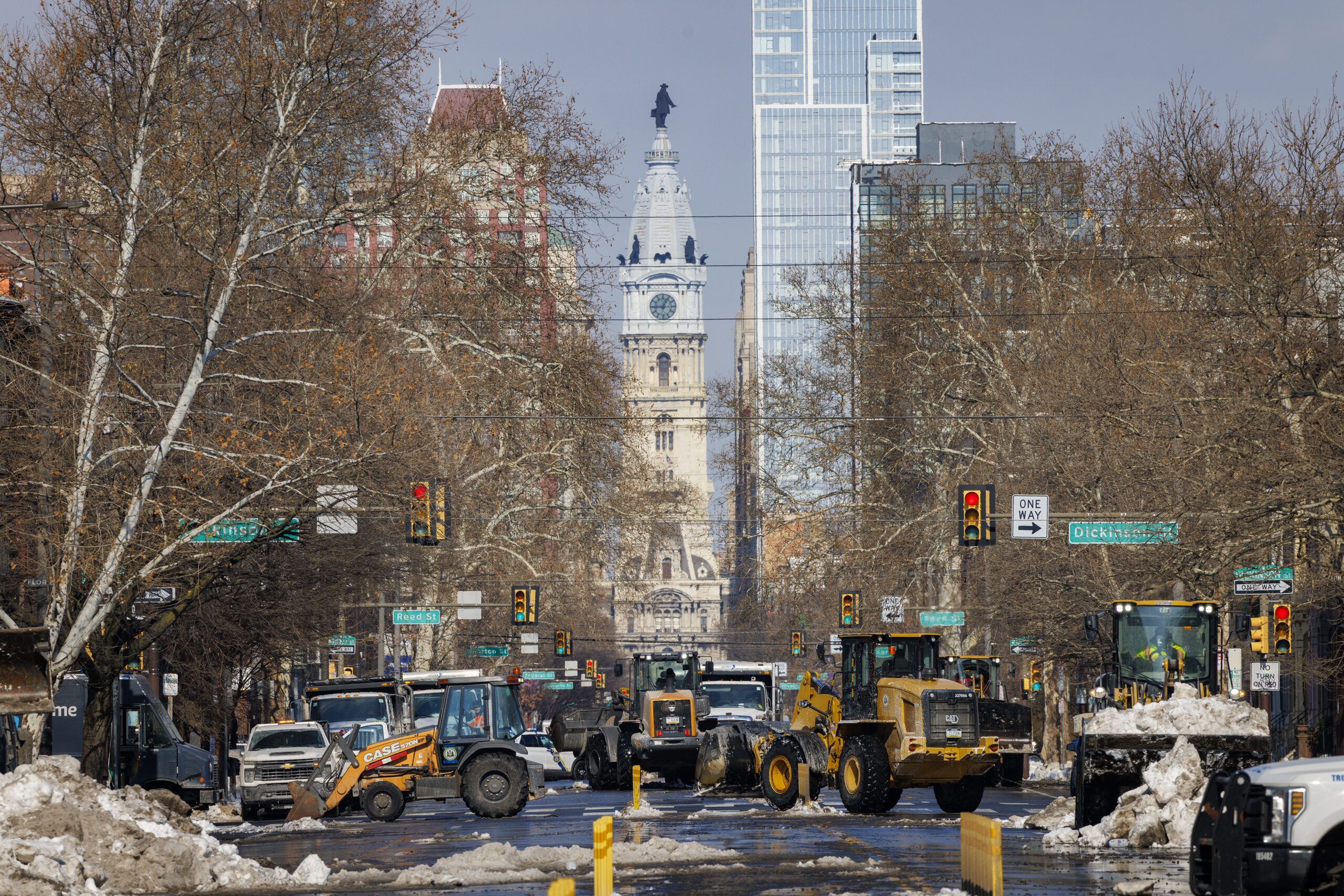
    Heavy equipment clearing snow along S. Broad Street at Dickinson Street.

    Carlton Williams, the city’s director of clean and green initiatives, said the hundreds of workers aiding in the cleanup have made significant progress in areas like North Philadelphia; South Philadelphia, which was the epicenter of 311 complaints days after the snowfall; and Manayunk, which posed a challenge because of its hills.

    He noted the complexity of the city’s narrow residential streets, which required bringing in specialized equipment, and where he previously said cleanup was further complicated by illegal parking.

    Throughout the week, the city had also conducted lifting operations where machines dumped snow and ice into dumpsters to be hauled to storage sites across the city.

    A Facebook video on the mayor’s social media page, along with responses to clips of the dig-out update shared online, offered a glimpse of how residents feel. Parker, many said rising to her defense, cannot control the freezing temps. Others were less forgiving, listing their blocks as forgotten sections in the cleanup.

    Philly is far from alone in the continued cleanup efforts hampered by below-freezing temperatures. At the request of Washington, D.C., officials, 50 National Guard members were deployed over the weekend to help clear schools of snow. Baltimore was able to get a snow melter on loan from D.C. this week, a machine officials told WBAL-TV the city had not needed in a decade.

    Even New York Mayor Zohran Mamdani, who received generally good marks on cleanup from the media in the early days after the storm, was pressed by reporters Monday on lingering snowbanks and delays in trash pickup.

    In Philadelphia on Tuesday, the city conducted a snow-clearing operation along a 1.5-mile stretch of Broad Street through 6 p.m., towing cars along the street in South Philly to make way for equipment on the major corridor.

    City workers received the slightest respite as they continued snow-clearing efforts as temperatures reached the mid-30s Monday and Tuesday.

  • Philly threatened shoveling fines. Then it left its own parks and properties snowy and icy.

    Philly threatened shoveling fines. Then it left its own parks and properties snowy and icy.

    Before 9.3 inches of snow and sleet blanketed Philadelphia, in the biggest snowfall the city has seen in a decade, officials were adamant: Shovel or face a fine.

    In a news conference last week, Director of Clean and Green Initiatives Carlton Williams said residents would have six hours to shovel after the last bit of snow fell. Failure to do so could result in a $300 fine.

    But four days after the last icy flake fell, residents across Philadelphia say the city has set a bad example on the shoveling front, noting various city-owned properties, many of them parks, remain inaccessible for people with strollers, wheelchairs, and those who have limited mobility, and a frigid obstacle for even the most nimble.

    “It feels emblematic of the city’s attitude towards its residents, where it’s like they have rules and laws for everybody, but if they can’t manage to do something, it’s like, ‘We don’t have the resources. People need to be patient. We’re trying,’” said Coryn Wolk of Cedar Park.

    The 36-year-old said she does have some sympathy for the city, as do many others, because it is responsible for so many sidewalks and buildings, and the icy weather isn’t helping cleanup efforts. But as she walked through Malcolm X Park Thursday, frustration set in as she trudged through a sidewalk of tightly packed, icy snow.

    The city did not respond to a request for comment regarding shoveling issues but its rules say paths on sidewalks must be three feet wide. Those on streets with sidewalks less than three feet wide can carve out paths that are one foot wide.

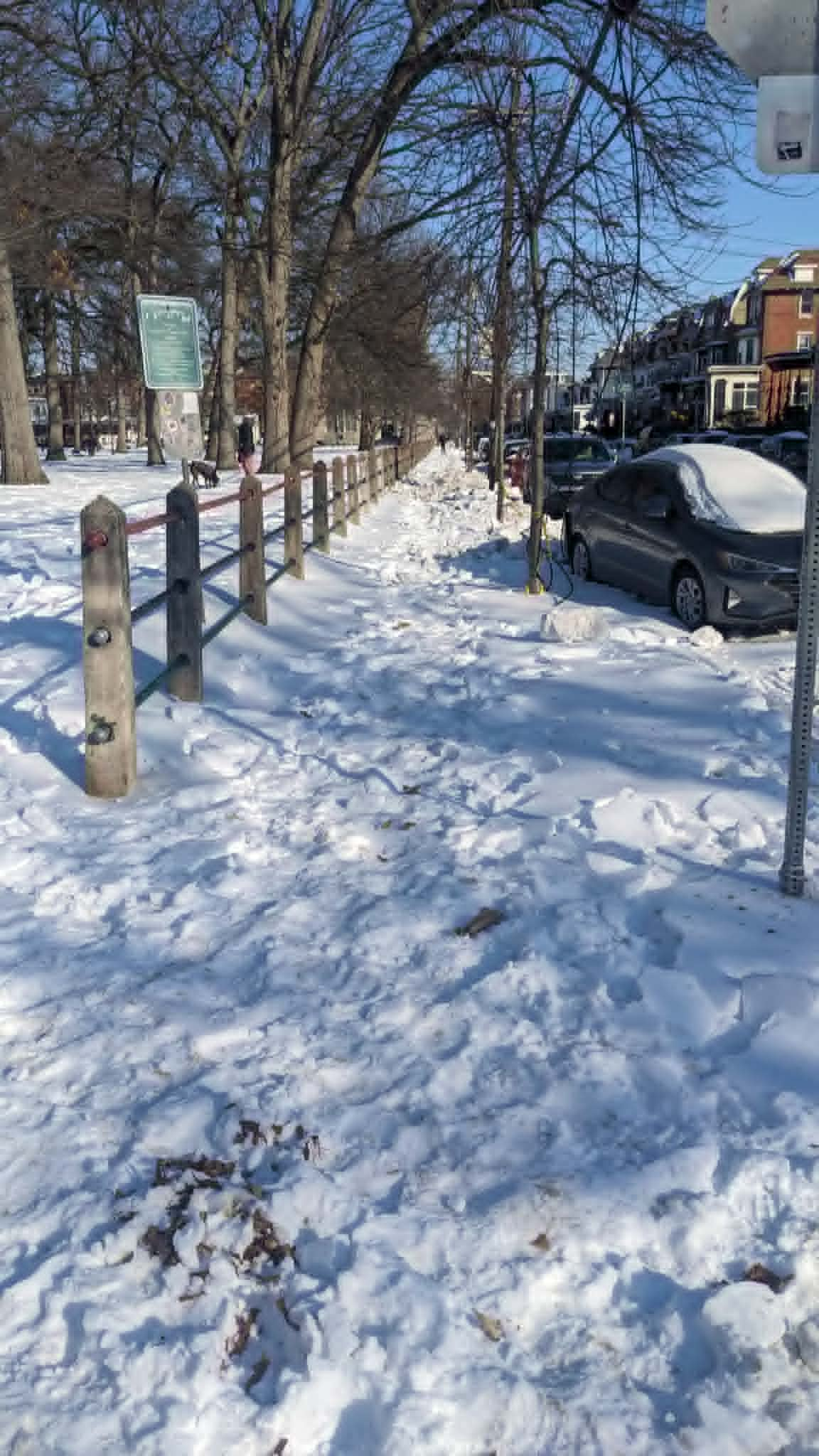
    A sidewalk of Malcom X Park in West Philadelphia on Thursday, Jan. 29, 2026.

    Still, Greys Ferry’s Lanier Park, Ridgeway Park in the Hawthorne section of the city, and Cobbs Creek Park also had sidewalks covered by a trampled layer of gray and yellow snow Thursday. In Center City, outside the former Philadelphia History Museum, another city-owned property, passersby had molded a narrow path that should have been shoveled.

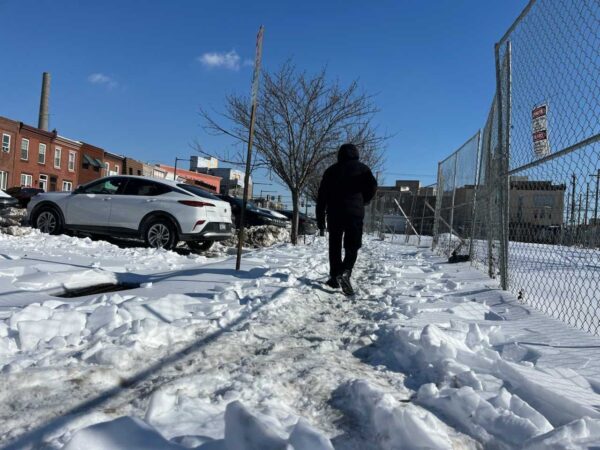
    A sidewalk along Lanier Park in Grays Ferry on Thursday, Jan. 29, 2026.

    Residents say the problem extends to trolley and bus stops that line streets, describing large mounds of snow they need to climb like athletes to reach their modes of transportation.

    Chase Howell, 29, described a herculean snow trudge through Center City with the child she nannies Wednesday. In one instance, she tried to catch the Route 4 bus along Broad and Spruce Streets only to find there was “no way to access the bus lane” because of snow pileups. To her disappointment, the next bus shelter north “was halfheartedly shoveled a foot wide but incredibly slippery.”

    In the process of lifting and pushing the stroller, Howell hurt her back, but she said that’s secondary in her whole ordeal.

    The city owes residents who use wheelchairs more than this, she said. “City curbs should be shoveled three feet wide just as the requirement is for residences and businesses.”

    Those stops and bus shelters are not under SEPTA’s purview. The responsibility of cleanup falls to the city and others who own property next to the stops, according to the agency’s spokesperson Andrew Busch. SEPTA, however, is responsible for the bus stops at the major transit hubs and clearing platforms, entrances, lots, and other areas at train stations.

    Walking around West Philadelphia, Razan Idris has seen plenty of businesses and properties that have also neglected to clear their sidewalks. But she thinks the cleanup is part of a larger issue that can be applied to property owners who don’t pick up trash or who let their buildings rot.

    “I see it as kind of the same thing, like there is little to no accountability for whoever is owning a building or an area or a lot,” said the 30-year-old.

    But ultimately, the buck stops with the city, said Idris.

    The former Philadelphia History Museum, which is city-owned, on Thursday, Jan. 29, 2026.

    By failing to care for public sidewalks surrounding parks and municipal properties, other residents feel the city is sending a message that the rules on shoveling aren’t being enforced.

    In South Philly, pedestrians trudged through crusty snow on the sidewalk along West Passyunk Avenue next to the former Melrose Diner. The sidewalk looked like it hadn’t been shoveled since the storm hit last week.

    The property is owned by M R Realty Limited Partnership, state records show. Business owner Michael Petrogiannis did not respond to a request for comment.

    A passerby, who only identified himself as Derek, complained about how some property owners leave their neighbors with the responsibility of making the sidewalks safe for use.

    “They don’t come out and shovel,” he said. “So I’m the one shoveling for them.”

    Staff writers Henry Savage and Max Marin contributed to this article.

  • Philly’s unplowed snow has slowed SEPTA and frustrated residents and businesses

    Philly’s unplowed snow has slowed SEPTA and frustrated residents and businesses

    With more than 60 hours since the last bit of snow descended upon Philadelphia, the widespread complaints about the conditions of secondary and tertiary streets have reached a fever pitch.

    The Philadelphia Streets Department has tried to quell the public’s concerns with daily videos of excavators diligently filling dumpsters with snow. Yet evidence of icy streets and snow banks blocking lanes dominate social media, with city data showing the street conditions vary block by block.

    Between 3 p.m. Tuesday and 3 p.m. Wednesday, the city’s GPS data show, about 30% of city streets had been visited by plows. Some areas, like Center City and South Philadelphia west of Broad Street, saw most numbered streets and cross streets hit by plows during that time. Meanwhile, South Philly and Center City neighborhoods east of Broad Street saw little to no reported activity.

    The same was true for large swaths of North and West Philadelphia. And neighborhoods like Overbrook, Wynnefield, and Nicetown, which have seen the fewest reported visits from city plow trucks since the storm began, saw only a handful of streets plowed between Tuesday and Wednesday afternoon, according to city data.

    On the neighborhood line of Grays Ferry and Devil’s Pocket, Dani Hildebrand was one resident who felt forgotten as the streets around him were plowed and garbage picked up. Hildebrand’s block was supposed to have trash collection come through Tuesday with the one-day delay announced by the city. But on Wednesday, bags of garbage lined his block.

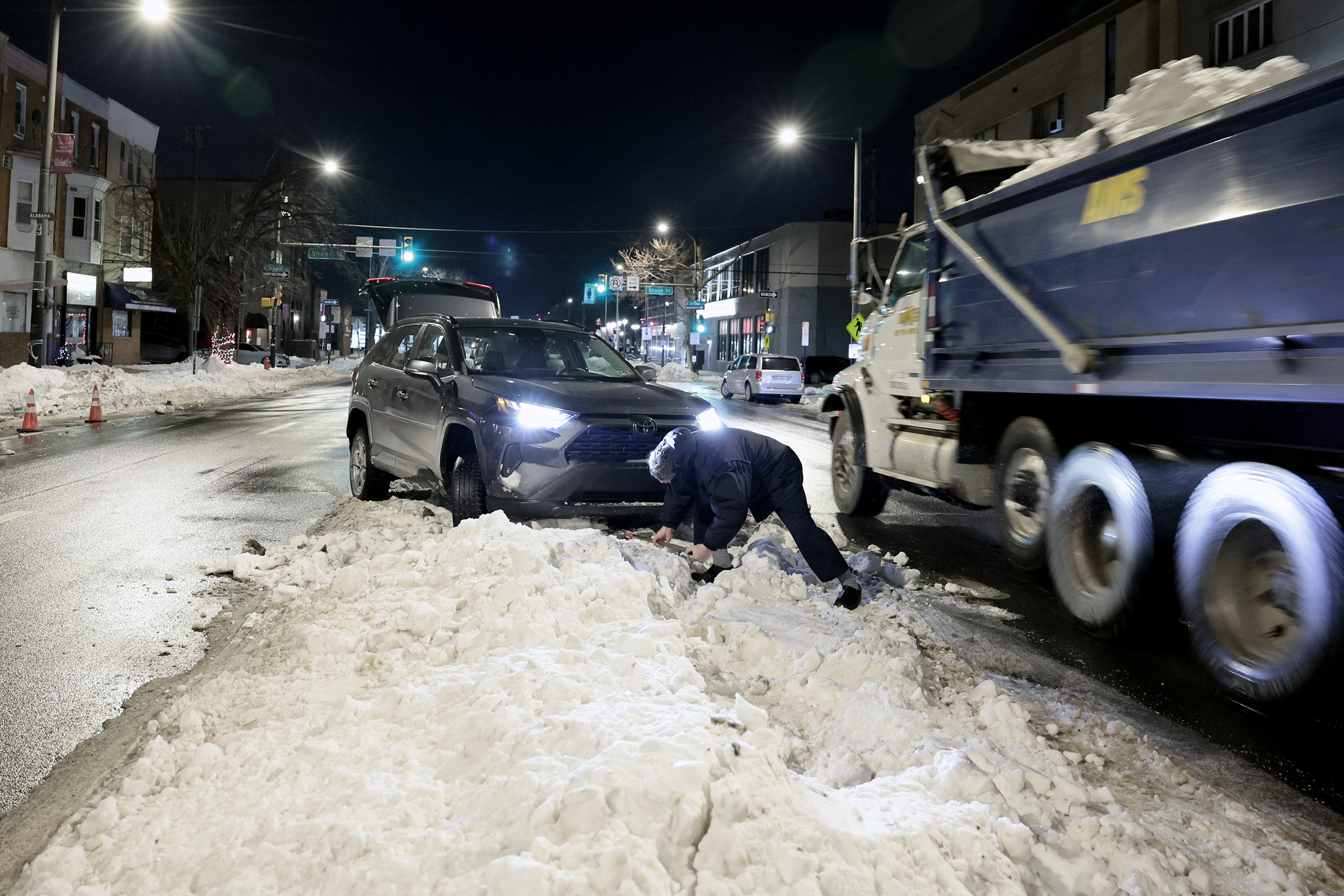
    An unidentified man shovels snow from underneath his car after it became hung up when he was trying to park in the middle of South Broad Street in Philadelphia in the early morning hours of Wednesday, Jan. 28, 2026. Dump trucks filled with snow from the city’s snow removal operations were zooming by as he worked to get his car free.

    The 41-year-old father of three said his school-age children yearn to leave the house, even if for an errand, but it’s not in the cards.

    “Between piles of snow, trash, and dog pee and poop, it’s not ideal,” he said. “We’ve been stuck in since Sunday, and while I’m close to a market, it’s not safe to walk there with my three kids and I can’t get my car out.”

    The city, for its part, has said the snow clearing would take as long as it needs to and the work would continue until all roads are dug out. Residents should expect trash-collection delays as crews navigate the snow and ice. At the same time, officials have consistently asked for patience, noting that the frigid temperatures were not aiding snow-removal efforts.

    They have pointed to the 14 teams with more than 200 vehicles and excavators that are trying to move the snow and ice into storage facilities using dumpsters. Future Track trainees with the Philadelphia Streets Department have also taken up shovels to help clear crosswalks in the city.

    But, the city notes, this is time-consuming work.

    Wanted: Private plowers

    Chris DiPiazza, owner of the Passyunk Square bakery Mighty Bread, could not afford to wait for city plows and paid for a private service to clear his street Tuesday afternoon.

    After the storm, the bakery was unable to make or receive deliveries because the city had not plowed Gerritt Street, the narrow road it’s on. Adding to frustrations, DiPiazza said, snowplows that had come through the adjacent 12th and 13th Streets had left giant snow piles on both ends of the block.

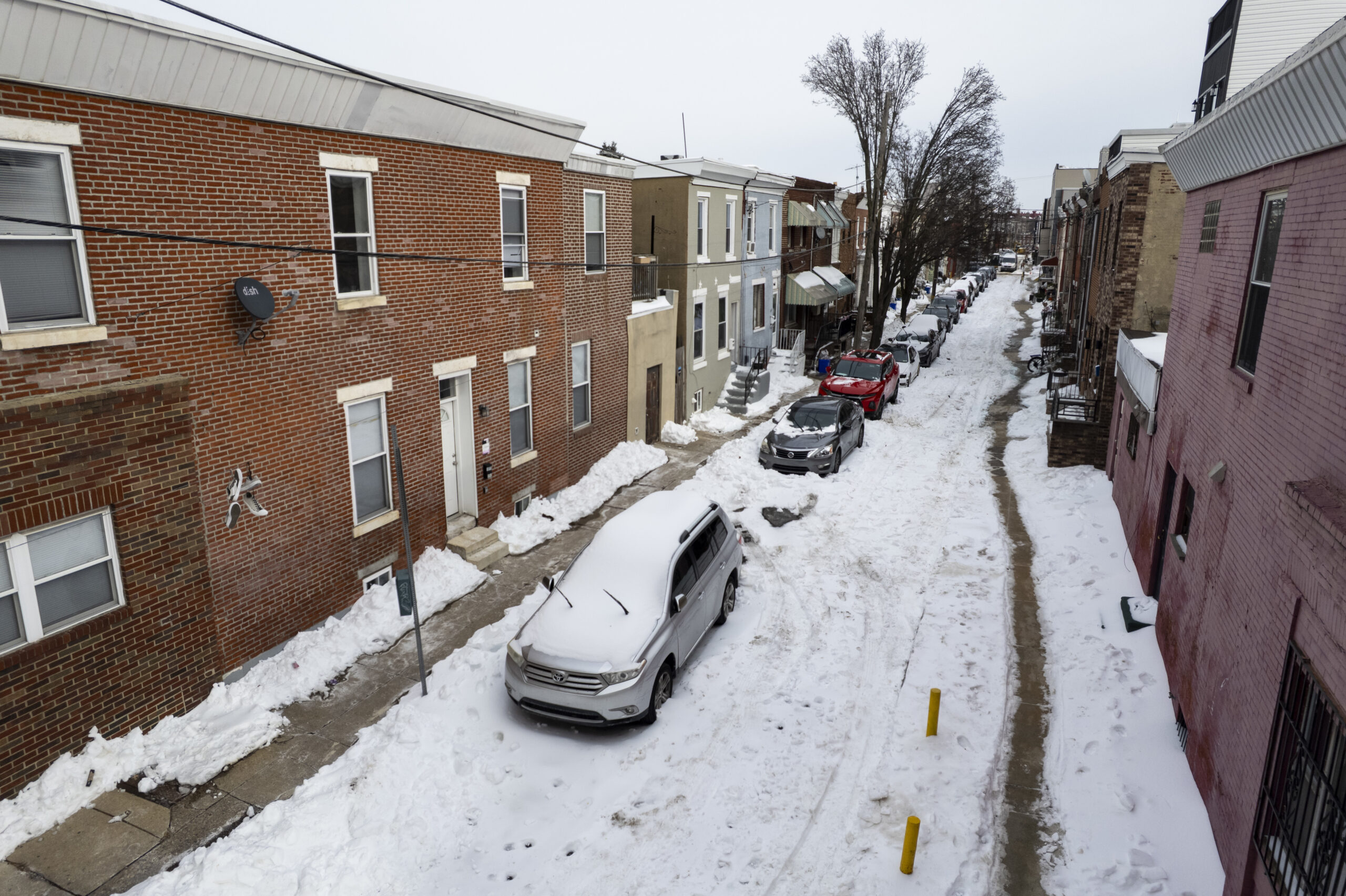
    The 700 block of Hoffman is still covered in snow on Wednesday, Jan. 28, 2026 in South Philadelphia.

    A 311 operator said it could take upward of three days for plowing to occur, DiPiazza said.

    That news was especially frustrating when residents are expected to do their part by shoveling sidewalks in front of their homes within six hours of snowfall stopping, but the city is not fulfilling its own end of that promise, DiPiazza said.

    “The city’s responsibility is to make the streets safe for people to drive, and they didn’t do that,” he said.

    SEPTA vs. ice

    For SEPTA’s size and reach, the organization is not so different from the average Philadelphian living without a plowed street.

    The snow-covered roads were especially difficult for bus routes through secondary and tertiary streets after the storm, SEPTA spokesperson John Golden said.

    “Those streets are hard to navigate on a good day,” he said.

    The lagging plow service made SEPTA pause service for many bus routes.

    “Some of our buses just aren’t able to navigate the streets because of lack of plowing,” Golden said.

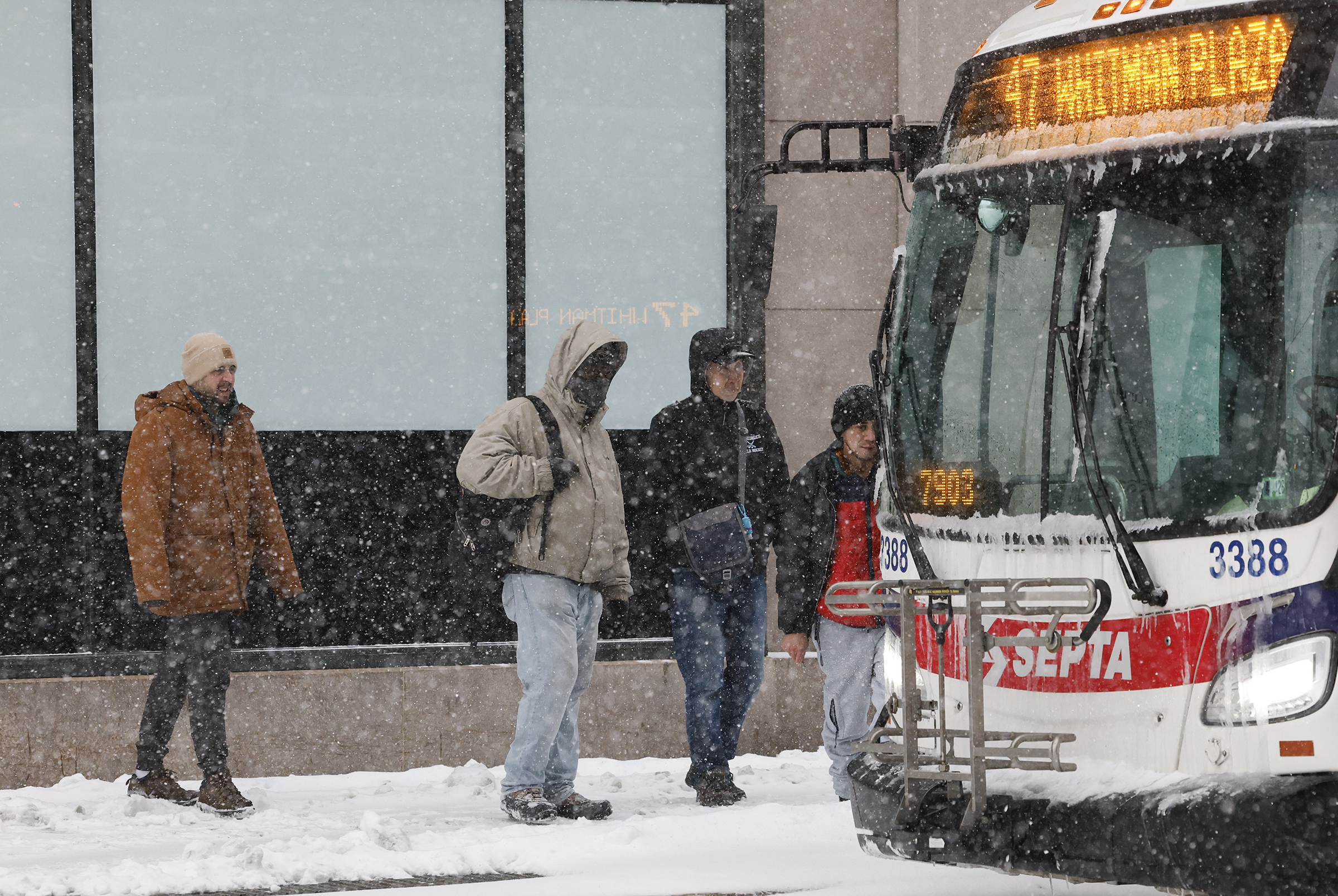
    SEPTA riders board the 47 bus at 8th and Market Streets with the snow falling on Sunday, January 25, 2026.

    But service had returned to all but a handful of routes by Wednesday afternoon. The weekend storm was not particularly onerous for SEPTA compared with other large storms in years past, Golden said, but he noted the frigid temperatures in the days following have made things difficult. Ice is not melting as quickly as it usually does, leaving the roads treacherous.

    Golden said that while SEPTA officials have been in frequent contact with the streets department about problem spots, they don’t have any special recourse besides waiting for the city to clear the streets.

    How does 2026 compare with 2016?

    When the city was smacked with 22.5 inches of snow in January 2016, it was the fourth-largest snowfall in Philly history, and newly sworn-in Mayor Jim Kenney’s first major test in office.

    At the time, many side street residents issued the same complaints heard with this most recent storm — they were the last to be dug out, and entire blocks were locked in.

    But by the fourth day of storm cleanup, a Kenney spokesperson claimed 92% of all residential streets “were plowed and passable” and the administration was taking in kudos for what many — though not all — said was a job well done.

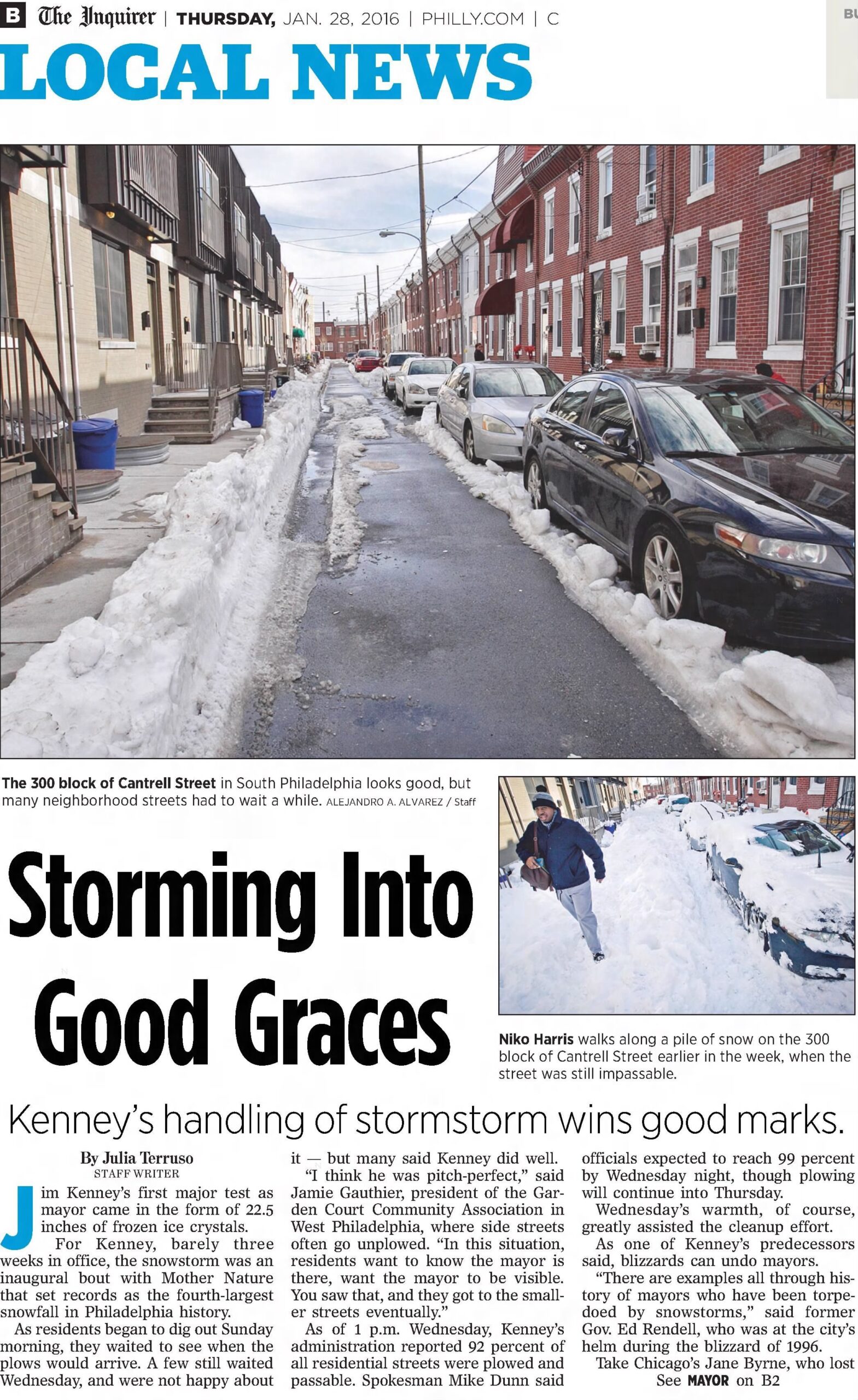
    The front page of The Philadelphia Inquirer’s B section in January 2016, following a major snowstorm that was similar to the January 2026 storm. The article reported some complaints of snow plow delays, but residents were largely complimentary of then new Mayor Jim Kenney’s handling of the storm.

    Though 9.3 inches fell this time around, city officials have said the conditions were very different. The temperature drop has been the largest hurdle so far, providing no help in melting the ice. The city still urges patience and says teams are working nonstop.

    For parents whose children took part in virtual learning Wednesday and residents who were sick of parking wars and icy crosswalks with another potential snowfall on the way, patience was almost gone.

    Residents in North and West Philly shared frustrations on social media of parking shortages because mounds of ice left people nowhere to go; some were even parking at an angle in parallel spots, to the chagrin of others. Bus stops were piles of dirty, frozen ice, and crosswalks remained icy.

    For Hildebrand, it was all very discouraging.

    “A plan could have been made and implemented, since the city knew about this a week before it happened, but it truly seems like bare minimum effort,” he said.

  • Immigration activists stage protests at Philly Target stores, demand the company reject ICE

    Immigration activists stage protests at Philly Target stores, demand the company reject ICE

    Activists with No ICE Philly demonstrated at Target stores in the city on Tuesday evening, attempting to slow business operations at a company that they say wrongly cooperates with federal immigration enforcement.

    Stores in South Philadelphia, Rittenhouse, Fairmount, Port Richmond and on Washington Avenue and City Avenue were among those targeted, the group said.

    Advocates say the retailer has failed to speak out against U.S. Immigration and Customs Enforcement, to safeguard employees and customers, and has allowed the agency to set up operations in its parking lots.

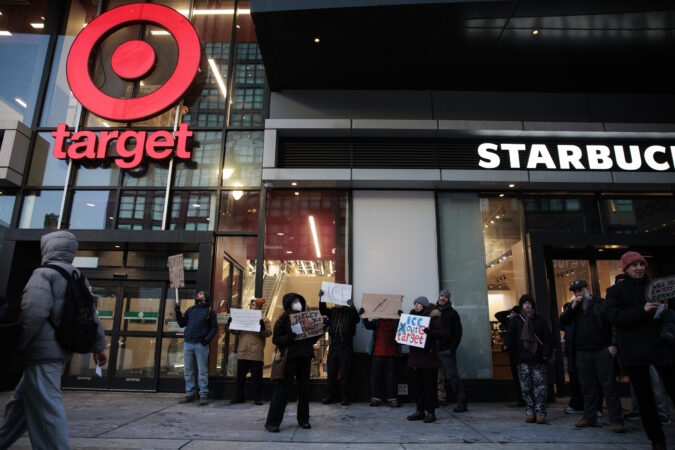
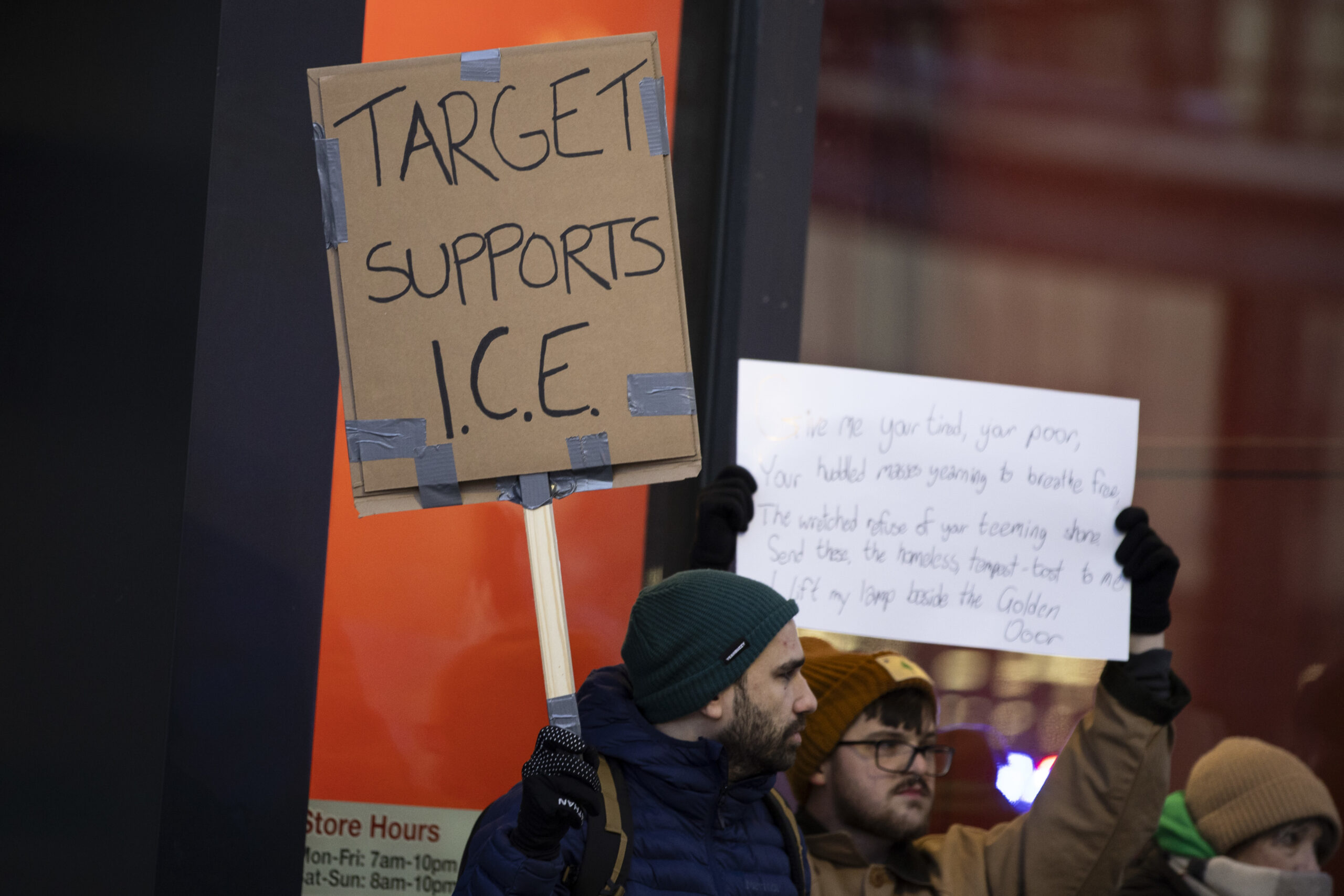
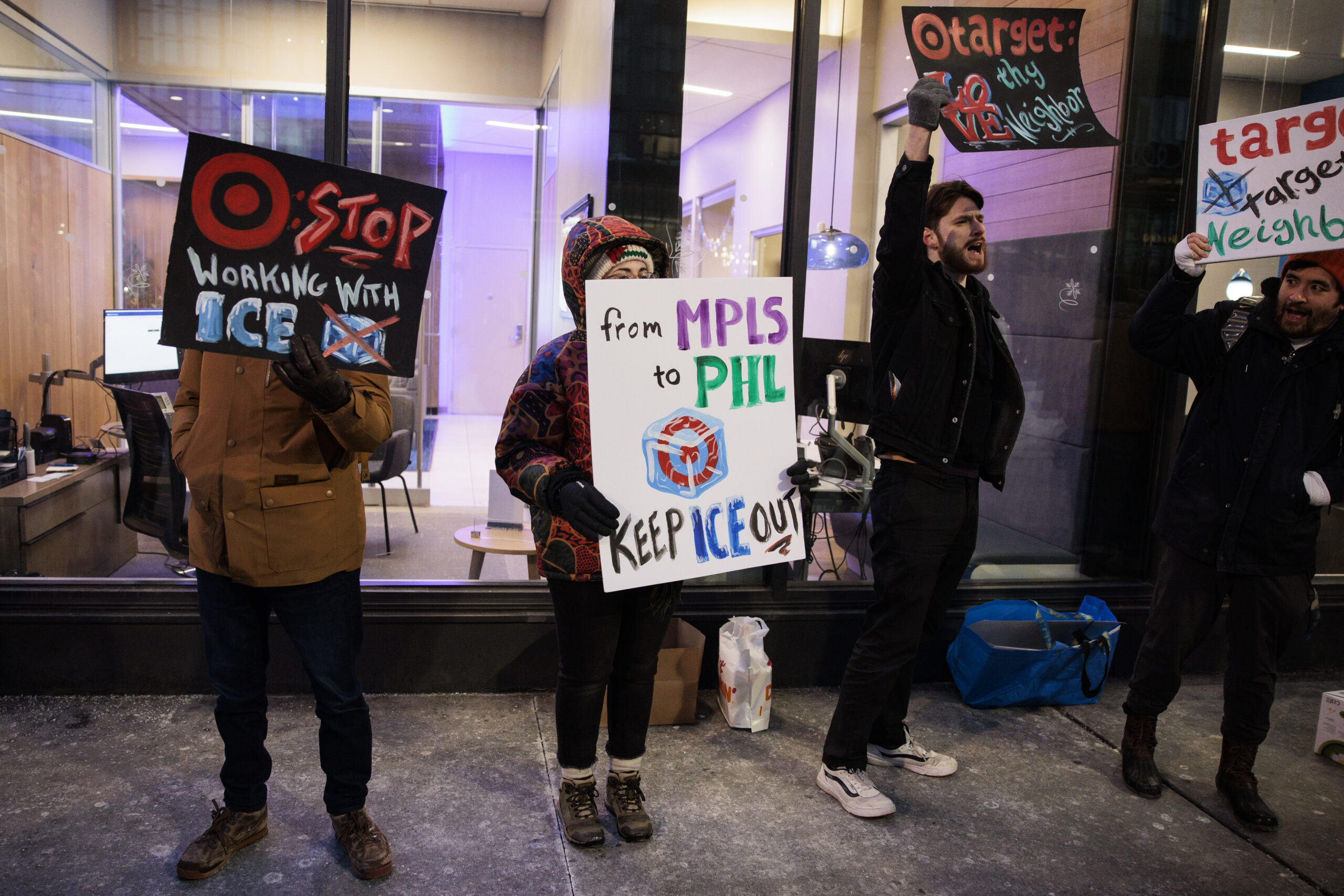
    More than 40 people rallied on a frozen, 19-degree night outside the Target at Broad Street and Washington Avenue, holding signs that showed solidarity with Minneapolis residents who have resisted ICE in their community.

    “From MPLS to PHL, keep ICE out,” read one sign.

    Demonstrators gathered outside of the Target at Broad and Washington on Tuesday in Philadelphia.

    Inside, some masked customers bought ice trays and single bottles of table salt. As soon as they paid for the items at the checkout counters, they headed to the “Returns” area to seek refunds.

    Items were quickly restocked on store shelves by staff, only to be purchased and returned again.

    Demonstrators visited at least seven stores, according to the Rev. Jay Bergen, a leader of No ICE Philly and pastor at the Germantown Mennonite Church.

    “Our actions are in solidarity with people across the country responding to the call from Minneapolis communities to pressure Target,” Bergen said Wednesday.

    Company spokespeople did not immediately reply to a request for comment on the protests in Philadelphia. Target, founded in 1962, operates 1,989 stores across the United States and has a net revenue of more than $100 billion a year.

    At Broad and Washington on Tuesday, members of No ICE Philly handed out pocket-sized fliers that described their goals as they urged shoppers to go elsewhere. Some people turned away after talking to demonstrators. Others who went inside were met with boos.

    “Find another store!” the protesters shouted, as a police officer looked on.

    Elijah Wald, 66, said the Washington Avenue location was his neighborhood Target.

    “Our main hope is that businesses will understand that they need to protect their employees, that they need to not collaborate with a government that right now is targeting everybody,” he said.

    Wald, whose mother was a Jewish refugee who fled Nazi Austria, said he has always felt positive about immigration, that the United States was built of “people who are used to moving to find work, moving to find cheaper housing.”

    But the discourse over ICE operations in major cities has gone beyond undocumented people, said Wald.

    “They’re shooting U.S. citizens now,” he said.

    Demonstrators gathered outside of the Target at Broad and Washington Streets on Tuesday.

    At the Target at Snyder Plaza, about 20 demonstrators encouraged people to do their shopping elsewhere.

    “Protest with your wallet; Acme is right there,” a protester said through a sound system.

    Celine Bossart, 34, said boycotts are an effective way to denounce ICE actions.

    “As citizens, our power is limited, but a big part of the power that we do have is where we choose to spend our money,” she said, “and at the end of the day, corporations aren’t necessarily going to listen until it hits their bottom line.”

    A man in a Flyers jersey stopped to heckle the demonstrators, who responded with words of their own. Bossart said the protest did not aim to make anyone’s day difficult.

    “Our neighbors are people who work at Target, people who work at Acme; these are the neighbors who we’re trying to protect,” she said. “So we’re just trying to send a message to upper, upper management.”

    Last week, demonstrators held a sit-in at a store in Minneapolis, where the company is headquartered, chanting, “Something ’bout this isn’t right ― why does Target work for ICE?”

    At other Minnesota stores, demonstrators formed long lines to buy bags of winter ice melt, then immediately got back in line to return them, slowing the checkout process.

    No ICE Philly, which has led demonstrations against the agency, and against the arrests of immigrants outside the city Criminal Justice Center, said Target must:

    • Publicly call for Immigration and Customs Enforcement to leave Minnesota.
    • Post signs in its stores that deny entrance to immigration agents, absent a signed judicial warrant.
    • Train store staff on how to respond if agents arrive.
    • Publicly call for Congress to end ICE funding.

    Chief executives of Target and more than 60 large Minnesota companies issued a public letter on Sunday calling for an “immediate de-escalation of tensions.” It marked the first time, The New York Times reported, that the most recognizable businesses in the state weighed in on the turmoil in Minneapolis.

    Critics said the letter offered too little, too late, coming after two local U.S. citizens were shot to death by federal agents.

  • Many Philly side streets remain full of snow and ice days after Sunday’s storm

    Many Philly side streets remain full of snow and ice days after Sunday’s storm

    It is a sentiment long held by residents across Philadelphia, especially those living on side streets, dating back to when snowfall was a more frequent occurrence than it has been in recent years: Don’t expect the city to do a thorough plowing job.

    That belief is one that Philadelphia Mayor Cherelle L. Parker has said she is trying to shake with action.

    Two days before a storm that whacked the city with 9.3 inches of snow and sleet, Parker, surrounded by the leaders of various agencies, including the Philadelphia Streets Department, vowed to buck precedent on the plowing issue.

    “We will make every effort to get to every primary, secondary, and tertiary street in the city of Philadelphia, and that is our standard,” she said, adding it would take “as long as it takes,” citing worker safety.

    “But know that we won’t leave any neighborhood, any block, or any community behind.”

    Still, residents across the city Tuesday said they were losing patience as side streets and even some secondary streets remained packed with several inches of snow and ice, locking cars in and making navigating intersections impossible.

    Fishtown resident Rohan Khadka, 22, was hoping plowing might happen overnight. Instead he woke up Tuesday to streets that were hard for him to cross even with the proper footwear.

    “A lot of our roads down here look exactly the same,” he said. “Most of the cleanup that has happened, to my knowledge, has either been by other residents or just cars happening to clean it because they’re using those roads.”

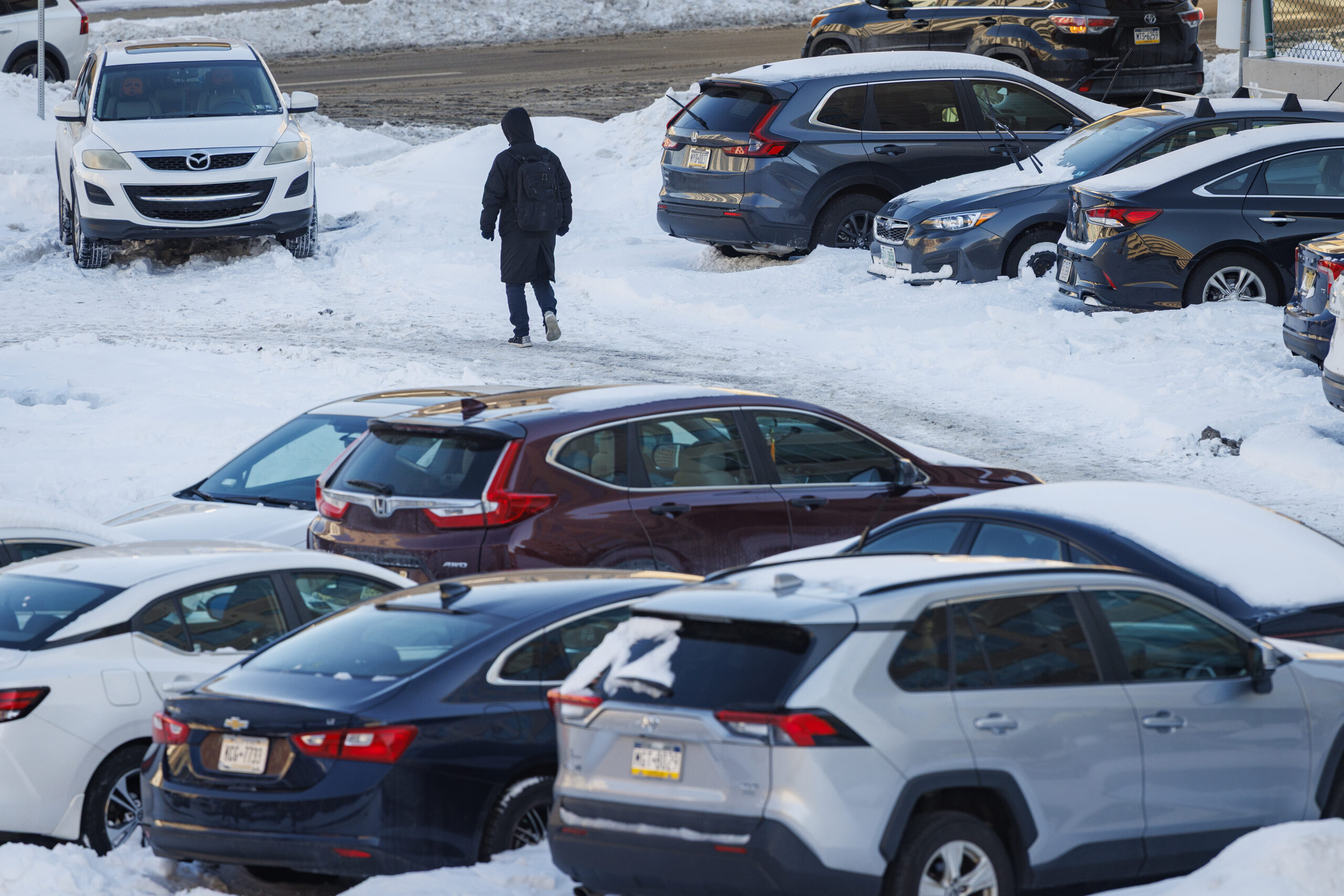
    A pedestrian walks through a snow-covered parking lot at Ninth and Arch Streets in Center City Philadelphia, Tuesday, Jan. 27, 2026.

    Analysis of the City of Philadelphia’s PlowPHL data, which tracks the movement of plows via GPS data, showed that about a quarter of streets citywide had received no snow treatment at all — including salting or plowing — after the conclusion of the storm Sunday night.

    Some areas were worse off than others.

    In places like Overbrook and Wynnefield, the city had salted or plowed about 70% of streets by the end of Sunday morning, when the storm began. But the majority of streets in these neighborhoods received no additional plowing or salting since Sunday, according to city data.

    The same was true for about a third of streets in South Philadelphia.

    The streets department said Tuesday it was deploying over 200 vehicles and excavators as part of a so-called lifting operation. Fourteen teams were fanning across the city to scoop up snow from the narrow roads and load it into dump trucks on nearby primary streets.

    The snow hauls were then being taken to storage sites across the city.

    Director of Clean and Green Initiatives Carlton Williams drove through parts of South Philadelphia on Tuesday afternoon, as dozens of the side-street-size excavators made their way through the city’s narrowest byways.

    “It is the smaller tertiary streets that are challenging,” he said. “There’s more of them. It’s difficult to navigate through those streets.”

    As Williams passed a side street with several inches of snow packed, he noted a car illegally parked on the corner, which would make it difficult for machines to get through.

    Williams said this storm came with additional challenges. Not only did the snow fall in a condensed period of time, but it was followed by sleet and frozen rain.

    “We wouldn’t have many of the challenges that we’re facing today, slowdowns, if those other weather conditions beyond our control did not exist,” he said. “But again, I want to reassure the public that we’re aware. You see us out here today. We’ll be out here tomorrow, and we’ll continue to fight this storm.”

    But for Philadelphians waiting for a plow, time is of the essence.

    311 ringing off the hook

    For Moya Ferenchak, 30, the effectiveness of the operation carries serious health implications. They started pet sitting on the 1500 block of South Capitol, a South Philly side street, for a friend last Tuesday, bringing exactly one week’s worth of food and lifesaving medication — more than they expected to need.

    Ferenchak, who lives with a disability that causes limited mobility, cannot shovel. Calling a car not only is expensive but also would require Ferenchak to travel with all their belongings to an intersection that is not blocked by snow.

    Adding to frustrations across the city were reports of inundated 311 phone lines.

    “I called first thing this morning, and there was a 50-plus-person queue,” Ferenchak said. “Then I called again, and there was like a 70-plus-person queue. I waited for like an hour or so, and then it hung up on me.”

    Alex Wiles of Philadelphia has been hustling during the recent snow, shoveling sidewalks and digging out cars. This photograph was taken along North Second Street near his home, Tuesday, Jan. 27, 2026. He was heading to the bus for a trip to his next client.

    The processing of online 311 tickets has also been a source of confusion for residents who wonder if they are being paid attention to. Williams said the complaints are populating a map used to direct plows to avoid redundancies.

    “We’ll take that data and get it within the operation,” he said.

    Some homes feel the impact more than others

    On the 4800 block of Regent Street in West Philadelphia, Justin Rothrauff described the road as “treacherous” for the mix of families and older residents who live there.

    “One of the big problems, besides the street not being plowed, is that the plowing that they have done on some of those primary roads has blocked the secondary and tertiary roads,” the 43-year-old teacher said, adding even if he could somehow get his car out of his block, he is not sure he would make it back in.

    While Rothrauff had heard of people paying to have their roads shoveled, he feels no one should have to.

    “I refuse to pay anyone money, I pay enough taxes in the city,” he said.

    For some Philadelphians, some information could go a long way. A much-touted live map of plow operations has been reported for mistakenly listing some streets as plowed, according to the residents who live there.

    Ken Wong shovels snow on Waverly Street, in Philadelphia, Monday, Jan. 26, 2026.

    Krista Dedrick-Lai, 45, a South Philly resident, hopes the city will do more to tell people about plowing statuses, and explain why their streets are still covered in snow days after the storm, even if the answers are not what they are hoping to hear.

    “Sometimes context can make everyone feel better,” she said, noting her block on Federal Street got a plow Monday and Tuesday, but the snow banks had blocked cars in.

    Fortunately, she said, she and her husband have not needed to leave their house to work or to help their child learn through third-grade virtual learning modules.

    Others, however, do not have that flexibility. Making matters worse, more snow may be on the horizon this weekend.

  • The promise, peril, and whimsy of a potential double-digit snowfall in Philly

    The promise, peril, and whimsy of a potential double-digit snowfall in Philly

    Informal plans for a snowball fight in Rittenhouse Square. Debates on the best snow to craft the most aerodynamic orb.

    A run on ice salt. Public denunciations of said runs.

    Searches for snow shovelers.

    Love it or hate it, Philadelphia could be racking up its first double-digit snowfall since 2016, and residents are bursting at the seams of their snowsuits with the peril and promise of a real, old-school winter wonderland.

    Alex Janconski, a manager at Stanley True Value, a hardware store in Roxborough, said the recent snow dustings in the city had already proved to be good for business but this weekend’s forecast had made it hard for suppliers to keep up. People seem to be stocked up on shovels at this point, Janconski said, but in recent days salt has been a hot commodity.

    People are taking whatever they can get — rock salt, fast melt, magnesium chloride.

    Janconski said the urgency felt by his customers is reminiscent of the COVID-19 days. Three pallets of ice melt sold within 15 minutes of opening Thursday. He suspects the demand has to do with the significant snow projections.

    “In terms of the inches, it’s hard to get away from that number and feel like, oh, I can get away with just having nothing,” he said.

    While the traditional run on stores before a storm is a strongly held American tradition, there is an added novelty in a city like Philadelphia, where some generations can still wax poetic about staring at the TV waiting for school closure announcements that would give them the all-clear to sled down the Art Museum steps, at Clark Park, or on Fairmount Park’s Belmont Plateau.

    Snowfall in the digital age, as the rarity that it is, has lost much of the whimsy.

    The specter of a dusting feels more like a chore. The kids can learn virtually and the responsibilities for homeowners and renters are the same — six hours to shovel or risk up to a $300 fine in Philadelphia.

    And is it true that the teens no longer do shoveling side-hustles anymore?

    The online space has also given the cynics multiple platforms from which to thumb their nose at the forecasts.

    Meteorologist Glenn “Hurricane” Schwartz, formerly of NBC10 and legendary for his bow tie collection, is one voice pushing back.

    “Forecasts of any type are going to be imperfect,” he said in a TikTok video, after announcing Wednesday that he would be doing two weather updates a day until the storm hits.

    “You got any sports forecasts that are correct? Political forecasts? Economic forecasts? It’s hard to predict the future.”

    @hurricane.schwartz i’ll be back later today with a more detailed update… #winterstorm2026 #philly ♬ original sound – Hurricane Schwartz

    Fans delighted in Schwartz’s coming “out of retirement,” even if it meant sharing his prognostication talents with the rest of the country.

    Whether or not the storm ends up being more modest than expected, there are plenty in Philadelphia who want to make the most of the occasion.

    A Reddit thread echoed childlike wonder as a poster asked if there was chatter of a collective snowball fight Sunday.

    “Dual [sic] at high noon?” asked the poster, whom, sadly, The Inquirer could not reach to ask about what makes a great snowball fight setting.

    Another thread pitched a pond hockey game at FDR Park should the ice be thick enough. Supportive commenters already began work to get the Philadelphia Flyers and Gritty to join.

    Meanwhile, contingency plans abound ahead of the potential weekend dump. Businesses are calling it and closing their doors, and state agencies are fully activated, adjusting their various plowing and emergency response plans.

    Even the 25th Annual Keystone Sacred Harp Convention at the Rotunda finds itself adjusting to potential snow.

    The members of the group, who don’t actually play any harps, practice a style of early American a cappella singing called shape-note singing that uses a series of different shapes rather than typical oval-shaped note heads. The notation was invented in Philadelphia in the 1700s, according to the convention’s chair, Rachel Hall.

    About 200 people from across the country were originally slated to come to the events over the weekend, Hall said. But, if the snow falls as predicted, Hall plans on hosting the singers in the living room of her West Philly home Sunday for those willing to make the trudge. She said she likes how the activity brings people together.

    “We have a lot of traditions that enable us to come together and think about things that are beyond ourselves,” Hall said.

    Besides, what’s an inch (or 14) of snow?

  • How N.J. ended up having some of the most restrictive e-bike regulations in the country

    How N.J. ended up having some of the most restrictive e-bike regulations in the country

    With a flick of his pen, outgoing Gov. Phil Murphy signed a bill Monday that makes New Jersey one of the most restrictive states for e-bikes, much to the dismay of cycling enthusiasts within and beyond the Garden State’s borders.

    Under the new regulations, all e-bikes must be registered and insured, whether they are low-speed e-bikes, which require pedaling and cannot exceed 20 mph, or high-speed bikes, called motorized bicycles or e-motos, that can go up to 28 mph.

    Riders will need to be at least 15 years old and they will need a motorized bicycle license to ride. People 17 and older can ride an e-bike using a driver’s license.

    The New Jersey law treats all e-bikes as the same, whereas most other states that regulate e-bikes tend to focus on e-motos when it comes to license and insurance requirements. The slower pedal-assist bikes face a patchwork of regulations across the country, with some restrictions on where they can go. By requiring insurance for the pedal-assist bikes people use for exercise and commuting, New Jersey now has some of the toughest regulations in the country for e-bikes, and cycling enthusiasts across the country fear their states might follow suit.

    The new regulations mark a dramatic shift in how New Jersey sees e-bikes. It was only in 2019 that state leaders, including Murphy, touted them as an alternative to cars with the potential to cut emissions and congestion in the state, allowing them to operate on streets, highways, and bicycle paths.

    Introduced in the legislature in November, the bill with e-bike restrictions traveled quickly across both chambers as lawmakers felt moved to action by fatalities in the state, including that of a Scotch Plains 13-year-old boy who collided with a landscaping truck while riding his e-bike in September and died.

    “It is clear that we are in an age of increasing e-bike use that requires us to take action and update regulations that help prevent tragedies from occurring,” Murphy said Monday.

    This is a point that even the most ardent critics of the new law have long agreed with. It had been six years since the last update to e-bike laws, and they agree that reckless riders abound.

    If New Jersey Facebook groups are any indicator, the law has plenty of supporters, sick of fast e-bikes taking up sidewalk space and e-motos zipping through residential neighborhoods.

    Ocean City Mayor Jay A. Gillian said in a statement Tuesday that the city had long called for the change.

    “Nobody likes more red tape, but the benefits of the new law far outweigh the inconvenience of the new registration requirements,” he wrote.

    Still, cycling advocates maintain the law is creating an unnecessary insurance requirement on a slew of people, such as tourists going down the Shore with their low-speed e-bikes, delivery drivers, and people who use pedal-assist bikes for exercise.

    Critics worry the law is not addressing some of the main issues plaguing the industry, such as misleading advertisements marketing e-motos as e-bikes and the sale of modification hardware that makes bikes go faster.

    State Sen. President Nicholas Scutari, a Democrat whose district includes Scotch Plains, introduced the bill in November, arguing that the increase in e-bikes created dangers for riders, motorists, and pedestrians.

    “Requiring registration and licensing will improve their safe use, and having them insured will protect those injured in accidents,” he said Monday.

    The 2019 e-bike laws did include insurance requirements for e-motos, which had to be registered and titled with the New Jersey Motor Vehicle Commission, but cycling advocates say these have never been enforced.

    Debra Kagan, executive director of the New Jersey Bike Walk Coalition, said she has asked for state data on e-moto registration and there does not seem to be any.

    The MVC did not immediately respond to a request asking for e-moto registration data.

    A fiscal analysis by the New Jersey Office of Legislative Services anticipated an increase in administrative costs for the MVC to update its technology systems, for communications, and to prepare an annual registration report for all e-bike classes. It did not give an estimate of how much that could cost the state. The law comes with no money attached.

    “Now this new legislation will require that all e-bikes, even the lowest speed e-bikes that don’t have throttles, would require licensing and registration, and there is no system and no funding to implement that across the state there,” Kagan said.

    The new law, critics add, will also carry a negative economic impact for the state, despite the expected fees the OLS says will be collected through registrations and eventual penalties for violations.

    While low-speed e-bikes can exceed $2,000, budget models can start at around $400, making them a suitable affordable transportation alternative.

    Patrick Cunnane, who sits on the board of directors of the trade organization People for Bikes and is an adviser to a bike shop in Gloucester County, worries that may no longer be the case for many with the new added costs of registration and insurance.

    Shore town boosters and small bike-rental businesses also feel threatened, Cunnane said. He said it was not out of the realm of possibility that the ability to travel on e-bikes could be what tips the scales between a stay in Ocean City, N.J., or one in Ocean City, Md., or at the Delaware beaches.

    “It’s just crazy for New Jersey to isolate themselves from an activity that’s really a lot of fun and safe,” he said.

    Niclas Elmer, owner of Tuckahoe Bike Shop, which has a handful of locations in Atlantic and Cape May Counties, said even as the threat of added regulation loomed, parents balked at buying their children low-speed e-bikes.

    “It was hard for us because we couldn’t give a straight answer [regarding regulations],” said Elmer, who has been in the retail business for more than 20 years.

    Further worrying Elmer is the status of bike rentals, a key part of his business model. He doesn’t know if these will be exempt from the new laws.

    To Elmer and others, cycling advocates say the fight over e-bike regulations is not over.

    Cunnane said People for Bikes has already been in touch with the administration of new Gov. Mikie Sherrill on the matter. The hope is that in the year the state has to set its new registration framework, advocates will be able to influence new legislation that walks back some of the restrictions.

    Cunnane was encouraged by the comments of the legislators who supported the law. They clearly want to tackle what they perceive to be a large problem, he said. Cycling advocates are not against all regulation; they simply want more targeted ways to address safety concerns.

    “We think we can really help make it better,” he said.