Author: Peter Dobrin

  • The Wanamaker Christmas concert took a defeat and turned it into a party, in the most Philly way possible

    The Wanamaker Christmas concert took a defeat and turned it into a party, in the most Philly way possible

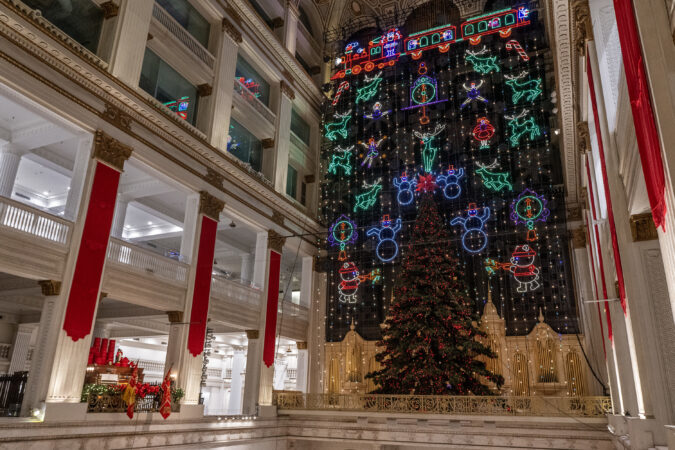
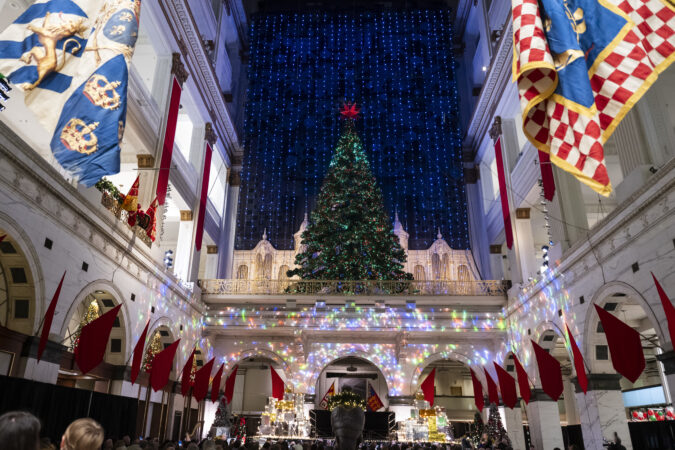
    The Christmas tree was indeed magical and the music, in turns, brilliant and warmly enveloping. Even the Wanamaker Eagle got into the act, crowned for the occasion with a lit Christmas wreath hung around its neck.

    A certain misty, nostalgic conjuring of Christmas past has reached its apotheosis in the Wanamaker Grand Court, and now the bittersweet countdown begins. Tuesday night’s “Home for the Holidays” concert is done, the Bearded Ladies Cabaret checks in next week, the Light Show and Dickens Village attractions run through Christmas Eve, and then the space closes for perhaps a couple of years while the building undergoes renovations.
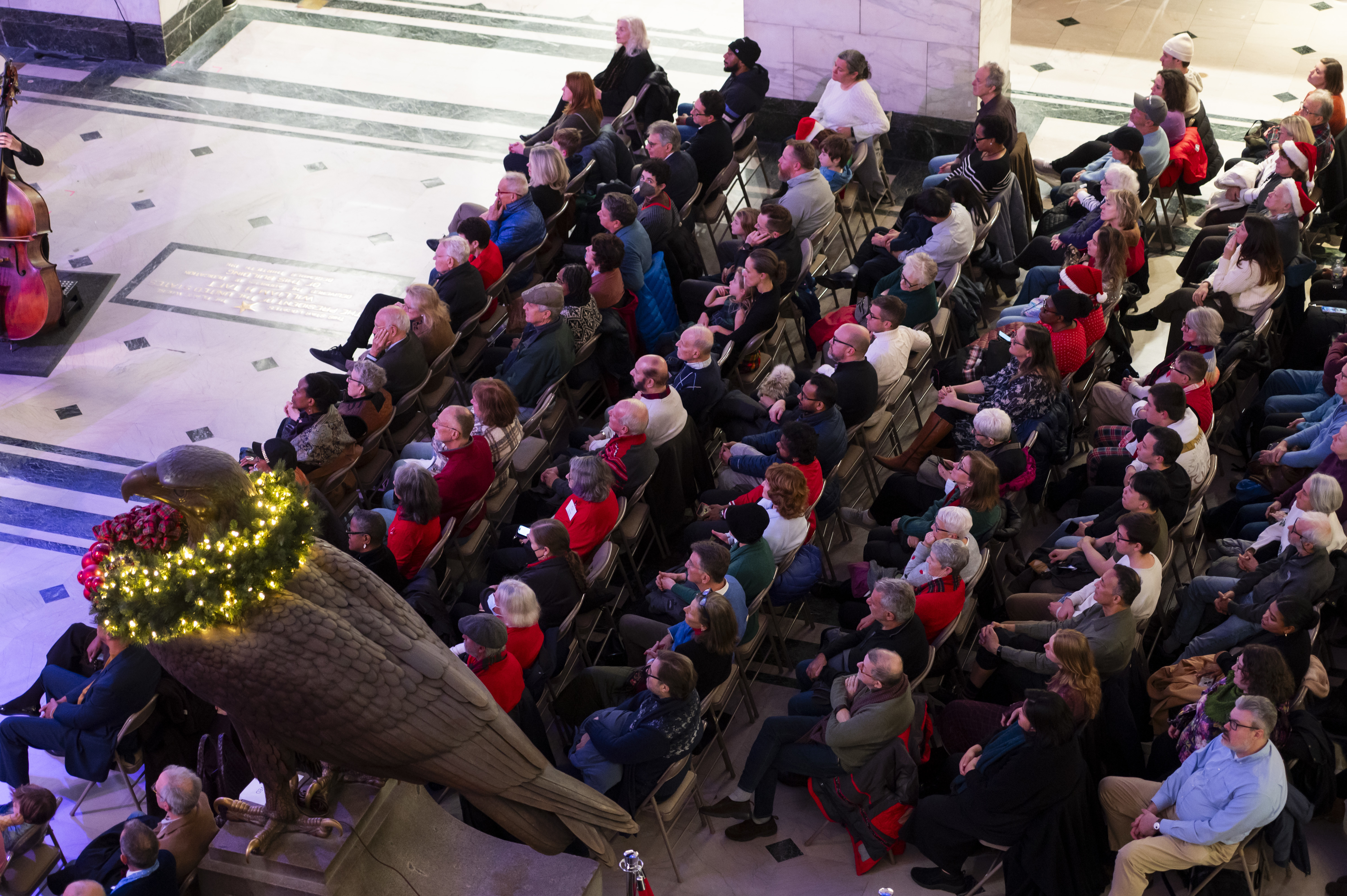
    The Wanamaker Eagle donned a lighted wreath for Tuesday night’s concert.

    The one-night-only concert in the former Center City Macy’s did exactly what it should have. In the best gritty Philadelphia tradition, it took a defeat — the departure of a major retailer and the imperilment of the beating heart of Christmas in the city — and turned it into a party.

    Opera Philadelphia was the creative director behind the event, which swung from sincere and spiritual (chorus members running their fingers around the wet rims of glasses to produce an ethereal shimmer) to the head-scratching (a couple of dancers in dinosaur suits moving to an excerpt from Philip Glass’s 1000 Airplanes on the Roof).
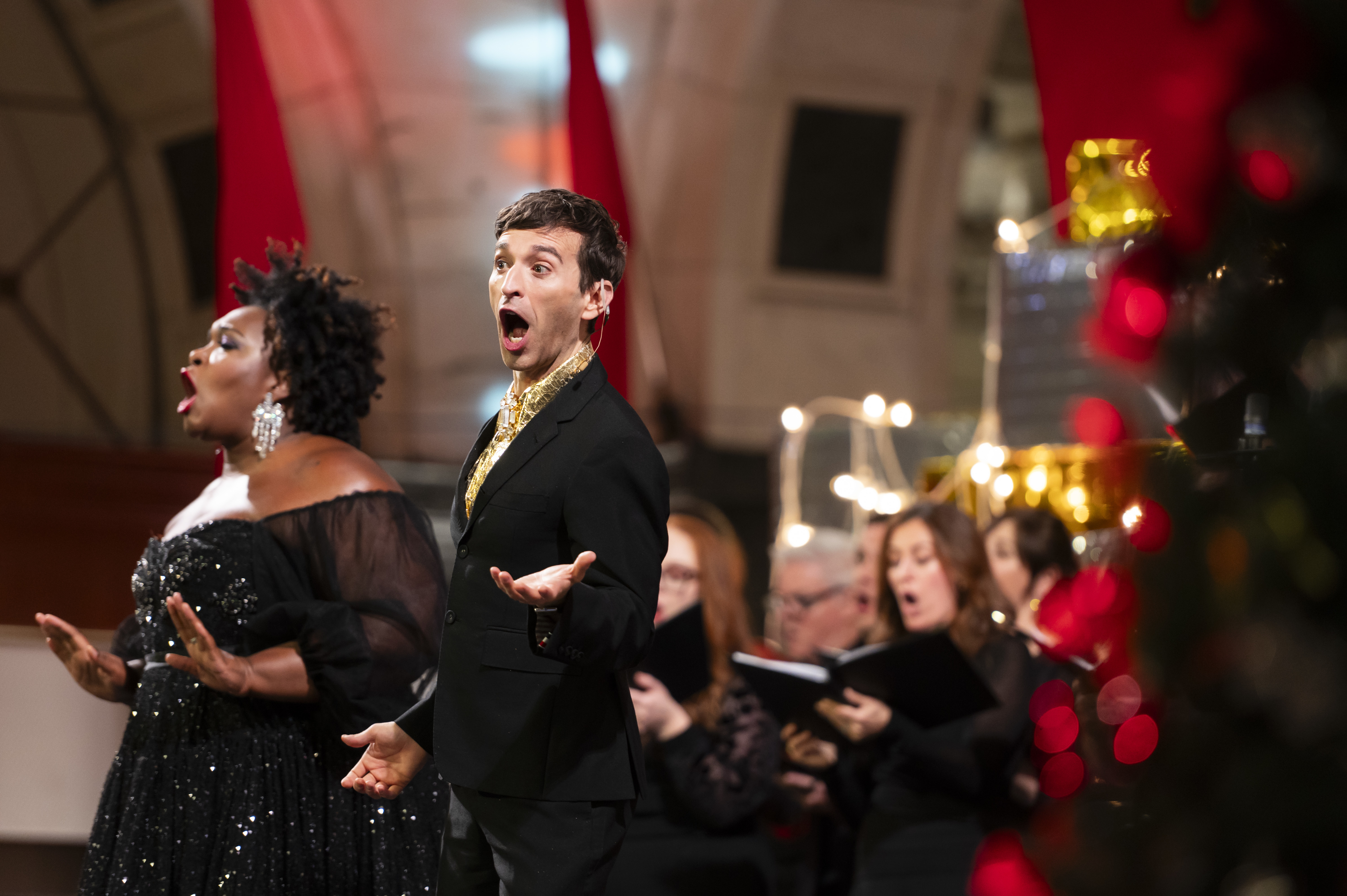
    Anthony Roth Costanzo (right), countertenor, and Leah Hawkins (left), soprano, perform during “Home for the Holidays” on Tuesday at the Macy’s Center City.

    The forces — orchestra, chorus, dancers, superb soprano Leah Hawkins, and clarion-countertenor (and Opera Philadelphia chief) Anthony Roth Costanzo led by conductor Geoffrey McDonald — delivered a variety-hour-plus celebration a la “Radio City Christmas Spectacular,” if in miniature.

    But the best vibe of the evening came from above via the hands and foot-peddling feet of organist Peter Richard Conte. He showed how a musician, instrument, and their space can seem made for each other, and why the Wanamaker Grand Court Organ is not one instrument, but many. The highly inventive organist called upon fat French horns and muted trumpets in his own arrangement of Victor Herbert’s “March of the Toys.”

    Pure joy.
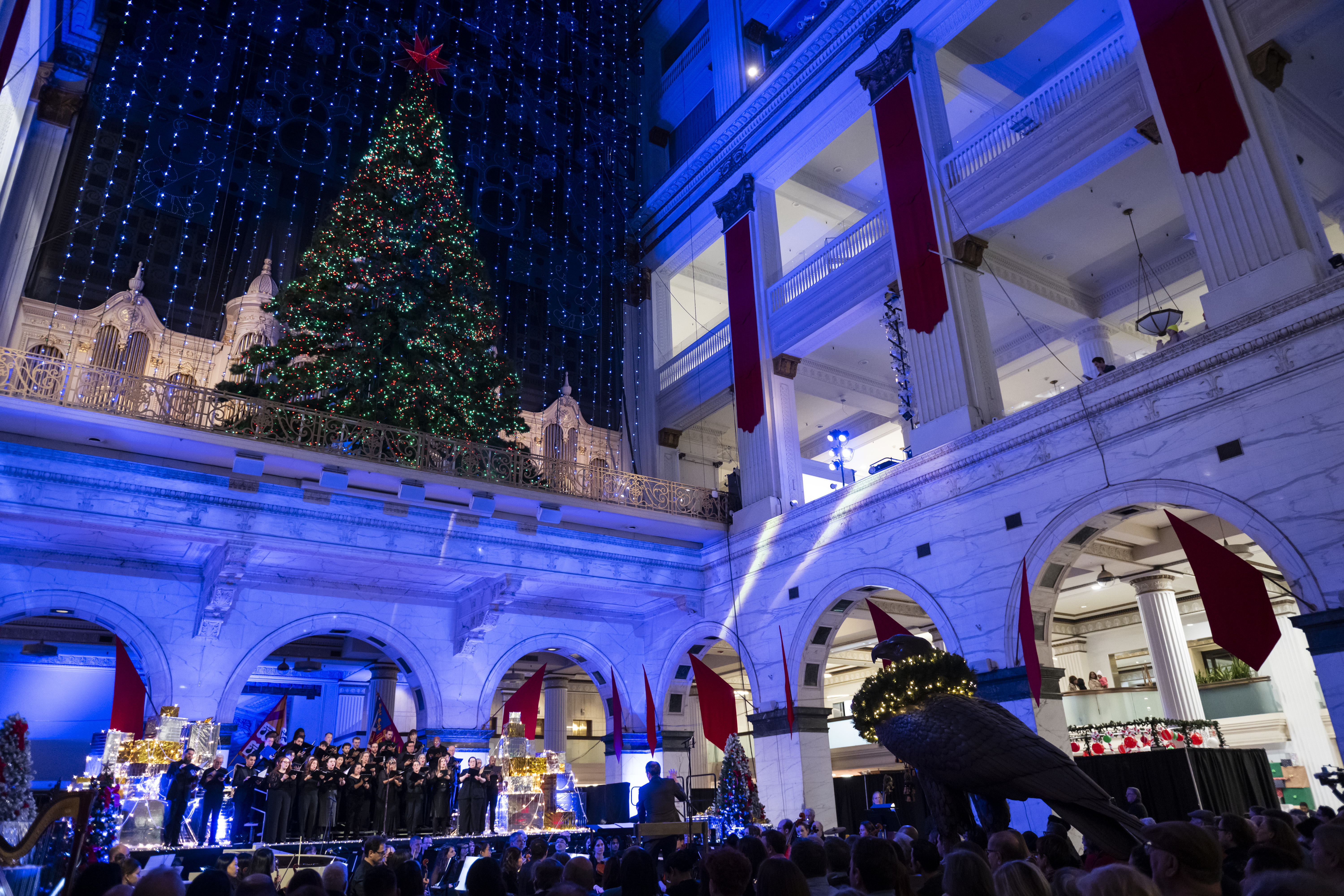
    The Opera Philadelphia chorus performs in “Home for the Holidays” at the Wanamaker Building’s Grand Court on Tuesday, Dec. 2, 2025.

    Christmas in this space triggers memories unique to each one of us, but it was a nice stroke by 10th Floor Productions to animate the marbled expanses around the courtyard’s arches with projected images of marching bears and soldiers for anyone who remembers the store as the source for holiday toys.
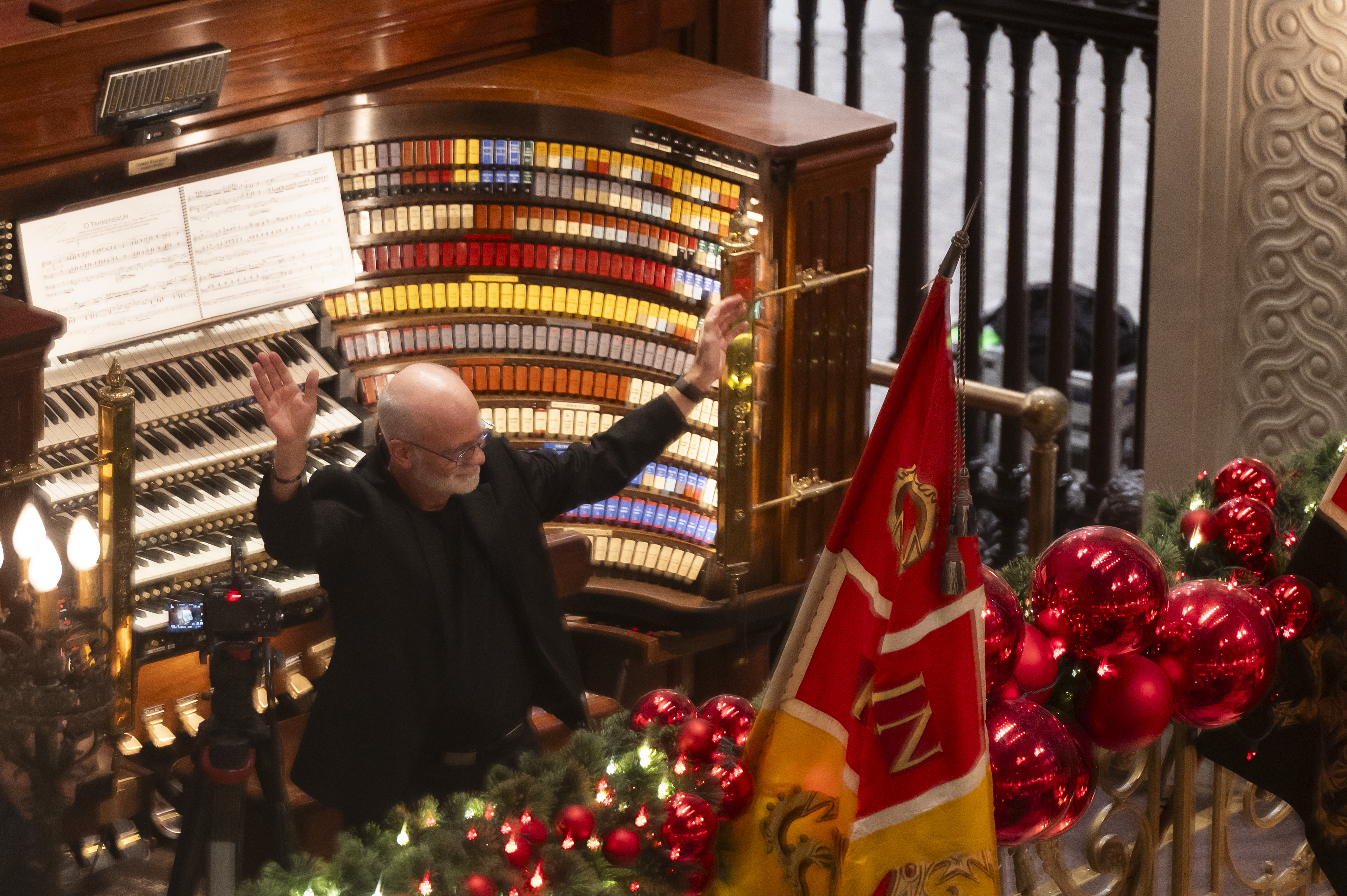
    Frederick R. Haas, philanthropist and organist, waves to the crowd during “Home for the Holidays” in the Wanamaker Grand Court.

    That the organ is still being played in this sliver of a post-Macy’s era is largely due to a $1 million donation from philanthropist Frederick R. Haas for the Pipe Up! series (as well as many previous gifts to the organ).

    Rarely have a donor and his cause been more personally intertwined. Haas is himself a trained organist who could sometimes be heard playing in the space in its department store days. On Tuesday, he played his medley A Christmas Improvisation, tapping into a supply of enormous, overtone-rich bells in “Silent Night” and beautiful, unusual harmonizations in “Carol of the Bells.”
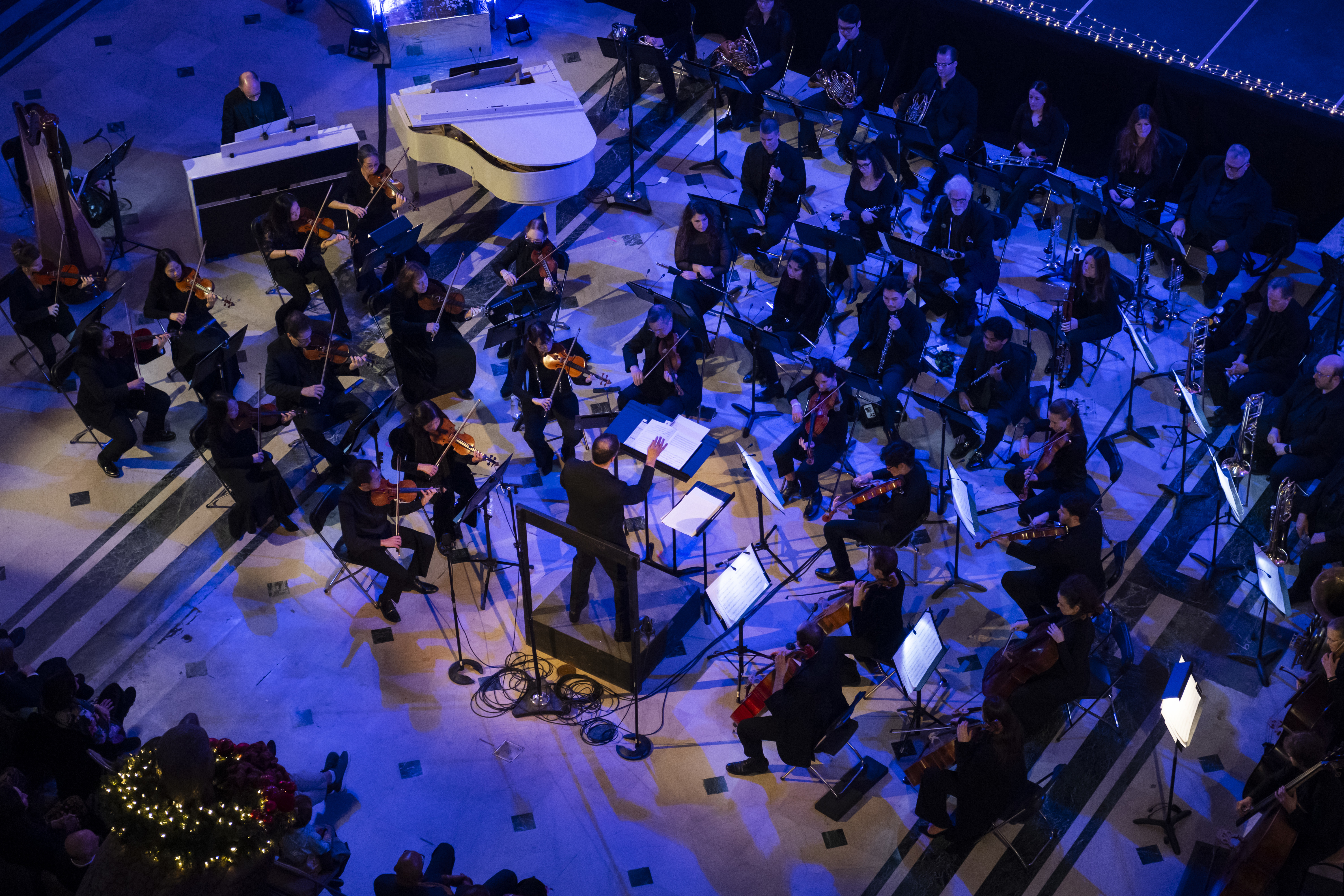
    Conductor Geoffrey McDonald leading the Opera Philadelphia Orchestra in the Wanamaker Grand Court.

    If the evening had a theme beyond Christmas, it was nostalgia.

    Sub rosa, though, this and every event in the Pipe Up! series in the past few months has been about the future — about making the case for the Wanamaker Grand Court as a space that should survive as a public right of way no matter its next life.

    TF Cornerstone, the building owner, has been generous and respectful of preserving public access so far. As the developer renovates and cuts deals with prospective tenants, access and the future of the organ as a daily presence hang in the balance.
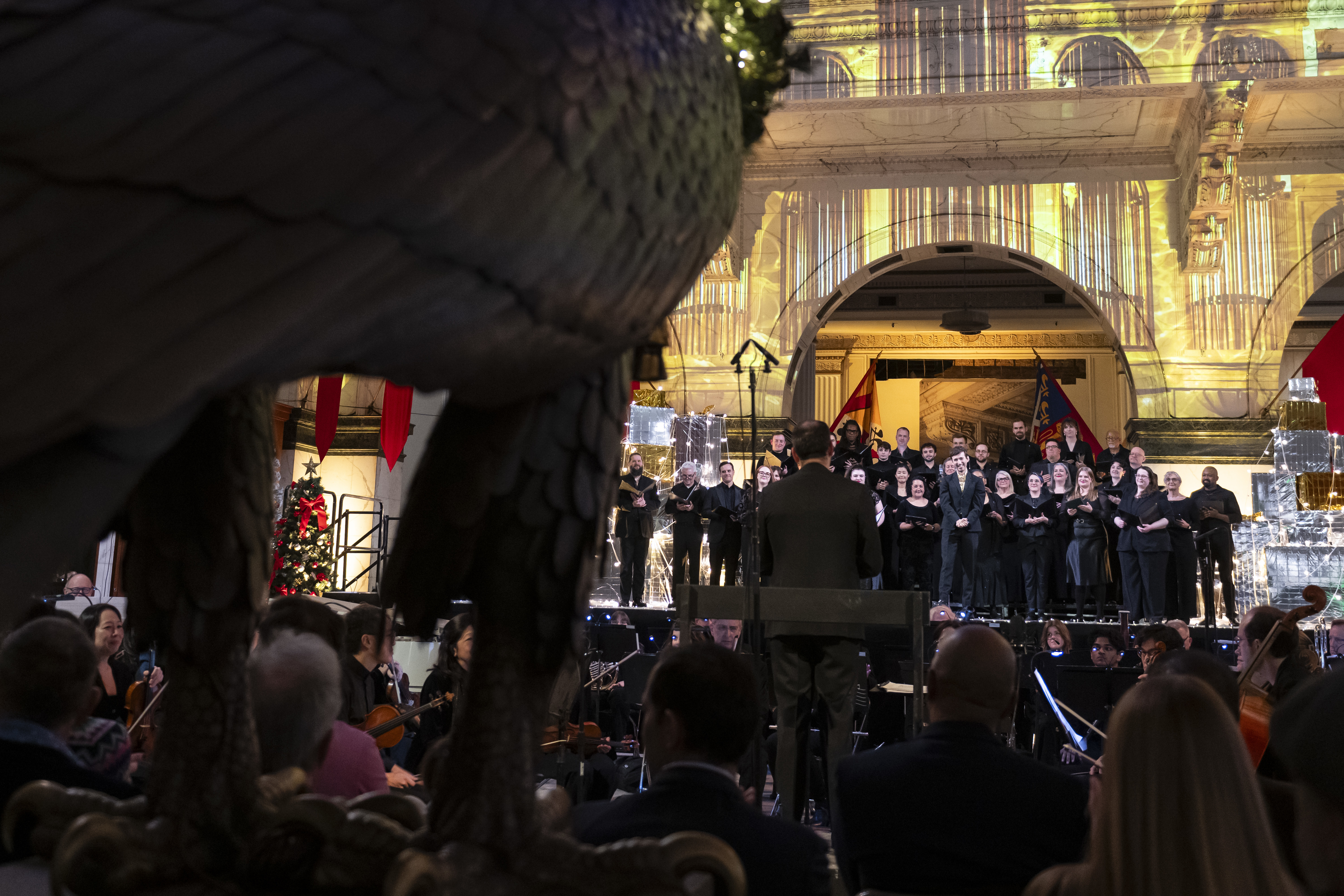
    The Opera Philadelphia orchestra, chorus, and vocal soloists in the Wanamaker Grand Court Tuesday night.

    One piece on Tuesday night was a reminder of the special dynamic at risk.

    When Opera Philadelphia flash-mobbed Macy’s with the “Hallelujah Chorus” from Handel’s Messiah in 2010, it packed a punch because of the surprise of it. Music was suddenly in the best place of all: somewhere you’d never expect it. That’s also the secret superpower of the organ.

    It was great to hear the “Hallelujah Chorus” here again. But heard now, it seems like a challenge issued, illustrating what the space once was and might one day be again.

    “Home for the Holidays” will be broadcast Dec. 23, 8 p.m. on WHYY TV12, WHYY radio (90.9 FM), and via whyy.org.

    The Pipe Up! series continues with the Bearded Ladies Cabaret’s “It’s Giving Cabaret” in the Greek Hall at the Wanamaker Building, 13th and Market Sts., Dec. 10-14. operaphila.org.

    The Wanamaker Light Show and Dickens Village run through Christmas Eve. visitphilly.com.
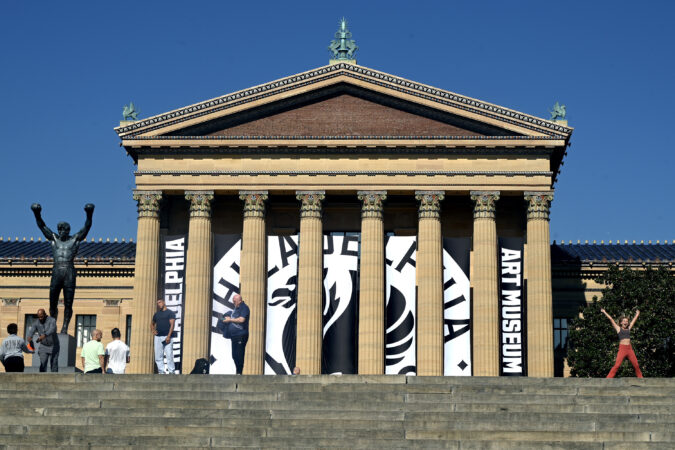
  • Read the Art Museum’s accusations against Sasha Suda in its new petition

    Read the Art Museum’s accusations against Sasha Suda in its new petition

    The Philadelphia Art Museum’s trustees responded to the lawsuit filed by recently-ousted director and CEO Sasha Suda, saying she was dismissed after an investigation determined that she “misappropriated funds from the museum and lied to cover up her theft.”

    On Thursday, the museum filed a petition in the Philadelphia Court of Common Pleas that says Suda repeatedly asked for raises, and when she was denied them by the museum board’s compensation committee, she took matters into her own hands.

    “Given Suda’s misconduct, no responsible board member could have done anything other than vote to remove Suda for cause,” says the petition, which asks the court to compel arbitration of the dispute. Suda had requested a trial by jury.

    “The museum’s accusations are false,” Suda’s lawyer, Luke Nikas of Quinn Emanuel Urquhart & Sullivan said Friday.

    “If the museum had nothing to hide, it would not be afraid to litigate in state court where we filed the case.”

    In her original complaint, Suda claims she was “terminated when her efforts to modernize the museum clashed with a small, corrupt, and unethical faction of the board intent on preserving the status quo. The museum, in their petition said her complaint was “laden with false, dishonest, and irrelevant allegations.”

    Read the full petition here:

    <iframe src="https://drive.google.com/file/d/1LibHWT0xtHNWSOpZQDga8y-6qMTn0jdl/preview" width="640" height="480" allow="autoplay"></iframe>

    Additional reporting by Abraham Gutman.

  • Philadelphia Art Museum accuses Sasha Suda of ‘theft’ in new filing

    Philadelphia Art Museum accuses Sasha Suda of ‘theft’ in new filing

    The Philadelphia Art Museum’s trustees fired back at a lawsuit filed by recently ousted director and CEO Sasha Suda, saying she was dismissed after an investigation determined that she “misappropriated funds from the museum and lied to cover up her theft.”

    In Thursday’s filing with the Philadelphia Court of Common Pleas, the museum said that Suda repeatedly asked for raises, and when she was denied them by the museum board’s compensation committee, she took matters into her own hands.

    “Suda took the money anyway,” the petition alleges, defying the board and violating her contract.

    “Given Suda’s misconduct, no responsible board member could have done anything other than vote to remove Suda for cause,” says the petition, which asks the court to compel arbitration of the dispute. Suda had requested a trial by jury.

    Suda was fired Nov. 4 for what the museum at the time called cause, and she filed her wrongful-dismissal suit less than a week later.

    “The museum’s accusations are false,” Suda’s lawyer, Luke Nikas of Quinn Emanuel Urquhart & Sullivan said Friday.

    “The motion, as well as its false narrative, fits the Philadelphia museum’s longstanding pattern of trying to cover up its misconduct and mistreatment of staff. We expected the museum would prefer to hide the sordid details about its unlawful treatment of Sasha Suda in a confidential arbitration. If the museum had nothing to hide, it would not be afraid to litigate in state court where we filed the case.”

    The money in question came as increases to Suda’s compensation, and these increases were “authorized” and “budgeted” cost-of-living increases that were “fully approved” and “disclosed,” and amounted to about $39,000 over two years, a source close to Suda stated previously.

    Another source with knowledge of the petition said the raises mentioned in the petition are, in fact, the same as the cost-of-living adjustment the first source refers to.

    Sasha Suda at the Philadelphia Art Museum, Jan. 30, 2024.

    Suda was in the third year of a five-year contract when she was dismissed.

    The museum on Friday named Daniel H. Weiss, a veteran leader of nonprofits, including the Metropolitan Museum of Art, to be its new director and CEO.

    Thursday’s court filing by the museum said that the board formed a seven-member special committee after documents showed that Suda was “receiving far more than the $720,000 in annual base salary” authorized by her contract.

    According to the petition, the special committee “was authorized to investigate issues including whether Suda had engaged in self-dealing by increasing her annual base salary and engaged in any improprieties with respect to her museum-related expenses.”

    The special committee hired law firm Kirkland & Ellis to conduct an investigation, which interviewed 20 current and former museum board members and employees.

    Suda was among those interviewed, and during that interview, she “lied about her actions, claiming, among other things, that her subordinates had advised her that she was entitled to receive these increases,” the court filing says.

    The special committee met with Kirkland & Ellis in October to review the evidence, and, as stated by the filing, the museum’s “executive committee determined that the evidence overwhelmingly established that Suda violated her agreement by misappropriating museum funds and engaging in repeated acts of dishonesty.”

    The petition alleges that Suda requested, and was denied, a salary increase from the compensation committee on Feb. 8, 2024. She then “awarded herself the salary increase” effective March 1, 2024, followed by a second “unauthorized” increase in July of that year. In July 2025, Suda “awarded herself a third unauthorized pay increase, which she once again failed to disclose to the board,” according to the museum’s petition.

    Suda, in her complaint, claims she was “terminated when her efforts to modernize the museum clashed with a small, corrupt, and unethical faction of the board intent on preserving the status quo.”

    She seeks two years’ salary plus damages.

    Thursday’s response from the museum said her complaint was “laden with false, dishonest, and irrelevant allegations.”

    Inquirer staff writer Abraham Gutman contributed to this article.

  • Philadelphia Art Museum names a new director and CEO

    Philadelphia Art Museum names a new director and CEO

    The Philadelphia Art Museum, seeking to calm the waters after a turbulent six-week stretch, has named an experienced hand, Daniel H. Weiss, as director and CEO.

    Weiss, 68, was president of Haverford College starting in 2013 and left the post in 2015 to lead the Metropolitan Museum of Art in New York, staying eight years. Prior to Haverford, he was president of Lafayette College.

    The decision was approved Friday morning by the Art Museum’s trustees with a unanimous vote, a spokesperson said.

    Weiss’ appointment comes as something of a surprise. The museum had been expected to name an interim director while it searched for a permanent one. Right now, Weiss is set to remain in the post only through the end of 2028, though his tenure could be extended.

    He takes over an institution left shaken by the Nov. 4 firing of its director and CEO, Sasha Suda, after an investigation by an outside law firm flagged the handling of her own compensation. She filed a wrongful termination lawsuit against the museum less than a week later.

    Weiss said Friday that despite the recent turmoil, the museum had all of the important required ingredients it needed for its future — a great collection, staff, buildings, and mission.

    “What we have to do is clean things up and reaffirm our commitment to that mission,” he said. “I don’t think the challenges are so steep. They have to be addressed, they are real, but they are not overwhelming.”

    The first thing he will do, he said, is to sit down with the staff, board, donors, and other constituents, and through these conversations the museum’s priorities would emerge.

    “I know less about these issues than anybody else does at this point, so I need to listen and to learn,” he said.

    Art Museum board chair Ellen T. Caplan was not available for comment, a spokesperson said, but she said in a statement that the museum was “extraordinarily fortunate to have someone of Dan Weiss’s caliber and experience step into this critical role.”

    His proven track record of museum leadership, along with his “deep understanding of the field, and his ability to navigate complex institutional challenges,” she said, “make him ideally suited to provide stability and strategic direction during this critical period for the art museum.”

    Weiss comes to his new post with both substantial art and business credentials. An art historian, he holds a master’s degree in medieval and modern art and a Ph.D. in western medieval and Byzantine art, both from Johns Hopkins University. He previously earned an MBA from Yale School of Management and worked for consulting giant Booz Allen Hamilton.

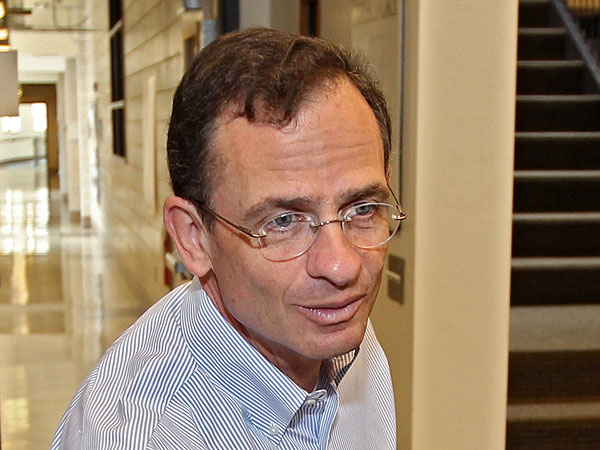
    Daniel Weiss at Haverford College after being named the college’s president in 2013.

    He was at Haverford College for a little less than two years before being hired away to lead the Met along with director Thomas P. Campbell. With Campbell’s departure in 2017, he took on the title of chief executive. He worked alongside Max Hollein after Hollein became director in 2018. Weiss left the Met in 2023.

    He was the head of Haverford College in 2014 when it received its largest single gift to date at the time — $25 million from Howard Lutnick, then-chairman of the college’s board of managers and a Haverford graduate. (Lutnick is currently U.S. secretary of commerce.)

    Weiss brings to the Art Museum another storehouse of knowledge. He recently worked as a consultant to the museum’s board, a museum spokesperson said.

    He is no stranger to controversy. At the Met, he helped the museum grapple with decisions such as the end of its longtime pay-as-you-wish admission policy, as well as the question of whether to cut ties with the Sackler family, whose company, Purdue Pharma, manufactured and marketed the opioid painkiller OxyContin.

    The museum in 2019 announced it would stop accepting gifts from the Sacklers, and in 2021 it removed the family’s name from a number of exhibition spaces, including the wing that houses the popular Temple of Dendur.

    Weiss was also at the Met when the museum faced a set of circumstances not unlike some of those the Philadelphia Art Museum is facing now. In 2017, struggling with a deficit, the Met decided to pause plans for a $600 million expansion. Instead, it focused on more mundane, if important, projects, like work on the roof and skylights.

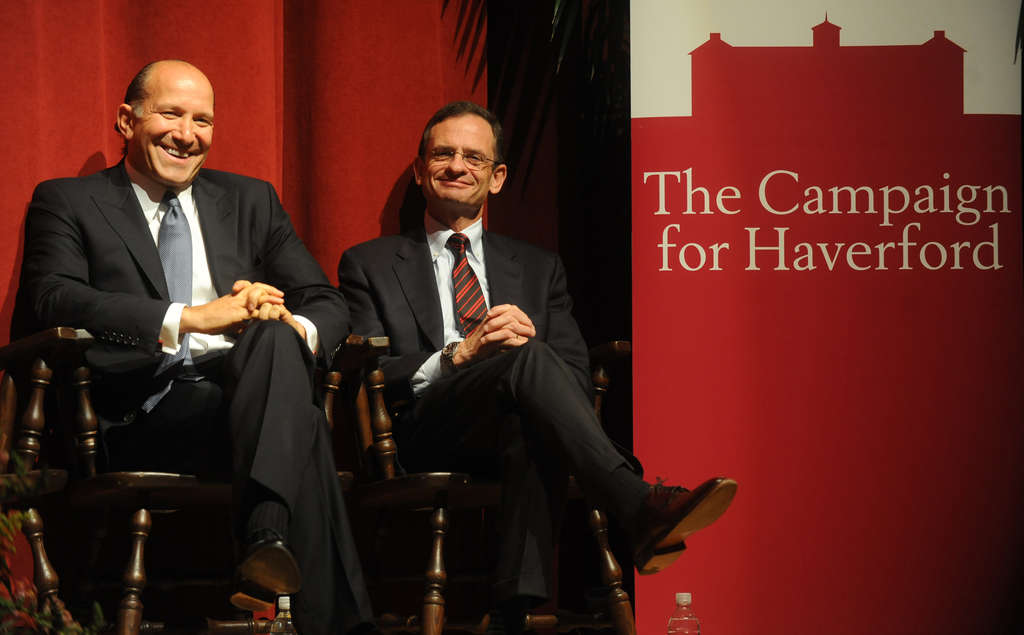
    Howard Lutnick (left) with Haverford College then-president Daniel Weiss for the 2014 announcement of Lutnick’s $25 million gift to the school.

    Most recently, for the past two years, Weiss has been a humanities professor and senior advisor to the provost for the arts at Johns Hopkins University.

    Suda filed a lawsuit on Nov. 10 against her former employer. Her lawyer said that she was the victim of a “small cabal” from the board that commissioned a “sham investigation” as a “pretext” for her “unlawful dismissal.”

    The Art Museum on Thursday responded to the lawsuit in Philadelphia Court of Common Pleas with a petition saying Suda was dismissed after an investigation determined that she “misappropriated funds from the museum and lied to cover up her theft.” Her lawyer called the museum’s accusations false. “These are the same recycled allegations from the sham investigation that the museum manufactured as a pretext for Suda’s wrongful termination,” he said.

    The Art Museum has a list of short- and long-term challenges with which it must grapple. Among them is the question of whether to roll back the recent name change and rebrand, which have been widely mocked and disliked.

    It also has several big pieces of the operational, facilities, and financial puzzle to prioritize. The Perelman annex was closed to the public during the pandemic and has not reopened; a planned expansion of gallery space beneath the museum’s east steps is in limbo; deferred maintenance on the main building awaits attention; the endowment is considered inadequate for an institution of its size.

    In addition, the museum is challenged by an operating deficit and visitorship numbers that have not recovered post-pandemic.

    Weiss — who is expected to take over the museum Dec. 1 — is the author of several books, including a recent one that explores the place of the art museum in society throughout history and examines its challenges today in the larger culture. Its title suggests the case he will need to make as the museum’s 15th director: Why the Museum Matters.

    “This is a great museum with a bright, important future,” said Weiss, “and our ability to fulfill our mission requires everyone’s involvement.”

  • Hark! A Christmas concert is popping up at the Wanamaker Building

    Hark! A Christmas concert is popping up at the Wanamaker Building

    The Wanamaker Grand Court won’t just have the Light Show back again this year but will also host a one-night-only concert with orchestra, chorus, singers, and Wanamaker Grand Court Organist Peter Richard Conte.

    “Home for the Holidays,” on Dec. 2, will feature holiday classics like Sleigh Ride, “The Christmas Song,” and “O Holy Night,” as well as classical works, such as David Ludwig’s Hanukkah Cantata.

    The performance will be recorded by WHYY for radio and TV broadcast and streaming later in the month.

    The event is another in a series dubbed Pipe Up! programmed in the space vacated by Macy’s in March. Philadelphia philanthropist Frederick R. Haas donated $1 million to help keep the Grand Court and Greek Hall open and accessible to the public with concerts, films, and other activities in the span of a few months before building owner TF Cornerstone begins renovations on the building early next year.

    Separately, responsibility for the holiday Light Show and Dickens Village have passed from Macy’s to a partnership of the Philadelphia Visitor Center and TF Cornerstone. Both Christmastime attractions open this year on Friday, Nov. 28, and are expected to be placed on pause for 2026 and 2027 during construction.

    The Dec. 2 concert will be led by conductor Geoffrey McDonald, and features the Opera Philadelphia Orchestra and Chorus. Soprano Leah Hawkins will perform, as will the opera company’s general director and president, countertenor Anthony Roth Costanzo. Philly-based creative design agency 10th Floor Productions will craft and project art onto the Grand Court as the music is performed.

    In addition, the former Macy’s space will host a Christmas Market starting on Black Friday, as well as pop-up food service offering snacks, craft beers, and holiday fare.

    More Pipe Up! events are being planned and are expected to be announced soon, a spokesperson said.

    “Home for the Holidays,” Dec. 2, 8 p.m., Wanamaker Building, 13th and Market Sts. Pick Your Price tickets starting at $11 go on sale on Thursday at operaphila.org. The concert will be broadcast Dec. 23, 8 p.m. on WHYY TV12, WHYY radio (90.9 FM), and via whyy.org.

  • Benita Valente, revered Philadelphia soprano with Met Opera and one of America’s great lieder artists, has died at 91

    Benita Valente, revered Philadelphia soprano with Met Opera and one of America’s great lieder artists, has died at 91

    Benita Valente, 91, a revered lyric soprano whose voice thrilled listeners with its purity and seeming effortlessness, died Friday night at home in Philadelphia, said her son, Pete Checchia. In a remarkable four-decade career, she appeared on the opera stage, in chamber music, and with orchestras.

    In the intimate genre of lieder — especially songs by Schubert and Brahms — she was considered one of America’s great recitalists.

    Even during an era of towering, individualistic voices, Ms. Valente stood out as something special. With pinpoint-precise technique, she deployed no vocal cheats or affectations. Her recognizable sound and honest approach were adored by aficionados.

    “She is as gifted a singer as we have today, worldwide,” wrote John Rockwell in the New York Times in 1983.

    Her voice had a natural quality, said pianist Richard Goode, who recalled that it was Ms. Valente who introduced him to the lieder repertoire. “There was an extraordinary distinctive sweetness of the timbre. Very clear pitch. Very focused,” said Goode, who recorded with her. ”And a kind of natural charm that came through in everything that she sang.”

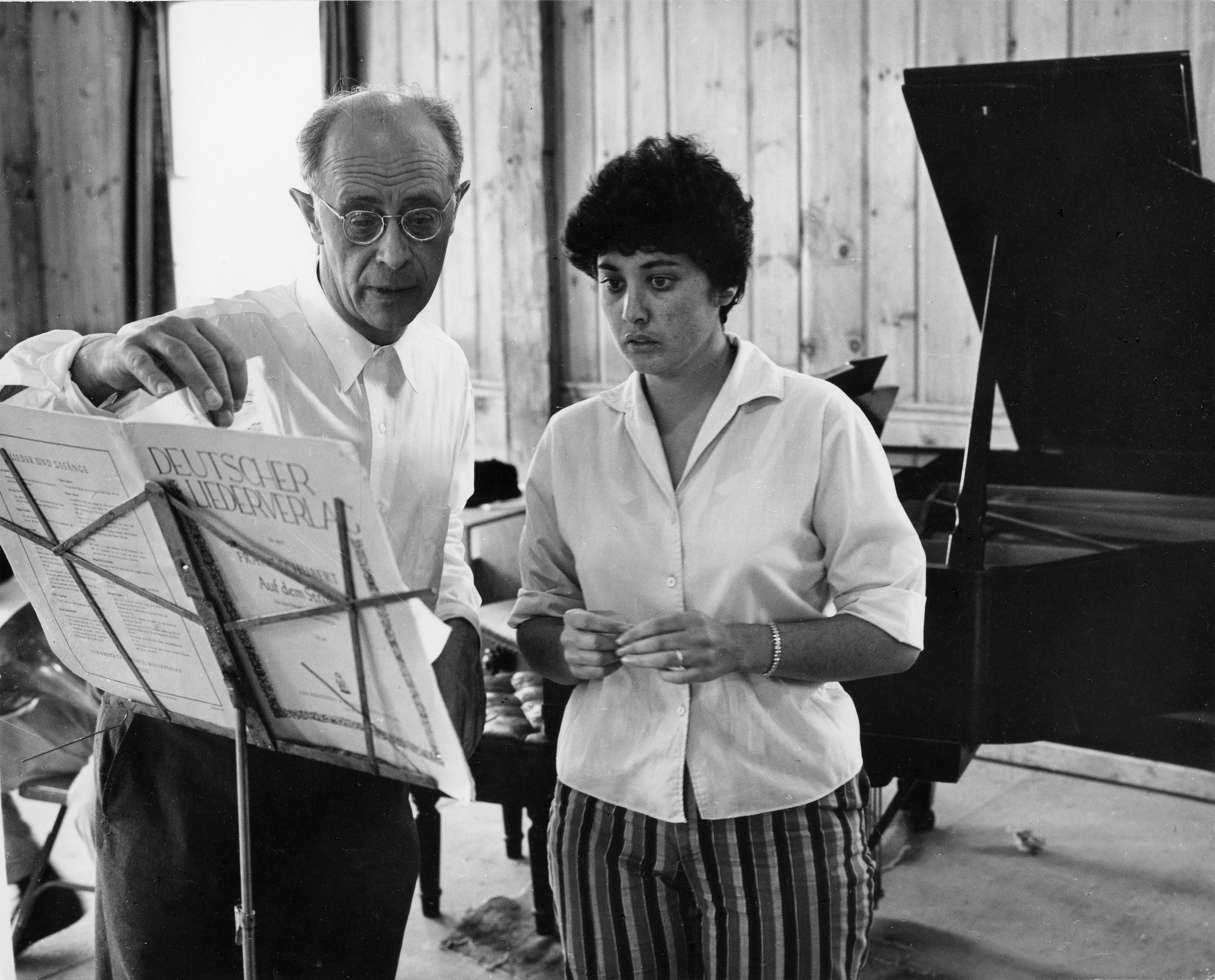
    Pianist Rudolf Serkin with soprano Benita Valente at Marlboro Music, 1960s.

    A longtime resident of Rittenhouse Square, Ms. Valente sang in the opera houses of San Francisco, Santa Fe, N.M., Germany, and Italy, and the Teatro Colón in Buenos Aires. She appeared with the Metropolitan Opera more than 70 times between 1960 and 1992 — as Pamina in Die Zauberflöte, Almirena in Handel’s Rinaldo, Gilda in Rigoletto, Susanna in Le Nozze di Figaro, and others.

    With the Juilliard String Quartet, she gave the world premiere of Ginastera’s String Quartet No. 3 in 1974, and was the voice for the Juilliard’s recording of Schoenberg’s String Quartet No. 2 in a collection that won a 1978 Grammy Award.

    In 1999, she became the first vocalist to win Chamber Music America’s Richard J. Bogomolny National Service Award.

    Critics pronounced her voice “incomparable” and “almost miraculously lovely.”

    She had something more: “that special projection of personality that distinguishes the great artist,” the Times wrote.

    The artist had her beginnings as a self-described shy tomboy growing up on her uncle’s farm in California’s San Joaquin Valley. Ms. Valente was born Oct. 19, 1934, in Delano, Calif., the daughter of an Italian father and a Swiss mother. A high school teacher noticed her gifts and recommended her to Lotte Lehmann, and as a teenager she traveled from home to Santa Barbara to study with the celebrated soprano and Lehmann’s brother, vocal coach Fritz Lehmann.

    “She didn’t know what to do with me,” Ms. Valente told The Inquirer. “I’d sing something she thought was very touching, and then there were lapses where I was as green as all get-out. She finally said, ‘I have contacts in Hollywood, I could get you to a screen test. I think you’d do very well.’ But I wanted to go into opera.”

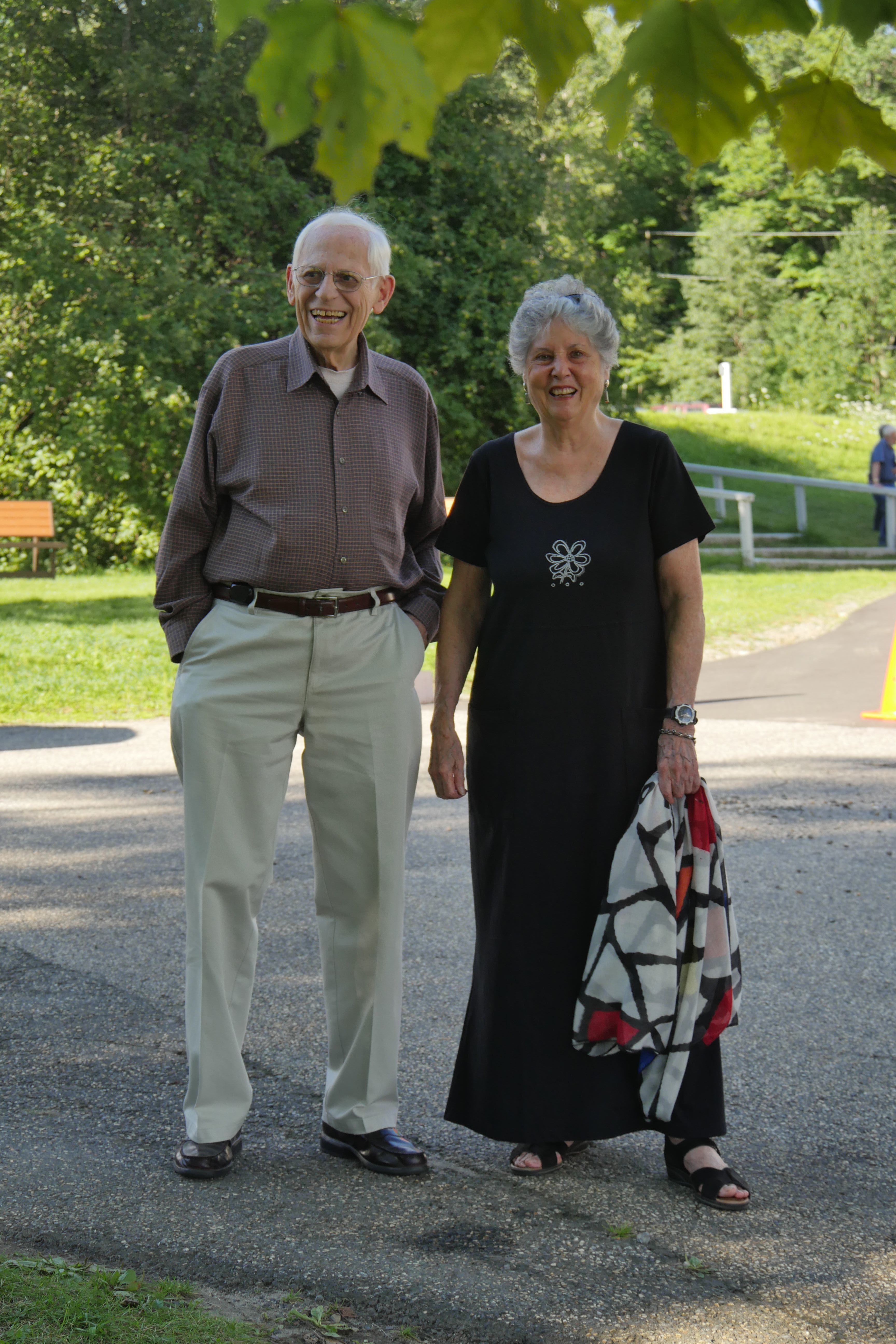
    Benita Valente with her husband, Anthony P. Checchia, at the Marlboro Music Festival.

    It was Fritz Lehmann who suggested that she audition for the Curtis Institute of Music with Mozart, and she got in. Ms. Valente attended Curtis from 1955 to 1960, where her primary teacher was French baritone Martial Singher, and later studied with Wagnerian soprano/mezzo-soprano Margaret Harshaw. She was still a student when she won a Philadelphia Orchestra student competition that brought a 1958 debut with the orchestra.

    The next year she married Anthony P. Checchia, a bassoonist she met at the Marlboro Music Festival who would go on to lead both Marlboro and the Philadelphia Chamber Music Society. They became one of classical music’s power couples, and had a special understanding because of their modest backgrounds — he from Tacony, she from a farm — said their son. “I remember my dad pulling over on Lombard Street once when she was on the radio. He was more nervous than she was,” Pete Checchia said. Anthony Checchia died in 2024.

    Ms. Valente became a regular soloist with the Philadelphia Orchestra, appearing with the ensemble 60 times — in core repertoire of Mozart and Beethoven, but also in contemporary works. She gave the world premiere in 1981 of David del Tredici’s All in the Golden Afternoon from Child Alice, Part II, with Eugene Ormandy conducting the Philadelphians.

    The work was in an ecstatic, neo-romantic musical language, thickly orchestrated with amplified soprano. Ms. Valente’s performance was “an essay in vocal purity,” wrote Inquirer music critic Daniel Webster.

    For the Academy of Music 130th Anniversary Concert in 1987, she sang an evening of Puccini arias with the Philadelphia Orchestra led by legendary conductor Klaus Tennstedt. ‘’O mio babbino caro” from Gianni Schicchi seemed an ideal choice, Webster wrote, “in which her sun-filled voice illuminated the joyous text.”

    American soprano singer Benita Valente, Germany, 1970s.

    Ms. Valente was soloist the previous season for one of the orchestra’s most notorious programs. She was Mélisande in a concert version of Debussy’s Pelléas et Mélisande at which an unusual number of listeners, apparently unimpressed with one of Western civilization’s great achievements, walked out. One man in the Academy of Music’s second row stretched out a newspaper and was asked to leave, she recalled.

    “It has too much mystery, that Pelléas,” Ms. Valente told The Inquirer years later, pointing out that the audience seemed similarly disenchanted with the work at a Metropolitan Opera performance she attended.

    Ms. Valente was never a household name, which often confounded critics. Some put it down to her lack of diva-ness. But it was perhaps more the fact that Ms. Valente was never a careerist. She was known to turn down prestigious opportunities — like a chance to sing Berg’s Altenberglieder with the Boston Symphony Orchestra — when she felt the part was not right for her voice.

    She retired from singing in 2000 and was awarded an honorary degree from Curtis in 2001.

    Benita Valente with soprano Lucy Fitz Gibbon in 2021.

    Ms. Valente taught and mentored young singers.

    “She was so meticulous about connecting the vowels and would listen in between the notes to how you got from one note to the next,” said soprano Sarah Shafer, who studied with Ms. Valente at Marlboro and in Philadelphia. “That trained my ear and my voice to pay attention to those things and brought me to a different level of detail.”

    Her knowledge of the repertoire was vast, said pianist Lydia Brown, with whom Ms. Valente worked in vocal coachings at Marlboro and the Met. “Every rehearsal she came to was a piece she had sung many times, or she commissioned it or premiered it. There were so few pieces that Benita didn’t have active performing knowledge of.”

    In recordings she is particularly renowned for a collection of Handel and Mozart duets with soprano Tatiana Troyanos; Haydn’s The Seven Last Words of Christ with the Juilliard String Quartet; and two discs in Bridge Records’ “Great Singers of the 20th Century” series, including a classic recording of Schubert’s “The Shepherd on the Rock” with pianist Rudolf Serkin and clarinetist Harold Wright.

    “She was in the old-school style of singing, where the singer is just a vessel for the music. Not selfish, not about herself, she was just delivering the music in as clear and undistorted a way as possible,” said Shafer, who learned “The Shepherd on the Rock” from Ms. Valente and has made it a calling card of her own.

    ”The result is this sparkly, silver jewel of her voice that you hear in these recordings. There’s just no singing like it now.”

    In addition to her son, the Philadelphia photographer Pete Checchia, Ms. Valente is survived by her “daughter by choice,” Eliza Batlle, Checchia said. A memorial concert is planned for a later date.

  • Hilary Hahn and Lang Lang cancel their Kimmel Center concert

    Hilary Hahn and Lang Lang cancel their Kimmel Center concert

    Two of classical music’s biggest stars slated to perform together in Philadelphia have canceled their appearance.

    Hilary Hahn is still recovering from a double pinched nerve, and the violinist’s Dec. 4 Kimmel Center recital with pianist Lang Lang won’t be rescheduled, Philadelphia Orchestra and Ensemble Arts announced Thursday.

    The recital was to have been repeated a few days later in New York City’s Carnegie Hall, and that performance, too, has been canceled.

    Both Hahn and Lang Lang were trained at Philadelphia’s Curtis Institute of Music, where their conservatory days overlapped in the late 1990s.

    Hahn announced this past summer that she was canceling performances through November for the same reason. At the time she wrote on social media that “while I thought I was fully recovered from my injury last season, I’m not. I have a lot more left to say on the violin and I’m not giving up! I will miss you and I hope to see you all soon.”

    The next artist scheduled in POEA’s recital series is Víkingur Ólafsson, the Icelandic pianist whose Bach Goldberg Variations in 2024 with the Philadelphia Chamber Music Society had the audience “universally over the moon,” said PCMS artistic director Miles Cohen. Ólafsson has recorded works of Bach, Mozart and his contemporaries, Philip Glass, and Debussy.

    Ólafsson’s March recital in Marian Anderson Hall includes Bach, Beethoven, and Schubert.

    Ticket holders for the Hahn-Lang Lang recital will receive a gift certificate for the value of their tickets, a POEA spokesperson said.

    ensembleartsphilly.org, 215-893-1999

  • Pew Charitable Trusts chief to step down

    Pew Charitable Trusts chief to step down

    The head of the Pew Charitable Trusts is stepping down.

    Susan K. Urahn, president and CEO, is expected to retire in early 2027 after a search for a successor is completed and the new leader has begun working at the organization, a Pew spokesperson said.

    Urahn, 72, began at Pew in 1994 and took the top job in 2020 following the retirement of longtime chief Rebecca W. Rimel.

    Neither Urahn nor board chair Christopher Jones were made available for interviews. But, in a statement posted on Pew’s website, Urahn said she was fortunate to work with colleagues and a board “all dedicated to finding common ground and using facts as the foundation for discussion and action.”

    “Under Sue’s leadership, Pew has become even better and stronger,” read a statement attributed to Jones.

    Pew — which has offices in Philadelphia, Washington, D.C., and other cities — is a combination foundation/think tank, conducting research and disbursing grants to nonprofit organizations.

    In Philadelphia, it awards money to arts groups through the Pew Center for Arts and Heritage. Its D. C-based Pew Research Center provides research on demographic trends and social issues, as well as polling on matters like politics, religion, climate change, and the role of technology in daily life.

    Pew’s work is funded through seven charitable trusts established between 1948 and 1979 by the children of Sun Oil Co. founder Joseph Newton Pew and his wife, Mary Anderson Pew. As of June 2024, the collective value of the trusts was $6.1 billion, a spokesperson said.

    In addition to funding Philadelphia arts groups and individual artists, Pew has sometimes taken a more activist role by partnering with other philanthropists on large civic projects costing tens of millions of dollars, such as the 2012 move by the Barnes Foundation from Merion to the Ben Franklin Parkway. In 2008, Pew contributed millions toward a bailout of the Kimmel Center that relieved it of debt left over from the arts center’s construction phase.

    In 2023, it announced the award of $4 million for Esperanza Health Center in North Philadelphia to expand services.

    Urahn, most recently based in D.C., worked her way through several posts — including director of Pew’s planning and evaluation division; director of the Pew Center on the States; and executive vice president for Pew’s work on state policy, economics and healthcare.

    A search for a new president is expected to begin in January.

  • The Wanamaker Building is turning into a film theater for the spooky season

    The Wanamaker Building is turning into a film theater for the spooky season

    Ghostly films will meet ghosts of department stores past in a pop-up film series leading up to Halloween. Film historian and former Inquirer film critic Carrie Rickey has curated five silent films from the 1920s to be shown at the Pipe Up! series in the Wanamaker Building — each one accompanied by live organ.

    Among the films being screened are Robert Wiene’s The Cabinet of Dr. Caligari (1920) and F.W. Murnau’s Nosferatu (1922) and Faust (1926).

    “What was scary a century ago when the great German filmmakers invented these templates of the modern horror movie aren’t exactly spine-tingling today,” said Rickey. “But they are creepy, in the manner of folk and fairy tales — and artists like Hieronymus Bosch. They get under the skin. And they’re inventive.”

    Also being shown are two lesser-known Swedish films: Victor Sjöström’s The Phantom Carriage (1921) — “a huge influence on Ingmar Bergman,” says Rickey — and Häxan (1922), Benjamin Christensen’s film purporting to be documentary.

    “It hypothesizes what medievalists called possessed nuns and black sabbaths, and what Freud would call female hysteria. It is the earliest example of goth horror that I’ve ever seen,” Rickey said.

    The screenings are scheduled to take place in the Wanamaker Building’s Greek Hall, which means the musical accompaniment will be played on an instrument that gets considerably less attention than the one in the Grand Court.

    That smaller instrument is a theater organ, a restored 1929 Wurlitzer originally from the Fox Theatre in Appleton, Wis.

    “It’s pristine, it hasn’t been fooled with like a lot of Wurlitzers,” said Friends of the Wanamaker Organ president Ray Biswanger. “It’s got a lot of color in it and represents well the experience of hearing a silent movie.”

    Organists have different approaches to scoring silent film, said Peter Richard Conte, the Wanamaker Grand Court organist who is playing two of the five nights. His method is to watch the film 10 to 15 times, prepare a cue sheet, and play leitmotifs (recurrent themes) for various characters and places.

    “And you just watch the film like a hawk and improvise,” he said.

    Conte tends to avoid tucking in popular tunes or familiar musical references. “It distracts from the film. It can be cute and occasionally I will do it, but almost like a joke. What you want to do is disappear. If the audience forgets that you’re there,” Conte says, “that’s the biggest compliment I can get.”

    The lineup: Monday, “Faust,” organist Ian Fraser; Tuesday, “The Phantom Carriage,” organist Don Kinnier; Wednesday, “Nosferatu,” organist Peter Richard Conte; Thursday, “The Cabinet of Dr. Caligari,” organist Peter Richard Conte; Friday, “Häxan,” organist Don Kinnear.

    Screenings begin at 7 p.m. at the Wanamaker Building, 1300 Market St. Admission is free with advance registration. operaphila.org.

    Conte will also perform on the Grand Court Organ for a live-to-screen presentation of the 1925 film “The Phantom of the Opera,” Nov. 10 at 7 p.m. The event is free and requires no advance registration.