There will be no Christmas miracle for trolley riders.
The Center City trolley tunnel will remain closed at least through the end of December, SEPTA said Wednesday. Officials did not offer a precise reopening date but were hopeful service would resume in January.
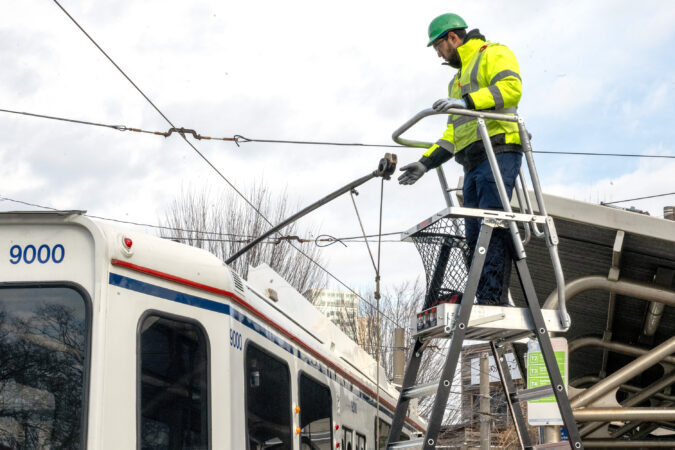
The tunnel has been closed since the beginning of November for repairs to its overhead catenary wire system. In October, damage caused two separate incidents in which trolleys were stopped and hundreds of riders were evacuated inside the tunnel.
“We want to make sure that we don’t reopen before we feel that the risk has been reduced as low as possible that we could have another event in the tunnel,” said Kate O’Connor, SEPTA’s assistant general manager of engineering, maintenance, and construction.
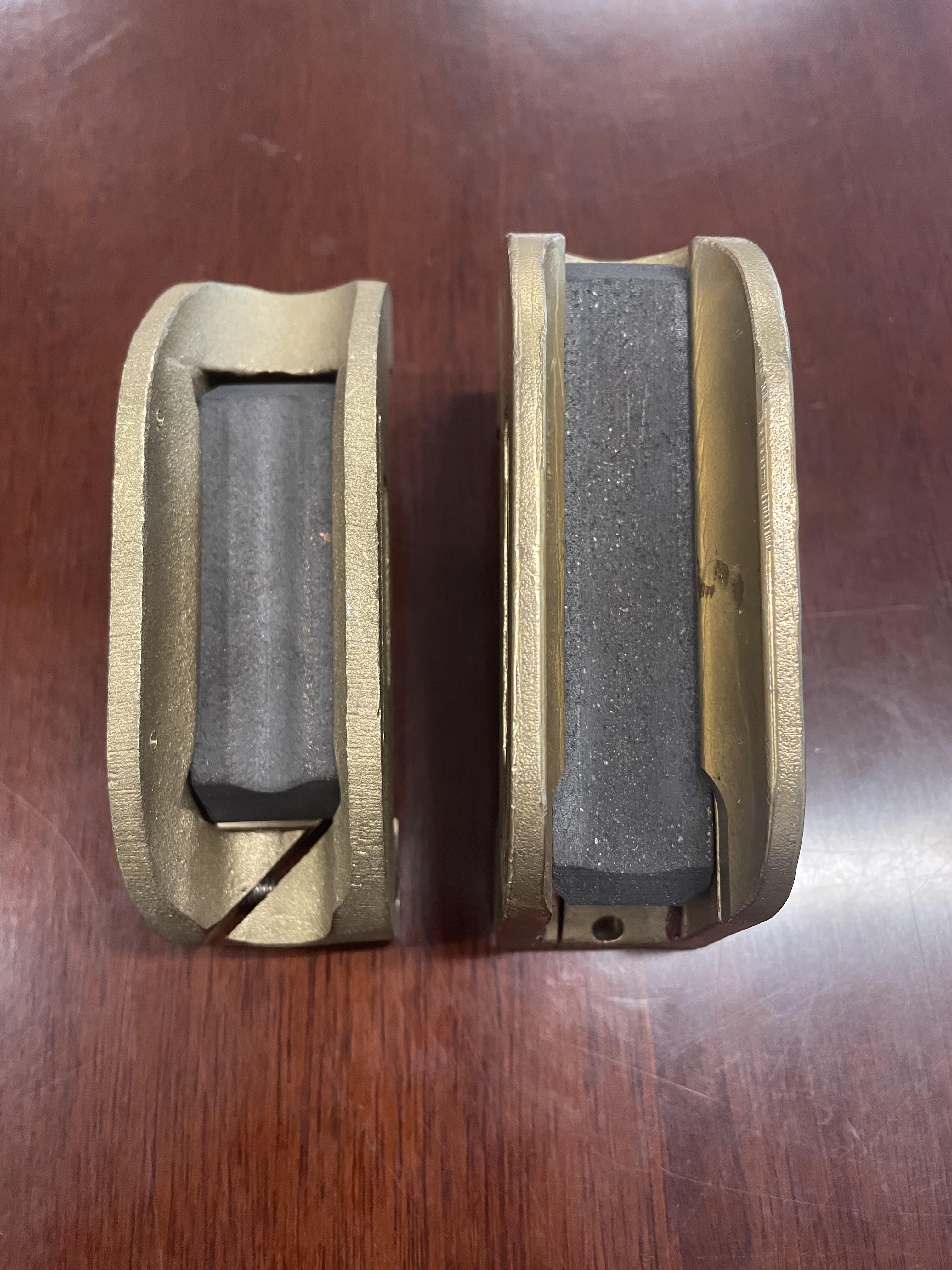
Issues began earlier this fall after SEPTA changed the size of the brass sliders that hold chunks of carbon that rub off and coat the wires carrying electricity to the trolleys. The carbon coating helps the trolleys move smoothly.
A 3-inch slider, left, and a 4-inch slider, which coats electric powered wires with carbon to reduce friction. When they fail, trolleys are stranded.
The switch from 3-inch to 4-inch sliders was meant to prolong their lifespan and lower maintenance costs, but it proved to do the opposite. Inside the tunnel, where there are more curves on the tracks and more equipment holding the wire to the ceiling, the new sliders and carbon burned through more quickly.
SEPTA had tested the 4-inch sliders before the change was made, but observed no issues,O’Connor said. The tests proved to be too limited, she said, and did not adequately measure how the sliders would work across an entire fleet.
SEPTA changed back to the 3-inch slider, but because the overhead wires were now damaged, the once-reliable sliders began to wear out more quickly, too.
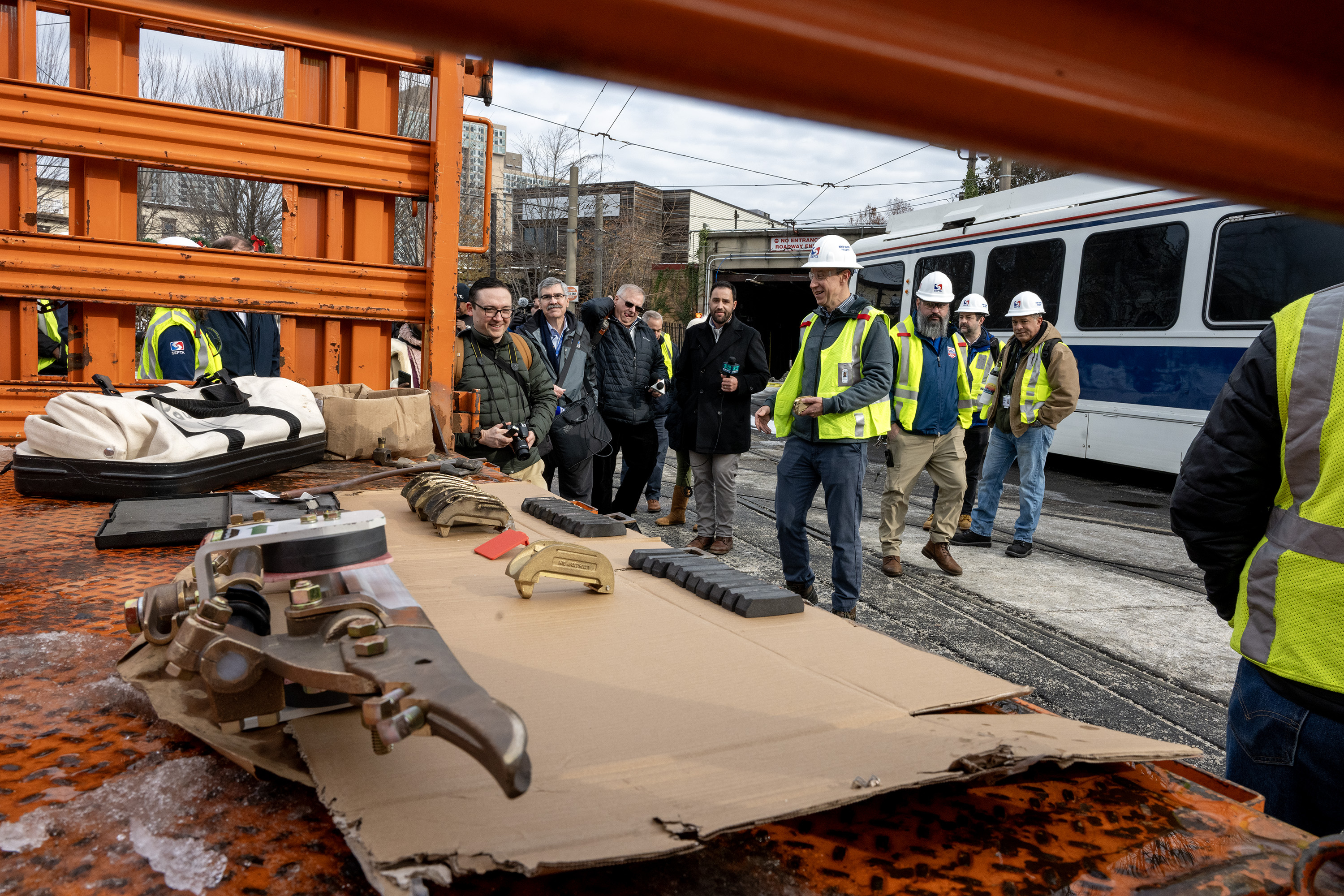
“We could hear the rubbing on the brass” after less than a day, said Jason Tarlecki, SEPTA’s deputy chief engineer of power.
Trolley slider parts are on display as Jason Tarlecki, acting SEPTA chief engineer of power, talks with the news media at the 40th Street trolley portal (rear) Wednesday, Dec. 17, 2025.
SEPTA determined it needed to replace the tunnel’s roughly five miles of overhead copper wiring, Tarlecki said, after the excess wear left it “shattered and raw” in sections.
Those repairs have taken longer than originally projected. According to SEPTA officials, supply-chain issues stemming from the pandemic have created longer wait times for new parts. New wiring needs to build up a carbon coating over time, and SEPTA has been running trolleys along the system during the closure for the patina to develop. And the transit authority has been conducting tests, like experimenting with reduced-speed zones and readjusted wire tension, to ensure that the issue does not arise again.
On Thursday morning, City Councilmember Jamie Gauthier and State Rep. Rick Krajewski (D., Philadelphia) plan to lead a canvass pushing for SEPTA and the city to help riders during the closure of the tunnel.
“I know how challenging and frustrating it’s been for the tens of thousands of West and Southwest Philadelphians who rely on the trolley to get to school, work, and other essentials. [Market-Frankford Line] riders dealing with crush crowds and drivers stuck in trolley diversion gridlock are suffering too. … Only a sustainable investment from our state government can solve the root cause of this problem: SEPTA’s aging infrastructure,” Gauthier said in a statement.
Even once the tunnel does reopen and service returns, the slider saga might not be over. O’Connor said that it was possible SEPTA would close the tunnel again occasionally, possibly for a weekend, as it continues to replace sections of the wiring.
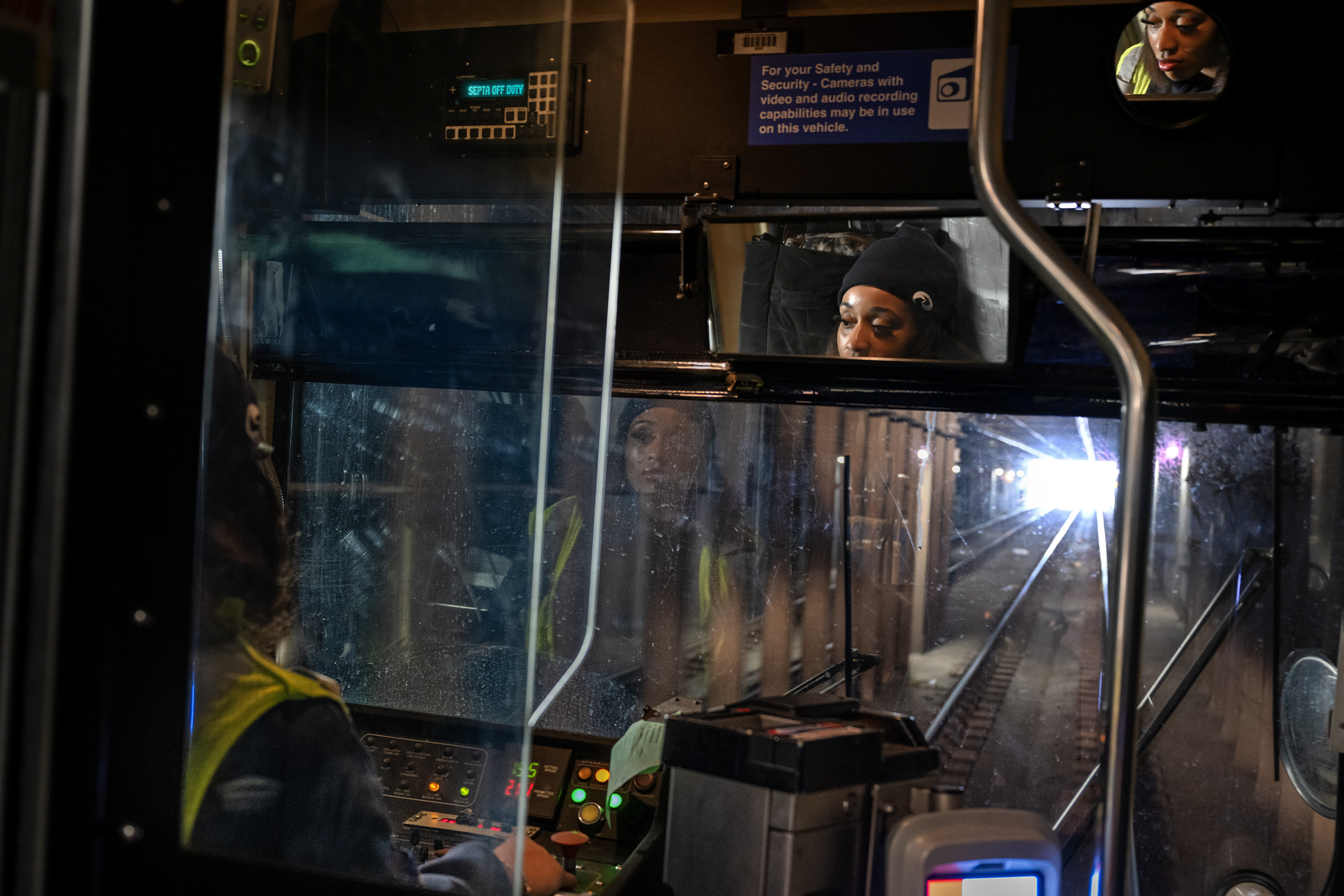
SEPTA trolley operator Victoria Daniels approaches the end of the tunnel, heading toward the 40th Street Trolley Portal Wednesday, Dec. 17, 2025, after a tour to update the news media on overhead wire repairs in the closed tunnel due to unexpected issues from new slider parts.
When a Southwest Philly resident reported a KKK flier had been taped to a pole outside their home this week, people got angry.
The Pennsylvania Human Relations Commission looked into the incident and put out a statement denouncing hate. Angry commenters on the 51st Ward’s Facebook page about the flier dared white supremacists to show their faces.
But 51st Ward Democratic leader Gregory Benjamin said while he understands the alarm and does not intend to dismiss people’s concerns, he believes this all may be some kind of misunderstanding.
“We want to calm that,” he said.
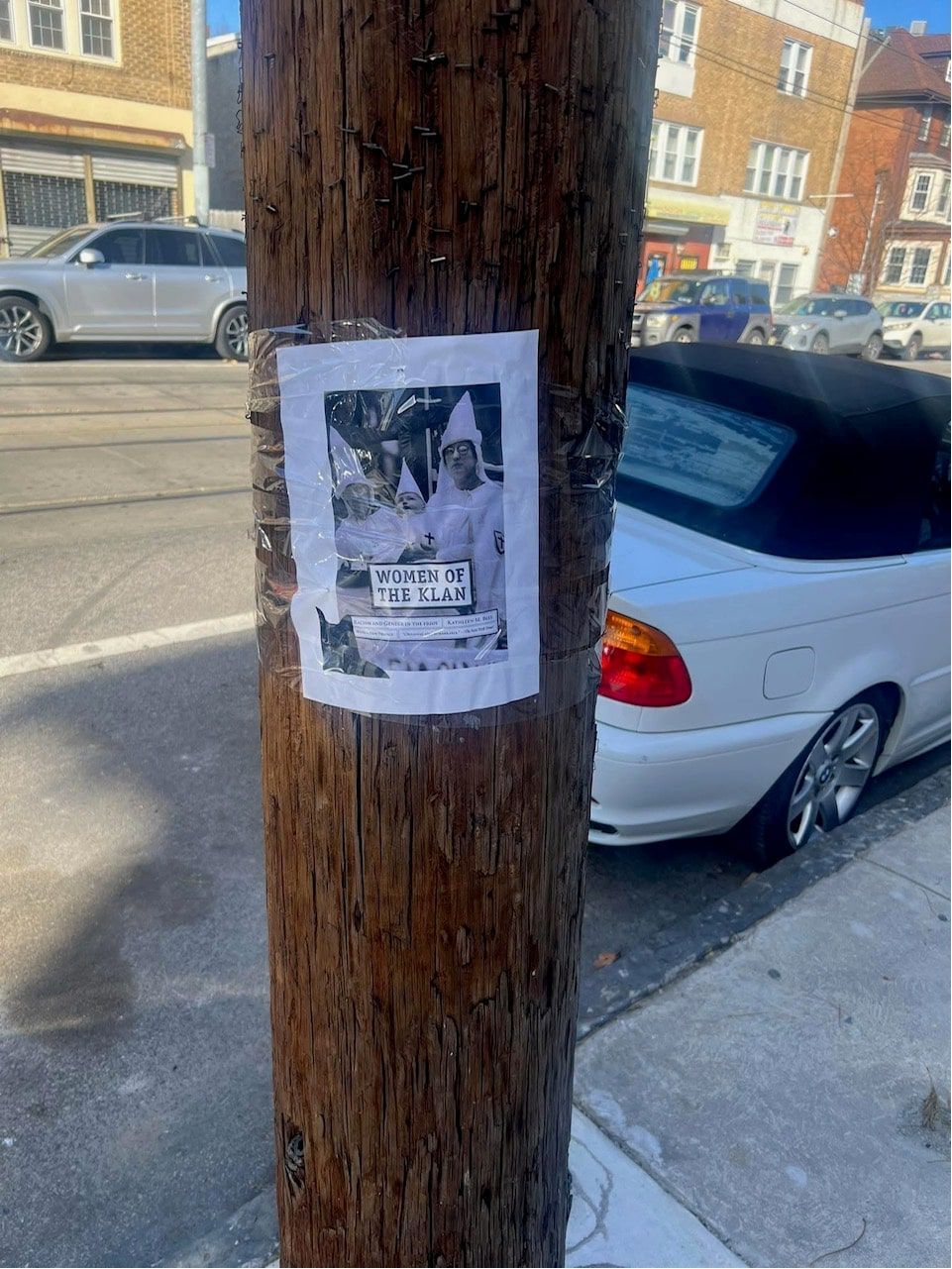
On Tuesday, a neighbor called Benjamin to let him know that they’d discovered a flier depicting members of the KKK on an electrical pole outside their home on the 5100 block of Chester Avenue.
A flier posted earlier this week in Southwest Philly is a copy of the cover from a book titled “Women of the Klan: Racism and Gender in the 1920s”.
The flier is black-and-white copy of the cover of a book written by University of Pittsburgh sociologist Kathleen M. Blee, Women of the Klan: Racism and Gender in the 1920s. The cover features a photograph of three generations of klans-people — an older woman, a younger adult woman, and a baby — all wearing white pointed robes, with a cross and American flag behind them.
It’s unclear what message whoever put up the flier intended to send. Blee’s book, originally published in 1991, is a study of the role that women played in the Jim Crow-era KKK and the covert ways they carried out the Klan’s mission, not an endorsement of the group’s ideology. The first page of the book describes the Klan as “one of U.S. history’s most vicious campaigns of prejudice and hatred.”
The flier still raised concerns. Residents contacted the Human Relations Commission, and its Philadelphia advisory council was notified, as well as police. It’s possible another identical flier wasposted nearby around the same time, Benjamin said, but all fliers have since been removed.
No person or group has taken responsibility for the flier so far. While there is no indication the flier was put up by a white supremacist group, the manner in which it was posted can still be harmful, said Chad Dion Lassiter, executive director of the Pennsylvania Human Relations Commission.
“These things, they take an emotional toll on individuals,” he said.
Even if the flier was a piece of trolling or a message targeted at white people, Lassiter said it was crucial not to ignore it.
“We take all of these things [seriously]… we’re in a moment where people want to continue to deny the surge of white nationalism and white supremacy,” he said.
Representatives of the Pennsylvania Human Relations Commission will attend the 51st Ward’s monthly community meeting onSaturday at noon at the Kingsessing Library, located at 1201 S. 51st St.
Benjamin said the meeting would be an opportunity for community members to share more information about the incident and ease any remaining tension. He said he hopes this experience will encourage neighbors to connect more and communicate better.
“Maybe we can bring something constructive out of this. Demonstrate that the community is more interested in [doing] something positive than anything else,” he said.
Correction: An earlier version of this article misstated the publication date of Blee’s book. It was originally published in 1991.
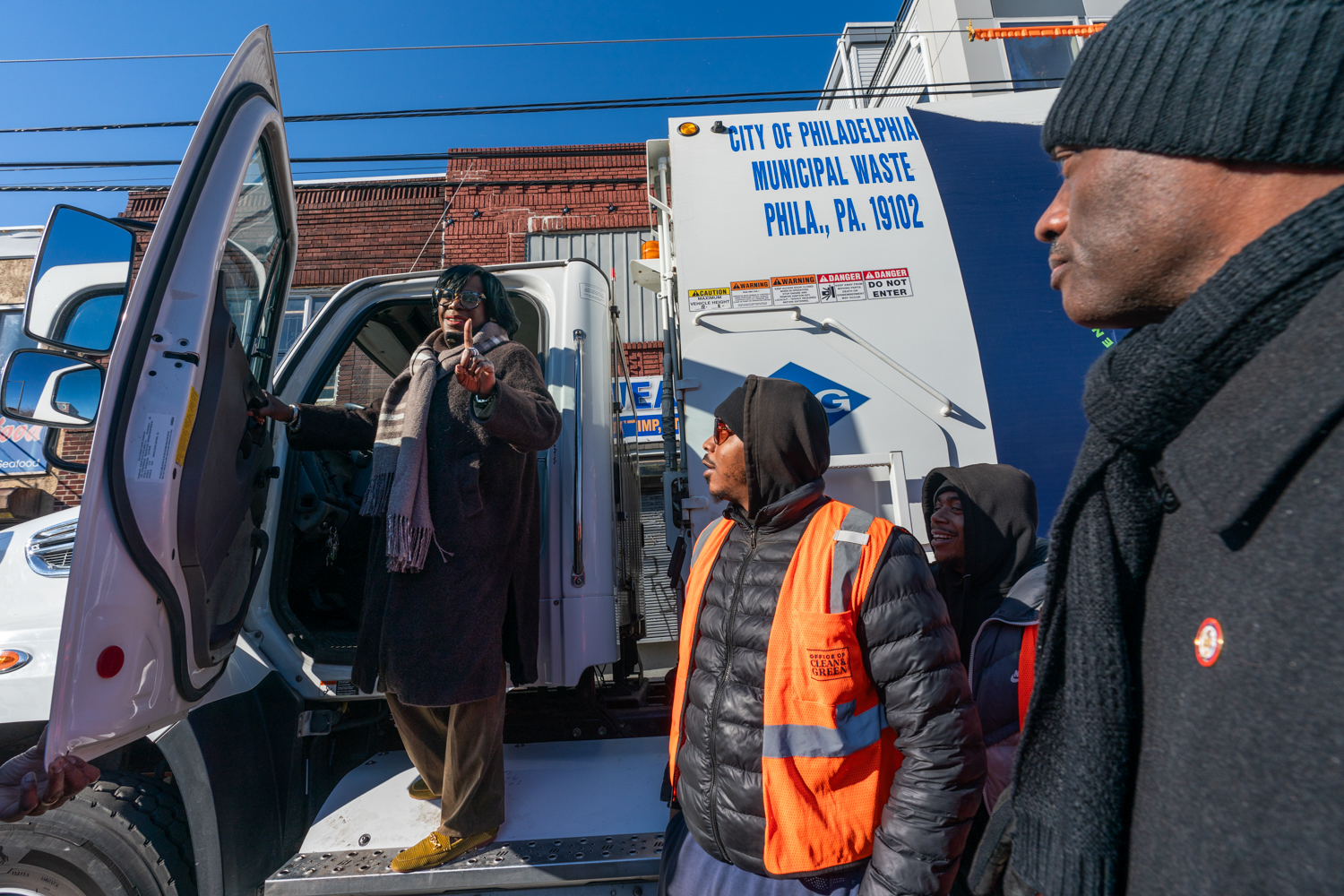
Happy holidays, North Philly: Twice-weekly trash pickups are coming to your neighborhood.
The city will institute a second pickup day for North Philadelphia, beginning Jan. 5.
Last year, Mayor Cherelle L. Parker announced a $11.9 million initiative to bring twice-weekly trash collection to Center City and South Philly as a key piece of her push to make the city clean and green. Now, after an additional $7 million investment in trash trucks, the program is ready for North Philly.
“We’re seeing this make a difference,” said Carlton Williams, director of the Philadelphia Office of Clean and Green Initiatives. He said since the initiative began in December 2024, reports of illegal dumping in South Philly and Center City have fallen by 15% to 20% and the amount of litter has decreased.
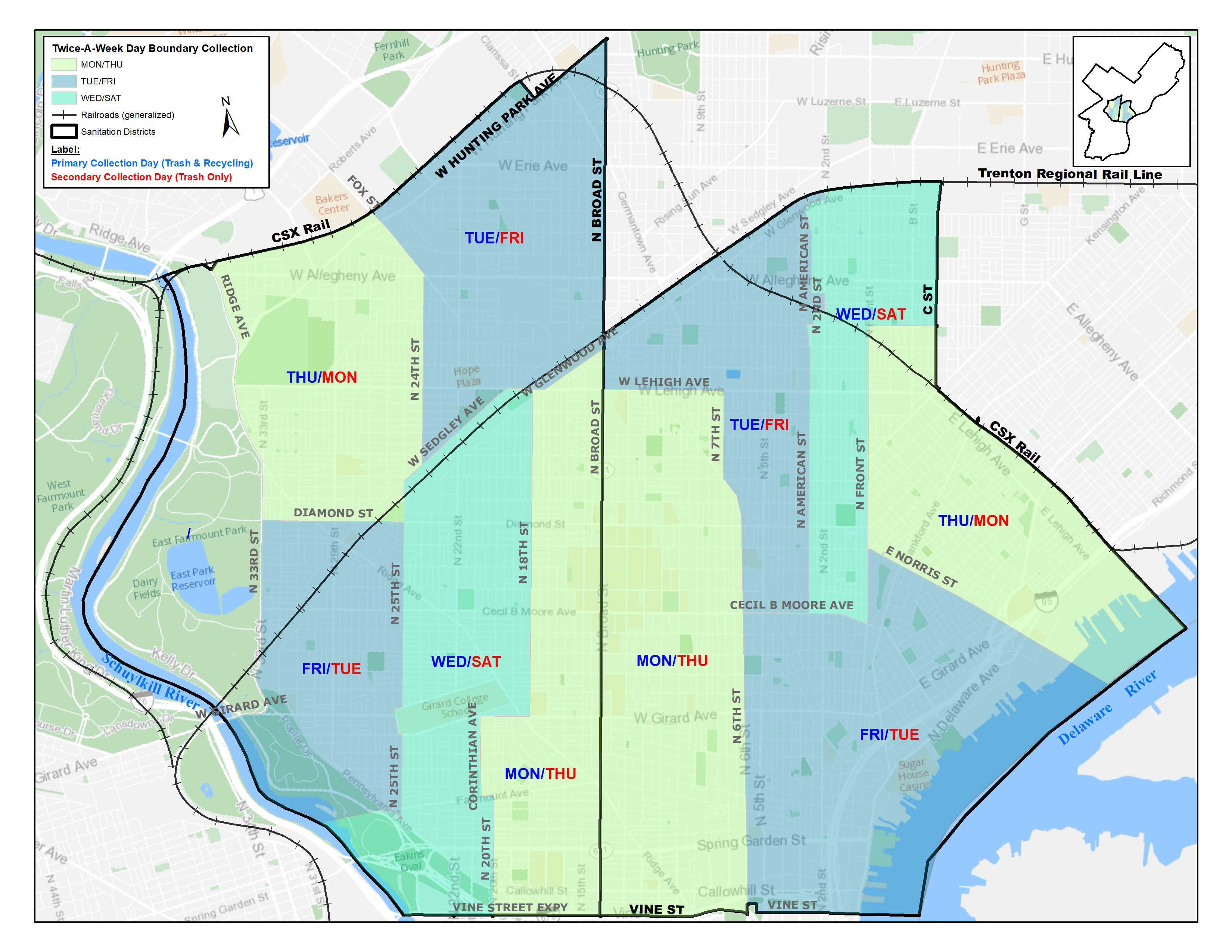
The North Philly phase of the initiative will cover the boundaries of:
Vine Street to Hunting Park Avenue, from Broad Street to the Schuylkill
Vine Street to Glenwood Avenue, from Broad Street to the Delaware River
A map of where and when additional trash pickups will take place in North Philadelphia, beginning Jan. 5, 2026.
Just like elsewhere in the city, the second pickup will occur on the third day after an area’s typical pickup day. For example, households that normally have their trash collected on Monday will have their second pickup on Thursday. Households with Tuesday pickups will have their second pickup on Friday, and so forth.
Recycling will not be collected on the second pickup day. That will continue to be done on the original pickup day. And there will be no second collection during weeks of city holidays.
Residents reported some inconsistency with the twice-weekly program in the first few months of its rollout. Williams said he expects a similar learning curve for pickup crews this time around, particularly since the North Philly phase covers a larger area.
Mayor Cherelle L. Parker poses for a photo on a sanitation truck at South 21st Street and Point Breeze Avenue in Philadelphia in December 2024.
Should crews miss a pickup, Williams said, they will collect it within 24 hours, but residents should also call 311 to ensure the trash is on the city’s radar.
To minimize the amount of time that trash sits outside, the city requires that households and businesses set their trash and recycling on the curb after 5 p.m. the day before pickup during the fall and winter, and after 7 p.m. in the spring and summer.
It is unclear when the rest of the city could see trucks coming a second time during the week. When the city announced the beginning of the initiative, it said it intended to expand the program to North Philly and West Philly.
Since then, Williams said, the city has determined that the program might not make sense for all of West Philly or other areas of the city, since some of those neighborhoods have driveways or other trash storage that make extra pickups unnecessary. He said other possible expansion areas will be evaluated.
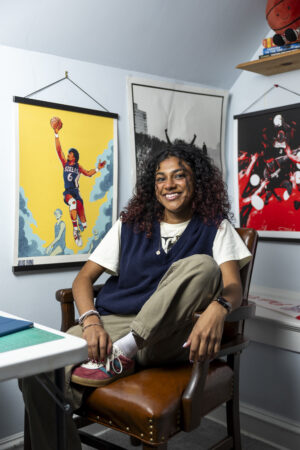
Lydia Hope Victor often jokes about how much worse off she’d be if she’d grown up in Ohio instead of Philadelphia.
Her parents arrived there from India before settling in Philly. Her father learned about American culture through Ohio State and then Eagles football. He came to love the brutal sport and passed his fandom down to his children, but who knows what would have happened if the family had been forced to root for the Cleveland Browns.
“Obviously, thankfully [he] became a Birds fan,” she said.
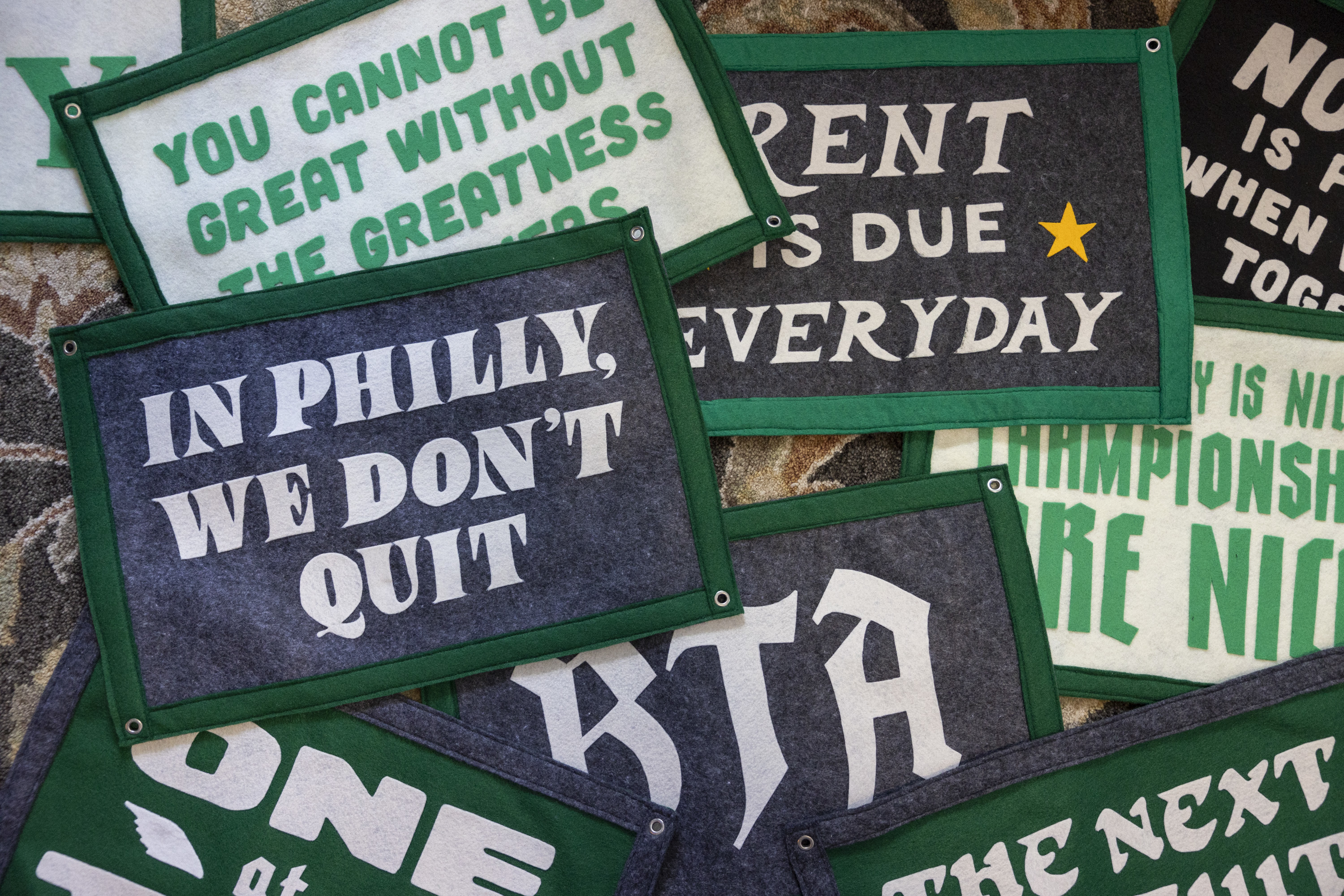
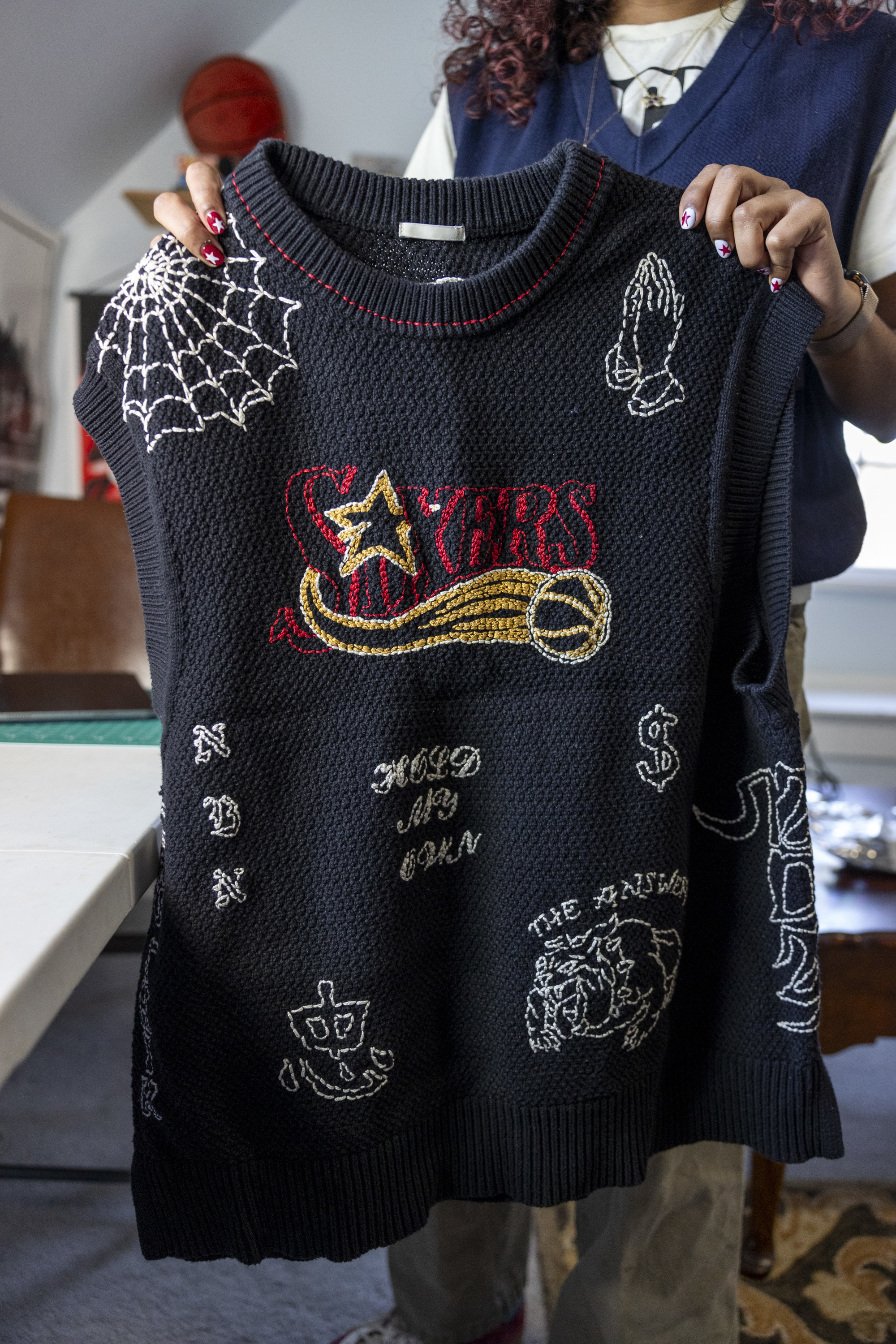
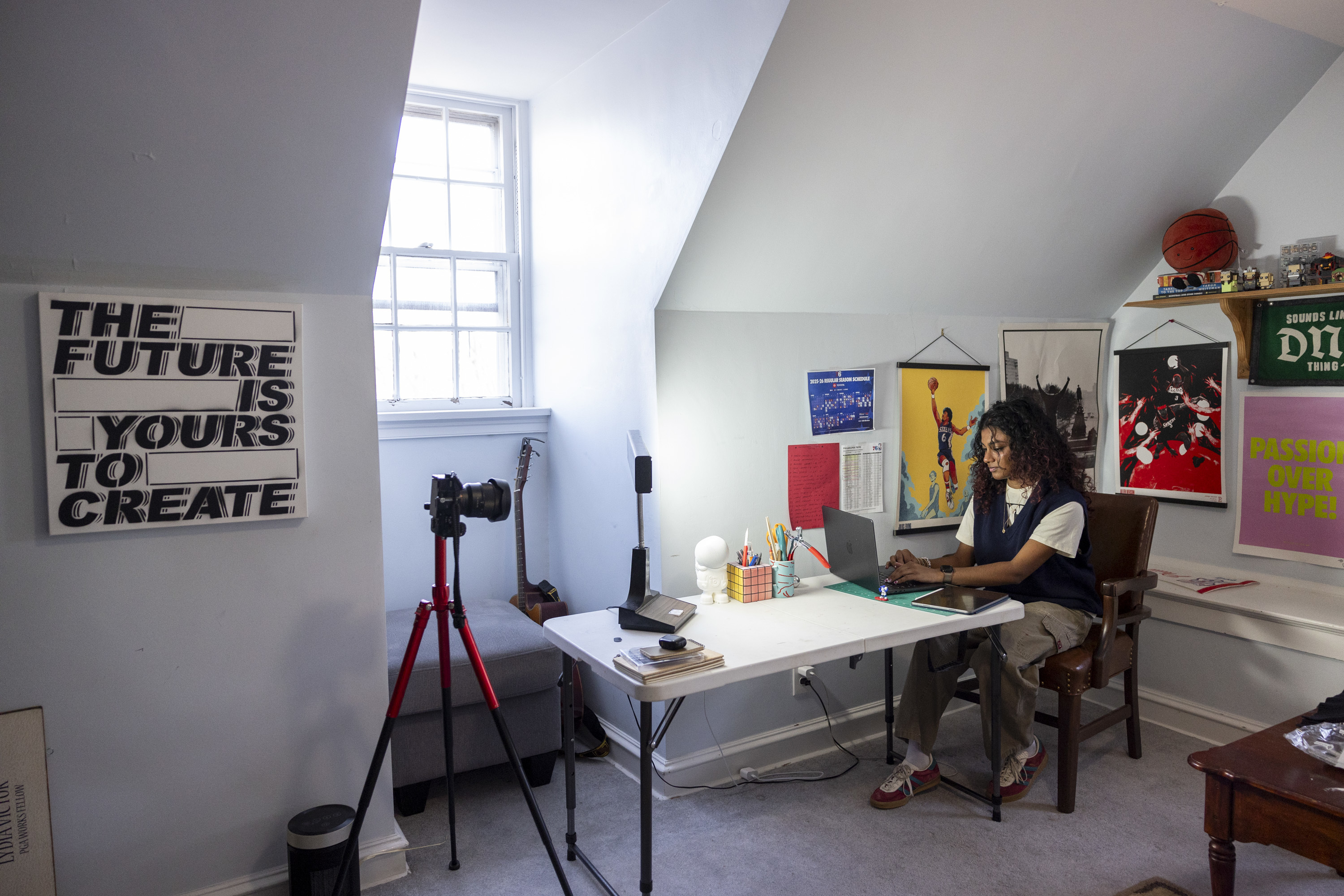
Victor, 22, is a graphic designer and multimedia artist based in Elkins Park whose work is focused on sports and the overlooked elements that shape them. Her work across mediums is for the casuals and diehards alike, including an Allen Iverson sweater vest, fan zines, and banners reading, “Find a New Slant” and “I’m Sorry I Just Wanted a Frosty”.
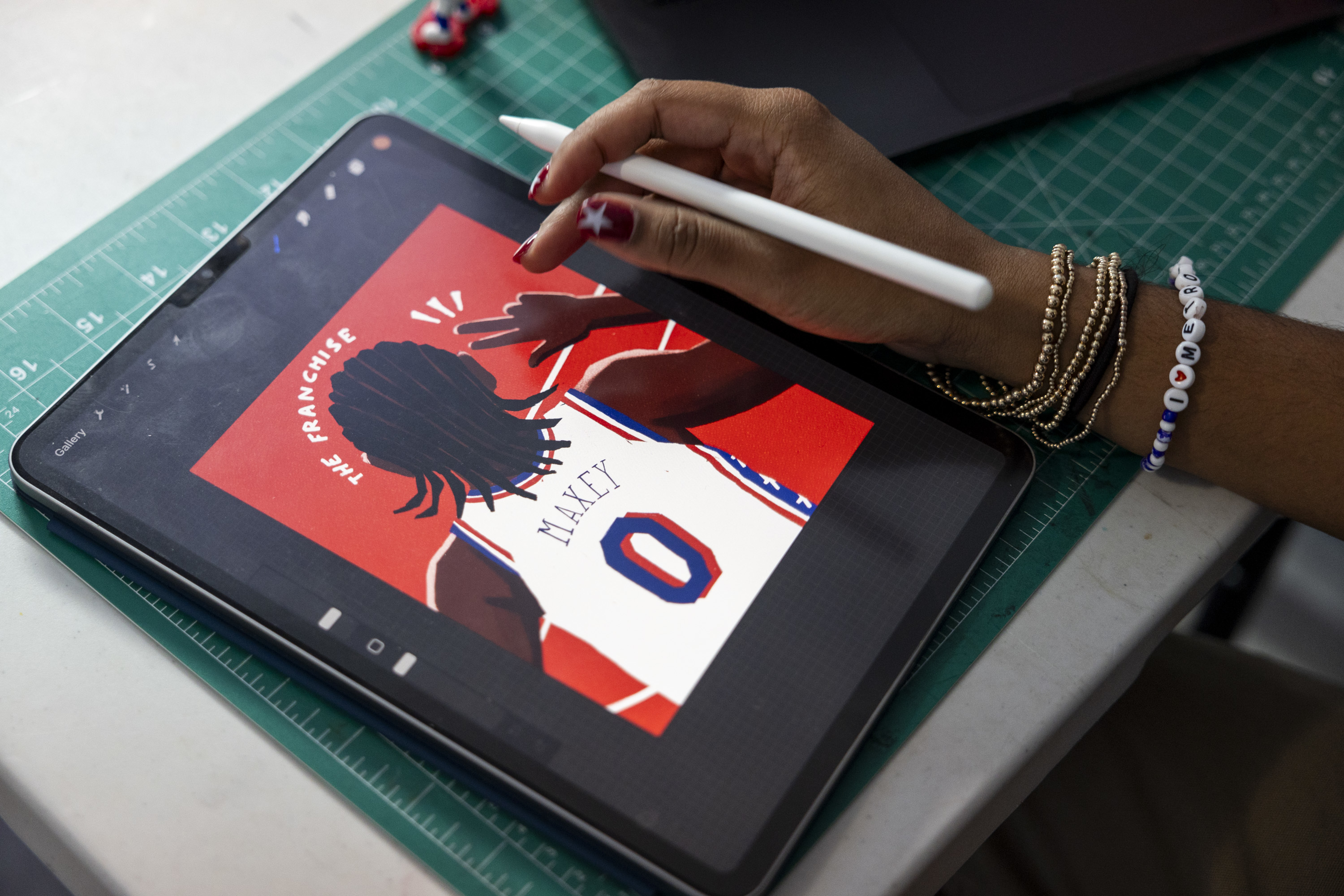
She’s in the middle of a season-long Sixers project that she’s sharing on social media called 82 Games. After every contest, Victor is creating an illustration based upon what happened on the court, with easter egg references, too.
Victor’s passion for basketball was molded by post-The Process-era Sixers and Allen Iverson YouTube highlights, despite being born after his 2001 MVP season. She was raised on Philly talk radio car rides with her dad, and her fondest sports memory is watching people flood the streets from her brother’s Temple University dorm after the Eagles’ first Super Bowl win.
“It’s hard to live in Philly and not be an insane Philly sports fan,” she said.
Victor spoke with The Inquirer about her 82 Games project and how it represents relentless Philly fandom and community, being a Joel Embiid truther, and aspiring to consume sports a little more healthily.
This conversation has been edited for length and clarity.
This is an endurance art project. How do you come up with a new design every game? And how do you stay committed to it, even when the Sixers are more or less a fringe playoff team?
I think that’s the fun of it, pushing myself to think of new ways to interpret the story. Some of the joy of it is also being able to look back and be like, I committed to doing that, I was able to finish it.
I originally did this project in high school, it was honestly to teach myself how to draw. [Now] I have a lot more experience in design and illustration, and I’m just seeking out some of the community again. I think that’s what really brought me back to it. Even the most niche reference I try to make in games, someone will understand it somewhere.
Victor shows off one of her illustrations for the 82 Games series, featuring Tyrese Maxey.
That fandom is so important to finding a community of people.
Philly fans are all a little crazy, we’re all so committed to support our teams. Even if we’re in a slump. I think Philly fans have a reputation — oh we booed Santa. But it’s coming from a place of — I’m still here and I’m gonna show up no matter what.
A through-line of your work is holding a player-centric point of view. Why do you feel like that’s an important perspective to emphasize? What do you think of the way sports are typically covered in media or online?
It’s kind of just rage-baiting. They want people to engage, but there’s no intention to do it through healthy conversation. People watch sports because they enjoy it at some level and sometimes those perspectives take away from that joy.
It’s easy to center the fan, but none of these things would exist without the player, too.
Victor’s custom-made banners with various Jalen Hurts quotes made after the Eagles’ Super Bowl victory.
I’m a Joel Embiid truther ‘til the day I die. People give him a lot of flack for not giving his all for the team, and I don’t think you can really point to his history and in good faith say that about him. He was playing with a mask. He was playing with [Bell’s palsy].
You made a sweater vest inspired by Allen Iverson and his tattoos. How did that project come to be?
I’m 4’11, so I immediately connected to Allen Iverson and his story and just the way he played. I remember watching his Hall of Fame speech and crying. When you think about how the media treated him or general narratives about him as a player, it all seemed negative. And I think it’s exciting to see him get his flowers.
I just love experimenting with different mediums. If I have an idea in my head, I wanna get it out into the world. Last season I was like, a jersey looks just like a sweater vest, what is something I could do to explore that? I immediately was like, do something about Allen Iverson.
Victor displays her Allen Iverson sweater vest, modeled after his iconic Sixers jersey. The embroidered designs mimic several of A.I.’s tattoos.
What are some of other ways you’ve focused your work on player perspectives and other overlooked parts of sports?
I try to think of things from systems point of view. I think there’s really a story behind every single thing in sports.
The project I’m working on right now is about the Women’s Basketball League, which was the first women’s basketball league in America in the 1970s. It only lasted for three seasons, but there was a team that was based in Philadelphia called the Philadelphia Fox, which only lasted for 10 games.
Victor is working to tell more multimedia stories about the subtle structures that impact sports.
Some of those people are doctors and lawyers and basketball coaches, their lives took such a different turn. Title IX was just starting, so there weren’t a lot of [opportunities] for women to play sports in general. I’ve been interviewing some of those women which is pretty cool, getting to hear their stories.
So just thinking about how these systems exist and operate and how to make them more equitable. Understanding where we started is so important.
Who are your Letterboxd-style four favorite Philly athletes of all time?
Allen Iverson, Nick Foles, Joel Embiid, and Michael Vick.
After 13 years at 6abc, reporter Annie McCormick is leaving the station, she announced on social media. Her last day was Monday, Dec. 1.
“For our viewers, I just wanted to do the job the constitution gave us the right to do in the most fair and respectful way. I am most thankful for the everyday people who have let me into their lives on even their worst days. I’ve learned my greatest life lessons from our viewers,” she said in a Facebook post.
“I will continue to tell the public’s stories in a variety of mediums, stay tuned,” she said.
In her announcement, McCormick did not detail what her next career move will be. She said that she was grateful for her time at 6abc and was “looking forward to my next chapter in journalism.”
McCormick and 6abc did not respond to requests for comment.
McCormick joined 6abc in 2012 as a general assignment reporter. She began her journalism career as a White House photo intern during the Clinton administration and went on to work as a photojournalist for several outlets, including the Philadelphia Daily News.
As a television reporter, she worked in Texas, New Mexico, and Harrisburg before returning to Philadelphia. Born and raised in South Jersey, McCormick stayed local to attend Muhlenberg College.
McCormick shared in her post that she is continuing to write her latest book, Restless Ghosts, a historical true-crime story about the 1929 death of two Moorestown, N.J., socialites. It is slated for publication sometime next year.
At the last minute on Thanksgiving morning, Chontai Diggs and her daughter decided to leave their Mount Airy home.
Diggs, 35, had always watched Philadelphia’s Thanksgiving Day parade on TV, despite being born and raised in the city. But this year, her 9-year old, Zaria Roscoe, wanted to see the towering inflatable floats up close. She grinned as the minutes ticked away, squinting as sun drenched the Benjamin Franklin Parkway.
Once it was finished, mom and daughter needed to get back home to cook some dishes for their Thanksgiving meal, they said. Zaria was looking forward to eating “ham and mashed potatoes and cornbread and pumpkin pie.”
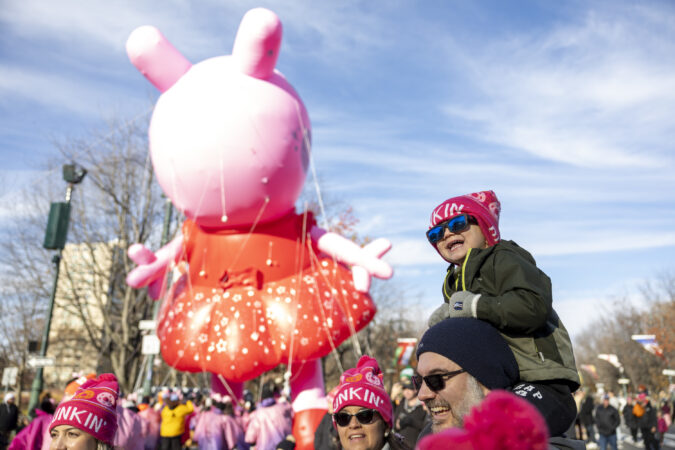
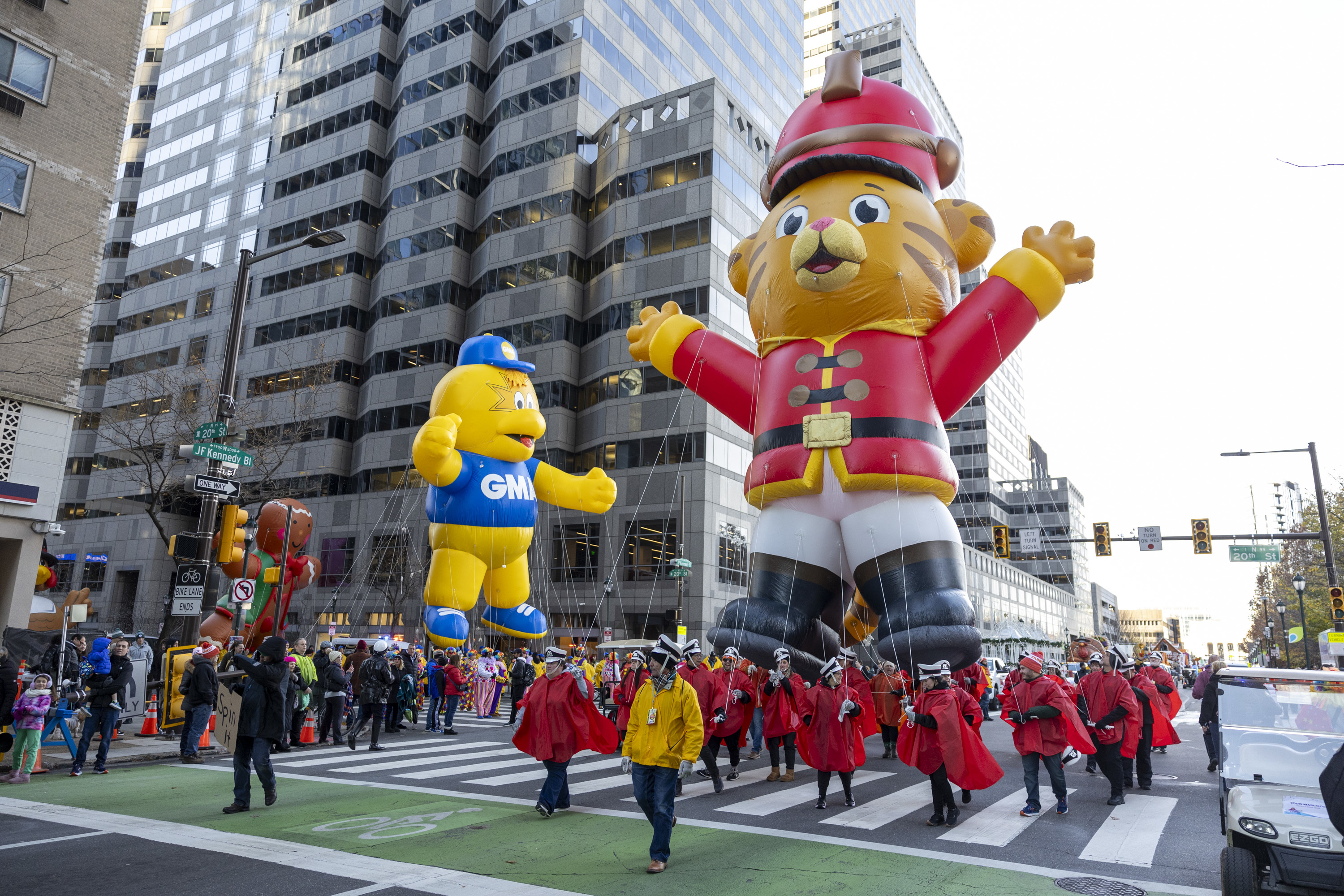
On a brisk morning when floats threatened to break free in the wind, but for their determined handlers, many families lined the route of the 106th 6abc Dunkin’ Thanksgiving Day Parade, the nation’s oldest.
Large floats present a towering start to this year’s Thanksgiving Day Parade in Philadelphia.
Kamila Bond, 29, and Alex Vaz, 32, were thankful they even got a chance to see the parade. The two University of Pennsylvania medical residents said they’re usually working on Turkey Day but were happy to see some communal joy, a welcome respite from what they normally see inside the hospital.
They were grateful for their own health this year and said they were excited to finally spend some time with friends and family on the holiday.
“And sleeping,” Vaz said, coffee in hand.
Thanks after a hard year
Philly’s parade has been running since 1920, when Ellis Gimbel of the once prominent Gimbel Brothers department store on the 800 block of Market Street came up with the idea to celebrate Thanksgiving.
Until 1986, the parade ended with Santa Claus climbing into an eighth-floor store window, but now finishes with a procession up the Parkway to the Art Museum. Today’s parade might be much larger and influenced by its sponsors, but it still holds a distinct Philly flair.
“Go Birds! Happy Thanksgiving! Gobble gobble!” said a parade participant in a clown costume, dressed like the original Gimbel employees.
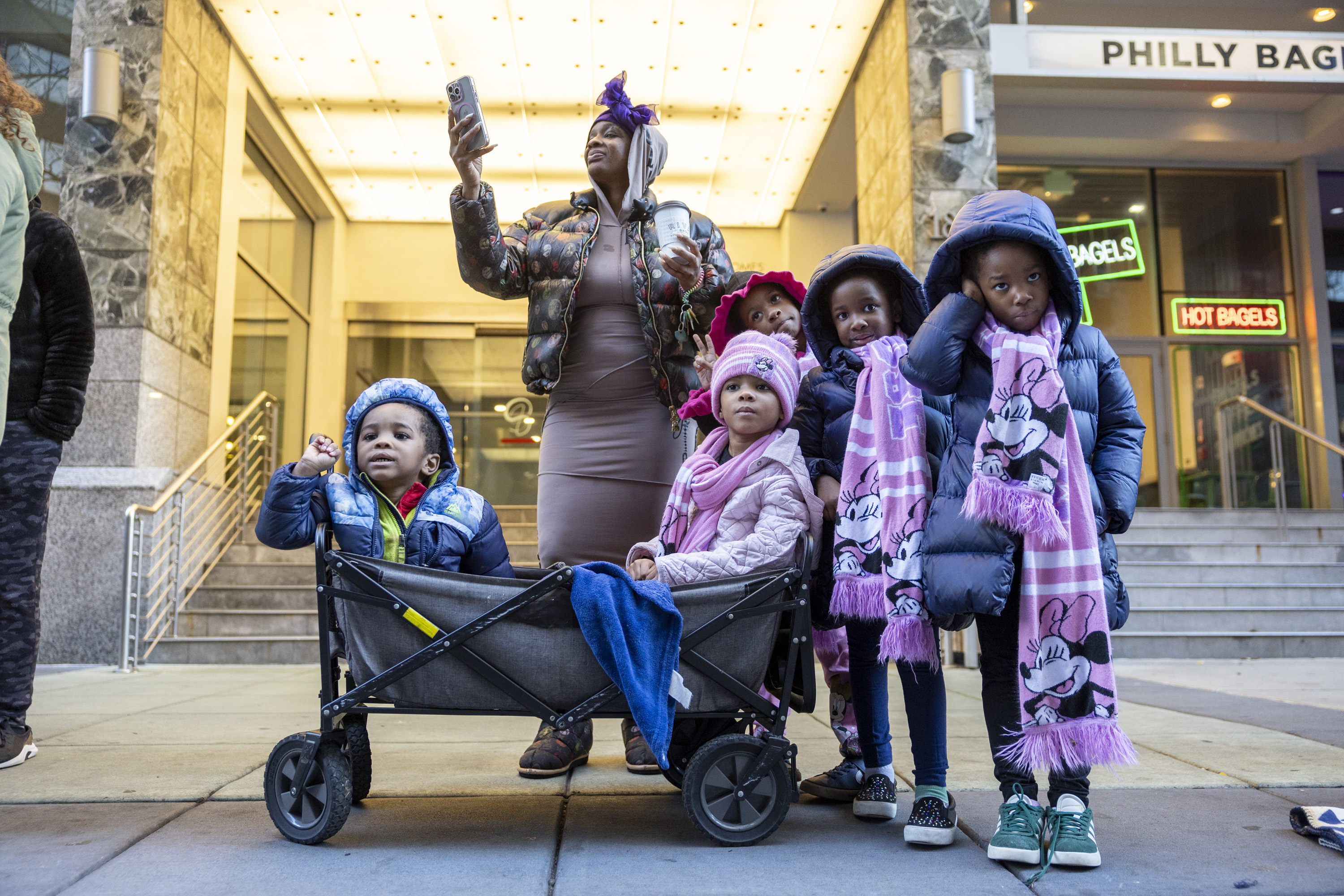
Sharina Sims, of Center City, and her kids were bundled up for the parade.
Little brought as much joy to the crowd as when float carriers relented to chants of “spin it!” and turned their displays around in a 360-degree circle. Second in popularity were the free pink Dunkin’ beanies handed out by the parade sponsor.
Missing from the celebration was the Temple University marching band. The 200-member ensemble was one of only 11 selected to participate in the 99th edition of the Macy’s Thanksgiving Day Parade in New York City, and the only band from Pennsylvania.
It was Temple’s first time performing in the New York parade, a fitting year-end celebration for the band, which marked its own 100th anniversary this year. High school bands from as far as Alabama and Indiana filled their place with their own perfectly polished silver tubas.
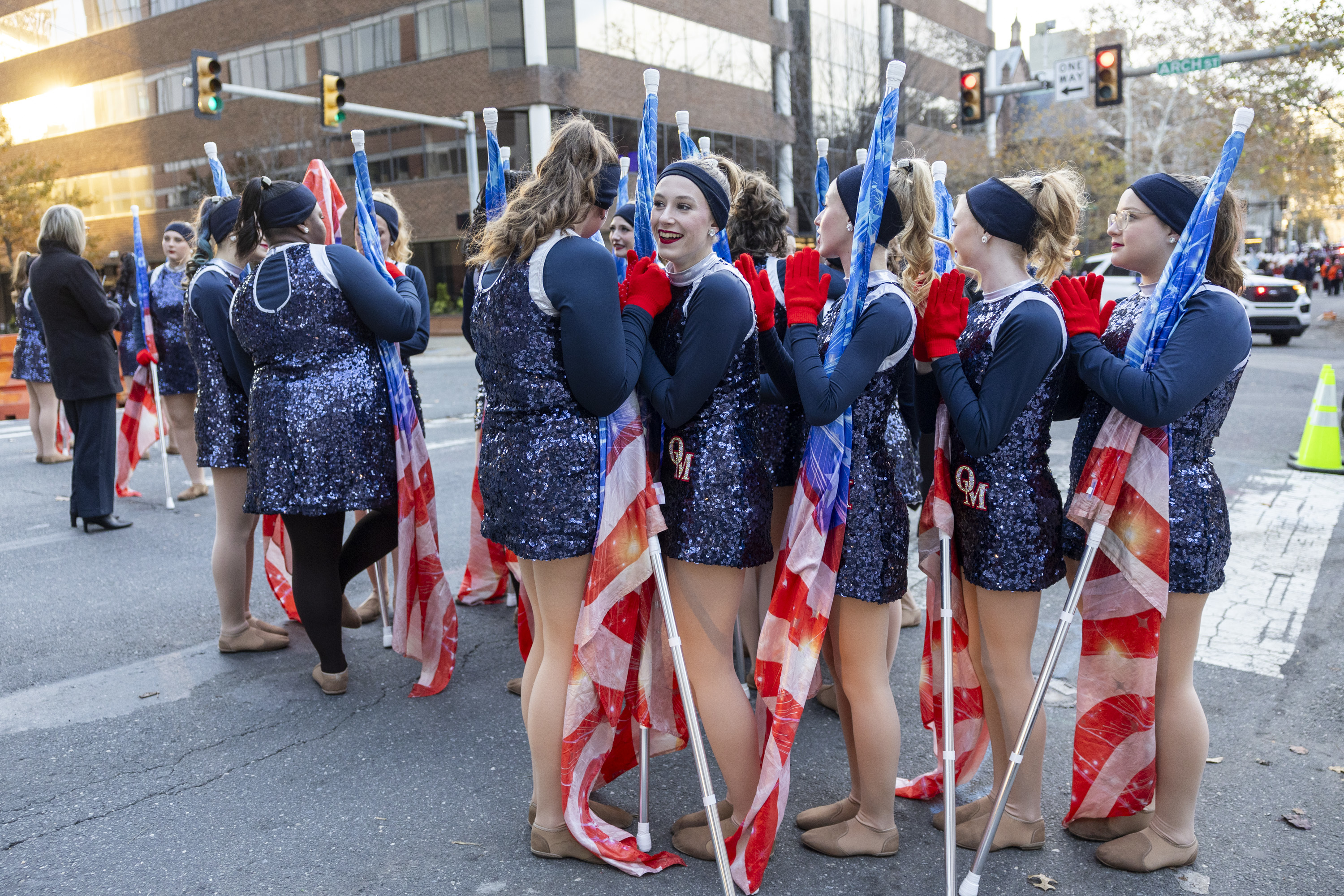
Anna Reynolds, 16, an 11th grader, is keeping warm with her fellow color guard members before the start of the wind-chilled Thanksgiving Day Parade in Philadelphia. The parade started at 20th Street and JFK Boulevard, traveled east to 16th Street and then north to the Parkway, with the procession ending on Eakins Oval at the Art Museum.
Perhaps for the good of the festive mood, former Dallas Cowboys quarterback Troy Aikman was not in attendance. Though 6abc advertised his appearance alongside Monday Night Football broadcast partner Joe Buck, the pair merely gave a taped message that aired during the parade’s television broadcast.
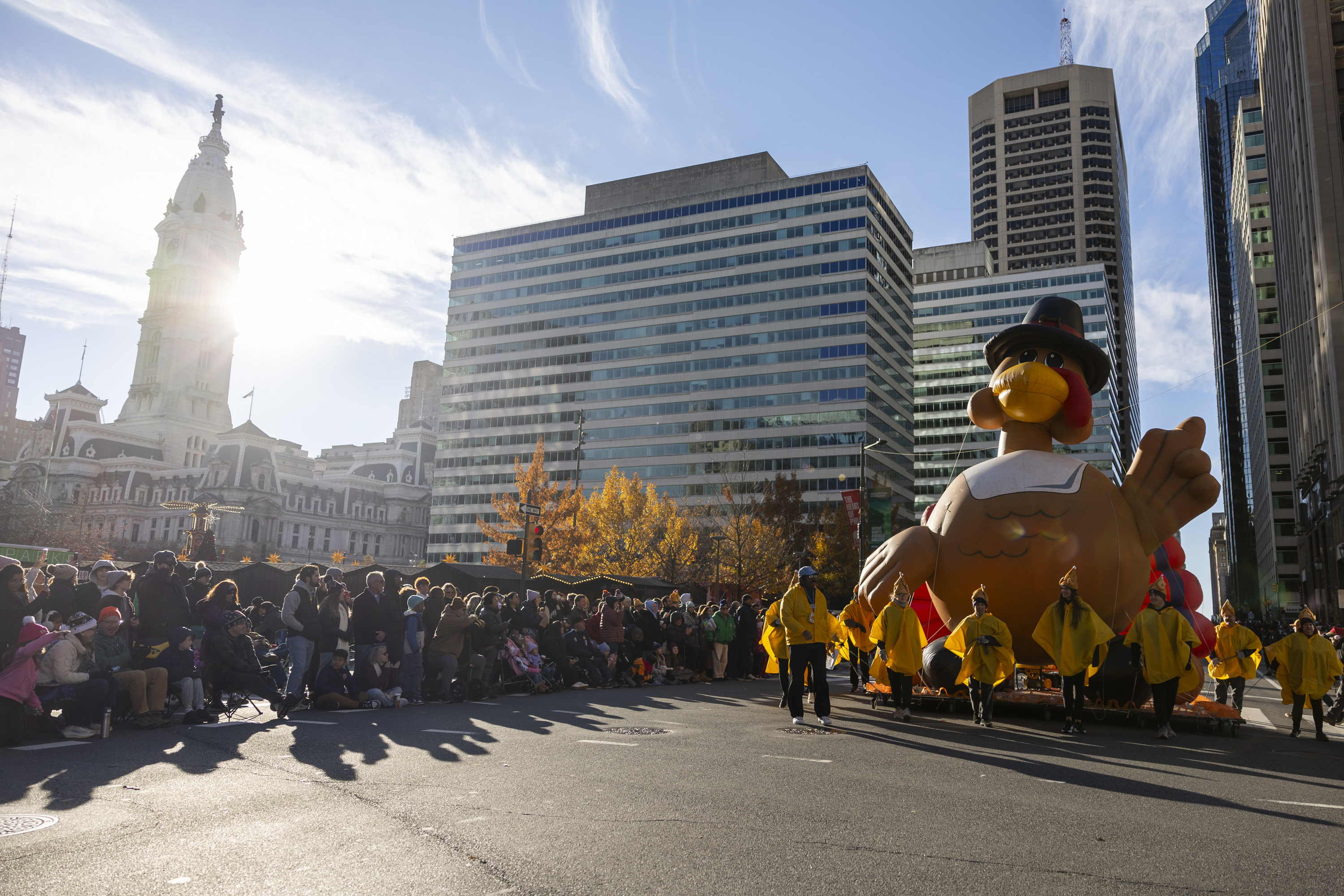
This turkey was not the edible kind, but one that nonetheless entertained parade onlookers on 16th Street near LOVE Park. The parade started at 20th Street and JFK Boulevard, traveled east to 16th and then north to the Parkway, with the procession ending on Eakins Oval at the Art Museum.
For reasons that are unclear, Aikman shouted out the Philadelphia Professional Football Cheerleader Alumni group, a collection of former Eagles cheerleaders who strutted down the Parkway wearing jackets displaying what appeared to be the years they last cheered for the team.
When they reflected back on 2025, some attendees conceded that it had been a difficult year for them and the country. Sarah LaBruce, 46, from Fishtown, said she was hopeful that things would be better going forward — and already had her bright-red Christmas leggings on.
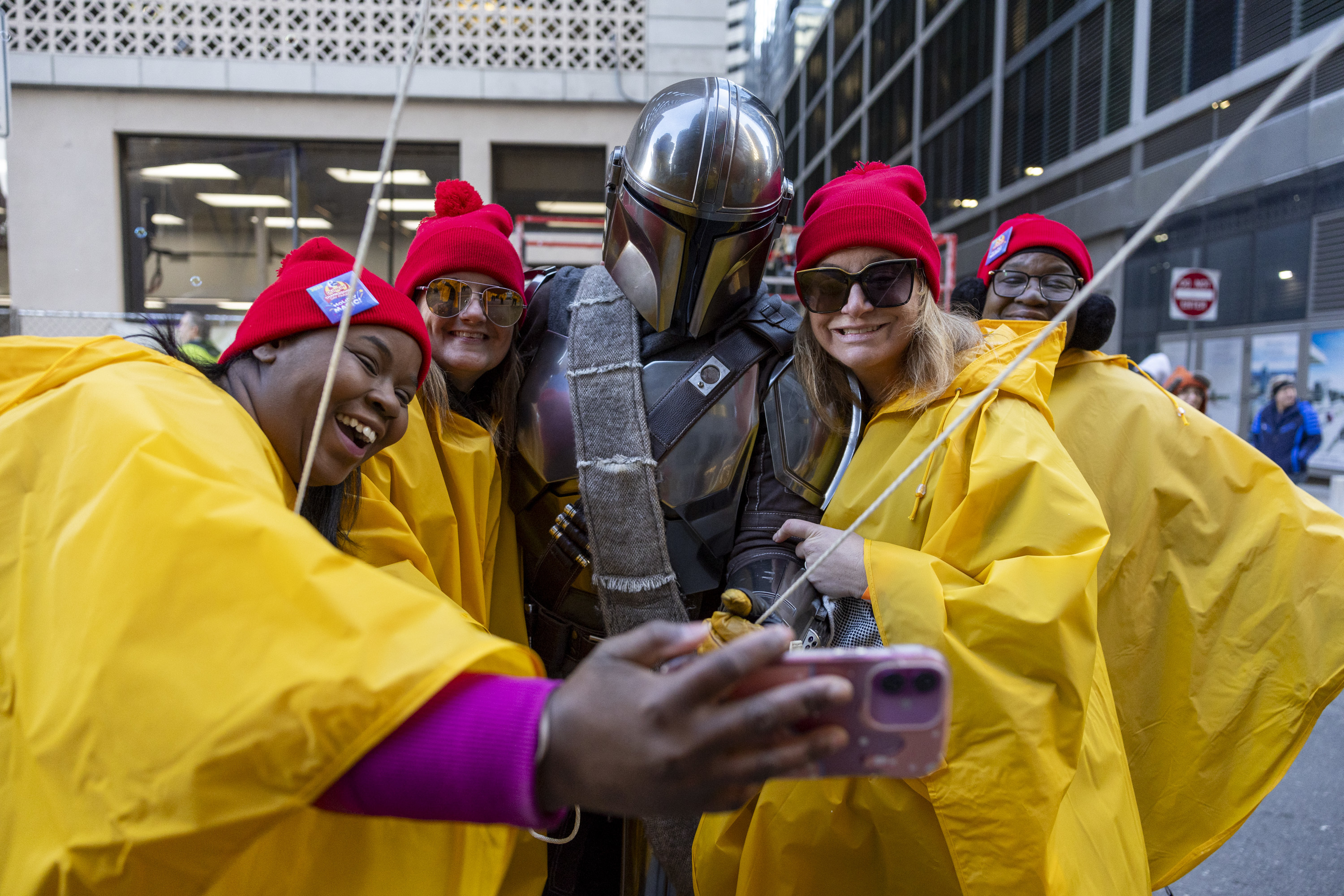
(From left to right) Dawn Simons, of Lawnside, camden County; Ann Marie Laun, of Northeast Philadelphia; and Lori Aument, of Oreland, Montgomery County, take a photo with the Mandalorian with the 501st Legion before the parade got underway.
James Govan, 64, is already eyeing his retirement next year, when he plans to leave Philadelphia. He’s a federal worker, and has been able to hold onto his job during all of the recent tumult in the government.
But until then, the Northeast resident said he was thankful for the everyday parts of life, including the plate of greens with smoked turkey and macaroni and cheese he had prepared for the day. He figured that he would swing by the parade this year, he said, because you never know when it could be your last chance to experience it.
“Let me see this Santa Claus guy,” he joked, before turning a bit more serious, a walking cane in his right hand.
The Rev. Carolyn Cavaness is adjusting to her new life as a celebrity.
Any pastor of the historic Mother Bethel A.M.E. Church might get stopped and asked for a picture while walking down the street, as she sometimes does. The church is a national historic landmark, long celebrated for its role as a hub for Black activism and the oldest church property in the United States to be owned continuously by Black people.
But in November, Cavaness, 42, was appointed as the first femalepastor in the church’s 238-year history. She is a fourth-generation A.M.E. preacher from Newark, N.J., and previously led the Bethel A.M.E. Church of Ardmore for 10 years, also serving as its first woman pastor. Cavaness took over for the Rev. Mark Kelly Tyler, who had left Mother Bethel after 16 years.
“Some days I have this moment where I say, ‘Wow, Carolyn, you are the pastor of Mother Bethel. You’re in the big chair. What if somebody else was in this spot? What would they be doing in this moment?’” she said.
While Cavaness brings a new perspective, she is also focused on honoring the legacy of the 52 pastors and their congregations who came before. She said that the church’s first members knew immediately that they were “a big deal” who would matter greatly to the Black community. Two centuries later, that is still the case.
“Here I am in this 21st century and having to be the caretaker, but also being called to action,” Cavaness said.
“So what becomes our contribution?”
Cavaness spoke with The Inquirer about her first year at Mother Bethel, what it has meant to take on her trailblazing role, and how the church’s tradition of resilience inspires her and the congregation.
This conversation has been edited for clarity.
Your first sermon at Mother Bethel was an emotional one, about your family’s deep Philly roots and great achievements born out of the Black struggle, even though you were only notified about your appointment just the day before. What do you remember about that day? What have you learned about what Mother Bethel means to people over the past year?
It was surreal. I mean I literally found out less than 24 hours before. But that is being an itinerant preacher [of] Methodist tradition. You’re here to serve.
I had very much the sentiment of “I wish my dad and my grandmothers were here to see this.”
I think about when I walked into the pulpit for the first time, how the congregation stood up. I think about the smiles, the hugs. I think about the flowers they gave me. And the sacred trust that I’ve been given.
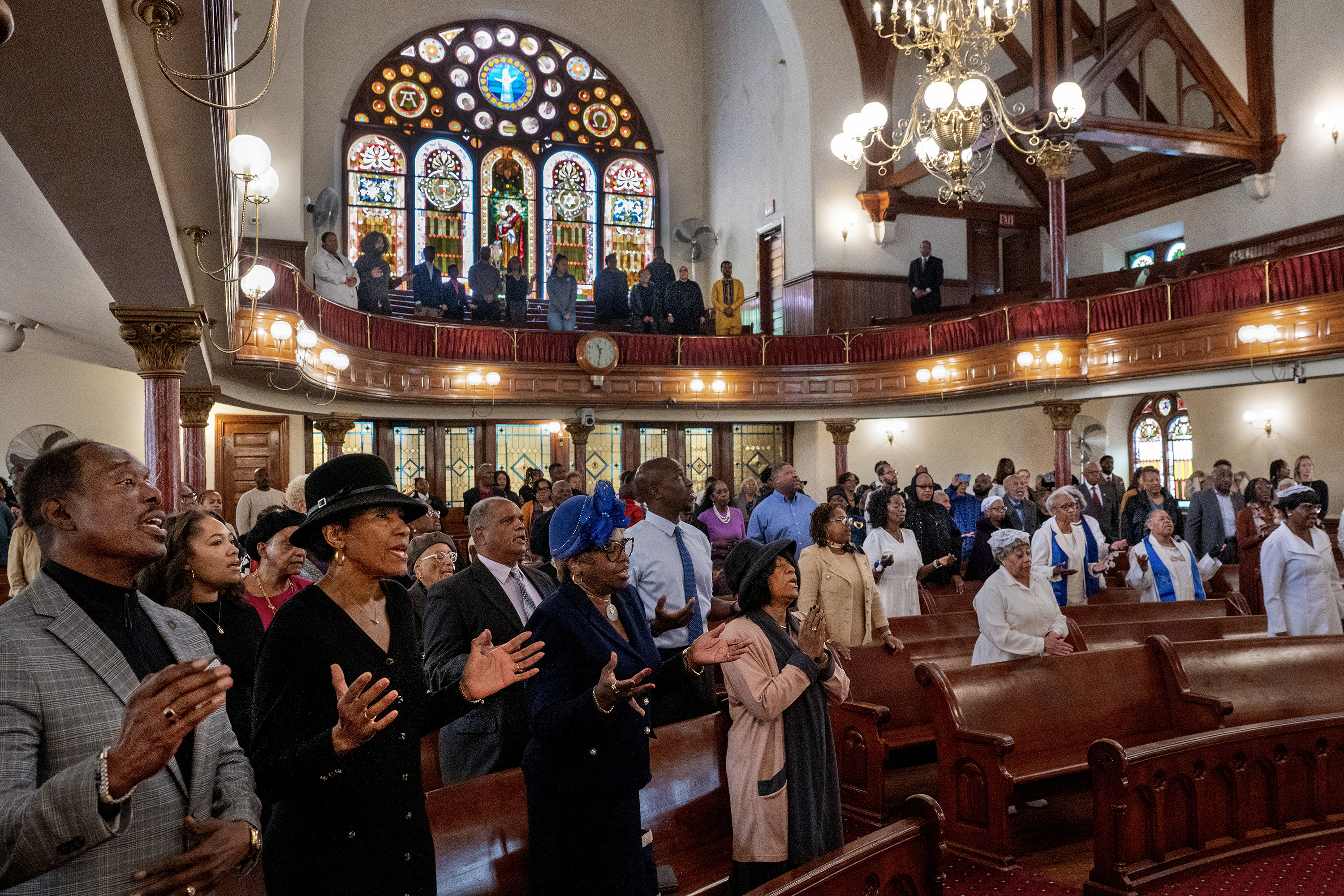
The congregation sings as Rev. Carolyn Cavaness (not shown) celebrates her first worship service on Nov. 10, 2024.
It’s been an amazing first year, definitely life-transforming, being entrusted with this national, this international treasure. I have just been captivated by the testament and the hope that she bears.
There’s this connection, this affinity for her. We’ve gotta be intentional about being the light, about being a place of love, sanctuary, refuge, that people feel safe. That’s a real thing for me.
The people I’ve come to know, the smiles, their new sense of hope — it is possible, you know? People have a sense of joy, and you can feel that and see that. Sometimes when you’re a leader, you’re in a vacuum. And so to hear and to see people smiling more, that does something. As a pastor, that’s a gift. You feel that you’re making a difference.
You are the first woman pastor at Mother Bethel A.M.E. How has it felt to hold that distinction, and how have people received you?
People have been very supportive. It’s about building trust and relationships. All I knew, I could only be Carolyn. I can’t be anybody I’m not. I like to laugh, I like to joke. I think I have surprised people by being accessible.
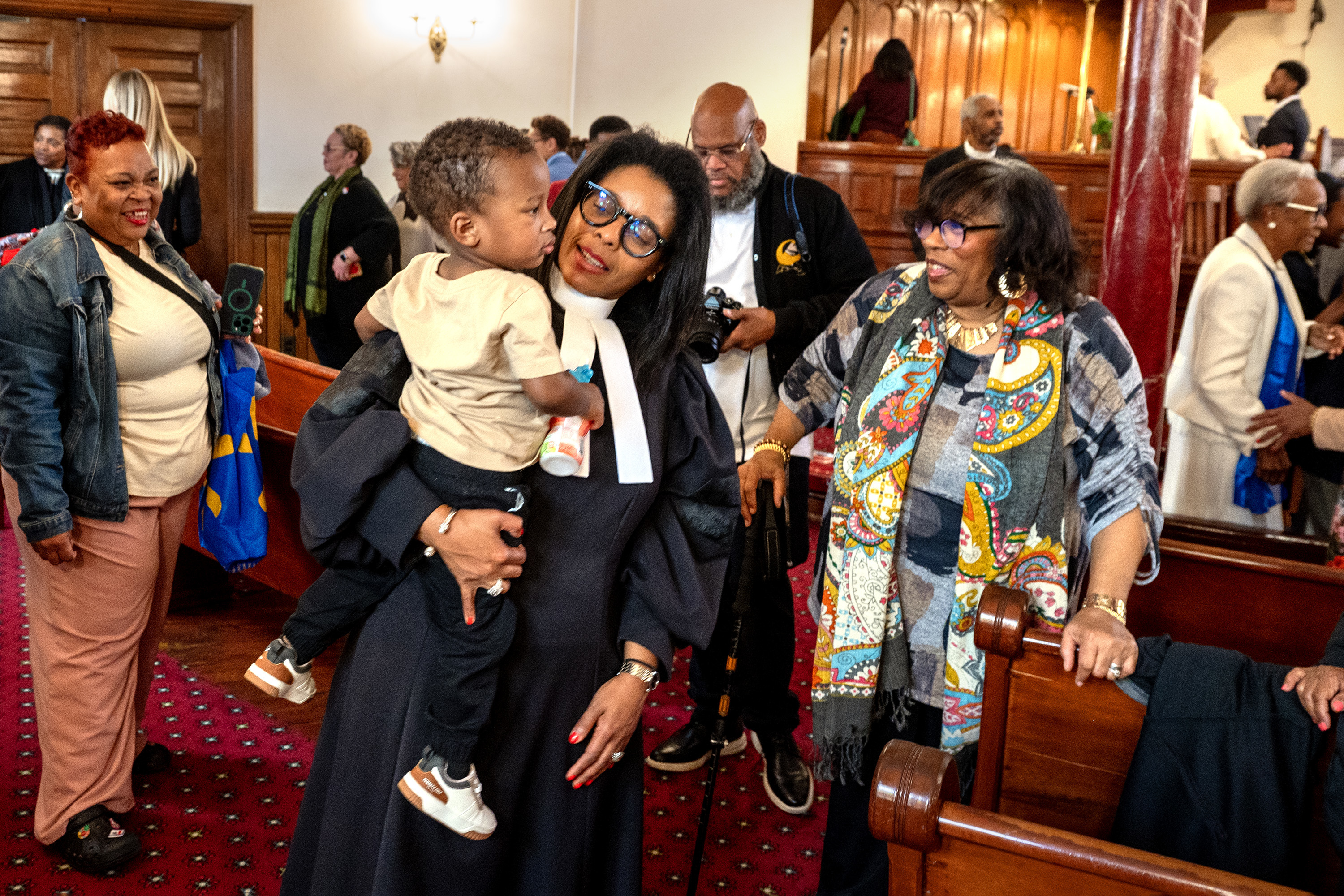
Rev. Carolyn Cavaness holds 2-year-old Kylo Banks as she greets members of the congregation after her first service.
Many people have reminded me, “You know, reverend, you’re a historical figure. Amongst the 53, there’s gonna be that picture of you.” It’s very humbling.
I went to New Orleans and an older gentleman walked up and he said, “Hello, good to meet you. You’re pastor of Mother Bethel.” Fifty years ago, that would have been a different conversation.
I have two twin nephews. They had a women’s history project, and they wrote about me being the pastor of Mother Bethel. My 5-year-old nephews are esteeming me. That was special.
When you were appointed last year, Donald Trump had just won the election, and many of your congregation were fearful of what was to come. What is Mother Bethel’s role during this time?
We are resilient people. This is not the first time that we have had pharaohs and tyrants and dictators.
Here is an institution providing, a way in which government ought to, esteem and affirm and care for [people]. Democracy has ideals, but here, this place, Mother Bethel, is where it’s realized. Where you’re a safe haven and a sanctuary. The principles and the ideals of the Free African Society. We come from that legacy, from that line where we have always taken care. We have always filled a gap. We’ve always been out front.
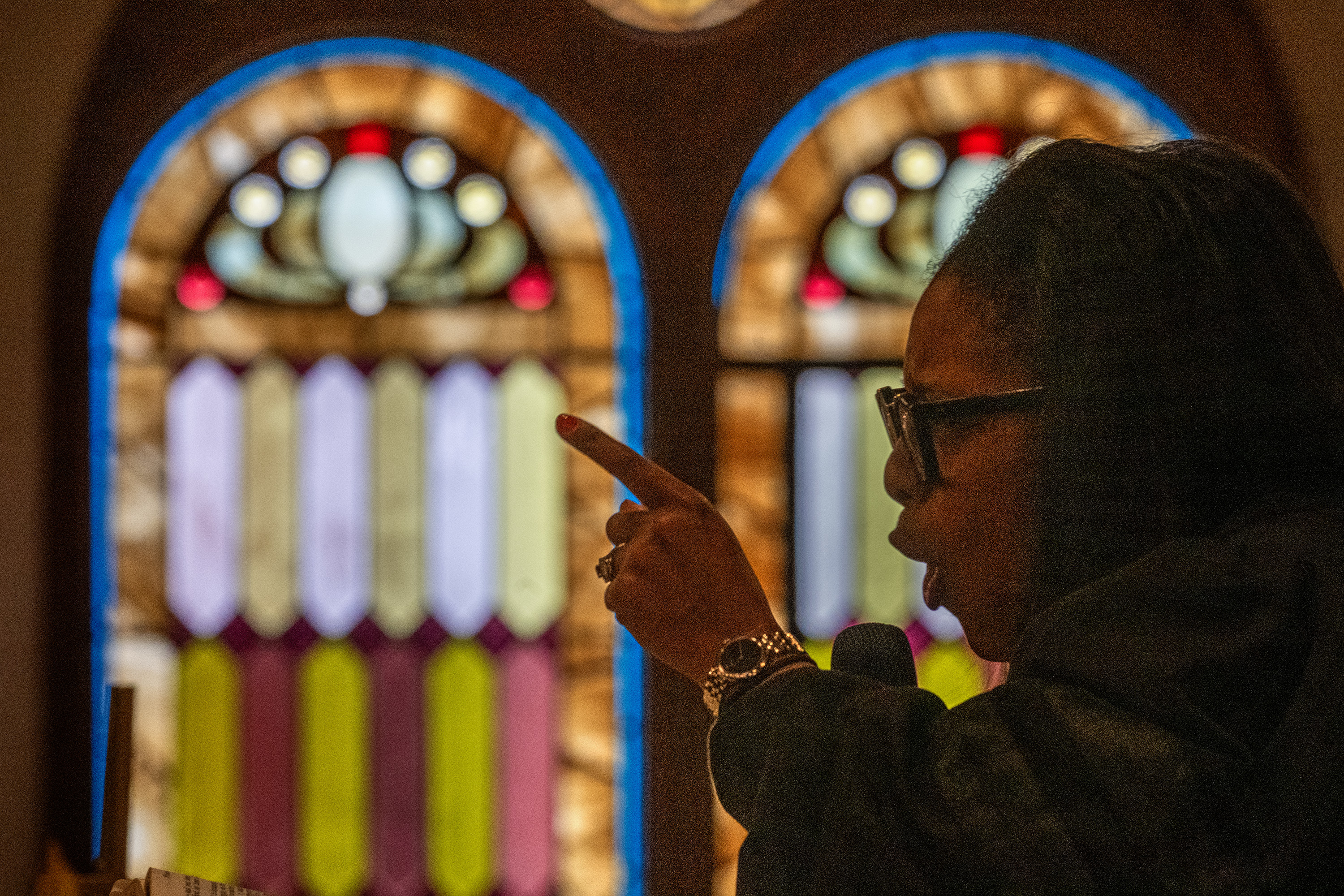
The Rev. Carolyn Cavaness celebrates her first worship service.
Another has definitely been around how we honor our history and legacy. I was honored to give the eulogy for Ruby Boyd — she was the first African American librarian in the city of Philadelphia. She lived to be 105, and she’s one noted for putting into a book, On This Rock, of Mother Bethel, the history of many of the stained glass window collection, pictures and little vignettes about the pastors. And so in my eulogy, I talked about that we have a responsibility to tell the story and to make it accessible.
This regime of erasure has really amplified my efforts as the spiritual leader and also just how important Mother Bethel is.
What are you looking forward to in year two?
I’m looking forward to the [Semiquincentennial], the 250th. Definitely the larger preservation plan, there are some conversations that we as a congregation are gonna be having about her preservation and how accessible [it is]. And to continue to tell this story.
I think also around community engagement. Just seeing people becoming more strengthened in their sense of witness.
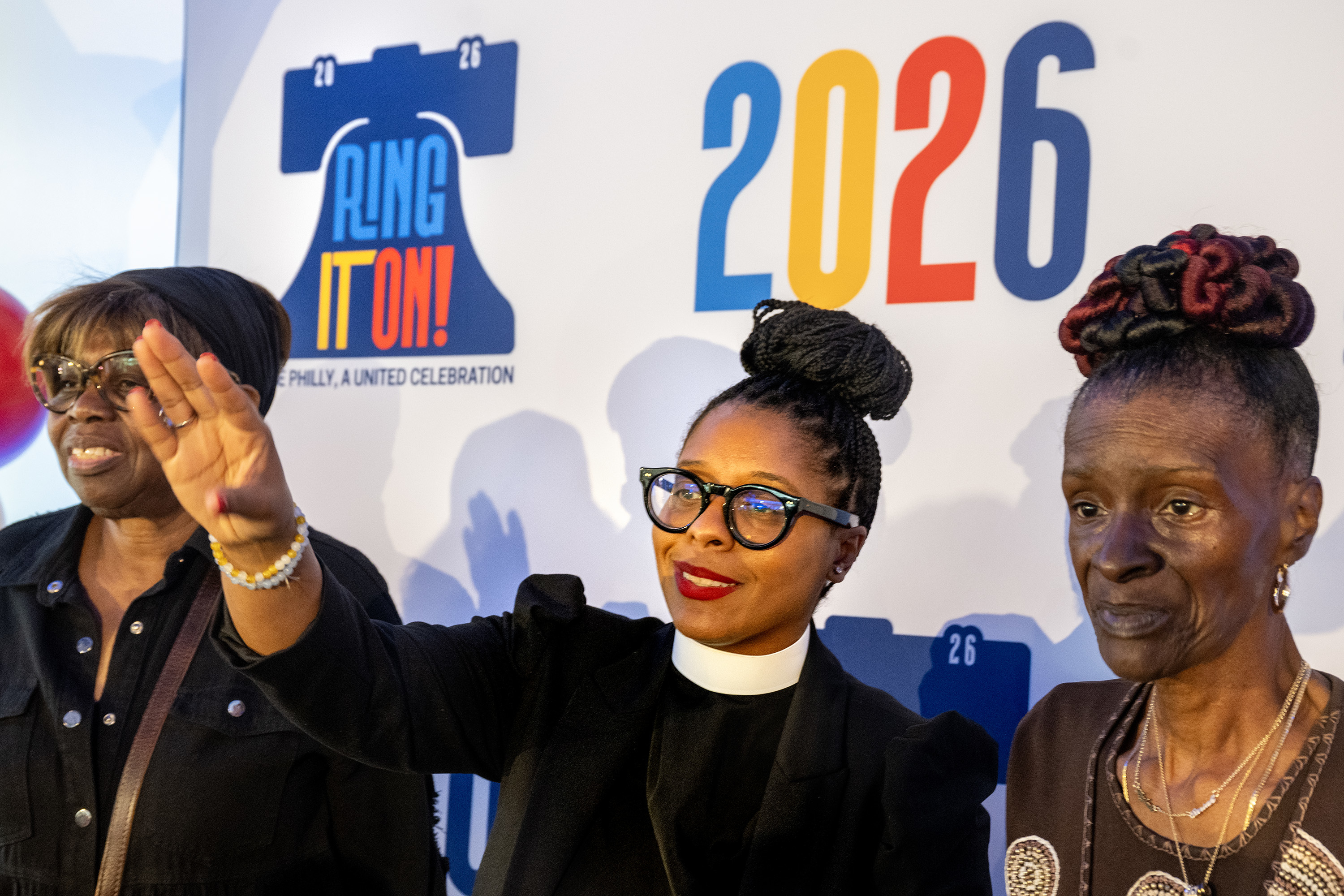
The Rev. Carolyn Cavaness (center) at the Independence Visitor Center during a September Semiquincentennial event.
It always figured to be an emotional day when the Alter family gathered at Har Jehuda Cemetery in Upper Darby. They were commemorating their mother’s first yahrzeit, the anniversary of death in the Jewish tradition.
But when the family arrived at her grave, they found it in devastating condition.
Beatrice Reina Alter, 93, was buried last year next to her husband, Milton Alter, in plots that the couple bought in the Jewish cemetery in the 1990s. When their family came together for her yahrzeit in August, they expected there to be a new headstone to match Milton’s.
Instead, her grave was covered in a fresh mound of dirt. The corner of a plywood board stuck out. And there was no headstone to be seen.
“We were shaken and appalled,” said Daniel Alter, one of the couple’s five children.
Yet issues at the cemetery — and for the burial industry — extend beyond placing headstones on time. Har Jehuda reflects an industry facing serious challenges to its longevity, where sometimes small, antiquated businesses must reinvent themselves. The country’s relationships with cemeteries and burials are changing, putting a seemingly timeless business at risk.
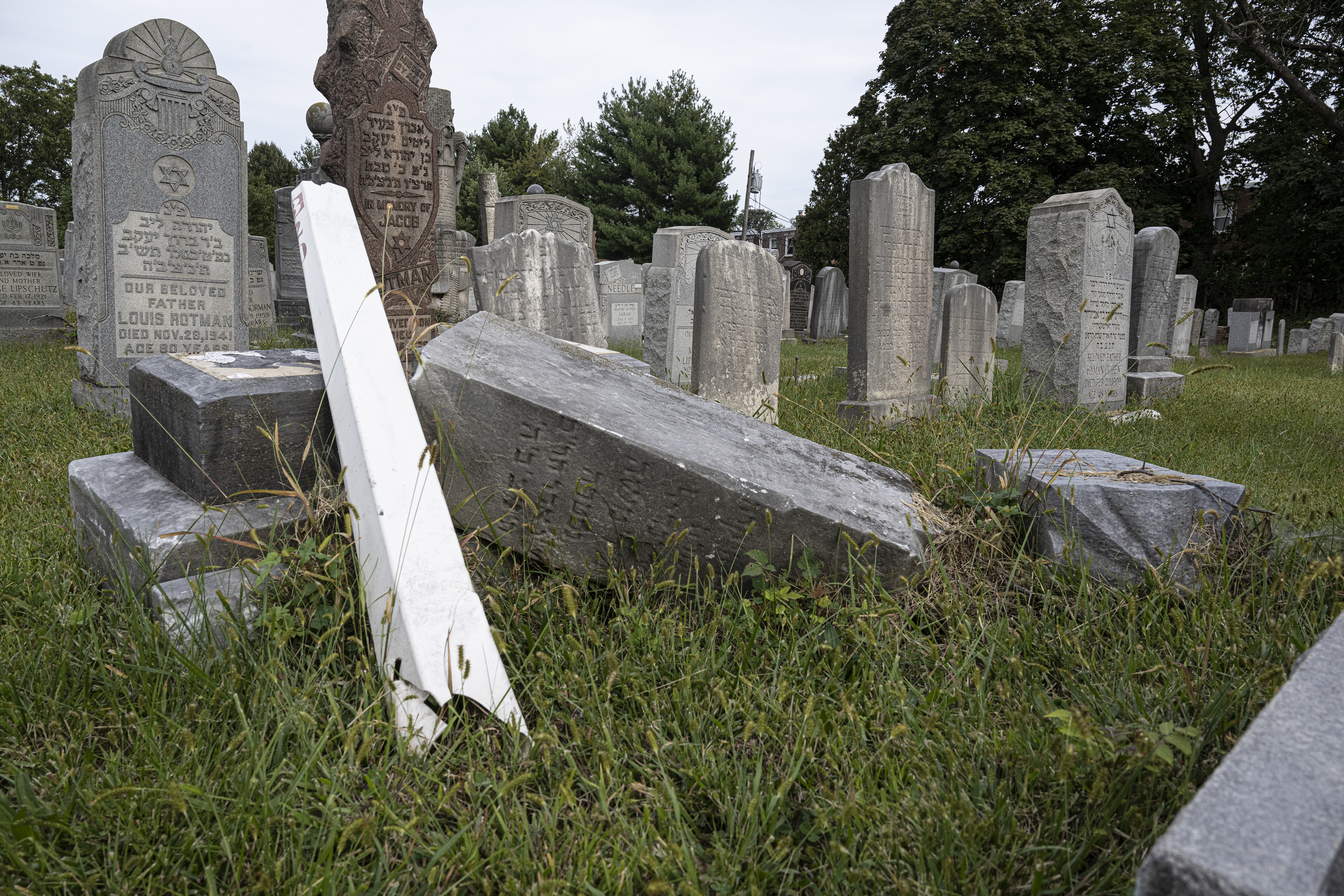
Har Jehuda, for instance,has been an important institution for the region’s Jewish community since its founding in the 1890s, holding more than 20,000 graves. But today, its grounds are largely overgrown and unkept, and numerous gravestones have fallen into disrepair. A volunteer group has stepped in to cover some of the maintenance and landscaping costs but fears it cannot sustain the cemetery for long.
Overgrown weeds and displaced headstones at Har Jehuda Cemetery in Upper Darby.
“The reality is that there are not enough staff or funds to maintain the cemetery, and there hasn’t been for years,” Randi Raskin Nash, a member of the Friends of Har Jehuda Cemetery group, said by email.
The cremation boom
A hundred years ago, cremation was an unusual choice in the United States. Things started to shift in 1963, when the Catholic Church lifted its prohibition of the practice and Jessica Mitford’s book The American Way of Death, an exposé of the death industry, was published. Before then the cremation rate was reported to be in the single digits, and even as it rose, by 1999 only about 25% of Americans were cremated. But that is changing.
Cremations are expected to double the number of burials in 2025, according to a report from the National Funeral Directors Association. By 2045, the cremation rate in Pennsylvania is projected to reach over 82%, with burials dropping to just under 14%.
Several factors appear to be driving the shift, according to Christopher Robinson, the president of the association’s board of directors. Those include costs, environmental concerns, declines in religious affiliation, and growing cultural acceptance of cremation.
window.addEventListener(“message”,function(a){if(void 0!==a.data[“datawrapper-height”]){var e=document.querySelectorAll(“iframe”);for(var t in a.data[“datawrapper-height”])for(var r,i=0;r=e[i];i++)if(r.contentWindow===a.source){var d=a.data[“datawrapper-height”][t]+”px”;r.style.height=d}}});
But that is not the business model that most cemeteries were built upon.
When folks secure a plot for interment, they are really buying an easement for burial rights, or essentially a license to use the cemetery’s land. Plots can cost thousands of dollars and areoften nonrefundable.
Once it comes time for a person to be buried, the cemetery may charge for other parts of the process, like digging and closing the plot, creating a headstone monument, or supplying a vault for the casket.
Most cemeteries sustain themselves for the future by putting a portion of that revenue into an endowment fund, where the return on investment can be used for maintenance and repairs. Friends of Har Jehuda estimates that it requires roughly $50,000 to$75,000 just to cover lawn mowing and weeding per season.
Cremations are much less profitable, particularly if a cemetery does not actually perform it — a walled recess with an engraved cover for a loved one’s urn may cost only a few hundred dollars.
It’s unknown exactly how many cemeteries have formally closed or been abandoned in recent years, since the statistic does not appear to be widely tracked. What is clear is that cremation trends and dwindling space for future burials have left cemeteries struggling.
“There’s going to be a lot of cemeteries going out of business in the next 20 years,” said Tanya Marsh, a law professor at Wake Forest University who teaches funeral and cemetery law, in an episode of The Economics of Everyday Things podcast last year.
Would you get married at a cemetery?
Some cemeteries have embraced the changes and creatively diversified their offerings.
“We’re an outdoor museum. We’re a sculpture garden, we’re an arboretum … we’re more than just a cemetery,” said Nancy Goldenberg, CEO of Laurel Hill Cemeteries in Philadelphia.
Laurel Hill uses its combined 265 acres on both sides of the Schuylkill to its advantage. On a given day at the historic cemetery, you might see visitors on a history tour, stretching out to watch a movie screening, attending a wedding, or meeting with the official book club, Boneyard Bookworms.
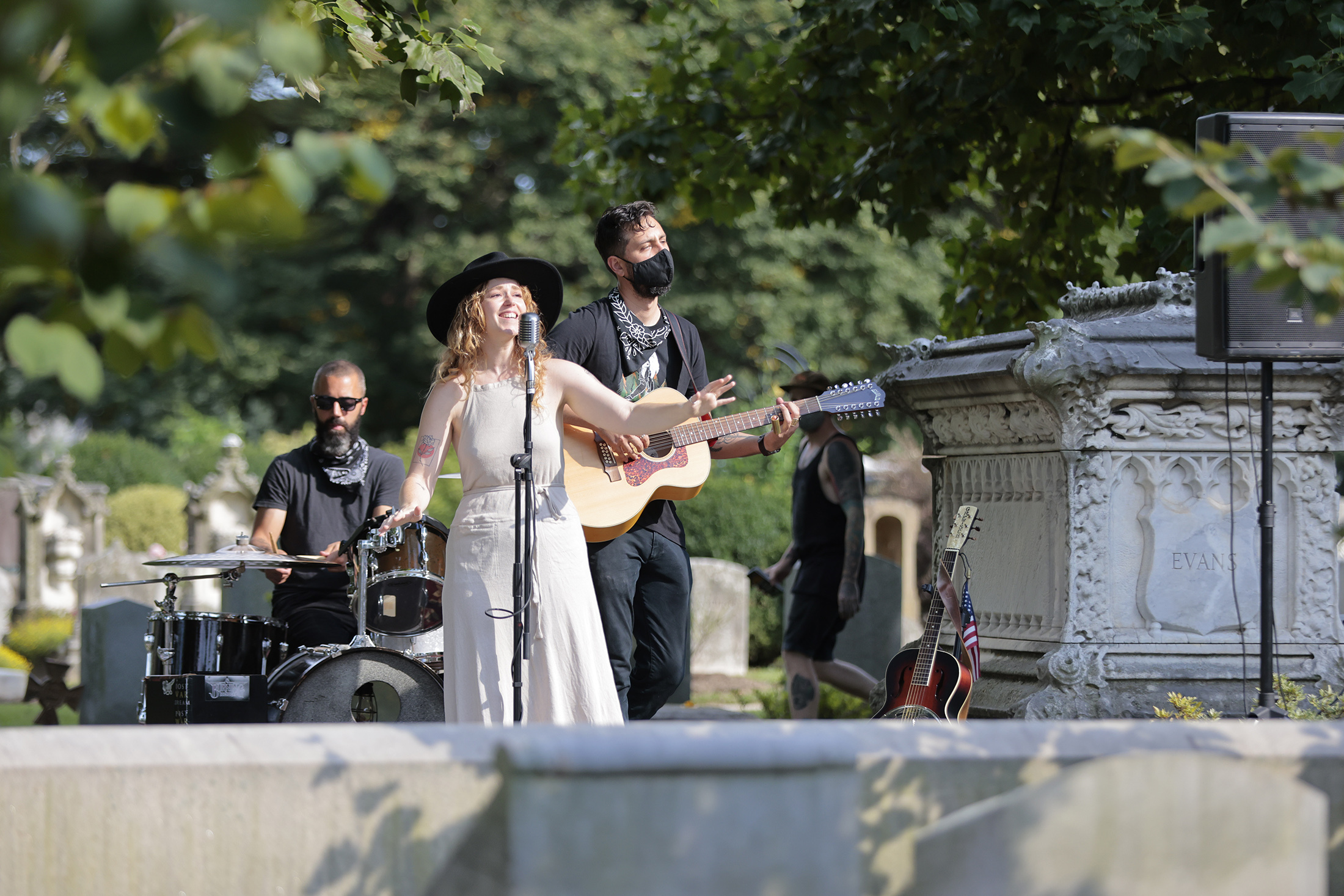
The 49 Burning Condors singer Kimber Dulin, Christopher Tremogile on guitar and Jason Gooch on drums play as folks shop for unusual antiques, vintage items, artwork and handmade wares at the Market of the Macabre at the Laurel Hill Cemetery in 2021.
Goldenberg said the extensive offerings are meant to build connections between people and the cemetery: They will be more likely to contribute money, or when they eventually need a resting place for their loved ones, they will look therefirst.
This all used to be more common — the first U.S. cemeteries in the mid-19th century also served as the country’s first public parks, with open grassy fields fit for a picnic. Before then, people buried their dead in smaller graveyards that eventually became overcrowded and sources of disease.
Laurel Hill is readying itself for a changing death industry, too. Goldenberg said she anticipates a rise in “green burials,” in which a person is buried without embalming or a casket, and said the cemetery was designating a section for them.
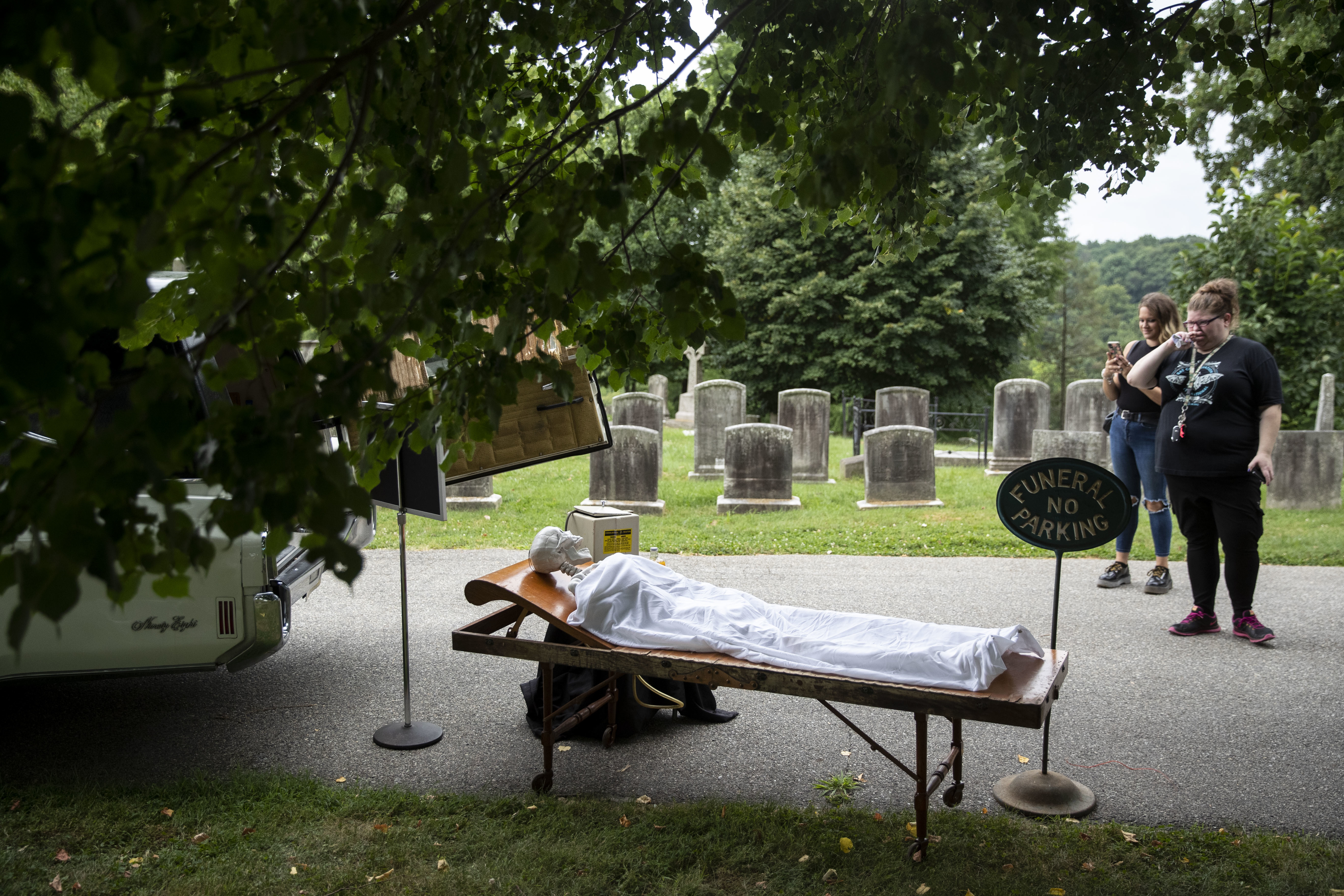
Visitors view a display behind a hearse during the 13th Car & Hearse Show presented by the Mohnton Professional Car Club at Laurel Hill Cemetery in 2021.
And while Goldenberg said she would be long gone before the cemetery runs out of space for new burials, it is a reality officials are planning for.
Laurel Hill is adding space for an additional 225 niches for cremated remains.
“There are small cemeteries, and once they fill up, that’s the revenue stream. … You have to be prepared for that,” she said.
“If you don’t, that’s when you fall on hard times.”
If a cemetery reachesthe point of closure or abandonment, it’s not alwaysclear what would happen to it. Last year, Gov. Josh Shapiro signed into law a bill sponsored by StateRep. Tim Brennan (D., Bucks) that would give financial relief to municipalities that take over abandoned cemeteries, since doing so can be a costly burden that local governments want to avoid.
Uncertain futures for cemeteries
Days after the Alter family made it through the prayers and memorial they planned, the emotional weight of the experience hit them even harder.
Daniel Alter later confirmed with Har Jehuda that a fresh grave had been dug where he believed his mother was buried. Recently, he hired a ground-penetrating radar company to examine the burial site, which determined the freshly dug grave was directly adjacent to where his mother was buried. While Alter was relieved to learn his mother’s grave had not been disturbed, he said Har Jehuda could have prevented the anguish he and his family have felt over the last few months.
Har Jehuda Cemetery’s owner, Larry Moskowitz, declined to comment for this article. Moskowitz was previously prosecuted by the state attorney general’s office over allegations that his other business, Wertheimer Monuments, had failed to deliver headstones to people who had paid for them. Complaints like these against the burial industry happen occasionally — the attorney general’s office also sued another Philadelphia monuments company in 2023 for failing to deliver headstones. There are multiple organizationsdedicated to protecting consumers against predatory burial providers.
The Alters, like other families, continue to visit and bury their loved ones at Har Jehuda, but they hope that no one else goes through their experience.
“Our collective wish is that it never, ever, ever happens again to anyone in the Philly area,” Daniel Alter said.
The West Philly Tool Library, where members can borrow from several thousand different tools and attend classes learning how to use them, is moving from its home of the past 15 years.
Its landlord on South 47th Street near Woodland Avenue has chosen not to renew its lease, and the library will have to move by the end of November.
Executive director Jason R. Sanders said that the tool library has been receiving below-market-rate rent since moving in and that the organization was not upset with its landlord for raising the rent beyond what the tool library could afford.
“We’re very grateful and want to dispel that,” Sanders said.
The tool library’s leadership is scouting options for a new home. Wherever the library goes, it will likely need to perform repairs and retrofitting before it can open again. Sanders said that work plus moving costs would likely exceed $50,000.

Tools cabinets inside the West Philly Tool Library last week.
Asking for money is something Sanders and the library have always sought to avoid. They run a purposefully tight operation, with $20 annual memberships, volunteer staff, and minimal grant funding.
Sanders said the organization started in 2007 as a few friends who shared tools with their neighbors to make DIY home repairs. They never imagined to have the reach the library does now, with over 1,300 active members and even more coming through its classes.
The library offers nearly every kind of household tool imaginable, from mundane screwdrivers and pliers to jackhammers and power washers. Its classes teach attendees about plumbing and electrical work, as well as sewing and date-night woodworking projects. It aimsto help people live more safely and healthily in their homes, Sanders said.
“We want to live within our means and support the community with the support we receive. So it’s kind of an unprecedented thing for us to ask for that, and I think people understand that we’re asking in a time of need,” Sanders said.
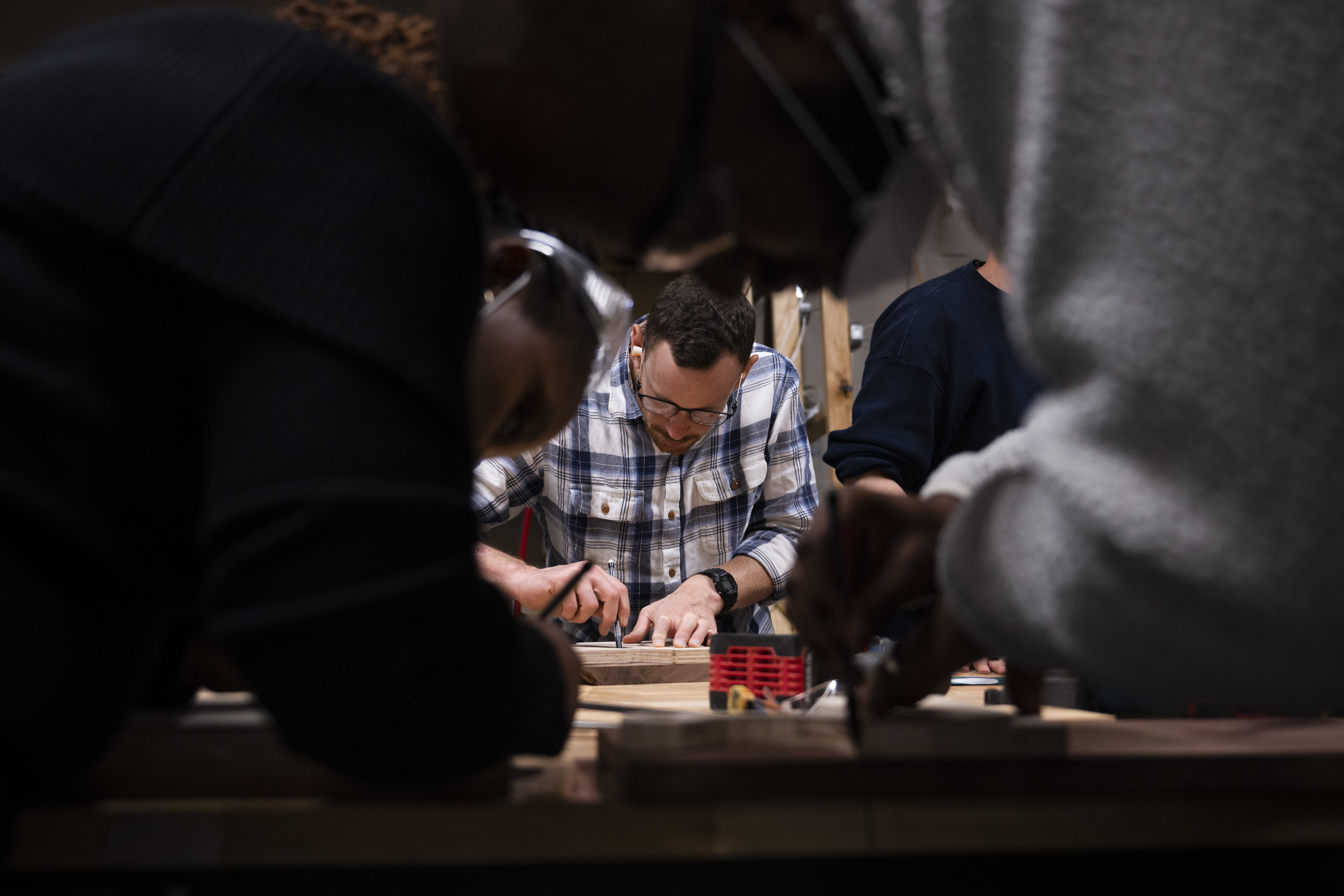
Alan Hahn works on a charcuterie board during a woodworking class at the West Philly Tool Library on Friday, Oct. 10.
Sanders said that particularly over the last few years, the library has become a sort of “community hub” that means more to West Philly than just a place you can grab a hammer.
“It blows me away,” Sanders said about the support the library has received.
Beginning later this week, the library will host volunteer days for those willing to help prepare for their move. The library is also accepting donated construction materials for renovations like drywall and wiring.
The tool library is hosting a fundraiser event on Oct. 25, with pumpkin carving, food and drink, and a raffle from local businesses and artists.