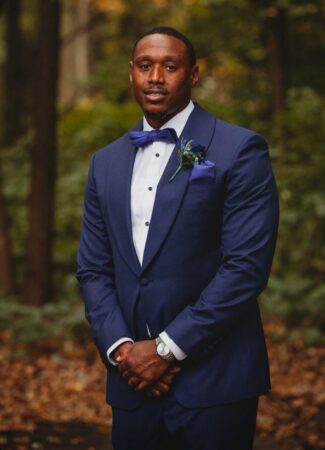
The Philadelphia Police Department on Tuesday released the name of the officer who shot and wounded a knife-wielding man on New Year’s Eve in Strawberry Mansion: Nicholas Jones.
Jones, 26, a four-year veteran of the department, shot 31-year-old Keith Freeman once in the chest, police said.
Jones and another officer — whose name has not been released — were called to a house in the 1800 block of North Bailey Street, police said, after a 911 caller had reported hearing a woman screaming.
A 9-year-old child opened the door, police said, and inside the officers saw a 30-year-old woman lying on the floor. Standing over her, knife in hand, they said, was Freeman. The woman had not been injured.
According to police, Jones and the other officer told Freeman to drop the knife. Instead, police said, Freeman leapt over a sofa and charged the officers, and Jones shot him.
Freeman was taken to Temple University Hospital for treatment. He was charged with aggravated assault, possession of an instrument of crime, simple assault, and recklessly endangering another person.
Freeman and the woman know one another, police said.
A police spokesperson said Tuesday that Jones has not previously been involved in an on-duty shooting. He has been placed on administrative duty, as is customary, pending an internal investigation.
A man died Sunday night after being placed in the back of a Philadelphia police cruiser that was parked on a Mayfair road, police said.
Officers were called to the 4000 block of Hellerman Street after the man, whose name and age have not been released, fired his legally owned gun several times into the ground outside a home he had just left, a police spokesperson said Monday.
Moments earlier, the spokesperson said, the man had argued with a relative during a party at the house.
No one was injured by the gunfire, police said.
When officers arrived, they took the man, who they said appeared disoriented and resisted arrest, into custody. They placed him in the back of a police vehicle, “where he became unresponsive,” the spokesperson said.
Efforts to resuscitate him were unsuccessful, and he was pronounced dead shortly before midnight at a nearby hospital.
The police released no additional details about the incident and said the cause of the man’s death has not yet been determined.
On Monday afternoon, no one answered the door at the home where the party had taken place. There was no visible sign of gunfire on the front lawn, which was crowded with lawn ornaments and a sign warning dog owners to clean up after their pets.
Two neighbors who were reached for comment at their homes said they had slept through the incident.
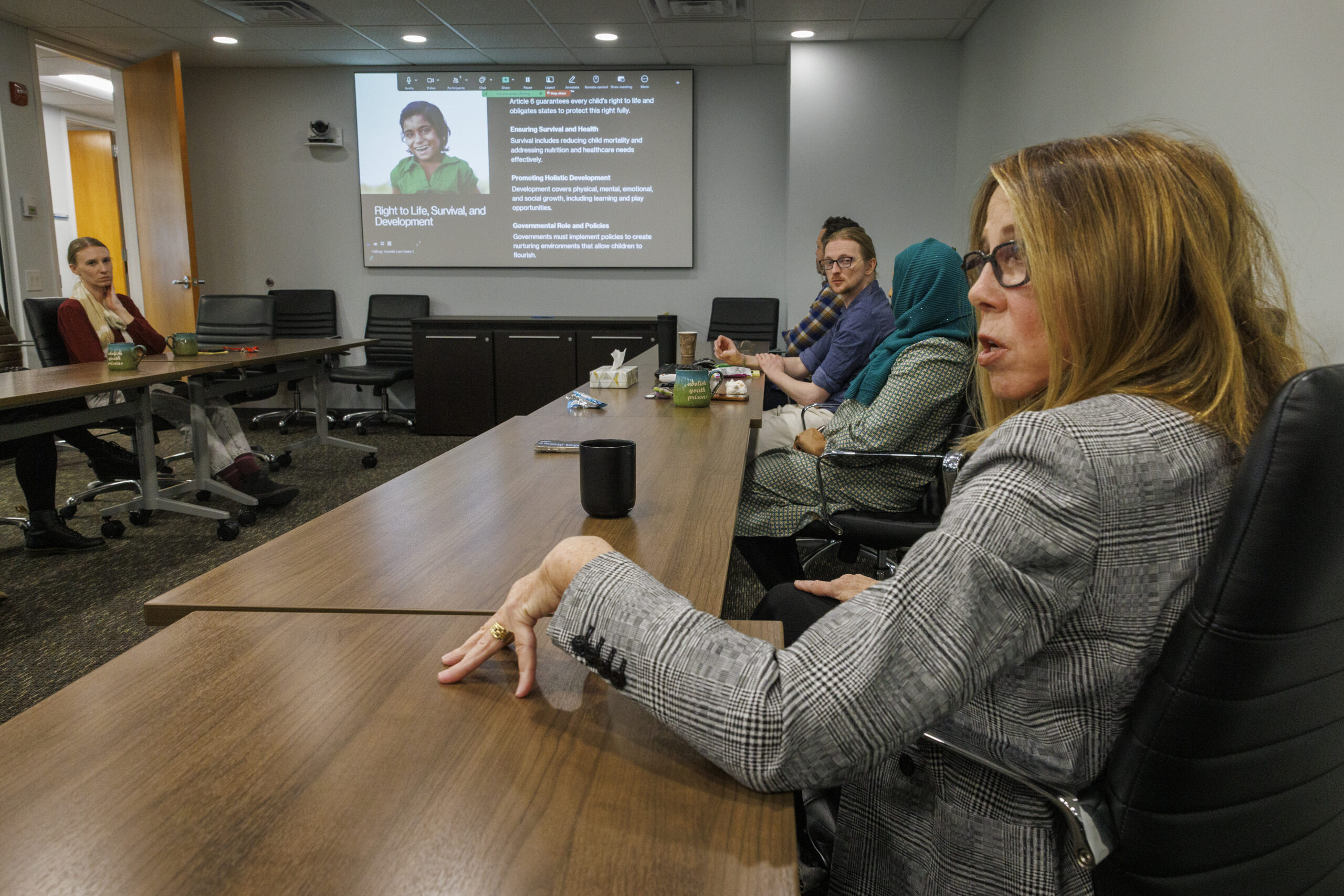
Marsha Levick took her seat at a conference table at the Juvenile Law Center on a recent Wednesday for what would be one of her last meetings. She walked colleagues through the basic principles of the United Nations Convention on the Rights of the Child, the 1989 treaty that laid out, in clear terms, what the world said it owed young people.
At the heart of the treaty is a simple idea: A child’s best interests come first — even when that child enters the justice system. It has been ratified by all but one of the U.N.’s member nations: the U.S. And in many of those 196other countries,Levick said, children younger than 14 cannot be prosecuted at all.
“Wait,” a staffer interjected. “Kids younger than 14 aren’t in the justice system?”
“I know,” Levick said. “It’s very different.”
Marsha Levick, chief legal officer and cofounder of the Juvenile Law Center, speaks with staff on Dec. 17.
For 50 years, Levick, 74, has been one of the most persistent and influential voices in the American juvenile justice system, a driving force in turning what was once a niche legal specialty into a national civil rights movement. Colleagues credit her with helping to rewrite how courts view children — persuading judges, including those on the U.S. Supreme Court, to treat youth not as miniature adults but as citizens with distinct constitutional protections and needs.
Levick will step down Wednesday from her position as chief legal officer of the Juvenile Law Center, the Philadelphia-based organization she helped build from a walk-in legal clinic in 1975 into a national leader in children’s rights.
Her departure coincides with the center’s 50th anniversary. At a celebration gala in May, the nonprofit honored Levick with a leadership award that recognized her body of work.
Levick’s career ranged from representing individual teenagers to steering landmark litigation that forced states to overhaul abusive practices. She helped lead the Juvenile Law Center’s response to the “kids for cash” scandal in Luzerne County. She coauthored briefs in a series of U.S. Supreme Court victories that throttled the harshest punishments for kids, including life in prison.
But Levick is also stepping down at what she calls a “dark moment” forcivil liberties in America — a time when rights once thought settled are being rolled back.
Levick was in law school in 1973 when the U.S. Supreme Court handed down Roe v. Wade, the landmark decision that recognized a constitutional right to abortion. In the years that followed, a constellation of rights — from marriage equality to access to contraception — also expanded.
Roe was overturned, however, in 2022. Since then, other decisions have also chipped away at affirmative action in colleges and LGBTQ+ protections.
“It’s hard to convey the shock that it imposes,” Levick said in a recent interview. “Now, 50 years later, you’re pushing the rock back up the hill.”
She made clear she was unsparing with herself, quick to point out what she perceived as shortcomings. “There were high moments for sure,” she said. “But I am not foolishly happy about that. I’m shocked that that’s all we could do. That’s as far as we got.”
Yet even as fresh battles loom, colleagues say the groundwork Levick has laid will guide the Juvenile Law Center’s mission and the broader fight for children’s rights for years to come.
Jessica Feierman, the center’s senior managing director, will step into Levick’s role. “It is a huge privilege and also an immense responsibility,” she said. “In this moment of attacks on civil rights and children’s rights, it’s even more vital that we build on the victories of the last 50 years.”
From Philadelphia to the U.S. Supreme Court
Raised in Philadelphia’s Fairmount neighborhood, Levick discovered early the charge of using her voice, first as a girl who demanded a recount in an elementary school election and won the presidency, and later as a teenager who inhaled The Feminine Mystique and the feminist writers who followed. She earned an undergraduate degree from the University of Pennsylvania and a law degree from what is now Temple University Beasley School of Law.
She cofounded the Juvenile Law Center in 1975 with three law school classmates: Bob Schwartz, a classical music aficionado and part-time semi-pro baseball umpire; Phil Margolis, a vegetarian and free spirit; and Judy Chomsky, a mother of two and passionate Vietnam War resister.
Seven years earlier, the U.S. Supreme Court had ruled that juveniles were entitled to due process. That decision cracked open an untapped field, Levick said, to buildwith her classmates a new kind of civil rights practice focused on children.
For the first year, they worked out of the Chestnut Street office of Chomsky’s husband, a cardiologist, carving out space in his waiting room and sidestepping an exam room on the days he saw patients.
In its earliest years, the center took on individual cases for children. One of Levick’s first clients was in Montgomery County, a teen girl who had participated in a protest at a nuclear plant and who was arrested and charged with trespassing, she said.
But the center struggled financially. The founding partners laid themselves off at one point, Levick said, so they could keep paying the few employees they had hired: a divorced mother who worked as a receptionist; their first lawyer, Anita DeFrantz, who was an Olympic rower; and a social worker.
In 1982, Levick quit the center to become the legal director of the national NOW Legal Defense and Education Fund, now Legal Momentum. By the time she left there six years later, she had become its executive director.
At the NOW Legal Defense and Education Fund, Levick said, she learned how to build national cases — coordinating multistate litigation and filing amicus briefs in federal courts. By the time she returned to the Juvenile Law Center in 1995, after a stint at a small Paoli firm, she had come to believe that individual wins, while necessary, would not be enough to create lasting change.
The center’s mission became more focused on appellate litigation and national advocacy, setting the stage for children’s rights to reach state supreme courts and, eventually, the U.S. Supreme Court.
Hundreds of juveniles resentenced, released
In 2005, in Roper v. Simmons, Levick cowrote in a brief that social science research on youth development should inform constitutional law. Children, she also wrote, have a greater capacity to change.
“We just pushed ourselves into the center of it,” Levick said. “We were like, ‘We’re here. We’re writing the amicus brief.’”
The high court overturned decades of precedent when it ruled in Roper that the Eighth Amendment forbids the death penalty for juveniles. Five years later, in Graham v. Florida, it barred life-without-parole sentences for juveniles in non-homicide cases, after reading another brief Levick coauthored.
In 2012, Levick helped persuade the court to end mandatory life-without-parole sentences for youths convicted of homicide in Miller v. Alabama. And in 2016, she served as cocounsel in Montgomery v. Louisiana, the case that made the Miller decision retroactive across the country.
Since then, hundreds of juveniles — including nearly 500 in Pennsylvania — have been resentenced or released from prison. One of them: Donnell Drinks, freed in 2018 after 27 years.
The first time Drinks met Levick, he hugged her. “I couldn’t believe how small she was, because of her presence, her legal prowess, has all been so enormous,” recalled Drinks, who works as a leadership and engagement coordinator at the Campaign for the Fair Sentencing of Youth.Levick is 5-foot-3.
Those cases brought Levick into courtrooms across the state, often alongside public defenders. One of them, Bradley S. Bridge, a retired Philadelphia public defender who worked with her on dozens of resentencings, called Levick a “zealous advocate” who “always saw the big picture.”
Her ability, he said, “to think toward the future, I think, was most glorious.”
Levick agreed that looking ahead had always been part of her work. “We always tried to look around the corner,” she said.
One of those moments came in 2008, when she and her colleagues began fielding troubling calls from Luzerne County — the first hints of what would become the “kids-for-cash” scandal.
Seeing more in the ‘kids-for-cash’ scandal
In 2007, Laurene Transue called the Juvenile Law Center. Her daughter, 14-year-old Hillary Transue, had been ordered to serve three months in a detention facility after she created a Myspace page mocking her school principal, she said at the time.
“We saw in that one phone call something that was clearly much bigger,” Levick said.
In fact, it was one of the most egregious judicial corruption cases in modern American history: Two Luzerne County judges had accepted kickbacks in exchange for sentencing thousands of juveniles — many for minor misbehavior — to extended stays in private detention centers.
“It was kind of like, if I may, what the f— in my mind,” Levick recalled.
Levick and the center petitioned the Pennsylvania Supreme Court, which ultimately threw out and expunged thousands of adjudications. They later helped families pursue civil damages, with the help of other firms. The judges, Mark Ciavarella and Michael Conahan, were convicted of federal crimes and sentenced to long prison terms; President Joe Biden commuted Conahan’s sentence in 2024.
Hillary Transue now serves on the Juvenile Law Center’s board.
Transue told The Inquirer that as a teenager she believed that “highly educated” adults in “positions of authority” were “mean, nasty people who were out to hurt you.” But Levick, she said, “brushed up against my perception of adults” and proved her wrong.
“I think she’s a goddamn superhero,” Transue said recently.
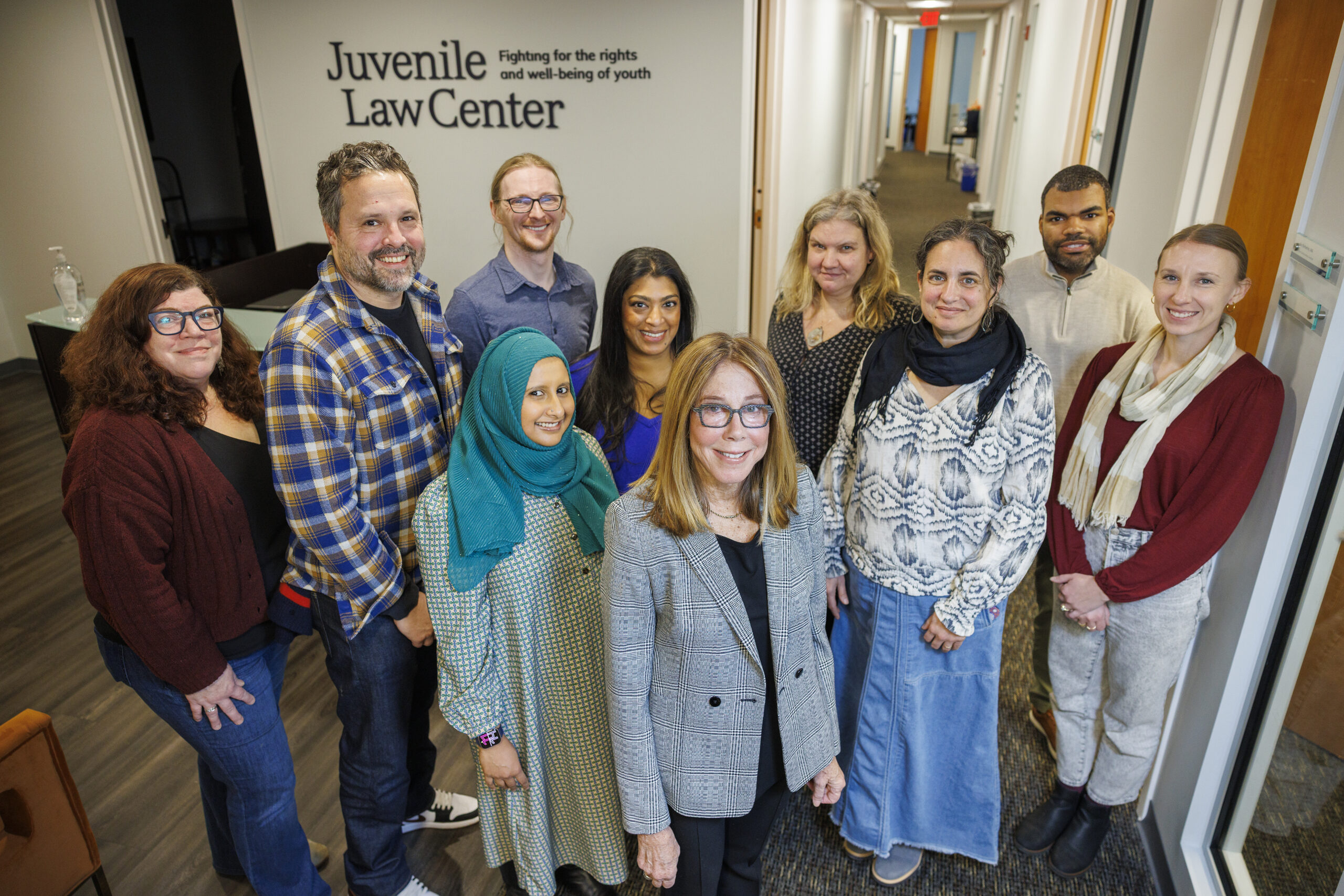
Marsha Levick (center) stands with staffers at the Juvenile Law Center earlier this month.
Among the successes, Levick still sees failures
Despite the victories, Levick is quick to cite the cases she lost. “I’ve had successes. I’ve also failed many times,” she said.
She still thinks about clients like Jamie Silvonek, sentenced to 35 years to life in prison after killing her mother, whose early release Levick has fought for but has not yet won, or a recent bid to expand parole access for people convicted as juveniles that fell flat in Florida.
Those losses have hardened her view of how deeply punishment is embedded in American law. “I feel like punishment is in our bones,” she said. “The way that we think about crime is that it is always followed by punishment.”
That instinct, she said, has left behind people who could have thrived outside prison — including juvenile lifers who will never be released. One of them is Silvonek, whom Levick described as brilliant and warm. “I want her to be able to share that warmth and joy with her family and with her community, who are all behind her,” Levick said.
“We lost what they had to give,” she added.
Levick isn’t done yet
Levick, who is married with two adult daughters, is not leaving the field. She will become the Phyllis Beck chair at Temple’s Beasley School of Law, a post once held by her cofounder Bob Schwartz, and will teach constitutional law to first-year students.
She feels newly urgent about the course. “I am outraged at the degree to which the law has been perverted by the current moment, and I think I still can say and do something about that,” she said. “I think that the things that motivate me include outrage.”
She expects much of the future progress in youth justice to come from state supreme courts rather than the U.S. Supreme Court — a shift she sees as pragmatic, not pessimistic. Washington State Supreme Court Justice Mary Yu, who has heard Levick argue successfully before her, called her a fearless litigator. “She’s an extraordinary appellate lawyer,” Yu, who is also retiring Wednesday, said in an interview.“It’s almost instinctual to her.”
And even now, Levick said, she has hope.
“We’re not going to abolish the juvenile justice system in America, but we could transform it radically,” Levick said. “I believe that. But it takes more than just lawyers to care. It takes more than the community to care. It takes people in positions of power to care. And that’s the hard part.”
Correction: An earlier version of this article misstated the name of a legal advocacy group at which Levick worked. She worked at NOW Legal Defense and Education Fund. The story also misstated the year Laurene Transue called the Juvenile Law Center; she called the law center in 2007.
Philadelphia police have arrested a 16-year-old girl and charged her with voluntary manslaughter, after they said she stabbed a man Sunday morning in Roxborough.
Officers who were called to the 500 block of Wartman Street found the 57-year-old man. He had been stabbed multiple timesin between his ribs, police said.
The man, whose name has not been released, was transported to Jefferson-Einstein Hospital, where he died shortly after 10 a.m., police said.
Deputy Police Commissioner Frank Vanore said the girl and her mother lived with the man, a family friend, in the Wartman Street home. He said that there was an altercation between the teen and the man, and that the girl then stabbed him multiple times. The teen, he said, also suffered injuries to her face.
Officers took the girl into custody Sunday. In addition to voluntary manslaughter, she has been charged with possessing an instrument of crime. She is being charged as a juvenile.
Vanore said investigators are looking into whether the teen and man may have used drugs together.
A 2-year-old girl was beaten to death in South Philadelphia last week, authorities say, and three people have been charged in connection with the crime.
The girl, Key’Monnie Bean, may have been subjected to abuse before the fatal beating on Dec. 8, Assistant District Attorney Ashley Toczylowski said at a news conference Thursday.
“There are indications this was an ongoing situation this little girl had to endure,” she said.
That night, police were called to a home in the 2100 block of South Beechwood Street for a report of an unresponsive child. When officers arrived, they found the girl lying on the floor of the basement, police said. She was not breathing, and bruises covered her body, Toczylowski said.
Efforts to revive the child were unsuccessful, said Deputy Commissioner Frank Vanore. She was pronounced dead shortly before 10 p.m. at Children’s Hospital of Philadelphia.
Prosecutors are still awaiting a medical examiner’s report, Toczylowski said, but preliminary evidence suggests the child may have been beaten with objects and her airway restricted, causing suffocation. Her death has been ruled a homicide.
Sean Hernandez, also known as Raafi Gorham, the boyfriend of the toddler’s mother, was arrested Wednesday and charged with murder, police said. Gorham, 21, lives at the house where the girl was found, Toczylowski said.
Gorham’s cousin, Anthony Lowrie, 21, and Alycia McNeill, 20, were also arrested Wednesday and charged with obstruction and lying to police, Toczylowski said. Lowrie is additionally charged with giving police a fake identification. Toczylowski said the two provided conflicting and false accounts of what occurred that evening. Both live in West Passyunk.
“Everyone in that house was very reluctant” to speak with police, she said, though someone in the house had called 911.
Key’Monnie’s mother was home at the time of the alleged beating, Toczylowski said, but has not been charged in the incident.
The girl’s father, TaShaun Walls, declined to comment Thursday, citing his grief.
In a public Facebook post, Walls wrote: “I love you so much [and] miss you so much already just wish I would has been there faster but I’ll never forget you.”
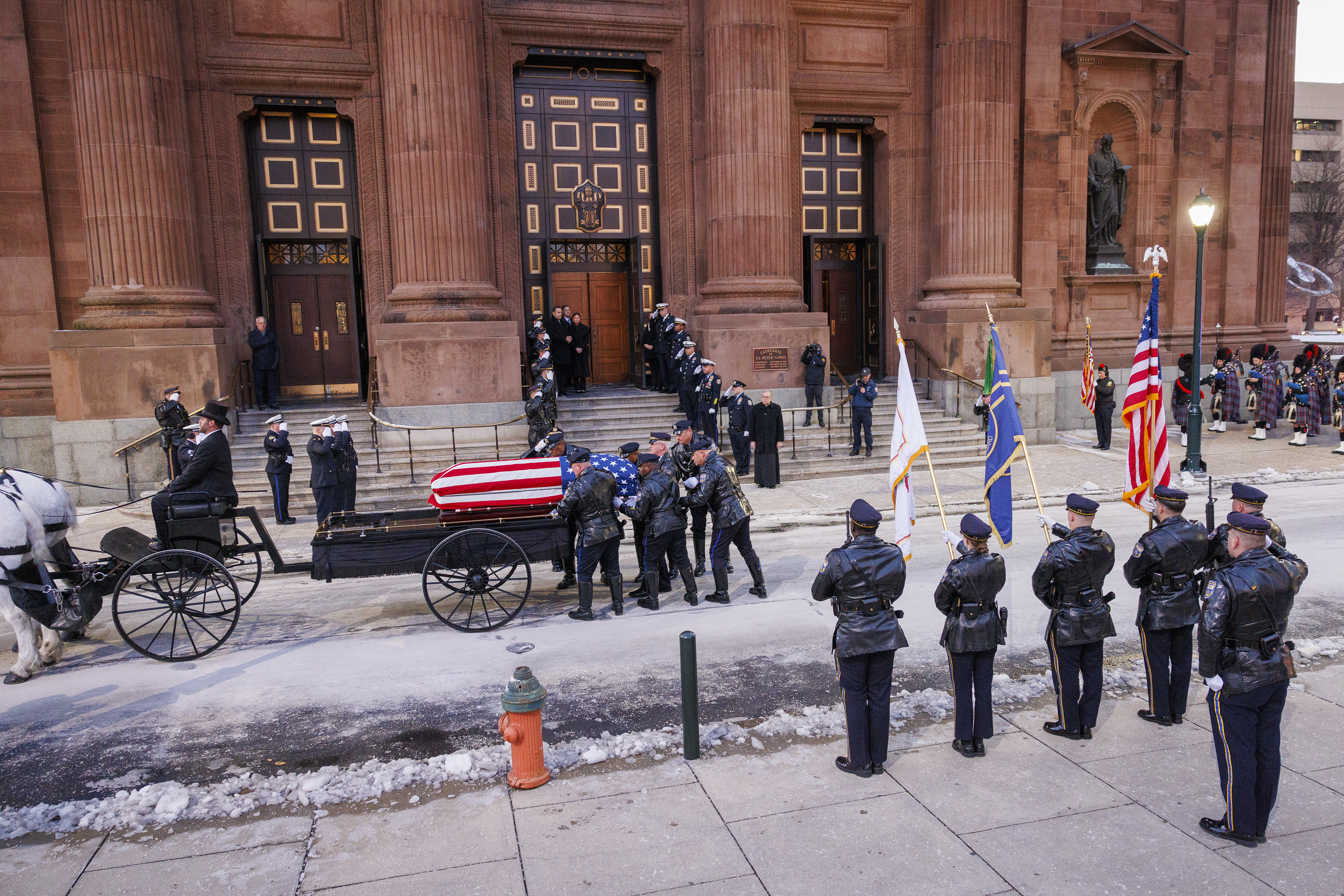
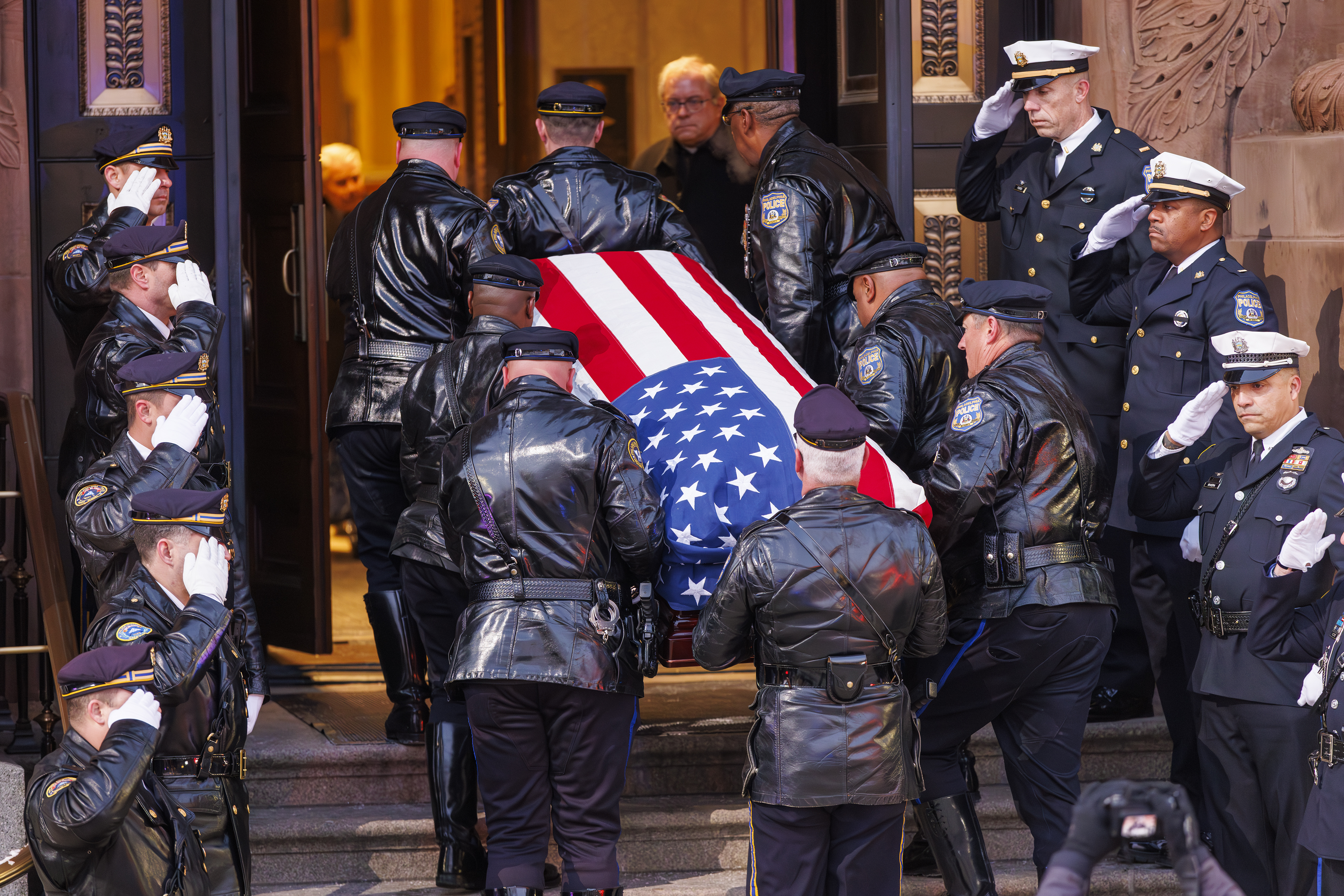
Philadelphia Police Commissioner Kevin Bethel stood at a podium behind a cherry wood coffin inside the Cathedral Basilica of SS. Peter and Paul on Tuesday and told mourners how Highway Patrol Officer Andy Chan had arrived in the afterlife: on his motorcycle, boots shining, smiling.
Then he turned to the highway patrol officers standing in the front pews. “And how,” he asked, “did Andy Chan announce himself when he arrived at the gates of heaven?”
“Highway!” they answered in unison.
Chan, 55, was laid to rest Tuesday morning, six years after a 79-year-old driver struck his patrol motorcycle near Pennypack Park, catapulting him more than 20 feet away onto the pavement and causing brain injuries from which he never fully recovered.
A highway patrol motorcycle leads the procession to the Cathedral Basilica of SS. Peter and Paul for the funeral of Philadelphia Police Officer Andy Chan.
Chan served 24 years on the Philadelphia police force before the crash on a quiet stretch of Rowland Avenue irrevocably altered the course of his life.
A highway patrol officer for nearly his entire career, Chan spent his working days on two wheels, patrolling neighborhoods and highways astride the bike he was known for riding with pride.
He greeted his fellow officers not with “Hello,” but with “Highway!”
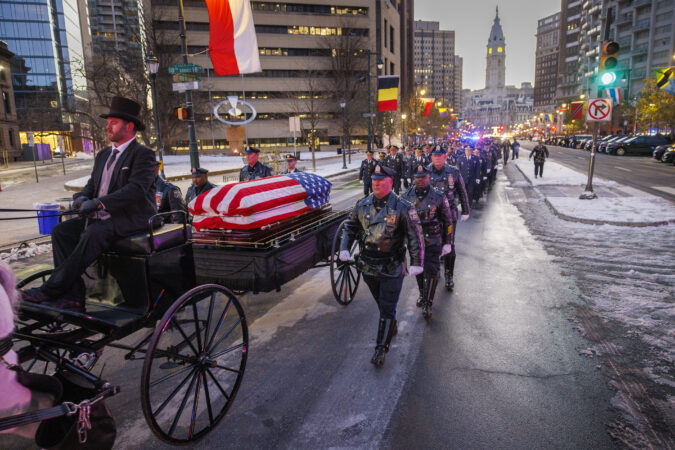
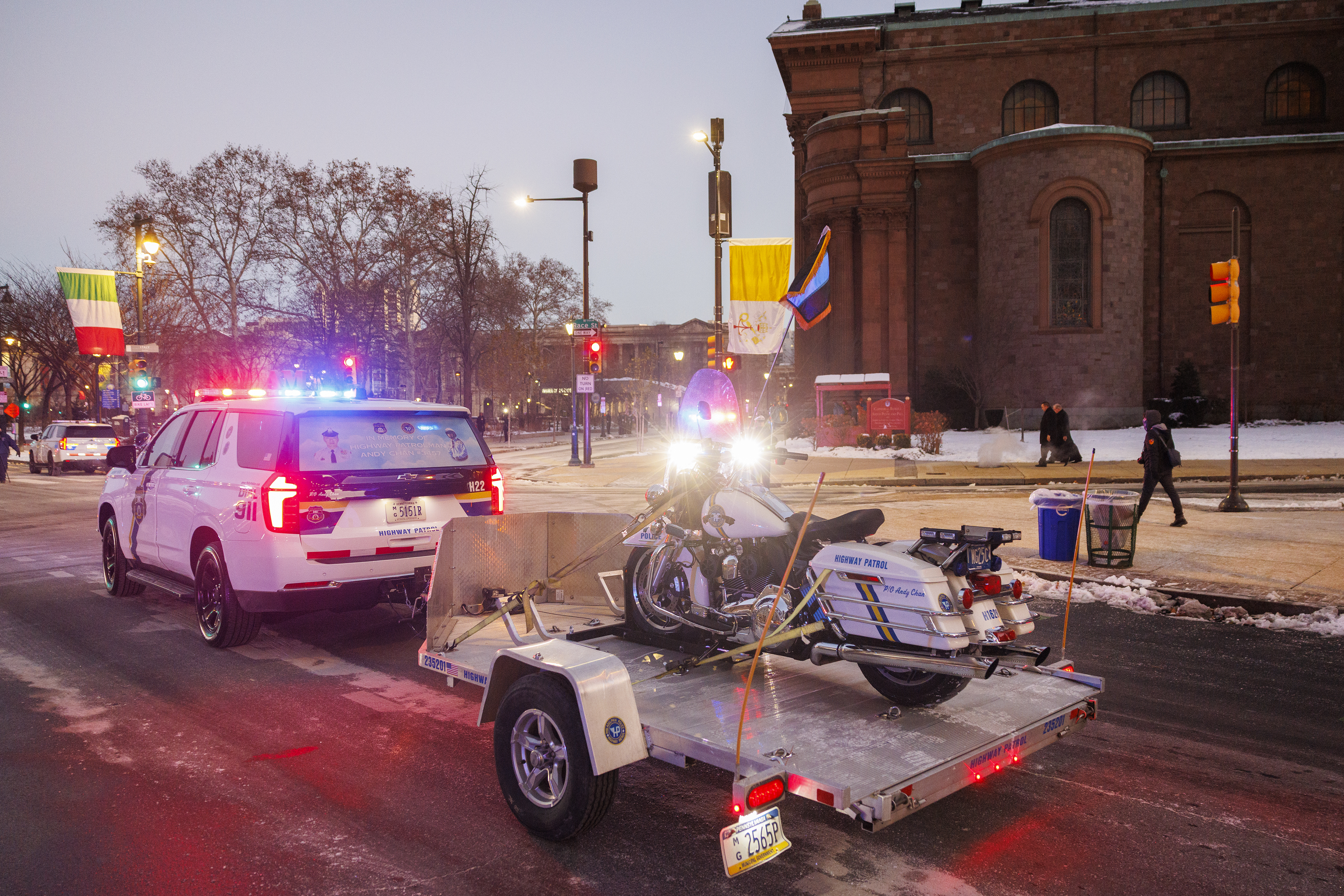
Officers towed Chan’s motorcycle, still bearing his name, in a procession that stretched nearly 18 miles, from North Philadelphia to Center City and finally, to the cathedral.
Inside the gilded building, photos of Chan streamed on TVs: Beside his wife, Teng, dressed in their wedding attire, hands clasped and raised triumphantly as they walked into their reception. In a portrait studio, cradling the youngest of his three children. Standing on the grass of the National Mall in Washington, D.C., surrounded by fellow officers. His arm around a gray-haired Sylvester Stallone. On his bike, over and over again.
The body of Philadelphia police officer Andy Chan is lifted from Caisson after arriving at the Cathedral Basilica St. Peter and Paul, Tuesday, December 16, 2025.
Chan had wanted to be a police officer since childhood, he once said in a radio appearance. From his parents’ restaurant in Chinatown, he listened with reverence to the uniformed officers who came in to eat and swap stories with his father. “I kind of looked up to police officers,” he said.
But he was drawn especially to the thunder of their motorcycles as they passed.
After joining the department, Chan spent eight years riding the streets of the 39th District as a bicycle officer before being promoted in 2004 to the department’s elite Highway Patrol Unit.
When he introduced himself to the woman who would become his wife, he did so simply with the words: “I’m Highway.”
The casket of Philadelphia Police Highway Patrol Officer Andy Chan arriving at the Cathedral Basilica of SS. Peter and Paul on Tuesday.
Teng Chan described her husband’s “unwavering sense of purpose” as rivaled only by his love of his family. On road trips, she said, he gave long lectures to their eldest son about life, inspiring him to become a volunteer firefighter and later, join the U.S. National Guard, she said.
As for her, his wife said, “He pushed me out of my comfort zone. He made me who I am today: a better person. A fighter.”
After the Jan. 3, 2019, crash, Chan remained in a coma for weeks, reliant on a ventilator. When he awoke, he required 24-hour care from family, friends, and fellow police officers, who regularly sat by his side. Though he could no longer speak, those close to him said he showed recognition and response when loved ones were present.
“We were heartbroken every day after the accident,” Teng Chan said. “We prayed every day for recovery, for him to be restored. With his unbreakable spirit, he stayed with us.
“But,” she said, “it was time. He has a higher calling.”
In the days after the killing of 93-year-old Lafayette Dailey on Dec. 3, authorities said, street surveillance cameras captured Coy Thomas behind the wheel of Dailey’s white 2007 Chrysler 300.
Then, they said, Thomas sold the car for $900.
On Monday, prosecutors with the Philadelphia District Attorney’s Office released new details in their case against Thomas, who is charged with murder, robbery, and related crimes in connection with a slaying that unfolded quietly inside Dailey’s Logan home.
Surveillance footage from that day showed a man police believe to be Thomas walking through the front door of Dailey’s house in the 4500 block of N. 16th St. About 10 minutes later, prosecutors said, the man reemerged, slid behind the wheel of Dailey’s sedan, and drove away.
Two days later, police found Dailey dead inside the home. He had been stabbed several times in the chest.
His house had also been “ransacked,” said Assistant District Attorney Ashley Toczylowski, with “things thrown around,” indicating “there was a struggle” before Dailey was killed.
Police found no signs of forced entry. Thomas’ unhindered entrance into the home suggested that the men knew one another “in a neighborly way,” Toczylowski said. Thomas, 53, previously lived near Dailey, she said.
Thomas is also accused of stealing and using Dailey’s debit card before he was taken into custody on Sunday.
District Attorney Larry Krasner called the killing “evil,” adding: “Even the mob didn’t target seniors.”
Krasner asked anyone with information about the killing to call police.
“It’s in your hands to make sure that your energy and your eyes and your ears are tuned in, so that we can prevent this next time and we can get a just and appropriate remedy this time,” he said.
Harold “Hal” Miller Jr. disappeared in June, leaving behind only two clues for police to follow: his vehicle abandoned in Pennsauken and, inside, a cell phone that last dialed a contact named “E. Poker.”
From those scant clues, investigators said, they uncovered something grim: Miller had been shot to death and dismembered with a chainsaw, they alleged, by the man whose number was saved in his phone as “E. Poker,” Everton Thomas, and two of Thomas’ relatives, in Camden.
In September, police charged Thomas, 41, with murder, desecration of human remains, and tampering with physical evidence. His wife, Sherrie Thomas, 41, and son, Deshawn Thomas, 23, were also charged with desecrating and disposing of Miller’s remains.
But more than five months later — after 178 days of searches, interviews, and forensic work — investigators have yet to find Miller’s body.
“It’s a horrible waiting game,” said Miller’s ex-wife and mother of his four children, Tamika Miller.
The case that has emerged since Miller’s disappearance is as sprawling as it is brutal: a trail of surveillance footage, internet searches, hardware-store runs, and border crossings that authorities say chart a carefully concealed killing. Court records detail a sequence of events that is at once methodical and frenzied — and has left investigators hunting for Miller’s remains even as three members of the Thomas family stand charged in his death.
Everton Thomas denies any involvement in the crime and is expected to plead not guilty to the charges on Dec. 15, according to his defense attorney, Timothy Farrow. Attorneys for Sherrie Thomas and Deshawn Thomas did not respond to requests for comment.
‘An awesome father’
Harold Miller and Tamika Miller had four children, three girls and a boy. “He was an awesome father,” Tamika Miller said.
He swelled with pride when their son announced he would join the Navy, continuing a military tradition in his family that “flat-footed” Miller could not follow himself, she recalled. His happiest moment, she said, came when their daughter, a special-education teacher, received her bachelor’s degree.
Miller worked in Camden’s social-services world, leading outreach for Volunteers of America and programs for Joseph House, a men’s homeless shelter. In 2017, he pleaded guilty in federal court to conspiring to sell crack cocaine and served five years in prison.
The couple divorced in 2023. But the family still gathered for holidays, including Thanksgiving, when Miller would rent a hall large enough for 100 people and make sure four turkeys — including his favorite, fried turkey — were on the table, Tamika Miller said.
Miller, who lived in Deptford Township, was 48 when he died. “The holidays will never be the same,” Tamika Miller said.
The grisly crime
Miller’s final call — placed at 11:26 a.m. on June 12 — went to the contact in his phone listed as “E. Poker.” Investigators later learned the number belonged to Everton Thomas, according to the affidavit of probable cause for his arrest.
Street cameras caught what happened next, the document said: Miller climbing the back stairs to Thomas’ Baird Boulevard home around the time the call was placed. Minutes later, the cameras recorded the crack of a gunshot. Miller was never seen emerging from the home.
From there, investigators say, camera footage captured an ominous procession across Camden. It shows a man they say is Thomas leaving the house in Miller’s minivan and abandoning it in Pennsauken. It shows his wife and son making a series of trips to stores, buying bleach, heavy-duty contractor bags, ice, latex gloves, duct tape, plastic sheeting — and a chainsaw, according to court filings. Later, cameras captured three people dumping large black trash bags into dumpsters behind a nearby housing complex, Tamarack Station Apartments.
When investigators examined Deshawn Thomas’ phone, they say, they found a browser search typed in amid the chaos: whether a chainsaw could cut through meat.
Authorities searched Everton Thomas’ house on June 20. They found a loaded Glock, and bloodstains on a doorframe leading to the basement, the affidavit said. Testing later confirmed the blood matched Miller’s DNA.
How the two men may have been connected is unclear. Tamika Miller said they were acquaintances, not friends. “Everybody knows everybody in Camden,” she said.
In an interview with police, Thomas told detectives that he and Miller had played poker the night before Miller vanished, and that they had spoken again around 11 a.m. on June 12. He denied knowing anything about what happened, according to the affidavit.
By the next afternoon, investigators said, they learned Thomas had slipped across the border. Agents at Fort Erie-Buffalo reported he had entered Canada. Nearly three months later, on Sept. 8, U.S. border officers arrested him as he tried to cross back into the country. He remains in custody, awaiting a court hearing next week.
Tamika Miller said family members held a private memorial service, where they gained some closure. “We don’t know if they will ever find him,” she said. “But we have hope.”
Investigators, meanwhile, continue to search for clues and Miller’s body.
“As we near the end of the year, our detectives are still seeking leads — no matter how small — that would assist with the recovery of Mr. Miller’s remains,” Camden County Prosecutor Grace MacAulay said Tuesday. “For anyone who has information, but has not yet come forward, we implore you to consider what his grieving family has been through. They deserve answers and the opportunity to properly mourn their loved one. We remain hopeful that our community does what’s right and helps bring Mr. Miller home.”
Anyone with information is asked to contact Detective Jake Siegfried of the Camden County Prosecutor’s Office Homicide Unit at 856-225-5086 and Detective Andrew Mogck of the Camden County Police Department at 609-519-8588. Tips can also be submitted to https://camdencountypros.org/tips.
Authorities have charged two men in connection with a double fatal shooting outside a Bordentown convenience store, prosecutors said Thursday.
Justford Doe, 23, and Giovanni Varanese, 21, are charged with first-degree murder, first-degree robbery, and other offenses stemming from the Nov. 5 killing outside a 7-Eleven and Valero gas station at the intersection of Route 130 North and Farnsworth Avenue.
The shooting left Daniel Patterson, 22, and Mason Knott, 21, dead.
Bordentown Township police were called at about 11:30 p.m. to the convenience store after Patterson, a Philadelphia resident, came into the store suffering from gunshot wounds and asked for help. He was pronounced dead at the scene, according to the Burlington County Prosecutor’s Office. Knott, of Wrightstown, was transported to a hospital in Trenton, where he died.
Police said the men shot Knott in the back of the head, then stole marijuana that was in his vehicle. They shot Patterson three times and stole his Jeep, police said.
The assailants fled but crashed in Florence Township, the prosecutor’s office said.
Authorities did not say Thursday how they connected Doe and Varanese to the killings.
The men are being held in the Philadelphia Department of Prisons, but will be extradited to New Jersey to face the charges, according to the prosecutor’s office.
Christina Miranda was shot and killed by two Philadelphia police officers early Sunday morning, authorities said, after she held a gun to her head, then turned the weapon on the officers. Her name was released Monday morning.
Police were called just after 4 a.m. Sunday to the 900 block of West Erie Avenue, where they found Miranda, 35, with a .22-caliber handgun. The officers ordered her to drop the weapon and used a Taser on her, according to police, but she fled. As she ran, they said, she pointed the gun at the officers.
The officers fired at Miranda, striking her multiple times, according to police. She was taken to Temple University Hospital, where she later died.
The two officers involved in the shooting — both on the force for less than three years — have been placed on desk duty, as is customary, pending an investigation by the police department and the Philadelphia District Attorney’s Office.