Disgraced financier Jeffrey Epstein once inquired about buying a private plane from University of Pennsylvania megadonor and Wharton School adviser Marc Rowan, emails released by the U.S. Department of Justice show.
The exchange, which appears among the three million documents unsealed Friday, occurred in early 2016, at a time when Epstein was corresponding with several executives from Apollo Global Management, the New York-based private equity firm Rowan cofounded in 1990 and where he now serves as CEO.
Epstein’s assistant Lesley Groff emailed Rowan’s office on Jan. 12 and asked for details about Rowan’s private plane: “Jeffrey is asking if he could get the details of Marc’s plane for sale…the hours, photos, any pertinent information! Possible?”
It was not clear whether Rowan ever personally followed up on the plane offer, which was first reported by Bloomberg News, but a representative for the jet company offered Epstein the Gulfstream G450 for $18.9 million, noting it was in “immaculate condition.” The plane ultimately was sold to another buyer, according to Bloomberg.
A spokesperson for Rowan declined to comment Friday.
Beyond his success on Wall Street, Rowan has become a powerful and controversial force at Penn, where he serves as chairman of the advisory board at the Wharton School. The billionaire executive donated more than $10 million to the school last year, and led a campaign to oust former Penn president Liz Magill and board chair Scott L. Bok over the school’s handling of antisemitism on campus after the Oct. 7, 2023, attacks on Israel.
While Rowan’s business relationship with Epstein has not been widely reported, Epstein had a long history with Rowan’s predecessor and fellow cofounder at Apollo, Leon Black. Black was one of the few Wall Street bosses who stood by Epstein after his 2008 guilty plea for soliciting sex from a minor, according to the New York Times. He stepped down as CEO and chairman of the company in 2021 after it came to light that he had paid Epstein more than $158 million in adviser fees over the years.
A week prior to the plane inquiry, Rowan had breakfast at Epstein’s home in New York City — at Rowan’s request, emails show. The two financiers were engaged in some kind of investment together, the details of which are not entirely clear in the DOJ emails. The documents do not indicate Rowan and Epstein discussed anything other than business.
In February 2016, a month after the plane inquiry, Epstein emailed Rowan to ask him for a phone call, though he did not say what about.
Rowan’s name appears in Epstein’s emails dating back to 2013, including a proposed meeting that year at Epstein’s New York City residence involving Black and another Apollo cofounder, Josh Harris.
Harris, who also owns the Sixers, and Epstein also corresponded multiple times over several years, although a Harris spokesperson said he sought to avoid meeting with Epstein to prevent him from forming a formal relationship with Apollo.
Rowan, in contrast, appears to have sought Epstein out for meetings, like the one that took place prior to Epstein’s plane offer.
“Marc said if Jeffrey wants an early breakfast that will work for him,” an Apollo assistant wrote to Epstein’s handler. “He will bring coffee!”
This story has been updated to clarify Epstein’s relationship with Apollo Global Management.
Peco responded to the smell of gas at the Bristol Health & Rehab Center more than two hours before an explosion that killed three people and injured at least 20 others just days before Christmas. Yet in initial findings released Wednesday, federal investigators said the public utility company did not fully stop the gas flow to the facility until an hour and a half after the catastrophic blast.
According to an investigative summary released by the National Transportation Safety Board, a maintenance director at the nursing home reported the odor coming from the basement boiler room around 11 a.m. A technician with Peco responded by 11:50 a.m. and identified the source — a leak in the gas meter valve.
The technician called for backup to assist with the repair, and a meter services technician arrived about 1:20 p.m. The explosion occurred less than an hour later, at 2:15 p.m. A Peco emergency crew fully isolated the gas at 3:50 p.m., as first responders were pulling victims from the rubble.
The NTSB’s initial findings provide the most concrete timeline yet of what happened in the lead-up to the Dec. 23 tragedy that rattled Lower Bucks County and raised questions about the actions of both the public utility company and the nursing home’s operator.
Peco spokesperson Candice Womer said in a statement Wednesday that the company has begun reevaluating response protocols and prioritizing the movement of indoor gas meters to the outdoors, in an effort to meet “the highest standards of safety and reliability.”
The initial findings do not fault or exonerate any parties in the blast, and NTSB officials said the investigation remains ongoing.
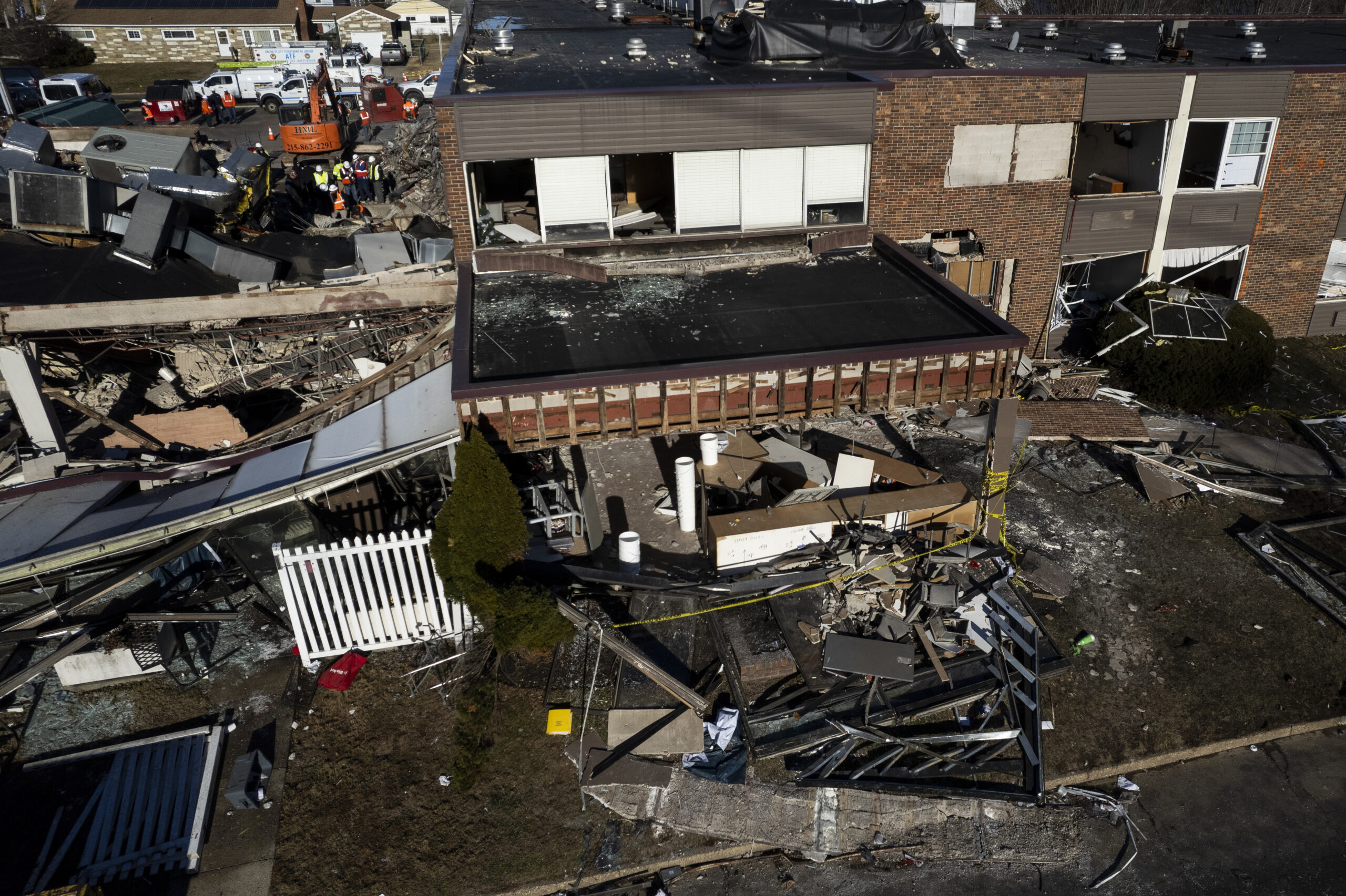
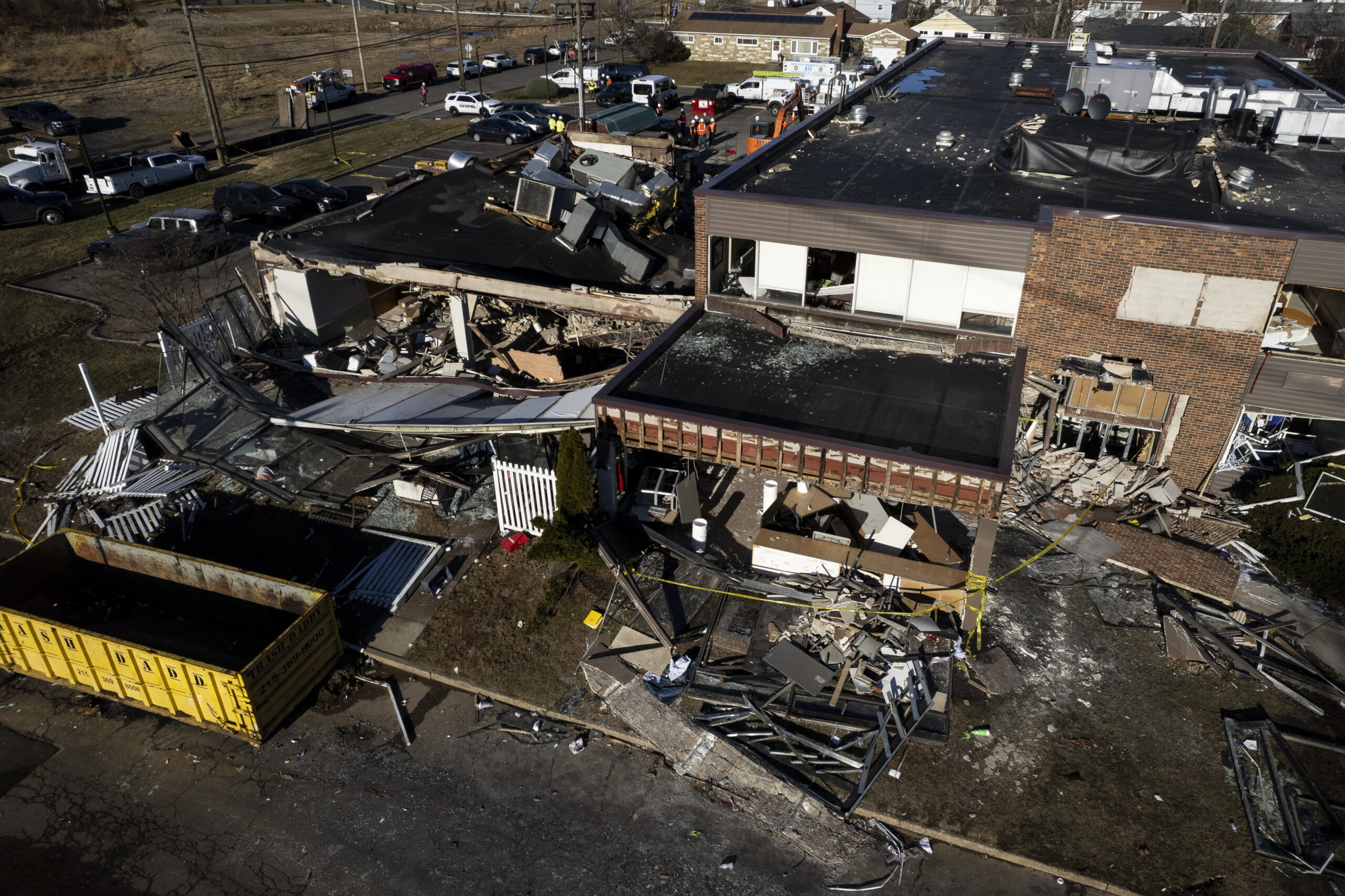
Investigators work the scene at Bristol Health & Rehab Center the day after the explosion
Carin O’Donnell, an attorney with Stark & Stark who is representing victims in a lawsuit, said the initial findings demonstrated that Peco gambled with everyone’s safety by not shutting off the flow of gas to the facility sooner.
“Clearly, Peco knew there was a leak, and rather than terminate the gas, they sent their repairmen in while the gas line was still pressurized,” O’Donnell said. “It’s like sending them in with a lit cigarette and a match.”
At least two separate lawsuits alleging negligence have been filed against Peco and Saber Healthcare Group, the Ohio-based nursing home operator that runs the facility.
Residents and staff told The Inquirer they had detected a heavy gas odor inside the 174-bed facility early that morning, yet no building-wide evacuation order was given to residents.
During interviews, NTSB officials heard from people in the facility that the smell could be detected from the basement up to the second floor of the building.
The safety board did not address whether an evacuation should have been done. Investigators noted the Peco foreman and the meter services technician had “had less than 1 year of experience in their current roles.”
Zachary Shamberg, chief of government affairs at Saber, cast the NTSB’s initial findings as exculpatory. He said in a statement that facility staff “acted promptly” while “Peco technicians unsuccessfully attempted to repair their gas line.”
In the aftermath of the tragedy, Peco initially reported arriving at the facility around 2 p.m. and later changed the timeline to “hours” before the blast that occurred just after 2:15 p.m.
First responders encountered chaos. People ran from the partially collapsed nursing home, many bleeding and injured. Police and firefighters helped others escape from the wreckage while contending with a second blast and fire that ignited after the initial explosion.
Two people were pronounced dead in the aftermath of the blast: Muthoni Nduthu, 52, of Bristol, who worked at the facility as a nurse for over a decade, and a resident at the facility whom police identified as Ann Ready. Another resident, 66-year-old Patricia Merro, died two weeks later from her injuries.
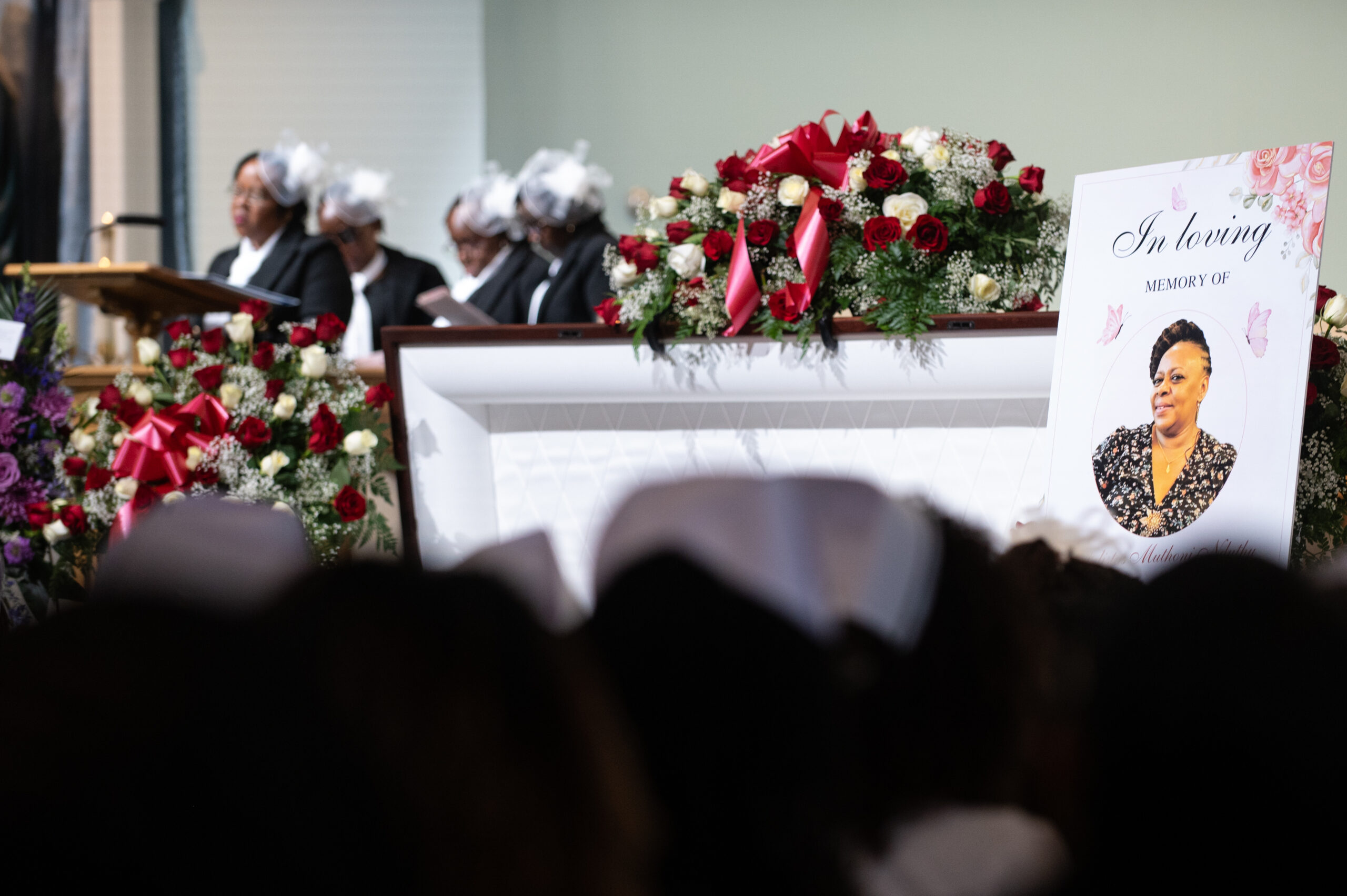
The sisters of Felistus Muthoni Nduthu-Ndegwa speak at her funeral at St. Ephrem Church in Bensalem. The 52-year-old nurse was killed in an explosion at Bristol Health and Rehab.
The nursing home, previously known as Silver Lake, had been acquired by Saber Healthcare Group and renamed Bristol Health & Rehab Center three weeks before the explosion.
Under the facility’s previous operator, the Cincinnati-based CommuniCare Health Services, the nursing home had been cited repeatedly for substandard care and facility management.
Federal regulators gave the facility a one-star rating, and CommuniCare was fined more than $418,000 in 2024, records show, due to ongoing violations. Two months before the explosion, state inspectors cited the facility for lacking a fire safety plan, failing to maintain extinguishers, and having hallways and doors that could not contain smoke.
A representative for Saber said last month the company had begun addressing those problems after taking over the facility in early December.
After the blast, Peco tested the ground outside the nursing home and detected gas in the ground. The safety board said it continues to analyze physical evidence gathered from the scene and did not provide a timeline on delivering a final report.
To hear Anthony Hudgins tell it, overtime fraud at the Philadelphia Fire Department is so brazen that some employees continued abusing the system even after officials started investigating them.
A paramedic was billing the city for overtime hours last May, Hudgins, the former first deputy fire commissioner, contends. But according to a federal lawsuit Hudgins filed Wednesday, there was one problem: That employee was luxuriating on a Norwegian Cruise at the time, not on the clock as a paramedic.
The alleged deception took place after The Inquirer reported that the city was investigating overtime abuse within the 2,800-member fire department and, at the same time, investigating Hudgins over a series of sexual harassment complaints made against him — claims Hudgins says were false and made by employees he’d reported for overtime abuse.
In his complaint filed in the U.S. District Court for the Eastern District of Pennsylvania, Hudgins accuses paramedics, the firefighters union president, and top city officials of defamation, subjecting him to a “bad faith” investigation, and ultimately forcing the department veteran of 31 years to lose his rank and take a $75,000 pay cut.
The dueling misconduct investigations have roiled the fire department since late 2024, and Mayor Cherelle L. Parker’s administration has declined to release the findings from either probe. Hudgins was demoted last fall.
Hudgins’ lawsuit claims that findings from the sexual harassment investigation conducted by the law firm Campbell Durrant cleared him of “verbal misconduct” and found that he had “hugged co-workers.” The complaint states that Fire Commissioner Jeffrey Thompson told Hudgins that the investigators found: “You were just being you.”
The lawsuit did acknowledge that Parker’s administration found that Hudgins had violated the city’s sexual harassment policy and demoted him as a result. Women who lodged complaints against Hudgins said that his conduct included unwanted touching, inappropriate comments, and intimidation tactics, The Inquirer reported last year.
However, Hudgins contended in his lawsuit that the overtime review conducted by Inspector General Alexander DeSantis concluded that two of the women who’d accused him of misconduct were “proven fraudsters” who also recruited other women to file complaints.
Hudgins claimed that the overtime probe was completed in September. DeSantis told The Inquirer last month that the investigation is “still ongoing and may be for some time.” DeSantis declined further comment Thursday.
Because Parker’s administration and DeSantis have continued to decline to release the results of their investigations, it is difficult to confirm Hudgins’ account.
Parker’s administration declined to comment on the lawsuit.
According to the complaint, Hudgins called for an overtime review in fall 2024 after hearing that paramedic Jacqulyn Murphy had lodged a disproportionately high number of overtime shifts that year. While her peers averaged about 24 overtime payments, Murphy had accrued 238, more than 80% of them without the necessary approval forms, Hudgins claimed.
The department’s payroll supervisor, Marian Farris, rubber-stamped the overtime approvals, according to Hudgins’ complaint. Hudgins alerted Fire Commissioner Thompson.
But before he could finish his review, he asserts, Murphy and Farris retaliated by filing sexual harassment complaints against him and encouraging other female employees to do the same — including Tabitha Boyle, Christina Quinones, and Dana Jackson, who are also named as defendants in the lawsuit. Requests for their comments were not returned Thursday.
Murphy, now a defendant in the lawsuit, did not respond to requests for comment Thursday. Payroll records show she was the ninth highest overtime earner in the department in 2024, more than doubling her $94,549 base salary.
The city paid Campbell Durrant $30,000 to conduct interviews and investigate the claims against Hudgins, who was reassigned to remote work and, later, forced to take a leave of absence.
The city has taken The Inquirer to court to block the release of overtime records related to the overtime investigation, claiming their public disclosure would jeopardize the integrity of the probe led by The Office of the Inspector General, the city’s fraud prevention watchdog.
Hudgins, in his lawsuit, claims to have seen the results of that investigation. According to his complaint, the OIG produced its findings to the city and found that Murphy and Farris had both conspired to defraud the city.
According to the complaint, the OIG report stated Murphy had received an undisclosed sum of overtime pay and then “consistently” paid Farris via CashApp. The payments occurred biweekly for at least six months in 2024.
Farris left the department in March 2025. In a phone interview Thursday, she denied any scheme involving payments with Murphy. Investigators found CashApp receipts on Murphy’s email account, but Farris said those were innocent transactions.
“It ain’t a good thing to say, but Jackie was somebody I could borrow money from when I was in Atlantic City, or I could babysit her son for her or something like that,” Farris said. “I get CashApps from my mother. I’m not doing anything fraudulent with my mother.”
Hudgins’ complaint also accused Murphy of continuing to bilk the overtime system even after Farris left the department last year.
The fire department did not respond to a request for comment on the complaint. Michael Bresnan, president of Local 22 of the International Fire Fighters and Paramedics Union, was also named as a defendant in the suit. He declined to comment Thursday.
Per the complaint, Hudgins received a phone call from Thompson in July, who told him the law firm found no wrongdoing and that he could return to work, saying, essentially:
“Good news! You’re coming back to work. You were just being you.”
Staff writer Samantha Melamed contributed to this article.
Two former Philadelphia homicide detectives were sentenced Wednesday to a combined three years of probation for lying about their knowledge of DNA evidence during the retrial of a man they helped convict of murder 35 years ago.
Common Pleas Court Judge Lucretia Clemons imposed a two-year probation sentence for Manuel Santiago, 76, and one-year sentence for Frank Jastrzembski, 78. The retired detectives will not be required to meet with probation officers.
The sentencing punctuates an unusual case in which prosecutors accused three retired Philadelphia police officers of fabricating evidence in a decades-old homicide case, and later perjuring themselves when testifying about that evidence under oath. A grueling eight-day trial in March revisited the 1991 murder of 77-year-old Louis Talley in Nicetown and the 2016 retrial of Anthony Wright, the man police helped send to prison for the crime.
The jury ultimately rejected the larger conspiracy built by prosecutors that the detectives had framed Wright, but found both Santiago and Jastrzembski guilty of misdemeanor false swearing and found Santiago guilty on an additional count of perjury, a felony. A third detective who worked on the case, Martin Devlin, was acquitted of all charges.
Santiago’s attorney, Fortunado Perri Jr., thanked Clemons for the “appropriate” sentence on Wednesday. Steve Patton, an attorney for Jastrzembski, reiterated that the jury had acquitted his client of planting evidence and described the conviction as a matter of “technical knowledge.”
“We’re pleased with that outcome and thankful for the judge’s careful consideration of the facts of this case,” Patton said.
In an interview Wednesday, Krasner blasted what he described as lenient sentencing guidelines for lying under oath in Pennsylvania. Probation is the recommended sentence for a false swearing conviction, while the maximum recommended penalty for perjury is nine months.
“Those sentencing guidelines are disgraceful,” Krasner said, while also acknowledging the two defendants are both now in their 70s and have health issues.
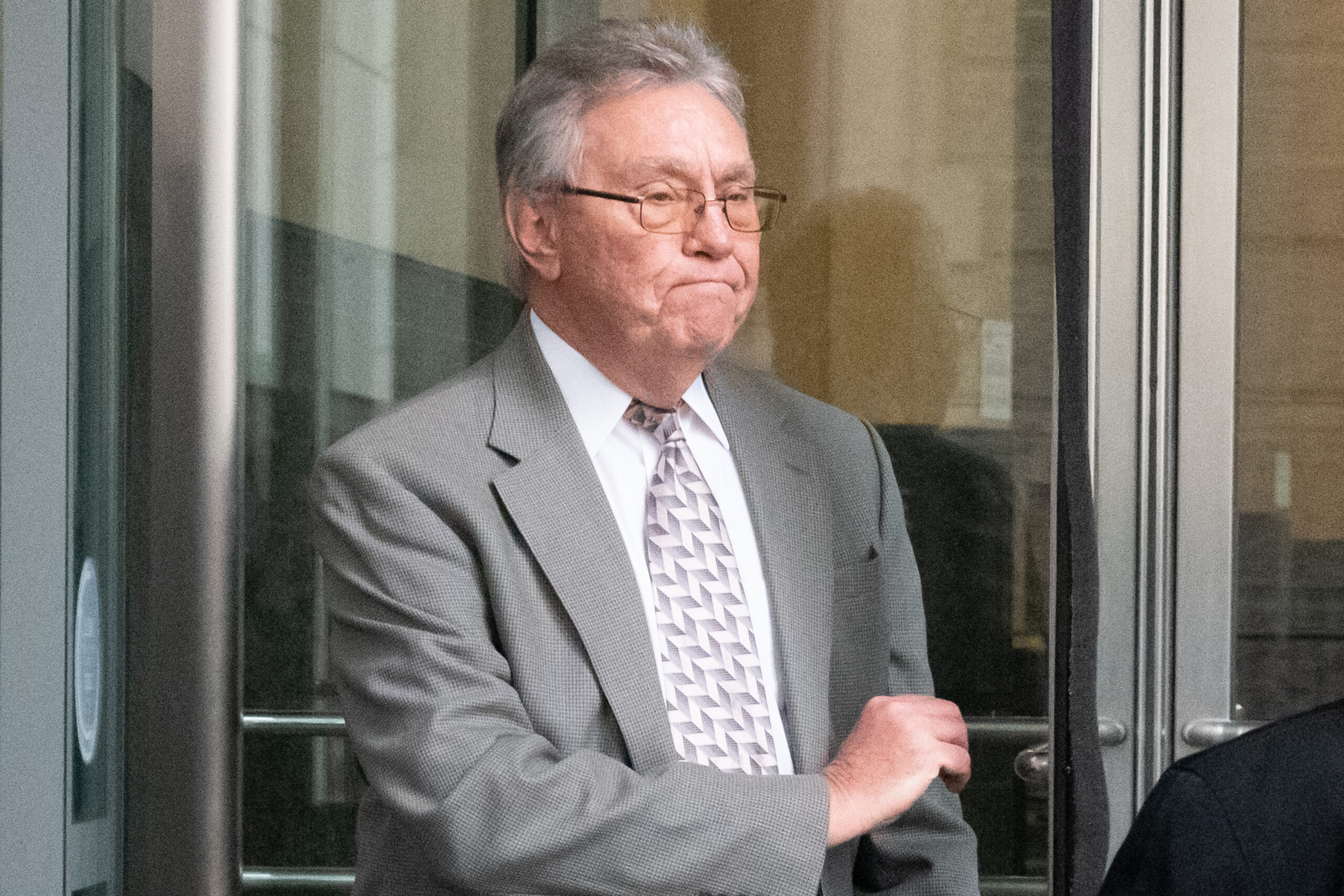
Former Philadelphia Police Detective Frank Jastrzembski leaves the Criminal Justice Center in Philadelphia on March 17, 2025.
At trial, Krasner’s top prosecutors contended that the three detectives had conspired to frame Wright for Talley’s murder, extracted a false confession from him, and planted evidence in his home.
Santiago was acquitted of perjury in connection with his testimony about Wright’s murder confession, while Jastrzembski was acquitted of perjury and related charges for his testimony about a search warrant he executed at Wright’s home — charges that hinged on prosecutors’ ability to prove the detectives had wholly fabricated evidence.
Instead, the convictions centered on what Santiago and Jastrzembski knew about the evidence against Wright when they testified at his 2016 retrial. The two detectives were instrumental in building the original case against Wright in 1991, and later sought to send him back to prison — even after DNA evidence implicated another man in Talley’s murder. Wright’s conviction was overturned in 2014 based on the strength of that forensic science.
When prosecutors under former District Attorney Seth Williams charged Wright a second time — under suspicion that he had acted with an accomplice — Santiago and Jastrzembski were briefed on the new DNA information. The results pointed to a known crack user who lived near Talley in Nicetown, a man who had since died in a prison.
Under oath at Wright’s retrial, however, Santiago and Jastrzembski denied knowing the DNA evidence implicated another suspect.
Wright was acquitted and later filed a federal civil rights lawsuit against the city and won a $9.85 million settlement. During sworn depositions in that case, Santiago and Jastrzembski were questioned about the DNA evidence and gave answers that prosecutors said contradicted their earlier trial testimony.
The perjury trial in March at times resembled a second retrial for Wright, with defense attorneys accusing him of getting away with Talley’s murder. Wright proclaimed his innocence.
Following the jury’s verdict, Krasner insisted that the detectives had framed Wright, and he criticized his predecessor’s decision to retry the man after his conviction was overturned.
Around 2:15 p.m. Tuesday, Samuel “Bull” Thomas pushed his older brother in a wheelchair down the first floor of the Bristol Health & Rehab Center.
As they rolled down the hallway, the 49-year-old Levittown resident smelled gas.
“People were still in there working, and there was a gas smell,” Thomas said Thursday. “There were people sitting behind desks — people just still walking around, like they were neglecting the smell.”
Moments later, Thomas and his brother arrived at the facility’s barbershop, where Thomas, a part-time barber, had cut his brother’s hair every two weeks. The Thomases are a close-knit family, and the nursing home had become their gathering place since Lamont “Bubs” Thomas, 59, suffered from a stroke several months ago.
Nearby stood the brothers’ nephew, Terence Aldridge, 42, who had started a job in the facility kitchen four days prior. Their sister, Terence’s mom, was on her way.
But within seconds, the visit turned catastrophic. As Samuel Thomas opened the door to the barbershop area and began to maneuver his brother’s wheelchair through the door, the building pancaked.
The force of the blast knocked his work boots off. The floor collapsed beneath the men, the ceiling fell on top of them, and they were soon fighting for each other’s lives in the basement below.
While crashing through the floor to the basement, Thomas gripped his brother’s wheelchair so tight he could feel his hands bleeding.Flames roared, while water from a burst pipe gushed around them.
“If I would have let him go, he would have fallen on his head in the basement,” Thomas said. “All this water was pouring down on my face.”
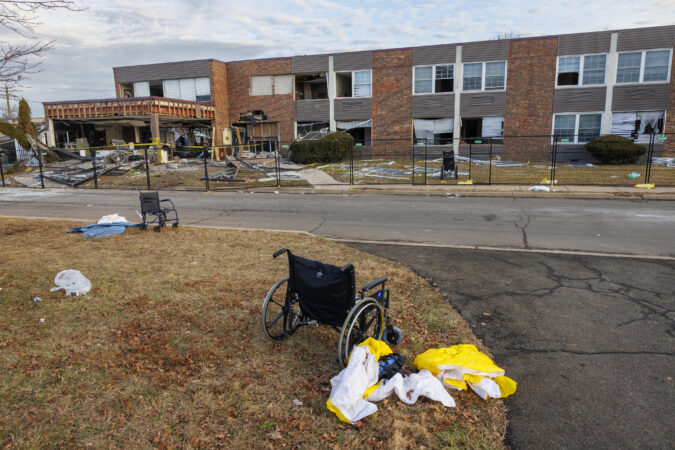
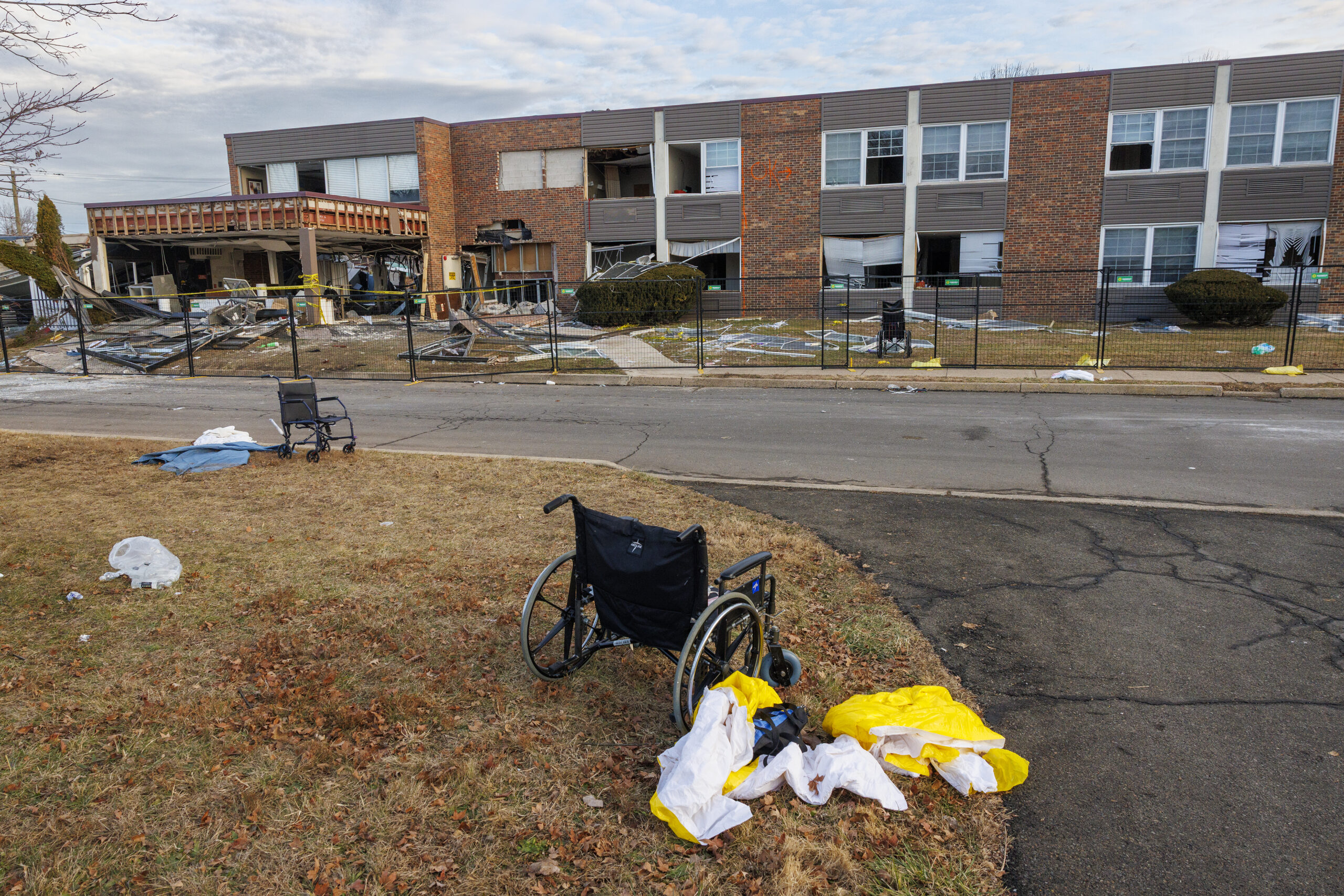
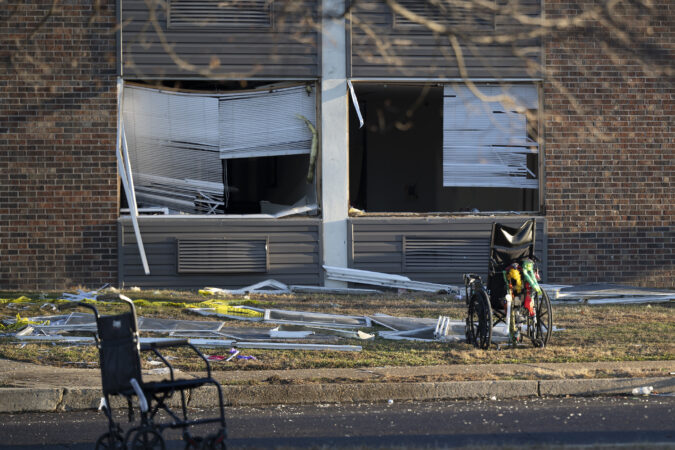
Wheelchairs and devastation on Christmas morning at the Bristol Health & Rehab Center, two days after the fatal explosion.
The three members of the Thomas family were among the 20 people injured in the fatal explosion that rocked the Lower Bucks County nursing facility. And while much remains unknown about what caused the blast, families of the victims like the Thomases spent the Christmas holiday gathered around hospital beds throughout the Philadelphia region, questioning the tragedy that occurred and counting their blessings.
Muthoni Nduthu, a 52-year-old nurse at the facility and mother to three sons, was killed in the blast. A second person who was killed, a resident at the nursing home, has not been identified. Saber Healthcare Group, which took over as the nursing home operator three weeks ago, said the company is evaluating its evacuation procedures.
“I’m alive,” Samuel Thomas said, in a Thursday interview from his bed at Lower Bucks Hospital. “That’s all I can say — I’m alive.”
Three days ago, that wasn’t guaranteed.
A ‘circus’ of chaos
Helen Middlebrook, 58, was driving to the nursing home that afternoon for her daily visit with her “Bubs.” She would have been there with her brothers and son Terence when the building erupted, but by a stroke of luck, she had forgotten something at home and turned the car around.
Back at home in Croydon, she got a panicked call.
A violent blast. Nursing home in flames. People trapped under the wreckage.
She rushed back to Tower Road where she was faced with a chaotic “circus.” As she scrambled to locate her brothers and son, going from ambulance to ambulance, she said she became hysterical.
Samuel Thomas — his legs mangled — managed to drag himself and his brother to a stairwell landing, where first responders were able to rescue them, he recounted Thursday from the hospital.
His brother, whose injuries were the most severe, was in critical condition at the scene.
Middlebrook rejoiced when she heard her brothers were still alive. But she could not find her son.
Investigators work the scene at Bristol Health & Rehab Center on Wednesday. Two people were killed and a number were injured in the explosion on Tuesday.
Law enforcement officials said that, in the confusion after the explosion, the injured were whisked off to numerous area hospitals. A second explosion that followed the initial blast added to the chaotic response effort.
For four hours, Middlebrook searched emergency rooms in anguish for her “Papoose,” Terence’s family nickname.
She braced for the worst.
“My thought [was] that he was in the building, trapped or dead,” she said. “But God is good.”
Middlebrook and her husband found her son at Jefferson Torresdale Hospital, safe and breathing on a ventilator. Aldridge sustained cuts all over his body and lung damage due to smoke inhalation. He is expected to recover.
Samuel Thomas underwent surgery Wednesday on both legs, which were crushed by heavy wooden beams after the blast. He broke his right femur and fractured his ankle.
Lamont Thomas remains in critical condition at Temple University Hospital, his family members said. His spine is broken, the bones in his face are fractured, and he suffered severe burns. He had surgery on Thursday afternoon, his family said.
For now, Middlebrook said she would withhold speculation about who was at fault.
“We’re just praying everything goes the way it should go,” she said, in an interview on Thursday as she rushed between hospitals to see her brothers and son on Christmas.
“It’s a really bad situation.”
Questions mount over blast
On Thursday morning, the two-acre campus at Bristol Health & Rehab Center sat deserted, save for local police officers stationed around the fenced-in nursing home.
There is no clear timeline for answers as to what caused the devastating explosion.
A Peco technician was called to the nursing facility and was there working in the basement shortly after 2 p.m. when the blast occurred. Some experts have already questioned why residents were not evacuated at the first smell of gas, in accordance with Peco’s own directives.
Peco referred questions to the National Transportation Safety Board (NTSB), the federal agency that is now leading the investigation.
Bristol Health & Rehab Center, formerly the Silver Lake Health Center, was cited repeatedly for substandard healthcare and unsafe building conditions under the management of CommuniCare Health Services, according to federal and state inspection records. Saber Healthcare Group acquired the facility home three weeks ago and gave it a new name. The company said it was working to fix deficiencies prior to the explosion.
A Saber representative said the company relocated about 120 residents to local hospitals and other assisted living facilities, while the investigators work to determine what led up to the explosion.
Peco, in its initial statement on Tuesday, said the gas technician had been called to the nursing home that afternoon due to the odor of gas. On Wednesday, Peco changed the timeline and said technicians had, in fact, arrived at the site hours earlier.
In a statement to The Inquirer Thursday, Peco president and CEO David Vahos said the company is committed to safety and deploys “considerable resources to inspect, maintain, and upgrade” its 14,000-mile network of gas lines.
While the NTSB is known for investigating high-profile transit accidents involving trains and aircraft, the agency sometimes intercedes after incidents involving gas pipelines.
An NTSB spokesperson said Wednesday that it could take days to clear a safe path in the debris and begin inspecting the gas line that fed the facility. The agency would “not determine or speculate about the cause of the accident” until the physical evidence had been gathered and analyzed from the scene.
Twenty-four hours after two gas explosions ripped through a Bucks County nursing home, the dead and injured had been identified, survivors were accounted for, and the cleanup was underway. But unanswered questions about the blast’s cause mounted.
On Wednesday morning, Peco provided a drastically different account of when its crews responded to reports of a gas odor on Tuesday, saying technicians had actually arrived hours — not minutes — before the blast at Bristol Health & Rehab Center.
Then, the energy company went silent, declining to answer any additional questions as the National Transportation Safety Board (NTSB) took over a sprawling investigation that will also involve other federal law enforcement and regulatory agencies.
Meanwhile, the new operator of the 174-bed nursing home, Saber Healthcare Group, is also coming under scrutiny amid questions about the poorly maintained facility on Tower Road that it took over from another provider just three weeks ago.
It could take months to get answers about what caused, and who is at fault for, the blast that killed two people and left 19 hospitalized, one in critical condition.
Experts and attorneys told The Inquirer the investigation will likely focus heavily on the actions of Peco and the nursing home’s operators.
“If the facility doesn’t maintain the equipment and the gas in their own facility, then they would be responsible,” said Robert Mongeluzzi, an attorney who has represented victims of gas explosions. “If there were reports of the gas leak, and Peco is notified and the facility isn’t cleared … there’s going to be responsibility on both of them.”
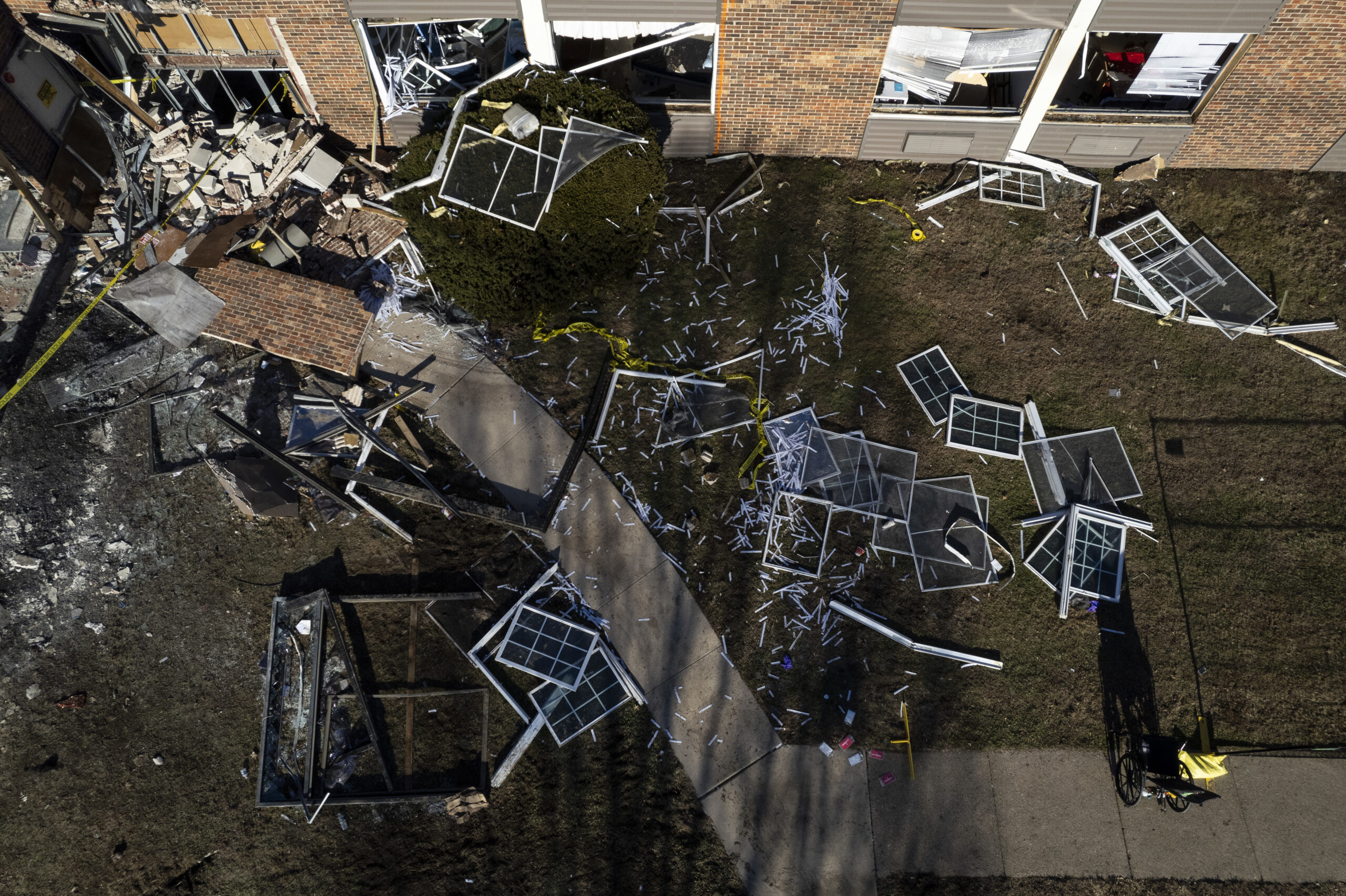
Windows and debris at the site of the Bristol Health & Rehab Center on Wednesday.
In a statement, the NTSB said investigators will not be able to fully evaluate the natural gas service line until “a safe path is cleared.” That effort alone could take several days. The agency provided no timeline for its initial findings.
Saber Healthcare Group took over operations at the nursing home on Dec. 1. Prior to that, the facility had been managed by another privately run for-profit healthcare company, the Ohio-based CommuniCare Health Services.
CommuniCare, which had operated the home since 2021, racked up a long list of code violations for unsafe building conditions and substandard healthcare. Just two months ago, state inspectors cited the facility for lacking a fire safety plan, failing to maintain extinguishers, and allowing conditions that would cause poor smoke ventilation.
Federal inspection records also show numerous citations over previous years for substandard healthcare, poor infection control, and mismanaged medical records, earning the facility a one-star rating. CommuniCare incurred more than $418,000 in fines due to violations in 2024, records show.
“We have worked to improve and fix prior issues, and we will continue that work in the wake of this tragedy,” Saber said in a statement Tuesday.
Attorneys watching the news unfold questioned whether Saber should have evacuated residents sooner on Tuesday. Peco’s own guidelines urge people who smell gas to evacuate the building immediately.
“If you or I smelled gas in our apartment or house, we’d be like, ‘Where is it?’ You have to get everybody out,” said Ian Norris, an attorney at Philadelphia-based McEldrew Purtell who has sued Saber and other nursing home operators accused of negligence. “In a nursing home, you have a higher standard of care. They are dependent residents who are there on the basis that they need help.”
A Saber representative said the company was looking into the evacuation procedures. In its statement Tuesday, the company said “facility personnel reported a gas smell” to Peco. The statement made no mention of an evacuation effort.
The smell was confined to the kitchen area of the nursing home, according to the Saber representative.
A Peco gas technician arrived at the nursing home on Tuesday afternoon. He was working alone in the basement below the kitchen area to address the issue, and as he went to his truck to retrieve more tools, the building erupted, said Larry Anastasi, president of IBEW Local 614, the union that represents Peco workers.
Whether Peco’s gas lines played a role in the blast remains unknown. But the utility company’s aging gas infrastructure will likely come under closer inspection as the probe progresses, according to attorneys with knowledge of investigations following such explosions.
One detail that became clear Wednesday was that Peco’s gas meter was located in the basement of the nursing home — not outside and aboveground as required by a 2011 order from the Pennsylvania Public Utility Commission (PUC).
The PUC, like Peco, declined to comment and referred questions to the NTSB.
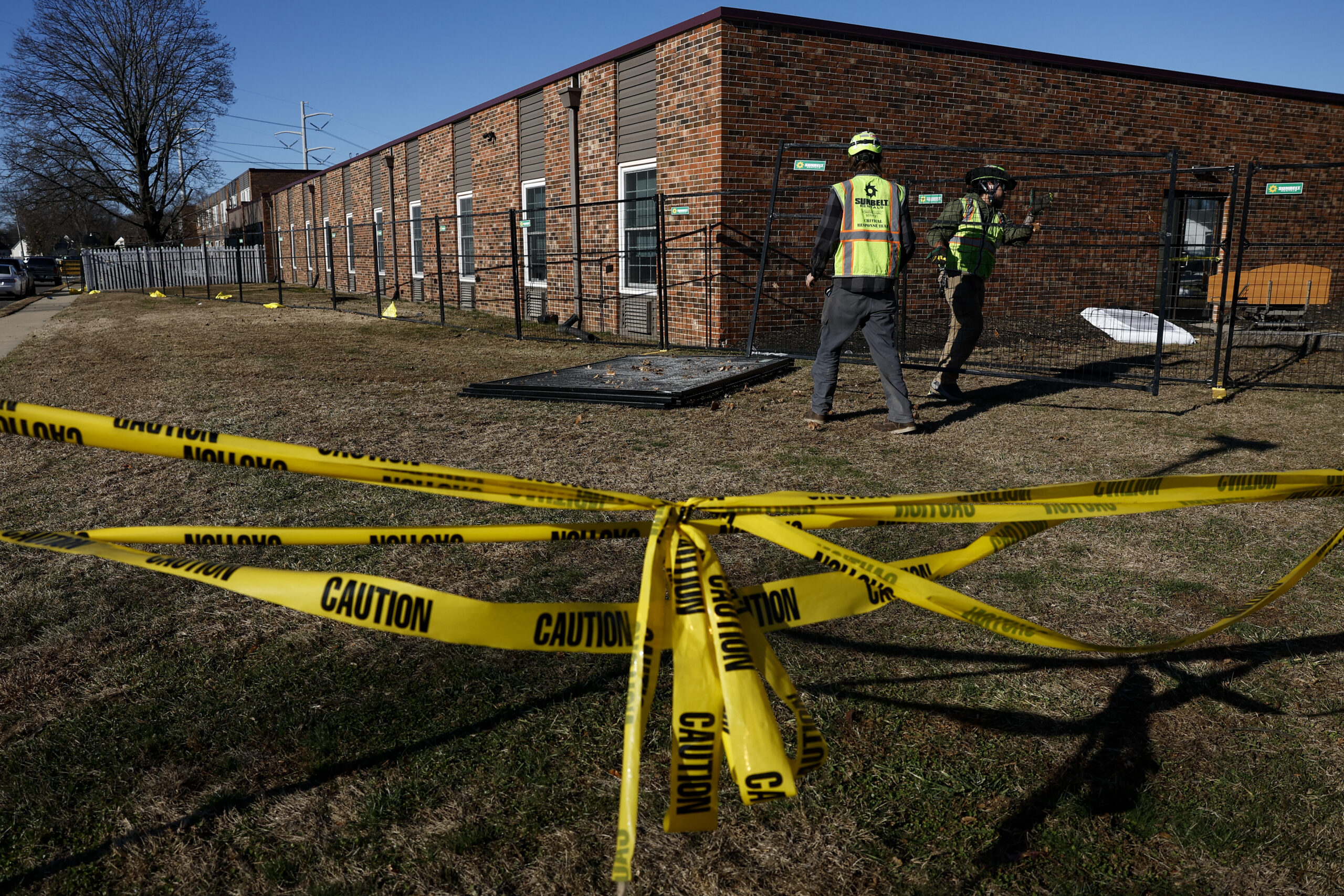
Workers set up fencing at Bristol Health & Rehab Center on Wednesday.
While the age and condition of the gas line near the nursing home were not clear, Peco has acknowledged it had 742 miles of substandard gas lines across the state — including cast iron, plastic, and uncoated steel piping — that needed replacing. The lines accounted for 5% of Peco’s gas service but 82% of leaks, according to a report from the PUC.
Peco plans call for all of those lines to be replaced by 2035 and to invest roughly $6 billion to inspect, modernize, and perform maintenance on all of its systems over the next five years.
Richard Kuprewicz, an expert on gas pipeline safety and investigations, said it is too early to tell if Peco or the nursing home acted improperly. He warned against jumping to conclusions the day after the explosions.
“We just don’t have the facts on this,” Kuprewicz said. “The tragedy is they had an explosion from a gas release that they knew was occurring. People will raise questions about this for months.”
In the immediate aftermath Tuesday evening, Peco spokesperson Greg Smore said in a statement that the company’s crews had responded to the nursing home “shortly after 2 p.m.” Tuesday and that while they were on site, the explosion occurred. The blast was reported just before 2:20 p.m. Tuesday, according to Bristol Fire Chief Kevin Dippolito.
But in a revised statement Wednesday morning, the company backtracked, saying its crews actually arrived “a few hours” before the explosion. It would not provide a specific time.
Peco said it shut off natural gas and electric service “to ensure the safety of first responders and local residents.” But, again, it would not say when.
Depending on where the gas leak was, Kuprewicz said, significant amounts of gas could continue to seep out after a shutoff.
“There isn’t one standard answer for all this,” he said. “Even when you shut it off, it doesn’t [always] stop flowing.”
Inquirer staff writers Samantha Melamed and Barbara Laker contributed to this article.
The word was out among Chester County teens: West Grove Smoke Shop wasn’t checking IDs.
“Many students frequented it,” a student told a Pennsylvania State Police officer investigating how scores of local high schoolers were getting their hands on an array of marijuana products. “So many, in fact, that there were long lines at the smoke shop after school.”
The tip — revealed in a grand jury report released in October — launched one of the largest stings of smoke shops in Pennsylvania this year. While those shops are allowed to sell hemp-based THC products that fall below a certain potency threshold, undercover detectives found widespread deception. After investigators made purchases from 19 stores in Chester, Delaware, and Lancaster Counties, lab tests determined all but one were selling unregulated marijuana falsely labeled as hemp.
It was a striking, if rare, example of local law enforcement cracking down on smoke shops selling hemp-based THC products, which an Inquirer investigation this year found are often just black market weed, sometimes contaminated with harmful toxins and chemicals. Several teens in Chester County told police they got sick from such products, with one landing in the hospital.
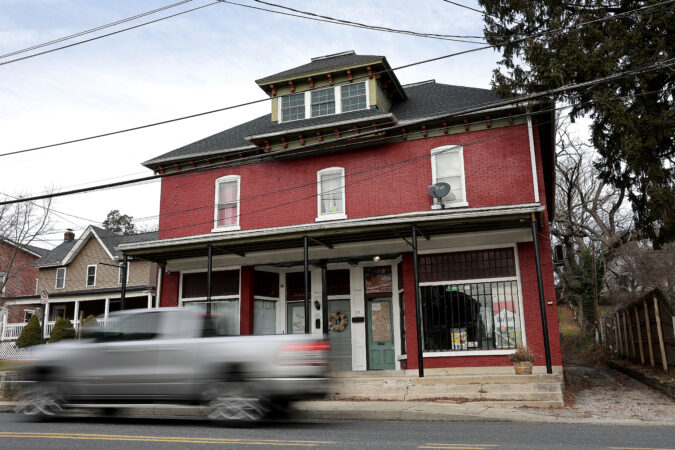
A view looking into the front window of the former West Grove Smoke Shop in West Grove, on Sunday, Dec. 21, 2025.
Confusion over federal hemp law, and the inability of lawmakers in Harrisburg to pass regulations in a state lacking a recreational cannabis program, has led to smoke shops popping up all over Pennsylvania. But the emerging effort to police these shops has so far been inconsistent and haphazard.
Philadelphia City Councilmember Katherine Gilmore Richardson has advanced a series of bills designed to crack down on scofflaw operators, who typically pull fraudulent grocery store licenses to open up shop. An Inquirer analysis found that the city has taken a stricter approach to smoke shops that operate under grocery store permits while peddling drug products and paraphernalia — with investigators doubling violations for improper licensing over the last two years.
“[It] marks important progress in the city’s efforts to better enforce against illegal smoke shops and nuisance businesses devastating our neighborhoods,” Gilmore Richardson said.
But block after city block, smoke shops remain open and continue to operate with relative impunity — sometimes within view of a similar shop that authorities have closed down.
Many use thinly veiled references in their names, such as “High Time Convenience” or “Hi Baby,” the latter featuring a logo meant to resemble the popular RAW rolling paper brand. Since 2022, nearly 100 zoning permits filed by the Frankford-based permit expediter Tina Accounting & Tax Services on behalf of would-be grocery store proprietors were later cited by inspectors as invalid, an Inquirer analysis found. (“There is no assumption that they are aware that these businesses may later become nuisance businesses,” a city official said.)
With the city short of investigators, many shops simply reopen even after they are shut down. Philadelphia has cited at least 42 stores, many of them smoke shops, for resuming operations after receiving an official shutdown order from inspectors over the last two years. One store, Market Mini Mart, located in the shadow of the 52nd Street El station, was cited 10 times for illegally reopening, records show.
City officials said the lack of a specific “smoke shop” permit makes it difficult to track the scope of the problem. Yet an Inquirer analysis of the city’s list of top 35 “nuisances businesses” found more than a third either had “smoke shop” in their names or advertised drug paraphernalia.
Going after technical violations remains one of the few tools available to local authorities, short of conducting raids and lab tests to determine if the over-the-counter products comply with federal law.
The supply line for smoke shops, however, could dry up next year. A provision in a federal spending bill would ban intoxicating THC products derived from hemp nationally, potentially closing a loophole that has created a glut of these quasi-legal products across the country.
The grand jury investigation acknowledged that the growing number of smoke shops presents a daunting challenge. The lead investigator in the Chester County case “quickly realized the sheer number was overwhelming, and many stores were interconnected, operating across multiple counties,” according to the grand jury report.
That investigation resulted in the September arrest of Satish Parsa, 33, the owner of three establishments, including the West Grove Smoke Shop, a redbrick storefront that now sits empty. Parsa faces more than 60 counts of drug trafficking and related charges, according to court records.
His attorney, Elliot Marc Cohen, said Parsa, who has pleaded not guilty, intends to “vigorously” fight the prosecution.
Ellie Siegel, CEO of Longview Strategic, a Philadelphia-area cannabis consultancy firm, argued that selective enforcement is ineffective.
When the federal ban goes into effect late next year, she reasoned, many smoke shops will shut down as the supply line dries up, while others will attempt to pivot toward the regulated marijuana market.
“The manufacturers won’t have a way to manufacture the intoxicating hemp products they’re making now,” she said. “It’s the closing of a loophole.”
A sample of hemp-based THC flower that was purchased by The Inquirer and sent for lab testing this summer.
The rise and fall of the Philly smoke shop
In interviews with about a half dozen Philly-area smoke shop owners over the last month, several told The Inquirer that they are bracing for closure, saying survival is nearly impossible in an already saturated market.
Others said they are confident they can endure.
On South Street, more than a dozen smoke shops crowd the mile-long stretch east of Broad Street. The longtime operator of Munchies Reloaded recalled thriving years when bongs and pipes brought in roughly $600,000 annually, before he expanded into hemp.
Now, he said, business has plunged nearly 80%. City inspectors have increasingly fined and shuttered stores for selling glassware used for smoking. Those items are easier to classify as “drug paraphernalia” prohibited by city codes, rather than quasi-legal hemp, which is superseded by federal laws.
“There used to be good money in it,” said the store owner, who declined to give his name. “Now there is no money.”
Smoke shops proliferated during the pandemic, often launched by marijuana enthusiasts, immigrant entrepreneurs, or small grocers looking to replace revenue lost to increasingly strict tobacco sale regulations.
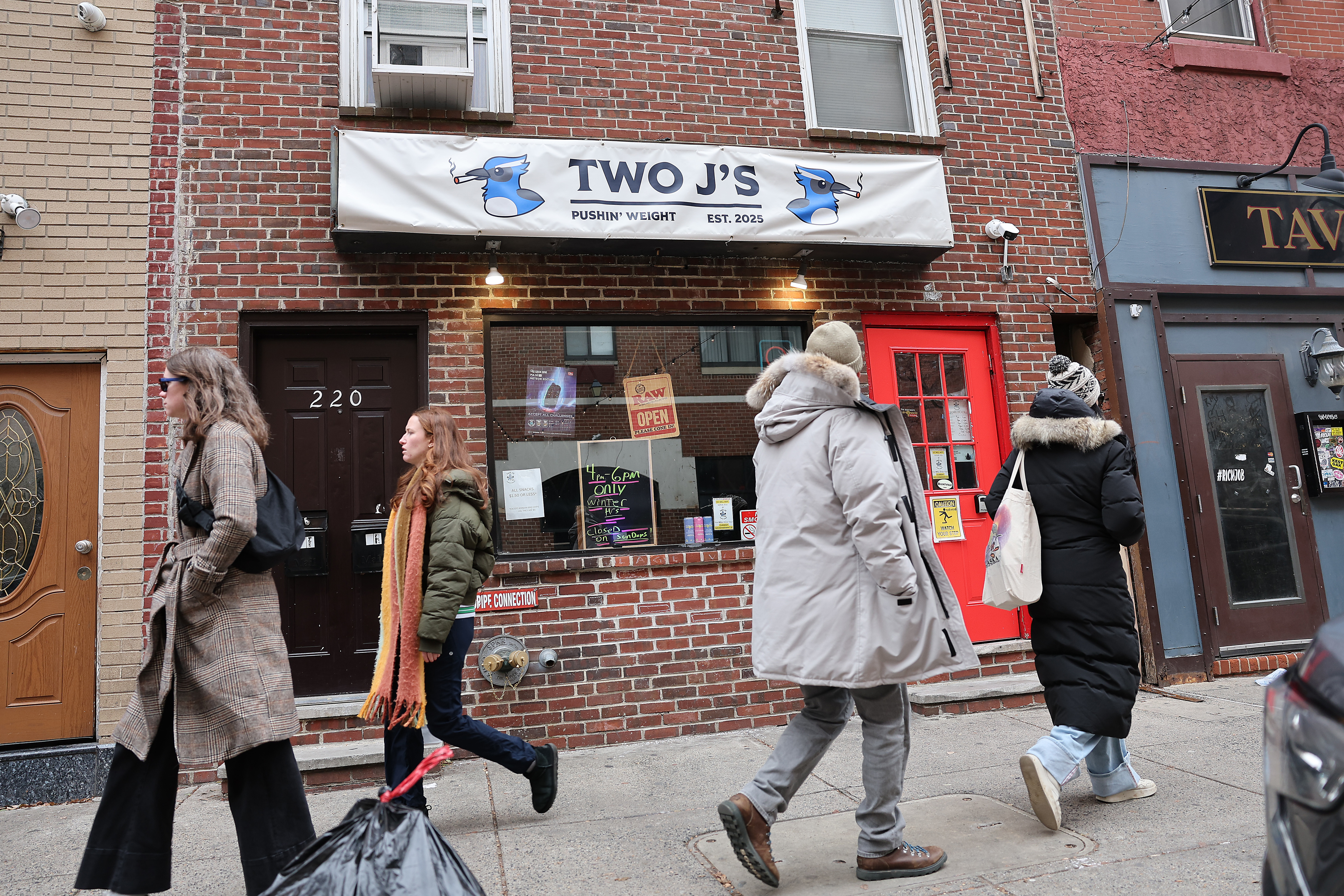
Pedestrians walk along South Street by Two J’s Pushin’ Weight shop in Philadelphia, on Sunday, Dec. 21, 2025.
Some shop owners have migrated to Philadelphia from the New York City area, lured by lower rents and higher demand in a state without legal recreational cannabis. A business permit for Green Broad Smokeshop on Broad Street, for instance, lists an owner based in Queens.
At the peak, a single shop could net between $250,000 and $1 million annually, depending on foot traffic and product line, according to two owners who spoke with The Inquirer on the condition they not be named so they could speak frankly about their businesses. Low overhead and high demand made for a tempting copycat model — a cheap pound of hemp might cost $600 in bulk but retail for more than $5,500.
On the same block as Munchies Reloaded, Abtein Jaeger and his brother in January opened Two J’s Pushin’ Weight. Jaeger said he sources high-grade hemp from West Coast farmers, positioning his store as a premium dispensary amid competitors selling a lower-quality product.
He said he is upbeat about surviving a potential crackdown on stores like his next year.
“It’s not the worst thing in the world,” Jaeger, 34, said.
He added that he would comply with any testing requirements and try to apply for a license, and that he already enforces a 21-plus age limit.
Reforming the Wild West of weed
Unlike in state-run cannabis programs, which mandate costly contaminant testing, hemp products need only carry a certificate of authenticity showing the flower tested under 0.3% Delta-9 THC at harvest.
The Inquirer, in its investigation earlier this year, commissioned a lab to test 10 products. Nine of them exceeded that limit, and most were tainted with banned pesticides, harmful mold, or heavy metals. Manufacturers had also used forged certificates to make their products appear safe and legitimate, The Inquirer found.
But the complexity of federal drug law makes it difficult to prove products are illegal, as many hemp-based products use THC variants like Delta-8 or Delta-10 that are not specifically banned.
For now, most shop owners say, local police leave them alone. Undercover stings, like those led in the suburbs, remain rare because they demand expensive lab testing and significant resources.
One South Street establishment has a singular strategy for surviving a potential crackdown.
South Street Cannabis Museum, whose logo includes a Liberty Bell festooned with marijuana leaves, exhibits a small collection of Reefer Madness-era newsprint, historical pamphlets, and other weed-themed memorabilia.
Exterior view of South Street Cannabis Museum in Philadelphia, on Sunday, Dec. 21, 2025.
“We are a museum, first and foremost, where we can engage with the public about the history, science, culture, and art of cannabis,” said owner Kristopher Wesolowski, 42, a former neuroscience lab manager and event planner, who pivoted into hemp sales after the pandemic.
The back half of the museum is a gift shop where visitors can buy hemp-derived THC flower under glass display cases.
“It’s almost like a simulated dispensary,” Wesolowski said. “But it’s not like some spot where people can just go and get high. … You can get historically stoned at our museum, in a sense.”
Like other proprietors, Wesolowski said the hemp industry has been “screaming for regulation,” as “bad actors” gave well-intentioned store owners a bad name.
But he also cautioned that overregulation would only create new problems, like increasing demand for unpredictable designer drugs on the black market.
“When you close one door, another will open,” he said. “And that one might be a little bit more dangerous.”
A former top-ranking deputy with the Philadelphia Fire Department has been demoted amid two ongoing investigations into sexual harassment and overtime abuse, The Inquirer has learned.
Former Deputy Commissioner for Operations Anthony Hudgins — who had been the second-highest ranking official in the 2,800-member department — was recently downgraded to deputy fire chief and reassigned to the Incident Safety Office, according to spokespeople with the city and fire department. The demotion cut his annual salary by nearly 25%, from $202,550 to $155,106, payroll records show.
Hudgins was the subject of an array of sexual harassment allegations, which led the city to hire an outside law firm to investigate the claims and interview department personnel. In a May interview with The Inquirer, Hudgins called the probe baseless and claimed he was targeted with false allegations after uncovering rampant overtime fraud. He acknowledged that as fewer than10 employees had lodged complaints against him. The city inked a $35,000 contract with the law firm Campbell Durrant to investigate the allegations.
Hudgins, a 31-year department veteran, did not immediately respond to a request for comment. After publication, Hudgins’ attorney, Amanda N. Martinez, sent a statement saying that Hudgins“remains committed to assisting the City with any legitimate investigation into the overtime fraud that he brought to light.”
She added that Hudgins is “reviewing the details surrounding the City’s actions and all defamatory statements made against him by individuals” and will “pursue all available legal remedies under the law necessary to protect Mr. Hudgins’ reputation and employment rights.”
The fire department has for decades faced allegations of pervasive sexual misconduct, and yet the Hudgins probe is significant in that it targeted a top-ranking department official. Although they acknowledged that Hudgins had been demoted, spokespeople for the city and fire department declined to confirm whether any of the allegations against him had been substantiated, citing the city’s policy to not discuss personnel issues.
Fire department leadership did not elaborate on the results of the investigation. A request for comment from Mayor Cherelle L. Parker resulted in a prepared statement from City Solicitor Renee Garcia, who said the city “takes any allegations of sexual harassment or fraud, including overtime fraud, very seriously.”
“We investigate any such allegations thoroughly and, if misconduct is found, we will take appropriate action to implement any warranted discipline expeditiously,” Garcia said.
The city has also declined to reveal whether any fire department employees have faced discipline as a result of the related investigation into alleged overtime abuse. Inspector General Alexander DeSantis — who as far back as January launched a probe into the overtime fraud claims — said his office’s investigation is “still ongoing and may be for some time.” He described the probe as “active” but declined to elaborate.
City officials have declined to release public records that would shed light on some of the fire department’s top overtime earners — and are taking The Inquirer to court in an effort to keep those records hidden.
In an affidavit submitted to the Office of Open Records, the agency that enforces state open-records laws, DeSantis argued that releasing the records to The Inquirer would jeopardize his office’s investigation and that it could not release the files “without identifying or implying who may be directly involved in this investigation.” Records related to noncriminal investigations are exempt from release under Pennsylvania’s Right-to-Know Law.
The Office of Open Records ruled in May that The Inquirer is entitled to receive the records, which cannot be withheld simply because the OIG opened an investigation.
The city again declined to release the overtime sheets and instead appealed the OOR ruling to the Court of Common Pleas. In a 21-page brief filed in that case, attorneys for the city urged the court to vacate the OOR’s ruling on the grounds that releasing the records would raise questions about “the efficacy of investigations, witness confidentiality, and harm to reputation.”
The OIG probe has yet to publicly reveal any findings. DeSantis offered no timeline for its conclusion, and the results may not be made public even after the investigation ends.
The OIG’s stated mission is to “keep City government free from fraud, corruption, and misconduct,” but the office rarely releases specifics related to the outcome of its fraud investigations. Instead, it publishes an annual report summarizing the office’s work from the previous year.
The OIG has yet to release that report for 2024.
Staff writers Samantha Melamed and Ryan W. Briggs contributed to this article.
Correction: A previous version of this story incorrectly characterized the total number of employees that Hudgins said may have filed complaints against him.
One man, buried under $20,000 in online gambling debt, became homeless. A woman lost $13,000 and missed her last five mortgage payments. A mother gambled away her son’s college tuition, piling up over $100,000 in debt.
Such dire stories — shared with gambling helplines in Pennsylvania and New Jersey in recent years — are on the rise. And for the growing number of people, the problem isn’t the casino, but the apps on their phones that let them gamble anywhere, 24-7.
“My family is hosting fundraisers for my son who had a stroke, and here I am, gambling on my phone,” one caller said. “What’s wrong with me?”
The Philadelphia media market — which encompasses the city, Southeastern Pennsylvania, and central and southern New Jersey — has become an epicenter of online gambling in the United States. In 2024, internet gaming and sports wagering revenues alone topped $6 billion in Pennsylvania and New Jersey, up from about $3.6 billion in 2021.
In the same period, the number of calls and texts to 1-800-GAMBLER rose in both Pennsylvania and New Jersey, two of only six states in the U.S. where both sports betting and online casino games are legal. But calls about online gambling problems rose significantly more — 180% in Pennsylvania and 160% in New Jersey in that period. In 2019, only about one in 10 Pennsylvania callers said online gambling was the main issue. By 2024, it was every other caller.
window.addEventListener(“message”,function(a){if(void 0!==a.data[“datawrapper-height”]){var e=document.querySelectorAll(“iframe”);for(var t in a.data[“datawrapper-height”])for(var r,i=0;r=e[i];i++)if(r.contentWindow===a.source){var d=a.data[“datawrapper-height”][t]+”px”;r.style.height=d}}});
The Inquirer analyzed anonymized helpline call logs, state revenue reports, and advertising data to shed light on how the Philadelphia-area market has become a hub for the online gambling industry. An increasing volume of gamblers face financial devastation as they struggle to get off the apps.
As of this fall, the Philadelphia media market outpaced New York City and Las Vegas as the No. 1 market for internet gambling advertisement, with companies spending more than $37 million on ads between January and September, according to data provided by Nielsen Ad Intel.
As many as 30% of Pennsylvania adults now gamble on online sports with some regularity, according to researchers at Pennsylvania State University who conduct an annual, state-funded survey of online gambling. And as many as 6% of Pennsylvanians, or 785,000 people, are estimated to be problem gamblers, according to the most recent survey, which is not yet published.
While problem gambling has a range of severity, the American Psychiatric Association recognizes it as a mental health condition. A gambling disorder is defined by a persistent pattern of problematic betting with an inability to limit or stop, leading to emotional, financial, and or relational distress.
For many, the losses are crushing. In New Jersey, helpline callers reported a combined $28 million in debt at least among people who disclosed this financial information, averaging about $34,000 for each of these callers. In Pennsylvania, 60% of those people willing to share said they owed money, though the state does not track totals.
Across both states, callers reported they had drained entire retirement accounts, lost homes to bank foreclosure, or blown through entire paychecks. One anonymous caller in New Jersey reported losing $400,000 in a single night — his life savings.
“We [also] have people who call us and say, ‘I think I’m doing this too much. I think I need a little bit of help,’” said Josh Ercole, executive director of the Council on Compulsive Gambling of Pennsylvania, the state-funded nonprofit that runs the hotline for the commonwealth’s residents.
Four calls made in New Jersey between 2023 and 2024 were about children under the age of 12 struggling with gambling problems, according to the state’s fiscal year report. Ten other calls were about children under the age of 18. In Pennsylvania, 10 calls involved children between the ages of 13 and 17.
Experts say the explosion of sports betting and casino apps has fueled what is increasingly seen as a public health crisis, as gambling profits and state tax revenues derived from them have soared since sports betting’s legalization in 2018. And Philadelphia is now viewed as something of a promised land for e-gambling boosters.
window.addEventListener(“message”,function(a){if(void 0!==a.data[“datawrapper-height”]){var e=document.querySelectorAll(“iframe”);for(var t in a.data[“datawrapper-height”])for(var r,i=0;r=e[i];i++)if(r.contentWindow===a.source){var d=a.data[“datawrapper-height”][t]+”px”;r.style.height=d}}});
Uttara Madurai Ananthakrishnan, an economics professor at the University of Washington who has studied the psychology of gambling, said lawmakers have struggled to keep pace with the industry’s meteoric growth.
“I don’t think people expected it to explode at this level,” said Madurai Ananthakrishnan, who previously worked in Pennsylvania. “All of this is going to slowly add up and cause a ton of issues downstream.”
Harrisburg also benefited handsomely from the high rollers, drawing $165 million last year in gambling taxes, up from $46 million five years prior. About $10 million was earmarked for gambling addiction helplines and treatment programs, which came directly from industry profits.
Online betting now accounts for nearly half of all gambling revenue in Pennsylvania, according to an Inquirer analysis of state reports. Pennsylvanians wagered a staggering $8.3 billion during the 2024-25 fiscal year in online sports betting alone, making it by far the most popular gambling method. Total revenue for sportsbook and iGaming sites rose past $2.9 billion last year.
window.addEventListener(“message”,function(a){if(void 0!==a.data[“datawrapper-height”]){var e=document.querySelectorAll(“iframe”);for(var t in a.data[“datawrapper-height”])for(var r,i=0;r=e[i];i++)if(r.contentWindow===a.source){var d=a.data[“datawrapper-height”][t]+”px”;r.style.height=d}}});
In New Jersey gaming revenue was nearly $6.3 billion in 2024 — $3.3 billion of which came from internet gaming and sports wagering, according to the state’s Casino Control Commission’s annual report.
Yet the amount spent online is almost certainly higher than what states can track — as is the number of people who have developed online problems.
Caron Treatment Center, a Pennsylvania-based substance use treatment facility, said 160 people in their inpatient treatment problem were struggling with gambling this year — a 162% increase from five years ago.
“I’ve been getting call after call about gambling,” said Eric Webber, a behavioral health specialist and gambling counselor at Caron. “It’s a national crisis that doesn’t have a national solution.”
Fewer than two dozen gambling sites are technically legal in Pennsylvania. But thanks to pervasive online advertising, many gamblers now use so-called offshore gambling sites that are not regulated by the state.
As of last year, more than 20% of online gamblers were using these illegal or unregulated sites, according to the 2024 Penn State report. Such sites often lack state-mandated guardrails like easily allowing users to set weekly betting limits or request a “self-exclusion” — avoluntary ban from licensed casinos, internet-based gambling, video gaming terminals, and fantasy sports wagering.
Self-exclusions in Pennsylvania are higher this year than last year — 8,315 people have already opted out compared with the 7,489 people who requested a ban through Dec. 31 of last year.
Major online sportsbooks say they are going above and beyond.
Beyond self-imposed spending limits, FanDuel, one of the largest sports betting advertisers in the Philadelphia market, introduced a dashboard to allow gamblers to track their spending habits. The company also began tracking betting patterns on its platform and alerting customers when they bet more than their normal wager.
“When users attempt to deposit significantly more than their predicted amount, we surface that information to them and prompt them to reduce their deposit or to set a go-forward deposit limit,” a FanDuel spokesperson said.
DraftKings, in a statement, said it works closely with a gambling company alliance to support responsible betting, “leveraging technology to help detect signs of potentially problematic behavior.”
Some lawmakers want to see more regulation.State Rep. Tarik Khan, a Democrat who represents parts of Montgomery County and Philadelphia, has called for hearings to examine best practices to rein in an industry that he said heavily targets youth.
“More and more people, especially young people, are getting addicted to it, and blowing large portions of their paychecks on feeding this addiction,” Khan said. “It’s already pervasive, and it’s going to get worse.”
‘I’ve gambled everything away on FanDuel’
In New Jersey, more than half of the callers to gambling hotlines who disclosed their age were under 35. In Pennsylvania, people under 35 accounted for 41% of callers.
“Things have shifted to a younger crowd,” said Ercole, of the Council on Compulsive Gambling of Pennsylvania. “Typically our highest call volume used to be in the 35 to 55 ranges.”
People from all professions are affected — nurses, construction workers, software engineers, chefs, attorneys, postal workers, microbiologists, and tattoo artists. Some are students, retirees, or unemployed.
Regardless of one’s income level, online gambling can put serious strain on personal and professional lives. Some people told of losing contact with their parents, getting divorced, or being cut off from friends.
Others lost jobs or had their homes and cars repossessed.
“I have nothing,” a 30-year-old caller told a New Jersey helpline operator in 2023. “I’ve gambled everything away on FanDuel.”
Most people are calling about their own gambling problems. But dozens of family members called to ask for help with their loved ones’ betting. In one case, a woman asked if she could use her father’s Social Security number to ban him from online betting apps.
Many gamblers do not call the hotlines or seek professional help until they face financial ruin or they are confronted by family members.
At the height of his problem, one man from New Jersey started gambling on Russian table tennis matches and Australian basketball games. His wife, who spoke to The Inquirer on condition of anonymity to discuss a sensitive family matter, said his compulsion had grown so severe that he needed a fix to hold him over between sports seasons.
“He was betting $1,000 on a sport he knows nothing about, played by people he’s never heard of before,” his wife said.
The husband kept his gambling hidden for her years, until she found his secret bank account — along with two dozen maxed-out credit cards and records of tribal loans he had taken out, one of them with a 300% interest rate. She also learned that, in 2021, he had quietly lost $70,000 while the newlyweds were on their honeymoon in France.
“It’s horrifying,” she said.
FanDuel, DraftKings and other online gambling apps are displayed on a phone. (AP Photo/Jeff Chiu, File)
The casino-to-app pipeline
Across Pennsylvania, as of 2024, people sought help for addiction to internet games more than any other type of gambling, especially in the suburbs.
In Montgomery County, the most common type of gambling problem cited was internet slots — with 47 calls. In Bucks, internet sports had the highest volume with 34 calls.
In Philadelphia, home to both Live! Casino and Rivers Casino, in-person games remain the largest reported problem for struggling gamblers, according to call center logs.
Some brick-and-mortar casinos, however, have seen business drop as bettors migrate to their phones. At Rivers Casino Philadelphia, sports-betting revenue fell from $29 million in fiscal 2019 — the first full year of legal wagering — to $11 million in 2024, according to state records.
But even in Philadelphia, a county with two casinos, the number of calls and texts for online gambling shot up in recent years. And experts say that people who gamble exclusively online show heightened risk.
“You can get cut off at the casino. You could walk away from the machine,” said Gillian Russell, an assistant Penn State professor who works on the annual online gambling survey. “Those things that maybe cause breaks, a lot of those things are removed.”
About 13% of people who gamble both online and in person were classified as problem or pathological gamblers, according to the 2024 Penn State survey. Online-only gamblers, though just 3% of the total gambling population, showed even greater risk: 37% fell into problem categories.
Prop bets, the practice of betting on various occurrences within a game rather than just the outcome, are a pointed concern. Such wagers have come under scrutiny as bet-fixing schemes ensnare athletes from the NBA, MLB, the NCAA, and even niche sports like table tennis.
Among normal gamblers, however, prop bettors are far more likely to develop problems, Russell said. Webber, the gambling counselor, likened in-game prop betting to a constant stream of small dopamine hits, which create a kind of withdrawal.
And with gambling sites offering bonus cash and rewards points, he said, the temptation can feel constant.
“DraftKings says, ‘Hey, I haven’t seen you in a couple weeks, here’s $50.’ The local beer distributor doesn’t say, ‘Hey, you haven’t been here in a while, here’s a cold six-pack,’” he said. “That doesn’t help somebody who’s struggling.”
Late in the afternoon on Nov. 7, a Friday, the Philadelphia Police Department announced that nine current and former police officers had been charged with conspiring to defraud the city by using a grant-funded youth boxing program to pad their salaries.
It was the largest number of Philly officers charged together with misconduct in nearly 40 years — a seemingly splashy case for District Attorney Larry Krasner, a progressive prosecutor who has made charging cops a cornerstone of his two terms in office.
Yet Krasner has been unusually quiet about it.
The district attorney was traveling in Switzerland for a conference when the charges became public. His office declined to comment, held no news conference, and issued no public statements — in stark contrast to his trumpeting of police misconduct cases in the past.
Krasner has charged dozens of police officers since taking office in 2018. But he did not publicly acknowledge his largest booking to date until The Inquirer approached him at an unrelated news conference, nearly a week after these most-recent charges were filed.
And even then, he was reluctant to talk about it.
“We had probable cause that they committed the crimes,” Krasner said Thursday. “Having said that, I wanna be very clear: There are a lot of great cops in the city. … I don’t think that this group of nine should in any way taint the rest of them.”
Prosecutors accuse Nashid Akil, former captain of the 22nd District in North Philadelphia, and eight of his officers of stealing $44,576 in taxpayer-funded anti-violence grant money between January and September 2022, according to charging documents.
Those funds came from a $392,000 city grant awarded to Epiphany Fellowship Church to support Guns Down, Gloves Up, a boxing and youth mentorship program that Akil founded at his nearby district building. No one from the church was charged, and Krasner said Thursday the church should not be “tainted” by the allegations against police.
Former Captain Nashid Akil, shown here while at the boxing program Guns Down Gloves Up, at the 22nd District, in Philadelphia, Friday, October 7, 2022.
City employees are prohibited from receiving grant dollars. Yet after vowing in the grant application that police time would be volunteered, Akil, using the church as a pass-through, allegedly paid himself and eight district officers for their work as boxing instructors, an arrangement that came to light through an Inquirer investigation in 2023.
Police now say some officers were paid during their scheduled shift hours.
A law enforcement source familiar with the case said the district attorney’s office concluded its probe into the grant scheme months ago. Krasner did not approve the charges until Oct. 31, according to a police department spokesperson. That was days before the Nov. 4 election, when Krasner was handily reelected to a third term. The defendants began surrendering to authorities three days later.
Police Commissioner Kevin Bethel issueda statement after the arrests saying he was “deeply troubled” by the officers’ alleged actions and “particularly disappointed by the involvement of a former commanding officer.”
But neither Krasner nor his spokesperson responded at the time to repeated requests for comment.
On Thursday, Krasner attributed the timing of the charges to logistical issues with bringing in the nine codefendants.
Akil was forced to resign in February 2023 after The Inquirer’s reporting on the boxing program, and three other officers who allegedly took the money had since resigned. Bethel has moved to fire the five active officers.
Only one of the nine officers listed an attorney in court records, and that lawyer could not be reached for comment.
Officials at Epiphany Fellowship Church did not respond to a request for comment.
An unusual silence
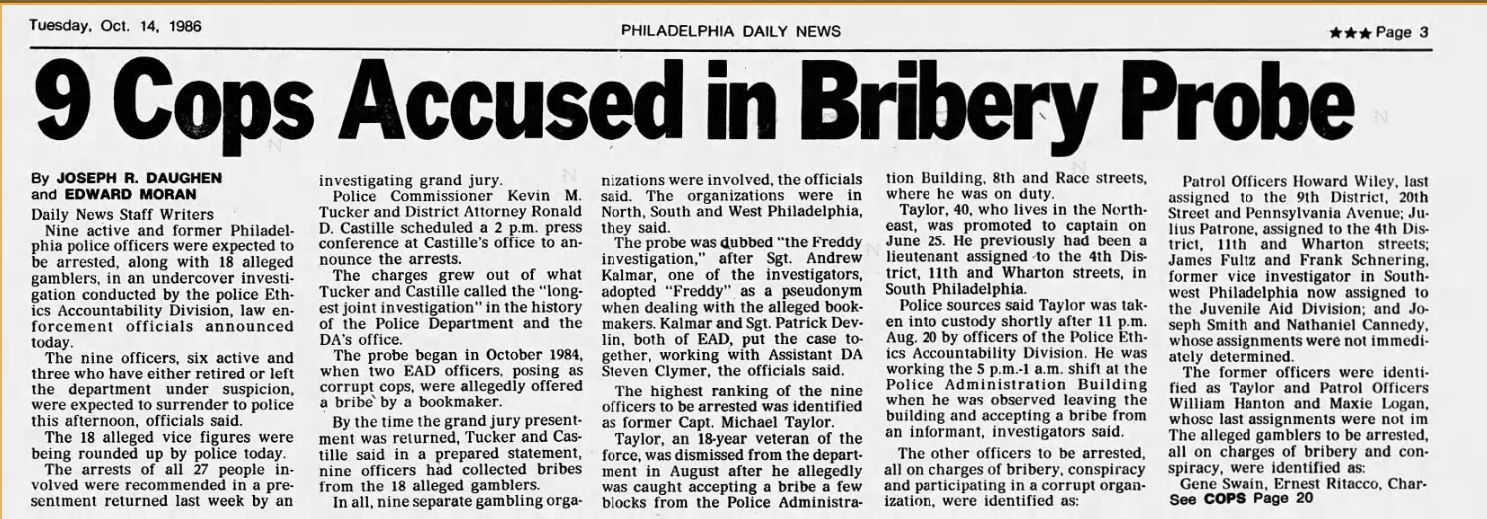
The last time nine officers were charged together in Philadelphia was in 1986, for taking bribes to conceal an underground gambling ring.
An Oct. 14, 1986 article in the Philadelphia Daily News shows the last time nine current and former Philadelphia police officers were charged following a single investigation.
Since the charges were filed in the boxing program scandal, Krasner’s office has put out ninenews releases — but nothing on the nine officers charged.
It’s a departure from how the typically loquacious district attorney has handled previous allegations of police misconduct.
In 2021, for example, when The Inquirer was reporting on widespread abuse of the department’s injured-on-duty program, Krasner said he believed some officers were “gaming the system, and in my opinion, committing crimes by engaging in fraudulent practices to stay home.” The disability system was reformed and hundreds of officers returned to work, but no criminal charges were filed.
The next year, Krasner issued a lengthy news release after the arrest of Officer Daniel Levitt on perjury and related charges, stemming from an allegedly illegal search that led to the recovery of a handgun. The charges against Levitt were initially dismissed but have since been refiled.
In 2023, Krasner was again out front in announcing the arrest of former Officer Patrick Henon for sexually assaulting young girls. Henon pleaded guilty.
In May, Krasner called a news conference after a jury convicted two former detectives convicted of making false statements about DNA evidence.
A month later, when Donald Suchinsky, a former homicide detective, was sentenced to prison for sexually assaulting relatives of murder victims, Krasner appeared outside the Criminal Justice Center to condemn Suchinsky’s conduct and urge any other victims to come forward.
And in July, Krasner again held a news conference to criticize what he called a lenient sentence of former Officer Mark Dial, who was paroled following his voluntary manslaughter conviction in the shooting of Eddie Irizarry.
“I am deeply disappointed with a verdict that I think makes people lose faith in the criminal justice system,” Krasner said.
A sensitive issue
In contrast, when approached by reporters Thursday, Krasner requested an advance list of questions about the alleged grant misappropriation, then huddled privately with two of his top prosecutors for several minutes before offering littlecomment.
Asked about his reticence toward this case compared with past cases, Krasner alluded to outside concerns.
“We have to do certain things in court in a certain kind of way, and we have to operate with our partners, and that’s what we’re going to do,” he said.
He declined further questions.
Krasner’s uncharacteristic silence has not gone unnoticed by nearly a dozen communications consultants, lawyers, and law enforcement officials, who spoke with The Inquirer on the condition that they not be named.
They speculated that Krasner might be downplaying the arrests due to political sensitivities or because — unlike in cases of wrongful arrests and shootings — there is not a clear victim in this case, outside of city taxpayers. Some acknowledged that there could also be legal reasons why Krasner would decline to draw additional attention to the arrests.
Carl Day, a pastor who runs Culture Changing Christians, noted that Krasner is allied with Black clergy members who have supported his political campaigns. Day suggested that the district attorney might be trying to avoid further scrutiny into the church that was in charge of the grant.
“My hope and belief is that it’s a level of respect,” Day said. “In this work, you become scrutinized a ton and placed under microscopes, especially when you are a Black-led organization and getting government money.”
The boxing program scandal is one of several incidents that have raised concern about the city’s oversight of millions of anti-violence grants, scores of which have been awarded to small nonprofits in the Black community.
Day said nonprofit leaders need to be held accountable for misspent funds, but he argued that Black-led nonprofits, many of which do not have the financial resources of large organizations that typically get city grants, face heightened scrutiny.
If that is the case, Day said, he is puzzled why Krasner wouldn’t come out and say so.