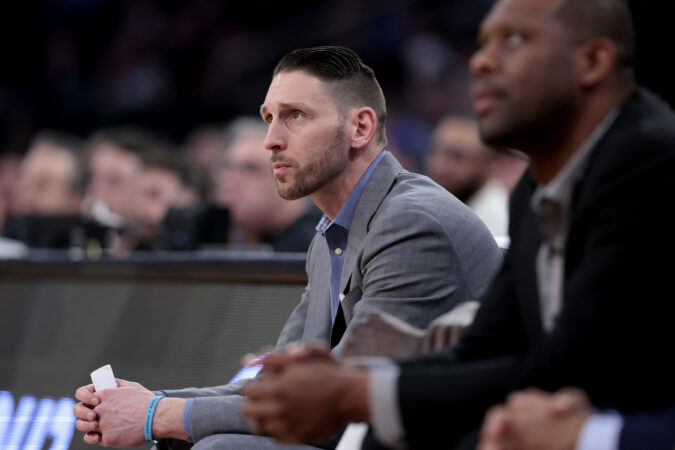
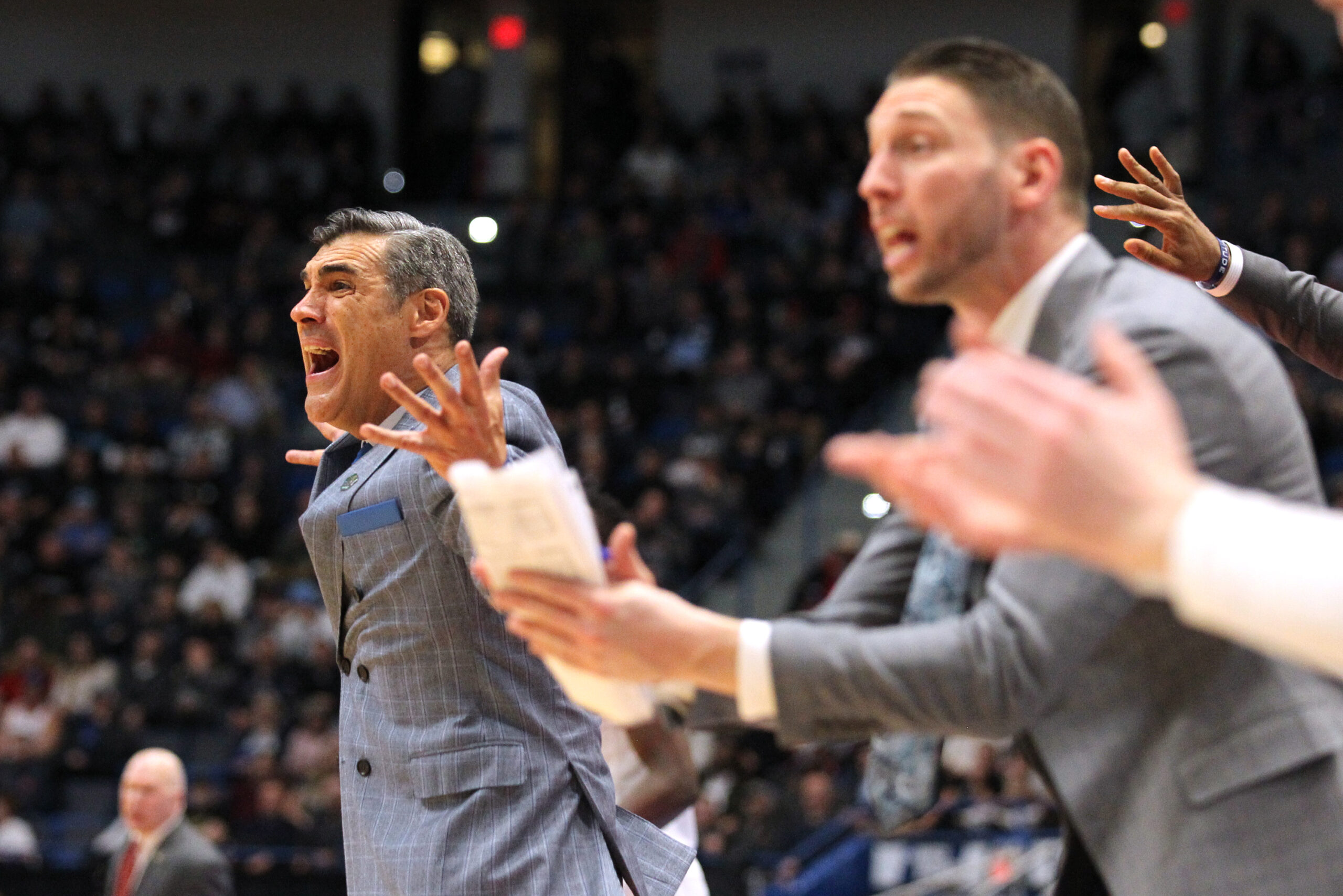
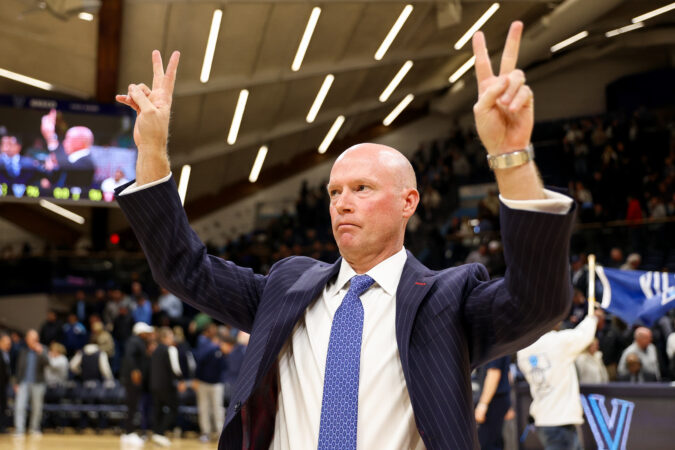
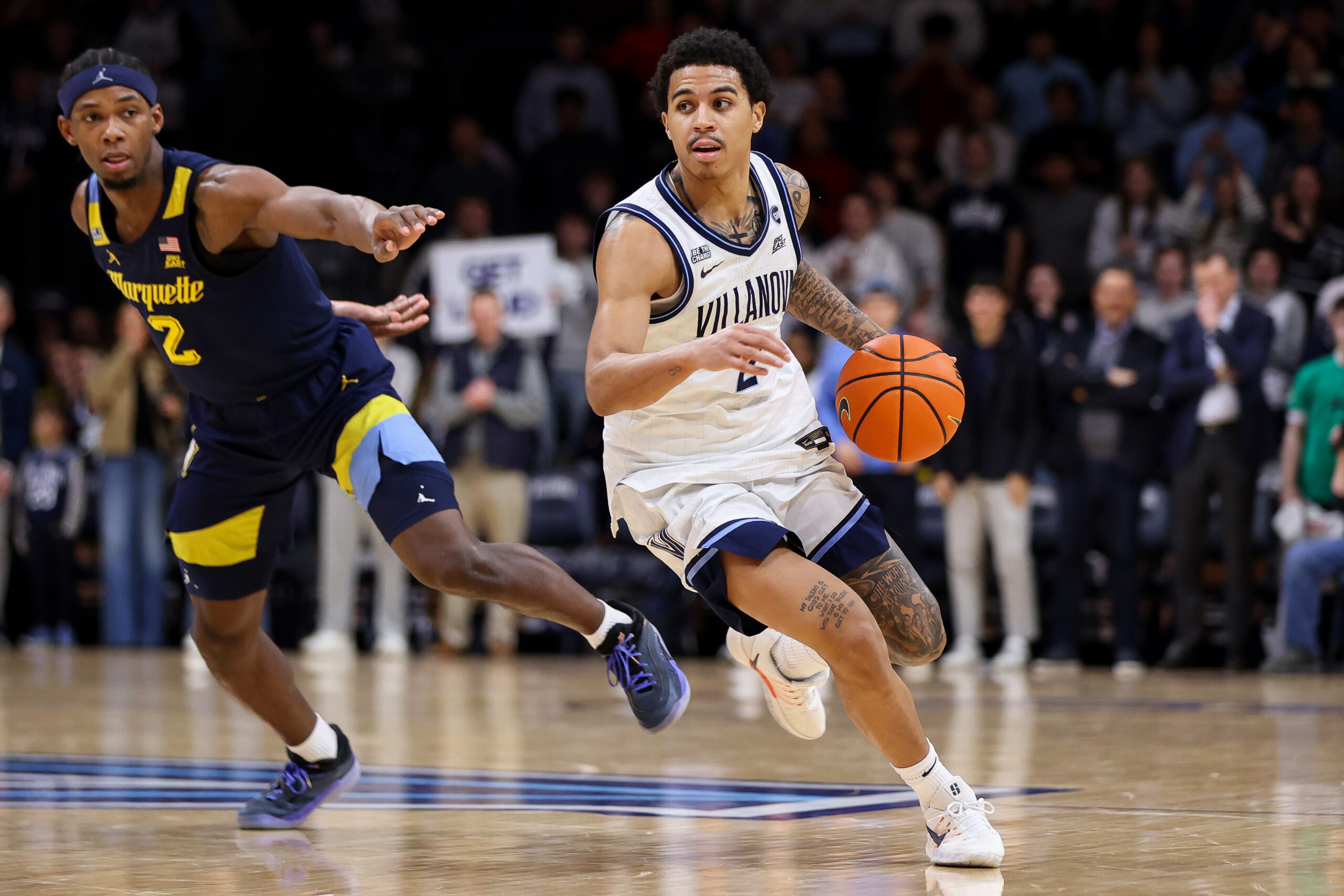
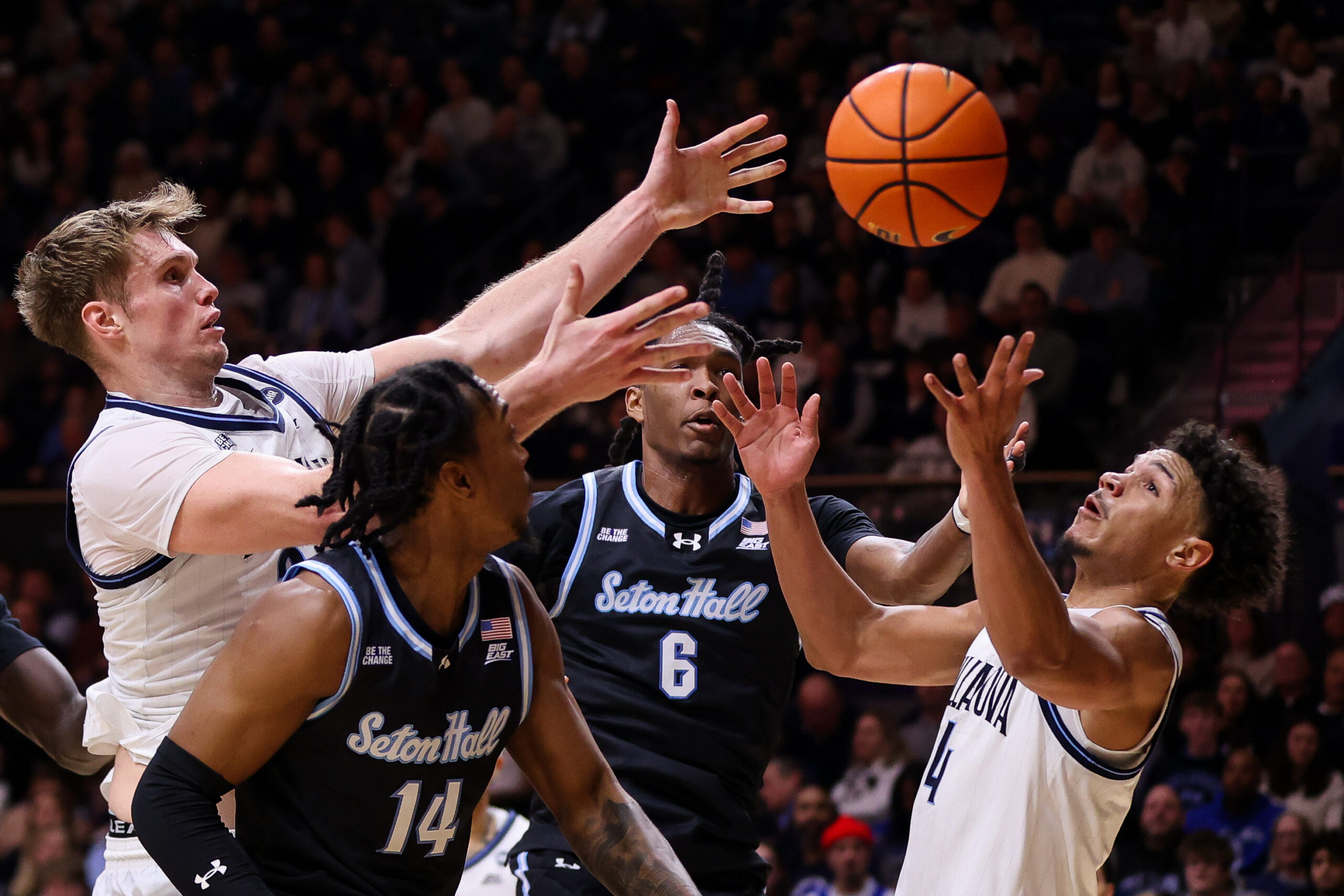
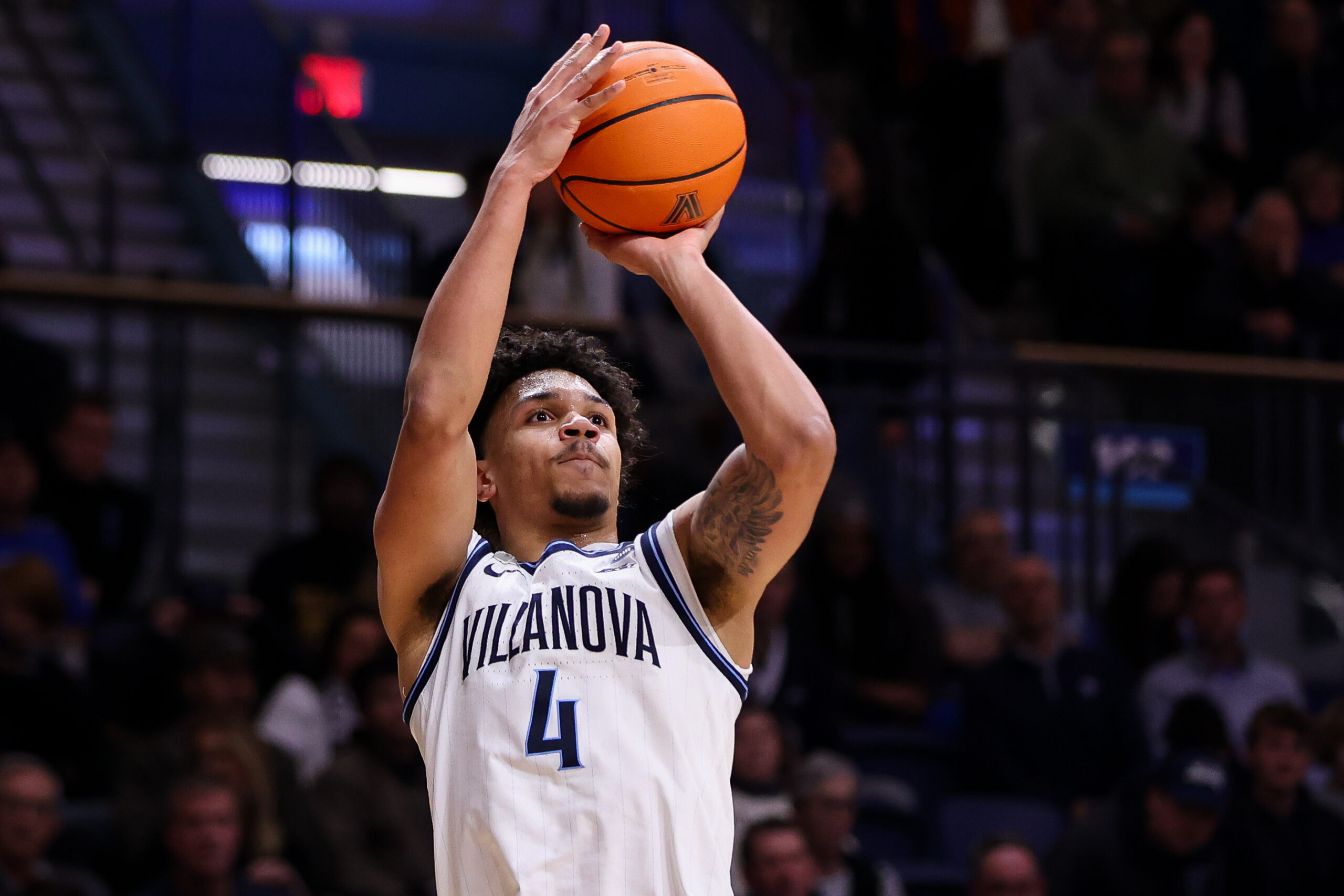
Mike Nardi turned 41 a few weeks ago, and considering he arrived on Villanova‘s campus as an 18-year-old freshman in 2003, played under Jay Wright for four seasons, then joined Wright’s staff in 2015 after seven years playing professionally overseas and remained on the bench through the end of last season, Villanova basketball was basically all Nardi knew for most of his adult life.
He was there in the nascent days of Wright’s dynasty as a player and was back on the bench in time to enjoy the two national championships he laid the groundwork for.
Xfinity Mobile Arena has been the site of many memories. Villanova fans still recite Sean McDonough’s “Nardi for three and the lead” call during an ESPN Big Monday broadcast on Feb. 13, 2006, with reverence. Nardi, who had missed the previous two games with tonsillitis, drilled a transition three-pointer from the right wing in front of the Villanova bench during a 22-4 run that erased a 12-point deficit and gave fourth-ranked Villanova its first win over No. 1 UConn in three years.
A year earlier, the building was where Villanova, during a freshman season that saw Nardi make the All-Big East rookie team, announced its arrival on the national stage with a blowout victory over second-ranked Kansas.
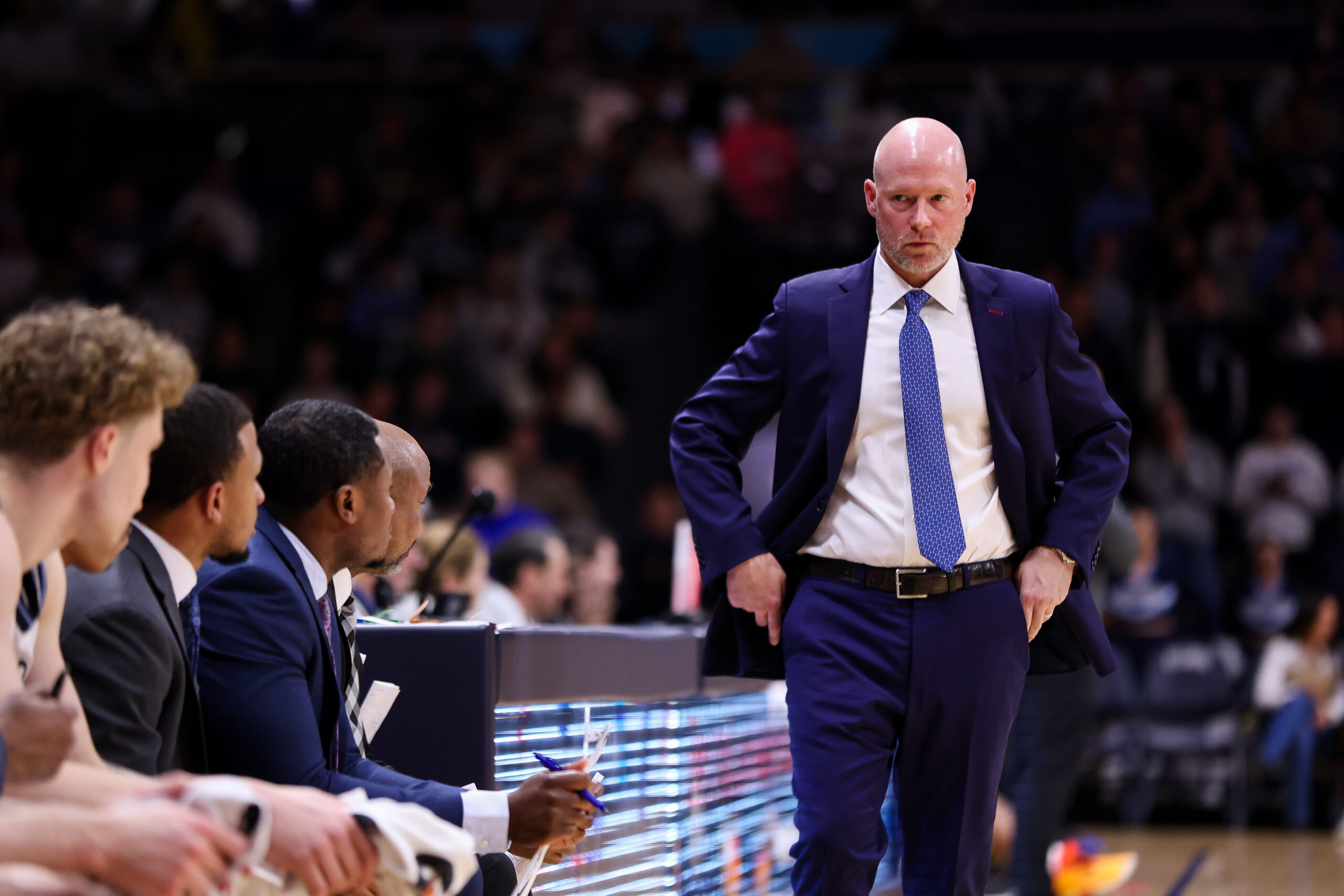
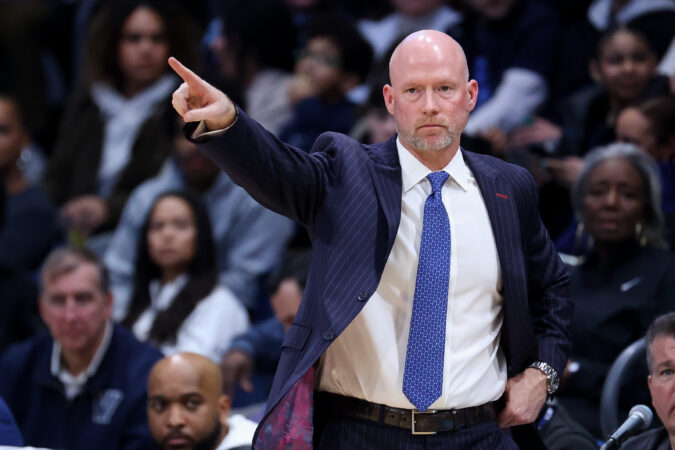
Nardi is returning to that building Saturday night. It’s the latest installment of the Villanova-UConn rivalry (5:30 p.m., FOX). But Nardi will be on the visitor’s bench, and he’d like nothing more than to prevent Villanova from getting its best win of the season over his fifth-ranked Huskies.
Mike Nardi joined Jay Wright’s staff in 2015.
“I had a great experience, but the emotions for me now are, ‘Hey, it’s competition,’” said Nardi, who was hired by Dan Hurley to be an assistant coach after Villanova brought in Kevin Willard last year. “I’m competing and I’m at a place where we want to win. The emotions and all of that, I’ve never been a guy to get caught up in that kind of stuff. There’s a task at hand and we want to go there and get a win and that’s the most important thing.”
Nardi already got some of those feelings, if there were any to begin with, out of the way during Villanova’s trip to Connecticut in January. He caught up with Ashley Howard, JayVaughn Pinkston, and Nick DePersia, the only holdovers from Kyle Neptune’s staff; longtime radio voice Whitey Rigsby; athletic director Eric Roedl; and longtime sports information director Mike Sheridan. Then it was all business. Villanova was Nardi’s scouting assignment for each of the matchups this season. He exchanged his pleasantries, said his hellos, and then he helped coach a UConn overtime victory.
“I was sad to see it end, but I landed in a place where, again, it’s like the standard of college basketball,” Nardi said. “I’m working for another Hall of Fame coach, a guy who has won at every level. For me, it’s a great learning experience because I played at Villanova, I coached at Villanova, and besides going overseas and seeing different systems and playing for other coaches, I really haven’t had a chance to branch out and see a different system and learn the game a different way.”
If it were up to Nardi, this story probably wouldn’t be written. He returned a reporter’s call Friday in part, he said, out of respect for Villanova. He doesn’t want Saturday night to be about anything more than UConn trying to go on the road against a good team in a tough environment and get a win in its pursuit of a Big East regular season title.
“I don’t want to make this about me,” he said. “It’s really not Mike Nardi and coming back to Villanova. This is about UConn and Villanova. That’s what’s most important to me.”
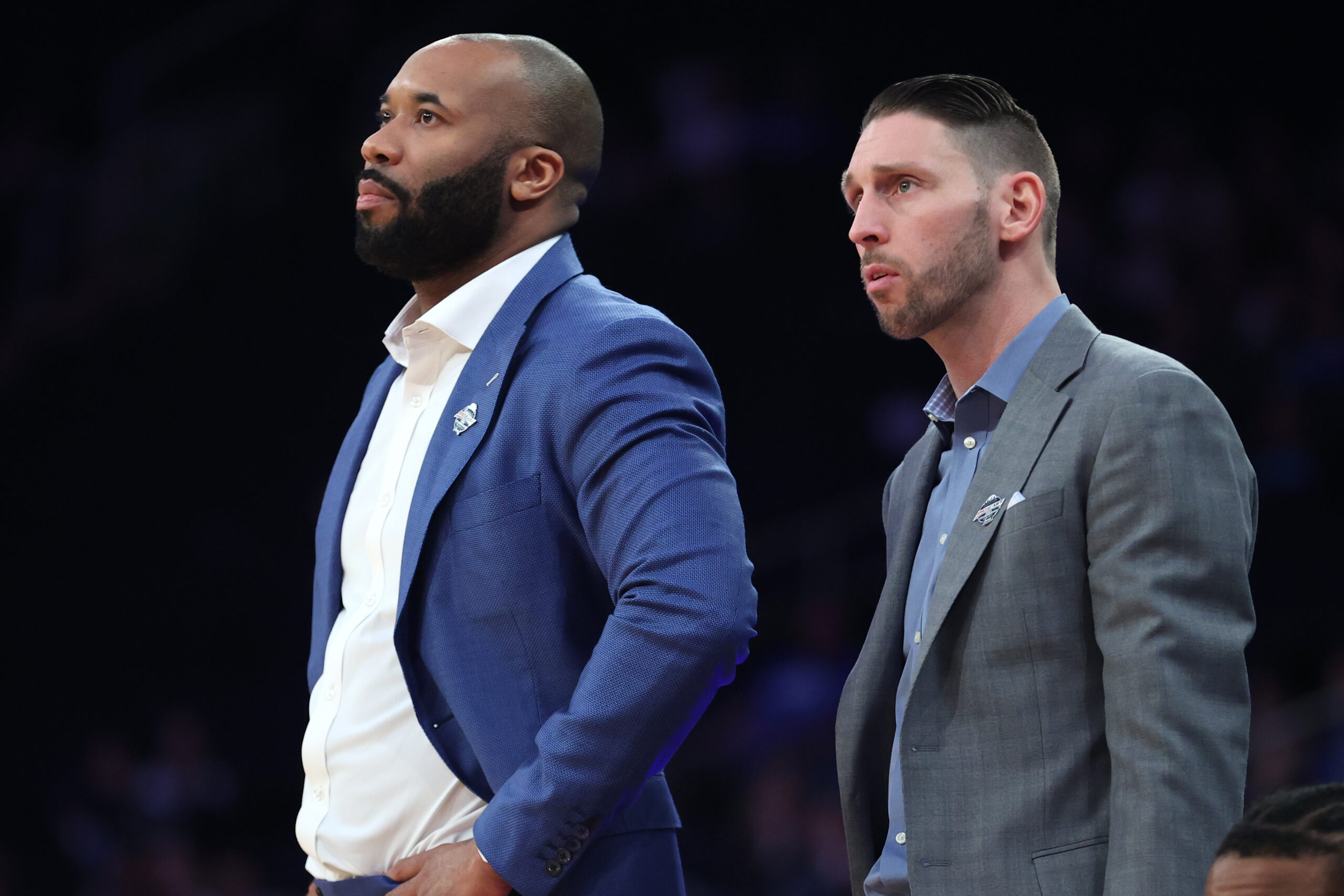
Former Villanova coach Kyle Neptune (left) and assistant coach Mike Nardi shown during the Big East tournament at Madison Square Garden last March.
It didn’t take very long to get over being on the other side of the rivalry despite all his history with it. The good and the bad. He made that crucial three to earn his first win over UConn in 2006, then watched the meaningful portion of the 2024-25 season end at the hands of Hurley in the Big East tournament, only to have his friend, Neptune, fired a few days later.
Nardi respects winning, he said, and respects excellence. He always viewed Connecticut in that light, from Jim Calhoun’s teams to Hurley’s. It was a good landing spot for him for basketball reasons and because Hurley, he said, respected everything Nardi was about, from playing for St. Patrick High School in New Jersey against Hurley’s father’s St. Anthony, to playing and coaching in the rivalry.
Nardi wasn’t asked to stay by Willard, he said, and never expected to be.
“I never felt slighted. I never felt a certain way,” Nardi said. “I kind of knew there was a slim chance of me being asked to stay. And that was OK. I didn’t take that the wrong way. I think I’m good at what I do. I think I could’ve been an asset, but I never ever looked at it like this is messed up, why aren’t you keeping me? That’s not how this works.”
Hurley, meanwhile, thought Nardi could be an asset in Connecticut. The Huskies are 24-3 after a Wednesday night home loss to Creighton, and they’re pursuing a third national title in four seasons. Villanova, meanwhile, is 21-5, 12-3 in the Big East, and in line to snap a three-season NCAA Tournament drought.
Nardi was happy, he said, that Willard got the job. He wanted the school to hire someone who cared about the program, and Willard fits that description. Part of him is happy to see Villanova back in the mix, but he’s not watching Villanova games in his free time with his old No. 12 jersey draped over his shoulders.
“It’s good to see them doing well,” Nardi said. “It’s obviously good for the league. I think that’s a big piece of it. But I’d be lying to you if I said I was rooting for them. I don’t root for anybody else in the league. I’m rooting for UConn and that’s it.”
The NCAA Tournament is coming to Philadelphia for one of its eight opening-weekend sites, and Villanova made sure to plan for the occasion.
The Wildcats hosted four games at Xfinity Mobile Arena last season but scheduled only two home games there this season — the second of which is Saturday evening vs. No. 5 Connecticut. NCAA rules prohibit a team from playing tournament games in a venue where they host more than three home games, and the lowest seeds typically are rewarded geographically with first- and second-round locations.
It was rather ambitious planning for Villanova, given that the Wildcats had a new coach and a new roster and hadn’t made the NCAA Tournament since 2022. And it remains lofty even now, after a six-game winning streak has Villanova at 21-5 overall and 12-3 in the Big East. The Wildcats are almost guaranteed to snap that tournament drought, but they remain unlikely to get to a seeding that would reward them with some home cooking in the first and second rounds.
“There is a path,” ESPN bracket master Joe Lunardi said Thursday when asked if Villanova could get as high as the No. 4 line, but when asked how realistic it was, Lunardi said “minimally.”
Lunardi spoke via phone from an interesting location, given the subject of the conversation. He was in Indianapolis, where a mock NCAA Tournament selection exercise with media members was taking place. In his own bracket projection, Lunardi had Villanova 25th as of Thursday morning, otherwise known as the top seventh seed on his big board. The Wildcats were 28th, the lowest possible seventh seed, and slotted in Buffalo to face 10th-seeded Auburn in the first round when the mock committee went through its process Thursday, 24 days from Selection Sunday.
The mock committee ranked the top 20 seeds and placed the last four at-large teams into the field, but it used computers to seed most of the rest of the bracket. Of note, those computer models had Temple, which is tied for sixth in the American Conference, winning its conference tournament and getting into the field.
Back to Villanova and to Lunardi’s bracket … not much has changed since Jan. 28, when we last caught up with him to assess the Wildcats’ tournament path. They were a No. 7 seed then, and while they moved up a few spots on the seeding line, they’re a No. 7 seed as of Friday even after reeling off six consecutive wins following their overtime road loss to UConn on Jan. 24.
Similarly, Villanova was 34th in the NCAA’s NET rankings on Jan. 28 and 29th on Friday. And at KenPom, the Wildcats were 27th on Jan. 28 and 27th on Friday. That is life in the 2025-26 Big East. Six wins in a row doesn’t move the metrics much.
Kevin Willard has Villanova in line for an NCAA Tournament bid in his first season on the Main Line.
“They’re certainly looking the part,” Lunardi said. “The problem is, the dirty little secret, the league standing is flat if not declining.”
The mock bracket on Thursday had just three Big East teams in the field of 68: UConn, St. John’s, and Villanova.
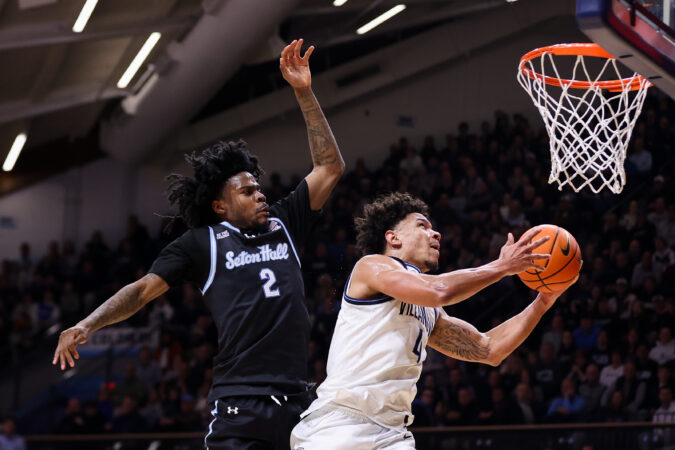
Villanova has just three Quad 1 wins to date: Wisconsin, the road win at Seton Hall, and last Saturday’s road win at Creighton. That game was a Quad 2 game until Creighton knocked off UConn on Wednesday and moved back into the top 75 of the NET rankings. It could slip back into Quad 2 territory if Creighton moves back in the rankings. As it stands, the Wildcats have just two more chances at Quad 1 victories in the regular season: Saturday vs. UConn and next Saturday at St. John’s.
Why are those opportunities important? As of Thursday morning, the top 21 teams in the NET rankings all had four or more Quad 1 wins. NET standings don’t necessarily translate to tournament seeds, but it’s hard to imagine Villanova climbing high enough in any tournament bracket without adding another regular-season Quad 1 win and another one or two en route to cutting the nets down at Madison Square Garden after winning the conference tournament.
What the winning streak has done, though, is shift the floor a little bit. As of three weeks ago, getting a No. 9 or 10 seed in the NCAA Tournament seemed just as likely as a No. 6 seed. Now, a No. 6 seems much more likely than a No. 10.
“Six is a great spot because you should win your first game, and it’s not too heavy of a lift in the second game,” Lunardi said. “And you avoid the one [seed].”
“They’re going to wear white,” he said later, implying that Villanova seems like it’s on a path to be, at worst, a No. 8 seed and be the de facto “home” team in its first-round game.
Home just probably won’t be South Philly. How does a mid-March trip to Buffalo sound?
The new league year is right around the corner, and it’s almost time for the 2026 Eagles roster to start coming into focus.
But first, the annual NFL Scouting Combine.
It’s the next thing on the offseason calendar, and while the focus for much of the week will be on the athletes going through performance testing, when it comes to the Eagles, it should be a big week for news related to the team.
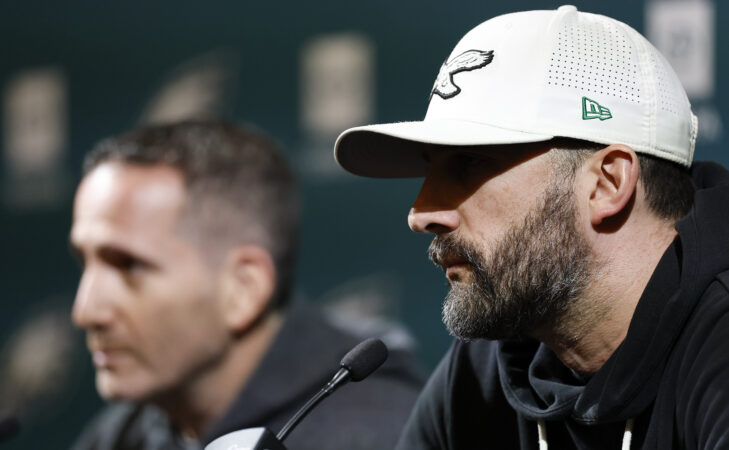
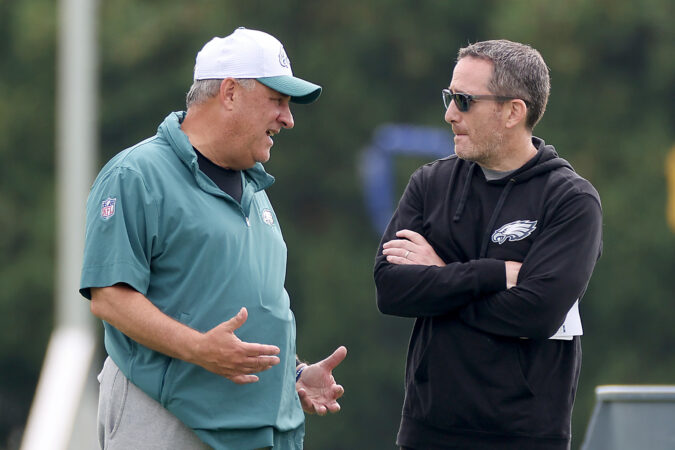
Reporters typically get to talk to Nick Sirianni and Howie Roseman around the combine, and there are certainly plenty of questions to ask this year.
Here’s a look at five of the most pressing Eagles topics the coach and general manager may be addressing soon:
Why did the Eagles choose Sean Mannion, and why did they assemble this staff around him?
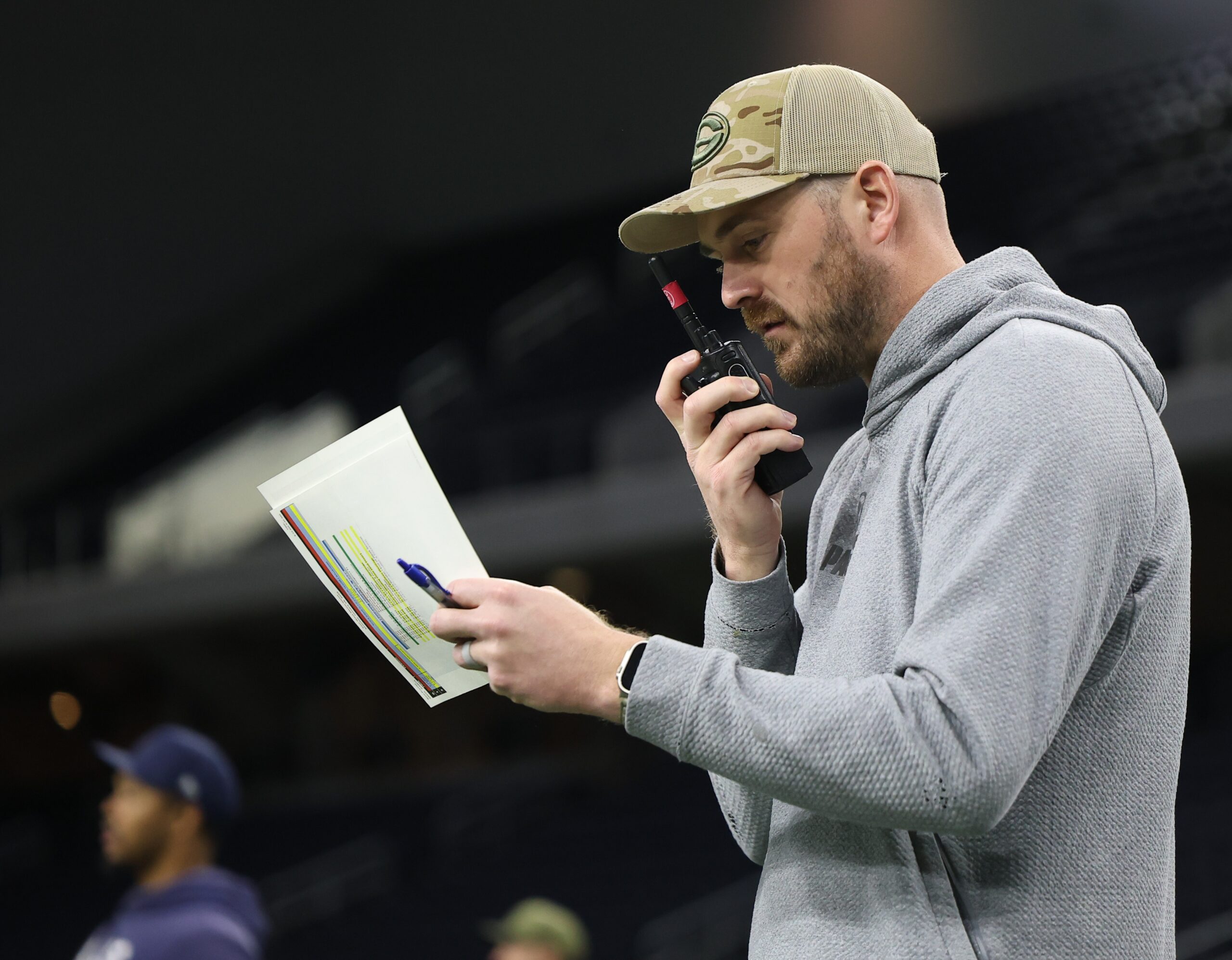
It’s been three weeks since the Eagles filled their vacancy at offensive coordinator by hiring Green Bay Packers quarterbacks coach Sean Mannion, a 33-year-old former quarterback with only two years of coaching experience. But we’ve yet to hear from Sirianni or Roseman, besides an initial statement released by the team, on why the Eagles hired Mannion, what they liked about him, and what hiring him means for the future of the scheme.
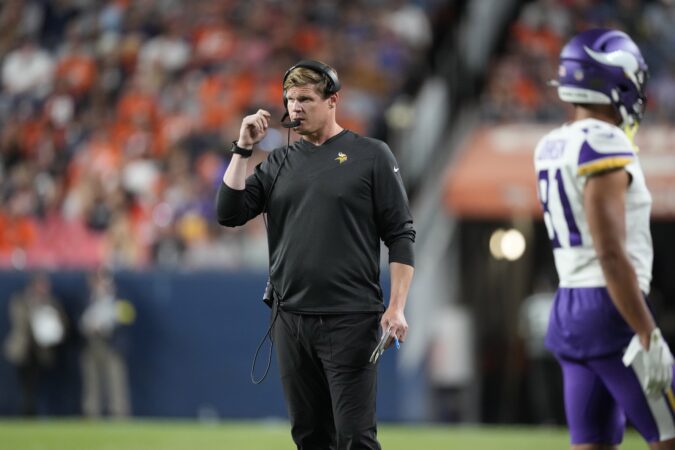
In the weeks since, the rest of the offensive coaching staff has been filled out. The Eagles hired one of their other coordinator candidates, former Tampa Bay offensive coordinator Josh Grizzard, as pass game coordinator. They hired Packers wide receivers coach Ryan Mahaffey to be the tight ends coach and run game coordinator. Longtime offensive line coach Jeff Stoutland left the team (more on that later), and he was replaced by Minnesota Vikings offensive line coach Chris Kuper.
The Eagles retained wide receivers coach Aaron Moorehead and running backs coach Jemal Singleton, sources told The Inquirer, and, according to CBS Sports, plan to shift Parks Frazier, last season’s pass game coordinator, to quarterbacks coach.
Sean Mannion will be calling plays for the first time under intense scrutiny in Philadelphia.
The new offensive coaching staff, under a first-year play-caller, is an amalgamation of coaches with different backgrounds. What will it mean for the scheme going forward?
Sirianni said after removing Kevin Patullo that the offense needed to “evolve.” He’ll soon have the chance to explain why and how this group can help it do that.
What happened with Jeff Stoutland?
The longest-tenured coach in the building, who has been widely regarded as the best offensive line coach in the sport, is no longer coaching with the Eagles.
Why?
The Eagles wanted Stoutland back as the offensive line coach, league sources said, but Stoutland, who also held the title of run game coordinator, wasn’t going to be as involved in the running game, and the Eagles are shifting schemes. Change is in the air. But Stoutland’s role in the running game decreased as last season went on, The Inquirer’s Jeff McLane reported recently on the unCovering the Birds podcast.
How did it get to this, and how much of an impact will his departure have on the offensive line moving forward?
Don’t expect Roseman to say anything that strays too far from his normal line when it comes to A.J. Brown and players like him.
Here’s what Roseman said at the end-of-year news conference on Jan. 15 when asked if he was open to trading Brown or if trading him was a nonstarter: “It is hard to find great players in the NFL, and A.J.’s a great player. I think from my perspective, that’s what we’re going out and looking for when we go out here in free agency and in the draft is trying to find great players who love football, and he’s that guy. I think that would be my answer.”
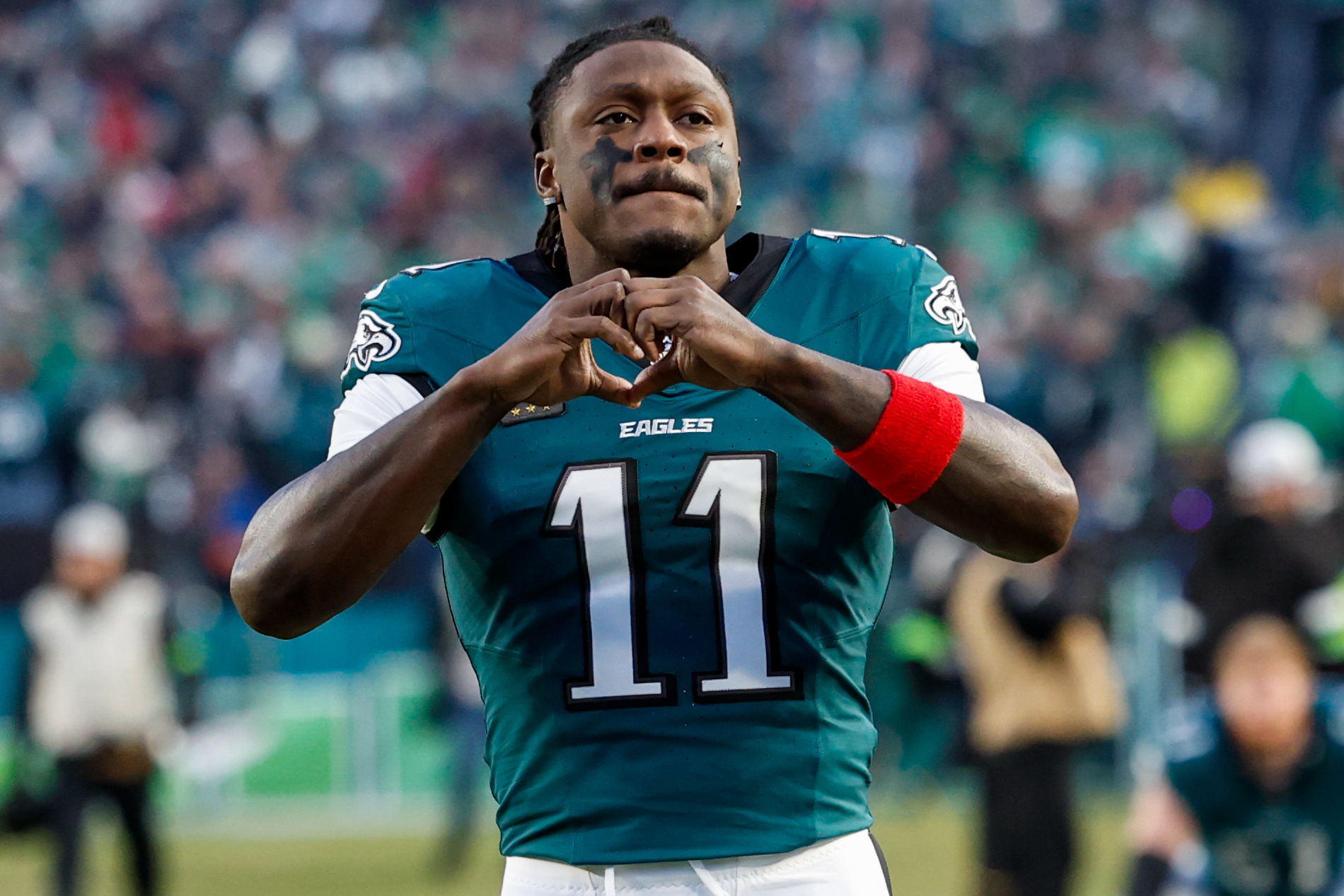
Still, Roseman likely will be asked about the star receiver’s future in Philadelphia in the coming days. It’s for good reason. Brown, of course, hasn’t been shy about his frustrations with the direction of the offense. But during Super Bowl week, Brown appeared on Micah Parsons’ podcast and spoke about his excitement for the future and the new offensive coaching staff. “Sometimes change is not a bad thing,” he said. He also called Philadelphia “home.”
Does wide receiver A.J. Brown have enough love for Philadelphia to remain an Eagle?
While he didn’t sound like someone who was about to ask for a trade, it’s still early in the offseason.
Brown’s future with the team impacts how the Eagles approach the draft and free agency, so a decision on whether the Eagles see him in their immediate plans probably is already made. It’s complicated, however, because of the salary cap implications. The cost to trade Brown before June 1 would be $48.939 million, according to Over the Cap. If the Eagles traded him after that, they would incur a dead cap charge of $22.09 million. Much more palatable, but still a lot of dead money.
It begs the question, too: Could the Eagles ever get good value in a trade for Brown?
Roseman probably won’t be showing his cards in the coming days, but it’s a topic he’ll have to address.
How much has the future outlook of the offensive line changed, and how will it impact the plans?
The offensive line took a big step back in 2025 thanks to a slew of injuries. Lane Johnson missed half the season. Landon Dickerson was never fully healthy and may never be again. Cam Jurgens played through back pain.
At the time of Stoutland’s departure, it wasn’t even a sure thing that Johnson and Dickerson would be back for the 2026 season. A unit that basically was plug-and-play has turned into a big question mark for the Eagles. How much longer will Johnson and Dickerson play? (Editor’s note: Johnson announced his return for 2026 on Thursday.)
Eagles offensive tackle Lane Johnson’s health and future were in doubt before he announced his return on Thursday.
Jurgens, meanwhile, shared a video this week on social media of him in Colombia undergoing stem cell treatments. Jurgens, via his agent, declined to comment further on what led him to go that route or how he is feeling. The center had back surgery after the Super Bowl last year and did not play to his 2024 level this past season.
This impacts how the Eagles approach the draft and free agency. They’re due to get an eventual replacement for Johnson in the door, but they now need to think about the future of the interior.
Who stays, who goes, and who could get extended or restructured?
It soon will be time for the Eagles to go shopping on the free agency market, but there are some players on the current roster in line to have their contracts extended or possibly restructured.
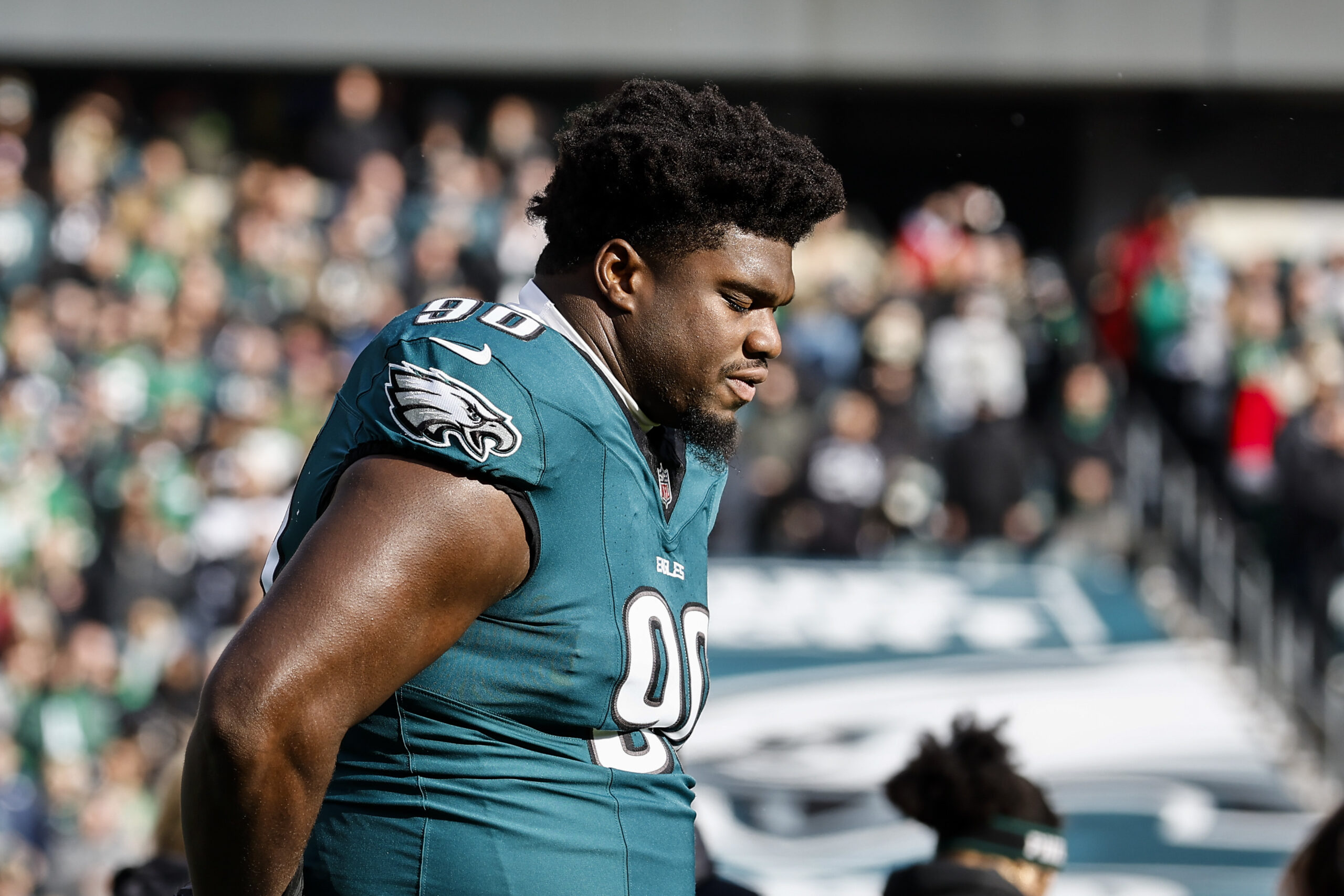
Let’s start with Jordan Davis, who broke out in 2025 and earned himself a new contract. The Eagles picked up Davis’ fifth-year option last year, but signing him to a new deal is almost too obvious because it would free up much-needed cap space for 2026.
Will defensive tackle Jordan Davis be first in line for a contract extension after a breakout season?
There’s also Jalen Hurts, whose cap number jumps from nearly $22 million in 2025 to nearly $32 million in 2026. It will be more than $42 million in 2027, more than $47 million in 2028, and a whopping $97.5 million in 2029. But Hurts has no guaranteed money beyond this season. A restructure or extension could be on the table sooner than later.
What about the free agents? Jaelan Phillips, for example, is one of the best edge rushers on the market, and the Eagles need some of those. Safety Reed Blankenship is slated to hit the market, and the Eagles need a safety.
Roseman may not tip his hand, but he’ll certainly be asked about all of it with free agency just a few weeks away.
Every once in a while, Kevin Willard loves when the shot clock expires before a Villanova shot attempt.
There really is a time and place for everything.
“Everyone will say, ‘You’re nuts,’” Willard said Tuesday night after Villanova rallied late to beat Marquette. “It takes 30 seconds; it sets up our defense. The worst thing you can do is come down and jack up a shot with 2 seconds on the shot clock, long rebound, your defense isn’t set. I’d rather have a shot-clock violation, set my defense up, have them work for 25 seconds, and then take 30 seconds and the game’s over.”
Villanova has taken its share of violations in the second half of victories this season. There were two during a 12-point win over Seton Hall on Feb. 4 while the Wildcats held leads of 14 and 12 inside of five minutes. They took one vs. Providence up by 19 points with four minutes left. They took one vs. Butler while ahead by 12 with 2½ minutes to go. And they had three during their Big East opener on Dec. 23, when they built a big lead over Seton Hall on the road and won by eight.
To be clear, there were no such violations during Tuesday’s win. So how did we get to this topic? Willard was asked after the game about tempo and whether he thought the team could play a little faster. The Wildcats are ranked 337th by KenPom’s adjusted tempo metric and 296th in average possessions per game (68.4).
Willard, who has the Wildcats at 19-5 overall and 10-3 in the Big East entering Saturday’s game at Creighton, is a passionate talker of tempo. He went on a mini rant about the subject in April at his introductory news conference at Villanova. He focuses on defensive tempo, he explained then, the amount of time it takes for an opponent to get off a shot. On the offensive side, the difference between shot speed from top to bottom is only a matter of a few seconds, he said.
“You know the difference between the 20th fastest team and us?” Willard asked Tuesday. “1.6 seconds.”
By average number of possessions, the difference between Villanova at 297th and the 100th-ranked team (Miami) is just four possessions.
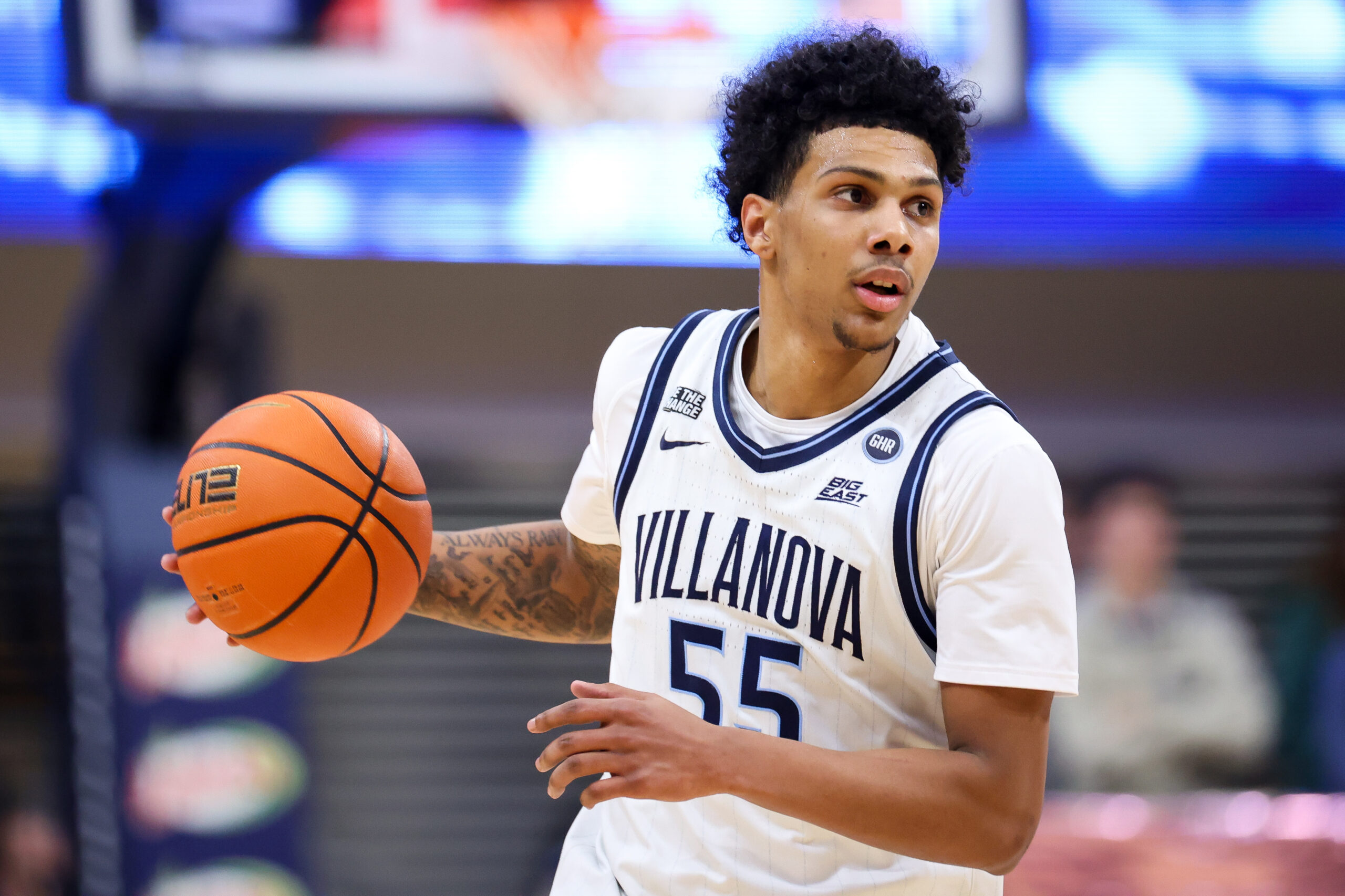
Freshman point guard Acaden Lewis is charged with setting Villanova’s tempo on offense.
“I have a young team, and when we get up I’m going to control the ball and take the air out of the ball,” Willard said. “That’s one of the reasons why our tempo is so low is if you watch any time we’ve gotten up more than 12, I’ve taken the air out of the ball and we have run the clock down. One of the easiest ways to lose leads is to take quick shots.
“I think we play pretty fast. It’s not like he walks the ball up,” Willard said, pointing to freshman point guard Acaden Lewis. “It’s not like we’re ever walking the ball up. It’s 1.6 seconds. Everyone gets stuck on that tempo s—.”
Less than a month of regular-season basketball remains, so it feels like a good time to round up who could win Big 5 awards.
Let’s start with the coaches. The easy answer here is Villanova sweeping. Willard is on his way to stopping the three-year NCAA drought on the men’s side. Denise Dillon has her fifth 20-win season in six years as Wildcats coach. But those are the obvious answers partially because they coach teams that entered the season with at-large NCAA Tournament chances.
But how about Mountain MacGillivray, the La Salle women’s coach? The Explorers went 4-15 in the Atlantic 10 last season. They’ve nearly doubled that total so far in 2025-26 and still have five games left. And what about Adam Fisher? The Temple men’s coach had to rebuild another roster in the offseason and has the Owls at 7-4 in the American Conference and in the mix. Or Steve Donahue, who stepped into a weird situation at St. Joseph’s, got off to a slow start, and has the Hawks in fourth place in the A-10?
La Salle’s Ashleigh Connor is guarded by St. Joseph’s Rhian Stokes on Jan. 28.
As for player of the year on the men’s side, Villanova’s Tyler Perkins and Lewis have good arguments, as do Penn’s Ethan Roberts, Derek Simpson of St. Joe’s, and Temple’s Derrian Ford. On the women’s side, it might be Villanova sophomore Jasmine Bascoe’s award to lose. But La Salle’s Ashleigh Connor is having a great season, as is Drexel’s Amaris Baker and Gabby Casey of St. Joe’s.
The Villanova women won by 40 Wednesday night at Xavier and Bascoe reached the 1,000-point plateau in less than two full seasons. The Wildcats are rolling. They’re 13-3 in the Big East and firmly in second place, two games clear of Seton Hall in the loss column.
But they’re also firmly on the NCAA Tournament bubble. ESPN’s latest bracketology had the Wildcats as a No. 10 seed and in the “last four byes” group. The projected field capped just six spots behind them.
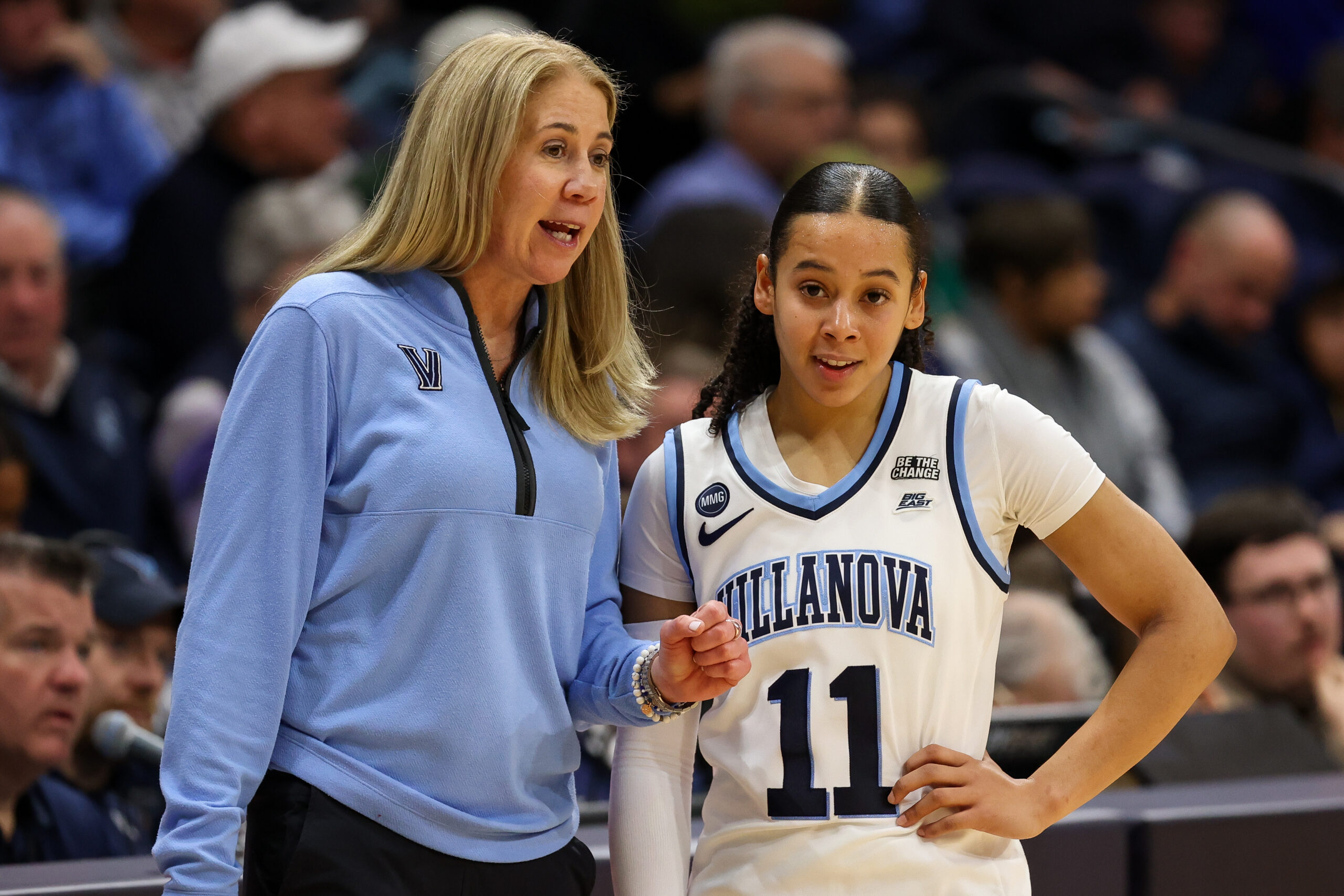
Villanova coach Denise Dillon with her star guard, Jasmine Bascoe.
Like the men, the women are in Omaha, Neb., this weekend. They play a Creighton team on Sunday that they already beat by 10 at home. It’s not a great time to have a slip-up, because after that it’s the annual home game vs. No. 1 UConn, which is undefeated and already beat Villanova by 49. Just two games are on the schedule after that: a home game vs. fourth-place Marquette and a road showdown at Seton Hall. Then comes the conference tournament.
Since we last took stock of the Big 5 men’s teams, a few more got on the positive side of .500 in league play, which brings a better possibility of running the table come conference tournament time.
What’s Torvik’s math — which is based on thousands of simulations — for the rest of the pack?
Penn: 10.1%
Drexel: 3%
Temple: 2.9%
St. Joe’s: 2.6%
La Salle: 0.1%
The Big 5’s streak of no men’s teams looks like it’s ending. Just don’t count on Villanova having any company at the dance.
Jill Bodensteiner is stepping down from her post as St. Joseph’s athletic director, according to an announcement from the university on Thursday.
Bodensteiner is set to become the next commissioner of the Horizon League. Her last day at St. Joe’s will be April 15.
Eric Laudano, St. Joe’s executive senior associate athletics director, will serve as interim athletic director while a search is conducted, the school said in a release.
An Indiana native, Bodensteiner will take over a league headquartered in Indianapolis. She has been the AD on Hawk Hill since June 2018.
St. Joe's athletic director Jill Bodensteiner is leaving the school for another opportunity, according to a source.
“Jill is a national leader in intercollegiate athletics,” St. Joe’s president Cheryl A. McConnell said in a statement. “We are profoundly grateful for her vision, dedication and service to the Hawks. She leaves our athletics program strong and well-positioned for continued success. We wish her the best on her return home to Indiana and her role with the Horizon League.”
Bodensteiner’s tenure at St. Joe’s started with a bang. She fired longtime men’s basketball coach Phil Martelli less than a year after taking over as athletic director. She replaced Martelli with Billy Lange, whose six-year run ended in the fall when he abruptly left the program for an assistant’s role with the New York Knicks. Lange posted an 81-104 record with the Hawks.
Though the men’s program has failed to get back to prominence in the new era of college basketball, St. Joe’s has had successful runs in non-revenue sports like field hockey, which played in the national championship game in 2024; men’s and women’s lacrosse, which made inaugural NCAA Tournament appearances; and baseball, which won the Atlantic 10 regular-season title in 2023.
Villanova and Notre Dame are finalizing an agreement to open the 2026-27 men’s and women’s basketball seasons with a doubleheader in Rome, sources told The Inquirer.
A contract has not been signed, and some logistics are still being worked out, but the schools are working toward that point, sources said. According to CBS, the schools received a special waiver to play the games on Sunday, Nov. 1, despite the college basketball season officially starting a day later.
The games will be played at the Palazzetto dello Sport, which seats 3,500 people for basketball, according to CBS.
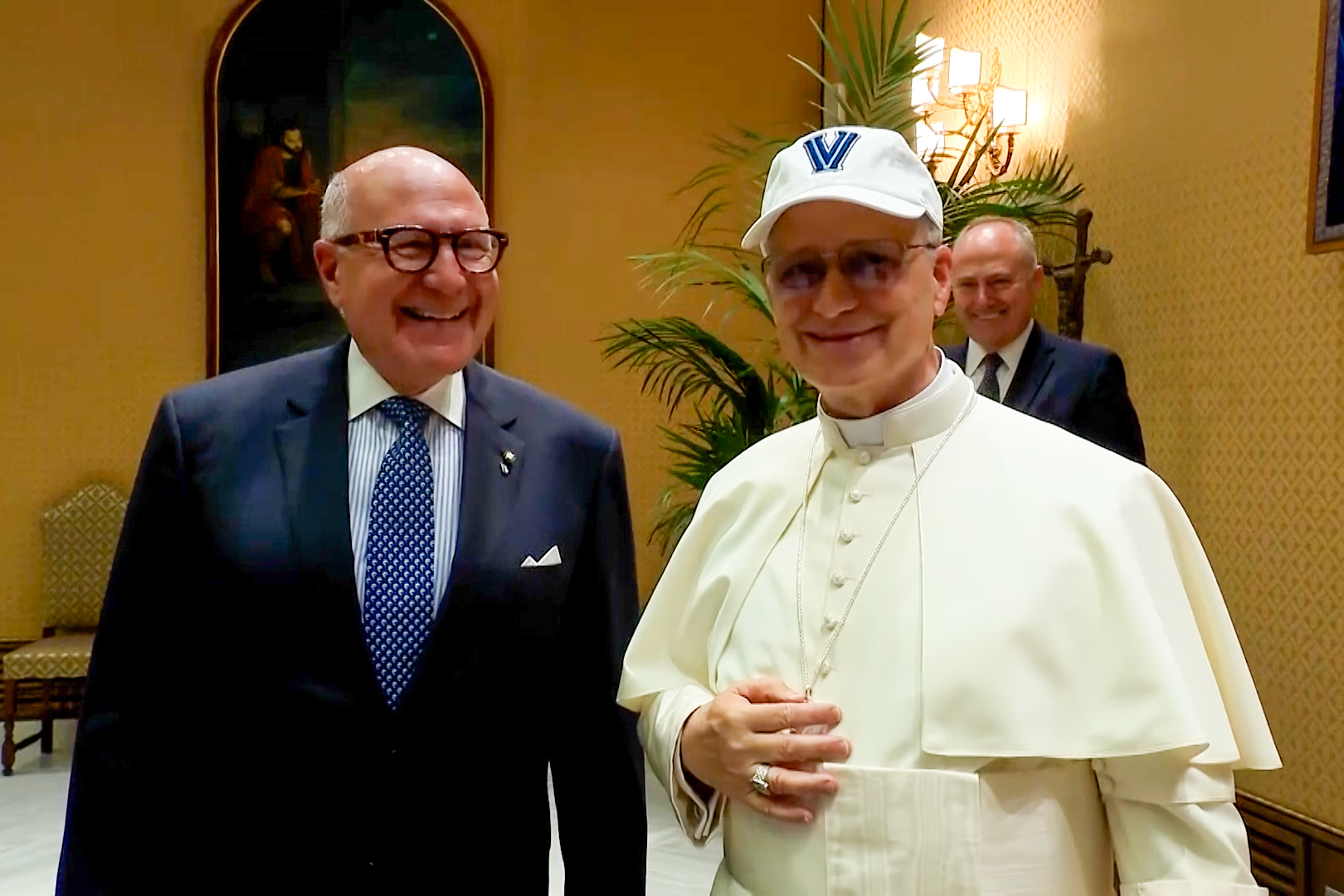
This video screen grab shows Pope Leo XIV wearing a Villanova hat gifted to him during a meeting with an Italian heritage group.
The contests are likely to give Villanova an audience with arguably the school’s most famous graduate. Pope Leo XIV is a 1977 Villanova alumnus formerly known as Robert Prevost. Notre Dame, meanwhile, is the largest Catholic university by endowment.
The game gives Villanova’s men’s team another power-conference opponent on its nonconference schedule. The Wildcats will host Michigan and Wisconsin and also play at Pittsburgh during their nonconference slate next season.
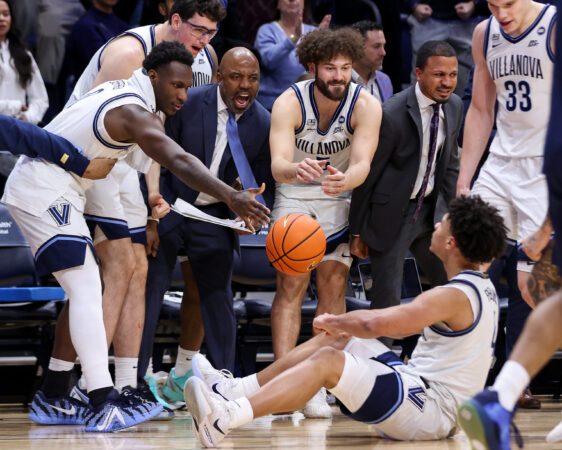
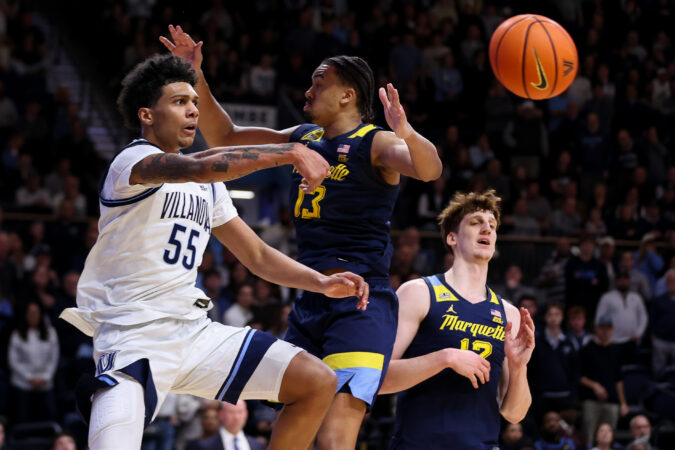
Acaden Lewis toed the free-throw line with 3 minutes, 35 seconds left in the second half Tuesday night and Villanova trailing Marquette by three. The freshman point guard released the first of two attempts and watched as it failed to reach the rim. The second attempt was only mildly better and clanked off the front of it.
Just over a minute later, he was back at the line after being fouled on a drive. The deficit still was three.
In this moment, it would be Tyler Perkins who inspired the winning plays in Villanova’s 77-74 victory. They were visible all night in Perkins’ clutch three-pointers, his game-winning block, and a key steal as he finished with a team-high 22 points.
But his night also included a moment of leadership, a junior making sure a freshman could forget what had just happened.
“Tyler came up to me and was just like, ‘You’re built for these moments,’” Lewis said.
“I just relaxed and shot them.”
Both free throws went in. Lewis cut Marquette’s lead to one. The tide was starting to turn, and Villanova (19-5, 10-3 Big East) rode the wave and avoided a bad loss to a struggling Marquette team.
A Villanova free throw misses the hoop during the second half against Marquette on Tuesday.
That is the thing about free throws. They giveth and taketh. Lewis described his two misses as “uncharacteristic,” but he is shooting 60.5% for the season, and the Wildcats entered Wednesday ranked 285th in the country and 10th among 11 Big East teams in free-throw percentage (69%).
They made their last six free throws and won the game at the line over the final 2 minutes, 10 seconds. But they were in a tight game against an inferior opponent largely because they were 12-for-25 before the closing minutes.
Villanova’s win against Georgetown on Saturday didn’t have to be as hard as it was. Fourteen missed free throws made it nervy. The fans who were at Finneran Pavilion on Tuesday night know the issues well. They gave a Bronx cheer to freshman Chris Jeffrey when he made a pair of free throws midway through the second half.
It is worth mentioning that the struggles are abnormal for a program that consistently has resided at the top of the conference and near the top of the country in free-throw percentage for much of the last decade. But it is not particularly relevant context, given that Kevin Willard is in his first season coaching an entirely new team.
Still, what gives?
“Everyone is in there every day,” Willard said. “It’s not like we’re not doing it. I think it’s a little mental right now. I think we miss one, and it’s like we got a little bit too much negative emotion right now on the free-throw line. I’ve got to change that somehow.”
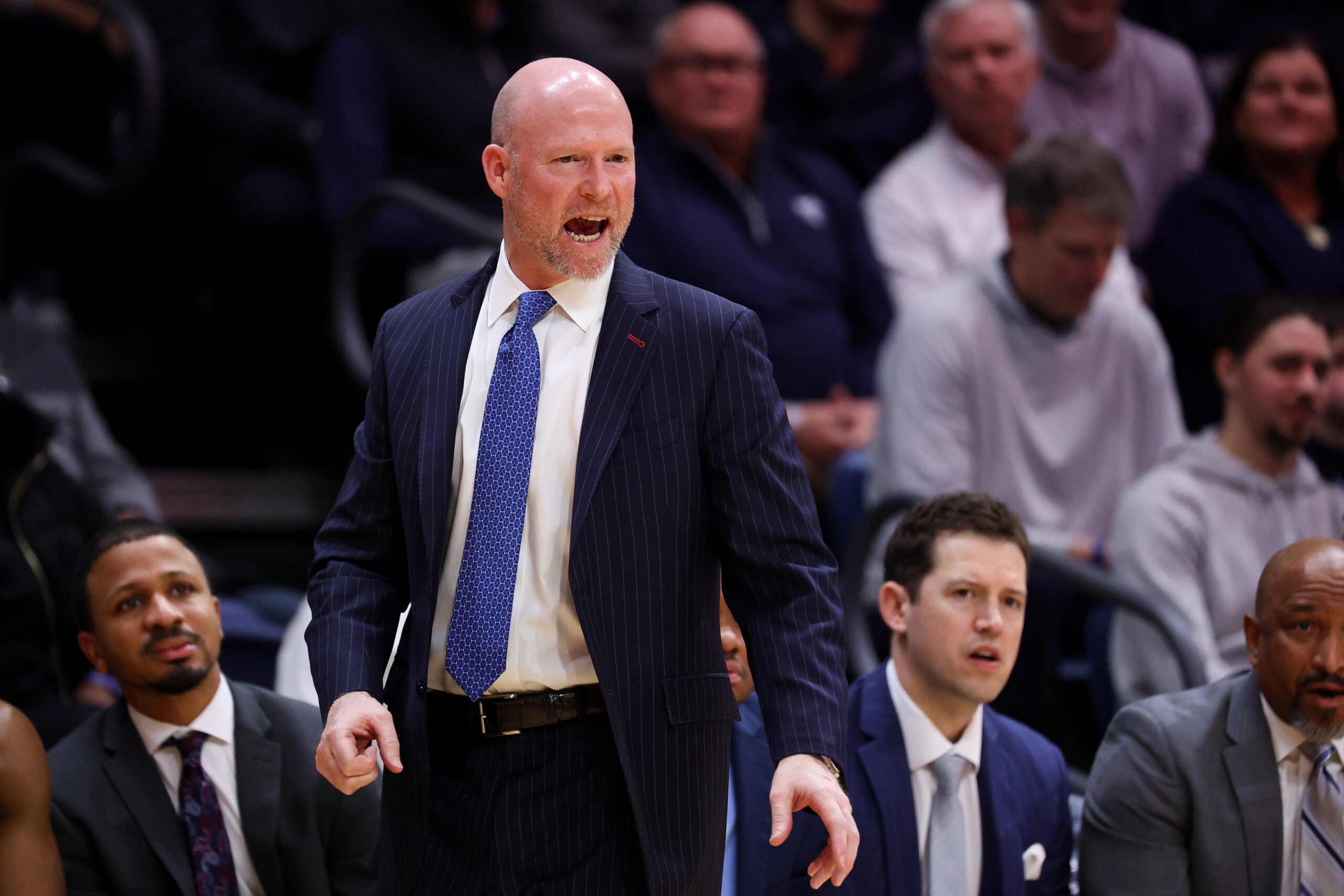
Villanova coach Kevin Willard calls out instructions during the first half against Marquette on Tuesday.
How does one change a mentality this late in the season?
“We’ll get there,” Willard said. “If we can improve our free-throw shooting and make a couple layups in the first half, it’s a completely different game. We held them to 32 points [in that first half], we should’ve had 44 points, and it’s a different type of game.”
Willard was flanked in his postgame news conference by Lewis and Perkins. He turned to Lewis and mentioned that the freshman shoots around 200 extra free throws after practices and noted that Perkins, who is shooting 75% for the season, never misses in practice.
“I have a lot of confidence in these guys that as we go through February and get into March that we’ll make them,” Willard said.
Bryce Lindsay made his first shot Tuesday night, a three-pointer less than three minutes into the game.
It had to, at least briefly, feel like the weight of the world was off his shoulders. Lindsay entered the night having made just 15 of his previous 64 attempts from three-point range (23.4%) over Villanova’s last 10 games since the calendar turned to 2026. The sharpshooting redshirt sophomore guard was a big reason behind Villanova’s strong start to the season, but he has reached double figures just four times in the last 11 games. That initial attempt Tuesday night was his only make on six three-point tries. He went scoreless Saturday afternoon at Georgetown.
Villanova guard Bryce Lindsay dribbles past Marquette’s Chase Ross during the second half Tuesday.
“He’s going to get going,” Willard said. “It’s a little mental. I talked to the team earlier, before the game, about staying in the moment. Talking to each other and not worrying about the past, not worrying about the future, just trying to stay in the present. Sometimes it’s hard when you’re not playing well to kind of stay in the moment.
“I have a lot of confidence in Bryce. He’s in the gym with me every day working. He’s going to get it. I thought he had some good opportunities tonight. When you’re struggling the way he’s struggling, sometimes you just need one, get a good bounce, bank one in. I told him to sleep on the other side of the bed tonight. Sometimes you’ve just got to try something different.”
Something different, like starting sixth man Devin Askew and giving Lindsay a different look off the bench?
“No,” Willard said. “He’s still doing a lot of other things, and people have to guard him.”
Lindsay did affect the game in positive ways despite only scoring four points. He was plus-8 and had three rebounds and four assists, including a key pass to the corner for a Matt Hodge three-pointer with 4:20 left in the game.
Willard said he likes Askew coming off the bench as a “security blanket.”
Speaking of which … it was Askew who made two free throws with 11 seconds left that gave Villanova a three-point lead and forced Marquette into a desperation three-point attempt.
The Eagles are no longer the defending champions, and their early exit from the playoffs one month ago has already ushered in major changes. Out is offensive coordinator Kevin Patullo, in is new offensive coordinator Sean Mannion, and with him more changes to the offensive coaching staff.
The Eagles are facing a key offseason as they aim to make changes and improvements to make sure their Super Bowl window remains open in 2026 and beyond.
Stoutland’s departure is a big one, as he has long been regarded as the best offensive line coach in the NFL. The Eagles hired his replacement on Monday by bringing in former Vikings offensive line coach Chris Kuper, who was with Minnesota as the line coach for the last four seasons before his contract expired. Kuper crossed paths with Mannion in 2023, when Mannion was a quarterback on the Vikings’ roster. He also worked under Vic Fangio as an assistant offensive line coach when Fangio was the head coach of the Denver Broncos (2019-21).
The new hires also indicate that Parks Frazier, the pass game coordinator this season, and Jason Michael, the tight ends coach, could be on their way out with the Eagles as the team revamps its offensive scheme under a new coordinator.
On the defensive side, there was a brief scare when Fangio was mulling retirement, but the defensive coordinator made the decision to return to the Eagles for the 2026 season. Fangio’s exit would have been a big blow, especially considering that the Dallas Cowboys plucked Eagles defensive backs coach Christian Parker, a highly regarded, 34-year-old up-and-comer, to be their new defensive coordinator. It had always seemed like a matter of time until Parker, who was also the defensive pass game coordinator, was lured to a better job with another team, and that time came.
Parker, of course, has been instrumental in helping the Eagles develop their two young All-Pro defensive backs, Quinyon Mitchell and Cooper DeJean. Those young players will now be under the tutelage of Joe Kasper, who will assume the role of defensive backs coach after being promoted from safeties coach, a position the Eagles need to backfill.
Did Jaelan Phillips show the Eagles enough to get a new contract from them this offseason?
Roster decisions
Scheduled free agents
The Eagles have 20 pending free agents — 10 on offense, nine on defense, and punter Braden Mann.
Offense
TE Dallas Goedert: Goedert reworked his deal last offseason to stay with the Eagles and scored a career-best 11 touchdowns, a tight end record for the team. Considering the Eagles don’t have any tight ends on the roster, they may look to bring the 31-year-old back after he got through the season relatively healthy.
WR Jahan Dotson: The little-used third receiver could find a new home this offseason. WR3 is a tough position on this team behind A.J. Brown and DeVonta Smith, and it seems unlikely the Eagles will find it worth bringing Dotson back.
OT Fred Johnson: Johnson left for free agency after last season, but the Eagles traded for him before the season for some insurance at tackle, and they needed it. It remains to be seen how the Eagles approach the draft and free agency, but Johnson’s return would put an experienced body on the depth chart.
TE Grant Calcaterra: As mentioned, the Eagles don’t have any tight ends. Calcaterra has been productive when the Eagles use him as a pass catcher, but he’s not a great blocker, and the Eagles need their tight ends to block.
OL Brett Toth: The do-it-all lineman has been a valuable asset in the offensive line room. He can fill in at any position.
TE Kylen Granson: Granson was a big part of the Eagles’ special teams, despite having a limited role in the offense. The tight end position is in flux, but Granson could return as a depth piece.
OL Matt Pryor: The Eagles brought back a familiar and experienced face in the offseason for some depth. Pryor gave that and provided positional versatility. But he wasn’t all that great in relief.
RB AJ Dillon: Dillon started the season in the mix to get snaps behind Saquon Barkley, but he fell out of favor after the Eagles traded for Tank Bigsby. Dillon was inactive for most of the second half of the season and logged just 12 carries. The Eagles are pretty set at running back with Barkley, Bigsby, and Will Shipley.
QB Sam Howell: The Eagles weren’t comfortable with Kyle McCord as QB3, so they acquired Howell before the season. McCord has since landed with Green Bay.
FB Ben VanSumeren: VanSumeren changed positions from linebacker to fullback and made the 53-man roster, but his season ended with an injury on the opening kickoff in Week 1. The Eagles signed Kansas City’s Carson Steele to a futures contract. Will they bring back VanSumeren and have a fullback competition?
Defense
Edge rusher Jaelan Phillips: The deadline acquisition stepped in right away and was a difference-maker along the defensive line. The Eagles need a top-end edge rusher to add to a unit that has Jalyx Hunt and Nolan Smith under contract. Phillips would make sense.
LB Nakobe Dean: Dean returned from patellar tendon surgery in the middle of the season and looked like he didn’t miss a beat. But the Eagles drafted his replacement last season in Jihaad Campbell.
S Reed Blankenship: Blankenship has been a big part of the defense for the last four years. He has started 50 games and is a leader. The Eagles are thin at safety, but it remains to be seen what Blankenship’s market looks like and if the Eagles will be in the mix.
CB Adoree’ Jackson: Jackson was up and down in training camp and to start the season, but he played his way into a starting job opposite Mitchell. He’ll be 31 next season, and the Eagles probably want to get better at CB2.
S Marcus Epps: Epps stepped in as a starter after Drew Mukuba went down. He just turned 30, although he could find his way back to the Eagles and compete for a job.
Edge rusher Brandon Graham: Graham came out of retirement and briefly changed positions when Jalen Carter went down and the interior needed a boost. Will he go back into retirement?
Edge rusher Joshua Uche: Uche seemed to be playing his way into a bigger role when the Eagles brought Graham out of retirement, which forced Uche to a lesser role. The Eagles are thin on the edge, though Uche seems to be more of a depth piece right now.
Edge rusher Azeez Ojulari: Ojulari ended up behind Uche on the depth chart and then missed most of the season after being placed on injured reserve.
Edge rusher Ogbo Okoronkwo: Okoronkwo made the team out of training camp as a depth edge rusher but suffered a season-ending injury in Week 4, the only game in which he played.
Special teams
P Braden Mann: Mann had a great season. He ranked fifth in the NFL in punt average (49.9 yards). It would make sense for the Eagles to want to bring him back.
New deals?
There are a few players under contract who could be in the running for a new contract with the Eagles.
DT Jordan Davis: The Eagles picked up Davis’ fifth-year option last offseason and he remains under contract for the 2026 season. But after a breakout 2025 season, he likely earned himself a lot of money.
DT Jalen Carter: The Eagles likely will do what they did with Davis and pick up Carter’s fifth year, but it might be time for an extension now. Carter didn’t have his best season after a dominant 2024. The Eagles may be able to sign him to a more team-friendly deal, though Carter and his agent, Drew Rosenhaus, may opt to play 2026 on his current deal and revisit the big-money deal next offseason.
DT Moro Ojomo: Ojomo is set to play the final year of his four-year rookie deal in 2026. The seventh-round pick has been a major success story. Will the Eagles look to lock him up beyond 2026? Will they be able to afford all of these defensive linemen with big contracts coming in the future for other defensive stars like Mitchell and DeJean?
Contracted players who could be on the way out
The Eagles have some players on the 2026 roster who may not be here when training camp starts.
K Jake Elliott: Elliott has had two consecutive seasons in which he didn’t perform well enough. His 2025 field goal conversion rate was just 74.1%, the lowest of any kicker who played a full season.
WR A.J. Brown: Will his frustrations with the offense cause him to ask for a trade? It would be a costly move for the Eagles, but they’ve willingly taken on dead cap in the past. The Eagles would have a big hole to fill if it came to that.
RT Lane Johnson: Johnson remains one of the best tackles in football, but his availability was an issue this season. He missed the final eight games after suffering a Lisfranc injury in his right foot. The Eagles probably would love him back, but Johnson will be 36 in May and won’t play forever.
LG Landon Dickerson: The Inquirer’s Jeff McLane reported in a podcast during Super Bowl week that Dickerson’s return was no sure thing. The 27-year-old played through a lot of pain in 2025 and his body has taken a toll with multiple injuries since his college football playing days. An early retirement would leave the Eagles with a big hole.
QB Tanner McKee: Will the Eagles look to ship McKee to another team for a draft pick? McKee’s Week 18 performance didn’t help their cause.
CB Kelee Ringo: Ringo remains under contract on his rookie deal, but he seems like a change-of-scenery candidate. He has struggled to get on the field with the Eagles, though he has been great on special teams.
2026 free agency targets
What do the Eagles need most? What kind of players will be on the market?
First, the Eagles need to know what happens with the futures of key offensive players like A.J. Brown, Lane Johnson, and Landon Dickerson.
At the moment, they have just over $20 million in cap space, according to Over the Cap. That’s not a lot, but Howie Roseman has shown the creativity to use void years and spread cap hits out over multiple seasons.
Free agency begins March 11.
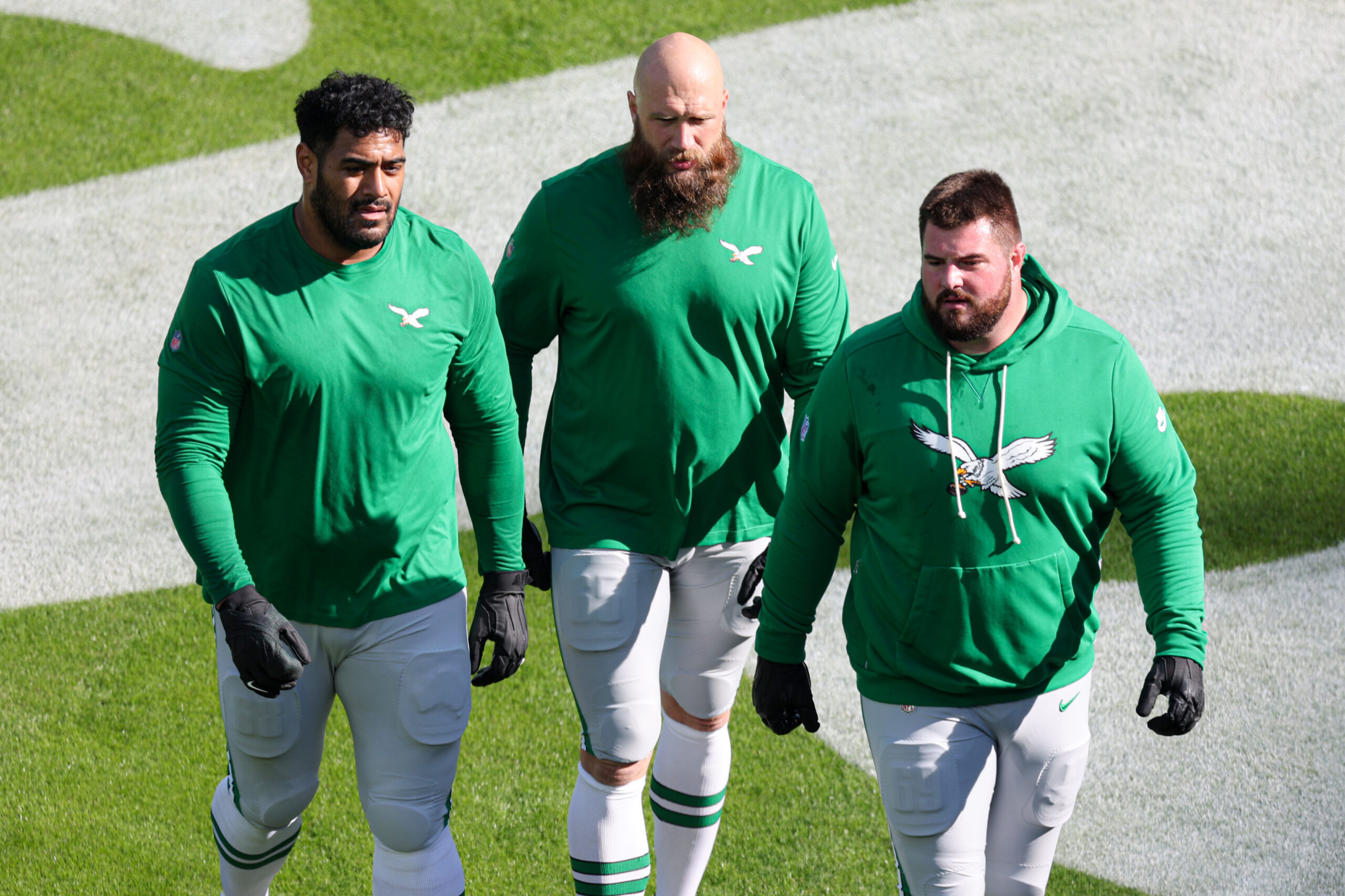
Jordan Mailata (left) will be back, but what will become of tackle Lane Johnson (center) and guard Landon Dickerson (right)?
Position groups and players to target
Offensive line: Will Johnson return? Will Dickerson ever be fully healthy again? Can Cam Jurgens bounce back? Those are big questions facing the Eagles, who need to restore their offensive line this offseason. Reinforcements likely will come via the draft, but free agency offers some options.
Indianapolis Colts right tackle Braden Smith, for example, has dealt with injuries but could provide insurance for Johnson and help the Eagles bridge their way to the next young tackle. Old friend Isaac Seumalo fits that bill, too, at guard. Same with Cleveland Browns guard Joel Bitonio.
Wide receiver: Regardless of what happens with Brown, the Eagles could use some more help at receiver. They won’t be playing in the George Pickens pool, and probably not Alec Pierce, either, but what about Romeo Doubs, Kendrick Bourne, or Van Jefferson at WR3?
EDGE: Jaelan Phillips should be at the top of the Eagles’ wish list. Jalyx Hunt and Nolan Smith are the only two edge rushers under contract. The Eagles will draft at least one rusher, but they need a top-end talent like Phillips. If not Phillips, other top options would be Trey Hendrickson, Odafe Oweh, Boye Mafe, Joey Bosa, and Khalil Mack. There’s always the possibility of Roseman figuring out a way to trade for Maxx Crosby, too.
Tight end: Dallas Goedert may be in the running to return. But if not, the Eagles could eye someone like Atlanta’s Kyle Pitts, who finally played to his potential this season. Pitts attended Abington and Archbishop Wood before playing at Florida in college. Other free agents include Isaiah Likely, David Njoku, and Tyler Higbee. The Eagles probably will use a draft pick on one, too.
Cornerback: Quinyon Mitchell eventually will re-sign at the top of the market, and you don’t see many teams spending that type of money on two players at this position. But there are some options the Eagles could target, like Tariq Woolen, Roger McCreary, and Jamel Dean. Will those players be too costly? We’ll see.
Safety: Reed Blankenship has been solid for the Eagles, but he’s not great in coverage. The Eagles could be looking to pair Drew Mukuba with a better player on the back line, and they could look to do that via free agency. Old friend Kevin Byard has been really productive with the Chicago Bears, though he could command a bigger contract than the Eagles are willing to give out. Los Angeles Rams safety Kamren Curl could be an option.
The 2026 NFL draft will be held April 23-25 in Pittsburgh.
The 2026 NFL draft
The Eagles’ needs here will become clearer after free agency, though our Devin Jackson released his first mock draft Monday morning and has the Eagles making a key addition to their offense at a position of need.
The draft will take place beginning on Thursday, April 23, in Pittsburgh.
The yearly NFL Scouting Combine begins on Feb. 23; and teams have until April 15 to conduct visits, tests, and interviews with prospective draft picks.
League meetings (updated Jan. 17)
The annual league meeting is from March 29 to April 1 in Arizona. It is there that the Tush Push likely will be another big topic of conversation and could meet its demise.
But the Eagles’ lack of success using their signature play this season could result in some teams backing off a little bit. We’ll see.
There’s also another league meeting May 19 and 20 in Orlando.
2026 Eagles schedule (updated Jan. 17)
The Eagles’ opponents are known. They play home games vs. their three divisional opponents (Washington Commanders, Dallas Cowboys, and New York Giants), as well as other games vs. the Indianapolis Colts, Carolina Panthers, Los Angeles Rams, Seattle Seahawks, Pittsburgh Steelers, and Houston Texans.
Besides their three NFC East road games, the Eagles also travel to play the San Francisco 49ers, Chicago Bears, Arizona Cardinals, Jacksonville Jaguars, and Tennessee Titans.
It remains to be seen if the Eagles will get an international game.
The schedule is due out in May, but international dates will likely be released before that.
The Eagles have their replacement for longtime offensive line coach Jeff Stoutland.
A league source confirmed an NFL Network report that the Eagles are hiring Minnesota Vikings offensive line coach Chris Kuper for the same role in Philadelphia. Kuper’s contract with Minnesota expired after the season and the team did not retain him, according to The Athletic.
Kuper, 43, had been the line coach for the Vikings since 2022 and crossed paths there with new Eagles offensive coordinator Sean Mannion in 2023, when Mannion was on the roster as a quarterback.
Kuper, who was drafted in the fifth round in 2006 and played guard for the Denver Broncos for eight seasons, also worked as an assistant offensive line coach under Eagles defensive coordinator Vic Fangio when Fangio was the head coach in Denver from 2019 to 2021.
Jeff Stoutland had been the Eagles’ offensive line coach since 2013.
Kuper has big shoes to fill. Stoutland was the Eagles’ offensive line coach from 2013 to 2025 and was widely regarded as the best line coach in the NFL. Stoutland announced his departure from the Eagles last week. The Eagles are moving to a new scheme under Mannion, and while Stoutland was offered a chance to return as offensive line coach, according to a source, he wasn’t going to have the role of run game coordinator and ultimately decided to step away from coaching with the Eagles.
The Eagles’ offensive line took a dramatic step back in 2025, mostly because of injuries. Lane Johnson missed half the season, and Landon Dickerson and Cam Jurgens were never or rarely fully healthy and did not have the same impact as in previous seasons. The futures of Johnson and Dickerson could be up in the air, and the Eagles could be forced to replace one or two key parts of the line, or at the very least need to start planning for replacements via the draft or free agency.
Kuper’s hiring marks the fourth new offensive coach in the building, a process that started when the Eagles hired Mannion on Jan. 29. They also hired former Tampa Bay offensive coordinator Josh Grizzard to be the pass game coordinator and hired Green Bay wide receivers coach Ryan Mahaffey as the run game coordinator and tight ends coach.
Kevin Willard was going on about his appreciation for the way his Villanova team works during practices when he referred to junior guard Tyler Perkins, seated to his right after Villanova’s 72-60 victory over Seton Hall, as a “pain in the ass.”
He meant it in the best way possible.
“He works too much,” Willard said. “His processor gets burned out sometimes.”
Villanova improved to 17-5 on the season and 8-3 in the Big East for a variety of reasons Wednesday night. The Wildcats, who never trailed, got a key effort from Malachi Palmer, who scored a career-high 15 points off the bench and helped ignite an 11-2 run to end the first half to send Villanova into the break with a 15-point lead. They forced Seton Hall point guard and Philadelphia native Adam “Budd” Clark to shoot jump shots and limited his ability to impact the game in transition. They outrebounded one of the better rebounding teams in the conference, 37-27.
But they won again because Perkins, the only returning regular player from last season, continues to excel. It has been a different guy on some nights for Villanova. Early in the season, it was Acaden Lewis and Bryce Lindsay driving the backcourt with Duke Brennan manning the middle.
Devin Askew has chipped in strong efforts off the bench, especially lately. Wednesday night was Palmer’s turn. But Perkins, who transferred to Villanova from Penn after his freshman season, scored 18 points and added five rebounds. It was his 10th double-digit scoring effort in Villanova’s last 12 games.
Villanova forward Duke Brennan and guard Tyler Perkins compete for a rebound against Seton Hall.
“He’s just the glue of their team,” Seton Hall coach Shaheen Holloway said. “He’s just solid.
“For him to be a junior, he’s a grown man. He plays bigger than his size.”
Being a “glue guy” can be a derogatory term to some players. And maybe it’s an unfair label for Perkins, a 6-foot-4 guard, who is averaging 17.8 points and 6.5 rebounds over his last six games. Lewis and Lindsay have, at times, struggled with the physicality required to get through a Big East season. Perkins hasn’t.
You can call him whatever you want.
“A lot of people say it, but at the end of the day I’m just trying to do whatever I can to help my team,” Perkins said. “I can impact the game in many ways. I’m fine with that if we win.”
Tyler Perkins is averaging 17.8 points and 6.5 rebounds over his last six games.
He made winning plays Wednesday, and some were more obvious than others. Seton Hall threatened to erase a Villanova lead that grew as large as 20. The Pirates dialed up the pressure and forced Villanova into 11 second-half turnovers. The lead was down to 11 when Perkins turned a missed Palmer three-pointer into a putback layup plus a free throw to push the lead back to 14 with 5 minutes, 50 seconds to go. He was just 1-for-6 from three-point range but made all five of his free throws and turned the ball over just once.
Willard was doing some reminiscing Wednesday with his former school in the building. He was asked if Perkins reminded him of Josh Hart with all of the little things he does.
“Josh kicked my ass for four years,” Willard said. “Three games a year, I got it from Josh. One of the things I loved about Josh is he affected the game at every level and never made a mistake. He was OK not touching the ball for eight or nine possessions. Once [Perkins] realizes it’s OK not to touch the ball a little bit, and he can still affect the game at an unbelievable level, that’s what made Josh a pro. Josh affected the game without having to score, but he found ways to score. He found ways to shut down the best offensive guy.
“[Perkins] is starting to figure that out. That’s about a big a compliment as I can give to somebody because Josh was not only a phenomenal person, which Tyler is, but just a winner. And Tyler is a winner.”
He may not have the kind of NBA future that Hart has created for himself, but Perkins is affecting winning right now on a Villanova team that is tracking toward snapping a three-year NCAA Tournament drought in Willard’s first season. The Wildcats play next at Georgetown on Saturday, a team they beat by 15 at home two weeks ago. There are more winnable games on the calendar ahead, and rematches with No. 3 UConn and No. 22 St. John’s remaining, too.
Villanova coach Kevin Willard said he isn’t satisfied with his team: “We’ve got a lot of work to do.”
With all the success Willard has had so far through 22 games, the coach was asked Wednesday night what he’s most satisfied with so far.
“Nothing,” he said. “We’ve got a lot of work to do. February is not a time to be [satisfied]. You should be looking at your team right now in February and saying, ‘What do I need to improve? What do I need to fix?’ I have to fix our offense a little bit.”