Author: Anna Orso

  • Philly lawmakers want to restrict cooperation with ICE and ban agents from wearing masks

    Philly lawmakers want to restrict cooperation with ICE and ban agents from wearing masks

    Philadelphia lawmakers are set to consider legislation that would make it harder for ICE to operate in the city, including limiting information sharing, restricting activity on city-owned property, and prohibiting agents from concealing their identities.

    Among the package of bills set to be introduced Thursday is an ordinance that effectively makes permanent Philadelphia’s status as a so-called “sanctuary city” by barring city officials from holding undocumented immigrants at ICE’s request without a court order. Another bans discrimination based on immigration status.

    Two City Council members are expected to introduce the legislation as U.S. Immigration and Customs Enforcement is facing mounting national scrutiny over its tactics in Minneapolis, where federal agents fatally shot two U.S. citizens this month.

    Councilmembers Rue Landau, a Democrat, and Kendra Brooks, of the progressive Working Families Party, said in an interview that the violence in Minneapolis hardened their resolve to introduce legislation to protect a population that includes an estimated 76,000 undocumented immigrants in Philadelphia.

    “It’s been very disheartening and frightening to watch ICE act with such lawlessness,” Landau said. “When they rise to the level of killing innocent civilians, unprecedented murders … this is absolutely the time to stand up and act.”

    The package of a half-dozen bills is the most significant legislative effort that Council has undertaken to strengthen protections for immigrants since President Donald Trump took office last year on a promise to carry out a mass deportation campaign nationwide.
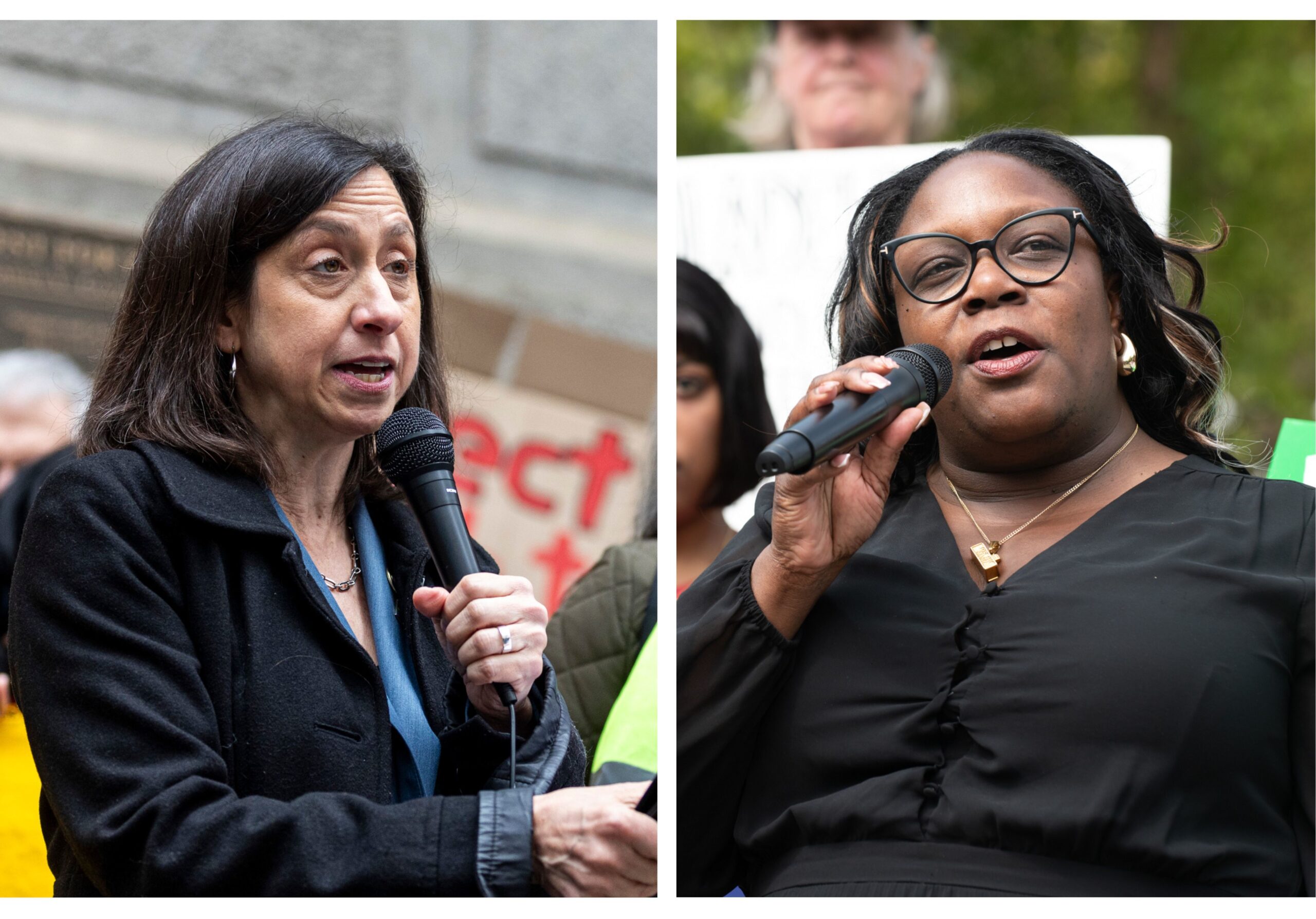
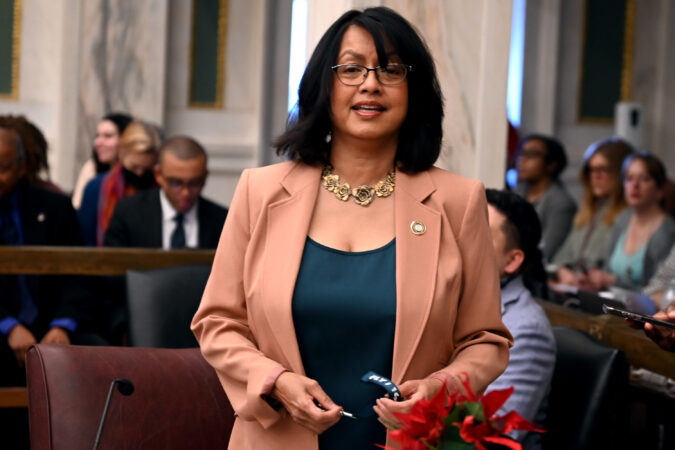
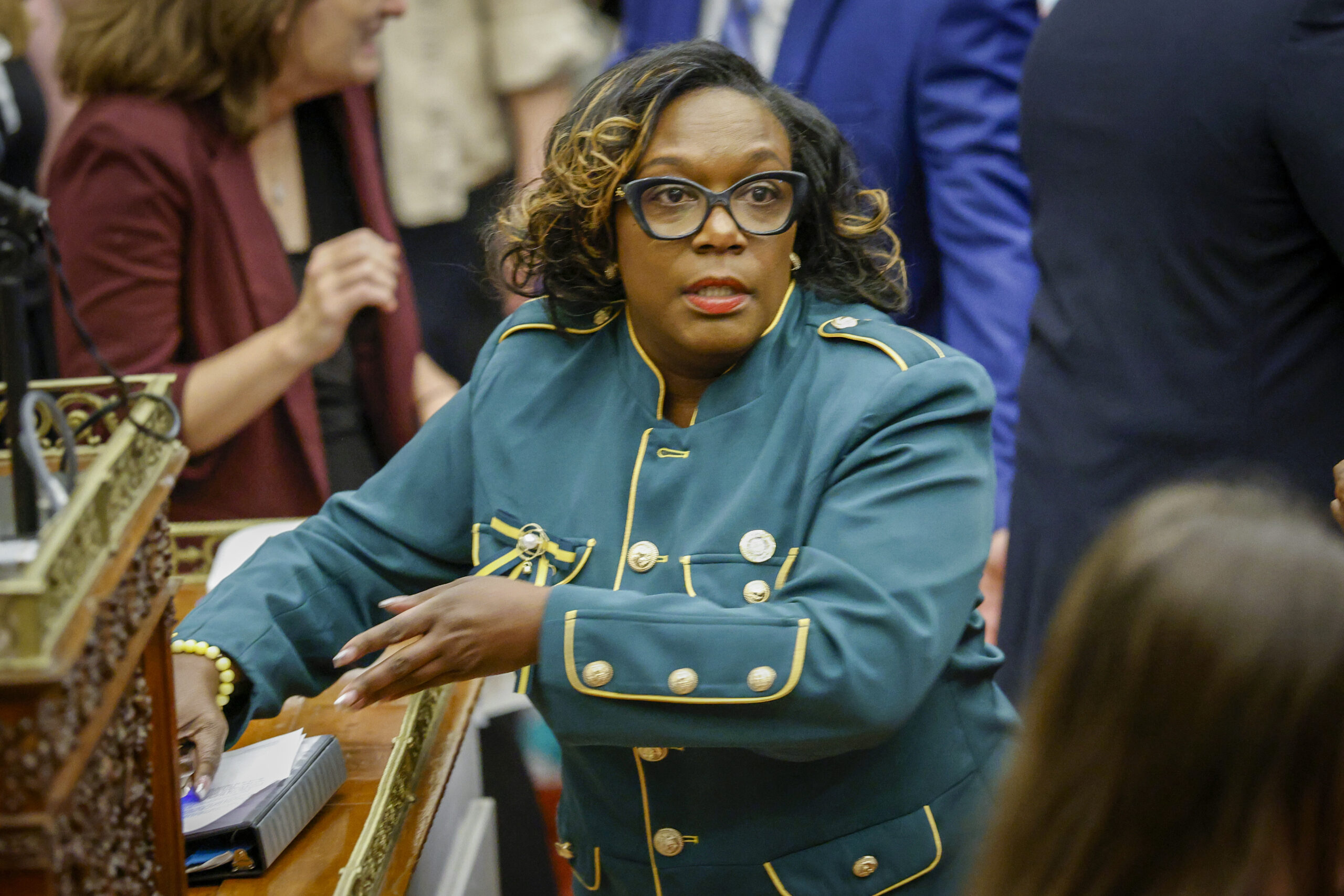
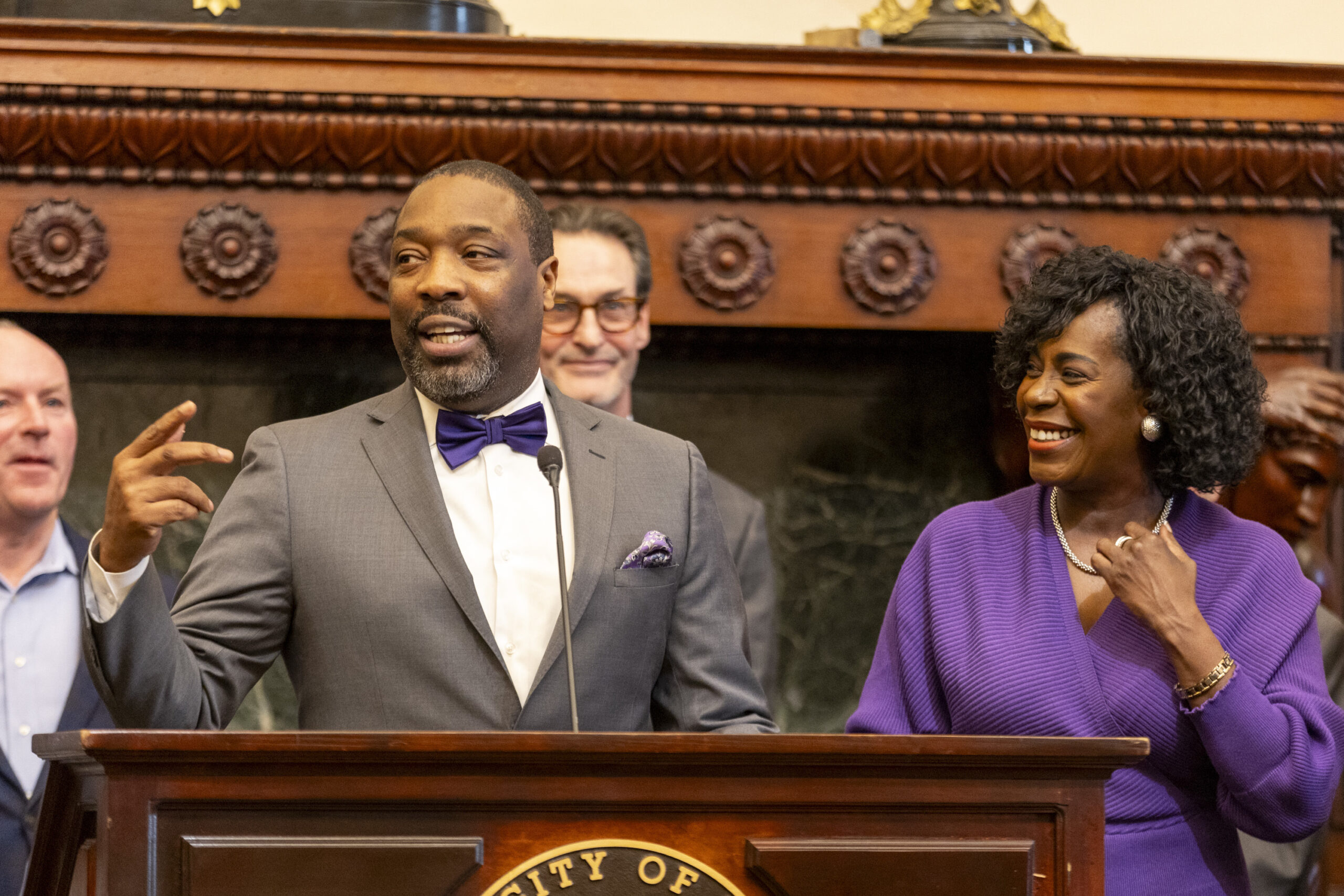
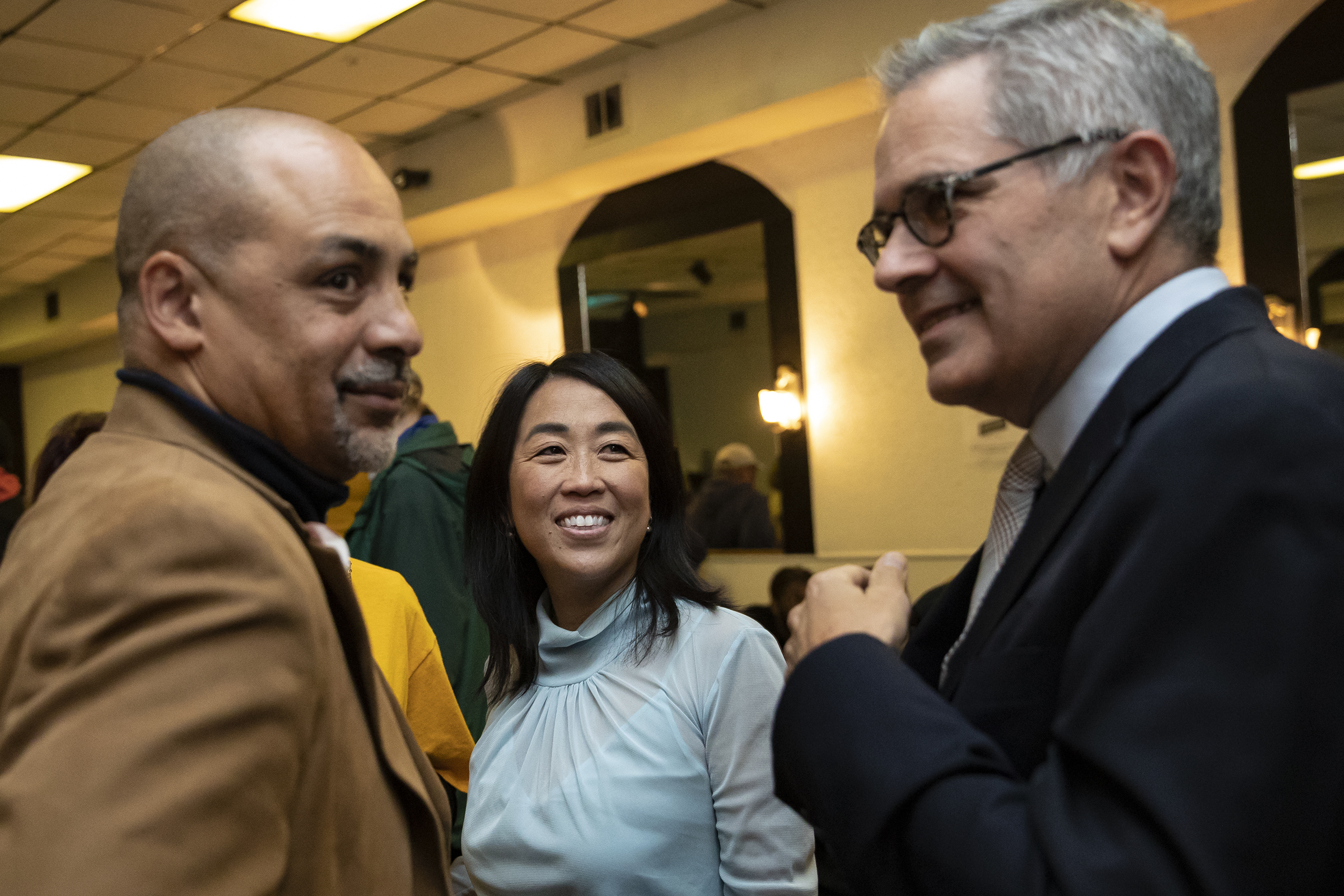
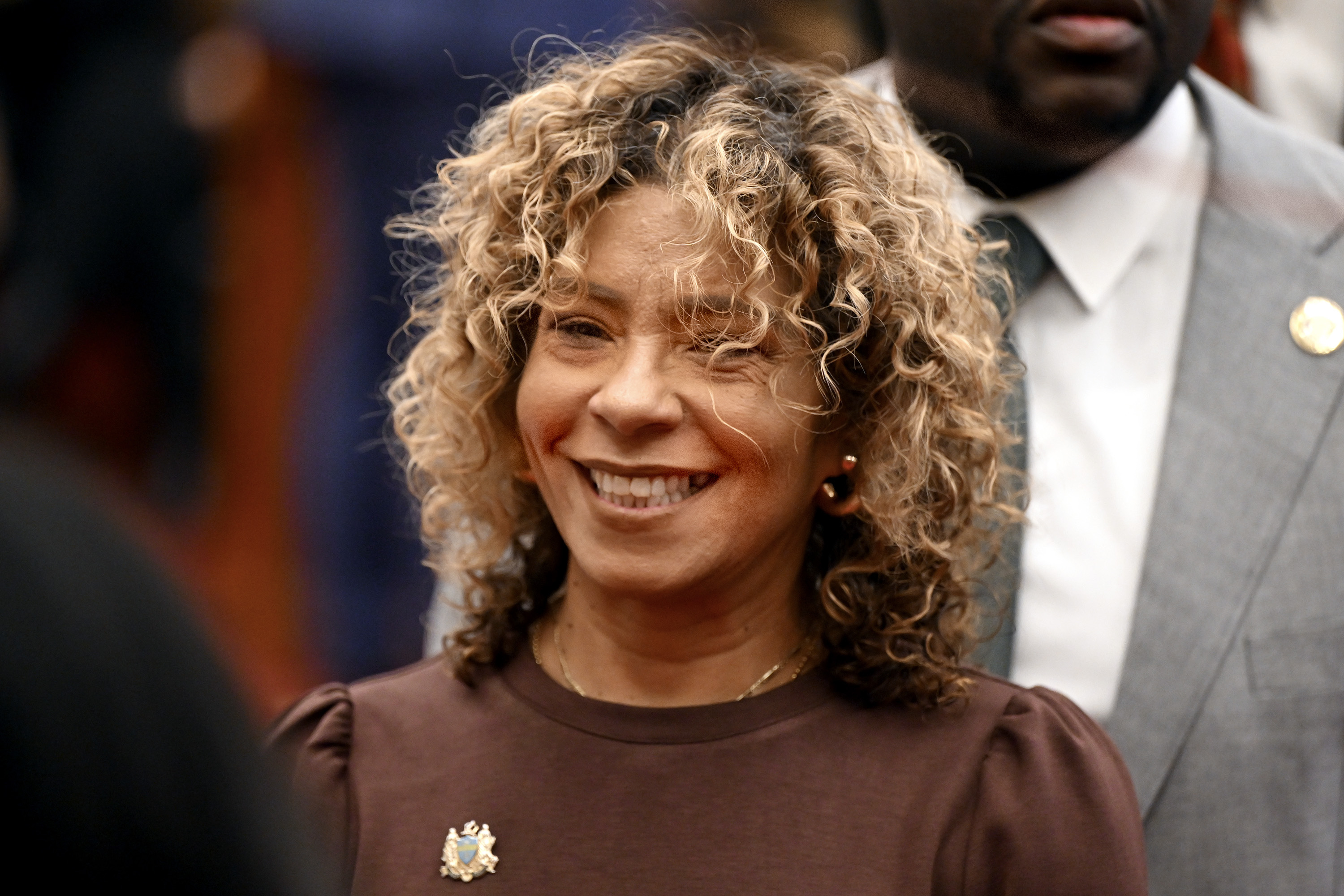
    Left: City Councilmember Rue Landau. Right: City Councilmember Kendra Brooks. Landau and Brooks are introducing legislation this week to make it harder for ICE to operate in Philadelphia, including by limiting city cooperation with the agency.

    ICE spokespeople did not immediately reply to a request for comment.

    Jasmine Rivera, executive director of the Pennsylvania Immigration Coalition, said it’s not the job nor the jurisdiction of the city to enforce federal law.

    The goal of the legislation, Rivera said, is ensuring that “not a single dime and single second of our local resources is being spent collaborating with agencies that are executing people.”

    Activists have for months urged Mayor Cherelle L. Parker to formally affirm her commitment to the city’s sanctuary status. Top city officials say an executive order signed by the former mayor to limit the city’s cooperation with ICE remains in place.

    But Parker, a centrist Democrat, has taken a quieter approach than her colleagues in Council, largely avoiding criticizing the Trump administration outwardly and saying often that she is focused on her own agenda.

    Now, the mayor could be forced to take a side. If City Council passes Landau and Brooks’ legislation this spring, Parker could either sign the bills into law, veto them, or take no action and allow them to lapse into law without her signature. She has never vetoed a bill.

    Joe Grace, a spokesperson for Parker, declined to comment on the legislation.
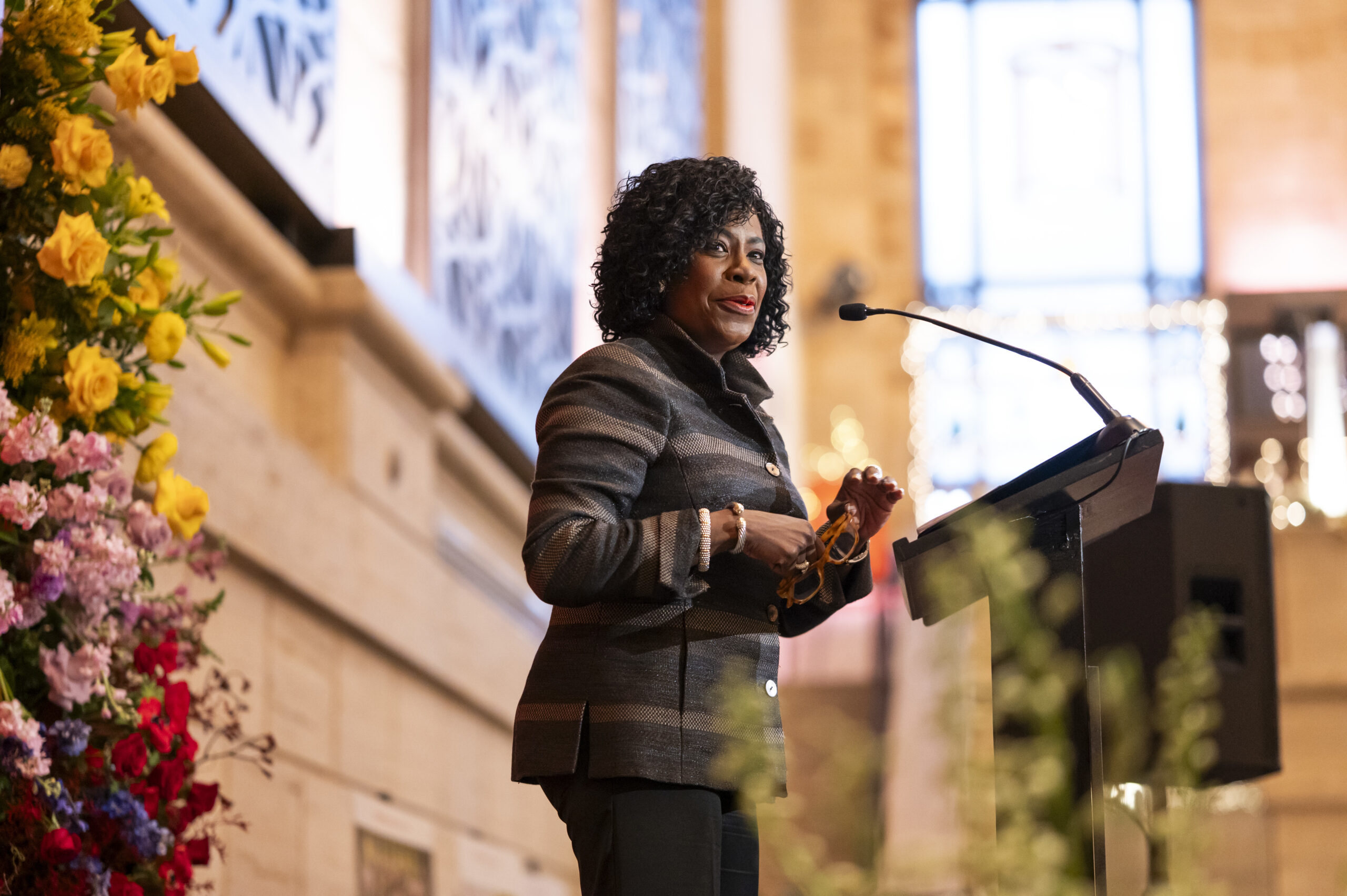
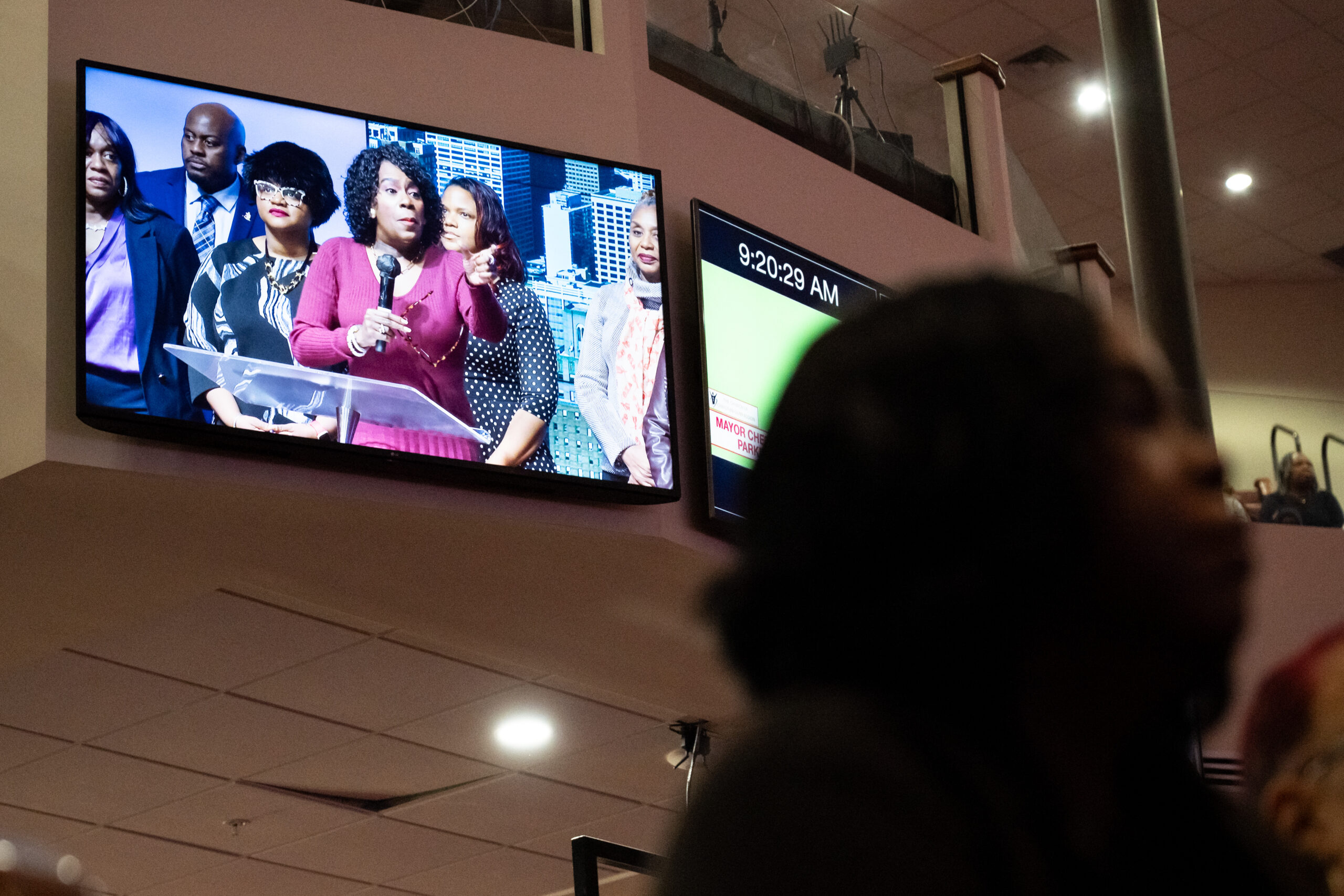
    Mayor Cherelle L. Parker speaks at a news conference earlier this month. It is unclear how she will act on upcoming legislation related to ICE operations in Philadelphia.

    It’s unclear what fate the ICE legislation could meet in Council. The 17-member body has just one Republican, but Parker holds influence with many of the Democrats in the chamber.

    City Council President Kenyatta Johnson, a Democrat who controls the flow of legislation, has not taken a position on the package proposed by Landau and Brooks.

    But he said in a statement that “Philadelphia has long positioned itself as a welcoming city that values the contributions of immigrants and strives to protect their rights and safety.”

    “I have deep concerns about federal ICE actions directed by President Donald Trump’s administration that sow fear and anxiety in immigrant communities,” Johnson said, “underscoring the belief that enforcement practices should be lawful, humane, and not undermine trust in public safety.”

    Making sanctuary status the law

    Border Patrol and ICE are both federal immigration agencies, which are legally allowed to operate in public places and subject to federal rules and regulations. Some cities and states — not including Pennsylvania and New Jersey — actively cooperate with ICE through written agreements.

    Since 2016, Philadelphia has operated under an executive order signed by former Mayor Jim Kenney, which prohibits city jails from honoring ICE “detainer requests,” in which federal agents ask the city to hold undocumented immigrants in jail for longer than they would have otherwise been in custody to facilitate their arrest by federal authorities.

    Undocumented immigrants are not shielded from federal immigration enforcement, nor from being arrested and charged by local police for local offenses.

    Some refer to the noncooperation arrangement as “sanctuary.” As the term “sanctuary cities” has become politically toxic, some local officials — including in Philadelphia — have backed away from it, instead declaring their jurisdictions to be “welcoming cities.”

    Parker administration officials have said several times over the last year that Philadelphia remains a “welcoming city.”

    Protesters march up Eighth Street, toward the immigration offices, during the Philly stands with Minneapolis Ice Out For Good protest at Philadelphia’s City Hall on Jan. 23.

    But advocates for immigrants have said they want an ironclad city policy that can’t be rescinded by a mayor.

    Landau and Brooks’ legislation would be that, codifying the executive order into law and adding new prohibitions on information sharing. The package includes legislation to:

    • Strengthen restrictions on city workers, including banning local police from carrying out federal immigration enforcement and prohibiting city workers from assisting in enforcement operations.
    • Prohibiting law enforcement officers from concealing their identities, including by wearing masks or covering up badges with identifying information.
    • Banning ICE from staging raids on city-owned property and designated community spaces such as schools, parks, libraries, and homeless shelters. (It would not apply to the Criminal Justice Center, where ICE has had a presence. The courthouse is overseen by both city and state agencies.)
    • Prohibiting city agencies and contractors from providing ICE access to data sets to assist in immigration enforcement.
    • Restricting city employees from inquiring about individuals’ immigration status unless required by a court order, or state or federal law.

    Peter Pedemonti, co-director of New Sanctuary Movement of Philadelphia, an advocacy organization that partnered with the Council members to craft the package of bills, compared ICE to an octopus that has multiple arms reaching into different facets of American life.

    The proposed legislation, he said, is a means to bind a few of those arms.

    “The whole world can see the violence and brutality,” Pedemonti said. “This is a moment where all of us need to stand up, and Philadelphia can stand up and speak out loud and clear that we don’t want ICE here to pull our families apart, the families that make Philadelphia Philadelphia.”

    An impending showdown that Parker hoped to avoid

    Homeland Security officials claim that sanctuary jurisdictions protect criminal, undocumented immigrants from facing consequences while putting U.S. citizens and law enforcement officers in peril.

    Last year, the Trump administration named Philadelphia as among the jurisdictions impeding federal immigration enforcement. The White House has said the federal government will cut off funding to sanctuary cities by Feb. 1.

    However, the president has made no explicit threat to ramp up ICE activities in Philadelphia.

    Some of Parker’s supporters say the mayor’s conflict-averse strategy has spared Philadelphia as other cities such as Washington, New York, Los Angeles, Chicago, and Minneapolis have seen National Guard troops or waves of ICE agents arrive in force.
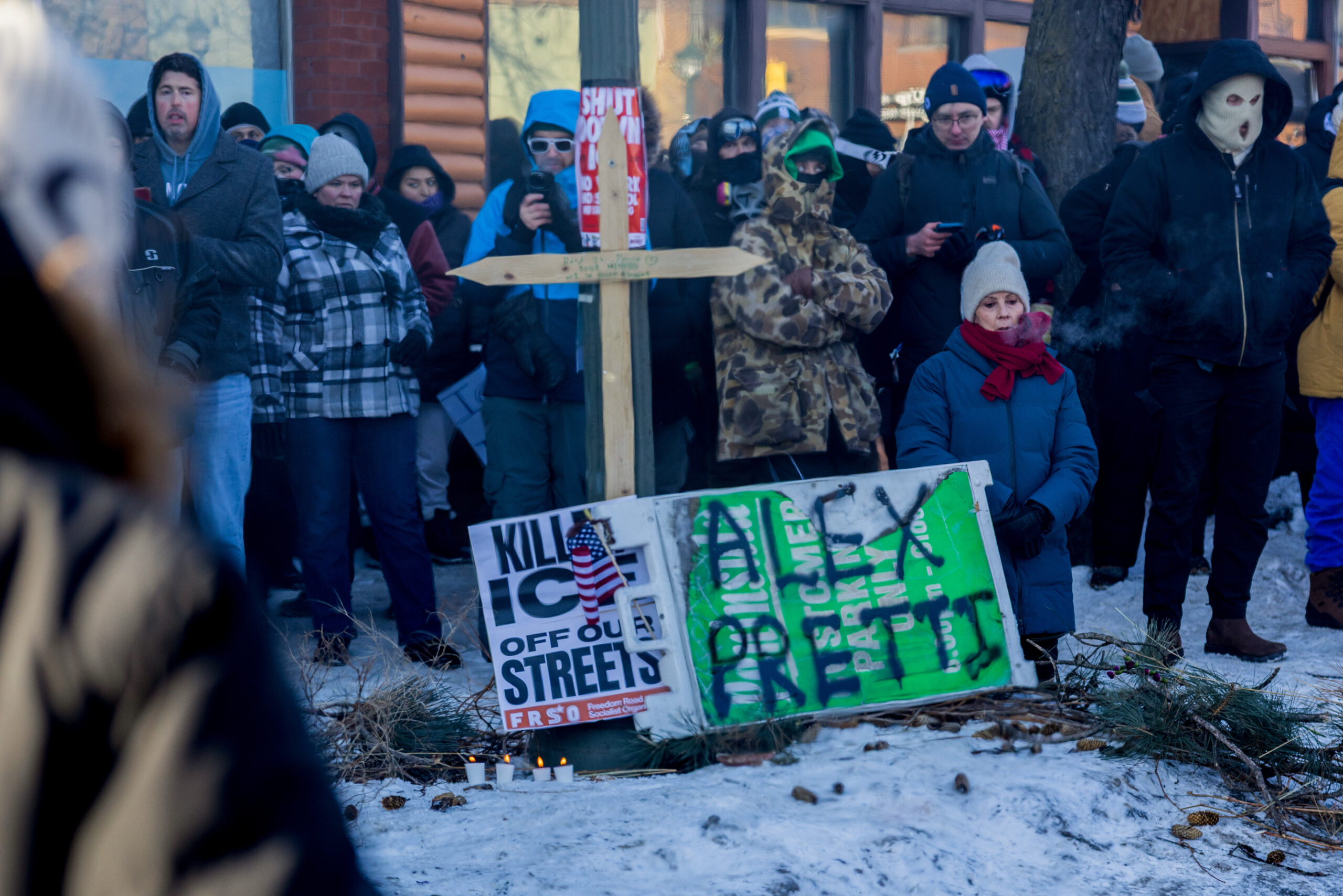
    Residents near the scene of a shooting by a federal law enforcement agent in Minneapolis on Saturday.

    Critics, including the backers of the new legislation, have for months pressed Parker to take a stronger stand.

    Brooks said she “would love to have the support of the administration.”

    “This should be something that we should be working collaboratively on,” she said. “Philadelphia residents are demanding us do something as elected officials, and this is our time to lead.”

    But Parker has not been eager to speak about Philadelphia’s immigration policies.

    For example, the city is refusing to release a September letter it sent to the U.S. Department of Justice regarding its immigration-related policies, even after the Pennsylvania Office of Open Records ruled its reasoning for keeping the document secret was invalid. The Inquirer has requested a copy of the letter under the state Right-to-Know Law.

    The new Council legislation and the increasing tension over Trump’s deportation push may force Parker to take a clearer position.

    Notably, the city sued the federal government last week over its removal of exhibits related to slavery from the President’s House at Independence National Historical Park, potentially signaling a new willingness by Parker to push back against the White House.

    But even then, Parker declined to take a jab at Trump.

    “In moments like this,” she said last week, “it requires that I be the leader that I need to be for our city, and I can’t allow my pride, ego, or emotions to dictate what my actions will be.”
  • How Jamie Gauthier charted a new path to power in Philadelphia City Hall

    How Jamie Gauthier charted a new path to power in Philadelphia City Hall

    When Mayor Cherelle L. Parker unveiled her much-anticipated plan to address Philadelphia’s housing crisis last year, there was predictable criticism from the political left. Activists said the proposal drafted by the moderate Democrat would not do enough for the city’s poorest residents.

    Less predictable was that a majority of City Council stood with them.

    Even the Council president, a centrist ally of the mayor, sided with a progressive faction that just two years ago had been soundly defeated in the mayor’s race — but whose new de facto leader in City Hall has proven adept at building alliances across the ideological spectrum.

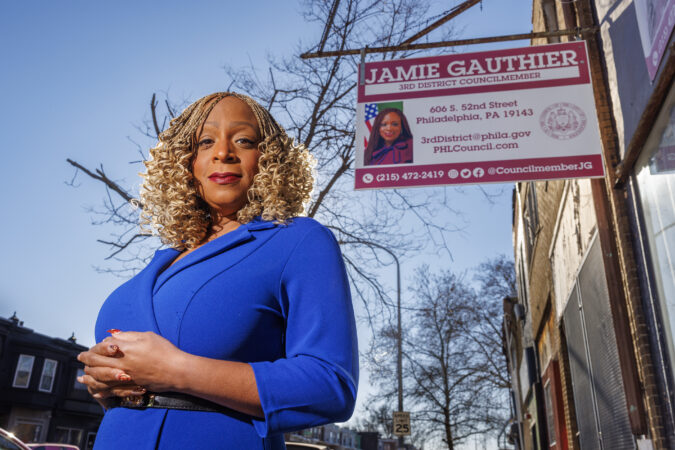
    At the center of that shift was Jamie Gauthier.

    The second-term Democratic lawmaker from West Philadelphia has solidified herself over the last year as a leading voice on Council and a counterweight to Parker. She has worked within the system as opposed to trying to break it, maintaining relationships with power players who disagree with her on policy.

    She counts Ryan N. Boyer — the labor leader who is Parker’s closest political ally — among those who consider her a “thought leader.”

    “Over the last year, what you saw,” Boyer said, “is her modulate her positions to become more practical.”

    Gauthier has generally voted with progressives, including last year when she opposed the controversial Center City 76ers arena proposal. But she has also endeavored to be a team player, at times compromising on ideological battles to focus on priorities in her district.

    Last year, she voted for Parker’s plan to cut taxes for businesses and corporations when other progressives opposed it, because her main priority was securing housing funding. She has not opposed some tough-on-crime efforts in the Kensington drug market, instead allowing her colleagues who represent that area to dictate the policy there.

    She says she is trying to use her political capital where it matters.

    “Why would I take a protest vote and tank a relationship with a colleague when I’m going to need them later?” she said. “I want to win.”

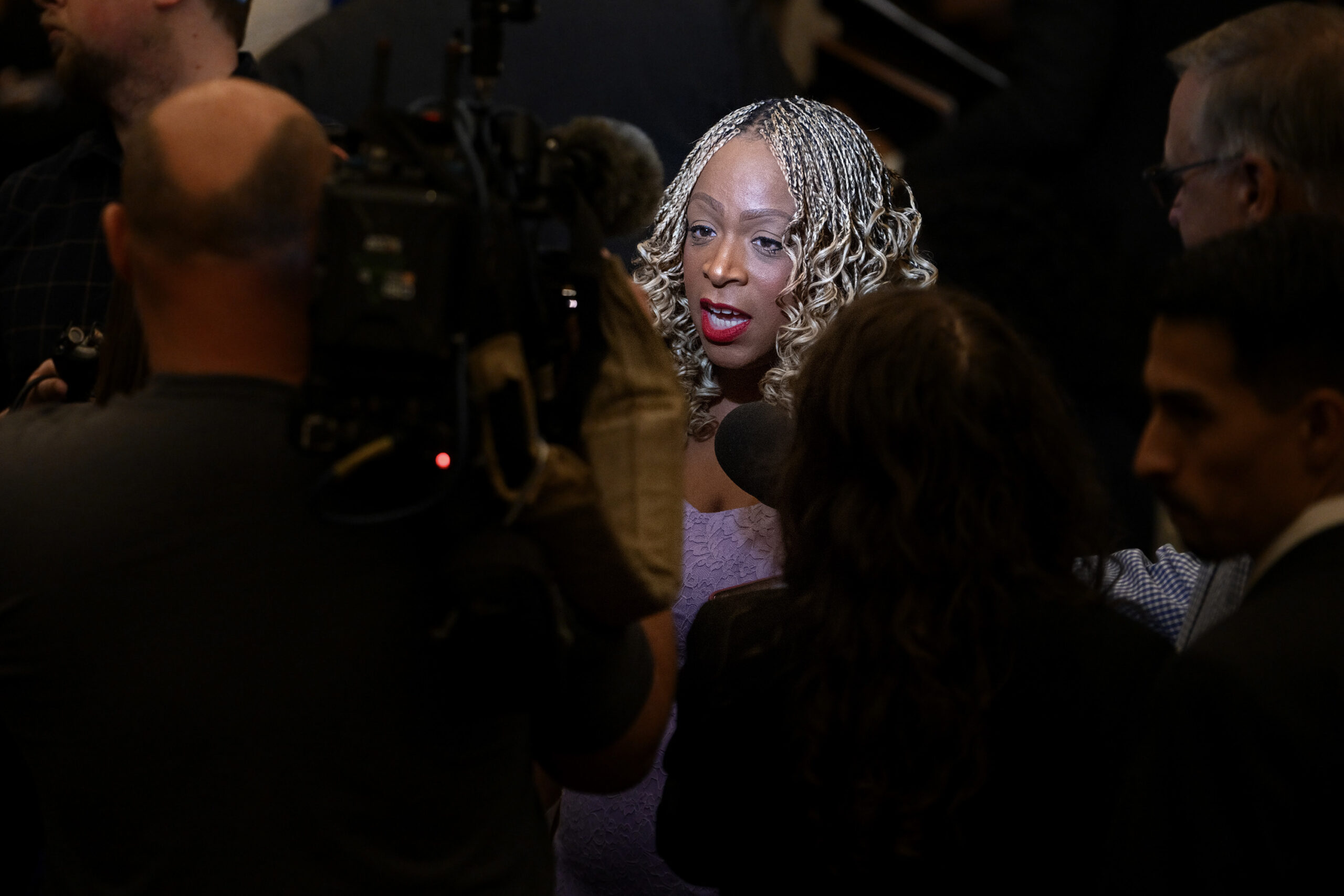
    Councilmember Jamie Gauthier talks with news media following a special session of City Council on March 24, 2025.

    The fact that Gauthier is a district Council member who represents a large swath of the city west of the Schuylkill also gives her cachet with colleagues. Council has a long tradition of honoring how members want their own neighborhoods to be governed.

    Gauthier, who leads Council’s housing committee, has used the influence to make West Philadelphia something of a testing ground for left-of-center policy. Plenty oppose what they see as draconian restrictions on real estate development in her district.

    Others see a progressive champion, and some political observers think Gauthier could amass enough support to run for mayor one day. She doesn’t deny that she has thought about it.

    But for whatever politics Gauthier can navigate in City Hall, she knows she can rise only if she is successful at home.

    ‘Not just a lone actor’

    When Parker took office, Council was in a moment of upheaval. Council President Kenyatta Johnson was the new leader of the chamber, and several prominent voices were gone after they had resigned to run for mayor themselves.

    One was Helen Gym, who was seen as the leader of Council’s left flank. There were questions about who would fill the void once Gym was gone.

    Gauthier, 47, an urban planner by trade, did not come up through an activist movement in the same way Gym did, and was a bit more reserved in her style.

    But she carries the mantle for the same theory of governance: that lawmakers should prioritize the vulnerable, and that what is good for business is not necessarily good for everyone else.

    That set Gauthier on an ideological collision course with Parker, a former Council member who ran for office on a promise to uplift the middle class, a group the mayor believes has been too often ignored.

    It came to a head in the fight over Parker’s Housing Opportunities Made Easy, or H.O.M.E., initiative.

    Parker wanted to set unusually high income eligibility thresholds for some of the programs so that middle-class families could unlock government subsidies they may not otherwise qualify for. A significant portion of Council, meanwhile, wanted the money to go initially to Philadelphians most vulnerable to displacement.

    Parker was clear-eyed about who was leading the charge.

    “Councilmember Jamie Gauthier, she may be comfortable and OK with telling Philadelphia homeowners, working-class Philadelphians, that they have to wait and there is no sense of urgency for them,” Parker said in a December interview on WHYY. “But that is not a sentiment that I support or agree with.”

    Gauthier is quick to point out that she did not work alone, and that one member of a 17-member body cannot accomplish much. Alongside Councilmember Rue Landau, a fellow Democrat and a housing attorney by trade, Gauthier worked for months to win over her colleagues.

    In the end, Council approved a version of the housing initiative closer to Gauthier’s vision.

    Gauthier didn’t think Parker helped her own cause. A “line was crossed,” she said, when Parker took the fight outside City Hall and to the pulpit. Amid negotiations with Council, the mayor went to 10 churches on one Sunday in December to lobby for support, saying her vision was to not “pit the ‘have-nots’ against those who have just a little bit.”

    Mayor Cherelle L. Parker speaks to the crowd at The Church of Christian Compassion in the Cobbs Creek neighborhood of West Philadelphia on Sunday, Dec. 7, 2025. Parker visited 10 churches in Philadelphia on Sunday to share details about her HOME housing plan.

    To Gauthier, the divisiveness was coming from the mayor’s office.

    “I wish the mayor and her administration were more open to other people’s ideas, were more OK with disagreement on policy issues, and more aware of Council as a completely separate chamber of government,” Gauthier said, “as opposed to a body that works for her.”

    That is a candid assessment of the relationship between Parker and City Council from Gauthier. Few lawmakers from the mayor’s own party have criticized her publicly.

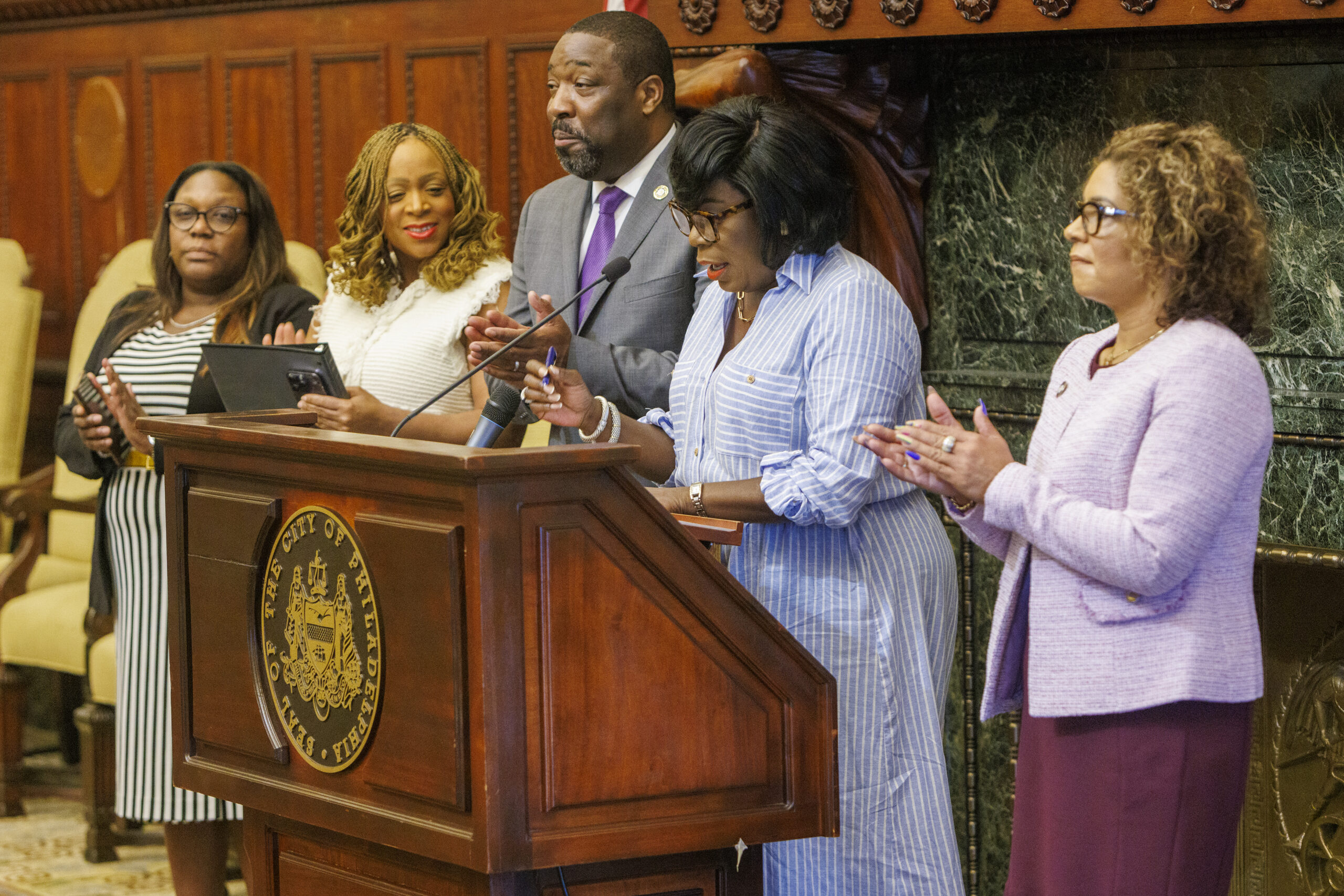
    Philadelphia Mayor Cherelle Parker holds a press conference regarding her first budget flanked by members of city council in her reception room, Philadelphia City Hall on Thursday, June 6, 2024. Council members from left are Kendra Brooks, Jamie Gauthier, council president Kenyatta Johnson, and Quetcy Lozada.

    State Rep. Rick Krajewski, a West Philadelphia Democrat and a progressive who has worked closely with Gauthier, said the fight over H.O.M.E. showed that Gauthier has learned “the diplomacy required to be an effective legislator.”

    “It was a good example of not being afraid of a conflict that felt important to stand up for,” he said, “but then to not just be a lone actor, but organize with other colleagues and allies.”

    Gauthier’s most important ally was Johnson, who negotiated directly with Parker through the process and controls the flow of legislation in the chamber.

    The two go back years. Before Johnson was Council president, he made a point of welcoming new members, a gesture that has always stuck with Gauthier. They worked closely to secure funding for gun violence prevention. And Gauthier said that since Johnson took the gavel, he has been more open to working with progressives than his predecessor was.

    She was also key to Johnson’s ascent. When he was locked in a tight battle for the Council presidency, it was Gauthier who became the ninth Council member to commit to voting for Johnson, allowing him to secure a majority of members and the presidency.

    He does not talk about that publicly. What he will say is that he works in partnership with Gauthier because she understands “the bigger picture in terms of how we move forward as the institution.”

    “I consider her to be a pragmatic idealist,” Johnson said. “She wears her heart on her sleeve, and she really believes in actually doing the work.”

    Creating a testing ground in West Philly

    When Gauthier first ran for office in 2019 against a member of one of Philadelphia’s most entrenched political families, she ran as a good-government urbanist. She railed against councilmanic prerogative, the city’s long tradition of allowing district Council members final say over land-use decisions in their areas.

    She was also supported by real estate interests, some of whom now have buyer’s remorse.

    After Gauthier pulled off a shock win, she arrived in Council and quickly aligned with the progressive bloc. Through her first two terms, she has used councilmanic prerogative often, and has voted with her district Council colleagues so that they can do the same.

    She admits that it is an effective tool for accomplishing her goals quickly.

    Carol Jenkins, a Democratic ward leader in West Philadelphia, said Gauthier’s use of councilmanic prerogative is “part of her maturation.”

    “That’s the power you have,” Jenkins said.

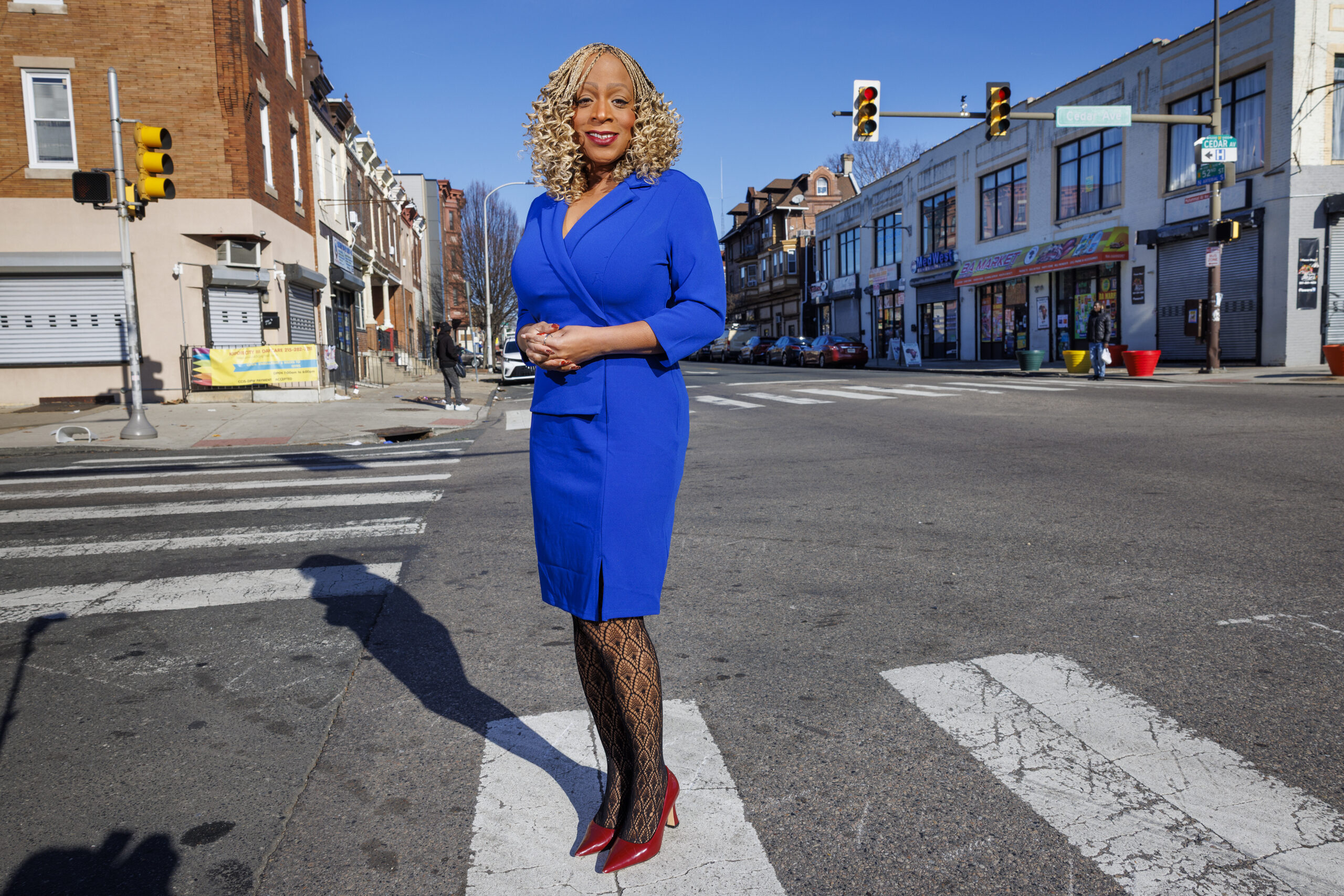
    City Councilmember Jamie Gauthier in her district near 52nd Street and Cedar Avenue in Philadelphia on Monday, Dec. 22, 2025.

    Gauthier has at times used the power in ways that the city’s urbanists and development interests can get behind. She has quickly approved bike lane expansions. And she recently was the only district Council member to allow her entire district to be included in legislation that cuts red tape for restaurants that want to offer outdoor dining.

    However, her most notable use of councilmanic prerogative has been in housing policy, and some developers say her district is now the most hostile to growth in the city.

    In Gauthier’s first term, she championed legislation to create what is known as a Mixed Income Neighborhood overlay. In essence, it requires that developers building projects with 10 or more units in certain parts of her district make at least 20% of their units affordable. That is defined as accessible for rental households earning up to 40% of the area median income.

    For Gauthier, it’s a tool to slow the rapid gentrification of her majority-Black district.

    But developers say that growth has slowed significantly in the areas covered by the overlay since it took effect in 2022. Some have said they avoid seeking to build in the 3rd District entirely. The only major project currently in the works in the area is a parking garage.

    Ryan Spak, an affordable housing developer who said he considers Gauthier a friend, has been among the most outspoken critics of the overlay. He said while Gauthier’s “moral compass is pointed in the right direction, her policies don’t math.”

    “You would never ask a restaurant to give away its ninth and 10th meal for 40 cents on the dollar, with no additional discounts or benefits,” he said, “and expect that restaurant to survive.”

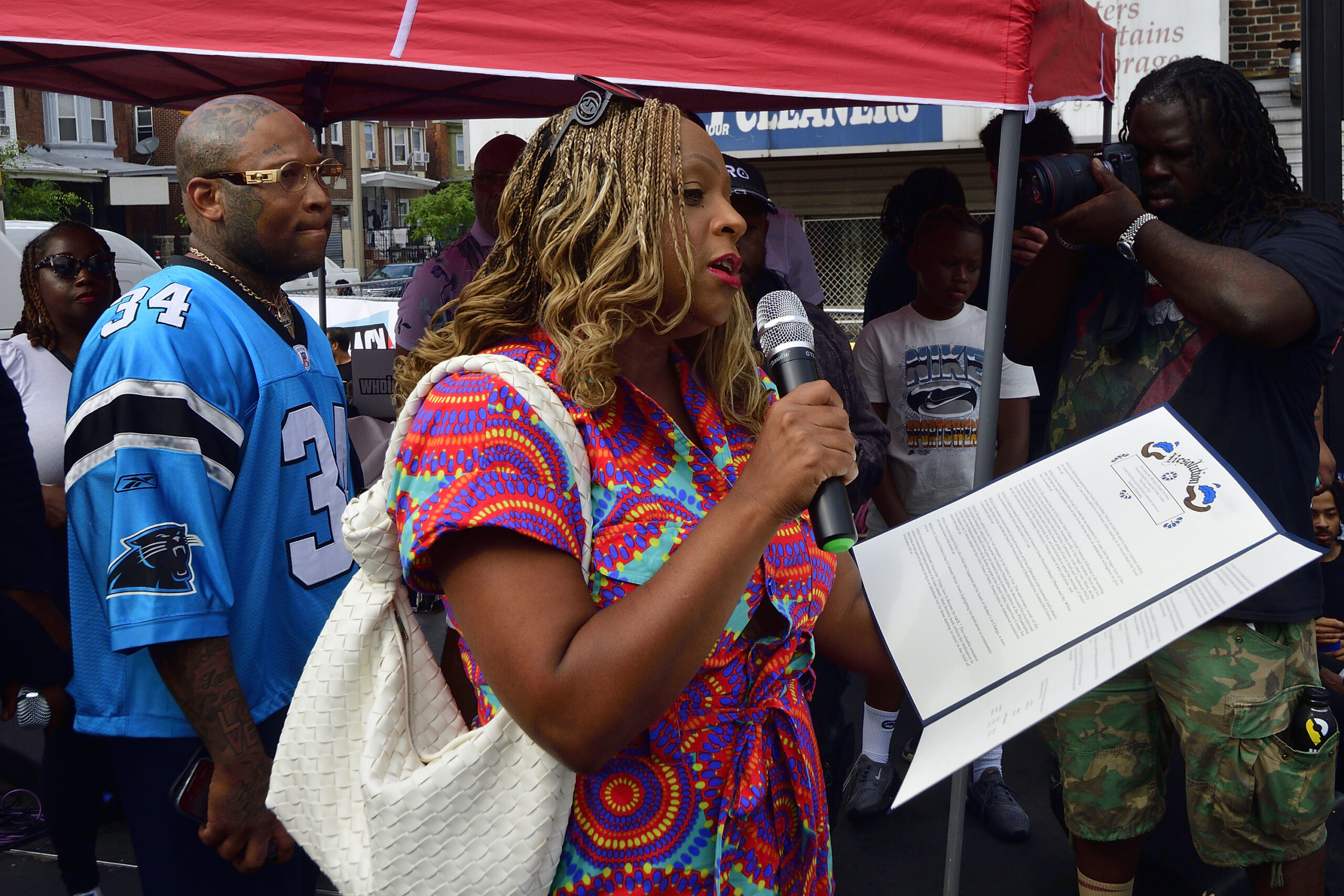
    Councilmember Jamie Gauthier reads out a citation honoring Rapper Mont Brown during a street naming ceremony for the Southwest Philadelphia native at the 13th Annual Stop the Violence Kickback Block Party at 55th Street and Chester Avenue, in Southwest Philadelphia on August 17, 2024.

    Gauthier said she has made adjustments, and she championed legislation to accelerate permitting and zoning approvals. The mandate, she said, is necessary because the market won’t build enough affordable housing on its own.

    “As untenable as it is to them that they can’t make the numbers work, it’s untenable to me that people can’t afford to live here,” Gauthier said. “So we can come together and we can fix that. But I’m not going to move from my position that we have to demand affordability.”

    Mayoral buzz, but no ‘stupid campaigns’

    Gauthier is one of several names that have been floated in political circles as potential candidates for mayor in 2031, which would be Parker’s final year in office if she runs for and wins a second term. Several of her Council colleagues, including Johnson, are seen as potential contenders.

    “I’d be lying if I didn’t say that mayor could be interesting one day,” Gauthier said. “I also don’t believe in stupid campaigns. So I would never do that if I didn’t think I had a path.”
    Boyer said he has counseled Gauthier to pursue moderate policy and avoid being “label-cast” as far left. He said Philadelphia is not Chicago or New York, and he doesn’t see the city electing an uber-progressive to be the mayor any time soon.

    “Philadelphia has always been a real center-left community,” Boyer said, “and just because you’re the loudest isn’t the most popular.”

    The left may have other plans. Robert Saleem Holbrook, a progressive activist, said that Gauthier would be an “ideal candidate” for higher office and that the city’s leftists would back her.

    Probably.

    “So long as she stays true and supportive of progressive ideals,” Holbrook said. “You can’t compromise on your way up.”

  • A Philly lawmaker refused to advance her colleague’s reproductive healthcare legislation. Now she’s promoting her own.

    A Philly lawmaker refused to advance her colleague’s reproductive healthcare legislation. Now she’s promoting her own.

    They say imitation is the sincerest form of flattery, but Kendra Brooks isn’t taking kindly to a recent gesture of duplication by one of her colleagues.

    The progressive City Council member is incensed at Councilmember Nina Ahmad, a Democrat who has been in something of cold war with Brooks for months over stalled legislation related to reproductive healthcare access.

    It all came to a head Thursday when Ahmad introduced a resolution to hold a hearing examining access to such care in Philadelphia — legislation that would, under most circumstances, be uncontroversial in a body where Democrats hold a supermajority.

    But Brooks and Councilmember Nicolas O’Rourke, both of the progressive Working Families Party, voted against it — a highly unusual move in a body that almost always unanimously approves legislation to authorize hearings.

    The backstory: Brooks had already authored legislation to hold a hearing on threats to reproductive healthcare, and City Council approved it five months ago.

    But the hearings have not happened. Ahmad, who chairs the Public Health and Human Services Committee, has refused to schedule Brooks’ hearing, citing scheduling difficulties. That was despite pleas from advocates to move swiftly amid new federal restrictions on reproductive care and clinics closing due to funding loss.

    Now, Ahmad is poised to call up her own legislation on the matter, leaving Brooks and her allies feeling squeezed out.

    Ahmad said her legislation is far more broad than Brooks’ and would allow Council to examine the entire reproductive healthcare landscape, not just access to abortion care.

    The Council member who authors a resolution to hold a hearing typically has sway over how the hearing is conducted, including steering the tenor of it by lining up witnesses to testify. In turn, that can drive the creation of more concrete legislation.

    “You have to be comprehensive,” Ahmad said in an interview. “I’m evidence-based. I’m a scientist. I want to look at the whole breadth of things.”

    City Councilmember Kendra Brooks stands in Council during the first day of the fall session in September.

    But Brooks said she is focused on all forms of reproductive healthcare and criticized Ahmad’s legislation for failing to acknowledge the role of the city’s Reproductive Freedom Task Force, which Brooks leads. Members of that group called for Council hearings after local Planned Parenthood leaders said they were disappointed that the most recent city budget did not include a $500,000 line item for sexual and reproductive healthcare, as it did the previous year.

    Brooks said Ahmad was engaging in “foolishness.”

    “This is a level of petty that turns people off from politics,” she said. “It’s really unfortunate that she would play politics on an issue that’s this important.”

    And Brooks intimated that the saga could cause her and her progressive allies to target Ahmad next year, when every City Council member is up for reelection.

    “I’m not going to forget this,” Brooks said. “We’re very close to reelection to be playing this game.”

    The veiled threat from Brooks, the face of the city’s Working Families Party, is notable and could put the WFP on a collision course with the local Democratic Party — which tends to endorse incumbents such as Ahmad. The WFP has previously said its efforts to win minority-party seats on Council are no threat to Democrats.

    However, in 2023 when both Brooks and Ahmad were running for seats on Council to represent the city at-large, Ahmad said that the WFP was trying to “poach” Democratic voters and that its political strategy was “lazy.”

    But Ahmad said Thursday she is not playing politics.

    “She’s the one,” Ahmad said of Brooks. “I’m the chair of the Public Health Committee, and I need to be aware of what work is going on in these respects. And if people don’t want to share, that’s up to them.”

    Brooks said she plans to hold her own hearing in March — what she is calling a “people’s hearing” that will take place outside the walls of City Hall.

    Some advocates say they will participate in both that event and Ahmad’s traditional hearing.

    Signe Espinoza, the vice president of public policy and advocacy at Planned Parenthood of Southeastern Pennsylvania, said she is supportive of any legislation that elevates the issue — no matter the author.

    “We are committed to keeping the doors open, and we also recognize that this is the most hostile environment we’ve ever been in,” Espinoza said, noting that clinics have closed across the country. “The clock is ticking.”

  • Philadelphia building trades unions will loan $50M to help redevelop the dilapidated Brith Sholom House

    Philadelphia building trades unions will loan $50M to help redevelop the dilapidated Brith Sholom House

    A coalition of building trades unions will lend the Philadelphia Housing Authority $50 million out of its pension fund to help finance the redevelopment of Brith Sholom House, a dilapidated senior apartment complex in West Philadelphia.

    Mayor Cherelle L. Parker and her longtime political ally Ryan N. Boyer, the business manager of the Philadelphia Building and Construction Trades Council, announced the arrangement Tuesday and framed it as a first-of-its-kind approach to expanding the city’s affordable housing stock.

    Under the terms of the deal, PHA will repay the building trades over 15 years at a 4.5% interest rate. PHA President and CEO Kelvin Jeremiah called it a good deal for taxpayers as banks and traditional financing institutions are lending at higher rates.

    The city is guaranteeing the loan. Parker said the outcome will be 336 units of affordable housing for seniors on fixed incomes. Members of the building trades unions will perform the work at the site.

    “This isn’t an investment for the building trades,” Boyer said. “It’s a down payment on our city’s future.”

    Boyer, one of the most powerful nonelected political figures in the state, has been a longtime ally to Parker and much of City Council. The trades unions poured millions into Parker’s run for mayor in 2023 and have remained largely in lockstep with her. Boyer led the mayor’s transition team and has been a key voice on her signature housing plan, which stands to generate thousands of construction jobs.

    The trades’ $50 million investment comes in addition to the $99.6 million that the housing authority is spending on a gut rehabilitation of the Wynnefield apartment complex, bringing the total cost of the project to $150 million.

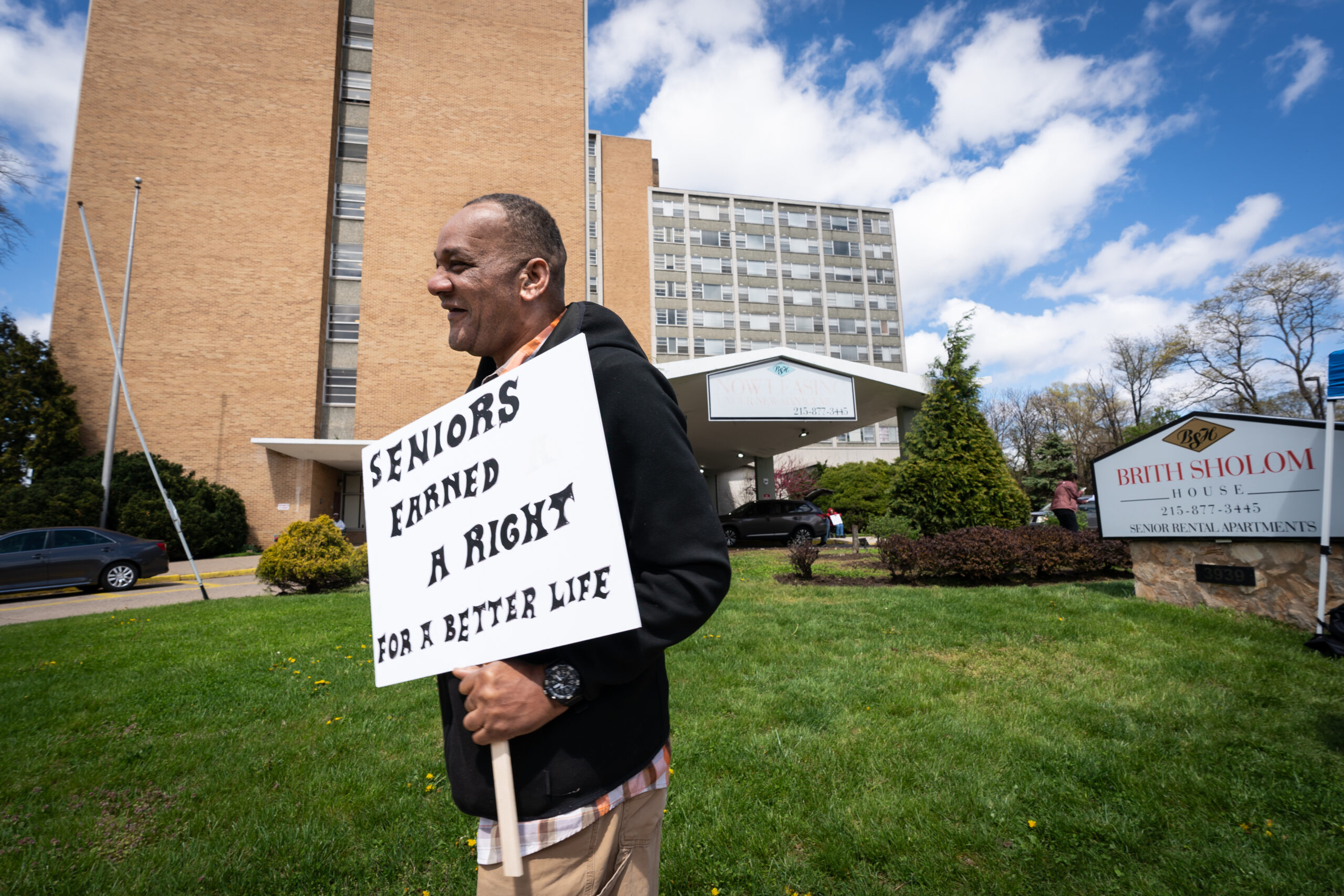
    A protestor carries a sign to protest the living conditions at Brith Sholom House apartments, in Philadelphia, on Friday, April 12, 2024.

    Jeremiah said he has been “shocked and dismayed” by the conditions at Brith Sholom, which was so neglected under its previous owners that tenants were forced to move out.

    Work will begin late this year and is expected to take about 20 months to complete, Jeremiah said, meaning tenants may not be able to move back in until 2028. He had previously estimated a timeline that would have allowed residents to return this year.

    Brith Sholom fell into disrepair under its previous owners, the New Jersey-based Puretz family. A 2024 Inquirer investigation found that members of the family became one of the nation’s largest affordable housing purveyors by buying up old buildings, saddling them with debt, and then defaulting on loans.

    At Brith Sholom, the Puretz family profited while defaulting on a $36 million mortgage and amassing dozens of code violations. Residents — who organized to save their homes — complained of deteriorating infrastructure, threats of utility shutoffs, squatters, and severe pest infestations.

    In a bid to preserve the building and reuse it in part as subsidized housing, PHA acquired Brith Sholom House in August 2024 for $24 million.

    In addition to the price of the acquisition, Jeremiah estimated in 2024 that the cost of rehabilitating the building would be an additional $30 million to $40 million. PHA said then that the remaining 111 elderly residents in the 360-unit building would be able to remain in place.

    Three months later, Jeremiah informed the tenants that Brith Sholom was in such ragged shape that they would have to be moved out to repair the building. Some units were so badly damaged that PHA could not fix them.

    Following the acquisition of Brith Sholom, PHA has embarked on an ambitious $6.3 billion, 10-year plan that includes the purchase of 4,000 other privately held apartments. In the face of a glut of market-rate multifamily properties, many developers have struggled to charge the rents they need to pay back their loans — and the housing authority has been able to purchase buildings from such companies across the city.

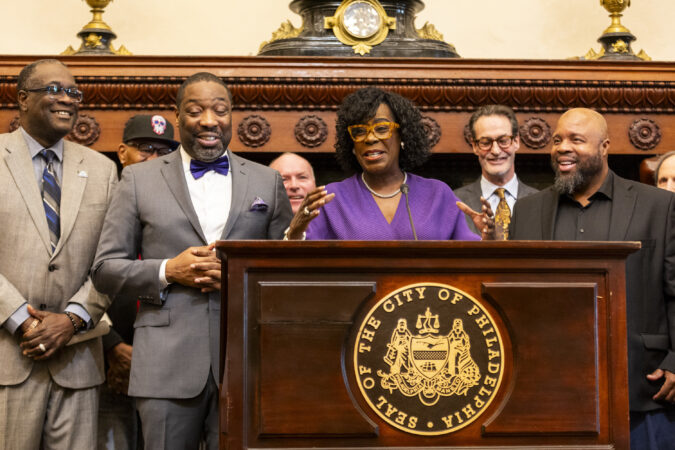
    City Council President Kenyatta Johnson speaks during a news conference about the plan to redevelop Brith Sholom. At right is Mayor Cherelle L. Parker.

    Parker also said the investment at Brith Sholom is part of her signature housing initiative, called Housing Opportunities Made Easy, or H.O.M.E. The mayor — who has promised to build, redevelop, and preserve more than 30,000 units of housing — is in the midst of continued negotiations with City Council over H.O.M.E.’s first-year budget.

    Council in December gave initial approval to changes to legislation related to Parker’s housing initiative, which set income eligibility thresholds for two housing programs funded by H.O.M.E.’s bond proceeds. Parker wanted a higher threshold so middle-class residents could access the programs, while Council’s version aims to prioritize poorer Philadelphians.

    Council could take a final vote on the related legislation as early as Thursday, when lawmakers return to session following their winter break.

    Throughout the contentious process, Parker has said her administration is committed to affordable housing for lower-income Philadelphians. The collaboration with PHA to remake Brith Sholom, she said, is part of that effort.

    “It’s not just for one particular constituency,” Parker said Tuesday about her overarching housing plan. “I’m personally on a mission to save Philly rowhomes. We’re trying to address our housing crisis and doing it for Philadelphians from all walks of life.”

    Parker was joined at the news conference Tuesday by Council President Kenyatta Johnson, despite the two being at odds over the H.O.M.E. legislation in recent months. Johnson praised the mayor’s leadership and said the financing arrangement for Brith Sholom is remedying a “miscarriage of justice.”

    “This is the type of work that helps those most in need,” Johnson said, “which is our seniors, who deserve to live out the twilight of their lives in dignity.”

  • Chris Rabb is trying to be the left’s standard-bearer as he runs for Congress. Will progressives rally around him?

    Chris Rabb is trying to be the left’s standard-bearer as he runs for Congress. Will progressives rally around him?

    In the most-watched race for Congress in Philadelphia in more than a decade, State Rep. Chris Rabb has cast himself as the unabashed anti-establishment leftist. He’s refusing donations from corporations, calls the war in Gaza a genocide, and wants to abolish U.S. Immigration and Customs Enforcement.

    But despite announcing his campaign more than six months ago, he had yet to amass support from much of the city’s progressive flank, leading observers to wonder if he would be able to tap into the movement’s network of donors and volunteers.

    It appears they’re coming around.

    Rabb this week has won an endorsement from One PA, a progressive political group that’s aligned with labor and most of the city’s left-leaning elected officials. That comes after the environmental justice group Sunrise Movement said it, too, would back Rabb.

    “This is a moment when democracy is at stake,” said Steve Paul, One PA’s executive director. “If there was any moment for the style of leadership that Chris [Rabb] brings to the table, it’s this moment.”

    Rabb said he’s “energized” by the endorsement and what it means for the campaign.

    “Our movement is growing every single day,” he said.

    The questions now are whether some of the city’s most prominent progressive elected officials will lend their endorsements to Rabb, and if deep-pocketed national organizations will spend money to back him.

    For example, Justice Democrats, a progressive political action committee, said it’s “very closely looking at this district.” And the Working Families Party, the labor-aligned third party that supports progressives across the nation, has endorsed candidates in four other congressional races with competitive primaries — but not yet in Philadelphia’s. The group previously spent millions to boost candidates in the region.

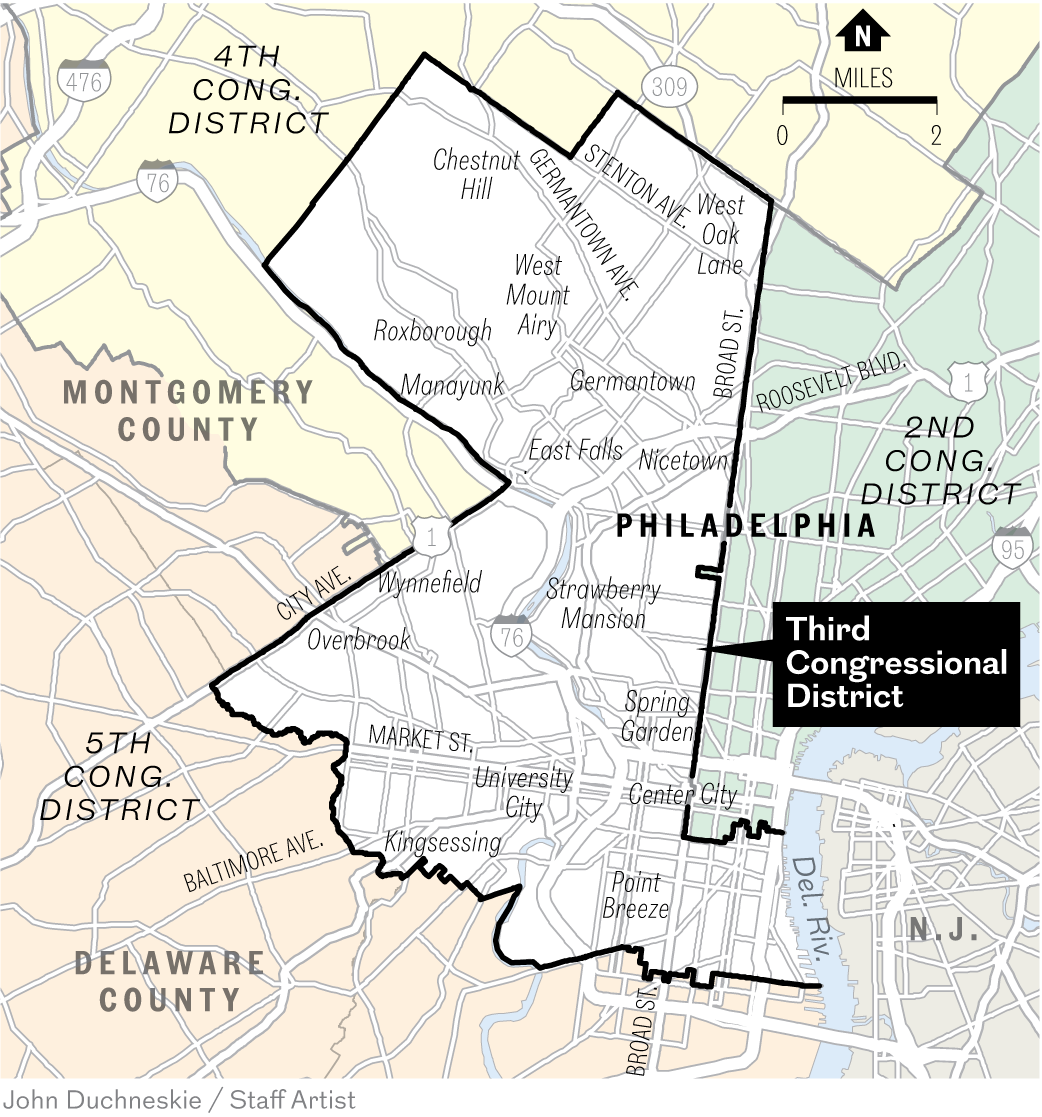
    Rabb, who hails from the voter-rich Northwest Philadelphia, is one of several likely front-runners seeking the Democratic nomination to represent the 3rd Congressional District, which encompasses about half of Philadelphia. U.S. Rep. Dwight Evans is retiring after holding the seat since 2016.

    Progressives and democratic socialists — energized by Mayor Zohran Mamdani’s win last year in New York City — see a major opportunity to install one of their own in the district, which is the most Democratic in the nation.

    Map of Pennsylvania’s 3rd Congressional District.

    The primary election — the marquee race in deep-blue Philadelphia — isn’t until May. But some on the left say the movement should have already coalesced around Rabb.

    “We will probably regret it in the end, because this is a seat we should win,” said one leader of a progressive organization in the city who requested anonymity to speak freely about the political dynamic.

    Rabb is seen as something of a lone operator with his own political apparatus. He didn’t come up through the newer progressive organizations that have run their own candidates for office in the city. Rather, he won a seat in the state House for the first time a decade ago when he toppled an establishment-backed Democrat.

    State Rep. Chris Rabb at a forum hosted by the 9th Ward Democratic Committee on Dec. 4, 2025. He is a Democratic candidate running to represent Philadelphia’s Third Congressional District.

    Some of the city’s progressive leaders say they expect to back Rabb but that they were waiting to see how the field shaped up.

    Last year, there were efforts to recruit other left-leaning candidates to run, including City Councilmember Kendra Brooks of the Working Families Party, and State Rep. Rick Krajewski, according to three sources with knowledge of the efforts who spoke on condition of anonymity to preserve relationships. Both decided against running.

    Brooks — who emerged as a face of the Working Families Party six years ago after she became the first third-party candidate to win a seat on Council in 100 years — is likely to back whomever the organization endorses. The group is still in the midst of its endorsement process.

    “We’re confident that we will land on a progressive who will fight for working people, not billionaire donors, big corporations, or special interests,” WFP spokesperson Nick Gavio said.

    Krajewski, who represents parts of West Philadelphia, has also not endorsed a candidate but he said he will. Rabb, according to Krajewski, has the qualities necessary to be a member of Congress during “a pivotal moment for our country.”

    “The question is: Do we allow the fascists and the ruling class to double down on this insanity that they’re pushing? Or do we use this opportunity to agitate and say a different world is possible?” Krajewski said. “That’s what I want from my member of Congress. Chris [Rabb] has demonstrated that he’s clear about that.”

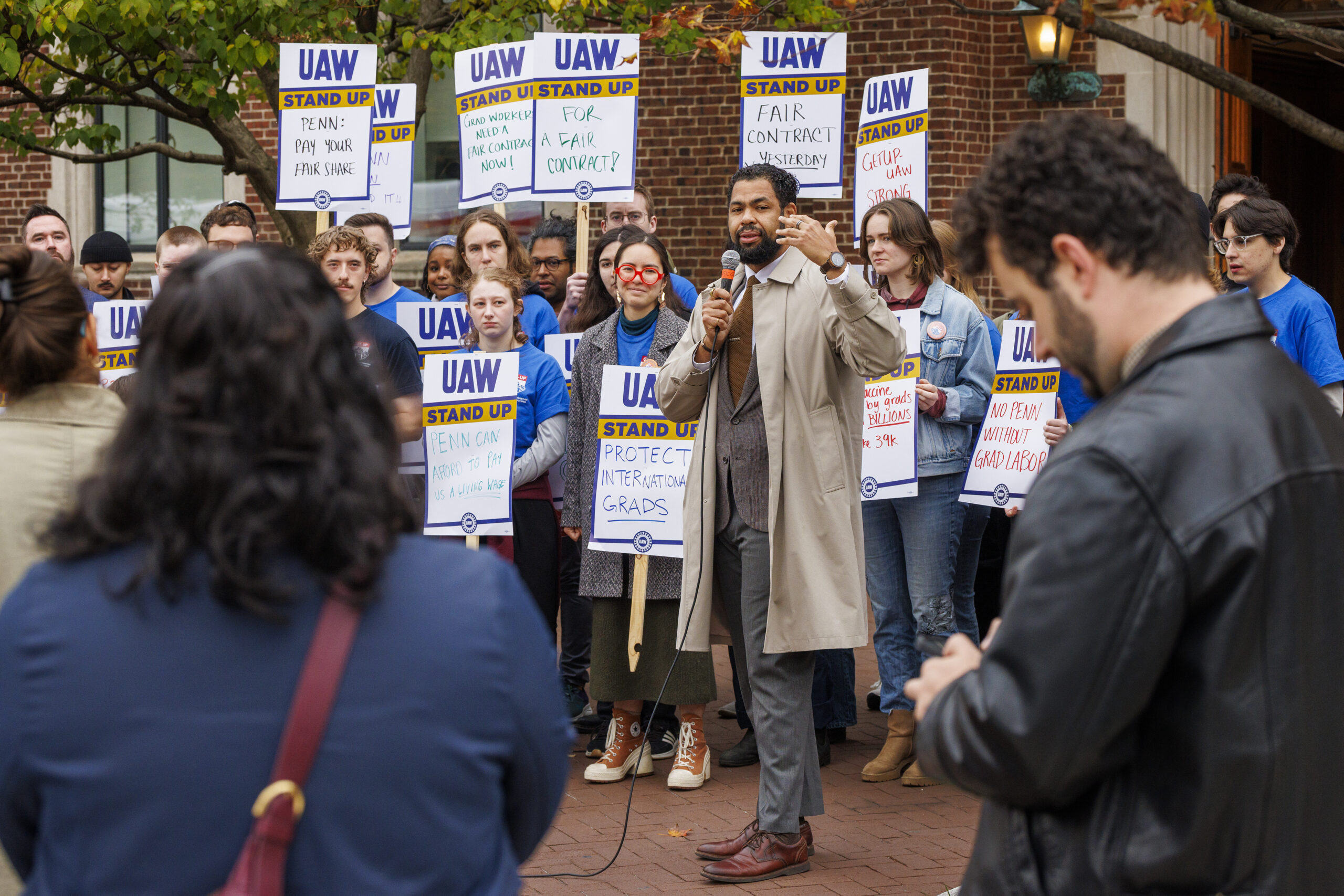
    Pennsylvania State Rep. Rick Krajewski making statements at a news conference and rally by University of Pennsylvania graduate students. Grad students held the event to call for a strike vote against the university at corner of South 34th and Walnut Streets on Nov. 3, 2025.

    Meanwhile, other candidates in the wide-open Democratic primary have tried to pick off progressive support.

    State Sen. Sharif Street, the former chair of the state Democratic Party, is seen as the establishment’s pick for the seat. But he also has alliances with some of the city’s most progressive leaders.

    That includes a decades-long relationship with Councilmember Rue Landau, who often votes with Council’s progressive bloc and is the first openly LGBTQ person ever elected to Council. Two sources familiar with Landau’s thinking said she is strongly considering endorsing Street.

    Street has also worked closely on criminal justice reform matters with District Attorney Larry Krasner, perhaps the city’s most prominent elected progressive. He inherited some of Krasner’s political staff to manage his campaign.

    However, several other candidates in the congressional race could be in the running for backing from Krasner, who recently won his third term in office in landslide fashion. Rabb, Street, and State Rep. Morgan Cephas previously endorsed Krasner for reelection.

    State Rep. Chris Rabb (left), Helen Gym (center), and District Attorney Larry Krasner attend the election results watch party for Working Families Party candidates Kendra Brooks and Nicolas O’Rourke in North Philadelphia on Nov. 5, 2019.

    The crowded field may also mean that some elected officials choose not to get involved.

    State Rep. Tarik Khan, a Democrat and nurse practitioner who has been backed by progressive organizations, said he has relationships with several leading candidates. That includes his colleagues in Harrisburg, as well as Ala Stanford, a surgeon. She and Khan were both prominent vaccine advocates during the COVID-19 pandemic.

    “There’s a lot of good choices in this race,” Khan said. “I’m probably just going to let the process play out.”

  • Mayor Parker touted her accomplishments and outlined a plan for homelessness during her State of the City speech

    Mayor Parker touted her accomplishments and outlined a plan for homelessness during her State of the City speech

    Mayor Cherelle L. Parker marked the halfway point of her term as mayor Friday by portraying the city as safer and more stable than when she took office two years ago, pointing to metrics like the plummeting homicide rate and cleaner streets.

    During her second end-of-year State of the City speech, Parker also briefly acknowledged challenges she faced this past year, including the eight-day city worker strike and a spat with City Council over her signature housing plan.

    And she outlined a plan to address rising street homelessness heading into 2026, when the city will host several major events expected to draw more than a million visitors.

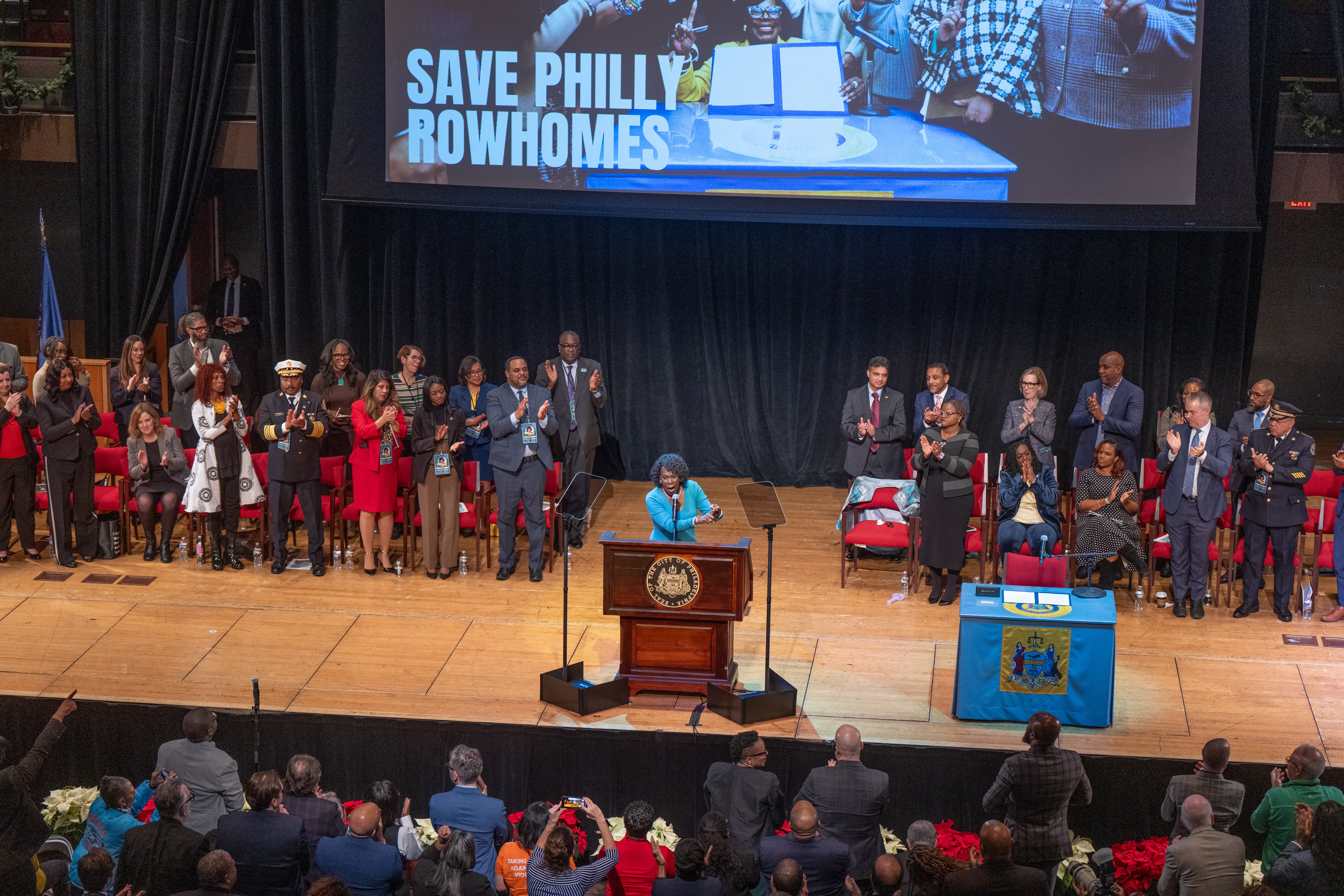
    Parker outlined a plan to address rising street homelessness heading into 2026, when the city will host several major events expected to draw millions of visitors, during her end-of-year speech at Temple University Friday.

    “I am here today to proudly report to all of you,” she said, “that the state of our city is strong and good, and we are moving in the right direction.”

    Parker’s announcement to add 1,000 shelter slots to the city’s system was a stark reminder that — despite progress on public safety and a coming year ripe with opportunity for tourism and growth — some of the city’s longest-term challenges remain unresolved.

    Even as Philadelphia this year shed its long-held title as the “poorest big city in America,” the number of unsheltered people increased by 20% compared to last. While shootings have reached 50-year lows, the open-air drug market that has long plagued Kensington persists.

    And after the mayor this year unveiled a long-awaited plan to build thousands of units of housing in the city, she hit roadblocks in City Council, where members rejected her vision to bolster the middle class in favor of a plan that prioritizes the poorest Philadelphians.

    Still, Parker and members of her administration struck an optimistic tone Friday. During the highly produced event, top officials repeatedly proclaimed that the “state of the city” is strong, and they thanked municipal employees in attendance, like police officers and sanitation workers.

    Parker’s State of the City address last year was Philadelphia’s first. Traditionally, the mayor’s March budget address to Council was seen as the city’s version of the presidential State of the Union speech in Congress. Parker plans to make the December event an annual tradition as well.

    Here are three takeaways from Parker’s speech Friday in North Philadelphia:

    A homelessness plan is in the works for 2026

    In the middle of her speech, Parker signed an executive order on stage, directing city departments to add 1,000 new beds to the existing shelter system by Jan. 31. That would represent a 35% increase in the number of beds citywide.

    The move comes as city data shows homelessness in the city is rising. There were 1,178 unsheltered people in Philadelphia this year, a 20% increase over last year and the highest number recorded since at least 2018, according to city data.

    In total, 5,516 people were considered homeless, a number that includes people who live in emergency shelters, are couch surfing, or otherwise lack an adequate nighttime residence. That number is up slightly from 5,191 last year.

    Parker’s executive order directs city agencies to increase outreach efforts to people living on the streets and to collaborate with the Philadelphia Housing Authority to move people from shelters to more stable housing.

    “We are seeking long-term solutions,” she said, “Solutions that will not only provide an expanded quality shelter system, but with more beds in safe, clean, and welcoming environments.”

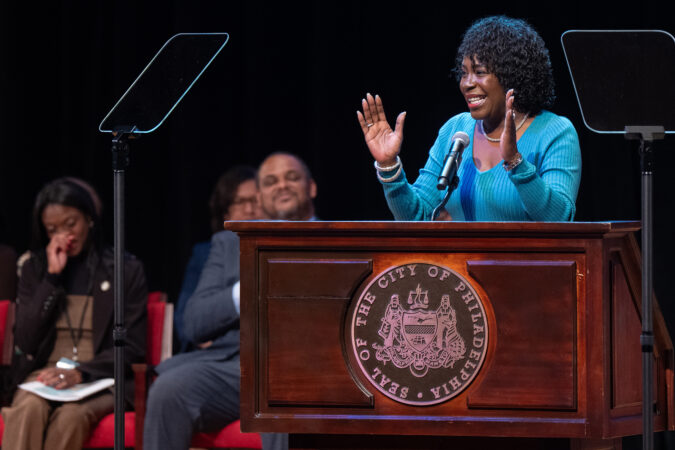
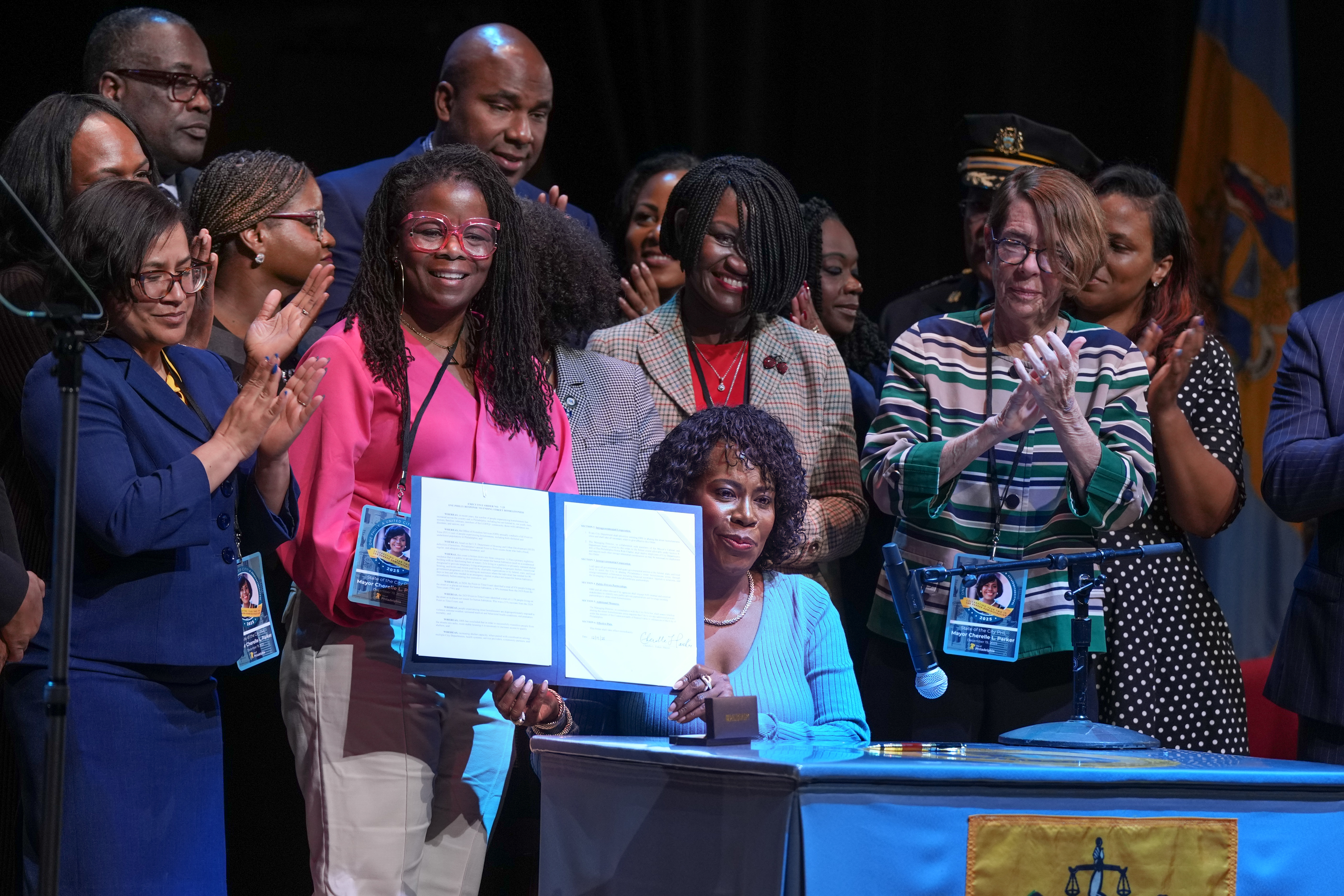
    Philadelphia Mayor Cherelle L. Parker holds up executive order ending street homelessness.

    30,000-unit housing plan swells to 50,000

    The mayor’s second year in office was in part defined by her plan to build, repair, or preserve 30,000 units of housing. In March, she unveiled her Housing Opportunities Made Easy, or H.O.M.E., plan, funded by $800 million in bonds.

    Parker made clear that her plan would be aimed at uplifting the middle class and often vowed never to pit “the have-nots against the have-a-little-bits.” But City Council this month advanced its own version of the proposal, rejecting Parker’s vision and directing more resources to the poorest Philadelphians.

    It was the most significant break between Parker and the legislative branch of her tenure. But the mayor on Friday defended her strategy, saying the middle class should not be asked to wait for access to housing programs.

    “You want me to tell you why we shouldn’t tell them to wait?” she said. “Because when I knocked on their doors and asked for their votes — and we’re running for reelection — we don’t ask them to wait.”

    Of Council’s 17 members, just four attended Parker’s speech Friday: Anthony Phillips, a close ally, as well as Rue Landau, Jamie Gauthier, and Nicolas O’Rourke — three progressives who led the effort to amend her housing plan. They sat in the front row.

    Parker struck a conciliatory tone, saying: “We will work together to press forward together, and we won’t let petty politics get in the way of us moving Philadelphia forward.”

    The mayor also made clear Friday that her 30,000-unit benchmark is separate from a plan being advanced by the Philadelphia Housing Authority, which is pursuing an ambitious expansion plan that Parker said would add an additional 20,000 units of affordable housing.

    “When you add our H.O.M.E. goal of 30,000 units with that 20,000, those are 50,000 units of housing,” Parker said, “and we shouldn’t have to leave any neighborhood behind.”

    Parker acknowledges city worker strike

    The most dramatic moment of Parker’s second year was undoubtedly the eight-day-and-four-hour city worker strike, Philadelphia’s first major municipal work stoppage in four decades.

    On Friday, Parker touted her administration’s work negotiating new contracts this year for almost all of the city’s major municipal unions. She acknowledged, but didn’t dwell on, the strike by the American Federation of State, County and Municipal Employees District Council 33.

    “We did have to endure an eight-day work stoppage,” she said. “But guess what we did? In true Philadelphia fashion … we got through it. It wasn’t easy, but we persevered together, and we found common ground, and we reached a fair and fiscally responsible agreement with both District Council 33 and District Council 47.”

    DC 33, the largest and lowest-paid union for city workers, called the strike when their previous contract expired at 12:01 a.m. July 1, the first minute the union was legally allowed to walk off the job. Union president Greg Boulware promised his members wouldn’t return to work unless they won raises of 5% per year.

    Over the next week, “Parker piles” of trash mounted across the city, and tensions mounted at picket lines. But Parker refused to budge.

    Boulware eventually called off the strike and accepted a contract with raises of 3% per year, which is close to Parker’s last offer before the strike. The deal also included $1,500 onetime bonuses for the union’s roughly 9,000 members and the addition of a fifth step in the DC 33 pay scale, a benefit for veteran employees.

    Parker also defended the city’s treatment of DC 33 under her tenure. Repeating an administration talking point from the strike, Parker noted that the union’s accumulated pay increases — combining raises the union won in a one-year contract during Parker’s first year with the increases included in the new three-year deal — will be higher in her first term than under any other mayoral term since the 1990s.

    “Just for the record, I also need to affirm — because sometimes people [create] revisionist history — I want to be clear that they were historic pay increases for our city workers,” Parker said. “It’s the largest in one term from any Philadelphia mayor over 30 years.”

  • Restrictions on Kensington outreach services take effect as City Council approves a broader ban

    Restrictions on Kensington outreach services take effect as City Council approves a broader ban

    Philadelphia lawmakers voted Thursday to ban mobile outreach groups that provide medical care and support services to people in addiction across a swath of Kensington, the epicenter of the city’s drug crisis.

    The vote came just days after the city began enforcing controversial new regulations in a different part of the neighborhood, where the same providers may operate only if they have a permit to do so and park in areas designated by the city.

    Taken together, the actions spearheaded by City Council members who represent Kensington and Mayor Cherelle L. Parker’s administration amount to a major shift in how transient people who use drugs obtain medical care and basic needs like food, water, and clothing.

    Many have long relied on mobile outreach services that met them on the street. Those same providers can now park only in designated areas or serve people for limited amounts of time.

    Council members who support the legislation say residents in the neighborhood do not want people in addiction lining up for medical care or support services near their homes.

    Councilmember Mike Driscoll authored the bill banning mobile service providers entirely from his 6th District, which includes parts of the neighborhood that are northeast of the infamous open-air drug market at the intersection of Kensington and Allegheny Avenues.

    Driscoll said his bill, which passed Council 14-3 on Thursday, is not aimed at punishing providers. He said he is open to finding a location in his district where they can operate with the city’s permission.

    “I just don’t want the service providers picking where they want to go at the expense of the kids and the neighbors,” he said.

    Councilmember Michael Driscoll in chambers as City Council meets Thursday, Dec. 11, 2025, on the last day of the 2025 session.

    But advocates for people who use drugs slammed the bill, and said reducing access to care will not help people in addiction.

    “Restrictions like these will not end the opioid crisis. They will not make anyone in Kensington or District 6 safer,” said Katie Glick, a nurse who treats people in addiction and lives in the neighborhood. “These restrictions will disable and kill people.”

    In Kensington, inconsistent rules for providers

    If Parker — who has never issued a veto — signs Driscoll’s bill, it would result in a patchwork of rules for mobile service providers in Kensington, which is represented by three different Council members.

    The western side of Kensington is in the 7th District, where Councilmember Quetcy Lozada’s legislation that required the permitting system applies. Organizations that do everything from handing out water to providing medical care now face a $1,000 fine for operating without a permit.

    The city began enforcing those new rules on Dec. 1. No citations had been issued as of Wednesday, police said.

    In the southern parts of Kensington that fall in the 1st District, represented by Councilmember Mark Squilla, no legislation applies to mobile providers.

    (function() {
    var l2 = function() {
    new pym.Parent(‘kensington_districts’,
    ‘https://media.inquirer.com/storage/inquirer/projects/innovation/arcgis_iframe/kensington_districts.html’);
    };
    if (typeof(pym) === ‘undefined’) {
    var h = document.getElementsByTagName(‘head’)[0],
    s = document.createElement(‘script’);
    s.type = ‘text/javascript’;
    s.src = ‘https://pym.nprapps.org/pym.v1.min.js’;
    s.onload = l2;
    h.appendChild(s);
    } else {
    l2();
    }
    })();

    The inconsistency is the result of councilmanic prerogative, the unwritten rule that gives Council members who represent geographic areas a large amount of sway over what happens in their districts. Lawmakers largely approve legislation offered by a district Council member when it affects only that member’s district.

    Some of Council’s progressive members who represent the city at-large have bucked that practice several times on matters related to Kensington, where Parker and her allies in Council have placed an intense focus on improving quality of life.

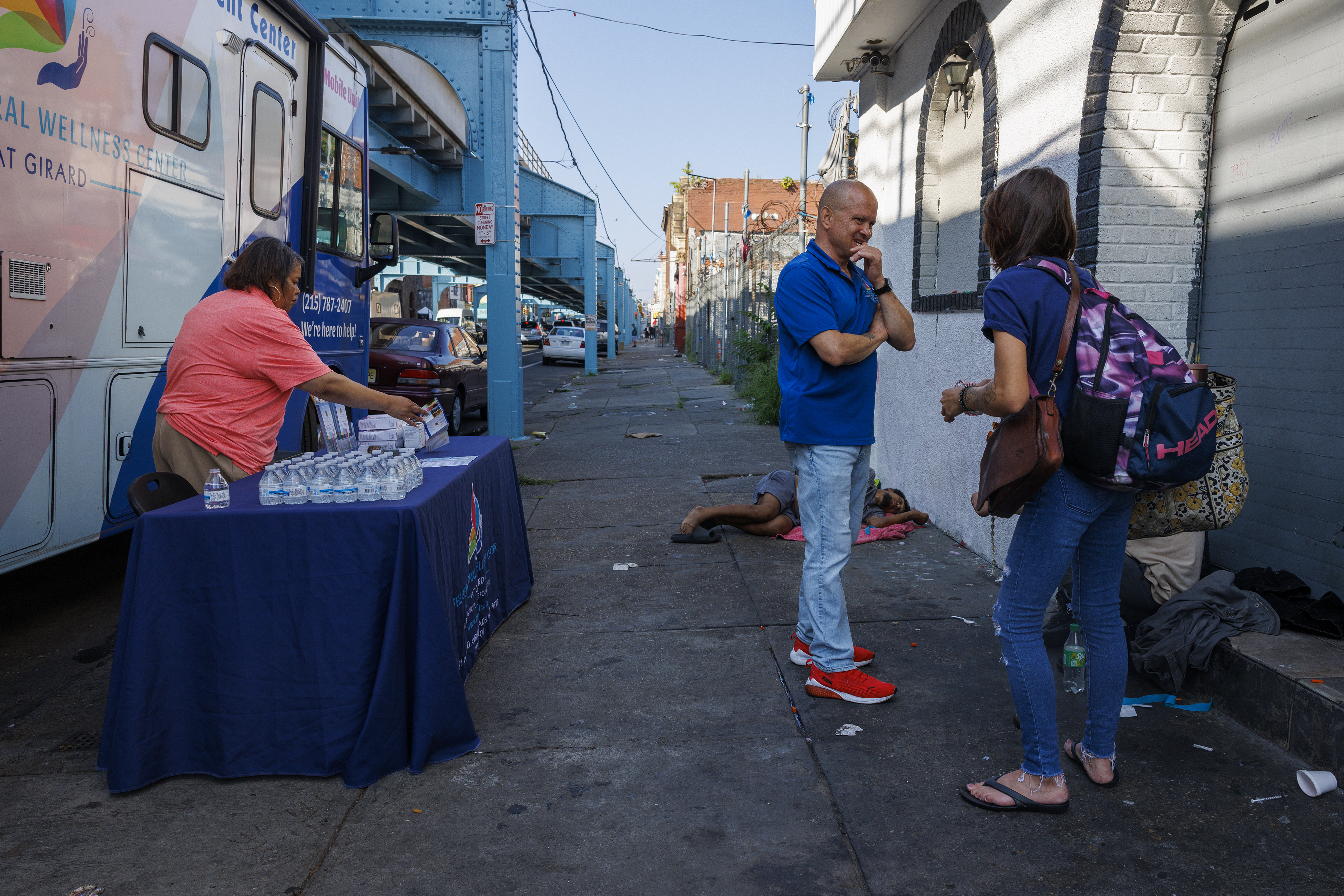
    In this 2023 file photo, the mobile home belonging to the Behavioral Wellness Center at Girard parked along Kensington Avenue. It is one of the city’s so-called mobile service providers that have faced increasing regulation from City Council.

    The progressives — who favor an approach to the crisis called harm reduction that aims to keep people alive until they are ready to enter treatment — argue that placing restrictions on mobile service providers will make it harder for them to reach vulnerable people in addiction and ultimately reduce the number of providers on the street.

    “When human beings are trying to provide help,” said Councilmember Nicolas O’Rourke, “the attitude should never be ‘how can we limit them.’”

    O’Rourke and Councilmember Kendra Brooks, both of the Working Families Party, and Democrat Rue Landau voted against Driscoll’s measure.

    But Lozada said implementing new regulations was not about restricting care.

    “We’re hoping that services continue,” she said. “People have just moved to other spaces to find a way to be able to continue to provide the services that people need.”

    And Parker administration officials said the goal is not to reduce the number of providers, but to better coordinate them and ensure safety, especially for people receiving medical services.

    Councilmember Quetcy Lozada in chambers as City Council meets Thursday, Dec. 11, 2025, on the last day of the 2025 session.

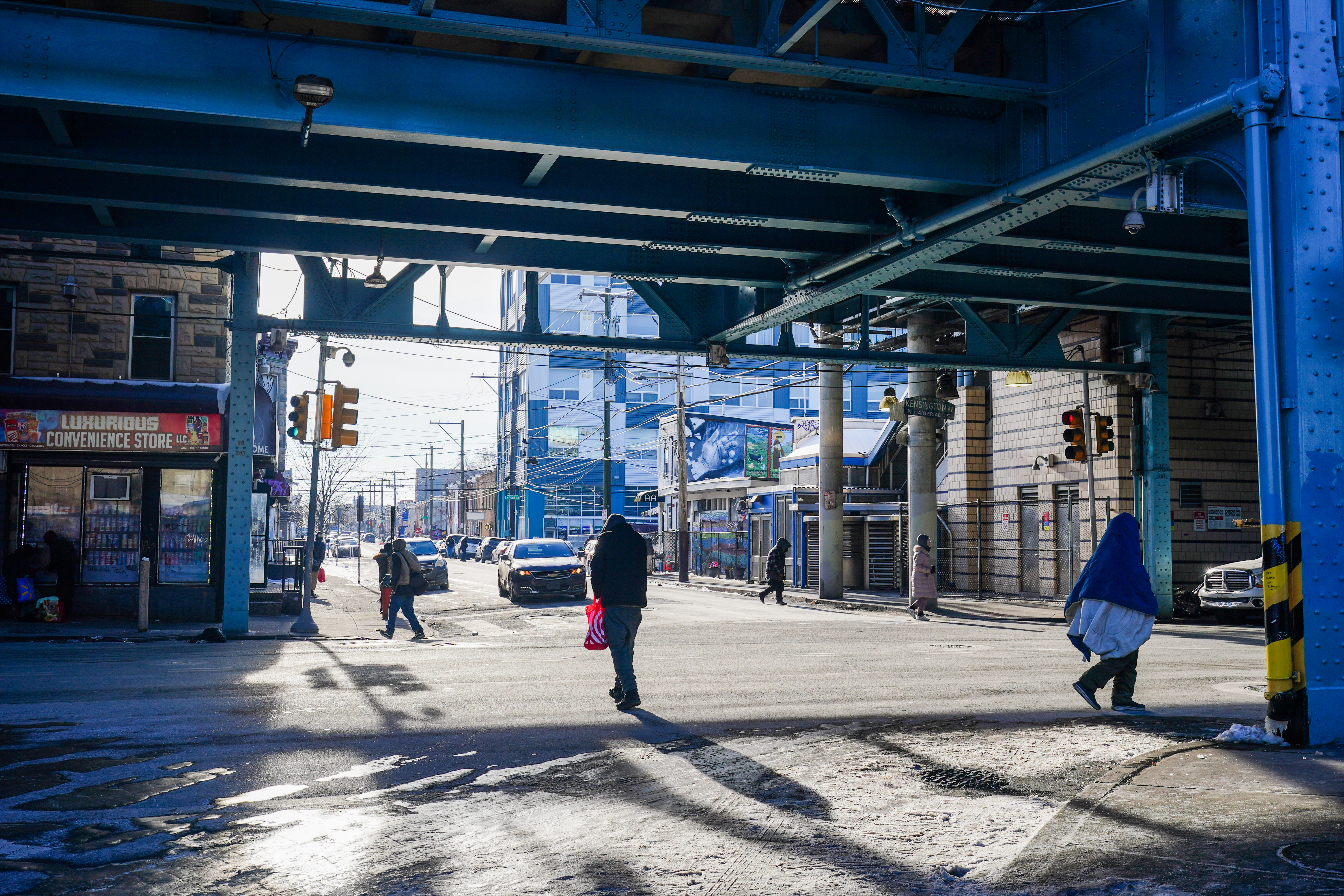
    Kensington has been a key issue for the Parker administration and Council members who have pushed for more law enforcement in the neighborhood, where sprawling homelessness, open drug use, and violent crime have been commonplace for years. There have been some signs of progress, including a reduction in the number of people living on the street.

    The city has tried new tactics, including opening its own recovery house and expanding police foot patrols. The local government has also at times operated its own mobile medical services and contracts with organizations that do so.

    So far, the city has issued nine permits to providers who perform mobile medical services and 40 to organizations considered “nonmedical,” like those that distribute food. Some of those organizations also operate in other neighborhoods.

    “We don’t have a problem if there’s five or 500 providers,” said Crystal Yates-Gale, deputy managing director for health and human services. “As long as they’re qualified to provide the care, and as long as we can help coordinate the care.”

    Despite the changes, city says ‘people are still coming’

    Under the new rules, nonmedical providers are prohibited from staying in one place for more than 45 minutes. Medical providers can station on a two-block stretch of Allegheny Avenue at nighttime or at a designated parking lot at 265 E. Lehigh Ave. during the day.

    That lot, which is managed by the city and addiction service provider Merakey, is connected to the city’s Wellness Support Center.

    Inside, people can access first aid, showers, and food, as well as get directed to treatment, legal aid, housing assistance, and other services.

    People walk near Kensington Ave. in January 2025.

    In the parking lot, two mobile medical service providers run by Merakey and Kensington Hospital are currently stationed, according to Kurt August, executive director of the Philadelphia Office of Public Safety’s Criminal Justice Division. He said officials are looking to expand the number of providers that operate there.

    In late October, Merakey began dispensing methadone out of an RV parked in the lot. The tightly regulated opioid medication is a popular treatment for people experiencing withdrawal because it helps stave off cravings.

    Raymond Bobb, a medical director at Merakey, said he has seen promising results in just a few weeks, including starting people on methadone and getting them stable enough to transition to inpatient drug treatment. Merakey offers to transport people on the street to the RV to enroll them in medication-assisted treatment.

    “We’ve been able to take everything right to the heart of the epidemic and engage people the way you would treat your brother, or your sister, or your family,” said Bobb, who is also in recovery and became emotional when speaking about the program.

    “Our goal,” he added, “is to build people up and motivate them to want treatment for themselves.”

    August said retention has been high, despite the police presence at the support center. The officers, he said, were “handpicked” to be stationed alongside behavioral health professionals.

    “It’s not a secret that police are on site, and people are still coming,” August said.

    Still, other providers have expressed concern that requiring people to travel to the lot adds an additional barrier to care, especially for those who were used to mobile services coming to them.

    Sarah Laurel, who runs the addiction outreach program Savage Sisters and has a nonmedical permit, said she fears that providers who offered medication-assisted treatment on the street will now be less accessible.

    However, she said, some clients greeted the news of service limits with a shrug.

    “The friends we serve are so used to not being heard that when they realize that services are going away, they adjust quickly to not having things,” Laurel said. “They just say, ‘No one cares about us. They hate us anyway.’ That is how people feel seen in this city.”

    Staff writer Ellie Rushing contributed to this article.

  • Philly expands outdoor dining and cracks down on ‘reservation scalpers’ ahead of expected 2026 tourism

    Philly expands outdoor dining and cracks down on ‘reservation scalpers’ ahead of expected 2026 tourism

    Philadelphia lawmakers on Thursday approved two changes to city law that are aimed at boosting business for restaurants and the hospitality sector ahead of an expected influx of tourists visiting the city next year.

    During its final meeting of the year, City Council voted to approve legislation to expand outdoor dining in the city by easing the permitting process in a handful of commercial corridors.

    Legislators also voted to ban so-called reservation scalpers, which are third-party businesses that allow people to secure tables and then resell them without authorization from the restaurant.

    Both measures passed Council unanimously and were championed by advocates for the restaurant industry, who lobbied lawmakers to ease burdens on the tourism and hospitality industry ahead of several large-scale events in the city next year, including celebrations for America’s Semiquincentennial, when Philadelphia is expected to host a flurry of visitors.

    They both now head to the desk of Mayor Cherelle L. Parker, who has never issued a veto.

    The outdoor dining legislation, authored by Councilmember Rue Landau, a Democrat who represents the city at-large, expands the number of so-called by-right zones, where businesses can have sidewalk cafes without having to obtain a special zoning ordinance.

    Currently, by-right areas are only in Center City and a few commercial corridors in other neighborhoods. Restaurants outside those areas must undertake a sometimes lengthy process to get permission to place tables and chairs outside.

    The expanded zones, which were chosen by individual Council members who represent the city’s 10 geographic districts, include corridors in Manayunk and on parts of Washington Avenue, Passyunk Avenue, and Point Breeze Avenue in South Philadelphia.

    The legislation also includes all of the West Philadelphia-based Third District, which is represented by Jamie Gauthier, the only Council member who chose to include her entire district in the expansion.

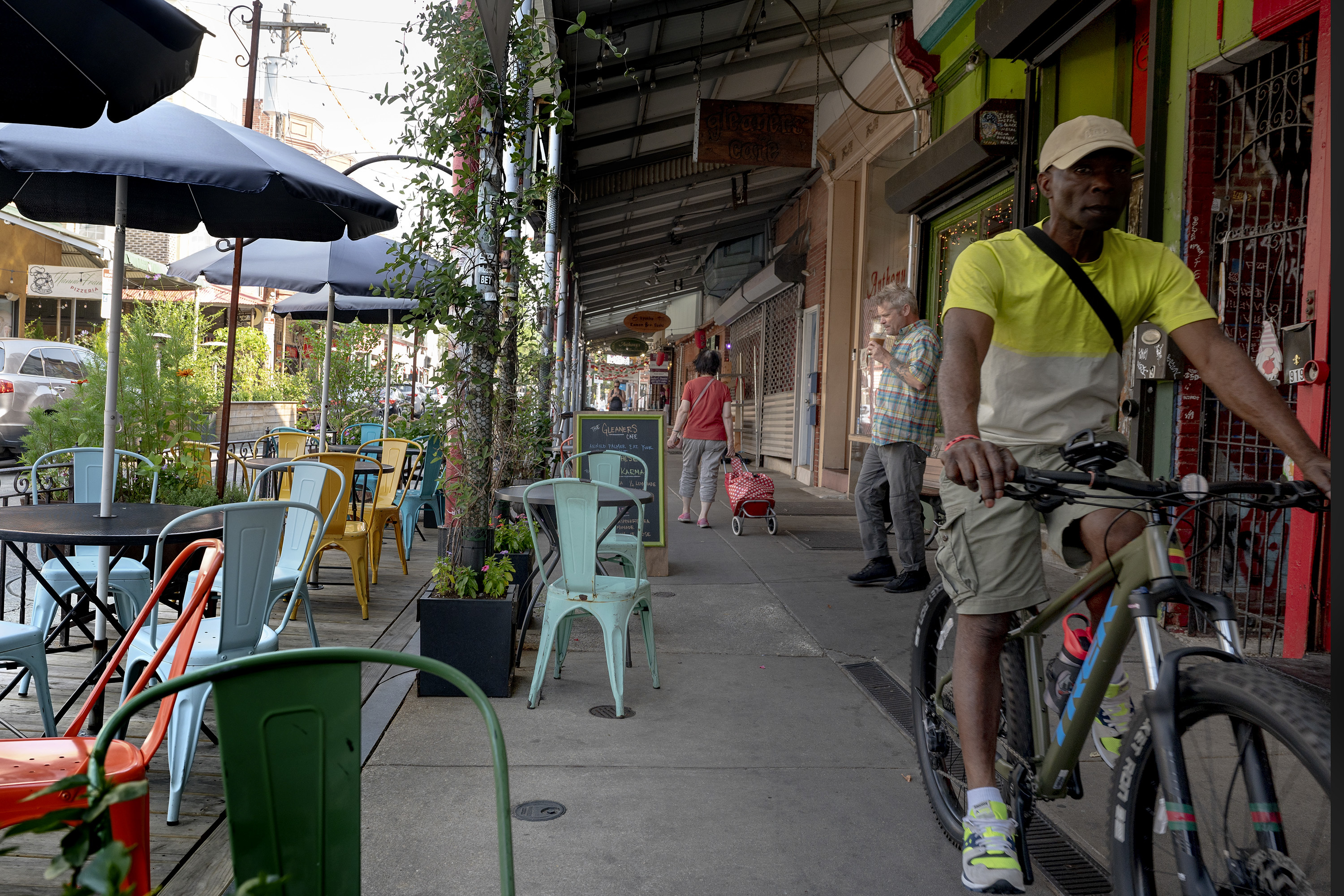
    The cafe area on the sidewalk outside of Gleaner’s Cafe in the 9th Street Market on Thursday, July 27, 2023.

    Nicholas Ducos, who owns Mural City Cellars in Fishtown, said he has been working for more than a year to get permission to place four picnic tables outside his winery. He said he has had to jump through hoops including working with multiple agencies, spending $1,500 to hire an architect, and even having to provide paperwork to the city on a CD-ROM.

    “There are a lot of difficult things about running a business in Philadelphia,” Ducos said. “This should not be one.”

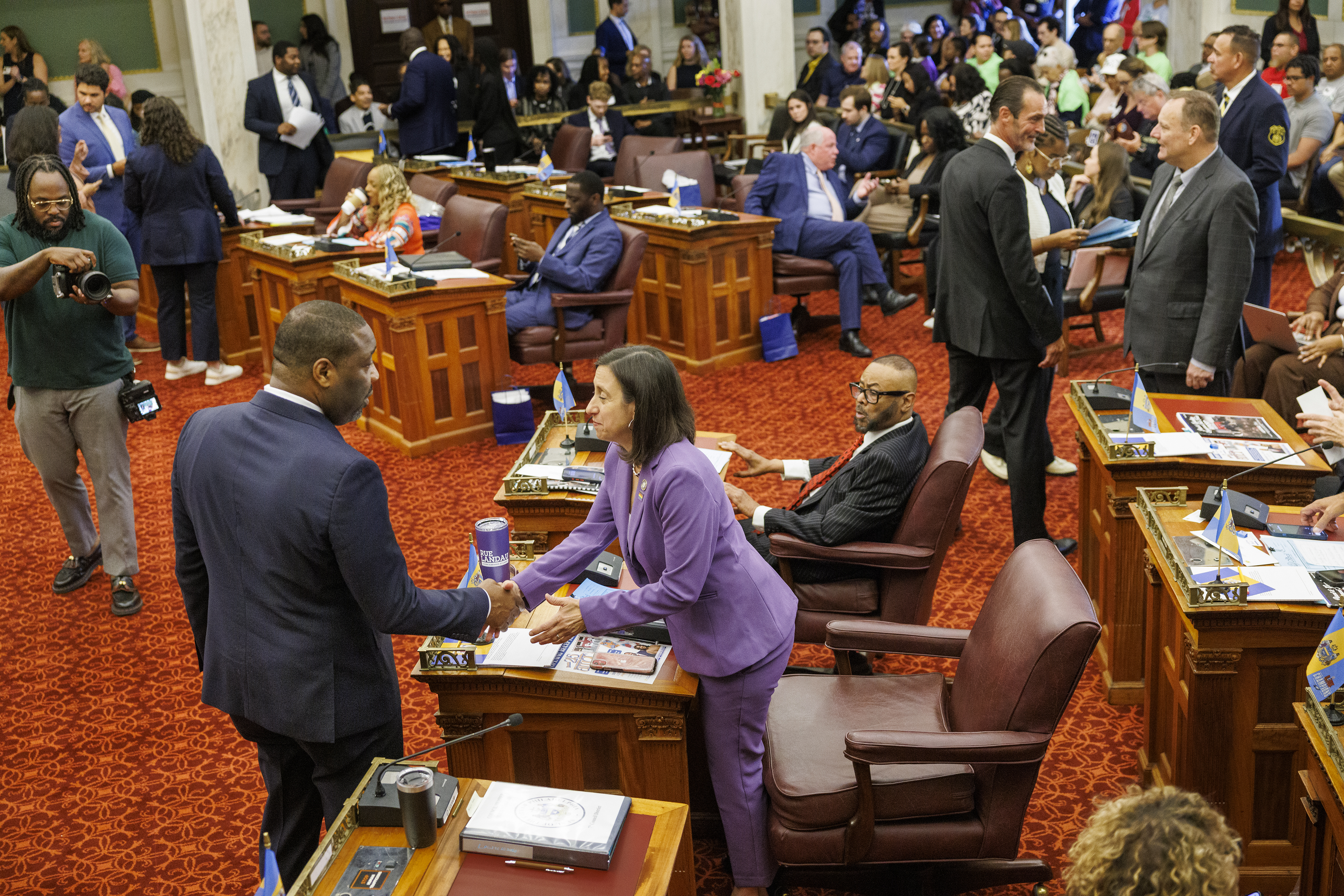
    At left is Philadelphia Council President Kenyatta Johnson greeting Rue Landau and other returning members of council on their first day of fall session, City Hall, Thursday, September 11, 2025.

    Council members also approved the reservation scalping legislation authored by Councilmember Isaiah Thomas, a Democrat who represents the city at-large. He has said the bill is modeled after a similar law in New York and is not aimed at popular apps and websites like OpenTable, Resy, and Tock that partner directly with restaurants.

    Instead, it is a crackdown on websites that don’t work with restaurants, such as AppointmentTrader.com, which provides a platform for people to sell reservations and tickets to events.

    Jonas Frey, the founder of AppointmentTrader.com, previously said the legislation needlessly targets his platform. He said his company put safeguards in place to prevent scalping, including shutting down accounts if more than half of their reservations go unsold.

    But Thomas has cast the website and similar platforms as “predatory” because restaurants can end up saddled with empty tables if the reservations do not resell.

    Zak Pyzik, senior director of public affairs at the Pennsylvania Restaurant and Lodging Association, said the legislation is an important safeguard for restaurants.

    “This bill provides clear, sensible protections that will keep restaurants in the driver’s seat,” he said, “and in control of their business and their technology services.”

  • As Philadelphia’s Riverview recovery house expands, residents describe a ‘whole new life’ away from Kensington

    As Philadelphia’s Riverview recovery house expands, residents describe a ‘whole new life’ away from Kensington

    Kevin Bean was a frail 125 pounds last February when he entered a brand-new recovery house, a facility where he landed after spending four years in the throes of addiction — at times on the streets of Kensington, the epicenter of the city’s drug crisis.

    The Frankford native was one of the first residents to enter the Riverview Wellness Village, the 20-acre recovery facility that Mayor Cherelle L. Parker’s administration opened in Northeast Philadelphia nearly a year ago as part of City Hall’s efforts to address opioid addiction and the Kensington drug market.

    Bean, now 46 and boasting a healthier frame, just celebrated one year of sobriety and is preparing to move out of Riverview early next year.

    He described his transition simply: “whole new life.”

    Much of the mayor’s agenda in Kensington has been visible to the neighborhood’s residents, such as increased law enforcement and a reduction in the homeless population. But the operations and treatment outcomes at Riverview, located down a winding road next to the city’s jail complex, happen largely outside of public view. Last spring, some city lawmakers complained that even they knew little about the facility operations.

    An inside look at the Riverview complex and interviews with more than a dozen residents and employees showed that, over the last year, the city and its third-party healthcare providers have transformed the facility. What was recently a construction zone is now a one-stop health shop with about 75 staff and more than 200 residents, many of whom previously lived on Kensington streets.

    Those who live and work at Riverview said the facility is plugging a hole in the city’s substance use treatment landscape. For years, there have not been enough beds in programs that help people transition from hospital-style rehab into long-term stability. The recovery house industry has been plagued with privately run homes that are in poor condition or offer little support.

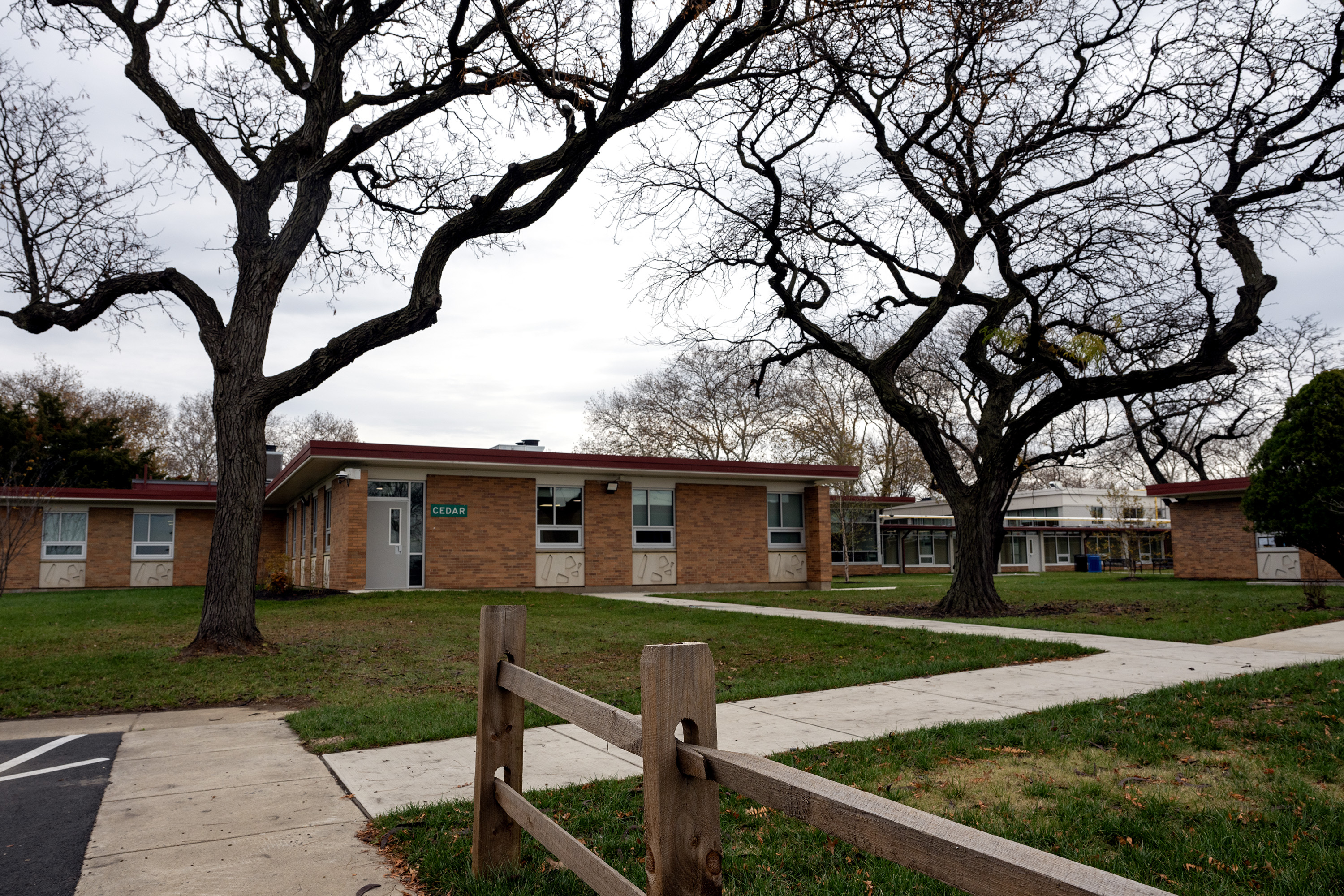
    The grounds and residence buildings at Riverview Wellness Village, a city-owned drug recovery home in Northeast Philadelphia.

    At its current capacity, Riverview has singularly increased the total number of recovery house beds in the city by nearly 50%. And residents — who are there voluntarily and may come and go as they please — have much of what they need on the campus: medical care, mental health treatment, job training, and group counseling.

    They also, as of last month, have access to medication-assisted treatment, which means residents in recovery no longer need to travel to specialized clinics to get a dose of methadone or other drugs that can prevent relapse.

    Arthur Fields, the regional executive director at Gaudenzia, which provides recovery services to more than 100 Riverview residents, said the upstart facility has become a desirable option for some of the city’s most vulnerable. Riverview officials said they aren’t aware of anywhere like it in the country.

    “The Riverview Wellness Village is proof of what’s possible,” Fields said, “when we work together as a community and move with urgency to help people rebuild their lives.”

    While the facility launched in January with much fanfare, it also faced skepticism, including from advocates who were troubled by its proximity to the jails and feared it would feel like incarceration, not treatment. And neighbors expressed concern that the new Holmesburg facility would bring problems long faced by Kensington residents, like open drug use and petty theft, to their front doors.

    But despite some tenets of the mayor’s broader Kensington plan still facing intense scrutiny, the vocal opposition to Riverview has largely quieted. Parker said in an interview that seeing the progress at Riverview and the health of its residents made enduring months of criticism “well worth it.”

    “I don’t know a Philadelphian who, in some way, shape, or form, hasn’t been touched by mental and behavioral health challenges or substance use disorder,” said Parker, who has spoken about how addiction shaped parts of her own upbringing. “To know that we created a path forward, to me, I’m extremely proud of this team.”

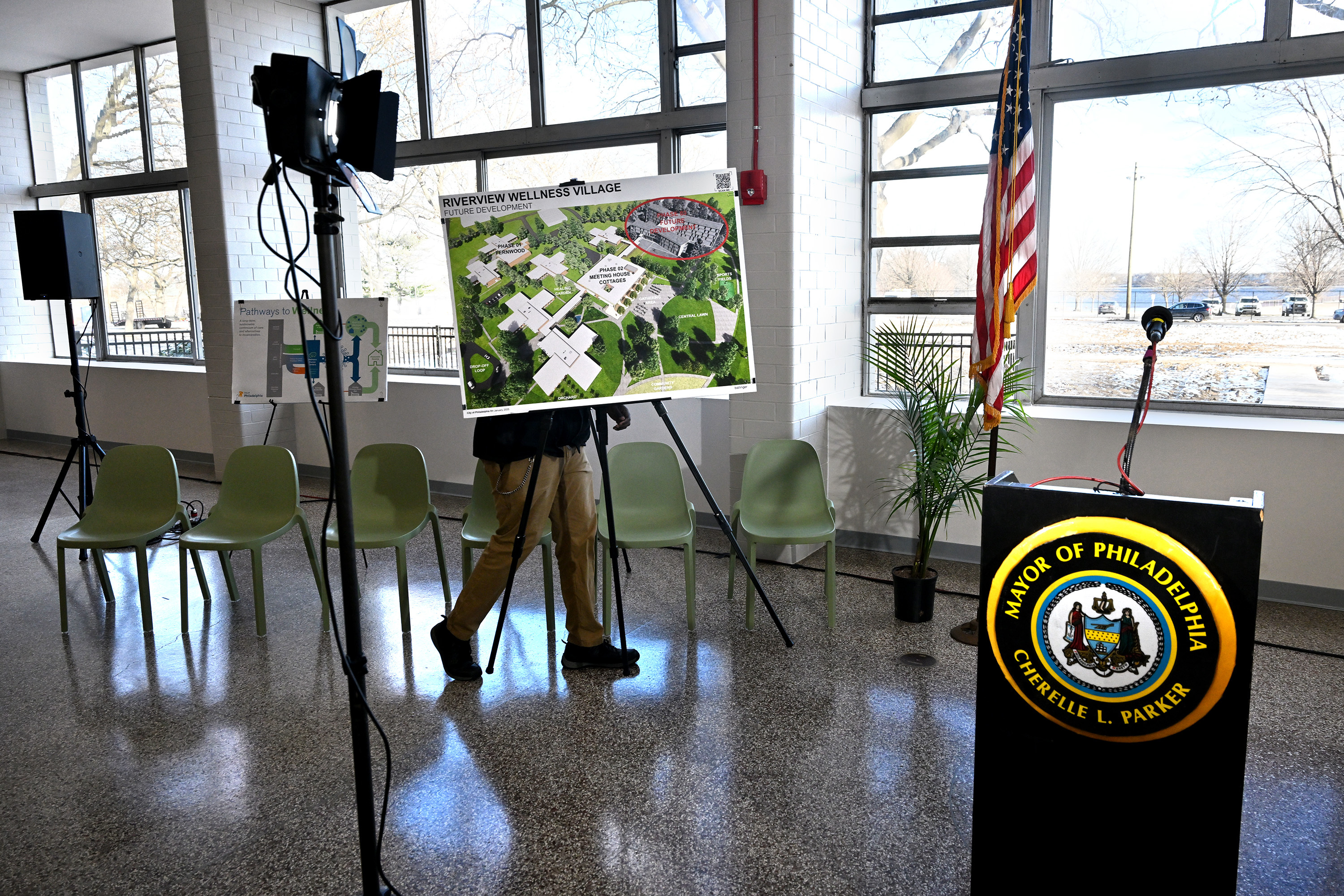
    Mayor Cherelle L. Parker places a new block on the scale model of the Riverview Wellness Village on Wednesday, Jan. 8 during the unveiling of Philadelphia’s new city-operated drug treatment facility. At left is Managing Director Adam Thiel. City Councilmember Michael Driscoll is at right.
    Isabel McDevitt, executive director of the Office of Community Wellness and Recovery, points to a model with upcoming expansion at Riverview Wellness Village, a city-owned drug recovery home in Northeast Philadelphia on Nov. 25.
    Staffers move photos into place at the Riverview Wellness Village on Jan. 8 before the unveiling of Philadelphia’s new city-operated drug treatment facility.

    Meanwhile, neighbors who live nearby say they have been pleasantly surprised. Pete Smith, a civic leader who sits on a council of community members who meet regularly with Riverview officials, said plainly: “There have been no issues.”

    “If it’s as successful as it looks like it’s going to be,” he said, “this facility could be a model for other cities throughout the country.”

    Smith, like many of his neighbors, wants the city’s project at Riverview to work because he knows the consequences if it doesn’t.

    His son, Francis Smith, died in September due to health complications from long-term drug use. He was 38, and he had three children.

    Getting a spot at Riverview

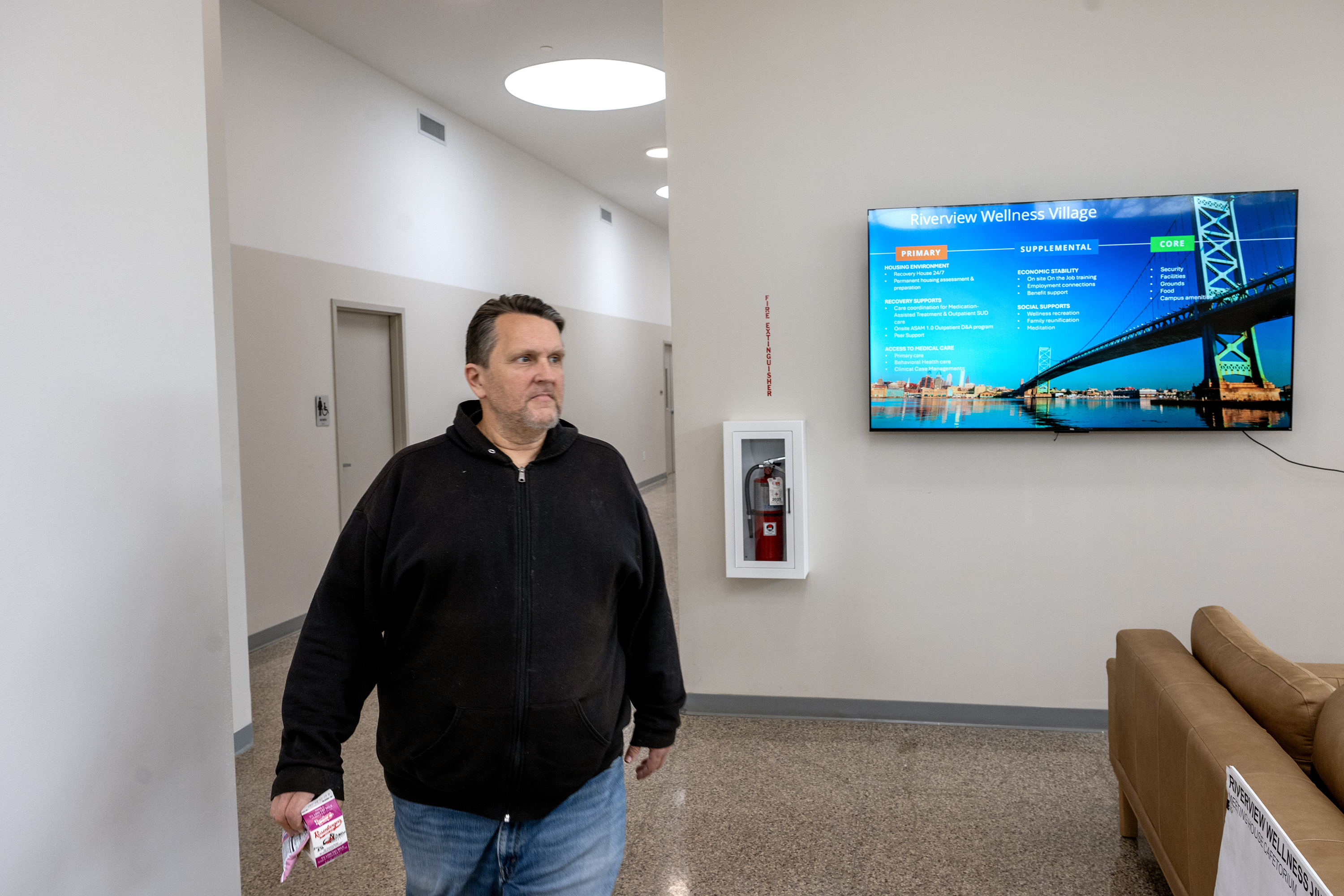
    The sprawling campus along the Delaware River feels more like a college dormitory setting than a hospital or homeless shelter. Its main building has a dining room, a commercial kitchen, a gym, and meditation rooms. There are green spaces, walking paths, and plans for massive murals on the interior walls.

    Katherine Young, director of Merakey at Riverview Wellness Village, talks with a resident at the city-owned drug recovery home in Northeast Philadelphia on Nov. 25.

    Residents live and spend much of their time in smaller buildings on the campus, where nearly 90% of the 234 licensed beds are occupied. The city plans to add 50 more in January.

    Their stays are funded through a variety of streams. The city allocated $400 million for five years of construction and operations, a portion of which is settlement dollars from lawsuits against pharmaceutical companies that manufactured the painkillers blamed for the opioid crisis.

    (function() {
    var l2 = function() {
    new pym.Parent(‘RIVERVIEW_MAP2.html’,
    ‘https://media.inquirer.com/storage/inquirer/projects/innovation/arcgis_iframe/RIVERVIEW_MAP2.html’);
    };
    if (typeof(pym) === ‘undefined’) {
    var h = document.getElementsByTagName(‘head’)[0],
    s = document.createElement(‘script’);
    s.type = ‘text/javascript’;
    s.src = ‘https://pym.nprapps.org/pym.v1.min.js’;
    s.onload = l2;
    h.appendChild(s);
    } else {
    l2();
    }
    })();

    To get in to Riverview, a person must complete at least 30 days of inpatient treatment at another, more intensive care facility.

    That is no small feat. There are significant barriers to entering and completing inpatient treatment, including what some advocates say is a dearth of options for people with severe health complications. Detoxification is painful, especially for people in withdrawal from the powerful substances in Kensington’s toxic drug supply.

    (function() { var l = function() { new pym.Parent( ‘riverview-flowchart__graphic’, ‘https://media.inquirer.com/storage/inquirer/ai2html/riverview-flowchart/index.html’); }; if(typeof(pym) === ‘undefined’) { var h = document.getElementsByTagName(‘head’)[0], s = document.createElement(‘script’); s.type = ‘text/javascript’; s.src = ‘https://pym.nprapps.org/pym.v1.min.js’; s.onload = l; h.appendChild(s); } else { l(); } })();

    Still, residents at Riverview have come from more than 25 different providers, according to Isabel McDevitt, the city’s executive director of community wellness and recovery. The bulk were treated at the Kirkbride Center in West Philadelphia, the Behavioral Wellness Center at Girard in North Philadelphia, or Eagleville Hospital in Montgomery County.

    They have ranged in age from 28 to 75. And they have complex medical needs: McDevitt said about half of Riverview’s residents have a mental health diagnosis in addition to substance use disorder.

    She said offering treatment for multiple health conditions in one place allows residents to focus less on logistics and more on staying healthy.

    “Many of the folks that are at Riverview have long histories of substance use disorder, long histories of homelessness,” she said. “So it’s really the first time a lot of people can actually breathe.”

    When new residents arrive, they go through an intake process at Riverview that includes acute medical care and an assessment for chronic conditions. Within their first week, every resident receives a total-body physical and a panel of blood work.

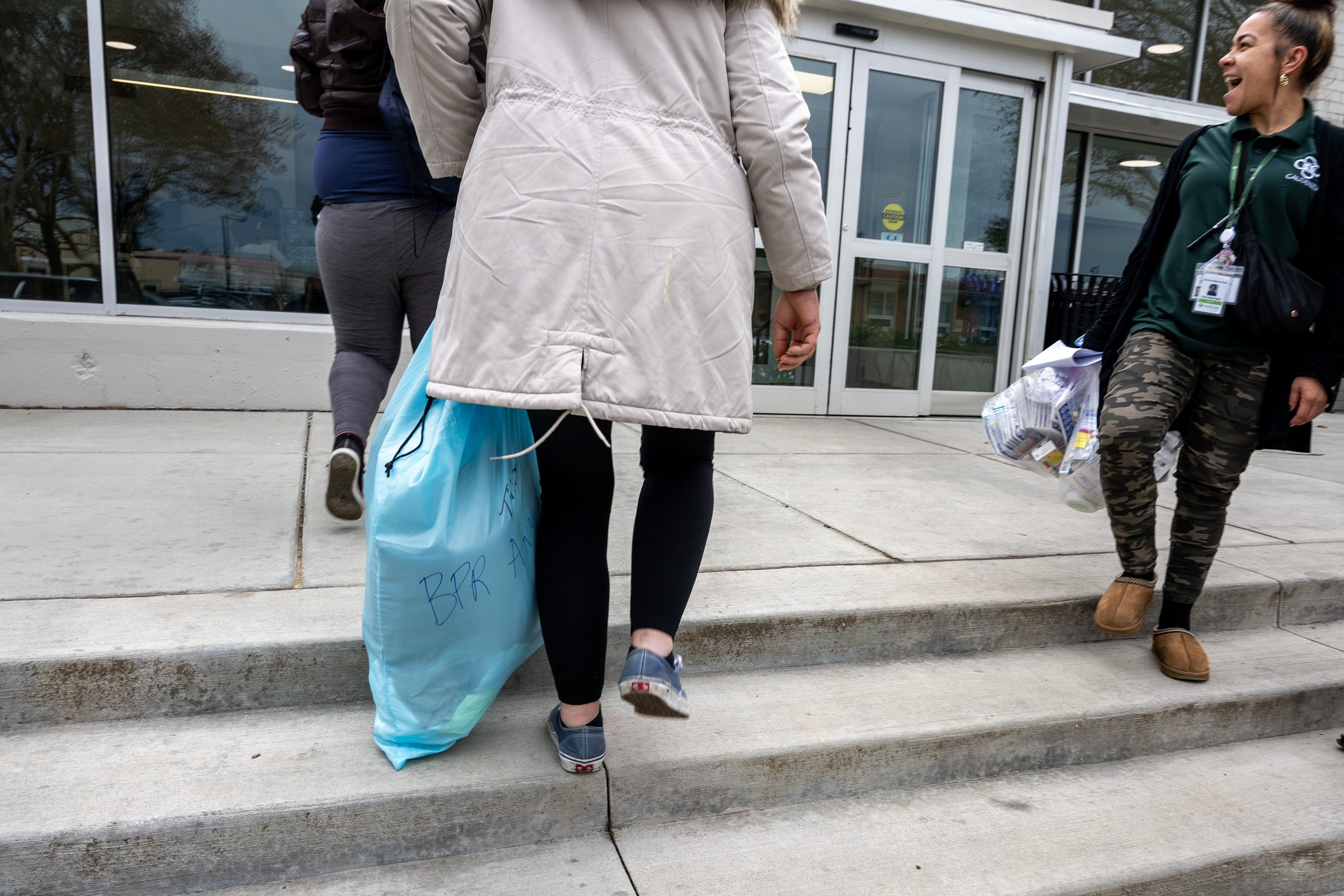
    “They literally arrive with all of their belongings in a plastic bag and their medications and some discharge paperwork,” said Ala Stanford, who leads the Black Doctors Consortium, which provides medical services at Riverview. “We are the ones who greet them and help get them acclimated.”

    Stanford — who this fall announced a run for Congress — said doctors and nurses at Riverview have diagnosed and treated conditions ranging from drug-related wounds to diabetes to pancreatic cancer. And patients with mental health needs are treated by providers from Warren E. Smith Health Centers, a 30-year-old organization based in North Philadelphia.

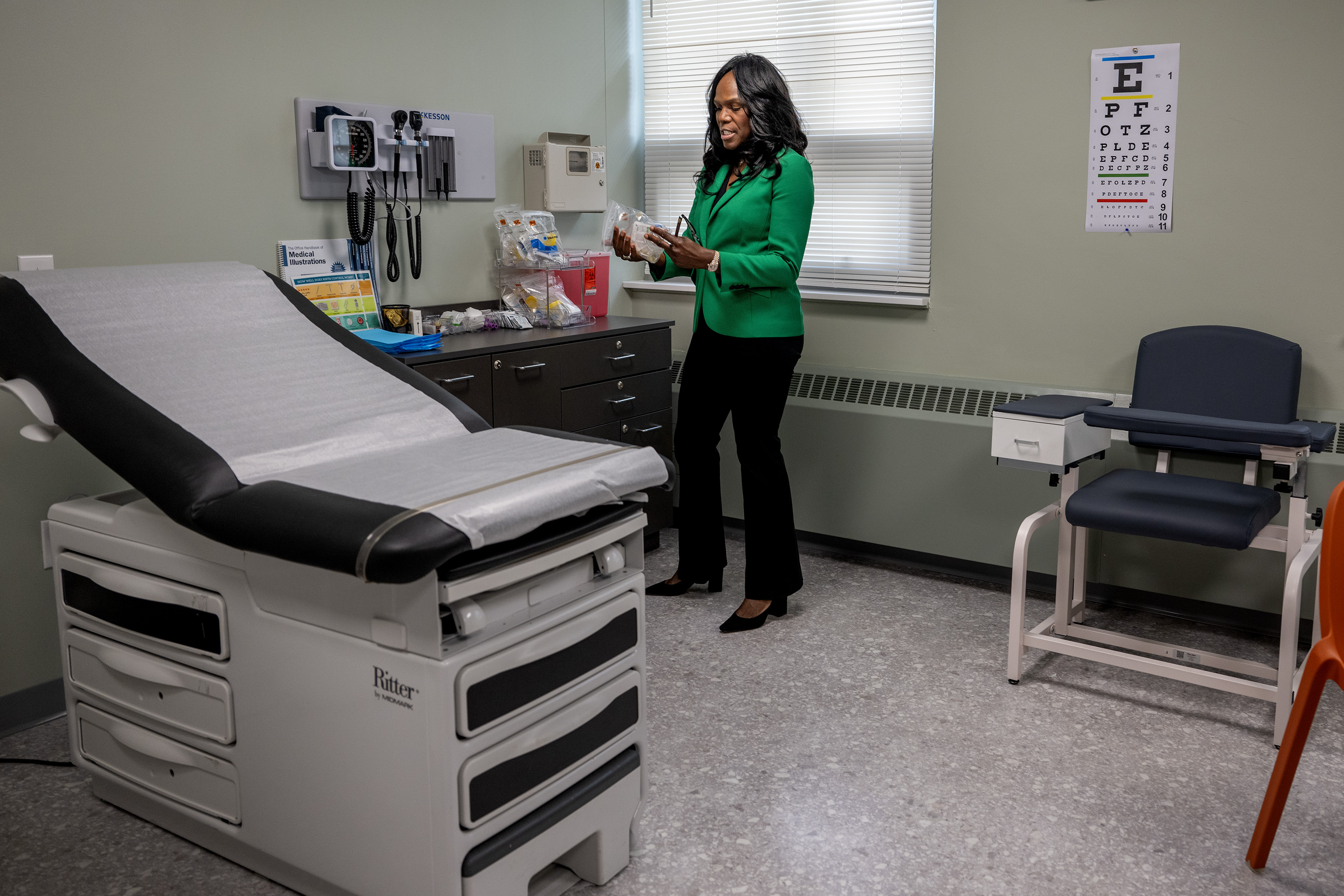
    Physician Ala Stanford in an examination room at the primary medical care center run by her Black Doctors Consortium at Riverview Wellness Village, a city-owned drug recovery home in Northeast Philadelphia, on Nov. 25.
    Francesca Colon (right), a recovery support professional with Gaudenzia, brings people in recovery to the main entrance of the Meetinghouse at Riverview Wellness Village on Nov. 25.

    Residents’ schedules are generally free-flowing and can vary depending on their wants and needs. About 20% have jobs outside the campus. Culinary arts training will be available in the next month or so. And residents can meet with visitors or leave to see family at any time.

    They also spend much of their time in treatment, including individual, family, and group therapy. On a recent day, there were group sessions available on trauma recovery, managing emotions, and “communicating with confidence.”

    Vernon Kostic, a 52-year-old Port Richmond native who said he has previously been homeless, has been in and out of drug treatment facilities for years.

    He said he’s been content as a Riverview resident since July, and called it “one of the smartest things that the city has ever done.”

    “We have the doctor’s office right over here,” he said. “They’ve got counseling right here. Everything we need. It’s like a one-stop recovery place.”

    Resident Vernon Kostic heads to a group meeting at Riverview Wellness Village on Nov. 25.
    The dining room and meeting room in the Meetinghouse at Riverview Wellness Village. At rear left is a brand-new, industrial, restaurant-quality kitchen that was not operational yet on Nov. 25.

    Finding ways to stay at Riverview

    Finding success in recovery is notoriously hard. Studies show that people who stay in structured sober housing for at least six months after completing rehab see better long-term outcomes, and Riverview residents may stay there for up to one year.

    But reaching that mark can take multiple tries, and some may never attain sobriety. McDevitt said that on a monthly basis, about 35 people move into Riverview, and 20 leave.

    Some who move out are reunited with family and want to live at home. Others simply were not ready for recovery, McDevitt said, “and that’s part of working with this population.”

    Fields said a resident who relapses can go back to a more intensive care setting for detoxification or withdrawal management, then return to Riverview at a later time if they are interested.

    “No one is punished for struggling,” he said. “Recovery is a journey. It takes time.”

    Providers are adding new programming they say will help residents extend their stays. Offering medication-assisted treatment is one of the most crucial parts, said Josh Vigderman, the senior executive director of substance use services at Merakey, one of the addiction treatment providers at Riverview.

    Entry to the primary medical care center run by the Black Doctors Consortium at Riverview Wellness Village.
    The main entry Meetinghouse at Riverview Wellness Village.
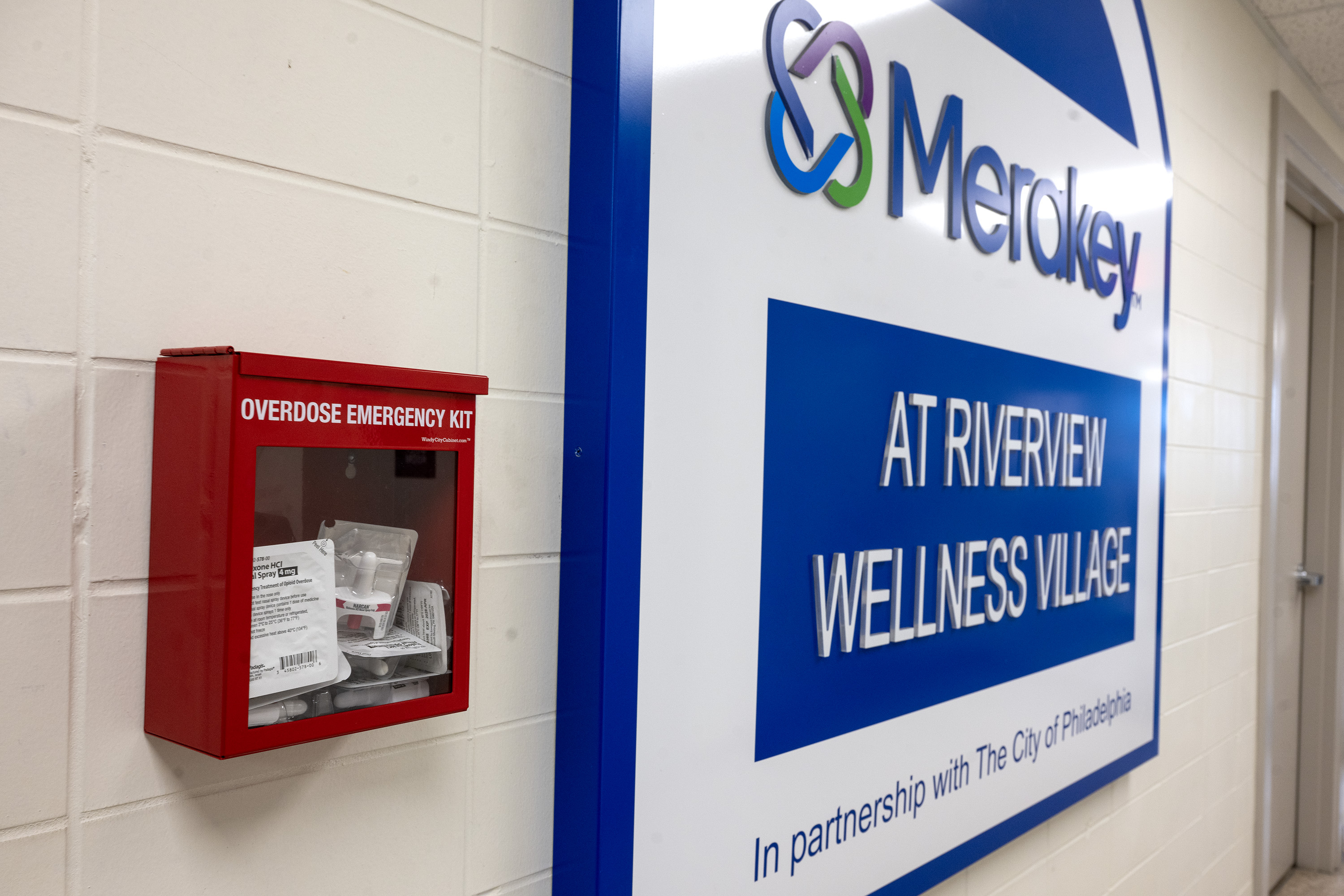
    Naloxone (Narcan) in an “overdose emergency kit” at Riverview Wellness Village.

    In the initial months after Riverview opened its doors, residents had to travel off campus to obtain medication that can prevent relapse, most commonly methadone and buprenorphine, the federally regulated drugs considered among the most effective addiction treatments.

    Typically, patients can receive only one dose of the drug at a time and must be supervised by clinicians to ensure they don’t go into withdrawal.

    Vigderman said staff suspected some residents relapsed after spending hours outside Riverview, at times on public transportation, to get their medication.

    This fall, Merakey — which was already licensed to dispense opioid treatment medications at other locations — began distributing the medications at Riverview, eliminating one potential relapse trigger for residents who no longer had to leave the facility’s grounds every day.

    Interest in the program has been strong, Vigderman said, with nearly 80 residents enrolling in medication-assisted treatment in just a few weeks. Merakey is hiring more staff to handle the demand.

    What’s next at Riverview

    The city is eying a significant physical expansion of the Riverview campus, including a new, $80 million building that could double the number of licensed beds to more than 500. That would mean that about half of the city’s recovery house slots would be located at Riverview.

    Development and construction of the new building, which will also house the medical and clinical facilities, is likely to take several years.

    Parker said the construction is “so important in how we’re going to help families.” She said the process will include “meticulous design and structure.”

    “The people who come for help,” she said, “we want them to know that we value them, that we see them, and that we think enough of them to provide that level of quality of support for them.”

    In the meantime, staff are working to help the center’s current residents — who were among the first cohort to move in — plot their next steps, like employment and housing.

    A rendering of the new, $80 million five-story building to be constructed on the campus of Riverview Wellness Village. It will include residences and medical suites.

    That level of support, Vigderman said, doesn’t happen in many smaller recovery houses.

    “In another place, they might not create an email address or a resumé,” he said. “At Riverview, whether they do it or not is one thing. But hearing about it is a guarantee.”

    Bean is closing in on one year at Riverview. He doesn’t know exactly what’s next, but he does have a job prospect: He’s in the hiring process to work at another recovery house.

    “I’m sure I’ll be able to help some people,” he said. “I hope.”

  • Philly is poised to launch a retirement savings program for workers without 401(k)s

    Philly is poised to launch a retirement savings program for workers without 401(k)s

    Philadelphia could soon become the first American city to establish its own retirement savings program for residents whose employers don’t offer one.

    City Council is poised to pass legislation that would enable the plan, called PhillySaves, which is modeled on similar state-facilitated “auto-IRA” programs that have been increasingly established across the country.

    The idea is that workers would be automatically enrolled in the city-managed plan and would contribute through payroll deductions at no cost to their employer. The plan would then follow employees, even as they change jobs.

    Council President Kenyatta Johnson, a Democrat, said during a committee hearing on the legislation last week that the program is an anti-poverty measure aimed at generating wealth for more than 200,000 Philadelphians who do not have access to a retirement savings plan through their job.

    “We want to make sure we are lifting all Philadelphians out of poverty, building generational wealth, and ensuring our seniors are financially stable in retirement,” Johnson said.

    A Council committee approved the legislation following a hearing last week, and the full Council is expected to pass it. Voters would have to approve the creation of an investment management board through a ballot question, which could come as early as the May primary election.

    Councilmember Cindy Bass, a Democrat who represents parts of North and Northwest Philadelphia, called the plan a “game changer.”

    “There was a time when you could retire just on Social Security alone,” she said. “That day has come and gone.”

    How would the program work?

    Workers would be automatically enrolled in the plan with a default contribution rate of 3 to 6% of their wages, however they can opt out or change their contributions at any time.

    Employers that do not offer their own retirement plans would be required to sign up. Their only responsibility would be facilitating the payroll deductions for their employees. There is no matching program for employers or the city.

    City Councilmember Mike Driscoll, a Democrat who represents parts of Northeast Philadelphia and is sponsoring the legislation, emphasized last week that there is “no cost” to employers and no fiduciary liability.

    “The goal is to make it easy for employees who want to save,” he said, “and not burden employers who are already managing their many responsibilities.”

    In this 2023 file photo, Council President Kenyatta Johnson (left) greets 6th District Councilmember Michael J. Driscoll (center) and Councilmember At-Large Katherine Gilmore Richardson (right) before the last City Council meeting of the year.

    The legislation includes minimal fines for employers who don’t enroll employees. But Council members said the city will launch a significant public education and outreach campaign before levying fines.

    Who is the program for?

    Under the current version of the legislation — which could still be amended — the program applies to businesses with at least one employee. It must have been operating in Philadelphia for at least two years.

    Auto-IRA plans are especially geared toward hourly workers who generally have fewer employer-covered benefits, such as 401(k) plans, as well as people who work for small businesses that can’t afford to provide retirement benefits.

    Is this a new thing?

    Twenty states have passed legislation creating their own auto-IRA plans and 16 programs are open to participants, according to the Center for Retirement Initiatives at Georgetown University.

    Pennsylvania is not among them, but New Jersey launched a state-run retirement savings program last year. That plan, called RetireReady NJ, was first established in 2019 and signed into law by Gov. Phil Murphy, a Democrat.

    As of July, more than 18,000 workers were saving through the program, according to the state’s Department of the Treasury.

    It is more limited than Philadelphia’s would be, in that it only applies to businesses with at least 25 employees. Philadelphia’s would apply to businesses with just one.

    Gov. Phil Murphy speaks with members of the media after meeting with Governor-elect Mikie Sherrill at the governor’s office in Trenton on Nov. 5.

    Two other cities — New York and Seattle — passed legislation enabling auto-IRA programs, but neither was implemented because both New York and Washington states enacted state-run programs that include the cities.

    The Democratic-controlled Pennsylvania State House passed legislation in 2023 along party lines enabling a similar program called Keystone Saves, but it stalled in the Republican-controlled Senate.

    Treasurer Stacy Garrity, a Republican now running for governor, has for years advocated for the program’s passage.

    How will the investments be managed?

    The city would create a nine-member Retirement Savings Board, which would include four appointees by the mayor, four by the City Council president, and one by the city controller.

    That board would be responsible for facilitating the program and may contract third-party consultants, financial advisers, actuaries, and other experts to manage the investments.

    Why does the money go into a Roth IRA?

    The program defaults to a Roth IRA, though people covered can elect to switch to a traditional IRA.

    John Scott, director of the retirement savings project at Pew Charitable Trust, said during the Council hearing last week that Roth IRAs are often the default in auto IRA programs because participating employees can pull money out of those accounts at any time without taxes or penalty.

    He said that’s especially appealing to workers “who sometimes have fluctuations in their work schedule or they might have a financial shock.”

    “For many of these workers in these programs, this is really the first opportunity to save money,” Scott said. “So, you know, life happens. And sometimes they do need to pull that money out, and the Roth IRA is really the best vehicle to do that.”

    When will this become reality?

    Creating the board that will oversee the investments requires a change to Philadelphia’s Home Rule Charter, the city’s governing document.

    If Council passes legislation and Mayor Cherelle L. Parker signs it — both are expected to support it — then voters could approve the change through a ballot question as early as May.

    The legislation says the program must be launched by July 2027, however there are exceptions in the case of legal challenges or a state-level program superseding the city’s.