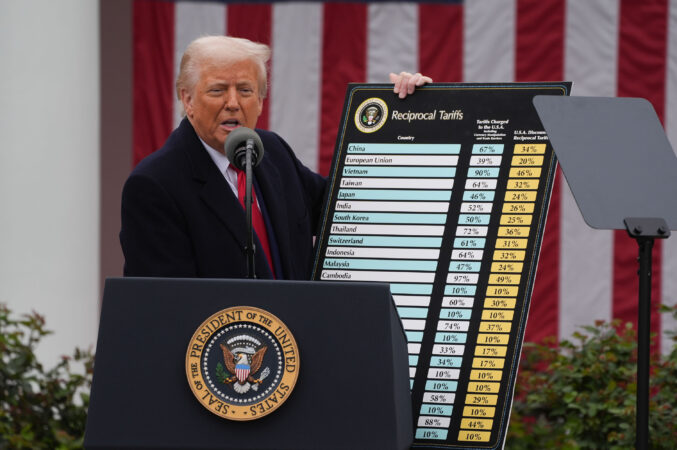
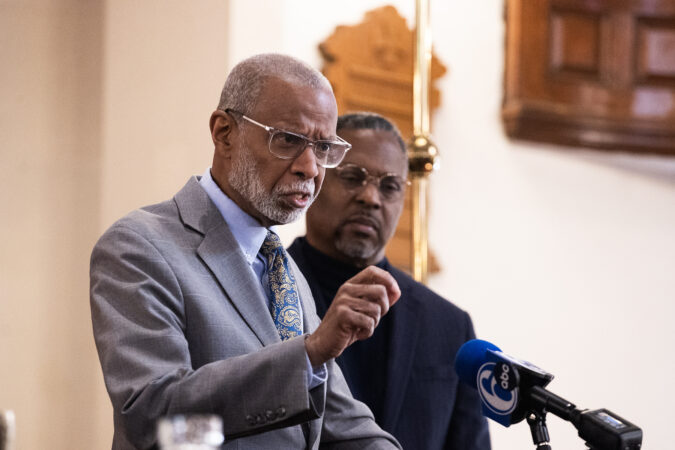
Pennsylvania lawmakers say Congress should reclaim its power over taxes and tariffs after the U.S. Supreme Court quashed President Donald Trump’s controversial global tariffs.
The nation’s high court ruled 6-3 Friday that Trump overstepped with tariffs imposed under an emergency powers law, dealing a significant blow to the president’s economic agenda and reasserting congressional authority.
Chief Justice John Roberts and Justices Neil Gorsuch and Amy Coney Barrett — both Trump nominees — joined liberal justices in the majority. Justices Brett Kavanaugh, Clarence Thomas, and Samuel A. Alito Jr. dissented.
Trump told reporters at the White House Friday that he was “ashamed” of the three Republican-appointed justices for not having “the courage to do what’s right for our country.”
But local lawmakers celebrated the decision as a step toward alleviating inflation exacerbated by Trump’s tariffs.
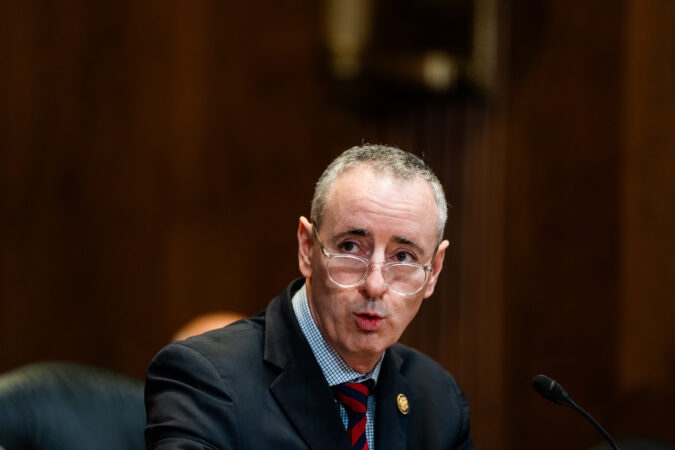
It’s “the first piece of good news that American consumers have gotten in a very long time,” said U.S. Rep. Brendan Boyle (D., Philadelphia), the ranking member of the House Budget Committee.
The decision is unlikely to be the end of the road for Trump’s efforts to impose tariffs. The court struck down the broad authority Trump had claimed to impose sweeping tariffs, but he could still impose additional import and export taxes using powers he employed in his first term.
Friday’s decision centers on tariffs imposed under an emergency powers law, including the “reciprocal” tariffs he waged on other countries, The Associated Press reported.
What’s next
It remains unclear what will happen to tariff revenue that’s already been collected — about $30 billion a month since Trump took office last year, NPR reported. But Pennsylvania lawmakers are pushing for Congress to reassert its power to control the country’s purse strings.
“As the Supreme Court validated this morning, Congress has the authority to levy taxes and tariffs,” Boyle said. “It’s time now for us to finally reclaim that authority and bring some certainty and rationality to our tariff policy, which under Donald Trump has been all over the map and changes day by day, even hour by hour.”
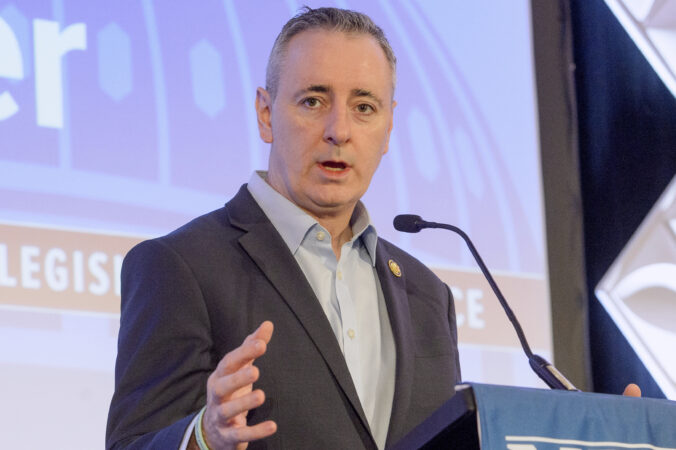
Casey-Lee Waldron, a spokesperson for U.S. Rep. Brian Fitzpatrick (R., Bucks), said in a statement Friday that the lawmaker “applauds” the high court’s decision, “which validates the Congressman’s opposition to blanket and indiscriminate tariffs that are not narrowly tailored, and that do not lower costs for the American consumer.”
Waldron added that Fitzpatrick supports enforcing trade laws, but “this should always be done in a collaborative manner with a bipartisan, bicameral majority in Congress.”
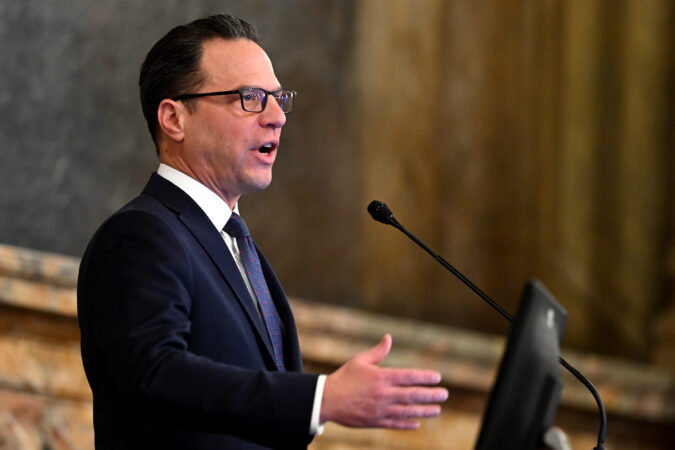
Pennsylvania Gov. Josh Shapiro and N.J. Gov. Mikie Sherrill, both Democrats, celebrated the decision Friday in statements that noted the challenges the tariffs had caused for local economies.
Speaking to reporters at the National Governors Association meeting in Washington, Shapiro said tariffs had done real harm to Pennsylvanians, citing rising prices for farmers and for consumer goods.
“There is a direct line connecting those price increases to the president pushing the tariff button,” Shapiro said. “I think the Supreme Court got it right, and I say that as a former attorney general, and I say that as someone who actually follows the law.”
U.S. Sen. Dave McCormick (R., Pa.), however, came to the defense of Trump’s tariff policies, saying in a statement that he believes Trump “was using legitimate emergency authorities very effectively to protect our national security and achieve fair trade for U.S. companies and American workers.”
McCormick, a former Treasury official and former hedge fund executive, said he was disappointed with the court’s ruling and called to find other ways to accomplish Trump’s economic and national security goals, which include preventing “foreign competitors from cheating Pennsylvania workers.”
Shockwaves in Philly and beyond
Trump enacted the sweeping tariffs early last year, arguing that the move would incentivize companies to bring operations back to the United States and even trade deficits with other countries.
The move, however, sent shock waves through the U.S. economy as prices increased and U.S. exports, including Pennsylvania’s lumber sales, suffered.
Tariffs slowed business at the Port of Philadelphia, which reported cargo volume down across the board.
Philly is a major gateway for produce, bringing in more fresh fruit than any other U.S. port, largely from Central and South America. The port saw record container volume last year, handling almost 900,000 units, up 6% over 2024. About two-thirds of that cargo was refrigerated — fruit and meat, for example.
But this year got off to a slow start. “The story is increased competition and tariffs,” Sean Mahoney, marketing director at the Philadelphia Regional Port Authority (PhilaPort), said during the agency’s board meeting on Wednesday.
Leo Holt, president of the city’s primary terminal operator Holt Logistics, hopes companies that see savings would pass them on to consumers. In practice, he acknowledged many would likely take a conservative approach.
“I think consumers are going to demand that at least there’s an accounting for what they’re paying,” Holt said Friday.
U.S. Sen. Chris Coons (D., Del.) said in a statement that he knows many Republican colleagues of his “are privately breathing sighs of relief this morning at the court’s decision.”
“They should instead be asking themselves why they didn’t use their legislative authority to do more to stop these tariffs when they had the chance — and what they’ll do differently next time when President Trump inevitably tries again,” Coons said.
‘Nobody is going to rush to drop their prices’
The Supreme Court’s ruling will be welcome news for some businesses, but it also sparks uncertainty.
Not all of Trump’s tariff increases came through the use of the International Emergency Economic Powers Act, and therefore some will remain in place, said Julie Park, a partner at London-based tax and business advisory firm Blick Rothenberg.
“This decision brings further uncertainty for businesses,” she said in a statement. That’s in part because Trump could seek to reimpose tariffs through other legal tools, leaving “businesses in limbo about if they will get refunded.”
U.S. exporters will also be closely following what happens next, since the fate of Trump’s tariffs will likely determine whether other countries, like Canada, keep their retaliatory measures in place. Canada is Pennsylvania’s biggest export market, with the state sending more than $14 billion in goods there in 2024. Top exports included machinery, cocoa, iron, and steel.
Pennsylvania’s dairy industry has also been caught in the middle of the global trade war, as China and Canada imposed extra taxes on those goods in response to U.S. tariffs.
It’s also unclear whether companies will receive refunds for the tariffs they’ve paid in the past year.
Tim Avanzato, vice president of international sales at Lanca Sales Inc, said his New Jersey-based import-export company should be eligible for as much as $4 million in tariff refunds.
“It’s going to create a paperwork nightmare for importers,” he said, noting that he doesn’t expect the Trump administration to make it easy to retrieve this money.
Avanzato said he is also watching for ways the administration may implement new tariffs. Consumers, he said, shouldn’t expect changes in the immediate term.
“Companies are not very good at passing on savings,” Avanzato said. “Nobody is going to rush to drop their prices.”
Sen. Andy Kim (D., N.J.) said Trump cost Americans “a lot of money.”
“Trump 2.0: You pay for his tariffs, tax breaks for his billionaire donors, & insane corruption for his friends and family,” the South Jersey Democrat added in a social media post.
The Supreme Court’s decision is “a step” in righting wrongs by the Trump administration, he said, but there’s “so much more to go.”
Staff Writers Katie Bernard, Max Marin, Aliya Schneider and Rob Tornoe and The Associated Press contributed to this article.
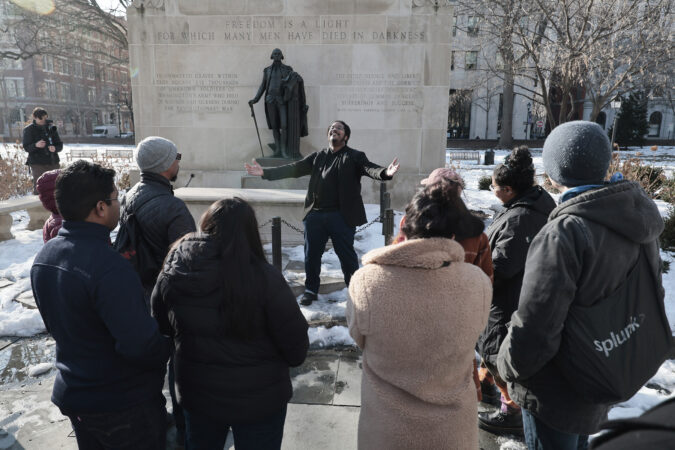
Mijuel K. Johnson stood on theground where the dining room of the first president’s residence once stood as he told the story of Ona Judge’s path to freedom.
Speaking to a group assembled just steps from the Liberty Bell, Johnson recounted how Judge escaped George Washington’s household in Philadelphia into the city’s free Black community before eventually making her way to New Hampshire, and evading the Washingtons’ several attempts to recapture her.
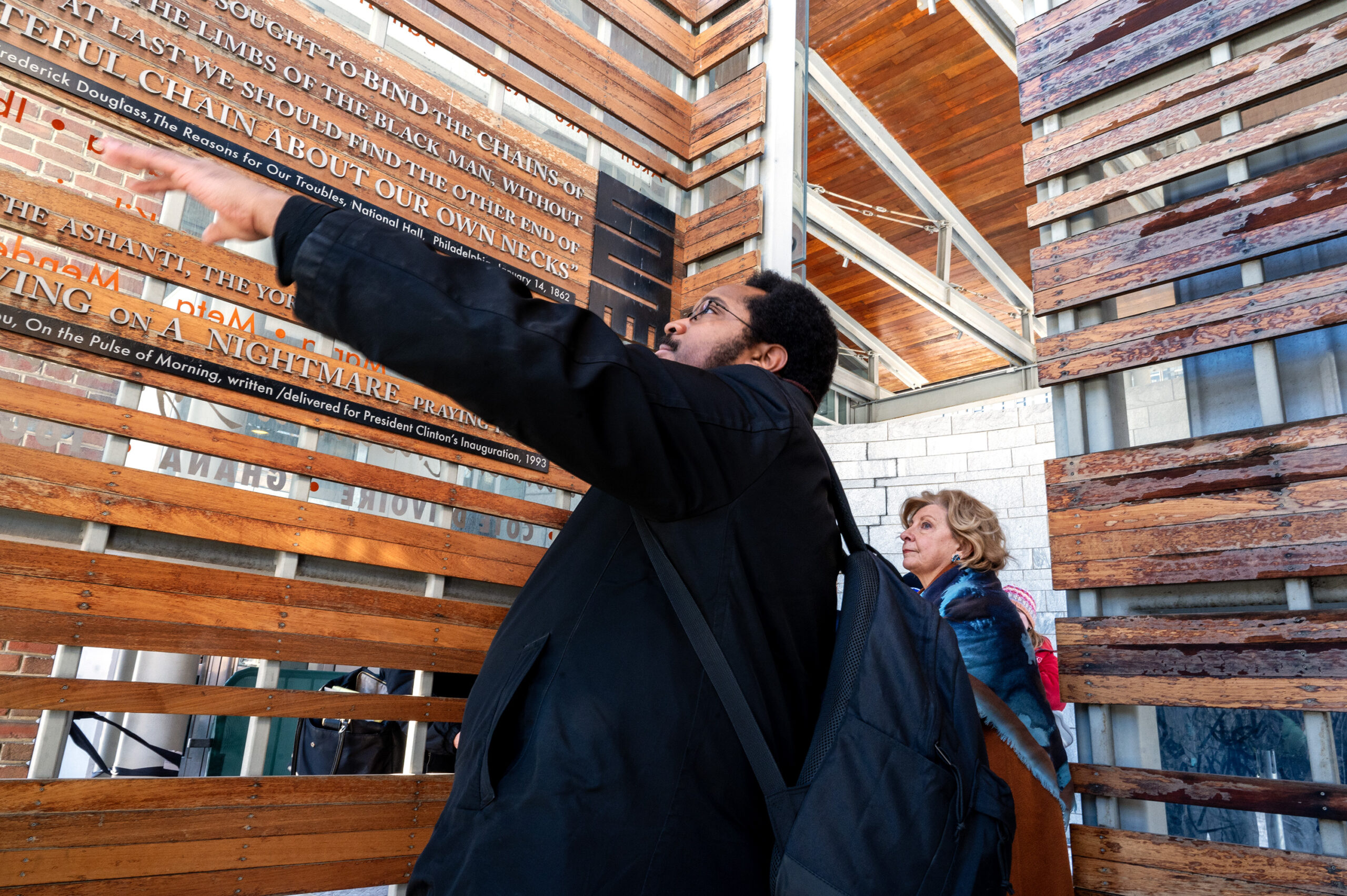
It’s a story Johnson has told many times as a guide for the Black Journey, which offers walking tours focused on African American history in Philadelphia. One of the first stops on “The Original Black History Tour” is the President’s House Site, an open-air exhibit at Sixth and Market Streets that memorializes Judge and the eight other people enslaved by the first president here.
But last weekend, instead of the educational panels and informative videos displayed for the last 15 years, the guide and his group were faced with faded brick walls and blank TV screens. Adhesive residue marked the spots where colorful panels had been.
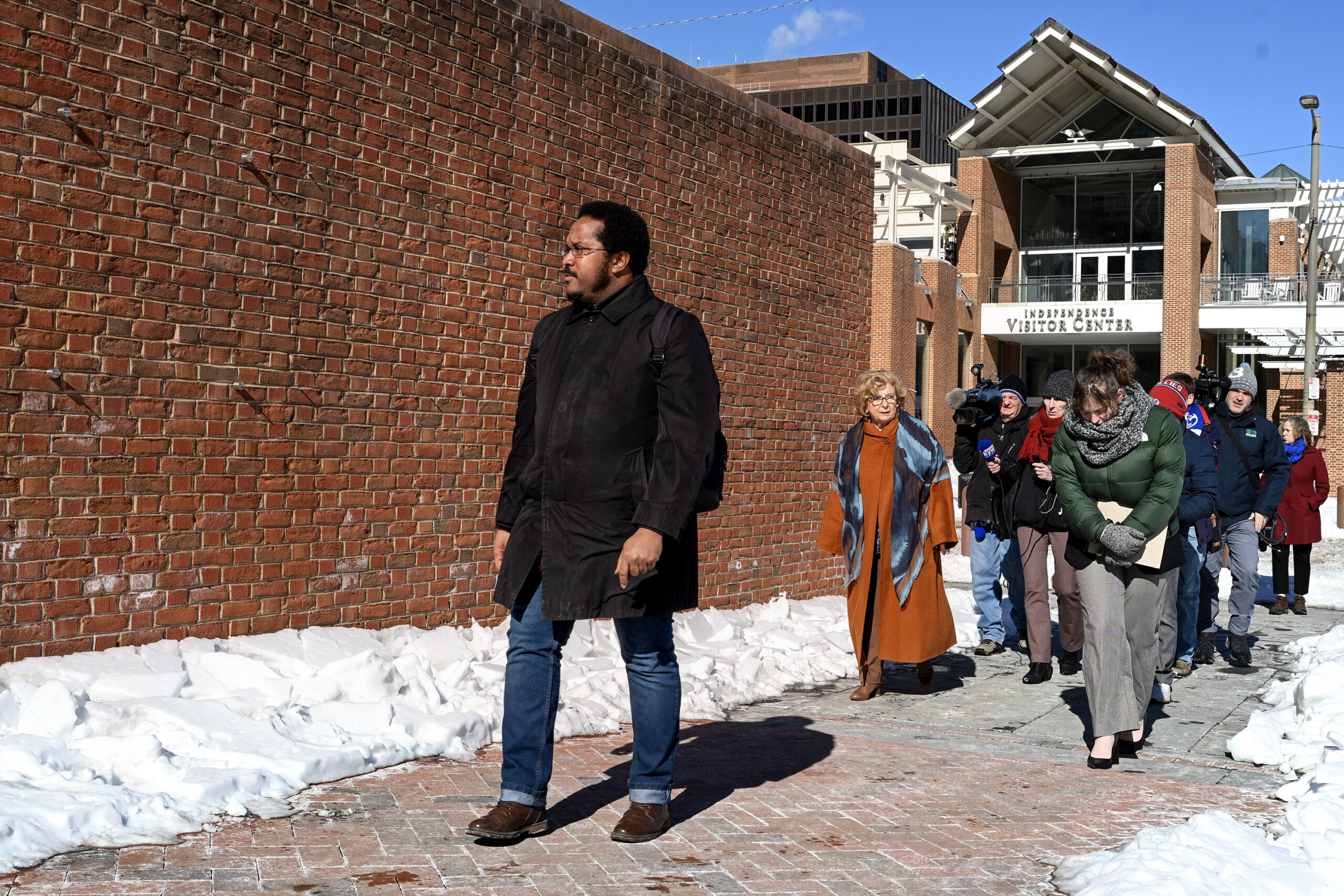
Mijuel K. Johnson guides Judge Cynthia M. Rufe as she visits the President’s House in Independence National Historical Park on Monday, Feb. 2, 2026.
It was Johnson’s first group tour since National Park Service employees wielding wrenches and crowbars — acting at the direction of President Donald Trump’s administration — last month stripped out every panel at the President’s House, censoring roughly 400 years of history. Judge’s name was still inscribed on the Memorial Wall and her footprints still imprinted into the concrete as the group walked through the site, but her story was missing. Television screens recounting her life had been abruptly disconnected.
Black History Month began this year with visitors unable to read displays juxtaposing the cruelty of slavery with the country’s founding principles for the first time since the site opened in late 2010. For many tourists and the guides who know the site best, the removal was a call to action.
Workers remove the displays at the President’s House in Independence National Historical Park on Thursday, Jan. 22, 2026. More than a dozen displays about slavery were flagged for the Trump administration’s review, with the President’s House coming under particular scrutiny.Maria Felton (middle) and Jahmitza Perez (right) of Philadelphia listen to Mijuel K. Johnson (left) during The Black Journey tour in Philadelphia on Saturday, Feb. 14, 2026.
“In telling their stories, I’m telling my own,” Johnson, 34, of South Philadelphia, said of the nine people the site memorializes, “and that’s where it becomes personal, so that in trying to erase their story, they’re effectively trying to erase me, too, and I just refuse to be erased.”
Parker celebrated the reinstallation in a post on social media Thursday but cautioned: “We know that this is not the end of the legal road.”
The Trump administration is appealing the ruling, so the future of the site remains uncertain even after this week’s victory. On Friday, a federal appeals judge said that the Trump administration does not have to restore more panels while the appeal is pending.
Seeing the site bare without the panels last weekend felt like a “slap in the face” for Maria Felton, 31, a stay-at-home mom from Roxborough. Felton, who is Afro-Latina, joined the Black Journey’s tour with best friend Jahmitza Perez, 37, as part of her quest to reconnect with her heritage.
“The administration can take away physical things. They can’t take away our ability to connect and learn and share our culture,” Felton said.
Passing a wall where panels about slavery were removed, Mijuel K. Johnson (left) with The Black Journey: African-American Walking Tour of Philadelphia, leads Judge Cynthia M. Rufe (second from left) as she visits the President’s House in Independence National Historical Park on Monday, Feb. 2, 2026.
‘A sign of the revolution’
Johnson has been giving tours since 2019, delivering rousing accounts of U.S. history interwoven with humor and theatrical gestures. He tells his patrons, who come from around the country, that long before cheesesteaks became Philly’s iconic food,the city was known for its pepper pot stew, an African dish.
“We can tell the full story of America,” he said.
Last weekend, Johnson’s tour group was more “somber” than usual, he said, as they saw the bare walls of the “desecrated” site.
“People seeing it for themselves that this actually did happen,” Johnson said.
For Toi Rachal, 47, a pharmacist from Dallas, and her husband, the tour was eye-opening. The couple had been unaware of the Trump administration’s changes to the site until they joined the tour during their visit to Philadelphia. The work of Johnson and other community members to continue telling the story was even more crucial with the exhibits gone, Rachal said.
“If we just walked in these areas on our own, eventually we would have probably figured it out,” she said, “but you may not have known exactly what happened.”
The exhibits were removed under an order issued by Trump instructing the Department of the Interior to remove materials at national parks that “inappropriately disparage Americans past or living,” widely criticized as an effort to whitewash history ahead of this year’s celebrations of the country’s 250th anniversary.
But the move brought unprecedented attention to the President’s House, drawing curious onlookers. When the panels were beginning to be restored Thursday, a group observed as park employees put history back in its rightful place.
Shortly before Johnson’s tour group stopped at the site, a volunteer read from a binder containing the informational text that had been removed. The volunteer was one of dozens of people who had signed up for a shift with Old City Remembers, a grassroots effort to speak the history of the President’s House even if the panels were no longer there.
Mijuel K. Johnson leads visitors from Charlotte, North Carolina, at the President’s House in Independence National Historical Park on Wednesday, July 23, 2025.
“Because those have been removed, somebody needs to tell the story, somebody needs to make sure that we’re not going to let that history be erased,” Matt Hall, a professor and the organizer of the group, said in an interview earlier this month.
It’s “active history,” said Ashley Jordan, president and CEO of the African American Museum in Philadelphia, located blocks away from the site. “The fact that they are using their words, their demonstrations, through art-making, through signage, through print materials — that has always been a sign of the revolution in America.”
Ahead of Johnson’s tour last Saturday, visitors taking advantage of the warmest winter day in weeks congregated around the bare exhibit wall. In its place were educational fliers about Washington, Ona Judge, and other historical figures. Posters displayed messages: “Truth Matters,” “Erasing Slavery is Pro-slavery,” and “Dump Trump Not History.”
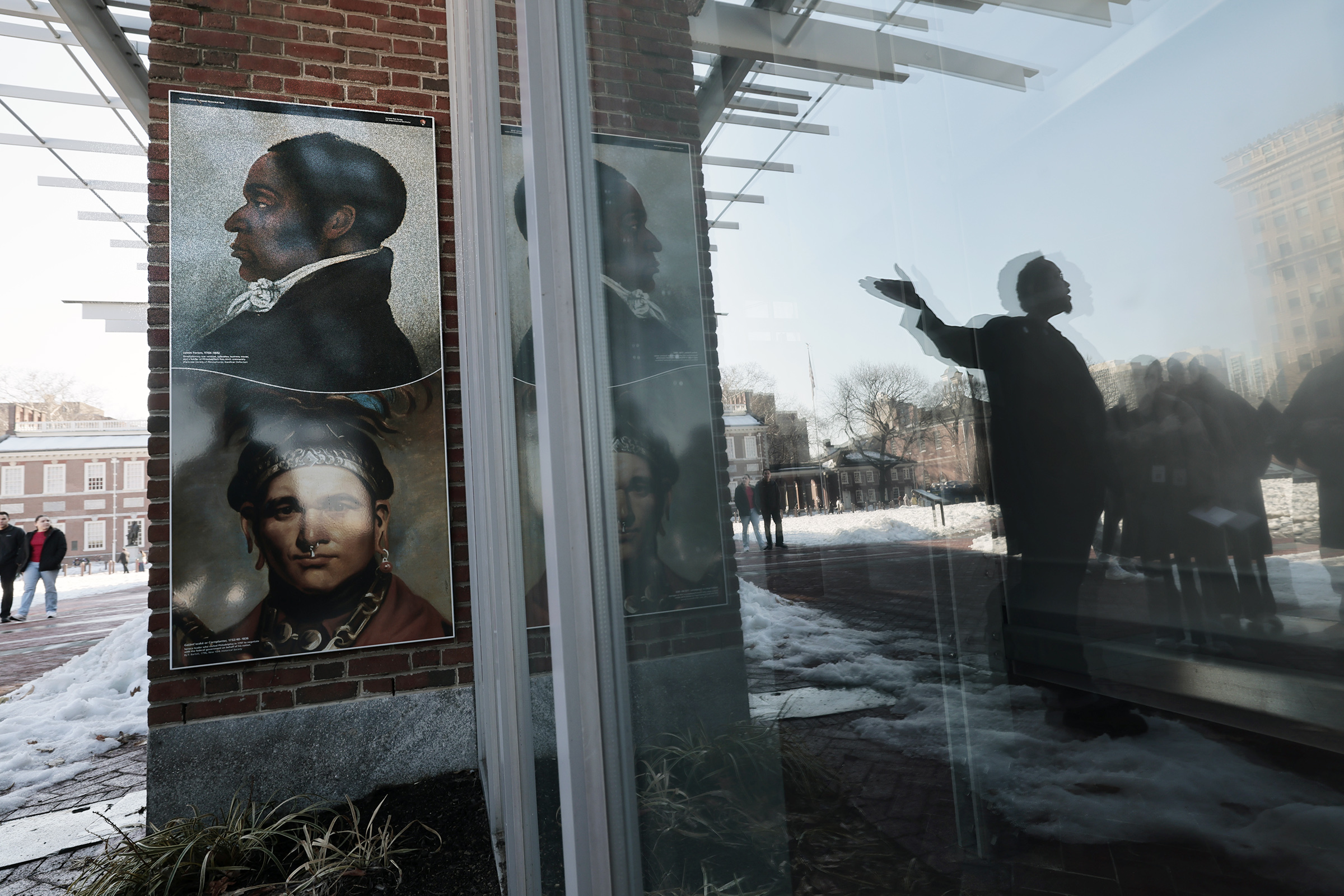
The Black Journey and the 1838 Black Metropolis tour guide Mijuel K. Johnson (right) is reflected in the Liberty Bell Center window as he talks about James Forten (top left) 1746-1842 during a Black History tour in Philadelphia on Saturday, Feb. 14, 2026. Forten was a Revolutionary War veteran, sailmaker, business owner, and a leader of Philadelphia’s free Black community.
Philadelphians celebrate, but prepare for more fights ahead
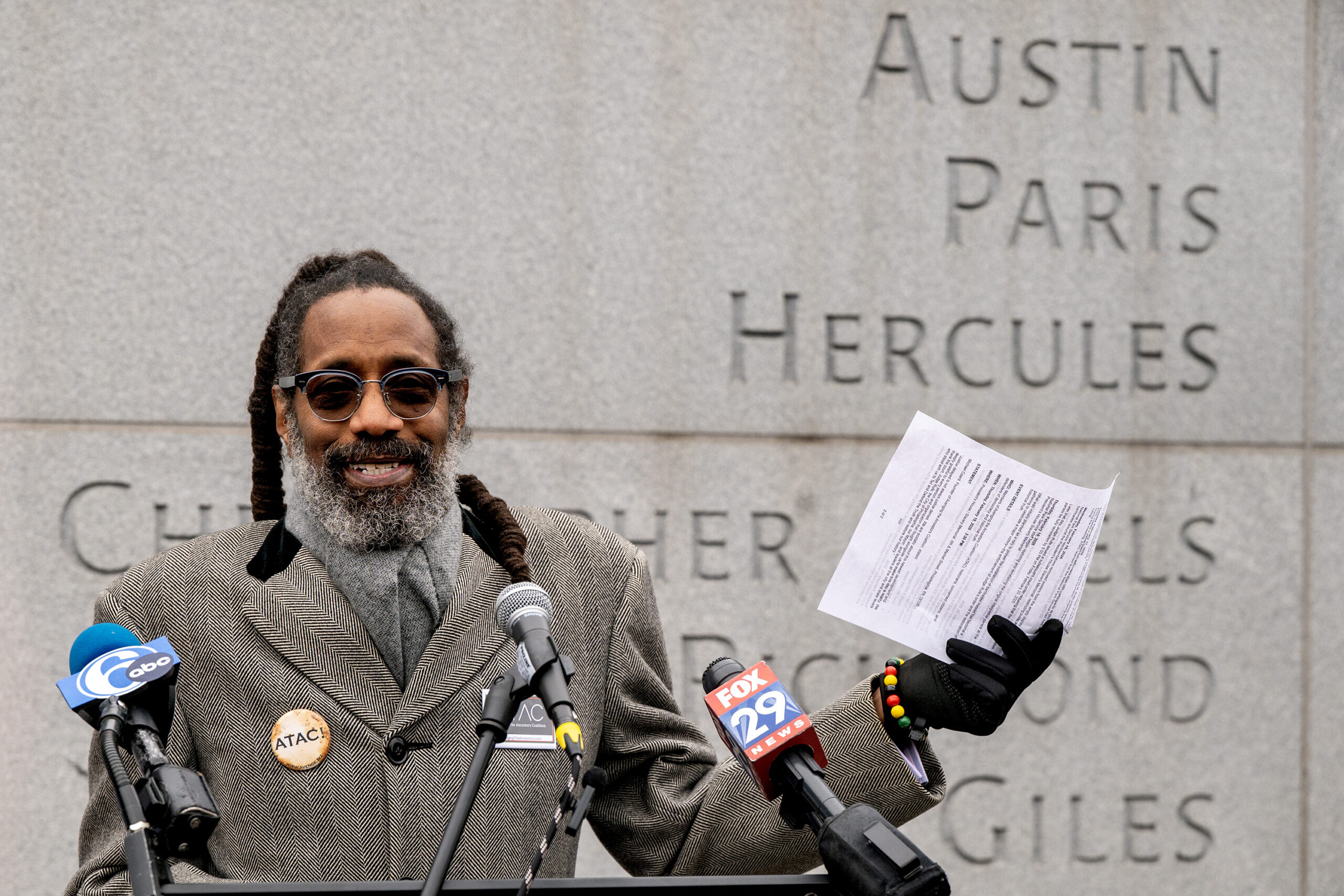
Avenging the Ancestors Coalition members gathered Thursday afternoon at the President’s House, celebrating the reinstallation earlier in the day.
“This is actually a moment in time,” said Michael Coard, attorney and leader of the coalition, which had fought tirelessly to develop and, now, protect the site. “Your children, your grandchildren, your great-grandchildren are going to be talking about this for years.”
Coard emphasized the fight was not yet over while highlighting the significance of the community’s contributions in the fight to safeguard the President’s House.
“I just want you for a few seconds just to think about what you all have done,” Coard told the crowd. “Because what you’ve done is to actually create history. … Think about it. You fought the most powerful man on the planet, and you won.”
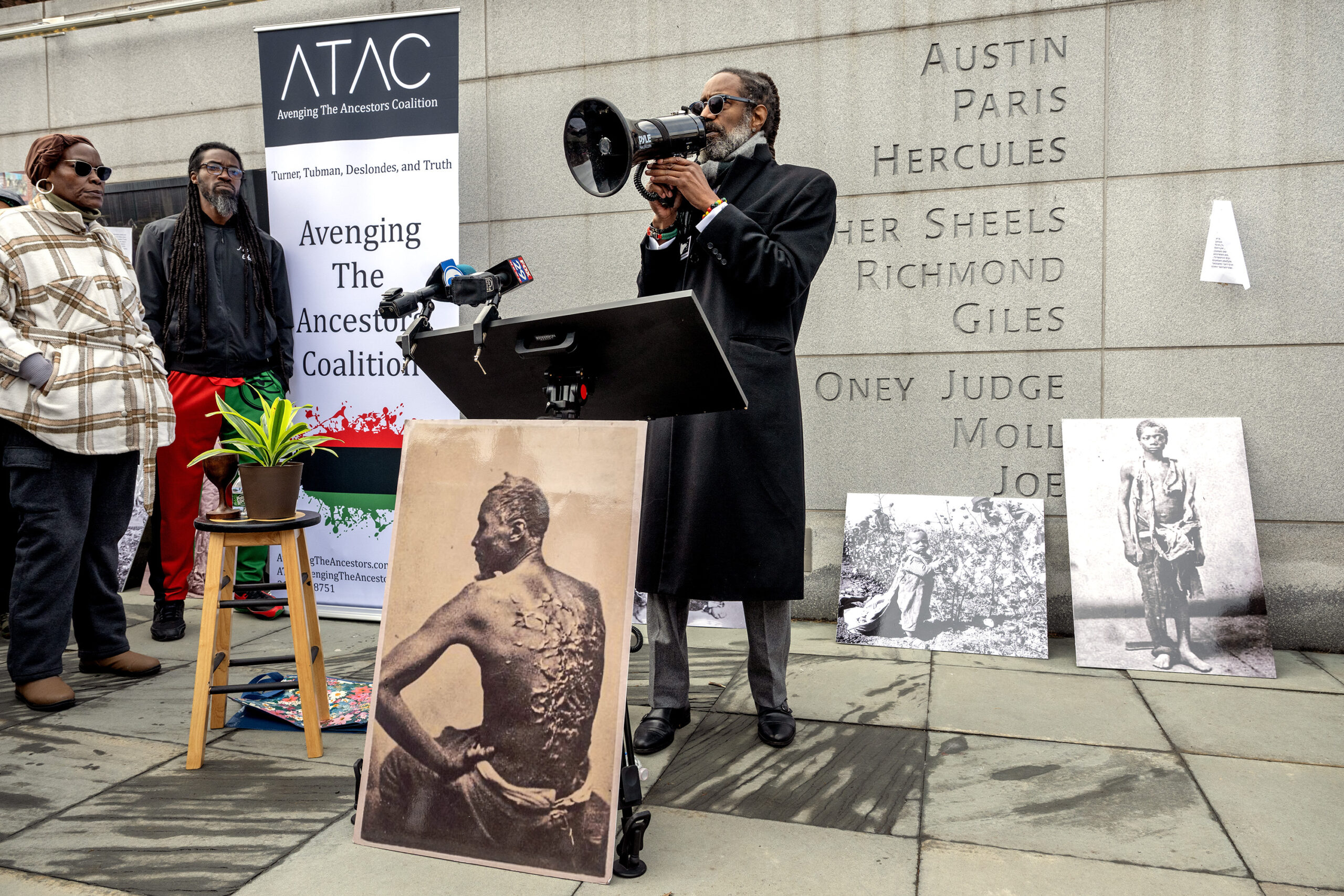
Attorney Michael Coard, leader of the Avenging the Ancestors Coalition, speaks at the President’s House site on Monday, Feb. 16, 2026, during their annual gathering for a Presidents’ Day observance. While there, they learned a federal judge ordered the Trump administration to restore the slavery exhibits that the National Park Service removed from the site last month. The names of nine enslaved people who lived and worked in the household of George Washington engraved in stone behind him were not removed by the NPS.
Even as Philadelphians celebrated the reinstallation, more efforts were being planned to continue sharing the story of the President’s House.
Mona Washington, a playwright and Avenging the Ancestors Coalition board member,is crafting a series of plays related to the President’s House, which she hopes to showcase this summer, during the height of the 250th anniversary celebrations. Some of the plays, she said, are written in the first person for the people who were enslaved by the first president at his Philadelphia residence.
“We’re here, and you can try and erase whatever you want, as much as you want, but guess what? There are lots of us, and we’re just going to keep moving and moving and moving toward truth,” Washington said.
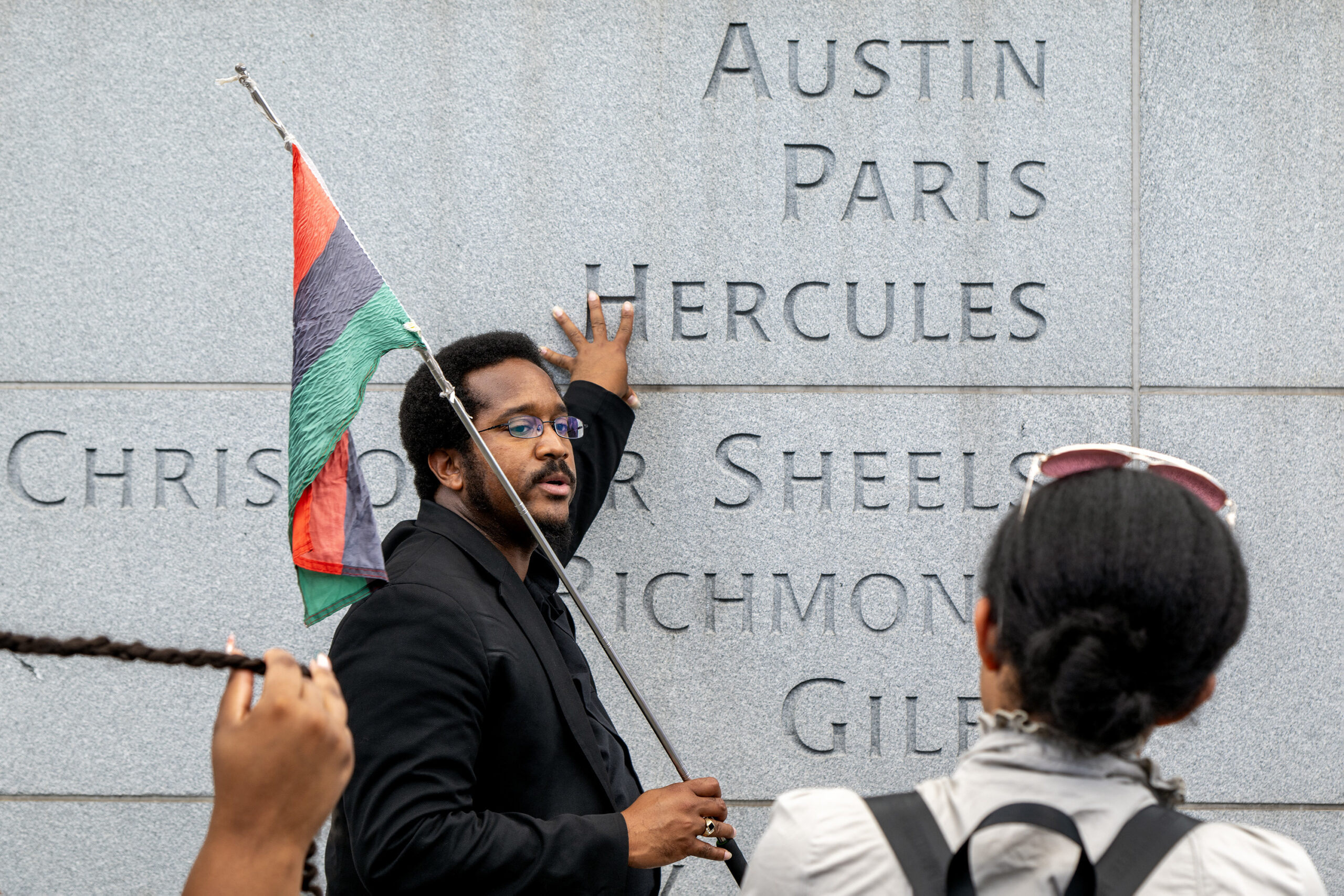
At the President’s House last Saturday, there were few pieces that Johnson could share with the group that had not been tainted by the Trump administration. One of them was the Memorial Wall, which is engraved with the names of Ona Judge and the eight other people George Washington enslaved — Austin, Paris, Hercules, Christopher Sheels, Richmond, Giles, Moll, and Joe. A few paces away, their quarters once stood, where at least four of the nine individuals would stay at any given time, Johnson said.
Mijuel Johnson, a guide with The Black Journey: African-American Walking Tour of Philadelphia, leads visitors in the President’s House in Independence National Historical Park Wednesday, July 23, 2025. The names of nine enslaved people who lived and worked at the House are engraved in stone on the site.
Outside the quarters appears a plaque signed by the city and the National Park Service that reads: “It is difficult to understand how men who spoke so passionately of liberty and freedom were unable to see the contradiction, the injustice, and the immorality of their actions.”
These words are preceded by an italicized quote from former President Barack Obama, the country’s first Black president: “It was whispered by slaves and abolitionists as they blazed a trail toward freedom … yes we can, yes we can.”
A lack of proper tools and the snow were the only things standing in the way of the Trump administration making further alterations to the President’s House last month.U.S. District Judge Cynthia M.Rufe has now ordered that the President’s House cannot be further altered.
Last Saturday, Johnson assured his tour group as they were filing through the quarters that this piece of history would remain.
“They can’t touch this,” he said.
Staff writer Maggie Prosser contributed to this article.
Almost a month after abruptly dismantling exhibits about slavery from the President’s House Site, National Park Service employees began reinstalling the panels late Thursday morning ahead of a court-imposed deadline.
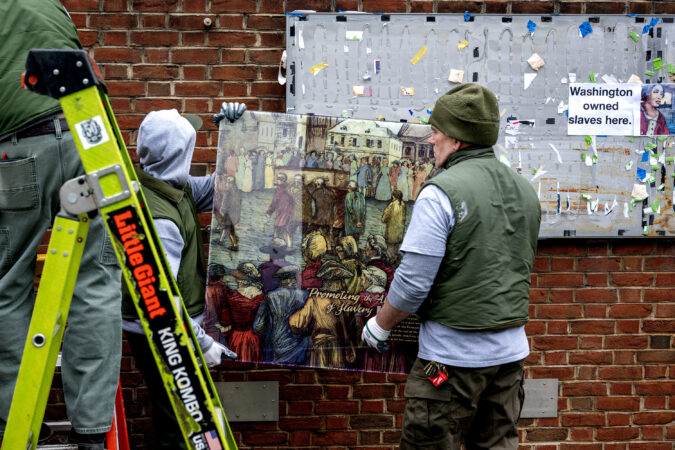
Just before 11 a.m., four park service employees carted glass panels from a white van to a barricaded area at the site. They screwed each panel back into the bricks before cleaning the glass with rags.
The restoration is a win for the City of Philadelphia and local stakeholders who have been fighting to preserve the President’s House after President Donald Trump’s administration ordered the removal of educational panels from the exhibit on Independence Mall last month, censoring 400 years of history. The removal sparked weeks of community activism that turned into celebrations Thursday once the reinstallation began.
As of Thursday evening, 16 of the 34 panels had been reinstalled. A couple of bystanders clapped as the displays were put back up.
Shortly before noon, Parker arrived at the scene, taking in the newly reinstalled exhibits. She shook hands with and thanked the National Park Service employees.
“It’s our honor,” an employee told the mayor.
Parker did not take questions from the media but later issued a statement celebrating the return of the exhibits.
“We know that this is not the end of the legal road,” the mayor said. “We will handle all legal challenges that arise with the same rigor and gravity as we have done thus far.”
Michael Coard, an attorney and leader of Avenging the Ancestors Coalition, which helped steer efforts to preserve the President’s House, called Thursday’s reinstallation a “huge victory” after weeks of advocacy in court and around the site itself.
“We had people doing something at least every single day since the vandalism took place on Jan. 22, and we’ve had the attorneys in court, so it’s a great day, but the battle is not over,” Coard said.
On Wednesday, several employees from Independence National Historical Park placed metal barriers around the brick walls where panels had been displayed near the open-air exhibit’s Market Street entrance. One employee said the barriers were set up so employees could clean the area.
Prior to Thursday, exhibits were being stored in a National Park Service storage facility adjacent to the National Constitution Center.
The reinstallation was a moment that Philadelphians who had been tirelessly fighting to protect the President’s House had been waiting for.
On Jan. 22, after park employees took crowbars and wrenches to the President’s House, which memorializes the nine people George Washington enslaved at his Philadelphia residence, the City of Philadelphia filed suit against members of the Trump administration. Community stakeholders took action to preserve the memory of the site.
“It’s important to hang on to hope,” said Bill Rooney, 68, of Chestnut Hill. “The people who lived here — sometimes that’s all they had to hold on to. We need to do that, too, and [make] sure that the whole history is told.”
Rooney, a certified tour guide, added: “History matters. All of history matters.”
Rufe, a George W. Bush appointee, issued a blistering 40-page opinion in which she compared the federal government’s arguments justifying the removal of the interpretive panels to the dystopian Ministry of Truth from George Orwell’s novel 1984.
The opinion said it was urgent that the full exhibit be shown to the public. When the federal government did not comply 48 hours later, the judge set a deadline of 5 p.m. Friday for the Department of the Interior and the National Park Service to fulfill her order.
The Trump administration asked Rufe on Wednesday night for a stay on the injunction while its appeal is pending in the U.S. Court of Appeals for the Third Circuit.
The motion says enforcement of the order makes Philadelphia a “backseat driver holding veto power” in all decisions related to Independence National Historical Park. By forcing the government to restore the slavery panels, the court “compels the Government to convey a message that it has chosen not to convey,” the motion says.
The city filed a brief Thursday opposing the stay, saying that the federal government did not add anything new to its argument. The idea that the restoration would cause harm was undermined by the fact that the exhibits “stood for 15 years without alteration, conveying the ‘whole, complicated truth,’” the city said. The filing does not acknowledge that some panels had been reinstalled.
Rufe had not ruled on the stay as of Thursday afternoon. But neither the federal government’s appeal to a higher court nor the request for a stay pauses Rufe’s order.
Complying with the order could complicate the federal agencies’ argument that restoring the panel inflicts irreparable harm because they have “turned around and done what they said they couldn’t do,” said Marsha Levick, a visiting chair at Temple University’s Beasley School of Law.
Attorney Michael Coard, leader of the Avenging the Ancestors Coalition speaks during a rally at the President’s House in Independence National Historical Park Thursday, Feb, 19, 2026, after some of the slavery exhibits were returned.
The people behind the fight to restore the President’s House Site were lauded at a late-afternoon rally. Organizers had called the 120-person event after the barricades were installed Wednesday, which they said prevented people from visiting the memorial. Instead, the event Thursday — set to Kool & the Gang’s “Celebration” and “Fight the Power” by Public Enemy — was celebratory.
“We’re still fighting. The battle is still being fought in court,” said coalition member Mijuel Johnson. “But today — this greatest day, this day of pride — we got our panels put back up.”
Coard said Thursday’s development epitomizes the group’s name. He said his coalition’s advocacy for the President’s House stands on the shoulders of activism by ancestors during the Civil Rights Movement.
“We took that baton from them and we ran with it,” Coard said. “And the interesting thing about taking that baton is that this track was not as difficult for us. They had more obstacles on their track. We have fewer because they cleared it for us.”
Gov. Josh Shapiro implored Homeland Security Secretary Kristi Noem this week to reconsider converting warehouses in Berks and Schuylkill counties into mass immigration detention centers, citing “real harms” to the communities.
In a Thursday letter to Noem obtained by The Inquirer, Shapiro questioned the legality of the facilities, which the governor said could hold up to 9,000 people in total.
Hinting at a possible lawsuit, Shapiro said if DHS goes through with converting the sites, his administration will “aggressively pursue every option to prevent these facilities from opening and needlessly harming the good people of Pennsylvania.”
As part of President Donald Trump’s expanding deportation agenda, the federal government has started purchasing warehouses across the country to flip into U.S. Immigration and Customs Enforcement detention centers. ICE is planning to spend $38.3 billion turning warehouses into detention centers, The Washington Post reported.
Shapiro slammed the department’s escalating immigration enforcement strategy, saying that ICE and other federal immigration agents “resort to unnecessary and excessive force, leading to innocent people being injured or tragically killed.”
“Your Department’s record is reason enough to oppose your plan to use warehouses in Schuylkill and Berks Counties as detention centers,” Shapiro wrote, adding that the warehouses would also negatively impact residents’ health and safety, deplete tax revenue, and put extra stress on local communities and emergency response.
Tricia McLaughlin, DHS assistant secretary for public affairs, confirmed ICE’s purchase of these two warehouses and the department’s plans to use them as detention facilities in a statement to The Inquirer Friday.
She said that the sites will “undergo community impact studies and a rigorous due diligence process to make sure there is no hardship on local utilities or infrastructure prior to purchase” and that the facilities would create economic benefits, including bringing more than 11,000 jobs to the two Pennsylvania communities in total.
“Thanks to the One Big Beautiful Bill, ICE has new funding to expand detention space to keep these criminals off American streets before they are removed for good from our communities,” McLaughlin said.
He’s said the Trump administration’s strategies in American cities make communities less safe, violate constitutional rights, and erode trust in law enforcement.
In his letter to Noem, Shapiro said that DHS has not engaged local leaders to discuss the warehouse purchases and that both Democratic and Republican state and local officials have objected to the department’s “plans to interfere with our communities because of the chaos and harm your actions will bring.”
Some of Shapiro’s cabinet secretaries also penned an additional letter to Noem where they stressed that the facilities would be detrimental to the communities’ environment and public health and safety.
“The stress each facility will place on local infrastructure will, among other things, jeopardize Pennsylvanians’ access to safe water, deplete resources and infrastructure needed for emergencies, and overextend already strained emergency response personnel,” wrote Pennsylvania Health Secretary Debra L. Bogen, Fire Commissioner Thomas Cook, Emergency Management Director Randy Padfield, Environmental Protection Secretary Jessica Shirley, and Labor Secretary Nancy A. Walker.
In addition to the warehouses, DHS is also leasing new office space throughout the country, including in the Philadelphia area. The department said back-office staff, including lawyers and analysts, will be moving into a building in Berwyn, and the department will also share space with the Department of Motor Vehicles at Eighth and Arch Streets in Center City, WIRED reported.
Despite the governor’s vocal opposition to Trump’s enforcementstrategies, Pennsylvania still cooperates with ICE. Shapiro’s administration honors some ICE detainers in state prisons and provides ICE with access to state databases that include personal identifying information for immigrants.
Immigrant rights groups have for months called on Shapiro to take more decisive action against federal immigration enforcement in Pennsylvania and end all cooperation with the agency.
As the Department of Homeland Security approaches an increasingly likely shutdown this weekend, U.S. Rep. Brian Fitzpatrick (R., Bucks) said reforms to ICE, including banning masks for federal immigration agents, should be a part of any funding extensions for DHS.
“I’m the only federal agent in Congress,” Fitzpatrick, who served in the FBI for 14 years, said in an interview Thursday. “I spent my whole professional career as an FBI agent. Never once did I wear a mask, never. Executing a search warrant, arrest warrant, you name it, because you need to be transparent. You need to identify yourself. The whole function of policing requires the trust of the public.”
U.S. Immigration and Customs Enforcement and the U.S. Border Patrol, the agencies involved in the fatal shootings of two American citizens last month in Minnesota, both fall under DHS, which will enter a shutdown if lawmakers do not reach a funding deal by Friday.
The Border Patrol and ICE would continue to operate after receiving funding from President Donald Trump’s One Big Beautiful Bill Act, but a lapse in funding to DHS would affect other agencies under the department, including the Transportation Security Administration, the Coast Guard, and the Federal Emergency Management Agency, of which many employees would be working without pay.
Democrats have demanded that restrictions on masking and other changes to immigration enforcement be part of any funding deal.
Fitzpatrick, who represents a purple district, is rare among Republicans in accepting Democrats’ proposal as Congress grapples with a national reckoning over Trump’s immigration crackdown after federal agents killed Renee Good and Alex Pretti in shootings caught on video.
“There is broken trust between the public and ICE, and we have to restore that trust,” Fitzpatrick said.
“And the only way you restore that trust is by enacting reforms that are going to rebuild that social contract,” he continued. “Because policing is a social contract, whether it be local law enforcement or federal law enforcement.”
In the aftermath of the shootings in Minnesota, the House ended a four-day government shutdown earlier this month by passing a five-bill funding package that excluded DHS. Fitzpatrick, who voted for the House bill, said he would aim to work with Democrats to come up with a solution.
Negotiations on DHS’s allocation appeared to be at a standstill Thursday ahead of lawmakers going on a 10-day break, making a partial shutdown appear likely. In the U.S. Senate, a vote to advance a funding bill was rejected in a 52-47 tally Thursday, falling short of the necessary 60-vote threshold, the Associated Press reported.
“The agents wearing masks, I think primarily that’s driven by people are going to dox those people. That’s a serious concern, too, absolutely,” Fetterman said in a Fox News interview with correspondent Jacqui Heinrich (who is engaged to Fitzpatrick).
Whether ICE agents should be allowed to wear masks has become a point of contention since the escalation of Trump’s immigration policies, with legislative bodies across the U.S., including in Philadelphia City Council, introducing legislation to prohibit them.
Fitzpatrick, cochair of the bipartisan Problem Solvers Caucus, said Thursday that he believes there is “unanimity” among lawmakers in Washington for reforms, like requiring ICE agents to wear body cameras and prohibiting them from wearing masks.
The Bucks County lawmaker, one of nine Republicans representing districts that went for Democratic presidential nominee Kamala Harris in 2024, has frequently touted his willingness to break withTrump on issues, such as voting to extend Affordable Care Act subsidies and opposing the final passage of the One Big Beautiful Bill. (Democratic opponents note that he cast a key vote to advance an earlier version of Trump’s legislation.)
As for next steps, Fitzpatrick said he and U.S. Rep. Tom Suozzi (D., N.Y.), cochair of the Problem Solvers Caucus with Fitzpatrick, are continuing to communicate with House Speaker Mike Johnson (R., La.) and House Minority Leader Hakeem Jeffries (D., N.Y.) as discussions over DHS funding and changes continue.
“I would hope that we can all agree that everybody needs to be treated humanely and with respect and with dignity, that everybody believes in upholding the rule of law, everybody believes in the constitutional rights of everybody in this country,” Fitzpatrick said.
Talking to reporters gathered at the front of an auditorium at Montgomery County Community College, the collar county’s top officials engaged in a friendly back-and-forth about something local leaders have had to pay unprecedented attention to since last year: how to handle any future federal funding cuts under President Donald Trump.
Within the last year, counties have navigated uncertainty surrounding reductions in funding under the Trump administration. In Montgomery County, those cuts have jeopardized key resources for public health, higher education, and homeless services.
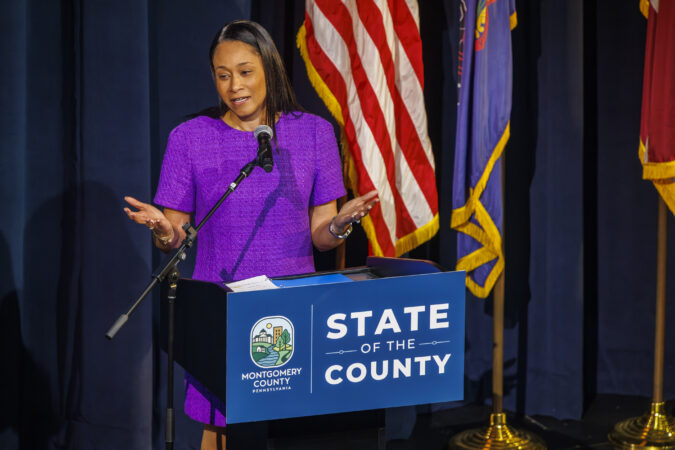
“Naturally, our teams are following what’s coming out of [the Department of Housing and Urban Development], what’s happening with SNAP. We’re trying to anticipate,” said Jamila Winder, a Democrat and thechair of the Montgomery County Board of Commissioners.
Community needs “that arise from the cuts to SNAP and the cuts to Medicaid are significant,” said vice chair Neil Makhija, a Democrat.
Tom DiBello, the board’s lone Republican, had a different view.
“Well, we also have to maybe look at what those reductions are, why those reductions are occurring … and I know this is where we divide,” he said.
Crossing the aisle has become rare in the rancorous national political environment. But at Montgomery County Community College on Wednesday, the commissioners emphasized at their annual State of the County address that they are striving for cooperation to be their norm, even as lawmakers in Harrisburg and Washington struggle to work together.
The commissioners have navigated their own tense moments in recent months, particularly related to immigration.
“Look, there are definitely things that we disagree on as a team, but what’s most important is that we’re able to fund the services that we provide to people in Montgomery County,” Winder told reporters.
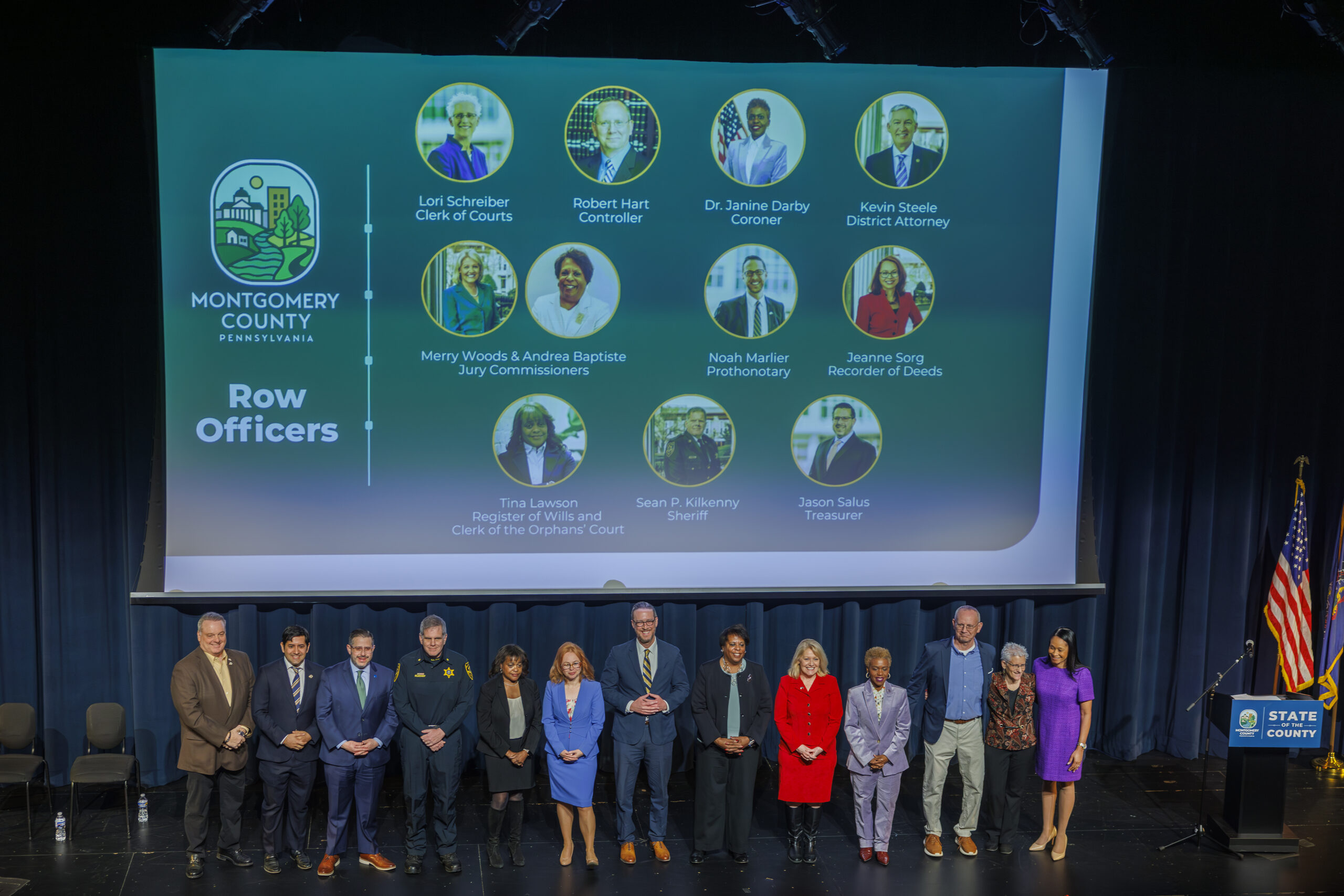
Montgomery County commissioners and row officers stand on stage during introductions.
Wednesday’s address featured the commissioners reflecting on the county’s accomplishments in 2025 and outlining their goals for the year ahead to an audience of constituents and officials. Those include opening shelters for people experiencing homelessness, determining how to best integrate artificial intelligence in county services, and cutting red tape for residents trying to access local services.
And it was also sprinkled with displays of camaraderie despite political differences, such as the commissioners touting 2026’s bipartisan budget as the first in nearly a decade or DiBello going in for a hug after turning the microphone over to Winder for her closing remarks.
“If there’s one thing I want you to take away from today, it’s this: Under our collective leadership as commissioners, this board will continue to put politics aside to do what’s best for our communities,” Winder said at the address, of which the theme was “collaboration.”
But their interactions have not always fit the cordial image presented Wednesday.
Winder and Makhija called for ICE agents to be held accountable, while DiBello encouraged respect for law enforcement and denounced the incorporation of politics into the meeting.
“People are being terrorized by masked ICE agents in Montgomery County, that’s what we’re saying. And if you can’t be empathetic to that, that’s disconcerting,” Winder said at the time.
Thomas DiBello, the lone Republican commissioner, walks to the podium for remarks during the Montgomery County’s 2026 State of County event in Blue Bell. At right is Jamila H. Winder, the board’s Democratic chair.
“No matter what, we should be respecting our law enforcement agencies until they break the law,” DiBello responded.
On Wednesday, immigration-related disagreements lingered when Makhija told reporters about his opposition to ICE buying warehouses in Pennsylvania, including in Berks County, that may be used to detain people.
“Again we divide, because I will support the rule of law,” DiBello said on immigration enforcement. ”I stand with law enforcement, and if people want changes, they need to go to Washington and ask and promote those changes.”
Montgomery County elected officials forcefully condemned a Monday ICE arrest in which agents broke down a family’s front door, lambasting officers for what the leaders described as needless cruelty.
“We are here for one reason, to say that this kind of brutality is completely unacceptable,” said State Sen. Art Haywood, a Democrat who represents parts of Montgomery County and Philadelphia, during a news conference Tuesdayin Norristown.
Neighbors watched in Lower Providence on Monday as a U.S. Immigration and Customs Enforcement action turned into an hours-long siege, with the street blocked off and more than a dozen government vehicles outside a home in an effort to take one man into custody.
The local leaders’ comments came amid a national debate over President Donald Trump’s deportation agenda, following violent operations in Minnesota in which federal agents fatally shot two U.S. citizens last month.
“ICE agents, if you can hear me, do not follow these cruel orders that violate the basic dignity that we all recognize, and for all immigrants who are terrified … we stand with you,” Haywood said.
ICE officials in Philadelphia did not respond to a request for comment.
Montgomery County has become a hot spot for ICE activity, and the Norristown area has come under particular scrutiny, with about one-third of the population identifying as Latino. In July, in one of its most high-profile operations in the Philadelphia region, ICE arrested 14 people at a food market near Norristown, about two miles north of the home where Monday’s arrest took place.
Rachel Rutter, an attorney and the executive director of Project Libertad, was at the scene of the arrest Monday.
She said it appeared the man was going to work when agents attempted to stop his car, and the vehicles tapped. Each blamed the other, she added. The man, who was not immediately identified, subsequently went inside the home at Ridge Pike and North Barry Avenue in Lower Providence Township.
By about 10 a.m., agents had arrived and moved into positions around the property. Videos showed the road blocked off with yellow police tape.
Some agents approached the house, Rutter said, and at least one could be seen waving at someone who was filming from inside. Rutter said family members told her federal agents later obtained a warrant and subsequently broke through the door to arrest the man.
The Department of Homeland Security statement said Wednesday that ICE was conducting a targeted operation to arrest Jose Manuel Cordova Lopez, a Mexican national who overstayed his visa after it expired in 2021 and who in 2025 was charged with driving under the influence.
To try to evade arrest, DHS said, he “weaponized his vehicle” and rammed an ICE vehicle, then fled into his house and refused to come out. ICE subsequently obtained a criminal warrant and arrested him, the agency said.
On Tuesday,elected officials said they were especially concerned with the manner in which Monday’s arrest was carried out.
Janine Darby, a Lower Providence Township supervisor, described seeing at least 20 unmarked vehicles, some with Uber stickers, along with agents from ICE and the Bureau of Alcohol, Tobacco, Firearms, and Explosives. She added that an ambulance was called for a family member in the house who had been “punched in the face.”
“Inside the home, what I saw was devastating,” Darby said. “Children crying, a family in shock, and a home destroyed after agents broke down the door.”
State Sen. Katie Muth (D., Montgomery) said that ICE arrests make communities less safe and less trusting of law enforcement.
“You allow this kind of unlawful behavior without due process to happen to one person, it can happen to anyone,” Muth said.
Montgomery County Commissioner Neil Makhija, a Democrat and vice chair of the board, said Tuesday that “it’s incredibly important that we continue to show that we are taking steps to protect every resident’s rights.”
Immigration activists have repeatedly called for Montgomery County officials to adopt a formal ordinance or resolution to officially become a “welcoming county.”
The Democratic-led board of commissioners has not done so, citing limits to its power and concern about creating a false sense of security for immigrants. Last year, county officials approved a policy limiting communication between county employees and ICE and said they would not honor prison-detainer requests without a signed judicial warrant, and the commissioners confirmed that the county will not participate in ICE’s 287(g) program, which authorizes local governments to assist in immigration enforcement.
State Rep. Greg Scott (D., Montgomery) said community advocacy is crucial, adding that residents witnessing and recording ICE activity are documenting “reality.”
“Keep on recording, keep that spare battery pack in your pocket,” he said. “Keep it in your car, keep your phones charged. We got to keep recording to hold people accountable.”
U.S. Rep. Brian Fitzpatrick (R., Bucks)called on President Donald Trump to apologize for sharing a racist video Thursday night on Truth Social that depicts former President Barack Obama, the country’s first Black president, and former first lady Michelle Obama, as apes.
“Whether intentional or careless, this post is a grave failure of judgment and is absolutely unacceptable from anyone — most especially from the President of the United States. A clear and unequivocal apology is owed,” Fitzpatrick wrote in a post on X Friday afternoon.
The Bucks County Republican, who will be defending a key swing district this fall, joined a bipartisan ensemble of lawmakers who are condemning Trump’s post, which was deleted Friday after the widespread backlash.
“Donald Trump is a bigoted, small-minded man who has long spewed racist remarks and tried to whitewash our nation’s history. Today he finds a new low,” said U.S. Rep. Dwight Evans (D., Philadelphia), a member of the Congressional Black Caucus, in a post on X. “His recent post is vile, disgusting, and abhorrently racist. Every elected official should speak up and condemn this hate.”
Sen. John Fetterman (D., Pa.) in a statement to The Inquirer, called the president’s post “indefensible and horrendous.”
“That garbage came from, and should forever remain in, the twisted and grotesque corners of the internet,” he said.
Fitzpatrick, a moderate representing a purple county, has disagreed with Trump before but the lawmaker’s comments Friday serve as one of his strongest rebukes yet.
“Racism and hatred have no place in our country — ever. They divide our people and weaken the foundations of our democracy,“ Fitzpatrick wrote. “History leaves no doubt: when division is inflamed by those in positions of power, the consequences are real and lasting.”
The White House blamed a staffer for the video, which was posted just fivedays into Black History Month, The Associated Press reported. This came after White House press secretary Karoline Leavitt said there was “fake outrage” over the post and that it was a meme inspired by The Lion King.
In addition to the Obamas, other Democratic leaders, including former President Joe Biden, were depicted as various animals in the video, which was set to “The Lion Sleeps Tonight” and features Trump as the “King of the Jungle.” The clip of the Obamas appears to have originally come from a conservative user on X, The New York Times reported.
In addition to the election officials reacting with horror, Rt. Rev. Daniel G.P. Gutiérrez, bishopof the Episcopal Diocese in Pennsylvania, said that he was “repulsed and sickened” by Trump’s post and called on the president toresign.
U.S. Sen. Dave McCormick (R., Pa) condemned the video late Friday afternoon after the White House had blamed it on a staffer.
“Posting this video is unacceptable and thankfully it has been taken down. It should never have been posted and does not represent who we are as a nation. Racism has no place in America,” McCormick said in a post on X.
Other Republican senators moved faster to publicly condemn Trump’s post.
U.S. Sen. Tim Scott (R., S.C.), the only Black Republican in the U.S. Senate, said Friday morning, “It’s the most racist thing I’ve seen out of this White House. The President should remove it.”
The U.S. House of Representatives Tuesday voted 217-214 to end the partial government shutdown on its fourth day, avoiding a repeat of last year’s 43-day standoff.
The House passed a five-bill package that includes funding the Departments of Defense, State, Transportation, Education, Labor, Treasury, Health and Human Services, and Housing and Urban Development.
Every House Democrat from Pennsylvania opposed the package. U.S. Rep. Scott Perry (R., York) was the lone Republican from the delegation to vote against it.
Among New Jersey Democrats, U.S. Rep. Josh Gottheimer (D., N.J.) was among the 21 members of the party who crossed the aisle to support the bill.
As part of the deal, the House also passed 10 days of funding for the Department of Homeland Security as negotiations for longer-term will continue amid national uproar over President Donald Trump’s immigration crackdown.
Funding for DHS has been the core reason behind the government shutdown after Democrats said they would not vote for an allocation to the department without reforms to federal immigration agents’ conduct after agents fatally shot two Americans in Minnesota last month.
U.S. Rep. Ryan Mackenzie (R., Lehigh), who voted for the deal, said he will participate in “ongoing conversations about achieving commonsense, bipartisan reforms of DHS operations.”
In the House, only a handful of Republicans voted against the package, providing House Speaker Mike Johnson with the support he needed from the party to pass the package in the narrowly divided chamber.
Meanwhile, the vast majority of Democrats voted against the bill, with immigration enforcement remaining a top issue.
"We are in a dangerous and deadly place," U.S. Rep. Madeleine Dean (D, Montgomery) said in a statement. Adding that with DHS receiving funding until Feb. 13, "ICE agents can continue their grotesque and thuggish behavior. Meaning Congress has only ten days to agree on reform,” she said.
Now that Trump has signed the bill, Republicans and Democrats still need to hammer out a long-term deal on DHS, which oversees ICE and the Border Patrol.
Retiring U.S. Rep. Dwight Evans (D., Philadelphia) said in a statement that he would “need to see much-needed guardrails and protections being put into law” before he can support more funding for the agencies.
DHS also oversees TSA and an extended funding lapse could affect air travel.
U.S. Rep. Brian Fitzpatrick, a moderate Republican from Bucks County, voted for the government funding package Tuesday and plans to work with Democrats in the bipartisan Problem Solvers Caucus on reforms to ICE, his spokesperson said.
Staff Contributors
Design, Development and Data: Sam Morris
Reporting: Fallon Roth
Editing: Bryan Lowry
(()=>{var te=(e,t)=>()=>(t||e((t={exports:{}}).exports,t),t.exports);var I=te(r=>{var ue={0:”Jan.”,1:”Feb.”,2:”March”,3:”April”,4:”May”,5:”June”,6:”July”,7:”Aug.”,8:”Sept.”,9:”Oct.”,10:”Nov.”,11:”Dec.”};function E(e){return e===void 0&&(e=new Date),ue[e.getMonth()]}var pe={0:”Jan”,1:”Feb”,2:”Mar”,3:”Apr”,4:”May”,5:”Jun”,6:”Jul”,7:”Aug”,8:”Sep”,9:”Oct”,10:”Nov”,11:”Dec”};function N(e){return e===void 0&&(e=new Date),pe[e.getMonth()]}function s(e){return e==null}function D(e){return typeof e==”number”&&isFinite(e)}function m(e){return D(e)&&Math.floor(e)===e}var fe=[“one”,”two”,”three”,”four”,”five”,”six”,”seven”,”eight”,”nine”],me=[“million”,”billion”,”trillion”,”quadrillion”,”quintillion”,”sextillion”,”septillion”,”octillion”,”nonillion”,”decillion”],$=[“th”,”st”,”nd”,”rd”,”th”,”th”,”th”,”th”,”th”,”th”],he=[11,12,13];function H(e){if(s(e))return””;var t=+e;return m(t)?he.indexOf(t%100)>-1?$[0]:$[t%10]:””}var ve=[“first”,”second”,”third”,”fourth”,”fifth”,”sixth”,”seventh”,”eighth”,”ninth”],ge=new RegExp(/s+([^s]*)s*$/);r.apdate=function(e){return e===void 0&&(e=new Date),E(e)+” “+e.getDate()+”, “+e.getFullYear()},r.apdatetab=function(e){return e===void 0&&(e=new Date),N(e)+” “+e.getDate()+”, “+e.getFullYear()},r.apmonth=E,r.apmonthtab=N,r.apnumber=function(e){if(s(e))return””;var t=+e;return m(t)?t=10?e.toString():fe[t-1]:e.toString()},r.aptime=function(e){e===void 0&&(e=new Date);var t,o,n=e.getHours(),i=e.getMinutes(),l=i===0;if(l){if(n===0)return”midnight”;if(n===12)return”noon”}return n0?n:12):(t=”p.m.”,o=n===12?n:n-12),l?o+” “+t:o+”:”+(i<10?"0"+i:i)+" "+t},r.capfirst=function(e){if(s(e))return"";var t=String(e);return""+t.charAt(0).toUpperCase()+t.slice(1)},r.intcomma=function(e){if(s(e))return"";var t,o=+e;return D(o)?((t=o.toString().split("."))[0]=t[0].replace(/B(?=(d{3})+(?!d))/g,","),t.join(".")):e.toString()},r.intword=function(e){if(s(e))return"";var t=+e;if(!m(t))return e.toString();var o=Math.abs(t);if(o<1e6)return e.toString();var n=Math.ceil(Math.log(o+1)/Math.LN10)-1,i=n-n%3,l=t/Math.pow(10,i);return(l=Math.round(10*l)/10)+" "+me[Math.floor(i/3)-2]},r.ordinal=function(e,t){if(t===void 0&&(t=!1),s(e))return"";var o=+e;return m(o)?t&&o{document.querySelectorAll(“.js-hover”).forEach(e=>{e.addEventListener(“click”,()=>{A(e)}),e.addEventListener(“mouseenter”,()=>{A(e)}),e.addEventListener(“mouseout”,()=>{M(e)})}),window.addEventListener(“scroll”,()=>{u!==null&&ne()})},ne=()=>{(u>window.scrollY+100||u{M(e)})},A=e=>{e.classList.add(“is-visible”),u=window.scrollY},M=e=>{e.classList.remove(“is-visible”),u=null},j={init:()=>{oe()}};var p,ie=(e,t)=>{p=p||window.PMNdataLayer,p?p.push({event:”misc_event”,eventAction:e,eventLabel:t}):window.location.hostname.includes(“localhost”)?console.log(“Analytics event:”,e,t,”(not actually being sent due to localhost)”):console.log(“Failed to push analytics event”,e,t)},f={event:(e,t)=>{ie(e,t)}};var re=!1,se=()=>{document.querySelectorAll(“.js-location”).forEach(e=>{e.querySelector(“.js-location-form”).addEventListener(“submit”,t=>{t.preventDefault(),ae(e)}),e.querySelector(“.js-location-street”).addEventListener(“keyup”,t=>{x(e)}),e.querySelector(“.js-location-street”).addEventListener(“change”,()=>{x(e)})})},ae=e=>{let t=new URLSearchParams;t.set(“street”,e.querySelector(“.js-location-street”).value),t.set(“city”,e.querySelector(“.js-location-city”).value||”Philadelphia”),t.set(“state”,e.querySelector(“.js-location-state”).value||”PA”),f.event(“search”,`submit | ${t.get(“street”)} ${t.get(“city”)}`),e.classList.remove(“is-inactive”,”is-error”,”is-found”),e.classList.add(“is-loading”),fetch(`https://inq-holme.herokuapp.com/geocode?${t.toString()}&fields=cd`).then(o=>{if(o.status>=200&&o.status{console.log(o),o.error?g(“Something has gone wrong. Please try again.”):ce(e,o)})},ce=(e,t)=>{let o=t.results[0].fields.congressional_districts,n=t.results[0].address_components;if(re=!0,t.results[0]&&t.results[0].accuracy>.9&&typeof o!==null&&n.number&&n.formatted_street){e.querySelector(“.js-location-street”).value=`${n.number} ${n.formatted_street}`,e.querySelector(“.js-location-city”).value=n.city;let K=t.results[0].fields.congressional_districts[0].district_number,Q=`${n.state.toLowerCase()}-${K}`,L=document.querySelector(`.js-politicans-member[data-id=”${Q}”]`),v=document.querySelector(“.js-politicans-with-location”),X=v.querySelector(`.js-politicians-members[data-id=”${L.dataset.voteCast.toLowerCase()}”]`),q=v.querySelectorAll(“.js-politicans-member”);q.length>0&&q.forEach(ee=>{ee.remove()}),X.append(L.cloneNode(!0)),v.classList.remove(“is-hidden”),T()}else g(“Address not found. Please try a different one.”)},x=e=>{e.querySelector(“.js-location-street”).value.length>3?e.classList.add(“is-valid”):e.classList.remove(“is-valid”)},T=()=>{document.querySelector(“.js-location”).classList.remove(“is-loading”)},g=e=>{let t=document.querySelector(“.js-location”);t.classList.remove(“is-loading”),t.classList.add(“is-error”),t.querySelector(“.js-error”).textContent=e,document.querySelector(“.js-politicans-with-location”).classList.add(“is-hidden”),T()},k={init:()=>{se()}};var le=()=>{document.querySelectorAll(“.js-politicans-expand”).forEach(e=>{e.addEventListener(“click”,()=>{de(e)})})},de=e=>{f.event(“click”,”open group”),e.closest(“.js-politicans-content”).classList.remove(“is-collapsed”),setTimeout(()=>{e.closest(“.js-politicans-content”).classList.add(“is-open”)},1e3)},P={init:()=>{le()}};var Ve=I();var C=()=>/Android|webOS|iPhone|iPad|iPod|BlackBerry|IEMobile|Opera Mini/i.test(navigator.userAgent);var y=(e,t=null,o=null)=>{o||(o=document.querySelector(“head”));let n=document.createElement(“script”);n.type=”text/javascript”,n.src=e,t&&(n.onload=t),o.appendChild(n)},F=()=>(window.PMNdataLayer?.[0]!==void 0&&window.PMNdataLayer[0])?.analytics?.user?.state===”Subscribed”,O=()=>{let t=(window.PMNdataLayer?.[0]!==void 0&&window.PMNdataLayer[0])?.analytics?.user?.state;return window.location.host.includes(“zzz-systest”)||window.location.host.includes(“pmn.arcpublishing.com”)||window.location.host.includes(“stage.fusion.inquirer.com”)||typeof t>”u”},z=()=>{let t=(window.PMNdataLayer?.[0]!==void 0&&window.PMNdataLayer[0])?.analytics?.user?.hasAdsFreeReading;return!!(t&&t==1)},w=()=>window.location.host.includes(“localhost”);var ye=()=>{z()&&document.querySelectorAll(“.js-ad”).forEach(t=>{t.classList.add(“is-hidden”)})},B={init:()=>{ye()}};var a,_,we=()=>{a=document.getElementById(“js-inno-toast”)},Se=e=>{if(!a)return;a.innerHTML=e,a.classList.add(“inno-toast–active”);let t=()=>{a.addEventListener(“transitionend”,be,{once:!0}),a.classList.remove(“inno-toast–active”)};clearTimeout(_),_=setTimeout(t,5e3)},be=()=>{a.innerHTML=””},c={init:()=>{we()},showToast:Se};var h,Le=async()=>new Promise(e=>{setTimeout(()=>{console.log(“simulating createShareLink for localhost”),e(“https://inquirer.com/interactives”),qe()},100)}),qe=()=>{let e=document.querySelector(“.js-gift-toast-receiver”);!e||!(e instanceof HTMLElement)||setTimeout(()=>{let t=e?.querySelector(“span”);t&&(t.innerHTML=”Gift link copied to clipboard“)},20)},Ae=()=>{let e=window.services?.createShareLink;e&&(h=e),w()&&(h=Le),h&&je()},Me=async e=>{let t=”text/plain”,o=async()=>{try{return await h(window.location.pathname)}catch{e.dataset.state=”error”,c.showToast(“Hmm, we couldn’t generate a gift link…”)}},n=new ClipboardItem({[t]:o()});await navigator.clipboard.write([n]).catch(i=>{console.log(i),c.showToast(“Couldn’t copy to clipboard, try again?”),e.dataset.state=”error”}),c.showToast(“Gift link copied to clipboard!”),e.dataset.state=”complete”},je=()=>{document.querySelectorAll(“.js-gift”).forEach(t=>{(F()||w()||O())&&t.classList.add(“is-available”)}),document.querySelectorAll(“.js-gift-button”).forEach(t=>{t instanceof HTMLButtonElement&&t.addEventListener(“click”,()=>{t.classList.contains(“disabled”)||(t.dataset.state=”loading”,Me(t),setTimeout(()=>{t.dataset.state=”ready”},2e3))})});let e=document.querySelector(“.js-gift-toast-receiver”);!e||!(e instanceof HTMLElement)||xe(e)},xe=e=>{new MutationObserver(o=>{for(let n of o){let i=[…n.addedNodes].at(0);if(!(i instanceof HTMLElement))return;c.showToast(i.outerHTML)}}).observe(e,{subtree:!0,childList:!0})},G={init:()=>{Ae()}};var Te=()=>{window.addEventListener(“message”,e=>{if(e.data[“datawrapper-height”]){let t=e.data[“datawrapper-height”];for(let o in t)document.querySelector(`#datawrapper-chart-${o}`).setAttribute(“height”,t[o])}})},ke=()=>{document.querySelectorAll(“.js-datawrapper-graphic”).forEach(e=>{y(`https://datawrapper.dwcdn.net/${e.dataset.id}/embed.js`,null,e)})},Pe=()=>{window.addEventListener(“message”,e=>{let t=e.data;document.querySelectorAll(`iframe[src*=”${t.id}”]`).forEach(n=>{n.style.height=`${t.height}px`})},!1)},Ee=()=>{document.querySelectorAll(“.js-pym-graphic”).forEach(e=>{if(typeof window{new window.pym.Parent(e.id,e.dataset.iframe)};typeof window.pym>”u”?y(“https://pym.nprapps.org/pym.v1.min.js”,t):t()}})},R={init:()=>{Te(),ke(),Ee(),Pe()}};var Ne=()=>{},J={init:()=>{Ne()}};var d,S,b=!0,$e=()=>{d=document.querySelectorAll(“.js-video-autoplay”)},He=()=>{window.addEventListener(“resize”,()=>{V()}),window.addEventListener(“scroll”,()=>{V()}),d.forEach(e=>{e.addEventListener(“volumechange”,t=>{e.muted!==b&&!C()&&(b=e.muted,De())})})},V=()=>{let e;d.forEach((t,o)=>{let n=t.getBoundingClientRect(),i=n.height/2;n.y-i&&(e=t)}),e!==S&&(S=e,d.forEach(t=>{t.pause()}),e?e.play():S=null)},De=()=>{d.forEach(e=>{e.muted=b})},W={init:()=>{$e(),d&&He()}};var Y={init:()=>{j.init?.(),k.init?.(),P.init?.(),B.init?.(),G.init?.(),R.init?.(),J.init?.(),W.init?.(),c.init?.()}};var Ie=()=>{},U={init:()=>{Ie()}};var Ce=document.querySelector(“.js-inno”),Z=()=>{Y.init(),U.init()};Ce?Z():new MutationObserver((t,o)=>{if(document.querySelector(“.js-inno”)){o.disconnect(),Z();return}}).observe(document,{attributes:!0,childList:!0,subtree:!0});})();
Pete Buttigieg, former President Joe Biden’s transportation secretary and a potential presidential hopeful for 2028, has endorsed Democrat Bob Brooks, a firefighter running for Congress in the Lehigh Valley.
Buttigieg’s endorsement of Brooks,shared first with The Inquirer, illustrates the political importance of the Lehigh Valley, a national bellwether.
Democrats see the 7th Congressional District as one of a limited number of flippable Republican-held seats in the 2026 midterms. It’s also notable that Buttigieg, who could once again be on the national stage in 2028, is weighing into politics in Pennsylvania, a key battleground state.
“People are seeking leaders who understand their lives and fight for their needs,” Buttigieg said in a news release, noting Brook’s experience as a firefighter, union leader, and snowplow driver.
“He understands the urgency of lowering costs because he’s lived it – working long hours, juggling jobs, and fighting for a paycheck that actually covers the basics,” Buttigieg added. “It’s a perspective Washington needs more of, and I’m proud to endorse him.”
This undated photo provided by Bob Brooks for Congress in August 2025 shows Bob Brooks, president of the Pennsylvania Professional Fire Fighters Association. (Bob Brooks for Congress via AP)
In addition to Buttigieg, Brooks has also received the backing of Gov. Josh Shapiro (another potential 2028 candidate), Lt. Gov. Austin Davis, U.S. Rep. Chris Deluzio, Sen. Bernie Sanders (I-Vt.), various unions, and other elected officials.
Brooks said in the news release that Buttigieg’s endorsement “means a great deal.”
“He’s focused on listening to new voices and making government work for everyday people at a time when too many feel shut out and left behind,” Brooks said. “It’s an honor to have him on board as we fight to build a Congress that looks like and works for the people it serves.”
President Donald Trump has endorsed Mackenzie (and every other congressional Republican in Pennsylvania except Fitzpatrick) and Vice President JD Vance swung through the district in December.
But Trump may not be the boon for Mackenzie he was two years ago.
Trump made his biggest gains in the state in 2024 in the Lehigh Valley and Northeastern Pa., but recent interviews with voters and polling data suggests his support in the region could be dwindling heading into the midterms.