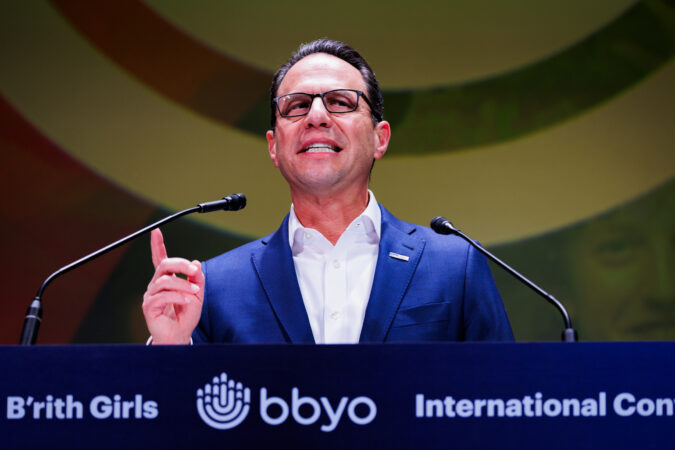
Pennsylvania Gov. Josh Shapiro pushed back against President Donald Trump’s executive orderto create of a national eligible voter list and restrict mail voting.
“President Trump can sign whatever the hell he wants to, but it won’t change the Constitution,“ Shapiro, a Democrat, said in a post on X Tuesday night after Trump signed the order. ”The authority to set our election rules belongs to the states — and as Governor, I will protect your right to vote. That includes your right to vote by mail.”
Trump’s order is the latest of several attempts by the president to nationalize the U.S. voting process and promote his false claims of election fraud.
Tuesday’s directive instructs the Department of Homeland Security to coordinate with the Social Security Administration to develop a list of eligible voters in each state, according to the executive order signed Tuesday. The list — called “The State Citizenship List” — will be compiled from various government records including citizenship and naturalization and the SSA.
It also seeks to bar the U.S. Postal Service from sending absentee ballots to those not on each state’s approved list, although the president likely lacks the power to mandate what the Postal Service does. Trump is also calling for ballots to have secure envelopes with unique barcodes for tracking.
The order is likely to attract swift legal action from officials in Democratic-led states. Shapiro was not explicit in his post on X as to whether he’ll file suit against the Trump administration for the directive. But it wouldn’t be a surprise if he did — the governor, who is running for reelection, has frequently taken the president and other top officials to court over the past year.
If Shapiro takes legal action, he’d be joining other Democratic officials who have already committed to file suit, including inArizona and Oregon. Voting law experts told The Associated Press that the order votes the Constitution by attempting to take the power to run elections from the states.
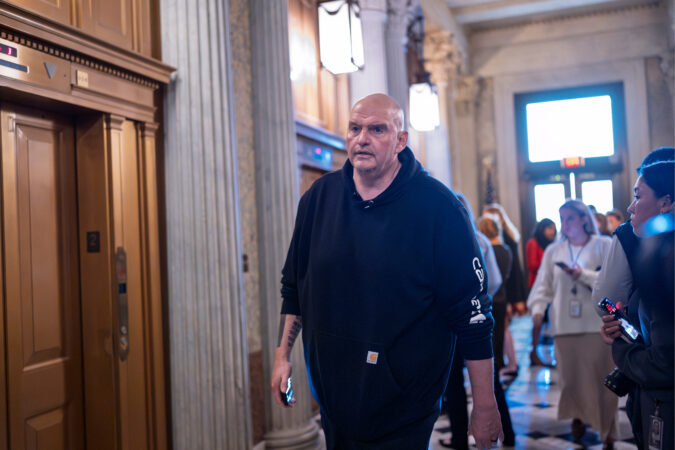
U.S. Sen. John Fetterman promised to back President Donald Trump’s pick to succeed Kristi Noem within minutes of her abrupt firing as secretary of homeland security.
Trump has tappedU.S. Sen. Markwayne Mullin (R., Okla.) to lead the Department of Homeland Security, which oversees Immigration and Customs Enforcement, the Border Patrol, and the two agencies’increasingly unpopular operations in carrying out Trump’s deportation agenda.
Mullin’s nomination must be confirmed by the Senate.
“I’m not sure how many fellow Democrats will vote to support our colleague [Sen. Mullin] as the next DHS Secretary, but I am AYE,” Fetterman said in a post on X, which also noted his membership on the committee that oversees the department.
Mullin and Fetterman (D., Pa.) were both elected to the Senate in 2022. The Oklahoma Republican had served in the U.S. House for a decade before joining the upper chamber. Mullin told reporters he had already received a text message from Fetterman after Trump’s announcement.
“You guys know John and I are friends. … We’re going to try to earn everybody’s vote,” Mullin said when asked whether other Democrats would vote for him.
The sudden change in leadership at DHS follows growingoutrage over ICE’s tactics and questions aboutNoem’s leadership, both of which escalated nationally after federalagents shot and killed U.S. citizens Renee Nicole Good and Alex Pretti in January in Minneapolis.
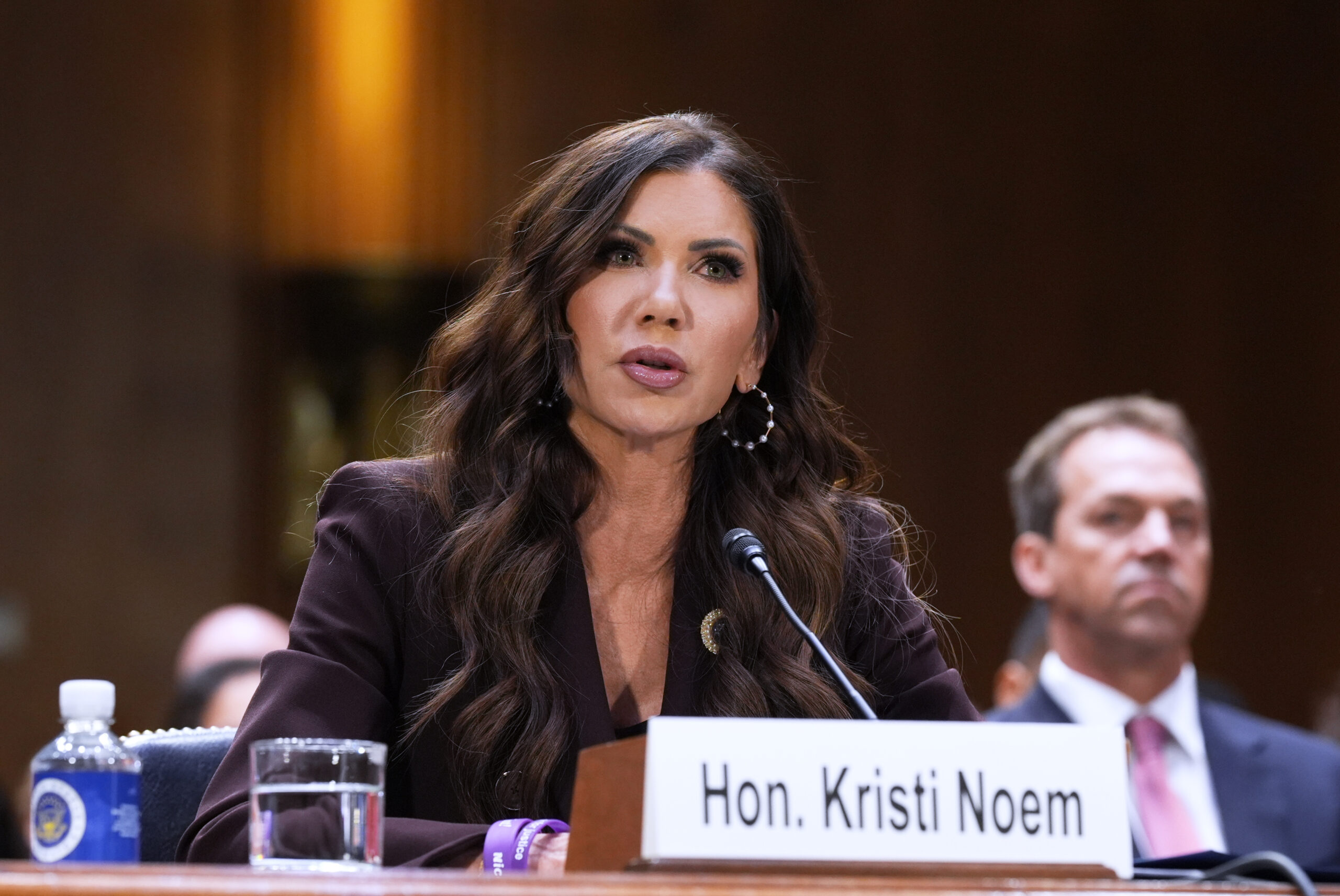
Homeland Security Secretary Kristi Noem appears for an oversight hearing before the Senate Judiciary Committee, at the Capitol in Washington, March 3, 2026.
Fetterman and other senators who had voted for Noem’s confirmation called for her to be fired after Pretti’s killing. She also faced criticism from both sides of the aisle at a recent oversight hearing before the Senate that examined a controversial $220 million ad campaign she approved, among other topics.
U.S. Sen. Dave McCormick (R., Pa.) said on Thursday that he supports Mullin’s nomination.
It is unclear whetherother Democratic senators will give the green light to Mullin’s nomination, but many on Thursday were quick to celebrate Noem’s departure as she transitions into a newly createdrole in the Trump administration called “the Special Envoy for the Shield of the Americas.”
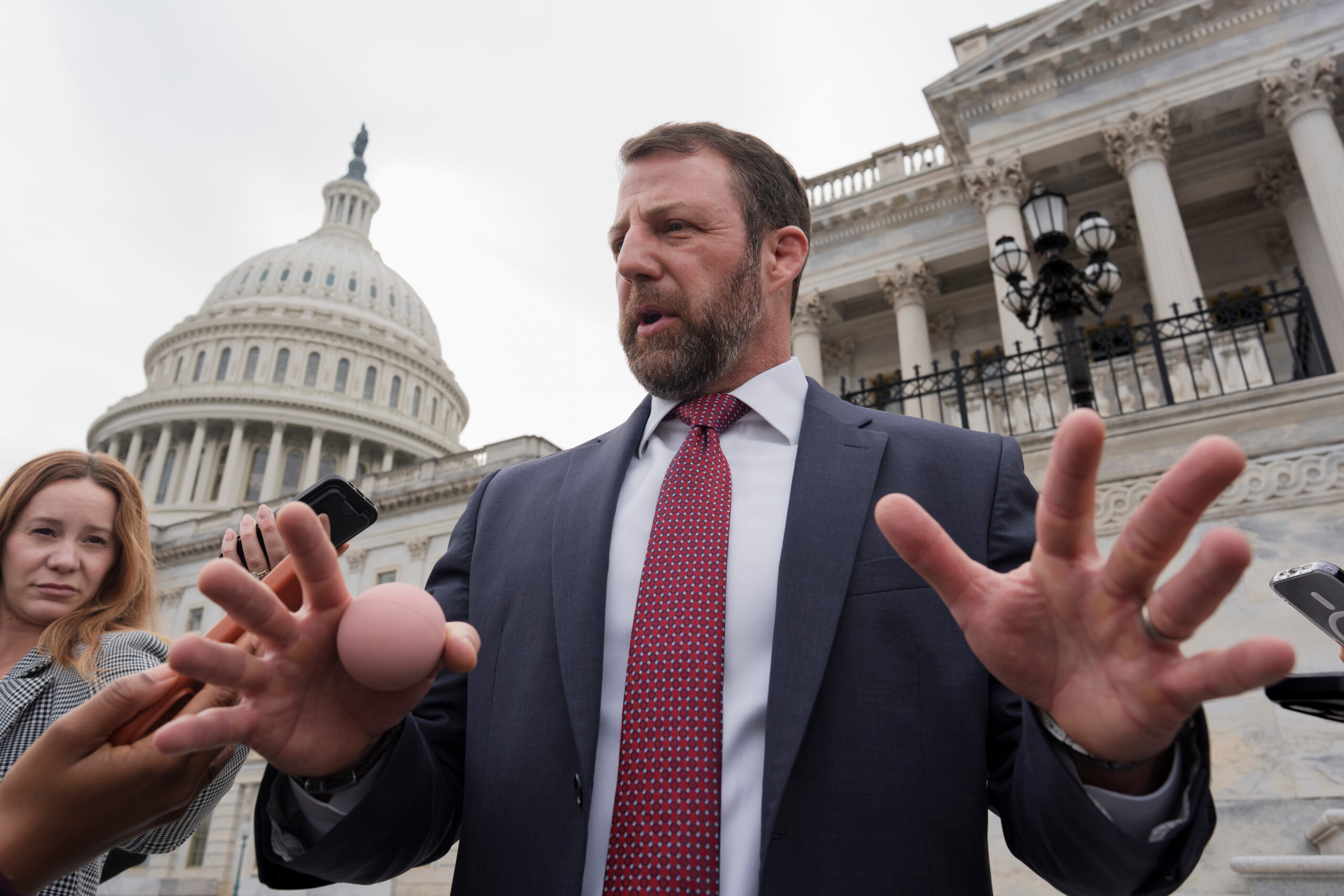
Sen. Markwayne Mullin, R-Okla., speaks with reporters on the steps at the Capitol in Washington, Thursday, March 5, 2026.
But he cautionedthat Noem’s termination is “only the start of getting rid of the deep rot of corruption in the Trump administration,” and that other officials, including Trump adviser Stephen Miller and Tom Homan, the border czar, should be held accountable for immigration agents’ conduct.
Kim and U.S. Sen. Cory Booker (D., N.J.) have offered legislation to prohibit such moves and Gov. Josh Shapiro has floated possible legal action over DHS’s purchase of two warehouses in Pennsylvania.
Democratic House members from the region echoed Kim’s sentiment that more change is needed than just the leadership of the department.
Lawmakers are still debating future funding for DHS, with Democrats demanding reforms to immigration enforcement before they will approve more money for the department.
“Change the lousy policies, not just the person,” U.S. Rep. Dwight Evans (D., Philadelphia) wrote on X.
“We still need real accountability at DHS, including meaningful reforms to ICE so agents are not terrorizing Americans,” U.S. Rep. Brendan Boyle (D., Philadelphia) said on X.
Boyle criticized Fetterman for immediately pledging to support Mullin, saying in another post that the Pennsylvania senator is “Trump’s favorite Democrat for a good reason.“
U.S. Rep. Chrissy Houlahan (D., Chester) congratulated Trump in a statement Thursday for “taking this long overdue action” in firing Noem.
“I sincerely hope Mr. Mullin or whomever is eventually confirmed will be prepared to reform ICE and to work with the Congress to rein in its most destructive practices,” she said.
U.S. Rep. Ryan Mackenzie (R., Lehigh), who represents a key swing district, said he looks forward to “seeing a greater emphasis on transparency” under Mullin.
He stopped short of criticizing Noem and said in the last year DHS“made critical progress towards securing the border once and for all.”
His office underlined that a new leader should focus on rebuilding the department’s reputation with the American people.
“The Department of Homeland Security carries one of the most important missions in government — protecting the American people. That mission requires the public’s trust, and Congressman Fitzpatrick believes a leadership change was needed to help restore confidence in the department,” Fitzpatrick spokesperson Casey-Lee Waldron said in a statement.
“He hopes Senator Mullin will work to rebuild that trust and strengthen DHS moving forward.”
The Montgomery County commissioners further limited the county’s cooperation with ICE on Thursday when they passed a resolution restricting federal immigration enforcement from using county property or resources for noncriminal investigations.
The measure approved by the Democratic-controlled board bars U.S. Customs and Immigration Enforcement from using county resources for various purposes, including as staging areas, processing locations, or operations bases related to civil immigration operations.
“We’ve seen it elsewhere — the violence, the fear, the separation of families. We want to make sure that here in Montgomery County, we’re doing everything we can to make sure all of our residents can continue to access essential services and live their lives safely,” said Commissioner Jamila Winder, the Democrat who chairs the board.
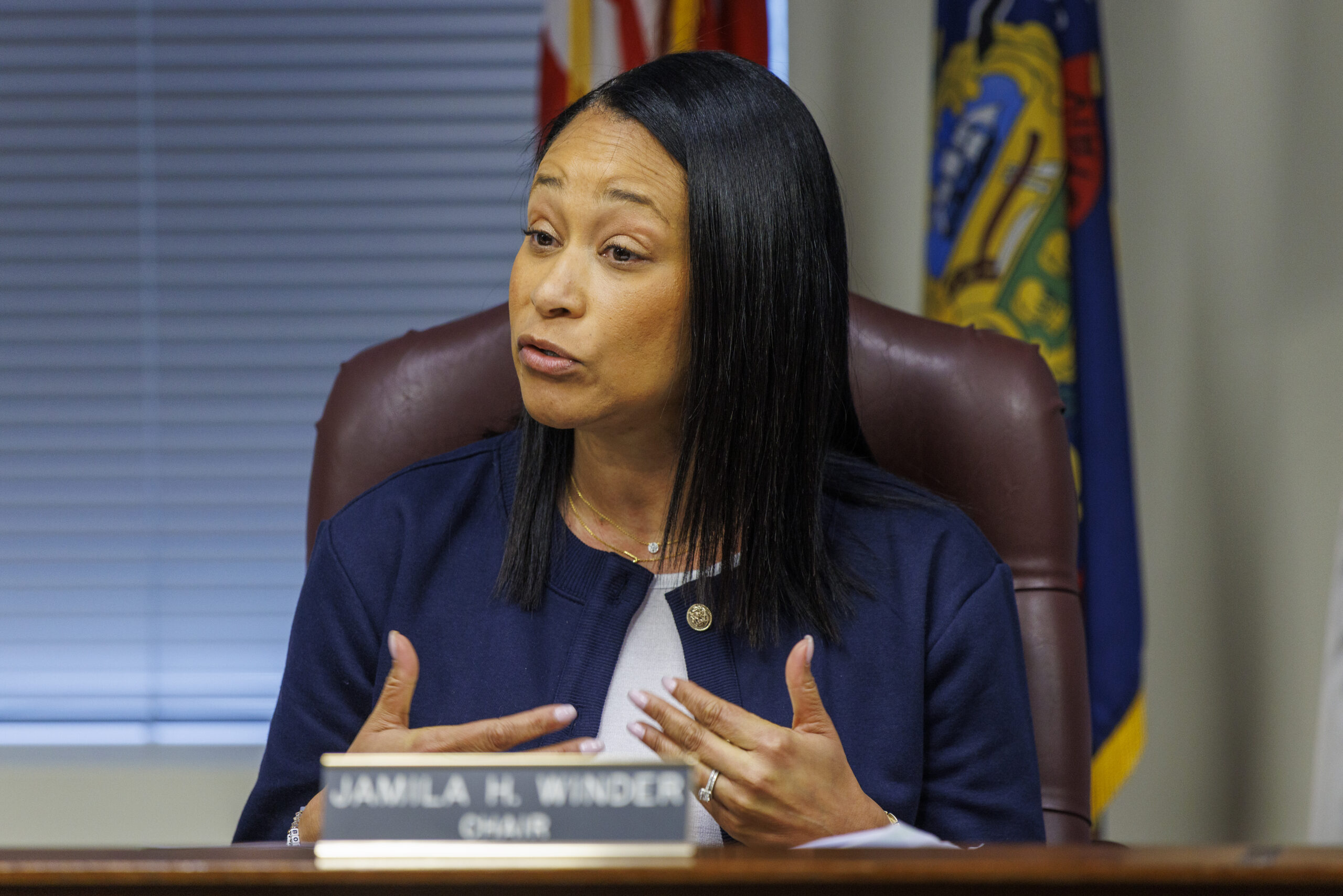
Jamila H. Winder, Chair, Montgomery County Commissioners on Thursday, March 5, 2026.
The resolution comes as immigration stakeholders in the county have been pushing the commissioners to take further action to protect residents from ICE enforcement as President Donald Trump’s deportation agenda continues to escalate.
Much of the tension occurred under the leadership of Kristi Noem, the Department of Homeland Security secretary whom Trump fired Thursday.
Calls for action escalated nationally in January after federal agents killed U.S. citizens Renee Nicole Good and Alex Pretti in Minnesota. In Montgomery County, ICE has carried out numerous operations, especially in communities with high numbers of Latino residents, such as Norristown, the county seat.
“Let me be clear: The county does not have authority over the federal government’s actions over civil immigration enforcement, and we still do not have the authority over the courts, other elected officials, municipalities, townships, or their law enforcement officers,” Winder said. “That remains unchanged, but what has changed is the environment we’re in.”
The policy to block ICE from using county resources passed 2-1 with Commissioner Tom DiBello, the board’s sole Republican, voting no.
The measure codifies that the county will not enter into a 287(g) agreement, which would allow ICE to use county resources, and that county employees will not comply in federal civil immigration operations without a judicial warrant or subpoena.
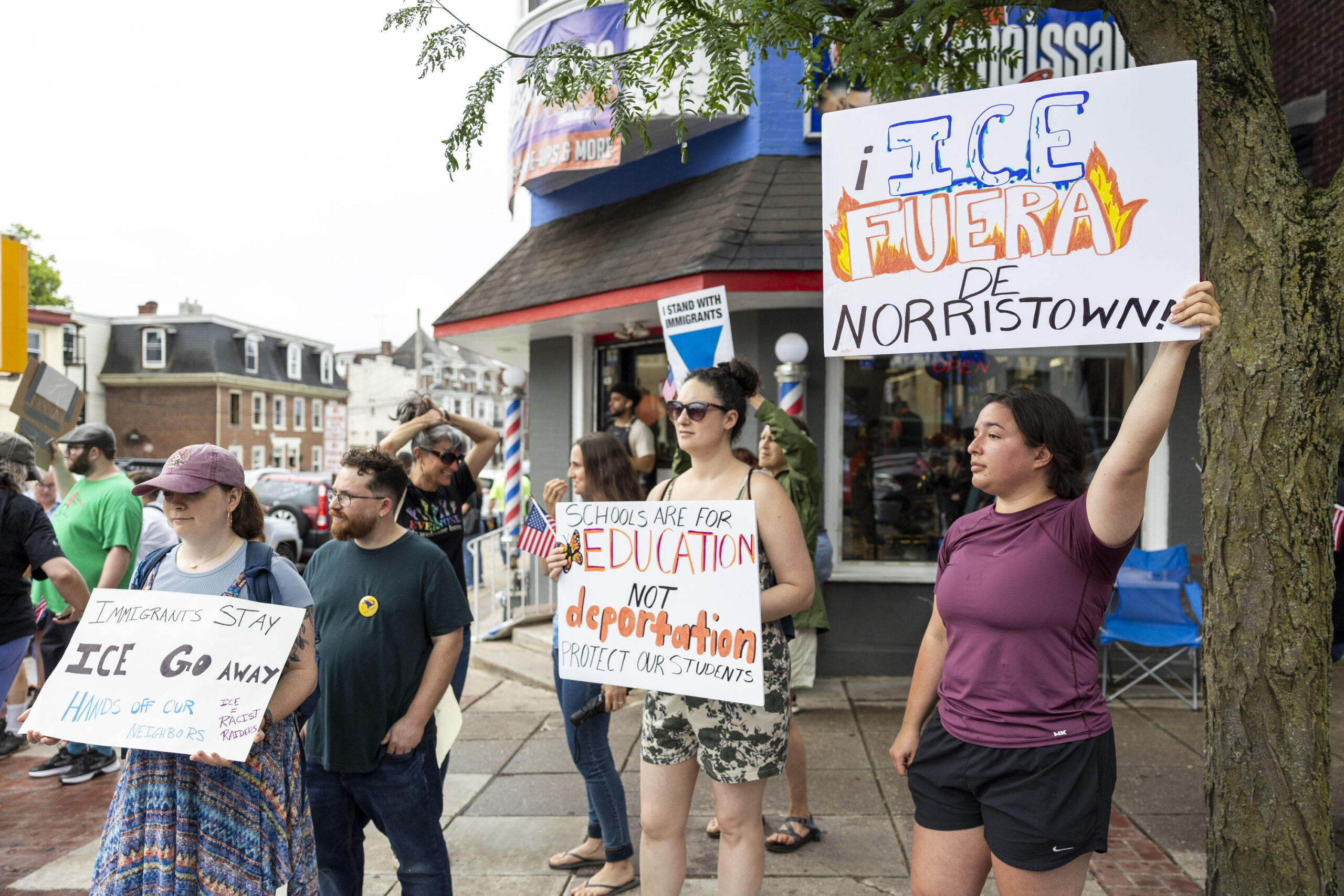
Lydia Villalba, 27, of Souderton, Pa., (right), holds a sign saying “Ice Fuera De Norristown” meaning Ice out of Norristown, during a rally to support immigrants in Norristown, Pa., on Saturday, June 7, 2025.
It does not prohibit ICE from purchasing warehouses for detention centers, as the agency has done in Berks and Schuylkill Counties.
Montgomery County’s resolution denying ICE access to its buildings and lands follows a national trend among Democratic-led jurisdictions. The move has both symbolic and practical impacts.
First, it enables the county government to publicly make clear its opposition and noncooperation. And second, ICE can need big spaces to set up officers, cars, and equipment for operations; banning the use of potential staging areas can complicate the agency’s logistics.
Montgomery County’s Department of Assets and Infrastructure will post signage on county-owned property noting that the area cannot be used for purposes not approved by the county, according to the resolution. Private property owners who wish to restrict civil immigration enforcement activity on their properties can request signs for free.
Megan Alt, a spokesperson for the county, said the hope is that ICE will comply with county law. But if not, the county is prepared to handle violations as it would for any other instances of trespassing.
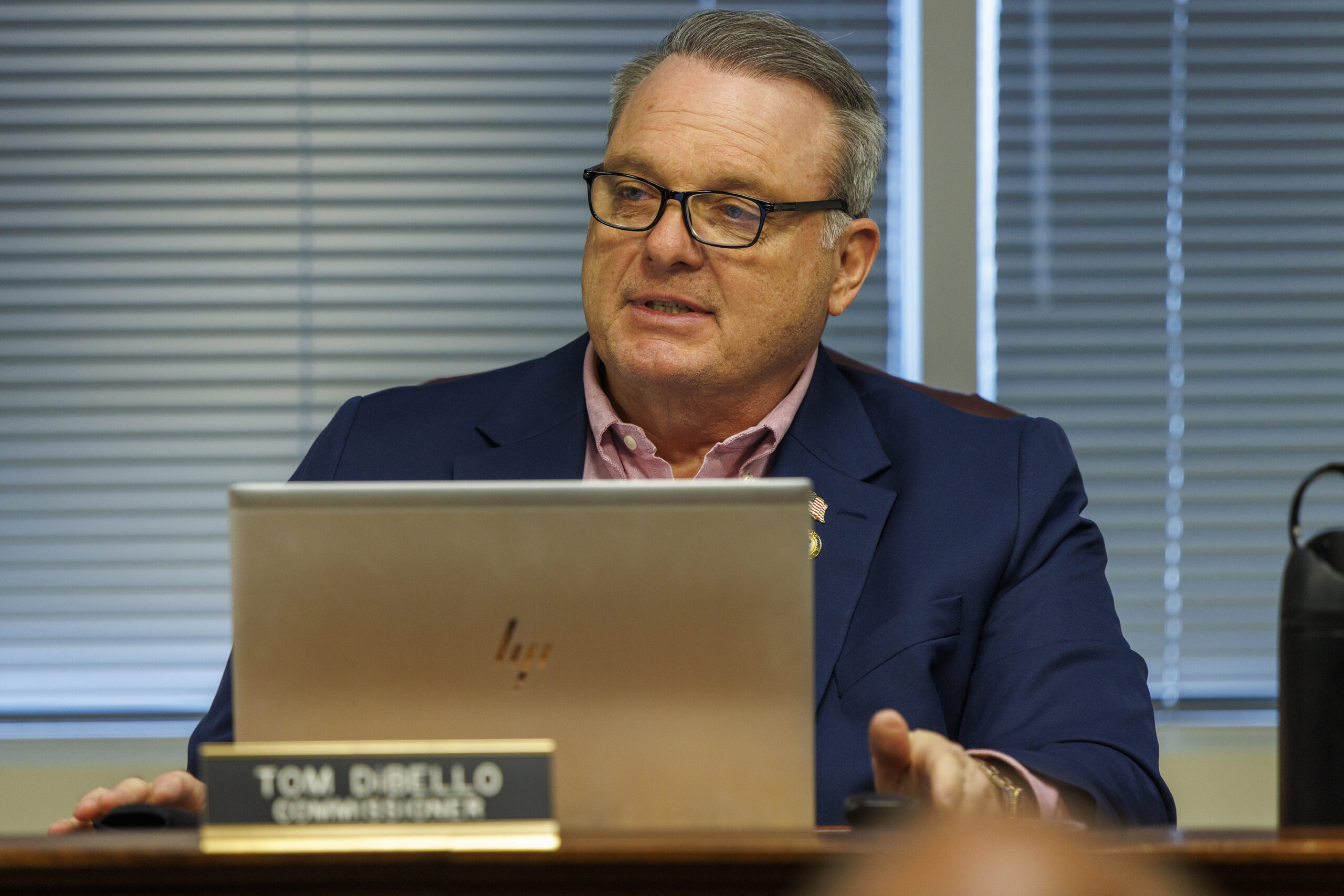
Thomas DiBello, Commissioner, Montgomery County Commissioners on Thursday, March 5, 2026.
DiBello, the lone GOP commissioner, said his opposition has “nothing to do with politics” and criticized the resolution’s references to ICE-related incidents that took place outside Montgomery County. He also said he was concerned that private property owners who do not post signs restricting ICE action on their properties will be targeted as a consequence.
“What’s going to happen then? Is there doxing going to occur? Is there protests outside of businesses?” he asked.
Commissioner Neil Makhija, the board’s vice chair, said the resolution “has nothing to with immigration policy,” but rather was about limiting cooperation with an agency that has used extreme tactics. He cited an ICE arrest last month in Lower Providence Township in which agents broke down a family’s front door.
DiBello responded that Makhija was engaging in “political positioning.”
In the Philadelphia region and elsewhere, ICE’s use of government property has long rankled immigration advocates, who say it amounts to cooperation on the part of local leaders.
For instance, Philadelphia City Council is poised to consider a package of “ICE Out” legislation that would bar the agency from staging or conducting enforcement on property owned or controlled by the city — including garages, parking lots, vacant land, buses, playgrounds, and schools.
Winder said Thursday that Montgomery County’s resolution is not some “newfound desire” to limit cooperation.
“Yes, we have our political affiliations, but we also know the difference between right and wrong, good and evil,” she said.
U.S. Sens. John Fetterman and Dave McCormick voted Wednesday against advancing a war powers resolution that would have barred President Donald Trump from ordering further strikes on Iran without congressional approval.
The vote came days after United States and Israel launched a missile attack on Iran, killing that nation’s supreme leader, Ayatollah Ali Khamenei. Six U.S. service members were killed in Iranian counterstrikes.
Fetterman, who applauded Trump’s comments about Iran during last week’s State of the Union, was the lone Democrat to vote against the measure, which would require the termination of U.S. military force against Iran.
Even before Trump ordered “Operation Epic Fury,” Democrats had pushed for a vote on a resolution to reassert congressional authority over military action.
But Fetterman has been at odds with the rest of his party, contending that military action is necessary to prevent Iran from developing nuclear weapons.
“Every member in the U.S. Senate agrees we cannot allow Iran to acquire a nuclear weapon. I’m baffled why so many are unwilling to support the only action to achieve that,” Fetterman said on X Monday. “Empty sloganeering vs. commitment to global security — which is it?”
The resolution, led by Sen. Tim Kaine (D., Va.), failed 47 to 53, falling short of the required 60-vote threshold to advance in the U.S. Senate. U.S Sen. Rand Paul (R., Ky) was the only Republican to support the measure.
U.S. Sen. Andy Kim (D., N.J.) compared Trump’s decision to attack Iran to former President George W. Bush’s 2003 invasion of Iraq.
“We’ve seen this before. A president manufactures an imminent threat, chooses to start a war with unclear objectives and uses America’s resolve as an excuse for war without end because they’ve got no plan to end it,” Kim said in a Senate floor speech Tuesday in support of the resolution.
But Kim also noted a point of contrast. Bush had obtained authorization from Congress for military force, a step Trump didn’t even try to take, Kim noted.
“President Trump refused to make a case to the American people,” said Kim, who served on former President Barack Obama’s National Security Council.
Senate Republicans once again failed to hold Trump accountable. Today's vote sends us down a dangerous path into a potentially endless war.
The American people don't want this war. Trump has no plan.
Lawmakers’ attempts to rein in Trump comes as the U.S. is “accelerating, not decelerating” its military efforts, Defense Secretary Pete Hegseth told reporters in the Pentagon Wednesday, CBS News reported.
A 1973 law allows a single lawmaker to force a vote to withdraw troops or block military strikes, and it requires the president to obtain congressional authorization to commit the Armed Forces beyond 60 days.
Both of Pennsylvania’s senators have been strong supporters of Trump’s strikes, which followed failed negotiations.
McCormick(R., Pa.), an Army veteran and member of the Senate Foreign Relations Committee, said “the president has given the ayatollahs a chance for a deal, and they have rejected a path to peace and prosperity.”
During the first Trump administration, the president withdrew from an agreement Obama struck with Iran intended to prevent it from developing nuclear weapons in exchange for lifting sanctions.
U.S. Sen. Lisa Blunt Rochester (D., Del.), who voted to support the measure, said in a statement Wednesday that the Iranian government ”is a deadly one” and acknowledged the danger of the country’s nuclear capabilities.
“But after attending the Senate briefing on Iran, it was strikingly clear that there was no rational justification for military action and no imminent threat to the United States,” she said. “This administration has failed to define its goals, explain an exit strategy, or provide any long-term plan for what comes next.”
Her fellow Delaware Democrat,U.S. Sen. Chris Coons, also supported the resolution and this week called for Hegseth and Secretary of State Marco Rubio to appear before the national security committees to explain the lack of planning for the “protection and evacuation of Americans from their war of choice,”as U.S. citizens in the Middle East are scrambling to evacuate.
U.S. Sen. Cory Booker (D., N.J.) said on X Saturday that Congress cannot “simply roll over” and invoked the lessons from past conflicts in the Middle East.
“We should have learned from the last two decades of conflict in the Middle East that wars launched without clear goals and without an end-state in mind rarely end well,” he said. “They cost lives, destabilize regions, embolden adversaries, and weaken America’s moral standing.”
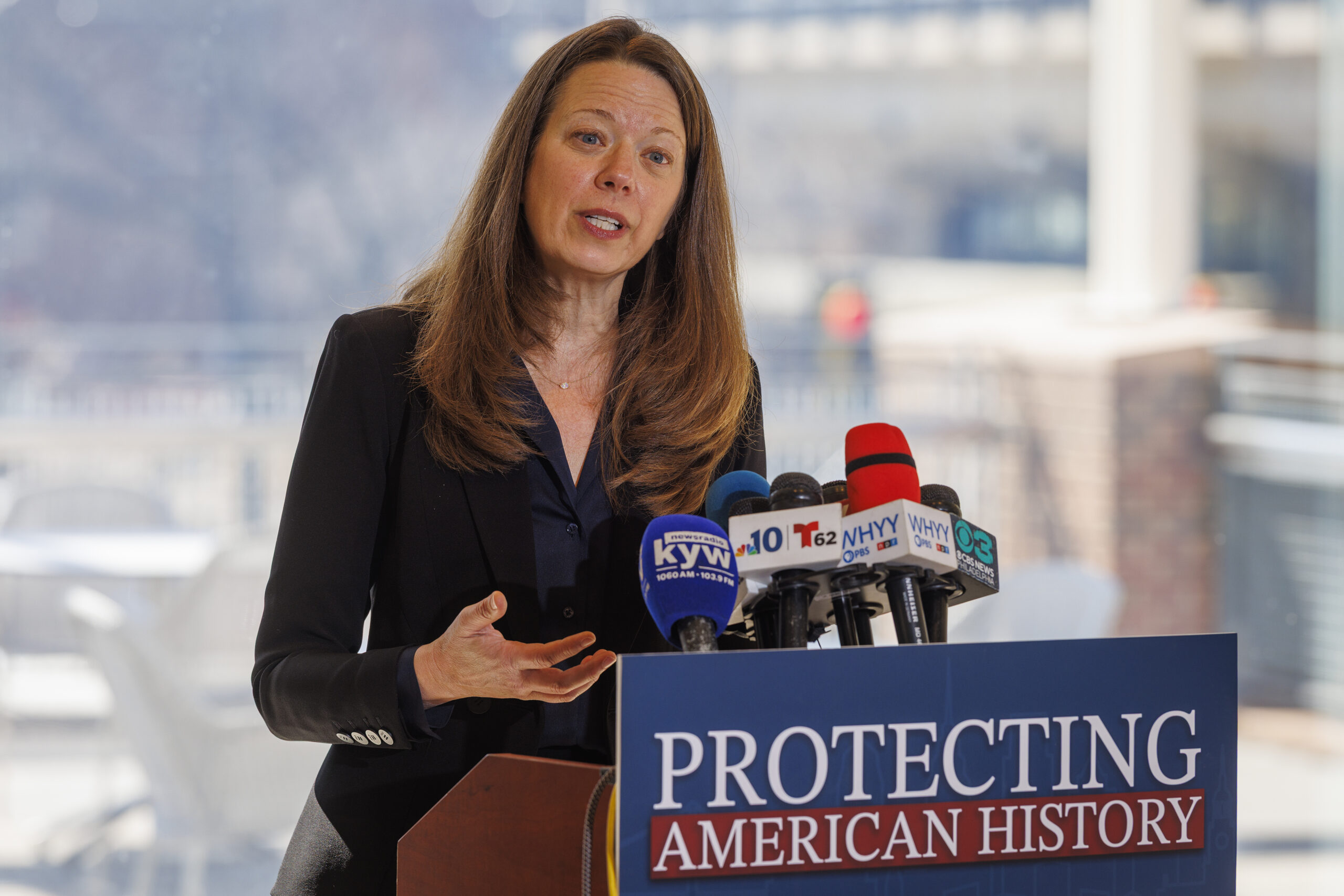
The proposed Protecting American History Act comes as the future of the President’s House, which memorializes the nine people George Washington enslaved in Philadelphia, remains in limbo as a legal battle between the City of Philadelphia and the federal government continues to play out.
“It is only dictatorships and communist countries that whitewash their history and give an official version, rather than the accurate version,” Boyle said during a news conference Friday. “Frankly, the most American thing in the world is to discuss and debate our nation’s history. It improves who we are as a people and where we’re going.”
The National Park Service last month removed educational panels from the site under President Donald Trump’s executive order forbidding displays at national parks that “inappropriately disparage Americans past or living.”
Some of that material was restored last week after a judge ruled in favor of the city, but those efforts were paused by a federal appeals judge while considering the Trump administration’s motion for a stay. The appeal of the lower federal court’s injunction that ordered them to restore the displays is also underway.
“Court decisions alone are not enough… History should not depend on the whims of one federal judge. This issue is bigger than just one exhibit, as important as it is. This is about the history of our entire nation and our people,” Boyle told reporters Friday at the Independence Visitor Center.
With Independence Hall towering behind him, Boyle said the bill calls for restoring all historical exhibits at the park, including the President’s House, to its status on Jan. 21, the day before the displays were taken down. It will also shield all historical displays at Independence National Historical Park, which Boyle’s district includes, from any future government censorship.
The President’s House opened in 2010 after years of advocacy by local Black leaders. It juxtaposes the cruelty of slavery against the nation’s founding ideals.
Michael Coard, an attorney and leader of Avenging the Ancestors Coalition, which helped shape the President’s House, said in a statement that his group is looking forward to working with Boyle on the legislation and will reach out to both Democratic and Republican lawmakers.
“From day one, we have said this is not a partisan issue,” Coard said in a statement. “This is an American issue. The full history of our nation deserves to be told without censorship or political interference.”
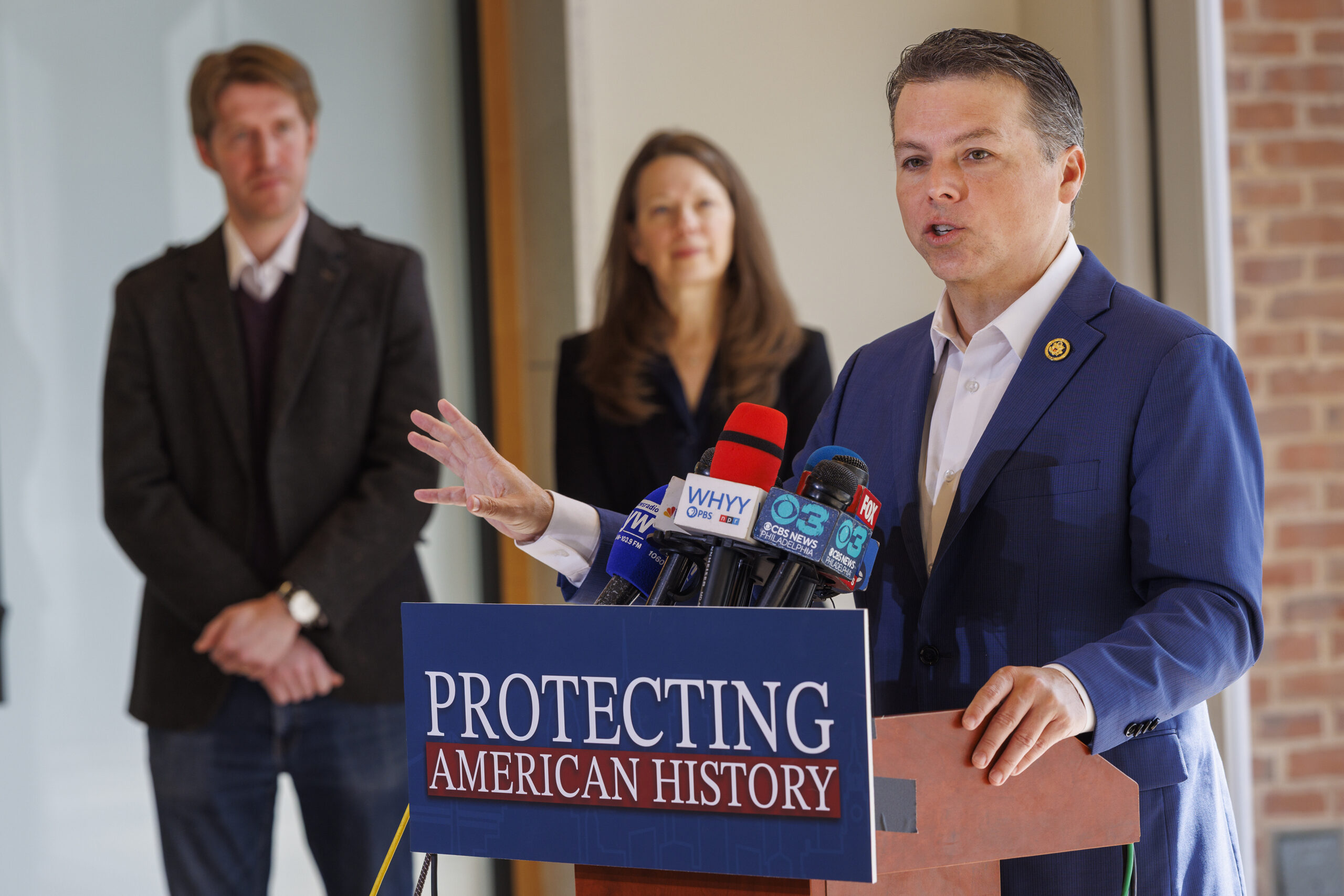
U.S. Rep. Brendan Boyle announces legislation called the Protecting American History Act at the Independence Visitor Center, Friday, Feb. 27, 2026.
U.S. Reps. Dwight Evans and Mary Gay Scanlon, who also represent parts of Philadelphia, are the lead cosponsors on the legislation.
The Democrats also joined Boyle last month in writing to Interior Secretary Doug Burgum and Acting National Park Service Director Jessica Bowron seeking answers about the President’s House by Jan. 30. As of Friday, the Trump administration officials had yet to respond, Boyle said.
Boyle said that he has discussed this bill with Republican colleagues in the House, and they have expressed support, but it’s uncertain whether those lawmakers will publicly support his billor whether it’ll receive a vote in the GOP-controlled chamber.
In addition to lawmakers, Boyle’s bill is supported by the Rev. Beth Hessel, executive director of the Athenaeum of Philadelphia, a historic membership library, and Sean Connolly, executive director of Arch Street Meeting House, a Quaker historical site.
Rev. Dr. Beth Hessel, executive director of the Athenaeum of Philadelphia, speaks in support of legislation from U.S. Rep. Brendan Boyle that would restore exhibits at the President’s House.
The legislation focuses solely on Philadelphia, but the hope is, Boyle said, that it can serve as a model for other lawmakers throughout the country as the Trump administration attempts to rewrite history ahead of the nation’s 250th anniversary.
Other historic sites and national parks have also had educational material removed in recent weeks, including the Grand Canyon, where the National Park Service took down signage about the mistreatment of Native Americans.
Boyle said the present day is almost a full-circle moment from the country’s founding, comparing Trump to King George III.
“Almost exactly 250 years ago, our founders were dealing with an out-of-control, dictatorial ‘Mad King.’ They opted on the side of honesty and truth and idealism… it is toward that more perfect union you still strive today.”
Pennsylvania voters appear to be all in on Gov. Josh Shapiro’s reelection bid, while some are still warming up to the thought of him being president one day.
Among registered voters, the Democratic incumbent leads his Republicanchallenger, state Treasurer Stacy Garrity, 55-37%, according to a Quinnipiac University poll released Wednesday.
But 43% of the state’s voters do not think he would make a good president and 16% did not offer an opinion, despite his high overall approval.
A strong majority of Democrats and a plurality of independent voters both said he would be a good president, but a strong majority of Republicans disagreed.
The survey, conducted among 836 registered voters in Pennsylvania from Feb. 19 to 23, offers a glimpse of what voters in one of the most politically consequential states think of top elected officials a little more than eight months ahead of the high-stakes 2026 midterms.
Pennsylvania voters also shared their perceptions of U.S. Sen John Fetterman (D., Pa.), who has significant support among Republicans but a low rating with his own party, and President Donald Trump, whose job approval rating is sitting below 50% in a state he won two years ago.
Here’s what else to know from the Quinnipiac poll:
Sen. John Fetterman, D-Pa., left, and Sen. Dave McCormick, R-Pa., right, greet before participating in a debate moderated by Fox News anchor Shannon Bream, not shown, Monday, June 2, 2025, at the Edward M. Kennedy Institute for the United States Senate, Monday, June 2, 2025, in Boston, as livestreamed on Fox Nation. (AP Photo/Steven Senne)
Republicans support John Fetterman. Democrats don’t.
Fetterman has been known to cross the political aisle, and his willingness to embrace Trump and take key votes with Republicans appears to be costing him with voters in his own party.
Sixty-two percent of Democratic Pennsylvania voters disapprove of how Fetterman is handling his job, while only 22% approve.
Those dismal numbers with his own party are worse than Fetterman’s Republican colleague, Sen. Dave McCormick, who has a 54% disapproval rate with Democrats.
After three years in office, Fetterman does much better with Republicans than his own party. Among GOP voters, 73% approve of the Democratic senator, compared with just 18% who disapprove, according to the poll. Among independents in the swing state, 48% approve and 37% disapprove.
The progressive Working Families Party has said it will support and, if needed, recruit a challenger. Fetterman has repeatedly sparred with progressives on a range of issues from unconditional support for Israel’s military actions in Gaza to his stance on immigration enforcement.
He also drew ire from fellow Pennsylvania Democrats for crossing the aisle to support a Republican plan to end last year’s government shutdown without a deal to address expiring healthcare subsidies.
U.S. Rep. Brendan Boyle (D., Philadelphia), a potential primary challenger, has repeatedly called Fetterman “Trump’s favorite Democrat,” including on Tuesday night, when the senator shook the president’s hand at the State of the Union address.
Other names floated as potential contenders include U.S. Rep. Chris Deluzio (D., Beaver) and former U.S. Rep. Conor Lamb, who lost the 2022 primary to Fetterman.
Which party do Pa. voters want to win the midterms?
Forty-nine percentof Pennsylvania registered voters want to see Democrats win control of the U.S. House in November, while 43% want Republicans to maintain their advantage.
November’s midterms are consequential for both parties, especially in the House, where Republicans currently have a slim majority.
But voters in Pennsylvania have soured on Trump, who receives just 40% approval in the poll, compared with 55% disapproval. And he is losing ground on two key issues that propelled him to office: the economy and immigration.
According to the poll, only 28% of Pennsylvania voters think the economy is getting better, while 47% think it is getting worse and 23% think it is staying the same.
Additionally, 56% believe the Trump administration’s immigration enforcement is too harsh in how it treats undocumented immigrants. Meanwhile, 36% think the president is handling immigration correctly and 6% think the administration is being too lenient.
Democrats believe they can capitalize on these issues and defeatincumbents in key swing districts: Republican U.S. Reps. Brian Fitzpatrick in Bucks County, Ryan Mackenzie in Lehigh County, Rob Bresnahan in Lackawanna County, and Scott Perry in York County.
Trump has endorsed every member of the Republican U.S. House delegation in Pennsylvania except Fitzpatrick.
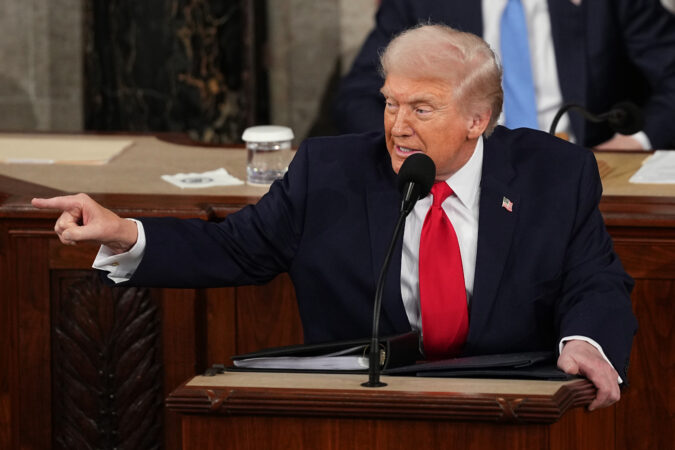
He mentioned the “historic streets of Philadelphia,” Thomas Jefferson’s final breath, and the FIFA World Cup games, some of which will take place in the city this summer.
But his talk of the 250th celebrations served as bookends to what was otherwise a speech in which he railed against immigrants, spread falsehoods and lashed out at political opponents.
The president chastised Supreme Court justices for their recent ruling against his tariffs. And he frequently lambasted Democrats, bristling when they would not stand to applaud.
Pennsylvania popped up throughout the evening as Trump leaned on the 250th as a framing device for his speech and pointed to a woman from the Poconos to promote his economic agenda.
Trump talks of ‘epic milestone’ 250th celebrations
Trump mentioned the “epic milestone” of the United States’ upcoming 250th anniversary in July just moments in his remarks.
“This July 4, we will mark two and a half centuries of liberty and triumph, progress and freedom, in the most incredible and exceptional nation ever to exist on the face of the earth and you’ve seen nothing yet, we’re going to do better and better and better,” Trump said.
Philadelphia will beat the center of 250th anniversary celebrations this year, especially during the warmer months when the city is expected to see an influx of tourism which by one estimate could bring in as much as $2.5 billion to the city and region.
But when visitors stop by Philly’s iconic sites, it’s unclear whether they’ll be seeing the full picture of U.S. history.
The incident has sparked outrage from Philadelphians who have rallied to protect the site and spurred Mayor Cherelle L. Parker’s first major confrontation with Trump.
Trump did not address the controversy in his speech even as he touted the city’s history and the founding fathers in his speech.
The Philadelphia case is the most high-profile battle over the Trump administration’s broader effort to sanitize U.S. history ahead of the 250th. The National Park Service has removed content from parks throughout the country, including the Grand Canyon, underan order from Trump forbidding displays that “inappropriately disparage Americans past or living.”
Trump gives a shoutout to working mom from Pa.
The president brought Megan Hemhauser, a waitress and mom of two from Cresco, Pa., a town in the Poconos, as one of his guests to his address Tuesday night, saying in his speech that because of his “No Tax on Tips” and “No Tax on Overtime” policies she is “so, so much richer.”
Both tax breaks are available from 2025 through 2028 and decreases in size when earnings exceed $150,000 for single filers or $300,000 for married couples filing jointly.
Democrats have pointed out the same legislation also included cuts to SNAP and Medicaid, two programs heavily relied by low-income Americans. They’ve blamed other Trump policies, including his signature tariffs and his opposition to extending health care policies, for exacerbating the cost of living for Pennsylvanians.
“Trump promised to lower costs for Pennsylvania families on Day One, but he’s done the exact opposite,” said DNC chair Ken Martin in a statement ahead of the speech.
Protesting with a pin
U.S. Rep. Madeleine Dean (D., Montgomery) attended Trump’s State of the Union, but ended up leaving the event once Trump announced that Vice President JD Vance would be leading a “war on fraud.”
“I just had had enough of the lies,” Dean said in an interview after the address.
The Pennsylvania lawmaker joined other members of the House Democratic Women’s Caucus in wearing white as an homage to the suffragettes. She also wore a pin and scarf showing her support for Ukraine, as Tuesday marks four years since Russia waged its attack on the country.
“How I would have wished the president would have said ‘I am dismayed that I have not been able to bring an end to that brutal war and that is going to be my singular focus,’” said Dean, a member of the Ukraine caucus. “But, of course, he doesn’t say that.”
Other Democrats showed their opposition to Trump by boycotting his speech, including several from the region.
U.S. Rep. Mary Gay Scanlon (D., Delaware) and U.S. Rep. Summer Lee (D., Allegheny) both attended “People’s State of the Union,” an alternative event hosted by progressive groups instead of the president’s address.
Other Democrats who skipped Trump’s speech include retiring U.S. Reps. Dwight Evans of Pennsylvania and U.S. Sen Cory Booker of New Jersey.
John Fetterman wears a suit and shakes hands with Trump
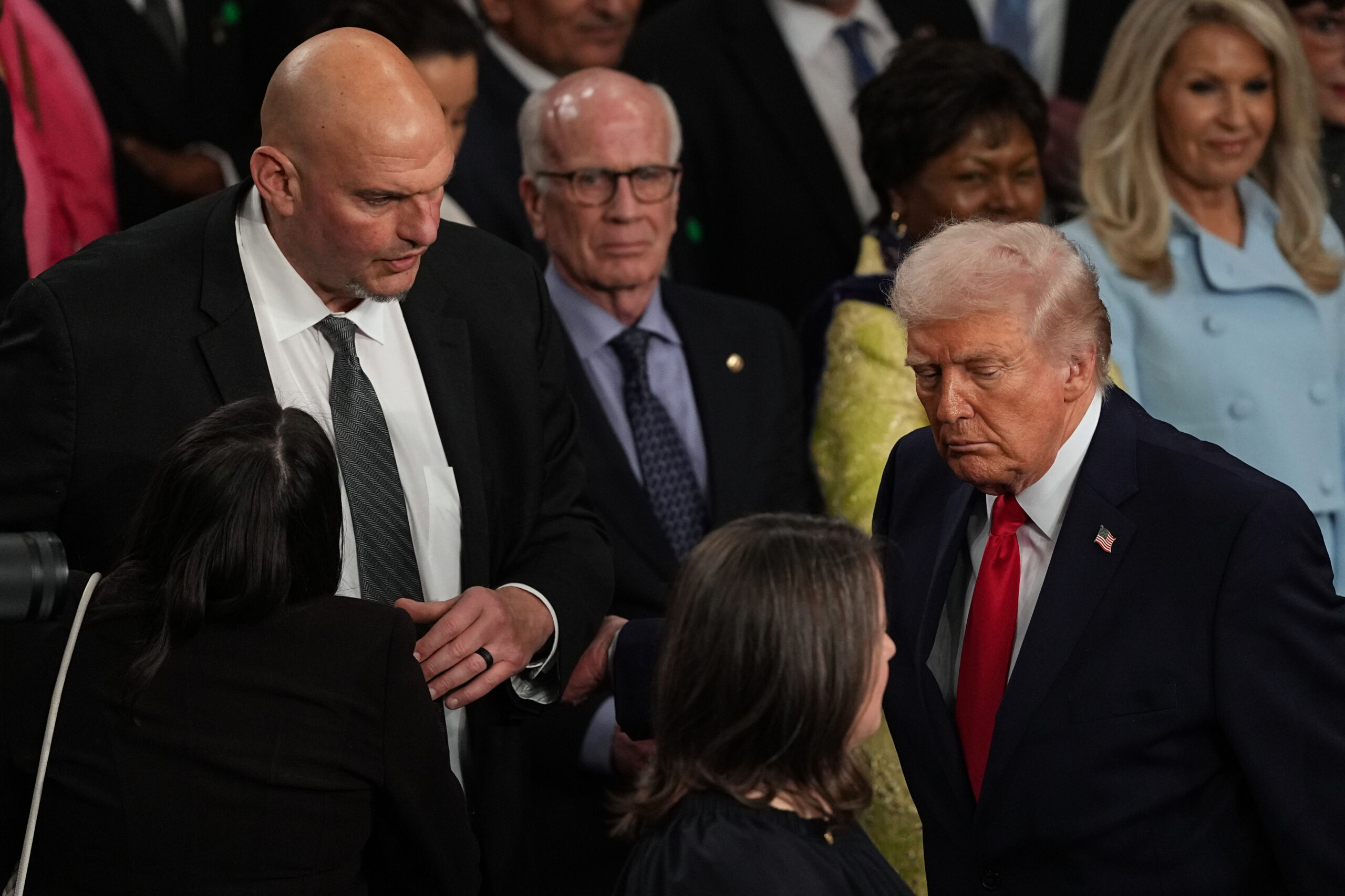
Known to seldom wear dress clothes, U.S. Sen. John Fettermantraded his usual hoodie for a suit Tuesday evening when he shook hands with Trump during the president’s entrance to the House chamber.
Fetterman’s greeting of Trump comes in contrast to many of his Democratic colleagues and underscores the senator’s willingness to embrace the other side of the political aisle, often earning him ire from his own party.
“I’m not surprised PA Senator John Fetterman finally got dressed up for once and so warmly greeted Donald Trump tonight,” wrote Boyle, who has been floated as a potential primary challenger to Fetterman in 2028. “After all, as the White House has previously stated, John Fetterman is Trump’s favorite Democrat.”
During a Wednesday morning interview with Fox News, Fetterman criticized fellow Democrats for not standing and applauding during several moments in Trump’s speech that he felt should have garnered bipartisan support, including when Trump recognized Erika Kirk, whose husband Charlie Kirk was shot and killed last year during a speech in Utah.
Fetterman also defended his handshake with the president and believes he was only Democrat to make such a gesture.
“Yes, I shook his hand. Of course. He walked in, and I’m always going to do that, for sure,” Fetterman said.
President Donald Trump passes Sen. John Fetterman, D-Pa., as he departs after delivering the State of the Union address to a joint session of Congress in the House chamber at the U.S. Capitol in Washington, Tuesday, Feb. 24, 2026.
Summer Lee’s Working Families Party response
Lee, a Pittsburgh progressive in her second term, delivered a response to Trump’s address on behalf of the Working Families Party, a grassroots progressive party that often endorses Democratic candidate.
The Pennsylvania lawmaker criticized Trump’s tariffs, Medicaid cuts, escalation of federal immigration agents, and mass layoffs of federal employees.
“The state of the union is dire,” Lee said. “We can’t afford to believe Trump’s lies, and we have to pay attention to his actions. This is not a normal time, and our response to it can’t be politics as usual.”
Pennsylvania Republican gubernatorial candidate and state Treasurer Stacy Garrity is to be among the guests filling the U.S. House’s gallery Tuesday night when President Donald Trump delivers the first State of the Union address of his second term.
Her presence at the primetime speech underlines her alignmentwith Trump on the national stage as she pursues her challenge against popular Democratic incumbent Gov. Josh Shapiro, widely seen as a potential contender for the White House in 2028.
A campaign spokesperson said Garrity will attend the address in her official capacity as state treasurer rather than as a candidate, but the Republican lawmaker bringing herto the event specifically cited her campaign for governor when he announced her as his guest.
“I am pleased to announce that the next governor of Pennsylvania Stacy Garrity will be my guest at the coming State of the Union,” U.S. Rep. Glenn ‘GT’ Thompson, who represents the 15th District, said earlier this month at a gathering of Pennsylvania Republicans in Harrisburg.
Steven Chizmar, a spokesperson for the Pennsylvania Treasury Department, said that Garrity was in Washington for the National Association of State Treasurers through Tuesday and that her attendance at the speech will come as part of this previously scheduled trip.
“This opportunity will allow her to gain valuable insights into national issues that could impact Pennsylvanians and the services provided by the Pennsylvania Treasury Department,” Chizmar said. “Attending the State of the Union is an honor rooted in more than two centuries of American tradition and Stacy Garrity is proud to be able to attend the president’s address.”
Garrity’s trip to Washington comes just days after Shapiro was among the Democratic governors to meet with Trump at the White House for the National Governors Association’s annual conference — though he skipped the black-tie dinner after Trump’s attacks on colleagues.
But now a little over a year into his second term, Trump’s approval rating is sinking. According to a new Washington Post-ABC-Ipsos poll, 60% of Americans said they disapprove of how Trump is handling the presidency. This is a potential liability for Garrityand other Pennsylvania Republicans on the ballot this year.
The Pennsylvania Democratic Partyseized on Garrity’s planned appearance at the State of the Union. Party chair Eugene DePasquale said during a news briefing Monday that Garrity will be “cheerleading” Trump’s “damaging” policies and specifically tied Garrity to rising healthcare costs.
Democrats boycott or bring guests to send a message
Healthcare costs willlikely be a key point of Democratic messagingagainst Trump on Tuesday night, following a national spike in insurance premiumswhen enhanced tax credits for the Affordable Care Act expired at the start of the year.
U.S. Rep. Madeleine Dean, who represents the 4th District, which is primarily Montgomery County, is to bring Lisa Boone Bogacki, a physical therapist and affordable healthcare advocate from Berks County.
Bogacki‘s husband, Gary, died from a sudden cardiac event in 2009 and Bogacki’s family came to rely on the Affordable Care Act and Social Security survivor benefits.
“Prior to the ACA, I paid over $20,000 annually for insurance coverage, and this was where the majority of the kids’ survivor’s benefits was spent,” Bogacki said in a news release from Dean’s office. “The ACA finally made insurance premiums affordable for us. This year, my premiums have drastically increased, following the new cuts made to the program.”
U.S. Rep. Chris Deluzio, who represents the 17h District in Western Pennsylania, also focused on health care messaging with his announced guest, Jonathan Akanowicz, an independent pharmacist from Hampton Township.
Addressing anothercontentious issue, Trump’s immigration agenda, U.S. Sen. Lisa Blunt Rochester of Delaware plans to bring Maria Mesias-Tatnall, director of outreach and immigration assistance at theDelaware Department of Justice.
Some Democrats are choosing to express their disapproval in other ways.
U.S. Rep. Mary Gay Scanlon of the 5th District mostly in Delaware County, is also scheduled to attend the “People’s State of the Union” event, organized by progressive groups MeidasTouch and MoveOn, her office confirmed.
After he boycotted Trump’s joint address to Congress last year, U.S. Rep. Dwight Evans of the 3rd District in Philadelphia will not attend Trump’s address Tuesday night. In his place, Evans — who is retiring — has designated Carolyn Hill, a Philadelphia grandmother who is impacted by Trump’s cuts to SNAP, an honorary guest.
Republican lawmakersfrom the region
U.S. Sen. Dave McCormick of Pennsylvania will be hosting hosted Jason Zugai, vice president of United Steelworkers Local 2227, as his guest after Japanese company Nippon Steel finalized a buyout of U.S. Steel in June. McCormick played a key role in persuading Trump to back the deal after his initial public opposition.
U.S. Rep. Ryan Mackenzie of the 7th District, which is north of Philadelphia will to bring Sarah Arndt, the lead teacher at PathStone Carbon County Head Start, where she has worked for the past 13 years. Funding for her program was in jeopardy last fall amid the lengthy government shutdown and state budget impasse.
And Sheryl Klein, a senior at Council Rock High School South in Bucks County, will to bethe guest of U.S. Rep. Brian Fitzpatrick of the 1st District. Klein founded and leads the high school’s Women’s Empowerment Club.
“That is the kind of civic engagement we should be encouraging across this country at every level: unifying, positive, and rooted in service to something greater than ourselves,” Fitzpatrick said.
Fitzpatrick and Mackenzie represent key swing districts, which both parties are targeting in the fall.
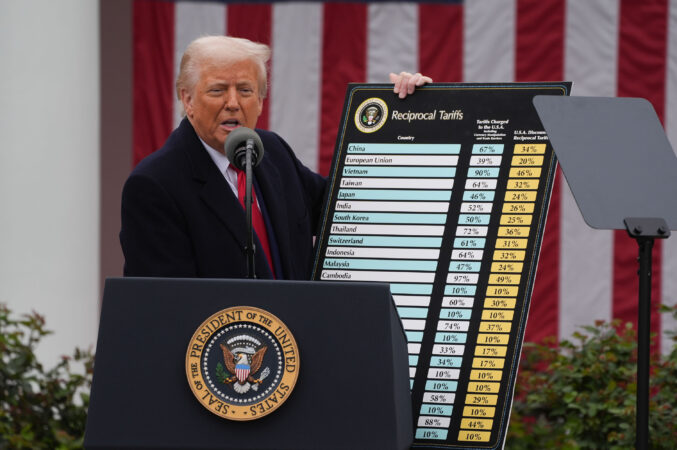
Pennsylvania lawmakers say Congress should reclaim its power over taxes and tariffs after the U.S. Supreme Court quashed President Donald Trump’s controversial global tariffs.
The nation’s high court ruled 6-3 Friday that Trump overstepped with tariffs imposed under an emergency powers law, dealing a significant blow to the president’s economic agenda and reasserting congressional authority.
Chief Justice John Roberts and Justices Neil Gorsuch and Amy Coney Barrett — both Trump nominees — joined liberal justices in the majority. Justices Brett Kavanaugh, Clarence Thomas, and Samuel A. Alito Jr. dissented.
Trump told reporters at the White House Friday that he was “ashamed” of the three Republican-appointed justices for not having “the courage to do what’s right for our country.”
But local lawmakers celebrated the decision as a step toward alleviating inflation exacerbated by Trump’s tariffs.
It’s “the first piece of good news that American consumers have gotten in a very long time,” said U.S. Rep. Brendan Boyle (D., Philadelphia), the ranking member of the House Budget Committee.
The decision is unlikely to be the end of the road for Trump’s efforts to impose tariffs. The court struck down the broad authority Trump had claimed to impose sweeping tariffs, but he could still impose additional import and export taxes using powers he employed in his first term.
Friday’s decision centers on tariffs imposed under an emergency powers law, including the “reciprocal” tariffs he waged on other countries, The Associated Press reported.
What’s next
It remains unclear what will happen to tariff revenue that’s already been collected — about $30 billion a month since Trump took office last year, NPR reported. But Pennsylvania lawmakers are pushing for Congress to reassert its power to control the country’s purse strings.
“As the Supreme Court validated this morning, Congress has the authority to levy taxes and tariffs,” Boyle said. “It’s time now for us to finally reclaim that authority and bring some certainty and rationality to our tariff policy, which under Donald Trump has been all over the map and changes day by day, even hour by hour.”
Casey-Lee Waldron, a spokesperson for U.S. Rep. Brian Fitzpatrick (R., Bucks), said in a statement Friday that the lawmaker “applauds” the high court’s decision, “which validates the Congressman’s opposition to blanket and indiscriminate tariffs that are not narrowly tailored, and that do not lower costs for the American consumer.”
Waldron added that Fitzpatrick supports enforcing trade laws, but “this should always be done in a collaborative manner with a bipartisan, bicameral majority in Congress.”
Pennsylvania Gov. Josh Shapiro and N.J. Gov. Mikie Sherrill, both Democrats, celebrated the decision Friday in statements that noted the challenges the tariffs had caused for local economies.
Speaking to reporters at the National Governors Association meeting in Washington, Shapiro said tariffs had done real harm to Pennsylvanians, citing rising prices for farmers and for consumer goods.
“There is a direct line connecting those price increases to the president pushing the tariff button,” Shapiro said. “I think the Supreme Court got it right, and I say that as a former attorney general, and I say that as someone who actually follows the law.”
U.S. Sen. Dave McCormick (R., Pa.), however, came to the defense of Trump’s tariff policies, saying in a statement that he believes Trump “was using legitimate emergency authorities very effectively to protect our national security and achieve fair trade for U.S. companies and American workers.”
McCormick, a former Treasury official and former hedge fund executive, said he was disappointed with the court’s ruling and called to find other ways to accomplish Trump’s economic and national security goals, which include preventing “foreign competitors from cheating Pennsylvania workers.”
Shockwaves in Philly and beyond
Trump enacted the sweeping tariffs early last year, arguing that the move would incentivize companies to bring operations back to the United States and even trade deficits with other countries.
The move, however, sent shock waves through the U.S. economy as prices increased and U.S. exports, including Pennsylvania’s lumber sales, suffered.
Tariffs slowed business at the Port of Philadelphia, which reported cargo volume down across the board.
Philly is a major gateway for produce, bringing in more fresh fruit than any other U.S. port, largely from Central and South America. The port saw record container volume last year, handling almost 900,000 units, up 6% over 2024. About two-thirds of that cargo was refrigerated — fruit and meat, for example.
But this year got off to a slow start. “The story is increased competition and tariffs,” Sean Mahoney, marketing director at the Philadelphia Regional Port Authority (PhilaPort), said during the agency’s board meeting on Wednesday.
Leo Holt, president of the city’s primary terminal operator Holt Logistics, hopes companies that see savings would pass them on to consumers. In practice, he acknowledged many would likely take a conservative approach.
“I think consumers are going to demand that at least there’s an accounting for what they’re paying,” Holt said Friday.
U.S. Sen. Chris Coons (D., Del.) said in a statement that he knows many Republican colleagues of his “are privately breathing sighs of relief this morning at the court’s decision.”
“They should instead be asking themselves why they didn’t use their legislative authority to do more to stop these tariffs when they had the chance — and what they’ll do differently next time when President Trump inevitably tries again,” Coons said.
‘Nobody is going to rush to drop their prices’
The Supreme Court’s ruling will be welcome news for some businesses, but it also sparks uncertainty.
Not all of Trump’s tariff increases came through the use of the International Emergency Economic Powers Act, and therefore some will remain in place, said Julie Park, a partner at London-based tax and business advisory firm Blick Rothenberg.
“This decision brings further uncertainty for businesses,” she said in a statement. That’s in part because Trump could seek to reimpose tariffs through other legal tools, leaving “businesses in limbo about if they will get refunded.”
U.S. exporters will also be closely following what happens next, since the fate of Trump’s tariffs will likely determine whether other countries, like Canada, keep their retaliatory measures in place. Canada is Pennsylvania’s biggest export market, with the state sending more than $14 billion in goods there in 2024. Top exports included machinery, cocoa, iron, and steel.
Pennsylvania’s dairy industry has also been caught in the middle of the global trade war, as China and Canada imposed extra taxes on those goods in response to U.S. tariffs.
It’s also unclear whether companies will receive refunds for the tariffs they’ve paid in the past year.
Tim Avanzato, vice president of international sales at Lanca Sales Inc, said his New Jersey-based import-export company should be eligible for as much as $4 million in tariff refunds.
“It’s going to create a paperwork nightmare for importers,” he said, noting that he doesn’t expect the Trump administration to make it easy to retrieve this money.
Avanzato said he is also watching for ways the administration may implement new tariffs. Consumers, he said, shouldn’t expect changes in the immediate term.
“Companies are not very good at passing on savings,” Avanzato said. “Nobody is going to rush to drop their prices.”
Sen. Andy Kim (D., N.J.) said Trump cost Americans “a lot of money.”
“Trump 2.0: You pay for his tariffs, tax breaks for his billionaire donors, & insane corruption for his friends and family,” the South Jersey Democrat added in a social media post.
The Supreme Court’s decision is “a step” in righting wrongs by the Trump administration, he said, but there’s “so much more to go.”
Staff Writers Katie Bernard, Max Marin, Aliya Schneider and Rob Tornoe and The Associated Press contributed to this article.
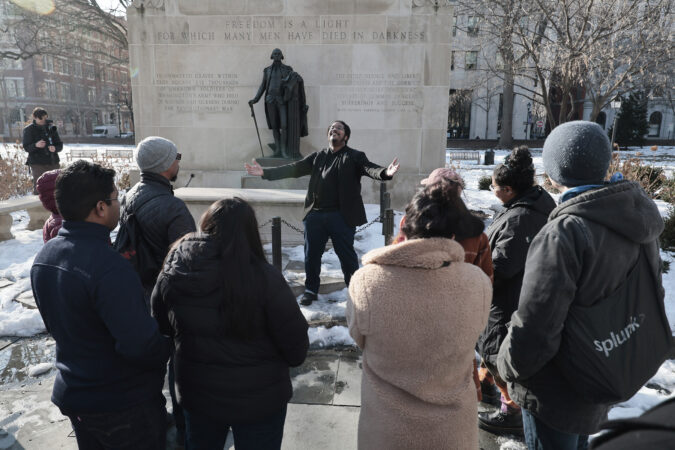
Mijuel K. Johnson stood on theground where the dining room of the first president’s residence once stood as he told the story of Ona Judge’s path to freedom.
Speaking to a group assembled just steps from the Liberty Bell, Johnson recounted how Judge escaped George Washington’s household in Philadelphia into the city’s free Black community before eventually making her way to New Hampshire, and evading the Washingtons’ several attempts to recapture her.
It’s a story Johnson has told many times as a guide for the Black Journey, which offers walking tours focused on African American history in Philadelphia. One of the first stops on “The Original Black History Tour” is the President’s House Site, an open-air exhibit at Sixth and Market Streets that memorializes Judge and the eight other people enslaved by the first president here.
But last weekend, instead of the educational panels and informative videos displayed for the last 15 years, the guide and his group were faced with faded brick walls and blank TV screens. Adhesive residue marked the spots where colorful panels had been.
Mijuel K. Johnson guides Judge Cynthia M. Rufe as she visits the President’s House in Independence National Historical Park on Monday, Feb. 2, 2026.
It was Johnson’s first group tour since National Park Service employees wielding wrenches and crowbars — acting at the direction of President Donald Trump’s administration — last month stripped out every panel at the President’s House, censoring roughly 400 years of history. Judge’s name was still inscribed on the Memorial Wall and her footprints still imprinted into the concrete as the group walked through the site, but her story was missing. Television screens recounting her life had been abruptly disconnected.
Black History Month began this year with visitors unable to read displays juxtaposing the cruelty of slavery with the country’s founding principles for the first time since the site opened in late 2010. For many tourists and the guides who know the site best, the removal was a call to action.
Workers remove the displays at the President’s House in Independence National Historical Park on Thursday, Jan. 22, 2026. More than a dozen displays about slavery were flagged for the Trump administration’s review, with the President’s House coming under particular scrutiny.Maria Felton (middle) and Jahmitza Perez (right) of Philadelphia listen to Mijuel K. Johnson (left) during The Black Journey tour in Philadelphia on Saturday, Feb. 14, 2026.
“In telling their stories, I’m telling my own,” Johnson, 34, of South Philadelphia, said of the nine people the site memorializes, “and that’s where it becomes personal, so that in trying to erase their story, they’re effectively trying to erase me, too, and I just refuse to be erased.”
Parker celebrated the reinstallation in a post on social media Thursday but cautioned: “We know that this is not the end of the legal road.”
The Trump administration is appealing the ruling, so the future of the site remains uncertain even after this week’s victory. On Friday, a federal appeals judge said that the Trump administration does not have to restore more panels while the appeal is pending.
Seeing the site bare without the panels last weekend felt like a “slap in the face” for Maria Felton, 31, a stay-at-home mom from Roxborough. Felton, who is Afro-Latina, joined the Black Journey’s tour with best friend Jahmitza Perez, 37, as part of her quest to reconnect with her heritage.
“The administration can take away physical things. They can’t take away our ability to connect and learn and share our culture,” Felton said.
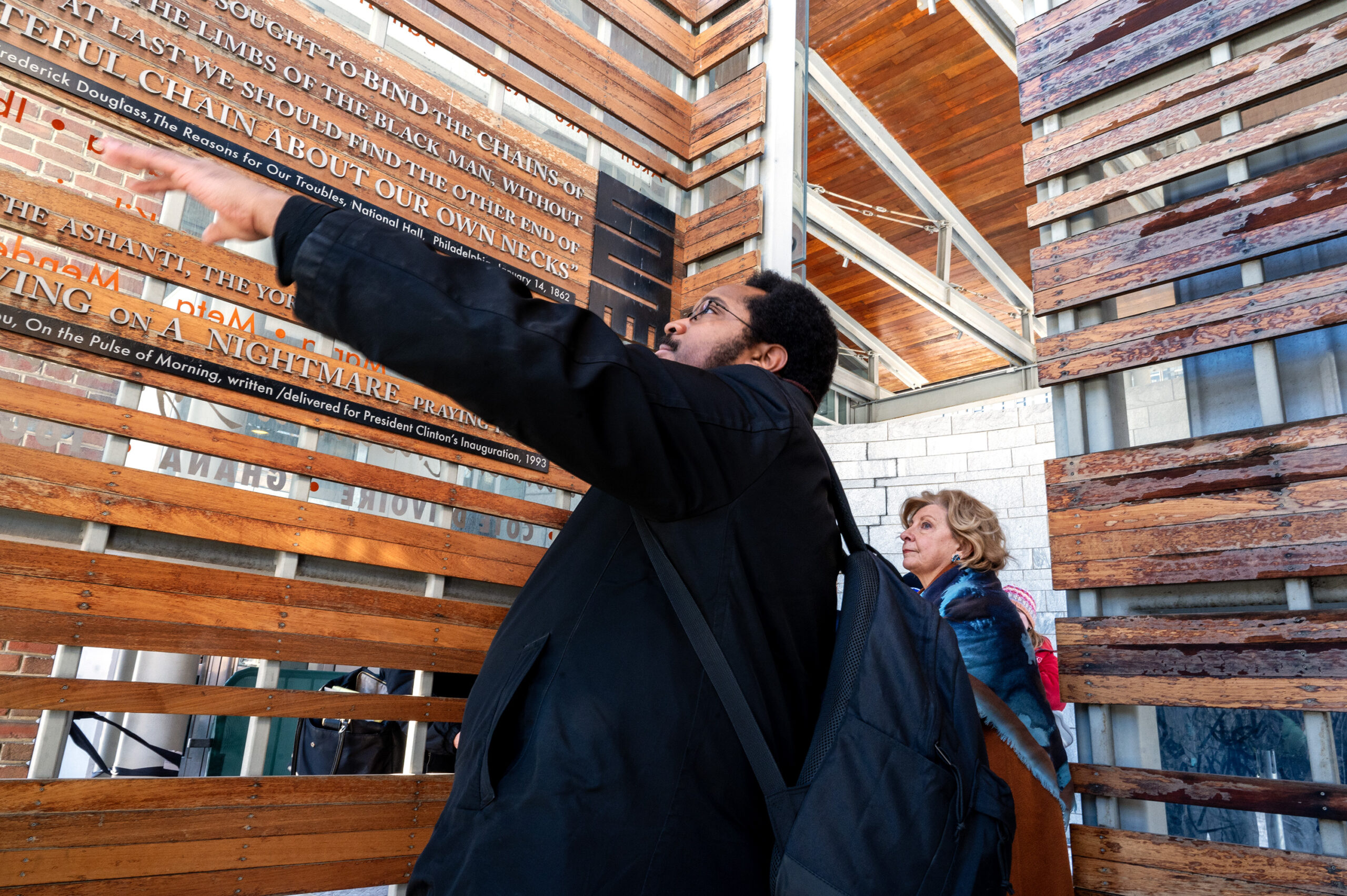
Passing a wall where panels about slavery were removed, Mijuel K. Johnson (left) with The Black Journey: African-American Walking Tour of Philadelphia, leads Judge Cynthia M. Rufe (second from left) as she visits the President’s House in Independence National Historical Park on Monday, Feb. 2, 2026.
‘A sign of the revolution’
Johnson has been giving tours since 2019, delivering rousing accounts of U.S. history interwoven with humor and theatrical gestures. He tells his patrons, who come from around the country, that long before cheesesteaks became Philly’s iconic food,the city was known for its pepper pot stew, an African dish.
“We can tell the full story of America,” he said.
Last weekend, Johnson’s tour group was more “somber” than usual, he said, as they saw the bare walls of the “desecrated” site.
“People seeing it for themselves that this actually did happen,” Johnson said.
For Toi Rachal, 47, a pharmacist from Dallas, and her husband, the tour was eye-opening. The couple had been unaware of the Trump administration’s changes to the site until they joined the tour during their visit to Philadelphia. The work of Johnson and other community members to continue telling the story was even more crucial with the exhibits gone, Rachal said.
“If we just walked in these areas on our own, eventually we would have probably figured it out,” she said, “but you may not have known exactly what happened.”
The exhibits were removed under an order issued by Trump instructing the Department of the Interior to remove materials at national parks that “inappropriately disparage Americans past or living,” widely criticized as an effort to whitewash history ahead of this year’s celebrations of the country’s 250th anniversary.
But the move brought unprecedented attention to the President’s House, drawing curious onlookers. When the panels were beginning to be restored Thursday, a group observed as park employees put history back in its rightful place.
Shortly before Johnson’s tour group stopped at the site, a volunteer read from a binder containing the informational text that had been removed. The volunteer was one of dozens of people who had signed up for a shift with Old City Remembers, a grassroots effort to speak the history of the President’s House even if the panels were no longer there.
Mijuel K. Johnson leads visitors from Charlotte, North Carolina, at the President’s House in Independence National Historical Park on Wednesday, July 23, 2025.
“Because those have been removed, somebody needs to tell the story, somebody needs to make sure that we’re not going to let that history be erased,” Matt Hall, a professor and the organizer of the group, said in an interview earlier this month.
It’s “active history,” said Ashley Jordan, president and CEO of the African American Museum in Philadelphia, located blocks away from the site. “The fact that they are using their words, their demonstrations, through art-making, through signage, through print materials — that has always been a sign of the revolution in America.”
Ahead of Johnson’s tour last Saturday, visitors taking advantage of the warmest winter day in weeks congregated around the bare exhibit wall. In its place were educational fliers about Washington, Ona Judge, and other historical figures. Posters displayed messages: “Truth Matters,” “Erasing Slavery is Pro-slavery,” and “Dump Trump Not History.”
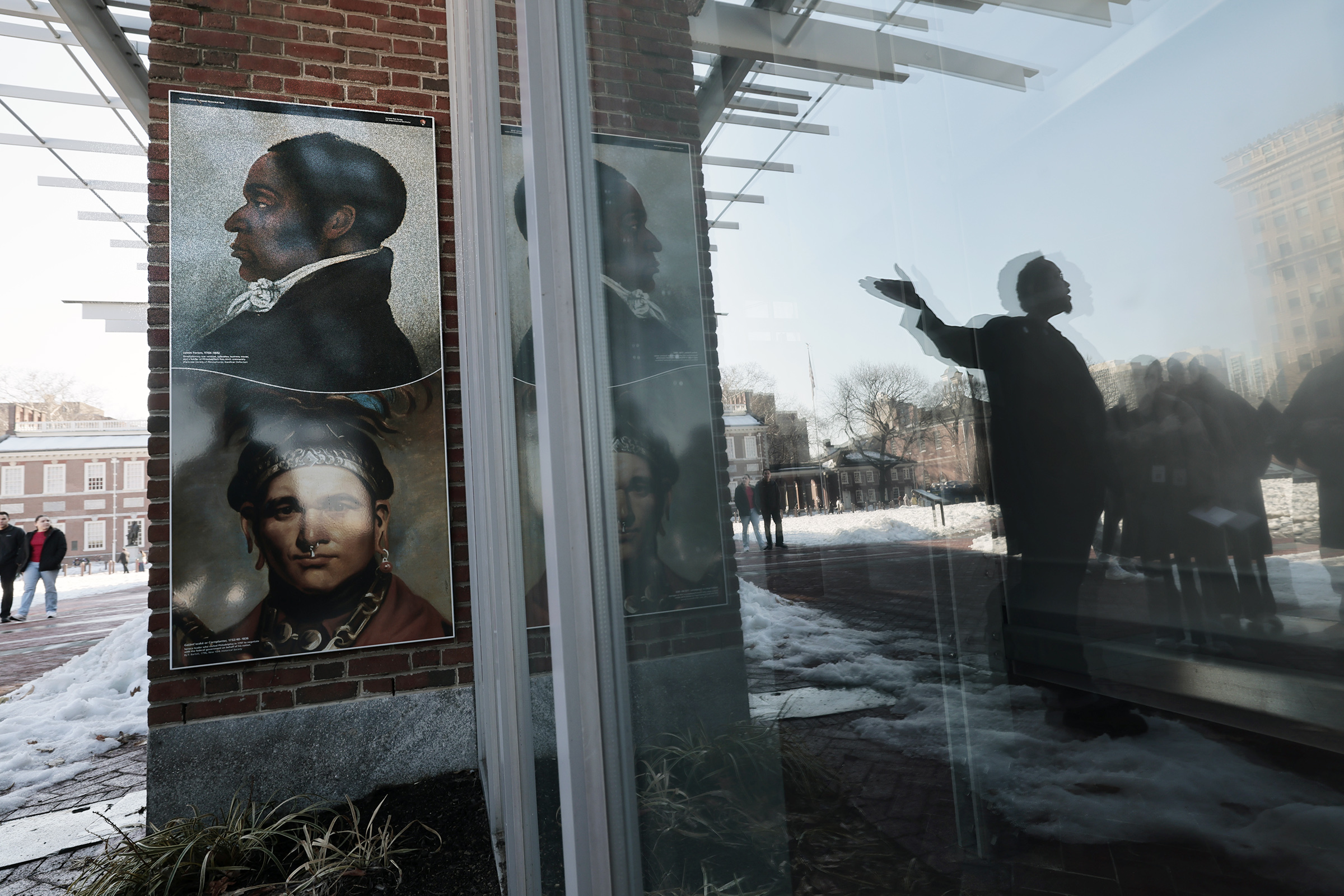
The Black Journey and the 1838 Black Metropolis tour guide Mijuel K. Johnson (right) is reflected in the Liberty Bell Center window as he talks about James Forten (top left) 1746-1842 during a Black History tour in Philadelphia on Saturday, Feb. 14, 2026. Forten was a Revolutionary War veteran, sailmaker, business owner, and a leader of Philadelphia’s free Black community.
Philadelphians celebrate, but prepare for more fights ahead
Avenging the Ancestors Coalition members gathered Thursday afternoon at the President’s House, celebrating the reinstallation earlier in the day.
“This is actually a moment in time,” said Michael Coard, attorney and leader of the coalition, which had fought tirelessly to develop and, now, protect the site. “Your children, your grandchildren, your great-grandchildren are going to be talking about this for years.”
Coard emphasized the fight was not yet over while highlighting the significance of the community’s contributions in the fight to safeguard the President’s House.
“I just want you for a few seconds just to think about what you all have done,” Coard told the crowd. “Because what you’ve done is to actually create history. … Think about it. You fought the most powerful man on the planet, and you won.”
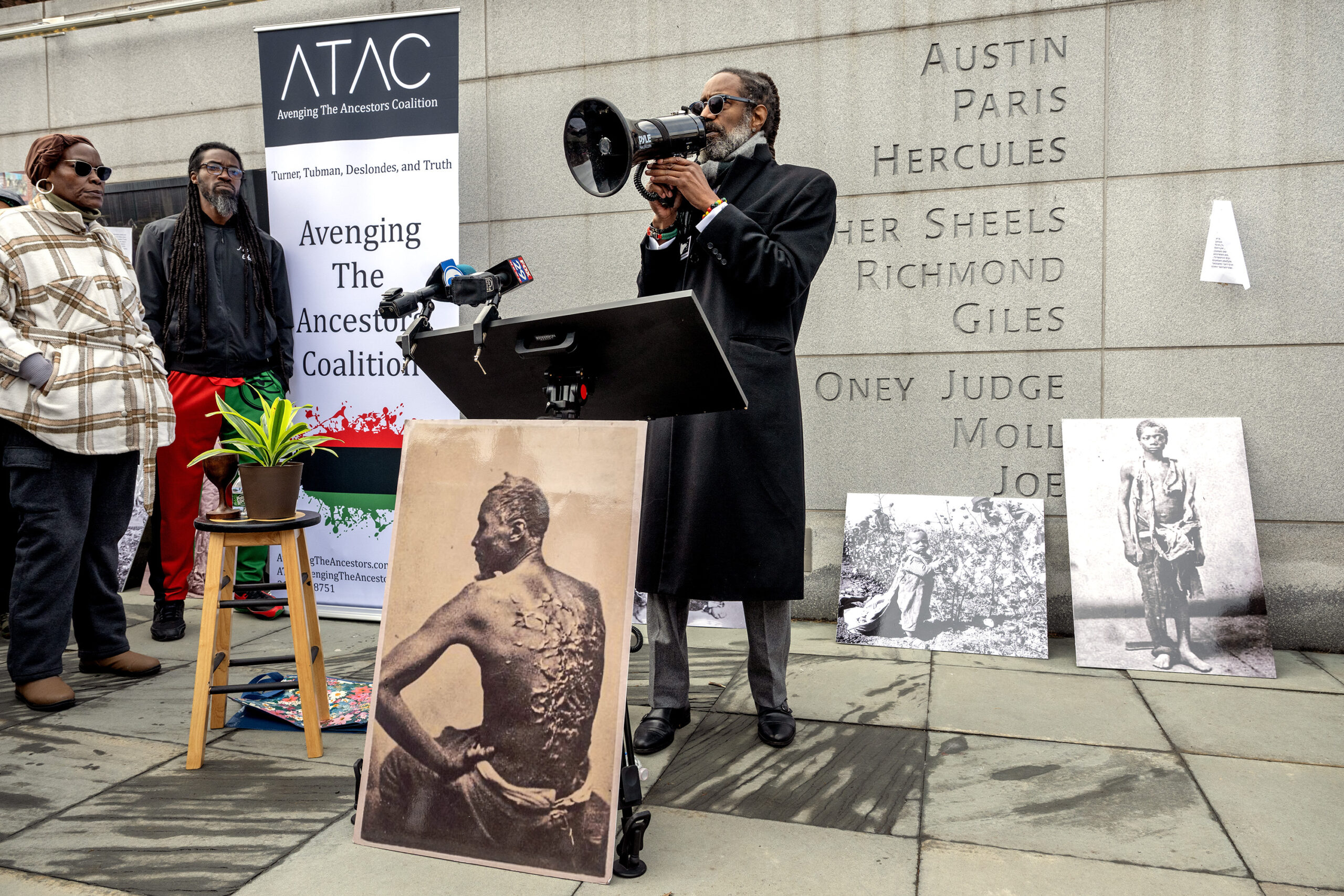
Attorney Michael Coard, leader of the Avenging the Ancestors Coalition, speaks at the President’s House site on Monday, Feb. 16, 2026, during their annual gathering for a Presidents’ Day observance. While there, they learned a federal judge ordered the Trump administration to restore the slavery exhibits that the National Park Service removed from the site last month. The names of nine enslaved people who lived and worked in the household of George Washington engraved in stone behind him were not removed by the NPS.
Even as Philadelphians celebrated the reinstallation, more efforts were being planned to continue sharing the story of the President’s House.
Mona Washington, a playwright and Avenging the Ancestors Coalition board member,is crafting a series of plays related to the President’s House, which she hopes to showcase this summer, during the height of the 250th anniversary celebrations. Some of the plays, she said, are written in the first person for the people who were enslaved by the first president at his Philadelphia residence.
“We’re here, and you can try and erase whatever you want, as much as you want, but guess what? There are lots of us, and we’re just going to keep moving and moving and moving toward truth,” Washington said.
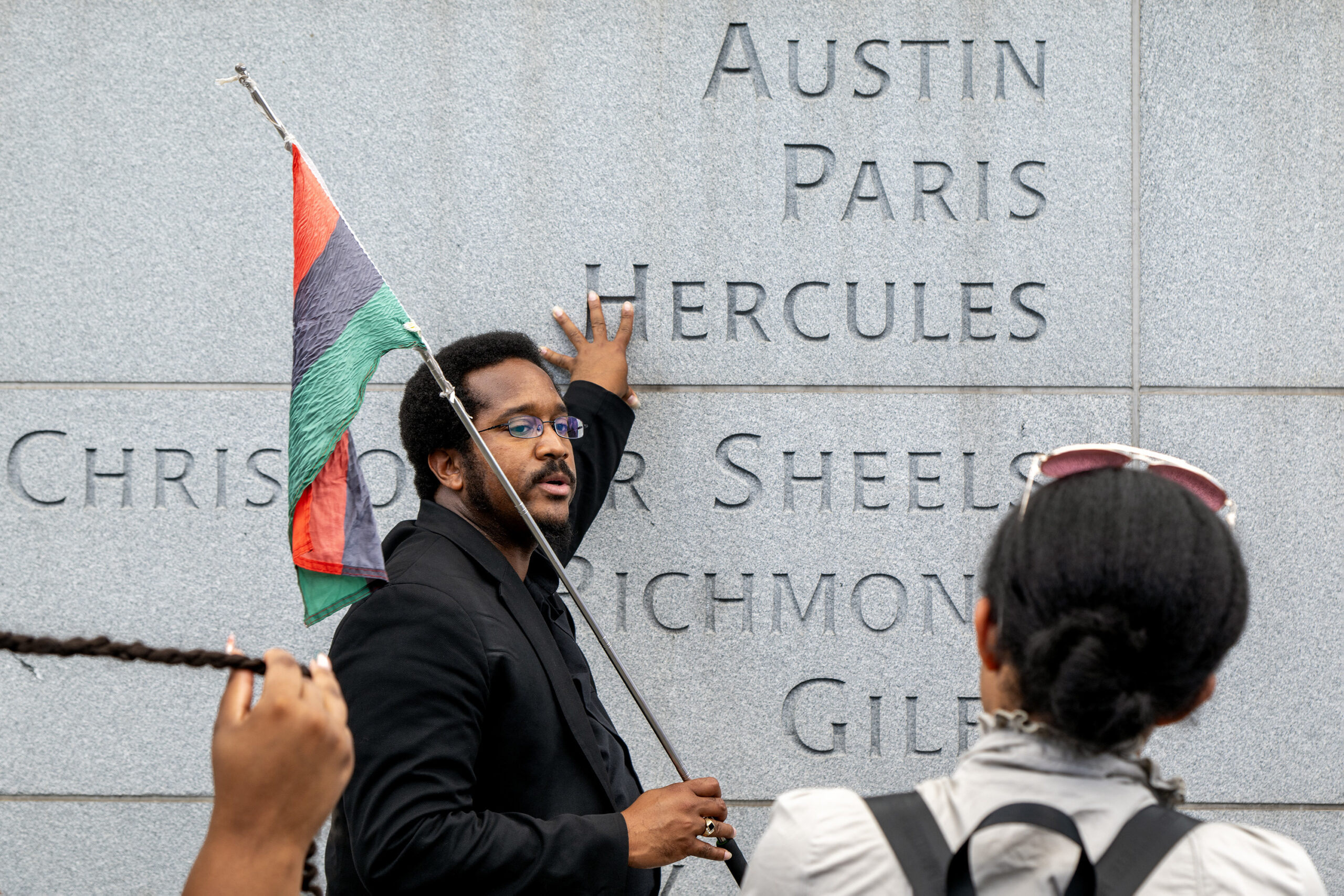
At the President’s House last Saturday, there were few pieces that Johnson could share with the group that had not been tainted by the Trump administration. One of them was the Memorial Wall, which is engraved with the names of Ona Judge and the eight other people George Washington enslaved — Austin, Paris, Hercules, Christopher Sheels, Richmond, Giles, Moll, and Joe. A few paces away, their quarters once stood, where at least four of the nine individuals would stay at any given time, Johnson said.
Mijuel Johnson, a guide with The Black Journey: African-American Walking Tour of Philadelphia, leads visitors in the President’s House in Independence National Historical Park Wednesday, July 23, 2025. The names of nine enslaved people who lived and worked at the House are engraved in stone on the site.
Outside the quarters appears a plaque signed by the city and the National Park Service that reads: “It is difficult to understand how men who spoke so passionately of liberty and freedom were unable to see the contradiction, the injustice, and the immorality of their actions.”
These words are preceded by an italicized quote from former President Barack Obama, the country’s first Black president: “It was whispered by slaves and abolitionists as they blazed a trail toward freedom … yes we can, yes we can.”
A lack of proper tools and the snow were the only things standing in the way of the Trump administration making further alterations to the President’s House last month.U.S. District Judge Cynthia M.Rufe has now ordered that the President’s House cannot be further altered.
Last Saturday, Johnson assured his tour group as they were filing through the quarters that this piece of history would remain.
“They can’t touch this,” he said.
Staff writer Maggie Prosser contributed to this article.