Author: Tommy Rowan

  • Phillies gave up trying to plant their flag in the New York TV market on this week in Philly history

    Phillies gave up trying to plant their flag in the New York TV market on this week in Philly history

    The National League made a dramatic exit.

    Two of its tentpole baseball franchises — the Brooklyn Dodgers and the New York Giants — packed up before the 1958 season and moved to the West Coast. Leaving behind only the Yankees and the rival American League to carry the New York City banner.

    Just down the (not-yet-under-construction) I-95 corridor, the Carpenter family wondered if their own N.L. franchise, the Philadelphia Phillies, could help fill the void.

    Broadcasting Phils’ games to the New York market could help soften the blow of losing two beloved franchises. It could also be lucrative.

    And it would help a Philly team build a fanbase in — of all places — the Big Apple.

    A league of their own

    Now they’re just organizing devices, but back in the 1950s, there was a difference between the two leagues under the Major League Baseball umbrella.

    The N.L. was faster to integrate Black players, featured more competitive teams, and thus more competitive pennant races. The A.L., on the other hand, was mostly dominated by one glory-hogging franchise.

    So Phillies owner Bob Carpenter, hoping to help fill the vacuum, made a deal with TV station WOR, which had previously aired Dodgers games.

    New York would carry 78 Phillies games during the 1958 season: 58 from Connie Mack Stadium, and 20 from the road (including night games).

    And they weren’t alone.

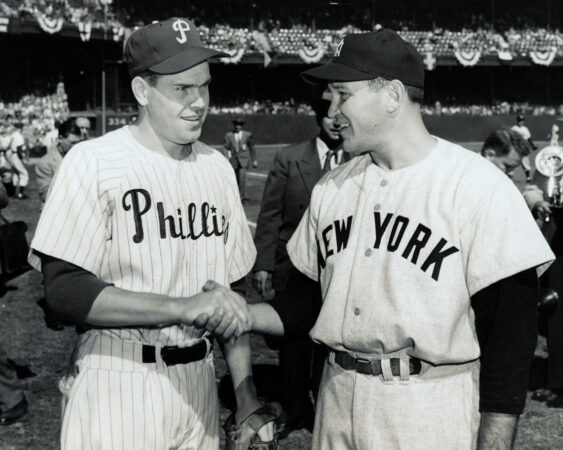
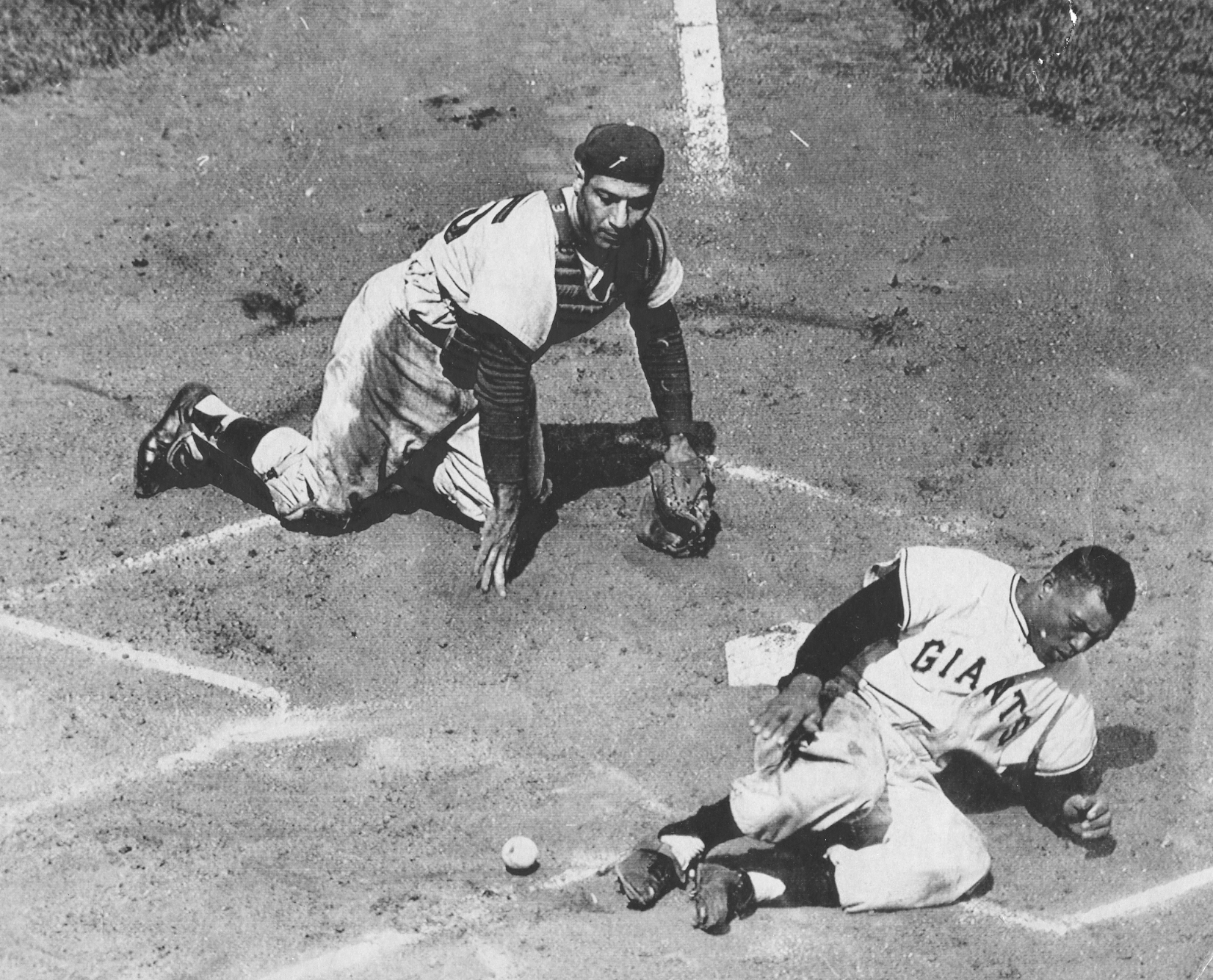
    Willie Mays scores on an inside-the-park home run vs. the Phillies in the 1950s.

    ‘The market is shot’

    The St. Louis Cardinals and Pittsburgh Pirates made deals to broadcast two dozen of their games against the Giants and Dodgers to a New York audience.

    Yankees brass reacted with trademark tact: They started making threats.

    If Phillies (or Pirates or Cardinals) games returned to New York television sets the next season, then the Yankees would look to televise their games — featuring World Series-winning superstars like Mickey Mantle and Yogi Berra — on a national network. They’d even partner with the National League’s Milwaukee Braves to complete the package. Together stealing away scores of diehards and converting scores of casuals, from sea to shining sea.

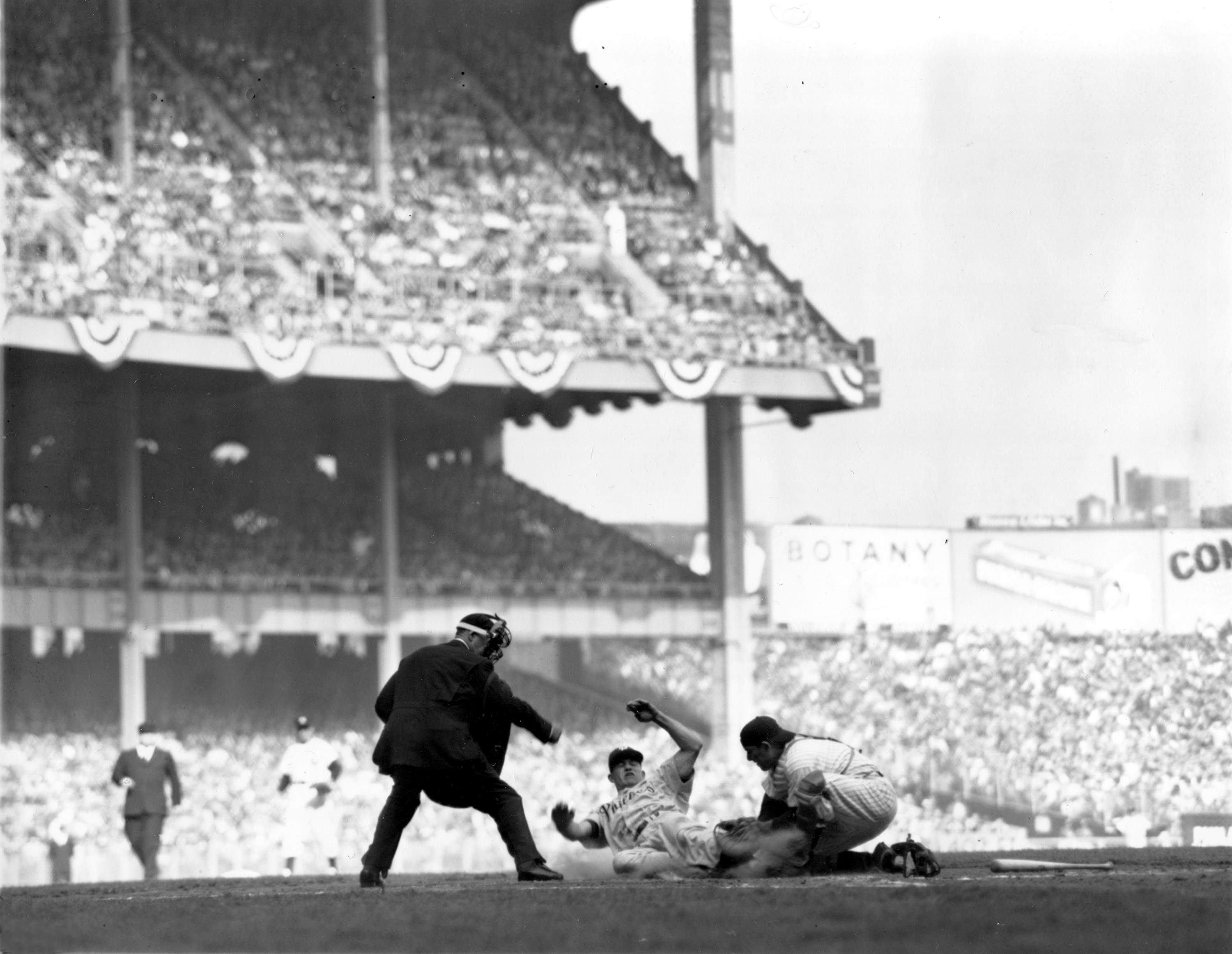
    New York Yankees catcher Yogi Berra tags the sliding Philadelphia Phillies shortstop Granny Hamner for an out at home plate and second half of double play in 4th inning in the fourth and final World Series game at Yankee Stadium in New York City in 1950.

    So on Dec. 5, 1958, the three teams announced that they were dropping their New York broadcast plans for the 1959 season.

    None of the team representatives admitted to backing down.

    “The market is shot,” Carpenter said, according to The Inquirer. “There is not enough money.”

    But the joke was really on us: Those left-behind Dodger and Giants fans in New York didn’t get much joy from Philadelphia’s signature brand of baseball.

    The Phillies went 69-85, and finished in last place.

    And to make it worse: the Mets would arrive four years later.

  • A finger stuck in a laundry machine upset Thanksgiving brunch plans on this week in Philly history

    A finger stuck in a laundry machine upset Thanksgiving brunch plans on this week in Philly history

    Holiday or not, N. Barba had laundry to do.

    The hairdresser had two boys, ages 4 and 12, and some time to kill before Friendsgiving brunch.

    So on a chilly Thanksgiving morning, on Nov. 28, 1996, she lugged her laundry down to the basement of her West Philadelphia apartment building and loaded up the washer.

    But she forgot one thing: The dryer she wanted to use wasn’t working.

    Too late.

    She had already plugged a quarter into the dryer’s coin slot.

    Using the ring finger on her left hand, she tried to poke the bottom of the slot to get back her 25-cent piece.

    And then her finger got stuck.

    Barba started to cry.

    “This felt like, to her, one more thing in a long line of things that were just not going great,” Inquirer reporter Al Lubrano, who wrote the original story, said recently.

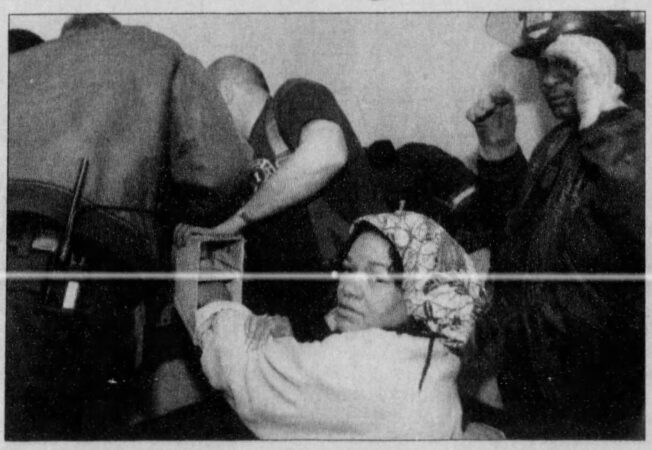
    For two hours she stood in that thankless and cold laundry room, fending off pins-and-needles sensations in her hand and worrying about her boys being alone in their apartment, before a neighbor found her.

    The neighbor brought a chair for Barba to stand on — to help release some of the pressure on her hand — and then called for help.

    Cell phones were not yet a thing, but another neighbor kindly brought down a portable phone so Barba could call and reassure her sons.

    Firefighters swooped in and cut the coin box off the machine. The machine’s operator was then called into action, and he showed up to separate the coin slot from the coin box.

    “She was little bit surprised when the firefighters came and it wasn’t the end of it,” Lubrano recalled.

    Her now-swollen finger needed a few dollops of petroleum jelly before slipping out of the coin slot. She did not report any permanent damage.

    Lubrano asked Barba back in ’96 to sum up the whole ordeal in one word.

    “Annoying,” she said.

    “Like a true mom,” Lubrano said recently, “she sort of minimized it.”

    And after all that, Barba went back downstairs later that night in ’96 and threw in another load of laundry — using a different dryer.

    “I’m grateful to my neighbors,” Barba said, “but I missed my brunch.”

  • Steve Sillman, beloved Joseph’s Pizza Parlor manager and a fixture of the Northeast Philly restaurant scene, dies at 70

    Steve Sillman, beloved Joseph’s Pizza Parlor manager and a fixture of the Northeast Philly restaurant scene, dies at 70

    In his prime, Steve Sillman worked nights, Thursday through Monday.

    And he was usually late coming in, despite only a 10-minute walk separating the front door of his impeccably preserved Fox Chase twin and the double red doors of Joseph’s Pizza Parlor.

    The dayside managers would be tapping the toes of their dark work shoes, and Mr. Sillman would just glide in. He’d start turning radio dials in search of disco hits or a 1970s station, resetting the vibe with work-appropriate dancing to classic hits from Carole King and James Taylor. He’d remind anyone listening that he wanted disco played at his funeral.

    And at the end of the night, hours after the other staff members had gone home, he’d pour himself a glass of red wine and close out the register, and then he’d call a few of the staffers and leave a message. He’d tell them to call back: “It’s important.” And when they called back, he’d say they missed a spot sweeping.

    “You work with people so long,” said current Joseph’s co-owner Matt Yeck, “that you become like family.”

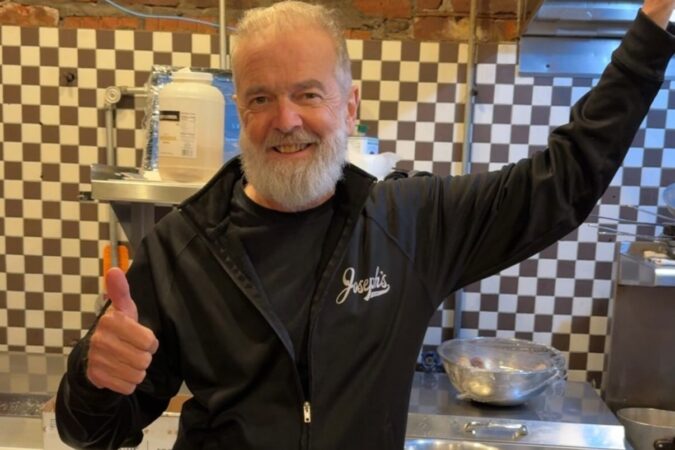
    For the better part of four decades, and until the 70-year-old received a terminal brain cancer diagnosis earlier this year, Mr. Sillman was the face of the neighborhood’s trademark pizza place.

    He started working there shortly after graduating from Northeast High School in the 1970s, and floated among the pizza parlor, neighboring Italian restaurant Moonstruck, and the once-wild Ciao nightclub above it.

    He’d often speak of waiting on entertainment icon Elizabeth Taylor. (He would say he got lost in her transfixing blue eyes.) Over the course of those 40ish years, he became intimately familiar with the building’s quirks, and attended to its every need, from fixing broken faucets to decorating it for Christmas.

    At the front of the house, he was the manager who would chat up customers before their order was ready. They always remembered his name, and sometimes he’d have to pretend to know theirs. In the back of the house, he was a peacekeeper, confidant, psychiatrist, dance partner, friend, and brother.

    It was Mr. Sillman who raised an entire generation of neighborhood kids who came to Joseph’s for work. He watched them grow up, and then he folded them into his restaurant family.

    He met his best friend of 40 years, Jane Readinger, through her siblings. They worked with Mr. Sillman at the restaurant, and over the years they folded him into their wider familial unit.

    “A lot of his friendships came through that building,” said Jane, who is eight years younger. “And he had those friendships for life.”

    It started with “P.L.P.’s,” or parking lot parties, after Joseph’s closed for the night. It grew into group ski trips and shared shore houses.

    As his friends started getting married and having kids and growing up, Mr. Sillman, a lifelong bachelor, bought a Sea Isle house so they all had a place to stay.

    But it was the twin on the corner of Jeanes Street and Solly Avenue that was his legacy. His grandparents built the house in 1914, and only his family — three generations — had called it home. He maintained its original layout and finishes and flourishes from the turn of the 20th century.

    The home was a marvel at Christmas, as Mr. Sillman would decorate his and the adjoining twin together. Draping them in handmade ribbons, and bestowing showstopper wreaths made of fresh fruit.

    After he was diagnosed in the spring with glioblastoma, members of that restaurant family would stop and see him on Jeanes Street, even as Mr. Sillman could no longer climb the three flights of stairs, and after he transitioned from the recliner to a bed setup in the dining room.

    Even the new owners came. Yeck and his partner, Jimmy Lyons, awkwardly inherited Mr. Sillman when they bought Joseph’s in 2021. But it didn’t take long for both to see his indistillable value.

    “Steve came with the building,” Yeck said.

    As Mr. Sillman took his last breaths on the morning of Sunday, Nov. 23, with Jane cradling his head in her arms, Carole King’s 1971 classic played through the house: “You’ve Got a Friend.”

    The outpouring of support in person and on social media was a nice reminder to Jane that people don’t need to be blood to be family. There’s family you’re born with, and then there’s family you collect along the way.

    “He was never alone during this fight,” Jane said. As a registered nurse, she volunteered to help attend to Mr. Sillman as he entered hospice care at home.

    Mr. Sillman is survived by his sister-in-law, Harriet Sillman; nieces and nephews; great nieces and nephews; and generations of former co-workers. His neighbors are planning to decorate the twin Jeanes Street houses in his absence this holiday season.

    Services for Mr. Sillman will be held Saturday, Nov. 29, at the Wetzel and Son Funeral Home, 419 Huntingdon Pike in Rockledge. The viewing will be held from 8 to 10 a.m., followed by a funeral ceremony.

    And then his extended family will honor Mr. Sillman’s wishes with an appropriate send-off: They’re throwing a disco party.

    Donations in his name may be made to the American Cancer Society, Box 970, Fort Washington, Pa. 19034, or to the Alex’s Lemonade Stand Foundation, 333 E. Lancaster Ave., Suite 414, Wynnewood, Pa. 19096.
  • The best things we ate this week

    The best things we ate this week

    A gobbler at Dolores’ 2Street

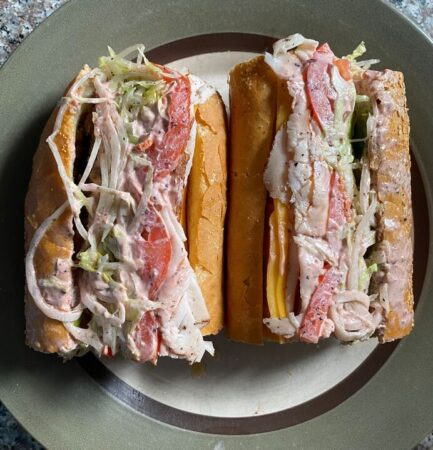
    The Gobbler has seen some bougie updates in the years since Wawa made it a thing. But the offering from Dolores’ 2Street isn’t fancy, and that’s to its credit. It’s built with solid ingredients, on a seeded Sarcone’s roll. Owners Peter Miglino and wife Victoria Rio lean hard into the leftover motif by offering a mostly cold sandwich made with cold cuts: thick slices of oven-roasted turkey and squares of orange-colored cheddar cheese. The little bit of heat (and crunch) comes from the house-made stuffing, carefully crafted by Miglino’s mother, Maria, a Philly restaurant veteran.

    Adding stuffing to a hoagie shouldn’t work. But this isn’t just any stuffing. This is Maria’s family recipe, which she prepares for almost an entire day so it’s just right. This Gobbler is as inclusive as a big Italian family, marrying the cold cuts and stuffing with a nice tang from a cranberry mayo that doesn’t overpower the palate, rings of raw onion, a confetti of lettuce, small slices of tomato, and a splash of olive oil. It’s a heavyweight sandwich, clocking in at just under a half-pound; you will most definitely need a nap afterward. As Rio compiled my sandwich on a mid-November afternoon, she said I ordered the first Gobbler of the season. They got it right from the jump. Dolores’ 2Street, 1841 S. Second St., 267-519-3212, facebook.com/Dolores2Street

    — Tommy Rowan

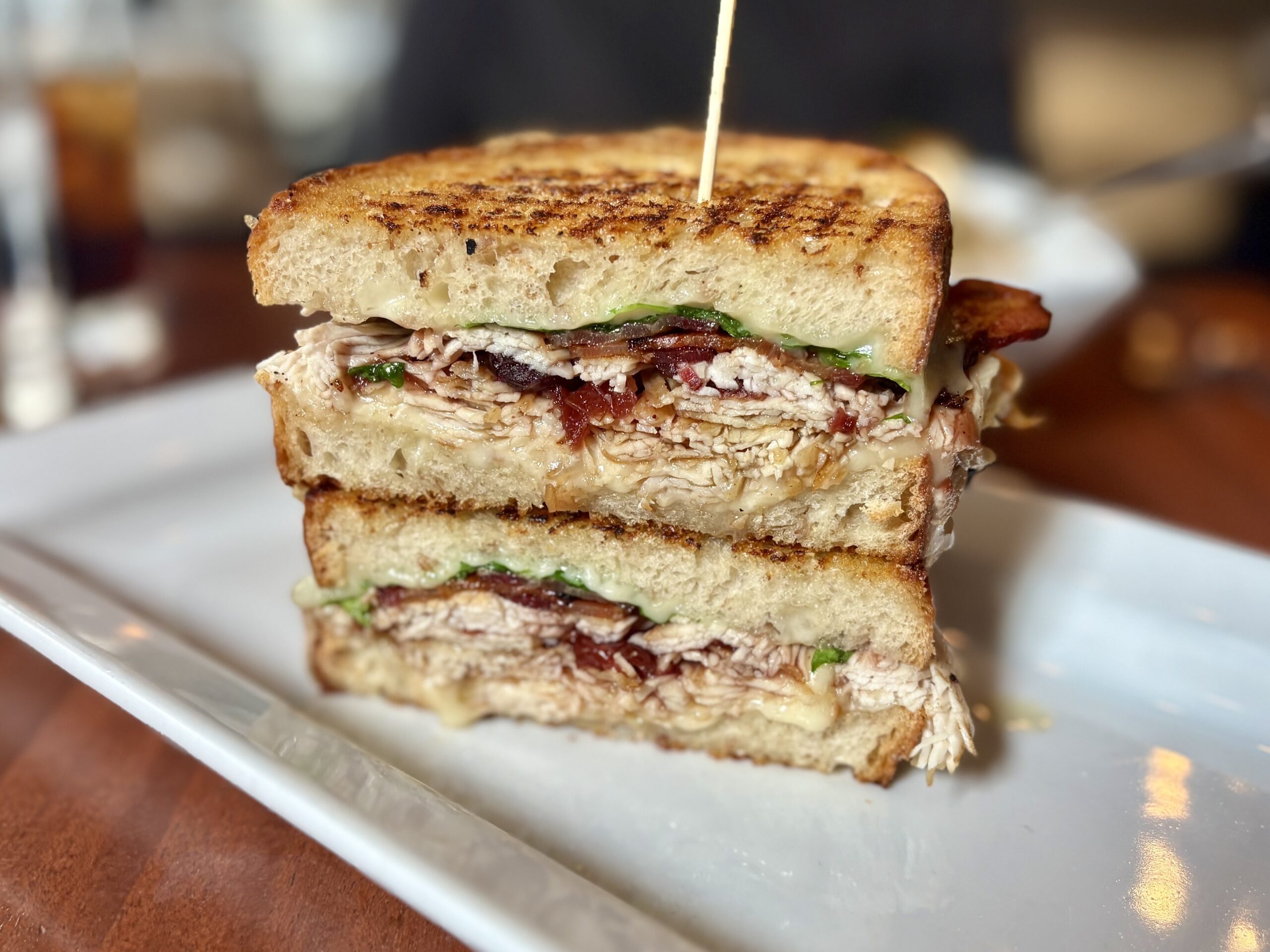
    A grilled Swiss cheese with turkey, bacon and cranberry chutney at Marathon Grill comes with a cup of soup. This “special” is so popular it hasn’t left the menu in over a year.

    Turkey-cranberry grilled cheese special at Marathon Grill

    By this time next week, most people will likely be in turkey leftover sandwich overload. But right now still I’m pre-gaming for Thanksgiving hard, and I could not resist this seasonally appropriate special at Marathon Grill. It’s essentially a grilled Swiss cheese on excellent sourdough bread, with turkey, cranberry chutney and bacon also tucked inside. That can potentially be an overwhelming mess. But I was impressed by how carefully the sandwich was built, with no particular ingredient overwhelming the others. The grilled bread’s buttery crisp and moist interior hit all the right savory and sweet notes for a preview of the feast to come. It’s served alongside a cup of tomato-basil soup for extra value (I swapped mine out for Marathon’s excellent matzo ball soup), so it’s no surprise it’s been a hit. In fact, Marathon’s regulars love it so much it’s been a “special” since they put it on the menu additions an entire year ago. Marathon Grill, 1839 Spruce St., 215-731-0800, eatmarathon.com

    — Craig LaBan

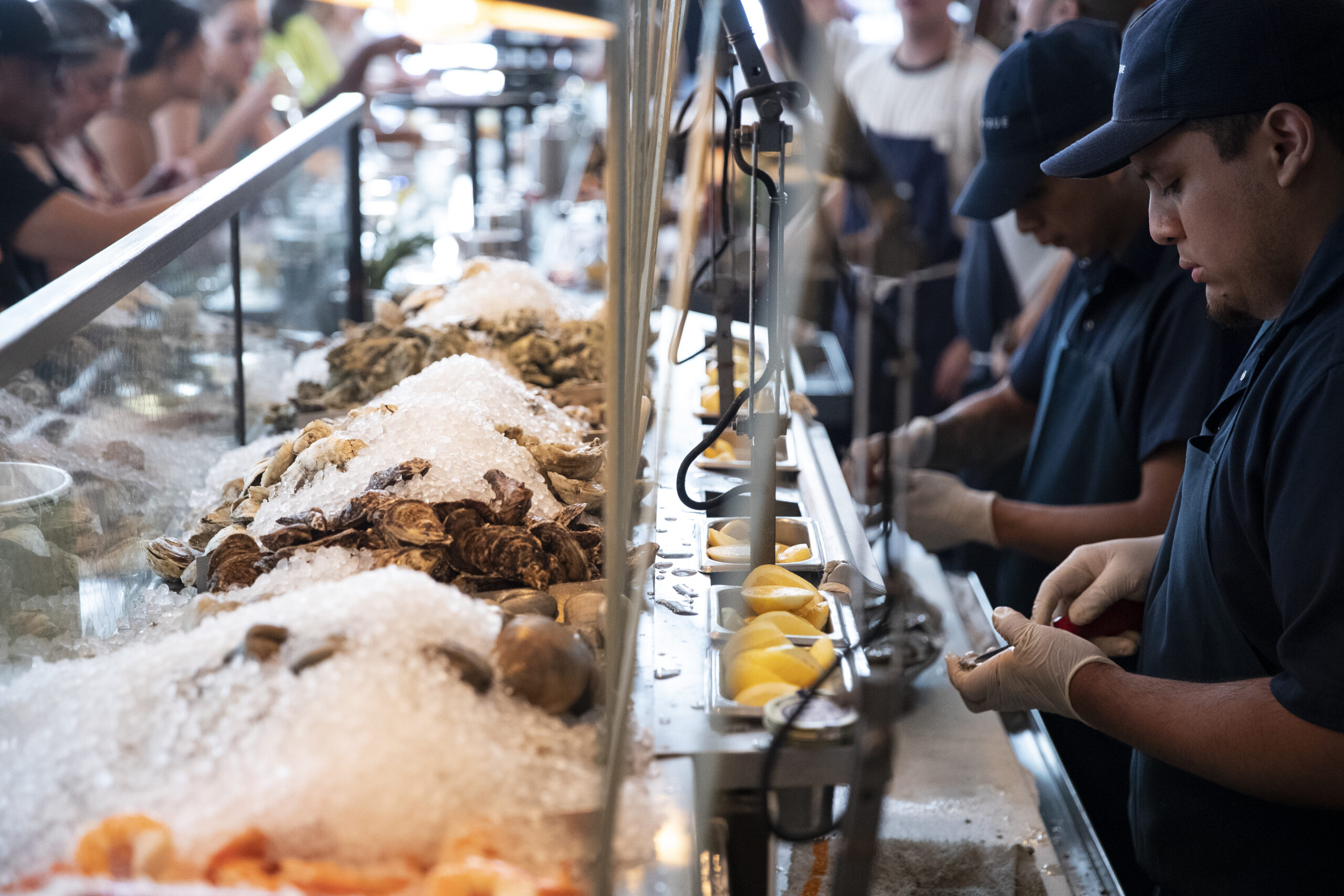
    Oysters rest on ice as shuckers work nearby at Pearl & Mary.

    Fish and chips at Pearl & Mary

    To quell the anxiety of a visit to the phone store, I found myself at Pearl & Mary, Michael Schulson’s Center City raw bar. My companion dove right into the Savage Blonde and Pink Moon oysters, both from Prince Edward Island. Oysters aren’t my thing, but my soul was soothed by the aroma wafting from the broth of my shrimp dumplings — a perfect small plate on this brisk Sunday morning. But my main highlight was the traditional fish and chips, with an especially succulent piece of cod and a buttery crust with a robust tartar sauce that leaned into its zest. The french fries are thin-cut and extra salty, as they should be. Pearl & Mary, 114 S. 13th St., 215-330-6786; pearlandmary.com

    — Henry Savage

  • Charles Lindbergh dedicated the airport on this week in Philly history

    Charles Lindbergh dedicated the airport on this week in Philly history

    He had a long flight.

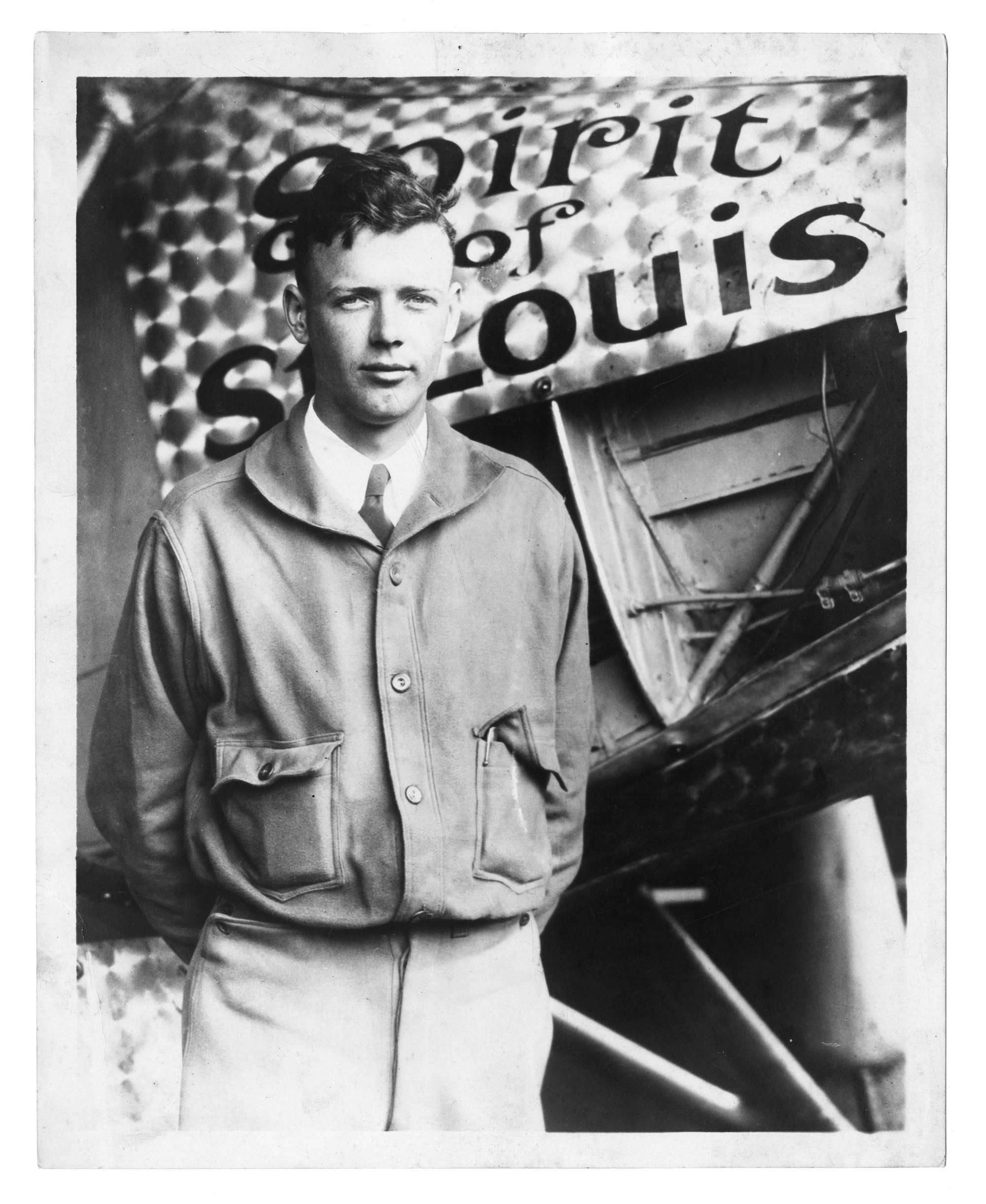
    In May 1927, Charles A. Lindbergh became the first person to fly nonstop between New York and Paris. A feat that launched him and his plane into a level of stardom today reserved for the likes of Taylor Swift.

    He was held up as the poster boy for an expanding empire. He epitomized the delicate balance of American exceptionalism and humble appreciation.

    So when he returned stateside, there was a nationwide celebration. The victory tour covered nearly 100 cities and ended in Philadelphia.

    So maybe he was a little cranky when a gaggle of reporters fawned over the 25-year-old aviator from Missouri.

    One problem

    Lindbergh landing the Spirit of St. Louis at Philadelphia’s airport on Oct. 22, 1927, was a big deal.

    During this PR tour, which also helped sell his forthcoming memoir We, the city saw an opportunity to hype its airport.

    Only problem?

    Lindbergh said he didn’t like the airport.

    His thoughts

    After landing, Lindbergh raised Old Glory as part of ceremony to dedicate what was then called Philadelphia Municipal Airport, which is now part of the Philadelphia International Airport. Two years earlier, in 1925, the municipal airport had opened as a training facility for National Guard aviators.

    Charles Lindbergh flew nonstop between New York and Paris in the Spirit of St. Louis.

    Later, he was honored at a reception at Municipal Stadium, which stood at the site of what’s now Xfinity Mobile Arena. The stadium was originally built for the 1926 Sesquicentennial.

    It was followed by a banquet at the Bellevue-Stratford Hotel, which is where he made his thoughts on the airport known.

    “What do you think of Philadelphia’s landing field?” a reporter asked.

    “Well,” he paused, “it could be improved.”

    He laughed at his frankness, The Inquirer reported.

    He thought that the airport needed longer runways and needed to be closer to the city.

    “I think that the field is a little far out,” he said.

    An Inquirer reporter covering the event observed Lindbergh was not the only out-of-towner to express disdain for the city.

    “A stranger finds Philadelphia the most difficult of American cities at first,” Richard Beamish wrote in The Inquirer, “and the most charming after he has become known.”

    In fairness, Lindbergh was also advocating for the expansion of airports and expansion of aerial accommodations across the country.

    If only Lindbergh could see PHL’s traffic now.

  • The Franklin Mills mall opened in Northeast on this week in Philly history

    The Franklin Mills mall opened in Northeast on this week in Philly history

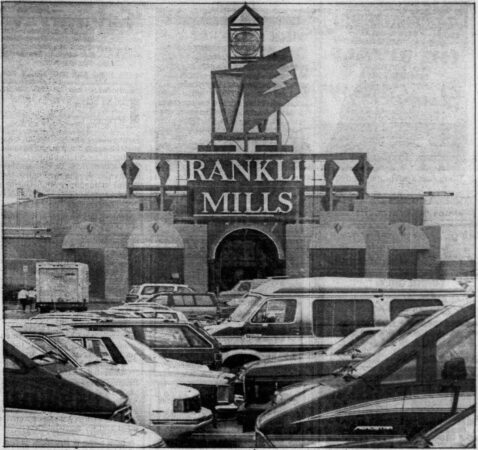
    The design of the Franklin Mills mall was inspired by disaster.

    “The mall was built in the fashion of a modified train wreck,” Jeffery Sneddon, the mall’s general manager, told The Inquirer in 1989, the year it opened. “There are several buildings connected at odd angles.”

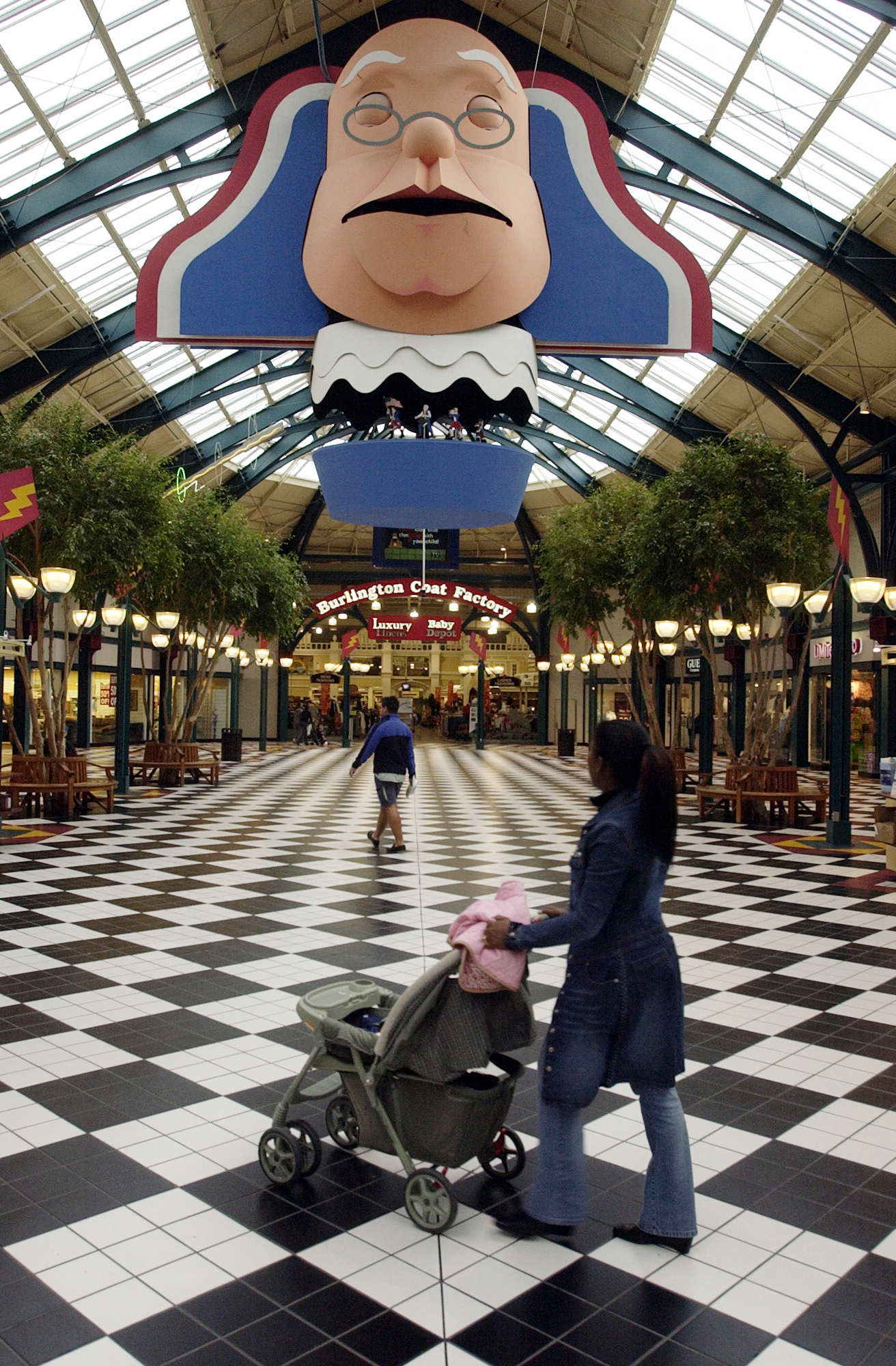
    Years later, the inspiration for the mall’s design underwent a little revisionist history, with publicists claiming the mall’s shape was inspired by the lightning bolts courted by Ben Franklin.

    Appropriate, as change would ultimately become the story of the mall in Northeast Philadelphia.

    At the outset, the goal of the design was to break up the long stretches of the single-level space.

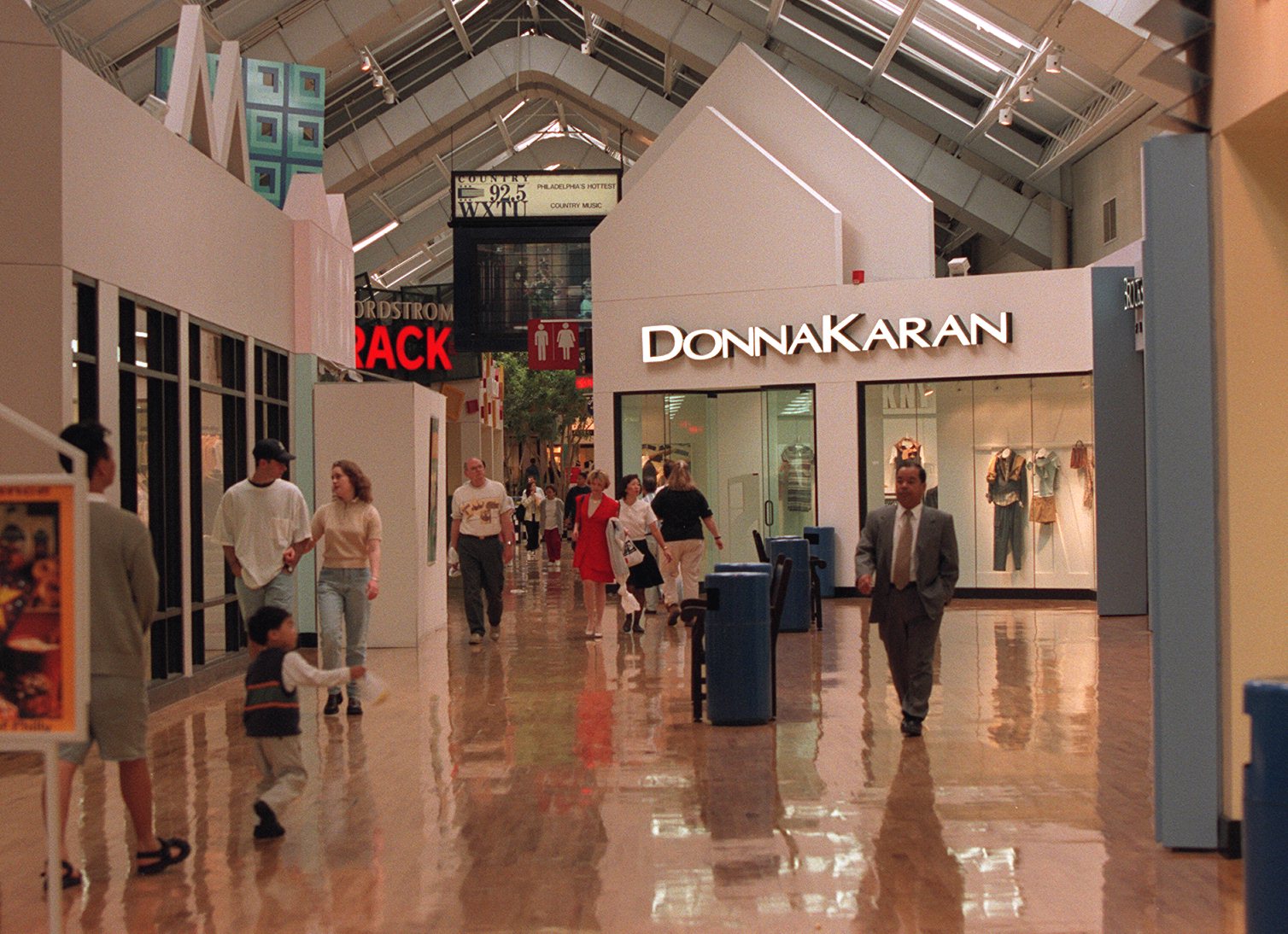
    Shoppers at Franklin Mills walk through the mall in 1997.

    The result was a mile of winding concourse lined with 250 storefronts, and organized so a shopper would always have merchandise shoved into their face.

    The 1.8 million-square-foot mall was built at Knights and Woodhaven Roads on the former Liberty Bell racetrack site. The build cost was $300 million, about $773 million in today’s money.

    When the doors opened on May 11, 1989, to the then-world’s largest outlet mall, the shops were 70% leased, with 120 stores rented by shoe and clothing outfits, restaurants, and anchor stores like a J.C. Penney Outlet and Sears Outlet.

    The title of world’s largest had previously belonged to the Potomac Mills mall, which was a prototype in the suburbs of Washington, D.C. Both shopping meccas were the brainchild of Washington-based commercial real estate tycoons Herbert S. Miller and Richard L. Kramer.

    The duo wanted to build destination venues with value stores. And they paired that with an aggressive marketing campaign that targeted tourists, as well as shoppers who lived up to 60 miles away.

    And it worked. Far Northeast Philadelphia became a destination in the shopping mall era. They’d later add a movie theater, a skate park, and a Jillian’s restaurant and arcade. The mall would host autograph signings and celebrity appearances. And throughout the 1990s and early aughts, it was a popular hangout for discount shoppers and teenagers, and attracted nearly 20 million shoppers yearly.

    Shoppers stroll through the Franklin Mills mall in 2014.

    But by the 2010s, it started to lose its charm. It changed names multiple times, became a haven for flash mobs, and saw its share of Black Friday melees, and a fatal shooting in the food court.

    The fall of the mall concept and the rise of online shopping added to its financial issues, and the building is in receivership as debt holders determine next steps, according to the Business Journal.

    John Chism, manager of Granite Run Mall in Middletown Township back in ’89, didn’t see the mall’s value at the time.

    “Malls are in business to sell,” he said, “not to be attractions for sightseers.”

    But that was the innovation of the Franklin Mills.

    It aimed to be both.

  • This week in Philly history: Girard College quietly admits first Black students

    By the afternoon of Sept. 11, 1968, the hostility had faded.

    Neither the Rev. Dr. Martin Luther King Jr. nor Cecil B. Moore was making rousing speeches outside Girard College’s wrought-iron front gates.

    No human barricade of police officers blocked the entrance, and no civil rights groups marched through North Philadelphia.

    After a brutal fight to desegregate the private boarding school, which started with an intense seven-month demonstration and then spent years tied up in the court system, the color barrier was pierced without protest.

    Four little boys, dressed in suits and ties and carrying their favorite board games, walked to the front door of marble-faced Founder’s Hall at 21st Street and College Avenue, and reported for their first day of second grade.

    Mothers and grandmothers and siblings accompanied each child, and a gaggle of photographers and reporters attempting to capture the otherwise-calm moment circled each family.

    “Nice place,” 11-year-old William Lenzy Dade told The Inquirer, “I didn’t expect it.”

    The school was the brainchild of French merchant Stephen Girard, a childless entrepreneur who amassed an immense wealth in Philadelphia in the aftermath of the American Revolution. Upon his death in 1831, he set aside a then-fortune of $2 million to start a boarding school for “poor, white, male orphans.” The school opened in 1848, and offered a premium education at no cost to select students whose families had a single guardian.

    By the 1960s, the campus’ imposing stone walls became a metaphorical obstacle to the enclosed white-columned buildings. Moore, then the Philadelphia NAACP president, led the charge and a lawsuit to force Girard to desegregate. In 1965, the animosity escalated into sometimes-violent confrontations with police. But demonstrators continued undaunted, singing and chanting and marching so those four boys could be the first Black students admitted to the private school.

    Owen Gowans III was 7 when he walked through those gates in his bright, green-and-brown plaid jacket, the last of the four to arrive.

    “Are you nervous?” a reporter asked.

    He just shook his head.

    In 2015, as part of an anniversary celebration of the school’s integration, Gowans found the words.

    “I’m just humbled by what transpired,” he told The Inquirer. “I’m appreciative to the people who put up with beatings and bad words so people like me could go to school here.”

  • 1990s flashback: When the desire for Starter jackets turned deadly

    1990s flashback: When the desire for Starter jackets turned deadly

    Just before midnight on March 4, 1990, 15-year-old Darius Lamont was pulled through the back door of a friend’s home in Charlotte, N.C.

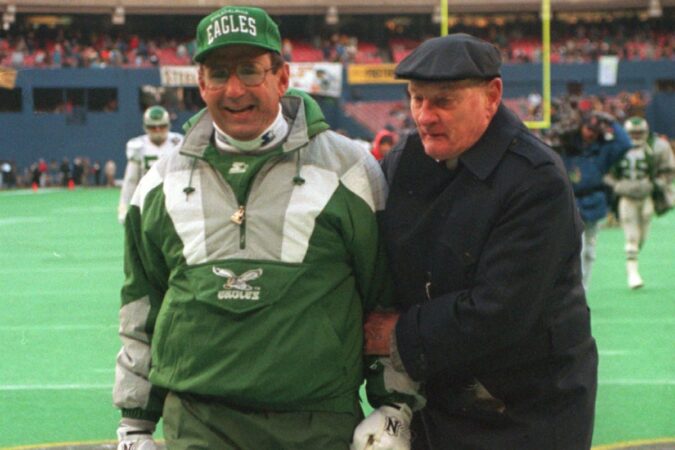
    His attacker wanted the teenager’s green-and-white Eagles Starter-brand jacket, valued at $125. During their struggle, the attacker pulled out a gun and shot Lamont in the face.

    When police arrived, the jacket was gone. Lamont died 10 hours later.

    His death — like the jacket — was part of a trend.

    The growing popularity of professional sports in the late 1980s and early ’90s spawned a new cultural status symbol: expensive sports gear lined in team colors and affixed with hulking logos. The apparel was marketed to the eager-to-impress in their teens and early 20s. But the gear was so popular that some young wearers became crime victims.

    As the 2017 NFL season kicks off and sports stores start to push their cold-weather gear, we look back on the chaos that followed the rise in sports-gear popularity and crimes spurred by the Starter-brand jacket trend.

    In the 1980s and ’90s, the jackets were manufactured by the Starter Corp. of New Haven, Conn. The company was licensed to produce gear for all the major professional teams, including baseball, hockey, basketball, and football. While the brand still exists, it’s now an underutilized subsidy of Iconix Brand Group, which continues to sell the jackets for about $100 each.

    Starter’s business peaked in 1992, when the brand made $350 million in sales. The most popular product was the winter-weight jacket, worn by gangster rappers and Hollywood superstars alike.

    But the status symbol also led to a secondary industry: jacket theft. In Philadelphia, especially in the lower Northeast, some who couldn’t afford one turned to violence.

    Two and three times a week, the police blotter was full. On one week in 1993:

    – “14-year-old boy was jumped by a group of four men at 8:45 p.m. Jan 23 in the 6300 block of Charles Street and robbed of his $100 warmup jacket”

    – “14-year-old boy was punched and robbed of his $100 Starter jacket at 9:15 p.m. Jan. 22 in the 4100 block of Levick Street by a group of three teen-age boys”

    – “A 13-year-old boy was robbed of his $100 Starter jacket at 3:15 p.m. Jan. 21 in the 1500 block of Foulkrod Street by a 15-year-old boy”

    Philadelphia police went so far as to send the freshest-faced cops undercover as decoys to catch would-be thieves. A Mayfair neighborhood group offered to put jackets on a registry, scribbling assigned serial numbers in three separate and secret locations on the jackets. But the thieves caught on, cutting out the serial numbers after they were lifted.

    In 1993, when Robert Levins was inspector of the Northeast Police Division, he told then-Daily News columnist Jill Porter that he would lecture parents.

    “I tell parents that I wouldn’t buy one for my child because of the fact — why put a target on your kid?” he said. “Why make your kid a victim? Buy him a nice coat, but it doesn’t have to be a Starter jacket or a sports team jacket.”

    Porter wrote in response: “Sounds good to me, but try telling that to your kid.”

    James Lamont, Darius’ father, told the Charlotte Observer that he had given his son money for Christmas to buy the jacket.

    “It’s a shame you can’t buy something for your child,” he said, “without worrying if he’ll be safe to wear it.”