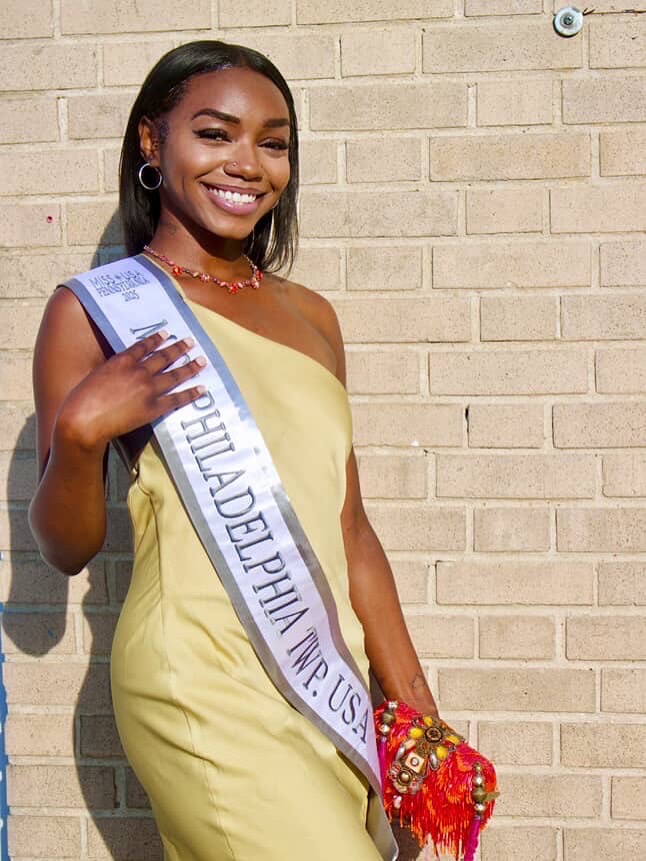
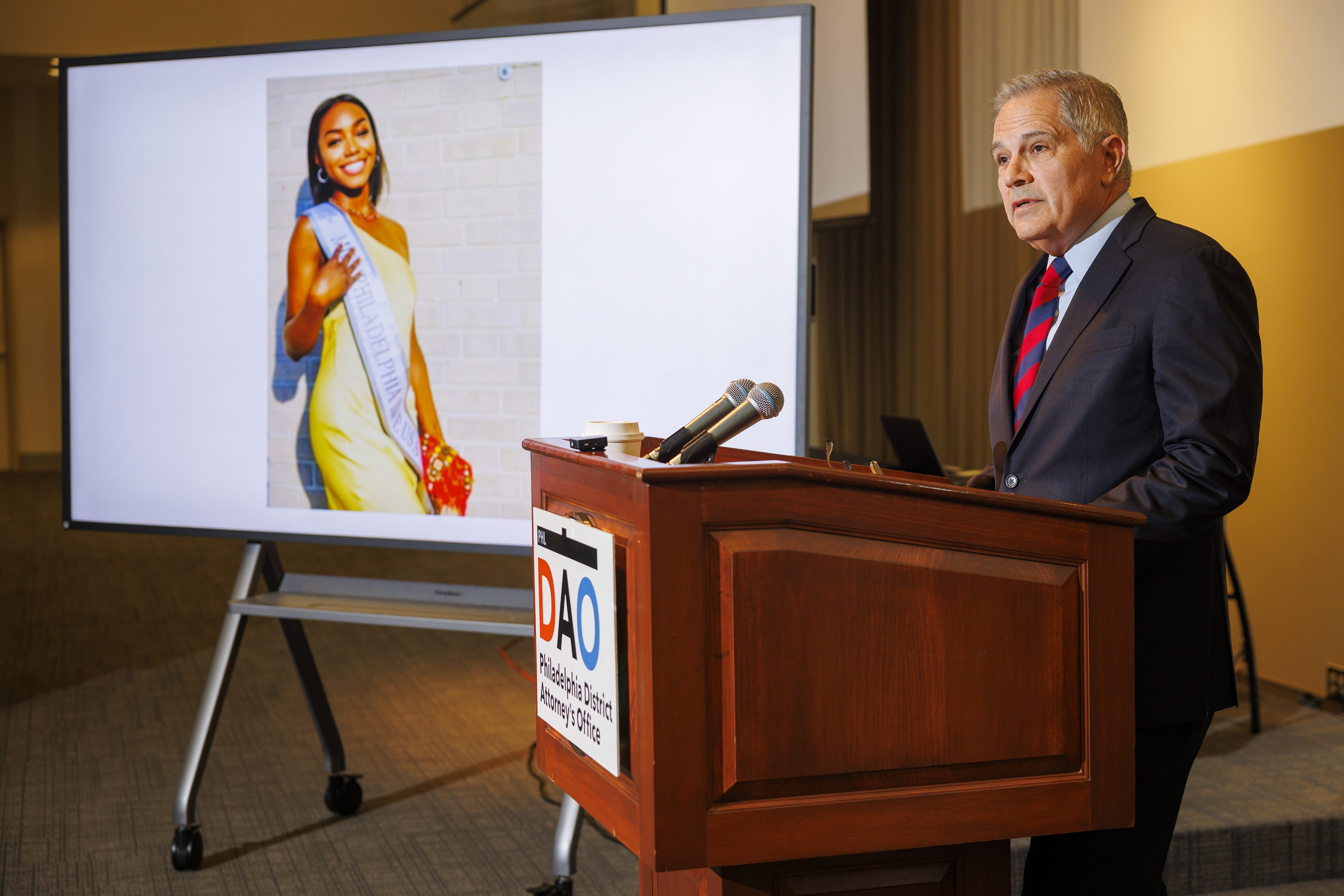
The former head of human resources and diversity initiatives for the Philadelphia Art Museum was charged with theft earlier this year. The police said she racked up more than $58,000 in personal expenses on a company credit card, then failed to pay back the funds, court records show.
Latasha Harling, 43, was arrested in July and charged with theft by unlawful taking, theft by deception, and related crimes about six months after she quietly resigned from her job as the chief people and diversity officer for the museum.
The charges against Harling — which had not previously been reported or made public by the museum — are the latest chapter in a six-week stretch of turbulence for the prominent institution, and raise new questions about the financial oversight and controls of its senior executives.
On Nov. 4, the museum fired its director and CEO, Sasha Suda, after an investigation by an outside law firm flagged the handling of her compensation. Suda filed a lawsuit on Nov. 10 against her former employer claiming that she was the victim of a “small cabal” from the board that commissioned a “sham investigation” as a “pretext” for her “unlawful dismissal.”
The Art Museum on Thursday responded to the lawsuit in Philadelphia Court of Common Pleas with a petition saying Suda was dismissed after an investigation determined that she “misappropriated funds from the museum and lied to cover up her theft.” Her lawyer, Luke Nikas of Quinn Emanuel Urquhart & Sullivan, called the museum’s accusations false.
“These are the same recycled allegations from the sham investigation that the museum manufactured as a pretext for Suda’s wrongful termination,” he said.
A sign shows the recent rebranding of the Philadelphia Art Museum.
Harling declined to comment on the charges filed against her Friday, as did her lawyers at the Defender Association. A spokesperson for the Philadelphia Art Museum also declined to comment on the matter.
Harling was hired by the museum as a senior member of its executive staff in November 2023, according to her LinkedIn profile. In that role, she oversaw human resources for the museum, implemented policies to promote diversity, equity, and inclusion, and managed budgetary responsibilities, among other duties, per her profile.
As part of her job, Harling had access to a corporate credit card for business-related expenses, according to the affidavit of probable cause for her arrest.
In January 2025, museum staff noticed that Harling’s December credit card statement contained “several large, and apparently personal expenses,” the affidavit said.
The museum’s chief financial officer conducted an audit and found that, over the course of Harling’s tenure, she charged $58,885.98 in personal expenses to the company’s credit card, the document said. She had not filed an expense report since July 2024, according to the affidavit.
Museum officials confronted Harling about the charges in January, the filing said, and proposed that she repay $32,565.42. She resigned from her role soon after “without resolution,” according to the affidavit.
The museum continued to negotiate with Harling, and in February, she signed a promissory note agreeing to pay back $19,380.21 over the course of three months that spring, the record said.
But in April, per the filing, a lawyer for the museum contacted the police to say that two months had passed and Harling had not repaid any of the funds. They said that, according to their agreement, she should have paid back about $13,000 by then.
After the museum provided investigators with copies of their emails with Harling, her expenses, and its travel and expense policy, prosecutors agreed to charge her with theft.
The case remains ongoing in Philadelphia’s criminal court.
Staff writer Jillian Kramer contributed to this article.
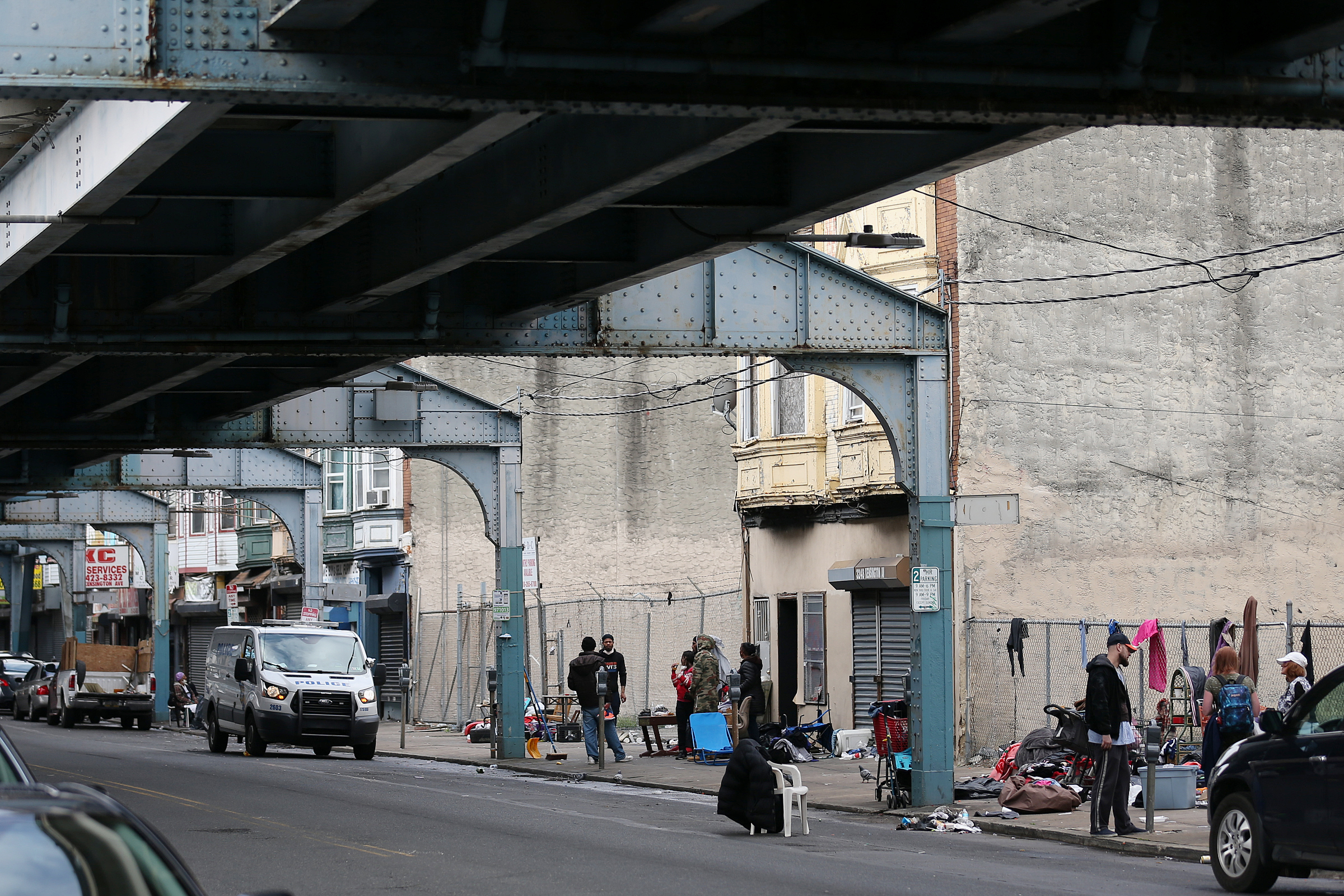
Gloria Cartagena Hart vividly remembers the scenes and sounds of her Kensington block just three years ago: The streets filled with trash. The sidewalks lined with dozens of people openly using drugs. Nightly pops of gunfire from dealers competing for turf, and the haunting screams that followed.
It was 2022, in the heart of one of the most notorious drug markets and poorest zip codes in America.
But Cartagena Hart, a longtime resident at Somerset and Jasper Streets, now says the neighborhood is experiencing something she once believed might never come.
“I see some progress,” she said.
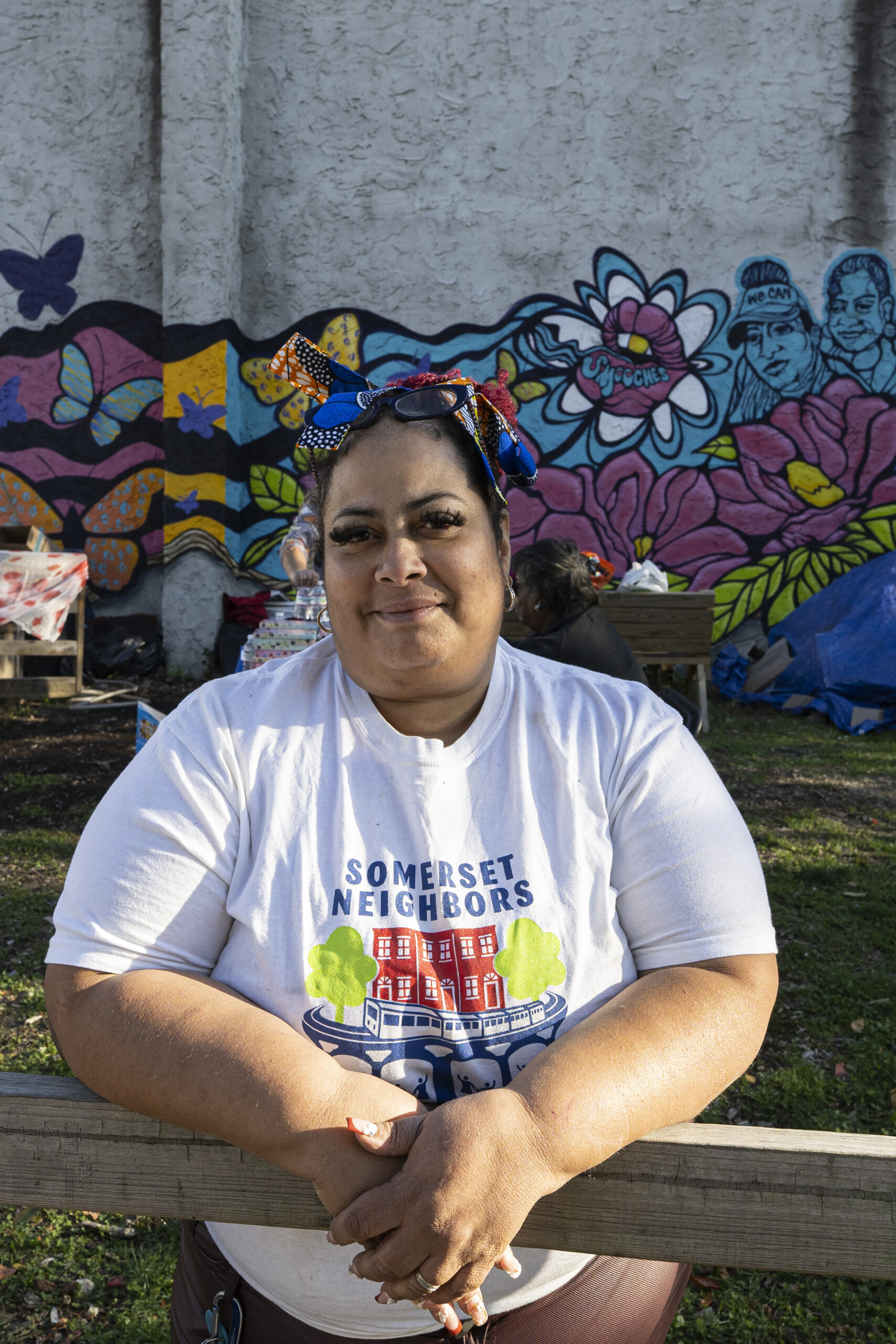
Gloria Cartagena Hart is a community organizer in Kensington who said she will never stop fighting for resources to stabilize the area.
For the first time in decades, under the renewed efforts of Mayor Cherelle L. Parker’s administration, some residents and city officials alike agree that many of Kensington’s most chronic challenges have been improving — albeit slowly.
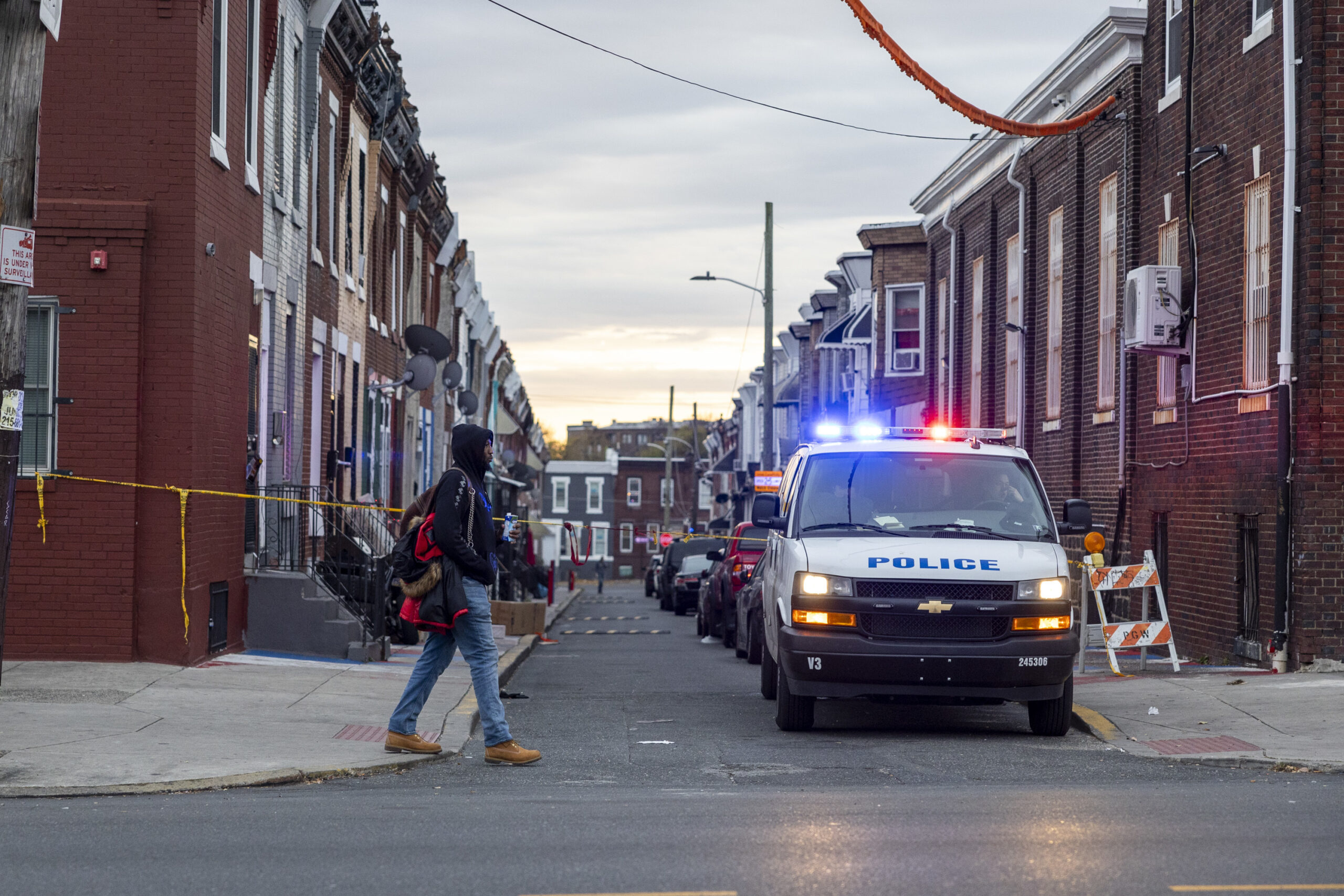
Fewer dealers dot the corners. Three times as many police officers patrol the neighborhood, disrupting their business. Half as many people are living on the streets compared with last year, police said. Some residents say quality-of-life issues — trash pickup, abandoned car removals, 311 calls — are being addressed more quickly.
And gun violence — long a byproduct of the drug economy and fragmented crews fighting for turf — is at its lowest level in a generation.
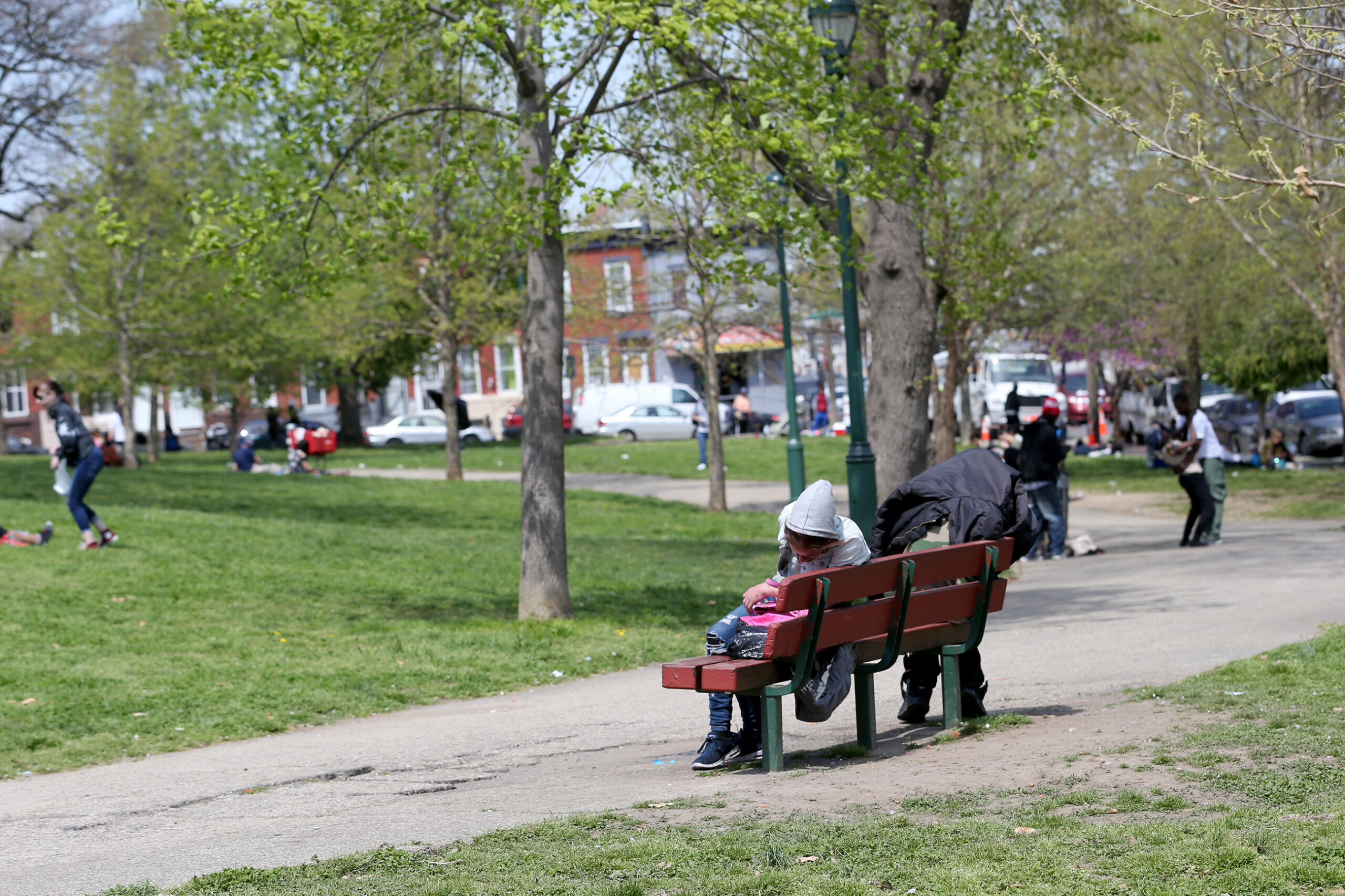
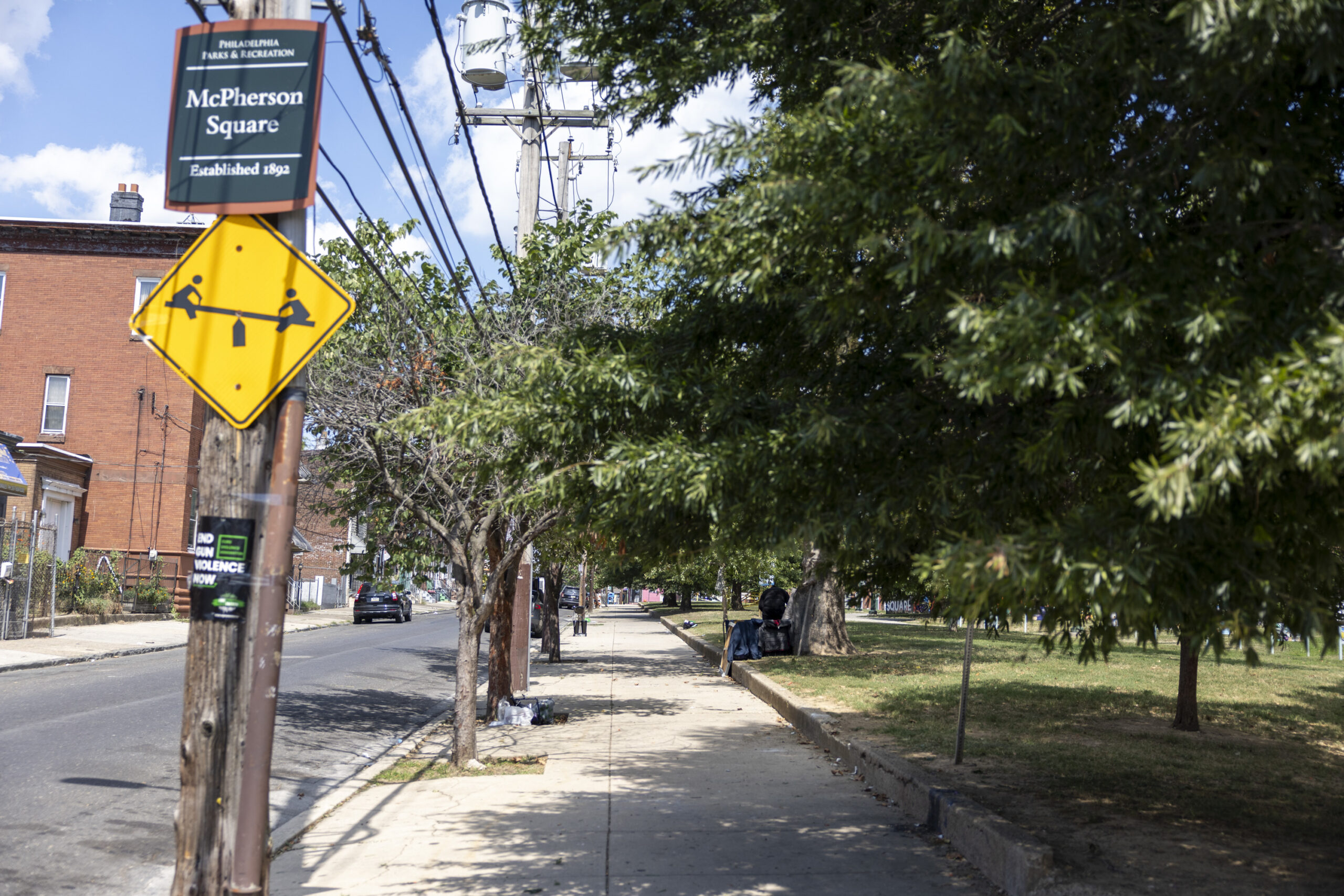
For years, McPherson Square was typically filled with people openly using drugs, as seen in this photo from April 2021. Residents could not let their children visit the park safely.This year, McPherson Square is a different scene. There are often a few people sitting along the edges, but police regularly sweep the park and ask people to leave.
City agencies and healthcare groups say they have also worked to get drug users into treatment more quickly, and have started building a network of care that they hope will keep fewer people from returning to the streets. Riverview Wellness Village, Parker’s new $100 million recovery and treatment facility, now houses about 200 people.
“Neighbors [are] telling me how many more people are sitting on their steps, how many more children are riding their bikes, how many more people may walk the commercial corridor,” Parker said this week. “To me, that’s progress. … We weren’t going to close our eyes and ignore it and walk around like it didn’t exist, or just contain it in one area.”
She’s committed to long-term change there, she said.
More dealers show up to give out free samples of drugs — and free pizza slices to go with them — in an effort to win over customers in a more competitive market, she said. She is constantly asking people to stay off her steps.
Deputy Police Commissioner Pedro Rosario sees the ongoing challenges.
“Am I where I want to be? No. Nowhere close to it,” said Rosario, who oversees the policing strategies in Kensington. “But ‘moving in the right direction’ is not giving us enough credit.”
Deputy Commissioner Pedro Rosario walks through the mini police station on Allegheny Avenue.
Improvements in Kensington, he said, may always be limited by the depths of the drug crisis and economy.
“It’s never gonna be as good as everyone wants it to be,” he said, but “it’s like the first time we’re all kind of rowing in the right direction.”
Some harm-reduction groups said the progress is surface level, and criticized the city for pushing homeless people into other areas where they are harder to reach: Harrowgate, Center City, the SEPTA stops at Broad and Snyder, Erie Avenue, and 69th Street.
“They’ve made it more difficult for people to be visibly homeless,” Sarah Laurel, who heads the harm reduction organization Savage Sisters in Kensington, said of the city’s efforts. “But have they actually resolved the dire need of community members who are unhoused?”
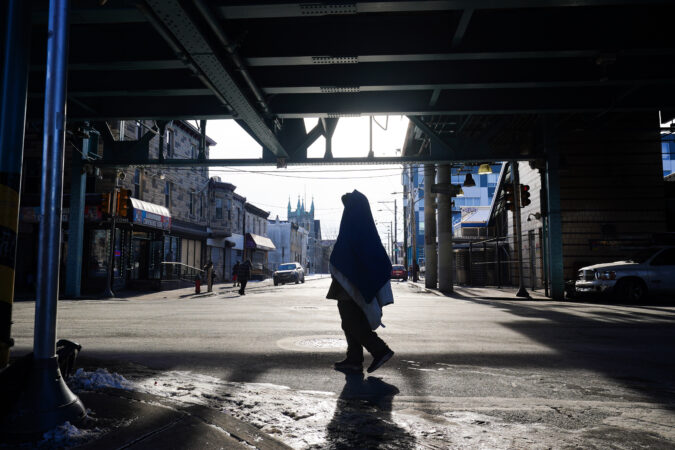
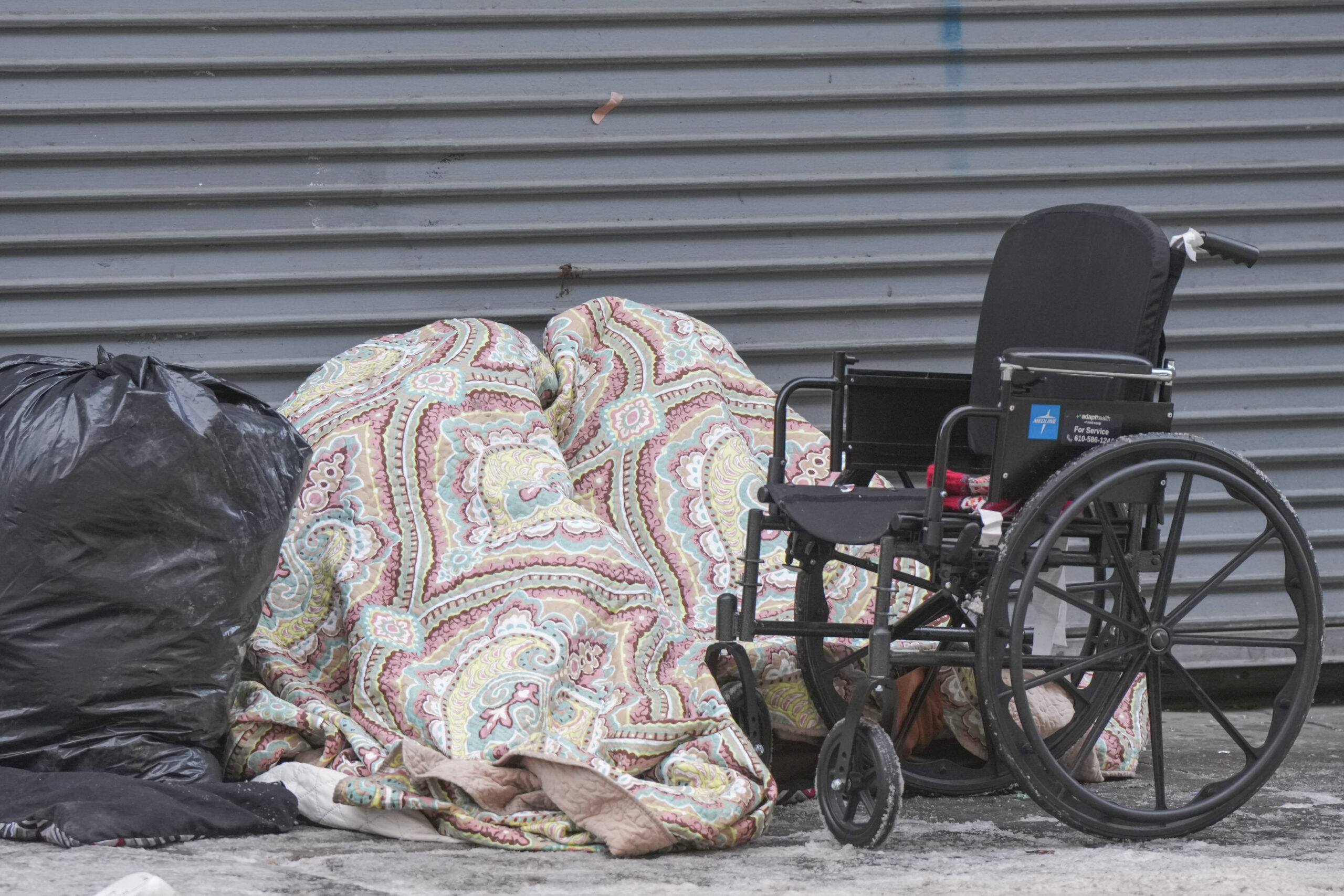
People experiencing homelessness and addiction sleep under blankets on Kensington Avenue in January.
Still, one woman in her 30s, who has come to Kensington on and off since she was 16, acknowledged the neighborhood is no longer the “free-for-all” it was at the height of the pandemic.
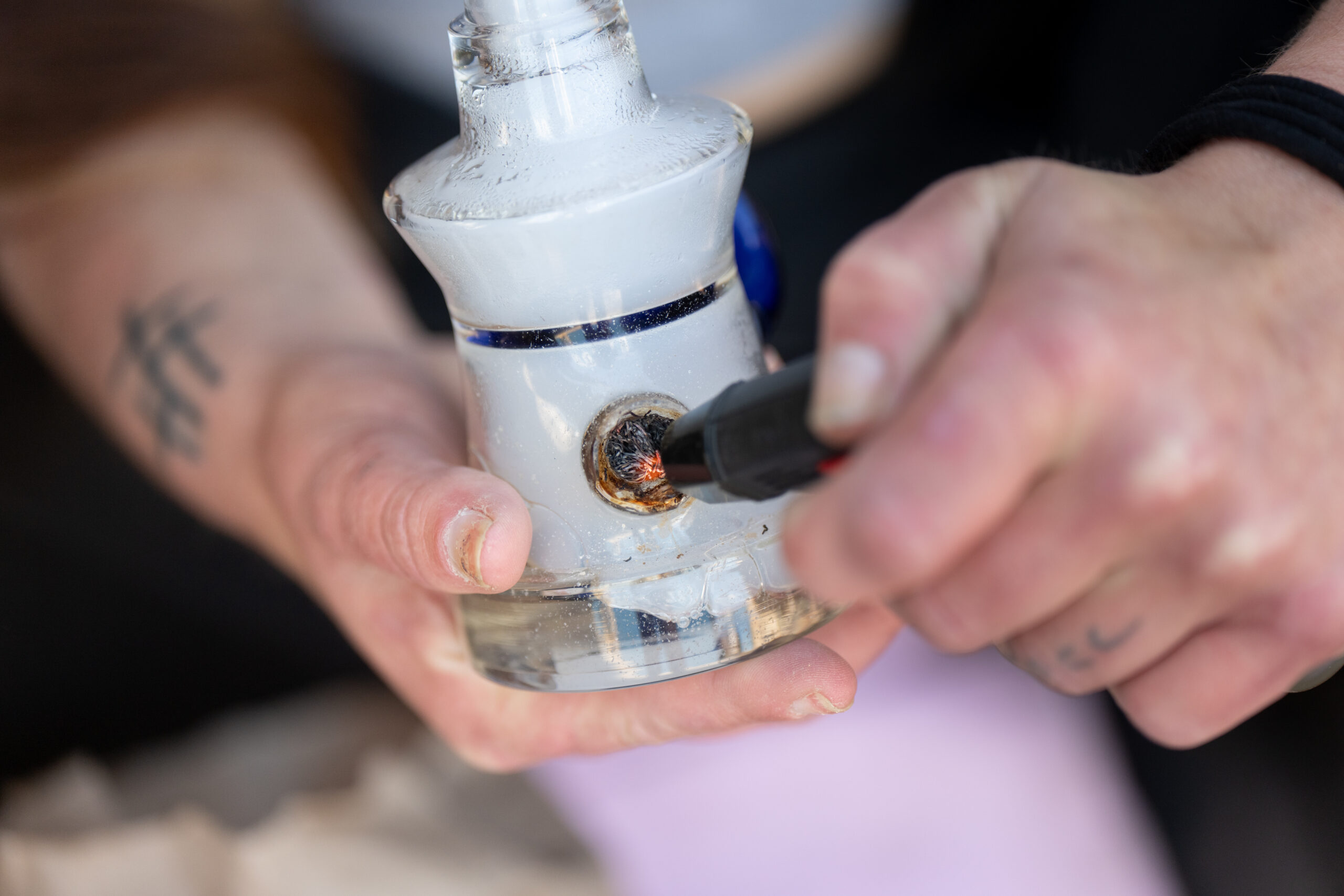
“It has changed,” she said, clutching a crack pipe on a quiet block away from police. “You can still get high on the street, you just can’t get caught doing it.”
And that, Rosario said, is progress.
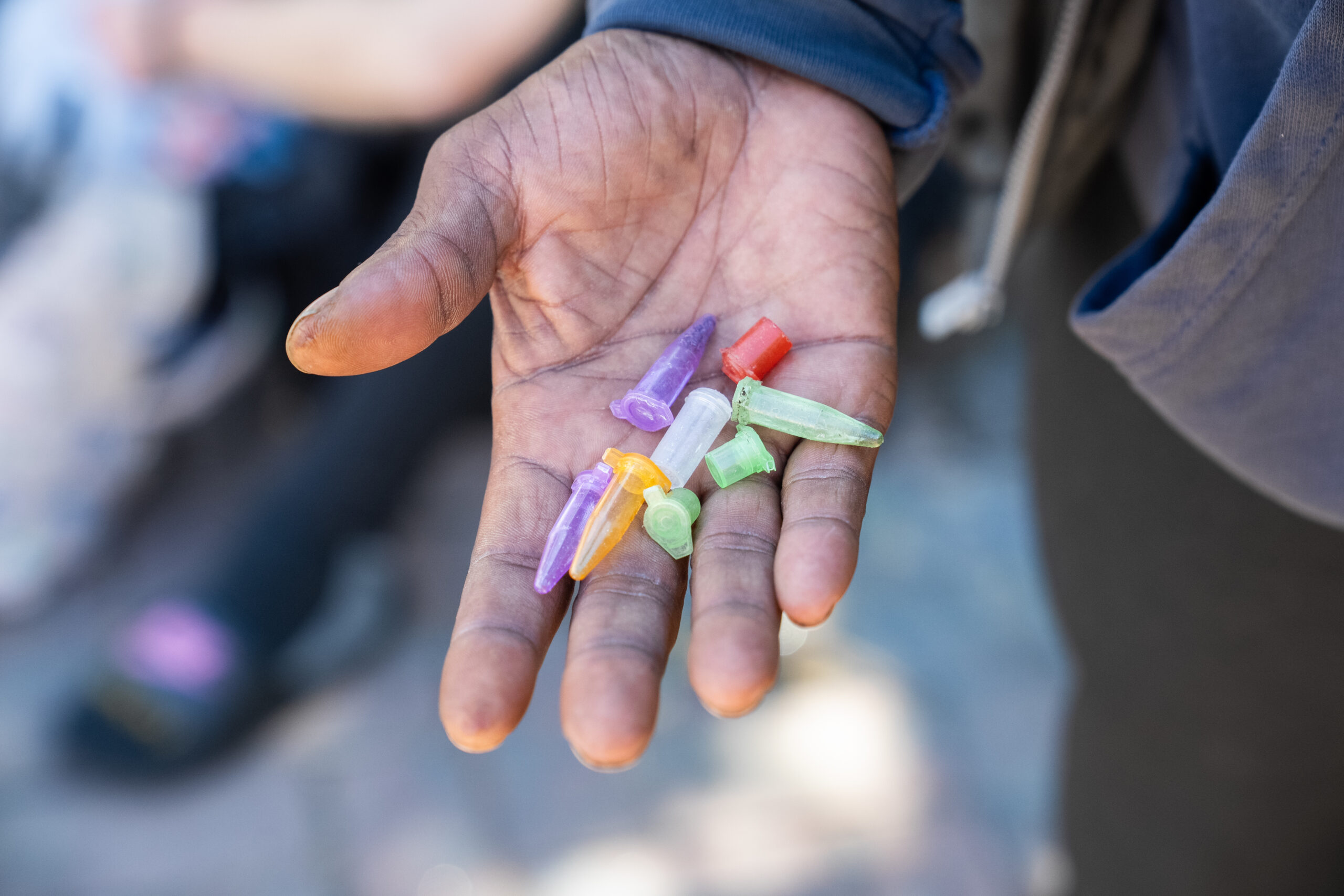
A man who sells drugs holds a collection of empty vials that typically hold meth, crack, and other illicit substances.
A drug ‘flea market’
Rosario has been a police officer in Kensington for 24 years, and saw how the neighborhood became what he calls “the flea market” of the city’s billion-dollar drug economy.
There have always been drug organizations that run specific blocks there — crews from Weymouth, Jasper, and Rosehill Streets, each with its own product, stamp, and employees to sell it.
But in the last five years, he said, blocks have been “leased out.” Someone in New York City or the Dominican Republic will often “own” a block, Rosario said, and rent it out to a local dealer to use for a week to make a stack of money and move on. Dealers even started using drug users to sell in the last few years, he said, because they are less obvious to police, can be paid less, and are seen as “expendable.”
That structure makes it challenging for police to identify and arrest the people in charge, he said. If a lower-level dealer is arrested — or killed — the top distributors can easily find a replacement.
Philadelphia police officers have a shut down the 3100 block of Weymouth Street after federal agents raided the block and arrested 30 people last month.
And the dealers are fearless, he said. Just before the police department was set to open a mini station near F Street and Allegheny Avenue in November 2020, the building was firebombed, he said. He suspects it was dealers attempting to prevent a growing police presence. (The department has since opened a station at 1952 Allegheny Ave.)
Deputy Commissioner Pedro Rosario faces the challenge of overseeing the policing one of Philadelphia’s poorest and most challenging neighborhoods. He sees progress so far.
When Parker tapped Rosario to lead the police department’s plans in the neighborhood, his first order of business was to reduce the violence so that city workers felt safe enough to go into the neighborhood.
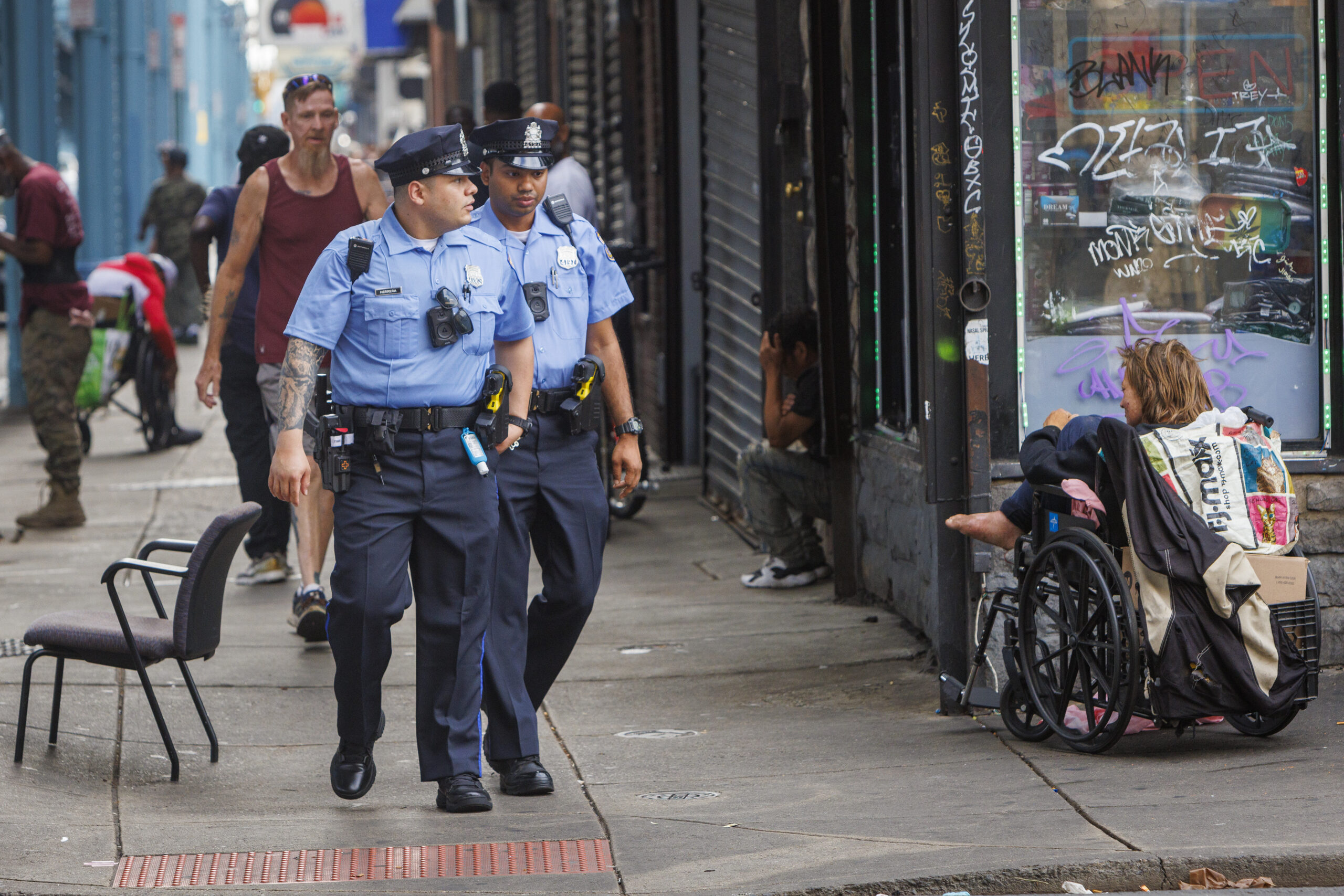
Last summer, the department assigned about 75 rookie cops to buttress existing patrols in the neighborhood, and it has continued to send in more officers. There are now three times as many police patrolling the main drag along Kensington Avenue as there were in 2021 — most of them on foot.
Rosario says the expanded police presence has contributed to a historic decline in violence.
(function() {
var l2 = function() {
new pym.Parent(‘kensington_2025’,
‘https://media.inquirer.com/storage/inquirer/projects/innovation/arcgis_iframe/kensington_2025.html’);
};
if (typeof(pym) === ‘undefined’) {
var h = document.getElementsByTagName(‘head’)[0],
s = document.createElement(‘script’);
s.type = ‘text/javascript’;
s.src = ‘https://pym.nprapps.org/pym.v1.min.js’;
s.onload = l2;
h.appendChild(s);
} else {
l2();
}
})();
While shootings citywide are down about 55% compared to three years ago, they have fallen even more in Kensington.
Through the second week of November, 46 people had been shot in the 24th Police District — an 82% drop from 2022, when, during the same time period, 259 people were shot. And there are half as many shooting victims as there were a decade ago.
“I cannot emphasize how important that is to resetting the norms in that community,” said Adam Geer‚ the city’s chief public safety director. “That is 82% less families dealing with the trauma. That is 82% less gunshots heard ringing in the night.”
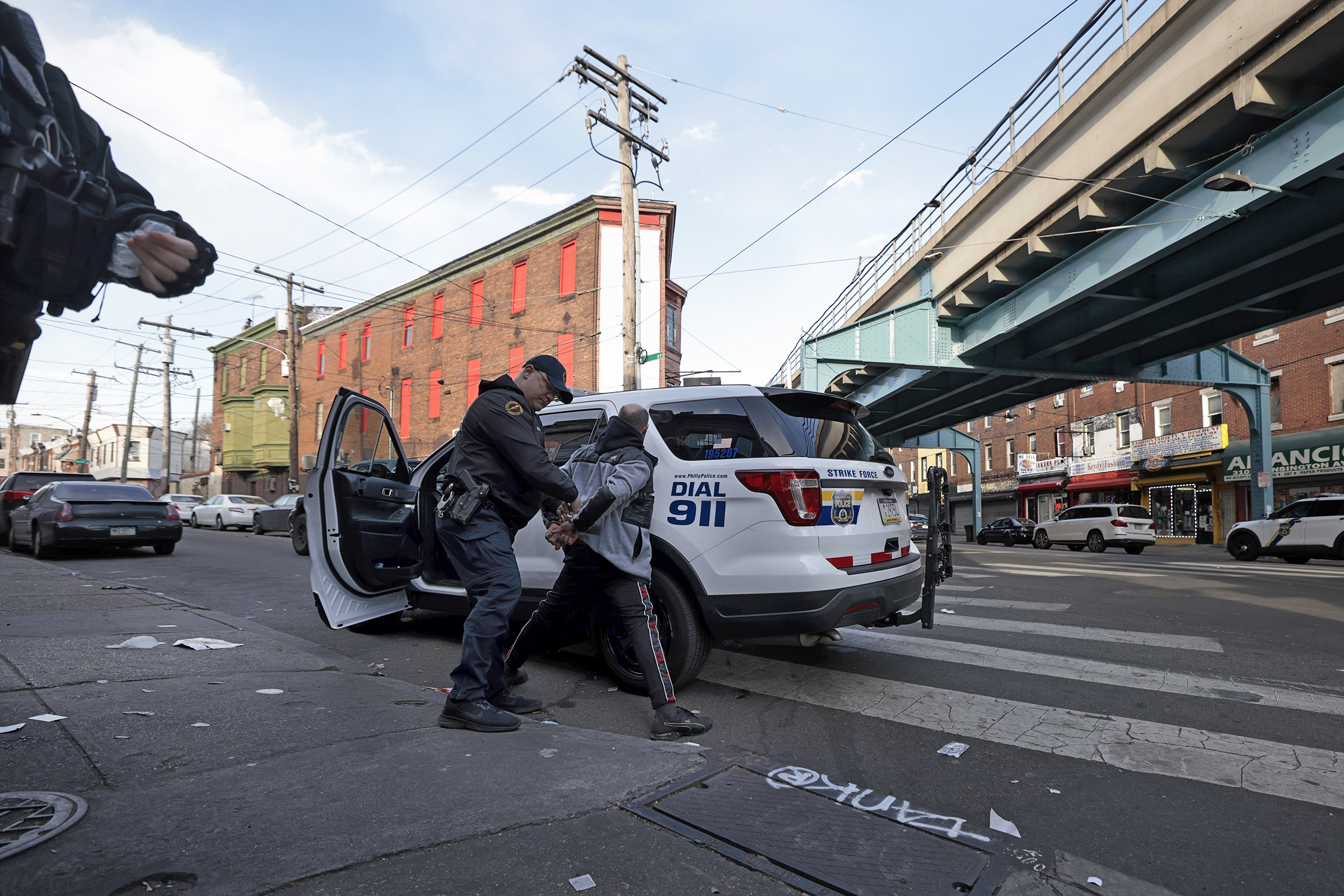
Philadelphia police take a man into custody at Kensington Avenue and G Street on March 20, 2024. Police searched the man and said they found small plastic bags containing what was believed to be illegal drugs (top left).
Through Nov. 15, arrests for drug dealing in the neighborhood were up 23% since Parker came into office. Still, overall, the city is on pace to see the fewest number of drug-related arrests in at least 15 years, city data show, and as law enforcement largely focuses in Kensington, arrests for selling drugs in other parts of the city are down about 34% compared with the 23 months before Parker was elected mayor.
Geer said the city is still in the beginning phases of its efforts. Illicit drug sales will likely always persist, he said, “but what we are really, really going after is the open, blatant, in the air using drugs and selling drugs toxic to this community.”
Rosario also said that reducing the area’s homeless population — by disbanding encampments and generally “being as disruptive as possible” — was critical to reducing the strain on the area’s services and residents, and lessening the open-air drug use and dealing.
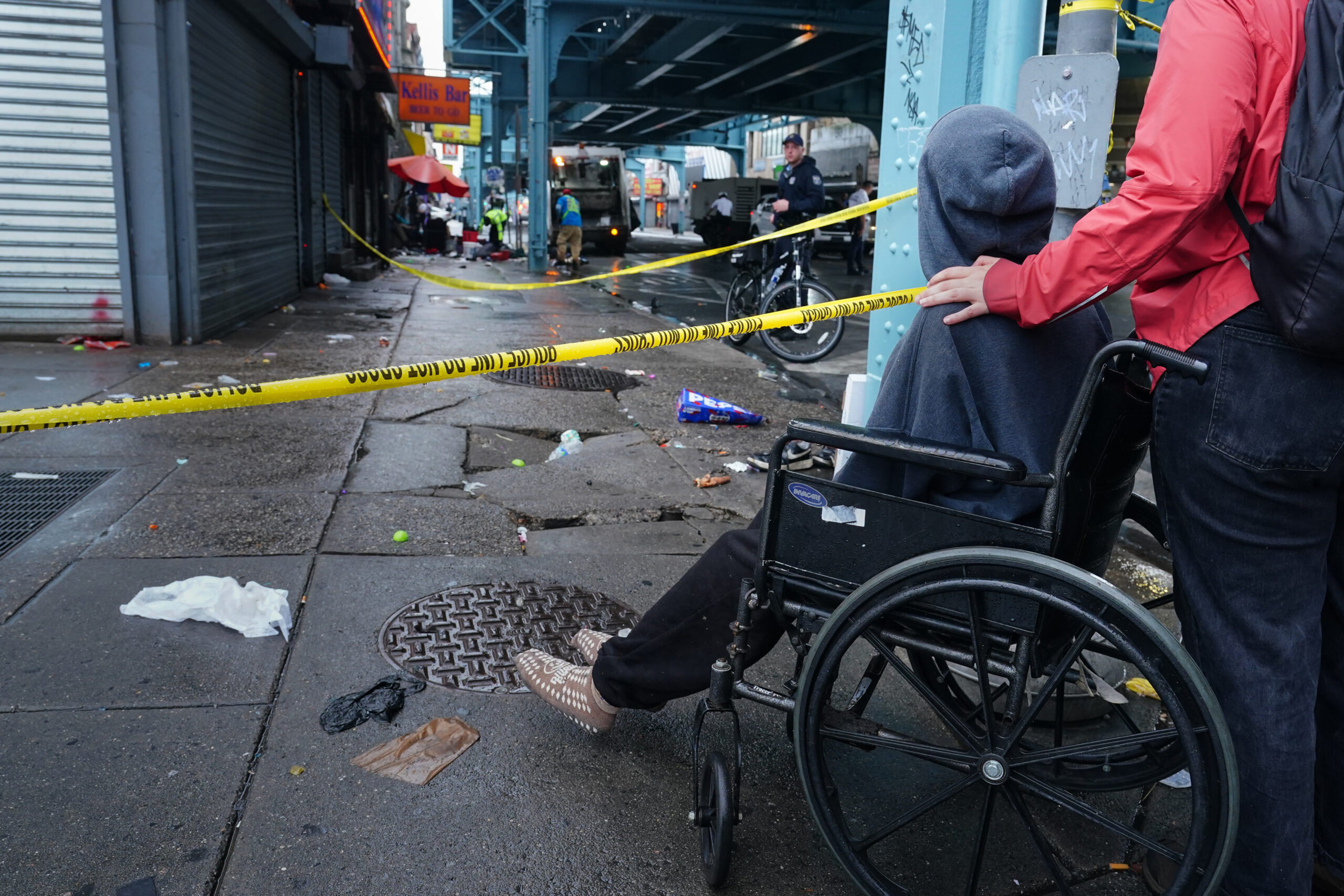
A woman in a wheelchair looks down Kensington Avenue after police cleared a large encampment in May 2024.
It has worked. Last September, there were about 750 people living on the streets in the area, according to a weekly count by police. During the same time this year, there were about 400.
But homelessness in the city generally has not improved, city data show.
There are actually about 400 more people experiencing homelessness this year than last, according to data from the Office of Homeless Services. Police and care providers believe some have simply moved to other neighborhoods to avoid the police presence.
Rosario acknowledged the dispersal, but said Kensington didn’t deserve to bear the burden of those crowds alone.
Because shutting down the drug market in Kensington, he said, “is like trying to stop a wave” at the beach.
“You can disperse it,” he said. “Maybe you can reengineer to kind of push it to a different direction.”
But you can’t stop it.
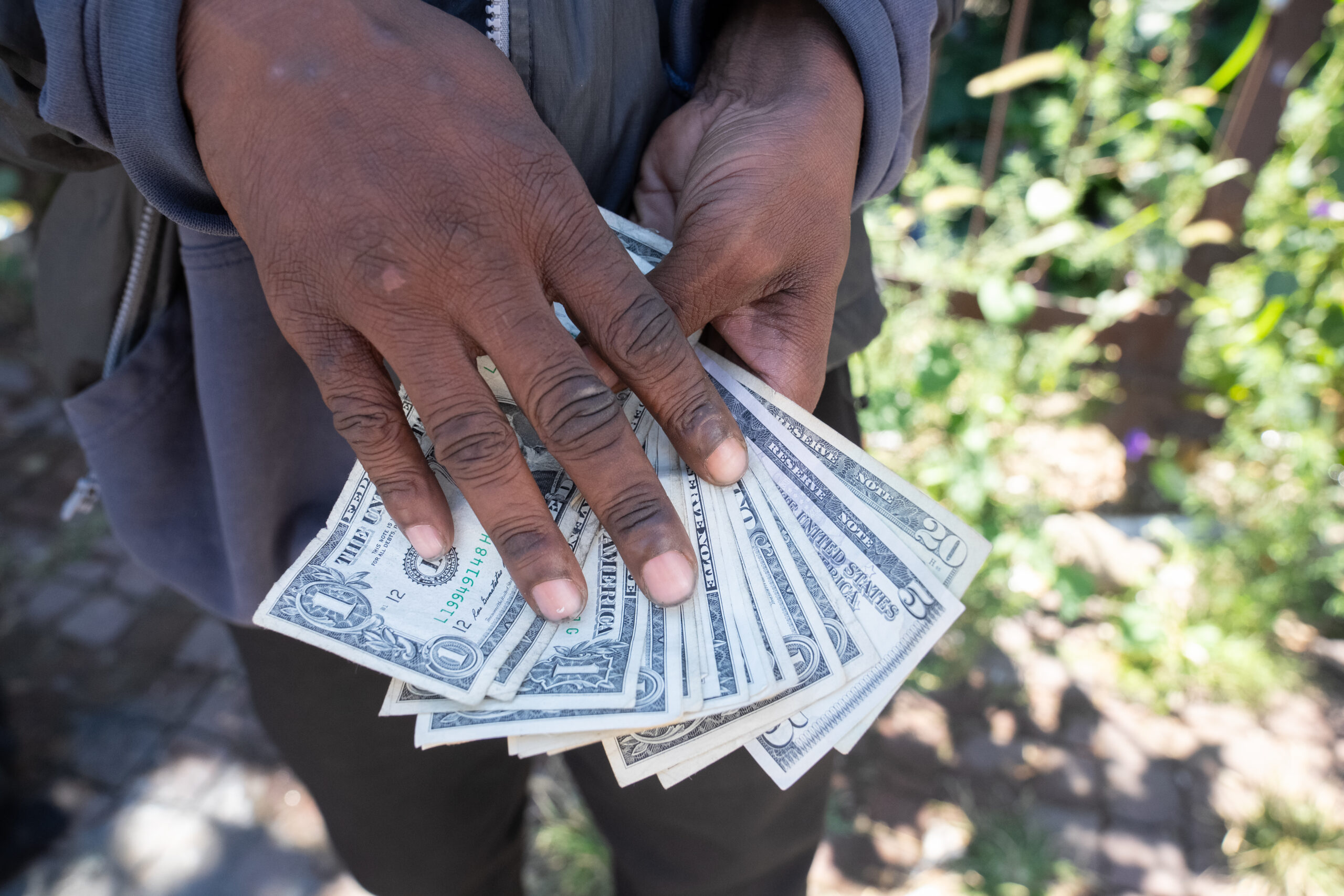
A man fans out the cash he has made on a recent day selling drugs. It’s not much — in part, he said, because there are fewer people in Kensington buying from him.
The view from the streets
One drug dealer can see the shift — and feel it in his wallet.
The 47-year-old man, who asked not to be identified because he sells illegal drugs, said he came to Kensington from New York in 2012 after serving time in prison for robbery. He’s been in the drug trade since he was 12, he said, taught by his parents, who hustled in the Bronx.
Today, he spends his days and nights on a quiet, trash-strewn corner, smoking K2 and selling crack, meth, and dope — whatever the man in the maroon Crown Victoria drops off that day.
During the pandemic, he said, business was booming. When he worked the overnight shift on Jasper Street, he said, he made at least $1,500 a week. Today, with more police on the corners and fewer customers on the streets, he’s lucky to clear $400.
A 28-year-old dealer along Kensington Avenue scoffed at the police enforcement. Where does the city expect the drug economy to go if not here? he asked. The drug trade is a constant, a viable employer with a stable customer base, and it has to go somewhere.
“They can’t put a cop on every f― block,” said the man, who asked not to be identified to discuss illegal activity.
A woman smokes crack on a quiet street in Kensington.
A few streets over, a 36-year-old man who smokes fentanyl and crack said that, a year or two ago, there would be five or six dealers on the corner of Jasper Street and Hart Lane.
Now, he said, there’s one.
“It’s harder to get drugs,” he said.
As police have cracked down on retail theft — once an easy way for people in addiction to make quick cash by reselling the items — it’s also gotten harder to fuel his habit, he said. He usually gambles online on his phone to scrape together a few extra dollars, he said, getting paid through CashApp, which some dealers use to accept payment now.
Many people in addiction said life overall is harder in Kensington — police clear away their tents, shoo them out of parks, and remove the often-stolen grocery carts used to carry belongings. It makes them feel subhuman, said one 36-year-old woman who has struggled with addiction since she was 13.
“We just want to be safe and warm,” she said.
But the biggest fear on the block these days, people said, is the withdrawal.
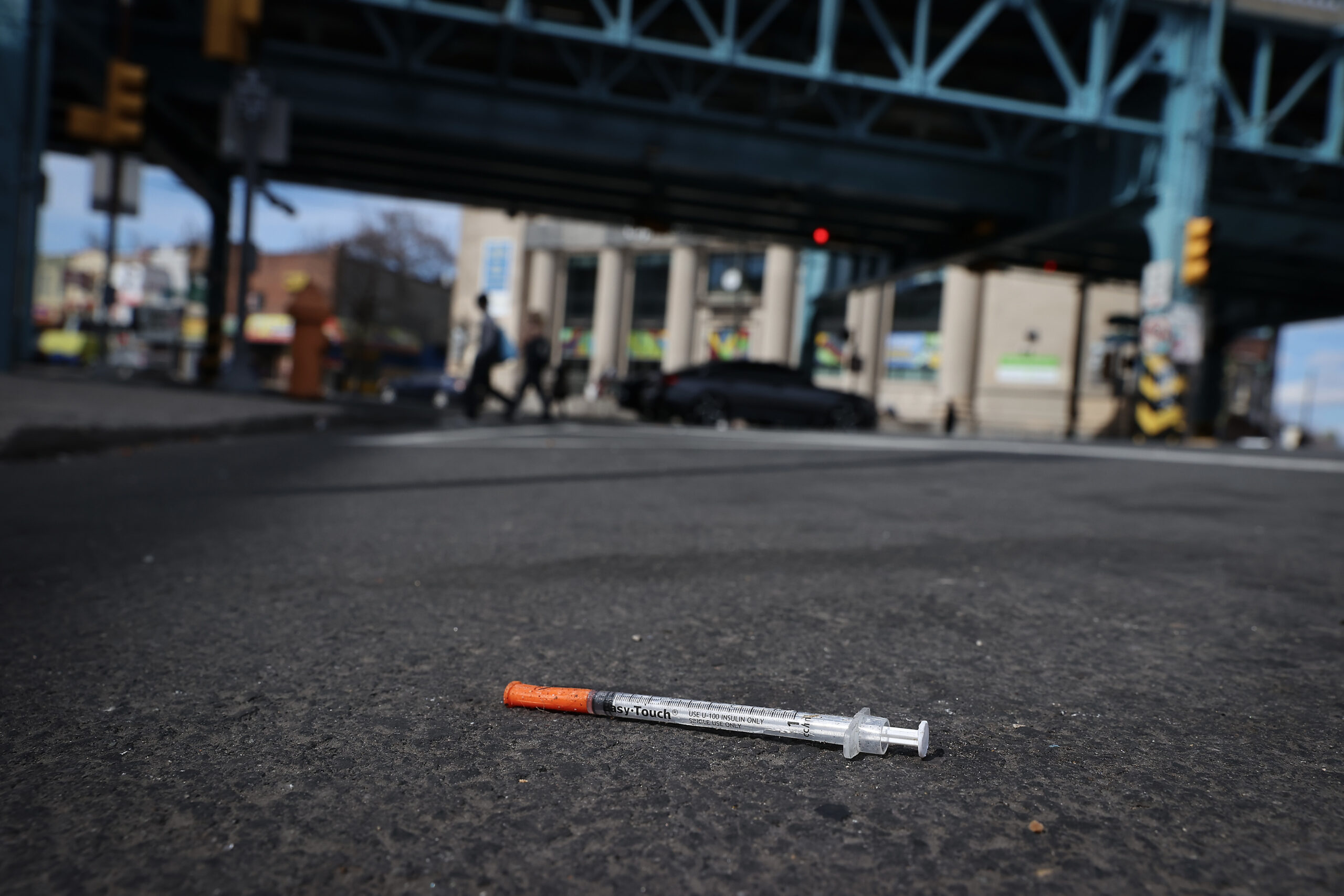
A used hypodermic needle rests on Allegheny Avenue at Kensington Avenue on March 17, 2024.
The withdrawal symptoms, which can begin within two hours, are so intense they can send people into cardiac arrest. Only hospitals can offer the most effective treatments for medetomidine withdrawal, and more people are ending up in intensive care units.
Dave Malloy, director of mobile services for Merakey, one of the city’s main addiction treatment providers, said the city has made strides in streamlining access to treatment in the last two years.
Evaluations that once required a daylong wait at a hospital can now happen in the field through mobile units like Malloy’s, getting people to rehab within hours. Doctors can also start patients on medications like Suboxone or methadone, to lessen their withdrawal symptoms, in as little as 45 minutes.
Malloy said that treatment providers, hospitals, police, and city agencies are working together better than they have in years.
“There was a realization that everybody had been siloed,” he said.
Only about 6% of the city’s homeless people who accepted help fromoutreach workers went to drug treatment and detox centers in recent years, according to city data — a statistic that, as of February, had not improved under Parker’s tenure.
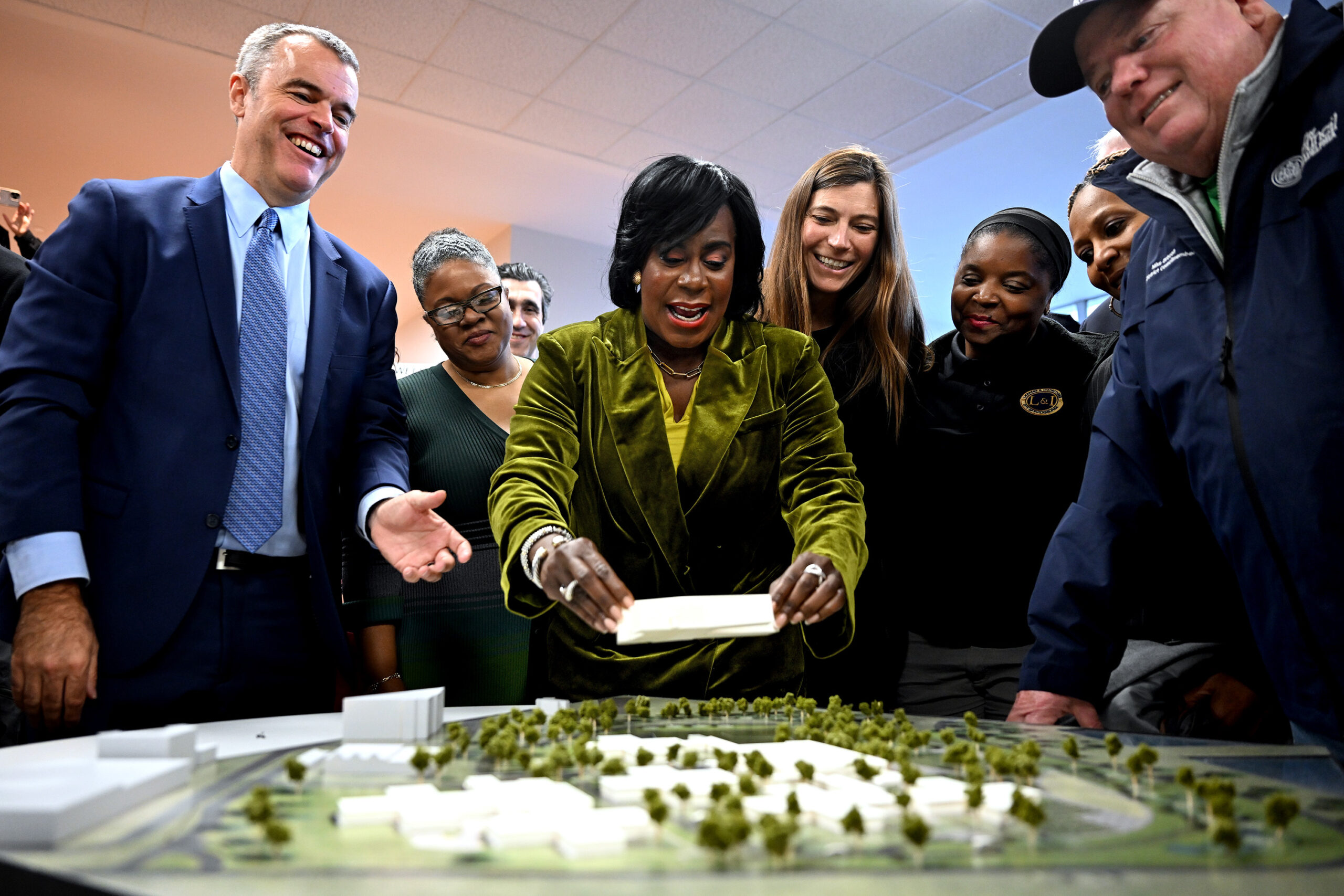
Mayor Cherelle L. Parker places a new block on the scale model of the Riverview Wellness Village Wednesday during the January unveiling of Philadelphia’s new city-operated drug treatment facility. At left is Managing Director Adam Thiel.
The city said it has also expanded the number of beds available for people in recovery by 66% through the opening of the Riverside Wellness Village, where people can live for up to a year after completing 30 days of inpatient drug treatment. Once construction is complete, the facility will house over 600 people.
Another 180 people are living in a shelter at 21st Street and Girard Avenue, which the city expanded last spring.
And the Neighborhood Wellness Court — a fast-track diversion program where people in addiction who are arrested for low-level offenses are brought before a judge the same day, in hopes of getting them into treatment more quickly — is growing.
In the first three months of the court, which Parker’s team launched in January and runs one day per week, only two of the approximately 50 people who had come through completed the program. Most who opted to go to rehab immediately left and absconded from follow-up hearings. At one point, operations were so disjointed that court leadership threatened to shut it down.
But Parker is committed to the court’s success and wants it to operate five days a week. The city recently hired a new director to oversee the court, and is in the process of hiring 14 additional staff members to provide better follow-up care.
Still, through early September, of the 187 people who had come through the court, only 10 completed the program and saw their criminal cases expunged, according to city data.
And while most people still do not come to court, the city said that it expects the situation will improve with the additional hires, and that there is success in the 130 people who have accepted some form of service through the court, even if they weren’t ready to enter recovery.
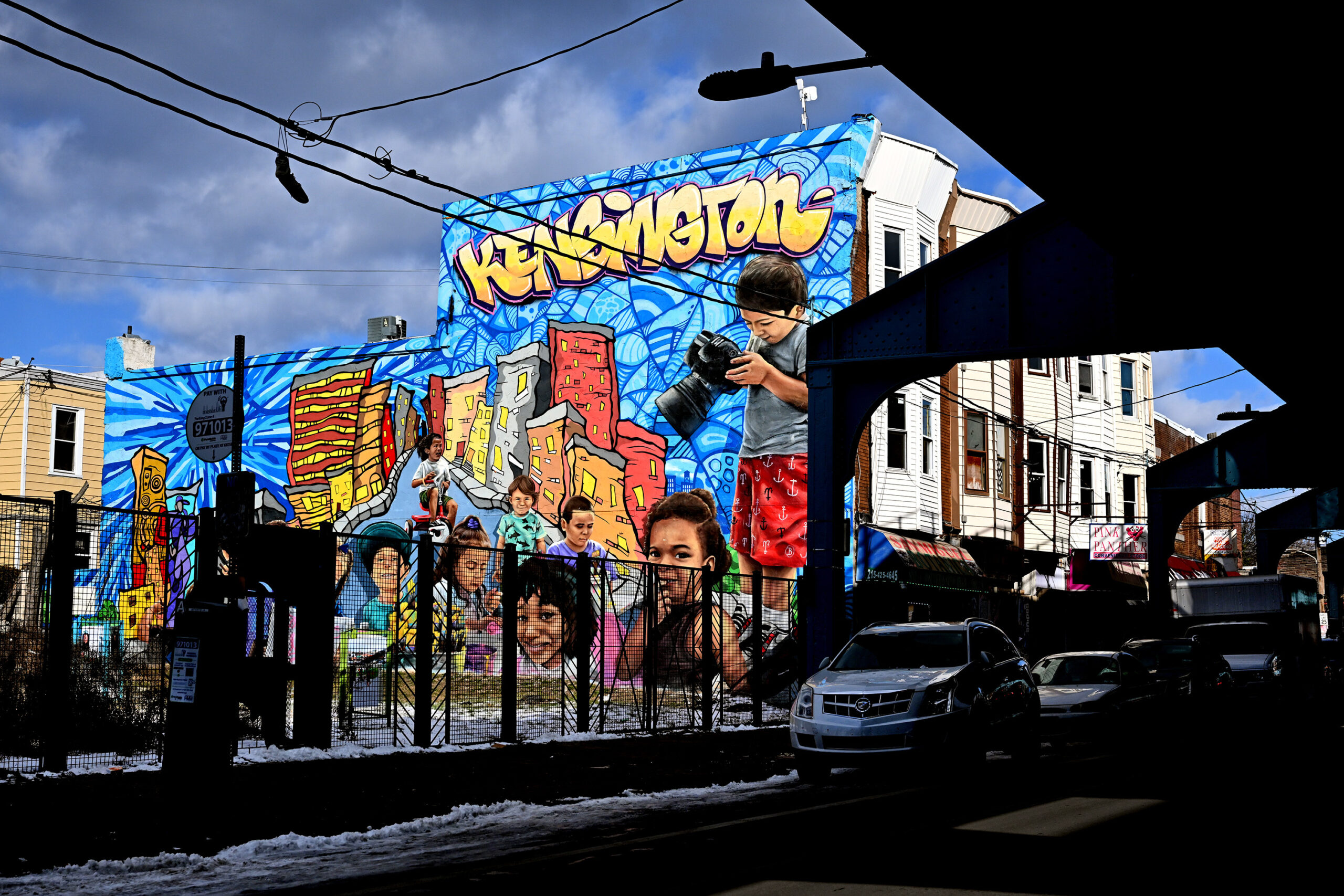
The “Lots of Lots of Love” mural by artist J.C. Zerbe is on the 3200 block of Kensington Avenue.
‘Kensington is love’
The increased police enforcement has sent more people in addiction to jail, and several people have died in police custody after they overdosed or had medical emergencies while going through withdrawal.
And not all residents feel the progress, or see the increased police presence as a good thing.
Theresa Grone, 41, who lives next to McPherson Square Park, said she and her children still cannot sit outside without someone in addiction asking them if they have free drug samples or clean syringes.
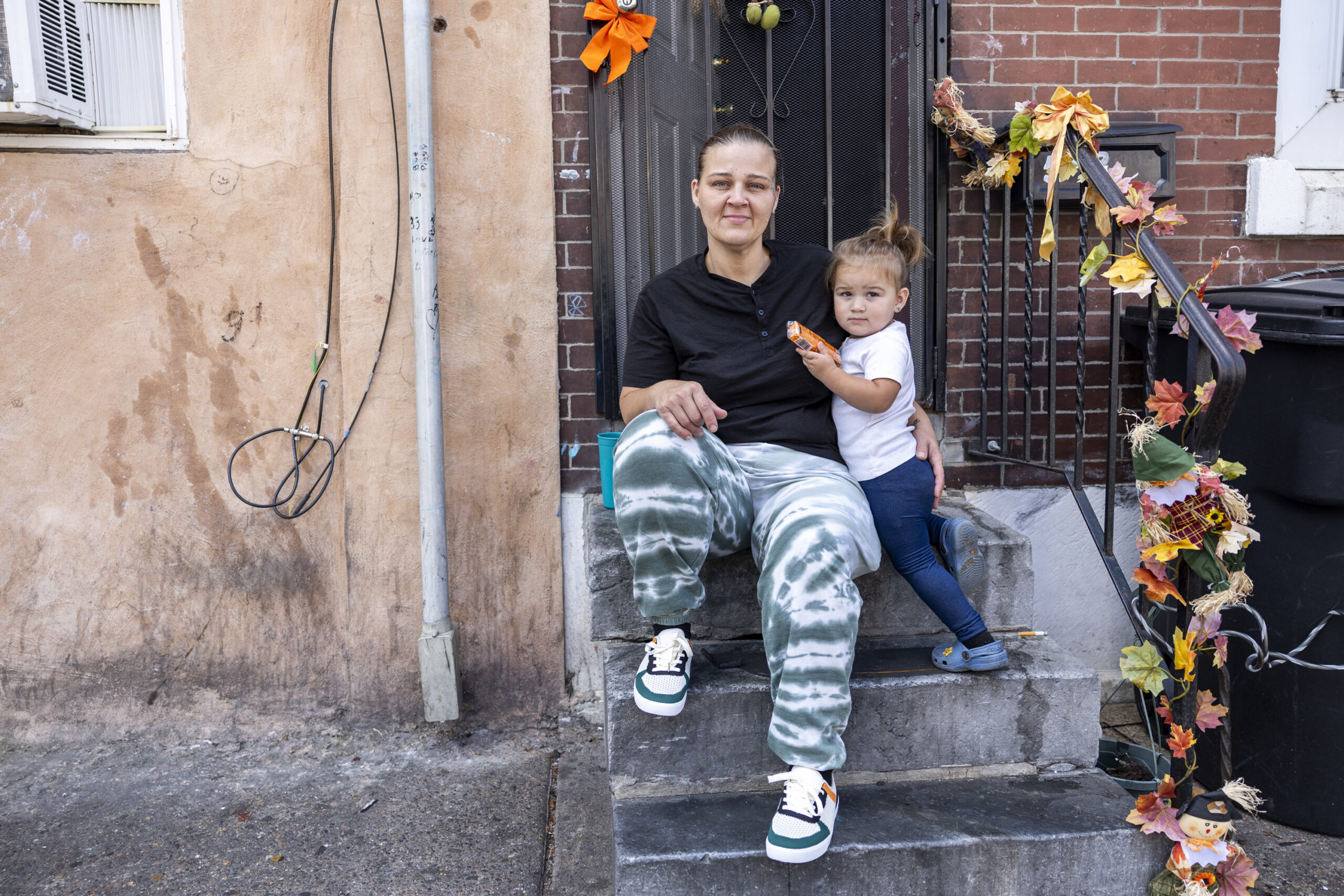
Theresa Grone, 41, and her daughter Abagail, 2, live near McPherson Square Park in Kensington.
And, she said, the police in the neighborhood have gotten more aggressive and harass people who aren’t doing anything wrong. Drug dealers and users still dominate the block.
“They’re not in the places they used to be, but they’re still there,” she said — on side streets, in abandoned houses, moving to corners as soon as the police leave.
She feels like the city is expanding resources for people in addiction more than for families like hers — a group of eight people renting a rowhouse in disrepair who want to move but can’t afford to.
But other residents, like Cartagena Hart, hope to never leave.
She said she has always seen the beauty and strength of Kensington, even at its lowest — the neighbors who care for each other’s children and feed the homeless, the police officers who will show up as soon as she texts them for help.
“Kensington,” she said, “is love to me.”
And she’s proud, she said, that her advocacy and that of her neighbors has helped city leaders finally invest in helping them.
Staff writers John Duchneskie, Max Marin, Anna Orso, Dylan Purcell, Sean Walsh, and Aubrey Whelan contributed to this article.
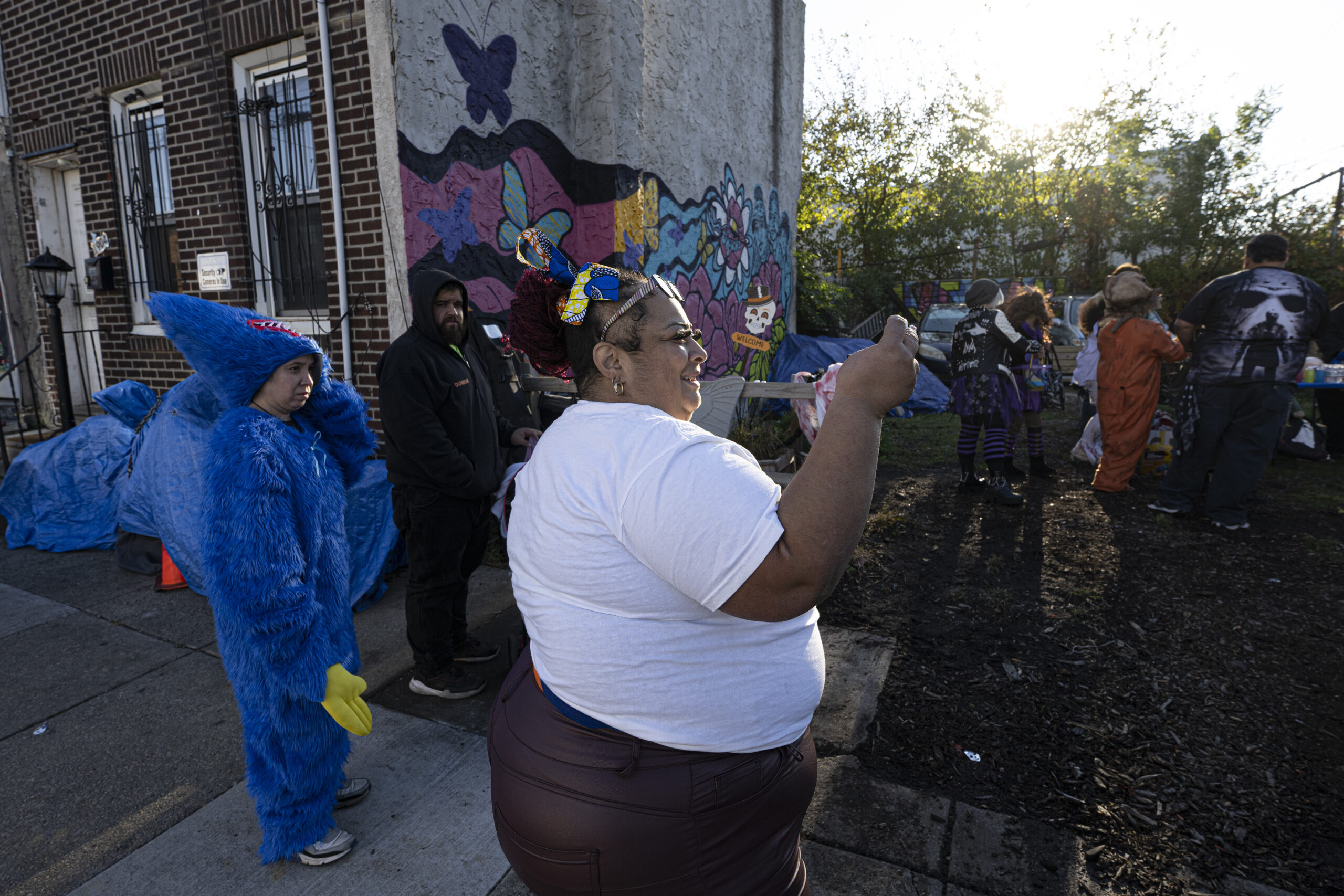
Gloria Cartagena Hart interacts with neighbors during a Halloween party and giveaway that she organized at the Butterfly Garden in Philadelphia’s Kensington neighborhood.
Philadelphia police are seeking to question two men in connection with the death of an American Airlines flight attendant who investigators believe was attacked inside his South Philadelphia home last week, then fell — or was thrown — out of his third-floor window.
Amadou Thiam, 50, was found lying naked on the pavement behind his home, on the 2400 block of Federal Street, with severe injuries to his face, neck, and body on the night of Nov. 10, police said. He was rushed to Penn Presbyterian Medical Center, where he later died from his injuries, they said.
The medical examiner has not yet determined the cause or manner of Thiam’s death, but homicide detectives are investigating, said Deputy Police Commissioner Frank Vanore. Vanore stopped short of saying Thiam was attacked, pending the coroner’s decision, but law enforcement sources familiar with the investigation said Thiam’s injuries, coupled with witness interviews and evidence recovered inside his home, suggest he was assaulted.
Residents of the Grays Ferry block this week recalled the harrowing moments when they found Thiam — and the chilling departing words of the men police are now looking to question.
Two neighbors, who asked not to be identified for fear of reprisal, said they heard loud noises coming from Thiam’s condo around 6:30 p.m. last Monday but assumed he was having guests over.
Then, they said, they heard a loud crash behind the building.
Shortly after, they said, they saw two men walk out of Thiam’s home.
“Is everything OK?” one neighbor recalled asking the men. “They just kind of chuckled and said, ‘We hope so.’”
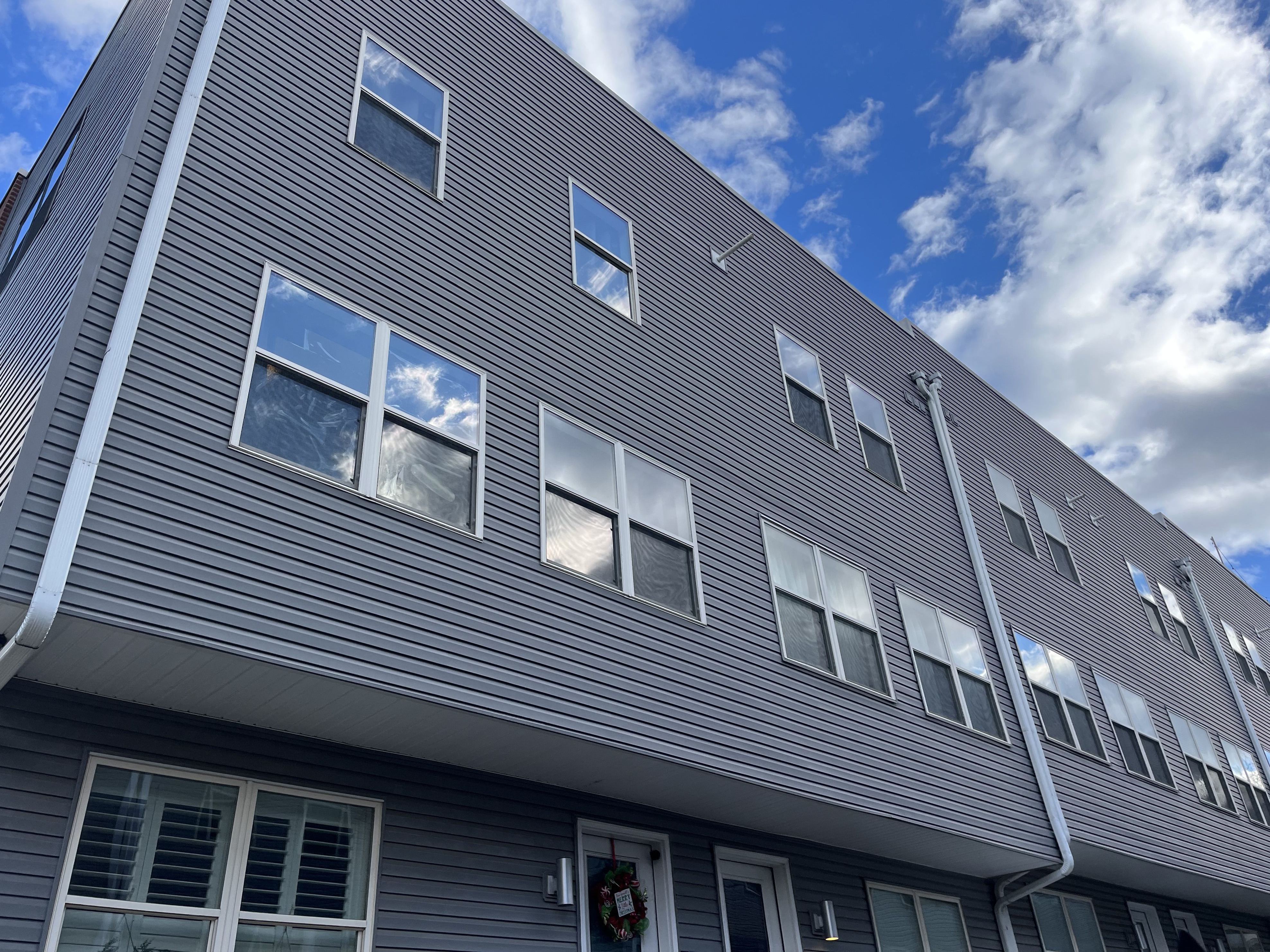
Amadou Thiam lived on the 2400 block of Federal Street. This image shows the third-story window, second from left, from which neighbors say Amadou Thiam fell on Nov. 10.
The neighbors said they approached Thiam’s door, which was left cracked open, and found blood smeared across his kitchen and third-floor bedroom. Thinking Thiam was not home, they called the police to report a burglary.
As the couple waited for police, they said, they noticed a stream of blood on the sidewalk outside. And then, they said, they saw Thiam’s body on the pavement.
Vanore said it was not clear how Thiam ended up on the ground, but police believe he went through a third-story window.
“We still don’t know if he fell or was thrown,” he said.
Thiam suffered injuries throughout his body, including fractures to his face, ribs, and skull, Vanore said.
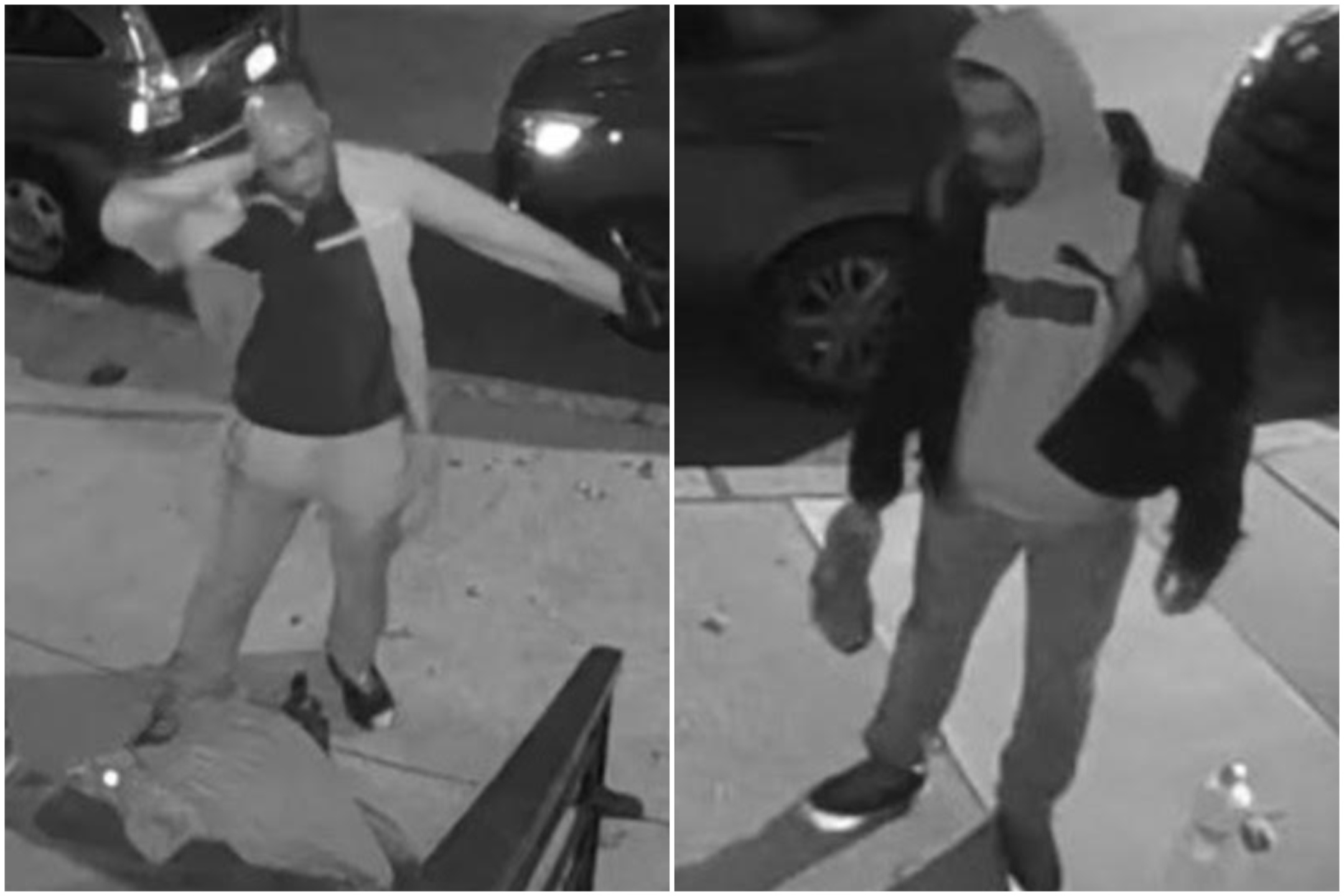
Detectives have recovered video from the block showing two men — one older, one younger — in the area around the time Thiam’s body was found, he said.
Vanore described one of the men as a thin Black male wearing a black leather jacket over a red hoodie and jeans and carrying a bag. The second man, he said, was older, bald, and wearing a gray jacket.
Philadelphia police are seeking to question two men who they believe could be connected to the death of Amadou Thiam in South Philadelphia last week.
“We’re looking to talk to them to see if they had anything to do with this,” he said.
Law enforcement sources, who asked not to be identified to discuss an ongoing investigation, said the men appeared to be carrying clothes out of the building. There were no signs of forced entry into Thiam’s home, the sources said.
Relatives of Thiam, who was originally from Côte d’Ivoire, could not be immediately reached.
His Instagram account showed a man who enjoyed exploring the world: standing before Hôtel de Paris Monte-Carlo and the Arc de Triomphe in Paris, and eating in Key West, Fla., and Las Vegas.
His death has shocked many who knew him, including his colleagues at American Airlines.
A spokesperson for the airline did not respond to a request for comment. But in a memo shared online, an operations manager for the Philadelphia region said Thiam had worked as a flight attendant with the airline since 2011 and, as a French speaker, he frequented international flights to Paris and Zurich.
“His presence and natural charisma was always something felt throughout a room,” the employee wrote. “He was a loyal friend whose kindness, positive attitude, and radiant smile touched everyone around him.”
John Stanley, a fellow American Airlines flight attendant, said that every July, there is a benefit for flight attendants at Voyeur, a nightclub in the Gayborhood, with dancers and drag performers. He recalled how one year, Thiam dressed up as Glinda from Wicked and performed for the crowd.
“He was as well-liked a flight attendant in Philadelphia as I know exist,” Stanley said.
Thiam’s neighbors also said he was exceptionally friendly, and loved to dress in eccentric clothing. He was also a dog lover, a passion that neighbor Nicole Colamesta said they bonded over.
“Everybody is having a really hard time processing it. This is a really quiet block. Everybody just looks out for each other here,” Colamesta said. “You can’t stop thinking about it because it’s right in our backyard.”
Police asked anyone with information to contact homicide detectives at 215-686-3334 or to call the police tip line at 215-686-8477.
Staff writer Maggie Prosser contributed to this article.
Angelica Javier was sitting at home on a Saturday evening last month when her son’s uncle called in a panic.
Xzavier, her 16-year-old, had been shot, he said — one of the teen’s friends had called and told him, but he knew nothing else.
Javier, 32, frantically checked a news website and saw a brief story mentioning that a man was shot and killed in Northeast Philadelphia.
That could not be her son, she told herself. Xzavier was only a boy, she said — tall but lanky, with the splotchy beginnings of a mustache just appearing on his upper lip.
She called around to hospitals without success. Xzavier’s father, Cesar Gregory, drove to Jefferson Torresdale Hospital, desperate for information.
Then, just before 10 p.m., she said, a homicide detective called to say their eldest child, their only son, had been shot and killed that afternoon near Teesdale and Frontenac Streets.
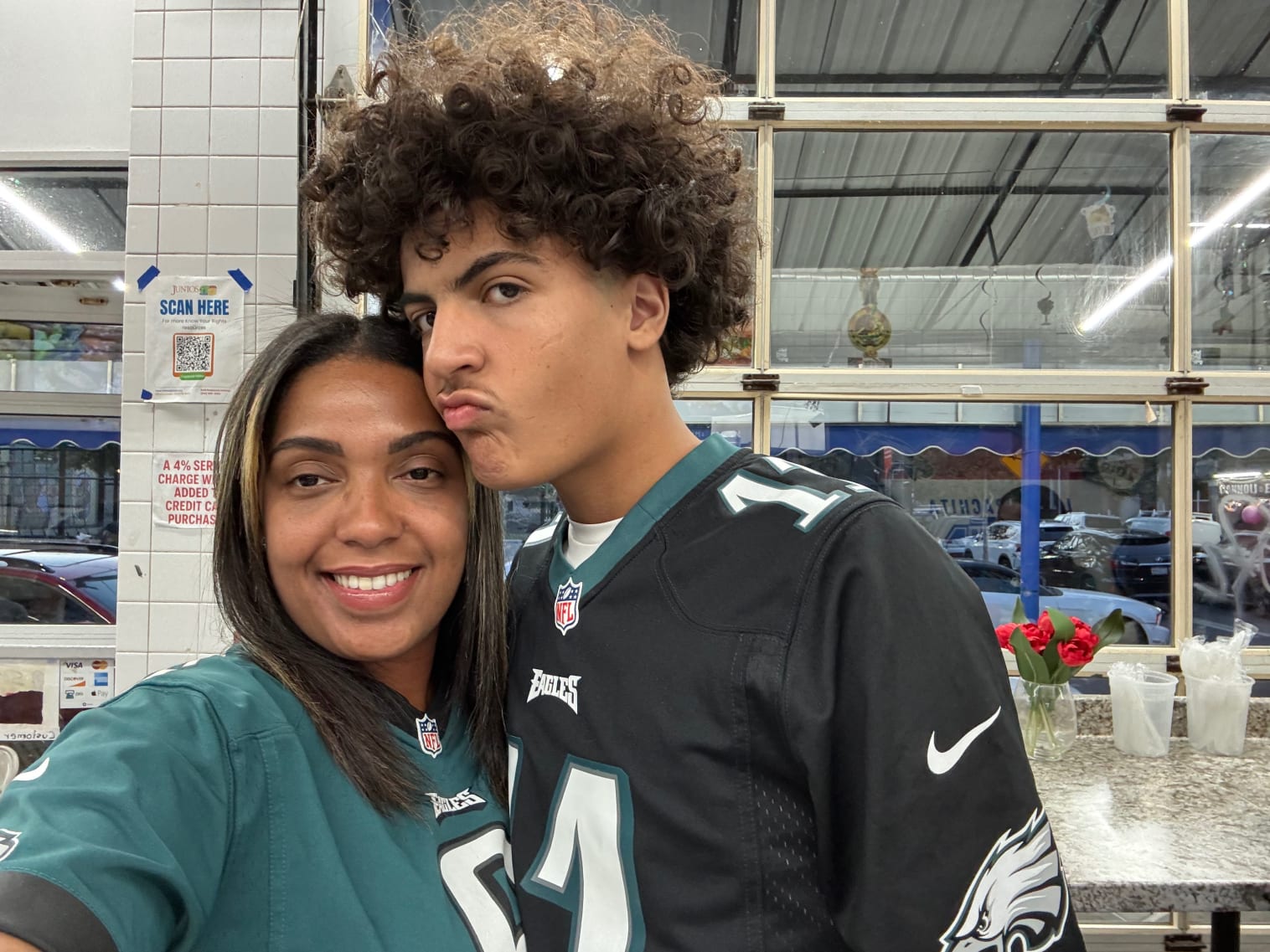
Angelica Javier (left) and her 16-year-old son, Xzavier Gregory, getting tacos after watching the Eagles beat the Los Angeles Rams earlier this year.
The shooting, police said, stemmed from a dispute among teens at the Jardel Recreation Center, just blocks away, earlier in the week. Xzavier’s parents said the detective told them that one of their son’s friends may have slapped a young woman that day.
On Oct. 11, they said, police told them that Xzavier and his friends stopped by the young woman’s house shortly before 4 p.m. to talk with her, apologize, and resolve the conflict. They shook hands, the parents said, and started to walk away.
Then, police said, the girl’s 17-year-old boyfriend, Sahhir Mouzon, suddenly came out of the house with a gun and started shooting down the block at them. Someone shot back, police said, but it was not Xzavier. In total, 45 bullets were fired.
An 18-year-old woman walking by the teens was wounded in the leg.
Xzavier was struck in the chest and died within minutes.
Mouzon has been charged with murder and related crimes.
Javier and Gregory have been left to navigate life without their “Zay” and to reckon with a loss that comes even as gun violence in the city reaches new lows — but which still persists among young people and brings pain to each family it touches.
They don’t understand how a 17-year-old had a gun, they said, or why a seemingly minor — and potentially resolved — conflict had to escalate.
But mostly, they said, they want Philadelphia to know and remember their child: a goofy junior at Northeast High. An avid Eagles fan. A lover of Marvel movies and spicy foods.
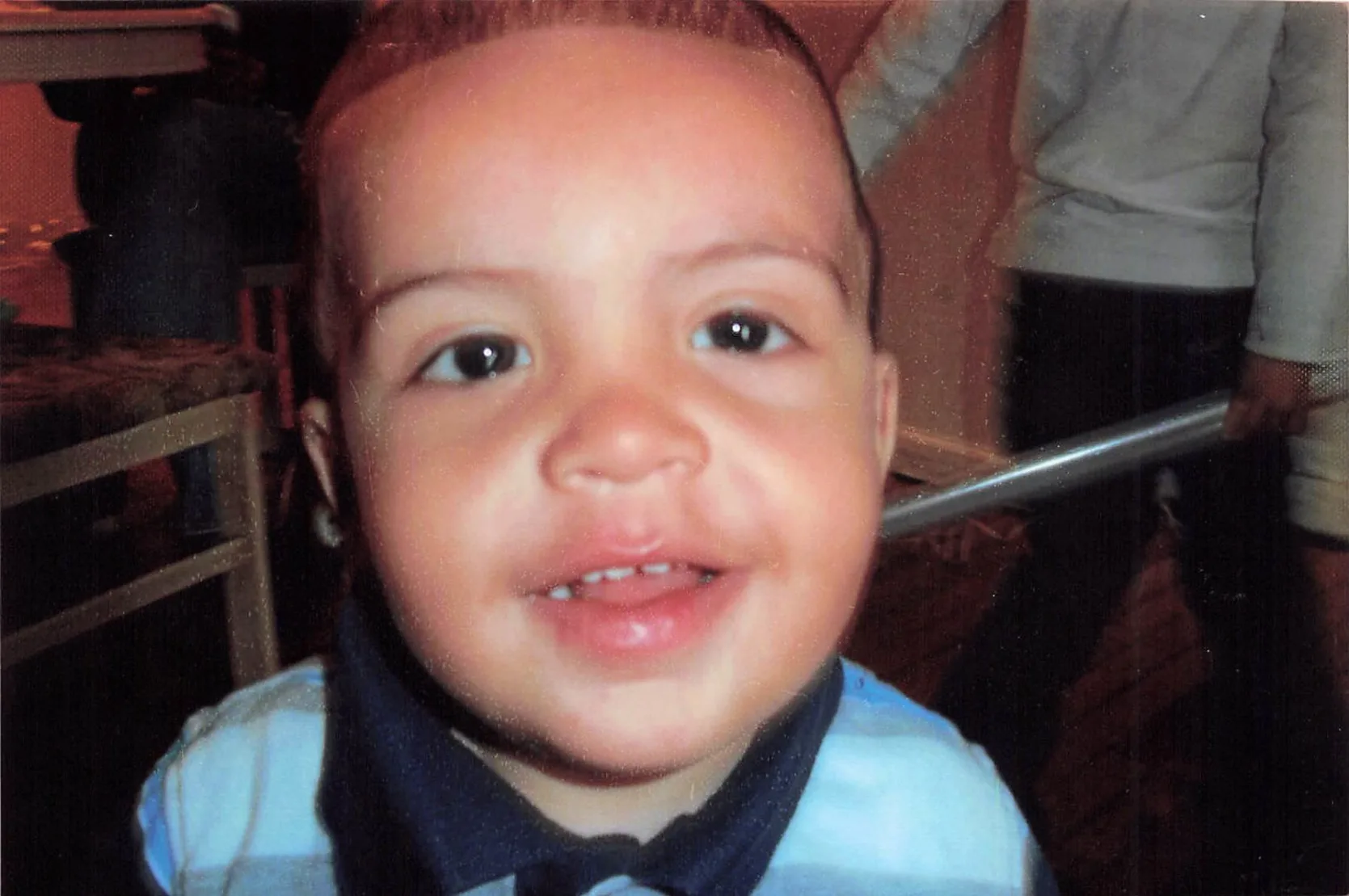
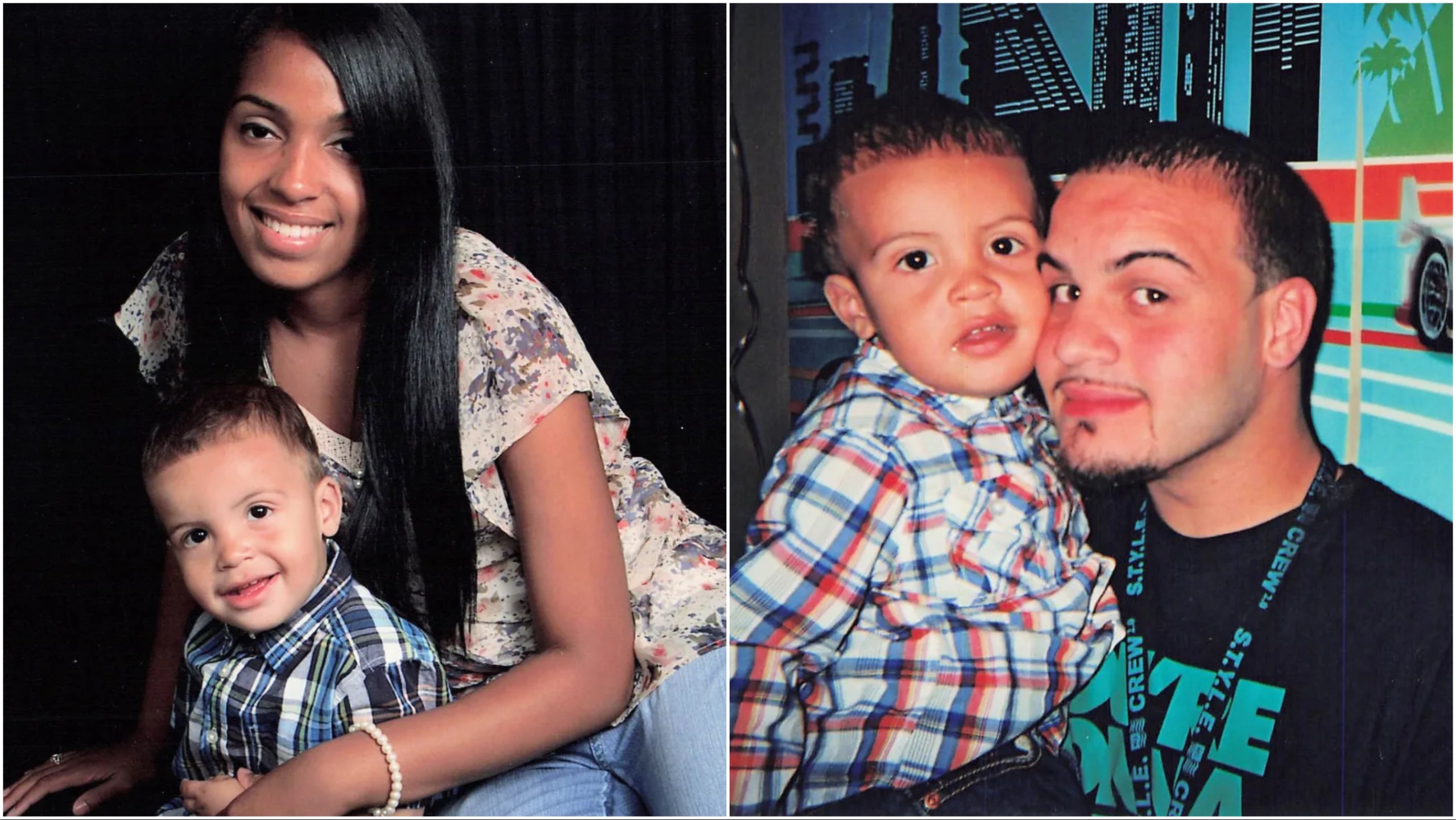
Xzavier Gregory was born in Philadelphia. His parents loved his chubby cheeks.Xzavier Gregory was born Sept. 20, 2009, to Angelica Javier and Cesar Gregory.
Xzavier Giovanni Gregory was born Sept. 20, 2009, at Temple University Hospital in North Philadelphia. His parents, just teens at the time, were immediately taken by his chubby cheeks, which he kept until his teenaged years.
He lived in Kensington until he was about 10 years old, his mother said, when they moved to the Northeast. He attended Louis H. Farrell School, then spent his freshman year at Father Judge High before moving to Northeast High.
He loved traveling, and often visited family in Florida and the Dominican Republic, attended football camps in Georgia and Maryland, and tagged along on weekends to New York with his mother as part of her job managing federal after-school programs.
He played football for the Rhawnhurst Raiders, typically as an offensive or defensive lineman, and had a natural skill for boxing, his parents said.
Philadelphia sports were in his blood — particularly the Eagles. DeVonta Smith and A.J. Brown, his father said, were his favorite players. (Before his death, he agreed that Brown should be included in more plays this year, Gregory said.)
Some of Gregory’s favorite memories with his son revolve around the Eagles. Sitting front row at the Linc on his 13th birthday. Erupting in cheers as the team won its first Super Bowl in 2018. Embracing in tears when they won a second this year.
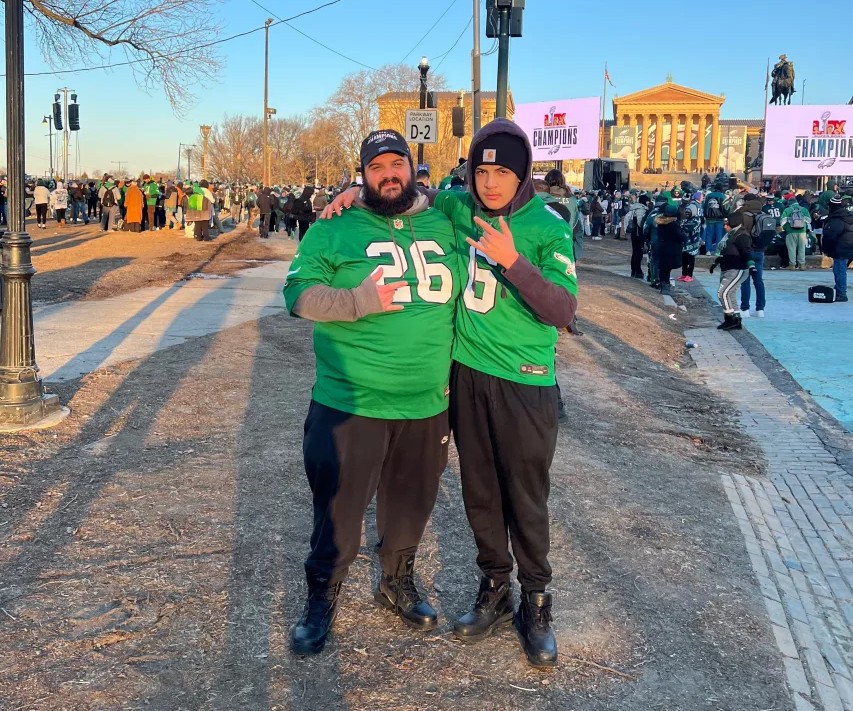
Cesar Gregory (left) and son Xzavier at the Eagles Super Bowl parade near the Art Museum in February. It is a day with his son that the father said he will never forget.
Xzavier was the oldest of three children. His sisters are still too young too fully understand what happened, the parents said.
“He went to heaven,” Javier told 7-year-old Kennedy.
The number of kids shot peaked in 2021 and 2022, when violence citywide reached record highs and guns became the leading cause of death among American children. So far this year, 105 kids under 18 have been shot — a sharp drop from three years ago, but still higher than pre-pandemic levels, according to city data.
Xzavier is one of at least 11 children killed by gunfire this year.
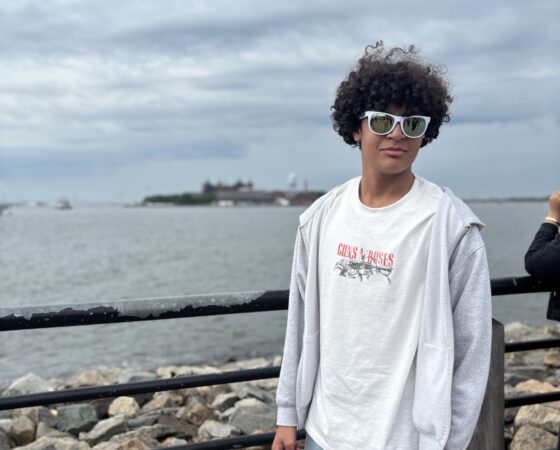
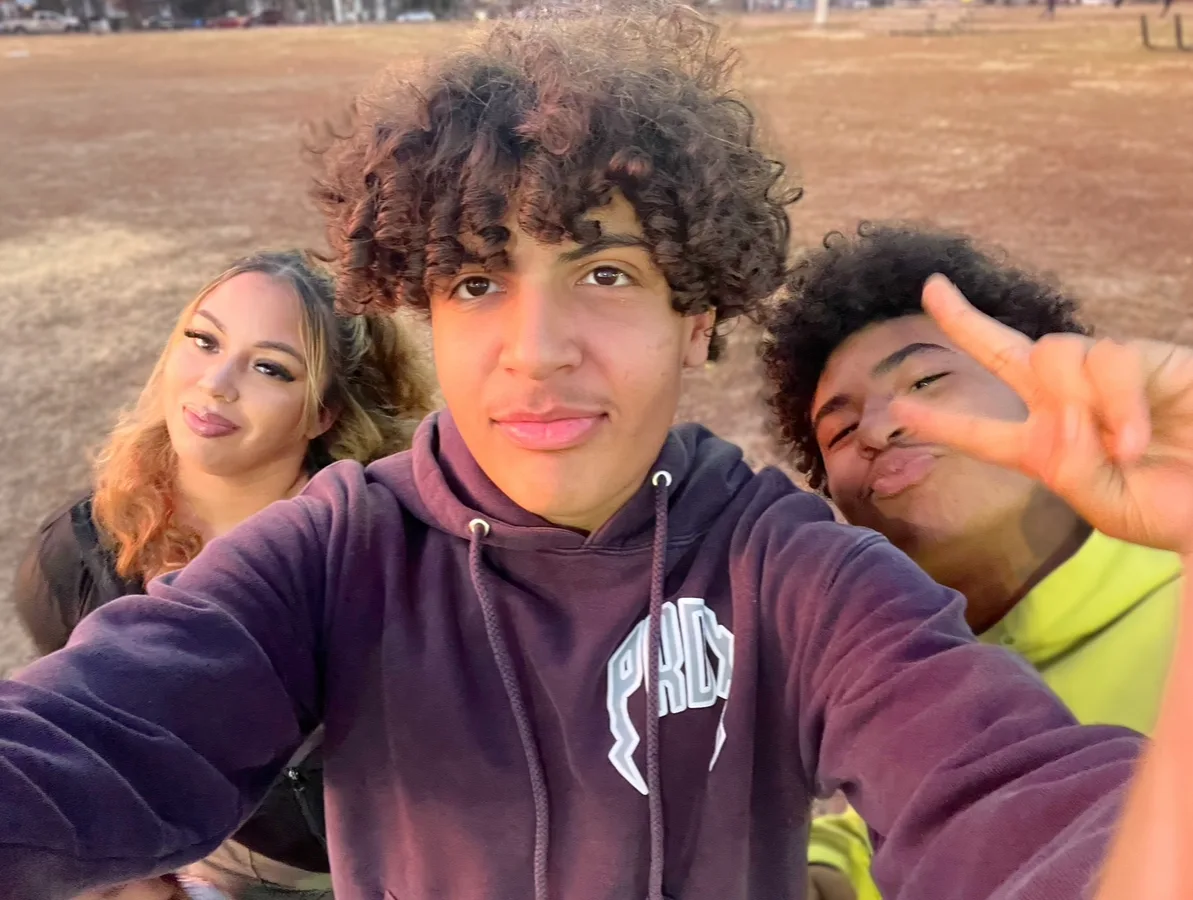
Xzavier Gregory (center) was a goofy teen who attended Northeast High School, his parents said.
Javier and Gregory said some relatives are considering leaving Philadelphia, shaken by Xzavier’s killing and a feeling that teens don’t fear consequences.
But the parents said they will stay. They want to be near Magnolia Cemetery, where Xzavier is buried, and to feel closer to the memories that briefly unite them with him.
On harder days, they said, they go into his bedroom, which is just as he left it, a relic of a teenage boy.
His PlayStation controller sits in the middle of his bed, and a photo of him and his mother hangs on the wall above it. His Nike sneakers are scattered. His black backpack rests on the floor, and a Spider-Man mask sits on the corner of his bedframe.
On Thursday, his parents stood in the room they used to complain was too messy, that smelled like dirty laundry.
“Now, I come in just to smell it,” Javier said.
She took a deep breath.
Staff writer Dylan Purcell contributed to this article.
A month after Keon King was charged with breaking into his ex-girlfriend’s home and attempting to strangle her, police say, his violence escalated: In January, he returned to her home with a gun, then kidnapped and assaulted her.
A warrant for his arrest was issued days later.
In the weeks that followed, King twice appeared in Philadelphia court and stood before a judge in the initial strangulation case. But no one in the courtroom seemed to know he was wanted for kidnapping.
So both times, King walked out.
In February, despite the warrant for King’s arrest, prosecutors — seemingly unaware that police said he had recently attacked their key witness — withdrew the burglary and strangulation case when the victim failed to appear in court.
Police did not go to either hearing to take him into custody, and do not appear to have alerted the prosecutor about the new arrest warrant.
And King was not formally charged with the kidnapping until April, when, for reasons that are unclear, he turned himself in.
Kada Scott, 23, was abducted from outside her workplace on Oct. 4, police said.
A review of King’sprevious criminal cases raises questions about whether police and prosecutors could have been more vigilant in holding him accountable for the earlier crimes they say he committed.
City Council has since vowed to hold a hearing examining how the city’s criminal justice system handles cases of domestic violence.
But even before the charges were withdrawn, police and court records show, there were missteps.
Marian Grace Braccia, a former Philadelphia prosecutor who is a law professor at Temple University, said she found it alarming that law enforcement failed to take King into custody when he twice stood before them in court while wanted for a violent felony.
“If this is supposed to be a collaborative effort — if there is a shared mission of public safety and victim advocacy — it sounds like everyone dropped the ball,” she said.
Detectives and prosecutors, she said, should have been aware of the arrest warrant and had officers take him into custody.
Then, she said, prosecutors could have cited the alleged kidnapping to ask a judge to increase King’s bail and keep him behind bars.
Instead, she said, “it passed by everybody, and he came in and walked out, and slipped through the cracks of the Philadelphia legal court system.”
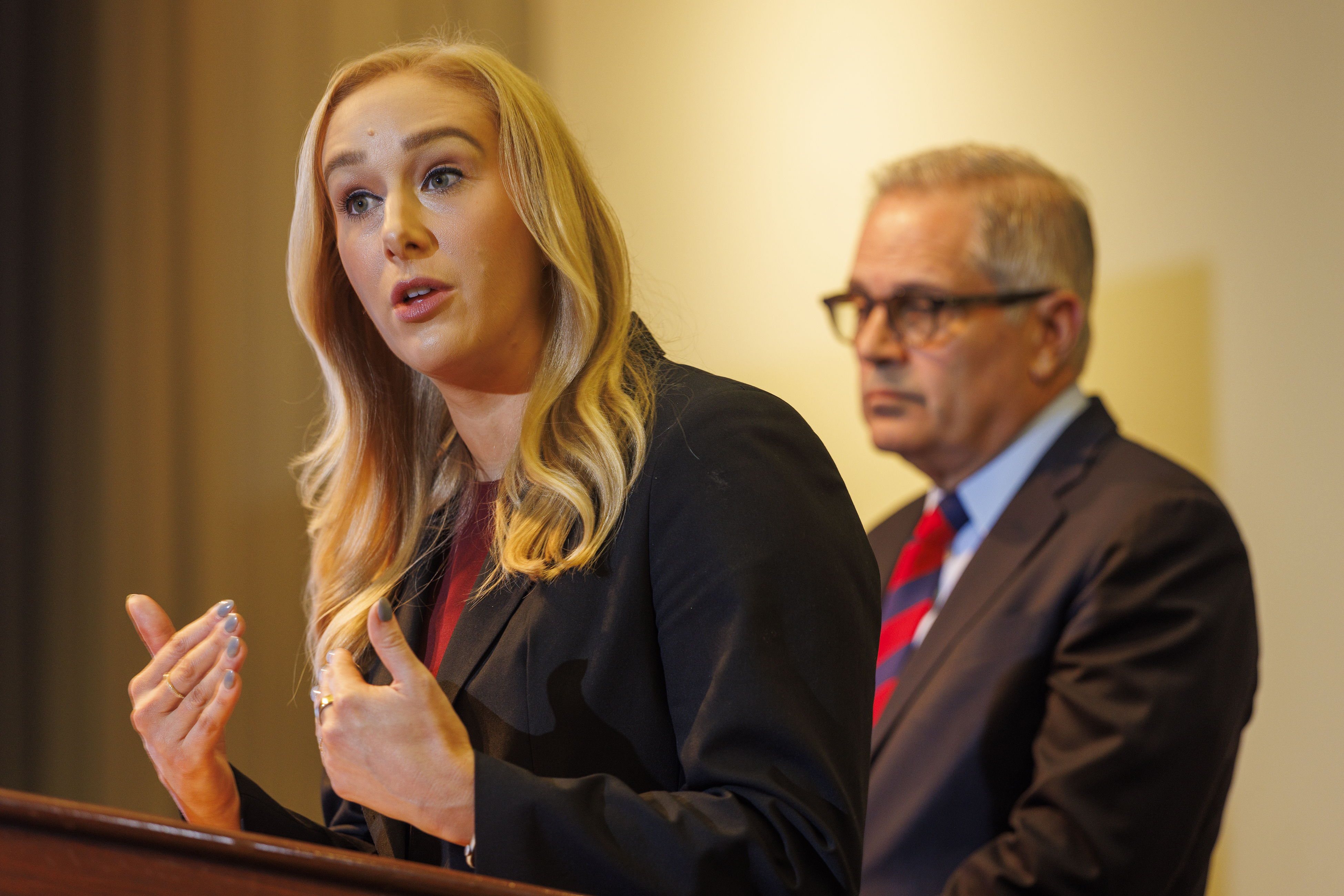
Philadelphia District Attorney Larry Krasner discusses the killing of Kada Scott at a news conference earlier this week.
Krasner said there is no system to automatically notify prosecutors when a defendant in one of their cases is arrested anew.
Similarly, there is no system to let police know that suspects in new cases have outstanding criminal matters, said Philadelphia Police Department spokesperson Sgt. Eric Gripp.
“Detectives are not automatically notified when a wanted subject is physically present in court on a different active case,” he said.
Krasner said the issues in the case underscore a lack of communication among law enforcement agencies that happens in part because their digital information systems are decades old. He said his office and other law enforcement agencies should work to update those systems.
“That is something that we can all improve together if we have the will and if we have the resources,” he said.
A wanted man walks free
Police said King first attacked his ex-girlfriend in early November of last year. He broke into her Strawberry Mansion home, then tried to strangle her, according to the affidavit of probable cause for his arrest.
He was taken into custody in December and charged with burglary and strangulation, and bail was set at $50,000. King immediately posted the necessary 10%, $5,000, and was released.
About a month later, police said, King returned to the woman’s home and tried to break in. When he could not gain entry, they said, he waited for her to step outside, then grabbed her by the hair and dragged her into his car. He drove for at least four miles, beating her along the way, before dropping her off in Fishtown, according to the affidavit for probable cause for his arrest.
A judge approved the warrant for King’s arrest on charges of kidnapping, strangulation, and related crimes on Jan. 19, court records show.
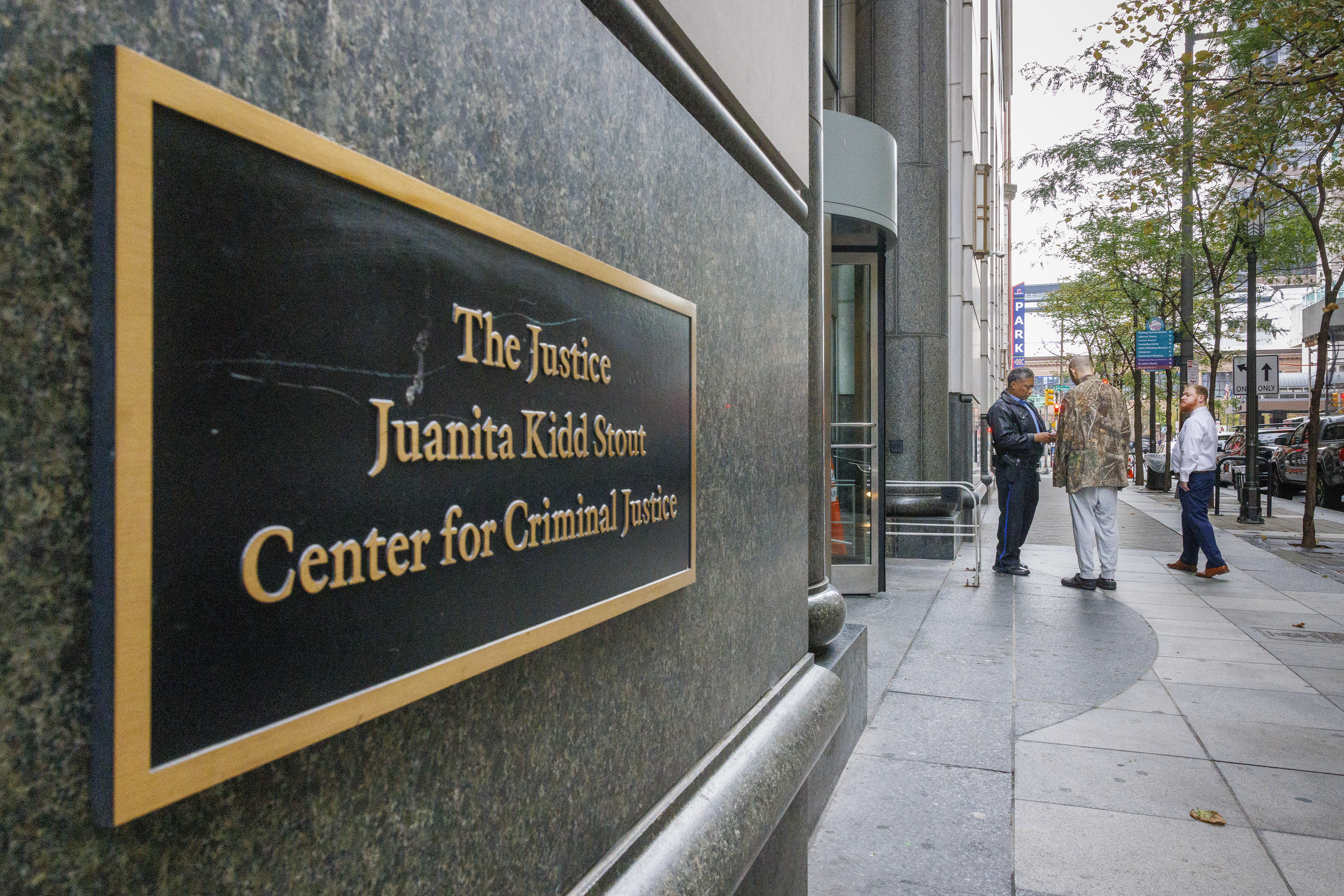
The Justice Juanita Kidd Stout Center for Criminal Justice in Philadelphia.
King — now wanted for a violent felony — appeared in court the following week for a preliminary hearing in the earlier burglary case, records show. But when the victim did not show up in court a second time, Municipal Court Judge Jacquelyn Frazier-Lyde ordered that the case had to proceed at the next listing. Prosecutors agreed.
King left court.
Meanwhile, police said, officers tried at least once to arrest him. On Feb. 11, Gripp said, police went to a home where they thought King might be, but he was not there.
Two weeks later, King was again in court for the burglary case — but police did not go there to arrest him. Once again, the victim did not show up, and prosecutors withdrew the charges
King walked out of court a free man.
Braccia, the Temple law professor, said the detective assigned to the case should have been aware of the hearing. When seeking to charge King for the kidnapping, she said, the detective should have pulled up King’s arrest history and noticed the ongoing case. He then could have flagged it to the prosecutor in the first case and gone to the hearing to arrest him.
At the same time, she said, the prosecutors who approved the kidnapping charges against King should have noticed the earlier case and told the prosecutor — particularly because it involved the same victim.
In April, King turned himself in to police to be charged with kidnapping, strangulation, and related crimes in connection with the January attack. Prosecutors asked for bail of $999,999, but the magisterial judge, Naomi Williams, set bail at $200,000, court records show. King posted the necessary $20,000 and was released.
The following month, after the victim again did not appear in court at two hearings, the kidnapping charges were also withdrawn.
Since prosecutors have refiled the charges, Krasner’s office said it has been back in touch with the woman and hopes she will testify. She declined to comment about King’s alleged crimes and the previous handling of the cases by police and prosecutors.
Six months later, King is back in custody, this time charged with murder. He is being held without bail.
Keon King was charged with murder and related crimes Wednesday in the death of Kada Scott, the 23-year-old Mount Airy woman police say he kidnapped, then killed, before burying her body in a shallow grave.
The district attorney’s office approved the charges shortly after police announced that the Medical Examiner’s Office had ruled her death a homicide. Officials said Thursday that Scott died by a gunshot wound to the head.
In addition to murder, King was charged with illegal gun possession, abuse of corpse, robbery, theft, tampering with evidence, and additional crimes.
The announcement came as investigators said they believe at least one other person helped King, 21, move Scott’s body and bury it behind a closed East Germantown school in the days after she was killed, and detectives are working to identify those involved.
New court records, made public Wednesday, offered the most detailed look yet inside the investigation into Scott’s disappearance and death, including her texts with King in the days before she went missing, the police search for her body, and how others may have helped King try to conceal her killing.
A review of Scott’s cell phone records showed that on Oct. 2, a number believed to belong to King texted Scott: “Yo Kada this my new number.”
“Who dis,” Scott asked, and he responded “Kel,” according to the affidavit of probable cause for King’s arrest.
Kada Scott, 23, went missing Oct. 4.
Law enforcement sources said King appeared to use various aliases when communicating with people, including “Elliot” and “Kel.”
On the morning of Oct. 4, the document says, Scott texted King saying, “kidnap me again.”
King replied, “better be up too,” according to the filing.
What Scott meant in that text continues to perplex investigators, said the sources, who spoke on the condition of anonymity to discuss an ongoing investigation. It’s not clear, the sources said, whether Scott was joking or being sarcastic, or if King had, in fact, abducted her before.
In any case, the affidavit says, the pair made plans to meet up later that night. Scott worked the overnight shift at the Terrace Hill nursing home in Chestnut Hill, and at 10:09 p.m., the records say, she texted King to call her when he arrived outside.
According to the affidavit, Scott received 12 calls from the number believed to belong to King between 9:25 p.m. and 10:12 p.m., ending with a 43-second call.
Around that time, a coworker later told police, she overheard Scott on the phone say, “I can’t believe you’re calling me about this,” before walking toward a dark-colored car.
At 10:24 p.m., Scott’s phone line went dead, the document shows.
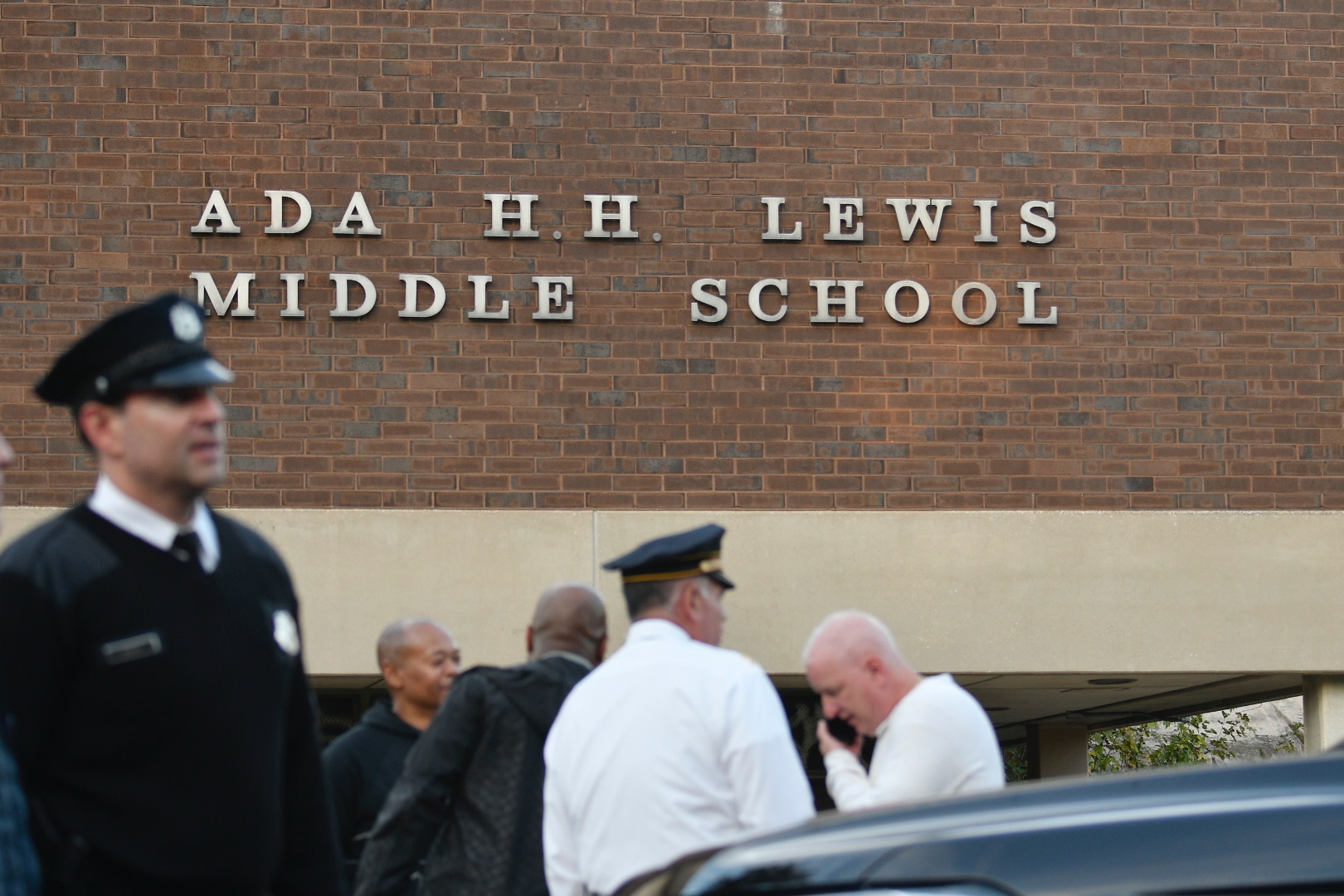
The rear of Ada H.H. Lewis Middle School, where Kada Scott’s body was found buried in the wooded area.
By 10:28 p.m., the affidavit says, surveillance cameras showed King, driving a black Hyundai Accent, pull into the parking lot of the Awbury Recreation Center. King got out of the car and left the area, the filing says.
The next day, around 11:39 p.m., two people in a gold Toyota Camry believed to belong to King went back to the recreation center, the records show. They walked toward the playground area, then returned to the car around 3:56 a.m.
The two people then opened up the Hyundai Accent and appeared to “remove a heavy object, consistent with a human body,” from the passenger side of the car. They carried the object toward the playground and returned to the vehicle a half-hour later, the records said.
On Oct. 7 at 2:48 a.m., police believe King returned to the recreation center to retrieve the Hyundai. They said the car — which had been reported stolen a few days earlier from the 6600 block of Sprague Street — was set on fire near 74th Street and Ogontz Avenue a short time later.
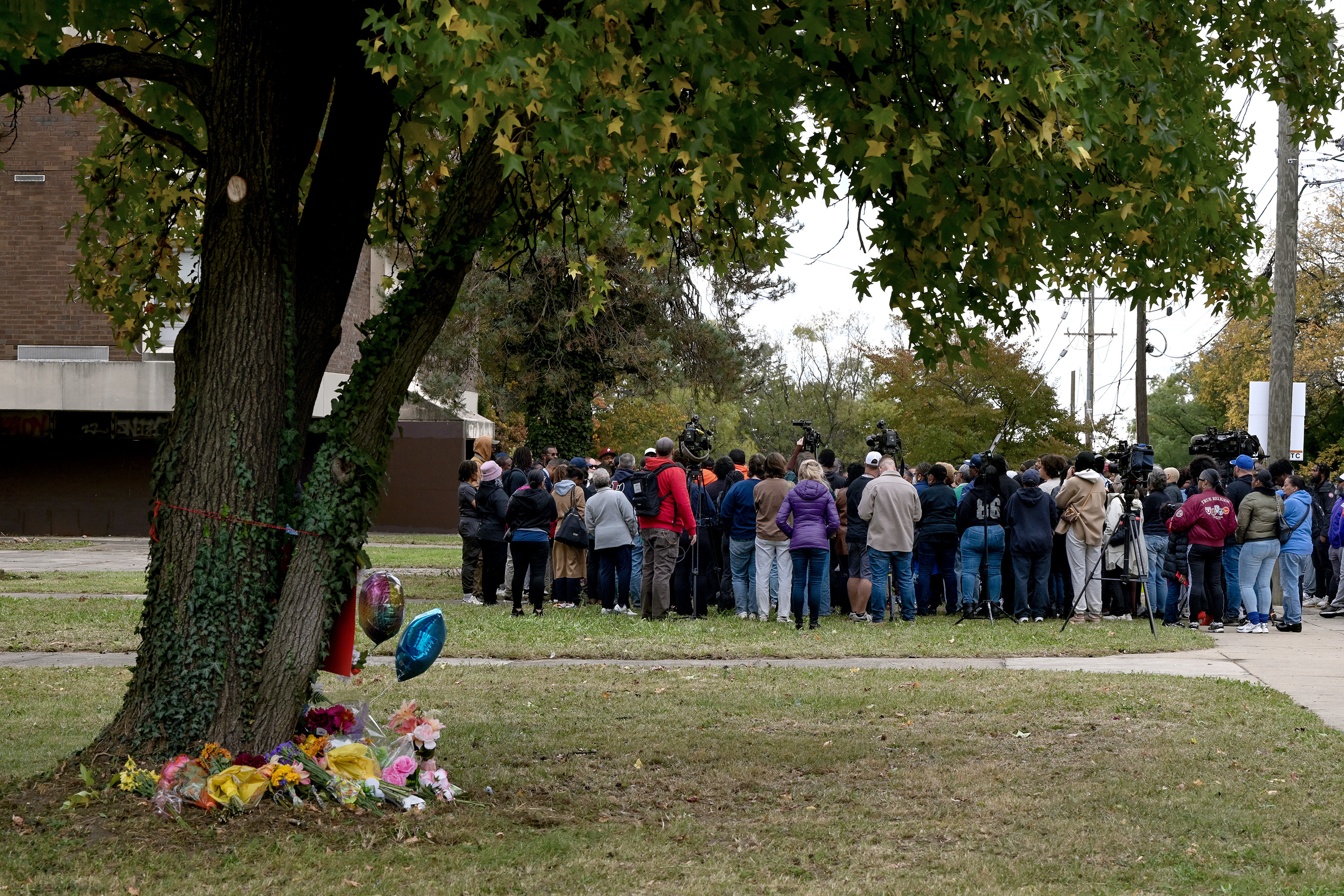
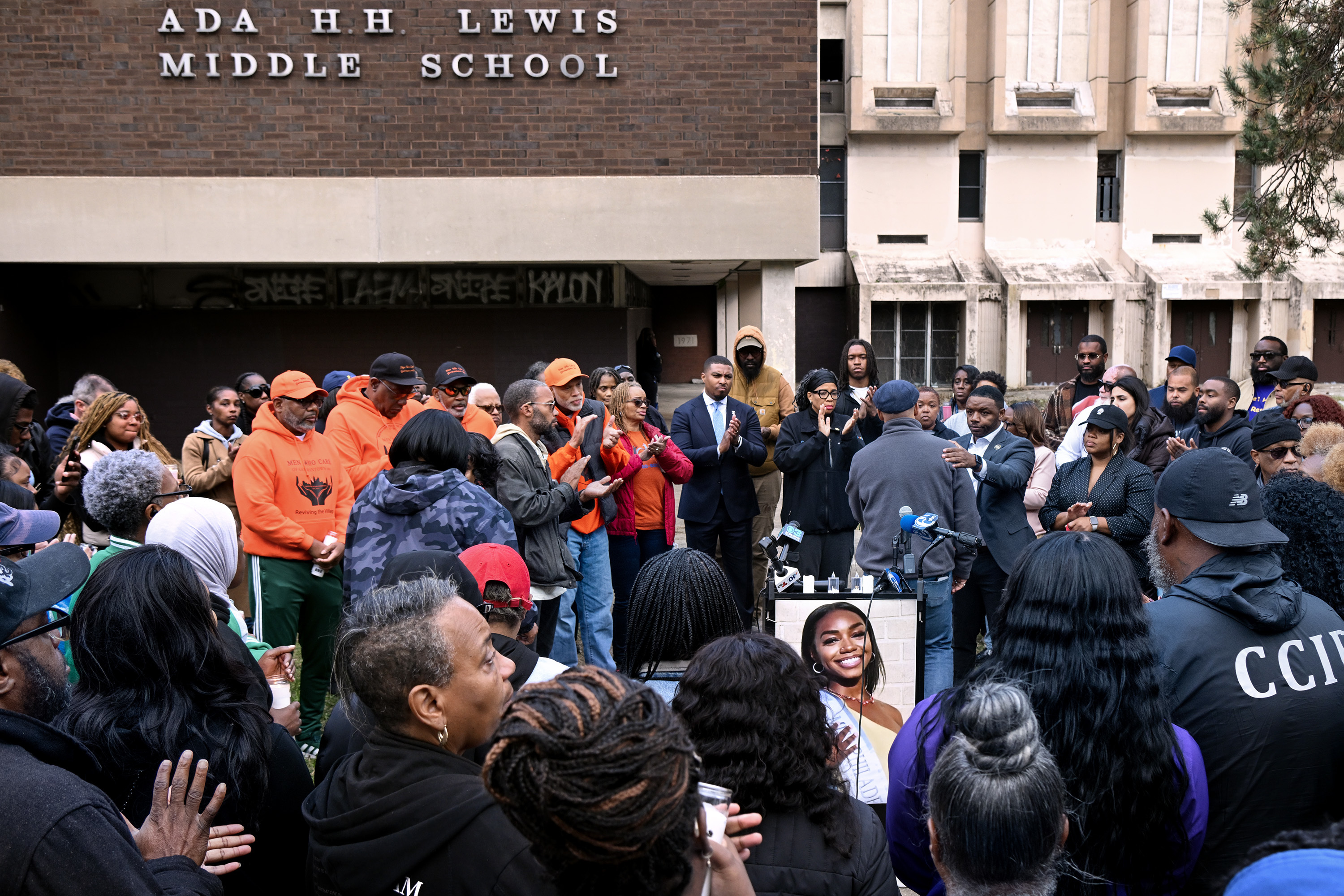
Community members attend a candlelight vigil by flowers and balloons left at a memorial for Kada Scott near the abandoned Ada H. H. Lewis Middle School on Monday.
King turned himself in to police last week to be charged with kidnapping Scott. He was held on $2.5 million bail.
Earlier this week, prosecutors also charged King with arson and related crimes for the burning of the car. Now that he is charged with murder, he is expected to be held without bail.
King’s lawyer, Shaka Johnson, could not immediately be reached for comment Wednesday.
On Wednesday evening, city leaders headed to a church in the Northwest Philadelphia community where Scott’s body was recovered, addressing a crowd of about 200 residents concerned about public safety.
Mayor Cherelle L. Parker and Police Commissioner Kevin Bethel, among other officials, offered condolences to Scott’s family and commended police for recovering her body. Residents, too, appeared relieved, breaking into applause when Bethel said murder charges had been filed against King.
Bethel, a father of three daughters, said that as the search for Scott wore on, he felt at times as if he were searching for his own child. And Councilmember Cindy Bass told the crowd that Scott “could have been your niece, she could have been your friend.”
The commissioner said the investigation was continuing as police search for those who might have assisted King. And addressing concerns over safety at the city’s abandoned buildings — including Ada H.H. Lewis Middle School — officials said the city was in the process of reviewing vacant properties.
Prosecutors on Monday charged Keon King, the man accused of kidnapping Kada Scott from her workplace earlier this month, with arson — and said they soon intend to charge him with murder for allegedly killing Scott, then setting on fire the car they say he used to abduct her last week.
District Attorney Larry Krasner said that he expects to charge King with murder in connection with Scott’s death but that officials are awaiting additional information from the Medical Examiner’s Office and are working to “precisely confirm everything we need” to do that.
Prosecutors also said that they “have reason to believe that other people may have been involved” or helped King conceal evidence after Scott, 23, was killed and that investigators are working to identify additional suspects.
Scott’s cause of death remains under investigation.
Philadelphia District Attorney Larry Krasner said he intends to charge Keon King with murder, but awaits additional information before formally filing the charges.
King, 21, turned himself in to police last week to face charges of kidnapping, stalking, and related crimes after investigators linked him to the Oct. 4 disappearance of Scott. Cell phone data showed King was the last person in touch with Scott before she walked out of the Chestnut Hill nursing home where she worked and never returned, officials said.
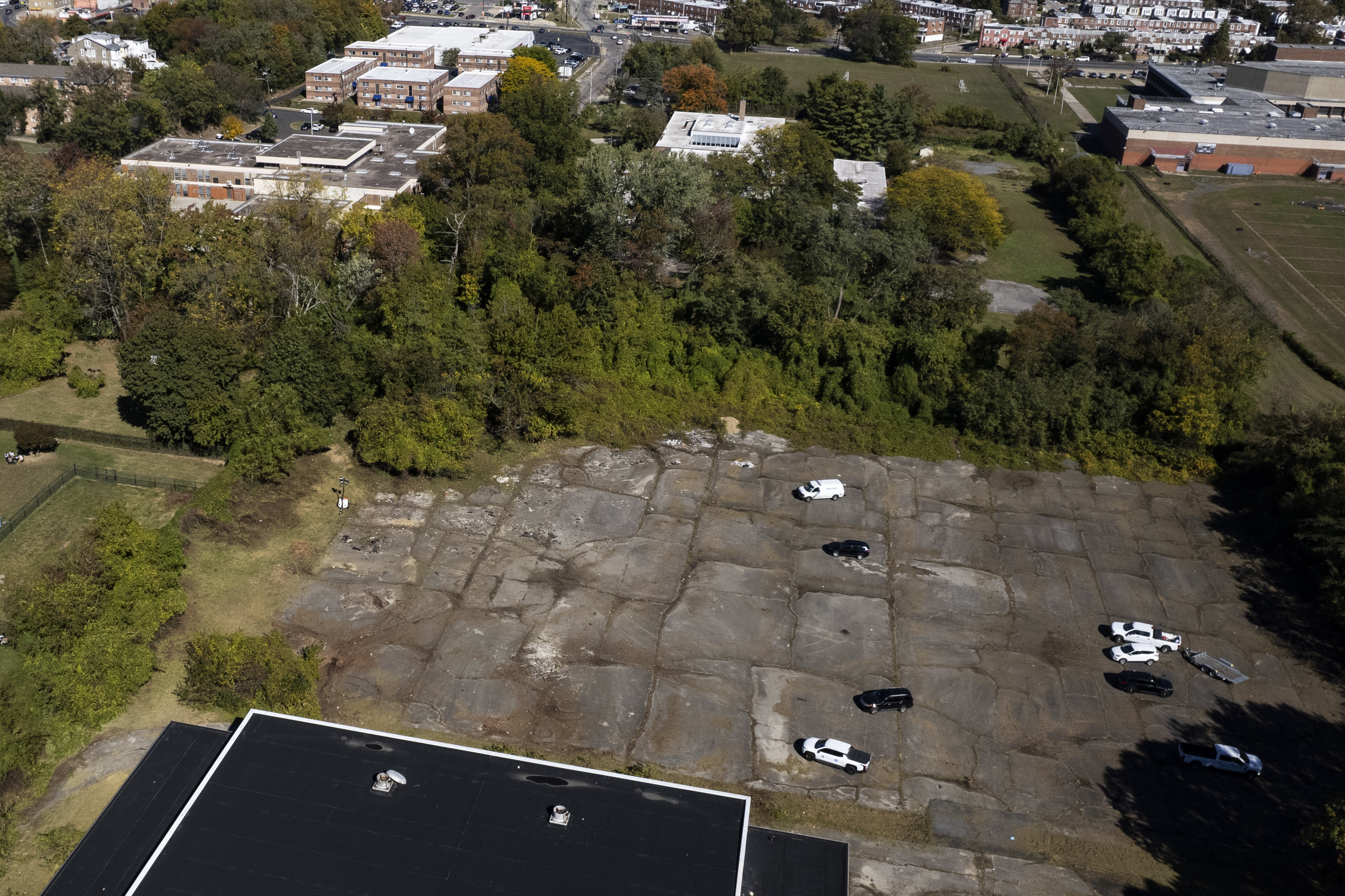
After a two-week search for the Mount Airy woman, police on Saturday found Scott’s body, buried in a shallow grave in the woods behind the abandoned Ada H.H. Lewis Middle School in East Germantown.
“There will be additional charges that are coming,” Krasner said at a news conference Monday.
In the meantime, Krasner said his office would charge King with arson, conspiracy, and related crimes for setting a black Hyundai Accent on fire near 74th Street and Ogontz Avenue on Oct. 7.
Assistant District Attorney Ashley Toczylowski said investigators believe that King used that car — which had been stolen from the 6600 block of Sprague Street in East Mount Airy on Oct. 3 — to kidnap Scott on the night of Oct. 4.
The extent of her relationship with King remains unclear, officials said.
Surveillance footage recovered late last week showed that the Hyundai Accent arrived at the Awbury Recreation Center around 10:30 p.m. the night Scott disappeared, the sources said.
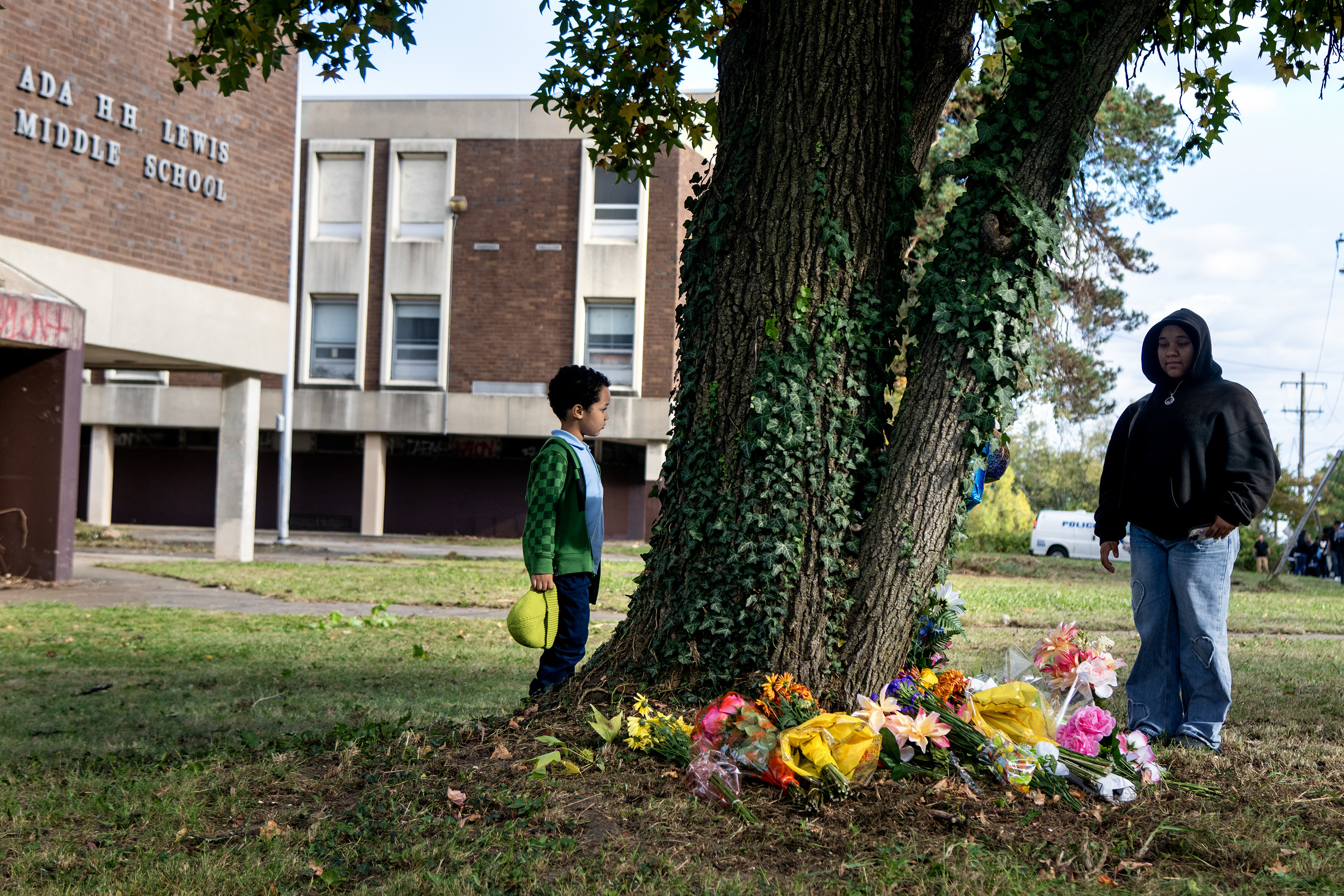
Julius Peden, 5, and Jaihanna Williams Peden (right), 14, pause at a memorial for Kada Scott at the Ada H. Lewis Middle School on Oct. 20, not far from where her body was found on Saturday. The siblings were brought by their grandmother Deborah Peden who said she felt the need to come. “My heart is broken. I feel like I lost someone in my family,” she said. “My daughter is a young Black woman. They are being targeted.”
King left the car in the parking lot, the sources said, then returned two days later — when video appears to show him moving what detectives believe was Scott’s body from the vehicle. Her corpse was buried at least 100 yards away in the woods behind the school next door.
The next day, Toczylowski said, King set the car ablaze.
Toczylowski said King’s cell phone location data shows he was at the recreation center when the car arrived Oct. 4 and again when he returned two days later. It also shows him in the area where the car was burned three days later, she said.
Detectives learned of the torched car last week after police received a tip that a car connected to her disappearance had been set on fire on the West Oak Lane block, she said. The car had already been towed, crushed, and sent to a junkyard when authorities learned of it, she said.
Assistant District Attorney Ashley Toczylowski will lead the prosecution again Keon King.
When investigators recovered video from the recreation center, she said, it confirmed that the car was used in the crime.
Krasner asked for the public’s continued help with the investigation, which he said “is developing almost hourly.”
“The community has already done tremendous work in aiding progress with this investigation,” he said. “We are simply asking for more.”
Scott’s family on Monday released their first statement since her body was found, thanking the public for its help in the investigation and asking for privacy as they grieve.
“Our hearts are shattered, yet we are deeply grateful for the outpouring of love, support, and prayers from people across the nation and around the world,” her parents wrote.
“Kada was deeply, deeply loved. Her light, kindness, and beautiful spirit will forever remain in our hearts,” they said.
They said they trust that the police department and district attorney’s office will get justice for their daughter, and that they are thankful for the “unity, leadership, and love” that has surrounded them so far.
“Please honor Kada’s memory by showing kindness and care to one another,” they wrote, “just as she did every day of her life.”
City Councilmember Anthony Phillips said his office is collecting donations to support Scott’s family, including toiletries, self-care and comfort products, and gift cards for grocery and meal delivery services.
Items can be dropped off at his office at 1514 Wadsworth Ave. from Tuesday through Friday, 8:30 a.m. to 4:30 p.m., and Saturday from 9 a.m. to noon. For questions, he said, call 215-686-3454.
Community members gather for a candlelight vigil in memory of Kada Scott on Monday. Neighborhood residents said they want the abandoned school torn down.
DNA analysis confirmed that the body recovered in the woods behind Ada H.H. Lewis Middle School in East Germantown is that of Kada Scott, the young woman who officials say was kidnapped two weeks ago, law enforcement sources said Sunday, and new details emerged about what led investigators to find her corpse.
An anonymous tipster contacted police Friday night, adamant that Scott’s body was on the grounds of the school.
Police had missed it in their earlier searches, the tipster said, and they should look along the old wooden fence that divides the school from the recreation center next door, said the sources, who spoke on the condition of anonymity to discuss an ongoing investigation.
“GO BACK YOU MISSED HER,” the tipster wrote, according to the sources.
And so, investigators returned to the school on Saturday morning, freshly scouring an area police had focused much of their search efforts on throughout the week after cell phone location data placed Keon King — the man suspected of kidnapping Scott, 23, from her workplace on Oct. 4 — nearby on the night she disappeared.
Days earlier, they had found Scott’s debit card and pink phone case behind the school, but nothing else.
Sources say DNA evidence has confirmed that police discovered the body of Kada Scott in a wooded area near Awbury Recreation Center on Saturday.
Officers were walking through the densely wooded area again on Saturday afternoon, the sources said, when one stepped on a patch of earth that felt softer than the rest — leaves, sticks, and debris scattered loosely on top.
Police excavated the area, and, a few feet down, they found Scott’s body.
It’s not yet clear how she died. It could take days or weeks for the Medical Examiner’s Office to determine the cause of death.
But new video evidence suggests that Scott was likely killed within just 30 minutes of her leaving her workplace the night she went missing, the sources said.
The discovery of the shallow grave, two weeks after Scott disappeared, came after anonymous tips that grew more detailed with each passing day, the sources said, coupled with location data from Scott’s Apple Watch, and finally, new surveillance footage recovered near the school.
Scott, a vibrant young woman from the Ivy Hill section of Mount Airy, disappeared from her workplace, a nursing home in Chestnut Hill, on the night of Oct. 4.
Investigators believe she and King, 21, had been texting, and that night, she walked out of work to meet him shortly after 10 p.m. but never returned.
Police are still investigating the nature and extent of Scott’s relationship with King.
After detectives identified King as a suspect, they pored over the location data from his and Scott’s phones. It showed that King was the last person in touch with Scott on Oct. 4, that his phone traveled with hers briefly before her phone was turned off, and that he was in the area of Awbury Arboretum later that night, a law enforcement source said.
Late last week, police learned that Scott had been wearing an Apple Watch on the night she disappeared. Location data showed that, around 1 a.m., the watch was in the parking lot of the Awbury Recreation Center, said the source.
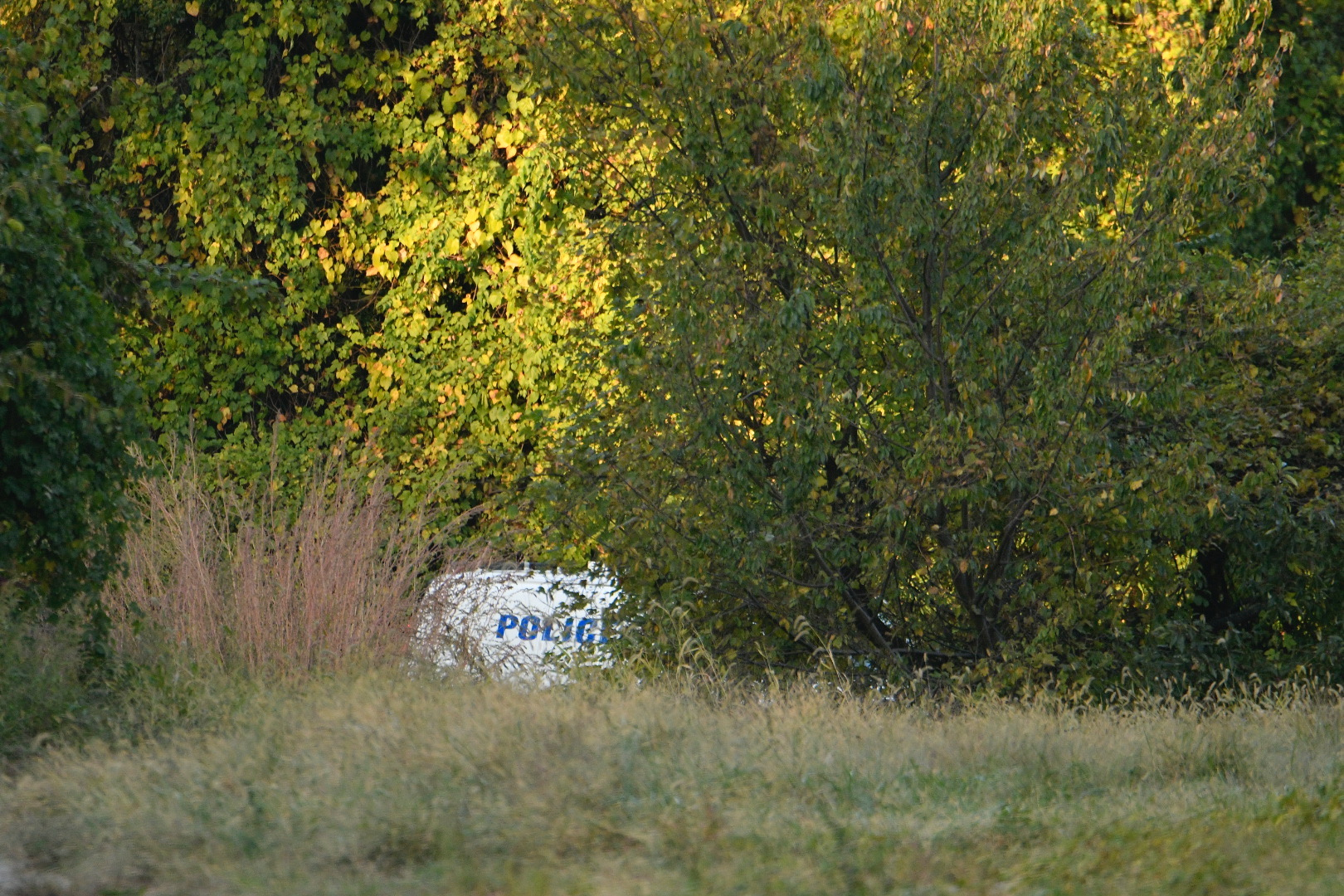
Police discovered a grave containing female human remains in the area of Ada H. H. Lewis Middle School, a closed school facility near the Awbury Arboretum in Germantown on Saturday.
Investigators went to the recreation center on Friday and recovered new surveillance footage that showed King pull into the parking lot around 10:30 p.m. on Oct. 4 in a Hyundai Accent that had been reported stolen, two sources said. He left the car there that night — most likely with Scott’s body inside, the sources said.
The footage appeared to show King return to the car two days later and retrieve and move what they believe to be Scott’s body, the sources said. It’s not clear whether he acted alone.
The next day, the sources said, the car was set on fire behind homes on the 7400 block of Ogontz Avenue. King’s cell phone data placed him there at the time of the blaze, the source said. (Police had initially been searching for a gold Toyota Camry that King was seen driving but no longer believe that car was used in the crime, the sources said.)
The district attorney’s office said prosecutors would wait for additional information from police and the medical examiner before determining whether to charge King in connection with Scott’s death.
King is expected to be charged with arson in the coming days for allegedly setting the car on fire in West Oak Lane, according to the sources.
Police don’t know the identity of the tipster who steered them to the location of Scott’s body. But if King had help moving it, the sources said, the accomplice may have confided in others, and one of those people may have contacted police.
The investigation is continuing.
Staff writer Maggie Prosser contributed to this article.
The homicide clearance rate this year has hovered between 86% and 90% — the highest since 1984, when the department recorded a 95% clearance rate.
The change is a welcome improvement from the challenges of 2015 to 2022, when the rate of solved homicides hovered around 50% or less and dropped to a historic low of 41.8% in 2021, according to police data.
Just as there’s no single explanation for the drop in shootings, there’s no simple answer to why detectives are closing cases more quickly this year. And a higher arrest rate doesn’t account for whether a defendant is convicted at trial.
But interviews with law enforcement officials and a review of police data and court records suggest a few likely factors: the overall decline in violence, which gives officers more time to investigate, and recent investments in technology that give detectives faster access to evidence.
Here are five things contributing to the improved clearance rate:
!function(){“use strict”;window.addEventListener(“message”,function(a){if(void 0!==a.data[“datawrapper-height”]){var e=document.querySelectorAll(“iframe”);for(var t in a.data[“datawrapper-height”])for(var r,i=0;r=e[i];i++)if(r.contentWindow===a.source){var d=a.data[“datawrapper-height”][t]+”px”;r.style.height=d}}})}();
Simple math
The clearance rate is calculated by dividing the number of homicide cases solved in a given year — regardless of when the crime occurred — by the number of homicides that occurred in that same year.
And so the apparent improvement partly comes down to simple math: with dramatically fewer killings this year, even fewer total arrests can boost the clearance rate.
Through August, police had solved about 60% of the killings in 2025, but because they’ve cleared nearly 50 others from previous years — and because there are a third as many homicides as three years ago — the rate goes up.
Still, that number is notable. Only about a third of killings that occurred in 2021 and 2022 were solved that same year, according to an Inquirer analysis of court records and police data.
!function(){“use strict”;window.addEventListener(“message”,function(a){if(void 0!==a.data[“datawrapper-height”]){var e=document.querySelectorAll(“iframe”);for(var t in a.data[“datawrapper-height”])for(var r,i=0;r=e[i];i++)if(r.contentWindow===a.source){var d=a.data[“datawrapper-height”][t]+”px”;r.style.height=d}}})}();
Time
The significant reduction in violence this year has given detectives the time to solve their cases, both old and new.
During the pandemic — as the city recorded about 2,000 homicides in just four years — detectives were handling 10 to 15 cases each year, more than twice the workload recommended by the U.S. Department of Justice.
This year, it’s half that.
That’s making a difference. Detectives this year appear to be solving cases more quickly than years past, according to an Inquirer analysis.
Through August, police arrested a suspect within a week in about 31% of cases — up from just 15% three years ago.
A video camera at Jasper and Orleans Streets in Philadelphia.
Cameras are everywhere
Just in the last year, police have doubled the number of “real-time crime” cameras on Philadelphia’s streets. In 2024, police said there were 3,625 of the ultrahigh-resolution cameras across the city. This year, there are 7,309.
And there are tens of thousands of other cameras through SEPTA, private businesses, and residents’ home-surveillance systems that give detectives leads on suspects.
Police have also recently installed hundreds of license plate readers — 650 for every patrol vehicle and another 125 on poles across the city.
The department also subscribes to a software that taps into a broader network of millions of other plate readers — on tow trucks, in parking garages, and even private businesses across the region.
Police said the tools are helping them track shooters’ movements before and after a shooting and locate getaway cars more quickly, by searching a vehicle’s license plate or even by its make and model.
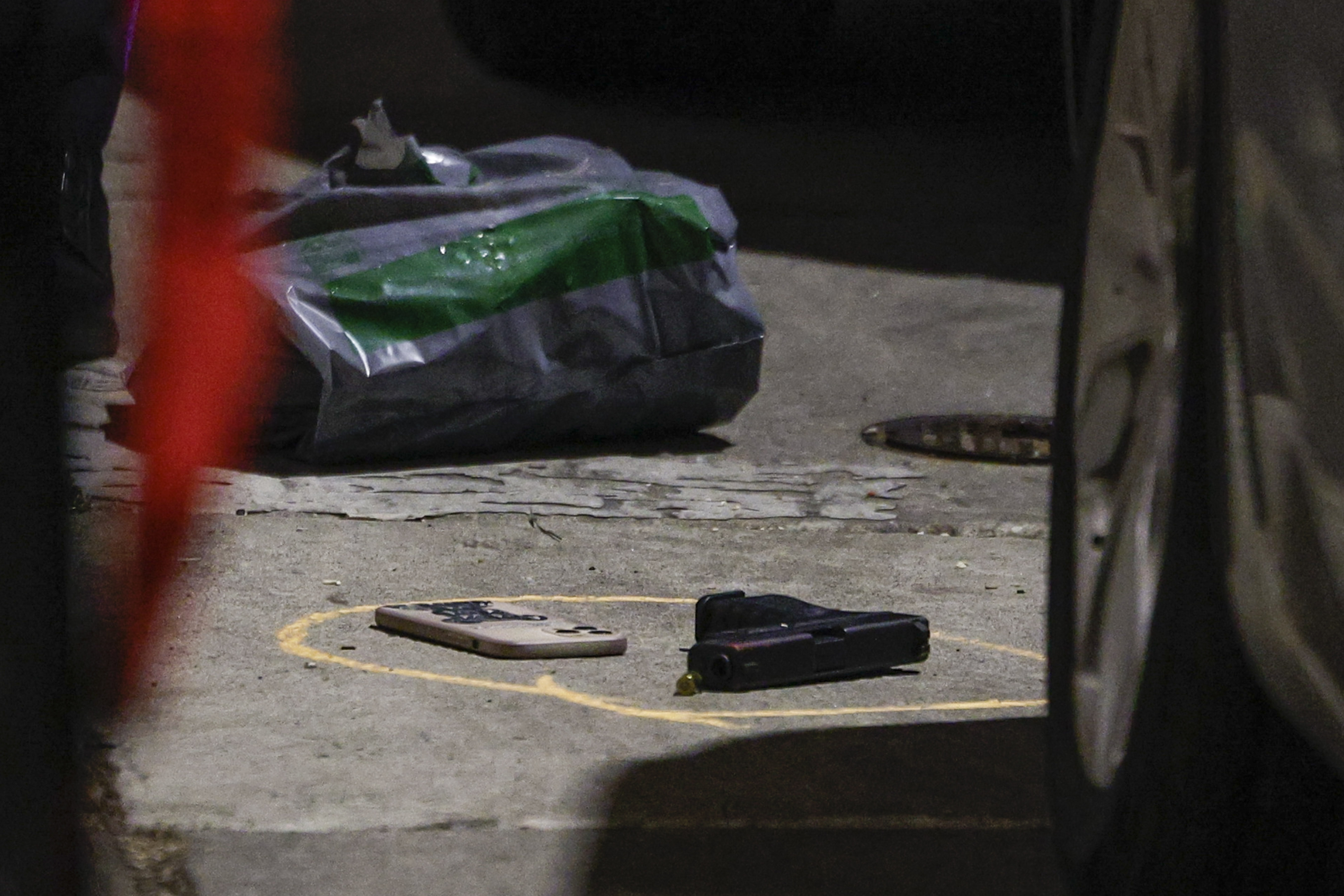
Police locate a gun and a cell phone on the 700 block of East Willard Street, where a man in his 20s was fatally shot in December 2024.
Phones and social media
Philadelphia police and the district attorney’s office have greatly expanded their digital evidence tools in the past two years.
Where cases once relied on grainy video and often-reluctant witnesses, detectives now have high-definition video footage, partial DNA processors, and cell phone location data — evidence that “never goes away” and doesn’t lie, said Deputy Police Commissioner Frank Vanore.
Getting access to a suspect’s — and victim’s — phones and social media can often tell the story behind a crime.
The Gun Violence Task Force, which investigates gang violence and works closely with homicide and shooting detectives, had just two cell phone extraction devices two years ago. Now, it has 14, plus a host of advanced software that helps investigators track and map gang networks.
Between the homicide unit and the task force, nearly 2,000 phones were processed last year — often giving detectives crucial evidence and information about crimes beyond the one they were initially investigating.
Improved morale
Some detectives, who asked not to be identified to speak frankly about their work, said morale in the homicide unit — and across the department — has improved.
During the pandemic, when shootings surged, tensions in the unit went unchecked, and conditions at the Roundhouse headquarters were dire. The office was overcrowded and infested with vermin, and investigators shared just 15 computers among nearly 100 detectives.
Since moving in 2022 to new offices at 400 N. Broad St., each detective now has a desk and computer, and that has boosted productivity, they said.
The detectives also said that patrol officers seem more empowered than during the height of the gun violence crisis to engage with their neighborhoods and gather information that ends up being important to their investigations.
The city’s new Neighborhood Wellness Court initiative has been placed on hold amid growing concern from the leadership of Philadelphia‘s courts and judges’ mounting frustration with the city officials tasked with overseeing the program.
Wellness court, which Mayor Cherelle L. Parker’s administration launched in January as a fast-track way to arrest people in Kensington for drug-related offenses and get them into treatment, has not taken any new cases over the last three weeks, city officials said.
Supervising Municipal Court Judge Karen Simmons was nearly ready to shut the program down over frustration with the lack of coordination and communication from the Parker administration with the courts and other city agencies involved, according to sources with knowledge of conversations about the program.
Simmons was concerned that the city was treating people arrested in some neighborhoods differently from others, and that there was inconsistency in how the program was tracking its data and determining who should be eligible for treatment, according to the sources, who spoke on the condition of anonymity to discuss private conversations.
Simmons ultimately gave the city time to fix those issues, asking that officials put together a written manual and streamline the paperwork and intake procedures to ensure fairness, the sources said. The city is expected to make those adjustments so police can resume making arrests and bringing people through the program next week.
A spokesperson for the courts declined to comment and referred questions to the city.
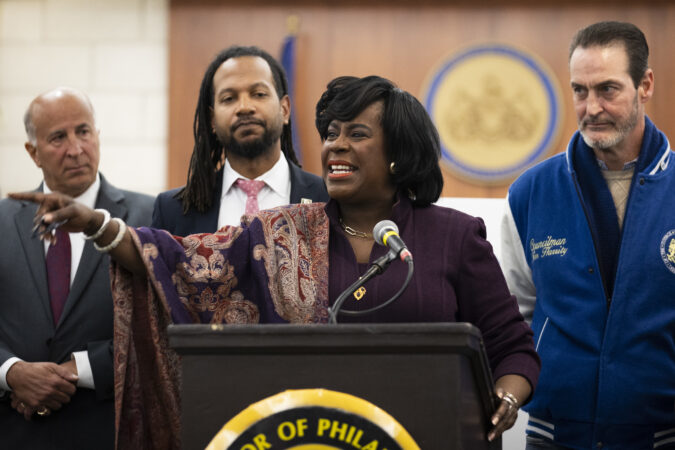
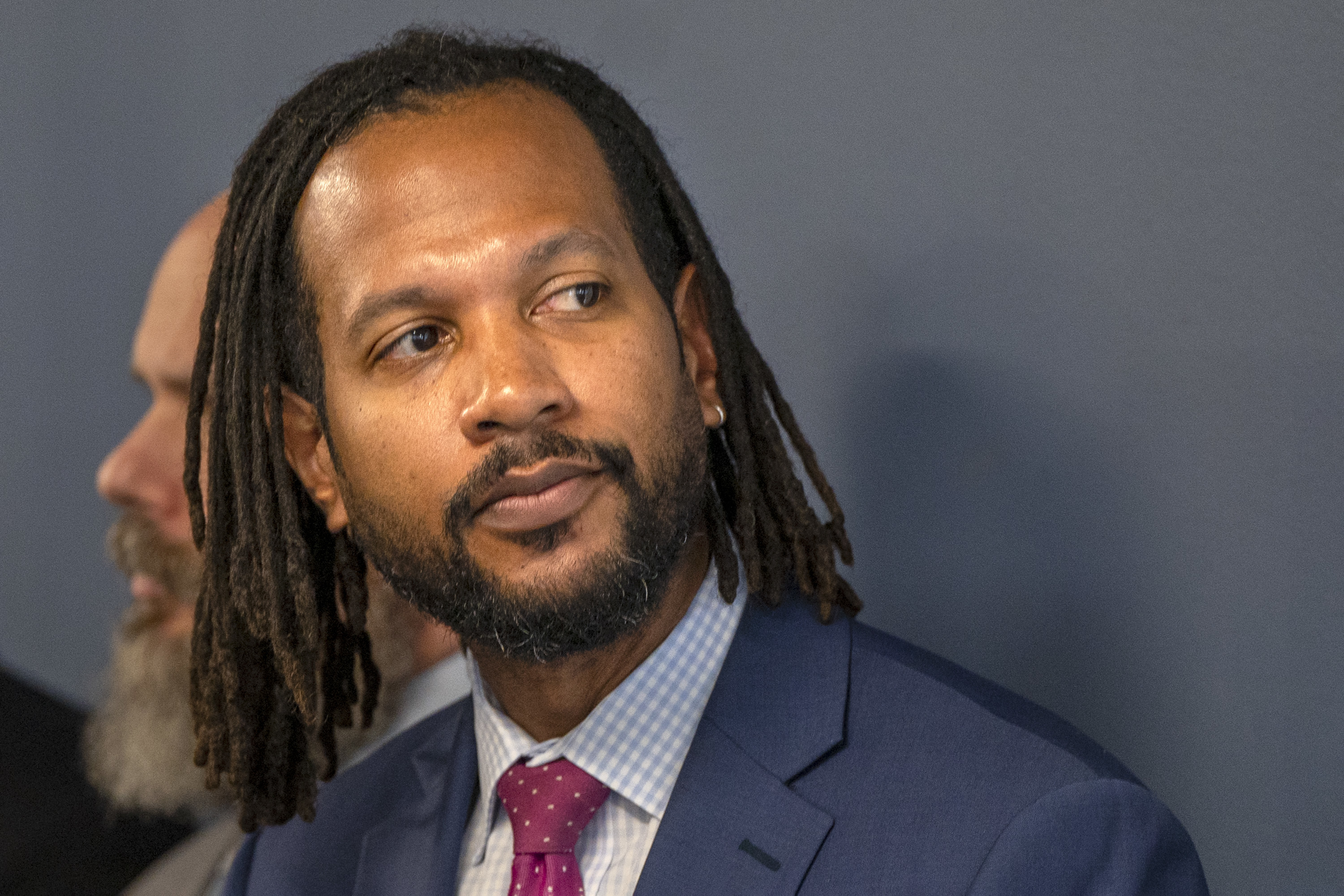
Chief Public Safety Director Adam Geer oversees the office that runs Neighborhood Wellness Court in Kensington.
Chief Public Safety Director Adam Geer, who oversees the city office that runs wellness court, said the delays were related to “administrative protocols” that needed to be resolved but declined to provide specifics.
Geer said that he expects the program to return to normal operations next week and that the city “is fully committed to successfully implementing and sustaining the Neighborhood Wellness Court model.”
Joshu Harris, the city’s deputy director of public safety, is no longer overseeing the program‘s operations, the sources said, and Deputy Mayor Vanessa Garrett Harley is now involved.
“As with all new pilot programs of this kind, adjustments will continually be made to improve operations as time moves forward,” city spokesperson Joe Grace said Thursday.
The pause comes amid long-simmering tension between the courts and the city over how the program was launched, sources said. Leadership of the Philadelphia District Attorney’s Office, the Defender Association of Philadelphia, and even the judges tasked with overseeing the court were largely excluded from the city’s plans for the program and how it would operate, sources said. They have felt like the Parker administration did not want their input.
That conflict spilled into open court this month. Municipal Court Judge Henry Lewandowski III, who has presided over most of the wellness court cases so far, said at a hearing in early April that certain politicians in the city think they can “just wave a wand” and fix Kensington’s long-standing drug problems.
“I care way more than they ever will. They’re fake,” he said, adding that officials are trying to build new programs just so they have something to take credit for.
“If I said what I wanted to say,” he said, “I’d have to resign.”
His frustration was clear again Thursday as he oversaw more than 100 summary offense cases, most for fare evasion amid SEPTA‘s new crackdown on turnstile jumping.
“Who knows what program they’ll start by next week,” he said. “Every Wednesday, there’s new stuff, new programs, new procedures. … I’ve never been more confused, I’ve never been more uncertain what my job is.”
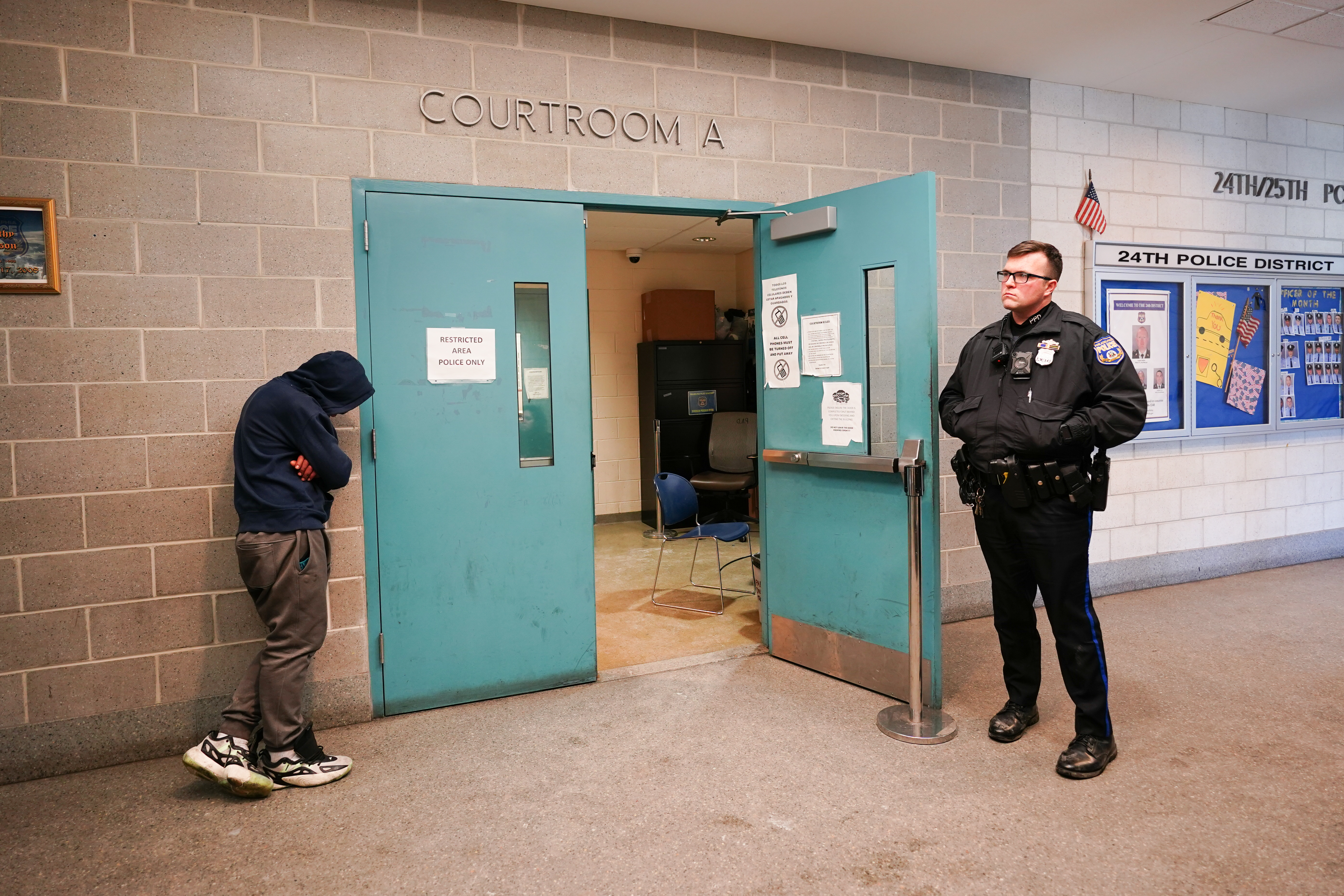
Wellness court takes place every Wednesday inside a courtroom at the 24th / 25th Police District.
Wellness court is a signature part of Parker’s plan to shut down Kensington’s notorious open-air drug market and restore quality of life for neighborhood residents.
The court runs on Wednesday afternoons. First, in the morning, police conduct sweeps of the Kensington area and arrest people in addiction for offenses like sleeping on the sidewalk, gathering around an outdoor fire, or stumbling into the street. They are typically charged with summary offenses like obstructing highways.
Those arrested are then brought to the Police-Assisted Diversion program building on Lehigh Avenue, where they are evaluated by a nurse and an addiction specialist. Officials also attempt to address any outstanding arrest warrants, and connect them with a court-appointed attorney hired by the city to discuss their rights.
Finally, they are brought before a judge — Lewandowski has heard most cases so far — inside the nearby police district. They are offered the opportunity to immediately go to rehab or face a summary trial for their alleged crimes. Those who opt to go into treatment and complete the program and terms set by the city will later have their cases dismissed and expunged.
Few in the program have asked for a same-day trial. Those found guilty have so far been ordered to pay fines and court fees ranging from about $200 to $500.
Homelessness and public drug use is widespread in Kensington, the heart of the city’s open-air drug market.
Of the more than 50 people who have come before the court so far, only two had successfully completed treatment as of early April, according to data collected by The Inquirer. The vast majority brought through the program almost immediately leave treatment and do not appear at follow-up hearings, the data show.
The city has declined to share data on wellness court, including with City Council at a recent budget hearing, saying that it is too early to judge the program on numbers alone and that more time is needed to see results.
But the Parker administration said it wants to expand the court and needs more funding for it to succeed. At a recent budget hearing, Geer asked City Council for an additional $3.7 million to operate the court five days a week and hire additional staffers.
The goal, Geer said, is to build a system where people suffering on the streets can immediately be connected with treatment and resources, avoid going to jail, and get housing through the city’s new Riverview Wellness Village. Geer has said that the program will never have a 100% success rate, but that every “touch” the program has with people in addiction increases their likelihood to eventually go into treatment.
But the First Judicial District has said wellness court will not be expanding anytime soon, according to sources.
Civil rights advocates have raised constitutional concerns over the program. In a letter to the Parker administration, the Pennsylvania chapter of the American Civil Liberties Union said the program could pose a threat to drug users’ rights and questioned whether the city could force people to make consequential legal decisions while potentially under the influence of narcotics.