Author: Aliya Schneider

  • Upper Darby Council passes resolution to restrict cooperation with ICE following resident’s death in the agency’s custody

    Upper Darby Council passes resolution to restrict cooperation with ICE following resident’s death in the agency’s custody

    The Upper Darby Township Council passed a resolution Wednesday to restrict cooperation with U.S. Immigration and Customs Enforcement in response to growing concerns about the agency’s activities in the diverse township.

    The 11-member council, made up entirely of Democrats, voted unanimously to pass a resolution saying the town will not use its resources to assist ICE with non-criminal immigration enforcement. But the largely symbolic resolution nearly mirrors the municipality’s existing guidelines, leading to criticism that it does not go far enough.

    The resolution’s passage comes after Parady La, an Upper Darby resident struggling with addiction, died last month in a hospital while in ICE’s custody. It also follows the chaotic scenes in Minneapolis, where federal agents fatally shot Renee Good and Alex Pretti last month as President Donald Trump’s administration targeted the city with a massive immigration enforcement operation.

    Those events have fueled anxiety in Upper Darby, where nearly a quarter of the population is foreign-born, compared with 15% in Philadelphia. Armed ICE agents wearing masks have become a familiar sight in the township, prompting residents to question why their community is suddenly under pressure, including high school students who held a walkout earlier this month.

    Council President Marion Minick called the resolution a chance to show immigrants in the community “they are not alone.”

    “We can demonstrate through our votes and through our voices that Upper Darby Council will do everything within our legislative power to shield our residents and their families from this climate of intimidation,” he said.

    The council’s resolution comes as local governments across the country and in the Philadelphia area try to curb ICE’s impact on their residents. Last month, Haverford passed a similar measure and Bucks County ended its agreement with the agency that allowed sheriff’s deputies to act as immigration enforcement.

    Council member Kyle McIntyre, a progressive community organizer who began his term last month, emphasized that the resolution is “just the start.”

    “There is so much more than we can do, and we will be doing, and I make that solemn promise to the community right now,” he said before the vote.

    “If we don’t do more, hold us accountable,” he added.
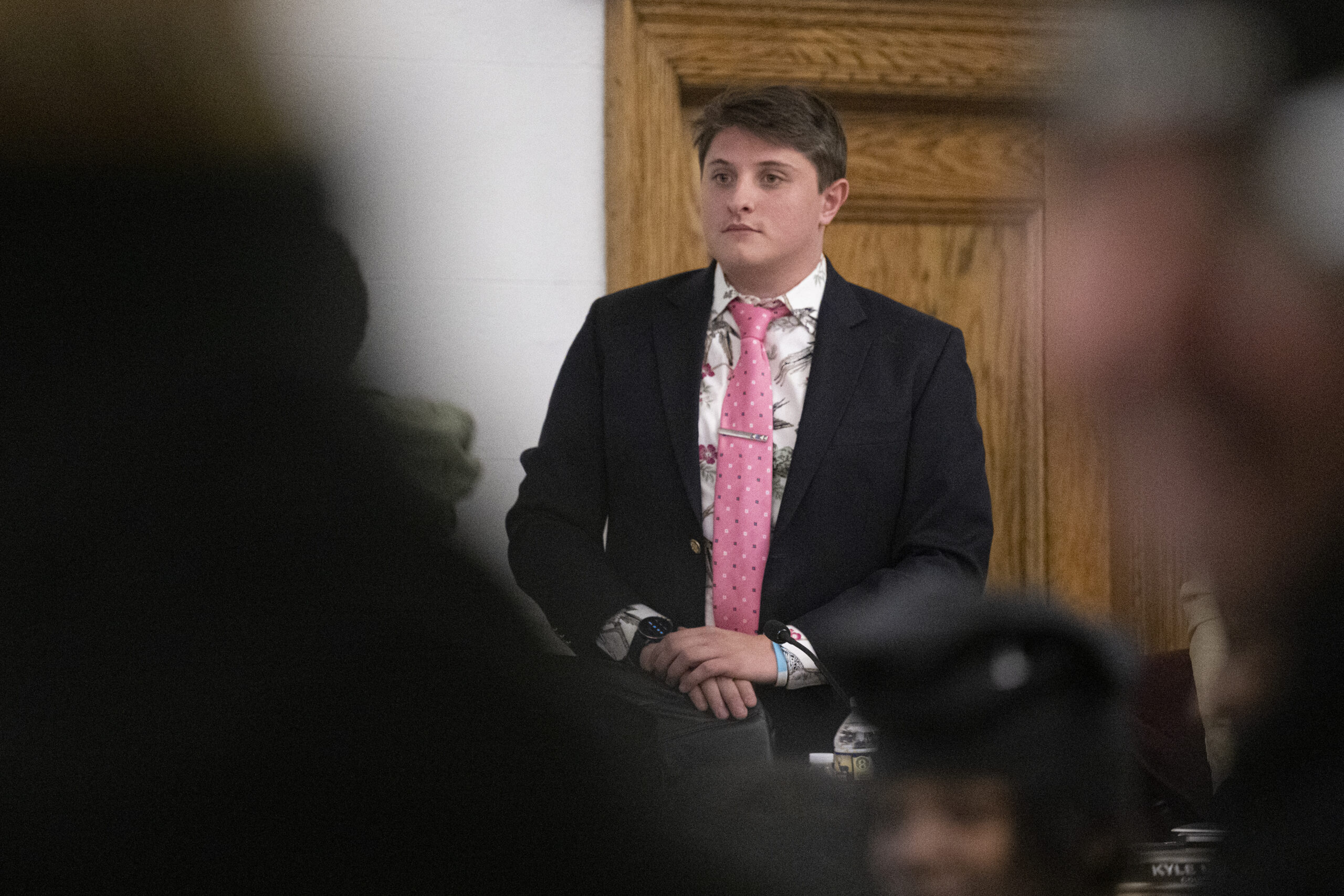
    Kyle McIntyre, an Upper Darby Township council member, listens to residents’ comments during a township meeting on Wednesday, Jan. 21, at the Upper Darby Municipal Building in Upper Darby, Pa.

    Township solicitor Mike Clarke said that police will cooperate with ICE if the agency has a criminal warrant signed by a judge.

    “Local law enforcement is not supposed to be in the immigration enforcement business, and essentially that’s what this resolution is saying … but if it’s a criminal warrant, they will be involved,” Clarke said.

    A list of frequently asked questions about ICE on the township’s website already stated that Upper Darby does not participate in civil immigration enforcement or ask residents their immigration status, though it does cooperate with lawfully issued criminal warrants and court orders. Township spokesperson Rob Ellis confirmed that the resolution reaffirms the town’s existing internal policy.

    The lack of cooperation seems to be going both ways.

    Upper Darby Mayor Ed Brown said earlier this month that ICE would no longer communicate with local police to tell them when agents are operating in the township, calling the change “scary.” ICE did not immediately respond to a request for clarity on Thursday.

    Some residents at the meeting expressed concern about the reaffirmed policy getting in the way of public safety, and McIntyre later said the policy ensures anyone in Upper Darby can feel comfortable reporting crimes to the police. He said “anybody that commits a crime in Upper Darby Township will be held accountable,” regardless of immigration status.

    Jennifer Hallam, who said she has worked with immigrants in Upper Darby for almost a decade, urged the council to postpone its vote and instead pursue legislation that has more teeth.

    “The current resolution really just preserves the status quo,” she said.

    She called for a resolution that would restrict ICE from municipal property without judicial warrants, prohibit the collection and sharing of immigration status among municipal employees, and prohibit ICE from wearing masks. Philadelphia lawmakers are attempting to ban ICE from wearing masks, though experts are split on whether the measure would be legally sound.

    McIntyre said in an interview that Wednesday’s resolution puts the council’s values down on paper and provides clarity to the community, but he acknowledged that a resolution is not enforceable.

    A death in ICE custody close to home

    The community has been grappling with the death of La, a 46-year-old Cambodian immigrant and Upper Darby resident who, according to his widow, Meghan Morgan, struggled with addiction. La came the United States in 1981 as a refugee around the age of 2. He became a lawful permanent resident a year later but lost his legal status after committing a series of crimes over two decades, ICE said.

    ICE said agents arrested La outside his home last month before he received treatment for severe withdrawal in a Philadelphia detention center. He was admitted to the hospital in critical condition, where his condition worsened and he died, the agency said.

    Morgan and La’s daughter Jazmine La said they believe he was not given proper medical treatment and the Pennsylvania ACLU filed a Freedom of Information Act request surrounding his detention and death.

    McIntyre last month called on Delaware County District Attorney Tanner Rouse and Philadelphia District Attorney Larry Krasner to investigate La’s death.

    Rouse said at the time that Delaware County law enforcement was not involved or aware of La’s detainment when it happened, and that his office would investigate it. He said Thursday that surveillance footage showed La was detained “without violence” but that his death in Philadelphia should be addressed by “investigating authorities” in the city.

    Krasner’s office declined to comment, saying it was a federal matter.

    Staff writer Jeff Gammage contributed to this article.
  • Sue Altman was thrown out of a hearing as a critic of George Norcross. Six years later, she’s running for Congress

    Sue Altman was thrown out of a hearing as a critic of George Norcross. Six years later, she’s running for Congress

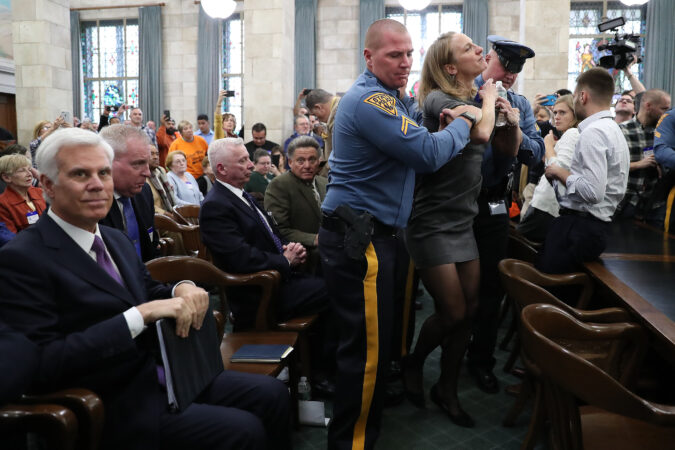
    Sue Altman showed up at a state Senate hearing in late 2019 to confront George E. Norcross III and was dragged out by state troopers. Six years later, she is using that incident as an example of why New Jersey voters should send her to Congress.

    “If anything can prepare you for a dogfight that Washington politics is, it’s Jersey politics,” said Altman, one of more than 15 Democrats vying to succeed retiring U.S. Rep. Bonnie Watson Coleman in a reliably blue Central Jersey seat.

    Altman, 43, recently resigned after serving for the last year as state director for U.S. Sen. Andy Kim, a South Jersey Democrat who has also challenged the state’s machine politics. Before that role, she unsuccessfully ran for Congress in 2024 in a swing district that borders Coleman’s district.

    She made a name for herself as a progressive activist in Camden, where she fought former Republican Gov. Chris Christie as the state began its takeover of the city’s public schools, vocally criticized power brokers like Norcross, and led a legal effort to abolish the county line from New Jersey ballots before Kim took it to the finish line in 2024.

    “My time in Camden was extremely important, and in many ways shapes the work that I did in the state from that point forward,” she said.

    While Altman built her progressive credentials in Camden, she has most recently lived in Lambertville and will be relocating northeast to Bridgewater to move in with her long-term boyfriend, who lives just outside the district’s boundaries.

    “I think what the electorate is hungry for and what the party needs are people who are going to challenge power,” she said. “I’ve done that my whole career.”

    Altman, who grew up in Central Jersey, played professional basketball in Ireland and Germany after graduating from Columbia University. She earned two master’s degrees from Oxford University before landing in Camden in 2014.

    She garnered attention in the city for going back and forth with Christie for roughly six minutes at a public meeting in which they tossed a microphone in the air to each other.

    After Donald Trump’s first election as president in 2016, Altman helped organize South Jersey Women for Progressive Change, a group that campaigned for Kim’s 2018 election to the U.S. House and spoke out against machine politics. She said she continued that work as she took the reins as executive director of the state’s Working Families Party in 2019 from Analilia Mejia — the progressive who recently won Democratic primary to replace Gov. Mikie Sherrill in Congress.

    Sue Altman at the Camden Waterfront in 2019.

    Altman drew national attention that year after she was dragged out of the hearing in Trenton on a corporate tax incentive program Norcross defended, drawing a message of support from U.S. Sen. Elizabeth Warren (D., Mass.). Activists used images of the incident to bolster their argument that unelected power brokers like Norcross hold outsize influence in New Jersey, though Norcross later said he did not believe she should have been thrown out.

    Camden Mayor Vic Carstarphen, a Democrat, criticized Altman for what he called her “singular focus” on “trying to tear down” Norcross during her time in Camden for her own “self-promotion.”

    “She created a lot of chaos in the city, and ran amok throughout the city,” Carstarphen said Tuesday.

    In 2021, Altman led the legal strategy in the first major lawsuit against the county line, the old ballot that was advantageous to party-endorsed candidates. The fall of the line has led to more competitive primaries, including her own.

    She went on to unsuccessfully challenge incumbent Republican U.S. Rep. Tom Kean Jr., losing by more than five percentage points in 2024.

    Altman said dealing with immigration cases while working in Kim’s office partially inspired her to run again. She said Democrats should replace U.S. Immigration and Customs Enforcement with “full comprehensive immigration reform” while also securing the border.

    Neither Kim nor the Working Families Party has weighed in on the race.

    Altman warns that the country is at “one of the most vulnerable points” in its history with Trump in office for a second time.

    “We have a very short window of time to prove to the rest of the country that Democrats in power can deliver for people and hold Trump accountable, but not get overwrought with the politics of it,” she said.

  • An ICE agent shot a gun near Mikie Sherrill’s former district. One of the candidates vying to replace her wants to abolish the agency.

    An ICE agent shot a gun near Mikie Sherrill’s former district. One of the candidates vying to replace her wants to abolish the agency.

    An ICE agent firing a gun near Gov. Mikie Sherrill’s former congressional district has brought new resonance to the agency in the race to replace her.

    Analilia Mejia, who campaigned on abolishing U.S. Immigration and Customs Enforcement, won a close and crowded Democratic primary to replace Sherrill in Congress in a victory for the progressive movement that coincides with a national debate over President Donald Trump’s deportation agenda. Even some Republican officials have been speaking out against ICE’s tactics.

    Mejia will compete with Joe Hathaway, the former Randolph mayor who ran unopposed in the Republican primary, in an April special election. While Hathaway is far from supporting Mejia’s call for an end to ICE, he has also voiced support for making changes to the agency.

    The encounter that has brought their views into focus happened Tuesday in Morris County. The incident, in which an ICE agent fired a gun in Roxbury, is under investigation by the New Jersey Attorney General’s Office. The attorney general’s office said no one was injured.

    The U.S. Department of Homeland Security, which oversees ICE, said the officer shot at an undocumented immigrant’s tires in self-defense during a targeted effort to detain him.

    “This is a public safety issue,” Mejia said in an interview. “Abolishing ICE, to me, is the only reasonable step forward, because it is clear that ICE’s and DHS’s recruitment practices are clearly failing the American people. Their oversight and training is clearly failing the American people, and they have zero accountability.”

    In Roxbury, a township of about 20,000 people, roughly 40 miles from New York City, local residents recently protested a proposed ICE facility, which Democratic politicians and the all-Republican town council alike oppose.

    The township, which contains mostly Republican and unaffiliated voters, falls right outside of Sherrill’s former district, which includes other parts of the same county and has become fairly reliably blue.

    Mejia said Tuesday’s confrontation raises concerns about guns going off in residential neighborhoods or near schools, and that it shows the “recklessness” of the Department of Homeland Security. She said she’s been in conversation with local Democratic officials who question DHS’s account of the incident.

    Hathaway disagrees with Mejia’s views on ICE, but he also stopped short of defending DHS when asked about Tuesday’s incident. He said in an interview that he needs more information to comment.

    “I think it’s generally not a good thing when politicians try to stick our nose in and stoke the flames and politicize these kinds of things before we know the facts,” he said. “I certainly don’t want to do that in this case.”

    The GOP candidate is critical of the state’s Immigrant Trust Directive — the sanctuary policy that limits local law enforcement’s cooperation with ICE, but he also said he supports improved training, de-escalation tactics, and technology for ICE agents. He said American citizens who peacefully protest should be kept safe, though ICE agents also need to be able to detain undocumented immigrants effectively.

    A New York Times and Siena University poll published in late January found that a “sizable majority” of voters believe ICE “has gone too far,” while roughly half support Trump’s deportations and handling of the southern border.

    DHS said the undocumented person driving the car in Roxbury had a criminal history of drug trafficking charges, drug possession, and driving under the influence, and that a judge issued an order of removal for him in 2021. The federal agency said he “rammed into a law enforcement vehicle and weaponized his vehicle in an attempt to run an officer over” while trying to “evade arrest.”

    “Following his training, the officer defensively used his firearm and shot out the tires of the vehicle to stop the threat,” an unnamed DHS spokesperson said. “Thankfully, no one was injured.” The driver was arrested and taken into ICE custody, DHS said.

    The attorney general’s office requested that any witnesses share video footage of the incident. The request came right before Sherrill’s administration launched an online portal for New Jerseyans to submit videos of ICE, which she initially announced on Comedy Central’s The Daily Show. Video footage shared by bystanders contradicted the Trump administration’s account of two recent deadly shootings by federal agents in Minnesota.

    Mejia argued during her campaign that ICE cannot be reformed and should be replaced with something else, such as a more efficient system of processing asylum or citizenship applications.

    “I’m not calling for open borders,” she said Wednesday. “I’m not calling for the eradication of a system. I’m actually calling for the cease and desist of the violence of the occupation of American cities, of the overreach from this administration, and the erosion of constitutional protections.”

    She said she believes Congress, in the short term, should stop funding ICE, reallocate funds for the agency that came as Trump’s One Big Beautiful Bill Act slashed funding for social services, stop surveilling and collecting data from Americans, and end qualified immunity for agents.

    Senate Democrats blocked a funding bill for DHS Thursday amid unsuccessful negotiations with the White House to make changes to immigration enforcement operations following the shootings in Minneapolis.

    Hathaway said he is “willing, absolutely, to come to the table to reform” how ICE operates, but that he also wants to see changes to sanctuary policies.

    Sherrill’s administration has not provided more information about the Roxbury incident, citing an ongoing investigation.

    “We recognize that matters of this nature raise concerns within our communities… it is my duty to protect the safety of residents of this state and uphold the Constitution. I will do everything in my power to fulfill this responsibility,” Acting Attorney General Jennifer Davenport said.

    On Wednesday, Sherrill signed an executive order prohibiting ICE from operating on state-owned private property unless there’s a judicial warrant and launched a “know your rights” guide for residents interacting with immigration agents.

    Mejia, who grew up in Elizabeth and lives in Glen Ridge in Essex County, said that as an Afro-Latina, she feels less safe during Trump’s immigration crackdown and that she takes precautions like carrying her passport or being careful where she speaks Spanish.

    “It happening close to home is, of course, troubling, but this is an escalation that we have been seeing for years,” said Mejia.

  • Chrissy Houlahan calls Trump administration’s failed attempt to indict her and other lawmakers for video an ‘abuse of power’

    Chrissy Houlahan calls Trump administration’s failed attempt to indict her and other lawmakers for video an ‘abuse of power’

    U.S. Rep. Chrissy Houlahan said it’s unclear what crime the Department of Justice was trying to charge her with when a grand jury refused an indictment over a video in which she, with five other Democratic colleagues, called on service members to “refuse illegal orders.”

    “The regular American people that comprised the grand jury saw this for what it was, which was kind of a spurious misuse, abuse of the power of the federal government against the people,” Houlahan, of Chester, said in an interview Wednesday.

    “It’s not about me or my colleagues,” continued Houlahan, a former Air Force officer. “It’s about the fact that the Constitution allows for all of us to be treated as equals, and all of us to have the freedom to speak with freedom.”

    The Justice Department investigated the six Democratic lawmakers who made the video, all of whom previously served in the military or intelligence agencies. But a Washington grand jury would not sign off on charges on Tuesday, The Associated Press reported.

    It’s a setback for President Donald Trump’s administration, which has targeted the lawmakers in a variety of ways since November, when the president claimed the video was an act of sedition.

    Houlahan said none of the Democrats’ lawyers could identify what charges could have legitimately been brought against them.

    “Collectively, we all, of course, have unfortunately had to secure lawyers in this process,” she said. “And to a person, none of them could come up really with what it was that we had purportedly done. And clearly the people in the grand jury saw the same thing.”

    The Justice Department did not respond to a request for comment on Wednesday.

    U.S. Rep. Chris Deluzio, an Allegheny County Democrat who also appeared in the video, said in an interview Wednesday he is “not surprised at all” by the grand jury’s decision.

    “The fact that the Trump administration and their lawyers want to try to charge us with crimes for stating the law and saying words that they don’t like is outrageous, and of course, not something that you should be able to throw people in prison for,” said Deluzio, who served in the Navy.

    In a news conference Wednesday, some of the lawmakers suggested legal action against the Trump administration is on the table.

    “There will be accountability, and they should be preserving documents, preparing for what’s coming,” Deluzio said.

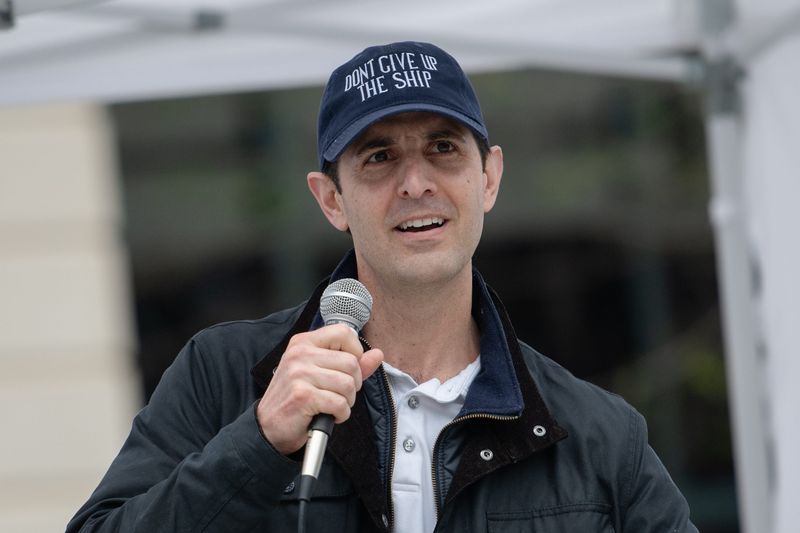
    U.S. Rep. Chris Deluzio speaks to a large crowd in front of the Beaver County Courthouse in April 2025 wearing a hat that says “don’t give up the ship.”

    Trump accused the Democratic lawmakers of sedition “punishable by death” after they posted the video in November, warning service members and intelligence workers to “refuse illegal orders.” In the video, the Democrats urged service members and intelligence professionals not to “give up the ship,” a sentiment Deluzio repeated Tuesday night.

    The phrase, which Deluzio has long referenced, is a rallying cry that’s hung on the wall at the Naval Academy’s Memorial Hall.

    “It’s a phrase that means a lot, and it means a lot in this moment of great stress to our country — that this thing is worth our efforts and that we should not give it up,” Deluzio said in the Wednesday interview.

    The Democrats did not mention any specific orders in the video, but lawmakers who appeared in the video expressed concerns at the time about strikes on boats in the Caribbean and National Guard operations in U.S. cities.

    Houlahan said they continue to be concerned about “the unlawfulness of the administration.”

    The video also included U.S. Sen. Elissa Slotkin (D., Mich.), a former CIA officer; U.S. Sen. Mark Kelly (D., Ariz.), a former Navy captain; U.S. Rep. Maggie Goodlander (D., N.H.), a former intelligence officer; and U.S. Rep. Jason Crow (D., Colo.), a former paratrooper and Army Ranger.

    The lawmakers were contacted by the FBI late last year.

    Federal prosecutors unsuccessfully tried to secure the indictment against all six lawmakers in the video, The New York Times reported. The office that pursued the case is led U.S. Attorney for D.C. Jeanine Pirro, the former Fox News personality who served as district attorney in Westchester County, N.Y., during the 1990s and early 2000s.

    Grand jury rejections are extraordinarily rare, but have occurred repeatedly in recent months in Washington, as citizens who have heard the government’s evidence have come away underwhelmed in a number of cases. Prosecutors could try again to secure an indictment.

    Attention on the lawmakers’ video escalated days after they initially posted it when Trump began his social media tirade in November.

    “This is really bad, and Dangerous to our Country,” he wrote on his social media platform Truth Social. “Their words cannot be allowed to stand. SEDITIOUS BEHAVIOR FROM TRAITORS!!! LOCK THEM UP???”

    He also shared posts from supporters calling for retribution against the Democrats, including one that said, “HANG THEM GEORGE WASHINGTON WOULD !!” and another calling them domestic terrorists.

    Houlahan said at the time she was “profoundly disappointed” in her GOP colleagues for not defending the Democrats, a sentiment she repeated on Wednesday.

    “The fact that the president and the people around him, in hearing a reminder about the law, reacted the way they did, which is to call for our death, arrest, to try to imprison us, tells me more about them than I could ever know,” Deluzio said Wednesday.

    “A normal person, a normal president, would be reminding their troops of their obligations to follow the law as well because they care about the rule of law,” he added.

    Houlahan and Deluzio reported bomb threats at their district offices after Trump went on offense in November.

    Trump told Fox News Radio that he was “not threatening death, but I think they’re in serious trouble,” adding that, “in the old days, it was death.”

    His administration has cited a different military law that says orders are presumed to be lawful and the importance of “good order and discipline.”

    “Their foolish screed sows doubt and confusion — which only puts our warriors in danger,” Defense Secretary Pete Hegseth said at the time.

    Kelly, the only lawmaker who served long enough to officially retire and therefore falls under The Pentagon’s jurisdiction, is in a another fight with Trump’s administration over the video.

    Hegseth has censured Kelly for participating in the video and is trying to retroactively demote him from his retired rank of captain.

    In response, Kelly is suing Hegseth to block those proceedings, calling them an unconstitutional act of retribution. During a hearing last week, the judge appeared to be skeptical of key arguments that a government attorney made in defense of Kelly’s Jan. 5 censure by Hegseth.

    This article contains reporting from The Associated Press

  • Progressive Analilia Mejia celebrates victory in 13-person primary to replace Mikie Sherrill in Congress

    Progressive Analilia Mejia celebrates victory in 13-person primary to replace Mikie Sherrill in Congress

    Analilia Mejia appeared to cement victory in the Democratic primary to replace New Jersey Gov. Mikie Sherrill in Congress after her top opponent conceded Tuesday morning.

    It’s a massive upset win for the progressive movement.

    Mejia led the race with a razor-thin margin when former U.S. Rep. Tom Malinowski, the closest contender, conceded. The Associated Press has still not called the race five days after the election as the race remains tight, but Malinowski’s concession will enable Mejia to focus on campaigning for her April 16 contest against Republican Joe Hathaway.

    The progressive, an Afro-Latina, shared a gif of Bad Bunny overwhelmed with emotion as he stood last week to receive the coveted album of the year Grammy for Debí Tirar Más Fotos — the first Spanish album to get the honor.

    She delivered a victory speech a couple of hours later on a livestream that kicked off with about two dozen supporters from unions and progressive groups chanting “abolish ICE,” “tax the rich,” and “Mejia for Congress.”

    Mejia said she wants to represent “every voice” in the district and said the victory was not hers alone.

    “This isn’t a race in which one individual won,” she said. “This is a race in which the community stepped up and said, ‘In this moment, what we want are real representatives who will listen to the people, who will ask questions about what is keeping you up at night, who will prioritize your interest over special interests.’”

    There were 13 candidates in the special primary for the open North Jersey seat, but as the results poured in Thursday it became a race between Mejia, a progressive endorsed by the Working Families Party, and Malinowski, a moderate who represented a neighboring district before losing his reelection bid in 2022.

    “Analilia deserves unequivocal praise and credit for running a positive campaign and for inspiring so many voters on Election Day,” Malinowski said in a statement Tuesday.

    Malinowski initially appeared to be in the lead Thursday night, which led multiple outlets and the Democratic National Committee to prematurely declare the race in his favor. Mejia picked up steam and moved ahead of him as the night went on, and publications issued retractions.

    In response, Mejia shared on social media the famous 1948 photo of President Harry Truman holding up the Chicago Tribune’s erroneous “Dewey Defeats Truman” headline.

    Mejia, the daughter of Colombian and Dominican immigrants, has repeatedly said that U.S. Immigration and Customs Enforcement cannot be reformed and should therefore be abolished as President Donald Trump’s immigration enforcement tactics become increasingly scrutinized across the country.

    She said at a news conference Friday that her position resonated with voters, and that the agency “must be replaced by something that isn’t violent, that isn’t shooting Americans in the streets, that is respecting our Constitution.”

    She made the case during her campaign that “any old blue just won’t do” and that she is “unbought and unbossed.”

    Malinowski raised nearly three times as much as Mejia through Jan. 16, according to Federal Election Commission data.

    Her victory is a major breakthrough for New Jersey’s progressive movement in what has become a fairly reliably blue district that includes parts of Essex, Morris, and Passaic Counties. It comes on the heels of a progressive victory in the crowded Jersey City mayoral race.

    (function () {window.addEventListener(‘message’, function (e) { var message = e.data; var els = document.querySelectorAll(‘iframe[src*=”‘ + message.id + ‘”]’); els.forEach(function(el) { el.style.height = message.height + ‘px’; }); }, false); })();

    It also adds another feather to the cap of the national progressive movement after the victory of New York City Mayor Zohran Mamdani, who was supported by some of the same high-profile progressives as Mejia, including U.S. Sens. Bernie Sanders (Ind., Vt.) and Elizabeth Warren (D., Mass.) and U.S. Rep. Alexandria Ocasio-Cortez (D., N.Y.).

    Sherrill, who remained neutral in the primary, said in a statement Tuesday that she endorses Mejia’s campaign to replace her seat in Congress.

    “I’ve known Analilia for years — I’ve seen her dedication to expanding opportunity and fighting for working people. I know she will be a great partner in Congress whether it is fighting for the Gateway Tunnel or to protect our Constitutional rights,” Sherrill said, referencing a major infrastructure project Trump halted.

    Mejia will enter the April special election as a heavy favorite against Hathaway, the former Randolph mayor who ran unopposed in the Republican primary. A regular primary will take place less than two months later, on June 2, for the midterm elections in November. That means the winner’s term will last only through this year.

    The progressive, who grew up in Elizabeth, lives with her husband and two kids in Glen Ridge in Essex County, where she says she has resided for 13 years.

    She said Friday that garnering name recognition was an “uphill battle” since she was one of the last candidates to join the crowded race. Even though mail ballots went out before many voters had the chance to get to know her, her team made it up “by being on the ground and having the most extensive field operation possible,” she added.

    Mejia has most recently worked as the co-executive director of Popular Democracy, a network of organizations across the country that call for “transformational change for Black, brown and low-income communities,” according to its website.

    She has a long resumé in activism, politics, and government, including working as the national political director for Sanders’ 2020 presidential campaign, the deputy director for the U.S. Labor Department’s Women’s Bureau under former President Joe Biden, the executive director of the New Jersey Working Families Party, and a union organizer before launching her bid for the seat.

    She said she also campaigned for Sherrill’s gubernatorial bid last year, whose organizers prioritized reaching Spanish-speaking voters. Mejia spoke in both English and Spanish in her victory speech.

    Her victory is the latest example of how the Democratic establishment in New Jersey is losing its grasp on primaries in the state.

    That is largely because New Jersey redesigned its primary ballot system last year to get rid of its county line ballot. The long-held system was advantageous to candidates supported by their local party apparatus, and progressive activists like Mejia worked for years to dismantle it to give other candidates a shot.

    Malinowski had the endorsement of the Morris County Democratic Committee, and the other local committees supported candidates who fell behind the two front-runners.

    AIPAC’s attacks on Malinowski

    A thorn in Malinowski’s side was a series of attacks funded by the American Israel Public Affairs Committee (AIPAC), a pro-Israel national lobbying group, on issues unrelated to Israel. The method may have backfired, since Mejia has been more critical of Israel than the former House member.

    United Democracy Project, a super PAC funded by AIPAC, attacked Malinowski in ads for voting “with Trump” by supporting bipartisan legislation that included funding for federal immigration enforcement. It also went after him for undisclosed stock trading while in Congress, for which he had received previous scrutiny.

    Patrick Dorton, a spokesperson for the super PAC, told the New York Times that Malinowski is not sufficiently supportive of Israel because he has talked about putting conditions on aid for the country.

    The group spent nearly $2 million on the race, according to Adimpact, which tracks TV and other spending by campaigns.

    Malinowski, who generally supports Israel, said in his concession statement that the results of the race “cannot be understood” without looking at the “dishonest ads” funded by the group.

    “I wish I could say today that this effort, which was meant to intimidate Democrats across the country, failed in NJ-11,” he said. “But it did not. I met several voters in the final days of the campaign who had seen the ads and asked me, sincerely: ‘Are you MAGA? Are you for ICE?’”

    He said he will oppose any candidates AIPAC backs in the June primary when the seat is again on the line.

    Mejia said AIPAC’s attacks demonstrate the influence money has over American politics, but she rejected the notion AIPAC played a decisive role in the race.

    “What they didn’t do is win this for us,” she said. “How we won it was people power. How we won it was talking to folks. How we won it was knocking at doors. How we won it was being ready at every moment.”

  • What to know about the too-close-to-call race to replace Mikie Sherrill in Congress

    What to know about the too-close-to-call race to replace Mikie Sherrill in Congress

    The Democratic primary to replace N.J. Gov. Mikie Sherrill in Congress remains too close to call as of Friday afternoon, but the early results already signal a major breakthrough for progressives in the state.

    Analilia Mejia, a progressive who’s worked for U.S. Sen. Bernie Sanders and the Working Families Party, led former U.S. Rep. Tom Malinowski by less than 1 percentage point, with more than 91% of votes tabulated in the crowded primary.

    Some outlets, including Decision Desk, called the race for Malinowski, who dominated mail ballots, Thursday night before issuing retractions as Mejia gained ground. The Democratic National Committee had even issued a premature congratulations to the former House member before Mejia took the lead.

    (function () {window.addEventListener(‘message’, function (e) { var message = e.data; var els = document.querySelectorAll(‘iframe[src*=”‘ + message.id + ‘”]’); els.forEach(function(el) { el.style.height = message.height + ‘px’; }); }, false); })();

    Sherrill represented North Jersey’s 11th Congressional District, which includes parts of Essex, Morris, and Passaic Counties, and stepped down after being elected governor. A field of 13 Democrats competed in the special election for the open seat from various factions of the Democratic Party.

    Only two broke through as serious contenders, and they represent two sides of the New Jersey Democratic Party: the establishment and progressives.

    Democrats were so invested in the race, turnout exceeded the 2024 primary for the seat, which signals the high level of motivation for Democratic voters going into this year’s midterms.

    Sherrill stayed neutral in the race

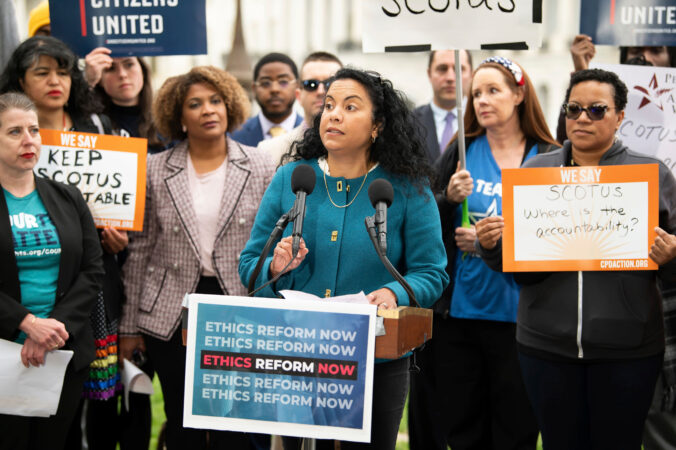
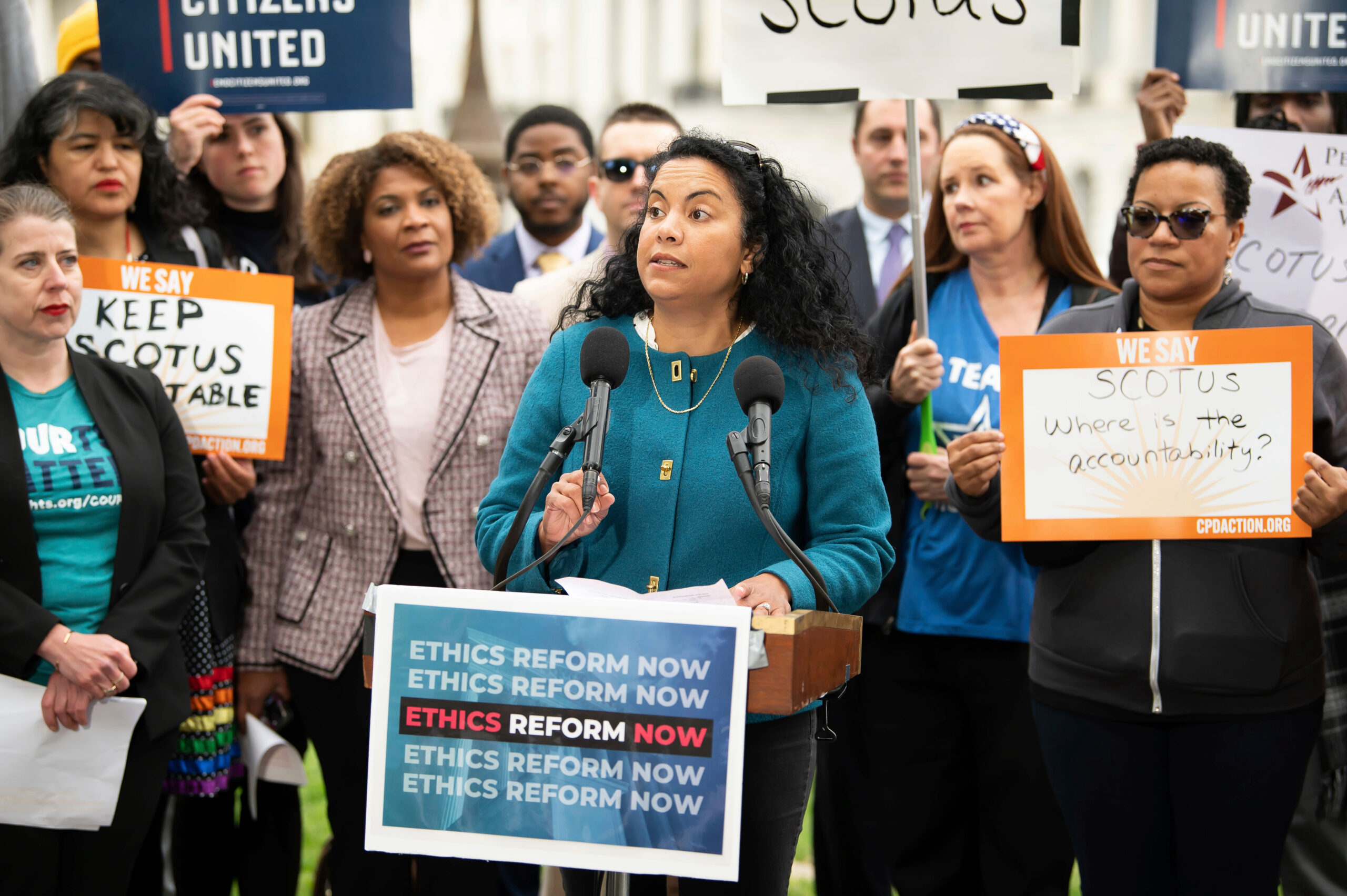
    Analilia Mejia, center, speaks during a rally calling for SCOTUS ethics reform, May 2, 2023, in Washington.

    Analilia Mejia is supported by national progressives like AOC

    Mejia, 48, is the daughter of Colombian and Dominican immigrants. She has called to “abolish ICE” and spoke in both English and Spanish at a news conference Friday.

    The progressive candidate has most recently worked as the co-executive director of Popular Democracy, a network of organizations across the country that call for “transformational change for Black, brown and low-income communities,” according to its website. She worked as the national political director for Sanders’ 2020 presidential campaign, the state director of the New Jersey Working Families Party, and as a union organizer before launching her bid for the seat.

    Mejia was endorsed by national progressives, including Sanders (I., Vt.), U.S. Rep. Alexandria Ocasio-Cortez (D., N.Y.) and U.S. Sen. Elizabeth Warren (D., Mass.). She also had the backing of Newark Mayor Ras Baraka, whose progressive campaign landed him in second place behind Sherrill in the six-way gubernatorial primary last year.

    Mejia leaned into her underdog status Thursday night when addressing supporters, noting the race had been called for her opponent before she took the lead.

    “Here’s the bottom line,” she said. “We know that our movement, this party, this moment, calls on every one of us to be big and bold and brave. And that is what we are about.”

    She later declared: “I think we’ll listen to some Bad Bunny!”

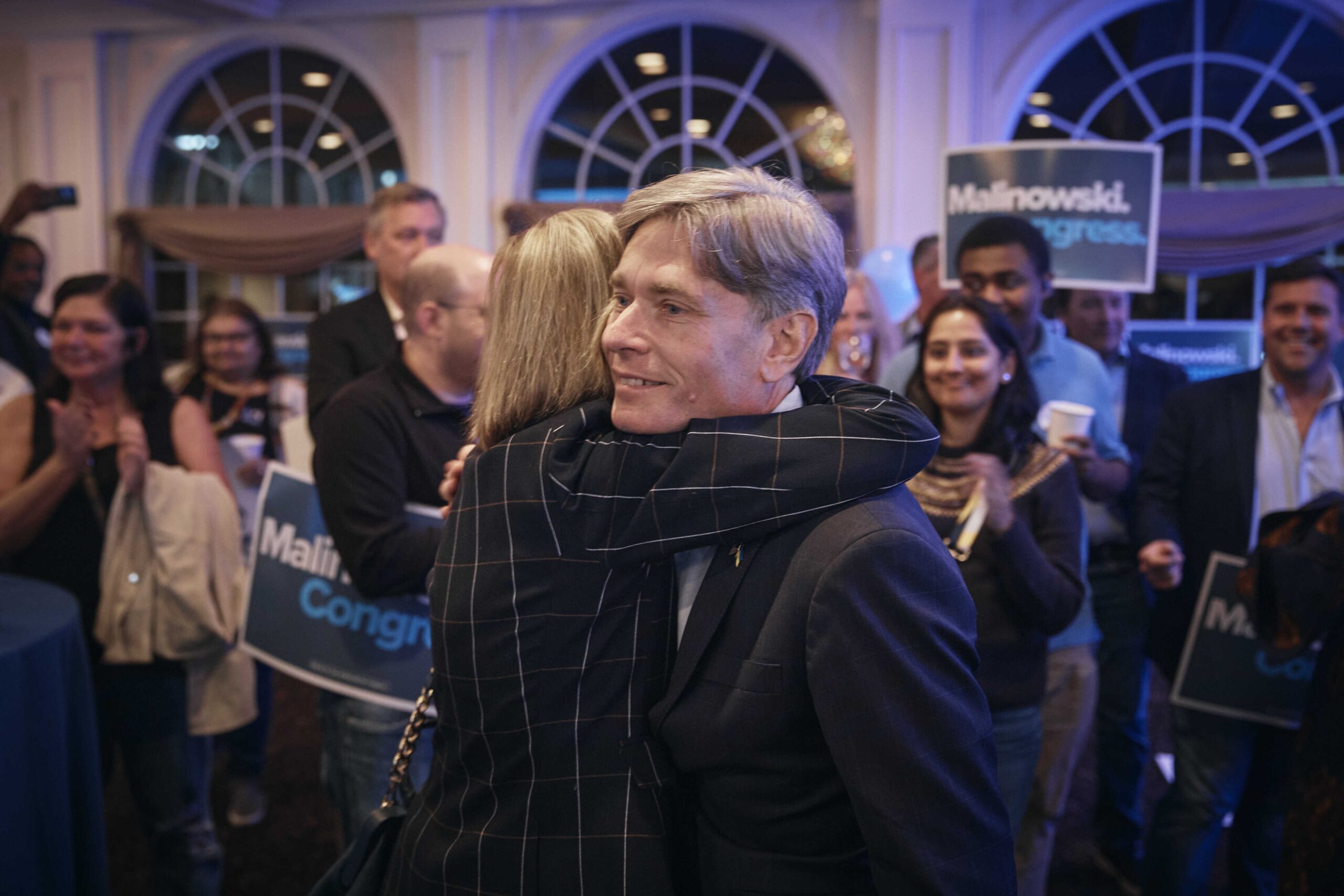
    Democratic Rep. Tom Malinowski, center right, arrives during his election night party in Garwood, N.J., Tuesday, Nov. 8, 2022.

    Tom Malinowski was backed by the local party apparatus

    Malinowski, 60, started as a freshman House Democrat alongside Sherrill in 2019 before losing his seat to Republican U.S. Rep. Thomas Kean Jr. in the 2022 election after he faced pushback for undisclosed stock trading and his area was redistricted to be less favorable to Democrats.

    His former district is right next to the 11th District and encompasses parts of Union, Somerset, Morris, and Sussex Counties, and all of Hunterdon and Warren Counties.

    He recently chaired the Hunterdon County Democratic Committee and previously worked as former President Barack Obama’s assistant secretary of state for democracy and human rights.

    He had the endorsement of the Morris County Democratic Committee, which would have had more sway before the state got rid of its county line ballot system last year.

    U.S. Sen. Andy Kim, the Burlington County Democrat who led the legal fight that led to the county line’s demise, endorsed Malinowski in this race, saying he trusts him.

    The Essex and Passaic County parties backed other candidates who were far behind Malinowski and Mejia.

    DNC Chair Ken Martin said in the premature Thursday night statement that Malinowski has “the experience to serve New Jersey once again.”

    AIPAC’s involvement in the race backfired

    Malinowski faced attacks from a super PAC funded by American Israel Public Affairs Committee (AIPAC), a pro-Israel national lobbying group, even though the group supported him in the past, The New York Times and other outlets reported.

    Those attacks likely pulled support away from Malinowski, who is far less critical of Israel than Mejia.

    Mejia called AIPAC’s tactics against Malinowski “disgusting” in a news conference on Friday and said it underscores her broader concerns about money in politics.

    “Big money can actually silence voters … In many ways, I’m glad that NJ-11 voters got to see the terrible tactics so that we could reject it in the future,” she said.

    The district, which used to be Republican, is now viewed as safely blue

    Sherrill flipped the 11th congressional district blue as a first-time candidate in 2018, defeating Republican Assemblymember Jay Webber after the GOP incumbent retired. The incumbent, former U.S. Rep. Rodney Frelinghuysen had held the seat since 1995. The district went from leaning Republican to leaning Democratic when its lines were redrawn in 2022.

    Sherrill won her last general election race for her House seat with 56.5% of the vote in 2024.

    The nonpartisan Cook Political Report rates the district as solidly Democratic. Former Vice President Kamala Harris won the district decisively by nearly 9 points in 2024, but it still swung to the right from Biden’s 2020 victory in the district by almost 17 points, according to Cook data.

    Joe Hathaway, the former mayor of Randolph in Morris County, was unopposed in the Republican primary.

    Hathaway, 38, said in a video on social media Thursday that the election brings an opportunity for “a new generation of leadership …one focused more on the hard work than the headlines.”

    He is a former aide to former Republican Gov. Christopher J. Christie and has worked in various roles in the private sector, and has branded himself as a “workhorse” throughout his campaign.

    Hathaway and the winner of the Democratic primary will face off on Thursday, April 16, less than two months before the regular primary election on June 2 for the midterms.

    When will the race be called, and will there be a recount?

    It’s unclear when the race will be called by The Associated Press (which The Inquirer relies on for election results), but it may not be this week.

    Mail ballots that were postmarked by Election Day on Thursday and received by the county Board of Election by next Wednesday can be counted in New Jersey.

    Provisional ballots in the state cannot be officially counted until after the eligible mail ballots are received to ensure the voter has not voted by mail. These ballots are used in specific situations, such as when a person registered to vote moves within the county without updating their address.

    Voters also have until the following Tuesday, Feb. 17, to cure a ballot flagged by election officials. This happens when there is a potential issue with a voter’s signature, which can happen when someone forgets to sign their ballot or whose signature has changed over time. The voter then has to verify their identity for their ballot to be counted.

    As for a recount, New Jersey doesn’t have an automatic recount system, so a candidate would have to request one and cover the expenses. The candidate would receive a refund if the result changed.

  • Brian Fitzpatrick has more cash on hand than any other swing district Republican incumbent in the country

    Brian Fitzpatrick has more cash on hand than any other swing district Republican incumbent in the country

    U.S. Rep. Brian Fitzpatrick has more cash on hand than any other GOP incumbent in a swing district nationwide as the party prepares for a tough election.

    The Bucks County lawmaker raised about $4.3 million in the most recent cycle, more than any other House candidate in the state and the 21st most of all the candidates running for the 435-member House in 2026. He ended 2024 with nearly $4.4 million when removing debt and had more than $7.3 million cash on hand as of Dec. 31. That haul makes him the best-funded of the 16 candidates on the National Republican Congressional Committee’s Patriots program, a group of vulnerable incumbents in key swing districts, according to Federal Election Commission data.

    “Brian Fitzpatrick has years of electoral success under his belt and will continue to be unbeatable in Bucks County because Pennsylvanians know he’ll always put them first in Washington … this race was over before it began,” NRCC spokesperson Reilly Richardson said in a statement.

    But Fitzpatrick’s district is one of four in Pennsylvania that could determine the control of the U.S. House and has long been coveted by Democrats because of its purple electorate. It is one of nine GOP-held districts in the country that former Vice President Kamala Harris won in 2024.

    Bob Harvie, a Democrat who chairs the Bucks County commissioners, has emerged as the front-runner to face Fitzpatrick in the 2026 election.

    Harvie, who would need to win the May primary to face Fitzpatrick, raised nearly $930,000 last year and has more than $400,000 cash on hand. He surpassed $1 million after getting $100,000 in the first few weeks of the year, according to his campaign.

    “Based on the outpouring of support we are receiving, it’s clear voters agree and are fired up to be a part of this campaign,” Harvie said Wednesday in a news release about his fundraising.

    Harvie made history flipping the Bucks County board six years ago, has strong name recognition in the district, and has the backing of national Democrats. But Fitzpatrick ended the year with nearly 20 times more cash on hand.

    Fitzpatrick received more money from each of New York and Florida than from in-state donors in 2025, according to FEC data. Harvie received the vast majority of his money from Pennsylvania.

    Fitzpatrick could be less vulnerable than other swing-state Republicans

    Fitzpatrick has set himself apart as willing to vote against President Donald Trump without blocking the president’s flagship bills. He was the only Pennsylvania Republican to vote against Trump’s One Big Beautiful Bill Act on final passage, and Trump called him disloyal in response. But Fitzpatrick had cast a key vote that propelled an earlier version of the legislation forward.

    He recently joined Democrats and two other swing-district Republicans in the state to vote to extend Affordable Care Act subsidies, which Republicans quashed. Fitzpatrick criticized House Speaker Mike Johnson (R., La.) and called some of his Republican colleagues “intellectually dishonest.” But Democrats have argued that Fitzpatrick has not been critical enough of the president, whom he often avoids naming when challenging his policies.

    Fitzpatrick has consistently outperformed Trump in the suburban district. He won his most recent election by nearly 13 percentage points.

    Jim Worthington, a GOP mega-donor in Pennsylvania and owner of the Newtown Athletic Club, said that Fitzpatrick’s approach makes him “the perfect representative for a purple county.”

    “Everybody that’s moderate and people that are independents, they love him because he votes to what best represents his constituents, and by the way, sometimes he takes some votes that make me cringe a little bit, but I understand why he does it,” Worthington said.

    Heather Roberts, a spokesperson for Fitzpatrick’s campaign, attributed the incumbent’s fundraising success to his ability to break the partisan mold.

    “Strong fundraising follows strong leadership — and Congressman Fitzpatrick has built a broad coalition of Republicans, Democrats, and Independents who are rejecting the extremes and backing two-party, patriotic, common-sense solutions,” Roberts said in a statement.

    But Democrats are still trying to tie Fitzpatrick to the president, whose popularity is falling, according to Pew Research Center and other pollsters.

    Fitzpatrick “is no maverick and no John McCain — he is a doormat for Trump’s worst instincts and a greenlight for D.C. Republicans’ dangerous agenda that is hurting our community,” Harvie said Wednesday in a statement to The Inquirer.

    “Pennsylvanians deserve a Congressman who will stand up to Trump and actually do something to lower prices — but Fitzpatrick is weak and caves to his own party when it matters most,” said Eli Cousin, a spokesperson for the Democratic Congressional Campaign Committee, in a statement.

    Democrats, including Harvie, will also be trying to build on their successes from the November 2025 elections, when Democrats flipped two key row offices in Bucks — district attorney and sheriff — and saw wins on local school boards.

    But the nonpartisan Cook Political Report expects Fitzpatrick to be in a safer position than his swing-district colleagues, rating his district as “likely” Republican, while U.S. Rep. Rob Bresnahan’s Northeastern Pennsylvania seat is rated “lean” Republican. Republican U.S. Reps Scott Perry of York County and Ryan Mackenzie of Lehigh County are each in districts rated as a “toss up.”

    Harvie has less cash on hand than the other Democratic front-runners in the state’s swing districts.

    Janelle Stelson, a second-time challenger to Perry, ended 2025 with about $1.5 million cash on hand. Scranton Mayor Paige Cognetti, who is challenging Bresnahan, ended the year with a little more than $800,000 cash on hand. Former federal prosecutor Ryan Croswell, Mackenzie’s Democratic challenger with the most cash, has $612,000 for the Lehigh Valley race.

    Does name recognition make Harvie a ‘formidable’ challenger?

    Harvie’s campaign is confident that he can cash in on name recognition, having won two countywide commissioner races in the last seven years that could help raise his profile among voters in the 1st Congressional District, which includes all of Bucks County and a sliver of Montgomery County.

    Provided he wins the primary, Harvie would be the first Democratic challenger to Fitzpatrick’s seat who has held countywide elected office.

    But will that help Harvie’s chances?

    “The starting point that Bob Harvie has with his name ID as a commissioner is just a much better starting point,” said Brittany Crampsie, a Democratic consultant in Pennsylvania, noting that he would not need to spend as much money introducing himself to voters in an expensive Philadelphia-area media market.

    “He has a lot of advantages going into this race, not the least of which is his name ID, but he would be probably the most formidable matchup we’ve seen against Fitzpatrick in his tenure,” she added.

    “Maybe,” GOP consultant Christopher Nicholas said as to whether Harvie has valuable name recognition, adding that “among hardcore Democrats his name ID is decent because they’re hardcore Democrats.”

    “But if you stood out on the streets of Tullytown or Riegelsville or Dublin and said, ‘Who are your county commissioners?’,” residents may be unfamiliar, Nicholas said.

    As of October 2025, 43% of respondents to an internal Harvie campaign survey conducted by Public Policy Polling could identify Harvie, with 26% giving him a favorable rating and 17% an unfavorable. That poll had the commissioner and Fitzpatrick tied at 41%.

    This article has been updated to include a comment from Fitzpatrick’s campaign received after publication.

  • Cory Booker has raised more than nearly every candidate for Congress running in 2026

    Cory Booker has raised more than nearly every candidate for Congress running in 2026

    U.S. Sen. Cory Booker has raised more than $30 million for his reelection campaign, outdoing the vast majority of candidates running for either chamber of Congress in 2026.

    The New Jersey Democrat has raised the second-largest amount of money for the 2026 elections for U.S. House and Senate as of the end of last year, behind only Sen. Jon Ossoff (D., Ga.), according to Federal Election Commission reports.

    Booker is widely considered a potential presidential contender for 2028, after unsuccessfully seeking the office in 2020.

    The lawmaker has no serious challengers at this point for his Senate seat, and he could leave this cycle with extra money he could use for a presidential run.

    His campaign has nearly $22 million cash on hand and no debt. He has been adding to his coffers since he began his most recent term in 2021.

    More than 200,000 people donated to Booker in 2025, and roughly 80% of the donations were $25 or less, according to Booker’s campaign.

    “Cory is backed by a grassroots movement that recognizes the importance of strong, principled leadership that stands up in this moment,“ his campaign manager, Adam Silverstein, said in a statement. ”We are grateful for this incredible outpouring of support and will keep building the infrastructure we need to win in 2026 and elect Democrats at every level.”

    The New Jersey Democrat saw a fundraising spike when he delivered a record-breaking 25-hour speech on the Senate floor last year. He raised nearly $9.7 million in the second quarter of 2025, the period that included his speech, far more than any other quarter last year.

    Booker criticized President Donald Trump on a host of issues in the speech and held up a pocket Constitution. He also acknowledged his own party’s failure to prevent Trump’s return to office.

    “I confess that the Democratic Party has made terrible mistakes that gave a lane to this demagogue,” he said in his speech. “I confess we all must look in the mirror and say, ‘We will do better.’”

    Laura Matos, a New Jersey Democratic operative, said Booker was already a “known entity,” and his speech came at a time when Democrats across the country were looking for someone to stand up to Trump.

    “For 25 hours, his people could constantly churn out, like every hour, ‘He’s still on the Senate floor, show him you support him,’” said Matos, a partner at lobbying and public affairs firm MAD Global Strategy Group. “The way that fundraising works, you can really build upon things like that. He was prolific before that, and then that just kind of skyrocketed it.”

    Ossoff, the 2026 federal candidate who reported more than Booker, has raised nearly $64 million and faces a more competitive race in a key swing state.

    Booker was viewed as a rising star in the party several years ago before dropping his primary bid for president in 2020 in part because he did not have enough money or support.

    He began serving as mayor of Newark in 2006 until he was elected to the U.S. Senate in a 2013 special election.

    Booker is also heading into a national tour to promote Stand, his new book, set to publish next month.

    The book combines Booker’s personal reflections with stories of American leaders from President George Washington to Supreme Court Justice Ketanji Brown Jackson, and “offers a hopeful and practical path forward,” according to his publisher, Macmillan.

    The tour will include a stop at the New Jersey Performing Arts Center in Newark, where Gov. Mikie Sherrill was inaugurated, as well as a book shop in D.C. and a church in St. Louis.

    Pennsylvania Gov. Josh Shapiro, another potential 2028 Democratic contender, recently embarked on a book tour of his own.

    Most of Booker’s money comes from outside New Jersey.

    According to FEC data, from January through September 2025, he received the most money from California, followed by New York.

    While Booker is raking in money, he’s also spending it. He spent the fourth most out of all 2026 Senate candidates, reporting $14 million in spending since 2021.

    One of his biggest expenses was in April, when his campaign spent $1.2 million on an email list acquisition.

    The only other candidate who has reporting fundraising for the New Jersey Senate race so far is Justin Murphy, a Republican from the Pinelands, who reported a little over $3,500.

    Several other Republicans have expressed interest in running in the primary, and county parties will hold conventions in the coming weeks to endorse candidates.

    Luke Ferrante, the executive director of New Jersey GOP, said the party is planning “a robust effort statewide” to unseat Booker.

    “New Jerseyans across the state are eager to elect a statewide representative that is focused on delivering for its residents, not their greater Washington ambitions,” Ferrante said.

  • Janelle Stelson almost beat Scott Perry in 2024. She keeps outraising him as she prepares for a rematch.

    Janelle Stelson almost beat Scott Perry in 2024. She keeps outraising him as she prepares for a rematch.

    Democrat Janelle Stelson outraised U.S. Rep. Scott Perry for the second quarter in a row in her bid to flip the Central Pennsylvania district, which could determine control of the House in November.

    Stelson, who lost by a little more than 1 percentage point to Perry in 2024, has raised more than $2.2 million since launching her rematch campaign in July. She has outraised Perry in both quarters since her kickoff and has more cash on hand than the incumbent Republican when taking his campaign debt into consideration.

    Perry, a close ally of President Donald Trump, appears to be in the toughest fight of his political career. The seven-term lawmaker continues to be a Trump loyalist even as other swing-district Republicans in the state increasingly look to distance themselves from the president.

    Stelson’s strong fundraising haul indicates Democrats think they can finally flip the seat this year in a more favorable environment after Stelson came close in 2024 even though Trump carried the state and led a red wave.

    Stelson, a former TV anchor and former Republican, has again rooted her campaign in attacks on Perry and Trump. She thinks it will work this time.

    “I think the story of Scott Perry just keeps getting worse,” Stelson, 65, said in an interview. “He’s somebody who I covered for years on the news, and people have just really had enough. After more than a decade in Washington, he’s caused a lot of problems.”

    Perry, 63, a member of the conservative House Freedom Caucus, voted last month against a Democratic-led bill to restore recently expired healthcare subsidies amid a national spike in insurance premiums, a vote Stelson has seized upon. Three other Pennsylvania Republicans who represent swing districts — U.S. Reps. Brian Fitzpatrick, Rob Bresnahan, and Ryan Mackenzie — voted for the measure.

    Stelson would need to win the Democratic primary in May to set up the November rematch. She is facing Dauphin County Commissioner Justin Douglas, a progressive pastor, who has raised under $85,000 this year. Perry also has his first primary challenge, from Karen Dalton, a retired attorney for Harrisburg Republicans, who reported raising a little more than $11,000 since launching her campaign.

    Perry raised more than $2.9 million in 2025, and Stelson has raised $2.2 million since she launched her campaign in July. Stelson raised more than $946,000 from October through December, beating Perry’s haul for the quarter of $780,031.

    Stelson ended the year with $1.52 million cash on hand, while Perry had $1.66 million. But Perry’s campaign also has nearly $280,000 in debt, which would put Stelson ahead when factored into the totals.

    FILE – U.S. Rep. Scott Perry, R-Pa., speaks during a campaign event in front of employees at an insurance marketing firm, Oct. 17, 2024, in Harrisburg, Pa.

    The nonpartisan Cook Political Report rated the district as a toss-up alongside Mackenzie’s Lehigh Valley district, marking them as among the most competitive races in the country.

    Perry campaign spokesperson Matt Beynon said Perry’s fundraising last quarter was “incredibly strong” and pointed to how he outraised fellow swing district Republicans Bresnahan and Mackenzie during that stretch.

    Beynon said Perry is in a better position to ward off a Democratic challenge this year because his district has emerged as a priority for national Republicans, landing on the National Republican Congressional Committee’s Patriots Program — a list of priority races that he was not on in 2024.

    “Seeing the results last go-around, and seeing how hard we fought to make sure that the congressman was reelected, I think did open some eyes, and the congressman has been able to make the case that he needs support, too,” Beynon said in an interview.

    He said it has been “a learning experience for folks to understand” that the district has become increasingly blue in recent years. The 10th Congressional District includes Dauphin County and parts of York and Cumberland Counties, and is home to Harrisburg and Hershey.

    Perry declined to be interviewed for this article.

    Stelson said Republican voters in the district who have historically voted along party lines are “really waking up” and are beginning to view Perry as more of an “extremist” than a Republican.

    She criticized Perry for urging his colleagues to throw out Pennsylvania’s votes hours after the Jan. 6, 2021, attack on the Capitol. She also pointed to his vote against awarding the Congressional Gold Medal to Capitol Police officers, as well as his support for Trump’s One Big Beautiful Bill Act, which made cuts to Medicaid and SNAP in order to help fund Trump’s tax cuts and immigration crackdown.

    “He’s always putting his far-right politics ahead of the needs of people in this area,” Stelson said. “They can’t pay their bills. … His defeat actually would be a defeat for extremism in our politics.”

    Democrats are optimistic that having Gov. Josh Shapiro, who won the district in 2022, at the top of the ticket will boost Stelson’s chances and build on last year’s momentum in local races.

    Perry’s campaign has called Stelson a “carpetbagger,” since she lived outside district lines in nearby Lancaster last time she ran. Stelson has argued that she knows the district well because of her decades-long career as a local journalist, and that she used to live in it.

    Stelson campaign spokesperson Alma Baker confirmed Stelson now rents a home in the district in Camp Hill while still owning her Lancaster residence, noting she lives in the district full-time.

    Stelson pointed to what she described as “national problems” when asked about unique issues in the district, such as the economy. Her campaign soon after unveiled an agenda aimed at supporting farmers and other rural residents.

    Beynon said that Perry will speak about his support for provisions in Trump’s One Big Beautiful Bill Act like ending tax on tips and extending tax benefits for overtime. He will also point to his long-held position sponsoring a bill to ban stock trading in Congress, on which he has collaborated with Democrats.

    Both candidates plan to talk about affordability, which has emerged as a successful message for both sides of the aisle.

    “It’s just getting worse when you have to worry about whether you’re going to put groceries on the table or pay your skyrocketing utility premiums, that’s a real problem,” Stelson said. “You can’t send kids to school without something in their tummies, otherwise they’re going to be thinking about that all day instead of learning.”

    As a broadcast journalist for decades, the second-time candidate said, she listened to and highlighted concerns from people in the district.

    “And I feel like now they can teach me what I need to be doing in Congress when I carry their voices there,” she added.

  • John Fetterman has voted to fund the government. Here’s how other local senators have voted.

    John Fetterman has voted to fund the government. Here’s how other local senators have voted.

    The U.S. Senate passed a bill late Friday to fund the federal government, but a short-term shutdown still went into effect Saturday.

    Senate Democratic leadership struck a deal earlier this week with President Donald Trump to separate Department of Homeland Security funding from the budget for other federal agencies after a national backlash to the ongoing ICE operation in Minnesota.

    The agreement with the White House emerged late Thursday after every Democrat, including Sen. John Fetterman of Pennsylvania, and several Republicans voted down the original package.

    Fetterman was among 23 Democrats to cross the aisle to vote for the compromise bill. With their support, the bill passed 71-29, despite five GOP defections.

    Here’s how the senators from the Philadelphia area voted:

    • Sen. John Fetterman (D., Pa.): Yes.
    • Sen. Dave McCormick (R., Pa.): Yes.
    • Sen. Andy Kim (D., N.J.): No.
    • Sen. Cory Booker (D., N.J.): No.
    • Sen. Chris Coons (D., Del.): Yes.
    • Sen. Lisa Blunt Rochester: (D., Del.): No.

    Even with the Senate passage, a partial government shutdown took effect Saturday because the bill still needs to pass the House, which is not expected to take up the legislation until Monday.

    It’s the second shutdown to begin since October when the federal government entered a 43-day shutdown, the longest in its history.

    Democrats took issue with funding in the earlier bill for DHS, the department that oversees the two agencies involved in fatal shootings of civilians this month in Minnesota.

    The Senate worked late Friday as some Republicans objected to the deal. McCormick, the lone Republican senator in the region, voted for the measure as expected.

    “I’m just not in favor of shutting down the government or stopping funding the government, and that’s the position that I’ve had through the last shutdown,” McCormick said Tuesday.

    The affected departments include the Departments of Defense, State, Transportation, Education, Labor, Treasury, Health and Human Services, and Housing and Urban Development, in addition to DHS.

    The deal struck with the White House would provide two weeks of funding for DHS, but funds the rest of the departments through September.

    Democrats on Thursday halted the original package that would have provided long-term funding for DHS, which oversees ICE and the Border Patrol.

    Fetterman had called for the DHS funding to be separated from the other departments as a compromise, which is ultimately what happened.

    The DHS funding dispute came after the national furor over the killings of Renee Good, a poet and mother, and Alex Pretti, a nurse who worked at a VA hospital, both of whom protested the ongoing operation in Minnesota and were fatally shot by federal agents.

    Democrats pushed for provisions to curb ICE’s immigration enforcement operations in order to fund DHS. Their demands include increased training for ICE agents, requiring warrants for immigration arrests and for agents to identify themselves, and for the Border Patrol to stay on the border instead of helping ICE elsewhere.

    Lawmakers from both parties have called on DHS Secretary Kristi Noem to resign or be fired, including all of the local Democrats.

    McCormick, a Trump ally who has been vocally supportive of ICE, called for an investigation into the fatal shooting of Pretti.

    This article contains reporting from the Associated Press and staff writer Fallon Roth.