Author: Aliya Schneider

  • Steve Sweeney to be paid up to $287K in new Gloucester County job after being appointed during Friday commissioners’ meeting

    Steve Sweeney to be paid up to $287K in new Gloucester County job after being appointed during Friday commissioners’ meeting

    Former New Jersey Senate President Steve Sweeney, who finished last in the six-way Democratic primary for New Jersey governor in June, will receive a six-figure salary in Gloucester County for a new role.

    The Gloucester County Board of Commissioners appointed Sweeney as county administrator at its public reorganizational meeting Friday night. The role has a salary rage of $191,308 to $287,168.

    The resolution appointing Sweeney, 66, to the position is tucked away in an unsearchable 236-page packet posted online Friday afternoon, just hours before the meeting. It does not say what Sweeney will be paid, but the document specifies that the county will provide him with a vehicle that can be utilized for personal use — “as in the past,” the resolution notes.

    Sweeney replaces Chad Bruner, the county’s longtime administrator who recently stepped down. Bruner chairs Rowan University’s Board of Trustees, which Sweeney joined in September.

    The resolution easily won approval by the board, which is composed of five Democrats and two Republicans. All five Democrats voted yes. Republican Nicholas DeSilvio voted no, while Republican Chris Konawel Jr. abstained from voting in protest.

    “They violated procedure, and I do believe that was an illegal meeting,” Konawel said Saturday morning.

    Democratic commissioners wouldn’t allow him to object to a “consent agenda,” which would have let commissioners look more closely at each resolution on the agenda, Konawel said. He said he received a copy of the resolution just four hours before the meeting, and noted that the vote was scheduled during a meeting with no public comment period.

    “The biggest thing for me is, we just handed somebody a $290,000 a year job, with no idea what his qualifications were,” Konawel said.

    Sweeney’s contract will last 5 years, the maximum for the role.

    Sweeney, a longtime friend of power broker George Norcross and an ironworker union leader, served the longest tenure as state Senate president, the most powerful position in New Jersey government aside from governor.

    But the West Deptford Democrat lost his reelection in 2021 to Trump-aligned Republican Ed Durr, a truck driver with little funding who planned to also run for governor before dropping out last year.

    The Republican commissioners first found out that Sweeney was picked for the role through the rumor mill weeks ago when department heads were given a heads-up behind closed doors, Konawel said.

    Konawel and DeSilvio each questioned Sweeney’s credentials in part because he didn’t attend college.

    “I kind of thought that they would actually go through a process to pick somebody qualified. I didn’t think they would just give it to Steve Sweeney, but that’s what they did,” DeSilvio said.

    Sweeney and Democratic leaders on the county board could not be reached on Friday for comment.

    Since leaving the state Senate, Sweeney served as the founding chair of a think tank at Rowan University called the Steve Sweeney Center for Public Policy.

    He attempted a political comeback last year, but his campaign for governor failed to gain traction outside of South Jersey and he did worse than expected even within the region.

    Sweeney ran to the right of his opponents on certain issues, like by saying he would get rid of the state’s sanctuary policy for undocumented immigrants, a stance touted by Republicans.

    He avoided the press in the final days of his campaign and left his party quietly just minutes after his loss, which signaled another failure of the South Jersey party machine. He won Gloucester and Salem Counties by wide margins but lost to Gov.-elect Mikie Sherrill in the other three southern counties that endorsed him.

    As county administrator, Sweeney will oversee all county department heads and can sign off on all personnel actions. The powerful role also comes with the authority to help prepare the county budget, authorize payments, take part in board discussions (without voting power), inquire into county operations, and sign off on behalf of the clerk of the board if the clerk is absent.

    County administrators are paid six-figure salaries throughout the state, but Gloucester County has developed a reputation for paying its administrator particularly well.

    Bruner was the second highest paid county administrator in the state at $253,324 in 2023, according to data compiled by the Bergen Record. The highest county administrator salary that year was in Middlesex County, which has more than double the population of Gloucester, according to the Census Bureau. Sweeney’s starting salary was not stated at the meeting, according to Konawel.

    Sweeney cannot be removed from the role without cause for the duration of his contract, and if he is, he will still receive his remaining salary, according to the resolution. He will be eligible for raises.

    Attorney General Matt Platkin expressed disapproval over the position’s high salary last month, noting that Gloucester’s County administrator was making more than the governor, whose salary is $175,000 and will raise to $210,000 this year when Sherrill takes office.

    “A county administrator making $100k more than the current governor’s salary is a pretty good argument to keep the comptroller as an independent agency to combat waste, fraud, and abuse in local government,” Platkin said in a social media post in early December when the state legislature was considering an ultimately unsuccessful bill to limit the watchdog’s power.

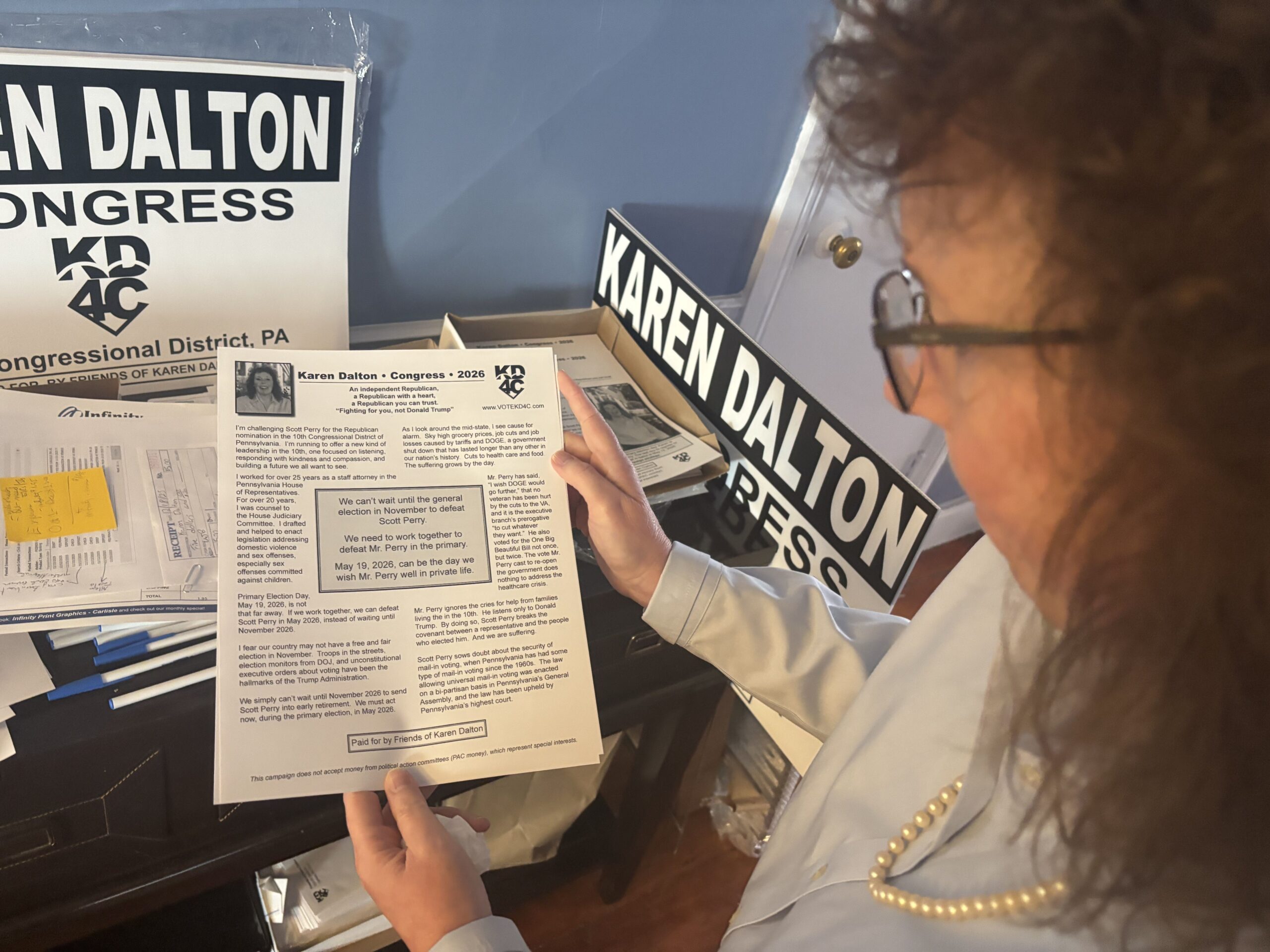
  • Karen Dalton, who plans to challenge Scott Perry in the GOP primary, has her own definition of RINO

    Karen Dalton, who plans to challenge Scott Perry in the GOP primary, has her own definition of RINO

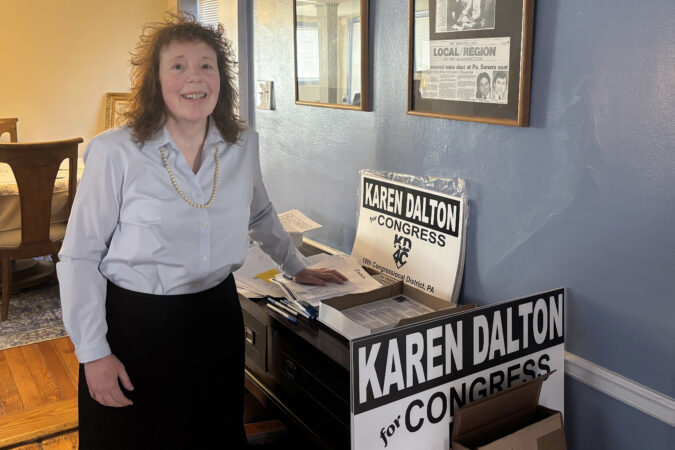
    If she makes it on the ballot, Karen Dalton will be U.S. Rep. Scott Perry’s first primary opponent since 2012 – the year he first won the seat.

    Dalton, a retired staff attorney for the Pennsylvania House Republicans, knows the odds are against her as she runs a solo campaign operation out of her living room. But she thinks she has a shot.

    The 65-year-old Carlisle resident is irked by President Donald Trump’s policies both from a faith-based standpoint and a legal one.

    She holds many views that align with Democrats, which may draw accusations that she’s a “RINO,” or Republican in name only. But she argues she’s a Republican at heart.

    “I was talking to a senior citizen the other day, and the first thing he said to me was, ‘So you’re a RINO,” said Dalton, 65. “And my response to that was, well, if you mean ‘Respect for Individuals and Not Oligarchs,’ I’ll go along with that. He goes, ‘No, no, no, I’m a RINO too. I’m that old school Republican that believes in helping people.’ I’m like, ‘Yes, thank you. That’s what I’m talking about getting back to.’”

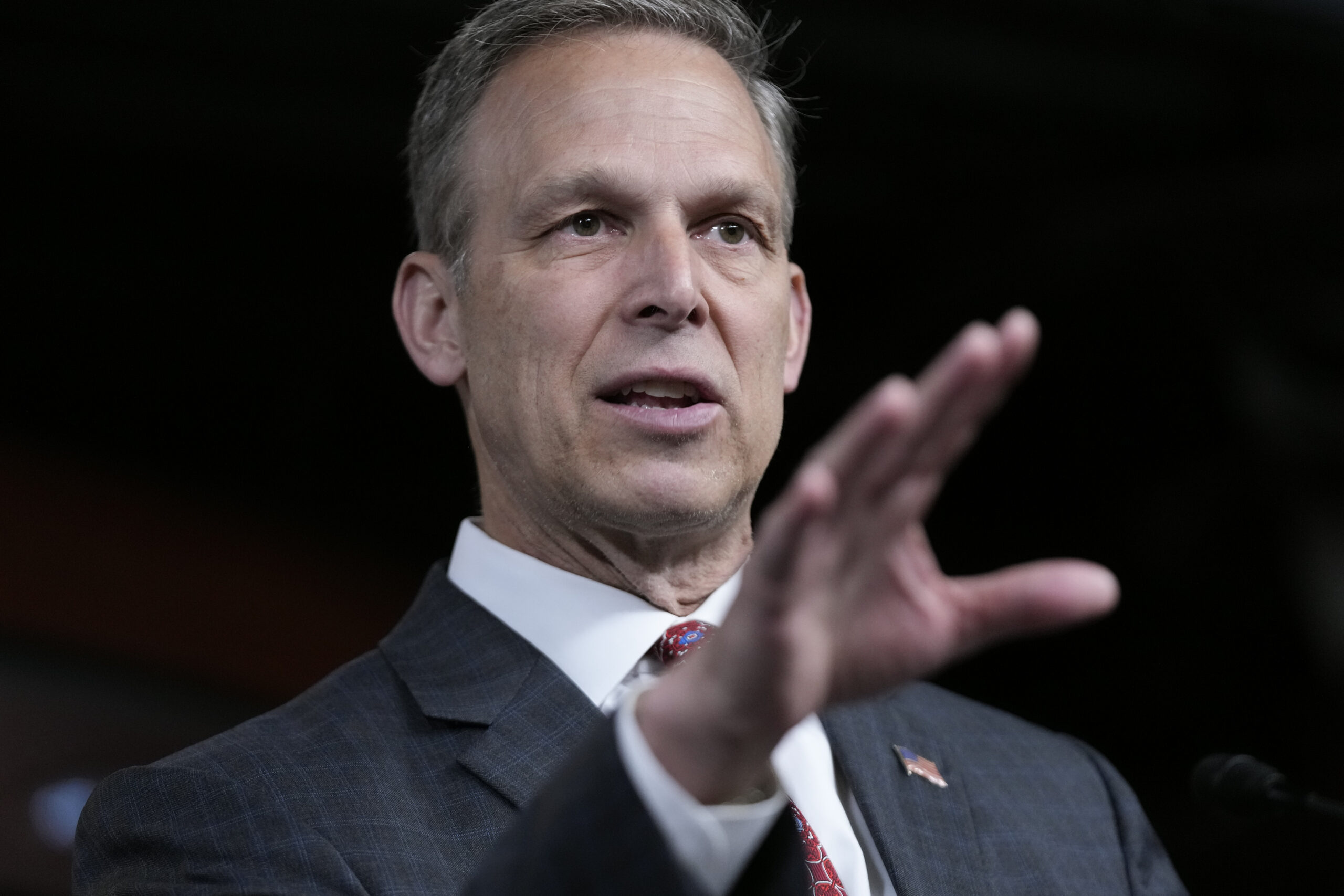
    Perry, a longtime ally of President Donald Trump who supported his unsuccessful attempts to overturn the 2020 election, represents Dauphin County and parts of Cumberland and York Counties in Central Pennsylvania. He appears to be particularly vulnerable this year as the district has shifted toward Democrats and Republican-turned-Democrat Janelle Stelson, a former local news anchor, had a razor-thin loss against him in the general election last year. She plans to run again in the Democratic primary.

    Dalton, in a long-ranging interview with The Inquirer in her living room, called Donald Trump’s One Big Beautiful Bill Act the “Big, Brutal Betrayal of the American Dream Act,” because of its cuts to Medicaid and SNAP.

    She believes former Vice President Kamala Harris should have pushed back more on Trump’s claims about transgender people in the 2024 election, argued that the term “illegal alien” is factually incorrect, and says on her website that climate change is a real threat.

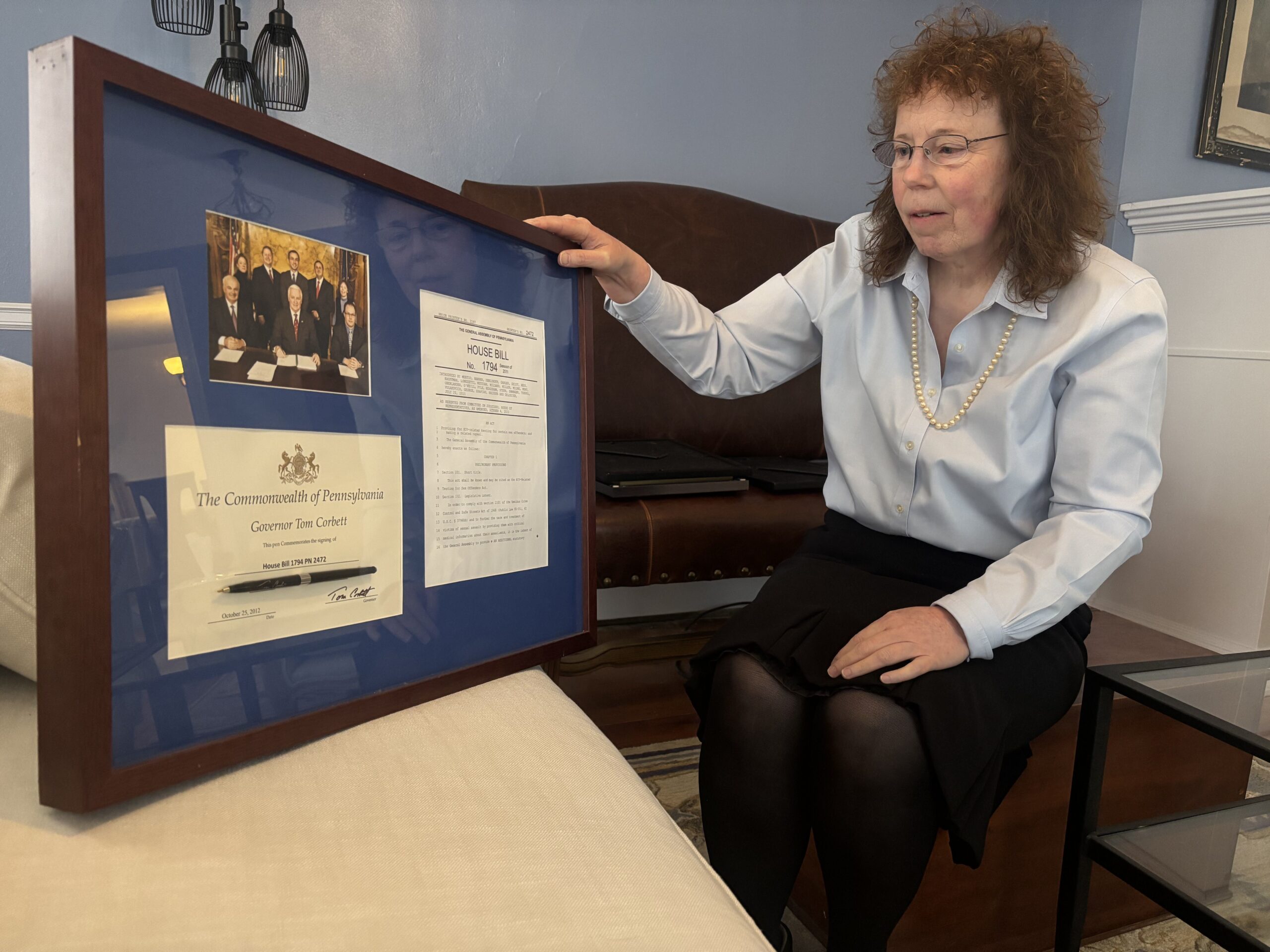
    Karen Dalton, who plans to challenge Scott Perry in the Republican primary, holds materials from a bill she worked on in Harrisburg in her Carlisle home on Monday.

    She supports a $15 federal minimum wage and a millionaire’s tax, and wants to raise the corporate tax rate. She supports abortion rights and believes health care is a human right, though she’s fearful of what she views as over-regulation from Democrats.

    Her walls are covered with Republican political memorabilia and a poster of the late Sen. Robert F. Kennedy, a Democrat who was assassinated during his 1968 presidential campaign.

    She noted that she was a Republican when Donald Trump was a Democrat.

    Her path to victory, she believes, is convincing enough independents and Democrats – particularly former Republicans – to change their registration to support her in the May GOP primary.

    “You know, independents have been upset many years because Pennsylvania has a closed primary system … if they register as Republicans, they get to vote in a primary against Scott Perry and not wait until November,” she said.

    Primary challengers are rarely successful. Dalton reported under $3,000 in contributions – and an approximately $6,000 loan from herself — through September, which is pennies compared to the more than $1 million Perry reported.

    But she only needs to gather 1,000 signatures and pay a $150 filing fee to appear alongside him on the primary ballot.

    Perry’s campaign did not respond to a request for comment about Dalton as of Wednesday.

    U.S. Scott Perry speaks during a news conference on Capitol Hill in Washington in July 2023.

    Rosy eyed about the old Republicans

    Dalton grew up in New Jersey and was the first in her immediate family to go to college, attending Montclair State University before getting her politics graduate degree at New York University and later attending law school.

    She lives in Carlisle near Dickinson Law — her “beloved alma mater” — in a home she bought just four years ago at age 61. With student loans hanging over her head for the vast majority of her career, she couldn’t afford a down payment until her state retirement payday.

    She has no kids and she’s never been married — “I spent a lot of time reading and studying and going to school,” she said. These days, she takes piano lessons and plays pickleball, and does pro bono legal work when she’s not knocking on doors for her one-woman campaign.

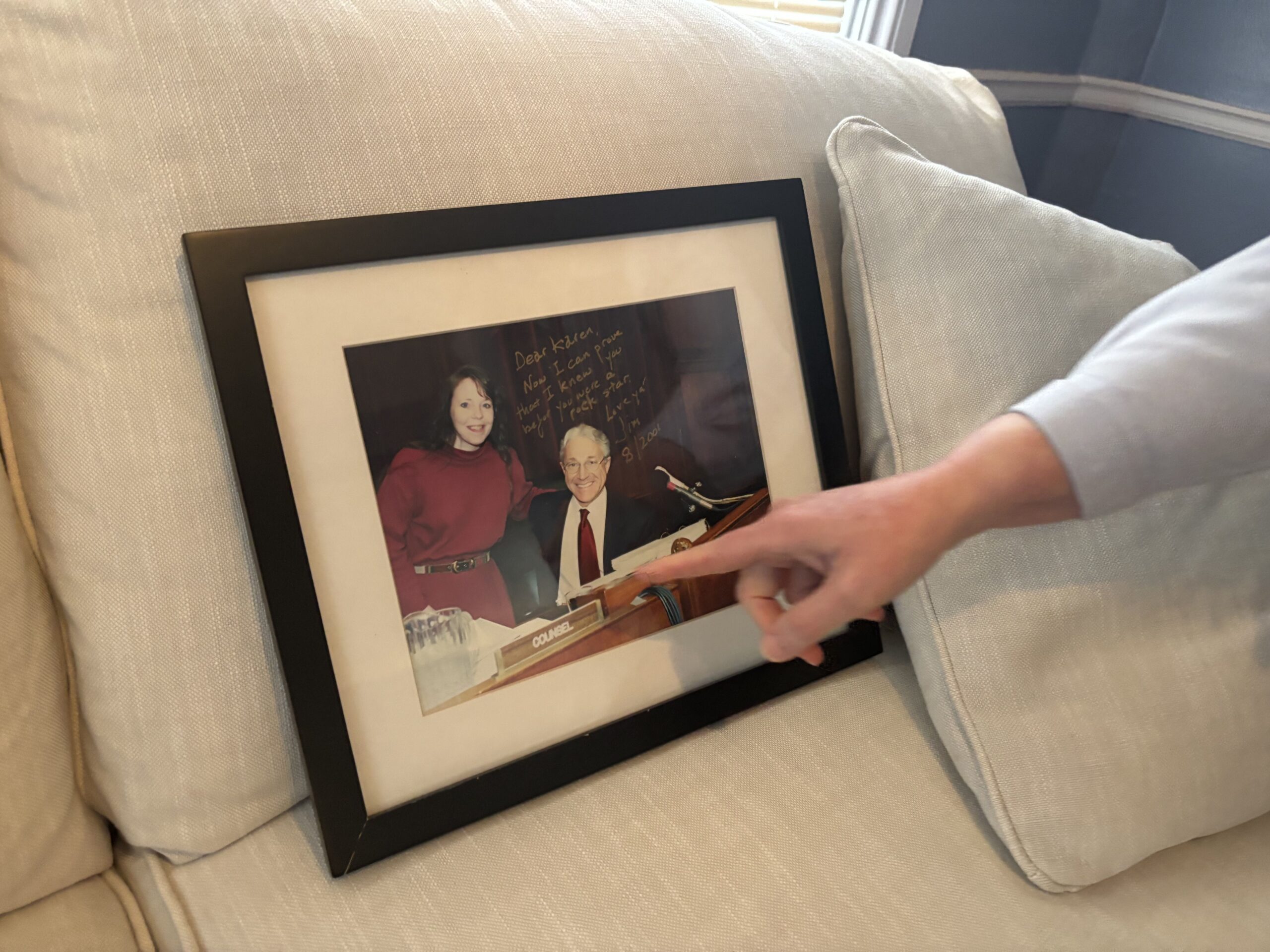
    Dalton is rosy-eyed about moderates of the Republican Party’s past. She managed former U.S. Rep. Jim Greenwood’s (R., Bucks) successful state Senate campaign in 1986 and worked for New Jersey Republican Gov. Tom Kean, who wrote The Politics of Inclusion. She later worked as a staff attorney for Pennsylvania House Republicans for 25 years, where she focused on domestic violence and child sexual abuse legislation.

    “I’m convinced that if the Republican Party wants to survive and thrive, we need to give up what Donald Trump believes in, and return to our roots,” she said.

    Dalton, whose parents were both Democrats, changed her registration from independent to Republican in 1984 at the age of 24 after her first job working for Ralph J. Salerno’s unsuccessful state Senate campaign in New Jersey. When he lost, “amazingly, nobody took up arms,” she said.

    “I mean, I cried in his lapel, but you know, it’s just like he conceded, and everybody moved on,” she said. “There was no insurrection, there was no battle, there was no violence, there was no ‘Oh, there was voter fraud.’ None of that stuff happened, because that’s the way things used to be before Donald Trump was president.”

    Karen Dalton points to a photo of herself and her old boss Jim Greenwood in her Carlisle home on Monday. A message from Greenwood says: “Now I can prove that I knew you before you were a rock star.”

    Tired of yelling at the television

    Dalton said she didn’t think she’d become a candidate herself during her years working for politicians. But she said “steam started to come out of my ears” when Trump tried to end birthright citizenship, and again when House Speaker Mike Johnson mused about defunding the federal judiciary.

    “I just couldn’t sit back anymore … I got tired of yelling at the television,” she said.

    While Dalton argued that Trump’s rise in 2015 has soured the Republican Party, much of her criticism concentrated on the Jan. 6, 2021 riot and what followed.

    Dalton worked with Perry in Harrisburg when he was a state representative, and she described him as “an incredibly nice man” despite her misgivings about his efforts to overturn the 2020 election and continued alignment with Trump. (She calls him “morally blind” on her website.)

    When asked if she ever supported Perry, Dalton said she wasn’t comfortable talking about who she voted for in the past because “ballots are private.” She did say that she didn’t vote for Trump in 2024, and she voted for Stelson, Perry’s Democratic challenger.

    “I can tell you that I don’t vote for insurrectionists,” she said.

    Karen Dalton, who plans to challenge Scott Perry in the Republican primary, calls a table in her living room her “campaign headquarters.”

    Policy informed by faith

    Dalton was raised Catholic, confirmed Episcopalian, and has attended the Unitarian Universalist Church. Though she hasn’t converted, she now identifies as Jewish, and was moved to tears while talking about a late mentor who introduced her to the religion – noting that speaking about the subject made her “verklempt,” a Yiddish term for emotional.

    “One of the things I love so much about Judaism, in addition to its focus on social justice, is the idea that you get to disagree,” she said, a handful of crumpled tissues in her lap.

    Her faith informs her approach to public policy, from opposing cuts to healthcare subsidies to appreciating ideas across the political spectrum.

    One of her flagship policy proposals is creating a way for people to borrow up to two years worth of their own Social Security benefits before they reach retirement age to help with things like a down payment, tuition, or medical expenses – one that would have helped her buy a home earlier.

    Another is a scholarship program that would allow students in any field to borrow the full amount of their education from the federal government through loans that would be forgiven if they serve “the public good,” a rebuke of Trump’s One Big Beautiful Bill’s borrowing limit on federal student loans.

    She also wants to create a program to pay for the education of students who want to pursue careers in science and guarantee employment at national health or science institutions, including a new foundation for scientific discovery.

    Dalton has brought her neighbors into her home to discuss her ideas, and plans to do it again.

    She also held a town hall at Central Penn College in Enola that she said drew 15 people.

    “That’s 15 more people than Scott Perry looked in the eye and talked to over the past five years at his town halls that didn’t exist,” she said.

  • How Camden tells the story of Mikie Sherrill’s big win and New Jersey’s blue wave

    How Camden tells the story of Mikie Sherrill’s big win and New Jersey’s blue wave

    The story behind New Jersey Gov.-elect Mikie Sherrill’s landslide victory last month can be understood by looking at her strong performance in the city of Camden.

    The young, diverse, and working-class city exemplifies trends that played out across the state as Sherrill reversed rightward shifts among the voter groups Democrats desperately need to rebound with nationally.

    An Inquirer analysis of municipal-level data shows that Sherrill outperformed both former Vice President Kamala Harris in 2024 and outgoing Democratic Gov. Phil Murphy in 2021 across New Jersey’s 564 cities, boroughs, and townships, winning 300 — about 53% — of them as compared with Harris’ 252 last year and Murphy’s 210 four years ago.

    She reversed gains made by President Donald Trump last year that gave Republicans false hope that Jack Ciattarelli, who was aligned with and endorsed by Trump, would do much better in November than he actually did as Sherrill outperformed expectations.

    window.addEventListener(“message”,function(a){if(void 0!==a.data[“datawrapper-height”]){var e=document.querySelectorAll(“iframe”);for(var t in a.data[“datawrapper-height”])for(var r,i=0;r=e[i];i++)if(r.contentWindow===a.source){var d=a.data[“datawrapper-height”][t]+”px”;r.style.height=d}}});
    Camden’s population is more than 54% Hispanic and nearly 38% Black — Democratic-leaning voter groups that had shifted toward Trump nationally in 2024. Sherrill’s campaign had outreach operations geared toward both Black and Hispanic voters.

    Every demographic group in the state swung toward Democrats this year, but Sherrill’s most striking improvement over Murphy and Harris seemed to be among Hispanic people, who make up more than half of Camden’s population.

    She similarly made gains in areas across the state that have high populations of young voters, lower-income voters, and voters without college degrees — like Camden.

    Voters in Camden turned out for Sherrill resoundingly with 92% of the vote, more than 10 percentage points better than Harris performed in the city during her presidential run last year, and Sherrill outperformed the former vice president in every one of the city’s 40 precincts. The larger the Hispanic share of the voting district, the larger it shifted toward Sherrill.

    This was reflected statewide, with the state’s 10 largest Hispanic-majority cities moving an average of 18 points to the left while other New Jersey municipalities moved just about four points toward the Democrat.

    Latino outreach in Camden fueled Hispanic support

    window.addEventListener(“message”,function(a){if(void 0!==a.data[“datawrapper-height”]){var e=document.querySelectorAll(“iframe”);for(var t in a.data[“datawrapper-height”])for(var r,i=0;r=e[i];i++)if(r.contentWindow===a.source){var d=a.data[“datawrapper-height”][t]+”px”;r.style.height=d}}});
    Outreach to Hispanic voters was driven by a coordinated campaign between Sherrill’s campaign and the state Democratic Party, as well as independent expenditure groups. It seemed to pay off.

    In Camden’s most heavily Hispanic precinct, for example, voters gave Sherrill 92% of the vote, 12 points more than they gave to Harris.

    Sherrill’s campaign and its backers knew how important it was to win over these voters who had felt taken for granted by the Democratic Party.

    Sherrill had limited time to introduce herself to voters coming out of a six-way competitive primary in June — which she won big but with less success in some heavily Black and Hispanic areas. To many voters, especially in South Jersey, she was just another candidate.

    UnidosUS Action PAC experienced that unfamiliarity with Sherrill when its canvassers first started knocking on doors in Camden in September, said Rafael Collazo, the executive director of the PAC.

    “The question that Latino voters and voters that we spoke to had wasn’t if they were going to vote for Ciattarelli or not, because they were clearly against anyone associated with Trump,” Collazo said. “But they honestly weren’t sure if they were going to vote for Sherrill, because they didn’t feel like they knew her.”

    Sherrill’s campaign and backers tapped local leaders like pastors, nonprofit executives, and elected officials, and held events specifically catered to Latinos, said Vereliz Santana, the coordinated campaign’s Latino base vote director, who grew up in Camden.

    They spread the message through Spanish-speaking door knockers and Spanish-language ads, which Camden City Councilman Falio Leyba-Martinez, a Democrat, called “beyond impactful.”

    “She made it normal for people to understand that you don’t speak English,” he said.

    That was not always the case for New Jersey Democrats, according to Patricia Campos-Medina, a vice chair of Sherrill’s campaign and senior adviser for Sherrill’s Latino and progressive outreach. Democratic operatives in the state justified saving money on bilingual messaging over the last decade since most Latinos speak English, she said.

    “But the problem is that Latinos have to hear that you are talking to them … otherwise they feel like you’re just ignoring them,” she added.

    And it’s not just speaking Spanish. Showing cultural competency — such as using Puerto Rican slang or phrases like “reproductive healthcare” instead of “abortion rights” — is also critical, she said.

    window.addEventListener(“message”,function(a){if(void 0!==a.data[“datawrapper-height”]){var e=document.querySelectorAll(“iframe”);for(var t in a.data[“datawrapper-height”])for(var r,i=0;r=e[i];i++)if(r.contentWindow===a.source){var d=a.data[“datawrapper-height”][t]+”px”;r.style.height=d}}});
    Latino organizers in Camden said that community members who supported Trump or did not vote in 2024 have become frustrated by the high cost of living, slashed federal funding, and Immigration and Customs Enforcement’s tactics. Even those for whom immigration was not a top priority or who supported Trump’s plan to deport people who committed crimes have been dismayed, they said.

    Camden City Council President Angel Fuentes said videos circulating of immigrants being detained locally have been particularly resonant.

    “You can see the tears of these individuals,” he said. “You know, it’s so inhumane. I mean, I really want to use the f-word, but it’s so inhumane how they’re treated. Latinos … we are all family. We should not be treated like this.”

    Turnout increased compared to last race for governor

    Turnout is typically lower in cities with large numbers of lower-income voters and voters without college degrees, like Camden. But Democratic investments in the city seemed to make a difference this year.

    Camden saw a 63% increase in turnout compared with 2021. The jump in the city is more than double the 28% turnout increase statewide compared with the last race for governor.

    The city still has relatively low turnout compared with the full state, however, with only 26% of voters casting ballots in Camden compared with 51% statewide.

    Camden County as a whole was closer to the statewide turnout rate at 50%, but the county’s increase of 32% from 2021 was smaller than the city’s growth.

    Sherrill visited the city of Camden in July — early in her general election campaign — for a visit to CAMcare, a federally qualified health center that treats underserved communities, and went on to discuss it on a national podcast the next day.

    She did not return until October, at which point she visited the city three times in the lead-up to Election Day. Her campaign also held a rally outside city lines at the Camden County Democratic Party headquarters in Cherry Hill that Santana said was planned to feel “authentically Latino.”

    As part of their “scientific” strategy, Sherrill visited less-Democratic areas in the summer and early fall to try to win over swing voters before pivoting to bluer places like Camden, where they needed to motivate already-registered Democrats to cast their ballots, said Om Savargaonkar, the coordinated campaign director for Sherrill’s campaign and the New Jersey Democratic State Committee.

    As Sherrill zigzagged the state, a massive coordinated effort was underway to draw a strong Democratic turnout, bolstered by national funding from the Democratic National Committee.

    Sherrill’s coordinated campaign — the state party operation that worked with the campaign — made at least 19.5 million phone calls, door knocks, and text messages statewide, which was roughly 13 times more than the 1.5 million made for Murphy’s coordinated campaign in 2021, Savargaonkar said.

    Out of a roughly $12 million statewide investment, about $2 million to $3 million went directly to county parties to supplement the statewide turnout efforts, Savargaonkar said of the coordinated campaign.

    Sherrill did even better than previous Democrats in lower-income municipalities

    Democrats routinely score landslide wins in New Jersey’s working-class municipalities.

    Both Murphy and Harris posted double-digit margins in these communities, but Sherrill took that strong base and supercharged it. She won nearly two-thirds of the vote in the lowest-income municipalities and in places where fewer voters have college degrees — improving on Murphy’s and Harris’ performances by as much as eight percentage points.

    In Camden, fewer than one in 10 adults have a college degree and the typical household has an annual income of $40,000. That’s in a state where nearly 45% of residents are college-educated and with a median income of about $100,000.

    Sherrill’s campaign reached Latinos in Camden who voted for Trump last year because they believed he would make life more affordable but were having buyer’s remorse, organizers said.

    Her campaign spoke with locals about the negative impacts of Trump’s tariffs, engaging with everyone from distributors and manufacturers to local business groups, Santana said. Local surrogates also discussed Trump’s cuts to benefits and programs that help the community, said Camden Mayor Victor Carstarphen.

    And Sherrill’s focus on affordability and Trump resonated more broadly.

    She also won among voters in wealthier places, including the middle 50% of towns by median household income — places where Ciattarelli won four years ago and where Trump fought Harris to a near-draw last year. Like Harris before her, she managed to win the very wealthiest areas comfortably.

    While the city of Camden saw Sherrill’s biggest improvement over Harris in the county, her second-largest improvement came in nearby Runnemede, a borough in Camden County, where the typical household’s income is virtually identical to that of the state.

    Sherrill reversed losses among the youngest voters

    Trump made gains last year among younger voters across the country, and New Jersey was no different. The president won about 37% of the vote in the state’s youngest 25% of municipalities, beating Ciattarelli’s 2021 performance with that group by more than three percentage points even as he lost the state by nearly double Ciattarelli’s 2021 margin.

    This year, Sherrill reversed those inroads, improving on Harris’ performance by nearly eight points in places, including Camden, where the median age is 33. (New Jersey’s median age is 40.)

    Sherrill’s campaign made partnering with social media influencers a key part of her strategy as more young people focus their attention online. She appeared on national podcasts and in TikTok videos, on Substack, Reddit, and Instagram — often with Democratic-friendly hosts. Her team provided special access to influencers and held briefings with them.

    Sherrill appeared on 18 podcasts from January to October 2025, according to Edison Research, while Harris appeared on only eight during her campaign from July to November 2024.

    Her coordinated campaign’s statewide Latino effort also had its own social media, spearheaded by Frank Santos, a 33-year-old Camden resident of Puerto Rican and Nicaraguan descent. Santos and other staffers on the Latino outreach team represented different sub-demographics of “the larger Latino monolith,” Santana said.

    Organizers also catered their conversations to different sub-demographics through smaller and more “organic” events, she said, noting that younger voters were generally more progressive.

    “If you’re trying to connect with a community, knowing that you yourself reflect and represent that community, I think it makes the world of a difference,” she said.

    window.addEventListener(“message”,function(a){if(void 0!==a.data[“datawrapper-height”]){var e=document.querySelectorAll(“iframe”);for(var t in a.data[“datawrapper-height”])for(var r,i=0;r=e[i];i++)if(r.contentWindow===a.source){var d=a.data[“datawrapper-height”][t]+”px”;r.style.height=d}}});
  • Radnor school board is considering charter’s plan to open on Valley Forge Military Academy campus

    Radnor school board is considering charter’s plan to open on Valley Forge Military Academy campus

    Radnor school board officials are now considering a plan for a charter school seeking to open in the fall of 2026 on the Valley Forge Military Academy campus.

    A group seeking to open Valley Forge Public Service Academy Charter School on the site of the closing military school is already equipped with a leadership team and board, but it cannot open as a publicly funded charter school without approval from the local school board.

    The group began the formal charter approval process Tuesday at a Radnor school board meeting with a presentation pitching a nontraditional high school experience that could prepare students for public service jobs.

    Liz Duffy, the board president, said the board entered the hearing “with an open mind toward gathering information.”

    “And no decisions have been made or will be made on the application today,” she added.

    At least one more hearing will follow before the board votes on the proposal. Radnor has never approved a charter school, despite receiving earlier proposals.

    Why is there a charter proposal?

    Valley Forge Military Academy is slated to close for good in May. The once-elite private boarding school was plagued with myriad problems amid declining enrollment, rising costs, publicity over unaddressed abuse concerns, and, according to some parents, misplaced priorities. A two-year college on the campus will continue to operate.

    The Radnor school board has voted down two previous proposals to add a military-themed charter school to the campus, which the board had argued would serve as a way to subsidize the military academy. The current proposal, The Inquirer has reported, has been in the works since March — months before the private military academy announced it would shut down.

    Chris Massaro, a Radnor native who runs a firm that advises educational institutions, had begun working to help the military academy in January and thought a new charter school could be a way to preserve the institution’s legacy.

    Massaro said at the hearing Tuesday that he introduced charter school consultant Alan Wohlstetter to the Valley Forge Military Academy Foundation in April and “they got to work” on the plan. Massaro and Wohlstetter are both listed as founders of the potential new school.

    The applicants and the foundation are presenting themselves as separate entities that would simply have a landlord-tenant relationship.

    “This proposal is entirely new,” said Stephen Flavell, the prospective charter school’s founding CEO. “It has a new mission, new leadership, and a new board.”

    He said the school would provide a “uniquely different” experience for students who might not be a good fit for a regular public school.

    “This is an ‘and’ for Radnor, not an ‘or,’” he added.

    Charter schools are publicly funded but privately run, and receive per-pupil funding from school districts.

    What would the charter school offer?

    Organizers said the school would prepare students in grades six through 12 for public service jobs, such as law enforcement, emergency response services, and the military. The entity’s website says its mission is “to provide a rigorous, service-oriented education that emphasizes character, discipline, academic excellence and career readiness.” Applicant spokespeople emphasized providing students with career-path alternatives to four-year college degrees.

    The school would cap the number of Radnor School District attendees at 25%, and would also cater to students from nine other local school districts, according to the applicant team. “Every student graduates with a diploma plus,” said Deborah Stern, a board adviser for the prospective school. She said the school would give students opportunities to secure college credits or industry-recognized credentials in addition to their high school diploma, alongside connections in the field of their choice.

    Would there be any construction?

    Dave Barbalace of BSI Construction said the applicant team would pursue a $2.4 million renovation that would take six to seven months to “repair, refresh, and modernize” the building.

    The renovation would include making the restrooms on the first floor bigger, a new roof, walkway repairs, and an Americans with Disabilities Act-accessible ramp, he said.

    When would the charter school open?

    The applicant team said the school would be ready to open in September 2026 if it is approved by the Radnor School District.

    The school would have 50 students per grade, starting with just sixth through eighth grades in the fall and adding another grade each year through 12th grade..

    A few students have already pre-enrolled, according to the applicant team.

    What feedback has the proposal gotten?

    Jim Higgins, a lifelong Radnor resident who grew up across the street from the military academy, told the school board he did not support the prior two charter school proposals but is supportive of this one.

    “I care personally about what happens to the property, so I’ve been watching it,” said Higgins, who previously worked as a CEO and principal of a North Philadelphia charter school and has two kids in the Radnor school system.

    “I did not support the other charter applications. I thought they were the wrong people. There wasn’t a community investment. I’m excited by this one,” he added.

    Jibri Trawick, a member of the applicant team, said the team has done over 35 outreach events and collected 115 petition signatures, though not all are from Radnor residents since the school would serve the region. The applicants also have 18 letters of support from local businesses and organizations, Trawick said.

    One person at the hearing expressed concern about young students sharing a campus with college students, and another questioned what was different between the proposed school’s programming and the existing options for students at Radnor’s district schools and the Delaware County Technical School.

    Michael Kearney, a Wayne resident, expressed concern over whether the applicant team was planning for the unexpected expenses that come with using an aged building.

    “I caution you that we don’t get too excited about what is a great idea and ignore the uncertainty and risk that are inherent in the proposal,” he said.

    What comes next?

    This hearing was designed for the charter school team to present its project, and a second hearing set for Jan. 20 is designed for the board, the school district’s administration, and its solicitor to question the applicant team.

    The school board has to make a decision by March 1.

    If Radnor rejects the application, the group could reapply, and ultimately could appeal to the Pennsylvania Department of Education.

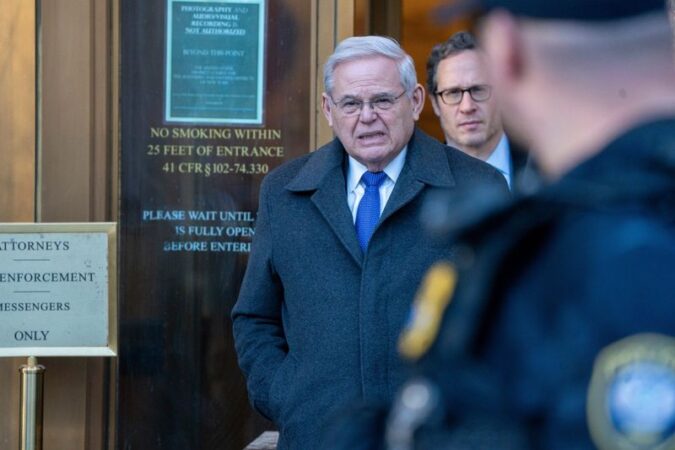
  • Former Sen. Bob Menendez is ‘forever disqualified’ from ever holding public office again in N.J.

    Former Sen. Bob Menendez is ‘forever disqualified’ from ever holding public office again in N.J.

    Former U.S. Sen. Bob Menendez is permanently banned from holding public office in New Jersey. If he tries to anyway, he could face criminal charges.

    Mercer County Superior Court Judge Robert Lougy wrote in an order that Menendez is “forever disqualified from holding any office or position of honor, trust, or profit” in New Jersey state or local government.

    If the once-powerful New Jersey Democrat applies for public office or employment, or shows any efforts to campaign or be appointed to political office, he will be subject to a fourth-degree contempt of court charge.

    Menendez, 71, was convicted in July 2024 for selling the powers of his office to wealthy benefactors and acting as a foreign agent for the Egyptian government.

    He accepted bribes of gold bars, cash, a Mercedes-Benz, and more from 2018 to 2022 in exchange for using his position to advance the interests of three New Jersey business owners and Egyptian officials.

    Prior to his conviction, Menendez floated the idea of running as an independent to maintain his Senate seat as a competitive Democratic primary was underway to replace him.

    He ultimately did not run and South Jersey Democratic Sen. Andy Kim, a U.S. House lawmaker at the time, won his former Senate seat.

    In January, Menendez was sentenced to 11 years in prison and began serving in June at the Federal Correctional Institution Schuylkill in Minersville, Pa.

    New Jersey Attorney General Matt Platkin’s office announced Lougy’s order on Friday.

    “Critical to preserving the public’s faith and trust in government institutions is ensuring that elected officials who commit crimes involving their offices don’t find new opportunities to regain positions of power,” Platkin said in a statement.

    The former senator’s wife, Nadine Menendez, was convicted in April of serving a “critical role” in his scheme. She was sentenced to 4-and-a-half years in prison and is slated to begin her sentence next summer.

    Menendez rose from the Union City school board at age 20 to the powerful Senate Foreign Relations Committee chair position over the course of five decades, becoming mayor earlier in his career and later being elected to the U.S. Senate in 2006.

    Platkin’s office filed a lawsuit in May requesting Menendez’s lifetime ban on public office in New Jersey. At the time, Platkin’s office pointed to former Paterson Mayor Jose “Joey” Torres, who was convicted of contempt in December 2024 after running for mayor in 2022 in violation of a similar 2017 order not to run. sentenced to three years of probation through a plea deal, along with a $10,000 fine, in February of this year.

    Platkin said he hopes the order on Menendez “sends a message” that pubic corruption will come with consequences.

    “Too many people in New Jersey have a cynical viewpoint that corruption is a routine, widespread feature of our politics,” he added.

  • Pete Hegseth, in a 2016 talk, cited the same military law as the lawmakers he’s now calling seditious

    Pete Hegseth, in a 2016 talk, cited the same military law as the lawmakers he’s now calling seditious

    Defense Secretary Pete Hegseth previously emphasized the same military law that the Trump administration has been calling Pennsylvania lawmakers seditious for citing.

    Hegseth noted the military rule not to obey unlawful orders during a forum in 2016, when he was a Fox News contributor, in recorded remarks CNN unearthed on Tuesday.

    Hegseth spoke at length about his views on the military — and criticism of former President Barack Obama — in a talk titled “The US Military: Winning Wars, Not Social Engineering.” The talk was shared online by the Liberty Forum of Silicon Valley and was marked as taking place on April 12, 2016. Hegseth, an Army veteran, had a book coming out that he promoted at the event.

    The moderator asked him a question from an attendee: “Can you comment on soldiers who are being held at Leavenworth Prison for being soldiers?”

    Fort Leavenworth in Kansas is home to the military’s only maximum-security correctional facility, which houses prisoners convicted of violating the Uniform Code of Military Justice.

    Hegseth argued that some prisoners at the facility did not deserve to be there but that others were facing the consequences for their unlawful actions.

    “There are some guys at Leavenworth who made really bad choices on the battlefield, and I do think there have to be consequences for abject war crimes,” he said. “If you’re doing something that is just completely unlawful and ruthless, then there is a consequence for that.”

    “That’s why the military said it won’t follow unlawful orders from their commander in chief,” he added. “There’s a standard, there’s an ethos, there’s a belief that we are above what so many things that our enemies or others would do.”

    It is the same policy that a group of six Democratic members of Congress cited in a video that enraged President Donald Trump.

    Democratic U.S. Reps. Chrissy Houlahan of Chester County and Chris Deluzio of Allegheny County, both veterans, joined a group of other veterans and former members of the intelligence community to urge members of the military and intelligence community to “refuse illegal orders” in a video they shared on social media last month.

    On his social media website, Truth Social, Trump said they were committing sedition “punishable by DEATH” and shared other posts attacking the lawmakers, including one calling for them to be hanged. Hegseth called them the “seditious six.”

    “Encouraging our warriors to ignore the orders of their Commanders undermines every aspect of ‘good order and discipline,’” Hegseth said in a social media post. “Their foolish screed sows doubt and confusion — which only puts our warriors in danger.”

    When asked for comment by CNN, spokespersons for the Pentagon and the White House further criticized the Democratic lawmakers who made the video.

    Pentagon spokesperson Kingsley Wilson also told CNN that the military “has clear procedures for handling unlawful orders” and defended Trump’s orders as legal.

    White House spokesperson Anna Kelly told CNN that Hegseth’s position has remained consistent and that his remarks were “uncontroversial.”

    Sean Timmons, a Houston-based attorney specializing in military law who served as an active-duty U.S. Army captain in the U.S. Army Judge Advocate General (JAG) program, told The Inquirer that service members can get in trouble for refusing orders and that it is largely up to commanders to determine whether orders are lawful or not. While the military rules specify not to follow obviously illegal orders, such as war crimes, they also say to presume orders are lawful.

    Houlahan expressed disappointment in her Republican colleagues for largely not defending the Democratic lawmakers, though U.S. Rep. Brian Fitzpatrick, a Bucks County Republican, said he stood by his Democratic colleagues when asked by The Inquirer.

    The fallout from the video has gone beyond rhetoric on X and Truth Social.

    The FBI wanted to question the lawmakers involved in the video, and the Department of Defense said it would investigate U.S. Sen. Mark Kelly (D., Ariz.), a former naval officer and the one veteran in the video who is still obligated to follow military laws because he served long enough to become a military retiree. The department threatened to call Kelly back to active duty for court-martial proceedings, which abide by stricter rules than civilian law.

    Hegseth also said in his 2016 talk that he believed U.S. Sen. Ted Cruz (R., Texas), Trump’s top rival for the GOP nomination that year, would be the best president at fighting wars, but that he believed Cruz and Trump would both “unleash war fighters and get the lawyers out of the way, which is really a big impediment to how we fight wars.”

    The Democratic lawmakers did not cite specific orders in their video announcement, but Trump’s involvement of the National Guard in U.S. cities and the Pentagon’s strikes in the Caribbean have drawn legal debate.

  • Trump’s efforts to keep Alina Habba the top prosecutor in N.J. aren’t legal, a Philly federal appeals court rules

    Trump’s efforts to keep Alina Habba the top prosecutor in N.J. aren’t legal, a Philly federal appeals court rules

    A federal appeals court in Philadelphia ruled Monday that President Donald Trump’s attempts to keep his former personal lawyer Alina Habba as New Jersey’s U.S. attorney have been illegal.

    The decision was unanimous from a Third Circuit Court of Appeals panel of three judges, including two appointed by former Republican President George W. Bush and one appointed by former Democratic President Barack Obama.

    It supports a federal district court judge’s ruling in August that determined the Trump administration kept Habba in her powerful role unlawfully since her temporary term expired in July. The top federal law enforcement role in the state is charged with enforcing U.S. criminal and civil law.

    The Monday ruling is the first federal appeals court decision on Trump’s efforts to sidestep the Senate confirmation process for U.S. attorneys.

    That makes it “critically important,” said Carl Tobias, a professor at the University of Richmond School of Law who specializes in federal judicial selection.

    The Trump administration can either bring the case to the Supreme Court or petition for all the appeal court’s judges to hold a rehearing through a rare process, he said.

    “I assume the Justice Department will … go to the Supreme Court, ask for a stay and continue to litigate it,” Tobias said. “Whether the justices will take it is not clear.”

    Trump nominated Habba to the role in March through an interim appointment that was supposed to last no more than 120 days.

    Wanting to instill his loyalist for a full four-year term, the president sent Habba’s name to the Senate over the summer for confirmation. But U.S. Sens. Andy Kim and Cory Booker, both New Jersey Democrats, said they opposed Habba in the position in part because she lacked experience and politicized the office.

    The Senate traditionally defers to the home state senators for these nominations, putting that path out of the picture.

    The two Democratic senators said in a joint statement Monday afternoon that the appeals court decision “vindicates concerns we have long raised about the extraordinary and unlawful steps taken by the Trump Administration to keep Habba in office without Senate confirmation.”

    Kim and Booker urged Trump’s administration to “follow the long-established process” to “restore public trust” in the position.

    Judge D. Michael Fisher, a Bush appointee, acknowledged that “the current administration has been frustrated by some of the legal and political barriers to getting its appointees in place” in the panel’s Monday opinion.

    “Where a vacancy exists, Congress has shown a strong preference that an acting officer be someone with a breadth of experience to properly lead the office,” he also stated in the roughly 30-page appellate court opinion.

    New Jerseyans and U.S. attorney employees “deserve some clarity and stability,” the opinion also said.

    Some criminal cases have slowed down and some grand jury proceedings have been halted in New Jersey’s federal courts due to Habba’s unclear status, the New York Times reported.

    Habba had no prosecutorial experience prior to her appointment and most of her experience was in state courts, not federal. She represented Trump in personal cases before his second term and was involved in both his campaign and administration prior to her appointment. She previously worked as a partner in a small law firm near his Bedminster golf course.

    She said after her appointment that she wanted to help “turn New Jersey red” in her role, which is supposed to be apolitical.

    As the clock was slated to run out on Habba’s limited term, federal judges in New Jersey appointed her first assistant and longtime prosecutor Desiree Leigh Grace to replace her. In response, U.S. Attorney General Pam Bondi quickly fired Grace from the post and reinstated Habba through maneuvers that Trump’s administration argued were allowed.

    In the role, Habba brought a trespassing charge against Newark Mayor Ras Baraka, a gubernatorial candidate at the time, who was arrested outside an ICE facility. Those charges were quickly dropped, drawing a scolding from a federal judge who called the situation “worrisome” and “embarrassing” for Habba.

    Habba later charged Democratic U.S. Rep. Monica McIver with assault stemming from the same scuffle with ICE officers, a rare federal criminal case against a sitting member of Congress other than for corruption. McIver denied the charges, which she has called political. She pleaded not guilty and the case is pending.

    New Jersey Gov.-elect Mikie Sherrill said in a statement that the judges’ decision “makes clear that the rule of law applies to everyone, regardless of who they are.”

    “The Trump administration should not be playing political games with the U.S. Attorney’s Office,” she said. “We need a new candidate in that post as soon as possible, so the office can focus on serving the people of New Jersey, not the president.”

    Trump and Habba took another blow in an Atlanta-based appeals court last week when it upheld penalties nearing $1 million against them for making “frivolous” legal arguments against his political enemies.

    Trump is running into similar roadblocks elsewhere in his pursuit of instilling loyalists into prosecutorial positions and sidestepping Senate approval.

    Last week, a federal judge dismissed criminal cases against former FBI Director James Comey and New York Attorney General Letitia James after determining that the U.S. attorney for the Eastern District of Virginia, who brought the charges in both cases at Trump’s urging, was unlawfully appointed by his administration.

    The U.S. Justice Department has not yet publicly commented on that matter.

    In September in Nevada, the Trump administration was found to have kept the acting U.S. attorney in her position for too long. In October, a federal judge ruled the same for the pick in Los Angeles.

    The Associated Press contributed to this article.

  • What does sedition actually mean? Here’s what to know about Trump’s accusation against Democratic lawmakers.

    What does sedition actually mean? Here’s what to know about Trump’s accusation against Democratic lawmakers.

    President Donald Trump accused six Democratic members of Congress of committing sedition, a claim that his administration has stuck to amid a fierce national debate that began when the lawmakers urged military and intelligence personnel to “refuse illegal orders.”

    The Democratic members, who are all veterans or members of the intelligence community, shared a video online last week in which they accused Trump’s administration of pitting service members against American citizens and warned against orders that would violate the Constitution.

    The lawmakers did not reference specific orders, but members have spoken against strikes in the Caribbean and Trump’s deployment of the National Guard in American cities — both of which have faced legal scrutiny — as cause for concern.

    Trump first responded to the video with a string of posts on his social media platform, Truth Social, calling for the lawmakers to be arrested and put on trial for sedition, “punishable by DEATH,” and sharing posts against them, including one that called for them to be hanged.

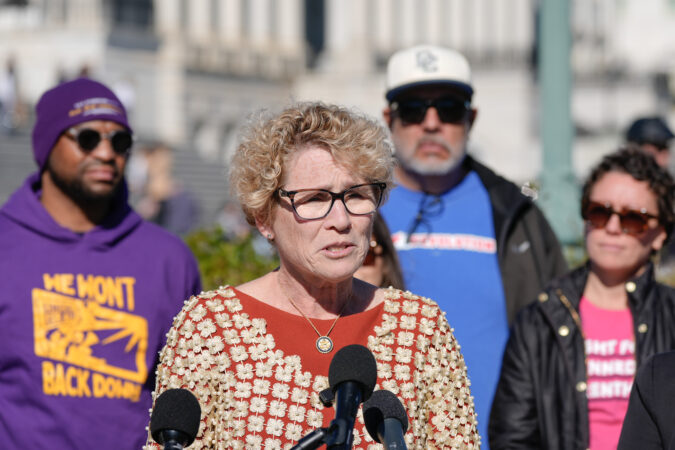
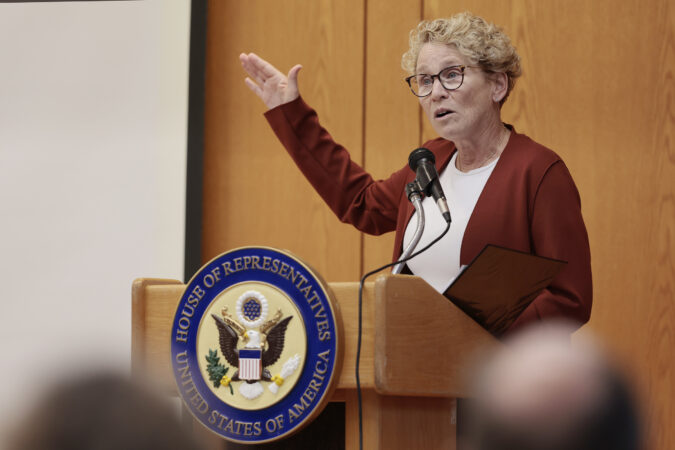
    Two of the members represent Pennsylvania: U.S. Reps. Chrissy Houlahan (D., Chester), an Air Force veteran, and Chris Deluzio (D., Allegheny), a Navy veteran.

    While Democrats denounced the president’s rhetoric, Houlahan was dismayed by a lack of support from congressional Republicans.

    On Monday, the Department of Defense announced that it would investigate Sen. Mark Kelly (D., Ariz.), a former naval officer and the one veteran in the video who is still obligated to follow military laws because he served long enough to become a military retiree. The announcement threatened to call Kelly back to active duty for court-martial proceedings.

    On Tuesday, a Justice Department official told Reuters that the FBI has requested interviews with the Democrats who appeared in the video, which some of the lawmakers publicly corroborated. The FBI declined to comment when reached by The Inquirer.

    As the debate over the video escalates in the wake of Trump’s sedition accusation and his administration’s actions, a rarely used charge and the intricacies of military law have been thrown into the spotlight.

    What is sedition, and is it punishable by death?

    Sedition is an incitement of a rebellion or encouragement of attacking authority, or, in other words, the intent to overthrow the government, according to legal and military experts. When acting with others, it is called seditious conspiracy.

    Members of the Proud Boys and Oath Keepers were convicted of seditious conspiracy for the attack on the U.S. Capitol on Jan. 6, 2021, but within hours of beginning his second term, Trump granted sweeping pardons and commutations for those charged in the riot.

    For civilians, sedition is a violation of federal law and carries prison time. It is not punishable by death.

    Active-duty military, however, must follow the Uniform Code of Military Justice (UCMJ). While the military law has overlap with civilian law, it is more expansive, controlling, and strict, said Sean Timmons, a Houston-based attorney specializing in military law who previously served as an active-duty U.S. Army captain in the U.S. Army Judge Advocate General (JAG) program.

    “In the civilian world you have a lot more defenses, and you have full First Amendment protections,” said Timmons, a managing partner at Tully Rinckey PLLC. “Whereas in the military, your First Amendment rights are quite limited.”

    The maximum punishment for active military is death, but it can be far lower, he said.

    Service members must be on active duty to be prosecuted under the UCMJ, but the conduct does not have to have taken place during active duty. This means that retirees like Kelly can be recalled for active duty to face UCMJ prosecution over their behavior while they were not on active duty.

    What is an illegal order?

    Members of Trump’s administration have pointed to the UCMJ rule that says members must follow lawful orders and orders should be presumed to be lawful. Service members can be punished for not following orders.

    However, military rules also prohibit service members from following orders that are undoubtedly illegal — a point the lawmakers get at in their video — and they can be punished for doing so.

    But whether orders are legal is supposed to be up to officers, not rank-and-file members, Timmons said.

    “If you don’t comply, you could be charged with failure to follow orders and other crimes,” he said.

    The exceptions (those obviously illegal crimes) would be war crimes like raping prisoners, deliberating killing civilians without justification, or torture, not day-to-day acts that would break the law, he explained.

    Take the example of burning down an enemy’s structure.

    “If your military unit says to burn it down because it’s part of the military objective, that’s a lawful order, even though it’s an illegal act,” he said. “It’s a war crime if it’s to burn down a daycare with kids inside.”

    The boat strikes in the Caribbean have been in a legal gray area, he said, but “if your command says it’s legal, you’re supposed to execute.”

    “The military system is harsh, cruel, and unfair … but it’s the system we have in place, and it’s designed that way to ensure discipline, obedience, and compliance,” he added.

    Did the lawmakers commit sedition?

    Claire Finkelstein, founder and faculty director of the Center for Ethics and the Rule of Law at the University of Pennsylvania’s Carey Law School and an expert in military ethics, said accusing the lawmakers of sedition “makes absolutely no sense, especially in a case in which they’re just reminding servicemen of their obligation not to follow illegal orders, which is a fundamental part of the UCMJ.”

    “One has to really work hard to fill in the blanks here,” she said.

    Timmons said five out of the six lawmakers have their freedom of speech to rely on as a protection.

    “Just having divergent political views that the commander-in-chief doesn’t like, for civilians, there’s no liability, there’s no repercussions,” he said.

    That doesn’t mean Trump’s administration cannot investigate them for “seditious behavior” anyway.

    Kelly, on the other hand, was “on thin ice” by participating in a video that seems to undermine Trump’s authority, he said, and it’s not “totally crazy” to argue he engaged in seditious behavior under military law.

    That being said, prosecutors would have to prove that his intent was to “cause a revolt within the ranks,” which would be “very hard,” he said.

    “But could they make him miserable and humiliate him and charge him? Yes,” he said.

    “Is that politically wise? Absolutely not. Is it reckless? Of course. But, technically, can they do it? Yes,” he added.

    What are members of Trump’s administration saying?

    White House press secretary Karoline Leavitt told reporters on Monday the White House supports the investigation into Kelly and accused him of trying to “intimidate” active-duty members with the video.

    “Sen. Mark Kelly well knows the rules of the military and the respect that one must have for the chain of command,” she said.

    “You can’t have a functioning military if there is disorder and chaos within the ranks, and that’s what these Democrat members were encouraging,” she added.

    In a social media post on Monday, Defense Secretary Pete Hegseth called the lawmakers the “seditious six.”

    “Encouraging our warriors to ignore the orders of their Commanders undermines every aspect of ‘good order and discipline,’” he wrote. “Their foolish screed sows doubt and confusion — which only puts our warriors in danger.”

    How has Kelly responded?

    Kelly, also a former astronaut, played down the impact of the threats against him on The Rachel Maddow Show Monday night.

    “Is it stressful? I’ve been stressed by, you know, things more important than Donald Trump trying to intimidate me into shutting my mouth and not doing my job,” he said. “He didn’t like what I said. I’m going to show up for work every day, support the Constitution, do my job, hold this administration accountable.”

    He also denounced the president’s rhetoric, calling it “inciteful.”

    “He’s got millions of supporters,” Kelly said. “People listen to what he says more so than anybody else in the country, and he should be careful with his words. But I’m not going to be silenced here.”

    He said he and his wife, former U.S. Rep. Gabby Giffords (D., Ariz.), who survived a 2011 assassination attempt in which she was shot in the head, “know what political violence is, and we know what causes it, too.”

    What response have Houlahan and Deluzio gotten?

    Houlahan and Deluzio, the two Pennsylvania lawmakers in the video, both reported bomb threats at their district offices on Friday following the president’s posts.

    But they have also gotten messages of support.

    Houlahan shared voice recordings of veterans from all over the country who left messages of support for her office and thanked her for her advocacy.

    “Keep pushing it,” one said. “I’m with you, I’m behind ya,” another said.

    “I am so proud of all six of you for making that video,” said another.

  • The FBI wants to question the lawmakers who called on troops to refuse unlawful orders, including Chester County’s Chrissy Houlahan

    The FBI wants to question the lawmakers who called on troops to refuse unlawful orders, including Chester County’s Chrissy Houlahan

    The FBI is seeking interviews with the six Democratic members of Congress, including two from Pennsylvania, who released a video calling on members of the military and intelligence community to “refuse illegal orders.”

    A U.S. Justice Department official said the FBI has requested interviews with the six Democratic lawmakers, who are all veterans or members of the intelligence community.

    The move came a day after the Pentagon threatened to recall Sen. Mark Kelly (D., Ariz.), a Navy veteran and one of the six lawmakers, to active duty potentially to face military charges. Defense Secretary Pete Hegseth on Monday described the video as “seditious” and “despicable, reckless, and false” after President Donald Trump went on a social media rant against the lawmakers last week.

    U.S. Reps. Chrissy Houlahan of Chester County, an Air Force veteran, and Chris Deluzio of Allegheny County, a Navy vet, both took part in the video.

    Houlahan said in a statement Tuesday that Trump “is using the FBI as a tool to intimidate and harass Members of Congress.”

    She said the FBI contacted the House and Senate sergeants at arms on Monday to request the interviews.

    “No amount of intimidation or harassment will ever stop us from doing our jobs and honoring our Constitution,” Houlahan said.

    The lawmaker said that members of Congress took an oath to the Constitution that “lasts a lifetime, and we intend to keep it.”

    “We will not be bullied. We will never give up the ship,” she added.

    The six members of Congress urged service members not to “give up the ship” in their video released last week, which drew fierce attacks from Trump. They did not refer to specific orders as illegal in the video, but some have cited military strikes against boats in the Caribbean that experts have questioned as well as Trump’s efforts to deploy the National Guard in U.S. cities.

    In a string of posts last week on his social media platform, Truth Social, Trump called the Democrats “traitors” who committed sedition “punishable by DEATH.” He reshared similarly aggressive posts from supporters, including one calling for the lawmakers to be hanged.

    Houlahan and Deluzio both reported bomb threats at their district offices on Friday following the president’s attacks.

    The Department of Defense announced Monday that it “has received serious allegations of misconduct” against Kelly, a retired Navy captain, and that “a thorough review of these allegations has been initiated.”

    Kelly is subject to military rules while the other veterans who partook in the video are not because he retired from the military. That means he earns a pension and can be recalled to active duty.

    His colleagues in the video did not serve long enough to qualify for retirement, so they are not subject to military laws, as he is.

    This article contains information from Reuters.

  • These parents wish Mikie Sherrill would defend their transgender kids. They understand why she doesn’t.

    These parents wish Mikie Sherrill would defend their transgender kids. They understand why she doesn’t.

    C.B. can’t even comprehend her transgender daughter being required to use the boys’ bathroom at her South Jersey school.

    “If you went into her classroom and someone said, ‘Pick out the trans kid out of these 25 kids,’ you would not be able to,” C.B. said. “You might very well get it wrong.”

    C.B., who asked to be identified by her initials to protect the privacy of her child, said she loves the Garden State. She has a “very Jersey family.”

    But, like other parents of trans children, she’s considering packing her family’s bags depending on the results of the Nov. 4 election, and whether the next governor maintains the state’s LGBTQ+ friendly policies.

    “I can’t think of anyone who’s not at least thinking of a contingency plan. I think we all have our limits of when we’ve got to go,” C.B. said. “We just have to protect our kids.”

    The stakes of the election are stark for C.B. and other parents. Jack Ciattarelli, the Republican nominee for New Jersey governor, opposes state policies implemented under Democratic Gov. Phil Murphy meant to protect transgender children. Ciattarelli says he would require schools to tell parents about their children’s gender identity and stop transgender girls from participating in girls’ sports. He also opposes gender-affirming care for minors and believes parents should be able to opt their kids out of LGBTQ+ related topics in school.

    U.S. Rep. Mikie Sherrill, the Democratic nominee, has largely voted in support of transgender rights throughout her nearly seven-year legislative career. She was endorsed by LGBTQ+ advocacy groups as well as her friend U.S. Rep. Sarah McBride (D., Del.), the first openly transgender member of Congress. But Sherrill has not publicly defended trans rights when criticized by Ciattarelli and has declined to answer reporters’ questions on the matter.

    L.B., another South Jersey parent facing the same dilemma in the lead-up to Election Day, said her 10-year-old transgender daughter isn’t stealing any thunder from other girls on her coed sports team — she is the smallest in her class. And it’s hard for her to imagine anyone seeing her child as a threat to anyone in the bathroom.

    “People move from all over the country to New Jersey because it’s known as a safe haven for LGBTQ rights,” said L.B., who is using her initials to protect her child’s privacy. “And now, if Jack Ciattarelli wins, it could become a state that people have to flee from.”

    Republican nominee for New Jersey governor Jack Ciattarelli speaks at a rally at the Corner House Tavern in Columbus.

    During the 2024 election, President Donald Trump frequently attacked Vice President Kamala Harris for supporting transgender people. Ciattarelli has followed that playbook, framing Sherrill on the campaign trail, in ads, and on the debate stage as being too supportive of transgender identities.

    Sherrill has not just ignored the attacks. She has avoided talking about the issue altogether.

    “I don’t necessarily blame her for that, although more vocal support, outspoken support, would be amazing. It would make a lot of us feel much safer,” C.B. said.

    Other transgender rights advocates interviewed by The Inquirer also said they wish Sherrill would speak up more. But they understand why she doesn’t.

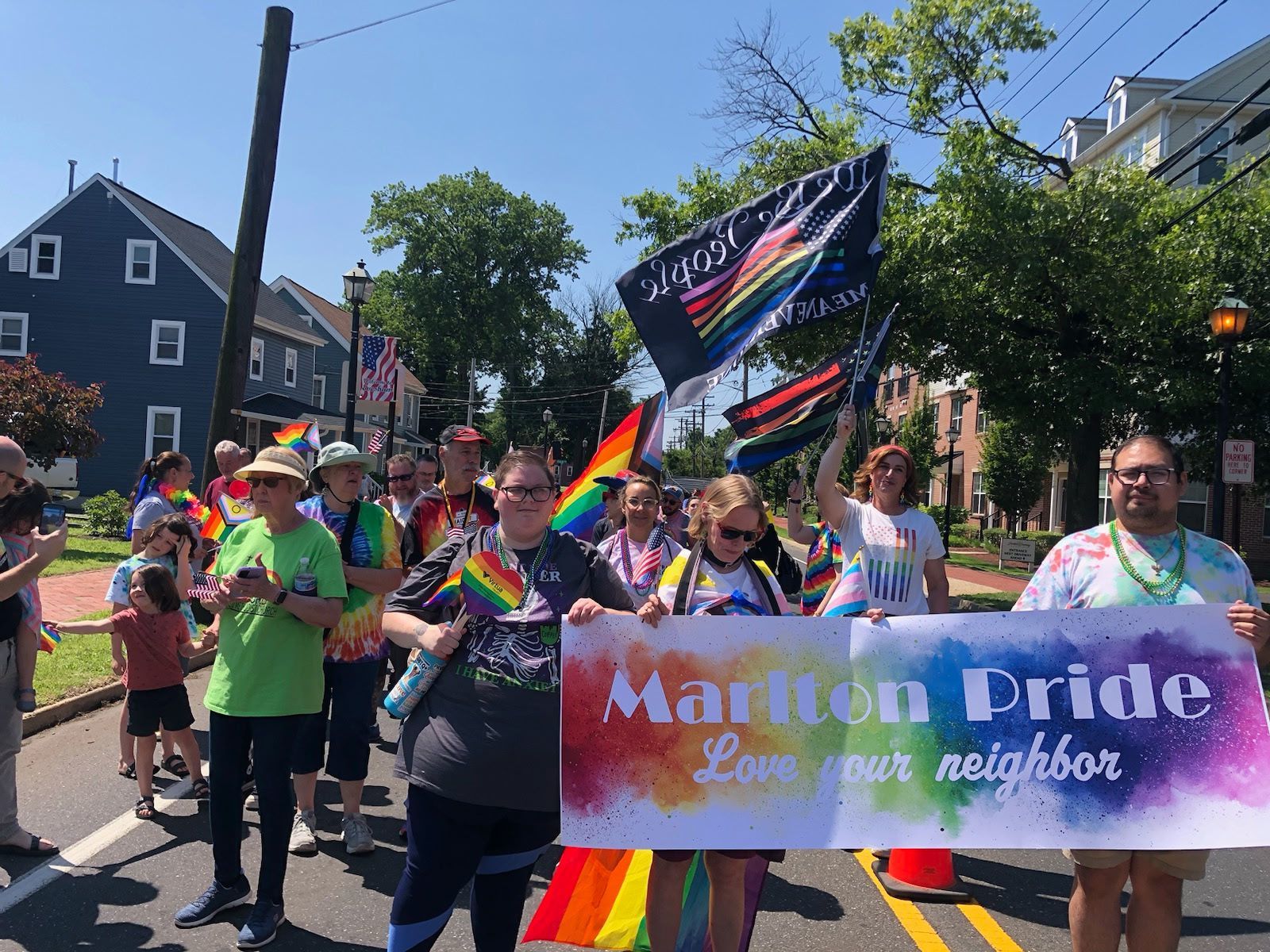
    “Mikie Sherrill is not saying much of anything about the transgender population — which, you know, frankly, is what unfortunately might be her best strategy to be elected,” said Melissa Firstenberg, a transgender woman who founded Marlton Pride. “Unfortunately, for somebody like me, she is the only option.”

    Melissa Firstenberg marching in a July 4 parade with Marlton Pride.

    A page out of Trump’s playbook

    Trump campaigned for president on the promise of stopping transgender athletes from competing in women’s and girls’ sports.

    Ciattarelli has also made the popular GOP talking point a centerpiece of his campaign. In his stump speeches, he attacks Sherrill for voting “to allow biological boys to play in girls’ sports” despite being “a mother of two daughters,” in reference to her vote against the “Protection of Women and Girls in Sports Act‚” which would prohibit transgender girls from participating in girls’ sports and had support from only two House Democrats.

    Ciattarelli has championed a so-called parental rights movement and frequently touts his opposition to New Jersey School Policy 5756, an advisory policy calling for schools to support students’ gender identity and allow transgender students to compete on sports teams and use the restrooms where they feel comfortable. The guidance states that parental consent is not needed to accept a student’s asserted gender identity.

    In the first general election debate last month, Ciattarelli tried to veer the conversation to transgender youth in schools multiple times, and said he was concerned about “the welfare of our children.”

    “I don’t think school districts should be keeping secrets from parents. I don’t think that biological boys should be playing in girls’ sports,” he said.

    “She opposes me on both of those issues,” Ciattarelli added, referring to Sherrill’s 2023 vote against the “Parents Bill of Rights Act” that would require parental notification of children’s gender identity, among other measures. No House Democrats voted for the bill.

    Sherrill did not address her past votes, correct Ciattarelli, or respond to the specifics of his argument, beyond mentioning that “parents know their kids best, and they need to be able to determine if there’s something they want to opt out of.” That stance echoes Ciattarelli’s arguments, though it was unclear what exactly Sherrill was referring to.

    When asked after the debate about participation of transgender athletes, Sherrill deferred to “New Jersey sports groups” and the National Collegiate Athletic Association. She also cited her support for the Kids Online Safety Act, mentioning an uptick in bullying of LGBTQ+ youth.

    Sherrill has garnered endorsements and donations from LGBTQ+ advocacy groups like the Human Rights Campaign and GLAAD for her voting record — though she did take heat for a December 2024 vote for the National Defense Authorization Act, which included a provision that removed transgender healthcare for military dependents. Despite her vote, Sherrill criticized that measure as singling “out a small handful of innocent children to be used as political pawns.”

    But Sherrill declined through a campaign spokesperson to share her stance on the state’s school guidance or protections for gender-affirming care for this story, or to be interviewed about trans rights.

    U.S. Rep. Mikie Sherrill (D., N.J.) speaks during a gubernatorial debate with Republican Jack Ciattarelli Sept. 21, 2025 at Rider University.

    Instead, in a statement, Sherrill said she “will govern in a way that keeps New Jersey kids, my own and others, safe and with parents in the driver’s seat regarding their kids’ education.” The 200-word statement did not mention “trans,” “gender,” or “LGBTQ.”

    She also said that “schools are a place to learn, not to advance political agendas,” and that she would ensure they teach “the full history of our nation” and continue to give parents the choice to opt out of “certain sex-education conversations.”

    Meanwhile, Chris Russell, a Ciattarelli campaign spokesperson, said in a text message that Ciattarelli “opposes so-called gender-affirming care for minors” when asked about Murphy’s executive order that makes the state a “safe haven” for gender-affirming healthcare.

    “As Governor Jack will review all of Governor Murphy’s EO’s and related policies to ensure that they are consistent with his positions regarding parental notification for minors, protecting women’s & girl’s sports & offering an age appropriate curriculum,” he added.

    Sherrill is not the only Democrat across the country who has trod lightly on trans rights since Republicans upped the attacks last year, but Diane Rugala, a Collingswood-based parent whose transgender son is a Rutgers University graduate student, thinks Sherrill should “just own it” when it comes to defending transgender kids.

    “You have to play the game, I get it,” said Rugala, who is also an activist with PFLAG, an LGBTQ+ advocacy group.

    “But I also think that a really authentic statement would be good,” she added. “I don’t think people are asking for her to become this big advocate for the trans community … just a simple statement.”

    Attack ads mirroring the presidential election

    Ciattarelli’s campaign recently started running an ad that highlights Sherrill saying that she “would push an LGBTQ education into our schools,” and that “parents have a right to opt out of a lot of things” but “this is not an area where they should be opting out.”

    The clip was from a Democratic primary debate earlier this year when she was responding to the question of whether parents should be able to opt their students out of “LGBTQ-related content” in the same way they can be taken out of sex-ed and health classes.

    The ad calls it her “education plan” and tells viewers that it’s “your choice, not hers.”

    She explained in that debate that students should understand “the background of people throughout our nation” and condemned the “erasure of history.” As of 2020, New Jersey schools are required to teach about societal contributions from LGBTQ+ people, along with other groups, in middle and high school social studies.

    Jo Miller speaks at a rally for trans youth organized by Garden State Equality in Asbury Park in June.

    Another ad echoes the attack that was lodged against Vice President Kamala Harris’ presidential campaign.

    The American Principles Project (APP), a Virginia-based conservative group that identifies itself as “pro-family,” paid for an ad that vilifies trans people and accuses Sherrill of wanting to “protect they/them instead of your children,” referencing nonbinary pronouns. The group’s New Jersey PAC reported $126,000 in expenditures in the race as of Oct. 3, with $429,000 more cash on hand.

    Trump’s campaign aired ads last year arguing that Harris is for “they/them,” while Trump is for “you.”

    Jo Miller, 29, a transgender woman who serves on the Woodbury City Council, said she “would like to see a more forceful response” from Sherrill because not addressing the attacks can leave more people thinking that Republicans’ “demonization” of trans people — a small segment of the population — is true.

    “I would love to see Mikie Sherrill take some stronger stances, and I think we will see that eventually as governor, but I think the truth is, it’s not her main focus,” Miller said. “And it’s kind of strange that it’s Jack Ciattarelli’s main focus, and it’s Donald Trump’s main focus.”