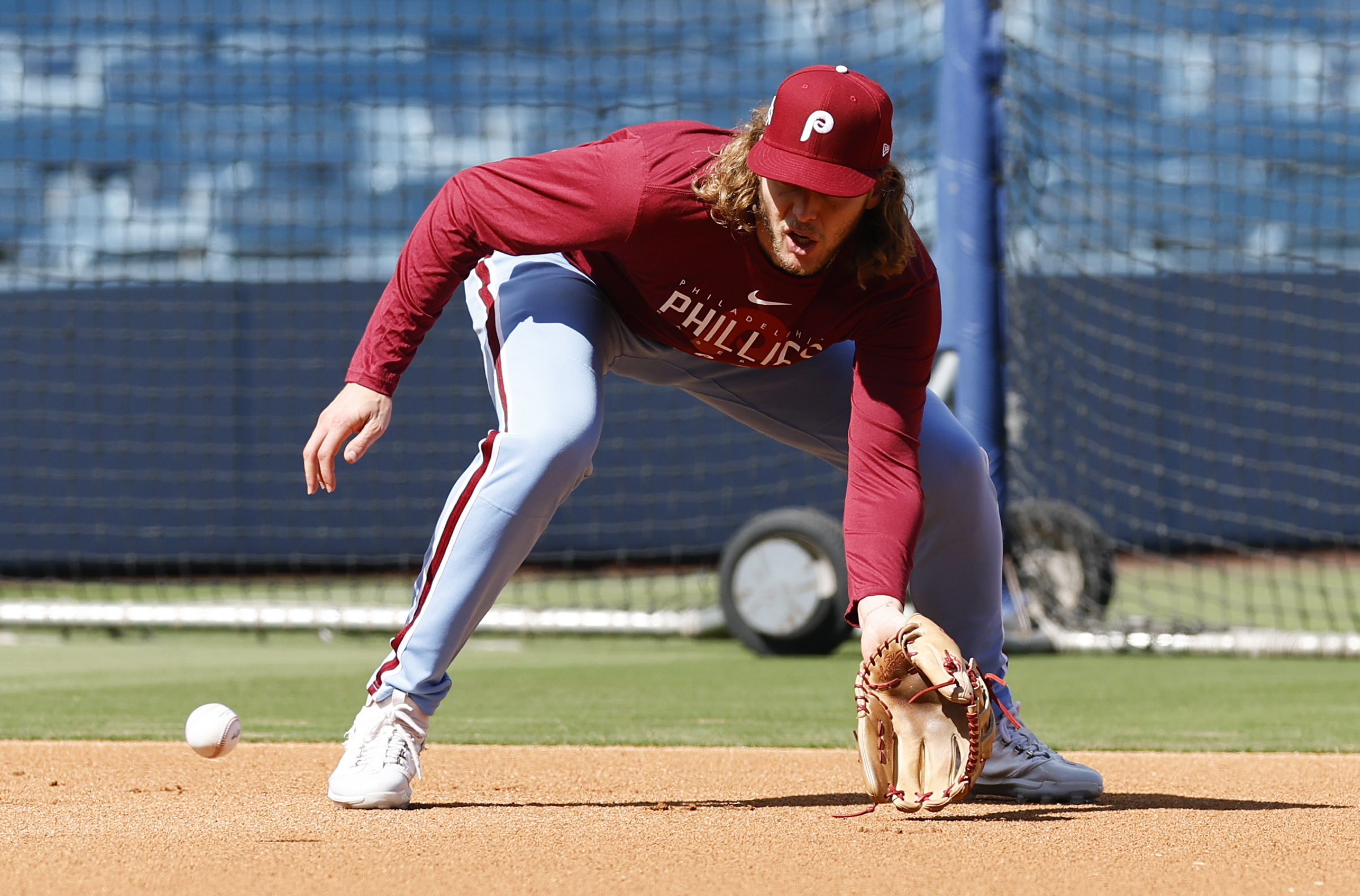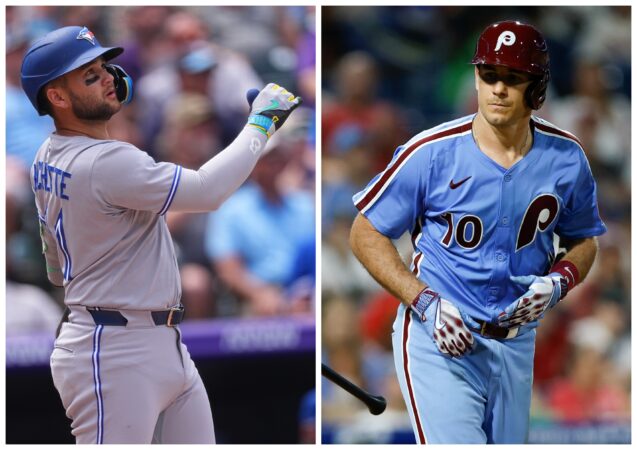
Author: Scott Lauber

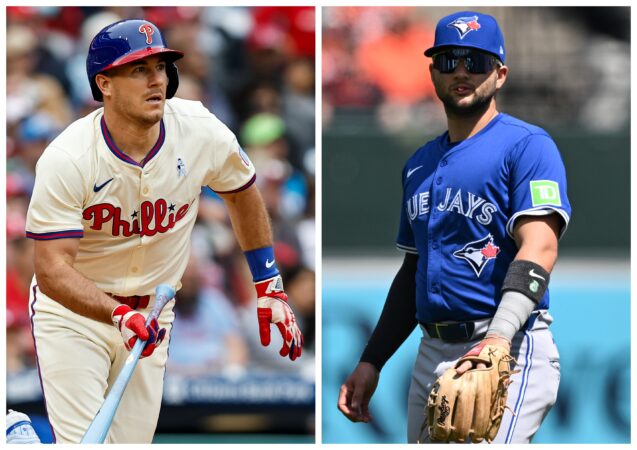
  • The Phillies were ‘very close’ to getting Bo Bichette and ended up with J.T. Realmuto. Here’s how it happened.

    The Phillies were ‘very close’ to getting Bo Bichette and ended up with J.T. Realmuto. Here’s how it happened.

    Late Thursday, within the hallways of One Citizens Bank Way, Phillies officials believed they were close to signing Bo Bichette.

    How close?

    “We were very close to having a deal done,” president of baseball operations Dave Dombrowski said Tuesday without divulging details. “We thought it was going to happen.”

    Bichette, through his agent, informed the Phillies that he would sign if they met his seven-year, $200 million asking price, two major league sources confirmed. The team agreed. All that was left, according to a source with knowledge of the situation, was “crossing the T’s and dotting the I’s” on the Phillies’ offer to the star infielder.

    That process was underway Friday when Bichette changed course, agreeing shortly before noon to a shorter-term (three years), higher-salary ($42 million per year) contract with two opt-outs from the Mets, who lost in their attempt to sign free-agent outfielder Kyle Tucker.

    Most Phillies officials found out about it like the public did — through reports in the media.

    “It’s a gut punch,” Dombrowski said. “I mean, you feel it.”

    Bichette didn’t give the Phillies the chance to outbid New York. Even so, they wouldn’t have sprung for the fourth-highest annual salary in the sport or included opt-out provisions.

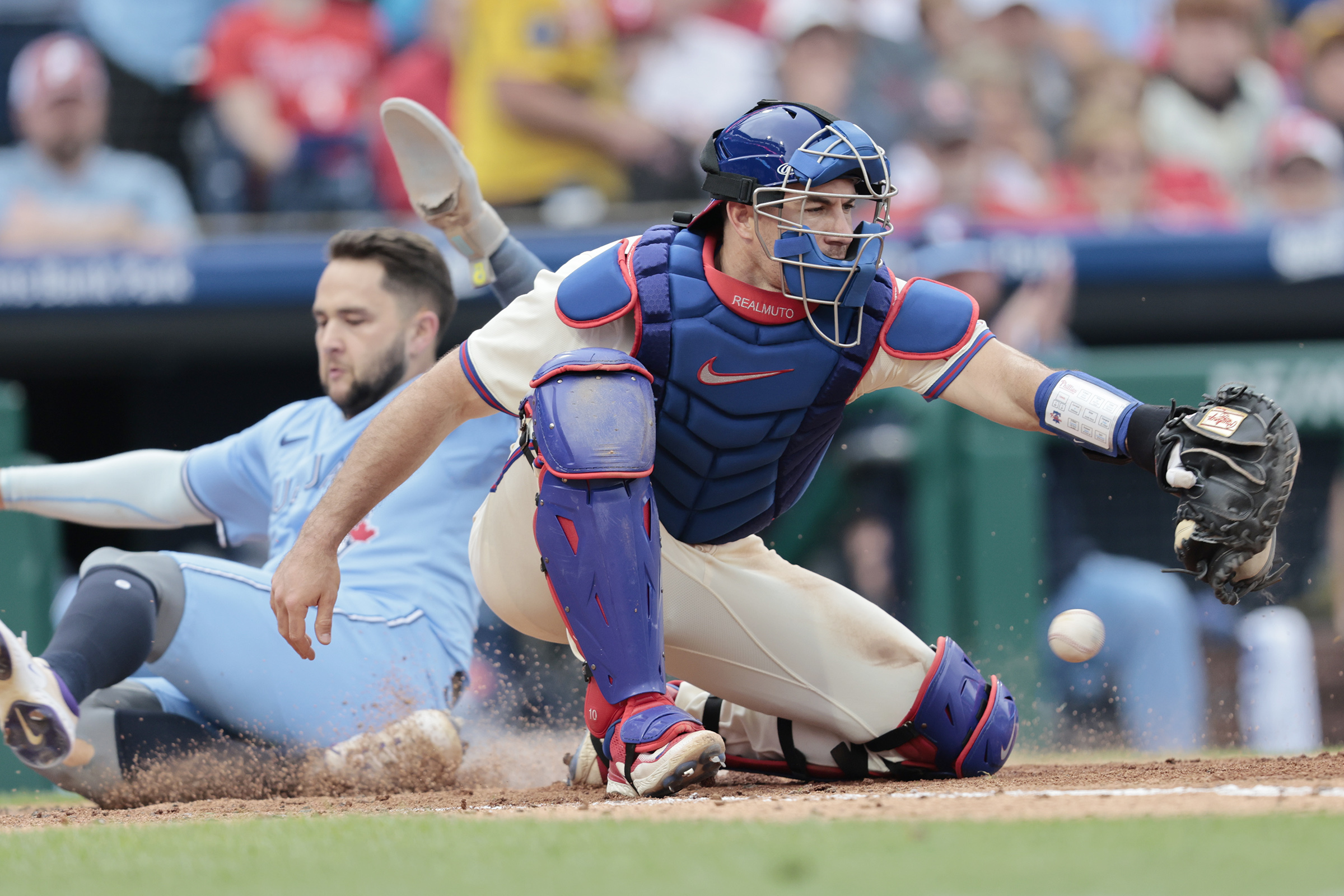
    And that’s how the Phillies and J.T. Realmuto found their way back to each other.

    OK, so it lacks the romance of other free-agent courtships. And it made for a potentially awkward news conference Tuesday to announce the catcher’s new three-year, $45 million contract.

    Because the Phillies “almost certainly” were going to sign Bichette or Realmuto, not both, a major league source said. And if things had gone as they anticipated Thursday night, their longtime iron-man catcher would be meeting the media from a different city this week.

    Yet here were Realmuto and Dombrowski, narrowly spared from divorce, trying to avoid sounding like staying together was more than a consolation prize for either side.

    “Things got a little hairy there at the end, but I’m glad we’re back here,” Realmuto said. “This is where we wanted to be the whole time.”

    Said Dombrowski: “We always wanted to bring J.T. back. That was always a priority for us. They knew it. We also knew that he wanted to come back. Just there was a disagreement as far as dollars were concerned.”

    Indeed, Realmuto made a catcher-record $23.1 million per year since 2021. At age 35, amid a three-year decline at the plate, he conceded he would have to take a pay cut.

    But Realmuto also believed a team should pay a premium for his strengths behind the plate, notably game-calling and handling a pitching staff, among the last intangibles that can’t be measured by metrics. The Phillies appreciate his skills in those areas, but valued it differently.

    “We couldn’t bridge that gap,” Dombrowski said.

    It led the Phillies to Bichette, with whom they met over a Zoom call on Jan. 12. The positional fit didn’t seem obvious earlier in the offseason. Bichette has only ever played shortstop. But as talks with Realmuto stalled, the Phillies began thinking about improving the roster in other ways.
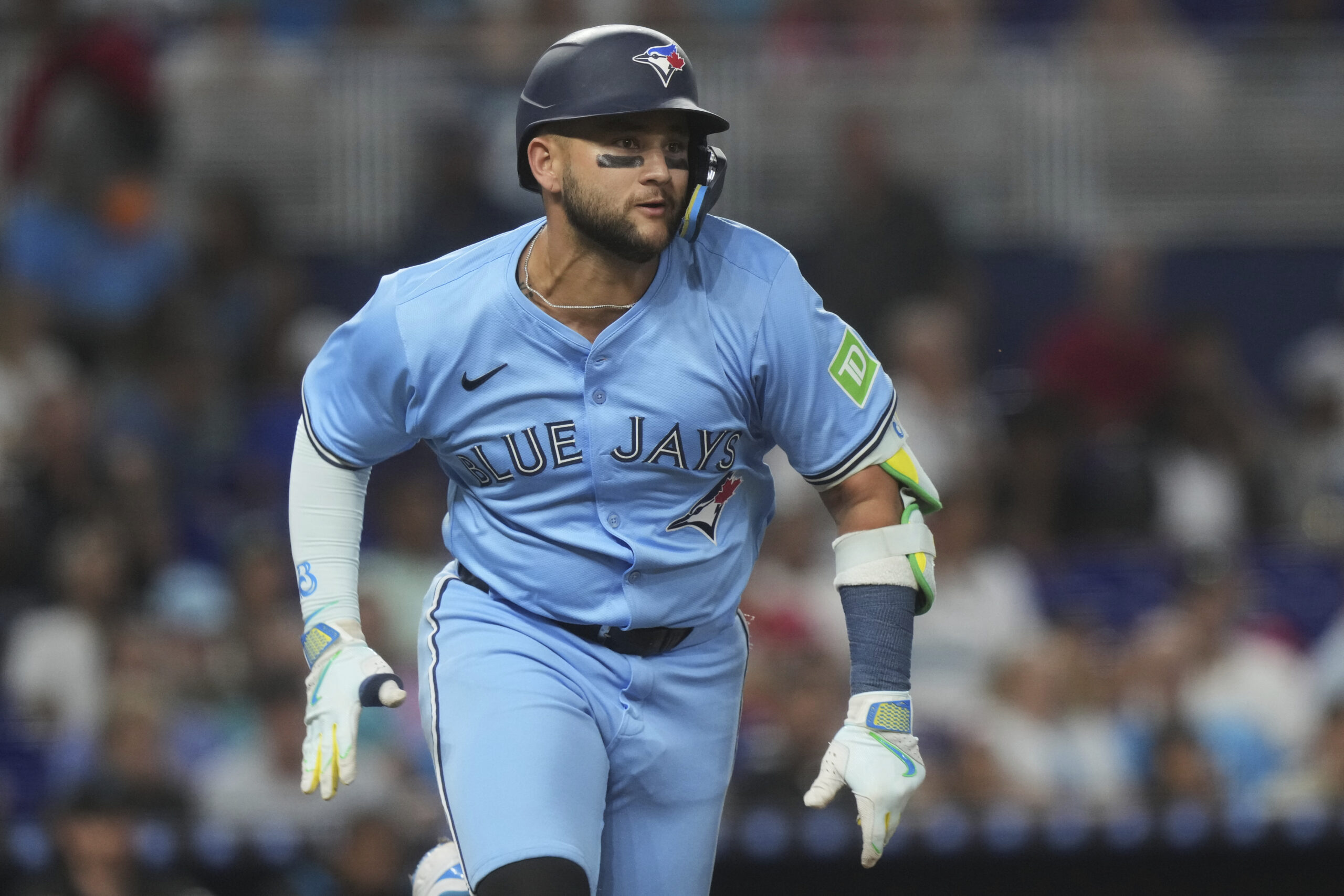
    A shortstop with the Blue Jays, Bo Bichette would have played third base with the Phillies.

    The Phillies would have played Bichette at third base and displaced Alec Bohm, who likely would’ve been traded. And Bichette was open to switching positions. The Zoom meeting went well enough that Dombrowski called Realmuto’s agent to inform him the Phillies might be going in another direction. Things began to get more serious.

    Or did they? Given how it all turned out, did Bichette use the Phillies as a stalking horse to get the deal he wanted from the Mets?

    “I can’t [say that] because you never know 100% what’s going on from their perspective,” Dombrowski said. “I do think he was sincere about thinking about coming to Philadelphia. Yes, I do. I think he was. We were at the numbers that they really asked us to match. [The Mets] jumped in at the last minute and made him a short-term offer that was very appealing to him.”

    Some within the Phillies’ front office were furious. But Dombrowski said Bichette’s camp didn’t renege on a deal or negotiate out of bounds because the sides never reached the point of signing a “memo of understanding,” a document that would have preceded a completed deal.

    “It wasn’t that we weren’t moving toward that direction,” Dombrowski said. “I did think that we were going to get there based upon our conversations. But we did not get to that point, so I can’t say that I ever thought we had it done.”

    The Phillies thought their willingness to stretch the term of the contract to seven years with more guaranteed money would be an advantage over the Mets (or potentially the Dodgers if they hadn’t signed Tucker). It’s a tactic they used to help land other marquee free agents: Bryce Harper (13 years), Trea Turner (11 years), and Aaron Nola (seven years).

    Instead, the Phillies missed out on a coveted free agent, a rarity since they signed Harper in 2019. They pivoted back to Realmuto within an hour of Bichette’s agreement with the Mets — “It was very quickly,” Dombrowski said — and bumped up their offer. They aren’t considering a run at any other big-ticket free agents, including Cody Bellinger.
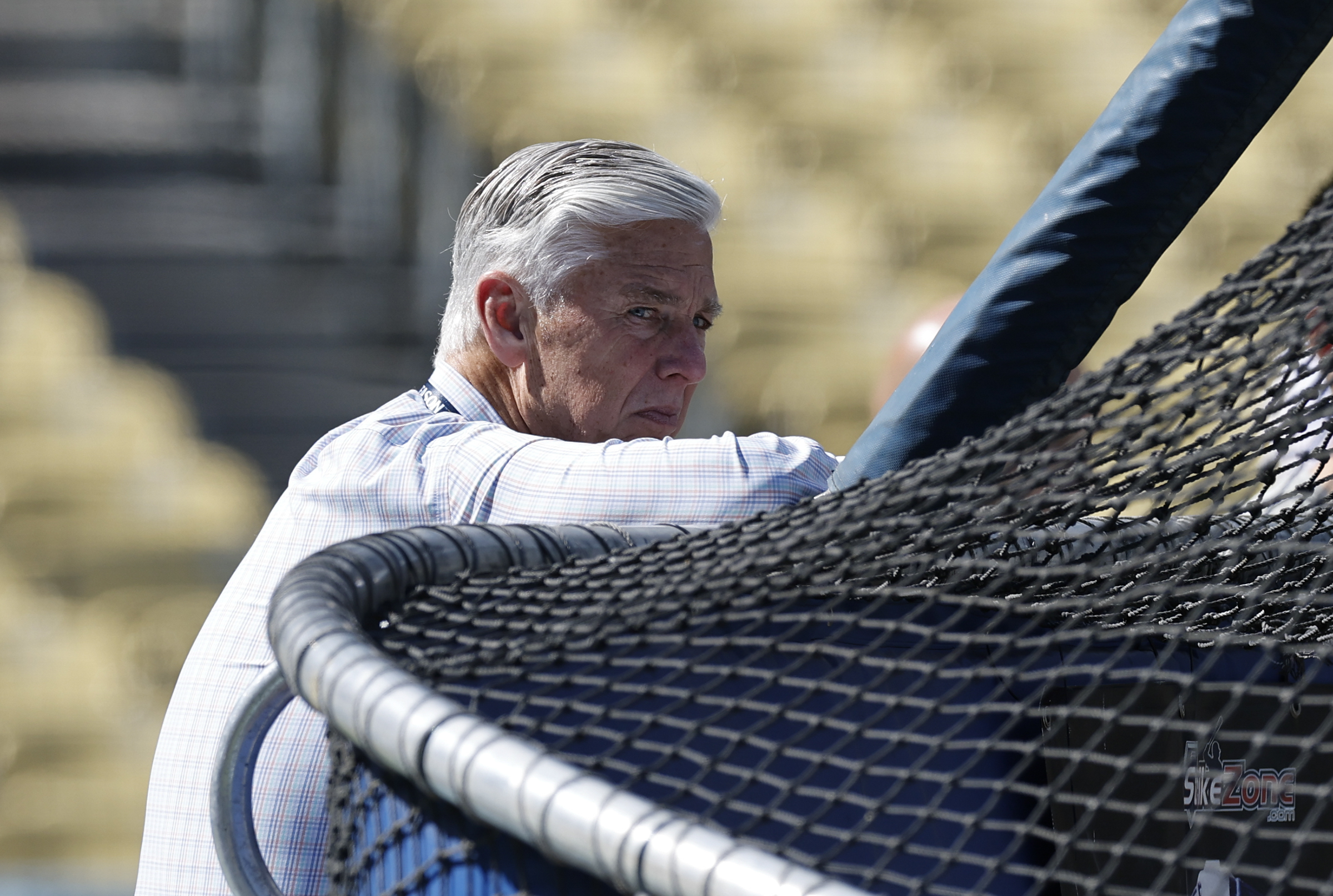
    Phillies president of baseball operations Dave Dombrowski said he was “upset” after finding out Bo Bichette picked the Mets, “but you have to pick yourself up and shake it off.”

    They might actually be better off with Realmuto at the controls of the pitching staff than with Bichette’s right-handed bat in the lineup. Pitching, after all, remains the strength of the roster, and Zack Wheeler, Cristopher Sánchez, and others swear by Realmuto’s guidance.

    Still, four days after Bichette slipped through the Phillies’ fingers, it was impossible to not hear the disappointment in Dombrowski’s voice.

    “That day you are very … upset, I guess is the way to say it,” he said. “But you have to pick yourself up and shake it off. Because you can’t just wallow in what took place. So, after a day of feeling that way, or a time period, you need to move forward. That’s how you handle it.

    “We did rebound in the sense that we signed J.T. right away. We’re very fortunate he didn’t sign somewhere else.”

    In time, maybe it will start to feel more like it.
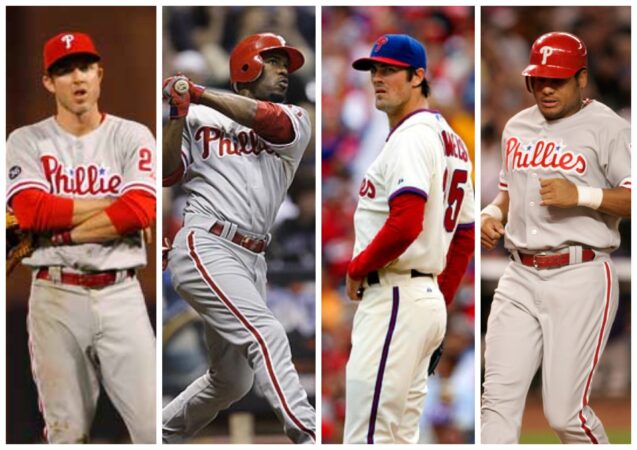
  • Who’s next? Sizing up the Hall of Fame chances for four Phillies on the ballot.

    Who’s next? Sizing up the Hall of Fame chances for four Phillies on the ballot.

    Cole Hamels knew it for years, even before pitching his last major league game. Eventually, a day would come when his name appeared on the Hall of Fame ballot.

    Even so, there was something about actually seeing it.

    “When they do put your name on the ballot, they send you a letter,” Hamels recently told Phillies Extra, The Inquirer’s baseball podcast. “You can frame it.”

    Better yet, cast it in bronze, just like those plaques on the walls in Cooperstown, N.Y. Because although only one, maybe two former players on this year’s ballot will get elected Tuesday night and inducted this summer, all 27 had careers worth recognizing.

    Take, for instance, Hamels. He finished in the top 10 in his league in ERA six times in 15 seasons, 10 of which came with the Phillies. He ranks fourth in Phillies history in strikeouts (2,560) and sixth in innings (2,698). He was the MVP of the 2008 World Series and threw a no-hitter in 2015 in his final Phillies start.

    By every measure, a brilliant career.

    Yet Hamels’ name might be checked on fewer than one-quarter of the 400 or so ballots — and not the one cast by this voter. Hamels was polling at 31.1% as of Friday evening, according to industrious ballot collector Ryan Thibodaux’s tracker, more than the minimum 5% to stay on the ballot, far from the 75% for election.

    But here’s what makes baseball’s Hall of Fame special: the quality of the players on the 1-yard line, a Tush Push from getting in. (Too soon for the Eagles reference?)

    Consider that less than 24,000 players have made it to the majors, even for one day. A fraction of those stuck around for 10 years, the minimum requirement to be considered by the screening committee that annually puts together the Hall of Fame ballot.

    Whittle it all down, and only about 5% of all major leaguers see their name on that sheet of paper. And since the inaugural Hall class in 1936, a total of 279 players have been elected, only 137 on the writers’ ballot.

    “It’s not a disservice to anyone that doesn’t get that checkmark in any single year,” said Hamels, making his ballot debut this year. “They’re all some of the best baseball players that I was fortunate to play against.”

    Indeed, that’s helpful to remember when the results are announced at 6 p.m. Tuesday on MLB Network.

    Full disclosure: I voted for Carlos Beltrán, Félix Hernández, Dustin Pedroia, Andy Pettitte, and Chase Utley. Pedroia was the only addition to my ballot from last year. I strongly considered Hamels, in addition to David Wright, Andruw Jones, and Jimmy Rollins and might come around on some, or all, next year.

    Every voter has a threshold for where to draw the 1-yard line. Over the years, my tendency has been to favor players who had a big peak, even if they lacked the longevity of classic Hall of Famers. Hernández, Pedroia, and Utley fall into that category.

    For observers of the Phillies, it was another loaded ballot, with four candidates — Bobby Abreu, Hamels, Rollins, and Utley — who spent the bulk of their careers with the team. Howie Kendrick and Hunter Pence briefly played for the Phillies; Kendrick works for them as a special assistant.

    Let’s dive into the Hall of Fame candidacies of the four longtime Phillies, from the most to the least likely to eventually get elected.

    Chase Utley received nearly 40% of the vote last year in his second appearance on the Hall of Fame ballot.

    Chase Utley

    Years on the ballot: Three

    2025 vote total: 39.8%

    The writers haven’t elected a player with fewer than 2,000 career hits since Ralph Kiner in 1975.

    Utley finished with 1,885.

    But Utley appears to be trending toward eventual election, likely because of the height of a peak that lasted at least six seasons and, if you squint, as many as 10. From 2005 to 2014, he had a 127 OPS+ and ranked second among second basemen in extra-base hits behind Robinson Canó, who was suspended twice for failing a drug test. Utley also had the second-most wins above replacement of any player, trailing only Albert Pujols.

    Utley made a healthy ballot debut (28.8%) in 2024, then got an 11-point bump last year. Without a strong first-year candidate, he’s set for his biggest leap yet, tracking above 60% in early returns, although players don’t tend to fare as well among voters who don’t make their ballot public.

    Second basemen are historically underrepresented in the Hall of Fame. The writers have elected only two (Craig Biggio and Roberto Alomar) since 2006. Jeff Kent was elected last month by an era committee after topping out at 46.5% in 10 years on the writers’ ballot. Maybe it will help Utley and Pedroia with the writers.

    Utley already got to almost 40% in only his second go-around. His statistics won’t change, but voters’ perspectives often do. It wouldn’t be surprising to see Utley climb over 50% this year and get the call to Cooperstown sometime around, oh, 2028.

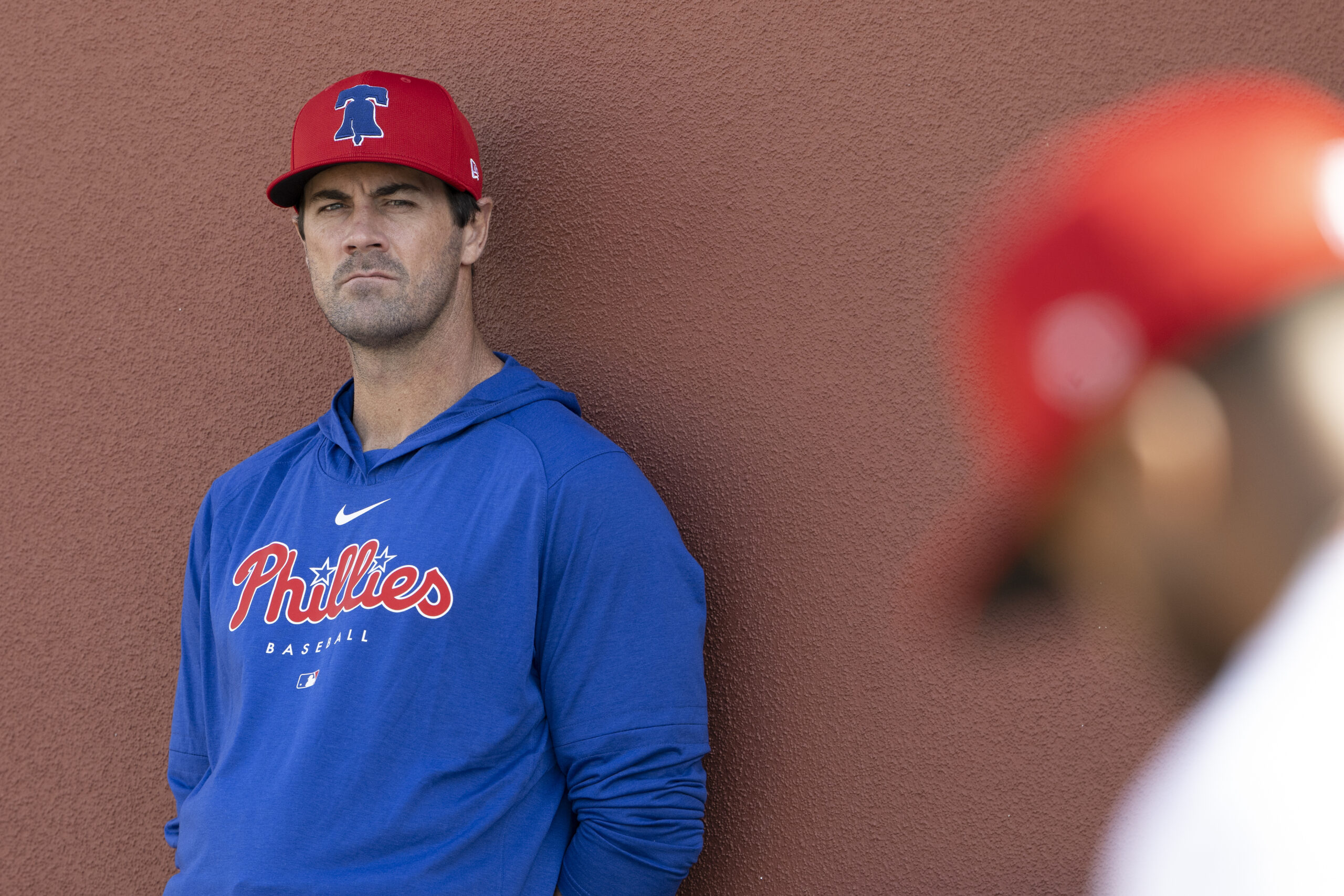
    Cole Hamels worked for the Phillies this year as a guest instructor in spring training and a part-time television analyst.

    Cole Hamels

    Years on the ballot: One

    Greg Maddux, Tom Glavine, Pedro Martínez, Randy Johnson, and John Smoltz went into the Hall of Fame in a two-year parade of starting pitchers in 2014 and ’15.

    Since then, the writers have elected only three starters.

    Roy Halladay, Mike Mussina, and CC Sabathia will be joined in five years by Clayton Kershaw and eventually by Justin Verlander and Max Scherzer. Maybe Zack Greinke, too. But beyond that group, who’s the next surefire Hall of Fame starter?

    At a time when teams ask less of their starters than before, in an age of reduced workloads and an arm-injury epidemic that has shortened careers, starters no longer reach the classic benchmarks — 300 wins, 3,000 strikeouts, etc. — that the all-time greats once did.

    It has been reflected in Hall of Fame voting. Johan Santana had a six-year peak with two Cy Young Awards and five top-five finishes but dropped off the ballot after one year because he apparently wasn’t dominant for long enough.

    Voters appear to be recalibrating. Hernández’s peak lasted slightly longer than Santana’s and featured one Cy Young and two runners-up. He appeared on 20.6% of ballots as a first-time candidate last year and was tracking at better than 50%.

    It’s difficult to assert that Hamels’ career, which didn’t include a top-three Cy Young finish, reached King Félix’s heights. But check out their numbers from 2007 to 2016:

    • Hamels: average of 208.2 innings, 126 ERA-plus, 46.5 WAR, according to Baseball-Reference.
    • Hernández: average of 214 innings, 129 ERA-plus, 47.2.

    It’s close. Fortunately, Hamels will get additional consideration. He’s going to hang around on the ballot, maybe even topping Hernández’s first-year total.

    Jimmy Rollins is the Phillies’ all-time leader with 2,306 hits.

    Jimmy Rollins

    Years on the ballot: Five

    2025 vote total: 18.0%

    Rollins’ significance to the Phillies would be undeniable even if he wasn’t their all-time hits leader. He was a soothsaying league MVP in 2007 and a World Series champion in 2008, and authored one of the biggest postseason hits in team history in the 2009 NL Championship Series.

    The Phillies’ 143-year story can’t be written without their best shortstop.

    But many Hall of Famers were franchise icons. Should every franchise icon be a Hall of Famer?

    The writers didn’t vote in Dale Murphy and Don Mattingly, whose excellence symbolized an era for the Braves and Yankees, respectively. Lou Whitaker didn’t get into the Hall of Fame after 19 starry seasons with the Tigers.

    And thus far, J-Roll hasn’t gotten much traction either.

    Despite sharing the middle infield with Utley for a dozen seasons, Rollins hasn’t matched his double-play partner’s ballot momentum. He debuted at 9.4% in 2022 and made only modest increases: 12.9% in 2023, 14.8% in 2024, and 18% last year. He’s tracking at about 23%, which would signal another small bump.

    Rollins’ supporters within the electorate often note that he’s the only shortstop ever with at least 2,000 hits, 200 homers, and 400 steals. He also won a league MVP, four Gold Gloves, and a World Series ring.

    But it’s difficult to ignore Rollins’ below-league-average OPS+ (95), although it wouldn’t be the lowest ever for a Hall of Fame shortstop (Phil Rizzuto, Ozzie Smith, Luis Aparicio, and Rabbit Maranville were worse).

    Bobby Abreu spent half of his 18 year major-league career with the Phillies.

    Bobby Abreu

    Years on the ballot: Seven

    2025 vote total: 19.5%

    Twenty-one players had at least 900 extra-base hits and 1,400 walks. Here’s the list: Babe Ruth, Lou Gehrig, Mel Ott, Jimmie Foxx, Ted Williams, Stan Musial, Willie Mays, Mickey Mantle, Eddie Mathews, Hank Aaron, Frank Robinson, Carl Yastrzemski, Pete Rose, Mike Schmidt, Barry Bonds, Gary Sheffield, Frank Thomas, Jim Thome, Jeff Bagwell, Chipper Jones … and Abreu.

    Good company, right?

    Yet Abreu somehow always seemed more like a supporting actor. He spent half his 18-year major league career with the Phillies but played for six teams. The Phillies won the World Series two years after he got traded; the Yankees won it one year after he left as a free agent.

    Abreu built on a 5.5% debut in 2020 but has plateaued in recent years — 15.4% in 2023, 14.8% in 2024, 19.5% last year. Through Wednesday, he had picked up 12 votes and was polling at about 40%.

    It would represent a decent jump for Abreu. But with only three more years on the ball, he needs a bigger leap to stand a chance at even sniffing 75%.

  • Gameday Central: Phillies Extra with Jesús Luzardo

    Gameday Central: Phillies Extra with Jesús Luzardo

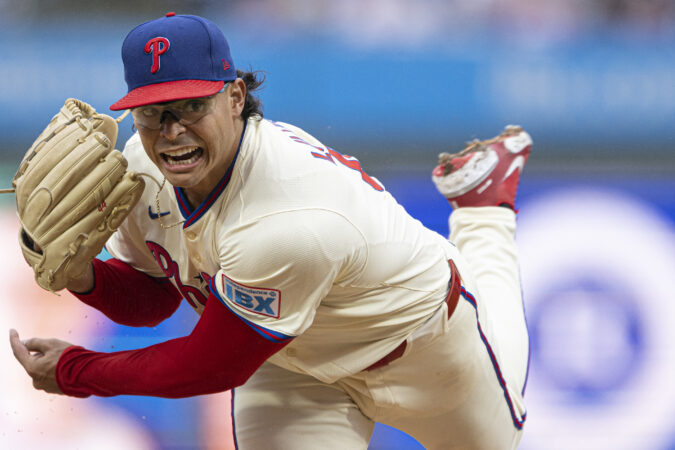
    Jesús Luzardo had the best season of his career last year with the Phillies. This is shaping up to be another important year for the 28-year-old pitcher, with free agency looming next winter. Luzardo sat down with Phillies Extra to discuss his interest in a contract extension, his relationship with catcher J.T. Realmuto, and what he can do for an encore after his breakout 2025. Watch here.

  • Jesús Luzardo ‘really interested’ in a contract extension with the Phillies

    Jesús Luzardo ‘really interested’ in a contract extension with the Phillies

    Jesús Luzardo hasn’t spoken with the Phillies yet about a contract extension.

    But it’s a conversation he would like to have.

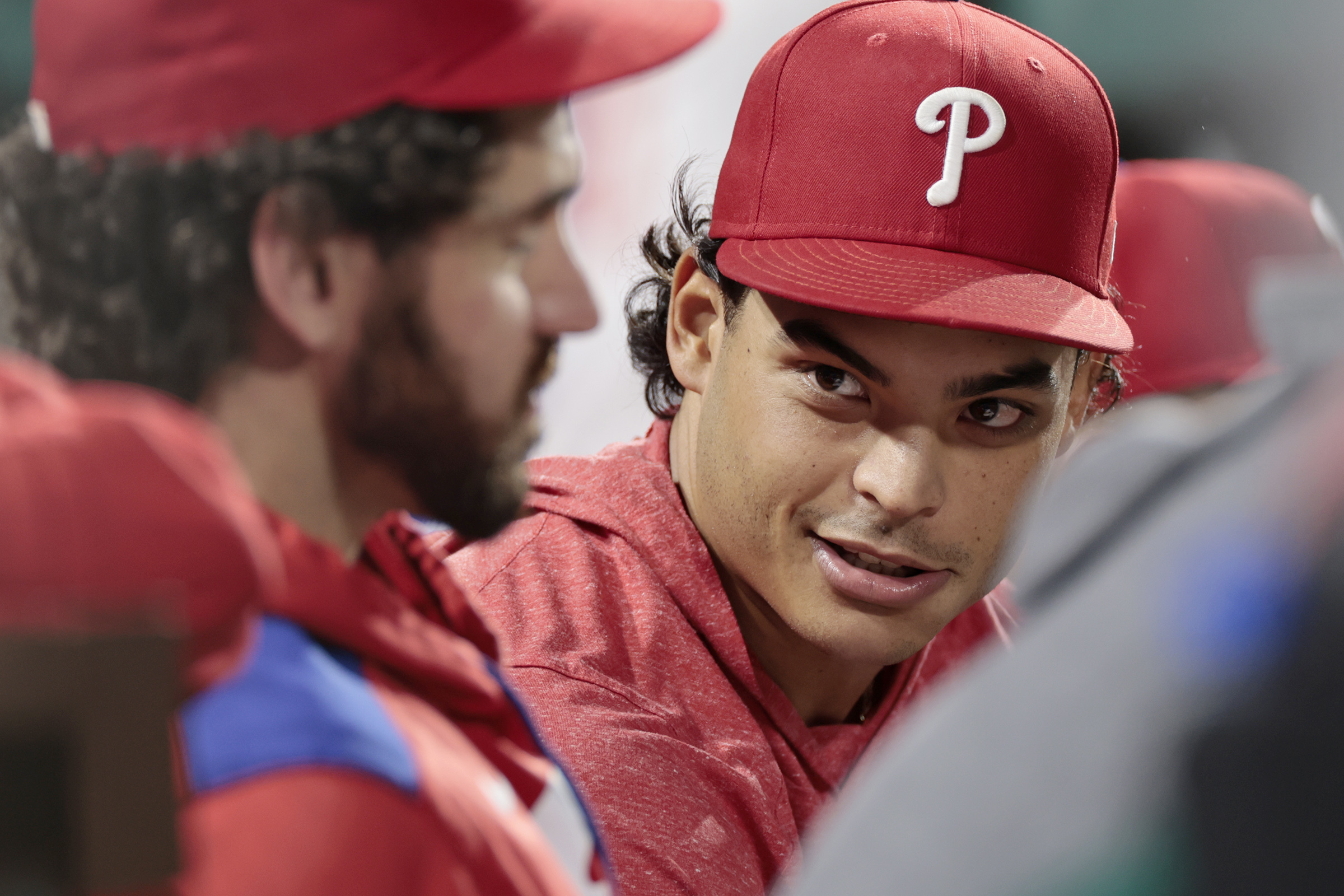
    “It’s not something that I’m closed off to,” said Luzardo, appearing as a guest this week on Phillies Extra, The Inquirer’s baseball podcast. “I just got married and hopefully eventually have a family, and just being stable in a certain place, knowing that you’re comfortable within an organization … it’s something I would be really interested in.”

    Stability has eluded Luzardo since he got drafted in 2016. The 28-year-old lefty has been traded three times — from the Nationals to the Athletics in 2017, the Athletics to the Marlins in 2021, and the Marlins to the Phillies before last season.

    But Luzardo’s first year with the Phillies was the best of his career. He made 32 starts and worked 183⅔ innings, both career highs. He posted a 3.92 ERA that was inflated by nearly one run by back-to-back starts in which he believed he was tipping pitches. And he incorporated a sweeping slider that became his go-to breaking pitch.

    “It’s an organization that I had a really good time in,” Luzardo said. “I love the city, I loved where I lived, and the organization as a whole, how they treat us as players, how they treated my family. But at the end of the day, it’s not entirely up to me or in my hands.

    Jesús Luzardo, who pitched for Venezuela in 2023, said he’s skipping this year’s World Baseball Classic.

    “I’m a firm believer that what is supposed to happen will happen. I haven’t had any of those conversations yet. If they were to come, I would be open to hearing them.”

    Regardless, Luzardo said he won’t be in the World Baseball Classic despite receiving calls from Team USA and Venezuela. He pitched for Venezuela in 2023.

    “Going into a free-agency year, I made the decision that, unfortunately, I’m not going to be able to pitch in the Classic,” Luzardo said. “I want to take my time, take a slow spring training, fully get ready with the team, make sure my body bounced back after a career high in innings.”

    Meanwhile, lefty Cristopher Sánchez is interested in representing the Dominican Republic in the WBC, a major league source said this week. Sánchez was the Cy Young runner-up in the National League last year. Kyle Schwarber and Bryce Harper committed to playing for Team USA in the tournament, which runs from March 5-17; catcher Garrett Stubbs intends to play for Israel.

    Luzardo will make $11 million this year and could be in line to at least double that salary with another good season. Two potential barometers: Framber Valdez and former Phillies teammate Ranger Suárez, free-agent lefties who could sign nine-figure contracts before spring training.

    The Phillies will have $38 million rolling off the books after this season when Nick Castellanos and Taijuan Walker’s contracts expire. But they have $165.9 million committed to seven players for 2027: Zack Wheeler, Schwarber, Trea Turner, Harper, Aaron Nola, Brad Keller, and Sánchez. And they had a Zoom call Monday with free-agent infielder Bo Bichette about a long-term contract that would add another big salary.

    Extra bases

    The Phillies acquired righty reliever Chase Shugart from the Pirates for minor-league infielder Francisco Loreto. Shugart, 29, got designated for assignment after posting a 3.40 ERA in 35 appearances last season for Pittsburgh. He has minor-league options and figures to provide more depth to the bullpen.

  • ‘Phillies Extra’ Q&A: Adam Lind on working with Justin Crawford, Aidan Miller, Gabriel Rincones Jr., and more

    ‘Phillies Extra’ Q&A: Adam Lind on working with Justin Crawford, Aidan Miller, Gabriel Rincones Jr., and more

    For most of last summer, observers of the Phillies wondered impatiently about when they would call up outfield prospect Justin Crawford.

    But Crawford stayed put in triple A.

    Now, with president of baseball operations Dave Dombrowski signaling that Crawford has the inside track on being the opening-day center fielder, many of those same observers are nervous about the Phillies turning over the keys to a 22-year-old rookie.

    It felt timely, then, to invite Crawford’s triple-A hitting coach as a guest on Phillies Extra, The Inquirer’s baseball podcast. Adam Lind obliged, and discussed Crawford’s approach at the plate, which has yielded a .322 batting average in the minor leagues but also a high ground ball rate that leaves critics wondering about his ability to hit major league pitching.

    Lind, 42, had a 12-year major league career, mostly with the Blue Jays, and finished with 200 home runs and a 112 OPS-plus. In 2017, his last season in the majors, he played with Bryce Harper and Trea Turner with the Nationals. Lind recalled the experience of teaming with Harper, in particular.

    Watch the full interview below and subscribe to the Phillies Extra podcast on Spotify or Apple Podcasts.

    Q: What was it like in 2017 to be teammates with a 24-year-old Harper at that stage of his career?

    A: It was interesting to be around. Even with José Bautista and Félix Hernández, Ryan Braun — those were superstars — but Bryce takes it to another level. So, it was wild to be in his environment. The talent immediately was like, I’ve never seen a player like that. And then I thought his personality was really interesting. He was actually very funny, a very funny character. I enjoyed being around him. It was a good experience, and it was a great year, a great way to end my career, that 2017 summer with the Washington Nationals.

    Q: What did Aidan Miller look like when he got to you at [single-A] Jersey Shore two years ago, and then what did he look like when he left Lehigh Valley after spending the last week of the season with you there last year?

    A: The first thing I want to compliment Aidan on is his character. It was a tough stretch [in 2024]. We had some deep talks. I learned about him; he learned about me. But the thing is, he worked hard. He gave 110% every single day, and I think more than his hitting or his approach or what I saw, what I witnessed was the type of kid he is and the character he has. And I think that will benefit him hopefully for as many years as he can play. But again, more so than his hitting, his character stands above his work ethic. They’re second to none.

    Q: What do you see as the biggest growth for Miller as a hitter?

    A: His physicality. He looks the part. He has the size, he has the tools. But one thing that happened to him was, my older players, when they were on deck, or when he was hitting or whatever the case might be, they were complimenting him to me. And when you have 29-, 31-year-olds noticing his talent, that means he’s got a real future in the game. Because a lot of times there’s doubt from those types of players. They don’t believe it until they see it. Day 1, he ignited our team. I know it’s triple A, the minor leagues. We had a big series against Scranton, and without him in our lineup that week, we probably wouldn’t have won that series. And he just ignited our lineup for what we needed at that moment in that part of the season.

    Q: Where do you come down on the question of whether Justin Crawford hits enough balls in the air to be successful in the big leagues? And with his speed, does it even really matter?

    A: Hopefully it doesn’t matter. I have to give a big shout-out to player acquisition and our amateur scouting. Between Aidan and between Justin, the type of kids they are, the type of adults they will be, their work ethic, they’re second to none. So, in terms of how [Crawford] is going to succeed in the major leagues, you can never forecast the future, but he’s got the right mentality. He’s got the right work ethic. He’s even-keeled. As far as hitting too many balls on the ground, his approach works right now. He’s super fast. His swing works to where he can hit the ball all over the yard. And when you’re left-handed, it’s a big asset to be able to hit the ball on the ground to the left side of the infield. And whenever a defender has to take one step away from first base, that usually means he’ll be safe.

    Gabriel Rincones Jr. hit 18 home runs with a .799 OPS in 506 plate appearances at triple-A Lehigh Valley in 2025.
    Q: Where did you leave things with Gabriel Rincones Jr., in terms of what he needs to do to take that next step this season?

    A: Well, I think the first two months were good for Gabriel. It forced him to learn about himself and learn about the game. We had discussions about, what have you learned so far in your career? And there weren’t really great answers yet. But through the struggle, he matured a lot. He learned a lot about his swing. He learned a lot about approach, and I think it was just the level. And I say this a lot, baseball will tell you when you need to make an adjustment, and that was his calling. Triple A was another level for him. He hadn’t played a whole lot even at double A, so it was a good challenge for him, and he responded well in the second half.

    As far as left-handed pitching, I tried to give him some tools. We worked a lot, somewhat a lot, with him in [high-performance] camp [in the fall] on left-handed pitching. But again, his calling card will be to do well against right-handed pitching. He’s immensely talented. In my heart, I think he can hit left-handed pitching, but he just needed some tools and some approach adjustment and just some outside-the-box thinking. Because I had to try and do it — how to survive against left-handed pitching. And you look at Kyle Schwarber, he wasn’t very good [against lefties] at the beginning of his career. He made adjustments. And it’s not usually [about the] swing; it’s an approach thing, and hopefully he will improve. The numbers are kind of low against lefties, so it should be easy to make improvements with just simple approach adjustments.

  • Gameday Central: Phillies Extra with Adam Lind

    Gameday Central: Phillies Extra with Adam Lind

    The Phillies are preparing to turn over the keys to center field in 2026 to prospect Justin Crawford. After working with Crawford last season, triple-A Lehigh Valley hitting coach Adam Lind sits down with “Phillies Extra” to discuss the touted 22-year-old’s readiness for the majors, as well as other prominent players in the Phillies organization. Watch here.

  • Alex Bregman is off the market. What does that mean for the Phillies’ pursuit of Bo Bichette?

    Alex Bregman is off the market. What does that mean for the Phillies’ pursuit of Bo Bichette?

    It’s a good time to be Bo Bichette.

    Not only did the Phillies cannonball last week into the pool of teams interested in signing Bichette, but his market is about to kick into overdrive after fellow free-agent infielder Alex Bregman reached a five-year, $175 million agreement with the Cubs late Saturday night.

    Bichette has a Zoom call with the Phillies scheduled for this week, a league source confirmed. Now, after Bregman bolted Boston for the North Side of Chicago, the Red Sox figure to pivot to Bichette, multiple major league sources expect. The Yankees may be in the mix, too, as their talks with free agent Cody Bellinger are at an “impasse,” ESPN.com reported over the weekend.

    The Cubs doled out a club-record $35 million per year for Bregman, albeit with deferrals that reduce the present-day value, according to The Athletic. Bichette, who turns 28 in March, is four years younger than Bregman, which could put him in line for a seven- or eight-year contract at a similar, if not higher, annual salary and boost the overall value of the deal to $250 million or more.

    Meanwhile, another musical chair in the infield market disappeared over the weekend, as the Diamondbacks pulled back Ketel Marte in trade talks. That leaves Bichette and 34-year-old free agent Eugenio Suárez as the best and most straightforward infield options.

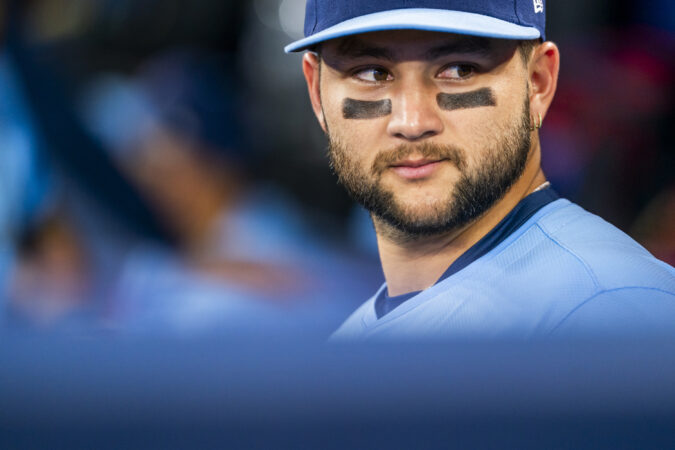
    Bo Bichette (left) will meet this week with the Phillies, who are awaiting a decision from free-agent catcher J.T. Realmuto.

    Until the last few weeks, the Phillies didn’t expect to join the bidding for Bichette. Not after re-signing Kyle Schwarber to a five-year, $150 million contract and making an offer to bring back cornerstone catcher J.T. Realmuto, whose influence among the pitching staff and leadership from behind the plate outweigh his declining offense.

    But as Realmuto holds out for a better offer, the Phillies have explored other avenues to potentially improve the roster, a league source said last week, and see a possible fit with Bichette, who is open to moving to second base or third base after playing shortstop for seven seasons with the Blue Jays.

    At the plate, Bichette is a .294 career hitter with a 121 OPS-plus and the unusual combination of a low strikeout rate (14.5% last season) and high rate of swings at pitches out of the strike zone (35.2%). His knack for putting balls in play, regardless of where they’re pitched, would add a dimension to the Phillies offense.

    It’s also likely the Phillies got a strong endorsement from newly hired bench coach Don Mattingly, with whom Bichette grew close over the last two seasons in Toronto.

    But the competition for Bichette is fierce, even more with Bregman off the board. Let’s look at the teams that could threaten the Phillies’ pursuit of Bichette:

    After only one season with the Red Sox, Alex Bregman agreed to a five-year, $175 million contract with the Cubs.

    Red Sox

    When the Red Sox signed Bregman last spring, they irritated incumbent third baseman Rafael Devers so much that they traded him in June even though Bregman could opt out of his contract after one season.

    Sure enough, third base at Fenway Park will be occupied by neither Bregman nor Devers in 2026.

    Although the Sox have mostly resisted long-term deals with free agents since they fired Dave Dombrowski in 2019, they reportedly put a five-year offer on the table for Bregman before getting outbid by the Cubs. It’s fair to assume they would go at least that long for Bichette. But would they stretch to seven years? Eight?

    The Sox entered the offseason looking for two middle-of-the-order hitters. Rather than chasing Schwarber or Pete Alonso in free agency, they traded for first baseman Willson Contreras. Their other big offseason move was also a trade, also with the Cardinals, for pitcher Sonny Gray. They could aim for the hat trick by trading for St. Louis’ Brendan Donovan to fill a vacancy at second base or third.

    Donovan, 29, will make only $5.8 million this year and is under club control through 2027. Trading for him feels like a move for a free agent-averse team. But few free agents are as young as Bichette, which might enable the Red Sox to view him as less risky.

    Despite reportedly receiving multiple offers from the Yankees, Cody Bellinger is still a free agent.

    Yankees

    Like the Phillies with Realmuto, the Yankees prioritized re-signing Cody Bellinger and taking aim at another World Series.

    A deal hasn’t materialized.

    Bellinger, 30, is reportedly seeking a seven-year contract; the Yankees, according to reports, are hesitant to go longer than five. And the longer the staring contest between the sides persists, the more the Yankees figure to pursue other options.

    Signing Bichette would require the Yankees to do almost as much lineup juggling as the Phillies. While the Phillies would have to trade third baseman Alec Bohm to make room in the payroll and the infield, the Yankees likely must do the same with second baseman Jazz Chisholm Jr. (Coincidentally, Bohm and Chisholm will both make $10.2 million this year and can be free agents after the season.)

    But if the Yankees lose Bellinger, they will need to replace his middle-of-the-order production. Bichette is one solution, albeit from the right side of the plate instead of the left.

    Free-agent outfielder Kyle Tucker spent the 2025 season with the Cubs.

    Blue Jays

    After spending $337 million in free agency on starter Dylan Cease, relievers Tyler Rogers and Cody Ponce, and Japanese third baseman Kazumo Okamoto, the World Series runner-up is hoping to put a cherry on top of its offseason bonanza by signing outfielder Kyle Tucker.

    Why not just bring back Bichette?

    The Blue Jays haven’t ruled it out. Although the infield appears set with Vladimir Guerrero Jr. at first base, Ernie Clement at second, Andrés Giménez at shortstop, and Okamoto at third, the Jays believe Okamoto is capable of adding left field to his portfolio. In his introductory news conference in Toronto, Okamoto said he likes playing different positions.

    But Tucker represents a better positional fit for the Blue Jays. If he signs elsewhere, it’s worth wondering if they would pivot to fellow lefty-hitting outfielder Bellinger or turn back to Bichette.

    The field

    Never count out the Dodgers, especially if Bichette is willing to sign for a shorter term and higher annual salary with an opt-out after a year or two. The two-time defending World Series champs would presumably play him at second base and use Tommy Edman in center field and Hyeseong Kim and Miguel Rojas in utility roles.

    Bichette would also fit with the Mariners, who won a division title and advanced to Game 7 of the ALCS last year despite ranking 17th in wins above replacement at second base (1.5) and 13th at third base (1.9). They could choose to re-sign Suárez but already lost infielder Jorge Polanco in free agency to the Mets.

  • Top 2026 Phillies storylines: J.T. Realmuto or Bo Bichette, Zack Wheeler’s return, and more

    Top 2026 Phillies storylines: J.T. Realmuto or Bo Bichette, Zack Wheeler’s return, and more

    If they made a movie about the Phillies as 2026 begins, the climactic scene would feature Bryce Harper at the plate, flipping his Victus bat, and shouting four words at a bloodthirsty crowd.

    “Are you not entertained?”

    It’s a fair question. Because the Phillies have a $300-plus-million payroll and as many stars as a planetarium. They won more games in the last three seasons than all but two teams (Dodgers, Brewers). And only the Dodgers have a streak of playoff appearances longer than the Phillies’ four-year run.

    Surely, the 3.3 million fans who surged through the gates of Citizens Bank Park last season enjoyed all that.

    Except, well, you know what keeps happening to the Phillies in October: divisional-round ousters in 2024 and ’25 after the Game 6 and 7 soul-crushers at home in the 2023 National League Championship Series. That’s eight losses in 10 playoff games — and nothing to show for so much regular-season success.

    So, when the Phillies re-signed Kyle Schwarber last month and made an offer to bring back franchise catcher J.T. Realmuto, it mostly was met with a shrug from fans who are more wary than they should be about keeping together the guts of a roster that chased 90 wins three years ago with 95 and then 96.

    But before channeling our inner Gladiator and questioning the entertainment value of yet another winning summer spent with the cast that disappoints every autumn, the Phillies went and set up a meeting next week with star free-agent infielder Bo Bichette, a major league source said Thursday, confirming a report by The Athletic.

    Entertaining? Maybe. Interesting? Definitely.

    Free-agent infielder Bo Bichette is scheduled to meet with the Phillies over video next week, according to a major league source.

    Bichette, who will be 28 next season and twice led the American League in hits, would bring a high contact rate and right-handed power to the Phillies’ lineup. Imagine a batting order that looked like this:

    1. Trea Turner, SS
    2. Schwarber, DH
    3. Harper, 1B
    4. Bichette, 3B
    5. Adolis García, RF
    6. Brandon Marsh/Otto Kemp, LF
    7. Bryson Stott, 2B
    8. Catcher
    9. Justin Crawford, CF

    But the real explanation for the fans’ collective endorphin rush is that Bichette — son of former major leaguer Dante Bichette, godson of ex-Phillies manager Joe Girardi — would represent the biggest change of the mix since Turner’s arrival as a free agent in December 2022. And let’s be clear: Signing Bichette would be like taking a blender to the roster.

    Not only would the Phillies need to teach Bichette a new position (third base), but to squeeze him into the budget — with the payroll pushing up against the highest luxury-tax threshold — they must move third baseman Alec Bohm’s $10.2 million salary and say goodbye to Realmuto.

    Are the Phillies really better off with Bichette? Maybe. Realmuto is older (35 this season) and amid a three-year decline at the plate. But he still has more wins above replacement over the last three seasons (9.0, as calculated by Baseball-Reference) than Bichette (8.0). And he’s beloved by the pitchers for his leadership and game-calling.

    The Phillies remain hopeful of retaining Realmuto, but the sides have been locked in a contractual staring contest for a month. There isn’t a Phillies story — and depending how things go Sunday at the Linc, maybe not a Philadelphia sports story — that will dominate the news more than the Bichette-Realmuto saga for as long as it lasts.

    But 2026 will bring several entertaining Phillies storylines, such as:

    Phillies ace Zack Wheeler is seeking to return from thoracic outlet decompression surgery.

    Whither Wheeler?

    When we last heard from Zack Wheeler, it was August, and he was where he normally is, smack dab in the conversation with Paul Skenes, Tarik Skubal, and maybe Garrett Crochet for the best pitcher in baseball.

    Then, in the flash of his fastball, he was gone, diagnosed with a blood clot near his right shoulder.

    The clot was brought on by venous thoracic outlet syndrome, a condition in which the subclavian vein gets compressed between the collarbone and rib cage. Wheeler had season-ending surgery to remove the clot, then another procedure in late September in which his top rib was removed to relieve the pressure on the vein.

    (Aside: It’s difficult not to wonder if the divisional series against the Dodgers would’ve turned out differently if the Phillies had Wheeler and reliever José Alvarado. Then again, they scored only seven runs in the three losses — and lost by a total of four runs. Pitching wasn’t the problem.)

    Wheeler is throwing again — from 75 feet, manager Rob Thomson said before seeing him in person this week. The Phillies are optimistic he won’t miss much of the season. As one major league source put it, his recovery is “going great.”

    “The trainers seem to think he’s doing very well,” Thomson said, purposely not venturing a guess for Wheeler’s return.

    But thoracic outlet syndrome isn’t as common as, say, Tommy John surgery, and the return isn’t always as smooth. Maybe Wheeler, 35 in May, will make a full recovery, à la Diamondbacks righty Merrill Kelly, who was in his 30s when he returned from TOS. Maybe he will need to reinvent himself on the mound.

    Either way, it won’t be as automatic as winding up Wheeler and watching him dominate for 200 innings. And the rest of the starting rotation, still the Phillies’ backbone, must be adjusted accordingly.

    Bryce Harper finished with an .844 OPS last season, 11th among qualified National League hitters.

    Return of the ‘Showman’

    As soon as Harper walks through the door in spring training, the Elite/Not Elite conversation will reach full boil. Silly as it is, Dave Dombrowski’s candid assessment of Harper’s 2025 season is a significant plotline, largely because of Harper’s reaction to it.

    But there are tangible things that Harper can improve.

    Start here: Harper swung at 35.6% of pitches out of the strike zone last season, 129th among 144 qualified hitters, according to Statcast. Not only was it worse than the league average (28.4%) but also his career mark (29.3%).

    Harper was hampered in the first half of the season by an inflamed right wrist, which eventually sidelined him for 23 games. And he did still finish with an .844 OPS, 11th among NL hitters who qualified for the batting title.

    Not bad. Just not … elite.

    There’s that word again.

    “He expanded a little bit more than we’re accustomed to,” hitting coach Kevin Long said in November on Phillies Extra, The Inquirer’s baseball podcast. “I don’t know what his actual chase rate ended up being, but it was probably 35%. That’s high. If he gets that number down to 32, just drop it 3%, now he’s swinging at better pitches, [and] he’s going to do more damage.”

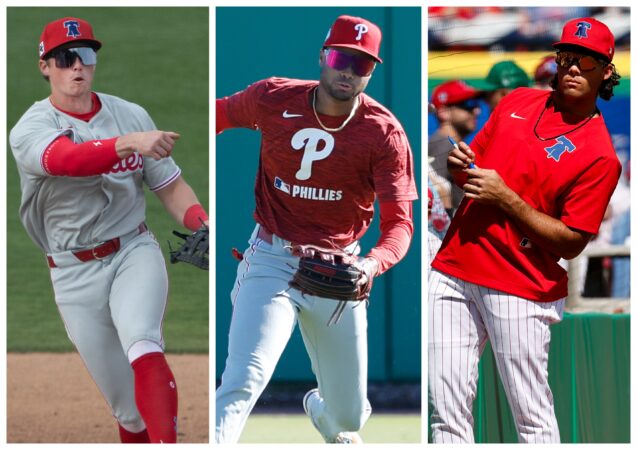
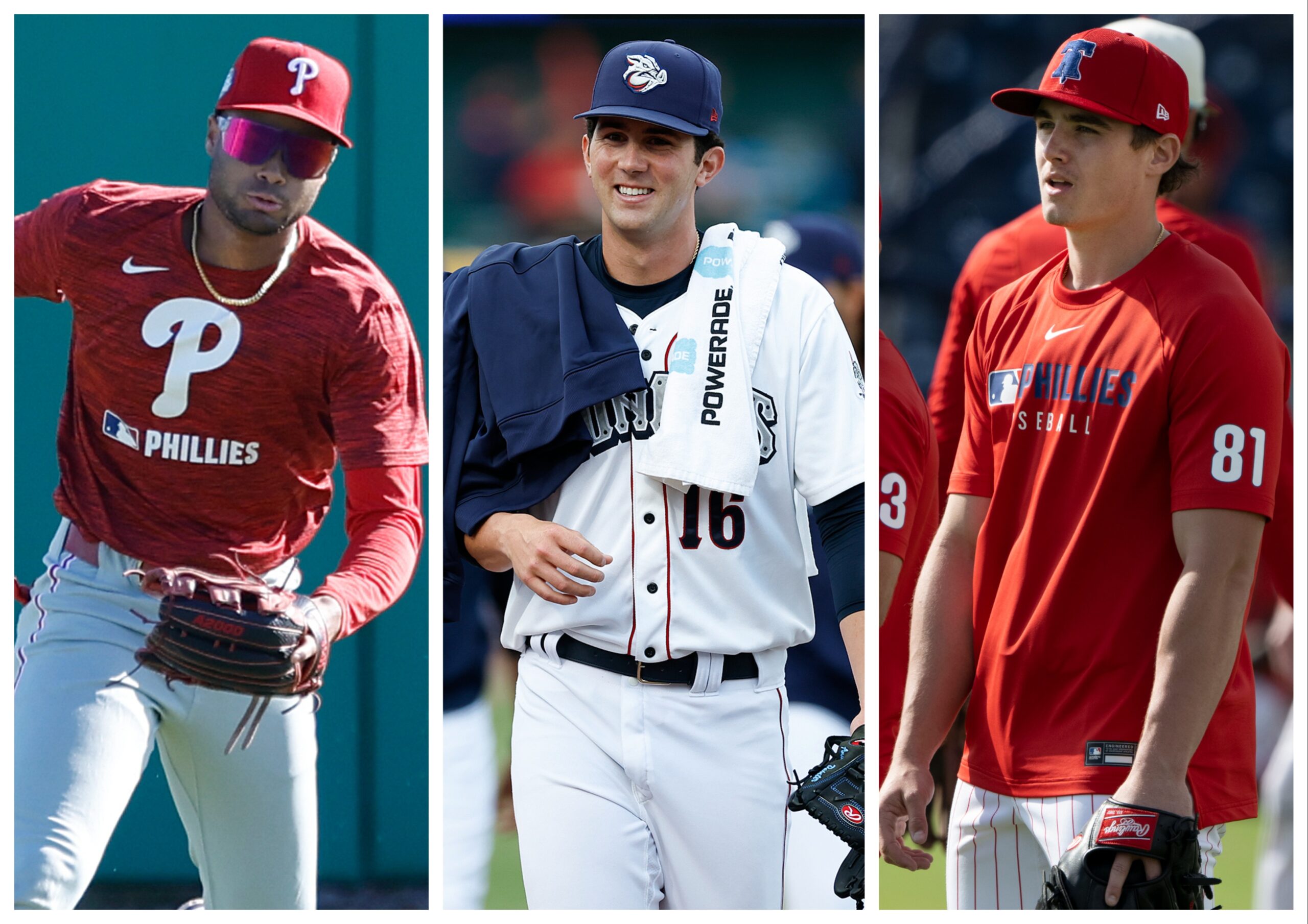
    Justin Crawford (left), Andrew Painter, and Aidan Miller are among the Phillies’ top prospects.

    Will the kids be all right?

    The Phillies had 12 players make their major league debuts in the last three seasons — fewer than any team, based on FanGraphs research.

    That’s about to change.

    Barring a spring training from hell, Justin Crawford will be part of the Phillies’ opening-day outfield, likely in center, on March 26 against the Rangers. There’s a decent chance Andrew Painter will be in the season-opening rotation, especially if Wheeler misses the first few weeks.

    And if infielder Aidan Miller plays well for a few months in triple A, he could accelerate the Phillies’ timetable to call him up.

    The existing core is aging, though not yet old. Harper and Schwarber will play at 33 all season; Turner and Aaron Nola will turn 33 in June. And if this is the year that the Phillies finally scale the October mountain, their stars will have led the charge.

    But it’s imperative that the Phillies’ trio of top prospects graduate to majors and provide at least as much impact, if not more, than the last wave of young players.

    “I’ve said this all along, and I still believe this: We need to start working our young players into our [roster],” Dombrowski said last month. “We have good young players, and we’ll be better for it. I do think that good organizations can blend young players with veterans.”

    Speaking of the Phillies’ previous youth brigade, Stott and Marsh finally got better results at the plate last season after making midyear changes. Stott hit .294 with an .855 OPS after the All-Star break; Marsh batted .303 with an .836 OPS after a hitless April. Can they build on that success?

    And will reliever Orion Kerkering bounce back from his devastating season-ending throwing error?

    File them away among the subplots in the Phillies’ 2026 soap opera.

  • Gameday Central: Phillies Extra with Adam Lind

    Gameday Central: Phillies Extra with Adam Lind

    The Phillies are preparing to turn over the keys to center field in 2026 to prospect Justin Crawford. After working with Crawford last season, triple-A Lehigh Valley hitting coach Adam Lind sits down with “Phillies Extra” to discuss the touted 22-year-old’s readiness for the majors, as well as other prominent players in the Phillies organization. Watch here.

  • Source: Phillies to meet with Bo Bichette; agree to deals with seven players

    Source: Phillies to meet with Bo Bichette; agree to deals with seven players

    Facing a deadline Thursday to agree on 2026 salaries or file for arbitration with seven players, the Phillies went 7-for-7, including a one-year deal with Alec Bohm.

    But will Bohm still be on the roster by opening day?

    The Phillies remain focused on bringing back J.T. Realmuto, according to multiple major league sources. But with the cornerstone catcher still unsigned, the team plans to have a video meeting next week with free-agent infielder Bo Bichette, a source said, confirming a report from The Athletic.

    Several hurdles exist in a potential pursuit of Bichette, not the least of which is his positional fit with the Phillies. Save for 32 innings at second base in last year’s World Series, he played only shortstop in seven seasons with the Blue Jays.

    The Phillies aren’t moving shortstop Trea Turner and value Bryson Stott’s defense at second base. Bichette hasn’t played third, but the Phillies have transitioned other players to new positions under highly regarded infield coach Bobby Dickerson (Bryce Harper in 2023, for instance.) And other teams are considering Bichette at third base, too.

    There’s also a financial component. The Phillies have roughly $302 million in 2026 payroll commitments, encroaching on the highest luxury-tax threshold. They will pay a 110% tax on expenditures above $304 million. (Their 2025 payroll was $314.3 million, fourth-highest in baseball and not including a $56.1 million luxury-tax bill due this month.)

    Alec Bohm agreed Thursday on a $10.2 million salary for 2026, avoiding arbitration with the Phillies. He’s eligible for free agency after the season.

    It’s unlikely, then, that the Phillies could sign Bichette and Realmuto. Fitting Bichette into the budget probably would require not only finding a less-expensive catcher, but also trading Bohm at a time when third base-needy teams can still choose from free agents Alex Bregman and Eugenio Suárez. Bohm agreed Thursday on a $10.2 million salary for 2026, his last season before free agency.

    Bichette, who will be 28 this season, reportedly is drawing interest from other big-market teams, including the Yankees, Red Sox, and Cubs, according to the New York Post.

    He also is a .294 career hitter, including .311 last season, with a high contact rate and right-handed power. He hit 18 homers last season, averaged 24 from 2021 to 2023, and could provide protection in the middle of the order for Harper or Kyle Schwarber. And Bichette has a close relationship with new Phillies bench coach Don Mattingly, for whom he played in Toronto.

    If the Phillies pivoted from Realmuto, they would have to find a catcher to at least split time with Rafael Marchán or Garrett Stubbs. They also would risk disrupting a starting rotation that reveres Realmuto. Zack Wheeler rarely shakes off any pitch he calls; Cristopher Sánchez described his impact this way: “We’re basically nothing without him.”

    The Phillies made at least one offer to Realmuto last month, according to an MLB.com report. But Realmuto is holding out for a higher salary over a two- or three-year term after making a catcher-record $23.1 million per year since 2021. At age 35 this season, he’s unlikely to come close to that salary.

    In addition to Bohm, the Phillies reached agreements on 2026 contracts with the following players (salary figures are according to major league sources): pitchers Jesús Luzardo ($11 million), Jhoan Duran ($7.5 million), and Tanner Banks ($1.2 million); Stott ($5.9 million); infielder Edmundo Sosa ($4.4 million); and outfielder Brandon Marsh ($5.2 million).