Author: Mike Sielski

  • Let us raise a glass to the Tush Push. It’s dead, and the Eagles have to find an alternative.

    Let us raise a glass to the Tush Push. It’s dead, and the Eagles have to find an alternative.

    We are football followers, Eagles followers, so … no lies between us.

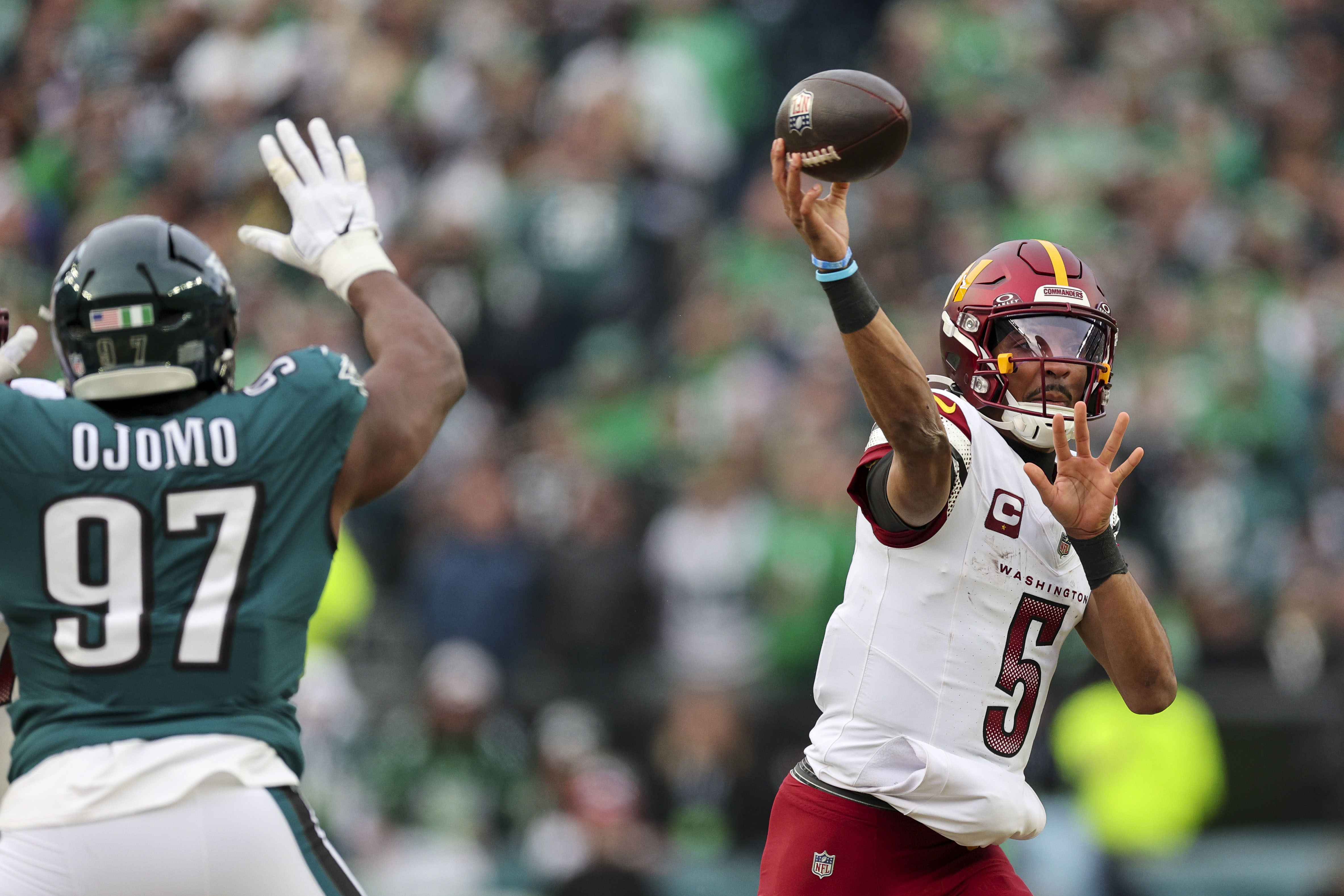
    The Tush Push had its moments. Yes, it did. You remember the first touchdown of Super Bowl LIX, the ease with which Jalen Hurts slipped through the Kansas City Chiefs’ defensive line and into the end zone? The Tush Push was the first sign of the rout to come. And the fourth-and-1 from the Eagles’ 26-yard line against the Miami Dolphins two years ago? In a one-score game? That was the Tush Push at its best. And the NFC championship game in January. The two Hurts TDs from the Washington 1-yard line. The Frankie Luvu leaps. The high comedy.

    The Tush Push took a lot of close games and put them away. Yes, indeed. It won more games for the Eagles than it lost, as much as any strategy or ploy. Did it tick off an NFL coach or three? No doubt. I think the league actually kind of got used to it, thank God. Did it cause controversy and enrage owners and get people in the media saying silly things about “nonfootball plays?” Hell, yes. Was it as much a fad, a passing fancy, as the run-and-shoot and the Wildcat and an RPO-based offense? Abso-freaking-lutely. But the Tush Push stood against that dark tide, and it helped make the Eagles of Philadelphia a great team. A championship team.

    ♦ ♦ ♦

    LANDOVER, Md. — Here at Northwest Stadium, just 35 miles from the city that was the setting for David Simon’s magisterial series The Wire, it is only fitting that, as if attending a barstool wake among Baltimore po-leece, we eulogize the Tush Push. The play that once gave the Eagles a physical, psychological, and strategic edge over every opponent they encountered is, by all available indications, dead.

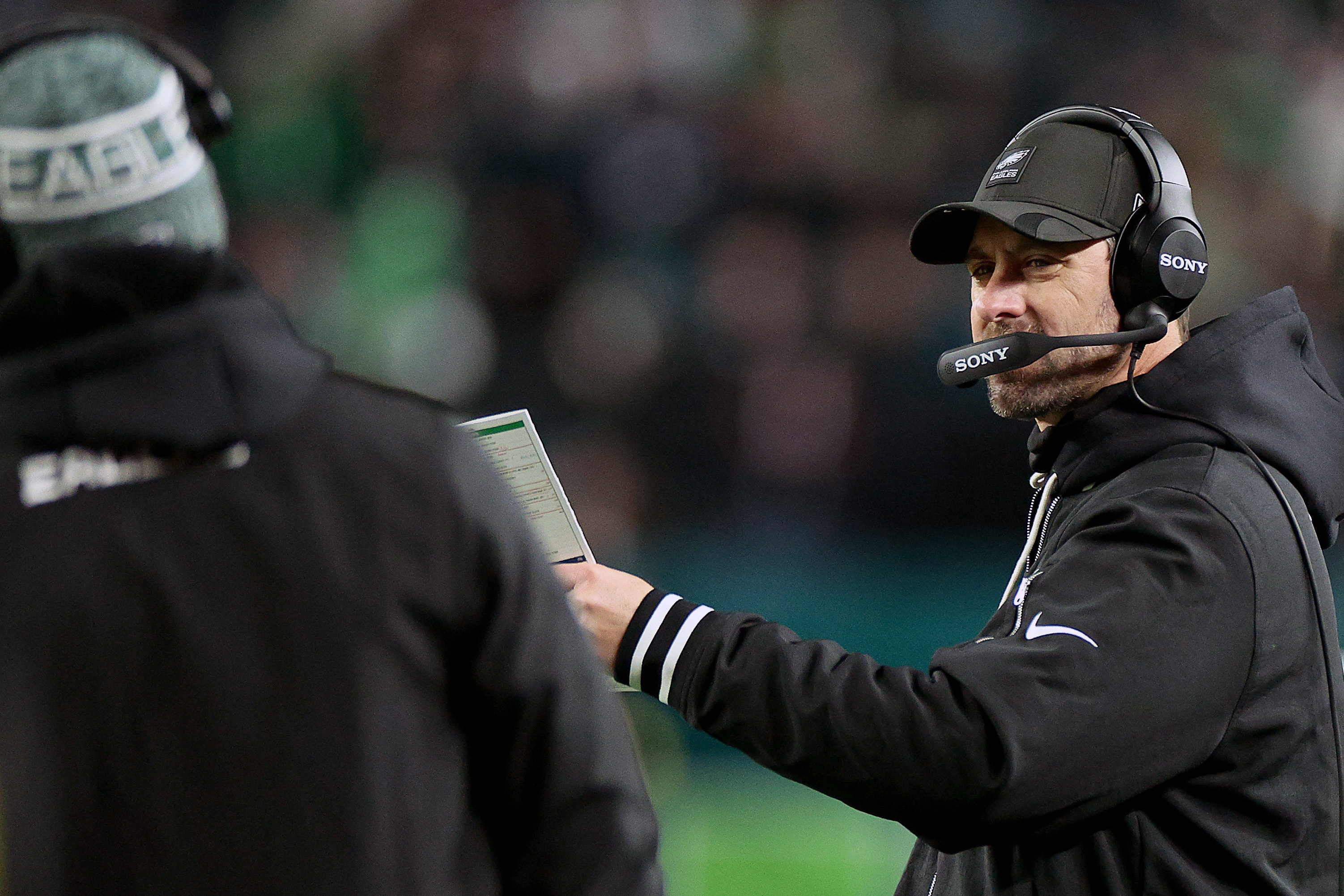
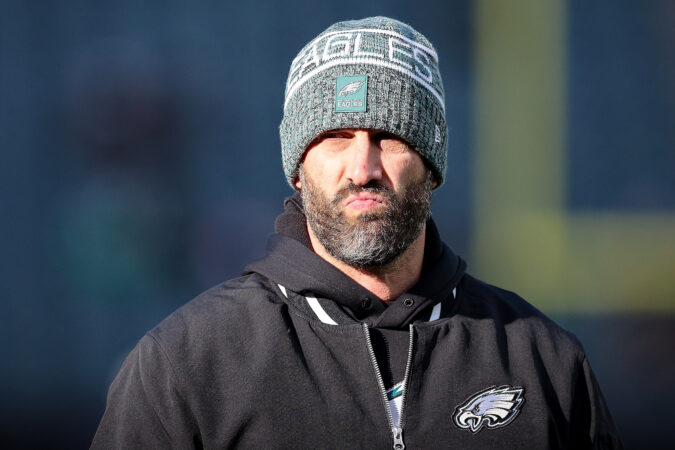
    Three times during their 29-18 victory Saturday over the Commanders, the Eagles tried to run their unique and once-unstoppable version of the quarterback sneak. Three times, it failed. Once, tackle Fred Johnson committed a false-start penalty. Once, Hurts gained no yardage. Once, guard Landon Dickerson committed another false-start infraction. And with his offense facing a (relatively long) fourth-and-1 on its first possession, coach Nick Sirianni had the Eagles punt from their own 41 instead of attempting the play.

    This was the flat line across the electrocardiogram screen. In 2023, the Eagles led the NFL in fourth-down conversion percentage, at 67.9%. Last season, they were third, but their efficiency rate (71%) was higher. This season, they entered Saturday at 61.1%, seventh-best in the league — good, but not dominant, not close.

    “Teams adjust; we’ve got to continue to adjust,” Sirianni said. “Credit to them. They did a really good job of stopping us there. … We have to get this play working the way it’s been in the past, which we’ll work our butts off to do. But we were really able to overcome.”

    They were. They got Hurts’ 15-yard touchdown pass to Dallas Goedert late in the third quarter — a nifty bit of improvisation after Dickerson’s penalty and a holding call against Johnson had pushed them back from the Commanders’ 1. They got Saquon Barkley gaining 132 yards and running like all the members of Washington’s defense had insulted his mother. And they got the benefit of playing a bad team that started its backup quarterback (Marcus Mariota) and had to turn to its third-stringer (Josh Johnson).

    But the demise of the Tush Push is real, and it has to be a worry as the Eagles look ahead to the postseason. Hurts has made it clear that he had grown tired of running it anyway, and the league officials had raised their level of scrutiny of it, calling more penalties against the Eagles this season. It has gone from an automatic first down to an unreliable chore. They will have to find a new way to remain aggressive, and to succeed, in fourth-and-short situations.

    “The play might not even be around next year, to be honest, the way they’re officiating it,” tackle Jordan Mailata said. “Last week, it was that our shoulders have to be parallel to the line of scrimmage. They can’t be angled in. Great. They’re officiating us a little harder. If this is the last year that we can run it, we’ll just run it till we can’t run it anymore.

    “The history that we have with that, we’re pretty successful, so when we lean on that play, you expect us to convert. One-yard line — we just didn’t do it. I was pretty happy that Dallas and Jalen could bail us out on that one, but sometimes, that’s just how it goes. Teams this year have done a great job of stopping that play, so we’ve got to do a better job of executing it and go from there.”

    Understand: The Eagles brought these challenges upon themselves, in the best way possible. They pioneered the Tush Push, then perfected it, then used it so frequently in the course of winning a Super Bowl that they inspired a campaign against it. Teams are better prepared for it now, and the officials are eyeballing the Eagles every time they line up to run it. And yet, like mourners over a casket, they spoke Saturday as if they haven’t reconciled themselves to the hard, heartbreaking truth. “It’s in a good place,” Hurts said, and center Cam Jurgens insisted, “It’s still our bread and butter. It might get a little dry at times, but bread and butter is bread and butter.” But these words seemed the bittersweet valediction for a play that will send an opposing defense to its knees no more.

    The Tush Push worked, and now its prime has passed. Raise your glass. It was called. It served. It is counted.
  • The Eagles are about to win the NFC East again, as usual. Here’s how they’ve done it.

    The Eagles are about to win the NFC East again, as usual. Here’s how they’ve done it.

    The Eagles are going to win their division. They need just one victory to clinch first place, and they’re likely to get that victory Saturday night against the Washington Commanders. And even if, by some minor miracle, they manage to lose to a 4-10 team that will be quarterbacked by Marcus Mariota, they can still just wait until the Dallas Cowboys lose again, which would bring its own kind of satisfaction.

    One way or another, the Eagles will end up atop the NFC East, becoming the first team to repeat as the division’s champion since they won it four straight times from 2001 through 2004. That statistic makes the last quarter-century of NFC East history sound more competitive and equitable among the Eagles, Cowboys, New York Giants, and Washington than it has actually been. In 2001, the Eagles won their first division title and reached their first NFC championship game with Andy Reid as their head coach and Donovan McNabb as their starting quarterback. That season was, really, the start of the general dominance that has followed. Here’s the breakdown of these 25 years, assuming the Eagles finish first again this season:

    Eagles

    Overall record: 240-160-2

    Winning seasons: 18

    Playoff berths: 16

    Division titles: 12

    Conference championship games: 8

    Super Bowl appearances: 4

    Super Bowl victories: 2

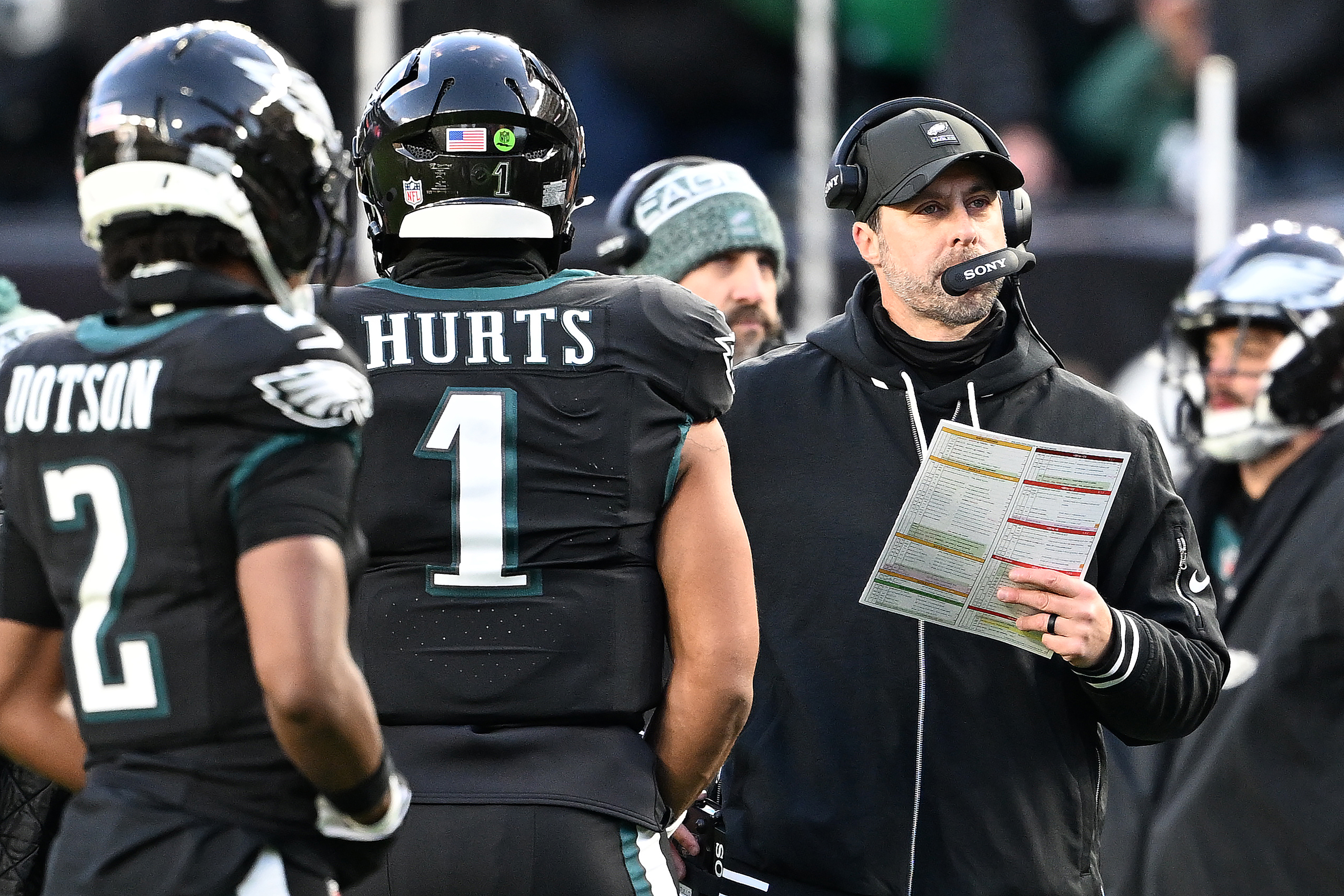
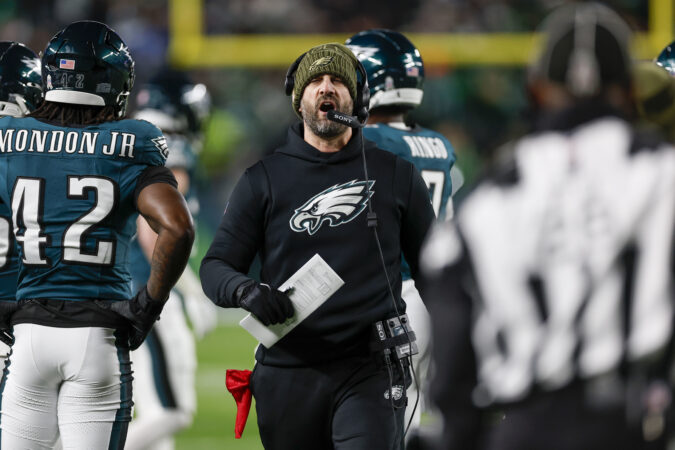
    Nick Sirianni (right) has carried on the Eagles’ winning tradition that started with Andy Reid.

    Cowboys

    Overall record: 218-183-1

    Winning seasons: 13

    Division titles: 7

    Conference championship games: 0

    Super Bowl appearances: 0

    Super Bowl victories: 0

    Giants

    Overall record: 176-225-1

    Winning seasons: 9

    Division titles: 3

    Conference championship games: 2

    Super Bowl appearances: 2

    Super Bowl victories: 2

    Washington

    Overall record: 166-234-2

    Winning seasons: 6

    Division titles: 3

    Conference championship games: 1

    Super Bowl appearances: 0

    Super Bowl victories: 0

    Whatever crises the Eagles might be undergoing are framed through a different lens from any other team in the division. They judge themselves and are judged by the answer to one question: Are we good enough to win the Super Bowl? Their divisional foes’ standard has not been quite as high: Are we good enough to keep from embarrassing ourselves again?

    Quarterback Jayden Daniels and the Commanders took a big step backward in an injury-plagued season.

    Less than a year ago, for instance, the Commanders’ appearance in the NFC championship game was supposed to augur a new rivalry between them and the Eagles at least and a new era for the division at best. That’s why the teams’ two games this season were scheduled in the season’s final three weeks. Huge head-to-head matchups to decide the division, right? Instead, the Eagles trounced the Commanders by 32 points to reach Super Bowl LIX. Jayden Daniels, Washington’s wonderful young quarterback, has played just seven games this season because of injuries, and even if Daniels had remained healthy, the Commanders might be floundering anyway; their front office built the oldest roster in the NFL around him.

    So what happened? How did the Eagles manage to create so much distance between themselves and the NFC East field? As with all big questions, there’s not just one big answer, but here are a few explanations:

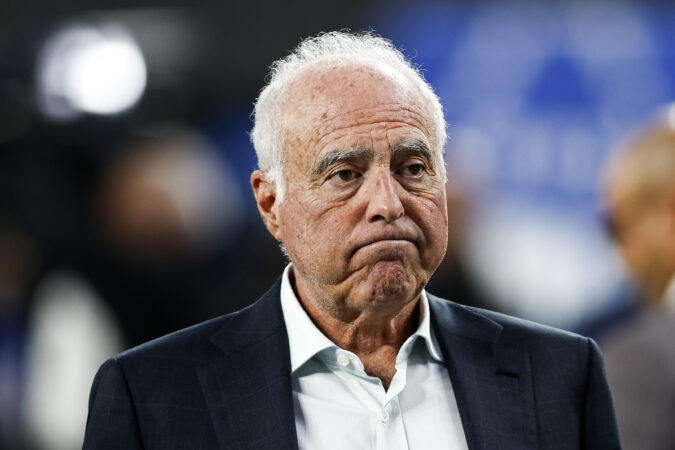
    Jeffrey Lurie, Joe Banner, and Howie Roseman have been forward-thinkers.

    From strategic massaging of the salary cap to aggressive play-calling on fourth down, Lurie has empowered his executives (and, in that middle-management position, his head coaches) to be creative, to posit how the NFL would evolve and how the Eagles might get ahead of those changes.

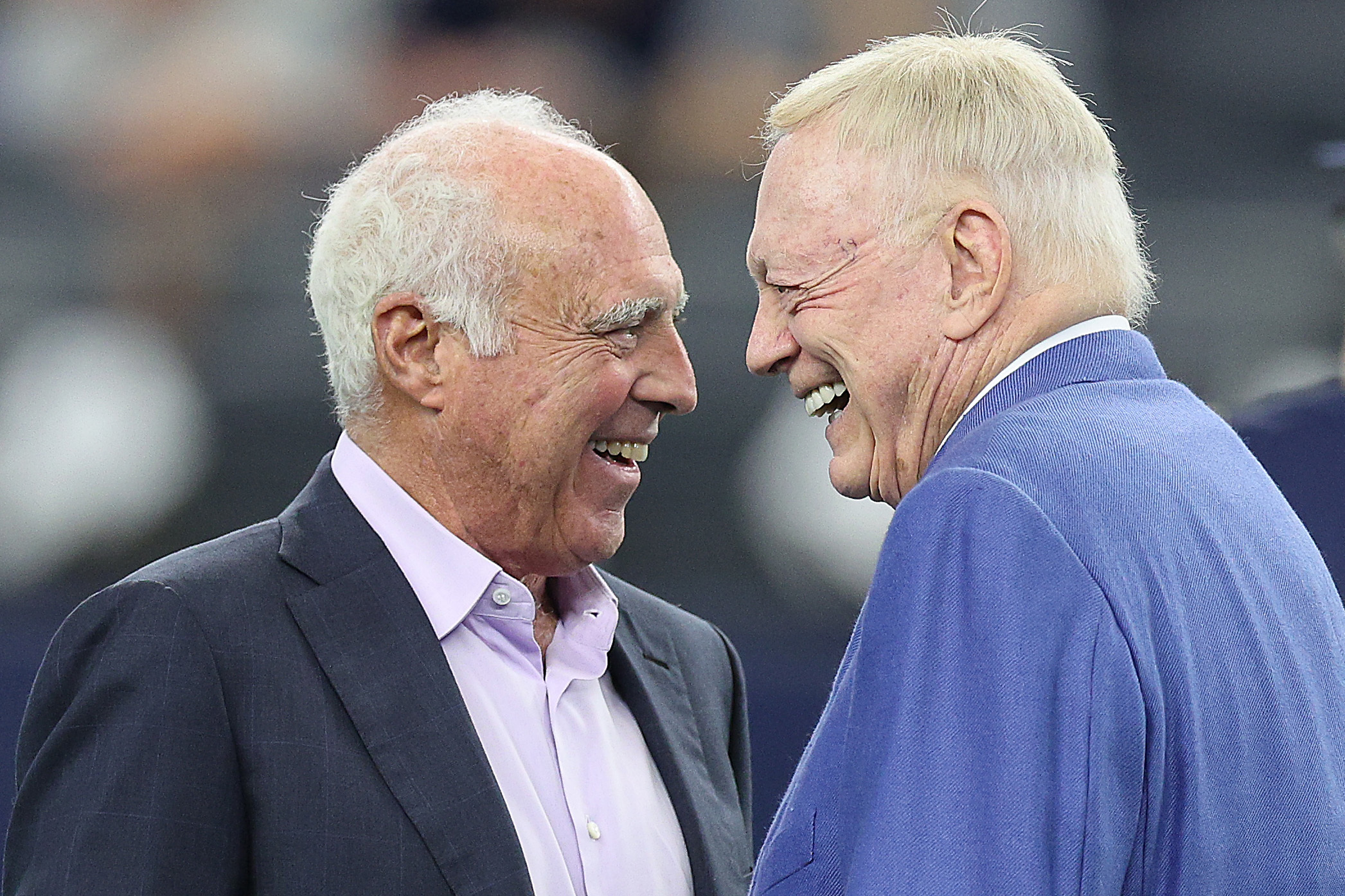
    Jerry Jones can’t put his ego aside for the sake of a Super Bowl.

    Jones has been a true visionary when it comes to the NFL’s growth into the pop-cultural monster it is today. He recognized America’s insatiable appetite for pro football and has built one trough after another to feed us, and he does want to win championships. But he’s not willing to sacrifice the publicity and the credit, to stand aside and let someone smarter handle the Cowboys’ football-related decision-making. It is not enough that the Cowboys win. Jones must be perceived as the reason they have won, and it’s that very thinking that keeps them from matching the Eagles’ success.

    Jerry Jones (right) and the Cowboys have not been able to keep up with Jeffrey Lurie’s Eagles.

    Daniel Snyder.

    That’s it. The man pretty much single-handedly destroyed one of the best and most popular franchises in the league. As just one example, Washington’s coaching staff in 2013, under head coach Mike Shanahan, included Sean McVay, Kyle Shanahan, Matt LaFleur, Mike McDaniel, and Raheem Morris — and Snyder let all of them get away. (Or run away, as the case may be.)

    Eli Manning retired.

    Sounds crazy, right? It’s not. When Manning was in his prime, the Giants went through an eight-year stretch in which they qualified for the postseason five times, won two Super Bowls, and never finished under .500. The Giants haven’t been able to replace him, and that has been a bigger failure even than allowing Saquon Barkley to sign with the Eagles.

    Jeff Stoutland has given the Eagles an edge in the trenches.

    Yes, the Eagles have long maintained that games are won and lost along the offensive and defensive lines. Any franchise’s coaching staff can chant that mantra, though. Few, if any, can develop linemen like the Eagles, and Stoutland’s presence and expertise are invaluable in that regard. Ask yourself if Jordan Mailata would have become an elite left tackle anywhere else.

    The Eagles value depth at quarterback.

    They won one Super Bowl with their backup quarterback (Nick Foles), won another with a player who had been drafted to be their backup quarterback (Jalen Hurts), made a season-saving run to the NFC divisional round in 2006-07 with their backup quarterback (Jeff Garcia), and have generally hired head coaches who know how to implement and oversee quarterback-friendly systems.

  • The Eagles can still get to the Super Bowl, but only if their defense drags them there

    The Eagles can still get to the Super Bowl, but only if their defense drags them there

    For an Eagles team desperate to stop a losing streak, a coach turned to Scripture the other day to inspire a few members of the one unit that has been pretty much beyond reproach. Jeremiah Washburn, who’s in charge of the Eagles’ defensive line, shared a message with the team’s tackles and ends from Isaiah 6:8: Then I heard the voice of the Lord saying, “Whom shall I send? And who will go for us?” And I said, “Here am I. Send me!”

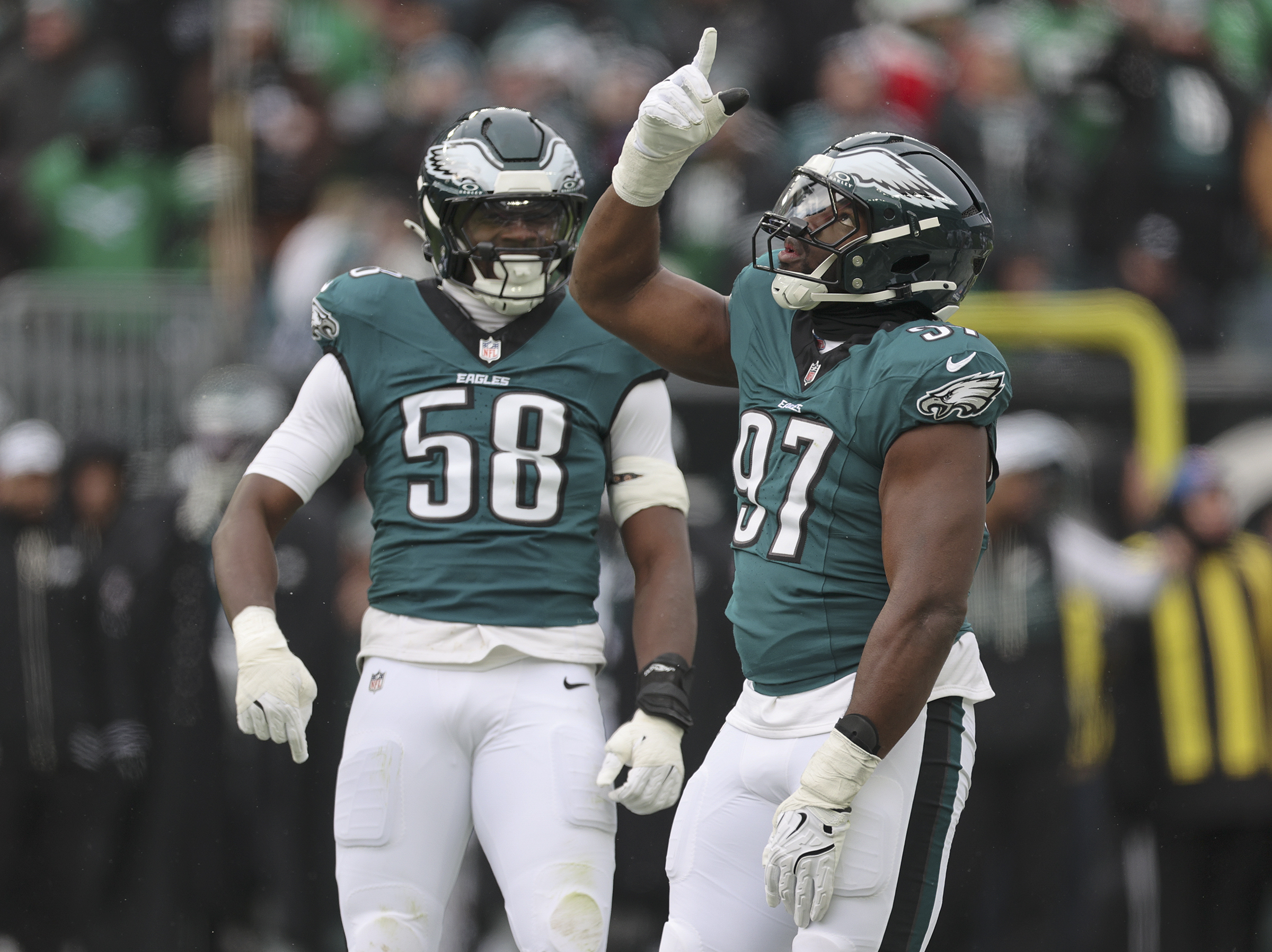
    “The perspective of the D-line — it’s like, ‘Send me,’” tackle Moro Ojomo said. “That was kind of our mentality heading into this game.”

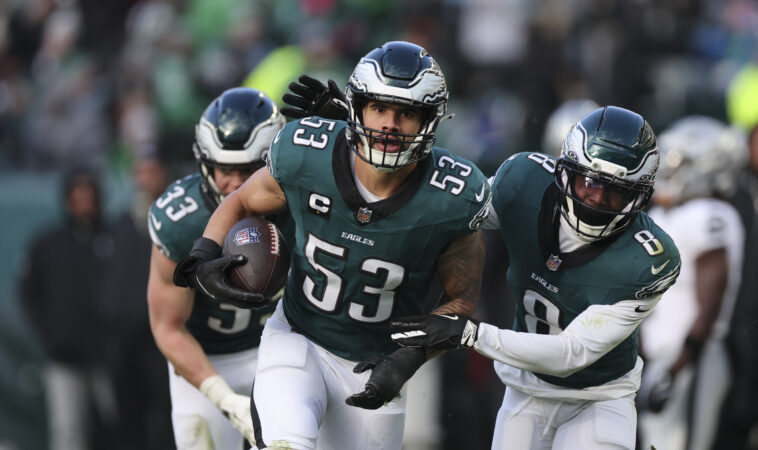
    So on Sunday against the two-win Las Vegas Raiders, the Eagles sent Ojomo, who had a sack and two quarterback hits. And they sent Brandon Graham, who had two sacks while lining up at tackle. And they sent Zack Baun, who had four tackles and an interception. And they sent the Raiders back to the Strip wearing the scarlet letter of having produced the worst offensive performance of any Eagles opponent ever. It wasn’t just that the Eagles won 31-0 — their first shutout in nearly seven years. It was that they allowed the Raiders to gain just 75 yards of total offense.

    Combine those two figures, the 0 and the 75, and you get what was, statistically speaking, the best game any Eagles defense has ever played. You get a game in which the Raiders’ longest gain on any play was 15 yards … on an unnecessary roughness penalty by Cooper DeJean. And as pitiful as Las Vegas was Sunday and has been offensively all season — the Raiders entered the game last in the NFL in points and next-to-last in yardage — you still got a glimpse of what might yet be the Eagles’ saving grace in their quest to win a second straight Super Bowl. As ragged and inconsistent as their offense has been, their defense is good enough to get them there.

    “Our mindset, regardless, is, ‘If they don’t score, they don’t win,’” Ojomo said. “You saw that today. That’s the mindset we’ve got to have. The offense has to have the mindset of not necessarily depending on us, and what you get is that perfect marriage. They do their thing. We do our thing. We’re always going to raise the standard.”

    “If they don’t score, they don’t win,” Moro Ojomo (right) said after Sunday’s victory.

    They have to. Maybe Jalen Hurts, Saquon Barkley, and the rest of the offense will raise their level of play over the next three weeks and beyond. Maybe this dominant performance against a terrible team can allow the Eagles to get their groove from last season back. But to be in their locker room after Sunday’s game was to observe a different collective disposition from one side of the ball to the other.

    Hurts delivered one curt, clipped answer after another in his postgame news conference, as if he were offended that the people in the room had pointed out that he’d committed five turnovers six days earlier against the Los Angeles Chargers. Nick Sirianni, Landon Dickerson, and other members of the offense kept up that same standoffish pose. Meanwhile, the team’s defensive players were ebullient and enthusiastic and generally have been all season. With the exception of the 281 rushing yards they gave up to the Chicago Bears two weeks ago, they have done their part to keep the Eagles in contention in the NFC.

    They let the Eagles get away with victories against the Green Bay Packers and the Detroit Lions. They surrendered a touchdown on the Chargers’ first possession last Monday night, and they haven’t given up another in the 20 possessions since. They have a high standard, and they keep meeting it, and it was telling to hear, for instance, linebacker Nakobe Dean describe a lesson he learned from the unit’s perfect performance Sunday.

    “There are plays we’re going to look back at and be like, ‘Oh, man, we could have [done] this better,’” he said. “I had a blitz. I was too high. I didn’t have great pad level. I got blocked by [running back] Raheem [Mostert], and the last couple of weeks I’ve been running through guys. So it’s like, yes, I have something to build on. I got blocked trying to bull [rush]. Now it’s time to stick/swat. Now it’s time to spin, do something like that. At first, I was thinking I was going to do it from the beginning. It was ‘Do this until they block it.’ Now it’s blocked. Now you can add a little something.”

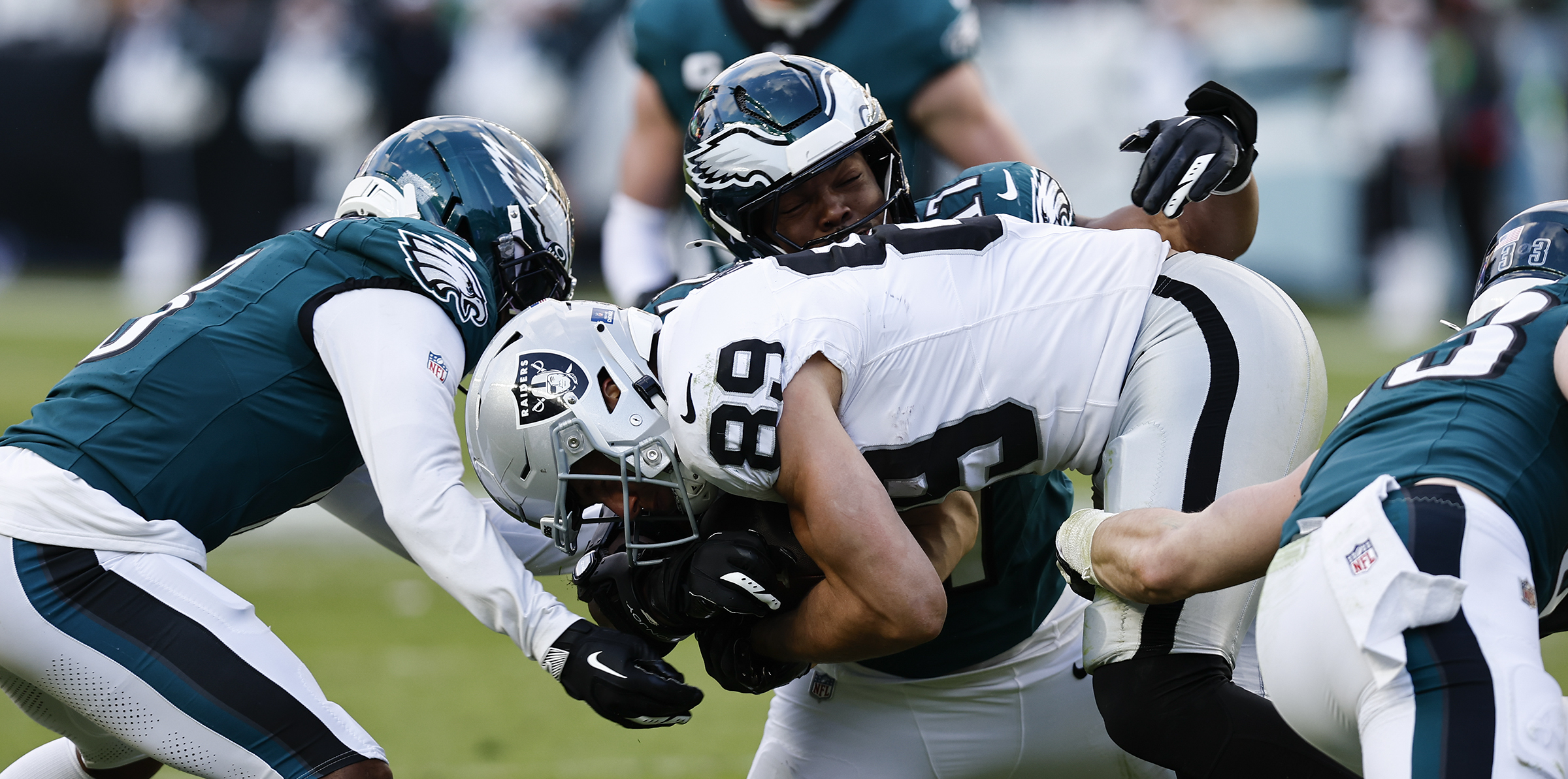
    Eagles linebacker Nakobe Dean (center) and cornerback Adoree’ Jackson stop Las Vegas Raiders tight end Brock Bowers in the fourth quarter of Sunday’s win.

    The striking aspect of this dynamic — the inconsistency of the offense, the consistent excellence of the defense — is the lack of dissension within the locker room. Dean and Ojomo and their defensive teammates would be well within their rights to resent how much they’ve had to carry the Eagles. But there’s no indication that such a fissure exists. That’s a credit to coordinator Vic Fangio, sure, and it’s a credit to a unit full of young, homegrown players who aren’t surly, cynical veterans, who aren’t mercenaries, who don’t know any better but to ball out.

    “We’re hungry, and we run around, and we want to be great,” Ojomo said. “We want to go and get it. It’s like this perfect thing, but the reality is, we’ve got to do it again.”

    And again. And again. And again into January, if the Eagles are to have any hope of playing into February. A Super Bowl is still possible for them. Their defense will have to drag them there.

  • Forget 2023. The Eagles are in bigger trouble now after their loss to the Chargers.

    Forget 2023. The Eagles are in bigger trouble now after their loss to the Chargers.

    INGLEWOOD, Calif. — So we know what kind of team the Eagles are now. It took 13 games, and to watch most of them was to experience the same amount of pleasure as when you slam your fingers in a door. But they have revealed themselves, and there’s no use disputing the diagnosis.

    The Eagles are an excellent defensive team, and that is all, and that is not enough, not even close. Not with an offense like this. Not with this team’s tendency to commit untimely and inexcusable penalties. Not with so many questions that don’t get answered and so many problems that don’t get solved.

    They lost Monday night to the Los Angeles Chargers, 22-19 in overtime, and we know now that the most basic assessment of their status is deceiving. They still are 8-5, still in first place in the NFC East, still on track to make the playoffs and, in theory, have a shot at winning another Super Bowl in a conference without a dominant team. But anyone who has watched them can see through that spin, that false representation of who they are and how the rest of this season could play out.

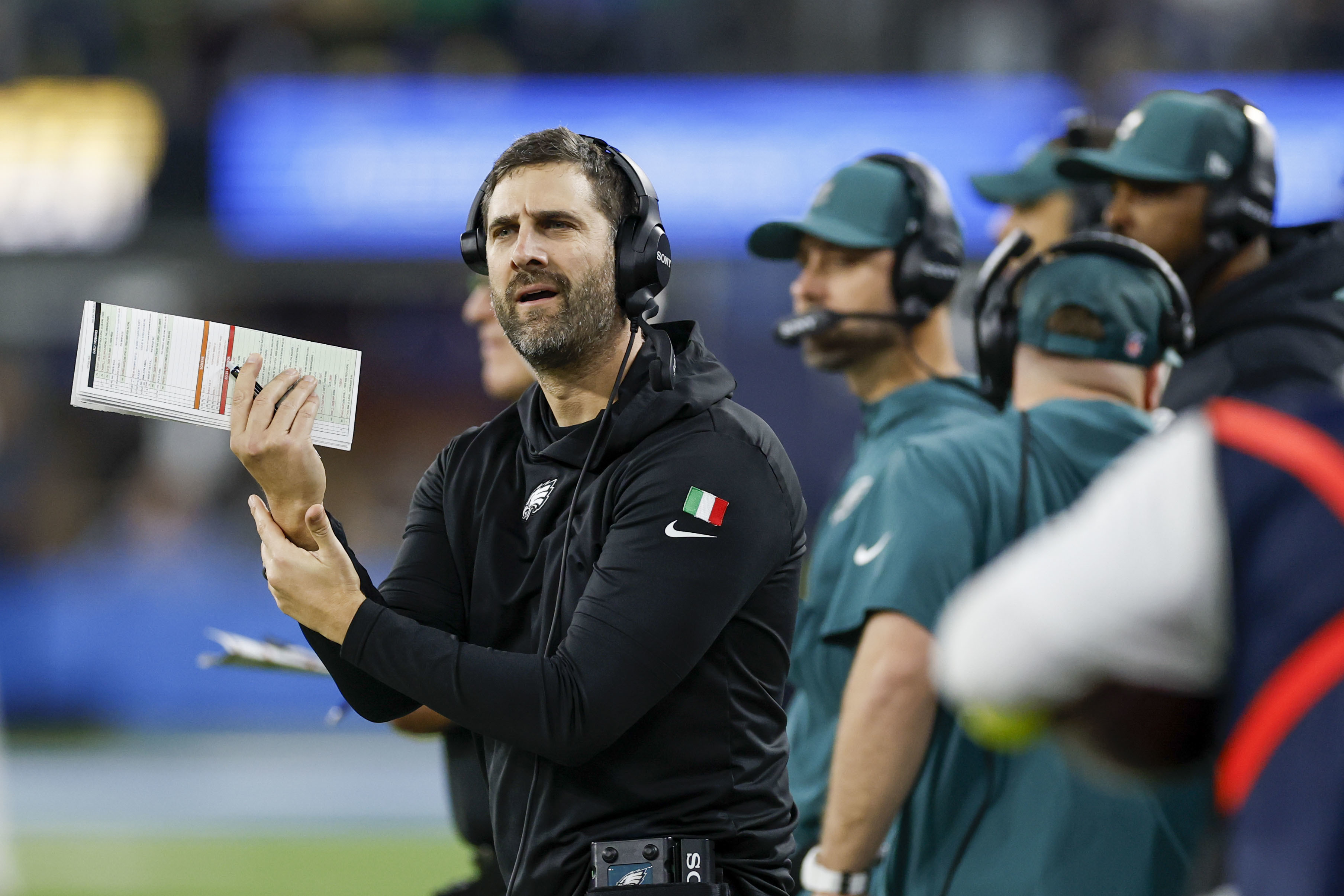
    Coach Nick Sirianni complains to the officials after the Eagles were called for holding late in the second quarter at SoFi Stadium.

    They have lost three straight games, and they are poised for a breakdown as bad or worse than their collapse in 2023. That was six losses in seven games and a franchise that faced an inflection point with its head coach. This is different. This disintegration, if it continues, will be harder and graver, because it will mean their season is transforming from an attempt to defend a championship into a referendum on the coach, the quarterback, and any number of players who were presumed to be part of a talented and tested team’s core.

    “Who said it was going to be easy?” Brandon Graham said. “This year, coming off a Super Bowl, man, all we got to do is make sure we stay together.”

    Easy to say. Challenging to do. The dynamic within the Eagles right now, the divide in performance between one side of the ball and the other, is fertile ground for dissension to bloom. Anyone who has paid attention to them over the last five games could tell you what Monday made clear: that they are regressing on offense, that some of their best and highest-compensated players are letting them down, and that there’s little or no reason to believe that anything about the unit is going to improve in the short term.

    Since their bye five weeks ago, the Eagles have played one good stretch on offense, and that stretch was brief. In their loss to the Cowboys on Nov. 23, they scored 21 points in the game’s first 18½ minutes, then didn’t score again. Those 18½ minutes seem like a mirage now. They marked the only game in a month and a half that the Eagles put up more than 19 points, and the offense’s performance against the Chargers only reinforced the reality that something about it has to change.

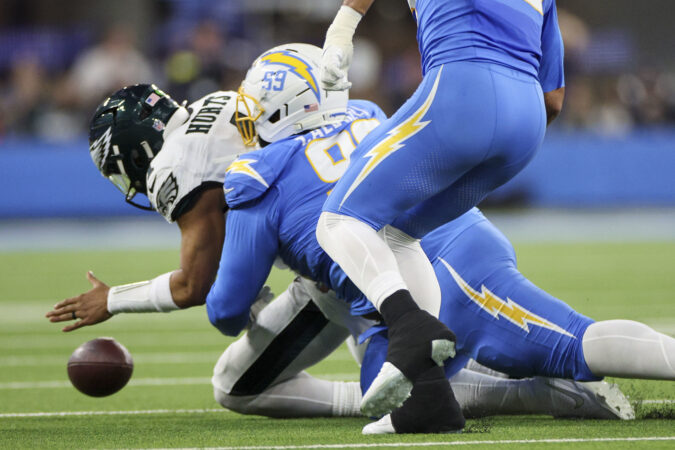
    Jalen Hurts was a mess. Kevin Patullo’s play calls are too predictable too often, the offensive line didn’t help Hurts much, and A.J. Brown helped him even less, dropping a deep ball on the game’s first play, then T-Rex-arming an over-the-middle pass in the fourth quarter that led to an interception. But even with those excuses or extenuating circumstances, Hurts was still a mess.

    He threw four interceptions. He failed to see some open receivers and threw wildly to others. His play this season is raising the question of whether, assuming he remains their starting quarterback for several more years, the Eagles will be able to win another Super Bowl, or even come close again, if they don’t surround him with the best roster in the NFL.

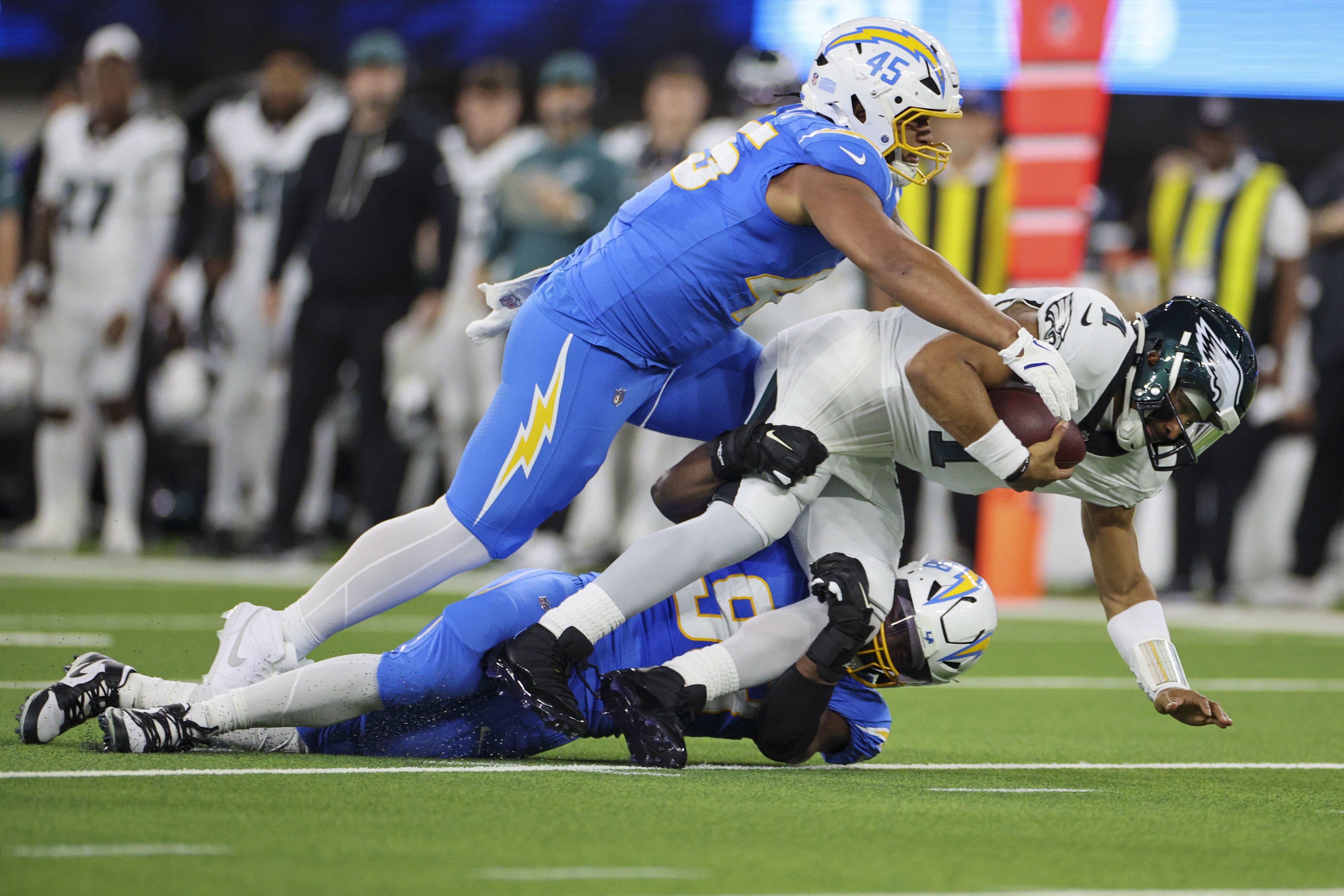
    Jalen Hurts is sacked by Chargers linebackers Tuli Tuipulotu and Odafe Oweh during the first quarter.

    We’re getting to the point where removing Hurts and inserting Tanner McKee would be helpful, just to create a control in this ugly experiment that is the Eagles offense. It’s unlikely to happen, and it’s possible, even probable, that such a change would do more harm than good. It would create an instant controversy, no doubt. Hurts might take the demotion as an insult, in the same way Carson Wentz viewed the decision to draft Hurts in 2020, and demand to be traded. There are an infinite number of scenarios that could play out from such a seismic move. One of them, though, could be that the Eagles would acquire some certainty about who and what have been the real problems with the offense all along.

    That decision would come with enormous risk for the man who presumably would make it. Nick Sirianni would be acknowledging that he and his handpicked offensive coordinator can’t fix Hurts, can’t help him get back to being someone who at least didn’t hurt the Eagles’ chances of winning. Once Sirianni crosses that bridge, there’s no going back, and there’s nothing Jeffrey Lurie is less willing to forgive than a head coach who fails to allow the franchise quarterback to thrive.

    “The people we have in there have won a lot of football games,” Sirianni said. “Right now, we’ve lost three in a row. Again, I saw a great, great week of preparation, and I’m confident in the coaches that we have, the players that we have, the owner that we have, the front office that we have — that we’re built to overcome. We know how to do that.”

    Then they’d better get to doing it. Fast. No, this wasn’t just another loss for the Eagles, and this is no small slump. This is a test for everyone in that locker room. And let’s be honest here: Have they given anyone any reason to believe that they’re going to pass it?

  • The narrative around A.J. Brown, Tyrese Maxey vs. Allen Iverson, and other thoughts …

    The narrative around A.J. Brown, Tyrese Maxey vs. Allen Iverson, and other thoughts …

    First and final thoughts …

    It has been a few weeks since A.J. Brown has been a major topic of consternation and conversation around the Eagles. The easy explanation for the relative quiet is that Brown hasn’t posted anything on social media lately that would get people to raise their eyebrows. The even easier explanation — and maybe so easy that it’s a cheap shot against Brown — is that he caught 18 passes for 242 yards and three touchdowns against the Bears and the Cowboys, and even though the Eagles lost both of those games, Brown must be content that he’s finally getting his numbers again.

    That narrative — that Brown is only about Brown, and his selfishness damages the Eagles — has never held up under much scrutiny. Should he stay off social media more? Of course he should. But they have a 53-18 record (in regular-season and postseason games), have won a Super Bowl, and reached another since acquiring him. At least 29 other teams in the NFL would sign up for that level of damage.

    What’s more, there’s nothing inherently wrong with Brown wanting the ball more in the name of benefiting himself and benefiting the Eagles. The two goals aren’t mutually exclusive, and it’s understandable that Brown would raise a stink with Jalen Hurts, Kevin Patullo, or both if he didn’t believe he was being used properly or frequently enough.

    Think of it like this: Brown is to the Eagles’ offense as an outstanding reporter or writer is to a news organization, and Patullo and Hurts are his editors. If the editors relegated that reporter to the least important and relevant assignments — when he has produced and is capable of producing well-read, Pulitzer-caliber journalism — he would be within his rights to tell them, Hey, you aren’t maximizing my skills, and it’s hurting the whole news operation, too.

    Would that make him selfish? Maybe. Would it make him self-interested? Yeah. Would it make him right? Absolutely.

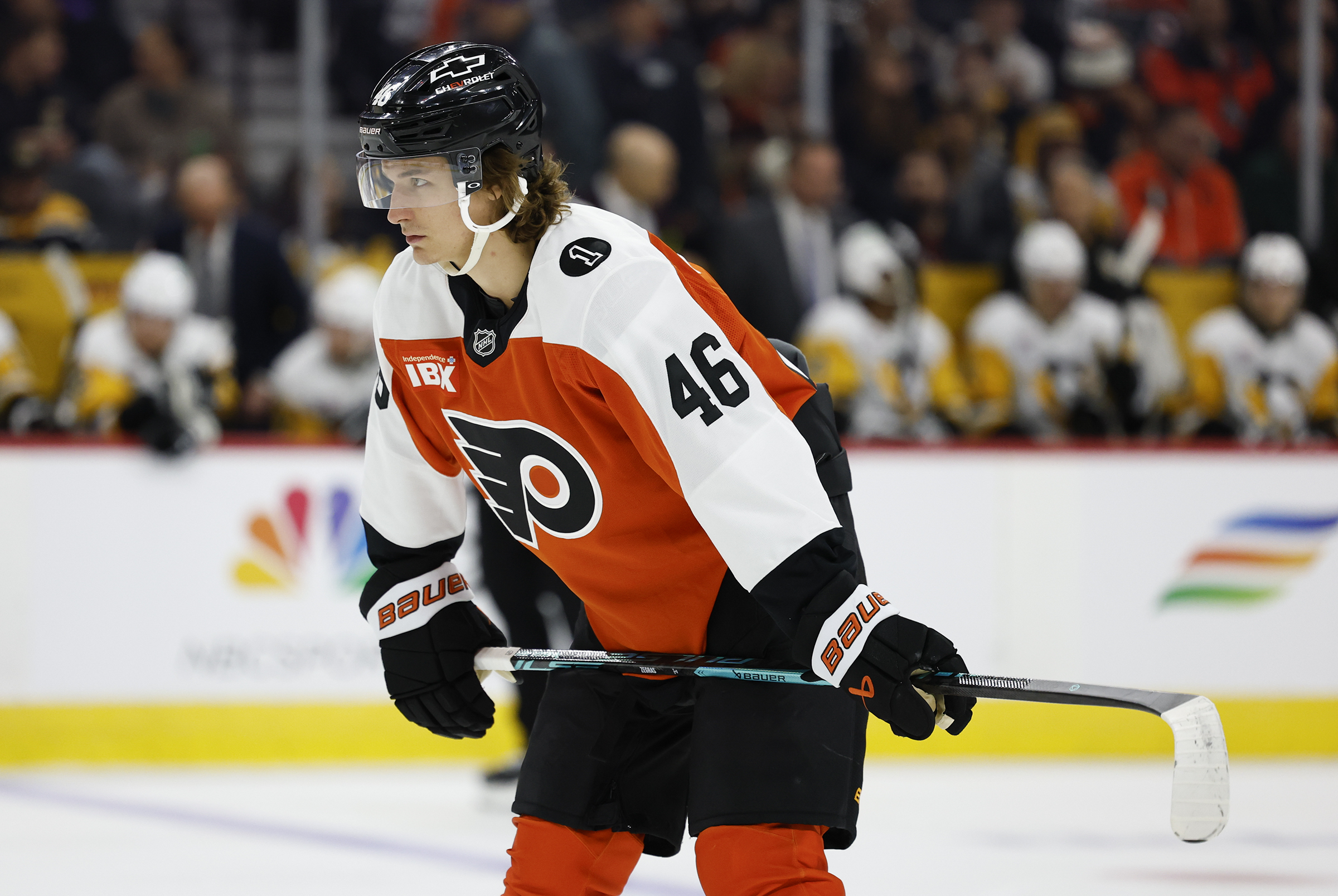
    Maybe tap the brakes on the Trevor Zegras anointment?

    Have you forgotten Andrew MacDonald?

    Trevor Zegras has been terrific so far, but before anyone starts thinking about making him a Flyer for life, can he get through half a season here first?

    Kyle and the cash register

    The very simple reason to be optimistic that the Phillies will re-sign Kyle Schwarber comes down to three words.

    Butts in seats.

    Yes, Schwarber has improved as a hitter over the last two years, putting the ball in play more often and raising his batting average without sacrificing any of his power. Yes, he’s an outstanding clubhouse leader. And yes, his presence is necessary if the Phillies are to get over their October bugaboos, get back to the World Series, and win it. Those factors make him vital to the franchise.

    But a baseball season, despite the attention and excitement that the playoffs generate, is not the playoffs alone. The 162-game march to the postseason matters too. It matters a lot. And Schwarber has overtaken Bryce Harper as the player on the Phillies roster whose at-bats are true can’t-miss theater. If you’re at Citizens Bank Park on a chilly night in early May, waiting to get your hot dog and beer, the chance to see Schwarber blast one 450 feet is probably one of the reasons you’re at the ballpark in the first place. And if he comes up and you’re still waiting, you might just hop out of that long line to make sure you don’t miss one of his lighting bolts. He’s the guy who makes you stop and watch.

    Sports is still first and foremost an entertainment product, and Schwarber provides more entertainment night to night than any other Phillies player. John Middleton isn’t likely to let someone steal such an asset away, for any price. He’d be a fool if he did.

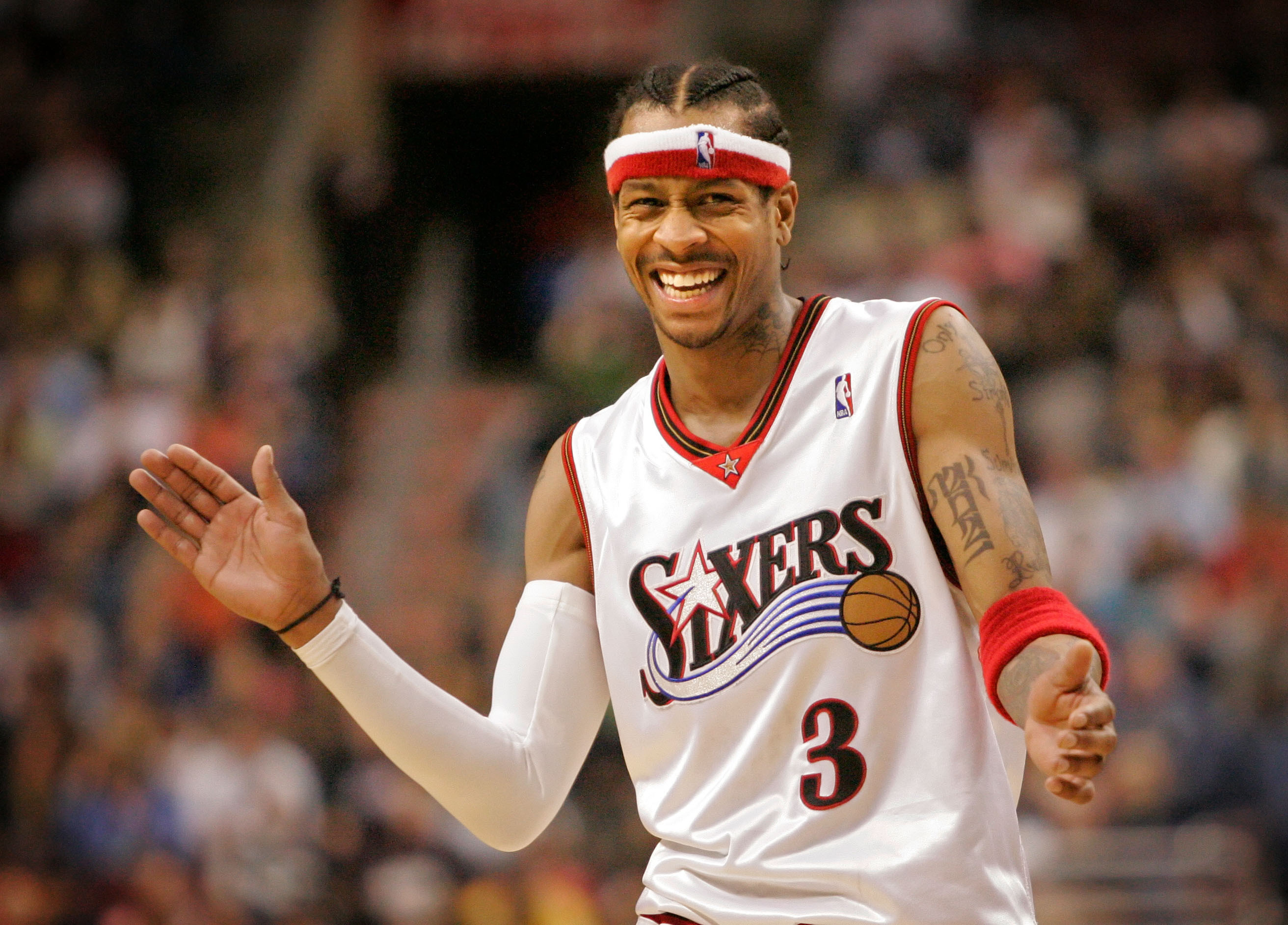
    Allen Iverson was a 40-plus-minute man before the term “load management” entered the NBA vernacular.

    Maxey and A.I. as iron men

    Ahead of the 76ers’ matchup in Milwaukee against the Bucks on Friday night, Tyrese Maxey was leading the NBA in minutes played per game. His average: 40.0.

    All kudos to Maxey for bringing it every night for as long as he does. But just for some perspective, it’s worth noting that for a 10-year period, from the 1998-99 season through the 2007-08 season, Allen Iverson never averaged fewer than 40.8 minutes. And over his six seasons from 2001 through 2007, he averaged 42.5 minutes and led the league in minutes five times. When the man said he played every game like it was his last, he meant it.

  • If you haven’t been paying attention to the Eagles’ troubles, let’s get you up to speed

    If you haven’t been paying attention to the Eagles’ troubles, let’s get you up to speed

    One of the regrettable developments of the modern media age is that, too often, coverage of a particular subject — whether it’s sports, politics, or whatever strange currents were vibrating between Robert F. Kennedy Jr. and Olivia Nuzzi during the summer of 2024 — presumes that news consumers already are intimately familiar with a story’s background and details.

    The truth is that not everyone, not even most of us, can know the ins and outs of every single news item that pops up, slot-machine-style, on our smartphones and social media scrolls. People are busy and preoccupied, especially this time of year. They have jobs to work, bills to pay, kids to raise, decorations to put up, gifts to buy, and gatherings to plan, and they’re going to spend whatever free time they have left watching the latest episodes of Stranger Things, because holy mother of mercy are those episodes long.

    Here at The Inquirer, we’re not about to make that same mistake. Sure, it might seem like everyone in the Philadelphia area has a firm grasp of all the problems plaguing the Eagles these days. But there are plenty of people out there who either don’t follow the Eagles closely or pay just enough attention to wonder why fans and media are making such a fuss about them. Didn’t they just win the Super Bowl? And isn’t their record pretty good? And don’t they still have that cutie-patootie Cooper DeWhatshisname?

    So in the interest of getting everyone up to speed on the big issues around this team ahead of its game Monday night against the Los Angeles Chargers, here’s a quick review of what’s been happening. Once you read this summary, you’ll be able to speak with total confidence about the Eagles at any holiday party, even to those insufferable neighbors whose Christmas lights are brighter and redder than a Kenny Rogers Roasters sign.

    Let’s start with Nick Sirianni, the Eagles’ coach. Over his four-plus seasons, Sirianni has pulled off the remarkable feat of leading the team to the playoffs four times, winning one Super Bowl, reaching another, compiling the fifth-highest winning percentage among the 537 head coaches in the 105-year history of the National Football League, and still convincing most Eagles fans that he has no idea what the hell he’s doing. In fact, many Eagles fans wonder exactly what Sirianni does do, since he does not call plays on offense, does not have much to do with the defense, has minimal say-so over personnel matters, and has instilled so much discipline and precision in his players that they have committed the fifth-most penalties in the league this season.

    Eagles offensive coordinator Kevin Patullo has received a lot of heat from fans because of the offense’s struggles this year.

    The offense has struggled, and coordinator Kevin Patullo has come under fire for his rudimentary play design, his unimaginative play calling, and his inability to persuade quarterback Jalen Hurts to throw to receivers who aren’t already standing alone in an empty cornfield. The public anger at Patullo became so intense that, on the morning after the Eagles’ recent loss to the Chicago Bears, his house was egged — a stupid, childish, and completely indefensible act, especially since there’s no evidence that Patullo gave out apples and black licorice on Halloween this year.

    Hurts has faced his share of criticism, as well, and not merely because wideouts A.J. Brown and DeVonta Smith could run their routes, recite the first four stanzas of The Waste Land, then rerun their routes — and Hurts still would be holding the ball, waiting for them to get really open. The Eagles used to have Hurts carry the ball a lot. But not anymore. For a couple of weeks, the Eagles had Hurts take more snaps from under center, which allowed them to use a wider array of plays. But not anymore.

    The general belief is that Hurts isn’t totally comfortable and on board with those tactics, so they have been phased out of the offense, much like the entire running game has. Hurts also has taken to speaking during postgame press conferences as if he were cracking open fortune cookies and reading the messages, and his admiration of Michael Jordan and his affiliation with the Jordan Brand have become such a huge part of his persona that it won’t be long before he starts answering the question, How’s it going, Jalen? by turning to an invisible TV camera and saying, I took that personally.

    Brown himself has been the source of a good bit of controversy for his frequent, cryptic social media posts — an unnecessary distraction, given that retweeting a Mike-Myers-as-Dr.-Evil THROW ME A FRICKIN’ BONE HERE meme would have sufficed. People have been debating whether Brown is a team-first guy who is using extreme means to call attention to the Eagles’ lousy passing game or a me-first diva who is most happy when he gets his. No one seems to accept that the correct position to take on the matter is Yes.

    Meanwhile, Saquon Barkley has morphed into DeMarco Murray. The offensive line is beat up, hasn’t been blocking well even when its members were reasonably healthy, and lately has been failing to push Hurts’ tush. The defense just lost its most talented player to a shoulder procedure, still hasn’t solidified its No. 2 cornerback spot, and this week attempted to solidify that spot not by putting Cooper Patootie there but by hoping to bring back a nearly-35-year-old former No. 2 cornerback. And Jeffrey Lurie would like to see if all these issues might be resolved by having someone else pay to build him a domed stadium.

    That about does it. Now you have the skinny on the 2025 Eagles. You wouldn’t know, from this synopsis of their season, that they’re 8-4, in first place in their division, and likely to be favored in four of their remaining five games. But at least you’ll have the requisite information and context to hold your own in any conversation about them. Unless your Kenny Rogers neighbor asks for your thoughts on going for two when you’re down nine. In that case, make a beeline for the bar and don’t look back.

  • Nick Sirianni defended Kevin Patullo, but it might not matter if Jeffrey Lurie decides he must act to save the Eagles’ season

    Nick Sirianni defended Kevin Patullo, but it might not matter if Jeffrey Lurie decides he must act to save the Eagles’ season

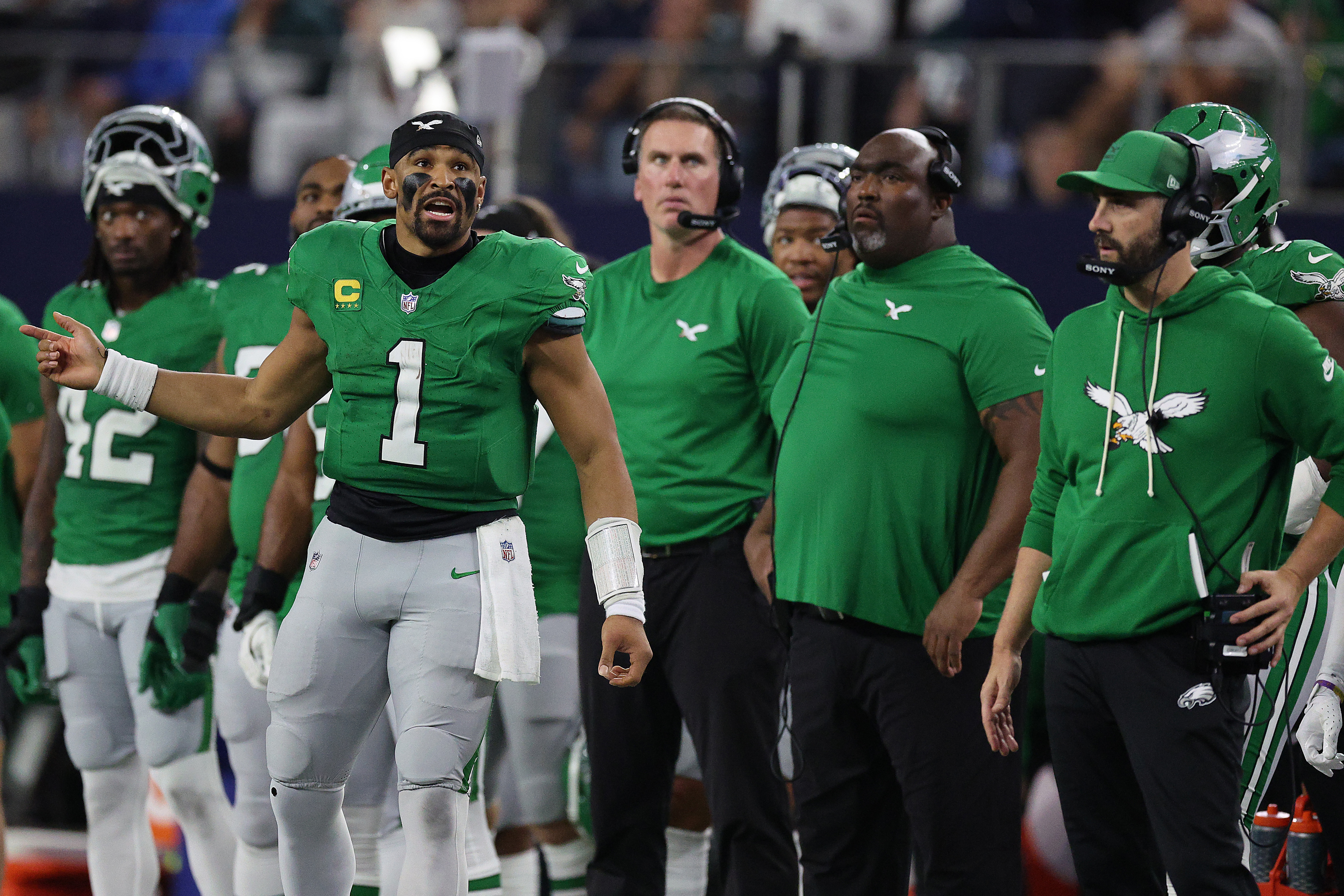
    It was easy to catch the chants rising out of the Lincoln Financial Field stands Friday, a call for change that feels closer and closer to happening, no matter what Nick Sirianni might say, no matter how much the Eagles head coach might stand behind his friend and offensive coordinator Kevin Patullo. Those “FIRE-KEVIN” singsongs were clear to everyone inside the stadium and to a nationwide streaming audience on Prime Video.

    Just like the Eagles’ 24-15 loss to the Chicago Bears and another ragged offensive performance, those chants and that atmosphere of frustration and disgruntlement were a sign that this season is reaching a tipping point. And for all the loyalty to Patullo and defiance to reality that Sirianni flashed after the game, his words might not end up meaning much.

    “No, we’re not changing the play-caller,” Sirianni said, “but we will evaluate everything.”

    The most important word in that sentence from Sirianni, though, was we, because we could end up including team chairman Jeffrey Lurie and vice president Howie Roseman, and those members of we have filmed this movie before — and not that long ago. Sirianni was equally steadfast in 2023 about taking up for then-defensive coordinator Sean Desai, but, sure enough, Sirianni’s defense of him was about as strong and effective as the Eagles’ defense under Desai and his replacement, Matt Patricia. That is, not very.

    Now Patullo has become the latest poster child for the Peter Principle. He’s gregarious and friendly and has spent a lot of time in the NFL coaching quarterbacks but had spent no time calling plays until Sirianni turned the offense over to him. Now a unit that boasts some of the most talented and accomplished and highly paid skill-position players and offensive linemen in the league is among the worst offenses in the league. Twelve games this season, and the Eagles have scored 24 points or fewer in eight — two-thirds — of them, including the last four.

    Lurie and the Eagles aren’t about to bench Jalen Hurts or A.J. Brown or Saquon Barkley or anyone else. And even if Patullo is hamstrung as a play-caller by Hurts’ height, by his reluctance or inability to throw the ball into tight windows of space, by the injuries and spotty play of the offensive line, he also hasn’t shown that he’s creative and imaginative enough to overcome those flaws and shortcomings in the offense.

    Sirianni’s mantra, since his arrival, has been that players make plays, that a wide receiver or a lineman or a tight end, if he’s coached well enough in the fundamentals, ought to prevail in his one-on-one matchup against a cornerback or a defensive end or a linebacker. The problem for the Eagles is that they’re winning fewer of those micro-contests, those games within the game, than they did a year ago, and Patullo isn’t helping them win more of them.

    A simple question was put to tight end Dallas Goedert after Sunday’s game: How often do you guys feel like you have a strategic advantage on a defense, where you’re going to fool them or you’re going to run something that they don’t see coming?

    Goedert paused for five seconds, then answered.

    “Tough question. I don’t know if I really have an answer for that one. We’ve got to make plays. We’ve got to execute better. And all 11 have to be on the same page.”

    Something is missing offensively for the Eagles, and it might be Kevin Patullo who will have to answer for it.

    Barkley refused to chalk up the Eagles’ struggles to their strategy or system. “I don’t really look into plays like that,” he said. “The times that we have successful plays, it’s not just because we have a strategic edge. We’ve got guys making plays. We’ve got coaches making great calls.

    “I don’t want to put words in your mouth, but I know what everyone is probably saying. When you go back and watch the film, we’ve got some great calls, and we just didn’t make the plays, or we’ll have a penalty. We keep seeing the same stuff. I get up here and say the same thing, and it’s not like I’m just feeding you guys these answers to, I don’t know, be a pro. But it’s the truth, and I guarantee Jordan [Mailata’s] saying the same thing. Zack [Baun’s] saying the same thing. Lane [Johnson’s] saying the same thing. The reality is, we’ve got to go do it.”

    There is a chicken-or-egg element to the Patullo question. No one, other than Patullo himself, can say for certain whether he’s orchestrating this offense to account for Hurts’ weaknesses, whether he’s calling what Hurts is comfortable with and capable of carrying out, whether Hurts’ limitations are limiting Patullo’s options. There’s no getting around the reality that the Eagles have made Hurts and the passing game the locus of their offense before — early in 2021, early in 2024 — and each time, they shifted their play selection toward running the ball, toward taking it out of Hurts’ hands.

    Last season, they won a championship with that approach because Barkley and the offensive line were that good, that dominant. The Eagles could afford to be predictable then; their opponents knew what was coming and still were powerless to stop it.

    Now the Eagles’ opponents know what’s coming, know how to stop it, and do stop it. Lurie has always placed a premium on having a team that could score lots of points and do so relatively easily, and he can’t be happy with this two-game losing streak, this season-long slog, and the offense’s contributions to those developments. What had been a slump is now a slide and could yet be another collapse, and Lurie isn’t likely to let his head coach’s assertions and assurances stand in the way of a change that he deems necessary to save a shot at another Super Bowl.

  • Book it: The Eagles’ loss to Dallas will put their coaches under Jeffrey Lurie’s microscope

    Book it: The Eagles’ loss to Dallas will put their coaches under Jeffrey Lurie’s microscope

    There are games in the NFL that have repercussions. The Eagles’ 24-21 loss Sunday to the Cowboys — a game in which they blew a 21-point lead, throttled back their offense after taking that lead, and committed one egregious mistake after another — is likely to be one.

    Those repercussions might yet be good for the Eagles. The NFL is so parity-ridden, each team separated from the other by such small differences, that it’s possible that Sunday’s meltdown will inspire the Eagles to clean up their sloppy play, beat the Chicago Bears on Black Friday, and embark on another deep playoff run. They’re still going to win the NFC East, at a minimum. It will be difficult to call such a season, no matter its final endpoint, a complete failure.

    But Eagles chairman Jeffrey Lurie stopped judging his franchise by that standard a long time ago. Sunday’s loss went from See, the team is rounding into form to HOLY HELL EVERYONE’S WORST FEARS HAVE BEEN CONFIRMED in a matter of minutes. That sudden reversal of fortune, though, really had been the culmination of a steady accumulation of inconsistent performances, injuries to important players, and consternation both inside and outside the locker room.

    Those conditions are the kind that, in the past, have compelled Lurie to act. It is, of course, true that the offensive line’s decline is a huge factor in the Eagles’ overall regression, maybe the biggest factor, and that reality, one could argue, should absolve Nick Sirianni, Kevin Patullo, Jalen Hurts, and anyone else for an 8-3 team that feels like it’s 3-8. But it’s naive to think, given the nature of Sunday’s loss and the arc of this season, that Lurie isn’t taking a long, hard look at the coaching staff, Sirianni included.

    Raising such questions might seem premature or unnecessary. It’s not. There are reasons for Sirianni to be worried here — not necessarily that he’s going to be fired after the season, but that he’s more vulnerable than he once was. Nine months after winning the Super Bowl, six months after getting a contract extension, he ought to understand that, if recent history is any indication, there’s a lot at stake for him over the next 6-12 weeks. Consider:

    1) The Eagles aren’t playing offense the way Lurie has generally wanted his teams to play offense.

    This assertion is obvious, and it’s based on the Eagles’ production, or lack thereof. But it’s also based on the Eagles’ style of play.

    For years, dating to the Andy Reid era, the Eagles made their bones by remaining aggressive in their play-calling even after taking a big lead, by using analytics to set themselves apart from the rest of the league. Sometimes, it cost them games. In February 2018, it won them their first Super Bowl. Lurie loves that approach.

    The last two years, however, the Eagles have turned themselves into a full-fledged running team. Lurie is not necessarily anti-running the ball — not when it leads to the big plays and the Super Bowl victory that Saquon Barkley and that dominant offensive line delivered last season. But those plays haven’t materialized and the line hasn’t dominated this season, and Sirianni’s response has been to lean into being uber-conservative. He doesn’t call plays, no, but the offense is his, and he hasn’t prioritized piling up points. He has prioritized protecting the football, eliminating turnovers, and walking a thinner line to victory. He has tempted fate by trying to win games in a manner Lurie is inclined to reject once it fails.

    2) Lurie has never hesitated to insist upon coaching changes when he has thought them necessary.

    After the 2019 season, for instance, the Eagles parted ways with then-offensive coordinator Mike Groh and then-wide receivers coach Carson Walch. A year later, after the team’s disastrous 4-11-1 season in 2020, then-head coach Doug Pederson was fired.

    For the moment, Patullo is a great shield for Sirianni. Everyone knows that Patullo is the Eagles’ offensive play-caller. Everyone knows that he’s a neophyte when it comes to this role and its responsibilities. And everyone can see that the Eagles offense has not been good this season, even though it has plenty of superstar-level players to whom Lurie is paying superstar-level dollars. So if the Eagles offense remains dysfunctional — and it really hasn’t been functional at all, not to the degree it was expected to be — Patullo will be and has been the coach who bears the blame, and a layer of protection will have been removed from Sirianni.

    Eagles quarterback Jalen Hurts on the sideline with head coach Nick Sirianni (right) during Sunday’s loss in Dallas.

    3) Lurie expects his franchise quarterback to grow into greatness, then remain there.

    One of the problems that the Eagles’ play-not-to-lose strategy creates for Sirianni is the implication that Hurts can’t be trusted or isn’t at his best when asked to operate a more dynamic, more daring offense. Lurie doesn’t care and doesn’t want to hear that the Eagles’ coaches feel like they have to run a Frankenstein’s monster style of offense, patching together parts from several systems just to maximize Hurts’ skill set. He wants his franchise quarterback to be worth the franchise-quarterback money he’s paying him, and if that player isn’t meeting those expectations, Lurie will greenlight a search for a replacement only as a last resort.

    Remember: Even after Carson Wentz’s horrible 2020 season, the Eagles fired Pederson first. They were willing to make it work with Wentz until they finally understood they couldn’t. Only then did they trade him.

    4) Sirianni’s personality is different from Pederson’s, and that difference doesn’t help Sirianni.

    Pederson was a go-along-to-get-along kind of guy, at least as much of one as an NFL head coach ever is. But after he won the Super Bowl, he started to assert himself. He wrote his autobiography. He sought more power within the organization, at least with respect to his assistants. Lurie eventually disabused him of those notions.

    Sirianni is naturally more emotional and combative than Pederson. He, too, has won a Super Bowl, and his winning percentage is among the best of any head coach in league history. It’ll be interesting to see whether he’ll have to quell his assertiveness with Lurie and Howie Roseman — and if he’s able.

  • The Eagles had problems with the Tush Push against the Lions. Nick Sirianni has to adjust his coaching accordingly.

    The Eagles had problems with the Tush Push against the Lions. Nick Sirianni has to adjust his coaching accordingly.

    Seven hundred and twenty-four days ago, Nick Sirianni stared into a bank of TV cameras and dared the NFL — hell, dared the whole world — to stop the play that the Eagles had mastered and no one else in pro football had. It was late October 2023, and while holding a seven-point lead against the Miami Dolphins, the Eagles ran a quarterback sneak, a Tush Push, on fourth-and-1 with 10 minutes, 1 second left in regulation. That wasn’t the striking part. Neither, really, was the fact that Jalen Hurts powered forward for a first down. The striking part was that the Eagles were on their own 26-yard line, a set of circumstances that made a bold postgame assertion from Sirianni all the more memorable.

    “If everybody could do it,” he said that night, “everybody would do it.”

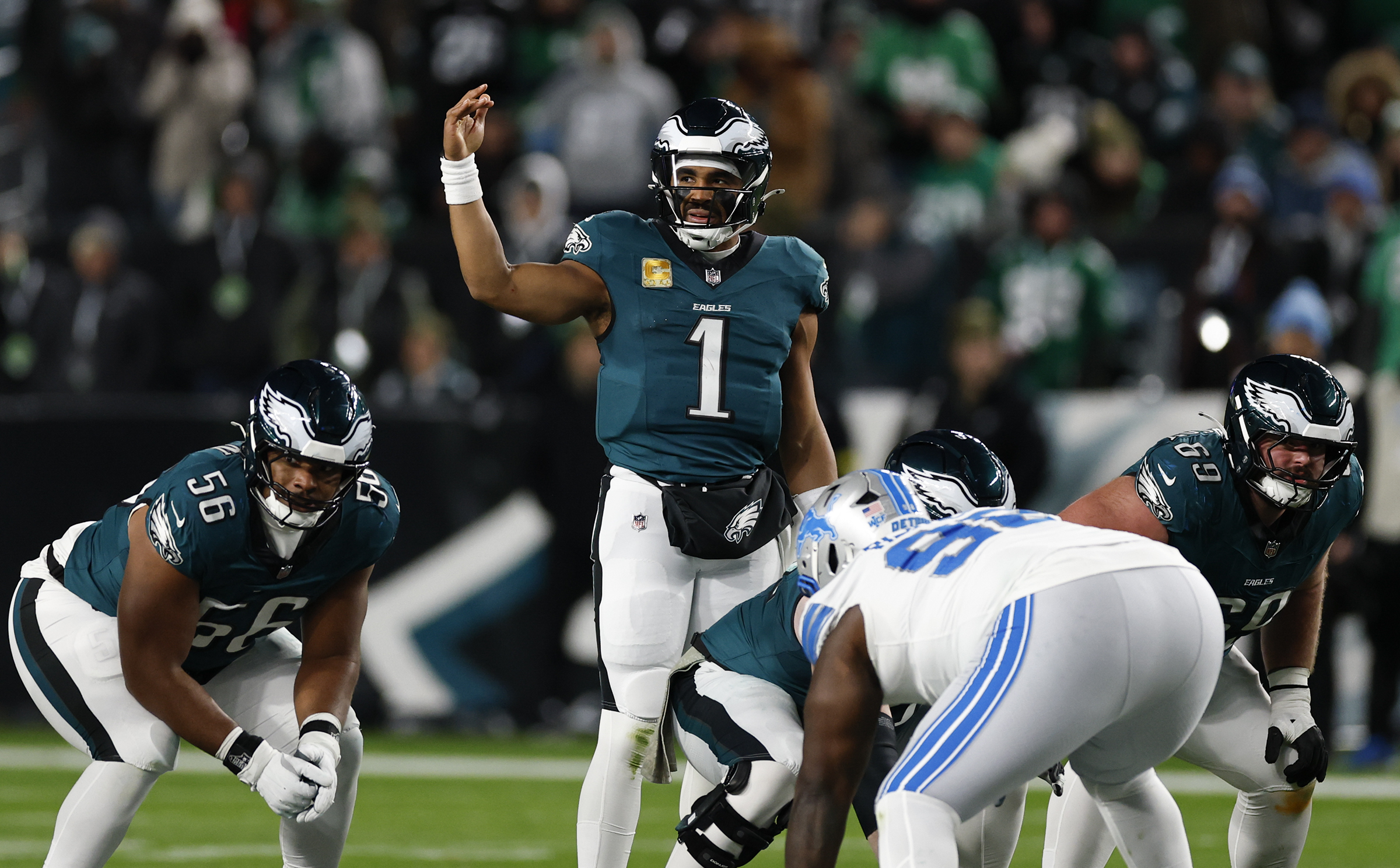
    Well, there the Eagles were Sunday night, and for once, the Tush Push was an issue for them. For once, it wasn’t automatic. For once, its magic was gone, and of all the ramifications of the Eagles’ 16-9 victory over the Detroit Lions, that relative demystifying of their signature, unstoppable play was among the most concerning. For these last few years, the Tush Push had given them an innovative and significant advantage over their opponents, had meant the Eagles really needed just 9 yards to get a first down, because the 10th yard was a fait accompli.

    Nothing was that easy Sunday. The Eagles succeeded just once — Hurts’ second-quarter touchdown, the team’s only one of the game — in their six sneak attempts. They false-started. They were stuffed. With 2:54 left in regulation, with the Eagles up 10 and facing fourth-and-1 from their own 29-yard line — a situation similar to the one they confronted against the Dolphins in ’23 — Hurts went nowhere, and that failure invited the Lions back into the game by handing them at least a chance to cut the lead to a single score.

    “I’d do it again over and over,” tackle Jordan Mailata said. “I’d take us any day. Now, we’ve got to go back and watch that play and see what went wrong. But I’d still take us any day of the week. When you have a defense like ours, it does make it easier to go for it on fourth down. There’s the trust and faith in the guys up front, but also, if we don’t get it, there’s the trust and faith in the guys on defense.”

    That was the knee-jerk justification for a call that, in the context of this particular game and the condition of this particular Eagles offensive line, Sirianni never should have made. When he had the Eagles go for it from their own 26 nearly two years ago, his decision was surprising because it was so unconventional at the time. He was correct then: The Eagles were the only team that could run the Tush Push with so high a rate of success, and they could because of the players they had blocking on the play: Jason Kelce, Lane Johnson, Mailata, all healthy.

    Jalen Hurts has been frequently working behind a different version of the O-line than the dominant one that patented the Tush Push.

    Sunday was so far from that same scenario. Johnson was ruled out at halftime with a foot injury, and center Cam Jurgens, having missed the previous two games with a knee injury and already playing through the painful effect of offseason back surgery, had exited, too, with 5:06 to go. So two backups, Fred Johnson and Brett Toth, were subbing for them. And the NFL and its officials and a chorus of complainers are now watching every twitch and subtle hint of movement every time the Eagles run the Tush Push. And now a play that was once a slam dunk is something closer to a midrange jump shot.

    “They’re homing in on it,” Hurts said. “They’re very strict on the guard and the center and how they operate. They’ve got their eyes on it, and we’ve got to go out there and be as clean as possible.”

    This sliver of doubt when it comes to the Tush Push might seem a small matter. It isn’t. The play’s reliability was a tangible symbol of the strength of the Eagles offense: the manner with which they controlled the line of scrimmage. Lane Johnson’s warning last month, after a loss to the New York Giants, about the offense becoming “predictable” was in that sense silly. No offense in the NFL last season was more predictable than the Eagles’. Everyone knew Saquon Barkley was getting the ball, and still no one could stop it.

    This season, the worry for a team that is 8-2 and atop the NFC is simple: That inevitable dominance hasn’t been there, and that reality has to change the calculus when it comes to the Eagles’ trademark aggressiveness in their play-calling. They could afford to go for it anytime, anywhere in short-yardage situations when they had the best collection of blockers in the league. The line’s regression should compel Sirianni to coach the team he has right now, not the one he used to have or the one he wished he had, and over the rest of the season, he has to weigh how much he asks of a defense that is carrying the Eagles, that allowed them to get away with two subpar offensive performances against two playoff-caliber teams.

    “Always. Always. You always think about those things,” he said. “You think about how it plays in-game, but you also think about your past experiences. Everything is taken into account. But you definitely think about how it’s playing in-game. … Any time we don’t get a fourth-down conversion, I’m going to put that on myself. I’m always going to be hypercritical of myself. Obviously, if I had known we weren’t going to get it, I would have punted it.”

    He couldn’t have known it, but he could have suspected it, and he has to start asking himself a question that he once didn’t have to contemplate. Of course, if everybody could do the Tush Push, everybody would. But what if the Eagles can’t?

  • The Eagles had two games to get themselves right before their bye. They did that and then some.

    The Eagles had two games to get themselves right before their bye. They did that and then some.

    It was just 17 days ago that the Eagles lost for the second straight time, lost to the New York Giants by 17 points at MetLife Stadium, lost in so humiliating a fashion that their All-Pro right tackle called out the play-calling as predictable and their star wide receiver admitted that with more than 11 minutes left in the game he had already resigned himself to defeat. It was bad.

    Two seasons before, it had been worse. Two seasons before, the Eagles had lost back-to-back games to the San Francisco 49ers and the Dallas Cowboys, and those pathetic performances triggered the kind of midseason change that reveals a franchise’s leadership has started to panic. The defensive coordinator was demoted. A Bill Belichick acolyte was promoted. And what began as a pebble rolling down a hill turned into an avalanche: six losses in seven games, a head coach whose job was in jeopardy, a collapse whose psychological residue remained on this team for a long time.

    Maybe, after their 38-20 victory Sunday in their rematch against the Giants, the Eagles can assure everyone that they’ve scraped away the last of that sticky stuff from 2023. Their Super Bowl win in February took care of most of it, but burping up that late lead against the Denver Broncos on Oct. 5 and getting manhandled by Jaxson Dart and Cam Skattebo four days later brought up all those bad memories again. The Eagles were 4-2 but reeling, still formidable but vulnerable, and it was fair to wonder whether they could straighten themselves out over their two games before their bye week.

    They did. They won a challenging road game against the Minnesota Vikings, then handled an inferior opponent Sunday. Now they enter their 15-day break with a 6-2 record, with a stranglehold on the NFC East, and — despite several injuries to key players, despite the ever-present mist of controversy around A.J. Brown — without the worry that their season was spiraling out of control.

    “I don’t think from an inside perspective there was ever any like, ‘Oh man, this is like ’23,’” coach Nick Sirianni said. “You know what I mean? But were there lessons learned in ’23? Absolutely. We continue to try to learn lessons from ’24 and ’25.

    “I always like our process off of a bye week and during a bye week. That’s my job as a coach. We’ve still got a lot of things to fix and clean up, but that’s what this week will be about: the players resting, looking at stuff themselves, and then us really grinding it out this week to put ourselves in a position to move on through the rest of the season.”

    It would be easy to argue that the Eagles are mentally tougher now than they were then; that they have a more talented, more cohesive collection of players; that Sirianni is a better head coach with a better coaching staff; that Jalen Hurts is a better quarterback. All those assertions are true, but they can feel intangible and opaque. The explanations for why a team regresses (as the Eagles did late in the 2023 season), improves (as they did in 2024), or stabilizes itself (as they’ve done over their last two games) often come down to the schematic and tactical adjustments that the team tries to make. They come down to concrete changes in the way the team does things.

    Take one example that went awry. When the Eagles decided in December ‘23 that they needed a new defensive coordinator, when they replaced Sean Desai with Matt Patricia, they failed to take a vital factor into consideration. Patricia’s defensive scheme was a lot of things, but simple wasn’t one of them, and there was little chance that the players would learn it well enough in time to thrive within it.

    “I still remember we used to come in here before games, and he’d have an entire greaseboard — it looked like a 15-foot-long greaseboard — and the entire thing was written up with all the calls,” Eagles center Brett Toth said after Sunday’s game. “And to see that, it’s like, ‘Wow.’ That’s tough on anyone to try to switch to midseason.

    “It’s a very hybrid defense. Anything with the Patriots is going to be very complex, high-IQ stuff. To have to learn and install that in the middle of the season, it’s a huge ask. This is chess. Football is 11-man chess.”

    Now take another, more recent, more successful example: the Eagles’ use, at long last, of under-center snaps and play-action passes. There’s no getting around the fact that their offense has been more dynamic overall — and their running game back to its old dominant self against the Giants — partially because putting Hurts under center allows Kevin Patullo to call a wider variety of plays. They didn’t have to rewrite the playbook. A new wrinkle was all they needed.

    “It’s not necessarily that you stick a guy under the center or you’re playing from the shotgun or you’re in a pistol,” said Hurts, who over his last two games has completed 34 of his 43 passes for 505 yards and seven touchdowns. “It’s about what you’re doing when you’re under center, how we’re leveraging what we do, how we’re leveraging the guys, what spots are we putting guys in when we’re in these different positions. We just want to continue to build off it.”

    Seventeen days ago, the idea that the Eagles would be building off anything heading into their bye seemed tenuous at best. The defending champs had staggered. The Giants had embarrassed them. And the memory of that awful ending to 2023 was fresh again. Now? It seems deeper in the distance, and they have a chance to make sure it stays there.