Author: Scott Sturgis

  • 2026 Audi S3: Looks fun, sounds fun, drives fun, but keep it casual

    2026 Audi S3: Looks fun, sounds fun, drives fun, but keep it casual

    2026 Audi S3 Prestige vs. 2026 BMW 228 xDrive Gran Coupe: Battle of the little racers.

    This week: Audi S3

    Price: The 2025 starts at $48,700, according to the window sticker of the test model; the 2026 starts at $52,000.

    Conventional wisdom: Car and Driver likes the “entertaining handling, responsive powertrain, sophisticated and luxurious interior.” They were less fond of the “limited trunk space,” that there was “some road noise at higher speeds,” and that it was “not quite as raucous as the RS3.”

    Marketer’s pitch: “Upgrade the everyday.”

    Reality: It depends where all you go every day.

    What’s new: We’ve been exploring efficiency over the last two weeks with the Accord Hybrid and Prius Plug-In. The Prius had some kick, but the Audi and BMW really pack a punch.

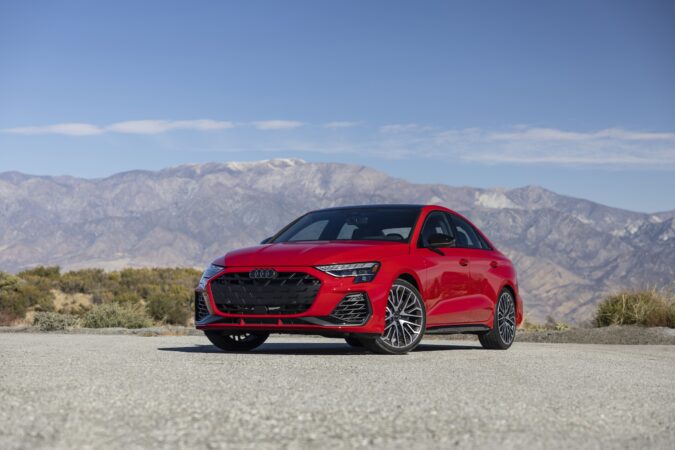
    The little Audi sedan (which the EPA surprisingly classifies as “midsize”) is the souped-up version of the A3. That’s not to be mistaken for the super souped-up version, the RS3. Just think of the abbreviations as “Speedy” and “Really Speedy.”

    The sedan got a power boost and handling improvements for 2025. The 2026 carries on fairly unchanged.

    Competition: In addition to the BMW 2 Series, there are the Acura Integra, Cadillac CT4, and Mercedes-Benz CLA.
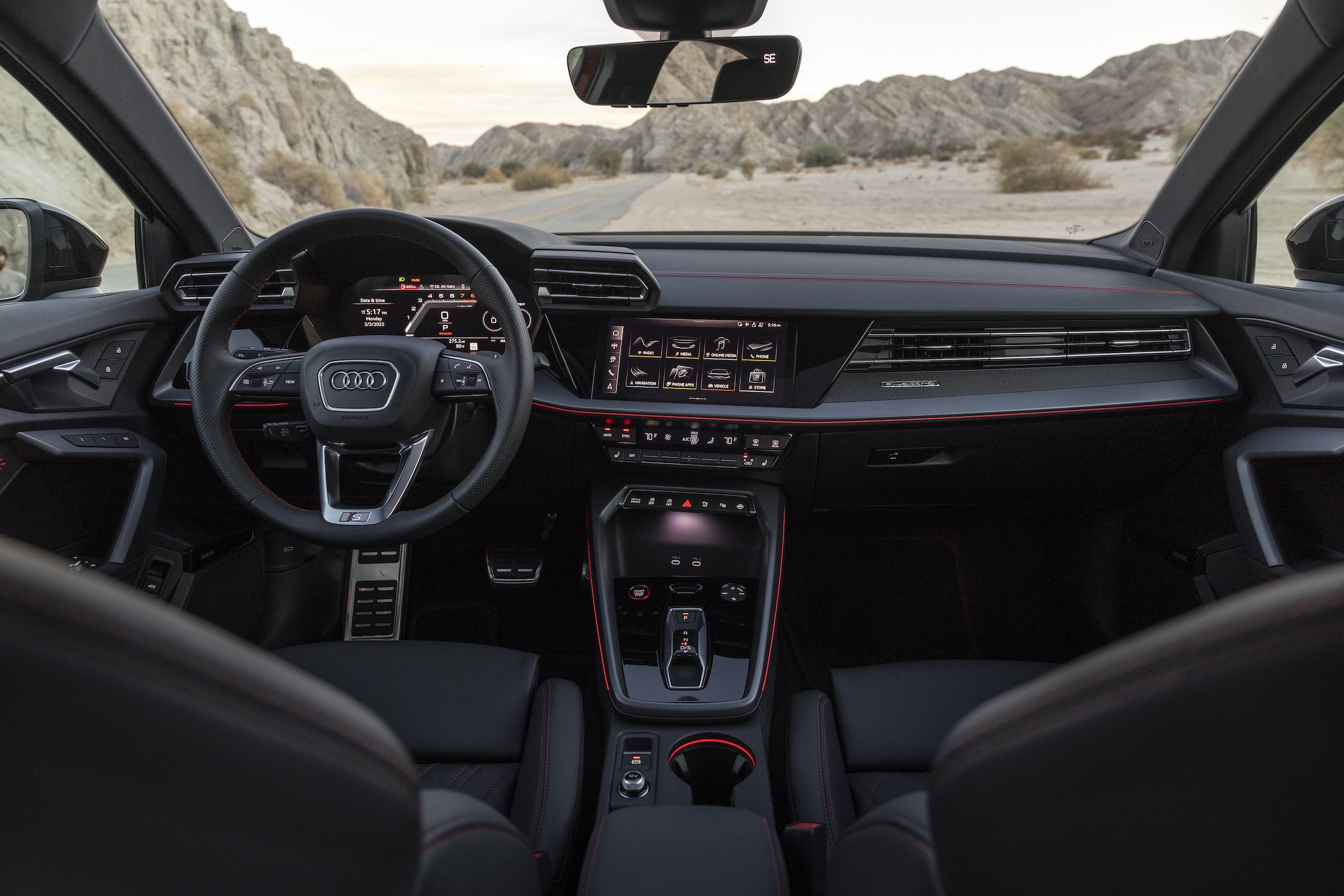
    The interior of the Audi S3 is comfortable when you’re riding up front, but not so much in the back row. The trunk helps teach how to travel light.

    Driver’s Seat: At first sit, the S3 started off strong. I hopped inside and felt instantly smitten with the no-nonsense black Dynamica faux leather interior, the firm but mostly comfortable seat, the narrow fonts in the typeface.

    Then I fired it up and heard the throaty exhaust recording that generally comes with Audi. But could this love last?

    Up to speed: The S3 certainly can get a move on. It’s powered by a 2.0-liter turbocharged four-cylinder engine that creates 328 horsepower, a lot for a small sedan, which kicks it to 60 mph in 4.4 seconds, according to Audi.

    Shifty: Audi has progressed even beyond its groundbreaking shift toggle switch and now has a shiny small shift mouse, for lack of a better term. Hold two fingers over it and push forward for Reverse and back for Drive. Kinda cool.

    You can shift the 7-speed automatic through the paddles, but with a vehicle as quick as the S3 you need to be in second gear before you finish rounding the corner at an intersection, so good luck finding the toggle. Here’s where a gearshift would come in handy.

    On the road: The S3 dazzles. It corners impressively and takes on country roads with a sense of wild abandon. What’s to prevent everyone from racing around the world like maniacs in this sedan?

    But what the Quattro all-wheel-drive system giveth, the suspension taketh away. The S3 starts to lose its charm on the highways; road seams and pocked road surfaces really jolt the little sedan abruptly. Be sure to check your dental plan before purchasing.

    Friends and stuff: You won’t squeeze much of either inside, friends nor stuff, not with this leg room, that hump, or the trunk. Feet and legs are pretty smushed.

    Farther back, the trunk seemed to identify as bigger but it’s rated at a snug 8.3 cubic feet, closer to a Miata (4.59) than a Civic (14.8). The rear seat does fold down, making things a little better.

    Play some tunes: Sound from the Sonos premium sound system is awesome — an A+. There’s a heavy echo in the surround sound, but I decided to live with it, as it only interfered with a few songs.

    Operation is all through the touchscreen. In a depressing application of function following form, the forward-reverse-volume controls live on a little round button on the console that matches the engine Start button. Beautiful to look at; disturbing to operate.

    I always love the Google Earth feature in Audi maps; it makes driving around quite scenic. Although so is looking at the actual road.

    Keeping warm and cool: The heater features a row of toggles that you push to lower and pull to raise. Somehow, though I’ve seen various toggles in different vehicles and they worked well, these black toggles felt hard to operate and distracting from the road.

    The blowers are also right in the driver’s face, which I was less enthusiastic about; there was no real way to send the air away from me.

    Fuel economy: I averaged about 24 mpg in a lively week of testing; every red light was an acceleration test. About 100 of those miles were there before me.

    Where it’s built: Ingolstadt, Germany. Just over half the parts hail from Germany as well (51%), and a mere 1% come from the U.S. or Canada.

    How it’s built: The less-fun A3 rates a 3 out of 5 from Consumer Reports for reliability, so that likely applies to the S3 as well.

    In the end: If your every day involves lots of highway, maybe this isn’t the choice.

    Next week: Let’s see how the BMW 228 compares.

  • 2025 Toyota Corolla: One way to stay under $30K

    2025 Toyota Corolla: One way to stay under $30K

    2025 Toyota Corolla FX vs. 2025 Buick Envista Avenir: Two options to avoid being spendy.

    This week: Toyota Corolla

    Price: $29,089 as tested. Convenience Package added blind-spot monitor and cross-traffic alert for $530; black roof, $500; and connected services trial, $325.

    Conventional wisdom: Motor Trend liked the “$27,785 base MSRP, cool black accents, and bigger, more readable screen”; on the down side, it was “not particularly quick,” the “engine drones,” and it’s a “dated cabin.”

    Marketer’s pitch: “Introduce fun to every day.”

    Reality: You’re going for the fun angle, Toyota? Really, now?

    What’s new: The Corolla adds a new FX model for 2025, which pays homage to the old FX16, something I’d never heard of before writing this. Still, I feel I can say with confidence, it doesn’t live up to that.

    Not so new: How thankful I am to have two small, inexpensive cars to test. They’re a rare treat among model lineups and even rarer among vehicles I get to test, and readers are clamoring for them. Manufacturers want to make money selling you expensive things we don’t really need.

    The Corolla is a sedan and the Envista is a crossover, so very different directions indeed.

    Competition: Honda Civic, Hyundai Venue, Hyundai Elantra, Kia Niro, Kia Soul, Mazda 3, Nissan Kicks, Subaru Impreza, Toyota Prius, to name just a few.

    Up to speed: The Corolla is not winning any races. The 2.0-liter four-cylinder engine creates 169 horsepower and gets to 60 mph in 8.2 seconds, according to Motor Trend.

    Still, I was pleased enough with most of the performance, though I was traveling solo through almost all of it. A packed car would suffer a bit of malaise under the extra strain.

    Shiftless: The continuously variable transmission in the Corolla saps power as much as any. The gearless setup offers infinite ratios in theory but in actuality some examples make hill-climbing and hard acceleration something you’d just rather avoid. The Corolla’s version sits about in the middle, not the worst or the best.

    On the road: The Corolla has never been anything like fun, although the XSE version gets close. The FX model doesn’t get there, though, although handling is small-car good. Still, you won’t confuse it with a Golf or Mazda3.

    Driver’s Seat: Sturgis Kid 1.0 once purchased a new Scion iM (the Corolla Hatchback before it was called that) based solely on the dreamy front seats. Every time I borrowed that car, I noted how comfortable it was.

    The Corolla FX tested had sport fabric-trimmed seats with orange stitching that matched that feel. They were soft but supportive seats and made all the Schuylkill Expressway stop-and-go feel lots better.

    The Corolla also benefits from the simple gauge setup that Toyota offers in its base models. Changing the screen to fit your needs is simple with the steering wheel controls.

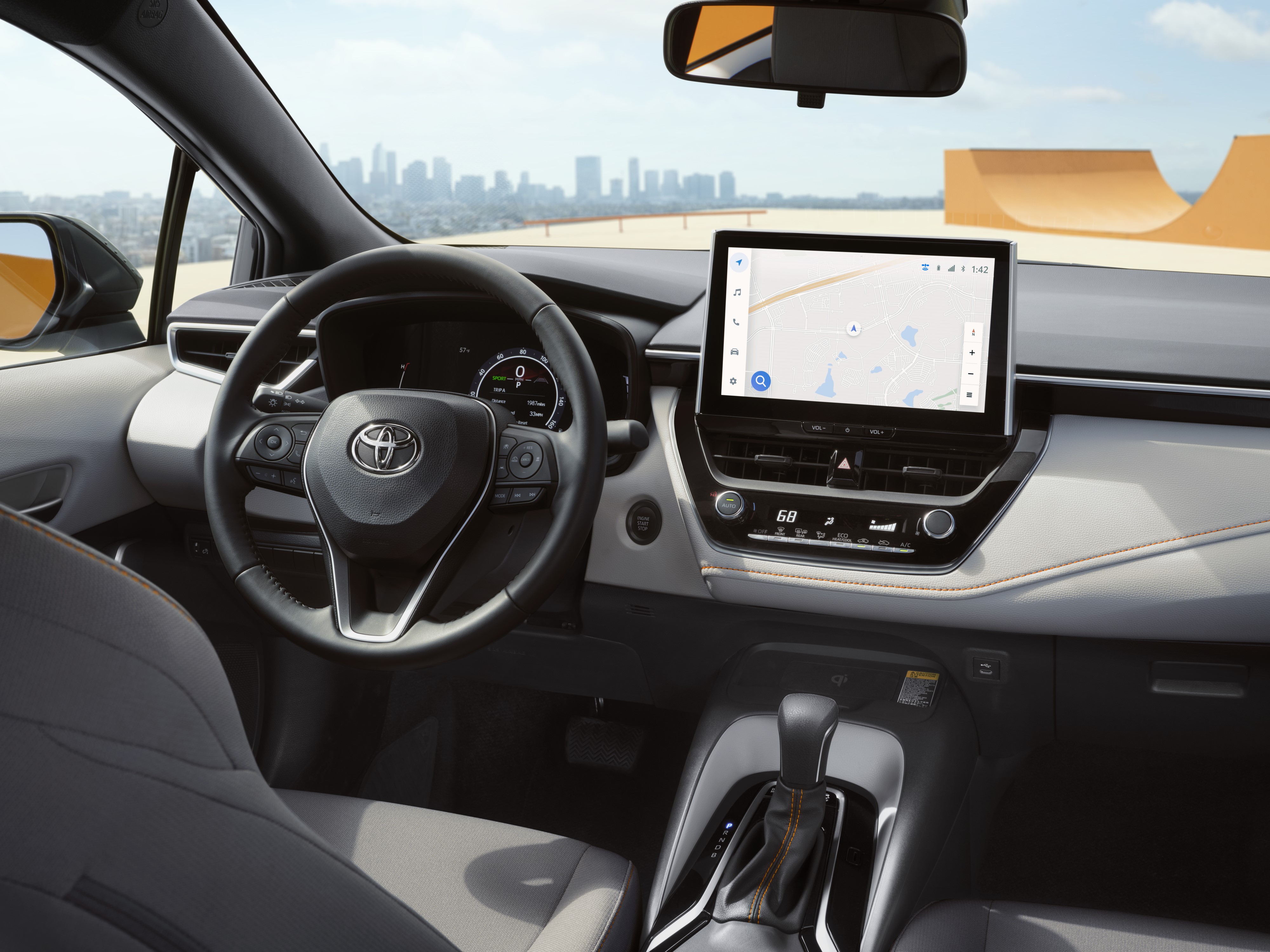
    The interior of the 2025 Toyota Corolla adds a 10.5-inch infotainment screen, and the seats remain among the most comfortable among all sizes of vehicles, not just small cars.

    Friends and stuff: The rear seat is pretty good for a small car. Headroom is dear — my head doesn’t hit the ceiling but it’s close — while legroom and foot room are nice. The door requires care when getting in and out because it’s a bit of a squeeze.

    The middle seat passenger will be perched on a narrow cushion and a tall floor hump, and will be permitted to throw small food items at everyone else, or to at least choose the evening’s movie later.

    Cargo space is 13.1 cubic feet. The seat folds to create a pass-through.

    Play some tunes: The new 10.5-inch touchscreen helps with navigating through the sources and whatnot. But somewhere a designer is patting themselves on the back for the sleek control panel, which trades a volume dial for pushbutton -/+ system. Boo!

    The stereo offers pretty good playback, especially by Toyota standards, about an A- or B+.

    Keeping warm and cool: Kudos for the simplest controls I’ve seen in a long time — one dial for air speed, another for temperature, and silver buttons for everything else.

    Fuel economy: I averaged about 32 mpg in an unusual array of Mr. Driver’s Seat testing. A very stop-and-go round trip to Center City figured mightily into the week. Otherwise it was mostly highway and side roads.

    Where it’s built: Blue Springs, Miss.

    How it’s built: Consumer Reports predicts the Corolla reliability to be a 5 out of 5. (Like, duh.)

    Next week: Buick Envista Avenir