Author: Jonathan Tannenwald

  • Gio Reyna seizes his moment with the USMNT, and is now in the World Cup race

    Gio Reyna seizes his moment with the USMNT, and is now in the World Cup race

    From the moment the U.S. men’s soccer team’s starting lineup was announced Saturday, all eyes were fixed on Gio Reyna.

    Not only was he about to play for his country for the first time since late March, but he was starting for the first time since last year’s Copa América group stage finale — a loss to Uruguay that sent the U.S. out in the group stage on home soil, and sent manager Gregg Berhalter out of his job.

    Reyna, 23, didn’t make any of Mauricio Pochettino’s squads until the Nations League final four in March because of a groin injury. Then he didn’t play in the semifinal loss to Panama, and was an ineffective second-half substitute in the third-place game loss to Canada.

    For all Reyna’s talents — and he has perhaps the most natural talent of any U.S. player besides Christian Pulisic — Pochettino declared him not “ready to play in the way that we expect from him” on the eve of the third-place game.
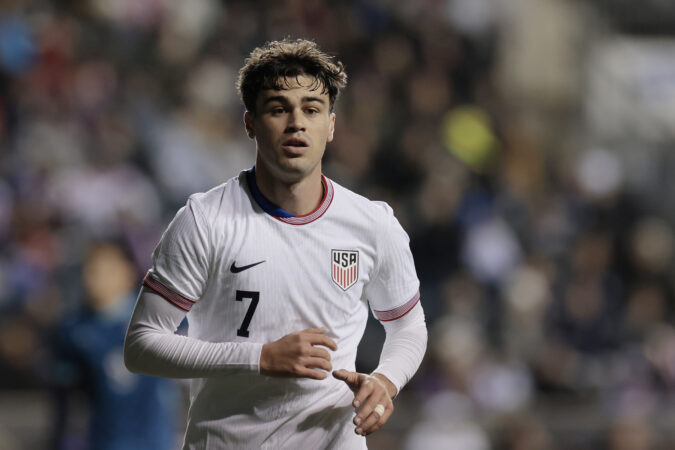
    Gio Reyna hadn’t been with the U.S. men’s soccer team since March.

    That was how far he had fallen, in terms of fitness, form, and playing time at his club, Germany’s Borussia Dortmund.

    Nor was he done falling. Reyna went to the Club World Cup with Dortmund instead of the Gold Cup and the friendlies before it, because Dortmund wanted him at their games and Pochettino didn’t want players at the friendlies whom he wouldn’t have afterward.

    Would that be salvation? No, it was almost the opposite. Reyna got off the bench only once in Dortmund’s five tournament games, a mostly useless 12-minute cameo in the group stage finale.

    Only after that did he finally leave for newer pastures, a move many outsiders had hoped to see for years. Borussia Mönchengladbach bought him for about $4.5 million up front and $3 million in incentives. It was miles below what Dortmund expected when a 17-year-old Reyna made his first-team debut in early 2020.
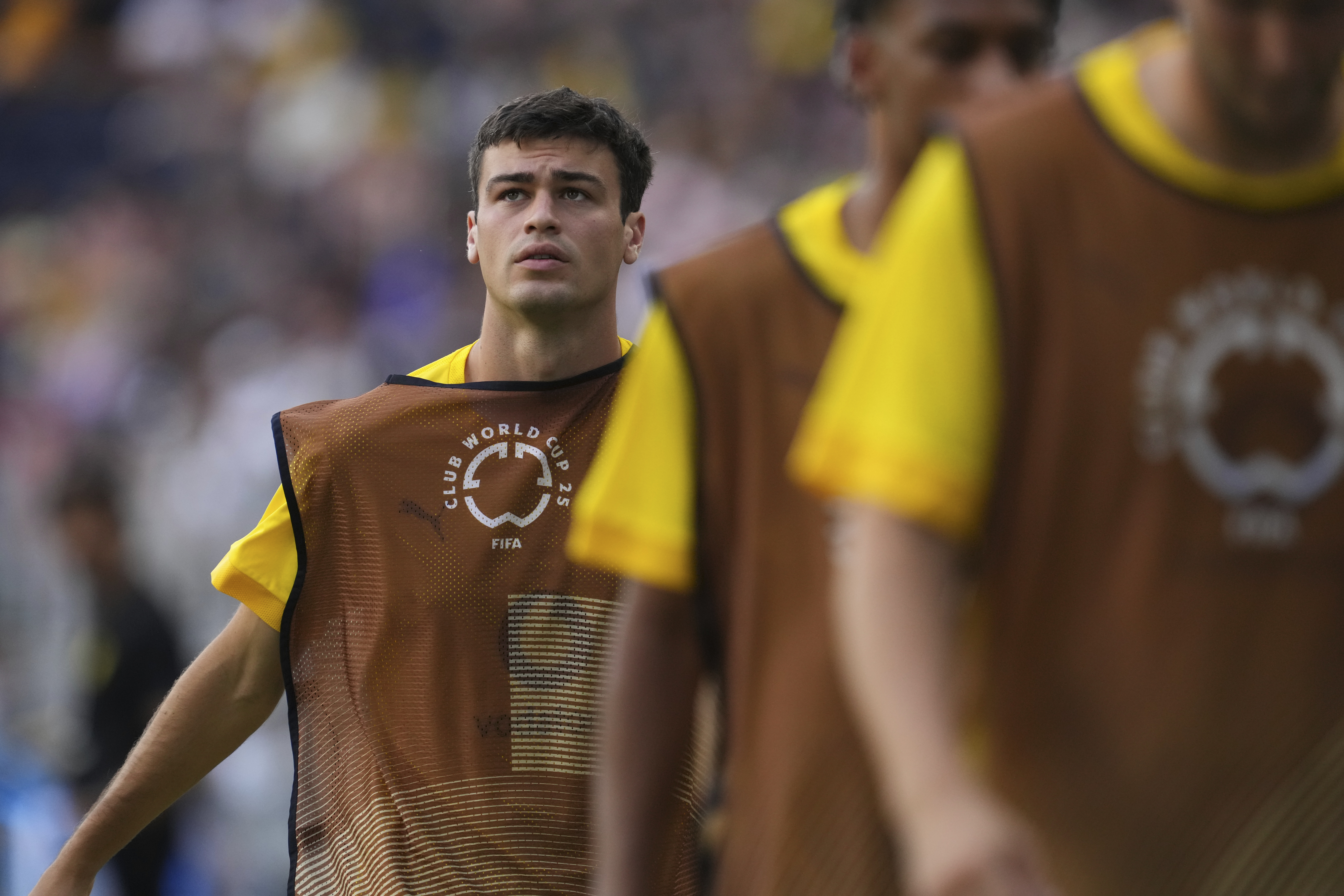
    Gio Reyna watched almost all of Borussia Dortmund’s Club World Cup run this summer from the bench, finally leaving the club afterward.

    It was to be a fresh start, but it barely started before Reyna suffered the latest of seemingly countless muscle injuries in September. He returned to action in mid-October, but only as a substitute.

    So it was a pretty big surprise when Pochettino called him up to the national team this month. But over the course of the week in Chester, it felt increasingly inevitable that he would start Saturday against Paraguay at Subaru Park.

    Meeting the moment

    Right on cue, there he was, and the message was clear. This was Reyna’s shot. Would he take it?

    The answer came within four minutes.

    It was a broken play out of a corner kick, the ball pinging around off all manner of limbs on both teams. Eventually, it fell to Max Arfsten, and he chipped a cross into the crowd. Reyna rose highest and met it with a header that caromed in off the crossbar.

    As the crowd roared, Reyna ran toward the corner flag, pointing to the U.S. badge on his jersey. Within seconds, his teammates had swarmed him to celebrate.

    “I know the kind of player he is, and I’m just really happy for him — he deserves it,” said Medford’s Brenden Aaronson, who started with Reyna in the attacking midfield spots. “He’s been through a lot with injuries, with all this stuff. But whenever he plays for the national team, he’s always there, and it’s awesome to see. … He’s confident in his ability, he knows what he can do, and that’s the beauty of him.”

    There wasn’t time in the moment to point out that Reyna has not in fact always been “there” when with the national team. That was the whole point of the 2022 World Cup scandal that nearly torpedoed him.

    When that goal went in, though, it was a moment for his immense burden of history to be a privilege, not a weight. The tally was his ninth for the U.S., passing his legendary father Claudio’s eight.
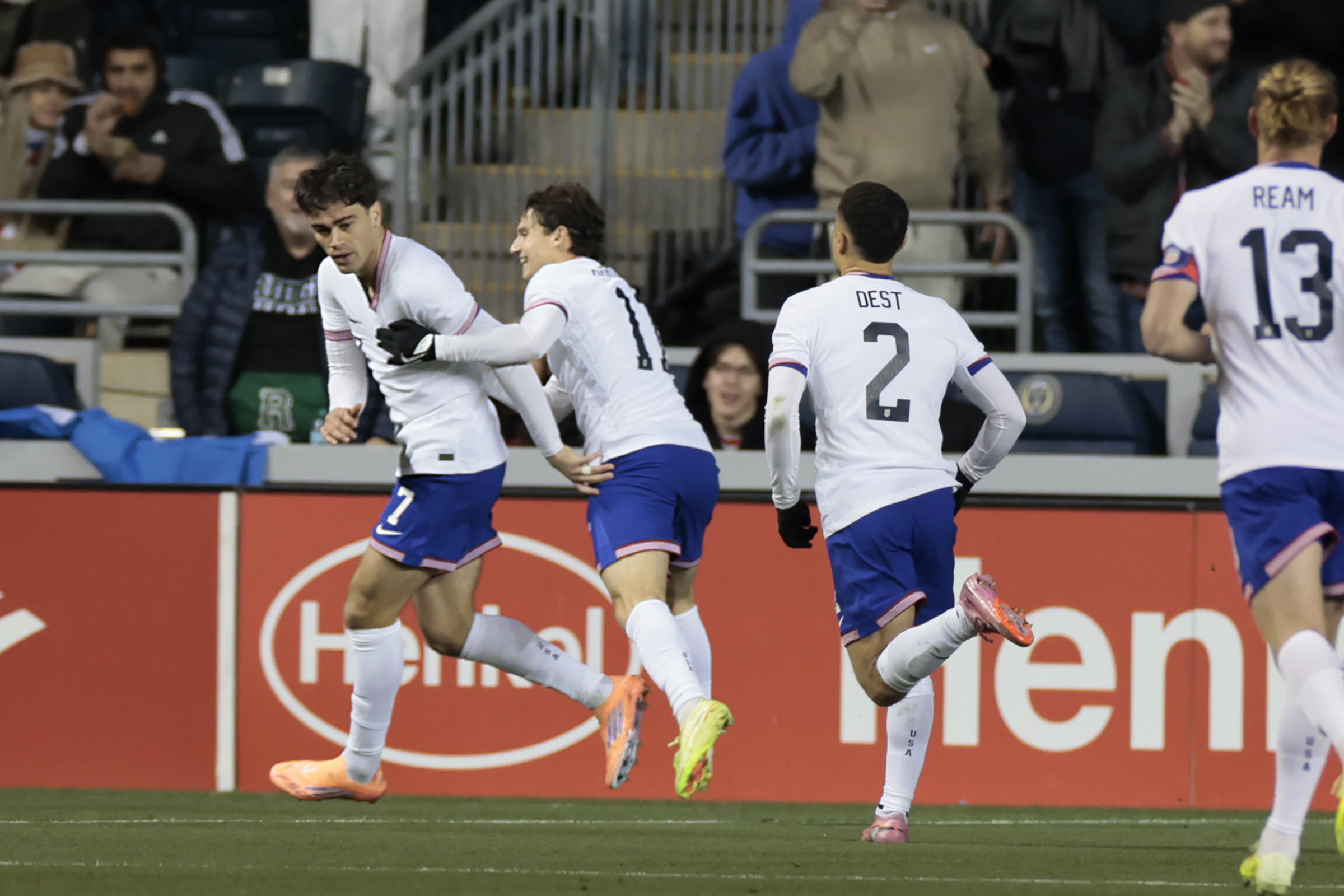
    Gio Reyna (left) celebrates with Brenden Aaronson (center) and other teammates after scoring the game’s opening goal.

    And for once, Claudio wasn’t invoked because of that scandal, or all the times Claudio interfered with U.S. Soccer officials before then, or yelled at referees from the sidelines in Gio’s youth days, or by genetics passed his ego on to his son.

    By the time Gio emerged from the locker room to meet one of the biggest media packs at a U.S. game in quite a while, he had already texted with his father.

    “It was just fun, love,” Gio said. “He was obviously happy for me that I passed him, but I had no idea. So he was more making fun of me for the fact that it was my first header I’ve ever scored.”

    The pressure on him is earned

    The negative side of the burden struck twice after that. On Paraguay’s 10th-minute equalizer, Reyna was late and slow to challenge Junior Alonso before he launched the long ball that sprung Miguel Almirón for a dazzling assist on Alex Arce’s goal.

    In the 50th, Reyna had a look to shoot in the 18-yard box and didn’t take it, choosing instead to dribble into what became a crowd of defenders.

    Those were small moments, but they mattered. Just as pressure is a privilege, Reyna knows his talents bring extra scrutiny.

    The scale tilted back his way in the 71st. Reyna combined superbly with Folarin Balogun to create the winning goal. The man of the hour had delivered again, and the U.S. went on to close out a 2-1 win.

    “I think in the end, performances like this that can help everybody here,” Reyna said. “But I want to have, more importantly, seven or eight good months in the rest of the season with Gladbach. And then I believe if I keep performing like I did tonight, then I’ll have a good chance to make the team and have an impact there, too.”

    There’s still a ways to go, and as Pochettino said, plenty for Reyna to do to earn a seat on the plane next summer. But in a moment when he was asked to step up, he did, and in national team soccer there are never many moments. So when you get one, you have to take it.

    “He showed why he started, and yes, confirmed that he’s a player that needs to improve because he needs to play more in his club,” Pochettino said. “But we can see today that he was great: scored and assisted. And the way that [he has] always the capacity to read the game, and find the free space in between the lines, I think that was a nightmare for Paraguay, and I think he did a very good job.”

    Reyna thanked Pochettino in turn, with some notable humility.

    “I knew it was an opportunity for me to to show that I belong here,” he said. “He’s been great with me all week, working with him, and just trying to give me the freedom and the confidence to sort of be myself. So I can’t thank him enough, obviously, for the start and just for the relationship that we’ve really built this camp.”
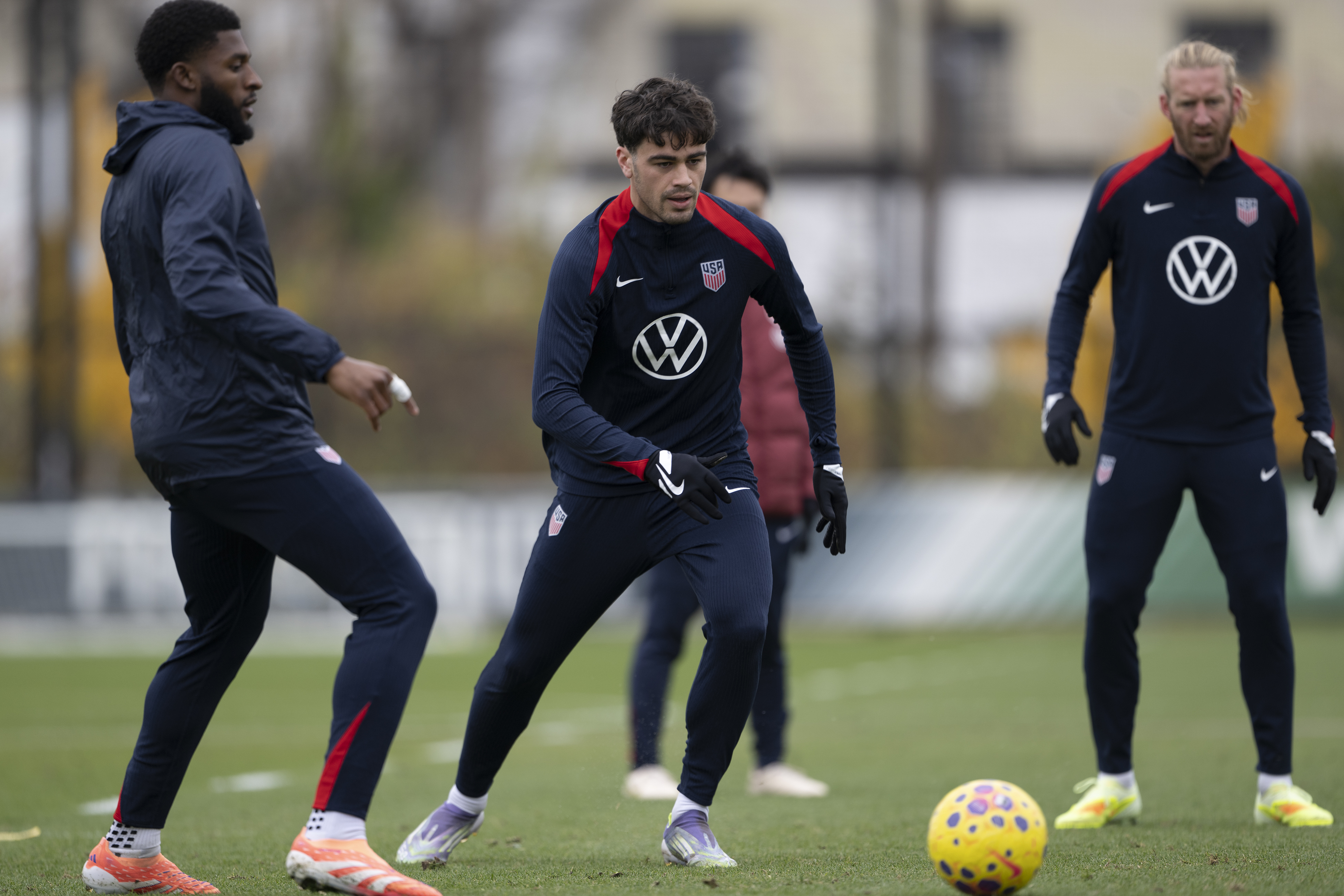
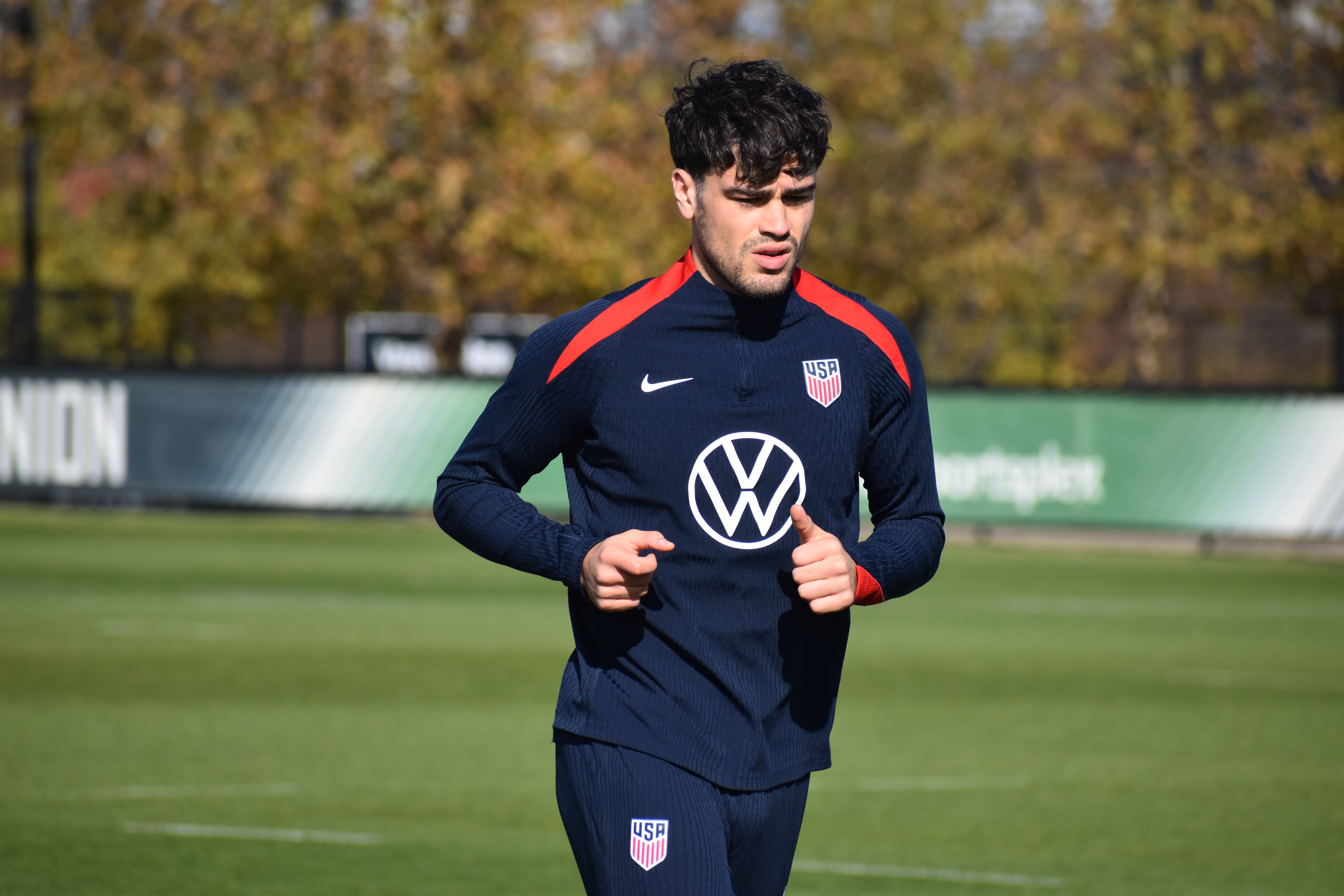
    Gio Reyna (center) working in practice during the week.

    The stakes only get higher from here, and so does the quality of opponent the U.S. will face. After meeting Uruguay on Tuesday in Tampa, Fla. (7 p.m., TNT, Universo), to close out this month, it’s expected that March’s games will see big-time opponents from Europe. Portugal, France, and Belgium are reportedly on the radar, with Atlanta’s Mercedes-Benz Stadium set as a fittingly big-time venue.

    Time will tell if Reyna earns the right to be there. For now, he’s only in the race. But that alone is the best place he’s been in for a long time.
  • Gio Reyna and Folarin Balogun lead the USMNT to a win over Paraguay at Subaru Park

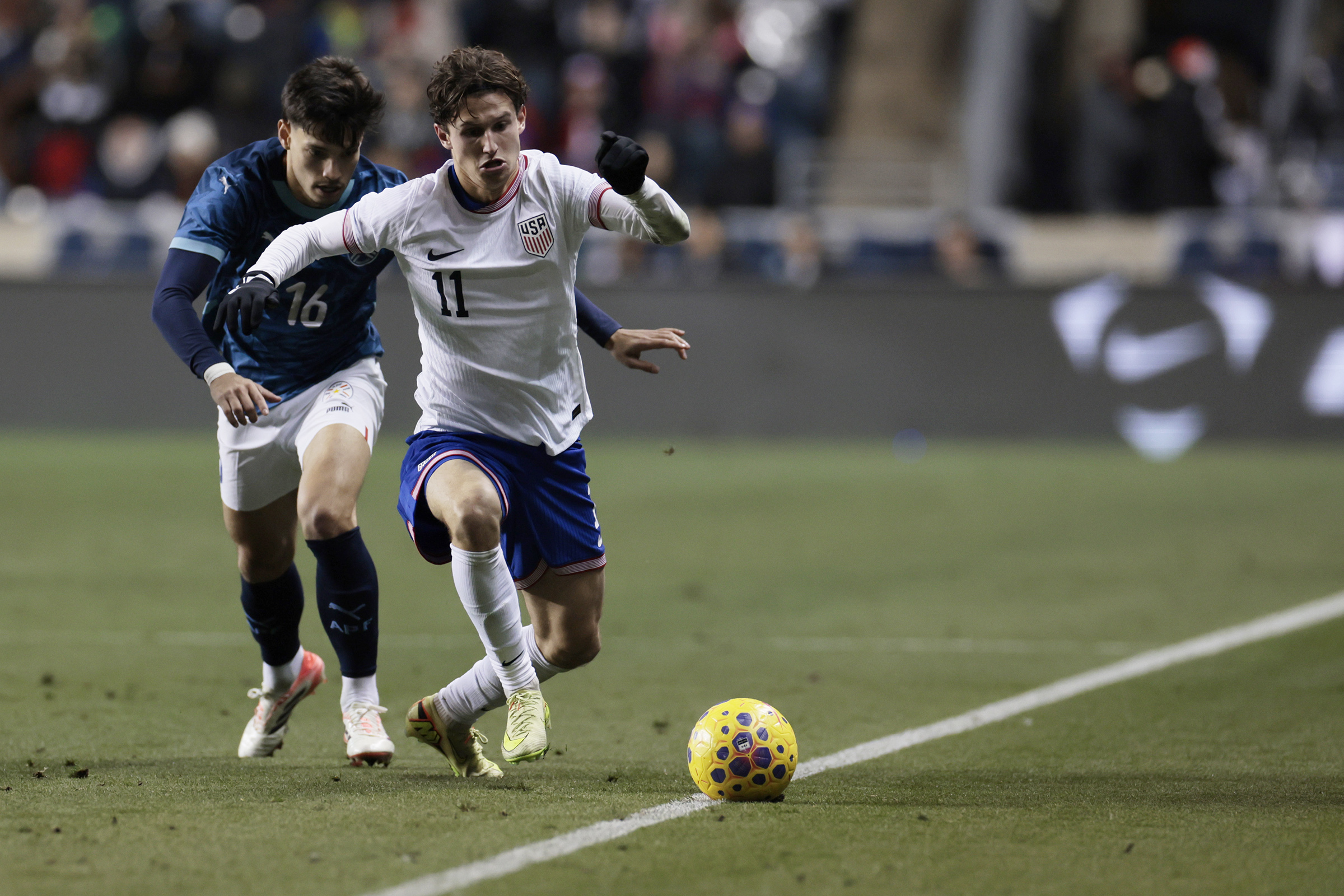
    Gio Reyna and Folarin Balogun lead the USMNT to a win over Paraguay at Subaru Park

    After waiting six years to see the U.S. men’s soccer team in town again, Philadelphia soccer fans got their money’s worth on Saturday.

    Gio Reyna scored in the fourth minute and assisted Folarin Balogun’s winner in the 71st to give the Americans a 2-1 win over Paraguay, extending their unbeaten run this fall to four games.

    Reyna was the man of the hour from the moment the lineups came out. This was his first U.S. game since the Concacaf Nations League final four in March and his first start since last year’s Copa América group stage finale. It also was just his fifth start of the calendar year in any game for club or country because of injuries and bad form.

    Reyna leapt to meet Max Arfsten’s cross after a corner kick got broken up. The 23-year-old attacking midfielder with so much unfulfilled talent ran to the corner flag, pointing to the U.S. crest on his jersey along the way, and his teammates joined him for a big group hug next to the TV cameras.

    Paraguay equalized just over five minutes later with a lightning-fast and impressive play. Junior Alonso hit a long ball down the left flank for Miguel Almirón — after Reyna waited too long to press — and the Atlanta United star hit an inch-perfect first-time cross. Alex Arce was right on time, and slammed the finish past a frozen Matt Freese.

    Almirón might have been an inch offside when the pass was played, but he otherwise left Joe Scally in the dust — in Scally’s first U.S. game since the Nations League flop. Arce then easily beat Miles Robinson, who has been a regular under manager Mauricio Pochettino but isn’t a surefire starter.

    The Paraguay fans in the bipartisan crowd of 17,221, many of whom arrived early to tailgate, were thrilled.

    After that, the game settled down for a while, and fans could observe how the U.S. was trying to play.

    Pochettino set out a lineup that looked on paper like the 3-4-2-1 he’s used lately, but it had some wrinkles. Arfsten, who played left wingback, sat a bit deeper than usual, while right wingback Sergiño Dest pushed up so high that it often looked like he was an attacking midfielder.

    The result looked at times like a 4-2-3-1, with Scally as the right back, Medford’s Brenden Aaronson in a central attacking midfield role, Dest to Aaronson’s right, and Reyna to the left — though Aaronson and Reyna had the freedom to switch places.

    Folarin Balogun led the line up top, Cristian Roldan and Tanner Tessmann were the central midfielders, and Tim Ream and Robinson stood at centerback.

    It was a fluid setup all in all, and it produced some entertaining soccer.

    Brenden Aaronson (right) runs past Paraguay’s Damian Bobadilla to chase a loose ball.

    The starting lineup stayed intact until the 67th minute and was just as lively as the first half. Aaronson was on the ball a lot, and Dest ripped a shot from atop the 18-yard box that Paraguay goalkeeper Orlando Gill tipped over his bar.

    That shot was Dest’s last action, as he and Scally departed for Diego Luna and Alex Freeman. The swaps shifted the U.S. formation to a traditional 4-2-3-1, with Freeman at right back and Luna, Reyna, and Aaronson in the attacking midfield roles from left to right.

    Balogun struck for the lead in the 71st, after first intercepting a loose pass forced by Juan Cacéres. Roldan and Luna forced it with some hustle, and when Balogun got the ball he held it up to spring Reyna down the left flank. Reyna returned the favor with a square pass that was deflected but fell right for Balogun to finish.

    Four minutes later, Pochettino sent in three more subs: Ricardo Pepi for Balogun at striker, Timothy Tillman for Reyna in attacking midfield, and Aidan Morris for Roldan in the center.

    Freese made his big save for the night in the 78th, denying a long-range blast from Almirón.

    After the ensuing corner kick, the U.S. went down the field, and Pepi should have made it 3-1 in front of an open net. But he was off-balance receiving it, and by the time he turned to his favored right foot, Paraguay’s Gustavo Gómez had raced to the goal line to block the shot.

    The last U.S. sub was Sebastian Berhalter for Aaronson in the 80th, and the hometown hero got a big ovation from the crowd on his way out.

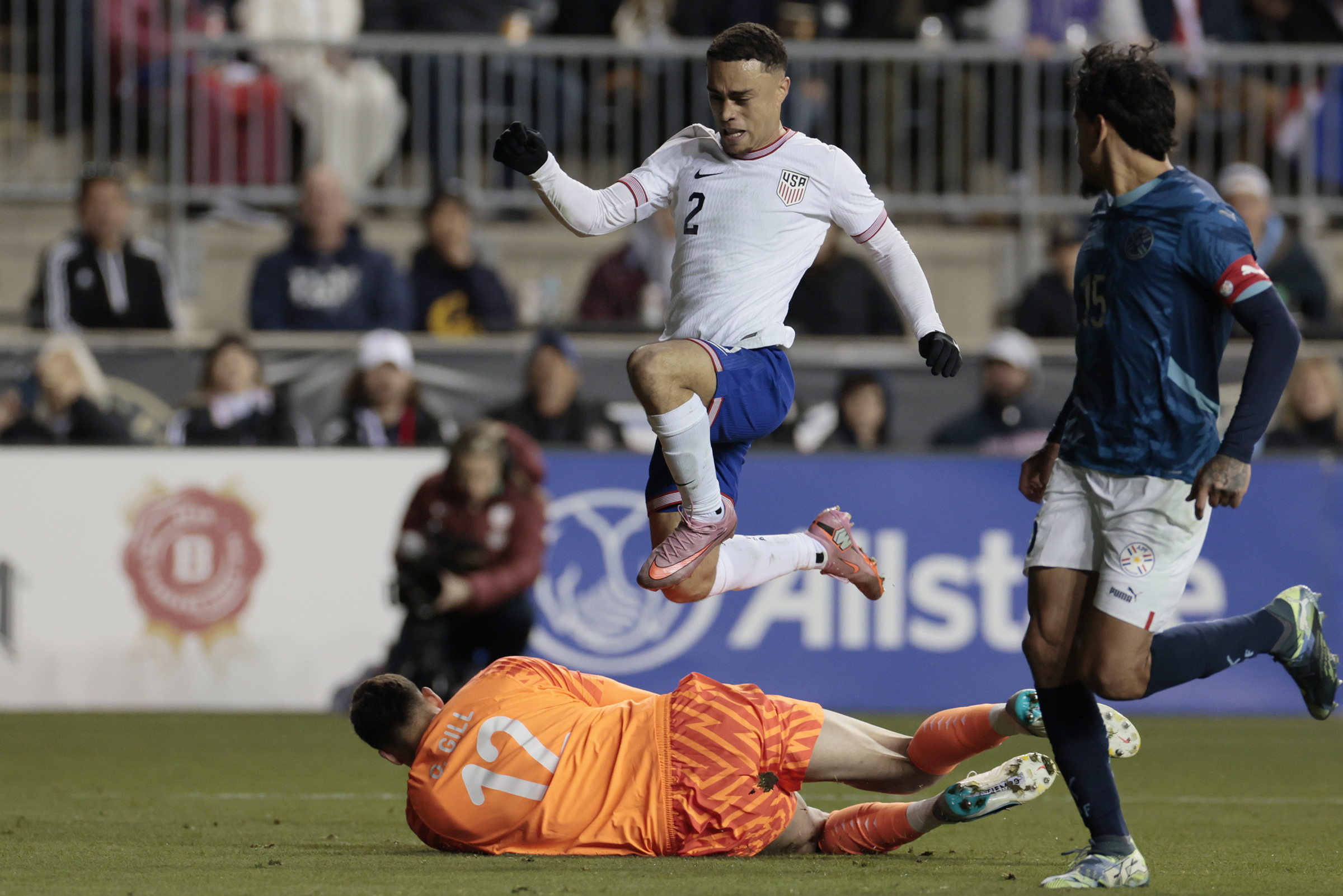
    Sergiño Dest (center) jumps over a diving Paraguay goalkeeper Orlando Gill on a U.S. scoring attempt during the second half

    Things got dicey from there for the U.S., including a deflection off Arfsten right on 90 minutes that rolled inches wide of Freese’s far post.

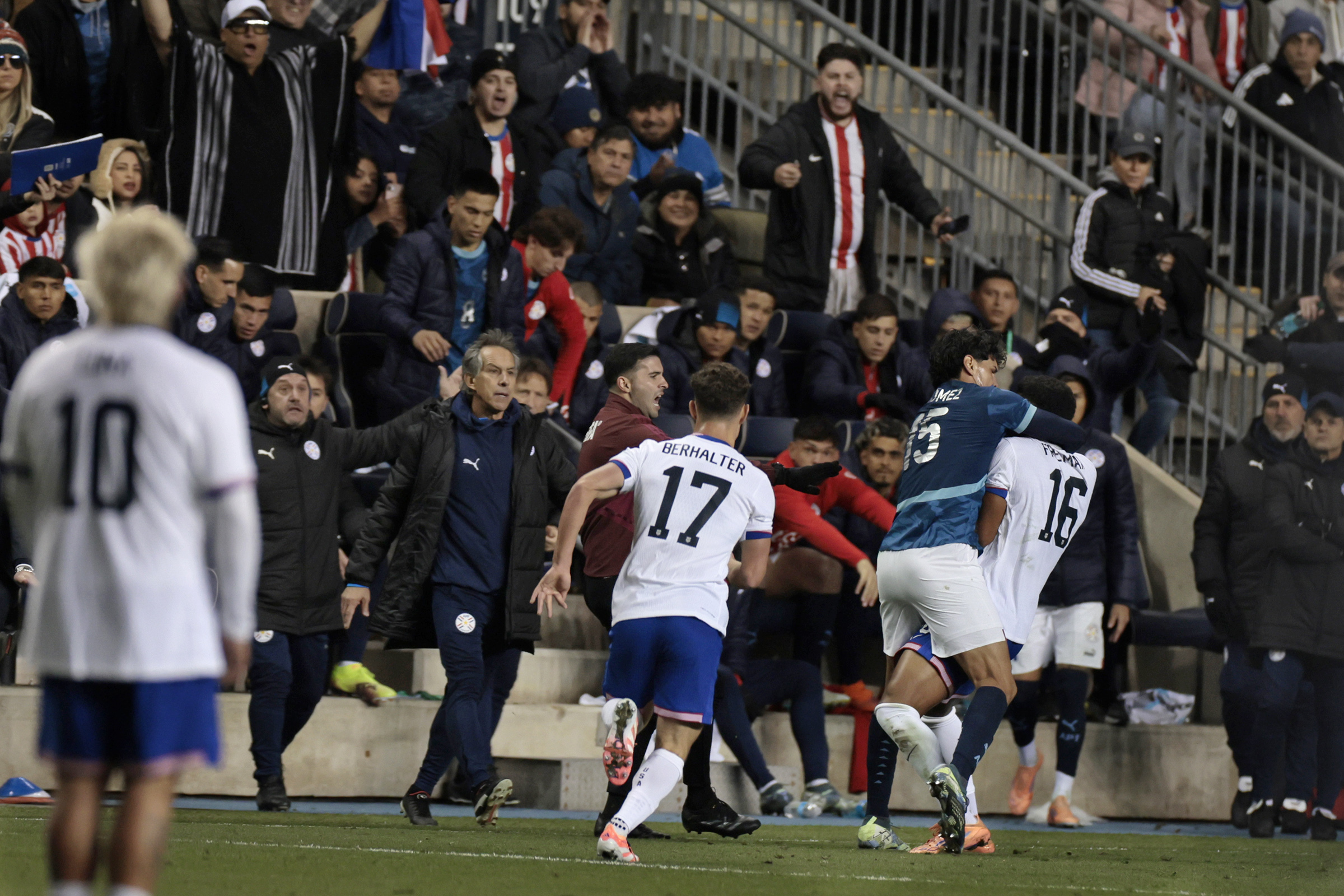
    Just over a minute later, a brawl erupted by the benches after Gómez and Freeman briefly argued over who would claim a dead ball on the field. Gómez put Freeman in a headlock, which sparked a melee that ensnared both teams’ active players and benches, coaches included. It was a sight rarely seen in soccer, but especially in a friendly without official stakes.

    Referee Cristhofer Corado of Guatemala dished out a few yellow cards, and would have been well within his rights to end the game there instead of waiting out the announced four minutes of stoppage time. But play did resume, and the clock ran to 96 minutes when the final whistle came.
    The U.S. now heads south to play another South American foe, Uruguay, in Tampa, Fla., on Tuesday (7 p.m., TNT, Universo).

    Our photographer’s view of Paraguay’s Gustavo Gómez getting Alex Freeman in a headlock, which led to the brawl at the end of the game.
  • The USMNT’s new tactics seem made for Sergiño Dest, but how much will he play in them?

    The USMNT’s new tactics seem made for Sergiño Dest, but how much will he play in them?

    Long before U.S. men’s soccer team manager Mauricio Pochettino unveiled a 3-4-2-1 formation for his players, outsiders debated the possibility.

    Though the program went decades without playing that way, the rise of high-flying outside backs like Sergiño Dest made the idea start to sound sensible.

    But since Pochettino made the switch in September, Dest hasn’t gotten to play in the new setup much. He was a second-half substitute in the momentum-turning win over Japan, then had to miss October’s games because of an injury.

    That makes this month’s games crucial for the 25-year-old, who plays his club soccer at Dutch power PSV Eindhoven. The odds are good that fans will see him play a major role Saturday at Subaru Park when the U.S. faces Paraguay (5 p.m., TNT, Telemundo 62).

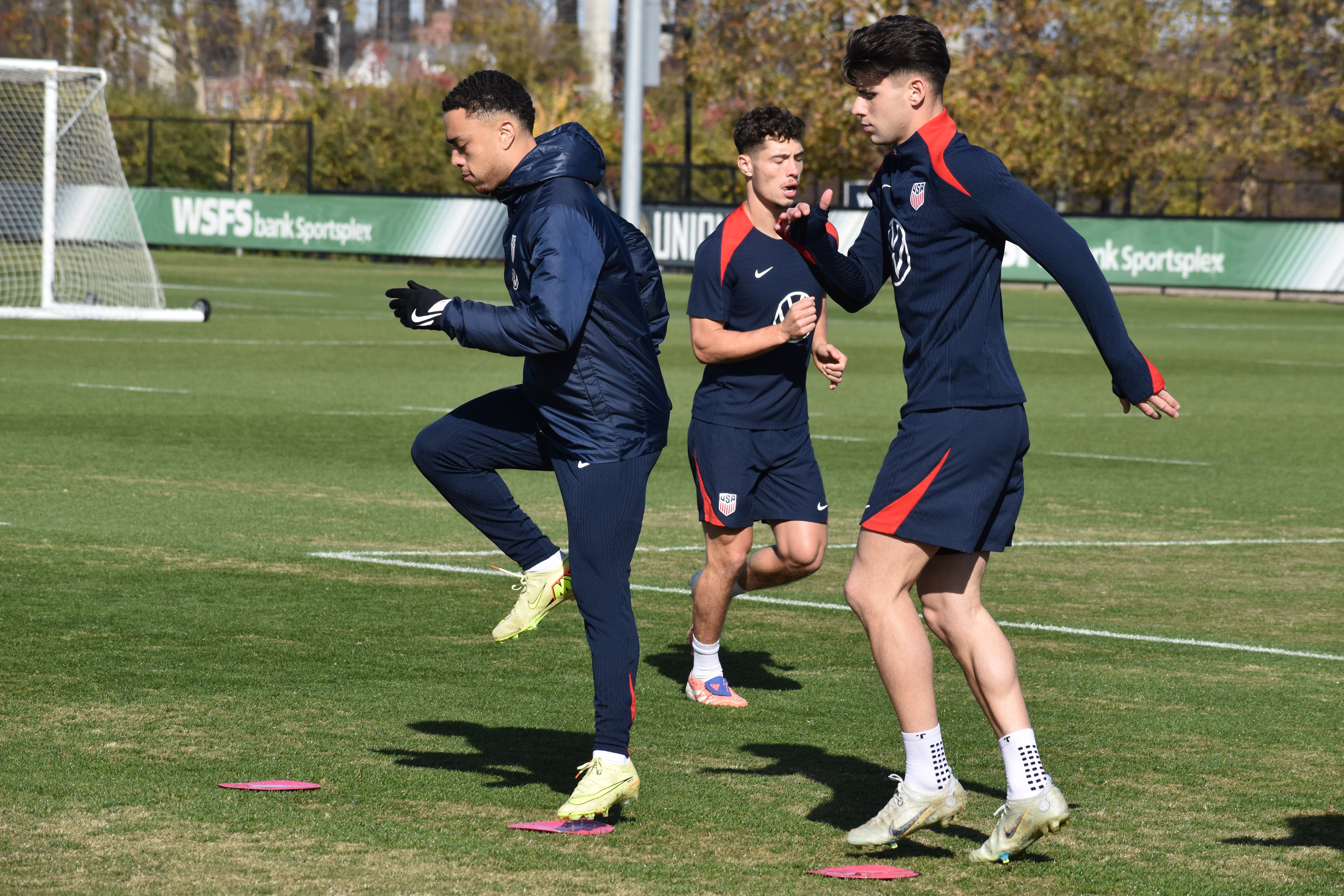
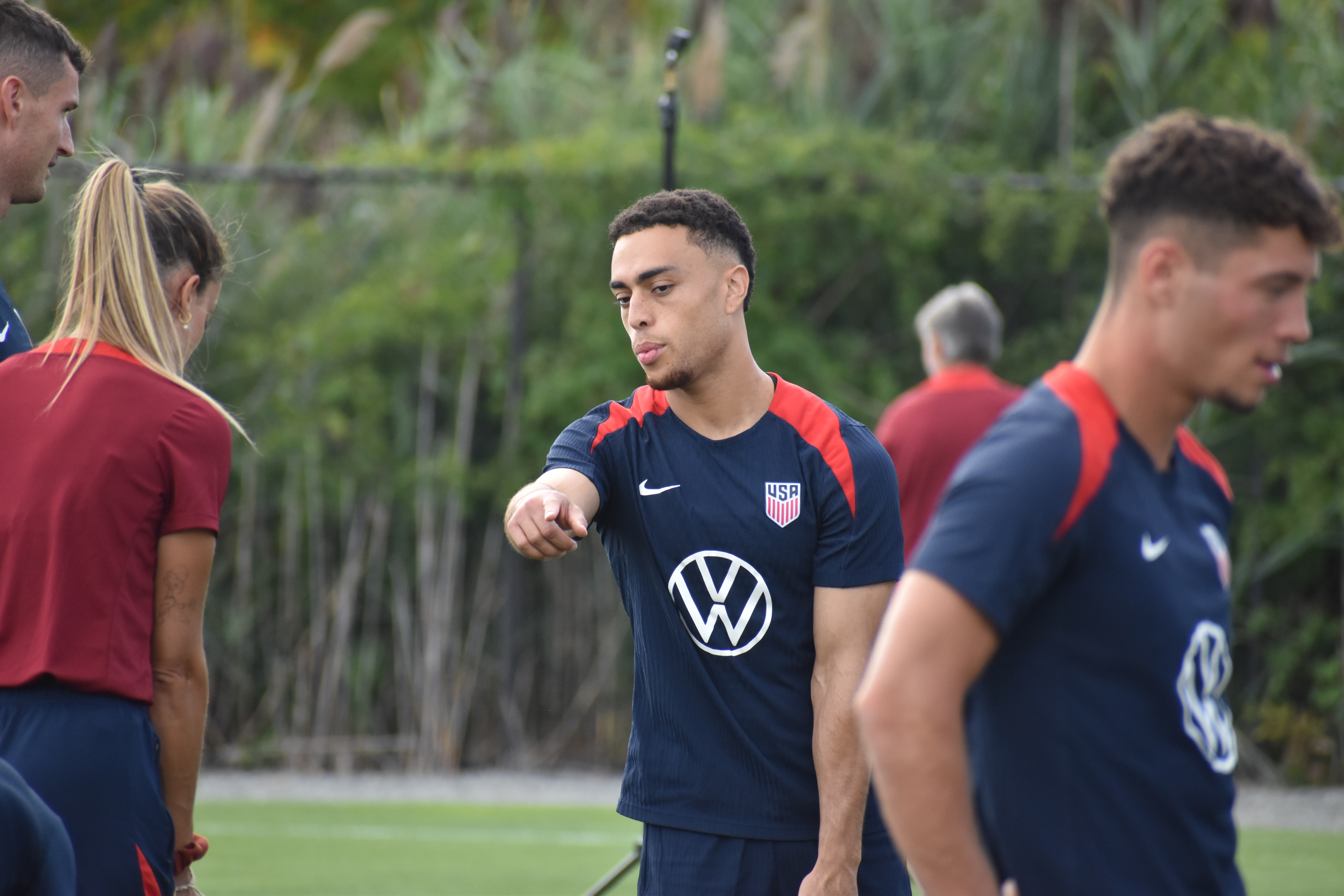
    Sergiño Dest (left) and left wingback Max Arfsten (right) working out together at Friday’s practice.

    “Yeah, I feel like it’s really important,” Dest said at Friday’s practice in Chester. “Because the rosters are a little bit different. For me personally, because I was injured, I didn’t really have that much time to play with everyone, the players that I didn’t know before. It needs time.”

    Dest has historically played on the right side of a four-defender setup with both club and country. The right wingback spot ahead of three centerbacks isn’t too different, but as with any tactical change, there are subtleties.

    “It’s a little bit different, but obviously, that’s the way we play at the moment, so I feel like you have to adapt to that formation,” Dest said. “For me personally, I’ve always been an attacking outside back, so I feel like it’s not that hard. But you still need some time.”

    Dest can also play on the left side, as he did against Japan. That could matter even more if longtime starter Antonee Robinson can’t overcome his longstanding knee issues. A combination of Dest and Tim Weah (who’s out injured right now) as the wingbacks would be quite dynamic — though with plenty of defense needed between them.

    Sergiño Dest (center) at a U.S. practice in September, the last time he was with the team.

    “Now is a good opportunity for him,” Pochettino said. “I think we have good players in that position [in this squad] like Alex Freeman and Joe Scally, that are very competitive and they can play in different [roles]. Sergiño is more offensive than defensive — he needs to improve in defensive areas — but I think it’s a great opportunity for us to know him, to see the capacity to adapt to our demands that are completely different for his club, or were in the past year. “

    Whatever Dest is asked, he made it clear he’s ready to answer the call.

    “I always want to play for the national team,” he said. “I feel like it’s an honor to be here and to fight for my spot. I always wanted to be here, but to have some extra training and some extra rest between some games, especially after the injury I came from, I think it’s also not bad, especially with the long season we still have ahead.”

    Gio Reyna in the spotlight

    While local fans will obviously be focused on the four Philly-area products on this squad, many eyes nationally will be on Gio Reyna’s return to the squad. The talented young playmaker had been on a downward slide for a while, but has finally started to trend back up in the last few weeks.

    Gio Reyna (center) on the ball at Wednesday’s practice.

    If he can make an impression in these two games, it will be a big deal in his quest to make a second straight World Cup team.

    Reyna hasn’t spoken with the media yet this week, but veteran U.S. centerback Tim Ream had praise for Reyna’s work in practice.

    “He’s not really letting the challenges overseas seep into camp, which is great to see,” said Ream, who wears the captain’s armband under Pochettino as the squad’s most experienced player. “He’s speaking up a lot more in the trainings, in terms of, ‘OK, I’m seeing this, what are you seeing?’ He’s really getting involved in the understanding of the movements and what we’re doing in the buildup and in the defensive shape.”

    Ream said he has observed a better mentality in Reyna, too. That has long been a question about the attacking midfielder, dating back to the scandal with former U.S. coach Gregg Berhalter at the 2022 World Cup.

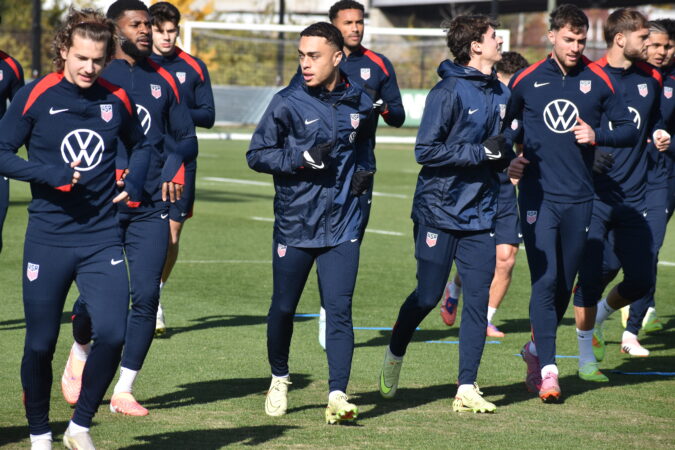
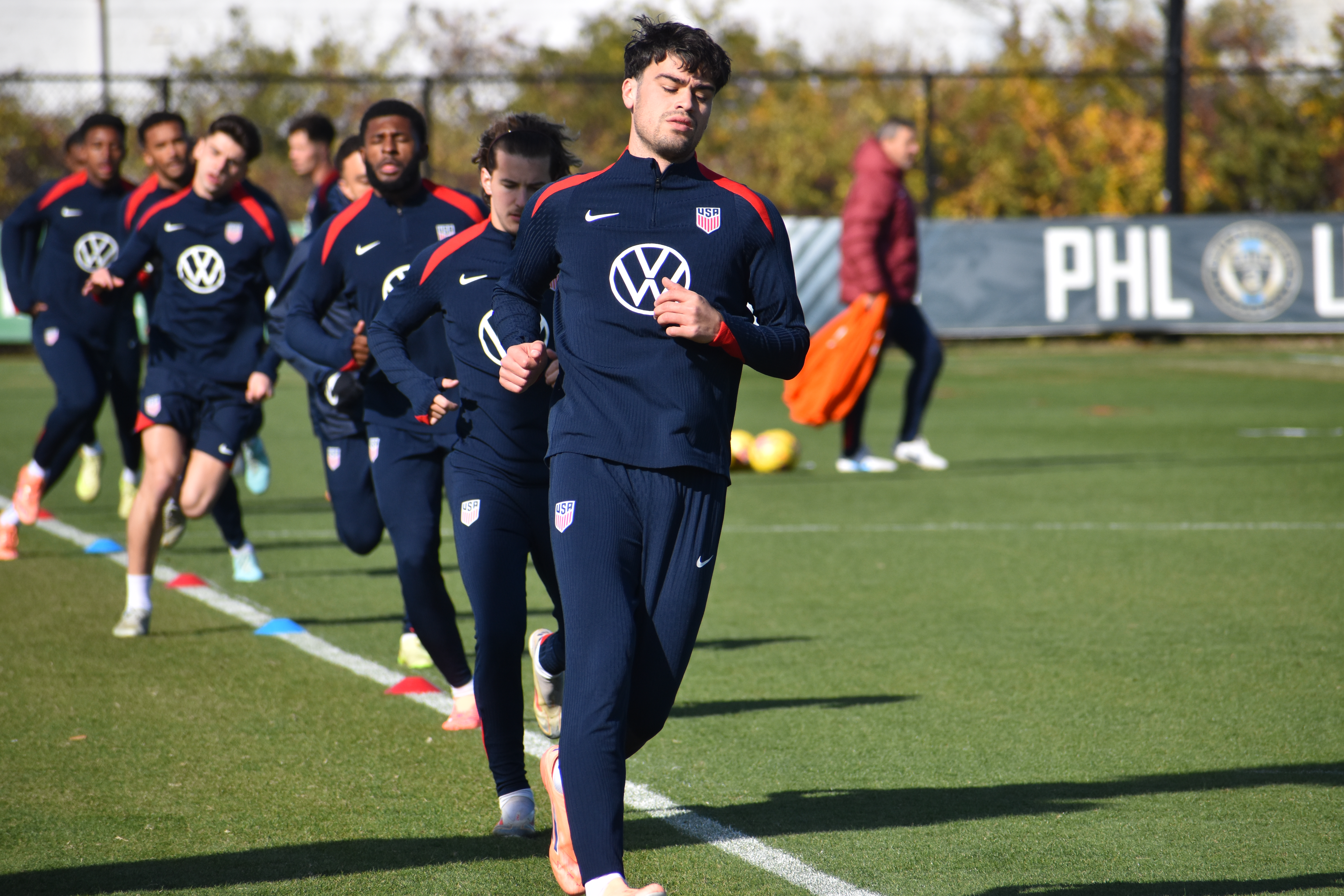
    Gio Reyna leading the jogging line at the start of Friday’s practice.

    “I feel like he’s more in tune and more focused on the field than I’ve seen in the past, which is a great thing,” Ream said. “And I think whether it was injury or other things that were going on, I think his focus is so much greater now, and that’s a good thing.”

    The mention of “other things” didn’t need further detail. Just last month, Reyna talked about it with the Associated Press, and his lack of contrition did not go over well.

    This U.S. squad is the first one where Reyna has worked with Sebastian Berhalter, Gregg’s son. Gio’s famed father, Claudio, was as close as could be with Berhalter until the scandal erupted.

    Pochettino was asked whether the subject had come up between the sons, and he said it has not.

    “I hear some things, but for me it’s not important, because in front of everything is the national team,” he said. “I cannot judge, I cannot take decisions from the past. … Now it’s a completely different environment. And what I saw from day one — good synergy, good teammates — I think the interaction and the communication is fantastic.”

  • Milan Iloski’s first salary with the Union is revealed, as is Son Heung-Min’s big paycheck at LAFC

    Milan Iloski’s first salary with the Union is revealed, as is Son Heung-Min’s big paycheck at LAFC

    Milan Iloski’s opening salary with the Union is just over $550,000, according to data from the MLS Players Association released on Wednesday.

    It’s a healthy raise from the $156,000 he was earning at the start of the year with San Diego FC, until he was released from that contract by mutual agreement. The Union acquired him in early August, signing him to a deal with funds from MLS’s Targeted Allocation Money system.

    That was the big local news in the autumn edition of the labor union’s salary data. The twice-yearly release is always welcomed by fans and amateur capologists as they dig into the big earners, the bargains, and the busts.

    Topping the list of summer newcomers, both in salary and name recognition, is Los Angeles FC’s Son Heung-Min. The South Korean superstar’s paycheck is $11,152,852, second-highest in the league behind Lionel Messi’s $20,446,667.

    Messi has stood at No. 1 since his arrival at Inter Miami two years ago, and with the same number. He just signed a new contract that will keep him on the field in South Florida through 2028, including when the Herons open their new stadium next to Miami’s airport next year. We’ll find out the numbers in it next spring.

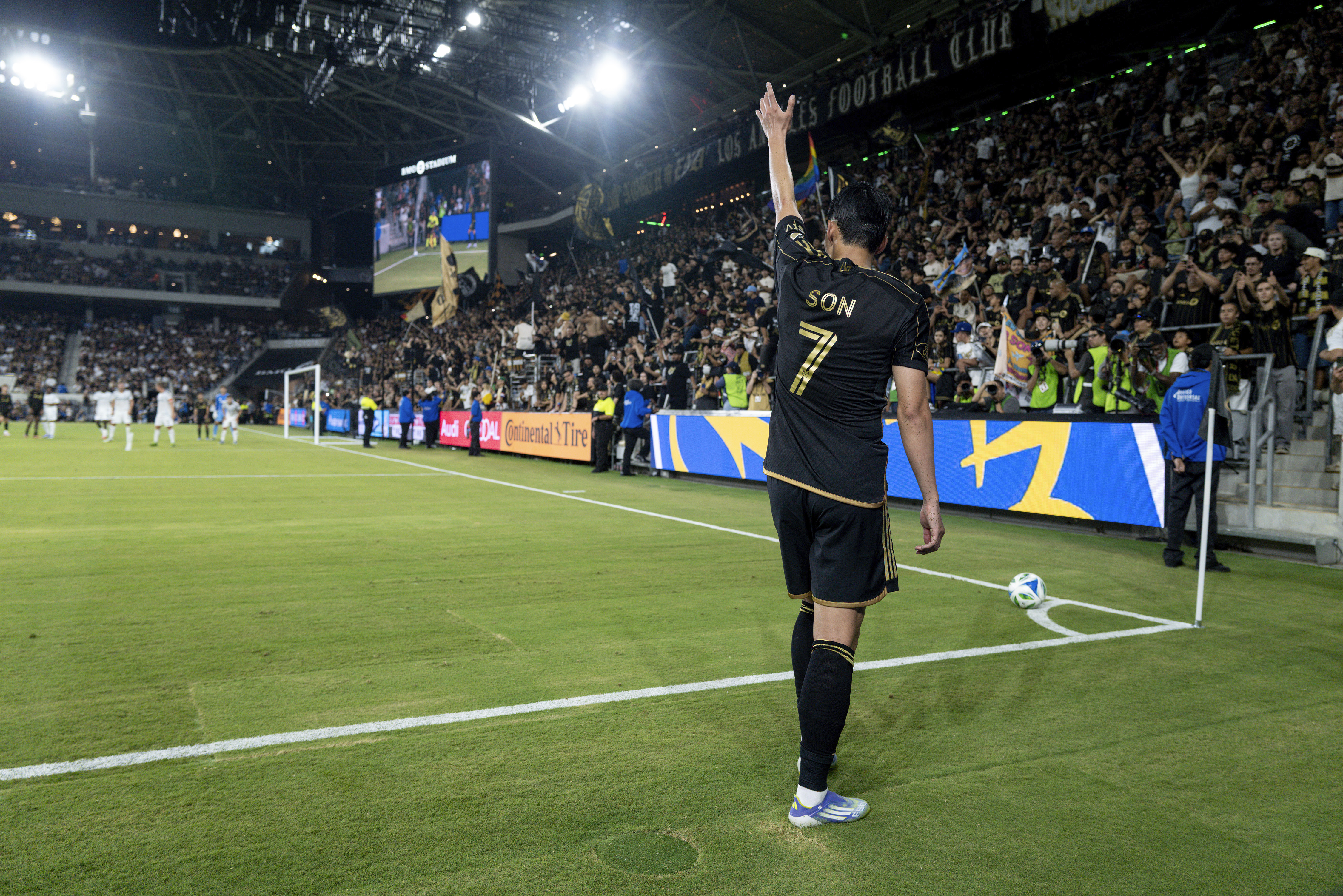
    Son Heung-Min immediately became one of MLS’s biggest stars when he joined Los Angeles FC this summer.

    The second-biggest summer arrival was Thomas Müller in Vancouver. His starting salary with the Whitecaps is $1,436,956, just below the threshold for loading up a contract in MLS’s Targeted Allocation Money system without hitting Designated Player status.

    Müller agreed to a deal that would give him less money up front in exchange for a bigger paycheck next year. The arrangement got the German legend in the door without Vancouver having to make other roster moves.

    Miami’s vice?

    Next on the marquee is another Miami newcomer, and another of Messi’s good friends, Rodrigo de Paul. His guaranteed compensation is $3,619,320, despite not being a Designated Player.

    How is that possible? Plenty of people will say it shouldn’t be. It was no secret that the Herons had to do some pretty serious gymnastics when they signed him, with all three of their DP slots already taken: Messi, Jordi Alba (an even $6 million), and Sergio Busquets ($8,774,996). All three of those numbers are way too big to buy down with Targeted Allocation Money (TAM).

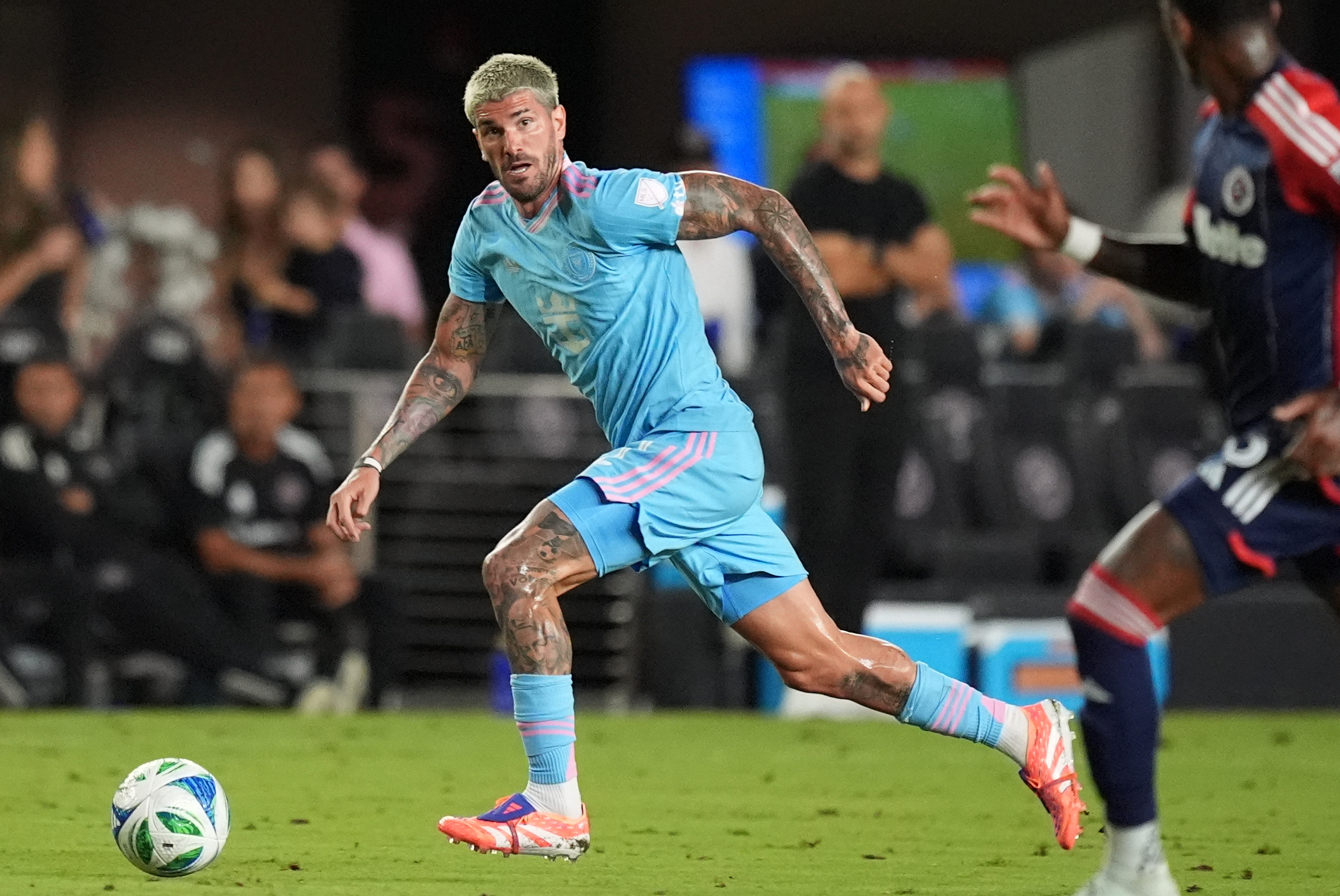
    Rodrigo De Paul in action with Inter Miami earlier this month.

    Let’s start with a reminder that the MLSPA always publishes two numbers: base salary and guaranteed compensation, which includes signing and guaranteed bonuses, plus marketing bonuses and agents’ fees, annualized over the term of a player’s contract, including option years.

    Also, the numbers in these databases are also always annualized, which means they don’t necessarily reflect what a summer signing takes home down to the cent.

    De Paul’s base salary is listed as $1.5 million, the maximum you can earn with TAM without being a DP. But even with that number being prorated to something lower, a lot of skeptics will say Miami is getting away with one.

    The trick, it seems, lies in Miami signing de Paul on loan for the rest of the year before signing him for good this winter. That passes some of the salary burden back to his previous club, Spain’s Atlético Madrid.

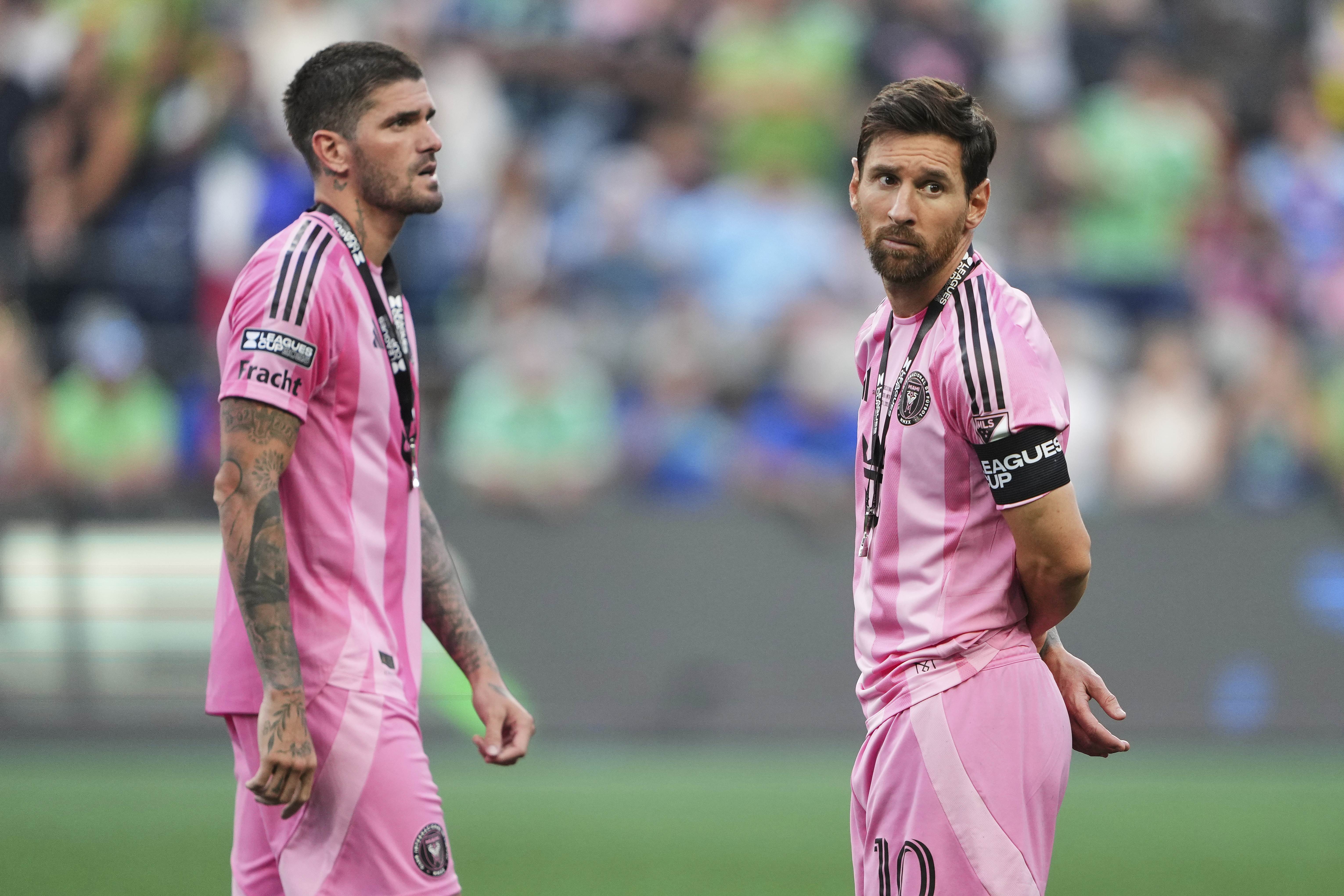
    Inter Miami will no doubt claim innocence over how it fit Rodrigo de Paul (left) into a roster already loaded with Lionel Messi (right) and other stars.

    ESPN reported when de Paul moved that MLS rules mandate “that no promise has already been made to exercise the permanent deal following the loan spell.” The Herons supposedly claimed that was the case, but no one believed them — and that same report said a new contract is ready for de Paul to sign this winter.

    But at that point, things will be much easier, because Alba and Busquets are retiring after this season.

    Miami has been caught bending the roster rules too far once before, in 2021. (The punishments were part of how Julián Carranza ended up with the Union.) But Messi and his friends weren’t in town yet back then. Now that they are, it seems the club might get away with this one.

    Other names to know

    The rest of the big summer signings leaguewide include two notable Americans: Medford native Paxten Aaronson and longtime U.S. national team goalkeeper Matt Turner.

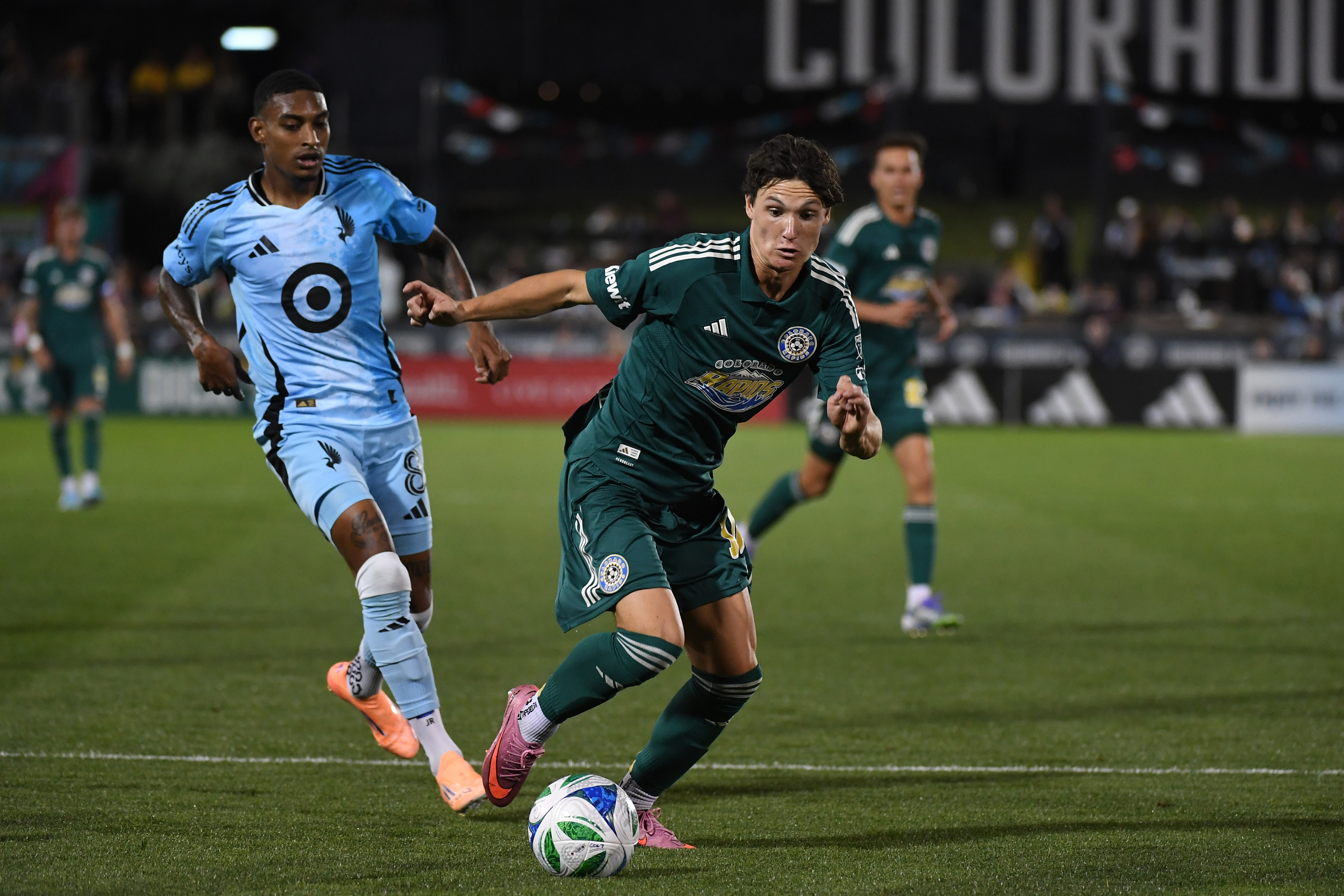
    Paxten Aaronson (right) in action with the Colorado Rapids earlier this month.

    Aaronson is earning $2,228,063 in his first year with the Colorado Rapids, which paid a nearly $8 million transfer fee to bring him back to the U.S. from Germany’s Eintracht Frankfurt.

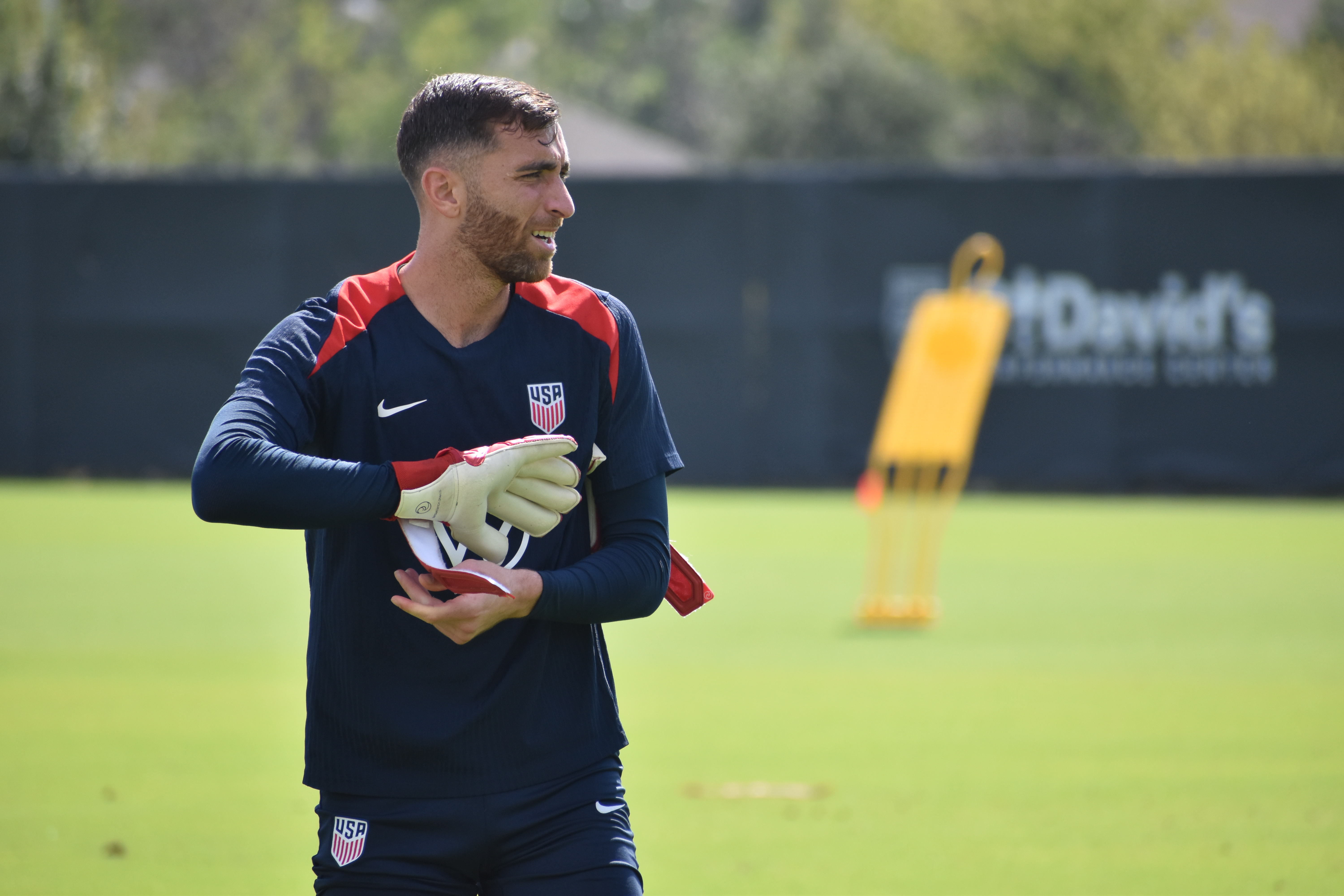
    Turner is earning $1,942,886 with the New England Revolution, which signed him on a year-and-a-half loan from France’s Lyon so he can have regular playing time before nex tyear’s World Cup.

    Among international arrivals, New York City FC’s Nicolás Fernández is earning $3,650,000, and he paid some of that back by helping the Pigeons win at Charlotte in Game 1 of their playoff series on Tuesday.

    Portland’s Kristoffer Velde is earning $3,027,000, and he scored his first Timbers goal in Sunday’s Game 1 at San Diego. Alas, it was too late to salvage a 2-1 loss.

    Matt Turner came back to New England this summer to try to regain the U.S. men’s national team’s starting goalkeeper job.

    Columbus’ Wessam Abou Ali is earning $2,157,375, but unfortunately he suffered a fracture in his right ankle in late September and is out six weeks. That might not be enough time to save the Crew’s first-round series against arch-rival Cincinnati, which won Game 1 at home on Monday.

    Game 2 is Sunday in Columbus, and Game 3 would be Nov. 8 in Cincinnati.

    Speaking of Cincinnati, they’ve got a case study on how to bring back a former star on a midseason deal. Brenner was a Designated Player striker from 2021-23, with a salary of over $2.2 million. He was sold to Italy’s Udinese, then reacquired this summer on a loan for the rest of this year with a purchase option.

    His salary for now is just $280,120.

    Brenner (left) in action during Monday’s Game 1 of the Cincinnati-Columbus playoff series.

    The Union’s payroll

    Each player’s salary figure officially includes two numbers: the base salary and guaranteed compensation. The latter number includes signing and guaranteed bonuses, plus marketing bonuses and agents’ fees, annualized over the term of a player’s contract, including option years.

    For conversational and reporting purposes, the guaranteed compensation number is the one usually used here and around the league.

    Along with the team’s summer signings (Iloski and third-string goalkeeper George Marks) and departures (prospects Nelson Pierre and David Vazquez), you’ll notice that another name is missing.

    Centerback Ian Glavinovich agreed to a mutual contract termination a few weeks after being given season-ending injury status for his rehab from a torn meniscus.

    The only Union player who got a raise this summer is Jakob Glesnes. He signed a new contract in August, and his pay for the year went up by $71,875, where he’s pulling in $1.31 million this season.

    window.addEventListener(“message”,function(a){if(void 0!==a.data[“datawrapper-height”]){var e=document.querySelectorAll(“iframe”);for(var t in a.data[“datawrapper-height”])for(var r,i=0;r=e[i];i++)if(r.contentWindow===a.source){var d=a.data[“datawrapper-height”][t]+”px”;r.style.height=d}}});

    The annotations in parentheses mean the following:

    (1) — Senior roster player; (2) — Supplemental roster player; (3) — Supplemental roster spot 31, loaned to the Union’s reserve team for the entire year; (4) — Off-roster supplemental player

    (5) — Designated Player; (6) — Young Designated Player (age 23 or below); (7) — Cap hit bought down with Targeted Allocation Money; (8) — International status; (9) — Homegrown Player status

    (10) — Under-22 Player status (via age) to reduce salary cap charge; (11) — Also has a “professional development role” with the team for work beyond the field; (12) — Currently loaned out

    The big numbers leaguewide

    Across the landscape, MLS teams are paying a total of $597,372,429 to 944 players.

    The average salary is $632,809.78, down a little bit from the spring, the first time that number has exceeded $600,000. The median salary of $300,000 has not changed. The lowest salary in the league, which is set by the CBA, is $80,622. It’s also the most common salary leaguewide, as it often is, with 78 players earning that sum.

    Atlanta has the most players on the minimum with eight, followed by Dallas with seven. Colorado has five, followed by Nashville, San Diego, St. Louis, and Seattle with four. The Union have none.

    Thomas Müller structured his contract with the Vancouver Whitecaps so that the team could stay within MLS roster rules this year.

    Team payroll comparison

    This section is often unpleasant reading for Union fans, and it is again this time. The team’s payroll of $13,365,549 is the third-lowest of MLS’s 30 teams right now, ahead of only Dallas and Montréal.
    Salary data do not include transfer fees, which occupy a significant portion of MLS team budgets and, these days, are often bigger than salaries. But the payroll comparison is still a snapshot of how teams handle the salary part of the equation. To learn more about teams’ histories with player sales and purchases, check out the data at Transfermarkt.us.

    It’s also important to note that players loaned out internationally are usually still counted on the MLSPA’s books. That can have a significant impact on the payroll rankings. For uniformity’s sake, all players listed in the MLSPA’s records are included in the calculations here, whether they’re big names or not.

    The most attention here usually goes to the top of the table, but this time the big headline is near the bottom. Toronto finally freed itself of big-money busts Lorenzo Insigne and Federico Bernardeschi, cutting the payroll from over $34 million in the spring — the second-highest total leaguewide — to $13.6 million now.

    That’s fourth from last, and just over $200,000 above where the Union have been all along. The Reds will no doubt reload this winter, but it’s quite a sight for now.

    Click here to see the team payroll comparison from the previous data set this past spring.

    window.addEventListener(“message”,function(a){if(void 0!==a.data[“datawrapper-height”]){var e=document.querySelectorAll(“iframe”);for(var t in a.data[“datawrapper-height”])for(var r,i=0;r=e[i];i++)if(r.contentWindow===a.source){var d=a.data[“datawrapper-height”][t]+”px”;r.style.height=d}}});

    The millionaires club

    The number of millionaires leaguewide is up to 138, another record, from 131 in the spring and 126 at the end of last season.

    As with the payroll rankings above, the table below may include some players who are loaned to clubs outside the league, but technically still on MLS teams’ books.

    The positions listed here come from the MLSPA’s database. They might not all be perfect matches, but they’re close enough.

    window.addEventListener(“message”,function(a){if(void 0!==a.data[“datawrapper-height”]){var e=document.querySelectorAll(“iframe”);for(var t in a.data[“datawrapper-height”])for(var r,i=0;r=e[i];i++)if(r.contentWindow===a.source){var d=a.data[“datawrapper-height”][t]+”px”;r.style.height=d}}});

    Historical charts

    Here are the latest versions of other charts that are recurring features in this analysis, showing changes in key MLS salary metrics over time.

    window.addEventListener(“message”,function(a){if(void 0!==a.data[“datawrapper-height”]){var e=document.querySelectorAll(“iframe”);for(var t in a.data[“datawrapper-height”])for(var r,i=0;r=e[i];i++)if(r.contentWindow===a.source){var d=a.data[“datawrapper-height”][t]+”px”;r.style.height=d}}});

    window.addEventListener(“message”,function(a){if(void 0!==a.data[“datawrapper-height”]){var e=document.querySelectorAll(“iframe”);for(var t in a.data[“datawrapper-height”])for(var r,i=0;r=e[i];i++)if(r.contentWindow===a.source){var d=a.data[“datawrapper-height”][t]+”px”;r.style.height=d}}});

    window.addEventListener(“message”,function(a){if(void 0!==a.data[“datawrapper-height”]){var e=document.querySelectorAll(“iframe”);for(var t in a.data[“datawrapper-height”])for(var r,i=0;r=e[i];i++)if(r.contentWindow===a.source){var d=a.data[“datawrapper-height”][t]+”px”;r.style.height=d}}});

    window.addEventListener(“message”,function(a){if(void 0!==a.data[“datawrapper-height”]){var e=document.querySelectorAll(“iframe”);for(var t in a.data[“datawrapper-height”])for(var r,i=0;r=e[i];i++)if(r.contentWindow===a.source){var d=a.data[“datawrapper-height”][t]+”px”;r.style.height=d}}});

  • The Union’s postseason return brought intensity — and Andre Blake’s shootout heroics

    The Union’s postseason return brought intensity — and Andre Blake’s shootout heroics

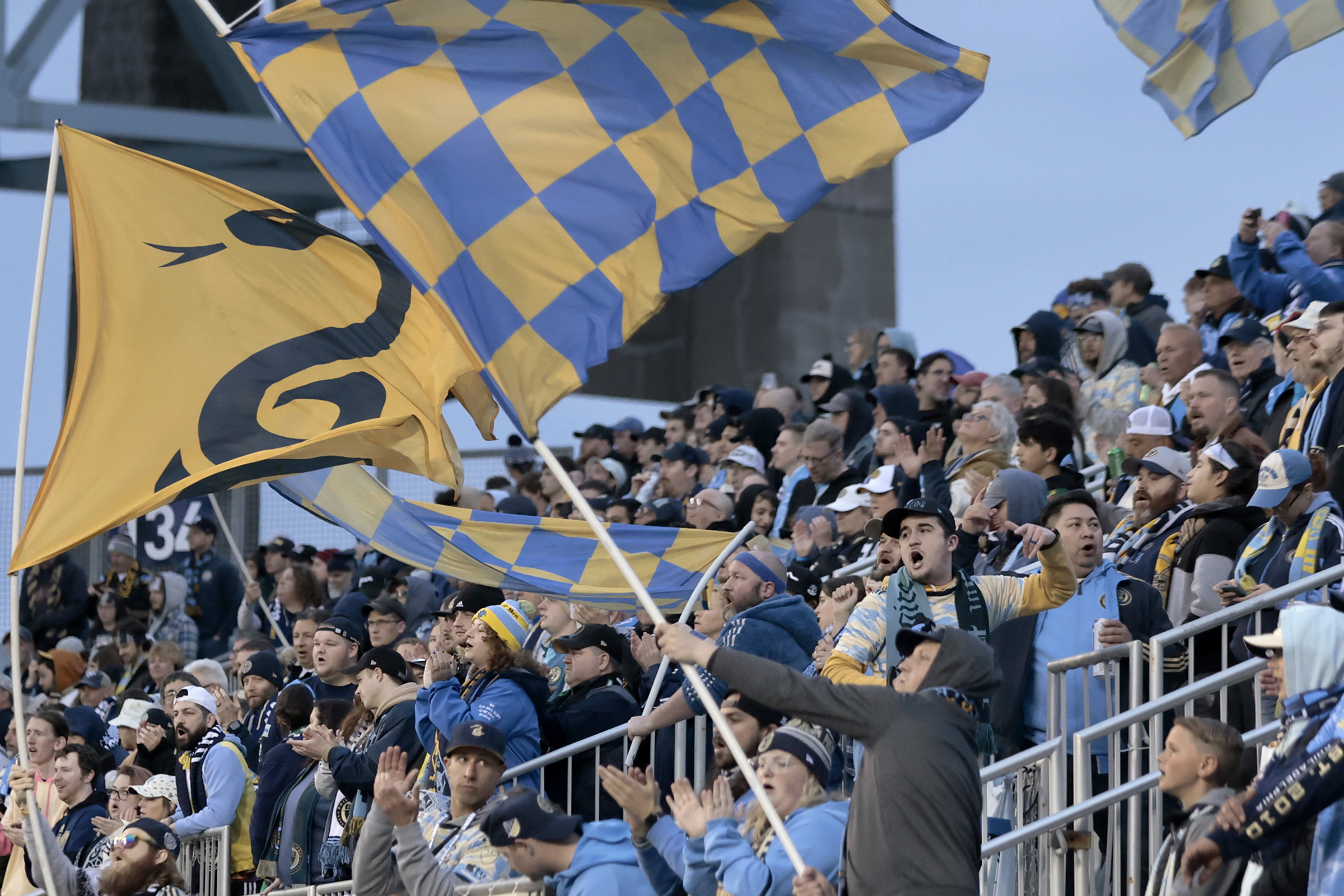
    Two years isn’t a long time to wait between playoff games, in MLS or any other sport. But the Union’s return to the postseason brought an intensity to the air at Subaru Park that hadn’t been felt for a while, even with the many soccer spectacles that have come to town since then.

    It also brought a very compelling game, if not always for the right reasons. At the end of the night, it felt like the series-opening win over Chicago had been four games in one: the scoreless first 70 minutes, the Union’s surge to a 2-0 lead, the Fire’s comeback, and the penalty-kick shootout.

    Let’s take each in turn to go inside how the home team prevailed.

    Three is a magic number

    The first stanza was defined as much by referee Sergii Boyko as by the lack of goals. He seemed to have little interest in calling most of the first half’s contact as fouls, less interest in the crowd’s opinion of him, and the least in Chicago goalkeeper Chris Brady’s repeated time-wasting on the ball.

    Those antics took much of the energy out of a crowd of 19,019 that for once was in the stands well before kickoff. Perhaps that was helped by the starting time being advertised in some places as 5:30 p.m., though it was long known and correctly printed elsewhere as 5:55. (Cue the joke that the time should be printed wrong more often.)

    The fans were alive when Chicago’s starting lineup was introduced, launching a storm of boos at manager Gregg Berhalter for his previous tenure with the U.S. men’s national team. Then they shook the rafters when Quinn Sullivan was unveiled as the pregame drummer, a few weeks after surgery on a torn ACL that ended his season.

    And they were touchingly silent during a pregame tribute to Brad Youtz, one of the Sons of Ben supporters’ club’s founding members, who died earlier this month. His loyalty began even before the Union existed, as he helped lead the fan movement that brought an expansion team here.

    The view of what transpired next looked familiar to any watcher, from Youtz upstairs to the new generation in his old River End seats.

    With the Supporters’ Shield mounted in the River End, an impeccably-observed moment of silence at the first Union home game since Brad Youtz’s passing.

    My longtime friend has the best seat in the house today.

    [image or embed]

    — Jonathan Tannenwald (@jtannenwald.bsky.social) October 26, 2025 at 5:51 PM

    Berhalter’s 3-4-3 tactics had helped the Fire build a six-game winning streak heading into their first playoff berth in eight years. That setup turned the screws on the Union, the latest proof that for all that has improved in Bradley Carnell’s first year as manager, the team can still struggle to solve three-back defenses.

    Uhre delivers again

    The game changed when Carnell turned to his own toolbox, with the first substitutions in the 64th minute. One of them, Mikael Uhre, broke the game open.

    It was a classic quick move down the field, with Milan Iloski sending Uhre down the right side. He was one-on-one with former Union teammate Jack Elliott and drew on some inside knowledge.

    “He probably knows that normally I would go on my right,” Uhre said. “So I was thinking, let me cut it in and then see how it opens up. And then I could see Indy making the run on the back post.”

    That was Indiana Vassilev, and Uhre found him with a dazzling, lofted pass across the 18-yard box. A quick trap, a quick shot, and Brady was flattened.

    Five minutes later, the player who arguably changed this team’s whole season had another defining moment. Here came the Union again, this time with Iloski on the ball on the right flank. He had Vassilev and Uhre charging up the middle, and Chicago’s defense was expecting a pass.

    Instead, Iloski kept the ball, cut left on Elliott, and slammed a shot into the top corner.

    “As I was dribbling forward, I noticed there wasn’t a lot of options,” Iloski said. “I knew off the dribble I could beat anyone in this league. Once I let the guy kind of get close to me … I just got the ball out of my feet and then focused on hitting the ball on target.”

    That same self-confidence would come in handy just over 20 minutes later. But there was still a long way to go.

    Chicago’s comeback

    Even after Jonathan Bamba’s goal out of a corner kick traffic jam in the 84th, there was little reason to believe the Union would blow the lead.

    But between Chicago’s goals, Berhalter made a tweak that turned the game, subbing in attacking midfielder Brian Gutiérrez for centerback Sam Rogers. Removing a defender ended up helping Iloski, but the Fire benefited more, and for the second game in a row Gutiérrez showed why he’s a U.S. national team prospect.

    “He was playing in these half spaces — that was really difficult for us, and they had some success to the end of the game,” Union goalkeeper Andre Blake said. “We couldn’t stop him from getting on the ball and he’s a great player, so he was able to create some dangerous plays for them.”

    At the start of stoppage time, Jakob Glesnes tripped Mauricio Pineda just outside the Union’s 18-yard box. And just as happened a previous time when Glesnes tripped Lionel Messi against Miami in May, this was a game-changing moment.

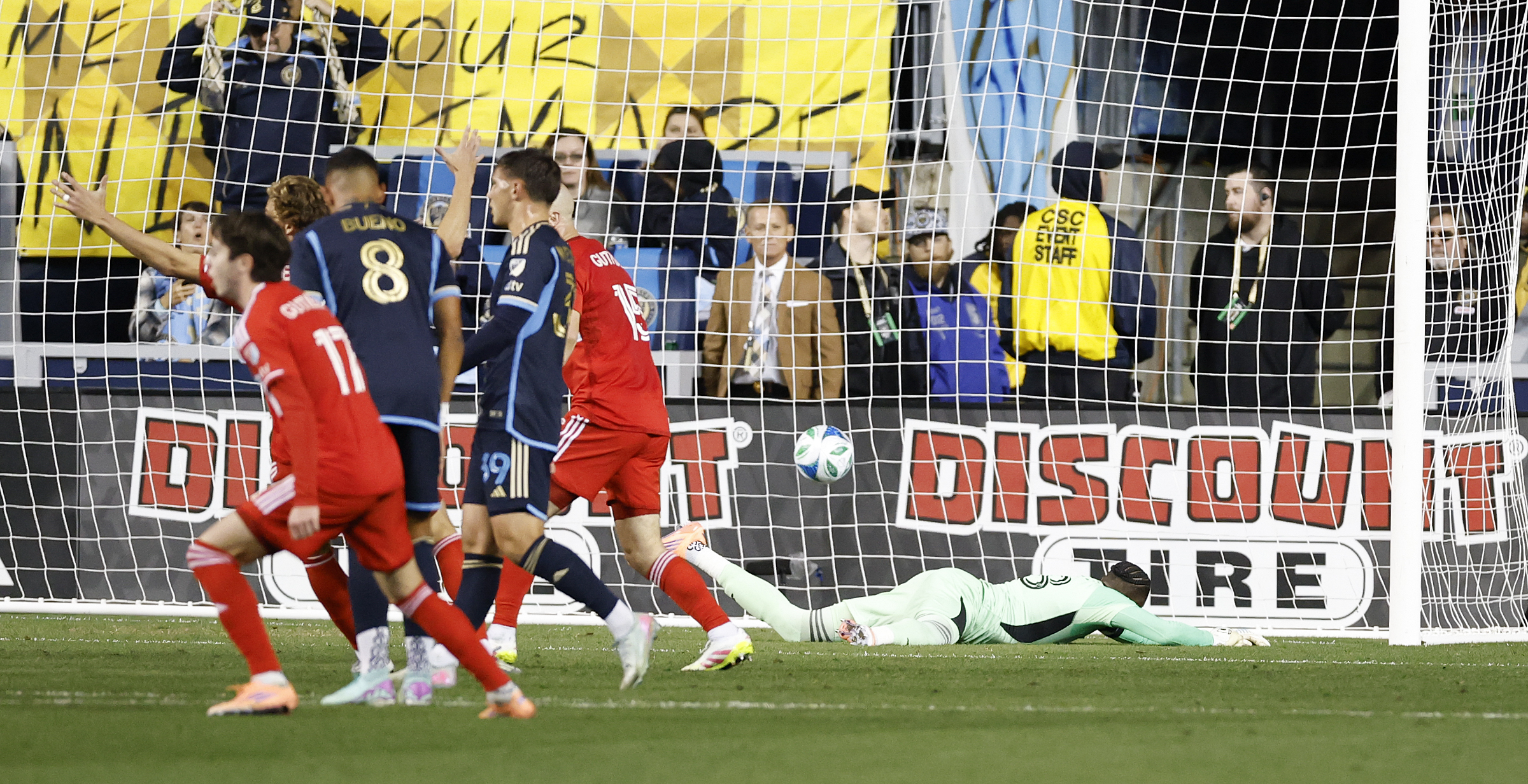
    Bamba shot the free kick into the wall, the ball came right back to him, and he laid it off for Elliott to fire from 30 yards — low, hard, and straight past his former teammates. That he did not celebrate made the moment even more resonant.

    Andre Blake (right) looks back at his net after Jack Elliott’s game-tying free kick goal got by.

    When Boyko finally blew the whistle to end regulation, the game headed straight to penalty kicks. It was a moment that both elevated the drama and exposed again the strangeness of the MLS playoff format: a best-of-three first round and single-game knockouts the rest of the way.

    Plenty of other competitions around the world these days go straight to penalties after regulation, as a kindness to players’ health. But none so contort things by making a score barely matter over the course of a series.

    MLS used to do what the rest of the sport has long done: single-game rounds all the way, or a two-game, home-and-away series in which the aggregate goal tally decides the winner. In this best-of-three setup, it doesn’t matter if you win 2-0, 2-1, or by any other score; or if the tie after 90 minutes is 2-2, 1-1, 0-0, or 5-5. All that counts is which team wins.

    It helped the Union this time, and it’s certainly an American tradition. But that doesn’t make it a good soccer principle.

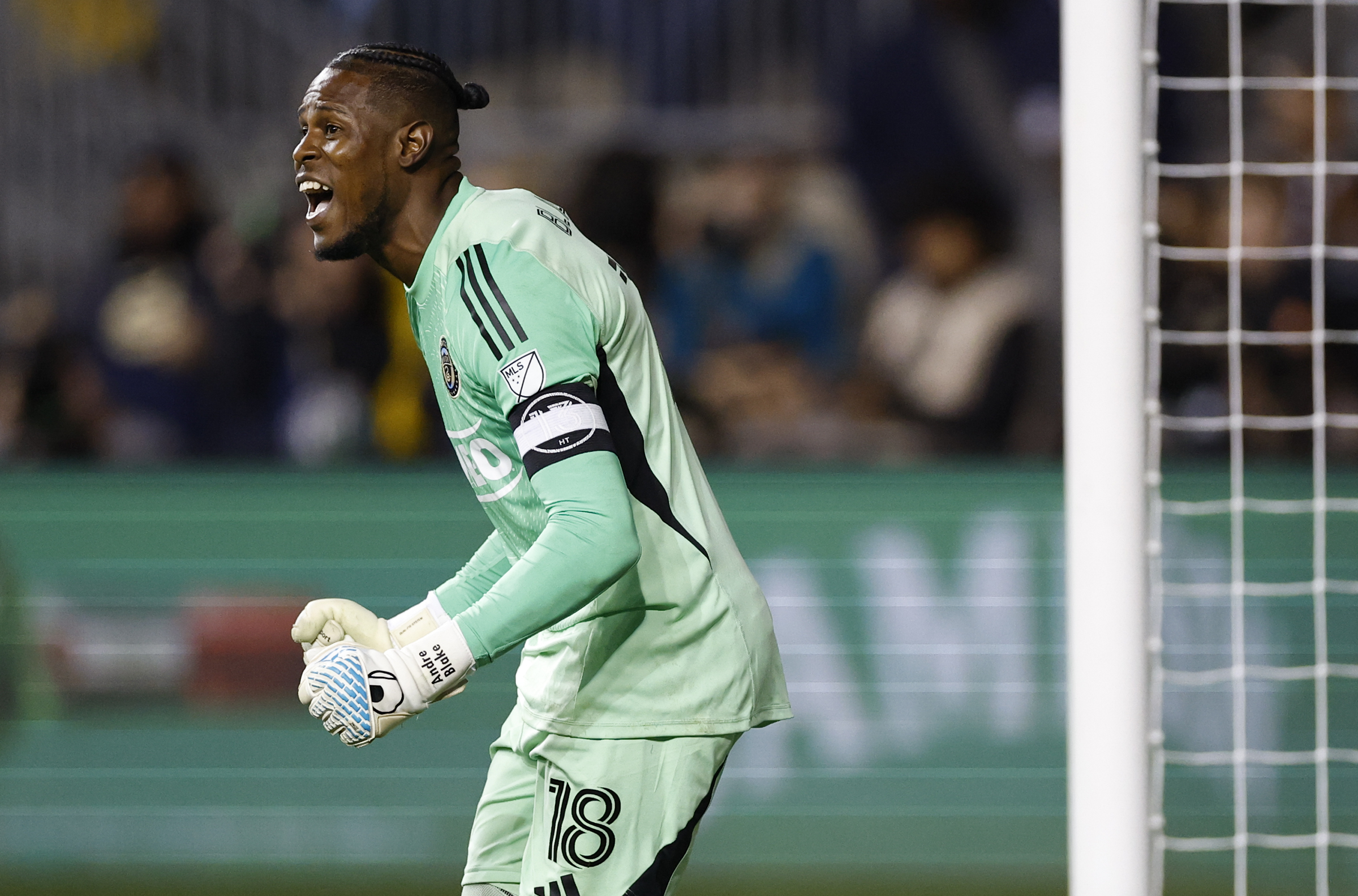
    Andre Blake celebrates after Chicago’s Joel Waterman put his penalty kick off the crossbar.

    Blake’s shootout heroics

    Carnell offered the zinger of the night when he called the game “a contrasting of two styles — one team just trying to waste every second and try and get out of here. Probably, they got what they wanted, [which] was penalties.”

    Be careful what you wish for, because you just might get it.

    Blake had studied Chicago’s takers with the Union’s outstanding goalkeeper coach, Phil Wheddon. A veteran of the U.S. men’s and women’s national teams and American clubs going back to the early 2000s, Wheddon delivered again this time, working out a set of signals from the bench that Blake needed only a glance to see.

    While Brady ran his mouth, the best goalkeeper in MLS for a decade running did his job. Blake stuffed Elliott, got a big piece of Hugo Cuypers’ shot even though it went in, and psyched Joel Waterman into hitting the crossbar.

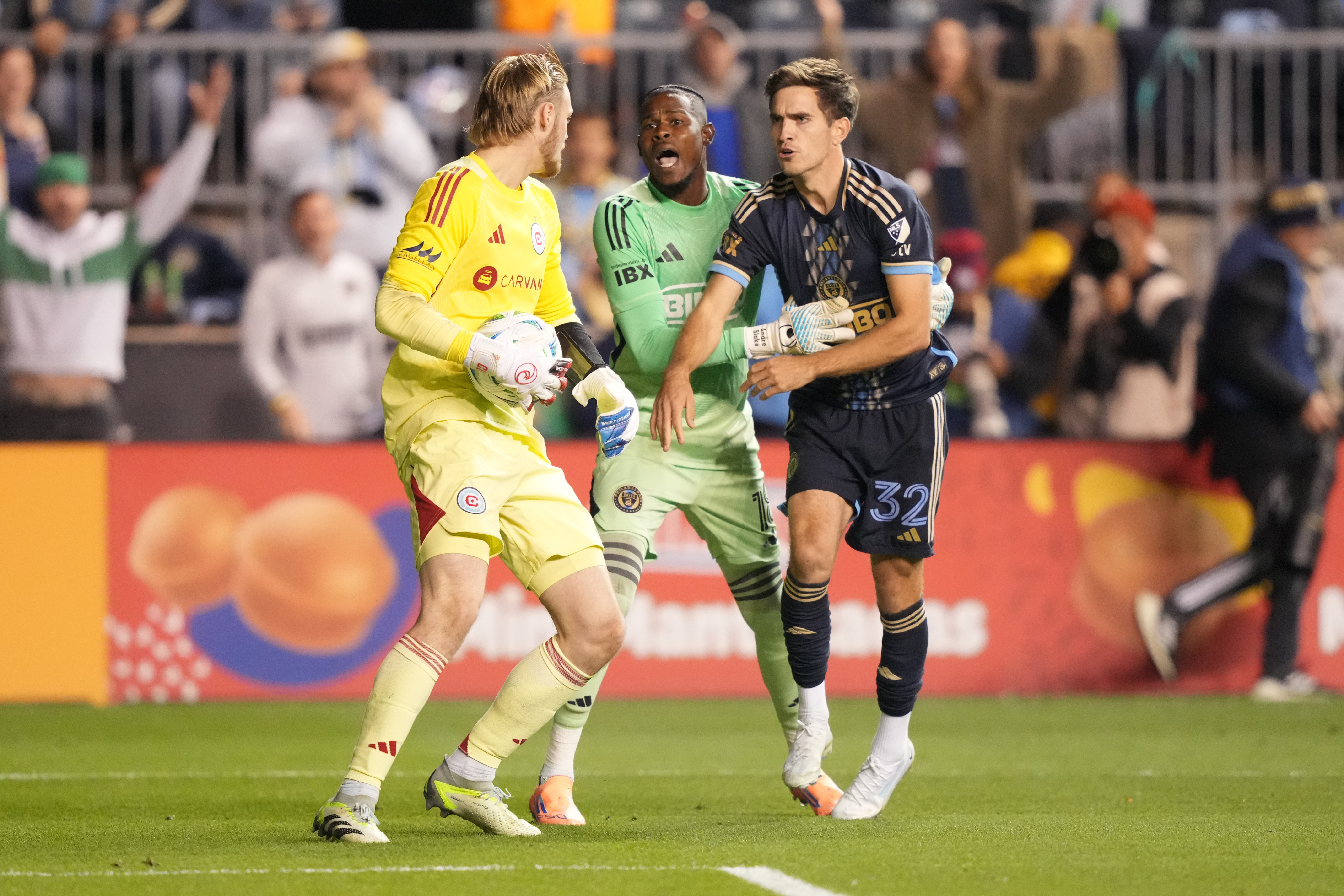
    Andre Blake (center) and Milan Iloski (right) had enough of the antics of Chicago goalkeeper Chris Brady during the shootout.

    That easily overcame Uhre being saved on the Union’s first turn of the shootout. Iloski, Frankie Westfield, Tai Baribo, and Jesús Bueno were perfect afterward.

    “In truth, I was a little bit nervous before my penalty kick,” Bueno said. “But when Blake gave me the ball, I just looked at him in the eye, and we laughed, and we knew that everything was going to be OK.”

    So it proved, and now it’s on to Game 2.

  • Jay Sugarman wants the Union to get more respect, and knows winning MLS Cup will make that happen

    Jay Sugarman wants the Union to get more respect, and knows winning MLS Cup will make that happen

    NEW YORK — Here’s something that Union principal owner Jay Sugarman has in common with his team’s fans.

    He, too, has spent much of this year seeing Lionel Messi, Son Heung-Min, and Thomas Müller dominate the headlines, even though his team topped them all in the standings.

    And he, like those fans — well, let’s keep things polite in the C-suite — would like to see the spotlight spread out a little more.

    “Any press for MLS, I’m good with,” he said. “Messi’s been fantastic for this league. Son’s been fantastic, Müller’s fantastic. We don’t want to take away their press. We just want more coverage for a different kind of story.”

    So Sugarman decided to put himself out there this week. The Union invited a group of media outlets, including The Inquirer, to MLS headquarters, and Sugarman held court, as he spent an hour talking about the success of his team.

    Jakob Glesnes (left) and the Union could see Lionel Messi and Inter Miami again in the playoffs.

    “We’ve got to show it on the field,” he said. “But so far the results, you know, I think are worthy of people paying attention. And saying, whether it’s a player or a fan: ‘Hey, I kind of like that team. They work really hard, they don’t ever give up, they’re a tough team in a tough city, and they bring it every game.’”

    Sugarman praised manager Bradley Carnell’s work this year, and Ernst Tanner’s work over many years. He praised the players for their feats and the culture they’ve all built together.

    He laid out a series of impressive statistics: the fewest goals conceded this year, and the most total shots taken, corner kicks won, tackles, interceptions, and counter-press regains — those moments when high-pressing forces turnovers.

    “It was a bit eye-opening to see how many categories we could track to say, when does a defense become offense?” Sugarman said of conversations he had with Tanner about this very subject.

    Bradley Carnell (right) helped the Union win the Supporters’ Shield in his first year as the team’s manager.

    This all came as the Union recorded the league’s worst pass completion percentage, the lowest number of touches in their own half, and the second-lowest number of one-on-one take-ons. But they also had the most goals scored from crosses.

    A surprising admission

    Sugarman then ran all this through the eye test.

    “It means we’re putting the ball in places where the defense has to put it out of play — that’s their best choice,” he said. “But where we do pass to, where we do touch the ball, is usually pretty dangerous, and it leads to dangerous things, crosses, shots, corner kicks, throw-ins deep. Anything in that deep attacking zone, I think Ernst would tell you, is a good place to be.”

    Then he offered something that many outsiders have felt instinctively, but might have never expected the team to admit.

    “We don’t rely so much on guys creating their own shot,” Sugarman said. “We don’t expect people to dribble through defenders. … We’re not about individual moments of brilliance breaking down a defense. But we will get into dangerous places, and our team working together will create opportunities.”

    Kai Wagner (left) and Tai Baribo are some of the players who most symbolize the Union’s direct style.

    The payoff for all of this has come in the statistics that matter most.

    The Union have totaled the most standings points of any team in the league since 2020, and the second-highest total since Tanner’s first full year in 2019. They’ve won two Supporters’ Shields for the league’s best regular-season record, made the playoffs every year but one along the way, reached two conference finals, and came a breath from winning it all in 2022.

    Sugarman believes in an organizational philosophy of continuous improvement, and there has been a lot in recent times. He also knows as well as anyone that the hardest part of improvement in sports is the last part.

    So here came, and not for the first time, a moment when something spontaneous he said made the biggest impact.

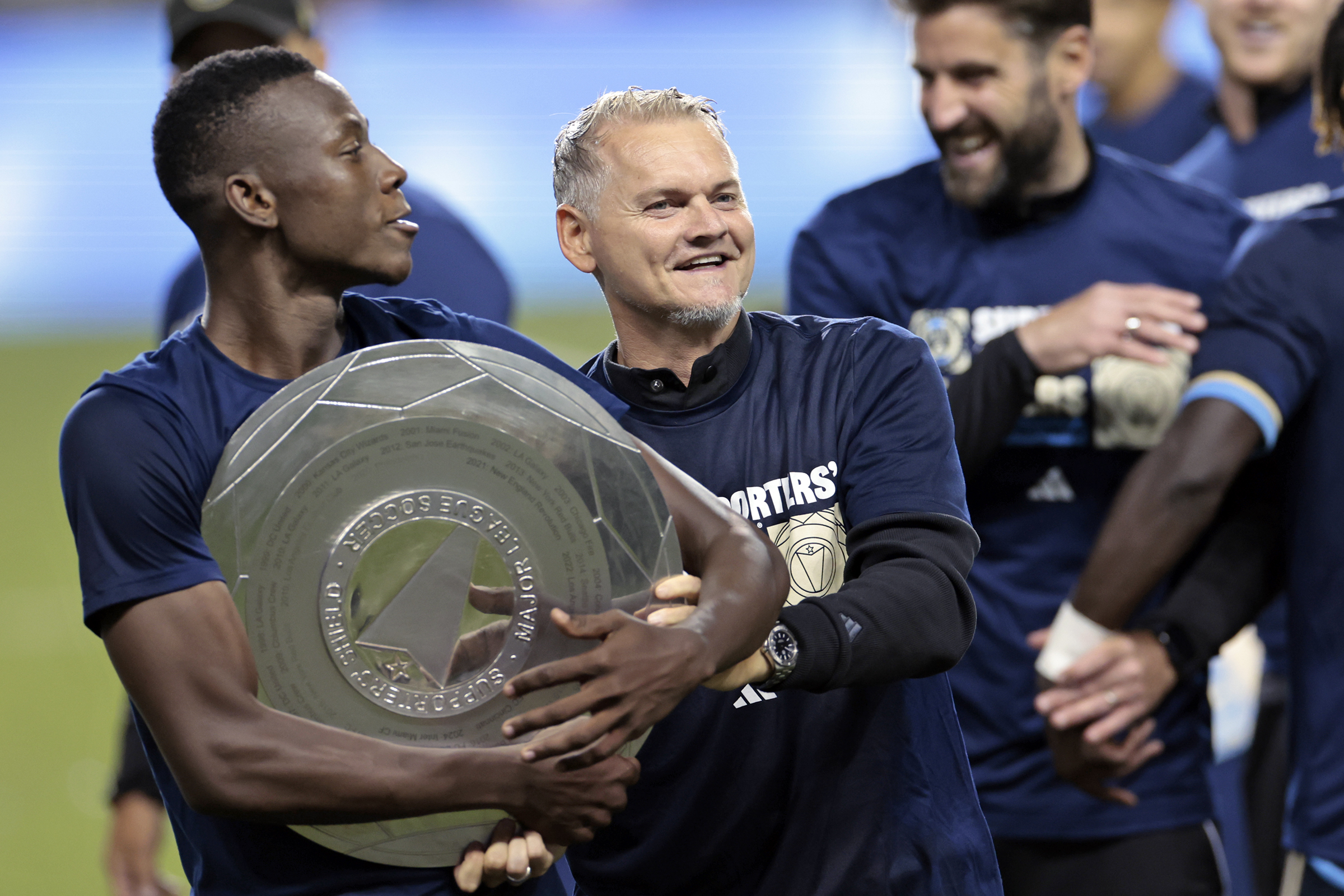
    Jay Sugarman was in a celebratory mood when the Union won their second Supporters’ Shield earlier this month.

    A reporter from a sports business publication asked Sugarman how the team’s success on the field has translated to the team’s bank accounts.

    “It’s a lot more fun to be part of a successful club,” he said to start his answer. “So we know that’s a helpful part of the conversation with sponsors and fans.”

    The rest had nothing to do with spreadsheets.

    “The one thing” missing

    “Our goal right now is to win a [MLS] Cup,” he said. “You can feel it in the players, you can feel it in the coaching staff, you can feel it at the ownership level. It feels like the one thing we haven’t quite gotten our hands on.”

    Jakob Glesnes (center) is one of the players still left from the 2022 Union team that came so close to winning the MLS Cup final.

    Now the heart of the matter was truly on the table. For as much as this year has been better than expected, there’s been real pressure on the Union to turn these many years of success into trophies.

    It’s why there have been stern demands to win a U.S. Open Cup. It’s why, once that quest failed this year, the pressure skyrocketed to win the Supporters’ Shield.

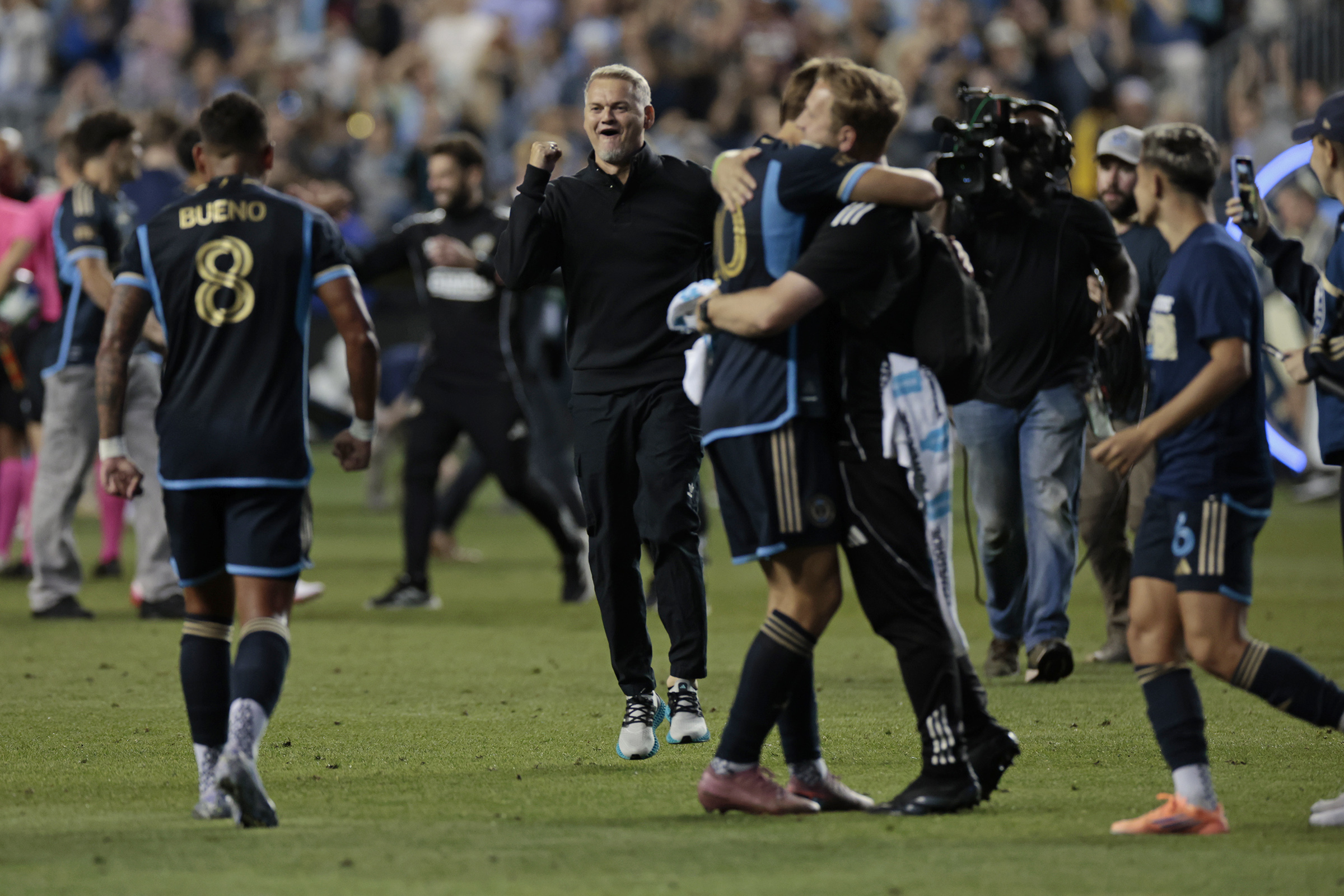
    It’s why the air was so thick as kickoff approached on the night they clinched it, earlier this month against New York City FC. And it’s why there was such an explosion of joy around Subaru Park when that final whistle blew.

    “Everybody knows this is the best sports town, maybe the toughest sports town,” Sugarman said. “We said, maybe our MLS tagline should be ‘the toughest team in the toughest city with the toughest fans.’ They want, they demand, success — we knew that going in. So we can’t deliver anything less than that for them.”

    The Union will play all but one of their playoff games this year at Subaru Park.

    He was still willing to defend his long-term vision for reaching success, even as he knew those same fans want it faster. But that’s for another moment.

    This moment — this month, this week, this Sunday evening playoff opener against the Chicago Fire at Subaru Park (5:55 p.m., FS1, Fox Deportes, and Apple TV) — is about right now.

    “It’s great that we’re going to be at home. Our fans are going to give us that extra 10%,” Sugarman said. “I think this is the year that everybody feels like we need to do everything we can.”

    He caught himself for a breath, but not much more.
    “It’s hard to put the kind of pressure on to say we must do it,” he said, “but this feels like the moment where — I’ve watched the joy on this team when they win. It is infectious. When they get rolling, I think it’s going to be hard to stop this.”
    Now to see if that really happens.

  • The Union’s return to the playoffs is a milestone moment for Bradley Carnell

    The Union’s return to the playoffs is a milestone moment for Bradley Carnell

    When the ball rolls on Sunday at Subaru Park in the Union’s playoff opener vs. Chicago (5:55 p.m., FS1, Fox Deportes, Apple TV), most of the spotlight will be where it usually is: on the players.

    But a little more than usual will be on manager Bradley Carnell, and not just because he’s a finalist for MLS’s Coach of the Year award.

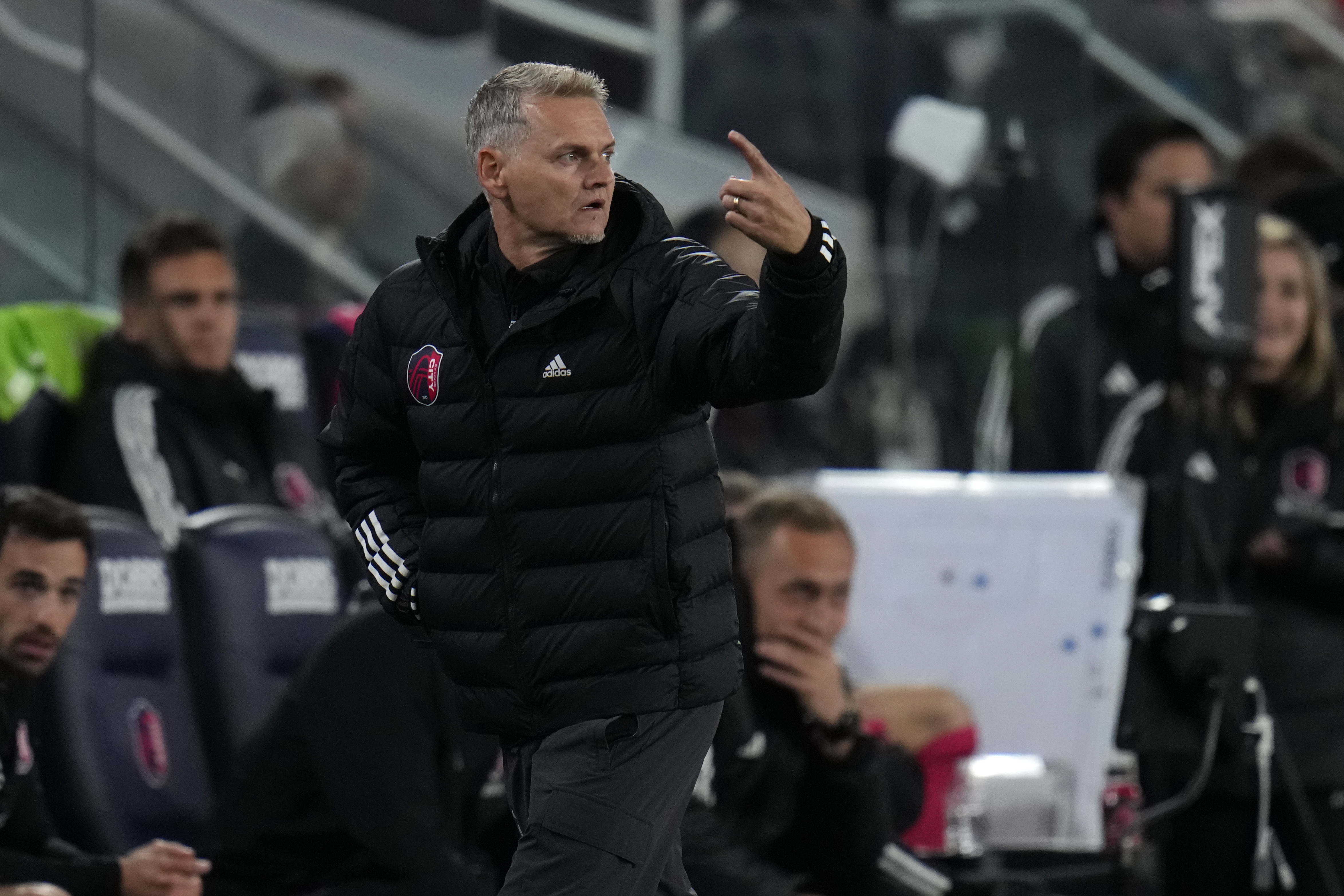
    A lot of people have been waiting all year for his first return to the playoffs since 2023, when he guided St. Louis City SC to the Western Conference’s best record in their expansion season.

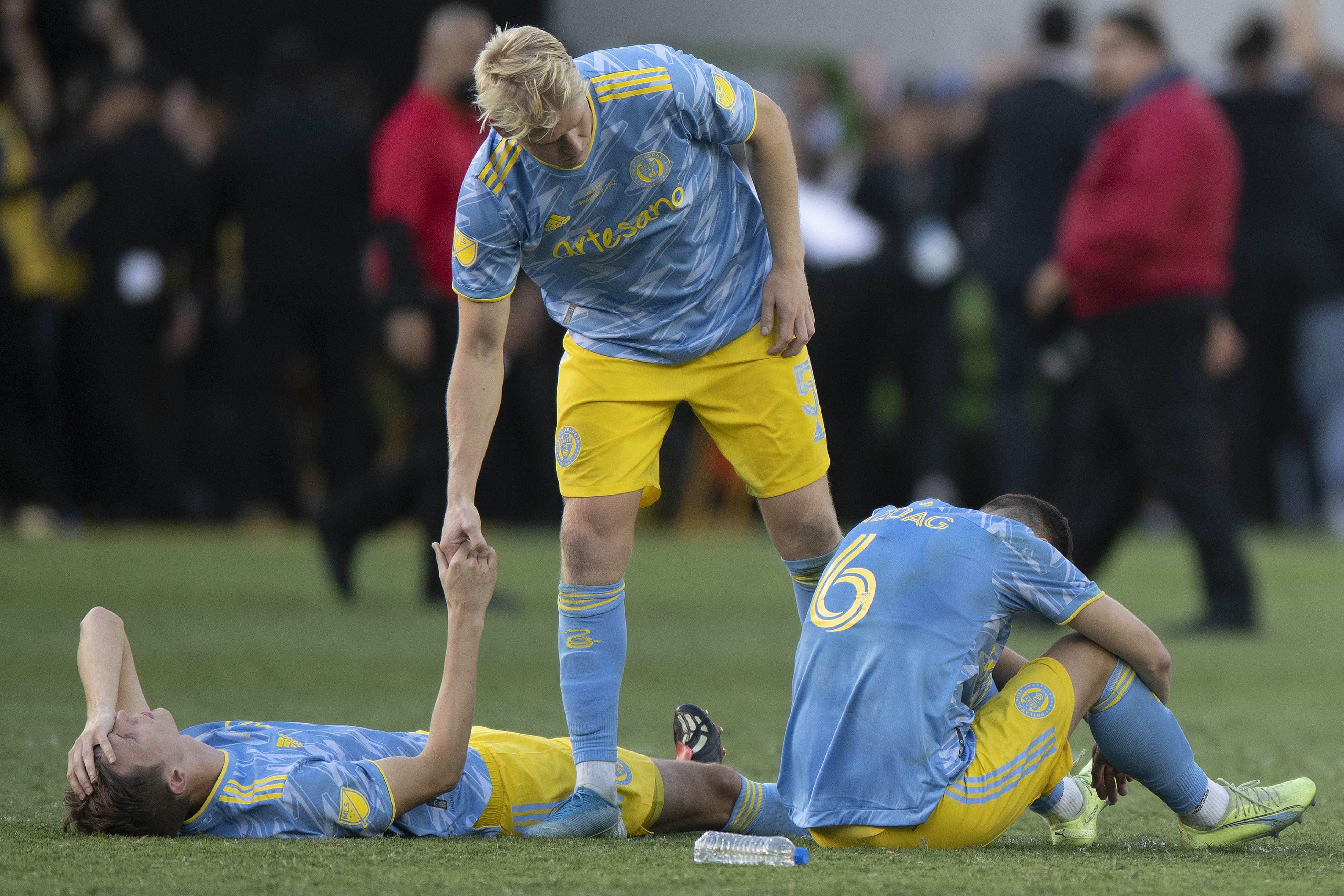
    The club crashed out of the playoffs in the first round to cross-state rival Sporting Kansas City. They weren’t just being swept in the best-of-three series but lost decisively: 4-1 at home in the first game and 2-1 on the road in the second.

    Bradley Carnell on the St. Louis City sideline in 2023.

    How much of a fluke was that? How different are the circumstances with this Union team, having not just many veterans but many players who’ve been here for a while?

    Given how much Carnell dislikes talking about himself, it wasn’t surprising that he didn’t want to answer those questions in his pregame news conference Friday. Nor was it surprising that the media present tried to find multiple ways to ask them.

    Everyone knew they would come, and that this was the time.

    “I think that’s a loaded question — it needs maybe a lot more time,” Carnell said when asked one of them.

    “I do a disservice now planning for three games, as opposed to just planning for one every match day for 34 match days,” he said to another.

    Bradley Carnell (center) celebrating on the field with his players after the final whistle of their Supporters’ Shield-clinching win.

    A moment later, he came the closest he got, but that was as far as he went.

    “We don’t want to go back in the history books,” Carnell said. “It’s a clean slate now. It’s three games, and it starts with one, and everyone has to be dialed in from the very get-go.”

    ‘We all enjoy the process right now’

    He preferred to talk about the team as a whole and how far it has come since he took the reins at the start of the year.

    “I think everyone has grown” Carnell said. “You have to face a bit of adversity to see what you can battle through and fight the demons and come out on the other side. And I think as a staff, as players, we’ve all been through this adversity from January, to find ourselves now to fight for something that’s greater than each and every individual one of us.”

    Bradley Carnell gets an ice water bath at the end of his speech:

    [image or embed]

    — Jonathan Tannenwald (@jtannenwald.bsky.social) October 4, 2025 at 9:47 PM

    He praised his group for its sacrifices, then realized he wanted a different word.

    “If you have to call it a sacrifice, it means somebody’s forcing you to do something, right?” he said. “I think we all love to do what we do, and I think we all enjoy the process right now. So for us to give willingly, whatever, we’ve gone to great lengths to to get where we are and to earn ourselves [being] in a position where we are, credit to everyone.”

    Carnell even admitted that his team has exceeded its own expectations.

    “Now that we’ve won the Supporters’ Shield, I can tell you that our target was top four” in the standings, he said. “We wanted I think, 55, 58 points — [that was] the target was for the boys, and that’s thinking big picture. You have a big picture, break it down into small cycles, and that’s the way you go about building the puzzle.”

    The one moment where Carnell did talk about himself was when he was asked about being a Coach of the Year finalist.

    “I’m so grateful to be in this community, the soccer community in the States,” he said. “It’s been eight years now, just growing and pursuing what I love to do, and what I love to do is my job and [to] help players develop.”

    Bradley Carnell on the Subaru Park sideline earlier this year.

    It means something to him that honor comes partially from his coaching peers, along with media, players, and front office staff.

    “We look out for each other,” he said of the coaching fraternity. “And, yeah, we’re competitive, but we also have a lot of compassion for each other because we know what sort of job this is We’re the first ones when people are talking good things, and we’re the first ones when it doesn’t really go your way … and I’ve experienced both in a short span of time.”

    Union’s reserve team also in playoffs

    The Union’s reserve squad has reached the second round of the MLS Next PRO league playoffs, and will host Huntsville City — Nashville SC’s reserve squad — on Saturday at Subaru Park (6 p.m., Apple TV).

    Union II finished second in the Eastern Conference this year and beat FC Cincinnati’s reserves, 2-1, in the first round last weekend. This game’s winner will face the reserves of the No. 1 New York Red Bulls II or No. 6 Chicago Fire II next weekend in the conference final.

    There have been strong performances this year some few young players on first-team contracts, particularly Cavan Sullivan (six goals and five assists in 14 games) and Neil Pierre (MLS Next PRO’s Defender of the Year). In this game, many eyes will be on two other players: midfielder CJ Olney and 16-year-old striker Malik Jakupovic.

    Olney also is on a first-team deal, but he didn’t crack the squad this year and then plateaued with the reserves. The Union tried to spark some improvement with a loan to Lexington SC of the second-tier USL Championship, but he didn’t play much there.

    Since his return to town, though, the 18-year-old has been in great form: six assists in five games, and his team has won them all.

    “I’m really happy for him that he went through this,” Union II coach Ryan Richter said. “Trying to develop as a professional is also how you respond to setbacks and how you respond to adversity and some of the low moments that you might have in your career. … For him to get back in [and] get on with it after a tough couple months, that shows a lot about his character.”

    Jakupovic has been getting hype from scouts for a while, and has started to deliver. The 6-foot-3 Michigan native signed his first pro contract in May — after the Union fended off many European teams that wanted him — and has scored eight goals in 17 games.

    “If he would have signed up for playing significant minutes in playoff games, and scoring eight goals this season — we all would have signed up for that in the beginning,” Richter said. “But he earned every minute that he got, and he’s performed well in every opportunity that he’s had on the field.”

    Tickets for Saturday’s contest are $17 including fees, with all seating general admission.

  • An unusual loss shows the USWNT might not have its new No. 1 goalkeeper yet

    An unusual loss shows the USWNT might not have its new No. 1 goalkeeper yet

    When a team gives up a goal on a corner kick, it’s rarely just down to one person. But when a team gives up two goals on corner kicks in one game, there likely will be alarm bells.

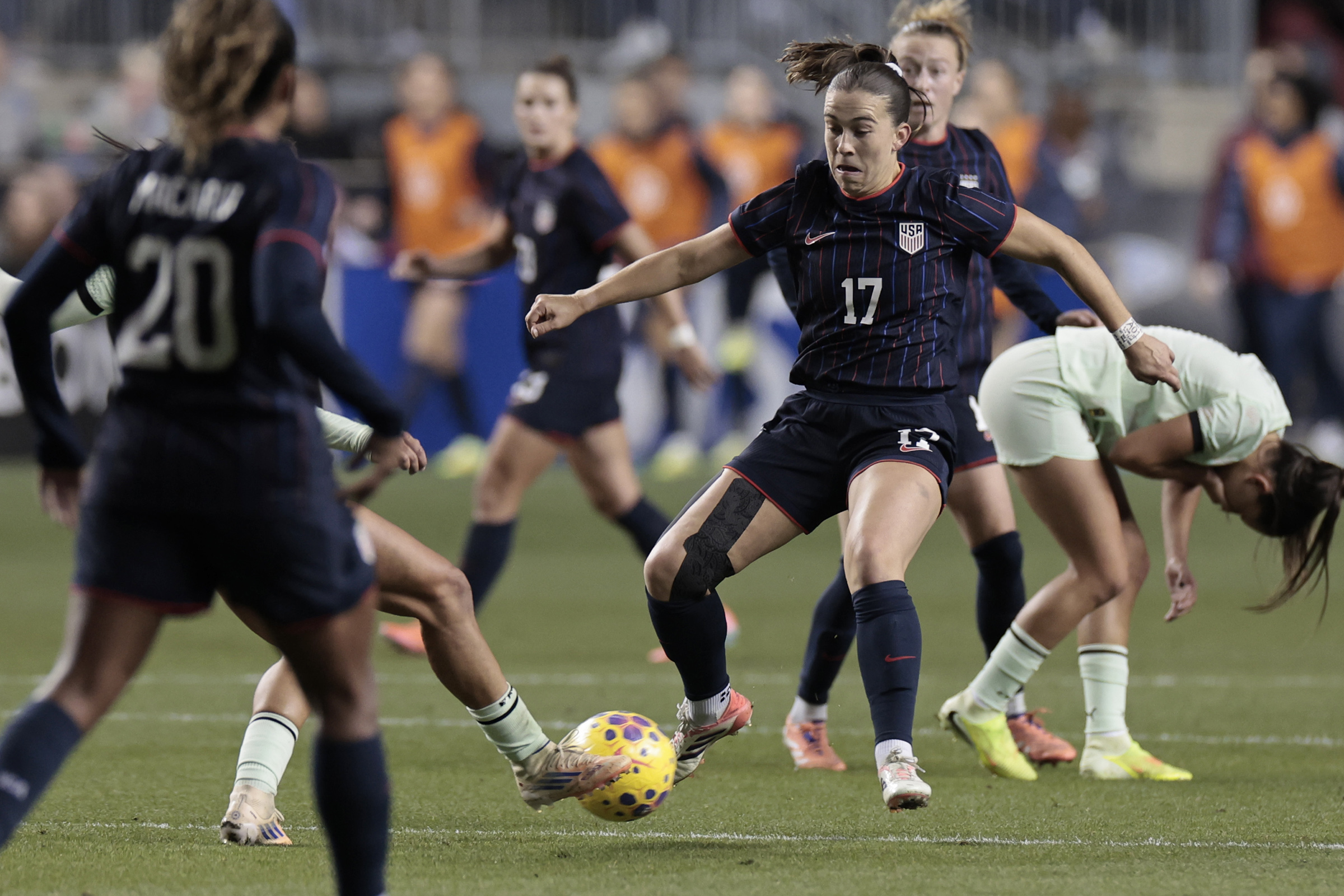
    That’s what happened Thursday night at Subaru Park, where the U.S. women were upset by Portugal, 2-1.

    Manager Emma Hayes was frustrated afterward, as were many of her players. There are few things — sometimes nothing — a soccer coach dislikes more than giving up goals on set pieces.

    Nor did it help that this U.S. squad looked unusually disjointed, even for a group that hadn’t been together in four months and had just two days of practice before kickoff.

    “I didn’t recognize us,” Hayes said. “ I felt that we just rushed everything. We went direct. We didn’t look like the team that we’ve been working on, but that’s what happens when you got 113 days apart.”

    She admitted she had “felt it the last two days in training,” seeing “so many misconnections, just taking a bit of time for us to get on the same page.”

    And she offered a few of the rhetorical flourishes that have long made her popular among fans and players.

    “Sometimes you need a kick up the back side like that,” she said at one point.

    “I was frustrated this evening because it felt like a game of Whac-a-Mole,” she said at another. ”I felt like I put something out, and then I was whacking that — that’s how the game felt for me as a coach. And I’ve been doing this for so long, I hate them games.”

    Hayes wasn’t going to pick at individual players or positions, to no surprise. She knew, though, that the U.S. team’s decades of success have also earned it the right to be criticized, and she usually doesn’t mind that when it’s warranted.

    There will be questions about the centerbacks and forwards. The latter certainly falls under Hayes’ remark that “there’s so many decisions we made” that felt like the wrong one.

    “I’m like, ‘Is it the right moment to take a shot? Slip a player in?’” she said. “No, we didn’t make those decisions.”

    And from up in the press box, there were questions about a position that has faced several lately.

    Portugal’s Fatima Pinto (center) celebrates after scoring the game-winning goal.

    Minding the net

    For much of the night, goalkeeper Phallon Tullis-Joyce didn’t play badly. She was credited with two saves, the best of which was a close-range stop on Tatiana Pinto after a misplay by U.S. centerback Tara McKeown.

    But Tullis-Joyce didn’t look good on either of those corners.

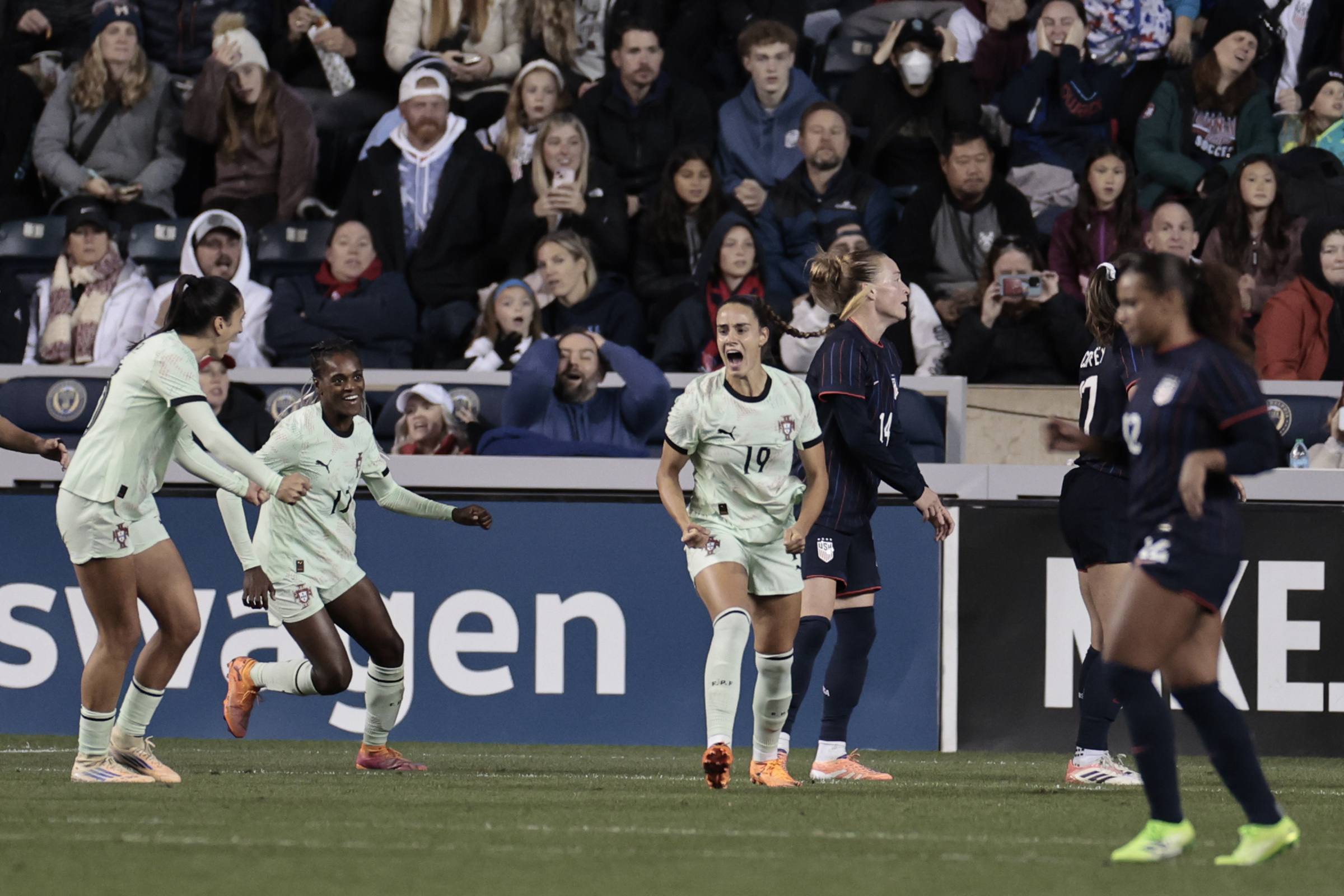
    Again, neither solely were her fault. On the first, Diana Gomes jumped amid three U.S. players to win the header and knocked it low, beating Tullis-Joyce on the bounce.

    The second was off an outswinging corner that Tullis-Joyce wouldn’t have gotten to in any circumstance, and Fatima Pinto’s shot bounced off two U.S. players. So it’s nitpicking to say Tullis-Joyce’s reaction time wasn’t ideal. But the standard is high, and it felt like just enough to plant a seed of doubt.

    “Those were tough to take on the chin,” Tullis-Joyce said.

    Asked about her play on those corner kicks, she said: “They had some driven corners into that back post area. I’m sure I’ll take a look at the clips afterward to see whether or not maybe I could play a bigger role in that, but that’s just for me to look and review afterward.”

    Hayes likely will stick with Tullis-Joyce as her new No. 1 goalkeeper for a while. The 29-year-old New Yorker has generally played well for the U.S., and is playing quite well at club level for England’s Manchester United.

    Still, we’ll see if anyone else gets minutes over the next two games during Sunday’s rematch vs. Portugal (4 p.m., TNT, Universo) — coincidentally Alyssa Naeher’s retirement tribute — and Wednesday’s game vs. New Zealand in Kansas City (8 p.m., TNT, Universo).

    Current No. 2 Claudia Dickey presumably would be first in line for that shot. And if after that, Aubrey Kingsbury leads the Washington Spirit on a second straight run to the NWSL title game, there might be some clamor for her to get a call-up for the first time since June of last year.

    ‘Not locked in enough’

    Otherwise, the blame was spread around.

    “It felt really individual out there,” said midfielder Rose Lavelle, who scored the U.S.’s goal just 33 seconds after kickoff. “I think everyone was trying to maybe fix it on their own. That’s something that, when the going gets tough, we’ve got to make sure we’re sticking together, playing together.”

    Sam Coffey was particularly miffed about conceding on those corner kicks. Asked how she’d assess the plays, she responded promptly: “Obviously, we got scored on them, so I wouldn’t assess them very high.”

    Sam Coffey (center) on the ball in the middle of the action.

    She credited Portugal, and rightly so. Though the Navegadoras are No. 23 in FIFA’s global rankings, they’ve got more talent than a few teams ahead of them — as they showed in tying reigning European champion England in February, then Italy at this summer’s Euros.

    Those results are more telling than the one that naturally stuck in many American fans’ minds Thursday night, the scoreless tie Portugal pulled against the U.S. at the 2023 World Cup.

    But Coffey saved most of her words for her own side, which also was the right move.

    “I think whether we’re not locked in enough in those moments or we’re not doing good enough in our man-marking or being alive for a second phase [when a ball is recycled after being cleared], I think that’s an area we’ve always prided ourselves on, and that was not up to our standard tonight,” she said. “Set pieces win championships, win games. And for them to capitalize on those and win the game that way, I think is really disappointing for us, and we have to be better.”

    Diana Gomes (center) celebrates scoring Portugal’s first goal.

    It is obviously better to lose in an off-year friendly than in an actual tournament. And on top of any loss lighting a spark under this group, they know they’ll see the same team again a couple days.

    “The lucky thing for us is we have a second shot at this,” Lavelle said. “There’s no months of time between the next time we can maybe get better from this loss. So we have three days to turn around and show up better.”

    Tullis-Joyce was even more blunt: “Revenge, for sure.”

    It will no doubt get attention, as this team always does.

  • The USWNT strike first, but Portugal has their number again in 2-1 loss at Subaru Park

    The USWNT strike first, but Portugal has their number again in 2-1 loss at Subaru Park

    Before Thursday night, the last time the U.S. women played Portugal was the scoreless tie at the 2023 World Cup that started their downfall.

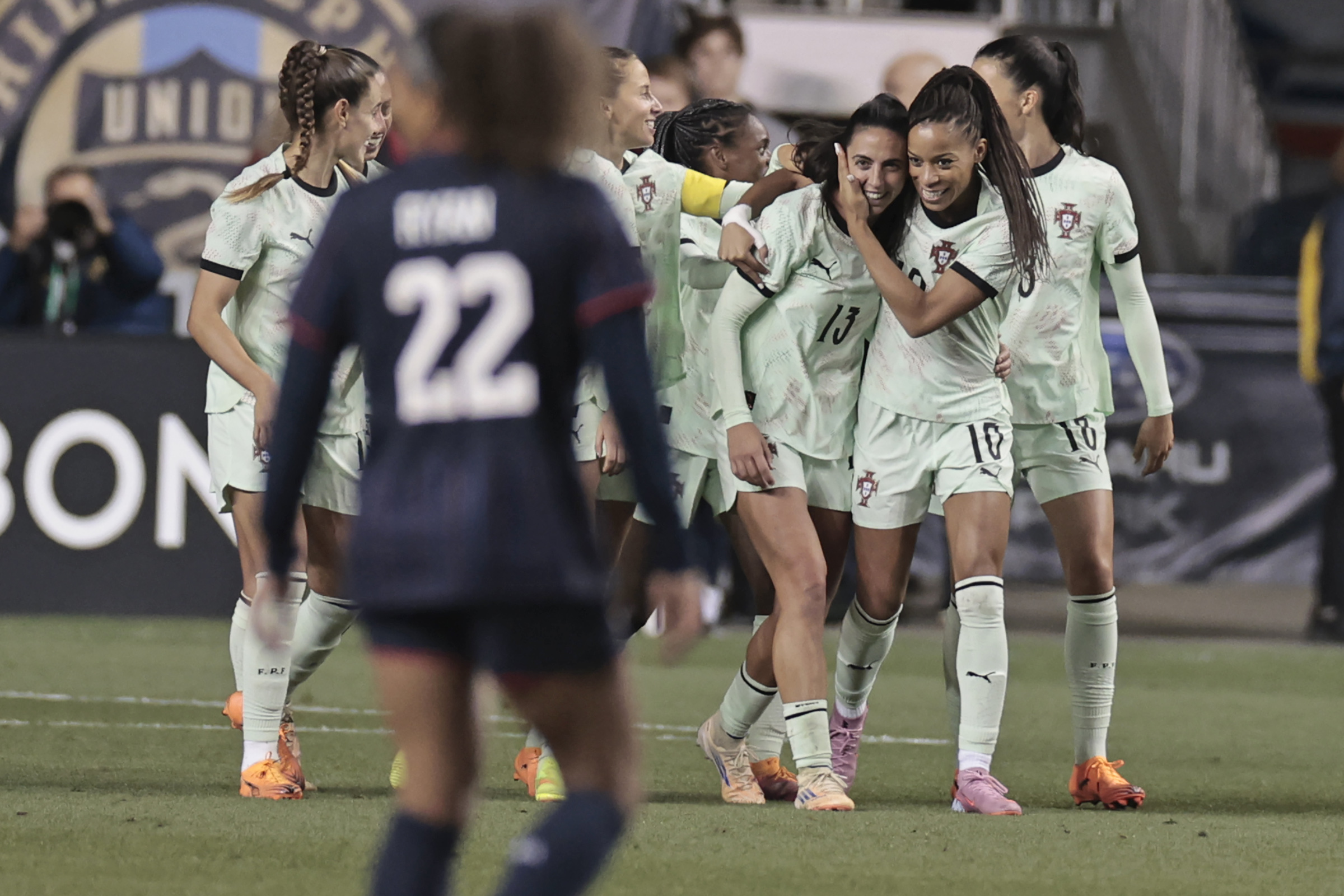
    For the first 33 seconds this time, it looked like things had changed. But by the end of the night, Portugal had the Americans’ number again — this time a 2-1 win as the visitors at Subaru Park.

    It was the U.S.’s first loss in a visit to the Philadelphia area since 2004 and the current team’s first loss in seven games dating back to February.

    Those 33 seconds were how long it took for the U.S. to open the scoring through Rose Lavelle. Catarina Macario set the play up with a dazzling move, running and dancing amid Portugal’s defense before feeding the assist.

    It was the seventh-fastest goal in U.S. women’s team history, and it will not be recorded that Lavelle clearly was offside. But with no video review in this friendly, the goal stood, and the crowd of 17,297 — including U.S. legend Alex Morgan and many ex-teammates honoring her retirement ceremony — cheered.

    Lavelle nearly scored again on a breakaway in the ninth, sprung beautifully by Alyssa Thompson. But Portugal goalkeeper Inês Pereira denied her with a charge off her line and a tip of the ball to just the right side of the post.

    From there, Portugal turned the tide. In the 37th minute, Kika Nazareth spun around Lavelle, passed wide to Andreia Jacinto, and she tried a chip attempt that landed on top of the crossbar. Two minutes later, a misplay by Tara McKeown let Tatiana Pinto get free on goal, and U.S. goalkeeper Phallon Tullis-Joyce had to come off her line for a sprawling stop.

    Portugal scored on the ensuing corner kick, as Diana Gomes beat Emily Sonnett on the jump.

    The U.S. looked livelier early in the second half, but Thompson flubbed a chance, and Macario got caught up to on a breakaway just in time to have the ball poked from behind.

    Nor could the Americans capitalize on a close-in free kick from the right wing, served well by Sam Coffey but not finished by anyone in the crowded 18-yard box.

    U.S. manager Emma Hayes took her time to make substitutions, but when she did, it was a quadruple move in the 69th minute. In came midfielders Claire Hutton and Lily Yohannes and forwards Yazmeen Ryan and Emma Sears; out went Coffey, Lindsey Heaps, Michelle Cooper, and Macario.

    Three minutes later, Portugal took the lead off another corner kick when Fátima Pinto trapping the service wonderfully and shooting low past Tullis-Joyce. There was a bit of a deflection, but Tullis-Joyce looked a little too frozen, and Hayes did not hide her frustration.

    Jaedyn Shaw was next to enter for the U.S. in the 78th, replacing Lavelle.

    The U.S. did not lack for scoring chances, but it couldn’t finish them. Outside back Avery Patterson forced a sharp save from Pereira in the 81st, and Yohannes headed right at Pereira a few seconds later.

    As the U.S. searched for an equalizer, Sears sent a well-placed pass through the 18-yard box in the 93rd that no teammate caught up to. And in the last seconds, Thompson shot when she could have passed — one of a few less-than-ideal decisions she made on the ball — and Yohannes lofted a cross that Pereira caught.

    That felt like the night in a nutshell, right as the final whistle blew to end it.

  • Amid a Union injury bug, Cavan Sullivan will stay a little longer before the under-17 World Cup

    Amid a Union injury bug, Cavan Sullivan will stay a little longer before the under-17 World Cup

    The Union had planned for some time to let teen phenom Cavan Sullivan go to next month’s under-17 men’s World Cup, the biggest stage he’ll have played on yet.

    But between Quinn Sullivan’s ACL injury and other players being banged up – including fellow attacking midfielders Indiana Vassilev and Jeremy Rafanello – the club faced a lack of depth heading into the playoffs.

    The Union still wanted to let Cavan go to the tournament. But they also knew they might need him, not just want to have him, for their first-round playoff series against Chicago or Orlando.

    Multiple sources told The Inquirer that with agreement from Sullivan and U.S. Soccer, he will stay with the club for the first two games of the best-of-three set. Game one is Sunday at Subaru Park (5:55 p.m., FS1, Fox Deportes, and Apple TV), and Game two is Nov. 1 on the road (5:30 p.m., Apple TV).

    Cavan Sullivan (right) had one of his best games for the Union this year last Saturday at Charlotte, even though the team lost.

    Sullivan won’t actually miss any of the tournament, as the U.S. team’s opener against Burkina Faso isn’t until Nov. 5. He’ll mainly miss the pre-tournament camp, which will take place in Abu Dhabi before the tournament is played in Qatar. That no doubt made it easier to get a deal done.

    The Americans’ group games after that are against Tajikistan on Nov. 8, then the Czech Republic on Nov. 11. The tournament runs through Nov. 27, so if the U.S. goes on a long run, Sullivan could be gone until the MLS conference finals.

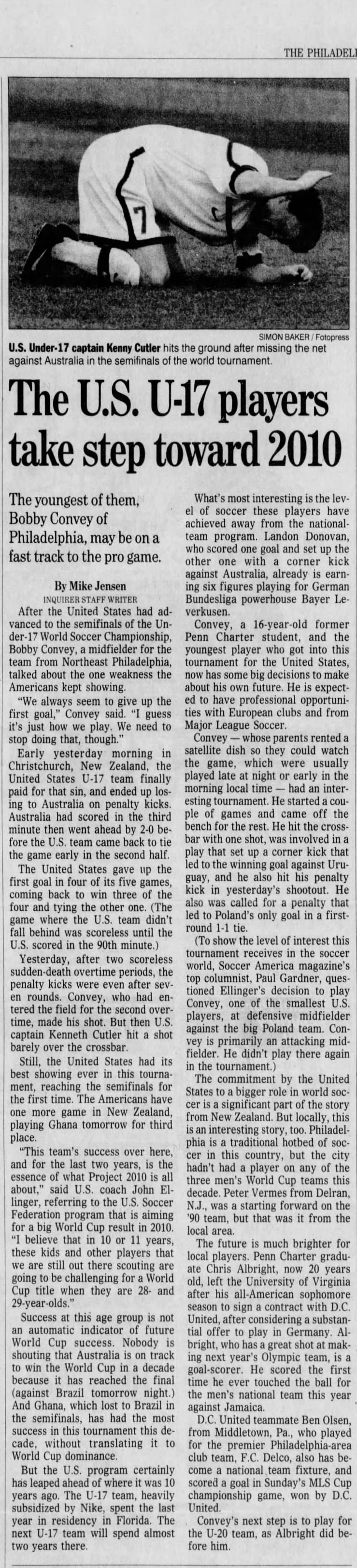
    Though the U.S. has played at every under-17 World Cup but one since the event started in 1985, the program has not reached the quarterfinals since 2017, and hasn’t gone farther since 1999 — when Landon Donovan led the way to the only semifinal in team history.

    Donovan won the tournament’s Golden Ball award as the most outstanding player, and was one of many famous names on that U.S. squad. It also included DaMarcus Beasley, Kyle Beckerman, Oguchi Oneywu (who finished his pro career with the Union 18 years later), and Philadelphia native Bobby Convey.

    This team has the potential for a deep run. Sullivan is one of its top names, along with forward Mathis Albert of Germany’s Borussia Dortmund and the New York Red Bulls’ Julian Hall. There are also three players from the Union’s youth academy, defender Jordan Griffin and forwards Jamir Johnson and Kellan LeBlanc – the last of them the son of former Union reserve team coach Marlon LeBlanc.

    Fox and Telemundo have the broadcast rights, in English and Spanish respectively, with games airing on their cable channels and streaming platforms.

    A clipping from The Inquirer’s sports section of November 25, 1999, highlighting Bobby Convey’s play for the United States at the under-17 men’s World Cup.