When the World Cup arrives in town next summer, diehard soccer fans and casual followers will tune in to see the action. If you’re one who doesn’t know everything about all the teams that will play at Lincoln Financial Field, we’re here to help.
Here’s our ranking of the five group games Philadelphia will host.
5. Curaçao vs. Ivory Coast
Group E, June 25, 4 p.m.
Curaçao will be one of this World Cup’s great underdog stories. The former Dutch territory leveraged its diaspora in the Netherlands to recruit talented players like brothers Leandro and Juninho Bacuna. Their manager is a Dutch legend, Dick Advocaat.
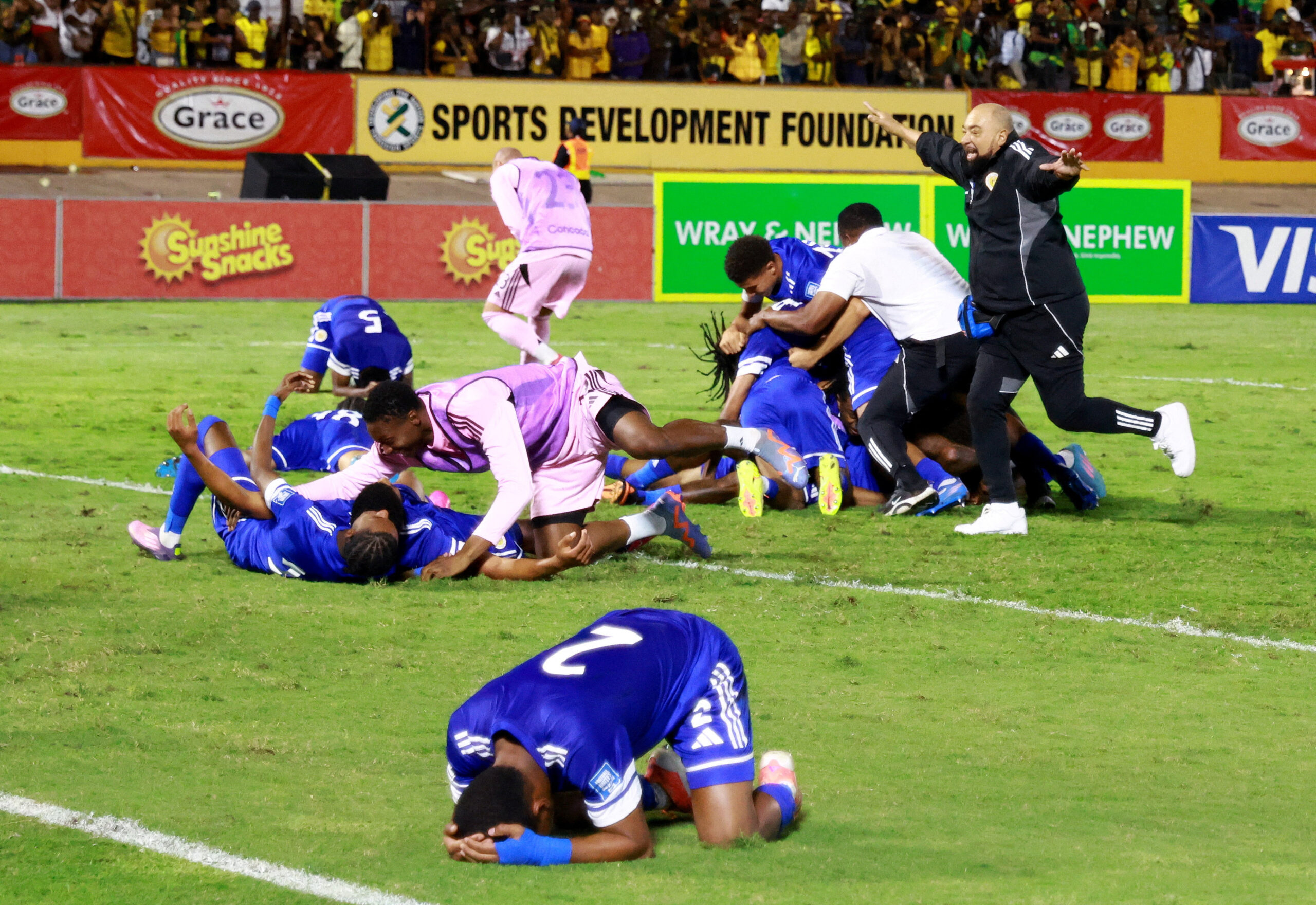
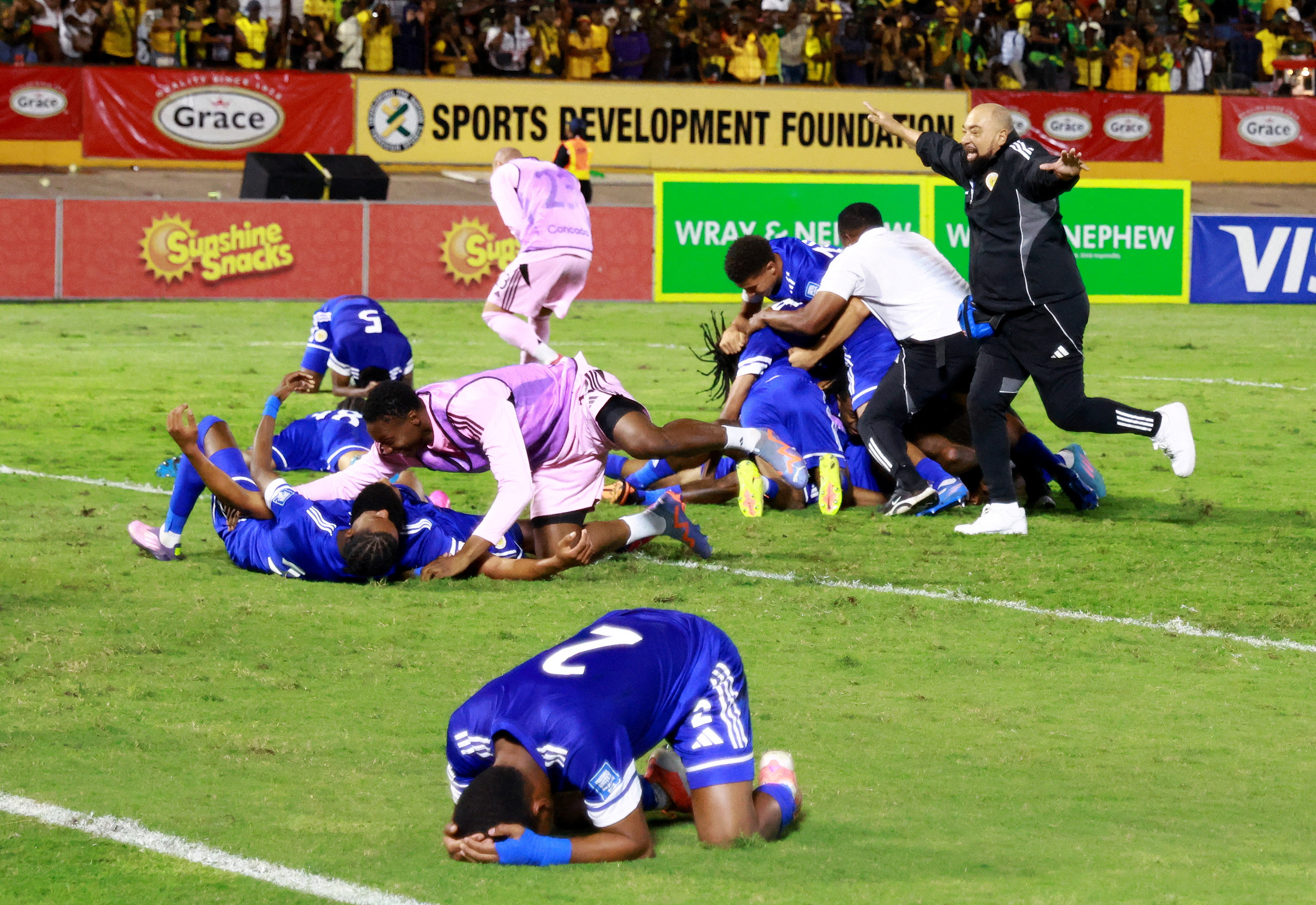
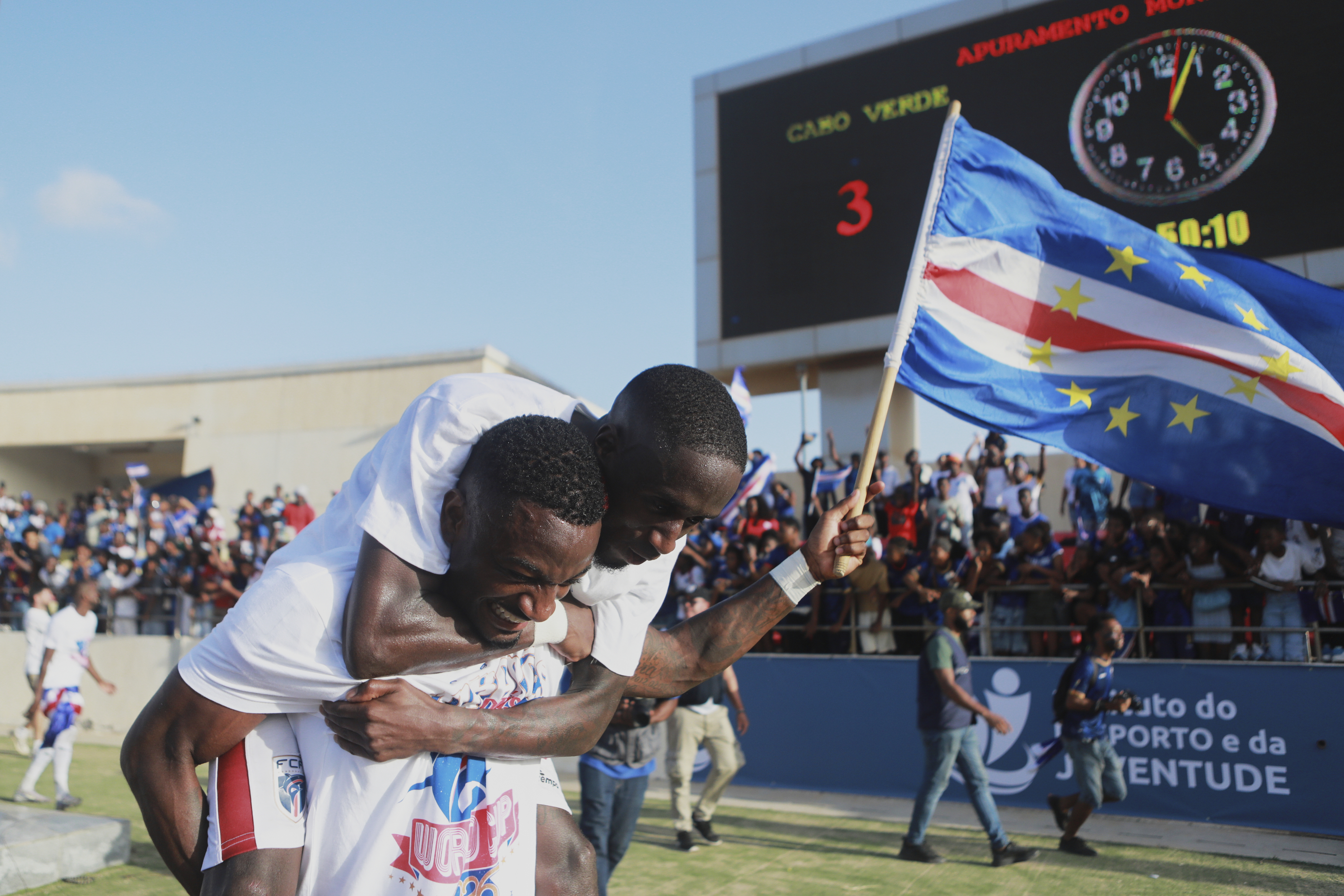
Curaçao’s celebrations at the final whistle of its tie at Jamaica last month that clinched the Caribbean island’s first World Cup qualification.
The Blue Wave will probably be routed by Germany and Ecuador in their first two group games, so this could be their tournament farewell. Hopefully, though, they will get a nice send-off from a city that loves underdogs.
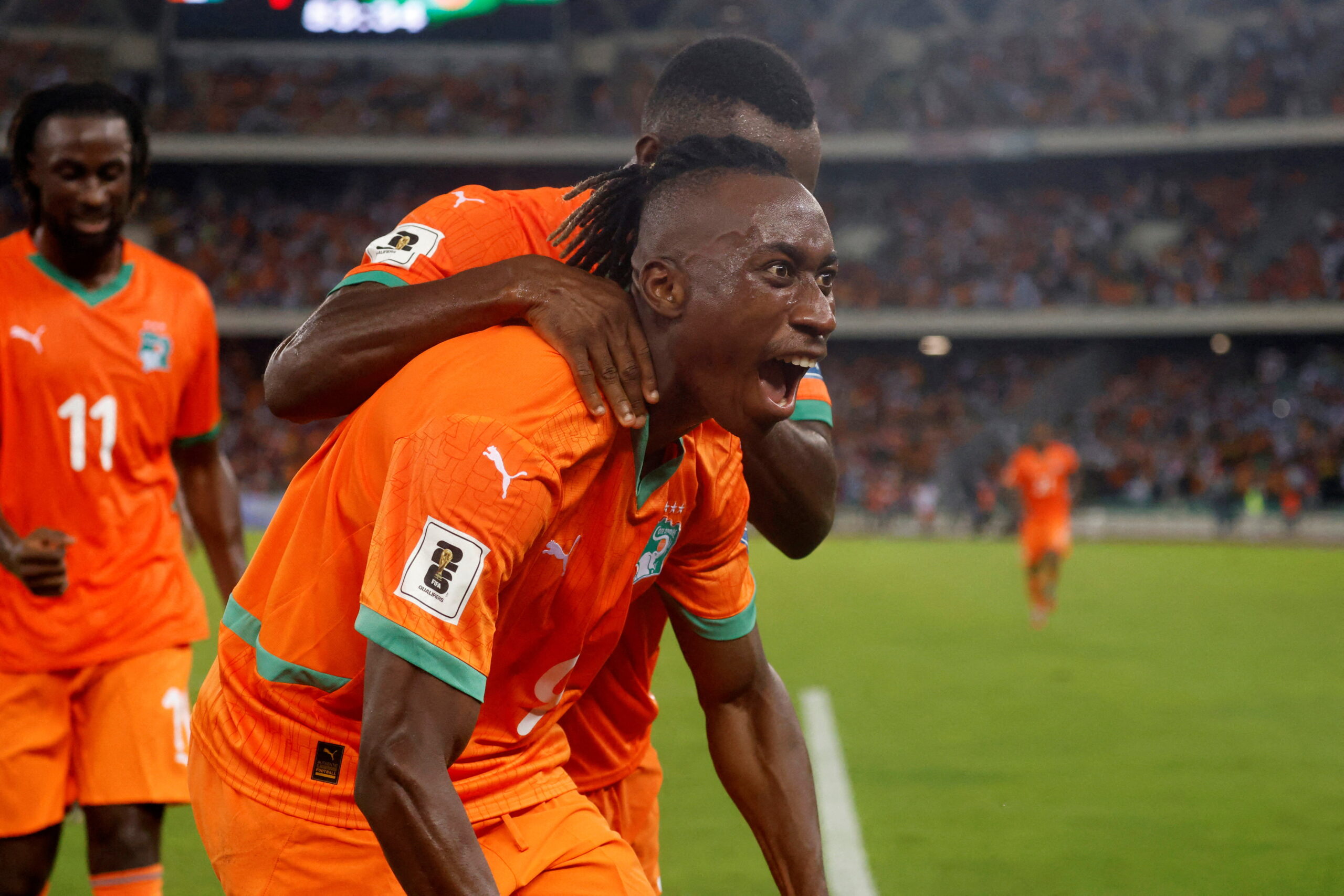
Ivory Coast is led by midfielder Franck Kessié and forwards Amad Diallo and Sébastien Haller. You’ll also want to keep an eye on 19-year-old winger Yan Diomande. He lived for a few years in the United States as a young teen, and played high school and youth club soccer in Florida before turning pro in Europe in November 2024.
The other upside to this matchup is that since the teams’ fan bases aren’t huge, there’s a chance local fans will be able to get tickets for it. Perhaps only a small chance, because there will be huge demand — and exorbitant prices — for every World Cup game no matter who’s in it.
Yan Diomande celebrates scoring a goal for Ivory Coast in a World Cup qualifier in October.
4. Ivory Coast vs. Ecuador
Group E, June 14, 7 p.m.
Picking the game to rank fourth was even harder than picking the game to rank fifth. It came down to star power vs. potential atmosphere in the stands, and the tie went against the atmosphere.
So we apologize to Ivory Coast for putting both of its games at the bottom. We also apologize to the tens of thousands of Ecuador fans who will ensure that Philadelphia’s first men’s World Cup game is a fast sellout. La Tri’s faithful have a long track record of traveling all over the U.S. when their team plays here, and creating boisterous atmospheres.
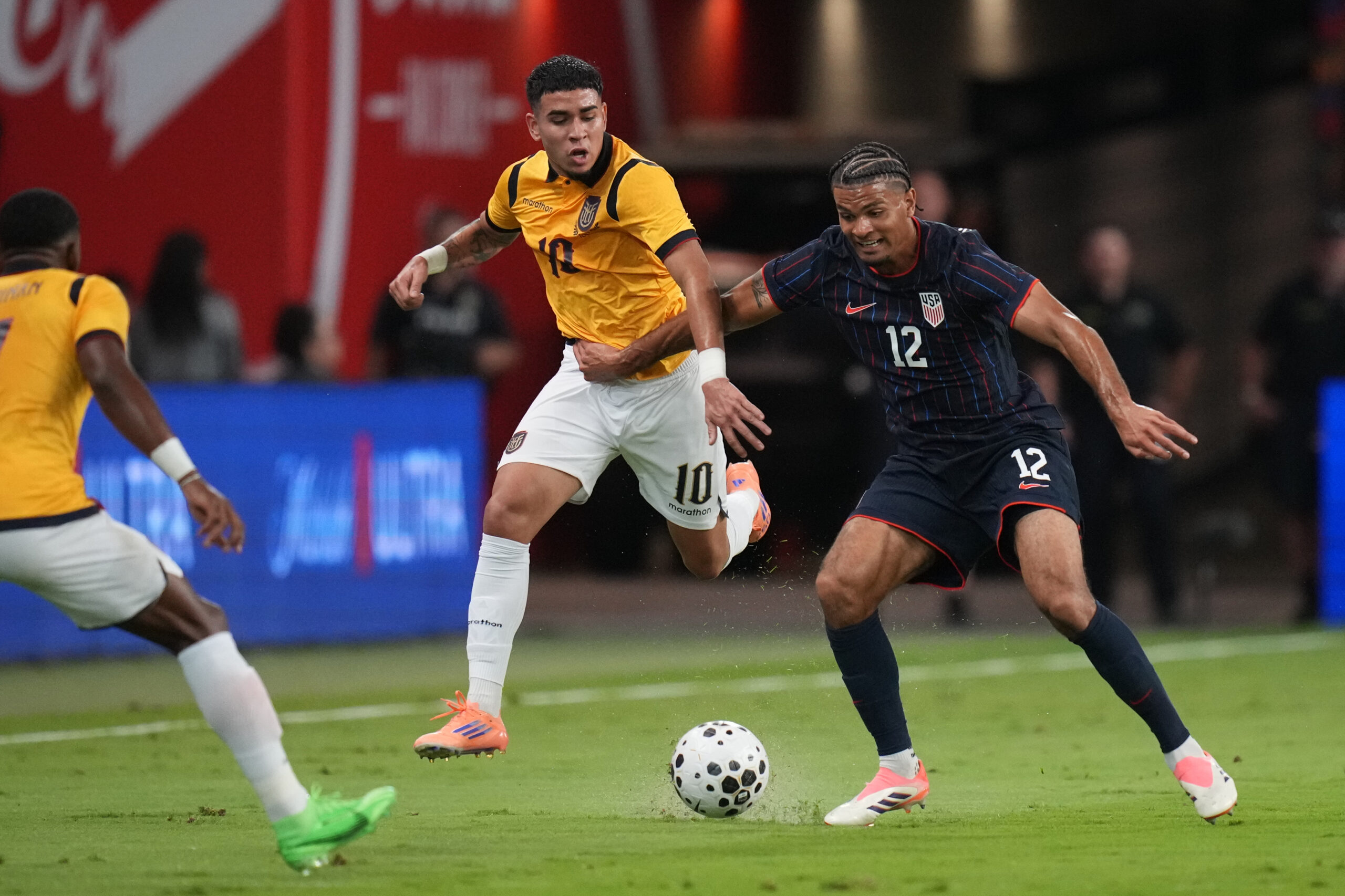
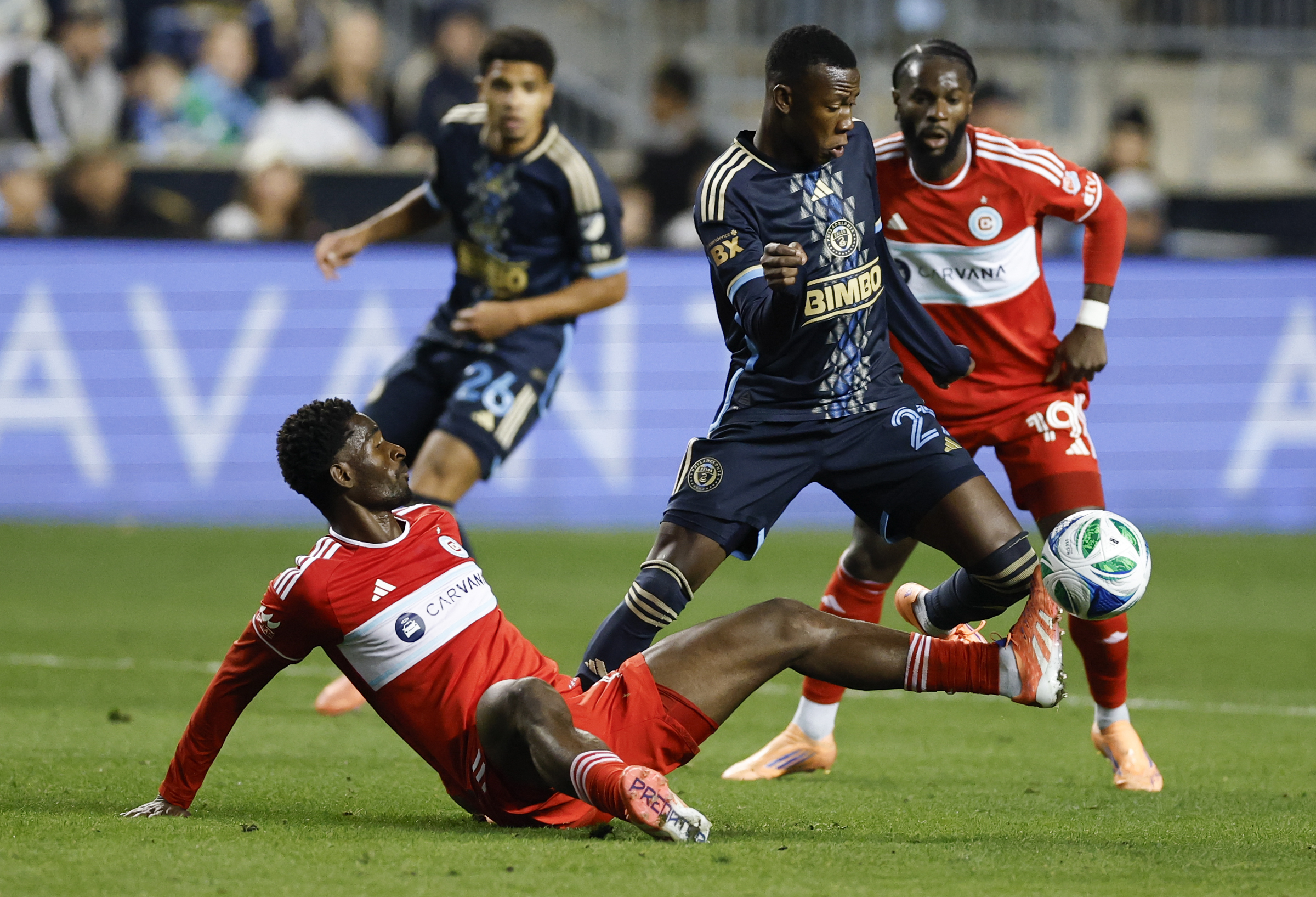
Kendry Paez (center) played for Ecuador against the United States in October.
3. Croatia vs. Ghana
Group L, June 27, 5 p.m.
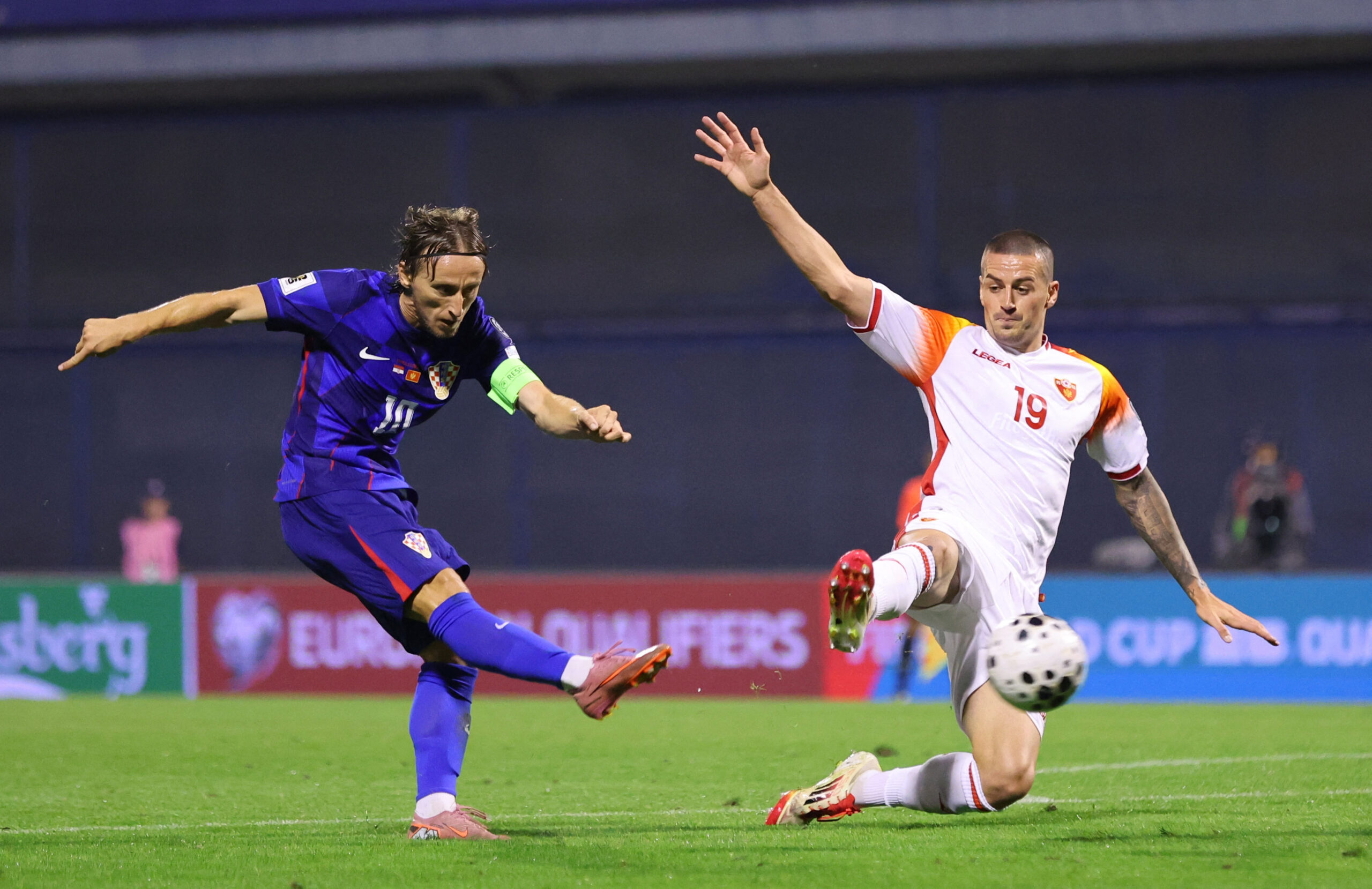
We said players break ties, and no one’s better for that than legendary Croatian playmaker Luka Modrić. He will be atop the marquee for this game, and he won’t just draw Croatia fans in their famed red-and-white checkerboard jerseys. Anyone who has relished watching his club career with Real Madrid and AC Milan will want to be there, as Modrić plays in his final World Cup at age 40.
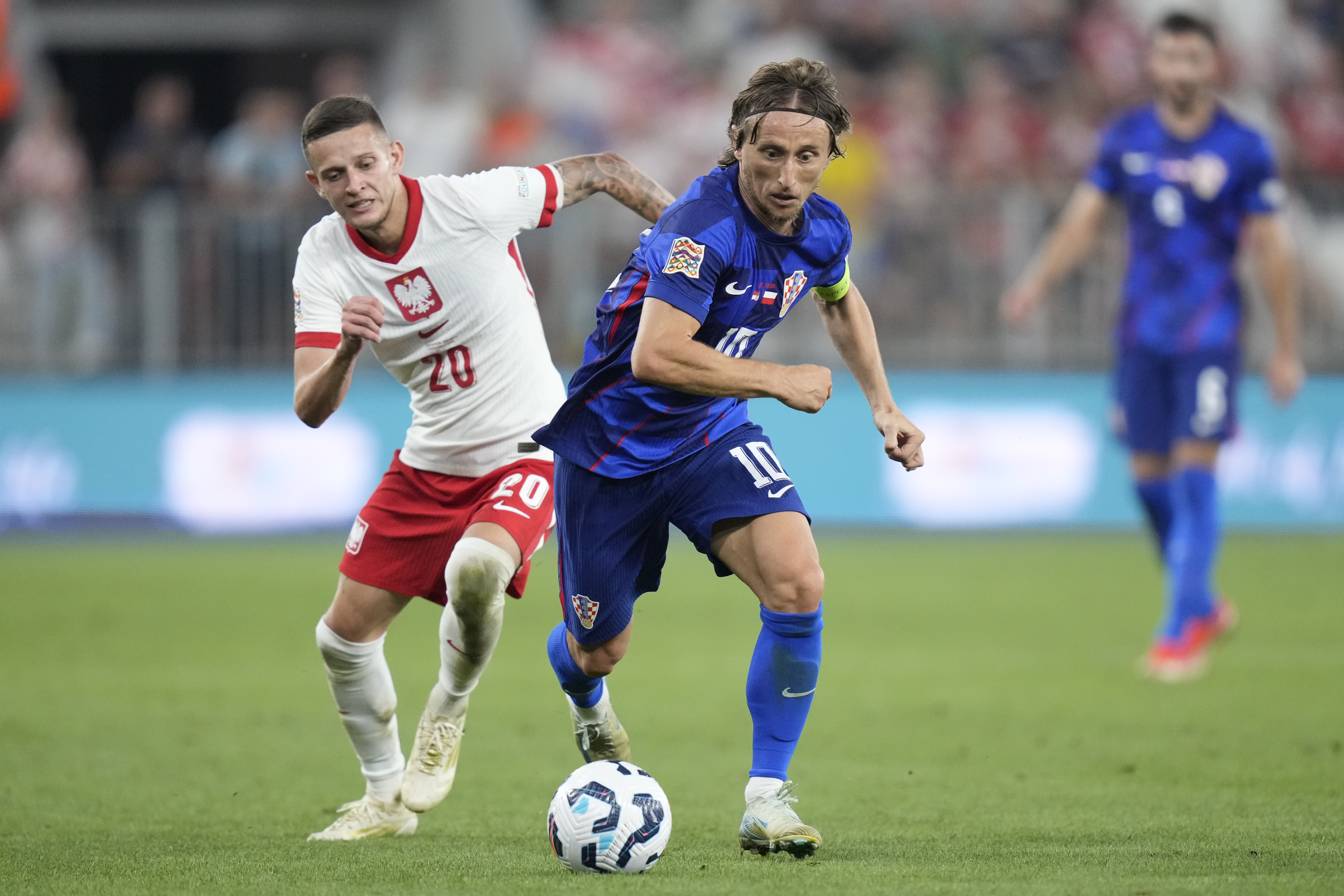
Even at age 40, Croatia’s Luka Modrić (left) remains one of the soccer world’s great midfield wizards.
2. France vs. Bolivia, Suriname, or Iraq
Group I, June 22, 5 p.m.
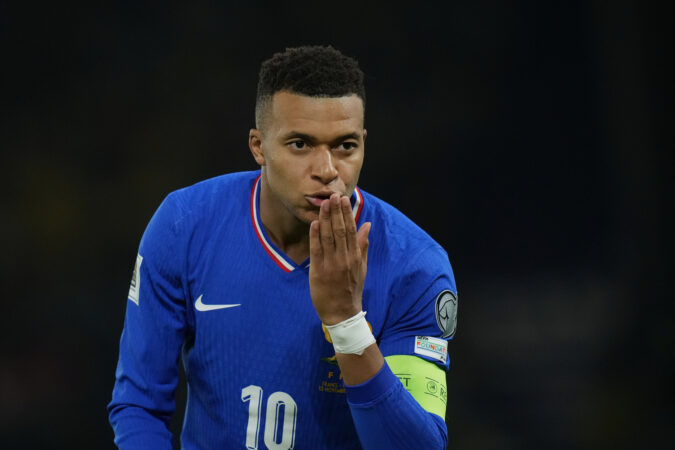
Now for the easy part. France commands attention with star power and success. Kylian Mbappé led Les Bleus to the 2018 World Cup title and the 2022 final, and there’s every reason to believe they could make another deep run next year.
From reigning world player of the year Ousmane Dembélé to fast-rising youngsters Bradley Barcola, Désiré Doué, and Michael Olise — just a few of the many names that could go here — France has a depth of elite talent that almost no other national team can match.
They also have a national anthem in “La Marseillaise” that’s perfect for belting out from the stands, even on a hot summer evening.
We’ll know which team France will face after the intercontinental playoffs in March. Bolivia hasn’t been to a men’s World Cup since 1994, when Marco Etcheverry and Jaime Moreno played before becoming some of MLS’s first stars. Iraq hasn’t been on this stage since 1986.
From here, and from the view of many followers of soccer in North and Central America, there will be a soft spot for Suriname. Like Curaçao, the nation that’s officially in South America’s land mass has leveraged its Dutch connections to rise up Concacaf’s ranks.
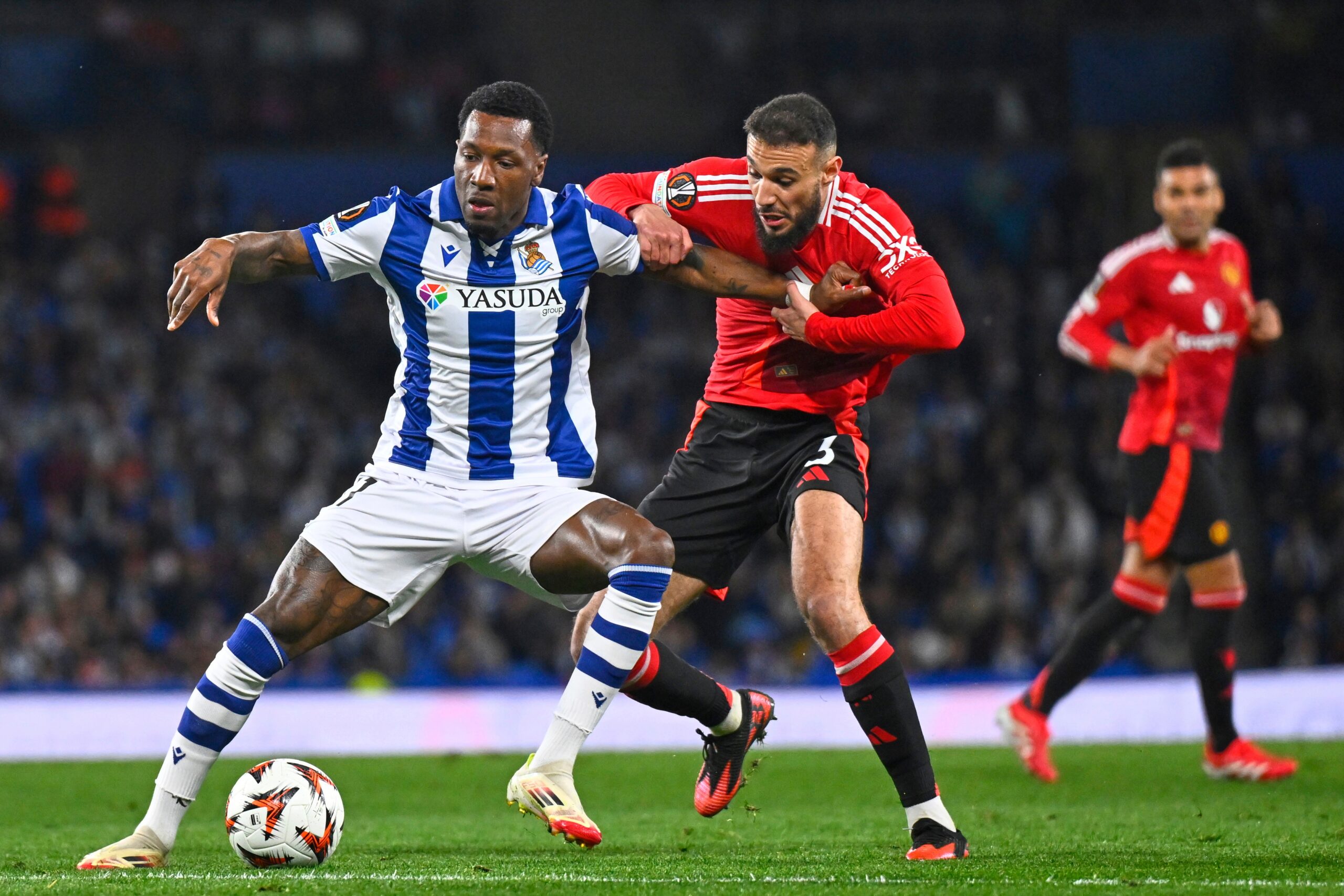
The Natio are led by forward Sheraldo Becker, who played with Medford’s Brenden Aaronson in 2023-24 at Germany’s Union Berlin. He then moved to Spain, first at Real Sociedad and now at Osasuna.
Sheraldo Becker (left) in action with Spain’s Real Sociead last season.
1. Brazil vs. Haiti
Group C, June 19, 9 p.m.
The top pick was obvious, but just in case, here’s a little more juice for it. A few hours after the World Cup schedule was announced, this writer went to the Big 5 Classic and was asked by a few friends and colleagues about the games coming here.
The answer always started with Brazil, and every time it didn’t finish before that one word produced an amazed reaction.
That’s the power of the most decorated team in men’s World Cup history. The Seleçao’s five championships are the record, and they are the only team to play in every men’s World Cup there’s ever been. Philadelphia will be the 60th all-time city in which Brazil has played a men’s World Cup game.
Nor can any team match the nation’s history of superstars, from Garrincha to Pelé to the original Ronaldo — all wearing the eternal yellow-and-green jerseys.
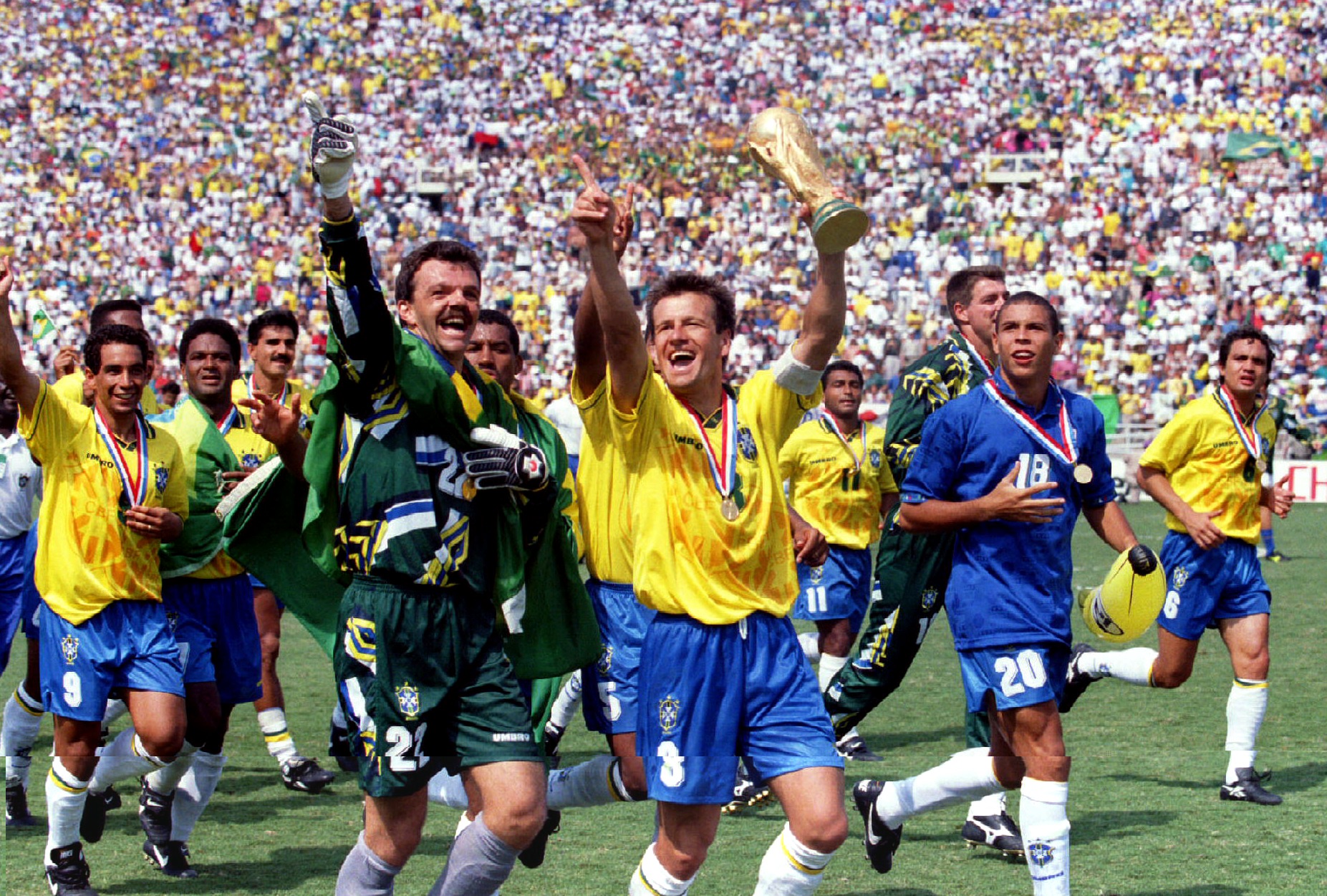
Dunga lifted the trophy and paraded it around the Rose Bowl when Brazil won the 1994 men’s World Cup in the United States for its fourth title.
Now comes what might be the final piece of the puzzle, famed manager Carlo Ancelotti. He coached many of these players at Spanish club Real Madrid, and has the clout to make the big decisions necessary to pick the World Cup team.
What makes this specific game even better is Brazil’s opponent. Haiti is in its first men’s World Cup since 1974. Its vibrant diaspora across North America will flock to town, even if the Trump administration bans travelers from the nation itself.
Les Grenadiers also have two players with Philadelphia ties, Union midfielder Danley Jean Jacques and Penn alumnus Duke Lacroix. As rare as it is to play in any World Cup, it’s even rarer to get a homecoming game on soccer’s biggest stage.
When Villanova hosted the first women’s Big 5 Classic tripleheader last year, the Wildcats intended to cap it off by winning the title.
Instead, the Temple Owls spoiled the party plans and left the Main Line with the title in their hands.
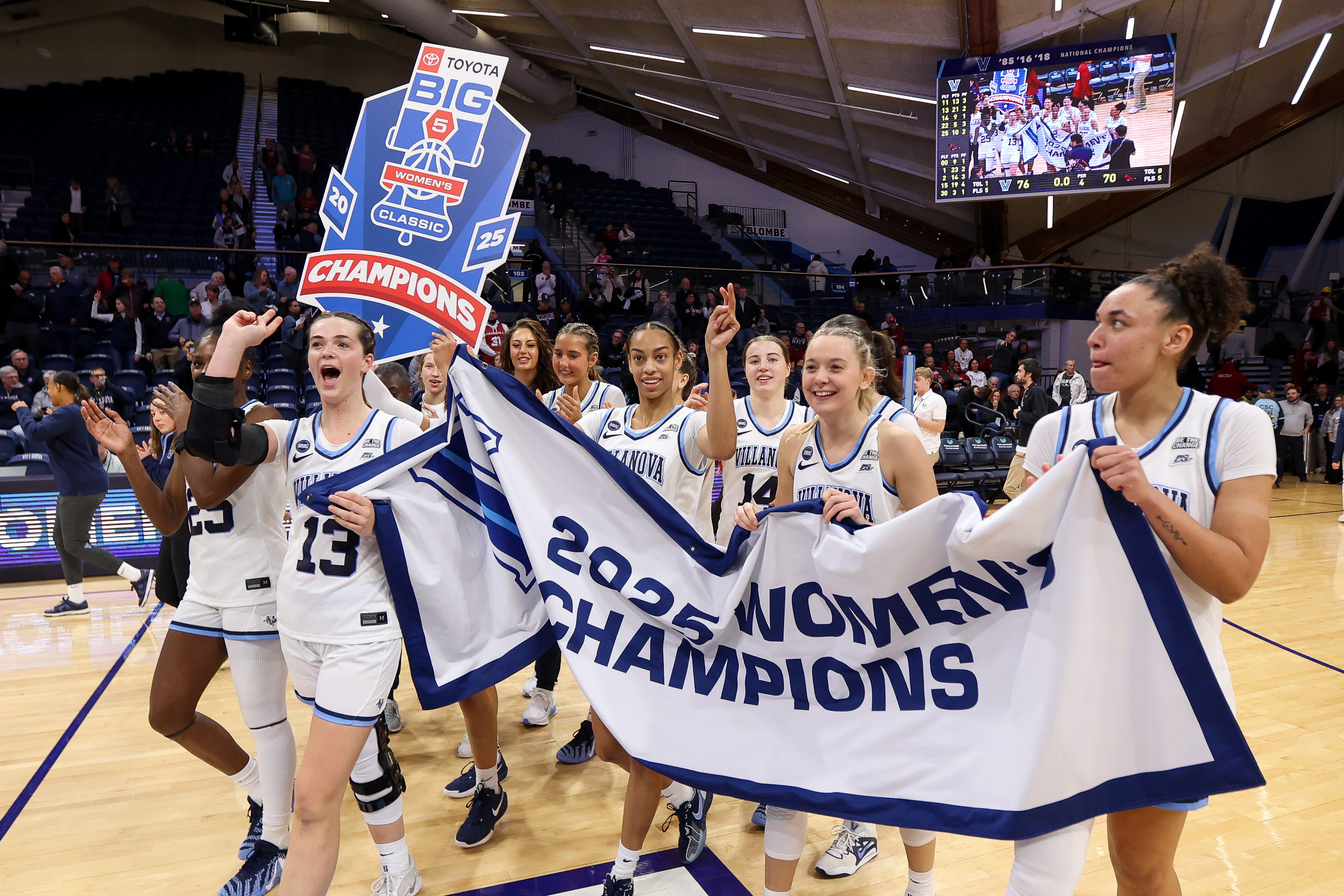
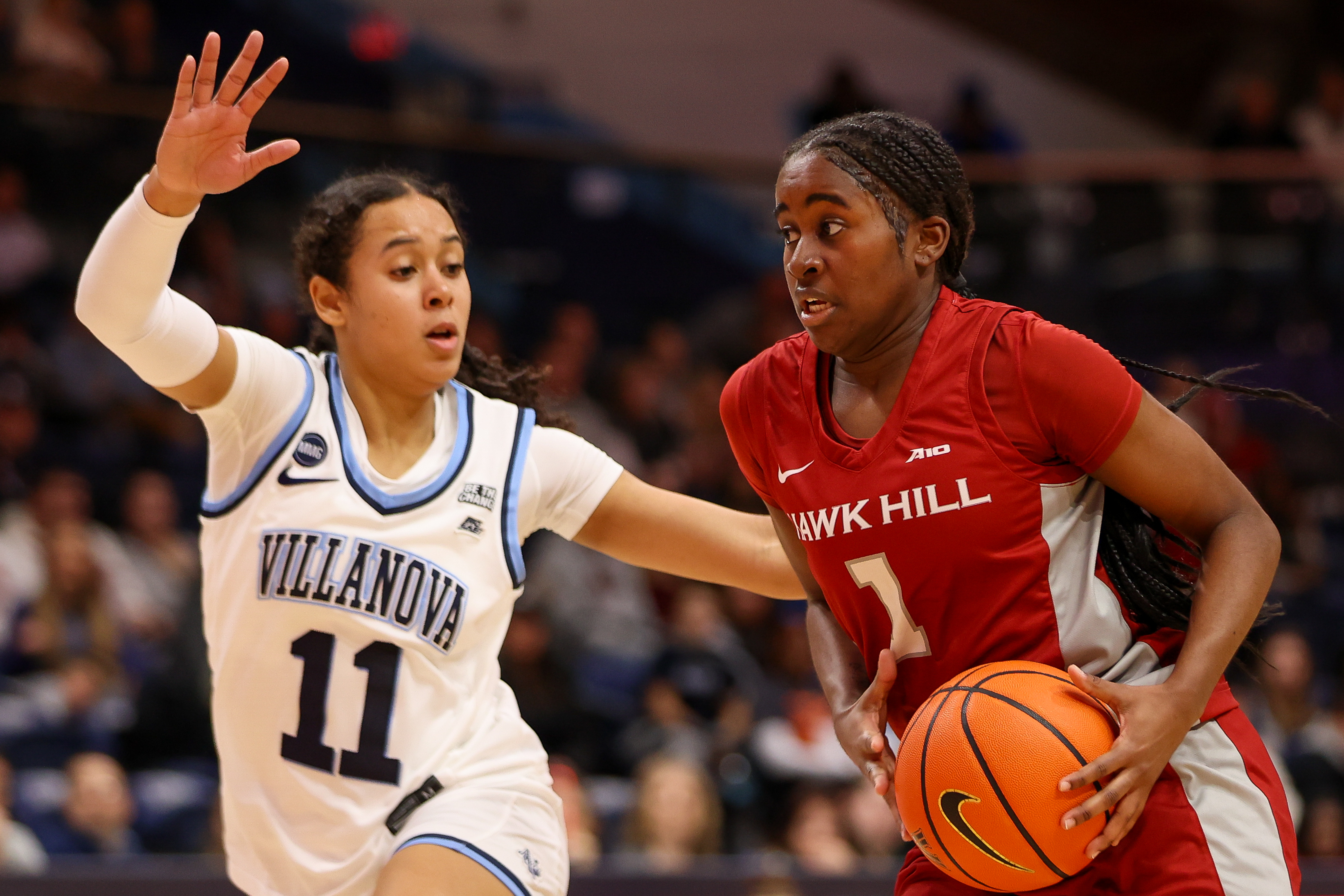
This year, the Wildcats delivered. Led by Brynn McCurry’s 21 points, they topped St. Joseph’s, 76-70, Sunday in a title game that was close throughout. It marked ’Nova’s 22nd women’s Big 5 crown, the most of any City Series team.
For as much as rosters in college basketball change by season these days, coach Denise Dillon admitted she had kept last year’s loss in mind.
“That’s the responsibility of myself and our staff, to explain to our players, because of so many new players on the roster, and not recognizing what Philly basketball is,” she said. “Yeah, the taste stuck with me, and I think some of the others who were playing in that game. Denae Carter and Jasmine Bascoe last year, they knew they gave something up here on our home court, and wanted to make sure we took care of business here today against St. Joe’s.”
Villanova’s players celebrate with the Big 5 champions’ banner.
The Hawks were more than valiant. Rhian Stokes totaled 23 points and six assists, while Gabby Casey had 19 points and eight rebounds.
At the other end, St. Joe’s held Bascoe to 4-of-16 field-goal shooting, though she still had 13 points. McCurry, who missed all of last season with a knee injury, delivered her third straight 20-point outing.
“Kudos to [McCurry] and to her teammates for stepping up, because I thought we did a hell of a job on Bascoe,” Hawks coach Cindy Griffin said,
December obviously isn’t March, but Villanova is on some national bracketologists’ early NCAA Tournament bubbles. Though the Wildcats lost at Princeton last month, they made up for it with a win at then-No. 25 West Virginia last Monday, and followed it with a win at Georgetown on Thursday to open Big East play.
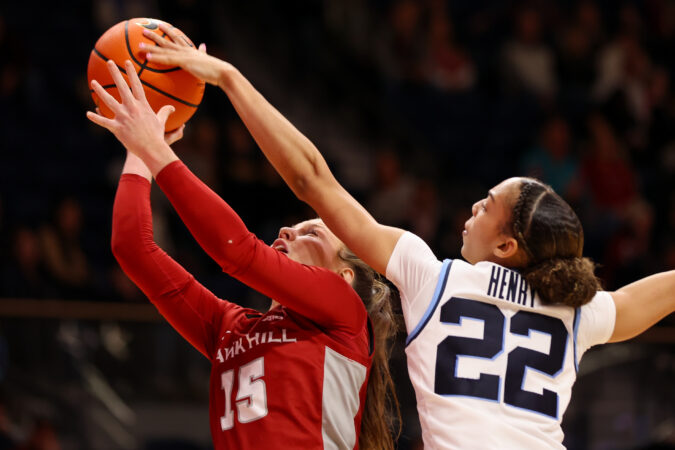
Villanova’s Jasmine Bascoe defending Rhian Stokes of St. Joe’s, who led all scorers with 23 points.
Their next game, following exams, should be another solid barometer: home vs. Seton Hall on Dec. 19. The Pirates were picked third in the preseason conference poll, with ’Nova fourth.
“We gave up a tough one to Seton Hall last year in this place,” Dillon said of a 56-55 defeat. “We’ll remind them [at practice] on Tuesday.”
The rest of the day
Drexel topped Temple in the third-place game, 59-52. With Dragons star guard Amaris Baker held to just seven points on 2-of-13 shooting, Deja Evans stepped up with 18 points on 8-of-14 shooting, plus seven rebounds and three assists.
“Things weren’t going our way, our scorers weren’t making shots, but they still found a way to lock in and stay focused on what we needed to do to win the game,” Drexel coach Amy Mallon said. “And to me, that’s what Drexel basketball is about, and how we find ways to win.”
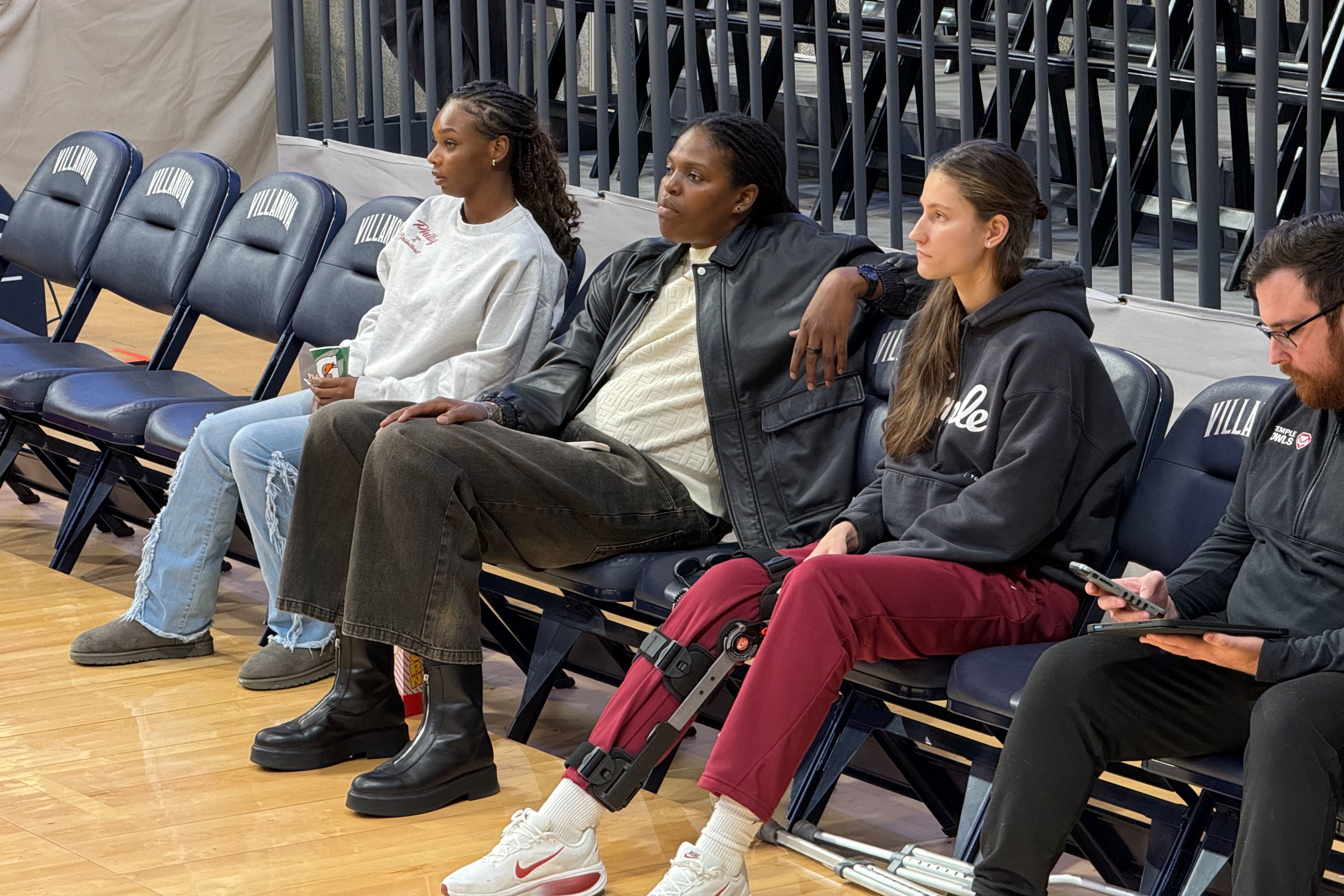
New York Liberty star Jonquel Jones, the adopted daughter of Temple women’s coach Diane Richardson, sat courtside to watch the Owls. That was a reminder of how big women’s basketball is nationally these days, though the stardust hasn’t landed on the Big 5.
Jonquel Jones (second from left) sitting courtside during the Temple-Drexel game.
“Well, I’d love to have her on the court, but we have already exhausted that eligibility,” the always-charismatic Richardson said. “It’s great. She loves our kids and she’s got some time off because of her [ankle] injury, so she’s been spending a lot of time with me. We’re glad to have her here, and not only just for us, but for women’s basketball — and here at the Big 5, where we want to shine a light.”
Penn won the fifth-place game over La Salle, 65-52, led by Katie Collins’ 20 points and nine rebounds. The Quakers led by 21 points in the third quarter, but the Explorers rallied to within five at the end of the period before Penn pulled away in the fourth.
As The Inquirer confirmed a few days ago, the women’s tripleheader will change location next season. Sunday marked Villanova’s second straight year, and the second straight year of disappointingly small crowds on the Main Line: 1,242 fans over the three games.
Though it’s not official yet, the Palestra is the favorite right now to host as part of the arena’s 100th birthday celebration. Penn’s coach isn’t alone in hoping that moving the games to the city’s most famous college basketball venue will draw more fans to watch them.
“I know one thing: Penn would put on a first-class event, just like Villanova has done here,” said Mike McLaughlin, who has long championed having the women’s tripleheader at the city’s most famous venue. “This has been a great event for our athletes, and Penn will do the same if it’s at the Palestra.”
Philadelphia will welcome two of the soccer world’s greatest powers, Brazil and France, for its slate of World Cup games next summer.
Brazil, whose five men’s World Cup titles are the most of any nation, will play Haiti on June 19. That will fill the city’s streets with a vibrant mix of the Seleçao’s famed yellow-and-green kits, and Haiti’s diaspora from across the northeast United States.
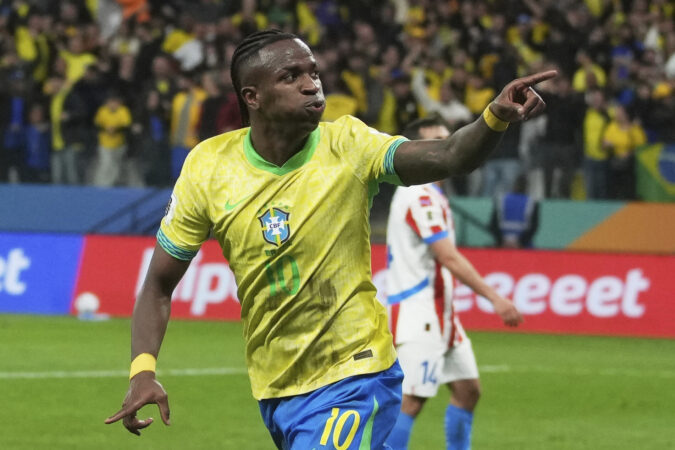
It will also mean an unofficial home game for Union midfielder Danley Jean Jacques, who helped Les Grenadiers reach their first men’s World Cup since 1974. He’ll get to play against superstars including Vinícius Júnior and Estêvão, who coincidentally played at the Linc last summer in the Club World Cup.
Union midfielder Danley Jean Jacques (center) will get to play an unofficial home game when Haiti faces Brazil in Philadelphia.
But that day will put Philadelphia in the middle of this World Cup’s political spotlight. Haiti is one of two teams in the field, along with Iran, whose citizens are currently banned from entering the United States because of political unrest in the tiny Caribbean nation. Anyone in an official delegation — players, coaches, team staff, etc. — will be fine, but whether fans will be able to travel here remains a huge question.
Haiti was unable to host its World Cup qualifiers on home soil, and manager Sébastien Migné has never set foot in the country. When asked about that at Friday’s group draw, he told reporters: “It depends on Mr. Trump.”
As President Donald Trump had just won the first edition of FIFA’s Peace Prize (with timing that perhaps wasn’t coincidental), Migné then offered a hope that “maybe he will continue with that [spirit], and he will open the possibility for the fans to come here.”
France will play here on June 22 against the winner of the March intercontinental playoff bracket, which includes Bolivia, Suriname, and Iraq. That will bring one of the world’s absolute superstars, Kylian Mbappé, who led Les Bleus to the 2018 title and the 2022 final.
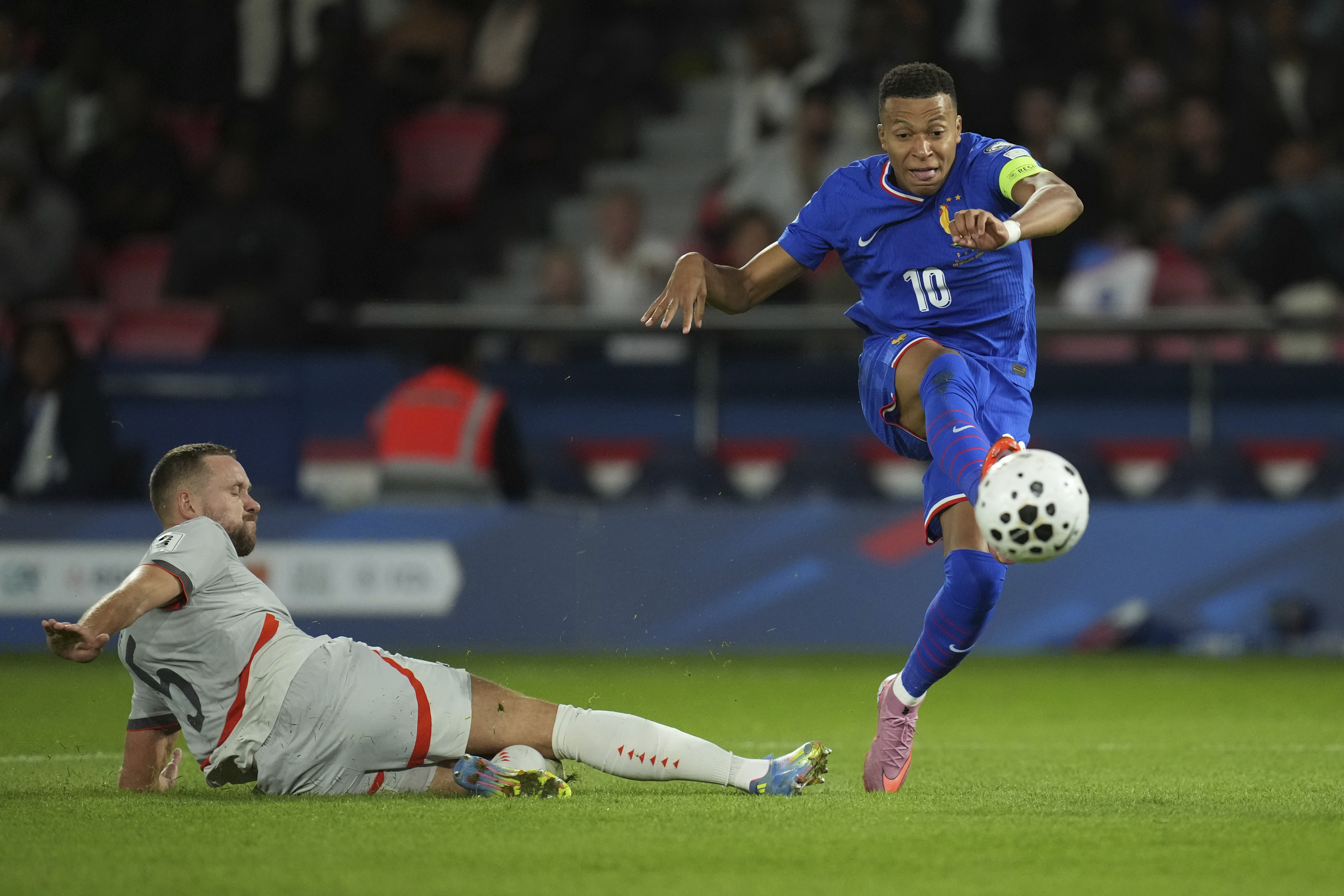
Philadelphia will get to see France superstar Kylian Mbappé (right) in person during the World Cup.
France’s squad is among the most loaded in the tournament. Mbappé is joined by reigning world player of the year Ousmane Dembélé and a fleet of outstanding youngsters: Bradley Barcola, Rayan Cherki, Desiré Doué, Hugo Ekitike, Michael Olise, and Warren Zaïre-Emery.
Philadelphia’s slate begins on June 14 with Ivory Coast vs. Ecuador in Group E. Expect Ecuador to bring a huge crowd, all clad in the country’s yellow jerseys, — and star players in midfielders Moisés Caicedo (England’s Chelsea) and Kendry Paez (France’s Strasbourg, owned by Chelsea).
Ivory Coast’s squad, led by midfielder Franck Kessie (Saudi Arabia’s Al-Ahli) and forward Amad Diallo (England’s Manchester United), will play two games in Philadelphia.
Les Elephants’ second game here will be their group stage finale, June 25 vs. Curaçao — a Caribbean island making its World Cup debut.
<iframe title="2026 World Cup Matches in Philadelphia" aria-label="Table" id="datawrapper-chart-bFLzF" src="https://datawrapper.dwcdn.net/bFLzF/1/" scrolling="no" frameborder="0" style="width: 0; min-width: 100% !important; border: none;" height="632" data-external="1"></iframe><script type="text/javascript">window.addEventListener("message",function(a){if(void 0!==a.data["datawrapper-height"]){var e=document.querySelectorAll("iframe");for(var t in a.data["datawrapper-height"])for(var r,i=0;r=e[i];i++)if(r.contentWindow===a.source){var d=a.data["datawrapper-height"][t]+"px";r.style.height=d}}});</script>
The Blue Wave’s history as a Dutch colony led the governing body to recruit dual nationals in recent years, and that paid off this year by topping Jamaica in their World Cup qualifying group.
This World Cup marked the first one where FIFA did not set games in venues at the moment of the draw. That caused a lot of consternation around the world.
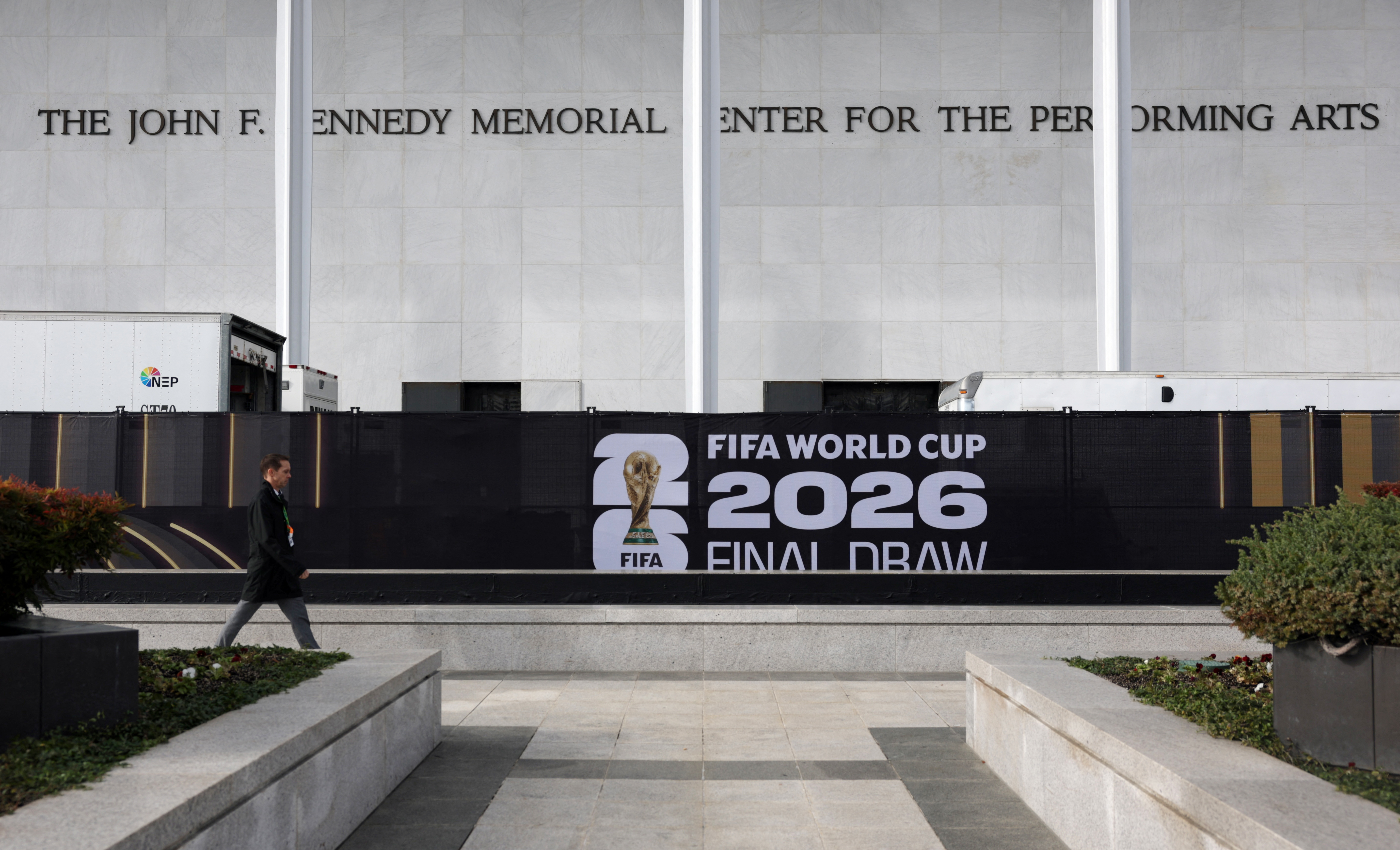
On Friday at the Kennedy Center’s Concert Hall, where the draw took place, The Inquirer overheard a FIFA staffer admit the truth about why that’s the case.
Before the draw, stadiums were assigned games in groups, but not specific matches. That meant any given matchup could be in one of two stadiums. FIFA’s decision to not set the venue at the moment of the draw meant it could move a matchup with less-popular teams to the smaller of the two stadiums available for it, and not worry about unsold tickets.
Curaçao’s celebrations at the final whistle of its tie in Jamaica last month that clinched World Cup qualification.
Of course, there’s so much demand in the U.S. and worldwide that every game is expected to sell out. But a supposedly “lesser” game in a bigger stadium could give a chance to fans who don’t want to shell out thousands of dollars for tickets on FIFA’s in-house secondary market.
There’s a chance Philadelphia could benefit from that in Curaçao-Ivory Coast and the city’s last group game, Croatia vs. Ghana on June 27. Croatia has one of the world’s all-time midfield maestros in Luka Modrić, and Ghana will also draw from West Philly and well beyond. But the teams’ fan bases aren’t big enough to fill the Linc on their own, so the odds might improve for local fans to get tickets.
After that, the Linc will have a week to recover before the city’s last game in the tournament, a round of 16 contest on July 4. The round of 32 games that feed into that matchup include the winners of Group E and Group I, which means Philly could see France return to town to play Germany in one of Europe’s classics.
Croatia’s Luka Modrić (right) is one of the soccer world’s most talented midfield creators.
Beyond the matchups, fans will also have an eye on kickoff times amid the hot summer weather. The city’s first two games will have nighttime starts, including a late one for Brazil-Haiti. But the remaining four will all have late-afternoon kickoffs, including a 5 p.m. start time on July 4.
As for the U.S. team, fans will be staying up late for two of its three group games. The June 12 opener vs. Paraguay in suburban Los Angeles is a 9 p.m., ET kickoff on a Friday, and the June 25 group stage finale against a European playoff winner will be a brutal (at least for East Coast fans) 10 p.m. start on a Thursday.
The middle game, June 19 (also a Friday) against Australia, will be a 3 p.m. Eastern kickoff.
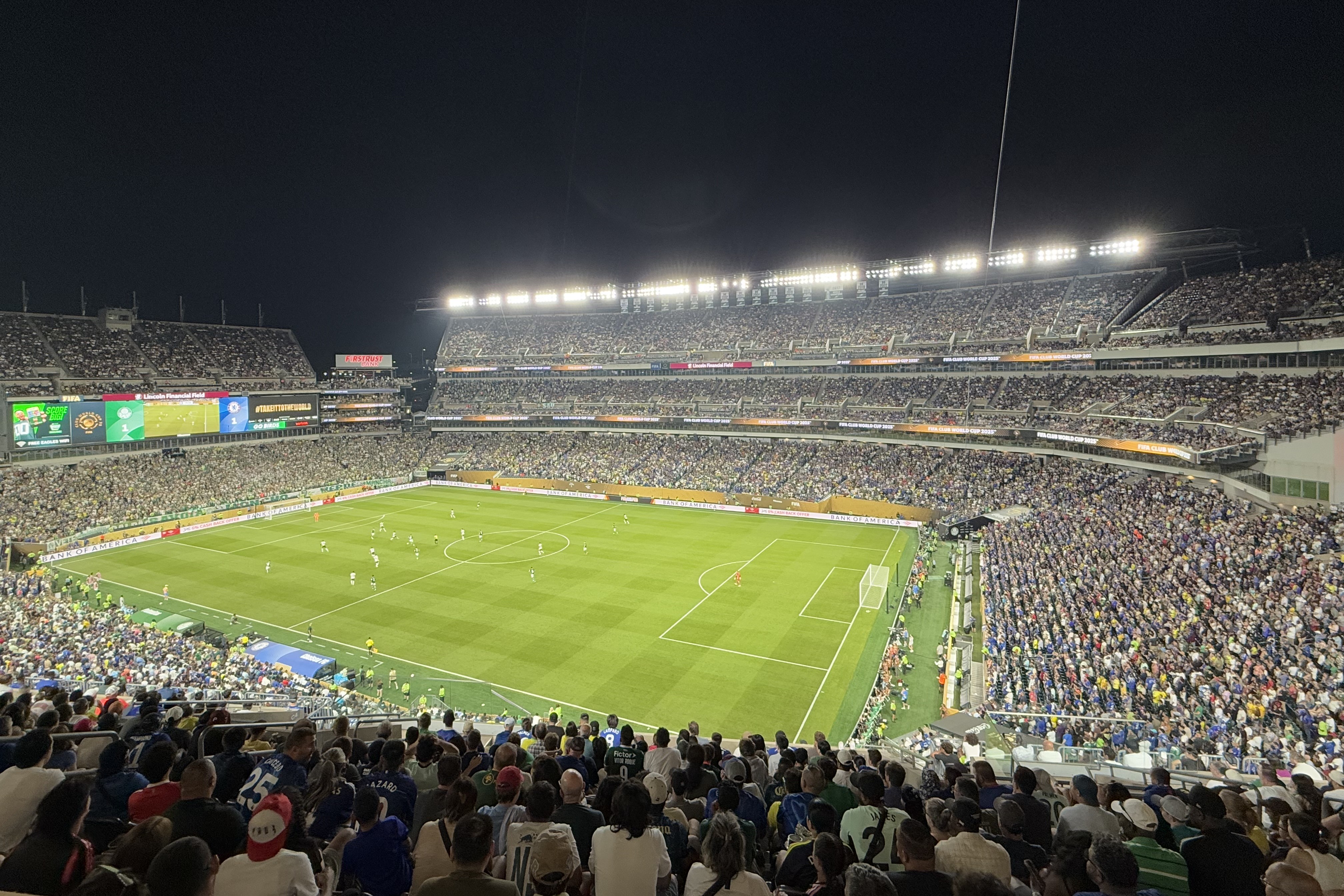
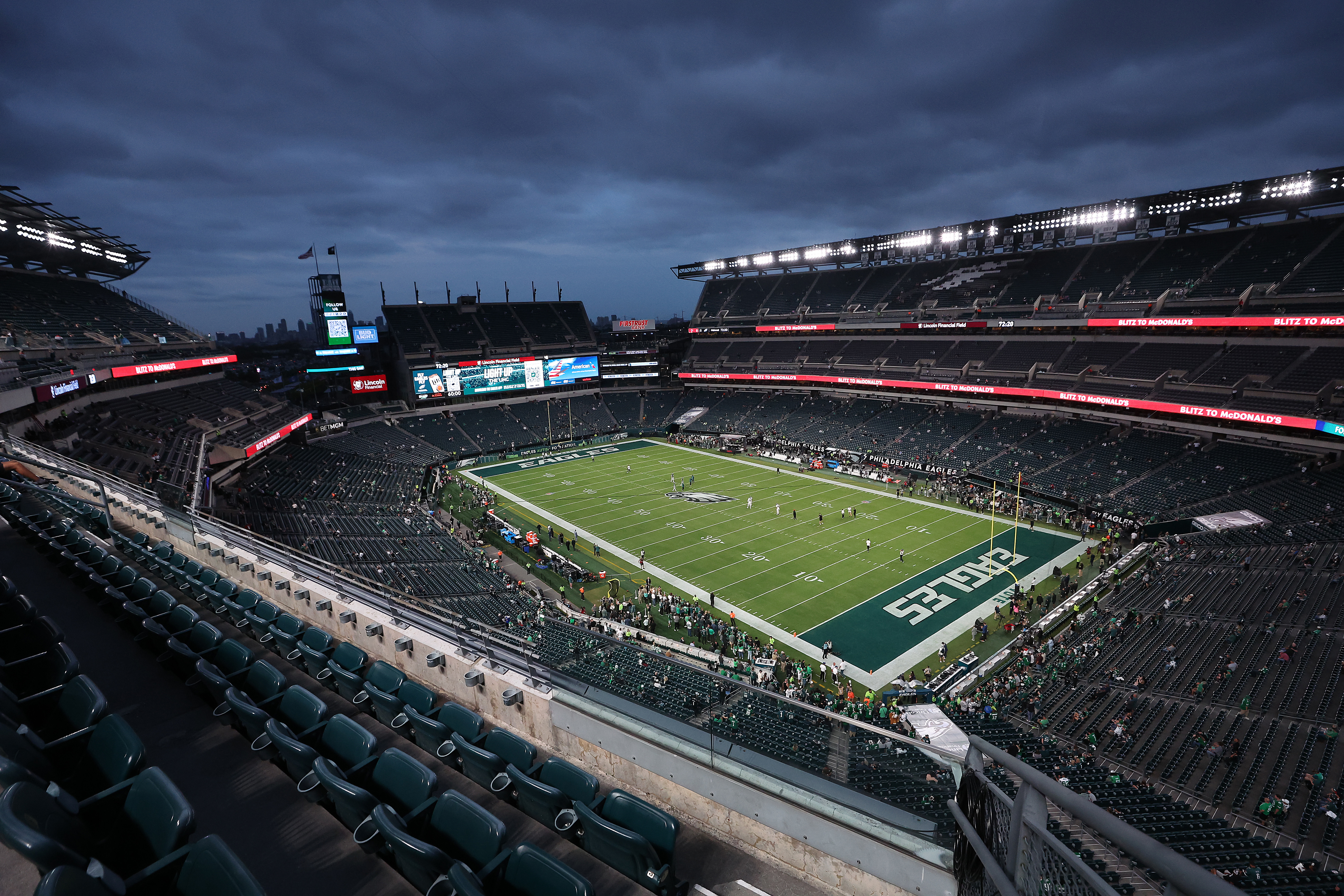
All games will be played at Lincoln Financial Field, which will be called Philadelphia Stadium during the tournament because FIFA bans the use of commercial sponsors’ names on stadiums during its senior World Cups.
June 14: E3. Ivory Coast vs. E4. Ecuador, 7 p.m.
June 19: C1. Brazil vs. C3. Haiti, 9 p.m.
June 22: I1. France vs. I3. Bolivia, Suriname, or Iraq (an intercontinental playoff), 5 p.m.
WASHINGTON — Don Garber said it when MLS announced its switch to a winter-centric schedule a few weeks ago, and he said it again Thursday at his State of the League address.
The commissioner knows as well as anyone that the league needs to not just change when it plays, but how it plays to truly improve its standing on the world stage. That means loosening the roster rules, letting teams not just spend more money but have more freedom about how they spend it.
This time, he said to not just the usual audience of domestic media who cover the league all year, but a big crowd of international journalists who came to the nation’s capital for Friday’s World Cup draw. Some of them might have headed to Fort Lauderdale afterward for Saturday’s MLS Cup final between Lionel Messi’s Inter Miami and Thomas Müller. (We can only wonder how many would have made the even shorter trip to Chester were the Union hosting.)
“One of our core principles is that we will do whatever it takes, and make whatever decisions necessary, that will define our future,” Garber said as he started to address the coming changes, including “increased investment in player development, and an evolution of our roster strategy that will elevate the overall quality of the play on the field.”
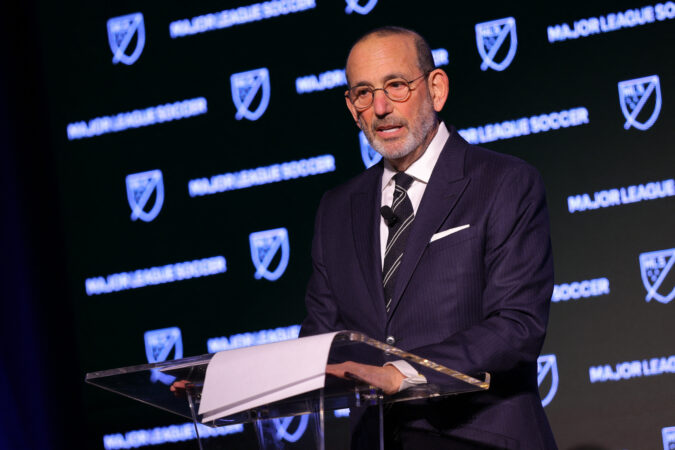
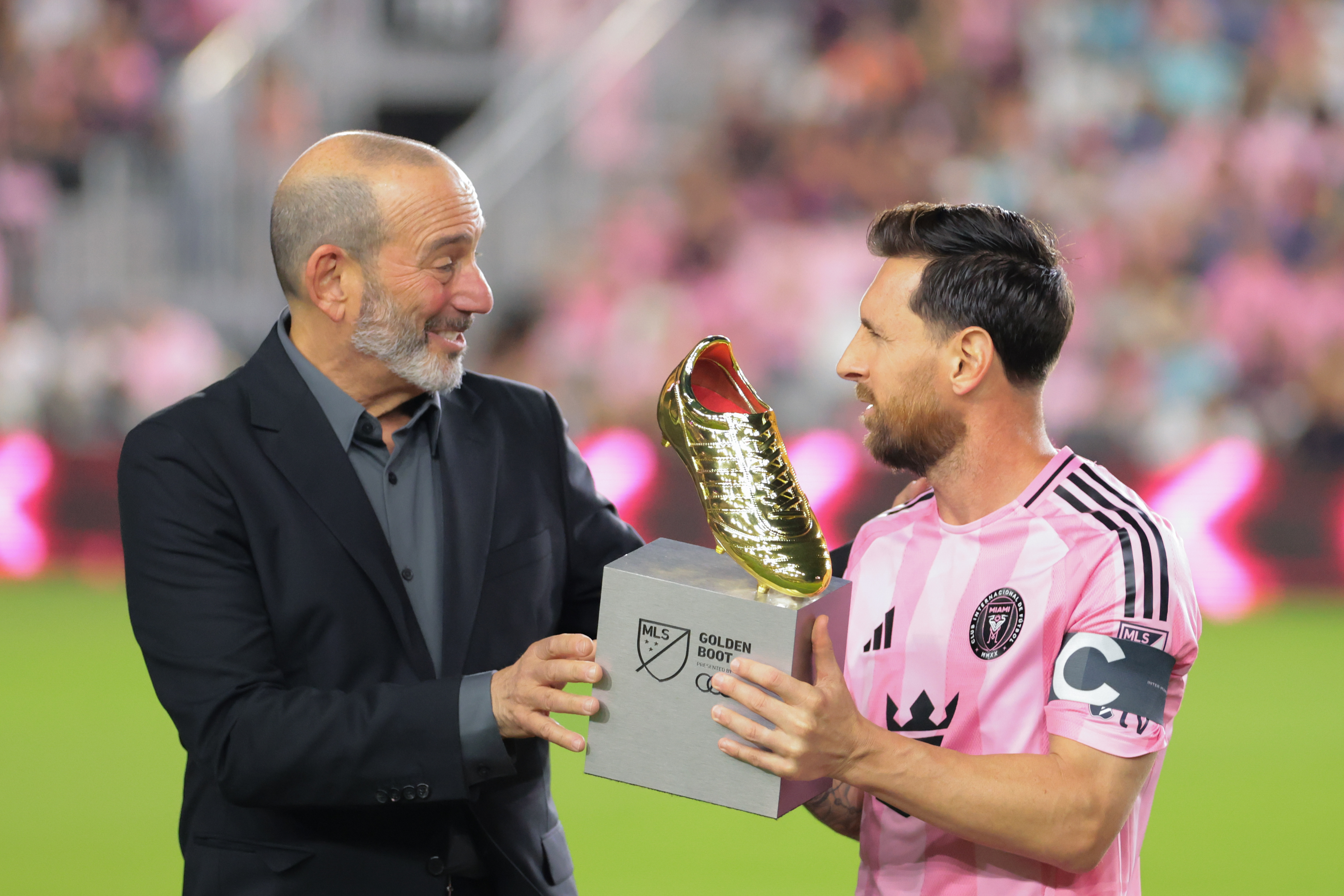
Don Garber (left) is no doubt pleased that Lionel Messi (right) and Inter Miami made this year’s MLS Cup final.
Those were some strong words, and they prompted a natural question. Just how far is the league willing to go to deliver that pledge? And in particular, how much work is the commissioner himself willing to do behind closed doors to push team owners who want to spend less than others do?
“MLS has had this view, and it’s defined the position that we’re in today, that our owners are partners off the field, and they’re fierce competitors on the field,” Garber said. “And in order to do that, you’ve got to consider the thoughts of teams that are in smaller markets that might have a different view as to what the competitive balance should be, and then those that are in larger markets and newer stadiums. You would say maybe the legacy teams versus the middle teams versus the new teams.”
Indeed, many watchers would say that, and some were facing Garber’s podium.
“Our job is to pull them all together,” Garber said of his circuit’s 30 clubs, “and come out with a competitive format and roster rules that move our league forward.”
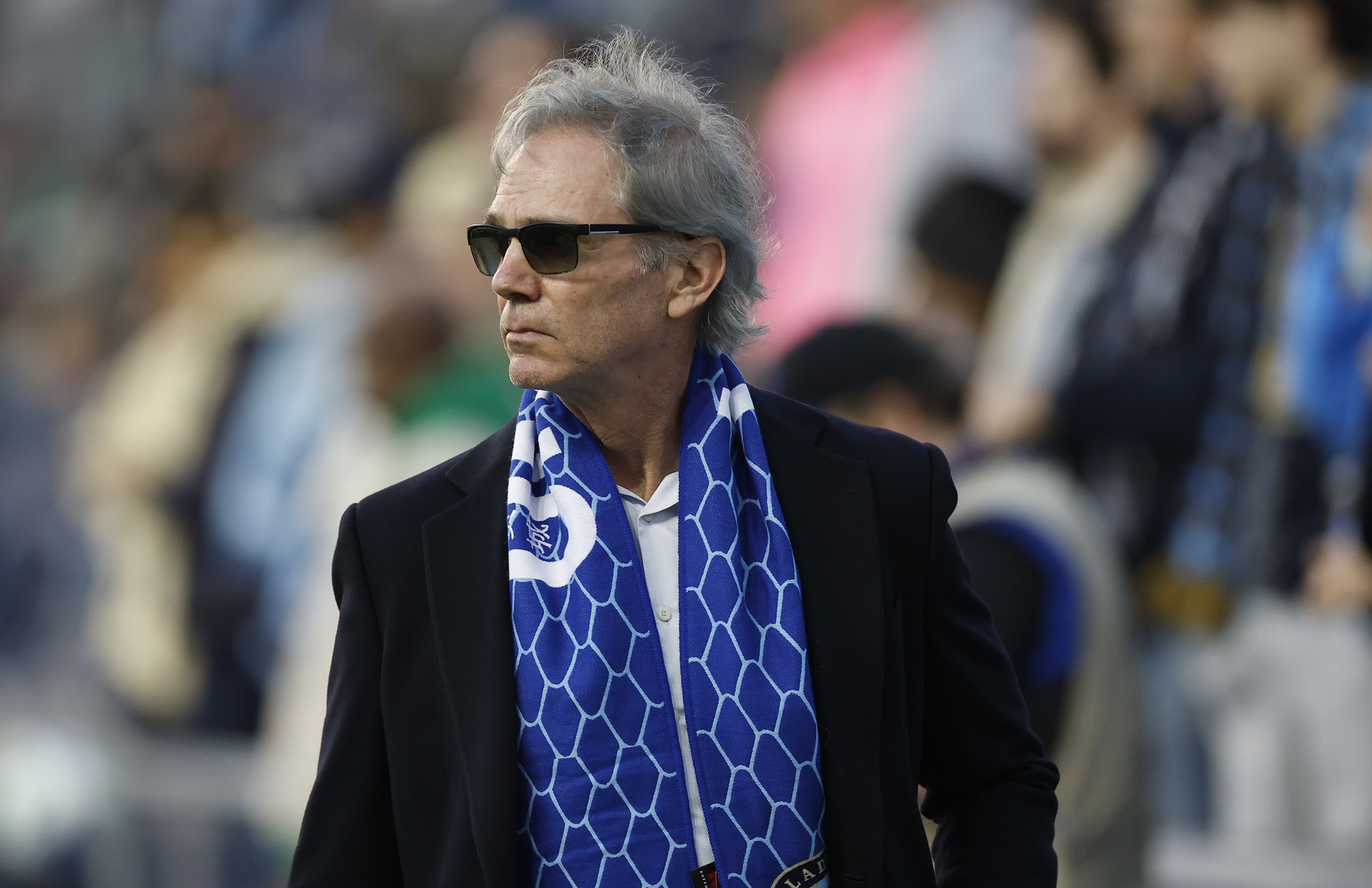
Philadelphia Union Chairman and Majority Owner Jay Sugarman before Union played the Chicago Fire FC in a first round MLS playoff game at Subaru Park in Chester, Pa., on Sunday, October 26, 2025.
‘Nudge it a little more’
He asked the next question himself, before others could.
“And how do you do that?” he said. “You know, you can listen to noise — and noise is important, because noise is really research — and get an understanding of where fans are and where is MLS in the conversation. But it’s also about metrics. What’s driving our revenue? What’s driving our ratings? What’s driving the overall sale of our commercial [product], which speaks to fan interest and what we call fan avidity?”
Garber did not need to use that jargon to back up his point that “that’s all moving in the right direction with the rules that we have.” No one, even the league’s critics, doubts that is happening. It’s just about how quickly or slowly that movement is going. And with the unparalleled opportunity that comes from the World Cup being on home turf, Garber knows it’s time to push the gas pedal.
“How do you nudge it a little more as the market gets more sophisticated?” he said. ”And that’s our job. And you’ve got to figure out ways that you go into a board room, and you wrangle a bunch of them together, and you do the work in committees, and base it on research. We try to not to be distracted by the loud voice of few, but use data to drive our decisions, and research that drives decisions, and that’s what made MLS successful.”
The Vancouver Whitecaps’ signing of German legend Thomas Müller helped push the team to its first MLS Cup final.
Garber engages more with the rest of the world’s soccer leagues than he ever has. He sits on the management board of the World Leagues Forum, along with English Premier League CEO Richard Masters and Italian Serie A CEO Luigi De Siervo.
That is good company to keep, but it’s also a constant reminder of how far MLS has to go.
“[MLS is] very different from the rest of the world, which has open rules and basically can do what they want, but they have different competitive formats,” Garber said. “They have their version of the Champions League, which has its own economic value. We’ve got to think about our business and ensuring that our league is stable and moving in the right direction.”
Garber concluded his reflection by saying that the league will “continue to do what we’re doing, and push the envelope as much as we can without being reckless.”
Where the balance of that lands will define the rest of his tenure.
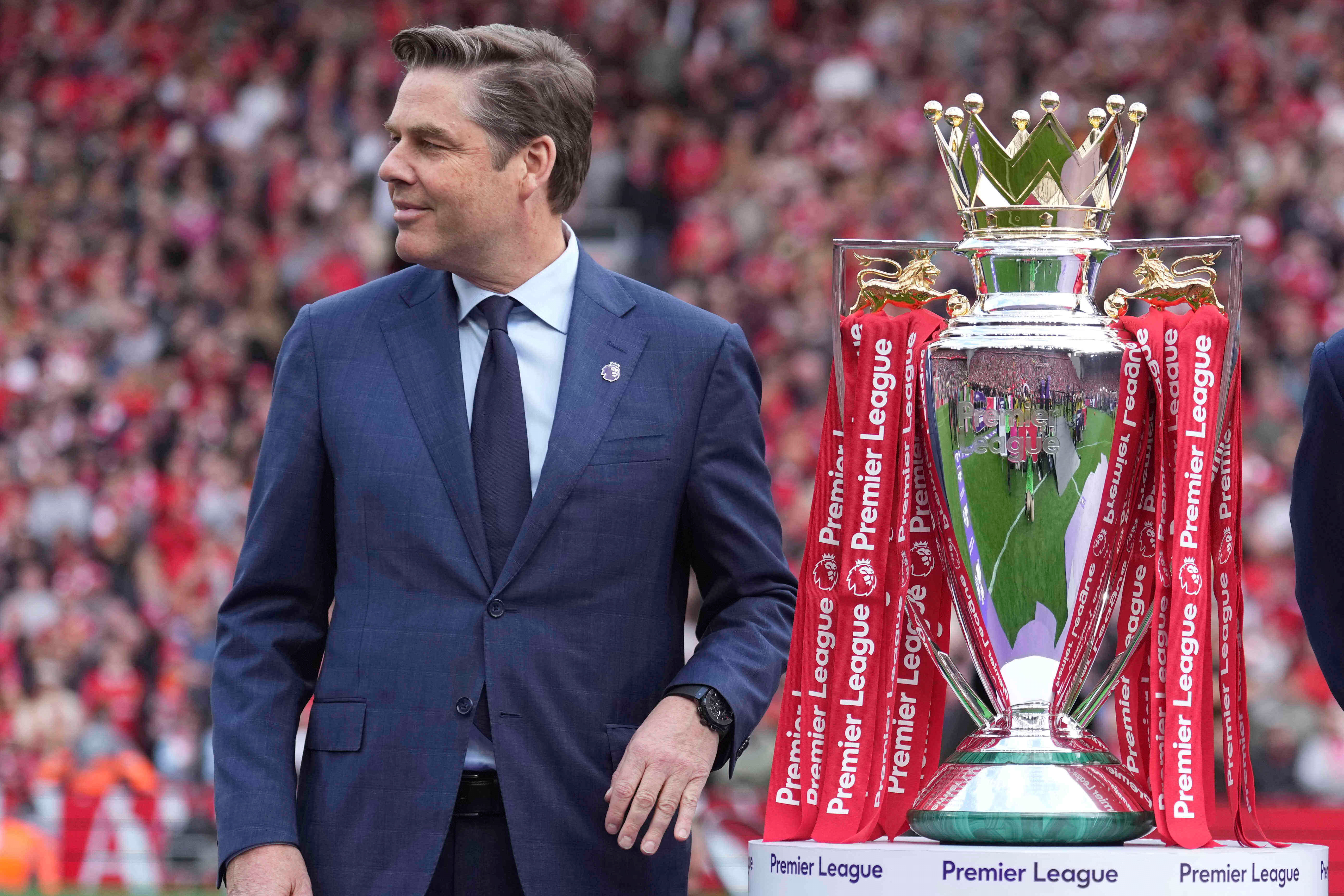
English Premier League CEO Richard Masters knows MLS commissioner Don Garber well.
Promotion and relegation?
Speaking of MLS’s differences from the rest of the world, Garber was given a proverbial open goal to shoot at when a reporter from abroad asked if MLS will ever have promotion and relegation, a cornerstone of the global sport.
In most of those years, as Garber went on to indicate, he thumped his shot in with a resounding no. But there is growing speculation that he might retire when his contract ends in 2027. He has not stopped that speculation in recent times, by talking about how the league will look after he steps down. He went in that direction again Thursday.
“This will be fun,” he said to start his answer. “In every single press conference we’ve ever had, somebody’s saying, ‘When are you going to have promotion and relegation?’”
That is indeed close to true.
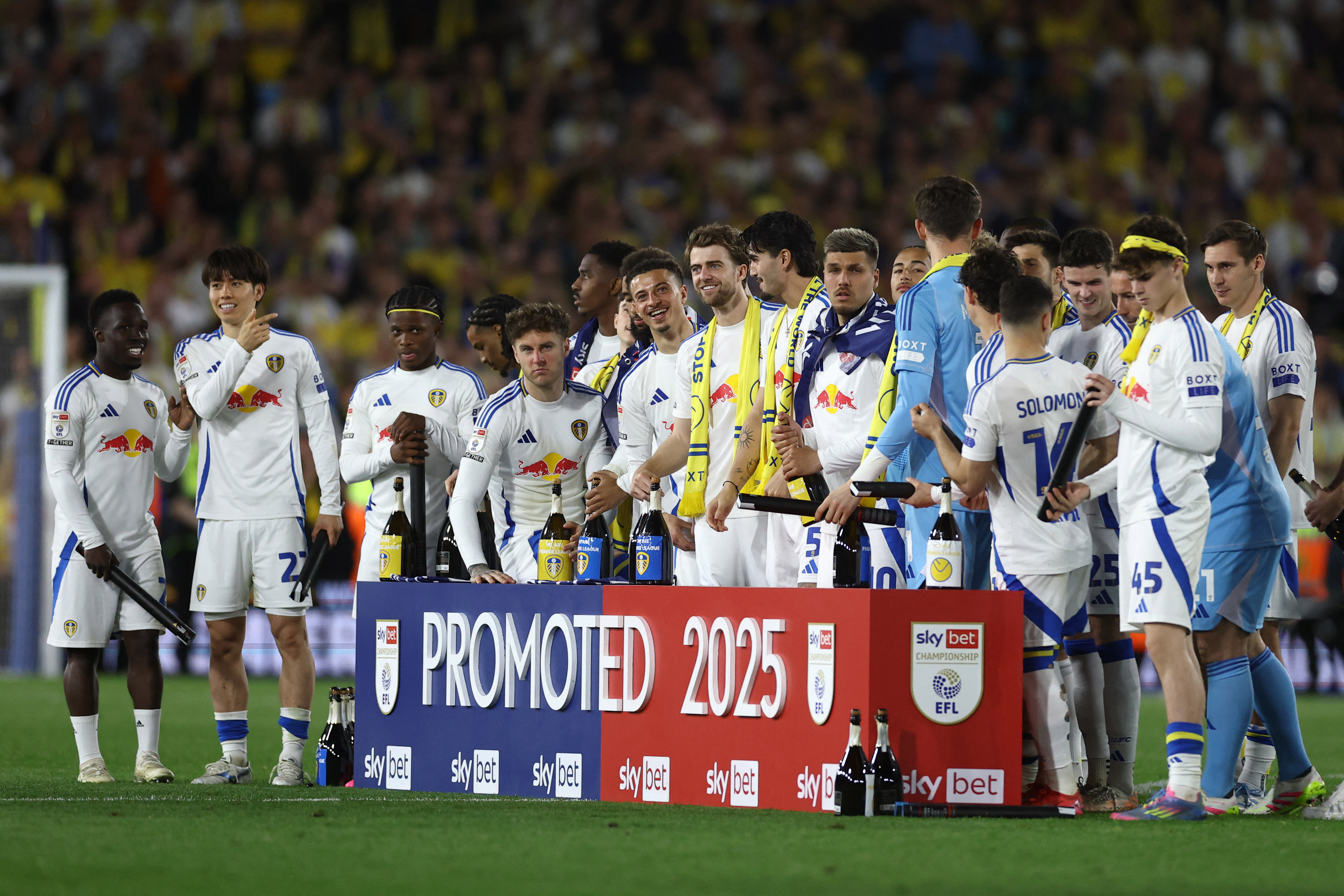
With a squad including Medford’s Brenden Aaronson, England’s Leeds United has shown in recent years how dramatic promotion and relegation can be.
“Back in the day, I would say, ‘Never,’” Garber said. “Today I would say, ‘There’s no real point in saying never, because I don’t know what the future will look like.”
Garber admitted the league’s calendar flip influenced his thinking on that, as something he also “never thought we would adapt to.” But with that now happening, and with the lower leagues of the USL getting stronger over time — albeit in a totally separate business entity — the question continues to arise.
He stood on his longtime point that relegation is bad for team owners who invest a lot of money and don’t make it back. But when Americans buy European clubs, as happens often, they know what they’re getting into, and Garber knows a fair few of them from his travels.
“If I were to ask most European leaders of pro leagues, and many owners, whether or not promotion and relegation was good for their investment and good for the broad, macro view of the sport,” he said, “most of them will say, ‘Well, I’m not quite sure. But as a fan, I think it’s kind of fun and it’s kind of cool.’”
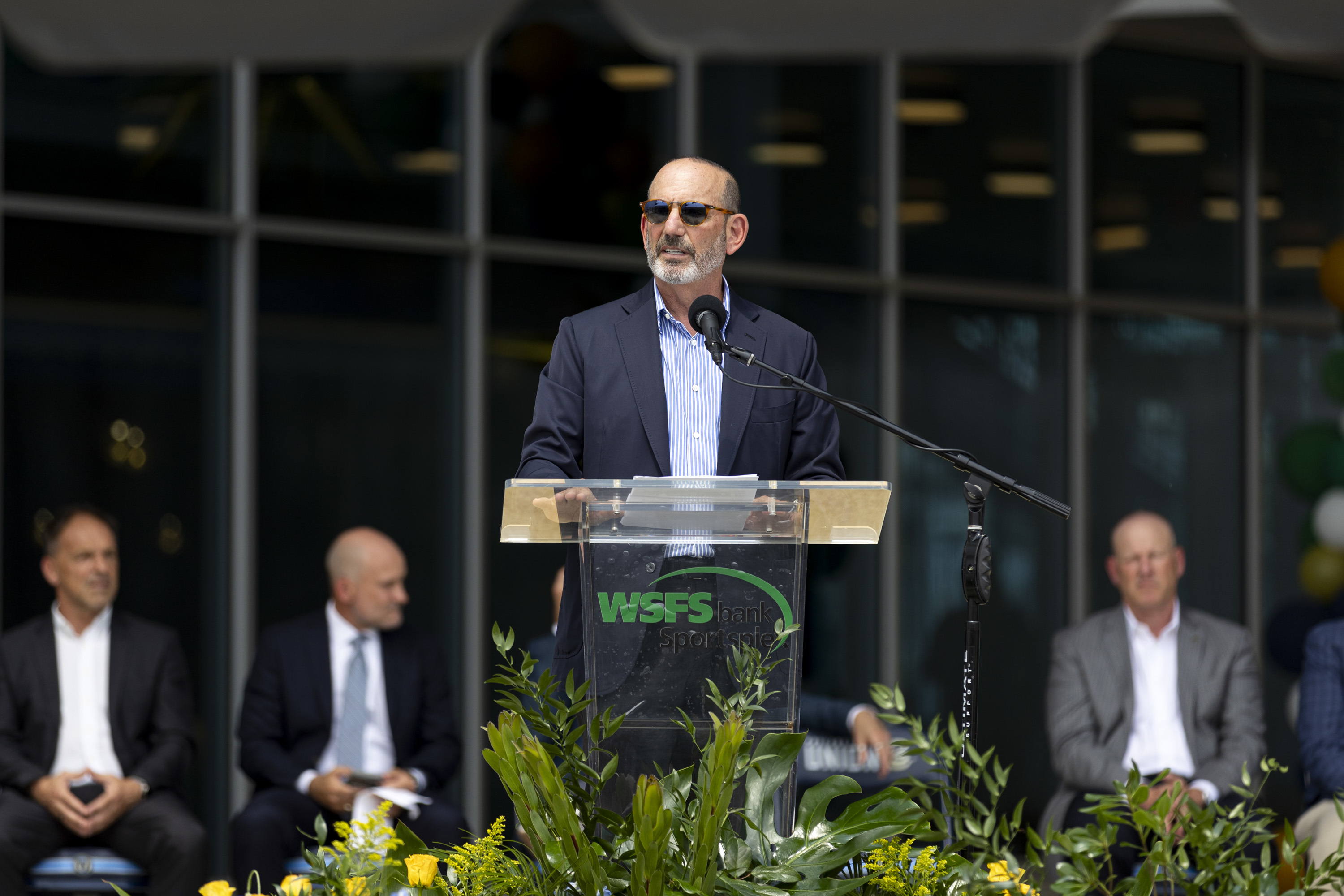
Don Garber, Major League Soccer Commissioner, speaks at the WSFS Bank Sportsplex Ceremony in Chester, Pa., on Thursday, July 17, 2025.
From there, he cracked open the door for a moment.
“So let’s see how it plays out,” Garber said. “Maybe as the development of the lower divisions continues to grow, as they’ve been doing so well over the years, there would be a proper ecosystem. I’m not sure — frankly, I don’t believe that ecosystem consists can exist today. But who knows? I’ve learned, never say never.”
Then, after taking a breath, he slammed the door right back shut.
“That doesn’t mean we’re having promotion or relegation anytime soon,” he said, and went on to the next question.
WASHINGTON — There’s plenty of history of World Cup host teams getting easy groups. But the soccer gods definitely smiled on the U.S. men’s national team at Friday’s draw.
The Americans got Australia out of Pot 2, the second-toughest batch, instead of the stars and skills of Croatia, Morocco, or Colombia. In Pot 3, they got Paraguay, instead of Norway’s all-world striker Erling Haaland and playmaker Martin Ødegaard.
At that point in the glitzy stage show, with President Donald Trump leading the guest list at the Kennedy Center, the U.S. knew it would get a European playoff winner from Pot 4. But even then, they got lucky, landing the bracket of Turkey, Romania, Slovakia, and Kosovo, instead of the one led by Italy.
Then, as the dust settled and the watching world looked at the results, something else became clear. At least two of the three games will be rematches of recent U.S. games, and all three will be if Turkey wins that playoff.
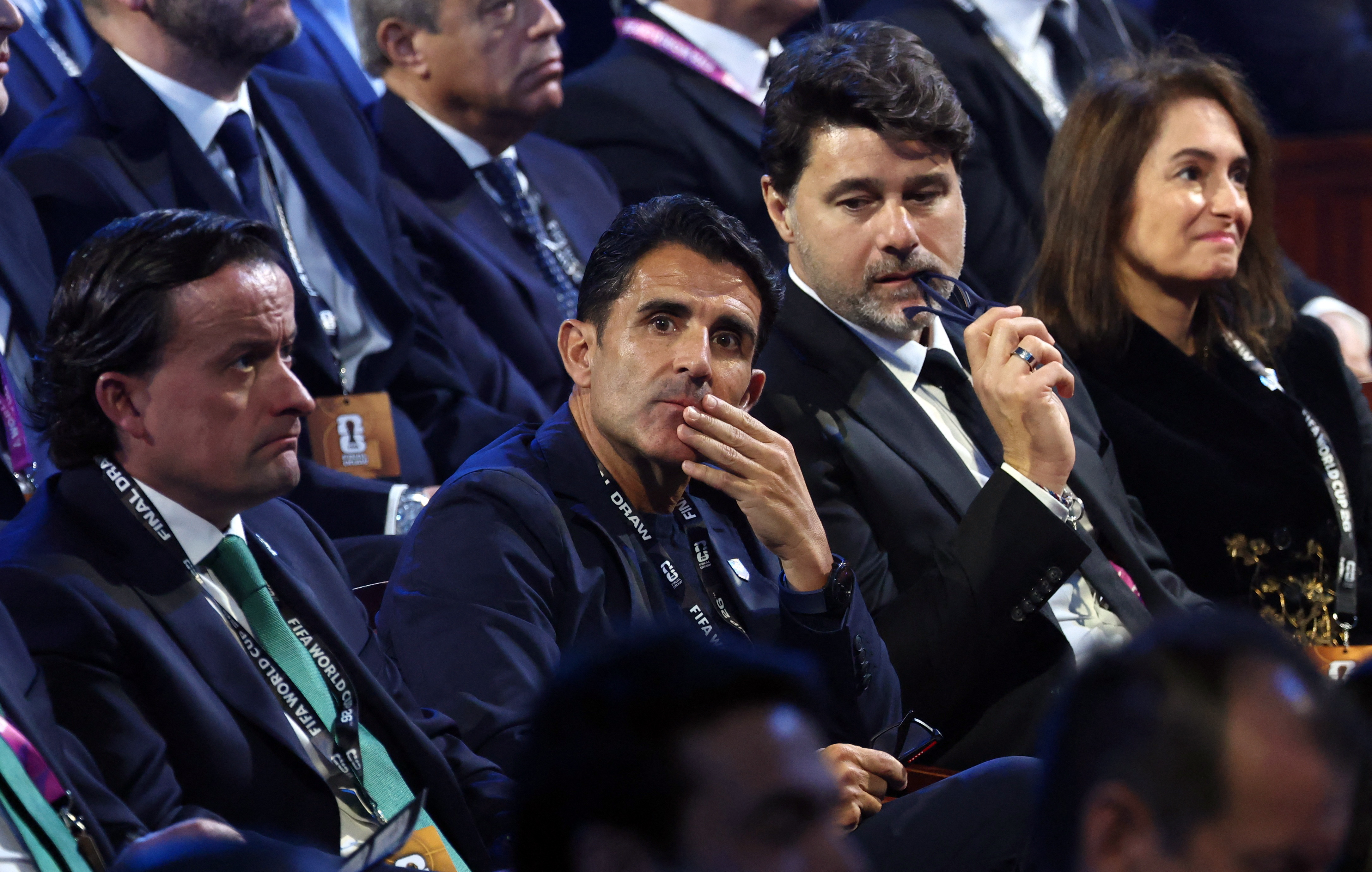
Mauricio Pochettino (second from right) in the audience in the Kennedy Center’s historic Concert Hall.
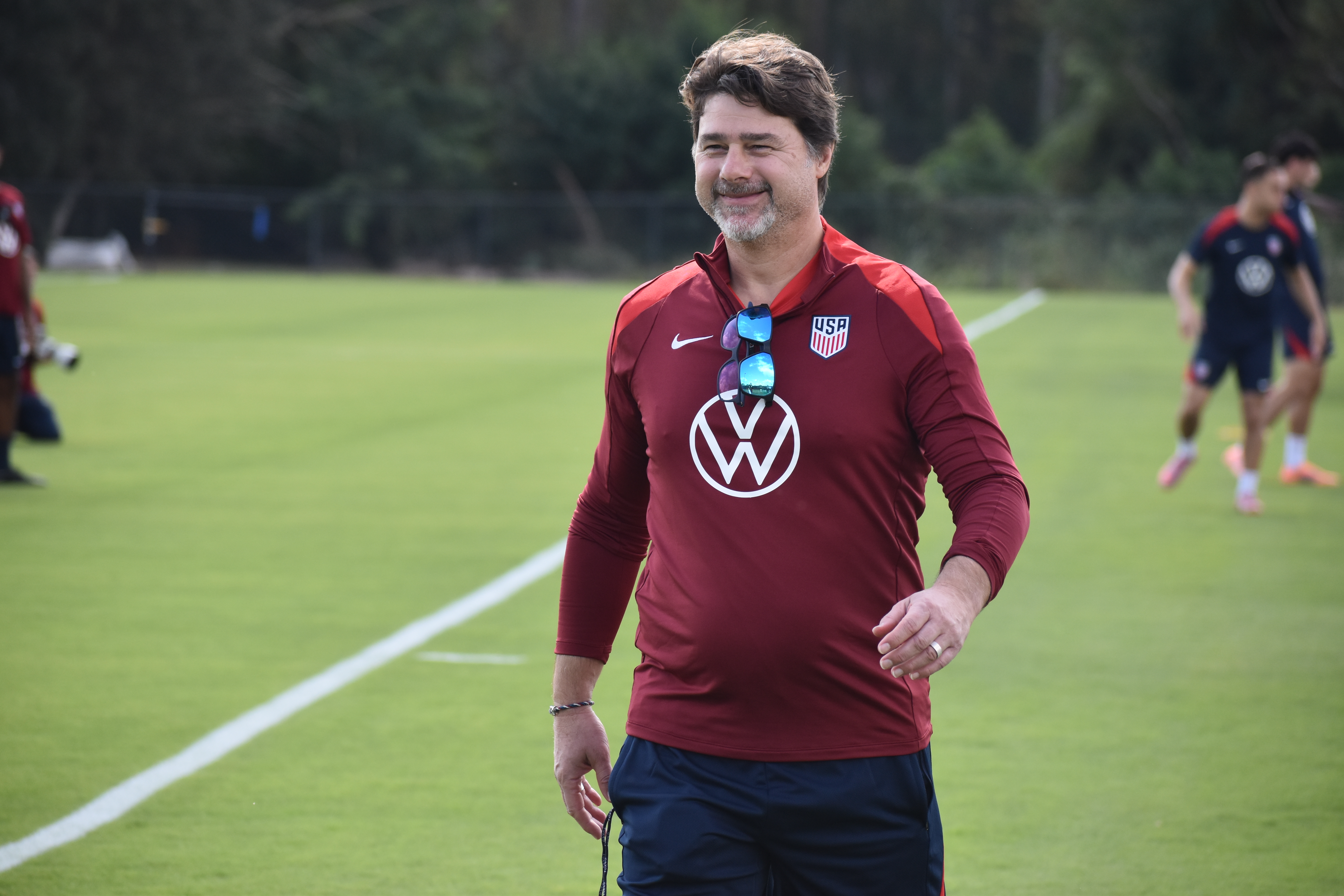
“It means less work,” U.S. manager Mauricio Pochettino said. “We can say we’ve already done the homework because it’s fresh when we played them … It’s still six months. We need to update everything — and we know them, but they know us.”
The Americans’ opening game will be against Paraguay on June 12, the second day of the tournament, in Inglewood, Calif. The teams met last month at Subaru Park in Chester, and the U.S. won, 2-1, with goals from Gio Reyna and Folarin Balogun.
“I know they’re a very difficult, very complex team, one that has found a way to build a solid foundation, a solid base,” Paraguay manager Gustavo Alfaro said. “And that helps us understand the things we need to improve.”
Seven days later, the U.S. will play Australia in Seattle, a game that should produce a thunderous atmosphere in one of America’s elite soccer cities. In October, the U.S. came from behind to beat a physical Socceroos squad, 2-1, with two goals from Haji Wright.
“We know what to expect — a top team, a top coach,” Australia manager Tony Popovic said. “It will be obviously different in a World Cup to a friendly, but that also excites us.”
Then it will be back to the LA area for the group stage finale, on June 25 against the playoff winner.
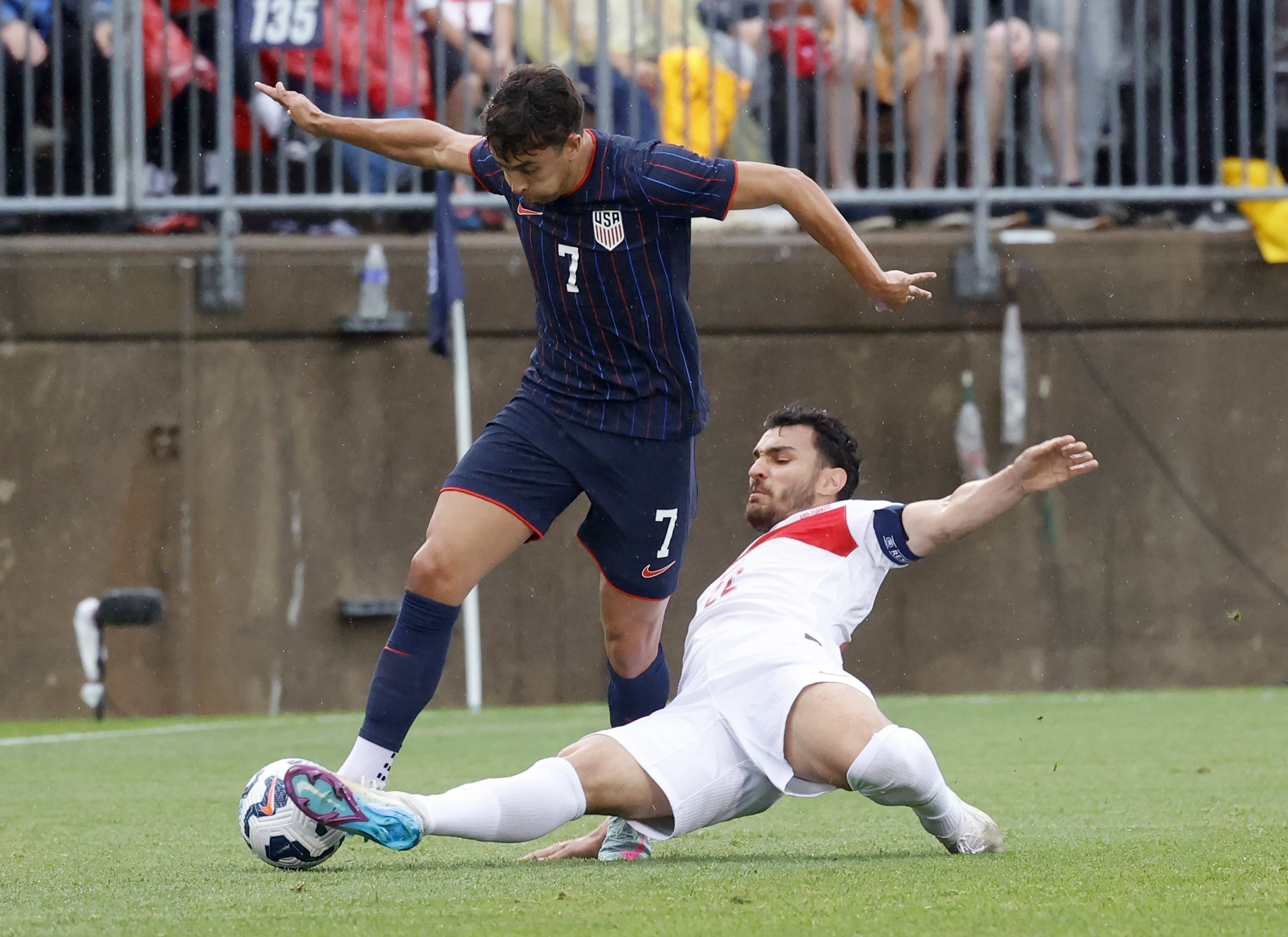
Turkey beat the U.S., 2-1 in June in East Hartford, Conn., but that U.S. squad was missing a lot of its stars — deliberately at that point, by Pochettino’s decision. Turkey’s squad was full-strength, including star playmakers Kenan Yıldız of Italy’s Juventus (where he’s teammates with Weston McKennie) and Arda Güler of Spain’s Real Madrid.
If Romania pulls off the upset in the playoff, memories will come back of the teams’ 1994 World Cup matchup at the Rose Bowl. Romania’s 1-0 win that day was the last of the teams’ four all-time meetings, with the first in 1991 the only U.S. win.
The Union’s Quinn Sullivan (left) made his senior U.S. debut in June’s game againt Turkey.
The U.S. has only played Slovakia once, a 1-0 Slovakia win in that country’s capital, Bratislava. The U.S. and Kosovo have never played.
The European playoffs are in March. Turkey hosts Romania, and Slovakia hosts Kosovo, and the latter game’s winner hosts the finale.
Pochettino wants his team to believe it can win the World Cup. His favorite slogan lately has been “Be realistic and do the impossible.”
It’s his job to present that message, even if “realistic” for everyone else is something else. That bears saying loudly because fans who only watch the U.S. men during World Cups might take Pochettino at his word.
Mauricio Pochettino at a U.S. team practice last month.
For them, and for the team’s devotees too, Tyler Adams’ words are worth heeding.
“Everyone’s going to want us to say winning it is obviously the goal,” the veteran U.S. midfielder and locker room leader said. “Our idea is to win — that’s the goal. But I think setting the benchmark of the furthest the U.S. team has gone is also realistic. So we want to go and make a run, but again, it’s a game by game mentality.”
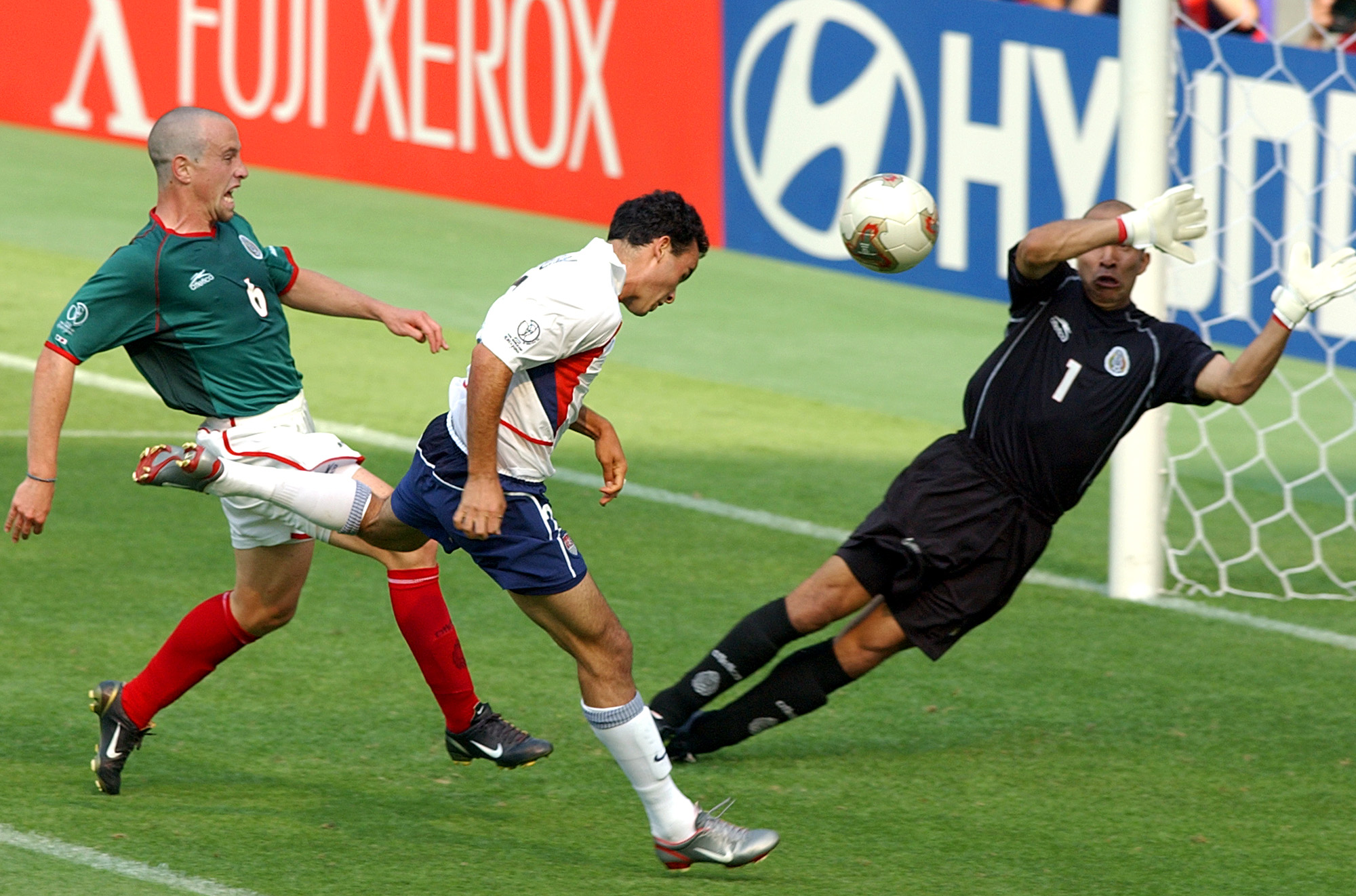
The farthest the U.S. men have gone at a World Cup was nearly a century ago at the first edition, in 1930, when they finished third in a 12-team field. They have advanced from their group in five of the eight World Cups they have gone to in their modern era, which started in 1990; and their only ever knockout game win was in 2002, against next-door-neighbor Mexico half a world away in South Korea.
Reaching the semifinals this time would require three knockout-round wins: in the round of 32 in the first 48-team World Cup, the round of 16, and the quarterfinals. The conventional wisdom outside the program is, and likely will remain, that success will be reaching the quarterfinals.
The U.S. men haven’t won a World Cup knockout game since Landon Donovan (center) scored to help beat Mexico in the 2002 World Cup’s round of 16.
“We have to focus on ourselves — we have to worry about how we are and who we are and what we are and the connections and the aggressiveness and the intensity and the focus,” said centerback Tim Ream, Pochettino’s captain as the squad’s most experienced player. “At some point, you’re going to have to play the best some of the best teams. So do you play them in the group stage? Do you play with the knockouts? It doesn’t really matter, right?”
What’s certain is that no matter the opponents, the games matter more now, starting with March friendlies against Portugal and Belgium. Then the U.S. will play its send-off games amid training camp against Germany and a team to be announced.
As the nation starts to tune in, it will be up to Pochettino and his players to turn that pressure into a force that strengthens them, and potentially powers a history-making run on home soil.
“I think it’s good pressure,” Pochettino said. “The expectation is good, because it puts good stress in your body.”
It will only build up over the coming months.
U.S. men’s soccer team 2026 World Cup group schedule
June 12: vs. Paraguay in Inglewood, Calif.
June 19: vs. Australia in Seattle
June 25: vs. UEFA playoff winner in Inglewood, Calif.
window.addEventListener(“message”,function(a){if(void 0!==a.data[“datawrapper-height”]){var e=document.querySelectorAll(“iframe”);for(var t in a.data[“datawrapper-height”])for(var r,i=0;r=e[i];i++)if(r.contentWindow===a.source){var d=a.data[“datawrapper-height”][t]+”px”;r.style.height=d}}});
President Donald Trump smiles after drawing USA’s name Friday.
The U.S. men’s soccer team will open its 2026 World Cup group stage run against Paraguay on June 12 in Inglewood, Calif.
That will mean a meeting right out of the gate with a team the Americans just beat last month, 2-1, at Subaru Park in Chester.
The game will be played on the second day of the tournament, with co-host Mexico playing the opener against South Africa on June 11 at Mexico City’s fabled Estadio Azteca.
The Americans’ second group game will be against Australia in Seattle on June 19. That will also be a rematch of a recent game, a 2-1 U.S. win in suburban Denver in October.
Their group stage finale will be back in suburban Los Angeles against the winner of a four-team qualifying playoff between Turkey, Romania, Slovakia, and Kosovo. The playoff will take place in March.
Turkey will be favored on paper. If that’s the matchup, it would be another rematch, this one a 2-1 U.S. loss this past June, with an understrength American squad on the field.
Here’s the U.S. men’s soccer team 2026 World Cup group schedule:
June 12: vs. Paraguay in Inglewood, Calif.
June 19: vs. Australia in Seattle
June 25: vs. UEFA playoff winner in Inglewood, Calif.
The opening game for the U.S. is on June 12 in Los Angeles against Paraguay. Games to be played in Philadelphia will involve teams from groups C, E, I, and L.
window.addEventListener(“message”,function(a){if(void 0!==a.data[“datawrapper-height”]){var e=document.querySelectorAll(“iframe”);for(var t in a.data[“datawrapper-height”])for(var r,i=0;r=e[i];i++)if(r.contentWindow===a.source){var d=a.data[“datawrapper-height”][t]+”px”;r.style.height=d}}});
As the first 24 teams were named in Friday’s World Cup draw, a few surprises and early looks at who could be coming to Philly next summer.
For Philly, Brazil and Morocco were drawn in Group C with those two opening against each other. In Group E, Germany and Ecuador are the early entrants, France and Senegal are in Group I and England-Croatia in Group L.
The eye openers are a rematch between Mexico and South Africa, the opening match 2010 FIFA World Cup. Also, Spain will open its campaign in group H against Uruguay, and an England-Croatia rematch from the 2018 World Cup semifinal.
The USA opener is vs. Paraguay June 12 in Inglewood, Calif. The teams just met at Subaru Park last month, a 2-1 U.S. victory.
Mexico-South Africa will be the tournament’s opening game in Mexico City’s famed Estadio Azteca – 16 years after the nations met in the 2010 opener in South Africa.
Here are the nations that could be headed to Philly
Philly will host six World Cup games at Lincoln Financial Field.
Philly now knows the potential games headed here next summer as the potential nations in Groups C, E, I and L.
They are:
Group C: Brazil, Morocco Haiti, Scotland
Group E: Germany, Curacao, Ivory Coast, Ecuador
Group I: France, Senegal, FIFA Playoff No. 2, Norway
Group L: England, Croatia, Ghana, Panama
The final nation is Group I will be determined by a FIFA Playoff qualifier between Iraq, Bolivia and Suriname in March.
Kevin Hart, who ended the event on stage with Heidi Klum, Rio Ferdinand and other celebrities, said, “I know my guys back in Philadelphia are happy who could be coming to Philly next summer.”
He’d be correct.
The specific games will be set Saturday. Here’s a rundown of the World Cup games that will be played at the Linc:
Host countries draw first, but we already knew the results
President Donald Trump, Mexican President Claudia Sheinbaum, and Canadian Prime Minister Mark Carney holds their countries’ name during the draw.
As co-hosts, the U.S., Mexico, and Canada were pre-set into the group places they were drawn into among the 48 slots. The U.S. is D1, Mexico is A1, and Canada is C1.
We also already knew the dates and locations of those teams’ group games, though we don’t know the opponents yet.
The U.S. will play on June 12 in Inglewood, Calif., June 19 in Seattle, and June 25 back in Inglewood. Mexico will play on June 11, the tournament’s opening day, at Mexico City’s legendary Estadio Azteca – the site of the 1970 and 1986 finals — then in Guadalajara on June 18 and June 24 back in Mexico City. Canada will play June 12 in Toronto, then June 18 and 24 in in Vancouver.
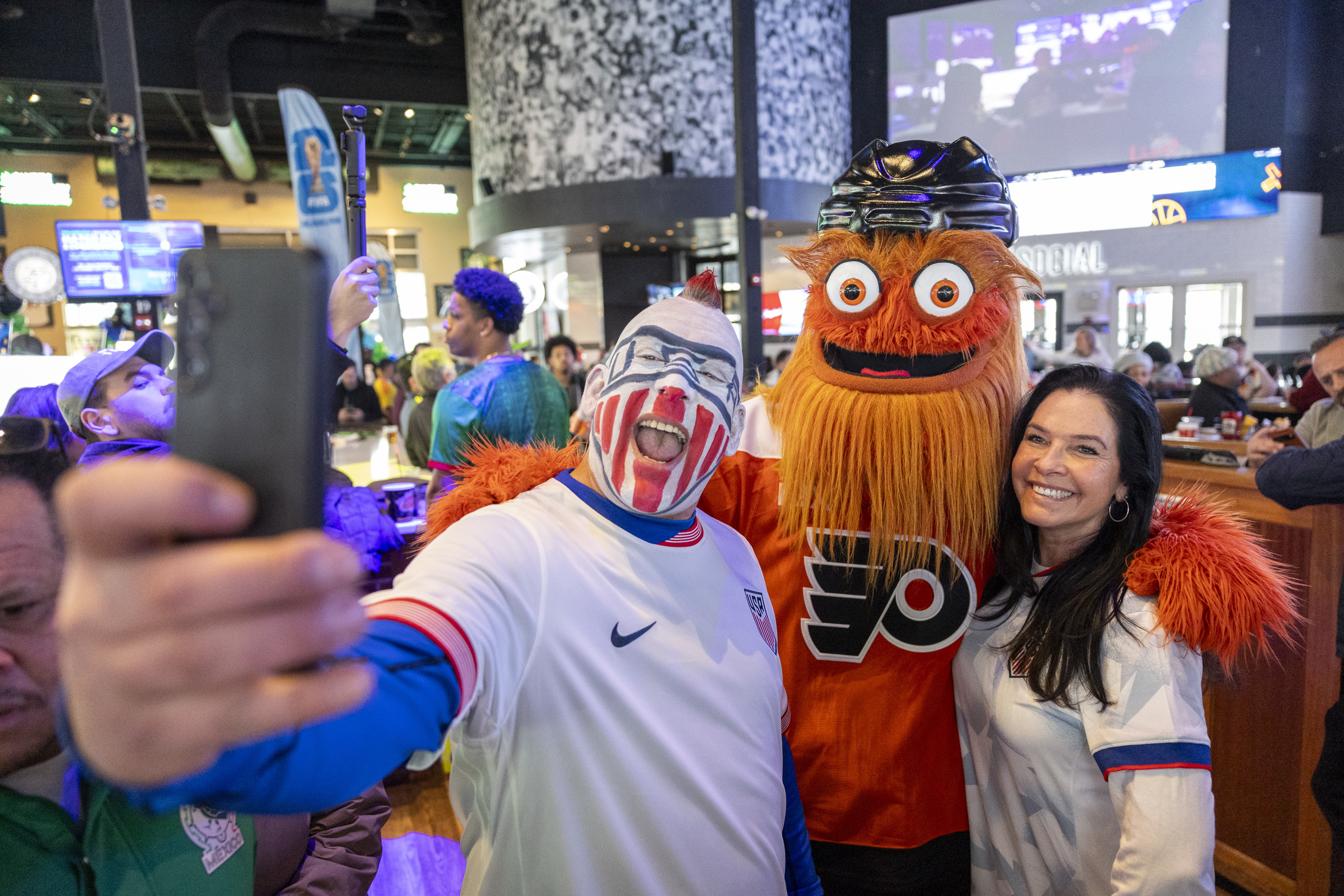
The Philly Sports Guy Jamie Pagliei, takes a selfie with Gritty at the FIFA World Cup drawing at Stateside Live! Friday.
Almost three hours from the John F. Kennedy Center for the Performing Arts, where the World Cup draw is hosted, Philadelphia sports fans gathered together as they waited in anticipation to learn the fates of their favorite teams — including Union season ticket holders Donna and Gary Brown.
“I’ve only been able to see the World Cup one other time and that was when we lived in Orlando and it was amazing,” Gary said. “But again, it’s our hometown now and our hometown team, so it just makes it even more special that it’s going to be here. It’s Philadelphia, it’s the workplace of our country, national team. … And it’s our country’s 250th birthday.”
If it feels to you that the draw is, to put it one way, drawn out… you aren’t alone. But it’s nothing new. World Cup draws have been spectacles for decades.
It was true the first time the United States hosted a men’s World Cup, the 1994 edition, and it remains true now. You don’t have to like it, and rest assured plenty of people with in the soccer world don’t. But it is what it is, and it won’t change any time soon.
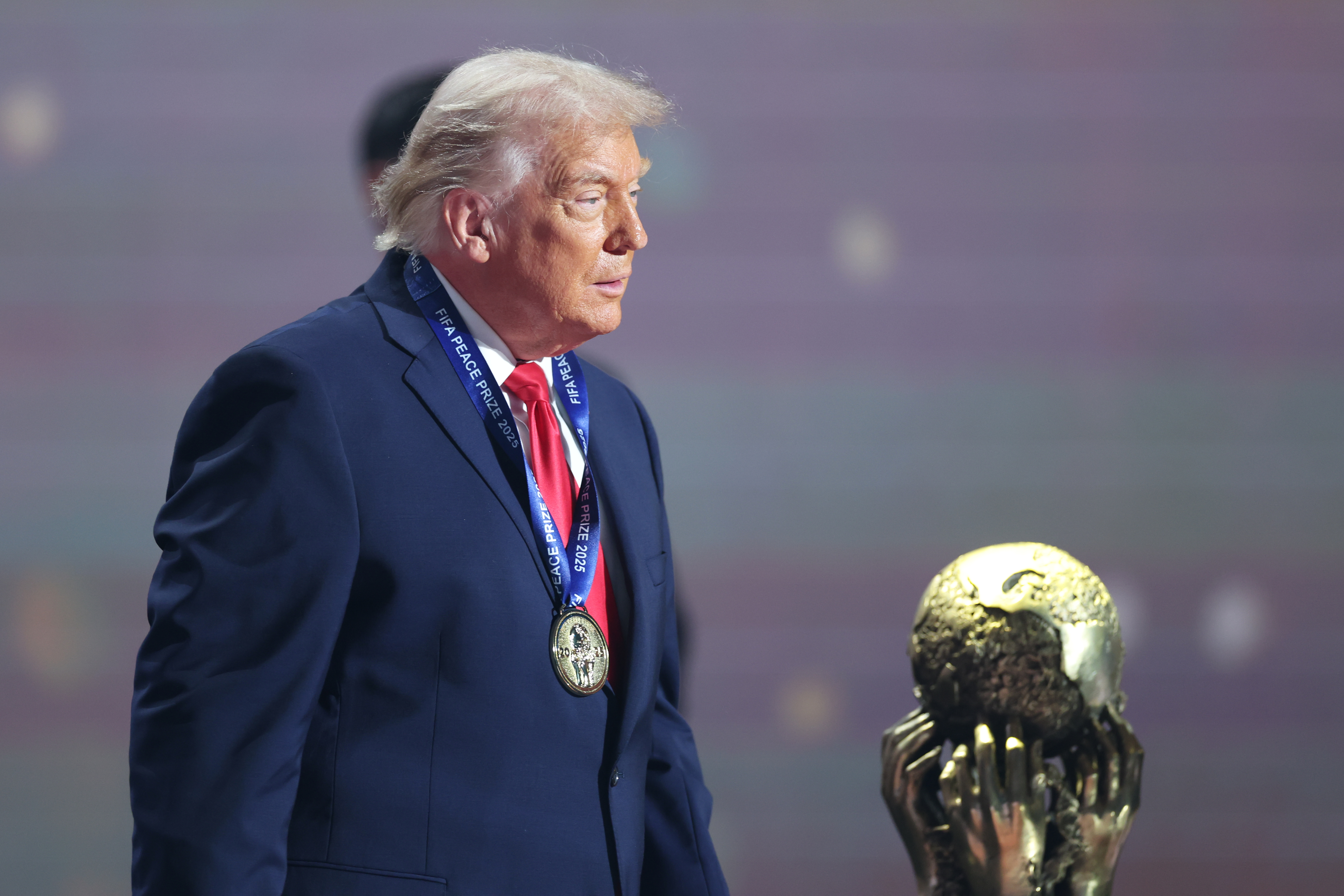
President Donald Trump is awarded the first-ever FIFA Peace Prize ahead of Friday’s World Cup draw.
President Donald Trump was awarded the first-ever FIFA Peace Prize ahead of the 2026 World Cup draw Friday.
“This is truly one of the great honors of my life,” Trump said during a brief speech.
FIFA said the award would be given to individuals who, through their unwavering commitment and their special actions, have helped to unite people all over the world.
Trump called the award “one of the great honors of his life,” as he went on to tout that peace accords he’s helped brokered in the Middle East, Africa and between Israel and Hamas has “saved millions and millions of lives.”
He then described his excitement for the World Cup coming to the United States, saying tickets — which are approaching 2 million sold, according to FIFA — were selling in record numbers, though there wasn’t data readily available to confirm that claim. Trump then quickly caught himself during his talk about tickets, stating that: “not to bring that up, because don’t want to bring a thing like that up, right now.”
World Cup tickets, and their exorbitant prices due to dynamic pricing models, have been major topics of discussion as well, given the confusing method for entering presales via lotteries.
FIFA has one more presale in which the lottery to enter is scheduled to open after Friday’s draw, before opening remaining tickets to the public early next year.
The announcement came about a month after Trump failed to receive the Nobel Peace Prize, which he claimed he deserved. It was announced by FIFA president Gianni Infantino, whom has developed a close relationship with Trump ahead of the World Cup.
“The FIFA Peace Prize is awarded annually,” Infantino said of the award, which was being given for the first time.
Governor Josh Shapiro attending the FIFA Philly draw at Stateside Live! in Philadelphia Friday.
Friday morning at Stateside Live! felt like a fever dream for Philadelphia sports fans as Pennsylvania Gov. Josh Shapiro stood above guests on the second floor surrounded by Phang, Gritty, Swoop, and the Phanatic as they prepared for the Philadelphia Soccer 2026 World Cup draw watch party.
“We won this bid to host the FIFA World Cup next year because we’ve got the greatest fans on the face of the earth,” Shapiro said.
“The eyes of the world are going to be on Philly next year when we celebrate USA 250,” Shapiro added. “FIFA World Cup is gonna be great. And let’s pray for a USA-Mexico matchup on July 4th right here in the Philly.”
Unfortunately for Shapiro, the odds of that happening are slim to none.
Josh Shapiro at the Philadelphia Soccer 2026 World Cup final draw watch party pic.twitter.com/xn7c7ImeCq
Inside the Kennedy Center, elected officials mix with former players
Spectators gather for the 2026 World Cup draw inside the Kennedy Center in Washington, D.C.
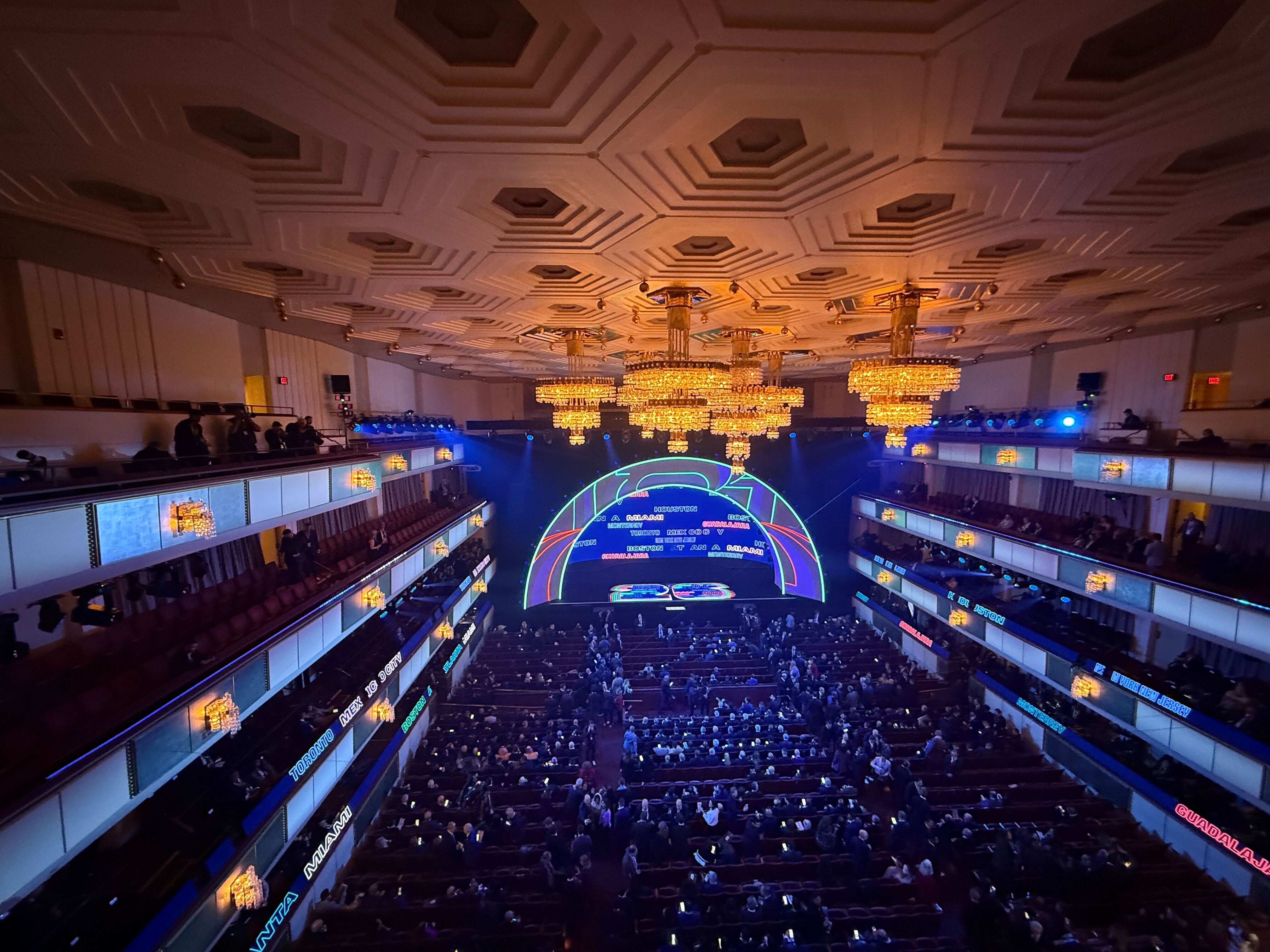
Hello from inside the Kennedy Center’s Concert Hall, a legendary space in the most-famous performing arts venue in America’s capital city. Just 15 of the over 900 credentialed media have seats in the hall for the World Cup draw, and I’m lucky to be one of them.
I must admit it’s a bit of a surreal feeling for me. I grew up in D.C. (sorry to anyone who thought I was a Philly native), and attended lots of concerts and musicals in this very space. To see it converted for a World Cup draw is a strange sight — and all the stranger by the inevitable politics surrounding this day.
While walking over from the media work area, I saw a lot of familiar faces: New Jersey Gov. Phil Murphy, U.S. Soccer Federation president Cindy Cone, sporting director Matt Crocker, former president Sunil Gulati, and MLS commissioner Don Garber.
Murphy is here on behalf of the New York/New Jersey local hosting committee, and there’s a slew of former U.S. players here either in the official delegation or as media. At a quick glance around, I saw Delran’s Carli Lloyd, Heather O’Reilly, Julie Ertz, Cobi Jones, Marcelo Balboa, and former Union centerback Oguchi Oneywu — now in the official world as U.S. Soccer’s deputy sporting director.
Plus, of course, famous soccer figures from all over the world, who were inevitably stopped all over for autographs. And in the hall, there was a brief moment of applause — though only scattered — when President Donald Trump walked in.
Trump, other dignitaries arrive for World Cup draw
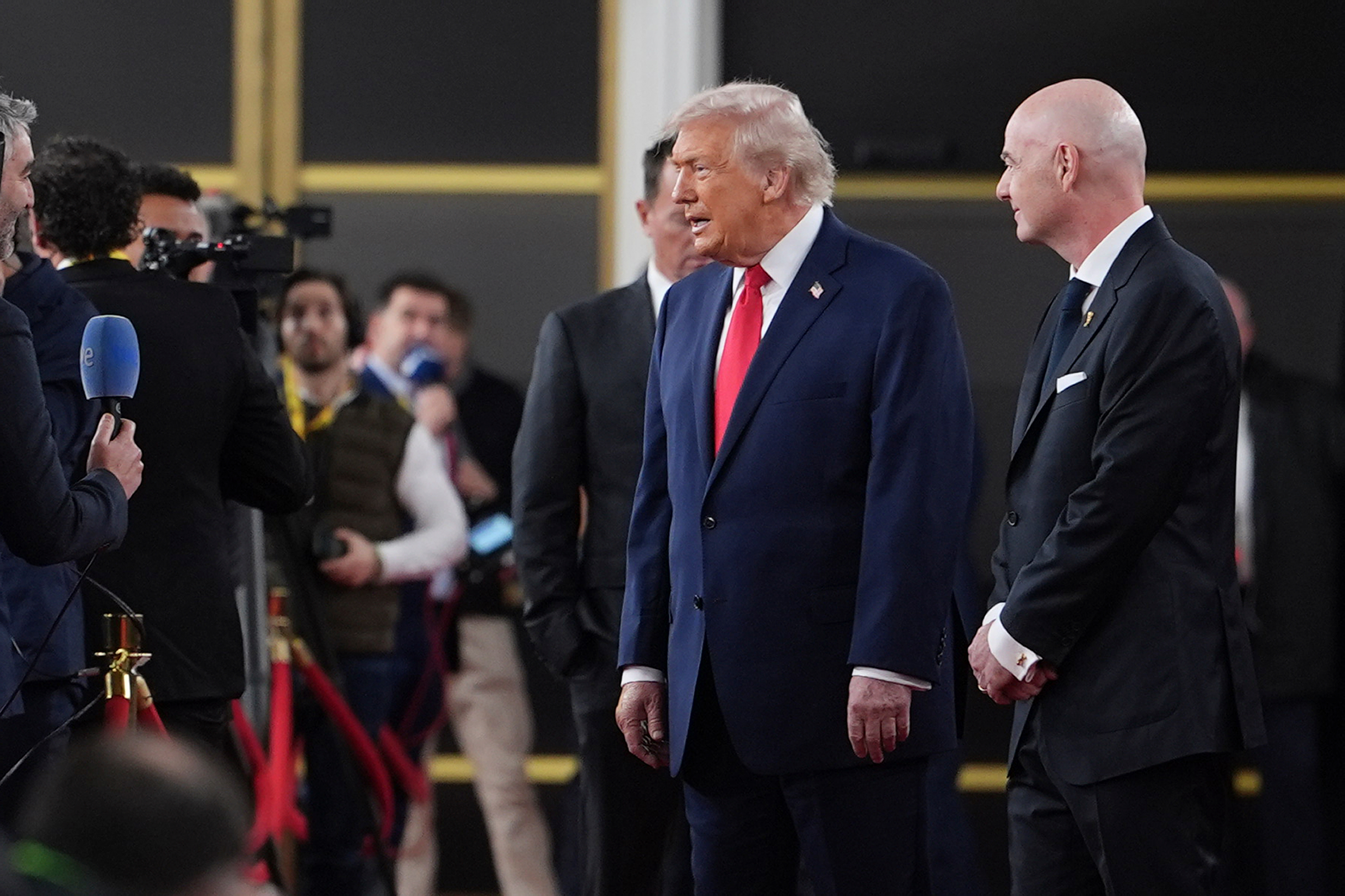
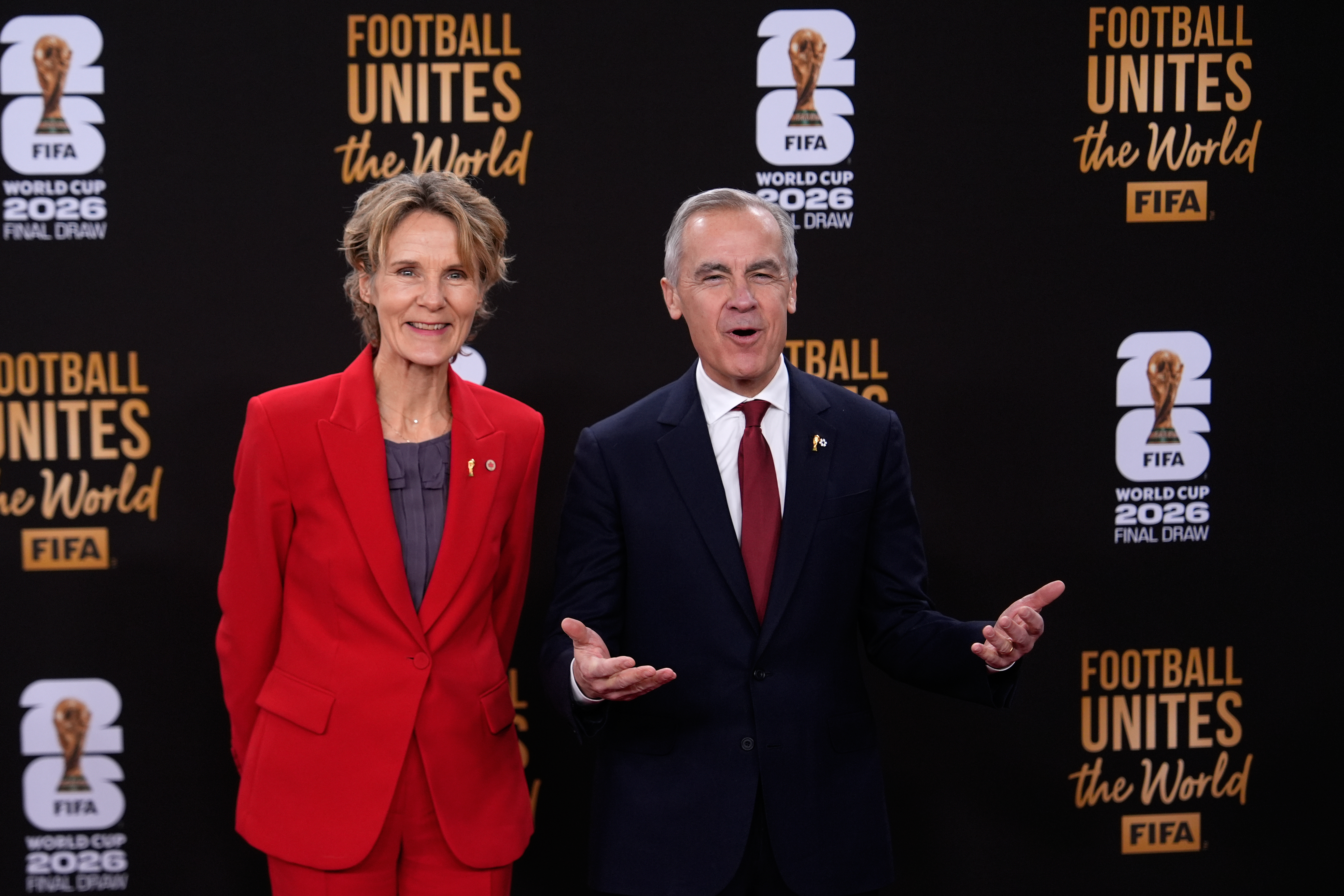
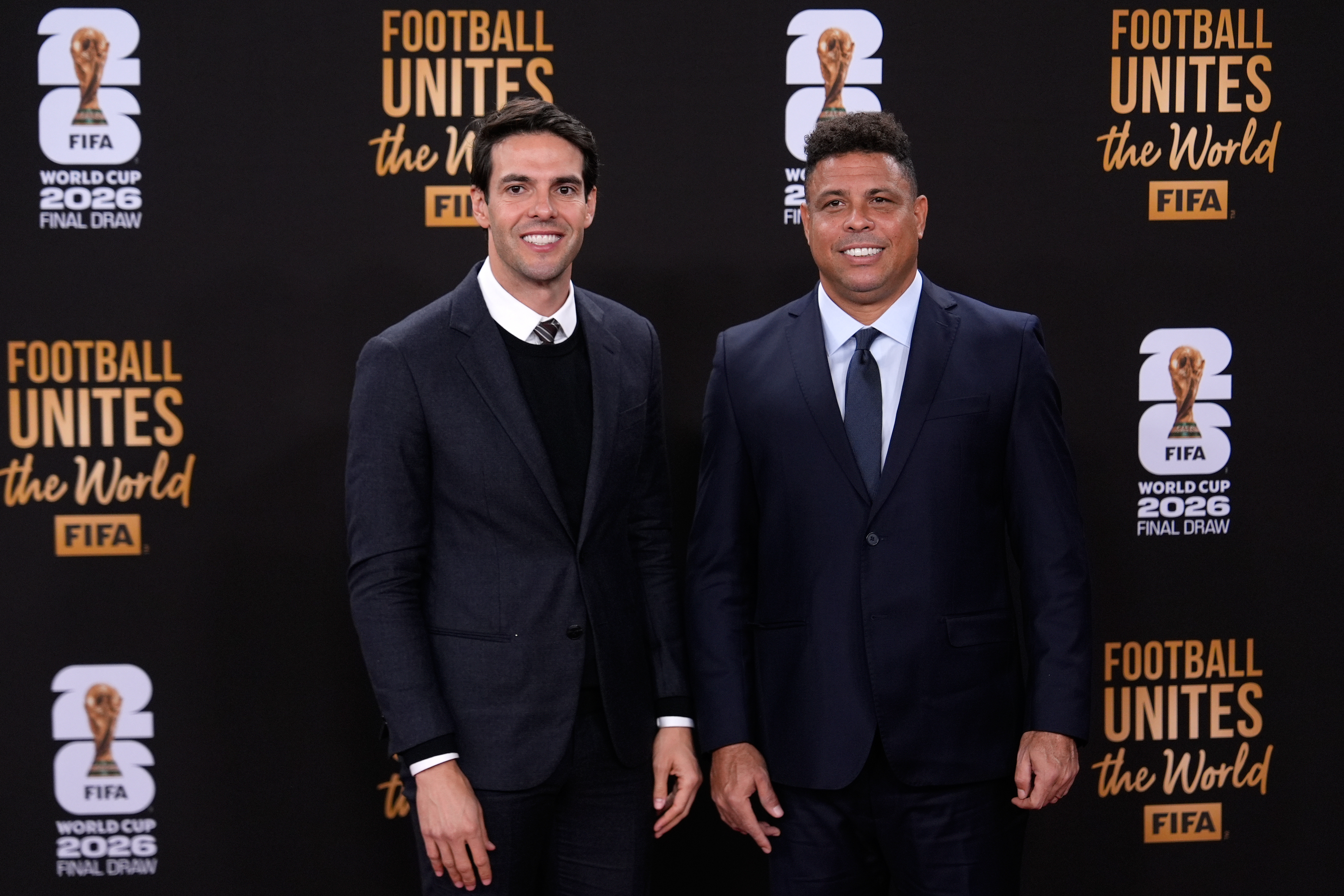
President Donald Trump and FIFA President Gianni Infantino arrive at the Kennedy Center. Canadian Prime Minister Mark Carney and wife Diana. Former Brazil players Kaka (left) and Ronaldo.
// Timestamp 12/05/25 10:55am
Trump still ‘talking to FIFA’ about moving World Cup cities, White House official says
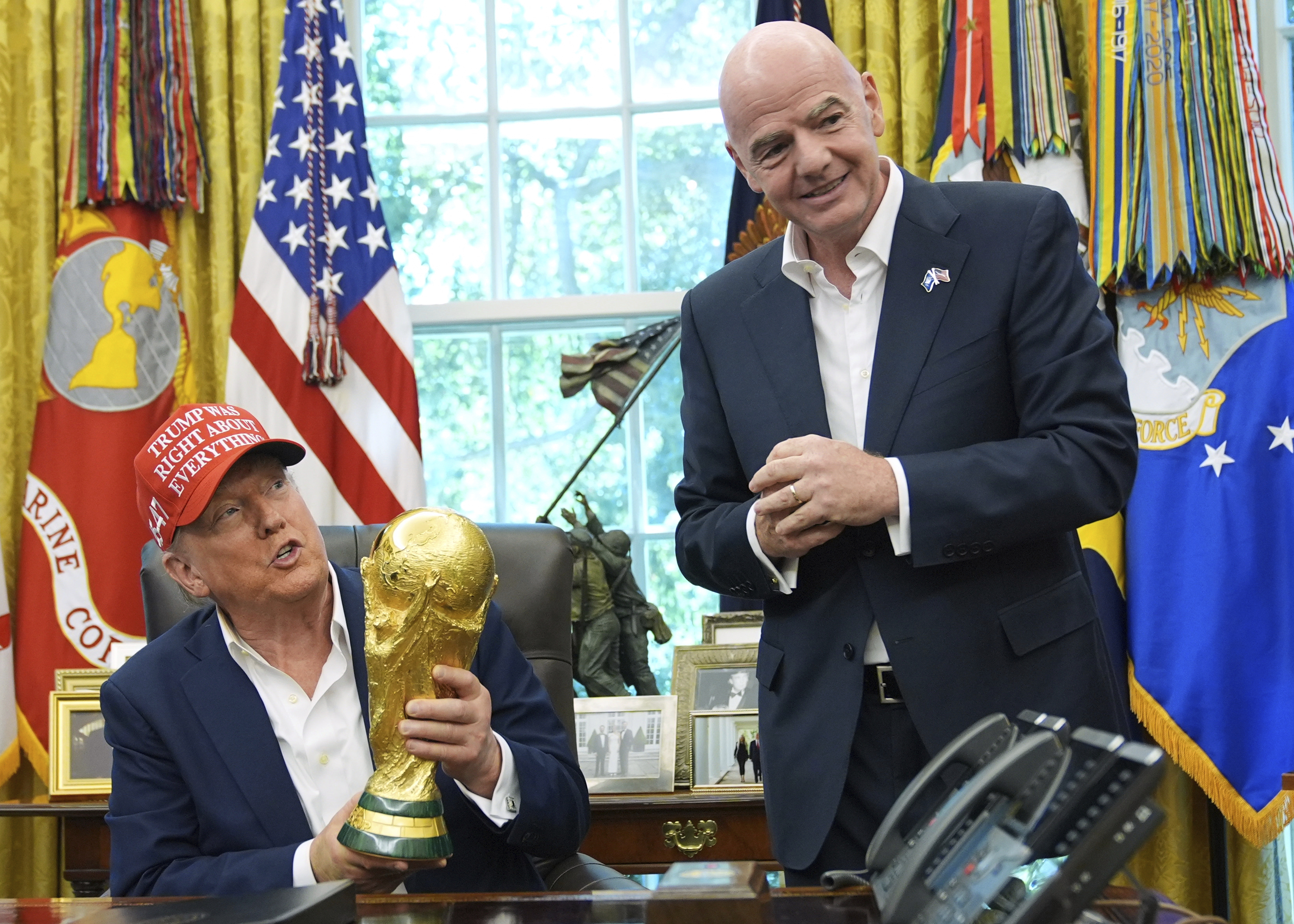
President Donald Trump holds the World Cup trophy alongside FIFA President Gianni Infantino.
President Donald Trump, who will attend Friday’s World Cup draw, continues to speak with FIFA about moving games out of cities controlled by Democrats, a White House official said on Fox News Friday.
“President Trump is very concerned about some of these blue cities’ high crime rates, and he’s talking to FIFA,” said Monica Crowley, White House chief of protocol, adding “no decisions have been made.”
“If any city we think is going to be even a little bit dangerous for the World Cup, or for the Olympics, but for the World Cup in particular, because they’re playing in so many cities, we won’t allow it to go,” Trump said. “We’ll move it around a little bit. But I hope that’s not going to happen.”
It would ultimately be FIFA’s decision to move games, a logistical challenge considering planning for the 2026 World Cup has been going on for years. FIFA president Gianni Infantino hasn’t indicated any potential moves, but has suggested he would consider shifting games from host cities if Trump made demands.
“I don’t think you can have this problem, but we’re going to move the event to someplace where it’s going to be appreciated and safe,” Infantino said in the White House last month when put on the spot by Trump.
We won’t know who’s playing in Philly until tomorrow. Here’s why.
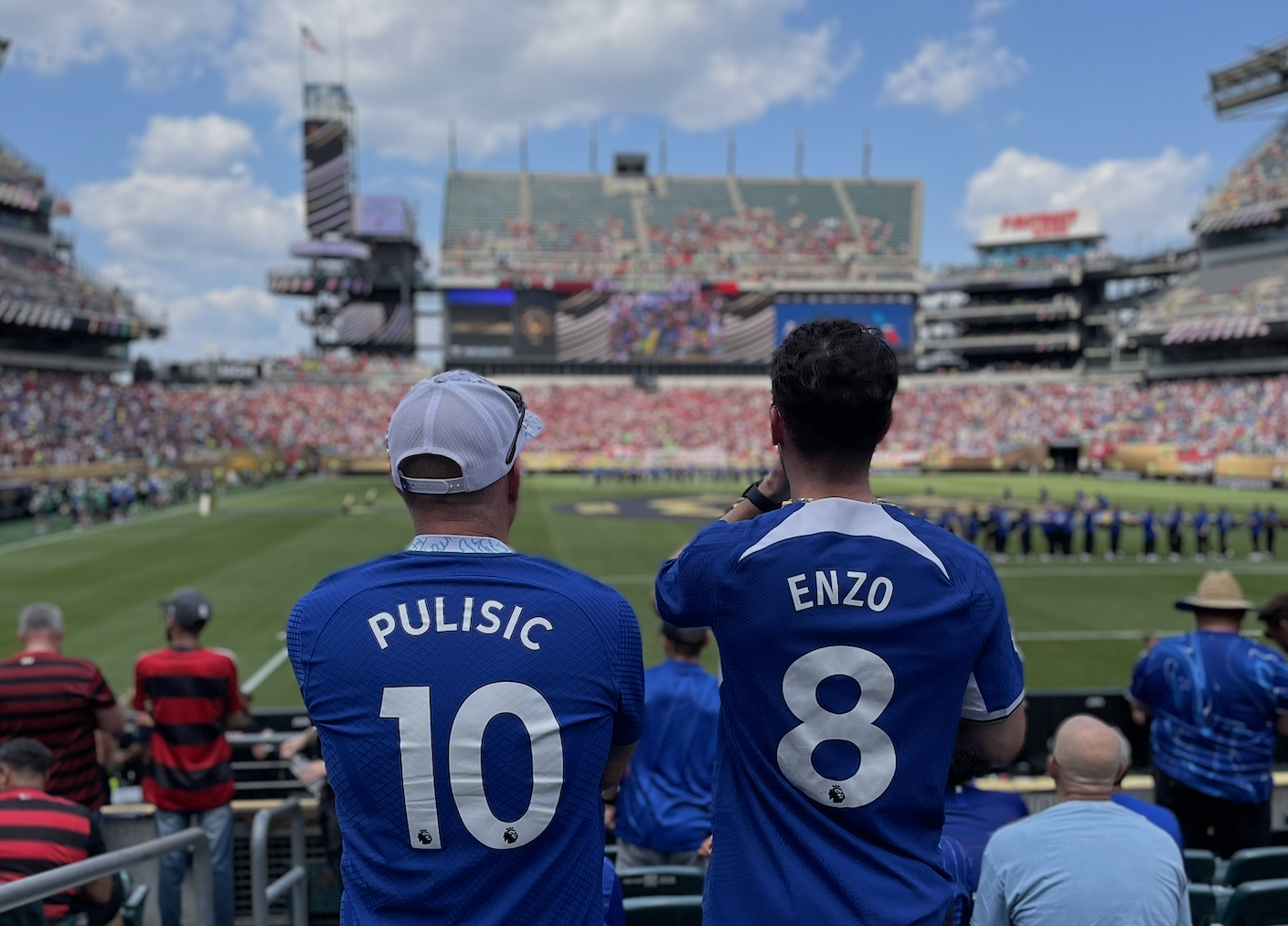
Chelsea and Flamengo fans during a FIFA Club World Cup match at the Linc in June.
FIFA’s decision to extend its draw over two days always felt by design.
On Friday, ahead of the World Cup draw that begins at noon, an official said that doing so was nothing more than trying to make the draw “into an event.”
Historically, FIFA would announce the venue pairings before the draw, so you’d know where teams would be after they fell into group pairings. For example, the nation slotted into Group A1 would play A4 making it easy to know where those nations would be playing even during the draw.
Friday’s presentation will only place nations into groups, with Saturday at noon the reveal of where those host nations will be.
“It’s to allow for greater discussion to take place on the exact locations,” said Brian Swanson, FIFA’s director of media relations. “In some parts of the world [where we’ve hosted previous World Cup draws], kickoff times are the big story in other parts [like the U.S.], we’re just looking to generate a bit of buzz.
“Historically, we just published a PDF of that information, but it’s 2025, so we thought let’s make it into something more fun.”
There are some who beg to differ.
“I mean let’s just get it over with,” a FIFA volunteer who overheard the conversation said. “Like I get why their doing this but the suspense, to me, isn’t necessary. Also, I’m Tunisian, I don’t want to wait a day to see who we play.”
A trash can overflows with discarded items not allowed into Friday’s World Cup draw.
With heads of state from all three host nations scheduled to take in today’s FIFA World Cup draw, U.S. Secret Service is taking no chances with what is being allowed inside the Kennedy Center.
But what’s making its way into the trash cans outside is pretty hilarious. From Yeti coffee canisters valued at $30 on up to vape pens and cartridges, all had to get tossed before entering. One FIFA official joked to the Inquirer that he’d planned to collect it all and start a resale store.
Upsetting at least the media on hand is that at a briefing yesterday, FIFA relayed that bringing in canisters for water and coffee would be an approved item.
Sike.
But what’s even more confusing are the workers, guests and media from around the world who thought they’d be able to enter today’s event with pocket knives, pointers and even a Phillips head screwdriver, as observed outside one of the trash cans.
The draw kicks off at noon, but the early festivities have been the Secret Service members turned TSA, navigating what guests and media are trying to bring inside.
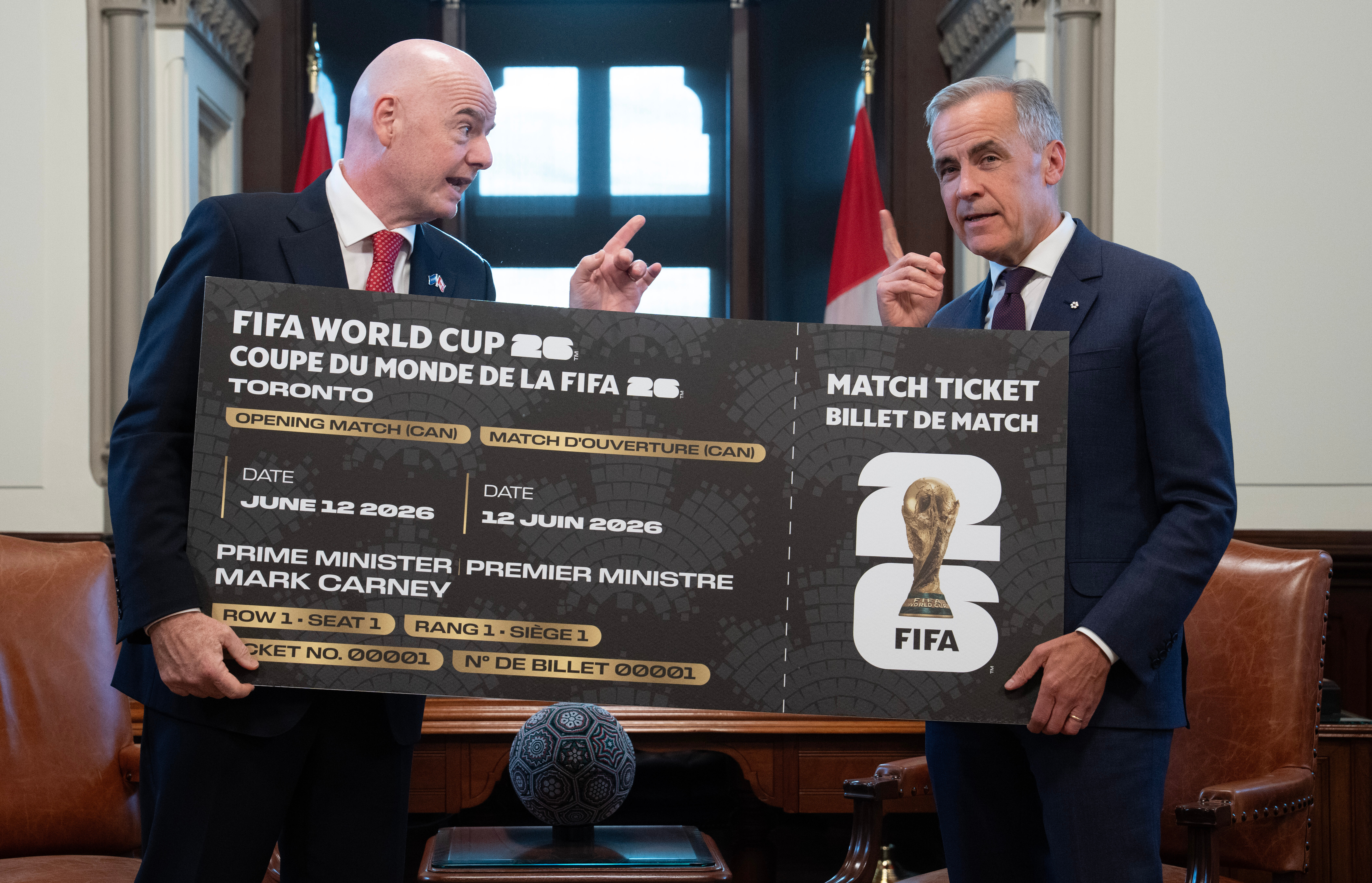
Canada Prime Minister Mark Carney (right) holds a novelty World Cup ticket alongside FIFA President Gianni Infantino.
Yes. Fans interested in buying tickets for World Cup matches at Lincoln Financial Field can enter ticket lotteries for individual group-stage games via FIFA’s random selection draw.
The lotteries will begin accepting entries on Dec. 11 at 11 a.m. and close at the same time on Jan. 13.
After the random selection draw phase of ticket sales has finished, any remaining inventory will be released on a first-come, first-served basis closer to the beginning of the tournament. Single-match and multimatch hospitality packages are also available through FIFA.
FIFA’s first-come, first-served phase will be the last opportunity for fans to buy tickets directly through FIFA. After that, tickets will be available only through resale on the secondary market.
— Owen Hewitt
// Timestamp 12/05/25 8:26am
Tight security as Trump, other dignitaries expected to attend today’s World Cup draw
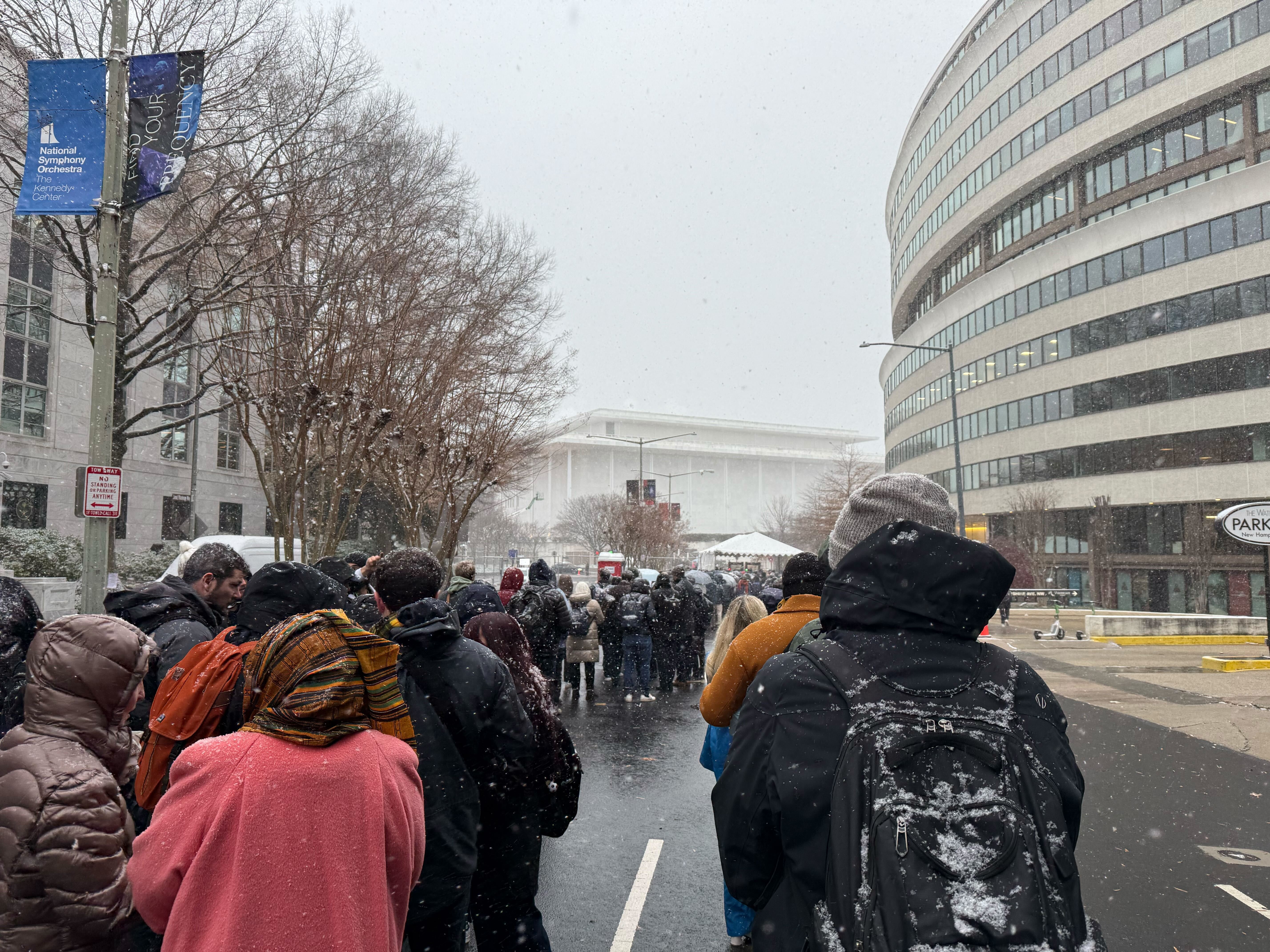
Snow falls in Washington, D.C. ahead of the 2026 World Cup Draw.
It was snowing as the sun rose over the nation’s capital Friday, a rare sight in December. The rest of the scene around the Kennedy Center was one this town is used to: rows of giant black SUVs for dignitaries, and fences lining many blocks of sidewalks.
I got to the security checkpoint just after 8 a.m., and there were already long lines to get in and many nearby streets were closed.
The checkpoint, by the way, was up the street near the Watergate hotel — made famous by former President Richard Nixon’s scandal in the 1970s. There have been plenty of jokes about that this week among the international media who’ve come to town.
But the security operation is no joke. It’s always been the way things work when the president — whoever the president is — wants to show up at a big sports event in D.C.
Even with that, a World Cup draw is different from other spectacles.
Today, the Kennedy Center will host dignitaries from the 42 national teams qualified for the World Cup so far, plus some from teams in the final qualifying playoffs; over 900 credentialed media members, spread across the Center’s many halls; and the tournament cohosts’ heads of state — U.S. President Donald Trump, Mexican President Claudia Sheinbaum, and Canadian Prime Minister Mark Carney.
It will be tight and tense inside, and some FIFA officials will no doubt wonder if they should have stood firm on having the draw in Las Vegas, where they wanted to have it until Trump said otherwise.
The World Cup draw, which will determine the groups for the round-robin stage of the tournament, will take place today at noon.
The event will be hosted by the Kennedy Center in Washington and broadcast live on Fox. Coverage of the draw will begin at 11:30 a.m. and conclude at 3 p.m.
FIFA’s event is expected to last about an hour and a half, with the draw itself accounting for about 45 minutes of that time.
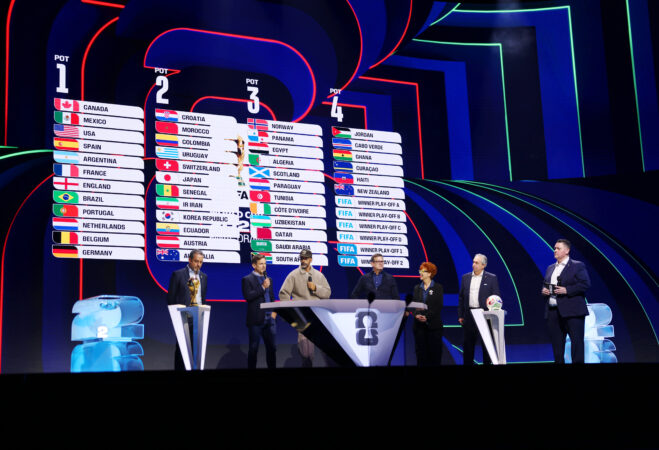
Qualified nations have been divided into four pots based on their FIFA World Rankings positions. Pot 1 contains the nine best-qualified teams in the rankings, as well as the three cohosts.
The host nations have already been assigned to groups — Mexico will be in Group A, Canada will be in Group B, and the U.S. will be in Group D. The remaining teams will be assigned to the other nine groups, one team per group.
After all the teams in Pot 1 have been drawn, the draw will move to Pot 2, selecting one team for each of the 12 groups. The process will repeat with Pot 3 and Pot 4, resulting in 12 groups of four teams.
During the tournament, the top two teams in each group will advance to the knockout rounds. The top eight third-place finishers in the 12 groups will also advance, completing the Round of 32.
Though the draw determines tournament groups, FIFA is also looking ahead to the knockout rounds. FIFA will structure the knockout bracket so that the top four teams in its rankings — Spain, Argentina, France, and England — will not meet before the tournament semifinal, provided that they each finish first in their respective groups. It is the first time the World Cup will use a tennis-style bracket for knockouts.
Here’s a complete look at the pots that will be used Friday:
Pot 1: Canada (B1), Mexico (A1), U.S. (D1), Spain, Argentina, France, England, Brazil, Portugal, Netherlands, Belgium, Germany
Pot 2: Croatia, Morocco, Colombia, Uruguay, Switzerland, Japan, Senegal, Iran, South Korea, Ecuador, Austria, Australia
Pot 3: Norway, Panama, Egypt, Algeria, Scotland, Paraguay, Tunisia, Ivory Coast, Uzbekistan, Qatar, Saudi Arabia, South Africa
U.S. goalkeeper Matt Freese dives for a save during practice last month.
42 countries have already qualified for next year’s World Cup, including the United States, Canada, and Mexico, and will be included in today’s draw.
There are six spots remaining – four for the top teams in the European Federation’s 16-team playoff, and two for the top two finishers in FIFA’s intercontinental playoff tournament. Both take place in March.
Since those have not been determined yet, those six teams will be represented by placeholders in today’s draw.
Here are the countries that have already qualified for the 2026 World Cup:
Cohosts: Canada, Mexico, United States
Asian Football Confederation (AFC): Australia, Iran, Japan, Jordan, South Korea, Qatar, Saudi Arabia, Uzbekistan
Confederation of African Football (CAF): Algeria, Cape Verde, Ivory Coast, Egypt, Ghana, Morocco, Senegal, South Africa, Tunisia
Confederation of North, Central American and Caribbean Association Football (Concacaf): Curaçao, Haiti, Panama
South American Football Confederation (CONMEBOL): Argentina, Brazil, Colombia, Ecuador, Paraguay, Uruguay
Oceania Football Confederation (OFC): New Zealand
Union of European Football Associations (UEFA): Austria, Belgium, Croatia, England, France, Germany, Netherlands, Norway, Portugal, Scotland, Spain, Switzerland
Lincoln Financial Field will hose six 2026 World Cup games.
We won’t know which counties will play in Philadelphia until Saturday, when FIFA releases its official schedule. But we’ll get a sense who might travel here.
Philadelphia will host six World Cup games at Lincoln Financial Field – five in the group stage, and one in the Round of 16. So we know counties ending up in Groups C, E, I, and L will play at the Linc (which unfortunately means no Team USA games during the group stage, since the U.S. has already been assigned Group D).
Here are the World Cup games scheduled to be played in Philly:
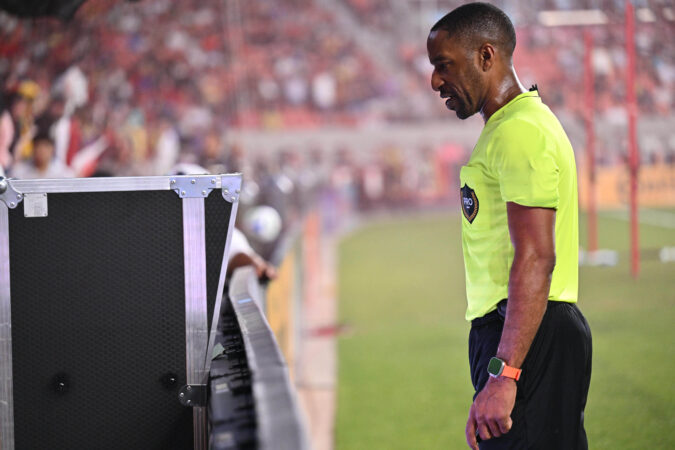
WASHINGTON — Whether fans like video reviews in soccer or not, they tend to draw complaints when those reviews seem to take too long.
It might seem natural to want a time limit for those reviews, perhaps one or two minutes. The sport’s global governing body is saying no, though, at least for now.
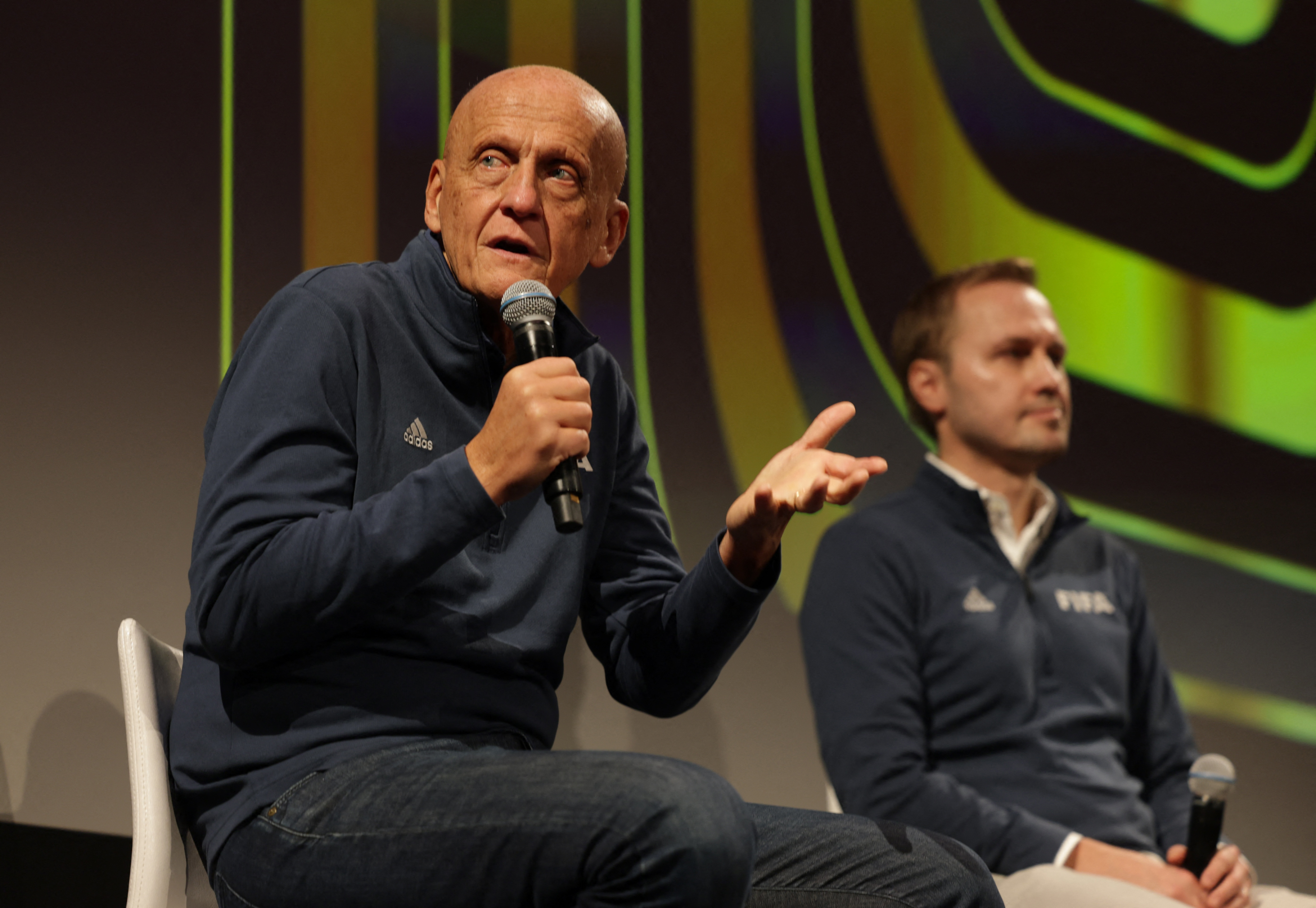
“Well, there might be different opinions, which I will respect,” FIFA’s refereeing chief Pierluigi Collina said Thursday at a media briefing ahead of Friday’s 2026 men’s World Cup draw. “Certainly, when something lasts a bit longer, it’s not because the referee is, say, lazy or slow. Probably, things which are considered are particularly complicated.’”
A game referee from 1995 to 2005, including the 2002 men’s World Cup final, Collina took his new role with FIFA in 2017 and has remained a public figure ever since.
Pierluigi Collina (left) speaking at Thursday’s event.
“Something else to consider is when you are waiting for someone, every second looks like an eternity — when you are under pressure and you are doing something, time flies,” he said. “So, referees, when they are doing that, probably they do not really realize that time is passing for them so quickly. But, we all know that timing is an issue in every activity, so we are always trying to improve.”
Collina acknowledged a report by the Times of London earlier this week that the International Football Association Board — the entity that sets the rules of how soccer is played — is considering expanding what VAR is allowed to rule on.
The expansion would include second yellow cards, which result in red cards and expulsion; and whether officials got it right calling a corner kick vs. a goal kick.
“It was already announced after a meeting of the IFAB football and technical advisory panel: the discussion took place, and the outcome was to propose to further discuss and propose” at the IFAB’s next business meeting on Jan. 20, Collina said. If a proposal passes there, it will go to the annual general meeting in March. That vote would be for implementation on June 1, in time for the World Cup.
Under the current rules, a straight red card is reviewable, but a second yellow card that results in expulsion is not reviewable.
“Certainly, extending the possibility of the VAR to intervene in some specific circumstances is something [on] the table,” Collina said, adding: “It would be a pity if the result of the competition, whichever the competition is, is decided not by what the players do on the field playing, but by a honest mistake made by the decision-maker.”
Specific to corner kicks calls, he said “that the main criteria is no delay” in the action on the field.
“It takes normally, how long? 10, 15 seconds to get the attackers ready to take the corner kick,” Collina said. “In these 10-15 seconds, if the corner kick was wrongly given, everybody has the evidence that the start of play is wrong. To me, it’s difficult to understand if they have the possibility to see that, why we have to hide our head under the sand and hope that nothing happened on the corner kick which is taken.”
Collina also said that FIFA hopes to use referee bodycams again next summer, after debuting them in the Club World Cup.
“It was, I would say, a great success,” he said. “It has been implemented in some leagues, [which] means that it was well-received by the TV viewers — also, referees got some benefit from using that. So, pretty confident that the rule-maker, as mentioned, IFAB, will give us the permission to to implement it during the next World Cup [in] ’26.”
Preparations at the Kennedy Center in Washington for Friday’s event.
FIFA defends expanding the World Cup to 48 teams
It was no surprise to hear FIFA officials say Thursday that it’s a good thing to expand the men’s World Cup to 48 teams, as will happen for the first time next year. The women’s tournament will follow suit in 2031 when the U.S. spearheads a regional tournament alongside Mexico, Costa Rica, and Jamaica.
But the way those officials framed it nonetheless was news, especially for the international media outlets that have traveled to D.C. this week.
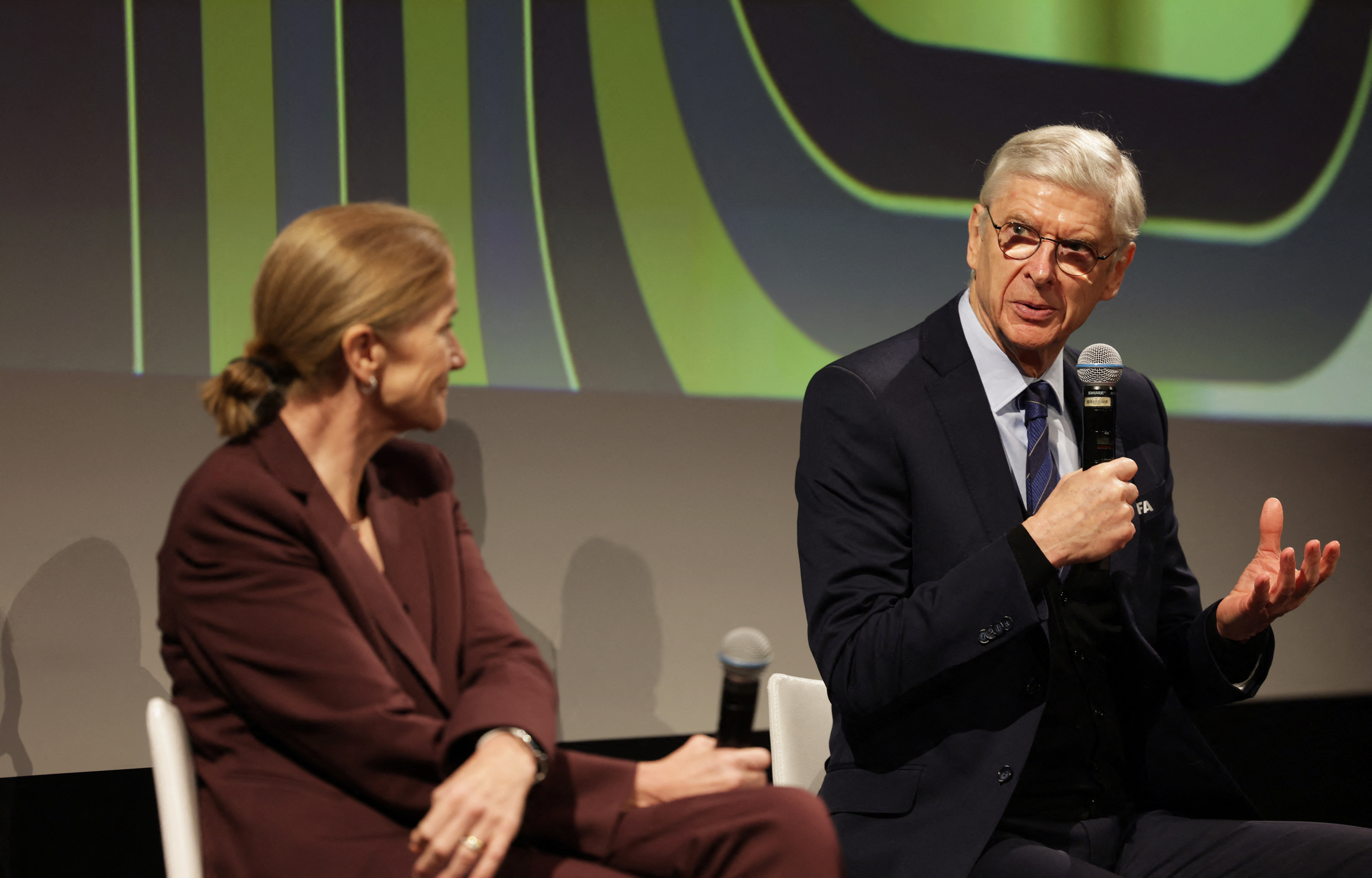
“It’s less than 25% of the 211 countries who are affiliated to FIFA,” said Arsène Wenger, FIFA’s chief of global football development and the famed former manager of English Premier League club Arsenal. “Still, 75% of the teams are not there, and I count in there China, India — that’s 3 billion people.”
FIFA’s chief football officer Jill Ellis, the former U.S. women’s national team manager, noted how the growth of women’s soccer worldwide has made it easier to have a 48-team tournament without fear of lopsided games.
“We see it in the in the college basketball landscape right here in the U.S.,” said the coach who led the U.S. women to World Cup titles in 2015 and 2019. “We’re used to these teams that are maybe lower-ranked and then they suddenly have this phenomenal run.”
Jill Ellis (left) and Arsène Wenger (right) on stage Thursday.
Will weather be an issue again?
The hot temperatures at this summer’s Club World Cup understandably raised a lot of complaints, and fears of more problems next summer. Wenger raised that unprompted.
“If there’s one uncertainty that we don’t master, it’s the weather,” Wenger said. “Especially in Miami, you know, places like Atlanta, where you had some problems last year. So we’ll do the maximum to protect the competition and the players.”
He also said “we will consider a lot the best possibilities for the teams to be protected from heat” as FIFA finalizes the kickoff times before Saturday’s announcement. But skeptical fans worldwide won’t believe that until they see it.
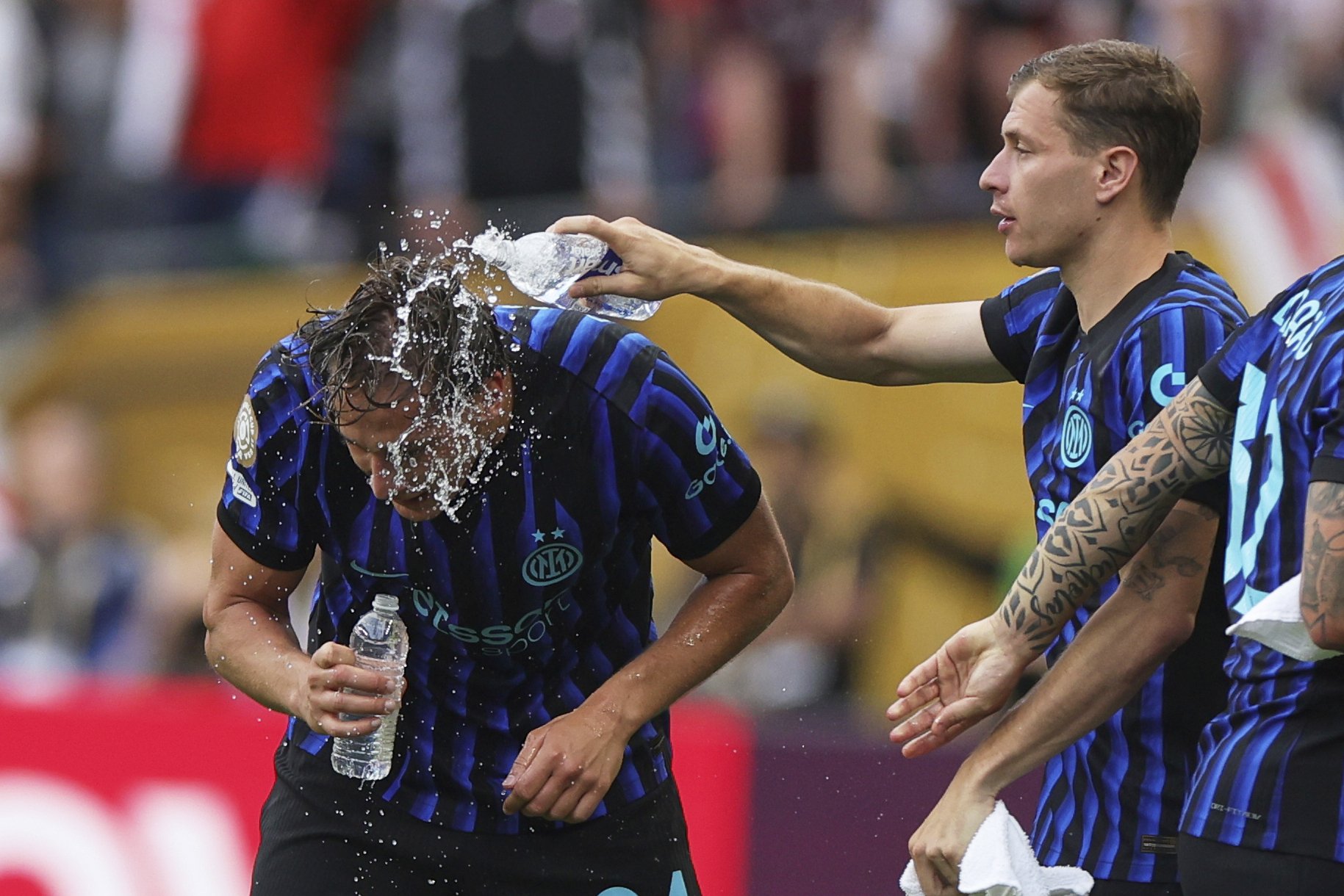
Temperatures were in the 90s during many Club World Cup games this past summer.
WASHINGTON — At some point between noon and 2 p.m. on Friday, the World Cup group draw will tell us which teams the United States will play in next year’s tournament. We’ll also get the first hints of which teams will come to Philadelphia, although the schedule won’t be set until Saturday.
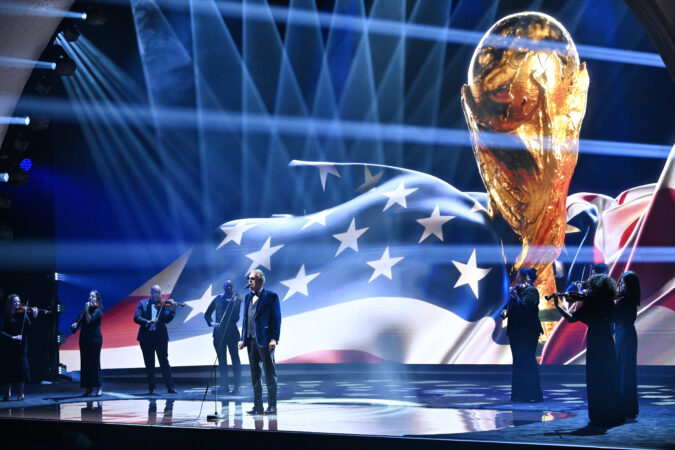
Along the way, there will be jokes from Kevin Hart, singing from Andrea Bocelli, and appearances from Tom Brady, Wayne Gretzky, Shaquille O’Neal, and Aaron Judge. President Donald Trump also will be involved, having steered FIFA to move the event from Las Vegas to the Kennedy Center in D.C.
Not only was FIFA president Gianni Infantino happy to oblige his friend, but the global governing body added the Village People (of Trump favorite “Y.M.C.A.” fame) to the list of performers.
But somewhere amid all that, there will be sports, too. Tournament draws weren’t always as much of a spectacle, but they’ve always been a dramatic part of soccer’s tapestry.
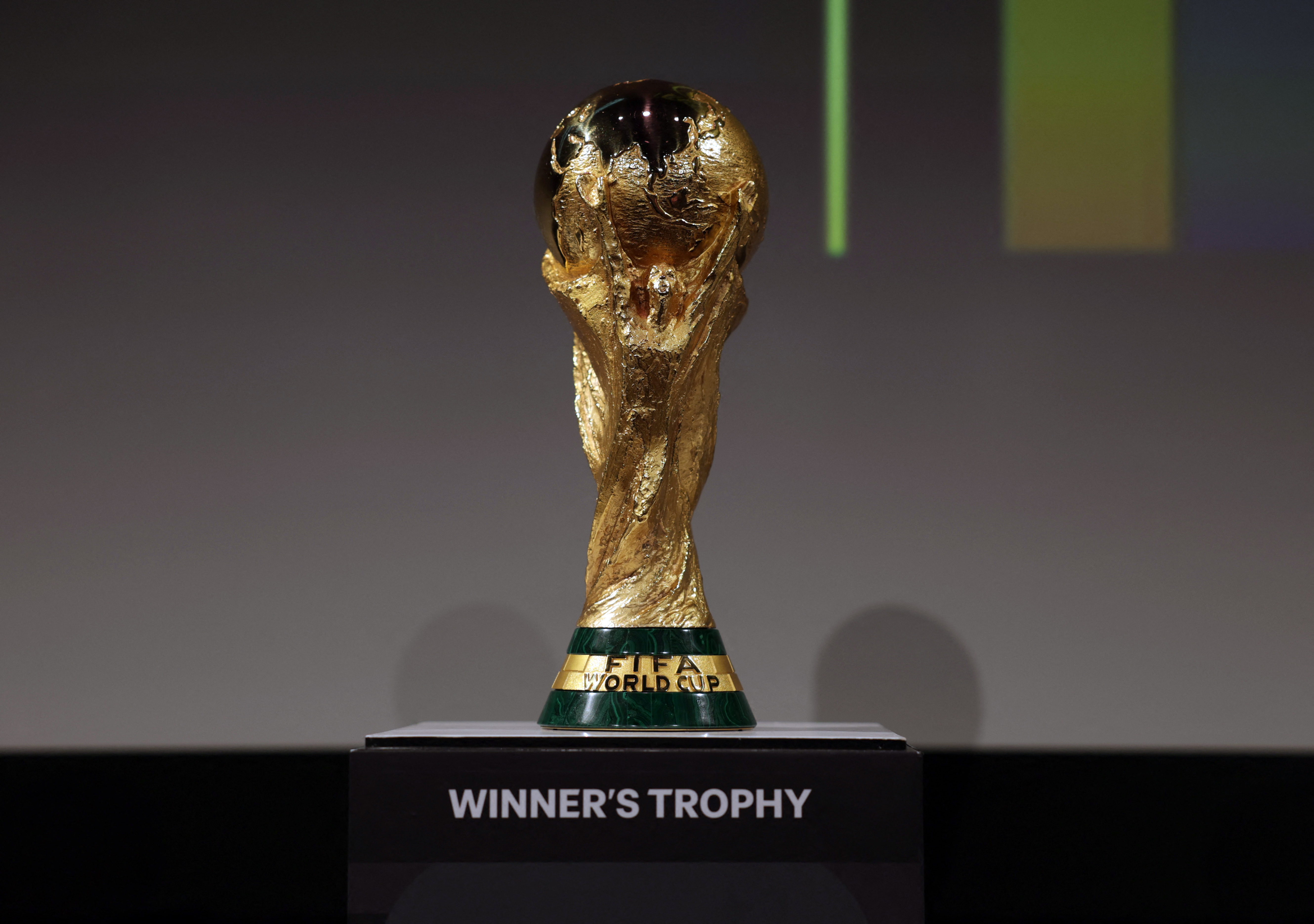
The men’s World Cup trophy on display Wednesday at the Kennedy Center in Washington, where the draw will take place Friday.
Once the pots of seeds were set last month — four groups of 12 each, with the cohosts and the top nine teams in FIFA’s rankings in Pot 1 — the speculation began worldwide. How about England vs. Scotland, or the Republic of Ireland, Wales, or Northern Ireland if they get through Europe’s last qualifying playoffs?
How about a Spain-Morocco rematch of a 2022 World Cup epic? If Italy gets through the playoffs, which teams will it face in its first men’s World Cup in 12 years? And what powerhouses will underdogs like Haiti, with the Union’s Danley Jean Jacques, get to challenge?
Then, of course, there are matchups that resonate off the field. For all the efforts to keep sports and politics separate, soccer has always been the most political sport. So will the U.S. play Iran for a second straight men’s World Cup, and a third overall? There are sparks already, as Iran has boycotted the draw, since some of its delegates were refused visas.
As you wonder, here are three rules to consider. First, teams from the same continent can’t be drawn in the same group except for Europe, which has 16 berths in the first 48-team World Cup. There must be one European team in each group, and there can’t be more than two.
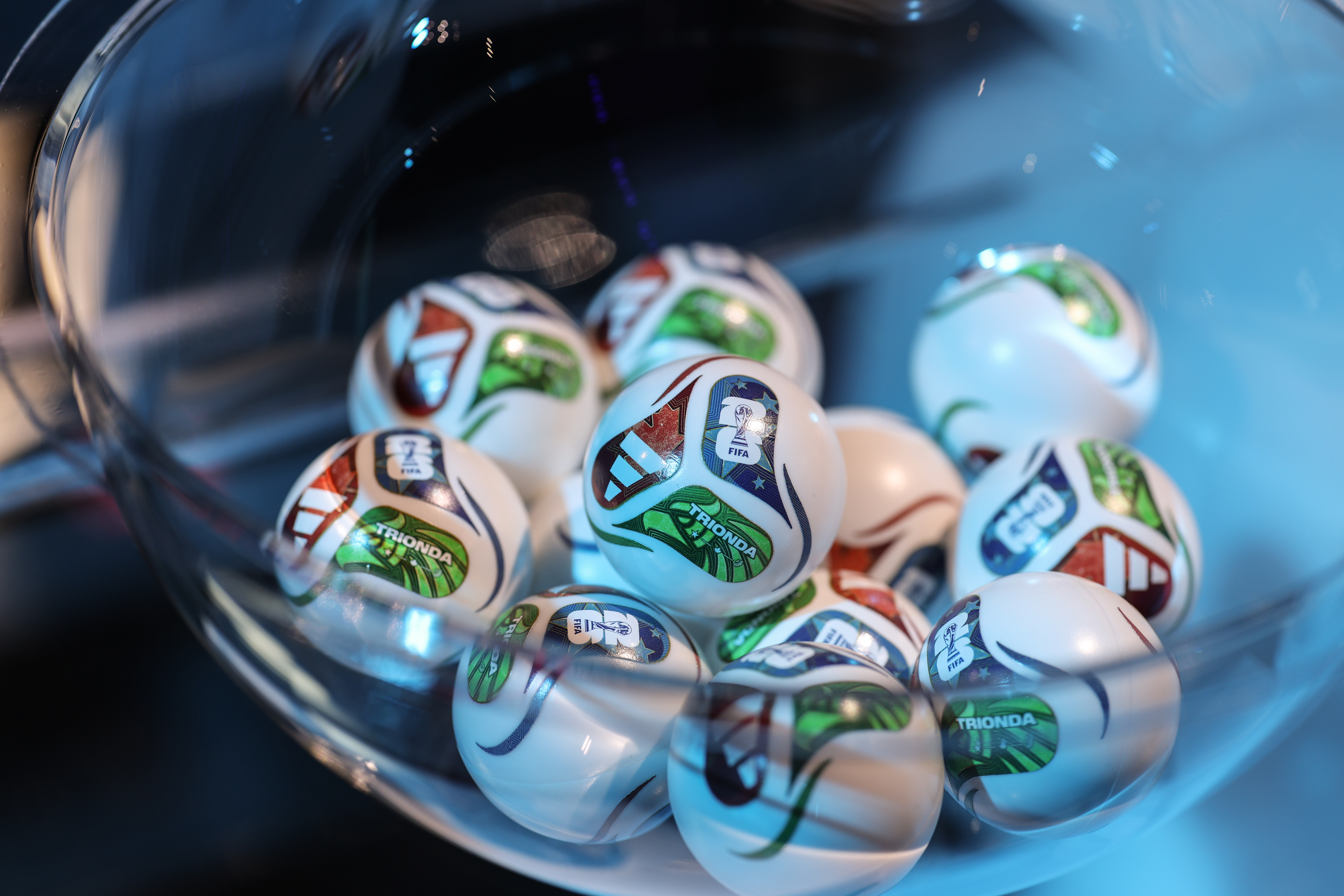
The famous draw balls in one of the bowls on stage, waiting to be picked up.
With that in mind, here are our picks for the easiest, hardest, most festive, and most politically controversial groups that the U.S. could end up in:
The picks
The easiest group: Austria, South Africa, Jordan. There are lower-ranked European teams in the playoffs than No. 24 Austria, but the case here is about the opponent you know vs. the opponent you don’t.
Since Austria is in Pot 2, drawing that country would spare the U.S. from big hitters like Croatia, Colombia, Morocco, and Japan. From there, South Africa would give the U.S. a better tactical matchup than the rest of Pot 3, whose teams span Europe, Africa, South America, Asia, and Concacaf.
Having picked South Africa from Pot 3, all the African teams in Pot 4 are off the table. So we’ll go to Asia for Jordan, a World Cup debutant ranked No. 66. And we’ll wish Cape Verde, with former Union midfielder Jamiro Monteiro in a starring role, all the best.
Former Union midfielder Jamiro Monteiro (right) helped Cape Verde qualify for its first World Cup.
The hardest group: Morocco, Norway, Italy if it qualifies. Morocco edges Croatia and Colombia from Pot 2 for talent — led by Paris Saint-Germain’s Achraf Hakimi — and a vibrant, gritty playing style.
In Pot 3, Norway has finally delivered Manchester City superstar striker Erling Haaland to his first World Cup, along with outstanding Arsenal playmaker Martin Ødegaard.
In Pot 4, we turn to the European playoffs. Italy never needs much introduction, though it bears repeating that the Azzuri truly blew it in failing to reach the 2018 and 2022 World Cups. The current squad features goalkeeper Gianluigi Donnarumma and midfield generals Nicolò Barella and Manuel Locatelli.
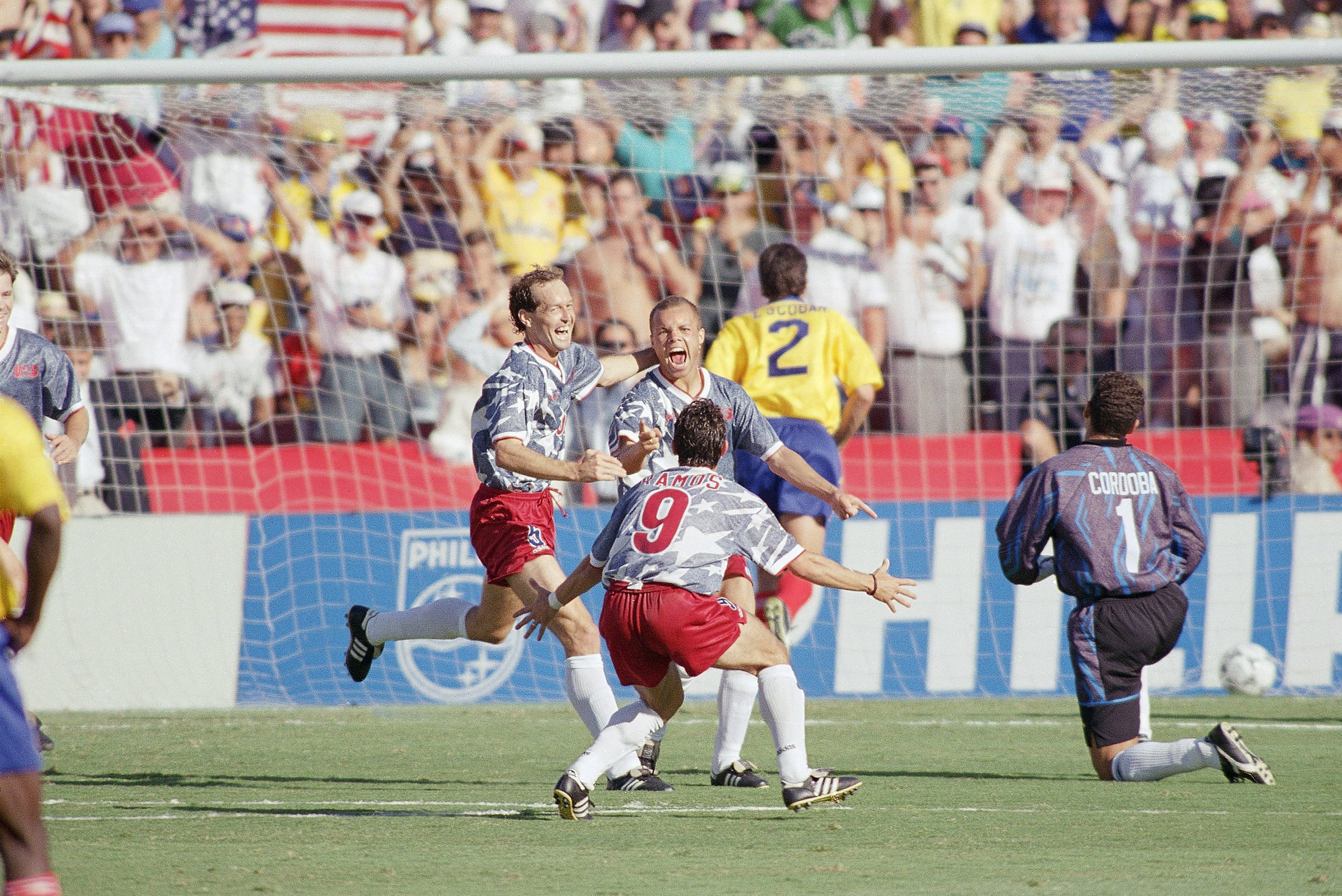
The most festive group: Colombia, Scotland, Republic of Ireland. A U.S.-Colombia game would be a headache for the American squad but would bring back epic memories of the 1994 upset at the Rose Bowl. The Cafeteros’ fan base is also as good as it gets in South America, especially with the country’s big immigrant population in this country.
Former Union sporting director Earnie Stewart (center) scored in the United States’ upset of Colombia at the 1994 World Cup.
Scotland and Ireland’s fan bases are massive, loud, and fun-loving. The Scots are in a men’s World Cup for the first time since 1998, and the Tartan Army will travel in huge numbers — buoyed by expats here and anyone who wants to feel the part for a day.
The same goes for Ireland if it gets through a tricky qualifying playoff with Czechia, North Macedonia, and favorite Denmark. But if the Irish make their first World Cup since 2002, the sea of green will flood the States. New Jersey’s Meadowlands still echo with the raucous noise of the 1994 Ireland-Italy game.
The most political group: Iran, South Africa, Ukraine if it qualifies. A combustible mix of war, immigration, race, and religion that spans as widely as three continents.
The teams Philadelphia fans should want
As the city saw up close during the Club World Cup this summer, there’s no party in soccer like a South American party. Argentina, Brazil, and Colombia have the continent’s biggest fan bases in the U.S., and the first two would bring global superstars in Lionel Messi or Real Madrid’s Vinícius Júnior.
40' ⚽ GOAL — VINÍCIUS JR!
A touch of class from the Brazilian as he puts Real Madrid in front.
Philly fans got to know Brazil’s new phenom, 18-year-old Estêvão, when he scored for Palmeiras against Chelsea in the Club World Cup at Lincoln Financial Field — then joined the Blues a few weeks later.
It’s already set that the U.S. won’t play in the nation’s birthplace during the group stage, to the dismay of fans here and well beyond. But from the rest of Pot 1, France would bring the most star power from Europe, and the Netherlands‘ dancing masses would paint the town oranje.
In Pot 2, no player is more worth watching than Croatia’s Luka Modrić. Even at age 40, his passing skills are unparalleled as he heads into his last World Cup. Japan, South Korea, and Morocco have vibrant fan bases, and the latter two have big expat communities in this part of the U.S.
In Pot 3, Scotland easily is the team you’d want most — and that every hotel, bar, and restaurant would dream of. Egypt would bring another superstar in Liverpool’s Mohamed Salah.
Pot 4 is where the Union ties are. It would be special for Jean Jacques to play in his club hometown with Haiti or for Monteiro to come back to town with Cape Verde’s Blue Sharks.
The biggest of all on that scale would be if Jamaica gets through the intercontinental qualifying playoffs to earn its first men’s World Cup trip since 1998, finally delivering Andre Blake to a stage he deserves. And the turnout from Jamaican fans would be epic, in a city they love coming to for the Penn Relays.
Among the European playoff contenders, the Republic of Ireland would be a huge deal here. But ever since the day three years ago when Philly was named as a host city, the first name on everyone’s lips has been Italy. Imagine how electric it would be if the Azzuri’s World Cup drought ends at the Linc.
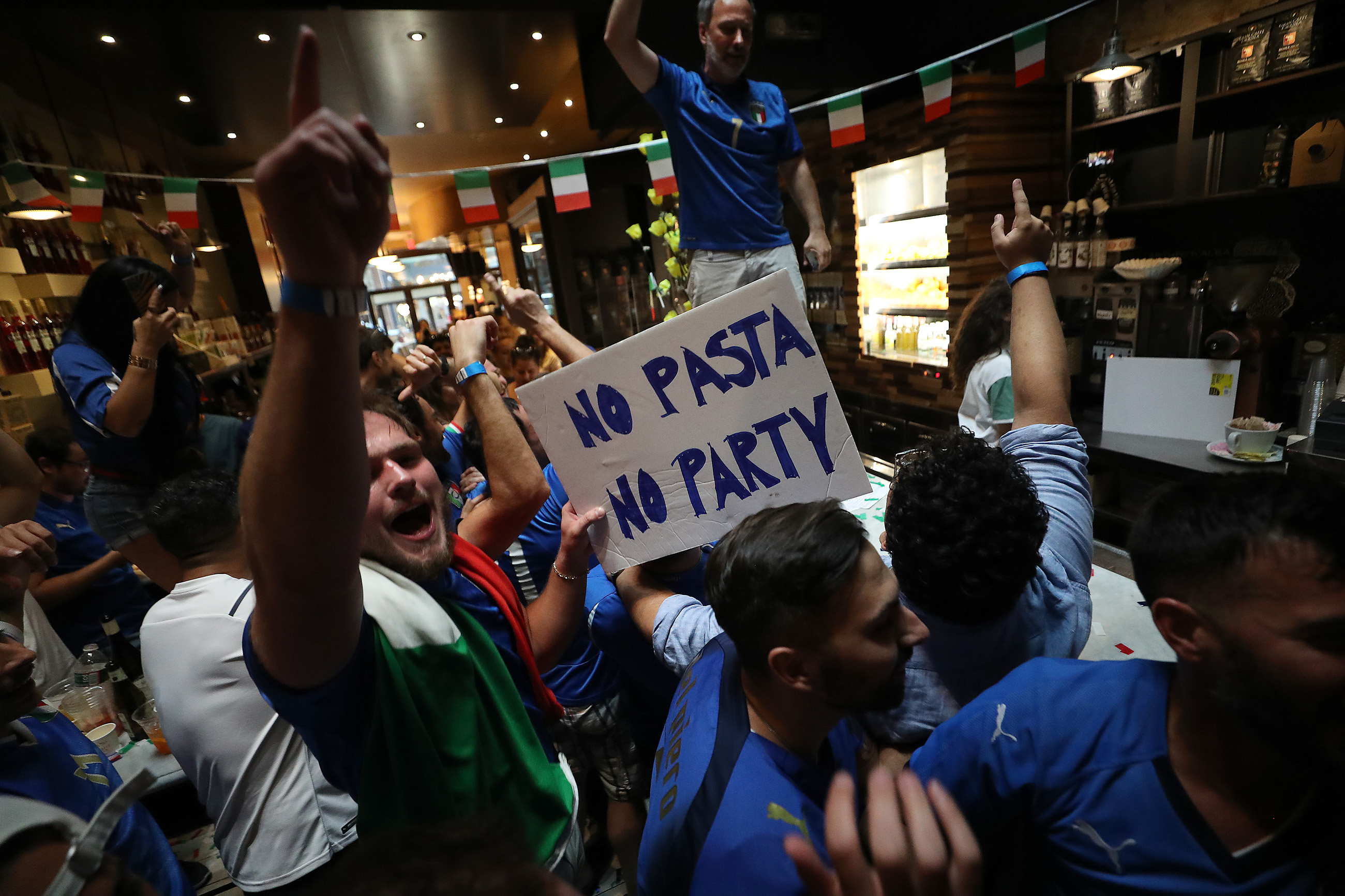
The scene at Gran Caffe L’Aquila in Center City when Italy won the European Championship in 2021.
You might have noticed one big team hasn’t been mentioned here yet: England. The Three Lions would bring a huge amount of fans, star players, and media attention to town. But to come to the city where America declared independence from them, 250 years later?
Ask around locally, and you’d find a fair number who’d say no thanks. They’d dreamed for years of a U.S.-England game on July 4, until the preset part of the draw path took the possibility away. It would feel strange if England uses the old colonial capital as the launchpad to fulfill the hype as one of the favorites to win it all.
NEW YORK — The U.S. men’s soccer team has played some strong opponents in its preparation for the World Cup so far. But for its last four games before the tournament, the team will face some of the biggest teams of all.
After weeks of speculation, official word came Tuesday that the U.S. will play Belgium and Portugal in March in Atlanta, then Germany in Chicago in June for its World Cup send-off game.
There also will be a game at the end of May in Charlotte, N.C., against a team to be announced. It might be revealed after the World Cup draw on Friday, since the U.S. won’t want to play against a team it will face again a few weeks later. The U.S. can’t be drawn against Belgium, Portugal, or Germany, as they’re in the same pot in the draw.
“I think before starting the World Cup, it starts to [feel] like a World Cup, and I think it’s important for the team,” U.S. manager Mauricio Pochettino said at a gathering of the governing body’s sponsors and donors. “What we need is to challenge teams that are in the top list, and I think that is going to be an important experience for us. Great experience, and then after [that] to attack the World Cup in a very good condition.”
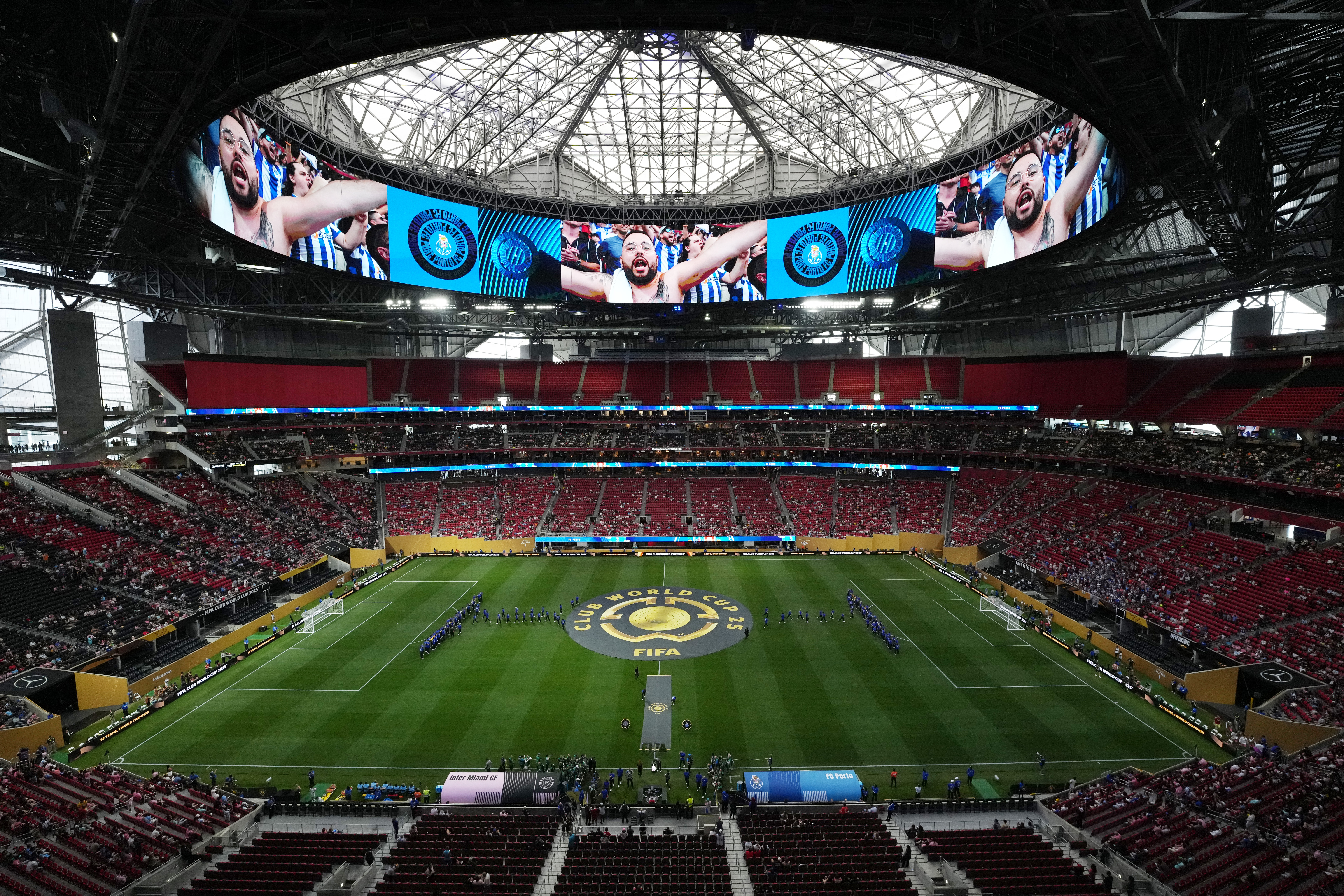
Atlanta’s Mercedes-Benz Stadium will host eight games in next year’s World Cup, including a semifinal.
All four games will be at the respective cities’ NFL stadiums, with Atlanta getting two since the area is the new home of U.S. Soccer’s headquarters. The governing body will open a $200-plus-million, 200-acre training center in the southern suburb of Fayetteville, Ga., this spring, in time for the men’s team to hold its pre-World Cup camp there.
“That is a massive thing that is going to inspire, is going to give an unbelievable power to soccer here in the USA,” Pochettino said, knowing that some of the funders of the facility were in attendance Tuesday. “Maybe today, people don’t realize it because we are focused on the World Cup, [so] it’s about [how] to win the games. But that is the real impact that is going to be a massive change for soccer here in the USA.”
Portugal’s visit won’t just bring all-time superstar Cristiano Ronaldo, who hasn’t played a game on American soil since 2014. The No. 6 team in FIFA’s global rankings has a fleet of the sport’s best players: Bruno Fernandes of England’s Manchester United, Rafael Leão of Italy’s AC Milan, and João Neves and Vitinha of reigning European champion Paris Saint-Germain.
Belgium is led by midfield playmaker Kevin De Bruyne, a longtime player for England’s Manchester City and now with Italy’s Napoli, and winger Leandro Trossard of England’s Arsenal. The Red Devils are ranked No. 8, and, like Portugal won their group in European World Cup qualifying. Had they finished second, they’d have gone into the playoffs for the last World Cup spots that also are set for March.
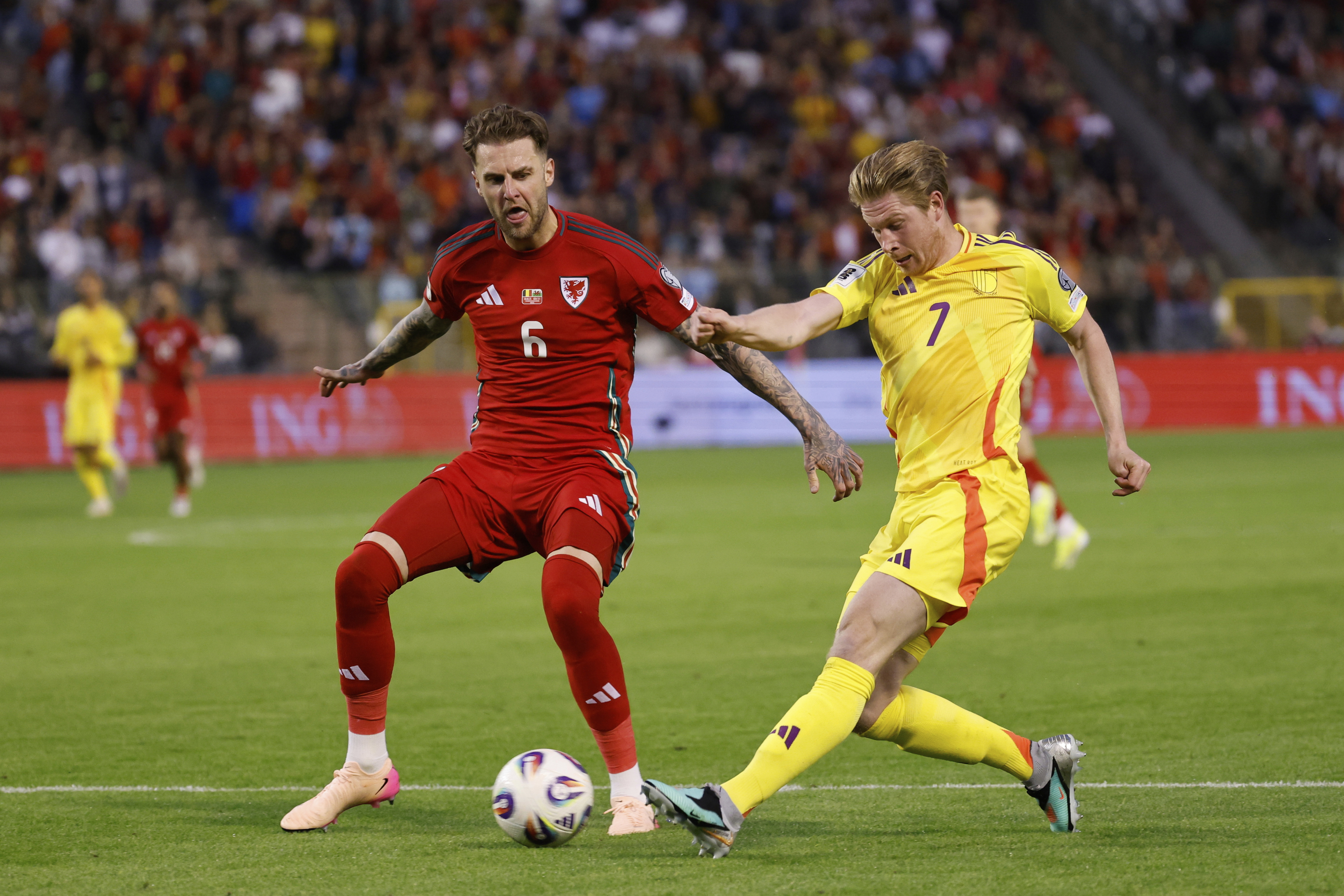
Kevin De Bruyne (right) is one of Belgium’s stars.
Some famous histories
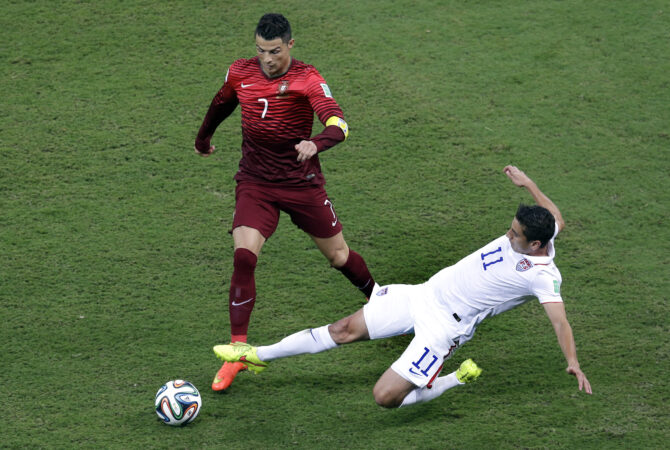
Both nations stir memories for U.S. fans. The American men earned one of their most famous World Cup wins against Portugal in 2002, then nearly pulled off another upset win in 2014 before Ronaldo assisted a last-minute equalizer.
When the teams last met in a friendly in 2017, the Americans earned a 1-1 tie in Portugal in the first senior national team appearance for Weston McKennie, Tyler Adams, and Cameron Carter-Vickers. (McKennie scored the goal, assisted by then-Union striker C.J. Sapong, and Ronaldo was absent.)
Nine days later, the U.S. took Belgium to extra time with goalkeeper Tim Howard’s 16 saves, then fell, 2-1. Howard’s heroics set a World Cup record for saves in a game that still stands. The teams have not met since.
Germany is a frequent and longtime U.S. opponent. This will be their 13th meeting, with the most recent a 3-1 Mannschaft win in Connecticut in October 2023. The first, in 1993, was a 4-3 U.S. loss that nonetheless announced the program on its way to hosting the 1994 World Cup. (Coincidentally, that game also was at Soldier Field.)
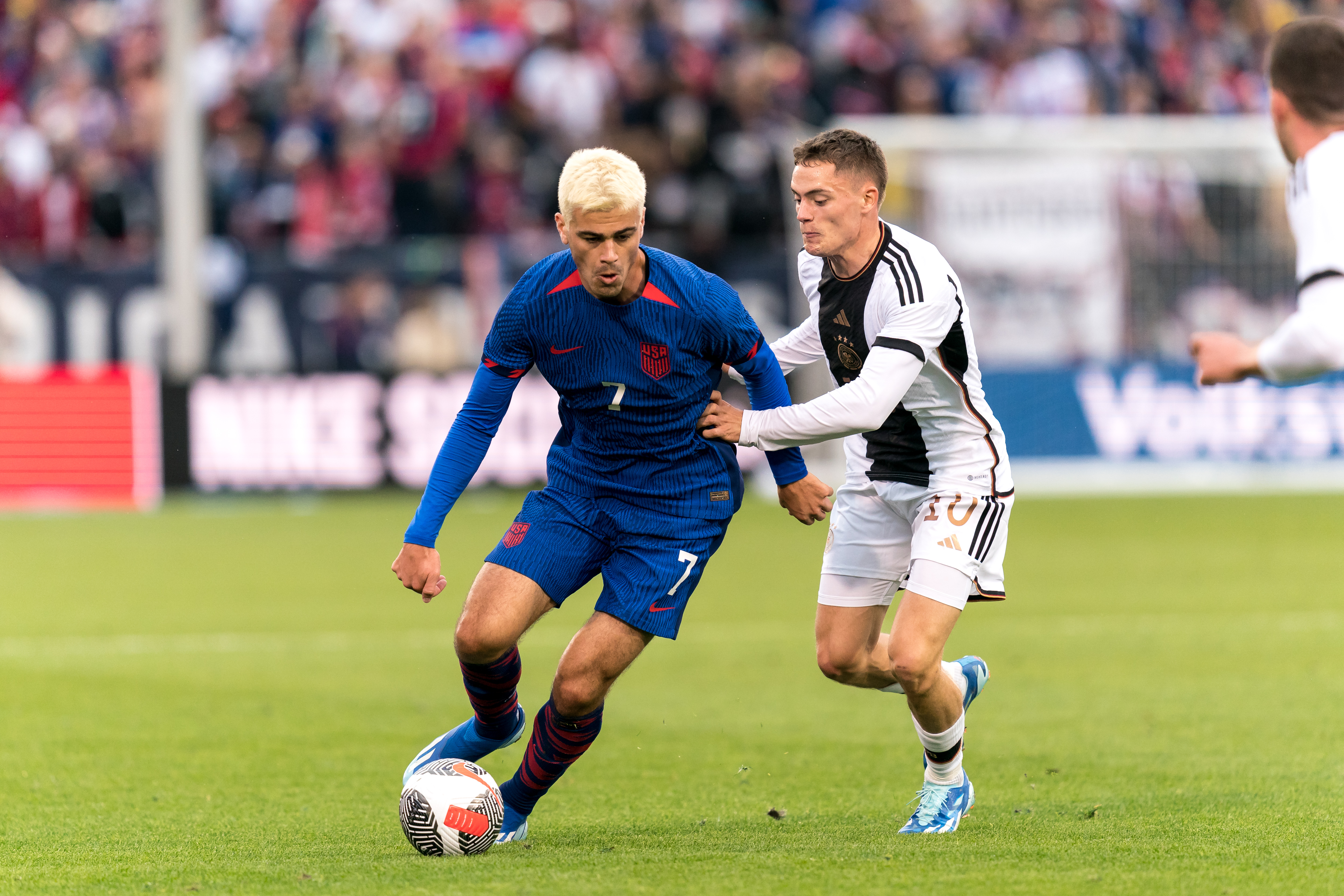
Gio Reyna (left) on the ball in front of Florian Wirtz during the last U.S.-Germany game in 2023.
The current German squad, ranked No. 9, is led by playmakers Florian Wirtz of England’s Liverpool and Jamal Musiala of Germany’s Bayern Munich. There also are some big-time rising stars aiming to make the World Cup squad, including striker Nick Woltemade of England’s Newcastle United and 17-year-old Lennart Karl of Bayern.
“It’s true that when we arrived here one year ago, it was a rushed time,” Pochettino said. “We need to go there, we need to perform, we need to get results, we need to push quickly the process, we need to go at a really fast speed. And I said, ‘No, calma [Spanish for calm down] … You cannot sometimes go faster [than] what the process demands.’ I think we are in a very good moment now, right on time.”
Pochettino’s insight on why he took the U.S. job
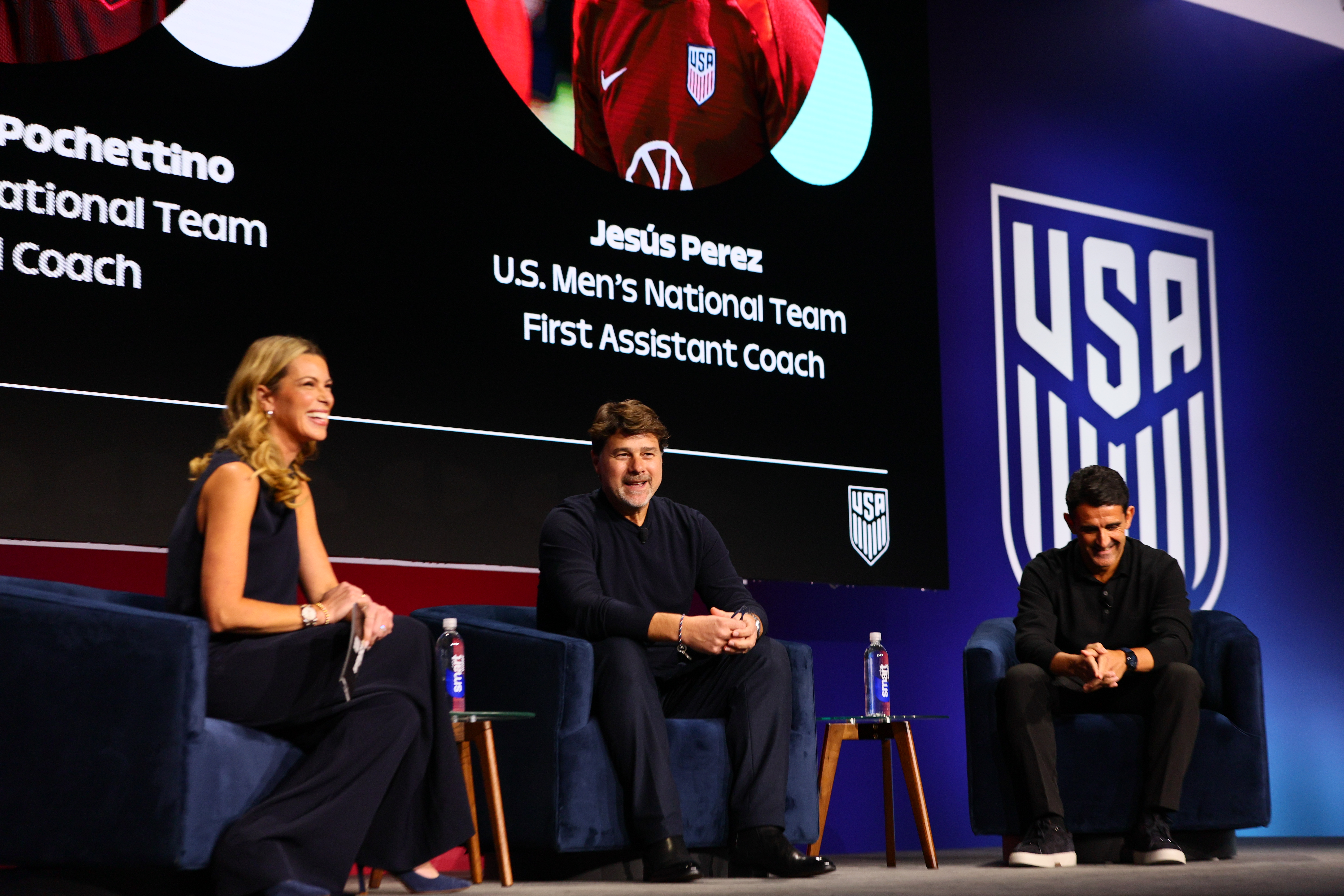
The manager’s remarks came in a wide-ranging conversation on stage with his top assistant Jesús Pérez and Fox Sports reporter Jenny Taft. Some of the topics were ones Pochettino has covered often, but one he hasn’t so much is why he took the U.S. job in the first place.
Mauricio Pochettino (center) with Jenny Taft (left) and Jesús Pérez (right) on stage at Tuesday’s event.
“I think one of the motivations was to go out of our comfort zone after more than 15 years coaching clubs,” he said. “We felt very special when the first call [came] from Matt [Crocker, U.S. Soccer’s sporting director]. I called Jesús and said, ‘Why not?’”
That didn’t mean he thought it would be easy.
“Was it going to be a massive challenge? Of course,” Pochettino said. “We didn’t know what we were going to find there. It was a country that we only traveled to, to come here for preseason with Tottenham or Chelsea or Paris Saint-Germain.”
Those were the three big European clubs he managed before taking the U.S. job.
“I said, ‘Oh, that is going to be a big test for us as a coaching staff,’” he said. “It was also a moment to reveal and to challenge ourselves … I think it was the right moment for us in our lifetimes, in a personal way but also in a professional way. Both sides were perfect timing.”
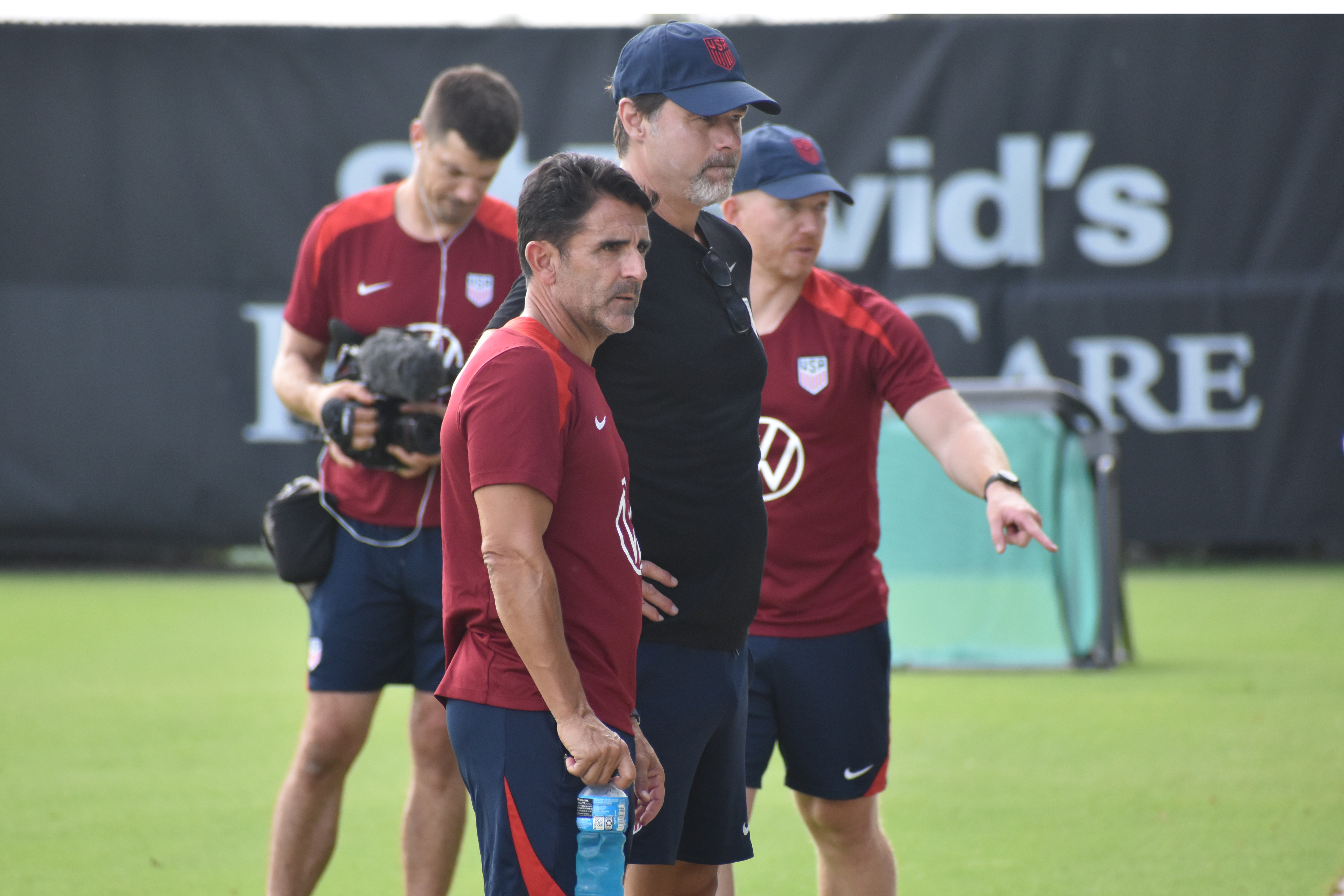
Mauricio Pochettino (right) and Jesús Pérez (left) watching a U.S. practice in Octover.
Pérez, who has been at Pochettino’s side throughout the manager’s career, went into more detail on that.
“To manage the last two clubs we were working with, and the personalities there, it took a lot of energy from him [Pochettino], especially — and you pay for that,” Pérez said. “It was a challenge for us to come where people know the name, but we had to prove that we can coach here and we can perform.”
He also spoke about the differences between club management, where coaches can spend every day with players, and national teams, where time together is limited.
“What we miss is training sessions,” Pérez said. “It’s where you can feel the player, you can improve the player, you can challenge the player. … It took us to a point that we have to change our way of work in order to have less training sessions, more precise, more clear, sometimes more simple. But with just basics, you can make people perform.”
Even at age 99, the Palestra still sees rare moments.
Saturday’s Penn-La Salle game marked the first time since the 2001-02 season that two teams formally in the Big 5 faced off in a regular-season nonconference game that didn’t count in the city standings.
When the tournament format started, five teams finally grew to six with Drexel’s inclusion. They agreed that they could schedule matchups outside the tournament pods, as long as they were willing to potentially meet again in the Big 5 Classic triple-header.
It didn’t happen in the tournament’s first two seasons, but it made sense that it would happen at some point. Scheduling nonconference games only ever gets harder for teams outside the elite, and Penn had room to fill in its Cathedral Classic four-team event on Thanksgiving weekend.
La Salle answered the call this season, while Fran Dunphy was still in charge on Olney Ave., and his close friend Steve Donahue was still in charge on 33rd Street. Their successors, Darris Nichols and Fran McCaffery, didn’t mind keeping the matchup when they took the jobs in the spring.
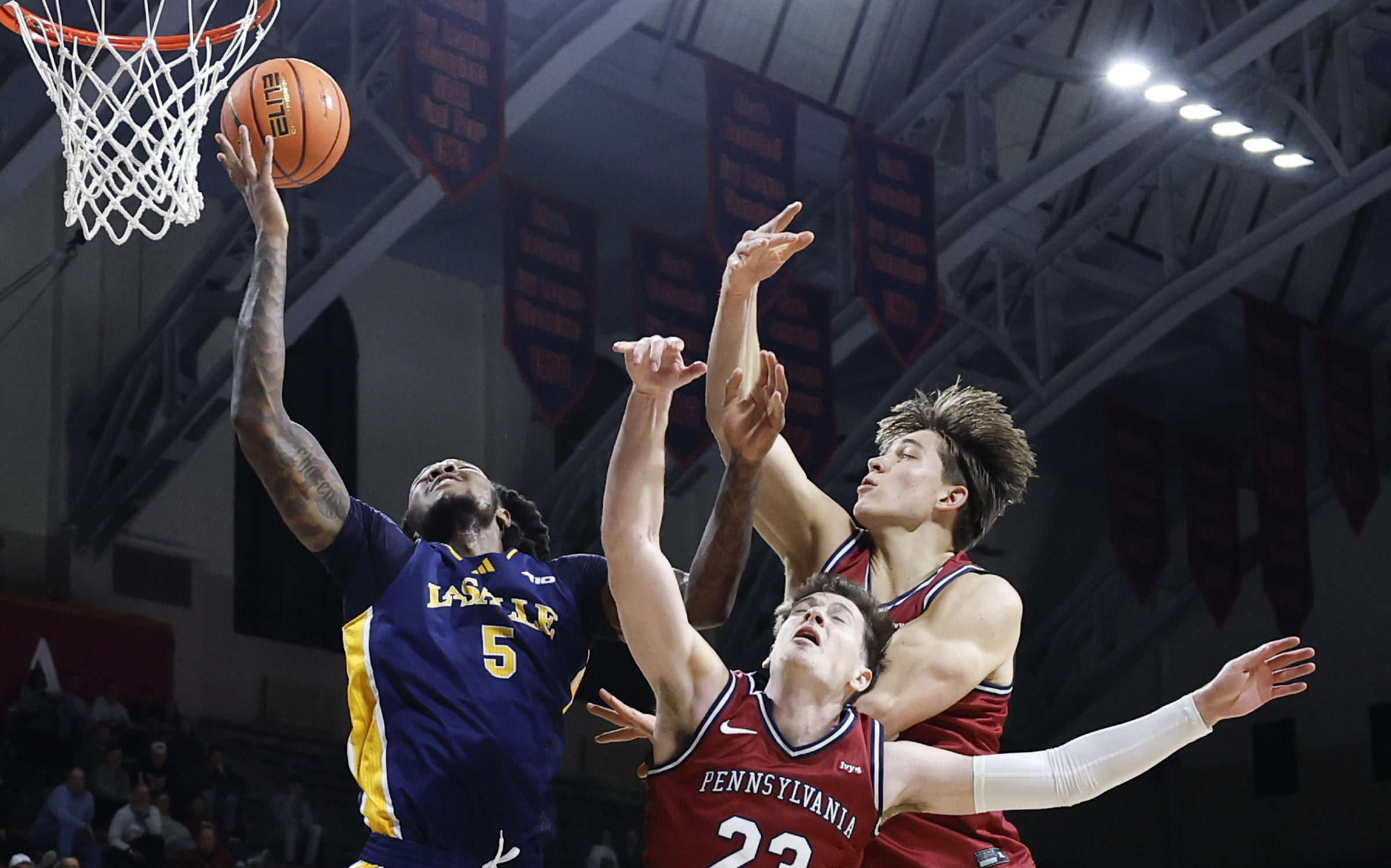
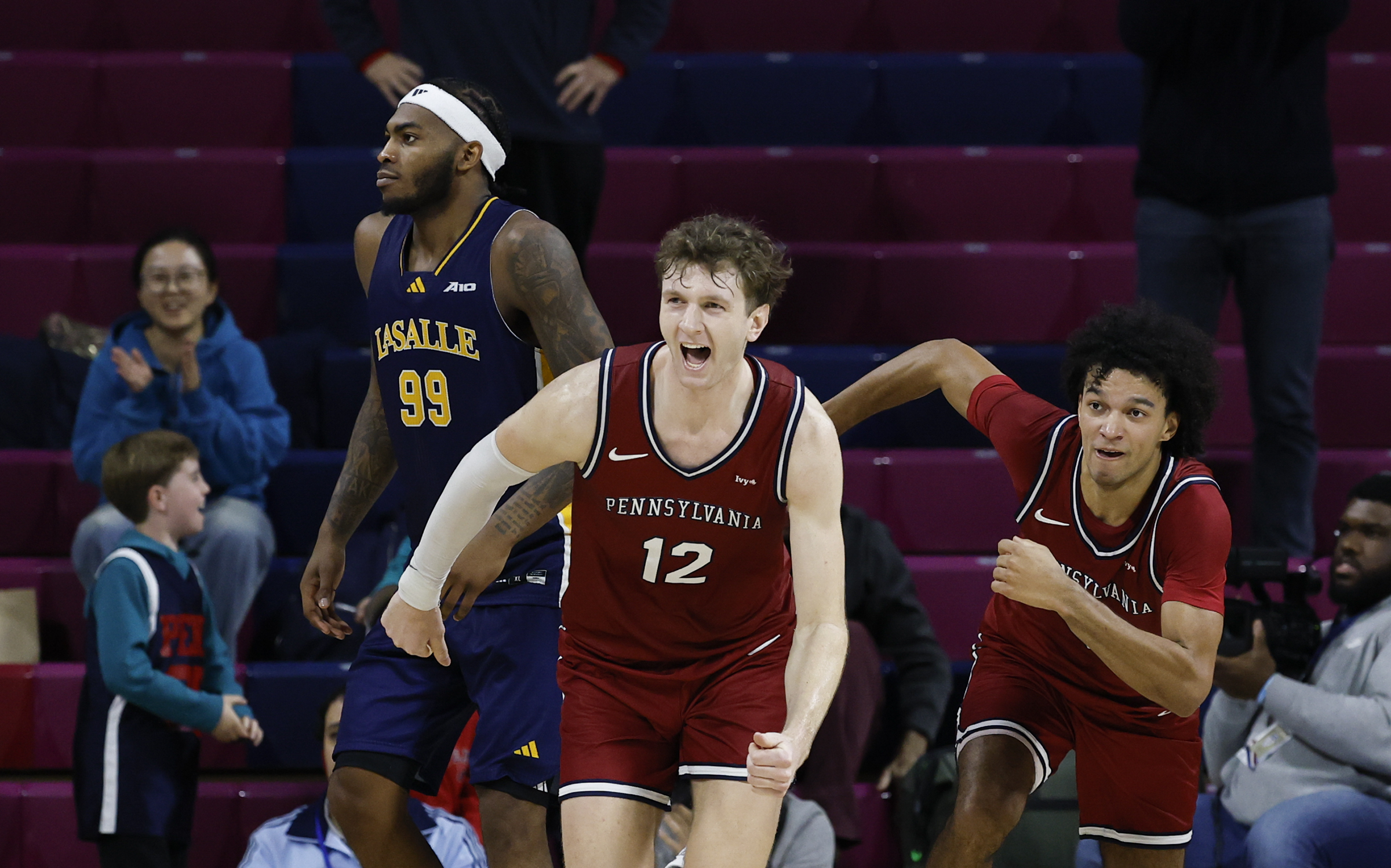
So there they were, staying in town for the holiday weekend, with Merrimack and Hofstra joining the field. The stands were far from filled, but there was some life in them — and there was lots of life on the court in Penn’s 73-71 win.
La Salle gave a great effort, earning a 44-38 halftime lead as much by outhustling Penn as by outscoring them. Though the Quakers shot 53.8% from the field in the frame, the Explorers outrebounded them at both ends of the floor to produce a 21-14 margin on the glass.
“We were just getting destroyed on the glass in the first half,” McCaffery said. “You can’t win basketball games like that. Give them credit for the energy level that they played with.”
La Salle’s Josiah Harris beats Penn’s Ethan Roberts (center) and Augustus Gerhart to the rim during Saturday’s first half.
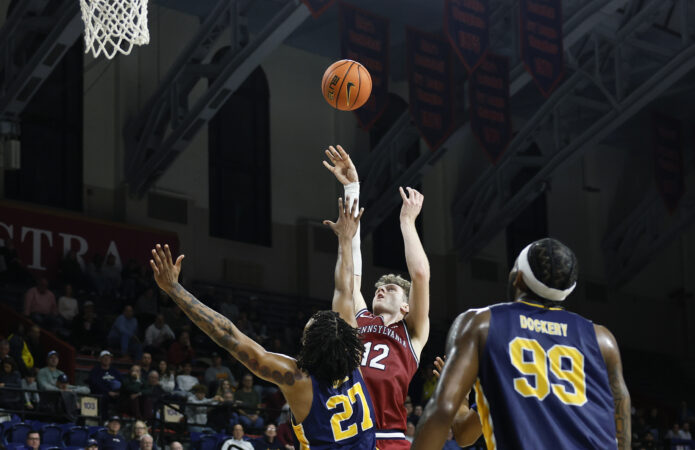
In the second half, the Explorers grew their lead to 55-41 with 15 minutes, 21 seconds remaining, and it was 60-47 with 12:26 to go. From there, star transfer TJ Power and freshman Jay Jones led the big comeback. The Quakers edged ahead 68-66 with 3:56 left, and held on despite missing enough free throws for the Explorers to stay within one possession through the final seconds.
At the buzzer, it felt every bit like a Big 5 game even though it wasn’t one.
“I think you could see the intensity level displayed by both teams and that’s a credit to the individuals but also the coaching staffs for both programs,” McCaffery said. “The crowd was into it and was really good, and I think from that standpoint it makes great sense to do it.”
Power made his latest big impression with a game-high 29 points, including five three-pointers in the second half. But he said he was “most proud of” the mental side of the comeback.
2H (10:49) | La Salle 60, Penn 53
Turnovers leading to triples. All five buckets this half are from distance and TJ has four of them. TIME OUT, EXPLORERS!!#FightOnPenn 🔴🔵🏀 pic.twitter.com/qJsk1Z22oQ
“We work really hard on building our identity to be a winning team,” he said. “When we went down 14, all we were saying in the huddle is, like, ‘We win basketball games — there’s no doubt about that.’ We just knew we had to get stops, we made some adjustments on defense and then we got some momentum on offense.”
Jones’ role came after he subbed in for starting point guard AJ Levine with 12:09 to go, with Levine out of gas. Jones did not leave the court for the rest of the night, tallying seven points, two rebounds, one assist, and two steals in that span.
McCaffery said Jones’ work in practices against the starters earned the opportunity, and praised him for seizing it.
“He’s just been really good,” McCaffery said. “His attitude is great. He’s just a freshman, so it takes time, but he was really special tonight and I’m not surprised.”
Jay Jones (right) celebrates with TJ Power (center) after the final buzzer.
Nichols was understandably in a less happy mood, having been on the receiving end of it all. But the Explorers are clearly making progress, no matter their record.
“I don’t know if things are on the up — I’m down right now,” he said. But he quickly added it was easy to be “a prisoner of the moment, especially after wins and losses, and I tell my guys all the time the season’s long.”
He will no doubt take his own advice as he teaches it to his players.
“You can be poisoned by accomplishment, you can be down in the valley of disappointment, and both of them are bad,” Nichols said. “Just trying to understand that we’ve got to continue to get better, we’ve got to get some guys healthy, we’ve got to get guys playing better, and we’re just going to continue to work.”