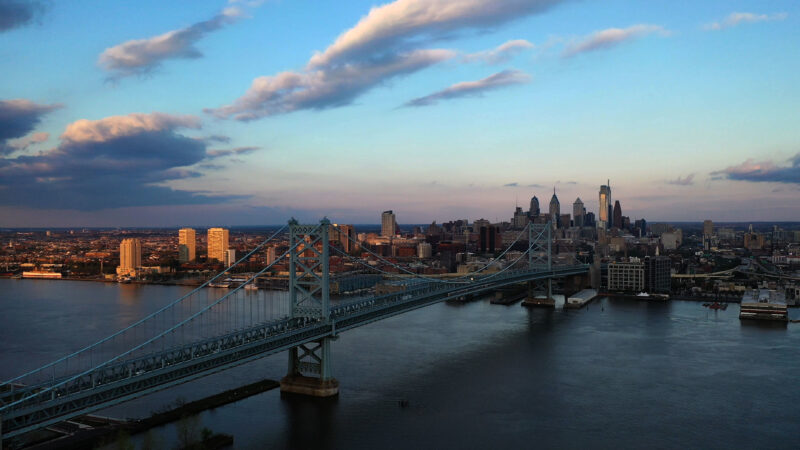
With Philadelphia’s Fourth of July festivities for the United States’ 250th birthday having come and gone, this weekend will mark a celebration for a newly minted centenarian. And with any luck, that party won’t run so late.
The party will feature interactive historical displays, food trucks, music, and other activities. It’s open to the public and free to attend, and while not required, advance registration via the DRPA website is encouraged, officials said.
“For 100 years, the Ben Franklin Bridge has stood as more than a crossing over the Delaware River. It is a public promise,” John T. Hanson, DRPA chief executive officer, said in a statement. “We are proud to invite the public to celebrate its past, recognize those who have preserved it, and look ahead to the next 100 years.”
Here is what you need to know:
Closed to cars
Due to the event, the bridge will be closed to vehicular traffic in both directions from 8:30 a.m. to 4 p.m. Saturday, DRPA officials said in a statement.
Road closures around the Benjamin Franklin Bridge, officials said, should be expected during the event. However, the Walt Whitman and Betsy Ross Bridges will remain open for motorists.
While the bridge travel lanes will be open to foot traffic, the pedestrian walkway will be closed during the event. It will reopen at 2:30 p.m., and continue to operating until 9 p.m., the usual closing time.
Additionally, PATCO trains will continue to operate across the bridge Saturday, with enhanced service instituted to allow trains to run every 15 minutes throughout the bridge celebration.
How to get there
For those looking to get to the Camden side’s main party area, DRPA officials advise using the PATCO option from Philadelphia, which can get you to Camden’s City Hall station nearby.
There will also be a complimentary shuttle service operating continuously throughout the event. One shuttle route runs between the Camden City Hall station and the event entrance, and another from PATCO’s Franklin Square Station at 7th and Race Streets in Philly to the event site in Camden, DRPA spokesperson Mike Williams said.
And, of course, from Philly, you could just get to the Jersey side by walking across the bridge. Starting from the main event area in Camden is not required
“The bridge walk is really the centerpiece of the celebration, and we hope attendees take advantage of this rare opportunity,” Williams said.
Bikes are permitted on the roadway but are not permitted in the main party area.
For those who plan on driving, parking areas will be available on the Jersey side. They include free lots at Rutgers University, on-street metered parking, and a paid parking garage at Camden Technology Center, DRPA said.
What if it rains?
Saturday’s event will go on rain or shine, and there is no rain date, Williams said.
Officials had announced a rain date of July 12, but the event logistics made a rain date impractical, Williams said.
Things to do
In addition to the food trucks and vendors, the event will feature dance performances and special guests.
A “Winged Victory” statue, one of four that originally sat atop the bridge at its opening in 1926, will also be on display.
A family fun zone will offer an inflatable obstacle course and oversized yard games, as well as face painting and other entertainment, organizers said. And attendees will also be able to get up-close views of the vehicles that work on the bridge, such as a barrier mover known as a “zipper machine,” as well as front-end loaders, and dump trucks.
Two children were removed from a Northeast Philadelphia home and two adults were arrested after federal authorities discovered hazardous living conditions at the property Tuesday.
The FBI was conducting “court-authorized law enforcement activities” about 11 a.m. Tuesday, and discovered the children, an 8-month-old and a 5-year-old, inside the home on the 7100 block of Whittaker Avenue in Castor Gardens, the Philadelphia Police Department said. The home was deemed unsafe due to “deplorable living conditions,” and the children were taken to a local hospital for evaluation.
Megan Bach, 44, and Thomas Bach, 43, were taken into custody at the scene, and have been charged with offenses including endangering the welfare of a child, criminal conspiracy, and possession of an instrument of crime. It was not immediately clear what prompted the search of the home, and authorities did not immediately respond to a request for comment about the adults’ relationships to the children found at the property.
The PSPCA said the FBI called in its Animal Law Enforcement team, which discovered the home was housing multiple animals in unsanitary conditions. PSPCA investigators found feces, urine, empty food bags and boxes, and an “overabundance of belongings” in the home, the organization said in a statement.
Though it remains unclear how many animals were on the property, PSPCA workers have removed 48 cats and one dog since arriving on the scene Tuesday. A majority of the rescued cats were removed Tuesday, with 10 more rescued Wednesday after workers set humane traps at the home. Animal rescue efforts are continuing, and it is not uncommon for cases involving large numbers of cats to go on for several days, the group said.
Animals from the property were taken to the PSPCA’s Philadelphia headquarters, where they were slated to undergo forensic examinations and receive medical care, the organization said. The rescued animals, it added, have not been signed over to the custody of the PSPCA, but will remain in its care until the case is resolved.
“Our Animal Law Enforcement team sprang into action yesterday upon learning that animals were living in deplorable and unsanitary conditions inside this home,” said Nicole Wilson, director of the PSPCA’s animal law enforcement and shelter operations. “It is our hope that, in time, each of them will find the loving new homes and new beginnings they deserve.”
Additional information about the FBI’s activity at the home was not immediately available. A spokesperson for the bureau’s Philadelphia office did not immediately respond to a request for comment.
After decades of dashed grand plans, months of unmeetable expectations, and weeks of fearmongering over political violence that never materialized, Philadelphia had little chance to live up to the hype that the Bicentennial carried with it in 1976.
And in the end, we didn’t. Not by a long shot.
Up to 20 million people were projected to travel to the city for the United States’ 200th birthday throughout the year — but in reality, only about 7 million came. We were supposed to build a massive suspended platform at 30th Street Station to house an international exposition, and never got either.
And instead of receiving due recognition as the birthplace of American democracy, we were given Legionnaires’ disease.
Understandably, the result in ’76 was a level of municipal malaise that rivals any since. We threw a party all summer, we thought, and no one came. No one liked us, but we did care — a lot.
Now, with five decades of hindsight, and another national anniversary this summer, perhaps the Bicentennial wasn’t as bad as Philadelphians say it was. It didn’t go off exactly as expected, sure, but maybe it wasn’t the abject failure we historically have believed it to be.
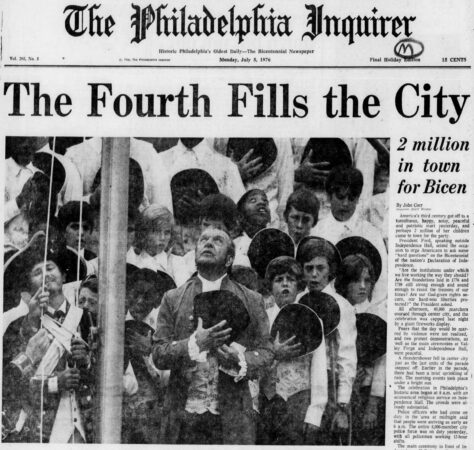
After all, in some ways, it did give us some of the Philadelphia we know today. Here is how the Inquirer and Daily News covered it.
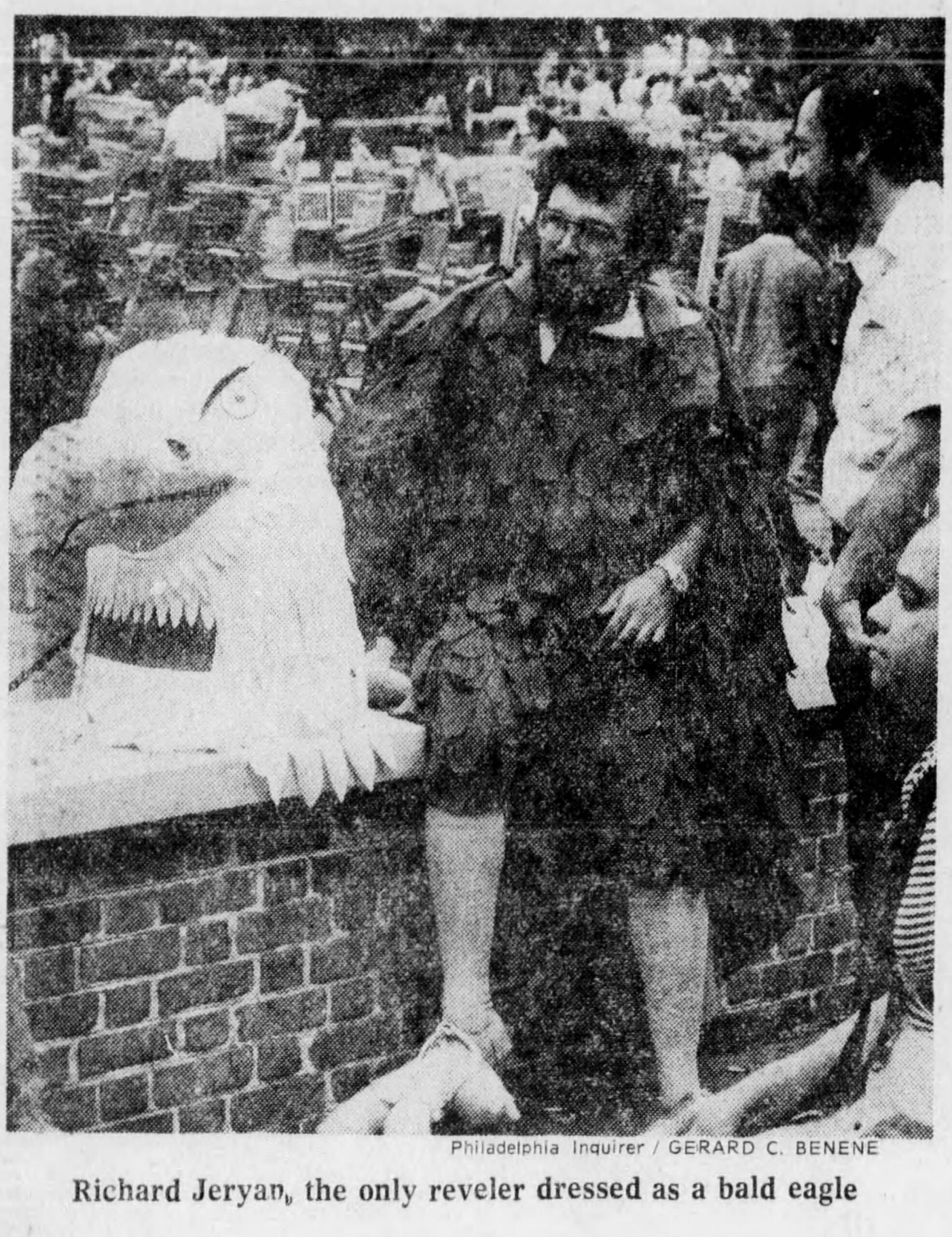
An Independence reveler celebrates the holiday in 1976 dressed as a bald eagle, as shown in an Inquirer photo from the time.
False starts and unrealized projects
Philly had big dreams for the Bicentennial as early as the 1950s, when planning tied the occasion to an international exposition that would bring travelers from all over the world. Some proposals ran into the neighborhood of $2 billion and had the exotic and impractical vision to match the price.
Among them was an $8 million plan for a flower-focused theme park in Fairmount Park known as “Philaflora” that was quickly abandoned.
Later, city planners proposed gimmicks like a large elevated platform over 30th Street Station that was to stretch more than four miles to West Philadelphia, the construction of concrete islands in the Delaware River, and converting swampland to solid ground in Eastwick to host the exposition.
None of these grand plans came to fruition. And by 1972, the entire idea for an international exposition was dead, having been “scotched” by President Richard Nixon, The Inquirer reported at the time. The city’s Bicentennial corporation, Philadelphia ’76 Inc., however held fast to plans for a large celebration, but was left with relatively little time to plan one — and no idea of what it would look like.
The result was a series of what The Inquirer in 1976 called “bread and circuses” efforts — essentially parades around town, plus a number of events and attractions on the Benjamin Franklin Parkway throughout the summer. These efforts, The Inquirer reported, were designed to give the illusion of tourist activity and interest, but without all the guff of actual planning and logistics.
And while we did have a Bicentennial celebration, it sadly did not “live up to 20 years of empty visions,” The Inquirer reported. And only months after July 4, 1976, we were left with “this feeling of promises unkept, hopes unfulfilled,” reports from the time said.
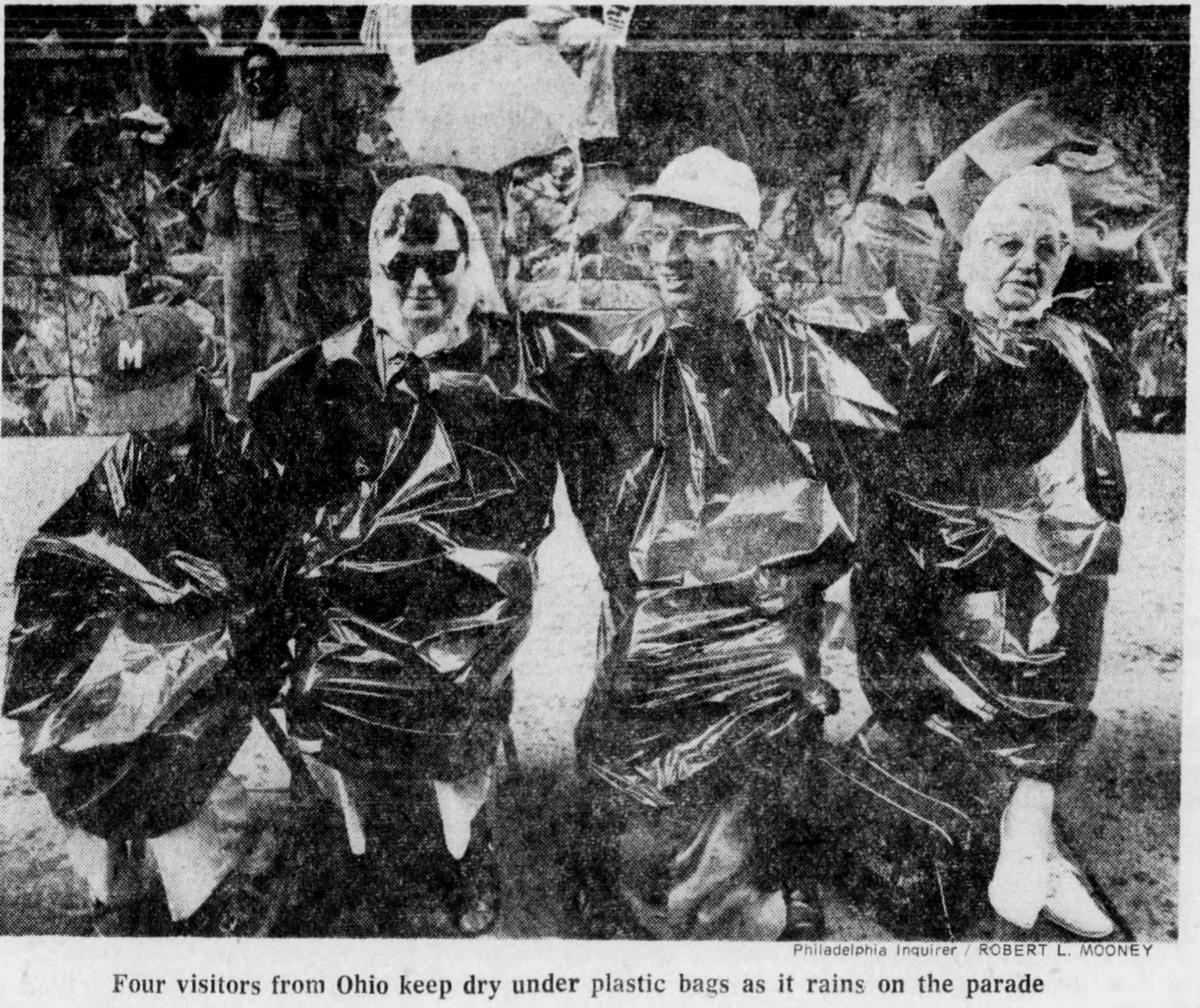
July 4, 1976 celebrants stave off the day’s rain under plastic bags during the day’s parade, as shown in an Inquirer photo from the time.
An under-attended party
Early estimates for tourism in Philadelphia in 1976 predicted 14 million to 20 million visitors for the year — figures that came from Sindlinger & Co., a Swarthmore-based research firm the city hired. The company conducted nationwide polling to determine the number of Americans who planned to visit Philadelphia in 1976.
They were way off. By October ’76, roughly 7 million visitors had come, reports from the time indicate. Some 2 million toured the city on July 4 alone, with the rest coming amid a myriad of conventions throughout the rest of the year. According to reports from the time, tourism numbers didn’t pick up until post-Independence Day — a welcome development for hotel operators, who expected a sell-out season that never arrived.
But that doesn’t mean Philadelphia fared poorly.
At least compared to 1975. As of December 1976, Philadelphia showed a 300% increase in visitors over the year before, The Inquirer reported — a proportion that placed us “better than any other American city in attracting Bicentennial visitors.”
The next closest city was Boston, which saw a mere 68% increase in tourism. No one else even came close.
In fact, no one really did well nationwide. According to a Christian Science Monitor article from the time, every city that expected an influx of Bicentennial tourists — Philly, Boston, D.C., and the like — said tourism numbers were way below predictions. Experts attributed that to the country’s economic state.
But tourism travel in the United States was high for the year, even though the Bicentennial boom never really arrived. The issue, experts said at the time, was that too much was expected. As Discover America Travel Organizations president William D. Toohey said at the time, the travel industry would have otherwise been “well-pleased.”
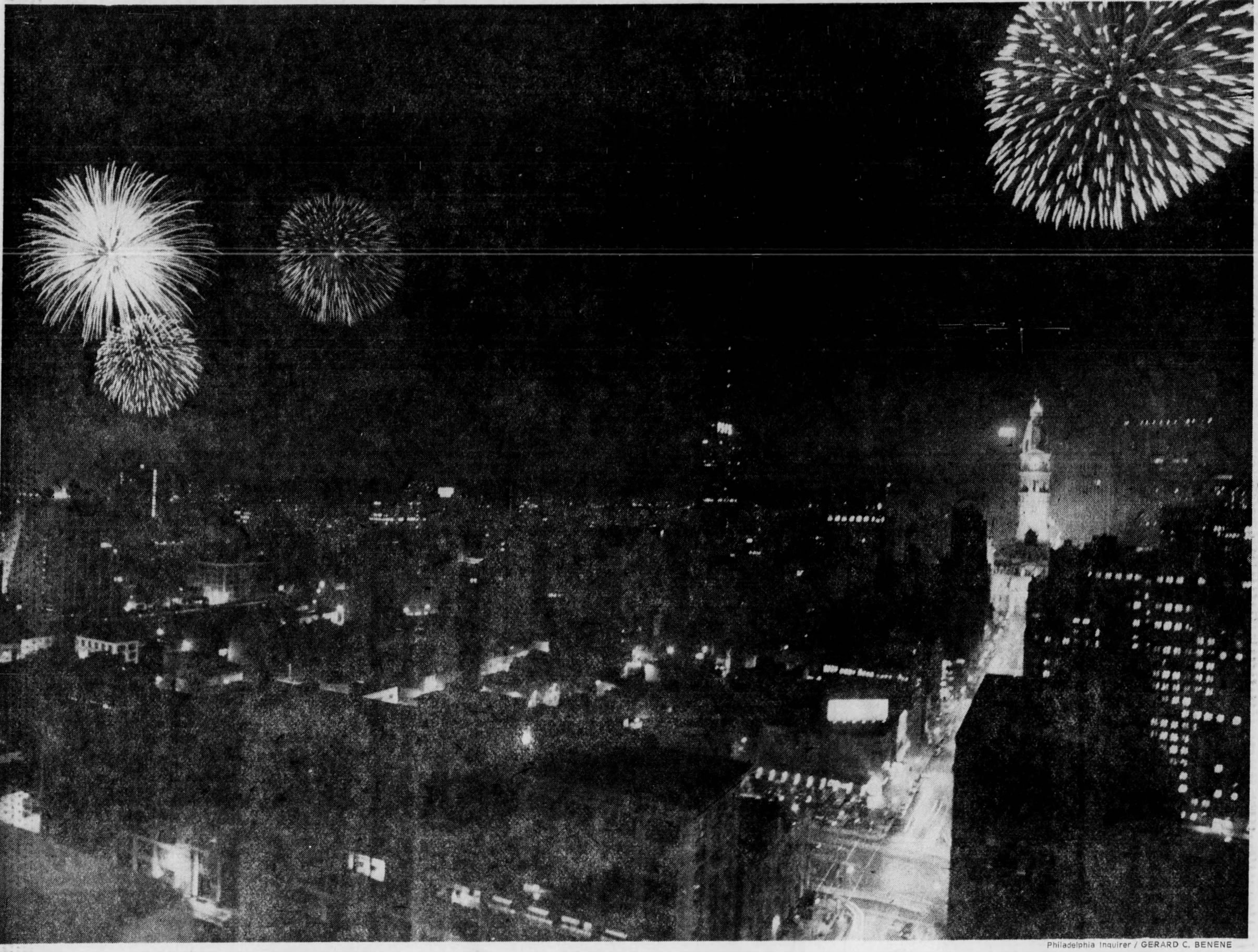
Fireworks over Philadelphia on July 4, 1976, as shown in an Inquirer article from the time.
Why Philly fell short
Philadelphia, however, was not blameless in its failure in 1976.
Chief among the factors was Mayor Frank Rizzo’s insistence that political violence would erupt on July 4, thanks to a contingent of protesters who planned to demonstrate in North Philadelphia — miles away from the day’s primary celebrations in Center City.
Rizzo was so worried that he called for thousands of federal troops to be earmarked to protect the city — a request that was ultimately not granted, primarily because investigators were unable to determine that a credible threat ever existed. And yet, when the holiday rolled around, the damage was already done.
By late June 1976, some 30,000 participants scheduled for the July 4 parade had canceled their trips to Philly, with most citing fear of political violence as the reason for backing out, reports from the time indicate. Rizzo had been essentially telling tourists not to come, and they largely listened.
Rizzo, however, wasn’t our only worry. In July, a slowdown by municipal workers caused trash to pile up in the streets for weeks. Workers refused to take overtime hours pending contract negotiations for a modest wage increase, and the dispute was not settled until early August.
And then, there was the Legionnaires’ Disease outbreak — a famous, but sometimes overlooked, factor impacting tourism for the year. The late-July outbreak severely impacted tourism due to concerns over potential illness, but didn’t entirely crush the influx of visitors.
“It was very clear that the Legionnaire’s Disease had a very sharp impact on tourism,” Philadelphia ’76 Inc. head William Rafsky said at the time.
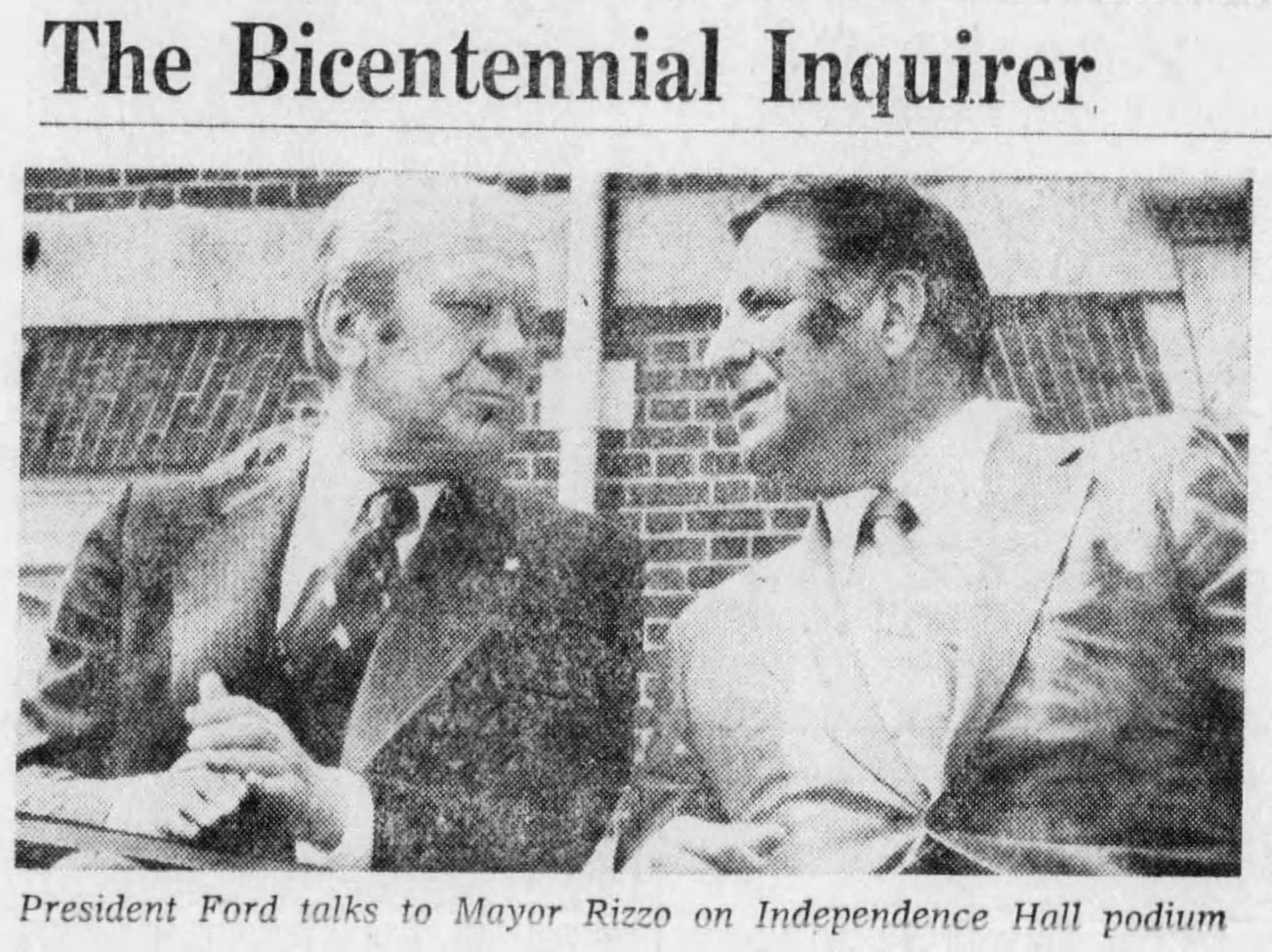
President Gerald Ford talks with Mayor Frank Rizzo at Independence Hall on July 4, 1976.
Benefits abound
Though the Bicentennial may have been something of a tourism bust, we didn’t walk away with nothing. In some ways, the city was enduringly altered — Philadelphia received an estimated $165 million in improvements for the country’s 200th birthday, a good bit of which was federal money that was not likely to be spent otherwise, reports from the time indicate.
The National Park Service, for example, spent an estimated $30 million on what we know today as Independence National Historical Park, The Inquirer reported. Those federal dollars bought a new Liberty Bell pavilion, extensive repairs and improvements to historical buildings, the construction of City Tavern and the Graff House, and the creation of Franklin Court.
Other improvements were also palpable. A number of subway stations were painted and rebuilt, institutions like the Philadelphia Museum of Art were improved, and places like the Mummers Museum and the Afro-American Museum (now the African-American Museum of Philadelphia) were established. Roughly 10,000 trees were planted in Fairmount Park.
These lasting municipal improvements had an impact, even if the Bicentennial itself did not live up to contemporary expectations. By the time 1976 hit, virtually nothing could quell the public’s want for advancement in light of the country’s 200th birthday. And so, it was deemed a failure.
But now, half a century later, perhaps we are overcoming that disappointment, or are at least willing to see what comes next — after all, the United States is 250 years old in 2026. And though tourism expectations for this year have been quieter, the city still stands, with hoards of visitors now reminiscent of our Bicentennial year.
“The Bicentennial Year will be a great year for the United States,” Rizzo said in 1976. “And particularly for Philadelphia, where our nation was born.”
Months before Philadelphia was set to celebrate the United States’ 200th birthday in 1976, Mayor Frank Rizzo was worried.
The city, he said, stood to face massive unrest and potential violence during the Bicentennial parade on July 4. There were, he believed, cadres of radical leftists plotting to disrupt what should be a day of jubilance two centuries after the country’s founding in the place where it was born.
They would come in droves from around the nation, Rizzo said. And to combat them, Philadelphia authorities didn’t just need to be vigilant — they needed thousands of federal troops to patrol the streets and quell the impending chaos.
Those troops, despite Rizzo pursuing their deployment, never arrived. Nor did the bedlam he feared would come. And neither did the throngs of tourists the city expected for the Bicentennial, at least in part because of Rizzo’s warnings.
The city, did, however, get plenty of leftist protesters — tens of thousands who held large, peaceful demonstrations in North Philadelphia on Independence Day of 1976. No blood flowed in the streets, and Rizzo, the man who claimed it would, that year became the first mayor in Philadelphia’s history to face a recall effort.
Here is how The Inquirer and Daily News covered it:
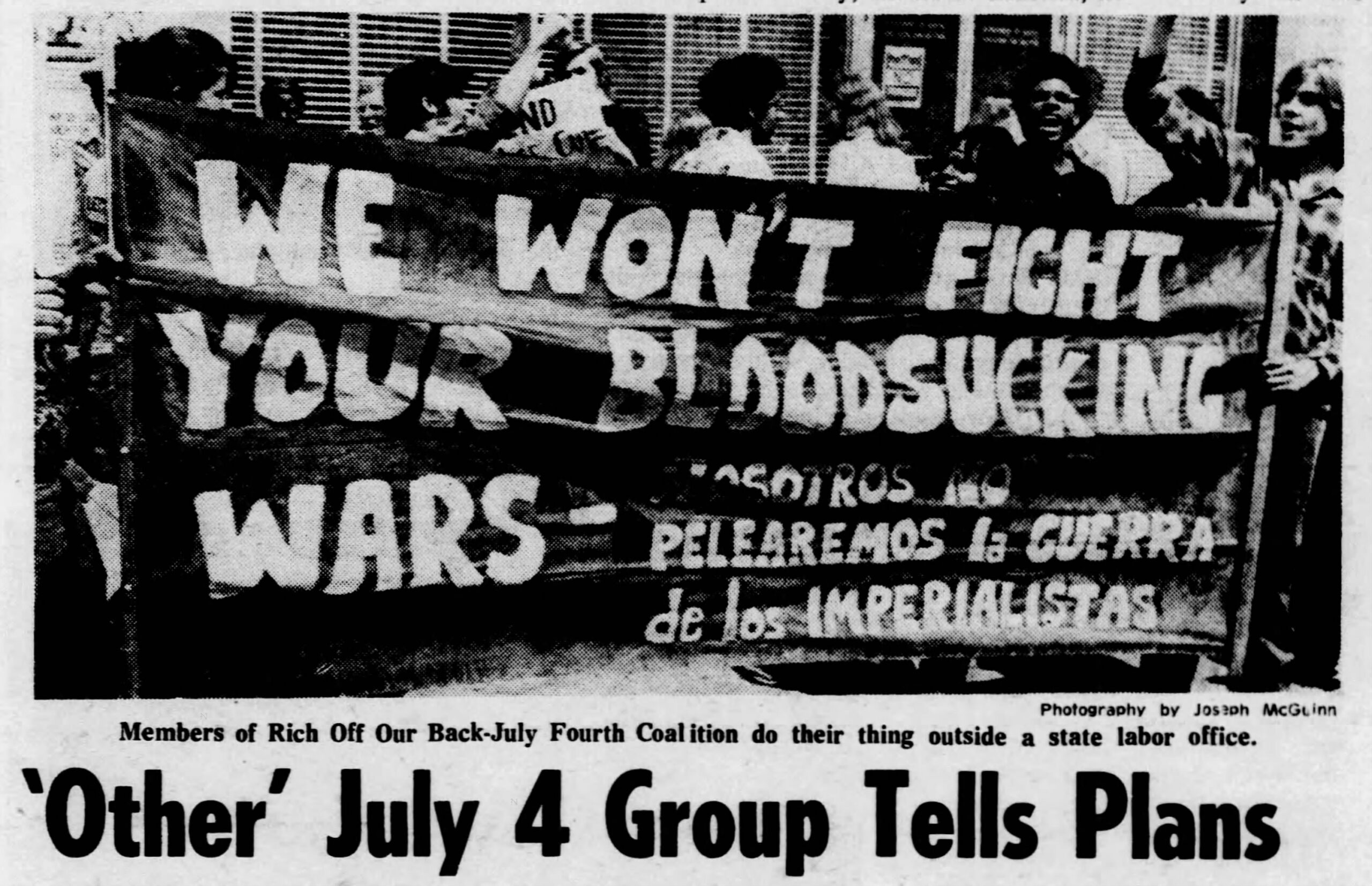
Members of Rich Off Our Backs demonstate outside a state employment office in Germantown in June 1976, as shown in an issue of the Daily News from the time.
Two groups plan protests
Rizzo’s perceived threat of chaos came from two similarly named, yet totally distinct, groups that planned demonstrations for Independence Day. Those were the July 4 Coalition and the Rich Off Our Backs-July 4th Coalition, two organizations that consisted largely of anti-war, socialist civil rights activists who hoped to offer some counter-programming for the holiday.
The July 4 Coalition was larger, with some 100 subgroups making up its ranks, which it claimed would bring 60,000 marchers to Philadelphia for the Bicentennial. Rich Off Our Backs, meanwhile, expected only 5,000 people to show up for its Independence Day demonstration, but was the larger concern for the Rizzo administration because it was considered the more radical group.
Ahead of the holiday, the city had reached an agreement with the July 4 Coalition, which planned to protest dozens of social ills ranging from racism and sexism to unemployment and military spending. Its demonstration would take place in North Philadelphia, miles away from the main festivities in Center City.
Rich Off Our Backs, meanwhile, wanted to hold its demonstration in Center City and was believed to be “dominated by a tiny, one-year-old Marxist splinter called the Revolutionary Communist Party,” The Inquirer reported at the time. The group, reports said, planned to focus on unemployment.
Those plans would have brought the group into direct conflict with the city’s Bicentennial activities, including Philadelphia’s official parade. But after a weekslong court battle, Rich Off Our Backs was denied a permit to parade in Center City, and agreed to an alternate route that would take the march through North Philly.
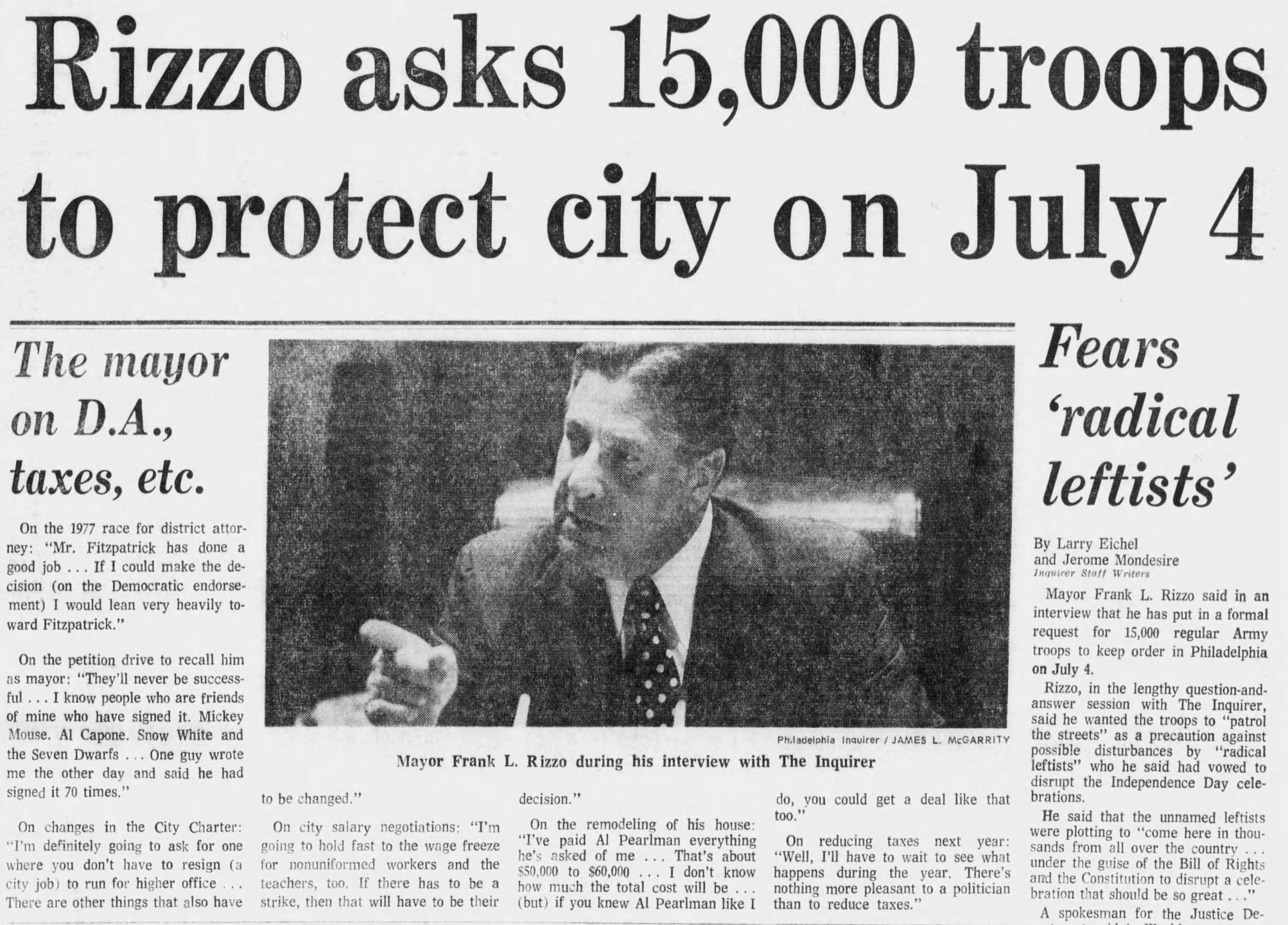
The front page of the May 30, 1976, Inquirer details Mayor Frank Rizzo’s request for 15,000 federal troops to protect Philadelphia on Independence Day that year.
Rizzo’s call for federal troops
In late May 1976, Rizzo told The Inquirer he would call for 15,000 Army troops to keep order in Philadelphia due to concerns over the planned protests and potential violence.
Federal troops, Rizzo said, would supplement the city’s police force, which would be “spread too thin” due to the number of planned festivities on July 4. Bolstering the police, he added would not included armored vehicles or heavily armed forces, but would consist merely of “bodies” carrying sidearms to quell dissent.
Deployment of federal troops, The Inquirer reported, would require approval from then-Gov. Milton J. Shapp, who supported the effort. And the FBI’s Philadelphia office said it was unaware of any federal investigation into the matter at the time of Rizzo’s announcement.
Both the July 4 Coalition and Rich Off Our Backs called Rizzo’s move “fascist,” and insisted demonstrations would be peaceful. One activist, the Rev. David Gracie, known for anti-Vietnam War protests in the 1960s, said Rizzo’s request harkened back to the city’s treatment of anti-war demonstrators.
And in late June, the Justice Department denied Rizzo’s call for troops, saying it failed to find substantive evidence of the radical activity the mayor feared would occur. There was, the FBI said, no “hard core” indication of impending terroristic activity, and no additional enforcement efforts were necessary.
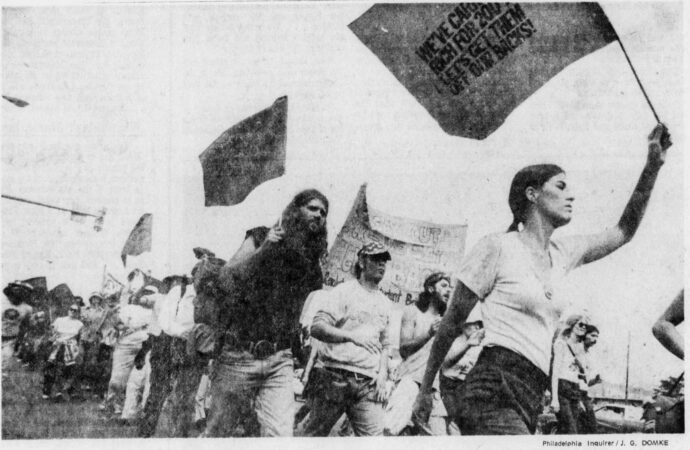
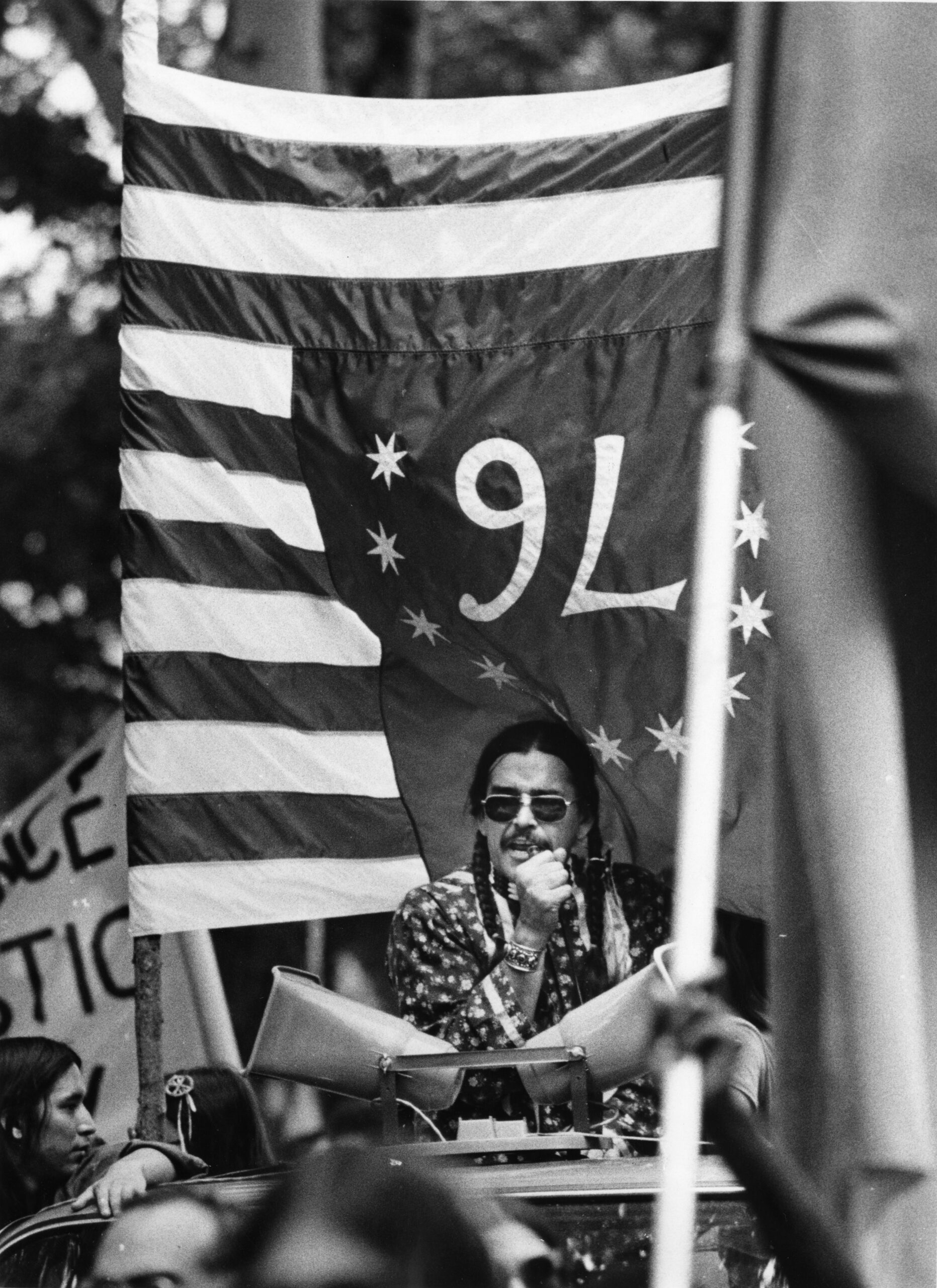
A group of Native Americans lead a “July the Fourth Coalition” protest parade at 33rd and Diamond Streets in Philadelphia, on July 4, 1976.
The day of
On Independence Day 1976, both groups marched through North Philadelphia without incident, The Inquirer reported at the time. There was not a single arrest or reported disturbance, with the only snafu being late starts to both marches.
Rich Off Our Backs, despite the fervor over its planned activities, managed to attract about 4,000 participants, all of whom marched east along Girard Avenue from Broad Street before convening in Norris Square Park in Kensington. The July 4 Coalition held an 18-block demonstration along Lehigh Avenue ahead of a rally at 33rd and Oxford Streets in Fairmount Park.
The coalition claimed to have drawn some 58,000 protesters, but Philadelphia Police, estimated the crowd at about 25,000 people, and observers pegged it at half that size.
“We did it,” Rich Off Our Backs spokesperson Nick Unger said in 1976. “Thousands of working people walking through the city for miles where you couldn’t see the front of the march or the rear of the march.”
Neither demonstration, meanwhile, resulted in any of the bloodshed, destruction, or disruption the Rizzo administration advertised. In fact, The Inquirer reported, both protests “drew little response from onlookers” along their routes, and the police who were deployed — clad in riot gear — were ultimately not needed.
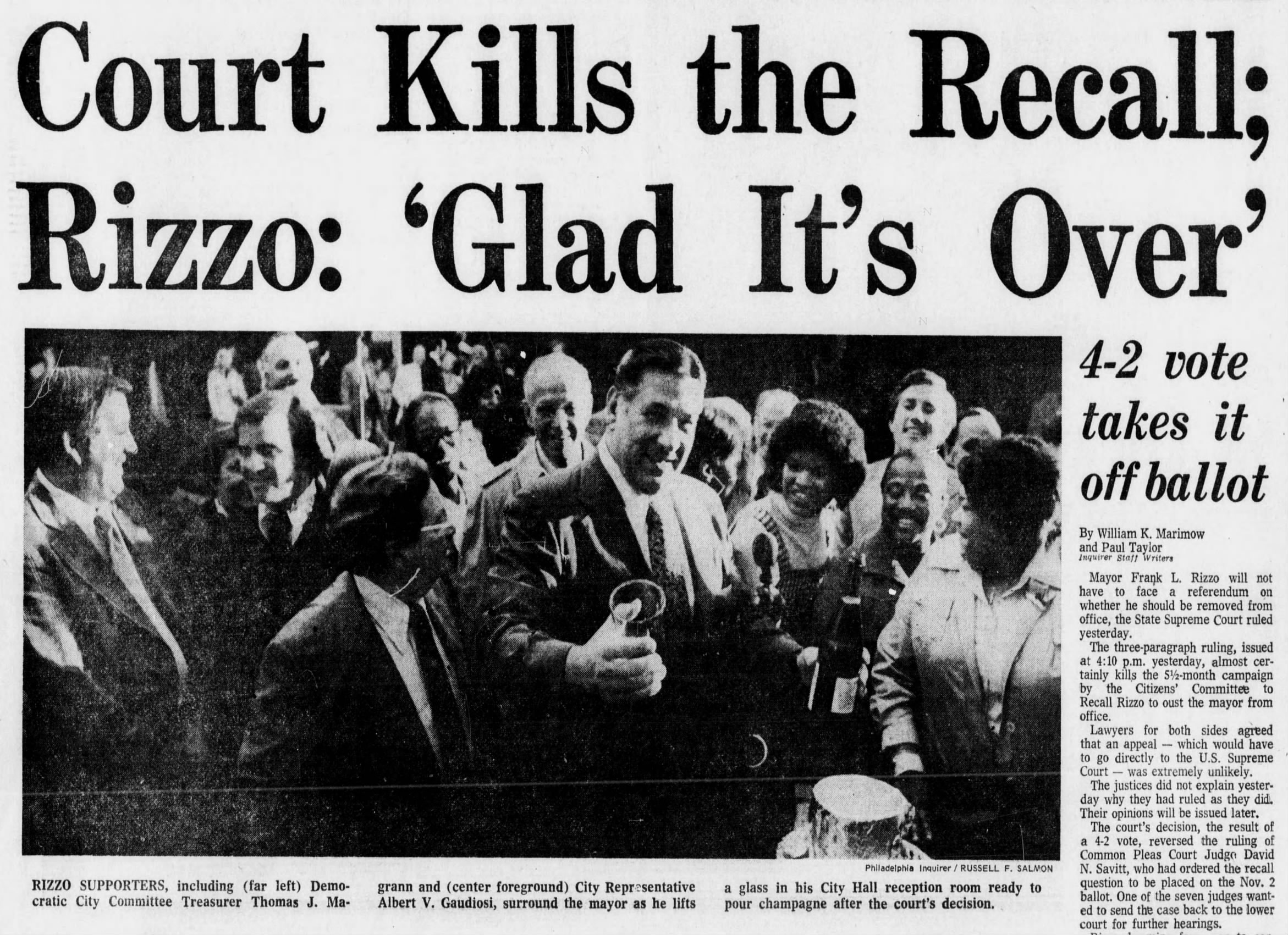
An Oct. 1, 1976 edition of The Inquirer details Mayor Frank Rizzo’s reaction to the defeat of the recall effort that year.
Rizzo’s recall
Rizzo’s treatment of the July 4 protests did not directly lead to efforts to recall him, but it certainly emboldened his critics. The mayor seemed to realize the error at the time, with Rizzo rarely showing his face publicly around Independence Day — a strategy largely believed to have been instituted by his top advisers.
In fact, efforts to recall Rizzo stretched back to April 1976, weeks before his pursuit of federal troops ever surfaced. The recall move was largely due to Philadelphia’s flagging economy, as well as tax increases and a city budget deficit.
An organization known as the Citizens Committee to Recall Rizzo organized a petition, garnering some 145,000 signatures by mid-April 1976. That figured swelled to more than 200,000 signatures following the Bicentennial, but only about 89,000 were found to be valid.
In September, a Common Pleas Court judge found that Rizzo would need to face a recall — a decision later struck down by the Pennsylvania Supreme Court. Rizzo, as a result, was never officially recalled, and the summer of 1976 would be remembered as a “Buycentennial that wouldn’t sell” amid a “call for federal troopers that neither came nor were needed,” The Inquirer reported.
And by late 1976, Rizzo expressed relief that the situation seemed to be resolved.
“I never had any doubts that it would rule in my favor. The law is on my side,” he told The Inquirer. “I’m glad it’s all over.”
As the mercury climbed above 100 degrees in the Philadelphia region two days before the nation’s 250th birthday, it was, it seemed, too hot for liberty as originally planned.
Thursday marked the start of the Red White & Blue To-Do — Philadelphia’s third-annual celebration of the day the Second Continental Congress voted to adopt a resolution of independence here on July 2, 1776. Though many events honoring that anniversary were planned, several highly anticipated gatherings were canceled or postponed due to the heat.
And yet, despite the oppressive temperatures on a particularly toasty July day in the cradle of the nation’s founding, the celebration started early Thursday.
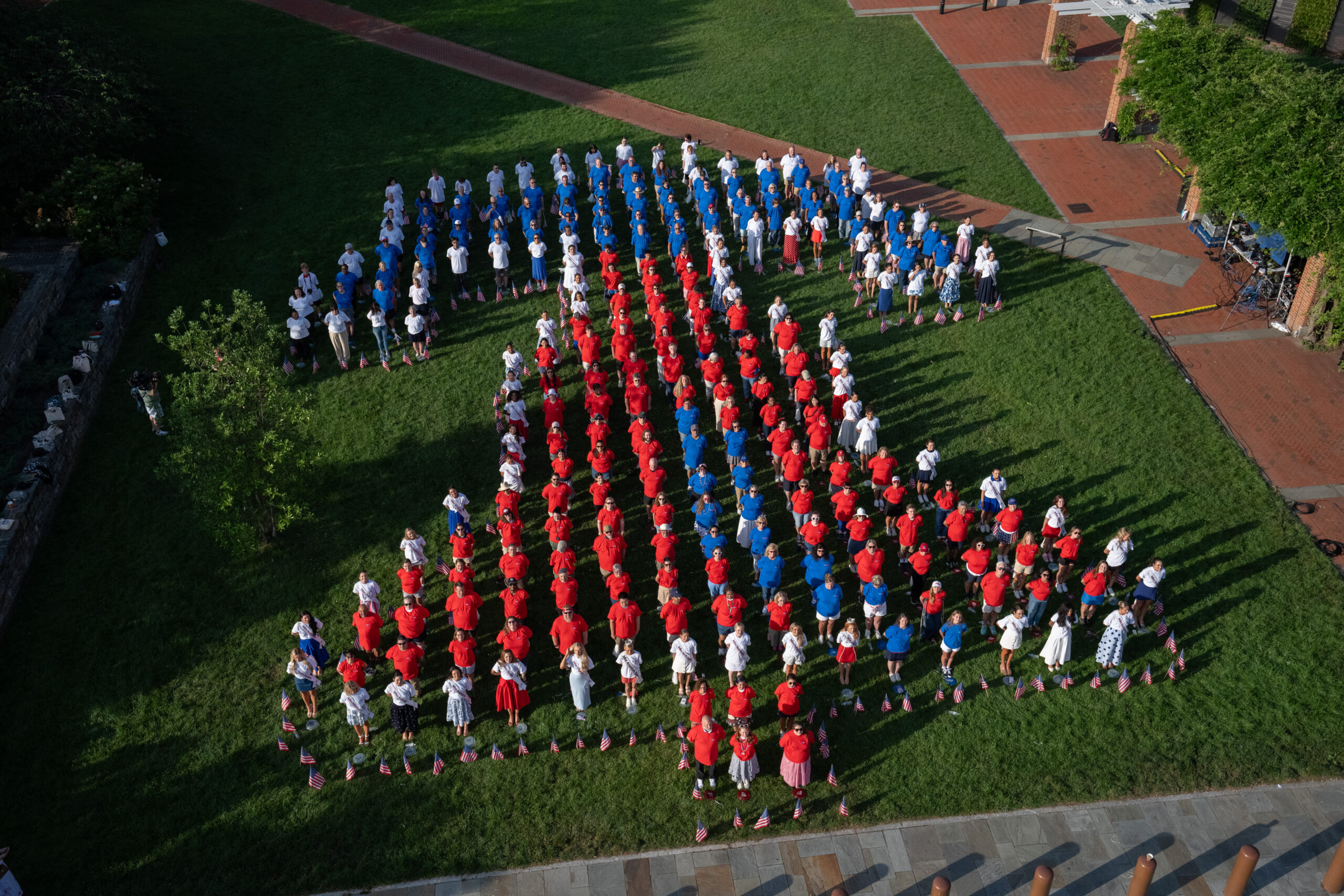
At 7 a.m., some 250 revelers, clad in red, white, and blue clothing, gathered at Independence Mall to make a living Liberty Bell — a representation of a symbol that has defined Philadelphia for centuries, and a touchstone for Americans nationwide. The human formation even captured the bell’s signature crack through an outline of participants wearing blue.
Participants gather to create the Living Liberty Bell, gathering 250 people to form the shape of the famous bell on Independence Mall.
Likewise, performers from neighborhoods across Philadelphia and nations around the world weren’t slowed down by the heat as they marched, stepped, and danced their way down Independence Mall in the Red, White & Blue To-Do Pomp & Parade. Attendance, however, did seem to be impacted, with relatively light crowds along the sunny parade route.
The same was true for the 11 historic spaces across Old City filled with music Thursday as part of the WXPN Welcomes the Red, White & Blue To-Do Music Series. More than two dozen local artists performed, though audience seats were were not all filled as crowds remained light and foot traffic across the historic district was much sparser than an average Thursday.
Legendary Philly poet and recording artist Ursula Rucker performed with Miles Orion on guitar at the Arch Street Meetinghouse for a crowd of about a dozen people. She gave moving renditions of her poems — like “Philadelphia Child” and “Fear or Freedom” — and ended her set on “L.O.V.E.”
“Love soft, love hard, just love,” she said.
Meanwhile, parade participants pulled wagons featuring small floats of Independence Hall, the LOVE sculpture, and the Liberty Bell, and a historical interpreter portraying John Adams brought up the rear of the procession. Lines for both Independence Hall and the Liberty Bell, meanwhile, snaked down the sides of their respective buildings.
Pastor Funmi Obilana of RCCG Church in West Philly stopped to watch the parade with two other members of her congregation on their way to the President’s House site. The three women were doing a walking tour of their own city Thursday, stopping at places where their ancestors were once enslaved in advance of Independence Day.
“We are here to pray for this city and this nation,” Obilana said. “Two-hundred-and-fifty years is a big number and it should be a new beginning, not only for Philadelphia, but for the nation.”
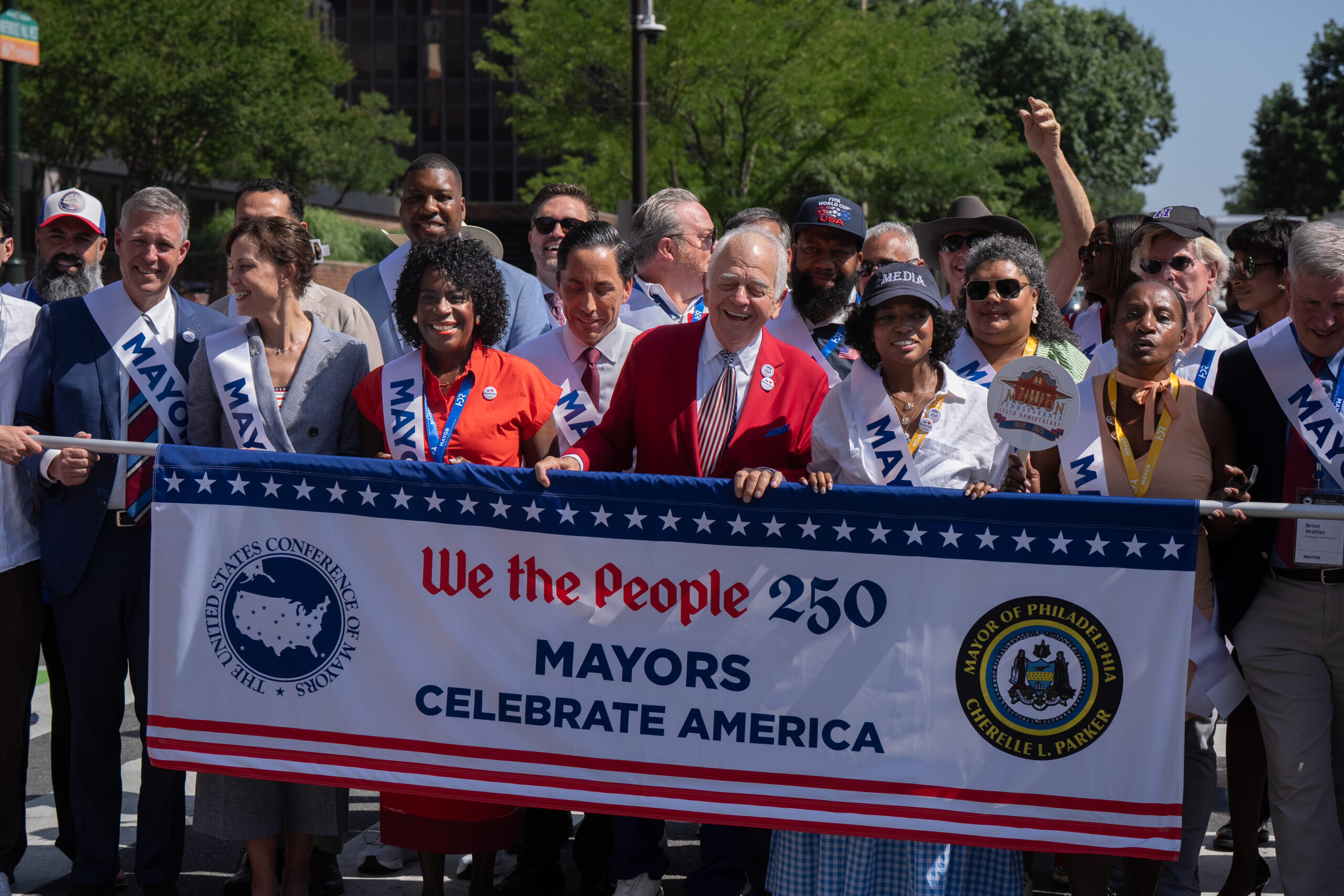
Mayor Cherelle L. Parker leads bipartisan mayors from communities across the nation in a Historic March of America’s Mayors through the birthplace of American democracy, and past Independence Hall, in Philadelphia, July 2, 2026.
Mayors from around the country who traveled to the city Thursday seemed to agree. Those local leaders were in town for a walk that featured 100 mayors from small towns and big cities nationwide touring Philadelphia. Despite scorching temperatures and differing political alignments, the mayors quickly befriended one another, many bonding over a shared connection of a city or state.
That mayoral group, led by Philadelphia Mayor Cherelle L. Parker as they marched from the President’s House to Independence Hall, later gathered in a small auditorium in the Museum of the American Revolution. There, Parker urged attendees to come together and share ideas, as representatives from across the colonies had in the 1700s.
“May today’s conversations strengthen old friendships, spark new ideas, and renew our shared commitment to public service,” Parker said. “Welcome to Philadelphia, everyone. Let’s roll up our sleeves and continue the hard work together.”
The meeting, it seemed, was a fitting one. On July 2, 1776, 12 of the 13 colonies voted in favor of independence from Great Britain, explained Tom Cochran, U.S. Conference of Mayors CEO and executive director. Only New York cast a no vote — until a few days later when it got onboard, as well.
“We talk about the declaration, we talk about the Constitution, it was on that day, July 2nd … that we broke,” Cochran said.
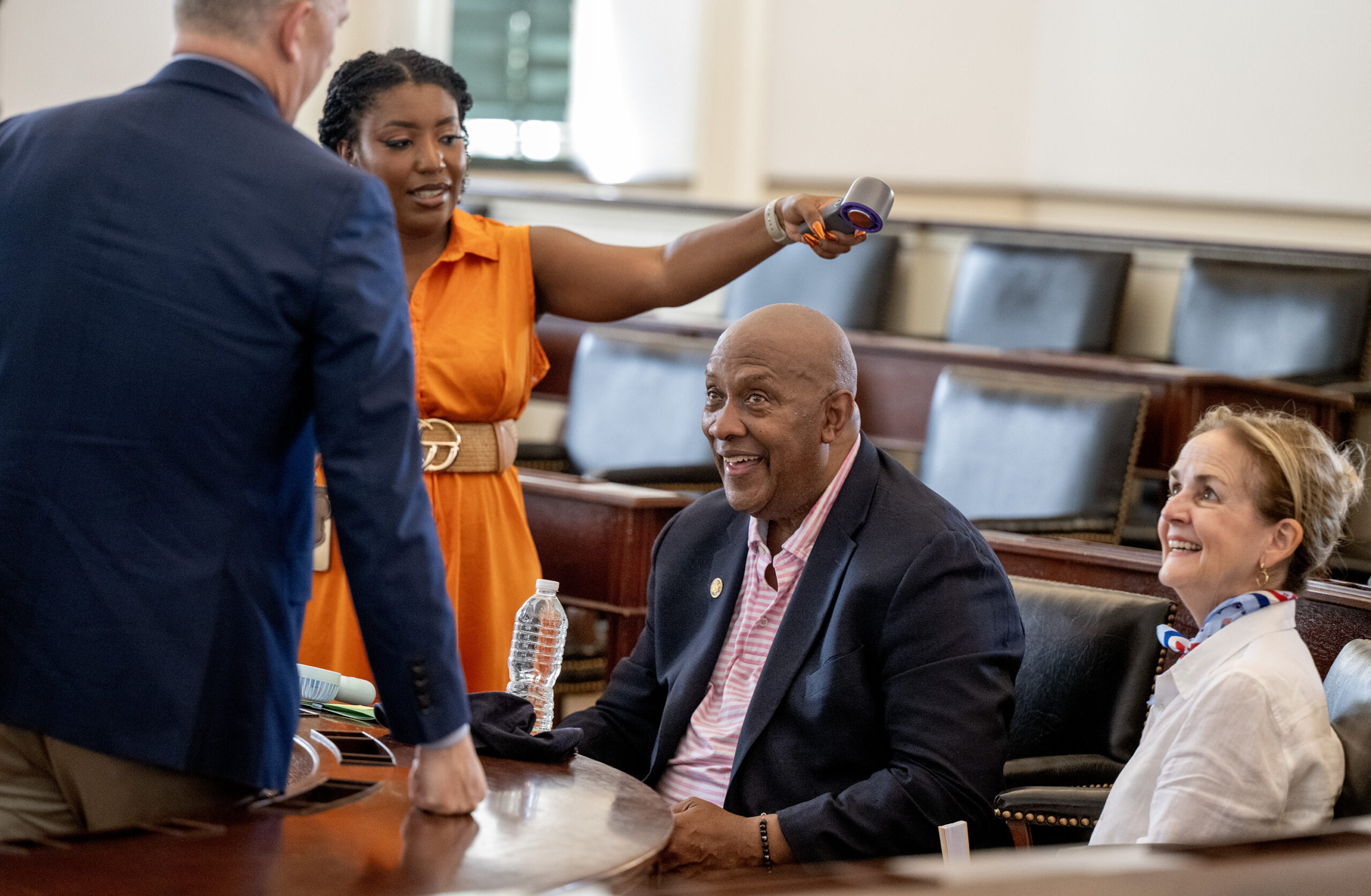
Jarquiza Ayers, on the staff of U.S. Rep. Watson Coleman, uses a handheld fan to cool off U.S. Rep. Dwight Evans at Independence Hall.
About 30 members of Congress also made the trip to town, lining up to enter Independence Hall for a ceremonial event that included speeches from Pennsylvania Gov. Josh Shapiro and House Minority Leader Hakeem Jeffries (D., N.Y.). The event, said U.S. Rep. Glenn Thompson (R., Pa.), showed that “the origins of our republic trace back to Pennsylvania.”
Founding Father John Adams believed July 2 would be celebrated for generations to come with “Pomp and Parade,” but July 4, when Congress approved the Declaration of Independence, ended up getting all of the glory and became the day we mark the nation’s founding. Now, more than two centuries later, Philadelphia seemed to be making good on Adams’ initial interpretation.
That is, except for the heat. Thursday’s skyrocketing temperatures, which hit 102 degrees in the afternoon, resulted in some alterations to the day’s events. The parade, for example, fell victim to a shortened route. A planned All-American Block Party and the Wawa Welcome America Salute to Service concert, featuring Queen Latifah, were canceled entirely. Parades, fireworks, drone shows, and other events planned in South Jersey were also affected by the extreme heat.
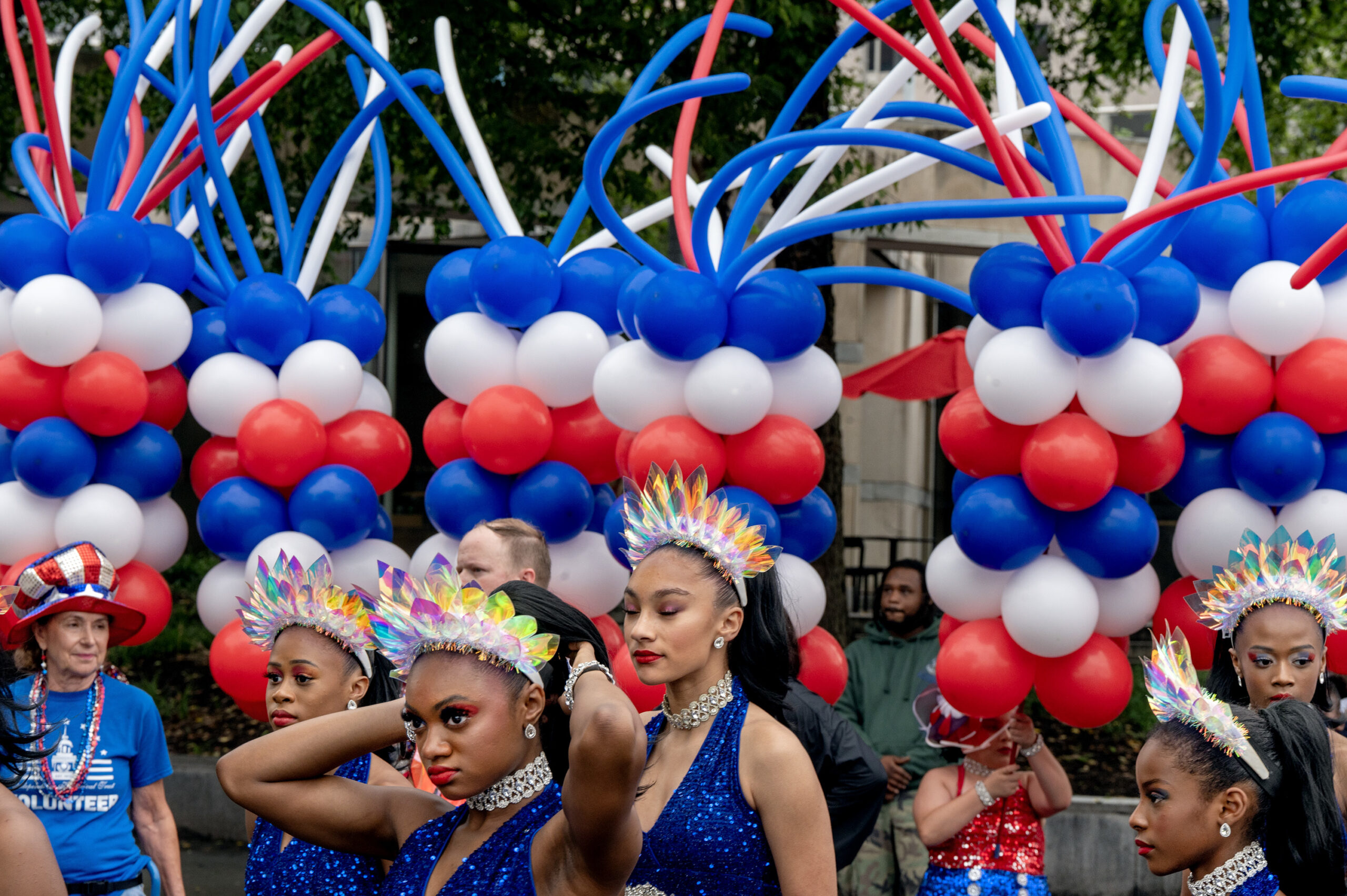
Students of DANCE4LIFE School of the Arts & Training Institute in Claymont, Del. Wait for the start of the second annual Red, White, & Blue To-Do parade.
And as the Fourth approaches Saturday, we aren’t likely to get much relief. In fact, Friday is expected to be a little warmer, followed by possibly stormy weather slated for the evening of Independence Day.
But the weather, however inclement, some visitors said, was illustrative of what the Founding Fathers dealt with when the United States was born a quarter-millennium ago. Lori Morgan and her three daughters traveled to Philadelphia from Boston, hoping to celebrate the nation’s historic 250th birthday in the place where it all happened. They toured Independence Hall this week, and Morgan said it gave them a new perspective on the days and people that led to the founding of our nation.
“We really thought about how when they did the Declaration it was a hot summer and this weather is helping us empathize with what they went through,” Morgan said. ”They all had different ideas, just like we do today, but they knew they couldn’t fail and they had to come together, and they did.”
Staff writers Michelle Baruchman, Emily Bloch, and Anthony R. Wood contributed to this article.
There are lots of air conditioned spaces you can go to for relief. Organizations like the Pennsylvania Department of Health have always recommended going to air-conditioned spaces — like a mall or library — to protect yourself from heat-related problems.
“With extreme heat, it is always important to remain cool, possibly in air-conditioned atmospheres,” state health department of health press secretary Maggi Mumma said in 2020.
There are, however, some things you can do at home to keep a little cooler if you are AC-less this summer. Here is what you need to know:
How to cool your body down
Let’s start with the basics: One key way to fight heat-related discomfort is to drink lots of cool water, which can both keep you hydrated and help cool you down. Sugary or alcoholic beverages can cause you to lose more body fluids. Dr. Joseph Teel, an associate professor of family medicine and community health at Penn Medicine, says you should drink water frequently.
How much? There is no one-size-fits-all answer. How much you need to drink can vary if you have health conditions such as congestive heart failure, Teel says, or be exacerbated by your environment, level of exercise, and overall health. One tip: Don’t wait until you are thirsty to drink, the state health department says.
When someone suffers heat exhaustion on a sports field, Teel says an ice bath can help bring down their temperature. You can take the same approach. A cold bath or shower, he says, can help but is not a permanent solution because “you can’t stay in the shower all summer.”
You can use cool compresses, Mumma says, to help cool down. Making one is simple: Just wet a washcloth or towel in cold water, and put it on your body. Where should you put it? Some of the most effective areas, Teel says, are around your neck and on your groin, and if you’re at home, you can try using them with minimal clothing on to hit a few areas at once.
You can step up that technique by using fans to make it an “evaporative process,” Teel says. “If we have water on our skin and it evaporates, it takes with it some heat,” he says. Put on your cold compress and use a fan to blow air across your skin, which Teel says can “cool you down a little faster than just a cold cloth itself.”
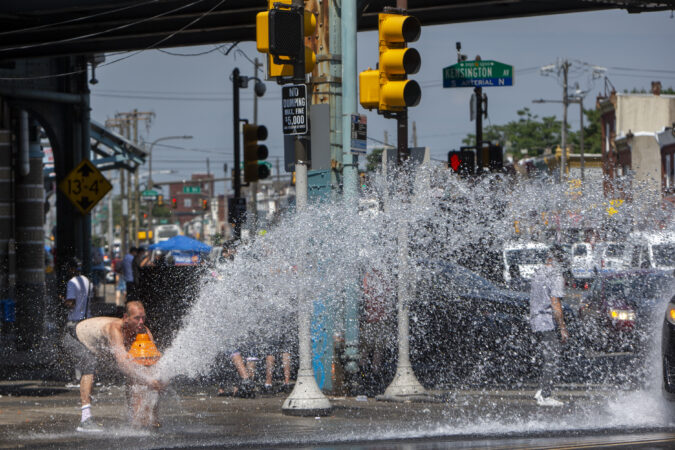
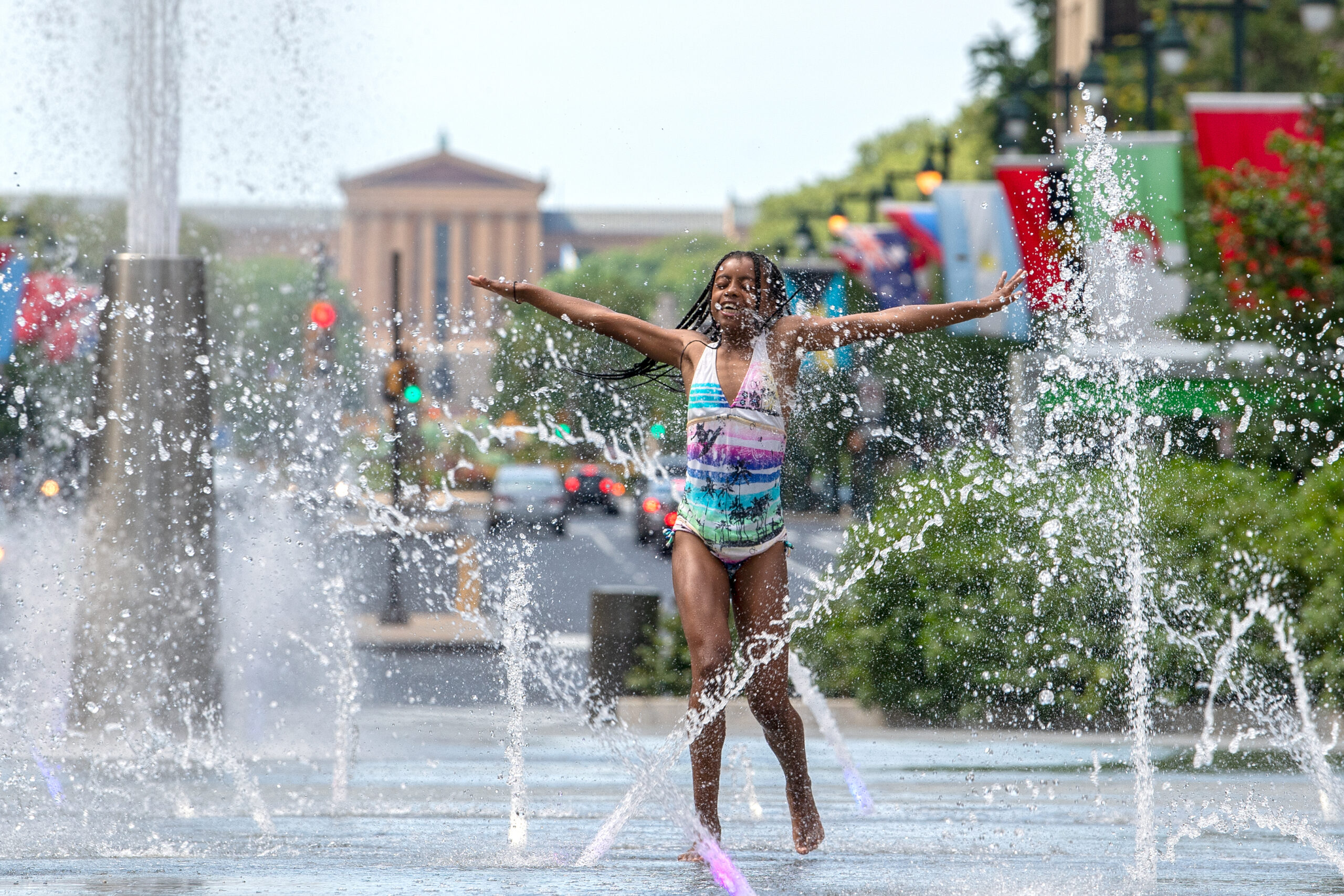
Beating the heat in Love Park fountain, during a hot summer day in Philadelphia.
How to cool down your house
Use fans wisely. Fans can be one of the best ways to keep cool — but there are right and wrong ways to use them. The city, for example, says you should never use a fan with your windows closed, which can create an “oven effect” by circulating hot air inside your home.
Fans can be more effective when the heat of the day is over, and you can open your windows to allow the cool night air in, Teel says. One of the best ways to create airflow is to put a box fan in an open window at one end of your space blowing air in, and another fan in a window blowing air out at the other end.
And if your home has ceiling fans, make sure the blades are rotating counterclockwise during hot weather. That way, the fan will push air down into your space to create a breeze. (Many ceiling fans have a directional switch on their motor that controls the direction in which they spin.)
There are more ways to keep your home cool.
Think about when you use your appliances.The Pennsylvania Utility Commission, for example, says that you should wait to use any appliances that generate heat — such as dryers, dishwashers, and ovens — until after 7 p.m. to avoid heating up your home unnecessarily. Turning off other nonessential appliances and lights is also a good idea.
Keep your blinds closed during the day. The sun, Teel says, can heat up your home faster, like a greenhouse. The PUC recommends spending time in rooms that are not hit with direct sunlight during the day.
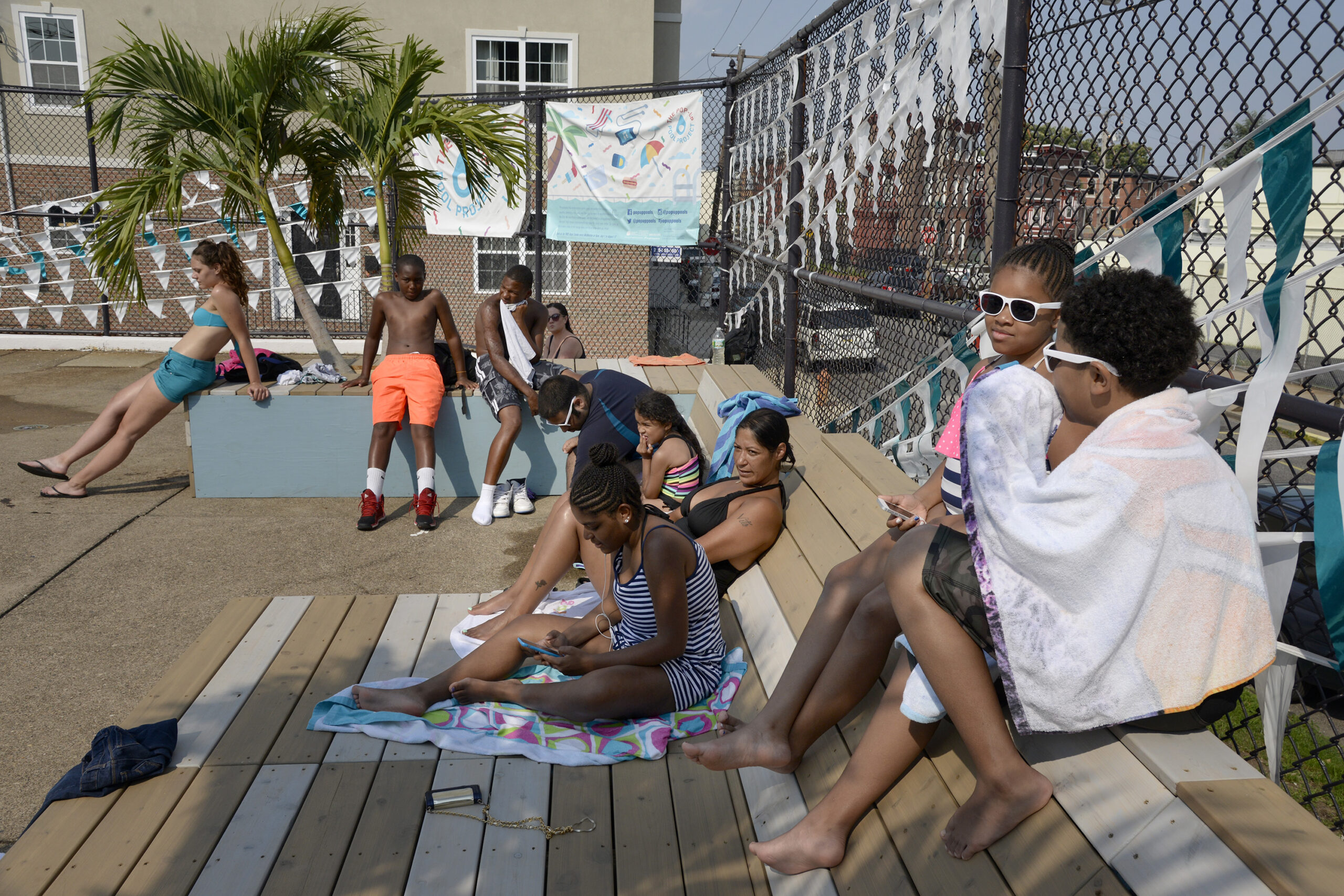
City pools were closed in 2020, but will reopen for the 2021 summer.
If you’re going to buy an AC
Window air conditioners are much cheaper and more convenient to install than central air, and if you can afford one, it may be a good time. However, there are some things to consider when buying a window unit.
As Consumer Reports points out, you will want to get an AC that is appropriately sized for the room you are trying to cool. If it’s too small, it will have trouble cooling the room; if it’s too big, it will cool the room quickly but leave too much moisture behind. A good rule of thumb is for the unit to have 20 BTUs (British Thermal Units) of cooling power for every square foot of space in the room.
And if you need help with utility costs this summer, funding from the Low Income Home Energy Assistance Program is available for qualified residents, a city spokesperson says.
Think about when you go out
The health department recommends staying indoors as much as possible and limiting exercise during the hottest parts of the day, Mumma says. However, if you have to go out, stay in the shade as much as possible and wear sunscreen, a ventilated hat, and sunglasses.
If you need to go shopping, Teel says, “look ahead in the week, and pick a cooler day. Avoid the time when you will be subjected to midday heat.”
At home, Teel says, wear as little clothing as possible. When out and about, consider using light-colored, loose-fitting clothes made of breathable, light materials like cotton that let air to circulate around you.
“Smokin’” Joe Frazier is finally in his new home, just in time for the 250th birthday of the United States.
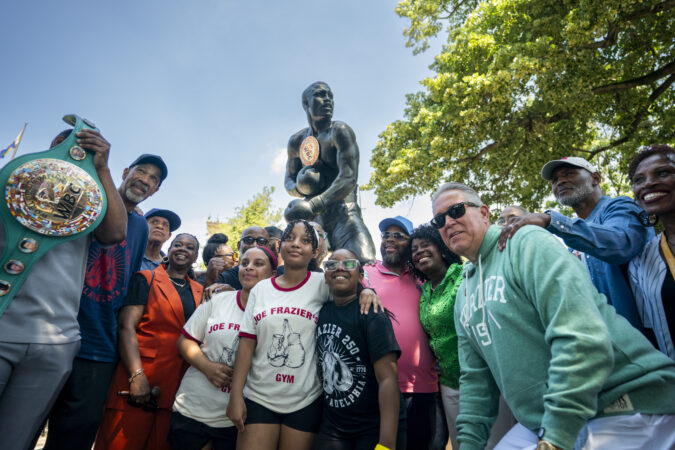
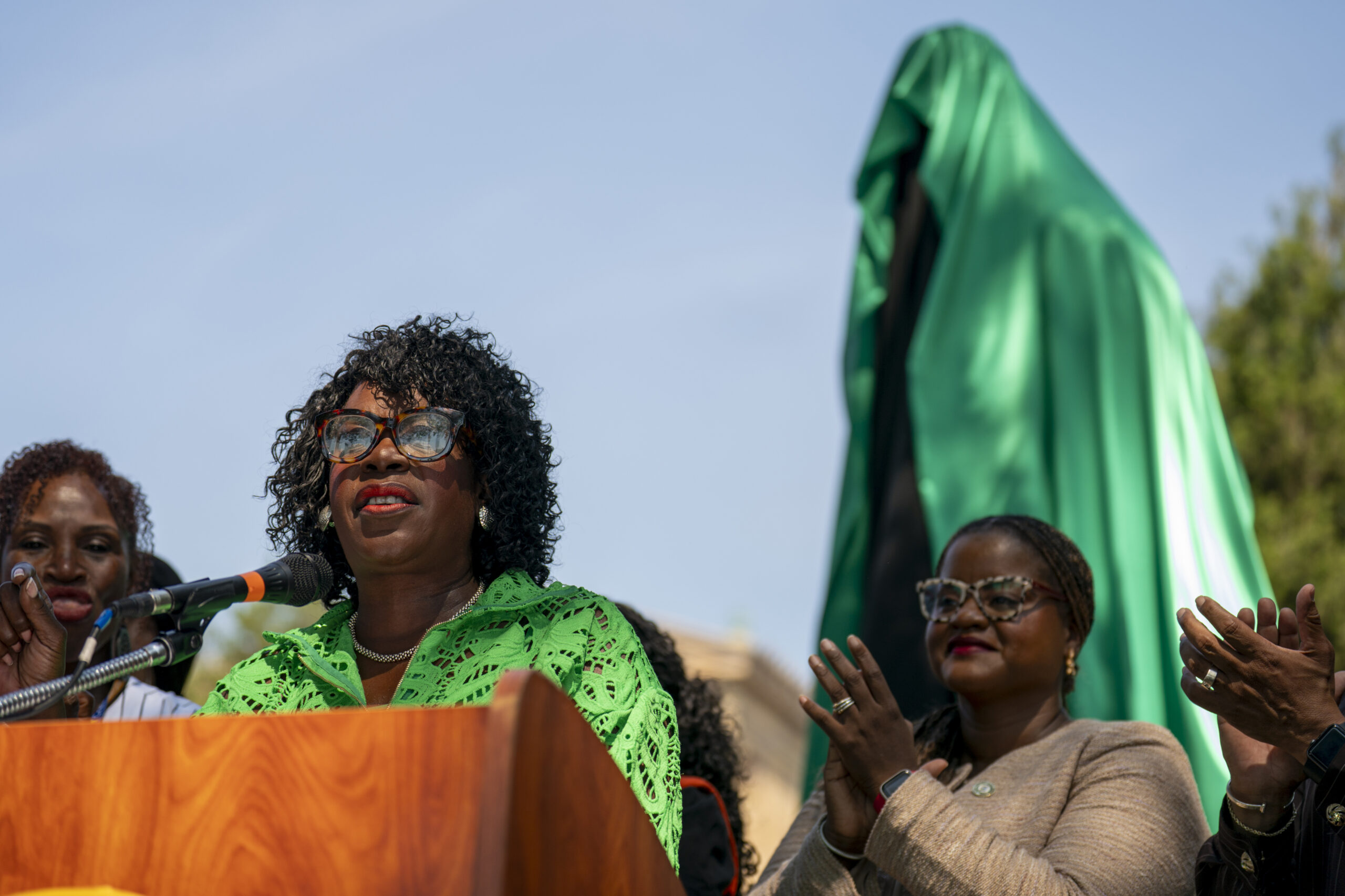
City officials, alongside Frazier’s family, friends, and fans, on Monday unveiled the real-life heavyweight boxing champion’s statue at the base of the Philadelphia Museum of Art. Intended to be the statue’s new location in perpetuity, the spot was occupied by a monument to fictional boxer Rocky Balboa for two decades.
“During this 250th celebration in the birthplace of democracy, we will forever remember that the city got right what it had gotten wrong for a long, long time,” Mayor Cherelle L. Parker said. “Now, Joe Frazier is attached, and connected to, and will permanently be here at our Philadelphia Museum of Art.”
Monday’s unveiling was the culmination of months of planning. The Philadelphia Art commission in February approved a plan to move the statue from by Creative Philadelphia, the city’s office for the creative sector. Chief cultural officer Valerie V. Gay said Monday’s event was something of a “soft launch” for the statue’s new home, as a granite base will be installed in the future, along with more formal interpretive panels.
Mayor Cherelle L. Parker speaks at the unveiling of the statue of former heavyweight boxing champion Joe Frazier at its new home outside the Art Museum.
“Today, we did not want to wait,” Gay said.
Frazier’s statue, after all, lived at the South Philadelphia sports complex for more than 10 years. Created by sculptor Stephen Layne, the statue was unveiled outside what is now Stateside Live! in 2015, four years after Frazier’s death in 2011 following a battle with liver cancer. Frazier, the undisputed heavyweight champion in 1970-1973, is probably best remembered for his three battles against Muhammad Ali in the 1970s.
The city’s statue of Rocky had called the base of the Art Museum’s famed steps home since 2006. The monuments’ moves are part of a larger shuffling of statues at the Art Museum that began in March, when the Rocky statue was moved inside the museum for the first time as part of the ongoing exhibition Rising Up: Rocky and the Making of Monuments.
That Rocky statue will be installed at the top of the Art Museum steps in the fall, when the statue of the Italian Stallion currently there will be returned to actor Sylvester Stallone’s private collection. Stallone, Parker said, was supportive of the Frazier statue’s new location.
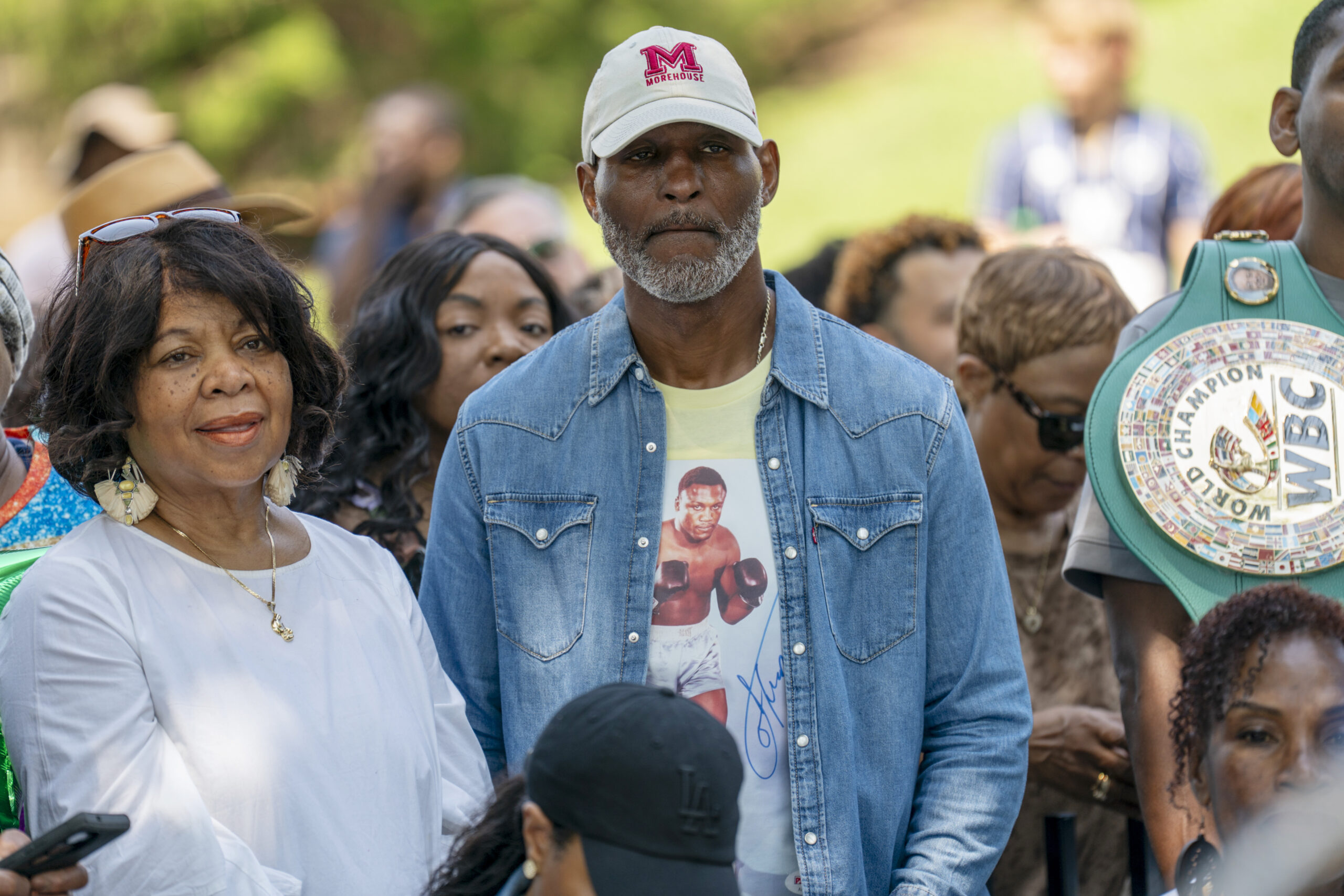
Dozens of the boxer’s supporters attended on Monday, including Philadelphia boxer Bernard Hopkins who held world championships in two weight classes, promoter Joe Hand Jr., and Frazier’s daughter Jacqueline Frazier-Lyde. Frazier-Lyde, a retired boxer and current Municipal Court judge, said the the color of the shroud covering her father’s statue — green —was fitting.
“My mother’s favorite color was green, because we’re from the South and we love green, because it represents life,” she said. “My father, Joe Frazier, liked it because it was the color of money.”
Boxing legend Bernard Hopkins at the unveiling of the new home for the statue of heavyweight boxing champion Joe Frazier.
To the end, the statue’s new location wasn’t the end of efforts in the boxer’s memory. Parker also announced plans for a capital campaign to restore the former Joe Frazier’s Gym on Broad Street above Glenwood Avenue in North Philadelphia. Now a discount furniture store, the building is a legendary location in Philadelphia boxing history, having served as a training location for not just Frazier but other famed fighters and community members.
Parker said plans were underway to establish a way to accept donations for that effort via the Philadelphia City Fund. The amount of funds targeted be raised was not immediately clear.
“It’s important to show the world who we are,” Gay said. “Joe Frazier was a humble underdog whose determination and grit inspires us all. What could be more [a] more Philadelphia story than that?”
Next week, Philadelphia will begin a centuries-long stint as the host of a time capsule that is not meant to be unearthed for a quarter of a millennium.
Set to be buried on July Fourth at Independence National Historical Park, the time capsule comes to the city as part of the celebrations surrounding the United States’ Semiquincentennial. After its burial, it is not slated to be seen again until 2276.
Known officially as “America’s Time Capsule,” it features items from every U.S. state and territory, as well as contributions from the three branches of government. Its creation was led by America250, a national, nonpartisan organization that Congress placed in charge of the 250th birthday celebrations.
Weighing in at 900 pounds, the time capsule — a massive cylinder emblazoned with an “America250” logo on its side — was sealed shut last week at a ceremony in Gaithersburg, Md. Its unveiling 250 years from now is intended to show future generations “the care, pride, and optimism with which Americans marked our 250th anniversary,” said America250 chair Rosie Rios in a statement.
Inside the capsule, which is constructed of stainless steel, archival contents sit organized largely in small boxes, with paper documents in a separate compartment. Many states submitted hundreds of letters, postcards, posters, poems, and other printed material for inclusion.
America250 has posted a detailed list of all the items included in the time capsule. Pennsylvania, for example, contributed a letter from Gov. Josh Shapiro, as well as an archival booklet. New Jersey, meanwhile, ponied up a stainless steel plate inscribed with a greeting for the time capsule’s future openers. And Delaware sent in a set of a dozen notecards from residents detailing their thoughts on what the state means to them.
There were some guidelines on what states could submit, as items that could degrade or rust were not allowed. Maryland, as a result, was not able to submit Old Bay seasoning, the Associated Press reported.
Some items were innovative. A “molecular data storage device” from the Library of Congress was included, and it contains synthetic DNA encoded with copies of several items from the library’s collection — including a draft of the Declaration of Independence, handwritten lyrics for “The Star-Spangled Banner,” and a 3-D rendering of President Abraham Lincoln’s hand, America250 said.
Items were sealed inside at 35% relative humidity to make sure they did not dry out or disintegrate, as well as to keep them from decaying due to moisture issues. The capsule is slated to be buried 10 feet below ground, which should keep it from being damaged by swings in temperature or storms.
“Philadelphia would have to be six feet underwater in order for this time capsule to even possibly take on water,” Michael Berilla, director of fabrication technology at the National Institute of Standards and Technology, told the AP. ”And if Philly is six feet underwater, you’ve got way bigger problems in the world.”
“For those who have the privilege to work here in the Capitol, you get a sense that you are just one chapter in a long history book,” Austin said. “The U.S. Capitol is a symbol of that history. In fact, it is the symbol of that American history.”
This is not the first time capsule project undertaken by the United States. In 1976, President Gerald Ford opened a “Century Safe” that had been created a century before, and the country that year created a Bicentennial capsule that is to be opened in 2076.
The time capsule set to be buried in Philadelphia on July Fourth, meanwhile, will be marked with a capstone that includes information about its contents and creation. Additional details about the time capsule’s burial were still forthcoming Friday, according to the America250 website.
This article contains information from the Associated Press.
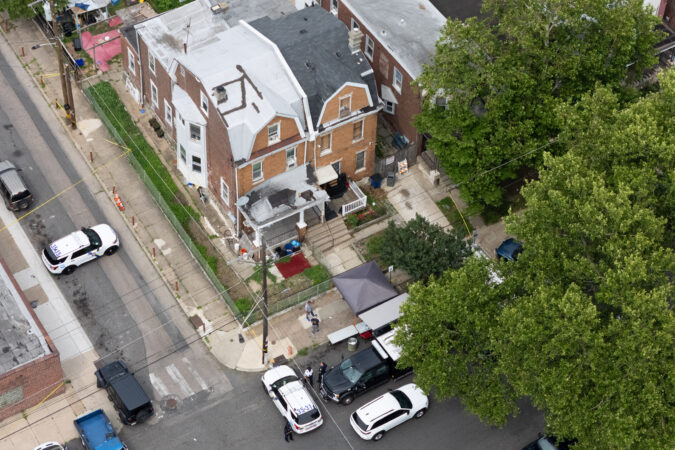
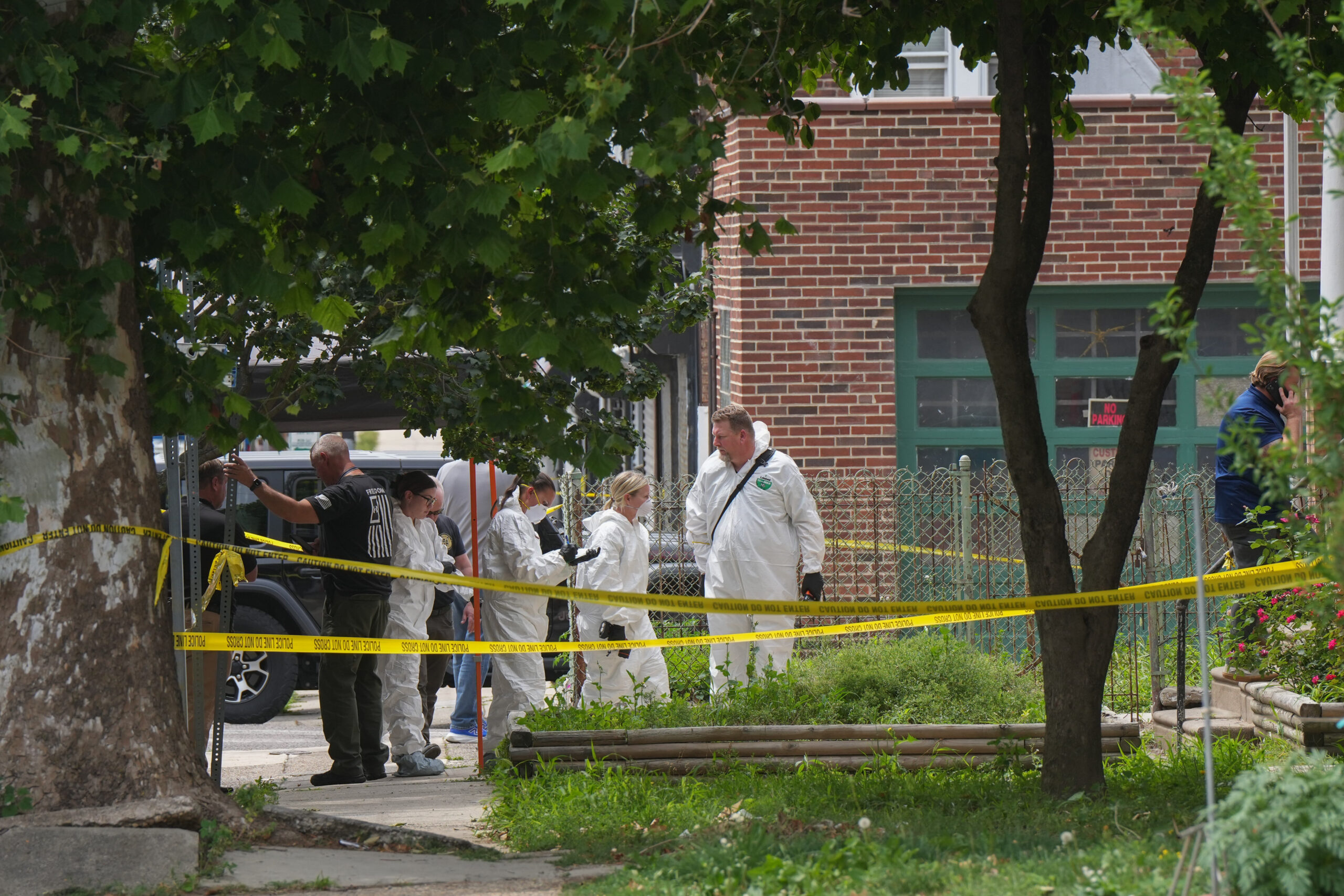
The 400 block of West Chew Avenue in Olney was largely shut down Friday afternoon as Philadelphia and federal law enforcement officials searched a home on the block to determine if its owner had connections to at least two missing women.
Residents of the block had effectively been sealed in as caution tape and Philadelphia Police Department vehicles cordoned off the street. Some residents gathered on their porches or sidewalks as federal officials produced equipment from the back of a black, unmarked utility truck.
“I have been living here all my life,” Larry Alosi, 56, said. “It used to be a safe place, but it changed with time.”
Consisting largely of rowhouses and small businesses, the North Philadelphia neighborhood of Olney is among the city’s most diverse, with large Korean American and Latin American populations calling the area home.
The search had been ongoing for nearly a week, and came after U.S. Park Police encountered Eugene Albert Horsch, 44, acting suspiciously in a black BMW near Sixth and Market Streets on June 19, police said. Investigators recovered two firearms with obliterated serial numbers from Horsch’s vehicle, as well as cocaine, fentanyl, and marijuana — along with a baton, a cattle prod device, a switchblade, and a falsified U.S. Drug Enforcement Administration badge with Horsch’s photograph depicting a falsified name.
Officials took Horsch into custody following the stop, and charged him with illegal gun possession and drug crimes. Searches of his home began last week.
Horsch was being held Friday at Curran-Fromhold Correctional Facility with bail set at $500,000.
A passerby called the West Chew Avenue residence “a house from a scary movie,” with boarded-up windows on its second and third floors. A camera on the exterior points to the street. The windows on the first floor have bars from top to bottom. Pink flowers remain on the lawn, decorated with pieces of broken glass from the door.
Neighbors on Horsch’s block said the area is a quiet one, though it occasionally has its issues. Fabin Ingram, an area resident, said he never saw anyone coming or going at the corner of West Chew near Horsch’s home, and he largely worked to avoid the intersection.
“I’m big on energy and feelings,” Ingram said. “If I get an eerie feeling, I act on it.”
Investigators at 417 W Chew, searching a home in Olney neighborhood in Philadelphia, June 26, 2026.
One neighbor, Sid Brunson, who used to cut Horsch’s grass, described Horsch as a quiet, jittery man who “had a lot on his mind.” Brunson said that Horsch’s father, R.C. Horsch, a convicted drug manufacturer and erotic filmmaker, died in 2025, leaving a pall over the home.
“You will never see a man other than him coming or leaving the house after that,” Brunson said. “If there was visitors at the home, it was always a female, never a male.”
Another neighbor, who asked not to be identified for fear of reprisal, said Horsch was someone who got into disagreements with neighbors over parking and trash. He had long driven an impeccably maintained gold 1980s Lexus, and in recent years had started driving a new black BMW — and was often seen bringing women home with him, the neighbor said.
The ongoing search of Horsch’s home this week was the latest in a series of odd developments at the property, with investigators saying that several urns had been found inside the home, including one that was labeled with the name of a deceased relative. Officials also discovered a 55-gallon drum with connections to water lines leading into a hole in the ground, as well as materials to grow marijuana, though it was not immediately clear if the items in the home were connected to drug manufacturing or more violent purposes.
On Friday, law enforcement officials wearing hazmat suits were seen entering and exiting the property.
During Horsch’s arrest last week, a woman falsely identified herself using the name of a 38-year-old woman who had been reported missing in Kensington in February 2023, sources told The Inquirer. Deputy Police Commissioner Frank Vanore declined to identify the woman who had been reported missing, but reports indicate that Horsch’s father had been questioned in the 2016 disappearance of his ex-wife, Amy McHale, of South Philadelphia.
By late Friday afternoon, the investigation into Horsch’s home had not ceased, but a large FBI truck was spotted leaving the scene. Late in the day, the area had been largely left quiet, with the crime-scene tape on the home’s door serving as conspicuous evidence of the day’s events.
Staff writer Andrea Padilla contributed to this article.
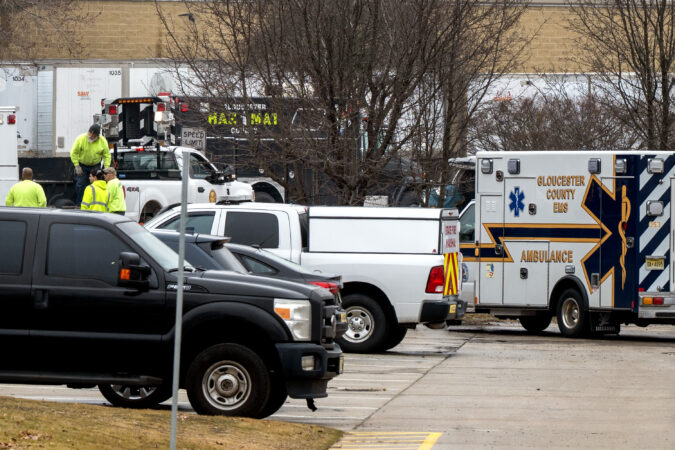
Emergency responders extinguished the fire at Savita Naturals in Logan Township, N.J., late Thursday, and sealed off the cocoa butter processor’s remaining propane tanks, marking a step forward in the investigation into the massive explosion that rocked the region.
Concerns about the structural integrity of the building at 617 Heron Drive remain, and a detailed look into the site remains pending, Gloucester County officials said at a Friday news conference.
“It’s going to be a lengthy process,” said Logan Township Fire Chief Scott Oatman. “Especially as they get into the building to try to secure everything up.”
The blast occurred at about 2:35 p.m. Wednesday. In the wake of the explosion, four employees of Savita Naturals were taken by ambulance to area hospitals, three additional employees transported themselves to medical facilities, and one person from an adjacent business was taken to a hospital for an undisclosed medical emergency.
Three Savita Naturals employees remain in critical condition, and one was stable, officials said Friday. Conditions for the others injured were not immediately available.
“Our thoughts and prayers continue to go out to those that were injured, and their families,” said Logan Township Police Chief Joseph Flatley. “This is going to be a long road for them, we’re aware. And that’s the highest priority.”
At the time of the explosion, there were 14 employees on the site — a majority of whom were working in a structure at the front of the property. The explosion occurred in a rear structure, where three employees were located, officials said.
No criminal activity is suspected in the explosion, and no hazards were present to the community surrounding the facility as of Friday morning, officials said. Emergency responders continue to monitor air quality in the area.
In addition to the Savita Naturals building sustaining suspected structural damage, two adjacent businesses — fluid engineering firm Sulzer and a food bank known as Bishops’ Storehouse and Home Storage Center — were deemed uninhabitable, and cannot resume operations until repairs are completed. Officials said they had received reports of potential property damage as far as a mile away from the site, and continue to field calls from individuals who believe their buildings may have been impacted.
At the site of the explosion, however, several large propane tanks remain. Though not leaking, the tanks contain a total of about 500 gallons of liquid propane that will need to be burnt off or otherwise removed before the investigation can progress.
Officials on Friday described the explosion as an unfortunate accident, noting that Savita Naturals had incurred some fire inspection violations in the past, but the company was responsive and corrected issues quickly. No violations, Oatman said, were out of the ordinary, and none caused major concerns.
The building itself, Oatman added, was constructed in such a way that it would contain an explosion. Part of its construction included “blow out panels” that served their intended purpose.
“If it wasn’t for that type of construction they had there, there might have been more injuries,” Oatman said. “So, we’re fortunate that there were no more additional injuries at the facility.”
Officials also corrected reports that the building was used to process CBD, or cannabidiol, a nonintoxicating component of hemp and marijuana that has risen in prominence in recent years. While the facility has processed CBD in the past, none has been produced or extracted there since 2023, Oatman said. The propane on the site, as well as ethanol, he added, is used in cocoa extractions.
The cause of the explosion remains unclear. Officials said they were aware of speculation that a propane tank exploded, but investigators think the explosion occurred as a result of the processes inside the building, though that belief is preliminary.
How long that investigation might take was unclear Friday. The look into the blast remains in its early stages, and involves a number of state and federal partners.
“I’m not sure what happened in the building,” Oatman said. “That’s why investigators are going to do the investigation.”