The investigation into the cause of a Wednesday afternoon explosion at a Logan Township, N.J., cocoa butter processor continues, though the conditions have improved for some victims injured in the blast.
Following the explosion, which rocked Gloucester County and the surrounding area just after 2:30 p.m. on Wednesday, five people were hospitalized. Three people were transported to Cooper University Hospital, which has since treated and released one patient, and stabilized two others, who were later transported to Temple Burn Center in Philadelphia, Cooper spokesperson Wendy Marano said.
The conditions of the other two people injured in the blast were not immediately clear Thursday. In the immediate aftermath of the explosion Wednesday, four people were in critical condition, and a fifth person in a neighboring building experienced a medical incident that required treatment, Gloucester County officials previously said.
“This is the largest industrial accident that I can recall,” Logan Township Police Chief Joseph Flatley said at a news conference Wednesday. “It was a terrible tragedy that took place out here.”
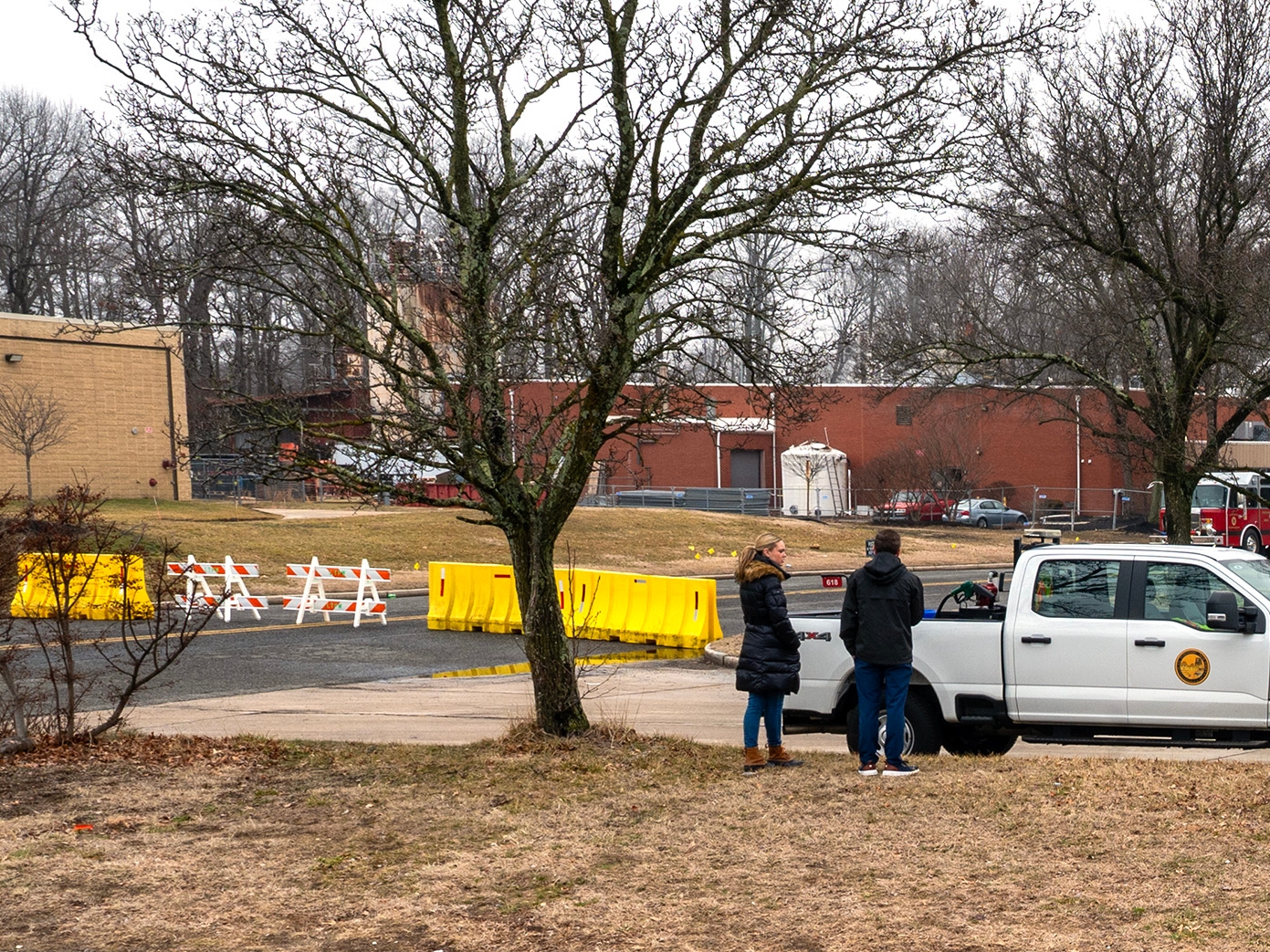
Emergency workers responded to an explosion at 617 Heron Drive in Logan Township at about 2:35 p.m. on Wednesday. The blast prompted a shelter-in-place order for homes and businesses within a two-mile radius of the facility, impacting roughly 7,200 people living within the affected area.
What caused the explosion was not yet clear Thursday. Gloucester County officials and officials in the Logan Township Police Department did not immediately respond to requests for comment.
Officials on Wednesday, however, indicated that the blast emanated from a building operated by Savita Naturals, a company that describes itself on its website as a “provider of specialty oil extractions and related services.”
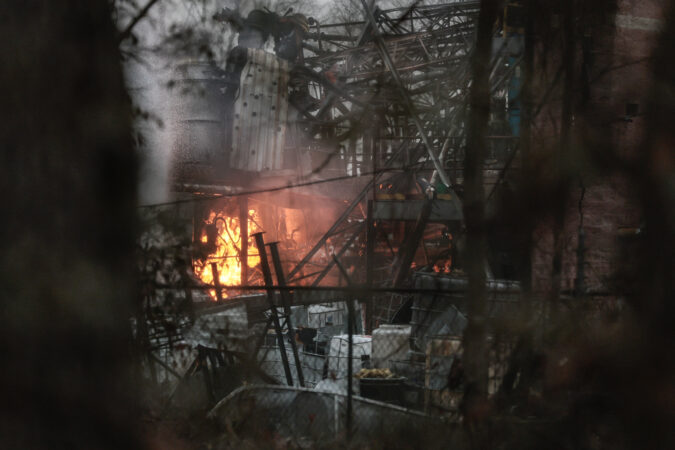
The scene outside Savita Naturals in Logan Township, N.J. Thursday Mar. 5, 2026, where at least four people were critically injured the day before after a large explosion destroyed the commercial production facility.
The company, Gloucester County Prosecutor’s Office spokesperson Rebecca Forand said Wednesday, serves as a processor in the cocoa and chocolate industry. As part of its work, the company utilizes propane — a highly flammable gas Savita Naturals has called its “solvent of choice” for botanical extractions.
Propane, officials said Wednesday, was used in the company’s production processes, and a large amount of it was stored on the facility’s premises. In the aftermath of Wednesday’s blast, a ruptured propane tank could be seen burning amid the collapsed building’s wreckage.
A highly flammable gas, propane is a commonly preferred solvent for extraction of natural compounds and oils. The chemical, Savita Naturals indicates on its website, “produces the highest yields at intermediate cost without sacrificing quality.”
It does, however, present some dangers. In high concentrations, it can decrease the amount of oxygen in the air, according to the New Jersey Department of Health. Propane is also naturally colorless and odorless, and often has an odorant added to aid in detection. Airborne exposure can result in headaches and dizziness, as well as fainting.
Savita Naturals could not immediately be reached for comment.
Officials on Wednesday lifted the shelter-in-place order shortly after the explosion, noting that there were no ongoing hazards, despite ongoing monitoring efforts from emergency responders. The New Jersey Department of Environmental Protection was notified of the situation, and burn-off of remaining gas continued on-site early Thursday.
New Jersey Gov. Mikie Sherrill indicated Wednesday that her office was informed about the situation, and was monitoring developments.
“We are actively supporting with resource coordination and will continue to monitor the situation to ensure the safety of residents and support those impacted,” Sherrill said.
It’s a tale as old as time — or about 3,600 years, anyway.
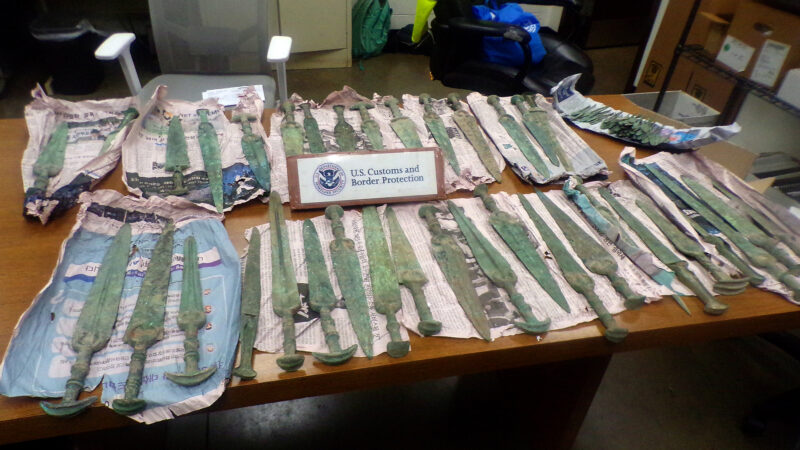
U.S. Customs and Border Protection on Friday announced the seizure of 36 Bronze Age-era short swords and 50 arrowheads following their arrival in Philadelphia in October. Considered cultural artifacts, the items were imported into the United States without proper permitting, and were likely the product of “illicit excavations of burial sites,” federal officials said.
Now, they may soon be returned to Iran, where they are believed to have originated and date from 1600 to 1000 BCE.
CBP tries “to repatriate them to their rightful owners, which in this case would be the country,” said agency spokesperson Stephen Sapp. “So they can retain a piece of their cultural history.”
The Bronze Age is considered to have spanned from 3300 to 1200 BCE, a historical period during which bronze — an alloy of copper and tin — was the prevailing metal used for making weapons and tools. What is today considered Iran was a pivotal area during that time, serving as an important trade route connector and bronze producer.
The items arrived in Philadelphia on Oct. 16 via an express delivery flight from the United Arab Emirates, having been “mis-manifested,” as Sapp put it, as “metal decoration articles.” CBP officers went on to X-ray the shipment, and discovered objects that resembled swords, prompting them to open up the items.
Inside, they saw what appeared to be ancient-looking swords and arrowheads covered in the teal patina of oxidized bronze. Suspecting the items to be of antiquity, the officers detained the shipment for additional investigation.
CBP officers worked with the Antiquities Unit of the department’s National Targeting Center to determine the historical and cultural value of the swords and arrowheads. That unit sought assistance from an archaeologist associated with an unnamed Philadelphia university for more information. The archaeologist later pegged them as hailing from what is today the northeastern area of Iran and dating back as far as 3,600 years.
Being that old, the items were considered to be the historical and cultural property of their origin nation. Many countries, federal officials noted, have laws that require official permission to export such items.
Investigators also reached out to the person who imported the items, and found that they did not have the documentation that would allow them to obtain the objects. As a result, even if the items were legally purchased, they were not able to be lawfully imported into the United States.
“That’s the key thing. If it is considered an artifact, or historical or cultural property of a country, that country has to permit that commodity leaving,” Sapp said. “Generally, you are going to be able find there is a black market — or a market, period — for all things.”
Sapp added that no criminal charges have been filed in the incident. However, he noted that the importer is now known to investigators, and lost the shipment as a result of the investigation.
Elliot N. Ortiz, CBP’s acting area port director in Philadelphia, said in a statement that officers “strive to rescue cultural artifacts from the grips of illicit international traders.” Items are often smuggled into the United States using “deceptive practices” that both violate import laws and “undermine efforts to preserve and protect the integrity of cultural history,” he added.
The investigation lasted about four months — a length of time Sapp said is not unusual in cases like this. Largely, he added, it comes down to investigators doing the due diligence when it comes to seeking the importer’s permitting, as well as allowing archaeologists to properly investigate the items to determine their age and origin.
“We aren’t going to give an archaeologist a day or two to look at this stuff,” Sapp said. “They need to be able to make sure they are accurate to the best of their ability, so when they give their determination, we can trust that to be truthful.”
Now, CBP officers will hold on to the items until the agency issues a disposition order. When that will happen exactly, Sapp said, has not yet been determined.
Think you know your news? There’s only one way to find out. Welcome back to our weekly News Quiz — a quick way to see if your reading habits are sinking in and to put your local news knowledge to the test.
Question 1 of 10
The city got its biggest snowfall in a decade during a storm that officially dumped this much powder at Philadelphia International Airport Sunday into Monday:
CorrectIncorrect. XX% of other readers got this question right.
Although the 14 inches measured officially at Philadelphia International Airport dwarfed the 9.3 inches of snow and sleet that accumulated in January’s storm, fears that the snowfall would reach what the National Weather Service called “potentially historic” levels didn’t quite materialize.
Question 2 of 10
According to recently released U.S. Census Bureau data, which county in the Philadelphia area was home to six of the 10 wealthiest towns in the region for the five-year period that ended in 2024?
CorrectIncorrect. XX% of other readers got this question right.
Chester County towns held six of the top 10 spots, including the top four — Pocopson Township, West Pikeland, Birmingham, and Easttown. Pocopson, in fact, is in a rarified zone for wealth, with an annual median household income of $230,000.
story continues after advertisement
Question 3 of 10
When Team USA beat out Canada for the men's hockey gold medal in the 2026 Winter Olympics, how did they honor late New Jersey native Johnny Gaudreau?
CorrectIncorrect. XX% of other readers got this question right.
Auston Matthews, Matthew Tkachuk, and Zach Werenski carried Gaudreau’s No. 13 jersey as they glided across the ice. And two players, Dylan Larkin and Werenski, scooped up Gaudreau's two oldest kids — Noa and Johnny Jr. — and carried them back out to the ice for a team photo.
Question 4 of 10
Veteran publicans, including Fergus Carey and Jim McNamara, will soon open Monto, a Celtic bar in the former Mac's Tavern in Old City. This Philly restaurateur will oversee the kitchen:
CorrectIncorrect. XX% of other readers got this question right.
Poe, the proprietor of Poe’s Sandwich Joint and Poe’s Side Piece, plans to blend his South Philadelphia sensibility with Irish pub fare — a mashup he calls the “Poe-gues” menu. His existing lineup of cutlet sandwiches, cheesesteaks, and burgers will serve as the backbone of Monto's food offerings.
Question 5 of 10
Why did Saladine Sharad, a 34-year-old handyman from North Philly, recently go viral?
CorrectIncorrect. XX% of other readers got this question right.
Sharad remembers one driver shouting at him “out of concern” as he rode his scooter. He let them know he was OK with a nod, and they drove off. But unbeknownst to Sharad, the driver had filmed him and uploaded the video to Instagram. “WHO MANS IS THIS??? Only in Philly. [an] electric scooter seen driving on Lincoln Drive,” the caption read.
Subscribe to The Philadelphia Inquirer
Our reporting is directly supported by reader subscriptions. If you want more journalism like this story, please subscribe today.
A Gettysburg theme park is closing and everything must go — including this type of animal, of which 30 will be available for auction:
CorrectIncorrect. XX% of other readers got this question right.
Sparkle, Pumpernickel, Russel’s Majestic Princess Gingerbread, Summer Wish, Shortcake and the other miniature horses will head for greener pastures at the Saturday morning auction, which will mark the end of the 55-year-old Land of Little Horses. Cameo, an 11-year-old chocolate mare with a bald face is expected to be the most popular and collect the highest bid.
Question 7 of 10
From national champions to top-50 contenders, a tight-knit club in Delco has quietly built one of America’s most competitive scenes to meet up and play this game on a weekly basis:
CorrectIncorrect. XX% of other readers got this question right.
The Delco Scrabble Club is a weekly gathering with some of the best players out there. Soon, it’ll draw national attention when two of the club’s members compete on CW’s Scrabble game show, hosted by comedian and former late-night show host Craig Ferguson.
Question 8 of 10
This Doylestown native has been nominated for the Rock and Roll Hall of Fame:
CorrectIncorrect. XX% of other readers got this question right.
The city’s biggest pop star, Pink, is among the 17 nominees in the running to be inducted later this year. Along with the Doylestown-born “Get the Party Started” singer, the list of potential inductees includes another artist with Philly ties in Lauryn Hill.
Question 9 of 10
Tired Hands Brewing’s Ardmore brewpub location is limbo as its owner navigates the future of the beer company. For now, it’s serving as this:
CorrectIncorrect. XX% of other readers got this question right.
While the Ardmore Fermenteria location remains open, the brewpub has pivoted to a private event space. The owner said the decision to shift to private events was born out of a number of factors: having two Tired Hands locations in Ardmore was confusing for customers; ongoing construction in Ardmore created a “prohibitive environment” for doing business; and the changing landscape of brewing has prompted Tired Hands to begin reimagining parts of its business model.
Question 10 of 10
Kylie Kelce attended the Winter Olympics for work, but Jason Kelce was just along for the ride, enjoying his time as a spectator. A CBS tweet identifying the couple as “Kylie Kelce and her husband” went viral. Jason said he had no problem with it, but would’ve preferred if they referred to him as this instead:
CorrectIncorrect. XX% of other readers got this question right.
“I really was just there to have fun and enjoy the Olympics,” Kelce said on the latest episode of New Heights. “So, I was 100% — [her husband] was the correct way to say it. I wanted to tell them I prefer ‘ball and chain.’”
Your Results
You have skipped .
You scored XX out of 10.
The average reader scored XX out of 10
Seems like you’ve been skimming more than reading there, buddy. There’s always next week.
You’ve read some articles (or made some educated guesses) but we wouldn’t come to you first for our local news recaps. Better luck next week!
Do you work here? You’re a local news stan with the latest updates on Philly happenings. Your friends definitely ask you for summaries on what’s going on and it shows.
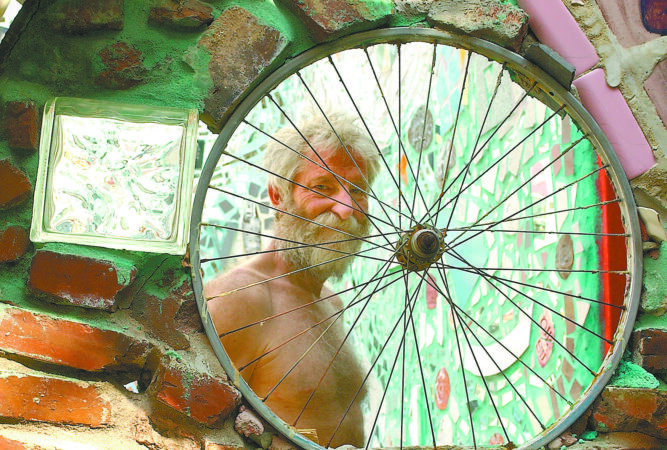
Famed mosaic artist Isaiah Zagar left a legacy shaped by the glimmering murals and large-scale tile works he created throughout Philadelphia.
Zagar, who died at 86 on Thursday due to complications of heart failure and Parkinson’s disease, will be remembered for his striking works and unrelenting mission to beautify the city he called home for more than five decades.
Zagar’s nearly 200 works can be found throughout the country but the bulk of his famed mosaics are within city lines.
Here’s some of the largest and boldest works the iconic artist handcrafted in Philadelphia.
(function() {
var l2 = function() {
new pym.Parent(‘ZAGARMAP.html’,
‘https://media.inquirer.com/storage/inquirer/projects/innovation/arcgis_iframe/ZAGARMAP.html’);
};
if (typeof(pym) === ‘undefined’) {
var h = document.getElementsByTagName(‘head’)[0],
s = document.createElement(‘script’);
s.type = ‘text/javascript’;
s.src = ‘https://pym.nprapps.org/pym.v1.min.js’;
s.onload = l2;
h.appendChild(s);
} else {
l2();
}
})();
Philadelphia’s Magic Gardens
1020 South St.
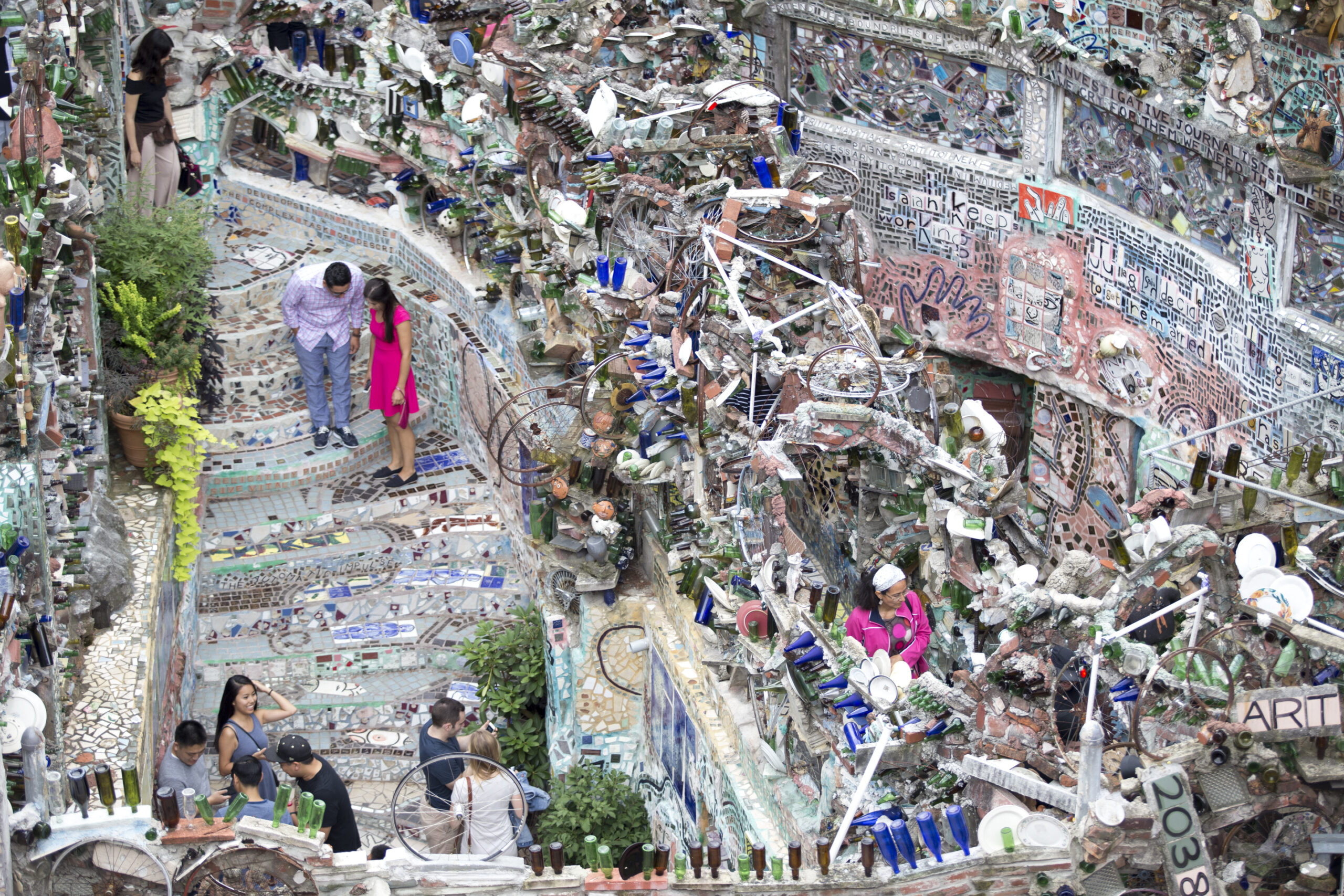
Tourists visit Philadelphia’s Magic Gardens, which was built by Isaiah Zagar, in 2017.
As inescapable as Zagar’s work is in Philadelphia, the Magic Gardens serves as the artist’s grandest, most well-known project. Dating back to 1994, it consists of thousands of square feet of entirely mosaicked space stretched across three city lots, showcasing what Zagar once referred to as his “voluminous” output of art.
Magic Gardens Studio
1002 Watkins St.
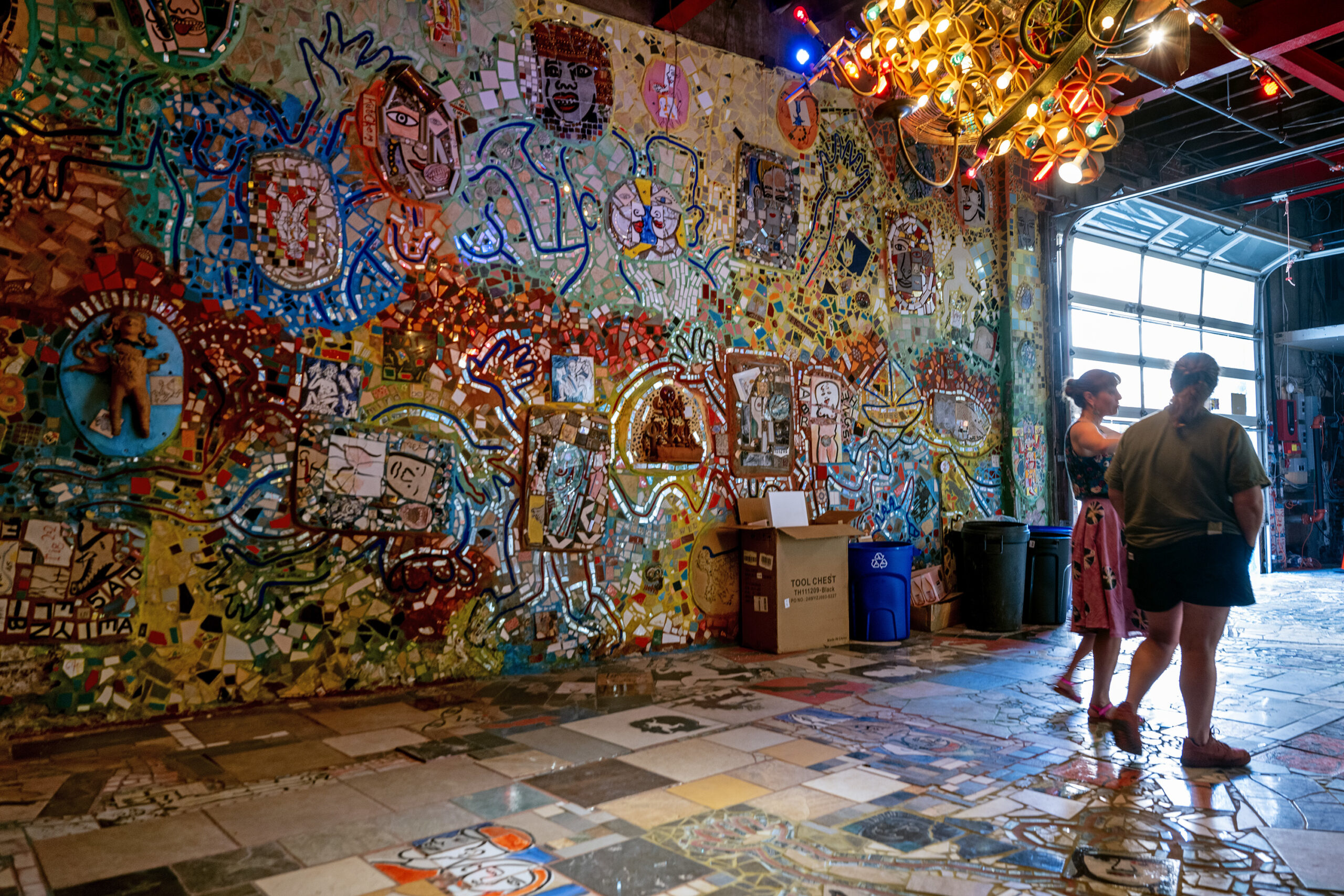
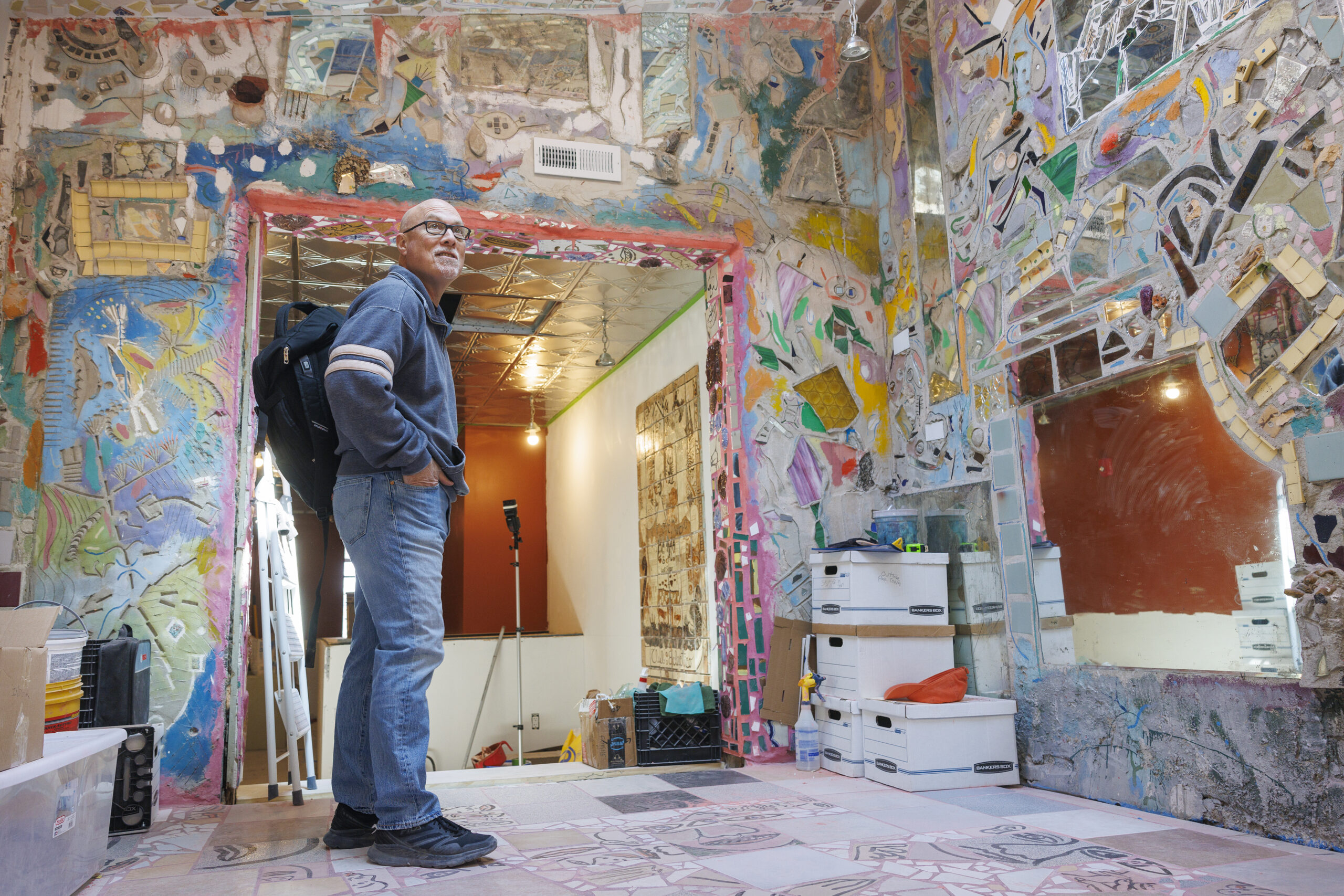
Philadelphia’s Magic Gardens executive director Emily Smith (left) and Preservation and Facilities manager Stacey Holder stand in the former studio of mosaic artist Isaiah Zagar in 2024.
If the Magic Gardens is the heart of Zagar’s output, his Magic Gardens Studio is the brain. Purchased in 2007, this 10,000-square-foot South Philly warehouse stands virtually covered — inside and out — in Zagar’s mosaics, and long served as his studio and storage space.
Home of Isaiah and Julia Zagar
826 South St.
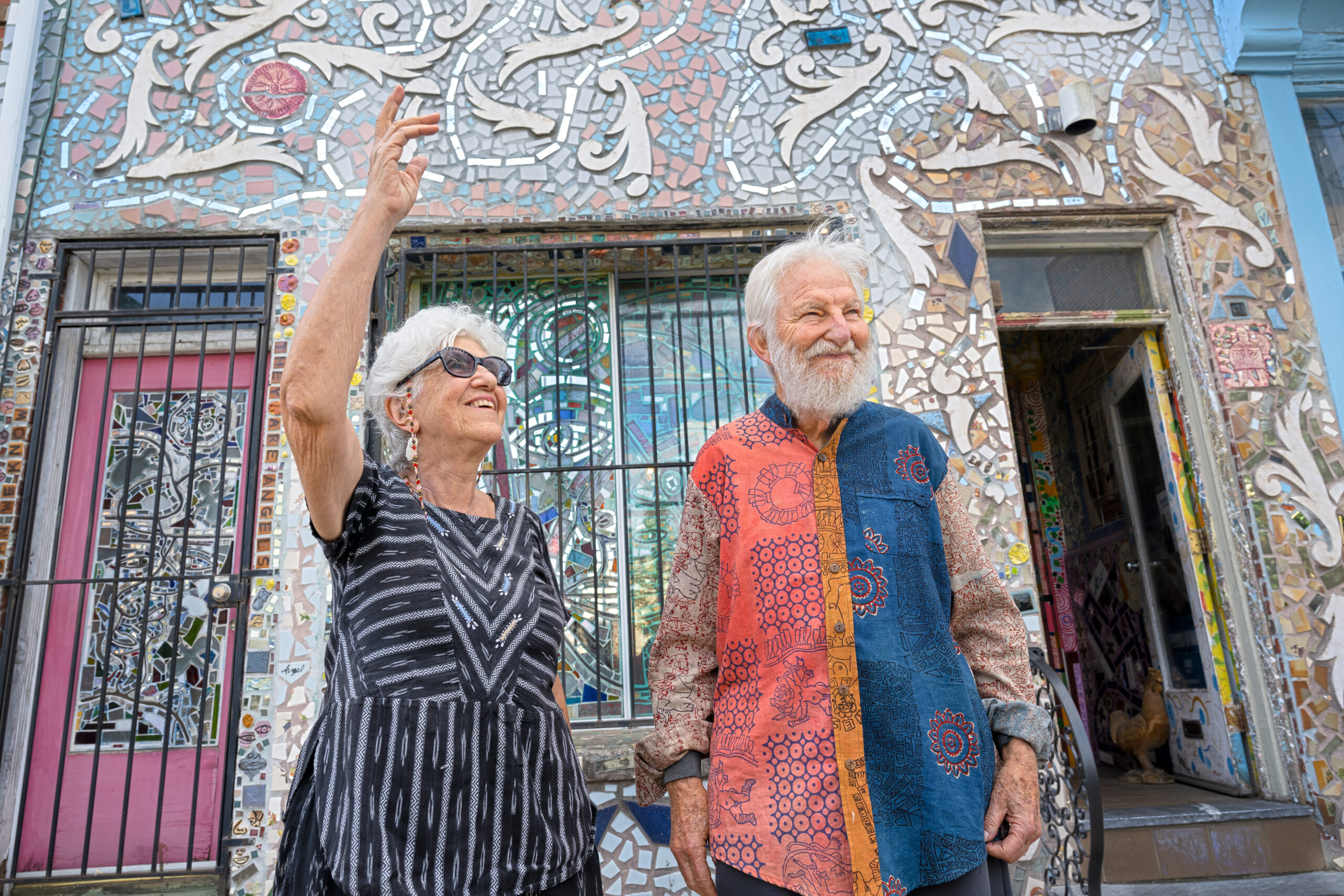
Isaiah and Julia Zagar are photographed in front of their home in South Philadelphia in 2024.
It doesn’t get much more personal than the Zagar’s home, where he and his family lived for about 40 years. Similar to his South Philly studio, the space is mosaicked inside and out in Zagar’s signature style, including a roughly 544-square-foot piece across the building’s façade.
‘This Is the Day, Jesus Journey’
1036 South St.
Just steps from the Magic Gardens sits the Waters Memorial African Methodist Episcopal Church, its side showcasing the 2006 mosaic Jesus Journey. At more than 400 square feet, it uses excerpts from the Bible detailing the life of Jesus Christ. Across the street, another similarly sized installation titled Bilal From Pakistan was completed in 2012 alongside artist Bilal Khan.
‘Rose and the Firefighters’
600 block of Alder Street
Among Zagar’s most iconic murals, this piece stretches some 6,000 square feet along Alder and Kater Streets, just east of the Magic Gardens. Completed in 2004, this piece adorns the former headquarters of Engine Company 11, a celebrated Black fire company in Philadelphia between 1919 and 1952.
Jim’s Steaks
400 South St.
Ken Silver, owner of Jim’s Steaks, in a room filled with mosaic tile by Philadelphia artist Isaiah Zagar in the former Eyes Gallery, run by Julia Zagar for decades.
Blocks from Zagar’s home, Jim’s Steaks showcases the artist’s mosaic work in a space formerly occupied by the Eyes Gallery, which Julia Zagar ran for decades. A 2022 fire damaged both the gallery and the neighboring original Jim’s building, prompting the cheesesteak shop to expand next door — revealing a treasure trove of interior artwork that had long been covered.
Schell Street Walls
600 S. Schell St.
Vacant lots, rowhouses, and cheesesteak shops weren’t Zagar’s only canvasses — he also covered entire side streets in his mosaics. Completed over nearly 30 years, the 600 block of Schell Street showcases the artist’s work on both sides of the street. Many pieces were created during community workshops Zagar held there over the years.
Fitness Works
714 Reed St.
There are better known murals than the one that occupies the lower facade and parking lot of this South Philly gym, but few are as large. At roughly 1,500 square feet, this piece was completed in 2014 as part of a mosaic mural workshop, and has since come to serve as a landmark.
‘Homage to Mike Mattio, Master Plumber’
700 block of Reese Street
Occupying the side of a number of rowhouses, this Zagar mosaic serves as a tribute to its eponymous Mike Mattio, a former plumber of the artist’s. The piece, with Mattio’s portrait included, is something of a high-brow installation, thanks to references calling out artists ranging from William Blake to Duke Ellington.
‘Hip Hop Café’
705 Passyunk Ave.
This building has housed quite a few businesses over the years. At least since 2002, it has showcased Zagar’s Hip Hop Café mosaic mural. The piece covers the structure’s 500-square-foot front, which today is home to Momoka Ramen Skewers’ Queen Village location.
The Rev. Jesse L. Jackson, a civil rights icon and a regular presence in Philadelphia who energized Black voters both locally and nationally for more than five decades, died Tuesday at his home in Chicago following a prolonged battle with a rare neurological disorder. He was 84.
“Jesse Jackson will be remembered in Philadelphia as a civil rights hero, and a leader in terms of independent Black politics nationwide,” said former Councilmember W. Wilson Goode Jr., the son of Philly’s first Black mayor, W. Wilson Goode Sr. “He loved Philadelphia, and Philadelphia loved him.”
A native of Greenville, S.C., Rev. Jackson initially rose to prominence in the mid-1960s, when he joined the 1965 voting rights march that the Rev. Dr. Martin Luther King Jr. led from Selma to Montgomery, Ala. In the years following King’s assassination in 1968, Rev. Jackson largely came to be considered his successor.
Rev. Jackson would go on to become a prominent Black political and cultural leader in his own right, with his lengthy time in the public eye including presidential runs in 1984 and 1988. His visits to Philadelphia date back to the 1970s, and run the gamut from time in town supporting his own presidential campaigns — though neither of which were successful in the ‘80s — to appearances at the Democratic National Convention in 2016.
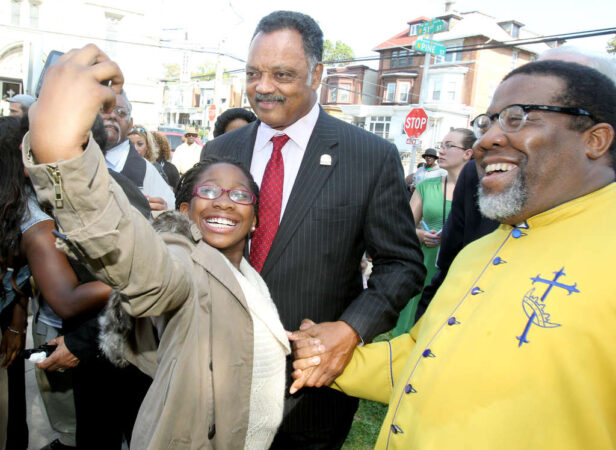
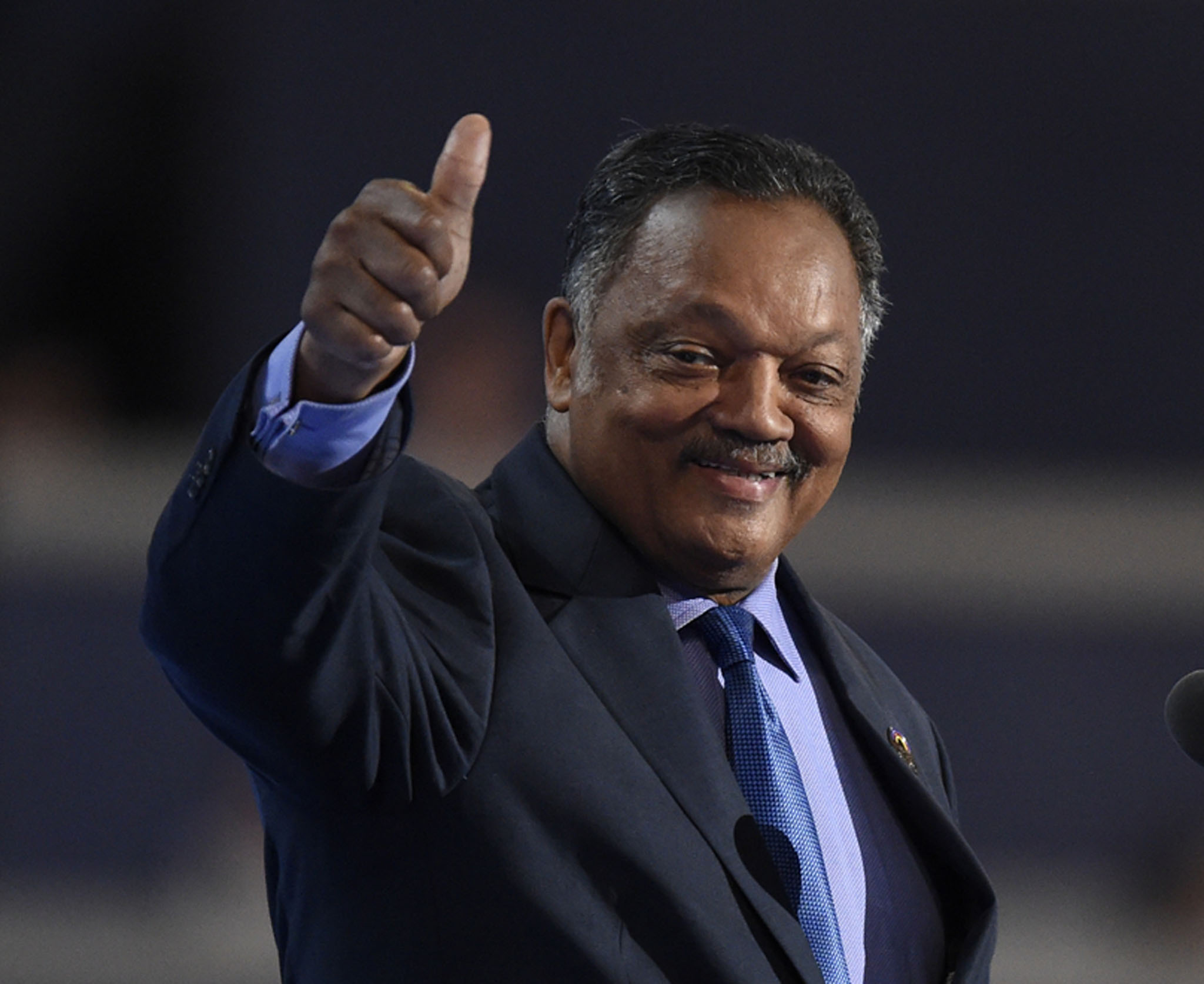
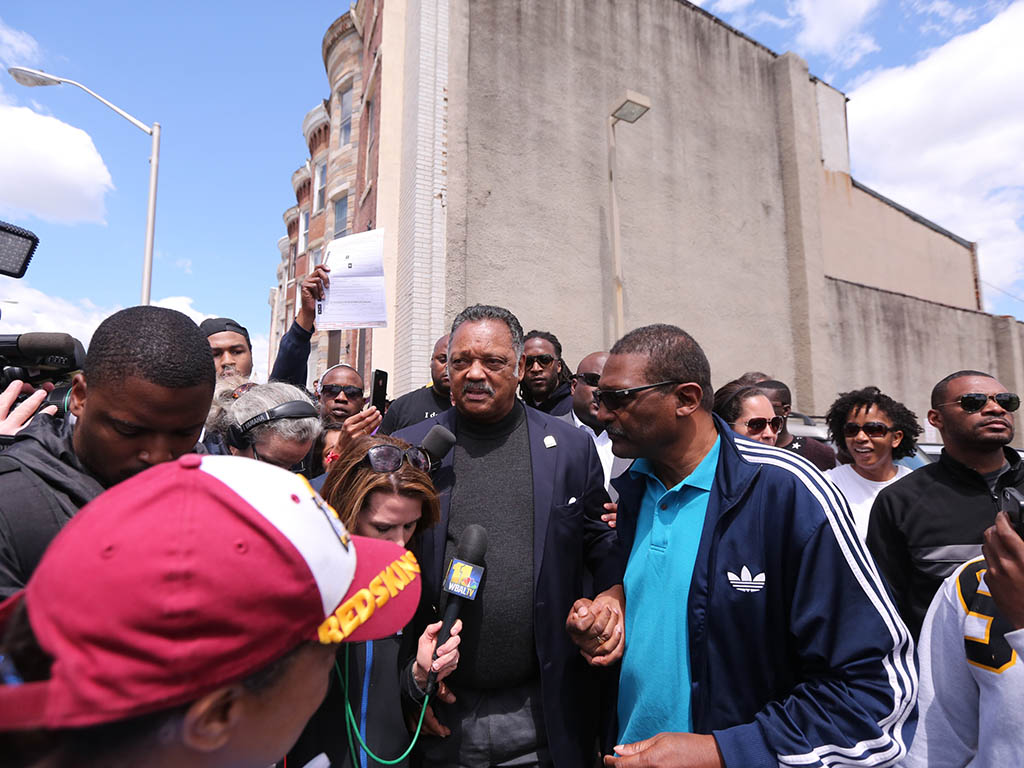
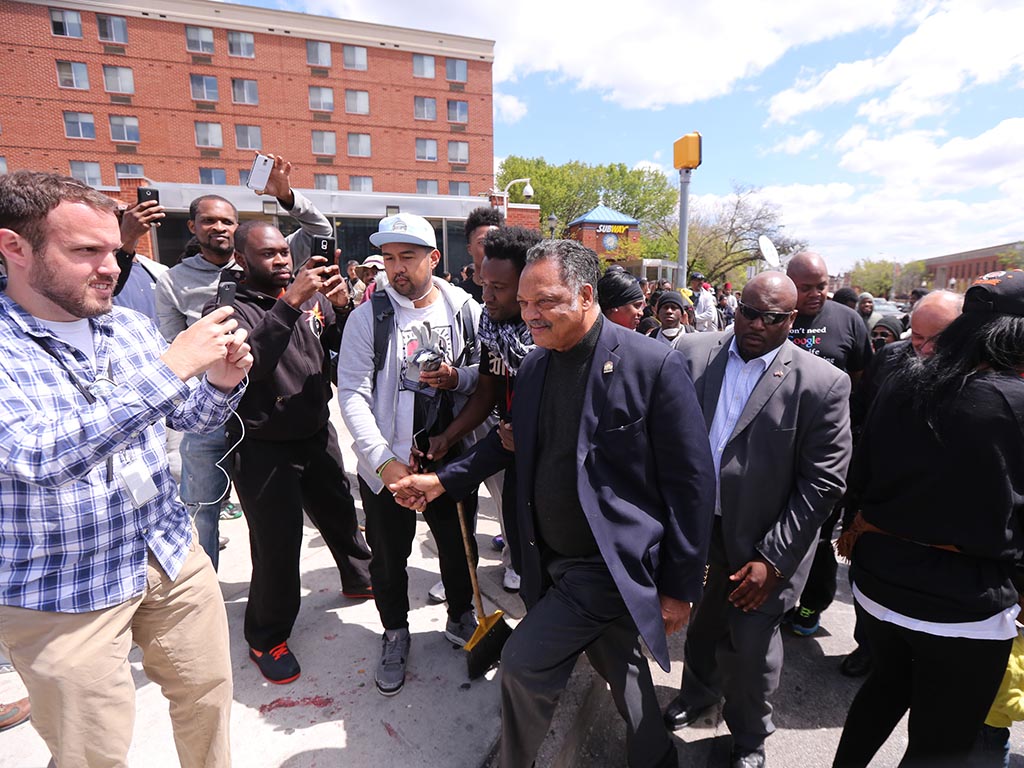
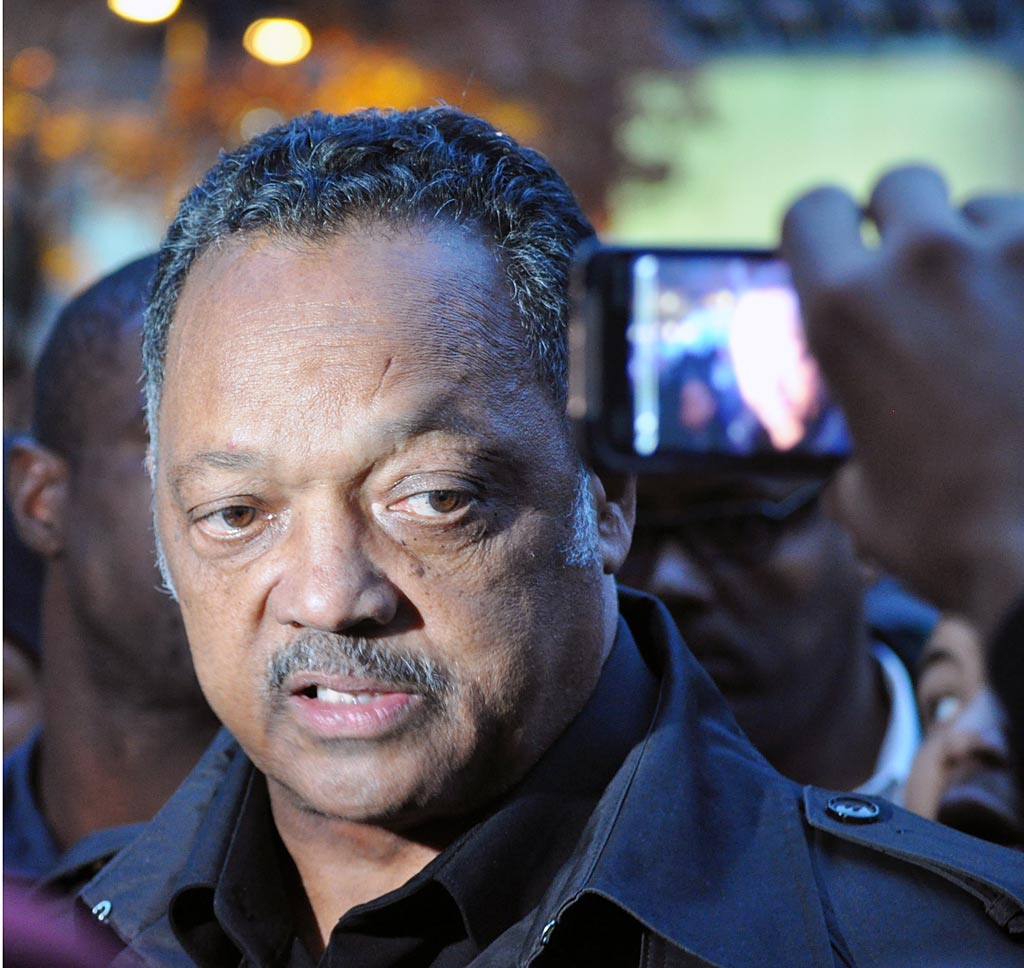
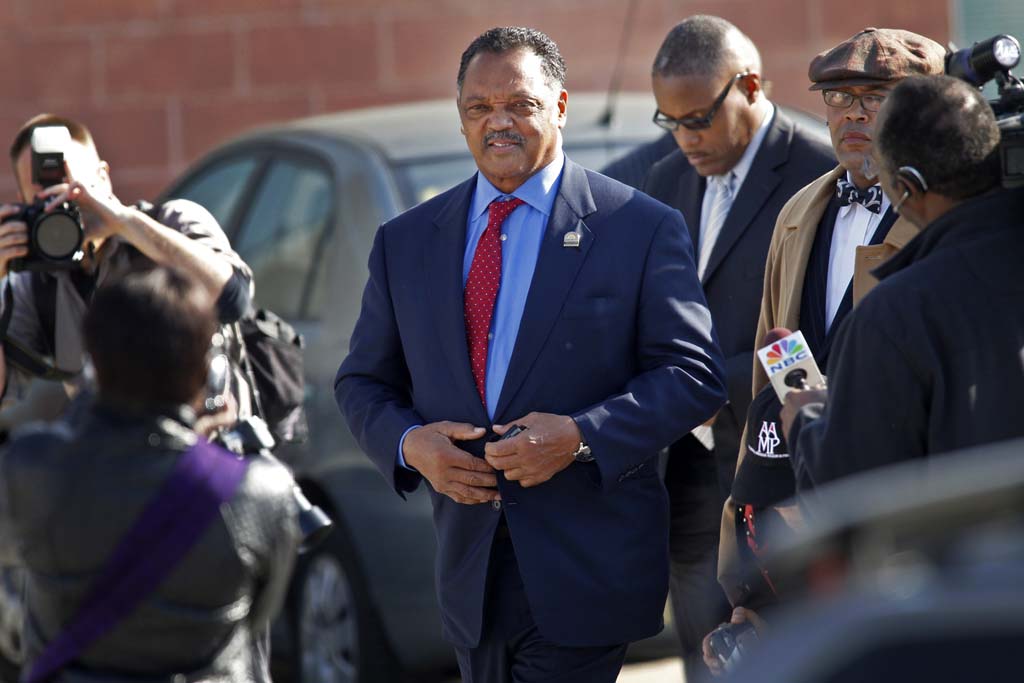
The Rev. Jesse Jackson, founder and president of the Rainbow/PUSH Coalition, acknowledges the cheers of delegates as he walks to the podium to deliver remarks on the third night of the Democratic National Convention in Philadelphia on July 27, 2016.Hillary Clinton supporters and the Rev. Jesse Jackson (right) on the fourth day of the Democratic National Convention at the Wells Fargo Center on July 28, 2016.The Rev. Jesse Jackson visits Baltimore’s turbulent intersection of West North Avenue and Pennsylvania Avenue on April 28, 2015.
Across that time, Rev. Jackson served as a sort of rallying figure for Black Philadelphians at large, who largely supported his candidacy during his presidential runs, despite him failing to secure the Democratic nomination statewide. Still, his impact for Black voters both in Philadelphia and nationally remains everlasting.
“That was the Rosetta stone to everything Jackson was trying to achieve,” said former Daily News scribe Gene Seymour, nephew of legendary People Paper columnist Chuck Stone. “We aren’t to be ignored or dismissed or cast aside — we matter.”
In that sense, Goode Jr. said, Rev. Jackson will remain a political icon who inspired the nationalization of Black political empowerment.
“Jesse Jackson is also a cultural icon in terms of telling people to be proud of being Black, and telling themselves, ‘I am somebody,’” Goode Jr. said, referencing Rev. Jackson’s famed refrain. “That is something that was indelible in the soul of Black people across the nation and world, and in Philadelphia here as well.”
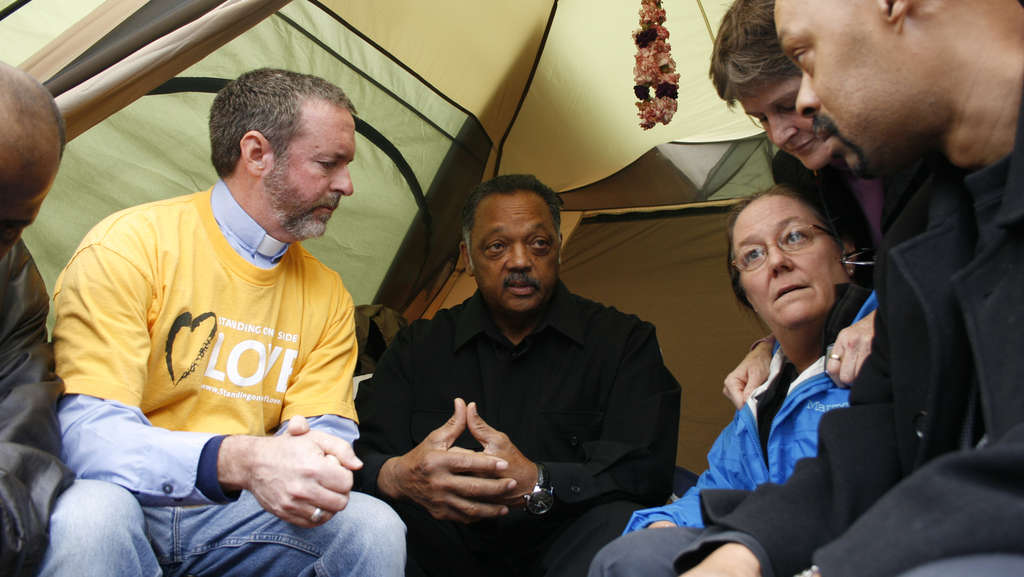
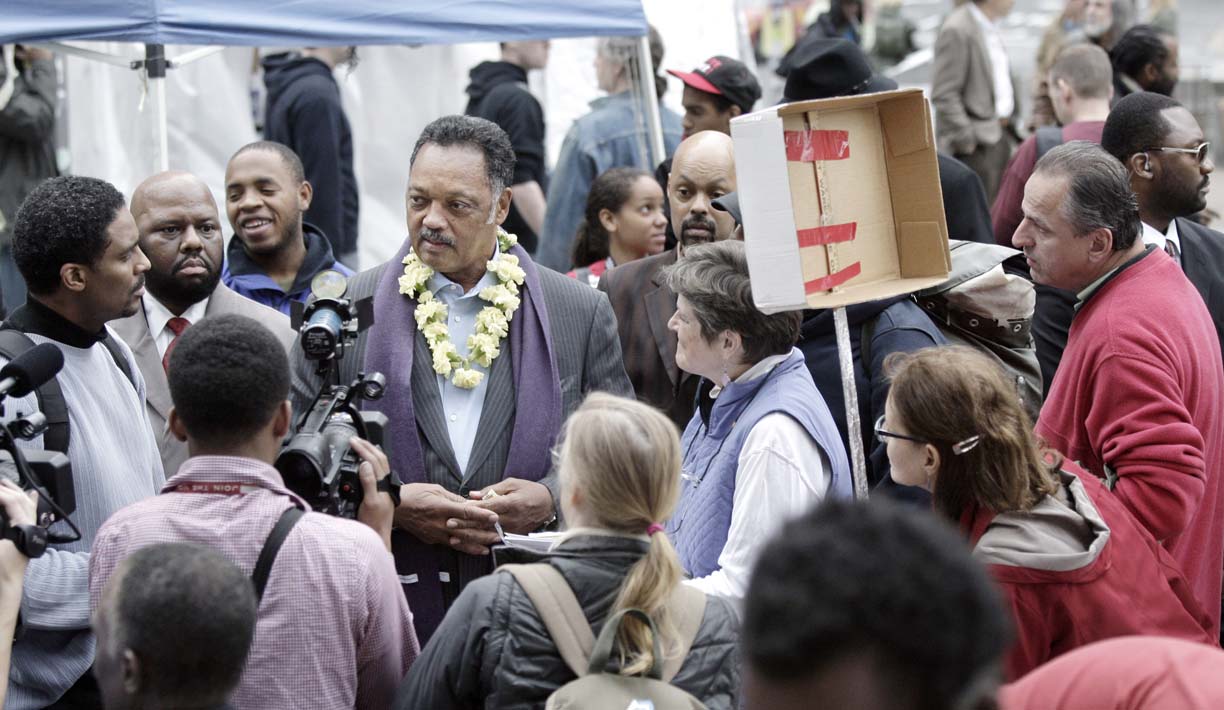
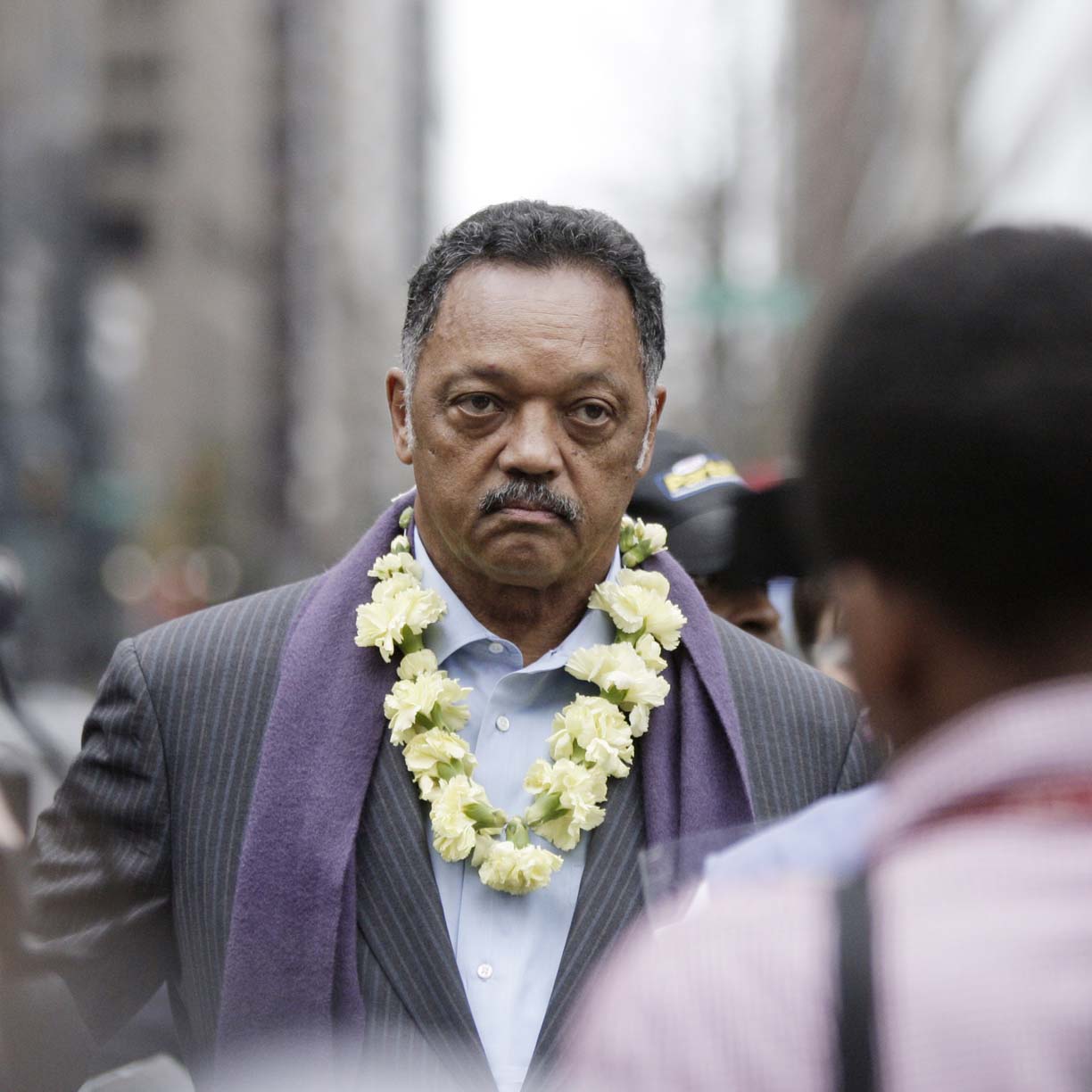
The Rev. Jesse Jackson visits the turbulent intersection of West North Avenue and Pennsylvania Avenue in Baltimore on April 28, 2015.The Rev. Jesse Jackson visited Occupy Philadelphia protesters on Nov. 13, 2011. He told them to “never surrender.”The Rev Jesse Jackson at Joe Frazier’s funeral at Enon Tabernacle Baptist Church on Cheltenham Avenue in Philadelphia on Nov. 14, 2011.The Rev. Jesse Jackson (center) visits the Interfaith tent, donated by Quakers, to talk to the Rev. Peter Friedrich (left) and (from right) Phillip Hall, Hollister Knowlton, and Joyce Moore in 2011.
Though Philadelphia’s Black community generally was supportive of and receptive to Rev. Jackson’s messaging historically, Seymour said, he maintained something of a complicated relationship with the city’s prominent politicians. Wilson Goode Sr., for example, officially supported Walter Mondale and Michael Dukakis for president in the 1980s. At least in 1988, Seymour said, Rev. Jackson likely had “the people’s hearts,” despite lacking the official nomination.
Wilson Goode Sr. was not immediately available for comment.
“His presidential campaigns in 1984 and 1988 reshaped American politics,” said the Rev. Gregory Edwards, of the Philly-based POWER Interfaith, in a statement. “Those campaigns widened the political imagination of this country and helped cultivate a generation of Black elected leaders.”
Rev. Jackson’s relationship with Goode Sr. was somewhat complicated following the 1985 MOVE bombing, which brought the civil rights leader to tour the ruins of the 6200 block of Osage Avenue in its aftermath. Rev. Jackson urged a congressional investigation into the incident, which he called “excessive force,” but avoided criticizing Goode directly in subsequent meetings. Goode, meanwhile, said that the city would cooperate with any groups investigating the incident, The Inquirer reported at the time.
“He was not happy with what happened in ‘85 with MOVE,” Seymour said.
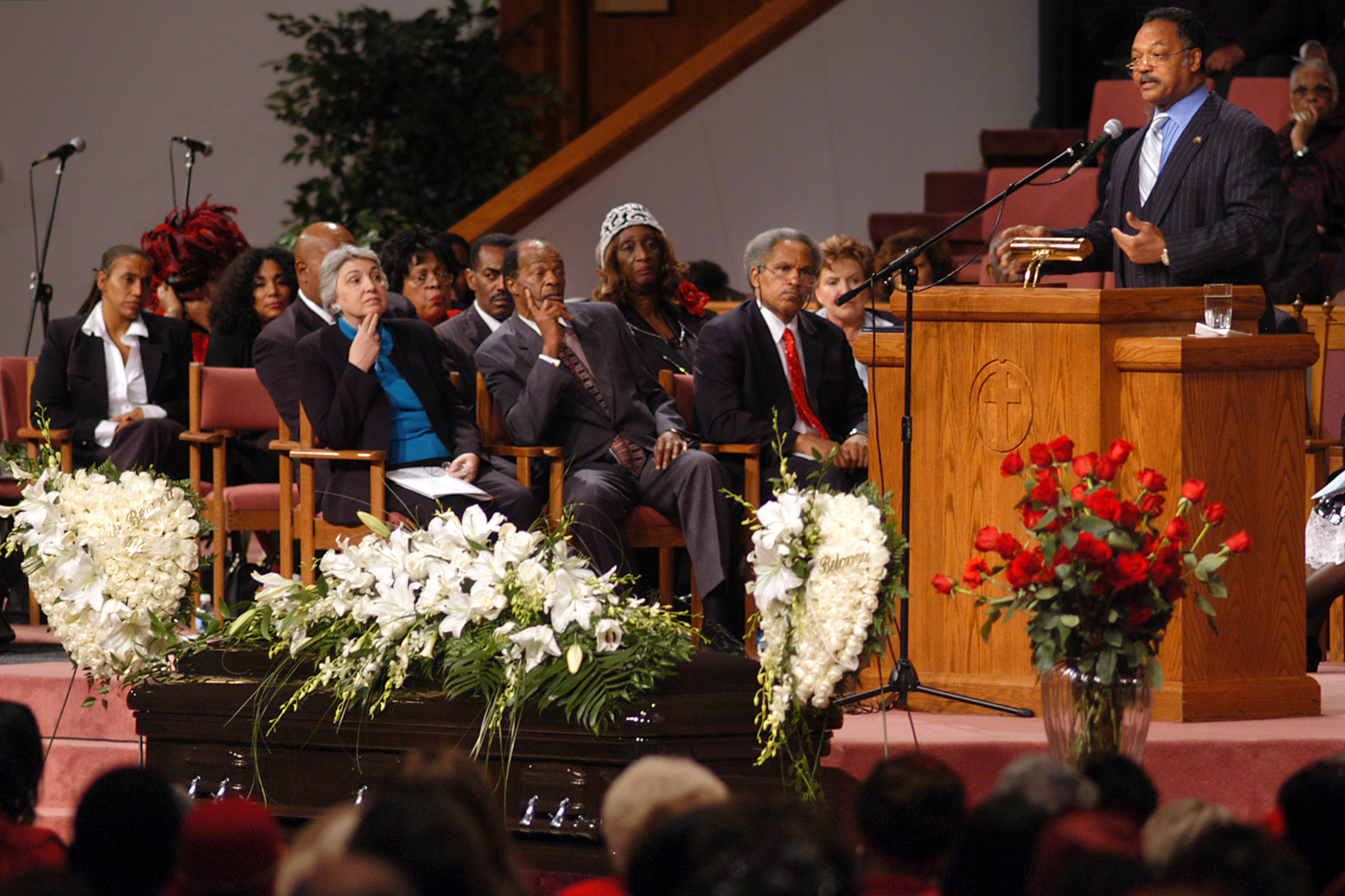
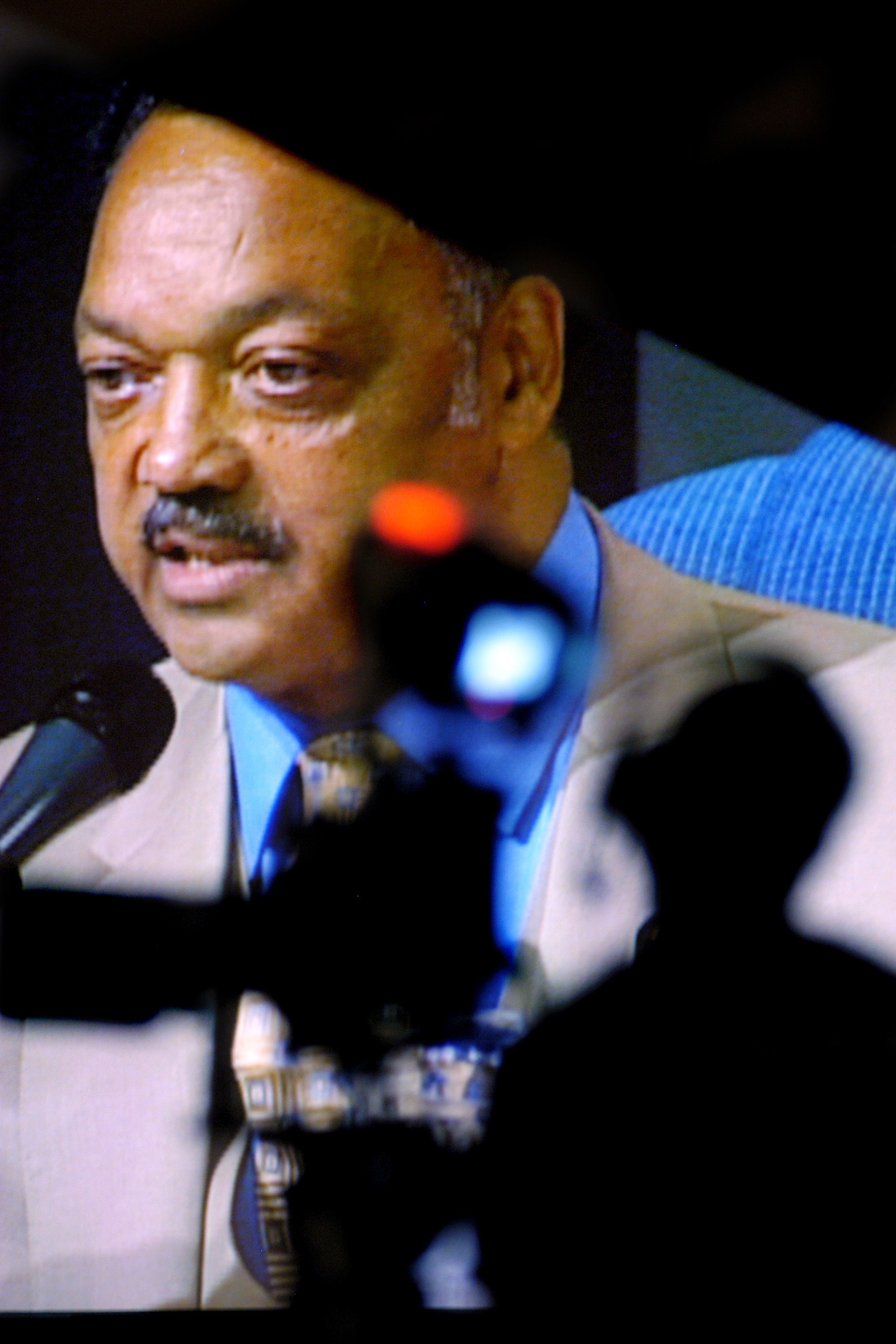
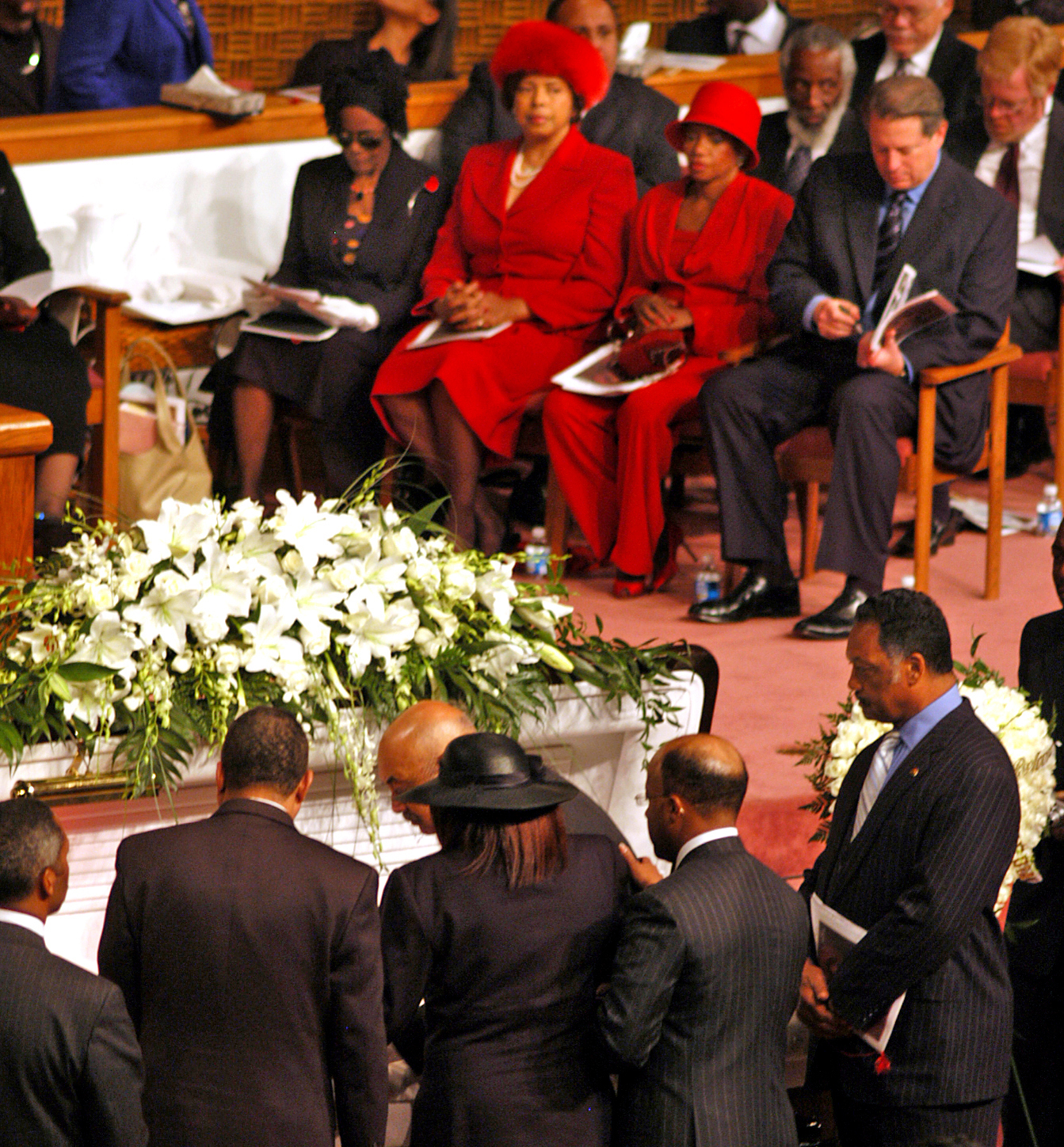
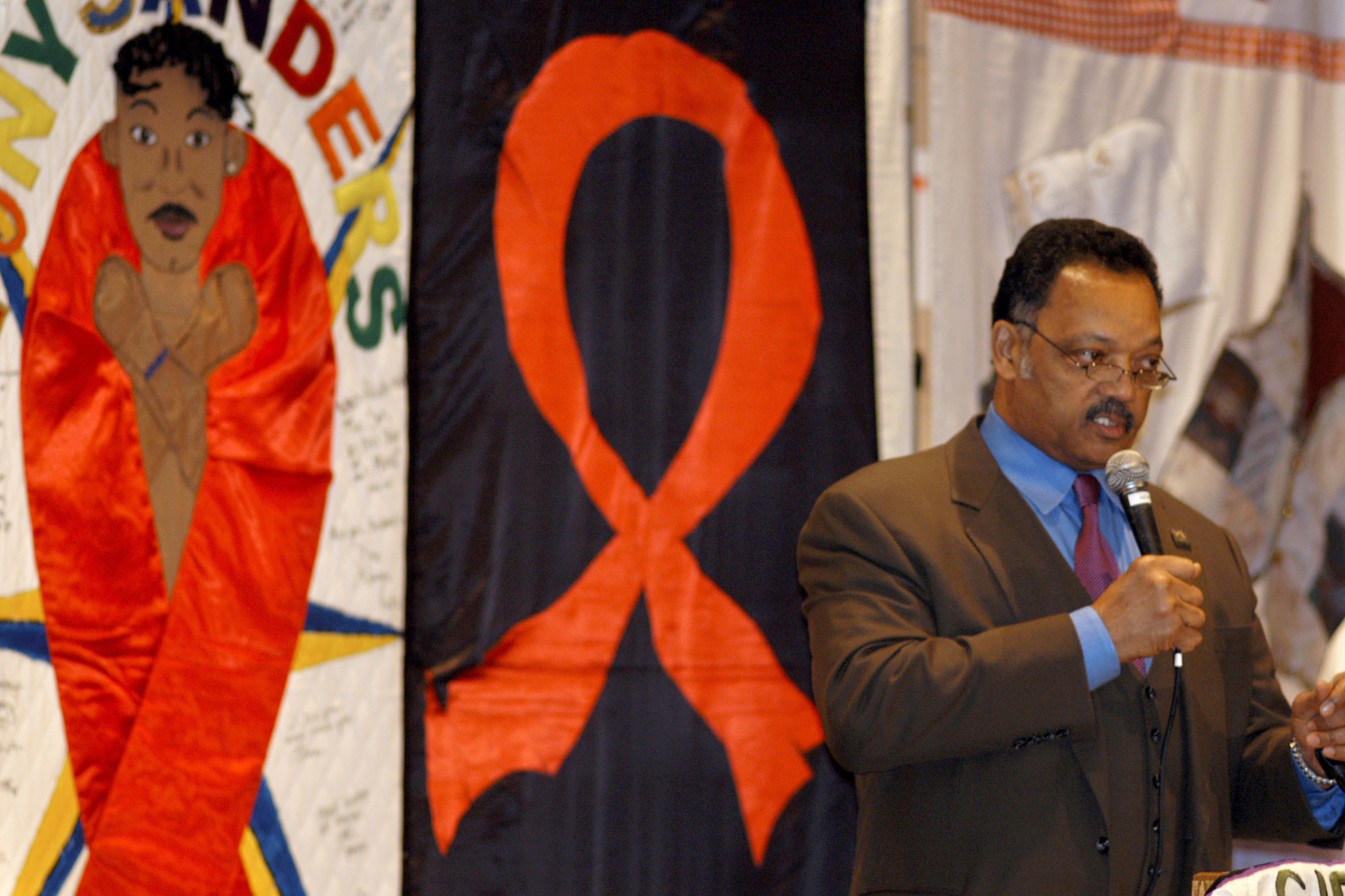
The Rev. Jesse L. Jackson speaks during during funeral services for civil rights activist C. Delores Tucker at Deliverance Evangelistic Church on Oct. 21, 2005. Seated in front row behind him, left to right are Eleanor Smeal, president of the Feminist Majority Foundation; Marion Barry, former mayor of Washington, and Philadelphia Mayor John Street. Rev. Jackson is projected live on a large screen monitor (camera operator in foreground) as he participates in a panel discussion laying out a legal and political strategy for fulfilling Brown v. the Board of Education, at the annual NAACP meeting on July. 14, 2004 at the Convention Center. Her family stands by as husband (partially hidden) William T. Tucker covers the body of civil rights activist C. Delores Tucker in her casket at the beginning of funeral service at Deliverance Evangelistic Church on Oct. 21, 2005. At right is the Rev. Jesse L. Jackson, founder and president of the Rainbow Coalition/PUSH, who later delivered the eulogy. Seated in rear at right is former Vice President Al Gore. AIDS quilt panels flank the podium as the Rev. Jesse Jackson speaks at an African American AIDS conference at the Wyndham Franklin Plaza Hotel on Feb. 28, 2005.
Still, Rev. Jackson often served as a defender of Philadelphia’s famed Black figures. In 2011, for example, Rev. Jackson spoke at the funeral of legendary world heavyweight boxing champion Joe Frazier, who had long competed with the fictional Rocky Balboa for recognition. As Jackson put it at the time, Frazier was the “real champion,” not the “Italian Stallion.”
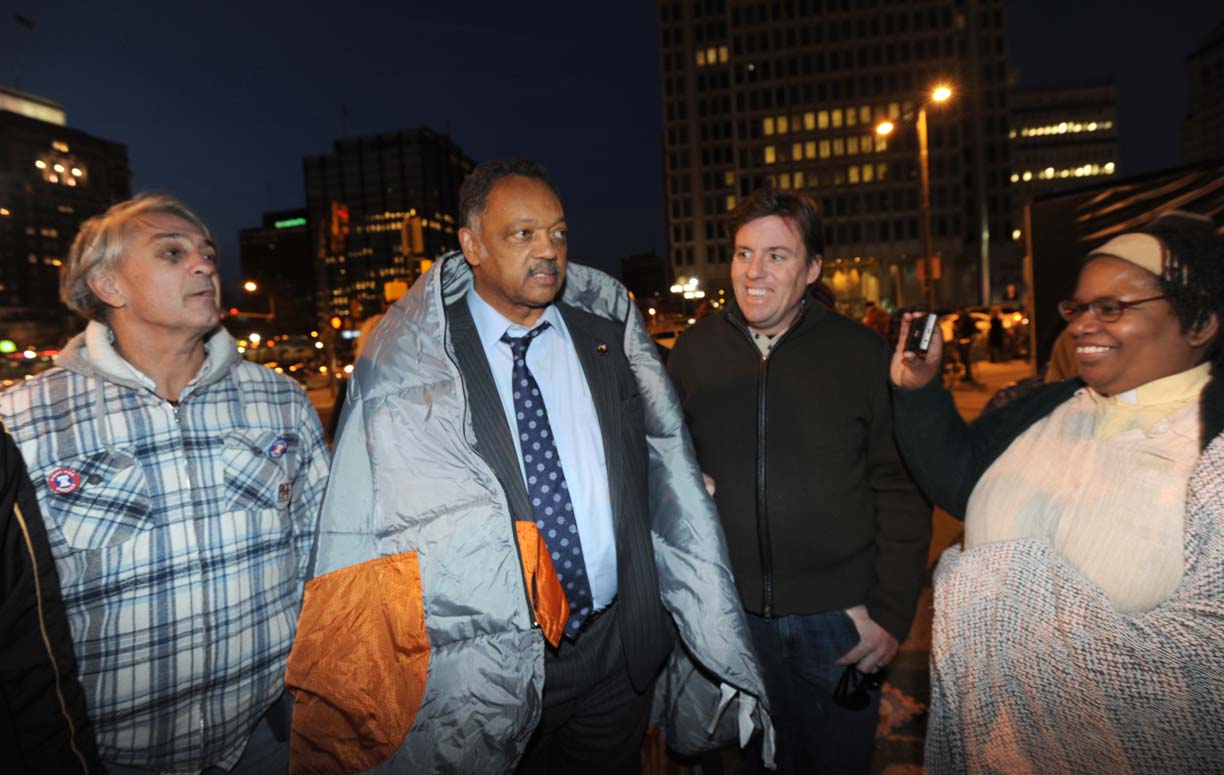
The Rev. Jesse Jackson, who has a sleeping bag draped around his shoulders, is talking and praying with Occupy Philadelphia demonstrators: Brad Wilson (from left); the Rev. Bill Golderer, pastor of Broad Street Ministry; and Donna Jones, pastor of the Cookman Baptist Initiative.
“If you were of importance as a Black person in America during the time [Jackson] was in the public eye,” Seymour said, “he was there to speak on your behalf.”
Goode Jr.’s most prominent memory of Rev. Jackson, meanwhile, dates back to the mid-1980s, when he was a student at the University of Pennsylvania. At the time, he said, Rev. Jackson attended a National Black Student Union conference following an invitation from its organizers, Goode Jr. included. It was, Goode Jr. said, an inspiration.
“It meant a lot to us,” Goode Jr. said. “Not just Black leaders at Penn, but across the nation, who were gathered there.”
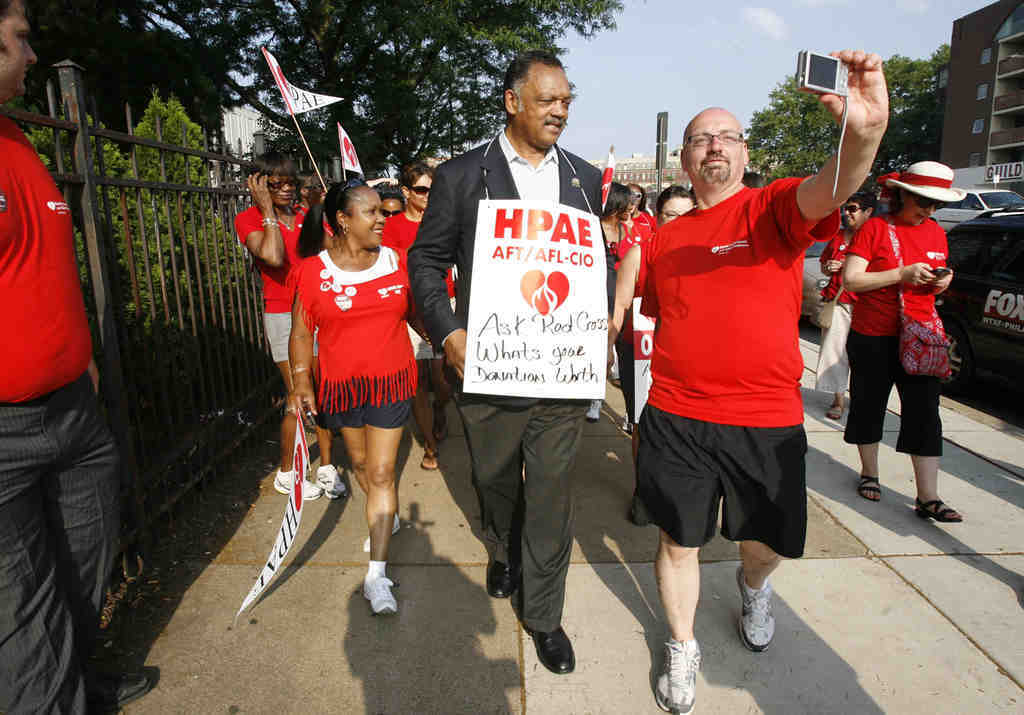
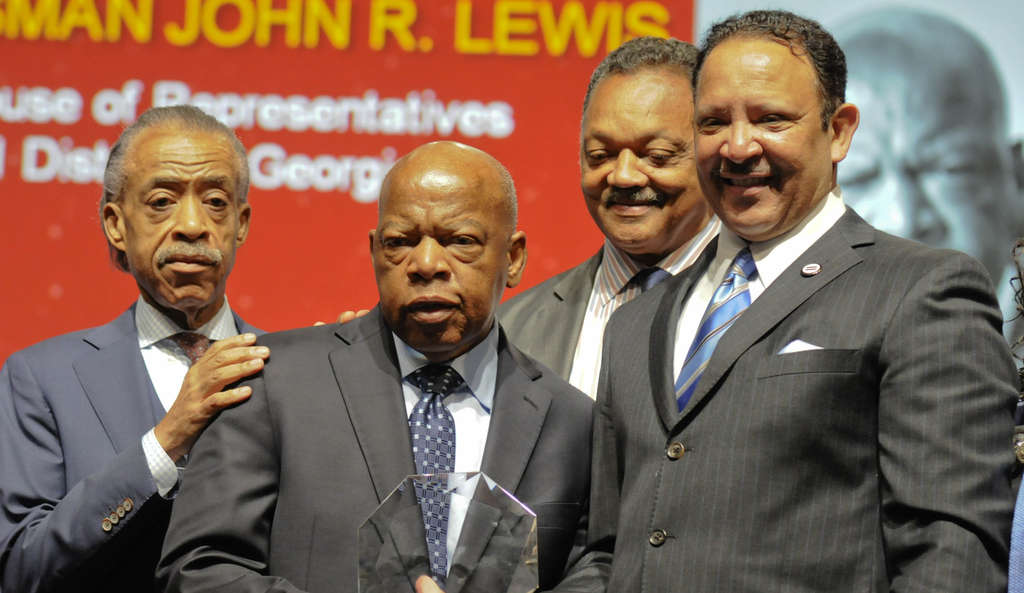
Striking Red Cross worker Lenny Lerro takes a picture of himself with the Rev. Jesse Jackson as they walk the picket line in 2011 on Spring Garden Street in Philadelphia.Rev. Jesse Jackson visits with folks at Occupy Philadelphia, just outside City Hall on Nov. 20, 2011.The Rev. Jesse Jackson visits with folks at Occupy Philadelphia, just outside City Hall on Nov. 20, 2011.U.S. Rep. John Lewis (second from left) is presented with the Civil Rights Champion Award in 2013 by (from left) the Rev. Al Sharpton, the Rev. Jesse Jackson, and Marc Morial, president of the Urban League.
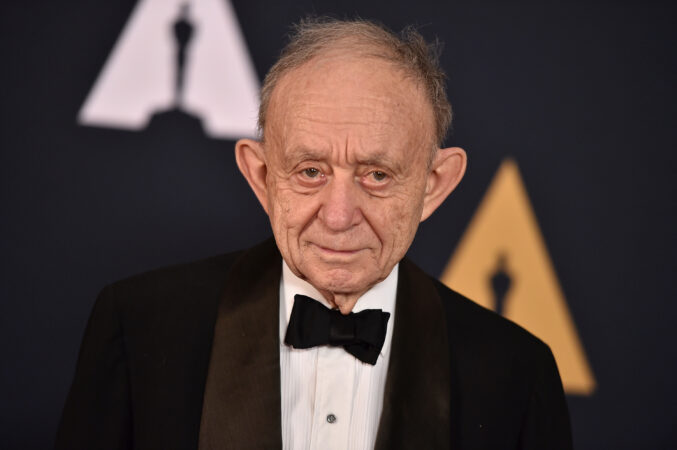
Frederick Wiseman, 96, the renowned documentarian who chronicled life at Northeast Philadelphia High School in a 1968 film that caused a yearslong controversy in the city, has died.
Known for his direct cinema style, Mr. Wiseman started his career as a law professor at the Boston University Institute of Law and Medicine before turning to film. His lengthy filmography stretches back to 1967 with the release of Titicut Follies, a controversial exposé focused on the treatment of the patient-inmates of Bridgewater State Hospital for the Criminally Insane in Massachusetts.
His follow-up, 1968’s High School, a foundational cinema verite documentary filmed at Northeast High School in Philly between the assassinations of the Rev. Dr. Martin Luther King Jr. and Sen. Robert F. Kennedy, was similarly controversial. In fact, Northeast High leaders found it so incendiary that it did not receive a local premiere until 2001 — 32 years after its initial release — for Mr. Wiseman’s fear of legal action.
At 75 minutes, High School depicted what viewers at the time saw as a bleak vision of life at Northeast High. Contemporary reviews agreed, with Variety writing that it showed the school taught “little but the dreary values of conformity, [and] blind respect for authority.” Newsweek noted that the film showed “high schools are prisons where the old beat down the young.”
In one scene, a guidance counselor tells a student they may not be college material. In another, a teacher tells a girl her legs are too fat for a dress she sewed. Another shows a dean shutting down a student who was complaining about unfairly receiving detention.
As early as mid-1969, Mr. Wiseman refused to make a copy of the film available locally, citing “legal repercussions,” according to Inquirer reports from the time. The Philadelphia Board of Education, meanwhile, declared the documentary “biased” and demanded it be shown to students and faculty.
High School, however, would not receive its first official local public showing until August 2001, at the Prince Music Theater. About 400 people attended, The Inquirer reported, most of whom were faculty or alumni of Northeast High.
Five days later, it aired on the PBS series POV Classic.
“I took him to the annual press tour the year we aired High School and never had a funnier, more incisive companion to compare notes with on the state of cinema,” said Cara Mertes, who was then the executive producer of POV Classic. “He was perpetually young, incredibly smart, and did not suffer fools, and still he was always generous with his time and immense talent as one of America’s greatest chroniclers, in any medium.”
Ten years before, in 1991, High School was selected for preservation in the United States National Film Registry by the Library of Congress.
“It is everything you need to know about 1968 middle-class America in microcosm,” Mertes said. “So many scenes and characters have taken on iconic status. It captures the tectonic social shifts happening in the most ordinary of exchanges in the day-to-day of a touchstone of American life: the high school experience.”
“Wiseman pulled a fast one on Northeast,” said English department head Irene Reiter after seeing the film. “It was a setup to attack the educational system.”
Former students, however, largely seemed to disagree. Andrea Korman Shapiro, a student featured in a scene in which a vice principal admonishes her for wearing a minidress to prom, called it “accurate.”
“[It’s] a chronicle of the inner life of people not permitted to speak,” she said.
Even others who had more positive experiences at the school argued the film’s strengths outweighed its shortcomings. As Marilyn Kleinberg, a 1978 graduate, put it: “It felt real to me, even though I had an excellent experience.”
Shapiro, meanwhile, said it would be wise to view High School as a “trauma model.”
“A trauma, if it doesn’t get resolved, gets replayed and reenacted,” she said. “There needs to be some kind of learning to let it go.”
The year High School debuted in Philadelphia, Mr. Wiseman told Current, a nonprofit news organization associated with American University’s School of Communication, that his concerns about legal action over the film were perhaps overblown.
“This was soon after the Titicut Follies case, and I didn’t want another lawsuit on my hands,” he said. Possible legal threats, he added, were merely the “vague talk of no one particular individual.”
In 2016, Mr. Wiseman received an honorary Oscar at the 89th Academy Awards for his “masterful and distinctive documentaries” that “examine the familiar and reveal the unexpected.” Making films, he said in his acceptance speech, presented opportunities to “learn something about a new subject.”
“The variety and complexity of the human behavior observed in making one of the films, and cumulatively all of the films, is staggering,” Mr. Wiseman said in the speech. “And I think it is as important to document kindness, civility, and generosity of spirit as it is to show cruelty, banality, and indifference.”
The article has been updated with quotes from Cara Mertes.
Federal authorities have arrested a man in connection with the 2000 rape and killing of a 5-year-old Philadelphia girl, nearly two decades after the suspect was placed on the FBI’s most-wanted list.
FBI Director Kash Patel on Thursday confirmed the apprehension of Alexis Flores, whom authorities had long sought for his alleged involvement in Iriana DeJesus’ death. Iriana went missing in late July 2000 and was found dead days later.
“After more than 25 years on the run, this arrest proves time and distance do not shield violent offenders from justice,” Patel wrote on social media. “Thanks to our FBI teams and international partners, a fugitive accused of a horrific crime against a child is in custody and on a path back to the U.S. We will never stop pursuing those who harm our most vulnerable.”
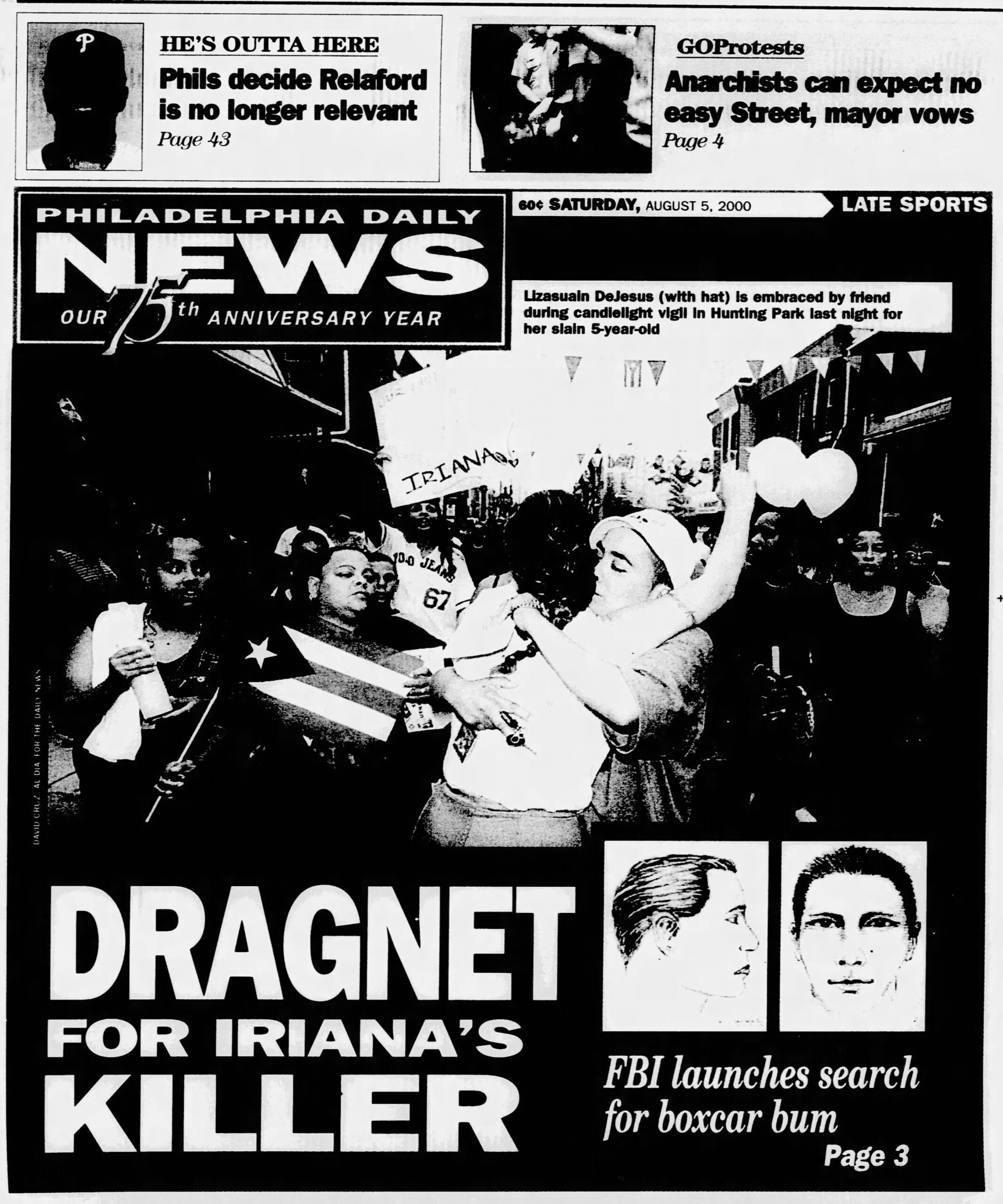
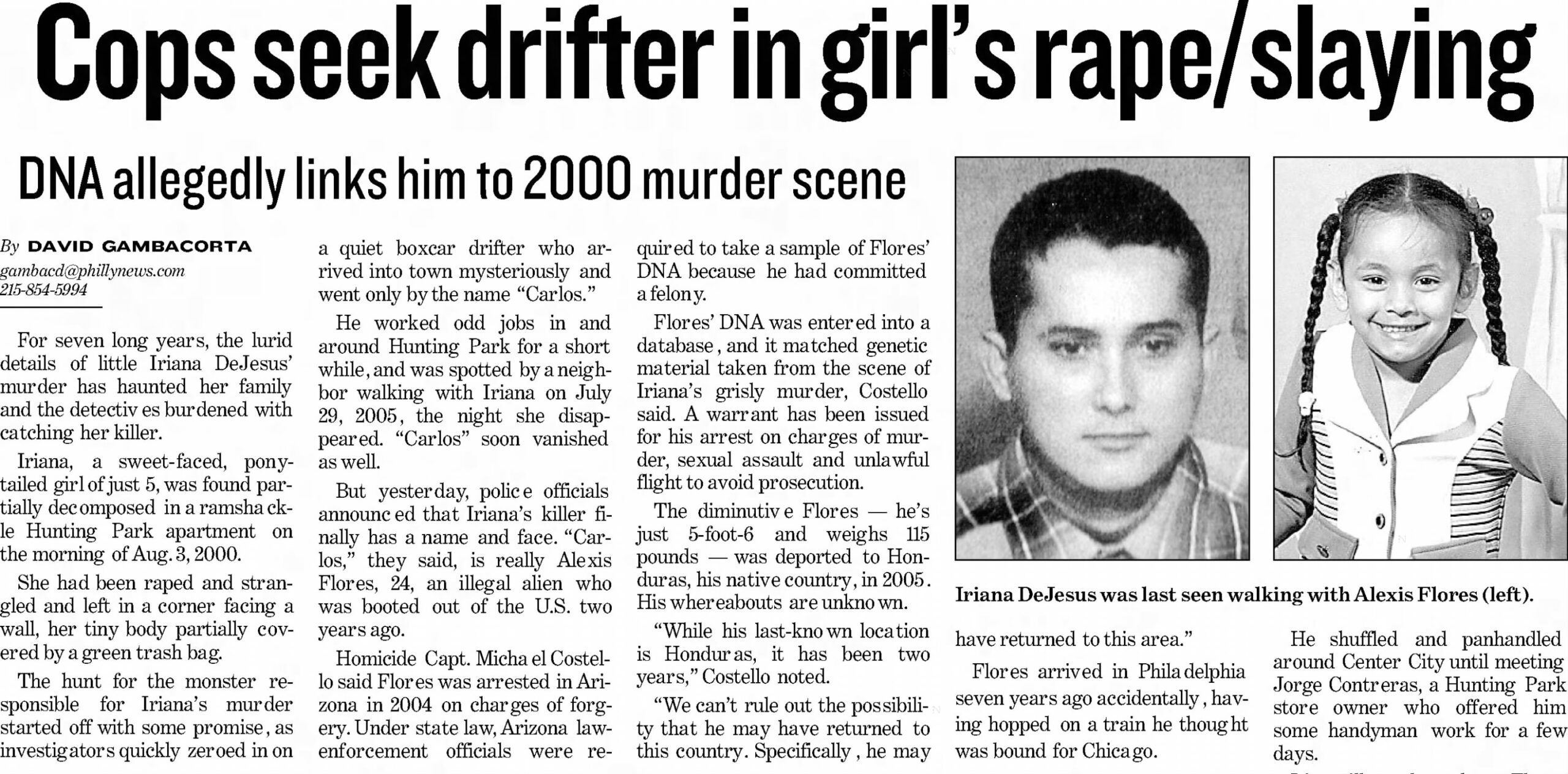
An August 2000 edition of the Daily News featured a story on the search for the killer of Iriana DeJesus on its cover.
Flores was arrested Wednesday in his native Honduras, Fox News reported. He was wanted for crimes including unlawful flight to avoid prosecution, murder, kidnapping, and indecent assault in connection with the Iriana DeJesus case, according to the FBI. Additional information about his arrest was not immediately available.
Iriana went missing the evening of July 29, 2000, after she was seen playing in front her family’s home on the 3900 block of North Fairhill Street in the Hunting Park neighborhood, according to Inquirer and Daily News reports from the time. A family friend told police at the time that she had seen the girl walking with an unknown man around the time of her disappearance.
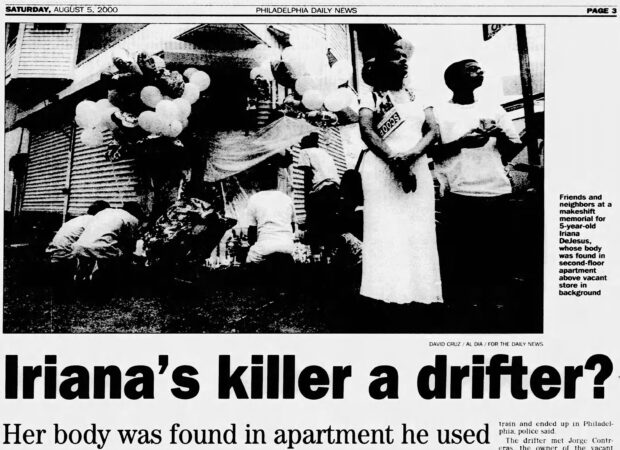
After the girl’s mother reported her missing, authorities launched searches and issued a reward for information leading to her whereabouts. But days later, on Aug. 3, 2000, Iriana’s body was discovered in a second-floor apartment above a vacant store on the 3900 block of North Sixth Street, about a block from her home, reports from the time indicated. She had been raped and strangled to death, her body covered by a green trash bag.
Police described a suspect in the crime as a “drifter” who went by the name Carlos, but few other details were immediately available. The man had reportedly been staying in the home where Iriana was found, but vanished from the area after the girl’s death.
The Daily News covers the announcement of Alexis Flores as the suspect in Iriana DeJesus’ murder in March 2007.
Authorities launched a national manhunt days after the killing, but Flores’ identity would not be publicly announced until March 2007, when federal officials issued a warrant for his arrest. He had been identified through a DNA database that allowed investigators to name him as a suspect years after a November 2004 arrest on a felony forgery charge in Phoenix.
Arizona requires felony suspects to provide a DNA sample, leading to Flores’ later identification, The Inquirer reported. Flores, authorities told the Daily News in 2007, arrived in Philadelphia in 2000, having come here accidentally after hopping a train he believed was destined for Chicago.
By the time he was identified, Flores had been deported to Honduras, and his whereabouts were unknown, complicating his apprehension. The FBI in June 2007 added him to its most-wanted list, but removed him from it last year after a review found he no longer fit its criteria, the bureau noted online. The bureau considers factors such as lengthy criminal records, the level of danger presented to the public, and whether nationwide publicity can assist in apprehension.
At the time Flores was identified as the suspect, Philadelphia homicide Detective Joseph Bamberski, who had been investigating the case from the start, expressed relief.
“It’s been a long time coming,” Bamberski told the Daily News in 2007. “This is the one case that always bothered me.”
As of midday Thursday, Flores’ page on the FBI website had been updated with one addition — a line reading “captured” over his mugshot.
“Smokin’” Joe Frazier is heading to the Philadelphia Museum of Art.
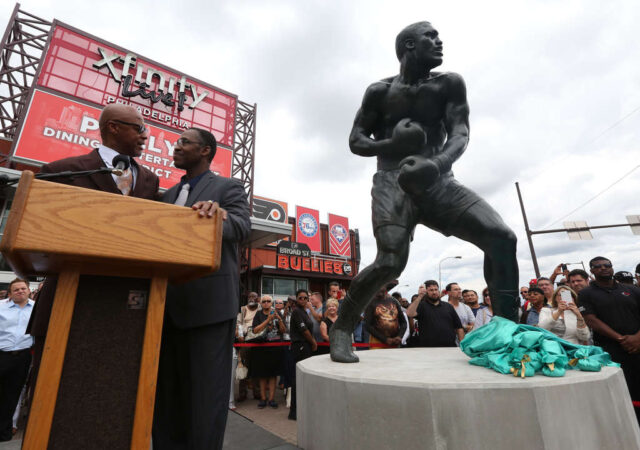
Philly’s statue of the famed heavyweight boxing champion is slated to be installed at the base of the museum’s steps later this year following a Philadelphia Art Commission vote Wednesday that approved the move. All five commissioners present Wednesday voted in favor of the statue’s relocation from its longtime home at the sports complex in South Philadelphia.
The proposal, presented by Creative Philadelphia, the city’s office for the creative sector, will see the Frazier statue installed where Philly’s original Rocky statue stands today. The Rocky statue, meanwhile, will be installed at the top of the museum’s steps.
“Placing the Joe Frazier statue at the Art Museum allows us to share a more complete history about Philadelphia’s spirit,” Marguerite Anglin, the city’s public art director, said Wednesday. “One rooted in real people, real work, and real pride in this city.”
The Frazier statue should move to the Art Museum sometime this spring, Anglin said. That relocation coincides with the move of the Rocky statue currently at the base of the steps, which is slated to be temporarily installed inside the museum for the first time as part of the forthcoming exhibition “Rising Up: Rocky and the Making of Monuments.” That Rocky statue will then be installed at the top of the museum’s steps in the fall, while the Rocky statue now at the top of the steps will go back into actor Sylvester Stallone’s private collection.
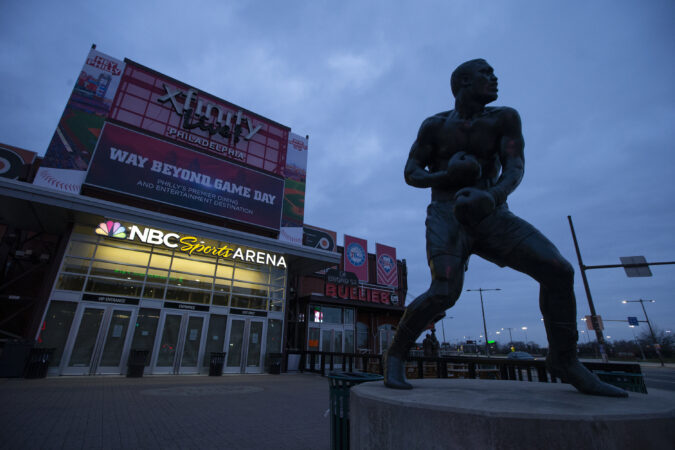
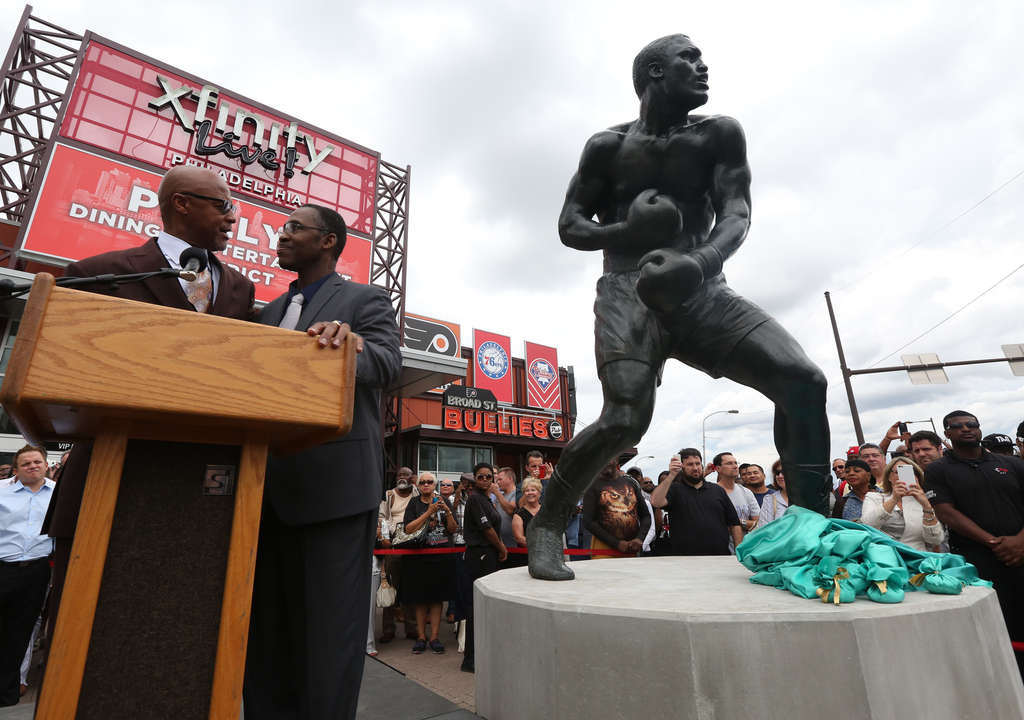
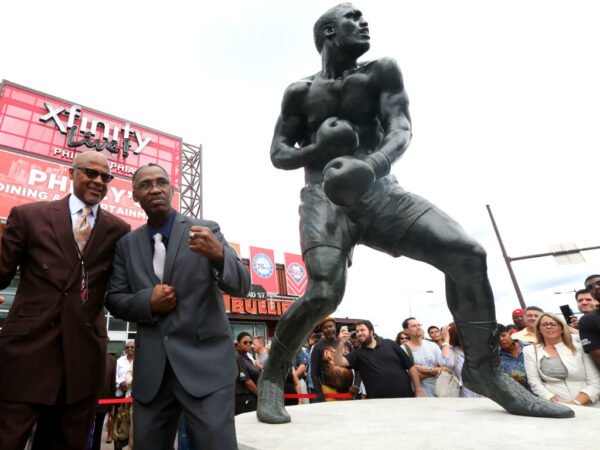
Created by sculptor Stephen Layne, the Frazier statue was unveiled in 2015 at what is now Stateside Live! at the sports complex in South Philadelphia. Its debut came years after Frazier’s death in 2011, which kicked off a campaign to erect the statue in his memory. Standing at 12 feet tall, it depicts the boxer moments after knocking down Muhammad Ali during the “Fight of the Century” — a famed March 1971 bout in which Ali suffered his first professional loss after a brutal 15-round skirmish.
For years before its creation, Frazier’s supporters lamented the fact that Philadelphia had long had a Rocky statue, but lacked one showing its own real-life champion. Our Rocky statue, in fact, has been around for more than 40 years, and has stood outside the Art Museum for two decades — about twice as long as the Frazier statue has even existed.
Creative Philadelphia’s plan featured widespread support from leaders including Mayor Cherelle L. Parker, as well as Frazier’s family and friends. It received little pushback at Wednesday’s meeting, with Gabrielle Gibson, a granddaughter of Frazier’s, asking what is perhaps the most obvious question about the placement: Shouldn’t the Frazier statue be at the top?
He was, after all, a real person, a real Philadelphian, and a real champion. Rocky, meanwhile, is a fictional character who appears to be an amalgamation of several real-life boxers’ stories — Frazier included, according to Creative Philadelphia. Many speakers Wednesday noted that, like Rocky, Frazier was known to run up the Art Museum’s steps and was said to have boxed sides of beef during his training, among other parallels.
And then there is the symbolism of where the Rocky and Frazier statues will stand.
“During Black History Month, I think we need to understand the new placement,” Gibson said. “A real boxer and a Black man’s image and likeness would be placed at a lower position beneath the fictional white character whose story was inspired by real boxers.”
The Frazier statue’s placement at the bottom of the steps, Anglin said, was for two main reasons. First, she said, having Frazier at the bottom makes it the first statue visitors will encounter at the Art Museum — even if they are there expressly to see Rocky — which will provide “an opportunity to be grounded in history.”
Second, the Rocky statue’s footprint is roughly half the size of the Frazier statue, which would not be “safe or feasible” to install on high, Anglin said. Putting Rocky at the top, Anglin said, allows for better circulation around the monument, and avoids the potential logistical and code-related issues putting Frazier there could present.
His son, and former heavyweight boxer Marvis Frazier (right), and Rev. Blane Newberry from Enon Tabernacle Baptist Church bless a 12-foot-tall 1,800-pound bronze statue of “Smokin’ Joe” Frazier after it was unveiled in 2015.
Jacqueline Frazier-Lyde, Frazier’s daughter, a retired professional boxing champion and a Municipal Court judge, expressed support for the move Wednesday, calling the statue a reminder that “we can overcome any obstacle and achieve.” She also recounted her father’s feelings on the Rocky statue, specifically when he would see tourists taking photos with Stallone’s character.
“At times,” she said, “he would say, ‘Don’t they understand that I’m the heavyweight champion?’”
After just over a decade standing outside of what is now known as Stateside Live!, the city’s statue of Philly’s own “Smokin’” Joe Frazier will be the newest Philly boxer to call the Art Museum home. The Philadelphia Art Commission on Wednesday approved a plan detailing the move presented by Creative Philadelphia, the city’s office for the creative sector.
That plan is the latest development in a saga that began before Frazier’s death from liver cancer in 2011. Frazier’s statue was unveiled in 2015 after years of work and advocacy. Fans and supporters considered the lack of a statue an injustice, given that the statue of Rocky Balboa has been in the city for more than 40 years and he’s not even a real person.
Rocky, in fact, has been stationed at the base of the Art Museum steps since 2006. That lengthy run follows installations not only at the top of the steps, but also at the sports complex in South Philadelphia, where the Frazier statue has been located since its inception. And Rocky has been in its current home twice as long as the Frazier statue has existed.
Still, Philly’s Frazier statue has a storied history of its own. Here is how The Inquirer and the Daily News covered it:
Article from Nov 12, 2011 The Philadelphia Inquirer (Philadelphia, Pennsylvania) <!— –>
Early advocacy
Frazier’s supporters had long lamented that Philadelphia lacked a memorial to the boxer. In fact, in a June 2011 Daily News poll, nearly 21% of respondents said Smokin’ Joe should be the next Philadelphia legend honored with a statue — second only to Flyers great Bob Clarke, who himself got a statue in 2013.
Calls for a statue intensified after Frazier’s death in November 2011. His loved ones and fans — including fellow Philly boxing great Bernard Hopkins — leaned on the city to memorialize the fallen legend. As Hopkins that year told the Daily News, the city ought to “build the biggest statue in appreciation for all the heart and love” Frazier gave to Philadelphia.
Following his death, Frazier lay in state at the Wells Fargo Center to allow friends, family, and fans to grieve. At Frazier’s funeral, the Rev. Jesse Jackson admonished the city for its lack of respect to Frazier.
“Tell them Rocky was not a champion, Joe Frazier was,” Jackson said to cheers. “Tell them Rocky’s fists were frozen in stone. Joe’s fists were smokin’.”
Article from Mar 9, 2012 Philadelphia Daily News (Philadelphia, Pennsylvania) <!— –>
Building momentum despite challenges
In March 2012, two months after what would have been Frazier’s 68th birthday, boxing promoter Joe Hand — a longtime Frazier supporter — publicized plans for a life-size statue of Frazier that would be placed near what was then Xfinity Live! Hand pledged a memorial, at a cost of $200,000, would be built.
Divisions among family members, friends, and business partners emerged, but by that September, Frazier’s family — led by daughters and estate executors Weatta Collins and Renae Martin — took over efforts for a statue.
Hand later bowed out of the proceedings, leaving the memorial up to Frazier’s family with backing from the city via the Fund for Philadelphia. Plans later shifted to a $150,000 funding goal for the statue, with support from the city under then-Mayor Michael Nutter, who was a longtime Frazier fan dating back to his childhood.
“[This is] a very personal moment for me to be in this position and make this announcement about someone I truly admire,” Nutter told The Inquirer in 2012.
Article from Apr 25, 2013 Philadelphia Daily News (Philadelphia, Pennsylvania) <!— –>
Setbacks and continued effort
In April 2013, Frazier’s family and the city selected New Hampshire-based sculptor Lawrence J. Nowlan to helm the project. An Overbrook Park native, Nowlan homed in on an image of Frazier knocking down fellow legend Muhammad Ali in the famed 1971 “Fight of the Century” as the statue’s inspiration.
But in late July, Nowlan unexpectedly died at the age of 48. The city proceeded with its Frazier statue plans, and roughly three months later selected Fishtown-based sculptor Stephen Layne as Nowlan’s replacement.
“We all deeply regret the passing of sculptor Lawrence Nowlan and the loss of his artistry in this project,” Nutter said at the time. “But Mr. Nowlan’s untimely passing will not deter us from honoring a great Philadelphian.”
Layne largely stuck with Nowlan’s plan, and in December 2013, the Philadelphia Art Commission approved designs for a statue depicting Frazier during the iconic Ali fight. It was, The Inquirer reported, expected to stand nine feet tall, plus a three-foot base, ultimately to be cast in bronze.
Article from Sep 13, 2015 The Philadelphia Inquirer (Philadelphia, Pennsylvania) <!— –>
Frazier’s unveiling
Among the most ardent supporters of the Frazier statue ahead of its unveiling in September 2015 was boxer Hopkins, who donated hundreds of thousands of dollars to see it erected. In April 2014, he told the Daily News that Frazier “has a rightful place in Philadelphia history and that should be honored.”
Sculptor Layne, meanwhile, plugged away at the statue for months. The pose, he told the Daily News ahead of its unveiling, showed a “pivotal moment” in Frazier’s career, which itself showed a “blue-collar mentality” that showcased his connection to Philadelphia perfectly.
“I am very happy to know Joe is being honored and memorialized in the city he loved, something that is long overdue,” Ali, Frazier’s longtime arch-nemesis, told the Daily News. “Joe was a great boxer and a worthy opponent in the ring. He always brought his best whenever he stepped inside the ropes. My only regret is that Joe won’t be there to share in the celebration.”
History may not repeat itself, but at least in Philadelphia, it sure does rhyme.
Twenty years ago, our famed Rocky statue made the move from its former perch at the stadium complex in South Philly to the base of the steps of the Philadelphia Museum of Art, where it has stood since.
Now, the city’s statue of former world heavyweight champion “Smokin’” Joe Frazier could soon do the same.
“Relocating the Joe Frazier statue to this prominent civic and cultural space would … create a respectful dialogue between two complementary representations of Philadelphia’s spirit,” chief cultural officer Valerie V. Gay and public art director Marguerite Anglin wrote in a letter to the Art Commission. “Rocky Balboa as a symbol of hard work and aspiration, and Joe Frazier as the embodiment of those values lived out in real life.”
Created by sculptor Stephen Layne in 2014, the Frazier statue has stood in the sports complex outside what is now Stateside Live! for about a decade, and has been a part of the city’s public art collection since its inception. In an effort led by Joe Hand, the owner of Feasterville’s Joe Hand Boxing Gym and a longtime friend of Frazier’s, the statue’s commission was funded by the boxer’s family and supporters before its donation to the city.
The statue, standing at about 12 feet tall, depicts Frazier just moments after besting Muhammad Ali in the so-called “Fight of the Century” — the March 1971 bout in which Ali suffered his first professional loss after 15 grueling rounds.
Frazier, who died in 2011, was a well-accomplished boxer before that matchup, having won an Olympic gold medal in 1964 in Tokyo. He held the heavyweight championship title from 1970 to 1973, when he lost the belt to fellow legend George Foreman following a bout in Kingston, Jamaica, in a matchup referred to as “The Sunshine Showdown.” He retired in 1976, the year following a vicious loss to Ali in the famed “Thrilla in Manila” fight. After returning for a 1981 match against “Jumbo” Floyd Cummings that resulted in a draw, Frazier left the sport for good.
Relocating the Frazier statue to the Art Museum is expected to cost roughly $150,000 in city funds, and has support from leaders including Mayor Cherelle L. Parker, City Councilmember Katherine Gilmore Richardson, State Sen. Sharif Street, and State Sen. Anthony Hardy Williams, according to Creative Philadelphia’s Art Commission proposal.
“Placing the Joe Frazier statue at the Art Museum affirms Philadelphia’s commitment to honoring real-life achievement alongside cultural mythology,” Parker wrote in a letter supporting the move. “Together, these figures reflect the city’s spirit, where determination, resilience, and opportunity meet.”
Friends of Frazier also expressed support in letters included as part of Creative Philadelphia’s proposal — in part, at least, because the Art Museum has higher foot traffic than where the statue currently stands.
The move “will give the Frazier statue many more eyes on it than at the Xfinity area,” wrote Nicholas L. Depace, the boxer’s friend and former physician.
Frazier served as a major inspiration for the Rocky Balboa character, with the man and the character sharing several key elements, according to Creative Philadelphia. Like Rocky, Frazier trained for boxing matches by hitting frozen raw meat, ran the Art Museum steps, and faced opponents that closely mirrored those actor Sylvester Stallone’s character faced in the franchise.
“Stallone made 5 Rocky movies mostly based on the real life humble champion Smokin’ Joe Frazier from Philadelphia,” wrote Smokin’ Frazier Championship Foundation Inc. CEO Pete Lyde in a letter of support for the move. “Joe Frazier’s statue at the Philadelphia Art Museum Steps symbolizes and celebrates the real life human heart and potential within us all worldwide.”
The Rocky statue, meanwhile, is cleared for installation atop the Art Museum steps following its exhibition in “Rising Up: Rocky and the Making of Monuments,” an Art Museum program slated to run from April to August. After that, the statue now displayed at the top of steps — which Stallone lent to the city for the inaugural RockyFest in December 2024 — will head back to the actor’s collection, and the original, screen-used statue will take its place.
It was not immediately clear when the Frazier statue could head to the Art Museum. Creative Philadelphia did not immediately respond to a request for comment.
“Placing the Smokin’ Joe Frazier statue at the Art Museum steps would not only correct a historical imbalance but also serve as an inspirational symbol for residents and visitors alike,” wrote Councilmember at-large Jim Harrity in a letter of support. “It would elevate a true Philadelphia champion whose impact reached far beyond the boxing ring and whose contributions to sports, labor history, and community service continue to resonate today.”




 –>
–>  –>
–>  –>
–>  –>
–>