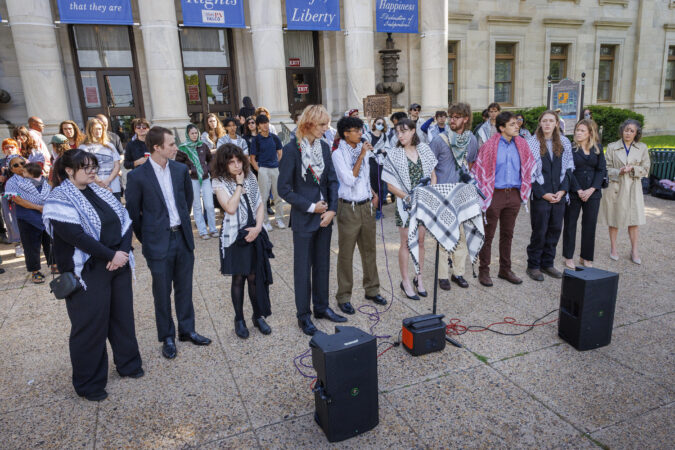
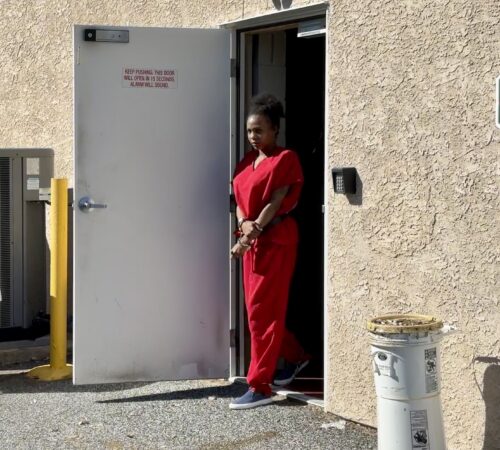
Judge Dominic Pileggi ruled that prosecutors had presented sufficient evidence for the case to proceed to trial and allow a jury to decide whether the so-called Swarthmore 9 had trespassed.
Of the nine people arrested, only one, Jace Boland, is a student at the college. Another, Brendan Cook, is a former student who was suspended for participating in an earlier protest in 2024, but the rest are not affiliated with Swarthmore, according to school officials.
Members of the group — Boland, Cook, Jonathan Britt, Mara Helen Cahill, Daria C. Dressler, Thomas Falcone, Colin Buckley Malcarney, Riley J. McManus, and Andrew Thomas — have all been charged with trespassing, a third-degree misdemeanor.
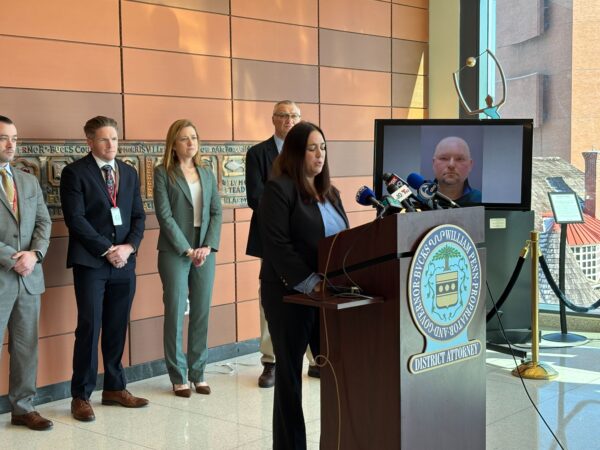
District Attorney Tanner Rouse has said his office offered each member of the group a plea deal that would see those charges reduced to summary offenses, similar to traffic citations, that could be resolved by paying a fine.
The group has refused, saying pleading guilty would set a precedent on how colleges across the country could curtail students’ protest rights.
During Monday’s hearing, the group’s attorney, Marni Jo Snyder, argued that Swarthmore and county prosecutors violated the protestors’ constitutional rights by arresting them.
She noted that Swarthmore changed its policy allowing protests on its campus to explicitly outlaw encampments after a similar, monthlong demonstration in the same location in 2024.
Policing a specific type of expressive speech, she said, is illegal.
“The policy is wrong, the repeated orders to leave are wrong,” she said. “These are improper responses to constitutionally protected speech.”
Snyder said that, though Swarthmore’s campus is private property, administrators have allowed previous demonstrations to be held there, as well as other quasi-private events. The arrests in this case, she said, showed that prosecutors were specifically targeting demonstrators protesting the war in Gaza.
Samantha Door, who represented the district attorney’s office at the hearing, disputed that, saying the protestors’ conduct, and not the purpose of the encampment, was the reason criminal charges were filed.
Swarthmore issued multiple warnings to the group to disperse over the course of three days, Door said, including one final warning 10 minutes before the encampment was dismantled.
Other protestors who left the encampment and continued to chant and hold protest signs were not arrested, she said.
Also, Door said administrators raised concerns about public safety, since many of the protestors wore masks and refused to identify themselves, vandalized campus property with graffiti, and used pallets and other materials to create barricades around the encampment.
The trial in the case is scheduled to begin with jury selection on June 30.
On Tuesday, as Shay, 50, was sentenced to 18 to 54 years in state prison, Bucks County Court Judge Stephen Corr expressed outrage over his crimes.
“You stole from these boys their childhoods, you stole from them their love of music, you stole from them their ability to love, and you stole from them their adulthood, because they are still living with this,” Corr said.
“Quite frankly, if someone hadn’t spoken up and given these men the courage to speak up, you might still be out there perpetrating your crime on other victims,” he added.
Shay, of Middletown Township, pleaded no contest in September to corruption of minors and related crimes in connection with the assaults, which began in the late 1990s and ended only with his arrest in February 2025, prosecutors said. That arrest came after one victim, decades after his abuse occurred, filed a police report.
For years, Shay advertised himself as a piano and saxophone teacher based at music stores throughout Central Bucks County, including D-Town Guitars & Skateboards in Doylestown and Coyle’s in Richboro, according to First Assistant District Attorney Kristin McElroy.
During those lessons, she said, Shay groomed his young students. The 18 men who came forward described a similar pattern: Shay targeted them when they were preteens, and would start each lesson by massaging their wrists as a way of “warming them up” before gradually moving his hands toward other parts of their body.
In subsequent lessons, they said, Shay touched their genitals or performed sex acts. Some said Shay would use neurolinguistic programming to put them into a meditative state before groping them. Others said Shay touched them dozens of times.
One man who spoke in court Tuesday said the abuse ended only when he begged his parents to stop sending him to music lessons.
“Timothy Shay took his position of trust with me as a child, in a closed setting, to satisfy his own perversions,” he said. “Today marks a sense of closure I thought I’d never receive.”
Another man said his ability to form lasting relationships or be intimate with women was destroyed by Shay’s abuse. He struggled, he said, to trust even his family.
A third told the judge Shay was a friend of his family’s and molested him while serving as his babysitter. He dropped out of school, struggled with drug addiction, and isolated himself from his family, he said.
“Tim Shay stole my self-esteem, my libido, and my faith in God and left me with a head full of passive ideation about my death,” he said.
Shay’s manipulation extended to the boys’ parents, according to McElroy, the prosecutor. He would wait until their parents trusted him, and no longer attended the music lessons, before beginning to assault the boys.
“The families were literally paying this defendant to enrich their children’s lives through music, and he took it as an opportunity to abuse them,” she said. “It speaks to the level of cruelty he showed.”
And she noted that as county detectives were investigating Shay, they found a cache of child pornography on his cell phone.
Shay’s attorney, Stephanie Moyer, asked the judge for leniency, noting that Shay had been the victim of sexual abuse as a child.
But Corr was not swayed, and fashioned a prison sentence for Shay that took into account each victim.
“You don’t get a bulk discount for coming here with 18 victims,” Corr said. “We have to bring justice for each of these men.”
One woman said at Nicklas’ preliminary hearing that she felt compelled to work with them because they told her that her ex-wife was being targeted by “black magic” and that her life was in danger.
“As someone who loved my wife and my family, I felt like I had no choice,” she said. “I wanted to save them.”
District Judge R. Emmett Madden dismissed four charges against Nicklas, 41, including racketeering and dealing in unlawful proceeds, but held him for trial on theft and related crimes. Marks, his paramour and business partner, waived her preliminary hearing and will face a county judge on all of the charges.
Nicklas’ attorney, Elizabeth Lippy, argued that Marks, not he, was the one who ran Jenkintown Psychic Visions and directed the transfer of money and high-priced items, including designer purses and watches.
“This is not the Jenkintown mafia,” Lippy said, referencing the use of racketeering charges to disrupt organized crime rings. “This is a storefront psychic who advertised her own abilities, and giving money to Mr. Nicklas doesn’t create a corrupt organization.”
Assistant District Attorney Christian Taffe presented evidence that between 2022 and their arrest in October, Marks and Nicklas encouraged the two women to make multiple wire transfers to bank accounts and a CashApp account operated by Nicklas. Marks also instructed them to withdraw large amounts of cash and to store the money in pillowcases as part of various rituals with supposedly paranormal purposes.
One woman said she hired Marks in hopes that her ex-fiancé, who had called off their wedding, would reach out to her and come back into her life.
She said Marks initially told her to keep the money in her home, but later asked her to bring it to her and Nicklas in person as part of a “marriage ritual.”
That ritual, the woman said, also required a $6,000 Chanel purse that Marks told her to purchase after asking her to extend a higher line of credit with her bank.
Marks, she said, promised to return both the purse and money to her.
“She told me not to worry about money,” the woman said, “because ‘money comes and money goes.’”
After months of cajoling Marks, the woman received a fraction of her money and the purse, which she was able to return to the store for a partial refund.
When the women pressed for more money to be returned, she said Marks threatened to contact her ex and create fake social media accounts for her, using personal information she had shared during their psychic readings.
The other victim said Marks placed similar demands on her: In addition to a pillowcase full of money, she was directed to buy expensive Rolex and Cartier watches, again as part of a ritual.
When the woman tried to get her money back, Marks became irate, she testified. Nicklas would then join the conversation, telling her to “trust the process” and promising that everything would be returned to her if she completed the ritual.
Lippy, Nicklas’ attorney, asserted that no theft had occurred. Both women, she said, believed in the paranormal and had agreed to pay for psychic services.
“Both of these victims have free will,” she said. “When a psychic promises their services, it’s a service nonetheless.”
For a little over a year, Adam Richardson was known among local car thieves as “the title guy,” state investigators said Monday. They could steal a car, visit Richardson’s title shop and resell it, either to a coconspirator or a unwitting bystander.
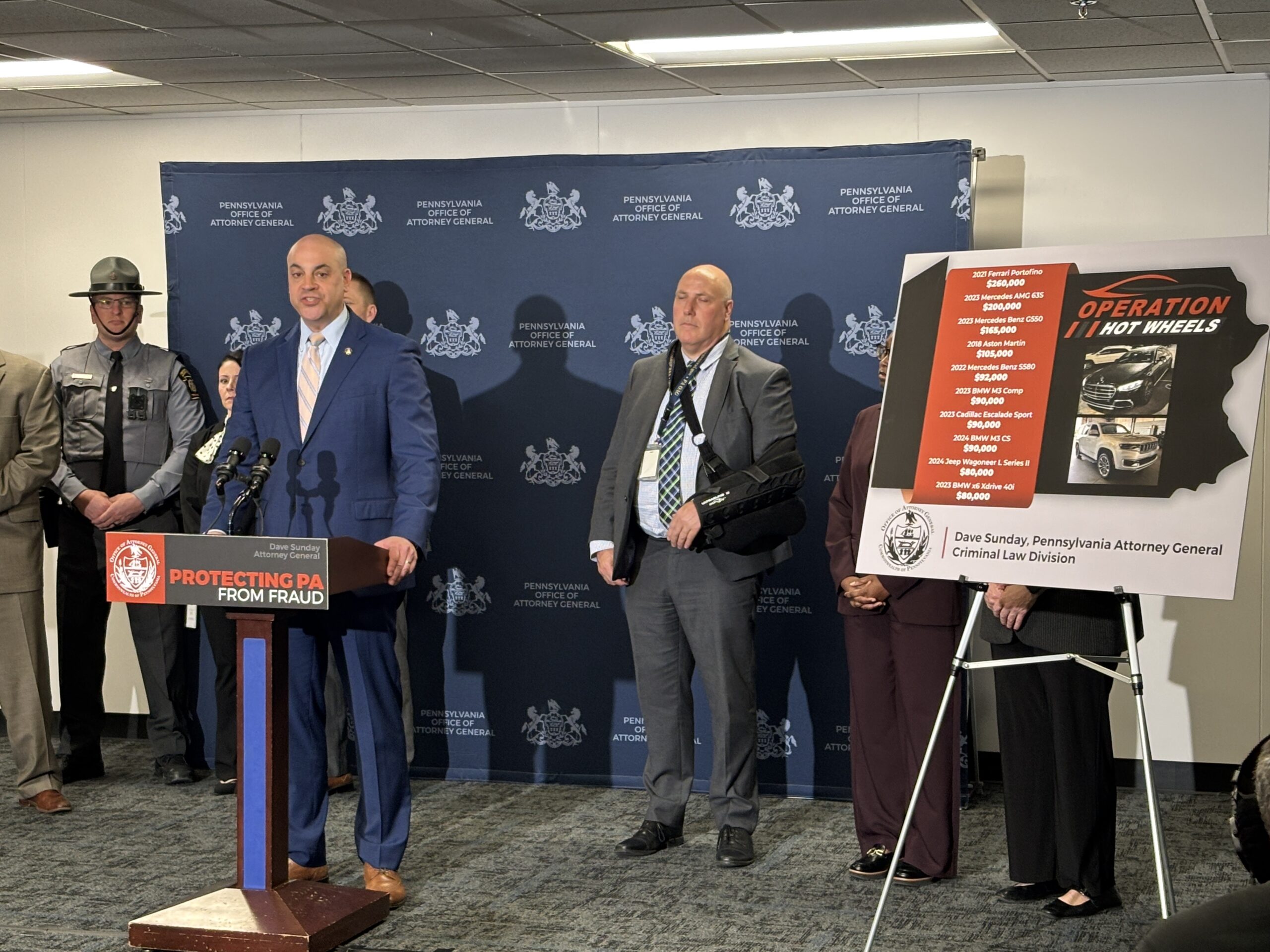
From his office on Golf Road in Wynnefield, Richardson, 40, created false title, registration, and insurance documents for luxury vehicles stolen from New Jersey, Philadelphia, and its suburbs, including a Ferrari Portofino worth $260,000 and a bevy of Mercedes, BMWs, and similar vehicles.
All told, Richardson facilitated the illegal transfer of 65 vehicles, the street value of which is nearly $4 million, according to state Attorney General Dave Sunday.
Richardson was arrested Friday and charged with racketeering, forgery, tampering with public records, and related crimes.
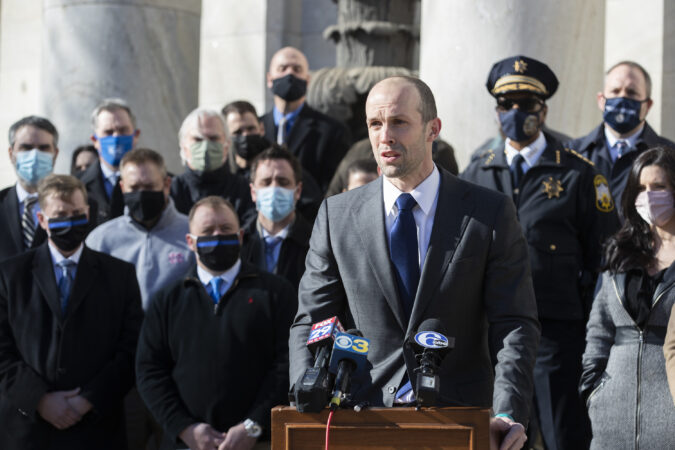
Sunday, speaking at a news conference in Northeast Philadelphia, said Richardson’s actions — referred to as “title washing” — created “a veil” behind which criminals were able to operate.
Pennsylvania Attorney General Dave Sunday said Monday that the title washing of stolen vehicles allows criminals to operate undetected throughout the state.
“What should be most concerning about this conduct to individuals and families in our communities is that title washing enables criminals to move in and out of communities without being detected by law enforcement,” he said.
Sunday declined to disclose whether the 37 vehicles recovered by Pennsylvania State Police were involved in other crimes, but he said that title washing is often linked to drug trafficking and other violent crimes.
The state’s investigation into Richardson is ongoing, he said.
Richardson remained in custody Monday in Dauphin County, denied bail due to the extent of his alleged crimes. There was no indication he had hired an attorney.
He will be prosecuted in Central Pennsylvania, investigators said, given his abuse of his power as a third-party contractor eligible to do business with the Pennsylvania Department of Transportation.
State Police investigators began investigating Richardson in May 2024, when a trooper at the Trevose Station and Barracks impounded a BMW X7 that he suspected held a fraudulent title, according to the affidavit of probable cause for Richardson’s arrest.
The vehicle had been registered in South Carolina, using a VIN that did not conform with the standard for that state and possessed a fake insurance policy, the affidavit said.
The true VIN, investigators said, matched a car reported stolen a month earlier in Montville Township in western New Jersey.
Investigators later interviewed a confidential informant who had facilitated the resale of the car. The informant had gotten the car, knowing it was stolen, from a man who told him to see Richardson, identifying him as “the 24-hour title guy” who had a reputation to meet sellers “anywhere and anytime,” the affidavit said.
The informant told troopers that Richardson helped him put the car in another person’s name, using a photo of their driver’s license.
The investigation into Adam Richardson, codenamed “Operation Hot Wheels,” found that he helped facilitate the sale of luxury cars, including multiple Mercedes sedans.
Using the unique identification number issued to Richardson’s business by PennDOT, investigators were able to identify the 65 cars involved in the title-washing scheme.
During the investigation, investigators spoke with multiple vehicle owners who said they had been paid money in exchange to have the stolen vehicles registered in their names, despite never meeting Richardson, visiting his business or driving the vehicles, according to the affidavit.
Previous audits by PennDOT in 2022 and 2023 found that his title business was violating multiple laws, including issuing plates to salvage vehicles and selling cars without a license.
With the election behind him and the top law enforcement job in Bucks County ahead, Joe Khan says he’s ready for his next challenge.
In January, Khan, a former federal prosecutor and onetime Bucks County solicitor, will become the first Democrat to serve as district attorney in the county since the end of the Civil War. (That’s not counting Ward Clark, a Republican who switched parties to run as a Democrat in 1965 and immediately switched back to his GOP roots after he won.)
Khan, 50, is also the first candidate from outside the district attorney’s office to win the top post after several decades in which voters routinely replaced outgoing district attorneys with successors from among inside the ranks of the office.
To claim that mantle, Khan decisively beat Jen Schorn, the Republican incumbent and a career prosecutor in the district attorney’s office, winning 54% of the vote in the November election, which broke a 20-year record for voter turnout.
County political leaders say Khan’s victory signals voters’ desire for regime change in the once GOP-dominated suburb.
“Democrats came out because they felt like it was necessary to push back on what Trump was doing,” said State Sen. Steve Santarsiero, the chair of the Bucks County Democratic Party. “And in the case of Joe, they recognized him as someone who is going to stand up to an administration that has shown it’s willing to flout the law.”
Khan, for his part, says politics is in the rearview mirror as he prepares for his new job.
“I don’t care what political party you’re from, I don’t care who you voted for president or for district attorney,” he said in a recent interview. “What I care about is that you’re here to support the mission of keeping Bucks County safe and seeking justice every day.”
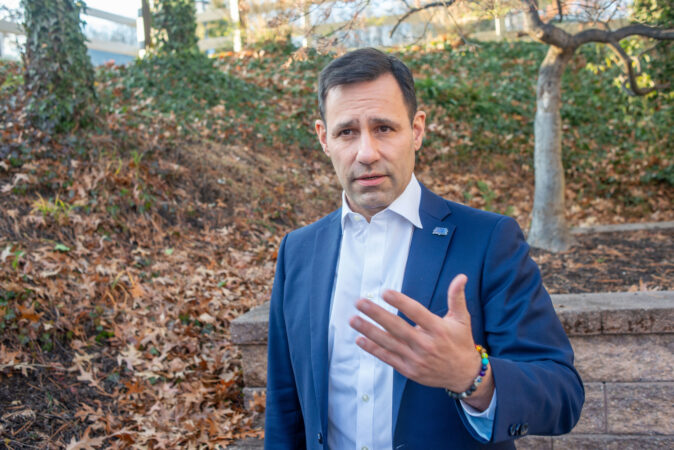
Joe Khan greets and signs a poster for supporter Phyllis Rubin-Arnold as he waits for a meeting with the Buckingham Township Police chief. Khan says that politics has no role in his plans for the district attorney’s office.
And he said he would expand that work — Khan tapped Kristin McElroy, one of Schorn’s top deputies, to serve as his first assistant.
Drawing on his experience in the U.S. Attorney’s Office in Philadelphia, Khan said he would pursue environmental crimes and prosecute cases involving violations of workers’ rights.
“We have seen all kinds of advances in terms of the powers that DAs have in Pennsylvania, so I think it’s great to have an opportunity to look at things with fresh eyes,” he said.
Khan grew up in Northeast Philadelphia, where his father settled after emigrating from Pakistan. Like his brother, State Rep. Tarik Khan (D, Philadelphia), he took an early interest in public service. He followed those aspirations to Swarthmore College and, later, the University of Chicago Law School.
Khan said he was drawn to Bucks County later in his career, and has made it his home in the 14 years he has lived with his sons, Sam, 14 and Nathan, 11, in Doylestown Township. He and the boys’ mother are divorced but co-parent amicably, he said, and live a few doors down from each other.
After stints in the Philadelphia District Attorney’s Office and the U.S. Attorney’s Office — where he specialized in prosecuting gun crimes and locking up child predators — Khan ran for the top prosecutor’s job in Philadelphia in 2017, losing the race to Larry Krasner.
Joe Khan (center) is seen here in March 2023 alongside County Commissioners Diane M. Ellis-Marseglia and Robert J. Harvie Jr. as they announced a lawsuit filed against multiple social media companies for “fueling a mental health crisis among young people.”
Three years later, Khan took over as Bucks County solicitor. He developed an interest in local politics, he said, after watching the culture-war debates over library books and allegations of abuse that embroiled the Central Bucks School District, where his kids are enrolled.
“It’s really central to my view of what parents need from their government,” he said. “They need people in roles like this that are going to make life easier, not harder, and that are going to help them with the challenges that they’re facing.”
Not long after taking over the office, Khan challenged Trump’s efforts to dismiss mail-in ballots during the 2020 election. He also waged legal battles, taking on companies including 3M, DuPont, and Tyco by filing lawsuits over the “forever chemicals” that had leached their way into residents’ water supplies.
And he made headlines for joining a national lawsuit against social media giants like TikTok, bidding them to address the mental health of their young users.
When now-Gov. Josh Shapiro left the state attorney general’s office, Khan stepped down to join a crowded primary to replace him, running in 2023 on a platform to “continue what has been a lifelong fight to keep people safe.”
After losing that race, Khan set his sights on the top law enforcement job in his new home, challenging the long-standing Republican machine that had controlled it for decades.
“I think that if you do a good job and you let people know why you’re doing the things that you’re doing, whether or not they agree with you on every political position, if they know that you’re honest, you got a pretty good shot at earning their vote,” he said.
“And I think that’s a big part of how we won this election.”
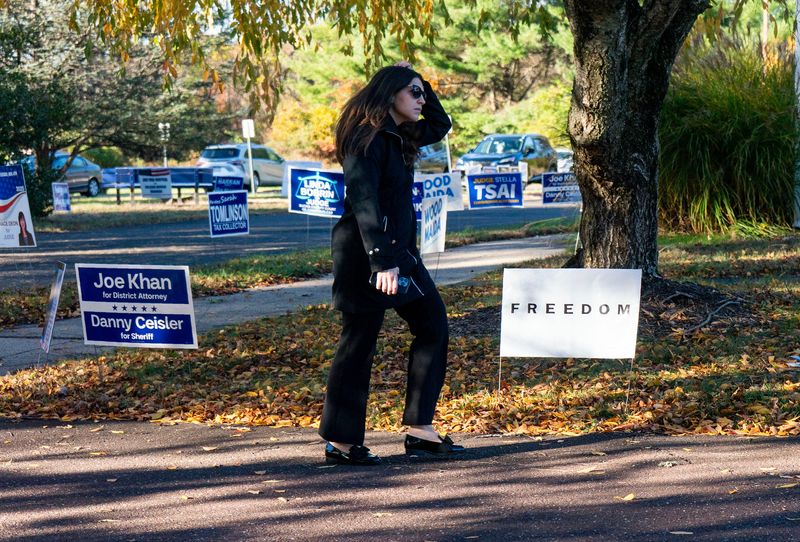
A voter walks past the election lawn signs, including one for Joe Khan and his running mate, Danny Ceisler, outside the Bucks County Senior Citizens polling location in Doylestown on Nov. 4.
Santarsiero, the county Democratic Party chair, said he was confident that Khan would make a fine district attorney.
Winning the post required political prowess, of course, but he said that is a dichotomy unique to the office: Politics are required every four years to secure a position that is apolitical.
Party affiliation aside, he said, Khan would work for the good of the county.
Khan, for his part, says he is ready to give it his all.
“We are here to keep people safe, and we’re going to do that in new and exciting ways,” he said. “I have my values, I wear them on my sleeve, and I’m very clear about the direction that we’re going to go to make sure that people who deserve a healthy environment for their families are getting a higher level of service than they’re used to.”
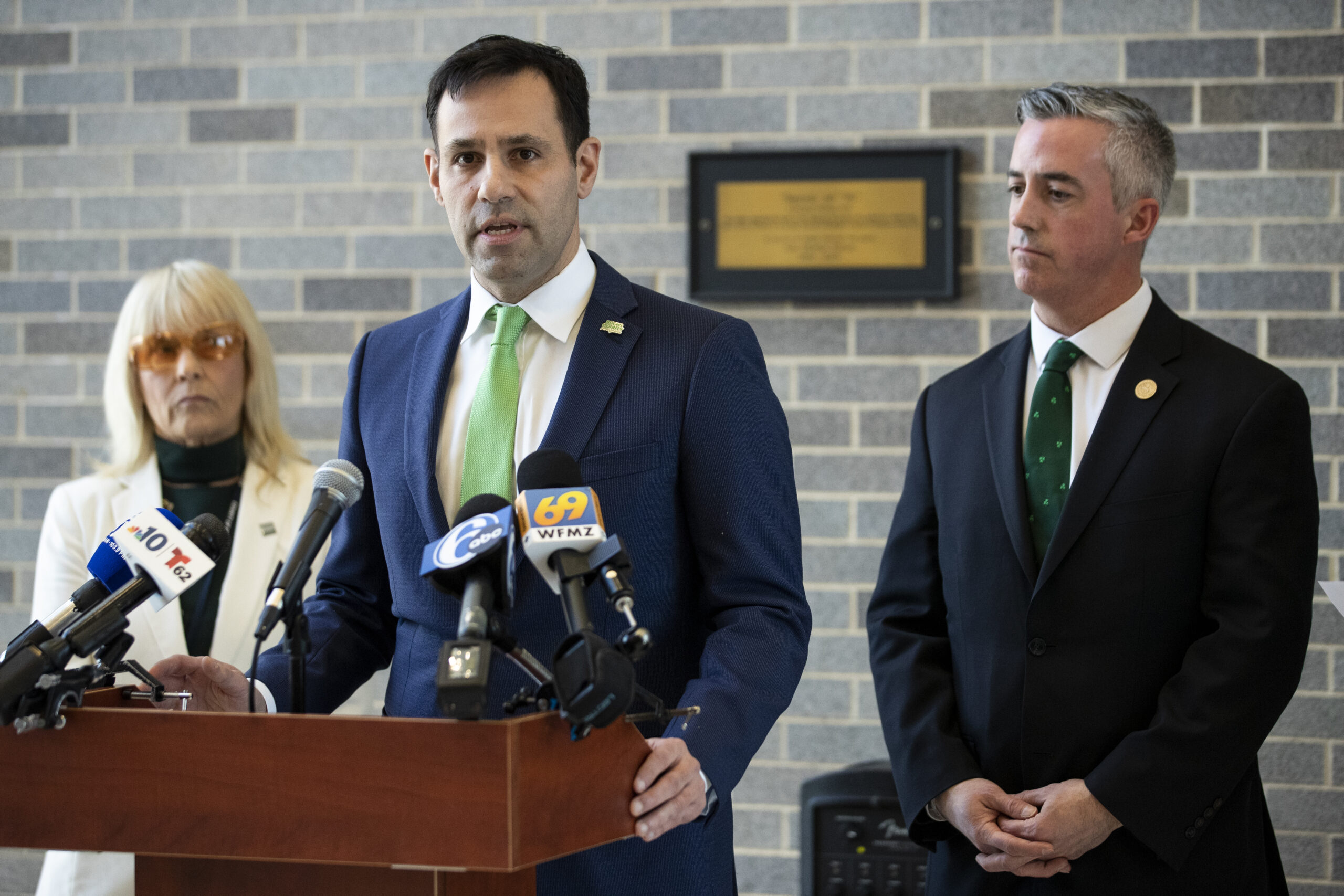
Tanner Rouse will be Delaware County’s new top law enforcement officer, but he’snot new to the work.
Rouse will be sworn in on Jan. 5 as district attorney after his predecessor, Jack Stollsteimer, steps down to assume the county judgeship he won in November. Rouse, 42, will finish out the final two years of Stollsteimer’s term after working as his first assistant since 2020.
In a recent interview, Rouse discussed the strides in reducing violent crime he and his colleagues have made under Stollsteimer — the first-ever Democrat to serve as district attorney in Delaware County — as well as how he plans to continue those advances.
The short answer: Keeping the same playbook, but “putting a personal stamp on it,” as an offensive coordinator does when he takes over as head coach, said Rouse, an avid Eagles fan and ambitious Little League coach.
A former Philadelphia prosecutor under Seth Williams, Rouse credited the lessons he learned from investigating gun violence in the city, along with the recruitment of several former colleagues he brought over the county line, withimproving the way crime is prosecuted in Delaware County.
“We have demonstrated you can reform the criminal justice system and that it doesn’t have to come at the expense of stopping violent crime,” Rouse said. “They’re not mutually exclusive.”
Who is Tanner Rouse?
Rouse, a Phoenixville-area native, is the son of the late Willard Rouse III, the prominent Philadelphia developer behind One and Two Liberty Place. After graduating from the University of Wisconsin and Fordham Law School, Rouse spent seven years in the Philadelphia District Attorney’s Office, prosecuting crimes in Center City and North Philadelphia.
Rouse left the office in 2017, months before Larry Krasner took over. He practiced civil law for a time and ran an ultimately failed campaign to unseat then-State Sen. Tom McGarrigle before Stollsteimer called and offered him the first assistant job.
At the time, Rouse said, the offer was unexpected. But, looking back, he now considers it one of the greatest opportunities of his career.
What is Rouse most proud of from his tenure as first assistant?
The most notable achievement of his tenure to date in the district attorney’s office, Rouse said, is the steep reduction of gun violence in Chester.Shootings are down 75% since 2020. Rouse credits community outreach efforts for that, especially through the Chester Partnership for Safe Neighborhoods program, overseen by veteran homicide prosecutor Matt Krouse, whom Rouse worked with in Philadelphia and recruited to join him in Delaware County.
The partnership’s fundamental philosophy is a combination of focused deterrence programs Rouse helped oversee in Philadelphia that target repeat offenders, as well as community outreach efforts run by trusted neighborhood figures.
Rouse said he never wanted to be a faceless presence in the county and made it his priority to get out and form relationships in all of the municipalities he served, visiting community meetings, block parties, and even a few pickup basketball games.
“I don’t do this job from behind a desk,” he said, speaking in his county courthouse office. “And I think demonstrating that commitment and that care by being more present in those communities, and not just being kind of the big, scary law enforcement agency on a hill is incredibly important.”
Rouse said he is proud of other reforms including creating a diversionary unit in the office, revamping its drug court and instituting a special “child’s court,” created by Kristen Kemp — Rouse’s chosen first assistant and an expert in special-victims’ cases — that allows young victims to testify against adult offenders in a more comfortable environment.
The county’s jail population is down 50% as well, something Rouse says is a result of approaching prosecuting crimes in a humane, logical way.
What are his priorities as district attorney?
Rouse said he plans to create a similar community outreach program in Upper Darby, a community he said is “on the verge of some big things.”
“It’s not as if we’re saying, ‘We’re coming in here to take on Upper Darby and what goes on there,’ but more of, ‘Guys, look, we’re not just the people you pick up and call when there’s a crime.’”
He also expressed interest in creating reciprocity agreements with his counterparts in the other collar counties around Philadelphia, specifically when it comes to handling drug cases and providing treatment to the people caught up in them.
How has his time in Philadelphia influenced his work in Delco?
Rouse said he cut his teeth in the city working alongside veteran prosecutors, and he’s worked to bring that environment of mentorship to Delaware County.
He said he and his more senior deputies often sit in on trials, giving feedback to younger staff members just as his mentors did for him nearly two decades ago.
“That’s how I got better, and that’s one of the roles I most cherish here,” he said.
A West Philadelphia man who set a fatal fire in the midst of a tumultuous breakup, killing his ex-girlfriend’s disabled sister, was convicted Friday of first-degree murder.
A Delaware County jury ruled that Aaron Clark, 20, set the the December 2022 blaze in Darby Township that killed Olivia Drasher, the wheelchair-bound sister of his ex-girlfriend, Amira Rogers. He was also found guilty of four counts of attempted murder, one each for the other occupants in the home at the time.
Hours before the fire, Rogers ended her relationship with Clark after he choked her during an argument over his alleged infidelity, according to testimony during the five-day trial before Delaware County Court Judge Deborah Krull.
In his closing argument, Clark’s attorney, Michael Dugan, accused prosecutors of having “tunnel vision” and building the case against Clark at the insistence of Rogers and her family.
“This investigation began with a conclusion right from the jump,” Dugan said. “There was never any suspect, there was no investigation of anyone else, other than looking at this man.”
Dugan urged jurors to acquit Clark of all charges, saying a lack of eyewitness evidence and inconsistent scientific rulings on whether the fire was set intentionally introduced too much reasonable doubt.
But jurors were not swayed.
Assistant District Attorney Danielle Gallaher challenged Dugan’s assessment, telling jurors not to let the veteran defense attorney mischaracterize the evidence.
“This crime fits this defendant,” she said. “Arson is a very intimate crime, and it’s something a man who has been scorned would do.”
Gallaher said Rogers ended her 10-month relationship with Clark out of fear that he would harm her further. She reported his abuse to her local police department, and even filed a complaint with the United States Postal Service, where the two worked together in Southwest Philadelphia.
But Clark, Gallaher said, could not stand to lose Rogers.
“He tried to kill her and everyone she loved, a family who loved each other unconditionally,” Gallaher said. “The defendant wanted to take it all away because he can’t comprehend that. He doesn’t have an ounce of compassion in him.”
Dugan told jurors that prosecutors had falsely painted Clark as homicidal and vindictive and noted that while the couple had a nasty argument two days before the fire, they had reconciled, posing for pictures in front of a Christmas tree hours later.
“That’s not someone who’s in fear of her life,” Dugan said of Rogers. “That’s just someone who’s in a bad relationship.”
Dugan characterized the prosecution’s case as “full of holes.” One of Rogers’ neighbors, touted as an eyewitness, could not pick Clark out of a police lineup, he said. Arson experts said there was no evidence of any accelerant found at the crime scene.
But Gallaher said there was more than enough evidence to connect Clark to the crime. The pants he was wearing when he was arrested tested positive for a petroleum-based accelerant, and cell-phone tower data showed he was near Rogers’ home at the time the fire was set.
The most damning evidence, she said, were the text messages Clark sent Rogers in the hours before the fire, including telling her: “hope you don’t miss the show.”
“He’s telling her he’s going to create a spectacle,” she said. “He wants her to know that whatever happens, he’s responsible.
“Believe him when he says that.”
A conviction for first-degree murder carries a mandatory sentence of life in prison. Clark will be sentenced next month.
When Aaron Clark’s soon-to-be-ex-girlfriend ignored his 200 calls in December 2022, he sent her a simple text message: “Pick up before I do something crazy.”
Clark, unable to handle the impending end to what Delaware County prosecutors described Tuesday as a toxic, abusive relationship, later made good on that threat, they said.
The West Philadelphia resident set fire to Amira Rogers’ home in Darby Township, killing Olivia Drasher, her wheelchair-bound sister, and forever tearing her family apart, Assistant District Attorney Danielle Gallaher said at the beginning of Clark’s trial for murder and related crimes.
“The breakup was the match that lit this fire, and the defendant was going to burn her and everything she cared about down to the ground,” Gallaher told jurors in her opening statement.
Just after midnight on Dec. 4, 2022, Clark, 33, sprayed accelerant on the front porch of Rogers’ home on Sharon Avenue, directly underneath her sister’s bedroom, the prosecutor said. Witnesses told 911 dispatchers that the fire spread quickly, and soon the entire house was engulfed.
Rogers’ mother, other sister, and Drasher’s full-time nurse were able to escape. But Drasher died in the blaze.
Gallaher promised the jury that “physical evidence, digital evidence and the defendant’s actions” will prove Clark was the only one who had the motivation and will to target Rogers and her family.
A man wearing distinctive clothing similar to what Clark was seen wearing that day was recorded on surveillance footage near the scene of the fire, Gallaher said. And cellphone data shows he was in the area of the blaze when it was set.
But Clark’s attorney, Michael Dugan, challenged Gallaher’s theory of the case, saying investigators had “tunnel vision” and focused in on Clark at the insistence of Rogers and her family.
Authorities failed, Dugan said, to find any witnesses who said he set the fire, and instead relied on “assumption and supposition.”
“At the end of the day, this is a tragic case,” the defense lawyer said. “But also at the end of the day, you have to understand that emotion doesn’t prove a case, evidence does.”
At the start of testimony, prosecutors chronicled the tumultuous 10 months during which Rogers and Clark dated. They met as co-workers at the United States Postal Service’s facility in Southwest Philadelphia.
But their relationship turned sour toward the end of 2022.
Hours before setting the deadly blaze, prosecutors said, Clark attacked Rogers when she confronted him over his infidelity and ended their relationship. He choked her so hard, she testified Tuesday, that she was afraid he was going to kill her.
“I begged him to stop,” Rogers said, her voice filled with emotion. “I felt terrified, because I didn’t know what he was doing.”
That attack came weeks after another, similar assault, she said, in which Clark struck her so hard that he bent the laptop computer she was carrying at the time.
Rogers later took steps to avoid Clark, changing her scheduled shift at work and reporting his continued harassment to their supervisors, she said Tuesday.
For hours on the day of the crime, Clark called her nonstop, his requests to speak with her turning to demands and, eventually, threats, according to text messages displayed in court.
Clark made an Instagram account through which he shared nude photos of Rogers, and shared the account with her family and friends.
Rogers continued to ignore Clark. Then he sent her a cryptic message not long before the fire was set: “Hope you don’t miss the show.”
The trial is expected to last through Friday before Delaware County Court Judge Deborah Krull.
William Ingram, 51, entered a plea to third-degree murder and related crimes for killing his 82-year-old mother, Dolores, as well as drug crimes for running a sizable marijuana and psilocybin mushroom-distribution business out of the condo they shared.
In a deal negotiated with Bucks County prosecutors, Ingram avoided a trial on charges of first-degree murder, and the potential it carries for life in prison.
Chief Deputy District Attorney Marc Furber said that negotiation included an agreed-upon sentence of 26 to 54 years in state prison for murder, abuse of corpse, and related crimes. But Ingram’s sentencing for the drug crimes will be up to the discretion of Common Pleas Judge Stephen Corr at a hearing in February.
Ingram’s attorney, Riley Downs, said Ingram suffers from a schizoaffective disorder, which is being treated and managed through medication while he’s incarcerated.
During his plea before Corr, Ingram admitted to the murder but initially seemed confused about some of the details.
Investigators said that after beating his mother in the head on June 16, 2024, Ingram left behind a chaotic and gruesome crime scene, with blood spattered throughout the home’s living room.
Ingram buried her body under a mountain of detritus, including a shattered aquarium that once housed his two pet lizards, which police found dead nearby.
Police found $53,000 among the items piled on top of the victim, as well as six pounds of marijuana and packaged psylocibin mushrooms. More drugs and paraphernalia, including cases of marijuana vapes, hash, and edibles, were found in Ingram’s bedroom.
A handwritten note advertised the prices for each item, according to Furber, the prosecutor.
Ingram stole his mother’s Honda Civic and fled Bucks County, driving four hours south to Washington, D.C.
Just before 1 a.m. the next day, police said, Ingram, wearing no clothes, approached a police officer sitting in a patrol car and used a skateboard to smash the car’s front passenger window. When the officer confronted him, he grabbed the officer, according to police. The officer pushed Ingram away, and he ran off.
Other officers caught up to Ingram about a half-mile away and took him into custody. He was charged with assaulting a police officer and destruction of property and was taken into custody.
While being questioned by police, Ingram admitted to killing his mother hours earlier after he said she hit him in the face, Furber said Monday.
He told the officers he left her body in their home.
“There’s tons of stuff thrown all over the place, I don’t know what the [expletive] I threw. … there’s blood, just a big mess,” Ingram said, according to court filings.
For that, the Southwest Philadelphia woman was sentenced Friday to 10 to 20 years in state prison.
“I am not God. I can’t decide who lives and who dies,” Williams, 31, told Judge Kevin F. Kelly. “This is the biggest mistake of my life, and I hate myself for it.”
Williams pleaded guilty in August to third-degree murder and third-degree murder of an unborn child for fatally shooting Latoya Davis in the parking lot of a Wawa store in Collingdale last year.
At the time, Davis, 32, was six months pregnant, something Williams said she did not know when she pulled the trigger of her Ruger .380 handgun on that night in October 2024.
“Not a day goes by where I don’t cry my eyes out,” Williams said. “I am sorry for the Davis family for the pain I have caused. I took something so precious, and I’m embarrassed, ashamed, remorseful, shattered.”
Davis, who left behind two young daughters, was shot once in the back during the dispute, which prosecutors said began inside the Wawa and continued in the store’s parking lot, where the two women had parked next to each other.
Latoya Davis, a mother of two, was killed outside of a Wawa in Glenolden. Davis was six months pregnant at the time.
As Williams went to drive away, Davis continued to argue with her and, at one point, threw a beverage at her. In response, Williams shot her with the gun she was licensed to carry.
Williams’ attorney, Anna Hinchman, said a lifetime of trauma, including sexual abuse as a teen and violent domestic assaults by her ex-husband, left Williams with a severe case of PTSD that was triggered when Davis confronted her.
Assistant District Attorney Dan Kerley called the shooting a “senseless act of violence” and said that, despite Williams’ perception that she was defending herself, her actions forever ruined two families.
“It’s undisputed that Ms. Williams had a license to carry her gun, but that did not give her a license to kill,” he said. “It does not give you the ability to shoot someone during an argument.”
Still, Kerley credited Williams for remaining at the scene, performing CPR on the grievously wounded Davis, and cooperating with police.
Gabou Jean Pierre Toure, Davis’ longtime boyfriend and the father of her unborn son, said no amount of remorse or accountability can heal the pain he feels.
“I want to forgive you so bad. I’m trying to forgive you,” he said. “But I still feel this is a nightmare that I want to wake up from.”
Toure said he and Davis were soulmates, and were both eagerly awaiting the birth of their son after struggling with fertility issues. The two shared a birthday and celebrated together every year.
This year, he said, all he could do on that day was weep for his lost love.
“You are a mom. You can imagine how it feels to lose your child,” he said to Williams. “I hope you regret what you’ve done.”