Wilmington received its first measurable snow of the season — a mighty 0.4 inches — and snow coated roads in parts of southern Chester County Friday.
But Philly once again had to settle for a “trace,” as the flakes that appeared at Philadelphia International Airport failed to meet the minimum requirements for a snowfall — a tenth of an inch.
Yes, PennDot was aware of the potential flake invasion, and crews and trucks were on standby, said spokesperson Krys Johnson. But evidently they can save that salt for another day.
It is possible that the city may see a few flurries this evening, or perhaps freezing rain, said Eric Hoeflich, meteorologist at the National Weather Service in Mount Holly.
But you aren’t going to pull a back muscle shoveling. Philadelphia stayed to the north of the snow line as the dry, cold air refused to give it up.
Snow in early December does happen around here, but lack of it is the norm. The “normal” value for snowfall through a Dec. 5 is 0.4 inches at PHL.
Philly’s snow season typically peaks in late January into February as the prime moisture source — the Atlantic Ocean — has a chance to chill, and the cold air in the upper atmosphere ripens.
It’s certainly cold enough for snow. Lows overnight fell into the 20s, officially 25 degrees at PHL. Mount Pocono set a Dec. 5 record with a reading of 4 below zero. That’s Fahrenheit.
Temperatures may not get above freezing Friday, and no higher than the low 40s Saturday and Sunday, which would be several degrees below the long-term daily averages. Another cold front is due Sunday, and readings likely won’t get out of the 30s on Monday and Tuesday.
The region is experiencing a classic Philadelphia early winter storm — a touch of ice and snow, rinsed away by plenty of ice water.
Some light freezing rain, sleet, and random snowflakes were reported across the region around daybreak Tuesday, and several school districts in Chester and Montgomery Counties opted for two-hour delays.
Small accumulations of freezing rain, under a tenth of an inch, were measured in the Doylestown and Pottstown areas.
For the record, the National Weather Service in Mount Holly reported that the city recorded its second official “trace” of snow, defined as a trained spotter’s sighting at least one flake at Philadelphia International Airport.
That duly noted, Philly’s chances for its first measurable snowfall of the season remained minimal or less.
“It’s cut and dried,” said Tyler Roys, senior meteorologist with AccuWeather Inc.
Quite wet, actually. As temperatures rise quickly above freezing, plain, old liquid rain, possibly heavy at times, is expected to persist into the afternoon throughout the region.
PennDot anti-icing crews have been mobilized, said spokesperson Krys Johnson, but they are also clearing leaf-clogged drains to mitigate road flooding.
The precipitation should shut off well before the peak afternoon commuting period. However, it appears that the meteorological winter, which began officially Monday, is going to get off to a livelier start than last year’s.
“We’re changing the script already,” said Roys, noting another storm threat later in the week. “It’s definitely an active start.”
NOAA’s Climate Prediction Center has the odds favoring below-normal temperatures and above-normal precipitation in the Northeast in the Dec. 7 through 15 period.
What time will any snow and ice change to rain?
The changeover to rain should proceed quickly, forecasters say, and it should be raining everywhere by midmorning.
Winds are from the east, and that is importing warm air off the ocean, where sea-surfaces temperatures off Atlantic City were in the upper 40s on Tuesday morning.
How much for Philly?
For Philly, Johnson’s reading of the forecast — “A chance of one snowflake” — was essentially correct. In fact, from King of Prussia eastward, said Roys, “You’re looking at nothing.”
What is the outlook for the rest of the week?
The weather community divides the seasons into tidy three-month increments, with Dec. 1 as opening day for winter.
It will feel that way, with temperatures several degrees below normal into the weekend, with daytime highs Tuesday and Wednesday mostly in the 30s and lows in the 20s.
A wild card would be the arrival of an Arctic front Thursday morning, said Roys, which might set off snow squalls in parts of the region.
Another winter storm is possible on the weekend, however computer guidance has been showing just about everything and not much, said Zach Cooper, a weather service meteorologist in the Mount Holly office.
Late on a stormy September night, Katie and Anthony Young were watching a horror show. In this instance, it wasalso a reality show.
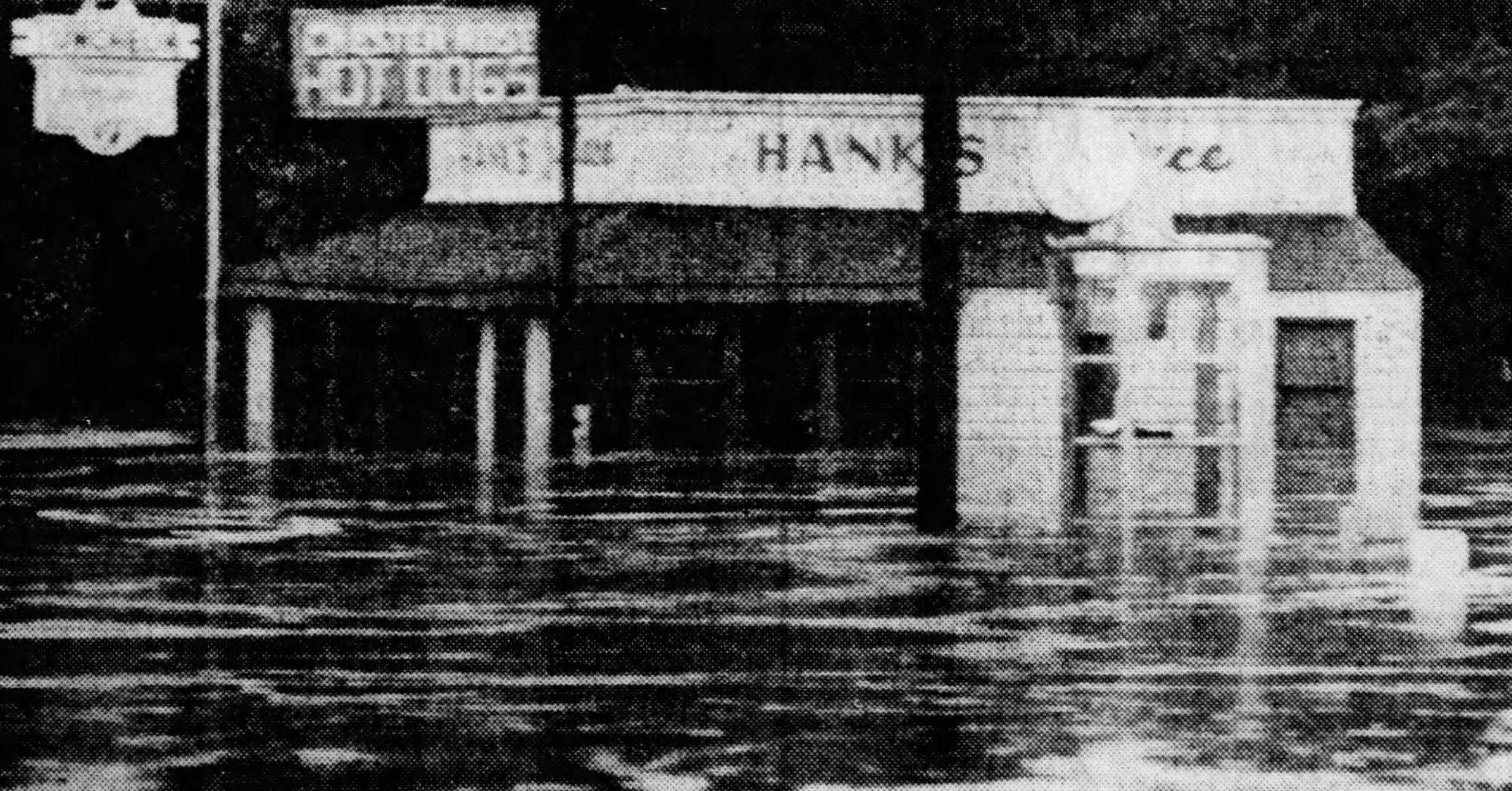
A surveillance camera showed 8-footfloodwaters drowning the generator in the rear of their restaurant, Hank’s Place. The water crashed into the dining and kitchen areas, tossing around furniture and emptying the contents of refrigerators.
The remnants of Hurricane Ida in 2021 had overwhelmed the Brandywine Creek at Chadds Ford, one of the region’s most picturesque locales, made famous by a frequent Hank’s customer, artist Andrew Wyeth.
“I don’t think either one of us was anticipating it being that catastrophic,” Katie Young said.
In a region where flooding is a perennial threat, an Inquirer analysis of the area’s most flood-prone waterways found the Brandywine ranks among the elite, based on available U.S. Geological Survey data.
(function() {
var l2 = function() {
new pym.Parent(‘area_floods’,
‘https://media.inquirer.com/storage/inquirer/projects/innovation/arcgis_iframe/area_floods.html’);
};
if (typeof(pym) === ‘undefined’) {
var h = document.getElementsByTagName(‘head’)[0],
s = document.createElement(‘script’);
s.type = ‘text/javascript’;
s.src = ‘https://pym.nprapps.org/pym.v1.min.js’;
s.onload = l2;
h.appendChild(s);
} else {
l2();
}
})();
A total of 61 major and moderate floods have occurred since 2005 at Chadds Ford and three other gages on the main stem of the Brandywine and its branches. The Brandywine East Branch near Downingtown has registered more major and moderatefloods, with 33 combined, than any gage point in the region.
No. 2 on the list was the Delaware River at Burlington, with seven major and 19 moderate floods, although that is not quite the same as stream flooding. Technically, flooding measured on the five Delaware River gages south of Trenton, including the one at Washington Avenue in South Philly, is “tidal,” since it is influenced by the behavior of the Atlantic Ocean and the Delaware Bay.
The chaotic behavior of the atmosphere may forever be elusive; however, more flooding along the Brandywine, the Delaware, and the rest of the region’s waterways is an absolute certainty.
Various studies have documented increases in extreme precipitation events with the warming of the planet. But humans are affecting the flood calculus immeasurably by hard-topping rain-absorbent vegetation.
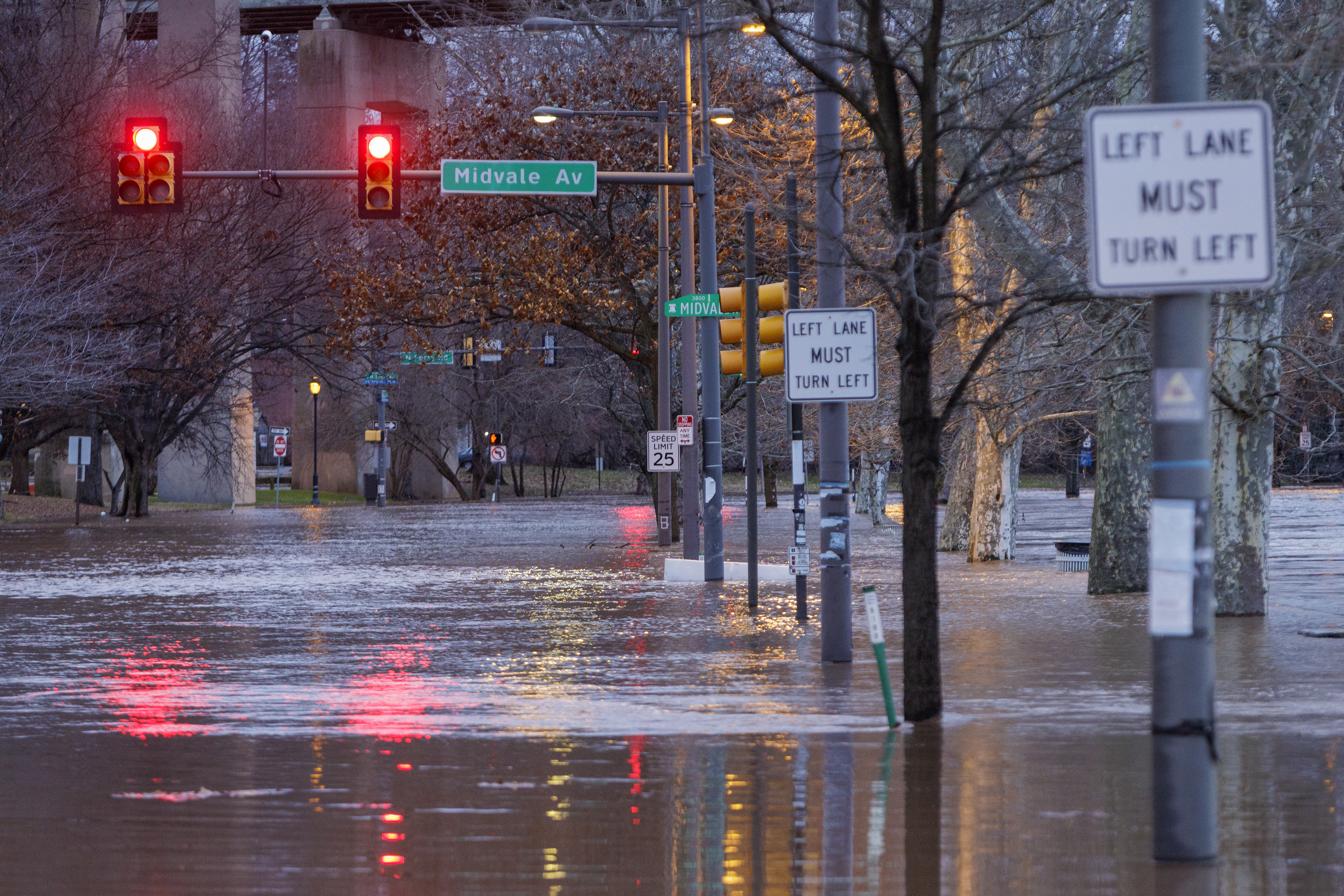
Schuylkill River floods onto Kelly Drive at Midvale in the East Falls section of Philadelphia on Wednesday, Jan. 10, 2024.
A comprehensive analysis of the Brandywine watershedpublished in April reported that impervious surfaces increased by 15% along the Great Valley’s Route 30 corridor from 2001 to 2020.
Those increases are “significant,” said Gerald Kauffman, director of the University of Delaware’s Water Resources Center, which coauthored the study along with the Brandywine Conservancy and the Chester County Water Resources Authority.
Municipalities welcome tax-generating development. Conversely, Kauffman said: “You get more value if you build next to a greenway. It’s the eternal debate.”
From 2001 to 2020, the population in the Brandywine watershed grew nearly 25%, to 265,000 people, with 150,000 more expected by the end of the century. That’s a lot of rooftops and driveways feeding water into the stream, which empties into the Delaware River.
Along the Delaware, the rising water levels of the Atlantic Ocean and the Delaware Bay are forecast to generate more flooding. The National Oceanic and Atmospheric Administration estimates that sea levels have been rising about an inch every five years.
While the oceanic salt line— the boundary between ocean and freshwater — usually stays well south of Philly, the tidal pulses contribute to flooding in the city and areas to the north, where the channel narrows, said Amy Shallcross, water resources operations manager at the Delaware River Basin Commission.
The five tidal gages along the Delaware from Newbold Island to Marcus Hook have registered more than 90 significant floods since 2005, according to the Inquirer analysis.
The study was limited to the 33 USGS gages that had a period of record of at least 20 yearsand list designated flood stages.
Along with the Delaware River sites, other stream gages that appeared in the top 10 list for major and moderate flooding were those on the Perkiomen, Chester, Neshaminy, and Frankford Creeks.
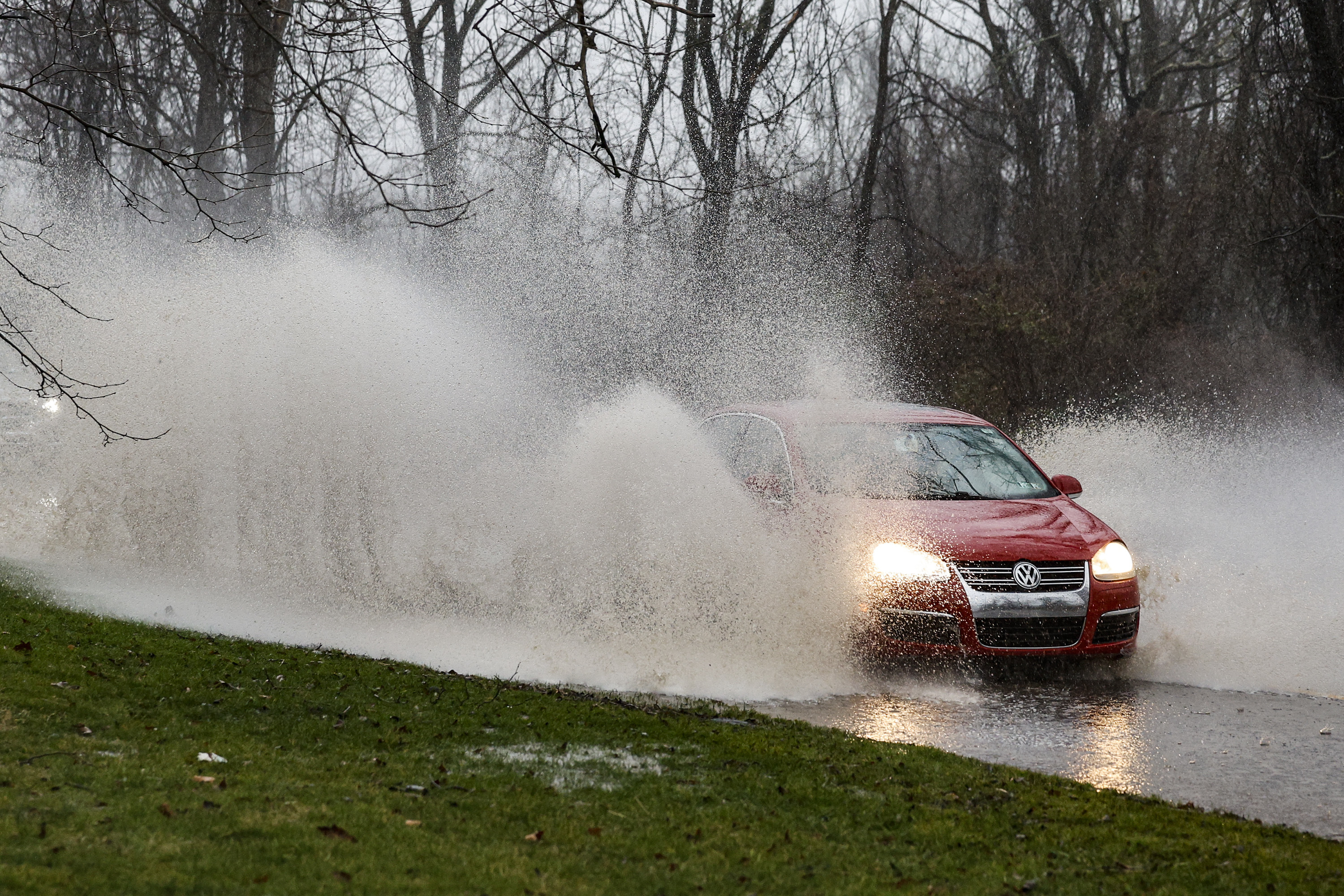
Motorists brave the heavy rain and deep puddles along Creek Road in Chadds Ford during a nasty flood event in January 2024.
The gage network cannot capture all the episodic flooding from the likes of thunderstorm downpours.
Flood frequency is not the only consideration for siting a gage, said Tyler Madsen, a hydrologist with NOAA’s Middle Atlantic River Forecast Center, in State College. For example, the gages have to be located in areas free of unnatural barriers, such as bridge abutments.
Plus, a major consideration is funding. They are costly to monitor and operate, serving multiple purposes such as measuring water quality and streamflow.
They rely on a variety of funding sources, including state and local governments, that are not available everywhere.
The Brandywine study’s suggested remedies included adding flood-control structures and beefing up warning systems all along the watershed, but warned: “Even with unlimited financial and technological resources, it would be impossible to eliminate all flood risks.”
Hank’s Place, on Routes 1 and 100 in Chadds Ford, was swamped by water from the rains of Tropical Storm Agnes in June 1972. The area has a long history of flooding, and the restaurant was reconstructed after it was flooded and damaged by Ida in 2021.
The Youngs are prepared to live with those risks, come storms or high water.
The snow rumors notwithstanding, the Philadelphia region and most of the rest of the Northeast can pretty well rule out a white Thanksgiving, nor will Black Friday turn white.
However, the upper atmosphere evidently is in a state of upheaval with a potentially rare event unfolding, and forecasters say something resembling winter may arrive around here before the holiday weekend ends.
The National Oceanic and Atmospheric Administration’s Climate Prediction Center has chances favoring below-normal temperatures and above-normal precipitation from Thanksgiving Day through Dec. 1.
However, the meteorologists who have grappled with longer-range outlooks are cautioning against taking social media snow forecasting too seriously.
“The observed snowfall is inversely proportional to the hype,” said Judah Cohen, research scientist with the Massachusetts Institute of Technology. He is among those who have noticed the snow mentions that have popped up on X accounts and popular websites.
The next week should generally be uneventful save for rain Tuesday night possibly into getaway Wednesday, when highs are forecast to reach the 60s.
Then a developing pattern change is predicted to import colder air into the Northeast. “I do believe it will get colder as the Thanksgiving week wears on,” said Bob Larson, senior meteorologist with AccuWeather Inc.
A rare event may chill December
What has the attention of Cohen and others in the meteorological world is the potential for a “major” stratospheric warming event in the upper atmosphere over the Arctic sometime in the next several days, a disruption that could allow significant cold air to pour into the United States.
Major events have occurred on average about six times a decade, according to NOAA researchers; however, having one so early would be a rarity.
If one occurred, it would be only the second time in records dating to the early 1950s that it has happened this early, said NOAA meteorologist Laura M. Ciasto.
While computer models have been debating over just what is going to happen, Cohen, chief of seasonal forecasting for the Janus Research Group, said that such an early date has given him pause about forecasting it will happen.
What causes a stratospheric warming event?
On occasion, upward-moving waves from the troposphere, 5 to 9 miles over the Arctic, crash into the stratosphere, 10 to 30 miles up. That has the effect of compromising the polar vortex, the west-to-east winds that lock cold air in the places where the sun disappears for the winter, Ciasto said.
When the winds slacken, the vortex can weaken and allow frigid air to spill southward. In some cases it might “stretch,” or split into pieces that deliver cold air to regions of the Northern Hemisphere.
A major disruption would have longer-lasting impacts, Cohen said.
The European forecast model has consistently predicted a major event, Ciasto said, while the U.S. model has not been as impressed.
What is likely to happen if the warming event occurs?
A major warming in January 2021, when temperatures in the stratosphere suddenly jumped 65 degrees Fahrenheit, resulted in quite a snowy February in the Philadelphia region.
After a warming event, “there’s a greater chance that the jet stream will become more disrupted and dip down” over the continuous United States, Ciasto said, “bringing cold air with it.”
As for timing, the effects may show up anywhere from two to several weeks after the event.
In the meantime, she noted that “several other factors,” including patterns over the North Pacific, favor a chilling for the Northeast.
Don’t be surprised to see snow appear in an actual forecast, but not necessarily on the ground.
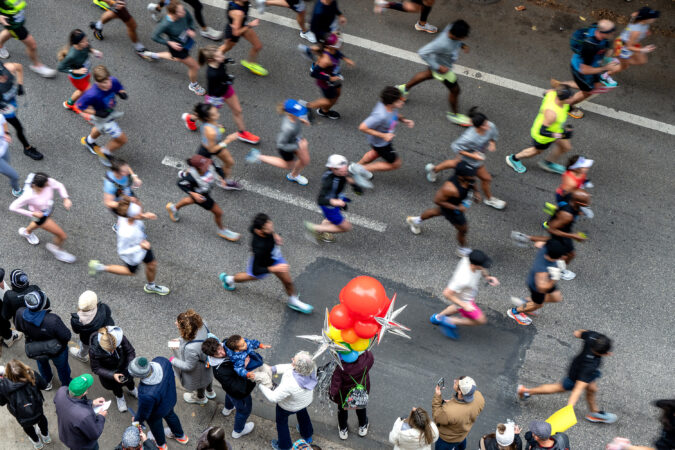
Assuming the sports scientists have it right, the temperatures should be near the performance sweet spots for the runners participating in the Philadelphia Marathon Weekend races on both Saturday and Sunday morning.
At showtimes, 6:55 a.m., just moments after daybreak, temperatures Saturday are expected to be in the upper 40s to near 50 degrees for the half-marathoners, and in the upper 30s to around 40 for Sunday’s main event.
Light rain is expected through the early-morning hours Saturday, and forecasters have been on the fence about when it will shut off. Nick Guzzo, a meteorologist at the National Weather Service said Friday afternoon that rain was likely at the start of the race, but that probabilities would drop precipitously once the event was underway.
AccuWeather Inc. and weather.com were posting about a 50-50 shot that the rain would continue through the morning. The hedging isn’t surprising; timing the onset and end of precipitation has been a longstanding forecast problem.
Nor would it be surprising for those running the 13.1-mile race to experience conditions different from those logging 26.2 miles the following day, points out Kathleen Titus, the race director and runner who has been involved with the marathon for 20 years.
This time of year is a busy one for frontal passages, this being a transition period when the atmosphere isn’t quite sure what season it wants to be. The temperature has reached 74 degreeson Nov. 22 (1883), and plunged to 14 (1880), and snowed 4.6 inches on Nov. 22-23, 1989.
However, nothing momentous is expected this weekend.
Like the rains, winds are forecast to be light, under 10 mph, from the north on Saturday, and northwest on Sunday, although runners allow that on the course, the wind can be way more capricious than the temperatures.
Various studies have concluded that temperature is the most important weather variable in runner performance and that the ideal range for marathoning is 39 to 50 degrees Fahrenheit — give or take a few degrees.
“Your body is always competing between a couple of different things,” said Philip Skiba, sports medicine specialist at ThomasJefferson UniversityHospital, who helped train Eliud Kipchoge, the Kenyan who became the world’s first runner to complete a marathon in under two hours.
During exercise, muscles demand blood to work, while for the body to stay cool, blood has to flow to the skin. If it’s too hot, more blood flows to the skin. When it’s cold, blood is diverted to heat the body’s core.
With temperates in that 39-to-50 range, the blood flow can more easily serve both the muscles and skin. Said Titus, racers love that temperature range because, “It regulates your body. It just works.”
Skiba said the temperature ranged from 51 to 55 degrees on the October 2019 day Kipchoge broke the two-hour barrier in a Vienna event that wasn’t held under record-eligible conditions.
Had the temperatures been lower, Kipchoge could have shaved a few more seconds off his time,Skiba said.
The wind also is a player in marathons
While not as dominant as temperature, “wind resistance … is worth a few seconds per mile,” said Skiba, a former triathlete.
“The more you stay out of the wind, you can save considerable energy,” he said.
“It’s really important to learn how to draft,” that is, get behind a group running close to your pace and using them for wind-breakers,he said. (Not sure how the wind-breakers feel about that.)
On the Philly course, the winds can be wild cards, especially on Kelly Drive, Titus said.
One instant, the wind “hits in your face. Now it’s at my back!”
Titus said she actually likes running uphill into the wind — and she is believed to be a member of a distinct minority — but agrees that “it is nice to have it at your back when you’re coming into the home stretch. Because it does give you a little boost.”
New Jersey’s beaches, still recovering from major sand losses from an offshore hurricane and a nor’easter, evidently are in for another assault this week as October is about to make a dramatic exit.
Gale-force gusts off the ocean could develop as early as Tuesday afternoon at the Shore, said Eric Hoeflich, a meteorologist at the National Weather Service office in Mount Holly, with brisk onshore winds persisting “maybe into Friday.”
A potent storm is forecast to affect the entire region Wednesday night into Thursday, with heavy rains in the immediate Philadelphia area, where drought conditions have been intensifying.
Also on Thursday, what is likely to become catastrophic Hurricane Melissa will be passing offshore, churning up the waves crashing on East Coast beaches.
“The coast once again is going to take a pretty good battering,” said Dave Dombek, senior meteorologist with AccuWeather Inc.
On the plus side, Hoeflich said, for the Shore, this week’s storm “doesn’t look as bad” as the beach-erasing nor’easter earlier this month. The path should be more inland, and the lunar influence on the tides would be less. Only minor flooding is expected, he said, subject to change.
However, not only would the track mean region-wide heavy rain, but it would also increase the potential for severe thunderstorms Thursday. A front is due to chase the rains Friday, but it may generate gusts to 50 mph, the weather service says. Power outages are possible both days.
The timetable for the winds and the storm in the Philly region
The National Weather Service has posted a gale warning for Tuesday into Wednesday morning for the waters along the immediate coast for winds from the east that could gust past 50 mph.
That would be more the result of high pressure to the north of the region. Winds circulate clockwise around centers of highs; thus, areas to the south of the center experience winds from the east.
The breezes will be getting a second wind as a storm develops in the Southeast and tracks north. Meanwhile, a weakened Hurricane Melissa will be churning the ocean as it passes well off the U.S. coast on Thursday.
A strong storm system will move across the region later this week. Here is a summary of expected impacts. pic.twitter.com/OvhoVAaS11
Rain for the last 30 days has been about a third of normal in the city and the neighboring Pennsylvania counties.
South Jersey has fared only slightly better, but precipitation is well less than half of normal.
What is the forecast for the trick-or-treaters?
It is all but certain that Friday will be a dry day, with temperatures in the low and mid-50s. Wind gusts are forecast to die down sometime after 5 p.m., but hold onto those brooms, just in case.
Frost advisories are up for Friday morning for areas just outside Philadelphia on both sides of the Delaware River as the region is about to experience its chilliest spell in more than six months.
While the urban hotplate areas of Philly and Delaware County were not included in the National Weather Service advisory zones, cooler areas of the city and Delco could see some patchy white.
“It is certainly possible,” said Zachary Cooper, a meteorologist at the agency’s Mount Holly office.
Conditions conducive to frost — relatively clear skies, temperatures in the 30s, and light winds — may whiten the pumpkins in the region through the weekend.
As per standard procedure, the weather service will be issuing frost advisories until the end of the growing season, defined as the first time temperatures reach 32 degrees or lower in a given area.
It won’t be freezing, just frosty
Philly’s first freezing reading typically doesn’t occur until mid-November, but frost can form with temperatures above 32.
The air temperatures are measured about six feet off the ground, but they can be several degrees lower on the ground and on cooler surfaces.
When winds are calm, they keep the air from mixing, and that allows thin layers of colder air to develop at ground level.
The winds won’t be completely calm Friday morning, but “they should be light enough for favorable” frost conditions, the weather service said.
The dry spell in the Philly region continues
Temperatures should be several degrees below normal into next week, with highs mostly in the 50s and lows 35 to 40 degrees, the weather service says.
Notably absent from the extended outlook is precipitation. Officially, at Philadelphia International Airport, only 0.81 inches of rain have fallen this month. That’s less than a third of normal.
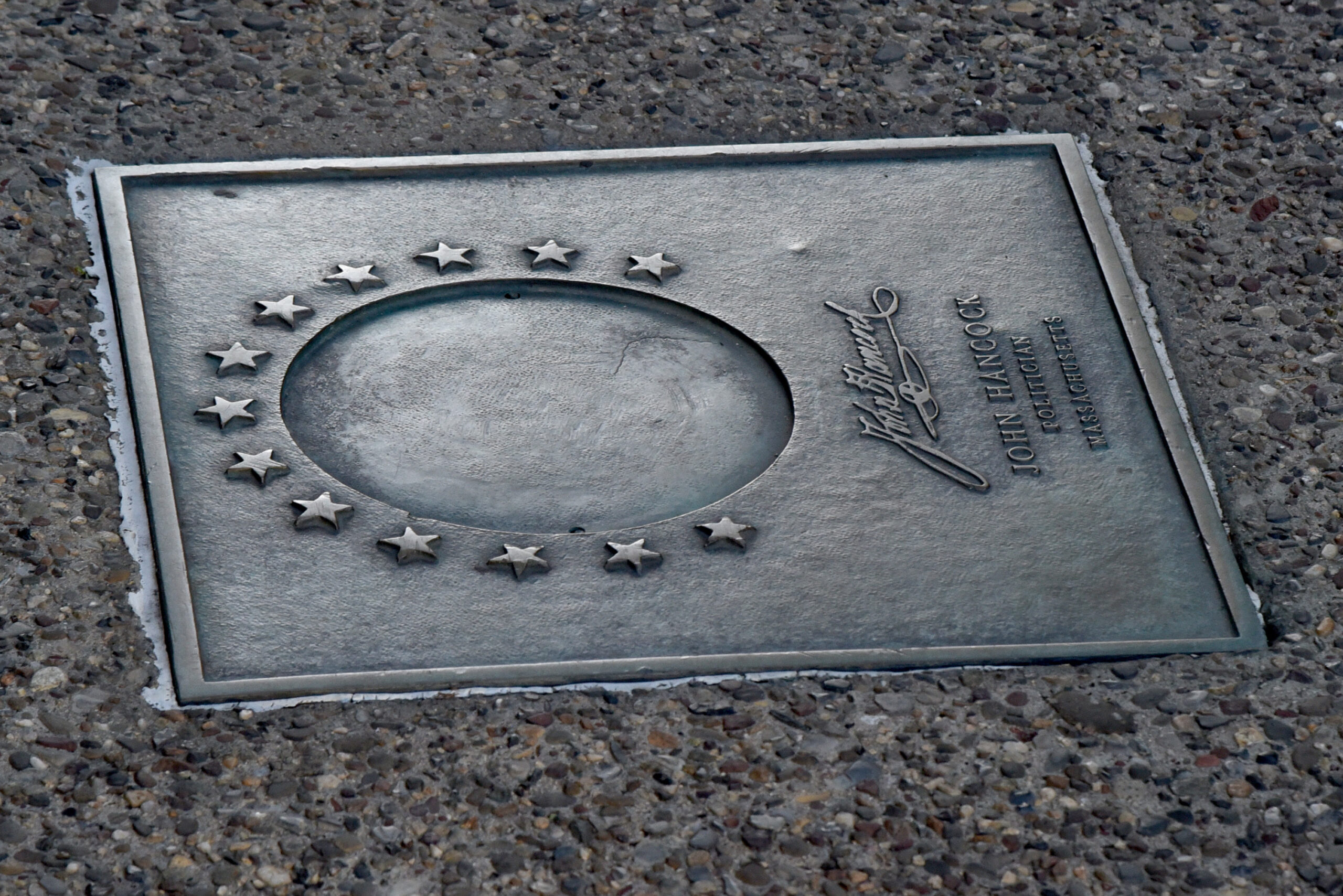
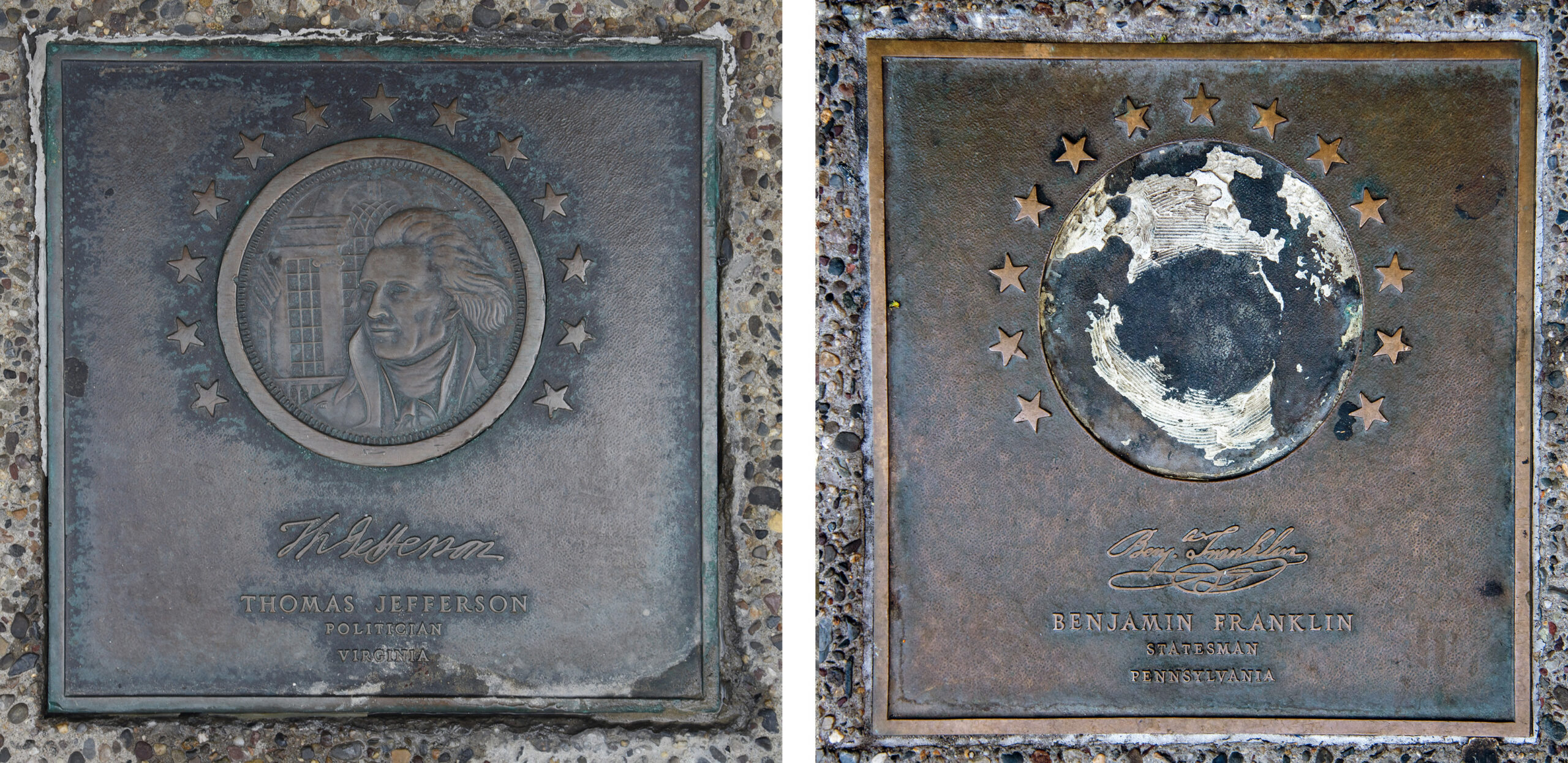
John Hancock has lost his face. So has Pennsylvania’s George Clymer.
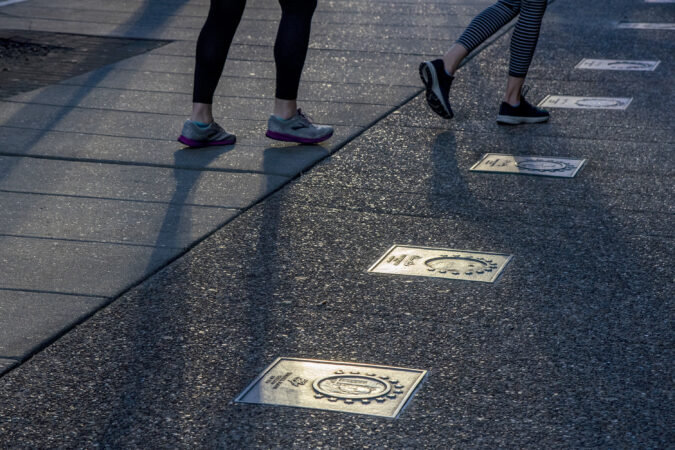
So have 12 other of the 56 signers of the Declaration of Independence whose memorial plaques have been consigned to the soles and heels of pedestrians in the 600 block of Chestnut Street, a block from where they put their lives on the line on July 4, 1776.
These days, the bronze plaques embedded in a sidewalk outside a Wawa, have become orphans, trodden upon daily and, literally, defaced.
The John Hancock plaque with the missing face.
They were donated by the Franklin Mint — whose roots, coincidentally, are in Wawa, Delaware County — for the city’s Bicentennial celebration in 1976.
The owners of the adjacent Public Ledger Building, who were not immediately available for comment, have assumed responsibility for the maintenance of the plaques, a spokesperson for the Center City District, a building tenant, said Saturday. However, they evidently have not been able to protect the plaques from vandalism.
Exactly how the faces disappeared is a mystery, and while a police spokesperson said that no incidents of theft have been reported, the remnants of glue and missing bolts suggest the faces were removed.
“That’s terribly sad,” said Ann Meredith, who as director of the erstwhile “Lights of Liberty” group had a lot to do with how the plaques wound up where they are today.
A bit of history
As part of an exhibit that The Inquirer called a “delightful” and “appropriate way” to teach history, the plaques were dedicated on May 10, 1975, the 200th anniversary of the convening of the Continental Congress.
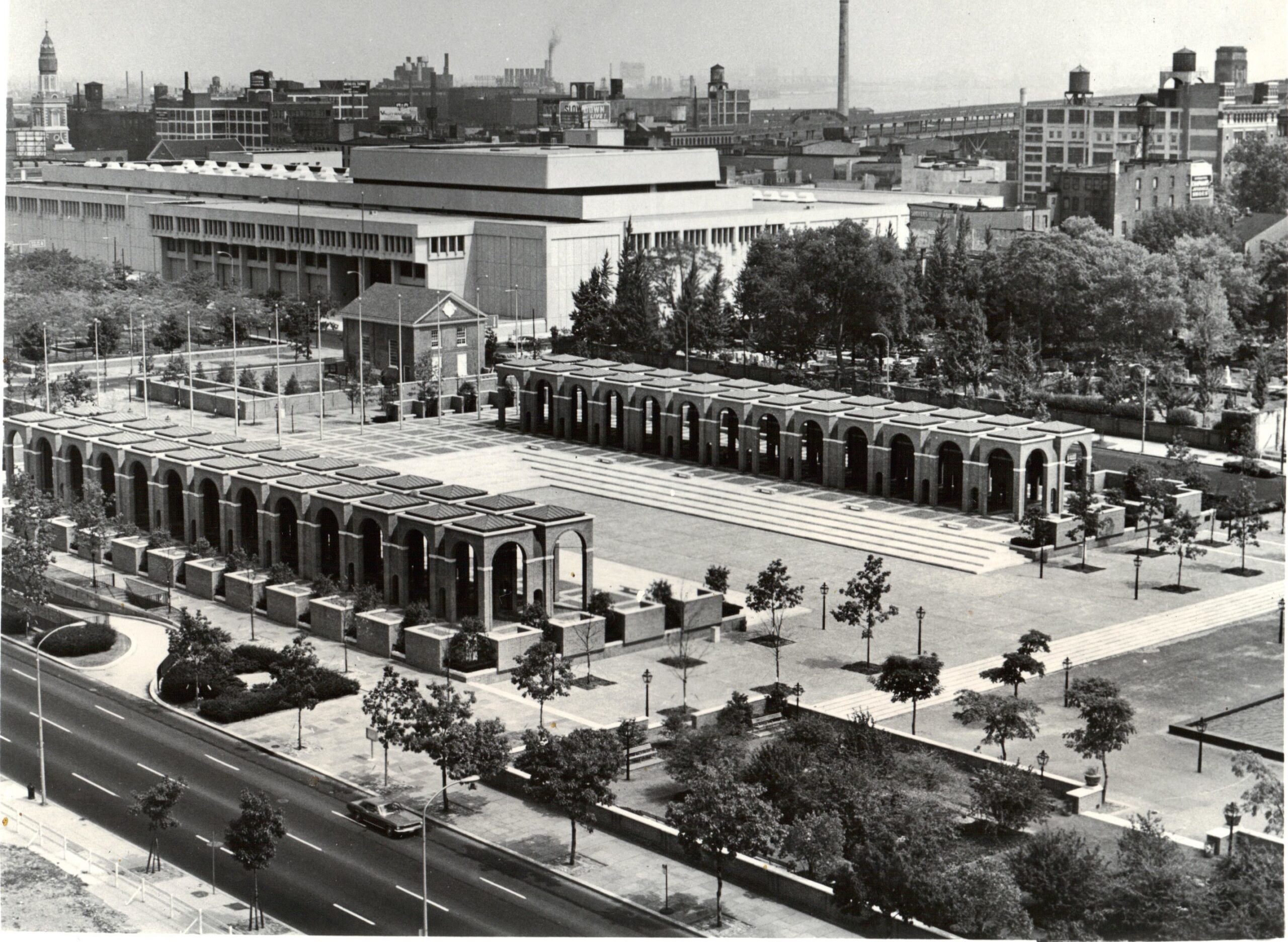
Just over a square foot, each one contained the image of a signer and a replica of the signature that appeared on the Declaration. They were mounted beneath the arches of brick colonnades on the Judge Lewis Quadrangle, along with flags of the states, ready for a Bicentennial celebration for which Philadelphia aspired to be a centerpiece.
The old Judge Lewis Quadrangle pavilions, which houses the bronze plaques commemorating the 56 signers of the Declaration of Independence. The site now is occupied by the Independence National Historical Park Gateway Visitors Center.
After the Bicentennial, Independence National Historical Park planned a major transformation.
“We found out the NPS was going to dispose of them,” said Meredith, who was running Lights of Liberty, a historical sound-and-light show that she described as “a theme-park experience in one of the most protected historical areas in America,” on Independence Mall. “We asked, ‘Can we have them?’”
The plaques were to be installed on Chestnut, just outside the park’s property, as a “Signers Walk” — an “added feature” to the light show, said Meredith.
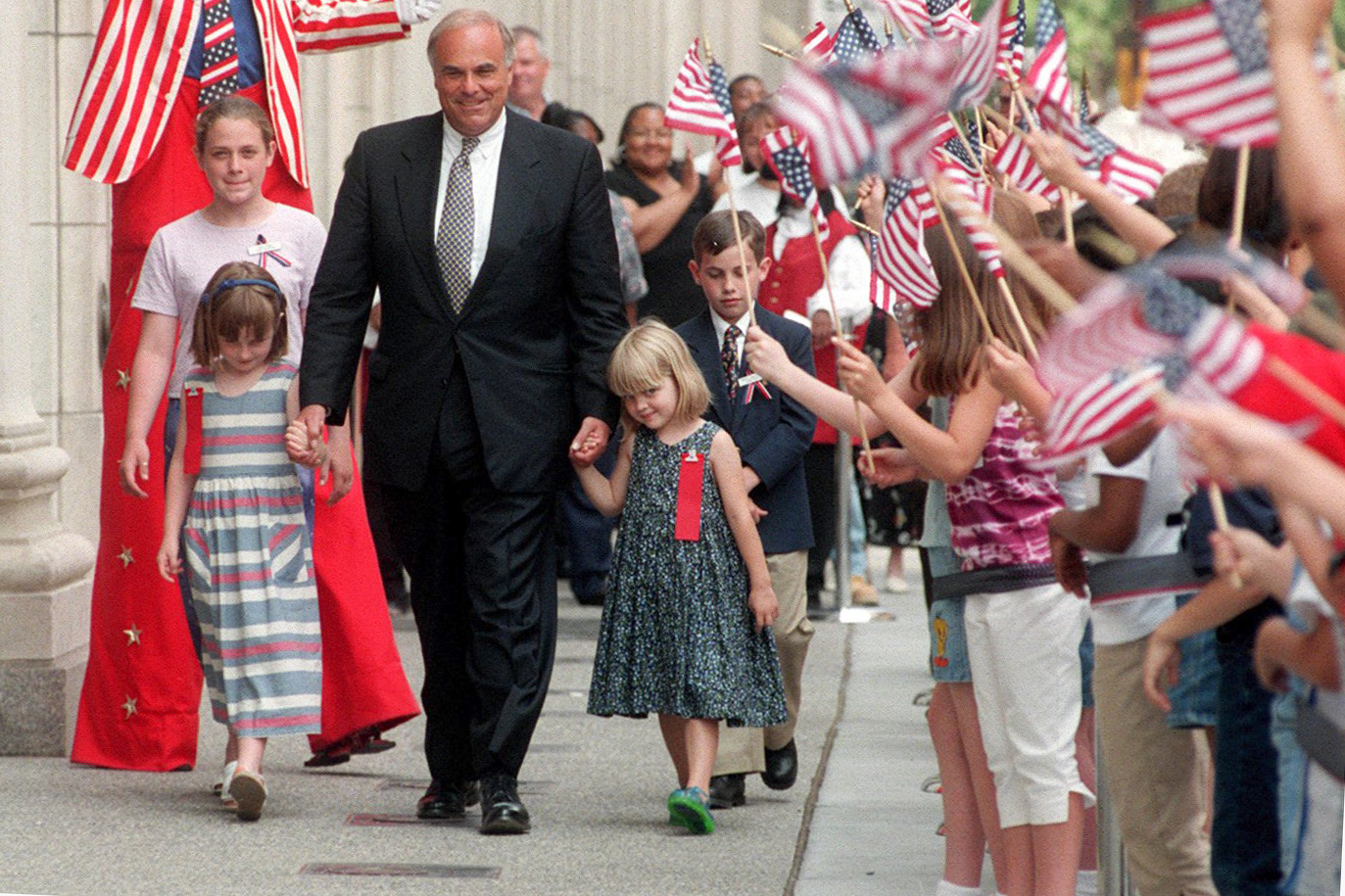
Former Pennsylvania Gov. Ed Rendell, who then was Philadelphia’s mayor, appeared at the 1999 dedication ceremony with a group of young descendants of the signers.
Meredith recalled it well: Her daughter participated.
Mayor Ed Rendell with some descendants of the signers of the Declaration of Independence during the June 7, 1999, unveiling of the “Signers Walk.”
“Everybody was happy,” said Meredith, now executive director of Herald Publishing, a division of the Bucks County Herald. The plaques “became a popular stop for tour guides.”
Meredith said that when she left Lights of Liberty in 2007, the plaques were in good shape.
Officials with the group, the city, the National Park Service, and the Center City District said they did not know who, if anyone, had assumed ownership of the plaques.
“I can’t say there was a plan for taking care of them in perpetuity,” said Meredith.
“I guess they were never meant for sidewalk use,” she said, adding she was not sanguine about their future.
“They were a nice enhancement. They were a pleasant surprise. I don’t think anyone would miss them if they weren’t there.”
The Thomas Jefferson and Benjamin Franklin plaques.
Staff writer Stephanie Farr contributed to this article.
This article has been updated to note that the owners of the Public Ledger Building have assumed responsibility for maintaining the plaques, according to the Center City District. An earlier version of this article also misidentified one of the signers of the Declaration of Independence.
As The Philadelphia Inquirer closes its printing plant, a ‘family’ of employees marks the end of an era
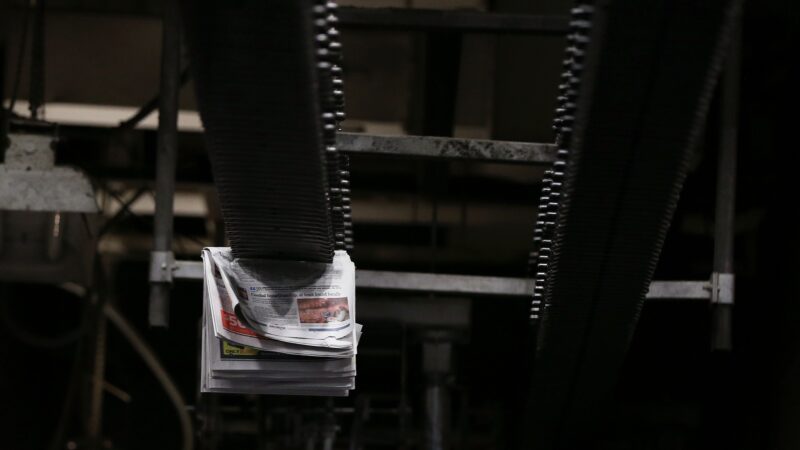
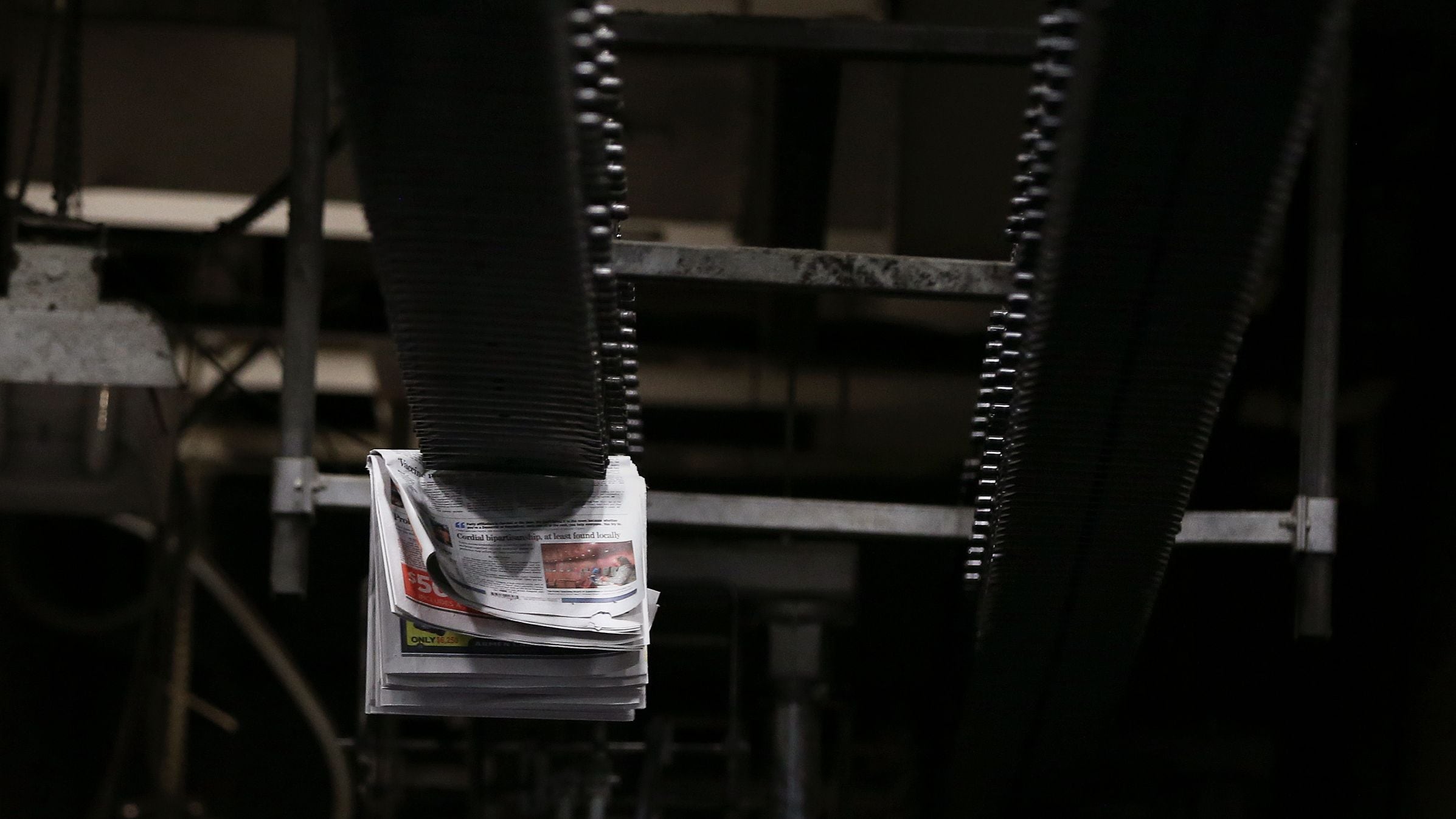
A tattered copy of The Inquirer is the last to ride the grippers from the pressroom to the mailroom at the Schuylkill Printing Plant in Upper Merion Township on March 28.TIM TAI / Staff Photographer
Tom “Three Bars” Lafauci had no chance of disappearing quietly into the howling winds of the night.
“Lafauci!”
Sybil White, a longtime security officer, summoned him before he could reach the only available exit at The Philadelphia Inquirer’s Schuylkill Printing Plant, the mammoth newspaper factory that was about to call it an era.
“Come on, get in the picture,” she commanded him. Almost reflexively, Len Leach and Tanya Rockeymore, who were working the lobby security detail that night, stuck their heads in the frame. They might not see him again. One of 500 who lost their jobs with the building’s sale, this was Lafauci’s last work shift.
At the age of 192, The Inquirer is stopping its own presses for good — the April 1 issues marked the last official runs — and will be outsourcing its print operations in line with newspapers across the country that are cutting costs and fighting a media universe changing at the speed of breaking news.
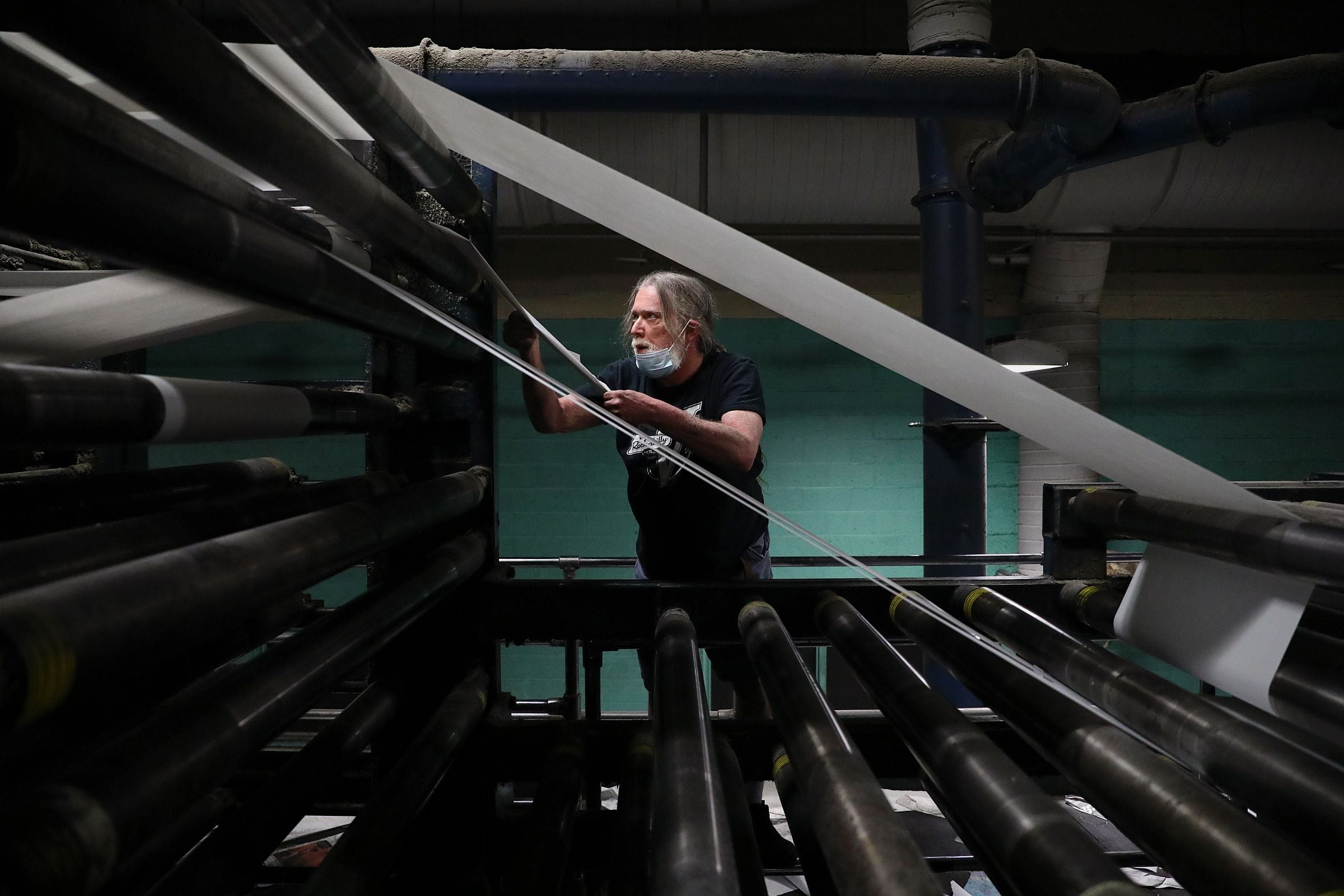
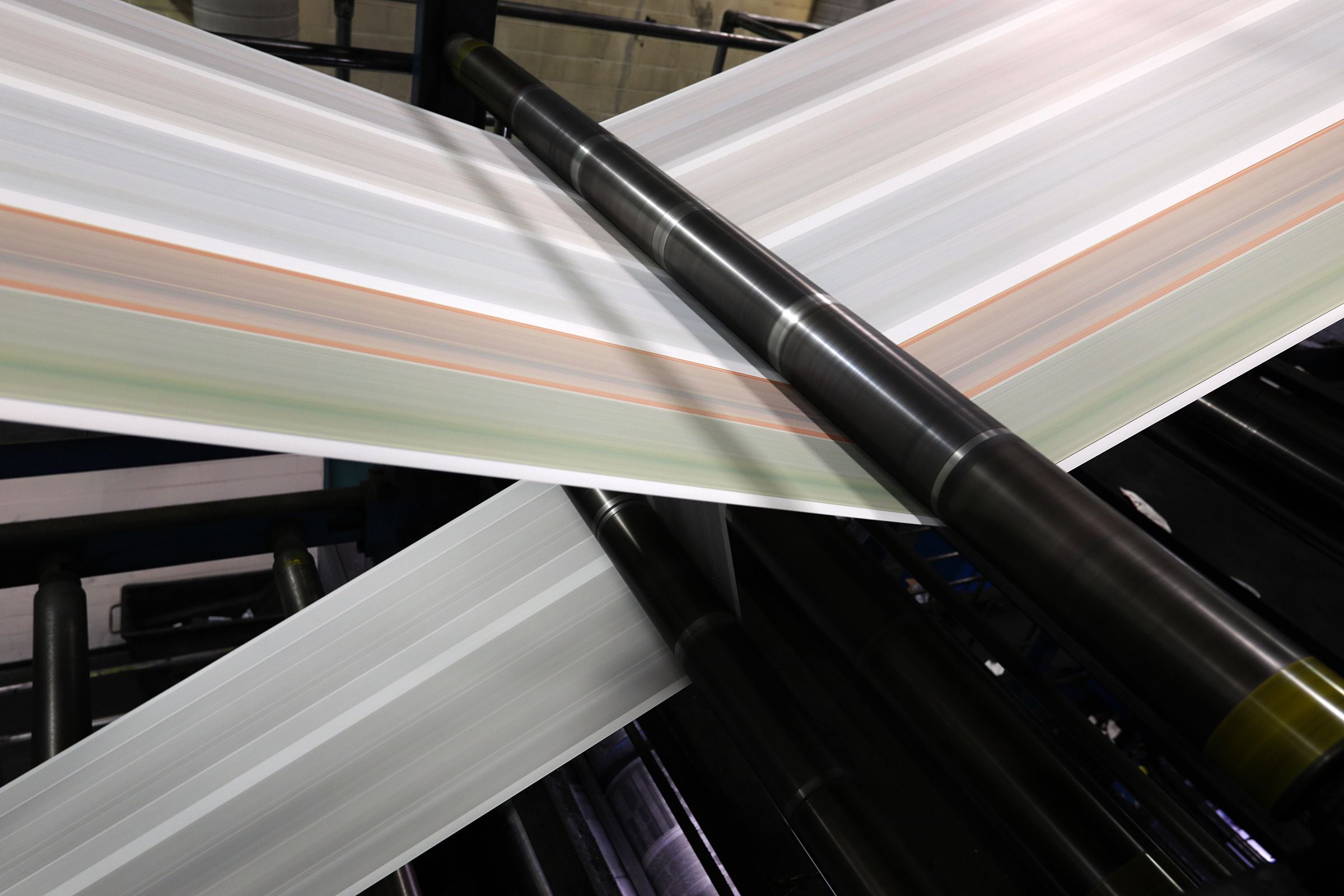
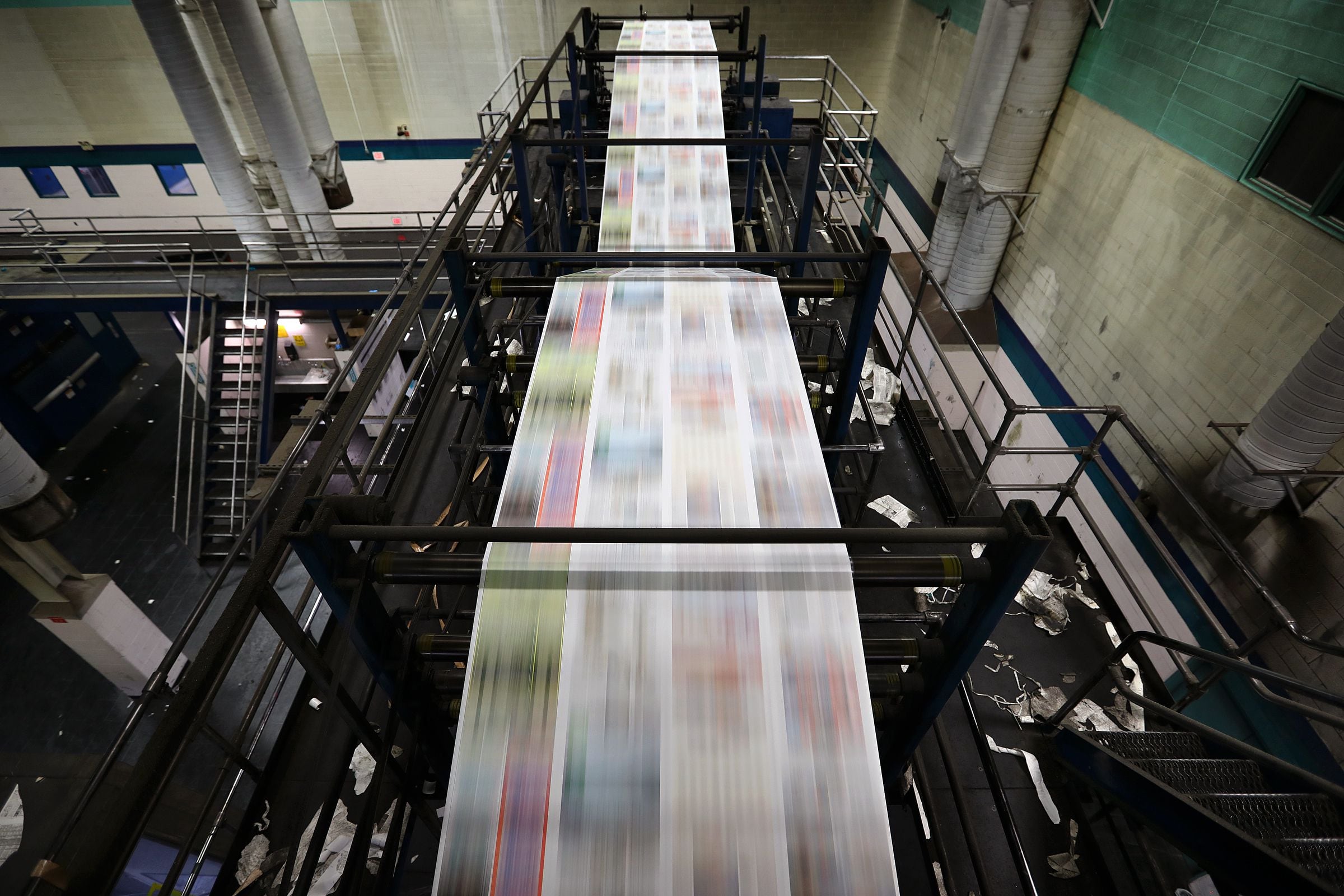
Aaron Krakovitz, a third-generation, 47-year pressman, threads paper through a set of rollers as he prepares for the night's press run. TIM TAI / Staff PhotographerA blur of paper courses along rollers during a Sunday advance run; some sections of the Sunday paper are printed ahead of time. TIM TAI / Staff PhotographerColor pages speed across rollers for a Sunday advance run. TIM TAI / Staff Photographer
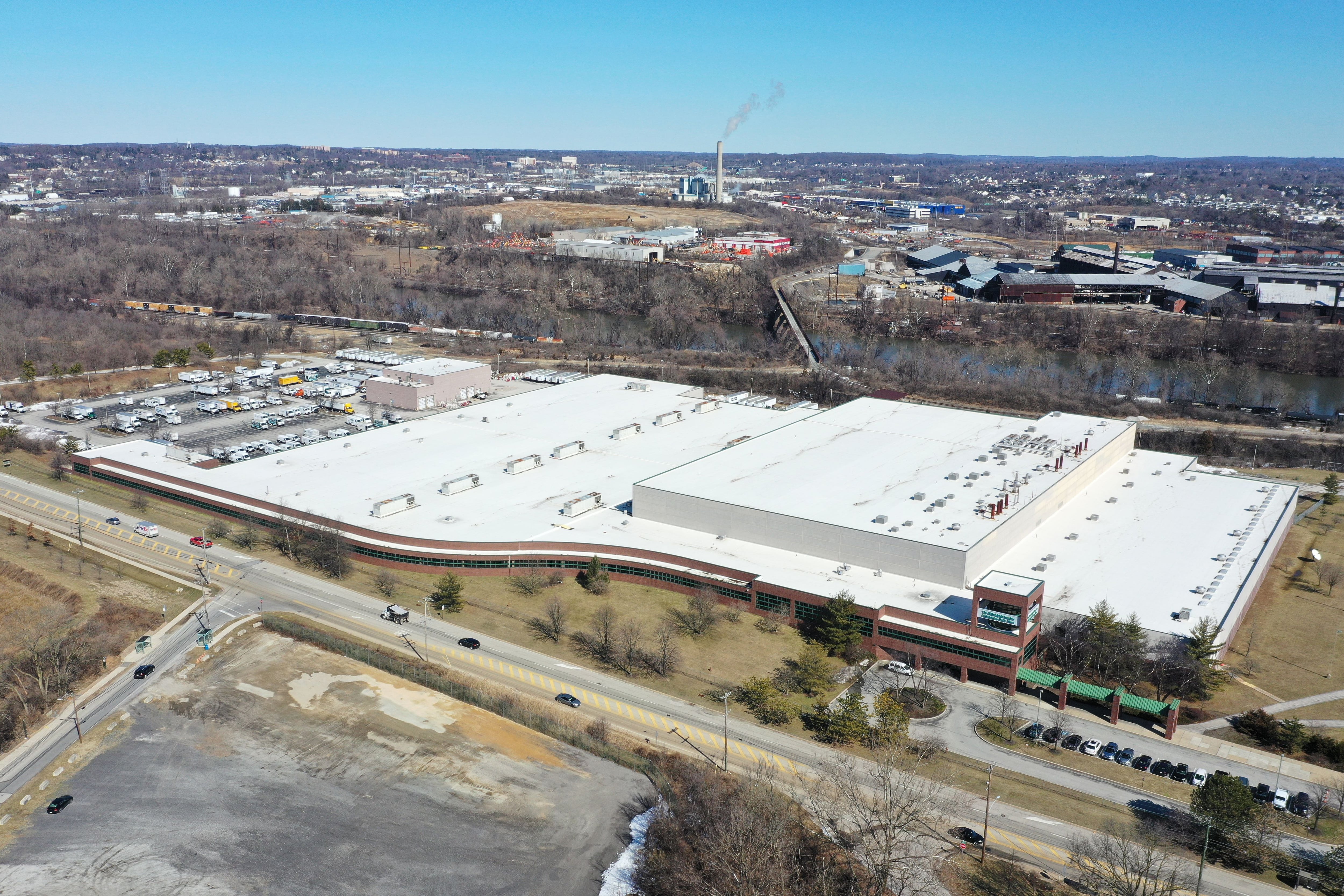
The guards seemed to be well-acquainted with Three Bars. Actually, they seemed to be well-acquainted with everyone exiting and entering the brick, curving structure built for $299.5 million (about $600 million in today’s dollars) 30 years ago, and sold to developer J. Brian O’Neill for $37 million to become part of his burgeoning biotech-health science empire.
“You get to know everybody,” said White. “It’s like family,” a leitmotif sentiment among the guards, engravers, pressmen, mailers, and drivers who worked in the immense, quirk-infested complex that was marinated in the vague odors of paper and the ink that blackwashed the floors and layered the handrails.
A production theme park
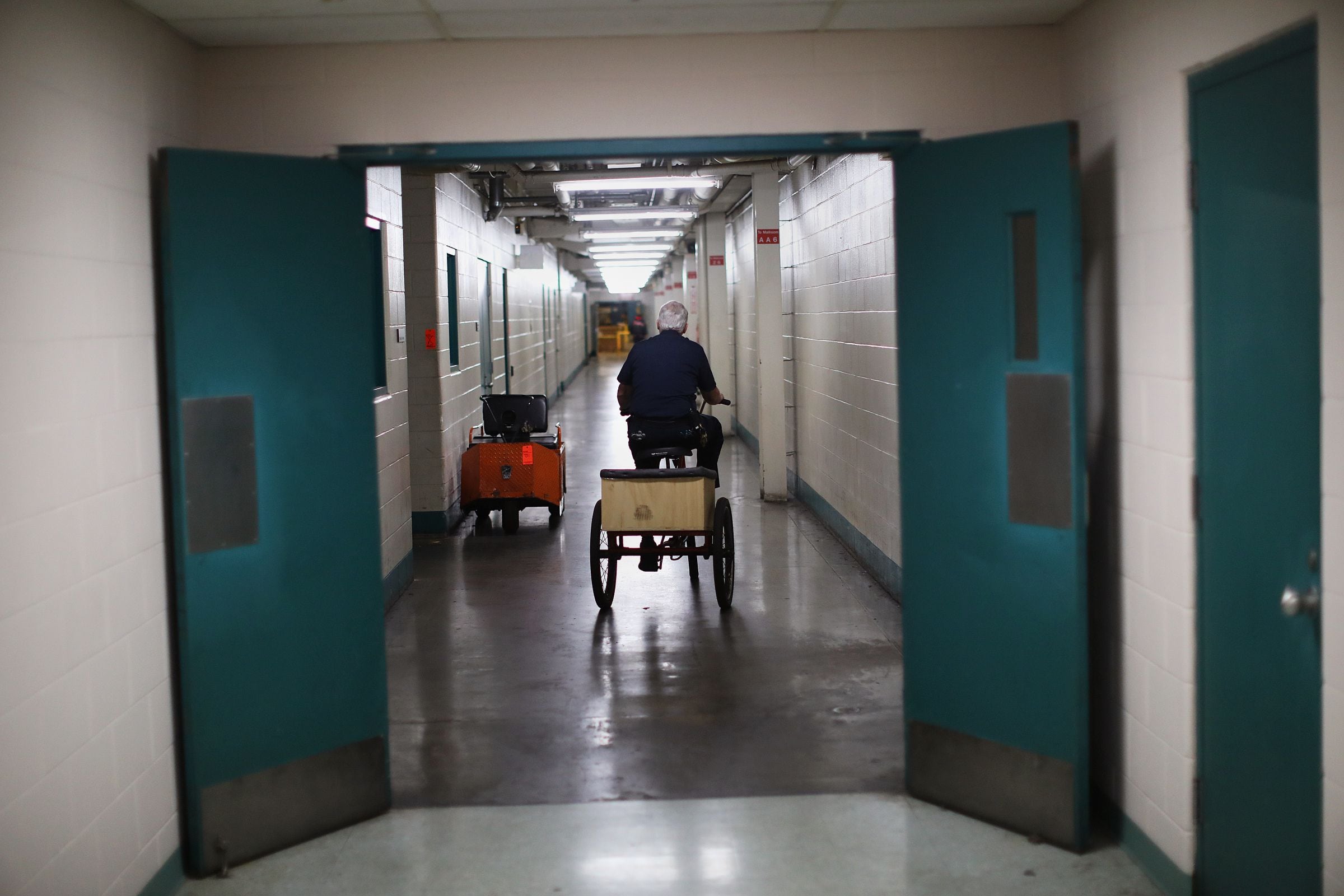
The printing plant, a 681,023-square-foot complex along the river, was built to house $160 million worth of “state of the art” presses. FRANK WIESE / StaffSecond childhood? No, engineer Joe Hoban is riding a tricycle that can carry tools while navigating the building’s lengthy corridors. TIM TAI / Staff Photographer
This was a thundering production theme park of impossible intricacy, where paper-carrying freight cars rumbled and rammed into the rail bay, where newspaper pages rolled off presses that collectively weighed as much as a Navy destroyer.
They were folded and collated, and commuted on cars and conveyors as though they had purchased tickets on amusement rides. Ultimately they landed in trucks that ferried The Inquirer and Daily News to hundreds of locations while most readers slept.
All it took to get them their papers, said Fred Lehman, vice president of operations, was about two million moving parts.
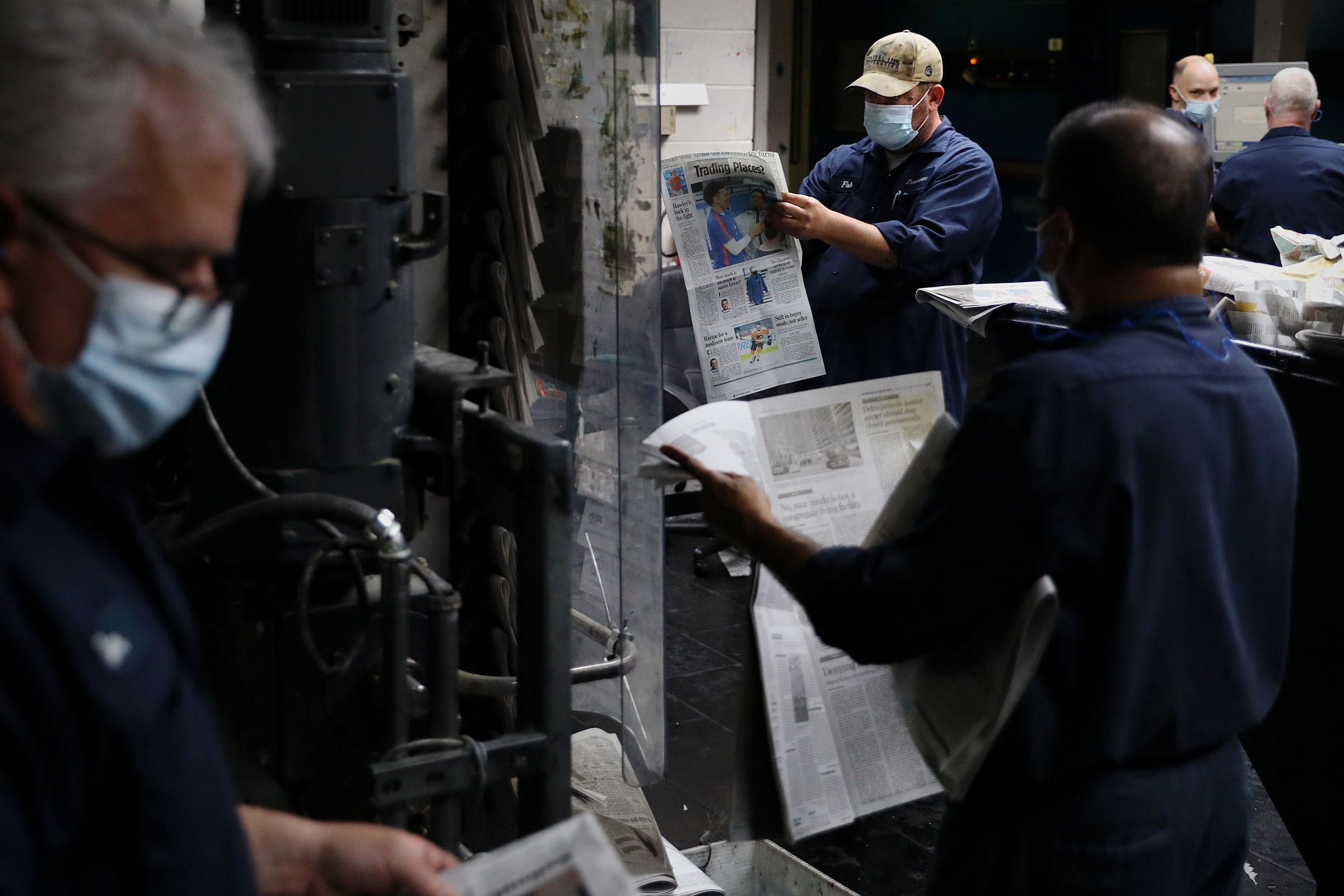
Pressroom supervisor Jim Fish (top) flips through Inquirer pages as a quality check. TIM TAI / Staff Photographer
Somehow amid the often hellish cacophony in this 681,023-square-foot behemoth, people got to know each other.
In many cases, they knew each other already. “Family” was more than metaphoric in White’s case. Her uncle got her the job 25 years ago; he worked at the company. Her father was a driver.
Lafauci, a mailer, said his nickname had no association with happy hour. “Three Bars … my grandfather worked here, my father worked here.” Yes, he was the third bar. Bill Burk, a transportation manager, worked with all three bars, and at one time or another, The Inquirer employed 20 of Burk’s family members.
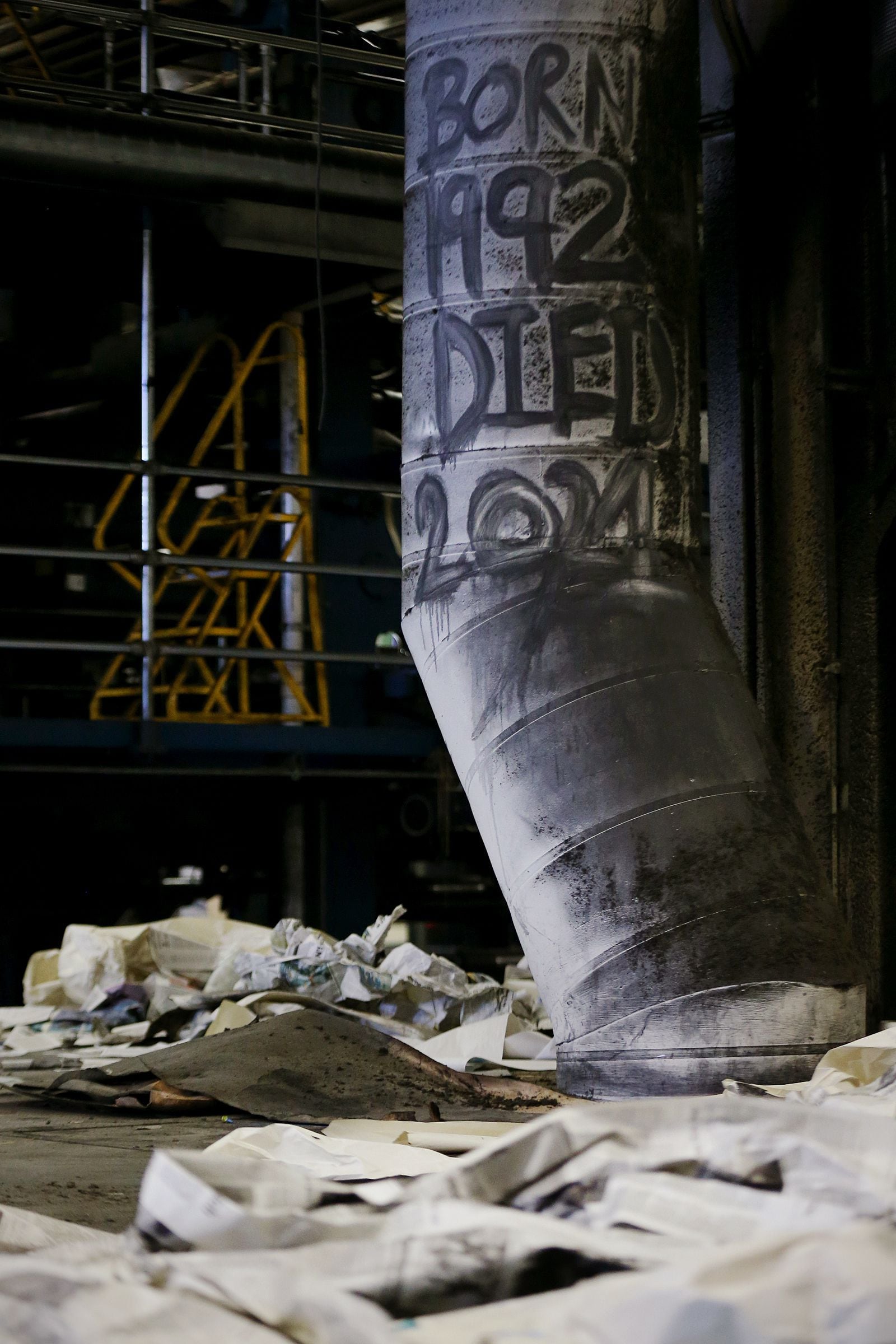
Epitaph for an era: "BORN 1992 DIED 2021" is traced in the grime on an air duct inside the pressroom. TIM TAI / Staff Photographer
“My grandfather worked here, my father worked here.”
Tom “Three Bars” Lafauci
‘It was family’
Those days are history, as soon will be the printing plant, located in Upper Merion Township at the junction of Routes 23 and 320, a location a reporter once described as “centrally isolated.”
Rather than a death in the family, October’s announcement that SPP would be sold was more like deaths in multiple families, and the sense of loss — a mix of resignation, equanimity, sadness, with a dash of bitterness — condensed as employees were leaving the building for the last time.
“It was family,” Lafauci said. There’s that word again.
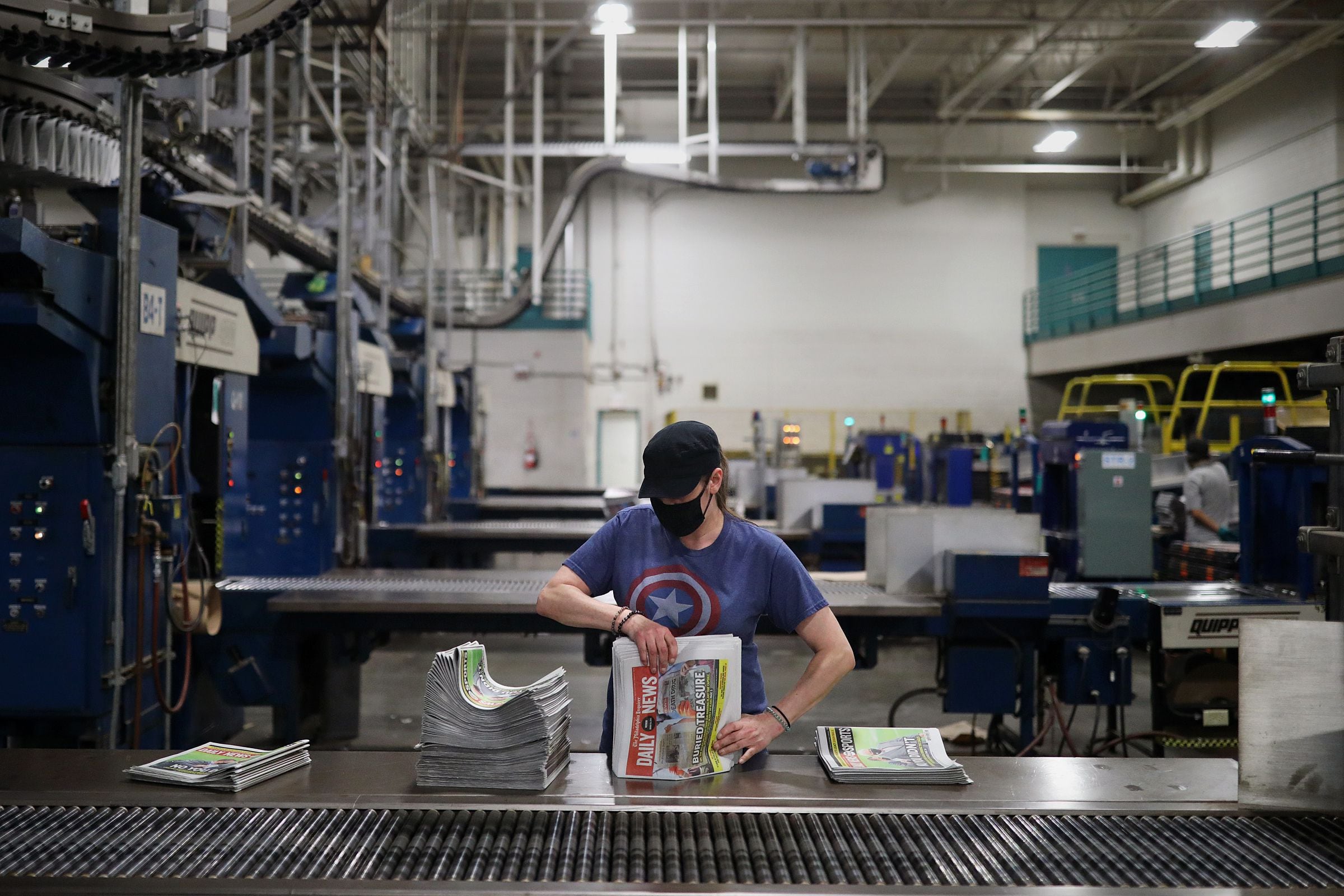
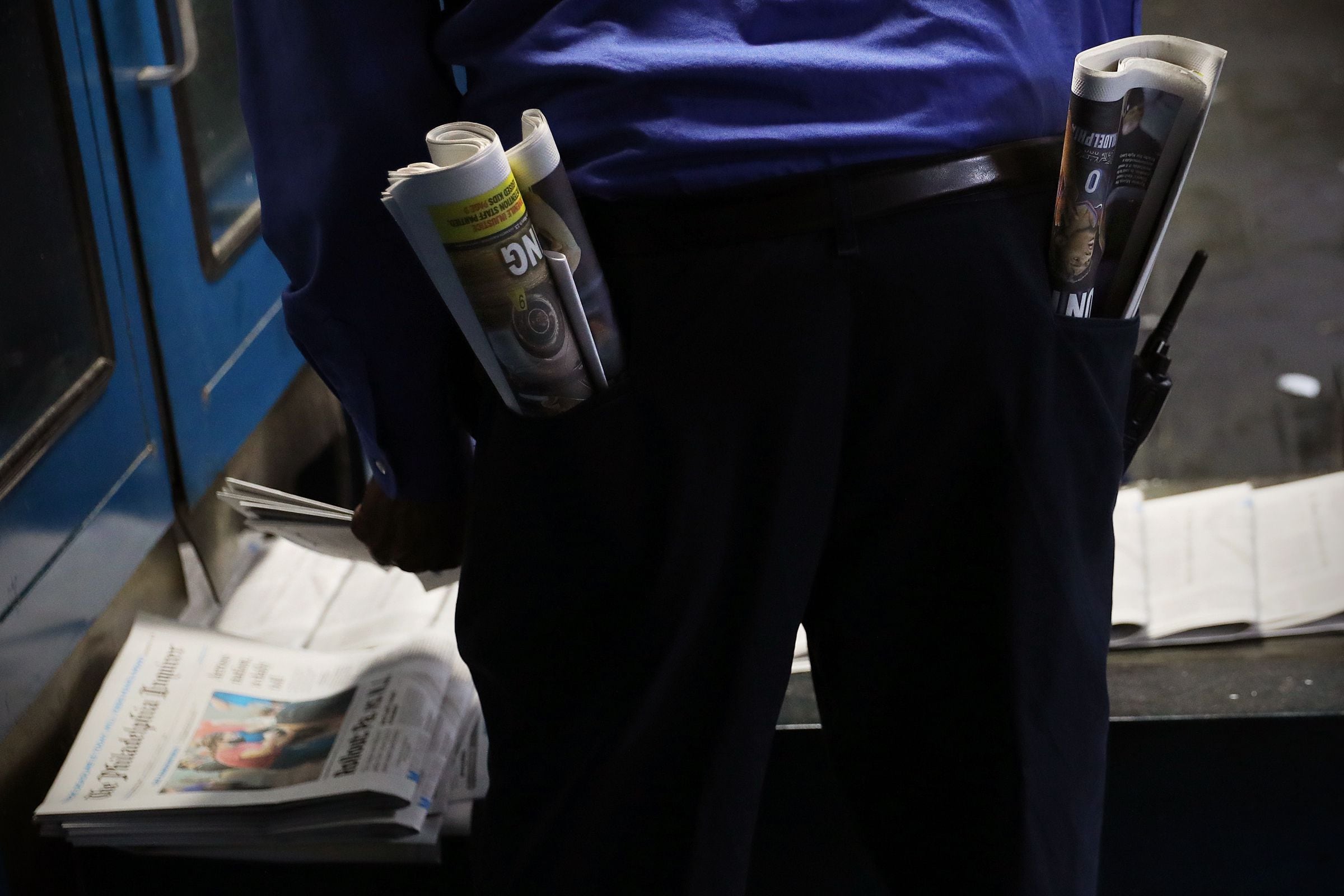
Mailer Jessica Tayoun, who started working for The Inquirer in 1992, stacks a bundle of Daily News issues. TIM TAI / Staff PhotographerTayoun and Lionel Shaw, a 37-year Inquirer veteran, prepare bundles of the newspaper's last scheduled edition to be printed at SPP. TIM TAI / Staff PhotographerPressroom supervisor Tom Addison, hired in 1979, carries in his rear pockets rolled-up Daily News issues that he will examine later for quality. TIM TAI / Staff Photographer
About the only problems they had at the plant, the guards said, involved intra-family disputes that reasoned discussion failed to resolve. Said White, “We tried to calm them down.”
The writers and editors reported and crafted the stories — from seven presidential elections in the SPP era, to a World Series title and a Super Bowl championship, to the 9/11 terrorist attacks, to one tenacious pandemic — but the SPP workforce made sure people got to read them on paper that they could hold in their hands, and perhaps even save.
During the last run of the Inquirer's own presses, a “family” of employees say goodbye as the company transitions to an outsourced printing operation.Kristen Balderas, Raishad Hardnett, Astrid Rodrigues, Lauren Schneiderman and Frank Wiese / Staff
All the news that fits
In the pre-SPP days, type and advertisements were posted on flats by hand. Editors marked last-minute cuts with blue pencils, and the compositors would surgically consign them to the cutting-room floor.
The job evolved rapidly with “pagination,” as computer screens replaced the flats and workers such as Kathleen Griffiths moved from the composing room to a video terminal. Inspecting the pages to make sure that the ads are properly placed and error-free, and that the display type and copy are correctly confined to a page is a critical step in the “prepress” process.
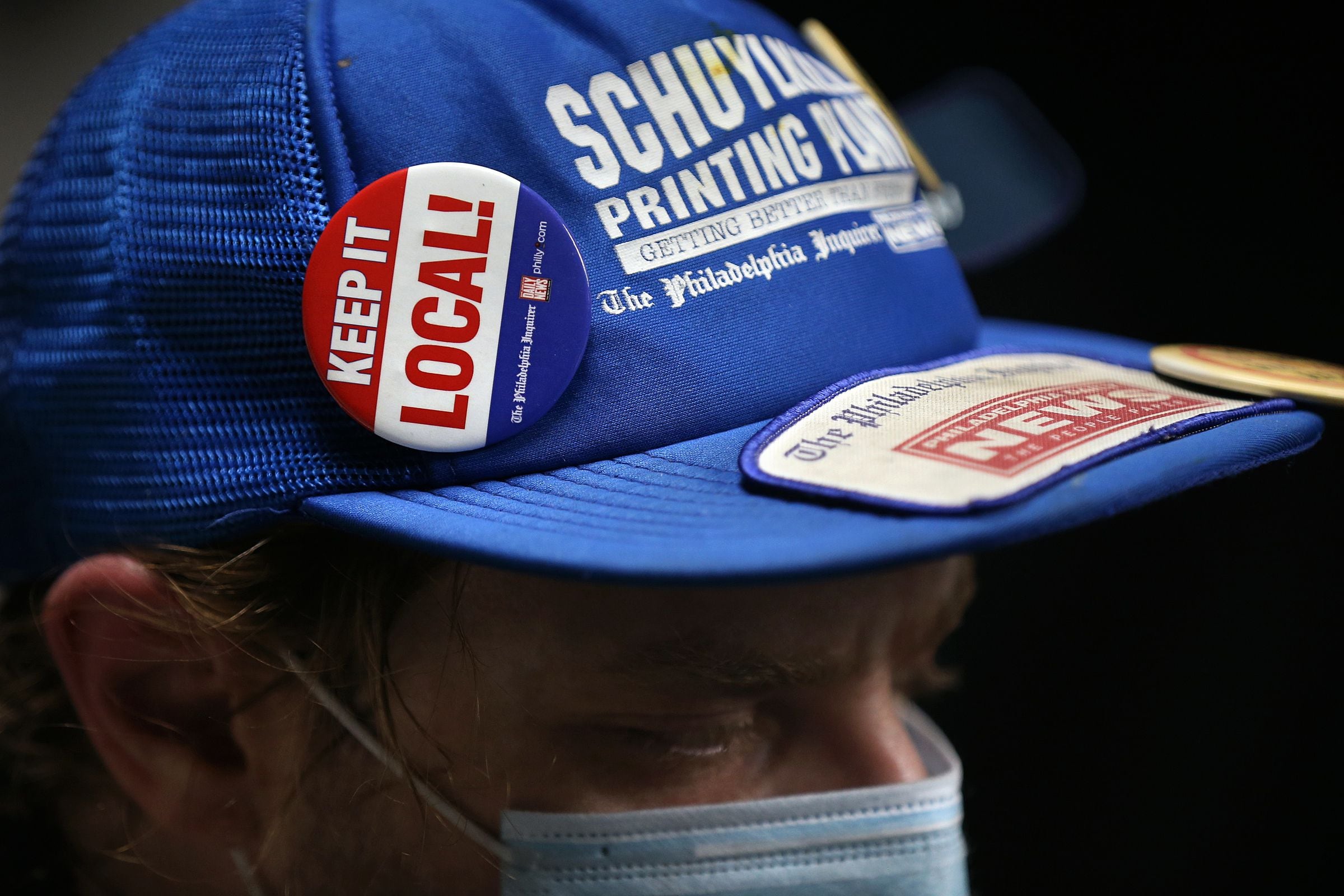
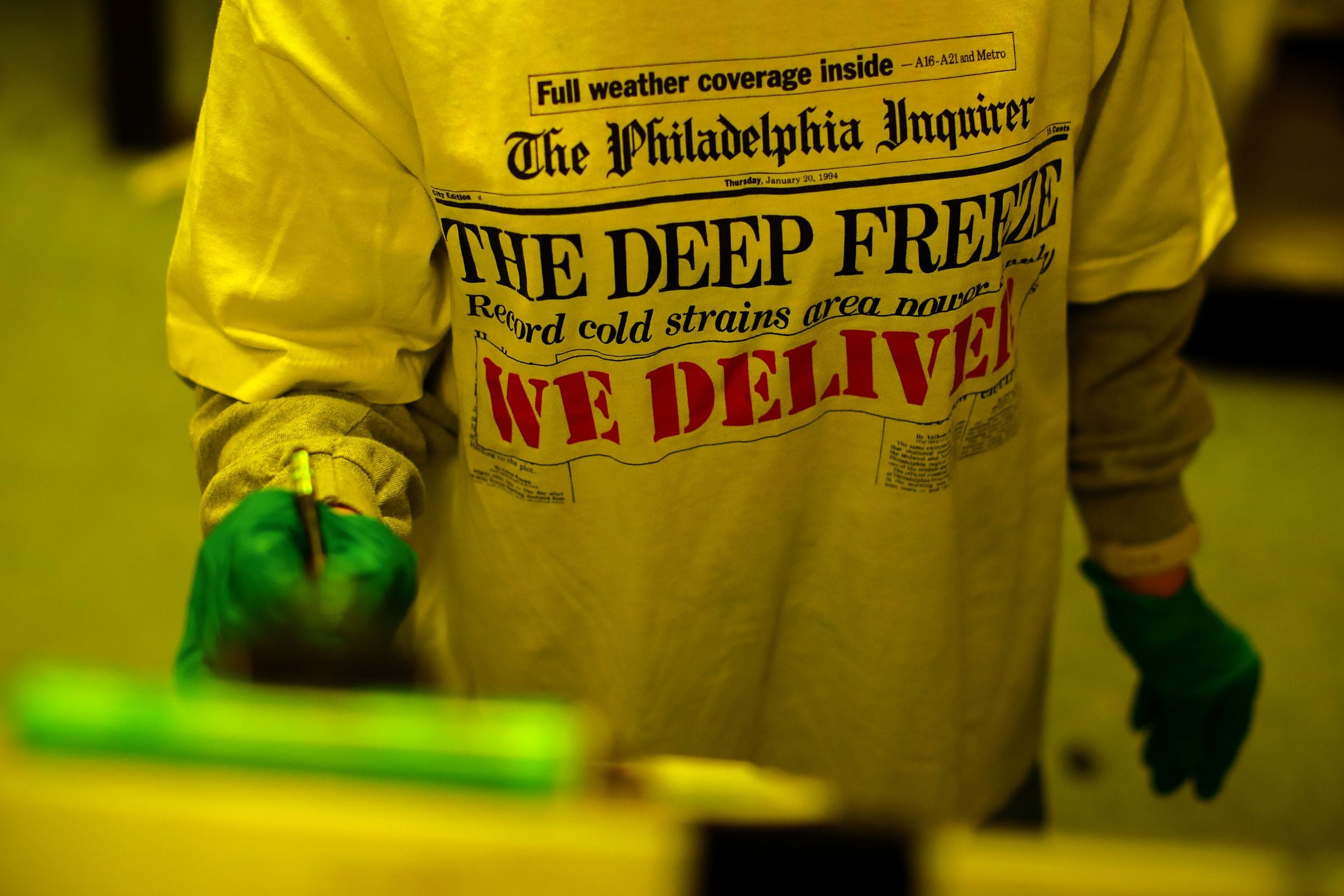
Pressman Brett Nick, who started working at The Inquirer in 2003, wears a hat with an old Inquirer campaign slogan: "Keep It Local!" TIM TAI / Staff PhotographerPlatemaker Debbie Dougherty wears a T-shirt stamped with a front-page image from Jan. 20, 1994, the year she was hired. TIM TAI / Staff Photographer
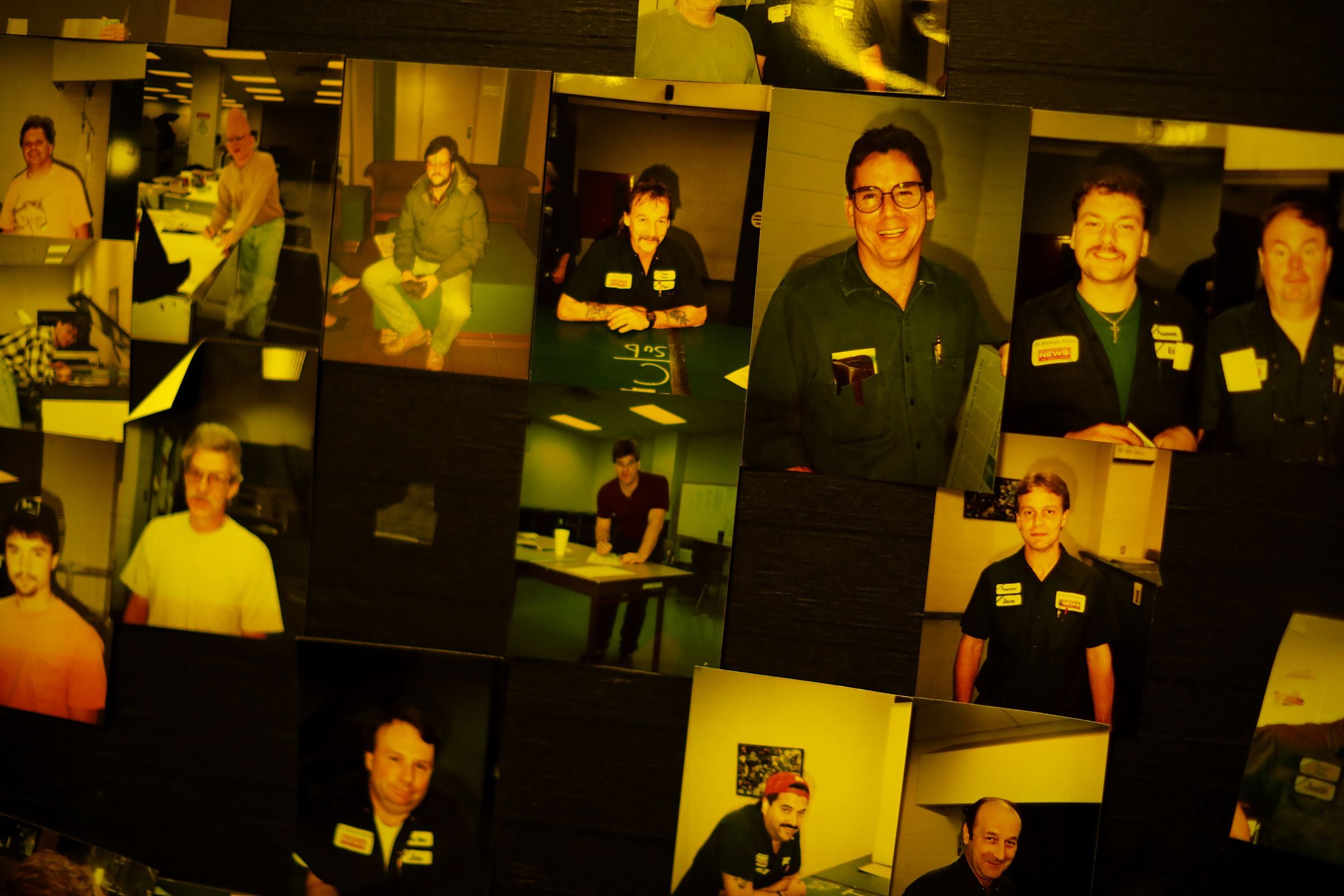
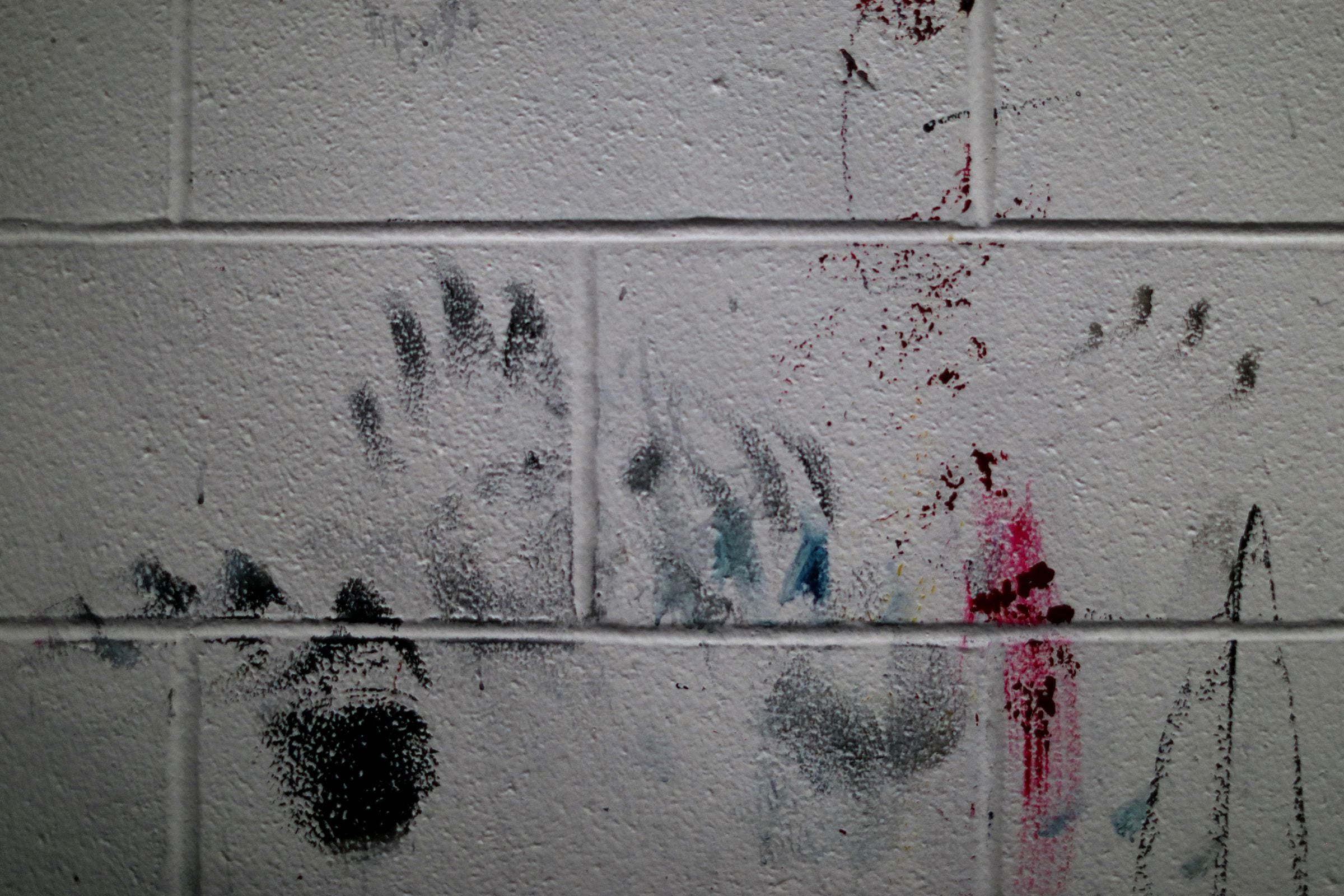
Engraved in memory: A board inside the plate room features photos of former employees. TIM TAI / Staff PhotographerInk-stained handprints decorate a pressroom wall. TIM TAI / Staff Photographer
“It’s like putting a puzzle together,” said Tom Chambers, who has worked for the company for 31 years. He and the other platemakers imprint those completed-puzzle images on wafer-thin aluminum plates that bear the images of the pages of The Inquirer and Daily News.
On any given day those images would be stamped on paper rolls whose linear footage would reach halfway around the world — all the way on Sundays.
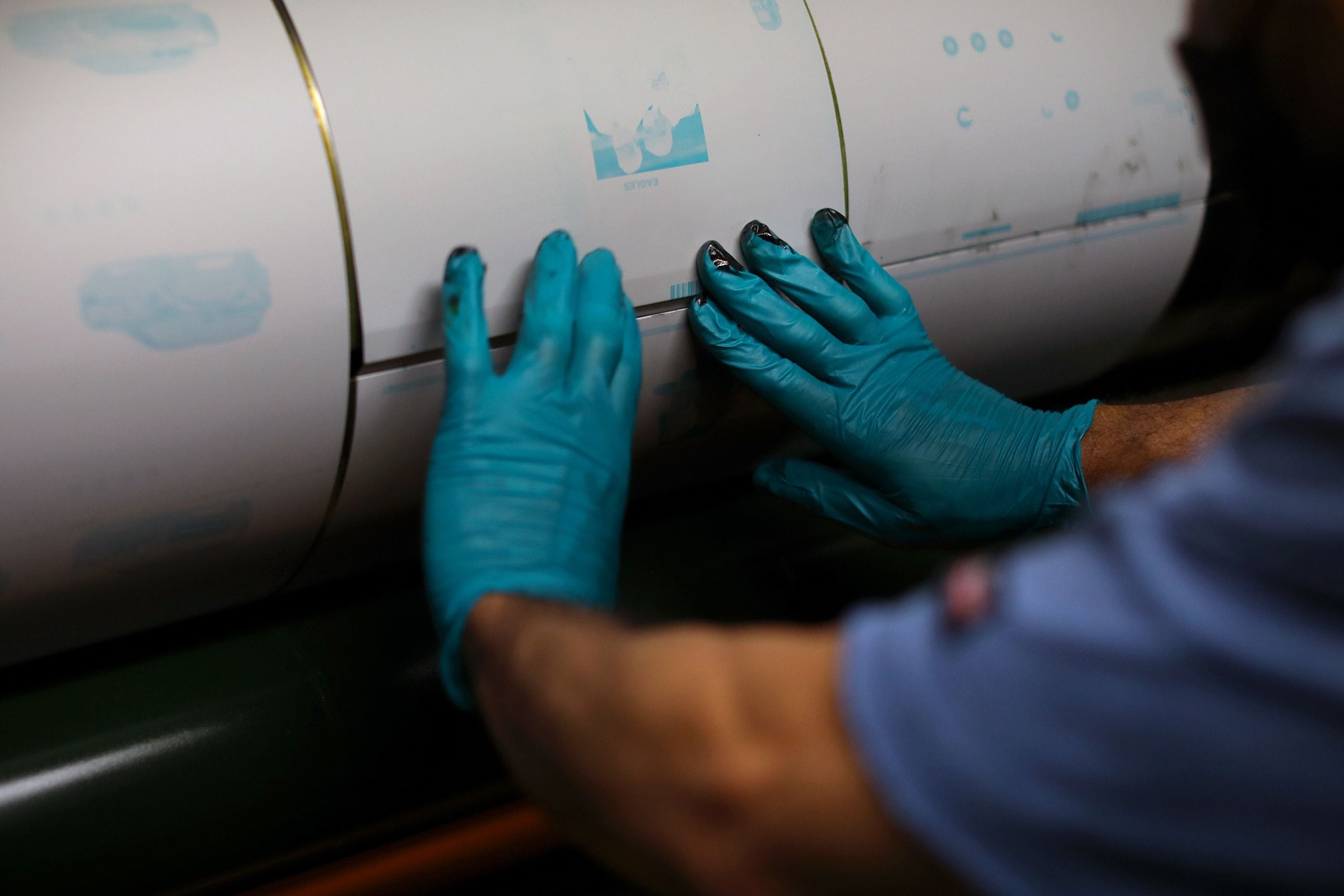
Pressman Hayden Darrabie, hired in 1998, presses plates into place before the night's run. TIM TAI / Staff Photographer
Roll ‘em
SPP is more or less a prodigious shell built around $160 million worth of presses, said Pat McElwee, the production supervisor. When the plant started operating in the summer of 1992, “It was fantastic,” he said.
The Goss Colorlink “offset” presses were radically different from the 45-year-old “letterpress” predecessors in which plates were pressed directly onto the paper. With offset, the plates roll against rubber “blankets” that press against the paper. For the first time The Inquirer and Daily News could publish photographs and ads in color.
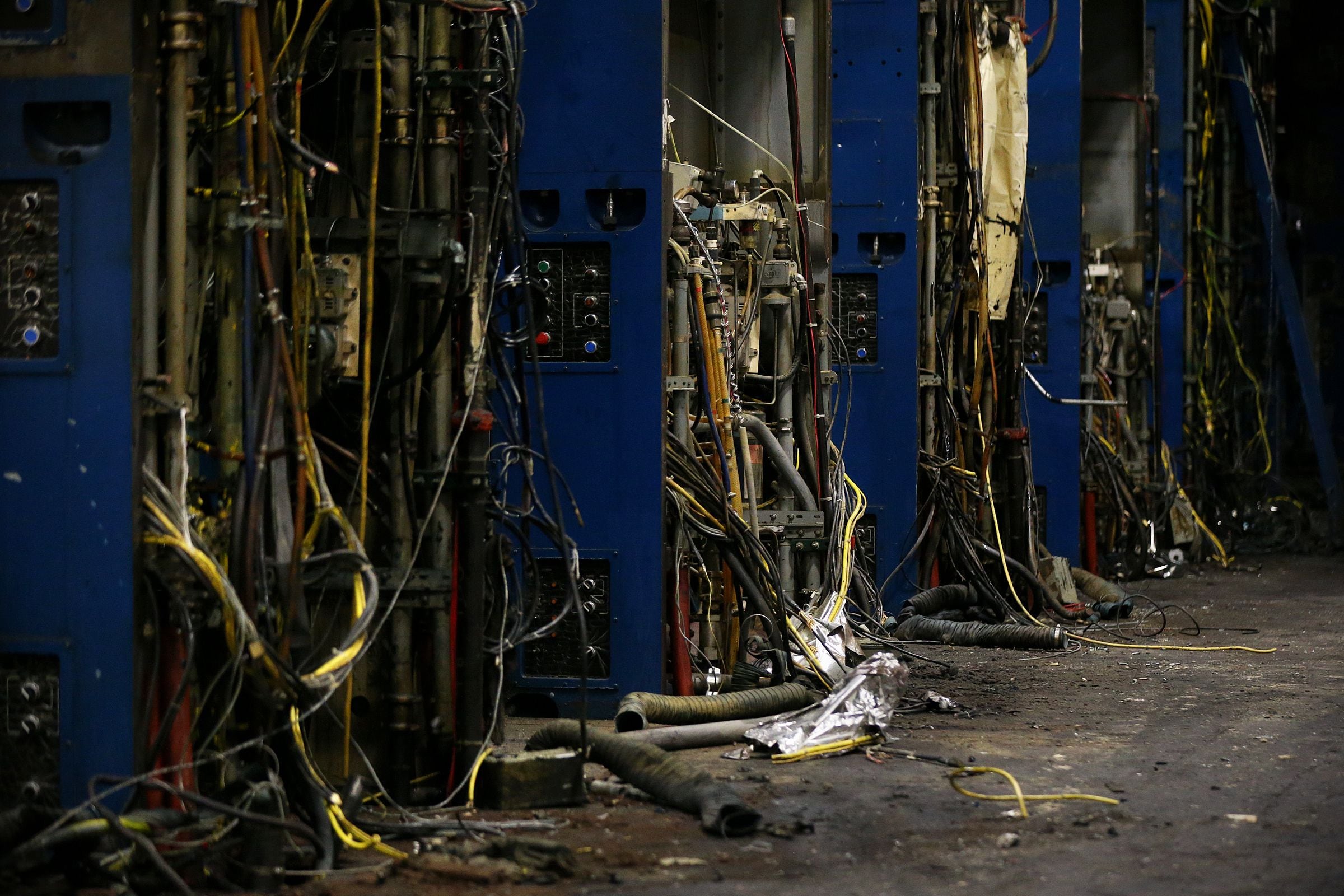
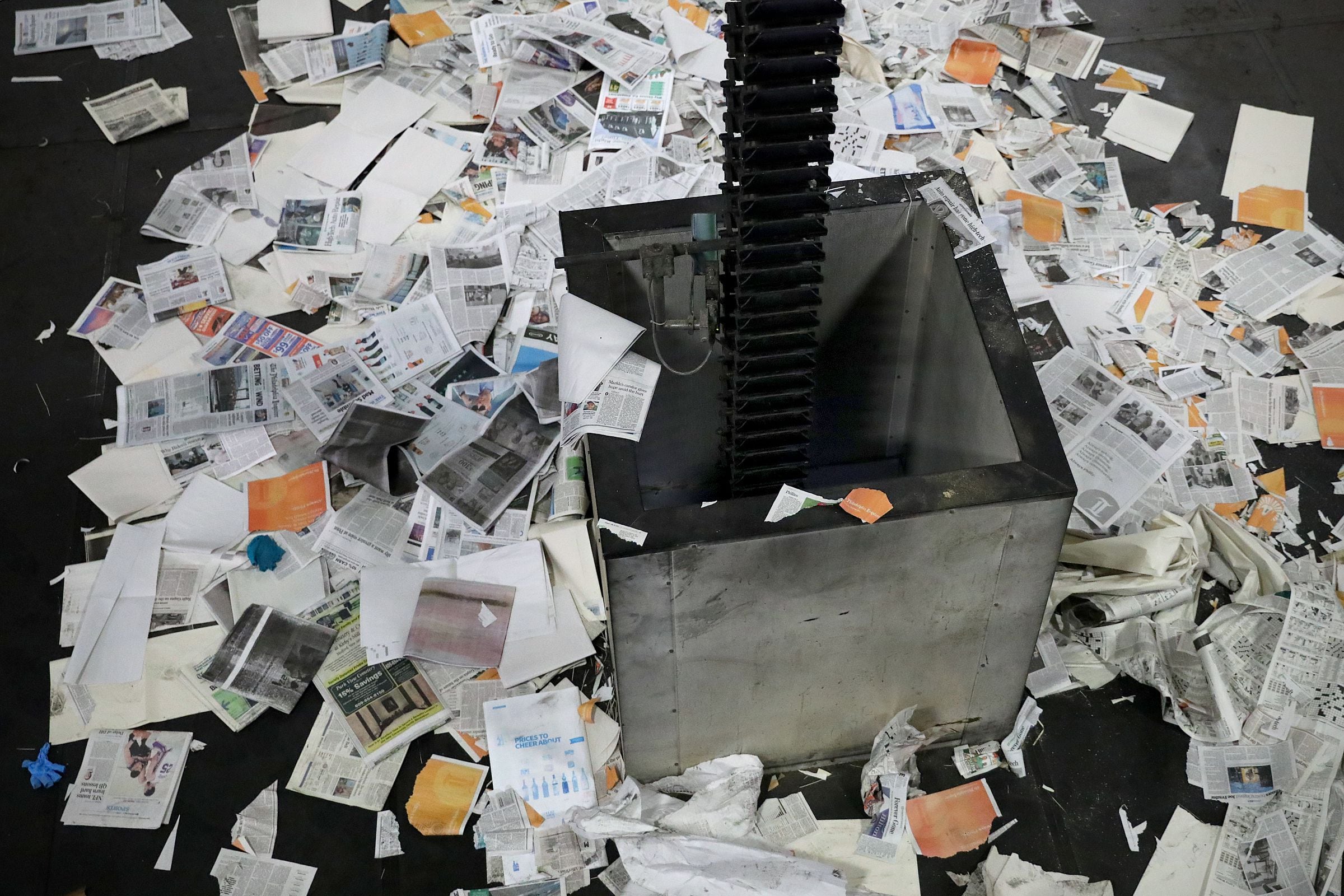
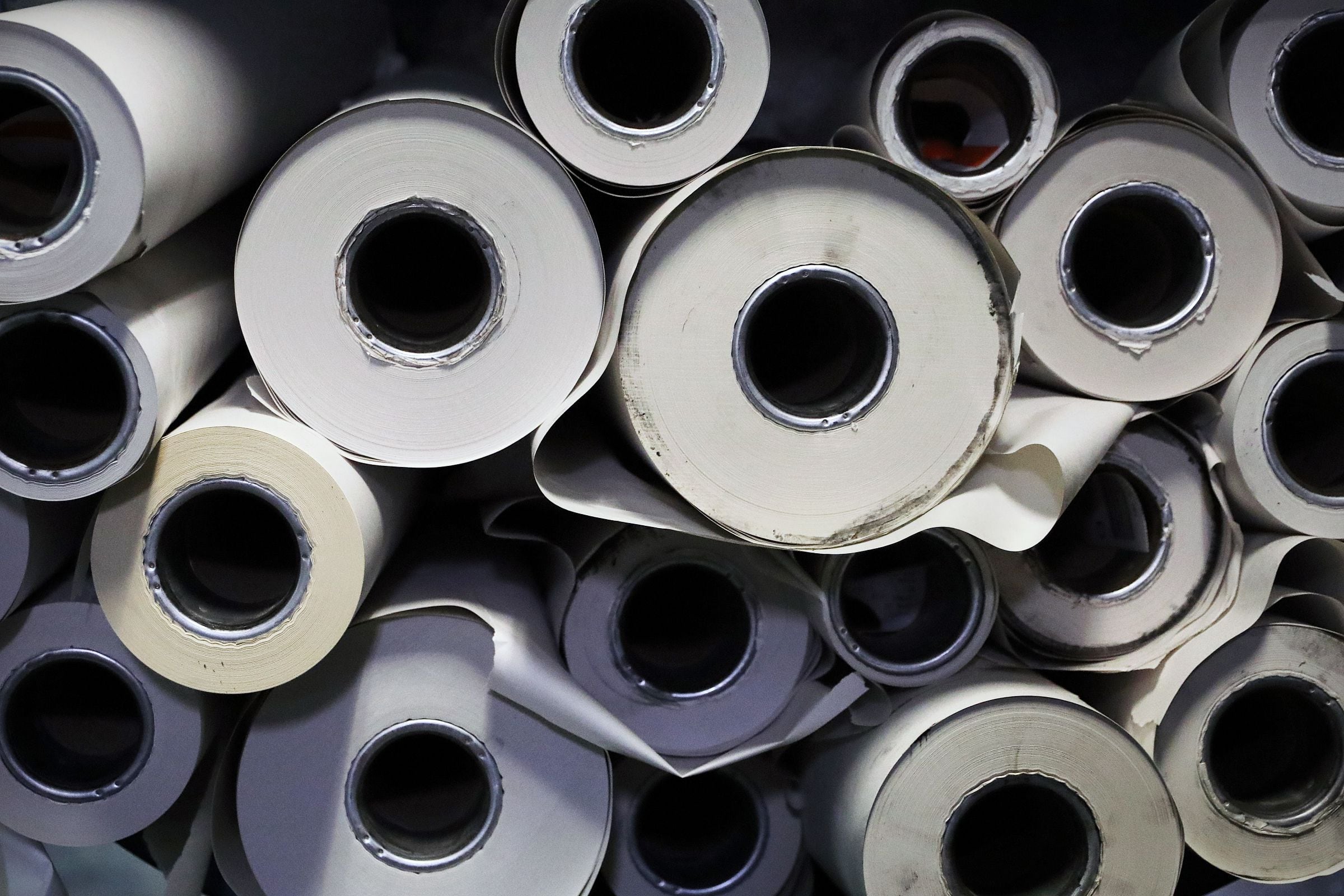
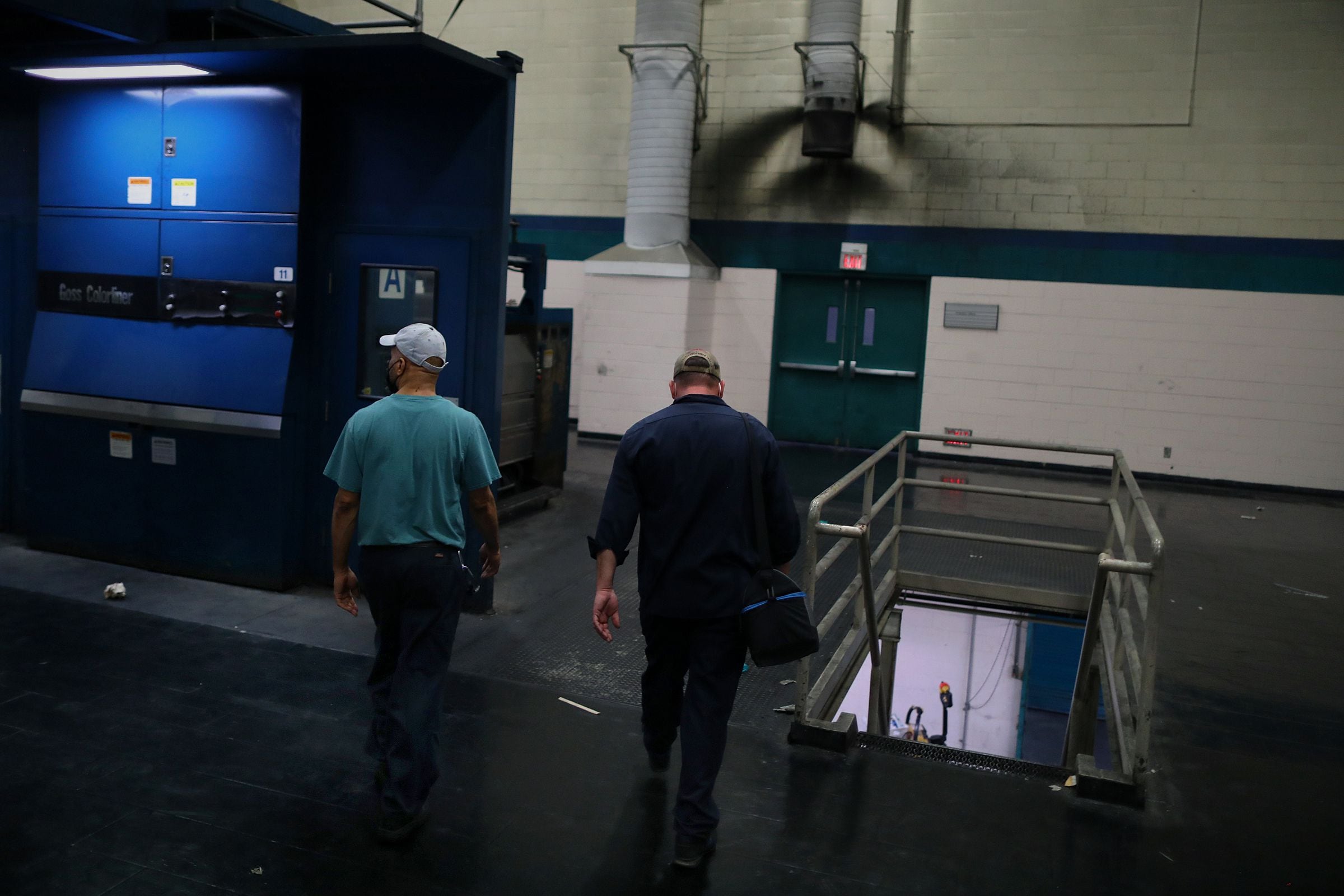
Wiring dangles from one of the nine Goss Colorliner presses. TIM TAI / Staff PhotographerLoose papers are scattered across the base of the gripper chute from which papers are conveyed from the pressroom to the mailroom for packaging. TIM TAI / Staff PhotographerPartial rolls of leftover paper from press runs, known as "butt rolls," are stored in the reel room. TIM TAI / Staff Photographer
“It was all new,” said Tom Addison, the company pressroom foreman. With novelty came mishaps. More than once the papers published “To our readers” apology notes for delivery issues.
Like so many employees on the production side, Addison was a lifer, having started in 1979.
And to Aaron Krakovitz, Addison was a newcomer: Krakovitz already had been there five years, starting as a high school senior, recruited to fill in on a short-staffed weekend. He was child labor whose own father was a pressman.
The pressmen developed a familial and literal closeness, said Jim Fish, the union foreman: In the heydays, he said, “You worked with six to seven guys on the press.”
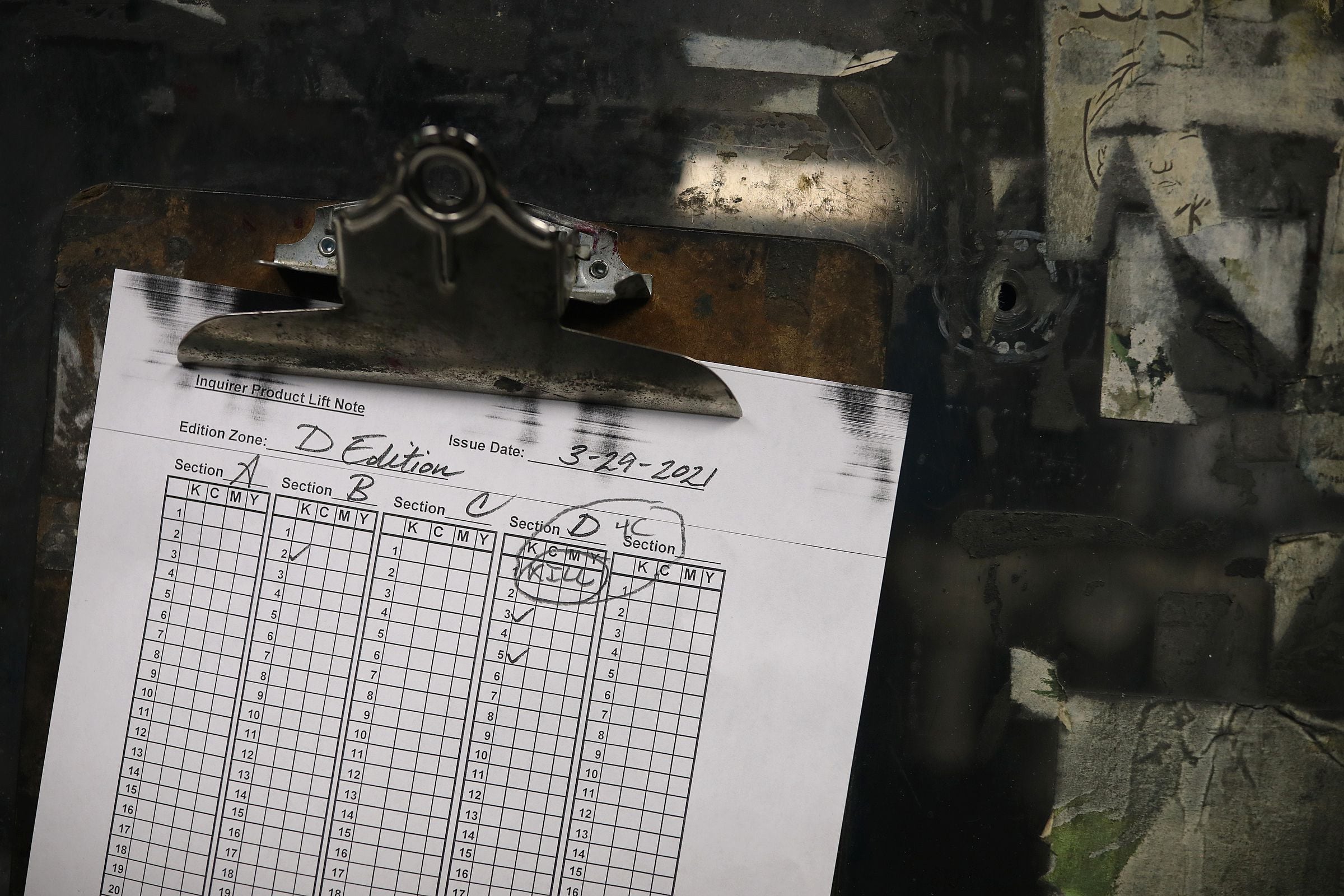
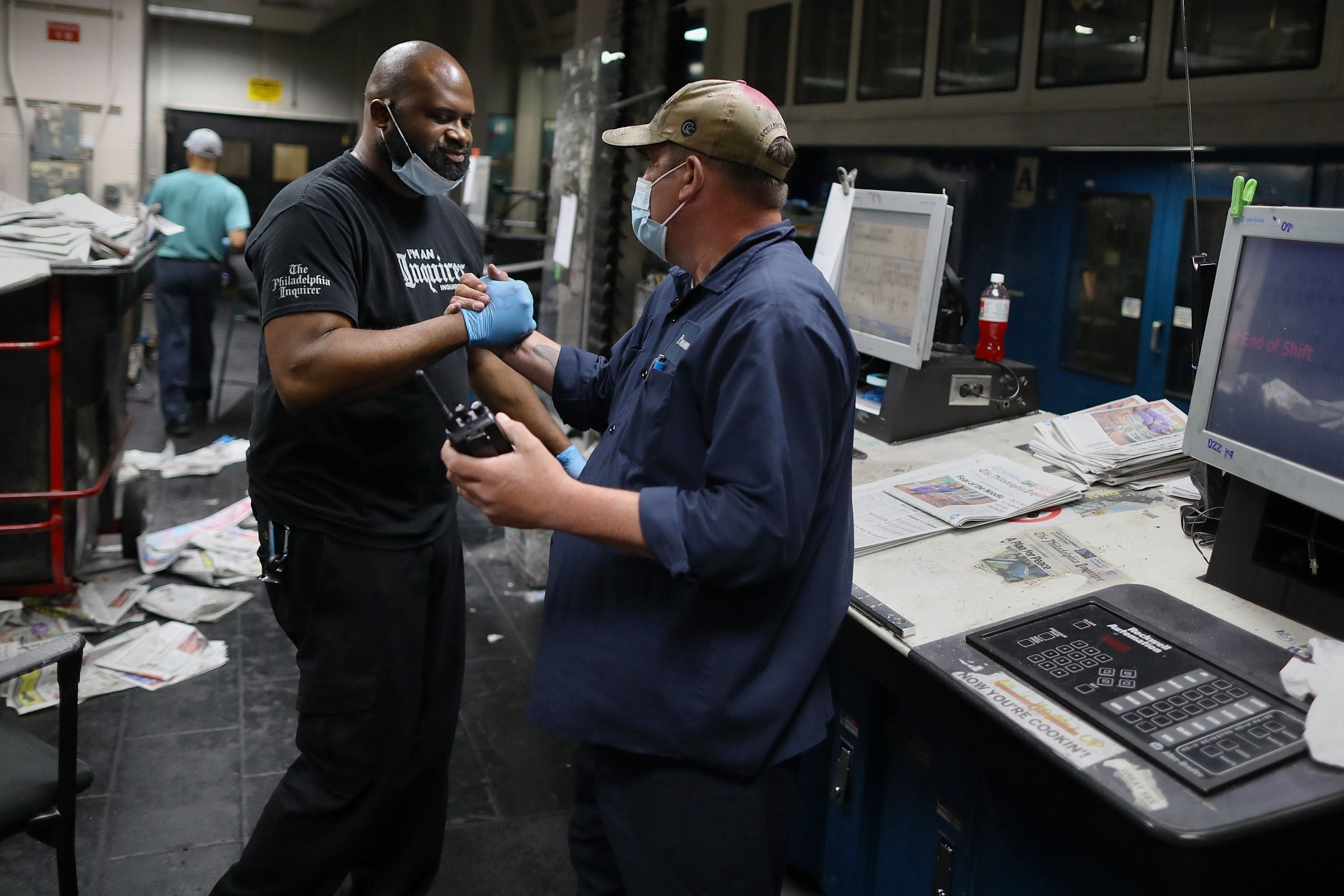
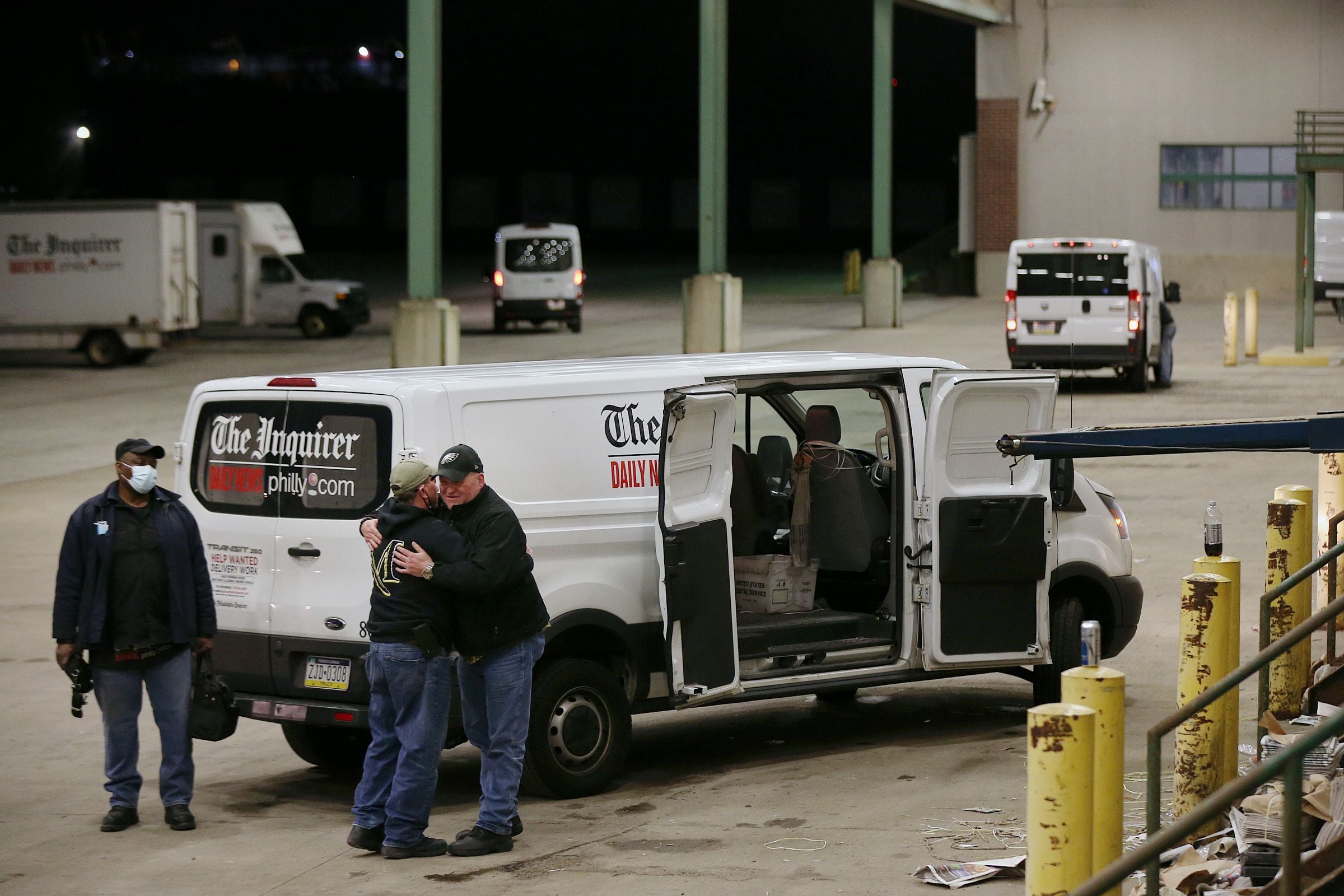
A clipboard in the quiet room informs pressmen about the plates that need to be switched out for a "lift" for a later edition. TIM TAI / Staff PhotographerPressman Keith Jones (left), who was hired in 2005, and Jim Fish prepare to embrace as they are about to depart after the last scheduled press run. TIM TAI / Staff Photographer
Fold ‘em, stuff ‘em
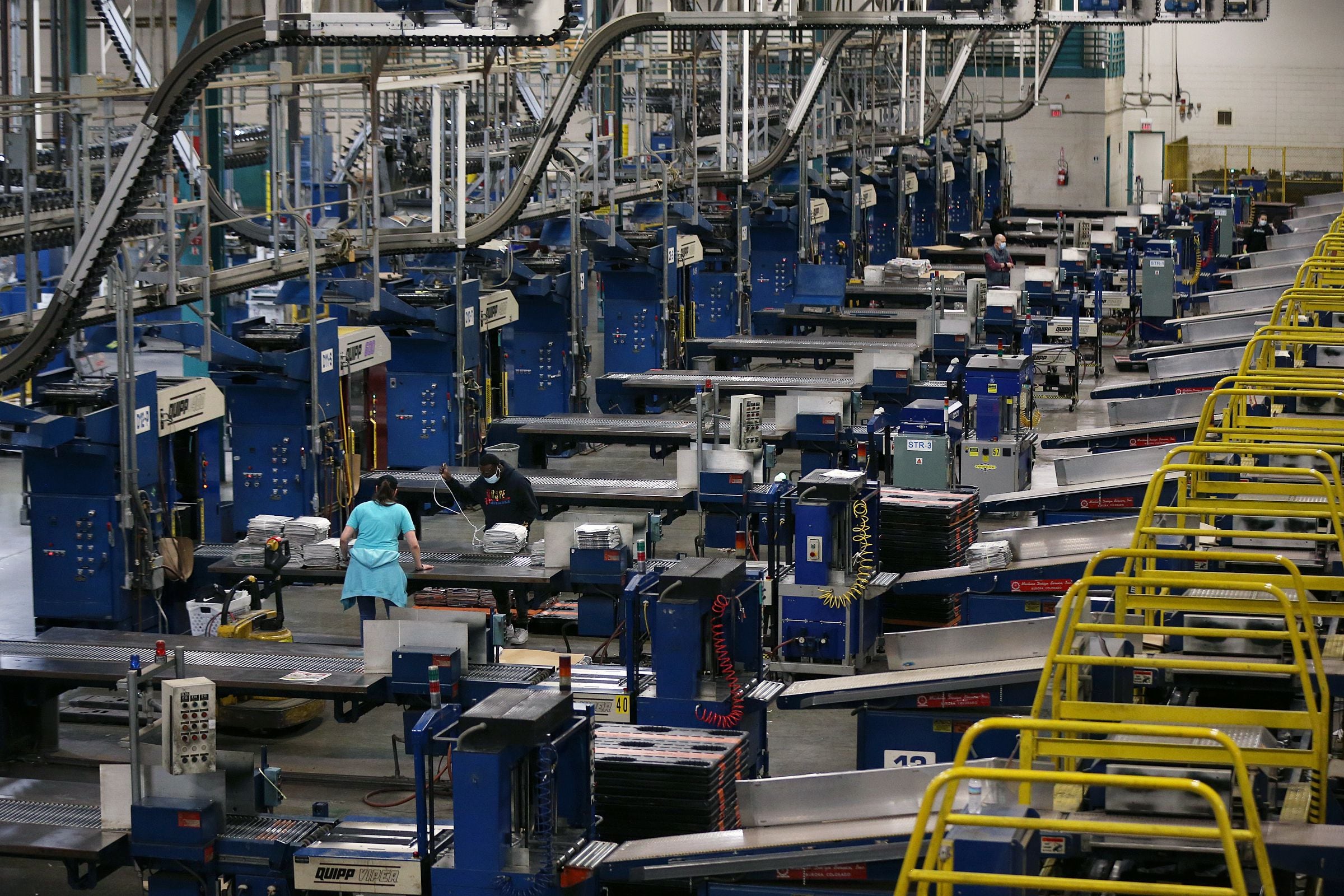
Among all his family members who ever worked in the mail room, a 187,000-square-foot canyon where the printed sections and advertising inserts were added and prepared for the trucks, Devin Leidy counted 150 years’ experience.
“When I was 12 years old, my father said, ‘You’re going to be delivering newspapers. You’re going to learn how to hand-stuff,’ ” said Leidy.
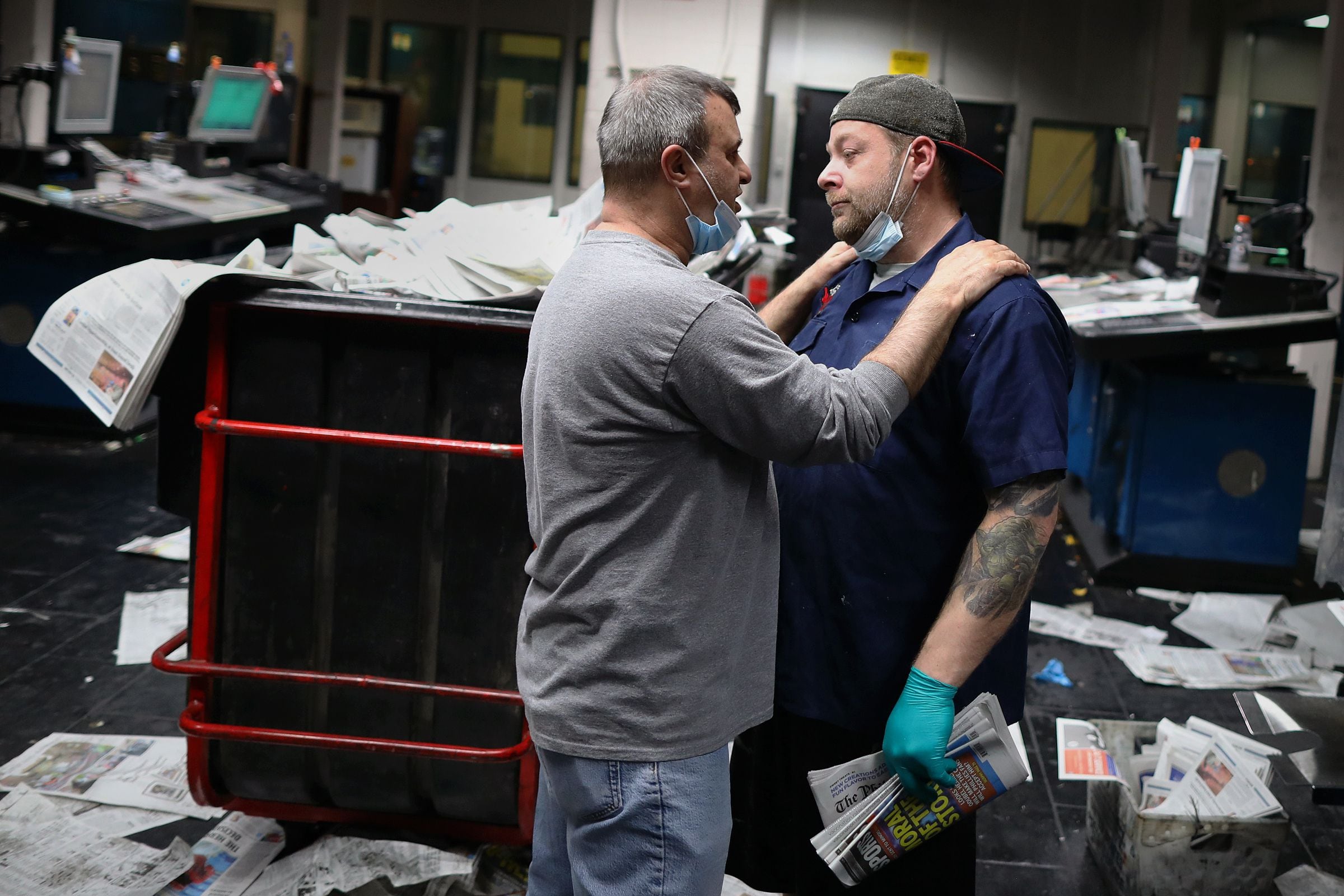
Pressroom supervisor David Creek (left), hired in 1984, chats with colleague Bobby Nick, who joined The Inquirer in 2002, as Nick gets ready to sign off. TIM TAI / Staff PhotographerDriver Darryl Jackson (left) looks toward dispatcher George Young (center) hugging driver Dominic Delvecchio, all of whom started in 2000. TIM TAI / Staff PhotographerPressman Hayden Darrabie (left) and Jim Fish walk out of the press room after the last scheduled run. TIM TAI / Staff Photographer
Leidy, who would grow up to be a mailroom supervisor, said the assembly and presentation of the papers were critical to sales: “You’re trying to put it out correctly … neatly.”
Evie Lang, a mailer who (stop if you heard this before) was the daughter and granddaughter of mailers, derived satisfaction from her labor as she left the house on Sunday mornings. “The newspaper would fall out the door and you’d go, ‘Oh, I helped to make that.’ ”
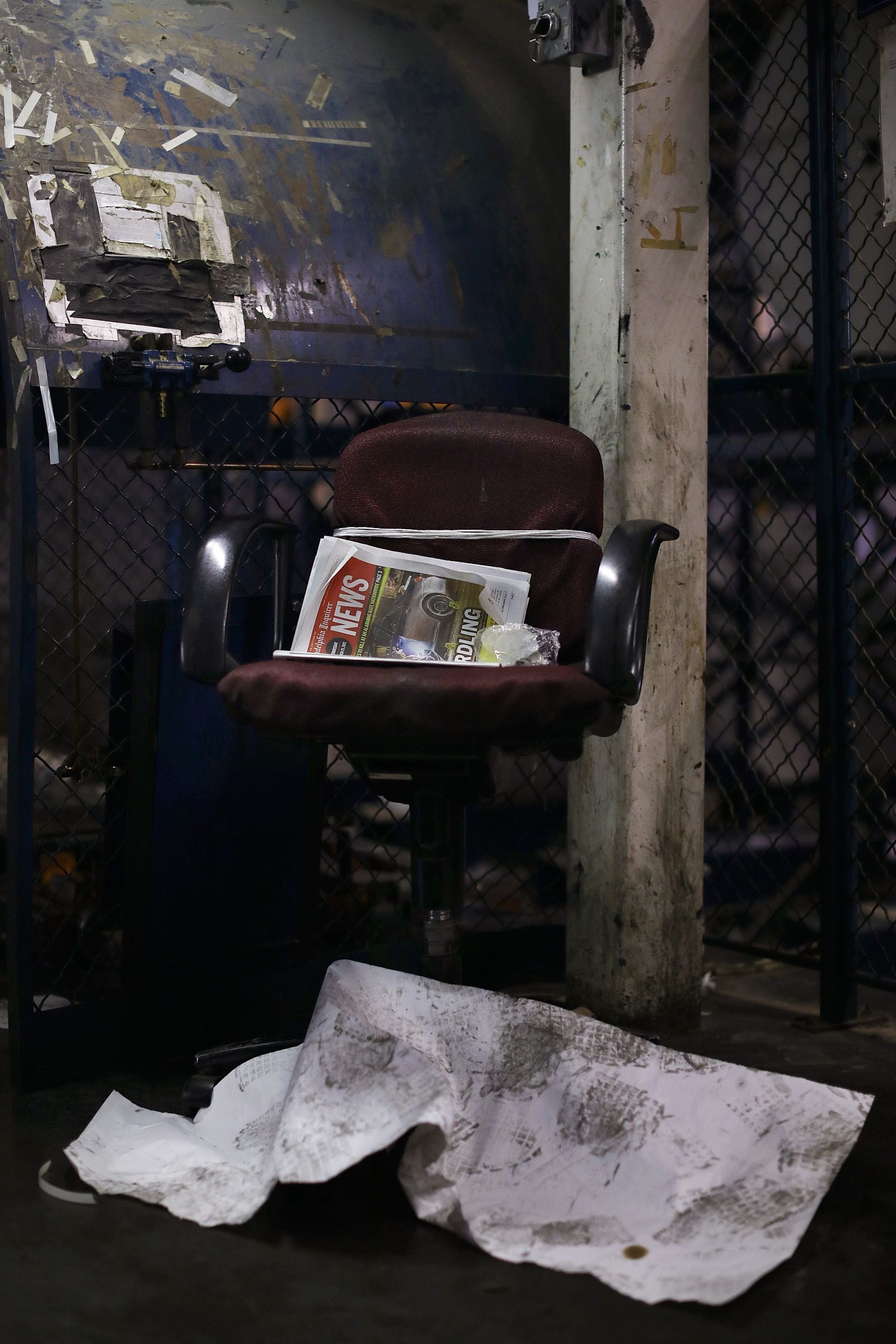
A discarded Daily News rests in a chair in the reel room, where paper had been loaded onto the presses that had been operating since 1992. TIM TAI / Staff Photographer
“My whole life. I wanted to yell, ‘Stop the presses.’ But now, when I think about it, I don’t want to stop them. I wish they could keep going.”
Pat McElwee
The last rides
Budd Emmett got hired in an antiquarian fashion: through a newspaper ad. That was in 1971.
Emmett became a transportation supervisor in 1988, overseeing a truck fleet that at one time exceeded 325.
“It’s all family,” Emmett said. It wasn’t an echo; it just sounded like one. The mood at the building in the closing days was similar to that of a pre-funeral viewing, only in this case the subject of conversation wasn’t yet deceased and had the benefit of hearing the praise.
Emmett said he plans to retire, as does pressman Krakovitz and others.
The furloughed SPP workers generally were pleased with what they viewed as generous severance packages. Lehman said those who wanted to keep working have found jobs.
Lehman and McElwee are among those who plan to call it a career. McElwee is anxious to spend more time with his grandchildren, but the end is profoundly bittersweet.
“My whole life. I wanted to yell, ‘Stop the presses.’ ” he said. “But now, when I think about it, I don’t want to stop them. I wish they could keep going.”
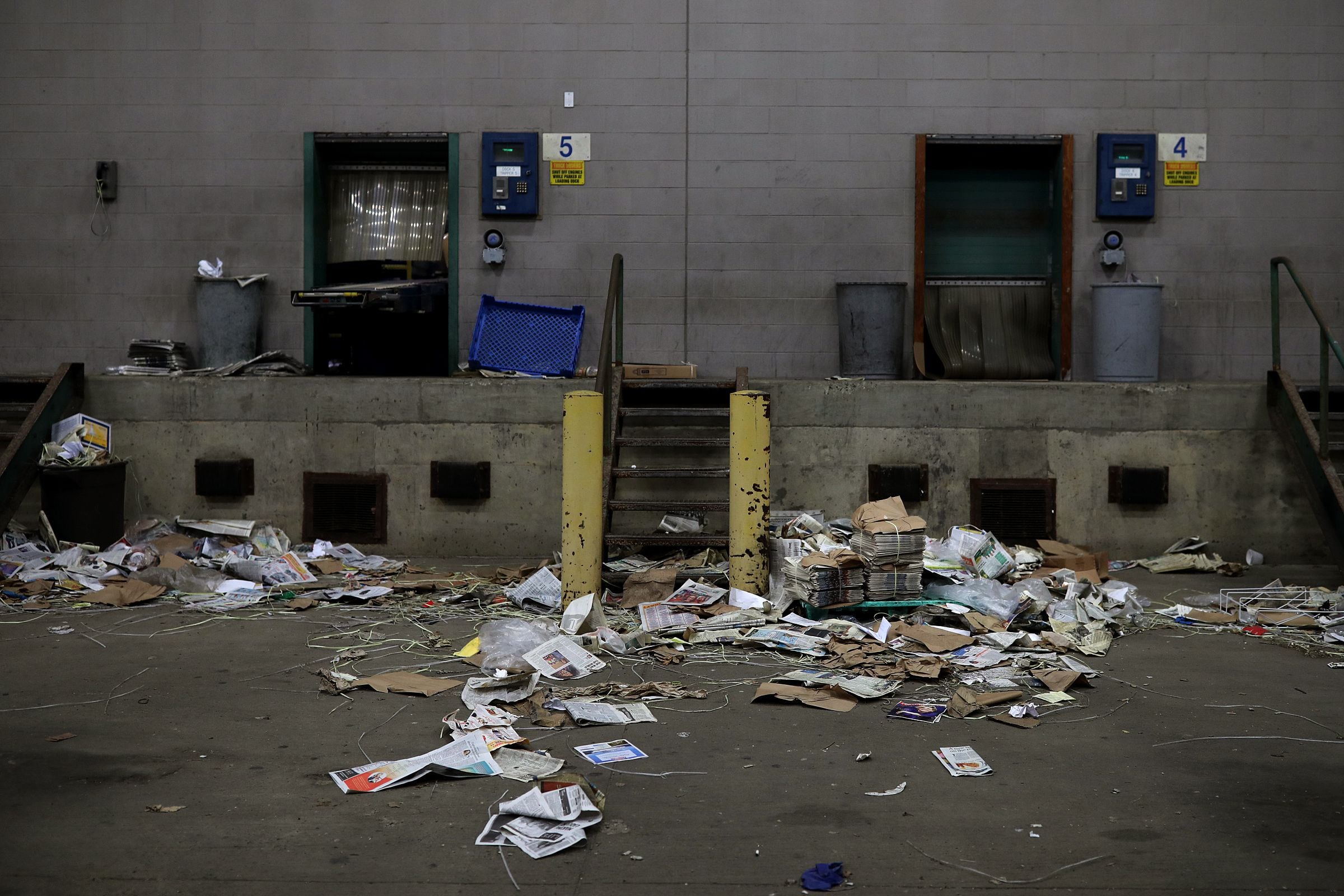
In the early morning hours of March 29, newspapers litter the docks that no longer will be used for loading The Inquirer and Daily News onto delivery trucks while most of us slept. TIM TAI / Staff Photographer
Staff Contributors
Reporting: Anthony R. Wood
Visuals: Tim Tai, Frank Wiese, Danese Kenon, Astrid Rodrigues, Kristen Balderas, Lauren Schneiderman, and Raishad Hardnett
Design & Development: Dain Saint and Jessica Parks
Editing: Emily Babay and Diane Mastrull
Digital: Kerith Gabriel, Patricia Madej, Lauren Aguirre, and Caryn Shaffer
Copy editing & Print: Brian Leighton and Sterling Chen