Category: Theater

  • James Ijames rewrote the script to ‘Good Bones’ after seeing the pushback to the Sixers arena. Is the play any good?

    James Ijames rewrote the script to ‘Good Bones’ after seeing the pushback to the Sixers arena. Is the play any good?

    Gentrification is perhaps not the flashiest subject for a play. But in a city like Philadelphia — which has seen years of rapid development and community backlash, particularly surrounding the contested Sixers arena effort — it serves as a ripe starting point for dramatic exploration in Good Bones, running at the Arden Theatre through March 22.

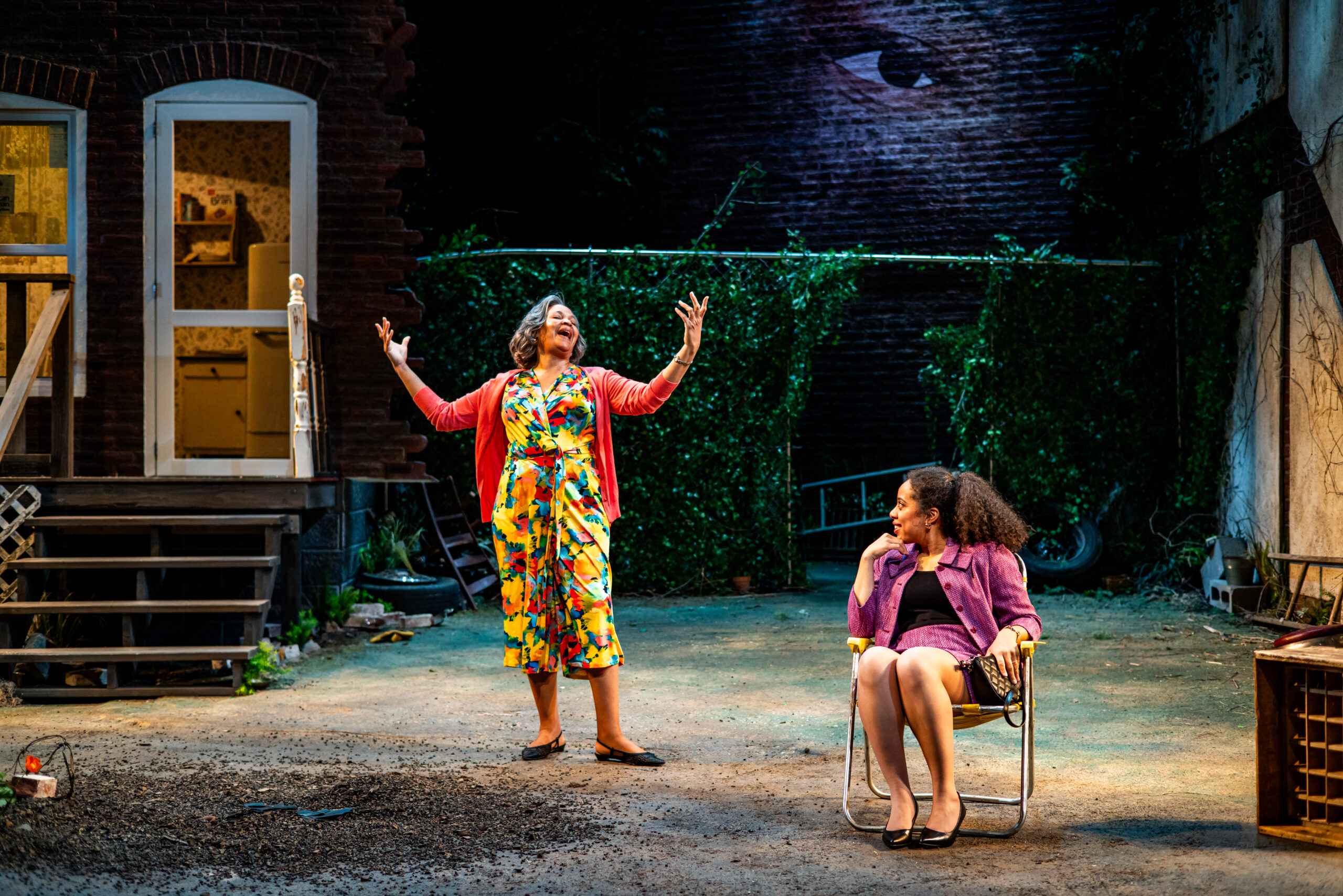
    Directed by Akeem Davis and written by Pulitzer Prize-winning playwright James Ijames, the play centers on Aisha (Taysha Marie Canales), a businesswoman tasked with community outreach for sports complex developers, and Earl (Walter DeShields), the contractor she hires for home renovations who vehemently opposes the arena. They both grew up in the same (fictional) neighborhood but hold vastly different visions for its future.

    Arts reporter Rosa Cartagena and residential real estate reporter Michaelle Bond discuss the production’s funny, emotional, and complex portrayal of a very Philly reality.

    Old neighborhoods, new names

    Rosa Cartagena: You’ve been covering real estate extensively here in Philadelphia. I’m wondering what’s your first impression of the way this play addressed gentrification?

    Michaelle Bond: I saw a lot of themes that I hear about all the time covering housing. The feelings of longtime residents vs. newer ones, revitalization vs. displacement, what new construction looks like and how it fits (or doesn’t) in a neighborhood, even what a neighborhood should be called.

    RC: Right, there was a funny moment on opening night when Earl criticized the newcomers for calling their neighborhood the new name “Finbrook” instead of “the Heat” and an audience member clapped. We’ve seen that kind of rebranding all across this city, too.

    MB: I think the Heat is the cooler of the two names, by the way. There’s more passion behind it. But yes, developers and real estate agents have rebranded or tried to rebrand lots of neighborhoods. The Gayborhood, for example, is also called Midtown Village now. Almost 10 years ago, a small developer in North Philly’s Norris Square tried to rename the neighborhood Stonewall Heights and was promptly shut down. In an extreme example, the Black Bottom neighborhood in West Philly was bulldozed and renamed University City.
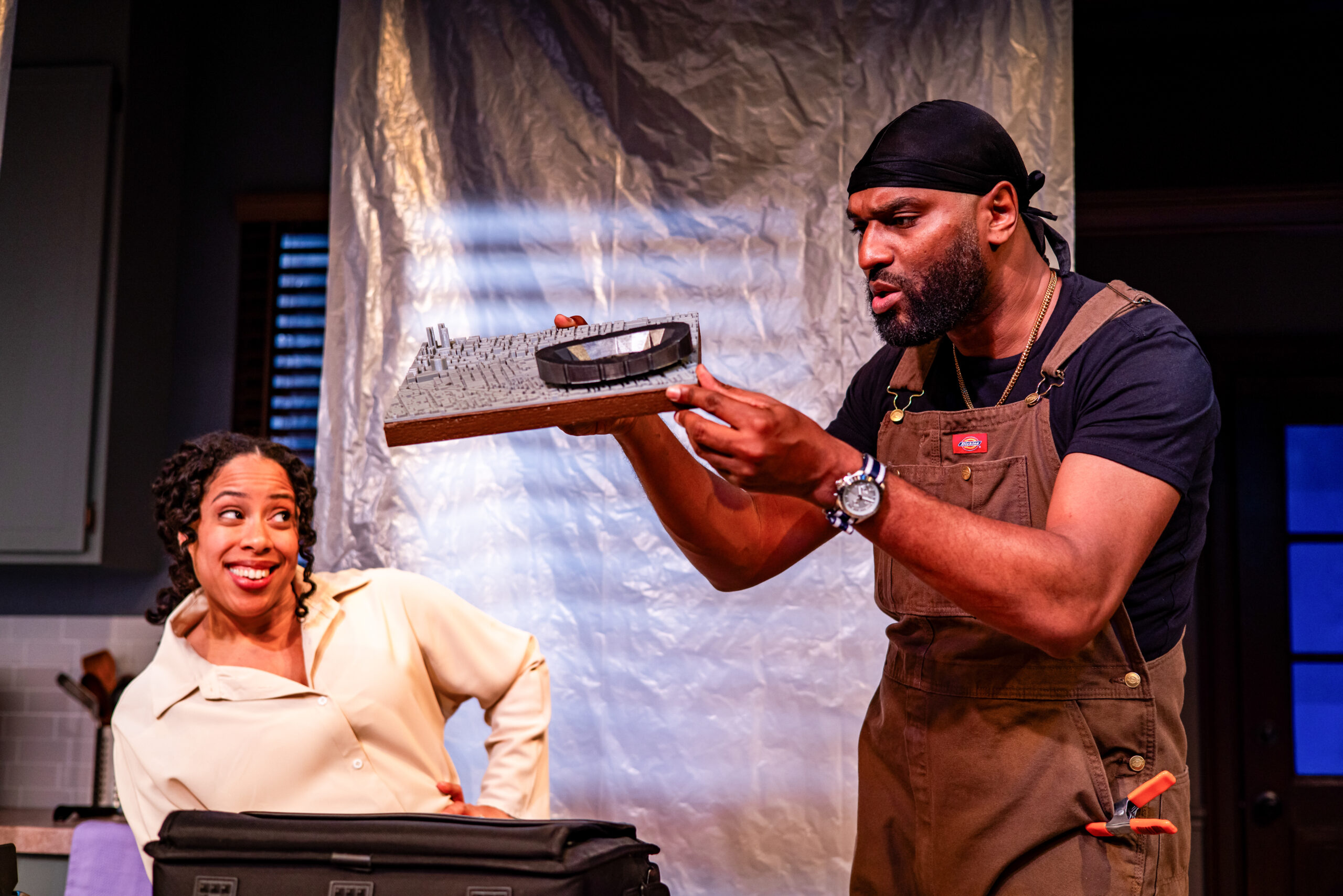
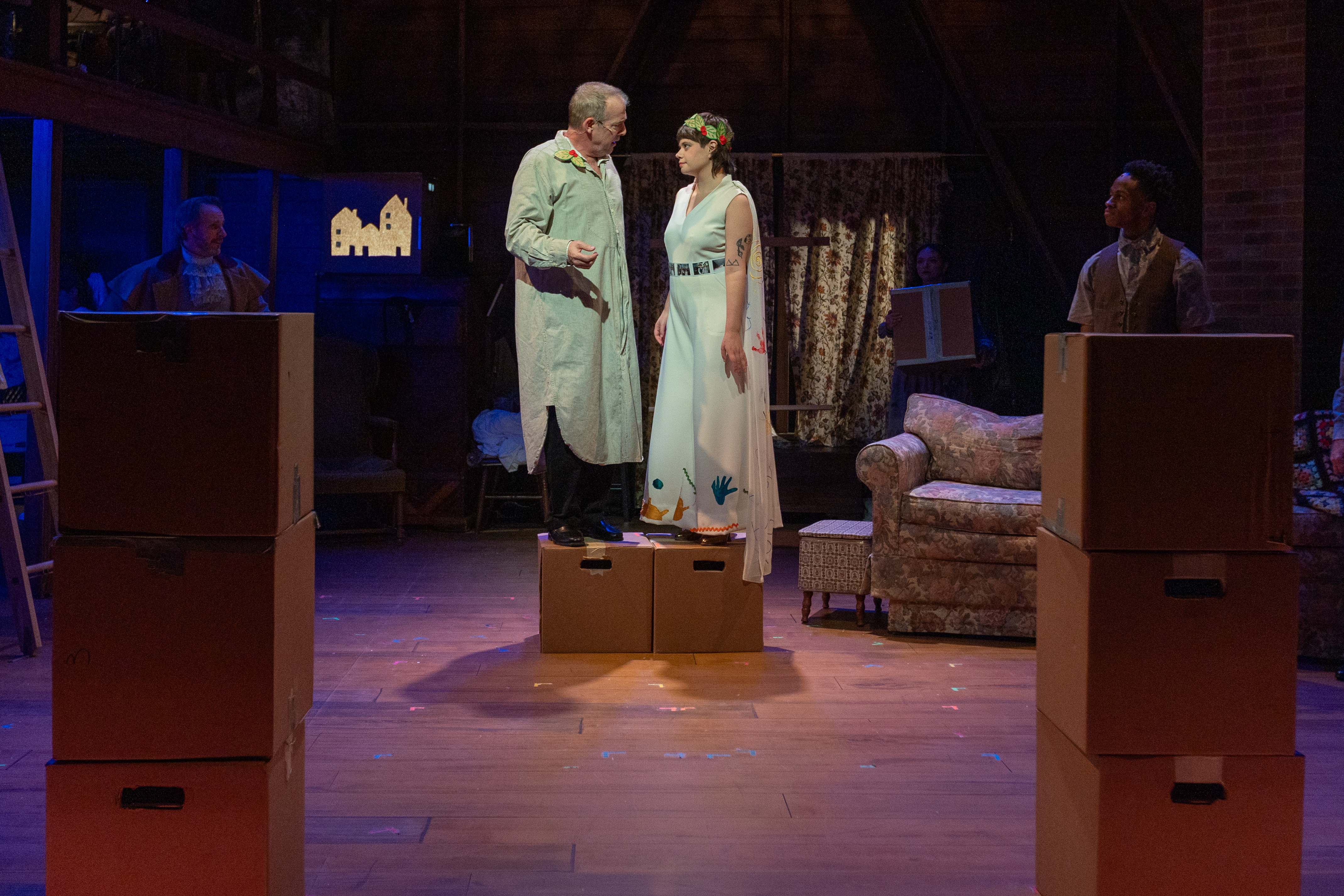
    Taysha Marie Canales (Aisha) and Walter DeShields (Earl) examine a model sports complex development in ‘Good Bones,’ running at the Arden Theatre through March 22.

    The Sixers arena influence

    RC: This story is set in an American city that could stand in for Philadelphia, or the sites of previous performances in Washington, D.C., and New York. The playwright James Ijames was living in South Philly when he wrote Good Bones, and he’s previously discussed his own growing pains of moving to a new community. This production delivers a specifically Philly version but with a universal resonance.

    MB: Right, because in the other productions, the new development coming in wasn’t a sports complex, was it?

    RC: Ijames rewrote the script after seeing the local pushback to the Sixers arena proposed in Chinatown. There are a few Philly callouts, like Earl’s sister Carmen (Kishia Nixon) attending the University of Pennsylvania and a joke about the Sixers sucking (which killed).

    Revitalization vs. destruction

    MB: One thing I’ve heard a lot about across Philly is that residents raise their kids in their neighborhoods, but when the kids grow up, they can’t afford to buy a home in that same neighborhood. Earl says that the public housing complex where he and Aisha grew up will be torn down and probably replaced with condos that no one can afford. The production does a good job highlighting the displacement and the class dynamics that are often at play.

    RC: Absolutely. In this case Aisha grew up, moved away, married a guy from a rich family, and returned to purchase a home with “character and charm.” But her view of the neighborhood’s drastic transformation isn’t a negative one — she sees her efforts as “healing” her once neglected and sometimes violent home. Aisha and Earl bond over their memories of the Heat but fiercely disagree about what is revitalization vs. destruction.

    MB: That’s the thing. They’re both passionate about the neighborhood and want to help the residents there, but they have different ways of going about it. Aisha wants to get rid of the public housing complex and “start over,” but Earl wants improvements that don’t erase the history.
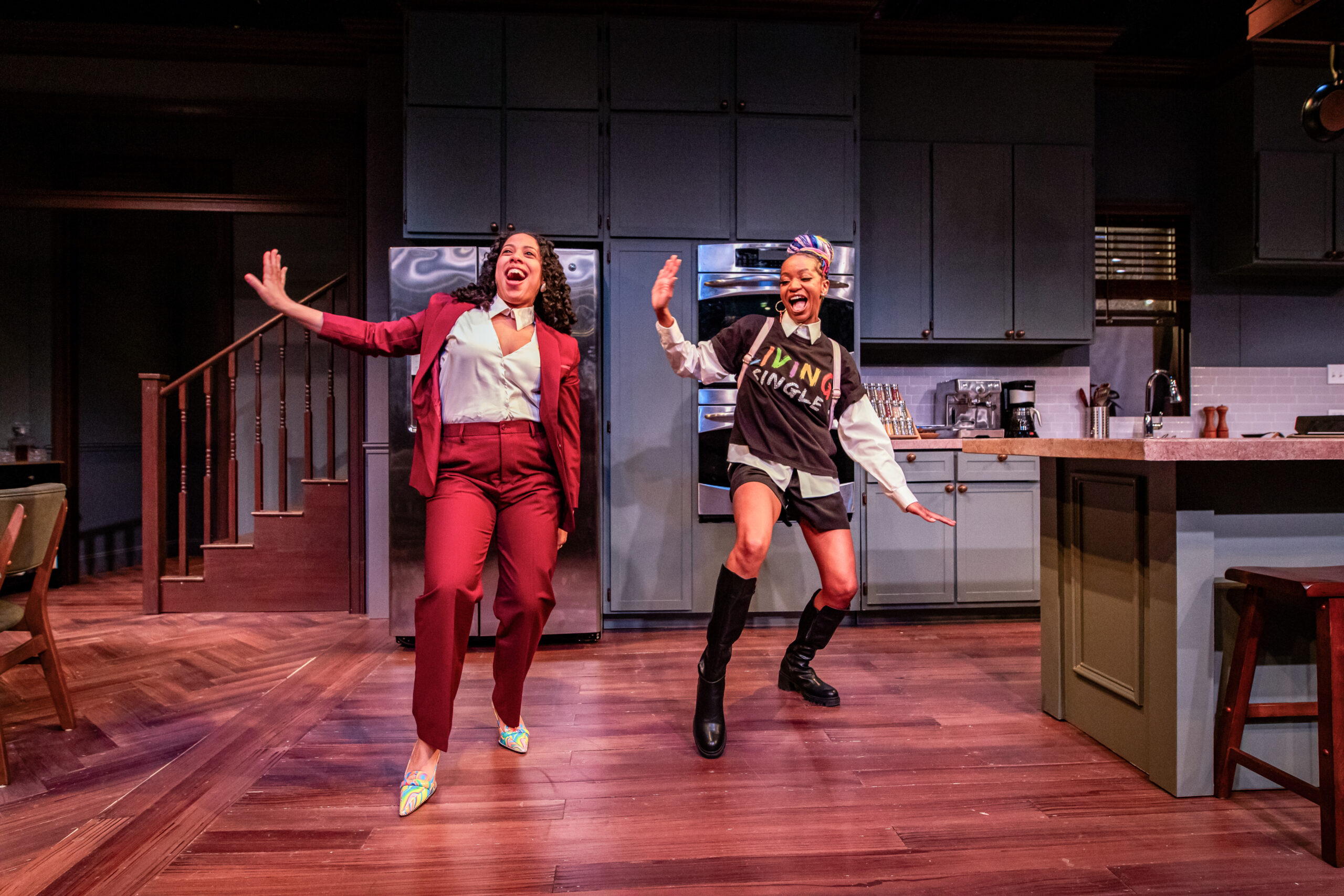
    Taysha Marie Canales (Aisha) and Kishia Nixon (Carmen) in ‘Good Bones,’ running at the Arden Theatre through March 22.

    RC: We learn that Earl has been handcrafting cabinet knobs that look like the ones originally in the kitchen, because he has memories of playing in the empty house after the previous owner died.

    MB: Earl is a big fan of preservation. He calls new construction ugly and says it has no character or charm. And that’s definitely something I’ve heard from Philadelphians. And how that’s particularly irritating in a historic city like Philadelphia. Inquirer architecture critic Inga Saffron said in a recent column that Philly neighborhoods “are now awash in interchangeable blocky structures, all dressed in the same dreary gray clothing, their aluminum panels shrink-wrapped around the exterior like a sheet of graph paper.”

    Block parties and traditions

    RC: Ew, yeah the millennial gray. New neighbors also bring new problems. When a block party interrupts Aisha’s husband Travis’ (Newton Buchanan) sleep, he decides to lodge a noise complaint using an app called the Hood — a clever Ijames invention that makes “this narc s— so pleasant,” Carmen says — and the cops come in a harrowing scene portrayed through anxiety-inducing lighting design thanks to Shannon Zura. It’s later revealed that the event was an annual community gathering Earl organized.

    MB: That’s also something I hear about. The tension between longtime residents who have longstanding traditions and newer residents who don’t have an understanding of that history or what it means to the community.

    RC: Or who are scared to even talk to their neighbors. Earl makes the point that Travis could have simply stepped outside and asked them to turn it down. It’s even more damning because Aisha’s whole job is to “help the franchise speak the language of the community.” Earl criticizes her by saying, “I expect more from my people.” As universal as it is, Good Bones isn’t a stereotypical representation of gentrification because these aren’t white newcomers in a historically Black community, which makes this portrayal richer and thornier.
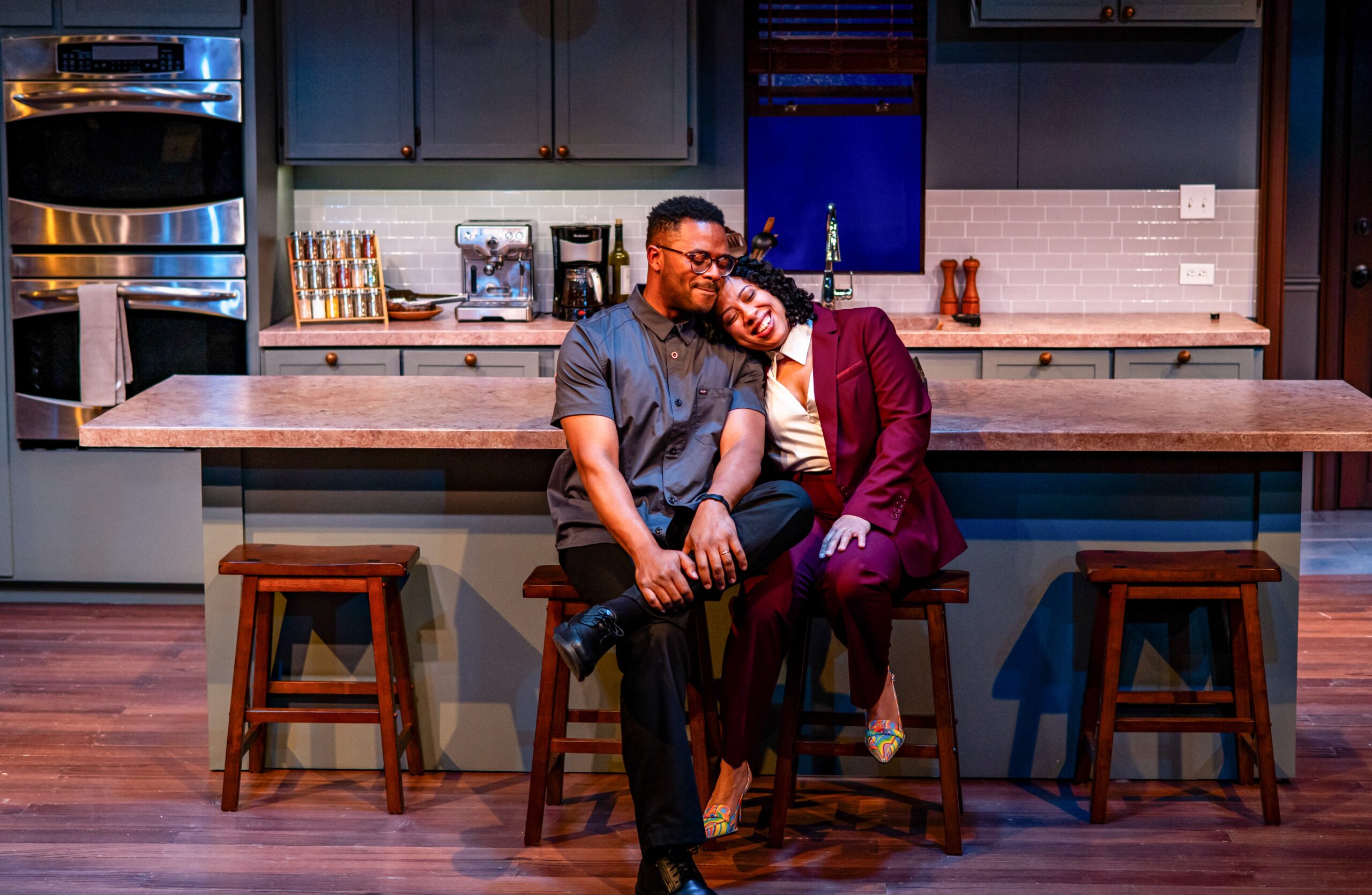
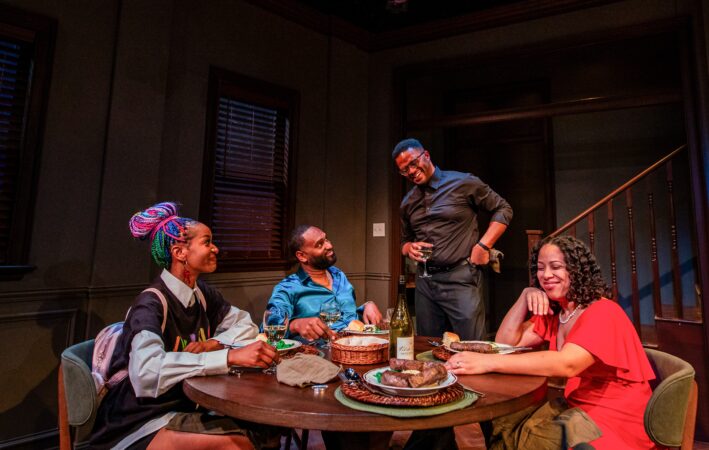
    Newton Buchanan (Travis) and Taysha Marie Canales (Aisha) in ‘Good Bones,’ running at the Arden Theatre through March 22.

    Nuance and personal experience

    MB: Speaking of thorny, the play also touches on what can be development’s double-edged sword. Investment boosts existing residents’ property values, but then everything gets more expensive, from property taxes to groceries. Earl mentions at one point that a Whole Foods replaced a neighborhood spot.

    RC: That frustration shined through in DeShields’ strong performance, too. The actor has had his own direct experiences with gentrification here after growing up in South Philadelphia and seeing his neighborhood renamed to Point Breeze. I think that personal pain and loss bolstered his take on Earl, who reminds Aisha that transformation to some means elimination for others. Aisha, on the other hand, primarily focuses on her memories of violence and trauma that she experienced, saying that they deserved better. Canales delivers a layered and emotional speech that underscores how these conversations can be conflicting and difficult.

    MB: I went into the play thinking there would be a clear resolution, but there really wasn’t one. And that speaks to the complexity of the subject matter.

    RC: That’s also a testament to the play’s strengths — it succeeds in getting audiences to think critically about a nuanced topic. Hopefully that means they’ll actually talk to their neighbors, too.

    “Good Bones” runs through March 22 at the Arden Theatre, 40 N. Second St., Phila., 215-922-1122 or ardentheatre.org. Runtime: 1 hour and 45 minutes (no intermission).
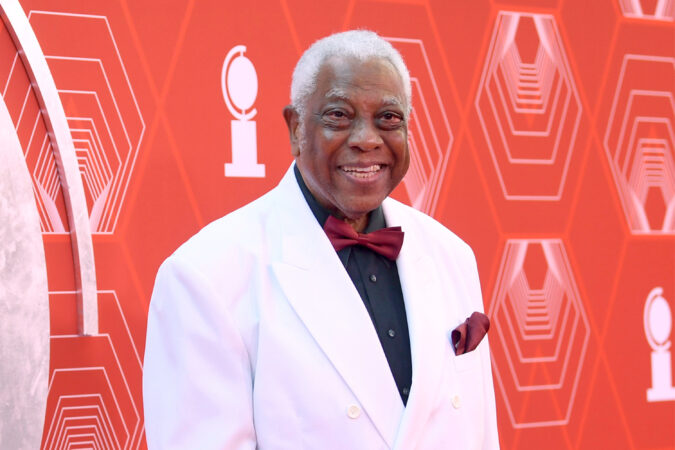
  • Woodie King Jr., founder of powerhouse off-Broadway New Federal Theatre, has died at 88

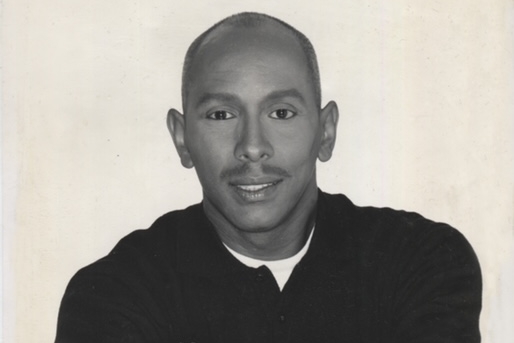
    Woodie King Jr., founder of powerhouse off-Broadway New Federal Theatre, has died at 88

    NEW YORK — Woodie King Jr., an actor, director, and producer who founded the New Federal Theatre to give voice and employment to Black playwrights, actors, directors, designers, and young people entering the American theater, has died. He was 88.

    His off-Broadway theater company said Mr. King died Thursday at Weill Cornell Medical Center in New York City of complications from emergency heart surgery.

    Mr. King was inducted into the American Theatre Hall of Fame in 2012 and received the Tony Honors for Excellence in Theatre in 2020.

    “We have lost a giant,” said Emmy Award-winning actor and educator Erin Cherry on Instagram. “I am here because of Woodie King Jr. My very first introduction to the Black theater scene was the play ‘Knock Me a Kiss’ produced by New Federal Theatre. It changed my life. I’m forever grateful.”

    The New Federal Theatre produced such key works as Black Girl by J.E. Franklin, The Taking of Miss Janie by Ed Bullins — which jumped to Lincoln Center and won the Drama Critics Circle Award — and For Colored Girls Who Considered Suicide When the Rainbow is Enuf by Ntozake Shange, which landed on Broadway in 1976 and was nominated for the best new play Tony Award.

    The New Federal Theatre was a springboard for many playwrights, including Charles Fuller — later to win the Pulitzer Prize for A Soldier’s Play — who premiered two plays — In My Many Names and Days and The Candidate. David Henry Hwang premiered The Dance and the Railroad at the New Federal and would later win the Tony for M. Butterfly.

    Some performers who got early career boosts thanks to the company include Chadwick Boseman, Debbie Allen, Morgan Freeman, Phylicia Rashad, Denzel Washington, LaTanya Richardson Jackson, Samuel L. Jackson, and Issa Rae.

    Mr. King was born in Alabama, raised in Detroit, and earned his bachelor’s degree from Lehman College and later his master’s from Brooklyn College. He served as the cultural director of Mobilization for Youth for five years, before founding New Federal Theatre in 1970.

    Mr. King is survived by his wife, Elizabeth Van Dyke, and his three children, Geoffrey King, Michael King, and Michelle King Huger, whom he shared with ex-wife Willie Mae Washington, as well as five grandchildren.

    Tyler Fauntleroy, an actor who has toured in Hamilton, took to Instagram to recall working at the New Federal in 2019 on a show called Looking for Leroy that would change his career. “His belief in me came at a time when my own was at an all-time low. What a champion he was for Black artists. It was an honor to witness. Thank you, sir and rest easy.”

  • Carla Washington Hines, longtime dancer, choreographer, and teacher, has died at 72

    Carla Washington Hines, longtime dancer, choreographer, and teacher, has died at 72

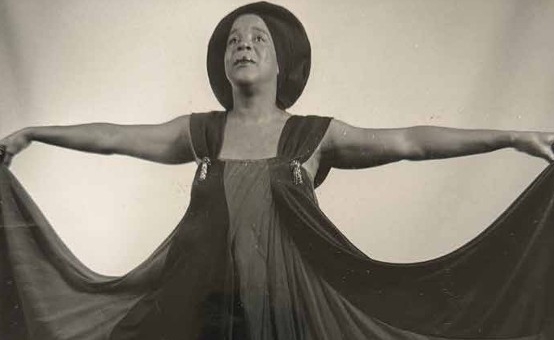
    Carla Washington Hines, 72, of Philadelphia, longtime dancer, pioneering choreographer, celebrated teacher, former artistic director, collaborator extraordinaire, and mentor, died Sunday, Nov. 2, of sepsis at Temple University Hospital-Jeanes Campus.

    Mrs. Hines came to Philadelphia from Virginia in 1974 after college and spent the next four decades dancing, teaching, lecturing, traveling, and generally advocating for arts in education from kindergarten through college. She danced with the Sun Ra Arkestra, the John Hines Dance Co., and other troupes at all sorts of venues in Philadelphia, New York, Chicago, elsewhere in the United States, and throughout Europe.

    She choreographed original performances such as “Montage in Black,” “Reflections,” and “Life Cycle,” and collaborated with notable jazz musicians Herbie Hancock and Alice Coltrane, and other musical stars. She was a guest on TV and radio shows, read poetry at public events, and earned awards from the Pennsylvania Council on the Arts and the Philadelphia-based Bartol Foundation for education.

    She was an expert in jazz dance, modern dance, ballet, and posture, and she lectured, organized workshops, and taught the elements of dance and choreographic principles at schools, colleges, art centers, drama guilds, libraries, and elsewhere around the country. Her mother, Thelma, was a dancer and teacher, too, and Mrs. Hines championed the connection between an interest in the arts and academic success.

    “In dance, I can be anything I want to be,” she said in an online interview. “That’s the magic of the arts.”

    She created an afterschool residency at a Universal charter school and taught dance at E.M. Stanton Elementary School, Strawberry Mansion High School, and other schools. She said in the online interview that her curriculum “is based on the appreciation of dance and movement,” and that it helps students “make sense of their lives using dance as a tool for learning.”

    She said: “I want them to be able to understand through movement exploration how dance can change one’s life.”

    She was artistic director for the Philadelphia chapter of the Institute for the Arts in Education and at the Point Breeze Performing Arts Center. “Her creative guidance helped students tell powerful cultural stories through movement,” her family said.

    Mrs. Hines performed with the Jones-Haywood Dance School in Washington before moving to Philadelphia.

    As longtime community engagement manager for the Philadelphia Clef Club of Jazz and Performing Arts, Mrs. Hines wrote grants and choreographed performances. She was executive director of the John Coltrane Cultural Society and active at the old University of the Arts.

    Her family said: “She devoted her life to creativity and to nurturing talent in others.”

    Carla Yvette Washington was born Nov. 3, 1952, in Charleston, W.Va. Her family moved to Grambling, La., when she was young, and she graduated from high school in 1970.

    She was named Miss Freshman at what is now Grambling State University, joined the Alpha Kappa Alpha Inc. sorority, and earned a bachelor’s degree in recreation in 1973. In 1981, she earned a master’s degree in fine arts and dance at the old Philadelphia College of the Performing Arts.

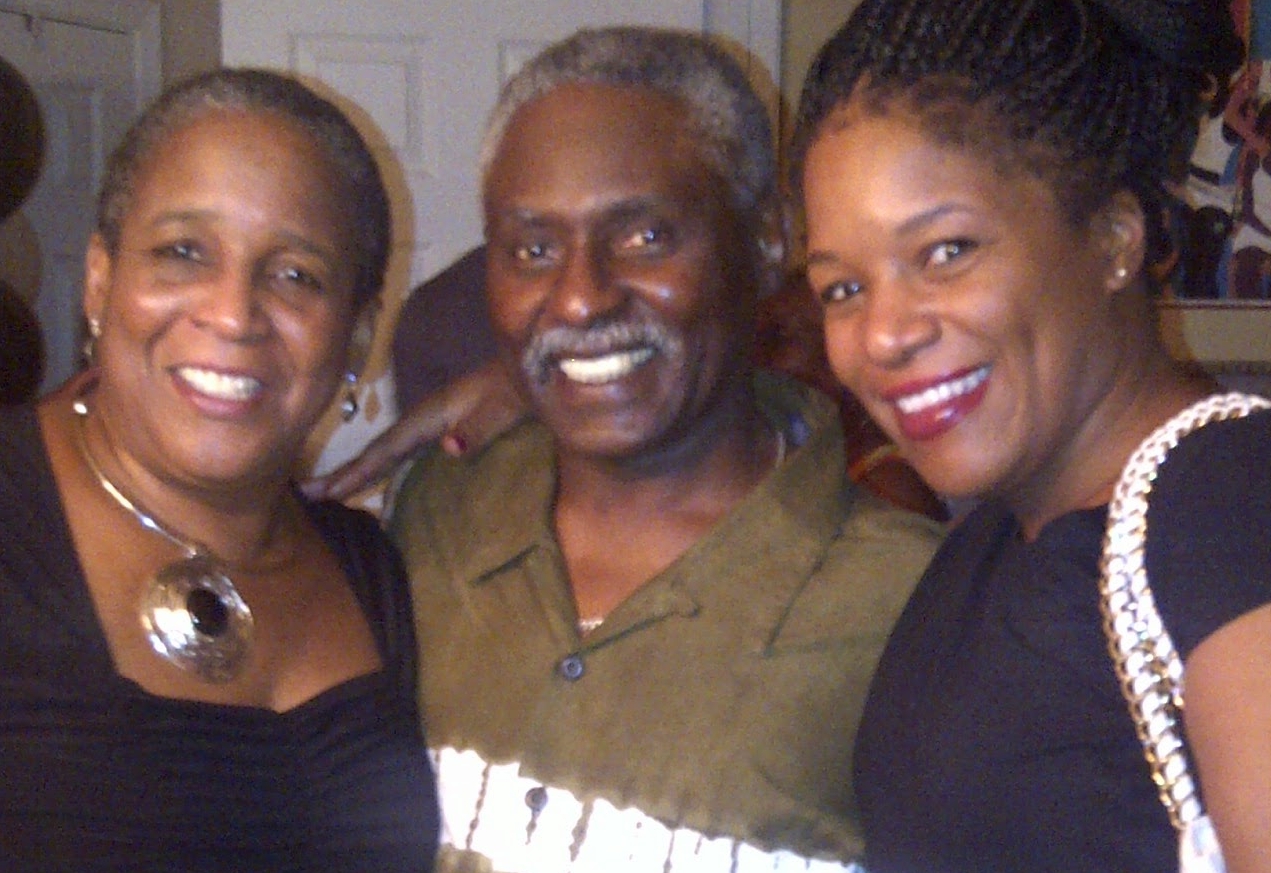
    Mrs. Hines (left) smiles with her husband, Lovett, and their daughter, Zara.

    She worked as a dance teacher for the Fairfax County Department of Recreation in Virginia after college and performed with the Jones-Haywood Dance School in Washington before moving to Philadelphia.

    She met jazz musician Lovett Hines Jr. when they were students at Grambling and they married in 1984 and lived in West Oak Lane. They had a daughter, Zara, and Mrs. Hines welcomed her husband’s son, Lovett III, and his family into her family.

    “She introduced many creatives to dance and culture, and sparked their creative careers,” her stepson said. “That is the essence of her legacy.”

    Mrs. Hines and her husband, their daughter said, were “a partnership of two geniuses.” He played the saxophone and was artistic director at the Clef Club. She loved the drums, and they collaborated seamlessly on many notable projects.

    Friends called her “a sweetheart” and “a beautiful soul” in online tributes. One said she “made an impact on Philadelphia and beyond in countless ways.” Her sister, Alicia Williams, said: “Everyone had a special relationship with her.”

    Mrs. Hines graduated from Grambling High School in Louisiana in 1970.

    Mrs. Hines was diagnosed with a lung disease in 2024 and Stage 4 cancer in 2025. “She was stern but soft,” her daughter said, “loving but able to tell you like it is.”

    Her husband said: “She had special relationships with so many musicians, so many people. It was through insight, understanding, and patience. In them, we see her everyplace, feel her everyplace.”

    In addition to her husband, daughter, mother, and stepson, Mrs. Hines is survived by three sisters, two step-grandsons, and other relatives. A brother died earlier.

    Services were held Wednesday, Dec. 17.

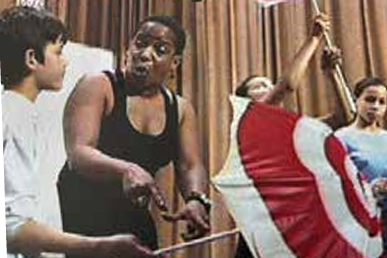
    Mrs. Hines (center) said she adapted her teaching techniques to suit the needs and ages of the students.
  • In ‘Steel Magnolias’ in Chesco, some of the cast has worked together for 50-plus years

    In ‘Steel Magnolias’ in Chesco, some of the cast has worked together for 50-plus years

    In a small fictional town in Louisiana, the six women centered in Steel Magnolias have forged a community among — and an ever-deepening relationship with — each other. In a real town in southeastern Pennsylvania, a group of women who have worked together for decades are bringing those characters and those deep bonds to life at People’s Light in Malvern.

    “You don’t have to worry about if that familiarity is there,” said Janis Dardaris, who portrays Clairee, the widow of the town mayor. “You just sit on the stage and it’s there. There’s no working at it. I sometimes wonder, what would it be like doing this play with completely different people that I didn’t know?”

    As the women portray lifelong friendships, they have been able to find that depth and heart because of their own close connections. They’ve known each other for decades through their work in the arts — up to 50 years, in some cases, with some combination of them overlapping in at least a dozen shows in recent years.

    Talking together in a room at the theater days before the Sunday opening, they occasionally finished each other’s sentences, extrapolating thoughts for each other.

    Abigail Adams, the production’s director who has directed the women in several other performances, has a sense of how each of them works — how much time it takes for them to process, when to ask for something in their performance and when to hold back.

    Claire Inie-Richards, who plays young nurse and newlywed Shelby, and Susan McKey, who plays her mother, M’Lynn, have portrayed a mother-daughter duo three times over 20 years.

    Though with each role they learn each other anew, “There’s no substitute for time,” Inie-Richards said.

    Marcia Saunders (left) and Brynn Gauthier are part of an all-women ensemble performing “Steel Magnolias.”

    Brynn Gauthier, who makes her People’s Light debut in her portrayal of Annelle, is the new addition to a group of women whose history stretches back decades.

    At first she thought it might be intimidating to work with people who have known each other and worked together for so long, but it felt like she got to be part of the journey of the cast getting to know each other in a new way through this show.

    That familiarity is not without its challenges, though. Marcia Saunders sometimes feels “Marcia” surface in place of “crusty” Ouiser.

    “That’s been challenging because of my relationship with these people and this institution, which is like a home to me,” she said.

    Told as a series of moments in the women’s life within the safe confines of Truvy’s in-home hair salon, the play opens with Truvy and newcomer Annelle preparing Shelby for her wedding. Shelby and mother M’Lynn discuss wedding preparations, while local grouch Ouiser gripes about their property line.

    Clairee arrives, windswept, from a dedication ceremony honoring her late mayor husband. Annelle, originally reluctant to give any information at all about herself, breaks down, admitting to the women that her husband has disappeared — with her money, her car, and her jewelry. She finds immediate support.

    It’s just the start of how the relationships evolve and deepen in Robert Harling’s play, set in a southern town in the 1980s.

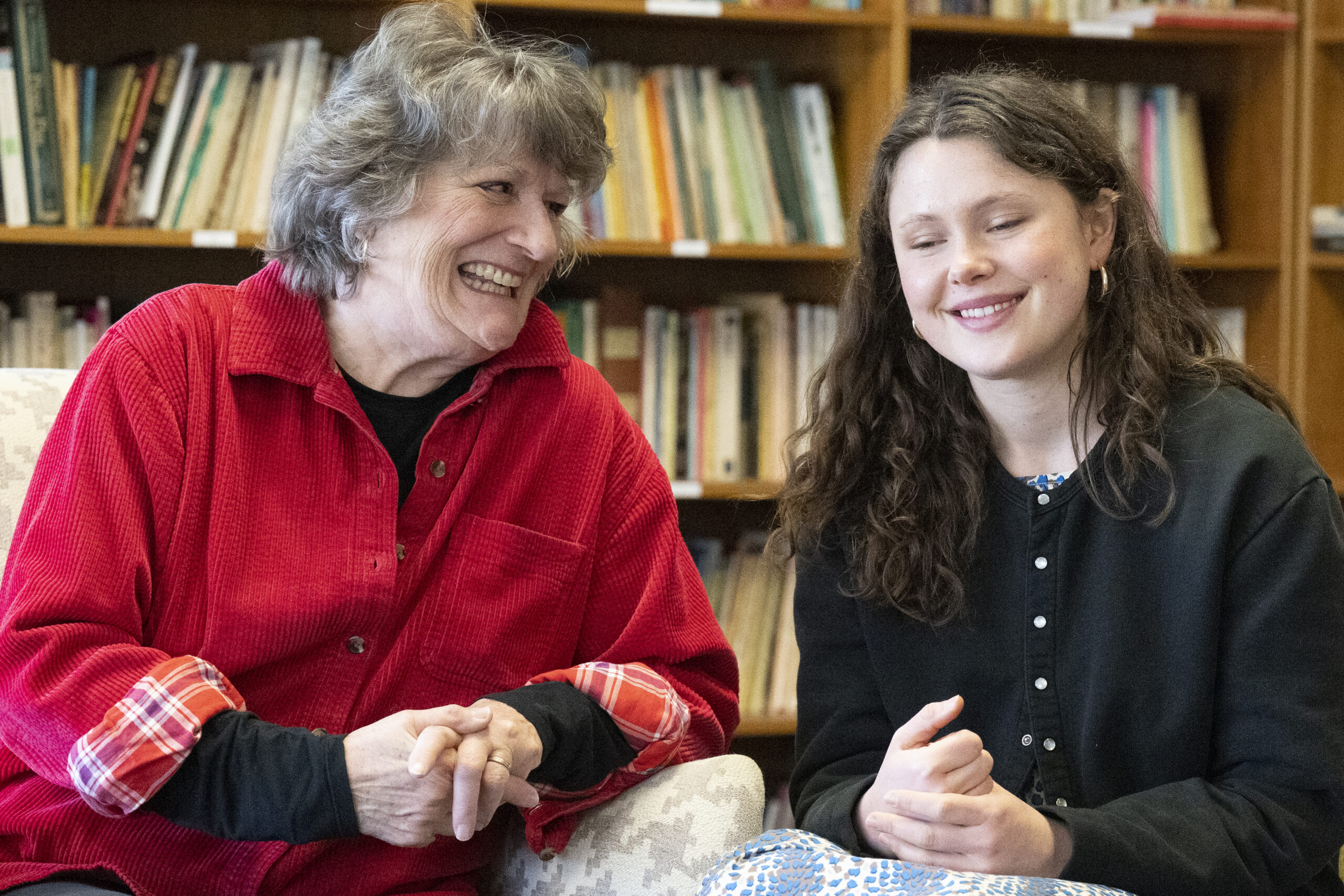
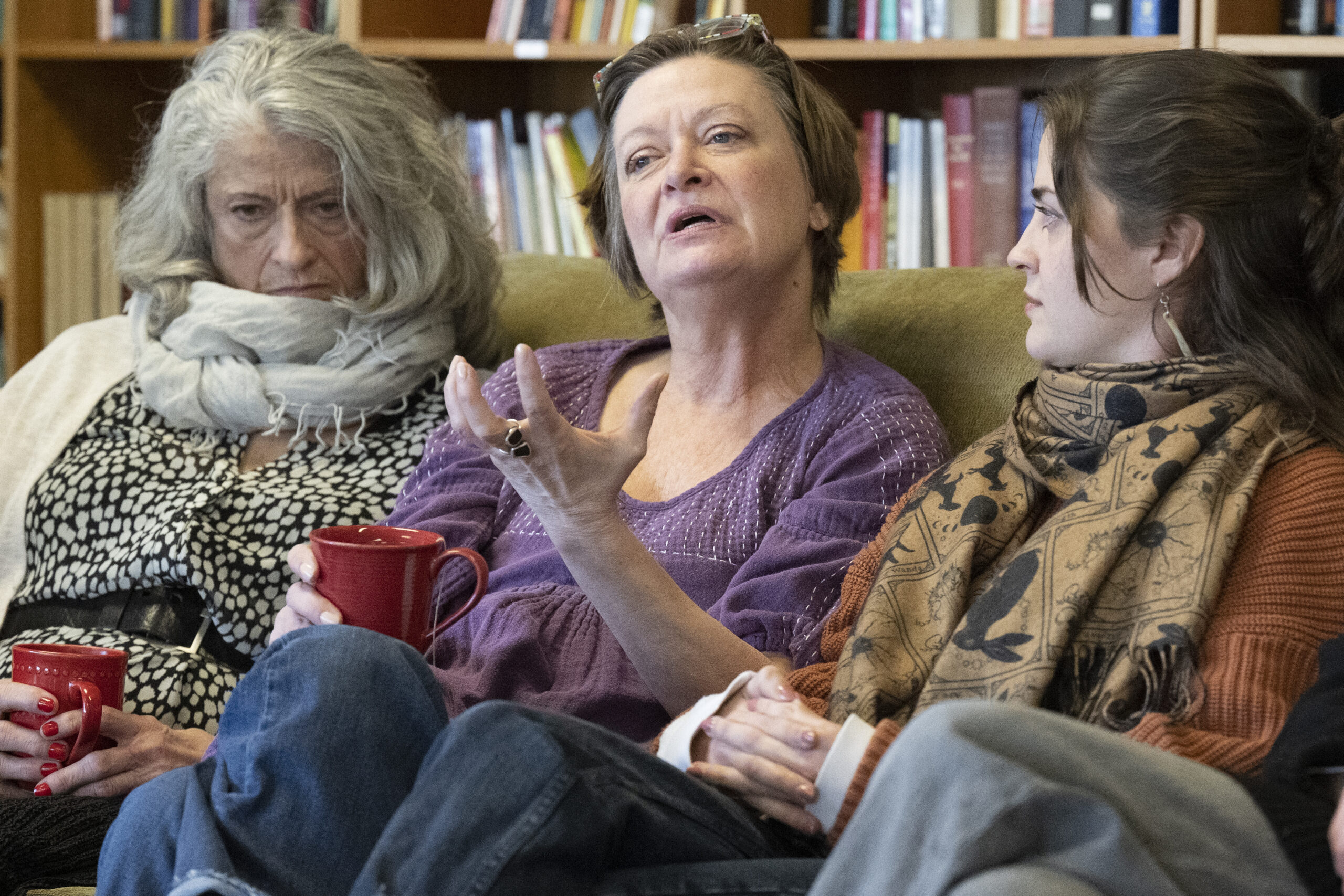
    From left, Janis Dardaris, Susan McKey, and Claire Inie-Richards, members of an all-women ensemble performing “Steel Magnolias,” speak about working together for decades — some for more than 50 years — during an interview at People’s Light in Malvern.

    Even though the viewer slowly learns more about the women’s external lives and pressures — confronting joys and tragedies — the play never leaves the salon.

    “I love how this play – it’s about these women. It’s about this place. It’s about us. And I just think that makes for such a strong story, and I think more poignant than the movie,”McKey said.

    Gauthier observed that there’s something inherent to women’s friendships in how they can discern when to tiptoe and when to confront in their care for each other.

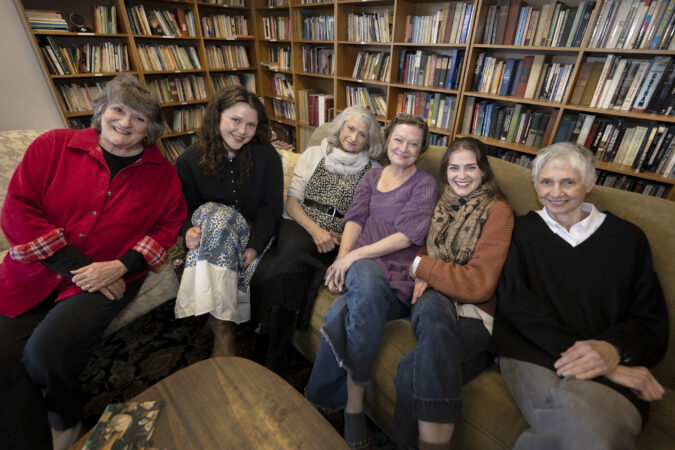
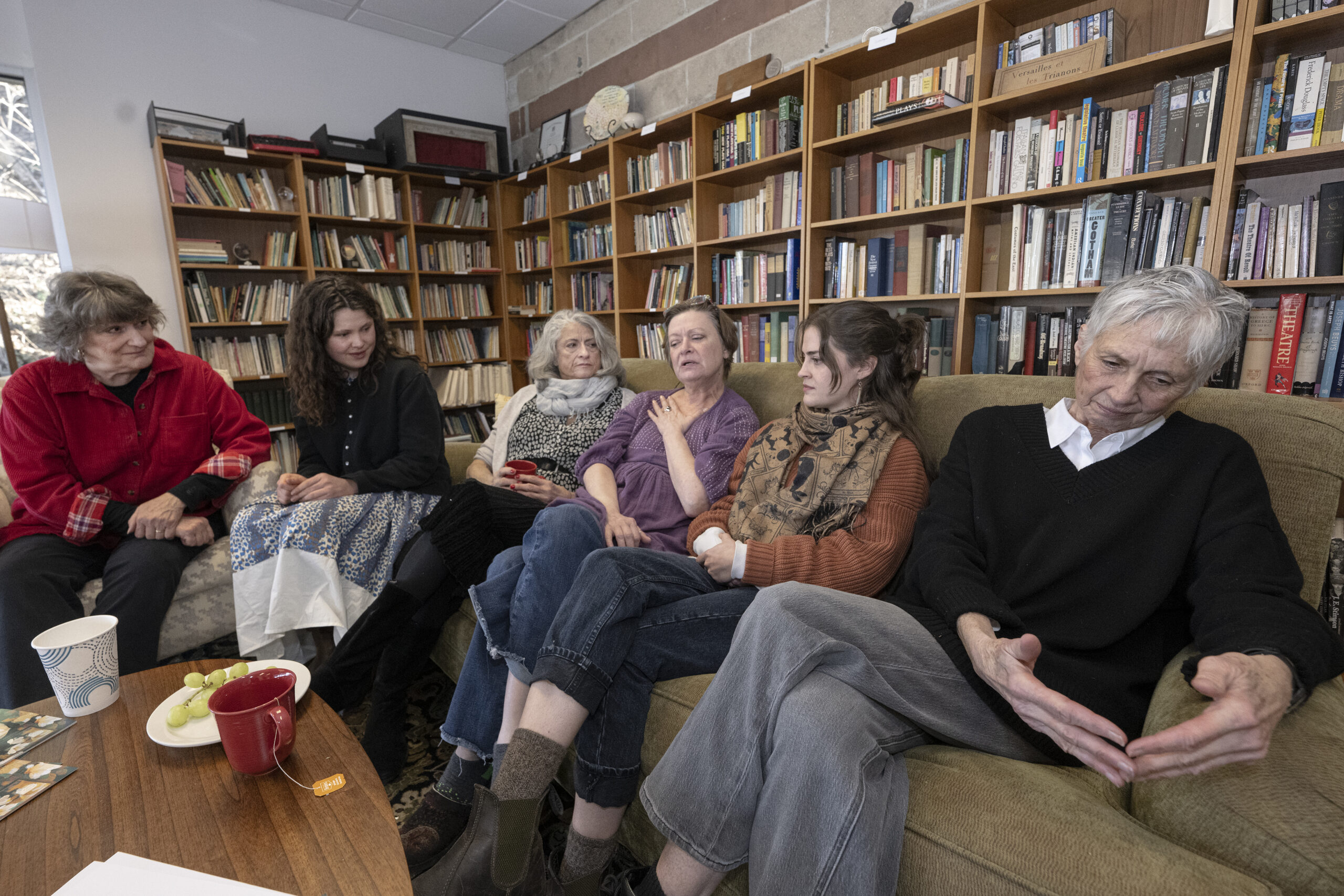
    Marcia Saunders (from left), Brynn Gauthier, Janis Dardaris, Susan McKey, Claire Inie-Richards, and Abigail Adams speak of their performing “Steel Magnolias” at People’s Light in Malvern.

    “Truvy’s place is the place where they can be fully themselves, and they really can’t be fully themselves in their domestic arrangements, not in the same way,” Adams said. “They can’t be as outrageous, and they can’t be as vulnerable.”

    It’s the vulnerability, that unyielding support for each other despite personal differences, that the women think today’s audiences will connect with. Though the story — popularized by a film adaptation released in 1989 starring Julia Roberts, Sally Fields, and Dolly Parton — is often thought about as a sentimental tearjerker, it’s injected with lightness, Gauthier said. .

    “It’s kind of like the best episode of like Friends or a TV show you really love, where you just are spending time with these people,” she said.

    “There’s always going to be intrigue and interest and drama, but there’s an element of just sitting with these people that you really enjoy and getting to experience them really fully,” Gauthier said. “It’s really nice to just have these characters that are so easy to fall in love with.”

    “Steel Magnolias” continues through Feb. 15 at People’s Light, 39 Conestoga Rd. in Malvern. Information: peopleslight.org or 610-644-3500.

  • Jeffrey A. Woodley, internationally celebrated celebrity hairstylist, has died at 71

    Jeffrey A. Woodley, internationally celebrated celebrity hairstylist, has died at 71

    Jeffrey A. Woodley, 71, formerly of Philadelphia, internationally celebrated celebrity hairstylist, scholar, youth track and field star, mentor, and favorite uncle, died Wednesday, Dec. 10, of complications from acute respiratory distress syndrome at Mount Sinai West Hospital in Manhattan.

    Reared in West Philadelphia, Mr. Woodley knew early that he was interested and talented in hairstyling, beauty culture, and fashion. He experimented with cutting and curling on his younger sister Aminta at home, left Abington High School before his senior year to attend the old Wilfred Beauty Academy on Chestnut Street, and quickly earned a chair at Wanamakers’ popular Glemby Salon at 13th and Chestnut Streets.

    He went to New York in the mid-1970s after being recruited by famed stylist Walter Fontaine and spent the next 30 years doing hair for hundreds of actors, entertainers, models, athletes, and celebrities. He styled Diahann Carroll, Whitney Houston, Aretha Franklin, Anita Baker, Angela Bassett, Halle Berry, and Tyra Banks.

    He worked with Denzel and Pauletta Washington, Eddie Murphy, Jasmine Guy, Lynn Whitfield, Pam Grier, Melba Moore, Jody Watley, and Karyn White. His hairstyles were featured in GQ, Vanity Fair, Ebony, Jet, Essence, Vibe, Vogue Italia, and other publications, and in advertising campaigns for L’Oréal and other products.

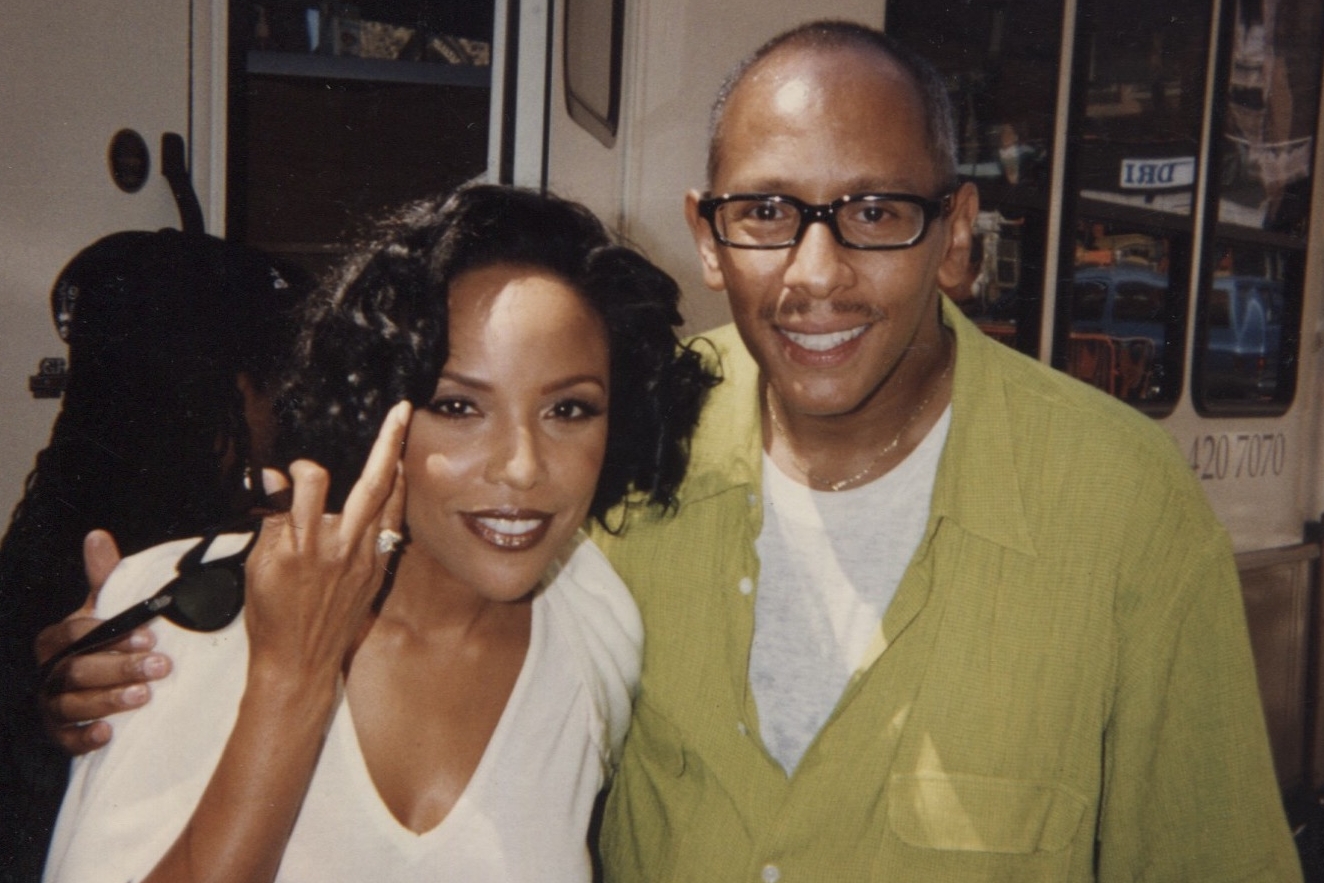
    Mr. Woodley poses with actor Lynn Whitfield.

    For years, actor Terry Burrell said, “He was the go-to hair stylist for every Black diva in New York City.” Pauletta Washington said: “He was responsible for so much of who I became as an artist and a friend.”

    Mr. Woodley worked for Zoli Illusions in New York, Europe, Africa, and elsewhere around the world, and collaborated often with noted makeup artists Reggie Wells and Eric Spearman. Model Marica Fingal called Mr. Woodley “uber talented” on Instagram and said: “He was one of the most skilled artists, creating stunning, innovative styles for models and celebs alike.”

    Friendly and curious, Mr. Woodley told Images magazine in 2000 that learning about the people in his chair was important. “A woman’s hairstyle should take into account the type of work she does, her likes, her dislikes, and her fantasies,” he said. “I’m a stylist, but I never impose hair styles on any client. When we arrive at our finished style, it’s always a collaboration.”

    His hairstyles appeared on record albums and at exhibitions at the Philadelphia Art Museum and elsewhere. He was quoted often as an expert in coiffure and a fashion forecaster. In 1989, he told a writer for North Carolina’s Charlotte Post: “Texture is the key. … Cut will still be important, but the lines will be more softened and much less severe.”

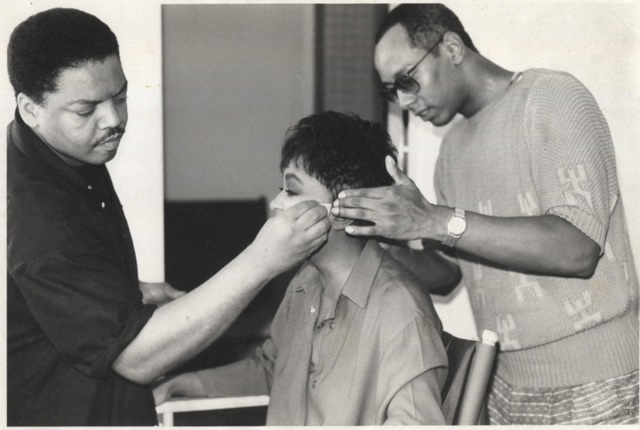
    Mr. Woodley (right) handles hair styling for singer Anita Baker while makeup artist Reggie Wells attends to her face.

    In 2000, he told Images that “low maintenance is the way of the future.” He said: “Today’s woman is going back to school. She has the corporate job. She has children that she needs to send off to school. She doesn’t have time anymore to get up and spend 35 to 40 minutes on her hair. She wants something she can get up and go with.”

    He retired in 2005 after losing his sight to glaucoma. So he earned his General Educational Development diploma, attended classes at the Borough of Manhattan Community College, and studied literature, Black history, and spiritual writing.

    “The entirety of his life was inspired by an insatiable thirst for knowledge,” said his friend Khadija Kamara.

    He was working on his memoir and still taking classes when he died. “He lived life on his own terms,” Burrell said, “and my respect and admiration for his determination will forever be inspiring.”

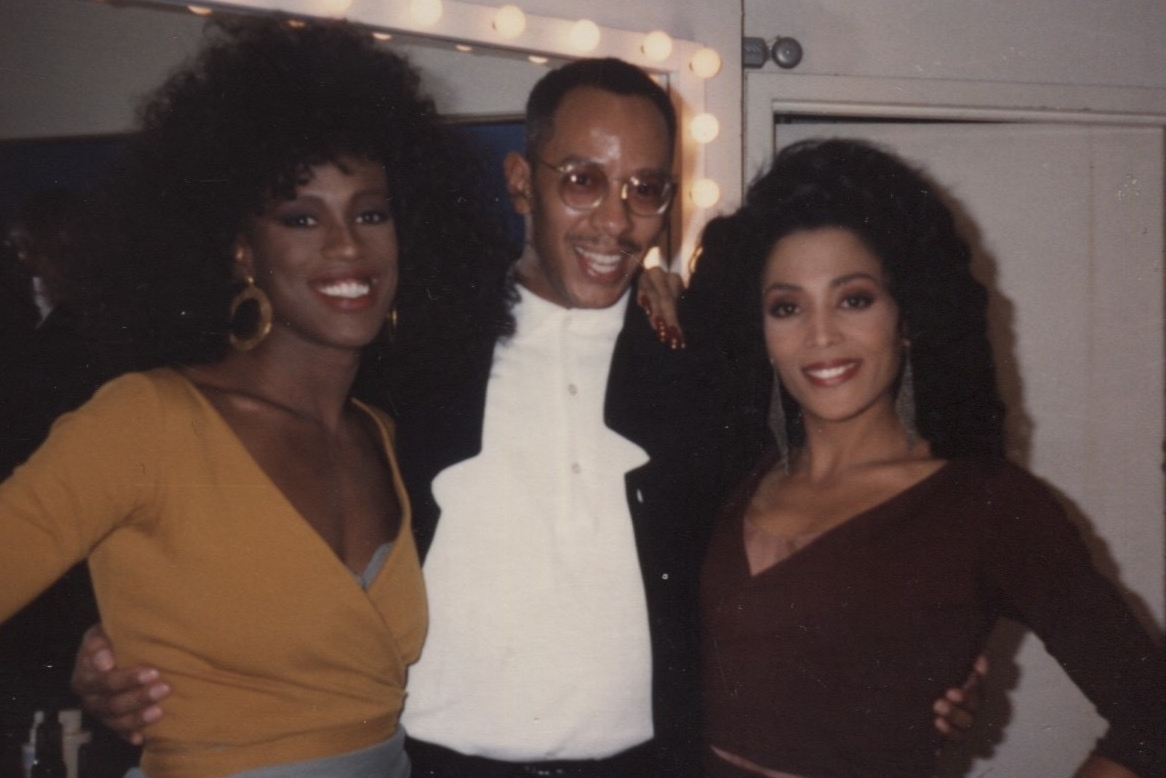
    Mr. Woodley smiles with track stars and celebrities Jackie Joyner-Kersee (left) and Florence Griffith Joyner.

    As a youth, Mr. Woodley excelled in sprints, relays, and the high jump at St. Rose of Lima Catholic School and Abington High School, and for the Philadelphia Pioneers and other local track and field teams. He ran on Abington’s 440-yard relay team that won the PIAA District 1 championship race at the 1970 Penn Relays and helped set a meet record in the four-lap relay at a 1971 Greater Philadelphia Track and Field Coaches Association indoor meet.

    Family and friends called him authentic, generous, and proud of his Philadelphia roots. He mentored his nieces and nephews and hosted them on long visits to his home in New York.

    “He was one of the most talented people around and always a lot of fun,” a friend said on Facebook. “A beautiful soul and spirit who made others beautiful.”

    Jeffrey Alan Woodley was born May 30, 1954, in Philadelphia. He had an older brother, Alex, and two younger sisters, Aminta and Alicia, and ran cross-country as well as track in high school.

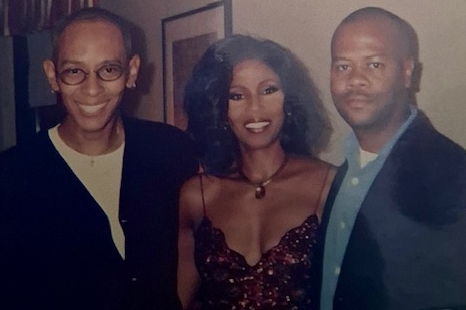
    Mr. Woodley (left) worked with actor and musician Pauletta Washington and makeup stylist Eric Spearman.

    He was always an avid reader and loved dogs, especially his guide dog Polly. He was a foodie and longtime member of the Abyssinian Baptist Church choir in Harlem. His close family and friends called him Uncle Jeff.

    “He was a fun-loving, spirited, and passionate individual,” his brother said. “Uncle Jeff loved the Lord and poured his heart into his work as well as family.”

    His sister Aminta said: “He had a wonderful spirit. He knew the Lord, lived life to the fullest, and was a joy to be with.”

    In addition to his mother, Anna, brother, and sisters, Mr. Woodley is survived by nieces, nephews, and other relatives.

    Mr. Woodley doted on his nieces and nephews.

    A celebration of his life was held Dec. 22.

    Donations in his name may be made to Abyssinian Baptist Church, 132 W. 138th St., New York, N.Y. 10030; and the Anna E. Woodley Music Appreciation Fund at Bowie State University, 14000 Jericho Park Rd., Bowie, Md. 20715.

  • Why touring ‘Suffs’ in Philadelphia under Trump is a ‘radical act’

    Why touring ‘Suffs’ in Philadelphia under Trump is a ‘radical act’

    Broadway playwright, composer, and actor Shaina Taub knows the power of theater to make a political statement. As an enthusiastic teen in Vermont, Taub staged a teach-in to protest the Iraq War at her high school — a bold move inspired by the anti-war musical Hair.

    About a decade later, when she was approached to write a musical about the suffrage movement, Taub recognized another meaningful opportunity to blend activism with theater.

    The one challenge: She was pretty unfamiliar with the American women who fought for the right to vote.

    “I really didn’t know anything,” Taub said.

    She was stunned, but her feelings turned into frustration as she concluded that her American public school education had been seriously lacking. “I was blown back by the scope of this history,” she said.

    That fueled her to create Suffs, the hit musical about the suffrage movement centered on South Jersey Quaker activist Alice Paul, a radical and charismatic organizer played fittingly by Taub herself in the Off-Broadway and Broadway runs.

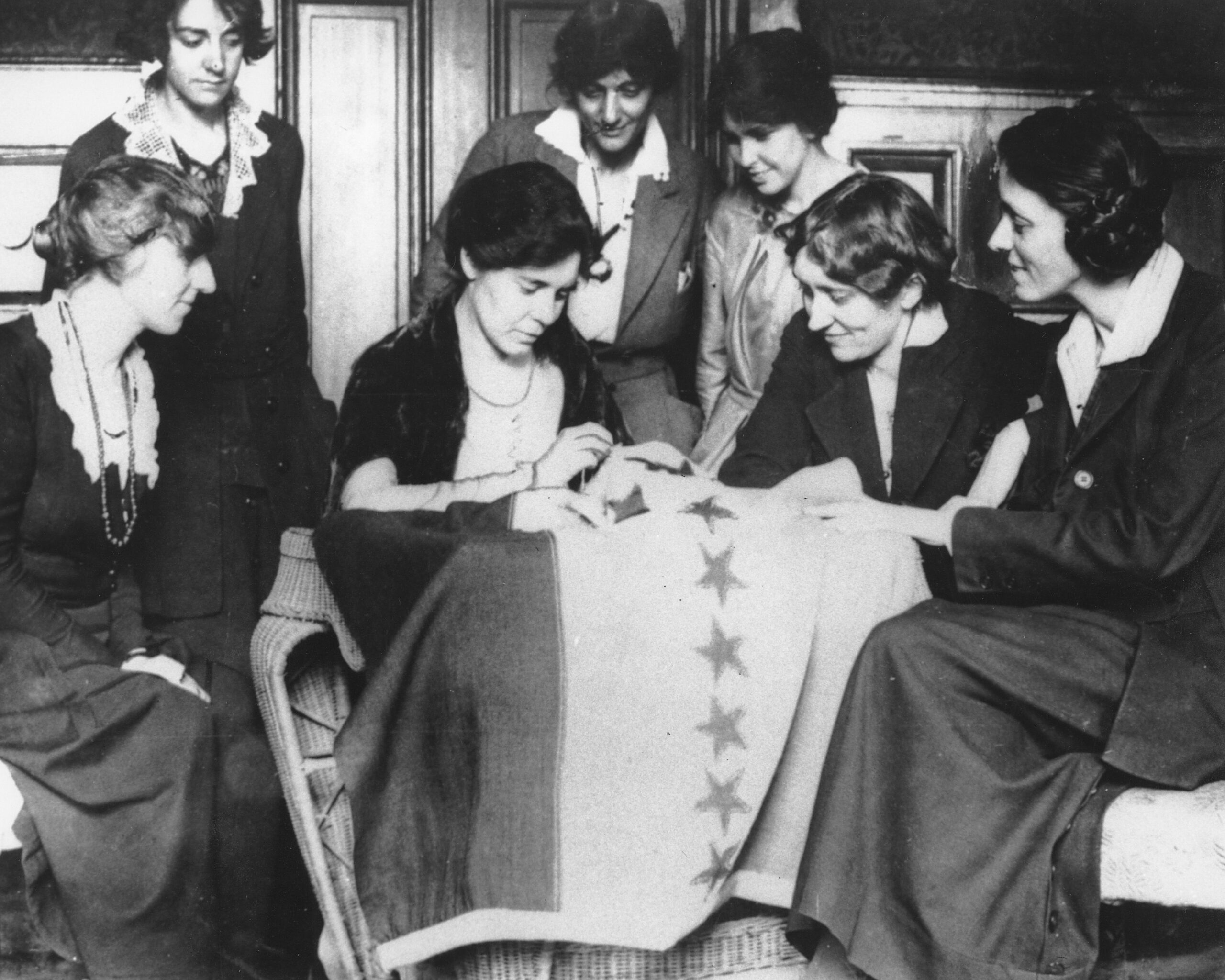
    Alice Paul, seated second from left, sews the 36th star on a banner, celebrating the ratification of the women’s suffrage amendment in August 1920. The 36th star represented Tennessee, whose ratification completed the number of states needed to put the amendment in the Constitution. (AP Photo, File)

    After premiering in 2022 at New York’s Public Theater for a sold-out run — following the trajectory of another history musical box-office success, HamiltonSuffs opened on Broadway in 2024. It went on to earn six Tony Award nominations.

    Taub took home two, for best book and best score, making history as the first woman to win in both categories independently on a night where Hillary Clinton, a Suffs coproducer, introduced Taub and the cast.

    Now on its first North American tour, Suffs has landed at Philadelphia’s Academy of Music this week (running through Jan. 18) to help kick off a year of events commemorating the 250th anniversary of the nation’s founding. The musical graces the same stage where suffragist Susan B. Anthony once spoke some 150 years ago advocating for the right to vote.

    Though mostly set in the District of Columbia, Suffs has some local shout-outs, too: The show mentions Swarthmore College, where Paul studied before pursuing her master’s at the University of Pennsylvania, and Bryn Mawr College, where President Woodrow Wilson (Suffs’ main antagonist) once taught history and politics.

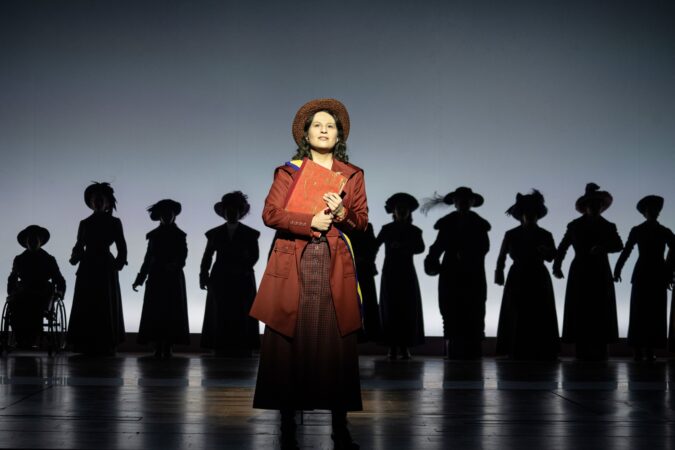
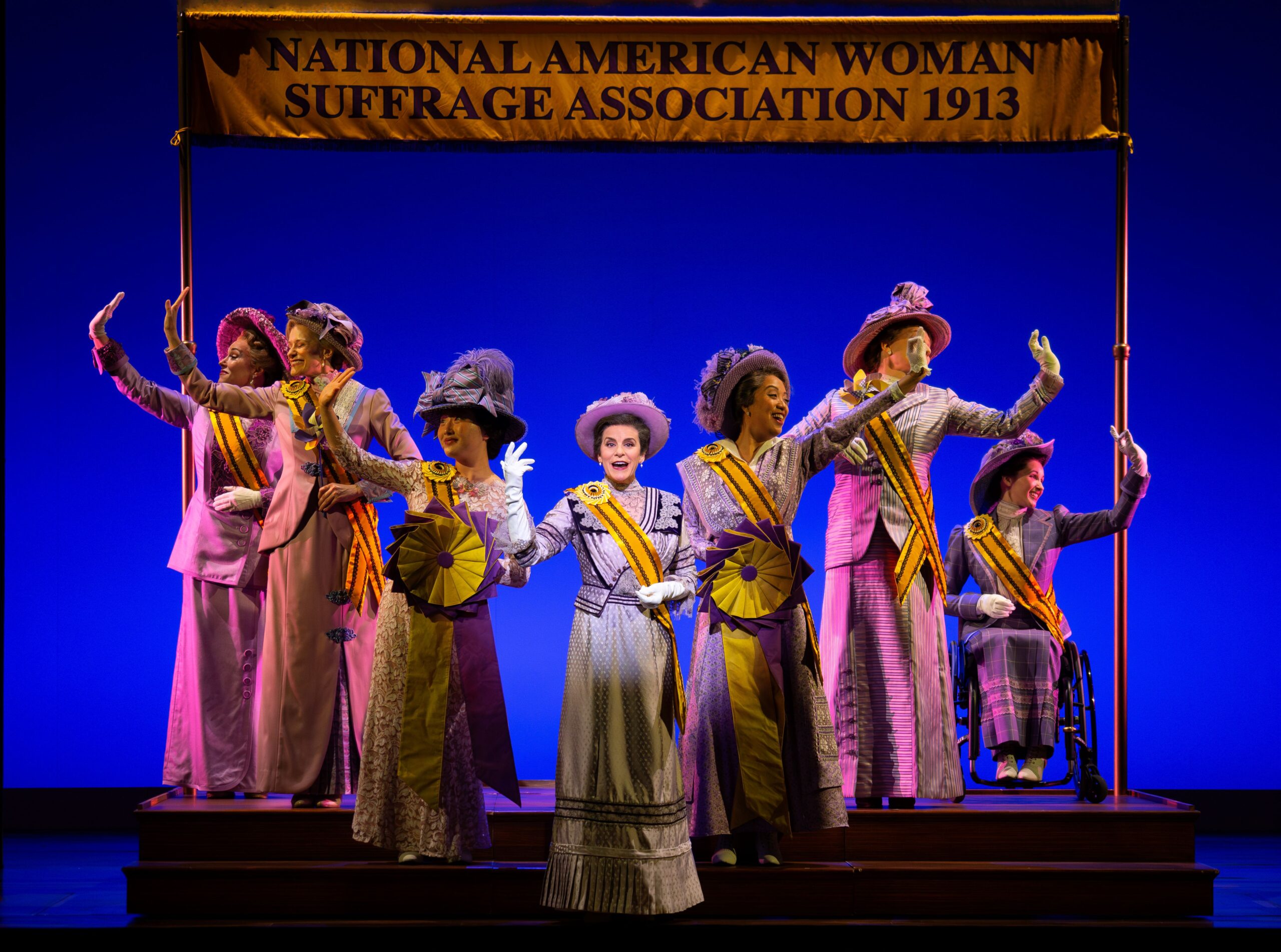
    “Suffs” on Broadway.

    On opening night at the Academy of Music, director Leigh Silverman nodded to Philadelphia’s history in the suffrage movement, mentioning the protests Paul organized at Independence Hall, only a mile away, and across the city.

    “The suffs you met tonight, and the many, many others … were here in Philadelphia, and they remind us of our collective strength and what is possible when we stand up and fight, despite how far it might seem like we have to go, or for how long we have to keep marching,” she said.

    Taub echoed that sentiment in an interview.

    She believes the tour has been especially significant to stage under President Donald Trump following his policies canceling millions in federal grants for arts organizations nationwide and targeting historical institutions (particularly in Philadelphia) to alter the information they present to the public about slavery.

    “This is the first year of Suffs being performed under this president, and [it feels like] a radical act to get together in the theater and tell these stories,” Taub said.

    She added that it’s acutely meaningful to see the show in Philadelphia as the city reflects on the nation’s history for America250 this year.

    Though the actor/playwright grew up in Vermont, she saw shows in Philadelphia as a kid when she visited family in South Jersey; her mother, Susan Taub, was raised in Cherry Hill, just a few miles down the road from Paul’s childhood home in Mount Laurel.

    Today, it serves as the location of the Alice Paul Center for Gender Justice.

    Despite her connections to the region, Taub admitted that she has not yet visited Paul’s home. She plans to march over there soon.

    “Suffs.” Through Jan. 18, Academy of Music, 240 S. Broad St. ensembleartsphilly.org

  • From a world premiere to a flying car, here are the 7 shows we loved on Philly stages in 2025

    From a world premiere to a flying car, here are the 7 shows we loved on Philly stages in 2025

    Philadelphia theaters have weathered a difficult year as arts organizations across the region faced deep cuts in federal funding. The numbers paint a somewhat bleak picture: The state lost $1,463,000 from the National Endowment of the Arts alone, and though some attendance figures have risen from last year, the performing arts sector has struggled overall to recapture prepandemic audiences.

    Yet there remain some bright signs of what’s to come next year, from Philadelphia’s massively successful Fringe Festival returning to full-year programming to a new, five-week arts festival launching for America 250 (with plans to recur on a regular basis). Plus, a program of three plays written by forever South Philadelphian and Pulitzer winner, James Ijames.

    This year, despite challenges, Philly’s scrappy, beloved, and award-winning theater community kept showing up and showing out on local stages with incredible productions and exciting world premieres.

    Here are few of our favorites from 2025.

    ‘La Otra’ from 1812 Productions

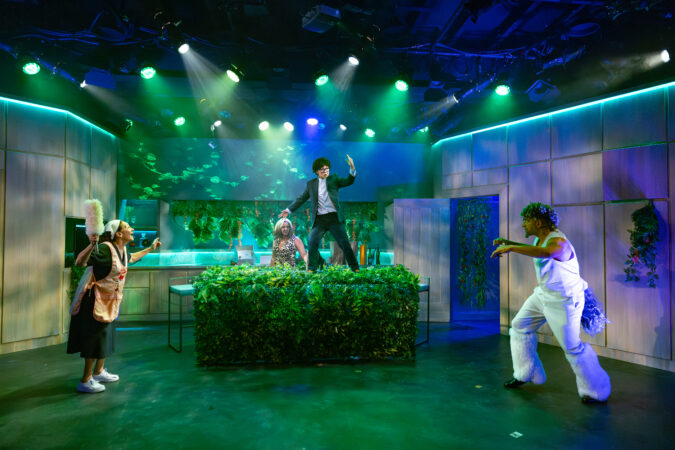
    Written and directed by Tanaquil Márquez, this Fringe Festival world premiere from 1812 Productions was a heartwarming comedy about three estranged sisters reuniting for their father’s 80th birthday party in Colombia. The real drama all happened in the kitchen as cousins played pranks, sisters bickered endlessly, and at one point the set exploded in a burst of tropical vines that broke into the realm of magical realism. The show fired on all cylinders, from the versatile cast in multiple roles, to its engrossing production design, to the sharp trilingual dialogue that echoed the rhythm and intimacy of a big family much like my own. (The clever use of subtitles ensured that no one got lost in translation, from English to Spanish to Vietnamese.) I laughed a lot, especially thanks to the standout performance from Yajaira Paredes. We named it one of the works with a high chance of post-Fringe Fest success, so here’s hoping to see it back on our stages soon.

    Valeria Diaz (Madeleine Garcia) and Professor Qiu (Justin Jain) in InterAct Theatre Company’s “Quixotic Professor Qiu.”

    ‘Quixotic Professor Qiu’ from InterAct Theatre Company

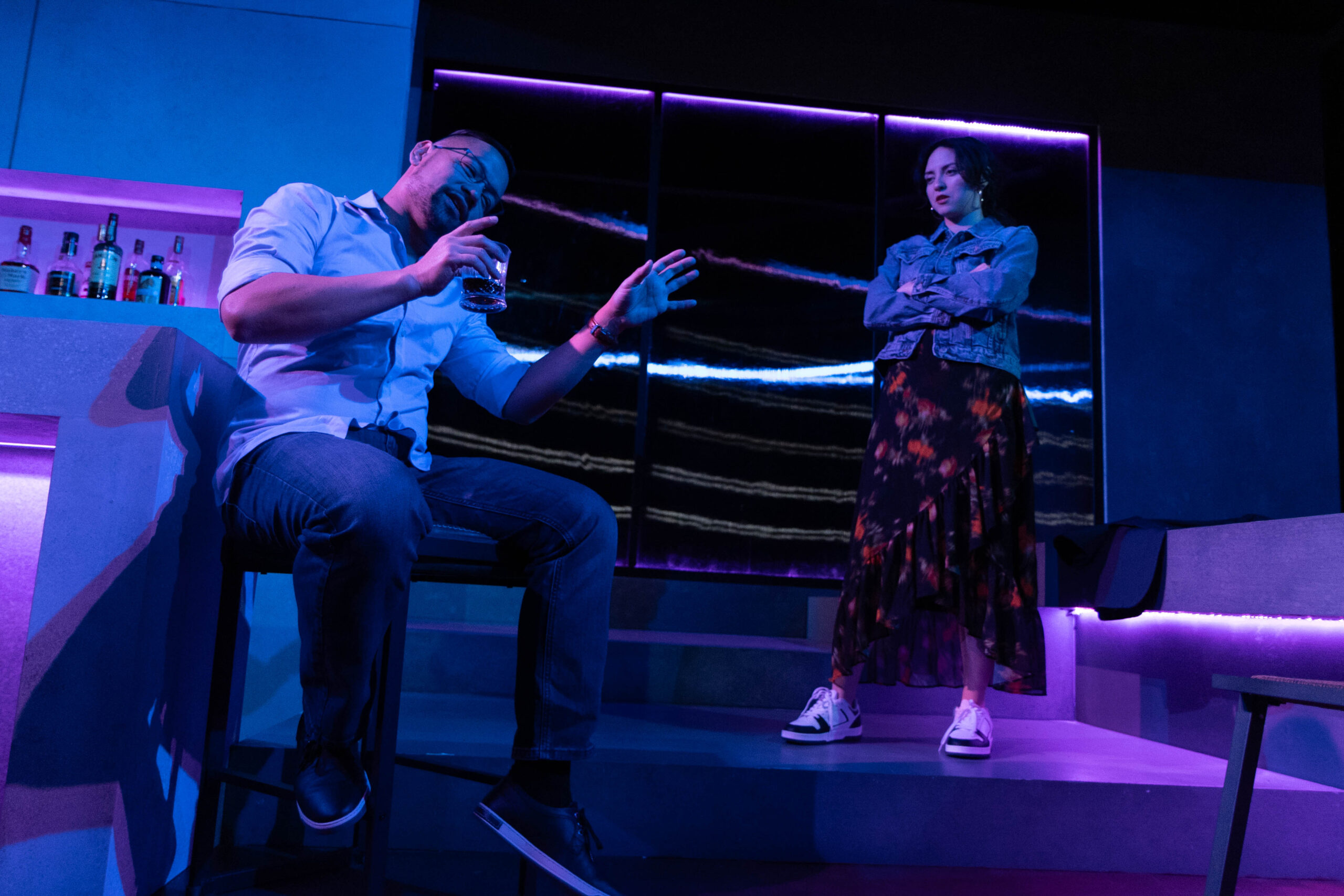
    Another promising world premiere came from playwright Damon Chua with this tense, small InterAct production following a Chinese American mathematics professor accused of being a spy. Inspired by actual instances of academics suspected of espionage, the drama provided a provocative and chilling reflection of the U.S. government’s targeting of immigrants amid the ever-encroaching creep of censorship. As the titular Qiu, Justin Jain played a convincingly aggrieved intellectual who finds the entire investigation absurd. But he’s essentially left helpless at the whims of law enforcement hell-bent on punishing him, regardless of the facts. The minimalist set centered our attention on the high stakes he faces trying to clear his name, with moody lighting that heightened our sense of dread. By the end, Jain breaks the fourth wall to underscore the message: “That’s the world we live in. That’s the world you live in.”

    ‘King Hedley II’ at Arden Theatre Company

    The Arden’s commitment to staging all of August Wilson’s Century Cycle plays is a laudable effort and each production is a major theatrical event. James Ijames directed this run with Akeem Davis playing the titular King, a struggling, formerly incarcerated man released at the height of the 1980s recession. The story depicts a harsh reality for the Black family at the center, played deftly by a well-rounded cast that pivots from warmth to fury to humor. It was not an easy watch — the tragic ending left me in tears — but it was a vital story that felt relevant, urgent, and timeless.

    Ruby (Kimberly S. Fairbanks) and Tonya (Taysha Marie Canales) in Arden
    Theatre Company’s 2025 production of August Wilson’s “King Hedley II.”

    ‘Back to the Future: The Musical’ at Academy of Music

    At the risk of being a little corny, I had a blast seeing one of my favorite classic movies adapted into a musical — mainly because the much-hyped time-traveling DeLorean was genuinely as impressive as promised. I went in thinking that the car bit would be too gimmicky, but I was proven so wrong in the best way: The masterful production design featured illusions that (tiny spoiler) made the car fly in the air. I gasped! The show also delivered transportive scenery alternating between the 1980s and 1950s, amplified by captivating group choreography and great singing. There were certainly some questionable choices, like leaning into the whole Marty-tries-avoiding-incest plot and songs that try but fail to give depth to Marty’s family. But overall, it was a lot of fun.

    ‘The Goldberg Variations’ at Fringe Arts

    Every year, Philly’s Fringe Fest delivers some of the strangest and most shocking productions with dazzling results. This was the craziest production I saw onstage this year and I’m still obsessed. It started as a petty PowerPoint presentation as the star/creator Clayton Lee explained that all his ex-boyfriends look like wrestler Bill Goldberg. It shifted into an interactive experience as Lee interviewed someone in the audience, flirting with him and asking sexually explicit questions. Then it evolved again into a wrestling ring, where Lee invited Goldberg doppelgängers (who were incognito in the audience) to the stage for a smackdown, complete with BDSM contraptions and a lot of body oil. It was a wild show that had the audience in sidesplitting laughter one moment and stunned silence the next.

    ‘Snow Queen’ at Wilma Theater

    This year, the Wilma presented its first production for all ages in this adaptation of Hans Christian Andersen’s 1844 fable (from which Disney’s Frozen also draws inspiration). Seeing a weekday matinee was such a treat because the rows were filled with eager schoolchildren who responded to the actors with infectious enthusiasm. The sprawling fairy tale features a terrifying ice queen who turns hearts cold and kidnaps a young boy named Kai. His determined friend Gerda goes on a quest to save him after he has been brainwashed. Directed by Yury Urnov, the show spotlights delightful characters with an inventive and quirky production and costume design. The heartfelt, whimsical story about the power of good over evil was a visually dazzling experience, complete with musical talent and a wonderful cast.

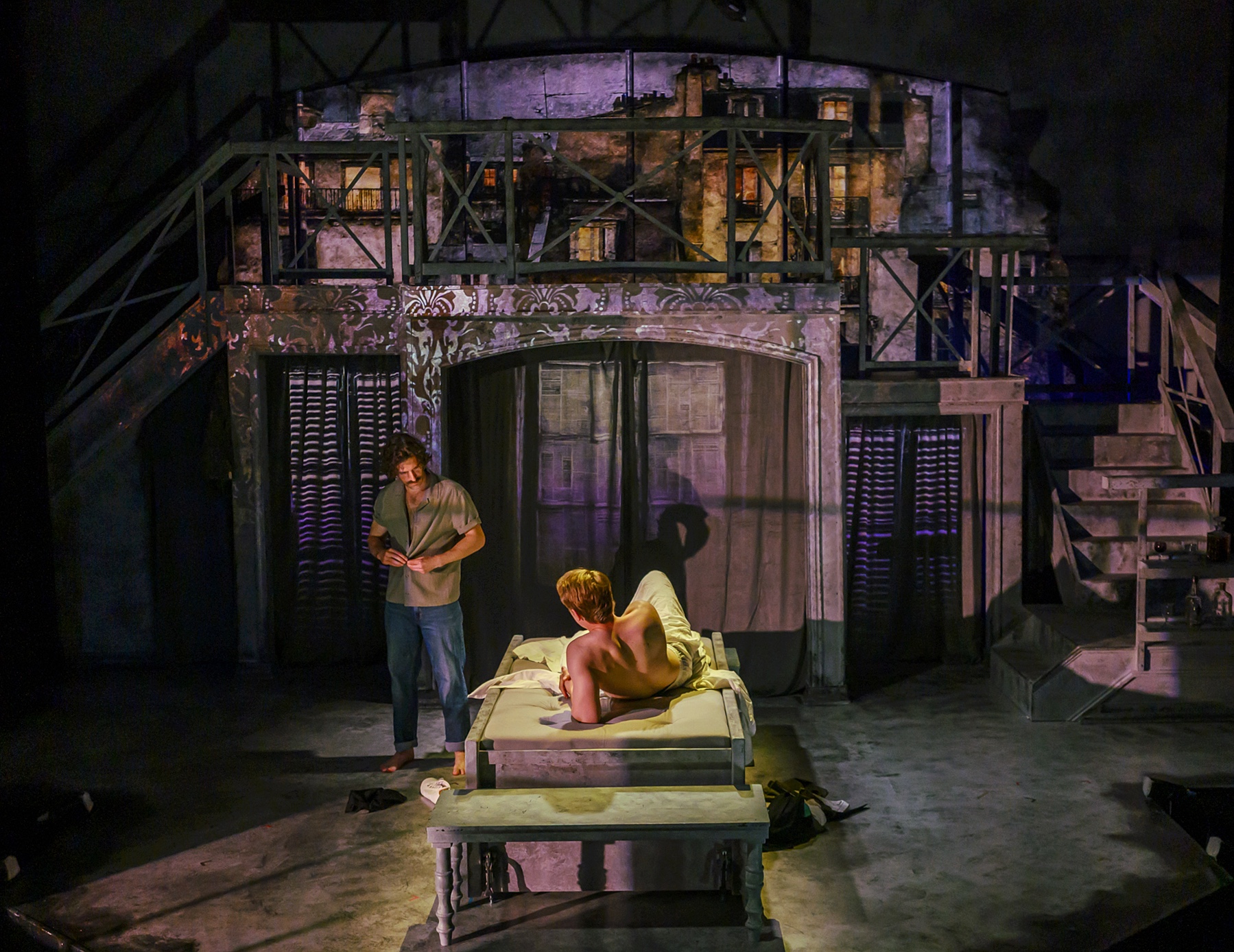
    Michael Aurelio and Ethan Check in Quintessence Theatre Group’s “Giovanni’s Room.”

    ‘Giovanni’s Room’ from Quintessence Theatre

    It may surprise people to learn that the first-ever authorized stage adaptation of James Baldwin’s classic 1956 novel Giovanni’s Room held its world premiere right here in Philadelphia. It’s certainly something to brag about: It took nearly 20 years, two rejections, and several rewrites, but actor/playwright Benjamin Sprunger and director/playwright Paul Oakley Stovall made it happen at Quintessence Theatre. The story centers on a closeted gay American who falls in love with a brash Italian bartender in Paris — and it’s no spoiler to say it ends in tragedy. The slim novel was one of Baldwin’s most popular and groundbreaking works, providing rich source material for a play. Onstage, it was a lyrical production with spellbinding light design and fascinating choreography; it was an excellent first run and I hope to see it progress in future productions, too.

  • Kennedy Center adds Trump’s name to building

    Kennedy Center adds Trump’s name to building

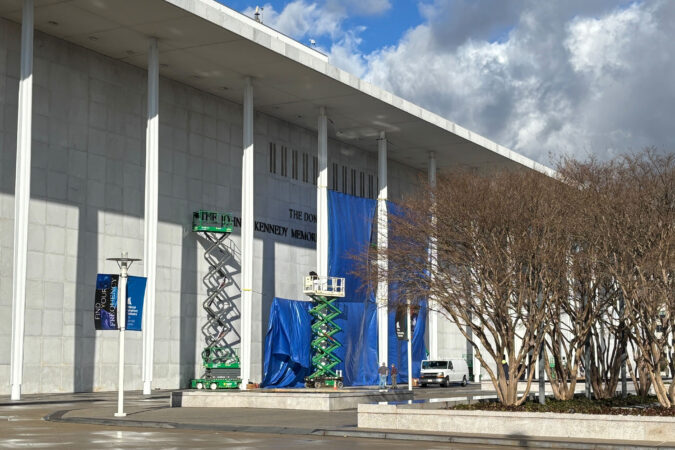
    The Kennedy Center began updating signage on the exterior of the building Friday morning, a day after its board voted to rename the institution “The Donald J. Trump and The John F. Kennedy Memorial Center for the Performing Arts.”

    A blue tarp was stretched across a portion of the building as a small team on scaffolding started the work. Loud drilling could be heard nearby. Inside the building, large letters spelling “Trump” could be seen on the floor of the entry hall, according to a photograph obtained by the Washington Post. Signage elsewhere around the exterior of the institution remained unchanged.

    Thursday’s vote by the board of trustees marked a dramatic change to a building established as a “living memorial” to a slain president. The announcement drew swift condemnation from Kennedy family members and Democratic leaders, who called it illegal and said only Congress could change the center’s name.

    For months, Trump had repeatedly joked about the name change, including at the Kennedy Center Honors earlier this month. The center has seen a year of upheaval since Trump overhauled the institution in February, sparking a wave of firings and resignations. Ticket sales have fallen sharply, according to an October analysis by The Post, and many artists have said they will no longer perform there. The new leadership has boasted of hefty fundraising tallies and has begun to ramp up bookings for Christian and right-wing events.

    “The Trump Kennedy Center shows a bipartisan commitment to the Arts,” Kennedy Center President Richard Grenell wrote Thursday on X. Officials did not cite an authority for the board’s ability to change the institution’s name.

    The current board consists of loyalists to Trump following a purge of trustees appointed by former President Joe Biden. They met Thursday in Palm Beach, Florida.

    This is not the only building to which Trump’s name has been added in recent weeks in Washington. Earlier this month, his administration renamed the building that houses the U.S. Institute of Peace downtown, emblazoning “Donald J. Trump” in several areas of the structure.

    “Boy, that is beautiful,” Trump said at the time, thanking Secretary of State Marco Rubio for putting his name on the building.

  • The many versions of ‘A Christmas Carol’ that you can watch in the Philadelphia region this season

    The many versions of ‘A Christmas Carol’ that you can watch in the Philadelphia region this season

    A story about ghosts is barely holiday season fare, but since Charles Dickens’ A Christmas Carol first published on Dec. 19, 1843, it has remained a holiday classic.

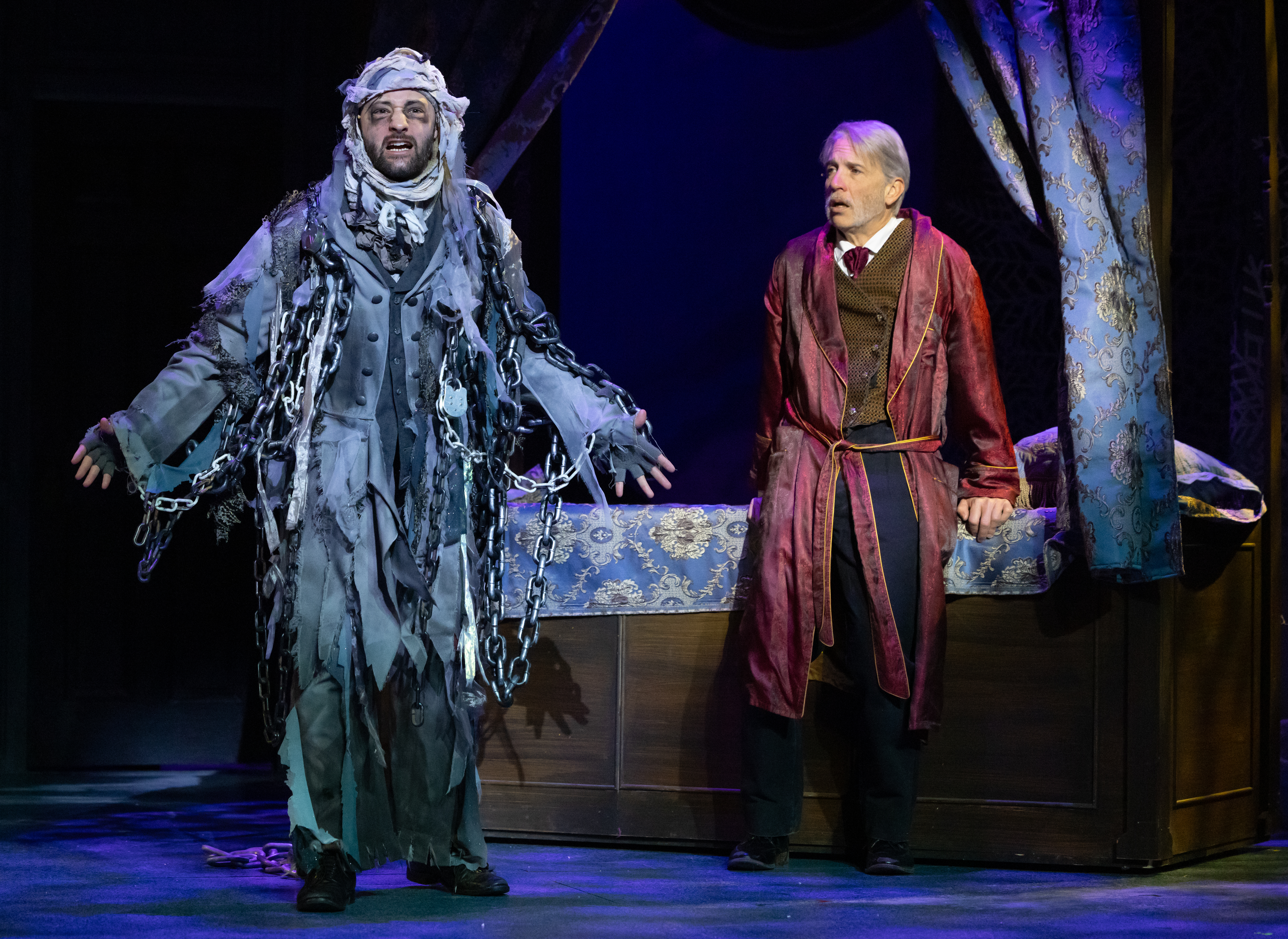
    The story of wealthy Ebenezer Scrooge being haunted by three ghosts (four if you’re counting Jacob Marley) in an effort to change his ways and save his soul, was so popular that the first printing sold out before Christmas Eve.

    The haunting narrative was almost immediately adapted for the stage, having its first production in 1844. Since then, there have been countless adaptations in just about every artistic medium. Every holiday season, theaters around the country take this wintry ghost story and add their own theatrical spin to it.

    The Philadelphia region is no different, with four productions currently underway. .

    Kouraj (left) and Righteous Jolly in “A Levittown Christmas Carol.”

    The Levittown version at New Hope Arts Center

    Dec. 18-20, 2 Stockton Ave., New Hope

    Most audiences have seen some version of this story before. While there are many direct adaptations of Dickens’ work, some take the plot and translate it into a different time and place. Such is the case with A Levittown Christmas Carol.

    This production at the New Hope Arts Center ditches the Victorian England setting in exchange for Levittown, with a healthy dose of ’80s and ’90s nostalgia thrown in for good measure.

    This adaptation, written by New Hope native Righteous Jolly, uses the story of Scrooge and spirits to explore more nuanced topics regarding the community’s history of racial segregation and the complexities of growing up among it.

    So what is it about the Dickens novella that still grabs audiences as it celebrates its 182nd anniversary?

    “Mercy, grace, forgiveness. The want to be more whole, and the subsequent excavation that sends a person to discover, what was doesn’t mean what will be, and what can be, may be even more joyous and wholesome than we could imagine,” said Jolly. $33-$39. newhopearts.org

    William R. McHattie and Michael Doheny in Walnut Street Theatre’s “A Christmas Carol.”

    The kids’ version at Walnut Street Theatre

    Through Dec. 21, 825 Walnut St., Phila.

    For some local theaters, this show has become a seasonal tradition. America’s oldest theater, the Walnut Street, puts up an annual production as part of its WST for Kids Series. It’s been around since 2001, and while there are slight changes every year, the core intention of their production is to honor Dickens’ original text.

    “For many, it is their first experience with live theater,” says Jessica Doheny, Walnut’s general manager, “which is a wonderful gift for us to share.” $24-$29. walnutstreettheatre.org

    Tony Lawton plays all the characters in the one-man version of “A Christmas Carol” at Lantern Theater Company.

    The one-man-plays-everyone version at Lantern Theater Company

    Through Dec. 28, 923 Ludlow St., Phila.

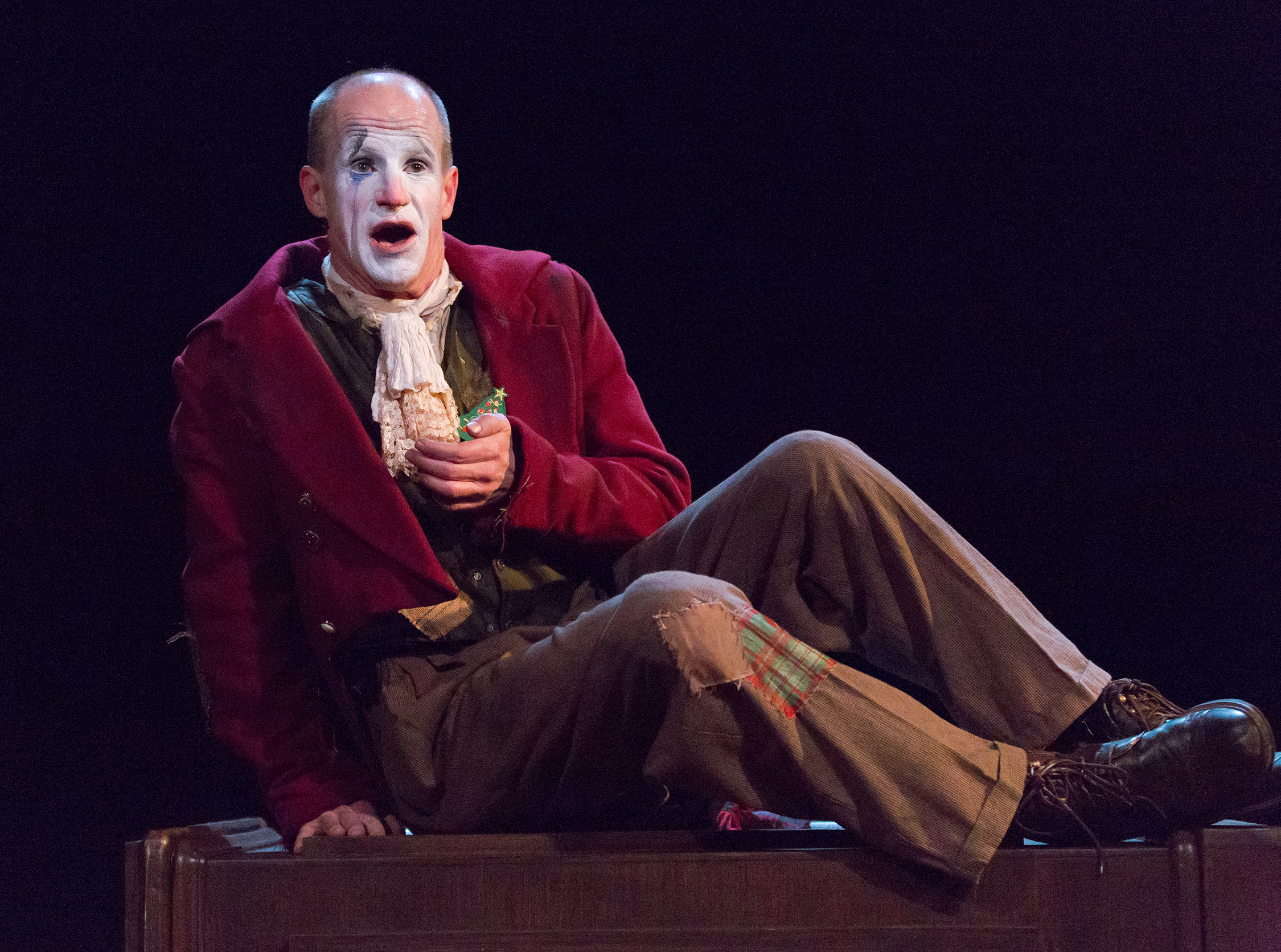
    The Lantern Theater’s version is slightly more alternative than the Walnut’s. Here, longtime Lantern Theater collaborator Anthony Lawton revives the show and performs all the characters in the story. Originally presented in this form in 2018, the production, now in its seventh year, has become a bit of a Philadelphia tradition. “When a great story is told effectively, we want to experience that story over and over again because it moves us,” says Stacy Dutton, executive director of Lantern Theater Company. $32-$40. lanterntheater.org

    Ian Merrill Peakes and Anna Faye Lieberman in People’s Light’s “A Christmas Carol” panto.

    The panto version at People’s Light

    Through Jan. 4, 39 Conestoga Rd, Malvern.

    Another theater looking to create an annual holiday tradition is People’s Light in Malvern.

    “Rituals are what make holidays so special. Nothing competes with being with loved ones and doing the same thing together each season,” said Zak Berkman, artistic director of People’s Light. “Our holiday musical pantos at People’s Light, and now this new version of A Christmas Carol, offer a similar opportunity for families and friends to enjoy something together year after year.”

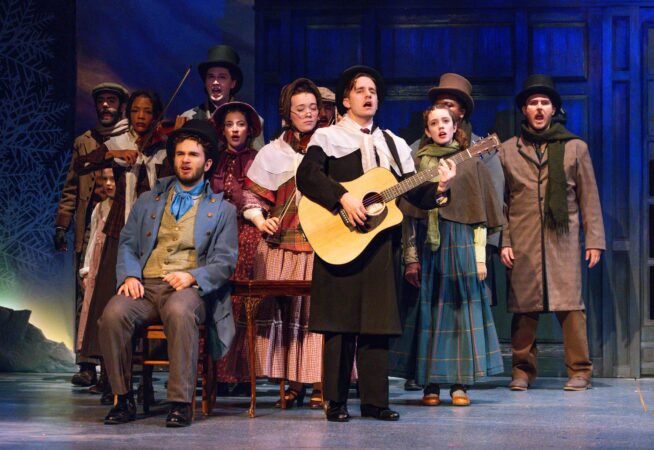
    This production takes the original Dickens narrative and puts it through the lens of a child sitting in their attic, using things around them to create the world of the story and live it out anew. The production’s original music is inspired by 19th-century carols (with a folk spin) and aids in elevating the storytelling of this production. $64-$94. peopleslight.org

  • Philly Fringe Fest is the biggest it’s ever been. Now FringeArts will offer year-round programming in 2026.

    Philly Fringe Fest is the biggest it’s ever been. Now FringeArts will offer year-round programming in 2026.

    Philadelphia’s FringeArts will return to offering seasonal programming, in addition to its monthlong Fringe Festival, beginning with a Winter-Spring 2026 season, the organization announced this week.

    The legendary festival, known for experimental and boundary-pushing theater, previously offered year-round programming before the COVID-19 lockdown in 2020. In recent years, it has seen record-breaking audience growth, prompting producing director Nell Bang-Jensen to expand beyond the month of September.

    “I’m really proud to say [Fringe Festival 2025] was actually, numbers-wise, our most successful festival ever, which just feels like a light shining, in terms of arts organizations having a win right now,” said Bang-Jensen, who took the helm last year after serving as Theatre Horizon’s artistic director. “It’s an experience that can’t be replicated on a screen, and an experience that celebrates Philly, and I think people are really here for that.”

    The Philly Fringe is one of the largest festivals of its kind in the country. Based on the number of participating venues across the city, Bang-Jensen said, Philly Fringe ranks first ahead of other notable festivals in Rochester, N.Y., and Minneapolis.

    The 2025 Fringe Festival was the largest-ever produced in its 29-year history with 353 shows. More than 35,000 tickets were sold during the month of September, which was a record high, and saw a 17% increase in unique ticket buyers from last year, which “means it’s not just the same people buying more tickets,” said Bang-Jensen.

    She added that they have seen success in reaching younger audiences this year as well, with more than half of the audience composed of Millennials and Gen Z for the first time.

    For the Winter-Spring 2026 season, FringeArts will present four productions from local and international artists at its Old City venue, along with a monthly series of Scratch Nights that invite artists to present works in progress.

    Philadelphia artist Jenn Kidwell will stage her new work “we come to collect: a flirtation with capitalism” at FringeArts in January 2026.

    Jenn Kidwell, the Obie Award-winning cowriter behind The Underground Railroad Game, will stage the Philadelphia premiere of her new work, we come to collect: a flirtation with capitalism (Jan. 22-24), with ASL artist Brandon Kazen-Maddox. It’s an irreverent exploration of “the pigsty of American consumerism.”

    Frequent Fringe artist Lee Minora will bring back her solo show, Baby Everything (Feb. 26-28), for another run. The interactive performance follows a protagonist who doomscrolls through her anxieties about the state of the world. Minora “challenges us to see ourselves as others do, no matter how endearing or insufferable,” wrote Julie Zeglen in The Inquirer’s roundup of the best shows of Fringe Fest 2025.

    Japanese artist Hiroaki Umeda is globally renowned for combining choreography and dynamic digital staging. He’s presenting two shows on a U.S. tour as a double billing: Moving State 1 and the solo performance, assimilating (March 14-15).

    Lastly, FringeArts will stage Girl Dolls: An American Musical (May 8-17) from Philadelphia artists Jackie Soro and Pax Ressler, who’ve teamed up with the Bearded Ladies Cabaret for a production billed as “part tea party, part identity crisis.” They ask, “What does your favorite doll reveal about your childhood trauma?”

    In addition to year-round programming, FringeArts will launch an artist-in-residency program for fostering original works. The Albert M. Greenfield Residency at FringeArts — funded by the local foundation of the same name — will invite three individuals or artist groups to develop new theatrical productions. The inaugural 2026 recipients will be selected by a panel of Philadelphia creatives.

    Bang-Jensen said she’s grateful that Philly audiences have shown up for the “city of makers” every year and she hopes to continue expanding FringeArts’ reach.

    “As many arts organizations are actually feeling pressure in 2025 just based on the economic environment and the political environment to do work that’s a little more mainstream, we have this wide-open field to do more for people who like things off the beaten path,” said Bang-Jensen.

    Tickets for FringeArts’ Winter-Spring 2026 season go on sale to FringeArts members on Dec. 10 and the public on Dec. 12 at fringearts.com.