Category: Business

Business news and market updates

  • The first Philly-area Sheetz is set to open next month across from a Wawa

    The first Philly-area Sheetz is set to open next month across from a Wawa

    Sheetz’s encroachment into Wawa territory has an official ETA.

    The Altoona-based convenience store chain is set to open its first Philadelphia-area store on Feb. 12 in Limerick Township, Montgomery County, according to Sheetz public affairs manager Nick Ruffner.

    It will be located at 454 W. Ridge Pike, across the street from an existing Wawa.

    Sheetz presented its site plans to Limerick’s board of supervisors about a year ago. The area was already zoned for this type of development, officials said at the time, and no other township permits were required.

    “As Sheetz continues its expansion into communities near its existing footprint, we remain committed to being the best neighbor we can be and delivering the convenience, quality, and service Pennsylvania communities have come to expect from us for more than 70 years,” Ruffner said in a statement.

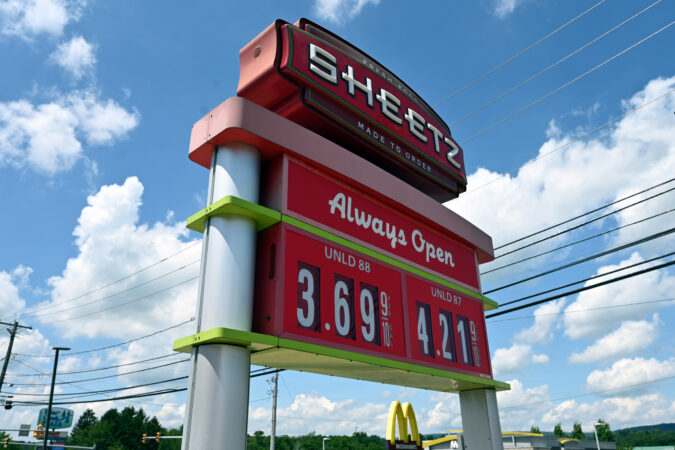
    A Sheetz convenience store and gas station near Carlisle, Pa. in 2020.

    For decades, Sheetz opened its convenience-store gas stations in the western and central parts of the Commonwealth, while Wawa added locations in communities near its Delaware County headquarters.

    Over the years, both companies expanded into other states: Wawa has more than 1,100 locations in 13 states and Washington, D.C., while Sheetz has more than 800 stores in seven states.

    But neither of the two chains would encroach on the other’s traditional strongholds in Pennsylvania. At least for a while.

    That changed in 2024, when Wawa opened its first central Pennsylvania store. The location outside Harrisburg was within eyesight of a Sheetz.

    In 2024, Wawa moved into Dauphin County, just 0.3 miles down the road from a Sheetz.

    By this October, Wawa announced it had opened its 10th central Pennsylvania store. At the time, the company said in a news release that it planned to add five to seven new locations in the region each year for the next five years — to “reach new Pennsylvania markets along the Susquehanna River.”

    Wawa plans to open its first outposts in the State College area, near Penn State’s campus.

    As of early January, Sheetz’s closest store to Philadelphia is just over the Chester County border in Morgantown.

    But along with the forthcoming Limerick location, Sheetz has also expressed interest in opening at least one store in western Chester County.

    For awhile, Sheetz, shown here in Bethlehem, Pa. in 2018, and Wawa expanded in different parts of the state, never overlapping into the other’s territory. That’s changed.

    This fall, Sheetz presented Caln Township officials with a sketch plan for a store on the site of a former Rite Aid on the 3800 block of Lincoln Highway in Thorndale, according to the township website.

    Sheetz’s namesake, Stephen G. Sheetz, died Sunday due to complications from pneumonia. The former president, CEO, and board chairman was 77.

    “Above all, Uncle Steve was the center of our family,” Sheetz president and CEO Travis Sheetz said in a statement. “We are so deeply grateful for his leadership, vision, and steadfast commitment to our employees, customers, and communities.”

  • A new $50 million investment fund will back Penn life sciences startups

    The University of Pennsylvania, German biotech firm BioNTech, and Osage University Partners, a Bala Cynwyd venture capital firm, have formed a $50 million fund to back early-stage life sciences startups at Penn, the partners announced Friday.

    The announcement came on the eve of the much-hyped annual J.P. Morgan Healthcare Conference in San Francisco, which starts Monday. The conference has become a way to measure the mood of the biotech sector, which has slumped after investment peaked in 2021. It’s been particularly difficult for early-stage biotech companies to raise money in recent years, according to a recent J.P. Morgan report.

    For Penn scientists and company founders, the so-called Penn-BioNTech Innovative Therapeutics Seed Fund, or PxB Fund for short, will step into that gap. It is designed to invest in companies that are developing new therapeutics, diagnostics, and research tools.

    The announcement did not include a breakdown of how much money each of the three backers provided. Osage University Partners, which has $800 million under management and had previously invested in at least 10 Penn spinouts, will run the fund.

    “Penn has a remarkable track record of creating cutting-edge startups,” Marc Singer, an Osage managing partner, said in a statement.

    He cited two deals for Penn spinouts last year: AbbVie acquired San-Diego-based Capstan Therapeutics for up to $2.1 billion, and Kite paid $350 million for Interius BioTherapeutics, which was based at Pennovation Works in the Grays Ferry section of Philadelphia.

    Penn was among the first six universities Osage partnered with 15 years ago when it started investing in spinouts from research universities, while allowing the institutions to share in some of the profits. This was at a time when few universities were investing in their own startups.

    Penn’s evolution as an investor in its own startups

    For Penn, that began changing about a decade ago. The university’s first investment in one of its own faculty-member spinouts came in 2016, when it invested $5 million in Carl June’s Tmunity Therapeutics. In 2018, Penn Medicine agreed to invest an additional $45 million in Penn biotech companies over three years in conjunction with outside funds.

    In December, Penn announced a $10 million fund that will make seed investments of up to $250,000 in companies that have at least one founder affiliated with the University of Pennsylvania. That fund is for the entire university, not just life sciences.

    PxB is another part of what John Swartley, Penn’s chief innovation officer, called in an interview Friday a “constellation of different support structures and funding sources that our companies can draw upon in order to advance their opportunities and agenda.”

    Anna Turetsky, a biotech investor in New York who received her undergraduate degree at Penn and has a doctorate in biophysics from Harvard University, has joined Osage and will serve as PxB’s general partner. She said PxB is a 10-year fund and is expected to build a portfolio of around 15 companies in the early years.

    “Part of why this is a fantastic time to start this fund is that there has been a gap in venture funding for early stage startups over the last few years. Everyone wants to see clinical data these days,“ Turetsky said. If that continues, ”then in a few years, there will be no early-stage clinical companies,” she said.

    Germany’s BioNTech, which partnered with Pfizer on one of the COVID-19 vaccines that used mRNA technology developed at Penn, will use the fund to deepen its longstanding ties to Penn researchers.

    Philadelphia’s place in biotech

    Some observers of Philadelphia’s biotech sector have lamented the relative lack of local investors, which are abundant in places like Boston and San Francisco and have helped turn those metro areas into leading innovation centers.

    Quaker BioVentures was a local investment fund that raised $700 million in the early 2000s to buy into biotech firms in Philadelphia and elsewhere, but was not successful for its investors, which included Pennsylvania state pension funds.

    Others, when asked why the Philadelphia region trails Boston, San Francisco, and San Diego, as a biotech hub, point to the need for a deeper pool of management talent.

    PxB could help change that, Singer said.

    “Part of our hope with the fund is to create some companies, start from scratch, take technology, find management teams, start them in Philadelphia. Hopefully, that will create a new crop of managers,” he said.

  • How to recycle your old electronics the right way, according to e-waste experts

    How to recycle your old electronics the right way, according to e-waste experts

    If you got an iPhone, smart TV, or laptop as a holiday gift, you may be facing the age-old dilemma of what to do with your old electronics.

    Or maybe you’ve already thrown your now-outdated device in the kitchen junk drawer to languish for years alongside flip phones from the early aughts.

    “People want to do the right thing, but they don’t know what to do,” Joe Connors, CEO of the Pennsylvania-based secure e-waste recycler CyberCrunch. Something like an old TV “often ends up in their basement or in their garage.”

    There is a better way to bid adieu to these electronics, experts say, and it’s not even that complicated.

    “It’s easier than people think,” said Andrew Segal, head of operations at eForce Recycling in Grays Ferry. “A lot of people scratch their heads, [saying] ‘I don’t know what to do with this stuff.’ … [But] there are plenty of electronics recyclers out there.”

    The industry has grown in recent decades, particularly after state laws began governing e-waste recycling in the early 2000s.

    Let experts answer your questions about how to responsibly dispose of old electronics.

    Can I put TVs, phones, and other electronics out with my regular trash or recycling?

    Electronics can’t be picked up with regular trash or recycling, but they can be taken to places like Philadelphia’s sanitation services centers.

    That’s a resounding no.

    Throwing out electronics is technically illegal in Pennsylvania and New Jersey, and consumers can face fines for disposing of e-waste. As of January, 25 states and D.C. have such laws on the books.

    Leaving TVs and other large electronics outside also poses environmental risks.

    “The screens wind up getting cracked, and they get rained on, and that all can wash up into the waterways,” Segal said. “It’s not good.”

    Only put electronics on the curb if you have arranged a pickup with a certified recycler, experts say.

    It can be difficult to find a company that will pick up electronics, e-recycling executives say. Some said they used to recommend the service Retrievr, but it recently paused its Philly-area services indefinitely. If a consumer does find such a service, they say it’s likely to come at a cost.

    If an electronic is too heavy to lift alone, and you don’t want to pay for a pickup, experts recommend asking neighbors, friends, or relatives to help get the item into the car. Once you get to a collection site, they say, workers can usually take it from there.

    So what should I do with old electronics?

    Electronics are stacked on pallets at the Greensburg, Pa., facility of CyberCrunch, an electronics recycling and data destruction service, as pictured in 2022.

    Take it to a certified electronics collection site.

    “Google ‘e-waste recycling’ and see what options exist” in your area, said Tricia Conroy, executive director of Minneapolis-based MRM Recycling, which helps electronics manufacturers recycle sustainably. “Most phone carriers will recycle on the spot.”

    Other programs and services vary by location, Conroy said.

    Philadelphians can drop off items for free at any of Philadelphia’s sanitation convenience centers. And in New Jersey, you can search free sites by county at dep.nj.gov/dshw/rhwm/e-waste/collection-sites.

    Elsewhere, you can search for township or county e-recycling events. You can also bring electronics to Goodwill Keystone Area stores, Staples, or Best Buy to be recycled. Call or go online to check a store’s specific e-recycling policy before making the trip.

    North Jersey-based Reworld waste management helped design Goodwill’s program in 2024 to “address a gap in Pennsylvania’s electronics recycling infrastructure,” spokesperson Andrew Bowyer said in a statement.

    “Prior to its launch, many counties, including densely populated areas around Philadelphia, had limited or fee-based options for recycling electronics — particularly bulky items like televisions — which often led to illegal dumping.”

    Consumers can also make appointments to drop off devices at places like CyberCrunch in Upper Chichester, said Connors, whose company specializes in data-destruction, e-waste recycling, and reuse.

    About 90% of CyberCrunch’s business comes from commercial clients, Connor said. But the Delaware County warehouse, he said, accepts drop-offs from consumers, usually for no fee (with the exception of TVs, which cost money to sustainably discard, Connors said).

    What should I do before I recycle an old smartphone, computer, or smart TV?

    Consumers should take care to remove data from old smartphones before they are recycled, industry experts say.

    Delete all data, experts say.

    “Most people, once [a device] leaves their hands, they don’t think about it,” Connors said. And “people don’t think that bad things are going to happen.”

    But consumers’ digital information gets stolen every day in increasingly creative ways, Connors said.

    To be safe, Connors recommends people remove the SIM cards from all old smartphones, whether they’re sitting in a junk drawer or heading to an e-recycling facility. SIM cards hold much of a user’s important, identifying data. On iPhones, SIM cards are located in a tray on the side of the phone and can be removed by putting a straightened paper clip or similar tool into the tiny hole on the tray.

    When removing data from an old laptop, Connors recommends more than a factory reset. Take it to a professional who can wipe the computer clean entirely, he said.

    Don’t forget to also remove data from old smart TVs, where users are often logged into multiple apps, including some like Amazon that are connected to banking information, Connors said.

  • AI will drive the economy in 2026, for better or worse, economist says

    AI will drive the economy in 2026, for better or worse, economist says

    It seems like it is déjà vu all over again. The economy is growing, people are getting rich, and we are assuming the next great economic engine of growth, AI, will keep on keeping on.

    Unfortunately, history has shown us that growth, when it is not well diversified, can meet an untimely and difficult end.

    In the 1980s to early 1990s, savings and loan institutions teetered on the edge of failure. Many crashed and burned and so did the economy.

    In the second half of the 1990s, the dot.com mania spurred enormous investment — until the bubble burst, taking the economy with it.

    The mid-2000s gave us the housing bubble and the over-leveraging of the financial sector. The resulting near-total-meltdown of the world’s financial system led to the Great Recession.

    And now the economy has become dependent on artificial intelligence (AI), which has exploded with the creation of generative AI programs, new chip technologies, rapidly advancing robot technology, and the need for data centers.

    Will AI lead to an extended period of growth, or will we discover it was just another bubble?

    AI turned tepid growth into decent growth in 2025

    The economy grew moderately last year, but it needed significant help from the rush to cash in on AI.

    Spending on new data centers, servers, software, infrastructure, chip production, and everything else that goes into creating and supporting the AI computing capacity is estimated to have accounted for roughly 25% of GDP growth in the first half of 2025.

    When you account for the secondary expenditures by the public sector on things such as roads, utilities, and energy capacity, the AI capital expenditure binge impact on growth was even greater, as much as 30%.

    But there is more.

    AI-driven labor productivity gains are just starting to appear. It is hard to estimate how much AI has or will add to output per worker. But it will.

    Essentially, AI likely boosted 2025 growth from a tepid 1.5% to about 2%.

    This year, AI-related activity could be the most important driver of growth.

    Has the AI exuberance reached bubble status?

    AI has kicked the nation’s competitive spirits into high gear, pulling in capital similar to the way dot.coms did during the high-tech bubble.

    Every major tech company is spending or planning to spend at levels not seen before. The approach is simple: Spend big or pack it in.

    The problem is, we have no idea who or if there will be any big winners in the race to the top of the AI world.

    And we don’t know how long the winners can stay at the top of the mountain. The pace of innovation has accelerated to the point where leaders could be taken down in a much shorter time period than previously.

    Until then, the racers are being rewarded royally. And that is a worry.

    The Morningstar US Market Index measures most of the stocks traded. Last year, the tech and communication services sectors accounted for almost 60% of the index’s rise. Chipmaker Nvidia by itself accounted for about 12% of the total market’s gains.

    When it comes to the equity markets, it has been all about AI and its associated industries.

    That raises the question: Are the equity markets suffering from what former Fed Chair Alan Greenspan called “irrational exuberance?”

    The answer to that question will not be known for a while. As Greenspan noted, it is really difficult to determine whether a bubble exists or has reached a dangerous level until it has actually burst.

    He also recognized that slowly letting the air out of the bubble is exceedingly difficult without causing a recession. Greenspan’s successor, Ben Bernanke, learned that lesson all too well when he thought the housing market was headed for a soft-landing. Whoops.

    That’s the fear. The dot.com bubble was not a problem until it was a really big problem. Housing was not a problem until it was an even bigger problem and nearly took down the world economy.

    Now, few believe the concentration of growth in AI is a problem.

    What does this all mean?

    There are some lessons we can learn from the tech collapse.

    Dot.coms were going to change the world and guess what, they did! It’s just that there were too many of them and some were too far ahead of the times. Some had brilliant ideas that didn’t survive the competitive meat grinder. Some just ran out of money, especially when the bubble started to burst.

    And some just had products or services that were readily reproducible by competitors. Being first in or early leaders didn’t ensure survival. Remember BlackBerry, AOL, Netscape, and Myspace?

    Will we wind up with so many competitors that the demand cannot support all of them?

    Unlike the tech bubble, the other bust periods don’t tell us much.

    The S&L crisis was due to regulatory changes that essentially made those financial institutions zombies. That is not the case now.

    The housing bubble bursting caused a financial crisis because the sector became way overleveraged. The regulators were asleep at the switch. It’s not clear how regulation fits into today’s situation.

    Most of the companies fighting the AI survival of the fittest test are massive and at least for now financially capable of carrying on the fight for an extended period.

    But there is a problem that the Federal Reserve faced when the financial crisis reached its peak: Are there companies that are too big to fail?

    Few thought the biggest banks could be taken down so easily, but almost all needed bailout funding to survive.

    And that is my concern. The tech behemoths need to show the value of AI to the economy as a whole. They need to start generating real earnings this year. And they need to show that having a data center on every corner is a sustainable business model.

    AI holds out great hopes for the economy, but significant risks as well. Those hopes will be confirmed if at the end of the year we are saying “AI that” instead of “Google that.”

  • How student loans and financial aid are changing in 2026

    How student loans and financial aid are changing in 2026

    The landscape for financial aid is about to change.

    In 2026, the federal government will curb access to billions of dollars in student loans, reconfigure how borrowers repay their debt, and provide new grant money for short-term career training programs.

    All of these changes are slated to take effect in July and are the result of the One Big Beautiful Bill signed into law in summer. The financial aid provisions in the law, which extend tax cuts from President Donald Trump’s first term, will affect how families pay for higher education. Since November, the Education Department has been negotiating the terms of the policies with a panel of experts, as required by Congress. Terms for the new rules will be finalized early this year, with few anticipated changes.

    While some higher-education experts say the changes will deliver commonsense reforms, others worry they could discourage college enrollment and persistence. Either way, students entering college in fall 2026 will encounter a very different federal financial aid system.

    Here’s what you need to know.

    Student loan limits

    In one of the largest revisions to federal student loan policy in decades, the Education Department will impose new caps on the amount of money graduate students and parents can borrow from the government.

    The Grad Plus program, which lets students borrow up to the full cost of attendance to pay for graduate degrees, will sunset on July 1 for new borrowers. At the same time, people pursuing a master’s degree will have their borrowing capped at $20,500 a year and $100,000 over a lifetime. Those working toward a professional degree — say, an aspiring doctor or lawyer — will be capped at $50,000 a year and $200,000 in total from the federal government.

    In all, students will now face a lifetime maximum borrowing limit of $257,500 for undergraduate and graduate school federal loans combined. If those amounts are not enough to cover costs, students will have to pay the rest themselves or turn to private lenders.

    The distinction between graduate and professional degree programs has been a lightning rod for controversy. Nurses and others have railed against the Education Department’s proposal to exclude their fields from the higher loan limits. They worry the agency’s move to restrict the professional degree classification to 11 fields will discourage people from enrolling in other advanced degree programs.

    The proposal must still be published for public comment before it can be finalized, which allows its detractors to fight for a broader classification.

    Researchers say a substantial number of students pursuing master’s degrees will be affected by the new limits. An analysis by the Federal Reserve Bank of Philadelphia found that one-third of graduate students with federal loans have borrowed more than the new limits will allow. Research from the Postsecondary Education & Economics Research at American University found that students in professional programs are more likely to borrow in excess of the new limit.

    Beth Akers, a senior fellow at the conservative American Enterprise Institute, said she suspects that many people will be caught off guard by the new constraints on graduate borrowing, and she said colleges are not doing enough to prepare.

    “There could be a private-sector solution that covers the gap,” Akers said. “But I suspect that the coordination that’s necessary for that to happen by next fall will probably not happen.”

    There have been a lot of conversations among schools about offering institutional loans to help graduate students in need, said Scott Z. Goldschmidt, a partner at the law firm Thompson Coburn who works with higher-education clients. He said colleges are also exploring private loan alternatives and trying to identify scholarship opportunities.

    Limits on parents

    While the tax bill left undergraduate loan limits intact, it will affect how much parents can borrow to support students working toward an associate’s or bachelor’s degree.

    Parents and caregivers could previously take out as much as their child needed to attend college through the Parent Plus program, which is designed as a supplement when other types of student aid have been exhausted. Starting July 1, the program will set new limits of $20,000 a year, or a total of $65,000 per student.

    Because relatively few families use Parent Plus loans, researchers at the think tank Urban Institute estimate that the new limits will affect just 2% of students. Still, among families who rely on the loans, nearly a third will be affected by the annual cap, and 17% will run up against the $65,000-per-child total cap.

    “It will have a significant impact on a small number of people, and it will be people who we’re particularly concerned about, like disadvantaged populations who tend to use those resources the most,” Akers said.

    She hopes that colleges will provide more financial aid to lower the cost for students.

    Current borrowers are exempt from both of the new caps for three years.

    Fewer repayment plans

    The federal student loan repayment system is notoriously complex, with a multitude of options and terms that can be difficult to navigate. Instead of having seven repayment plans, new borrowers will have just two options after July 1: one standard plan and one new income-driven repayment (IDR) plan, called the Repayment Assistance Plan.

    The new standard plan will stretch monthly payments out from 10 to 25 years. The larger the debt, the longer the repayment term. Someone with an outstanding principal of less than $25,000 will repay the debt for no more than 10 years, while a borrower with more than $100,000 in federal loans will be in repayment for up to 25 years.

    Payments on the new income-driven plan will be based on a borrower’s total adjusted gross income, ranging from 1% to 10% depending on earnings. The plan cancels the remaining balance after 30 years of payments, instead of the current 20 or 25 years.

    Borrowers have to make a minimum monthly payment of $10. Those who make timely monthly payments will have their unpaid interest waived to prevent negative amortization, which happens when payments are not enough to cover the principal and interest. The plan also provides a monthly subsidy of up to $50 to ensure borrowers pay down their principal balance by at least that amount.

    An analysis from American University suggests that the principal subsidy could result in faster loan forgiveness for low-income, low-balance borrowers. Still, researchers said they worry that higher payments and a longer time before forgiveness for many low-income borrowers is likely to increase the rate of loan defaults.

    People who are currently repaying their loans can remain in any of the three existing plans that are not tied to income. Current borrowers on an income-driven plan can stay put until July 1, 2028, at which time they can switch to RAP or the original Income Based option. That income-based plan will give Parent Plus borrowers, who are barred from the new IDR plan, a repayment option tied to their earnings.

    There are some complications in consolidating the repayment plans. Congress gave borrowers enrolled in the Saving on a Valuable Education plan three years to exit, but a proposed settlement could speed up the timeline. The Education Department struck a deal in December with seven states to resolve a lawsuit challenging the legality of the Biden-era repayment plan. The agency stressed that enrollees would have a limited time to find another option to repay their debt, but it has not provided an explicit timeline.

    “Given what we’ve seen with folks not being able to enroll in plans and being stuck in a backlog … I’m really concerned there’s going to be even more chaos and confusion,” said Michele Zampini, associate vice president of federal policy and advocacy at the Institute for College Access & Success.

    Other student advocates worry about whether the Education Department will have revamped the repayment system to reflect all of the changes in time for the graduating class of 2026.

    People entering repayment for the first time will need an updated loan simulator, for instance, to select the best repayment plan, said Melanie Storey, president and chief executive of the National Association of Student Financial Aid Administrators. Although newly minted graduates have a six-month grace period before repayment kicks in, she said colleges need to start communicating to students about their options long before then.

    “We need information and we need clarity,” Storey said. “My members are the people on the ground who have to answer questions for students, and I’m concerned that given the schedule, we won’t have answers until well into the spring.”

    Pell Grant eligibility

    There are some significant changes ahead for the Pell Grant, the largest federal grant program for low- and middle-income college students. Chief among them is the expansion of the program to include students enrolling in career training programs that range from eight to 15 weeks in duration. Those programs, which are mainly offered at community and technical colleges, must provide at least 600 hours of instruction.

    In December, the Education Department reached a consensus with negotiators on the framework of the policy, dubbed Workforce Pell. The proposal must still be published and finalized, but higher-education experts expect few, if any, changes. It calls for governors to work with state advisory boards to determine program eligibility, with a focus on courses that are in high-demand fields such as nursing aides or emergency medical technicians.

    Other new policies could change the number of students eligible for Pell Grants. This summer, the Education Department will exclude assets from family farms, small businesses, and family-owned commercial fisheries from the calculation of the Student Aid Index, or SAI — a figure used to determine a student’s ability to pay for college and the amount of aid they receive.

    And some people may no longer be able to get a Pell Grant. The Education Department will begin including foreign income in the calculation of a student’s Pell eligibility, which could reduce eligibility. Furthermore, anyone who receives enough scholarship dollars to cover their full cost of attendance will no longer be eligible to receive Pell.

    Students will also be ineligible if their families have lots of assets but appear to have little income in the calculation of SAI. A student previously could qualify for Pell despite their family having a lot of assets if their parents generated business losses that lowered their adjusted gross income. Starting July 1, an SAI that is equal to or exceeds twice the amount of the maximum Pell award will be disqualifying.

  • Trump’s tax stimulus set to keep U.S. economy on track in 2026

    Trump’s tax stimulus set to keep U.S. economy on track in 2026

    After a year of rolling policy shocks, the U.S. economy is set to get a lift from President Donald Trump’s tax-cuts package to keep the expansion on track in 2026.

    American taxpayers will get bigger refunds in the first half of this year as a result of Trump’s signature bill, economists say, with estimates for the aggregate boost ranging from $30 billion to $100 billion. Incentives for companies to invest in plants and equipment are also likely to bolster growth while lower borrowing costs, and steadier trade policy should help too.

    Still, forecasters see grounds for caution. Any burst of consumer spending from Trump’s fiscal stimulus is expected to fade as the year goes on, while tariffs will continue to weigh on small businesses especially. Unemployment is on the rise, as are concerns about affordability and inequality. The AI boom may not deliver the kind of broad-based growth its advocates promise, and the U.S. attack on Venezuela shows the potential for geopolitical instability.

    Adding it all up, economists surveyed by Bloomberg in mid-December expected growth of 2% in 2026 — the same as their forecast for 2025. That would likely be enough to extend America’s streak of outperforming its developed-world peers, though it’s a modest pace by past U.S. standards.

    “2026 is shaping up to be a decent year — not a boom, not a bust, just solid trend growth,” said Olu Sonola, head of U.S. economic research at Fitch Ratings.

    Federal Reserve officials were slightly more optimistic than Wall Street at their meeting last month, penciling in an increase of 2.3% in gross domestic product this year. The central bank’s economic staff cited fiscal policy, easier financial conditions, and a dissipation of the tariff impact as growth drivers through 2028, minutes of the meeting released recently show.

    The world’s largest economy weathered the shocks of 2025 better than most pundits predicted. After an initial slump driven by tariff front-running, growth bounced right back — and unexpectedly accelerated to 4.3% in the third quarter, according to numbers eventually published on Dec. 23 after a long delay due to the government shutdown.

    “President Trump’s economic agenda unleashed historic job, wage, and economic growth in his first term,” White House spokesperson Kush Desai said in a statement. “The Trump administration is implementing this same agenda of rapid deregulation, working-class tax cuts, full equipment expensing, and energy abundance — accelerating GDP growth and trillions in investment commitments are proof that the best is yet to come in President Trump’s second term.”

    ‘Helps us invest’

    Trump’s legislation extended income-tax reductions and added new exemptions for tips and overtime pay. Refunds will average $300 to $1,000 more than in a typical year, according to the Tax Foundation. In aggregate, economists at Goldman Sachs Group Inc. anticipate an extra $100 billion for consumers in the first half, while Citigroup Inc. put the figure at $30 billion to $50 billion.

    A longer-lasting impact will likely come from business incentives, some economists say.

    Gregory Daco, chief economist at EY-Parthenon, expects the fiscal package to lift GDP by 0.3% this year. He says some elements of the bill, like cuts in Medicaid and food-aid programs, will be a drag on growth — but reckons they’ll be outweighed by others including higher defense and border-enforcement spending, and measures to help businesses deduct the cost of investments.

    Among those anticipating a boost is Gat Caperton, who runs furniture-maker Gat Creek in West Virginia.

    “It helps us invest in our business,” Caperton said. “There’s really good high-end technology equipment that’s very competitive and very productive for us. And we will spend aggressively to buy that type of material.”

    ‘Faster gear’

    Investments like these and the Fed’s easing of monetary policy will cushion a slowing job market, according to Kathy Bostjancic, chief economist at Nationwide Mutual Insurance Co. The unemployment rate rose to 4.6% in November, the highest in more than four years, and economists predict it will average 4.5% this year.

    “Labor demand should shift into a faster gear by mid-year as businesses increase investment in response to lower interest rates and tax incentives,” Bostjancic said.

    Fed policymakers including Chair Jerome Powell have said inflation linked to higher tariffs will likely be a one-off and eventually fade. Still, the cost of living was a major issue in November’s off-year elections, where Trump’s Republicans suffered losses. Companies remain concerned about tariffs and are projecting price increases of more than 3% in 2026, according to one recent survey.

    Jonathan Echeverry’s coffee business in Montclair, N.J., had to pay out an additional $150,000 in tariffs on beans, packaging, and other imports — just as his customers are becoming choosier in their spending.

    “People are opting to buy beans to brew at home rather than to buy beverages,” said Echeverry, who co-owns Paper Plane Coffee Co. “I doubt this year will be better.”

    Most forecasters anticipate a quieter year on the trade policy front compared with the chaos of 2025 — but there’s plenty of uncertainty still. The Supreme Court is expected to rule soon on the legitimacy of some of Trump’s import taxes. The president has floated the prospect of $2,000 tariff rebate checks, which would offer another boost to growth — and further pressure on the U.S. budget deficit.

    AI spillovers

    Another unknown is artificial intelligence. The rush to build and equip data centers helped lift business investment in 2025, and the AI-led equity boom amplified the purchasing power of wealthier Americans, but there’s also concern that the technology will replace human workers.

    There’s a disconnect between multibillion-dollar announcements of new data centers and the amount of hiring they generate, according to Michael Feroli, chief U.S. economist at JPMorgan Chase & Co.

    “It’s not creating as many jobs as the big nominal numbers might imply and that’s in contrast to past capex booms,” he said. “Labor demand continues to look soft, and that leaves us worried about downside risks.”

  • Toll Brothers just named a new CEO. Here’s how much he’ll earn.

    Toll Brothers just named a new CEO. Here’s how much he’ll earn.

    Toll Brothers, the luxury homebuilder based in Fort Washington, will have a new CEO this spring.

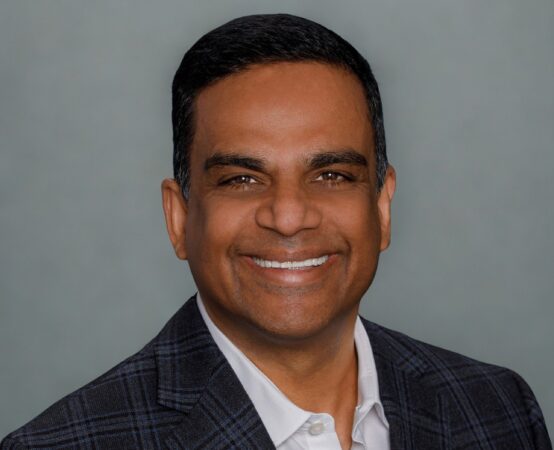
    Karl K. Mistry, an executive vice president who has been with the company for 22 years, is set to be promoted to CEO effective March 30, Toll Brothers announced Wednesday. Mistry will succeed Douglas C. Yearley Jr., who will become executive chairman of the board.

    Yearley has served as CEO since 2010, when he was given the reins by company cofounder Robert Toll during the financial crisis.

    Mistry joined Toll Brothers in 2004 and went on to hold leadership positions in the Houston and Washington, D.C., markets. Since 2021, Mistry has managed the company’s homebuilding operations in 15 states in the Eastern U.S.

    “Karl has honed his skills in both strong markets and challenging ones. He has run numerous homebuilding divisions and has overseen our expansion into several major markets,” Yearley said in a statement. “With Karl at the helm partnering with our other seasoned leaders and operating teams, the company’s future is in excellent hands.”

    Mistry is set to receive a base salary of $1 million, with annual cash bonuses of around $2.25 million, according to the company’s recent filing with the U.S. Securities and Exchange Commission.

    Karl K. Mistry, an executive vice president at Toll Brothers, is set to become the company’s next CEO starting March 30.

    Yearley, who was named one of Barron’s top 25 CEOs in 2024, made an annual base salary of $1.2 million, as well as nearly $8 million in cash incentives, according to SEC filings.

    As executive board chair, Yearley’s base salary is set to remain at $1.2 million, according to the recent filing, and his total annual compensation is expected to be $6.6 million, including cash bonuses and long-term equity, starting in fiscal year 2027.

    Toll Brothers was founded in 1967 by brothers Bob and Bruce Toll, who grew up in Elkins Park and were the sons of a homebuilder. Their company has since expanded, now building in more than 60 markets nationwide.

    Douglas C. Yearley Jr., CEO of Toll Brothers, outside a model home in Newtown Square in this 2015 file photo.

    Toll Brothers recorded a record $10.8 billion in home sales revenue in fiscal year 2025, according to the company’s most recent earnings report. But the company was less profitable than in 2024, with net income at $1.35 billion, compared with $1.57 billion the prior year.

    Last year, Toll Brothers “executed well in a choppy environment” that saw “soft demand across many markets,” Yearley said in a statement accompanying the report.

    During that time, Toll Brothers sold more than 11,000 homes for $960,000 on average, according to the report. The company described its customer base in a recent news release as “first-time, move-up, active-adult, and second-home buyers.”

  • American Airlines is launching free Wi-Fi on flights. Here’s how to access it.

    American Airlines is launching free Wi-Fi on flights. Here’s how to access it.

    Wi-Fi is coming for the skies.

    American Airlines, the largest carrier out of Philadelphia International Airport, is bringing free Wi-Fi to its fleet for members of its rewards program. The service is sponsored by AT&T and launches this month, the airline announced Tuesday.

    “Free high-speed Wi-Fi isn’t just a perk; it’s essential for today’s travelers,” said Heather Garboden, American’s chief customer officer. “Once rollout is completed, every AAdvantage member can stay connected, stream, and share almost anywhere their journey takes them for free.”

    American is not the first PHL airline to tout free onboard Wi-Fi for travelers with reward memberships. Southwest Airlines started doing so last year through a partnership with T-Mobile, and Delta announced a similar offering in 2023. United offers Wi-Fi to rewards members on some planes, provided by Elon Musk’s Starlink, and announced in October that it plans to install the service on several more aircrafts.

    American Airlines estimates that by early spring, free Wi-Fi will be available on “nearly every” one of its flights.

    Travelers need an AAdvantage account, which is free to join, to access the free Wi-Fi. The membership also allows customers to earn points and miles toward flights. Onboard, travelers must log in at aainflight.com and select the “Free Wi-Fi” option.

    Previously, all passengers using Wi-Fi had to pay for a pass or subscription. Non-AAdvantage members can still do so, said company spokesperson Bri Harper.

    Philadelphia International Airport is a hub for American Airlines, PHL’s largest airline by passenger volume, which carried nearly 20 million passengers through the airport in 2024. That’s more than five times the second largest carrier, Frontier.

    The airline was among the top 10 largest employers in Philadelphia in 2025.

  • Alveus Therapeutics, a Philadelphia start-up treating obesity, debuted with $160M in funding

    Alveus Therapeutics, a Philadelphia start-up treating obesity, debuted with $160M in funding

    Alveus Therapeutics, a Philadelphia start-up specializing in obesity therapies with top staff from Novo Nordisk and Eli Lilly, made its public debut Thursday with $159.8 million in venture capital funding.

    The announcement comes on the heels of a banner year for investment and acquisition activity in the weight loss arena, as venture capitalists and big pharmaceutical firms try to catch up to the enormous successes Eli Lilly and Novo Nordisk have had in recent years with their GLP-1 treatments.

    New Rhein Healthcare Investors, based in Philadelphia and Belgium, founded Alveus in early 2024 to develop obesity treatments that are more tolerable and have greater durability. Andera Partners, based in Paris, and Omega Funds in Boston joined New Rhein in leading the Series A investment round.

    “Obesity is one of the fastest-growing global healthcare challenges, and today’s therapies leave patients struggling to maintain weight loss over time,” Raj Kannan, CEO of Alveus, said. Kannan is based in Boston, according to LinkedIn.

    Alveus is headquartered in Philadelphia, the company said. Most research and development is in Copenhagen, Denmark. The company has fewer than 50 employee, split about evenly between Philadelphia and Copenhagen.

    The company’s chief scientific officer and head of R&D, Jacob Jeppesen, is a former vice president at Novo Nordisk in the areas of type 2 diabetes and cardiovascular disease.

    Brian Bloomquist, a former Eli Lilly vice president with responsibility in the diabetes and obesity treatment area, is Alveus’ chief business and strategy officer. The company’s chief technical officer is Xiao-Ping Dai, who spent some time working at the former WuXi Advanced Therapies in Philadelphia.

    Alveus’ lead drug candidate was licensed from a Chinese company called Gmax Pharma, an Alveus spokesperson said. Alveus also has treatments in development that it developed internally.

  • You can still be arrested in Delaware for smoking weed in public. A new bill might change that.

    You can still be arrested in Delaware for smoking weed in public. A new bill might change that.

    While weed is legal in Delaware, with a baker’s dozen worth of dispensaries to buy it from, people can still face jail time for public marijuana use under current state law.

    State Rep. Eric Morrison (D., Newark) introduced a bill last month that would ease those punishments. House Bill 252 would reduce the penalties for public marijuana consumption from a misdemeanor to a civil violation.

    “This is not saying that public consumption of cannabis is OK. It is simply making the penalty commensurate with the offense,” Morrison said. “Almost all of the states that have legalized cannabis like we have revisited their laws and changed this violation to a civil offense instead of a misdemeanor, which carries higher fines, a criminal record, and possible jail time.”

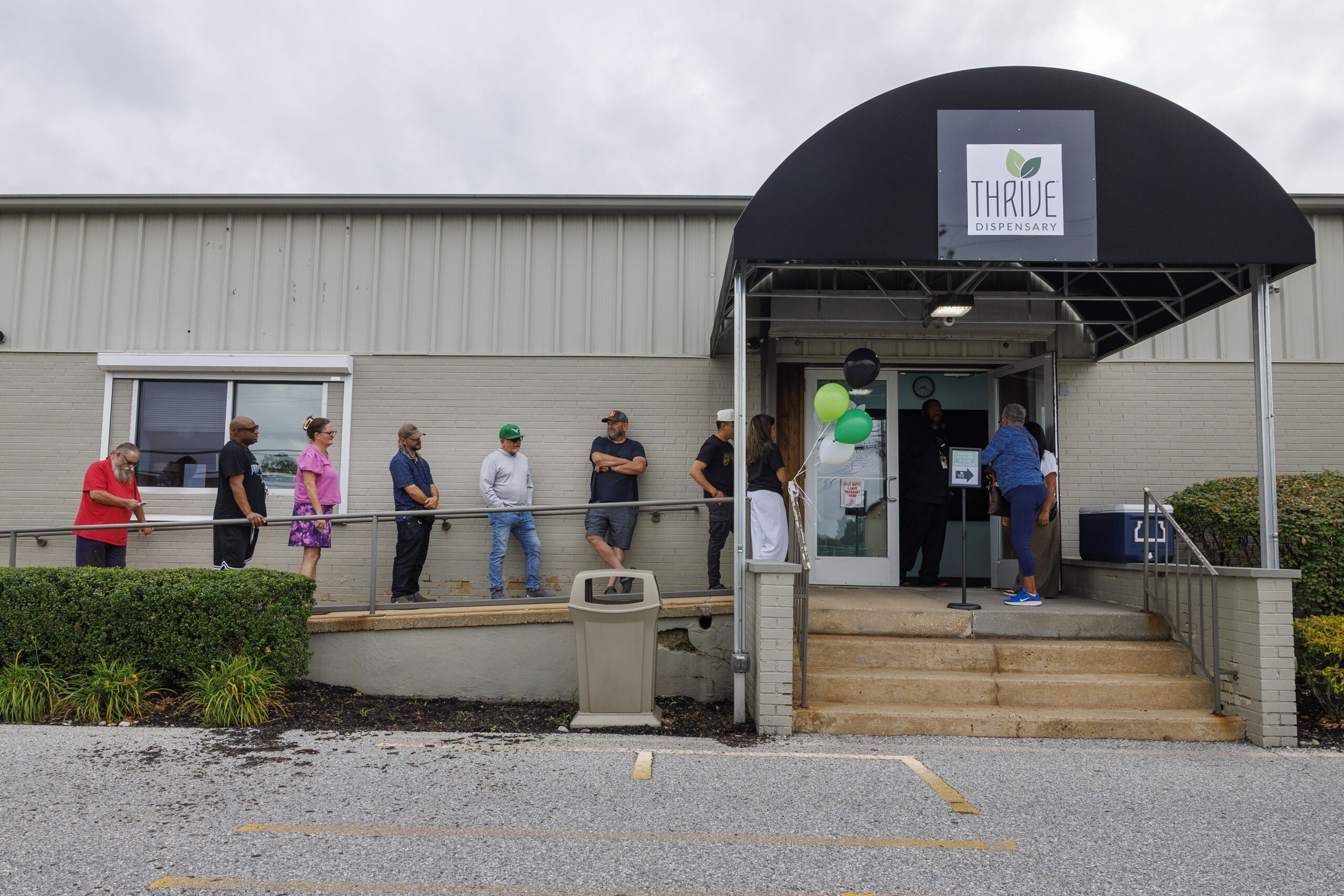
    Customers line up for the first day of recreational marijuana sales at Thrive Dispensary in Wilmington on Aug. 1, 2025.

    Currently, police can either stop and fine someone up to $200 for smoking weed in public, or officers have the option to arrest the person, with possible imprisonment for up to five days.

    Under Morrison’s bill, police can still stop people for smoking or consuming marijuana in public, but instead of a misdemeanor, the offense is considered a civil violation — similar to a traffic violation — that carries a fine of up to $50 for a first offense, and up to $100 for subsequent offenses.

    People driving a vehicle while under the influence of marijuana would still be considered a DUI.

    Delaware’s decriminalization of public marijuana use would match the policies of neighboring states, like New Jersey and Maryland, where weed is fully legal, and some Pennsylvania cities where only medical marijuana is legal, such as Philadelphia and Pittsburgh. In these places, only fines are given out, and violations do not appear on criminal records.

    New Jersey went a step further and approved the East Coast’s first legal weed lounges, which means more adults can safely and legally consume cannabis outside of their homes.

    Zoë Patchell, president of the Delaware Cannabis Advocacy Network, said some lawmakers are now correcting a policy that should have been included in the original legalization laws.

    “This simply just brings Delaware’s law in line with the standards used by most other states,” Patchell said. “This measure does not legalize public consumption. It reduces the penalty from a misdemeanor, which can result in a criminal record.”

    Criminal charges have “severe collateral consequences,” Patchell added. For example, arrest and incarceration can negatively impact someone’s health and social outcomes, like losing access to housing, financing, and employment.

    “Especially today, for people in America living paycheck to paycheck, spending time in jail can lead to lost wages or having this charge on a criminal record can lead to being terminated from your job,” Morrison said. “For a whole lot of Americans, losing any wages puts their family in a hard predicament financially.”

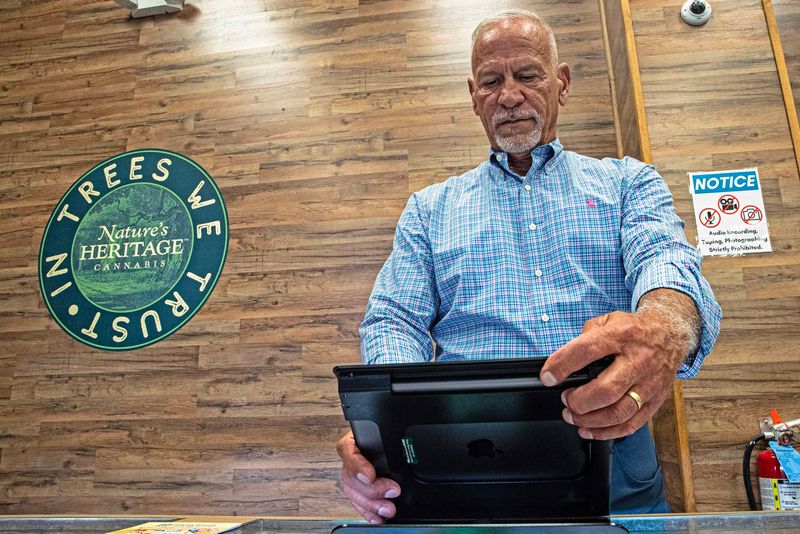
    A customer browses through product offerings on Day One of recreational marijuana sales at Thrive Dispensary in Lewes on Aug. 1, 2025.

    Delaware legalized recreational marijuana in 2023, but it took years to open legal sales to adults in recreational dispensaries. The first 13 dispensaries opened to adults last year, but advocates like Patchell say the current law makes it difficult to consume cannabis legally.

    Delaware’s laws on consumption on private property are also restrictive, Patchell said. Adults can consume cannabis on private property, but only in locations that are at least 10 feet from a sidewalk, street, parking lots, businesses, or “any other areas to which the general public is invited,” according to state law.

    “This means that someone can be arrested for consuming cannabis on their own private property,” Patchell said. This proves even more difficult for those living in households that don’t have the property space to be away from the public, she said.

    Morrison said he wants to keep working with cannabis advocates to create a safe and robust cannabis industry, but that it would be premature to say if additional measures will be taken at this time, such as amending the 10-foot rule around private property and public space.

    “For this year, [decriminalization of public use] is what I’m focused on regarding cannabis,” Morrison said.